EP2899992B1 - Schutzvorrichtung für einen tonsignalwandler - Google Patents
Schutzvorrichtung für einen tonsignalwandler Download PDFInfo
- Publication number
- EP2899992B1 EP2899992B1 EP13839688.2A EP13839688A EP2899992B1 EP 2899992 B1 EP2899992 B1 EP 2899992B1 EP 13839688 A EP13839688 A EP 13839688A EP 2899992 B1 EP2899992 B1 EP 2899992B1
- Authority
- EP
- European Patent Office
- Prior art keywords
- temperature
- coil
- circuit
- modification
- sound signal
- Prior art date
- Legal status (The legal status is an assumption and is not a legal conclusion. Google has not performed a legal analysis and makes no representation as to the accuracy of the status listed.)
- Active
Links
Images









Classifications
-
- H—ELECTRICITY
- H04—ELECTRIC COMMUNICATION TECHNIQUE
- H04R—LOUDSPEAKERS, MICROPHONES, GRAMOPHONE PICK-UPS OR LIKE ACOUSTIC ELECTROMECHANICAL TRANSDUCERS; DEAF-AID SETS; PUBLIC ADDRESS SYSTEMS
- H04R3/00—Circuits for transducers, loudspeakers or microphones
- H04R3/007—Protection circuits for transducers
-
- G—PHYSICS
- G10—MUSICAL INSTRUMENTS; ACOUSTICS
- G10H—ELECTROPHONIC MUSICAL INSTRUMENTS; INSTRUMENTS IN WHICH THE TONES ARE GENERATED BY ELECTROMECHANICAL MEANS OR ELECTRONIC GENERATORS, OR IN WHICH THE TONES ARE SYNTHESISED FROM A DATA STORE
- G10H1/00—Details of electrophonic musical instruments
- G10H1/32—Constructional details
-
- H—ELECTRICITY
- H02—GENERATION; CONVERSION OR DISTRIBUTION OF ELECTRIC POWER
- H02H—EMERGENCY PROTECTIVE CIRCUIT ARRANGEMENTS
- H02H7/00—Emergency protective circuit arrangements specially adapted for specific types of electric machines or apparatus or for sectionalised protection of cable or line systems, and effecting automatic switching in the event of an undesired change from normal working conditions
- H02H7/20—Emergency protective circuit arrangements specially adapted for specific types of electric machines or apparatus or for sectionalised protection of cable or line systems, and effecting automatic switching in the event of an undesired change from normal working conditions for electronic equipment
-
- H—ELECTRICITY
- H02—GENERATION; CONVERSION OR DISTRIBUTION OF ELECTRIC POWER
- H02P—CONTROL OR REGULATION OF ELECTRIC MOTORS, ELECTRIC GENERATORS OR DYNAMO-ELECTRIC CONVERTERS; CONTROLLING TRANSFORMERS, REACTORS OR CHOKE COILS
- H02P29/00—Arrangements for regulating or controlling electric motors, appropriate for both AC and DC motors
- H02P29/02—Providing protection against overload without automatic interruption of supply
-
- G—PHYSICS
- G10—MUSICAL INSTRUMENTS; ACOUSTICS
- G10H—ELECTROPHONIC MUSICAL INSTRUMENTS; INSTRUMENTS IN WHICH THE TONES ARE GENERATED BY ELECTROMECHANICAL MEANS OR ELECTRONIC GENERATORS, OR IN WHICH THE TONES ARE SYNTHESISED FROM A DATA STORE
- G10H2220/00—Input/output interfacing specifically adapted for electrophonic musical tools or instruments
- G10H2220/155—User input interfaces for electrophonic musical instruments
- G10H2220/351—Environmental parameters, e.g. temperature, ambient light, atmospheric pressure, humidity, used as input for musical purposes
-
- G—PHYSICS
- G10—MUSICAL INSTRUMENTS; ACOUSTICS
- G10H—ELECTROPHONIC MUSICAL INSTRUMENTS; INSTRUMENTS IN WHICH THE TONES ARE GENERATED BY ELECTROMECHANICAL MEANS OR ELECTRONIC GENERATORS, OR IN WHICH THE TONES ARE SYNTHESISED FROM A DATA STORE
- G10H2220/00—Input/output interfacing specifically adapted for electrophonic musical tools or instruments
- G10H2220/461—Transducers, i.e. details, positioning or use of assemblies to detect and convert mechanical vibrations or mechanical strains into an electrical signal, e.g. audio, trigger or control signal
-
- G—PHYSICS
- G10—MUSICAL INSTRUMENTS; ACOUSTICS
- G10H—ELECTROPHONIC MUSICAL INSTRUMENTS; INSTRUMENTS IN WHICH THE TONES ARE GENERATED BY ELECTROMECHANICAL MEANS OR ELECTRONIC GENERATORS, OR IN WHICH THE TONES ARE SYNTHESISED FROM A DATA STORE
- G10H2230/00—General physical, ergonomic or hardware implementation of electrophonic musical tools or instruments, e.g. shape or architecture
- G10H2230/025—Computing or signal processing architecture features
- G10H2230/035—Power management, i.e. specific power supply solutions for electrophonic musical instruments, e.g. auto power shut-off, energy saving designs, power conditioning, connector design, avoiding inconvenient wiring
-
- H—ELECTRICITY
- H04—ELECTRIC COMMUNICATION TECHNIQUE
- H04R—LOUDSPEAKERS, MICROPHONES, GRAMOPHONE PICK-UPS OR LIKE ACOUSTIC ELECTROMECHANICAL TRANSDUCERS; DEAF-AID SETS; PUBLIC ADDRESS SYSTEMS
- H04R9/00—Transducers of moving-coil, moving-strip, or moving-wire type
- H04R9/02—Details
- H04R9/022—Cooling arrangements
Definitions
- the present invention was accomplished to solve the above-described problem, and an object thereof is to provide a protection apparatus for a sound signal converting device, the apparatus protecting a coil and peripheral devices of the coil with high accuracy.
- numerical references of corresponding components of embodiments which will be described later are given in parentheses in order to facilitate the understanding of the invention.
- the constituent features of the invention are limited to the corresponding components of the embodiments indicated by the numerical references.
- a protection apparatus for a sound signal converting device (40), the protection apparatus protecting the sound signal converting device which has a coif (16) and converts an audio signal supplied to the coil to a sound signal
- the protection apparatus including a level controller (24, 24-1, 24-2) for supplying an input audio signal to the coil in a first state with a level of the audio signal being kept, and suspending the supply of an audio signal to the coil or decreasing the level of an audio signal which is to be supplied to the coil in a second state; first temperature measurement means (21 or 30, 104 to 108, S101, S102 or 21) for measuring temperature of the coil as a first measured temperature; second temperature measurement means (30, S13, S14 or 30, S13, S14 or 30, 104 to 108, S101, S103) for measuring temperature of the coil as a second measured temperature, independently of the first temperature measurement means; an unexpected condition controller (30, S29, S31, S33) for setting the level controller to
- the protection apparatus further includes a display unit (31); and an unexpected condition display controller (30, S16, S18, S20, S22, S24, S26, S28, S30, S32) for displaying a type of unexpected condition of the first temperature measurement means, the second temperature measurement means or the atmosphere temperature sensing means on the display unit if the level controller is set to the second state by the unexpected condition controller.
- an unexpected condition display controller (30, S16, S18, S20, S22, S24, S26, S28, S30, S32) for displaying a type of unexpected condition of the first temperature measurement means, the second temperature measurement means or the atmosphere temperature sensing means on the display unit if the level controller is set to the second state by the unexpected condition controller.
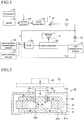
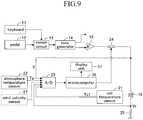
- FIG. 1 is a schematic block diagram indicating an electronic circuit embedded in the piano to vibrate the sound board in order to generate softened piano tones or softened tones of a different musical instrument.
- the piano has a keyboard 11 and a pedal 12.
- the keyboard 11 is composed of a plurality of white keys and a plurality of black keys to serve as musical performance means operated to depress or release the keys by player's hands.
- the pedal 12 is composed of a damper pedal, a soft pedal, a shift pedal, a sostenuto pedal and the like to serve as musical performance means operated by a player's foot.
- the piano has a sensor circuit 13, a tone generator 14, an amplifier circuit 15 and a coil 16 in order to generate softened musical tones.
- the sensor circuit 13 is formed of a plurality of sensors for sensing the position of a depressed key and the velocity of a key-depression on the keyboard 11, the position and the velocity of a traveling hammer which is not shown but is driven by a player's key-depression on the keyboard 11, and the position of the pedal 12 operated by the player.
- the tone generator 14 In accordance with the position and the velocity of the key-depression on the keyboard 11, the position and the velocity of the traveled hammer, and the position of the operated pedal 12 sensed by the sensor circuit 13, the tone generator 14 outputs a musical tone signal having a tone pitch corresponding to the key depressed on the keyboard 11 in a tone volume corresponding to the velocity of the key-depression in accordance with player's operation on the pedal 12.
- musical tone signals output by the tone generator 14 are audio signals corresponding to piano tones, but can be audio signals corresponding to musical tones of a musical instrument other than piano.
- the audio signal output by the tone generator 14 is output to the coil 16 via the amplifier circuit 15.
- the amplifier circuit 15 amplifies the input audio signal with a predetermined amplification factor K, and outputs the amplified signal to one end of the coil 16 via a relay circuit 24 which will be described later.
- the coil 16 is provided inside the transducer 40, with the other end of the coil 16 being grounded. As a result, by the output of the audio signal from the tone generator 14, a current corresponding to the audio signal is fed into the coil 16.
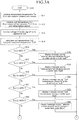
- the yoke 42 has a disc portion 42a shaped like a disc and a cylinder portion 42b which protrudes upward from a central position of the disc portion 42a and is shaped like a cylinder, with the undersurface of the disc portion 42a being fastened to the bottom surface 41a of the box 41.
- the magnet 43 is shaped like a cylinder, with the bottom surface of the magnet 43 being fastened to the disc portion 42a of the yoke 42.
- the cylinder portion 42b of the yoke 42 is pierced through the through hole provided at the central position of the magnet 43.
- the yoke 44 is also shaped like a cylinder.
- a bottom surface of the yoke 44 is fastened to the magnet 43, while the cylinder portion 42b of the yoke 42 is pierced through a through hole provided at the center of the yoke 44.
- magnetic paths are provided as indicated by broken lines in the figure.
- the transducer 40 also has a bobbin 45 and the above-described coil 16.
- the bobbin 45 is shaped like a cylinder, with a disc-shaped cap 46 being fastened to the upper end of the bobbin 45.
- the bobbin 45 and the cap 46 vibrate the sound board 48 of the piano and a bridge 49 which supports strings which are not shown.
- An upper surface of the cap 46 is bonded to the undersurface of the sound board 48 with an adhesive, double-faced tape or the like such that the cap 46 is situated immediately below or near the bridge 49 which supports strings which are not shown.
- the bobbin 45 is pierced through the through hole of the upper surface 41 b of the box 41, so that the lower part of the bobbin 45 is inserted into a space provided between the outer periphery of the cylinder portion 42b of the yoke 42 and the inner periphery of the yoke 44.
- the coil 16 is coiled around the outer periphery of the bobbin 45 to be situated on the magnetic path shown by the broken lines in the figure. Between the outer periphery of the coil 16 and the inner periphery of the yoke 44, a magnetic fluid 47 is interposed.
- the transducer 40 and the sound board 48 serve as a sound signal converting device for converting an audio signal, that is, an electric signal to a sound signal.
- the coil temperature sensor 21 is configured by a thermal diode temperature sensor, thermistor temperature sensor or the like, and is fastened to the bobbin 45 to be placed near the coil 16 (see FIG. 2 ).
- the coil temperature sensor 21 directly senses the temperature Tc1 (that is, a first measured temperature) of the coil 16, and outputs a voltage signal indicative of the temperature Tc1 to the A/D converting circuit 23.
- the atmosphere temperature sensor 22 is also configured by a thermal diode temperature sensor, thermistor temperature sensor or the like, and is placed in a space where the transducer 40 is placed.
- the atmosphere temperature sensor 22 directly senses a temperature Ta (that is, an atmosphere temperature Ta) of the space where the transducer 40 is placed, and outputs a voltage signal indicative of the atmosphere temperature Ta to the A/D converting circuit 23.
- the A/D converting circuit 23 receives a signal indicative of an application voltage V applied to the coil 16, a detection signal indicative of the coil temperature Tc1 (the first measured temperature) and a detection signal indicative of the atmosphere temperature Ta, converts the signals from analog to digital respectively, and supplies the converted signals to the microcomputer 30 respectively.
- the relay circuit 24 is provided between the amplifier circuit 15 and the coil 16 to serve as a relay switch which is controlled by the microcomputer 30 to switch between on and off in order to switch between energization and non-energization of the coil 16.
- the application voltage V supplied to the A/D converting circuit 23 to be applied to the coil 16 is a voltage of a point at which the relay circuit 24 is connected with the coil 16.
- the measurement of the coil temperature Tc2 is done by calculation based on a thermal equivalent circuit, in consideration of thermal equivalent circuit of the transducer 40.
- the magnitude of current (ampere) corresponds to electric power (watt)
- the magnitude of voltage (volt) corresponds to temperature (deg. C)
- the magnitude of resistance (ohm) corresponds to thermal resistance (deg. C/watt)
- capacitance of capacitor (farad) corresponds to thermal capacitance (deg. C/joule).
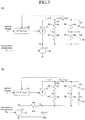
- FIG. 5(A) indicates a thermal equivalent circuit for calculating coil temperature Tc2 of the transducer 40.
- the voltage source 52 corresponds to the atmosphere temperature Ta of the transducer 40, and outputs a voltage V1 corresponding to the atmosphere Ta sensed by the atmosphere temperature sensor 22.
- Heat generated by the coil 16 is dissipated into atmosphere through the bobbin 45, and is also dissipated into atmosphere through the magnetic fluid 47 and the yoke 44.
- "Pb” represents a dissipated power dissipated by the bobbin 45
- “Py” represents a dissipated power dissipated through the magnetic fluid 47 and the yoke 44. Therefore, on a current path corresponding to a thermal dissipation path by the bobbin 45 provided between the current source 51 and the voltage source 52, a coil-bobbin thermal resistance 54 and a bobbin thermal dissipation resistance 55 are connected in series.
- Capacitance values of the magnetic fluid thermal capacitance 57 and the yoke thermal capacitance 59 are C3 and C4, respectively. These resistance values R1, R2, R3 and R4, and the capacitance values C3 and C4 are previously measured known values.
- voltage of a connection point between the current source 51, the coin-bobbin thermal resistance 54, the magnetic fluid thermal resistance 56 and the magnetic fluid thermal capacitance 57 corresponds to the coil temperature Tc2.
- Voltage of a connection point between the coil-bobbin thermal resistance 54 and the bobbin thermal dissipation resistance 55 corresponds to a temperature Tb of the bobbin 45.
- Voltage of a connection point between the magnetic fluid thermal resistance 56, the magnetic fluid thermal capacitance 57, the yoke thermal dissipation resistance 58 and the yoke thermal capacitance 59 corresponds to a yoke temperature Ty.
- T1 represents the temperature of the coil 16 before energization
- R L1 represents the resistance value of the coil 16 before energization
- T2 represents the temperature of the coil 16 after energization
- R L2 represents the resistance value of the coil 16 after energization.
- the resistance value R L2 can be expressed as equation 3 described below.
- R L 2 234.5 + T 2 234.5 + T 1 ⁇ R L 1
- the equation 3 can be expressed as equation 4 described below.
- R L 2 R 25.5 260 ⁇ 234.5 + T 2
- FIG. 6(A) will be explained again.
- the operation of the equation 4 corresponds to the calculating processing by the adding portion 71 and the multiplying portion 72.
- the reciprocal converting portion 73 converts the above-calculated resistance value R L (Tc2) to a reciprocal.
- the square calculating portion 74 squares the input voltage V applied to the coil 16, so that the multiplying portion 75 multiplies the result squared by the square calculating portion 74 by an output from the reciprocal converting portion 73 to output the multiplied result.
- the calculating processing by the reciprocal converting portion 73, the square calculating portion 74 and the multiplying portion 75 corresponds to the operation of the equation 1. Resultantly, the consumption power P of the coil 16 is to be output from the multiplying portion 75.
- the calculation result by the multiplying portion 77 is equivalent to the dissipated power Pb by the bobbin 45. Furthermore, since the subtracting portion 76 subtracts the dissipated power Pb by the bobbin 45 from the consumption power P of the coil 16 and outputs the subtracted result, the output from the subtracting portion 76 is equivalent to the dissipated power Py by the magnetic fluid 47 and the yoke 44.
- the calculation portion 78 receives a current corresponding to the dissipated power Py by the magnetic fluid 47 and the yoke 44 to figure out the voltages on the both ends of the magnetic fluid thermal resistance 56 and the magnetic fluid thermal capacitance 57, that is, the amount of rise in temperature ⁇ Tcy in the magnetic fluid 47.
- the calculation portion 79 receives a current corresponding to the dissipated power Py by the magnetic fluid 47 and the yoke 44 to figure out the voltages on the both ends of the yoke thermal dissipation resistance 58 and the yoke thermal capacitance 59, that is, the amount of rise in temperature ⁇ Tya in the yoke 44.
- the delay portion 85 delays the value input from the subtracting portion 83 as a unit delay, and outputs the delayed value to the gain control portions 84 and 87.
- the gain control portion 84 multiplies a gain b 1 by the value input from the delay portion 85 and outputs the multiplied result to the subtracting portion 83.
- the gain control portion 86 multiplies a gain a 0 by the value input from the subtracting portion 83, and outputs the multiplied result to the adding portion 88.
- the gain control portion 87 multiplies a gain a 1 by the value input from the delay portion 85, and outputs the multiplied result to the adding portion 88.
- the adding portion 88 adds the values input from the gain control portions 86 and 87 together, and outputs the added result.
- a gain G of the gain control portion 82 is R3.
- W3/( ⁇ 3+W3), the gain b 1 of the gain control portion 84 is ( ⁇ 3-W3)/( ⁇ 3+W3), the gain a 0 of the gain control portion 86 is "1", and the gain a 1 of the gain control portion 87 is "1".
- the value ⁇ 3 is 2/T3, while the value W3 is 1/C3 ⁇ R3.
- the gain G of the gain control portion 82 is R4 ⁇ W4/( ⁇ 4+W4)
- the gain b 1 of the gain control portion 84 is ( ⁇ 4-W4)/( ⁇ 4+W4)
- the gain a 0 of the gain control portion 86 is "1”
- the gain a 1 of the gain control portion 87 is "1”.
- the value ⁇ 4 is 2/T4, while the value W4 is 1/C4 ⁇ R4.
- the temperature Tc of the coil 16 can be figured out in accordance with the calculation blocks of FIG. 6(A) and FIG. 6(C) by inputting the voltage V applied to the coil 16 and the atmosphere temperature Ta.
- the transducer 40 vibrates the bobbin 45 and the cap 46 in the vertical direction shown in FIG. 2 , so that the sound board 48 and the bridge 49 also vibrate in response to the vibration of the bobbin 45 and the cap 46.
- the audio signal is converted to a sound signal, so that the player and audience can hear a musical tone corresponding to the player's operation on the keyboard 11 and the pedal 12.
- the musical tone brought about by the vibration of the sound board 48 by use of the transducer 40 is a musical instrument tone of a low tone volume, compared to a case where strings are vibrated by a hammer. That is, the musical tone is a softened tone of the musical instrument.
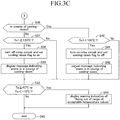
- the microcomputer 30 In a state where the above-described piano is in operation, the microcomputer 30 repeatedly executes a program indicated in FIG. 3A to FIG. 3C at every predetermined short period of time.
- the program is started at step S10 shown in FIG. 3A .
- the microcomputer 30 receives the atmosphere temperature Ta sensed by the atmosphere temperature sensor 22 via the A/D converting circuit 23.
- the microcomputer 30 receives the coil temperature Tc1 sensed by the coil temperature sensor 21 via the A/D converting circuit 23.
- the microcomputer 30 receives the voltage V (audio signal) applied to the coil 16 via the A/D converting circuit 23.
- the microcomputer 30 calculates the coil temperature Tc2, using the received atmosphere temperature Ta and the application voltage V. As described above, the calculation of the coil temperature Tc2 is done in accordance with the calculating processing indicated by the calculation blocks of FIG. 6(A) and (C) based on the thermal equivalent circuit of the transducer 40 shown in FIG. 5(A) .
- the microcomputer 30 judges at step S15 whether the atmosphere temperature Ta is equal to or higher than 160 degrees Celsius, and judges at step S17 whether the atmosphere temperature Ta is lower than -20 degrees Celsius.
- the microcomputer 30 judges whether the coil temperature Tc1 is equal to or higher than 160 degrees Celsius, and judges at step S21 whether the coil temperature Tc1 is lower than -20 degrees Celsius.
- the microcomputer 30 judges whether the coil temperature Tc2 is equal to or higher than 160 degrees Celsius.
- the microcomputer 30 determines "Yes” at step S15, and displays a message saying "the atmosphere temperature sensor is under short-circuit fault” on the display unit 31 at step S16. This is because it is impossible for the atmosphere temperature of the transducer 40 to be "160 degrees Celsius", and it is possible if the atmosphere temperature sensor is under short-circuit fault. Furthermore, if the atmosphere temperature Ta is lower than -20 degrees Celsius, the microcomputer 30 determines "Yes” at step S17, and displays a message saying "the atmosphere temperature sensor 22 is under open fault” on the display unit 31 at step S18. This is because it is impossible for the atmosphere temperature of the transducer 40 to be "-20 degrees Celsius", and it is possible if the atmosphere temperature sensor 22 is under open fault.
- the microcomputer 30 determines "Yes” at step S19, and displays a message saying "the coil temperature sensor is under short-circuit fault” on the display unit 31 at step S20. This is because it is impossible for the coil 16 to be "160 degrees Celsius”, and it is possible if the coil temperature sensor 21 is under short-circuit fault. Furthermore, if the coil temperature Tc1 is lower than -20 degrees Celsius (see B of FIG. 4 ), the microcomputer 30 determines "Yes” at step S21, and displays a message saying "the coil temperature sensor is under open fault” on the display unit 31 at step S22. This is because it is impossible for the coil 16 to be "-20 degrees Celsius", and it is possible if the coil temperature sensor 21 is under open fault.
- the microcomputer 30 determines "Yes” at step S23, and displays a message saying "electric power measurement system is under fault conditions" on the display unit 31 at step S24.
- the coil 16 determines "160 degrees Celsius”, and there is an extremely high possibility that the electric power measurement system for use in the calculation of the coil temperature Tc2, that is, the input of the application voltage V is under fault conditions.
- the above-described temperature values "160 degrees Celsius” and “-20 degrees Celsius” are predetermined temperature values given as examples. Therefore, the temperature values may be any values as long as the temperature values are impossible for the atmosphere temperature Ta and the coil temperatures Tc1 and Tc2.
- the microcomputer 30 turns the relay circuit 24 to the off-state at step S33 of FIG. 3B , executes a program termination process at step 34 to terminate the execution of the program at step S35.
- the switch of the relay circuit 24 to the off-state the supply of audio signal to the coil 16 is stopped to stop generation of musical tone of the musical instrument by the transducer 40.
- the automatically repeated execution of the program at the every predetermined short period of time is also stopped.
- the microcomputer 30 determines "No" at steps S15, S17, S19, S21 and S23 to proceed to step S25 and later steps shown in FIG. 3B .
- the microcomputer 30 judges at step S25 whether the coil temperature Tc2 is lower than the atmosphere temperature Ta, and judges at step S27 whether the coil temperature Tc1 is lower than a temperature value (Ta-5) which is 5 degrees Celsius lower than the atmosphere temperature Ta. Then, the microcomputer 30 judges at step S29 whether the coil temperature Tc1 is equal to or higher than a temperature value (Tc2+10) which is 10 degrees Celsius higher than the coil temperature Tc2, and judges at step S31 whether the coil temperature Tc1 is lower than a temperature value (Tc2-20) which is 20 degrees Celsius lower than the coil temperature Tc2.
- the microcomputer 30 determines "Yes” at step S25, and displays a message saying "the program processing is under fault conditions" on the display unit 31 at step S26. This is because the coil temperature Tc2 cannot be lower than the atmosphere temperature Ta, for the coil temperature Tc2 is obtained by adding to the atmosphere temperature Ta by the above-described calculating processing. Therefore, there is an extremely high possibility that the program processing is under fault conditions.
- the microcomputer 30 determines "Yes” at step S27, and displays a message saying "the coil temperature sensor 21 is under fault conditions due to disconnection, or the atmosphere temperature sensor 22 is under ohmic mode fault (in the middle between open fault and short-circuit fault)" on the display unit 31 at step S28.
- the temperature value (Ta-5) is adopted, considering that although the coil temperature Tc1 cannot basically be lower than the atmosphere temperature Ta, there is a possibility that there can be a time delay in the coil temperature Tc1 detected by the coil temperature sensor 21 under circumstances where the atmosphere temperature Ta rises abruptly.
- the above-described temperature value (Ta-5) is a value given as an example, and may be any other temperature value as long as the temperature value is slightly smaller than the atmosphere temperature Ta.
- the microcomputer 30 determines "Yes” at step S31, and displays a message saying "fault caused by detachment of coil temperature sensor, or fault caused by disconnection of coil temperature sensor or coil” on the display unit 31 at step S32.
- the coil temperatures Tc1 and Tc2 are supposed to be the same basically, there can be a slight error between the coil temperatures Tc1 and Tc2.
- the coil temperature Tc1 measured by the coil temperature sensor 21 may be lower than the coil temperature Tc2 in a case where the piano is used outdoors.
- Tc2-20 is also a value given as an example, and may be any other temperature value as long as the temperature value is slightly smaller than the coil temperature Tc2.
- the microcomputer 30 executes the above-described steps S33 and S34, and terminates the execution of the program at step S35.
- the supply of audio signal to the coil 16 is stopped to stop generation of musical tone of the musical instrument by the transducer 40.
- the automatically repeated execution of the program at the every predetermined short period of time is also stopped.
- the microcomputer 30 determines "No" at steps S25, S27, S29 and S31, and proceeds to step S36 and later steps of FIG. 3C .
- the microcomputer 30 judges whether the coil 16 is in the course of cooling-down.
- the cooling-down indicates a state where the supply of audio signals is interrupted by turning the relay circuit 24 to the off-state, that is, a state where the temperature of the coil 16 is being lowered by suspending the supply of audio signals.
- a cooling-down flag is set to ON ("1").
- the cooling-down flag is set to OFF ("0").
- the microcomputer 30 determines "No" at step S36, and judges at step S37 whether the coil temperature Tc1 is equal to or higher than 120 degrees Celsius.
- the temperature value of 120 degrees Celsius is an example temperature value of a case where the coil 16 needs to be protected due to excessive rise in temperature of the coil 16. Therefore, the temperature value can be a different value. If the coil temperature Tc1 is lower than 120 degrees Celsius, the microcomputer 30 determines "no" at step S37, and terminates this program at step S45 after executing steps S43 and S44 which will be explained later.
- the microcomputer 30 keeps repeatedly executing the process composed of the above-described steps S11 to S44 at each lapse of the predetermined short period of time. In this case, therefore, the relay circuit 24 is kept at the on-state to keep the supply of audio signals to the coil 16 to keep generating musical tones of the musical instrument by the transducer 40.
- the microcomputer 30 determines "Yes” at step S36, and judges at step S40 whether the coil temperature Tc1 is lower than 100 degrees Celsius.
- the temperature value of 100 degrees Celsius is an example temperature value at which it can be considered that the temperature of the coil 16 has been lowered adequately, so that the coil 16 need not to be protected. Therefore, a different temperature value which is lower than 120 degrees Celsius may be adopted. If the coil temperature Tc1 is equal to or higher than 100 degrees Celsius, the microcomputer 30 determines "No" at step S40, and temporarily terminates the execution of the program at step S45 after executing the steps S43 and S44.
- the microcomputer 30 determines "Yes” at step S40, and turns the relay circuit 24 to the on-state and sets the cooling-down flag to OFF ("0") at step S41, cancels the display indicating that the piano is in the course of cooling-down on the display unit 31 at step S42, and temporarily terminates the program at step S45 after executing the steps S43 and S44. In this state, the supply of audio signal to the coil 16 is started to start generation of musical tones of the musical instrument by the transducer 40. As described above, furthermore, the microcomputer 30 starts determining "No" at steps S36 and S37.
- the microcomputer 30 judges at step S43 whether the atmosphere temperature Ta is equal to or higher than 40 degrees Celsius, or lower than -10 degrees Celsius. If the atmosphere temperature Ta is not equal to or higher than 40 degrees Celsius, or is not lower than -10 degrees Celsius, the microcomputer 30 determines "No” at step S43 and does not execute step S44. If the atmosphere temperature Ta is equal to or higher than 40 degrees Celsius or is lower than -10 degrees Celsius, the microcomputer 30 determines "Yes” at step S43, and displays a warning indicative of "being out of range of acceptable temperature values" on the display unit 31 at step S44.
- the warning is given in order to warn a user that the transducer 40 should not be used for the above-described generation of musical tones of the musical instrument under such an environment. Since the temperature values of 40 degrees Celsius and -10 degrees Celsius are also example values, different temperature values which are inadequate for the use of the transducer 40 may be adopted.
- the steps S29 to S33 furthermore, if the difference between the coil temperatures Tc1 and Tc2 is outside the predetermined range, it is judged that the measurement means for measuring the coil temperatures Tc1 and Tc2 is under fault conditions to display the type of the fault on the display unit 31 and to turn off the relay circuit 24 to suspend the supply of audio signal to the coil 16.
- the steps S19 to S24 and S33 furthermore, if the coil temperatures Tc1 and Tc2 are outside their respective predetermined ranges, it is judged that the measurement means for measuring the coil temperatures Tc1 and Tc2 is under fault conditions to display the type of the fault on the display unit 31 and to turn off the relay circuit 24 to suspend the supply of audio signal to the coil 16.
- the first embodiment can enhance reliability of the measured coil temperatures Tc1 and Tc2 to protect the coil 16 and its peripheral devices more appropriately. Furthermore, since the type of fault is displayed on the display unit 31, the first embodiment allows a user to appropriately cope with the fault.
- the atmosphere temperature Ta of the transducer 40 that is, the coil 16 is sensed by the atmosphere temperature sensor 22 to find out that measured coil temperatures Tc1 and Tc2 are outside the predetermined range with respect to the atmosphere temperature Ta, it is judged that the measurement means of the coil temperatures Tc1 and Tc2, or the atmosphere temperature Ta is under fault conditions to display the type of the fault on the display unit 31 and to turn off the relay circuit 24 to suspend the supply of audio signal to the coil 16 by the steps S25 to S28 and S33.
- the first embodiment can enhance reliability of the measured coil temperatures Tc1 and Tc2 and reliability of the atmosphere temperature Ta to protect the coil 16 and its peripheral devices more appropriately.
- the first embodiment allows a user to appropriately cope with the fault.
- the coil temperature Tc2 is calculated, considering that the atmosphere temperature Ta sensed by the atmosphere temperature sensor 22 is the atmosphere temperature of the transducer 40.
- the atmosphere temperature Ta sensed by the atmosphere temperature sensor 22 may not be able to be treated as the atmosphere temperature of the transducer 40. More specifically, there can be cases where the atmosphere temperature sensor 22 and the transducer 40 are apart from each other, so that there can be a slight difference in temperature between an air temperature Ta of the position of the atmosphere temperature sensor 22 and an air temperature Tr of the position of the transducer 40.
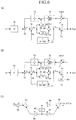
- FIG. 6(B) A calculation block diagram corresponding to the thermal equivalent circuit shown in FIG. 5(B) is indicated in FIG. 6(B) .
- the air temperature Ta of the position of the atmosphere temperature sensor 22 is calculated by a calculation portion 52c to be supplied to the adding portion 81 as the air temperature Tr of the position of the transducer 40.
- this calculation block diagram is configured similarly to the above-described calculation block diagram shown in FIG. 6(A) .
- the calculation portion 52c is configured as shown in FIG. 6(C) .
- FIG. 6(C) In FIG.
- the coil temperature Tc2 can be figured out in accordance with the calculation blocks of FIG. 6(B) and FIG. 6(C) by inputting the voltage V applied to the coil 16 and the atmosphere temperature Ta.
- the microcomputer 30 executes the program shown in FIG. 3A to FIG. 3C , similarly to the case of the first embodiment.
- the coil temperature Tc2 is calculated in accordance with the calculation blocks shown in FIG. 6(B) and FIG. 6(C) .
- the coil temperature Tc2 can be accurately figured out because of the consideration of the difference in air temperatures being given to calculation of the coil temperature Tc2.
- the first modification of the first embodiment will be explained.
- the calculation of the coil temperature Tc2 which is the second measured temperature is different from that of the first embodiment.
- only the calculation of the coil temperature Tc2 which is the second measured temperature is different from the first embodiment.
- the electronic circuit of the piano according to the first modification is also configured similarly to the schematic block diagram of the first embodiment shown in FIG. 1 .
- the transducer 40 of the piano according to the first modification is also configured similarly to the transducer of the first embodiment shown in FIG. 2 .
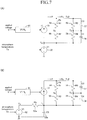
- the resistance value R L of the coil 16 is constant, with changes in the resistance value R L of the coil 16 caused by changes in the coil temperature Tc2 being ignored.
- a feedback path of the coil temperature Tc2 of the first embodiment is omitted, while a calculating unit 61 is provided instead of the calculating unit 53 provided in the first embodiment.
- the calculating unit 61 receives only the voltage V applied to the coil 16 to calculate the consumption power P of the coil 16 in accordance with an equation 5 described below.
- the resistance value R L of this case is a previously measured known value.
- FIG. 8(A) A calculation block for calculating the coil temperature Tc2 based on this thermal equivalent circuit is shown in FIG. 8(A) .
- the adding portion 71, the multiplying portion 72 and the reciprocal converting portion 73 provided in the calculation block of the first embodiment shown in FIG. 6(A) are omitted, while a calculation portion 91 related to the calculating unit 61 of FIG. 7(A) is provided instead of the multiplying portion 75.
- the calculation portion 91 calculates the consumption power P of the coil 16 by dividing a square value V 2 of the voltage V input from the square calculating portion 74 by the resistance value R L of the coil 16, and outputs the obtained consumption power P to the subtracting portion 76.
- the other parts of the calculation block are similar to the first embodiment.
- the microcomputer 30 executes the program shown in FIG. 3A to FIG. 3C .
- the coil temperature Tc2 is calculated by a method which is different from that of the first embodiment.
- the coil temperature Tc2 is figured out by use of the application voltage V and the atmosphere temperature Ta in accordance with the calculation block shown in FIG. 8(A) . Since the other steps of FIGS. 3A to 3C are done similarly to the case of the first embodiment, the explanation about the other steps will be omitted.
- the microcomputer 30 receives the voltage V applied to the coil 16 and the atmosphere temperature Ta sensed by the atmosphere temperature sensor 22, and calculates the coil temperature Tc2 (the second measured temperature) by use of the received application voltage V and atmosphere temperature Ta.
- the coil temperature Tc2 the second measured temperature
- consumption power P of the coil 16 is calculated in accordance with the calculation block shown in FIG. 8(A) , that is, with the resistance value R L of the coil 16 being used as a fixed value.
- the coil temperature Tc2 is calculated, considering that the air temperature sensed by the atmosphere temperature sensor 22 is defined as the atmosphere temperature Ta of the transducer 40.
- the atmosphere temperature sensor 22 and the transducer 40 are apart from each other, so that there can be a slight difference in temperature between the air temperature Ta of the position of the atmosphere temperature sensor 22 and the air temperature Tr of the position of the transducer 40.
- the thermal equivalent circuit shown in FIG. 7(A) is modified to a circuit shown in FIG.
- the microcomputer 30 calculates the coil temperature Tc2 in accordance with the calculation block shown in FIG. 8(B) according to the above-described modification.
- this modification as well, therefore, even though the atmosphere temperature sensor 22 and the transducer 40 are apart from each other to result in a difference between the air temperature Ta of the position of the atmosphere temperature sensor 22 and the air temperature Tr of the position of the transducer 40, the coil temperature Tc2 can be accurately figured out because of the consideration of the difference in air temperature being given to calculation of the coil temperature Tc2.
- the A/D converting circuit 23 converts not only signals indicative of the coil temperature Tc1 sensed by the coil temperature sensor 21, the voltage V applied to the coil 16 and the atmosphere temperature Ta sensed by the atmosphere temperature sensor 22 of the first embodiment, but also the terminal voltage Vr of the resistance 25 from analog to digital, and then supplies the converted signals and voltage to the microcomputer 30.
- the other portions of this electronic circuit are configured similarly to the case of the first embodiment.
- the transducer 40 of the piano according to the second modification is also configured similarly to the transducer of the first embodiment shown in FIG. 2 .
- the second modification as well, therefore, only the points which are different from the first embodiment will be explained, with the similar portions being given the same numerical references as the first embodiment to omit explanations about the similar portions.
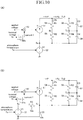
- the feedback path of the coil temperature Tc2 in the first embodiment is omitted, while the calculating unit 53 of the first embodiment is replaced with a multiplier 62 as indicated in FIG. 10(A) .
- the multiplier 62 receives the voltage V which is to be applied to the coil 16 and current I which is to flow through the coil 16 and is calculated by a divider 62a, and calculates the consumption power P of the coil 16 in accordance with an equation 6 described below.
- a divider 62a divides the terminal voltage Vr of the resistance 25 by the resistance value r of the resistance 25 to obtain the current I flowing through the coil 16.
- the divider 62a may be omitted.
- the other portions of the second modification are configured similarly to the first embodiment.
- the calculation block for calculating the coil temperature Tc2 on the basis of this thermal equivalent circuit is indicated in FIG. 11(A) .
- the adding portion 71, the multiplying portion 72 and the reciprocal converting portion 73 provided in the calculation block of the first embodiment shown in FIG. 6(A) are omitted, while the square calculating portion 74 and the multiplying portion 75 are replaced with a multiplying portion 92 and a dividing portion 92a corresponding to the multiplier 62 and the divider 62a, respectively, of FIG. 10(A) .
- the dividing portion 92a divides the terminal voltage Vr by the resistance value r to figure out the current value I.
- the multiplying portion 92 multiplies the voltage value V by the current value I to figure out the consumption power P, and outputs the obtained consumption power P to the subtracting portion 76.
- the other portions of the calculation block are similar to the first embodiment.
- the microcomputer 30 executes the program indicated in FIG. 3A to FIG. 3C .
- the program at step S13 of the first embodiment, not only the application voltage V but also the terminal voltage Vr (substantially indicative of the current value I) are received, while the coil temperature Tc2 is calculated at step S14 by a method which is different from that of the first embodiment.
- the coil temperature Tc2 is calculated by use of the application voltage V, the terminal voltage Vr (substantially indicative of the current value I) and the atmosphere temperature Ta in accordance with the calculation block shown in FIG. 11 (A) . Since the other steps of FIGS. 3A to 3C are done similarly to the first embodiment, the explanations about the other steps are omitted.
- the coil temperature Tc2 is calculated, considering that the air temperature sensed by the atmosphere temperature sensor 22 is defined as the atmosphere temperature Ta of the transducer 40.
- the atmosphere temperature sensor 22 and the transducer 40 are apart from each other, so that there can be a slight difference in temperature between the air temperature Ta of the position of the atmosphere temperature sensor 22 and the air temperature Tr of the position of the transducer 40.
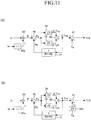
- the thermal equivalent circuit shown in FIG. 10(A) is modified to a circuit shown in FIG.
- the microcomputer 30 calculates the coil temperature Tc2 in accordance with the calculation block shown in FIG. 11 (B) according to the above-described modification.
- this modification as well, therefore, even though the atmosphere temperature sensor 22 and the transducer 40 are apart from each other to result in a difference between the air temperature Ta of the position of the atmosphere temperature sensor 22 and the air temperature Tr of the position of the transducer 40, the coil temperature Tc2 can be accurately figured out because of the consideration of the difference in air temperatures being given to calculation of the coil temperature Tc2.
- the third modification of the first embodiment will be explained.
- the calculation of the coil temperature Tc2 which is the second measured temperature is further modified from that of the first embodiment.
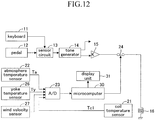
- the electronic circuit of the piano according to the third modification is configured as indicated in FIG. 12 such that the connecting line for supplying the voltage V which is to be applied to the coil 16 to the A/D converting circuit 23 is removed from the first embodiment shown in FIG. 1 , with a yoke temperature sensor 26 being provided instead.
- the yoke temperature sensor 26 is formed of a thermal diode temperature sensor, a thermistor temperature sensor or the like to be provided for the yoke 44 as indicated by broken lines in FIG.
- the A/D converting circuit 23 converts the detection signal indicative of the yoke temperature Ty from analog to digital, instead of the voltage V applied to the coil 16 of the case of the first embodiment, and supplies the converted signal to the microcomputer 30.
- the other portions of this electronic circuit are configured similarly to the case of the first embodiment.
- the transducer 40 of the piano according to the third modification is also configured similarly to the transducer of the first embodiment shown in FIG. 2 . As for the third modification as well, therefore, only the points which are different from the first embodiment will be explained, with the similar portions being given the same numerical references as the first embodiment to omit explanations about the similar portions.
- the input path of the voltage V applied to the coil 16, the feedback path of the coil temperature Tc2 and the calculating unit 53 of the first embodiment are omitted as indicated in FIG. 13(A) .
- the current source 51, the coil-bobbin thermal resistance 54 and the bobbin thermal dissipation resistance 55 are not necessary for the calculation of the coil temperature Tc2, these components exist as constituting units of the transducer 40. In FIG. 13(A) , therefore, these components 51, 54 and 55 are included.
- a voltage source 63 is provided between a point where the magnetic fluid thermal resistance 56 is connected with the yoke heat dissipation resistance 58 and the ground.
- the voltage source 63 corresponds to the yoke temperature Ty, so that the voltage source 63 outputs a voltage V2 corresponding to the yoke temperature Ty sensed by the yoke temperature sensor 26.
- the other portions of the third modification are configured similarly to the first embodiment.
- the calculation block for calculating the coil temperature Tc2 on the basis of this thermal equivalent circuit is indicated in FIG. 14(A) .
- the voltage of the point where the magnetic fluid thermal resistance 56 is connected with the yoke heat dissipation resistance 58 corresponds to the yoke temperature Ty
- the voltage on the both ends of the yoke heat dissipation resistance 58 corresponds to a difference Ty-Ta (the amount of rise in yoke temperature ⁇ Tya) between the yoke temperature Ty and the atmosphere temperature Ta.
- a subtracting portion 93 is provided in the calculation block.
- a current corresponding to the difference Ty-Ta is fed through a parallel circuit in which the magnetic fluid thermal resistance 56 and the magnetic fluid thermal capacitance (magnetic fluid heat capacitance) 57 are connected in parallel to determine the voltage on the both ends of the magnetic fluid thermal resistance 56 (the amount of rise in magnetic fluid temperature ⁇ Tcy) in accordance with this current to add the amount of rise in yoke temperature ⁇ Tya (difference in temperature Ty-Ta) and the amount of rise in magnetic fluid temperature ⁇ Tcy to the atmosphere temperature Ta to figure out the coil temperature Tc2.
- the calculation of these temperatures is realized by the subtracting portion 93, the calculation portions 78, 79 and 94, and the adding portions 80 and 81.
- the amount of rise in magnetic fluid temperature ⁇ Tcy is calculated by the calculating processing by the subtracting portion 93 and the calculation portions 78 and 94
- the amount of rise in yoke temperature ⁇ Tya is calculated by the calculating processing by the subtracting portion 93 and the calculation portions 79 and 94
- the amount of rise in magnetic fluid temperature ⁇ Tcy and the amount of rise in yoke temperature ⁇ Tya are added by the adding processing by the adding portion 80.
- the microcomputer 30 executes the program indicated in FIG. 3A to FIG. 3C .
- the program at step S13 of the first embodiment, the yoke temperature Ty sensed by the yoke temperature sensor 26 is received instead of the application voltage V, while the coil temperature Tc2 is calculated at step S14 by a method which is different from that of the first embodiment.
- the coil temperature Tc2 is calculated by use of the atmosphere temperature Ta and the yoke temperature Ty in accordance with the calculation block shown in FIG. 14(A) . Since the other steps of FIGS. 3A to 3C are done similarly to the first embodiment, the explanations about the other steps are omitted.
- the microcomputer 30 receives the atmosphere temperature Ta sensed by the atmosphere temperature sensor 22 and the yoke temperature Ty sensed by the yoke temperature sensor 26, and calculates the coil temperature Tc2 (the second measured temperature) by use of the received atmosphere temperature Ta and the yoke temperature Ty. According to the third modification, therefore, although the yoke temperature sensor 26 for sensing the yoke temperature Ty is necessary, the calculating processing is simplified, compared with the first embodiment and its first and second modifications. According to the third modification, as a result, the calculation of the coil temperature Tc2 is simplified.
- the fourth modification of the first embodiment will be explained, the fourth modification being related to a position where the voltage V applied to the coil 16 is to be retrieved.
- the terminal voltage of the coil 16 is supplied to the microcomputer 30 via the A/D converting circuit as the voltage V applied to the coil 16.
- an output voltage of the amplifier circuit 15 on an input side of the relay circuit 24 may be supplied to the microcomputer 30 via the A/D converting circuit 23.
- the input voltage of the amplifier circuit 15 may be supplied to the microcomputer 30 via the A/D converting circuit 23 to multiply the input voltage by the factor of K by the microcomputer 30 to use the multiplied voltage as the voltage V applied to the coil 16.
- the fifth modification of the first embodiment will be explained, the fifth modification calculating the coil temperature Tc2 in consideration of wind velocity.
- consideration may be given to wind velocity at a location where the transducer 40 is placed.
- the resistance value R2 of the bobbin thermal dissipation resistance 55 and the resistance value R4 of the yoke thermal dissipation resistance 58 decrease. Therefore, it is preferable to correct such that as the wind velocity in the atmosphere where the transducer 40 is placed increases, the resistance values R2 and R4 decrease.
- a conversion table which is provided on the basis of measured results by experiments and indicates the resistance values R2 and R4 which vary with wind velocity, a conversion function and the like may be used.
- a wind velocity sensor 27 which is placed near the transducer 40 to sense wind velocity in the atmosphere of the transducer 40 to output a detection signal indicative of the sensed wind velocity is connected to the A/D converting circuit 23 as indicated by broken lines.
- the A/D converting circuit 23 converts the detection signal indicative of the wind velocity as well from analog to digital, and supplies the converted signal to the microcomputer 30.
- the microcomputer 30 also receives the wind velocity sensed by the wind velocity sensor 27.
- the sixth modification of the first embodiment will be explained, the sixth modification being related to the relay circuit 24 which restricts supply of audio signals to the coil 16.
- the relay circuit 24 that is, a relay switch serving as protection means (level control means) which turns on and off the supply of audio signals to the coii 16 is provided to be situated after the amplifier circuit 15 in order to prevent excessive rise in temperature of the coil 16.
- the relay circuit 24 serving as the protection means may be replaced with an electronic switch circuit formed of a transistor or the like so that the microcomputer 30 can control the switching of the electronic switch circuit between on and off.
- the relay circuit 24 or the electronic switch circuit may be replaced with an electronic switch circuit 24-1 which is provided between the line connecting the tone generator 14 and the amplifier circuit 15, and the ground, and is in an off-state in normal times as indicated in FIG. 15 so that the electronic switch circuit 24-1 can be controlled to switch between on and off by the steps S33, S38 and S41 of FIG. 3B and FIG. 3C .
- the microcomputer 30 turns on the electronic switch circuit 24-1 at step S33 or S38 to stop the supply of audio signals to the coil 16.
- an electronic volume may be used.
- an electronic volume 24-2 may be provided between the line connecting the tone generator 14 and the amplifier circuit 15, and the ground as indicated by broken lines in FIG. 15 .
- the resistance 28 is provided between the tone generator 14 and a terminal of the electronic volume 24-2, the terminal being situated on the tone generator side.
- the electronic volume 24-2 is controlled by the microcomputer 30 to be kept at the maximum volume in normal times. If the coil temperature Tc1 is equal to or higher than 120 degrees Celsius, the microcomputer 30 determines "Yes" at step S37, and reduces the value of the electronic volume 24-2 to reduce the amount of audio signals supplied to the coil 16 at step S38.
- the microcomputer 30 determines "Yes” at step S40, and increases the value of the electronic volume 24-2 to the maximum value to increase the amount of audio signals supplied to the coil 16 at step S41.
- the microcomputer 30 turns the output level of the electronic volume 24-2 to zero by the step S33 to suspend the supply of audio signals to the coil 16.
- the seventh modification of the first embodiment will be explained, the seventh modification being configured to control the supply of audio signals to the coil 16 by the coil temperature Tc2.
- the microcomputer 30 determines at step S37 of FIG. 3C whether the coil temperature Tc2 is equal to or higher than 120 degrees Celsius, instead of examining the coil temperature Tc1. If the coil temperature Tc2 is equal to or higher than 120 degrees Celsius, the microcomputer 30 turns off the relay circuit 24 at step S38 to suspend the supply of audio signals to the coil 16. After the suspension of supply of audio signals to the coil 16 (that is, in the cooling-down state), the microcomputer 30 determines at step S40 whether the coil temperature Tc2 is lower than 100 degrees Celsius, instead of examining the coil temperature Tel. If the coil temperature Tc2 is lower than 100 degrees Celsius, the microcomputer 30 turns on the relay circuit 24 at step S41 to resume the supply of audio signals to the coil 16.
- the eighth modification of the first embodiment will be explained, the eighth modification being related to a modification of the transducer 40.
- the magnetic fluid 47 is provided in the transducer 40 in the first embodiment and its modifications
- the temperature measurement of the coil 16 on the basis of thermal equivalent circuit can be also applied to a transducer without the magnetic fluid 47.
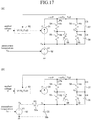
- the thermal equivalent circuits shown in FIGS. 5 , 7 , 10 and 13 the magnetic fluid thermal resistance 56 and the magnetic fluid thermal capacitance (magnetic fluid thermal capacitor) 57 are replaced with an air thermal resistance and an air thermal capacitance. Furthermore, the resistance value of the air thermal resistance is extremely greater than that of the magnetic fluid thermal resistance 56. Therefore, the resistance value R3 of the thermal equivalent circuits shown in FIGS.
- the coil temperature Tc is calculated, considering that the indoor temperature Ta sensed by the atmosphere temperature sensor 22 is defined as the atmosphere temperature Ta of the transducer 40.
- the atmosphere temperature sensor 22 and the transducer 40 are apart from each other, so that there can be a slight difference in temperature between the air temperature Ta of the position of the atmosphere temperature sensor 22 and the air temperature Tr of the position of the transducer 40.
- the thermal equivalent circuits shown in FIG. 16(A) , FIG. 17(A) , and FIG. 18(A) are modified to circuits shown in FIG. 16(B) , FIG. 17(B) , and FIG. 18(B) , respectively. Since the above-described modifications are similar to the case of the thermal equivalent circuit of FIG. 5(B) of the modification of the first embodiment, components of the above-described modifications are given the same numerical references as those of the modification of the first embodiment to omit explanation about the components.
- the microcomputer 30 calculates the coil temperature Tc in accordance with the calculation block according to the above-described modifications. In these modifications as well, therefore, even though the atmosphere temperature sensor 22 and the transducer 40 are apart from each other to result in a difference between the air temperature Ta of the position of the atmosphere temperature sensor 22 and the air temperature Tr of the position of the transducer 40, the temperature Tc of the coil 16 can be accurately figured out because of the consideration of the difference in air temperatures being given to calculation of the coil temperature Tc.
- the second embodiment is configured such that a resistance value R L of the coil 16 is sensed to figure out the coil temperature Tc1 on the basis of the relation between the resistance value R L and the temperature of the coil 16, instead of the measurement of the coil temperature Tc1 (the first measured temperature) by the coil temperature sensor 21 in the first embodiment.
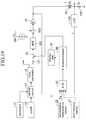
- a schematic block diagram of an electronic circuit for vibrating a sound board embedded in the piano according to the second embodiment is shown in FIG. 19 .
- components which are the same as those of the first embodiment are given the same numerical references as those of the first embodiment to omit explanation about the components.
- the constant voltage source circuit 104 In order to detect the resistance value of the coil 16, the constant voltage source circuit 104 outputs a predetermined magnitude of DC voltage Vo which is to be superimposed on an audio signal.
- the DC voltage Vo is small enough to have no effect on reproduction of audio signals and to save power consumption. More specifically, it is preferable that the DC voltage Vo falls within a range of voltage values where a current from 10 mA to 100 mA, for example, is fed through the coil 16.
- the constant voltage source circuit 104 is placed at a position as far as possible from the coil 16 which is a heat source in order to prevent the DC voltage Vo which is to be output from fluctuating due to influence of temperature.
- the high-pass filter circuit 102 is connected with the output of the tone generator 14 in order to reliably remove DC component from an audio signal output by the tone generator 14 so that the DC voltage passing through the coil 16 depends only on the DC voltage Vo supplied from the constant voltage source circuit 104.
- the adding circuit 103 adds the DC voltage Vo supplied from the constant voltage source circuit 104 to the audio signal supplied from the tone generator 14 as offset voltage, and outputs the resultant to the amplifier circuit 15.
- the coil 16 is grounded via the resistance 105, while a point where the coil 16 is connected with the resistance 105 is connected with the A/D converting circuit 23 via a low-pass filter circuit 106.
- the resistor 105 is a current sensing resistor (shunt resistor) for sensing the value of a direct current i running through the coil 16.
- a resistance value R of the resistor 105 is a predetermined value which is small enough to be ignored, compared to the resistance value R L of the coil 16.
- the low-pass filter circuit 106 removes alternating current signal component, that is, an audio signal from a voltage signal applied to the resistor 105, and outputs only DC voltage component to the A/D converting circuit 23.
- the microcomputer 30 executes a program obtained by replacing the step S12 of the program shown in FIG. 3A to FIG. 3C with steps S101 and S102 shown in FIG. 20 .
- the tone generator 14 when a player operates the keyboard 11 and the pedal 12 for musical performance, the tone generator 14 outputs an electric musical tone signal (audio signal) indicative of a piano sound corresponding to the musical performance, as in the case of the first embodiment.
- the audio signal is supplied to the high-pass filter circuit 102 via the resistance 101 and the relay circuit 24 which is in the on-state under normal conditions, so that the high-pass filter circuit 102 removes a DC component included in the audio signal, and supplies only an alternating component to one input of the adding circuit 103.
- the predetermined DC voltage Vo is supplied from the constant voltage source circuit 104, so that the adding circuit 103 supplies an electric signal obtained by superimposing the DC voltage Vo on the audio signal to the amplifier circuit 15.
- the amplifier circuit 15 amplifies the supplied signal with the amplification factor K, and supplies the amplified voltage signal to the coil 16 and the resistance 105.
- the microcomputer 30 repeatedly executes the program at every predetermined short period of time.
- the microcomputer 30 receives atmosphere temperature Ta from the atmosphere temperature sensor 22 via the A/D converting circuit 23, similarly to the first embodiment.
- the microcomputer 30 receives the terminal voltage Vr (DC voltage component) of the resistance 105 via the low-pass filter circuit 106 and the A/D converting circuit 23 at step S101, and calculates the coil temperature Tc1 (the first measured temperature) by use of the terminal voltage Vr at step S102.
- T2 R 2 ⁇ 234.5 + T 1 R 1 ⁇ 234.5
- the equation 11 can be expressed as an equation 12 given below.
- T 2 260 ⁇ R 2 R 25.5 ⁇ 234.5 Therefore, by substituting the resistance value R L of the coil 16 expressed by the equation 9 into the resistance value R2 of the equation 12, the temperature T L of the coil 16 can be figured out as the temperature T2 by the equation 12.
- the microcomputer 30 receives the voltage V applied to the coil 16 at step S13, similarly to the first embodiment, and calculates the coil temperature Tc2 (the second measured temperature) by use of the atmosphere temperature Ta and the application voltage V at step S14.
- the other steps of the program are similar to those of the first embodiment. However, as for the display of causes of the fault of the coil temperature sensor 21 at steps S20 and S22 of FIG. 3A , and steps S28, S30 and S32 of FIG.
- the resistance value R L of the coil 16 is calculated by use of the terminal voltage Vr of the resistance 105 to calculate the coil temperature Tc1 as the first measured temperature by use of the calculated resistance value R L on the basis of the relation between the resistance value R L and the temperature of the coil 16.
- the coil temperature Tc2 is calculated as the second measured temperature by use of the voltage V applied to the coil 16 and the atmosphere temperature Ta on the basis of the thermal equivalent circuit of the transducer 40.
- FIG. 21 is a schematic block diagram showing an electronic circuit which is embedded in the piano according to the first modification and is provided in order to vibrate the sound board.
- the resistance 101, the high-pass filter circuit 102, the adding circuit 103, and the constant-voltage source circuit 104 provided in the second embodiment are omitted, while the amplifier circuit 15 is connected directly to the output side of the tone generator 14, with the relay circuit 24 being connected between the amplifier circuit 15 and the coil 16. Furthermore, an output of the relay circuit 24 is supplied to the A/D converting circuit 23 as the voltage V applied to the coil 16. In this case as well, the amplification factor K of the amplifier circuit 15 is a predetermined constant value.
- the direct current I does not also affect reproduction of the audio signal, and is small enough to save power consumption. More specifically, it is preferable that the direct current I falls within a range from 10 mA to 100 mA. Furthermore, it is preferable that the constant current source circuit 108 is placed at a position as far as possible from the coil 16 which is a heat source in order to prevent the constant current I which is to be output from fluctuating due to influence of temperature.
- the microcomputer 30 executes the program similar to the second embodiment, the program being shown in FIGS. 3A to 3C but being obtained by replacing part of FIG. 3A with the steps shown in FIG. 20 .
- the calculation of the coil temperature Tc1 (the first measured temperature) of step S102 of FIG. 20 is different from the calculation of the second embodiment.
- the other steps are configured similarly to the second embodiment, so that components of this modification are provided with the same numerical references as those of the second embodiment to omit explanation about the components.
- the direct current I supplied from the constant current source circuit 108 is also fed into the coil 16, while the low-pass filter circuit 106 removes alternating component (audio signal) to supply DC component of the voltage on the both ends of the coil 16, that is, the direct voltage Vr on the both ends of the coil 16 related only to the direct current I supplied from the constant current source circuit 108 to the A/D converting circuit 27.
- the microcomputer 30 receives the atmosphere temperature Ta from the atmosphere temperature sensor 22 via the A/D converting circuit 23 at step S11 of FIG. 20 , receives the terminal voltage Vr (DC voltage component) of the coil 16 via the low-pass filter circuit 106 and the A/D converting circuit 23 at step S101, and calculates the coil temperature Tc1 (the first measured temperature) by use of the terminal voltage Vr at step S102.
- Vr DC voltage component
- the microcomputer 30 receives the voltage V applied to the coil 16 at step S13, and calculates the coil temperature Tc2 (the second measured temperature) by use of the atmosphere temperature Ta and the application voltage V at step S14.
- the other steps of the program are similar to those of the second embodiment. However, as for the display of causes of the fault of the coil temperature sensor 21 at steps S20 and S22 of FIG. 3A , and steps S28, S30 and S32 of FIG.
- the coil temperature Tc1 (T2) is calculated by the performance of the calculation using the resistance value R L (R2) of the coil 16.
- the coil temperature Tc1 is calculated by the performance of the calculation using the resistance value R L of the coil 16.
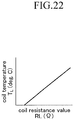
- a conversion table indicative of the correlation between the resistance value R L and the temperature T L of the coil 16 shown in FIG. 22 may be provided so that the calculated resistance value R2 (R L ) can be converted to the temperature T L (Tc1) by use of the provided conversion table to obtain the coil temperature Tc1.
- a conversion table for converting from the voltage value Vr to the resistance value R L may be provided so that the resistance value R L can be calculated on the basis of the voltage value Vr by use of the conversion table.
- the calculation of the coil temperature Tc2 (the second measured temperature) which is employed in the first to third modifications of the first embodiment explained in the above-described a1 to a3 can be also applied to the second modification and its modifications. Furthermore, the position according to the fourth modification of the first embodiment explained in the above-described a4 where the voltage V applied to the coil 16 is retrieved can be also applied to the second embodiment and its modifications. Furthermore, the calculation of the coil temperature Tc2 (the second measured temperature) in consideration of wind velocity according to the fifth modification explained in the above-described a5 can be also applied to the second embodiment and its modifications.
- the restriction on supply of audio signals to the coil 16 by use of the electronic switch circuit 24-1 and the electronic volume 24-2 according to the sixth modification of the first embodiment explained in the above-described a6 can be also applied to the second embodiment and its modifications.
- the control of supply of audio signals to the coil 16 by the coil temperature Tc2 according to the seventh modification of the first embodiment explained in the above-described a7 can be also applied to the second embodiment and its modifications.
- the modification of the transducer 40 according to the eighth modification of the first embodiment explained in the above-described a8 can be also applied to the second embodiment and its modifications.
- the third embodiment is configured such that the coil temperature Tc1 is measured by the coil temperature sensor 21 as the first measured temperature, and the resistance value R L of the coil 16 is detected to figure out the coil temperature Tc2 as the second measured temperature on the basis of the relation between the resistance value R L and the temperature of the coil 16.
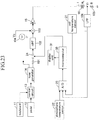
- a schematic block diagram of an electronic circuit for vibrating a sound board embedded in the piano according to the third embodiment is shown in FIG. 23 .
- the path of the voltage V applied to the coil 16 provided in the schematic block diagram of FIG. 19 according to the second embodiment is omitted, but the coil temperature sensor 21 of the first embodiment is connected to the A/D converting circuit 23.
- the other components of the third embodiment are configured similarly to the second embodiment, the same components are given the same numerical references as those of the second embodiment to omit explanation about the components.
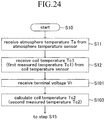
- the microcomputer 30 executes a program obtained by replacing the steps S13 and S14 of the program shown in FIG. 3A to FIG. 3C with steps S101 and S103 shown in FIG. 24 .
- the microcomputer 30 repeatedly executes the program at every predetermined short period of time.
- the microcomputer 30 receives the atmosphere temperature Ta from the atmosphere temperature sensor 22 via the A/D converting circuit 23 at step S11 of FIG. 24 similarly to the first and second embodiments, and receives the coil temperature Tc1 from the coil temperature sensor 21 as the first measured temperature at step S12 similarly to the first embodiment.
- the microcomputer 30 receives the terminal voltage Vr (DC voltage component) of the resistance 105 via the low-pass filter circuit 106 and the A/D converting circuit 23, and calculates the coil temperature Tc2 as the second measured temperature by use of the terminal voltage Vr at step S103.
- Vr DC voltage component
- the microcomputer 30 carries out the step S15 and later steps which are similar to those of the first and second embodiments.
- the coil temperature Tc2 is figured out not by adding the atmosphere temperature Ta as in the cases of the first and second embodiments, but by use of the correlation between the resistance value R L and the temperature of the coil 16, independently of the atmosphere temperature Ta.
- a message indicative of a fault of a circuit for generating or sensing the voltage value Vr such as the constant voltage source circuit 104, the resistance 105 or the low-pass filter circuit 106, or a fault caused by erroneous calculation of the coil temperature Tc2 is also displayed.
- the coil temperature Tc1 sensed by the coil temperature sensor 21 is received as the first measured temperature
- the resistance value R L of the coil 16 is calculated by use of the terminal voltage Vr of the resistance 105 to calculate the coil temperature Tc2 as the second measured temperature by use of the calculated resistance value R L on the basis of the relation between the resistance value R L and the temperature of the coil 16.
- the first modification of the third embodiment will be explained.
- the calculation of the coil temperature Tc2 which is the second measured temperature is modified from that of the third embodiment.
- the first modification is configured such that the coil temperature Tc2 of the third embodiment is measured by the method using the resistance value R L of the coil 16 similarly to the coil temperature Tc1 of the first modification of the second embodiment.
- FIG. 25 A schematic block diagram showing an electronic circuit for vibrating the sound board embedded in the piano according to the first modification of the third embodiment is shown in FIG. 25 .
- the path of the voltage V applied to the coil 16 provided in the schematic block diagram of FIG.
- the coil temperature sensor 21 according to the first modification of the second embodiment is omitted, but the coil temperature sensor 21 of the first embodiment is connected to the A/D converting circuit 23.
- the first modification since the other components of the first modification are configured similarly to the first modification of the second embodiment, the same components are given the same numerical references as those of the first modification of the second embodiment to omit explanation about the components.
- the microcomputer 30 executes a program obtained by replacing the steps S12 and S13 of the program shown in FIG. 3A to FIG. 3C with steps S101 and S103 shown in FIG. 24 , similarly to the third embodiment.
- the microcomputer 30 repeatedly executes the program at every predetermined short period of time.
- the microcomputer 30 receives the atmosphere temperature Ta, the coil temperature Tc1 and the terminal voltage Vr, and calculates the coil temperature Tc2.
- the calculation of the coil temperature Tc2 at step S103 is different from the calculation employed in the third embodiment, but is completely the same as the calculation of the coil temperature Tc1 at step S102 of FIG. 20 of the first modification of the second embodiment. Since only a point that the calculation in this modification is performed to figure out the coil temperature Tc2 (the second measured temperature) is different from the first modification of the second embodiment, detailed explanation about the calculation will be omitted.
- the microcomputer 30 carries out the step S15 and later steps which are similar to those of the third embodiment.
- the coil temperature Tc2 is figured out not by adding the atmosphere temperature Ta as in the cases of the first and second embodiments, but by use of the correlation between the resistance value R L and the temperature of the coil 16, independently of the atmosphere temperature Ta.
- a message indicative of a fault of a circuit for generating or sensing the voltage value Vr such as the constant current source circuit 108 or the low-pass filter circuit 106, or a fault caused by erroneous calculation of the coil temperature Tc2 is also displayed.
- the coil temperature Tc1 sensed by the coil temperature sensor 21 is received as the first measured temperature
- the resistance value R L of the coil 16 is calculated by use of the terminal voltage Vr of the coil 16 to calculate the coil temperature Tc2 as the second measured temperature by use of the calculated resistance value R L on the basis of the relation between the resistance value R L and the temperature of the coil 16.
- the coil temperature Tc2 is calculated by the performance of the calculation using the resistance value R L (R2) of the coil 16.
- the coil temperature Tc2 is calculated by the performance of the calculation using the resistance value R L of the coil 16.
- a conversion table indicative of the correlation between the resistance value R L and the temperature T L of the coil 16 shown in FIG. 22 may be provided so that the calculated resistance value R2 (R L ) can be converted to the temperature T L (Tc1) by use of the provided conversion table to obtain the coil temperature Tc2.
- the restriction on supply of audio signals to the coil 16 by use of the electronic switch circuit 24-1 and the electronic volume 24-2 according to the sixth modification of the first embodiment explained in the above-described a6 can be also applied to the third embodiment and its modifications.
- the control of supply of audio signals to the coil 16 by the coil temperature Tc2 according to the seventh modification of the first embodiment explained in the above-described a7 can be also applied to the third embodiment and its modifications.
- the first embodiment and its modifications are configured such that the two kinds of coil temperatures Tc1 and Tc2 are obtained by direct sensing by the coil temperature sensor 21 and the calculation on the basis of the thermal equivalent circuit of the transducer 40, respectively.
- the second embodiment and its modifications are configured such that the two kinds of coil temperatures Tc1 and Tc2 are figured out by the calculation in which the resistance value R L of the coil 16 is converted to a temperature, and the calculation on the basis of the thermal equivalent circuit of the transducer 40, respectively.
- the third embodiment and its modifications are configured such that the two kinds of coil temperatures Tc1 and Tc2 are obtained by direct sensing by the coil temperature sensor 21 and the calculation in which the resistance value R L of the coil 16 is converted to a temperature, respectively.
- the two kinds of coil temperatures Tc1 and Tc2 may be obtained by a combination of two items selected from the direct sensing by the two coil temperature sensors, various kinds of calculations using the thermal equivalent circuit of the transducer 40 explained in the first and second embodiments and their modifications, and calculation by which the resistance value R L of the coil 16 is converted to a temperature explained in the second and third embodiments and their modifications.
- first to third embodiments and their modifications are configured such that an audio signal output from the tone generator 14 is supplied to the coil 16 of the transducer 40, so that the sound board 48 is vibrated by the transducer 40.
- first to third embodiments and their modifications may be modified such that an audio signal output from the tone generator 14 is supplied to respective coils of a plurality of transducers, so that the sound board 48 is vibrated by the plurality of transducers.
- the first to third embodiments and their modifications are configured such that audio signals are generated by the tone generator 14 in accordance with musical operation on the keyboard 11 and the pedal 12.
- the first to third embodiments and their modifications may be modified such that audio signals are generated by the tone generator 14 in accordance with musical operation of a musical performance operating element other than the keyboard 11 and the pedal 12.
- audio signals may be generated by the tone generator 14 in accordance with previously stored musical performance data.
- the present invention can be applied not only to musical instruments but also to various kinds of sound signal converting devices as long as the sound signal converting devices can convert an audio signal to a sound signal by use of a transducer, a speaker or the like. Even without the tone generator 14, more specifically, the sound signal converting devices may convert a recorded audio signal to a sound signal by directly supplying the audio signal to the transducer, the speaker or the like.
Landscapes
- Engineering & Computer Science (AREA)
- Physics & Mathematics (AREA)
- Acoustics & Sound (AREA)
- Power Engineering (AREA)
- Signal Processing (AREA)
- Multimedia (AREA)
- Audible-Bandwidth Dynamoelectric Transducers Other Than Pickups (AREA)
- Circuit For Audible Band Transducer (AREA)
- Measuring Temperature Or Quantity Of Heat (AREA)
Claims (10)
- Schutzvorrichtung für eine Tonsignalumwandlungseinrichtung (40), wobei die Schutzvorrichtung die Tonsignalumwandlungseinrichtung schützt, die eine Spule (16) aufweist und ein der Spule zugeführtes Audiosignal in ein Tonsignal umwandelt, wobei die Schutzvorrichtung umfasst:einen Pegelregler (24; 24-1;24-2) zum Zuführen eines Eingangs-Audiosignals zu der Spule in einem ersten Zustand, in dem ein Pegel des Audiosignals gehalten wird, und zum Unterbrechen der Zufuhr eines Audiosignals zu der Spule oder Verringern des Pegels eines Audiosignals, das der Spule zugeführt werden soll, in einem zweiten Zustand;ein erstes Temperaturmessmittel (21; 101-106, 30; 106-108, 30) zum Messen einer Temperatur der Spule als eine erste gemessene Temperatur;ein zweites Temperaturmessmittel (30; 101-106, 30; 106-108, 30) zum Messen einer Temperatur der Spule als eine zweite gemessene Temperatur, unabhängig von dem ersten Temperaturmessmittel;einen Regler (30) eines unerwarteten Zustands zum Einstellen des Pegelreglers auf den zweiten Zustand, wenn ein Unterschied zwischen der ersten gemessenen Temperatur und der zweiten gemessenen Temperatur außerhalb eines vorbestimmten Bereichs liegt; undeinen Temperaturregler (30) zum:Halten des Pegelreglers in dem ersten Zustand, wenn der Unterschied zwischen der ersten gemessenen Temperatur und der zweiten gemessenen Temperatur in den vorbestimmten Bereich fällt, wobei eine vorbestimmte von der ersten gemessenen Temperatur und der zweiten gemessenen Temperatur niedriger ist als eine erste Temperatur, undSchalten des Pegelreglers in den zweiten Zustand, wenn der Unterschied zwischen der ersten gemessenen Temperatur und der zweiten gemessenen Temperatur in den vorbestimmten Bereich fällt, wobei die vorbestimmte von der ersten gemessenen Temperatur und der zweiten gemessenen Temperatur gleich oder höher als die erste Temperatur ist.
- Schutzvorrichtung für die Tonsignalumwandlungseinrichtung (40) nach Anspruch 1, wobei der Regler (30) eines unerwarteten Zustands ferner den Pegelregler (24; 24-1;24-2) auf den zweiten Zustand einstellt, wenn die erste gemessene Temperatur oder die zweite gemessene Temperatur außerhalb eines vorbestimmten Bereichs liegt.
- Schutzvorrichtung für die Tonsignalumwandlungseinrichtung (40) nach Anspruch 1 oder 2, wobei die Vorrichtung ferner umfasst:ein Atmosphärentemperatur-Erfassungsmittel (22) zum Erfassen einer Atmosphärentemperatur der Tonsignalumwandlungseinrichtung (40), wobeider Regler (30) eines unerwarteten Zustands ferner den Pegelregler (24) auf den zweiten Zustand einstellt, wenn die erste gemessene Temperatur oder die zweite gemessene Temperatur außerhalb eines vorbestimmten Bereichs in Bezug auf die erfasste Atmosphärentemperatur liegt.
- Schutzvorrichtung für die Tonsignalumwandlungseinrichtung (40) nach Anspruch 3, wobei der Regler (30) eines unerwarteten Zustands ferner den Pegelregler (24) auf den zweiten Zustand einstellt, wenn die erfasste Atmosphärentemperatur außerhalb eines vorbestimmten Bereichs liegt.
- Schutzvorrichtung für die Tonsignalumwandlungseinrichtung (40) nach Anspruch 1 oder 2, wobei die Vorrichtung ferner umfasst:eine Anzeigeeinheit (31); undeinen Anzeigeregler (30) eines unerwarteten Zustands zum Anzeigen eines Typs von unerwartetem Zustand des ersten Temperaturmessmittels (21; 101-106, 30; 106-108, 30) oder des zweiten Temperaturmessmittels (30; 101-106, 30; 106-108, 30) auf der Anzeigeeinheit, wenn der Pegelregler (24) von dem Regler eines unerwarteten Zustands auf den zweiten Zustand eingestellt wird.
- Schutzvorrichtung für die Tonsignalumwandlungseinrichtung (40) nach Anspruch 3 oder 4, wobei die Vorrichtung ferner umfasst:eine Anzeigeeinheit (31); undeinen Anzeigeregler (30) eines unerwarteten Zustands zum Anzeigen eines Typs von unerwartetem Zustand des ersten Temperaturmessmittels (21; 101-106, 30; 106-108, 30), des zweiten Temperaturmessmittels (30; 101-106, 30; 106-108, 30) oder des Atmosphärentemperatur-Erfassungsmittels (22) auf der Anzeigeeinheit, wenn der Pegelregler (24) von dem Regler eines unerwarteten Zustands auf den zweiten Zustand eingestellt wird.
- Schutzvorrichtung für die Tonsignalumwandlungseinrichtung (40) nach einem der Ansprüche 1 bis 6, wobei
der Temperaturregler (30) ferner einen Pegelregelungsannullierungsregler (30) aufweist, zum Schalten des Pegelreglers (24) in den ersten Zustand, wenn die erste gemessene Temperatur oder die zweite gemessene Temperatur niedriger ist als eine zweite Temperatur, die niedriger ist, als die erste Temperatur in einem Zustand, in dem der Pegelregler von dem Temperaturregler in den zweiten Zustand geschaltet worden ist. - Schutzvorrichtung für die Tonsignalumwandlungseinrichtung (40) nach einem der Ansprüche 1 bis 7, wobeidas erste Temperaturmessmittel durch einen Temperatursensor (21) zum Erfassen der Temperatur der Spule (16) konfiguriert ist; unddas zweite Temperaturmessmittel (30) eine Temperatur der Spule durch Durchführen einer Berechnung auf der Basis einer Wärmeäquivalentschaltung der Tonsignalumwandlungseinrichtung berechnet.
- Schutzvorrichtung für die Tonsignalumwandlungseinrichtung (40) nach einem der Ansprüche 1 bis 7, wobeidas erste Temperaturmessmittel (101-106, 30; 106-108, 30) eine Temperatur der Spule (16) auf der Basis einer Veränderung in einem Widerstandswert gemäß der Temperatur der Spule ermittelt; unddas zweite Temperaturmessmittel (30) eine Temperatur der Spule durch Durchführen einer Berechnung auf der Basis einer Wärmeäquivalentschaltung der Tonsignalumwandlungseinrichtung berechnet.
- Schutzvorrichtung für die Tonsignalumwandlungseinrichtung nach einem der Ansprüche 1 bis 7, wobeidas erste Temperaturmessmittel durch einen Temperatursensor (21) zum Erfassen der Temperatur der Spule (16) konfiguriert ist; unddas zweite Temperaturmessmittel (101-106, 30; 106-108, 30) eine Temperatur der Spule auf der Basis einer Veränderung in einem Widerstandswert gemäß der Temperatur der Spule ermittelt.
Applications Claiming Priority (2)
| Application Number | Priority Date | Filing Date | Title |
|---|---|---|---|
| JP2012209274 | 2012-09-24 | ||
| PCT/JP2013/069819 WO2014045705A1 (ja) | 2012-09-24 | 2013-07-22 | 音響信号変換器のための保護装置 |
Publications (3)
| Publication Number | Publication Date |
|---|---|
| EP2899992A1 EP2899992A1 (de) | 2015-07-29 |
| EP2899992A4 EP2899992A4 (de) | 2016-03-30 |
| EP2899992B1 true EP2899992B1 (de) | 2017-08-30 |
Family
ID=50341031
Family Applications (1)
| Application Number | Title | Priority Date | Filing Date |
|---|---|---|---|
| EP13839688.2A Active EP2899992B1 (de) | 2012-09-24 | 2013-07-22 | Schutzvorrichtung für einen tonsignalwandler |
Country Status (5)
| Country | Link |
|---|---|
| US (1) | US9532141B2 (de) |
| EP (1) | EP2899992B1 (de) |
| JP (1) | JP6308133B2 (de) |
| CN (1) | CN104662930B (de) |
| WO (1) | WO2014045705A1 (de) |
Families Citing this family (8)
| Publication number | Priority date | Publication date | Assignee | Title |
|---|---|---|---|---|
| JP5741530B2 (ja) * | 2012-07-20 | 2015-07-01 | ヤマハ株式会社 | 音響信号変換器のための温度測定装置及び保護装置 |
| US9807528B1 (en) * | 2015-09-21 | 2017-10-31 | Apple Inc. | Electronic devices and method for thermal monitoring of an electro-mechanical actuator |
| US9749740B2 (en) | 2015-11-17 | 2017-08-29 | Motorola Solutions, Inc. | Method and apparatus for expanded temperature operation of a portable communication device |
| US10236972B2 (en) | 2016-11-18 | 2019-03-19 | Motorola Solutions, Inc. | Method and apparatus for providing expanded interface operation between a portable communication device and an accessory |
| GB2563460B (en) * | 2017-06-15 | 2021-07-14 | Cirrus Logic Int Semiconductor Ltd | Temperature monitoring for loudspeakers |
| CN115210546A (zh) * | 2020-04-24 | 2022-10-18 | 谷歌有限责任公司 | 与温度传感器一起使用的音圈和包括该音圈的设备 |
| CN116033319A (zh) * | 2021-10-26 | 2023-04-28 | 北京小米移动软件有限公司 | 扬声器及电子设备 |
| CN115291832B (zh) * | 2022-08-17 | 2025-09-23 | 歌尔科技有限公司 | 一种调音方法、装置、电子设备及可读存储介质 |
Family Cites Families (15)
| Publication number | Priority date | Publication date | Assignee | Title |
|---|---|---|---|---|
| JPH03222600A (ja) * | 1990-01-26 | 1991-10-01 | Onkyo Corp | ボイスコイル温度上昇測定器 |
| WO2002021879A2 (en) | 2000-09-08 | 2002-03-14 | Harman International Industries, Inc. | Digital system to compensate power compression of loudspeakers |
| AT410498B (de) * | 2001-02-20 | 2003-05-26 | Akg Acoustics Gmbh | Elektroakustische kapsel |
| JP3898983B2 (ja) * | 2002-05-31 | 2007-03-28 | 株式会社ケンウッド | 音響装置 |
| CN1856180A (zh) * | 2004-11-01 | 2006-11-01 | 桑尼奥荷兰有限公司 | 电-声转换器和转换器组件 |
| JP2007174384A (ja) | 2005-12-22 | 2007-07-05 | Alpine Electronics Inc | オーディオ再生装置 |
| JP4964536B2 (ja) | 2006-08-31 | 2012-07-04 | 矢崎総業株式会社 | モータ異常検出装置及び方法 |
| JP2008131703A (ja) * | 2006-11-17 | 2008-06-05 | Komatsu Ltd | 車両の異常診断装置および方法 |
| JP2008187856A (ja) * | 2007-01-31 | 2008-08-14 | Mitsuba Corp | モータのコイル温度推定方法及びその方法を用いた開閉装置の制御方法及び開閉装置 |
| JP2008292739A (ja) | 2007-05-24 | 2008-12-04 | Kawai Musical Instr Mfg Co Ltd | 響板付き鍵盤楽器 |
| US8259953B2 (en) * | 2008-04-10 | 2012-09-04 | Bang & Olufsen Icepower A/S | Thermal protection of electro dynamic transducers used in loudspeaker systems |
| JP2010226797A (ja) * | 2009-03-19 | 2010-10-07 | Mitsuba Corp | モータ制御装置、及び、サンルーフ駆動装置 |
| EP2357726B1 (de) * | 2010-02-10 | 2016-07-06 | Nxp B.V. | System und Verfahren zur Anpassung eines Lautsprechersignals |
| CN101877807B (zh) * | 2010-06-18 | 2015-08-12 | 中兴通讯股份有限公司 | 扬声器及音源播放的方法 |
| US9578431B2 (en) * | 2013-04-30 | 2017-02-21 | Samsung Electronics Co., Ltd. | Audio output apparatus capable of controlling temperature of voice coil and method thereof |
-
2013
- 2013-07-22 CN CN201380049650.9A patent/CN104662930B/zh active Active
- 2013-07-22 US US14/430,807 patent/US9532141B2/en active Active
- 2013-07-22 EP EP13839688.2A patent/EP2899992B1/de active Active
- 2013-07-22 JP JP2014536652A patent/JP6308133B2/ja active Active
- 2013-07-22 WO PCT/JP2013/069819 patent/WO2014045705A1/ja not_active Ceased
Non-Patent Citations (1)
| Title |
|---|
| None * |
Also Published As
| Publication number | Publication date |
|---|---|
| CN104662930B (zh) | 2017-10-27 |
| EP2899992A4 (de) | 2016-03-30 |
| JPWO2014045705A1 (ja) | 2016-08-18 |
| WO2014045705A1 (ja) | 2014-03-27 |
| US9532141B2 (en) | 2016-12-27 |
| CN104662930A (zh) | 2015-05-27 |
| JP6308133B2 (ja) | 2018-04-11 |
| US20150256931A1 (en) | 2015-09-10 |
| EP2899992A1 (de) | 2015-07-29 |
Similar Documents
| Publication | Publication Date | Title |
|---|---|---|
| EP2899992B1 (de) | Schutzvorrichtung für einen tonsignalwandler | |
| US9609430B2 (en) | Temperature measurement apparatus and protection apparatus for sound signal converting device | |
| EP2876895B1 (de) | Temperaturmessvorrichtung und schutzvorrichtung für einen klangsignalwandler | |
| US9924287B2 (en) | Temperature sensing | |
| US8319507B2 (en) | System and method for sensing an amplifier load current | |
| KR101479976B1 (ko) | 층간 소음 측정 시스템 및 방법 | |
| JP6478910B2 (ja) | スピーカ制御装置 | |
| JP2009253955A (ja) | 音声増幅装置 | |
| KR101381200B1 (ko) | 마이크 시험 장치 및 방법 | |
| JP2017221439A (ja) | 情報端末装置の制御方法、体動測定装置、及び、プログラム | |
| JPH08271204A (ja) | 渦電流式変位センサー | |
| JP2005221484A (ja) | 測定装置及びその制御方法とプリンタ装置 | |
| JP6450557B2 (ja) | 測定装置および測定方法ならびにプログラム | |
| JP4069418B2 (ja) | 磁界センサ及び電流センサ | |
| JP4602291B2 (ja) | 音響装置 | |
| JP6450559B2 (ja) | 測定装置および測定方法ならびにプログラム | |
| JP2007285849A (ja) | ガス濃度検出装置 | |
| JP2006325326A (ja) | インバータ装置 | |
| JP2005265507A (ja) | 加速度センサ | |
| JP2009251045A (ja) | 電子楽器および音質制御方法 | |
| JP2007336661A (ja) | 発電機の電圧調整装置 | |
| JP2007155616A (ja) | 瞬時電流測定方法 |
Legal Events
| Date | Code | Title | Description |
|---|---|---|---|
| PUAI | Public reference made under article 153(3) epc to a published international application that has entered the european phase |
Free format text: ORIGINAL CODE: 0009012 |
|
| 17P | Request for examination filed |
Effective date: 20150413 |
|
| AK | Designated contracting states |
Kind code of ref document: A1 Designated state(s): AL AT BE BG CH CY CZ DE DK EE ES FI FR GB GR HR HU IE IS IT LI LT LU LV MC MK MT NL NO PL PT RO RS SE SI SK SM TR |
|
| AX | Request for extension of the european patent |
Extension state: BA ME |
|
| DAX | Request for extension of the european patent (deleted) | ||
| RA4 | Supplementary search report drawn up and despatched (corrected) |
Effective date: 20160225 |
|
| RIC1 | Information provided on ipc code assigned before grant |
Ipc: H04R 29/00 20060101ALI20160219BHEP Ipc: G10H 1/32 20060101ALN20160219BHEP Ipc: H02P 29/02 20060101ALN20160219BHEP Ipc: H04R 9/02 20060101ALN20160219BHEP Ipc: H04R 3/00 20060101AFI20160219BHEP |
|
| GRAP | Despatch of communication of intention to grant a patent |
Free format text: ORIGINAL CODE: EPIDOSNIGR1 |
|
| RIC1 | Information provided on ipc code assigned before grant |
Ipc: H04R 29/00 20060101ALI20170228BHEP Ipc: H04R 3/00 20060101AFI20170228BHEP Ipc: H04R 9/02 20060101ALN20170228BHEP |
|
| RIC1 | Information provided on ipc code assigned before grant |
Ipc: H04R 29/00 20060101ALI20170308BHEP Ipc: H04R 3/00 20060101AFI20170308BHEP Ipc: H04R 9/02 20060101ALN20170308BHEP |
|
| INTG | Intention to grant announced |
Effective date: 20170328 |
|
| GRAS | Grant fee paid |
Free format text: ORIGINAL CODE: EPIDOSNIGR3 |
|
| GRAA | (expected) grant |
Free format text: ORIGINAL CODE: 0009210 |
|
| AK | Designated contracting states |
Kind code of ref document: B1 Designated state(s): AL AT BE BG CH CY CZ DE DK EE ES FI FR GB GR HR HU IE IS IT LI LT LU LV MC MK MT NL NO PL PT RO RS SE SI SK SM TR |
|
| REG | Reference to a national code |
Ref country code: GB Ref legal event code: FG4D |
|
| REG | Reference to a national code |
Ref country code: CH Ref legal event code: EP |
|
| REG | Reference to a national code |
Ref country code: AT Ref legal event code: REF Ref document number: 924687 Country of ref document: AT Kind code of ref document: T Effective date: 20170915 |
|
| REG | Reference to a national code |
Ref country code: IE Ref legal event code: FG4D |
|
| REG | Reference to a national code |
Ref country code: DE Ref legal event code: R096 Ref document number: 602013025943 Country of ref document: DE |
|
| REG | Reference to a national code |
Ref country code: NL Ref legal event code: MP Effective date: 20170830 |
|
| REG | Reference to a national code |
Ref country code: LT Ref legal event code: MG4D |
|
| REG | Reference to a national code |
Ref country code: AT Ref legal event code: MK05 Ref document number: 924687 Country of ref document: AT Kind code of ref document: T Effective date: 20170830 |
|
| PG25 | Lapsed in a contracting state [announced via postgrant information from national office to epo] |
Ref country code: FI Free format text: LAPSE BECAUSE OF FAILURE TO SUBMIT A TRANSLATION OF THE DESCRIPTION OR TO PAY THE FEE WITHIN THE PRESCRIBED TIME-LIMIT Effective date: 20170830 Ref country code: HR Free format text: LAPSE BECAUSE OF FAILURE TO SUBMIT A TRANSLATION OF THE DESCRIPTION OR TO PAY THE FEE WITHIN THE PRESCRIBED TIME-LIMIT Effective date: 20170830 Ref country code: LT Free format text: LAPSE BECAUSE OF FAILURE TO SUBMIT A TRANSLATION OF THE DESCRIPTION OR TO PAY THE FEE WITHIN THE PRESCRIBED TIME-LIMIT Effective date: 20170830 Ref country code: NO Free format text: LAPSE BECAUSE OF FAILURE TO SUBMIT A TRANSLATION OF THE DESCRIPTION OR TO PAY THE FEE WITHIN THE PRESCRIBED TIME-LIMIT Effective date: 20171130 Ref country code: AT Free format text: LAPSE BECAUSE OF FAILURE TO SUBMIT A TRANSLATION OF THE DESCRIPTION OR TO PAY THE FEE WITHIN THE PRESCRIBED TIME-LIMIT Effective date: 20170830 Ref country code: SE Free format text: LAPSE BECAUSE OF FAILURE TO SUBMIT A TRANSLATION OF THE DESCRIPTION OR TO PAY THE FEE WITHIN THE PRESCRIBED TIME-LIMIT Effective date: 20170830 |
|
| PG25 | Lapsed in a contracting state [announced via postgrant information from national office to epo] |
Ref country code: RS Free format text: LAPSE BECAUSE OF FAILURE TO SUBMIT A TRANSLATION OF THE DESCRIPTION OR TO PAY THE FEE WITHIN THE PRESCRIBED TIME-LIMIT Effective date: 20170830 Ref country code: BG Free format text: LAPSE BECAUSE OF FAILURE TO SUBMIT A TRANSLATION OF THE DESCRIPTION OR TO PAY THE FEE WITHIN THE PRESCRIBED TIME-LIMIT Effective date: 20171130 Ref country code: LV Free format text: LAPSE BECAUSE OF FAILURE TO SUBMIT A TRANSLATION OF THE DESCRIPTION OR TO PAY THE FEE WITHIN THE PRESCRIBED TIME-LIMIT Effective date: 20170830 Ref country code: ES Free format text: LAPSE BECAUSE OF FAILURE TO SUBMIT A TRANSLATION OF THE DESCRIPTION OR TO PAY THE FEE WITHIN THE PRESCRIBED TIME-LIMIT Effective date: 20170830 Ref country code: GR Free format text: LAPSE BECAUSE OF FAILURE TO SUBMIT A TRANSLATION OF THE DESCRIPTION OR TO PAY THE FEE WITHIN THE PRESCRIBED TIME-LIMIT Effective date: 20171201 Ref country code: IS Free format text: LAPSE BECAUSE OF FAILURE TO SUBMIT A TRANSLATION OF THE DESCRIPTION OR TO PAY THE FEE WITHIN THE PRESCRIBED TIME-LIMIT Effective date: 20171230 |
|
| PG25 | Lapsed in a contracting state [announced via postgrant information from national office to epo] |
Ref country code: NL Free format text: LAPSE BECAUSE OF FAILURE TO SUBMIT A TRANSLATION OF THE DESCRIPTION OR TO PAY THE FEE WITHIN THE PRESCRIBED TIME-LIMIT Effective date: 20170830 |
|
| PG25 | Lapsed in a contracting state [announced via postgrant information from national office to epo] |
Ref country code: CZ Free format text: LAPSE BECAUSE OF FAILURE TO SUBMIT A TRANSLATION OF THE DESCRIPTION OR TO PAY THE FEE WITHIN THE PRESCRIBED TIME-LIMIT Effective date: 20170830 Ref country code: DK Free format text: LAPSE BECAUSE OF FAILURE TO SUBMIT A TRANSLATION OF THE DESCRIPTION OR TO PAY THE FEE WITHIN THE PRESCRIBED TIME-LIMIT Effective date: 20170830 Ref country code: PL Free format text: LAPSE BECAUSE OF FAILURE TO SUBMIT A TRANSLATION OF THE DESCRIPTION OR TO PAY THE FEE WITHIN THE PRESCRIBED TIME-LIMIT Effective date: 20170830 Ref country code: RO Free format text: LAPSE BECAUSE OF FAILURE TO SUBMIT A TRANSLATION OF THE DESCRIPTION OR TO PAY THE FEE WITHIN THE PRESCRIBED TIME-LIMIT Effective date: 20170830 |
|
| PG25 | Lapsed in a contracting state [announced via postgrant information from national office to epo] |
Ref country code: EE Free format text: LAPSE BECAUSE OF FAILURE TO SUBMIT A TRANSLATION OF THE DESCRIPTION OR TO PAY THE FEE WITHIN THE PRESCRIBED TIME-LIMIT Effective date: 20170830 Ref country code: SK Free format text: LAPSE BECAUSE OF FAILURE TO SUBMIT A TRANSLATION OF THE DESCRIPTION OR TO PAY THE FEE WITHIN THE PRESCRIBED TIME-LIMIT Effective date: 20170830 Ref country code: IT Free format text: LAPSE BECAUSE OF FAILURE TO SUBMIT A TRANSLATION OF THE DESCRIPTION OR TO PAY THE FEE WITHIN THE PRESCRIBED TIME-LIMIT Effective date: 20170830 Ref country code: SM Free format text: LAPSE BECAUSE OF FAILURE TO SUBMIT A TRANSLATION OF THE DESCRIPTION OR TO PAY THE FEE WITHIN THE PRESCRIBED TIME-LIMIT Effective date: 20170830 |
|
| REG | Reference to a national code |
Ref country code: DE Ref legal event code: R097 Ref document number: 602013025943 Country of ref document: DE |
|
| PLBE | No opposition filed within time limit |
Free format text: ORIGINAL CODE: 0009261 |
|
| STAA | Information on the status of an ep patent application or granted ep patent |
Free format text: STATUS: NO OPPOSITION FILED WITHIN TIME LIMIT |
|
| 26N | No opposition filed |
Effective date: 20180531 |
|
| PG25 | Lapsed in a contracting state [announced via postgrant information from national office to epo] |
Ref country code: SI Free format text: LAPSE BECAUSE OF FAILURE TO SUBMIT A TRANSLATION OF THE DESCRIPTION OR TO PAY THE FEE WITHIN THE PRESCRIBED TIME-LIMIT Effective date: 20170830 |
|
| REG | Reference to a national code |
Ref country code: CH Ref legal event code: PL |
|
| GBPC | Gb: european patent ceased through non-payment of renewal fee |
Effective date: 20180722 |
|
| PG25 | Lapsed in a contracting state [announced via postgrant information from national office to epo] |
Ref country code: LU Free format text: LAPSE BECAUSE OF NON-PAYMENT OF DUE FEES Effective date: 20180722 Ref country code: MC Free format text: LAPSE BECAUSE OF FAILURE TO SUBMIT A TRANSLATION OF THE DESCRIPTION OR TO PAY THE FEE WITHIN THE PRESCRIBED TIME-LIMIT Effective date: 20170830 |
|
| REG | Reference to a national code |
Ref country code: BE Ref legal event code: MM Effective date: 20180731 |
|
| REG | Reference to a national code |
Ref country code: IE Ref legal event code: MM4A |
|
| PG25 | Lapsed in a contracting state [announced via postgrant information from national office to epo] |
Ref country code: GB Free format text: LAPSE BECAUSE OF NON-PAYMENT OF DUE FEES Effective date: 20180722 Ref country code: FR Free format text: LAPSE BECAUSE OF NON-PAYMENT OF DUE FEES Effective date: 20180731 Ref country code: LI Free format text: LAPSE BECAUSE OF NON-PAYMENT OF DUE FEES Effective date: 20180731 Ref country code: IE Free format text: LAPSE BECAUSE OF NON-PAYMENT OF DUE FEES Effective date: 20180722 Ref country code: CH Free format text: LAPSE BECAUSE OF NON-PAYMENT OF DUE FEES Effective date: 20180731 |
|
| PG25 | Lapsed in a contracting state [announced via postgrant information from national office to epo] |
Ref country code: BE Free format text: LAPSE BECAUSE OF NON-PAYMENT OF DUE FEES Effective date: 20180731 |
|
| PG25 | Lapsed in a contracting state [announced via postgrant information from national office to epo] |
Ref country code: MT Free format text: LAPSE BECAUSE OF NON-PAYMENT OF DUE FEES Effective date: 20180722 |
|
| PG25 | Lapsed in a contracting state [announced via postgrant information from national office to epo] |
Ref country code: TR Free format text: LAPSE BECAUSE OF FAILURE TO SUBMIT A TRANSLATION OF THE DESCRIPTION OR TO PAY THE FEE WITHIN THE PRESCRIBED TIME-LIMIT Effective date: 20170830 |
|
| PG25 | Lapsed in a contracting state [announced via postgrant information from national office to epo] |
Ref country code: PT Free format text: LAPSE BECAUSE OF FAILURE TO SUBMIT A TRANSLATION OF THE DESCRIPTION OR TO PAY THE FEE WITHIN THE PRESCRIBED TIME-LIMIT Effective date: 20170830 |
|
| PG25 | Lapsed in a contracting state [announced via postgrant information from national office to epo] |
Ref country code: MK Free format text: LAPSE BECAUSE OF NON-PAYMENT OF DUE FEES Effective date: 20170830 Ref country code: HU Free format text: LAPSE BECAUSE OF FAILURE TO SUBMIT A TRANSLATION OF THE DESCRIPTION OR TO PAY THE FEE WITHIN THE PRESCRIBED TIME-LIMIT; INVALID AB INITIO Effective date: 20130722 Ref country code: CY Free format text: LAPSE BECAUSE OF FAILURE TO SUBMIT A TRANSLATION OF THE DESCRIPTION OR TO PAY THE FEE WITHIN THE PRESCRIBED TIME-LIMIT Effective date: 20170830 |
|
| PG25 | Lapsed in a contracting state [announced via postgrant information from national office to epo] |
Ref country code: AL Free format text: LAPSE BECAUSE OF FAILURE TO SUBMIT A TRANSLATION OF THE DESCRIPTION OR TO PAY THE FEE WITHIN THE PRESCRIBED TIME-LIMIT Effective date: 20170830 |
|
| PGFP | Annual fee paid to national office [announced via postgrant information from national office to epo] |
Ref country code: DE Payment date: 20250722 Year of fee payment: 13 |