EP2890392B1 - Expression of chimeric ksac protein and method of producing soluble proteins by high pressure - Google Patents
Expression of chimeric ksac protein and method of producing soluble proteins by high pressure Download PDFInfo
- Publication number
- EP2890392B1 EP2890392B1 EP13760212.4A EP13760212A EP2890392B1 EP 2890392 B1 EP2890392 B1 EP 2890392B1 EP 13760212 A EP13760212 A EP 13760212A EP 2890392 B1 EP2890392 B1 EP 2890392B1
- Authority
- EP
- European Patent Office
- Prior art keywords
- bar
- protein
- ksac
- pressure
- high pressure
- Prior art date
- Legal status (The legal status is an assumption and is not a legal conclusion. Google has not performed a legal analysis and makes no representation as to the accuracy of the status listed.)
- Not-in-force
Links
Images








Classifications
-
- C—CHEMISTRY; METALLURGY
- C07—ORGANIC CHEMISTRY
- C07K—PEPTIDES
- C07K14/00—Peptides having more than 20 amino acids; Gastrins; Somatostatins; Melanotropins; Derivatives thereof
- C07K14/195—Peptides having more than 20 amino acids; Gastrins; Somatostatins; Melanotropins; Derivatives thereof from bacteria
- C07K14/24—Peptides having more than 20 amino acids; Gastrins; Somatostatins; Melanotropins; Derivatives thereof from bacteria from Enterobacteriaceae (F), e.g. Citrobacter, Serratia, Proteus, Providencia, Morganella, Yersinia
- C07K14/245—Escherichia (G)
-
- A—HUMAN NECESSITIES
- A23—FOODS OR FOODSTUFFS; TREATMENT THEREOF, NOT COVERED BY OTHER CLASSES
- A23B—PRESERVATION OF FOODS, FOODSTUFFS OR NON-ALCOHOLIC BEVERAGES; CHEMICAL RIPENING OF FRUIT OR VEGETABLES
- A23B2/00—Preservation of foods or foodstuffs, in general
- A23B2/10—Preservation of foods or foodstuffs, in general by treatment with pressure variation, shock, acceleration or shear stress
- A23B2/103—Preservation of foods or foodstuffs, in general by treatment with pressure variation, shock, acceleration or shear stress using sub- or super-atmospheric pressures, or pressure variations transmitted by a liquid or gas
-
- A—HUMAN NECESSITIES
- A61—MEDICAL OR VETERINARY SCIENCE; HYGIENE
- A61K—PREPARATIONS FOR MEDICAL, DENTAL OR TOILETRY PURPOSES
- A61K39/00—Medicinal preparations containing antigens or antibodies
- A61K39/002—Protozoa antigens
- A61K39/008—Leishmania antigens
-
- A—HUMAN NECESSITIES
- A61—MEDICAL OR VETERINARY SCIENCE; HYGIENE
- A61K—PREPARATIONS FOR MEDICAL, DENTAL OR TOILETRY PURPOSES
- A61K39/00—Medicinal preparations containing antigens or antibodies
- A61K39/02—Bacterial antigens
- A61K39/0225—Spirochetes, e.g. Treponema, Leptospira, Borrelia
-
- A—HUMAN NECESSITIES
- A61—MEDICAL OR VETERINARY SCIENCE; HYGIENE
- A61K—PREPARATIONS FOR MEDICAL, DENTAL OR TOILETRY PURPOSES
- A61K39/00—Medicinal preparations containing antigens or antibodies
- A61K39/02—Bacterial antigens
- A61K39/0241—Mollicutes, e.g. Mycoplasma, Erysipelothrix
-
- A—HUMAN NECESSITIES
- A61—MEDICAL OR VETERINARY SCIENCE; HYGIENE
- A61K—PREPARATIONS FOR MEDICAL, DENTAL OR TOILETRY PURPOSES
- A61K39/00—Medicinal preparations containing antigens or antibodies
- A61K39/02—Bacterial antigens
- A61K39/099—Bordetella
-
- A—HUMAN NECESSITIES
- A61—MEDICAL OR VETERINARY SCIENCE; HYGIENE
- A61L—METHODS OR APPARATUS FOR STERILISING MATERIALS OR OBJECTS IN GENERAL; DISINFECTION, STERILISATION OR DEODORISATION OF AIR; CHEMICAL ASPECTS OF BANDAGES, DRESSINGS, ABSORBENT PADS OR SURGICAL ARTICLES; MATERIALS FOR BANDAGES, DRESSINGS, ABSORBENT PADS OR SURGICAL ARTICLES
- A61L2/00—Disinfection or sterilisation of materials or objects, in general; Accessories therefor
- A61L2/02—Disinfection or sterilisation of materials or objects, in general; Accessories therefor using physical processes
-
- A—HUMAN NECESSITIES
- A61—MEDICAL OR VETERINARY SCIENCE; HYGIENE
- A61P—SPECIFIC THERAPEUTIC ACTIVITY OF CHEMICAL COMPOUNDS OR MEDICINAL PREPARATIONS
- A61P31/00—Antiinfectives, i.e. antibiotics, antiseptics, chemotherapeutics
- A61P31/04—Antibacterial agents
-
- A—HUMAN NECESSITIES
- A61—MEDICAL OR VETERINARY SCIENCE; HYGIENE
- A61P—SPECIFIC THERAPEUTIC ACTIVITY OF CHEMICAL COMPOUNDS OR MEDICINAL PREPARATIONS
- A61P33/00—Antiparasitic agents
- A61P33/02—Antiprotozoals, e.g. for leishmaniasis, trichomoniasis, toxoplasmosis
-
- C—CHEMISTRY; METALLURGY
- C07—ORGANIC CHEMISTRY
- C07K—PEPTIDES
- C07K14/00—Peptides having more than 20 amino acids; Gastrins; Somatostatins; Melanotropins; Derivatives thereof
- C07K14/435—Peptides having more than 20 amino acids; Gastrins; Somatostatins; Melanotropins; Derivatives thereof from animals; from humans
- C07K14/44—Peptides having more than 20 amino acids; Gastrins; Somatostatins; Melanotropins; Derivatives thereof from animals; from humans from protozoa
-
- C—CHEMISTRY; METALLURGY
- C12—BIOCHEMISTRY; BEER; SPIRITS; WINE; VINEGAR; MICROBIOLOGY; ENZYMOLOGY; MUTATION OR GENETIC ENGINEERING
- C12N—MICROORGANISMS OR ENZYMES; COMPOSITIONS THEREOF; PROPAGATING, PRESERVING, OR MAINTAINING MICROORGANISMS; MUTATION OR GENETIC ENGINEERING; CULTURE MEDIA
- C12N9/00—Enzymes; Proenzymes; Compositions thereof; Processes for preparing, activating, inhibiting, separating or purifying enzymes
- C12N9/10—Transferases (2.)
- C12N9/1003—Transferases (2.) transferring one-carbon groups (2.1)
- C12N9/1007—Methyltransferases (general) (2.1.1.)
-
- C—CHEMISTRY; METALLURGY
- C12—BIOCHEMISTRY; BEER; SPIRITS; WINE; VINEGAR; MICROBIOLOGY; ENZYMOLOGY; MUTATION OR GENETIC ENGINEERING
- C12N—MICROORGANISMS OR ENZYMES; COMPOSITIONS THEREOF; PROPAGATING, PRESERVING, OR MAINTAINING MICROORGANISMS; MUTATION OR GENETIC ENGINEERING; CULTURE MEDIA
- C12N9/00—Enzymes; Proenzymes; Compositions thereof; Processes for preparing, activating, inhibiting, separating or purifying enzymes
- C12N9/14—Hydrolases (3)
- C12N9/48—Hydrolases (3) acting on peptide bonds (3.4)
- C12N9/50—Proteinases, e.g. Endopeptidases (3.4.21-3.4.25)
- C12N9/52—Proteinases, e.g. Endopeptidases (3.4.21-3.4.25) derived from bacteria or Archaea
-
- C—CHEMISTRY; METALLURGY
- C12—BIOCHEMISTRY; BEER; SPIRITS; WINE; VINEGAR; MICROBIOLOGY; ENZYMOLOGY; MUTATION OR GENETIC ENGINEERING
- C12Y—ENZYMES
- C12Y201/00—Transferases transferring one-carbon groups (2.1)
- C12Y201/01—Methyltransferases (2.1.1)
- C12Y201/01041—Sterol 24-C-methyltransferasee (2.1.1.41)
-
- C—CHEMISTRY; METALLURGY
- C12—BIOCHEMISTRY; BEER; SPIRITS; WINE; VINEGAR; MICROBIOLOGY; ENZYMOLOGY; MUTATION OR GENETIC ENGINEERING
- C12Y—ENZYMES
- C12Y304/00—Hydrolases acting on peptide bonds, i.e. peptidases (3.4)
- C12Y304/22—Cysteine endopeptidases (3.4.22)
-
- A—HUMAN NECESSITIES
- A61—MEDICAL OR VETERINARY SCIENCE; HYGIENE
- A61K—PREPARATIONS FOR MEDICAL, DENTAL OR TOILETRY PURPOSES
- A61K39/00—Medicinal preparations containing antigens or antibodies
- A61K2039/55—Medicinal preparations containing antigens or antibodies characterised by the host/recipient, e.g. newborn with maternal antibodies
- A61K2039/552—Veterinary vaccine
-
- A—HUMAN NECESSITIES
- A61—MEDICAL OR VETERINARY SCIENCE; HYGIENE
- A61L—METHODS OR APPARATUS FOR STERILISING MATERIALS OR OBJECTS IN GENERAL; DISINFECTION, STERILISATION OR DEODORISATION OF AIR; CHEMICAL ASPECTS OF BANDAGES, DRESSINGS, ABSORBENT PADS OR SURGICAL ARTICLES; MATERIALS FOR BANDAGES, DRESSINGS, ABSORBENT PADS OR SURGICAL ARTICLES
- A61L2103/00—Materials or objects being the target of disinfection or sterilisation
- A61L2103/05—Living organisms or biological materials
-
- C—CHEMISTRY; METALLURGY
- C07—ORGANIC CHEMISTRY
- C07K—PEPTIDES
- C07K2319/00—Fusion polypeptide
-
- C—CHEMISTRY; METALLURGY
- C07—ORGANIC CHEMISTRY
- C07K—PEPTIDES
- C07K2319/00—Fusion polypeptide
- C07K2319/35—Fusion polypeptide containing a fusion for enhanced stability/folding during expression, e.g. fusions with chaperones or thioredoxin
-
- C—CHEMISTRY; METALLURGY
- C07—ORGANIC CHEMISTRY
- C07K—PEPTIDES
- C07K2319/00—Fusion polypeptide
- C07K2319/40—Fusion polypeptide containing a tag for immunodetection, or an epitope for immunisation
-
- C—CHEMISTRY; METALLURGY
- C12—BIOCHEMISTRY; BEER; SPIRITS; WINE; VINEGAR; MICROBIOLOGY; ENZYMOLOGY; MUTATION OR GENETIC ENGINEERING
- C12N—MICROORGANISMS OR ENZYMES; COMPOSITIONS THEREOF; PROPAGATING, PRESERVING, OR MAINTAINING MICROORGANISMS; MUTATION OR GENETIC ENGINEERING; CULTURE MEDIA
- C12N5/00—Undifferentiated human, animal or plant cells, e.g. cell lines; Tissues; Cultivation or maintenance thereof; Culture media therefor
- C12N5/0018—Culture media for cell or tissue culture
- C12N5/0031—Serum-free culture media
-
- C—CHEMISTRY; METALLURGY
- C12—BIOCHEMISTRY; BEER; SPIRITS; WINE; VINEGAR; MICROBIOLOGY; ENZYMOLOGY; MUTATION OR GENETIC ENGINEERING
- C12N—MICROORGANISMS OR ENZYMES; COMPOSITIONS THEREOF; PROPAGATING, PRESERVING, OR MAINTAINING MICROORGANISMS; MUTATION OR GENETIC ENGINEERING; CULTURE MEDIA
- C12N9/00—Enzymes; Proenzymes; Compositions thereof; Processes for preparing, activating, inhibiting, separating or purifying enzymes
- C12N9/14—Hydrolases (3)
- C12N9/48—Hydrolases (3) acting on peptide bonds (3.4)
- C12N9/50—Proteinases, e.g. Endopeptidases (3.4.21-3.4.25)
- C12N9/58—Proteinases, e.g. Endopeptidases (3.4.21-3.4.25) derived from fungi
- C12N9/60—Proteinases, e.g. Endopeptidases (3.4.21-3.4.25) derived from fungi from yeast
-
- C—CHEMISTRY; METALLURGY
- C12—BIOCHEMISTRY; BEER; SPIRITS; WINE; VINEGAR; MICROBIOLOGY; ENZYMOLOGY; MUTATION OR GENETIC ENGINEERING
- C12P—FERMENTATION OR ENZYME-USING PROCESSES TO SYNTHESISE A DESIRED CHEMICAL COMPOUND OR COMPOSITION OR TO SEPARATE OPTICAL ISOMERS FROM A RACEMIC MIXTURE
- C12P21/00—Preparation of peptides or proteins
- C12P21/02—Preparation of peptides or proteins having a known sequence of two or more amino acids, e.g. glutathione
-
- Y—GENERAL TAGGING OF NEW TECHNOLOGICAL DEVELOPMENTS; GENERAL TAGGING OF CROSS-SECTIONAL TECHNOLOGIES SPANNING OVER SEVERAL SECTIONS OF THE IPC; TECHNICAL SUBJECTS COVERED BY FORMER USPC CROSS-REFERENCE ART COLLECTIONS [XRACs] AND DIGESTS
- Y02—TECHNOLOGIES OR APPLICATIONS FOR MITIGATION OR ADAPTATION AGAINST CLIMATE CHANGE
- Y02A—TECHNOLOGIES FOR ADAPTATION TO CLIMATE CHANGE
- Y02A50/00—TECHNOLOGIES FOR ADAPTATION TO CLIMATE CHANGE in human health protection, e.g. against extreme weather
- Y02A50/30—Against vector-borne diseases, e.g. mosquito-borne, fly-borne, tick-borne or waterborne diseases whose impact is exacerbated by climate change
Definitions
- the present invention relates to formulations for combating Leishmania infections in animals or humans. Specifically, the present disclosure provides pharmaceutical compositions comprising a chimeric Leishmania antigen and method of vaccination against Leishmania. The present invention also relates to methods of producing soluble or disaggregated proteins using high pressure.
- Leishmaniasis is a major and severe parasitic disease that affects humans, canines, and to a lesser degree, felines.
- Leishmania and Viannia subgenera are grouped into complexes of species and subspecies based upon molecular, biochemical and immunological similarities.
- the agent of visceral leishmaniasis is a protozoan parasite and belongs to the leishmania donovani complex. This parasite is widely distributed in temperate and subtropical countries of Southern Europe, Africa, Asia, South America and Central America ( Desjeux P. et al., 1984, Nucl. Acids Res., 12:387-395 ).
- Leishmania donovani infantum L. infantum
- Leishmania donovani chagasi L. chagasi
- the agent is Leishmania donovani donovani ( L. donovani ), which is also related to L. infantum and L. chagasi .
- Leishmaniasis is a slowly progressive disease that can take up to 7 years to become clinically apparent ( McConkey SE et al., 2002, Canine Vet J 43:607-609 ). Even then, signs are frequently nonspecific and a diagnosis of Leishmania is seldomly considered. Dogs are most commonly infected with L. infantum (L. donovani complex) which is responsible for viscerotropic disease in people. However, up to 90% of infected dogs present with both visceral and cutaneous lesions ( Slappendel RJ et al., 1998, In: Greene CE: Infectious Diseases of the Dog and Cat, pp450-458 ).
- Some of the more frequently reported clinical signs of leishmaniasis include listlessness, fatigue and exercise intolerance coupled with anorexia and weight loss that eventually culminate as wasting disease (McConkey SE et al .). These signs may or may not be accompanied by fever, local or generalized lymphadenopathy (90%) and/or hepatosplenomegaly ( Grosjean NL et al., 2003, J Am Vet Med Assoc 222:603-606 ; Lindsay DS et al ., McConkey SE et al .; Martinez-Subiela S et al., 2002, Vet Rec 150:241-244 ).
- Dogs are considered the major reservoir of Leishmaniasis. The disease is characterized by chronic evolution of viscero-cutaneous signs occurring in less than 50% of infected animals ( Lanotte G. et al., 1979, Ann. Parasitol. Hum. Comp. 54:277-95 ). Both asymptomatic and symptomatic dogs with detectable antibodies may be infectious ( Molina R. et al., 1994, Trans. R. Soc. Med. Hyg. 88:491-3 ; Courtenay O. et al., 2002, J. Infect. Dis., 186 :1314-20 ). Cats may also be carriers of the protozoan parasites and are thus considered secondary potential reservoirs.
- Ketaconazole, miconazole, fluconazole and itraconazole are oral drugs that may be useful in containing the disease but are cost prohibitive and carry the risk of drug resistance when treating patients symptomatically.
- the various treatment regimens for leishmaniasis in dogs have been investigated but are not 100% efficacious; relapses are the rule rather than the exception.
- the veterinary practitioner is faced with the dilemma of treating symptomatic outbreaks of leishmaniasis in dogs at the risk of developing drug resistant strains of this parasite within the United States.
- Haynes et al. (Biotechnol. Prog., 2010, Vol. 26, No. 3, 743-749 ) discuss the use of high hydrostatic pressure to achieve high solubility and high refolding yields of growth hormone (GH) produced in E.coli inclusion bodies.
- GH growth hormone
- US6,489,450 , US7,064,192 , US7,767,795 and US7,615,617 disclose reversing aggregation and increasing refolding of denatured proteins by application of high pressure.
- the present invention demonstrated for the first time that a chimeric KSAC protein expressed in E. coli inclusion bodies was substantially solubilized and refolded after high pressure treatment.
- the present invention showed surprising result that application of stepwise increase of pressure coupled with prolonged treatment of inclusion bodies under high pressure produced high yield of soluble, disaggregated, refolded and active proteins.
- compositions and vaccines comprising the chimeric KSAC protein are provided. Such vaccines or compositions can be used to vaccinate an animal and provide protection against Leishmaniasis.
- the KSAC protein may be expressed in E. coli inclusion bodies and is subsequently solubilized by high pressure treatment.
- the KSAC protein possesses immunogenic and protective properties.
- Methods of the invention include methods for making and producing soluble proteins expressed in prokaryotes or eukaryotes comprising the steps of
- animal is used herein to include all mammals, birds and fish.
- the animal as used herein may be selected from the group consisting of equine (e.g., horse), canine (e.g., dogs, wolves, foxes, coyotes, jackals), feline (e.g., lions, tigers, domestic cats, wild cats, other big cats, and other felines including cheetahs and lynx), bovine (e.g., cattle), swine (e.g., pig), ovine (e.g., sheep, goats, lamas, bisons), avian (e.g., chicken, duck, goose, turkey, quail, pheasant, parrot, finches, hawk, crow, ostrich, emu and cassowary), primate (e.g., prosimian, tarsier, monkey, gibbon, ape), humans, and fish.
- the term "animal” also includes
- polypeptide and “protein” are used interchangeably herein to refer to a polymer of consecutive amino acid residues.
- nucleic acid refers to RNA, DNA, cDNA, or cRNA and derivatives thereof, such as those containing modified backbones. It should be appreciated that the disclosure provides polynucleotides comprising sequences complementary to those described herein.
- the "polynucleotide” contemplated in the present disclosure includes both the forward strand (5' to 3') and reverse complementary strand (3' to 5').
- Polynucleotides according to the disclosure can be prepared in different ways (e.g. by chemical synthesis, by gene cloning etc.) and can take various forms (e.g. linear or branched, single or double stranded, or a hybrid thereof, primers, probes etc.).
- genomic DNA or “genome” is used interchangeably and refers to the heritable genetic information of a host organism.
- the genomic DNA comprises the DNA of the nucleus (also referred to as chromosomal DNA) but also the DNA of the plastids (e.g., chloroplasts) and other cellular organelles (e.g., mitochondria).
- the genomic DNA or genome contemplated in the present disclosure also refers to the RNA of a virus.
- the RNA may be a positive strand or a negative strand RNA.
- genomic DNA contemplated in the present disclosure includes the genomic DNA containing sequences complementary to those described herein.
- the term “genomic DNA” also refers to messenger RNA (mRNA), complementary DNA (cDNA), and complementary RNA (cRNA).
- genes or polynucleotides include introns and exons as in genomic sequence, or just the coding sequences as in cDNAs , such as an open reading frame (ORF), starting from the start codon (methionine codon) and ending with a termination signal (stop codon). Genes and polynucleotides can also include regions that regulate their expression, such as transcription initiation, translation and transcription termination.
- ORF open reading frame
- promoters and ribosome binding regions in general these regulatory elements lie approximately between 60 and 250 nucleotides upstream of the start codon of the coding sequence or gene; Doree S M et al .; Pandher K et al .; Chung J Y et al .), transcription terminators (in general the terminator is located within approximately 50 nucleotides downstream of the stop codon of the coding sequence or gene; Ward C K et al .).
- Gene or polynucleotide also refers to a nucleic acid fragment that expresses mRNA or functional RNA, or encodes a specific protein, and which includes regulatory sequences.
- heterologous DNA refers to the DNA derived from a different organism, such as a different cell type or a different species from the recipient.
- the term also refers to a DNA or fragment thereof on the same genome of the host DNA wherein the heterologous DNA is inserted into a region of the genome which is different from its original location.
- the term "antigen" or "immunogen” means a substance that induces a specific immune response in a host animal.
- the antigen may comprise a whole organism, killed, attenuated or live; a subunit or portion of an organism; a recombinant vector containing an insert with immunogenic properties; a piece or fragment of DNA capable of inducing an immune response upon presentation to a host animal; a polypeptide, an epitope, a hapten, or any combination thereof.
- the immunogen or antigen may comprise a toxin or antitoxin.
- immunogenic protein or peptide includes polypeptides that are immunologically active in the sense that once administered to the host, it is able to evoke an immune response of the humoral and/or cellular type directed against the protein.
- the protein fragment is such that it has substantially the same immunological activity as the total protein.
- a protein fragment according to the disclosure comprises or consists essentially of or consists of at least one epitope or antigenic determinant.
- An "immunogenic" protein or polypeptide, as used herein includes the full-length sequence of the protein, analogs thereof, or immunogenic fragments thereof.
- immunogenic fragment is meant a fragment of a protein which includes one or more epitopes and thus elicits the immunological response described above. Such fragments can be identified using any number of epitope mapping techniques, well known in the art.
- immunological response denotes the replacement of an amino acid residue by another biologically similar residue, or the replacement of a nucleotide in a nucleic acid sequence such that the encoded amino acid residue does not change or is another biologically similar residue.
- conservative substitutions will generally be conservative in nature, i.e., those substitutions that take place within a family of amino acids.
- amino acids are generally divided into four families: (1) acidic--aspartate and glutamate; (2) basiclysine, arginine, histidine; (3) non-polar--alanine, valine, leucine, isoleucine, proline, phenylalanine, methionine, tryptophan; and (4) uncharged polar--glycine, asparagine, glutamine, cysteine, serine, threonine, tyrosine. Phenylalanine, tryptophan, and tyrosine are sometimes classified as aromatic amino acids.
- conservative variations include the substitution of one hydrophobic residue such as isoleucine, valine, leucine or methionine for another hydrophobic residue, or the substitution of one polar residue for another polar residue, such as the substitution of arginine for lysine, glutamic acid for aspartic acid, or glutamine for asparagine, and the like; or a similar conservative replacement of an amino acid with a structurally related amino acid that will not have a major effect on the biological activity.
- Proteins having substantially the same amino acid sequence as the reference molecule but possessing minor amino acid substitutions that do not substantially affect the immunogenicity of the protein are, therefore, within the definition of the reference polypeptide. All of the polypeptides produced by these modifications are included herein.
- the term "conservative variation” also includes the use of a substituted amino acid in place of an unsubstituted parent amino acid provided that antibodies raised to the substituted polypeptide also immunoreact with the unsubstituted polypeptide.
- epitope refers to the site on an antigen or hapten to which specific B cells and/or T cells respond.
- the term is also used interchangeably with "antigenic determinant” or "antigenic determinant site”.
- Antibodies that recognize the same epitope can be identified in a simple immunoassay showing the ability of one antibody to block the binding of another antibody to a target antigen.
- an "immunological response" to a composition or vaccine is the development in the host of a cellular and/or antibody-mediated immune response to a composition or vaccine of interest.
- an "immunological response” includes but is not limited to one or more of the following effects: the production of antibodies, B cells, helper T cells, and/or cytotoxic T cells, directed specifically to an antigen or antigens included in the composition or vaccine of interest.
- the host will display either a therapeutic or protective immunological response such that resistance to new infection will be enhanced and/or the clinical severity of the disease reduced. Such protection will be demonstrated by either a reduction or lack of symptoms normally displayed by an infected host, a quicker recovery time and/or a lowered viral titer in the infected host.
- the terms “recombinant” and “genetically modified” are used interchangeably and refer to any modification, alteration or engineering of a polynucleotide or protein in its native form or structure, or any modification, alteration or engineering of a polynucleotide or protein in its native environment or surrounding.
- the modification, alteration or engineering of a polynucleotide or protein may include, but is not limited to, deletion of one ore more nucleotides or amino acids, deletion of an entire gene, codon-optimization of a gene, conservative substitution of amino acids, insertion of one or more heterologous polynucleotides.
- inclusion bodies refers to inactive aggregates of heterologous proteins expressed in prokaryotes or eukaryotes.
- the terms “substantially soluble”, “substantially solubilized”, “substantially disaggregated” or “substantially refolded” are used interchangeably herein to refer to aggregated proteins in inclusion bodies that are at least 50%, at least 60%, at least 70%, at least 80%, at least 90%, at least 95%, or at least 98% soluble in aqueous solution, or are disaggregated, or are refolded to active form after treatments. Refolding means that a fully or partially denatured protein adopts secondary, tertiary and quaternary structure like that of the native molecule.
- the protein may be a fusion protein comprising two or more immunogenic portions of Leishmania protein selected from Kinetoplastid Membrane Protein 11 (KMP11), Sterol MethylTransferase (SMT), A2 and Cysteine Proteinase (CP).
- KMP11 Kinetoplastid Membrane Protein 11
- SMT Sterol MethylTransferase
- CP Cysteine Proteinase
- the protein may be a fusion protein comprising Leishmania KMP11, SMT, A2 and CP designated as chimeric KSAC protein.
- the KSAC protein may be solubilized from the E.coli inclusion bodies by a high pressure.
- the KSAC protein may be substantially soluble in an aqueous solution or substantially refolded.
- homologs of aforementioned proteins or polynucleotides are described herein.
- the term “homologs” includes orthologs, analogs and paralogs.
- the term “analogs” refers to two polynucleotides or polypeptides that have the same or similar function, but that have evolved separately in unrelated organisms.
- the term “orthologs” refers to two polynucleotides or polypeptides from different species, but that have evolved from a common ancestral gene by speciation. Normally, orthologs encode polypeptides having the same or similar functions.
- paralogs refers to two polynucleotides or polypeptides that are related by duplication within a genome.
- Analogs, orthologs, and paralogs of a wild-type polypeptide can differ from the wild-type polypeptide by post-translational modifications, by amino acid sequence differences, or by both.
- homologs will generally exhibit at least 80-85%, 85-90%, 90-95%, or 95%, 96%, 97%, 98%, 99% sequence identity, with all or part of the polynucleotide or polypeptide sequences described above, and will exhibit a similar function.
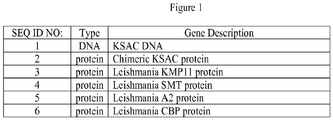
- the chimeric KSAC protein may have at least 70%, 75%, 80%, 85%, 90%, 95%, 96%, 97%, 98% or 99% sequence identity to a polypeptide having the sequence as set forth in SEQ ID NO:2.
- the polynucleotide encoding the chimeric KSAC protein may have at least 70%, 75%, 80%, 85%, 90%, 95%, 96%, 97%, 98% or 99% sequence identity to a polypeptide having the sequence as set forth in SEQ ID NO:2.
- the KSAC encoding polynucleotide may have at least 70%, 75%, 80%, 85%, 90%, 95%, 96%, 97%, 98% or 99% sequence identity to a polynucleotide having the sequence as set forth in SEQ ID NO:1.
- sequence identity with respect to sequences can refer to, for example, the number of positions with identical nucleotides or amino acids divided by the number of nucleotides or amino acids in the shorter of the two sequences wherein alignment of the two sequences can be determined in accordance with the Wilbur and Lipman algorithm (Wilbur and Lipman).
- the sequence identity or sequence similarity of two amino acid sequences, or the sequence identity between two nucleotide sequences can be determined using Vector NTI software package (Invitrogen, 1600 Faraday Ave., Carlsbad, CA).
- RNA sequences are said to be similar, or have a degree of sequence identity or homology with DNA sequences, thymidine (T) in the DNA sequence is considered equal to uracil (U) in the RNA sequence.
- RNA sequences are within the scope of the disclosure and can be derived from DNA sequences, by thymidine (T) in the DNA sequence being considered equal to uracil (U) in RNA sequences.
- polynucleotides of the disclosure include sequences that are degenerate as a result of the genetic code, e.g., optimized codon usage for a specific host.
- optimized refers to a polynucleotide that is genetically engineered to increase its expression in a given species.
- the DNA sequence of the KSAC protein gene can be modified to 1) comprise codons preferred by highly expressed genes in a particular species; 2) comprise an A+T or G+C content in nucleotide base composition to that substantially found in said species; 3) form an initiation sequence of said species; or 4) eliminate sequences that cause destabilization, inappropriate polyadenylation, degradation and termination of RNA, or that form secondary structure hairpins or RNA splice sites.
- Increased expression of KSAC protein in said species can be achieved by utilizing the distribution frequency of codon usage in eukaryotes and prokaryotes, or in a particular species.
- frequency of preferred codon usage refers to the preference exhibited by a specific host cell in usage of nucleotide codons to specify a given amino acid. There are 20 natural amino acids, most of which are specified by more than one codon. Therefore, all degenerate nucleotide sequences are included in the disclosure as long as the amino acid sequence of the KSAC polypeptide encoded by the nucleotide sequence is functionally unchanged.
- the present disclosure provides a method for producing a soluble, disaggregated, refolded or active protein expressed in prokaryotes or eukaryotes comprising the steps of (i) preparing the inclusion bodies in a buffer containing no or low concentration of urea to form inclusion body suspension; and (ii) subjecting the inclusion body suspension to a high pressure for a period of time.
- the present invention provides a method of producing a soluble protein expressed in prokaryotes or eukaryotes comprising the steps of (i) preparing inclusion bodies in a buffer containing no or low concentration of urea to form an inclusion body suspension, wherein the urea concentration is from 0M to 3M; (ii) subjecting the inclusion body suspension to a stepwise increase of pressure over a period of time; and (iii) maintaining high pressure applied to the inclusion bodies for a period of time.
- the buffer may contain DiThio Threitol (DTT).
- DTT DiThio Threitol
- the DTT concentration may range from about 1mM to about 100mM, about 1mM to about 90mM, about 1mM to about 70mM, about 1mM to about 60mM, about 1mM to about 50mM, or about 1mM, 2mM, 3mM, 4mM, 5mM, 6mM, 7mM, 8mM, 9mM, 10mM, 15mM, 20mM, 25mM, 30mM, 35mM, 40mM, 45mM, 50mM, 55mM, 60mM, 65mM, 70mM, 75mM, 80mM, 85mM, 90mM, 95mM, 100mM.
- urea may not be present in the buffer. In another aspect, urea may be present in the buffer at the concentration of about 1M, about 2M and about 3M.
- the high pressure may be in the range from about 1000 bar to about 5000 bar, from about 2000 bar to about 4000 bar.
- the high pressure may be any pressure in the range from about 2000 bar to about 4000 bar, for example, but not limiting to, 2000 bar, 2100 bar, 2200 bar, 2300 bar, 2400 bar, 2500 bar, 2600 bar, 2700 bar, 2800 bar, 2900 bar, 3000 bar, 3100 bar, 3200 bar, 3300 bar, 3400 bar, 3500 bar, 3600 bar, 3700 bar, 3800 bar, 3900 bar, and 4000 bar.
- a gradual increase of the pressure may be applied to the inclusion body suspension by continuously increasing the pressure at a constant rate over a period of time to reach the desired final high pressure.
- the pressure may be increased at the rate of about 200 bar/min - about 1000 bar/min continuously over about 2 min - about 10 min to reach 2000 bar, at the rate of about 200 bar/min - about 1000 bar/min continuously over about 3 min - about 15 min to reach 3000 bar, at the rate of about 200 bar/min - about 1000 bar/min continuously over about 4 min - about 20 min to reach 4000 bar, at the rate of about 200 bar/min - about 1000 bar/min continuously over about 5 min - about 25 min to reach 5000 bar.
- the gradual increase of the pressure is applied stepwise.
- the pressure is increased at about 1000 bar/min for about one minute to reach 1000 bar, then the 1000 bar pressure is maintained for about one hour to relax the protein, after the relaxation period, the pressure is increased again at about 1000 bar/min for about one minute to reach the final desired high pressure of 2000 bar.
- the pressure may also be increased at about 1000 bar/min for about thirty seconds to reach 500 bar, the 500 bar pressure is maintained for about one hour to relax the protein, then the pressure is increased again at about 1000 bar/min for about thirty seconds to reach 1000 bar, the 1000 bar pressure is maintained for about one hour to relax the protein, the pressure is increased again at about 1000 bar/min for about thirty seconds to reach 1500 bar, the 1500 bar pressure is maintained for about one hour to relax the protein, then the pressure is increased again at about 1000 bar/min to reach the final desired pressure of 2000 bar.
- the same stepwise increase of the pressure at about 1000 bar/min for about one minute or about 30 seconds with intermediate relaxation of protein for about one hour may be employed.
- the pressure is increased at about 1000 bar/min for about one minute to reach 1000 bar, then the 1000 bar pressure is maintained for about one hour to relax the protein, the pressure is increased again at about 1000 bar/min for about one minute to reach the pressure of 2000 bar, then the 2000 bar pressure is maintained for about one hour to relax the protein for the second time, the pressure is increased again at about 1000 bar/min for about one minute to reach the final desired pressure of 3000 bar.
- the pressure can also be increased at about 1000 bar/min for about thirty seconds, with a plateau of 1 hour duration at each 500 bar, and the target pressure of 3000 bar may be reached after 5 hr.
- the pressure is increased at about 1000 bar/min for about one minute to reach 1000 bar, then the 1000 bar pressure is maintained for about one hour to relax the protein, the pressure is increased again at about 1000 bar/min for about one minute to reach the pressure of 2000 bar, then the 2000 bar pressure is maintained for about one hour to relax the protein for the second time, the pressure is increased again at about 1000 bar/min for about one minute to reach the final desired pressure of 3000 bar, then the 3000 bar pressure is maintained for about one hour to relax the protein for the third time, the pressure is increased again at 1000 bar/min for about one minute to reach the final desired pressure of 4000 bar.
- the pressure can also be increased at about 1000 bar/min for about thirty seconds, with a plateau of 1 hour duration at each 500 bar, and the target pressure of 4000 bar may be reached after 7 hr.
- the inclusion body suspension may be treated under the high pressure for about 10 hours to about 100 hours, about 20 hours to about 100 hours.
- the high pressure treatment is preferably for more than 24 hours, for example, for about 25 hours to about 100 hours, about 25 hours to about 80 hours, about 25 hours to about 60 hours, about 25 hours to about 50 hours, about 25 hours, about 26 hours, about 27 hours, about 28 hours, about 29 hours, about 30 hours, about 31 hours, about 32 hours, about 33 hours, about 34 hours, about 35 hours, about 36 hours, about 37 hours, about 38 hours, about 39 hours, about 40 hours, about 41 hours, about 42 hours, about 43 hours, about 44 hours, about 45 hours, about 46 hours, about 47 hours, about 48 hours, about 49 hours, about 50 hours.
- the present invention provides a method for producing a soluble protein expressed in prokaryotes or eukaryotes comprising the steps of (i) preparing inclusion bodies in a buffer containing no or low concentration of urea to form an inclusion body suspension wherein the urea concentration is from 0M to 3M; (ii) subjecting the inclusion body suspension to a stepwise increase of pressure over a period of time; (iii) maintaining high pressure applied to the inclusion bodies for a period of time; and (iv) recovering the protein by depressurization.
- Depressurization may be performed at the rate of about 83 bar/hr - 200 bar/hr.
- the prokaryotes contemplated in the present invention may include Avibacterium, Brucella, Escherichia coli , Haemophilus (e.g., Haemophilus suis), Salmonella (e.g., Salmonella enteridis, Salmonella typhimurium, Salmonella infantis), Shigella, Pasteurella, and Rimeirella .
- a number of expression vectors may be selected.
- Such vectors include, but are not limited to, the multifunctional E. coli cloning and expression vectors such as PBLUESCRIPT (Stratagene); piN vectors ( Van Heeke & Schuster, J. Biol. Chern. 264:5503-5509 (1989 )); and the like; PGEX Vectors (Promega, Madison, Wis.); in eukaryotic systems, the cell lines may be yeast (such as Saccharomyces cerevisiae, Pichia pastoris), baculovirus cells, mammalian cells, plant cells.
- the expression vectors of eukaryotic systems include, but are not limited to, pVR1020 or pVT1012 vectors (Vical Inc., San Diego, CA), PichiaPink Vector (Invitrogen, CA, USA), pFasBac TOPO vector (Invitrogen).
- the method for producing a soluble protein expressed in prokaryotes or eukaryotes provided in the present invention may be used to solubilize any proteins.
- the proteins may include antibodies and insulin.
- composition or vaccine comprising the chimeric KSAC protein aforementioned and a pharmaceutically or veterinarily acceptable carrier, excipient, vehicle or adjuvant.
- the pharmaceutically or veterinarily acceptable carriers or adjuvant or vehicles or excipients are well known to the one skilled in the art.
- the pharmaceutically or veterinarily acceptable carrier or adjuvant or vehicle or excipients that can be used for methods of this disclosure include, but are not limited to, 0.9% NaCl (e.g., saline) solution or a phosphate buffer, poly-(L-glutamate) or polyvinylpyrrolidone.
- the pharmaceutically or veterinarily acceptable carrier or vehicle or excipients may be any compound or combination of compounds facilitating the administration of the vector (or protein expressed from an inventive vector in vitro ), or facilitating transfection or infection and/or improve preservation of the vector (or protein). Doses and dose volumes are herein discussed in the general description and can also be determined by the skilled artisan from this disclosure read in conjunction with the knowledge in the art, without any undue experimentation.
- optionally other compounds may be added as pharmaceutically or veterinarily acceptable carriers or adjuvant or vehicles or excipients, including, but not limited to, alum; CpG oligonucleotides (ODN), in particular ODN 2006, 2007, 2059, or 2135 ( Pontarollo R.A. et al., Vet. Immunol. Immunopath, 2002, 84: 43-59 ; Wernette C.M. et al., Vet. Immunol. Immunopath, 2002, 84: 223-236 ; Mutwiri G. et al., Vet. Immunol.
- ODN CpG oligonucleotides
- compositions and vaccines according to the disclosure may comprise or consist essentially of one or more adjuvants.
- Suitable adjuvants are (1) polymers of acrylic or methacrylic acid, maleic anhydride and alkenyl derivative polymers, (2) immunostimulating sequences (ISS), such as oligodeoxyribonucleotide sequences having one or more non-methylated CpG units (Klinman et al., 1996; WO98/16247 ), (3) an oil in water emulsion, such as the SPT emulsion described on p 147 of "Vaccine Design, The Subunit and Adjuvant Approach" published by M. Powell, M.
- cation lipids containing a quaternary ammonium salt e.g., DDA (5) cytokines, (6) aluminum hydroxide or aluminum phosphate, (7) saponin or (8) other adjuvants discussed in any document cited in the instant application, or (9) any combinations or mixtures thereof.
- a quaternary ammonium salt e.g., DDA (5) cytokines, (6) aluminum hydroxide or aluminum phosphate, (7) saponin or (8) other adjuvants discussed in any document cited in the instant application, or (9) any combinations or mixtures thereof.
- a solution of adjuvant, especially of carbomer may be prepared in distilled water, advantageously in the presence of sodium chloride, the solution obtained being at an acidic pH.
- This stock solution is diluted by adding it to the desired quantity (for obtaining the desired final concentration), or a substantial part thereof, of water charged with NaCl, advantageously physiological saline (NaCl 9 g/1) all at once in several portions with concomitant or subsequent neutralization (pH 7.3 to 7.4), advantageously with NaOH.
- This solution at physiological pH is used for mixing with the vaccine, which may be especially stored in freeze-dried, liquid or frozen form.
- the polymer concentration in the final vaccine composition can be from 0.01% to 2% w/v, from 0.06 to 1% w/v, or from 0.1 to 0.6% w/v.
- the subunit (protein) vaccine may be combined with adjuvants, like oil-in-water, water-in-oil-in-water emulsions based on mineral oil and/or vegetable oil and non ionic surfactants such as block copolymers, TWEEN®, SPAN®.
- adjuvants like oil-in-water, water-in-oil-in-water emulsions based on mineral oil and/or vegetable oil and non ionic surfactants such as block copolymers, TWEEN®, SPAN®.
- emulsions are notably those described in page 147 of "Vaccine Design - The Subunit and Adjuvant Approach", Pharmaceutical Biotechnology, 1995 , or TS emulsions, notably the TS6 emulsion, and LF emulsions, notably LF2 emulsion (for both TS and LF emulsions, see WO 04/024027 ).
- Suitable adjuvants are for example vitamin E, saponins, and CARBOPOL® (Noveon; see WO 99/51269 ; WO 99/44633 ), aluminium hydroxide or aluminium phosphate (" Vaccine Design, The subunit and adjuvant approach", Pharmaceutical Biotechnology, vol. 6, 1995 ), biological adjuvants (i.e. C4b, notably murine C4b (Ogata R T et al .) or equine C4b, GM-CSF, notably equine GM-CSF ( US 6,645,740 )), toxins (i.e.
- Another aspect of the disclosure relates to a method for inducing an immunological response in an animal against one or more antigens or a protective response in an animal against one or more pathogens, which method comprises inoculating the animal at least once with the vaccine or pharmaceutical composition of the present disclosure.
- Yet another aspect of the disclosure relates to a method for inducing an immunological response in an animal to one or more antigens or a protective response in an animal against one or more Leishmania pathogens in a prime-boost administration regime, which is comprised of at least one primary administration and at least one booster administration using at least one common polypeptide, antigen, epitope or immunogen.
- the immunological composition or vaccine used in primary administration may be same, may be different in nature from those used as a booster.
- the prime-administration may comprise one or more administrations.
- the boost administration may comprise one or more administrations.
- the prime-boost administrations may be carried out 2 to 6 weeks apart, for example, about 3 weeks apart.
- a semi-annual booster or an annual booster, advantageously using the subunit (protein) vaccine, is also envisioned.
- the prime-boost administration can include the subunit vaccine or composition comprising the chimeric KSAC protein aforementioned.
- the prime-boost administration can also include recombinant viral vectors and plasmid vectors expressing Leishmania antigens (see, for example, US2009/0324649 ).
- the composition or vaccine comprising the KSAC protein is administered followed by the administration of vaccine or composition comprising a recombinant viral vector that contains and expresses any Leishmania antigens, or a DNA plasmid vaccine or composition that contains and expresses any Leishmania antigens, or an inactivated viral vaccine or composition comprising the Leishmania antigens.
- one administration of the vaccine is performed at 10 to 15-week old by the subcutaneous or intramuscular route.
- a second or third administration can be done within the 2-6 weeks of the first administration.
- the animals are preferably at least 4-week old at the time of the first administration.
- a variety of administration routes may be used in addition to subcutaneously or intramuscularly, such as intradermally or transdermally.
- composition or vaccine according to the disclosure comprise or consist essentially of or consist of an effective quantity to elicit a therapeutic response of one or more polypeptides as discussed herein; and, an effective quantity can be determined from this disclosure and the knowledge in the art, without undue experimentation.
- a dose may include, from about 1 ⁇ g to about 2000 ⁇ g, about 5 ⁇ g to about 1000 ⁇ g, about 10 ⁇ g to about 100 ⁇ g, about 20 ⁇ g to about 1000 ⁇ g, about 30 ⁇ g to about 500 ⁇ g, or about 50 ⁇ g to about 500 ⁇ g.
- the dose volumes can be between about 0.1ml to about 10ml, or between about 0.2ml to about 5ml.
- the KSAC inclusion bodies produced from E. coli were prepared in the following three buffers: 1) Tris 20mM, 50mM DiThio Threitol (DTT), pH8; 2) Tris 20mM, 50mM DiThio Threitol (DTT), pH8, urea 1M; 3) Tris 20mM, 50mM DiThio Threitol (DTT), pH8, urea 2M.
- the KSAC inclusion bodies prepared in the same buffers at room temperature without pressure during the entire treatment duration were used as controls.
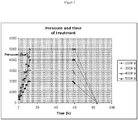
- Figure 3 shows the steps of pressure levels for protein relaxation during the pressure increase (stepwise increase of pressure). Pressurization at target pressure was applied for 48 hours, then the samples were depressurized for 24 hours.
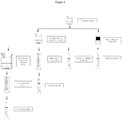
- Figure 4 shows the schematic comparison between the high pressure solubilisation and folding of recombinant proteins from inclusion bodies and the classical solubilisation and folding of recombinant proteins from inclusion bodies.
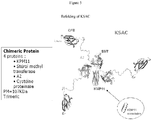
- FIG. 5 shows the schematic graph of KSAC refolding.
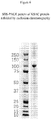
- Figure 6 shows the typical SDS-PAGE pattern of the KSAC protein after the KSAC protein was solubilized in 7M urea, 20mM DTT and refolded by exclusion chromatography.
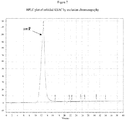
- Figure 7 shows the typical HPLC plot of the KSAC protein. The HPLC chromatogram identifies the trimer of KSAC protein by its mass. The protein concentration and the relative purity towards total protein content were estimated.
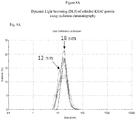
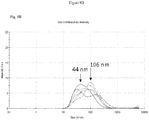
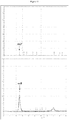
- Figure 8 shows the dynamic light scattering (DLS) of refolded KSAC protein using exclusion chromatography.
- Fig.8A shows the distribution by number which indicates that the majority of the population has a size of 12 to 18nm.
- Fig.8B shows the exhaustive range of size detected that is not linked to relative population. Objects between 10 and 800nm were detected.
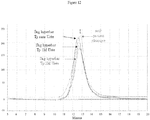
- Figure 12 is the superposed HPLC chromatogram of the supernatant of the 3000 bar pressure treated KSAC samples and the KSAC protein obtained with the classical refolding process. The results show that the peaks are similar that the soluble protein obtained by high pressure treatment is organized in trimer.
- Table 1 below shows quantification of KSAC protein after 3000 bar treatment by qDot-blot and HPLC.
- Table 1 2M urea control Assay pellet Assay supernatant Dot-blot ⁇ g/ml 347 10 797 HPLC ⁇ g/ml - - 723 1M urea control Assay pellet Assay supernatant Dot-blot ⁇ g/ml 328 10 750 HPLC ⁇ g/ml - - 746 Without urea control Assay pellet Assay supernatant Dot-blot ⁇ g/ml 123 15 649 HPLC ⁇ g/ml - - 825
- the quantity of solubilized protein was about 800 ⁇ g/ml. This was very close to the estimated quantity of initial KSAC protein as inclusion bodies (1000 ⁇ g/ml). The solubilisation yield is very high (75-100%).
- Figure 13 shows the superposition of the DLS data obtained with the 3000 bar pressurized protein (lighter line) in the buffer without urea and the protein obtained with the classical refolding process (darker line).
- the exhaustive range of size shows that less objects of higher size are detected in pressurized samples.
- the distribution by number shows that the majority of the pressure-refolded population has a similar size with the population refolded by the classical process and the folding seems very similar.
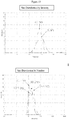
- Figure 14 shows that the protein sizes obtained at 3000 bar are identical to protein sizes obtained from classical chromatography refolding for all three buffers used (circled).
- the protein sizes are identical to the protein sizes from classical chromatography refolding when urea is used in the buffer.
- pressure higher than 3000 bar high-pressure aggregates appear when no urea is used. With urea present in the buffer, the protein seems to collapse (10nm in size) which indicates that denaturation has occurred.
- Figure 15 shows HPLC chromatogram of 4000 bar treated samples. The results show that proteins with sizes larger than KSAC protein appeared when no urea was present in the buffer, or with only 1M urea was added in the buffer. Protein size was as expected when 2M was added in the buffer.
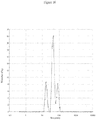
- Figure 16 shows the DLS size distribution by number of the 5000 bar treated samples without urea. The results indicate that three populations of proteins were detected with large sizes up to 90nm. The population whose size is similar to the chromatography refolded KSAC is a minority one.
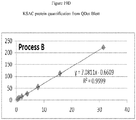
- Figure 17 shows the comparison of KSAC soluble protein content determined by HPLC and Qdot-blot. The results indicate that the maximum concentrations of solubilized proteins are obtained with 3000 bar treated samples with good consistency between HPLC and Qdot-blot technologies. For the 2000 bar treated samples, the presence of urea helps to increase the solubilization yield. For the 4000 bar treated samples, HPLC gives higher yield than Qdot-blot, indicating a loss of recognition of the antigens.
- OCS Overall Clinical Score
- the OCS data indicated that no major abnormality of the OCS was detected before M15.
- the parasitological and serological assays were performed to evaluate the status of the dogs as defined by Oliva et al (2006). Nested PCR on bone marrow, culture on lymph nodes aspirates were performed according to Gradoni et al (2005, Vaccine 23:5245-5251 ). IFAT (ImmunoFluorescent Antibody Test) serum titers test was performed according to a technique derived from OIE (2004, Manual of diagnostic tests and vaccines for terrestrial animals, fifth Edition OIE, Par is).
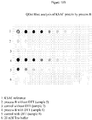
- the objective of the study is to compare the efficiency of solubilizing protein from inclusions bodies by different processes.
- the inclusion bodies suspensions were stored in Quick Seal tubes for high pressure treatments as described below.
- stepwise pressurization was applied to the inclusion bodies suspensions increasing the pressure from 0 bar to 3000 bar at 1000 bar/min, with a plateau of 1 hour duration at each 500 bar (target pressure of 3000 bar reached after 5 hr).
- the 3000 bar pressure was maintained for 48 hours.
- the samples were then depressurized from 3000 bar to 0 bar at constant rate of 125 bar/hr for 24 hrs.
- process B the inclusions bodies suspensions were treated according to the method described in US 6,489,450 .
- the samples were subject to pressurization at constant rate up to 2500 bar in 1 hr.
- the 2500 bar pressure was maintained for 6 hrs.
- Depressurization was performed at constant rate for 1 hr reducing the pressure from 2500 bar to 0 bar.
- Table 8 inclusion bodies suspensions treatment Sample (1mg/mL KSAC inclusion bodies buffer High pressure treatment process 1 Tris 20mM Process A 2 Tris 20mM + DTT 50mM Process A 3 Tris 20mM Control* 4 Tris 20mM + DTT 50mM Control 5 Tris 20mM Process B 6 Tris 20mM + DTT 50mM Process B 7 Tris 20mM Control 8 Tris 20mM + DTT 50mM Control Control *: no high pressure treatment, stored at room temperature.
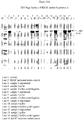
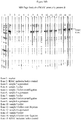
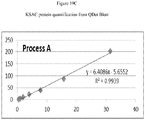
- KSAC protein amounts calculated from the band intensity on the SDS-PAGE were presented in Table 9 below. Table 9 Comparative integration of the intensities of the bands measured on SDS gels Process A Process B sample I.I. KSAC band Total protein I.I. %KSAC/total %KSAC-S/%KSAC-P* I.I. KSAC band Total protein I.I.
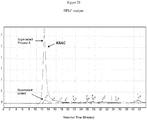
- Figure 20 shows the superposition of the HPLC chromatograms of the supernatant of the control and process A treated sample.
- the retention time, retention volume and estimated purity obtained for the process A treated sample are show in Table 11 below.
- Table 11 Retention time, retention volume and estimated purity obtained for process A treated sample Detection Information Control - no processing After Process A RT (Retention time - min) 12.7 12.4
- UV VR Retention volume - mL
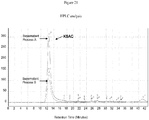
- Figure 21 shows the superposition of the HPLC chromatograms of the supernatant of process A treated sample and process B treated sample.
- the retention time, retention volume and estimated purity obtained for the process A treated sample are show in Table 12 below.
- Table 12 Retention time, retention volume and estimated purity obtained for process A and B treated samples Detection Information Process A Process B RT (Retention time - min) 12.4 12.4 UV VR (Retention volume - mL) 6.46 6.47 Estimated Purity (%) 85.5 74.2
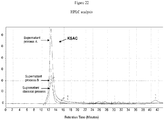
- Figure 22 shows the superposition of the HPLC chromatograms of the supernatant of process A treated sample, process B treated sample and classical process treated sample (denaturation and refolding obtained by urea and DTT treatment).
- the retention time, retention volume and estimated purity obtained for the process A treated sample are show in Table 13 below.
- Table 13 Retention time, retention volume and estimated purity obtained for process A, process B and classical process treated samples Detection Information Classical process Process A Process B RT (Retention time - min) 12.5 12.4 12.4 UV VR (Retention volume - mL) 6.50 6.46 6.47 Peak area (mAU) 8628 25251 10506 Estimated purity (%) 94.7 85.5 74.2
- process A provided better solubilization of KSAC protein than process B judging from the peak areas (25251mAU for process A vs 10506mAU for process B). Both process A and B allow obtaining a refolding of the KSAC protein very close to the one obtained using the classical process (solubilization using urea + DTT treatment and refolding by SEC chromatography).
Landscapes
- Health & Medical Sciences (AREA)
- Chemical & Material Sciences (AREA)
- Life Sciences & Earth Sciences (AREA)
- Organic Chemistry (AREA)
- General Health & Medical Sciences (AREA)
- Zoology (AREA)
- Engineering & Computer Science (AREA)
- Genetics & Genomics (AREA)
- Wood Science & Technology (AREA)
- Bioinformatics & Cheminformatics (AREA)
- Medicinal Chemistry (AREA)
- Biochemistry (AREA)
- Microbiology (AREA)
- General Engineering & Computer Science (AREA)
- Molecular Biology (AREA)
- Veterinary Medicine (AREA)
- Animal Behavior & Ethology (AREA)
- Public Health (AREA)
- Pharmacology & Pharmacy (AREA)
- Epidemiology (AREA)
- Biotechnology (AREA)
- Biomedical Technology (AREA)
- Tropical Medicine & Parasitology (AREA)
- Immunology (AREA)
- Mycology (AREA)
- Proteomics, Peptides & Aminoacids (AREA)
- Biophysics (AREA)
- Gastroenterology & Hepatology (AREA)
- Toxicology (AREA)
- Chemical Kinetics & Catalysis (AREA)
- General Chemical & Material Sciences (AREA)
- Polymers & Plastics (AREA)
- Food Science & Technology (AREA)
- Nuclear Medicine, Radiotherapy & Molecular Imaging (AREA)
- Oncology (AREA)
- Communicable Diseases (AREA)
- Medicines Containing Antibodies Or Antigens For Use As Internal Diagnostic Agents (AREA)
- Peptides Or Proteins (AREA)
- Micro-Organisms Or Cultivation Processes Thereof (AREA)
- Sustainable Development (AREA)
Applications Claiming Priority (3)
| Application Number | Priority Date | Filing Date | Title |
|---|---|---|---|
| US201261694968P | 2012-08-30 | 2012-08-30 | |
| US201361830425P | 2013-06-03 | 2013-06-03 | |
| PCT/US2013/057430 WO2014036349A1 (en) | 2012-08-30 | 2013-08-30 | Expression of chimeric ksac protein and method of producing soluble proteins by high pressure |
Publications (2)
| Publication Number | Publication Date |
|---|---|
| EP2890392A1 EP2890392A1 (en) | 2015-07-08 |
| EP2890392B1 true EP2890392B1 (en) | 2019-04-17 |
Family
ID=49162270
Family Applications (2)
| Application Number | Title | Priority Date | Filing Date |
|---|---|---|---|
| EP13760212.4A Not-in-force EP2890392B1 (en) | 2012-08-30 | 2013-08-30 | Expression of chimeric ksac protein and method of producing soluble proteins by high pressure |
| EP13766420.7A Active EP2890393B1 (en) | 2012-08-30 | 2013-08-30 | Hyperbaric device and methods for producing inactivated vaccines and for refolding/solubilizing recombinant proteins |
Family Applications After (1)
| Application Number | Title | Priority Date | Filing Date |
|---|---|---|---|
| EP13766420.7A Active EP2890393B1 (en) | 2012-08-30 | 2013-08-30 | Hyperbaric device and methods for producing inactivated vaccines and for refolding/solubilizing recombinant proteins |
Country Status (18)
| Country | Link |
|---|---|
| US (3) | US9315553B2 (enExample) |
| EP (2) | EP2890392B1 (enExample) |
| JP (2) | JP6405308B2 (enExample) |
| KR (1) | KR102208844B1 (enExample) |
| CN (3) | CN104768577B (enExample) |
| AP (1) | AP2015008331A0 (enExample) |
| AU (4) | AU2013308623B2 (enExample) |
| BR (1) | BR112015004463B8 (enExample) |
| CA (2) | CA2883296A1 (enExample) |
| EA (1) | EA031988B1 (enExample) |
| ES (1) | ES2744709T3 (enExample) |
| HK (1) | HK1211874A1 (enExample) |
| MD (1) | MD4608C1 (enExample) |
| MX (3) | MX358782B (enExample) |
| NZ (3) | NZ705790A (enExample) |
| PH (1) | PH12015500700B1 (enExample) |
| RU (1) | RU2647568C2 (enExample) |
| WO (2) | WO2014036349A1 (enExample) |
Families Citing this family (11)
| Publication number | Priority date | Publication date | Assignee | Title |
|---|---|---|---|---|
| US8968749B2 (en) * | 2006-07-21 | 2015-03-03 | Universidade Federal De Minas Gerais—Ufmg | Vaccine composition and immunization method |
| ZA201501696B (en) | 2012-08-30 | 2016-01-27 | Merial Ltd | Hyperbaric device and methods for producing inactivated vaccines and for refolding/solubilizing recombinant proteins |
| EP2890392B1 (en) * | 2012-08-30 | 2019-04-17 | Merial, Inc. | Expression of chimeric ksac protein and method of producing soluble proteins by high pressure |
| EP2978447B1 (en) * | 2013-03-28 | 2019-05-08 | Infectious Disease Research Institute | Vaccines comprising leishmania polypeptides for the treatment and diagnosis of leishmaniasis |
| CN104758944B (zh) * | 2015-04-02 | 2017-11-28 | 中国科学院过程工程研究所 | 一种疫苗制剂及其制备方法和用途 |
| JP2018082987A (ja) * | 2016-11-25 | 2018-05-31 | 株式会社日立製作所 | ウイルス不活化方法及びウイルス不活化装置 |
| JP2020152644A (ja) * | 2019-03-18 | 2020-09-24 | 国立大学法人愛媛大学 | Vnarのリフォールディング方法およびvnarの製造方法 |
| US10973908B1 (en) | 2020-05-14 | 2021-04-13 | David Gordon Bermudes | Expression of SARS-CoV-2 spike protein receptor binding domain in attenuated salmonella as a vaccine |
| US12537071B1 (en) | 2020-07-22 | 2026-01-27 | David Gordon Bermudes | Bacteria having boolean control pathways expressing therapeutic proteins including immunotherapeutic cytotoxins |
| CN112120012B (zh) * | 2020-09-30 | 2022-03-22 | 广东康盾创新产业集团股份公司 | 一种car-t细胞冻存方法 |
| BR102021000794A2 (pt) * | 2021-01-15 | 2022-07-26 | Fundação Oswaldo Cruz | Proteína quimérica, kit, método para diagnóstico de leishmaniose, uso de uma proteína quimérica, composição vacinal contra leishmaniose visceral, e, uso de uma composição vacinal |
Family Cites Families (37)
| Publication number | Priority date | Publication date | Assignee | Title |
|---|---|---|---|---|
| CA1247080A (en) | 1983-03-08 | 1988-12-20 | Commonwealth Serum Laboratories Commission | Antigenically active amino acid sequences |
| JP2743177B2 (ja) * | 1987-04-24 | 1998-04-22 | 財団法人阪大微生物病研究会 | 百日咳菌の培養方法、及び百日咳トキソイドとその混合ワクチン |
| WO1998016247A1 (en) | 1996-10-11 | 1998-04-23 | The Regents Of The University Of California | Immunostimulatory polynucleotide/immunomodulatory molecule conjugates |
| US5980912A (en) | 1997-03-25 | 1999-11-09 | Zonagen, Inc. | Chitosan induced immunopotentiation |
| FR2771011B1 (fr) | 1997-11-17 | 2000-01-28 | Hippocampe | Obtention de vaccins destines a prevenir les effets pathogenes associes a une infection retrovirale |
| FR2775601B1 (fr) | 1998-03-03 | 2001-09-21 | Merial Sas | Vaccins vivants recombines et adjuves |
| FR2776928B1 (fr) | 1998-04-03 | 2000-06-23 | Merial Sas | Vaccins adn adjuves |
| ATE349460T1 (de) | 1998-07-09 | 2007-01-15 | Barofold Inc | Rückfaltung von protein-aggregaten und einschlussteilchen durch hohen druck |
| AU4906200A (en) | 1999-05-28 | 2000-12-18 | Universite Laval | Inactivation of food spoilage and pathogenic microorganisms by dynamic high pressure |
| US6645740B1 (en) | 1999-06-10 | 2003-11-11 | Merial Limited | Nucleic acids encodings equine GM-CSF |
| WO2001022972A2 (en) | 1999-09-25 | 2001-04-05 | University Of Iowa Research Foundation | Immunostimulatory nucleic acids |
| US7615617B2 (en) | 1999-10-25 | 2009-11-10 | University Of Delaware | Use of hydrostatic pressure to inhibit and reverse protein aggregation and facilitate protein refolding |
| AU2002246493A1 (en) | 2000-08-10 | 2002-07-30 | Boston Biomedica, Inc. | Pressure cycling inactivation of pathogens in biological materials used for therapeutics or vaccines |
| US6635223B2 (en) * | 2000-10-25 | 2003-10-21 | Andreas Maerz | Method for inactivating micro-organisms using high pressure processing |
| CA2434045A1 (en) * | 2000-10-31 | 2002-08-15 | The Regents Of The University Of Colorado, A Body Corporate | Improved protein disaggregation and refolding using high pressure |
| AU2003245416A1 (en) | 2002-06-07 | 2004-04-30 | University Of Florida | Endodontic files made using bulk metallic glasses |
| SE525457C2 (sv) * | 2002-06-24 | 2005-02-22 | Flow Holdings Sagl | Förfarande för åstadkommande av en tryckändring mellan två trycktillstånd, högtryckspressanordning samt användning av förfarande eller högtryckspressanordning |
| RS52507B (sr) * | 2003-11-05 | 2013-04-30 | Laboratorios Leti S.L. | Primena specifičnih histona za lečenje parazitnih bolesti |
| US7993580B2 (en) | 2004-08-24 | 2011-08-09 | Baxter International Inc. | Methods for the inactivation of microorganisms in biological fluids, flow through reactors and methods of controlling the light sum dose to effectively inactivate microorganisms in batch reactors |
| CA2630802A1 (en) | 2005-11-21 | 2007-05-31 | Barofold, Inc. | Devices and methods for high-pressure refolding of proteins |
| CN200945252Y (zh) * | 2006-09-01 | 2007-09-12 | 天津市华泰森淼生物工程技术有限公司 | 手动开启式小型超高压生物处理设备 |
| CA2663416A1 (en) * | 2006-09-15 | 2008-03-20 | Barofold, Inc. | High pressure treatment of proteins for reduced immunogenicity |
| US20080249286A1 (en) | 2007-04-05 | 2008-10-09 | Seefeldt Matthew B | High-pressure refolding of proteins in the presence of binding partners |
| US7829681B2 (en) * | 2007-04-05 | 2010-11-09 | Barofold Inc. | High-pressure inclusion body solubilization and protease clipping of recombinant fusion proteins |
| EP2207890A4 (en) | 2007-10-05 | 2010-12-15 | Barofold Inc | HIGH PRESSURE PROCESSING OF AGGREGATED INTERFERONS |
| DK2224951T3 (da) * | 2007-12-21 | 2020-01-06 | Zoetis Services Llc | Varmebehandlede bakteriner og emulsionsvacciner, der er fremstillet af sådanne varmebehandlede bakteriner |
| BRPI0800357A2 (pt) | 2008-03-10 | 2009-10-27 | Fundacao Oswaldo Cruz | método para produção de uma vacina estabilizada |
| WO2009137577A2 (en) | 2008-05-08 | 2009-11-12 | Merial Limited | Leishmania vaccine using sand fly salivary immunogen |
| US8410258B2 (en) * | 2008-05-21 | 2013-04-02 | Infections Disease Research Institute | Recombinant polyprotein vaccines for the treatment and diagnosis of leishmaniasis |
| US8425919B2 (en) | 2008-05-21 | 2013-04-23 | Infectious Disease Research Institute | Recombinant polyprotein vaccines for the treatment and diagnosis of leishmaniasis |
| US20100112660A1 (en) | 2008-05-30 | 2010-05-06 | Barofold, Inc. | Method for Derivatization of Proteins Using Hydrostatic Pressure |
| US20110070219A1 (en) | 2009-04-27 | 2011-03-24 | Seefeldt Matthew B | High pressure protein crystallization |
| WO2011091860A1 (en) | 2010-02-01 | 2011-08-04 | Avure Technologies Ab | High-pressure arrangement with locking element preventing rotation of load basket |
| CN201781934U (zh) * | 2010-04-14 | 2011-04-06 | 中国农业大学 | 一种小型框架自动式超高压设备 |
| ES2749977T3 (es) | 2010-07-19 | 2020-03-24 | Pressure Biosciences Inc | Composiciones de proteínas terapéuticas que tienen inmunogenia reducida y/o eficacia mejorada |
| ZA201501696B (en) * | 2012-08-30 | 2016-01-27 | Merial Ltd | Hyperbaric device and methods for producing inactivated vaccines and for refolding/solubilizing recombinant proteins |
| EP2890392B1 (en) | 2012-08-30 | 2019-04-17 | Merial, Inc. | Expression of chimeric ksac protein and method of producing soluble proteins by high pressure |
-
2013
- 2013-08-30 EP EP13760212.4A patent/EP2890392B1/en not_active Not-in-force
- 2013-08-30 CA CA2883296A patent/CA2883296A1/en not_active Abandoned
- 2013-08-30 CN CN201380054922.4A patent/CN104768577B/zh active Active
- 2013-08-30 AU AU2013308623A patent/AU2013308623B2/en active Active
- 2013-08-30 NZ NZ705790A patent/NZ705790A/en unknown
- 2013-08-30 JP JP2015530070A patent/JP6405308B2/ja not_active Expired - Fee Related
- 2013-08-30 ES ES13760212T patent/ES2744709T3/es active Active
- 2013-08-30 US US14/014,437 patent/US9315553B2/en active Active
- 2013-08-30 WO PCT/US2013/057430 patent/WO2014036349A1/en not_active Ceased
- 2013-08-30 JP JP2015530066A patent/JP6438396B2/ja active Active
- 2013-08-30 RU RU2015111255A patent/RU2647568C2/ru active
- 2013-08-30 NZ NZ706288A patent/NZ706288A/en not_active IP Right Cessation
- 2013-08-30 MX MX2015002699A patent/MX358782B/es active IP Right Grant
- 2013-08-30 AP AP2015008331A patent/AP2015008331A0/xx unknown
- 2013-08-30 CA CA2883303A patent/CA2883303A1/en not_active Abandoned
- 2013-08-30 EA EA201500275A patent/EA031988B1/ru unknown
- 2013-08-30 MD MDA20150031A patent/MD4608C1/ro active IP Right Revival
- 2013-08-30 CN CN201810318137.XA patent/CN108578679A/zh active Pending
- 2013-08-30 AU AU2013308627A patent/AU2013308627B2/en not_active Ceased
- 2013-08-30 NZ NZ715459A patent/NZ715459A/en unknown
- 2013-08-30 HK HK16100050.9A patent/HK1211874A1/xx unknown
- 2013-08-30 EP EP13766420.7A patent/EP2890393B1/en active Active
- 2013-08-30 WO PCT/US2013/057426 patent/WO2014036345A2/en not_active Ceased
- 2013-08-30 CN CN201380053720.8A patent/CN104717976A/zh active Pending
- 2013-08-30 US US14/014,434 patent/US9169302B2/en active Active
- 2013-08-30 MX MX2015002701A patent/MX381717B/es unknown
- 2013-08-30 KR KR1020157008190A patent/KR102208844B1/ko active Active
- 2013-08-30 BR BR112015004463A patent/BR112015004463B8/pt active IP Right Grant
-
2015
- 2015-02-27 MX MX2021004478A patent/MX2021004478A/es unknown
- 2015-03-27 PH PH12015500700A patent/PH12015500700B1/en unknown
-
2016
- 2016-02-05 US US15/017,486 patent/US10364274B2/en active Active
-
2017
- 2017-01-17 AU AU2017200301A patent/AU2017200301A1/en not_active Abandoned
- 2017-03-14 AU AU2017201724A patent/AU2017201724B2/en active Active
Non-Patent Citations (1)
| Title |
|---|
| Y. GOTO ET AL: "KSAC, the First Defined Polyprotein Vaccine Candidate for Visceral Leishmaniasis", CLINICAL AND VACCINE IMMUNOLOGY, vol. 18, no. 7, 1 July 2011 (2011-07-01), pages 1118 - 1124, XP055054327, ISSN: 1556-6811, DOI: 10.1128/CVI.05024-11 * |
Also Published As
Similar Documents
| Publication | Publication Date | Title |
|---|---|---|
| US10364274B2 (en) | Expression of chimeric KSAC protein and method of producing soluble proteins by high pressure | |
| US20220105170A1 (en) | African swine fever vaccine | |
| US10537632B2 (en) | Canine parvovirus (CPV) virus-like particle (VLP) vaccines and uses thereof | |
| RU2714428C2 (ru) | Слитые белки fmdv-e2 и их применение | |
| US9228002B2 (en) | Leishmania vaccine using sand fly salivary immunogen | |
| CN111944023A (zh) | 一种抗o型口蹄疫的疫苗组合物及其制备方法和应用 | |
| Wang et al. | IL-7 enhances the protective efficacy of inactivated grass carp reovirus vaccine as adjuvant in grass carp (Ctenopharyngodon idella) | |
| WO2016162672A2 (en) | Avian vaccine | |
| HK1211873B (en) | Expression of chimeric ksac protein and method of producing soluble proteins by high pressure | |
| US10864260B2 (en) | Neospora vaccine composition | |
| US10485857B2 (en) | Heartworm vaccine, methods and uses thereof | |
| WO2018148186A1 (en) | Eimeria tenella elongation factor-1 alpha recombinant immunogenic compositions which induce active protective immunity against avian coccidiosis | |
| HK40010377A (en) | Fmdv and e2 fusion proteins and uses thereof | |
| HK1150616B (en) | Leishmania vaccine using sand fly salivary immunogen | |
| CZ292879B6 (cs) | DNA vakcína proti houbovým infekcím, zejména trichofytóze |
Legal Events
| Date | Code | Title | Description |
|---|---|---|---|
| PUAI | Public reference made under article 153(3) epc to a published international application that has entered the european phase |
Free format text: ORIGINAL CODE: 0009012 |
|
| 17P | Request for examination filed |
Effective date: 20150330 |
|
| AK | Designated contracting states |
Kind code of ref document: A1 Designated state(s): AL AT BE BG CH CY CZ DE DK EE ES FI FR GB GR HR HU IE IS IT LI LT LU LV MC MK MT NL NO PL PT RO RS SE SI SK SM TR |
|
| AX | Request for extension of the european patent |
Extension state: BA ME |
|
| DAX | Request for extension of the european patent (deleted) | ||
| REG | Reference to a national code |
Ref country code: HK Ref legal event code: DE Ref document number: 1211873 Country of ref document: HK |
|
| STAA | Information on the status of an ep patent application or granted ep patent |
Free format text: STATUS: EXAMINATION IS IN PROGRESS |
|
| 17Q | First examination report despatched |
Effective date: 20171215 |
|
| GRAP | Despatch of communication of intention to grant a patent |
Free format text: ORIGINAL CODE: EPIDOSNIGR1 |
|
| STAA | Information on the status of an ep patent application or granted ep patent |
Free format text: STATUS: GRANT OF PATENT IS INTENDED |
|
| INTG | Intention to grant announced |
Effective date: 20181109 |
|
| GRAS | Grant fee paid |
Free format text: ORIGINAL CODE: EPIDOSNIGR3 |
|
| GRAA | (expected) grant |
Free format text: ORIGINAL CODE: 0009210 |
|
| STAA | Information on the status of an ep patent application or granted ep patent |
Free format text: STATUS: THE PATENT HAS BEEN GRANTED |
|
| AK | Designated contracting states |
Kind code of ref document: B1 Designated state(s): AL AT BE BG CH CY CZ DE DK EE ES FI FR GB GR HR HU IE IS IT LI LT LU LV MC MK MT NL NO PL PT RO RS SE SI SK SM TR |
|
| REG | Reference to a national code |
Ref country code: GB Ref legal event code: FG4D |
|
| REG | Reference to a national code |
Ref country code: CH Ref legal event code: EP |
|
| REG | Reference to a national code |
Ref country code: DE Ref legal event code: R096 Ref document number: 602013054034 Country of ref document: DE |
|
| REG | Reference to a national code |
Ref country code: AT Ref legal event code: REF Ref document number: 1120834 Country of ref document: AT Kind code of ref document: T Effective date: 20190515 Ref country code: IE Ref legal event code: FG4D |
|
| RAP2 | Party data changed (patent owner data changed or rights of a patent transferred) |
Owner name: BOEHRINGER INGELHEIM ANIMAL HEALTH USA INC. |
|
| REG | Reference to a national code |
Ref country code: NL Ref legal event code: MP Effective date: 20190417 |
|
| REG | Reference to a national code |
Ref country code: LT Ref legal event code: MG4D |
|
| PG25 | Lapsed in a contracting state [announced via postgrant information from national office to epo] |
Ref country code: NL Free format text: LAPSE BECAUSE OF FAILURE TO SUBMIT A TRANSLATION OF THE DESCRIPTION OR TO PAY THE FEE WITHIN THE PRESCRIBED TIME-LIMIT Effective date: 20190417 |
|
| PG25 | Lapsed in a contracting state [announced via postgrant information from national office to epo] |
Ref country code: NO Free format text: LAPSE BECAUSE OF FAILURE TO SUBMIT A TRANSLATION OF THE DESCRIPTION OR TO PAY THE FEE WITHIN THE PRESCRIBED TIME-LIMIT Effective date: 20190717 Ref country code: LT Free format text: LAPSE BECAUSE OF FAILURE TO SUBMIT A TRANSLATION OF THE DESCRIPTION OR TO PAY THE FEE WITHIN THE PRESCRIBED TIME-LIMIT Effective date: 20190417 Ref country code: HR Free format text: LAPSE BECAUSE OF FAILURE TO SUBMIT A TRANSLATION OF THE DESCRIPTION OR TO PAY THE FEE WITHIN THE PRESCRIBED TIME-LIMIT Effective date: 20190417 Ref country code: SE Free format text: LAPSE BECAUSE OF FAILURE TO SUBMIT A TRANSLATION OF THE DESCRIPTION OR TO PAY THE FEE WITHIN THE PRESCRIBED TIME-LIMIT Effective date: 20190417 Ref country code: FI Free format text: LAPSE BECAUSE OF FAILURE TO SUBMIT A TRANSLATION OF THE DESCRIPTION OR TO PAY THE FEE WITHIN THE PRESCRIBED TIME-LIMIT Effective date: 20190417 Ref country code: PT Free format text: LAPSE BECAUSE OF FAILURE TO SUBMIT A TRANSLATION OF THE DESCRIPTION OR TO PAY THE FEE WITHIN THE PRESCRIBED TIME-LIMIT Effective date: 20190817 Ref country code: AL Free format text: LAPSE BECAUSE OF FAILURE TO SUBMIT A TRANSLATION OF THE DESCRIPTION OR TO PAY THE FEE WITHIN THE PRESCRIBED TIME-LIMIT Effective date: 20190417 |
|
| REG | Reference to a national code |
Ref country code: DE Ref legal event code: R082 Ref document number: 602013054034 Country of ref document: DE Representative=s name: VOSSIUS & PARTNER PATENTANWAELTE RECHTSANWAELT, DE Ref country code: DE Ref legal event code: R081 Ref document number: 602013054034 Country of ref document: DE Owner name: BOEHRINGER INGELHEIM ANIMAL HEALTH USA INC., D, US Free format text: FORMER OWNER: MERIAL, INC., DULUTH, GA., US |
|
| PG25 | Lapsed in a contracting state [announced via postgrant information from national office to epo] |
Ref country code: GR Free format text: LAPSE BECAUSE OF FAILURE TO SUBMIT A TRANSLATION OF THE DESCRIPTION OR TO PAY THE FEE WITHIN THE PRESCRIBED TIME-LIMIT Effective date: 20190718 Ref country code: PL Free format text: LAPSE BECAUSE OF FAILURE TO SUBMIT A TRANSLATION OF THE DESCRIPTION OR TO PAY THE FEE WITHIN THE PRESCRIBED TIME-LIMIT Effective date: 20190417 Ref country code: RS Free format text: LAPSE BECAUSE OF FAILURE TO SUBMIT A TRANSLATION OF THE DESCRIPTION OR TO PAY THE FEE WITHIN THE PRESCRIBED TIME-LIMIT Effective date: 20190417 Ref country code: LV Free format text: LAPSE BECAUSE OF FAILURE TO SUBMIT A TRANSLATION OF THE DESCRIPTION OR TO PAY THE FEE WITHIN THE PRESCRIBED TIME-LIMIT Effective date: 20190417 Ref country code: BG Free format text: LAPSE BECAUSE OF FAILURE TO SUBMIT A TRANSLATION OF THE DESCRIPTION OR TO PAY THE FEE WITHIN THE PRESCRIBED TIME-LIMIT Effective date: 20190717 |
|
| REG | Reference to a national code |
Ref country code: AT Ref legal event code: MK05 Ref document number: 1120834 Country of ref document: AT Kind code of ref document: T Effective date: 20190417 |
|
| PG25 | Lapsed in a contracting state [announced via postgrant information from national office to epo] |
Ref country code: IS Free format text: LAPSE BECAUSE OF FAILURE TO SUBMIT A TRANSLATION OF THE DESCRIPTION OR TO PAY THE FEE WITHIN THE PRESCRIBED TIME-LIMIT Effective date: 20190817 |
|
| REG | Reference to a national code |
Ref country code: DE Ref legal event code: R097 Ref document number: 602013054034 Country of ref document: DE |
|
| PG25 | Lapsed in a contracting state [announced via postgrant information from national office to epo] |
Ref country code: RO Free format text: LAPSE BECAUSE OF FAILURE TO SUBMIT A TRANSLATION OF THE DESCRIPTION OR TO PAY THE FEE WITHIN THE PRESCRIBED TIME-LIMIT Effective date: 20190417 Ref country code: SK Free format text: LAPSE BECAUSE OF FAILURE TO SUBMIT A TRANSLATION OF THE DESCRIPTION OR TO PAY THE FEE WITHIN THE PRESCRIBED TIME-LIMIT Effective date: 20190417 Ref country code: CZ Free format text: LAPSE BECAUSE OF FAILURE TO SUBMIT A TRANSLATION OF THE DESCRIPTION OR TO PAY THE FEE WITHIN THE PRESCRIBED TIME-LIMIT Effective date: 20190417 Ref country code: AT Free format text: LAPSE BECAUSE OF FAILURE TO SUBMIT A TRANSLATION OF THE DESCRIPTION OR TO PAY THE FEE WITHIN THE PRESCRIBED TIME-LIMIT Effective date: 20190417 Ref country code: EE Free format text: LAPSE BECAUSE OF FAILURE TO SUBMIT A TRANSLATION OF THE DESCRIPTION OR TO PAY THE FEE WITHIN THE PRESCRIBED TIME-LIMIT Effective date: 20190417 Ref country code: DK Free format text: LAPSE BECAUSE OF FAILURE TO SUBMIT A TRANSLATION OF THE DESCRIPTION OR TO PAY THE FEE WITHIN THE PRESCRIBED TIME-LIMIT Effective date: 20190417 |
|
| PLBE | No opposition filed within time limit |
Free format text: ORIGINAL CODE: 0009261 |
|
| STAA | Information on the status of an ep patent application or granted ep patent |
Free format text: STATUS: NO OPPOSITION FILED WITHIN TIME LIMIT |
|
| REG | Reference to a national code |
Ref country code: ES Ref legal event code: FG2A Ref document number: 2744709 Country of ref document: ES Kind code of ref document: T3 Effective date: 20200226 |
|
| PG25 | Lapsed in a contracting state [announced via postgrant information from national office to epo] |
Ref country code: SM Free format text: LAPSE BECAUSE OF FAILURE TO SUBMIT A TRANSLATION OF THE DESCRIPTION OR TO PAY THE FEE WITHIN THE PRESCRIBED TIME-LIMIT Effective date: 20190417 Ref country code: IT Free format text: LAPSE BECAUSE OF FAILURE TO SUBMIT A TRANSLATION OF THE DESCRIPTION OR TO PAY THE FEE WITHIN THE PRESCRIBED TIME-LIMIT Effective date: 20190417 |
|
| 26N | No opposition filed |
Effective date: 20200120 |
|
| PG25 | Lapsed in a contracting state [announced via postgrant information from national office to epo] |
Ref country code: TR Free format text: LAPSE BECAUSE OF FAILURE TO SUBMIT A TRANSLATION OF THE DESCRIPTION OR TO PAY THE FEE WITHIN THE PRESCRIBED TIME-LIMIT Effective date: 20190417 |
|
| PG25 | Lapsed in a contracting state [announced via postgrant information from national office to epo] |
Ref country code: MC Free format text: LAPSE BECAUSE OF FAILURE TO SUBMIT A TRANSLATION OF THE DESCRIPTION OR TO PAY THE FEE WITHIN THE PRESCRIBED TIME-LIMIT Effective date: 20190417 Ref country code: LI Free format text: LAPSE BECAUSE OF NON-PAYMENT OF DUE FEES Effective date: 20190831 Ref country code: SI Free format text: LAPSE BECAUSE OF FAILURE TO SUBMIT A TRANSLATION OF THE DESCRIPTION OR TO PAY THE FEE WITHIN THE PRESCRIBED TIME-LIMIT Effective date: 20190417 Ref country code: CH Free format text: LAPSE BECAUSE OF NON-PAYMENT OF DUE FEES Effective date: 20190831 Ref country code: LU Free format text: LAPSE BECAUSE OF NON-PAYMENT OF DUE FEES Effective date: 20190830 |
|
| REG | Reference to a national code |
Ref country code: BE Ref legal event code: MM Effective date: 20190831 |
|
| PG25 | Lapsed in a contracting state [announced via postgrant information from national office to epo] |
Ref country code: IE Free format text: LAPSE BECAUSE OF NON-PAYMENT OF DUE FEES Effective date: 20190830 |
|
| PG25 | Lapsed in a contracting state [announced via postgrant information from national office to epo] |
Ref country code: BE Free format text: LAPSE BECAUSE OF NON-PAYMENT OF DUE FEES Effective date: 20190831 |
|
| REG | Reference to a national code |
Ref country code: ES Ref legal event code: PC2A Owner name: BOEHRINGER INGELHEIM ANIMAL HEALTH USA INC. Effective date: 20200918 |
|
| REG | Reference to a national code |
Ref country code: GB Ref legal event code: 732E Free format text: REGISTERED BETWEEN 20210211 AND 20210217 |
|
| PG25 | Lapsed in a contracting state [announced via postgrant information from national office to epo] |
Ref country code: CY Free format text: LAPSE BECAUSE OF FAILURE TO SUBMIT A TRANSLATION OF THE DESCRIPTION OR TO PAY THE FEE WITHIN THE PRESCRIBED TIME-LIMIT Effective date: 20190417 |
|
| PG25 | Lapsed in a contracting state [announced via postgrant information from national office to epo] |
Ref country code: MT Free format text: LAPSE BECAUSE OF FAILURE TO SUBMIT A TRANSLATION OF THE DESCRIPTION OR TO PAY THE FEE WITHIN THE PRESCRIBED TIME-LIMIT Effective date: 20190417 Ref country code: HU Free format text: LAPSE BECAUSE OF FAILURE TO SUBMIT A TRANSLATION OF THE DESCRIPTION OR TO PAY THE FEE WITHIN THE PRESCRIBED TIME-LIMIT; INVALID AB INITIO Effective date: 20130830 |
|
| PGFP | Annual fee paid to national office [announced via postgrant information from national office to epo] |
Ref country code: FR Payment date: 20210819 Year of fee payment: 9 |
|
| PGFP | Annual fee paid to national office [announced via postgrant information from national office to epo] |
Ref country code: GB Payment date: 20210820 Year of fee payment: 9 Ref country code: DE Payment date: 20210819 Year of fee payment: 9 |
|
| PGFP | Annual fee paid to national office [announced via postgrant information from national office to epo] |
Ref country code: ES Payment date: 20211026 Year of fee payment: 9 |
|
| PG25 | Lapsed in a contracting state [announced via postgrant information from national office to epo] |
Ref country code: MK Free format text: LAPSE BECAUSE OF FAILURE TO SUBMIT A TRANSLATION OF THE DESCRIPTION OR TO PAY THE FEE WITHIN THE PRESCRIBED TIME-LIMIT Effective date: 20190417 |
|
| REG | Reference to a national code |
Ref country code: DE Ref legal event code: R119 Ref document number: 602013054034 Country of ref document: DE |
|
| GBPC | Gb: european patent ceased through non-payment of renewal fee |
Effective date: 20220830 |
|
| PG25 | Lapsed in a contracting state [announced via postgrant information from national office to epo] |
Ref country code: FR Free format text: LAPSE BECAUSE OF NON-PAYMENT OF DUE FEES Effective date: 20220831 Ref country code: DE Free format text: LAPSE BECAUSE OF NON-PAYMENT OF DUE FEES Effective date: 20230301 |
|
| REG | Reference to a national code |
Ref country code: ES Ref legal event code: FD2A Effective date: 20230929 |
|
| PG25 | Lapsed in a contracting state [announced via postgrant information from national office to epo] |
Ref country code: GB Free format text: LAPSE BECAUSE OF NON-PAYMENT OF DUE FEES Effective date: 20220830 Ref country code: ES Free format text: LAPSE BECAUSE OF NON-PAYMENT OF DUE FEES Effective date: 20220831 |