EP2885246B1 - Procédé de production de composés de métaux de transition, composés de métaux de transition et leur utilisation - Google Patents
Procédé de production de composés de métaux de transition, composés de métaux de transition et leur utilisation Download PDFInfo
- Publication number
- EP2885246B1 EP2885246B1 EP13750332.2A EP13750332A EP2885246B1 EP 2885246 B1 EP2885246 B1 EP 2885246B1 EP 13750332 A EP13750332 A EP 13750332A EP 2885246 B1 EP2885246 B1 EP 2885246B1
- Authority
- EP
- European Patent Office
- Prior art keywords
- transition metal
- compounds
- heat treatment
- und
- wurde
- Prior art date
- Legal status (The legal status is an assumption and is not a legal conclusion. Google has not performed a legal analysis and makes no representation as to the accuracy of the status listed.)
- Not-in-force
Links
- 150000003623 transition metal compounds Chemical class 0.000 title claims description 83
- 238000004519 manufacturing process Methods 0.000 title claims description 11
- PXHVJJICTQNCMI-UHFFFAOYSA-N Nickel Chemical compound [Ni] PXHVJJICTQNCMI-UHFFFAOYSA-N 0.000 claims description 135
- 238000010438 heat treatment Methods 0.000 claims description 75
- 229910052723 transition metal Inorganic materials 0.000 claims description 75
- 150000003624 transition metals Chemical group 0.000 claims description 72
- 239000011541 reaction mixture Substances 0.000 claims description 63
- 239000000203 mixture Substances 0.000 claims description 54
- 229910052799 carbon Inorganic materials 0.000 claims description 48
- QGBSISYHAICWAH-UHFFFAOYSA-N dicyandiamide Chemical compound NC(N)=NC#N QGBSISYHAICWAH-UHFFFAOYSA-N 0.000 claims description 47
- 150000001875 compounds Chemical class 0.000 claims description 46
- 229910052759 nickel Inorganic materials 0.000 claims description 42
- OKTJSMMVPCPJKN-UHFFFAOYSA-N Carbon Chemical compound [C] OKTJSMMVPCPJKN-UHFFFAOYSA-N 0.000 claims description 40
- 239000000843 powder Substances 0.000 claims description 40
- ZOXJGFHDIHLPTG-UHFFFAOYSA-N Boron Chemical compound [B] ZOXJGFHDIHLPTG-UHFFFAOYSA-N 0.000 claims description 38
- 238000000034 method Methods 0.000 claims description 31
- XEEYBQQBJWHFJM-UHFFFAOYSA-N Iron Chemical compound [Fe] XEEYBQQBJWHFJM-UHFFFAOYSA-N 0.000 claims description 28
- 238000011282 treatment Methods 0.000 claims description 28
- 239000011572 manganese Substances 0.000 claims description 26
- PWHULOQIROXLJO-UHFFFAOYSA-N Manganese Chemical compound [Mn] PWHULOQIROXLJO-UHFFFAOYSA-N 0.000 claims description 20
- 229910052796 boron Inorganic materials 0.000 claims description 20
- 229910052751 metal Inorganic materials 0.000 claims description 20
- 239000002184 metal Substances 0.000 claims description 20
- 239000000463 material Substances 0.000 claims description 16
- IJGRMHOSHXDMSA-UHFFFAOYSA-N Atomic nitrogen Chemical compound N#N IJGRMHOSHXDMSA-UHFFFAOYSA-N 0.000 claims description 12
- 229910052748 manganese Inorganic materials 0.000 claims description 12
- 229910052757 nitrogen Inorganic materials 0.000 claims description 11
- 239000013078 crystal Substances 0.000 claims description 10
- -1 isocyan Chemical class 0.000 claims description 9
- 229910052742 iron Inorganic materials 0.000 claims description 8
- 229920000877 Melamine resin Polymers 0.000 claims description 7
- JDSHMPZPIAZGSV-UHFFFAOYSA-N melamine Chemical compound NC1=NC(N)=NC(N)=N1 JDSHMPZPIAZGSV-UHFFFAOYSA-N 0.000 claims description 7
- XZMCDFZZKTWFGF-UHFFFAOYSA-N Cyanamide Chemical compound NC#N XZMCDFZZKTWFGF-UHFFFAOYSA-N 0.000 claims description 6
- 150000001639 boron compounds Chemical class 0.000 claims description 6
- BASFCYQUMIYNBI-UHFFFAOYSA-N platinum Chemical compound [Pt] BASFCYQUMIYNBI-UHFFFAOYSA-N 0.000 claims description 6
- GUTLYIVDDKVIGB-UHFFFAOYSA-N cobalt atom Chemical compound [Co] GUTLYIVDDKVIGB-UHFFFAOYSA-N 0.000 claims description 5
- 239000010955 niobium Substances 0.000 claims description 5
- GUCVJGMIXFAOAE-UHFFFAOYSA-N niobium atom Chemical compound [Nb] GUCVJGMIXFAOAE-UHFFFAOYSA-N 0.000 claims description 5
- RYGMFSIKBFXOCR-UHFFFAOYSA-N Copper Chemical compound [Cu] RYGMFSIKBFXOCR-UHFFFAOYSA-N 0.000 claims description 4
- 239000003054 catalyst Substances 0.000 claims description 4
- 229910052802 copper Inorganic materials 0.000 claims description 4
- 239000010949 copper Substances 0.000 claims description 4
- 238000002203 pretreatment Methods 0.000 claims description 4
- GUVRBAGPIYLISA-UHFFFAOYSA-N tantalum atom Chemical compound [Ta] GUVRBAGPIYLISA-UHFFFAOYSA-N 0.000 claims description 4
- WFKWXMTUELFFGS-UHFFFAOYSA-N tungsten Chemical compound [W] WFKWXMTUELFFGS-UHFFFAOYSA-N 0.000 claims description 4
- 125000002915 carbonyl group Chemical group [*:2]C([*:1])=O 0.000 claims description 3
- 229910017052 cobalt Inorganic materials 0.000 claims description 3
- 239000010941 cobalt Substances 0.000 claims description 3
- 125000004093 cyano group Chemical class *C#N 0.000 claims description 3
- 229910052758 niobium Inorganic materials 0.000 claims description 3
- 150000002825 nitriles Chemical class 0.000 claims description 3
- 229910052697 platinum Inorganic materials 0.000 claims description 3
- 229910052715 tantalum Inorganic materials 0.000 claims description 3
- 229910052721 tungsten Inorganic materials 0.000 claims description 3
- 239000010937 tungsten Substances 0.000 claims description 3
- HCHKCACWOHOZIP-UHFFFAOYSA-N Zinc Chemical compound [Zn] HCHKCACWOHOZIP-UHFFFAOYSA-N 0.000 claims description 2
- 229910052725 zinc Inorganic materials 0.000 claims description 2
- 239000011701 zinc Substances 0.000 claims description 2
- QGZKDVFQNNGYKY-UHFFFAOYSA-O Ammonium Chemical compound [NH4+] QGZKDVFQNNGYKY-UHFFFAOYSA-O 0.000 claims 1
- 239000007795 chemical reaction product Substances 0.000 description 46
- 239000000047 product Substances 0.000 description 41
- 238000002360 preparation method Methods 0.000 description 39
- PZNSFCLAULLKQX-UHFFFAOYSA-N Boron nitride Chemical compound N#B PZNSFCLAULLKQX-UHFFFAOYSA-N 0.000 description 27
- 238000001816 cooling Methods 0.000 description 27
- 239000000126 substance Substances 0.000 description 27
- VYPSYNLAJGMNEJ-UHFFFAOYSA-N Silicium dioxide Chemical compound O=[Si]=O VYPSYNLAJGMNEJ-UHFFFAOYSA-N 0.000 description 26
- 229910052582 BN Inorganic materials 0.000 description 21
- 238000001514 detection method Methods 0.000 description 20
- 239000007789 gas Substances 0.000 description 16
- 230000015572 biosynthetic process Effects 0.000 description 15
- 238000001149 thermolysis Methods 0.000 description 15
- 238000002441 X-ray diffraction Methods 0.000 description 13
- QGZKDVFQNNGYKY-UHFFFAOYSA-N ammonia Natural products N QGZKDVFQNNGYKY-UHFFFAOYSA-N 0.000 description 13
- 238000000354 decomposition reaction Methods 0.000 description 13
- 229910052739 hydrogen Inorganic materials 0.000 description 12
- 238000012360 testing method Methods 0.000 description 11
- 238000011276 addition treatment Methods 0.000 description 10
- 238000006243 chemical reaction Methods 0.000 description 10
- 238000000921 elemental analysis Methods 0.000 description 10
- 230000005291 magnetic effect Effects 0.000 description 10
- QJGQUHMNIGDVPM-UHFFFAOYSA-N nitrogen group Chemical group [N] QJGQUHMNIGDVPM-UHFFFAOYSA-N 0.000 description 10
- 238000010586 diagram Methods 0.000 description 9
- VNWKTOKETHGBQD-UHFFFAOYSA-N methane Chemical compound C VNWKTOKETHGBQD-UHFFFAOYSA-N 0.000 description 8
- 150000004767 nitrides Chemical class 0.000 description 8
- 239000001257 hydrogen Substances 0.000 description 7
- 230000008569 process Effects 0.000 description 7
- 229910021529 ammonia Inorganic materials 0.000 description 6
- UFHFLCQGNIYNRP-UHFFFAOYSA-N Hydrogen Chemical compound [H][H] UFHFLCQGNIYNRP-UHFFFAOYSA-N 0.000 description 5
- 238000002156 mixing Methods 0.000 description 5
- 238000007792 addition Methods 0.000 description 4
- 229910001567 cementite Inorganic materials 0.000 description 4
- 239000011521 glass Substances 0.000 description 4
- 239000012948 isocyanate Substances 0.000 description 4
- 150000001247 metal acetylides Chemical class 0.000 description 4
- YXFVVABEGXRONW-UHFFFAOYSA-N Toluene Chemical compound CC1=CC=CC=C1 YXFVVABEGXRONW-UHFFFAOYSA-N 0.000 description 3
- 239000011248 coating agent Substances 0.000 description 3
- 238000000576 coating method Methods 0.000 description 3
- RKTYLMNFRDHKIL-UHFFFAOYSA-N copper;5,10,15,20-tetraphenylporphyrin-22,24-diide Chemical compound [Cu+2].C1=CC(C(=C2C=CC([N-]2)=C(C=2C=CC=CC=2)C=2C=CC(N=2)=C(C=2C=CC=CC=2)C2=CC=C3[N-]2)C=2C=CC=CC=2)=NC1=C3C1=CC=CC=C1 RKTYLMNFRDHKIL-UHFFFAOYSA-N 0.000 description 3
- LELOWRISYMNNSU-UHFFFAOYSA-N hydrogen cyanide Chemical compound N#C LELOWRISYMNNSU-UHFFFAOYSA-N 0.000 description 3
- ZAUUZASCMSWKGX-UHFFFAOYSA-N manganese nickel Chemical compound [Mn].[Ni] ZAUUZASCMSWKGX-UHFFFAOYSA-N 0.000 description 3
- YSRVJVDFHZYRPA-UHFFFAOYSA-N melem Chemical compound NC1=NC(N23)=NC(N)=NC2=NC(N)=NC3=N1 YSRVJVDFHZYRPA-UHFFFAOYSA-N 0.000 description 3
- JMANVNJQNLATNU-UHFFFAOYSA-N oxalonitrile Chemical class N#CC#N JMANVNJQNLATNU-UHFFFAOYSA-N 0.000 description 3
- RCIBIGQXGCBBCT-UHFFFAOYSA-N phenyl isocyanide Chemical compound [C-]#[N+]C1=CC=CC=C1 RCIBIGQXGCBBCT-UHFFFAOYSA-N 0.000 description 3
- 238000000197 pyrolysis Methods 0.000 description 3
- 239000010453 quartz Substances 0.000 description 3
- 230000001105 regulatory effect Effects 0.000 description 3
- 239000007858 starting material Substances 0.000 description 3
- 241000162682 Heterogen Species 0.000 description 2
- WHXSMMKQMYFTQS-UHFFFAOYSA-N Lithium Chemical compound [Li] WHXSMMKQMYFTQS-UHFFFAOYSA-N 0.000 description 2
- 229910016573 Mn7C3 Inorganic materials 0.000 description 2
- QVGXLLKOCUKJST-UHFFFAOYSA-N atomic oxygen Chemical compound [O] QVGXLLKOCUKJST-UHFFFAOYSA-N 0.000 description 2
- 238000009838 combustion analysis Methods 0.000 description 2
- 238000009833 condensation Methods 0.000 description 2
- 230000005494 condensation Effects 0.000 description 2
- 238000011161 development Methods 0.000 description 2
- 230000018109 developmental process Effects 0.000 description 2
- 238000002474 experimental method Methods 0.000 description 2
- 239000008240 homogeneous mixture Substances 0.000 description 2
- 238000000265 homogenisation Methods 0.000 description 2
- 229930195733 hydrocarbon Natural products 0.000 description 2
- 150000002430 hydrocarbons Chemical class 0.000 description 2
- 150000002431 hydrogen Chemical class 0.000 description 2
- 125000001841 imino group Chemical group [H]N=* 0.000 description 2
- 238000011065 in-situ storage Methods 0.000 description 2
- 238000011835 investigation Methods 0.000 description 2
- YOBAEOGBNPPUQV-UHFFFAOYSA-N iron;trihydrate Chemical compound O.O.O.[Fe].[Fe] YOBAEOGBNPPUQV-UHFFFAOYSA-N 0.000 description 2
- 150000002513 isocyanates Chemical class 0.000 description 2
- 229910052744 lithium Inorganic materials 0.000 description 2
- WPBNNNQJVZRUHP-UHFFFAOYSA-L manganese(2+);methyl n-[[2-(methoxycarbonylcarbamothioylamino)phenyl]carbamothioyl]carbamate;n-[2-(sulfidocarbothioylamino)ethyl]carbamodithioate Chemical compound [Mn+2].[S-]C(=S)NCCNC([S-])=S.COC(=O)NC(=S)NC1=CC=CC=C1NC(=S)NC(=O)OC WPBNNNQJVZRUHP-UHFFFAOYSA-L 0.000 description 2
- 229910001510 metal chloride Inorganic materials 0.000 description 2
- 239000001301 oxygen Substances 0.000 description 2
- 229910052760 oxygen Inorganic materials 0.000 description 2
- 229920000642 polymer Polymers 0.000 description 2
- 238000012545 processing Methods 0.000 description 2
- 230000011514 reflex Effects 0.000 description 2
- 238000005204 segregation Methods 0.000 description 2
- 230000035939 shock Effects 0.000 description 2
- 230000006641 stabilisation Effects 0.000 description 2
- 238000011105 stabilization Methods 0.000 description 2
- 238000003786 synthesis reaction Methods 0.000 description 2
- 238000010626 work up procedure Methods 0.000 description 2
- JRTIUDXYIUKIIE-KZUMESAESA-N (1z,5z)-cycloocta-1,5-diene;nickel Chemical compound [Ni].C\1C\C=C/CC\C=C/1.C\1C\C=C/CC\C=C/1 JRTIUDXYIUKIIE-KZUMESAESA-N 0.000 description 1
- JIHQDMXYYFUGFV-UHFFFAOYSA-N 1,3,5-triazine Chemical group C1=NC=NC=N1 JIHQDMXYYFUGFV-UHFFFAOYSA-N 0.000 description 1
- 238000006418 Brown reaction Methods 0.000 description 1
- 239000004215 Carbon black (E152) Substances 0.000 description 1
- BRDWIEOJOWJCLU-LTGWCKQJSA-N GS-441524 Chemical compound C=1C=C2C(N)=NC=NN2C=1[C@]1(C#N)O[C@H](CO)[C@@H](O)[C@H]1O BRDWIEOJOWJCLU-LTGWCKQJSA-N 0.000 description 1
- OWYWGLHRNBIFJP-UHFFFAOYSA-N Ipazine Chemical group CCN(CC)C1=NC(Cl)=NC(NC(C)C)=N1 OWYWGLHRNBIFJP-UHFFFAOYSA-N 0.000 description 1
- OWIKHYCFFJSOEH-UHFFFAOYSA-N Isocyanic acid Chemical compound N=C=O OWIKHYCFFJSOEH-UHFFFAOYSA-N 0.000 description 1
- 0 N=C(NC1=NC(C=C=**=C=CC(N=C(N2)N3C(N4)=NC2=N)=NC3=NC4=N)=N2)N=C(N3)N1C2=NC3=N Chemical compound N=C(NC1=NC(C=C=**=C=CC(N=C(N2)N3C(N4)=NC2=N)=NC3=NC4=N)=N2)N=C(N3)N1C2=NC3=N 0.000 description 1
- VYGUBTIWNBFFMQ-UHFFFAOYSA-N [N+](#[C-])N1C(=O)NC=2NC(=O)NC2C1=O Chemical group [N+](#[C-])N1C(=O)NC=2NC(=O)NC2C1=O VYGUBTIWNBFFMQ-UHFFFAOYSA-N 0.000 description 1
- XLJMAIOERFSOGZ-UHFFFAOYSA-N anhydrous cyanic acid Natural products OC#N XLJMAIOERFSOGZ-UHFFFAOYSA-N 0.000 description 1
- 125000004429 atom Chemical group 0.000 description 1
- 239000013590 bulk material Substances 0.000 description 1
- 239000006227 byproduct Substances 0.000 description 1
- 150000001718 carbodiimides Chemical class 0.000 description 1
- 239000000919 ceramic Substances 0.000 description 1
- 239000003795 chemical substances by application Substances 0.000 description 1
- 230000000052 comparative effect Effects 0.000 description 1
- 238000006356 dehydrogenation reaction Methods 0.000 description 1
- 238000004146 energy storage Methods 0.000 description 1
- 239000000945 filler Substances 0.000 description 1
- 238000000227 grinding Methods 0.000 description 1
- 238000005984 hydrogenation reaction Methods 0.000 description 1
- 230000002687 intercalation Effects 0.000 description 1
- 238000009830 intercalation Methods 0.000 description 1
- 230000001404 mediated effect Effects 0.000 description 1
- 238000002844 melting Methods 0.000 description 1
- 230000008018 melting Effects 0.000 description 1
- 238000012986 modification Methods 0.000 description 1
- 230000004048 modification Effects 0.000 description 1
- 238000006053 organic reaction Methods 0.000 description 1
- 230000003647 oxidation Effects 0.000 description 1
- 238000007254 oxidation reaction Methods 0.000 description 1
- 239000002245 particle Substances 0.000 description 1
- 230000000704 physical effect Effects 0.000 description 1
- 238000005498 polishing Methods 0.000 description 1
- 230000001902 propagating effect Effects 0.000 description 1
- 230000001681 protective effect Effects 0.000 description 1
- 239000000376 reactant Substances 0.000 description 1
- 230000009257 reactivity Effects 0.000 description 1
- 230000009467 reduction Effects 0.000 description 1
- 239000004065 semiconductor Substances 0.000 description 1
- 239000007787 solid Substances 0.000 description 1
- 239000007784 solid electrolyte Substances 0.000 description 1
- 238000003746 solid phase reaction Methods 0.000 description 1
- 238000010671 solid-state reaction Methods 0.000 description 1
- 241000894007 species Species 0.000 description 1
- 238000003756 stirring Methods 0.000 description 1
- 238000005979 thermal decomposition reaction Methods 0.000 description 1
- 230000007704 transition Effects 0.000 description 1
- GTLDTDOJJJZVBW-UHFFFAOYSA-N zinc cyanide Chemical compound [Zn+2].N#[C-].N#[C-] GTLDTDOJJJZVBW-UHFFFAOYSA-N 0.000 description 1
Images

Classifications
-
- C—CHEMISTRY; METALLURGY
- C01—INORGANIC CHEMISTRY
- C01B—NON-METALLIC ELEMENTS; COMPOUNDS THEREOF; METALLOIDS OR COMPOUNDS THEREOF NOT COVERED BY SUBCLASS C01C
- C01B21/00—Nitrogen; Compounds thereof
- C01B21/06—Binary compounds of nitrogen with metals, with silicon, or with boron, or with carbon, i.e. nitrides; Compounds of nitrogen with more than one metal, silicon or boron
- C01B21/0615—Binary compounds of nitrogen with metals, with silicon, or with boron, or with carbon, i.e. nitrides; Compounds of nitrogen with more than one metal, silicon or boron with transition metals other than titanium, zirconium or hafnium
-
- C—CHEMISTRY; METALLURGY
- C01—INORGANIC CHEMISTRY
- C01B—NON-METALLIC ELEMENTS; COMPOUNDS THEREOF; METALLOIDS OR COMPOUNDS THEREOF NOT COVERED BY SUBCLASS C01C
- C01B21/00—Nitrogen; Compounds thereof
- C01B21/082—Compounds containing nitrogen and non-metals and optionally metals
- C01B21/087—Compounds containing nitrogen and non-metals and optionally metals containing one or more hydrogen atoms
-
- C—CHEMISTRY; METALLURGY
- C07—ORGANIC CHEMISTRY
- C07F—ACYCLIC, CARBOCYCLIC OR HETEROCYCLIC COMPOUNDS CONTAINING ELEMENTS OTHER THAN CARBON, HYDROGEN, HALOGEN, OXYGEN, NITROGEN, SULFUR, SELENIUM OR TELLURIUM
- C07F15/00—Compounds containing elements of Groups 8, 9, 10 or 18 of the Periodic Table
- C07F15/04—Nickel compounds
-
- C—CHEMISTRY; METALLURGY
- C01—INORGANIC CHEMISTRY
- C01B—NON-METALLIC ELEMENTS; COMPOUNDS THEREOF; METALLOIDS OR COMPOUNDS THEREOF NOT COVERED BY SUBCLASS C01C
- C01B21/00—Nitrogen; Compounds thereof
- C01B21/06—Binary compounds of nitrogen with metals, with silicon, or with boron, or with carbon, i.e. nitrides; Compounds of nitrogen with more than one metal, silicon or boron
- C01B21/0615—Binary compounds of nitrogen with metals, with silicon, or with boron, or with carbon, i.e. nitrides; Compounds of nitrogen with more than one metal, silicon or boron with transition metals other than titanium, zirconium or hafnium
- C01B21/0622—Binary compounds of nitrogen with metals, with silicon, or with boron, or with carbon, i.e. nitrides; Compounds of nitrogen with more than one metal, silicon or boron with transition metals other than titanium, zirconium or hafnium with iron, cobalt or nickel
-
- C—CHEMISTRY; METALLURGY
- C01—INORGANIC CHEMISTRY
- C01B—NON-METALLIC ELEMENTS; COMPOUNDS THEREOF; METALLOIDS OR COMPOUNDS THEREOF NOT COVERED BY SUBCLASS C01C
- C01B21/00—Nitrogen; Compounds thereof
- C01B21/082—Compounds containing nitrogen and non-metals and optionally metals
- C01B21/0828—Carbonitrides or oxycarbonitrides of metals, boron or silicon
-
- C—CHEMISTRY; METALLURGY
- C01—INORGANIC CHEMISTRY
- C01B—NON-METALLIC ELEMENTS; COMPOUNDS THEREOF; METALLOIDS OR COMPOUNDS THEREOF NOT COVERED BY SUBCLASS C01C
- C01B21/00—Nitrogen; Compounds thereof
- C01B21/082—Compounds containing nitrogen and non-metals and optionally metals
- C01B21/087—Compounds containing nitrogen and non-metals and optionally metals containing one or more hydrogen atoms
- C01B21/092—Compounds containing nitrogen and non-metals and optionally metals containing one or more hydrogen atoms containing also one or more metal atoms
-
- C—CHEMISTRY; METALLURGY
- C01—INORGANIC CHEMISTRY
- C01B—NON-METALLIC ELEMENTS; COMPOUNDS THEREOF; METALLOIDS OR COMPOUNDS THEREOF NOT COVERED BY SUBCLASS C01C
- C01B32/00—Carbon; Compounds thereof
- C01B32/90—Carbides
- C01B32/914—Carbides of single elements
-
- C—CHEMISTRY; METALLURGY
- C07—ORGANIC CHEMISTRY
- C07F—ACYCLIC, CARBOCYCLIC OR HETEROCYCLIC COMPOUNDS CONTAINING ELEMENTS OTHER THAN CARBON, HYDROGEN, HALOGEN, OXYGEN, NITROGEN, SULFUR, SELENIUM OR TELLURIUM
- C07F13/00—Compounds containing elements of Groups 7 or 17 of the Periodic Table
-
- C—CHEMISTRY; METALLURGY
- C07—ORGANIC CHEMISTRY
- C07F—ACYCLIC, CARBOCYCLIC OR HETEROCYCLIC COMPOUNDS CONTAINING ELEMENTS OTHER THAN CARBON, HYDROGEN, HALOGEN, OXYGEN, NITROGEN, SULFUR, SELENIUM OR TELLURIUM
- C07F15/00—Compounds containing elements of Groups 8, 9, 10 or 18 of the Periodic Table
-
- C—CHEMISTRY; METALLURGY
- C07—ORGANIC CHEMISTRY
- C07F—ACYCLIC, CARBOCYCLIC OR HETEROCYCLIC COMPOUNDS CONTAINING ELEMENTS OTHER THAN CARBON, HYDROGEN, HALOGEN, OXYGEN, NITROGEN, SULFUR, SELENIUM OR TELLURIUM
- C07F15/00—Compounds containing elements of Groups 8, 9, 10 or 18 of the Periodic Table
- C07F15/02—Iron compounds
-
- C—CHEMISTRY; METALLURGY
- C01—INORGANIC CHEMISTRY
- C01P—INDEXING SCHEME RELATING TO STRUCTURAL AND PHYSICAL ASPECTS OF SOLID INORGANIC COMPOUNDS
- C01P2002/00—Crystal-structural characteristics
- C01P2002/50—Solid solutions
-
- C—CHEMISTRY; METALLURGY
- C01—INORGANIC CHEMISTRY
- C01P—INDEXING SCHEME RELATING TO STRUCTURAL AND PHYSICAL ASPECTS OF SOLID INORGANIC COMPOUNDS
- C01P2002/00—Crystal-structural characteristics
- C01P2002/70—Crystal-structural characteristics defined by measured X-ray, neutron or electron diffraction data
- C01P2002/72—Crystal-structural characteristics defined by measured X-ray, neutron or electron diffraction data by d-values or two theta-values, e.g. as X-ray diagram
-
- C—CHEMISTRY; METALLURGY
- C01—INORGANIC CHEMISTRY
- C01P—INDEXING SCHEME RELATING TO STRUCTURAL AND PHYSICAL ASPECTS OF SOLID INORGANIC COMPOUNDS
- C01P2002/00—Crystal-structural characteristics
- C01P2002/70—Crystal-structural characteristics defined by measured X-ray, neutron or electron diffraction data
- C01P2002/76—Crystal-structural characteristics defined by measured X-ray, neutron or electron diffraction data by a space-group or by other symmetry indications
-
- C—CHEMISTRY; METALLURGY
- C01—INORGANIC CHEMISTRY
- C01P—INDEXING SCHEME RELATING TO STRUCTURAL AND PHYSICAL ASPECTS OF SOLID INORGANIC COMPOUNDS
- C01P2002/00—Crystal-structural characteristics
- C01P2002/70—Crystal-structural characteristics defined by measured X-ray, neutron or electron diffraction data
- C01P2002/77—Crystal-structural characteristics defined by measured X-ray, neutron or electron diffraction data by unit-cell parameters, atom positions or structure diagrams
Definitions
- the invention further relates to appropriately prepared transition metal compounds and their use.
- the present invention is assigned to the substance system carbon, nitrogen, hydrogen and transition metal.
- the material system C, N, H is reported.
- Investigations in the material system C, N, H, transition metal focus on the preparation of nitrides and carbides of some transition metals as well as on the synthesis of intercalation compounds in which the transition metal is located in a graphitic, built of planar s-triazine units carbon nitride structure.
- Many of the processes known in the art for producing carbon nitrides involve pyrolysis of chemical substances and / or mixtures of substances. DING, Z. (ua) report in ChemSusChem, Vol.4, 2011, p.
- the present invention is therefore based on the object to provide a process for the preparation of transition metal compounds of the type mentioned, which allows the cost-effective production of a starting material for the production of economically valuable recyclables, in particular cubic phases, carbon and nitrogen-containing recyclables. It is a further object of the present invention to provide a correspondingly prepared transition metal compound.
- contents of transition metals and / or transition metal compounds are proportions of 6 mol%, 7 mol%, 8 mol%, 9 mol%, 10 mol%, 11 mol%, 12 mol%, 13 mol -%, 14 mol%, 15 mol%, 16 mol%, 17 mol%, 18 mol%, 19 mol%, 20 mol%, 21 mol%, 22 mol%, 23 mol -%, 24 mol%, 25 mol%, 26 mol%, 27 mol%, 28 mol%, 29 mol%, 30 mol%, 31 mol%, 32 mol%, 33 mol %, 34 mole%, 35 mole%, 36 mole%, 37 mole%, 38 mole%, 39 mole% or 40 mole%, and corresponding intermediate values such as 29.0 mole%, 29 , 1 mol%, 29.2 mol%, 29.3 mol%, 29.4 mol%, 29.5 mol%, 29.6 mol%,
- Temperatures of 300 ° C, 310 ° C, 320 ° C, 330 ° C, 340 ° C, 350 ° C, 360 ° C, 370 ° C, 380 ° are particularly suitable for a second temperature range between 300 ° C and 570 ° C C, 390 ° C, 400 ° C, 410 ° C, 420 ° C, 430 ° C, 440 ° C, 450 ° C, 460 ° C, 470 ° C, 480 ° C, 490 ° C, 500 ° C, 510 ° C, 520 ° C, 530 ° C, 540 ° C, 550 ° C, 560 ° C, 570 ° C, and corresponding intermediate values such as 305 ° C, 315 ° C, 325 °, 335 ° C, 345 ° C or 535 ° C and 545 ° C.
- the multi-stage heat treatment here according to the invention comprises a pretreatment and one or more main treatments, wherein the pretreatment in a first temperature range of 150 ° C and 400 ° C and a first main treatment in the second temperature range between 300 ° C and 570 ° C are performed.
- Transition metal compounds prepared by the process according to the invention contain di-imino-tri-s-triazine as building block. Only with the said high proportion of transition metal in the reaction mixture, the formation of metal clusters is made possible, their supply of delocalized electrons in the condensation of low or low condensed CNH compounds, such as melamine or dicyandiamide or cyanamide, which results in formation and stabilization of compounds in which di-imino-tri-s-triazine tautomers are attached to transition metals. The formation of graphitic structures in the use of the transition metal compounds according to the invention is reliably prevented. Thus, the transition metal compounds according to the invention for the production of economically valuable recyclables, in particular cubic phases, carbon and nitrogen-containing recyclables serve.
- the transition metal compounds according to the invention have a metal carbide structure, for example when nickel is used, an X-ray diffractogram comparable to the nickel carbide. These are obtained only in the reaction of reaction mixtures with high transition metal contents, ie at least 6 mole percent, preferably 10 to 40 mole percent, based on the reaction mixture.
- the Bragg reflections of the X-ray powder diagrams of the transition metal compounds according to the invention prove the presence of substances which are present in a crystal lattice analogous to the metal carbide, for example the nickel carbide. From the thermal behavior of these substances it can be concluded that - when using nickel as transition metal - there is no nickel carbide Ni 3 C present.
- the molar ratio transition metal and / or transition metal compound to the low-condensed CNH compounds is advantageously between 1: 2 and 1: 8.
- the heat treatment according to the first main treatment can be carried out in one or more stages or oscillating within the second temperature range. Furthermore, there is a possibility that the heat treatment according to the first main treatment may be carried out continuously or at intervals of time within the second temperature range for a period between 5 minutes and 500 hours.
- the transition metals and / or transition metal compounds are selected from the group of transition metals effective as catalysts or from the group of carbonyl complexes forming elements. Transition metal compounds according to the invention are also obtained, in particular, when transition metal complexes which form carbonyl complexes and / or are suitable as hydrogenation catalysts, such as manganese, iron, cobalt, nickel, platinum, are used singly or in a mixture in the reaction mixture.
- transition metals for example, nickel and / or cobalt and / or manganese and / or iron and / or platinum and / or niobium and / or iron and / or tungsten and / or tantalum and / or copper and / or zinc can be used.
- the transition metals are used in elemental form as a powder.
- cyanides and / or cyano complexes and / or isocyanic complexes which consist of non-condensed or slightly condensed C-N-H compounds and transition metals and / or transition metal compounds according to the invention are added, in particular those which have a cubic lattice structure.
- reaction mixture according to the invention consisting of non-condensed or slightly condensed CNH compounds and transition metals and / or transition metal compounds before and / or after one or more heat treatments in the first temperature range boron powder and / or boron compounds such
- boron powder and / or boron compounds such
- lithium boride LiB 12 and / or nitride-forming elements and / or compounds thereof added for example, lithium boride LiB 12 and / or nitride-forming elements and / or compounds thereof added.
- the method according to the invention takes place after the heat treatment according to the first main treatment in the second temperature range between 300 ° C and 570 ° C, at least one further heat treatment in a third temperature range between 520 ° C and 700 ° C.
- a third temperature range between 520 ° C and 700 ° C are in particular temperatures of 520 ° C, 530 ° C, 540 ° C, 550 ° C, 560 ° C, 570 ° C, 580 ° C, 590 ° C, 600 ° C, 610 ° C, 620 ° C, 630 ° C, 640 ° C, 650 ° C, 660 ° C, 670 ° C, 680 ° C, 690 ° C, 700 ° C and corresponding intermediate values such as 545 ° C, 555 ° C, 565 °, 575 ° C, 585 ° C or 635 ° C and 645 ° C to understand.
- the imino groups are available as part of isocyanate building blocks for the formation of stable transition metal complexes.
- the property of the transition metal compounds according to the invention to form substances with cubic lattice structure during the thermolysis is due to the presence of isocyanuric structures in the di-imino-tri-s-triazine molecule.
- the di-imino-tri-s-triazine transition metal compounds of the present invention have the excellent property of becoming cubic in carbon and nitrogen containing material upon thermolysis Transform lattice structure.
- reaction mixtures consisting of, for example, cyanamide and / or dicyandiamide and / or melamine and one and / or more transition metals reaction products are obtained in which a CNH transition metal compound is present, which in a further heat treatment forms a cubic phase containing carbon, nitrogen and hydrogen.
- substances having such cubic phases are used to produce carbides and / or nitrides present in the cubic lattice.
- the use of the compounds according to the invention as starting material for the preparation of cubic lattice structure carbon and / or nitrogen-containing materials is therefore also the subject of the invention.
- thermolysis product in cubic lattice carbon present. If the X-ray diffraction patterns of thermolysis products show the Bragg reflections of cubic carbon, it is evident that a compound according to the invention has undergone the thermolysis.
- the preparation of present in the cubic crystal lattice, carbon and / or nitrogen-containing substances under mild reaction conditions is not only for those substances technically and economically better solution, their preparation in the prior art only under complex technical conditions - such as high pressures and Temperatures - is possible, but also opens up opportunities for the development of new materials.
- the tetragonal nickel (0) tetracarbonyl complex is formed by analogous tetragonal tetraisocyanate transition metal (0) complexes which are suitable in situ for the formation of the substances present in the cubic crystal lattice.
- the use of cubic phases containing tetragonal Isocyanübergangsmetall (0) complex as a reactive template for the production of cubic carbide and / or nitride and / or carbonitride phases containing substances is also the subject of the invention.
- transition metal compounds according to the invention which have, for example, a crystal lattice analogous to the nickel carbide and which are subjected to said further heat treatment in the third temperature range undergo Bragg reflexes in the X-ray powder diagram, according to which substances in a cubic, diamond-like space group available.
- the following d-values were obtained: 2.045vs, 1.774s, range: ⁇ 0.01 (For comparison: cubic carbon d-values: 2.043vs, 1.769w, 1.251s).
- the further heat treatment in the third temperature range can be performed.
- cubic boron nitride is formed at heat treatment temperatures above 500 ° C. If Bragg reflections attributable to the cubic boron nitride are found in the X-ray diffractogram of the reaction products from such heat treatments, these Bragg reflections are evidence of the presence of transition metal compounds according to the invention in the reaction mixture used for the thermolysis.
- the further heat treatment can also be carried out in one or more stages or oscillating within the third temperature range.
- the third heat treatment is performed such that it overlaps the second and third temperature range.
- the heat treatment within the third temperature range may be performed continuously or at intervals over a period of time between 5 minutes and 500 hours.
- the transition metal compounds contain di-imino-tri-s-triazine as a building block.
- transition metal compounds according to the invention Only in the above-mentioned high proportion of transition metal in the reaction mixture, the formation of metal clusters is made possible, the offer of delocalized electrons in the condensation of low or low condensed CNH compounds, such as melamine or dicyandiamide or cyanamide, the formation and stabilization of Compounds result in which di-imino-tri-s-triazine tautomers bonded to transition metals.
- the formation of graphitic structures in the use of the transition metal compounds according to the invention is reliably prevented.
- the transition metal compounds according to the invention for the production of economically valuable recyclables, in particular cubic phases, carbon and nitrogen-containing recyclables serve.
- the transition metal compounds according to the invention have an X-ray diffractogram comparable to the transition metal carbide.
- the transition metal compounds according to the invention may have, for example, the following structural formulas: Me 3 C 2 HN (C 6 N 9 H 4 ), Me 6 C 4 H 2 (C 6 N 9 H 4 ) 2 or Me 3 (C 6 N 9 H 4 ) 3 ,
- the transition metal compounds advantageously have a metal carbide structure.
- the transition metal compounds prepared by a method described above are used for the production of present in the cubic crystal lattice, carbon and / or nitrogen-containing substances.
- the present invention provides the simplest possible access to the substances according to the invention.
- a crucial feature of the method according to the invention is the choice of transition metals.
- the transition metals are, for example, selected from the group of carbonyl-forming transition metals.
- Another feature of the method according to the invention is the composition of the reaction mixture.
- the molar ratio of transition metal in the reaction mixture is at least 6 percent.
- reaction mixtures are used with a molar ratio of transition metal between 10 and 40 percent.
- the reaction mixture can be exposed as a bulk material of the heat treatment. When melt phases occur, appropriate measures such as shaking or stirring prevent segregation of the reactants.
- the heat treatment is carried out in several stages.
- comminution and homogenization of the resulting reaction product can be carried out after each treatment stage.
- the multi-stage heat treatment also consists of a pre-treatment and one and / or several main treatments.
- the pretreatment comprises heating the reaction mixture to one and / or several pretreatment temperatures, lingering at these pretreatment temperatures, cooling, comminuting and homogenizing the resulting pretreatment product.
- the pretreatment temperatures are in a first temperature range between 150 ° C and 400 ° C.
- Under pretreatment temperatures are in particular temperatures of 150 ° C, 160 ° C, 170 ° C, 180 ° C, 190 ° C, 200 ° C, 210 ° C, 220 ° C, 230 ° C, 240 ° C, 250 ° C, 260 ° C, 270 ° C, 280 ° C, 290 ° C, 300 ° C, 310 ° C, 320 ° C, 330 ° C, 340 ° C, 350 ° C, 360 ° C, 370 ° C, 380 ° C, 390 ° C, 400 ° C and corresponding intermediate values such as 245 ° C, 255 ° C, 265 °, 275 ° C, 285 ° C, 335 ° C or 345 ° C.
- melting phases can occur in principle which - depending on the composition of the reaction mixture - can follow conversion reactions associated with violent gas emissions.
- the duration of the stay is basically an uncritical parameter. It is usual to have a stay in the pre-treatment between 10 minutes and a few hours. For a period between 10 minutes and a few hours, periods of 10 minutes, 15 minutes, 20 minutes, 25 minutes, 30 minutes, 35 minutes, 40 minutes, 45 minutes, 50 minutes, 55 minutes, 60 minutes, 2 hours, 3 hours, 4 hours, 5 hours, 6 hours, 7 hours, 8 hours, 9 hours are particularly important.
- the main treatment then comprises heating the comminuted, comminuted and homogenized product or / and heating the starting reaction mixture to one or more main treatment temperatures, namely the second and / or third temperature ranges, lingering at these temperatures, cooling to room temperature, Crushing and homogenizing.
- the temperatures used in the first heat treatment according to the first main treatment for the preparation of the transition metal compound according to the invention are in the second temperature range between 300 ° C and 570 ° C, in particular between 300 ° C and 540 ° C or between 400 ° C and 550 ° C.
- the third temperature range between 520 ° C and 700 ° C, preferably between 550 ° C and 590 ° C exposed.
- the residence time is between a few minutes and several hours. In this case, a substance is obtained which has the cubic carbon-like Bragg reflections in the X-ray powder diagram.
- transition metal compound according to the invention and / or the substance obtained by the further heat treatment admixed with a nitride and / or carbide-forming element, for example elemental boron and / or a boron compound, homogenized the mixture and a further heat treatment in the temperature range of 500 ° C to 700 ° C, in particular between 550 ° C and 620 ° C, exposed, - with a residence time of a few minutes to several hours - then a further reaction product is obtained, which has in the X-ray powder diagram, for example, the cubic boron nitride-like Bragg reflections.
- a nitride and / or carbide-forming element for example elemental boron and / or a boron compound
- Heat treatments of CNH compounds and transition metal-containing reaction mixtures may be carried out in normal reactors of metal, glass or quartz glass suitable for the reaction. Volatile by-products resulting from the heat treatment may preferably be at and / or after each Treatment step are separated, for example, by escape, by diffusing or absorbing.
- the heat treatment can be carried out at reduced pressure and / or normal pressure and / or at moderate overpressure or / and at high pressures generated by applying an external pressure.
- the heat treatment can be carried out with or without protective gas. Reaction products obtained from the heat treatment are preferably present as reproducible solids.
- the compounds and substances which can be prepared by the process according to the invention can have further properties which make their use advantageous in a wide variety of fields, e.g. as catalysts in organic reactions, as solid electrolytes, as energy storage, sensors, semiconductors, fillers, grinding and polishing agents, ceramics and cermets.
- the properties of the substances according to the invention can be changed if further elements and / or compounds thereof, for example carbides, nitrides, borides, cyanides and / or cyano complexes, are added to the reaction mixture.
- the preparation and use of such further elements containing metal-containing, in particular cubic phases having carbon and nitrogen-containing substances is the subject of the present invention.
- a reaction mixture of nickel powder and dicyandiamide in a molar ratio of 1: 2.15 was prepared.
- the reaction mixture was filled in a glass reactor.
- the reactor was evacuated, the reaction mixture heated to about 200-230 ° C, melt phase, shaking, low gas shock. Then, the reaction mixture was heated to 520 ° C for 20 minutes and held at this temperature for 40 minutes. After cooling, a brown reaction product was obtained. After comminution and homogenization, the reaction product was subjected to elemental analysis without further work-up.
- C-N-H-O combustion analysis gave the following values in weight percent: carbon 22.6, nitrogen 29.8, hydrogen 1.14, oxygen 1.85 and nickel 44.61 (from difference to 100 wt%). ).
- the reaction product has the following d values: 2.29 s, 2.17 s, 2.0289 vs, 1.57 s. From the values of the elemental analysis, the following stoichiometric composition of the reaction product is calculated: Ni 3 C 8 N 9 H 5 .
- a transition metal compound was prepared by the method described in Example 1 at a first heat treatment temperature of 400 ° C and a treatment time of 100 minutes.
- 0.5 g of this reaction product was placed in a glass reactor, the filled reactor was provided with an open capillary and placed in a tube furnace. The thus introduced into the tube furnace reaction product was exposed to a second heat treatment temperature of 570 ° C - 580 ° C with a residence time of 30 minutes. After cooling, a gray-brown powder was obtained as a reaction product.
- the d values of 2.054vs and 1.780s obtained by X-ray diffraction with a powder diffractometer are very similar to the d values of 2.043 and 1.759 known for the cubic carbon phase.
- a reaction mixture consisting of dicyandiamide, nickel powder and manganese powder in the molar ratio 8: 1: 1 was treated according to the method described in Example 1. Heat treatment temperature: 500 ° C, residence time: 60 minutes.
- the di-imino-tri-s-triazine building blocks can be recognized in the structural formulas described. If one considers the di-imino-tri-s-triazine molecule, one recognizes that the imino groups are present as nitrogen-bonded isocyanic acid building blocks. These units lead to the formation of Studentsgangsmetallisocyankomplexen in the thermolysis of transition metal di-imino-tri-s-triazine compounds.
- a reaction mixture consisting of cyanamide, nickel powder, manganese powder, zinc cyanide powder and boron powder in a molar ratio of 2.8: 1: 1: 1: 6.3 was prepared. 2.6 g of this mixture were placed in a nickel tube (internal diameter 6.0 mm), the tube was sealed on both sides and in a container with inner diameter 12 mm introduced. The space between the container and the tube was filled with melamine, the container was sealed and placed in a chamber furnace.
- the reaction product obtained was 1.8 g of a black-brown powder, characterized by the following d values of the Bragg reflections: 4.757s, 2.691s, 2.166vvs, 2.0351w, 1.835vs, 1.675s, 1.297s and 1.107s.
- Example 6 The reaction product described in Example 6 was obtained by heat-treating a reaction mixture at atmospheric pressure. The elemental analysis gave the empirical formula NiC 6 N 9 H 4 .
- the compound has a nickel carbide Ni 3 C analogous lattice, which is why this compound in the structure Ni 3 (C 6 N 9 H 4 ) 3 is present.
- the corresponding structural formula Ni 3 (C 6 N 9 H 4 ) 3 can the Example 4 are taken.
- one Ni atom of the Ni 3 cluster is connected to one di-imino-tri-s-triazine.
- the reaction product described in Example 8 was placed about 10 mm high on the bottom of a vertically arranged quartz glass reactor. A nickel tube immersed in this bed about 5 mm was fixed approximately in the center of the reactor.
- the closed equipped with pressure compensation device reactor was heated in a chamber furnace, flooded at about 400 ° C with ammonia and at about 430 ° C, methane was introduced through the nickel tube with a volume flow of one bubble per second in the powder bed.
- the temperature in the chamber furnace was increased from 430 ° C to 575 ° C over 30 minutes. After a residence time of 10 hours at 570 ° C to 577 ° C, the furnace was switched off and removed the quartz glass reactor after a cooling phase of 4 hours from the furnace.
- a black, loose, powdery coating had been deposited in a region up to about 50 mm above the lower end of the nickel tube.
- the coating was gently stripped from the outside of the tube to give about 80 mg of a black powder, characterized by the following Bragg reflections: 3.330s 2.056vs 2.045vs 2.027s 1.774s 1.256s.
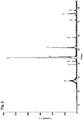
- FIG. 2 Figure 4 shows the Bragg reflections of the reaction product described in Example 7 with the following d values: melem 3.236s, nickel carbide 2.289w, 2.169w, 2.025s, 1.576w and a cubic C phase with the values 2.0524vs, 1.776s.
- the reaction products described in Examples 6 and 7 were prepared from identical reaction mixtures.
- the heat treatment parameters were Example 6: duration 45 minutes at a temperature of 535 ° C and in Example 7: duration 45 minutes at a temperature of 555 ° C.
- Example 7 When comparing the FIGS. 1 and 2 It can clearly be seen that in Example 7, with a heat treatment higher by 20 ° C., the Bragg reflections of a cubic C phase occur and, at the same time, the Bragg reflections of nickel carbide have lower intensity.
- Example 8 In the preparation of the reaction product described in Example 8, a metal mixture consisting of 50% nickel and 50% manganese was reacted with dicyandiamide.
- the reaction product of Example 8 contains a heteronuclear metal cluster corresponding to a Me 3 (C 6 N 9 H 4 ) 3 , a (tri (di-imino-tri-s-triazine)) - tri- (nickel-manganese). Further processing of the reaction product prepared in Example 8 is described in Example 4. Boron powder was added to the reaction product and this mixture was stirred for 4.5 hours at a temperature of 580.degree heat treated.
- the reaction product of Example 9 is a vapor deposited product.
- methane was bubbled through a bed of nickel from the reaction product of Example 8 at a temperature of 570 ° C.
- the reaction product was deposited on the nickel tube outside above the powder bed as a loose coating.
- the Bragg reflections of the product described in Example 9 contain the reflections of cubic modification carbon and nickel.
- gaseous transition-metal isocyanate complexes can be plausibly explained by the fact that isocyanic units formed during the thermolysis of di-imino-tri-s-triazine molecules react directly with transition metal and / or nickel present in the methane dehydrogenation -Carbin species Ni (CH) + with ammonia and transition metal reacts.
- reaction products containing di-imino-tri-s-triazine transition metal compounds have the Bragg reflections for melem and metal carbide, in some cases also the Bragg reflections of the corresponding metal nitrides.
- the preparation, the C, N, H values of the elemental analysis and the Bragg reflections of some of the investigated reaction products are listed under examples. Examples 10 to 19 are part of small series of experiments, which is why the descriptions differ only in detail. In these test series, it was found that reaction products are also obtained in which cubic boron nitride associated with the carbide, boride, nitride and optionally also the carbodiimide of the transition metal used is present (Example 12).
- these Examples use the Bragg reflections attributed to cubic carbon or cubic boron nitride.
- boron to the reaction mixture is in the Thermolysis of the compounds of the invention cubic boron nitride formed.
- transition metal isocyanate complexes whose reaction with boron leads to cubic boron nitride during the thermolysis of the transition metal compounds according to the invention is reproduced with the reaction of tetra (phenyl isocyanide) nickel (0) with boron to form cubic boron nitride described in Example 20.
- crystalline tetra (phenyl isocyanide) nickel (0) prepared by reacting bis (1,5-cyclooctadiene) nickel (0), NiCOD, with phenyl isocyanide in toluene was mixed thoroughly with 0.15 g of boron.
- the resulting mixture was filled in a quartz test tube.
- the filled test tube was placed in an autoclave and exposed at 30 bar ammonia to a temperature of 590 ° C. At a time interval of 0.5 hours, the pressure in the autoclave was lowered by 2 bar, after 7 hours and a pressure of 2 bar, the pressure reduction took place in further steps of 0.5 bar per hour. After cooling, a black-brown product was obtained.
- the X-ray diffraction measurement of the product shows the following values: 2.089 and 1.810. These values closely approximate those for cubic boron nitride characteristic d values: 2.089 and 1.810.
- Table 1 lists selected d values of the inventive transition metal compounds described in Examples 1 to 20 and their pyrolysis products.
- the columns dW a, b, c, d, i and k show characteristic Bragg reflections of the compounds according to the invention. Italic printed values correspond to the Bragg reflections of the pyrolysis products of the compounds of the invention.
- Columns dW l and m in bold Bragg reflections in the cubic boron nitride range.
Landscapes
- Chemical & Material Sciences (AREA)
- Organic Chemistry (AREA)
- Inorganic Chemistry (AREA)
- Crystallography & Structural Chemistry (AREA)
- Battery Electrode And Active Subsutance (AREA)
- Carbon And Carbon Compounds (AREA)
- Catalysts (AREA)
- Organic Low-Molecular-Weight Compounds And Preparation Thereof (AREA)
Claims (14)
- Procédé de fabrication de composés de métaux de transition de la composition générale MeaCbNcHd, avec Me = métal de transition ou mélange de métaux de transition, a = 1 - 4, b = 6 - 9, c = 8 - 14, d = 0 - 8, un mélange de réaction, se composant de métaux de transition et / ou de composés de métaux de transition et de composés C-N-H non ou peu condensés, étant exposé à un traitement thermique en plusieurs étapes, du cyanamide et / ou du dicyandiamide d'ammonium et / ou du dicyandiamide et / ou de la mélamine étant mis en oeuvre en tant que composés C-N-H non ou peu condensés et la teneur en métaux de transition et / ou en composés de métaux de transition étant d'au moins 6 moles pour cent, par rapport au mélange de réaction et le traitement thermique en plusieurs étapes comprenant un prétraitement et un ou plusieurs traitements principaux, le prétraitement étant effectué dans une première plage de températures de 150° C et 400° C et un premier traitement principal étant effectué dans une deuxième plage de températures entre 300° C et 570° C.
- Procédé de fabrication selon la revendication 1,
caractérisé en ce que
la teneur en métaux de transition et / ou en composés de métaux de transition est de 10 à 40 moles pour cent, par rapport au mélange de réaction. - Procédé de fabrication selon la revendication 1 ou 2,
caractérisé en ce que
le rapport molaire métal de transition et / ou composé de métaux de transition par rapport aux composés C-N-H non ou peu condensés se situe respectivement entre 1:2 et 1:8. - Procédé de fabrication selon la revendication 1, 2 ou 3,
caractérisé en ce que
le traitement thermique est effectué conformément au premier traitement principal, en une seule ou en plusieurs étapes ou de manière oscillante dans les limites de la deuxième plage de températures. - Procédé selon l'une des revendications précédentes,
caractérisé en ce que
le traitement thermique est effectué en continu ou suivant des intervalles de temps, conformément au premier traitement principal, sur une période entre 5 minutes et 500 heures. - Procédé selon l'une des revendications précédentes,
caractérisé en ce que
les métaux de transition et / ou composés de métaux de transition sont sélectionnés dans le groupe des métaux de transition, efficaces comme catalyseurs ou que les métaux de transition et / ou composés de métaux de transition sont sélectionnés dans le groupe des éléments formant des complexes carbonyles ou que du nickel et / ou du cobalt et / ou du manganèse et / ou du fer et / ou du platine et / ou du niobium et / ou du tungstène et / ou du tantale et / ou du cuivre et / ou du zinc ou des mélanges de ceux-ci sont utilisés comme métaux de transition. - Procédé selon l'une des revendications précédentes,
caractérisé en ce que
des cyanures et / ou cyano-complexes et / ou complexes cyaniques et / ou complexes isocyaniques sont ajoutés au mélange de réaction, se composant de composés C-N-H non ou peu condensés et de métaux de transition et / ou de composés de métaux de transition, en particulier ceux qui présentent une structure de réseau cubique. - Procédé selon l'une des revendications précédentes,
caractérisé en ce que
de la poudre de bore et / ou des composés de bore et / ou des éléments formant du nitrile et / ou leurs composés sont ajoutés au mélange de réaction, se composant de composés C-N-H non ou peu condensés et de métaux de transition et / ou de composés de métaux de transition avant et / ou après un ou plusieurs traitements thermiques, conformément au premier traitement principal dans la deuxième plage de températures. - Procédé selon l'une des revendications précédentes,
caractérisé en ce
qu'il se produit au moins un autre traitement thermique dans une troisième plage de températures entre 520° C et 700° C, après le traitement thermique conformément au premier traitement principal dans la deuxième plage de températures entre 300° C et 570° C. - Procédé selon la revendication 9,
caractérisé en ce que
l'autre traitement thermique est exécuté après une adjonction de poudre de bore et / ou de composés de bore et / ou d'éléments formant du nitrile et / ou de leurs composés. - Procédé selon la revendication 9 ou 10,
caractérisé en ce que
l'autre traitement thermique se produit en une ou plusieurs étapes ou de manière oscillante dans la troisième plage de températures et / ou au-delà de la deuxième et de la troisième plage de températures. - Composé de métaux de transition de la composition générale MeaCbNcHd, avec Me = métal de transition ou mélange de métaux de transition, a = 1 -4, b = 6 - 9, c = 8 - 14, d = 0 - 8,
caractérisé en ce que
le composé de métaux de transition présente au moins une unité C6N9H4, liée directement ou indirectement au métal de transition ou au mélange de métaux de transition, unité qui existe en tant que di-imino-tri-s-triazine. - Composé de métaux de transition selon la revendication 12,
caractérisé en ce que
le composé de métaux de transition présente une structure de carbure métallique. - Utilisation de composés de métaux de transition, fabriqués selon l'une des revendications 1 à 8, destinés à la fabrication de substances, contenant du carbone et / ou de l'azote, présentes dans le réseau cristallin cubique.
Applications Claiming Priority (2)
| Application Number | Priority Date | Filing Date | Title |
|---|---|---|---|
| DE102012016486.6A DE102012016486B4 (de) | 2012-08-17 | 2012-08-17 | Verfahren zur Herstellung von Übergangsmetallverbindungen der allgemeinen Zusammensetzung Mea Cb Nc Hd mit Me = Übergangsmetall, a = 1 - 4, b = 6 - 9, c = 8 - 14, d = 0 - 8 und deren Verwendung. |
| PCT/EP2013/067168 WO2014027096A1 (fr) | 2012-08-17 | 2013-08-16 | Procédé de production de composés de métaux de transion, composés de métaux de transition et leur utilisation |
Publications (2)
| Publication Number | Publication Date |
|---|---|
| EP2885246A1 EP2885246A1 (fr) | 2015-06-24 |
| EP2885246B1 true EP2885246B1 (fr) | 2019-02-27 |
Family
ID=48998617
Family Applications (1)
| Application Number | Title | Priority Date | Filing Date |
|---|---|---|---|
| EP13750332.2A Not-in-force EP2885246B1 (fr) | 2012-08-17 | 2013-08-16 | Procédé de production de composés de métaux de transition, composés de métaux de transition et leur utilisation |
Country Status (7)
| Country | Link |
|---|---|
| US (1) | US9701705B2 (fr) |
| EP (1) | EP2885246B1 (fr) |
| CN (1) | CN104968600B (fr) |
| DE (1) | DE102012016486B4 (fr) |
| RU (1) | RU2605706C2 (fr) |
| WO (1) | WO2014027096A1 (fr) |
| ZA (1) | ZA201501054B (fr) |
Cited By (1)
| Publication number | Priority date | Publication date | Assignee | Title |
|---|---|---|---|---|
| DE102019133583A1 (de) * | 2019-12-09 | 2021-06-10 | Georg Vogt | Übergangsmetallverbindung und Verfahren zur Herstellung von metallreichen Übergangsmetallverbindungen |
Families Citing this family (6)
| Publication number | Priority date | Publication date | Assignee | Title |
|---|---|---|---|---|
| KR102453050B1 (ko) * | 2016-10-05 | 2022-10-07 | 엑손모빌 케미칼 패턴츠 인코포레이티드 | 금속 질화물 및 금속 탄화물의 제조 방법 |
| WO2018067276A1 (fr) * | 2016-10-05 | 2018-04-12 | Exxonmobil Chemical Patents Inc. | Procédé de production de nitrures métalliques et de carbures métalliques |
| DE102020116953A1 (de) | 2020-06-26 | 2021-12-30 | Georg Vogt | Verfahren zur Herstellung eines Kohlenstoffnitrids der Zusammensetzung C11N4 |
| CN111943149A (zh) * | 2020-08-25 | 2020-11-17 | 合肥工业大学 | 一种过渡金属氮化物的通用制备方法 |
| DE102020124445A1 (de) | 2020-09-18 | 2022-03-24 | Georg Vogt | Verfahren zur Herstellung von Diamantkohlenstoff und/oder Fullerenen |
| CN116621128B (zh) * | 2023-06-25 | 2025-05-16 | 北京理工大学 | 氮化碳及锰基碳二亚胺复合材料及其制备与应用方法 |
Family Cites Families (7)
| Publication number | Priority date | Publication date | Assignee | Title |
|---|---|---|---|---|
| US1772107A (en) | 1926-04-15 | 1930-08-05 | Safety Tire Pop Valve Company | Tire pop valve |
| GB2232991B (en) * | 1989-05-24 | 1994-01-05 | Central Glass Co Ltd | Metal containing derivatives of aminotriazine polymer and method of preparing same |
| RU1772107C (ru) | 1990-03-06 | 1992-10-30 | Отделение Института химической физики АН СССР | Способ получени триазинсодержащих полимеров |
| DE19634777A1 (de) | 1996-08-28 | 1998-03-05 | Max Planck Gesellschaft | Salz- und halogenfreie Synthese von Polyelementcarbodiimiden zur Herstellung keramischer Materialien |
| DE102008045742B4 (de) | 2008-09-04 | 2016-06-09 | Technische Universität Bergakademie Freiberg | Verfahren zur Herstellung von kohlenstoffbasierten Nanopartikeln |
| DE102009034090A1 (de) * | 2009-07-21 | 2011-01-27 | MAX-PLANCK-Gesellschaft zur Förderung der Wissenschaften e.V. | Verfahren zur Darstellung anorganischer Harze auf der Basis wasserstofffreier, polymerer Isocyanate zur Darstellung nitridischer, carbidischer und carbonitridischer Netzwerke und deren Verwendung als Schutzüberzüge |
| KR100957128B1 (ko) * | 2009-08-11 | 2010-05-11 | 한국과학기술원 | 니켈―질화탄소 구체의 제조방법 및 그 방법에 의해 제조된 니켈―질화탄소 구체 |
-
2012
- 2012-08-17 DE DE102012016486.6A patent/DE102012016486B4/de not_active Expired - Fee Related
-
2013
- 2013-08-16 WO PCT/EP2013/067168 patent/WO2014027096A1/fr not_active Ceased
- 2013-08-16 US US14/421,922 patent/US9701705B2/en not_active Expired - Fee Related
- 2013-08-16 EP EP13750332.2A patent/EP2885246B1/fr not_active Not-in-force
- 2013-08-16 RU RU2015109144/05A patent/RU2605706C2/ru active
- 2013-08-16 CN CN201380053701.5A patent/CN104968600B/zh not_active Expired - Fee Related
-
2015
- 2015-02-16 ZA ZA2015/01054A patent/ZA201501054B/en unknown
Non-Patent Citations (1)
| Title |
|---|
| BETTINA VALESKA LOTSCH: "From Molecular Building Blocks to Condensed Carbon Nitride Networks: Structure and Reactivity", 1 January 2006 (2006-01-01), München, XP055462120, ISBN: 978-3-662-24795-2, Retrieved from the Internet <URL:https://edoc.ub.uni-muenchen.de/6492/1/Lotsch_Bettina_V.pdf> [retrieved on 20180322], DOI: 10.1007/978-3-662-24795-2 * |
Cited By (1)
| Publication number | Priority date | Publication date | Assignee | Title |
|---|---|---|---|---|
| DE102019133583A1 (de) * | 2019-12-09 | 2021-06-10 | Georg Vogt | Übergangsmetallverbindung und Verfahren zur Herstellung von metallreichen Übergangsmetallverbindungen |
Also Published As
| Publication number | Publication date |
|---|---|
| DE102012016486B4 (de) | 2017-04-06 |
| ZA201501054B (en) | 2015-12-23 |
| DE102012016486A1 (de) | 2014-05-15 |
| US20150307536A1 (en) | 2015-10-29 |
| EP2885246A1 (fr) | 2015-06-24 |
| RU2015109144A (ru) | 2016-10-10 |
| RU2605706C2 (ru) | 2016-12-27 |
| CN104968600A (zh) | 2015-10-07 |
| WO2014027096A1 (fr) | 2014-02-20 |
| US9701705B2 (en) | 2017-07-11 |
| CN104968600B (zh) | 2017-08-08 |
Similar Documents
| Publication | Publication Date | Title |
|---|---|---|
| EP2885246A1 (fr) | Procédé de production de composés de métaux de transion, composés de métaux de transition et leur utilisation | |
| DE69920005T2 (de) | Verfahren zur Herstellung von kohlenstoffhaltigen Kohlen mit katalytischer Wirkung | |
| DE69807320T2 (de) | Gelaugte nanokrristalline materialien, verfahren zu deren herstellung und verwendung im energiesektor | |
| DE3305057C2 (de) | Verfahren zur Herstellung von Siliciumcarbid-Whiskern | |
| DE2519388C3 (de) | Verfahren zur Herstellung von N-Phosphonmethylglycin | |
| DE2634541B2 (de) | Nickel und Aluminiumoxid sowie Natrium und/oder Kalium enthaltender Katalysator zur Reformierung von Kohlenwasserstoffen mit Dampf bei hohen Drücken | |
| DE3223828A1 (de) | Verfahren zur gewinnung von nickel | |
| DE102020116953A1 (de) | Verfahren zur Herstellung eines Kohlenstoffnitrids der Zusammensetzung C11N4 | |
| EP0010779B1 (fr) | Procédé de préparation de gaz de ville à partir de méthanol | |
| Masuda et al. | Kinetics of the thermal dehydration of magnesium oxalate dihydrate in a flowing atmosphere of dry nitrogen | |
| DE2703557A1 (de) | Kristalline modifikation von wasserfreiem magnesiumchlorid | |
| DE10032303A1 (de) | Metallischse Hydrierkatalysatoren | |
| DE102020124445A1 (de) | Verfahren zur Herstellung von Diamantkohlenstoff und/oder Fullerenen | |
| DE102019133583A1 (de) | Übergangsmetallverbindung und Verfahren zur Herstellung von metallreichen Übergangsmetallverbindungen | |
| DE102015112626B4 (de) | Verfahren zur Herstellung von Diamantkohlenstoff | |
| EP0558887A1 (fr) | Corps formés inorganiques microporeux et leur procédé de préparation | |
| DE10344015A1 (de) | Kristalline Verbindungen in den Systemen C-N, B-N und B-C-N | |
| DE2748535C3 (de) | Verfahren zur Herstellung von gemischten Polyiminoderivaten von Aluminium und Magnesium und von Magnesiumamiden | |
| DE10020626B4 (de) | Verfahren zur Herstellung von Siliciumcarbid aus nachwachsenden Rohstoffen | |
| DE1190442B (de) | Verfahren zur Herstellung eines Aluminiumoxydkatalysators bzw. eines Aluminiumoxydtraegers | |
| DE102005014590A1 (de) | Verfahren zur Herstellung von Kohlenstoffnitrid | |
| DE202022100881U1 (de) | Ein System zur Herstellung von Fe2O3- und Fe2O3-Zeolit-Nanopulver mit höchster photokatalytischer Aktivität | |
| EP1912891A1 (fr) | Procede de production d'un materiau accumulateur d'hydrogene | |
| DE551534C (de) | Verfahren zur Darstellung von Russ | |
| DE1924429A1 (de) | Verfahren zur Herstellung von B?surethanen |
Legal Events
| Date | Code | Title | Description |
|---|---|---|---|
| PUAI | Public reference made under article 153(3) epc to a published international application that has entered the european phase |
Free format text: ORIGINAL CODE: 0009012 |
|
| 17P | Request for examination filed |
Effective date: 20150313 |
|
| AK | Designated contracting states |
Kind code of ref document: A1 Designated state(s): AL AT BE BG CH CY CZ DE DK EE ES FI FR GB GR HR HU IE IS IT LI LT LU LV MC MK MT NL NO PL PT RO RS SE SI SK SM TR |
|
| AX | Request for extension of the european patent |
Extension state: BA ME |
|
| DAX | Request for extension of the european patent (deleted) | ||
| STAA | Information on the status of an ep patent application or granted ep patent |
Free format text: STATUS: EXAMINATION IS IN PROGRESS |
|
| 17Q | First examination report despatched |
Effective date: 20180404 |
|
| RIC1 | Information provided on ipc code assigned before grant |
Ipc: C01B 21/06 20060101AFI20180803BHEP Ipc: C07D 487/16 20060101ALI20180803BHEP Ipc: C01B 21/082 20060101ALI20180803BHEP Ipc: C01B 32/914 20170101ALI20180803BHEP |
|
| GRAP | Despatch of communication of intention to grant a patent |
Free format text: ORIGINAL CODE: EPIDOSNIGR1 |
|
| STAA | Information on the status of an ep patent application or granted ep patent |
Free format text: STATUS: GRANT OF PATENT IS INTENDED |
|
| INTG | Intention to grant announced |
Effective date: 20180917 |
|
| GRAS | Grant fee paid |
Free format text: ORIGINAL CODE: EPIDOSNIGR3 |
|
| GRAA | (expected) grant |
Free format text: ORIGINAL CODE: 0009210 |
|
| STAA | Information on the status of an ep patent application or granted ep patent |
Free format text: STATUS: THE PATENT HAS BEEN GRANTED |
|
| AK | Designated contracting states |
Kind code of ref document: B1 Designated state(s): AL AT BE BG CH CY CZ DE DK EE ES FI FR GB GR HR HU IE IS IT LI LT LU LV MC MK MT NL NO PL PT RO RS SE SI SK SM TR |
|
| REG | Reference to a national code |
Ref country code: GB Ref legal event code: FG4D Free format text: NOT ENGLISH |
|
| REG | Reference to a national code |
Ref country code: CH Ref legal event code: EP |
|
| REG | Reference to a national code |
Ref country code: AT Ref legal event code: REF Ref document number: 1101015 Country of ref document: AT Kind code of ref document: T Effective date: 20190315 |
|
| REG | Reference to a national code |
Ref country code: IE Ref legal event code: FG4D Free format text: LANGUAGE OF EP DOCUMENT: GERMAN |
|
| REG | Reference to a national code |
Ref country code: DE Ref legal event code: R096 Ref document number: 502013012311 Country of ref document: DE |
|
| REG | Reference to a national code |
Ref country code: CH Ref legal event code: NV Representative=s name: VALIPAT S.A. C/O BOVARD SA NEUCHATEL, CH |
|
| REG | Reference to a national code |
Ref country code: NL Ref legal event code: FP |
|
| REG | Reference to a national code |
Ref country code: LT Ref legal event code: MG4D |
|
| PG25 | Lapsed in a contracting state [announced via postgrant information from national office to epo] |
Ref country code: PT Free format text: LAPSE BECAUSE OF FAILURE TO SUBMIT A TRANSLATION OF THE DESCRIPTION OR TO PAY THE FEE WITHIN THE PRESCRIBED TIME-LIMIT Effective date: 20190627 Ref country code: SE Free format text: LAPSE BECAUSE OF FAILURE TO SUBMIT A TRANSLATION OF THE DESCRIPTION OR TO PAY THE FEE WITHIN THE PRESCRIBED TIME-LIMIT Effective date: 20190227 Ref country code: FI Free format text: LAPSE BECAUSE OF FAILURE TO SUBMIT A TRANSLATION OF THE DESCRIPTION OR TO PAY THE FEE WITHIN THE PRESCRIBED TIME-LIMIT Effective date: 20190227 Ref country code: NO Free format text: LAPSE BECAUSE OF FAILURE TO SUBMIT A TRANSLATION OF THE DESCRIPTION OR TO PAY THE FEE WITHIN THE PRESCRIBED TIME-LIMIT Effective date: 20190527 Ref country code: LT Free format text: LAPSE BECAUSE OF FAILURE TO SUBMIT A TRANSLATION OF THE DESCRIPTION OR TO PAY THE FEE WITHIN THE PRESCRIBED TIME-LIMIT Effective date: 20190227 |
|
| PG25 | Lapsed in a contracting state [announced via postgrant information from national office to epo] |
Ref country code: BG Free format text: LAPSE BECAUSE OF FAILURE TO SUBMIT A TRANSLATION OF THE DESCRIPTION OR TO PAY THE FEE WITHIN THE PRESCRIBED TIME-LIMIT Effective date: 20190527 Ref country code: GR Free format text: LAPSE BECAUSE OF FAILURE TO SUBMIT A TRANSLATION OF THE DESCRIPTION OR TO PAY THE FEE WITHIN THE PRESCRIBED TIME-LIMIT Effective date: 20190528 Ref country code: HR Free format text: LAPSE BECAUSE OF FAILURE TO SUBMIT A TRANSLATION OF THE DESCRIPTION OR TO PAY THE FEE WITHIN THE PRESCRIBED TIME-LIMIT Effective date: 20190227 Ref country code: LV Free format text: LAPSE BECAUSE OF FAILURE TO SUBMIT A TRANSLATION OF THE DESCRIPTION OR TO PAY THE FEE WITHIN THE PRESCRIBED TIME-LIMIT Effective date: 20190227 Ref country code: RS Free format text: LAPSE BECAUSE OF FAILURE TO SUBMIT A TRANSLATION OF THE DESCRIPTION OR TO PAY THE FEE WITHIN THE PRESCRIBED TIME-LIMIT Effective date: 20190227 Ref country code: IS Free format text: LAPSE BECAUSE OF FAILURE TO SUBMIT A TRANSLATION OF THE DESCRIPTION OR TO PAY THE FEE WITHIN THE PRESCRIBED TIME-LIMIT Effective date: 20190627 |
|
| PG25 | Lapsed in a contracting state [announced via postgrant information from national office to epo] |
Ref country code: RO Free format text: LAPSE BECAUSE OF FAILURE TO SUBMIT A TRANSLATION OF THE DESCRIPTION OR TO PAY THE FEE WITHIN THE PRESCRIBED TIME-LIMIT Effective date: 20190227 Ref country code: IT Free format text: LAPSE BECAUSE OF FAILURE TO SUBMIT A TRANSLATION OF THE DESCRIPTION OR TO PAY THE FEE WITHIN THE PRESCRIBED TIME-LIMIT Effective date: 20190227 Ref country code: SK Free format text: LAPSE BECAUSE OF FAILURE TO SUBMIT A TRANSLATION OF THE DESCRIPTION OR TO PAY THE FEE WITHIN THE PRESCRIBED TIME-LIMIT Effective date: 20190227 Ref country code: CZ Free format text: LAPSE BECAUSE OF FAILURE TO SUBMIT A TRANSLATION OF THE DESCRIPTION OR TO PAY THE FEE WITHIN THE PRESCRIBED TIME-LIMIT Effective date: 20190227 Ref country code: EE Free format text: LAPSE BECAUSE OF FAILURE TO SUBMIT A TRANSLATION OF THE DESCRIPTION OR TO PAY THE FEE WITHIN THE PRESCRIBED TIME-LIMIT Effective date: 20190227 Ref country code: DK Free format text: LAPSE BECAUSE OF FAILURE TO SUBMIT A TRANSLATION OF THE DESCRIPTION OR TO PAY THE FEE WITHIN THE PRESCRIBED TIME-LIMIT Effective date: 20190227 Ref country code: ES Free format text: LAPSE BECAUSE OF FAILURE TO SUBMIT A TRANSLATION OF THE DESCRIPTION OR TO PAY THE FEE WITHIN THE PRESCRIBED TIME-LIMIT Effective date: 20190227 Ref country code: AL Free format text: LAPSE BECAUSE OF FAILURE TO SUBMIT A TRANSLATION OF THE DESCRIPTION OR TO PAY THE FEE WITHIN THE PRESCRIBED TIME-LIMIT Effective date: 20190227 |
|
| REG | Reference to a national code |
Ref country code: DE Ref legal event code: R097 Ref document number: 502013012311 Country of ref document: DE |
|
| PG25 | Lapsed in a contracting state [announced via postgrant information from national office to epo] |
Ref country code: SM Free format text: LAPSE BECAUSE OF FAILURE TO SUBMIT A TRANSLATION OF THE DESCRIPTION OR TO PAY THE FEE WITHIN THE PRESCRIBED TIME-LIMIT Effective date: 20190227 Ref country code: PL Free format text: LAPSE BECAUSE OF FAILURE TO SUBMIT A TRANSLATION OF THE DESCRIPTION OR TO PAY THE FEE WITHIN THE PRESCRIBED TIME-LIMIT Effective date: 20190227 |
|
| PLBE | No opposition filed within time limit |
Free format text: ORIGINAL CODE: 0009261 |
|
| STAA | Information on the status of an ep patent application or granted ep patent |
Free format text: STATUS: NO OPPOSITION FILED WITHIN TIME LIMIT |
|
| 26N | No opposition filed |
Effective date: 20191128 |
|
| PG25 | Lapsed in a contracting state [announced via postgrant information from national office to epo] |
Ref country code: SI Free format text: LAPSE BECAUSE OF FAILURE TO SUBMIT A TRANSLATION OF THE DESCRIPTION OR TO PAY THE FEE WITHIN THE PRESCRIBED TIME-LIMIT Effective date: 20190227 |
|
| PG25 | Lapsed in a contracting state [announced via postgrant information from national office to epo] |
Ref country code: TR Free format text: LAPSE BECAUSE OF FAILURE TO SUBMIT A TRANSLATION OF THE DESCRIPTION OR TO PAY THE FEE WITHIN THE PRESCRIBED TIME-LIMIT Effective date: 20190227 |
|
| PG25 | Lapsed in a contracting state [announced via postgrant information from national office to epo] |
Ref country code: LU Free format text: LAPSE BECAUSE OF NON-PAYMENT OF DUE FEES Effective date: 20190816 Ref country code: MC Free format text: LAPSE BECAUSE OF FAILURE TO SUBMIT A TRANSLATION OF THE DESCRIPTION OR TO PAY THE FEE WITHIN THE PRESCRIBED TIME-LIMIT Effective date: 20190227 |
|
| PGFP | Annual fee paid to national office [announced via postgrant information from national office to epo] |
Ref country code: NL Payment date: 20200820 Year of fee payment: 8 |
|
| PGFP | Annual fee paid to national office [announced via postgrant information from national office to epo] |
Ref country code: BE Payment date: 20200820 Year of fee payment: 8 |
|
| PG25 | Lapsed in a contracting state [announced via postgrant information from national office to epo] |
Ref country code: CY Free format text: LAPSE BECAUSE OF FAILURE TO SUBMIT A TRANSLATION OF THE DESCRIPTION OR TO PAY THE FEE WITHIN THE PRESCRIBED TIME-LIMIT Effective date: 20190227 |
|
| PG25 | Lapsed in a contracting state [announced via postgrant information from national office to epo] |
Ref country code: HU Free format text: LAPSE BECAUSE OF FAILURE TO SUBMIT A TRANSLATION OF THE DESCRIPTION OR TO PAY THE FEE WITHIN THE PRESCRIBED TIME-LIMIT; INVALID AB INITIO Effective date: 20130816 Ref country code: MT Free format text: LAPSE BECAUSE OF FAILURE TO SUBMIT A TRANSLATION OF THE DESCRIPTION OR TO PAY THE FEE WITHIN THE PRESCRIBED TIME-LIMIT Effective date: 20190227 |
|
| PGFP | Annual fee paid to national office [announced via postgrant information from national office to epo] |
Ref country code: IE Payment date: 20210827 Year of fee payment: 9 Ref country code: FR Payment date: 20210823 Year of fee payment: 9 Ref country code: AT Payment date: 20210818 Year of fee payment: 9 |
|
| PGFP | Annual fee paid to national office [announced via postgrant information from national office to epo] |
Ref country code: CH Payment date: 20210824 Year of fee payment: 9 Ref country code: GB Payment date: 20210824 Year of fee payment: 9 |
|
| REG | Reference to a national code |
Ref country code: NL Ref legal event code: MM Effective date: 20210901 |
|
| REG | Reference to a national code |
Ref country code: BE Ref legal event code: MM Effective date: 20210831 |
|
| PG25 | Lapsed in a contracting state [announced via postgrant information from national office to epo] |
Ref country code: NL Free format text: LAPSE BECAUSE OF NON-PAYMENT OF DUE FEES Effective date: 20210901 Ref country code: MK Free format text: LAPSE BECAUSE OF FAILURE TO SUBMIT A TRANSLATION OF THE DESCRIPTION OR TO PAY THE FEE WITHIN THE PRESCRIBED TIME-LIMIT Effective date: 20190227 |
|
| PG25 | Lapsed in a contracting state [announced via postgrant information from national office to epo] |
Ref country code: BE Free format text: LAPSE BECAUSE OF NON-PAYMENT OF DUE FEES Effective date: 20210831 |
|
| PGFP | Annual fee paid to national office [announced via postgrant information from national office to epo] |
Ref country code: DE Payment date: 20220826 Year of fee payment: 10 |
|
| REG | Reference to a national code |
Ref country code: CH Ref legal event code: PL |
|
| REG | Reference to a national code |
Ref country code: AT Ref legal event code: MM01 Ref document number: 1101015 Country of ref document: AT Kind code of ref document: T Effective date: 20220816 |
|
| GBPC | Gb: european patent ceased through non-payment of renewal fee |
Effective date: 20220816 |
|
| PG25 | Lapsed in a contracting state [announced via postgrant information from national office to epo] |
Ref country code: LI Free format text: LAPSE BECAUSE OF NON-PAYMENT OF DUE FEES Effective date: 20220831 Ref country code: CH Free format text: LAPSE BECAUSE OF NON-PAYMENT OF DUE FEES Effective date: 20220831 Ref country code: AT Free format text: LAPSE BECAUSE OF NON-PAYMENT OF DUE FEES Effective date: 20220816 |
|
| PG25 | Lapsed in a contracting state [announced via postgrant information from national office to epo] |
Ref country code: IE Free format text: LAPSE BECAUSE OF NON-PAYMENT OF DUE FEES Effective date: 20220816 Ref country code: FR Free format text: LAPSE BECAUSE OF NON-PAYMENT OF DUE FEES Effective date: 20220831 |
|
| PG25 | Lapsed in a contracting state [announced via postgrant information from national office to epo] |
Ref country code: GB Free format text: LAPSE BECAUSE OF NON-PAYMENT OF DUE FEES Effective date: 20220816 |
|
| REG | Reference to a national code |
Ref country code: DE Ref legal event code: R119 Ref document number: 502013012311 Country of ref document: DE |
|
| PG25 | Lapsed in a contracting state [announced via postgrant information from national office to epo] |
Ref country code: DE Free format text: LAPSE BECAUSE OF NON-PAYMENT OF DUE FEES Effective date: 20240301 |