EP2859145B1 - Textilhilfsmittel und damit veredeltes textilprodukt - Google Patents
Textilhilfsmittel und damit veredeltes textilprodukt Download PDFInfo
- Publication number
- EP2859145B1 EP2859145B1 EP13729627.3A EP13729627A EP2859145B1 EP 2859145 B1 EP2859145 B1 EP 2859145B1 EP 13729627 A EP13729627 A EP 13729627A EP 2859145 B1 EP2859145 B1 EP 2859145B1
- Authority
- EP
- European Patent Office
- Prior art keywords
- fibers
- acrylate
- meth
- group
- textile
- Prior art date
- Legal status (The legal status is an assumption and is not a legal conclusion. Google has not performed a legal analysis and makes no representation as to the accuracy of the status listed.)
- Active
Links
Images

Classifications
-
- D—TEXTILES; PAPER
- D06—TREATMENT OF TEXTILES OR THE LIKE; LAUNDERING; FLEXIBLE MATERIALS NOT OTHERWISE PROVIDED FOR
- D06M—TREATMENT, NOT PROVIDED FOR ELSEWHERE IN CLASS D06, OF FIBRES, THREADS, YARNS, FABRICS, FEATHERS OR FIBROUS GOODS MADE FROM SUCH MATERIALS
- D06M11/00—Treating fibres, threads, yarns, fabrics or fibrous goods made from such materials, with inorganic substances or complexes thereof; Such treatment combined with mechanical treatment, e.g. mercerising
-
- D—TEXTILES; PAPER
- D06—TREATMENT OF TEXTILES OR THE LIKE; LAUNDERING; FLEXIBLE MATERIALS NOT OTHERWISE PROVIDED FOR
- D06M—TREATMENT, NOT PROVIDED FOR ELSEWHERE IN CLASS D06, OF FIBRES, THREADS, YARNS, FABRICS, FEATHERS OR FIBROUS GOODS MADE FROM SUCH MATERIALS
- D06M15/00—Treating fibres, threads, yarns, fabrics, or fibrous goods made from such materials, with macromolecular compounds; Such treatment combined with mechanical treatment
Definitions
- the present invention describes a textile auxiliary which achieves a locally warming effect on energy-absorbing surfaces of electromagnetic radiation and / or on reduced energy output on textile surfaces, woven fabrics, laid fabrics, knitted fabrics, nonwovens and knitted fabrics or products made therefrom.
- Benzoxazoline-based UV absorbers are incorporated with transparent conductive oxides in polyester fibers by melt-spinning processes. As a result, the authors achieve an improvement in the Thermal insulation.
- the Japanese patent JP 2004149931 describes the use of zirconium carbide, titanium oxide or specific metal complexes as IR radiation absorbing compounds for the use of underwear.
- Another commonly described method for influencing the reflection and / or remission is the selection of suitable colorants.
- the lowering of remission of textiles is reflected in, for example, in RU 2196855 and in PL 202000 reported. By the method described therein, however, can only produce colored textiles.
- DE 10 2009 006 832 A1 describes a liquid or semi-solid formulation of spectrally selective particles for coating flexible bodies.
- the coating is characterized by having a significantly lower thermal emissivity at room temperature than the uncoated body, while maintaining the body's texture / texture and flexibility.
- the coatings can be given a virtually arbitrary color impression, while maintaining a lowered emissivity.
- EP 1 321 291 A1 and EP 1 437 438 A1 describe textile aids for IR absorption and / or reflection and the use of semiconductors indium tin oxide and antimony tin oxide.
- WO 2008/004993 A2 describes layers with near infrared absorptions as well as corresponding articles containing these layers. This should not change the visual impression of the entire article.
- non-color-modifying electromagnetic radiation absorbing layers can be applied permanently and wash-permanently on textiles, whereby textiles under IR or solar radiation absorb an increased amount of heat and / or deliver a reduced amount of heat. It has been found, particularly surprisingly, that the described effect can be synergistically enhanced by the selection of suitable binder polymers.
- the present invention combines the simplicity of already existing textile-technological processes such as equipment by means of pad-forced application, coating by means of pastes or foams, spray application, printing, dipping and exhausting processes and single filament application on Galette or in the dipping bath with an effect of increased heat energy absorption or reduced heat emission (Fig. loss) of such refined textiles by selection suitable compounds.
- textile parameters such as hand and tear are not adversely affected.
- the color of a textile is not adversely affected.
- white or colorless textiles can be refined with this invention.
- such a finished textile under the influence of electromagnetic radiation heats significantly more than a corresponding comparative sample of the same parameters (e.g., material composition, color, fabric weight, thickness, texture and weave).
- this can be used to detect a reduction in the remission of electromagnetic radiation and / or an increase in the absorption thereof.
- the use of suitable semiconductors together with other components solves the technical problem.
- inorganic including elemental and oxidic as well as organic semiconductors are used.
- organic semiconductors are used.
- the former group a) fall the compounds of the A III B V type semiconductor (see. AF Holleman, E. Wiberg, Lehrbuch der anorganischen Chemie, 101st ed., De Gruyter, Berlin, pp. 1098-1100 ).
- Suitable elementary semiconductors of group b) are suitable modifications of tin, indium, carbon, silicon and germanium.
- the group d) of the oxide semiconductor includes conductive transparent oxides.
- the group A III B V- semiconductor group comprises the compounds AB of elements A, where A is gallium, indium, thallium, germanium, tin, lead and B is nitrogen, phosphorus, arsenic, antimony and bismuth in stand any stoichiometric ratios.
- A is gallium, indium, thallium, germanium, tin, lead and B is nitrogen, phosphorus, arsenic, antimony and bismuth in stand any stoichiometric ratios.
- Particularly preferred within the meaning of the invention are the binary pentel compounds of aluminum, in particular aluminum nitride, since they are generally distinguished by high chemical inertness.
- organic conductive polymers namely polypyrrole, polyaniline, polyparaphenylene, polythiophene, poly (4,4-dioctylcyclopentadithiophene), poly (3,4-ethylenedioxythiophene) or poly (3,4-ethylenedioxythiophene) / poly ( styrenesulfonate), as semiconductors solve the technical problem.
- Suitable oxides from group d) are fluorine-doped tin oxide, indium tin oxide, antimony tin oxide, aluminum zinc oxide, magnesium zinc oxide or mixtures of the binary oxides of these metals.
- the transparent conductive oxides can particularly preferably be used in combination with suitable polymers in the preparation. Surprisingly, it has been found that a synergistic effect is found by combining the semiconductors.
- the semiconductors are selected from at least one of the semiconductors of groups a), b) and c) and furthermore at least one semiconductor from group d), or Mixtures of at least two semiconductors selected from groups a), b) and c), in particular at least one from group a) and at least one from group c).
- infrared radiation-absorbing dyes may optionally be additionally contained in small amounts in order to increase the effect of heat absorption.
- Such infrared radiation absorbing materials according to the invention can be either organic or inorganic as defined above.
- infrared radiation absorbing materials in the sense of the invention are materials which in a wavelength range of 700 to 35,000 nm at at least two of the wavelengths 1000 nm, 1500 nm, 2000 nm and 3500 nm have a molar extinction coefficient of at least 1.5 l.mol -1 ⁇ Cm -1 .
- the infrared-absorbing material has an absorption maximum in a range of 900 to 1000 nm.
- a material selected from phthalocyanines, naphthalocyanines, anthraquinones, cyanine compounds, squalylium compounds, thiolnickel complex compounds, triallylmethanes, naphthoquinones, anthraquinones and amine compounds such as N, N, N ', N'-tetrakis is used as the organic infrared ray absorbing material (p-di-n-butylaminophenyl) -p-phenylenediaminium perchlorate, phenylenediaminium chlorate, phenylenediaminium hexafluoroantimonate, phenylenediaminium fluoroborate, phenylenediaminium fluorate and phenylenediaminium perchlorate.
- the particulate semiconductors used in this invention have a particle size (number average, d 50 , laser diffraction) of 1 nm to 10 .mu.m, preferably less than 2 microns, on.
- the use of one or more of the abovementioned semiconductors from the abovementioned groups a), b), c) or d) solves the technical problem.
- the effect can be synergistically enhanced by infrared-absorbing organic dyes.
- Suitable binder polymers for the semiconductors are, for example, homopolymers, copolymers or terpolymers based on polyacrylates, polyurethanes, styrene-butadienes, sol-gels, silicones, epoxide resins, polyvinyl chloride, ethylvinyl acetate, polyester resins or mixtures of these classes in the invention.
- Cross-linked, cross-linking or reactive systems are preferred for the purposes of the invention, particularly preferably those whose films show a glass transition state of less than 0 ° C.
- triphenylmethane-4,4 ', 4 "-triisocyanate polyphenyl-polymethylene-polyisocyanates, as obtained by aniline-formaldehyde condensation and subsequent phosgenation and, for example, in GB-PS 874 430 and GB-PS 848,671 are described, m- and p-Isocyanatophenylsulfonylisocyanate according to U.S. Patent 3,454,606 perchlorinated aryl polyisocyanates, as in U.S. Patent 3,277,138 Carbodiimid phenomenon containing polyisocyanates, as described in U.S.
- Patent 3,394,164 and 3 644 457 be described, acylated urea groups having polyisocyanates according to DE-PS 12 30 778 Biuret group-containing polyisocyanates as described in U.S. Patent 3,124,605 . 3,201,372 and 3 124 605 as in British Patent 889,050 are described by telomerization reactions prepared polyisocyanates, as described in U.S. Patent 3,654,106 are described, polyisocyanates containing ester groups, as in GB-PS 965 474 and 1 072 956 , in U.S.
- Patent 3,567,763 and in DE-PS 12 31 688 be mentioned, reaction products of the above isocyanates with acetals according to DE-PS 10 72 385 and polymeric fatty acid ester-containing polyisocyanates according to U.S. Patent 3,455,883 ,
- polyisocyanates for example the 2,4- and 2,6-toluene diisocyanate and any mixtures of these isomers (“TDI”), 4,4'-diphenylmethane diisocyanate, 2,4'-diphenylmethane diisocyanate, 2,2 ' Diphenylmethane diisocyanate and polyphenyl polymethylene polyisocyanate as prepared by aniline-formaldehyde condensation and subsequent phosgenation (“crude MDI”), and carbodiimide groups, uretonimine groups, urethane groups, allophanate groups, isocyanurate groups, urea groups or biuret group-containing polyisocyanates (“modified polyisocyanates”), in particular those modified polyisocyanates derived from 2,4- and / or 2,6-toluene diisocyanate or from 4,4'- and / or 2,4'-diphenylmethane diis
- TDI 2,4- and
- Polyacrylates in the context of the present invention are in particular prepared by solution, precipitation, emulsion or inverse emulsion polymerization.
- Acrylates are preferably selected from the group consisting of 1,4-butanediol di (meth) acrylate, 1,6-hexanediol di (meth) acrylate, neopentyl glycol di (meth) acrylate, polyethylene glycol di (meth) acrylate, neopentyl glycol adipate di (meth) acrylate, neopentyl glycol hydroxypivalate di (meth) acrylate, dicyclopentanyl di (meth) acrylate, dicyclopentenyl di (meth) acrylate modified with caprolactam, phosphoric di (meth) acrylate modified with ethylene oxide, cyclohexyl di (meth) acrylate modified with an ally group, isocyanurate di (meth) acrylate, trimethylolpropane tri (meth) acrylate, dipentaerythritol tri (meth) acrylate, dipenta
- Suitable starting materials for the sol-gel binder polymers are the following silicon compounds or mixtures thereof selected from the group consisting of tetramethoxysilane, tetraethoxysilane, tetra-n-propoxysilane, tetraisopropoxysilane, tetra-n-butoxysilane, tetraisobutoxysilane, tetrasec-butoxysilane , Tetra-tert-butoxysilane, trimethoxysilane hydride, triethoxysilane hydride, tripropoxysilane hydride, methyltrimethoxysilane, methyltriethoxysilane, methyltripropoxysilane, methyltriisopropoxysilane, ethyltrimethoxysilane, ethyltriethoxysilane, propyltriethoxysilane, Butyltrimethoxysilane, phenyltrimethoxy
- alkylene- or arylene-bridged di- or oligosilanes such as 1,2-bis (triethoxysilyl) ethane, 1,2-bis (trimethoxysilyl) ethane, 1,4-phenylenebis (triethoxysilane), 1,4-phenylenebis (trimethoxysilane).
- aluminum salts, aluminum alcoholates, zinc salts, zinc alcoholates, zirconium salts, zirconium salts, zirconium alcoholates, titanium salts, titanium alcoholates, iron salts, iron alcoholates, manganese salts or manganese alkoxides can be used as starting materials of the systems.
- the binder is preferably prepared in water and / or organic solvents, optionally with the aid of dispersants, in particular in mono-, oligo- or polyfunctional alcohols, particularly preferably in aqueous solutions of the abovementioned alcohols.
- Silicone binder polymers usually consist of the repeating unit dimethylsiloxane, which can be supplemented for example by equilibration reactions by other siloxane groups.
- the polymer therefore has the structure R "[- (Y-Si (Me) 2 ) n - (Z-Si (RR ') m ] -R"'
- M and n independently assume values between 0 and 100,000.
- the base unit - (O-Si (Me) 2 ) - may be partially or completely replaced by units of the type - (O-SiRR ') -, where R and R' may be independently modified and optionally functionalized organic radicals of the alkyl type , Aryl, alkenyl, alkylaryl, arylalkyl, arylalkenyl, alkenylaryl, hydrogen, hydroxyl, amine.
- the radicals may be attached directly to the central silicon atom or via a heteroatom such as oxygen or nitrogen.
- the silicon units are connected via a group Y or are directly bonded to each other.
- Y and Z are independently selected from the aforementioned organic groups or from the group of said heteroatoms.
- the polymer can carry in end ⁇ , ⁇ position end groups R "and / or R"'from the abovementioned groups, which can be chosen independently of one another.
- the textile auxiliaries according to the invention can be present as solutions or dispersions in water and / or an organic solvent. Particularly preferred in this invention are aqueous solutions or dispersions of the components, since this is advantageous for process engineering and environmental aspects.
- surface-active substances from the group of anionic, cationic or nonionic surfactants are used.
- anionic or nonionic, particularly preferably nonionic, surfactants are particularly preferred.
- further dispersants such as thickeners based on Carboxyalkylpolysaccharide or polyacrylates can be used.
- the preparation on which the invention is based can be combined with other conventional textile auxiliaries and applied together in standard textile processes.
- these include, for example, fluorocarbons, plasticizers, high-performance resins, brighteners, dyes, hydrophilizing or hydrophobing agents, anti-pilling additives, fixers, crosslinkers, surfactants, polymeric binders, adhesives, anti-slip agents and / or pigments.
- the textile auxiliaries thus obtained can be used as fleets, foams or pastes for textile finishing. Also, the combination of these additives and the aforementioned components to a preparation according to the invention.
- fixers and / or cross-linking agents from the group of blocked and unblocked are preferably used in the context of the invention Isocyanates, melamine-formaldehyde resins, urea-formaldehyde resins and / or di-, oligo- or polycarboxylic acids, if appropriate in combination with suitable catalysts which increase the reactivity and / or selectivity of the crosslinking.
- oligo- or polyfunctional carboxylic acids are compounds of the type W m (CO 2 H) n wherein W is an organic radical selected from the group of optionally functionalized alkyl, aryl, alkenyl, alkylaryl, arylalkyl, arylalkenyl, alkenylaryl, m as a number is either 0 or 1 and n is a number between 2 and 100,000.
- Alkanedicarboxylic acids are particularly preferred, in particular malonic acid, maleic acid, derivatives of succinic acid and oxalic acid.
- oligo- and polycarboxylic acids are alkyloligo-, alkylpoly- or aryloligocarboxylic acids, particular preference is given to butanetetracarboxylic acid, all-cis-1,2,3,4-cyclopentanetetracarboxylic acid, tricarballylic acid, citric acid, 1,2,3-trans-propentricarboxylic acid, Succinic acid and derivatives of polyacrylic acid and polymethacrylic acid as homopolymers or copolymers.
- Suitable catalysts for the fixers are generally Lewis acids or bases.
- Magnesium chloride is particularly preferably used alone or in combination with Bronsted acids, preferably ortho-phosphoric acid, citric acid, sulfuric acid.
- Bronsted acids preferably ortho-phosphoric acid, citric acid, sulfuric acid.
- Brönsted acids preferably ortho-phosphoric acid, citric acid, sulfuric acid without Lewis acid can be used.
- basic catalysts such as amines, hypophosphites, phosphonates, pyro and polyphosphates or alkali.
- the textile material according to the invention may be composed of natural fibers such as cotton, bast fibers, hard fibers, wool, silk, mineral fibers and / or synthetic fibers such as cellulose regenerated fibers, polylactic acid, polyester, polyamide, polyimide, polyamideimide, polyphenylene sulfide, aramid, polyvinyl chloride, polyacrylonitrile, Polyvinyl acetal, polytetrafluoroethylene, polyethylene, polypropylene, polyurethane, elastane, carbon fibers, silicate fibers, glass fibers, basalt fibers, metal fibers consist, contain these or consist of mixtures of the materials mentioned. Also, laminated fibers or fibers cast in a composite material are according to the invention.
- the color change of the textile after treatment with the textile auxiliaries according to the invention measured in the CIE-Lab color space, is very small.
- the textile according to the invention shows a color change of less than or equal to 10, preferably less than 3, units according to CIE-Lab color space or a maximum degree of whiteness of less than or equal to 6, preferably less than or equal to 3, Berger units.
- the textile auxiliaries according to the invention is characterized in particular in that a product refined therewith exhibits a lower remission and / or a higher absorption in the range of the infrared light and / or the solar spectrum or parts thereof. Furthermore, it is preferably characterized in that it absorbs an increased amount of heat per surface under solar or IR radiation.
- the textile according to the invention shows under irradiation in the measuring apparatus Fig. 1 a temperature increase of 5 ° C, preferably 15 ° C, particularly preferably 25 ° C, compared to a non-refined reference.
- the remission was determined by standard techniques using a Datacolor type instrument, type Microflash 45, preferably at a wavelength of 980 nm.
- the optical assessment was carried out in a commercial Abmusterungskabine with different light sources.
- White cotton swatches (twill, 205 g / m 2 , 20 cm x 30 cm) were set with 250 ml of a fresh finish liquor consisting of 0.45% indium tin oxide added as a 20% pigment dispersion and 5% polyurethane binder polymer in soft water to pH 5.5 with acetic acid, equipped on a laboratory pad. The contact pressure of Rolling was set at 3 bar. After finishing, the fabric was dried on a laboratory fixture frame for 2 minutes at 120 ° C and then condensed for 1 minute at 150 ° C. Subsequently, the patterns with a reference pattern in the in Fig. 1 measured device as well as remission and color numbers determined. .DELTA.T 15 ° C Remission share 93% ⁇ E according to CIE-Lab color space 11.2 Optical assessment Recognizable blue shift
- Polyurethane binder polymer in soft water adjusted to pH 5.5 with acetic acid, equipped on a laboratory pad. The contact pressure of the rolls was set to 3 bar. After finishing, the fabric was dried on a laboratory fixture frame for 2 minutes at 120 ° C and then condensed for 1 minute at 150 ° C.
- the pattern was color acceptable to the textile expert, but the amount of heat absorbed is not sufficient.
- White PES / lyocell fabrics (210 g / m 2 , 20 cm x 30 cm) were coated with 250 ml of a fresh finish liquor consisting of 0.02% conductive organic polymer, 5% polyurethane binder polymer, 1% fixer and 0, 5% Kollasol CDO (surfactant, available from CHT R. Beitlich GmbH), in soft water, adjusted to pH 5.5 with acetic acid, equipped on a laboratory pad. The contact pressure of the rolls was set to 3 bar. After finishing, the fabric was dried on a laboratory fixture frame for 2 minutes at 120 ° C and then condensed for 1 minute at 150 ° C. Subsequently, the patterns with a reference pattern in the in. Fig.
- White PES / lyocell fabrics (210 g / m 2 , 20 cm x 30 cm) were coated with 250 ml of a fresh finish liquor consisting of 0.2% indium tin oxide, 0.02% organic conductive polymers, 5% polyurethane binder polymer, 1 % Fixer, 0.05% Kollasol CDO, adjusted to pH 5.5 in soft water with acetic acid, on a laboratory pad. The contact pressure of the rolls was set to 3 bar. After finishing, the fabric was dried on a laboratory fixture frame for 2 minutes at 120 ° C and then condensed for 1 minute at 150 ° C.
- Red polyamide samples (twill weave, 120 g / m 2 , 20 cm x 30 cm) were mixed with 250 ml of a fresh finish liquor consisting of 0.8% aluminum nitride added as a 20% pigment dispersion containing 0.1% Kollasol CDO Soft water, adjusted to pH 5.5 with acetic acid, equipped on a laboratory pad. In some examples, 0.02% conductive organic polymers were also added. The contact pressure of the rolls was set to 3 bar. After finishing, the fabric was dried on a laboratory fixture frame for 2 minutes at 120 ° C and then condensed for 1 minute at 150 ° C. Subsequently, the patterns with a reference pattern in the in Fig. 1 measured device as well as remission and color numbers determined.
- Yellow viscose fabrics (160 g / m 2 , 20 cm x 30 cm) were coated with 250 ml of a fresh finish liquor consisting of 0.2% ternary oxide, 0.05% polyaniline, 5% polyurethane binder polymer, 1% fixer, 0.25% Kollasol CDO, adjusted to pH 5.5 in acetic acid with acetic acid, on a laboratory pad. The contact pressure of the rolls was set to 3 bar. After finishing, the fabric was dried on a laboratory fixture frame for 2 minutes at 120 ° C and then condensed for 1 minute at 150 ° C.
- Textile samples of various materials were each equipped with 250 ml of the liquor mentioned in Example 2 consisting of indium tin oxide and poly (3,4-ethylenedioxythiophene) / poly (styrenesulfonate) and Kollasol CDO on a laboratory pad.
- the contact pressure of the rolls was set to 3 bar.
- the fabric was dried on a laboratory fixture frame for 2 minutes at 120 ° C and then condensed for 1 minute at 150 ° C. Subsequently, the samples were taken as unwashed original, after 10 household washes (HHW) at 40 ° C with a reference pattern in the illustration 1 Measured device measured and determines the remission.
- HHW household washes
- Yellow polyester-elastane textile samples were each equipped with 250 ml of the below-mentioned liquors on a laboratory pad. The contact pressure of the rolls was set to 3 bar. After finishing, the fabric was dried on a laboratory fixture frame for 2 minutes at 120 ° C and then condensed for 1 minute at 150 ° C. Subsequently, the patterns with a reference pattern in the in illustration 1 Measured device measured and determines the remission.
Landscapes
- Engineering & Computer Science (AREA)
- Textile Engineering (AREA)
- Treatments For Attaching Organic Compounds To Fibrous Goods (AREA)
- Chemical Or Physical Treatment Of Fibers (AREA)
- Compositions Of Macromolecular Compounds (AREA)
Description
- Die vorliegende Erfindung beschreibt ein Textilhilfsmittel, das auf textilen Flächen, Geweben, Gelegen, Gestricken, Vliesen und Gewirken oder daraus hergestellten Produkten einen lokal wärmenden Effekt durch Energieaufnahme aus elektromagnetischer Strahlung und / oder durch verminderte Energieabgabe erzielt.
- In der Vergangenheit wurden Kleidungstextilien zur besseren Wärmeisolierung mit dickerem Futterstoff, zusätzlichen Stofflagen, schwereren oder dichter gewebten Textilien versehen. Dies ist insofern unpraktisch, da durch zusätzliches Futtermaterial oder dickere und schwerere Stoffe Volumen und Gewicht der Kleidung zunehmen und daher Tragekomfort und Beweglichkeit der Träger beeinträchtigt werden.
- Durch Einsatz IR-absorbierender und / oder -reflektierender Lagen unterschiedlichster Materialien wie Aluminium oder Kohlenstoff wurde in
JP 2005212471 - Dieser Ansatz ist aber technisch aufwendig, kostspielig und nicht mit farbigen, insbesondere hellen oder weißen, Textilien vereinbar.
- Ein weiterer Ansatz ist die Beeinflussung der Wärmemenge in Form von Strahlung, die von dem durch die Kleidung zu wärmenden Körper emittiert wird. Durch Gasabscheidungsprozesse werden in der Patentanmeldung
JP 2005290585 - In
EP 1 792 724 A2 wird die beidseitige Beschichtung mit einem Turmalinband beschrieben, um die Emission von vom Körper des die Kleidung tragenden Trägers zu reduzieren. Dieser Ansatz benötigt eine spezielle im Patent beschriebene Apparatur und derartige Textilien weisen ungewünschte Farbveränderungen und haptische Veränderungen auf. - Aufnahme von Wärmestrahlung durch Einsatz von dunklen Farbstoffen beschreibt die Patentanmeldung
JP 2009062652 EP 1 847 635 A1 wird der Einsatz IR-reflektierender Pigmente auf Basis aktivierter Wolframoxide beschrieben. Organische Bisiminiumverbindugen werden in der japanischen PatentanmeldungJP 2009203596 DE 39 21 249 A1 werden IR-absorbierende Farbstoffe auf Basis leitfähiger organischer Polymere auf Textilien eingesetzt, um die emittierende Wärmestrahlung und damit die Detektierbarkeit durch Nachtsichtgeräte zu vermindern. - Benzoxazolin-basierte UV-Absorber werden mit transparenten leitfähigen Oxiden in Polyesterfasern durch Schmelz-Spinn-Prozesse eingebracht. Dadurch erreichen die Autoren eine Verbesserung der Wärmeisolierung. Das japanische Patent
JP 2004149931 - Als transparente leitfähige Oxide werden binäre oder ternäre Oxide einiger Übergangsmetalle genannt. Die Herstellungen und auch deren Anwendungen auch auf Textilien sind seit langem bekannt. So beschreibt
WO 01/25367 A1 EP 0 341 554 A1 werden große Mengen solcher Oxide synthetischen Fasern in einer Masterbatch-Applikation zugesetzt, um leitfähige Textilien herzustellen. Zur Erreichung winkelabhängiger Farbeffekte von Textilien wurden inTW 201113410 - Verfahren zur Senkung der Remission oder Reflektion werden vor allem für Tarnzwecke im Militärbereich eingesetzt. Dabei werden vor allem die Strahlungsbereiche des Infrarotlichts beeinflusst. So beschreibt zum Beispiel
DE 10 258 014 A1 ein Verfahren zur Einbringung von mit Aluminiumpulver einseitig beschichteten Glasfäden in Wärmetarndecken, um eine sichtoptische Tarnung durch Senkung der emittierten Wärmestrahlung zu ermöglichen. Dabei sind die reflektierenden Schichten zu der Wärmequelle hin gerichtet. - Häufig werden Verfahren zur Beschichtung und / oder Bedampfung mit metallischen Schichten auf textilen Trägern oder in Textilien beschrieben. Ein Beispiel, dem eine Aluminiumbeschichtung zugrunde liegt, ist in
WO 2004/020931 A1 dargestellt. Diese Verfahren haben den Nachteil, dass sie das Textil stark beeinflussen, so dass es zu haptischen, farblichen und Komforteinbußen kommt. - Metallische und polymere Nanopartikel zur Modifikation von Reflektion und / oder Remission werden in
WO 2010/120531 A1 beschrieben. - Eine andere häufig beschriebene Methode zur Beeinflussung der Reflektion und / oder Remission ist die Auswahl geeigneter Färbemittel. Die Senkung der Remission von Textilien wird in zum Beispiel in
RU 2196855 PL 202000 - Die Beeinflussung insbesondere schwarzer Textilien wird in
WO 2009/118419 A1 beschrieben. Durch die Auswahl der Farbmittel wird eine Erhöhung der Reflexion im nahen Infrarotbereich berichtet, wodurch eine Erniedrigung der aufgenommenen Wärmemenge von Textilien erreicht wird. -
DE 10 2009 006 832 A1 beschreibt eine flüssige oder halbfeste Formulierung spektralselektiver Partikel zur Beschichtung flexibler Körper. Die Beschichtung zeichnet sich dadurch aus, dass sie bei Raumtemperatur einen signifikant geringeren thermischen Emissionsgrad als der unbeschichtete Körper aufweist, wobei die Oberflächenstruktur/Textur und Flexibilität des Körpers erhalten bleibt. Außerdem kann den Beschichtungen, unter Beibehaltung eines abgesenkten Emissionsgrades, ein nahezu beliebiger Farbeindruck verliehen werden. -
EP 1 321 291 A1 undEP 1 437 438 A1 beschreiben textile Hilfsmittel zur IR-Absorption und/oder Reflexion und den Einsatz der Halbleiter Indiumzinnoxid und Antimonzinnoxid. -
DE 39 21 249 A1 beschreibt IR-absorbierende Textilien, die gegen den Nachweis durch Nachsichtgeräte mit IR-absorbierenden Verbindungen, die konjugierte, organische Polymere sind, ausgerüstet sind. -
WO 2008/004993 A2 beschreibt Schichten, mit Absorptionen im nahen Infrarotbereich sowie entsprechende Gegenstände, die diese Schichten enthalten. Hierdurch soll der optische Eindruck des Gesamtartikels nicht geändert werden. - Allen vorgenannten Ansätzen ist gemein, dass die Eigenschaften wie Farbe, Tragekomfort oder Griff des Textils nachteilig beeinflusst werden, die Lösungen technisch aufwändig oder kostspielig sind oder dass keine Wärmeretention und Remissionsverbesserung erreicht wird.
- Überraschenderweise wurde gefunden, dass durch Einsatz geeigneter Halbleiter und insbesondere durch Kombinationen davon nichtfarbverändernde elektromagnetische Strahlung absorbierende Schichten dauerhaft und waschpermanent auf Textilien appliziert werden können, wodurch Textilien unter IR- oder solarer Strahlung eine erhöhte Wärmemenge aufnehmen und / oder eine reduzierte Wärmemenge abgeben. Besonders überraschend wurde gefunden, dass durch die Auswahl geeigneter Binderpolymere der beschriebene Effekt noch synergistisch verstärkt werden kann.
- Gegenstand der Erfindung ist in einer ersten Ausführungsform ein Textilhilfsmittel zur IR-Absorption und/oder -Reflexion von Textilien, enthaltend
- (α) Halbleiter, die ausgewählt sind aus wenigstens einem der Halbleiter der Gruppen a), b) und c) sowie weiterhin wenigstens einem Halbleiter aus der Gruppe d) oder Mischungen von wenigstens zwei Halbleitern ausgewählt aus den Gruppen a), b) und c), insbesondere wenigstens einen aus der Gruppe a) sowie wenigstens einen aus der Gruppe, c) wobei
- a) AIIIBV-Halbleiter Verbindungen des binären Typs umfasst, wobei A für Gallium, Indium, Thallium, Germanium, Zinn, Blei und B für Stickstoff, Phosphor, Arsen, Antimon und Bismut in beliebigen stöchiometrischen Verhältnissen steht,
- b) elementare Halbleiter ausgewählt aus Modifikationen des Zinns, Indiums, Kohlenstoffs, Siliziums und Germaniums umfasst,
- c) Polypyrrol, Polyanilin, Polyparaphenylen, Polythiophen, Poly(4,4-dioctyl-cyclopenta-dithiophene), Poly(3,4-ethylen-dioxythiophen) oder Poly(3,4-ethylen-dioxythiophen) / Poly(styrolsulfonat) umfasst,
- d) einen Halbleiter aus der Gruppe, Indiumzinnoxid, Antimonzinnoxid, Aluminiumzinkoxid, Magnesiumzinkoxid, fluordotiertes Zinnoxid oder Mischungen der binären Oxide dieser genannten Metalle umfasst,
- (β) einen oder mehrere Binderpolymere aus der Gruppe der Polyurethane, Polyacrylate, Styrol-Butadiene, Silikone, Siloxane, Sol-Gele, Polyvinylchlorid, Ethylvinylacetat, Epoxy- oder Polyesterharze,
- (γ) oberflächenaktive Substanzen ausgewählt aus der Gruppe der anionaktiven, kationaktiven oder nicht-ionischen Tenside sowie
- (δ) Lösungsmittel und/oder weitere Dispergierhilfsmittel.
- Die vorliegende Erfindung kombiniert die Einfachheit bereits bestehender textiltechnischer Prozesse wie Ausrüstung per Foulard-Zwangsapplikation, Beschichtung mittels Pasten oder Schäumen, Sprayapplikation, Druck-, Tauch- und Ausziehverfahren und Einzelfadenapplikation an Galette oder im Tauchbad mit einem Effekt der erhöhten Wärmemengenabsorption oder verringerten Wärmeremission (-verlust) derart veredelter Textilien durch die Auswahl geeigneter Verbindungen. Durch die Ausführung dieser Erfindung werden die textilen Parameter wie zum Beispiel Griff und Reißfestigkeit nicht negativ beeinflusst. Insbesondere die Farbe eines Textils wird nicht nachteilig verändert. Somit lassen sich auch weiße oder farblose Textilien mit dieser Erfindung veredeln.
- Durch die Anwendung der Erfindung erwärmt sich ein derart veredeltes Textil unter Einfluss von elektromagnetischer Strahlung signifikant mehr als ein entsprechendes Vergleichsmuster gleicher Parameter (z.B. Materialzusammensetzung, Farbe, Warengewicht, Dicke, Struktur und Webung). Zugleich lässt sich dadurch eine Verringerung der Remission elektromagnetischer Strahlung und / oder eine Erhöhung der Absorption davon feststellen.
- Erfindungsgemäß löst der Einsatz geeigneter Halbleiter zusammen mit weiteren Bestandteilen das technische Problem. Aus der Gruppe der Halbleiter werden anorganische einschließlich elementare und oxidische sowie organische Halbleiter eingesetzt. In die erstgenannte Gruppe a) fallen die Verbindungen des AIIIBV-Typ-Halbleiters (vgl. A. F. Holleman, E. Wiberg, Lehrbuch der anorganischen Chemie, 101. Aufl., de Gruyter, Berlin, S. 1098-1100).
- Als elementare Halbleiter der Gruppe b) kommen geeignete Modifikationen des Zinns, Indiums, Kohlenstoffs, Siliziums und Germaniums in Frage.
- In die dritte Gruppe c) fallen organische leitfähige Polymere.
- Die Gruppe d) der oxidischen Halbleiter umfasst leitfähige transparente Oxide.
- Der AIIIBV-Halbleiter-Typ der Gruppe im Sinne dieser Erfindung umfasst die Verbindungen AB der Elemente A, wobei A für Gallium, Indium, Thallium, Germanium, Zinn, Blei und B für Stickstoff, Phosphor, Arsen, Antimon und Bismut in beliebigen stöchiometrischen Verhältnissen stehen. Besonders bevorzugt sind im Sinne der Erfindung die binären Pentelverbindungen des Aluminiums, insbesondere Aluminiumnitrid, da sie sich im Allgemeinen durch hohe chemische Inertheit auszeichnen.
- Im Sinne der vorliegenden Erfindung können organische leitfähige Polymere, nämlich Polypyrrol, Polyanilin, Polyparaphenylen, Polythiophen, Poly(4,4-dioctylcyclopentadithiophene), Poly(3,4-ethylen-dioxythiophen) oder Poly(3,4-ethylendioxythiophen) / Poly(styrolsulfonat), als Halbleiter das technische Problem lösen.
- Geeignete Oxide aus der Gruppe d) sind fluordotiertes Zinnoxid, Indiumzinnoxid, Antimonzinnoxid, Aluminiumzinkoxid, Magnesiumzinkoxid oder Mischungen der binären Oxide dieser genannten Metalle. Die transparenten leitfähigen Oxide können besonders bevorzugt in Kombination mit geeigneten Polymeren in der Zubereitung eingesetzt werden. Überraschenderweise wurde gefunden, dass durch Kombination der Halbleiter ein synergistischer Effekt gefunden wird. Die Halbleiter sind ausgewählt aus wenigstens einem der Halbleiter der Gruppen a), b) und c) sowie weiterhin wenigstens einem Halbleiter aus der Gruppe d), oder Mischungen von wenigstens zwei Halbleitern ausgewählt aus den Gruppen a), b) und c), insbesondere wenigstens einem aus der Gruppe a) sowie wenigstens einem aus der Gruppe c).
- Weiterhin können bestimmte, Infrarotstrahlung absorbierende Farbstoffe gegebenenfalls in geringen Mengen zusätzlich enthalten sein, um den Effekt der Wärmeaufnahme zu erhöhen. Solche Infrarotstrahlung absorbierende Materialien im Sinne der Erfindung können wie oben definiert entweder organisch oder anorganisch sein. Generell sind Infrarotstrahlung absorbierende Materialien im Sinne der Erfindung solche Materialien, die in einem Wellenlängenbereich von 700 bis 35.000 nm bei mindestens zwei der Wellenlängen 1000 nm, 1500 nm, 2000 nm und 3500 nm einen molaren Extinktionskoeffizienten von wenigstens 1,5 l·mol-1·cm-1 aufweisen. Besonders bevorzugt weist das Infrarotstrahlung absorbierende Material ein Absorptionsmaximum in einem Bereich von 900 bis 1000 nm auf. Als organisches Infrarotstrahlung absorbierendes Material wird insbesondere ein Material eingesetzt, dass ausgewählt ist aus der Gruppe Phthalocyanine, Naphthalocyanine, Anthrachinone, Cyaninverbindungen, Squalyliumverbindungen, Thiolnickel-Komplexverbindungen, Triallylmethane, Naphthochinone, Anthrachinone und Aminverbindungen wie N,N,N',N'-Tetrakis(p-di-n-butylaminophenyl)-p-phenylenediaminium perchlorat, Phenylenediaminium chlorat, Phenylenediaminium hexafluoroantimonat, Phenylenediaminium fluoroborat, Phenylenediaminium fluorat and Phenylenediaminium perchlorat.
- Die in dieser Erfindung eingesetzten partikulären Halbleiter weisen eine Korngröße (Zahlenmittel, d50, Laserbeugung) von 1 nm bis 10 µm, vorzugsweise kleiner 2 µm, auf.
- Erfindungsgemäß löst der Einsatz eines oder mehrerer der oben genannten Halbleiter aus den genannten Gruppen a), b), c) oder d) das technische Problem. Optional kann durch Infrarot absorbierende organische Farbstoffe der Effekt synergistisch verstärkt werden.
- Überraschenderweise wurde gefunden, dass durch den Einsatz der genannten Halbleiter, und insbesondere der genannten Kombinationen davon, die Wärmeaufnahme erhöht und Remission abgesenkt werden kann, ohne dass sich die Basisfarbe einer textilen Materials verändert. Besonders überraschend wurde gefunden, dass durch die Kombination mehrerer Halbleiter synergistische Effekte erreicht werden können.
- Mithilfe des erfindungsgemäßen Textilhilfsmittels werden aufwändige Färbeversuche vermieden, um einen gewünschten Farbton des ausgerüsteten Textils zu erreichen. In der Textilindustrie dürfen der Färbung nachfolgende Prozessschritte keine farbverändernde Effekte aufweisen, da diese a priori beachtet und ausgeglichen werden müssen. Durch das Verfahren sind somit auch helle oder weiße Textilien mit den gewünschten Eigenschaften herstellbar.
- Als Binderpolymere für die Halbleiter kommen beispielsweise Homo-, Co- oder Terpolymere auf Basis von Polyacrylaten, Polyurethanen, Styrol-Butadienen, Sol-Gelen, Silikonen, Epoxidharze, Polyvinylchlorid, Ethylvinylacetat, Polyesterharze oder Mischungen dieser Klassen in der Erfindung infrage. Bevorzugt sind im Sinne der Erfindung quervernetzte, quervernetzende oder reaktive Systeme, besonders bevorzugt solche deren Filme einen Glasübergangszustand von kleiner 0 °C zeigen.
- Als Ausgangskomponente für die erfindungsgemäßen Polyurethane eignen sich aliphatische, cycloaliphatische, araliphatische, aromatische und heterocyclische Polyisocyanate, wie sie beispielsweise von W. Siefken in Justus Liebigs Annalen der Chemie, 562, Seiten 75 bis 136, beschrieben werden, beispielsweise solche der Formel
Q(NCO)n
in der n = 2 bis 4, und Q einen aliphatischen Kohlenwasserstoffrest mit 2 bis 18, vorzugsweise 6 bis 10 C-Atomen, einen cycloaliphatischen Kohlenwasserstoffrest mit 4 bis 15, vorzugsweise 5 bis 10 C-Atomen, einen aromatischen Kohlenwasserstoffrest mit 6 bis 15, vorzugsweise 6 bis 13 C-Atomen, oder einen aliphatischen Kohlenwasserstoffrest mit 8 bis 15, vorzugsweise 8 bis 13 C-Atomen, bedeuten, beispielsweise Ethylendiisocyanat, 1,4-Tetramethylendiisocyanat, 1,6-Hexamethylendiisocyanat (HDI), 1,12-Dodecandiisocyanat, Cyclobutan-1,3-diisocyanat, Cyclohexan-1,3- und -1,4-diisocyanat sowie beliebige Gemische diese Isomeren, 1-Isocyanato-3,3,5-tri-methyl-5-isocyanatomethyl-cyclohexan, 2,4- und 2,6-Hexahydrotoluylendiisocyanat sowie beliebige Gemische dieser Isomeren, Hexahydro-1,3-und -1,4-phenylen-diisocyanat, Perhydro-2,4'- und -4,4'- diphenyl-methan-diisocyanat, 1,3- und 1,4-Phenylendiisocyanat, 1,4-Duroldiisocyanat (DDI), 4,4'-Stilbendiisocyanat, 3,3'-Dimethyl-4,4'-biphenylendiisocyanat (TODI) 2,4- und 2,6-Toluylendiisocyanat (TDI) sowie beliebige Gemische dieser Isomeren, Diphenylmethan-2,4'- und/oder -4,4'-diisocyanat (MDI), und/oder Naphthylen-1,5-diisocyanat (NDI). - Ferner kommen beispielsweise in Frage: Triphenylmethan-4,4',4"-triisocyanat, Polyphenyl-polymethylen-polyisocyanate, wie sie durch Anilin-Formaldehyd-Kondensation und anschließende Phosgenierung erhalten und beispielsweise in
GB-PS 874 430 GB-PS 848 671 US-PS 3 454 606 , perchlorierte Arylpolyisocyanate, wie sie inUS-PS 3 277 138 beschrieben werden, Carbodiimidgruppen aufweisende Polyisocyanate, wie sie inUS-PS 3 152 162 sowie inDE-OS 25 04 400 25 37 685 und25 52 350 beschrieben werden, Norbornan-diisocyanate gemäßUS-PS 3 492 301 , Allophanatgruppen aufweisende Polyisocyanate, wie sie inGB-PS 994 890 BE-PS 761 626 NL-A 7 102 524 US-PS 3 001 9731 DE-PS 10 22 789 12 22 067 und10 27 394 sowie inDE-OS 19 29 034 20 04 048 beschrieben werden, Urethangruppen aufweisende Polyisocyanate, wie sie beispielsweise in derBE-PS 752 261 US-PS 3 394 164 und3 644 457 beschrieben werden, acylierte Harnstoffgruppen aufweisende Polyisocyanate gemäßDE-PS 12 30 778 US-PS 3 124 605 ,3 201 372 und3 124 605 sowie inGB-PS 889 050 US-PS 3 654 106 beschrieben werden, Estergruppen aufweisende Polyisocyanate, wie sie inGB-PS 965 474 1 072 956 US-PS 3 567 763 und inDE-PS 12 31 688 DE-PS 10 72 385 US-PS 3 455 883 . - Es ist auch möglich, die bei der technischen Isocyanatherstellung anfallenden, Isocyanatgruppen aufweisenden Destillationsrückstände, gegebenenfalls gelöst in einem oder mehreren der vorgenannten Polyisocyanate, einzusetzen. Ferner ist es möglich, beliebige Mischungen der vorgenannten Polyisocyanate zu verwenden.
- Bevorzugt eingesetzt werden die technisch leicht zugänglichen Polyisocyanate, beispielsweise das 2,4- und 2,6-Toluylendiisocyanat sowie beliebige Gemische dieser Isomeren ("TDI"), 4,4'-Diphenylmethandiisocyanat, 2,4'-Diphenylmethandiisocyanat, 2,2'-Diphenylmethandiisocyanat und Polyphenyl-polymethylenpolyisocyanat, wie sie durch Anilin-Formaldehyd-Kondensation und anschließende Phosgenierung hergestellt werden ("rohes MDI"), und Carbodiimidgruppen, Uretonimingruppen, Urethangrupppen, Allophanatgruppen, Isocyanuratgruppen, Harnstoffgruppen oder Biuretgruppen aufweisende Polyisocyanate ("modifizierte Polyisocyanate"), insbesondere solche modifizierten Polyisocyanate, die sich vom 2,4- und/oder 2,6-Toluylendiisocyanat beziehungsweise vom 4,4'- und/oder 2,4'-Diphenylmethandiisocyanat ableiten. Gut geeignet sind auch Naphthylen-1,5-diisocyanat und Gemische der genannten Polyisocyanate.
- Polyacrylate im Sinne der vorliegenden Erfindung werden insbesondere hergestellt durch Lösungs-, Fällungs-, Emulsions- oder inverse Emulsionspolymerisation.
- Acrylate sind vorzugsweise ausgewählt aus der Gruppe 1,4-Butanediol di(meth)acrylat, 1,6-Hexanediol di(meth)acrylat, Neopentyl glycol di(meth)acrylat, Polyethylene glycol di(meth)acrylat, Neopentyl glycol adipat di(meth)acrylat, Neopentyl glycol hydroxypivalat di(meth)acrylat, Dicyclopentanyl di(meth)acrylat, Dicylopentenyl di(meth)acrylat modifiziert mit Caprolactam, Phosphorsäure di(meth)acrylat modiiziert mit Ethylenoxid, Cyclohexyl di(meth)acrylat modifiziert mit einer Allygruppe, Isocyanurat di(meth)acrylat, Trimethylolpropan tri(meth)acrylat, Dipentaerythritol tri(meth)acrylat, Dipentaerythritol tri(meth)acrylat modifiziert mit Propionsäure, Pentaerythritol tri(meth)acrylat, Trimethylolpropan tri(meth)acrylat modifiziert mit Propylenoxid, Tris(acryloxyethyl) isocyanurat, Dipentaerythritol penta(meth)acrylat modifiziert mit Propionsäure, Dipentaerythritol hexa(meth)acrylat, Dipentaerythritol hexa(meth)acrylat modifiziert mit Caprolactam, (Meth)acrylatestern monofunktionelle (Meth)acrylat, wie etwa Methyl(meth)acrylat, Ethyl(meth)acrylat, Isopropyl(meth)acrylat, 2- Ethylhexyl(meth)acrylat Butyl(meth)acrylat, Cyclohexyl(meth)-acrylat, Tetrahydrofurfuryl(meth)acrylat, 2-Hydroxyethyl(meth)acrylat, 2-Hydroxypropyl(meth)acrylat, Polyethylenglykolmono(meth)acrylat, Methoxypolyethylenglykolmono(meth)acrylat, Polypropylenglykolmono-(meth)acrylat, Polyethylenglykol-polypropylenglykolmono(meth)acrylat, Polyethylenglykol-polytetrtamethylenglykolmono(meth)acrylat und Glycidyl(meth)acrylat; difunktionelles (Meth)acrylat, wie etwa Ethylen-glykol-di(meth)acrylat, Diethylenglykoldi(meth)acrylat, Triethylenglykol-di(meth)acrylat, Tetraethylenglykol-di(meth)acrylat, Polyethylenglykol-di(meth)acrylat, Polypropylenglykol-di(meth)acrylat, Neopentylglykol-di(meth)acrylat, Allyl(meth)acrylat, Bisphenol-A-di(meth)acrylat, Ethylenoxid-modifiziertes Bisphenol-A-di(meth)acrylat, Polyethylenoxid-modifiziertes Bisphenol-A-di(meth)acrylat, Ethylenoxid-modifiziertes Bisphenol-S-di(meth)acrylat, Bisphenol-S-di(meth)acrylat, 1,4-Butandioldi(meth)acrylat, und 1,3-Butylenglykol-di(meth)acrylat; und tri- und höherfunktionelle (Meth)acrylat, wie etwa Trimethylolpropantri(meth)acrylat, Glycerintri(meth)acrylat, Pentaery-thrit-tri(meth)acrylat, Pentraerythrlt-tetra(meth)acrylat, Ethylenmodifiertes Trimethylolpropantri(meth)acrylat, Dipentaerythrit-hexa(meth)acrylat, 2-Hydroxyethyl (meth)acrylat, 2-Hydroxypropyl (meth)acrylat, Isobutyl (meth)acrylat, t-Butyl (meth)acrylat, 2-Ethylhexyl (meth)acrylat, Stearylacrylat, 2-Ethylhexylcarbitolacrylat, omega -Carboxypolycaprolactam monoacrylat, Acryloyloxyethylische Säure, Acrylsäuredimer, Lauryl (meth)acrylat, 2-Methoxyethyl acrylat, Butoxyethyl acrylat, Ethoxyethoxyethyl acrylat, Methoxytriethylen glycol acrylat, Methoxypolyethylen glycol acrylat, Stearyl (meth)acrylat, Cyclohexyl (meth)acrylat, Tetrahydrofurfuryl (meth)acrylat, N-vinyl-2-pyrrolidon, Isobornyl (meth)acrylat, Dicyclopentenyl acrylat, Benzyl acrylat, Phenyl glycidyl ether epoxyacrylat, Phenoxyethyl (meth)acrylat, Phenoxy(poly)ethylen glycol acrylat, Nonylphenol ethoxyliertes acrylat, Acryloyloxyethylphthalsäure, Tribromophenyl acrylat, Tribromophenol ethoxyliertes (meth)acrylat, Methyl methacrylat, Tribromophenyl methacrylat, Methacryloxyethylsäure, Methacryloyloxyethylmaleinsäure, Methacryloyloxyethylhexahydrophthalsäure, Methacryloyloxyethylphthalsäure, Polyethylene glycol (meth)acrylat, Polypropylene glycol (meth)acrylat, beta -Carboxyethyl acrylat, N-methylol acrylamide, N-methoxymethyl acrylamide, N-ethoxymethyl acrylamid, N-n-butoxymethyl acrylamid, t-Butyl acrylamide sulfonsäure, vinyl stearate, N-Methyl acrylamid, N-dimethyl acrylamid, N-dimethylaminoethyl (meth)acrylat, N-dimethylaminopropyl acrylamid, Acryloyl morpholin, Glycidyl methacrylat, n-Butyl methacrylat, Ethyl methacrylat, Allyl methacrylat, Cetyl methacrylat, Pentadecyl methacrylat, Methoxypolyethylen glycol (meth)acrylat, Diethylaminoethyl (meth)acrylat, Methacryloyloxyethylbernsteinsäure, Hexanediol diacrylat, Neopentyl glycol diacrylat, Triethylene glycol diacrylat, Polyethylene glycol diacrylat, Polypropylene glycol diacrylat, Pentaerythritol diacrylat monostearat, Glycol diacrylat, 2-Hydroxyethylmethacryloyl phosphat, Bisphenol A ethylen glycol Addukt acrylat, Bisphenol F ethylen glycol Addukt acrylat, Tricyclodecanemethanol diacrylat, Trishydroxyethyl isocyanurat diacrylat, 2-Hydroxy-1-acryloxy-3-methacryloxypropan, Trimethylolpropane triacrylat, Trimethylolpropan ethylenglycol Addukt triacrylat, Trimethylolpropan propylen glycol Addukt triacrylat, Pentaerythritol triacrylat, Trisacryloyloxyethyl phosphat, Trishydroxyethyl isocyanurat triacrylat, modifiziertes epsilon -Caprolactam triacrylat, Trimethylolpropan ethoxy triacrylat, Glycerol propylen glycol Addukt triacrylat, Pentaerythritol tetraacrylat, Pentaerythritol ethylen glycol Addukt tetraacrylat, Ditrimethylolpropan tetraacrylat, Dipentaerythritol hexa(penta)acrylat, Dipentaerythritolmonohydroxy pentaacrylat, Acrylsäure, Methacrylsäure, Urethane acrylat, Epoxyacrylat, Polyesteracrylat, und/oder ungesättigte Polyesteracrylate. Ferner sind Co- und Terpolymere der genannten Acrylate mit Monomeren wie Styrol, Vinylacetat, Ethylvinylacetat, Itaconsäure und / oder Vinylester der Kochsäuren geeignet.
- Als Ausgangsmaterialien für die Sol-Gel-Binder-Polymere können beispielsweise die folgenden Siliziumverbindungen oder deren Mischungen dienen, die ausgewählt sind aus der Gruppe Tetramethoxysilan, Tetraethoxysilan, Tetra-n-propoxysilan, Tetraisopropoxysilan, Tetra-n-butoxysilan, Tetraisobutoxysilan, Tetrasec-butoxysilan, Tetra-tert-butoxysilan, Trimethoxysilan hydrid, Triethoxysilan hydrid, Tripropoxysilan hydrid, Methyltrimethoxysilan, Methyltriethoxysilan, Methyltripropoxysilan, Methyltriisopropoxysilan, Ethyltrimethoxysilan, Ethyltriethoxysilan, Propyltriethoxysilan, Butyltrimethoxysilan, Phenyltrimethoxysilan, Phenyltriethoxysilan, gamma -Glycidoxypropyltrimethoxysilan, gamma-Acryloyloxypropyltrimethoxysilan, gamma -Methacryloyloxypropyltrimethoxysilan, Dimethyldimethoxysilan, Methylphenyldimethoxysilan, Vinyltrimethoxysilan, Vinyltriethoxysilan, Divinyldimethoxysilan, Divinyldiethoxysilan, Aminopropyltriethoxysilan, 3-Aminopropyltrimethoxysilan, 3-Aminopropyltriethoxysilan, 3-Aminopropylmethyldimethoxysilan, 3-Aminopropylmethyldiethoxysilan, N-(n-Butyl)-3-aminopropyltrimethoxysilan, N-(n-Butyl)-3-aminopropyltriethoxysilan, N-(2-Aminoethyl)-3-aminopropyltrimethoxysilan, N-(2-Aminoethyl)-3-aminopropyltriethoxysilan, N-(2-Aminoethyl)-3-aminopropylmethyldimethoxysilan, N-(2-Aminoethyl)-3-aminopropyl-methyldiethoxysilan und / oder (3-Trimethoxysilylpropyl)-diethylenetriamine. Ferner sind alkylen- oder arylenverbrückte Di-oder Oligosilane wie 1,2-Bis(triethoxysilyl)ethan, 1,2-Bis(trimethoxysilyl)ethan, 1,4-Phenylenbis(triethoxysilan), 1,4-Phenylenbis(trimethoxysilan) geeignet. Zudem können Aluminiumsalze, Aluminiumalkoholate, Zinksalze, Zinkalkoholate, Zirkoniumsalze, Zirkonsalze, Zirkonalkoholate, Titansalze, Titanalkoholate, Eisensalze, Eisenalkoholate, Mangansalze oder Manganalkoholate als Edukte der Systeme eingesetzt werden.
- Der Binder wird bevorzugt hergestellt in Wasser und / oder organischen Lösungsmitteln, gegebenenfalls unter Zuhilfenahme von Dispergiermitteln, insbesondere in mono-, oligo- oder polyfunktionellen Alkoholen, besonders bevorzugt in wässrigen Lösungen vorgenannter Alkohole. Die Vernetzung durch Hydrolyse der Bausteine und anschließende Kondensation der hydrolysierten Edukte wird durch mineralische oder organische Säuren, Alkali, organische Basen, Übergangsmetallkatalysatoren, wie Titanate und / oder Zirkonate und / oder protische Lösungsmittel, bevorzugt Wasser, da dies aus Sicherheitsaspekten wie Brennbarkeit und aus Umweltgesichtspunkten vorteilhaft ist, vermittelt und man erhält die Binder als kolloidale Lösung oder Dispersion.
- Silikonbinderpolymere bestehen meist aus der sich wiederholenden Einheit Dimethylsiloxan, die zum Beispiel durch Äquilibrierungsreaktionen durch andere Siloxangruppen ergänzt werden kann.
- Das Polymer hat demnach die Struktur
R"[-(Y-Si(Me)2)n-(Z-Si(RR')m]-R"'
- Dabei nehmen m und n unabhängig voneinander Werte zwischen 0 und 100000 ein. Die Basiseinheit -(O-Si(Me)2)- kann teilweise oder vollständig durch Einheiten des Typs -(O-SiRR')- ersetzt werden, wobei R und R' unabhängig voneinander modifiziert sein können und gegebenenfalls funktionalisierte organische Reste des Typs Alkyl, Aryl, Alkenyl, Alkylaryl, Arylalkyl, Arylalkenyl, Alkenylaryl, Wasserstoff, Hydroxyl, Amin enthalten können. Die Reste können unmittelbar an das zentrale Siliziumatom oder über ein Heteroatom, wie Sauerstoff oder Stickstoff, daran gebunden sein. Die Siliziumeinheiten werden über eine Gruppe Y verbunden oder sind direkt aneinander gebunden. Y und Z werden unabhängig voneinander aus den vorgenannten organischen Gruppen oder aus der Gruppe der genannten Heteroatome gewählt. Das Polymer kann in α,ω-Position Endgruppen R" und / oder R"' tragen aus den zuvor benannten Gruppen, die unabhängig voneinander gewählt werden können.
- Die erfindungsgemäßen Textilhilfsmittel können als Lösungen oder Dispersionen in Wasser und / oder einem organischen Lösungsmittel vorliegen. Besonders bevorzugt sind in dieser Erfindung wässrige Lösungen oder Dispersionen der Komponenten, da dies aus prozesstechnischen und Umweltaspekten vorteilhaft ist.
- Zur Herstellung der Dispersionen oder Lösungen werden beispielsweise oberflächenaktive Substanzen aus der Gruppe der anionaktiven, kationaktiven oder nicht-ionogenen Tenside eingesetzt. Besonders bevorzugt sind aus Gründen der Verträglichkeit mit anderen Textilhilfsmitteln die anionaktiven oder nicht-ionogenen, insbesondere bevorzugt die nicht-ionogenen, Tenside. Zur Stabilisierung der Zubereitung können weitere Dispergierhilfsstoffe wie beispielsweise Verdicker auf Basis von Carboxyalkylpolysaccharide oder Polyacrylate eingesetzt werden.
- Die der Erfindung zugrunde liegende Zubereitung kann mit anderen gängigen Textilhilfsmitteln kombiniert und gemeinsam in textilen Standardverfahren appliziert werden. Dazu zählen zum Beispiel Fluorcarbone, Weichmacher, Hochveredlungsharze, Aufheller, Farbstoffe, Hydrophilierungs- oder Hydrophobierungsmittel, Anti-Pilling-Additive, Fixierer, Vernetzer, Tenside, polymere Binder, Kleber, Schiebefestmittel und / oder Pigmente. Die so erhaltenen Textilhilfsmittel können als Flotten, Schäume oder Pasten zur textilen Veredlung eingesetzt werden. Auch die Kombination dieser genannten Additive und der vorgenannten Komponenten zu einer Zubereitung ist erfindungsgemäß.
- Zur weiteren Verbesserung der Waschpermanenz des beschriebenen Effekts werden im Sinne der Erfindung-vorzugsweise Fixierer und / oder Quervernetzer aus der Gruppe der geblockten und ungeblockten Isocyanate, Melaminformaldehydharze, Harnstoffformaldehydharze und / oder Di-, Oligo- oder Polycarbonsäuren, ggf. in Kombination mit geeigneten Katalysatoren, die die Reaktivität und / oder Selektivität der Vernetzung erhöhen, eingesetzt.
- In der Gruppe der di-, oligo- oder polyfunktionellen Carbonsäuren sind Verbindungen des Typs
Wm(CO2H)n
zusammengefasst, wobei W einen organischen Rest aus der Gruppe der gegebenenfalls funktionalisierten Alkyl, Aryl, Alkenyl, Alkylaryl, Arylalkyl, Arylalkenyl, Alkenylaryl ist, m als Zahl entweder 0 oder 1 und n eine Zahl zwischen 2 und 100000 umfasst. Alkandicarbonsäuren sind besonders bevorzugt, insbesondere Malonsäure, Maleinsäure, Derivate der Bernsteinsäure und Oxalsäure. Als Oligo- und Polycarbonsäuren sind insbesondere Alkyloligo-, Alkylpoly- oder Aryloligocarbonsäuren zu nennen, besonders bevorzugt sind Butantetracarbonsäure, all-cis-1,2,3,4-Cyclopentantetracarboxylsäure, Tricarballylsäure, Citronensäure, 1,2,3-trans-Propentricarbonsäure, Honigsteinsäure sowie Derivate der Polyacrylsäure und Polymethacrylsäure als Homo- oder Copolymere. - Als Katalysatoren für die Fixierer kommen im Allgemeinen Lewis-Säuren oder -Basen in Betracht. Besonders bevorzugt wird Magnesiumchlorid alleine oder in Kombination mit Brönsted-Säuren, bevorzugt ortho-Phosphorsäure, Citronensäure, Schwefelsäure eingesetzt. Alternativ können auch Brönsted-Säuren, bevorzugt ortho-Phosphorsäure, Citronensäure, Schwefelsäure ohne Lewis-Säure eingesetzt werden. Auch bekannt ist der Einsatz basischer Katalysatoren wie Aminen, Hypophosphiten, Phosphonaten, Pyro- und Polyphosphate oder Alkali.
- Das erfindungsgemäße textile Material kann aus Naturfasern wie zum Beispiel Baumwolle, Bastfasern, Hartfasern, Wolle, Seide, mineralische Fasern und/oder synthetischen Fasern wie zum Beispiel Zelluloseregeneratfasern, Polymilchsäure, Polyester, Polyamid, Polyimid, Polyamidimid, Polyphenylensulfid, Aramid, Polyvinylchlorid, Polyacrylnitril, Polyvinylacetal, Polytetrafluorethylen, Polyethylen, Polypropylen, Polyurethan, Elasthan, Carbonfasern, Silikatfasern, Glasfasern, Basaltfasern, Metallfasern bestehen, diese enthalten oder aus Mischungen der genannten Materialien bestehen. Auch laminierte Fasern oder in ein Kompositwerkstoff eingegossene Fasern sind erfindungsgemäß.
- Die Farbänderung des Textils nach der Behandlung mit dem erfindungsgemäßen Textilhilfsmittel, gemessen im CIE-Lab Farbraum ist sehr gering.
- Das erfindungsgemäße Textil zeigt nach Anwendung der Zubereitung eine Farbänderung von kleiner oder gleich 10, bevorzugt kleiner 5, insbesondere bevorzugt kleiner 3, Einheiten nach CIE-Lab Farbraum oder einen maximalen Weißgradverlust von kleiner oder gleich 6, bevorzugt kleiner gleich 3, Berger-Einheiten.
- Das erfindungsgemäße Textilhilfsmittel ist insbesondere dadurch gekennzeichnet, dass ein damit veredeltes Produkt eine geringere Remission und/oder eine höhere Absorption im Bereich des Infrarotlichts und/oder des solaren Spektrums oder Teilen davon zeigt. Weiterhin ist es vorzugsweise dadurch gekennzeichnet, dass es unter solarer oder IR-Strahlung eine erhöhte Wärmemenge je Oberfläche aufnimmt.
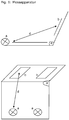
- Das erfindungsgemäße Textil zeigt unter Bestrahlung in der Messapparatur nach
Fig. 1 eine Temperaturerhöhung von 5 °C, bevorzugt von 15 °C, insbesondere bevorzugt von 25°C, gegenüber einer nicht-veredelten Referenz. - Eine Messapparatur bestand aus zwei identischen IR-Lampen mit einer Leistung von 150 W, einer Vorrichtung zur Einspannung der textilen Proben in einem Abstand von d=30 cm davon, wobei die textilen Proben in einem Winkel von α=45° geneigt angebracht wurden. Die Temperaturerhöhung der Textilien wurde in Abhängigkeit der Bestrahlungsdauer gemessen, wobei stets eine Referenzprobe als Vergleich mit bestrahlt wurde (
Fig. 1 ). -
Fig. 1 : Messapparatur zur Bestimmung der Temperaturerhöhung (Seit-und Frontalansicht):- In der Zeichnung sind zwei Lampen (a), eine Vorrichtung zur Fixierung der textilen Proben (b) in einem Abstand d = 30 cm von den Lampen in einem Winkel α=45° gezeigt.
-
Fig. 2 :
Fig. 2 zeigt ein Remissionspektrum eines Ausführungsbeispiels im Vergleich zur Referenz. - Als ΔT wird die Temperaturdifferenz nach 2 min in der Messapparatur nach
Fig. 1 zwischen veredeltem und Referenzmuster bezeichnet.
- Die Remission wurde nach Standardverfahren mit einem Gerät der Marke Datacolor, Typ Microflash 45 bestimmt, vorzugsweise bei einer Wellenlänge von 980 nm. Als Remissionsanteil galt der Quotient aus Remission des Musters geteilt durch die Remission des Referenzmusters:

- Die optische Beurteilung wurde in einer handelsüblichen Abmusterungskabine mit verschiedenen Lichtquellen durchgeführt.
- Weiße Baumwollmuster (Köper, 205 g/m2, 20 cm x 30 cm) wurden mit 250 ml einer frisch angesetzten Ausrüstungsflotte bestehend aus 0,45% Indiumzinnoxid, zugegeben als 20%ige Pigmentdispersion, und 5% Polyurethan-Binderpolymer in Weichwasser, eingestellt auf pH 5.5 mit Essigsäure, an einem Laborfoulard ausgerüstet. Der Anpressdruck der Walzen wurde auf 3 bar eingestellt. Nach der Ausrüstung wurde das Textil an einem Laborspannrahmen für 2 min bei 120 °C getrocknet und anschließend für 1 min bei 150 °C kondensiert. Anschließend wurden die Muster mit einem Referenzmuster in der in
Fig. 1 gezeigten Vorrichtung vermessen sowie Remission und Farbzahlen bestimmt.ΔT 15 °C Remissionsanteil 93% ΔE nach CIE-Lab Farbraum 11,2 Optische Beurteilung Erkennbare Blauverschiebung - Das Muster zeigte eine für den Textilfachmann nicht akzeptable Farbveränderung. Zudem ist ITO in den benötigten Mengen in der Textilindustrie preislich nicht realisierbar.
- Weiße Polyamid-Muster (Leinwand, 120 g/m2, 20 cm x 30 cm) wurden mit 250 ml einer frisch angesetzten Ausrüstungsflotte bestehend aus 1% Aluminiumzinkoxid (d50=50 nm), zugegeben als 16%ige Dispersion, und 5% Polyurethan-Binderpolymer in Weichwasser, eingestellt auf pH 5.5 mit Essigsäure, an einem Laborfoulard ausgerüstet. Der Anpressdruck der Walzen wurde auf 3 bar eingestellt. Nach der Ausrüstung wurde das Textil an einem Laborspannrahmen für 2 min bei 120 °C getrocknet und anschließend für 1 min bei 150 °C kondensiert.
- Anschließend wurden die Muster mit einem Referenzmuster in der in
Abbildung 1 gezeigten Vorrichtung vermessen sowie Remission und Farbzahlen bestimmt.ΔT 2 °C Remissionsanteil 96% ΔE nach CIE-Lab Farbraum 2 Optische Beurteilung unauffällig - Das Muster war farblich für den Textilfachmann akzeptabel, aber die aufgenommene Wärmemenge ist nicht hinreichend.
-
- Weiße PES/Lyocell-Gewebe (210 g/m2, 20 cm x 30 cm) wurden mit 250 ml einer frisch angesetzten Ausrüstungsflotte bestehend aus 0,02% leitfähigem organischem Polymer, 5% Polyurethan-Binderpolymer, 1% Fixierer und 0,5% Kollasol CDO (Tensid, erhältlich von CHT R. Beitlich GmbH), in Weichwasser, eingestellt auf pH 5.5 mit Essigsäure, an einem Laborfoulard ausgerüstet. Der Anpressdruck der Walzen wurde auf 3 bar eingestellt. Nach der Ausrüstung wurde das Textil an einem Laborspannrahmen für 2 min bei 120 °C getrocknet und anschließend für 1 min bei 150 °C kondensiert. Anschließend wurden die Muster mit einem Referenzmuster in der in.Fig. 1 gezeigten Vorrichtung vermessen sowie Remission und Farbzahlen bestimmt.Poly(3,4-ethylen-dioxythiophen) / Poly(styrolsulfonat) Polyanilin Polypyrrol ΔT 5 °C 5 °C 3 °C Remissionsanteil 86% 88% 96% ΔE nach CIE-Lab Farbraum 4,1 5,0 5,3 Optische Beurteilung unauffällig unauffällig leichte Grauverschiebung - Weiße PES/Lyocell-Gewebe (210 g/m2, 20 cm x 30 cm) wurden mit 250 ml einer frisch angesetzten Ausrüstungsflotte bestehend aus 0,2% Indiumzinnoxid, 0,02% organisch leitfähige Polymere, 5% Polyurethan-Binderpolymer, 1% Fixierer, 0,05% Kollasol CDO, in Weichwasser eingestellt auf pH 5.5 mit Essigsäure, an einem Laborfoulard ausgerüstet. Der Anpressdruck der Walzen wurde auf 3 bar eingestellt. Nach der Ausrüstung wurde das Textil an einem Laborspannrahmen für 2 min bei 120 °C getrocknet und anschließend für 1 min bei 150 °C kondensiert.
Poly(3,4-ethylen-dioxythiophen) / Poly(styrolsulfonat) Polyanilin Polypyrrol ΔT 19 °C 11 °C 12 °C Remissionsanteil 75% 82% 81% ΔE nach CIE-Lab Farbraum 7,7 8,5 10,0 Optische Beurteilung unauffällig unauffällig leichte Grauverschiebung - Rote Polyamid-Muster (Köperbindung, 120 g/m2, 20 cm x 30 cm) wurden mit 250 ml einer frisch angesetzten Ausrüstungsflotte bestehend aus 0,8% Aluminiumnitrid, zugegeben als 20%ige Pigmentdispersion enthaltend 0,1% Kollasol CDO, in Weichwasser, eingestellt auf pH 5.5 mit Essigsäure, an einem Laborfoulard ausgerüstet. Bei einigen Beispielen wurden zudem 0,02% leitfähige organische Polymere zugegeben. Der Anpressdruck der Walzen wurde auf 3 bar eingestellt. Nach der Ausrüstung wurde das Textil an einem Laborspannrahmen für 2 min bei 120 °C getrocknet und anschließend für 1 min bei 150 °C kondensiert. Anschließend wurden die Muster mit einem Referenzmuster in der in
Fig. 1 gezeigten Vorrichtung vermessen sowie Remission und Farbzahlen bestimmt.Ohne leitfähiges organisches Polymer Poly(3,4-ethylen-dioxythiophen) / Poly(styrolsulfonat) Polyanilin Polypyrrol ΔT 8 °C 15 °C 10 °C 9 °C Remissionsanteil bei λ=980 nm 77% 62% 75% 75% ΔE nach CIE-Lab Farbraum 3,8 4,1 4,2 8,0 Optische Beurteilung unauffällig unauffällig unauffällig leichte Grauverschiebung - Gelbe Viskose-Gewebe (160 g/m2, 20 cm x 30 cm) wurden mit 250 ml einer frisch angesetzten Ausrüstungsflotte bestehend aus 0,2% ternärem Oxid, 0,05% Polyanilin, 5% Polyurethan-Binderpolymer, 1% Fixierer, 0,25% Kollasol CDO, in Weichwasser eingestellt auf pH 5.5 mit Essigsäure, an einem Laborfoulard ausgerüstet. Der Anpressdruck der Walzen wurde auf 3 bar eingestellt. Nach der Ausrüstung wurde das Textil an einem Laborspannrahmen für 2 min bei 120 °C getrocknet und anschließend für 1 min bei 150 °C kondensiert.
ITO ATO FTO Ohne Oxid ΔT 19 °C 15 °C 6 °C 5 °C Remissionsanteil 72% 74% 81% 84% ΔE nach CIE-Lab Farbraum 4,8 5,0 3,5 3,5 Optische Beurteilung unauffällig leichter rötlicher Grauton unauffällig unauffällig - Textile Muster verschiedener Materialien (siehe unten stehende Tabelle) wurden mit jeweils 250 ml der in Ausführungsbeispiel 2 genannten Flotte bestehend aus Indiumzinnoxid und Poly(3,4-ethylendioxythiophen) / Poly(styrolsulfonat) und Kollasol CDO an einem Laborfoulard ausgerüstet. Der Anpressdruck der Walzen wurde auf 3 bar eingestellt. Nach der Ausrüstung wurde das Textil an einem Laborspannrahmen für 2 min bei 120 °C getrocknet und anschließend für 1 min bei 150 °C kondensiert. Anschließend wurden die Muster als ungewaschenes Original, nach 10 Haushaltswäschen (HHW) bei 40 °C mit einem Referenzmuster in der in
Abbildung 1 gezeigten Vorrichtung vermessen und die Remission bestimmt.Material vor Wäschen Material nach 10 HHW Polyester Polyamid/Elasthan Polyester Polyamid/Elasthan Grundfarbe weiß weiß weiß weiß Warengewicht 130 g/m2 230 g/m2 130 g/m2 230 g/m2 ΔT 24 °C 32 °C 22 °C 30 °C Remissionsanteil 82% 74% 83% 77% ΔE nach CIE-Lab Farbraum 4,5 7,5 3,6 6,6 - Gelbe Polyester-Elasthan-Textilmuster wurden mit jeweils 250 ml der unten genannten Flotten an einem Laborfoulard ausgerüstet. Der Anpressdruck der Walzen wurde auf 3 bar eingestellt. Nach der Ausrüstung wurde das Textil an einem Laborspannrahmen für 2 min bei 120 °C getrocknet und anschließend für 1 min bei 150 °C kondensiert. Anschließend wurden die Muster mit einem Referenzmuster in der in
Abbildung 1 gezeigten Vorrichtung vermessen sowie die Remission bestimmt.# Flottenzusammensetzung ΔT Remissions anteil Optische Beurteilung 1 5% Polyurethan-Binderpolymer I, 0,1% Kollasol CDO 103% unauffällig 2 5% Polyurethan-Binder-polymer I, 0,4% Antimonzinnoxid, 0,1% Polyanilin, 0,1% Kollasol CDO 23 °C 78% leichte Grauverschiebung 3 5% Polyurethan-Binderpolymer I, 0,4% Indiumzinnoxid, 0,1% Polyanilin, 0,1% Kollasol CDO 28 °C 72% geringe grau-blaue Farbverschiebung 4 5% Polyurethan-Binderpolymer II, 0,1% Kollasol CDO 2 °C 102% unauffällig 5 5% Polyurethan-Binderpolymer II, 0,4% Antimonzinnoxid, 0,1% Polyanilin, 0,1% Kollasol CDO 16 °C 88% leichte Grauverschiebung 6 5% Polyurethan-Binderpolymer II, 0,4% Indiumzinnoxid, 0,1% Polyanilin, 0,1% Kollasol CDO 18 °C 84% geringe Grau-blaue Farb-verschiebung 7 2% Sol-Gel-Binder (iSys MTX) 0 °C 101% unauffällig 8 2% Sol-Gel-Binder (iSys MTX), 0,4% Antimonzinnoxid, 0,1% Polyanilin, 0,1% Kollasol CDO 22 °C 81% marginale Grauverschiebung 9 2% Sol-Gel-Binder (iSys MTX), 0,4% Indiumzinnoxid, 0,1% Polyanilin, 0,1% Kollasol CDO 26 °C 78% marginale grau-blaue Farbverschiebung
Claims (9)
- Textilhilfsmittel zur IR-Absorption und/oder -Reflexion von Textilien, enthaltend(α) Halbleiter, die ausgewählt sind aus wenigstens einem der Halbleiter der Gruppen a), b) und c) sowie weiterhin wenigstens einem Halbleiter aus der Gruppe d) oder Mischungen von wenigstens zwei Halbleitern ausgewählt aus den Gruppen a), b) und c), insbesondere wenigstens einem aus der Gruppe a) sowie wenigstens einen aus der Gruppe c),
wobeia) - AIIIBV-Halbleiter Verbindungen des binären Typs umfasst, wobei A für Gallium, Indium, Thallium, Germanium, Zinn, Blei und B für Stickstoff, Phosphor, Arsen, Antimon und Bismut in beliebigen stöchiometrischen Verhältnissen steht,b) - elementare Halbleiter ausgewählt aus Modifikationen des Zinns, Indiums, Kohlenstoffs, Siliziums und Germaniums umfasst,c) - Polypyrrol, Polyanilin, Polyparaphenylen, Polythiophen, Poly(4,4-dioctyi-cyclopenta-dithiophene), Poly(3,4-ethylen-dioxythiophen) oder Poly(3,4-ethylen-dioxythiophen) / Poly(styrolsulfonat) umfasst,d) - einen Halbleiter aus der Gruppe Indiumzinnoxid, Antimonzinnoxid, Aluminiumzinkoxid, Magnesiumzinkoxid, fluordotiertes Zinnoxid oder Mischungen der binären Oxide dieser genannten Metalle umfasst,(β) einen oder mehrere Binderpolymere aus der Gruppe der Polyurethane, Polyacrylate, Styrol-Butadiene, Silikone, Siloxane, Sol-Gele, Polyvinylchlorid, Ethylvinylacetat, Epoxy- oder Polyesterharze,(γ) oberflächenaktive Substanzen ausgewählt aus der Gruppe der anionaktiven, kationaktiven oder nicht-ionischen Tenside sowie(δ) Lösungsmittel und/oder weitere Dispergierhilfsmittel. - Textilhilfsmittel nach Anspruch 1, dadurch gekennzeichnet, dass die Halbleiter ausgewählt sind aus wenigstens einem aus der Gruppe a) sowie wenigstens einem aus der Gruppe c).
- Textilhilfsmittel nach Anspruch 1 oder 2, dadurch gekennzeichnet, dass die genannten Komponenten in organischen Lösungsmitteln, Wasser oder einer Mischung der vorgenannten Lösungsmittel gelöst, dispergiert, kolloidal oder fein verteilt vorliegen.
- Textilhilfsmittel nach einem der Ansprüche 1 bis 3, dadurch gekennzeichnet, dass es weiterhin Fixierer und / oder Vernetzer, insbesondere Di-, Oligo-oder Polycarbonsäuren, Melaminformaldehydharze, Harnstoffformaldehydharze, geblockte und/oder ungeblockte Isocyanate aufweist.
- Textilhilfsmittel nach einem der Ansprüche 1 bis 4, dadurch gekennzeichnet, dass es weiterhin Fluorcarbone, Weichmacher, Aufheller, Farbstoffe, Hydrophilierungs- oder Hydrophobierungsmittel, Anti-Pilling-Additive, Kleber, Schiebefestmittel, Biozide, Verdicker, Vernetzer, Fixierer, Fungizide und/oder Pigmente aufweisen kann.
- Verwendung eines Textilhilfsmittels nach einem der Ansprüche 1 bis 5, das im Ausziehverfahren oder durch Zwangsapplikation wie Beschichtung, Ausrüstung durch Foulardieren, Druck, Sprayverfahren, Einzelfadenapplikation und/oder Färben, allgemein zum Veredeln von Textilien, textilen Gelegen, Vliesen, Fasern, Fäden oder Kompositen, eines oder mehrerer solcher Vorprodukte, die natürliche und/oder synthetische Fasern enthalten.
- Natürliche Fasern einschließlich der daraus gefertigten Textilien, beschichtet mit einem Textilhilfsmittel nach einem der Ansprüche 1 bis 6, enthaltend Baumwolle, Bastfasern, Hartfasern, Wolle, Seide und/oder mineralische Fasern sowie deren Gemische.
- Synthetische Fasern einschließlich der daraus gefertigten Textilien beschichtet mit einem Textilhilfsmittel nach einem der Ansprüche 1 bis 7, enthaltend Fasern ausgewählt aus Zelluloseregeneratfasern, Polymilchsäure, Polyester, Polyamid, Polyimid, Polyamidimid, Polyphenylensulfid, Aramid, Polyvinylchlorid, Polyacrylnitril, Polyvinylacetal, Polytetrafluorethylen, Polyethylen, Polypropylen, Polyurethan, Elasthan, Carbonfasern, Silikatfasern, Glasfasern, Basaltfasern und/oder Metallfasern sowie deren Gemische.
- Fasern einschließlich der daraus gefertigten Textilien nach Anspruch 7 und/oder 8 umfassend natürliche Fasern und synthetische Fasern.
Applications Claiming Priority (2)
| Application Number | Priority Date | Filing Date | Title |
|---|---|---|---|
| DE102012209598A DE102012209598A1 (de) | 2012-06-06 | 2012-06-06 | Textilhilfsmittel und damit veredeltes Textilprodukt |
| PCT/EP2013/061500 WO2013182568A2 (de) | 2012-06-06 | 2013-06-04 | Textilhilfsmittel und damit veredeltes textilprodukt |
Publications (2)
| Publication Number | Publication Date |
|---|---|
| EP2859145A2 EP2859145A2 (de) | 2015-04-15 |
| EP2859145B1 true EP2859145B1 (de) | 2017-03-15 |
Family
ID=48651993
Family Applications (1)
| Application Number | Title | Priority Date | Filing Date |
|---|---|---|---|
| EP13729627.3A Active EP2859145B1 (de) | 2012-06-06 | 2013-06-04 | Textilhilfsmittel und damit veredeltes textilprodukt |
Country Status (3)
| Country | Link |
|---|---|
| EP (1) | EP2859145B1 (de) |
| DE (1) | DE102012209598A1 (de) |
| WO (1) | WO2013182568A2 (de) |
Families Citing this family (6)
| Publication number | Priority date | Publication date | Assignee | Title |
|---|---|---|---|---|
| US10252945B2 (en) | 2012-09-26 | 2019-04-09 | Multiple Energy Technologies Llc | Bioceramic compositions |
| TWI555890B (zh) * | 2013-12-18 | 2016-11-01 | 財團法人工業技術研究院 | 具有吸收紅外線功能的紗線及其紡織品 |
| EA201692098A1 (ru) | 2014-05-05 | 2017-05-31 | МАЛТИПЛ ЭНЕРДЖИ ТЕКНОЛОДЖИС ЭлЭлСи | Биокерамические композиции и их применение для биомодулирования |
| CN104389156A (zh) * | 2014-11-04 | 2015-03-04 | 东华大学 | 一种耐久型负载氧化锌纺织品的制备方法 |
| CN113089123B (zh) * | 2021-04-21 | 2022-09-20 | 上海工程技术大学 | 碳化锆/聚吡咯-聚氨酯复合纤维及其制备方法和应用 |
| CN121447938B (zh) * | 2026-01-06 | 2026-04-07 | 西南石油大学 | 一种多功能玄武岩纤维复合材料及其制备方法 |
Family Cites Families (53)
| Publication number | Priority date | Publication date | Assignee | Title |
|---|---|---|---|---|
| US3277138A (en) | 1966-10-04 | Method for the chlorination of aromatic isocyanates | ||
| US3001973A (en) | 1953-05-23 | 1961-09-26 | Bayer Ag | Production of cross-linked plastics |
| DE1022789B (de) | 1956-09-29 | 1958-01-16 | Bayer Ag | Verfahren zur Herstellung von Schaumstoffen aus Polyoxy- und/oder Polycarboxylverbindungen und Polyisocyanaten |
| DE1027394B (de) | 1956-10-22 | 1958-04-03 | Bayer Ag | Verfahren zur Herstellung von Schaumstoffen |
| BE562425A (de) | 1956-11-16 | |||
| DE1072385C2 (de) | 1958-06-20 | 1960-07-07 | Bayer Ag | Verfahren zur Herstellung von harzartigen, gegebenenfalls noch löslichen, beim Erwärmen Isocyanatgruppen freisetzenden Polyadditionsprodukten |
| BE581667A (de) | 1958-08-15 | |||
| GB889050A (en) | 1959-06-12 | 1962-02-07 | Ici Ltd | Process for the manufacture of polyurethanes |
| US3152162A (en) | 1959-07-29 | 1964-10-06 | Bayer Ag | Polyisocyanate-carbodiimide adducts and process for the production thereof |
| US3019731A (en) | 1960-02-19 | 1962-02-06 | Advanced Oil Tools Inc | Jet perforator for well casings |
| US3245833A (en) * | 1964-04-20 | 1966-04-12 | Eastman Kodak Co | Electrically conductive coatings |
| NL133051C (de) | 1960-12-05 | |||
| GB994890A (en) | 1961-12-18 | 1965-06-10 | Ici Ltd | New organic polyisocyanates and their manufacture |
| US3455883A (en) | 1963-01-09 | 1969-07-15 | Gen Mills Inc | Polyisocyanates and derivatives |
| US3454606A (en) | 1963-11-14 | 1969-07-08 | Union Carbide Corp | Isocyanatophenylsulfonyl isocyanates |
| US3124605A (en) | 1963-12-05 | 1964-03-10 | Biuret polyisocyanates | |
| DE1222067B (de) | 1964-11-07 | 1966-08-04 | Bayer Ag | Verfahren zur Herstellung von einheitlichen organischen Polyisocyanaten |
| DE1231688B (de) | 1965-04-17 | 1967-01-05 | Bayer Ag | Verfahren zur Herstellung von Isocyanatocarbonsaeureestern polyfunktioneller Hydroxyverbindungen |
| DE1230778B (de) | 1965-05-24 | 1966-12-22 | Bayer Ag | Verfahren zur Herstellung von acylierten Harnstoffpolyisocyanaten |
| US3394164A (en) | 1965-10-24 | 1968-07-23 | Upjohn Co | Stabilized methylenebis-(phenyl isocyanate) compositions |
| US3492301A (en) | 1965-11-01 | 1970-01-27 | Armstrong Cork Co | 2,4,6-trisubstituted sulfonylhydrazido-s-triazines |
| US3567763A (en) | 1966-01-06 | 1971-03-02 | Rohm & Haas | Ester polyisocyanates |
| DE1618380C3 (de) | 1967-03-08 | 1975-09-11 | Bayer Ag, 5090 Leverkusen | Verfahren zur Herstellung eines bei Raumtemperatur flüssigen Diphenylmethan-diisocyanatpräparates |
| DE1720747C3 (de) | 1967-11-09 | 1980-06-26 | Bayer Ag | Verfahren zur Herstellung von Iso cyanatgruppen aufweisenden Telomerisaten |
| US3513491A (en) | 1968-03-13 | 1970-05-26 | Donald W Gordon | Athlete's landing pit with foam-block cushion units |
| DE1929034B2 (de) | 1969-06-07 | 1972-04-20 | Farbenfabriken Bayer Ag, 5090 Lever Kusen | Verfahren zur herstellung von flammfesten urethangruppen aufweisenden schaumstoffen |
| AT304874B (de) | 1969-06-20 | 1973-01-25 | Bayer Ag | Verfahren zur Herstellung von flammwidrigen, gegebenenfalls zellförmigen, Urethangruppen aufweisenden Kunststoffen |
| DE2002064C2 (de) | 1970-01-17 | 1983-09-01 | Bayer Ag, 5090 Leverkusen | Verfahren zur Herstellung von flammwidrigen elastischen oder halbelastischen Schaumstoffen |
| DE2009179C3 (de) | 1970-02-27 | 1974-07-11 | Bayer Ag, 5090 Leverkusen | Verfahren zur Herstellung von Allophanatpoly isocy anaten |
| DE2504400A1 (de) | 1975-02-01 | 1976-08-05 | Bayer Ag | Lagerstabile, carbodiimidgruppen enthaltende polyisocyanate |
| DE2537685C2 (de) | 1975-08-23 | 1989-04-06 | Bayer Ag, 5090 Leverkusen | Verfahren zur teilweisen Carbodiimidisierung der Isocyanatgruppen von organischen Polyisocyanaten |
| DE2552350A1 (de) | 1975-11-21 | 1977-05-26 | Bayer Ag | Lagerstabile, carbodiimidgruppen enthaltende polyisocyanate |
| DE2737192A1 (de) | 1976-11-10 | 1978-05-11 | Hydrocarbon Research Inc | Verfahren zur kohlehydrierung bei erhoehten temperaturen |
| EP0341554A1 (de) | 1988-05-03 | 1989-11-15 | BASF Corporation | Elektrisch leitfähige textile Fäden |
| DE3921249A1 (de) * | 1988-07-08 | 1990-01-11 | Sandoz Ag | Ir-absorbierende textilien |
| FR2799392A1 (fr) | 1999-10-06 | 2001-04-13 | Tedeco | Nouveau procede de preparation de dispersions stables de nanoparticules d'oxydes metalliques, et de fabrications de fibres revetues par ces oxydes, et fibres et articles ainsi obtenus |
| US20030113498A1 (en) * | 2000-06-27 | 2003-06-19 | Tatsuya Zenda | Moisture-permeable, waterproof and heat insulating fabric and moisture-permeable, waterproof and heat insulating resin film with releasing paper |
| RU2196855C1 (ru) | 2001-07-12 | 2003-01-20 | Институт химии растворов РАН | Состав пасты для печати целлюлозосодержащих материалов кубовыми красителями |
| JP3853185B2 (ja) * | 2001-09-26 | 2006-12-06 | 帝人ファイバー株式会社 | 保温性布帛 |
| DE10240802A1 (de) | 2002-08-30 | 2004-04-15 | W.L. Gore & Associates Gmbh | IR reflektierendes Material |
| JP4007497B2 (ja) | 2002-10-28 | 2007-11-14 | グンゼ株式会社 | 光発熱性肌着 |
| DE10258014A1 (de) | 2002-12-12 | 2004-06-24 | Texplorer Gmbh | Wärmetarnplane |
| JP2005212471A (ja) | 2004-01-31 | 2005-08-11 | Sozai Kk Nippon | 省エネ保温カバー |
| JP2005290585A (ja) | 2004-03-31 | 2005-10-20 | Taiwan Textile Research Inst | 温度制御繊維製品及びその製造方法 |
| JP4355945B2 (ja) | 2004-11-08 | 2009-11-04 | 住友金属鉱山株式会社 | 近赤外線吸収繊維およびこれを用いた繊維製品 |
| PL1901624T3 (pl) * | 2005-05-25 | 2012-02-29 | Gore & Ass | Materiał tłumiący podczerwień |
| PT103361A (pt) | 2005-09-30 | 2007-03-30 | Sasaki Internacional Ind E Com | Processo de fabrico de edredão |
| JP2009062652A (ja) | 2007-09-07 | 2009-03-26 | Asakura Senpu Kk | 赤外線吸収能繊維及び赤外線吸収能付与染色方法 |
| JP5230464B2 (ja) | 2008-01-30 | 2013-07-10 | 小松精練株式会社 | 赤外線吸収布帛およびその製造方法 |
| WO2009118419A1 (en) | 2008-03-28 | 2009-10-01 | Clariant International Ltd | Influencing the near infrared reflectance of dyed textile materials |
| DE102009006832A1 (de) * | 2009-01-30 | 2010-08-05 | Bayerisches Zentrum für Angewandte Energieforschung e.V. | Flüssige oder halbfeste Formulierung spektralselektiver Partikel zur Beschichtung flexibler Körper sowie Verwendung dieser |
| US20120058697A1 (en) | 2009-04-01 | 2012-03-08 | Strickland Aaron D | Conformal particle coatings on fiber materials for use in spectroscopic methods for detecting targets of interest and methods based thereon |
| TWI396788B (zh) | 2009-10-01 | 2013-05-21 | Taiwan Textile Res Inst | 彩色織物 |
-
2012
- 2012-06-06 DE DE102012209598A patent/DE102012209598A1/de not_active Withdrawn
-
2013
- 2013-06-04 WO PCT/EP2013/061500 patent/WO2013182568A2/de not_active Ceased
- 2013-06-04 EP EP13729627.3A patent/EP2859145B1/de active Active
Non-Patent Citations (1)
| Title |
|---|
| None * |
Also Published As
| Publication number | Publication date |
|---|---|
| EP2859145A2 (de) | 2015-04-15 |
| WO2013182568A2 (de) | 2013-12-12 |
| WO2013182568A3 (de) | 2014-01-30 |
| DE102012209598A1 (de) | 2013-12-12 |
Similar Documents
| Publication | Publication Date | Title |
|---|---|---|
| EP2925832B1 (de) | Beschichtung von luminophoren | |
| WO2013182568A2 (de) | Textilhilfsmittel und damit veredeltes textilprodukt | |
| Abd El-Hady et al. | Flame retardancy and UV protection of cotton based fabrics using nano ZnO and polycarboxylic acids | |
| Zhao et al. | Superhydrophobic and UV-blocking cotton fabrics prepared by layer-by-layer assembly of organic UV absorber intercalated layered double hydroxides | |
| EP2578649B1 (de) | Zusammensetzung für die herstellung einer beschichtung mit hoher haft- und kratzfestigkeit | |
| DE2418027A1 (de) | Gebilde aus titandioxyd | |
| DE69503598T2 (de) | Einen mit einer elektrisch leitfähigen schicht versehenen bildschirm enthaltende kathodenstrahlröhre | |
| EP0121078A1 (de) | Textilausrüstungsmittel | |
| DE102007027361A1 (de) | Pigment und damit mattierte polymere Werkstoffe | |
| US20130130018A1 (en) | Method for coating with dispersions of active ingredients coated in a polymer layer | |
| DE102011076256B4 (de) | Verfahren zur Antifleckenbehandlung von Stoff und Antiflecken-behandelter Stoff | |
| DE10041038B4 (de) | Sphärische Metalloxidpartikel mit partikulären Oberflächenerhebungen und Verfahren zu dessen Herstellung sowie deren Verwendung | |
| DE2264962C3 (de) | Glasgewebe mit einem die Biegebeanspruchbarkeit verbessernden Überzug aus Polytetrafluorethylen und Verfahren zur Herstellung desselben | |
| DE69502671T2 (de) | Anzeigevorrichtung mit einem mit einer licht absorbierenden schicht versehenen bildschirm | |
| El Gabry et al. | Ecofriendly modification of acrylic fabrics for enhanced transfer printability | |
| EP2021424A2 (de) | Mit wasser verdünnbare konzentrate zur beschichtung verschiedener substrate | |
| EP0724024A1 (de) | Thermostabile Polarisatoren | |
| WO2005028396A2 (de) | Verwendung von kern-mantel-partikeln | |
| Khan et al. | Dye aggregation in layer-by-layer dyeing of cotton fabrics | |
| DE1906220A1 (de) | Waermebehandelte Produkte aus Acrylnitrilmischpolymeren und Verfahren zu ihrer Herstellung | |
| DE69430180T2 (de) | Textilmaterialienbehandlungsmittel | |
| EP3268310B1 (de) | Nanopartikel enthaltendes fibersizing von kohlefasern | |
| Mahltig et al. | Nanocoatings by sol–gel processes for functionalization of polymer surfaces and textiles | |
| DE3235002A1 (de) | Verfahren zur modifizierung regenerierter cellulose-faser | |
| DE102004025368A1 (de) | Verfahren zur Herstellung von strukturierten Oberflächen |
Legal Events
| Date | Code | Title | Description |
|---|---|---|---|
| PUAI | Public reference made under article 153(3) epc to a published international application that has entered the european phase |
Free format text: ORIGINAL CODE: 0009012 |
|
| 17P | Request for examination filed |
Effective date: 20141202 |
|
| AK | Designated contracting states |
Kind code of ref document: A2 Designated state(s): AL AT BE BG CH CY CZ DE DK EE ES FI FR GB GR HR HU IE IS IT LI LT LU LV MC MK MT NL NO PL PT RO RS SE SI SK SM TR |
|
| AX | Request for extension of the european patent |
Extension state: BA ME |
|
| RIN1 | Information on inventor provided before grant (corrected) |
Inventor name: LUTZ, HARALD Inventor name: JAICH, TANJA Inventor name: DANIELEC, HOLGER |
|
| DAX | Request for extension of the european patent (deleted) | ||
| 17Q | First examination report despatched |
Effective date: 20160307 |
|
| GRAP | Despatch of communication of intention to grant a patent |
Free format text: ORIGINAL CODE: EPIDOSNIGR1 |
|
| INTG | Intention to grant announced |
Effective date: 20161014 |
|
| STAA | Information on the status of an ep patent application or granted ep patent |
Free format text: STATUS: GRANT OF PATENT IS INTENDED |
|
| GRAS | Grant fee paid |
Free format text: ORIGINAL CODE: EPIDOSNIGR3 |
|
| GRAA | (expected) grant |
Free format text: ORIGINAL CODE: 0009210 |
|
| STAA | Information on the status of an ep patent application or granted ep patent |
Free format text: STATUS: THE PATENT HAS BEEN GRANTED |
|
| AK | Designated contracting states |
Kind code of ref document: B1 Designated state(s): AL AT BE BG CH CY CZ DE DK EE ES FI FR GB GR HR HU IE IS IT LI LT LU LV MC MK MT NL NO PL PT RO RS SE SI SK SM TR |
|
| REG | Reference to a national code |
Ref country code: CH Ref legal event code: EP Ref country code: GB Ref legal event code: FG4D Free format text: NOT ENGLISH |
|
| REG | Reference to a national code |
Ref country code: CH Ref legal event code: NV Representative=s name: KASCHE AND PARTNER AG, CH |
|
| REG | Reference to a national code |
Ref country code: IE Ref legal event code: FG4D Free format text: LANGUAGE OF EP DOCUMENT: GERMAN |
|
| REG | Reference to a national code |
Ref country code: AT Ref legal event code: REF Ref document number: 875695 Country of ref document: AT Kind code of ref document: T Effective date: 20170415 |
|
| REG | Reference to a national code |
Ref country code: DE Ref legal event code: R096 Ref document number: 502013006667 Country of ref document: DE |
|
| REG | Reference to a national code |
Ref country code: NL Ref legal event code: MP Effective date: 20170315 |
|
| REG | Reference to a national code |
Ref country code: LT Ref legal event code: MG4D |
|
| PG25 | Lapsed in a contracting state [announced via postgrant information from national office to epo] |
Ref country code: HR Free format text: LAPSE BECAUSE OF FAILURE TO SUBMIT A TRANSLATION OF THE DESCRIPTION OR TO PAY THE FEE WITHIN THE PRESCRIBED TIME-LIMIT Effective date: 20170315 Ref country code: GR Free format text: LAPSE BECAUSE OF FAILURE TO SUBMIT A TRANSLATION OF THE DESCRIPTION OR TO PAY THE FEE WITHIN THE PRESCRIBED TIME-LIMIT Effective date: 20170616 Ref country code: NO Free format text: LAPSE BECAUSE OF FAILURE TO SUBMIT A TRANSLATION OF THE DESCRIPTION OR TO PAY THE FEE WITHIN THE PRESCRIBED TIME-LIMIT Effective date: 20170615 Ref country code: LT Free format text: LAPSE BECAUSE OF FAILURE TO SUBMIT A TRANSLATION OF THE DESCRIPTION OR TO PAY THE FEE WITHIN THE PRESCRIBED TIME-LIMIT Effective date: 20170315 Ref country code: FI Free format text: LAPSE BECAUSE OF FAILURE TO SUBMIT A TRANSLATION OF THE DESCRIPTION OR TO PAY THE FEE WITHIN THE PRESCRIBED TIME-LIMIT Effective date: 20170315 |
|
| PG25 | Lapsed in a contracting state [announced via postgrant information from national office to epo] |
Ref country code: BG Free format text: LAPSE BECAUSE OF FAILURE TO SUBMIT A TRANSLATION OF THE DESCRIPTION OR TO PAY THE FEE WITHIN THE PRESCRIBED TIME-LIMIT Effective date: 20170615 Ref country code: LV Free format text: LAPSE BECAUSE OF FAILURE TO SUBMIT A TRANSLATION OF THE DESCRIPTION OR TO PAY THE FEE WITHIN THE PRESCRIBED TIME-LIMIT Effective date: 20170315 Ref country code: RS Free format text: LAPSE BECAUSE OF FAILURE TO SUBMIT A TRANSLATION OF THE DESCRIPTION OR TO PAY THE FEE WITHIN THE PRESCRIBED TIME-LIMIT Effective date: 20170315 Ref country code: SE Free format text: LAPSE BECAUSE OF FAILURE TO SUBMIT A TRANSLATION OF THE DESCRIPTION OR TO PAY THE FEE WITHIN THE PRESCRIBED TIME-LIMIT Effective date: 20170315 |
|
| PG25 | Lapsed in a contracting state [announced via postgrant information from national office to epo] |
Ref country code: NL Free format text: LAPSE BECAUSE OF FAILURE TO SUBMIT A TRANSLATION OF THE DESCRIPTION OR TO PAY THE FEE WITHIN THE PRESCRIBED TIME-LIMIT Effective date: 20170315 |
|
| PG25 | Lapsed in a contracting state [announced via postgrant information from national office to epo] |
Ref country code: CZ Free format text: LAPSE BECAUSE OF FAILURE TO SUBMIT A TRANSLATION OF THE DESCRIPTION OR TO PAY THE FEE WITHIN THE PRESCRIBED TIME-LIMIT Effective date: 20170315 Ref country code: EE Free format text: LAPSE BECAUSE OF FAILURE TO SUBMIT A TRANSLATION OF THE DESCRIPTION OR TO PAY THE FEE WITHIN THE PRESCRIBED TIME-LIMIT Effective date: 20170315 Ref country code: IT Free format text: LAPSE BECAUSE OF FAILURE TO SUBMIT A TRANSLATION OF THE DESCRIPTION OR TO PAY THE FEE WITHIN THE PRESCRIBED TIME-LIMIT Effective date: 20170315 Ref country code: RO Free format text: LAPSE BECAUSE OF FAILURE TO SUBMIT A TRANSLATION OF THE DESCRIPTION OR TO PAY THE FEE WITHIN THE PRESCRIBED TIME-LIMIT Effective date: 20170315 Ref country code: SK Free format text: LAPSE BECAUSE OF FAILURE TO SUBMIT A TRANSLATION OF THE DESCRIPTION OR TO PAY THE FEE WITHIN THE PRESCRIBED TIME-LIMIT Effective date: 20170315 Ref country code: ES Free format text: LAPSE BECAUSE OF FAILURE TO SUBMIT A TRANSLATION OF THE DESCRIPTION OR TO PAY THE FEE WITHIN THE PRESCRIBED TIME-LIMIT Effective date: 20170315 |
|
| PG25 | Lapsed in a contracting state [announced via postgrant information from national office to epo] |
Ref country code: PL Free format text: LAPSE BECAUSE OF FAILURE TO SUBMIT A TRANSLATION OF THE DESCRIPTION OR TO PAY THE FEE WITHIN THE PRESCRIBED TIME-LIMIT Effective date: 20170315 Ref country code: PT Free format text: LAPSE BECAUSE OF FAILURE TO SUBMIT A TRANSLATION OF THE DESCRIPTION OR TO PAY THE FEE WITHIN THE PRESCRIBED TIME-LIMIT Effective date: 20170717 Ref country code: SM Free format text: LAPSE BECAUSE OF FAILURE TO SUBMIT A TRANSLATION OF THE DESCRIPTION OR TO PAY THE FEE WITHIN THE PRESCRIBED TIME-LIMIT Effective date: 20170315 Ref country code: IS Free format text: LAPSE BECAUSE OF FAILURE TO SUBMIT A TRANSLATION OF THE DESCRIPTION OR TO PAY THE FEE WITHIN THE PRESCRIBED TIME-LIMIT Effective date: 20170715 |
|
| REG | Reference to a national code |
Ref country code: DE Ref legal event code: R097 Ref document number: 502013006667 Country of ref document: DE |
|
| PLBE | No opposition filed within time limit |
Free format text: ORIGINAL CODE: 0009261 |
|
| STAA | Information on the status of an ep patent application or granted ep patent |
Free format text: STATUS: NO OPPOSITION FILED WITHIN TIME LIMIT |
|
| PG25 | Lapsed in a contracting state [announced via postgrant information from national office to epo] |
Ref country code: DK Free format text: LAPSE BECAUSE OF FAILURE TO SUBMIT A TRANSLATION OF THE DESCRIPTION OR TO PAY THE FEE WITHIN THE PRESCRIBED TIME-LIMIT Effective date: 20170315 Ref country code: MC Free format text: LAPSE BECAUSE OF FAILURE TO SUBMIT A TRANSLATION OF THE DESCRIPTION OR TO PAY THE FEE WITHIN THE PRESCRIBED TIME-LIMIT Effective date: 20170315 |
|
| 26N | No opposition filed |
Effective date: 20171218 |
|
| GBPC | Gb: european patent ceased through non-payment of renewal fee |
Effective date: 20170615 |
|
| PG25 | Lapsed in a contracting state [announced via postgrant information from national office to epo] |
Ref country code: SI Free format text: LAPSE BECAUSE OF FAILURE TO SUBMIT A TRANSLATION OF THE DESCRIPTION OR TO PAY THE FEE WITHIN THE PRESCRIBED TIME-LIMIT Effective date: 20170315 |
|
| REG | Reference to a national code |
Ref country code: IE Ref legal event code: MM4A |
|
| REG | Reference to a national code |
Ref country code: FR Ref legal event code: ST Effective date: 20180228 |
|
| PG25 | Lapsed in a contracting state [announced via postgrant information from national office to epo] |
Ref country code: GB Free format text: LAPSE BECAUSE OF NON-PAYMENT OF DUE FEES Effective date: 20170615 Ref country code: LU Free format text: LAPSE BECAUSE OF NON-PAYMENT OF DUE FEES Effective date: 20170604 Ref country code: IE Free format text: LAPSE BECAUSE OF NON-PAYMENT OF DUE FEES Effective date: 20170604 |
|
| PG25 | Lapsed in a contracting state [announced via postgrant information from national office to epo] |
Ref country code: FR Free format text: LAPSE BECAUSE OF NON-PAYMENT OF DUE FEES Effective date: 20170630 |
|
| REG | Reference to a national code |
Ref country code: BE Ref legal event code: MM Effective date: 20170630 |
|
| PG25 | Lapsed in a contracting state [announced via postgrant information from national office to epo] |
Ref country code: BE Free format text: LAPSE BECAUSE OF NON-PAYMENT OF DUE FEES Effective date: 20170630 |
|
| PG25 | Lapsed in a contracting state [announced via postgrant information from national office to epo] |
Ref country code: MT Free format text: LAPSE BECAUSE OF FAILURE TO SUBMIT A TRANSLATION OF THE DESCRIPTION OR TO PAY THE FEE WITHIN THE PRESCRIBED TIME-LIMIT Effective date: 20170315 |
|
| PG25 | Lapsed in a contracting state [announced via postgrant information from national office to epo] |
Ref country code: HU Free format text: LAPSE BECAUSE OF FAILURE TO SUBMIT A TRANSLATION OF THE DESCRIPTION OR TO PAY THE FEE WITHIN THE PRESCRIBED TIME-LIMIT; INVALID AB INITIO Effective date: 20130604 |
|
| REG | Reference to a national code |
Ref country code: AT Ref legal event code: MM01 Ref document number: 875695 Country of ref document: AT Kind code of ref document: T Effective date: 20180604 |
|
| PG25 | Lapsed in a contracting state [announced via postgrant information from national office to epo] |
Ref country code: CY Free format text: LAPSE BECAUSE OF FAILURE TO SUBMIT A TRANSLATION OF THE DESCRIPTION OR TO PAY THE FEE WITHIN THE PRESCRIBED TIME-LIMIT Effective date: 20170315 |
|
| PG25 | Lapsed in a contracting state [announced via postgrant information from national office to epo] |
Ref country code: MK Free format text: LAPSE BECAUSE OF FAILURE TO SUBMIT A TRANSLATION OF THE DESCRIPTION OR TO PAY THE FEE WITHIN THE PRESCRIBED TIME-LIMIT Effective date: 20170315 |
|
| PG25 | Lapsed in a contracting state [announced via postgrant information from national office to epo] |
Ref country code: AT Free format text: LAPSE BECAUSE OF NON-PAYMENT OF DUE FEES Effective date: 20180604 |
|
| PG25 | Lapsed in a contracting state [announced via postgrant information from national office to epo] |
Ref country code: TR Free format text: LAPSE BECAUSE OF FAILURE TO SUBMIT A TRANSLATION OF THE DESCRIPTION OR TO PAY THE FEE WITHIN THE PRESCRIBED TIME-LIMIT Effective date: 20170315 |
|
| PG25 | Lapsed in a contracting state [announced via postgrant information from national office to epo] |
Ref country code: AL Free format text: LAPSE BECAUSE OF FAILURE TO SUBMIT A TRANSLATION OF THE DESCRIPTION OR TO PAY THE FEE WITHIN THE PRESCRIBED TIME-LIMIT Effective date: 20170315 |
|
| PGFP | Annual fee paid to national office [announced via postgrant information from national office to epo] |
Ref country code: DE Payment date: 20220701 Year of fee payment: 10 |
|
| PGFP | Annual fee paid to national office [announced via postgrant information from national office to epo] |
Ref country code: CH Payment date: 20220629 Year of fee payment: 10 |
|
| REG | Reference to a national code |
Ref country code: DE Ref legal event code: R119 Ref document number: 502013006667 Country of ref document: DE |
|
| REG | Reference to a national code |
Ref country code: CH Ref legal event code: PL |
|
| PG25 | Lapsed in a contracting state [announced via postgrant information from national office to epo] |
Ref country code: DE Free format text: LAPSE BECAUSE OF NON-PAYMENT OF DUE FEES Effective date: 20240103 Ref country code: CH Free format text: LAPSE BECAUSE OF NON-PAYMENT OF DUE FEES Effective date: 20230630 |