EP2859069B1 - Verfahren und einrichtung zur behandlung von erdölanlage - Google Patents
Verfahren und einrichtung zur behandlung von erdölanlage Download PDFInfo
- Publication number
- EP2859069B1 EP2859069B1 EP13712183.6A EP13712183A EP2859069B1 EP 2859069 B1 EP2859069 B1 EP 2859069B1 EP 13712183 A EP13712183 A EP 13712183A EP 2859069 B1 EP2859069 B1 EP 2859069B1
- Authority
- EP
- European Patent Office
- Prior art keywords
- plant
- hydrocarbon
- petroleum
- methyl
- ether
- Prior art date
- Legal status (The legal status is an assumption and is not a legal conclusion. Google has not performed a legal analysis and makes no representation as to the accuracy of the status listed.)
- Active
Links
- 0 *C1CCCC1 Chemical compound *C1CCCC1 0.000 description 2
Images





Classifications
-
- C—CHEMISTRY; METALLURGY
- C10—PETROLEUM, GAS OR COKE INDUSTRIES; TECHNICAL GASES CONTAINING CARBON MONOXIDE; FUELS; LUBRICANTS; PEAT
- C10G—CRACKING HYDROCARBON OILS; PRODUCTION OF LIQUID HYDROCARBON MIXTURES, e.g. BY DESTRUCTIVE HYDROGENATION, OLIGOMERISATION, POLYMERISATION; RECOVERY OF HYDROCARBON OILS FROM OIL-SHALE, OIL-SAND, OR GASES; REFINING MIXTURES MAINLY CONSISTING OF HYDROCARBONS; REFORMING OF NAPHTHA; MINERAL WAXES
- C10G75/00—Inhibiting corrosion or fouling in apparatus for treatment or conversion of hydrocarbon oils, in general
- C10G75/04—Inhibiting corrosion or fouling in apparatus for treatment or conversion of hydrocarbon oils, in general by addition of antifouling agents
-
- C—CHEMISTRY; METALLURGY
- C10—PETROLEUM, GAS OR COKE INDUSTRIES; TECHNICAL GASES CONTAINING CARBON MONOXIDE; FUELS; LUBRICANTS; PEAT
- C10G—CRACKING HYDROCARBON OILS; PRODUCTION OF LIQUID HYDROCARBON MIXTURES, e.g. BY DESTRUCTIVE HYDROGENATION, OLIGOMERISATION, POLYMERISATION; RECOVERY OF HYDROCARBON OILS FROM OIL-SHALE, OIL-SAND, OR GASES; REFINING MIXTURES MAINLY CONSISTING OF HYDROCARBONS; REFORMING OF NAPHTHA; MINERAL WAXES
- C10G45/00—Refining of hydrocarbon oils using hydrogen or hydrogen-generating compounds
- C10G45/02—Refining of hydrocarbon oils using hydrogen or hydrogen-generating compounds to eliminate hetero atoms without changing the skeleton of the hydrocarbon involved and without cracking into lower boiling hydrocarbons; Hydrofinishing
-
- C—CHEMISTRY; METALLURGY
- C10—PETROLEUM, GAS OR COKE INDUSTRIES; TECHNICAL GASES CONTAINING CARBON MONOXIDE; FUELS; LUBRICANTS; PEAT
- C10G—CRACKING HYDROCARBON OILS; PRODUCTION OF LIQUID HYDROCARBON MIXTURES, e.g. BY DESTRUCTIVE HYDROGENATION, OLIGOMERISATION, POLYMERISATION; RECOVERY OF HYDROCARBON OILS FROM OIL-SHALE, OIL-SAND, OR GASES; REFINING MIXTURES MAINLY CONSISTING OF HYDROCARBONS; REFORMING OF NAPHTHA; MINERAL WAXES
- C10G7/00—Distillation of hydrocarbon oils
-
- C—CHEMISTRY; METALLURGY
- C10—PETROLEUM, GAS OR COKE INDUSTRIES; TECHNICAL GASES CONTAINING CARBON MONOXIDE; FUELS; LUBRICANTS; PEAT
- C10G—CRACKING HYDROCARBON OILS; PRODUCTION OF LIQUID HYDROCARBON MIXTURES, e.g. BY DESTRUCTIVE HYDROGENATION, OLIGOMERISATION, POLYMERISATION; RECOVERY OF HYDROCARBON OILS FROM OIL-SHALE, OIL-SAND, OR GASES; REFINING MIXTURES MAINLY CONSISTING OF HYDROCARBONS; REFORMING OF NAPHTHA; MINERAL WAXES
- C10G9/00—Thermal non-catalytic cracking, in the absence of hydrogen, of hydrocarbon oils
- C10G9/005—Coking (in order to produce liquid products mainly)
-
- C—CHEMISTRY; METALLURGY
- C10—PETROLEUM, GAS OR COKE INDUSTRIES; TECHNICAL GASES CONTAINING CARBON MONOXIDE; FUELS; LUBRICANTS; PEAT
- C10G—CRACKING HYDROCARBON OILS; PRODUCTION OF LIQUID HYDROCARBON MIXTURES, e.g. BY DESTRUCTIVE HYDROGENATION, OLIGOMERISATION, POLYMERISATION; RECOVERY OF HYDROCARBON OILS FROM OIL-SHALE, OIL-SAND, OR GASES; REFINING MIXTURES MAINLY CONSISTING OF HYDROCARBONS; REFORMING OF NAPHTHA; MINERAL WAXES
- C10G9/00—Thermal non-catalytic cracking, in the absence of hydrogen, of hydrocarbon oils
- C10G9/007—Visbreaking
-
- C—CHEMISTRY; METALLURGY
- C10—PETROLEUM, GAS OR COKE INDUSTRIES; TECHNICAL GASES CONTAINING CARBON MONOXIDE; FUELS; LUBRICANTS; PEAT
- C10G—CRACKING HYDROCARBON OILS; PRODUCTION OF LIQUID HYDROCARBON MIXTURES, e.g. BY DESTRUCTIVE HYDROGENATION, OLIGOMERISATION, POLYMERISATION; RECOVERY OF HYDROCARBON OILS FROM OIL-SHALE, OIL-SAND, OR GASES; REFINING MIXTURES MAINLY CONSISTING OF HYDROCARBONS; REFORMING OF NAPHTHA; MINERAL WAXES
- C10G9/00—Thermal non-catalytic cracking, in the absence of hydrogen, of hydrocarbon oils
- C10G9/14—Thermal non-catalytic cracking, in the absence of hydrogen, of hydrocarbon oils in pipes or coils with or without auxiliary means, e.g. digesters, soaking drums, expansion means
- C10G9/16—Preventing or removing incrustation
-
- F—MECHANICAL ENGINEERING; LIGHTING; HEATING; WEAPONS; BLASTING
- F24—HEATING; RANGES; VENTILATING
- F24D—DOMESTIC- OR SPACE-HEATING SYSTEMS, e.g. CENTRAL HEATING SYSTEMS; DOMESTIC HOT-WATER SUPPLY SYSTEMS; ELEMENTS OR COMPONENTS THEREFOR
- F24D17/00—Domestic hot-water supply systems
- F24D17/0015—Domestic hot-water supply systems using solar energy
- F24D17/0021—Domestic hot-water supply systems using solar energy with accumulation of the heated water
-
- F—MECHANICAL ENGINEERING; LIGHTING; HEATING; WEAPONS; BLASTING
- F24—HEATING; RANGES; VENTILATING
- F24D—DOMESTIC- OR SPACE-HEATING SYSTEMS, e.g. CENTRAL HEATING SYSTEMS; DOMESTIC HOT-WATER SUPPLY SYSTEMS; ELEMENTS OR COMPONENTS THEREFOR
- F24D17/00—Domestic hot-water supply systems
- F24D17/0026—Domestic hot-water supply systems with conventional heating means
- F24D17/0031—Domestic hot-water supply systems with conventional heating means with accumulation of the heated water
-
- F—MECHANICAL ENGINEERING; LIGHTING; HEATING; WEAPONS; BLASTING
- F24—HEATING; RANGES; VENTILATING
- F24D—DOMESTIC- OR SPACE-HEATING SYSTEMS, e.g. CENTRAL HEATING SYSTEMS; DOMESTIC HOT-WATER SUPPLY SYSTEMS; ELEMENTS OR COMPONENTS THEREFOR
- F24D17/00—Domestic hot-water supply systems
- F24D17/02—Domestic hot-water supply systems using heat pumps
-
- C—CHEMISTRY; METALLURGY
- C10—PETROLEUM, GAS OR COKE INDUSTRIES; TECHNICAL GASES CONTAINING CARBON MONOXIDE; FUELS; LUBRICANTS; PEAT
- C10G—CRACKING HYDROCARBON OILS; PRODUCTION OF LIQUID HYDROCARBON MIXTURES, e.g. BY DESTRUCTIVE HYDROGENATION, OLIGOMERISATION, POLYMERISATION; RECOVERY OF HYDROCARBON OILS FROM OIL-SHALE, OIL-SAND, OR GASES; REFINING MIXTURES MAINLY CONSISTING OF HYDROCARBONS; REFORMING OF NAPHTHA; MINERAL WAXES
- C10G2300/00—Aspects relating to hydrocarbon processing covered by groups C10G1/00 - C10G99/00
- C10G2300/40—Characteristics of the process deviating from typical ways of processing
- C10G2300/4075—Limiting deterioration of equipment
-
- Y—GENERAL TAGGING OF NEW TECHNOLOGICAL DEVELOPMENTS; GENERAL TAGGING OF CROSS-SECTIONAL TECHNOLOGIES SPANNING OVER SEVERAL SECTIONS OF THE IPC; TECHNICAL SUBJECTS COVERED BY FORMER USPC CROSS-REFERENCE ART COLLECTIONS [XRACs] AND DIGESTS
- Y10—TECHNICAL SUBJECTS COVERED BY FORMER USPC
- Y10T—TECHNICAL SUBJECTS COVERED BY FORMER US CLASSIFICATION
- Y10T29/00—Metal working
- Y10T29/49—Method of mechanical manufacture
Definitions
- Said groups may also contain non-hydrocarbon substituents provided they do not alter the predominantly hydrocarbon character of the group, e.g., the groups selected from: keto, hydroxy, nitro, alkoxy, acyl, sulphonic, sulphoxid, sulphur, amino.
- Said groups may also or alternatively contain atoms other than carbon, such atoms being in a hydrocarbon chain or ring otherwise composed of carbon atoms.
- Hetheroatoms of this type are selected from the group of: nitrogen, oxygen and sulfur.
- all the current design/engineering practices is to over-dimension the equipment which is subject to fouling. This is because fouling limits the performance of said equipment and the designers consider on a conservative basis a certain amount of fouling which can be tolerated by the equipment, for sake of having the equipment running the most of the operating time and not having it on hold for the purpose of cleaning, thereby impairing, or even stopping, petroleum plant production.
- heat exchangers are designed by taking into account a "fouling factor" which relates the duty under clean conditions versus the duty under dirty conditions. This is a standard procedure in the current state of the art.
- the present invention will make available to the production the portion of the plant which have been over-dimensioned for the purpose. For example, if a preheat train has been designed with a 30% surface increase to take into consideration fouling and said fouling is eliminated by the present invention, said preheat train can be passed through by 30% more feed, by maintaining the same performances. In case the rest of the plant has been dimensioned with a 30% more of surface, it will be easy to increase the feed rate of the plant by 30% over the design rate.
- An apparatus to be implemented in a petroleum plant comprise: i) withdrawal means for withdrawal from one or more point(s) in the petroleum plant of one or more hydrocarbon fluid(s) preferably having one of the following boiling ranges: a) up to 75°C; b) from 75°C to 175°C; c) from 175°C to 350°C; d) higher than 350°C; ii) introduction means for introduction of said one or more fluid(s) as above withdrawn into one or more point(s) of the petroleum plant, preferably upstream the equipment to be cleaned (treated); iii) distillation means for distillation of said one or more fluid(s) as above introduced into one or more point(s) of the petroleum plant; iv) re-withdrawal and re-introduction means of said one or more fluid(s) as above distilled to re-withdraw said distilled fluid(s) and re-introduce it (them) into one or more point(s) of the petroleum plant, wherein said re-with
- H 2 S scavengers are to be preferred those selected from the group consisting of: diethanolamine, monoethanolamine, methyl-diethanolamine, diisopropylamine, formaldehyde, maleimides, amidines, polyamidines, glyoxal, sodium nitrite, reaction products of polyamide-formaldehyde, triazines, carboxamides, alkylcarboxyl-azo compounds, cumine-peroxide compounds, bisoxazolidines, glycidyl ethers, potassium formate.
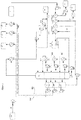
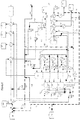
- the distillation column residue by means of line (32), pump (22) and line (33), is sent to the exchangers (11) and (12) to preheat the feed and then, by means of line (21), is sent to another petroleum plant and/or to storage (24).
- the products at the distillation column outlet enter in some strippers (15), wherein by injection of steam they are further purified.
- the distillates gathering at strippers' bottoms are pumped out of the plant by means of pumps (16), (17), (18), (19). Before being sent to other petroleum plants and/or to storage tanks (25), (26), (27), (23) the distillates give their sensible heat to the cold crude entering the plant in the heat exchangers (4), (5), (6), (10), (9).
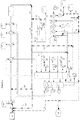
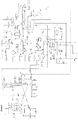
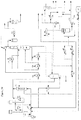
- From the line (123) can branch, as previously described in Figure 2 , e.g., one or more (including any sub-combination) of the lines (297), (106), (107), (108), (110), (109). As per the lines (119), (114), (115), (118), (158), (159) they will apply the same considerations as illustrated in Figure 2 . Whenever the monitoring system detects in the plant an insufficient amount of the first and the second hydrocarbon fluid, said fluid(s) can be re-introduced in the plant.
- the pumps installed on purpose can be e.g., cart- or skid-mounted, such that the same pump can be used in different locations of the plant or in other plants.
- one or more pump(s) installed on purpose can have one or more suction(s) and/or discharge(s) in order to suck from one or more points of the plant or another plant and/or discharge the circulating fluids in different point(s) of the same or other plants.
- inventions can be automated and/or controlled/regulated from the control room of the petroleum plant.
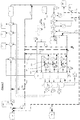
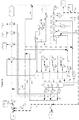
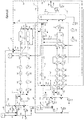
- the embodiment of the present invention will also include all of the logic and the devices (including, for example, software and/or hardware) which are used to implement said control/regulation of feed rate and/or the introduction of the first and second hydrocarbon fluid(s). The same can be applied to line (703) for the controller (713).
- Figure 15 also illustrates further additional configurations of the present invention, inclusive of an embodiment wherein control means are added in order to regulate the introduction of the first and second hydrocarbon fluid(s) and simultaneously control the feed rate (inclusive of its variation) under the present invention, subject to a monitoring of the process under the present invention.
- the plant can thereafter continue to run under these conditions (fresh feed 400 T/h, circulating self-produced gas oil 30 T/h) or by reducing, e.g., the fresh feed to 300 T/h, by having 60 T/h of "exceeding" gas oil re-introduced and circulated in the plant.
- the fresh feed can then be reduced to 250 T/h, thereby distilling 150 T/h gas oil.
- From the distilled 150 T/h gas oil, e.g., 75 T/h will exit the plant to satisfy production needs, while 75 T/h will be re-introduced in the plant and circulation will continue until the monitoring system under the present invention will indicate the termination of cleaning operations.
- the temperature is thereafter increased up to 450 °C while the produced distillate is condensed, re-introduced in the reactor and then re-distilled and re-introduced, so as to create a circulation of said distillate between the reactor and the condenser; such conditions have been maintained for 24 hours.
- 100% of the foulant deposit had been solubilized in the hydrocarbon fluid.
- the temperature was thereafter increased up to 450 °C while the produced distillate was condensated, re-introduced in the reactor and then re-distilled and re-introduced, so as to create a circulation of said distillate between the reactor and the condenser; such conditions have been maintained for 24 hours.
- 50% of the coke which was originally present in the catalyst had been solubilized in the hydrocarbon fluid.
- the same pilot plant has been degassed by steaming it out for 3 days, then mechanically cleaned and hence modified by installing an apparatus under the present invention.
- a second run has been then performed in the same operating conditions, with the same feed and for the same time as per the blank run.
- the apparatus under the present invention was put in service, by continuing the plant run and by executing a circulation in the feed of 1% vol of the gas oil withdrawn from the stripper and by introducing in said gas oil 0.5% vol (referred to the feed) of the same hydrocarbon fluid used in the previous cleaning.
- the cleaning during the run lasted 2 days, after that the plant run in the same operating conditions as the blank run.
Landscapes
- Chemical & Material Sciences (AREA)
- Oil, Petroleum & Natural Gas (AREA)
- Engineering & Computer Science (AREA)
- Chemical Kinetics & Catalysis (AREA)
- Organic Chemistry (AREA)
- General Chemical & Material Sciences (AREA)
- Thermal Sciences (AREA)
- Physics & Mathematics (AREA)
- Combustion & Propulsion (AREA)
- General Engineering & Computer Science (AREA)
- Mechanical Engineering (AREA)
- Sustainable Energy (AREA)
- Sustainable Development (AREA)
- Life Sciences & Earth Sciences (AREA)
- Production Of Liquid Hydrocarbon Mixture For Refining Petroleum (AREA)
- Organic Low-Molecular-Weight Compounds And Preparation Thereof (AREA)
Claims (24)
- Verfahren zum Reinigen einer Erdölanlage, die zur Verarbeitung von Rohöl eingerichtet ist, oder einer Ausrüstung der Erdölanlage während des Betriebs der Erdölanlage, umfassend:die Aufrechterhaltung eines für die Anlage selbst typischen Produktionsbetriebszustandes während einer Behandlungsperiode, was die Frischbeschickung der Erdölanlage einschließt;unter Aufrechterhaltung des Betriebszustandes der Erdölanlage im Produktionsbetrieb wird sowohl a) als auch b) durchgeführt;a) während der Behandlungszeit Einleitung des ersten und zweiten selbst produzierten Behandlungsfluids auf Kohlenwasserstoffbasis in die Erdölanlage;b) Variation einer festgelegten Versorgungsrate, die zu Beginn der Reinigung der Erdölanlage oder der Ausrüstung der Erdölanlage vorhanden ist, wobei die festgelegte Versorgungsrate von einer maximalen Betriebsrate für die Erdölanlage, die eine Auslegungsrate für die Erdölanlage einschließt, bis zu einer minimalen Betriebsrate reicht, die auf einem Niveau festgelegt ist, das einen Mindestproduktionsbetriebszustand in der Erdölanlage erfüllt; wobei die Einleitung des ersten und zweiten Behandlungsfluids auf Kohlenwasserstoffbasis und die Variation der Behandlungs-Versorgungsrate eine zusätzliche Quelle für die Destillation in Bezug auf die durch die festgelegte Rate bereitgestellte Menge erzeugt; und destillieren der genannten zusätzlichen Quelle für die Destillation zum Zweck der Selbstherstellung des ersten und zweiten Behandlungsfluids auf Kohlenwasserstoffbasis für die Anlagenreinigung und Rückführung von mindestens einem Teil des ersten und zweiten selbst produzierten Behandlungsfluids auf Kohlenwasserstoffbasis, um während des Betriebs der Anlage einen geschlossenen oder halbgeschlossenen Kreislauf zu schaffen, während ein anderer Teil der Destillate die Produktion der Erdölanlage und/oder den normalen Destillatflussstrom bildet, um eine Erhöhung der Destillationsausbeute und die Verringerung der Koksbildung auf Katalysatoren und die Entfernung von Koks auf Katalysatoren zu erreichen.
- Verfahren nach Anspruch 1, das ferner die Einleitung einer zunehmenden Menge des abgezogenen Destillats in einen oder mehrere Frischbeschickungskanäle der Anlage und eine koordinierte Verringerung einer gegenwärtigen Frischbeschickungsrate in die Anlage umfasst, so dass die verringerte Frischbeschickungsrate plus das zusätzliche abgezogene Destillat zu einer gewünschten Behandlungs-Beschickungsrate summiert wird, und wobei eine Steuerung so konfiguriert ist, dass sie die Frischbeschickungsrate in die Anlage überwacht und einstellt, basierend auf einem Eingangspegel des abgezogenen Destillats, das in dem einen oder den mehreren Frischbeschickungskanälen aufgenommen wird, einer gegenwärtigen Frischbeschickung in die Anlage und einer eingestellten gewünschten Behandlungs-Beschickungsrate in der Anlage.
- Das Verfahren nach Anspruch 1 umfasst ferner die Anpassung einer Anlagenkonfiguration, um den geschlossenen oder halbgeschlossenen Kreislauf einzubeziehen.
- Verfahren nach Anspruch 1, bei dem ein mit dem Betrieb der Anlage verbundenes Überwachungskriterium überwacht wird und bei dem die Einführung des Fluids auf Kohlenwasserstoffbasis die Zirkulation eines ersten Fluids auf Kohlenwasserstoffbasis oder des ersten und eines zweiten Fluids auf Kohlenwasserstoffbasis innerhalb eines geschlossenen oder halbgeschlossenen Kreislaufs einschließt, wobei die Zirkulation in wiederholter Weise durchgeführt wird, bis das Überwachungskriterium als zufriedenstellend erachtet wird.
- Verfahren nach Anspruch 1, bei dem die Erdölanlage mit erhöhter Versorgung oder mit der Auslegungs-Versorgungrate oder höher läuft, um eine größere Menge an Destillaten zu erzeugen, wonach die Frischbeschickungsrate schrittweise verringert wird, so dass die erhöhte Menge an erzeugten Destillaten im Vergleich zu der Menge an Destillaten, die mit der vorher vorhandenen Frischbeschickungsrate erzeugt wurde, in den zu behandelnden Anlagenteilen zirkuliert wird.
- Verfahren nach Anspruch 1, wobei die Einleitung des Fluids auf Kohlenwasserstoffbasis die Einleitung eines ersten und eines zweiten Fluids auf Kohlenwasserstoffbasis aus getrennten Quellen in die Anlage umfasst, und wobei das zweite Fluid auf Kohlenwasserstoffbasis mit dem ersten Fluid auf Kohlenwasserstoffbasis zusammenkommt und mit dem ersten Fluid auf Kohlenwasserstoffbasis zu einem gemeinsamen Behandlungseinführungspunkt der Erdölanlage gelangt.
- Verfahren nach Anspruch 1, wobei die Behandlung in einer Anlage mit einem Ofen durchgeführt wird und wobei die Behandlung eine Werteinstellung für eine Ofeneinlasstemperatur des Ofens und/oder zur Verringerung oder Vermeidung der Erhöhung einer Werteinstellung für die Rohrmetalltemperatur des Ofens, die am Punkt des Beginns der Behandlung vorliegt, erhöht.
- Verfahren nach Anspruch 1, bei dem die Behandlung die Ausbeute der Anlagendestillation in einer Weise erhöht, die über die Menge hinausgeht, die von einer gleichen Gesamt-Versorgungsmenge zu der/den Anlagendestillationsquelle(n) an einem Punkt des Behandlungsbeginns erzielt werden kann.
- Verfahren nach Anspruch 1, wobei die Behandlung die Agglomeration von Anlagenkatalysatoren reduziert und/oder die Koksbildung auf Anlagenkatalysatoren reduziert und/oder Ablagerungen schwerer Verbindungen, einschließlich Koks, auf Anlagenkatalysatoren reduziert und/oder den Differenzdruck in einem Anlagenreaktor, der einen Katalysator enthält, reduziert.
- Verfahren nach Anspruch 1, wobei die Einleitung des Fluids auf Kohlenwasserstoffbasis die Einleitung sowohl des ersten Fluids auf Kohlenwasserstoffbasis als auch des zweiten Fluids auf Kohlenwasserstoffbasis einschließt, die in der Lage sind, die Ablagerungen in der zu behandelnden Ausrüstung im wesentlichen unter nahezu kritischen oder überkritischen Bedingungen unter Betriebsbedingungen der Anlage zu lösen.
- Verfahren nach Anspruch 10, wobei das erste Fluid auf Kohlenwasserstoffbasis ein oder mehrere chemische Produkte enthält und das erste Fluid auf Kohlenwasserstoffbasis und die chemischen Produkte in einem Verhältnis gemischt werden, das so ausgelegt ist, dass es in einer Lösungsform verwendet werden kann, und wobei das erste Fluid auf Kohlenwasserstoffbasis das Lösungsmittel der chemischen Produkte bildet.
- Verfahren nach Anspruch 11, wobei das Verhältnis Lösungsmittel/chemische Produkte im Bereich Lösungsmittel 70%-99,99%, chemische Produkte 0,01%-30% variiert.
- Verfahren nach Anspruch 1, wobei die Einleitung des Fluids auf Kohlenwasserstoffbasis die Einleitung des ersten und des zweiten Kohlenwasserstofffluids umfasst, und wobei das erste und/oder zweite Kohlenwasserstofffluid aus einer Gruppe ausgewählt ist oder sind, die aus Destillationsprodukten aus Rohöl besteht, welche aus der Erdölanlage stammen und/oder ohnehin in der Erdölanlage vorhanden sind, indem sie Endprodukte, Mischungen aus Komponenten von Endprodukten, Zwischenprodukte oder Versorgungsprodukte in die Erdölanlage sind und aus der Gruppe aus folgenden Stoffen ausgewählt werden: Benzin, Diesel, Gasöl, Rohbenzin, Kerosin, reformiertes Benzin, Pyrolysebenzin, Pyrolysegasöl, leichtes Fahrradöl aus FCCU, Dekantieröl aus FCCU, Methyl-tert-butyl-ether (MTBE), Benzol, Toluol, Xylole, Cumol, Methanol, Cyclohexan, Cyclohexanon, Ethylbenzol, lineares Alkylbenzol (LAB), Dimethylterephthalat, Phthalsäureanhydrid, Styrol, Tert-Amyl-Methylether (TAME), Ethanol, Dimethylformamid (DMF), Dioctylphthalat, Isopropylalkohol, Butylalkohol, Allylalkohol, Butylglykol, Methylglykol, Ethyl-tert-Butylether (ETBE), Ethanolamine, Aceton, Octylalkohol, Methylethylketon (MEK), Methylisobutylketon (MIBK), Rohöl, Schweröl, Quenchöl aus der Ethylenanlage, aromatisches Benzin aus der Reformierungsanlage, Benzol/Toluol/Xylole (BTX), wie sie in einer Aromatenextraktionsanlage (einschließlich Sulfolan, Furfural, Glykole oder Formylmorpholin) hergestellt werden, das Benzin und/oder das Gasöl, das in einer Ethylenanlage hergestellt wird (Pyrolysehenzin/Gasöl),
- Verfahren nach Anspruch 13, wobei das erste und/oder das zweite Kohlenwasserstofffluid in Kombination mit einer oder mehreren Verbindungen, als Einzelstoff oder Mischung davon, ausgewählt aus der Gruppe bestehend aus folgenden Stoffen verwendet wird oder werden: Polymetacrylaten, Polyisobutylensuccinimiden, Polyisobutylensuccinaten; Laurylacrylat/Hydroxyethylmetacrylat-Copolymer; Alkylarylsulfonaten, Alkanolamin-Alkylarylsulfonaten und Alkylarylsulfonsäuren; substituierten Aminen, wobei der Substituent ein Kohlenwasserstoff mit mindestens 8 Kohlenstoffatomen ist; acylierte Verbindungen, die Stickstoff enthalten und einen Substituenten mit mindestens 10 aliphatischen Kohlenstoffatomen aufweisen, wobei ein solcher Substituent durch Reaktion einer Acylantcarbonsäure mit mindestens einer Aminverbindung, die mindestens eine Gruppe -NH- enthält, erhalten wird, wobei das Acylantierungsmittel mit der Aminverbindung über eine Imido-, Amido-, Amidin- oder Acyloxyammoniumbrücke verbunden ist; stickstofthaltige kondensierte Verbindungen eines Phenols, eines Aldehyds oder einer Aminverbindung, die mindestens eine Gruppe -NH- aufweisen; Ester einer substituierten Carbonsäure; kohlenwasserstoffsubstituierte Phenole; alkoxylierte Derivate eines Alkohols, eines Phenols oder eines Amins; Phthalate; organische Phosphate; Ölsäureester; Diethylhydroxylamin; Glykole und/oder ihre Derivate, wobei diese Glykole und/oder ihre Derivate nicht in polymerer Form vorliegen, in dem Sinne, dass sie Moleküle von Einzelverbindungen, auch in Adduktform, sind und nicht Moleküle, die aus einer Kette bestehen, in der sich ein einziges Monomer wiederholt, z. B.: Tetraethylenglykol; Mono- und Di-, Mono-und Diester, Mono- und Diester, Etherester und Thioether von einzelnen Glykolen; Glykol der allgemeinen Formel R1-O-CH2-CH2-O-R2, wobei Ri ein C1-C20-Hydrocarbylsubstituent und R2 ein H-Atom oder ein C1-C20-Hydrocarbylsubstituent ist; Glykolester der allgemeinen Formel R1-O-O-CH2-CH2-O-O-R2, wobei Ri ein C1-C20-Hydrocarbylsubstituent und R2 ein H-Atom oder ein C1-C20-Hydrocarbylsubstituent ist; Thioglykole der allgemeinen Formel HO-R1-S-R2-OH, wobei Ri ein C1-C10-Hydrocarbylsubstituent und R2 ein H-Atom oder ein C1-C10-Hydrocarbylsubstituent ist; Glykolether-Ester der allgemeinen Formel R1-O-CH2-CH2-O-O-R2, wobei R1 und R2 ein C1-C20-Hydrocarbylsubstituent sind; Ether der allgemeinen Formel R1-O-R2 wobei R1 oder R2 ein Kohlenwasserstoffsubstituent C1-C20-Hydrocarbylsubstituent ist; substituierte Benzole der allgemeinen Formel


- Verfahren nach Anspruch 1, wobei die Einleitung des Behandlungsfluids auf Kohlenwasserstoffbasis die Einführung eines ersten Fluids auf Kohlenwasserstoffbasis in die Erdölanlage in einem Verhältnis zwischen 0,1% und 100%, bezogen auf die aktuelle Frischbeschickung der Anlage, und eines zweiten Fluids auf Kohlenwasserstoffbasis einschließt Fluids auf Kohlenwasserstoffbasis in einem Verhältnis zwischen 0,01% und 50% einschließt, bezogen auf die aktuelle Frischbeschickung der Anlage; und wobei das zweite Kohlenwasserstofffluid ausgewählt wird aus der Gruppe bestehend aus: Methanol, Ethanol, Propanol, Isopropanol, Butanol, Isobutanol, Methylglykolmonomethylether, Butylglykolmonobutylether, Toluol, aliphatische Amine C8 +, die mit mindestens 6 Mol Ethylenoxid ethoxyliert sind, Arylsulfonate, Benzol, Diphenyl, Phenanthren, Nonylphenol, 1-Methyl-2-pyrrolidinon, Diethylether, Dimethylformamid (DMF), tetrahydrofuran (THF), Ethylendiamin, Diethylamin, Triethylamin, Trimethylamin, Propylamin, 1-(3-Aminopropyl)-2-Pyrrolidon, 1-(3-Aminopropyl)-Imidazol, N-Hydroxyethyl-imidazolidinon, N-Aminoethylimidazolidinon, 2-(2-Aminoethylamino)ethanol, Isopropylamin, Cumol, 1,3,5-Trimethylbenzel, 1,2,4-Trimethylbenzol, Maleinsäureanhydrid, p-Toluidin, o-Toluidin, Dipropylamin, Diphenylether, Hexamethylbenzol, Propylbenzol, Cyclohexylamin, 1-Isopropyl-4-methylbenzol, 1,2,3,5-Tetramethylbenzol, Hexanol, morpholin, o-Xylol, m-Xylol, p-Xylol, Butylamin, Methylamin, Mesitylen, untersuchen, Bernsteinsäureanhydrid, Decahydronaphthalin, Ethylbenzol, 1,2-Dimethylnaphthalin, 1,6-Dimethylnaphthalin, p-Cymol, Ethylether, Isopropylether, Etoxybenzol, Phenylether, Acetophenon, Monoethanolamin (MEA), Diethanolamin (DEA), Triethanolamin (TEA), diethylenglykol, Triethylenglykol, Tetraethylenglykol, Hexylglykol, Dodecylbenzol, Laurylalkohol, Myristylalkohol, Thiodiglykol, Dioctylphthalat, Diisooctylphthalat, Didecylphthalat, Diisodecylphthalat, Dibutylphthalat, Dinonylphthalat, Methylethylketon (MEK), Methylisobutylketon (MIBK), Methyl-tert-butylether (MTBE), Cyclohexan, Cyclohexanon, Methyl- oder Ethylester von Fettsäuren, die durch Veresterung von pflanzlichen und/oder tierischen Ölen gewonnen werden (Biodiesel); Dimethylamin, Ethylamin, Ethylformiat, Methylacetat, Dimethylformamid (DMF), Propanol, Propylamin, Isopropylamin, Trimethylamin, Tetrahydrofuran (THF), Ethylvinylether, Ethylacetat, Propylformiat, Butanol, Methylpropanol, Diethylether, Methylpropylether, Isopropylmethylether, diethylsulfid, Butylamin, Isobutylamin, Diethylamin, Diethylhydroxylamin, Cyclopentanol, 2-Methyltetrahydrofuran, Tetrahydropyran, Pentanal, Isobutylformiat, Propylacetat, Pentansäure, Butylmethylether, tert-Butylmethylether, Ethylpropylether, Methylpyridine, cyclohexanon, Cyclohexan, Methylcyclopentan, Cyclohexanol, Hexanal, Pentylformiat, Isobutylacetat, 2-Ethoxyethylacetat, Methylpentylether, Dipropylether, Diisopropylether, Hexanol, Methylpentanole, Triethylamin, Dipropylamin, Diisopropylamin, Benzaldehyd, Toluol, kresole, Benzylalkohol, Methylaniline, Dimethylpyridine, Furfural, Pyridin, Methylcyclohexan, Heptanol, Acetophenon, Ethylbenzol, Xylole, Ethylphenole, Xylole, Aniline, Dimethylanilin, Ethylanilin, octannitril, Ethylpropanoat, Methylbutanoat, Methylisobutanoat, Propylpropanoat Propylpropanoat, Ethyl-2-Methylpropanoat, Methylpentanoat, Eptansäure, Octansäure, 2-Ethylhexansäure, Propyl-3-methylbutanoat, Octanole, 4-Mothyl-3-heptanol, 5-Methyl-3-heptanol, 2-Etyl-1-hexanol, Dibutylether, Di-tert-butylether, Dibutylamin, Diisobutylamin, Chinolin, Isochinolin, Indan, Cumol, Propylbenzol, 1,2,3-Trimethylbenzol, 1,2,4-Trimethylbenzol, Mesitylen, o-Toluidin, N,N-Dimethyl-o-toluidin, Nonansäure, Nonanole, Naphthalin, Butylbenzol, Isobutylbenzol, Cymene, p-Di-Ethylbenzol, 1,2,4,5-Tetramethylbenzol, Decahydronaphthalin, Decansäure, Decanol, 1-Methylnaphthalin, Carbazol, Diphenyl, Hexamethylbenzol, Dodecanole, Diphenylmethan, Tridecanole, Tetradecanole, Hexadecanole, Heptadecanole, Terphenyle, Octadecanole, Eicosanole; Fettamine und ihre Gemische, p-Toluidin, Toluol, Dipropylamin, Diisobutylacetat, Propylacetato, Propyl-ethylether, Triethylamin, Ethylbenzol, Propylbenzol, Butylbenzol, Cumol, Para-Xylol, Hexamethylbenzol, Triethanolamin, Diphenylmethan, MTBE, Dioctylphthalat, Diisodecylphthalat, Diisoctylphthalat, Nonylether, Methyloleat, Dioctylether; die im Plural genannten Verbindungen beziehen sich auf alle möglichen Isomere der genannten Verbindung: z. B. der Begriff "Xylole" bezeichnet o-Xylol, m-Xylol, p-Xylol; diese Verbindungen können auch unter überkritischen Bedingungen verwendet werden.
- Verfahren nach Anspruch 14, wobei das zweite Kohlenwasserstofffluid eine oder mehr Verbindung(en) umfasst, die als Quellmittel wirken, ausgewählt aus solchen, die Wasserstoffbrückenbindungen bilden, und solchen, die keine Wasserstoffbrückenbindungen bilden, wobei die Quellmittel, die keine Wasserstoffbrückenbindungen bilden, ausgewählt sind aus der Gruppe bestehend aus: Benzol, Toluol, Cyclohexan, Naphthalin, Diphenyl, Xylol, Tetralin, Methylcyclohexan; und wobei die Quellmittel, die Wasserstoffbrückenbindungen bilden, ausgewählt sind aus der Gruppe bestehend aus:Pyridin, Methanol, Ethanol, Ethylendiamin, Propanol, 1,4-Dioxan, Aceton, Formamid, Anilin, Tetrahydrofuran, N,N-Dimethylanilin, Diethylether, Dimethylsulphoxid, Acetophenon, Dimethylformamid, Ethylacetat, Methylacetat, Methylethylketon, 1-Methyl-2-Pyrrolidon, Chinolin.
- Verfahren nach Anspruch 1, bei dem die Einleitung des Behandlungsfluids auf Kohlenwasserstoffbasis die Einleitung eines ersten auf Kohlenwasserstoff basierenden Fluids in die Erdölanlage in einem Verhältnis zwischen 0,1% und 100% bezogen auf die aktuelle Frischbeschickung der Anlage und des zweiten auf Kohlenwasserstoff basierenden Fluids in einem Verhältnis zwischen 0,01% und 50% bezogen auf die aktuelle Frischbeschickung der Anlage umfasst; und wobei das zweite Kohlenwasserstofffluid eine oder mehrere Verbindung(en) mit einer Siedetemperatur >150°C umfaßt, ausgewählt aus der Gruppe ausgewählt aus: Anthrachinon, Eicosanol, Benzalacetophenon, Benzanthracen, Hydrochinon, Dodecylbenzol, Hexaethylbenzol, Hexamethylbenzol, Nonylbenzol, 1,2,3-Triaminobenzol, 1,2,3-Trihydroxybenzol, 1,3,5-Triphenylbenzol, Diphenylmethanol, p-Benzidin, Benzil, 2-Benzoylbenzofuran, Benzoesäureanhydrid, 2-Benzoyl-methylbenzoat, Benzylbenzoat, 4-Tolylbenzoat, Benzophenon, 4,4'-Bis(dimethylamino)benzophenon, 2,2'-Dihydroxybenzophenon, 2,2'-Dimethylbenzophenon, 4,4-Dimethylbenzophenon, Methylbenzophenon, 2-Aminobenzylalkohol, 3-Hydroxybenzylalkohol, a-1-Naphthylbenzylalkohol, Benzylethyl-phenylamin, Benzylanilin, Benzylether, Phenylacetophenon, 2-Acetamiddiphenyl, 2-Aminodiphenyl, 4,4'-Bis(dimethylamino)diphenyl, Biphenol, Butyl-bis(2-hydroxyethyl)amin, Butylphenylamin, Butylphenylketon, Carbazol, Diphenylcarbonat, Cetylalkohol, Cetylamin, benzylcinnamat, Cumarin, Lindan, Dibenzofuran, Dibenzylamin, Diethylenglykoldibenzylether, Diethylenglykolmonolaurat, Diethylenglykol(2-hydroxypropyl)ether, Diethylentriamin, Di-a-naphthylamin, Di-13-naphthylamin, Dioctylamin, Diphenylamin, Diphenylmethan, 4,4'-Diaminodiphenyl, 4,4'-Dimethylaminodiphenyl, 4-Hydroxydiphenyl, Diphenylmethanol, Diphenylethylamin, Di-(a-phenylethyl)amin, Di-iso-propanolamin, Di-2-tolylamin, Eicosanol, 1,1,2-Triphenylethan , Ethylenglykol-1,2-Diphenyl e, Ethyl-di-benzylamin, Ethylenglykolmonobenzylether, Ethylenglykolmonophenylether, N,N-Diphenylformamid, Phenylformamid, Tolylformamid, 2-Benzoylfuran, 2,5-Diphenylfuran, Glicerin und verwandte Ester, Eptadecylamin, Eptadecanol, Cerylalkohol, Hexadecanamin, Cetylalkohol, Hydroxyethyl-2-tolylamin, Triethanolamin, imidazol, Methylimidazol, Phenylimidazol, 5-Amine-Indan, 5-Hexyl-Indan, 1-Phenyl-L,3,3-trimethyl-Indan, 2,3-Diphenyl-Inden, Indol, 2,3-Dimethyl-Indol, Tryptamin, 2-Phenyl-Indol, Isocumarin, Diethyl-Isophthalat, isochinolin, Benzyl-Laurat, Phenyl-Laurat, Laurylalkohol, Laurylamin, Laurylsulfat, Di-Ethyl-Benzyl-Maionat, Melamin, Diphenylmethan, Triphenylmethan, 4-Benzyl-Morfolin, 4-Phenyl-Morfolin, 4-(4-Tolyl)-Morfolin, myristischer Alkohol, 9,10-Dihydro-Naphtacen, Acethyl-Naphthalin, Benzyl-Naphthalin, Butyl-Naphthalin, Dihydro-Naphthalin, Dihydroxy-Naphthalin, Methyl-Naphthalin, Phenyl-Naphthalin, Naphthol, Naphthylamin, Methylnaphthylamin, Naphthylphenylamin, a-Naphthyl-2-Tolyl-Cheton, Nonacosanol, Octadecanol, Octyl-phenylether, Pentadecylamin, Pentadecanol, 3-Hydroxyacephenon, Tyramin, 4-Hydroxyphenylacetonitril, o- Phenylendiamin, N-Phenyl-Phenylendiamin, 4-Methyl-Phenylendiamin, Diphenylether, Bis-(2-Phenylethyl)amin, Fosphinderivate als Phenyl, Triphenyl und Oxyde, Triphenylphosphit, dibutylphthalat, Dibenzylphthalat, Diethylphthalat, Dioctylphthalat, Diisoctylphthalat, Didecylphthalat, Diphenylphthalat, Phthalsäureanhydrid, N-Benzoylpiperidin, 1,3-Diphenoxypropan, N-(2-Tolyl)propionamid, 1-Methyl-3-phenyl-pirazolin, Piridinderivate wie 3-Acetamid, 3-Benzyl, 4-Hydroxy, 2-Phenyl, Phenylbernsteinsäureanhydrid, Succinimid, N- Benzylsuccinimid, N-Phenylsuccinimid, o-Terphenyl, m-Terphenyl, 1,14-Tetradecandiole, Tetradecanol, Tetraethylenglykol, Tetraethylenpentamin, 2,5-Diaminotoluol, 3,5-Dihydroxytoluol, 4-Phenyltoluol, p-Toluensulfonsäure und verwandte Methyl- und Propylester, o-Toluylsäure und verwandtes Anhydrid, N-Benzyl-Toluidin (o-, m- e p-), Tribenzylamin, Tributylamin, Triethanolamin, Triethylenglykol und verwandter Monobutylether, Trieptylamin, Trioctylamin, Triphenylamin, Tritan, Tritanol, 2-Pyrrolidon, Xanthen, Xanthon, Xylidin.
- Verfahren nach Anspruch 1, das ferner die Überwachung des Behandlungsniveaus umfasst und bei dem die Überwachung mit einem oder mehreren Analyseverfahren durchgeführt wird, ausgewählt aus der Gruppe bestehend aus: Viskosität, z. B. ASTM D445, Dichte, z.B. ASTM D1298; atmosphärische oder Vakuumdestillation, z. B. ASTM D86, D1160; Kohlenstoffrückstand, z.B. ASTM D4530, D189; Sedimente durch Heißfiltration, z. B. 1P375, 390; Sedimente durch Extraktion, z.B. ASTM D473; Sedimente durch Filtration, z. B. ASTM 4807; Asche, z. B. ASTM D482, EN6245; Asphalten, z. B. IP143, Farbe z. B. ASTM D1500; Wasser und Sedimente z.B. ASTM D2709, D1796; oder ein Analyseverfahren der physikalischen Art, ausgewählt aus der Gruppe bestehend aus: i) Auswertung des Verschmutzungsfaktors, definiert als das Verhältnis zwischen dem Wärmeübergangskoeffizienten der sauberen Ausrüstung und dem Wärmeübergangskoeffizienten der Ausrüstung zum Zeitpunkt der Aufzeichnung des Wertes; ii) Auswertung des Drucks an verschiedenen Punkten der Anlage; iii) Auswertung der Temperatur an verschiedenen Punkten der Anlage.
- Verfahren nach Anspruch 1, das ferner die folgenden Schritte umfasst, um gasfreie/sichere Eintrittsbedingungen zu erreichen:a) Aussetzung der Beschickung;b) optionale Zirkulation in einem geschlossenen oder halbgeschlossenen Kreislauf des ersten und/oder zweiten Kohlenwasserstoff-Fluids innerhalb der zu behandelnden Ausrüstung für eine Dauer von mindestens 20 Minuten bei einer Temperatur zwischen 100 °C und 900 °C und einem Druck zwischen 1 bar und 400 bar;c) Kühlung der Ausrüstung/Anlage;d) Entleerung der Ausrüstung/Anlage von allen Kohlenwasserstoffen;e) Einleitung von Wasser in das Innere der Ausrüstung/Anlage;f) Implementierung eines geschlossenen Kreislaufs, der die Ausrüstung/Anlage umfasst;g) Einleitung eines oder mehrerer chemischer Wasch-/Reinigungsprodukte und ihrer Mischungen in den geschlossenen Kreislauf;h) Einstellung der Temperatur und des Drucks innerhalb des geschlossenen Zirkulationskreislaufs auf Werte zwischen 60 °C und 350 °C und zwischen 1 bar und 50 bar;i) Zirkulation der wässrigen Lösung des/der chemischen Produkte(s) innerhalb des geschlossenen Zirkulationskreislaufs unter Temperatur- und Druckbedingungen zwischen 60 °C und 350 °C und zwischen 1 und 50 bar für einen Zeitraum zwischen 20 Minuten und 60 Tagen;j) Kühlung (einschließlich der eventuellen Einleitung von Frischwasser in den Kreislauf) und Entleerung der Wasserlösung aus dem Kreislauf;k) optionale Weiterleitung der Wasserlösung zur Aufbereitungsanlage für ölhaltiges Wasser;l) optionale Wiederholung der Schritte von e) bis k).
- Verfahren nach Anspruch 19, wobei die Schritte von e) bis k) durch folgende Schritte ersetzt werden:m) Einleitung von Dampf mit einem Druck zwischen 1,5 bar und 100 bar in die Ausrüstung/Anlage;n) Einleitung eines oder mehrerer chemischer Wasch-/Reinigungsmittel einschließlich ihrer Mischungen in den genannten Dampf;o) Einleitung der Mischung Dampf/Chemikalienprodukt(e) gemäß der vorliegenden Erfindung in die Ausrüstung/Anlage für eine Dauer von mindestens 20 Minuten,p) optionale Zirkulation von kondensiertem Dampf, der ein chemisches Produkt gemäß der vorliegenden Erfindung enthält;q) Entleerung der Kondensate aus der Ausrüstung/Anlage;r) optionale Weiterleitung der Kondensate zur Aufbereitungsanlage für ölhaltiges Wasser;
- Verfahren nach Anspruch 19, bei dem das zum Waschen/Reinigen verwendete chemische Produkt ausgewählt ist aus der Gruppe bestehend aus: nichtionischen Tensiden, anionischen Tensiden, Terpenderivaten, Emulgatoren, Schwefelwasserstoff-Fängern, Quecksilber-Fängern und deren Mischungen in jedem Verhältnis, einschließlich deren wässrigen Lösungen.
- Verfahren nach Anspruch 20, bei dem das zum Waschen/Reinigen verwendete chemische Produkt ausgewählt ist aus der Gruppe bestehend aus: nichtionischen Tensiden, anionischen Tensiden, Terpenderivaten, Emulgatoren, Schwefelwasserstoff-Fängern, Quecksilber-Fängern und deren Mischungen in jedem Verhältnis, einschließlich deren wässrigen Lösungen.
- Verfahren nach Anspruch 22, wobei die anionischen und nichtionischen Tenside ausgewählt werden aus der Gruppe bestehend aus Alkyl-, Aryl- oder Alkylarylbenzensulfonaten der allgemeinen Formel RC6H4SO3M, wobei R ein C8-C20-Hydrocarbylsubstituent und M das Ion H, Na, Ca, Ammonium, Triethanolammonium, Isopropylammonium ist; Dialkylsulfosuccinate der allgemeinen Formel R02CCH2CH(S03Na)C02R, wobei R ein C1-C20-Hydrocarbylsubstituent ist; Alkylsulfate der allgemeinen Formel ROSO3M, wobei R ein Cg-Cm^ydrocarbylsubstituent und M das Ion Natrium, Ammonium, Triethanolammonium ist; ethoxylierte und sulfatierte Alkohole der allgemeinen Formel R-(-OCH2CH2-)n-OSO3M, wobei R ein C5-C20-Hydrocarbylsubstituent, n=1-5 und M das Ion Natrium, Ammonium, Triethanolammonium ist; ethoxylierte und sulfatierte Alkyphenole der allgemeinen Formel RC6H6-(-OCH2CH2-)n-OSC>3M, worin R ein C5-C20-Hydrocarbylsubstituent, n=1-5 und M das Ion Natrium, Ammonium, Triethanolammonium ist; ethoxylierte Alkohole der allgemeinen Formel R-(-0-CH2CH2-)n-0H, wobei R ein C5-C30-Hydrocarbylsubstituent ist, n=1-30; ethoxylierte Alkylphenole der allgemeinen Formel RC6H4-(-OCH2CH2-)n-OH, wobei R ein C5-C30-Hydrocarbylsubstituent ist, n=1-40; Mono-und Difettsäureglycerinester, wobei die Säure einen C10-C40-Hydrocarbylsubstituenten enthält; Mono- und Dipolyoxyethylenester von Ölen und Fettsäuren der allgemeinen Formel RCO-(-OC2H4-)n-OH and RCO-(-OC2H4-)n- OOCR, wobei das Öl vom vom Typ "Tallöl" oder "Kolophoniumöl" ist, n=1-40 und die Säure einen C10-C40-Hydrocarbylsubstituenten enthält; ethoxylierte "Rizinusöle" (Rizinusöl ist ein Triglycerid, das in Ricinolsäureestern reichlich vorhanden ist), die eine Anzahl von polyethoxylierten Ethylenoxidgruppen enthalten, die zwischen 5 und 200 variiert; Mono- und DiEthanolamide von Fettsäuren der allgemeinen Formel RCONHC2H4OOCR und RC0N(C2H40H)C2H400CR, wobei R ein C10-C40-Hydrocarbylsubstituent ist; Tenside aus Poly(oxyethylen-co-oxypropylen), auch als Blockpolymer bekannt, mit einem Molekulargewicht von 50-10000; mono-, di-und polyaliphatische Amine, abgeleitet von Fettsäuren, wie RNHCH2CH2CH2CH2NH2, wobei Rein C10-C40-Hydrocarbylsubstituent ist; N-Alkyltrimethylendiamine der allgemeinen Formel


Terpenprodukte-Derivate werden ausgewählt aus der Gruppe bestehend aus: Limonen, Pinen, Canfor, Menthol, Eukalipthol, Eugenhol, Geraniol, Thymol; Emulgatoren sind ausgewählt aus der Gruppe bestehend aus: Tween 60, Tween 80, Nonylphenol-Polyethylen-Glicol-Ether, Oleate, Sorbitanoleate, Glycerinmonostearat, Nonylphenolethoxylate, Isopropylpalmitat, Polyglycerinester von Fettsäuren, Tridecylalkoholethoxylate, Fettalkoholethoxylate, lineare Alkylbenzolsulfonsäure, Dioctylphthalat, Natriumtripolyphosphat, Zitronensäure, Sojabohnenölsäure, Trinatriumphosphat, Natriumdodecylsulfat, Didecyldimethylammoniumchlorid, Ölsäurediethanolamin, Dodecyldimethylbenzilammoniumchlorid, Natriumacetat, Oleamid, Polyethylenglykol, Lanolin, ethoxyliertes (E20) Sorbitanmonooleat, Sorbitanmonooleat, Sulfosuccinammate; H2S-Scavenger werden ausgewählt aus der Gruppe bestehend aus Diethanolamin, Monoethanolamin, Methyldiethanolamin, Diisopropylamin, Formaldehyd, Maleimide, Amidine, Polyamidine, Glyoxal, Natriumnitrit, Reaktionsprodukte von Polyamid-Formaldehyd, Triazine, Carboxamide, Alkylcarboxyl-Azoverbindungen, Kreuzkümmelperoxidverbindungen, Bisoxazolidine, Glycidylether, Kaliumformiat; Quecksilberfänger werden ausgewählt aus der Gruppe bestehend aus: Thiohamstoff, Ätznatron, Natriumcarbonat, Trimercapto-s-triazin-Tri-Natriumsalz. - Apparat für eine Erdölanlage, umfassend: i) Entnahmemittel von einem ersten und einem zweiten Punkt in der Erdölanlage von einem ersten und einem zweiten Kohlenwasserstoffdestillat, die selbst erzeugt wurden; ii) Einführungsmittel des ersten und des zweiten Kohlenwasserstoffdestillats, wie oben beschrieben, die in einen oder mehrere Punkt(e) der Erdölanlage entnommen wurden; iii) Destillationsmittel des ersten und des zweiten Kohlenwasserstoffdestillats, wie oben beschrieben, die in einen oder mehrere Punkt(e) der Erdölanlage eingeführt wurden; iv) Mittel zur Wiederentnahme und Wiedereinführung des einen oder der mehreren Kohlenwasserstoffdestillate wie oben destilliert, um das (die) destillierte(n) Fluid(e) wieder zu entnehmen und es (sie) in einen oder mehrere Punkt(e) der Erdölanlage wieder einzuführen, wobei die Mittel zur Wiederentnahme und Wiedereinführung die gleichen Entnahme- und Einführungsmittel wie oben sein können; v) Verbindungsmittel, um einen geschlossenen oder halbgeschlossenen Kreislauf zu bilden, der eine Ausrüstung der zu behandelnden Erdölanlage umfasst, wobei die ersten und zweiten Kohlenwasserstoffdestillate kontinuierlich destillert, entnommen und eingeführt werden; vi) ein Austragssystem für das/die Kohlenwasserstofffluid(e), um deren Entfernung aus dem geschlossenen oder halbgeschlossenen Kreislauf zu ermöglichen; vii) Steuermittel, um Temperatur und/oder Druck und/oder Durchfluss zu steuern oder zu regeln; viii) optionale Filtrationsmittel, wobei die Steuermittel so angeordnet sind, dass sie alle Schritte nach Anspruch 1 durchführen.
Priority Applications (1)
| Application Number | Priority Date | Filing Date | Title |
|---|---|---|---|
| PL13712183T PL2859069T3 (pl) | 2012-04-16 | 2013-03-15 | Sposób i urządzenie do czyszczenia instalacji ropy naftowej |
Applications Claiming Priority (2)
| Application Number | Priority Date | Filing Date | Title |
|---|---|---|---|
| IT000162A ITRM20120162A1 (it) | 2012-04-16 | 2012-04-16 | Metodo e impianto per il trattamento di apparecchiature petrolifere |
| PCT/EP2013/055472 WO2013156228A1 (en) | 2012-04-16 | 2013-03-15 | Method and apparatus for treating petroleum equipment |
Publications (2)
| Publication Number | Publication Date |
|---|---|
| EP2859069A1 EP2859069A1 (de) | 2015-04-15 |
| EP2859069B1 true EP2859069B1 (de) | 2020-10-14 |
Family
ID=46262235
Family Applications (1)
| Application Number | Title | Priority Date | Filing Date |
|---|---|---|---|
| EP13712183.6A Active EP2859069B1 (de) | 2012-04-16 | 2013-03-15 | Verfahren und einrichtung zur behandlung von erdölanlage |
Country Status (10)
| Country | Link |
|---|---|
| US (2) | US9328300B2 (de) |
| EP (1) | EP2859069B1 (de) |
| CA (1) | CA2908494C (de) |
| ES (1) | ES2856264T3 (de) |
| HU (1) | HUE052660T2 (de) |
| IT (1) | ITRM20120162A1 (de) |
| PL (1) | PL2859069T3 (de) |
| PT (1) | PT2859069T (de) |
| RU (1) | RU2642421C2 (de) |
| WO (1) | WO2013156228A1 (de) |
Families Citing this family (69)
| Publication number | Priority date | Publication date | Assignee | Title |
|---|---|---|---|---|
| JP6114989B2 (ja) * | 2013-02-08 | 2017-04-19 | パナソニックIpマネジメント株式会社 | 熱硬化性樹脂組成物の硬化方法、熱硬化性樹脂組成物、これを用いたプリプレグ、金属張積層板、樹脂シート、プリント配線板及び封止材 |
| US9505994B2 (en) * | 2014-02-05 | 2016-11-29 | Baker Hughes Incorporated | Antifoulants for use in hydrocarbon fluids |
| US9452941B2 (en) * | 2014-03-26 | 2016-09-27 | Refined Technologies, Inc. | Pyrophoric iron sulfide treatment using sodium nitrite |
| EP2940104B1 (de) * | 2014-03-31 | 2022-01-05 | INDIAN OIL CORPORATION Ltd. | Flüssigphasenadditiv zur verwendung in thermischen crackverfahren zur verbesserung der produktausbeute |
| EP3137768B1 (de) | 2014-04-30 | 2020-10-14 | Anthony George Hurter | Vorrichtung und verfahren zur reinigung von verwendetem heizöl mit superkritischem wasser |
| RU2556691C1 (ru) * | 2014-08-19 | 2015-07-20 | Игорь Анатольевич Мнушкин | Завод по переработке углеводородного сырья в северных регионах |
| US20160172188A1 (en) * | 2014-12-16 | 2016-06-16 | Samsung Sdi Co., Ltd. | Rinse solution for silica thin film, method of producing silica thin film, and silica thin film |
| US9864823B2 (en) * | 2015-03-30 | 2018-01-09 | Uop Llc | Cleansing system for a feed composition based on environmental factors |
| US10095200B2 (en) | 2015-03-30 | 2018-10-09 | Uop Llc | System and method for improving performance of a chemical plant with a furnace |
| WO2016200856A1 (en) | 2015-06-08 | 2016-12-15 | M-I L.L.C. | Asphaltene dispersant and methods of use thereof |
| US9719535B1 (en) * | 2015-08-10 | 2017-08-01 | Reladyne, LLC | Varnish mitigation process |
| US9827602B2 (en) * | 2015-09-28 | 2017-11-28 | Tesla, Inc. | Closed-loop thermal servicing of solvent-refining columns |
| US10184087B2 (en) * | 2016-01-04 | 2019-01-22 | TriStar PetroServ, Inc. | Optimization of a method for isolation of paraffinic hydrocarbons |
| RU2018141870A (ru) * | 2016-04-29 | 2020-05-29 | Басф Корпорейшн | Новая конструкция установки циклической дезактивации металлов для дезактивации катализатора с использованием крекинга с флюидизированным псевдоожиженным катализатором (кфк) |
| CN105950214B (zh) * | 2016-05-17 | 2018-03-20 | 武汉工程大学 | 一种低硫汽油的生产方法 |
| MX2019000537A (es) * | 2016-07-13 | 2019-09-11 | SHUMKA Thomas | Metodos, materiales y aparato para limpiar e inspeccionar conjuntos de engranajes circunferenciales. |
| CN106316992A (zh) * | 2016-08-22 | 2017-01-11 | 岳阳昌德化工实业有限公司 | 从轻质油中回收环氧环己烷和正戊醇的方法及装置 |
| US10545487B2 (en) | 2016-09-16 | 2020-01-28 | Uop Llc | Interactive diagnostic system and method for managing process model analysis |
| US10655052B2 (en) | 2016-12-30 | 2020-05-19 | M-I L.L.C. | Method and process to stabilize asphaltenes in petroleum fluids |
| BR112019013672B1 (pt) | 2016-12-30 | 2023-10-10 | Stepan Company | Composição para estabilizar asfaltenos em fluidos de petróleo |
| US10754359B2 (en) | 2017-03-27 | 2020-08-25 | Uop Llc | Operating slide valves in petrochemical plants or refineries |
| US10678272B2 (en) | 2017-03-27 | 2020-06-09 | Uop Llc | Early prediction and detection of slide valve sticking in petrochemical plants or refineries |
| US10794644B2 (en) | 2017-03-28 | 2020-10-06 | Uop Llc | Detecting and correcting thermal stresses in heat exchangers in a petrochemical plant or refinery |
| US10844290B2 (en) | 2017-03-28 | 2020-11-24 | Uop Llc | Rotating equipment in a petrochemical plant or refinery |
| US11396002B2 (en) | 2017-03-28 | 2022-07-26 | Uop Llc | Detecting and correcting problems in liquid lifting in heat exchangers |
| US10670027B2 (en) | 2017-03-28 | 2020-06-02 | Uop Llc | Determining quality of gas for rotating equipment in a petrochemical plant or refinery |
| US10752844B2 (en) | 2017-03-28 | 2020-08-25 | Uop Llc | Rotating equipment in a petrochemical plant or refinery |
| US10962302B2 (en) | 2017-03-28 | 2021-03-30 | Uop Llc | Heat exchangers in a petrochemical plant or refinery |
| US11037376B2 (en) | 2017-03-28 | 2021-06-15 | Uop Llc | Sensor location for rotating equipment in a petrochemical plant or refinery |
| US10794401B2 (en) | 2017-03-28 | 2020-10-06 | Uop Llc | Reactor loop fouling monitor for rotating equipment in a petrochemical plant or refinery |
| US10663238B2 (en) | 2017-03-28 | 2020-05-26 | Uop Llc | Detecting and correcting maldistribution in heat exchangers in a petrochemical plant or refinery |
| US10816947B2 (en) | 2017-03-28 | 2020-10-27 | Uop Llc | Early surge detection of rotating equipment in a petrochemical plant or refinery |
| US11130111B2 (en) | 2017-03-28 | 2021-09-28 | Uop Llc | Air-cooled heat exchangers |
| US10752845B2 (en) | 2017-03-28 | 2020-08-25 | Uop Llc | Using molecular weight and invariant mapping to determine performance of rotating equipment in a petrochemical plant or refinery |
| US10670353B2 (en) | 2017-03-28 | 2020-06-02 | Uop Llc | Detecting and correcting cross-leakage in heat exchangers in a petrochemical plant or refinery |
| US10695711B2 (en) | 2017-04-28 | 2020-06-30 | Uop Llc | Remote monitoring of adsorber process units |
| US10913905B2 (en) | 2017-06-19 | 2021-02-09 | Uop Llc | Catalyst cycle length prediction using eigen analysis |
| US11365886B2 (en) | 2017-06-19 | 2022-06-21 | Uop Llc | Remote monitoring of fired heaters |
| US10739798B2 (en) | 2017-06-20 | 2020-08-11 | Uop Llc | Incipient temperature excursion mitigation and control |
| US11130692B2 (en) | 2017-06-28 | 2021-09-28 | Uop Llc | Process and apparatus for dosing nutrients to a bioreactor |
| WO2019023210A1 (en) * | 2017-07-24 | 2019-01-31 | Uop Llc | CLEANING SYSTEM FOR CHARGE COMPOSITION BASED ON ENVIRONMENTAL FACTORS |
| US10934472B2 (en) | 2017-08-18 | 2021-03-02 | Flotek Chemistry, Llc | Compositions comprising non-halogenated solvents for use in oil and/or gas wells and related methods |
| CN107537561A (zh) * | 2017-08-23 | 2018-01-05 | 周逸 | 催化裂化或降解含有c‑h键结构聚合物的催化剂的制备 |
| US10994240B2 (en) | 2017-09-18 | 2021-05-04 | Uop Llc | Remote monitoring of pressure swing adsorption units |
| US11194317B2 (en) | 2017-10-02 | 2021-12-07 | Uop Llc | Remote monitoring of chloride treaters using a process simulator based chloride distribution estimate |
| US11676061B2 (en) | 2017-10-05 | 2023-06-13 | Honeywell International Inc. | Harnessing machine learning and data analytics for a real time predictive model for a FCC pre-treatment unit |
| CN107513400B (zh) * | 2017-10-16 | 2020-01-10 | 中石化炼化工程(集团)股份有限公司 | 炼油装置防结盐方法及防结盐系统和应用 |
| US11105787B2 (en) | 2017-10-20 | 2021-08-31 | Honeywell International Inc. | System and method to optimize crude oil distillation or other processing by inline analysis of crude oil properties |
| US10901403B2 (en) | 2018-02-20 | 2021-01-26 | Uop Llc | Developing linear process models using reactor kinetic equations |
| US10734098B2 (en) | 2018-03-30 | 2020-08-04 | Uop Llc | Catalytic dehydrogenation catalyst health index |
| WO2022076550A1 (en) * | 2020-10-06 | 2022-04-14 | United Laboratories International, Llc | Solvent system for cleaning low-temperature fixed-bed reactor catalyst in situ |
| US12220690B2 (en) | 2019-03-01 | 2025-02-11 | United Laboratories International, Llc | Method of equipment decontamination |
| US10953377B2 (en) | 2018-12-10 | 2021-03-23 | Uop Llc | Delta temperature control of catalytic dehydrogenation process reactors |
| US11786893B2 (en) | 2019-03-01 | 2023-10-17 | United Laboratories International, Llc | Solvent system for cleaning fixed bed reactor catalyst in situ |
| RU190067U1 (ru) * | 2019-03-11 | 2019-06-17 | Федеральное государственное бюджетное образовательное учреждение высшего образования "Дальневосточный государственный университет путей сообщения" (ДВГУПС) | Устройство для приготовления, хранения и подготовки к сжиганию жидкого топлива |
| DE202019102991U1 (de) * | 2019-05-27 | 2019-06-06 | Kopschina Industriereinigung GmbH | Reinigungsvorrichtung |
| JP7261323B2 (ja) | 2019-06-19 | 2023-04-19 | ヒンドゥスタン ペトロリアム コーポレーション リミテッド | 防汚組成物及びその使用法 |
| US20210260631A1 (en) * | 2020-02-20 | 2021-08-26 | United Laboratories International, Llc | On-Line Equipment Cleaning Method |
| JP7375658B2 (ja) * | 2020-04-01 | 2023-11-08 | 味の素株式会社 | 樹脂組成物 |
| ES1260366Y (es) * | 2020-07-03 | 2021-04-30 | Jorge Luiz Coelho | Mezcla asfaltica perdurable aplicada en frio |
| JP7719673B2 (ja) * | 2020-10-20 | 2025-08-06 | コスモ石油株式会社 | 石油精製プロセスにおける原料油予熱用熱交換器の汚れ防止剤、石油精製プロセス用原料油および石油精製プロセスにおける原料油予熱用熱交換器の汚れ防止方法 |
| EP4263763A4 (de) * | 2020-12-15 | 2024-11-13 | ConocoPhillips Company | Verhinderung der verschmutzung von rohölausrüstung |
| CA3173974A1 (en) * | 2021-02-08 | 2022-08-11 | Pioneer Energy, Inc | System and method for oil production equipment that minimizes total emissions |
| US11926793B2 (en) * | 2021-10-27 | 2024-03-12 | ExxonMobil Technology and Engineering Company | FCC co-processing of biomass oil |
| FR3137101A1 (fr) * | 2022-06-22 | 2023-12-29 | Totalenergies Onetech | Procédé de distillation de composition pétrolière contenant du sulfure d’hydrogène et contaminé par des aldéhydes |
| WO2024015532A1 (en) * | 2022-07-14 | 2024-01-18 | University Of Wyoming | Extracts of coal and uses thereof |
| CN115449284B (zh) * | 2022-10-10 | 2023-05-16 | 四川大学 | 含植物源基功效因子的抗菌防霉皮革涂饰剂的制备方法 |
| CN116116030B (zh) * | 2022-12-27 | 2024-10-01 | 北京化工大学 | 一种化工分离提纯工艺用节能减排系统 |
| CN119672918A (zh) * | 2023-09-20 | 2025-03-21 | 中国石油化工股份有限公司 | 油浆换热器结垢预警方法、装置、设备、介质和除垢系统 |
Citations (6)
| Publication number | Priority date | Publication date | Assignee | Title |
|---|---|---|---|---|
| WO1996020255A1 (fr) * | 1994-12-26 | 1996-07-04 | Institut Francais Du Petrole | Procede de vaprocraquage flexible et installation de vapocraquage correspondante |
| US6485578B1 (en) * | 2000-03-20 | 2002-11-26 | Sk Corporation | Chemical cleaning process for removing fouling |
| WO2008002423A2 (en) * | 2006-06-23 | 2008-01-03 | Exxonmobil Research And Engineering Company | Reduction of fouling in heat exchangers |
| WO2008070299A1 (en) * | 2006-12-05 | 2008-06-12 | Exxonmobil Chemical Patents Inc. | Apparatus and method of cleaning a transfer line heat exchanger tube |
| US20090266742A1 (en) * | 2008-04-28 | 2009-10-29 | Conocophillips Company | Method for Reducing Fouling of Coker Furnaces |
| WO2011126880A2 (en) * | 2010-04-09 | 2011-10-13 | Lummus Technology Inc. | Deposit mitigation in gasoline fractionation, quench water system and product recovery section |
Family Cites Families (18)
| Publication number | Priority date | Publication date | Assignee | Title |
|---|---|---|---|---|
| US3677819A (en) | 1970-03-17 | 1972-07-18 | Halcon International Inc | Process for the cleaning of plants which are used for the oxidation of saturated hydrocarbons in the presence of boron compounds |
| US4810397A (en) | 1986-03-26 | 1989-03-07 | Union Oil Company Of California | Antifoulant additives for high temperature hydrocarbon processing |
| US4762958A (en) * | 1986-06-25 | 1988-08-09 | Naphtachimie S.A. | Process and furnace for the steam cracking of hydrocarbons for the preparation of olefins and diolefins |
| US5076856A (en) | 1989-03-27 | 1991-12-31 | Delano Schweiger | Method for cleaning heat exchangers |
| US5266186A (en) * | 1989-10-12 | 1993-11-30 | Nalco Chemical Company | Inhibiting fouling employing a dispersant |
| US5425814A (en) | 1991-12-10 | 1995-06-20 | Serv-Tech, Inc. | Method for quick turnaround of hydrocarbon processing units |
| DE4420579A1 (de) | 1994-06-03 | 1995-12-07 | Meyer & John Gmbh & Co | Verfahren zum Reinigen von Rohrleitungen |
| US5540784A (en) | 1994-09-23 | 1996-07-30 | United Laboratories, Inc. | Pressurized closed flow cleaning system |
| CO4560488A1 (es) * | 1995-10-03 | 1998-02-10 | Nor Ind Inc | Composiciones limpiadoras para pozos de lineas, carcasas, formaciones y equipo de petroleo y gas . |
| US5611869A (en) | 1995-10-25 | 1997-03-18 | Betzdearborn Inc. | Refinery vessel cleaning treatment |
| US5935276A (en) | 1997-07-29 | 1999-08-10 | Texaco Inc | Method of impeding the evaporation of a solvent and compositions useful therein |
| US5964230A (en) | 1997-10-06 | 1999-10-12 | Air Products And Chemicals, Inc. | Solvent purge mechanism |
| JP3998815B2 (ja) | 1998-06-16 | 2007-10-31 | ソフタード工業株式会社 | 石油精製プラントの修理方法 |
| GB2361282A (en) | 2000-04-12 | 2001-10-17 | Versar Inc | Methods, composition and apparatus for cleaning pipes using a fluorocarbon solvent and fluorinated surfactant |
| AU2001273098A1 (en) | 2000-06-30 | 2002-01-14 | Shirley A. Hebert | Closed loop cleaning system |
| FR2815639A1 (fr) | 2000-10-19 | 2002-04-26 | Rhodia Eco Services | Methode pour fluidifier un goudron |
| ITME20020007A1 (it) | 2002-06-10 | 2003-12-10 | Marcello Ferrara | Metodo, impianto, prodotti chimici e sistema di monitoraggio per la pulizia di apparecchiature petrolifere e la loro bonifica a gas free. |
| US7282136B2 (en) * | 2004-05-26 | 2007-10-16 | Nalco Company | Method of dispersing hydrocarbon foulants in hydrocarbon processing fluids |
-
2012
- 2012-04-16 IT IT000162A patent/ITRM20120162A1/it unknown
-
2013
- 2013-03-15 US US13/836,857 patent/US9328300B2/en active Active
- 2013-03-15 CA CA2908494A patent/CA2908494C/en active Active
- 2013-03-15 WO PCT/EP2013/055472 patent/WO2013156228A1/en not_active Ceased
- 2013-03-15 ES ES13712183T patent/ES2856264T3/es active Active
- 2013-03-15 PT PT137121836T patent/PT2859069T/pt unknown
- 2013-03-15 PL PL13712183T patent/PL2859069T3/pl unknown
- 2013-03-15 HU HUE13712183A patent/HUE052660T2/hu unknown
- 2013-03-15 RU RU2015141566A patent/RU2642421C2/ru active
- 2013-03-15 EP EP13712183.6A patent/EP2859069B1/de active Active
-
2016
- 2016-04-29 US US15/141,871 patent/US10106752B2/en active Active
Patent Citations (6)
| Publication number | Priority date | Publication date | Assignee | Title |
|---|---|---|---|---|
| WO1996020255A1 (fr) * | 1994-12-26 | 1996-07-04 | Institut Francais Du Petrole | Procede de vaprocraquage flexible et installation de vapocraquage correspondante |
| US6485578B1 (en) * | 2000-03-20 | 2002-11-26 | Sk Corporation | Chemical cleaning process for removing fouling |
| WO2008002423A2 (en) * | 2006-06-23 | 2008-01-03 | Exxonmobil Research And Engineering Company | Reduction of fouling in heat exchangers |
| WO2008070299A1 (en) * | 2006-12-05 | 2008-06-12 | Exxonmobil Chemical Patents Inc. | Apparatus and method of cleaning a transfer line heat exchanger tube |
| US20090266742A1 (en) * | 2008-04-28 | 2009-10-29 | Conocophillips Company | Method for Reducing Fouling of Coker Furnaces |
| WO2011126880A2 (en) * | 2010-04-09 | 2011-10-13 | Lummus Technology Inc. | Deposit mitigation in gasoline fractionation, quench water system and product recovery section |
Also Published As
| Publication number | Publication date |
|---|---|
| HUE052660T2 (hu) | 2021-05-28 |
| US20170037327A1 (en) | 2017-02-09 |
| ES2856264T3 (es) | 2021-09-27 |
| PL2859069T3 (pl) | 2021-04-19 |
| PT2859069T (pt) | 2021-01-19 |
| CA2908494A1 (en) | 2013-10-24 |
| WO2013156228A1 (en) | 2013-10-24 |
| EP2859069A1 (de) | 2015-04-15 |
| ITRM20120162A1 (it) | 2013-10-17 |
| US20130270157A1 (en) | 2013-10-17 |
| US9328300B2 (en) | 2016-05-03 |
| CA2908494C (en) | 2023-09-12 |
| US10106752B2 (en) | 2018-10-23 |
| RU2015141566A (ru) | 2017-04-05 |
| RU2642421C2 (ru) | 2018-01-25 |
Similar Documents
| Publication | Publication Date | Title |
|---|---|---|
| EP2859069B1 (de) | Verfahren und einrichtung zur behandlung von erdölanlage | |
| EP1565277B1 (de) | Verfahren zum reinigen | |
| JP5474037B2 (ja) | 炭化水素処理流体における炭化水素汚染物質を分散させる方法 | |
| CN102242029B (zh) | 一种高效、无污染的工业清洗剂及其应用 | |
| CN106929197B (zh) | 一种用于石化设备清洗的油基清洗剂 | |
| JP2006241181A (ja) | 水添脱硫分解プロセス残渣油の冷却用熱交換器のファウリング防止方法 | |
| WO2021168324A1 (en) | On-line equipment cleaning method | |
| JP3840979B2 (ja) | 石油精製プラントの停止および洗浄方法 | |
| JP7549508B2 (ja) | 重油脱硫装置用熱交換器の洗浄方法 | |
| CN109762601B (zh) | 阻焦剂 | |
| CN112375585A (zh) | 一种延迟焦化装置原料换热器在线清洗装置及其方法 | |
| CN118580886A (zh) | 双减压塔模式的浆态床渣油加氢装置及双减压塔切换方法 | |
| CN107297088A (zh) | 一种导热油净化处理系统 |
Legal Events
| Date | Code | Title | Description |
|---|---|---|---|
| PUAI | Public reference made under article 153(3) epc to a published international application that has entered the european phase |
Free format text: ORIGINAL CODE: 0009012 |
|
| 17P | Request for examination filed |
Effective date: 20150213 |
|
| AK | Designated contracting states |
Kind code of ref document: A1 Designated state(s): AL AT BE BG CH CY CZ DE DK EE ES FI FR GB GR HR HU IE IS IT LI LT LU LV MC MK MT NL NO PL PT RO RS SE SI SK SM TR |
|
| AX | Request for extension of the european patent |
Extension state: BA ME |
|
| DAX | Request for extension of the european patent (deleted) | ||
| PUAG | Search results despatched under rule 164(2) epc together with communication from examining division |
Free format text: ORIGINAL CODE: 0009017 |
|
| 17Q | First examination report despatched |
Effective date: 20160711 |
|
| B565 | Issuance of search results under rule 164(2) epc |
Effective date: 20160711 |
|
| STAA | Information on the status of an ep patent application or granted ep patent |
Free format text: STATUS: EXAMINATION IS IN PROGRESS |
|
| GRAP | Despatch of communication of intention to grant a patent |
Free format text: ORIGINAL CODE: EPIDOSNIGR1 |
|
| STAA | Information on the status of an ep patent application or granted ep patent |
Free format text: STATUS: GRANT OF PATENT IS INTENDED |
|
| RIC1 | Information provided on ipc code assigned before grant |
Ipc: C10G 75/04 20060101AFI20200401BHEP Ipc: C10G 9/16 20060101ALI20200401BHEP |
|
| INTG | Intention to grant announced |
Effective date: 20200424 |
|
| GRAS | Grant fee paid |
Free format text: ORIGINAL CODE: EPIDOSNIGR3 |
|
| GRAA | (expected) grant |
Free format text: ORIGINAL CODE: 0009210 |
|
| STAA | Information on the status of an ep patent application or granted ep patent |
Free format text: STATUS: THE PATENT HAS BEEN GRANTED |
|
| AK | Designated contracting states |
Kind code of ref document: B1 Designated state(s): AL AT BE BG CH CY CZ DE DK EE ES FI FR GB GR HR HU IE IS IT LI LT LU LV MC MK MT NL NO PL PT RO RS SE SI SK SM TR |
|
| REG | Reference to a national code |
Ref country code: GB Ref legal event code: FG4D |
|
| REG | Reference to a national code |
Ref country code: AT Ref legal event code: REF Ref document number: 1323554 Country of ref document: AT Kind code of ref document: T Effective date: 20201015 Ref country code: CH Ref legal event code: EP |
|
| REG | Reference to a national code |
Ref country code: DE Ref legal event code: R096 Ref document number: 602013073252 Country of ref document: DE |
|
| REG | Reference to a national code |
Ref country code: IE Ref legal event code: FG4D |
|
| REG | Reference to a national code |
Ref country code: RO Ref legal event code: EPE |
|
| REG | Reference to a national code |
Ref country code: PT Ref legal event code: SC4A Ref document number: 2859069 Country of ref document: PT Date of ref document: 20210119 Kind code of ref document: T Free format text: AVAILABILITY OF NATIONAL TRANSLATION Effective date: 20210113 |
|
| REG | Reference to a national code |
Ref country code: NL Ref legal event code: FP |
|
| REG | Reference to a national code |
Ref country code: SE Ref legal event code: TRGR |
|
| REG | Reference to a national code |
Ref country code: NO Ref legal event code: T2 Effective date: 20201014 |
|
| REG | Reference to a national code |
Ref country code: AT Ref legal event code: MK05 Ref document number: 1323554 Country of ref document: AT Kind code of ref document: T Effective date: 20201014 |
|
| PG25 | Lapsed in a contracting state [announced via postgrant information from national office to epo] |
Ref country code: GR Free format text: LAPSE BECAUSE OF FAILURE TO SUBMIT A TRANSLATION OF THE DESCRIPTION OR TO PAY THE FEE WITHIN THE PRESCRIBED TIME-LIMIT Effective date: 20210115 Ref country code: RS Free format text: LAPSE BECAUSE OF FAILURE TO SUBMIT A TRANSLATION OF THE DESCRIPTION OR TO PAY THE FEE WITHIN THE PRESCRIBED TIME-LIMIT Effective date: 20201014 Ref country code: FI Free format text: LAPSE BECAUSE OF FAILURE TO SUBMIT A TRANSLATION OF THE DESCRIPTION OR TO PAY THE FEE WITHIN THE PRESCRIBED TIME-LIMIT Effective date: 20201014 |
|
| REG | Reference to a national code |
Ref country code: LT Ref legal event code: MG4D |
|
| REG | Reference to a national code |
Ref country code: HU Ref legal event code: AG4A Ref document number: E052660 Country of ref document: HU |
|
| PG25 | Lapsed in a contracting state [announced via postgrant information from national office to epo] |
Ref country code: LV Free format text: LAPSE BECAUSE OF FAILURE TO SUBMIT A TRANSLATION OF THE DESCRIPTION OR TO PAY THE FEE WITHIN THE PRESCRIBED TIME-LIMIT Effective date: 20201014 Ref country code: IS Free format text: LAPSE BECAUSE OF FAILURE TO SUBMIT A TRANSLATION OF THE DESCRIPTION OR TO PAY THE FEE WITHIN THE PRESCRIBED TIME-LIMIT Effective date: 20210214 Ref country code: AT Free format text: LAPSE BECAUSE OF FAILURE TO SUBMIT A TRANSLATION OF THE DESCRIPTION OR TO PAY THE FEE WITHIN THE PRESCRIBED TIME-LIMIT Effective date: 20201014 Ref country code: BG Free format text: LAPSE BECAUSE OF FAILURE TO SUBMIT A TRANSLATION OF THE DESCRIPTION OR TO PAY THE FEE WITHIN THE PRESCRIBED TIME-LIMIT Effective date: 20210114 |
|
| PG25 | Lapsed in a contracting state [announced via postgrant information from national office to epo] |
Ref country code: HR Free format text: LAPSE BECAUSE OF FAILURE TO SUBMIT A TRANSLATION OF THE DESCRIPTION OR TO PAY THE FEE WITHIN THE PRESCRIBED TIME-LIMIT Effective date: 20201014 |
|
| REG | Reference to a national code |
Ref country code: DE Ref legal event code: R097 Ref document number: 602013073252 Country of ref document: DE |
|
| PG25 | Lapsed in a contracting state [announced via postgrant information from national office to epo] |
Ref country code: SK Free format text: LAPSE BECAUSE OF FAILURE TO SUBMIT A TRANSLATION OF THE DESCRIPTION OR TO PAY THE FEE WITHIN THE PRESCRIBED TIME-LIMIT Effective date: 20201014 Ref country code: LT Free format text: LAPSE BECAUSE OF FAILURE TO SUBMIT A TRANSLATION OF THE DESCRIPTION OR TO PAY THE FEE WITHIN THE PRESCRIBED TIME-LIMIT Effective date: 20201014 Ref country code: EE Free format text: LAPSE BECAUSE OF FAILURE TO SUBMIT A TRANSLATION OF THE DESCRIPTION OR TO PAY THE FEE WITHIN THE PRESCRIBED TIME-LIMIT Effective date: 20201014 Ref country code: CZ Free format text: LAPSE BECAUSE OF FAILURE TO SUBMIT A TRANSLATION OF THE DESCRIPTION OR TO PAY THE FEE WITHIN THE PRESCRIBED TIME-LIMIT Effective date: 20201014 Ref country code: SM Free format text: LAPSE BECAUSE OF FAILURE TO SUBMIT A TRANSLATION OF THE DESCRIPTION OR TO PAY THE FEE WITHIN THE PRESCRIBED TIME-LIMIT Effective date: 20201014 |
|
| PLBE | No opposition filed within time limit |
Free format text: ORIGINAL CODE: 0009261 |
|
| STAA | Information on the status of an ep patent application or granted ep patent |
Free format text: STATUS: NO OPPOSITION FILED WITHIN TIME LIMIT |
|
| PG25 | Lapsed in a contracting state [announced via postgrant information from national office to epo] |
Ref country code: DK Free format text: LAPSE BECAUSE OF FAILURE TO SUBMIT A TRANSLATION OF THE DESCRIPTION OR TO PAY THE FEE WITHIN THE PRESCRIBED TIME-LIMIT Effective date: 20201014 |
|
| 26N | No opposition filed |
Effective date: 20210715 |
|
| REG | Reference to a national code |
Ref country code: ES Ref legal event code: FG2A Ref document number: 2856264 Country of ref document: ES Kind code of ref document: T3 Effective date: 20210927 |
|
| PG25 | Lapsed in a contracting state [announced via postgrant information from national office to epo] |
Ref country code: MC Free format text: LAPSE BECAUSE OF FAILURE TO SUBMIT A TRANSLATION OF THE DESCRIPTION OR TO PAY THE FEE WITHIN THE PRESCRIBED TIME-LIMIT Effective date: 20201014 Ref country code: AL Free format text: LAPSE BECAUSE OF FAILURE TO SUBMIT A TRANSLATION OF THE DESCRIPTION OR TO PAY THE FEE WITHIN THE PRESCRIBED TIME-LIMIT Effective date: 20201014 Ref country code: IT Free format text: LAPSE BECAUSE OF FAILURE TO SUBMIT A TRANSLATION OF THE DESCRIPTION OR TO PAY THE FEE WITHIN THE PRESCRIBED TIME-LIMIT Effective date: 20201014 |
|
| REG | Reference to a national code |
Ref country code: CH Ref legal event code: PL |
|
| PG25 | Lapsed in a contracting state [announced via postgrant information from national office to epo] |
Ref country code: SI Free format text: LAPSE BECAUSE OF FAILURE TO SUBMIT A TRANSLATION OF THE DESCRIPTION OR TO PAY THE FEE WITHIN THE PRESCRIBED TIME-LIMIT Effective date: 20201014 |
|
| PG25 | Lapsed in a contracting state [announced via postgrant information from national office to epo] |
Ref country code: LI Free format text: LAPSE BECAUSE OF NON-PAYMENT OF DUE FEES Effective date: 20210331 Ref country code: LU Free format text: LAPSE BECAUSE OF NON-PAYMENT OF DUE FEES Effective date: 20210315 Ref country code: CH Free format text: LAPSE BECAUSE OF NON-PAYMENT OF DUE FEES Effective date: 20210331 Ref country code: IE Free format text: LAPSE BECAUSE OF NON-PAYMENT OF DUE FEES Effective date: 20210315 |
|
| PG25 | Lapsed in a contracting state [announced via postgrant information from national office to epo] |
Ref country code: IS Free format text: LAPSE BECAUSE OF FAILURE TO SUBMIT A TRANSLATION OF THE DESCRIPTION OR TO PAY THE FEE WITHIN THE PRESCRIBED TIME-LIMIT Effective date: 20210214 |
|
| PGFP | Annual fee paid to national office [announced via postgrant information from national office to epo] |
Ref country code: HU Payment date: 20230310 Year of fee payment: 11 |
|
| PG25 | Lapsed in a contracting state [announced via postgrant information from national office to epo] |
Ref country code: CY Free format text: LAPSE BECAUSE OF FAILURE TO SUBMIT A TRANSLATION OF THE DESCRIPTION OR TO PAY THE FEE WITHIN THE PRESCRIBED TIME-LIMIT Effective date: 20201014 |
|
| P01 | Opt-out of the competence of the unified patent court (upc) registered |
Effective date: 20230530 |
|
| REG | Reference to a national code |
Ref country code: DE Ref legal event code: R082 Ref document number: 602013073252 Country of ref document: DE Representative=s name: KRAUS & LEDERER PARTGMBB, DE |
|
| PG25 | Lapsed in a contracting state [announced via postgrant information from national office to epo] |
Ref country code: MK Free format text: LAPSE BECAUSE OF FAILURE TO SUBMIT A TRANSLATION OF THE DESCRIPTION OR TO PAY THE FEE WITHIN THE PRESCRIBED TIME-LIMIT Effective date: 20201014 |
|
| PGFP | Annual fee paid to national office [announced via postgrant information from national office to epo] |
Ref country code: PT Payment date: 20240311 Year of fee payment: 12 |
|
| PG25 | Lapsed in a contracting state [announced via postgrant information from national office to epo] |
Ref country code: MT Free format text: LAPSE BECAUSE OF FAILURE TO SUBMIT A TRANSLATION OF THE DESCRIPTION OR TO PAY THE FEE WITHIN THE PRESCRIBED TIME-LIMIT Effective date: 20201014 |
|
| PG25 | Lapsed in a contracting state [announced via postgrant information from national office to epo] |
Ref country code: RO Free format text: LAPSE BECAUSE OF NON-PAYMENT OF DUE FEES Effective date: 20240315 |
|
| PG25 | Lapsed in a contracting state [announced via postgrant information from national office to epo] |
Ref country code: HU Free format text: LAPSE BECAUSE OF NON-PAYMENT OF DUE FEES Effective date: 20240316 |
|
| PG25 | Lapsed in a contracting state [announced via postgrant information from national office to epo] |
Ref country code: HU Free format text: LAPSE BECAUSE OF NON-PAYMENT OF DUE FEES Effective date: 20240316 |
|
| PGFP | Annual fee paid to national office [announced via postgrant information from national office to epo] |
Ref country code: SE Payment date: 20250306 Year of fee payment: 13 |
|
| PGFP | Annual fee paid to national office [announced via postgrant information from national office to epo] |
Ref country code: DE Payment date: 20250307 Year of fee payment: 13 |
|
| PGFP | Annual fee paid to national office [announced via postgrant information from national office to epo] |
Ref country code: NL Payment date: 20250307 Year of fee payment: 13 |
|
| PGFP | Annual fee paid to national office [announced via postgrant information from national office to epo] |
Ref country code: NO Payment date: 20250310 Year of fee payment: 13 |
|
| PGFP | Annual fee paid to national office [announced via postgrant information from national office to epo] |
Ref country code: BE Payment date: 20250307 Year of fee payment: 13 |
|
| PGFP | Annual fee paid to national office [announced via postgrant information from national office to epo] |
Ref country code: FR Payment date: 20250311 Year of fee payment: 13 Ref country code: PL Payment date: 20250311 Year of fee payment: 13 |
|
| PGFP | Annual fee paid to national office [announced via postgrant information from national office to epo] |
Ref country code: GB Payment date: 20250306 Year of fee payment: 13 |
|
| PGFP | Annual fee paid to national office [announced via postgrant information from national office to epo] |
Ref country code: TR Payment date: 20250311 Year of fee payment: 13 |
|
| PGFP | Annual fee paid to national office [announced via postgrant information from national office to epo] |
Ref country code: ES Payment date: 20250404 Year of fee payment: 13 |
|
| PG25 | Lapsed in a contracting state [announced via postgrant information from national office to epo] |
Ref country code: PT Free format text: LAPSE BECAUSE OF NON-PAYMENT OF DUE FEES Effective date: 20250915 |
|
| PG2D | Information on lapse in contracting state deleted |
Ref country code: RO |
|
| PGFP | Annual fee paid to national office [announced via postgrant information from national office to epo] |
Ref country code: RO Payment date: 20250311 Year of fee payment: 13 |