EP2832239B1 - Verpacktes festes nahrungsmittel und herstellungsverfahren dafür - Google Patents
Verpacktes festes nahrungsmittel und herstellungsverfahren dafür Download PDFInfo
- Publication number
- EP2832239B1 EP2832239B1 EP13769973.2A EP13769973A EP2832239B1 EP 2832239 B1 EP2832239 B1 EP 2832239B1 EP 13769973 A EP13769973 A EP 13769973A EP 2832239 B1 EP2832239 B1 EP 2832239B1
- Authority
- EP
- European Patent Office
- Prior art keywords
- mousse
- form solid
- solid body
- food
- container
- Prior art date
- Legal status (The legal status is an assumption and is not a legal conclusion. Google has not performed a legal analysis and makes no representation as to the accuracy of the status listed.)
- Active
Links
Images
Classifications
-
- A—HUMAN NECESSITIES
- A23—FOODS OR FOODSTUFFS; TREATMENT THEREOF, NOT COVERED BY OTHER CLASSES
- A23L—FOODS, FOODSTUFFS OR NON-ALCOHOLIC BEVERAGES, NOT OTHERWISE PROVIDED FOR; PREPARATION OR TREATMENT THEREOF
- A23L35/00—Foods or foodstuffs not provided for in groups A23L5/00 - A23L33/00; Preparation or treatment thereof
-
- A—HUMAN NECESSITIES
- A23—FOODS OR FOODSTUFFS; TREATMENT THEREOF, NOT COVERED BY OTHER CLASSES
- A23P—SHAPING OR WORKING OF FOODSTUFFS, NOT FULLY COVERED BY A SINGLE OTHER SUBCLASS
- A23P30/00—Shaping or working of foodstuffs characterised by the process or apparatus
- A23P30/40—Foaming or whipping
-
- A—HUMAN NECESSITIES
- A23—FOODS OR FOODSTUFFS; TREATMENT THEREOF, NOT COVERED BY OTHER CLASSES
- A23L—FOODS, FOODSTUFFS OR NON-ALCOHOLIC BEVERAGES, NOT OTHERWISE PROVIDED FOR; PREPARATION OR TREATMENT THEREOF
- A23L29/00—Foods or foodstuffs containing additives; Preparation or treatment thereof
- A23L29/20—Foods or foodstuffs containing additives; Preparation or treatment thereof containing gelling or thickening agents
-
- A—HUMAN NECESSITIES
- A23—FOODS OR FOODSTUFFS; TREATMENT THEREOF, NOT COVERED BY OTHER CLASSES
- A23L—FOODS, FOODSTUFFS OR NON-ALCOHOLIC BEVERAGES, NOT OTHERWISE PROVIDED FOR; PREPARATION OR TREATMENT THEREOF
- A23L29/00—Foods or foodstuffs containing additives; Preparation or treatment thereof
- A23L29/20—Foods or foodstuffs containing additives; Preparation or treatment thereof containing gelling or thickening agents
- A23L29/206—Foods or foodstuffs containing additives; Preparation or treatment thereof containing gelling or thickening agents of vegetable origin
- A23L29/212—Starch; Modified starch; Starch derivatives, e.g. esters or ethers
-
- A—HUMAN NECESSITIES
- A23—FOODS OR FOODSTUFFS; TREATMENT THEREOF, NOT COVERED BY OTHER CLASSES
- A23L—FOODS, FOODSTUFFS OR NON-ALCOHOLIC BEVERAGES, NOT OTHERWISE PROVIDED FOR; PREPARATION OR TREATMENT THEREOF
- A23L33/00—Modifying nutritive qualities of foods; Dietetic products; Preparation or treatment thereof
- A23L33/40—Complete food formulations for specific consumer groups or specific purposes, e.g. infant formula
-
- A—HUMAN NECESSITIES
- A23—FOODS OR FOODSTUFFS; TREATMENT THEREOF, NOT COVERED BY OTHER CLASSES
- A23V—INDEXING SCHEME RELATING TO FOODS, FOODSTUFFS OR NON-ALCOHOLIC BEVERAGES AND LACTIC OR PROPIONIC ACID BACTERIA USED IN FOODSTUFFS OR FOOD PREPARATION
- A23V2002/00—Food compositions, function of food ingredients or processes for food or foodstuffs
Definitions
- the present invention relates to an encased solid food and a method for manufacturing the same.
- an encased food which contains an ingredient, such as a vegetable that can easily collapse during cooking, along with a seasoning liquid in a sealed state, to prevent the ingredient from collapsing during transportation.
- the hardness of care foods is prescribed in a standard of Universal Design Food. This hardness is set at a hardness of 5 ⁇ 10 4 N/m 2 or less or a hardness of 2 ⁇ 10 4 N/m 2 or less, depending on the situation of swallowing. Mousse-like foods according to this hardness are very soft. Particularly, mousse-form foods made from a protein, such as egg albumen, and/or a starch, such as dextrin, are less elastic and can more easily collapse, as compared with foods made from gelatin, when they have the same hardness. Accordingly, mousse-form foods of this type are distributed in a frozen state in general. Frozen mousse-form foods are thawed and then served for eating.
- document JP2005/229879 a method for preparing a meal easy to swallow that comprises highly nutritious jelly food and containing at least 5g of protein each per 100g of a product that has to be brought into contact with liquid seasoning having viscosity of 5*10-2 to 50 Pa.s.
- Document JP2005/287326 depicts a cooked meat processed food comprising flesh meat and seafood meat, soybean protein, a peptide mixture and water, and having a certain shape and hardness of 5x10 5 N/m 2 to 5x10 3 N/m 2 .
- An object of the present invention is to provide an encased mousse-form food that does not require freezing for distribution.
- an encased mousse-form solid food comprising a container with an opening, a mousse-form solid body contained inside the container, a viscous liquid contained inside the container and covering a circumference of the mousse-form solid body, and a lid (6) attached to the opening of the container.
- the mousse-form solid body has a hardness of 1.0 ⁇ 10 4 N/m 2 or more and 5.0 ⁇ 10 4 N/m 2 or less.
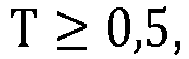
- the viscous liquid has a viscosity of 0.5 Pa ⁇ s or more and 10.0 Pa ⁇ s or less, wherein, where the viscosity of the viscous liquid denoted by T [Pa*s], and the hardness of the mousse-form solid body (4) is expressed by Hx10 4 [N/m 2 ], a following formula is satisfied within a range of 1.0 ⁇ H ⁇ 2.0, T ⁇ -H+2.5 (Formula I), or a following formula is satisfied within a range of 2.0 ⁇ H ⁇ 5.0, T ⁇ 0.5.
- an encased mousse-form food that does not require freezing for distribution.
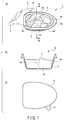
- FIG. 1 is a perspective view illustrating an encased mousse-form food.
- FIG. 1 is a sectional view taken along a line B-B.
- FIG. 1 is a plan view illustrating a lid.
- the encased mousse-form food 1 comprises a container 2 including an opening and a flange 2a formed around the opening.
- the container 2 contains mousse-form solid bodies 4a to 4f put therein. Further, the container 2 contains a viscous liquid 3 that covers the circumference of each of the mousse-form solid bodies 4a to 4f.
- a lid 6 including a tongue portion 5 is attached to the flange 2a of the container 2, so that the mousse-form solid bodies 4a to 4f and the viscous liquid 3 are sealed inside the container 2.
- FIG. 1 illustrates an example where the lid 6 is made of a transparent plastic film.
- FIG. 1 illustrates a state where the lid 6 is partly detached from the flange 2a of the container 2.
- FIG. 1 illustrates the plurality of mousse-form solid bodies 4a to 4f, but only one or more than one mousse-form solid bodies may be contained inside the container 2.
- the mousse-form solid bodies 4a to 4f are collectively mentioned as a mousse-form solid body 4.
- these mousse-form solid bodies 4 may be of different types or may be of the same type.
- the mousse-form solid body 4 has a hardness of 1.0 ⁇ 10 4 N/m 2 or more and 5.0 ⁇ 10 4 N/m 2 or less.
- the mousse-form solid body 4 is easy for a consumer to swallow.
- the mousse-form solid body 4 is produced as follows: At first, materials are selected.
- the materials may be selected from animal food materials and vegetable food materials.
- the materials may be meats, fish and shellfish, cereals, vegetables, seaweed, fruits, nuts and/or insects, or may be any of the substances used as food materials in general.
- the selected materials are ground to form material particles.
- a binding agent is added to the material particles, and they are mixed with each other, and heated as needed, to form a mousse-form solid body 4 having a specific hardness.
- a process such as heating, may be performed after stirring.
- the binding agent may be at least one selected from the group consisting of egg albumen, starch, and dextrin.
- the heating process is a time period sufficient to make the temperature of the mousse-form solid body uniform up to the inside and to solidify the mousse-form solid body over the entirety thereof. Thereafter, the mousse-form solid body may be cooled at room temperature or at a lower temperature, and/or cooled in water. Due to this heating, the final product or food may contain egg albumen and/or starch and/or dextrin in a thermally denatured state.
- the material particles with the binding agent may be further mixed with desired additives, such as substances used for foods in general, which are, for example, seasonings, such as salt, sugar, soy sauce, and vinegar, and/or food additives, such as oil, thickener, perfume, and red food coloring.
- seasonings such as salt, sugar, soy sauce, and vinegar
- food additives such as oil, thickener, perfume, and red food coloring.
- the hardness of the mousse-form solid body 4 may be measured by use of an apparatus that can measure the compression stress of a substance by linear motion, along with a compression speed of 10 mm/sec and a measurement temperature of 20 ⁇ 2°C. This measurement is performed by use of a plunger having a diameter of, e.g., 3 mm, under a clearance of, e.g., 3 mm.
- the mousse-form solid body 4 provides smooth palate feeling when being eaten. This smooth palate feeling of the mousse-form solid body 4 may be achieved by reducing the diameter of the material particles contained in the mousse-form solid body.
- the material particles contained in the mousse-form solid body 4 may have a diameter of 1.5 mm, 0.5 mm or less, or 0.3 mm or less, and preferably of 0.1 mm or less.
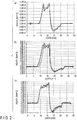
- FIG. 2 shows results of measurement performed on three examples of different types of the mousse-form solid body 4 by use of the above-described apparatus.
- the measurement was performed as follows: Each mousse-form solid body was cut to have a thickness of 1 cm, and then its hardness was measured in TENSIPRESSER My Boy II system (manufactured by Taketomo Electric Inc.), by use of a plunger having a diameter of 3 mm, along with a measurement temperature of 20 ⁇ 2°C, a compression speed of 10 mm/sec, and a clearance of 30% of the sample thickness, i.e., a clearance of 3 mm.
- TENSIPRESSER My Boy II system manufactured by Taketomo Electric Inc.
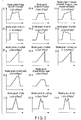
- model graphs were formed from these graphs and are shown in (a), (b), and (c) of FIG. 3 .
- the model graphs (a), (b), and (c) of FIG. 3 correspond respectively to graphs (a), (b), and (c) of FIG. 2 .
- FIG. 1 For reference, FIG. 1
- model graphs obtained in the same way from the following foods: (d) boiled radish, (e) boiled carrot, (f) boiled potato, (g) boiled codfish, (h) boiled flatfish, (i) boiled hanppen, (j) boiled pork belly, (k) boiled beef fibrous meat, (1) jelly, (m) pudding, and (n) firm tofu.
- the stress numerical value indicated in each of the model graphs denotes the stress maximum value in the model graph.
- the mousse-form solid body 4 has a hardness almost uniform over the entirety thereof. Immediately after a physical force is applied to the mousse-form solid body 4, the rising of stress is gradual and constant. On the other hand, an appropriate stress needs to be applied to press and crush the mousse-form solid body 4.
- the viscous liquid 3 has a viscosity of 0.5 Pa ⁇ s or more and 10.0 Pa ⁇ s or less, and preferably of 1.5 Pa ⁇ s or more and 2.0 Pa ⁇ s or less.
- the relationship between the hardness of the mousse-form solid body 4 and the viscosity of the viscous liquid 3 satisfies the condition defined by the following Formula I or Formula II, where the viscosity of the viscous liquid 3 is denoted by T and the hardness of the mousse-form solid body 4 is expressed by H ⁇ 10 4 N/m 2 .
- the viscosity was measured by use of a B-type rotational viscometer, in which the rotor was rotated at a specific number of revolutions, such as 12 rpm, and the indicated value was read after two minutes. This value was multiplied by a corresponding count, and the resultant value thus obtained was expressed with "Pa ⁇ s". This measurement may be performed at a temperature of 20 ⁇ 2°C.
- the mousse-form solid body 4 Since the circumference of the mousse-form solid body 4 is entirely covered with the viscous liquid 3 having such a viscosity, the mousse-form solid body 4 is prevented from collapsing during transportation.
- the ratio between the total volume of the viscous liquid 3 and the total volume of the mousse-form solid body 4 inside the container 2 may be set at 2:8 to 5:5 and preferably at 3:7 to 4:6.
- the total volume of the mousse-form solid body 4 mentioned here means the total of the volumes of all the mousse-form solid bodies 4 contained inside the container 2. Specifically, when a single mousse-form solid body 4 is contained inside one container 2, the total volume is the volume of this single mousse-form solid body 4. On the other hand, when a plurality of mousse-form solid bodies 4 are contained inside one container 2, the total volume is the total of the respective volumes of the plurality of mousse-form solid bodies 4.
- the mousse-form solid body 4 With an increase in the total volume of the mousse-form solid body 4, in relation to the ratio between the viscous liquid 3 and the mousse-form solid body 4, the mousse-form solid body 4 becomes less apt to collapse. This is because the movable range of the mousse-form solid body 4 inside the container 2 becomes smaller, with an increase in the total volume of the mousse-form solid body 4. However, if the viscous liquid 3 is too little, it becomes difficult to provide a function as a seasoning liquid. On the other hand, if the viscous liquid 3 is too much, the mousse-form solid body 4 is given a larger movable range and becomes more apt to collapse. Further, in this case, since the ingredient looks smaller, the appearance becomes poorer.
- the viscous liquid 3 may be prepared as follows: For example, the viscous liquid 3 is obtained by adding a thickening stabilizer to a seasoning liquid containing water and seasonings, and then mixing them with each other. Depending on the type of the thickening stabilizer, a process necessary for dissolution, such as warming and/or stirring, may be performed. Further, in order to obtain a specific viscosity, a process, such as warming, cooling, stirring, and/or pH-adjusting, may be performed.
- an example of the thickening stabilizer is pectin, guar gum, xanthan gum, tamarind gum, carrageenan, carboxymethylcellulose, tara gum, locust bean gum, curdlan, gelatin, agar, sodium alginate, psyllium seed gum, gellan gum, Arabic gum, karaya gum, chitin, chitosan, arabinogalactan, welan gum, sesbania gum, Aloe vera extract, Erwinia mitsuensis gum, daruman resin, ghatti gum, elemi resin, dextran, enterobacter simanus gum, enterobacter gum, triacanthos gum, oligoglucosamine, Abelmoschus manihot, microfibrous cellulose, tragacanth gum, Bacillus subtilis natto gum, Gloiopeltis furcata extract, furcellaran, cassia gum, macrophomopsis gum, pullulan, Alo
- the thickening stabilizer may be selected in consideration of the properties of respective thickening stabilizers, as shown in TABLE 1, the other component composition contained in the viscous liquid, and/or whether the encased mousse-form solid food is to be heated before being served for eating.
- the thickening stabilizer is pectin, guar gum, xanthan gum, tamarind gum, carrageenan, carboxymethylcellulose, tara gum, locust bean gum, curdlan, gelatin, agar, sodium alginate, psyllium seed gum, gellan gum, Arabic gum, karaya gum, chitin, and/or chitosan. More preferably, the thickening stabilizer is xanthan gum, guar gum, tamarind gum, tara gum, gellan gum, and/or sodium alginate. Most preferably, the thickening stabilizer is xanthan gum.
- the container 2 may be any one of a plastic container, metal container, glass container, ceramic container, and waterproof paper container, as long as the container can maintain a certain form during its manufacture, transportation, and use for, e.g., eating.
- the container 2 may be a container having any shape selected from well known ones, such as a cup type, bowl type, and ship type; a cylindrical shape with an opening; a circular column shape, polygonal column shape, circular cone shape, and polygonal cone shape, each of which is hollow; and a circular cone shape and polygonal cone shape, each of which is truncated and hollow.
- the container 2 may be produced by use of any technique selected from well known ones, in accordance with a material and shape selected for the container.
- the lid 6 is a member that covers the opening of the container 2 to seal the mousse-form solid body 4 and the viscous liquid 3 contained inside the container 2. It suffices if the lid 6 at least has a shape and size necessary for covering the entirety of the opening of the container 2. In the example described above, the lid 6 includes the tongue portion 5, but the tongue portion 5 may be omitted. Further, the size of the lid 6 may be set to be larger than the circumference of the flange 2a of the container 2. In this case, a user can pull away the lid 6 from the container 2 by holding, with fingers, that part of the lid 6 which extends outward from the flange 2a.
- the lid 6 may be made of a material the same as that of the container 2 or different from that of the container 2.
- the material of the lid 6 may be selected from plastic, metal, glass, ceramic, and waterproof paper.
- the lid 6 may be attached to the container 2 by any one of adhering, fitting, heat sealing, double seaming, screw cap, and wax sealing.
- an encased mousse-form solid food may be manufactured as follows: Materials are ground into particles having a diameter of 0.1 mm or less and thereby turned into a paste. Egg albumen and/or starch are added to the paste thus formed, and they are mixed with each other. The resultant mixture is heated, and a mousse-form solid body is thereby obtained. A seasoning liquid is provided. The seasoning liquid is set to have a viscosity of 0.5 Pa ⁇ s or more and 10.0 Pa ⁇ s or less, and a viscous liquid is thereby prepared. The viscous liquid and the mousse-form solid body are put in a container. A lid is attached to the container.
- the encased mousse-form solid food 1 may be provided as any one of a side dish, main dish, and confectionery.
- an encased mousse-form food that does not require freezing for distribution.
- a nursing facility or the like accommodates a lot of persons to be nursed, and so it needs to provide a large quantity of meal at a time.
- a large amount of labor is required for the thawing operation.
- the encased mousse-form solid food according to the present invention can be distributed in an unfrozen state, and thus can be served for eating only by removing the lid, for example.
- the encased mousse-form solid food makes it possible for consumers to enjoy even the taste of a food having a complicated feature using various materials. In this case, it is possible to easily manufacture such an encased mousse-form solid food. Further, even in the case of a cuisine that requires labor for cooking, such as a simmered dish, the encased mousse-form solid food makes it possible to reproduce the taste of the cuisine without damaging the taste, while keeping the tastes of respective materials. Also in this case, it is possible to easily manufacture such an encased mousse-form solid food. Thus, the encased mousse-form solid food makes it possible for consumers to enjoy even the taste of a cuisine that requires labor.
- the present invention is more effective to prevent a food comprising a very soft solid body of 5.0 ⁇ 10 4 N/m 2 or less from collapsing.
- the present invention is highly effective to prevent a food comprising a solid body formed of protein or starch from collapsing.
- the encased mousse-form solid food according to the present invention utilizes the viscosity of the liquid to reduce vibration during transportation and to prevent the solid food from moving inside the container. Accordingly, it is possible to prevent the mousse-form solid body from collapsing, which can be caused when the mousse-form solid body comes into contact with the inner surface of the container, or when mousse-form solid bodies come into contact with each other. Further, since the food can be prevented from collapsing by a necessary minimum viscosity, the viscous thickness becomes minimally influential even in the case where the food is applied to a type that is not preferably thickened.
- Dried egg albumen (dried egg albumen W-type produced by Kewpie Egg Corporation) was dissolved by mixing and stirring it with water.
- the object thus obtained was put in a container serving as a heat-proof mold, such as a cake mold, and was hardened by steaming for 25 minutes in a steamer (Healsio manufactured by Sharp Corporation).
- the object thus hardened was cooled, and then cut into a size of 20 ⁇ 20 ⁇ 7 mm.
- This resultant product was defined as a mousse-form solid body according to a present example 1.
- the added amount of the dried egg albumen employed there was varied at weight percent concentrations of 7.29, 7.49, 7.69, 8.08, 8.28, and 11.24.
- the mousse-form solid bodies thus obtained respectively had hardnesses of 1.0 ⁇ 10 4 N/m 2 , 1.2 ⁇ 10 4 N/m 2 , 1.4 ⁇ 10 4 N/m 2 , 1.8 ⁇ 10 4 N/m 2 , 2.0 ⁇ 10 4 N/m 2 , and 5.0 ⁇ 10 4 N/m 2 .
- These mousse-form solid bodies were respectively defined as a sample 1, sample 2, sample 3, sample 4, sample 5, and sample 6.
- the hardness of each of these mousse-form solid bodies was measured in a texture meter (TENSIPRESSER My Boy II system manufactured by Taketomo Electric Inc.). The measurement was performed under conditions employing a plunger having a diameter of 3 mm, along with a measurement temperature of 20 ⁇ 2°C, a compression speed of 10 mm/sec, and a clearance of 2.1 mm.
- Janef mousse jelly powder (plain type produced by Kewpie Egg Corporation) was put in water and lightly boiled by heating to be well dissolved. The object thus dissolved was put in a cake mold serving as a heat-proof mold, and was hardened by leaving and cooling it. The object thus hardened was cut into a size of 20 ⁇ 20 ⁇ 7 mm.
- This resultant product was defined as a mousse-form solid body according to a present example 2.
- the added amount of the Janef mousse jelly powder employed there was varied at weight percent concentrations of 22.4, 23.3, 24.2, 25.9, 26.8, and 39.9.
- the mousse-form solid bodies thus obtained respectively had hardnesses of 1.0 ⁇ 10 4 N/m 2 , 1.2 ⁇ 10 4 N/m 2 , 1.4 ⁇ 10 4 N/m 2 , 1.8 ⁇ 10 4 N/m 2 , 2.0 ⁇ 10 4 N/m 2 and 5.0 ⁇ 10 4 N/m 2 .
- These mousse-form solid bodies were respectively defined as a sample 7, sample 8, sample 9, sample 10, sample 11, and sample 12.
- the hardness of each of these mousse-form solid bodies was measured in a texture meter (TENSIPRESSER My Boy II system manufactured by Taketomo Electric Inc.). The measurement was performed under conditions employing a plunger having a diameter of 3 mm, along with a measurement temperature of 20°C, a compression speed of 10 mm/sec, and a clearance of 2.1 mm.
- a viscous liquid was prepared by use of tamarind gum.
- a solution of the tamarind gum has properties according to a Newtonian fluid.
- the tamarind gum (glyloid 3S produced by DSP Gokyo Food & Chemical Co., Ltd.) was dissolved in water by use of hand mixer. In order to settle the viscosity of the viscous liquid, the object thus dissolved was left in a refrigerator overnight, and then returned to normal temperature (20°C).
- the added amount of the tamarind gum employed there was varied at weight percent concentrations of 0.20, 0.49, 0.78, 1.22, 1.37, 1.66, 1.95, 2.10, 2.68, 7.07, and 14.37.
- the viscous liquids thus obtained respectively had viscosities of 0.3 Pa ⁇ s, 0.5 Pa ⁇ s, 0.7 Pa ⁇ s, 1.0 Pa ⁇ s, 1.1 Pa ⁇ s, 1.3 Pa ⁇ s, 1.5 Pa ⁇ s, 1.6 Pa ⁇ s, 2.0 Pa ⁇ s, 5.0 Pa ⁇ s, and 10.0 Pa ⁇ s.
- These mousse-form solid bodies were respectively defined as a sample 13, sample 14, sample 15, sample 16, sample 17, sample 18, sample 19, sample 20, sample 21, sample 22, and sample 23.
- the viscosity was measured by use of a B-type viscometer (manufactured by Toki Sangyo Co., Ltd.), (along with use of M3 rotor, 12 rpm, and 20°C).
- Plastic cups each having a capacity of 50 mL and including an opening and a flange formed around the opening, were used as containers.
- the mousse-form solid bodies of the samples 1 to 12 were respectively put in the containers, such that each of these types consisted of 4 pieces.
- One of the viscous liquids of the samples 13 to 23 was introduced, in an amount of 35 mL, into each of the containers.
- a lid formed of a film was placed on the flange of each of the containers, and was then sealed by ironing.
- Each of the containers had a head space of 3.8 mL.
- the encased mousse-form solid foods thus obtained were respectively defined as encased mousse-form solid foods.
- a shallow tray was partitioned by use of cardboards so that cups for nursing care foods could be placed thereon without a space between them. This tray was used as a box for testing vibration.
- the box for testing vibration was placed on a vibration testing machine.
- the encased mousse-form solid foods manufactured by filling the containers as described above were respectively put in the spaces surrounded by the partitions inside the box for testing vibration.
- the box for testing vibration was capped and was then fixed to the vibration testing machine by a rope.
- each mousse-form solid body did not collapse when it satisfied the following formula. T ⁇ ⁇ H + 2.5
- each mousse-form solid body did not collapse when it satisfied the following formula. T ⁇ 0.5
Landscapes
- Chemical & Material Sciences (AREA)
- Life Sciences & Earth Sciences (AREA)
- Health & Medical Sciences (AREA)
- Engineering & Computer Science (AREA)
- Food Science & Technology (AREA)
- Polymers & Plastics (AREA)
- Nutrition Science (AREA)
- Dispersion Chemistry (AREA)
- Pediatric Medicine (AREA)
- Mycology (AREA)
- Jellies, Jams, And Syrups (AREA)
- Seeds, Soups, And Other Foods (AREA)
Claims (11)
- Verpacktes Mousse-artiges festes Nahrungsmittel (1), mit:einem Behälter (2) mit einer Öffnung;einem Mousse-artigen festen Körper (4), der in dem Behälter (2) enthalten ist;einer viskosen Flüssigkeit, die in dem Behälter (2) enthalten ist und einen Umfang des Mousse-artigen festen Körpers (4) bedeckt; undeinem Deckel (6), der an der Öffnung des Behälters (2) befestigt ist,wobei der Mousse-artige feste Körper (4) eine Festigkeit von 1,0 x 10⁴ N/m2 oder mehr und 5,0 x 10⁴ N/m2 oder weniger aufweist, und die viskose Flüssigkeit eine Viskosität von 0,5 Pa·s oder mehr und 10,0 Pa·s oder weniger aufweist, undwobei eine folgende Formel im Bereich 1,0 ≤ H ≤ 2,0 erfüllt ist,
 eine folgende Formel im Bereich von 2,0 < H ≤ 5,0 erfüllt ist,
 die Viskosität der viskosen Flüssigkeit als T [Pa·s], und die Festigkeit des Mousse-artigen festen Körpers (4) als H x 104 [N/m2] ausgedrückt wird.
 - Nahrungsmittel (1) gemäß Anspruch 1, wobei die Viskosität der viskosen Flüssigkeit 1,5 Pa·s oder mehr und 2,0 Pa·s oder weniger beträgt.
- Nahrungsmittel gemäß einem der Ansprüche 1 bis 2, wobei der Mousse-artige feste Körper (4) Materialpartikel umfasst, die einen Durchmesser von 0,1 mm oder weniger aufweisen, und ein Bindemittel für die Materialpartikel aufweist, welches zumindest eines, ausgewählt aus der Gruppe Ei-Albumin, Stärke und Dextrin, ist.
- Nahrungsmittel (1) gemäß Anspruch 3, wobei das Ei-Albumin, die Stärke, und das Dextrin in einem thermisch denaturierten Zustand vorliegen.
- Nahrungsmittel (1) gemäß einem der Ansprüche 1 bis 4, wobei das Verhältnis zwischen dem Gesamtvolumen der viskosen Flüssigkeit und dem Gesamtvolumen des Mousse-artigen festen Körpers (4) innerhalb des Behälters (2) 2:8 bis 5:5 beträgt.
- Nahrungsmittel (1), gemäß einem der vorstehenden Ansprüche 1 bis 5, wobei das Nahrungsmittel eine Beilage ist.
- Verfahren zur Herstellung eines verpackten Mousse-artigen festen Nahrungsmittels (1), mit den Schritten:(a) Bilden einer Paste durch Mahlen eines Materials zu Partikeln mit einem Durchmesser von 0,1 mm oder weniger;(b) Mischen der in Schritt (a) gebildeten Paste mit einem zusätzlichen Stoff, der zumindest einer ausgewählt aus der Gruppe Ei-Albumin, Stärke und Dextrin, ist;(c) Erhitzen einer in Schritt (b) enthaltenen Mischung, wobei ein Mousse-artiger fester Körper (4) erhalten wird;(d) Bereitstellen einer Würzflüssigkeit;(e) Einstellen der Würzflüssigkeit, sodass sie eine Viskosität von 0,5 Pa·s oder mehr und 10,0 Pa·s oder weniger aufweist, um eine viskose Flüssigkeit zu erhalten; wenn die Viskosität der viskosen Flüssigkeit mit T [Pa·s] bezeichnet wird, und die Festigkeit des Mousse-artigen festen Körpers (4) als H x 104 [N/m2] ausgedrückt wird, wird eine folgende Formel im Bereich von 1,0 ≤ H ≤ 2,0 erfüllt,

eine folgende Formel im Bereich von 2,0 < H ≤ 5,0 erfüllt, (f) Füllen der viskosen Flüssigkeit und des Mousse-artigen festen Körpers (4) in einen Behälter (2); und(g) Befestigen eines Deckels (6) an dem Behälter (2).
 - Verfahren nach Anspruch 7, wobei die Viskosität der viskosen Flüssigkeit 1,5 Pa·s oder mehr und 2,0 Pa·s oder weniger beträgt.
- Verfahren nach einem der Ansprüche 7 oder 8, wobei das Einstellen der Viskosität in Schritt (e) das Hinzufügen eines verdickenden Stabilisators zu der Würzflüssigkeit umfasst.
- Verfahren nach einem der Ansprüche 7 bis 9, wobei ein Verhältnis zwischen einem Gesamtvolumen der viskosen Flüssigkeit und einem Gesamtvolumen des Mousse-artigen festen Körpers (4) innerhalb des Behälters (2) 2:8 bis 5:5 beträgt.
- Verfahren gemäß einem der Ansprüche 7 bis 10, wobei das verpackte Mousse-artige feste Nahrungsmittel eine Beilage ist.
Applications Claiming Priority (2)
| Application Number | Priority Date | Filing Date | Title |
|---|---|---|---|
| JP2012074618 | 2012-03-28 | ||
| PCT/JP2013/058435 WO2013146618A1 (ja) | 2012-03-28 | 2013-03-22 | 容器入り固形食品およびその製造方法 |
Publications (3)
| Publication Number | Publication Date |
|---|---|
| EP2832239A1 EP2832239A1 (de) | 2015-02-04 |
| EP2832239A4 EP2832239A4 (de) | 2015-11-18 |
| EP2832239B1 true EP2832239B1 (de) | 2018-06-27 |
Family
ID=49259871
Family Applications (1)
| Application Number | Title | Priority Date | Filing Date |
|---|---|---|---|
| EP13769973.2A Active EP2832239B1 (de) | 2012-03-28 | 2013-03-22 | Verpacktes festes nahrungsmittel und herstellungsverfahren dafür |
Country Status (10)
| Country | Link |
|---|---|
| US (1) | US20150010687A1 (de) |
| EP (1) | EP2832239B1 (de) |
| JP (1) | JP5847295B2 (de) |
| KR (1) | KR101706991B1 (de) |
| CN (1) | CN104168780A (de) |
| CA (1) | CA2867106C (de) |
| ES (1) | ES2687846T3 (de) |
| HK (1) | HK1199181A1 (de) |
| SG (1) | SG11201405560TA (de) |
| WO (1) | WO2013146618A1 (de) |
Families Citing this family (7)
| Publication number | Priority date | Publication date | Assignee | Title |
|---|---|---|---|---|
| US10476823B2 (en) * | 2014-09-04 | 2019-11-12 | Blackberry Limited | Automatic identification and retrieval of message attachments in a message conversation |
| JP6304836B2 (ja) * | 2016-01-19 | 2018-04-04 | 広島県 | 容器詰め食品の製造方法 |
| TW202123827A (zh) * | 2019-11-15 | 2021-07-01 | 瑞士商傑太日煙國際股份有限公司 | 破碎的煙草基質 |
| JP7457549B2 (ja) * | 2020-03-25 | 2024-03-28 | 日清食品ホールディングス株式会社 | 新たな食塩組成物の製造方法 |
| JP7250840B2 (ja) * | 2021-03-31 | 2023-04-03 | 大和製罐株式会社 | 食品セット |
| CN115606617B (zh) * | 2022-09-27 | 2023-08-22 | 四川旅游学院 | 一种控制亚硝胺含量并提高货架期的川味香肠制备方法 |
| JP2024074564A (ja) | 2022-11-21 | 2024-05-31 | 大和製罐株式会社 | 包装容器及び軟質食品入り包装体 |
Family Cites Families (10)
| Publication number | Priority date | Publication date | Assignee | Title |
|---|---|---|---|---|
| US5368877A (en) * | 1992-01-16 | 1994-11-29 | Pillsbury Company | Method of producing film shelf stable food products |
| JP4312075B2 (ja) * | 2004-02-18 | 2009-08-12 | キユーピー株式会社 | 咀嚼・嚥下困難者用食事の提供方法及びこれに用いるための高栄養ゼリー状食品キット |
| JP2005287326A (ja) * | 2004-03-31 | 2005-10-20 | Fuji Oil Co Ltd | 調理肉加工食品及びその製造法 |
| JP2006055076A (ja) | 2004-08-20 | 2006-03-02 | Q P Corp | パウチ入り米飯添加用加工食品 |
| JP2006304719A (ja) | 2005-04-28 | 2006-11-09 | Q P Corp | 具材入りレトルト液状食品の製造方法 |
| US20080311174A1 (en) * | 2006-02-01 | 2008-12-18 | Hiroshima Prefecture | Food and Process for Producing Food |
| JP2008141994A (ja) * | 2006-12-08 | 2008-06-26 | Nippon Suisan Kaisha Ltd | 咀嚼困難者用の冷凍成型惣菜 |
| JP4850942B2 (ja) * | 2008-12-26 | 2012-01-11 | イーエヌ大塚製薬株式会社 | 軟質化方法および軟質化動物性食材 |
| JP5832081B2 (ja) * | 2009-10-19 | 2015-12-16 | 株式会社大塚製薬工場 | 咀嚼嚥下訓練用組成物 |
| GB2483392B (en) * | 2010-05-10 | 2016-06-08 | Andersen Inst Of Bread & Life Co Ltd | Easy-to-chew/swallow foods, and food making method |
-
2013
- 2013-03-22 CA CA2867106A patent/CA2867106C/en active Active
- 2013-03-22 SG SG11201405560TA patent/SG11201405560TA/en unknown
- 2013-03-22 HK HK14112810.7A patent/HK1199181A1/xx unknown
- 2013-03-22 KR KR1020147024490A patent/KR101706991B1/ko active Active
- 2013-03-22 JP JP2014507837A patent/JP5847295B2/ja active Active
- 2013-03-22 ES ES13769973.2T patent/ES2687846T3/es active Active
- 2013-03-22 CN CN201380015773.0A patent/CN104168780A/zh active Pending
- 2013-03-22 WO PCT/JP2013/058435 patent/WO2013146618A1/ja not_active Ceased
- 2013-03-22 EP EP13769973.2A patent/EP2832239B1/de active Active
-
2014
- 2014-09-22 US US14/492,625 patent/US20150010687A1/en not_active Abandoned
Non-Patent Citations (1)
| Title |
|---|
| None * |
Also Published As
| Publication number | Publication date |
|---|---|
| ES2687846T3 (es) | 2018-10-29 |
| HK1199181A1 (en) | 2015-06-26 |
| KR101706991B1 (ko) | 2017-02-15 |
| CA2867106A1 (en) | 2013-10-03 |
| EP2832239A4 (de) | 2015-11-18 |
| KR20140121472A (ko) | 2014-10-15 |
| CN104168780A (zh) | 2014-11-26 |
| JPWO2013146618A1 (ja) | 2015-12-14 |
| SG11201405560TA (en) | 2014-11-27 |
| US20150010687A1 (en) | 2015-01-08 |
| WO2013146618A1 (ja) | 2013-10-03 |
| EP2832239A1 (de) | 2015-02-04 |
| CA2867106C (en) | 2018-09-04 |
| JP5847295B2 (ja) | 2016-01-20 |
Similar Documents
| Publication | Publication Date | Title |
|---|---|---|
| Qin | Applications of bioactive seaweed substances in functional food products | |
| US20150010687A1 (en) | Encased solid food and method for manufacturing the same | |
| KR102347061B1 (ko) | 식품 조성물 | |
| WO2004105511A1 (en) | Method for preparing a gelled food product and semi-finished product for use in the method | |
| JP2016152822A (ja) | 磨砕こんにゃくを含むスムージー | |
| JP6918453B2 (ja) | 食品の離水抑制方法 | |
| CN109788779A (zh) | 蛋白质强化食品 | |
| JP2010263877A (ja) | クレス種子抽出物の新規用途 | |
| CN110477317A (zh) | 一种魔芋罐头的制备方法 | |
| JP6203996B2 (ja) | 即席パン粥様食品及びパン粥様食品 | |
| JP4833038B2 (ja) | ラムザンガムの新規用途 | |
| JP7350271B1 (ja) | 寒天含有食品、および品質改良剤 | |
| JP5879958B2 (ja) | 嚥下困難者用食肉加工食品及び、嚥下困難者用食肉加工食品の製造法 | |
| JP4807336B2 (ja) | 新規な畜肉加工品 | |
| JP2017189170A (ja) | 高齢者用即席ミルクパン粥様食品及び高齢者用ミルクパン粥様食品 | |
| KR20100128792A (ko) | 피쉬 콜라겐을 함유하는 젤리형 드레싱 조성물 및 그 제조방법 | |
| JP6997853B1 (ja) | 自己保形性食品組成物およびその製造方法 | |
| US20070104852A1 (en) | Casing-packed cooked rice and its production process | |
| JP5190844B2 (ja) | 粥を寿司のシャリの形態に成形するための粥成形剤 | |
| CN106858368A (zh) | 一种家乡肠及其制备方法 | |
| WO2021025048A1 (ja) | 流動性食品の製造方法 | |
| JP6282158B2 (ja) | ゲル食品 | |
| JP7706961B2 (ja) | ゲル状食品及びゲル状食品の製造方法 | |
| US20250089753A1 (en) | Molded food, method for manufacturing the same, and container-packed molded food | |
| KR102707480B1 (ko) | 가금류 혈액을 이용한 블랙푸딩 식품 및 이의 제조방법 |
Legal Events
| Date | Code | Title | Description |
|---|---|---|---|
| PUAI | Public reference made under article 153(3) epc to a published international application that has entered the european phase |
Free format text: ORIGINAL CODE: 0009012 |
|
| 17P | Request for examination filed |
Effective date: 20140827 |
|
| AK | Designated contracting states |
Kind code of ref document: A1 Designated state(s): AL AT BE BG CH CY CZ DE DK EE ES FI FR GB GR HR HU IE IS IT LI LT LU LV MC MK MT NL NO PL PT RO RS SE SI SK SM TR |
|
| AX | Request for extension of the european patent |
Extension state: BA ME |
|
| DAX | Request for extension of the european patent (deleted) | ||
| RA4 | Supplementary search report drawn up and despatched (corrected) |
Effective date: 20151021 |
|
| RIC1 | Information provided on ipc code assigned before grant |
Ipc: A23L 1/48 20060101AFI20151015BHEP |
|
| REG | Reference to a national code |
Ref country code: DE Ref legal event code: R079 Ref document number: 602013039441 Country of ref document: DE Free format text: PREVIOUS MAIN CLASS: A23L0001480000 Ipc: A23L0033000000 |
|
| RIC1 | Information provided on ipc code assigned before grant |
Ipc: A23L 35/00 20160101ALI20171127BHEP Ipc: A23L 33/00 20160101AFI20171127BHEP Ipc: A23P 30/40 20160101ALI20171127BHEP |
|
| GRAP | Despatch of communication of intention to grant a patent |
Free format text: ORIGINAL CODE: EPIDOSNIGR1 |
|
| STAA | Information on the status of an ep patent application or granted ep patent |
Free format text: STATUS: GRANT OF PATENT IS INTENDED |
|
| INTG | Intention to grant announced |
Effective date: 20180118 |
|
| GRAS | Grant fee paid |
Free format text: ORIGINAL CODE: EPIDOSNIGR3 |
|
| GRAA | (expected) grant |
Free format text: ORIGINAL CODE: 0009210 |
|
| STAA | Information on the status of an ep patent application or granted ep patent |
Free format text: STATUS: THE PATENT HAS BEEN GRANTED |
|
| AK | Designated contracting states |
Kind code of ref document: B1 Designated state(s): AL AT BE BG CH CY CZ DE DK EE ES FI FR GB GR HR HU IE IS IT LI LT LU LV MC MK MT NL NO PL PT RO RS SE SI SK SM TR |
|
| REG | Reference to a national code |
Ref country code: GB Ref legal event code: FG4D |
|
| REG | Reference to a national code |
Ref country code: AT Ref legal event code: REF Ref document number: 1011519 Country of ref document: AT Kind code of ref document: T Effective date: 20180715 |
|
| REG | Reference to a national code |
Ref country code: IE Ref legal event code: FG4D |
|
| REG | Reference to a national code |
Ref country code: DE Ref legal event code: R096 Ref document number: 602013039441 Country of ref document: DE |
|
| REG | Reference to a national code |
Ref country code: SE Ref legal event code: TRGR |
|
| REG | Reference to a national code |
Ref country code: ES Ref legal event code: FG2A Ref document number: 2687846 Country of ref document: ES Kind code of ref document: T3 Effective date: 20181029 |
|
| PG25 | Lapsed in a contracting state [announced via postgrant information from national office to epo] |
Ref country code: NO Free format text: LAPSE BECAUSE OF FAILURE TO SUBMIT A TRANSLATION OF THE DESCRIPTION OR TO PAY THE FEE WITHIN THE PRESCRIBED TIME-LIMIT Effective date: 20180927 Ref country code: FI Free format text: LAPSE BECAUSE OF FAILURE TO SUBMIT A TRANSLATION OF THE DESCRIPTION OR TO PAY THE FEE WITHIN THE PRESCRIBED TIME-LIMIT Effective date: 20180627 Ref country code: BG Free format text: LAPSE BECAUSE OF FAILURE TO SUBMIT A TRANSLATION OF THE DESCRIPTION OR TO PAY THE FEE WITHIN THE PRESCRIBED TIME-LIMIT Effective date: 20180927 Ref country code: LT Free format text: LAPSE BECAUSE OF FAILURE TO SUBMIT A TRANSLATION OF THE DESCRIPTION OR TO PAY THE FEE WITHIN THE PRESCRIBED TIME-LIMIT Effective date: 20180627 |
|
| REG | Reference to a national code |
Ref country code: NL Ref legal event code: MP Effective date: 20180627 |
|
| REG | Reference to a national code |
Ref country code: LT Ref legal event code: MG4D |
|
| PG25 | Lapsed in a contracting state [announced via postgrant information from national office to epo] |
Ref country code: HR Free format text: LAPSE BECAUSE OF FAILURE TO SUBMIT A TRANSLATION OF THE DESCRIPTION OR TO PAY THE FEE WITHIN THE PRESCRIBED TIME-LIMIT Effective date: 20180627 Ref country code: RS Free format text: LAPSE BECAUSE OF FAILURE TO SUBMIT A TRANSLATION OF THE DESCRIPTION OR TO PAY THE FEE WITHIN THE PRESCRIBED TIME-LIMIT Effective date: 20180627 Ref country code: GR Free format text: LAPSE BECAUSE OF FAILURE TO SUBMIT A TRANSLATION OF THE DESCRIPTION OR TO PAY THE FEE WITHIN THE PRESCRIBED TIME-LIMIT Effective date: 20180928 Ref country code: LV Free format text: LAPSE BECAUSE OF FAILURE TO SUBMIT A TRANSLATION OF THE DESCRIPTION OR TO PAY THE FEE WITHIN THE PRESCRIBED TIME-LIMIT Effective date: 20180627 |
|
| REG | Reference to a national code |
Ref country code: AT Ref legal event code: MK05 Ref document number: 1011519 Country of ref document: AT Kind code of ref document: T Effective date: 20180627 |
|
| PG25 | Lapsed in a contracting state [announced via postgrant information from national office to epo] |
Ref country code: NL Free format text: LAPSE BECAUSE OF FAILURE TO SUBMIT A TRANSLATION OF THE DESCRIPTION OR TO PAY THE FEE WITHIN THE PRESCRIBED TIME-LIMIT Effective date: 20180627 |
|
| PG25 | Lapsed in a contracting state [announced via postgrant information from national office to epo] |
Ref country code: CZ Free format text: LAPSE BECAUSE OF FAILURE TO SUBMIT A TRANSLATION OF THE DESCRIPTION OR TO PAY THE FEE WITHIN THE PRESCRIBED TIME-LIMIT Effective date: 20180627 Ref country code: AT Free format text: LAPSE BECAUSE OF FAILURE TO SUBMIT A TRANSLATION OF THE DESCRIPTION OR TO PAY THE FEE WITHIN THE PRESCRIBED TIME-LIMIT Effective date: 20180627 Ref country code: EE Free format text: LAPSE BECAUSE OF FAILURE TO SUBMIT A TRANSLATION OF THE DESCRIPTION OR TO PAY THE FEE WITHIN THE PRESCRIBED TIME-LIMIT Effective date: 20180627 Ref country code: IS Free format text: LAPSE BECAUSE OF FAILURE TO SUBMIT A TRANSLATION OF THE DESCRIPTION OR TO PAY THE FEE WITHIN THE PRESCRIBED TIME-LIMIT Effective date: 20181027 Ref country code: SK Free format text: LAPSE BECAUSE OF FAILURE TO SUBMIT A TRANSLATION OF THE DESCRIPTION OR TO PAY THE FEE WITHIN THE PRESCRIBED TIME-LIMIT Effective date: 20180627 Ref country code: RO Free format text: LAPSE BECAUSE OF FAILURE TO SUBMIT A TRANSLATION OF THE DESCRIPTION OR TO PAY THE FEE WITHIN THE PRESCRIBED TIME-LIMIT Effective date: 20180627 Ref country code: PL Free format text: LAPSE BECAUSE OF FAILURE TO SUBMIT A TRANSLATION OF THE DESCRIPTION OR TO PAY THE FEE WITHIN THE PRESCRIBED TIME-LIMIT Effective date: 20180627 |
|
| REG | Reference to a national code |
Ref country code: CH Ref legal event code: PK Free format text: BERICHTIGUNGEN |
|
| RIC2 | Information provided on ipc code assigned after grant |
Ipc: A23P 30/40 20160101ALI20171127BHEP Ipc: A23L 33/00 20160101AFI20171127BHEP Ipc: A23L 35/00 20160101ALI20171127BHEP |
|
| PG25 | Lapsed in a contracting state [announced via postgrant information from national office to epo] |
Ref country code: SM Free format text: LAPSE BECAUSE OF FAILURE TO SUBMIT A TRANSLATION OF THE DESCRIPTION OR TO PAY THE FEE WITHIN THE PRESCRIBED TIME-LIMIT Effective date: 20180627 |
|
| REG | Reference to a national code |
Ref country code: DE Ref legal event code: R097 Ref document number: 602013039441 Country of ref document: DE |
|
| PLBE | No opposition filed within time limit |
Free format text: ORIGINAL CODE: 0009261 |
|
| STAA | Information on the status of an ep patent application or granted ep patent |
Free format text: STATUS: NO OPPOSITION FILED WITHIN TIME LIMIT |
|
| PG25 | Lapsed in a contracting state [announced via postgrant information from national office to epo] |
Ref country code: DK Free format text: LAPSE BECAUSE OF FAILURE TO SUBMIT A TRANSLATION OF THE DESCRIPTION OR TO PAY THE FEE WITHIN THE PRESCRIBED TIME-LIMIT Effective date: 20180627 |
|
| 26N | No opposition filed |
Effective date: 20190328 |
|
| PG25 | Lapsed in a contracting state [announced via postgrant information from national office to epo] |
Ref country code: SI Free format text: LAPSE BECAUSE OF FAILURE TO SUBMIT A TRANSLATION OF THE DESCRIPTION OR TO PAY THE FEE WITHIN THE PRESCRIBED TIME-LIMIT Effective date: 20180627 |
|
| PG25 | Lapsed in a contracting state [announced via postgrant information from national office to epo] |
Ref country code: MC Free format text: LAPSE BECAUSE OF FAILURE TO SUBMIT A TRANSLATION OF THE DESCRIPTION OR TO PAY THE FEE WITHIN THE PRESCRIBED TIME-LIMIT Effective date: 20180627 |
|
| REG | Reference to a national code |
Ref country code: CH Ref legal event code: PL |
|
| PG25 | Lapsed in a contracting state [announced via postgrant information from national office to epo] |
Ref country code: AL Free format text: LAPSE BECAUSE OF FAILURE TO SUBMIT A TRANSLATION OF THE DESCRIPTION OR TO PAY THE FEE WITHIN THE PRESCRIBED TIME-LIMIT Effective date: 20180627 Ref country code: LU Free format text: LAPSE BECAUSE OF NON-PAYMENT OF DUE FEES Effective date: 20190322 |
|
| REG | Reference to a national code |
Ref country code: BE Ref legal event code: MM Effective date: 20190331 |
|
| PG25 | Lapsed in a contracting state [announced via postgrant information from national office to epo] |
Ref country code: LI Free format text: LAPSE BECAUSE OF NON-PAYMENT OF DUE FEES Effective date: 20190331 Ref country code: IE Free format text: LAPSE BECAUSE OF NON-PAYMENT OF DUE FEES Effective date: 20190322 Ref country code: CH Free format text: LAPSE BECAUSE OF NON-PAYMENT OF DUE FEES Effective date: 20190331 |
|
| PG25 | Lapsed in a contracting state [announced via postgrant information from national office to epo] |
Ref country code: BE Free format text: LAPSE BECAUSE OF NON-PAYMENT OF DUE FEES Effective date: 20190331 |
|
| PG25 | Lapsed in a contracting state [announced via postgrant information from national office to epo] |
Ref country code: TR Free format text: LAPSE BECAUSE OF FAILURE TO SUBMIT A TRANSLATION OF THE DESCRIPTION OR TO PAY THE FEE WITHIN THE PRESCRIBED TIME-LIMIT Effective date: 20180627 |
|
| PG25 | Lapsed in a contracting state [announced via postgrant information from national office to epo] |
Ref country code: MT Free format text: LAPSE BECAUSE OF NON-PAYMENT OF DUE FEES Effective date: 20190322 Ref country code: PT Free format text: LAPSE BECAUSE OF FAILURE TO SUBMIT A TRANSLATION OF THE DESCRIPTION OR TO PAY THE FEE WITHIN THE PRESCRIBED TIME-LIMIT Effective date: 20181029 |
|
| PG25 | Lapsed in a contracting state [announced via postgrant information from national office to epo] |
Ref country code: CY Free format text: LAPSE BECAUSE OF FAILURE TO SUBMIT A TRANSLATION OF THE DESCRIPTION OR TO PAY THE FEE WITHIN THE PRESCRIBED TIME-LIMIT Effective date: 20180627 |
|
| PG25 | Lapsed in a contracting state [announced via postgrant information from national office to epo] |
Ref country code: HU Free format text: LAPSE BECAUSE OF FAILURE TO SUBMIT A TRANSLATION OF THE DESCRIPTION OR TO PAY THE FEE WITHIN THE PRESCRIBED TIME-LIMIT; INVALID AB INITIO Effective date: 20130322 |
|
| PG25 | Lapsed in a contracting state [announced via postgrant information from national office to epo] |
Ref country code: MK Free format text: LAPSE BECAUSE OF FAILURE TO SUBMIT A TRANSLATION OF THE DESCRIPTION OR TO PAY THE FEE WITHIN THE PRESCRIBED TIME-LIMIT Effective date: 20180627 |
|
| PGFP | Annual fee paid to national office [announced via postgrant information from national office to epo] |
Ref country code: ES Payment date: 20250407 Year of fee payment: 13 |
|
| PGFP | Annual fee paid to national office [announced via postgrant information from national office to epo] |
Ref country code: SE Payment date: 20260216 Year of fee payment: 14 |
|
| PGFP | Annual fee paid to national office [announced via postgrant information from national office to epo] |
Ref country code: GB Payment date: 20260127 Year of fee payment: 14 |
|
| PGFP | Annual fee paid to national office [announced via postgrant information from national office to epo] |
Ref country code: DE Payment date: 20260323 Year of fee payment: 14 |
|
| PGFP | Annual fee paid to national office [announced via postgrant information from national office to epo] |
Ref country code: IT Payment date: 20260217 Year of fee payment: 14 |
|
| PGFP | Annual fee paid to national office [announced via postgrant information from national office to epo] |
Ref country code: FR Payment date: 20260130 Year of fee payment: 14 |