EP2829602A1 - L-Aspartatoxidasevariante und Verfahren zur Herstellung von Chinolinat oder Nicotinsäure damit - Google Patents
L-Aspartatoxidasevariante und Verfahren zur Herstellung von Chinolinat oder Nicotinsäure damit Download PDFInfo
- Publication number
- EP2829602A1 EP2829602A1 EP20140178598 EP14178598A EP2829602A1 EP 2829602 A1 EP2829602 A1 EP 2829602A1 EP 20140178598 EP20140178598 EP 20140178598 EP 14178598 A EP14178598 A EP 14178598A EP 2829602 A1 EP2829602 A1 EP 2829602A1
- Authority
- EP
- European Patent Office
- Prior art keywords
- quinolinate
- nadb67
- amino acid
- ppro
- nada
- Prior art date
- Legal status (The legal status is an assumption and is not a legal conclusion. Google has not performed a legal analysis and makes no representation as to the accuracy of the status listed.)
- Granted
Links
Images
Classifications
-
- C—CHEMISTRY; METALLURGY
- C12—BIOCHEMISTRY; BEER; SPIRITS; WINE; VINEGAR; MICROBIOLOGY; ENZYMOLOGY; MUTATION OR GENETIC ENGINEERING
- C12N—MICROORGANISMS OR ENZYMES; COMPOSITIONS THEREOF; PROPAGATING, PRESERVING, OR MAINTAINING MICROORGANISMS; MUTATION OR GENETIC ENGINEERING; CULTURE MEDIA
- C12N9/00—Enzymes; Proenzymes; Compositions thereof; Processes for preparing, activating, inhibiting, separating or purifying enzymes
- C12N9/0004—Oxidoreductases (1.)
-
- C—CHEMISTRY; METALLURGY
- C12—BIOCHEMISTRY; BEER; SPIRITS; WINE; VINEGAR; MICROBIOLOGY; ENZYMOLOGY; MUTATION OR GENETIC ENGINEERING
- C12P—FERMENTATION OR ENZYME-USING PROCESSES TO SYNTHESISE A DESIRED CHEMICAL COMPOUND OR COMPOSITION OR TO SEPARATE OPTICAL ISOMERS FROM A RACEMIC MIXTURE
- C12P17/00—Preparation of heterocyclic carbon compounds with only O, N, S, Se or Te as ring hetero atoms
- C12P17/10—Nitrogen as only ring hetero atom
- C12P17/12—Nitrogen as only ring hetero atom containing a six-membered hetero ring
-
- C—CHEMISTRY; METALLURGY
- C12—BIOCHEMISTRY; BEER; SPIRITS; WINE; VINEGAR; MICROBIOLOGY; ENZYMOLOGY; MUTATION OR GENETIC ENGINEERING
- C12N—MICROORGANISMS OR ENZYMES; COMPOSITIONS THEREOF; PROPAGATING, PRESERVING, OR MAINTAINING MICROORGANISMS; MUTATION OR GENETIC ENGINEERING; CULTURE MEDIA
- C12N1/00—Microorganisms; Compositions thereof; Processes of propagating, maintaining or preserving microorganisms or compositions thereof; Processes of preparing or isolating a composition containing a microorganism; Culture media therefor
- C12N1/20—Bacteria; Culture media therefor
-
- C—CHEMISTRY; METALLURGY
- C12—BIOCHEMISTRY; BEER; SPIRITS; WINE; VINEGAR; MICROBIOLOGY; ENZYMOLOGY; MUTATION OR GENETIC ENGINEERING
- C12N—MICROORGANISMS OR ENZYMES; COMPOSITIONS THEREOF; PROPAGATING, PRESERVING, OR MAINTAINING MICROORGANISMS; MUTATION OR GENETIC ENGINEERING; CULTURE MEDIA
- C12N15/00—Mutation or genetic engineering; DNA or RNA concerning genetic engineering, vectors, e.g. plasmids, or their isolation, preparation or purification; Use of hosts therefor
- C12N15/09—Recombinant DNA-technology
- C12N15/11—DNA or RNA fragments; Modified forms thereof; Non-coding nucleic acids having a biological activity
- C12N15/52—Genes encoding for enzymes or proenzymes
-
- C—CHEMISTRY; METALLURGY
- C12—BIOCHEMISTRY; BEER; SPIRITS; WINE; VINEGAR; MICROBIOLOGY; ENZYMOLOGY; MUTATION OR GENETIC ENGINEERING
- C12N—MICROORGANISMS OR ENZYMES; COMPOSITIONS THEREOF; PROPAGATING, PRESERVING, OR MAINTAINING MICROORGANISMS; MUTATION OR GENETIC ENGINEERING; CULTURE MEDIA
- C12N9/00—Enzymes; Proenzymes; Compositions thereof; Processes for preparing, activating, inhibiting, separating or purifying enzymes
- C12N9/0004—Oxidoreductases (1.)
- C12N9/0012—Oxidoreductases (1.) acting on nitrogen containing compounds as donors (1.4, 1.5, 1.6, 1.7)
- C12N9/0014—Oxidoreductases (1.) acting on nitrogen containing compounds as donors (1.4, 1.5, 1.6, 1.7) acting on the CH-NH2 group of donors (1.4)
- C12N9/0022—Oxidoreductases (1.) acting on nitrogen containing compounds as donors (1.4, 1.5, 1.6, 1.7) acting on the CH-NH2 group of donors (1.4) with oxygen as acceptor (1.4.3)
-
- C—CHEMISTRY; METALLURGY
- C12—BIOCHEMISTRY; BEER; SPIRITS; WINE; VINEGAR; MICROBIOLOGY; ENZYMOLOGY; MUTATION OR GENETIC ENGINEERING
- C12Y—ENZYMES
- C12Y104/00—Oxidoreductases acting on the CH-NH2 group of donors (1.4)
- C12Y104/03—Oxidoreductases acting on the CH-NH2 group of donors (1.4) with oxygen as acceptor (1.4.3)
- C12Y104/03015—D-Glutamate(D-aspartate) oxidase (1.4.3.15)
-
- C—CHEMISTRY; METALLURGY
- C12—BIOCHEMISTRY; BEER; SPIRITS; WINE; VINEGAR; MICROBIOLOGY; ENZYMOLOGY; MUTATION OR GENETIC ENGINEERING
- C12Y—ENZYMES
- C12Y104/00—Oxidoreductases acting on the CH-NH2 group of donors (1.4)
- C12Y104/03—Oxidoreductases acting on the CH-NH2 group of donors (1.4) with oxygen as acceptor (1.4.3)
- C12Y104/03016—L-Aspartate oxidase (1.4.3.16)
Definitions
- the invention relates to L-aspartate oxidase variants, quinolinate-producing microorganisms including genes that encode the L-aspartate oxidase variants, and methods of producing quinolinate or nicotinic acid in high efficiency by using the microorganisms.
- Nicotinic acid is an oxide of nicotine and one of vitamin B complex. It is a water soluble vitamin, which is also called niacin, or vitamin B 3 and prevalent in animal and plant. Deficiency of nicotinic acid may cause pellagra disease or neuropathies.
- nicotinic acid is present in the form of nicotinic acid amide coenzyme, i.e., nicotinamide adenine dinucleotide (NAD) or nicotinamide adenine dinucleotide phosphate (NADP), in vivo, and is involved in oxidation reduction reactions.
- NAD nicotinamide adenine dinucleotide
- NADP nicotinamide adenine dinucleotide phosphate
- Quinolinate which is also called quinolinic acid, is produced by oxidation of quinoline.
- Quinolinic acid is known to have neurotoxicity and cause various neurological disorders.
- Quinolinate is also known as a precursor of nicotinic acid.
- Nicotinic acid that is widely applicable to the foods and medicinal products may be prepared by a chemical synthetic method or a biological production method. Chemical synthesis of nicotinic acid may result in large quantities of toxic waste including catalysts. Thus, the waste is required for a thorough management and great expenses for disposal. In addition, pyrimidine used as a precursor has various derivatives, and then fluctuations in supply and price of pyrimidine cause an unstable price of nicotniic acid.
- nicotinic acid is accomplished mainly through two biosynthetic pathways, one of which is a biosynthetic pathway of nicotinic acid from tryptophan as a starting material in eukaryotes, and the other is from aspartic acid as a starting material as in prokaryotes.
- quinolinate phosphoribosyltransferase nadC
- nadD nicotinate-mononucleotide adenyl transferase
- nadE NAD synthetase
- NMN nadR nicotinamide-nucleotide adenyl transferase
- pncA nicotinamidase
- the invention provides L-aspartate oxidase variants showing that the feedback regulation by nicotinic acid or nicotinamide adenine dinucleotide (NAD) is released.
- NAD nicotinamide adenine dinucleotide
- the invention provides quinolinate-producing microorganisms that include the L-aspartate oxidase variants.
- the invention provides methods of producing quinolinate by culturing the microorganisms.
- the invention provides methods of producing nicotinic acid by culturing the microorganisms and decarboxylation of quinolinate.
- An aspect of the present invention provides an L-aspartate oxidase variant having an amino acid sequence which a 302 nd amino acid in amino acid sequence represented by SEQ ID NO: 1 is substituted with another amino acid.
- L-aspartate oxidase has a catalytic activity of oxidizing L-aspartate to iminosuccinate, as represented in Reaction Scheme 1.
- L-aspartate oxidase of the present invention may comprise the amino acid sequence represented by SEQ ID NO: 1.
- SEQ ID NO: 1 amino acid sequence represented by SEQ ID NO: 1.
- it is not limited thereto, because there may be the difference in the amino acid sequence of the protein depending on the microbial species or strains.
- it can be a mutant protein or artificial variant with an amino acid sequence comprising substitution, deletion, insertion, or addition of one or several amino acids at one or more locations of the amino acid sequence of represented by SEQ ID NO: 1, as long as it can oxidize L-aspartate to iminosuccinate.
- “several” may differ depending on the location or type in the three-dimensional structure of amino acid residues of the protein, but specifically means 2 to 20, specifically 2 to 10, and more specifically 2 to 5.
- the substitution, deletion, insertion, addition or inversion of the amino acid includes those caused by artificial variants or natural mutation, if based on the difference in the individual or species of microorganism.
- the polynucleotide encoding the amino acid sequence in of the present invention may comprise the polynucleotide sequence encoding the protein having amino acid sequence represented by SEQ ID NO: 1, or the amino acid sequence of 80% or more, specifically 90% or more, more specifically 95% or more, and particularly specifically 97% or more homology with the same, as long as it has similar activity as L-aspartate oxidase.
- the most specifically, it may be the polynucleotide sequence represented by SEQ ID NO: 24.
- homology refers to the identity between two amino acid sequences and canmay be determined by the well known method well known to those skilled in the art, using BLAST 2.0 to compute the parameter such as score, identity and similarity.
- polynucleotide sequence encoding L-aspartate oxidase of the present invention can be hybridized with the polynucleotide of SEQ ID. NO: 24 or the probe prepared from the same under 'stringent conditions', and can may be a variant modified polynucleotide sequence encoding L-aspartate oxidase which normally functions.
- stringent conditions refer to conditions which allow the specific hybridization between the polynucleotide., and are described specifically, for example, in Molecular Cloning (A Laboratory Manual, J.
- the hybridization is carried out in the hybridization buffer of 65°C (3.5 x SSC, 0.02% Ficoll, 0.02% polyvinylpyrrolidone, 0.02% bovine serum albumin, 2.5 mM NaH2PO4 (pH 7), 0.5% SDS, 2 mM EDTA).
- SSC is 0.15 M sodium chloride/0.15 M sodium citrate of pH 7.
- an another amino acid refers to the other amino acid residue except the amino acid originally located in the amino acid sequence prior to the modification.
- the another amino acid of the present invention may include one amino acid selected from the group consisting of arginine, glycine, alanine, serine, threonine, cysteine, valine, leucine, isoleucine, methionine, proline, phenylalanine, tyrosine, tryptophan, aspartic acid, glutamic acid, asparagine, glutamine, and histidine except lysine.
- the another amino acid may include one amino acid selected from the group consisting of arginine, valine, leucine, isoleucine, methionine, tryptophan, and histidine.
- the another amino acid may include arginine.
- the term “302 nd” refers to the position of amino acid from the methionine of the amino acid sequence represented by SEQ ID NO: 1, since the methionine of the amino acid sequence is counted to the first amino acid residue.
- L-aspartate oxidase In general, the activity of L-aspartate oxidase is regulatedby nicotinic acid or NAD accumulated in microorganisms, in other words, its feedback regulation is inhibited by nicotinic acid or NAD.
- the feedback regulation by nicotinic acid of NAD may be released in the L-aspartate oxidase variants of the present invention,unlike common L-aspartate oxidase.
- the other aspect of the present invention provides a polynucleotide having a nucleotide sequence that encodes forthe L-aspartate oxidase variants.
- a polynucleotide may have a nucleotide sequence that encodes a L-aspartate oxidase variant having an amino acid sequence which a 302 nd amino acid in the amino acid sequence represented by SEQ ID NO:1 is substituted with another amino acid.
- the 302 nd amino acid may include one amino acid selected from the group consisting of arginine, glycine, alanine, serine, threonine, cysteine, valine, leucine, isoleucine, methionine, proline, phenylalanine, tyrosine, tryptophan, aspartic acid, glutamic acid, asparagine, glutamine, and histidine. Accordingly, the nucleotide sequence corresponding to the 302 nd amino acid may be appropriately substituted.
- 904 th to 906 th nucleotides in a nucleotide sequence represented by SEQ ID NO:24 may be appropriately substituted with any combination of nucleotides except for AAG, AAA, TAA, TAG, and TGA.
- Another aspect of the present invention provides a vector including an above-described polynucleotide ,which is operably linked to a regulatory sequence.
- the polynucleotide may have a nucleotide sequence that 904 th to 906 th nucleotides in the nucleotide sequence represented by SEQ ID NO: 24 are appropriately substituted.
- the polynucleotide may have a nucleotide sequence that 904 th to 906 th nucleotides in the nucleotide sequence represented by SEQ ID NO: 24 are substituted with any combination of nucleotides except for AAG, AAA, TAA, TAG, and TGA.
- the polynucleotide may be operably linked to a regulatory sequence.
- the regulatory sequence may regulate expression of L-aspartate oxidase, and include a promoter, a terminator, or an enhancer.
- the vector of the present invention is not specifically limited, and may be any vector known in the art.
- the vector may be pCR2.1-TOPO vector (Invitrogen, U.S.A) or pECCG117 (KFCC-10673), but it's not limited thereof.
- the promoter of the present invention may be a lambda PL promoter, a trp promoter, a lac promoter, a T7 promoter, a pPro promoter, a pCJ1 promoter, or a pCJ7 promoter (Korean Patent No. 10-0620092 ).
- the promoter may be a pCJ1 promoter, but it's not limited thereof.
- the promoter may be operably linked to a nucleotide sequence encording a gene.
- operably linked refers to a functional linkage between a nucleic acid expression regulatory sequence (for example, a: promoter, a signal sequence, an array of transcriptional regulatory factor binding sites, a terminator, or an enhancer) and other nucleotide sequences. Accordingly, the regulatory sequence may regulate transcription and/or translation of the nucleotide sequence encording the gene.
- Another aspect of the present invention provides a microorganism comprising an above-described polynucleotide, wherein the polynucleotide may comprise a nucleotide sequence enencoding an amino acid sequence which 302 nd amino acid in the amino acid sequence represented by SEQ ID NO: 1 is substituted with another amino acid.
- the polynucleotide may comprise a polynucleotide that 904 th to 906 th nucleotides in the nucleotide sequence of SEQ ID NO: 24 are substituted with other nucleotides.
- the polynucleotide may be obtained through random mutation or genetic engineering manipulation.
- a microorganism, in which part of an amino acid sequence of SEQ ID NO: 1 is partially substituted, may be constructed by transformation of the obtained polynucleotide.
- the term "transformation” refers to introducing a gene into a host cell to be expressed therein.
- the transformed gene may be in any gene, for example, that is inserted into a chromosome of the host cell, or that is out of the chromosome of the host cell, as long as the introduced gene is expressible within the host cell.
- the gene includes a polynucleotide encoding a polypeptide, such as DNA and RNA.
- the gene may be introduced in the form of an expression cassette, which is a polynucleotide structure including all the elements required for self-expression of the gene, into a host cell.
- the expression cassette may include a promoter operably linked to the gene, a transcription termination signal, a ribosome binding site, and a translation termination signal.
- the expression cassette may be in the form of an expression vector that is self-replicable.
- the gene may also be introduced into a host cell by itself or in the form of a polynucleotide structure and operably linked to a sequence that is required for expression in the host cell.
- microorganism having an ability to produce quinolinate refers to a microorganism capable of producing quinolinate from a carbon source in a culture medium and of accumulating quinolinate.
- the microorganism having an improved ability to produce quinolinate may be obtained by removing or weakening the activity of quinolinate phosphoribosyltransferase that is involved in a decomposition pathway of quinolinate, by enhancing the expression or activity of quinolinate synthetase that is involved in a synthetic pathway of quinolinate, or by a combination thereof.
- the microorganism having an improved ability to produce quinolinate may be further modified to enhance the activity of quinolinate synthetase.
- the enhanced activity of the quinolinate synthetase may be achieved by additionally introducing the quinolinate synthetase to increase the expression thereof in the microorganism.
- the enhanced activity of the quinolinate synthetase may also be achieved by replacing a promoter linked to the quinolinate synthetase in the microorganism with a strong promoter.
- the enhanced activity of the quinolinate synthetase may be achieved by increasing the activity of the quinolinate synthetase itself.
- a polynucleotide encoding this enzyme may be introduced to increase the expression of the polynucleotide.
- the polynucleotide encoding the quinolinate synthetase may be expressed in a plasmid of the microorganism or may be inserted into a chromosome of the microorganism and expressed therein.
- the quinolinate synthetase may have an amino acid sequence represented by SEQ ID NO: 29 or may have an amino acid sequence that is homologous thereto. In other words, it is not limited thereto, because there may be the difference in the amino acid sequence of the protein depending on the microbial species or strains. It can be a mutant protein or artificial variant with an amino acid sequence comprising substitution, deletion, insertion, or addition of one or several amino acids at one or more locations of the amino acid sequence of represented by SEQ ID NO: 29, as long as it can synthesize quinolinic acid from iminosuccinic acid.
- the sequence of gene nad A enencoding this enzyme can be obtained from the genome sequence (gi: GI:89109380) of Escherichia coli ( E.
- the polynucleotide encoding the amino acid sequence in of the present invention may comprise the polynucleotide sequence encoding the protein having amino acid sequence represented by SEQ ID NO: 29, or the amino acid sequence of 80% or more, specifically 90% or more, more specifically 95% or more, and particularly specifically 97% or more homology with the same, as long as it has similar activity as L-aspartate oxidase. The most specifically, it may be the polynucleotide sequence represented by SEQ ID NO: 26.
- the quinolinate synthetase has an activity to synthesize quinolinic acid from iminosuccinic acid, as shown in Reaction Scheme 2.
- the expression of a gene encoding the quinolinate synthetase or the activity of this enzyme is enhanced, the yield of quinolinate in cells may be increased.
- the activities of aspartic acid oxidase and quinolinate synthetase may be enhanced by substituting endogenous promoters with strong promoters, by inducing a mutation in the promoters, or by increasing the copy number of the genes.
- strong promoters generally known strong promoters, including pTac, pTrc, pPro, pR, pL, pCJ1, pCysK, and the like, may be used.
- a microorganism having an improved ability to produce quinolinate, wherein the activity of quinolinate phosphoribosyltransferase may be additionally reduced or removed.
- the activity of quinolinate phosphoribosyltransferase may be reduced or removed by modifying a gene encoding quinolinate phosphoribosyltransferase or by using a microRNA that suppresses transcription.
- the quinolinate phosphoribosyltransferase may have an amino acid sequence represented by SEQ ID NO: 30 or an amino acid sequence that is highly homologous thereto. In other words, it is not limited thereto, because there may be the difference in the amino acid sequence of the protein depending on the microbial species or strains. It can be a mutant protein or artificial variant with an amino acid sequence comprising substitution, deletion, insertion, or addition of one or several amino acids at one or more locations of the amino acid sequence of represented by SEQ ID NO: 30, as long as it can synthesize nicotinic acid (nicotinate) mononucleotide from quinolinate.
- the quinolinate phosphoribosyltransferase may have an activity to synthesize nicotinic acid mononucleotide from quinolinate, as shown in Reaction Scheme 3. Therefore, the yield of quinolinate in cells may be increased by deleting a gene having the activity to synthesize nicotinic acid mononucleotide or by weakening the activity of the gene.
- Weakening or removing the activity of quinolinate phosphoribosyltransferase may be performed by substituting an endogenous gene encoding quinolinate phosphoribosyltransferase with a modified gene to weaken or remove the activity of the enzyme, by replacing a promoter of the endogenous gene with a weak promoter, or by deleting the endogenous gene encoding the enzyme from chromosome.
- the activity of quinolinate phosphoribosyltransferase converting quinolinate into nicotinic acid mononucleotide may be removed.
- the gene nadC encoding quinolinate phosphoribosyltransferase may be removed from the genome of the microorganism by homologous recombination.
- the sequence of the gene nadC may be obtained from the genome sequence (GI:89106990) of E.
- the polynucleotide encoding the amino acid sequence in of the present invention may comprise the polynucleotide sequence encoding the protein having amino acid sequence represented by SEQ ID NO: 30, or the amino acid sequence of 80% or more, specifically 90% or more, more specifically 95% or more, and particularly specifically 97% or more homology with the same, as long as it has similar activity as L-aspartate oxidase. The most specifically, it may be the polynucleotide sequence represented by SEQ ID NO: 25.
- the microorganism having an ability to produce quinolinate may be a prokaryotic microorganism or an eukaryotic microorganism.
- examples of the microorganism having an ability to produce quinolinate may belong to the genus Enterbacter, genus Escherichia, genus Erwinia, genus Serratia, genus Providencia genus, genus Corynebacterium, and genus Brevibacterium, but it's not limited thereto.
- the microorganism having an ability to produce quinolinate may be belong to the genus Escherichia.
- the microorganism having an ability to produce quinolinate may be Escherichia coli (E. coli).
- Another aspect of the present invention provides a method of producing quinolinate, comprising: culturing a microorganism that includes a polynucleotide encoding a L-aspartate oxidase which a 302 nd amino acid in an amino acid sequence represented by SEQ ID NO:1 is substituted with another amino acid; and recovering quinolinate from a cultured solution.
- the culturing of the microorganism may be performed using a suitable culture medium under suitable culture conditions that are well-known in the art. Such culturing procedures may be used by one of ordinary skill in the art and may be readily adjusted depending on a selected microorganism.
- the culturing method may include a batch culture type, a continuous culture type, and a fed-batch culture type, but it's not limited thereto.
- Various examples of culturing methods are disclosed in, for example, " Biochemical Engineering” (by James M. Lee, Prentice-Hall International Editions, pp 138-176 ").
- the culture medium used in the culturing process is required to satisfy suitable conditions for a selected microorganism.
- Various culture media for microorganisms are disclosed in, for example, " Manual of Methods for General Bacteriology (by the American Society for Bacteriology, Washington D.C., U.S.A, 1981 )".
- the culture medium may include various carbon sources, nitrogen sources, and trace elements.
- Examples of carbon sources available for the culture medium may include carbohydrates, such as glucose, sucrose, lactose, fructose, maltose, and starch; oils and fats, such as soybean oil, sunflower oil, castor oil, and coconut oil; fatty acids, such as palmitic acid, stearic acid, and linoleic acid; alcohols, such as glycol and ethanol; and organic acids, such as acetic acid, which may be used alone or in combination, but it's not limited thereto
- nitrogen sources available for the culture medium may include organic nitrogen sources, such as peptones, yeast extract, meat extract, malt extract, corn steep liquor (CSL), soybean flour, and urea; and inorganic nitrogen sources, such as ammonium sulfate, ammonium chloride, ammonium phosphate, ammonium carbonate, and ammonium nitrate, which may be used alone or in combination, but it's not limited thereto.
- organic nitrogen sources such as peptones, yeast extract, meat extract, malt extract, corn steep liquor (CSL), soybean flour, and urea
- inorganic nitrogen sources such as ammonium sulfate, ammonium chloride, ammonium phosphate, ammonium carbonate, and ammonium nitrate, which may be used alone or in combination, but it's not limited thereto.
- Examples of phosphorous sources available for the culture media may include potassium dihydrogen phosphate, dipotassium hydrogen phosphate, and corresponding sodium-containing salts.
- the culture medium may also include metal salts such as magnesium sulfate or iron sulfate.
- the culture medium may further include amino acids, vitamins, and suitable precursors, in addition to the above-listed components.
- the culture medium for culturing microorganisms, or individual components may be added to a culture solution in a batch or continuous manner.
- the pH of the culture solution may be adjusted by adding a compound, for example, ammonium hydroxide, potassium hydroxide, ammonia, phosphoric acid, or sulfuric acid in a proper manner.
- foaming in the culture solution may be suppressed using an anti-foaming agent such as a fatty acid, for example, polyglycol ester.
- oxygen or an oxygen-containing gas for example, air
- the temperature of the culture solution may be maintained in a temperature range of about 20°C to about 45 °C, specifically about 25°C to about 40°C.
- the culturing may be maintained until a target quantity of quinolinate is obtained, specifically, the period may be about 10 hours to 160 hours.
- Another aspect of the present invention provides a method of producing nicotinic acid, comprising: culturing a microorganism that includes a polynucleotide encoding L-aspartate oxidase which 302 nd amino acid in an amino acid sequence represented by SEQ ID NO:1 is substituted with another amino acid; and conducting decarboxylation reaction by adding an acid to a cultured product.
- decarboxylation reaction refers to a reaction to produce nicotinic acid by removing a carboxyl group fromquinolinate and releasing carbon dioxide.
- the resulting quinolinate-including culture solution may be subjected to centrifugation or membrane filtration to remove the microorganism. Then, to accelerate the decarboxylation reaction, an acid that provides a hydrogen group may be added into the quinolinate-including culture solution. Any acid may be used without limitation, as long as it can provide hydrogen group to the culture solution.
- the quinolinate-including culture solution may be used without purification.
- the acid being added into the culture solution may be hydrochloric acid or sulfuric acid.
- the culture solution may be have a pH of about 5 or less, or may specifically be in a range of about 2 to about 3.
- the decarboxylation reaction of the culture solution may be performed at a temperature of about 100°C to about 150°C, or may specifically be in a range of about 120°C to about 135°C.
- the decarboxylation reaction of the culture solution may be performed at a pressure of about 0.1 MPa to about 0.5 Mpa, or may specifically be performed at a pressure of about 0.2 MPa to about 0.4 MPa.
- quinolinate in the culture solution may be converted into nicotinic acid, as shown in Reaction Scheme 4.
- the method of producing nicotinic acid may further include recovering and purifying the nicotinic acid.
- the recovering of nicotinic acid may be conducted by a common method known in the art, including filtration of the culture solution and crystallization processes.
- quinolinate may be effectively produced by culturing a microorganism including a L-aspartate oxidase variant that the feedback regulation by nicotinic acid or NAD. Nicotinic acid is released.
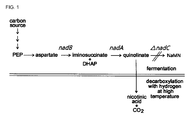
- FIG. 1 illustrates a pathway to produce nicotinic acid in a method of producing nicotinic acid according to an embodiment of the present invention.
- an E. coli -derived nadB gene encoding the wild L-aspartate oxidase was cloned in an expression vector.
- a chromosome of E. coli K12 W3110 strain was used as a template. The strain was purchased from the American Type Culture Collection (ATCC No.23257). Based on the nucleotide sequence for the nadB gene (NCBI Registration No. "GI:89109380”) represented by SEQ ID NO: 24 obtained from the GenBank of the National Institute of Health (NIH GenBank).
- PCR was conducted using chromosomal DNA of E. coli K12 W3110 as the template and oligonucleotides represented by SEQ ID NOs: 2and 3 as primers.
- the polymerase used was PfuUltra TM DNA polymerase (Stratagene, U.S.A.), and PCR was conducted by repeating 30 times of a cycle comprising denaturation at 96°C for 30 seconds, annealing at 50°C for 30 seconds, and extension at 72°C for 2 minutes.
- an amplified gene of about 1.9 kb including the nadB ORF gene and the recognition sites of restriction enzymes Ndel and BamHI was obtained.
- nadB gene obtained through the PCR was recovered by agarose gel elution, and then treated with the restriction enzymes Ndel and BamHI, followed by ligation into a pProLar vector (CloneTech, U.S.A) treated with the restriction enzymes Ndel and BamHI so as to express L-aspartate oxidase from the nadB gene linked to a pPro promoter.
- the resulting vector was named "pPro-nadB vector".
- nadB gene variant library was constructed using the pPro-nadB vector obtained in ⁇ 1-1> as a template by error-prone PCR in the presence of dGTP and MnSO 4 .
- PCR was conducted by repeating 30 times of a cycle comprising denaturation at 96°C for 30 seconds, annealing at 50°C for 30 seconds, and extension at 72°C for 2 minutes. Through the PCR, a DNA fragment of about 1.9 kb was obtained.
- This DNA fragment was purified via agarose gel elution, treated with the restriction enzyme Dpnl (NEB, U.S.A) for about 1 hour, and then transformed into E. coli DH5 ⁇ strain (Invitrogen, U.S.A.) via CaCl 2 method.
- the transformed E. coli DH5a strain was smeared on a Luria-Bertani (LB)-kanamycin(Km) (yeast extract 10 g/L, NaCl 5 g/L, tryptone 10 g/L, kanamycin 25 ⁇ g/L) plate medium, and cultured overnight at 37°C to obtain kanamycin-resistant colonies. Ten clones were randomly selected from them, followed by sequencing.
- the error rate of the nadB gene was estimated to be about 4.5 nucleotide/1 kb.
- the number of strains with a nadB gene variant obtained was about 3x 10 5 or more.
- nadB gene negatively affects on the production of quinolinate under the feedback regulation by NAD ( J Biol Chem. 1982 Jan 25;257(2):626-32 .). For this reason, it is important to discover a nadB gene the feedback regulation by NAD is released. To effectively selecting better naB gene variants, an endogenous nadB gene was removed from a strain. Based on the nucleotide sequence for the nadB gene (NCBI Registration No.
- GI:89109380 represented by SEQ ID NO: 24 obtained from the GenBank of the National Institute of Health (NIH GenBank), primers of SEQ ID NOs: 6 and 7 able to amplify the downstream region of the nadB gene, primers of SEQ ID NOs: 8 and 9 able to amplify the upstream region of the nadB gene, and primers of SEQ ID NOs: 10 and 11 able to amplify loxpCm were constructed.
- PCR was performed using a chromosomal DNA of E. coli K12 W3110 (ATCC NO. 23257) as a template and oligonucleotides of SEQ ID NOs. 6 and 7 as primers to amplify the upstream and SEQ ID NOs. 8 and 9 as primers to amplify downstream regions of nadB gene of 0.4 kb and 0.4 kb, respectively.
- PCR was performed using the plasmid vector containing loxpCm, pLoxpCat2 vector, as a template and oligonucleotides of SEQ ID NOs.
- the polymerase used was PfuUltra TM DNA polymerase (Stratagene, U.S.A), and the PCR was conducted by repeating 30 times of a cycle comprising denaturation at 96°C for 30 seconds, annealing at 53°C for 30 seconds, and extension at 72°C for 1 minute, followed by agarose gel elution to obtain a nadB -upstream fragment, a nadB -downstream fragment, and a loxpCm fragment.
- PCR was conducted using these obtained fragments as templates under the PCR conditions by repeating 10 times of the cycle comprising denaturation at 96°C for 60 seconds, denaturation at 50°C for 60 seconds, and extension at 72°C for 1 minute, and 20 repetition of the cycle after addition of primers of SEQ ID NOs. 7 and 8.
- a nadB -deficient cassette containing the upstream region of nadB gene-loxpCm-downstream region of nadB gene of 1.8 kb was obtained.
- E. coli K12 W3110 strain containing pKD46 as lambda red recombinase expression vector was transformed with the nadB -deficient cassette by electroporation, and then the strain was smeared on a LB plate medium (tryptone 10 g, yeast extract 5 g, NaCl 10 g, chloramphenical 15 ⁇ g/L, and agar 1.5 %) containing chloramphenicol as a selective marker. Thencultured at 37°C overnight to select microorganism strains exhibiting resistance against chloramphenical.
- the selected strains were directly used as templates to perform PCR using primers of SEQ ID NOs. 7 and 8 under the same conditions.
- the gene sizes of the wild strain and the nadB -deficient strain were identified to be 2.4 kb and 0.8 kb, respectively on 1.0% agarose gel, thereby confirming the deletion of nadB gene in E. coli K12 W3110.
- 6-aminopyridine-3-carboxylic acid (6-NA, purchased from Aldrich, U.S.A) as a nicotinic acid analogue
- 6-aminonicotinamide (6-Nm, purchased from Aldrich, U.S.A) as a nicotinamide analogue
- nadB gene variants were primarily selected using the nicotinic acid analogue and nicotinamide analogue, and then the NAD-feedback resistance of each of the selected nadB gene variants was confirmed (ref. Journal of bacteriology, June 1983, p.1126-1136 ).
- L-aspartate oxidase variant plasmid library constructed in ⁇ 1-2> of Example 1 was transformed into W3110- ⁇ nadB strain via CaCl 2 method.
- the transformed W3110- ⁇ nadB strain was smeared on a M9-(6,NA)-(6,Nm) plate medium (NaHPO 4 -7H 2 O 12.8 g, KH 2 PO 4 3 g, NaCl 0.5 g, NH 4 Cl 1 g, MgSO 4 2 mM, CaCl 2 0.1 mM, casamino acid 1 g, 6-aminopyridine-3-carboxylic acid (6-NA) 0.3 g/L, 6-aminonicotinamide (6-Nm) 0.3 g/L) to select colonies with higher growth rate compared to the wild nadB.
- M9-(6,NA)-(6,Nm) plate medium NaHPO 4 -7H 2 O 12.8 g, KH 2 PO 4 3 g, NaCl 0.5 g, NH 4 Cl 1 g, MgSO 4 2 mM, CaCl 2 0.1 mM, casamino acid 1 g, 6-aminopyr
- the selected three strains were each inoculated and cultured in a M9-(6,NA)-(6,Nm) liquid medium (NaHPO 4 -7H 2 O 12.8 g, KH 2 PO 4 3 g, NaCl 0.5 g, NH 4 Cl 1 g, MgSO 4 2 mM, CaCl 2 0.1 mM, casamino acid 1 g, 6-aminopyridine-3-carboxylic acid (6-NA) 0.3 g/L, 6-aminonicotinamide (6-Nm) 0.3 g/L), and then optical densities (OD) thereof were compared.
- M9-(6,NA)-(6,Nm) liquid medium NaHPO 4 -7H 2 O 12.8 g, KH 2 PO 4 3 g,
- the growth rates of pPro-nadB67 were found to be higher than those of the pPro-nadB64 and pPro-nadB72 in the media containing 6-NA and 6-Nm, as shown in Table 4. Accordingly, the pPro-nadB67 was selected and sequence thereof was identified. As a result, the pPro-nadB67 was found to include arginine as substituent for lysine, the 302 nd amino acid from the start amino acid methione.
- E. coli K12 W3110 which is deficient of nadC gene, and contains a pPro-nadB67(Lys302Arg)-pCJ-nadA by using pProlar vetor as an expression vector for nadB gene variant, was named CV01-0518. Then it was deposited under the Budapest Treaty at the Korean Culture Center of Microorganisms (KCCM) with Accession No. KCCM11434P on June 20, 2013.
- KCCM Korean Culture Center of Microorganisms
- PCR was conducted using on chromosomal DNA of E. coli K12 W3110 as a template to obtain a nadC gene that is involved in the decomposition pathway of quinolinate. Based on the nucleotide sequence for the nadC gene (NCBI Registration No.
- GI:89106990 represented by SEQ ID NO: 25 obtained from the GenBank of the National Institute of Health (NIH GenBank), primers represented by SEQ ID NOs: 12 and 13 able to amplify the downstream region of the nadC gene, primers of SEQ ID NOs: 14 and 15 able to amplify the upstream and downstream regions of the nadC gene, and loxpCm gene, and primers of SEQ ID NOs: 16 and 17 able to amplify the upstream region of the nadC gene were constructed.
- PCR was performed using chromosomal DNA of E. coli K12 W3110 as a template and oligonucleotides of SEQ ID NOs: 12 and 13, and 16 and 17 as primers to amplify the upstream and downstream regions of nadC gene of 0.5 kb and 0.3 kb, respectively.
- PCR was performed using a plasmid vector including loxpCm, pLoxpCat2 vector, as a template and oligonucleotides of SEQ ID NOS. 14 and 15 as primers to amplify loxpCm gene having the sequence homologous to nadC gene on both ends of 1.0 kb.
- the polymerase used was PfuUltraTM DNA polymerase (Stratagene, U.S.A), and PCR was conducted by repeating 30 times of a cycle comprising denaturation at 96°C for 30 seconds, annealing at 53°C for 30 seconds, and extension at 72°C for 1 minute, As a result, a nadC-upstream fragment, a nadC-downstream fragment, and a loxpCm fragment were obtained.
- PCR was conducted using these fragments resulting from the above-described PCR as templates under the PCR conditions including 10 repetition of the cycle comprising denaturation at 96°C for 60 seconds, denaturation at 50°C for 60 seconds, and extension at 72°C for 1 minute, and 20 repetition of the cycle after addition of primers of SEQ ID NOs: 12 and 17.
- a nadC -deficient cassette containing the upstream region of nadC gene- loxpCm -downstream region of nadC gene of 1.8 kb was obtained.
- E. coli K12 W3110 strain containing pKD46 as expression vector of lambda red recombinase was transformed with the nadC -deficient cassette by electroporation, and then the strain was smeared on a LB plate medium (tryptone 10 g, yeast extract 5 g, NaCl 10 g, and agar 1.5 %) containing chloramphenicol as a selective marker, and cultured at 37°C overnight to select microorganism strains exhibiting resistance against chloramphenical.
- the selected strains were directly used as templates to perform PCR using primers of SEQ ID NOs: 13 and 16 under the same conditions, and the gene sizes of the wild strain and the nadC -deficient strain were identified to be 1.6 kb and 1.3 kb, respectively on 1.0% agarose gel, thereby confirming the deletion of nadC gene in E. coli K12 W3110., The construction of the nadC -deficient strain, named W3110- ⁇ nadC, was completed.
- nadB and nadA genes encoding the two enzymes were constructed.
- PCR was performed using chromosomal DNA of E. coli W3110 to obtain nadA gene encoding quinolinate synthetase. Based on the nucleotide sequence for the nadA gene (NCBI Registration No.
- GI: 89107601 represented by SEQ ID NO: 26 obtained from the GenBank of the National Institute of Health (NIH GenBank), primers of SEQ ID NOs:18 and 19 able to amplify the ORF region of the nadA gene including ATG and TAA regions and having the recognition sites of restriction enzymes Apal and Notl were synthesized.
- NIH GenBank National Institute of Health
- PCR was performed using chromosomal DNA of E. coli K12 W3110 as a template, and oligonucleotides of SEQ ID NOs: 18 and 19 as primers.
- the polymerase used was PfuUltra TM DNA polymerase (Stratagene, U.S.A), and the PCR was conducted by repeating 30 times of a cycle comprising denaturation at 96°C for 30 seconds, annealing at 50°C for 30 seconds, and extension at 72°C for 1 minute.
- PfuUltra TM DNA polymerase (Stratagene, U.S.A)
- the PCR was conducted by repeating 30 times of a cycle comprising denaturation at 96°C for 30 seconds, annealing at 50°C for 30 seconds, and extension at 72°C for 1 minute.
- an amplified gene of about 1.0 kb including the nadA gene and the recognition sites of restriction enzymes Apal and Notl was obtained.
- a pCJ1 promoter was obtained through PCR using a plasmid including the pCJ1 promoter as a template, based on the disclosure in Korean laid-open Patent No. 10-2006-0068505 .
- Primers represented by SEQ ID NOs: 20 and 21 having the recognition sites of restriction enzymes BamHI and Apal were constructed for ligating the pCJ1 promoter with the amplified nadA gene.
- [Table 7] Nucleotide sequence SEQ ID NO 5' CCGC GGA TCCCACCGCGGGCTTATTCCATTAC 3' 20 5' GAT GGGCCC ATCTTAATCTCCTAGATTGGGTTTC 3' 21
- PCR was performed using chromosomal DNA of E. coli K12 W3110 as a template, and oligonucleotides of SEQ ID NOs: 20 and 21 as primers.
- the polymerase used was PfuUltra TM DNA polymerase (Stratagene, U.S.A), and the PCR was conducted by repeating 30 times of a cycle comprising denaturation at 96°C for 30 seconds, annealing at 50°C for 30 seconds, and extension at 72°C for 1 minute.
- PfuUltra TM DNA polymerase (Stratagene, U.S.A)
- the nadA gene obtained through the PCR was treated with restriction enzymes Apal and Notl, and the amplified pCJ1 promoter fragment was treated with restriction enzymes Apal and BamHI.
- the nadA gene and pCJ1promoter fragment treated with the restriction enzymes, respectively, were cloned via ligation into the pPro- nadB vector obtained in ⁇ 1-1> that was treated with the restriction enzymes Notl and BamHI.
- a pPro-nadB- pCJ1-nadA recombinant vector of 5.9 kb was constructed, inwhich the nadB gene expression is regulated by the pPro promoter as a constitutive promoter, and the nadA gene expression is regulated by pCJ1 promoter.
- the constructed pPro-nadB-pCJ1-nadA had the sequence represented by SEQ ID NO: 27.
- a recombinant vector pPro-nadB67-pCJ1-nadA including the nadB variant and the wild nadA gene was also constructed.
- the constructed pPro-nadB67-pCJ1-nadA had the sequence represented by SEQ ID NO: 28.
- nadB67 gene variant including arginine instead of lysine as the 302 nd amino acid starting from methionine of L-aspartate oxidase
- the 302 nd amino acid of the nadB gene was substituted with each of 18 different amino acids, except for lysine and arginine.
- Quick mutagenesis using the recombinant vector pPro-nadB67-pCJ1-nadA as a template was performed.
- the polymerase used was PfuUltra TM DNA polymerase (Stratagene, U.S.A.).
- PCR was conducted by repeating 18 times of a cycle comprising denaturation at 96°C for 30 seconds, annealing at 55°C for 30 seconds, and extension at 68°C for 15 minutes.
- the resulting PCR product was treated with the restriction enzyme DpnI (NEB, U.S.A), and then transformed into E.coli DH5 ⁇ strain (Invitrogen, U.S.A.) via CaCl2 method.
- the transformed E.coli DH5a strain was smeared on a LB-Km plate medium (yeast extract 10 g/L, NaCl 5 g/L, tryptone 10 g/L, kanamycin 25 ⁇ g/L), and cultured overnight at 37°C to select kanamycin-resistant colonies.
- a quinolinate titer assay was conducted. After the quinolinate-producing strain (W3110- ⁇ nadC) obtained in ⁇ 2-1> of Example 2 was transformed with the plasmid pPro-nadB67-pCJq1-nadA constructed in ⁇ 2-2> of Example 2, and each of the18 types of nadB67 variants constructed in ⁇ 2-2-1> of Example 2 via CaCl2 method.
- the transformed strains were cultured overnight in a LB-Km plate medium in a 37°C culture batch to obtain a single colony, and then the single colony was inoculated by one platinum pool into 25 ml of a culture medium for the quinolinate potency assay and cultured at 37 °C for 24 hours to 72 hours by shaking at 250 rpm.
- Table 9 shows the composition of the culture medium for producing quinolinate.
- nicotinic acid (NA) was added to the culture medium at different concentrations, followed by comparison of the produced quantities of quinolinate.
- composition of the culture medium for quinolinate potency assay Composition Concentration (per liter) Glucose 70 g Ammonium sulfate 17 g KH 2 PO 4 1.0 g MgSO 4 ⁇ 7H 2 O 0.5 g FeSO4 ⁇ 7H 2 O 5 mg MnSO 4 ⁇ 8H 2 O 5 mg ZnSO 4 5 mg Calcium carbonate 30 g Yeast extract 2 g
- the quinlinate-producing variants including the plasmids pPro-nadB67(D)-pCJ-nadA and pPro-nadB67(E)-pCJ-nadA, the nadB gene was destroyed and lost activity.
- the quinlinate-producing variants mostly had very low quinolinate (QA) levels, the level was converted to a residual relative yield in percentage (%). It was based on 100% of the produced QA level when a nicotinic acid (NA) is 0 uM.
- NA nicotinic acid
- the yield of quinolinate was less than 50% when the pPro-nadB-pCJ-nadA plasmid including the wild type nadB gene was used, and the culture medium contains nicotinic acid, over 5 uM or greater. Whereas the yield of quinolinate was 70% or greater when the pPro-nadB67-pCJ-nadA plasmid and 302 nd variants recombinant plasmids including the nadB gene variant were used.
- W3110 - ⁇ nadC strain is an NAD auxotroph that requires supply of external NAD for growth.
- W3110- ⁇ nadC strain is unable to directly accept NAD, and uses heterogenous nicotinic acid (NA) or nicotinamide (Nm) to produce NAD.
- NA nicotinic acid
- Nm nicotinamide
- the nadB gene is feedback-regulated to maintain the amount of intracellular NAD constant. Accordingly, the production of QA may be limited by the nadB gene that is feedback-regulated.
- Adding NA to a culture medium means an increase of NAD in a strain. Accordingly, the production quantities of QA were compared between the strains with the addition of NA to the culture medium at different concentrations to identify a degree of feedback regulation in the nadB gene variants with respect to NAD concentration. As a result, the nadB gene variants with substituted 302 nd amino acids were found that the feedback regulation by NAD is released.
- the production method of nicotinic acid used herein was decarboxylation of the quinolinate-including culture solution under high-temperature and high-pressure conditions based on the disclosure of Korean Patent No. 10-1223904 , to convert quinolinate to nicotinic acid.
- centrifugation was performed at about 3000 rpm to about 4000 rpm for about 10 minutes to about 30 minutes. The quinolinate-containing supernatant resulting from the centrifugation was separated and used as a sample for decarboxylation reaction.
- the decarboxylation reaction was conducted at about 135°C at about 0.2 MPa for about 3 hours.
- the samples used are shown in Table 12.
- An aqueous solution of quinolinate (a standard product of Sigma-Aldrich Co.) in deionized water was used as a control group.
- Each samples of the aqueous solutions of quinolinate was titrated with sodium hydroxide, ammonia water, hydrochloric acid, or sulfuric acid, specifically the conversion of quinolinate into nicotinic acid took place at pH of 2.
- Table 12 shows the production quantities of nicotinic acid converted from quinolinate of Table 10 through high-temperature and high-pressure reaction.
- the NAD-feedback resistance of a L-aspartate oxidase variant encoded by the nadB67 variant selected in ⁇ Example 1-3-2> was evaluated.
- PCR was performed using the wild type pPro-nadB plasmid and the recombinant pPro-nadB67 as templates, respectively.
- primers of SEQ ID NOs: 22 and 23 able to amplify the ORF region of the wild type nadB and the variant nadB67 gene that includes ATG and TAA regions and having the recognition sites of the restriction enzymes BamHI and NdeI were constructed.
- [Table 13] Nucleotide sequence SEQ ID NO. 5' AATTGGATCCGATGAATACTCTCCCTGAACATT 3' 22 5' AATTCATATGTTATCTGTTTATGTAATGATTGC 3' 23
- the polymerase used was PfuUltraTM DNA polymerase (Stratagene, U.S.A), and the PCR was conducted by repeating 30 times of a cycle comprising denaturation at 96°C for 30 seconds, annealing at 50°C for 30 seconds, and extension at 72°C for 2 minutes.
- amplified genes of about 1.9 kb of the wild type nadB and the nadB67 variant including the recognition sites of the restriction enzymes BamHI and NdeI was obtained.
- the genes of the wild type nadB and nadB67 variant obtained through the PCR was treated with the restriction enzymes BamHI and NdeI, and then cloned via ligation into a pCDF-duet vector treated with the restriction enzymes BamHI and NdeI.
- recombinant vectors including the genes of the wild type nadB and the nadB67 variant, respectively was constructed wherein the expression of each of the genes is controllable by a T7 promoter as a constitutive promoter and the gene contains the His-tag capable of protein purification.
- the constructed recombinant vectors were named pT7-nadB and pT7-nadB67, respectively.
- pT7-nadB, pT7-nadB67, pT7-nadB67(V), pT7-nadB67(L), pT7-nadB67(I), or pT7-nadB67(H) was transformed into a tuner strain via CaCl 2 method, the transformed strain was smeared on a LB-SP (yeast extract 10 g/L, NaCl 5 g/L, tryptone 10 g/L, and spectinomycin 50 ⁇ g/L) plate medium, and cultured overnight at 37°C to select spectinomycin-resistant colonies.
- LB-SP yeast extract 10 g/L, NaCl 5 g/L, tryptone 10 g/L, and spectinomycin 50 ⁇ g/L
- LB-SP yeast extract 10 g/L, NaCl 5 g/L, tryptone 10 g/L, spectinomycin 50 ⁇ g/L
- IPTG isopropyl-1-thio- ⁇ -D-galactopyranoside
- Cells including the overexpressed wild type L-aspartate oxidase and L-aspartate oxidase variants were recovered from the culture medium, followed by purification of the wild type L-aspartate oxidase and L-aspartate oxidase variants from the recovered cells by Ni-NTA spin kit (Quiagen, U.S.A).
- the recovered protein was 50% of a total protein, about 2% of the recovered protein was recovered as L-aspartate oxidase.
- the L-aspartate oxidase converts aspartate as a substrate to iminoaspartate in the presence of an FAD as cofactor, and the imminoaspartate is converted b to oxaloacetate.
- Hydrogen peroxide (H 2 O 2 ) that is generated through the above-described reaction, was used to identify the activity of the nadB. Absorbance at 560 nm of a reaction product of H 2 O 2 with a product from the reaction was measured using an Amplex Red (Invitrogen, Korea) to determine the activity of the nadB.
- NAD was added at different concentrations to create a condition for competitive inhibition to FAD so as to evaluate the resistance of L-aspartate oxidase against the feedback regulation by NAD.
- the Relative activity of the wild type L-aspartate oxidase at a NAD concentration of 1 mM was less than 50 %, while the relative activities of the L-aspartate oxidase variants at the same NAD concentration remained about 70% or higher (Table 14), thereby indicating that the feedback regulation by NAD was released in L-aspartate oxidase variants.
- the present invention is related to L-aspartate oxidase variants that are resistant against the feedback regulation by nicotinic acid or NAD, and thus may effectively produce quinolinate.
- Quinolinate may be effectively produced by culturing of a microorganism including such a L-aspartate oxidase variant according to the embodiments of the present invention.
- Quinolinate may also be effectively produced using the microorganism in which the activity of quinolinate synthetase is additionally enhanced or the activity of quinolinate phosphoribosyltransferase is additionally weakened. Through such transformation of the microorganism, the yield of quinolinate or nicotinic acid may be improved, which is industrially and highly useful.
Landscapes
- Chemical & Material Sciences (AREA)
- Organic Chemistry (AREA)
- Life Sciences & Earth Sciences (AREA)
- Health & Medical Sciences (AREA)
- Engineering & Computer Science (AREA)
- Zoology (AREA)
- Wood Science & Technology (AREA)
- Genetics & Genomics (AREA)
- Bioinformatics & Cheminformatics (AREA)
- General Engineering & Computer Science (AREA)
- General Health & Medical Sciences (AREA)
- Biochemistry (AREA)
- Biotechnology (AREA)
- Microbiology (AREA)
- Biomedical Technology (AREA)
- Molecular Biology (AREA)
- Medicinal Chemistry (AREA)
- Chemical Kinetics & Catalysis (AREA)
- General Chemical & Material Sciences (AREA)
- Physics & Mathematics (AREA)
- Biophysics (AREA)
- Plant Pathology (AREA)
- Tropical Medicine & Parasitology (AREA)
- Virology (AREA)
- Micro-Organisms Or Cultivation Processes Thereof (AREA)
- Preparation Of Compounds By Using Micro-Organisms (AREA)
- Enzymes And Modification Thereof (AREA)
Applications Claiming Priority (1)
| Application Number | Priority Date | Filing Date | Title |
|---|---|---|---|
| KR1020130088240A KR101634582B1 (ko) | 2013-07-25 | 2013-07-25 | 니코틴산 또는 nad에 대한 피드백 조절이 해제된 l-아스파르테이트 옥시다제 변이체 및 이를 이용한 퀴놀리네이트 또는 니코틴산 생산 방법 |
Publications (2)
| Publication Number | Publication Date |
|---|---|
| EP2829602A1 true EP2829602A1 (de) | 2015-01-28 |
| EP2829602B1 EP2829602B1 (de) | 2018-01-31 |
Family
ID=51220504
Family Applications (1)
| Application Number | Title | Priority Date | Filing Date |
|---|---|---|---|
| EP14178598.0A Active EP2829602B1 (de) | 2013-07-25 | 2014-07-25 | L-Aspartatoxidasevariante und Verfahren zur Herstellung von Chinolinat oder Nicotinsäure damit |
Country Status (10)
| Country | Link |
|---|---|
| US (1) | US9290743B2 (de) |
| EP (1) | EP2829602B1 (de) |
| JP (1) | JP6211191B2 (de) |
| KR (1) | KR101634582B1 (de) |
| CN (1) | CN104450638B (de) |
| BR (1) | BR102014018364B1 (de) |
| ES (1) | ES2664092T3 (de) |
| MY (1) | MY172675A (de) |
| RU (1) | RU2648167C2 (de) |
| WO (1) | WO2015012641A1 (de) |
Cited By (1)
| Publication number | Priority date | Publication date | Assignee | Title |
|---|---|---|---|---|
| CN115948358A (zh) * | 2022-05-27 | 2023-04-11 | 中国石油大学(华东) | L-天冬氨酸氧化酶SaAO及其编码基因和应用 |
Families Citing this family (7)
| Publication number | Priority date | Publication date | Assignee | Title |
|---|---|---|---|---|
| KR101656363B1 (ko) * | 2014-07-07 | 2016-09-09 | 씨제이제일제당 주식회사 | 퀴놀린산을 생산하는 재조합 미생물 및 이를 이용한 퀴놀린산의 생산 방법 |
| KR101758446B1 (ko) * | 2015-02-03 | 2017-07-17 | 씨제이제일제당 (주) | 퀴놀린산 생산능을 가지는 미생물 및 이를 이용하여 퀴놀린산을 생산하는 방법 |
| KR101776375B1 (ko) * | 2015-03-18 | 2017-09-08 | 씨제이제일제당 (주) | 피루브산 디하이드로게나아제 변이체, 이를 포함하는 미생물 및 이를 이용한 l-아미노산 생산 방법 |
| JP2018076715A (ja) * | 2016-11-10 | 2018-05-17 | 大阪瓦斯株式会社 | 石油増進回収方法 |
| CN111909907B (zh) * | 2020-07-08 | 2022-05-24 | 浙江工业大学 | 天冬氨酸氧化酶突变体、工程菌及其在氧化-还原偶联制备精草铵膦中的应用 |
| CN116396973B (zh) * | 2022-11-28 | 2025-02-25 | 杭州唯铂莱生物科技有限公司 | 一种制备烟酰胺的表达盒组合、重组菌及烟酰胺的生产方法 |
| CN119662617B (zh) * | 2024-12-11 | 2026-01-30 | 河南大学 | 烟酰胺酶突变体及其在生产烟酸中的方法 |
Citations (4)
| Publication number | Priority date | Publication date | Assignee | Title |
|---|---|---|---|---|
| KR20060068505A (ko) | 2004-12-16 | 2006-06-21 | 씨제이 주식회사 | 코리네박테리움 속 세포로부터 유래된 신규한 프로모터서열, 그를 포함하는 발현 카세트 및 벡터, 상기 벡터를포함하는 숙주 세포 및 그를 이용하여 유전자를 발현하는방법 |
| CN101353322A (zh) | 2008-09-09 | 2009-01-28 | 浙江大学 | 高温液态水中吡啶二甲酸无催化脱羧制备烟酸的方法 |
| WO2012096553A2 (en) * | 2011-01-14 | 2012-07-19 | Cj Cheiljedang Corporation | Method for the preparation of nicotinic acid |
| WO2013103246A2 (ko) * | 2012-01-06 | 2013-07-11 | 씨제이제일제당 (주) | 퀴놀린산을 생산하는 재조합 미생물 및 이를 이용한 퀴놀린산의 생산 방법 |
Family Cites Families (1)
| Publication number | Priority date | Publication date | Assignee | Title |
|---|---|---|---|---|
| US6271031B1 (en) * | 1998-08-12 | 2001-08-07 | E.I. Du Pont De Nemours And Company | Quinolinate metabolism enzymes |
-
2013
- 2013-07-25 KR KR1020130088240A patent/KR101634582B1/ko active Active
-
2014
- 2014-07-25 BR BR102014018364-7A patent/BR102014018364B1/pt active IP Right Grant
- 2014-07-25 MY MYPI2016000093A patent/MY172675A/en unknown
- 2014-07-25 WO PCT/KR2014/006817 patent/WO2015012641A1/en not_active Ceased
- 2014-07-25 US US14/341,137 patent/US9290743B2/en active Active
- 2014-07-25 RU RU2016106171A patent/RU2648167C2/ru active
- 2014-07-25 CN CN201410588148.1A patent/CN104450638B/zh active Active
- 2014-07-25 JP JP2016529717A patent/JP6211191B2/ja active Active
- 2014-07-25 EP EP14178598.0A patent/EP2829602B1/de active Active
- 2014-07-25 ES ES14178598.0T patent/ES2664092T3/es active Active
Patent Citations (6)
| Publication number | Priority date | Publication date | Assignee | Title |
|---|---|---|---|---|
| KR20060068505A (ko) | 2004-12-16 | 2006-06-21 | 씨제이 주식회사 | 코리네박테리움 속 세포로부터 유래된 신규한 프로모터서열, 그를 포함하는 발현 카세트 및 벡터, 상기 벡터를포함하는 숙주 세포 및 그를 이용하여 유전자를 발현하는방법 |
| KR100620092B1 (ko) | 2004-12-16 | 2006-09-08 | 씨제이 주식회사 | 코리네박테리움 속 세포로부터 유래된 신규한 프로모터서열, 그를 포함하는 발현 카세트 및 벡터, 상기 벡터를포함하는 숙주 세포 및 그를 이용하여 유전자를 발현하는방법 |
| CN101353322A (zh) | 2008-09-09 | 2009-01-28 | 浙江大学 | 高温液态水中吡啶二甲酸无催化脱羧制备烟酸的方法 |
| WO2012096553A2 (en) * | 2011-01-14 | 2012-07-19 | Cj Cheiljedang Corporation | Method for the preparation of nicotinic acid |
| KR101223904B1 (ko) | 2011-01-14 | 2013-01-21 | 씨제이제일제당 (주) | 니코틴산의 제조 방법 |
| WO2013103246A2 (ko) * | 2012-01-06 | 2013-07-11 | 씨제이제일제당 (주) | 퀴놀린산을 생산하는 재조합 미생물 및 이를 이용한 퀴놀린산의 생산 방법 |
Non-Patent Citations (14)
| Title |
|---|
| "Manual of Methods for General Bacteriology", 1981, AMERICAN SOCIETY FOR BACTERIOLOGY |
| AHMED BELMOUDEN ET AL: "Molecular cloning and nucleotide sequence of cDNA encoding rat kidney long-chain l-2-hydroxy acid oxidase. Expression of the catalytically active recombinant protein as a chimaera", EUROPEAN JOURNAL OF BIOCHEMISTRY, vol. 214, no. 1, 1 May 1993 (1993-05-01), pages 17 - 25, XP055153757, ISSN: 0014-2956, DOI: 10.1111/j.1432-1033.1993.tb17891.x * |
| F.M. AUSUBEL ET AL.,: "Current Protocols in Molecular Biology", JOHN WILEY & SONS, INC. |
| HUGHES K T ET AL: "6-Aminonicotinamide-resistant mutants of Salmonella typhimurium.", JOURNAL OF BACTERIOLOGY JUN 1983, vol. 154, no. 3, June 1983 (1983-06-01), pages 1126 - 1136, XP002732644, ISSN: 0021-9193 * |
| J BIOL CHEM., vol. 257, no. 2, 25 January 1982 (1982-01-25), pages 626 - 32 |
| J. SAMBROOK ET AL.,: "Molecular Cloning (A Laboratory Manual, 2nd Edition,", 1989, COLD SPRING HARBOR LABORATORY PRESS |
| JAMES M. LEE,: "Biochemical Engineering", PRENTICE-HALL INTERNATIONAL EDITIONS, pages: 138 - 176 |
| JOURNAL OF BACTERIOLOGY, June 1983 (1983-06-01), pages 1126 - 1136 |
| K H DIÊP ET AL: "0 1991 by The American Society for Biochemistry and Molecular Biology, Inc. Amino Acid Sequence of Long Chain a-Hydroxy Acid Oxidase from Rat Kidney, a Member of the Family of FMN-dependent &-Hydroxy Acid-oxidizing Enzymes*", JOURNAL OF BIOLOGICAL CHEMISTRY, 5 November 1991 (1991-11-05), pages 20877 - 20881, XP055153692, Retrieved from the Internet <URL:http://www.jbc.org/content/266/31/20877.full.pdf> [retrieved on 20141118] * |
| MICHELE MORTARINO ET AL: "L-Aspartate Oxidase from Escherichia coli. I. Characterization of Coenzyme Binding and Product Inhibition", EUROPEAN JOURNAL OF BIOCHEMISTRY, vol. 239, no. 2, 15 July 1996 (1996-07-15), pages 418 - 426, XP055153570, ISSN: 0014-2956, DOI: 10.1111/j.1432-1033.1996.0418u.x * |
| MOL SYST BIOL., 21 February 2006 (2006-02-21) |
| MOL SYST BIOL., vol. 2, 21 February 2006 (2006-02-21) |
| S NASU ET AL: "THE JOURNAL OP BIOLOGICAL CHEMISTRY L-Aspartate Oxidase, a Newly Discovered Enzyme of Escherichia coli, Is the B Protein of Quinolinate Synthetase*", THE JOURNAL OP BIOLOGICAL CHEMISTRY, vol. 17, no. 257, 25 January 1982 (1982-01-25), pages 626 - 632, XP055153472 * |
| SEIFERT J ET AL: "EXPRESSION OF THE E. COLI NADB GENE AND CHARACTERIZATION OF THE GENE PRODUCT L-ASPARTATE OXIDASE", BIOLOGICAL CHEMISTRY HOPPE-SEYLER, WALTER DE GRUYTER, BERLIN, DE, vol. 371, no. 3, 1 March 1990 (1990-03-01), pages 239 - 248, XP001063255, ISSN: 0177-3593 * |
Cited By (2)
| Publication number | Priority date | Publication date | Assignee | Title |
|---|---|---|---|---|
| CN115948358A (zh) * | 2022-05-27 | 2023-04-11 | 中国石油大学(华东) | L-天冬氨酸氧化酶SaAO及其编码基因和应用 |
| CN115948358B (zh) * | 2022-05-27 | 2024-04-12 | 中国石油大学(华东) | L-天冬氨酸氧化酶SaAO及其编码基因和应用 |
Also Published As
| Publication number | Publication date |
|---|---|
| RU2648167C2 (ru) | 2018-03-22 |
| CN104450638B (zh) | 2017-08-04 |
| KR20150014006A (ko) | 2015-02-06 |
| BR102014018364A2 (pt) | 2015-11-17 |
| BR102014018364B1 (pt) | 2022-09-20 |
| US9290743B2 (en) | 2016-03-22 |
| ES2664092T3 (es) | 2018-04-18 |
| RU2016106171A (ru) | 2017-08-30 |
| MY172675A (en) | 2019-12-10 |
| US20150031093A1 (en) | 2015-01-29 |
| JP2016525353A (ja) | 2016-08-25 |
| CN104450638A (zh) | 2015-03-25 |
| EP2829602B1 (de) | 2018-01-31 |
| WO2015012641A1 (en) | 2015-01-29 |
| KR101634582B1 (ko) | 2016-06-30 |
| JP6211191B2 (ja) | 2017-10-11 |
Similar Documents
| Publication | Publication Date | Title |
|---|---|---|
| EP2829602B1 (de) | L-Aspartatoxidasevariante und Verfahren zur Herstellung von Chinolinat oder Nicotinsäure damit | |
| EP3272860B1 (de) | Pyruvat-dehydrogenase-mutant, mikroorganismus mit dem mutanten sowie verfahren zur herstellung von l-aminosäure mit dem mikroorganismus | |
| EP2998388A1 (de) | O-acetyl-homoserin-produzierender mikroorganismus und verfahren zur herstellung von o-acetyl-homoserin mittels mikroorganismen | |
| JP2018531033A (ja) | L−イソロイシン生産能を有するコリネバクテリウム属微生物及びこれを用いてl−イソロイシンを生産する方法 | |
| JP2018531033A6 (ja) | L−イソロイシン生産能を有するコリネバクテリウム属微生物及びこれを用いてl−イソロイシンを生産する方法 | |
| JP7730378B2 (ja) | 3-メチル-2-オキソブタノエートヒドロキシメチルトランスフェラーゼの活性が強化された微生物、およびその用途 | |
| JP2018529354A (ja) | L−トレオニンを生産する組み換え微生物及びそれを用いてl−トレオニンを生産する方法 | |
| EP3926048A1 (de) | Mikroorganismus zur produktion von l-aminosäure sowie verfahren zur produktion von l-aminosäure damit | |
| EP2663646B1 (de) | Verfahren zur herstellung von nikotinsäure | |
| CN104160015B (zh) | 生产喹啉酸的重组微生物及利用该微生物的喹啉酸生产方法 | |
| JP7607785B2 (ja) | プレフェナート脱水酵素変異体及びそれを用いた分岐鎖アミノ酸生産方法 | |
| JP6697525B2 (ja) | キノリン酸を生産する組み換え微生物、及びそれを利用したキノリン酸の生産方法 | |
| EP4047086A1 (de) | Neues mutiertes polypeptid mit abgeschwächter aktivität der citratsynthase und l-aminosäureherstellungsverfahren damit | |
| EP4446417A1 (de) | Corynebacterium glutamicum-variante mit verbesserter l-lysin-produktionsfähigkeit und verfahren zur herstellung von l-lysin damit | |
| EP3153575B1 (de) | Mikroorganismus mit fähigkeit zur herstellung von o-succinylhomoserin oder bernsteinsäure und verfahren zur herstellung von bernsteinsäure oder o-succinylhomoserin damit | |
| JP7470187B2 (ja) | アセトヒドロキシ酸シンターゼ新規変異体及びこれを含む微生物 | |
| EP3964572A1 (de) | Mutante von corynebacterium glutamicum mit erhöhter l-lysinproduktivität und verfahren zur herstellung von l-lysin damit | |
| JP6502515B2 (ja) | キノリン酸生産能を有する微生物及びそれを用いてキノリン酸を生産する方法 | |
| KR20150028121A (ko) | Nad+ 의존성 포르메이트 데히드로게나제 유전자를 포함하는 코리네박테리움 및 이를 이용한 c4 디카르복실산 생산 방법 | |
| KR102495918B1 (ko) | aroG 알돌라아제 (Phospho-2-dehydro-3-deoxyheptonate aldolase) 변이체 및 이를 이용한 분지쇄 아미노산 생산 방법 |
Legal Events
| Date | Code | Title | Description |
|---|---|---|---|
| 17P | Request for examination filed |
Effective date: 20140725 |
|
| AK | Designated contracting states |
Kind code of ref document: A1 Designated state(s): AL AT BE BG CH CY CZ DE DK EE ES FI FR GB GR HR HU IE IS IT LI LT LU LV MC MK MT NL NO PL PT RO RS SE SI SK SM TR |
|
| AX | Request for extension of the european patent |
Extension state: BA ME |
|
| PUAI | Public reference made under article 153(3) epc to a published international application that has entered the european phase |
Free format text: ORIGINAL CODE: 0009012 |
|
| 17Q | First examination report despatched |
Effective date: 20160615 |
|
| STAA | Information on the status of an ep patent application or granted ep patent |
Free format text: STATUS: EXAMINATION IS IN PROGRESS |
|
| GRAP | Despatch of communication of intention to grant a patent |
Free format text: ORIGINAL CODE: EPIDOSNIGR1 |
|
| STAA | Information on the status of an ep patent application or granted ep patent |
Free format text: STATUS: GRANT OF PATENT IS INTENDED |
|
| INTG | Intention to grant announced |
Effective date: 20171020 |
|
| GRAS | Grant fee paid |
Free format text: ORIGINAL CODE: EPIDOSNIGR3 |
|
| GRAA | (expected) grant |
Free format text: ORIGINAL CODE: 0009210 |
|
| STAA | Information on the status of an ep patent application or granted ep patent |
Free format text: STATUS: THE PATENT HAS BEEN GRANTED |
|
| AK | Designated contracting states |
Kind code of ref document: B1 Designated state(s): AL AT BE BG CH CY CZ DE DK EE ES FI FR GB GR HR HU IE IS IT LI LT LU LV MC MK MT NL NO PL PT RO RS SE SI SK SM TR |
|
| REG | Reference to a national code |
Ref country code: GB Ref legal event code: FG4D Ref country code: CH Ref legal event code: EP |
|
| REG | Reference to a national code |
Ref country code: AT Ref legal event code: REF Ref document number: 967421 Country of ref document: AT Kind code of ref document: T Effective date: 20180215 |
|
| REG | Reference to a national code |
Ref country code: IE Ref legal event code: FG4D |
|
| REG | Reference to a national code |
Ref country code: CH Ref legal event code: NV Representative=s name: ISLER AND PEDRAZZINI AG, CH |
|
| REG | Reference to a national code |
Ref country code: DE Ref legal event code: R096 Ref document number: 602014020274 Country of ref document: DE |
|
| REG | Reference to a national code |
Ref country code: NL Ref legal event code: FP |
|
| REG | Reference to a national code |
Ref country code: ES Ref legal event code: FG2A Ref document number: 2664092 Country of ref document: ES Kind code of ref document: T3 Effective date: 20180418 |
|
| REG | Reference to a national code |
Ref country code: FR Ref legal event code: PLFP Year of fee payment: 5 |
|
| REG | Reference to a national code |
Ref country code: LT Ref legal event code: MG4D |
|
| REG | Reference to a national code |
Ref country code: AT Ref legal event code: MK05 Ref document number: 967421 Country of ref document: AT Kind code of ref document: T Effective date: 20180131 |
|
| PG25 | Lapsed in a contracting state [announced via postgrant information from national office to epo] |
Ref country code: LT Free format text: LAPSE BECAUSE OF FAILURE TO SUBMIT A TRANSLATION OF THE DESCRIPTION OR TO PAY THE FEE WITHIN THE PRESCRIBED TIME-LIMIT Effective date: 20180131 Ref country code: HR Free format text: LAPSE BECAUSE OF FAILURE TO SUBMIT A TRANSLATION OF THE DESCRIPTION OR TO PAY THE FEE WITHIN THE PRESCRIBED TIME-LIMIT Effective date: 20180131 Ref country code: NO Free format text: LAPSE BECAUSE OF FAILURE TO SUBMIT A TRANSLATION OF THE DESCRIPTION OR TO PAY THE FEE WITHIN THE PRESCRIBED TIME-LIMIT Effective date: 20180430 Ref country code: FI Free format text: LAPSE BECAUSE OF FAILURE TO SUBMIT A TRANSLATION OF THE DESCRIPTION OR TO PAY THE FEE WITHIN THE PRESCRIBED TIME-LIMIT Effective date: 20180131 |
|
| PG25 | Lapsed in a contracting state [announced via postgrant information from national office to epo] |
Ref country code: RS Free format text: LAPSE BECAUSE OF FAILURE TO SUBMIT A TRANSLATION OF THE DESCRIPTION OR TO PAY THE FEE WITHIN THE PRESCRIBED TIME-LIMIT Effective date: 20180131 Ref country code: PL Free format text: LAPSE BECAUSE OF FAILURE TO SUBMIT A TRANSLATION OF THE DESCRIPTION OR TO PAY THE FEE WITHIN THE PRESCRIBED TIME-LIMIT Effective date: 20180131 Ref country code: AT Free format text: LAPSE BECAUSE OF FAILURE TO SUBMIT A TRANSLATION OF THE DESCRIPTION OR TO PAY THE FEE WITHIN THE PRESCRIBED TIME-LIMIT Effective date: 20180131 Ref country code: LV Free format text: LAPSE BECAUSE OF FAILURE TO SUBMIT A TRANSLATION OF THE DESCRIPTION OR TO PAY THE FEE WITHIN THE PRESCRIBED TIME-LIMIT Effective date: 20180131 Ref country code: SE Free format text: LAPSE BECAUSE OF FAILURE TO SUBMIT A TRANSLATION OF THE DESCRIPTION OR TO PAY THE FEE WITHIN THE PRESCRIBED TIME-LIMIT Effective date: 20180131 Ref country code: BG Free format text: LAPSE BECAUSE OF FAILURE TO SUBMIT A TRANSLATION OF THE DESCRIPTION OR TO PAY THE FEE WITHIN THE PRESCRIBED TIME-LIMIT Effective date: 20180430 Ref country code: IS Free format text: LAPSE BECAUSE OF FAILURE TO SUBMIT A TRANSLATION OF THE DESCRIPTION OR TO PAY THE FEE WITHIN THE PRESCRIBED TIME-LIMIT Effective date: 20180531 |
|
| REG | Reference to a national code |
Ref country code: GR Ref legal event code: EP Ref document number: 20180400966 Country of ref document: GR Effective date: 20180829 |
|
| PG25 | Lapsed in a contracting state [announced via postgrant information from national office to epo] |
Ref country code: AL Free format text: LAPSE BECAUSE OF FAILURE TO SUBMIT A TRANSLATION OF THE DESCRIPTION OR TO PAY THE FEE WITHIN THE PRESCRIBED TIME-LIMIT Effective date: 20180131 Ref country code: EE Free format text: LAPSE BECAUSE OF FAILURE TO SUBMIT A TRANSLATION OF THE DESCRIPTION OR TO PAY THE FEE WITHIN THE PRESCRIBED TIME-LIMIT Effective date: 20180131 Ref country code: RO Free format text: LAPSE BECAUSE OF FAILURE TO SUBMIT A TRANSLATION OF THE DESCRIPTION OR TO PAY THE FEE WITHIN THE PRESCRIBED TIME-LIMIT Effective date: 20180131 |
|
| REG | Reference to a national code |
Ref country code: DE Ref legal event code: R097 Ref document number: 602014020274 Country of ref document: DE |
|
| PG25 | Lapsed in a contracting state [announced via postgrant information from national office to epo] |
Ref country code: SK Free format text: LAPSE BECAUSE OF FAILURE TO SUBMIT A TRANSLATION OF THE DESCRIPTION OR TO PAY THE FEE WITHIN THE PRESCRIBED TIME-LIMIT Effective date: 20180131 Ref country code: SM Free format text: LAPSE BECAUSE OF FAILURE TO SUBMIT A TRANSLATION OF THE DESCRIPTION OR TO PAY THE FEE WITHIN THE PRESCRIBED TIME-LIMIT Effective date: 20180131 Ref country code: CZ Free format text: LAPSE BECAUSE OF FAILURE TO SUBMIT A TRANSLATION OF THE DESCRIPTION OR TO PAY THE FEE WITHIN THE PRESCRIBED TIME-LIMIT Effective date: 20180131 Ref country code: DK Free format text: LAPSE BECAUSE OF FAILURE TO SUBMIT A TRANSLATION OF THE DESCRIPTION OR TO PAY THE FEE WITHIN THE PRESCRIBED TIME-LIMIT Effective date: 20180131 |
|
| PLBE | No opposition filed within time limit |
Free format text: ORIGINAL CODE: 0009261 |
|
| STAA | Information on the status of an ep patent application or granted ep patent |
Free format text: STATUS: NO OPPOSITION FILED WITHIN TIME LIMIT |
|
| 26N | No opposition filed |
Effective date: 20181102 |
|
| PG25 | Lapsed in a contracting state [announced via postgrant information from national office to epo] |
Ref country code: SI Free format text: LAPSE BECAUSE OF FAILURE TO SUBMIT A TRANSLATION OF THE DESCRIPTION OR TO PAY THE FEE WITHIN THE PRESCRIBED TIME-LIMIT Effective date: 20180131 |
|
| PG25 | Lapsed in a contracting state [announced via postgrant information from national office to epo] |
Ref country code: MC Free format text: LAPSE BECAUSE OF FAILURE TO SUBMIT A TRANSLATION OF THE DESCRIPTION OR TO PAY THE FEE WITHIN THE PRESCRIBED TIME-LIMIT Effective date: 20180131 Ref country code: LU Free format text: LAPSE BECAUSE OF NON-PAYMENT OF DUE FEES Effective date: 20180725 |
|
| REG | Reference to a national code |
Ref country code: BE Ref legal event code: MM Effective date: 20180731 |
|
| REG | Reference to a national code |
Ref country code: IE Ref legal event code: MM4A |
|
| PG25 | Lapsed in a contracting state [announced via postgrant information from national office to epo] |
Ref country code: IE Free format text: LAPSE BECAUSE OF NON-PAYMENT OF DUE FEES Effective date: 20180725 |
|
| PG25 | Lapsed in a contracting state [announced via postgrant information from national office to epo] |
Ref country code: BE Free format text: LAPSE BECAUSE OF NON-PAYMENT OF DUE FEES Effective date: 20180731 |
|
| PG25 | Lapsed in a contracting state [announced via postgrant information from national office to epo] |
Ref country code: MT Free format text: LAPSE BECAUSE OF NON-PAYMENT OF DUE FEES Effective date: 20180725 |
|
| PG25 | Lapsed in a contracting state [announced via postgrant information from national office to epo] |
Ref country code: TR Free format text: LAPSE BECAUSE OF FAILURE TO SUBMIT A TRANSLATION OF THE DESCRIPTION OR TO PAY THE FEE WITHIN THE PRESCRIBED TIME-LIMIT Effective date: 20180131 |
|
| PG25 | Lapsed in a contracting state [announced via postgrant information from national office to epo] |
Ref country code: PT Free format text: LAPSE BECAUSE OF FAILURE TO SUBMIT A TRANSLATION OF THE DESCRIPTION OR TO PAY THE FEE WITHIN THE PRESCRIBED TIME-LIMIT Effective date: 20180131 Ref country code: HU Free format text: LAPSE BECAUSE OF FAILURE TO SUBMIT A TRANSLATION OF THE DESCRIPTION OR TO PAY THE FEE WITHIN THE PRESCRIBED TIME-LIMIT; INVALID AB INITIO Effective date: 20140725 |
|
| PG25 | Lapsed in a contracting state [announced via postgrant information from national office to epo] |
Ref country code: CY Free format text: LAPSE BECAUSE OF FAILURE TO SUBMIT A TRANSLATION OF THE DESCRIPTION OR TO PAY THE FEE WITHIN THE PRESCRIBED TIME-LIMIT Effective date: 20180131 Ref country code: MK Free format text: LAPSE BECAUSE OF NON-PAYMENT OF DUE FEES Effective date: 20180131 |
|
| P01 | Opt-out of the competence of the unified patent court (upc) registered |
Effective date: 20230606 |
|
| PGFP | Annual fee paid to national office [announced via postgrant information from national office to epo] |
Ref country code: NL Payment date: 20250520 Year of fee payment: 12 |
|
| PGFP | Annual fee paid to national office [announced via postgrant information from national office to epo] |
Ref country code: GB Payment date: 20250520 Year of fee payment: 12 |
|
| PGFP | Annual fee paid to national office [announced via postgrant information from national office to epo] |
Ref country code: IT Payment date: 20250523 Year of fee payment: 12 |
|
| PGFP | Annual fee paid to national office [announced via postgrant information from national office to epo] |
Ref country code: FR Payment date: 20250521 Year of fee payment: 12 |
|
| PGFP | Annual fee paid to national office [announced via postgrant information from national office to epo] |
Ref country code: GR Payment date: 20250520 Year of fee payment: 12 |
|
| PGFP | Annual fee paid to national office [announced via postgrant information from national office to epo] |
Ref country code: ES Payment date: 20250822 Year of fee payment: 12 |
|
| PGFP | Annual fee paid to national office [announced via postgrant information from national office to epo] |
Ref country code: DE Payment date: 20250520 Year of fee payment: 12 |
|
| PGFP | Annual fee paid to national office [announced via postgrant information from national office to epo] |
Ref country code: CH Payment date: 20250801 Year of fee payment: 12 |