EP2828336B1 - Hellgefärbte flammgeschützte polyamide - Google Patents
Hellgefärbte flammgeschützte polyamide Download PDFInfo
- Publication number
- EP2828336B1 EP2828336B1 EP13710853.6A EP13710853A EP2828336B1 EP 2828336 B1 EP2828336 B1 EP 2828336B1 EP 13710853 A EP13710853 A EP 13710853A EP 2828336 B1 EP2828336 B1 EP 2828336B1
- Authority
- EP
- European Patent Office
- Prior art keywords
- weight
- thermoplastic molding
- acid
- component
- composition according
- Prior art date
- Legal status (The legal status is an assumption and is not a legal conclusion. Google has not performed a legal analysis and makes no representation as to the accuracy of the status listed.)
- Not-in-force
Links
- NZJMDWDPURLYSH-UHFFFAOYSA-N CC(C)c(cc(CCC(OCCOCCOCCOC(CCc(cc1C(C)(C)C)cc(C)c1O)=O)=O)cc1C)c1O Chemical compound CC(C)c(cc(CCC(OCCOCCOCCOC(CCc(cc1C(C)(C)C)cc(C)c1O)=O)=O)cc1C)c1O NZJMDWDPURLYSH-UHFFFAOYSA-N 0.000 description 1
Classifications
-
- C—CHEMISTRY; METALLURGY
- C08—ORGANIC MACROMOLECULAR COMPOUNDS; THEIR PREPARATION OR CHEMICAL WORKING-UP; COMPOSITIONS BASED THEREON
- C08K—Use of inorganic or non-macromolecular organic substances as compounding ingredients
- C08K5/00—Use of organic ingredients
- C08K5/16—Nitrogen-containing compounds
- C08K5/34—Heterocyclic compounds having nitrogen in the ring
- C08K5/3467—Heterocyclic compounds having nitrogen in the ring having more than two nitrogen atoms in the ring
- C08K5/3477—Six-membered rings
- C08K5/3492—Triazines
- C08K5/34928—Salts
-
- C—CHEMISTRY; METALLURGY
- C08—ORGANIC MACROMOLECULAR COMPOUNDS; THEIR PREPARATION OR CHEMICAL WORKING-UP; COMPOSITIONS BASED THEREON
- C08L—COMPOSITIONS OF MACROMOLECULAR COMPOUNDS
- C08L77/00—Compositions of polyamides obtained by reactions forming a carboxylic amide link in the main chain; Compositions of derivatives of such polymers
- C08L77/06—Polyamides derived from polyamines and polycarboxylic acids
-
- C—CHEMISTRY; METALLURGY
- C08—ORGANIC MACROMOLECULAR COMPOUNDS; THEIR PREPARATION OR CHEMICAL WORKING-UP; COMPOSITIONS BASED THEREON
- C08K—Use of inorganic or non-macromolecular organic substances as compounding ingredients
- C08K3/00—Use of inorganic substances as compounding ingredients
- C08K3/02—Elements
-
- C—CHEMISTRY; METALLURGY
- C08—ORGANIC MACROMOLECULAR COMPOUNDS; THEIR PREPARATION OR CHEMICAL WORKING-UP; COMPOSITIONS BASED THEREON
- C08K—Use of inorganic or non-macromolecular organic substances as compounding ingredients
- C08K3/00—Use of inorganic substances as compounding ingredients
- C08K3/18—Oxygen-containing compounds, e.g. metal carbonyls
- C08K3/20—Oxides; Hydroxides
- C08K3/22—Oxides; Hydroxides of metals
-
- C—CHEMISTRY; METALLURGY
- C08—ORGANIC MACROMOLECULAR COMPOUNDS; THEIR PREPARATION OR CHEMICAL WORKING-UP; COMPOSITIONS BASED THEREON
- C08K—Use of inorganic or non-macromolecular organic substances as compounding ingredients
- C08K5/00—Use of organic ingredients
- C08K5/16—Nitrogen-containing compounds
- C08K5/34—Heterocyclic compounds having nitrogen in the ring
- C08K5/3467—Heterocyclic compounds having nitrogen in the ring having more than two nitrogen atoms in the ring
- C08K5/3477—Six-membered rings
- C08K5/3492—Triazines
- C08K5/34922—Melamine; Derivatives thereof
-
- C—CHEMISTRY; METALLURGY
- C08—ORGANIC MACROMOLECULAR COMPOUNDS; THEIR PREPARATION OR CHEMICAL WORKING-UP; COMPOSITIONS BASED THEREON
- C08K—Use of inorganic or non-macromolecular organic substances as compounding ingredients
- C08K3/00—Use of inorganic substances as compounding ingredients
- C08K3/02—Elements
- C08K2003/026—Phosphorus
-
- C—CHEMISTRY; METALLURGY
- C08—ORGANIC MACROMOLECULAR COMPOUNDS; THEIR PREPARATION OR CHEMICAL WORKING-UP; COMPOSITIONS BASED THEREON
- C08K—Use of inorganic or non-macromolecular organic substances as compounding ingredients
- C08K3/00—Use of inorganic substances as compounding ingredients
- C08K3/18—Oxygen-containing compounds, e.g. metal carbonyls
- C08K3/20—Oxides; Hydroxides
- C08K3/22—Oxides; Hydroxides of metals
- C08K2003/2237—Oxides; Hydroxides of metals of titanium
- C08K2003/2241—Titanium dioxide
-
- C—CHEMISTRY; METALLURGY
- C08—ORGANIC MACROMOLECULAR COMPOUNDS; THEIR PREPARATION OR CHEMICAL WORKING-UP; COMPOSITIONS BASED THEREON
- C08K—Use of inorganic or non-macromolecular organic substances as compounding ingredients
- C08K2201/00—Specific properties of additives
- C08K2201/002—Physical properties
- C08K2201/006—Additives being defined by their surface area
-
- C—CHEMISTRY; METALLURGY
- C08—ORGANIC MACROMOLECULAR COMPOUNDS; THEIR PREPARATION OR CHEMICAL WORKING-UP; COMPOSITIONS BASED THEREON
- C08K—Use of inorganic or non-macromolecular organic substances as compounding ingredients
- C08K3/00—Use of inorganic substances as compounding ingredients
- C08K3/01—Use of inorganic substances as compounding ingredients characterized by their specific function
- C08K3/016—Flame-proofing or flame-retarding additives
-
- C—CHEMISTRY; METALLURGY
- C08—ORGANIC MACROMOLECULAR COMPOUNDS; THEIR PREPARATION OR CHEMICAL WORKING-UP; COMPOSITIONS BASED THEREON
- C08K—Use of inorganic or non-macromolecular organic substances as compounding ingredients
- C08K3/00—Use of inorganic substances as compounding ingredients
- C08K3/18—Oxygen-containing compounds, e.g. metal carbonyls
- C08K3/24—Acids; Salts thereof
- C08K3/26—Carbonates; Bicarbonates
-
- C—CHEMISTRY; METALLURGY
- C08—ORGANIC MACROMOLECULAR COMPOUNDS; THEIR PREPARATION OR CHEMICAL WORKING-UP; COMPOSITIONS BASED THEREON
- C08K—Use of inorganic or non-macromolecular organic substances as compounding ingredients
- C08K5/00—Use of organic ingredients
- C08K5/0008—Organic ingredients according to more than one of the "one dot" groups of C08K5/01 - C08K5/59
- C08K5/0041—Optical brightening agents, organic pigments
-
- C—CHEMISTRY; METALLURGY
- C08—ORGANIC MACROMOLECULAR COMPOUNDS; THEIR PREPARATION OR CHEMICAL WORKING-UP; COMPOSITIONS BASED THEREON
- C08K—Use of inorganic or non-macromolecular organic substances as compounding ingredients
- C08K5/00—Use of organic ingredients
- C08K5/0008—Organic ingredients according to more than one of the "one dot" groups of C08K5/01 - C08K5/59
- C08K5/005—Stabilisers against oxidation, heat, light, ozone
-
- C—CHEMISTRY; METALLURGY
- C08—ORGANIC MACROMOLECULAR COMPOUNDS; THEIR PREPARATION OR CHEMICAL WORKING-UP; COMPOSITIONS BASED THEREON
- C08L—COMPOSITIONS OF MACROMOLECULAR COMPOUNDS
- C08L2201/00—Properties
- C08L2201/02—Flame or fire retardant/resistant
-
- C—CHEMISTRY; METALLURGY
- C08—ORGANIC MACROMOLECULAR COMPOUNDS; THEIR PREPARATION OR CHEMICAL WORKING-UP; COMPOSITIONS BASED THEREON
- C08L—COMPOSITIONS OF MACROMOLECULAR COMPOUNDS
- C08L2203/00—Applications
- C08L2203/12—Applications used for fibers
-
- C—CHEMISTRY; METALLURGY
- C08—ORGANIC MACROMOLECULAR COMPOUNDS; THEIR PREPARATION OR CHEMICAL WORKING-UP; COMPOSITIONS BASED THEREON
- C08L—COMPOSITIONS OF MACROMOLECULAR COMPOUNDS
- C08L2203/00—Applications
- C08L2203/16—Applications used for films
-
- C—CHEMISTRY; METALLURGY
- C08—ORGANIC MACROMOLECULAR COMPOUNDS; THEIR PREPARATION OR CHEMICAL WORKING-UP; COMPOSITIONS BASED THEREON
- C08L—COMPOSITIONS OF MACROMOLECULAR COMPOUNDS
- C08L51/00—Compositions of graft polymers in which the grafted component is obtained by reactions only involving carbon-to-carbon unsaturated bonds; Compositions of derivatives of such polymers
- C08L51/06—Compositions of graft polymers in which the grafted component is obtained by reactions only involving carbon-to-carbon unsaturated bonds; Compositions of derivatives of such polymers grafted on to homopolymers or copolymers of aliphatic hydrocarbons containing only one carbon-to-carbon double bond
Definitions
- the present invention therefore an object of the invention to provide flame-retardant molding compositions available that have a light color and improved flame retardancy (if possible without burning dripping).
- the molding compositions according to the invention contain 10 to 98, preferably 20 to 96 and in particular 30 to 88 wt .-% of at least one polyamide.
- the polyamides of the molding compositions according to the invention generally have a viscosity number of 90 to 350, preferably 110 to 240 ml / g, determined in a 0.5 wt .-% solution in 96 wt .-% sulfuric acid at 25 ° C according to ISO 307th
- Examples include polyamides derived from lactams having 7 to 13 ring members, such as polycaprolactam, polycapryllactam and polylaurolactam and polyamides obtained by reacting dicarboxylic acids with diamines.
- alkanedicarboxylic acids having 6 to 12, in particular 6 to 10 carbon atoms and aromatic dicarboxylic acids can be used.
- adipic acid, azelaic acid, sebacic acid, dodecanedioic acid and terephthalic and / or isophthalic acid may be mentioned as acids.
- Suitable diamines are particularly alkanediamines having 6 to 12, especially 6 to 8 carbon atoms and m-xylylenediamine are suitable (for example Ultramid ® X17 from BASF SE, a 1: 1 molar ratio of MXDA with adipic acid), di- (4-aminophenyl) methane, Di- (4-amino-cyclohexyl) -methane, 2,2-di- (4-aminophenyl) -propane, 2,2-di- (4-aminocyclohexyl) -propane or 1,5-diamino-2-methyl- pentane.
- Ultramid ® X17 from BASF SE, a 1: 1 molar ratio of MXDA with adipic acid
- di- (4-aminophenyl) methane Di- (4-amino-cyclohexyl) -methane
- polyamides may also be mentioned which are obtainable, for example, by condensation of 1,4-diaminobutane with adipic acid at elevated temperature (polyamide 4,6). Production processes for polyamides of this structure are described, for example, in US Pat EP-A 38 094 . EP-A 38 582 and EP-A 39 524 described.
- the production of the preferred partially aromatic copolyamides having a low triamine content can be carried out according to the methods described in US Pat EP-A 129 195 and 129 196 described method.
- Inventive flame retardant B is elemental red phosphorus, in particular in combination with glass fiber reinforced molding compositions, which can be used in untreated form.
- preparations are particularly suitable in which the phosphorus on the surface with low molecular weight liquid substances such as silicone oil, paraffin oil or esters of phthalic acid (in particular dioctyl phthalate, s. EP 176 836 ) or adipic acid or with polymeric or oligomeric compounds, for example with phenolic resins or aminoplasts and polyurethanes are coated (s. EP-A 384 232 . DE-A 196 48 503 ).
- Such so-called phlegmatizers are generally contained in amounts of 0.05 to 5 wt .-%, based on 100 wt .-% B).
- concentrates of red phosphorus e.g. suitable as a flame retardant in a polyamide or elastomers.
- polyolefin homo- and copolymers are useful as concentrate polymers.
- the proportion of the concentrate polymer-if no polyamide is used as a thermoplastic- should not be more than 35% by weight, based on the weight of the components A) and B), in the molding compositions according to the invention.
- the polyamide used for the batch can be different from A) or preferably equal to A), so that incompatibilities or melting point differences have no negative effect on the molding composition.
- the average particle size (d 50 ) of the phosphor particles distributed in the molding compositions is preferably in the range from 0.0001 to 0.5 mm; in particular from 0.001 to 0.2 mm.
- the content of component B) in the molding compositions according to the invention is 0.1 to 60, preferably 0.5 to 40 and in particular 1 to 15 wt .-%, based on the sum of components A) to F).
- the commercially available product is a white powder with a mean particle size d 50 of 1.5-7 microns.
- melamine melamine borate
- oxalate phosphate prim.
- pyrophosphate sec. Neopentyl glycol boronic acid melamine and polymeric melamine phosphate (CAS No. 56386-64-2).
- melamine polyphosphate is available under the trademark Melapur® BASF SE.
- Preferred phosphorus content is 10-15, in particular 12-14%, the water content is preferably below 0.3% and the specific gravity at 1.83 to 1.86 g / cm 3 .
- melamine polyphosphate salts of a 1,3,5-triazine compound whose number n of the average degree of condensation is between 20 and 200 and the 1,3,5-triazine content of 1.1 to 2.0 mol of a 1,3,5-triazine compound from the group consisting of melamine, melam, melem, melon, ammeline, ammelide, 2-ureidomelamine, acetoguanamine, benzoguanamine and diaminophenyltriazine, per mole of phosphorus atom.
- the n value of such salts is generally between 40 and 150 and the ratio of a 1,3,5-triazine compound per mole of phosphorus atom is preferably between 1.2 and 1.8.
- the pH of a 10% by weight aqueous slurry of salts prepared according to EP1095030B1 generally greater than 4.5 and preferably at least 5.0.
- the pH is usually determined by adding 25 g of the salt and 225 g of clean water of 25 ° C to a 300 ml beaker, the resulting aqueous slurry for Stirred for 30 minutes and then the pH is measured.
- the above-mentioned n-value, the number-average degree of condensation can be determined by 31 P solid NMR.
- EP1095030B1 is also a process for preparing the desired polyphosphate salt of a 1,3,5-triazine compound having an n value of 20 to 200 and their 1,3,5-triazine content 1.1 to 2.0 mol of a 1.3, 5-triazine compound is described.
- This process involves the conversion of a 1,3,5-triazine compound with orthophosphoric acid into its orthophosphate salt followed by dehydration and heat treatment to convert the orthophosphate salt to a polyphosphate of the 1,3,5-triazine compound.
- This heat treatment is preferably carried out at a temperature of at least 300 ° C, and preferably at least 310 ° C.
- other 1,3,5-triazine phosphates may also be used, including, for example, a mixture of orthophosphates and pyrophosphates.
- melamine derivatives which may be mentioned are the melamine condensates melam, melem, melon or carbonitrides, which may also be used.
- the molding compositions according to the invention contain from 1 to 30, preferably from 1 to 25, and in particular from 10 to 20,% by weight of titanium dioxide of the rutile type.
- rutile-type is understood as the so-called rutile lattice, ie, the crystal form is detretragonal - dipyramidal, crystal class 4 / mmm-D 4h .
- the [Ti O 6 ] octahedra are connected by common edges to chains parallel to the C axis.
- Preferred TiO 2 types show an uneven surface, ie, the surface is not smooth as measured by scanning electron microscopy at a magnification of 300: 1, 1500: 1, 5000: 1, 20,000: 1 and 50,000: 1 at 5kV.
- the titanium content is typically between 94 and 98% by inclusion of other metals in the crystal system such as Fe, Nb, Ta, Cr, V, Al, Zr.
- the refractive index n is preferably 2.75 according to DIN 51423.
- the BET surface area (according to DIN ISO 9277) is preferably at least 5, in particular at least 6 m 2 / g.
- the Langmuir surface (maximum loading of the sorption surfaces) is preferably at least 14, in particular 14 to 18 m 2 / g according to DIN 66131 and 66134.
- the molding compositions in amounts 0 to 40, preferably 1 to 30, in particular 5 to 20 wt .-% elastomeric polymers (often also referred to as impact modifiers, elastomers or rubbers).
- these are copolymers which are preferably composed of at least two of the following monomers: ethylene, propylene, butadiene, isobutene, isoprene, chloroprene, vinyl acetate, styrene, acrylonitrile and acrylic or methacrylic acid esters having 1 to 18 C atoms in the alcohol component.
- EPM ethylene-propylene
- EPDM ethylene-propylene-diene
- EPM rubbers generally have practically no double bonds, while EPDM rubbers can have 1 to 20 double bonds / 100 carbon atoms.
- diene monomers for EPDM rubbers for example, conjugated dienes such as isoprene and butadiene, non-conjugated dienes having 5 to 25 carbon atoms such as penta-1,4-diene, hexa-1,4-diene, hexa-1,5 -diene, 2,5-dimethylhexa-1,5-diene and octa-1,4-diene, cyclic dienes such as cyclopentadiene, cyclohexadienes, cyclooctadienes and dicyclopentadiene and alkenylnorbornenes such as 5-ethylidene-2-norbornene, 5-butylidene-2 norbornene, 2-methallyl-5-norbornene, 2-isopropenyl-5-norbornene and tricyclodienes such as 3-methyl-tricyclo (5.2.1.0.2.6) -3,8-decadiene or mixtures thereof.
- EPM or EPDM rubbers may preferably also be grafted with reactive carboxylic acids or their derivatives.
- reactive carboxylic acids or their derivatives e.g. Acrylic acid, methacrylic acid and its derivatives, e.g. Glycidyl (meth) acrylate, and called maleic anhydride.
- Another group of preferred rubbers are copolymers of ethylene with acrylic acid and / or methacrylic acid and / or the esters of these acids.
- the rubbers may also contain dicarboxylic acids such as maleic acid and fumaric acid or derivatives of these acids, for example esters and anhydrides, and / or monomers containing epoxy groups.
- dicarboxylic acid derivatives or monomers containing epoxy groups are preferably incorporated into the rubber by addition of monomers containing dicarboxylic acid or epoxy groups of the general formulas I or II or III or IV to the monomer mixture
- R 1 C (COOR 2 ) C (COOR 3 )
- R 4 (I) wherein R 1 to R 9 represent hydrogen or alkyl groups having 1 to 6 carbon atoms and m is an integer of 0 to 20, g is an integer of 0 to 10 and p is an integer of 0 to 5.
- Preferred compounds of formulas I, II and IV are maleic acid, maleic anhydride and epoxy group-containing esters of acrylic acid and / or methacrylic acid, such as glycidyl acrylate, glycidyl methacrylate and the esters with tertiary alcohols, such as t-butyl acrylate. Although the latter have no free carboxyl groups, their behavior is close to the free acids and are therefore termed monomers with latent carboxyl groups.
- the copolymers consist of 50 to 98 wt .-% of ethylene, 0.1 to 20 wt .-% of monomers containing epoxy groups and / or methacrylic acid and / or monomers containing acid anhydride groups and the remaining amount of (meth) acrylic acid esters.
- esters of acrylic and / or methacrylic acid are the methyl, ethyl, propyl and i- or t-butyl esters.
- vinyl esters and vinyl ethers can also be used as comonomers.
- acrylates such as e.g. N-butyl acrylate and 2-ethylhexyl acrylate, corresponding methacrylates, butadiene and isoprene and their mixtures called.
- monomers for the preparation of the rubber portion of the elastomers acrylates such as e.g. N-butyl acrylate and 2-ethylhexyl acrylate, corresponding methacrylates, butadiene and isoprene and their mixtures called.
- monomers may be reacted with other monomers such as e.g. Styrene, acrylonitrile, vinyl ethers and other acrylates or methacrylates such as methyl methacrylate, methyl acrylate, ethyl acrylate and propyl acrylate are copolymerized.
- the soft or rubber phase (with a glass transition temperature below 0 ° C) of the elastomers may be the core, the outer shell, or a middle shell (for elastomers having more than two shell construction); in the case of multi-shell elastomers, it is also possible for a plurality of shells to consist of a rubber phase.
- one or more hard components having glass transition temperatures of more than 20 ° C.
- these are generally synthesized by polymerization of styrene, acrylonitrile, methacrylonitrile, ⁇ -methylstyrene, p-methylstyrene, acrylic esters and methacrylates such as methyl acrylate, ethyl acrylate and methyl methacrylate produced as main monomers.
- acrylic esters and methacrylates such as methyl acrylate, ethyl acrylate and methyl methacrylate produced as main monomers.
- smaller proportions of other comonomers can also be used here.
- acrylamide methacrylamide and substituted esters of acrylic acid or methacrylic acid, such as (Nt-butylamino) -ethyl methacrylate, (N, N-dimethylamino) ethyl acrylate, (N, N-dimethylamino) -methyl acrylate and (N, N-diethylamino) called ethyl acrylate.
- the particles of the rubber phase can also be crosslinked.
- monomers acting as crosslinking agents are buta-1,3-diene, divinylbenzene, diallyl phthalate and dihydrodicyclopentadienyl acrylate and those described in US Pat EP-A 50 265 described compounds.
- graft-linking monomers ie monomers having two or more polymerizable double bonds which react at different rates during the polymerization.
- those compounds are used in which at least one reactive group with about the same Speed polymerizes like the other monomers, while the other reactive group (or reactive groups), for example polymerized much slower (polymerize).
- the different polymerization rates bring a certain proportion of unsaturated double bonds in the rubber with it. If a further phase is subsequently grafted onto such a rubber, the double bonds present in the rubber react at least partially with the grafting monomers to form chemical bonds, ie the grafted-on phase is at least partially linked to the grafting base via chemical bonds.
- graft-crosslinking monomers examples include allyl-containing monomers, in particular allyl esters of ethylenically unsaturated carboxylic acids such as allyl acrylate, allyl methacrylate, diallyl maleate, diallyl fumarate, diallyl itaconate or the corresponding monoallyl compounds of these dicarboxylic acids.
- allyl-containing monomers in particular allyl esters of ethylenically unsaturated carboxylic acids such as allyl acrylate, allyl methacrylate, diallyl maleate, diallyl fumarate, diallyl itaconate or the corresponding monoallyl compounds of these dicarboxylic acids.
- graft-crosslinking monomers examples include graft-crosslinking monomers, for more details here is for example on the US-PS 4 148 846 directed.
- the proportion of these crosslinking monomers in the impact-modifying polymer is up to 5% by weight, preferably not more than 3% by weight, based on the impact-modifying polymer.
- graft polymers having a core and at least one outer shell, which have the following structure: Type Monomers for the core Monomers for the shell I Buta-1,3-diene, isoprene, n-butyl acrylate, ethylhexyl acrylate or mixtures thereof Styrene, acrylonitrile, methylmethacrylate II like I but with the co-use of crosslinkers like I III like I or II n-butyl acrylate, ethyl acrylate, methyl acrylate, buta-1,3-diene, isoprene, ethylhexyl acrylate IV like I or II as I or III but with the concomitant use of monomers having reactive groups as described herein V Styrene, acrylonitrile, methyl methacrylate or mixtures thereof first shell of monomers as described under I and II for the core second shell as described under I or IV for the shell
- emulsion polymers examples include n-butyl acrylate / (meth) acrylic acid copolymers, n-butyl acrylate / glycidyl acrylate or n-butyl acrylate / glycidyl methacrylate copolymers, graft polymers having an inner core of n-butyl acrylate or butadiene-based and an outer shell of the above copolymers and copolymers of ethylene with comonomers which provide reactive groups.
- the described elastomers may also be prepared by other conventional methods, e.g. by suspension polymerization.
- Silicone rubbers as in DE-A 37 25 576 , of the EP-A 235 690 , of the DE-A 38 00 603 and the EP-A 319 290 are also preferred.
- Particularly preferred rubbers E) are ethylene copolymers, as described above, which contain functional monomers, the functional monomers being selected from the group of the carboxylic acid, carboxylic acid anhydride, carboxylic acid ester, carboxylic acid amide, carboxylic acid imide, amino, hydroxyl, epoxide , Urethane or oxazoline groups or mixtures thereof.
- the proportion of the functional groups is 0.1 to 20, preferably 0.2 to 10 and in particular 0.3 to 7 wt .-%, based on 100 wt .-% E).
- Particularly preferred monomers are composed of an ethylenically unsaturated mono- or dicarboxylic acid or a functional derivative of such an acid.
- esters having 1 to 12 C atoms in particular having 2 to 10 C atoms.
- Examples thereof are methyl, ethyl, propyl, n-, i-butyl and t-butyl, 2-ethylhexyl, octyl and decyl acrylates or the corresponding esters of methacrylic acid. Of these, n-butyl acrylate and 2-ethylhexyl acrylate are particularly preferred.
- acid-functional and / or latent acid-functional monomers of ethylenically unsaturated mono- or dicarboxylic acids or monomers containing epoxy groups may also be present in the olefin polymers.
- Acrylic acid, methacrylic acid, tertiary alkyl esters of these acids, in particular tert-butyl acrylate and dicarboxylic acids such as maleic acid and fumaric acid or derivatives of these acids and their monoesters may be mentioned as further examples of monomers.
- Suitable latent acid-functional monomers are those compounds which form free acid groups under the polymerization conditions or during the incorporation of the olefin polymers into the molding compositions.
- Examples which may be mentioned are anhydrides of dicarboxylic acids having up to 20 carbon atoms, in particular maleic anhydride and tertiary C 1 -C 12 -alkyl esters of the abovementioned acids, in particular tert-butyl acrylate and tert-butyl methacrylate.
- the acid-functional or latent acid-functional monomers and the monomers containing the epoxy groups are preferably incorporated into the olefin polymers by addition of compounds of the general formulas I-IV to the monomer mixture.
- the melt index of the ethylene copolymers is generally in the range of 1 to 80 g / 10 min (measured at 190 ° C and 2.16 kg load).
- the molecular weight of these ethylene- ⁇ -olefin copolymers is between 10,000 and 500,000 g / mol, preferably between 15,000 and 400,000 g / mol (Mn as determined by GPC in 1,2,4-trichlorobenzene with PS calibration).
- ethylene- ⁇ -olefin copolymers produced by so-called "single site catalysts" are used. More details can the US 5,272,236 be removed.
- the ethylene- ⁇ -olefin copolymers have a polyolefin narrow molecular weight distribution less than 4, preferably less than 3.5.
- molding compositions of the invention may contain up to 60, preferably up to 50 wt .-% of other additives.
- fibrous or particulate fillers F are carbon fibers, glass fibers, glass beads, amorphous silica, calcium silicate, calcium metasilicate, magnesium carbonate, kaolin, chalk, powdered quartz, mica, barium sulfate and feldspar called in amounts of 1 to 50 wt .-%, in particular 5 to 40, preferably 10 to 40 wt .-% are used.
- Preferred fibrous fillers are carbon fibers, aramid fibers and potassium titanate fibers, glass fibers being particularly preferred as E glass. These can be used as rovings or cut glass in the commercial forms.
- the fibrous fillers can be surface-pretreated for better compatibility with the thermoplastics with a silane compound.
- acicular mineral fillers are also suitable.
- fillers are kaolin, calcined kaolin, wollastonite, talc and chalk called and additionally platelet or needle-shaped nanofilling preferably in amounts between 0.1 and 10%.
- Boehmite, bentonite, montmorillonite, vermicullite, hectorite and laponite are preferably used for this purpose.
- the platelet-shaped nanofillers according to the prior art are organically modified.
- the addition of the platelet or needle-shaped nanofillers to the nanocomposites according to the invention leads to a further increase in the mechanical strength.
- the molding compositions according to the invention may contain 0.05 to 3, preferably 0.1 to 1.5 and in particular 0.1 to 1 wt .-% of a lubricant.
- Preferred metal salts are Ca-stearate and Ca-montanate as well as Al-stearate.
- the carboxylic acids can be 1- or 2-valent. Examples which may be mentioned are pelargonic acid, palmitic acid, lauric acid, margaric acid, dodecanedioic acid, behenic acid and particularly preferably stearic acid, capric acid and montanic acid (mixture of fatty acids having 30 to 40 carbon atoms).
- the aliphatic alcohols can be 1 to 4 valent.
- examples of alcohols are n-butanol, n-octanol, stearyl alcohol, ethylene glycol, propylene glycol, neopentyl glycol, pentaerythritol, with glycerol and pentaerythritol being preferred.
- the concentration of the solid homogeneous solution of copper is preferably between 0.3 and 3, in particular between 0.5 and 2 wt .-%, based on the total weight of the solution and the molar ratio of copper (I) iodide to potassium iodide is between 1 and 11.5, preferably between 1 and 5.
- Suitable polyamides for the concentrate are homopolyamides and copolyamides, in particular polyamide 6 and polyamide 6.6.
- Suitable hindered phenols F are in principle all compounds having a phenolic structure which have at least one sterically demanding group on the phenolic ring.
- Antioxidants of the type mentioned are, for example, in the DE-A 27 02 661 ( US 4,360,617 ).
- Another group of preferred sterically hindered phenols are derived from substituted benzenecarboxylic acids, especially substituted benzenepropionic acids.
- Particularly preferred compounds of this class are compounds of the formula where R 4 , R 5 , R 7 and R 8 independently of one another are C 1 -C 8 -alkyl groups which in turn may be substituted (at least one of which is a sterically demanding group) and R 6 is a bivalent aliphatic radical having 1 to 10C Atom, which may also have CO bonds in the main chain.
- the antioxidants F which can be used individually or as mixtures, are in an amount of 0.05 to 3 wt .-%, preferably from 0.1 to 1.5 wt .-%, in particular 0.1 to 1 Wt .-%, based on the total weight of the molding compositions A) to F).
- sterically hindered phenols having no more than one sterically hindered group ortho to the phenolic hydroxy group have been found to be particularly advantageous; especially when assessing color stability when stored in diffused light for extended periods of time.
- the molding compositions according to the invention may contain 0.05 to 5, preferably 0.1 to 2 and in particular 0.25 to 1.5 wt .-% of a nigrosine.
- Nigrosines are generally understood to mean a group of black or gray indulene-related phenazine dyes (azine dyes) in various embodiments (water-soluble, fat-soluble, gas-soluble), dyeing in wool dyeing and printing, blackening of silks of leather, shoe creams, varnishes, plastics, stoving lacquers, inks and the like, as well as being used as microscopy dyes.
- azine dyes in various embodiments (water-soluble, fat-soluble, gas-soluble), dyeing in wool dyeing and printing, blackening of silks of leather, shoe creams, varnishes, plastics, stoving lacquers, inks and the like, as well as being used as microscopy dyes.
- nigrosine is obtained by heating nitrobenzene, aniline, and aniline with anhydrous metal.
- Component F can be used as the free base or else as the salt (for example hydrochloride).
- Nigrosinen is, for example, the electronic Lexicon Römpp Online, Version 2.8, Thieme-Verlag Stuttgart, 2006 , Keyword "Nigrosine" to take.
- thermoplastic molding compositions of the invention may contain conventional processing aids such as stabilizers, antioxidants, agents against thermal decomposition and decomposition by ultraviolet light, lubricants and mold release agents, colorants such as dyes and pigments, nucleating agents, plasticizers.
- processing aids such as stabilizers, antioxidants, agents against thermal decomposition and decomposition by ultraviolet light, lubricants and mold release agents, colorants such as dyes and pigments, nucleating agents, plasticizers.
- antioxidants and heat stabilizers are sterically hindered phenols and / or phosphites and amines (eg TAD), hydroquinones, aromatic secondary amines such as diphenylamines, various substituted representatives of these groups and mixtures thereof in concentrations up to 1 wt .-%, based on the weight of the thermoplastic molding compositions called.
- TAD sterically hindered phenols and / or phosphites and amines
- hydroquinones such as diphenylamines
- aromatic secondary amines such as diphenylamines
- various substituted representatives of these groups and mixtures thereof in concentrations up to 1 wt .-%, based on the weight of the thermoplastic molding compositions called.
- UV stabilizers which are generally used in amounts of up to 2 wt .-%, based on the molding composition, various substituted resorcinols, salicylates, benzotriazoles and benzophenones and sterically hindered P-containing compounds, sterically hindered amines, carbodiimides may be mentioned ,
- sodium phenylphosphinate, alumina, silica and preferably talc may be used as nucleating agents.
- thermoplastic molding compositions according to the invention can be prepared by processes known per se, by mixing the starting components in conventional mixing devices such as screw extruders, Brabender mills or Banbury mills and then extruded. After extrusion, the extrudate can be cooled and comminuted. It is also possible to premix individual components and then to add the remaining starting materials individually and / or likewise mixed.
- the mixing temperatures are usually 230 to 320 ° C.
- the components B) and C), D) and optionally F) and E) can be mixed with a prepolymer, formulated and granulated.
- the resulting granules are then condensed in solid phase under inert gas continuously or discontinuously at a temperature below the melting point of component A) to the desired viscosity.
- thermoplastic molding compositions according to the invention are distinguished by good flame retardance and a light inherent color. These are therefore suitable for the production of fibers, films and moldings of any kind. Below are some examples: connectors, plugs, connector parts, harness components, circuit board, circuit carrier components, three-dimensional injection-molded circuit board, electrical connectors and mechatronic components.
- thermoplastic molding compositions can be used, for example, in the motor vehicle, electrical, electronics, telecommunications, information technology, entertainment, computer industry, in vehicles and other means of transportation, in ships, spaceships, in the household, in office equipment, sports, in medicine as well as generally in objects and building parts which require increased fire protection.
- compositions of the molding compositions and the results of the measurements are shown in the table.
Landscapes
- Chemical & Material Sciences (AREA)
- Health & Medical Sciences (AREA)
- Chemical Kinetics & Catalysis (AREA)
- Medicinal Chemistry (AREA)
- Polymers & Plastics (AREA)
- Organic Chemistry (AREA)
- Compositions Of Macromolecular Compounds (AREA)
Description
- Die Erfindung betrifft thermoplastische Formmassen, enthaltend
- A) 10 bis 98 Gew.-% eines thermoplastischen Polyamids,
- B) 0,1 bis 60 Gew.-% roter Phosphor,
- C) 0,5 bis 20 Gew.-% einer Melaminverbindung,
- D) 1 bis 30 Gew.-% Titandioxid des Rutil-Typs,
- E) 0 bis 40 Gew.-% eines Schlagzähmodifiers,
- F) 0 bis 60 Gew.-% weiterer Zusatzstoffe,
- Es ist bekannt, dass der Zusatz von rotem Phosphor zu thermoplastischen Kunststoffen, vor allem zu verstärkten oder gefüllten Polyamiden, zu einem wirksamen Brandschutz führt (
DE-A 1931387 ,DE-A 2703052 ,DE-A 19648503 ,EP-A 71788 EP-A 384232 EP-A 1626066 undWO2007/042446 ). Roter Phosphor neigt jedoch unter ungünstigen Bedingungen, wie z.B. erhöhter Temperatur, Feuchtigkeit, Gegenwart von Alkali oder Sauerstoff, zur Bildung von Zersetzungsprodukten, wie Phosphorwasserstoff und Säuren des 1- bis 5-wertigen Phosphors. In thermoplastischen Kunststoffen z.B. in Polyamiden, eingearbeiteter roter Phosphor ist meist infolge der Einbettung in das Polymer gegen Thermooxidation weitgehend geschützt. - Weiterer Nachteil von phosphorhaltigen Polyamiden ist die rote bis braune Farbneigung. Die Zugabe von Weißpigmenten verschlechtert jedoch die Flammschutzwirkung, insbesondere die Tropfneigung nach Ofenlagerung beim Brandtest.
- Der vorliegenden Erfindung lag daher die Aufgabe zugrunde, flammgeschützte Formmassen zur Verfügung zu stellen, die eine helle Eigenfarbe und einen verbesserten Flammschutz (möglichst ohne brennendes Abtropfen) aufweisen.
- Demgemäß wurden die eingangs definierten Formmassen gefunden. Bevorzugte Ausführungsformen können den Unteransprüchen entnommen werden.
- Als Komponente A) enthalten die erfindungsgemäßen Formmassen 10 bis 98, vorzugsweise 20 bis 96 und insbesondere 30 bis 88 Gew.-% mindestens eines Polyamides.
- Die Polyamide der erfindungsgemäßen Formmassen weisen im Allgemeinen eine Viskositätszahl von 90 bis 350, vorzugsweise 110 bis 240 ml/g auf, bestimmt in einer 0,5 gew.-%igen Lösung in 96 gew.-%iger Schwefelsäure bei 25°C gemäß ISO 307.
-
- Beispiele hierfür sind Polyamide, die sich von Lactamen mit 7 bis 13 Ringgliedern ableiten, wie Polycaprolactam, Polycapryllactam und Polylaurinlactam sowie Polyamide, die durch Umsetzung von Dicarbonsäuren mit Diaminen erhalten werden.
- Als Dicarbonsäuren sind Alkandicarbonsäuren mit 6 bis 12, insbesondere 6 bis 10 Kohlenstoffatomen und aromatische Dicarbonsäuren einsetzbar. Hier seien nur Adipinsäure, Azelainsäure, Sebacinsäure, Dodecandisäure und Terephthal- und/oder Isophthalsäure als Säuren genannt.
- Als Diamine eignen sich besonders Alkandiamine mit 6 bis 12, insbesondere 6 bis 8 Kohlenstoffatomen sowie m-Xylylendiamin (z.B. Ultramid® X17 der BASF SE, ein 1:1 molares Verhältnis von MXDA mit Adipinsäure), Di-(4-aminophenyl)methan, Di-(4-amino-cyclohexyl)-methan, 2,2-Di- (4-aminophenyl)-propan, 2,2-Di-(4-aminocyclohexyl)-propan oder 1,5-Diamino-2-methyl-pentan.
- Bevorzugte Polyamide sind Polyhexamethylenadipinsäureamid, Polyhexamethylen-sebacinsäureamid und Polycaprolactam sowie Copolyamide 6/66, insbesondere mit einem Anteil von 5 bis 95 Gew.-% an Caprolactam-Einheiten (z.B. Ultramid® C31 der BASF SE). Weiterhin geeignete Polyamide sind erhältlich aus ω-Aminoalkylnitrilen wie beispielsweise Aminocapronitril (PA 6) und Adipodinitril mit Hexamethylendiamin (PA 66) durch sog. Direktpolymerisation in Anwesenheit von Wasser, wie beispielsweise in der
DE-A 10313681 ,EP-A 1198491 undEP 922065 - Außerdem seien auch noch Polyamide erwähnt, die z.B. durch Kondensation von 1,4-Diaminobutan mit Adipinsäure unter erhöhter Temperatur erhältlich sind (Polyamid 4,6). Herstellungsverfahren für Polyamide dieser Struktur sind z.B. in den
EP-A 38 094 EP-A 38 582 EP-A 39 524 - Weiterhin sind Polyamide, die durch Copolymerisation zweier oder mehrerer der vorgenannten Monomeren erhältlich sind, oder Mischungen mehrerer Polyamide geeignet, wobei das Mischungsverhältnis beliebig ist. Besonders bevorzugt sind Mischungen von Polyamid 66 mit anderen Polyamiden, insbesondere Copolyamide 6/66.
- Weiterhin haben sich solche teilaromatischen Copolyamide wie PA 6/6T und PA 66/6T als besonders vorteilhaft erwiesen, deren Triamingehalt weniger als 0,5, vorzugsweise weniger als 0,3 Gew.-% beträgt (siehe
EP-A 299 444 EP-A 19 94 075 bekannt (PA 6T/6I/MXD6). - Die Herstellung der bevorzugten teilaromatischen Copolyamide mit niedrigem Triamingehalt kann nach den in den
EP-A 129 195 129 196 - Die nachfolgende nicht abschließende Aufstellung enthält die genannten, sowie weitere Polyamide A) im Sinne der Erfindung und die enthaltenen Monomeren.
AB-Polymere: - PA 4
- Pyrrolidon
- PA 6
- ε-Caprolactam
- PA 7
- Ethanolactam
- PA 8
- Capryllactam
- PA 9
- 9-Aminopelargonsäure
- PA 11
- 11-Aminoundecansäure
- PA 12
- Laurinlactam
- PA 46
- Tetramethylendiamin, Adipinsäure
- PA 66
- Hexamethylendiamin, Adipinsäure
- PA 69
- Hexamethylendiamin, Azelainsäure
- PA 610
- Hexamethylendiamin, Sebacinsäure
- PA 612
- Hexamethylendiamin, Decandicarbonsäure
- PA 613
- Hexamethylendiamin, Undecandicarbonsäure
- PA 1212
- 1,12-Dodecandiamin, Decandicarbonsäure
- PA 1313
- 1,13-Diaminotridecan, Undecandicarbonsäure
- PA 6T
- Hexamethylendiamin, Terephthalsäure
- PA 9T
- 1,9-Nonandiamin Terephthalsäure
- PA MXD6
- m-Xylylendiamin, Adipinsäure
- PA 6I
- Hexamethylendiamin, Isophthalsäure
- PA 6-3-T
- Trimethylhexamethylendiamin, Terephthalsäure
- PA 6/6T
- (siehe PA 6 und PA 6T)
- PA 6/66
- (siehe PA 6 und PA 66)
- PA 6/12
- (siehe PA 6 und PA 12)
- PA 66/6/610
- (siehe PA 66, PA 6 und PA 610)
- PA 6I/6T
- (siehe PA 6I und PA 6T)
- PA PACM 12
- Diaminodicyclohexylmethan, Laurinlactam
- PA 6I/6T/PACM
- wie PA 6I/6T + Diaminodicyclohexylmethan
- PA 12/MACMI
- Laurinlactam, Dimethyl-diaminodicyclohexylmethan, Isophthalsäure
- PA 12/MACMT
- Laurinlactam, Dimethyl-diaminodicyclohexylmethan, Terephthalsäure
- PA PDA-T
- Phenylendiamin, Terephthalsäure
- Erfindungsgemäßes Flammschutzmittel B) ist elementarer roter Phosphor, insbesondere in Kombination mit glasfaserverstärkten Formmassen, der in unbehandelter Form eingesetzt werden kann.
- Besonders eignen sich jedoch Zubereitungen, in denen der Phosphor oberflächlich mit niedermolekularen flüssigen Substanzen wie Silikonöl, Paraffinöl oder Estern der Phthalsäure (insbesondere Dioctylphthalat, s.
EP 176 836 EP-A 384 232 DE-A 196 48 503 ). Derartige sogenannte Phlegmatisierungsmittel sind in der Regel in Mengen von 0,05 bis 5 Gew.-%, bezogen auf 100 Gew.-% B) enthalten. - Außerdem sind Konzentrate von rotem Phosphor, z.B. in einem Polyamid oder Elastomeren als Flammschutzmittel geeignet. Insbesondere eignen sich Polyolefinhomo- und -copolymere als Konzentratpolymere. Jedoch sollte der Anteil des Konzentratpolymeren -falls kein Polyamid als Thermoplast eingesetzt wird- nicht mehr als 35 Gew.-% bezogen auf das Gewicht der Komponenten A) und B) in der erfindungsgemäßen Formmassen betragen.
- Bevorzugte Konzentratzusammensetzungen sind
- B1) 30 bis 90 Gew.-%, vorzugsweise von 45 bis 70 Gew.-% eines Polyamids oder Elastomeren,
- B2) 10 bis 70 Gew.-%, vorzugsweise von 30 bis 55 Gew.-% roter Phosphor.
- Das eingesetzte Polyamid für den Batch kann verschieden von A) sein oder bevorzugt gleich A) sein, damit Unverträglichkeiten oder Schmelzpunktdifferenzen keine negative Auswirkung auf die Formmasse aufweisen.
- Die mittlere Teilchengröße (d50) der in den Formmassen verteilten Phosphorpartikel liegt bevorzugt im Bereich von 0,0001 bis 0,5 mm; insbesondere von 0,001 bis 0,2 mm.
- Der Gehalt der Komponente B) in den erfindungsgemäßen Formmassen beträgt 0,1 bis 60, bevorzugt 0,5 bis 40 und insbesondere 1 bis 15 Gew.-%, bezogen auf die Summe der Komponenten A) bis F).
- Als Komponente C) enthalten die erfindungsgemäßen thermoplastischen Formmassen 0,5 bis 20, bevorzugt 1 bis 20 und insbesondere 5 bis 15 Gew.-% einer Melaminverbindung.
- Das gemäß der Erfindung (Komponente C) bevorzugt geeignete Melamincyanurat ist ein Reaktionsprodukt aus vorzugsweise äquimolaren Mengen von Melamin (Formel I) und Cyanursäure bzw. Isocyanursäure (Formeln la und Ib).


- Man erhält es z.B. durch Umsetzung von wässrigen Lösungen der Ausgangsverbindungen bei 90 bis 100°C. Das im Handel erhältliche Produkt ist ein weißes Pulver mit einer mittleren Korngröße d50 von 1,5-7 µm.
- Weitere geeignete Verbindungen (oft auch als Salze oder Addukte bezeichnet) sind Melamin, Melaminborat, -oxalat, -phosphat prim., -phosphat sec. und -pyrophosphat sec. Neopentylglycolborsäuremelamin sowie polymeres Melaminphosphat (CAS-Nr. 56386-64-2).
- Insbesondere bevorzugtes Melaminpolyphosphat ist unter der Marke Melapur® der Firma BASF SE erhältlich. Bevorzugter Phosphorgehalt beträgt 10-15, insbesondere 12-14%, der Wassergehalt liegt bevorzugt unter 0,3% sowie die spezifische Dichte bei 1,83 bis 1,86 g/cm3.
- Bevorzugt sind Melaminpolyphosphatsalze einer 1,3,5-Triazinverbindung, deren Zahl n des durchschnittlichen Kondensationsgrades zwischen 20 und 200 liegt und der 1,3,5-Triazingehalt 1,1 bis 2,0 mol einer 1,3,5-Triazinverbindung, ausgewählt aus der Gruppe, bestehend aus Melamin, Melam, Melem, Melon, Ammelin, Ammelid, 2-Ureidomelamin, Acetoguanamin, Benzoguanamin und Diaminophenyltriazin, pro Mol Phosphoratom beträgt. Bevorzugt beträgt der n-Wert solcher Salze im Allgemeinen zwischen 40 und 150 und das Verhältnis einer 1,3,5-Triazinverbindung pro Mol Phosphoratom vorzugsweise zwischen 1,2 und 1,8. Desweiteren wird der pH einer 10 gew.-%igen wässrigen Aufschlämmung von Salzen, hergestellt gemäß
EP1095030B1 im Allgemeinen mehr als 4,5 und vorzugsweise mindestens 5,0, betragen. Der pH-Wert wird üblicherweise bestimmt, indem 25 g des Salzes und 225 g sauberes Wasser von 25°C in einen 300-ml-Becher gegeben werden, die resultierende wäßrige Aufschlammung für 30 Minuten gerührt und dann der pH gemessen wird. Der o.g. n-Wert, der zahlenmittlere Kondensationsgrad, kann mittels 31 P-Feststoff-NMR bestimmt werden. Aus J. R. van Wazer, C. F. Callis, J. Shoolery und R. Jones, J. Am. Chem. Soc., 78, 5715, 1956, ist bekannt, dass die Anzahl benachbarter Phosphatgruppen eine einzigartige, chemische Verschiebung angibt, die die klare Unterscheidung zwischen Orthophosphaten, Pyrophosphaten und Polyphosphaten ermöglicht. InEP1095030B1 ist außerdem ein Verfahren zur Herstellung des gewünschten Polyphosphatsalzes einer 1,3,5-Triazinverbindung, die einen n-Wert von 20 bis 200 aufweist und deren 1,3,5- Triazingehalt 1,1 bis 2,0 mol einer 1,3,5- Triazinverbindung beträgt beschrieben. - Dieses Verfahren umfaßt die Umwandlung einer 1,3,5-Triazinverbindung mit Orthophosphorsäure in ihr Orthophosphatsalz, gefolgt von Dehydratisierung und Wärmebehandlung um das Orthophosphatsalz in ein Polyphosphat der 1,3,5-Triazinverbindung umzuwandeln. Diese Wärmebehandlung wird vorzugsweise bei einer Temperatur von mindestens 300°C, und vorzugsweise bei mindestens 310°C, durchgeführt. Zusätzlich zu Orthophosphaten von 1,3,5-Triazinverbindungen können ebenso andere 1,3,5-Triazinphosphate verwendet werden, einschließlich beispielsweise ein Gemisch aus Orthophosphaten und Pyrophosphaten.
- Als weitere Melaminderivate sind die Melaminkondensate Melam, Melem, Melon oder Carbonitride zu nennen, die ebenfalls eingesetzt werden können.
- Als Komponente D) enthalten die erfindungsgemäßen Formmassen 1 bis 30, vorzugsweise 1 bis 25 und insbesondere 10 bis 20 Gew.-% Titandioxid des Rutil-Typs. Gemäß Römpp Online, Version 3.12 (März 2002) wird unter Rutil-Type das sogenannte Rutil-Gitter verstanden, d.h., die Kristallform ist ditetragonal - dipyramidal, Kristallklasse 4/mmm-D4h. Somit sind die [Ti O6]-Oktaeder über gemeinsame Kanten zu Ketten parallel der C-Achse verbunden.
- Bevorzugte TiO2 Typen zeigen eine unebene Oberfläche, d.h., die Oberfläche ist nicht glatt wie mittels Rasterelektronenmikroskopie messbar mit einer Vergrößerung von 300:1, 1500:1, 5000:1, 20000:1 und 50000:1 bei 5kV.
- Der Titangehalt beträgt in der Regel zwischen 94 und 98 % durch Einschlüsse anderer Metalle in das Kristallsystem wie beispielsweise Fe, Nb, Ta, Cr, V, Al, Zr.
- Die Brechzahl n (früher Brechungsindex) beträgt vorzugsweise 2,75 gemäß DIN 51423.
- Die BET-Oberfläche (gemäß DIN ISO 9277) beträgt vorzugsweise mindestens 5, insbesondere mindestens 6 m2/g.
- Die Langmuir Oberfläche (maximale Beladung der Sorptionsflächen) beträgt vorzugsweise mindestens 14, insbesondere 14 bis 18 m2/g gemäß DIN 66131 und 66134.
- Als Komponente E) enthalten die Formmassen in Mengen 0 bis 40, bevorzugt 1 bis 30, insbesondere 5 bis 20 Gew.-% kautschukelastische Polymerisate (oft auch als Schlagzähmodifier, Elastomere oder Kautschuke bezeichnet).
- Ganz allgemein handelt es sich dabei um Copolymerisate die bevorzugt aus mindestens zwei der folgenden Monomeren aufgebaut sind: Ethylen, Propylen, Butadien, Isobuten, Isopren, Chloropren, Vinylacetat, Styrol, Acrylnitril und Acryl- bzw. Methacrylsäureester mit 1 bis 18 C-Atomen in der Alkoholkomponente.
- Derartige Polymere werden z.B. in Houben-Weyl, Methoden der organischen Chemie, Bd. 14/1 (Georg-Thieme-Verlag, Stuttgart, 1961). Seiten 392 bis 406 und in der Monographie von C.B. Bucknall, "Toughened Plastics" (Applied Science Publishers, London, 1977) beschrieben. Im Folgenden werden einige bevorzugte Arten solcher Elastomerer vorgestellt.
- Bevorzugte Arten von solchen Elastomeren sind die sog. Ethylen-Propylen (EPM) bzw. Ethylen-Propylen-Dien-(EPDM)-Kautschuke.
- EPM-Kautschuke haben im Allgemeinen praktisch keine Doppelbindungen mehr, während EPDM-Kautschuke 1 bis 20 Doppelbindungen/100 C-Atome aufweisen können.
- Als Dien-Monomere für EPDM-Kautschuke seien beispielsweise konjugierte Diene wie Isopren und Butadien, nicht-konjugierte Diene mit 5 bis 25 C-Atomen wie Penta-1,4-dien, Hexa-1,4-dien, Hexa-1,5-dien, 2,5-Dimethylhexa-1,5-dien und Octa-1,4-dien, cyclische Diene wie Cyclopentadien, Cyclohexadiene, Cyclooctadiene und Dicyclopentadien sowie Alkenylnorbornene wie 5-Ethyliden-2-norbornen, 5-Butyliden-2-norbornen, 2-Methallyl-5-norbornen, 2-Isopropenyl-5-norbornen und Tricyclodiene wie 3-Methyl-tricyclo(5.2.1.0.2.6)-3,8-decadien oder deren Mischungen genannt. Bevorzugt werden Hexa-1,5-dien, 5-Ethylidennorbornen und Dicyclopentadien. Der Diengehalt der EPDM-Kautschuke beträgt vorzugsweise 0,5 bis 50, insbesondere 1 bis 8 Gew.-%, bezogen auf das Gesamtgewicht des Kautschuks.
- EPM- bzw. EPDM-Kautschuke können vorzugsweise auch mit reaktiven Carbonsäuren oder deren Derivaten gepfropft sein. Hier seien z.B. Acrylsäure, Methacrylsäure und deren Derivate, z.B. Glycidyl(meth)acrylat, sowie Maleinsäureanhydrid genannt.
- Eine weitere Gruppe bevorzugter Kautschuke sind Copolymere des Ethylens mit Acrylsäure und/oder Methacrylsäure und/oder den Estern dieser Säuren. Zusätzlich können die Kautschuke noch Dicarbonsäuren wie Maleinsäure und Fumarsäure oder Derivate dieser Säuren, z.B. Ester und Anhydride, und/oder Epoxy-Gruppen enthaltende Monomere enthalten. Diese Dicarbonsäurederivate bzw. Epoxygruppen enthaltende Monomere werden vorzugsweise durch Zugabe von Dicarbonsäure- bzw. Epoxygruppen enthaltenden Monomeren der allgemeinen Formeln I oder II oder III oder IV zum Monomerengemisch in den Kautschuk eingebaut
R1C(COOR2)=C(COOR3)R4 (I)


- Vorzugsweise bedeuten die Reste R1 bis R9 Wasserstoff, wobei m für 0 oder 1 und g für 1 steht. Die entsprechenden Verbindungen sind Maleinsäure, Fumarsäure, Maleinsäureanhydrid, Allylglycidylether und Vinylglycidylether.
- Bevorzugte Verbindungen der Formeln I, II und IV sind Maleinsäure, Maleinsäureanhydrid und Epoxygruppen-enthaltende Ester der Acrylsäure und/oder Methacrylsäure, wie Glycidylacrylat, Glycidylmethacrylat und die Ester mit tertiären Alkoholen, wie t-Butylacrylat. Letztere weisen zwar keine freien Carboxylgruppen auf, kommen in ihrem Verhalten aber den freien Säuren nahe und werden deshalb als Monomere mit latenten Carboxylgruppen bezeichnet.
- Vorteilhaft bestehen die Copolymeren aus 50 bis 98 Gew.-% Ethylen, 0,1 bis 20 Gew.-% Epoxygruppen enthaltenden Monomeren und/oder Methacrylsäure und/oder Säureanhydridgruppen enthaltenden Monomeren sowie der restlichen Menge an (Meth)acrylsäureestern.
- Besonders bevorzugt sind Copolymerisate aus
- 50 bis 98,
- insbesondere 55 bis 95 Gew.-% Ethylen,
- 0,1 bis 40,
- insbesondere 0,3 bis 20 Gew.-% Glycidylacrylat und/oder Glycidyl-methacrylat, (Meth)acrylsäure und/oder Maleinsäureanhydrid, und
- 1 bis 45,
- insbesondere 5 bis 40 Gew.-% n-Butylacrylat und/oder 2-Ethylhexylacrylat.
- Weitere bevorzugte Ester der Acryl- und/oder Methacrylsäure sind die Methyl-, Ethyl-, Propyl- und i- bzw. t-Butylester.
- Daneben können auch Vinylester und Vinylether als Comonomere eingesetzt werden.
- Die vorstehend beschriebenen Ethylencopolymeren können nach an sich bekannten Verfahren hergestellt werden, vorzugsweise durch statistische Copolymerisation unter hohem Druck und erhöhter Temperatur. Entsprechende Verfahren sind allgemein bekannt.
- Bevorzugte Elastomere sind auch Emulsionspolymerisate, deren Herstellung z.B. bei Blackley in der Monographie "Emulsion Polymerization" beschrieben wird. Die verwendbaren Emulgatoren und Katalysatoren sind an sich bekannt.
- Grundsätzlich können homogen aufgebaute Elastomere oder aber solche mit einem Schalenaufbau eingesetzt werden. Der schalenartige Aufbau wird durch die Zugabereihenfolge der einzelnen Monomeren bestimmt; auch die Morphologie der Polymeren wird von dieser Zugabereihenfolge beeinflusst.
- Nur stellvertretend seien hier als Monomere für die Herstellung des Kautschukteils der Elastomeren Acrylate wie z.B. n-Butylacrylat und 2-Ethylhexylacrylat, entsprechende Methacrylate, Butadien und Isopren sowie deren Mischungen genannt. Diese Monomeren können mit weiteren Monomeren wie z.B. Styrol, Acrylnitril, Vinylethern und weiteren Acrylaten oder Methacrylaten wie Methylmethacrylat, Methylacrylat, Ethylacrylat und Propylacrylat copolymerisiert werden.
- Die Weich- oder Kautschukphase (mit einer Glasübergangstemperatur von unter 0°C) der Elastomeren kann den Kern, die äußere Hülle oder eine mittlere Schale (bei Elastomeren mit mehr als zweischaligem Aufbau) darstellen; bei mehrschaligen Elastomeren können auch mehrere Schalen aus einer Kautschukphase bestehen.
- Sind neben der Kautschukphase noch eine oder mehrere Hartkomponenten (mit Glasübergangstemperaturen von mehr als 20°C) am Aufbau des Elastomeren beteiligt, so werden diese im Allgemeinen durch Polymerisation von Styrol, Acrylnitril, Methacrylnitril, α-Methylstyrol, p-Methylstyrol, Acrylsäureestern und Methacrylsäureestern wie Methylacrylat, Ethylacrylat und Methylmethacrylat als Hauptmonomeren hergestellt. Daneben können auch hier geringere Anteile an weiteren Comonomeren eingesetzt werden.
- In einigen Fällen hat es sich als vorteilhaft herausgestellt, Emulsionspolymerisate einzusetzen, die an der Oberfläche reaktive Gruppen aufweisen. Derartige Gruppen sind z.B. Epoxy-, Carboxyl-, latente Carboxyl-, Amino- oder Amidgruppen sowie funktionelle Gruppen, die durch Mitverwendung von Monomeren der allgemeinen Formel

wobei die Substituenten folgende Bedeutung haben können: - R10
- Wasserstoff oder eine C1- bis C4-Alkylgruppe,
- R11
- Wasserstoff, eine C1- bis C8-Alkylgruppe oder eine Arylgruppe, insbesondere Phenyl,
- R12
- Wasserstoff, eine C1- bis C10-Alkyl-, eine C6- bis C12-Arylgruppe oder -OR13
- R13
- eine C1- bis C8-Alkyl- oder C6- bis C12-Arylgruppe, die gegebenenfalls mit O- oder N-haltigen Gruppen substituiert sein können,
- X
- eine chemische Bindung, eine C1- bis C10-Alkylen- oder C6-C12-Arylengruppe oder

- Y
- O-Z oder NH-Z und
- Z
- eine C1- bis C10-Alkylen- oder C6- bis C12-Arylengruppe.
- Auch die in der
EP-A 208 187 - Als weitere Beispiele seien noch Acrylamid, Methacrylamid und substituierte Ester der Acrylsäure oder Methacrylsäure wie (N-t-Butylamino)-ethylmethacrylat, (N,N-Dimethylamino)ethylacrylat, (N,N-Dimethylamino)-methylacrylat und (N,N-Diethylamino)ethylacrylat genannt.
- Weiterhin können die Teilchen der Kautschukphase auch vernetzt sein. Als Vernetzer wirkende Monomere sind beispielsweise Buta-1,3-dien, Divinylbenzol, Diallylphthalat und Dihydrodicyclopentadienylacrylat sowie die in der
EP-A 50 265 - Ferner können auch sogenannte pfropfvernetzende Monomere (graft-linking monomers) verwendet werden, d.h. Monomere mit zwei oder mehr polymerisierbaren Doppelbindungen, die bei der Polymerisation mit unterschiedlichen Geschwindigkeiten reagieren. Vorzugsweise werden solche Verbindungen verwendet, in denen mindestens eine reaktive Gruppe mit etwa gleicher Geschwindigkeit wie die übrigen Monomeren polymerisiert, während die andere reaktive Gruppe (oder reaktive Gruppen) z.B. deutlich langsamer polymerisiert (polymerisieren). Die unterschiedlichen Polymerisationsgeschwindigkeiten bringen einen bestimmten Anteil an ungesättigten Doppelbindungen im Kautschuk mit sich. Wird anschließend auf einen solchen Kautschuk eine weitere Phase aufgepfropft, so reagieren die im Kautschuk vorhandenen Doppelbindungen zumindest teilweise mit den Pfropfmonomeren unter Ausbildung von chemischen Bindungen, d.h. die aufgepfropfte Phase ist zumindest teilweise über chemische Bindungen mit der Pfropfgrundlage verknüpft.
- Beispiele für solche pfropfvernetzende Monomere sind Allylgruppen enthaltende Monomere, insbesondere Allylester von ethylenisch ungesättigten Carbonsäuren wie Allyl-acrylat, Allylmethacrylat, Diallylmaleat, Diallylfumarat, Diallylitaconat oder die entsprechenden Monoallylverbindungen dieser Dicarbonsäuren. Daneben gibt es eine Vielzahl weiterer geeigneter pfropfvernetzender Monomerer; für nähere Einzelheiten sei hier beispielsweise auf die US-PS
4 148 846 verwiesen. - Im Allgemeinen beträgt der Anteil dieser vernetzenden Monomeren an dem schlagzäh modifizierenden Polymer bis zu 5 Gew.-%, vorzugsweise nicht mehr als 3 Gew.-%, bezogen auf das schlagzäh modifizierende Polymere.
- Nachfolgend seien einige bevorzugte Emulsionspolymerisate aufgeführt. Zunächst sind hier Pfropfpolymerisate mit einem Kern und mindestens einer äußeren Schale zu nennen, die folgenden Aufbau haben:
Typ Monomere für den Kern Monomere für die Hülle I Buta-1,3-dien, Isopren, n-Butylacrylat, Ethylhexylacrylat oder deren Mischungen Styrol, Acrylnitril, Methylmethacrylat II wie I aber unter Mitverwendung von Vernetzern wie I III wie I oder II n-Butylacrylat, Ethylacrylat, Methylacrylat, Buta-1,3-dien, Isopren, Ethylhexyl-acrylat IV wie I oder II wie I oder III aber unter Mitverwendung von Monomeren mit reaktiven Gruppen wie hierin beschrieben V Styrol, Acrylnitril, Methylmethacrylat oder deren Mischungen erste Hülle aus Monomeren wie unter I und II für den Kern beschrieben zweite Hülle wie unter I oder IV für die Hülle beschrieben - Anstelle von Pfropfpolymerisaten mit einem mehrschaligen Aufbau können auch homogene, d.h. einschalige Elastomere aus Buta-1,3-dien, Isopren und n-Butylacrylat oder deren Copolymeren eingesetzt werden. Auch diese Produkte können durch Mitverwendung von vernetzenden Monomeren oder Monomeren mit reaktiven Gruppen hergestellt werden.
- Beispiele für bevorzugte Emulsionspolymerisate sind n-Butylacrylat/(Meth)acrylsäure-Copolymere, n-Butylacrylat/Glycidylacrylat- oder n-Butylacrylat/Glycidylmethacrylat-Copolymere, Pfropfpolymerisate mit einem inneren Kern aus n-Butylacrylat oder auf Butadienbasis und einer äußeren Hülle aus den vorstehend genannten Copolymeren und Copolymere von Ethylen mit Comonomeren, die reaktive Gruppen liefern.
- Die beschriebenen Elastomere können auch nach anderen üblichen Verfahren, z.B. durch Suspensionspolymerisation, hergestellt werden.
- Siliconkautschuke, wie in der
DE-A 37 25 576 , derEP-A 235 690 DE-A 38 00 603 und derEP-A 319 290 - Besonders bevorzugte Kautschuke E) sind Ethylencopolymere, wie vorstehend beschrieben, welche funktionelle Monomere enthalten, wobei die funktionellen Monomeren ausgewählt sind aus der Gruppe der Carbonsäure-, Carbonsäureanhydrid-, Carbonsäureester-, Carbonsäureamid-, Carbonsäureimid-, Amino-, Hydroxyl-, Epoxid-, Urethan- oder Oxazolingruppen oder deren Mischungen.
- Der Anteil der funktionellen Gruppen beträgt 0,1 bis 20, vorzugsweise 0,2 bis 10 und insbesondere 0,3 bis 7 Gew.-%, bezogen auf 100 Gew.-% E).
- Besonders bevorzugte Monomere sind aus einer ethylenisch ungesättigten Mono- oder Dicarbonsäure oder einem funktionellen Derivat einer solchen Säure aufgebaut.
- Grundsätzlich eignen sich alle primären, sekundären und tertiären C1-C18-Alkylester der Acrylsäure oder Methacrylsäure, doch werden Ester mit 1 - 12 C-Atomen, insbesondere mit 2 - 10 C-Atomen bevorzugt.
- Beispiele hierfür sind Methyl-, Ethyl-, Propyl-, n-, i-Butyl- und t-Butyl-, 2-Ethylhexyl-, Octyl- und Decylacrylate bzw. die entsprechenden Ester der Methacrylsäure. Von diesen werden n-Butylacrylat und 2-Ethylhexylacrylat besonders bevorzugt.
- Anstelle der Ester oder zusätzlich zu diesen können in den Olefinpolymerisaten auch säurefunktionelle und/oder latent säurefunktionelle Monomere ethylenisch ungesättigter Mono- oder Dicarbonsäuren oder Epoxygruppen aufweisende Monomere enthalten sein.
- Als weitere Beispiele für Monomere seien Acrylsäure, Methacrylsäure, tertiäre Alkylester dieser Säuren, insbesondere tert.-Butylacrylat und Dicarbonsäuren wie Maleinsäure und Fumarsäure oder Derivate dieser Säuren sowie deren Monoester genannt.
- Als latent säurefunktionelle Monomere sollen solche Verbindungen verstanden werden, die unter den Polymerisationsbedingungen bzw. bei der Einarbeitung der Olefinpolymerisate in die Formmassen freie Säuregruppen bilden. Als Beispiele hierfür seien Anhydride von Dicarbonsäuren mit bis zu 20 C-Atomen, insbesondere Maleinsäureanhydrid und tertiäre C1-C12-Alkylester der vorstehend genannten Säuren, insbesondere tert.-Butylacrylat und tert.-Butylmethacrylat angeführt.
- Die säurefunktionellen bzw. latent säurefunktionellen Monomeren und die Epoxygruppenenthaltenden Monomeren werden vorzugsweise durch Zugabe von Verbindungen der allgemeinen Formeln I - IV zum Monomerengemisch in die Olefinpolymerisate eingebaut.
- Der Schmelzindex der Ethylencopolymeren liegt im Allgemeinen im Bereich von 1 bis 80 g/10 min (gemessen bei 190°C und 2,16 kg Belastung).
- Das Molekulargewicht dieser Ethylen-α-Olefin-Copolymere liegt zwischen 10.000 und 500.000 g/mol, bevorzugt zwischen 15.000 und 400.000 g/mol (Mn, bestimmt mittels GPC in 1,2,4-Trichlorbenzol mit PS-Eichung).
- In einer besonderen Ausführungsform werden mittels sog. "single site catalysts" hergestellte Ethylen-α-Olefin-Copolymere eingesetzt. Weitere Einzelheiten können der
US 5,272,236 entnommen werden. In diesem Fall weisen die Ethylen-α-Olefin-Copolymere eine für Polyolefine enge Molekulargewichtsverteilung kleiner 4, vorzugsweise kleiner 3,5 auf. - Bevorzugt eingesetzte Handelsprodukte B sind Exxelor® VA 1801 oder 1803, Kraton® G 1901 FX oder Fusabond® N NM493 D oder Fusabond® A560 der Firmen Exxon, Kraton und DuPont sowie Tafmer®MH 7010 der Firma Mitsui.
- Selbstverständlich können auch Mischungen der vorstehend aufgeführten Kautschuktypen eingesetzt werden.
- Als Komponente F) können die erfindungsgemäßen Formmassen bis zu 60, vorzugsweise bis zu 50 Gew.-% weiterer Zusatzstoffe enthalten.
- Als faser- oder teilchenförmige Füllstoffe F) (verschieden von D)) seien Kohlenstofffasern, Glasfasern, Glaskugeln, amorphe Kieselsäure, Calciumsilicat, Calciummetasilicat, Magnesiumcarbonat, Kaolin, Kreide, gepulverter Quarz, Glimmer, Bariumsulfat und Feldspat genannt, die in Mengen von 1 bis 50 Gew.-%, insbesondere 5 bis 40, vorzugsweise 10 bis 40 Gew.-% eingesetzt werden.
- Als bevorzugte faserförmige Füllstoffe seien Kohlenstofffasern, Aramid-Fasern und Kaliumtitanat-Fasern genannt, wobei Glasfasern als E-Glas besonders bevorzugt sind. Diese können als Rovings oder Schnittglas in den handelsüblichen Formen eingesetzt werden.
- Die faserförmigen Füllstoffe können zur besseren Verträglichkeit mit den Thermoplasten mit einer Silanverbindung oberflächlich vorbehandelt sein.
- Geeignete Silanverbindungen sind solche der allgemeinen Formel
(X-(CH2)n)k-Si-(O-CmH2m+1)4-k
in der die Substituenten folgende Bedeutung haben:
- n
- eine ganze Zahl von 2 bis 10, bevorzugt 3 bis 4
- m
- eine ganze Zahl von 1 bis 5, bevorzugt 1 bis 2
- k
- eine ganze Zahl von 1 bis 3, bevorzugt 1
- Bevorzugte Silanverbindungen sind Aminopropyltrimethoxysilan, Aminobutyltrimethoxysilan Aminopropyltriethoxysilan, Aminobutyltriethoxysilan sowie die entsprechenden Silane, welche als Substituent X eine Glycidylgruppe enthalten.
- Die Silanverbindungen werden im Allgemeinen in Mengen von 0,01 bis 2, vorzugsweise 0,025 bis 1,0 und insbesondere 0,05 bis 0,5 Gew.-% (bezogen auf E)) zur Oberflächenbeschichtung eingesetzt.
- Geeignet sind auch nadelförmige mineralische Füllstoffe.
- Unter nadelförmigen mineralischen Füllstoffen wird im Sinne der Erfindung ein mineralischer Füllstoff mit stark ausgeprägtem nadelförmigen Charakter verstanden. Als Beispiel sei nadelförmiger Wollastonit genannt. Vorzugsweise weist das Mineral ein L/D-(Länge Durchmesser)-Verhältnis von 8 : 1 bis 35 : 1, bevorzugt von 8 : 1 bis 11 : 1 auf. Der mineralische Füllstoff kann gegebenenfalls mit den vorstehend genannten Silanverbindungen vorbehandelt sein; die Vorbehandlung ist jedoch nicht unbedingt erforderlich.
- Als weitere Füllstoffe seien Kaolin, calciniertes Kaolin, Wollastonit, Talkum und Kreide genannt sowie zusätzlich plättchen- oder nadelförmige Nanofüllstoffe bevorzugt in Mengen zwischen 0,1 und 10 %. Bevorzugt werden hierfür Böhmit, Bentonit, Montmorillonit, Vermicullit, Hektorit und Laponit eingesetzt. Um eine gute Verträglichkeit der plättchenförmigen Nanofüllstoffe mit dem organischen Bindemittel zu erhalten, werden die plättchenförmigen Nanofüllstoffe nach dem Stand der Technik organisch modifiziert. Der Zusatz der plättchen- oder nadelförmigen Nanofüllstoffe zu den erfindungsgemäßen Nanokompositen führt zu einer weiteren Steigerung der mechanischen Festigkeit.
- Als Komponente F) können die erfindungsgemäßen Formmassen 0,05 bis 3, vorzugsweise 0,1 bis 1,5 und insbesondere 0,1 bis 1 Gew.-% eines Schmiermittels enthalten.
- Bevorzugt sind Al-, Alkali-, Erdalkalisalze oder Ester- oder Amide von Fettsäuren mit 10 bis 44 C-Atomen, vorzugsweise mit 12 bis 44 C-Atomen.
- Die Metallionen sind vorzugsweise Erdalkali und Al, wobei Ca oder Mg besonders bevorzugt sind.
- Bevorzugte Metallsalze sind Ca-Stearat und Ca-Montanat sowie Al-Stearat.
- Es können auch Mischungen verschiedener Salze eingesetzt werden, wobei das Mischungsverhältnis beliebig ist.
- Die Carbonsäuren können 1- oder 2-wertig sein. Als Beispiele seien Pelargonsäure, Palmitinsäure, Laurinsäure, Margarinsäure, Dodecandisäure, Behensäure und besonders bevorzugt Stearinsäure, Caprinsäure sowie Montansäure (Mischung von Fettsäuren mit 30 bis 40 C-Atomen) genannt.
- Die aliphatischen Alkohole können 1- bis 4-wertig sein. Beispiele für Alkohole sind n-Butanol, n-Octanol, Stearylalkohol, Ethylenglykol, Propylenglykol, Neopentylglykol, Pentaerythrit, wobei Glycerin und Pentaerythrit bevorzugt sind.
- Die aliphatischen Amine können 1- bis 3-wertig sein. Beispiele hierfür sind Stearylamin, Ethylendiamin, Propylendiamin, Hexamethylendiamin, Di(6-Aminohexyl)amin, wobei Ethylendiamin und Hexamethylendiamin besonders bevorzugt sind. Bevorzugte Ester oder Amide sind entsprechend Glycerindistearat, Glycerintristearat, Ethylendiamindistearat, Glycerinmonopalmitat, Glycerintrilaurat, Glycerinmonobehenat und Penta-erythrittetrastearat.
- Es können auch Mischungen verschiedener Ester oder Amide oder Ester mit Amiden in Kombination eingesetzt werden, wobei das Mischungsverhältnis beliebig ist.
- Als Komponente F) können die erfindungsgemäßen Formmassen 0,05 bis 3, vorzugsweise 0,1 bis 1,5 und insbesondere 0,1 bis 1 Gew.-% eines Cu-Stabilisators, vorzugsweise eines Cu-(I)-Halogenids, insbesondere in Mischung mit einem Alkalihalogenid, vorzugsweise KJ, insbesondere im Verhältnis 1:4., oder eines sterisch gehinderten Phenols oder deren Mischungen enthalten.
- Als Salze des einwertigen Kupfers kommen vorzugsweise Kupfer(I)-Acetat, Kupfer(I)-Chlorid, - Bromid und -Jodid in Frage. Zusätzlich können auch Phosphin-Komplexe (speziell bis-Triphenylphosphin-Kupferiodid) enthalten sein. Diese sind in Mengen von 5 bis 500 ppm Kupfer, vorzugsweise 10 bis 250 ppm, bezogen auf Polyamid, enthalten.
- Die vorteilhaften Eigenschaften werden insbesondere erhalten, wenn das Kupfer in molekularer Verteilung im Polyamid vorliegt. Dies wird erreicht, wenn man der Formmasse ein Konzentrat zusetzt, das Polyamid, ein Salz des einwertigen Kupfers und ein Alkalihalogenid in Form einer festen, homogenen Lösung enthält. Ein typisches Konzentrat besteht z.B. aus 79 bis 95 Gew.-% Polyamid und 21 bis 5 Gew.-% eines Gemisches aus Kupferjodid oder -bromid und Kaliumjodid. Die Konzentration der festen homogenen Lösung an Kupfer liegt bevorzugt zwischen 0,3 und 3, insbesondere zwischen 0,5 und 2 Gew.-%, bezogen auf das Gesamtgewicht der Lösung und das molare Verhältnis von Kupfer(I)-Jodid zu Kaliumjodid liegt zwischen 1 und 11,5, vorzugsweise zwischen 1 und 5.
- Geeignete Polyamide für das Konzentrat sind Homopolyamide und Copolyamide, insbesondere Polyamid 6 und Polyamid 6.6.
- Als sterisch gehinderte Phenole F) eignen sich prinzipiell alle Verbindungen mit phenolischer Struktur, die am phenolischen Ring mindestens eine sterisch anspruchsvolle Gruppe aufweisen.
- Vorzugsweise kommen z.B. Verbindungen der Formel

- R1 und R2 eine Alkylgruppe, eine substituierte Alkylgruppe oder eine substituierte Triazolgruppe, wobei die Reste R1 und R2 gleich oder verschieden sein können und R3 eine Alkylgruppe, eine substituierte Alkylgruppe, eine Alkoxigruppe oder eine substituierte Aminogruppe.
- Antioxidantien der genannten Art werden beispielsweise in der
DE-A 27 02 661 (US- 4 360 617 ) beschrieben. - Eine weitere Gruppe bevorzugter sterisch gehinderter Phenole leiten sich von substituierten Benzolcarbonsäuren ab, insbesondere von substituierten Benzolpropionsäuren.
- Besonders bevorzugte Verbindungen aus dieser Klasse sind Verbindungen der Formel
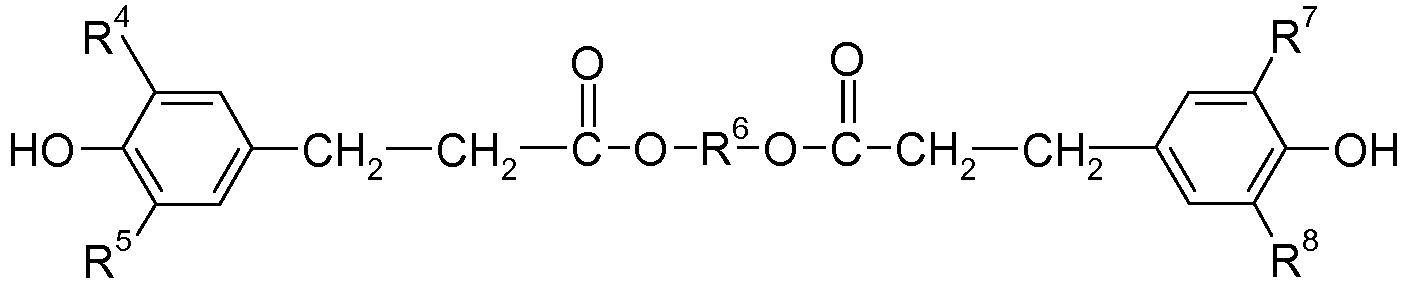
- Bevorzugte Verbindungen, die dieser Formel entsprechen, sind


- Beispielhaft genannt seien insgesamt als sterisch gehinderte Phenole:
- 2,2'-Methylen-bis-(4-methyl-6-tert.-butylphenol), 1,6-Hexandiol-bis[3-(3,5-di-tert.-butyl-4-hydroxyphenyl)-propionat], Pentaerythrityl-tetrakis-[3-(3,5-di-tert.-butyl-4-hydroxy-phenyl)-propionat], Distearyl-3,5-di-tert.-butyl-4-hydroxybenzylphosphonat, 2,6,7-Trioxa-1-phospha-bicyclo-[2.2.2]oct-4-yl-methyl-3,5-di-tert.-butyl-4-hydroxyhydro-cinnamat, 3,5-Di-tert.-butyl-4-hydroxyphenyl-3,5-distearyl-thiotriazylamin, 2-(2'-Hydroxy-3'-hydroxy-3',5'-di-tert.-butylphenyl)-5-chlorbenzotriazol, 2,6-Di-tert.-butyl-4-hydroxymethylphenol, 1,3,5-Trimethyl-2,4,6-tris-(3,5-di-tert.-butyl-4-hydroxybenzyl)-benzol, 4,4'-Methylen-bis-(2,6-di-tert.-butylphenol), 3,5-Di-tert.-butyl-4-hydroxybenzyl-dimethylamin.
- Als besonders wirksam erwiesen haben sich und daher vorzugsweise verwendet werden 2,2'-Methylen-bis-(4-methyl-6-tert.-butylphenol), 1,6-Hexandiol-bis-(3,5-di-tert.-butyl-4-hydroxyphenyl)-propionat (Irganox® 259), Pentaerythrityl-tetrakis-[3-(3,5-di-tert.-butyl-4-hydroxyphenyl)-propionat] sowie N,N'-Hexamethylen-bis-3,5-di-tert.-butyl-4-hydroxyhydrocinnamid (Irganox® 1098) und das vorstehend beschriebene Irganox® 245 der Firma BASF SE, das besonders gut geeignet ist.
- Die Antioxidantien F), die einzeln oder als Gemische eingesetzt werden können, sind in einer Menge von 0,05 bis zu 3 Gew.-%, vorzugsweise von 0,1 bis 1,5 Gew.-%, insbesondere 0,1 bis 1 Gew.-%, bezogen auf das Gesamtgewicht der Formmassen A) bis F) enthalten.
- In manchen Fällen haben sich sterisch gehinderte Phenole mit nicht mehr als einer sterisch gehinderten Gruppe in ortho-Stellung zur phenolischen Hydroxygruppe als besonders vorteilhaft erwiesen; insbesondere bei der Beurteilung der Farbstabilität bei Lagerung in diffusem Licht über längere Zeiträume.
- Als Komponente F) können die erfindungsgemäßen Formmassen 0,05 bis 5, vorzugsweise 0,1 bis 2 und insbesondere 0,25 bis 1,5 Gew.-% eines Nigrosins enthalten.
- Unter Nigrosinen versteht man im Allgemeinen eine Gruppe von schwarzen oder grauen, mit den Indulinen verwandten Phenazin-Farbstoffen (Azin-Farbstoffen) in verschiedenen Ausführungsformen (wasserlöslich, fettlöslich, spritlöslich), die bei Wollfärberei und -druck, beim Schwarzfärben von Seiden, zum Färben von Leder, Schuhcremes, Firnissen, Kunststoffen, Einbrennlacken, Tinten und dergleichen, sowie als Mikroskopiefarbstoffe Verwendung finden.
- Man gewinnt die Nigrosine technisch durch Erhitzen von Nitrobenzol, Anilin und salzsaurem Anilin mit Metall. Eisen und FeCl3 (Name von lateinischem niger = schwarz).
- Die Komponente F) kann als freie Base oder auch als Salz (z.B. Hydrochlorid) eingesetzt werden.
- Weitere Einzelheiten zu Nigrosinen sind beispielsweise dem elektronischen Lexikon Römpp Online, Version 2.8, Thieme-Verlag Stuttgart, 2006, Stichwort "Nigrosin" zu entnehmen.
- Als Komponente F) können die erfindungsgemäßen thermoplastischen Formmassen übliche Verarbeitungshilfsmittel wie Stabilisatoren, Oxidationsverzögerer, Mittel gegen Wärmezersetzung und Zersetzung durch ultraviolettes Licht, Gleit- und Entformungsmittel, Färbemittel wie Farbstoffe und Pigmente, Keimbildungsmittel, Weichmacher, enthalten.
- Als Beispiele für Oxidationsverzögerer und Wärmestabilisatoren sind sterisch gehinderte Phenole und/oder Phosphite und Amine (z.B. TAD), Hydrochinone, aromatische sekundäre Amine wie Diphenylamine, verschiedene substituierte Vertreter dieser Gruppen und deren Mischungen in Konzentrationen bis zu 1 Gew.-%, bezogen auf das Gewicht der thermoplastischen Formmassen genannt.
- Als UV-Stabilisatoren, die im Allgemeinen in Mengen bis zu 2 Gew.-%, bezogen auf die Formmasse, verwendet werden, seien verschiedene substituierte Resorcine, Salicylate, Benzotriazole und Benzophenone sowie sterisch gehinderte P-haltige Verbindungen, sterisch gehinderte Amine, Carbodiimide genannt.
- Es können anorganische Pigmente, wie Titandioxid, Ultramarinblau, Eisenoxid, ZnO, Böhmit AIO(OH) und Ruß, weiterhin organische Pigmente, wie Phthalocyanine, Chinacridone, Perylene sowie Farbstoffe, wie Anthrachinone als Farbmittel zugesetzt werden.
- Als Keimbildungsmittel können Natriumphenylphosphinat, Aluminiumoxid, Siliziumdioxid sowie bevorzugt Talkum eingesetzt werden.
- Die erfindungsgemäßen thermoplastischen Formmassen können nach an sich bekannten Verfahren hergestellt werden, indem man die Ausgangskomponenten in üblichen Mischvorrichtungen wie Schneckenextrudern, Brabender-Mühlen oder Banbury-Mühlen mischt und anschließend extrudiert. Nach der Extrusion kann das Extrudat abgekühlt und zerkleinert werden. Es können auch einzelne Komponenten vorgemischt werden und dann die restlichen Ausgangsstoffe einzeln und/oder ebenfalls gemischt hinzugegeben werden. Die Mischtemperaturen liegen in der Regel bei 230 bis 320°C.
- Nach einer weiteren bevorzugten Arbeitsweise können die Komponenten B) und C), D) sowie gegebenenfalls F) und E) mit einem Präpolymeren gemischt, konfektioniert und granuliert werden. Das erhaltene Granulat wird in fester Phase anschließend unter Inertgas kontinuierlich oder diskontinuierlich bei einer Temperatur unterhalb des Schmelzpunktes der Komponente A) bis zur gewünschten Viskosität kondensiert.
- Die erfindungsgemäßen thermoplastischen Formmassen zeichnen sich durch eine gute Flammwidrigkeit und helle Eigenfarbe aus. Diese eignen sich daher zur Herstellung von Fasern, Folien und Formkörpern jeglicher Art. Nachfolgend sind einige Beispiele genannt: Steckverbinder, Stecker, Steckerteile, Kabelbaumkomponenten, Schaltungsträger, Schaltungsträgerkomponenten, dreidimensional spritzgegossene Schaltungsträger, elektrische Verbindungselemente und mechatronische Komponenten.
- Die erfindungsgemäß aus den thermoplastischen Formmassen herzustellenden Formteile oder Halbzeuge können beispielsweise in der Kraftfahrzeug-, Elektro-, Elektronik-, Telekommunikations-, Informations-technologie-, Unterhaltungs-, Computerindustrie, in Fahrzeugen und anderen Fortbewegungsmitteln, in Schiffen, Raumschiffen, im Haushalt, in Büroausstattungen, Sport, in der Medizin sowie allgemein in Gegenständen und Gebäudeteilen die einen erhöhten Brandschutz erfordern angewandt werden.
- Für den Küchen- und Haushaltsbereich ist der Einsatz fließverbesserter Polyamide zur Herstellung von Komponenten für Küchengerate, wie z.B. Friteusen, Bügeleisen, Knöpfe, sowie Anwendungen im Garten- und Freizeitbereich möglich.
- Es wurden folgende Komponenten verwendet:
Komponente A: - Polyamid 66 mit einer Viskositätszahl VZ von 150 ml/g, gemessen als 0.5 gew.-%ige Lösung in 96 gew.-%iger Schwefelsäure bei 25°C nach ISO 307 (Es wurde Ultramid® A24 der BASF SE verwendet).
- roter Phosphor
- Melaminpolyphosphat (Melapur® M200/70 der BASF SE)
- Ethylencopolymerisat:
- 59,8 Gew.-% Ethylen
- 35 Gew.-% n-Butylacrylat
- 4,5 Gew.-% Acrylsäure
- 0,7 Gew.-% Maleinsäureanhydrid
- Standard Schnittglasfaser für Polyamide, Länge = 4,5 mm, Durchmesser = 10µm.
- N,N'-Hexamethylen-bis-3,5-di-ter.-butyl-4-hydroxyhydrocinnamid (Irganox® 1098)
- Ca-stearat
- Zinkoxid
- Zum Nachweis der erfindungsgemäß beschriebenen Verbesserungen wurden durch Compoundierung entsprechende Kunststoff-Formmassen angefertigt. Die einzelnen Komponenten wurden hierzu in einem Zweiwellenextruder ZSK 25 (Fa. Berstorff) bei einem Durchsatz von 15 kg/h und ca. 290°C bei flachem Temperaturprofil gemischt, als Strang ausgetragen, bis zur Granulierfähigkeit abgekühlt und granuliert.
- Die Brandschutztests wurden wie folgt bestimmt:
- UL 94 nach Lagerung 2d/23°C oder 7d(Tage)/70°C unter Luft.
- Die Zusammensetzungen der Formmassen und die Ergebnisse der Messungen sind der Tabelle zu entnehmen.
- Der Gehalt F/2 / F/3 und F4 betrug in Summe jeweils 1,5 Gew.-%.
Komponenten [Gew.-%] 1 2 3 V1 V2 A 36,75 36,75 36,75 36,75 36,75 F/1 25 25 25 25 25 D/1 12,5 D/2 12,5 D/3 12,5 D/1V 12,5 D/2V 12,5 B 1.75 1.75 1.75 1.75 1.75 C 12,5 12,5 12,5 12,5 12,5 E 10 10 10 10 10 UL 94 0,8mm 2d/23°C Einstufung V-0 V-0 V-0 V-0 V-0 Gesamtnachbrenndauer [s] 32 27 31 42 39 Bodenwatte entz. nein nein nein nein nein UL 94 0,8mm 7d/70°C Einstufung V-0 V-0 V-0 V-2 V-2 Gesamtnachbrenndauer [s] 38 41 45 32 37 Bodenwatte entz. nein nein nein ja ja
Komponente B:
Komponente C:
Komponente D:
| D1 | D2 | D3 | D/1V | D/2V | |
| BET Oberfläche | 11 | 12 | 6 | 9 | 8 |
| Langmuir Oberfläche | 16 | 17 | 14 | 13 | 12 |
| Kristalltyp | Rutil | Rutil | Rutil | Anatas | Anatas |
| Brechungszahl | 2,75 | 2,75 | 2,75 | 2,55 | 2,55 |
| Oberfläche | uneben | uneben | uneben | glatt | glatt |
| Handelsprodukt | TiO2 Kronos 2220 | TiO2 Kronos 2222 | Sachtleben R330 | TiO2 Kronos 1071 | Sachtleben LW-S |
Komponente E:
Komponente F/1:
Komponente F/2:
Komponente F/3:
Komponente F/4:
Claims (11)
- Thermoplastische Formmassen, enthaltendA) 10 bis 98 Gew.-% eines thermoplastischen Polyamids,B) 0,1 bis 60 Gew.-% roter Phosphor,C) 0,5 bis 20 Gew.-% einer Melaminverbindung,D) 1 bis 30 Gew.-% Titandioxid des Rutil-Typs,E) 0 bis 40 Gew.-% eines Schlagzähmodifiers,F) 0 bis 60 Gew.-% weiterer Zusatzstoffe,wobei die Summe der Gewichtsprozente der Komponenten A) bis F) 100 % ergibt.
- Thermoplastische Formmassen nach Anspruch 1, enthaltendA) 20 bis 96 Gew.-%B) 0,5 bis 40 Gew.-%C) 1 bis 20 Gew.-%D) 1 bis 25 Gew.-%E) 1 bis 30 Gew.-%F) 0 bis 50 Gew.-%.
- Thermoplastische Formmassen nach den Ansprüchen 1 oder 2, in denen die Komponente C) aus Melaminpolyphosphat oder Melaminpolyphosphatsalzen einer 1,3,5-Triazinverbindung oder deren Mischungen besteht.
- Thermoplastische Formmassen nach den Ansprüchen 1 bis 3, in denen die Komponente D) eine unebene Oberfläche aufweist.
- Thermoplastische Formmassen nach den Ansprüchen 1 bis 4, in denen die Komponente D) eine Brechzahl von n = 2,75 aufweist (gemäß DIN 51423).
- Thermoplastische Formmassen nach den Ansprüchen 1 bis 5, in denen die Komponente D) eine BET-Oberfläche gemäß DIN ISO 9277 von mindestens 5 m2/g aufweist.
- Thermoplastische Formmassen nach den Ansprüchen 1 bis 6, in denen die Komponente D) eine Langmuir Oberfläche von mindestens 14 m2/g aufweist (gemäß DIN 66131 und 66134).
- Thermoplastische Formmassen nach den Ansprüchen 1 bis 7, in denen die Komponente E) aus einem Ethylencopolymer aufgebaut ist, welches 0,1 bis 20 Gew.-% funktioneller Monomere enthält.
- Thermoplastische Formmassen nach den Ansprüchen 1 bis 8, wobei die Komponente E) funktionelle Monomere enthält, ausgewählt aus der Gruppe der Carbonsäure-, Carboxylanhydrid-, Carbonsäureamid-, Carbonsäureimid-, Amino, Hydroxyl-, Epoxid-, Urethan- oder Oxazolingruppen oder deren Mischungen.
- Verwendung der thermoplastischen Formmassen gemäß den Ansprüchen 1 bis 9 zur Herstellung von Fasern, Folien und Formkörpern.
- Fasern, Folien und Formkörper erhältlich aus den thermoplastischen Formmassen gemäß den Ansprüchen 1 bis 9.
Priority Applications (1)
| Application Number | Priority Date | Filing Date | Title |
|---|---|---|---|
| EP13710853.6A EP2828336B1 (de) | 2012-03-21 | 2013-03-20 | Hellgefärbte flammgeschützte polyamide |
Applications Claiming Priority (3)
| Application Number | Priority Date | Filing Date | Title |
|---|---|---|---|
| EP12160483.9A EP2641939A1 (de) | 2012-03-21 | 2012-03-21 | Hellgefärbte flammgeschützte Polyamide |
| PCT/EP2013/055766 WO2013139827A1 (de) | 2012-03-21 | 2013-03-20 | Hellgefärbte flammgeschützte polyamide |
| EP13710853.6A EP2828336B1 (de) | 2012-03-21 | 2013-03-20 | Hellgefärbte flammgeschützte polyamide |
Publications (2)
| Publication Number | Publication Date |
|---|---|
| EP2828336A1 EP2828336A1 (de) | 2015-01-28 |
| EP2828336B1 true EP2828336B1 (de) | 2016-01-06 |
Family
ID=47901998
Family Applications (2)
| Application Number | Title | Priority Date | Filing Date |
|---|---|---|---|
| EP12160483.9A Withdrawn EP2641939A1 (de) | 2012-03-21 | 2012-03-21 | Hellgefärbte flammgeschützte Polyamide |
| EP13710853.6A Not-in-force EP2828336B1 (de) | 2012-03-21 | 2013-03-20 | Hellgefärbte flammgeschützte polyamide |
Family Applications Before (1)
| Application Number | Title | Priority Date | Filing Date |
|---|---|---|---|
| EP12160483.9A Withdrawn EP2641939A1 (de) | 2012-03-21 | 2012-03-21 | Hellgefärbte flammgeschützte Polyamide |
Country Status (7)
| Country | Link |
|---|---|
| EP (2) | EP2641939A1 (de) |
| JP (1) | JP6234428B2 (de) |
| KR (1) | KR102017364B1 (de) |
| CN (1) | CN104204097B (de) |
| BR (1) | BR112014022979B1 (de) |
| MY (1) | MY185102A (de) |
| WO (1) | WO2013139827A1 (de) |
Families Citing this family (35)
| Publication number | Priority date | Publication date | Assignee | Title |
|---|---|---|---|---|
| JP7128743B2 (ja) * | 2016-10-18 | 2022-08-31 | アセンド・パフォーマンス・マテリアルズ・オペレーションズ・リミテッド・ライアビリティ・カンパニー | 熱老化に対する耐性を有する低ハロゲンの難燃性のポリアミド組成物 |
| KR20220022192A (ko) * | 2020-08-18 | 2022-02-25 | 현대자동차주식회사 | 연료튜브용 폴리아미드계 복합수지 조성물 |
| JP2025521224A (ja) | 2022-06-08 | 2025-07-08 | ビーエーエスエフ ソシエタス・ヨーロピア | ポリアミド化合物を製造するためのリサイクル方法 |
| WO2024046793A1 (en) | 2022-08-31 | 2024-03-07 | Basf Se | Process for thermal treatment of a multicomponent plastic waste material |
| AU2024245974A1 (en) | 2023-03-31 | 2025-10-09 | Basf Se | Highly integrated caprolactam recycling process |
| EP4695348A1 (de) | 2023-04-13 | 2026-02-18 | Basf Se | Verfahren zur reinigung eines pyrolyseöls |
| KR20250174939A (ko) | 2023-04-13 | 2025-12-15 | 바스프 에스이 | 열분해 오일의 정제 방법 |
| KR20260009929A (ko) | 2023-05-16 | 2026-01-20 | 바스프 에스이 | 열분해 오일 및 크래커 공급원료로부터 저비점 분획 수율을 증가시키는 방법 |
| AU2024286546A1 (en) | 2023-06-06 | 2025-12-18 | Basf Se | Process for hydrolytically depolymerizing a polyamide |
| WO2024251759A1 (en) | 2023-06-06 | 2024-12-12 | Basf Se | Process for hydrolytically depolymerizing a polyamide |
| AR132874A1 (es) | 2023-06-06 | 2025-08-06 | Basf Se | Proceso para la despolimerización hidrolítica de una poliamida |
| CN121358797A (zh) | 2023-06-19 | 2026-01-16 | 巴斯夫欧洲公司 | 用于从聚合物材料中回收基于聚对苯二甲酸乙二醇酯的聚合物的方法 |
| TW202511372A (zh) | 2023-06-19 | 2025-03-16 | 德商巴地斯顏料化工廠 | 包含脫色及化學處理之用於再循環有色聚合材料之方法 |
| EP4727996A1 (de) | 2023-06-19 | 2026-04-22 | Basf Se | Verfahren zur entfernung von additiven aus einem polymermaterial |
| CN121420020A (zh) | 2023-06-19 | 2026-01-27 | 巴斯夫欧洲公司 | 用于使有色聚合物材料再循环的方法和由其获得的挤出产品 |
| EP4728000A1 (de) | 2023-06-19 | 2026-04-22 | Basf Se | Verfahren zur rückgewinnung eines polyalkylenterephthalatpolymers aus einem gefärbten polymermaterial |
| TW202506854A (zh) | 2023-06-19 | 2025-02-16 | 德商巴地斯顏料化工廠 | 聚合材料之脫色及/或分離方法 |
| CN121666440A (zh) | 2023-07-31 | 2026-03-13 | 巴斯夫欧洲公司 | 合成气生产设备和用于通过气化连续生产合成气的方法 |
| CN121194944A (zh) | 2023-07-31 | 2025-12-23 | 巴斯夫欧洲公司 | 用于控制化学产物制造期间的生物源碳含量的系统和方法 |
| EP4698488A1 (de) | 2023-07-31 | 2026-02-25 | Basf Se | System und verfahren zur herstellung eines chemischen produkts mit einem biogenen kohlenstoffgehalt aus zwei oder mehr rohstoffen |
| EP4695199A1 (de) | 2023-07-31 | 2026-02-18 | Basf Se | System und verfahren zur steuerung des biogenen kohlenstoffgehalts eines chemischen produkts |
| WO2025036761A1 (en) | 2023-08-17 | 2025-02-20 | Basf Se | Method for treating wastewater having an organic content |
| WO2025051086A1 (en) | 2023-09-04 | 2025-03-13 | Basf Se | Recycling method and recycled products |
| WO2025051936A1 (en) | 2023-09-07 | 2025-03-13 | Basf Se | Process for preparing a granular material |
| WO2025061939A1 (en) | 2023-09-22 | 2025-03-27 | Basf Se | Highly heat-integrated process for preparing purified epsilon-caprolactam from polyamide 6 |
| CN122003461A (zh) | 2023-10-11 | 2026-05-08 | 巴斯夫欧洲公司 | 用于从固体材料中回收ε-己内酰胺的再循环方法 |
| WO2025093347A1 (en) | 2023-10-31 | 2025-05-08 | Basf Se | Process for hydrotreating feedstocks manufactured from biomass and/or plastic waste |
| WO2025103834A1 (en) | 2023-11-16 | 2025-05-22 | Basf Se | Producing renewable hydrocarbons and chemical products from biomass |
| WO2025119731A1 (en) | 2023-12-07 | 2025-06-12 | Basf Se | Method and chemical plant for separating c6−c8 aromatic hydrocarbons from a liquid stream |
| WO2025119733A1 (en) | 2023-12-07 | 2025-06-12 | Basf Se | Chemical plant and method for separating c6−c8 aromatic hydrocarbons from a feedstock stream comprising at least one pyrolysis oil |
| WO2025119722A1 (en) | 2023-12-07 | 2025-06-12 | Basf Se | Chemical plant and method for separating a steam cracker feedstock from a feedstock stream comprising at least one plastic pyrolysis oil |
| TW202544152A (zh) | 2023-12-21 | 2025-11-16 | 德商巴斯夫歐洲公司 | 從聚醯胺6製備純ε-己內醯胺的高省水方法 |
| TW202544151A (zh) | 2023-12-21 | 2025-11-16 | 德商巴斯夫歐洲公司 | 從聚醯胺6解聚和混合物中分離高沸點物的方法 |
| WO2025162836A1 (en) | 2024-01-30 | 2025-08-07 | Basf Se | Chemical treatment of recovered liquid caprolactam |
| WO2025162837A1 (en) | 2024-01-30 | 2025-08-07 | Basf Se | Color-stable aqueous mixture comprising recovered liquid caprolactam |
Family Cites Families (50)
| Publication number | Priority date | Publication date | Assignee | Title |
|---|---|---|---|---|
| US2071251A (en) | 1931-07-03 | 1937-02-16 | Du Pont | Fiber and method of producing it |
| US2071250A (en) | 1931-07-03 | 1937-02-16 | Du Pont | Linear condensation polymers |
| US2130523A (en) | 1935-01-02 | 1938-09-20 | Du Pont | Linear polyamides and their production |
| US2130948A (en) | 1937-04-09 | 1938-09-20 | Du Pont | Synthetic fiber |
| US2241322A (en) | 1938-09-30 | 1941-05-06 | Du Pont | Process for preparing polyamides from cyclic amides |
| US2312966A (en) | 1940-04-01 | 1943-03-02 | Du Pont | Polymeric material |
| US2512606A (en) | 1945-09-12 | 1950-06-27 | Du Pont | Polyamides and method for obtaining same |
| IL24111A (en) | 1964-08-24 | 1969-02-27 | Du Pont | Linear polyamides |
| DE1931387B2 (de) | 1969-06-20 | 1974-10-17 | Basf Ag, 6700 Ludwigshafen | Flammschutzausrüstung für glasfaserverstärktes Polyamid |
| US4148846A (en) | 1970-09-10 | 1979-04-10 | Rohm And Haas Company | Acrylic modifiers for polycarbonamides |
| CH626385A5 (de) | 1976-02-05 | 1981-11-13 | Ciba Geigy Ag | |
| DE2703052C2 (de) | 1977-01-26 | 1985-09-12 | Basf Ag, 6700 Ludwigshafen | Stabilisierte, flammgeschützte, thermoplastische Formmassen |
| DE3063066D1 (en) * | 1979-06-02 | 1983-06-16 | Basf Ag | Flameproof polyamide moulding compositions containing a filler |
| NL8001764A (nl) | 1980-03-26 | 1981-10-16 | Stamicarbon | Bereiding van hoogmoleculair polytramethyleenadipamide. |
| NL8001763A (nl) | 1980-03-26 | 1981-10-16 | Stamicarbon | Bereiding van polytetramethyleenadipamide. |
| NL8001762A (nl) | 1980-03-26 | 1981-10-16 | Stamicarbon | Bereiding van voorwerpen op de basis van polyamide. |
| DE3039114A1 (de) | 1980-10-16 | 1982-05-13 | Bayer Ag, 5090 Leverkusen | Thermoplastische polyester-formmassen mit verbesserter zaehigkeit |
| DE3131447A1 (de) | 1981-08-07 | 1983-02-24 | Basf Ag, 6700 Ludwigshafen | Flammfeste polyamid-formmassen |
| DE3321579A1 (de) | 1983-06-15 | 1984-12-20 | Basf Ag, 6700 Ludwigshafen | Verfahren zur kontinuierlichen herstellung von polyamiden |
| DE3321581A1 (de) | 1983-06-15 | 1984-12-20 | Basf Ag, 6700 Ludwigshafen | Verfahren zur kontinuierlichen herstellung von polyamiden |
| DE3436161A1 (de) | 1984-10-03 | 1986-04-10 | Hoechst Ag, 6230 Frankfurt | Phlegmatisierter roter phosphor |
| DE3524234A1 (de) | 1985-07-06 | 1987-01-08 | Bayer Ag | Neue pfropfpolymerisate und deren abmischungen mit polyamiden |
| DE3606982A1 (de) | 1986-03-04 | 1987-09-10 | Bayer Ag | Pfropfpolymerisate auf kautschukpolymeren mit blockartiger struktur |
| DE3626768A1 (de) * | 1986-08-07 | 1988-02-11 | Basf Ag | Flammgeschuetzte verstaerkte polyamidformmassen mit heller einfaerbung |
| DE3889787D1 (de) | 1987-07-17 | 1994-07-07 | Basf Ag | Teilaromatische Copolyamide mit verringertem Triamingehalt. |
| DE3725576A1 (de) | 1987-08-01 | 1989-02-09 | Bayer Ag | Formmassen aus aromatischem polyester und gepfropftem silikonkautschuk |
| JPH01146958A (ja) | 1987-12-04 | 1989-06-08 | Polyplastics Co | 熱可塑性樹脂組成物 |
| DE3800603A1 (de) | 1988-01-12 | 1989-07-20 | Bayer Ag | Formmassen aus aromatischen polyestern, vinyl-copolymerisaten und gepfropftem siliconkautschuk |
| JPH0730326B2 (ja) * | 1988-11-07 | 1995-04-05 | 燐化学工業株式会社 | 赤リン系難燃剤の消色方法 |
| DE3905038A1 (de) | 1989-02-18 | 1990-08-23 | Basf Ag | Flammgeschuetzte thermoplastische formmassen auf der basis von phlegmatisiertem roten phosphor |
| US5272236A (en) | 1991-10-15 | 1993-12-21 | The Dow Chemical Company | Elastic substantially linear olefin polymers |
| JP2501502B2 (ja) * | 1991-11-01 | 1996-05-29 | 東芝シリコーン株式会社 | 電線被覆用難燃性シリコ―ンゴム組成物 |
| JP3364250B2 (ja) * | 1992-10-15 | 2003-01-08 | 岸本産業株式会社 | 色調の改良された赤リン難燃剤及びこれを含むガラス繊維強化難燃性プラスチック組成物 |
| DE4307682A1 (de) * | 1993-03-11 | 1994-09-15 | Basf Ag | Halogenfreie flammgeschützte thermoplastische Polyamidformmassen |
| WO1998008889A2 (de) | 1996-08-30 | 1998-03-05 | Basf Aktiengesellschaft | Verfahren zur herstellung von polyamiden aus aminonitrilen |
| DE19648503A1 (de) | 1996-11-22 | 1998-05-28 | Basf Ag | Flammgeschützte thermoplastische Formmassen |
| NL1009588C2 (nl) | 1998-07-08 | 2000-01-11 | Dsm Nv | Polyfosfaatzout van een 1,3,5-triazineverbinding met hoge condensatiegraad, een werkwijze voor de bereiding ervan en de toepassing als vlamdover in polymeersamenstellingen. |
| DE19935398A1 (de) | 1999-07-30 | 2001-02-01 | Basf Ag | Verfahren zur Herstellung von Polyamiden aus Dinitrilen und Diaminen |
| JP2003049076A (ja) * | 2001-08-03 | 2003-02-21 | Asahi Kasei Corp | 酸化チタン含有難燃性樹脂組成物および製法 |
| JP4263880B2 (ja) * | 2001-09-04 | 2009-05-13 | 積水化学工業株式会社 | 難燃性膜材 |
| DE10249797A1 (de) * | 2002-10-24 | 2004-05-13 | Basf Ag | Verfahren zur Herstellung eines mit Titandioxid pigmentierten Polyamids |
| JP2004269635A (ja) * | 2003-03-07 | 2004-09-30 | Kanbo Pras Corp | 難燃性フィルム、不燃性積層体、および不燃性積層体構造体 |
| DE10313681A1 (de) | 2003-03-26 | 2004-10-07 | Basf Ag | Verfahren zur Herstellung von Polyamiden |
| JP2005336474A (ja) * | 2004-04-28 | 2005-12-08 | Ube Ind Ltd | 難燃性樹脂組成物 |
| DE102004039148A1 (de) | 2004-08-12 | 2006-02-23 | Clariant Gmbh | Glühdrahtbeständige flammwidrige Polymere |
| DE102005049297A1 (de) * | 2005-10-12 | 2007-04-19 | Basf Ag | Flammgeschützte Formmassen |
| KR20080100288A (ko) | 2006-03-08 | 2008-11-14 | 바스프 에스이 | 결정화도가 높은 부분적 방향족 코폴리아미드 |
| TWI487668B (zh) * | 2009-02-19 | 2015-06-11 | Sakai Chemical Industry Co | 金紅石型氧化鈦粒子之分散體,其製造方法,及其用途 |
| JP2011256233A (ja) * | 2010-06-07 | 2011-12-22 | Teijin Ltd | 脂肪族ポリエステル系樹脂白色フィルムおよびそれを用いた反射板 |
| EP2388293B1 (de) * | 2010-05-17 | 2012-12-26 | Ems-Patent Ag | Polyamidformmasse und deren Verwendung zur Herstellung von LED-Gehäusekomponenten |
-
2012
- 2012-03-21 EP EP12160483.9A patent/EP2641939A1/de not_active Withdrawn
-
2013
- 2013-03-20 EP EP13710853.6A patent/EP2828336B1/de not_active Not-in-force
- 2013-03-20 BR BR112014022979-1A patent/BR112014022979B1/pt not_active IP Right Cessation
- 2013-03-20 JP JP2015500899A patent/JP6234428B2/ja not_active Expired - Fee Related
- 2013-03-20 KR KR1020147029351A patent/KR102017364B1/ko not_active Expired - Fee Related
- 2013-03-20 CN CN201380015671.9A patent/CN104204097B/zh not_active Expired - Fee Related
- 2013-03-20 MY MYPI2014002687A patent/MY185102A/en unknown
- 2013-03-20 WO PCT/EP2013/055766 patent/WO2013139827A1/de not_active Ceased
Also Published As
| Publication number | Publication date |
|---|---|
| CN104204097B (zh) | 2016-08-24 |
| BR112014022979B1 (pt) | 2021-01-19 |
| MY185102A (en) | 2021-04-30 |
| JP6234428B2 (ja) | 2017-11-22 |
| JP2015510963A (ja) | 2015-04-13 |
| WO2013139827A1 (de) | 2013-09-26 |
| KR20140139013A (ko) | 2014-12-04 |
| EP2641939A1 (de) | 2013-09-25 |
| KR102017364B1 (ko) | 2019-10-21 |
| CN104204097A (zh) | 2014-12-10 |
| EP2828336A1 (de) | 2015-01-28 |
Similar Documents
| Publication | Publication Date | Title |
|---|---|---|
| EP2641939A1 (de) | Hellgefärbte flammgeschützte Polyamide | |
| EP2652032B1 (de) | Glühdrahtbeständige polyamide | |
| EP2493969B1 (de) | Wärmealterungsbeständige polyamide mit flammschutz | |
| EP2986673B1 (de) | Glühdrahtbeständige polyamide | |
| EP2001951B1 (de) | Wärmeleitfähige polyamide | |
| EP2379644B1 (de) | Wärmealterungsbeständige polyamide | |
| EP3589696B1 (de) | Flammgeschuetzte polyamide mit pvp | |
| EP1937778A1 (de) | Flammgeschütze formmassen | |
| EP3526283B1 (de) | Flammgeschützte polyamide | |
| EP2898009B1 (de) | Flammgeschützte polyamide mit heller farbe | |
| EP3420017B1 (de) | Polyamidmischungen mit pyrrolidon enthaltenden polyamiden | |
| EP2861666B1 (de) | Flammgeschützte polyamide mit polyacrylnitrilhomopolymerisaten | |
| EP3642265B1 (de) | Polyamide mit phosphor und al-phosphonaten | |
| DE102010023770A1 (de) | Glühdrahtbeständige Formmassen | |
| EP2817363B1 (de) | Cuo/zno-mischungen als stabilisatoren für flammgeschützte polyamide | |
| EP2443192B1 (de) | Flammgeschützte Polyamidformmassen | |
| EP2702102A1 (de) | Flammgeschütze formmassen | |
| EP2756033B1 (de) | Silber-zinkoxid-mischungen als stabilisator für flammgeschützte polyamide enthaltend roten phosphor | |
| WO2011009877A1 (de) | Flammgeschützte polyamidformmassen | |
| DE102014215370A1 (de) | Langfaserverstärkte flammgeschützte Polyamide | |
| EP2415827A1 (de) | Flammgeschützte Polyamide mit Schichtsilikaten | |
| WO2013083508A1 (de) | Flammgeschützte polyamide mit flüssigkristallinen polyestern | |
| WO2016087324A1 (de) | Flammgeschützte polyamide mit sulfonsäuresalzen | |
| WO2012013564A1 (de) | Flammgeschützte formmassen |
Legal Events
| Date | Code | Title | Description |
|---|---|---|---|
| PUAI | Public reference made under article 153(3) epc to a published international application that has entered the european phase |
Free format text: ORIGINAL CODE: 0009012 |
|
| 17P | Request for examination filed |
Effective date: 20141021 |
|
| AK | Designated contracting states |
Kind code of ref document: A1 Designated state(s): AL AT BE BG CH CY CZ DE DK EE ES FI FR GB GR HR HU IE IS IT LI LT LU LV MC MK MT NL NO PL PT RO RS SE SI SK SM TR |
|
| AX | Request for extension of the european patent |
Extension state: BA ME |
|
| DAX | Request for extension of the european patent (deleted) | ||
| GRAP | Despatch of communication of intention to grant a patent |
Free format text: ORIGINAL CODE: EPIDOSNIGR1 |
|
| INTG | Intention to grant announced |
Effective date: 20150724 |
|
| GRAS | Grant fee paid |
Free format text: ORIGINAL CODE: EPIDOSNIGR3 |
|
| GRAA | (expected) grant |
Free format text: ORIGINAL CODE: 0009210 |
|
| AK | Designated contracting states |
Kind code of ref document: B1 Designated state(s): AL AT BE BG CH CY CZ DE DK EE ES FI FR GB GR HR HU IE IS IT LI LT LU LV MC MK MT NL NO PL PT RO RS SE SI SK SM TR |
|
| REG | Reference to a national code |
Ref country code: GB Ref legal event code: FG4D Free format text: NOT ENGLISH |
|
| REG | Reference to a national code |
Ref country code: CH Ref legal event code: EP |
|
| REG | Reference to a national code |
Ref country code: IE Ref legal event code: FG4D Free format text: LANGUAGE OF EP DOCUMENT: GERMAN |
|
| REG | Reference to a national code |
Ref country code: AT Ref legal event code: REF Ref document number: 768848 Country of ref document: AT Kind code of ref document: T Effective date: 20160215 |
|
| REG | Reference to a national code |
Ref country code: DE Ref legal event code: R096 Ref document number: 502013001761 Country of ref document: DE |
|
| REG | Reference to a national code |
Ref country code: FR Ref legal event code: PLFP Year of fee payment: 4 |
|
| REG | Reference to a national code |
Ref country code: LT Ref legal event code: MG4D |
|
| REG | Reference to a national code |
Ref country code: NL Ref legal event code: MP Effective date: 20160106 |
|
| PG25 | Lapsed in a contracting state [announced via postgrant information from national office to epo] |
Ref country code: NL Free format text: LAPSE BECAUSE OF FAILURE TO SUBMIT A TRANSLATION OF THE DESCRIPTION OR TO PAY THE FEE WITHIN THE PRESCRIBED TIME-LIMIT Effective date: 20160106 |
|
| PG25 | Lapsed in a contracting state [announced via postgrant information from national office to epo] |
Ref country code: GR Free format text: LAPSE BECAUSE OF FAILURE TO SUBMIT A TRANSLATION OF THE DESCRIPTION OR TO PAY THE FEE WITHIN THE PRESCRIBED TIME-LIMIT Effective date: 20160407 Ref country code: NO Free format text: LAPSE BECAUSE OF FAILURE TO SUBMIT A TRANSLATION OF THE DESCRIPTION OR TO PAY THE FEE WITHIN THE PRESCRIBED TIME-LIMIT Effective date: 20160406 Ref country code: FI Free format text: LAPSE BECAUSE OF FAILURE TO SUBMIT A TRANSLATION OF THE DESCRIPTION OR TO PAY THE FEE WITHIN THE PRESCRIBED TIME-LIMIT Effective date: 20160106 Ref country code: ES Free format text: LAPSE BECAUSE OF FAILURE TO SUBMIT A TRANSLATION OF THE DESCRIPTION OR TO PAY THE FEE WITHIN THE PRESCRIBED TIME-LIMIT Effective date: 20160106 Ref country code: HR Free format text: LAPSE BECAUSE OF FAILURE TO SUBMIT A TRANSLATION OF THE DESCRIPTION OR TO PAY THE FEE WITHIN THE PRESCRIBED TIME-LIMIT Effective date: 20160106 |
|
| PG25 | Lapsed in a contracting state [announced via postgrant information from national office to epo] |
Ref country code: SE Free format text: LAPSE BECAUSE OF FAILURE TO SUBMIT A TRANSLATION OF THE DESCRIPTION OR TO PAY THE FEE WITHIN THE PRESCRIBED TIME-LIMIT Effective date: 20160106 Ref country code: IS Free format text: LAPSE BECAUSE OF FAILURE TO SUBMIT A TRANSLATION OF THE DESCRIPTION OR TO PAY THE FEE WITHIN THE PRESCRIBED TIME-LIMIT Effective date: 20160506 Ref country code: LV Free format text: LAPSE BECAUSE OF FAILURE TO SUBMIT A TRANSLATION OF THE DESCRIPTION OR TO PAY THE FEE WITHIN THE PRESCRIBED TIME-LIMIT Effective date: 20160106 Ref country code: PL Free format text: LAPSE BECAUSE OF FAILURE TO SUBMIT A TRANSLATION OF THE DESCRIPTION OR TO PAY THE FEE WITHIN THE PRESCRIBED TIME-LIMIT Effective date: 20160106 Ref country code: PT Free format text: LAPSE BECAUSE OF FAILURE TO SUBMIT A TRANSLATION OF THE DESCRIPTION OR TO PAY THE FEE WITHIN THE PRESCRIBED TIME-LIMIT Effective date: 20160506 Ref country code: RS Free format text: LAPSE BECAUSE OF FAILURE TO SUBMIT A TRANSLATION OF THE DESCRIPTION OR TO PAY THE FEE WITHIN THE PRESCRIBED TIME-LIMIT Effective date: 20160106 Ref country code: LT Free format text: LAPSE BECAUSE OF FAILURE TO SUBMIT A TRANSLATION OF THE DESCRIPTION OR TO PAY THE FEE WITHIN THE PRESCRIBED TIME-LIMIT Effective date: 20160106 Ref country code: BE Free format text: LAPSE BECAUSE OF NON-PAYMENT OF DUE FEES Effective date: 20160331 |
|
| REG | Reference to a national code |
Ref country code: DE Ref legal event code: R097 Ref document number: 502013001761 Country of ref document: DE |
|
| PG25 | Lapsed in a contracting state [announced via postgrant information from national office to epo] |
Ref country code: EE Free format text: LAPSE BECAUSE OF FAILURE TO SUBMIT A TRANSLATION OF THE DESCRIPTION OR TO PAY THE FEE WITHIN THE PRESCRIBED TIME-LIMIT Effective date: 20160106 Ref country code: MC Free format text: LAPSE BECAUSE OF FAILURE TO SUBMIT A TRANSLATION OF THE DESCRIPTION OR TO PAY THE FEE WITHIN THE PRESCRIBED TIME-LIMIT Effective date: 20160106 Ref country code: LU Free format text: LAPSE BECAUSE OF FAILURE TO SUBMIT A TRANSLATION OF THE DESCRIPTION OR TO PAY THE FEE WITHIN THE PRESCRIBED TIME-LIMIT Effective date: 20160320 Ref country code: DK Free format text: LAPSE BECAUSE OF FAILURE TO SUBMIT A TRANSLATION OF THE DESCRIPTION OR TO PAY THE FEE WITHIN THE PRESCRIBED TIME-LIMIT Effective date: 20160106 |
|
| REG | Reference to a national code |
Ref country code: CH Ref legal event code: PL |
|
| PLBE | No opposition filed within time limit |
Free format text: ORIGINAL CODE: 0009261 |
|
| STAA | Information on the status of an ep patent application or granted ep patent |
Free format text: STATUS: NO OPPOSITION FILED WITHIN TIME LIMIT |
|
| PG25 | Lapsed in a contracting state [announced via postgrant information from national office to epo] |
Ref country code: RO Free format text: LAPSE BECAUSE OF FAILURE TO SUBMIT A TRANSLATION OF THE DESCRIPTION OR TO PAY THE FEE WITHIN THE PRESCRIBED TIME-LIMIT Effective date: 20160106 Ref country code: CZ Free format text: LAPSE BECAUSE OF FAILURE TO SUBMIT A TRANSLATION OF THE DESCRIPTION OR TO PAY THE FEE WITHIN THE PRESCRIBED TIME-LIMIT Effective date: 20160106 Ref country code: SK Free format text: LAPSE BECAUSE OF FAILURE TO SUBMIT A TRANSLATION OF THE DESCRIPTION OR TO PAY THE FEE WITHIN THE PRESCRIBED TIME-LIMIT Effective date: 20160106 Ref country code: SM Free format text: LAPSE BECAUSE OF FAILURE TO SUBMIT A TRANSLATION OF THE DESCRIPTION OR TO PAY THE FEE WITHIN THE PRESCRIBED TIME-LIMIT Effective date: 20160106 |
|
| 26N | No opposition filed |
Effective date: 20161007 |
|
| REG | Reference to a national code |
Ref country code: IE Ref legal event code: MM4A |
|
| PG25 | Lapsed in a contracting state [announced via postgrant information from national office to epo] |
Ref country code: CH Free format text: LAPSE BECAUSE OF NON-PAYMENT OF DUE FEES Effective date: 20160331 Ref country code: IE Free format text: LAPSE BECAUSE OF NON-PAYMENT OF DUE FEES Effective date: 20160320 Ref country code: LI Free format text: LAPSE BECAUSE OF NON-PAYMENT OF DUE FEES Effective date: 20160331 |
|
| PG25 | Lapsed in a contracting state [announced via postgrant information from national office to epo] |
Ref country code: BG Free format text: LAPSE BECAUSE OF FAILURE TO SUBMIT A TRANSLATION OF THE DESCRIPTION OR TO PAY THE FEE WITHIN THE PRESCRIBED TIME-LIMIT Effective date: 20160406 Ref country code: SI Free format text: LAPSE BECAUSE OF FAILURE TO SUBMIT A TRANSLATION OF THE DESCRIPTION OR TO PAY THE FEE WITHIN THE PRESCRIBED TIME-LIMIT Effective date: 20160106 |
|
| REG | Reference to a national code |
Ref country code: FR Ref legal event code: PLFP Year of fee payment: 5 |
|
| PG25 | Lapsed in a contracting state [announced via postgrant information from national office to epo] |
Ref country code: MT Free format text: LAPSE BECAUSE OF FAILURE TO SUBMIT A TRANSLATION OF THE DESCRIPTION OR TO PAY THE FEE WITHIN THE PRESCRIBED TIME-LIMIT Effective date: 20160106 |
|
| GBPC | Gb: european patent ceased through non-payment of renewal fee |
Effective date: 20170320 |
|
| PG25 | Lapsed in a contracting state [announced via postgrant information from national office to epo] |
Ref country code: GB Free format text: LAPSE BECAUSE OF NON-PAYMENT OF DUE FEES Effective date: 20170320 |
|
| REG | Reference to a national code |
Ref country code: FR Ref legal event code: PLFP Year of fee payment: 6 |
|
| PG25 | Lapsed in a contracting state [announced via postgrant information from national office to epo] |
Ref country code: HU Free format text: LAPSE BECAUSE OF FAILURE TO SUBMIT A TRANSLATION OF THE DESCRIPTION OR TO PAY THE FEE WITHIN THE PRESCRIBED TIME-LIMIT; INVALID AB INITIO Effective date: 20130320 |
|
| PG25 | Lapsed in a contracting state [announced via postgrant information from national office to epo] |
Ref country code: CY Free format text: LAPSE BECAUSE OF FAILURE TO SUBMIT A TRANSLATION OF THE DESCRIPTION OR TO PAY THE FEE WITHIN THE PRESCRIBED TIME-LIMIT Effective date: 20160106 Ref country code: MK Free format text: LAPSE BECAUSE OF FAILURE TO SUBMIT A TRANSLATION OF THE DESCRIPTION OR TO PAY THE FEE WITHIN THE PRESCRIBED TIME-LIMIT Effective date: 20160106 |
|
| PG25 | Lapsed in a contracting state [announced via postgrant information from national office to epo] |
Ref country code: TR Free format text: LAPSE BECAUSE OF FAILURE TO SUBMIT A TRANSLATION OF THE DESCRIPTION OR TO PAY THE FEE WITHIN THE PRESCRIBED TIME-LIMIT Effective date: 20160106 Ref country code: AL Free format text: LAPSE BECAUSE OF FAILURE TO SUBMIT A TRANSLATION OF THE DESCRIPTION OR TO PAY THE FEE WITHIN THE PRESCRIBED TIME-LIMIT Effective date: 20160106 |
|
| REG | Reference to a national code |
Ref country code: AT Ref legal event code: MM01 Ref document number: 768848 Country of ref document: AT Kind code of ref document: T Effective date: 20180320 |
|
| PG25 | Lapsed in a contracting state [announced via postgrant information from national office to epo] |
Ref country code: AT Free format text: LAPSE BECAUSE OF NON-PAYMENT OF DUE FEES Effective date: 20180320 |
|
| PGFP | Annual fee paid to national office [announced via postgrant information from national office to epo] |
Ref country code: FR Payment date: 20230323 Year of fee payment: 11 |
|
| PGFP | Annual fee paid to national office [announced via postgrant information from national office to epo] |
Ref country code: DE Payment date: 20240328 Year of fee payment: 12 |
|
| PGFP | Annual fee paid to national office [announced via postgrant information from national office to epo] |
Ref country code: IT Payment date: 20240321 Year of fee payment: 12 |
|
| PG25 | Lapsed in a contracting state [announced via postgrant information from national office to epo] |
Ref country code: FR Free format text: LAPSE BECAUSE OF NON-PAYMENT OF DUE FEES Effective date: 20240331 |
|
| PG25 | Lapsed in a contracting state [announced via postgrant information from national office to epo] |
Ref country code: FR Free format text: LAPSE BECAUSE OF NON-PAYMENT OF DUE FEES Effective date: 20240331 |
|
| REG | Reference to a national code |
Ref country code: DE Ref legal event code: R119 Ref document number: 502013001761 Country of ref document: DE |
|
| PG25 | Lapsed in a contracting state [announced via postgrant information from national office to epo] |
Ref country code: DE Free format text: LAPSE BECAUSE OF NON-PAYMENT OF DUE FEES Effective date: 20251001 |
|
| PG25 | Lapsed in a contracting state [announced via postgrant information from national office to epo] |
Ref country code: IT Free format text: LAPSE BECAUSE OF NON-PAYMENT OF DUE FEES Effective date: 20250320 |