EP2808685B1 - Wandler enthaltende Vorrichtungen, und Verfahren und Vorrichtung zu ihrer Kalibrierung - Google Patents
Wandler enthaltende Vorrichtungen, und Verfahren und Vorrichtung zu ihrer Kalibrierung Download PDFInfo
- Publication number
- EP2808685B1 EP2808685B1 EP13180554.1A EP13180554A EP2808685B1 EP 2808685 B1 EP2808685 B1 EP 2808685B1 EP 13180554 A EP13180554 A EP 13180554A EP 2808685 B1 EP2808685 B1 EP 2808685B1
- Authority
- EP
- European Patent Office
- Prior art keywords
- calibration
- transducer
- including devices
- code
- axis
- Prior art date
- Legal status (The legal status is an assumption and is not a legal conclusion. Google has not performed a legal analysis and makes no representation as to the accuracy of the status listed.)
- Not-in-force
Links
Images




Classifications
-
- B—PERFORMING OPERATIONS; TRANSPORTING
- B81—MICROSTRUCTURAL TECHNOLOGY
- B81B—MICROSTRUCTURAL DEVICES OR SYSTEMS, e.g. MICROMECHANICAL DEVICES
- B81B7/00—Microstructural systems; Auxiliary parts of microstructural devices or systems
- B81B7/008—MEMS characterised by an electronic circuit specially adapted for controlling or driving the same
-
- G—PHYSICS
- G01—MEASURING; TESTING
- G01P—MEASURING LINEAR OR ANGULAR SPEED, ACCELERATION, DECELERATION, OR SHOCK; INDICATING PRESENCE, ABSENCE, OR DIRECTION, OF MOVEMENT
- G01P21/00—Testing or calibrating of apparatus or devices covered by the preceding groups
-
- G—PHYSICS
- G01—MEASURING; TESTING
- G01C—MEASURING DISTANCES, LEVELS OR BEARINGS; SURVEYING; NAVIGATION; GYROSCOPIC INSTRUMENTS; PHOTOGRAMMETRY OR VIDEOGRAMMETRY
- G01C25/00—Manufacturing, calibrating, cleaning, or repairing instruments or devices referred to in the other groups of this subclass
- G01C25/005—Manufacturing, calibrating, cleaning, or repairing instruments or devices referred to in the other groups of this subclass initial alignment, calibration or starting-up of inertial devices
-
- G—PHYSICS
- G01—MEASURING; TESTING
- G01P—MEASURING LINEAR OR ANGULAR SPEED, ACCELERATION, DECELERATION, OR SHOCK; INDICATING PRESENCE, ABSENCE, OR DIRECTION, OF MOVEMENT
- G01P15/00—Measuring acceleration; Measuring deceleration; Measuring shock, i.e. sudden change of acceleration
- G01P15/02—Measuring acceleration; Measuring deceleration; Measuring shock, i.e. sudden change of acceleration by making use of inertia forces using solid seismic masses
- G01P15/08—Measuring acceleration; Measuring deceleration; Measuring shock, i.e. sudden change of acceleration by making use of inertia forces using solid seismic masses with conversion into electric or magnetic values
- G01P15/0802—Details
Definitions
- Embodiments of the subject matter described herein relate generally to devices that include one or more transducers (“transducer-including devices”), and methods and apparatus for calibrating transducer-including devices.
- Accelerometers are being incorporated into an ever expanding variety of electronic systems.
- MEMS MicroElectroMechanical Systems
- accelerometers now are commonly used in automotive systems and in consumer and industrial electronics.
- EP 2 284 546 B1 discloses a test fixture that includes an electromagnet. When an electronic device with a magnetic sensor and an accelerometer is placed in the test fixture and the electromagnet is activated, the electronic device detects the electromagnetic field generated by the electromagnet, and executes a testing and calibrating subroutine for the accelerometer.
- U.S. 2007/0277586 discloses a sensor inspection device in which multiple acceleration sensors mounted on a rotating structure produce acceleration data that is communicated wirelessly to a wireless receiver.
- Embodiments of the subject matter described herein include methods and apparatus for calibrating (or “trimming") devices that include one or more transducers (“transducer-including devices”), and more specifically devices that include one or more sensors configured to sense gravitational force, movement (e.g., acceleration, rotation), electromagnetic field strength, pressure, and so on.
- transducer-including devices include one or more transducers
- sensors configured to sense gravitational force, movement (e.g., acceleration, rotation), electromagnetic field strength, pressure, and so on.
- various embodiments of the calibration methods and apparatus discussed herein may be used in conjunction with devices having any combination of one or more accelerometers, gyroscopes, magnetometers (or “magnetic sensors”), pressure sensors, and/or other types of sensors.
- Embodiments more specifically relate to calibrating sensors included within packaged devices, where the sensors produce electrical signals indicating the magnitudes of various accelerations, forces, and/or fields with respect to one or more device-fixed axes or surfaces.
- An example of a packaged device that may be calibrated using the various calibration methods and apparatus is discussed below in conjunction with FIG. 1 .
- FIG. 1 is an external view of a transducer-including device 100, in accordance with an example embodiment.
- Device 100 includes various internal electrical components (e.g., transducers and other components) housed within a package body.
- device 100 may include any combination of one or more accelerometers (e.g., accelerometers 212-214, FIG. 2 ), gyroscopes (e.g., gyroscopes 222-224, FIG. 2 ), magnetometers (e.g., magnetometers 232-234, FIG. 2 ), pressure sensors, and/or other types of sensors.
- accelerometers e.g., accelerometers 212-214, FIG. 2
- gyroscopes e.g., gyroscopes 222-224, FIG. 2
- magnetometers e.g., magnetometers 232-234, FIG. 2
- pressure sensors e.g., pressure sensors, and/or other types of sensors.
- the package body is defined by a top surface 102, a bottom surface 104, and side surfaces 106.
- Conductive contacts 108 exposed at an exterior of the package body facilitate communication between the internal electrical components and external electrical systems (not illustrated in FIG. 1 ).
- contacts 108 provide for communication of various signals and voltage references (e.g., power and ground) between the internal electrical components and an external electrical system.
- Contacts 108 are shown in FIG. 1 as being essentially flush with the side surfaces 106 of the package body, and thus the device 100 may be considered to be a "leadless" package.
- the various embodiments also may be implemented using packages with protruding leads (i.e., packages with leaded chip carriers), packages with contact arrays (e.g., ball grid array (BGA) packages, pin grid array (PGA) packages, and so on).
- contacts 108 are shown to be exposed at the side surfaces 106 of the device 100, the various embodiments also may be implemented using packages with contacts that are exposed on any surface (e.g., all four side surfaces 106, only two side surfaces 106, the top surface 102, and/or the bottom surface 104).
- a device may have more or fewer contacts 108 than is shown in the example device 100 of FIG. 1 .
- the transducers within device 100 may be configured to produce electrical signals indicating the magnitudes of various accelerations, forces, fields, and/or rotation velocities with respect to one or more device-fixed axes, such as orthogonal, device-fixed axes 110, 112, and 114, arbitrarily labeled as “x,” “y,” and “z,” respectively for convenience.
- each device-fixed axis 110, 112, 114 are fixed with respect to the device 100, and according to an embodiment, each device-fixed axis 110, 112, 114 may be aligned with a sensing axis of one or more transducers within the device 100 (e.g., x-axis 110 may be aligned with the sensing axis of an x-axis accelerometer 212, an x-axis gyroscope 222, and/or an x-axis magnetometer 232, FIG. 2 ).
- x-axis 110 may be aligned with the sensing axis of an x-axis accelerometer 212, an x-axis gyroscope 222, and/or an x-axis magnetometer 232, FIG. 2 ).
- each of the device-fixed axes 110, 112, 114 may be angularly offset from corresponding orthogonal axes of an inertial coordinate system (e.g., orthogonal axes "X,” “Y,” and “Z” of a fixed, inertial coordinate system 120).
- an inertial coordinate system e.g., orthogonal axes "X,” “Y,” and “Z” of a fixed, inertial coordinate system 120.
- the Earth's gravity field is in the -Z direction of the inertial coordinate system 120.
- device 100 is held in a fixed orientation in space by a structure (not shown) that exerts a reaction force on the device 100 in the +Z direction. Accordingly, when device 100 is in the orientation shown in FIG.
- the device 100 would experience a +1 G acceleration due to gravity along its z-axis 114 in the +Z direction of the inertial coordinate system 120. Conversely, the device 100 would experience a 0G acceleration due to gravity (i.e., no acceleration) along its x- and y-axes 110, 112.
- device 100 includes a three-axis accelerometer, with a first accelerometer (e.g., accelerometer 212, FIG. 2 ) configured to sense the magnitude of a force along the x-axis 110, a second accelerometer (e.g., accelerometer 213, FIG. 2 ) configured to sense the magnitude of a force along the y-axis 112, and a third accelerometer (e.g., accelerometer 214, FIG. 2 ) configured to sense the magnitude of a force along the z-axis 114.
- device 100 may include a one-axis or a two-axis accelerometer, or no accelerometer at all.
- device 100 may include a three-axis gyroscope in an embodiment, which includes a first gyroscope (e.g., gyroscope 222, FIG. 2 ) configured to sense the rate of rotation around the x-axis 110, a second gyroscope (e.g., gyroscope 223, FIG. 2 ) configured to sense the rate of rotation around the y-axis 112, and a third gyroscope (e.g., gyroscope 224, FIG. 2 ) configured to sense the rate of rotation around the z-axis 114.
- a first gyroscope e.g., gyroscope 222, FIG. 2
- second gyroscope e.g., gyroscope 223, FIG. 2
- a third gyroscope e.g., gyroscope 224, FIG. 2
- device 100 may include a one-axis or a two-axis gyroscope, or no gyroscope at all.
- device 100 may include a three-axis magnetometer in an embodiment, which includes a first magnetometer (e.g., magnetometer 232, FIG. 2 ) configured to sense the intensity of a magnetic field along the x-axis 110, a second magnetometer (e.g., magnetometer 233, FIG. 2 ) configured to sense the intensity of a magnetic field along the y-axis 112, and a third magnetometer (e.g., magnetometer 234, FIG. 2 ) configured to sense the intensity of a magnetic field along the z-axis 114.
- a first magnetometer e.g., magnetometer 232, FIG. 2
- second magnetometer e.g., magnetometer 233, FIG. 2
- a third magnetometer e.g., magnetometer 234, FIG. 2
- device 100 may include a one-axis or a two-axis magnetometer, or no magnetometer at all.
- Device 100 may include one or more additional or different types of sensors, as well (e.g., pressure sensors, temperature sensors, chemical sensors, and so on).
- sense when referring to an action performed by a transducer, means that the transducer produces an electrical signal indicating the magnitude of an acceleration, a force or a field impinging upon the transducer, or the rate of an angular acceleration (rotation) experienced by the transducer.
- FIG. 2 is a simplified block diagram of a device 200 that includes multiple transducers 212-214, 222-224, 232-234, in accordance with an example embodiment. More specifically, device 200 includes a three-axis accelerometer 210, a three axis gyroscope 220, and a three axis magnetometer 230, in an embodiment. Accelerometer 210 includes x-axis accelerometer 212 configured to sense the magnitude of acceleration (e.g., due to gravity) along an x-axis of the device 200 (e.g., x-axis 110, FIG.
- acceleration e.g., due to gravity
- Accelerometers 210 may function to measure static acceleration (e.g., for quantifying the tilt angles experienced by device 200) and/or dynamic accelerations (e.g., for quantifying dynamic acceleration of device 200 in a particular direction).
- device 200 may include only a subset of accelerometers 212-214, or may have no accelerometer at all.
- Gyroscope 220 includes x-axis gyroscope 222 configured to sense the rate of rotation around the x-axis of the device 200, y-axis gyroscope 223 configured to sense the rate of rotation around the y-axis of device 200, and z-axis gyroscope 224 configured to sense the rate of rotation around the z-axis of device 200.
- device 200 may include only a subset of gyros 222-224, or may have no gyroscope at all.
- Magnetometer 230 includes x-axis magnetometer 232 configured to sense the intensity of a magnetic field along the x-axis of the device 200, y-axis magnetometer 233 configured to sense the intensity of a magnetic field along the y-axis of the device, and z-axis magnetometer 234 configured to sense the intensity of a magnetic field along the z-axis of the device 200.
- device 200 may include only a subset of magnetometers 232-234, or may have no magnetometer at all.
- Device 200 may include one or more additional or different types of sensors, as well (e.g., pressure sensors, temperature sensors, chemical sensors, and so on).
- device further includes multiplexers 216, 226, 236, 250 (MUXs), gain and filter circuitry 260, analog-to-digital converter 270 (ADC), and microcontroller 280 (or another suitable control and/or processing component).
- MUXs multiplexers 216, 226, 236, 250
- ADC analog-to-digital converter
- microcontroller 280 may include memory 282 (e.g., data and instruction registers, Flash memory, read only memory (ROM), and/or random access memory (RAM)), although all or portions of memory 282 may be external to microcontroller 280, as well.
- memory 282 e.g., data and instruction registers, Flash memory, read only memory (ROM), and/or random access memory (RAM)
- Memory 282 may be used to store a variety of types of persistent and temporary information or data, such as executable software instructions (e.g., instructions associated with implementation of the various embodiments), data (e.g., data generated based on transducer output signals ("transducer data” herein), configuration coefficients, and so on), device parameters, and so on.
- microcontroller 280 may include an external interface 284, which is configured to facilitate communication between microcontroller 280 and an external electrical system (not illustrated in FIG. 2 ) through conductive contacts 292, 293, 294, 295 exposed at an exterior of device 200.
- external interface 284 may include a Serial Peripheral Interface (SPI), an Inter-Integrated Circuit (I 2 C), another type of interface, or a combination of various types of interfaces.
- SPI Serial Peripheral Interface
- I 2 C Inter-Integrated Circuit
- Device 200 may further include conductive contacts 290, 291 configured to convey voltage references (e.g., power and ground) to various nodes and/or internal electrical components of device 200. Although six contacts 290-295 are illustrated in FIG. 2 for purpose of example, it should be understood that device 200 may include more or fewer contacts 290-295.
- voltage references e.g., power and ground
- Gain and filter circuitry 260 includes an amplifier, which is configured to apply a pre-determined voltage or power gain to the selected signal (e.g., as specified by a gain value or code selected during a calibration process).
- gain and filter circuitry 260 includes a filter configured to filter the signal (either before or after amplification) in order to eliminate spurious, out-of-band signal components, to filter out signal components caused by undesired mechanical vibrations, and/or to filter out electrical noise (e.g., from other circuitry of device 200).
- the resulting analog signal is provided to ADC 270, which samples the analog signal and converts the samples into a sequence of digital values.
- Each digital value indicates the magnitude of an acceleration, a force or a magnetic field impinging upon the device 200 (e.g., when the value corresponds to a signal from the accelerometer 210 or gyroscope 220, respectively), or the rate of acceleration around an axis (e.g., when the value corresponds to a signal from the magnetometer 230).
- microcontroller 280 based on commands received via one or more contacts 292-295 (e.g., from calibration controller 310, FIG. 3 ), microcontroller 280 participates in a calibration process in which microcontroller 280 may select a particular transducer output signal (e.g., via MUXs 216, 226, 236, 250) and store digital values corresponding to the transducer output signal in memory 282.
- microcontroller 280 processes the stored digital values to determine calibration coefficients (e.g., gain and offset values or codes) for the transducers 212-214, 222-224, 232-234.
- Microcontroller 280 also stores the calculated calibration coefficients in memory 282, according to an embodiment.
- the gain values or codes determined during the calibration process are retrieved from memory 282 and used to set the pre-determined gain applied by the amplifier of the gain and filter circuitry 260.
- the offset values or codes determined during the calibration process are retrieved from memory 282 and used to set 0G readings to a target value during normal operation (e.g., a value close to the center of the supply voltage to provide the greatest output voltage swing).
- device 200 is configured to control the amplifier of gain and filter circuitry 260 to apply a specific gain to received transducer output signals.
- the device 200 may maintain a table of gain codes (e.g., in memory 282), where each gain code corresponds to one of a plurality of gain values.
- a particular gain value or gain code may be selected for each transducer 212-214, 222-224, 232-234.
- the gain code selected for a particular transducer 212-214, 222-224, 232-234 may be used to establish the gain applied by the amplifier for signals received from that transducer 212-214, 222-224, 232-234.
- a gain code table may include a plurality of gain codes and corresponding gain values that span a range of gains that may be applied to the signals: Table 1: Gain codes and corresponding gains Gain code Gain 0001 1.0 0010 1.5 0011 2.0 0100 2.5 0101 3.0 0110 3.5 0111 4.0 1000 4.5
- Table 1 includes eight gain code entries, although a gain code table may include more or fewer entries, as well.
- the gain codes and/or gain values within a gain code table may be different from those depicted in Table 1.
- device 200 may be configured to apply a voltage offset (or "offset") to received transducer signals, in order to adjust the 0G bias level for each transducer 212-214, 222-224, 232-234.
- the device 200 may maintain a table of offset codes (e.g., in memory 282), where each offset code corresponds to one of a plurality of offset values. Also during the calibration processes described below, a particular offset value or offset code may be selected for each transducer 212-214, 222-224, 232-234.
- an offset code table may include a plurality of offset codes and corresponding offset values that span a range of offsets that may be applied to the signals: Table 2: Offset codes and corresponding offsets Offset code Offset 0001 0.03V 0010 0.06V 0011 0.09V 0100 0.12V 0101 0.15V 0110 0.18V 0111 0.21V 1000 0.24V
- Table 2 includes eight offset code entries, although an offset code table may include more or fewer entries, as well.
- the offset codes and/or offset values within an offset code table may be different from those depicted in Table 2.
- the offset values included within an offset code table may vary from device to device. For example, part of the calibration process may include determining the linear region of a device's amplifier, and determining offset codes for the offset code table that correspond to the device-specific linear region.
- Accelerometers 212-214 may be MEMS accelerometers, for example.
- a MEMS accelerometer includes a mass with a first electrode, which is suspended over a second electrode that is fixed with respect to the accelerometer substrate.
- the first electrode, the second electrode, and the air gap between the first and second electrodes form a capacitor, and the value of the capacitor is dependent upon the distance between the first and second electrodes (i.e., the width of the air gap).
- an external force e.g., gravitational force
- the first electrode may move closer to or farther from the second electrode, and thus the capacitance value may decrease or increase, accordingly.
- Other accelerometer configurations also are possible, including configurations in which signals indicating multiple capacitances are generated. According to an embodiment, each accelerometer 212-214 produces an electrical signal indicating the value of such capacitance(s).
- device 200 includes MUX 216, as mentioned previously, and further includes capacitance-to-voltage (C-to-V) converter 218.
- the electrical signals indicating the capacitance values associated with accelerometers 212-214 are provided to MUX 216, which may selectively provide one of the signals to C-to-V converter 210 based on a control signal from microcontroller 280.
- C-to-V converter 218 is configured to convert the capacitance value into a voltage signal on line 219, where the voltage signal has a magnitude that is proportional to the capacitance value associated with the accelerometer 212-214 selected by MUX 216.
- device 200 may include a C-to-V converter for each accelerometer 212-214, and a MUX instead could be used to select a voltage signal output from one of the C-to-V converters.
- Gyroscopes 222-224 may be MEMS gyroscopes, for example.
- a MEMS gyroscope includes a moving mass with an electrode (“movable electrode”), which is suspended adjacent to a second electrode (“fixed electrode”) that is fixed with respect to the gyroscope substrate.
- movable electrode an electrode
- fixed electrode a second electrode
- the mass experiences a force in the third orthogonal direction of magnitude 2 mv ⁇ where m is the mass, v the velocity, and ⁇ is the rotation rate.
- a displacement due to this force will occur, which is dependent on the spring constant of the suspension of the moving mass.
- the fixed electrode is placed so that the distance between the fixed and movable electrodes will change due this motion.
- the force may be calculated from the change in distance by measuring capacitance, for example, and the rotation rate may then be calculated from the expression for the force.
- the mass, m is known by design, and the velocity, v, is determined from the conditions set up for the movable mass and the design of its suspension, which includes electrodes to drive the movable mass into resonance by application of sinusoidal voltages.
- an oscillating disk may be used. The oscillating disk will respond to substrate rotations perpendicular the disk axis of rotation according to the right hand rule A X ⁇ where A is along the disk axis of rotation, and ⁇ is along the substrate rotation direction. Electrodes beneath the disk can be positioned to measure separation between the disk and substrate to allow calculations of substrate rotation rate that are similar to the calculations discussed above for the linear case.
- Other gyroscope configurations also are possible.
- device 200 includes MUX 226, as mentioned previously.
- the electrical signals from gyroscopes 222-224 are provided to MUX 226, which may selectively provide one of the signals to MUX 250.
- Magnetometers 232-234 may be implemented using Hall effect devices, magnetic film devices such as anisotropic magneto resistance (AMR) devices, giant magneto resistance devices (GMR), spin valves, tunnel junction devices (MTJ), Lorentz force devices, or other types of magnetometer devices, in various embodiments.
- AMR, GMR, spin-valve, and MTJ devices rely on the change in resistance of the structures as function of the strength of a magnetic field relative to a preferred direction for lowest resistance.
- AMR devices can include films of one magnetic material, for example.
- GMR devices consist of stacks of metal films, for example, one magnetic film on top, one non-magnetic film in the middle, and another magnetic film on the bottom. Current flow laterally along the stack produces a high resistance due to the magnetic layers being oriented anti-parallel by the magnetic field of the current. This produces more scattering
- MTJ devices are similar to spin valves, except that the non-magnetic layer is insulating and current flow is by tunneling through the insulating junction.
- the magnetic layers may themselves consist of stacks of varying compositions.
- Lorentz force devices rely on the force exerted by an external magnetic field on a current carrying element such as a wire or coil. By using MEMS structures that can move an amount proportional to the applied force, the strength of the external field can be calculated.
- Such MEMS structures are typically driven by an alternating current at the resonant frequency of the structure to increase the movement and hence increase sensitivity.
- a permanent magnetic layer is substituted for the conductive element, and displacement of the structure occurs due to torque produced by an external field. Displacement of these structures may be measured by capacitive sensing or by strain gauges.
- device 200 includes MUX 236, as mentioned previously.
- the electrical signals from magnetometers 232-234 are provided to MUX 236, which may selectively provide one of the signals to MUX 250.
- MUX 250 is configured to select, based on a control signal from microcontroller 280, one of the received inputs on lines 219, 229, 239 for provision to gain and filter circuitry 260.
- a particular configuration of multiplexers is illustrated in FIG. 2 to allow selection of a signal from a particular one of transducers 212-214, 222-224, 232-234, is it to be understood that other multiplexer configurations and circuitry could provide the same functionality, including a configuration that includes a single multiplexer that receives and selects from output signals from all of the transducers 212-214, 222-224, 232-234.
- microcontroller 280 is configured to communicate with an external electrical system.
- device 200 may be installed in a device calibration system (e.g., system 300, FIG. 3 ) for the purpose of calibrating device 200 (e.g., calculating gain and offset values or codes).
- microcontroller 280 may receive one or more commands from the calibration system that cause microcontroller 280 to select transducer outputs, store digital values corresponding to the transducer outputs, calculate device calibration coefficients (e.g., gain and offset values or codes) based on the stored digital values, and store the device calibration coefficients.
- device calibration coefficients e.g., gain and offset values or codes
- a calibration system may receive digital sensor outputs directly, and may calculate the device calibration coefficients based on the received sensor outputs.
- the calibration system may cause the device calibration coefficients to be stored on the device. Otherwise, the device calibration coefficients may later be stored in a memory device of an electronic system into which the device ultimately is incorporated.
- FIG. 3 is a simplified block diagram of a device calibration system 300, in accordance with an example embodiment.
- Calibration system 300 includes a calibration controller 310, a device handling system 350, and one or more calibration boards 370.
- each calibration board 370 includes a plurality of sockets (e.g., sockets 420, FIG. 4 ) within which a plurality of transducer-including devices 372 (“TIDs") may be inserted.
- the calibration board sockets also include conductive contacts configured to electrically connect with corresponding contacts of the transducer-including devices 372.
- the socket contacts are coupled with conductors on the calibration board 370, and the conductors on the calibration board 370 ultimately are coupled with a communication structure 330 that enables communication between the transducer-including devices 372 and the calibration controller 310.
- a system may include multiple calibration boards, which may be supported by a single board support structure, as described below.
- a system may include multiple device handling systems 350.
- the device handling system 350 transitions the calibration board 370 (and thus the transducer-including devices 372) through a series of physical orientations.
- the calibration controller 310 communicates with the transducer-including devices 372 in order to cause each transducer-including device 372 to sense magnitudes of accelerations, fields or forces with respect to one or more device-fixed axes (e.g., axes 110, 112, 114, FIG. 1 ) and/or to sense rate of rotation around one or more device-fixed axes.
- the calibration controller 310 also causes each transducer-including device 372 to calculate calibration coefficients (e.g., gain and offset values or codes) and to store the calibration coefficients in a memory of the transducer-including device 372 (e.g., memory 282, FIG. 2 ).
- calibration coefficients e.g., gain and offset values or codes
- system 300 also includes a communication structure 330.
- the communication structure 330 includes a plurality of conductors and connectors, which enable communication of various signals and voltage references (e.g., power and ground) between the calibration controller 310 and the transducer-including devices 372.
- the communication structure 330 may include a first structure that electrically interconnects the calibration controller 310 and the device handling system 350.
- the first structure may include a first, multi-conductor connector 334, a plurality of conductive lines 336, and a second, multi-conductor connector 338.
- the first structure may be in the form of a flexible, multi-conductor cable with connectors 334, 338 on either end of the cable, for example.
- the connector 334 on one end of the cable may be configured to mate with a corresponding, multi-conductor connector 332 of the calibration controller 310, and the connector 338 on the other end of the cable may be configured to mate with a corresponding, multi-conductor connector 340 of the device handling system 350.
- Additional conductors and connectors (e.g., connectors 342, 344) of the device handling system 350 and the calibration board 370 may complete the communication structure 330, thus enabling the calibration controller 310 to communicate with the transducer-including devices 372.
- FIG. 3 an example of a communication structure 330 is illustrated in FIG. 3 and described herein, it is to be understood that an alternate embodiment may include any suitable communication structure, including but not limited to a communication structure that includes one or more wireless communication links. Thus, the given example should not be construed as limiting.
- the device handling system 350 includes a base 352, a rotatable board support structure 354, one or more motors 356, a first connector 340 configured to electrically interface with the calibration controller 310 (e.g., via one or more additional connectors 332, 334, 338 and conductive lines 336), a second connector 342 configured to electrically interface with the calibration board 370 (e.g., via a corresponding connector 344 of the calibration board 370), and a plurality of conductors (not numbered) between the first and second connectors 340, 342.
- the device handling system 350 may include a circuit board 358 electrically coupled to the second connector 342.
- the circuit board 358 may include a microcontroller 360 (or other suitable control and/or processing component), a memory (not illustrated), and/or other components.
- the device handling system 350 also may include a magnetic field generator (not illustrated) configured to produce a magnetic field that passes through the board support structure 354.
- the magnetic field generator may be activated prior to calibrating the transducer-including devices 372 (or more specifically, prior to calibrating magnetometers of the transducer-including devices 372).
- the Earth's magnetic field may be used to calibrate magnetometers of the transducer-including devices 372.
- the base 352 is configured to support one or more of the motor(s) 356 in a fixed position, and to support the board support structure 354 in a manner that enables the board support structure 354 to be rotated around one or more axes by the motor(s) 356, in an embodiment.
- a first motor 356 that is mounted to the base 352 may be used to change the orientation of a second motor 352 (e.g., a two-axis gimbal structure may be used to enable two motors 356 to rotate the board support structure 354 around multiple axes).
- the board support structure 354 is configured to hold the calibration board 370 in a fixed position with respect to itself. Accordingly, as the board support structure 354 is rotated by the motor(s) 356, the calibration board 370 also is rotated by the same angle. Further, when transducer-including devices 372 are installed in the sockets of the calibration board 370, the transducer-including devices 372 also are rotated by the same angle. In other words, the device handling system 350 is configured simultaneously to rotate the board support structure 354, calibration board 370, and transducer-including devices 372 around one or more axes. At any given time, the orientation of the board support structure 354 defines the orientations of the calibration board 370 and the transducer-including devices 372.
- the device handling system 350 includes a connector 342, which is configured to electrically interface with a corresponding connector 344 of the calibration board 370.
- connectors 342, 344 are held together by the force of friction, and a human operator may readily install calibration board 370 into the device handling system 350 by aligning the connector 344 of the calibration board 370 with the connector 342 of the device handling system 350, and pushing the calibration board 370 toward connector 342 using a reasonable pressure applied to the calibration board 370 (i.e., the calibration board 370 is configured to be coupled with the board support structure 354 by connecting the connectors 342, 344 using a reasonable force).
- the calibration board connection operation may be performed by an automated board-handling system without the intervention of a human operator (e.g., an automated board-handling system may pick up the calibration board 370 and load it into the device handling system 350). Either way, once connectors 342, 344 are firmly mated, electrical connections are established between the calibration controller 310 and transducer-including devices 372 installed in the sockets of the calibration board 370. A calibration process may thereafter be performed, as described in more detail below.
- the human operator may thereafter remove the calibration board 370 from the device handling system 350 by pulling the calibration board 370 away from connector 342 using a reasonable force (i.e., the calibration board 370 is configured to be removed from the board support structure 354 by disconnecting the connectors 342, 344 using a reasonable force).
- FIG. 4 is a top view of a calibration board 400 (e.g., calibration board 370, FIG. 3 ) with a plurality of transducer-including devices 490 (e.g., transducer-including devices 372, FIG. 2 ) installed in a plurality of sockets 420 of the calibration board 400, in accordance with an example embodiment.
- Calibration board 400 includes a substrate 410, a plurality of sockets 420 coupled to the substrate 410, an edge connector 430 (e.g., connector 344, FIG. 3 ), a plurality of conductors 440, 442 between the sockets 420 and the connector 430, and a handle 480, in an embodiment.
- handle 480 is not essential, handle 480 may be included for the convenience of a human operator who is responsible for inserting calibration board 400 into a device handling system (e.g., device handling system 350, FIG. 3 ) and removing calibration board 400 from the device handling system.
- a device handling system e.g., device handling system 350, FIG. 3
- Each socket 420 is configured to hold a transducer-including device 490, and to provide for electrical connection between the transducer-including device 490 and conductors 440, 442. More specifically, each socket 420 is designed so that, when a transducer-including device 490 is installed in the socket 420, contacts of the transducer-including device 490 (e.g., contacts 290-295, FIG. 2 ) align and physically connect with corresponding contacts (not illustrated) of the socket 420.
- calibration board 400 includes an array of sockets 420 arranged in rows 451, 452, 453, 454, 455, 456, 457, 458 and columns 461, 462, 463, 464.
- each socket 420 may be identified by the row and column in which it is positioned.
- each socket 420 may be identified by some other unique identifier that enables a calibration system (e.g., calibration control module 310 of calibration system 300, FIG.
- Each conductor 440, 442 extends between a socket contact and a conductive element of connector 430 (e.g., a pin or pin receptacle, which is configured to mate with a corresponding pin receptacle or pin, respectively, of another connector, such as connector 342, FIG. 3 ).
- a conductive element of connector 430 e.g., a pin or pin receptacle, which is configured to mate with a corresponding pin receptacle or pin, respectively, of another connector, such as connector 342, FIG. 3 ).
- Certain ones of conductors 440 may be connected in parallel to corresponding contacts of sockets 420 within a given column 461-464 or with corresponding contacts of all sockets 420 of the calibration board 400. These conductors 440 may be referred to herein as "multiple socket conductors" 440.
- a signal or voltage reference conveyed on a multiple socket conductor 440 is conveyed simultaneously to all sockets 420 to which the parallel conductor 440 is coupled (and to all transducer-including devices 490 installed in those sockets 420).
- Certain other conductors 442 may be connected to a contact of only one socket 420. These conductors 442 may be referred to herein as "single socket conductors" 442.
- a signal conveyed on a single socket conductor 442 is conveyed to or by only a single transducer-including device 490 installed in a single socket 420. In FIG.
- each socket 420 may be coupled to a plurality of multiple socket conductors 440 and/or single socket conductors 442, with each conductor 440, 442 being coupled to a particular socket contact (corresponding to a particular contact of a transducer-including device 490).
- voltage references corresponding to power and ground are conveyed using multiple socket conductors 440.
- Other signals may be conveyed using multiple socket conductors 440 or single socket conductors 442, as will be described in more detail below.
- the device handling system 350 includes a single motor 356 coupled to the board support structure 354 in a manner that enables the motor 356 to rotate the board support structure 354 around one axis (e.g., X-axis of fixed coordinate system 690, FIG. 6 ).
- the device handing system 350 includes multiple motors 356 coupled to the board support structure 354 in a manner that enables the motors 356 to rotate the board support structure 354 around multiple axes (e.g., multiple orthogonal axes of a fixed coordinate system).
- motor(s) 356 are controlled by signals from calibration controller 310 (e.g., signals conveyed via communication structure 330). Communication between calibration controller 310 and motor(s) 356 may be one-way (e.g., calibration controller 310 may send signals or commands to motor(s) 356 to rotate a specified number of degrees, for a specified time period, and/or at a specified rate) or communications may be bi-directional (e.g., motor(s) 356 also may send feedback to calibration controller 310 indicating an angular orientation, a rate of rotation, and so on).
- calibration controller 310 may send signals or commands to motor(s) 356 to rotate a specified number of degrees, for a specified time period, and/or at a specified rate
- communications may be bi-directional (e.g., motor(s) 356 also may send feedback to calibration controller 310 indicating an angular orientation, a rate of rotation, and so on).
- calibration controller 310 communicates with transducer-including devices 372 (e.g., via communication structure 330) to cause transducer-including devices 372 to generate transducer data and, in an embodiment, to calculate and store calibration coefficients.
- Communication between calibration controller 310 and transducer-including devices 372 is bi-directional, in an embodiment. More specifically, as will be described later, calibration controller 310 may send various commands to the transducer-including devices 372 (e.g., via parallel conductors of communication structure 330, where parallelism is indicated with a forward slash in FIG. 3 ), and the transducer-including devices 372 may send signals to calibration structure 310 indicating certain events and/or data.
- the transducer-including devices 372 also may receive voltage references (e.g., power and ground) through one or more conductive paths (e.g., through communication structure 330 and/or from voltage references supplied by the device handling system 350).
- calibration controller 310 includes a user interface 312, a display device 314, memory 316, a calibration control module 318, a motor control module 320, and a transducer-including device interface 322.
- the various components of calibration controller 310 may communicate over a common bus structure 324, as shown in FIG. 3 , or may communicate over multiple busses and/or other conductive paths.
- the various components of calibration controller 310 may be housed together in a single housing, the various components of calibration controller 310 alternatively may be housed in multiple housings, with appropriate connectors between the various components.
- the user interface 312 includes one or more devices, which enable a human operator to interact with the system 300.
- the user interface 312 may include any combination of a key panel, a button panel, a keyboard, a cursor control device, a touch sensitive screen, a speaker, a microphone, and so on.
- Display device 314 enables the system 300 to provide the human operator with information (e.g., prompts, data, calibration process status updates, and so on).
- the human operator may initiate, control, and monitor a calibration process. Alternatively, initiation, control, and monitoring of a calibration process may be performed using an automated system.
- Memory 316 may include any combination of RAM, ROM, or other type of memory. According to an embodiment, memory 316 may be used to store a variety of types of persistent and temporary information or data, such as executable software instructions (e.g., instructions associated with implementation of the various embodiments), data, system parameters, and so on.
- executable software instructions e.g., instructions associated with implementation of the various embodiments
- data e.g., data, system parameters, and so on.
- Calibration control module 318 is configured to execute the software associated with implementation of the calibration process, including controlling the motor control module 320 and communicating with the transducer-including devices 372 via device interface 322.
- calibration control module 318 is configured to cause motor control module 320 to send motor control signals to the motor(s) 356 to cause the motors to move the board support structure 354 through a series of orientations with respect to one or more axes (and thus to move the calibration board 370 and transducer-including devices 372 through the series of orientations).
- calibration control module 318 is configured to send calibration control signals to the transducer-including devices 372 via the device interface 322 and communication structure 330, in order to cause the transducer-including devices 372 to generate transducer data while the device support structure 354 is in or moving toward each of the series of orientations.
- a transducer-including device e.g., device 200, 372, FIGs 2 , 3
- a microcontroller e.g., microcontroller 280, FIG. 2
- internal memory e.g., memory 282, FIG. 2
- the microcontroller calculates the calibration coefficients, and the calibration coefficients are stored in the internal memory.
- a transducer-including device may not include a microcontroller that calculates the calibration coefficients.
- the transducer-including device may instead provide electronic signals that convey the transducer measurements to the system 300 (e.g., to a microcontroller 360 of the device handling system 350 or to calibration control module 318 of the calibration controller 310), and those components of the system 300 may calculate the calibration coefficients.
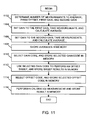
- a transducer-including device does not store the calibration coefficients in internal memory. Instead, the system 300 may store the calibration coefficients (e.g., in memory 316 of the calibration controller 310), and the calibration coefficients later may be loaded into the memory of a device (e.g., device 1100, FIG. 11 ) into which a transducer-including device ultimately is incorporated.
- all or portions of the calibration controller 310 may be coupled to the board support structure 354.
- circuit board 358 may have components corresponding to all or portions of the calibration controller 310. More particularly, those components may be configured to implement all or portions of the processes performed by user interface 312, display 314, memory 316, calibration control module 318, motor control module 320, and/or device interface 322.
- the portions of the calibration controller 310 that are coupled to the board support structure 354 e.g., that are coupled to circuit board 358) may communicate wirelessly with portions of the calibration controller 310 that are not coupled to circuit board 358.
- Such embodiments may be particularly useful, for example, when it is desired to rotate the board support structure 354 in a manner in which physical conductors of communication structure 330 (e.g., cables) otherwise may become undesirably wound up (e.g., when it is desired to rotate the board support structure 354 through multiple full rotations, such as when calibrating gyroscopes 220, FIG. 2 ).
- physical conductors of communication structure 330 e.g., cables
- the calibration system 300 may be used to calibrate a plurality of transducer-including devices 372 at various points in a manufacturing process.
- FIG. 5 is a flowchart of a method for calibrating a plurality of transducer-including devices at a particular point in a manufacturing process, in accordance with an example embodiment. It is to be understood that a calibration system (e.g., calibration system 300, FIG. 3 ) alternatively may be used at a different point in a manufacturing process than that described in conjunction with FIG. 5 .
- the method may begin by manufacturing a plurality of transducer-including devices (e.g., transducer-including devices 100, 200, 372, 490, FIGs 1-4 ), in block 502.
- the transducer-including devices essentially are fully packaged devices (e.g., overmolded or air cavity packages) with exposed contacts (e.g., contacts 108, FIG. 1 ).
- firmware instructions or "code" associated with performing a calibration process in accordance with an embodiment may be stored in each device (e.g., into memory 282, FIG. 2 ).
- the device's microcontroller e.g., microcontroller 280, FIG. 2
- the device's microcontroller may retrieve and execute the stored calibration code.
- the calibration code may include various code segments corresponding to the device-performed portions of the overall calibration processes of FIGs 8 and 9 or the calibration sub-processes of FIGs 10-12 .
- the transducer-including devices are loaded into sockets (e.g., sockets 420, FIG. 4 ) of one or more calibration boards (e.g., calibration board 400, FIG. 4 ).
- the devices may be loaded into the sockets by hand, using automatic pick-and-place equipment, or using some other technique.
- a human operator installs the calibration board(s) into a board support structure of a device handling system (e.g., into board support structure 354 of device handling system 350, FIG. 3 ).
- a human operator installs the calibration board(s) into a board support structure of a device handling system (e.g., into board support structure 354 of device handling system 350, FIG. 3 ).
- an edge connector of the calibration board e.g., edge connector 344, 430, FIGs 3 , 4
- a corresponding connector of a device handling system e.g., connector 342, FIG. 3
- the board support structure is coupled with a base (e.g., base 352, FIG. 3 ) and with one or more motors (e.g., motors 356, FIG. 3 ), which are configured to support the board support structure and to rotate the board support structure around one or more axes, respectively.
- FIG. 6 is an external view of a device handling system 600, which includes a base 610, a motor 620, and a board support structure 630 that is oriented in a first orientation with respect to a fixed coordinate system 690 (e.g., a coordinate system that is fixed with respect to base 610), in accordance with an example embodiment.
- a fixed coordinate system 690 e.g., a coordinate system that is fixed with respect to base 610
- board support structure 630 is configured to hold two calibration boards 640, and each calibration board 640 may include a plurality of transducer-including devices 650 loaded into sockets of the calibration boards 640.
- a board support structure may be configured to hold a single calibration board or more than two calibration boards. Either way, in the orientation of FIG. 6 , the device-fixed axes 680 of each transducer-including device 650 are angularly offset from the corresponding axes of the fixed coordinate system 690 (although in the orientation of FIG. 6 , the angular offsets are approximately zero degrees).
- the calibration boards 640 may be coupled to the board support structure 630 using corresponding connectors.
- an edge connector e.g., connector 344, 430, FIGs 3 , 4
- a corresponding connector e.g., connector 342, FIG. 3
- the connectors and other mechanical features e.g., slots, ledges, and so on of the calibration boards 640 and/or the board support structure 630 hold the calibration boards 640 in a fixed position with respect to the board support structure 630.
- the board support structure 630 is coupled to the base 610 in a manner that enables the board support structure 630 to be rotated by motor 620 around an axis of the fixed coordinate system 690.
- motor 620 is coupled to base 610, and a shaft 622 extending from motor 620 is coupled to the board support structure 630.
- the motor 620 may be controlled (e.g., by calibration controller 310, FIG. 3 ) to rotate the shaft 622 and, thus, to rotate the board support structure 630, calibration boards 640, and transducer-including devices 650.
- calibration controller 310 FIG. 3
- motor 620 may be controlled to rotate the board support structure 630, calibration boards 640, and transducer-including devices 650 around the X-axis of coordinate system 690.
- a system alternatively may include one or more motors that may be controlled to rotate a board support structure and/or calibration board around multiple fixed axes.
- the calibration process essentially includes a calibration controller (e.g., calibration controller 310, FIG. 3 ) causing the motor(s) (e.g., motors 356, FIG. 3 ) to rotate the board support structure through a series of orientations, causing the transducer-including devices to collect transducer data while in the various orientations (or while being moved between orientations) and, ultimately, causing the transducer-including devices to select calibration coefficients (e.g., gain and offset values or codes) based on the collected transducer data.
- a calibration controller e.g., calibration controller 310, FIG. 3
- the motor(s) e.g., motors 356, FIG. 3
- the transducer-including devices to collect transducer data while in the various orientations (or while being moved between orientations) and, ultimately, causing the transducer-including devices to select calibration coefficients (e.g., gain and offset values or codes) based on the collected transducer data.
- the calibration controller causes the transducer-including devices (e.g., devices 650, FIG. 6 ) and their corresponding device-fixed axes (e.g., axes 680, FIG. 6 ) to be rotated with respect to a fixed coordinate system (e.g., fixed coordinate system 690, FIG. 6 ).
- the calibration controller communicates with the transducer-including devices to cause the devices to produce transducer data and to calculate calibration coefficients, in an embodiment.
- the calibration controller (not shown in FIG.
- the transducer-including devices 650 may communicate with the transducer-including devices 650 to cause the transducer-including devices 650 to generate transducer data while the devices 650 are in the orientation shown in FIG. 6 .
- the transducer data e.g., accelerometer and/or gyroscope data
- the system also may include a magnetic field generator (not illustrated) configured to produce a magnetic field that passes through the board support structure 630 (e.g., with the magnetic field being strongest along the Z-axis), and the transducer data (e.g., magnetometer data) produced by the devices 650 would have corresponding values.
- a magnetic field generator (not illustrated) configured to produce a magnetic field that passes through the board support structure 630 (e.g., with the magnetic field being strongest along the Z-axis)
- the transducer data e.g., magnetometer data
- the transducer-including device 650 may send an indication to the calibration controller that the measurement (or data collection) process has been completed for that orientation.
- the calibration controller may then send motor control signals to motor 620, to cause the motor 620 to rotate the board support structure 630 to a next orientation in the sequence.
- FIG. 7 is an external view of the device handling system 600 of FIG. 6 , with the board support structure 630 oriented in a second orientation with respect to the fixed coordinate system 690, in accordance with an example embodiment.
- the board support structure 630 has been rotated approximately 90 degrees around the X-axis of the fixed coordinate system 690.
- a + 1G acceleration due to gravity would be exerted on the transducer-including devices 650 along the device-fixed y-axis.
- the calibration controller may cause each transducer-including device 650 again to produce transducer data, and the transducer-including device 650 again may send an indication to the calibration controller that the measurement process in that orientation has been completed. This process may continue until the calibration controller has caused the board support structure 630 to be rotated through a series of desired orientations.
- the transducer-including devices 650 may calculate calibration coefficients (e.g., gain and offset values or codes).
- the calibration coefficients may be stored in memory of the devices (e.g., memory 282, FIG. 2 ). In alternate embodiments, the transducer-including devices 650 may not calculate and/or store calibration coefficients, in which case these processes would be performed elsewhere (e.g., by microcontroller 360, calibration control module 318, and/or memory 316, FIG. 3 ).
- the calibration board(s) may be removed from the device handling system, in block 510.
- the loaded calibration board(s) may then be used to perform other portions of the manufacturing process (e.g., both calibration and additional processes may be performed without removing the transducer-including devices from the calibration board).
- a burn-in process may thereafter be performed with the device-loaded calibration boards.
- the calibration boards may be electrically connected (via connectors 344, 430, FIGs 3 , 4 ) to corresponding connectors in a chamber.
- the transducer-including devices may make produce and store additional sensor measurements, verify that the measurements are within expected ranges, and produce indications of the results.
- Other processes also or alternatively may be performed during a burn-in process.
- a final test process may be performed.
- the devices may be tested to ensure that the transducers are still functioning properly.
- data stored within the device may be read out and evaluated to ensure that the data falls within pre-specified ranges.
- FIG. 8 is a flowchart of a method for calibrating a plurality of transducer-including devices, in accordance with an example embodiment.
- the method may begin, in block 802, when a human operator causes the calibration process to be initiated (e.g., by pressing a "start" button of the calibration controller user interface 312, FIG. 3 ).
- the calibration process may be started automatically (e.g., once the calibration board has been properly loaded into the board support system). Either way, upon initiation of the process, the calibration controller may cause the transducer-including devices to be powered up, in block 804.
- the calibration controller may then wait to receive "ready" indications from each of the transducer-including devices on a calibration board, in block 806.
- each transducer-including device 490 on calibration board 400 may produce a signal at one of its contacts (e.g., one of contacts 292-295, FIG. 2 ), which corresponds to the ready indicator (e.g., the device may establish a relatively-high voltage at the contact).
- the signal corresponding to the ready indicator is conveyed via a socket contact and a single-socket conductor 442 to the calibration board connector 430, and ultimately through the communication structure 330 to the calibration controller 310.
- the transducer-including device may send a message (e.g., a message packet) to the calibration controller with a payload that indicates that the device is ready, or the device may produce some other type of ready indicator.
- a message e.g., a message packet
- the calibration controller may log an error for that device (e.g., the calibration controller may log an error corresponding to a particular socket).
- the calibration controller may cause the calibration board to be placed in a first orientation. More specifically, for example, the calibration controller may provide motor control signals (e.g., via motor control module 320), which cause the motor(s) of the device handling system (e.g., motor(s) 356) to move the board support structure, calibration board, and devices (e.g., board support structure 354, calibration board 370, and devices 372) to a first orientation in a pre-defined sequence of orientations. The motor(s) may provide feedback to the calibration controller during this process (e.g., indicating motor position, rate of rotation, and so on). If the board support structure already is in the first orientation at the beginning of the calibration process, the first iteration of block 808 may be bypassed.
- the motor(s) of the device handling system e.g., motor(s) 356
- the motor(s) may provide feedback to the calibration controller during this process (e.g., indicating motor position, rate of rotation, and so on). If the board support structure already is in the first
- the calibration controller may then send a "calibration" command to the devices.
- the calibration controller may send the calibration command to all devices on the calibration board in parallel.
- the calibration command is conveyed by the calibration controller 310 via the communication structure 330 and the calibration board connector 430 to multiple socket conductor(s) 440 of the calibration board 400, which in turn convey the signals to the sockets 420 and the transducer-including devices 490.
- the calibration command indicates to the transducer-including device (or more specifically to microcontroller 280, FIG. 2 ) the orientation that the device is in, and/or from which of multiple transducers transducer data should be collected.
- the calibration command may indicate from which of multiple accelerometers (e.g., which of accelerometers 212-214, FIG. 2 ) data should be collected. If the orientation is expected to produce a maximum acceleration (e.g., about +1 G of acceleration due to gravity) along the device's z-axis (e.g., z-axis 114, FIG.
- the calibration command may indicate that that transducer data should be collected from the z-axis accelerometer (e.g., z-axis accelerometer 214, FIG. 2 ). Accordingly, the device may select the output from that accelerometer (e.g., microcontroller 280 may control MUXs 216, 250 to produce an output from z-axis accelerometer 214, FIG. 2 ).
- the device may select the output from that accelerometer (e.g., microcontroller 280 may control MUXs 216, 250 to produce an output from z-axis accelerometer 214, FIG. 2 ).
- the calibration command may indicate from which of multiple magnetometers (e.g., which of magnetometers 232-234, FIG. 2 ) data should be collected. If the orientation is expected to produce a maximum magnetic field along the device's y-axis (e.g., y-axis 112, FIG. 1 ), for example, the calibration command may indicate that transducer data should be collected from the y-axis magnetometer (e.g., y-axis magnetometer 233, FIG. 2 ). Accordingly, the device may select the output from that magnetometer (e.g., microcontroller 280 may control MUXs 236, 250 to produce an output from y-axis magnetometer 233, FIG. 2 ).
- the device may select the output from that magnetometer (e.g., microcontroller 280 may control MUXs 236, 250 to produce an output from y-axis magnetometer 233, FIG. 2 ).
- the calibration controller may send the calibration command to the device while the calibration board is being rotated, so that transducer data from the gyroscope may be collected during the rotation operation.
- the calibration command may indicate from which of multiple gyroscopes (e.g., which of gyroscopes 222-224, FIG. 2 ) data should be collected. If the rotation is around the device's x-axis (e.g., x-axis 110, FIG.
- the calibration command may indicate that transducer data should be collected from the x-axis gyroscope (e.g., x-axis gyroscope 222, FIG. 2 ).
- the device may select the output from that gyroscope (e.g., microcontroller 280 may control MUXs 226, 250 to produce an output from x-axis gyroscope 222, FIG. 2 ).
- each transducer-including device may first de-assert the ready indicator, thus signaling to the calibration controller that the transducer-including device is collecting transducer data and, in some embodiments, storing and/or processing the transducer data (e.g., in embodiments in which the transducer-including device includes memory, such as memory 282, and/or a microcontroller, such as microcontroller 280, FIG. 2 ). As indicated above, the transducer-including device may collect transducer data from one or more transducers associated with the received command. In an embodiment in which the transducer-including device includes a memory (e.g., memory 284, FIG. 2 ), the transducer-including device may store the transducer data and transducer data processing results in the memory in a manner in which it is correlated with the appropriate transducer, transducer type, and/or sensing axis (or axes).
- the transducer-including device may store the transducer data and transducer data processing results in the memory in a
- the transducer-including device when the transducer-including device has completed the transducer data collection, processing, and storage processes, and when the current device orientation does not correspond to a last orientation in the pre-defined sequence of orientations (as indicated by decision block 814), the transducer-including device may re-assert the ready indicator, in block 816. Re-assertion of the ready indicator indicates to the calibration controller that the transducer-including device is ready to be re-oriented in order to collect, process, and store additional transducer data. The method then iterates as shown.
- the transducer-including device may calculate calibration coefficients (e.g., gain and/or offset values or codes for each sensing axis) using the stored transducer data, in block 818.
- calibration coefficients e.g., gain and/or offset values or codes for each sensing axis
- the device may store the calibration coefficients for each sensing axis and sensor type in internal memory (e.g., memory 282, FIG. 2 ) for later use during normal operation of the device.
- the device may re-assert the ready indicator, indicating to the calibration controller that the transducer-including device has completed collection of transducer data in the final orientation, and has calculated and stored calibration coefficients.
- the calibration controller waits to receive the final ready indicators from all transducer-including devices on the calibration board, in block 820. Once the calibration controller has received the ready indicator from all transducer-including devices (and/or has logged errors for non-responsive devices), in block 822, the calibration controller may send a final command to the transducer-including devices (e.g., in parallel).
- the device may validate results, in block 822 (e.g., determine whether the calibration coefficients fall within acceptable ranges).
- the device may produce a "calibration complete" indicator, in block 824.
- the calibration complete indicator may include toggling the voltage level (e.g., from a relatively high voltage to a relatively low voltage) on a contact (e.g., one of contacts 292-295, FIG. 2 ) at a particular frequency (e.g., 50 hertz or some other frequency).
- the calibration complete indicator may be some other type of signal to the calibration controller.
- the calibration controller waits to receive the calibration complete indicators from all transducer-including devices on the calibration board.
- the calibration controller may log an error for that device (e.g., the calibration controller may log an error corresponding to a particular socket).
- the calibration controller may power down the devices, in block 828, and the method may end (e.g., proceed to block 510 of FIG. 5 ).
- FIG. 9 is a flowchart of a method for calibrating a plurality of transducer-including devices, in accordance with another example embodiment.
- the embodiment of the calibration method depicted in FIG. 9 is similar to the embodiment of the calibration method depicted in FIG. 8 , with certain differences regarding some of the processes performed, and other differences regarding communication between a calibration controller (e.g., calibration controller 310, FIG. 3 ) and a transducer-including device (e.g., transducer-including device 200, 372, 490, FIGs 2-4 ).
- a calibration controller e.g., calibration controller 310, FIG. 3
- a transducer-including device e.g., transducer-including device 200, 372, 490, FIGs 2-4 .
- a calibration method may include a hybrid of processes and communication methods from the embodiments of FIGs 8 and 9 , and/or may include other differences that would occur to one of skill in the art based on the description herein.
- processes performed by the calibration controller are shown on the left side of the dashed line that extends vertically through FIG. 9
- processed performed by a transducer-including device are shown on the right side of the dashed line.
- the method may begin, in block 902, when a human operator causes the calibration process to be initiated (e.g., by pressing a "start" button of the calibration controller user interface 312, FIG. 3 ).
- the calibration process may be started automatically (e.g., once the calibration board has been properly loaded into the board support system).
- the calibration controller may cause the transducer-including devices to be powered up, in block 904.
- each transducer-including device may check a "calibration flag" (e.g., stored in memory 282, FIG. 2 or in a register or other memory location of the device) to determine whether or not a calibration process should be performed by executing the calibration code previously stored in the device.
- the process may continue as shown in FIG. 9 . Otherwise, the device may perform some other process (e.g., processes associated with burn-in or some other operation). In an alternate embodiment, a calibration flag is not implemented, and accordingly, the calibration process may proceed without checking such a flag.
- the transducer-including device may provide a "ready indicator" on one of its contacts (e.g., one of contacts 292-295, FIG. 2 , referred to below as a "device ready pin"), which indicates to the calibration controller that the transducer-including device is ready to receive a calibration command from the calibration controller.
- a “ready indicator” on one of its contacts (e.g., one of contacts 292-295, FIG. 2 , referred to below as a "device ready pin”), which indicates to the calibration controller that the transducer-including device is ready to receive a calibration command from the calibration controller.
- providing the ready indicator may include the transducer-including device establishing a voltage at the device ready pin that has a first voltage level associated with a first logic state (e.g., a relatively high level).
- the transducer-including device may make the device ready pin high to indicate that the transducer-including device is ready to receive a calibration command from the calibration controller.
- the "first voltage level" associated with the ready indicator may be a relatively low level. Either way, referring also to FIGs 3 and 4 , this indication may be conveyed from the transducer-including device 490 to the calibration controller through a socket contact and a single-socket conductor 442 to the calibration board connector 430, and ultimately through the communication structure 330 to the calibration controller 310, in an embodiment.
- the calibration controller may then wait to receive ready indicators from each of the transducer-including devices on the calibration board, in block 908. More specifically, the calibration controller may determine whether or not the device ready pin has been set high for each of the devices on the calibration board by determining the voltage on each single-socket conductor (e.g., single socket conductors 442) coupled to each device ready pin, in an embodiment. When the calibration controller has not received a ready indicator from a particular device within a timeout period (e.g., 0.25 seconds from initiation of power up, or some other timeout period), the calibration controller may log an error for that device (e.g., indicating the socket or device identifier and the point in the calibration process when the device became non-responsive).
- a timeout period e.g. 0.25 seconds from initiation of power up, or some other timeout period
- the calibration controller also may display an indication of the location of the non-responsive device on the calibration board (e.g., via display 314, FIG. 3 ), so that the human operator may thereafter take appropriate action (e.g., reject the device and/or mark the device as being defective).
- the calibration controller may place the transducer-including devices in a first orientation, if they are not already in the first orientation. More specifically, for example, the calibration controller may provide motor control signals (e.g., via motor control module 320), which cause the motor(s) of the device handling system (e.g., motor(s) 356) to move the board support structure, calibration board, and devices (e.g., board support structure 354, calibration board 370, and devices 372) to a first orientation in a pre-defined sequence of orientations.
- motor control signals e.g., via motor control module 320
- the motor(s) may provide feedback to the calibration controller during this process (e.g., indicating motor position, rate of rotation, and so on). If the board support structure already is in the first orientation at the beginning of the calibration process, the first iteration of block 910 may be bypassed.
- the calibration controller may then send a calibration command to the devices.
- the calibration controller may send the calibration command to all devices on the calibration board in parallel.
- the calibration command is conveyed by the calibration controller 310 via the communication structure 330 and the calibration board connector 430 to multiple socket conductor(s) 440 of the calibration board 400, which in turn convey the signals to the sockets 420 and the transducer-including devices 490.
- each calibration command may be a multi-bit command (e.g., 8 bits or some other number of bits), which the calibration controller clocks into each transducer-including device.
- one of the transducer-including device's contacts e.g., one of contacts 292-295, FIG.
- the calibration board 400 may include first multiple socket conductor(s) 440 that connect to socket contacts associated with the serial command input pins of the transducer-including devices, and second multiple socket conductor(s) 440 that connect to socket contacts associated with the serial clock pins of the transducer-including devices.
- the calibration board 400 may include single-socket conductors 442 that convey the calibration commands and/or clock signals (e.g., the calibration commands and/or clock signals are not necessarily conveyed to all devices simultaneously via the same conductors).
- the calibration controller and transducer-including devices may be configured to communicate calibration commands without the calibration controller providing a clock signal (e.g., each command may be preceded by a preamble (e.g., 0xF)).
- the calibration commands may be conveyed to the transducer-including devices as parallel signals (e.g., the transducer-including devices include parallel command input pins).
- each calibration command indicates to the transducer-including device (or more specifically to microcontroller 280, FIG. 2 ) the orientation that the device is in, and/or from which of multiple transducers transducer data should be collected, and/or which of multiple possible calibration sub-processes the device should perform.
- a calibration command of 81 hexadecimal may indicate that the transducer-including device has been placed in a first orientation, and that the transducer-including device should execute a particular calibration sub-process (e.g., a sub-process codified by instructions stored in memory 282, FIG. 2 ).
- each transducer-including device may read the calibration command provided on its serial command in pin.
- the device may provide an indication that the device is "busy" or "not ready.”
- providing the busy indication may include the transducer-including device establishing a voltage at the device ready pin that has a second voltage level associated with a second logic state (e.g., a relatively low level).
- the transducer-including device may make the device ready pin low to indicate that the transducer-including device is busy executing a command and/or otherwise is not ready to receive another calibration command from the calibration controller.
- the "second voltage level" associated with the busy indication may be a relatively high level.
- the transducer-including device may then execute the calibration sub-process associated with the calibration command (e.g., processes in accordance with FIGs 10-12 , discussed later).
- execution of a calibration sub-process may include the transducer-including device collecting, storing, and processing transducer data, and/or selecting and storing calibration coefficients.
- data may be stored in internal memory of the transducer-including device (e.g., in memory 282, FIG. 2 ), including transducer measurements, values derived from multiple transducer measurements (e.g., averages of multiple measurements or other values), selected calibration coefficients (e.g., gain values, gain codes, offset values, and/or offset codes), and/or other data.
- the data may be output by the device for processing and/or storage by the calibration controller.
- the device again may provide a ready indicator (e.g., by making the device ready pin high), indicating to the calibration controller that the device has completed the calibration sub-process and is ready to receive a next calibration command.
- the calibration controller may wait to receive ready indicators from each of the transducer-including devices on the calibration board, in block 916.
- the calibration controller may log an error for that device (e.g., indicating the socket or device identifier and the point in the calibration process when the device became non-responsive), and may exclude that device from subsequent portions of the calibration process.
- the calibration controller also may display an indication of the location of the non-responsive device on the calibration board (e.g., via display 314, FIG. 3 ), so that the human operator may thereafter take appropriate action.
- the calibration controller may determine whether the devices are in their last orientation of the pre-defined sequence of orientations, as indicated by decision block 918. If not, the calibration controller may return to block 910, and repeat the process of placing the devices in the next orientation in the sequence (i.e., block 910), sending the appropriate calibration command to the devices (i.e., block 912), and waiting to receive the ready indicators from the devices (i.e., block 916), and the transducer-including devices may again perform a calibration sub-process associated with the received calibration command (i.e., block 914).
- the calibration controller may send a final command to the devices, in block 920 (e.g., via the serial command input pins).
- each transducer-including device reads in the final command, and performs a final process corresponding to the final command.
- the final process may include a validity verification process in which the transducer-including device verifies the validity of the calibration results obtained and stored (e.g., in memory 282, FIG. 2 ) during the performance of the various calibration sub-processes (e.g., the sub-processes performed in conjunction with the various iterations of block 914).
- Verification of the validity of the calibration results may include, for example, ensuring that the transducer measurements stored for each orientation are different from previously stored default values (e.g., FFFF hexadecimal or some other value), indicating that the corresponding measurements were appropriately made and stored.
- verification of the calibration results may include ensuring that each calculated or chosen calibration coefficient (for each orientation) falls within a range of expected or acceptable values (e.g., that the gain value associated with a chosen gain code falls within an acceptable range of gain values, and that the offset value associated with a chosen offset code falls within an acceptable range of offset values).
- the device may provide a calibration complete indicator.
- the device may provide the calibration complete indicator on the device ready pin.
- the device may provide alternating voltage levels on the device ready pin, in an embodiment.
- the device may cause the voltage level on the device ready pin to toggle at a pre-defined frequency (e.g., 50 hertz or some other frequency) when the verification process has determined that the calibration results are valid.
- a pre-defined frequency e.g. 50 hertz or some other frequency
- the device may refrain from producing the calibration complete indicator, or may produce a calibration complete indicator that toggles at a different pre-defined frequency (e.g., 100 hertz or some other frequency).
- the device may alter a calibration flag (e.g., in memory 282, FIG. 2 or in a register or other memory location) to indicate that the calibration process has been completed, and that the device should execute different code the next time that the device is powered up.
- a calibration flag e.g., in memory 282, FIG. 2 or in a register or other memory location
- the calibration controller may wait to receive calibration complete indicators from each of the transducer-including devices on the calibration board, in block 924. More specifically, for example, the calibration controller may determine whether the voltage on each device ready pin is toggling at the pre-defined frequency associated with a successful verification process. When the calibration controller has not received a calibration complete indicator from a particular device within a timeout period (e.g., 0.25 seconds from sending the final command in block 920, or some other timeout period), or when the calibration controller receives an indication that the calibration results are not valid for a device, the calibration controller may log an error for that device (e.g., indicating the socket or device identifier and the failure of the verification process). In addition, in an embodiment, the calibration controller also may display an indication of the location of the unverified device on the calibration board (e.g., via display 314, FIG. 3 ), so that the human operator may thereafter take appropriate action.
- a timeout period e.g. 0.25 seconds from sending the final command in block 920, or some other timeout period
- the calibration controller may power down the devices, in block 926, and the method may end (e.g., proceed to block 510 of FIG. 5 ).
- each calibration command may cause a transducer-including device to perform a specific calibration sub-process.
- FIGs 10-12 are flowcharts of examples of three different calibration sub-processes, in accordance with various embodiments. It is to be understood that the sub-processes depicted in FIGs 10-12 are just a few examples of different calibration sub-processes that could be performed, and a transducer-including device may be configured to perform more, fewer, or different calibration sub-processes in other embodiments. It should be further understood that some of the calibration sub-processes may use results of other calibration sub-processes. For example, according to an embodiment, the calibration sub-processes of FIGs 10 and 11 are complementary.
- one of the sub-processes may be performed when a known positive gravitational force (e.g., + 1G) is exerted on the device along the axis, and the other sub-process may be performed when a known negative gravitational force of the same magnitude (e.g., - 1 G) is exerted on the device along the axis.
- the sub-process of FIG. 10 would first be performed when the device is in a first orientation, and the sub-process of FIG.
- the sub-process of FIG. 11 subsequently would be performed when the device is in a second orientation (e.g., an orientation that is rotated 180 degrees with respect to the first orientation around an axis orthogonal to the calibration axis).
- a second orientation e.g., an orientation that is rotated 180 degrees with respect to the first orientation around an axis orthogonal to the calibration axis.
- the sub-process of FIG. 11 may use measurement averages previously calculated in conjunction with performing the sub-process of FIG. 10 to select a gain value (or code) and an offset value (or code) for a particular calibration axis.
- FIG. 10 is a flowchart of a first calibration sub-process, in accordance with an example embodiment.
- the calibration sub-process of FIG. 10 could be performed (e.g., in conjunction with block 812 or 914, FIGs 8 , 9 ) by a transducer-including device (e.g., device 200, 372, 490, FIGs 2-4 ) in response to having received a particular calibration command from a calibration controller (e.g., calibration controller 310, FIG. 3 ).
- a calibration controller e.g., calibration controller 310, FIG. 3
- a plurality of transducer measurements are taken at a first gain value and averaged
- a plurality of additional transducer measurements are taken at a second gain value and averaged.
- the fixed offset value, number of measurements to average, and the gain values may be configurable parameters that are stored in memory (e.g., memory 282, FIG. 2 ), in an embodiment.
- the fixed offset value and gain values may be stored as actual magnitudes, or they may be stored as an offset code (corresponding to a particular offset value) and gain codes (corresponding to particular gain values).
- the gain codes may be considered to be "known gain codes," and the gain values associated with the known gain codes may be referred to below “known gain values,” or as "C1" and "C2.”
- the calibration sub-process of FIG. 10 may begin, in block 1002, by determining the various parameters associated with the process. More particularly, in an embodiment, the microcontroller of the transducer-including device (e.g., microcontroller 280, FIG. 2 ) may retrieve the fixed offset value (or code), the number of measurements to average, and the two known gain values, C1 and C2, from memory (e.g., memory 282, FIG. 2 ).
- the fixed offset value may be a value roughly or precisely in the center of the range of possible offset values, although the fixed offset value may correspond to a value that is not in the center of the range of offset values, as well.
- the number of measurements to average may be in a range of two measurements to about 10 measurements or more, depending upon the desired speed and accuracy of the calibration sub-process.
- one of the known gain values may have a value that is higher than a central gain value (i.e., a gain value in the center of the range of possible gain values), and the other known gain value may have a value that is lower than the central gain value.
- the first known gain value may be about 75 percent of the maximum gain that may be applied, and the second known gain value may be about 25 percent of the maximum gain, although the first and second known gain values may be different, as well.
- the device sets the gain of its amplifier (e.g., the amplifier in gain and filter circuitry 260, FIG. 2 ) to the first known gain value, C1, and takes a first plurality of transducer measurements (e.g., a number of measurements that is equal to the specified number of measurements to average). The device then calculates a first average of the measurements taken at the first gain value.
- the device sets the gain to the second known gain value, C2, and takes a second plurality of transducer measurements (e.g., a number of measurements that is equal to the specified number of measurements to average). The device then calculates a second average of the measurements taken at the second gain value.
- the first and second averages are stored (e.g., in memory 282, FIG. 2 ) for later use (e.g., during execution of the sub-process of FIG. 11 ), and the method may end.
- two transducer measurement averages are stored in memory.
- the first measurement average corresponds to the first known gain value, C1, and a known gravitational force (e.g., + 1 G or - 1 G) associated with the current orientation of the device.
- the second measurement average corresponds to the second known gain value, C2, and the known gravitational force (e.g., + 1 G or- 1 G) associated with the current orientation of the device.
- the first and second measurement averages may be referred to below as "M1 C1 " and "M2 C2 ,” respectively.
- FIG. 11 is a flowchart of a calibration sub-process, in accordance with another example embodiment.
- the calibration sub-process of FIG. 11 may be a complementary process to the calibration sub-process of FIG. 10 (i.e., the sub-process of FIG. 11 may use the results obtained from the sub-process of FIG. 10 ).
- the sub-process of FIG. 11 is performed after the device has been rotated approximately 180 degrees around an axis orthogonal to the calibration axis, with respect to the orientation in which the sub-process of FIG. 10 was performed. Accordingly, where the process of FIG.
- FIG. 10 was performed when a first known gravitational force (e.g., + 1G or - 1 1G) was being exerted along the calibration axis
- the process of FIG. 11 is performed when a second known gravitational force of opposite sign (e.g., - 1G or + 1G) is being exerted along the calibration axis.
- a first known gravitational force e.g., + 1G or - 1 1G
- a second known gravitational force of opposite sign e.g., - 1G or + 1G
- the first four blocks of FIG. 11 are substantially similar to the four blocks representing the sub-process of FIG. 10 . More particularly, the calibration sub-process of FIG. 11 may begin, in block 1102, by determining the various parameters associated with the process (e.g., retrieving the fixed offset value (or code), the number of measurements to average, and the two known gain values, C1 and C2, from memory 282, FIG. 2 ). According to an embodiment, the fixed offset value, the number of measurements to average, and the first and second known gain values, C1 and C2, are equal to the values used in performing the sub-process of FIG. 10 .
- the fixed offset value, the number of measurements to average, and the first and second known gain values, C1 and C2 are equal to the values used in performing the sub-process of FIG. 10 .
- the device sets the gain of the amplifier (e.g., of gain and filter circuitry 260, FIG. 2 ) to the first known gain value, C1, and takes a third plurality of transducer measurements (e.g., at least a number of measurements that is equal to the specified number of measurements to average). The device then calculates a third average of the measurements taken at the first gain value.
- the device sets the gain to the second known gain value, C2, and takes a fourth plurality of transducer measurements (e.g., at least a number of measurements that is equal to the specified number of measurements to average). The device then calculates a fourth average of the measurements taken at the second gain value.
- the third and fourth averages are stored (e.g., in memory 282, FIG. 2 ).
- two additional transducer measurement averages are stored in memory.
- the third measurement average corresponds to the first known gain value, C1, and a second known gravitational force (e.g., - 1G or + 1 G) associated with the current orientation of the device.
- the fourth measurement average corresponds to the second known gain value, C2, and the second known gravitational force (e.g., - 1 G or + 1 G) associated with the current orientation of the device.
- the third and fourth measurement averages may be referred to below as "M3 C1 " and "M4 C2 ,” respectively.
- measurement averages (M1 C1 and M2 C2 ) for the first and second known gain values when the device was in an orientation associated with the first known gravitation force of opposite sign (e.g., + 1G or - 1G)
- the memory of the device now contains first, second, third, and fourth stored measurement averages representing measurements at two known gravitational forces (e.g., +1G and -1G), which were taken with two known gain values, C1 and C2.
- the device specifications may stipulate a target sensitivity or target offset (e.g., defined in G/count or G/LSB) with an error window (e.g., 0.118 G/count +/- 15 percent).
- the device specifications also may stipulate a digital code per G, with an error window (e.g., code 255 for 30G, +/- 3G).
- the device specifications alternatively or additionally may specify other sensitivity or offset related parameters. According to an embodiment, using the measurement averages calculated in blocks 1004, 1104, 1006, and 1106, the device determines a gain value and/or an offset value that are likely to ensure that the device may substantially achieve the performance parameters stipulated in the device specifications. The device then selects a corresponding gain code and offset code, as described in more detail below.
- a gain value is determined based on the stored first, second, third, and fourth averages, and a gain code corresponding to the determined gain value is selected and stored (e.g., in memory 282, FIG. 2 ).
- a gain code corresponding to the determined gain value is selected and stored (e.g., in memory 282, FIG. 2 ).
- Any of several algorithms may be used to determine the gain value and corresponding gain code using the previously-acquired measurements (e.g., M1 C1 , M2 C2 , M3 C1 , and M4 C2 determined in blocks 1004, 1006, 1104, 1106).
- an embodiment of a gain value determination algorithm may include:
- each of the transducer measurements used in the equations was taken when the corresponding calibration axis was aligned with the gravitational force vector (e.g., when the device is in one of the orientations shown in FIG. 13 ).
- transducer measurements may be taken when the calibration axis or axes are not aligned with the gravitational force vector (e.g., when the device is in one of the orientations shown in FIG. 14 ).
- the example equations provided above may be modified to account for the vector mathematics that may be employed to calculate the offset and gain values. Such embodiments are intended to fall within the scope of the inventive subject matter.
- a gain code is selected based on the target offset stipulated in the specification.
- the selected gain code may be the gain code that is associated with an offset value that is closest to the specified target offset value.
- the selected gain code (or the gain value associated with that gain code) is then stored (e.g., in memory 282, FIG. 2 ) for the transducer associated with the calibration axis.
- the device's amplifier is set to the gain value associated with the selected gain code, and a plurality of additional transducer measurements are taken at a plurality of offset values.
- the device first may be configured to apply the gain value associated with the selected gain code. Thereafter, the device may perform multiple measurement iterations, where a different offset is applied during each iteration.
- the applied offsets may be selected sequentially from an offset code table stored in the device (e.g., such as the offset code table shown in Table 2, above), where each offset has a corresponding offset code.
- an offset code table stored in the device (e.g., such as the offset code table shown in Table 2, above)
- each offset has a corresponding offset code.
- the amplifier configured to apply a gain value corresponding to the selected gain code
- transducer measurements are obtained during a sweep of offset values stored in the offset code table.
- the transducer measurements obtained during the offset sweep are stored (e.g., in memory 282, FIG. 2 ).
- an offset code is selected based on the transducer measurements stored during the offset sweep. More specifically, the selected offset code may be the offset code that is associated with an offset value (determined in block 1112) that is closest to the specified target offset value. The selected offset code is then stored (e.g., in memory 282, FIG. 2 ) for the transducer associated with the calibration axis. In an alternate embodiment, the offset value corresponding to the selected offset code may be stored for the transducer, rather than storing the selected offset code.
- a calibrated measurement may then be performed with the device configured to apply the gain value associated with the selected gain code and to apply the offset value associated with the selected offset code.
- the results of the calibrated measurement process may then be stored (e.g., in memory 282, FIG. 2 ), and the method may end.
- the calibration sub-processes of FIGs 10 and 11 may be modified in various ways.
- the sub-processes includes taking measurements at two gain values
- other sub-processes may include taking measurements at only one gain value or at more than two gain values.
- the measurements are averaged in the above-described embodiment, other mathematical formulas could be applied to the measurements in other embodiments.
- various other mathematical formulas could be used to select gain values and offset values.
- FIG. 12 is a flowchart of a calibration sub-process, in accordance with yet another example embodiment.
- the calibration sub-process of FIG. 12 may be used simply to collect measurement data that may later be retrieved and evaluated for various purposes (e.g., for validating the calibration process).
- the method may begin, in block 1202, when a calibrated measurement is be performed with the device configured to apply the gain value associated with the selected gain code and to apply the offset value associated with the selected offset code.
- the results of the calibrated measurement process may then be stored (e.g., in memory 282, FIG. 2 ).
- an offset sweep may then be performed with the gain set to the gain value corresponding to the selected gain code.
- the measurement results obtained from the offset sweep may then be stored (e.g., in memory 282, FIG. 2 ), and the method may end.
- FIGs 8-12 illustrate particular sequences of steps associated with calibration processes, it should be understood that the sequences may be modified while achieving substantially the same results or similar results. For example, rather than waiting to calculate calibration coefficients associated with all transducers until the device has been transferred through an entire sequence of orientations and all transducer data has been collected, calibration coefficients for a particular transducer may be calculated as soon as sufficient transducer data for the transducer has been collected.
- various commands and indications are discussed in conjunction with the embodiments illustrated in FIGs 8-12 , the commands and indications may be different from those discussed above. For example, the various signals and indications discussed above could be provided in different formats, using different contacts or "pins,” and so on.
- the devices may be desirable to have the devices execute multiple calibration sub-processes while in a particular orientation (e.g., the devices may be sent multiple calibration commands while in a particular orientation, and the devices accordingly execute multiple calibration sub-processes in the orientation).
- the devices may be sent multiple calibration commands while in a particular orientation, and the devices accordingly execute multiple calibration sub-processes in the orientation.
- FIG. 13 an example is shown of a pre-determined sequence of orientations 1301-1306 through with a system (e.g., system 300, FIG. 3 ) may put a transducer-including device 1300 with respect to a fixed coordinate system (represented by axes 1310, 1312, 1314), in accordance with an example embodiment. More specifically, FIG. 13 is intended to show a sequence of orientations that a device handling system (e.g., device handling system 350, FIG. 3 ) may put a plurality of transducer-including devices through under the control of a calibration controller (e.g., calibration controller 310, FIG. 3 ). To avoid cluttering FIG.
- a calibration controller e.g., calibration controller 310, FIG. 3
- a "pin 1" top surface indicator 1331 is illustrated as a solid black circle on the top surface 1330 of device 1300.
- a "pin 1" bottom surface indicator 1333 is illustrated as a white-filled circle on the bottom surface 1332 of device 1300.
- Transducer data from accelerometers and magnetometers within device 1300 may be collected when device 1300 is in each of the orientations 1301-1306, in an embodiment.
- transducer data from gyroscopes e.g., gyroscopes 222-224, FIG. 2
- device 1300 is transitioned to a plurality of orientations 1301-1306 in which orthogonal device-fixed axes 1320 align with orthogonal fixed axes 1310, 1312, 1314.
- device 1300 is transitioned from one orientation by rotating device 1300 around one of the fixed axes 1310, 1312, 1314.
- a calibration system capable of achieving the orientations 1301-1306 shown in FIG. 13 would be capable of, at least, rotating device 1300 around two fixed, orthogonal axes (e.g., X-axis 1310 and Z-axis 1314).
- a calibration system may be capable of rotating devices around a single axis (e.g., as in the embodiment illustrated in FIGs 6 and 7 ), or a calibration system may be capable of rotating devices around all three orthogonal axes.
- a primary acceleration, force or field being sensed is strongest along the Z-axis 1314 of the fixed coordinate system.
- a gravitational force vector may extend in the -Z direction along Z-axis 1314.
- device 1300 would experience a + 1 G acceleration due to gravity along the device-fixed z-axis, and 0G acceleration due to gravity along the device-fixed x-axis and y-axis. If device 1300 is rotated (e.g., by device handling system 350, FIG.
- device 1300 would experience a + 1G acceleration due to gravity along the device-fixed y-axis, and 0G acceleration due to gravity along the device-fixed x-axis and z-axis. If device 1300 is thereafter rotated by 90 degrees around the fixed X-axis 1310 to third orientation 1303, device 1300 would experience a - 1 G acceleration due to gravity along the device-fixed z-axis, and 0G acceleration due to gravity along the device-fixed x-axis and y-axis.
- device 1300 If device 1300 is thereafter rotated by 90 degrees around the fixed X-axis 1310 to fourth orientation 1304, device 1300 would experience a - 1G acceleration due to gravity along the device-fixed y-axis, and 0G acceleration due to gravity along the device-fixed x-axis and z-axis. If device 1300 is thereafter rotated by 90 degrees around the fixed Y-axis 1312 to fifth orientation 1305, device 1300 would experience a - 1 G acceleration due to gravity along the device-fixed x-axis, and 0G acceleration due to gravity along the device-fixed y-axis and z-axis.
- device 1300 is thereafter rotated by 180 degrees around the fixed Y-axis 1312 to sixth orientation 1306, device 1300 would experience a + 1G acceleration due to gravity along the device-fixed x-axis, and 0G acceleration due to gravity along the device-fixed y-axis and z-axis.
- device 1300 may include a three-axis accelerometer (e.g., device 1300 includes x-axis accelerometer 212, y-axis accelerometer 213, and z-axis accelerometer 214, FIG. 2 ) and each accelerometer is associated with a corresponding device-fixed axis 1320.
- An embodiment of a calibration controller may send calibration commands to device 1300 when device 1300 is in each of orientations 1301-1306, where each calibration command would indicate which accelerometer outputs should be collected while in the given orientation 1301-1306. More specifically, in the example, each calibration command would indicate that samples should be collected from the accelerometer corresponding to the device-fixed axis 1320 currently aligned with the fixed Z-axis 1314.
- the calibration command may indicate the direction of alignment (e.g., in the positive or negative direction).
- each calibration command may indicate the orientation 1301-1306 in which the device 1300 has been placed.
- a microcontroller of the device 1300 e.g., microcontroller 280, FIG. 2
- device 1300 may include a three-axis magnetometer (e.g., device 1300 includes x-axis magnetometer 232, y-axis magnetometer 233, and z-axis magnetometer 234, FIG. 2 ), and one may assume for example that a primary magnetic field being sensed is strongest along the Z-axis 1314 of the fixed coordinate system.
- Each magnetometer may be associated with a corresponding device-fixed axis 1320.
- An embodiment of a calibration controller may send calibration commands to device 1300 when device 1300 is in each of orientations 1301-1306, where each calibration command would indicate which magnetometer outputs should be collected while in the given orientation 1301-1306.
- each calibration command would indicate that samples should be collected from the magnetometer corresponding to the device-fixed axis 1320 currently aligned with the fixed Z-axis 1314.
- the calibration command may indicate the direction of alignment (e.g., in the positive or negative direction).
- a microcontroller of the device 1300 e.g., microcontroller 280, FIG. 2
- device 1300 may include a three-axis gyroscope (e.g., device 1300 includes x-axis gyroscope 222, y-axis gyroscope 223, and z-axis gyroscope 224,
- each gyroscope may be associated with a corresponding device-fixed axis 1320.
- An embodiment of a calibration controller may send calibration commands to device 1300 while device 1300 is rotating between orientations 1301-1306, and each calibration command would indicate which gyroscope outputs should be collected while being rotated between orientations 1301-1306. More specifically, in the example, each calibration command would indicate that samples should be collected from the gyroscope corresponding to the device-fixed axis 1320 around which the device 1300 is being rotated.
- the calibration command may indicate the direction of rotation (e.g., in the positive or negative direction) and/or the rate of rotation.
- a microcontroller of the device 1300 may calculate calibration coefficients for the gyroscope associated with that axis, and store the calibration coefficients in memory (e.g., memory 282, FIG. 2 ), in an embodiment.
- FIG. 13 is intended to show an example of a pre-determined sequence of orientations 1301-1306, and the example shown should not be construed as limiting.
- Other pre-determined sequences may include transitioning a device through orientations 1301-1306 in a different order, transitioning a device through a subset of orientations 1301-1306, and/or transitioning a device through additional and/or different orientations than those shown in FIG. 13 .
- one of the device-fixed axes 1320 is aligned with a gravitational force or the primary orientation of a magnetic field (e.g., aligned with the Z-axis 1314 of the fixed coordinate system), and the other device-fixed axes 1320 are in a plane orthogonal to the Z-axis. Accordingly, maximum sensor output values would be expected for the sensors associated with the device-fixed axis aligned with the Z-axis 1314, and negligible sensor output values would be expected for the sensors associated with the device-fixed axes that are not aligned with the Z-axis 1314.
- a device may be transitioned through a sequence of orientations in which none of the device-fixed axes are aligned with a gravitational force or the primary orientation of a magnetic field.
- components of the gravitational force or magnetic field strength may be experienced along multiple ones of the device-fixed axes, and calibration coefficients may be calculated accordingly.
- FIG. 14 illustrates an example of a pre-determined sequence of orientations 1401, 1402 through with a system (e.g., system 300, FIG. 3 ) may put a transducer-including device 1400 with respect to a fixed coordinate system (represented by axes 1410, 1412, 1414), in accordance with another example embodiment.
- a "pin 1" top surface indicator 1431 is shown on the top surface 1430 of device 1400 in orientation 1401
- a "pin 1" bottom surface indicator 1433 is shown on the bottom surface 1432 of device 1400 in orientation 1402.
- transducer data from accelerometers and magnetometers within device 1400 may be collected when device 1400 is in each of the orientations 1401, 1402, in an embodiment.
- transducer data from gyroscopes e.g., gyroscopes 222-224, FIG. 2
- gyroscopes 222-224, FIG. 2 may be collected while device 1400 is being moved from one orientation to another at pre-defined rates of rotation around the fixed axes 1410, 1412, 1414.
- device 1400 is transitioned from a first orientation 1401 in which each of orthogonal device-fixed axes 1420 are angularly offset from corresponding orthogonal fixed axes 1410, 1412, 1414 by approximately 45 degrees, to a second orientation 1402 in which each of device-fixed axes 1420 are angularly offset from corresponding fixed axes 1410, 1412, 1414 by approximately 225 degrees.
- device 1400 is transitioned from one orientation to another by rotating device 1300 around one of the fixed axes 1410, 1412, 1414.
- the angular offsets between the device fixed axes 1420 and the corresponding fixed axes 1410, 1412, 1414 may be achieved, in an embodiment by using a board support structure (e.g., board support structure 354, FIG. 3 ) that is configured to support a calibration board (e.g., calibration board 370, FIG. 3 ) at 45 degree angles with respect to the axes of rotation of the motor(s) (e.g., motor(s) 356, FIG. 3 ).
- a board support structure e.g., board support structure 354, FIG. 3
- a calibration board e.g., calibration board 370, FIG. 3
- a calibration controller sends a command to device 1400 in each orientation 1401, 1402, and after collecting accelerometer data for each of the device-fixed axes, a microcontroller of the device 1400 (e.g., microcontroller 280, FIG. 2 ) may calculate calibration coefficients for each of the accelerometers using appropriate vector mathematics.
- Device 1400 may thereafter store the calibration coefficients in memory (e.g., memory 282, FIG. 2 ), in an embodiment.
- a calibration controller sends a command to device 1400 in each orientation 1401, 1402, and after collecting magnetometer data for each of the device-fixed axes, a microcontroller of the device 1400 (e.g., microcontroller 280, FIG. 2 ) may calculate calibration coefficients for each of the magnetometers using appropriate vector mathematics.
- Device 1400 may thereafter store the calibration coefficients in memory (e.g., memory 282, FIG. 2 ), in an embodiment.
- An embodiment of a method for calibrating a packaged device that includes one or more transducers includes steps performed by the packaged device.
- the steps of the method performed by the packaged device include receiving a first calibration command from an external calibration controller through an interface, and executing first code in response to receiving the first calibration command.
- Executing the first code includes generating first transducer data from a transducer of the one or more transducers, calculating calibration coefficients using the first transducer data, and storing the calibration coefficients within a memory of the device.
- An embodiment of a method for calibrating a plurality of packaged, transducer-including devices includes sending, through a communication structure, calibration commands to the plurality of transducer-including devices.
- the calibration commands cause each of the transducer-including devices to execute code stored in memories of the transducer-including devices. Execution of the code causes the transducer-including devices to generate transducer data, calculate calibration coefficients using the transducer data, and store the calibration coefficients within the memories of the transducer-including devices.
- An embodiment of a packaged transducer-including device includes one or more transducers, an interface configured to facilitate communications with an external calibration controller, a memory, and a processing component.
- the processing component is configured to receive calibration commands from the external controller through the interface, and to execute code in response to receiving the calibration commands. Execution of the code includes generating transducer data from the one or more transducers, calculating calibration coefficients using the transducer data, and storing the calibration coefficients within the memory.
Landscapes
- Physics & Mathematics (AREA)
- General Physics & Mathematics (AREA)
- Engineering & Computer Science (AREA)
- Manufacturing & Machinery (AREA)
- Radar, Positioning & Navigation (AREA)
- Remote Sensing (AREA)
- Computer Hardware Design (AREA)
- Microelectronics & Electronic Packaging (AREA)
- Gyroscopes (AREA)
- Measuring Magnetic Variables (AREA)
Claims (14)
- Verfahren zur Kalibrierung einer verpackten Vorrichtung (100, 200, 372, 490, 650, 1300), die einen oder mehrere Wandler (210, 220, 230) umfasst, wobei das Verfahren durch die verpackte Vorrichtung durchgeführt wird und die folgenden Schritte umfasst:Empfang (812, 914) eines ersten Kalibrierungsbefehls von einer externen Kalibrierungssteuerung (310) durch eine Schnittstelle (284);Ausführung (812, 914) eines ersten Codes in Reaktion auf einen Empfang des ersten Kalibrierungsbefehls, wobei eine Ausführung des ersten Codes umfasst: Erzeugung (812, 914, 1004, 1006, 1104, 1106, 1112, 1116, 1201, 1204) erster Wandlerdaten von einem Wandler von dem einen oder den mehreren Wandlern, Berechnung (818) von Kalibrierungskoeffizienten unter Verwendung der ersten Wandlerdaten, wobei die Kalibrierungskoeffizienten einen ausgewählten Gain-Wert und einen ausgewählten Offset-Wert spezifizieren, und Speicherung (818) der Kalibrierungskoeffizienten in einem Speicher (282) der Vorrichtung;nach Ausführung des ersten Codes, Konfiguration der Vorrichtung (1110, 1114) zur Anwendung des ausgewählten Gain-Wertes und des ausgewählten Offset-Wertes auf ein Ausgangssignal des Wandlers; undErzeugung und Speicherung kalibrierter Wandlerdaten (1116).
- Verfahren gemäß Anspruch 1, wobei die Kalibrierungskoeffizienten aus der folgenden Gruppe ausgewählt werden: einem Gain-Wert, einem Gain-Code, einem Offset-Wert und einem Offset-Code.
- Verfahren gemäß Anspruch 1 oder 2, das weiterhin umfasst:vor einem Empfang des ersten Kalibrierungsbefehls, Herstellung (906) einer "Ready"-Anzeige für die Kalibrierungssteuerung.
- Verfahren gemäß Anspruch 1, 2 oder 3, das weiterhin umfasst:Empfang (812, 914) eines zweiten Kalibrierungsbefehls von der Kalibrierungssteuerung vor einem Empfang des ersten Kalibrierungsbefehls; undAusführung (812, 914) eines zweiten Codes in Reaktion auf einen Empfang des zweiten Kalibrierungsbefehls, wobei eine Ausführung des zweiten Codes eine Erzeugung (812, 914, 1004, 1006, 1104, 1106, 1112, 1116, 1201, 1204) von zweiten Wandlerdaten von dem einen oder den mehreren Wandlern umfasst und wobei eine Berechnung der Kalibrierungskoeffizienten eine Berechnung (818) der Kalibrierungskoeffizienten unter Verwendung der ersten Wandlerdaten und der zweiten Wandlerdaten umfasst.
- Verfahren gemäß Anspruch 1, 2, 3 oder 4, das weiterhin umfasst:Empfang (824, 922) eines letzten Befehls von der Kalibrierungssteuerung;Ausführung (824, 922) eines dritten Codes in Reaktion auf einen Empfang des letzten Befehls, wobei eine Ausführung des dritten Codes eine Verifizierung einer Validität von Kalibrierungsergebnissen umfasst; undnach einer Ausführung des dritten Codes, Herstellung (824, 922) einer "Kalibrierung abgeschlossen"-Anzeige für die Kalibrierungssteuerung.
- Verfahren gemäß Anspruch 5, wobei eine Herstellung (824, 922) der "Kalibrierung abgeschlossen"-Anzeige ein Wechsel-Umschalten einer Spannung bei einem Kontakt der verpackten Vorrichtung umfasst.
- Verfahren zur Kalibrierung einer Mehrzahl von verpackten, einen Wandler umfassenden Vorrichtungen (100, 200, 372, 490, 650, 1300), wobei das Verfahren die folgenden Schritte umfasst:Senden (810, 912), durch eine Kommunikationsstruktur (330), von Kalibrierungsbefehlen an eine Mehrzahl von einen Wandler umfassenden Vorrichtungen, wobei die Kalibrierungsbefehle jede von den einen Wandler umfassenden Vorrichtungen veranlasst einen Code auszuführen (812, 914), der in Speichern (282) der einen Wandler umfassenden Vorrichtungen gespeichert ist, und wobei eine Ausführung des Codes jede von den einen Wandler umfassenden Vorrichtungen veranlasst, unabhängig Wandlerdaten zur Berechnung (818) von Kalibrierungskoeffizienten unter Verwendung der Wandlerdaten zu erzeugen (812, 914, 1004, 1006, 1104, 1106, 1112, 1116, 1201, 1204), wobei die Kalibrierungskoeffizienten einen ausgewählten Gain-Wert und einen ausgewählten Offset-Wert spezifizieren, die Kalibrierungskoeffizienten in einen Speicher der einen Wandler umfassenden Vorrichtung zu speichern (818), die einen Wandler umfassende Vorrichtung (1110, 1114) zu konfigurieren den ausgewählten Gain-Wert und den ausgewählten Offset-Wert auf ein Ausgangssignal eines Wandlers der einen Wandler umfassenden Vorrichtung anzuwenden und kalibrierte Wandlerdaten zu erzeugen und zu speichern (1116).
- Verfahren gemäß Anspruch 7, das weiterhin umfasst:vor einem Senden eines Kalibrierungsbefehls, Warten (806, 908) auf eine "Ready"-Anzeige von der Mehrzahl von einen Wandler umfassenden Vorrichtungen.
- Verfahren gemäß Anspruch 7, wobei das Verfahren weiterhin umfasst:Veranlassung (808) eines Motorsteuermoduls die Mehrzahl von einen Wandler umfassenden Vorrichtungen von einer ersten Ausrichtung in eine zweite Ausrichtung in einer Reihe von Ausrichtungen zu drehen, undwobei ein Senden der Kalibrierungsbefehle umfasst:Senden (810, 912) eines ersten Kalibrierungsbefehls an die Mehrzahl von einen Wandler umfassenden Vorrichtungen, wenn sich die Mehrzahl von einen Wandler umfassenden Vorrichtungen in der ersten Ausrichtung befindet, wobei der erste Kalibrierungsbefehl jede von den einen Wandler umfassenden Vorrichtungen veranlasst einen ersten Code auszuführen (812, 914), der die einen Wandler umfassenden Vorrichtungen veranlasst erste Wandlerdaten zu erzeugen (812, 914, 1004, 1006, 1104, 1106, 1112, 1116, 1201, 1204); undSenden (810, 912) eines zweiten Kalibrierungsbefehls an die Mehrzahl von einen Wandler umfassenden Vorrichtungen, wenn sich die Mehrzahl von Wandler umfassenden Vorrichtungen in der zweiten Ausrichtung befindet, wobei der zweite Kalibrierungsbefehl jede von den einen Wandler umfassenden Vorrichtungen veranlasst einen zweiten Code auszuführen (812, 914), der die einen Wandler umfassenden Vorrichtungen veranlasst zweite Wandlerdaten zu erzeugen (812, 914, 1004, 1006, 1104, 1106, 1112, 1116, 1201, 1204), die Kalibrierungskoeffizienten unter Verwendung der ersten Wandlerdaten und der zweiten Wandlerdaten zu berechnen (818) und die Kalibrierungskoeffizienten in die Speicher der einen Wandler umfassenden Vorrichtungen zu speichern (818).
- Verfahren gemäß Anspruch 7, das weiterhin umfasst:Bestimmung (814, 918), ob die Mehrzahl von einen Wandler umfassenden Vorrichtungen in alle Ausrichtungen in einer Reihe von Ausrichtungen positioniert worden ist;wenn die Mehrzahl von einen Wandler umfassenden Vorrichtungen in alle Ausrichtungen positioniert worden ist, Senden (822, 920) eines letzten Befehls an die Mehrzahl von einen Wandler umfassenden Vorrichtungen, was die einen Wandler umfassenden Vorrichtungen veranlasst einen Validitätsverifizierungsprozess durchzuführen (824, 922), in dem die einen Wandler umfassenden Vorrichtungen eine Validität von Kalibrierungsergebnissen verifizieren; undWarten (826, 924) auf "Kalibrierung abgeschlossen"-Anzeigen von der Mehrzahl von einen Wandler umfassenden Vorrichtungen, die anzeigen, dass die Mehrzahl von einen Wandler umfassenden Vorrichtungen den Validitätsverifizierungsprozess abgeschlossen hat.
- Verpackte, einen Wandler umfassende Vorrichtung (100, 200, 372, 490, 650, 1300), die umfasst:einen oder mehrere Wandler (210, 220, 230);eine Schnittstelle (284), die geeignet ist Kommunikationen mit einer externen Kalibrierungssteuerung (310) zu unterstützen;einen Speicher (282); undeine Verarbeitungskomponente (280), die geeignet ist Kalibrierungskoeffizienten von der externen Steuerung durch die Schnittstelle zu empfangen und in Reaktion auf einen Empfang der Kalibrierungskoeffizienten einen Code auszuführen (812, 914), wobei eine Ausführung des Codes umfasst: Erzeugung (812, 914, 1004, 1006, 1104, 1106, 1112, 1116, 1201, 1204) von Wandlerdaten von dem einen oder den mehreren Wandlern, Berechnung (818) von Kalibrierungskoeffizienten unter Verwendung der Wandlerdaten, wobei die Kalibrierungskoeffizienten einen ausgewählten Gain-Wert und einen ausgewählten Offset-Wert spezifizieren, Speicherung (818) der Kalibrierungskoeffizienten in dem Speicher, Konfiguration der Vorrichtung (1110, 1114) zur Anwendung des ausgewählten Gain-Wertes und des ausgewählten Offset-Wertes auf ein Ausgangssignal des einen oder der mehreren Wandler und Erzeugung und Speicherung kalibrierter Wandlerdaten (1116).
- Einen Wandler umfassende Vorrichtung gemäß Anspruch 11, wobei der eine oder die mehreren Wandler aus der folgenden Gruppe ausgewählt werden: einen oder mehrere Beschleunigungsmesser (212, 213, 214), einem oder mehreren Gyroskopen (222, 223, 224) und einem oder mehrere Magnetsensoren (232, 233, 234).
- System (300) zur Kalibrierung einer Mehrzahl von verpackten, einen Wandler umfassenden Vorrichtungen (100, 200, 372, 490, 650, 1300), wobei das System umfasst:ein Kalibrierungssteuermodul (310), das geeignet ist, durch eine Kommunikationsstruktur (330) Kalibrierungsbefehle an die Mehrzahl von einen Wandler umfassenden Vorrichtungen zu senden (810, 912), wobei die Kalibrierungsbefehle jede von den einen Wandler umfassenden Vorrichtungen veranlasst einen Code auszuführen (812, 914), der in Speichern (282) der einen Wandler umfassenden Vorrichtungen gespeichert ist, und wobei eine Ausführung des Codes jede von den einen Wandler umfassenden Vorrichtungen veranlasst unabhängig Wandlerdaten zu erzeugen (812, 914, 1004, 1006, 1104, 1106, 1112, 1116, 1201, 1204), Kalibrierungskoeffizienten unter Verwendung der Wandlerdaten zu berechnen (818), wobei die Kalibrierungskoeffizienten einen ausgewählten Gain-Wert und einen ausgewählten Offset-Wert spezifizieren, die Kalibrierungskoeffizienten in einen Speicher der einen Wandler umfassenden Vorrichtung zu speichern (818), die einen Wandler umfassende Vorrichtung (1110, 1114) zur Anwendung des ausgewählten Gain-Wertes und des ausgewählten Offset-Wertes auf ein Ausgangssignal eines Wandlers der einen Wandler umfassenden Vorrichtung zu konfigurieren und kalibrierte Wandlerdaten (1116) zu erzeugen und zu speichern.
- System gemäß Anspruch 13, das weiterhin umfasst:eine Bordunterstützungsstruktur (354, 630), die geeignet ist ein Kalibrierungsbord (370, 400, 640) in einer bezüglich der Bordunterstützungsstruktur festen Position zu halten;einen oder mehrere Motoren (356, 620), die geeignet sind die Bordunterstützungsstruktur um eine oder mehrere Achsen eines festen Koordinationssystems (690) zu drehen;ein Motorsteuermodul (320), das geeignet ist Motorsteuersignale an den einen oder die mehreren Motoren zu senden (808, 910), um den einen oder die mehreren Motoren zu veranlassen die Bordunterstützungsstruktur durch eine Reihe von Ausrichtungen bezüglich der festen Koordinatensystems zu bewegen; unddas Kalibrierungsbord (370, 400, 640), wobei das Kalibrierungsbord umfasst: ein Substrat (410), eine Mehrzahl von Steckdosen (420), eine ersten Stecker (430) und eine Mehrzahl von Leitern (440, 442), wobei jede Steckdose von der Mehrzahl von Steckdosen umfasst: eine Mehrzahl von Steckdosenkontakten, die geeignet sind sich mit einer entsprechenden Mehrzahl von Kontakten (292 - 295) einer einen Wandler umfassenden Vorrichtung (100, 200, 372, 490, 650, 1300) zu verbinden, wobei die Mehrzahl von Leitern geeignet ist Signale zwischen dem ersten Stecker und der Mehrzahl von Steckdosenkontakten zu übertragen und der erste Stecker geeignet ist sich an die Kommunikationsstruktur (330) zu koppeln.
Applications Claiming Priority (1)
| Application Number | Priority Date | Filing Date | Title |
|---|---|---|---|
| IB2013001450 | 2013-05-29 |
Publications (2)
| Publication Number | Publication Date |
|---|---|
| EP2808685A1 EP2808685A1 (de) | 2014-12-03 |
| EP2808685B1 true EP2808685B1 (de) | 2015-12-23 |
Family
ID=49036428
Family Applications (1)
| Application Number | Title | Priority Date | Filing Date |
|---|---|---|---|
| EP13180554.1A Not-in-force EP2808685B1 (de) | 2013-05-29 | 2013-08-15 | Wandler enthaltende Vorrichtungen, und Verfahren und Vorrichtung zu ihrer Kalibrierung |
Country Status (4)
| Country | Link |
|---|---|
| US (1) | US9365413B2 (de) |
| EP (1) | EP2808685B1 (de) |
| JP (1) | JP6334866B2 (de) |
| CN (1) | CN104215274B (de) |
Families Citing this family (40)
| Publication number | Priority date | Publication date | Assignee | Title |
|---|---|---|---|---|
| FR2975485B1 (fr) * | 2011-05-20 | 2013-05-10 | Sagem Defense Securite | Procede de calibration d'un ensemble inertiel comportant une phase dynamique entre deux phases statiques |
| EP2754524B1 (de) | 2013-01-15 | 2015-11-25 | Corning Laser Technologies GmbH | Verfahren und Vorrichtung zum laserbasierten Bearbeiten von flächigen Substraten, d.h. Wafer oder Glaselement, unter Verwendung einer Laserstrahlbrennlinie |
| EP2781296B1 (de) | 2013-03-21 | 2020-10-21 | Corning Laser Technologies GmbH | Vorrichtung und verfahren zum ausschneiden von konturen aus flächigen substraten mittels laser |
| US9939290B1 (en) * | 2013-09-16 | 2018-04-10 | Panasonic Corporation | Method for calibration of a system with time-multiplexed sensors |
| US9517963B2 (en) | 2013-12-17 | 2016-12-13 | Corning Incorporated | Method for rapid laser drilling of holes in glass and products made therefrom |
| US11556039B2 (en) | 2013-12-17 | 2023-01-17 | Corning Incorporated | Electrochromic coated glass articles and methods for laser processing the same |
| US9607319B2 (en) | 2013-12-30 | 2017-03-28 | Adtile Technologies, Inc. | Motion and gesture-based mobile advertising activation |
| JP2017521259A (ja) | 2014-07-08 | 2017-08-03 | コーニング インコーポレイテッド | 材料をレーザ加工するための方法および装置 |
| LT3169477T (lt) | 2014-07-14 | 2020-05-25 | Corning Incorporated | Skaidrių medžiagų apdorojimo sistema ir būdas, naudojant lazerio pluošto židinio linijas, kurių ilgis ir skersmuo yra reguliuojami |
| JP2016100099A (ja) * | 2014-11-19 | 2016-05-30 | アイシン精機株式会社 | 車両用操作検出装置 |
| WO2016154284A1 (en) | 2015-03-24 | 2016-09-29 | Corning Incorporated | Laser cutting and processing of display glass compositions |
| US10512983B2 (en) * | 2015-06-15 | 2019-12-24 | University Of Kentucky Research Foundation | Method and apparatus for measurement of three-dimensional welding torch orientation for a welding process without using a magnetometer |
| EP3319911B1 (de) | 2015-07-10 | 2023-04-19 | Corning Incorporated | Verfahren zur kontinuierlichen herstellung von löchern in flexiblen substratbahnen und zugehörige produkte |
| US9578493B1 (en) | 2015-08-06 | 2017-02-21 | Adtile Technologies Inc. | Sensor control switch |
| US20170097181A1 (en) * | 2015-10-05 | 2017-04-06 | Dunan Microstaq, Inc. | Method and Apparatus For Calibrating And Testing Multiple Superheat Controllers |
| US10437463B2 (en) | 2015-10-16 | 2019-10-08 | Lumini Corporation | Motion-based graphical input system |
| KR20170053068A (ko) * | 2015-11-05 | 2017-05-15 | 삼성전자주식회사 | 전자 장치의 교정 방법 및 장치 |
| US11293778B1 (en) * | 2015-11-16 | 2022-04-05 | Tiax Llc | Attitude sensor system with automatic accelerometer bias correction |
| US10254870B2 (en) | 2015-12-01 | 2019-04-09 | Apple Inc. | Force sensor-based motion or orientation determination in a device |
| US10371713B2 (en) * | 2016-06-07 | 2019-08-06 | MRP Properties LLC | Measurement of the flow velocity and the flow direction of gases and liquids |
| KR102078294B1 (ko) | 2016-09-30 | 2020-02-17 | 코닝 인코포레이티드 | 비-축대칭 빔 스폿을 이용하여 투명 워크피스를 레이저 가공하기 위한 기기 및 방법 |
| DE102016220564A1 (de) * | 2016-10-20 | 2018-04-26 | Volkswagen Aktiengesellschaft | Verfahren zur Übertragung von Daten von einem Sensor zu einem Empfänger |
| KR102428350B1 (ko) | 2016-10-24 | 2022-08-02 | 코닝 인코포레이티드 | 시트형 유리 기판의 레이저 기반 기계 가공을 위한 기판 프로세싱 스테이션 |
| US10852165B1 (en) * | 2016-12-06 | 2020-12-01 | Davis Intellectual Properties LLC | Vehicle orientation-determining process |
| CN107063237A (zh) * | 2016-12-14 | 2017-08-18 | 歌尔股份有限公司 | 一种测量物体姿态角的方法和装置 |
| CN108268056B (zh) * | 2016-12-30 | 2020-12-15 | 昊翔电能运动科技(昆山)有限公司 | 手持云台校准方法、装置和系统 |
| US9983687B1 (en) | 2017-01-06 | 2018-05-29 | Adtile Technologies Inc. | Gesture-controlled augmented reality experience using a mobile communications device |
| EP3404422B1 (de) * | 2017-05-19 | 2019-11-13 | NXP USA, Inc. | System aus einem kapazitiven wandler und einer anregungsschaltung für einen solchen wandler und verfahren zur beschleunigungsmessung mit solch einem system |
| JP2019074322A (ja) * | 2017-10-12 | 2019-05-16 | ソニー株式会社 | 情報処理装置、情報処理方法、およびプログラム |
| US11573245B2 (en) * | 2017-12-06 | 2023-02-07 | Invensense, Inc. | Method and system for automatic factory calibration |
| US11068530B1 (en) * | 2018-11-02 | 2021-07-20 | Shutterstock, Inc. | Context-based image selection for electronic media |
| JP7372108B2 (ja) * | 2019-10-16 | 2023-10-31 | 株式会社トプコン | 傾斜検出装置及び測量装置 |
| US11473909B2 (en) * | 2020-03-04 | 2022-10-18 | Invensense, Inc. | Use of MEMS gyroscope for compensation of accelerometer stress induced errors |
| CN112798881A (zh) * | 2020-07-20 | 2021-05-14 | 左仪 | 一种压电超声换能器参数测量装置和方法 |
| JP7724626B2 (ja) * | 2021-03-26 | 2025-08-18 | 株式会社トプコン | 傾斜センサおよびデータ取得装置 |
| US11522958B1 (en) | 2021-12-12 | 2022-12-06 | Intrado Life & Safety, Inc. | Safety network of things |
| WO2024071000A1 (ja) * | 2022-09-29 | 2024-04-04 | 株式会社トプコン | 回転作動型慣性検出装置及び測量装置 |
| DE102022212081A1 (de) * | 2022-11-15 | 2024-05-16 | Robert Bosch Gesellschaft mit beschränkter Haftung | Verfahren zum Abgleich eines Inertialsensorbauteils mittels einer Kalibriereinrichtung, Kalibriereinrichtung, Sockeleinrichtung und Inertialsensorbauteil |
| US12278363B1 (en) | 2024-04-29 | 2025-04-15 | Camx Power, Llc | Multiple morphology composite cathode materials providing high energy and long cycle life and cells employing the same |
| CN119394401B (zh) * | 2024-11-18 | 2025-08-05 | 汉威科技集团股份有限公司 | 超声波液位测量系统与装置 |
Family Cites Families (34)
| Publication number | Priority date | Publication date | Assignee | Title |
|---|---|---|---|---|
| US4558426A (en) * | 1983-12-14 | 1985-12-10 | Mcdonnell Douglas Corporation | Transducer multiplexer |
| US4956602A (en) | 1989-02-14 | 1990-09-11 | Amber Engineering, Inc. | Wafer scale testing of redundant integrated circuit dies |
| US5521393A (en) * | 1994-06-27 | 1996-05-28 | Brunswick Bowling & Billiards Corporation | Lane monitor for monitoring dressing on the surface of a bowling lane |
| US5617431A (en) | 1994-08-02 | 1997-04-01 | Advanced Micro Devices, Inc. | Method and apparatus to reuse existing test patterns to test a single integrated circuit containing previously existing cores |
| DE19721217C1 (de) | 1997-05-21 | 1998-08-27 | Daimler Benz Aerospace Ag | Vorrichtung zur Kalibrierung mehrerer Kreiselsysteme |
| WO1999018496A1 (en) * | 1997-10-07 | 1999-04-15 | Electronics Development Corporation | Transducer assembly with smart connector |
| US6321171B1 (en) * | 1998-04-03 | 2001-11-20 | Tektronix, Inc. | Electronic measurement instrument probe accessory offset, gain, and linearity correction method |
| US6758080B1 (en) | 1999-03-17 | 2004-07-06 | Input/Output, Inc. | Calibration of sensors |
| US6629448B1 (en) | 2000-02-25 | 2003-10-07 | Seagate Technology Llc | In-situ testing of a MEMS accelerometer in a disc storage system |
| US6882426B1 (en) * | 2002-06-26 | 2005-04-19 | Digital Control Systems, Inc. | Gas sensor with slotted diffusive gas sample chamber |
| JP2005106749A (ja) * | 2003-10-01 | 2005-04-21 | Honda Motor Co Ltd | 慣性センサユニット、及びその製造方法 |
| JP4236612B2 (ja) | 2004-05-13 | 2009-03-11 | アキム株式会社 | 電子部品の調整検査方法および装置 |
| US7043960B1 (en) | 2004-06-17 | 2006-05-16 | The United States Of America As Represented By The Administrator Of The National Aeronautics And Space Administration | Self-calibrating pressure transducer |
| US7492127B2 (en) * | 2005-01-07 | 2009-02-17 | Symbol Technologies, Inc. | System and method for battery calibration in portable computing devices |
| WO2007037926A2 (en) | 2005-09-23 | 2007-04-05 | Sharp Laboratories Of America, Inc. | Mems pixel sensor |
| US7421903B2 (en) | 2005-10-27 | 2008-09-09 | Amnon Brosh | Internal pressure simulator for pressure sensors |
| JP2007233753A (ja) * | 2006-03-01 | 2007-09-13 | Fujitsu Ltd | 加速度センサを備えた情報処理装置 |
| US7578189B1 (en) | 2006-05-10 | 2009-08-25 | Qualtre, Inc. | Three-axis accelerometers |
| JP4675831B2 (ja) | 2006-06-02 | 2011-04-27 | Okiセミコンダクタ株式会社 | 3軸加速度センサおよび3軸加速度センサの検査方法 |
| WO2008039242A1 (en) | 2006-09-28 | 2008-04-03 | Medtronic, Inc. | Implantable medical device with sensor self-test feature |
| US8013759B1 (en) * | 2007-04-12 | 2011-09-06 | Aid James D | Towing monitor system |
| US7930148B1 (en) * | 2007-08-20 | 2011-04-19 | PNI Sensor Corporation | Spherical calibration and reference alignment algorithms |
| US7852109B1 (en) | 2008-12-15 | 2010-12-14 | Xilinx, Inc. | Method and apparatus for supplying a clock to a device under test |
| US8117888B2 (en) * | 2009-02-11 | 2012-02-21 | Perception Digital Limited | Method and apparatus of improving accuracy of accelerometer |
| US8626471B2 (en) * | 2009-07-30 | 2014-01-07 | Blackberry Limited | Method and system for testing and calibrating an accelerometer of an electronic device |
| US20110154050A1 (en) * | 2009-12-22 | 2011-06-23 | Pitney Bowes Inc. | System and method for selectively providing cryptographic capabilities based on location |
| TWI394950B (zh) | 2010-02-12 | 2013-05-01 | King Yuan Electronics Co Ltd | 旋轉式三維動態測試設備 |
| GB2478561A (en) | 2010-03-09 | 2011-09-14 | Servomex Group Ltd | Apparatus and methods for three axis vector field sensor calibration |
| JP5071533B2 (ja) * | 2010-05-19 | 2012-11-14 | 株式会社デンソー | 車両用現在位置検出装置 |
| US8676528B2 (en) * | 2011-02-08 | 2014-03-18 | Blackberry Limited | System and method for calibrating an accelerometer |
| US20120215477A1 (en) * | 2011-02-21 | 2012-08-23 | Freescale Semiconductor, Inc. | Accelerometer and Automatic Calibration of Same |
| US20120215447A1 (en) * | 2011-02-22 | 2012-08-23 | Chevron U.S.A. Inc. | Method for determining paleo-pore pressure |
| US9285422B2 (en) | 2012-05-07 | 2016-03-15 | Freescale Semiconductor Inc. | Tester and method for testing a strip of devices |
| CN103175567B (zh) * | 2013-03-01 | 2015-09-09 | 中国科学院长春光学精密机械与物理研究所 | 一种绝对式光栅尺读数头参数的在线修正装置 |
-
2013
- 2013-08-08 US US13/962,717 patent/US9365413B2/en active Active
- 2013-08-15 EP EP13180554.1A patent/EP2808685B1/de not_active Not-in-force
- 2013-08-15 JP JP2013168786A patent/JP6334866B2/ja not_active Expired - Fee Related
- 2013-08-16 CN CN201310618262.XA patent/CN104215274B/zh not_active Expired - Fee Related
Also Published As
| Publication number | Publication date |
|---|---|
| US9365413B2 (en) | 2016-06-14 |
| CN104215274B (zh) | 2018-08-10 |
| CN104215274A (zh) | 2014-12-17 |
| US20140352400A1 (en) | 2014-12-04 |
| JP2014232096A (ja) | 2014-12-11 |
| EP2808685A1 (de) | 2014-12-03 |
| JP6334866B2 (ja) | 2018-05-30 |
Similar Documents
| Publication | Publication Date | Title |
|---|---|---|
| EP2808685B1 (de) | Wandler enthaltende Vorrichtungen, und Verfahren und Vorrichtung zu ihrer Kalibrierung | |
| US9400226B2 (en) | Methods and apparatus for calibrating transducer-including devices | |
| JP5046509B2 (ja) | 傾度センサ及びその使用方法 | |
| CN109813336B (zh) | 惯性测量单元标定方法 | |
| CN106662600B (zh) | 抗机械震动mems加速计布置、相关方法、设备和系统 | |
| KR100940104B1 (ko) | 센서를 캘리브레이션하는 장치 및 방법 | |
| EP3470861B1 (de) | Redundante sensorfehlerdetektion | |
| CN101957387B (zh) | 三轴微型加速度计静态性能的测试装置及其测试方法 | |
| US10012673B2 (en) | Compensation and calibration of multiple mass MEMS sensor | |
| WO2006106876A1 (ja) | 微小構造体のプローブカード、微小構造体の検査装置、検査方法およびコンピュータプログラム | |
| US20190146043A1 (en) | Differential magnetic load cells for compact low-hysteresis force and torque measurements | |
| US8950258B2 (en) | Micromechanical angular acceleration sensor and method for measuring an angular acceleration | |
| CN108398576B (zh) | 一种静态误差标定系统及方法 | |
| KR20100025061A (ko) | 모션센서를 검사하는 장치 및 방법 | |
| US9751757B2 (en) | Single motor dynamic calibration unit | |
| CN114152271B (zh) | 多轴集成的微机电系统惯性器件测试装置、系统及方法 | |
| CN118586133A (zh) | 一种快速实现惯性测量器件特性建模及模拟仿真的方法 | |
| CN217058838U (zh) | 多轴集成的微机电系统惯性器件测试装置及系统 | |
| CN113985329A (zh) | 一种空间磁场发生器装置及空间磁场产生方法 | |
| US20250341539A1 (en) | Method for Measuring the Response of an Accelerometer at Accelerations Greater than 1 G | |
| CN110044383B (zh) | 三轴微型传感器高低温测试装置及其测试方法 | |
| US12429495B2 (en) | MEMS strain sensitivity calibration | |
| Giomi et al. | New low-cost concept for characterization of MEMS accelerometers at medium-g levels for automotive | |
| JP4676706B2 (ja) | 慣性装置及びそのレベリング方法 | |
| HK40050037A (en) | Mechanical shock resistant mems accelerometer arrangement, associated method, apparatus and system |
Legal Events
| Date | Code | Title | Description |
|---|---|---|---|
| PUAI | Public reference made under article 153(3) epc to a published international application that has entered the european phase |
Free format text: ORIGINAL CODE: 0009012 |
|
| 17P | Request for examination filed |
Effective date: 20130815 |
|
| AK | Designated contracting states |
Kind code of ref document: A1 Designated state(s): AL AT BE BG CH CY CZ DE DK EE ES FI FR GB GR HR HU IE IS IT LI LT LU LV MC MK MT NL NO PL PT RO RS SE SI SK SM TR |
|
| AX | Request for extension of the european patent |
Extension state: BA ME |
|
| R17P | Request for examination filed (corrected) |
Effective date: 20150603 |
|
| RBV | Designated contracting states (corrected) |
Designated state(s): AL AT BE BG CH CY CZ DE DK EE ES FI FR GB GR HR HU IE IS IT LI LT LU LV MC MK MT NL NO PL PT RO RS SE SI SK SM TR |
|
| GRAP | Despatch of communication of intention to grant a patent |
Free format text: ORIGINAL CODE: EPIDOSNIGR1 |
|
| INTG | Intention to grant announced |
Effective date: 20150720 |
|
| GRAS | Grant fee paid |
Free format text: ORIGINAL CODE: EPIDOSNIGR3 |
|
| GRAA | (expected) grant |
Free format text: ORIGINAL CODE: 0009210 |
|
| AK | Designated contracting states |
Kind code of ref document: B1 Designated state(s): AL AT BE BG CH CY CZ DE DK EE ES FI FR GB GR HR HU IE IS IT LI LT LU LV MC MK MT NL NO PL PT RO RS SE SI SK SM TR |
|
| REG | Reference to a national code |
Ref country code: GB Ref legal event code: FG4D |
|
| REG | Reference to a national code |
Ref country code: CH Ref legal event code: EP |
|
| REG | Reference to a national code |
Ref country code: IE Ref legal event code: FG4D |
|
| REG | Reference to a national code |
Ref country code: AT Ref legal event code: REF Ref document number: 766773 Country of ref document: AT Kind code of ref document: T Effective date: 20160115 |
|
| REG | Reference to a national code |
Ref country code: DE Ref legal event code: R096 Ref document number: 602013004209 Country of ref document: DE |
|
| REG | Reference to a national code |
Ref country code: LT Ref legal event code: MG4D |
|
| REG | Reference to a national code |
Ref country code: NL Ref legal event code: MP Effective date: 20151223 |
|
| PG25 | Lapsed in a contracting state [announced via postgrant information from national office to epo] |
Ref country code: HR Free format text: LAPSE BECAUSE OF FAILURE TO SUBMIT A TRANSLATION OF THE DESCRIPTION OR TO PAY THE FEE WITHIN THE PRESCRIBED TIME-LIMIT Effective date: 20151223 Ref country code: LT Free format text: LAPSE BECAUSE OF FAILURE TO SUBMIT A TRANSLATION OF THE DESCRIPTION OR TO PAY THE FEE WITHIN THE PRESCRIBED TIME-LIMIT Effective date: 20151223 Ref country code: NO Free format text: LAPSE BECAUSE OF FAILURE TO SUBMIT A TRANSLATION OF THE DESCRIPTION OR TO PAY THE FEE WITHIN THE PRESCRIBED TIME-LIMIT Effective date: 20160323 |
|
| REG | Reference to a national code |
Ref country code: AT Ref legal event code: MK05 Ref document number: 766773 Country of ref document: AT Kind code of ref document: T Effective date: 20151223 |
|
| PG25 | Lapsed in a contracting state [announced via postgrant information from national office to epo] |
Ref country code: LV Free format text: LAPSE BECAUSE OF FAILURE TO SUBMIT A TRANSLATION OF THE DESCRIPTION OR TO PAY THE FEE WITHIN THE PRESCRIBED TIME-LIMIT Effective date: 20151223 Ref country code: FI Free format text: LAPSE BECAUSE OF FAILURE TO SUBMIT A TRANSLATION OF THE DESCRIPTION OR TO PAY THE FEE WITHIN THE PRESCRIBED TIME-LIMIT Effective date: 20151223 Ref country code: SE Free format text: LAPSE BECAUSE OF FAILURE TO SUBMIT A TRANSLATION OF THE DESCRIPTION OR TO PAY THE FEE WITHIN THE PRESCRIBED TIME-LIMIT Effective date: 20151223 Ref country code: NL Free format text: LAPSE BECAUSE OF FAILURE TO SUBMIT A TRANSLATION OF THE DESCRIPTION OR TO PAY THE FEE WITHIN THE PRESCRIBED TIME-LIMIT Effective date: 20151223 Ref country code: RS Free format text: LAPSE BECAUSE OF FAILURE TO SUBMIT A TRANSLATION OF THE DESCRIPTION OR TO PAY THE FEE WITHIN THE PRESCRIBED TIME-LIMIT Effective date: 20151223 Ref country code: GR Free format text: LAPSE BECAUSE OF FAILURE TO SUBMIT A TRANSLATION OF THE DESCRIPTION OR TO PAY THE FEE WITHIN THE PRESCRIBED TIME-LIMIT Effective date: 20160324 |
|
| REG | Reference to a national code |
Ref country code: FR Ref legal event code: PLFP Year of fee payment: 4 |
|
| PG25 | Lapsed in a contracting state [announced via postgrant information from national office to epo] |
Ref country code: CZ Free format text: LAPSE BECAUSE OF FAILURE TO SUBMIT A TRANSLATION OF THE DESCRIPTION OR TO PAY THE FEE WITHIN THE PRESCRIBED TIME-LIMIT Effective date: 20151223 Ref country code: IT Free format text: LAPSE BECAUSE OF FAILURE TO SUBMIT A TRANSLATION OF THE DESCRIPTION OR TO PAY THE FEE WITHIN THE PRESCRIBED TIME-LIMIT Effective date: 20151223 Ref country code: ES Free format text: LAPSE BECAUSE OF FAILURE TO SUBMIT A TRANSLATION OF THE DESCRIPTION OR TO PAY THE FEE WITHIN THE PRESCRIBED TIME-LIMIT Effective date: 20151223 |
|
| PG25 | Lapsed in a contracting state [announced via postgrant information from national office to epo] |
Ref country code: SM Free format text: LAPSE BECAUSE OF FAILURE TO SUBMIT A TRANSLATION OF THE DESCRIPTION OR TO PAY THE FEE WITHIN THE PRESCRIBED TIME-LIMIT Effective date: 20151223 Ref country code: IS Free format text: LAPSE BECAUSE OF FAILURE TO SUBMIT A TRANSLATION OF THE DESCRIPTION OR TO PAY THE FEE WITHIN THE PRESCRIBED TIME-LIMIT Effective date: 20160423 Ref country code: SK Free format text: LAPSE BECAUSE OF FAILURE TO SUBMIT A TRANSLATION OF THE DESCRIPTION OR TO PAY THE FEE WITHIN THE PRESCRIBED TIME-LIMIT Effective date: 20151223 Ref country code: PT Free format text: LAPSE BECAUSE OF FAILURE TO SUBMIT A TRANSLATION OF THE DESCRIPTION OR TO PAY THE FEE WITHIN THE PRESCRIBED TIME-LIMIT Effective date: 20160426 Ref country code: EE Free format text: LAPSE BECAUSE OF FAILURE TO SUBMIT A TRANSLATION OF THE DESCRIPTION OR TO PAY THE FEE WITHIN THE PRESCRIBED TIME-LIMIT Effective date: 20151223 Ref country code: RO Free format text: LAPSE BECAUSE OF FAILURE TO SUBMIT A TRANSLATION OF THE DESCRIPTION OR TO PAY THE FEE WITHIN THE PRESCRIBED TIME-LIMIT Effective date: 20151223 Ref country code: PL Free format text: LAPSE BECAUSE OF FAILURE TO SUBMIT A TRANSLATION OF THE DESCRIPTION OR TO PAY THE FEE WITHIN THE PRESCRIBED TIME-LIMIT Effective date: 20151223 Ref country code: AT Free format text: LAPSE BECAUSE OF FAILURE TO SUBMIT A TRANSLATION OF THE DESCRIPTION OR TO PAY THE FEE WITHIN THE PRESCRIBED TIME-LIMIT Effective date: 20151223 |
|
| REG | Reference to a national code |
Ref country code: DE Ref legal event code: R097 Ref document number: 602013004209 Country of ref document: DE |
|
| PLBE | No opposition filed within time limit |
Free format text: ORIGINAL CODE: 0009261 |
|
| STAA | Information on the status of an ep patent application or granted ep patent |
Free format text: STATUS: NO OPPOSITION FILED WITHIN TIME LIMIT |
|
| PG25 | Lapsed in a contracting state [announced via postgrant information from national office to epo] |
Ref country code: DK Free format text: LAPSE BECAUSE OF FAILURE TO SUBMIT A TRANSLATION OF THE DESCRIPTION OR TO PAY THE FEE WITHIN THE PRESCRIBED TIME-LIMIT Effective date: 20151223 |
|
| 26N | No opposition filed |
Effective date: 20160926 |
|
| PG25 | Lapsed in a contracting state [announced via postgrant information from national office to epo] |
Ref country code: BE Free format text: LAPSE BECAUSE OF FAILURE TO SUBMIT A TRANSLATION OF THE DESCRIPTION OR TO PAY THE FEE WITHIN THE PRESCRIBED TIME-LIMIT Effective date: 20151223 |
|
| PG25 | Lapsed in a contracting state [announced via postgrant information from national office to epo] |
Ref country code: SI Free format text: LAPSE BECAUSE OF FAILURE TO SUBMIT A TRANSLATION OF THE DESCRIPTION OR TO PAY THE FEE WITHIN THE PRESCRIBED TIME-LIMIT Effective date: 20151223 |
|
| PG25 | Lapsed in a contracting state [announced via postgrant information from national office to epo] |
Ref country code: MC Free format text: LAPSE BECAUSE OF FAILURE TO SUBMIT A TRANSLATION OF THE DESCRIPTION OR TO PAY THE FEE WITHIN THE PRESCRIBED TIME-LIMIT Effective date: 20151223 |
|
| REG | Reference to a national code |
Ref country code: CH Ref legal event code: PL |
|
| PG25 | Lapsed in a contracting state [announced via postgrant information from national office to epo] |
Ref country code: CH Free format text: LAPSE BECAUSE OF NON-PAYMENT OF DUE FEES Effective date: 20160831 Ref country code: LI Free format text: LAPSE BECAUSE OF NON-PAYMENT OF DUE FEES Effective date: 20160831 |
|
| REG | Reference to a national code |
Ref country code: IE Ref legal event code: MM4A |
|
| REG | Reference to a national code |
Ref country code: FR Ref legal event code: PLFP Year of fee payment: 5 |
|
| PG25 | Lapsed in a contracting state [announced via postgrant information from national office to epo] |
Ref country code: IE Free format text: LAPSE BECAUSE OF NON-PAYMENT OF DUE FEES Effective date: 20160815 |
|
| PG25 | Lapsed in a contracting state [announced via postgrant information from national office to epo] |
Ref country code: LU Free format text: LAPSE BECAUSE OF NON-PAYMENT OF DUE FEES Effective date: 20160815 |
|
| REG | Reference to a national code |
Ref country code: FR Ref legal event code: TP Owner name: NXP USA, INC., US Effective date: 20170921 |
|
| REG | Reference to a national code |
Ref country code: GB Ref legal event code: 732E Free format text: REGISTERED BETWEEN 20171109 AND 20171115 |
|
| REG | Reference to a national code |
Ref country code: DE Ref legal event code: R081 Ref document number: 602013004209 Country of ref document: DE Owner name: NXP USA, INC. (N.D.GES.D.STAATES DELAWARE), AU, US Free format text: FORMER OWNER: FREESCALE SEMICONDUCTOR, INC., AUSTIN, TEX., US |
|
| PG25 | Lapsed in a contracting state [announced via postgrant information from national office to epo] |
Ref country code: HU Free format text: LAPSE BECAUSE OF FAILURE TO SUBMIT A TRANSLATION OF THE DESCRIPTION OR TO PAY THE FEE WITHIN THE PRESCRIBED TIME-LIMIT; INVALID AB INITIO Effective date: 20130815 |
|
| PG25 | Lapsed in a contracting state [announced via postgrant information from national office to epo] |
Ref country code: MT Free format text: LAPSE BECAUSE OF NON-PAYMENT OF DUE FEES Effective date: 20160831 Ref country code: CY Free format text: LAPSE BECAUSE OF FAILURE TO SUBMIT A TRANSLATION OF THE DESCRIPTION OR TO PAY THE FEE WITHIN THE PRESCRIBED TIME-LIMIT Effective date: 20151223 Ref country code: MK Free format text: LAPSE BECAUSE OF FAILURE TO SUBMIT A TRANSLATION OF THE DESCRIPTION OR TO PAY THE FEE WITHIN THE PRESCRIBED TIME-LIMIT Effective date: 20151223 |
|
| REG | Reference to a national code |
Ref country code: FR Ref legal event code: PLFP Year of fee payment: 6 |
|
| PG25 | Lapsed in a contracting state [announced via postgrant information from national office to epo] |
Ref country code: BG Free format text: LAPSE BECAUSE OF FAILURE TO SUBMIT A TRANSLATION OF THE DESCRIPTION OR TO PAY THE FEE WITHIN THE PRESCRIBED TIME-LIMIT Effective date: 20151223 |
|
| PG25 | Lapsed in a contracting state [announced via postgrant information from national office to epo] |
Ref country code: TR Free format text: LAPSE BECAUSE OF FAILURE TO SUBMIT A TRANSLATION OF THE DESCRIPTION OR TO PAY THE FEE WITHIN THE PRESCRIBED TIME-LIMIT Effective date: 20151223 Ref country code: AL Free format text: LAPSE BECAUSE OF FAILURE TO SUBMIT A TRANSLATION OF THE DESCRIPTION OR TO PAY THE FEE WITHIN THE PRESCRIBED TIME-LIMIT Effective date: 20151223 |
|
| P01 | Opt-out of the competence of the unified patent court (upc) registered |
Effective date: 20230725 |
|
| PGFP | Annual fee paid to national office [announced via postgrant information from national office to epo] |
Ref country code: GB Payment date: 20230720 Year of fee payment: 11 |
|
| PGFP | Annual fee paid to national office [announced via postgrant information from national office to epo] |
Ref country code: FR Payment date: 20230720 Year of fee payment: 11 Ref country code: DE Payment date: 20230720 Year of fee payment: 11 |
|
| REG | Reference to a national code |
Ref country code: DE Ref legal event code: R119 Ref document number: 602013004209 Country of ref document: DE |
|
| GBPC | Gb: european patent ceased through non-payment of renewal fee |
Effective date: 20240815 |
|
| PG25 | Lapsed in a contracting state [announced via postgrant information from national office to epo] |
Ref country code: DE Free format text: LAPSE BECAUSE OF NON-PAYMENT OF DUE FEES Effective date: 20250301 |
|
| PG25 | Lapsed in a contracting state [announced via postgrant information from national office to epo] |
Ref country code: GB Free format text: LAPSE BECAUSE OF NON-PAYMENT OF DUE FEES Effective date: 20240815 |
|
| PG25 | Lapsed in a contracting state [announced via postgrant information from national office to epo] |
Ref country code: FR Free format text: LAPSE BECAUSE OF NON-PAYMENT OF DUE FEES Effective date: 20240831 |