EP2794788B1 - Epoxy-containing polysiloxane oligomer compositions, process for making same and uses thereof - Google Patents
Epoxy-containing polysiloxane oligomer compositions, process for making same and uses thereof Download PDFInfo
- Publication number
- EP2794788B1 EP2794788B1 EP12812473.2A EP12812473A EP2794788B1 EP 2794788 B1 EP2794788 B1 EP 2794788B1 EP 12812473 A EP12812473 A EP 12812473A EP 2794788 B1 EP2794788 B1 EP 2794788B1
- Authority
- EP
- European Patent Office
- Prior art keywords
- group
- mole percent
- epoxy
- polysiloxane
- iii
- Prior art date
- Legal status (The legal status is an assumption and is not a legal conclusion. Google has not performed a legal analysis and makes no representation as to the accuracy of the status listed.)
- Active
Links
Images


Classifications
-
- C—CHEMISTRY; METALLURGY
- C09—DYES; PAINTS; POLISHES; NATURAL RESINS; ADHESIVES; COMPOSITIONS NOT OTHERWISE PROVIDED FOR; APPLICATIONS OF MATERIALS NOT OTHERWISE PROVIDED FOR
- C09D—COATING COMPOSITIONS, e.g. PAINTS, VARNISHES OR LACQUERS; FILLING PASTES; CHEMICAL PAINT OR INK REMOVERS; INKS; CORRECTING FLUIDS; WOODSTAINS; PASTES OR SOLIDS FOR COLOURING OR PRINTING; USE OF MATERIALS THEREFOR
- C09D7/00—Features of coating compositions, not provided for in group C09D5/00; Processes for incorporating ingredients in coating compositions
- C09D7/40—Additives
- C09D7/60—Additives non-macromolecular
- C09D7/63—Additives non-macromolecular organic
-
- C—CHEMISTRY; METALLURGY
- C08—ORGANIC MACROMOLECULAR COMPOUNDS; THEIR PREPARATION OR CHEMICAL WORKING-UP; COMPOSITIONS BASED THEREON
- C08G—MACROMOLECULAR COMPOUNDS OBTAINED OTHERWISE THAN BY REACTIONS ONLY INVOLVING UNSATURATED CARBON-TO-CARBON BONDS
- C08G77/00—Macromolecular compounds obtained by reactions forming a linkage containing silicon with or without sulfur, nitrogen, oxygen or carbon in the main chain of the macromolecule
- C08G77/04—Polysiloxanes
- C08G77/14—Polysiloxanes containing silicon bound to oxygen-containing groups
-
- C—CHEMISTRY; METALLURGY
- C09—DYES; PAINTS; POLISHES; NATURAL RESINS; ADHESIVES; COMPOSITIONS NOT OTHERWISE PROVIDED FOR; APPLICATIONS OF MATERIALS NOT OTHERWISE PROVIDED FOR
- C09D—COATING COMPOSITIONS, e.g. PAINTS, VARNISHES OR LACQUERS; FILLING PASTES; CHEMICAL PAINT OR INK REMOVERS; INKS; CORRECTING FLUIDS; WOODSTAINS; PASTES OR SOLIDS FOR COLOURING OR PRINTING; USE OF MATERIALS THEREFOR
- C09D183/00—Coating compositions based on macromolecular compounds obtained by reactions forming in the main chain of the macromolecule a linkage containing silicon, with or without sulfur, nitrogen, oxygen, or carbon only; Coating compositions based on derivatives of such polymers
- C09D183/04—Polysiloxanes
- C09D183/06—Polysiloxanes containing silicon bound to oxygen-containing groups
-
- C—CHEMISTRY; METALLURGY
- C09—DYES; PAINTS; POLISHES; NATURAL RESINS; ADHESIVES; COMPOSITIONS NOT OTHERWISE PROVIDED FOR; APPLICATIONS OF MATERIALS NOT OTHERWISE PROVIDED FOR
- C09J—ADHESIVES; NON-MECHANICAL ASPECTS OF ADHESIVE PROCESSES IN GENERAL; ADHESIVE PROCESSES NOT PROVIDED FOR ELSEWHERE; USE OF MATERIALS AS ADHESIVES
- C09J183/00—Adhesives based on macromolecular compounds obtained by reactions forming in the main chain of the macromolecule a linkage containing silicon, with or without sulfur, nitrogen, oxygen, or carbon only; Adhesives based on derivatives of such polymers
- C09J183/04—Polysiloxanes
- C09J183/06—Polysiloxanes containing silicon bound to oxygen-containing groups
Definitions
- the present invention relates to epoxy-containing polysiloxane oligomer compositions, process of preparation, and uses thereof.
- oligomeric epoxy-functional silanes were disclosed as an important component of waterborne coatings.
- U.S. Patent Nos. 7,732,552 and 7,893,183 disclose water-based coating compositions containing oligomeric epoxy-functional silanes and one or more optional ingredients such as surfactants, pH adjusting agents, co-solvents, monomeric silanes, binders, crosslinkers and pigment paste dispersions.
- oligomeric epoxy-functional silanes are prepared from glycidoxy silane and/or cycloaliphatic epoxy silane having 2 or 3 alkoxy groups and less than 1.5 equivalents of water in the presence of a catalyst, wherein the water is continuously fed during the reaction. Further examples are known from DE 10 2011 111 757 A1 or US 2007/179268 A1 .
- Oligomeric epoxy-functional silanes can also be prepared by other methods.
- U.S. Patent Application Publication No. 2010/0191001 discloses oligomeric epoxy-functional silanes prepared by using 0.001 to less than 5 mol of water per mole of alkoxy function of silanes and not using any further hydrolysis or condensation catalyst apart from boric acid as a hydrolysis catalyst and condensation component.
- DE 10 2007 038313 A1 and DE 10 2007 038314 A1 disclose further oligomeric mixtures derived from 3-glycidoxy propyl trimethoxy silane monomer.
- oligomeric epoxy-functional silanes in the coating compositions may improve the chemical resistance of the coatings, the flexibility of the coatings may be compromised due to the higher degree of cross-linking associated with the use of high molecular weight oligomeric epoxy-functional silanes.
- the volatile organic compound (VOCs) emissions in the form of alcohols from coatings containing the low molecular weight epoxy-functional silane oligomers disclosed in the prior art may be high due to partial hydrolysis of the monomeric epoxy-functional alkoxysilane.
- the present invention is directed to an epoxy-containing polysiloxane oligomer composition
- an epoxy-containing polysiloxane oligomer composition comprising:
- the epoxy-containing composition of the present invention further comprises a stabilizing agent.
- the epoxy-containing polysiloxane oligomer composition of the invention can be prepared by a process comprising:
- the present invention relates to a composition
- a composition comprising:
- the epoxy-containing polysiloxane oligomer composition of the invention provides a high degree of chemical resistance to coatings, and at the same time, maintains or improves the flexibility of the coatings.
- the epoxy-containing polysiloxane oligomer compositions of the invention impart very low or zero VOCs in the form of alcohols to the coating formulations.
- the epoxy-containing polysiloxane oligomer composition of the invention comprises:
- the composition of the epoxy-containing polysiloxane oligomer composition comprises from 5 to 65 peak area percent, more specifically from 9 to 30 peak area percent, and even more specifically from 10 to 20 peak area percent of component (i); from 10 to 55 peak area percent, more specifically from 30 to 50 peak area percent, and even more specifically from 35 to 48 peak area percent of the component (ii); from 5 to 45 peak area percent, more specifically from 20 to 40 peak area percent, and even more specifically from 25 to 35 peak area percent of component (iii); from 1 to 20 peak area percent, more specifically from 5 to 18 peak area percent and even more specifically from 7 to 15 peak area percent of component (iv); and from 0.1 to 20 peak area percent, more specifically from 2 to 8 peak area percent, and even more specifically from 3 to 6 peak percent of component (v),
- peak area percent of components (i), (ii), (iii), (iv) and (v) are based upon the sum of the peak areas as determined by the liquid chromatographic-mass spectrometric method (LC-MS Method) of components (i), (ii), (iii), (iv) and (v), as described herein.
- the epoxy-containing composition has a viscosity of from 50 centistokes to 250 centistokes and more specifically from 100 centistokes to 200 centistokes at 20°C using a bubble viscometer and carried out in accordance with ASTM method D-1545.
- the epoxy content is from 5.2 milliequivalents per gram to 5.7 milliequivalents per gram and more specifically, from 5.3 milliequivalents per gram to 5.6 milliequivalents per gram, as determined by a titration method involving the reaction of the epoxy-containing polysiloxane oligomer composition with hexadecyltrimethylammonium bromide in acetic acid and titrating the acetate anion with perchloric acid.
- the amount of releasable alcohol generated from the reaction of the epoxy-containing polysiloxane oligomer compositions with water is less than 1 weight percent, more specifically less than 0.5 weight percent, and even more specifically, less than 0.2 weight percent, based upon the sum of the weights of components (i), (ii), (iii), (iv) and (v).
- the weight percent releasable alcohol is calculated using an 13-C NMR method in which the relative molar amount of the alkoxysilyl carbon SiOC is used to calculate the weight of alcohol by multiplying the relative molar amount of the alkoxysilyl carbon SiOC by the molecular weight of the alcohol, and the molar amount of the methylsilyl carbon SiCH 3 is used to calculate the sum of the weights of components (i), (ii), (iii), (iv) and (v) by multiplying the relative molar amounts of the methylsilyl carbon SiCH 3 by 162, and the weight percent releasable alcohol is calculated by dividing the weight of alcohol by the weight of components (i), (ii), (iii), (iv) and (v) and multiplying the quotient by 100%.
- the epoxy-containing composition of the invention comprises less than 10 mole percent, more specifically, less than 5 mole percent, and even more specifically, less than 3 mole percent, of epoxy-containing polysiloxane oligomer components having 6 or more silicon atoms, based upon the sum of the molar amounts of components (i), (ii), (iii), (iv) and (v).
- the number average molecular weight of the epoxy-containing polysiloxane oligomer composition is between 500 grams per mole and 700 grams per mole, as determined by a GPC method using polystyrene standards, as described herein.
- the epoxy-containing polysiloxane oligomer composition of the invention can be prepared by a process including the step of hydrolyzing a silane of Formula (VI): to form a silanol, removing byproduct alcohols, and condensing the silanol by removing water, wherein:
- R 2 and R 3 are independently a methyl or ethyl group.
- the process of the invention comprises the steps of:
- the silane of Formula (VI) is hydrolyzed in the presence of 2 to 15 moles of water per mole of the silane, specifically 4 to 10 mole of water per moles of the silane, more specifically 5 to 7 moles of water per mole of the silane, and optionally in the presence of a catalyst.
- the catalyst can be metal salts, alkyl ammonium salts, ion exchange resins, carboxylic acids, mineral acids or metal chelates.
- the catalysts are poor nucleophiles that do not readily react with the glycidoxy group of the silane and are poor catalysts for the condensation of the silanol intermediate of step (a).
- These preferred catalysts include carboxylic acids having a pK a value of from 2 to 5, and more preferably from 3.5 to 4.8.
- Representative and non-limiting examples of the catalysts include formic acid, acetic acid, propanoic acid, 1-butanoic acid, and tartaric acid.
- the acid catalyst can be used at amounts ranging from 1 part per million (ppm) to 1 weight percent based upon the weight of the silane of Formula VI, more specifically from 5 ppm to 1,000 ppm and even more specifically from 50 ppm to 500 ppm.
- the hydrolysis temperature of step (a) is from 10°C to 100°C, more specifically, from 15°C to 50°C , and even more specifically from 20°C to 35°C.
- the hydrolysis of step (a) may be conducted under sub atmospheric, atmospheric or super atmospheric pressure.
- the hydrolysis pressure of step (a) is from 0.01 kilopascal to 200 kilopascal, and more specifically from 80 kilopascal to 110 kilopascal.
- the hydrolysis time may vary from 1 minute to 200 hours, more specifically from 1 hour to 100 hours and even more specifically from 16 hours to 96 hours.
- the alcohol byproducts can be removed by distillation.
- the removal of the alcohol from step (b) is carried out by distillation at a pressure of from 0.01 kilopascal to 200 kilopascal, more specifically from 0.1 kilopascal to 110 kilopascal, and even more specifically from 2 kilopascal to 105 kilopascal.
- the temperature for the distillation can range from 10°C to 100°C, more specifically from 20°C to 80°C, and even more specifically, from 25°C to 60°C.
- the removal of the water and condensation of the silanol of step (c) can be accomplished by distillation.
- the removal of the water and condensation of the silanol of step (c) is carried out by distillation at a pressure of from 0.01 kilopascal to 200 kilopascal, more specifically from 0.1 kilopascal to 110 kilopascal, and even more specifically from 2 kilopascal to 105 kilopascal.
- the temperature for the distillation can range from 10°C to 100°C, more specifically from 20°C to 80°C, and even more specifically, from 40°C to 75°C.
- the time to achieve the condensation can vary depending upon the temperature and pressure used.
- the removal of water and condensation of the silanol of step (c) requires from 1 hour to 200 hours, more specifically from 2 hours to 24 hours and even more specifically from 3 hours to 16 hours.
- the removal of the water and condensation of the silanols can be assisted by sparging the reaction mixture of step (c) with an inert gas, such as for example nitrogen.
- M wr is from 1.25 moles water per mole silane to 1.45 moles water per mole silane.
- step (b) When the alcohol removed in step (b) forms an azeotrope with water, such as in the case of ethanol, then for each mole of silane initially added in step (a), 0.235 moles of water is removed in step (c) due to the water:ethanol azetrope.
- the water:ethanol azeotrope is 4.4 weight percent water and 95.6 weight percent ethanol, or 0.117 moles water per mole ethanol. If the alcohol does not form an azeotrope with water, then the value of 0.235(x) is zero.
- the process is carried out in which in step (a) the silane is 3-glycidoxypropylmethyldimethoxysilane or 3-glycidoxypropylmethyldiethoxysilane and the amount of water is 5 to 7 mole per mole of silane; the hydrolysis is carried out at a temperature of from 20°C to 30°C, a pressure of from 80 to 105 kilopascal, and a time ranging from 10 to 100 hours; removal of the alcohol of step (b) at a temperature of from 25°C to 60°C, pressure of 2 to 105 kilopascal for 1 to 10 hours; removal of the water and condensation of the silanol of step (c) at a temperature of from 40°C to 75°C, pressure of from 1 kilopascal to 15 kilopascal for a time of from 2 to 16 hours and wherein the amount of water removed per mole of silane is 62.1 grams water per mole silane to 104.5 grams water per mole silane.
- a stabilizing agent can be added in a step (d) to the epoxy-containing polysiloxane oligomer composition after water is removed.
- Suitable stabilizing agents are represented by Formula (VII): R 4 (OR 5 ) p (VII) wherein:
- the stabilizing agent are boric acid, phosphoric acid, phosphorus acid, acetic acid, acetic acid anhydride, glycerol, 2-methyl-1,3-propanediol, 1-methoxy-2,3-propanediol, 1,2-hexanediol, and 2,3-dimethyl-2,3-butanediol.
- the weight percents of components (i), (ii), (iii), (iv) and (v) are determined using a liquid chromatographic-mass spectrometric (LC-MS) method, which was adapted from the ESI Ionization Method disclosed in the reference, " Quantitative mass spectrometry of technical polymers: a comparison of several ionization methods", W. Yan, et al., Eur. Mass Spectrom. 4, 467-474 (1998 ).
- the method involves dissolving in acetonitrile the sample of the epoxy-containing polysiloxane at a concentration of 0.1 weight percent before analysis.
- the analysis is carried out with a Waters LCT Premier XE LC/MS instrument.
- Atlantis dC18 (2.1x30mm, 3um) column and the following gradient are used: Time (min) % Water % MeOH % 2-propanol 0.00 7 93 0 3.00 7 93 0 4.00 0 0 100 15.00 0 0 100 15.01 7 93 0 25.00 7 93 0
- the flow rate is 0.3 ml/min, and the injection volume is 1.00 ml.
- the mass spectrometer is operated with the following settings: Optics Mode: V Ionization: ESi + Capillary Voltage: 3000 Sample Cone Voltage: 50 Desolvation T (°C) 300 Source T (°C) 120 Nitrogen Gas Flow (L/hr.) Cone: 50 Desolvation: 650 Mass Range: 100-2000
- the peak area for each component (i) to (v) are divided by the sum of the peak areas for components (i), (ii), (iii), (iv) and (v) and the quotients are multiplied by 100%.
- the mole percent of the components can be calculated from the peak area percents, as determined by the liquid chromatographic-mass spectrometric (LC-MS) method described above and setting the response factor, which is the mole percent per peak area percent, for each of the components (i), (ii), (iii), (iv) and (v) equal to 1.
- the number average molecular weight of the epoxy-containing polysiloxane oligomer composition is determined by a gel permeation chromatographic method (GPC).
- GPC gel permeation chromatographic method
- the GPC methods involves using a Waters 2690 Chromatograph equipped with Waters 2460 Variable Wavelength UV and Waters 2420 ELS detectors and Waters Millenium System data collection. This detector is typically used for concentration operating at 45°C utilizing N 2 as a nebulizing gas.
- the columns are one 100 x 4.6 mm guard column and two 300x7.6 mm linear mixed bed columns with a reported molecular weight range of 100-20,000,000 (polystyrene).
- the epoxy-containing polysiloxane oligomer composition of the invention has many applications. Accordingly, in one embodiment, the present invention is directed to a composition comprising
- the organic resin (ii) may be an epoxy resin, an isocyanate-terminated polymer, an alkoxysilyl-terminated polyurethane, an alkoxysilyl-terminated polyether, a polyamide, a polyvinyl acetate, polyvinyl alcohol, polycarbonate, polyamines, copolymers of an alkene and (meth)acrylic, copolymers of (meth)acrylate ester and (meth)acrylic acid, terpolymers of an alkene, (meth)acrylate ester and (meth)acrylic acid, a urea-extended phenolic resin and a phenolic resin.
- an epoxy resin an isocyanate-terminated polymer, an alkoxysilyl-terminated polyurethane, an alkoxysilyl-terminated polyether, a polyamide, a polyvinyl acetate, polyvinyl alcohol, polycarbonate, polyamines, copolymers of an alkene and (meth
- the organic resin (ii) is an epoxy resin selected from the group consisting of diglycidyl ether of bis-phenol A, diglycidyl ether of bis-phenol F, epoxy phenolic novolac resin, glycidyl ether of bisphenol, glycidyl ether of aliphatic polyol, glycidyl amide, glycidyl amine, thioglycidyl resins, glycidyl ester of dicarboxylic acids, tetraglycidyl ether of tetra phenol ethane, epoxy cresol novolac and combinations thereof.
- Commercial epoxy resins that are suitable for use in this inventions are listed in: Handbook of Epoxy Resins, Henry Lee and Kris Neville, McGraw-Hill Book Company, New York (1967 ), Appendix 4-2, the entire contents incorporated herein by reference.
- the organic resin (ii) can in the form of an emulsion or a dispersion, in which the resin is emulsified with water using surfactants or dispersed in water.
- the solids content of the emulsion or dispersion may be from 0.1 to 70 weight percent, more specifically from 5 to 60 weight percent and even more specifically from 30 to 55 weight percent, based upon the total weight of the emulsion or dispersion.
- the curing agent is not particularly limited and can be dicarboxylic acids, carboxylic acid anhydrides, aziridines, fatty acid polyamides, dicyandiamide, acrylamides, imidazoles, hydrazidines, ethylene imines, thioureas, sulfonamides, acrylamides, guanamines, melamine, urea, polyamines, imidazoline-polyamines, or polyamine-amides.
- Non-liming examples include m-phenylenediamine, 4,4'methylenediamine, diaminodiphenylsulfone, benzyldimethylamine, benzyldiethylamine, dimethylethanolamine, diethylethanolamine, 2-picoline, 4-picoline, 2,6,lutidine and mixtures thereof.
- Suitable solvents include water, alcohols, ketones, esters, amides, ether-alcohols, hydrocarbons, and mixtures thereof.
- Representative and non-limiting solvent include water, methanol, ethanol, propanol, isopropanol, butanol, ethylene glycol monomethyl ether, ethylene glycol monoethyl ether, ethylene glycol monopropyl ether, ethylene glycol monobutyl ether, ethylene glycol monohexyl ether, ethylene glycol mono-2-ethylhexyl ether, ethylene glycol monophenyl ether, diethylene glycol monomethyl ether, diethylene glycol monoethyl ether, diethylene glycol monopropyl ether, diethylene glycol monobutyl ether, butyl carbitol, dipropylene glycol dimethyl ether, butyl glycol, butyl diglycol, ethylene glycol monomethyl ether acetate, ethylene glycol monobutyl ether
- the surfactant can be a cationic surfactant, anionic surfactant or a non-ionic surfactant or any combination thereof.
- the surfactant has a hydrophilic-lipophilic balance (HLB) ranging from 5 to 13.
- the amount of surfactant can be in the range of from 0.1 to 6 weight percent, more specifically from 1 to 5 weight percent, based upon the total weight of the composition to which the solvent is to be added.
- surfactants include alkyl-phenol-ethoxylate surfactant, polyether siloxane based surfactant, quaternary ammonium halide surfactant, alkyl phosphate salts of ammonium, alkali or earth alkaline metal ion, organic phosphate esters, diether sulfosuccinates, or mixtures thereof.
- the particulate metal can be a corrosion protection filler or a pigment.
- the particulate metal is any finely divided aluminum, manganese, cadmium, nickel, stainless steel, tin, magnesium, zinc, alloys thereof or ferroalloy, or salts or metal organic inhibitors or metal phosphates. More specifically, the particulate metal is zinc dust, zinc flake, aluminum dust, or aluminum in a powder or paste dispersion form.
- the particulate metal may be a mixture of any of the foregoing, as well as alloys and intermetallic mixtures thereof. Flake may be blended with pulverulent metal powder, but typically with only minor amounts of powder.
- the metallic powders typically have particle size such that all particles pass 100 mesh and a major amount passes 325 mesh ("mesh" as used herein is U.S. Standard Sieve Series).
- the powders are generally spherical as opposed to the leafing characteristics of the flake.
- the metal particulate is a combination of zinc with aluminum
- the aluminum may be present in very amounts, ranging from 2 to 50 weight percent of the particulate metal.
- the particulate metal includes metal oxides, such as cerium oxide, aluminum oxide, iron oxide, silicon oxide and the like. Some particulate metal particles can be dispersed in an aqueous solvent, such as colloidal cerium oxide or colloidal silica.
- the particulate metal content will typically not exceed more than 70 weight percent of the total weight of the composition, based upon the total weight of the composition to which the particulate metal is to be added, but is preferably used in amounts of 1.5 to 35 weight percent.
- Other particulate metal also include metal salts, where representative and non-limiting examples are zinc chromates, zinc potassium chromates, zinc phosphates, aluminotriphosphates, aluminum zinc phosphates, molybdates, wolframates, zirconates and vanadates, zinc salts of 5-nitrophtalic acid or iron phoshide.
- the thickener is a polymeric compound that contributes to the viscosity of the composition.
- a thickener may be water-soluble cellulose ether, xanthan gum, urethane associative thickeners, urethane-free nonionic associate thickeners, which are typically opaque, high-boiling liquids, or modified clays.
- the thickener when present, can contribute an amount of between 0.01 and 2 weight percent, based upon the total weight of the composition to which the thickener is to be added.
- Representative and non-limiting thickeners include ether of hydroxyethylcellulose, methylcellulose, methylethylcellulose, highly beneficiated hectorite clay, organically modified and activated smectite clay or mixtures thereof. When thickener is used, it is usually the last ingredient added to the composition.
- Fillers may include those for density modification, physical property improvements such as mechanical properties or sound absorption, fire retardancy or other benefits including those that may involve improved economics.
- calcium carbonate or other fillers can reduce the cost of manufactured composition
- aluminum trihydrate or other fire retardant fillers can improve fire retardancy
- barium sulfate or other high-density filler can be used for sound absorption
- microspheres of materials such as glass or polymers can improve physical properties.
- Fillers of high aspect ratio that are used to modify mechanical properties such as stiffness or flexural modulus include man-made fibers such as milled glass fiber or graphite fiber, natural mineral fibers such as wollastonite, natural animal fibers such as wool or plant fibers such as cotton, man-made plate-like fillers such as shattered glass and natural mineral plate-like fillers such as mica.
- man-made fibers such as milled glass fiber or graphite fiber, natural mineral fibers such as wollastonite, natural animal fibers such as wool or plant fibers such as cotton, man-made plate-like fillers such as shattered glass and natural mineral plate-like fillers such as mica.
- filler can be used at amount ranging from 0.1 to 80 weight percent, and more specifically from 5 to 50 weight percent, based upon the total weight of the composition to which the filler is to be added.
- the composition may include surface active agents for reducing foam, aiding in de-aeration, or in modifying a surface, such as increase in mar resistance, reduced coefficient of friction, flatting or leveling effects, and improved abrasion resistance.
- the surface-active material may include silicone-based materials, such as a polyether silicone copolymers and silicone oils, and hydrophobized silica particles. These surface-active materials are typically used in the range of from 0.01 weight percent to 5 weight percent, based upon the total weight of the composition to which the surface-active agent is to be added.
- Representative and non-limiting surface active materials include CoatOSil* 100E deformer, CoatOSil* 1211 wetting agent, CoatOSil* 1220 surfactant, CoatOSil* 1221 surfactant, CoatOSil* 3500, CoatOSil* 3501, CoatOSil* 3505 or CoatOSil* 3573 agent used to reduce the coefficient of friction, CoatOSil* 3509 agent used to improve mar resistance and CoatOSil* 7001E agent, used to level and flow, all sold commercially by Momentive Performance Materials Inc.
- a biocide is a chemical substance or microorganism which can deter, render harmless or exert a controlling effect on any harmful organism by chemical or biological means.
- a biocide can be a pesticide or an antimicrobial agent.
- Many biocides are synthetic, but a class of natural biocides, derived from bacteria and plants. Biocides are used at amounts ranging from 0.01 weight percent to 2 weight percent, based upon the total weight of the composition to which the surface-active agent is to be added.
- Representative and non-limiting examples of chemical biocides include acrolein, alphachloralose, aluminum phophide, bifenthrin, boric acid, boric oxide, brodifacoum, bromadilone, chlorophacinone, chothianidin, coumatetralyl, dazomet, dichloofluanid, difenacoum, difethialone, disodium octaborate tetrahydrate, and mixtures thereof.
- Representative and non-limiting examples of microorganism-based biocides include brassica oleracea, brassica oleracea gemmifera, and clostridium botulinum bacteria.
- the epoxy-containing polysiloxane oligomer compositions of the present invention can be used as a component in coatings, sealants, adhesives or mineral filled composites.
- these coatings, sealants, adhesives or mineral filled composites can be applied to a desired substrate by conventional techniques.
- substrates include plastic, metal, wood, concrete, and vitreous surfaces.
- the present invention is directed to a substrate having a composition applied thereto, wherein the composition contains (i) a epoxy-containing polysiloxane oligomer composition of the invention; (ii) an organic resin containing at least one functional group selected from the group consisting of epoxy, carboxylic acid, carboxylate anion, amino, ureido, urethane, mercapto, hydroxyl, alkoxysilyl and isocyanato; and (iii) at least one additional component selected from the group consisting of a solvent, surfactant, particulate metal, pigment, biocide, filler, thixotrope, catalyst, curing agent, and leveling agent.
- the composition can be cured to provide desired properties to the substrate.
- epoxy-containing polysiloxane oligomer compositions of the present invention are useful as additive for coatings to improve the chemical resistance while maintaining the flexibility of the cured coating and not contributing VOCs into the environment during use.
- the coatings containing the epoxy-containing polysiloxane oligomer composition of the present invention may include powder coatings, conversion coatings, passivation coatings, primers, high solids coating, waterborne coatings, solventborne coatings, e-coatings, hardcoats and the like.
- These coatings may be used to decorate a surface, to protect from abrasion, chemical etching or marring, to inhibit corrosion of metal surfaces, to bond different coating together or to the surface, to inhibit fouling of surfaces by biological organisms, or to improve the slip resistance of the surface.
- Water and ethanol were removed from the distillation unit as an azeotrope at an initial temperature of 23-24 °C and pressure of 16.0 kilopascal to 17.3 kilopascal (120-130 mmHg) and slowly raised in temperature to remove the remaining azeotrope.
- the temperature was further raised to a final temperature of 60 °C and the pressure lowered to a final pressure ranging from 0.013 kilopascal to 1.2 kilopascal (0.1 to 9 mmHg) to remove the water and to condense the silanol.
- the contents of the two reaction vessels were then combined into one reaction vessel, and any remaining volatiles were removed at a temperature of 60 °C and a pressure of 0.26 kilopascal (2 mmHg).
- the reaction vessel was then sparged with nitrogen for 11 hours at 70-80°C at 13.3 kilopascal (100 mmHg). After sparging, boric acid (1.2 grams, available from Sigma-Aldrich) was charged to the reaction vessel to provide epoxy-containing polysiloxane oligomer composition 1.
- the composition was analyzed to have the following properties:
- Viscosity 177 centistokes, by bubble viscometer at 20°C Ethanoxy or Ethanol: 0 mole percent (not detected) by the 13-C NMR method, described herein.
- 3-Glycidoxypropylmethyldiethoxysilane (248 grams, 1 mole) was charged into a 3-necked round bottom flask quipped with a mechanical stirrer.
- Aqueous boric acid solution (108 grams solution, 6 moles water and 0.054 grams boric acid, 8.75 X 10 -4 mole boric acid) was added to the flask and stirred at room temperature of approximately 25°C and atmospheric pressure over a period of 16 hours.
- the reaction flask was then equipped with a distillation head and a vacuum pump. The mixture was heated to a temperature of 78-80°C to remove the azeotrope of ethanol and water and then volatile byproduct water was removed with the application of vacuum over a period of 3 hours.
- the epoxy-containing polysiloxane oligomer composition 2 was cooled to room temperature and stored under nitrogen.
- the analyses of the product were:
- 3-Glycidoxypropylmethyldiethoxysilane (1464.56 grams, 5.89 moles, available from Momentive Performance Materials Inc.) and aqueous acetic acid solution (655.25 grams solution, 36.4 moles water, 1.0 X 10 -4 mole acetic acid) were charged into a round bottom flask equipped with a mechanical stirrer, condenser, and temperature probe. The mixture was stirred for a period of 24 hours at ambient temperature to hydrolyze the silane.
- composition was analyzed using a gas chromatographic method using an Agilent 6850 Series GC system, HP 5 capillary column, helium gas carrier, thermal conductivity detector and a temperature profile of 80°C for 2 minutes and then a ramp up of 10°C/minute until a temperature of 250°C is reached, followed by a 10 minute hold period.
- the composition contained 13.3 weight percent 3-glycidoxypropylmethyldiethoxysilane.
- the epoxy-functional silane hydrolyzate composition A contained 13.3 weight percent of 3-glycidoxypropylmethyldiethoxysilane because only 1.52 moles of water were added per mole of silane in step (a).
- the composition A contained residual ethoxysilyl groups which, upon use, generated ethanol, a volatile organic compound that contributes to emissions into the environment.
- the epoxy-containing polysiloxane oligomer compositions of the present invention do not contain significant amounts of ethoxysilyl groups and therefore do not contribute to volatile organic compound emission during use.
- Figure 1 is a graph of the weighted peak area average number of silicon atoms per sum of peak area of all the components of the composition, as determined using the liquid chromatography-mass spectrometry method over time. It illustrates the effect of using a stabilizing agent (d) to improve the stability of the epoxy-containing polysiloxane oligomer composition.
- the product from Example 1 gained 0.0063 Si units per day (0.19 Si units per month).
- the product from Example 2 gained 0.0148 Si units per day (0.444 Si units per month).
- the product from Example 3 gained 0.0017 Si units per day (0.0521 per month).
- the addition of the boric acid in step (d) produced a relatively more stable epoxy-containing polysiloxane oligomer composition than when boric acid was added in step (a).
- the 2-methyl-1,3-propanediol was also an effective stabilizing agent when used at 11.8 weight percent.
- Part A Preparation of Coating Formulation Containing the Epoxy-containing Polysiloxane Oligomer of Example 1.
- a coating formulation comprising the epoxy-containing polysiloxane oligomer from Example 1, which has a releasable ethoxy/ethanol content of 0 mole percent was prepared.
- the epoxy-containing polysiloxane oligomer from Example 1 22.72 grams was added to a 250mL wide mouth glass jar under agitation.
- De-ionized water 38.91 grams was added followed by butyl cellosolve (22.99 grams).
- trimethylolpropane triacrylate (1.41 grams of SR 351, available through Sartomer) was added to the mixture. The mixture was vigorously agitated by hand for approximately one minute to form Part A.
- Part B Preparation of Amine Catalyst Blend
- the amine curative Part B (62.51 grams) was added to Part A (86.03 grams). The mixture was vigorously agitated for one minute prior to spray application.
- a coating formulation containing a 3-glycidoxylpropyl polysilsesquioxane (CoatOSil* MP200 which has a releasable methanol, a hazardous air pollutant (HAP) content of ⁇ 20 weight percent and VOC release of ⁇ 200g/L, available from Momentive Performance Materials Inc.) was prepared.
- CoatOSil* MP200 (24.33 grams) was added to the jar with agitation.
- De-ionized water 38.70 grams
- butyl cellosolve 23.10 grams).
- trimethylolpropane triacrylate (1.41 grams of SR 351, available from Sartomer) was added to the mixture, to form Part A.
- the amine curative prepared in Example 5 (59.54 grams of Part B) was added to Part A (86.13 grams). The mixture was vigorously agitated for one minute prior to spray application.
- a coating formulation was prepared by adding de-ionized water (38.90 grams), butyl cellosolve (22.98 grams), trimethylolpropane triacrylate (1.41 grams of SR351, available through Sartomer) and finally, a 53 weight percent solids, non-ionic aqueous dispersion of a modified EPONTM Resin 1001 type solid Bis A epoxy (68.40 grams of Epirez 6520-WH-53, available from Momentive Specialty Chemicals Inc.) to a 250 mL glass jar. The mixture was then vigorously agitated by hand for approximately one minute to give Part A. To this mixture, the amine curative prepared above in Example 5 (38.28 grams of Part B) was added to Part A (131.69 grams) and vigorously agitated for one minute prior to spray application.
- the substrate that was used to test the coating compositions was Cold Roll Steel APR10184 substrate available from ACT Test Panels.
- the solution to clean the Cold Roll Steel consisted of 0.06 weight percent Triton X-100, 0.52 weight percent anhydrous sodium metasilicate, 0.49 weight percent anhydrous sodium carbonate, 0.35 weight percent sodium phosphate, anhydrous dibasic, all available from Aldrich, and 98.57 weight percent de-ionized water.
- the Cold Roll Steel panels were cleaned.
- the cleaning solution was heated to a temperature of between 65 °C to 70 °C.
- the Cold Roll Steel panels were immersed into the stirred, heated cleaning solution for 2 to 3 minutes to remove any oil contaminants.
- the panels were removed from the solution and immediately rinsed with de-ionized water.
- Kimwipe Kimtech Delicate Task Wipers available from Kimberly Clark, were then used to wipe the panels dry.
- the panels were then lightly sprayed with water to determine the water break of the cleaned panels, in according to ASTM F-22, "Standard Method of Test for Hydrophobic Surface Films by the Water Break Test. If the panels showed water beading, then the cleaning process was repeated. If the water formed a continuous sheen, then the panels were then dried with a Kimwipe wiper and stored for use.
- Example 5 The coating formulations from Example 5 and Comparative Examples B and C were then spray applied over the bare Cold Roll Steel panels.
- Spray application was conducted with a StartingLine HVLP gravity fed siphon spray hand spraygun, available through DeVilbiss. The coatings were sprayed at a wall pressure of 241.3 kilopascal (35 lb/in 2 ).
- the spray application technique was a side-to-side sweep of the spray onto the panel at a rate of approximately 2,540 centimeter/minute (1,000 inches/minute), indexing up and down the panel approximately 5.0 centimeters (2 inches) per sweep until approximately 25.4 microns (1.0 mil) of coating thickness was applied on the panel.
- the panels were then cured under room temperature conditions for 24 hours, and then tested for scrub resistance using methyl ethyl ketone (MEK) Double Rubs according to AATCC 8 using Crockmeter device and 4 layers of cheesecloth, for gloss according to ASTM D523, for Pencil Hardness according to ASTM D3363, and for Gardner Direct & Reverse Impact Strength according to ASTM D2794 using a 4-pound weight. Test results were measured at 1, 3, and 10 days unless otherwise specified.
- MEK methyl ethyl ketone
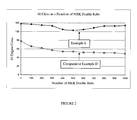
- Example 5 had MEK double rubs in excess of 999, indicating chemical resistance, and reverse impact of 160, indicating flexibility.
- the coating of Comparative Example B had MEK double rubs in excess of 999, but the reverse impact was less than 20 after 10 days, indicating poorer flexibility than the coating of Example 5.
- the coating of Comparative Example C had MEK rubs of only 21 after 1 day, which slowly increased to 800 double rubs after 40 days, indicating poorer chemical resistance than the coating of Example 5, even though its flexibility, as indicated by the reverse impact, was comparable. Only the coating composition containing the epoxy-containing polysiloxane oligomer composition of the present invention had good chemical resistance without sacrificing flexibility.
- a two-part coating formula was prepared using 3-glycioxypropylmethyldiethoxysilane, the precursor silane used to make the epoxy-containing polysiloxane oligomer composition.
- Part A Preparation of Coating Formulation Containing the 3-Glycidoxypropylmethyldiethoxysilane.
- a coating formulation containing 3-glycidoxypropylmethyldiethoxysilane was prepared.
- a medium viscosity hydrogenated epoxy-4,4' -isopropylidenediphenol resin (28.5 grams of Eponex 1510 resin, available from Momentive Specialty Chemicals Inc.), micronized rutile titanium dioxide (25 grams of Bayertitan R-KB-4, available from Bayer AG), a methoxy functional methylphenyl polysiloxane (14.6 grams of TSR-165, available from Momentive Performance Materials Inc.) and 3-glycidoxypropylmethyldiethoxysilane (9.5 grams of Silquest* A-2287, available from Momentive Performance Materials Inc.) was added to a 250mL wide mouth glass jar under agitation. The mixture was vigorously agitated by hand for approximately one minute to form Part A.
- a medium viscosity reactive polyamide curing agent based on dimerized fatty acid and poly-amines with an amine content of 330 to 360 milligram/gram (3125, 9.2 grams of Epikure curing agent, available from Momentive Specialty Chemicals Inc.), 3-aminopropyltriethoxysilane (11.2 grams of Silquest* A-1100 silane, available from Momentive Performance Materials Inc.) and dibutyl tin dilaurate (2 grams of Fomrez tin catalyst SUL-4, available from Momentive Performance Materials Inc.). The blend of materials was vigorously agitated by hand for approximately one minute.
- Part A and Part B were mixed and vigorously agitated for one minute prior to spray application.
- a coating formulation containing epoxy-containing polysiloxane oligomer of Example 2 was prepared.
- a medium viscosity hydrogenated epoxy-4,4' - isopropylidenediphenol resin (27.8 grams of Eponex 1510 resin, available from Momentive Specialty Chemicals Inc.), micronized rutile titanium dioxide (25 grams of Bayertitan R-KB-4, available from Bayer AG), a methoxy functional methylphenyl polysiloxane (14.6 grams of TSR-165, available from Momentive Performance Materials Inc.) and epoxy-containing polysiloxane oligomer composition prepared in Example 2 (9.3 grams) was added to a 250mL wide mouth glass jar under agitation. The mixture was vigorously agitated by hand for approximately one minute to form Part A.
- a medium viscosity reactive polyamide curing agent based on dimerized fatty acid and poly-amines with an amine content of 330 to 360 milligram/gram (3125, 9.6 grams of Epikure curing agent, available from Momentive Specialty Chemicals Inc.), 3-aminopropyltriethoxysilane (11.7 grams of Silquest* A-1100 silane, available from Momentive Performance Materials Inc.) and dibutyltin dilaurate (2 grams of Fomrez tin catalyst SUL-4, available from Momentive Performance Materials Inc.). The blend of materials was vigorously agitated by hand for approximately one minute.
- Part A and Part B were mixed and vigorously agitated for one minute prior to spray application.
- the substrate that was used to test the coating compositions was Cold Roll Steel APR10184 substrate available from ACT Test Panels.
- the solution to clean the Cold Roll Steel consisted of 0.06 weight percent Triton X-100, 0.52 weight percent anhydrous sodium metasilicate, 0.49 weight percent anhydrous sodium carbonate, 0.35 weight percent sodium phosphate, anhydrous dibasic, all available from Aldrich, and 98.57 weight percent de-ionized water.
- the Cold Roll Steel panels were cleaned.
- the cleaning solution was heated to a temperature of between 65 °C to 70 °C.
- the Cold Roll Steel panels were immersed into the stirred, heated cleaning for 2 to 3 minutes to remove any oil contaminants.
- the panels were removed from the solution and immediately rinsed with de-ionized water.
- Kimwipe Kimtech Delicate Task Wipers available from Kimberly Clark, were then used to wipe the panels dry.
- the panels were then lightly sprayed with water to determine the water break of the cleaned panels. If the panels showed water beading, then the cleaning process was repeated. If the water formed a continuous sheen, then the panels were then dried with a Kimwipe wiper and stored for use.
- Example 7 and Comparative Examples F were then spray applied over the bare Cold Roll Steel panels to form test panels for Example 8 and Comparative Example G, respectively.
- Spray application was conducted with a StartingLine HVLP gravity fed siphon spray hand spraygun, available through DeVilbiss. The coatings were sprayed at a wall pressure of 241.3 kilopascal (35 lb/in 2 ).
- the spray application technique was a side-to-side sweep of the spray onto the panel at a rate of approximately 2,540 centimeter/minute (1,000 inches/minute), indexing up and down the panel approximately 5.0 centimeters (2 inches) per sweep until approximately 25.4 microns (1.0 mil) of coating thickness was applied on the panel.
- the coating composition containing epoxy-containing polysiloxane oligomer composition from Example 2 had initial gloss and gloss retention better than the similar coating composition containing the monomeric silane, 3-glycidoxypropylmethyldiethoxysilane.
- the gloss retention of 96% for the coating of Example 7 indicates better chemical resistance than observed for Comparative Example G, which had only 79% gloss retention.
Landscapes
- Chemical & Material Sciences (AREA)
- Organic Chemistry (AREA)
- Chemical Kinetics & Catalysis (AREA)
- Engineering & Computer Science (AREA)
- Materials Engineering (AREA)
- Wood Science & Technology (AREA)
- Life Sciences & Earth Sciences (AREA)
- Medicinal Chemistry (AREA)
- Health & Medical Sciences (AREA)
- Polymers & Plastics (AREA)
- Epoxy Resins (AREA)
- Compositions Of Macromolecular Compounds (AREA)
- Paints Or Removers (AREA)
- Silicon Polymers (AREA)
- Sealing Material Composition (AREA)
- Adhesives Or Adhesive Processes (AREA)
- Laminated Bodies (AREA)
Applications Claiming Priority (2)
| Application Number | Priority Date | Filing Date | Title |
|---|---|---|---|
| US13/329,430 US8728345B2 (en) | 2011-12-19 | 2011-12-19 | Epoxy-containing polysiloxane oligomer compositions, process for making same and uses thereof |
| PCT/US2012/070277 WO2013096272A1 (en) | 2011-12-19 | 2012-12-18 | Epoxy-containing polysiloxane oligomer compositions, process for making same and uses thereof |
Publications (2)
| Publication Number | Publication Date |
|---|---|
| EP2794788A1 EP2794788A1 (en) | 2014-10-29 |
| EP2794788B1 true EP2794788B1 (en) | 2015-07-22 |
Family
ID=47520286
Family Applications (1)
| Application Number | Title | Priority Date | Filing Date |
|---|---|---|---|
| EP12812473.2A Active EP2794788B1 (en) | 2011-12-19 | 2012-12-18 | Epoxy-containing polysiloxane oligomer compositions, process for making same and uses thereof |
Country Status (8)
| Country | Link |
|---|---|
| US (2) | US8728345B2 (https=) |
| EP (1) | EP2794788B1 (https=) |
| JP (1) | JP6166734B2 (https=) |
| KR (1) | KR101869689B1 (https=) |
| CN (1) | CN104080870B (https=) |
| BR (1) | BR112014015138B1 (https=) |
| TW (1) | TW201331298A (https=) |
| WO (1) | WO2013096272A1 (https=) |
Families Citing this family (40)
| Publication number | Priority date | Publication date | Assignee | Title |
|---|---|---|---|---|
| US10421882B1 (en) | 2012-05-21 | 2019-09-24 | The Government Of The United States Of America As Represented By The Secretary Of The Navy | Polysiloxane based coating compositions |
| JP6063183B2 (ja) * | 2012-08-31 | 2017-01-18 | パナソニックIpマネジメント株式会社 | 剥離可能銅箔付き基板及び回路基板の製造方法 |
| CN105504287A (zh) | 2014-10-09 | 2016-04-20 | 瓦克化学(中国)有限公司 | 硅烷低聚物组合物的制备方法及应用 |
| MX392249B (es) * | 2014-12-10 | 2025-03-24 | Halliburton Energy Services Inc | Composicion curable y resina para tratamiento de formacion subterranea. |
| JP5869709B1 (ja) * | 2015-01-23 | 2016-02-24 | 台湾太陽油▲墨▼股▲分▼有限公司 | 熱硬化性樹脂組成物、その硬化物、及びそれを用いたディスプレイ用部材 |
| CN104927727B (zh) * | 2015-07-06 | 2017-01-11 | 香山红叶建设有限公司 | 一种玻璃幕墙用结构密封胶及其制备方法 |
| DE102015222028A1 (de) | 2015-11-09 | 2017-05-11 | Tesa Se | Kationisch polymerisierbare Polyacrylate enthaltend Alkoxysilangruppen und deren Verwendung |
| DE102015222027A1 (de) | 2015-11-09 | 2017-05-11 | Tesa Se | Barriereklebemasse mit polymerem Gettermaterial |
| CN106147596B (zh) * | 2016-07-04 | 2019-01-22 | 江苏朝晖化工有限公司 | 一种高硬度高耐磨耐腐蚀环氧复合涂料及其制备方法和应用 |
| TWI600725B (zh) * | 2016-09-29 | 2017-10-01 | 3M創新有限公司 | 一種具有防滑功能的保護性塗層組合物、塗佈製品及其製備方法 |
| CN107267107A (zh) * | 2017-05-29 | 2017-10-20 | 北华大学 | 一种环保型水性聚氨酯胶黏剂的制备方法 |
| KR102336865B1 (ko) * | 2017-07-06 | 2021-12-09 | 오씨아이 주식회사 | 식각 조성물 및 이를 이용한 식각 방법 |
| US10858541B2 (en) * | 2017-12-19 | 2020-12-08 | Rohm And Haas Electronic Materials Llc | Curable composition |
| KR102083444B1 (ko) * | 2018-05-30 | 2020-03-02 | 주식회사 나노폴리켐 | 발전소 세정 및 내시경용 고내열성 복합소재 |
| EP3628700B1 (de) | 2018-09-27 | 2022-06-01 | Evonik Operations GmbH | 3-glycidyloxypropylalkoxysilanoligomere-enthaltende zusammensetzung, verfahren zu deren herstellung und deren verwendung |
| WO2020092895A1 (en) * | 2018-11-02 | 2020-05-07 | Momentive Performance Materials Inc. | Coatings with early water resistance |
| CN109868030A (zh) * | 2018-12-25 | 2019-06-11 | 蔡冠之 | 一种绝缘涂料及其使用方法和应用 |
| US11125059B2 (en) * | 2019-01-03 | 2021-09-21 | Upwing Energy, LLC | Downhole-type tool for artificial lift |
| JP7284387B2 (ja) * | 2019-03-27 | 2023-05-31 | 日本製鉄株式会社 | 水系塗料組成物および塗装金属板 |
| CN111808511B (zh) * | 2019-04-11 | 2022-04-01 | 娄从江 | 硅氧烷改性类密封胶用底涂树脂及其配制的底涂组合物 |
| EP3763525A1 (en) * | 2019-07-11 | 2021-01-13 | Bostik Sa | One-component heat-activatable polyurethane water-based adhesive composition |
| US11773285B2 (en) | 2020-02-25 | 2023-10-03 | Axalta Coating Systems Ip Co., Llc | Sealers, methods of producing sealers, and methods of sealing construction products |
| CN114181577B (zh) * | 2020-09-15 | 2026-01-09 | 宣伟(广东)新材料有限公司 | 水性木器涂料组合物以及由其制成的木制品 |
| CN112625599B (zh) * | 2020-12-11 | 2022-03-04 | 中国科学院海洋研究所 | 一种快速自修复超韧有机硅改性聚脲硫脲防污涂层及其制备方法 |
| CN112831048B (zh) * | 2021-01-29 | 2022-06-17 | 桐庐宏基源混凝土有限公司 | 一种缓释型聚羧酸减水剂 |
| CN112920411B (zh) * | 2021-01-29 | 2022-06-21 | 桐庐宏基源混凝土有限公司 | 一种混凝土粘度调节剂 |
| JP2024507710A (ja) | 2021-02-02 | 2024-02-21 | モメンティブ パフォーマンス マテリアルズ インコーポレイテッド | 有機官能性アルコキシシランを含む組成物およびそれを含むコーティング組成物 |
| CN113026415B (zh) * | 2021-03-15 | 2022-04-29 | 广东良仕工业材料有限公司 | 一种有机硅改性油、造纸用乳液型烘缸剥离剂及其制备方法 |
| EP4308613A1 (en) | 2021-03-19 | 2024-01-24 | Synthomer Sdn. Bhd. | Polymer latex composition |
| CN115073748A (zh) * | 2022-06-29 | 2022-09-20 | 安庆中拓新材料科技有限公司 | 一种非离子型水性有机硅树脂及其制备方法 |
| JP2025530806A (ja) * | 2022-09-05 | 2025-09-17 | ヘンケル・アクチェンゲゼルシャフト・ウント・コムパニー・コマンディットゲゼルシャフト・アウフ・アクチェン | エポキシド化合物のブレンドに基づく2成分組成物 |
| WO2024107042A1 (en) | 2022-11-15 | 2024-05-23 | Synthomer Sdn Bhd | Silane compound and compositions containing same |
| US12202228B2 (en) | 2023-02-07 | 2025-01-21 | Siplast Inc. | Flashing assemblies and related systems and methods |
| KR102916278B1 (ko) * | 2023-03-16 | 2026-01-22 | 주식회사 케이씨씨 | 방오 도료 조성물 |
| CA3240634A1 (en) | 2023-06-06 | 2025-06-10 | Bmic Llc | Adhesive-less roofing systems and related methods |
| US12352040B2 (en) | 2023-06-08 | 2025-07-08 | Siplast, Inc. | Barrier systems for building structures and related methods |
| CN117126403B (zh) * | 2023-10-26 | 2024-01-02 | 山东富源新材料股份有限公司 | 一种甲基mq硅树脂的合成方法 |
| WO2025151977A1 (en) * | 2024-01-15 | 2025-07-24 | Henkel Ag & Co. Kgaa | Moisture and heat curable composition, preparation method and use of the same |
| CN117965098A (zh) * | 2024-04-02 | 2024-05-03 | 成都图南电子有限公司 | 一种永磁用防腐绝缘耐磨组合浸涂液 |
| CN118956335B (zh) * | 2024-10-14 | 2024-12-24 | 中国科学技术大学 | 一种多功能防火胶粘剂及其制备方法和应用 |
Family Cites Families (8)
| Publication number | Priority date | Publication date | Assignee | Title |
|---|---|---|---|---|
| JPH05202146A (ja) * | 1991-12-27 | 1993-08-10 | I C I Japan Kk | 光硬化性樹脂組成物 |
| JPH1112440A (ja) * | 1997-06-25 | 1999-01-19 | Sumitomo Bakelite Co Ltd | 半導体封止用エポキシ樹脂組成物 |
| US7893183B2 (en) | 2005-04-07 | 2011-02-22 | Momentive Performance Materials Inc. | Epoxy silane oligomer and coating composition containing same |
| US7595372B2 (en) | 2005-04-07 | 2009-09-29 | Momentive Performance Materials Inc. | Epoxy silane oligomer and coating composition containing same |
| US7732552B2 (en) | 2006-01-27 | 2010-06-08 | Momentive Performance Materials Inc. | Low VOC epoxy silane oligomer and compositions containing same |
| DE102007038314A1 (de) | 2007-08-14 | 2009-04-16 | Evonik Degussa Gmbh | Verfahren zur kontrollierten Hydrolyse und Kondensation von Epoxy-funktionellen Organosilanen sowie deren Condensation mit weiteren organofunktionellen Alkoxysilanen |
| DE102007038313A1 (de) | 2007-08-14 | 2009-02-19 | Evonik Degussa Gmbh | Anorganisch-modifizierte Polyesterbindemittelzubereitung, Verfahren zur Herstellung und ihre Verwendung |
| DE102011111757A1 (de) | 2011-08-24 | 2013-02-28 | Coventya Gmbh | Versiegelungsmittel sowie dessen Verwendung und versiegeltes metallisches Substrat |
-
2011
- 2011-12-19 US US13/329,430 patent/US8728345B2/en active Active
-
2012
- 2012-12-18 EP EP12812473.2A patent/EP2794788B1/en active Active
- 2012-12-18 CN CN201280068493.1A patent/CN104080870B/zh active Active
- 2012-12-18 WO PCT/US2012/070277 patent/WO2013096272A1/en not_active Ceased
- 2012-12-18 KR KR1020147016138A patent/KR101869689B1/ko active Active
- 2012-12-18 JP JP2014549194A patent/JP6166734B2/ja active Active
- 2012-12-18 BR BR112014015138-5A patent/BR112014015138B1/pt active IP Right Grant
- 2012-12-19 TW TW101148501A patent/TW201331298A/zh unknown
-
2014
- 2014-04-08 US US14/247,645 patent/US9243152B2/en active Active
Also Published As
| Publication number | Publication date |
|---|---|
| US9243152B2 (en) | 2016-01-26 |
| TW201331298A (zh) | 2013-08-01 |
| JP6166734B2 (ja) | 2017-07-19 |
| CN104080870B (zh) | 2016-12-07 |
| US20140221531A1 (en) | 2014-08-07 |
| US20130158159A1 (en) | 2013-06-20 |
| US8728345B2 (en) | 2014-05-20 |
| BR112014015138B1 (pt) | 2021-03-16 |
| JP2015510521A (ja) | 2015-04-09 |
| CN104080870A (zh) | 2014-10-01 |
| BR112014015138A2 (pt) | 2017-06-13 |
| WO2013096272A1 (en) | 2013-06-27 |
| KR101869689B1 (ko) | 2018-07-19 |
| KR20140116848A (ko) | 2014-10-06 |
| EP2794788A1 (en) | 2014-10-29 |
Similar Documents
| Publication | Publication Date | Title |
|---|---|---|
| EP2794788B1 (en) | Epoxy-containing polysiloxane oligomer compositions, process for making same and uses thereof | |
| CN102317391B (zh) | 含有基于硅的聚醚共聚物的硅烷涂料组合物、涂布金属表面的方法以及由其制备的制品 | |
| KR101004729B1 (ko) | 소수성 입자를 포함하는 아크릴 코팅 분말 및 그로부터제조된 내사상부식성이 개선된 분말 코팅 | |
| KR102128213B1 (ko) | 에폭시 실록산 코팅 조성물 | |
| EP2895570B1 (en) | Siloxane organic hybrid materials providing flexibility to epoxy-based coating compositons | |
| KR102469861B1 (ko) | 메르캅토-관능 규소화합물을 포함하는 반응성 조성물 | |
| JP2003160759A (ja) | シリカ系コーティング液、およびそれを用いたシリカ系コーティング膜ならびにシリカ系コーティング膜被覆基材 | |
| JP6291820B2 (ja) | シリル基含有ホスホリルコリン化合物及びその製造方法、並びに、重縮合体及び表面改質剤 | |
| JP3482569B2 (ja) | 塗料用樹脂組成物、及び耐汚染性に優れた塗膜の形成方法 | |
| EP1585795B1 (en) | Coating composition | |
| CN110951080B (zh) | 含3-环氧丙氧基丙基烷氧基硅烷低聚物的组合物、其制备方法及其用途 | |
| TW202126724A (zh) | 含氟硬化性組成物及物品 | |
| WO2005083006A1 (ja) | ケイ素含有液状組成物 | |
| US12595375B2 (en) | Polysiloxane-based coating composition | |
| JP4141447B2 (ja) | コロイド状シリカ結合ポリシロキサン含有塗料組成物 | |
| JP3900452B2 (ja) | 水性オルガノポリシロキサン溶液の製造方法及びコーティング組成物 | |
| JP2019112519A (ja) | シロキサン系硬化性樹脂組成物及びハードコーティング液 | |
| JP5241076B2 (ja) | 塗膜の形成方法 | |
| TW202428723A (zh) | 有機聚矽氧烷、其製造方法、密接性賦予劑、水性塗料組成物及底漆組成物 | |
| JP2001279179A (ja) | 低汚染型水性塗料組成物およびその塗装物品 | |
| JP2000319582A (ja) | 塗料用樹脂組成物 | |
| JP2003160754A (ja) | 塗料用樹脂組成物、及び耐汚染性に優れた塗膜の形成方法 | |
| JP2008024823A (ja) | 非汚染性シリコーンコーティング剤組成物 |
Legal Events
| Date | Code | Title | Description |
|---|---|---|---|
| PUAI | Public reference made under article 153(3) epc to a published international application that has entered the european phase |
Free format text: ORIGINAL CODE: 0009012 |
|
| 17P | Request for examination filed |
Effective date: 20140602 |
|
| AK | Designated contracting states |
Kind code of ref document: A1 Designated state(s): AL AT BE BG CH CY CZ DE DK EE ES FI FR GB GR HR HU IE IS IT LI LT LU LV MC MK MT NL NO PL PT RO RS SE SI SK SM TR |
|
| DAX | Request for extension of the european patent (deleted) | ||
| GRAP | Despatch of communication of intention to grant a patent |
Free format text: ORIGINAL CODE: EPIDOSNIGR1 |
|
| INTG | Intention to grant announced |
Effective date: 20150414 |
|
| GRAS | Grant fee paid |
Free format text: ORIGINAL CODE: EPIDOSNIGR3 |
|
| GRAA | (expected) grant |
Free format text: ORIGINAL CODE: 0009210 |
|
| AK | Designated contracting states |
Kind code of ref document: B1 Designated state(s): AL AT BE BG CH CY CZ DE DK EE ES FI FR GB GR HR HU IE IS IT LI LT LU LV MC MK MT NL NO PL PT RO RS SE SI SK SM TR |
|
| REG | Reference to a national code |
Ref country code: GB Ref legal event code: FG4D |
|
| REG | Reference to a national code |
Ref country code: CH Ref legal event code: EP |
|
| REG | Reference to a national code |
Ref country code: IE Ref legal event code: FG4D |
|
| REG | Reference to a national code |
Ref country code: AT Ref legal event code: REF Ref document number: 737913 Country of ref document: AT Kind code of ref document: T Effective date: 20150815 |
|
| REG | Reference to a national code |
Ref country code: DE Ref legal event code: R096 Ref document number: 602012009033 Country of ref document: DE |
|
| RAP2 | Party data changed (patent owner data changed or rights of a patent transferred) |
Owner name: MOMENTIVE PERFORMANCE MATERIALS INC. |
|
| REG | Reference to a national code |
Ref country code: AT Ref legal event code: MK05 Ref document number: 737913 Country of ref document: AT Kind code of ref document: T Effective date: 20150722 |
|
| REG | Reference to a national code |
Ref country code: FR Ref legal event code: PLFP Year of fee payment: 4 |
|
| REG | Reference to a national code |
Ref country code: NO Ref legal event code: T2 Effective date: 20150722 |
|
| REG | Reference to a national code |
Ref country code: LT Ref legal event code: MG4D |
|
| REG | Reference to a national code |
Ref country code: NL Ref legal event code: FP |
|
| PG25 | Lapsed in a contracting state [announced via postgrant information from national office to epo] |
Ref country code: LT Free format text: LAPSE BECAUSE OF FAILURE TO SUBMIT A TRANSLATION OF THE DESCRIPTION OR TO PAY THE FEE WITHIN THE PRESCRIBED TIME-LIMIT Effective date: 20150722 Ref country code: LV Free format text: LAPSE BECAUSE OF FAILURE TO SUBMIT A TRANSLATION OF THE DESCRIPTION OR TO PAY THE FEE WITHIN THE PRESCRIBED TIME-LIMIT Effective date: 20150722 Ref country code: GR Free format text: LAPSE BECAUSE OF FAILURE TO SUBMIT A TRANSLATION OF THE DESCRIPTION OR TO PAY THE FEE WITHIN THE PRESCRIBED TIME-LIMIT Effective date: 20151023 Ref country code: FI Free format text: LAPSE BECAUSE OF FAILURE TO SUBMIT A TRANSLATION OF THE DESCRIPTION OR TO PAY THE FEE WITHIN THE PRESCRIBED TIME-LIMIT Effective date: 20150722 |
|
| PG25 | Lapsed in a contracting state [announced via postgrant information from national office to epo] |
Ref country code: SE Free format text: LAPSE BECAUSE OF FAILURE TO SUBMIT A TRANSLATION OF THE DESCRIPTION OR TO PAY THE FEE WITHIN THE PRESCRIBED TIME-LIMIT Effective date: 20150722 Ref country code: AT Free format text: LAPSE BECAUSE OF FAILURE TO SUBMIT A TRANSLATION OF THE DESCRIPTION OR TO PAY THE FEE WITHIN THE PRESCRIBED TIME-LIMIT Effective date: 20150722 Ref country code: RS Free format text: LAPSE BECAUSE OF FAILURE TO SUBMIT A TRANSLATION OF THE DESCRIPTION OR TO PAY THE FEE WITHIN THE PRESCRIBED TIME-LIMIT Effective date: 20150722 Ref country code: PL Free format text: LAPSE BECAUSE OF FAILURE TO SUBMIT A TRANSLATION OF THE DESCRIPTION OR TO PAY THE FEE WITHIN THE PRESCRIBED TIME-LIMIT Effective date: 20150722 Ref country code: IS Free format text: LAPSE BECAUSE OF FAILURE TO SUBMIT A TRANSLATION OF THE DESCRIPTION OR TO PAY THE FEE WITHIN THE PRESCRIBED TIME-LIMIT Effective date: 20151122 Ref country code: HR Free format text: LAPSE BECAUSE OF FAILURE TO SUBMIT A TRANSLATION OF THE DESCRIPTION OR TO PAY THE FEE WITHIN THE PRESCRIBED TIME-LIMIT Effective date: 20150722 Ref country code: PT Free format text: LAPSE BECAUSE OF FAILURE TO SUBMIT A TRANSLATION OF THE DESCRIPTION OR TO PAY THE FEE WITHIN THE PRESCRIBED TIME-LIMIT Effective date: 20151123 Ref country code: ES Free format text: LAPSE BECAUSE OF FAILURE TO SUBMIT A TRANSLATION OF THE DESCRIPTION OR TO PAY THE FEE WITHIN THE PRESCRIBED TIME-LIMIT Effective date: 20150722 |
|
| REG | Reference to a national code |
Ref country code: DE Ref legal event code: R097 Ref document number: 602012009033 Country of ref document: DE |
|
| PG25 | Lapsed in a contracting state [announced via postgrant information from national office to epo] |
Ref country code: SK Free format text: LAPSE BECAUSE OF FAILURE TO SUBMIT A TRANSLATION OF THE DESCRIPTION OR TO PAY THE FEE WITHIN THE PRESCRIBED TIME-LIMIT Effective date: 20150722 Ref country code: DK Free format text: LAPSE BECAUSE OF FAILURE TO SUBMIT A TRANSLATION OF THE DESCRIPTION OR TO PAY THE FEE WITHIN THE PRESCRIBED TIME-LIMIT Effective date: 20150722 Ref country code: EE Free format text: LAPSE BECAUSE OF FAILURE TO SUBMIT A TRANSLATION OF THE DESCRIPTION OR TO PAY THE FEE WITHIN THE PRESCRIBED TIME-LIMIT Effective date: 20150722 |
|
| PLBE | No opposition filed within time limit |
Free format text: ORIGINAL CODE: 0009261 |
|
| STAA | Information on the status of an ep patent application or granted ep patent |
Free format text: STATUS: NO OPPOSITION FILED WITHIN TIME LIMIT |
|
| PG25 | Lapsed in a contracting state [announced via postgrant information from national office to epo] |
Ref country code: RO Free format text: LAPSE BECAUSE OF FAILURE TO SUBMIT A TRANSLATION OF THE DESCRIPTION OR TO PAY THE FEE WITHIN THE PRESCRIBED TIME-LIMIT Effective date: 20150722 |
|
| 26N | No opposition filed |
Effective date: 20160425 |
|
| PG25 | Lapsed in a contracting state [announced via postgrant information from national office to epo] |
Ref country code: LU Free format text: LAPSE BECAUSE OF FAILURE TO SUBMIT A TRANSLATION OF THE DESCRIPTION OR TO PAY THE FEE WITHIN THE PRESCRIBED TIME-LIMIT Effective date: 20151218 Ref country code: MC Free format text: LAPSE BECAUSE OF FAILURE TO SUBMIT A TRANSLATION OF THE DESCRIPTION OR TO PAY THE FEE WITHIN THE PRESCRIBED TIME-LIMIT Effective date: 20150722 |
|
| REG | Reference to a national code |
Ref country code: CH Ref legal event code: PL |
|
| PG25 | Lapsed in a contracting state [announced via postgrant information from national office to epo] |
Ref country code: SI Free format text: LAPSE BECAUSE OF FAILURE TO SUBMIT A TRANSLATION OF THE DESCRIPTION OR TO PAY THE FEE WITHIN THE PRESCRIBED TIME-LIMIT Effective date: 20150722 |
|
| REG | Reference to a national code |
Ref country code: IE Ref legal event code: MM4A |
|
| PG25 | Lapsed in a contracting state [announced via postgrant information from national office to epo] |
Ref country code: IE Free format text: LAPSE BECAUSE OF NON-PAYMENT OF DUE FEES Effective date: 20151218 Ref country code: LI Free format text: LAPSE BECAUSE OF NON-PAYMENT OF DUE FEES Effective date: 20151231 Ref country code: CH Free format text: LAPSE BECAUSE OF NON-PAYMENT OF DUE FEES Effective date: 20151231 |
|
| REG | Reference to a national code |
Ref country code: FR Ref legal event code: PLFP Year of fee payment: 5 |
|
| PG25 | Lapsed in a contracting state [announced via postgrant information from national office to epo] |
Ref country code: SM Free format text: LAPSE BECAUSE OF FAILURE TO SUBMIT A TRANSLATION OF THE DESCRIPTION OR TO PAY THE FEE WITHIN THE PRESCRIBED TIME-LIMIT Effective date: 20150722 Ref country code: BG Free format text: LAPSE BECAUSE OF FAILURE TO SUBMIT A TRANSLATION OF THE DESCRIPTION OR TO PAY THE FEE WITHIN THE PRESCRIBED TIME-LIMIT Effective date: 20150722 |
|
| PG25 | Lapsed in a contracting state [announced via postgrant information from national office to epo] |
Ref country code: CY Free format text: LAPSE BECAUSE OF FAILURE TO SUBMIT A TRANSLATION OF THE DESCRIPTION OR TO PAY THE FEE WITHIN THE PRESCRIBED TIME-LIMIT Effective date: 20150722 Ref country code: HU Free format text: LAPSE BECAUSE OF FAILURE TO SUBMIT A TRANSLATION OF THE DESCRIPTION OR TO PAY THE FEE WITHIN THE PRESCRIBED TIME-LIMIT; INVALID AB INITIO Effective date: 20121218 |
|
| PG25 | Lapsed in a contracting state [announced via postgrant information from national office to epo] |
Ref country code: MT Free format text: LAPSE BECAUSE OF FAILURE TO SUBMIT A TRANSLATION OF THE DESCRIPTION OR TO PAY THE FEE WITHIN THE PRESCRIBED TIME-LIMIT Effective date: 20150722 |
|
| REG | Reference to a national code |
Ref country code: FR Ref legal event code: PLFP Year of fee payment: 6 |
|
| PG25 | Lapsed in a contracting state [announced via postgrant information from national office to epo] |
Ref country code: MK Free format text: LAPSE BECAUSE OF FAILURE TO SUBMIT A TRANSLATION OF THE DESCRIPTION OR TO PAY THE FEE WITHIN THE PRESCRIBED TIME-LIMIT Effective date: 20150722 |
|
| PG25 | Lapsed in a contracting state [announced via postgrant information from national office to epo] |
Ref country code: AL Free format text: LAPSE BECAUSE OF FAILURE TO SUBMIT A TRANSLATION OF THE DESCRIPTION OR TO PAY THE FEE WITHIN THE PRESCRIBED TIME-LIMIT Effective date: 20150722 Ref country code: TR Free format text: LAPSE BECAUSE OF FAILURE TO SUBMIT A TRANSLATION OF THE DESCRIPTION OR TO PAY THE FEE WITHIN THE PRESCRIBED TIME-LIMIT Effective date: 20150722 |
|
| PGFP | Annual fee paid to national office [announced via postgrant information from national office to epo] |
Ref country code: CZ Payment date: 20181205 Year of fee payment: 7 |
|
| PG25 | Lapsed in a contracting state [announced via postgrant information from national office to epo] |
Ref country code: CZ Free format text: LAPSE BECAUSE OF NON-PAYMENT OF DUE FEES Effective date: 20191218 |
|
| P01 | Opt-out of the competence of the unified patent court (upc) registered |
Effective date: 20230513 |
|
| PGFP | Annual fee paid to national office [announced via postgrant information from national office to epo] |
Ref country code: GB Payment date: 20251223 Year of fee payment: 14 |
|
| PGFP | Annual fee paid to national office [announced via postgrant information from national office to epo] |
Ref country code: NO Payment date: 20251218 Year of fee payment: 14 |
|
| PGFP | Annual fee paid to national office [announced via postgrant information from national office to epo] |
Ref country code: IT Payment date: 20251218 Year of fee payment: 14 |
|
| PGFP | Annual fee paid to national office [announced via postgrant information from national office to epo] |
Ref country code: NL Payment date: 20251222 Year of fee payment: 14 Ref country code: FR Payment date: 20251230 Year of fee payment: 14 |
|
| PGFP | Annual fee paid to national office [announced via postgrant information from national office to epo] |
Ref country code: DE Payment date: 20251229 Year of fee payment: 14 |
|
| PGFP | Annual fee paid to national office [announced via postgrant information from national office to epo] |
Ref country code: BE Payment date: 20260109 Year of fee payment: 14 |