EP2731710B1 - Verfahren zur herstellung von kompositen aus aluminiumoxid und cer-/zirkonium-mischoxiden - Google Patents
Verfahren zur herstellung von kompositen aus aluminiumoxid und cer-/zirkonium-mischoxiden Download PDFInfo
- Publication number
- EP2731710B1 EP2731710B1 EP12740471.3A EP12740471A EP2731710B1 EP 2731710 B1 EP2731710 B1 EP 2731710B1 EP 12740471 A EP12740471 A EP 12740471A EP 2731710 B1 EP2731710 B1 EP 2731710B1
- Authority
- EP
- European Patent Office
- Prior art keywords
- suspension
- solution
- weight
- rare earth
- cerium
- Prior art date
- Legal status (The legal status is an assumption and is not a legal conclusion. Google has not performed a legal analysis and makes no representation as to the accuracy of the status listed.)
- Active
Links
Images

Classifications
-
- B—PERFORMING OPERATIONS; TRANSPORTING
- B01—PHYSICAL OR CHEMICAL PROCESSES OR APPARATUS IN GENERAL
- B01J—CHEMICAL OR PHYSICAL PROCESSES, e.g. CATALYSIS OR COLLOID CHEMISTRY; THEIR RELEVANT APPARATUS
- B01J23/00—Catalysts comprising metals or metal oxides or hydroxides, not provided for in group B01J21/00
- B01J23/10—Catalysts comprising metals or metal oxides or hydroxides, not provided for in group B01J21/00 of rare earths
-
- B—PERFORMING OPERATIONS; TRANSPORTING
- B01—PHYSICAL OR CHEMICAL PROCESSES OR APPARATUS IN GENERAL
- B01J—CHEMICAL OR PHYSICAL PROCESSES, e.g. CATALYSIS OR COLLOID CHEMISTRY; THEIR RELEVANT APPARATUS
- B01J21/00—Catalysts comprising the elements, oxides, or hydroxides of magnesium, boron, aluminium, carbon, silicon, titanium, zirconium, or hafnium
- B01J21/02—Boron or aluminium; Oxides or hydroxides thereof
- B01J21/04—Alumina
-
- B—PERFORMING OPERATIONS; TRANSPORTING
- B01—PHYSICAL OR CHEMICAL PROCESSES OR APPARATUS IN GENERAL
- B01J—CHEMICAL OR PHYSICAL PROCESSES, e.g. CATALYSIS OR COLLOID CHEMISTRY; THEIR RELEVANT APPARATUS
- B01J23/00—Catalysts comprising metals or metal oxides or hydroxides, not provided for in group B01J21/00
- B01J23/38—Catalysts comprising metals or metal oxides or hydroxides, not provided for in group B01J21/00 of noble metals
- B01J23/54—Catalysts comprising metals or metal oxides or hydroxides, not provided for in group B01J21/00 of noble metals combined with metals, oxides or hydroxides provided for in groups B01J23/02 - B01J23/36
- B01J23/56—Platinum group metals
- B01J23/63—Platinum group metals with rare earths or actinides
-
- B—PERFORMING OPERATIONS; TRANSPORTING
- B01—PHYSICAL OR CHEMICAL PROCESSES OR APPARATUS IN GENERAL
- B01J—CHEMICAL OR PHYSICAL PROCESSES, e.g. CATALYSIS OR COLLOID CHEMISTRY; THEIR RELEVANT APPARATUS
- B01J35/00—Catalysts, in general, characterised by their form or physical properties
- B01J35/60—Catalysts, in general, characterised by their form or physical properties characterised by their surface properties or porosity
-
- B—PERFORMING OPERATIONS; TRANSPORTING
- B01—PHYSICAL OR CHEMICAL PROCESSES OR APPARATUS IN GENERAL
- B01J—CHEMICAL OR PHYSICAL PROCESSES, e.g. CATALYSIS OR COLLOID CHEMISTRY; THEIR RELEVANT APPARATUS
- B01J35/00—Catalysts, in general, characterised by their form or physical properties
- B01J35/60—Catalysts, in general, characterised by their form or physical properties characterised by their surface properties or porosity
- B01J35/61—Surface area
- B01J35/613—10-100 m2/g
-
- B—PERFORMING OPERATIONS; TRANSPORTING
- B01—PHYSICAL OR CHEMICAL PROCESSES OR APPARATUS IN GENERAL
- B01J—CHEMICAL OR PHYSICAL PROCESSES, e.g. CATALYSIS OR COLLOID CHEMISTRY; THEIR RELEVANT APPARATUS
- B01J37/00—Processes, in general, for preparing catalysts; Processes, in general, for activation of catalysts
- B01J37/02—Impregnation, coating or precipitation
- B01J37/03—Precipitation; Co-precipitation
-
- B—PERFORMING OPERATIONS; TRANSPORTING
- B01—PHYSICAL OR CHEMICAL PROCESSES OR APPARATUS IN GENERAL
- B01J—CHEMICAL OR PHYSICAL PROCESSES, e.g. CATALYSIS OR COLLOID CHEMISTRY; THEIR RELEVANT APPARATUS
- B01J37/00—Processes, in general, for preparing catalysts; Processes, in general, for activation of catalysts
- B01J37/02—Impregnation, coating or precipitation
- B01J37/03—Precipitation; Co-precipitation
- B01J37/031—Precipitation
- B01J37/033—Using Hydrolysis
-
- B—PERFORMING OPERATIONS; TRANSPORTING
- B01—PHYSICAL OR CHEMICAL PROCESSES OR APPARATUS IN GENERAL
- B01J—CHEMICAL OR PHYSICAL PROCESSES, e.g. CATALYSIS OR COLLOID CHEMISTRY; THEIR RELEVANT APPARATUS
- B01J2235/00—Indexing scheme associated with group B01J35/00, related to the analysis techniques used to determine the catalysts form or properties
-
- B—PERFORMING OPERATIONS; TRANSPORTING
- B01—PHYSICAL OR CHEMICAL PROCESSES OR APPARATUS IN GENERAL
- B01J—CHEMICAL OR PHYSICAL PROCESSES, e.g. CATALYSIS OR COLLOID CHEMISTRY; THEIR RELEVANT APPARATUS
- B01J2235/00—Indexing scheme associated with group B01J35/00, related to the analysis techniques used to determine the catalysts form or properties
- B01J2235/15—X-ray diffraction
-
- B—PERFORMING OPERATIONS; TRANSPORTING
- B01—PHYSICAL OR CHEMICAL PROCESSES OR APPARATUS IN GENERAL
- B01J—CHEMICAL OR PHYSICAL PROCESSES, e.g. CATALYSIS OR COLLOID CHEMISTRY; THEIR RELEVANT APPARATUS
- B01J2523/00—Constitutive chemical elements of heterogeneous catalysts
-
- B—PERFORMING OPERATIONS; TRANSPORTING
- B01—PHYSICAL OR CHEMICAL PROCESSES OR APPARATUS IN GENERAL
- B01J—CHEMICAL OR PHYSICAL PROCESSES, e.g. CATALYSIS OR COLLOID CHEMISTRY; THEIR RELEVANT APPARATUS
- B01J35/00—Catalysts, in general, characterised by their form or physical properties
- B01J35/30—Catalysts, in general, characterised by their form or physical properties characterised by their physical properties
-
- B—PERFORMING OPERATIONS; TRANSPORTING
- B01—PHYSICAL OR CHEMICAL PROCESSES OR APPARATUS IN GENERAL
- B01J—CHEMICAL OR PHYSICAL PROCESSES, e.g. CATALYSIS OR COLLOID CHEMISTRY; THEIR RELEVANT APPARATUS
- B01J35/00—Catalysts, in general, characterised by their form or physical properties
- B01J35/60—Catalysts, in general, characterised by their form or physical properties characterised by their surface properties or porosity
- B01J35/61—Surface area
- B01J35/615—100-500 m2/g
-
- B—PERFORMING OPERATIONS; TRANSPORTING
- B01—PHYSICAL OR CHEMICAL PROCESSES OR APPARATUS IN GENERAL
- B01J—CHEMICAL OR PHYSICAL PROCESSES, e.g. CATALYSIS OR COLLOID CHEMISTRY; THEIR RELEVANT APPARATUS
- B01J37/00—Processes, in general, for preparing catalysts; Processes, in general, for activation of catalysts
- B01J37/0009—Use of binding agents; Moulding; Pressing; Powdering; Granulating; Addition of materials ameliorating the mechanical properties of the product catalyst
- B01J37/0027—Powdering
- B01J37/0045—Drying a slurry, e.g. spray drying
-
- B—PERFORMING OPERATIONS; TRANSPORTING
- B01—PHYSICAL OR CHEMICAL PROCESSES OR APPARATUS IN GENERAL
- B01J—CHEMICAL OR PHYSICAL PROCESSES, e.g. CATALYSIS OR COLLOID CHEMISTRY; THEIR RELEVANT APPARATUS
- B01J37/00—Processes, in general, for preparing catalysts; Processes, in general, for activation of catalysts
- B01J37/02—Impregnation, coating or precipitation
- B01J37/0201—Impregnation
-
- B—PERFORMING OPERATIONS; TRANSPORTING
- B01—PHYSICAL OR CHEMICAL PROCESSES OR APPARATUS IN GENERAL
- B01J—CHEMICAL OR PHYSICAL PROCESSES, e.g. CATALYSIS OR COLLOID CHEMISTRY; THEIR RELEVANT APPARATUS
- B01J37/00—Processes, in general, for preparing catalysts; Processes, in general, for activation of catalysts
- B01J37/02—Impregnation, coating or precipitation
- B01J37/0201—Impregnation
- B01J37/0203—Impregnation the impregnation liquid containing organic compounds
Definitions
- the present invention relates to a process for producing composites comprising aluminum oxide and cerium / zirconium mixed oxides, hereinafter referred to as Al / Ce / Zr oxide composite (e) for short.
- Al / Ce / Zr oxide composites prepared in this way have increased thermal stability.
- Al / Ce / Zr oxide composites with embedded catalytically active noble metals are known and are used, for example, for the catalytic exhaust aftertreatment, in particular of combustion gases, which have left the combustion chamber or the combustion chamber of vehicles.
- vehicle catalysts usually consist of several components.
- the carrier is a temperature-stable honeycomb body made of ceramic, usually cordierite or metal foils, which has a plurality of thin-walled channels.
- washcoat On the carrier is the so-called washcoat. This includes porous alumina (Al 2 O 3 ) and oxygen storage components.
- Catalytically active precious metals are also incorporated in the washcoat. In modern catalytic converters these are platinum, rhodium and / or palladium.
- the ceramic carrier is supported by special bearing mats, such as high-temperature wool, rarely in combination with wire mesh, in a metallic housing.
- Washing coats comprising Al / Ce / Zr oxide composites are known for the exhaust aftertreatment of internal combustion engines, wherein the cerium / zirconium mixed oxides act as an oxygen storage component.
- the Al / Ce / Zr oxide composites of this invention find use in the above vehicle catalysts.
- WO 2006/070201 A2 is an improved variant for the preparation of mixed oxides of alumina, zirconia and optionally at least one member of CeO 2 , La 2 O 3 , Nd 2 O 3 , Pr 6 O 11 , Sm 2 O 3 , Y 2 O 3 and optionally further rare earth Oxides described.
- the preparation is based on a common precipitation of the corresponding salts.
- the preparation is carried out by a co-precipitation of all oxides involved, starting from a metal salt solution, wherein the pH during the precipitation in the range of 8.5 +/- 1 is set.
- the precipitation was carried out by adding alkali metal hydroxides, in particular sodium hydroxide solution.
- the WO 2008/113457 A1 describes the preparation of Al / Ce / Zr oxide composites based on blends of separately prepared alumina and cerium / zirconium mixed oxide. From the US 6306794 B1 a process for the preparation of Al / Ce / Zr composite oxides is known, after which Al, Ce, Zr salts are presented in aqueous solution and the pH is increased by addition of an alkaline solution with thorough mixing, wherein a common precipitation is triggered.
- the US 6831036 B1 discloses a process according to which a solution of Ce and Zr salts is charged and a suspension of gamma alumina is added, followed by the addition of an alkaline solution for precipitation.
- the process described there provides a multi-step process, after which first Ce, Zr and possibly Pr salts are precipitated by pH increase and a precipitate is isolated.
- the precipitate is contacted with alumina with mixing, isolated and subsequently subjected to drying and calcining.
- the alumina is preferably stabilized by foreign ions from the group of the rare earths, Ba, Zr or Si.
- the Ce / Zr mixed oxides and Ce / Zr / Pr mixed oxides prepared by precipitation may optionally be additionally stabilized by, for example, at least one element of group VIII, bismuth and / or another rare earth element.
- a disadvantage of this manufacturing method is due to the low homogeneity of the material obtained.
- the EP 1172139 A1 describes the preparation of homogeneous Al 2 O 3 / CeO 2 / ZrO 2 / Y 2 O 3 / La 2 O 3 mixed oxides via co-precipitation and their thermal stabilities.
- the precipitated Al-Ce-Zr-Y-La hydroxide intermediates were calcined and thus converted into the oxides.
- the WO 2006/119549 A1 describes a process in which a solution of metal salts is added to an acidic boehmite suspension to obtain a second suspension. The precipitation is carried out by dropwise addition of the second suspension in an alkaline solution.
- the procedure of WO 2006/119549 A1 As shown by Examples 1 and 2, formation of discrete islands of the Ce / Zr / rare earth compound oxide besides the alumina. A very similar process is described in Comparative Examples 3, 14 and 15 of US 6,831,036 described. The specified residual surfaces are after calcination at 1000 ° C for 3 h process-related to a maximum of 39 m 2 / g.
- the WO 2012/67654 A1 describes a process in which Al / Ce / Zr / rare earth oxide composites are prepared via a two-stage precipitation.
- an "aluminum hydrate" and optionally rare earth hydroxide is prepared by precipitation of aluminum sulfate with sodium aluminate.
- the Ce / Zr / rare earth component is then precipitated by adding the appropriate salt solution into this suspension and increasing the pH again.
- the Al / Ce / Zr / rare earth oxide composites thus obtained, after calcining at 1100 ° C. for 5 hours, have a surface area (in m 2 / g), which results from the formula SA 0.8235 [Al] + 11.157.
- the object of the present invention is to provide improved Al / Ce / Zr / (optionally rare earth) oxide composites having significantly higher thermal surface stabilities, especially at temperatures of 1100 ° C and more (eg for 24 hours and more).
- Surface stability in this sense is the (largely) preservation of the surface at high temperatures measured according to BET.
- Homogeneity here means a uniform distribution of the phases Al 2 O 3 and Ce / Zr / rare earth mixed oxide without formation of discrete islands.
- the Al / Ce / Zr oxide composites obtained by the process according to the invention optionally containing further rare earth oxide components, contain at least the Ce / Zr oxide in the form of a "solid solution". This can be detected by X-ray powder diffraction. Furthermore, Al 2 O 3 and the Ce-Zr (possibly rare earth) mixed oxides are present in complete homogeneous distribution next to one another, as demonstrated by means of EDX (energy-dispersive X-ray analysis) and element mapping. No domains for single metal oxides were detected.
- the specification of the constituents Al 2 O 3 and Ce-Zr mixed oxides or Ce-Zr (possibly rare earth) mixed oxides or Al / Ce / Zr / (if appropriate rare earth) oxide composites does not exclude that other metal oxides constituents of mixed oxides or of composite.
- the composites consist exclusively of Al 2 O 3 and Ce-Zr (possibly rare earth) mixed oxide.
- the process described in this invention differs from the prior art described above in that an aqueous alkaline boehmite suspension (slurry) is employed and the precipitation in this suspension in the presence of soluble metal salts to form a Ce-Zr (or rare earth -) Hydroxide precipitate takes place, wherein the Ce-Zr (possibly rare earth) hydroxide precipitate (as well as the subsequent solid solution) is homogeneously distributed in the boehmite matrix.
- the degree of homogeneity and the associated effective separation of the Ce-Zr (possibly rare earth) mixed oxide crystallites by the aluminum oxide is achieved by a very homogeneous precipitation, in which the boehmite particles within the suspension do not sediment even in the alkaline medium.
- the constantly high pH value ensures a uniform precipitation of the Ce / Zr / (possibly rare earth) hydroxides, whereby they present after calcination in the form of a homogeneous "solid solution".
- Nitrogen bases can be used to adjust the pH. These are, for example, in addition to ammonia and urea or urotropin.
- the suspension comprising boehmite is adjusted to the necessary ph value,
- the composite may further comprise one or more alkaline earth elements / compounds, rare earth elements / compounds, zirconium and / or silicon, especially rare earth elements / compounds, preferably before drying, and especially after step (c) or even (i.e. ) are added in the form of one or more other soluble compounds.
- the suspension from (c) is hydrothermally aged in an aqueous environment, preferably at least 90 ° C. and for at least 1 h, in particular at at least 120 ° C. and for at least 4 h.
- water-soluble salts of the metals are used for the preparation of the metal salt solution, such as acetates, nitrates and / or chlorides.
- the process according to the invention preferably dispenses with the addition of alkali metal and / or alkaline earth metal salts, with the exception of barium salts, which can optionally be used.
- the Ce / Zr (possibly rare earth) oxide is present in the form of a "solid solution” in the composite and Al 2 O 3 and the Ce-Zr (possibly rare earth) mixed oxides / "solid solution” are distributed homogeneously next to each other.
- the Al / Ce / Zr oxide composite has 20 to 80 wt%, preferably 40 to 70 wt%, aluminum, 5 to 80 wt%, preferably 5 to 40 wt%, zirconium, 5 to 80 wt% , preferably 5 to 40% by weight of cerium, 0 to 12% by weight, preferably 0.1 to 9% by weight of rare earth metal (RE), calculated as Al 2 O 3 , ZrO 2 , CeO 2 , RE 2 O 3 .
- the proportion of the further soluble compounds added in step (d2.2) after redispersion is preferably 0.1-15% by weight (calculated as oxide) based on the mass of Al 2 O 3 .
- Preferred rare earth metals are neodymium, praseodymium, yttrium and / or lanthanum.
- the Al / Ce / Zr oxide composites preferably also have surfaces of at least 20 m 2 / g, preferably at least 40 m 2 / g, even after 4 h and 1200 ° C.
- the aluminum / cerium / zirconium mixed oxides can be used in vehicle catalytic converters such as 3-way catalysts (TWC) or in other components such as NO x stores, diesel oxidation catalysts (DOC) and diesel particulate filters (DPF). Their structure is described in the beginning.
- vehicle catalytic converters such as 3-way catalysts (TWC) or in other components such as NO x stores, diesel oxidation catalysts (DOC) and diesel particulate filters (DPF).
- TWC 3-way catalysts
- DOC diesel oxidation catalysts
- DPF diesel particulate filters
- Boehmites the purposes of this invention are compounds of the formula AlO (OH) x H 2 O.
- boehmites are prepared via the hydrolysis of an aluminum alkoxide is reacted, see U.S. Patent 5,051,019 ("Process for the Production of Boehmitic Aluminas").
- boehmitic clays are obtained in a purity of at least 99.95% Al 2 O 3 with defined pore radii in a range between 3 to 100 nm by salt-free, aqueous, neutral Aluminiumalkoholathydrolyse, wherein the obtained from the Aluminiumalkoholathrolrolyse alumina suspension in an autoclave a) at a water vapor pressure of 1 to 30 bar corresponding to a temperature of 100 to 235 ° C, b) in a period of 0.5 to 20 hours and c) with stirring at a peripheral speed of 1.0 to 6.0 m / it ages.
- aluminum alcoholates are used to produce the boehmitic clays in order to obtain high-purity products.
- the aluminum alcoholates may be prepared, for example, by the Ziegler method, in which preferably a purification step is carried out by filtration.
- Alumiuniumalkoholate example C1 to C24 alcohols or mixtures thereof can be used.
- boehmites are used which have a pore volume of from 0.4 to 1.2 ml / g and / or have crystallite sizes of from 4 to 40 nm, preferably from 4 to 16 nm, measured on the (120) reflex.
- the boehmites are modified with organic compounds having at least one carboxy group and one or more other groups selected from hydroxy (-OH), carboxy (-COO) and / or amine (-NH, including -NH 2 ) groups , such as tartaric acid or citric acid, in particular having 2 to 12 C-atoms, more preferably 4 to 8 C-atoms, preferably in proportions by weight of 0.1 to 50 wt.%, In particular 5 to 15 wt.%, Based on the dry weight of boehmite. These prevent the agglomeration and sedimentation of boehmites in an alkaline environment.
- Suitable substituted carboxylic acids in the context of the invention are, for example, 2-hydroxypropionic acid, 2-oxopropanoic acid, hydroxybutanedicarboxylic acid, dihydroxybutanedicarboxylic acid, 2-hydroxypropane-1,2,3-tricarboxylic acid (citric acid), L-aspartic acid, L-serine, glycine, L-leucine , L-Tyrosine or L-Tryptophan.
- the composites prepared according to the invention comprising alumina and cerium / zirconium (optionally rare earth) mixed oxides furthermore have, as catalysts, platinum, rhodium and / or palladium as catalysts.
- the process described here provides for the use of modified boehmite, which enables dispersibility in an alkaline medium.
- agglomeration and sedimentation of the boehmite are not involved, but rather a particularly homogeneous precipitation and distribution of the CeO 2 / ZrO 2 / (possibly rare earth oxide) component at elevated pH in the presence of finely divided boehmite, which is based on particle sizes in the aqueous suspension at high pH values becomes clear. This is demonstrated in Examples A1 and A2.
- the measurements of the surfaces were carried out with Micromeritics TriStar 3000 according to DIN ISO 9277.
- the X-ray diffractograms were measured with a Panalytical X'Pert Pro MDB diffractometer. % -S are by weight unless otherwise specified.
- the particle distribution was determined using a Malvern Mastersizer 2000 with the Hydro-S dispersing unit in water. The measurement is carried out in accordance with ISO 13320: 2009, whereby the Fraunhofer method was used as evaluation.
- Composition 61.5% Al 2 O 3 , 21% CeO 2 , 15% ZrO 2 , 2.5% Y 2 O 3
- This solution was added with 7.47 g of a 35% H 2 O 2 solution (equivalent to 1.2 times the molar amount of cerium) and this mixture was stirred for about 25 minutes.
- the resulting solution was then brought to pH 7 by addition of a 24% ammonia solution and stirred for 15 minutes.
- the resulting mixture was filtered off and the filter residue washed with deionized water at 60 ° C.
- This filter cake was then dried at 120 ° C for 16 hours. Subsequently, the dried filter cake was calcined at first 300 ° C for 5 hours and then at 700 ° C for 5 hours.
- the measured surface area is shown in Table 1.
- Composition 41% Al 2 O 3 , 30% CeO 2 , 23% ZrO 2 , 2.5% Y 2 O 3 , 3.5% La 2 O 3
- This solution was admixed with 10.71 g of a 35% H 2 O 2 solution (equivalent to 1.2 times the molar amount of cerium) and this mixture was stirred for about 25 minutes. The resulting solution was then brought to pH 7 by addition of a 24% ammonia solution and stirred for 15 minutes. The resulting mixture was filtered off and the filter residue washed with deionized water at 60 ° C.
- This filter cake was then dried at 120 ° C for 16 hours. Subsequently, the dried filter cake was first calcined at 300 ° C for 5 hours and then at 700 ° C for 5 hours.
- the measured surface area is shown in Table 2.
- composition 51% Al 2 O 3 , 14.2% CeO 2 , 34.8% ZrO 2
- the resulting mixture was filtered off and the filter residue washed with deionized water at 60 ° C.
- This filter cake was then suspended in 850 ml of deionized water and adjusted to pH 10 by addition of 25% sodium hydroxide solution. Then autoclaving was carried out at 120 ° C for 6 hours. The aged suspension was cooled to room temperature, brought to pH 8 by the addition of nitric acid and stirred for 30 minutes.
- Composition 50% Al 2 O 3 , 30% CeO 2 , 15% ZrO 2 , 3.5% La 2 O 3 , 1.5% Y 2 O 3
- Solution A was prepared by adding 6.0 g of a solution of lanthanum nitrate (La 2 O 3 content 14.57%) to 53 g of a 24% ammonia solution and 110 g of distilled water.
- Solution C was prepared by dissolving 46.3 g of sodium aluminate in 200 g of distilled water.
- Composition 50% Al 2 O 3 , 30% CeO 2 , 15% ZrO 2 , 3.5% La 2 O 3 , 1.5% Y 2 O 3
- a suspension with an Al 2 O 3 content of 5% was prepared by stirring DISPERAL HP14 (boehmite) in deionized water at pH 7. The pH was then adjusted to 10 by addition of a 24% ammonia solution.
- Example A2 Preparation of an alkaline boehmite suspension using a modified boehmite.
- a suspension with an Al 2 O 3 content of 5% was prepared by stirring DISPERAL HP14 / 7 (boehmite modified with citric acid) in deionized water at pH 7. The pH was then adjusted to 10 by addition of a 24% ammonia solution.
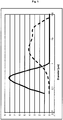
- the measured particle size distributions are in Fig. 1 shown.
- Composition 41% Al 2 O 3 , 30% CeO 2 , 23% ZrO 2 , 2.5% Y 2 O 3 , 3.5% La 2 O 3 (corresponding to Comparative Example 2)
- Comparative Example 1 example 1 (analogous EP 1 172 139 ) (Invention) 5 h / 300 ° C + 5 h / 700 ° C (starting material) 168 126 5 h / 950 ° C 109 95 4 h / 1000 ° C 84 89 2 h / 1100 ° C 32 70
- composition corresponds exactly to that of Comparative Example 2 41% Al 2 O 3 , 30% CeO 2 , 23% ZrO 2 , 2.5% Y 2 O 3 , 3.5% La 2 O 3
- the pH was kept constant at pH 9.5 by adding a 24% ammonia solution in a timely manner.
- the resulting mixture was stirred for 45 minutes. Following this, the suspension was autoclaved at 140 ° C for 3 hours.
- the resulting mixture is filtered off and the solid washed with deionized water at 60 ° C. This filter cake was dried for 16 hours in a drying oven and then calcined at 850 ° C.
- Composition 41% Al 2 O 3 , 30% CeO 2 , 23% ZrO 2 , 2.5% Y 2 O 3 , 3.5% La 2 O 3 (corresponds to Comparative Example 2)
- a boehmite suspension consisting of 492.0 g DISPERAL HP14 / 7 (boehmite modified with citric acid) (Al 2 O 3 content 5%) was prepared by stirring the solid in deionized water and then adding a 24% ammonia solution produced to pH 10.
- the pH was kept constant at 9.0 by simultaneous addition of a 24% ammonia solution. This mixture was then stirred at 90 ° C for 30 minutes.
- the mixture was then filtered off and the filter residue washed with deionized water at 60 ° C.
- the dried material was calcined at 850 ° C for 4 hours.
- Composition 41% Al 2 O 3 , 30% CeO 2 , 23% ZrO 2 , 2.5% Y 2 O 3 , 3.5% La 2 O 3 corresponds to Comparative Example 2, but using cerium (III) nitrate + H 2 O 2
- a suspension consisting of 510.0 g DISPERAL HP14 / 7 (boehmite modified with citric acid) (Al 2 O 3 content 5%) was prepared by stirring the solid in deionized water and then adding a 24% ammonia solution to pH Value 10 produced.
- Example 6 (analogous WO 2006/070201 ) (Invention) 850 ° C / 4 hours (starting material) 107 97 2 h / 1100 ° C 47 62 24 h / 1100 ° C 35 36
- Composition 50% Al 2 O 3 , 30% CeO 2 , 15% ZrO 2 , 3.5% La 2 O 3 , 1.5% Y 2 O 3 (corresponds to Comparative Examples 4 and 5)
- a suspension consisting of 500 g DISPERAL HP14 / 7 (boehmite modified with citric acid) (Al 2 O 3 content 5%) was prepared by stirring the solid in deionized water and then adding a 24% ammonia solution to pH 10 manufactured.
- This suspension was slowly added dropwise to the metal salt solution and after completion of the addition, the pH was adjusted to 8.3 by addition of 24% ammonia solution. This mixture was then stirred at 90 ° C for 30 minutes. The mixture was then filtered off and the filter residue washed with deionized water at 60 ° C. The filter cake was dried at 120 ° C for 16 hours and then calcined at 850 ° C for 4 hours.
- Composition 50% Al 2 O 3 , 30% CeO 2 , 15% ZrO 2 , 3.5% La 2 O 3 , 1.5% Y 2 O 3 (corresponds to Comparative Examples 4 and 5)
- Composition 70% Al 2 O 3 , 20% CeO 2 , 7% ZrO 2 , 3.0% La 2 O 3
- Vgl.4 calculated* Vgl.5 Bsp.7 Bsp.8 Bsp.9 4 h / 850 ° C (starting material) 130 - 96 92 96 101 4 h / 1200 ° C 17 22 (5 hours) 23 23 25 40 * Surfaces calculated using the formulas in WO2012 / 067654 A1
Landscapes
- Chemical & Material Sciences (AREA)
- Engineering & Computer Science (AREA)
- Materials Engineering (AREA)
- Organic Chemistry (AREA)
- Chemical Kinetics & Catalysis (AREA)
- Catalysts (AREA)
- Exhaust Gas Treatment By Means Of Catalyst (AREA)
- Inorganic Compounds Of Heavy Metals (AREA)
- Compounds Of Alkaline-Earth Elements, Aluminum Or Rare-Earth Metals (AREA)
Description
- Die vorliegende Erfindung betrifft ein Verfahren zur Herstellung von Kompositen umfassend Aluminiumoxid und Cer-/ Zirkonium-Mischoxide, nachfolgend kurz Al/Ce/Zr-Oxidkomposit(e) genannt. Derartig hergestellte Al/Ce/Zr-Oxidkomposite weisen eine erhöhte Thermostabilität auf.
- Al/Ce/Zr-Oxidkomposite mit eingelagerten katalytisch aktiven Edelmetallen sind bekannt und werden z.B. zur katalytischen Abgasnachbehandlung, insbesondere von Verbrennungsgasen, eingesetzt, die den Brennraum oder die Brennkammer von Fahrzeugen verlassen haben. Solche Fahrzeugkatalysatoren bestehen meistens aus mehreren Komponenten. Als Träger dient ein temperaturstabiler Wabenkörper aus Keramik, in der Regel Cordierit oder Metallfolien, der eine Vielzahl dünnwandiger Kanäle aufweist. Auf dem Träger befindet sich der so genannte Washcoat. Dieser umfasst poröses Aluminiumoxid (Al2O3) sowie Sauerstoffspeicherkomponenten. In dem Washcoat sind weiterhin katalytisch aktive Edelmetalle eingelagert. Bei modernen Abgaskatalysatoren sind dies Platin, Rhodium und/oder Palladium. Der keramische Träger ist mithilfe spezieller Lagermatten, etwa aus Hochtemperaturwolle, seltener in Kombination mit Drahtgestricken, in einem metallischen Gehäuse gelagert. Waschcoats enthaltend Al/Ce/Zr-Oxidkomposite sind zur Abgasnachbehandlung von Verbrennungsmotoren bekannt, wobei die Cer/Zirkonium-Mischoxide als Sauerstoffspeicherkomponente wirken. Die Al/Ce/Zr-Oxidkomposite dieser Erfindung finden Verwendung in obigen Fahrzeugkatalysatoren.
- In der
WO 2006/070201 A2 wird eine verbesserte Variante zur Herstellung von Mischoxiden aus Aluminiumoxid, Zirkoniumoxid und fakultativ mindestens einem Vertreter aus CeO2, La2O3, Nd2O3, Pr6O11, Sm2O3, Y2O3 und ggf. weiteren Seltenerd-Oxiden beschrieben. Die Herstellung beruht auf einer gemeinsamen Fällung der entsprechenden Salze. Die Herstellung erfolgt über eine gemeinsame Fällung aller beteiligten Oxide, ausgehend von einer Metallsalzlösung, wobei der pH-Wert während der Fällung im Bereich von 8,5 +/- 1 eingestellt wird. Die Fällung erfolgte durch Zugabe von Alkalihydroxiden, insbesondere Natronlauge. DieWO 2008/113457 A1 beschreibt die Herstellung von Al/Ce/Zr-Oxidkompositen basierend auf Mischungen von separat hergestelltem Aluminiumoxid und Cer/Zirkonium-Mischoxid. Aus derUS 6306794 B1 ist ein Verfahren zur Herstellung von Al/Ce/Zr-Kompositoxiden bekannt, wonach Al-, Ce-, Zr- Salze in wässriger Lösung vorgelegt werden und der pH-Wert durch Zugabe einer alkalischen Lösung unter starker Durchmischung erhöht wird, wobei eine gemeinsame Fällung ausgelöst wird. - Die
US 6831036 B1 offenbart ein Verfahren wonach eine Lösung aus Ce- und Zr- Salzen vorgelegt wird und eine Suspension aus gamma- Aluminiumoxid zugegeben wird, gefolgt von der Zugabe einer alkalischen Lösung zur Fällung. In derUS 5,883,037 wird auf die Bedeutung der Thermostabilität der Kompositmaterialien eingegangen. Der dort beschriebene Prozess sieht ein mehrstufiges Verfahren vor, wonach zunächst Ce-, Zr- und ggf. Pr-Salze durch pH-Werterhöhung gefällt werden und ein Niederschlag isoliert wird. Der Niederschlag wird mit Alumina unter Mischen in Kontakt gebracht, isoliert und nachfolgend einer Trocknung und Kalzinierung unterzogen. Das Alumina ist vorzugsweise stabilisiert durch Fremdionen aus der Gruppe der Seltenen Erden, Ba, Zr oder Si. Die über Fällung hergestellten Ce/Zr-Mischoxide und Ce/Zr/Pr-Mischoxide können ggf. zusätzlich stabilisiert werden, durch z.B. mindestens ein Element der Gruppe VIII, Bismut und/oder ein weiteres Seltenerd-Element. Ein Nachteil dieses Herstellungsverfahren liegt in der geringen Homogenität des erhaltenen Materials begründet. - Die
EP 1172139 A1 beschreibt die Herstellung homogener Al2O3/CeO2/ZrO2/Y2O3/La2O3 - Mischoxide über Co-Fällung sowie deren Thermostabilitäten. In dem beschriebenen Prozess wurden die aus gemeinsamer Fällung resultierenden Al-Ce-Zr-Y-La- Hydroxid-Zwischenstufen kalziniert und so in die Oxide überführt. - Die
WO 2006/119549 A1 beschreibt einen Prozess, bei dem einer sauren Böhmit Suspension eine Lösung von Metallsalzen zugesetzt wird, um eine zweite Suspension zu erhalten. Die Fällung erfolgt über Zutropfen der zweiten Suspension in eine alkalische Lösung. Das Verfahren derWO 2006/119549 A1 führt, wie auch durch die Beispiele 1 und 2 gezeigt, zur Ausbildung diskreter Inseln des Ce/Zr/Seltenerd-Mischoxids neben dem Aluminiumoxid. Ein sehr ähnlicher Prozess wird im Vergleichsbeispiel 3, 14 und 15 derUS 6,831,036 beschrieben. Die angegebenen Restoberflächen liegen nach Kalzinierung bei 1000°C für 3 h prozessbedingt bei maximal 39 m2/g. - Die
WO 2012/67654 A1 WO 2012/67654 A1 - Aufgabe der vorliegenden Erfindung ist es, verbesserte Al/Ce/Zr/(ggf. Seltenerd)- Oxidkomposite bereitzustellen, die deutlich höhere thermische Oberflächenstabilitäten aufweisen, insbesondere bei Temperaturen von 1100°C und mehr (z.B. für 24 Stunden und mehr). Oberflächenstabilität in diesem Sinne ist der (weitgehende) Erhalt der Oberfläche bei hohen Temperaturen gemessen nach BET. Gleichzeitig soll ein maximaler Grad an Homogenität erzielt werden. Unter Homogenität ist hierbei eine gleichmäßige Verteilung der Phasen Al2O3 und Ce/Zr/Seltenerd-Mischoxid ohne Ausbildung diskreter Inseln gemeint.
- Die Aufgabe wird gelöst durch ein Verfahren nach Anspruch 1. Bevorzugte Ausführungsformen sind Gegenstand der Unteransprüche und/oder nachfolgend beschrieben.
- Es wurde festgestellt, dass die nach dem erfindungsgemäßen Verfahren erhaltenen Al/Ce/Zr Oxidkomposite, enhaltend ggf. weitere Seltenerdoxidkomponenten, zumindest das Ce/Zr-Oxid in Form einer "solid solution" (festen Lösung) enthalten. Dies kann durch Röntgenpulverbeugung nachgewiesen werden. Weiterhin liegen Al2O3 und die Ce-Zr-(ggf. Seltenerd)-Mischoxide vollständig homogen verteilt nebeneinander vor, wie mittels EDX (energiedispersiver Röntgenanalyse) und Element-Mapping nachgewiesen wurde. Es wurden keine Domänen für Einzelmetalloxide detektiert. Die Angabe der Bestandteile Al2O3 und Ce-Zr-Mischoxide bzw. Ce-Zr-(ggf. Seltenerd) -Mischoxide bzw. Al/Ce/Zr/(ggf. Seltenerd)- Oxidkomposite schließt nicht aus, dass andere Metalloxide Bestandteile des Mischoxide oder des Komposits sind. Vorzugsweise bestehen die Composite ausschließlich aus Al2O3 und aus Ce-Zr-(ggf. Seltenerd)-Mischoxid.
- Der in dieser Erfindung beschriebene Prozess unterscheidet sich vom weiter oben beschriebenen Stand der Technik dadurch, dass eine wässrige, alkalische Böhmit Suspension (Aufschlämmung) eingesetzt wird und die Fällung in dieser Suspension in Gegenwart löslicher Metallsalze unter Bildung eines Ce-Zr-(ggf. Seltenerd-)Hydroxid Präzipitats erfolgt, wobei das Ce-Zr-(ggf. Seltenerd-)Hydroxid Präzipitat (ebenso wie die spätere Solid-Solution) in der Böhmitmatrix homogen verteilt vorliegt. Der Grad an Homogenität und die damit verbundene effektive Trennung der Ce-Zr-(ggf. Seltenerd)-Mischoxidkristallite durch das Aluminiumoxid wird erzielt durch eine sehr homogene Fällung, bei der die Böhmitpartikel innerhalb der Suspension auch im alkalischen Milieu nicht sedimentieren. Der konstant hohe pH-Wert sorgt dabei für eine gleichmäßige Fällung der Ce/Zr/(ggf. Seltenerd)-Hydroxide, wodurch diese nach Kalzinierung in Form einer homogenen "solid solution" Vorliegen.
- In dem hier beschriebenen Prozess kann auf die Verwendung von Alkali und insbesondere Natronlauge verzichtet werden. Die Entfernung von Alkali bzw. Natriumhydroxid aus dem Kompositmaterial ist für die Anwendung zwingend erforderlich und so stellt der Verzicht auf diese Komponente einen wesentlichen Vorteil dar.
- Das erfindungsgemäße Verfahren umfasst folgende Schritte:
- (a) Bereitstellen einer Suspension umfassend Böhmit als Alumina-Precursor und Einstellen des pH-Wertes auf 6 - 11.5, bevorzugt 8 bis 10,5 oder 9 bis 10,5, z.B. mit einer wässrigen Lösung aus Ammoniak. In einer bevorzugten Ausführungsart handelt es sich um eine wässrige Suspension von Böhmiten, die mit organischen Verbindungen modifiziert sind, die zumindest eine Carboxy-Gruppe und eine oder mehrere weitere Gruppen, ausgewählt aus Hydroxy-(-OH), Oxo- (O), Carboxy (-COO) und/oder Amin- (-NH) Gruppen, aufweist, z.B. Weinsäure oder Zitronensäure, vorzugsweise in Gewichtsanteilen von 0,1 bis 50 Gew.%, insbesondere 3 bis 12 Gew.%, bezogen auf das Trockengewicht des Böhmits.
- (b) Herstellung einer wässrigen Metallsalzlösung, die Metallsalze von Cer und von Zirkonium und ggf. einem oder mehreren Seltenerd-Elementen umfasst. Zur Herstellung sind alle in Wasser löslichen Salze (z.B. Acetate, Nitrate, Chloride) geeignet. Löslich in diesem Sinne meint, dass sich unter Rühren bei der Umsetzungstemperatur eine stabile Lösung von zumindest 5 g Salz (bezogen auf die oxidische Form des Metalls) in 100 g Wasser einstellt. In einer bevorzugten Ausführungsart werden die Metallnitrate verwendet. Im Besonderen wird als Cer-Quelle Ammonium Cer(IV)-nitrat eingesetzt. Nach einer anderen bevorzugten Ausführungsform kann Cer(III)-nitrat eingesetzt werden, wenn die erhaltene Metallsalzlösung aufoxidiert wird, z.B. mit einer wässrigen H2O2-Lösung.
- (c) Zusammenbringen der Suspension aus (a) mit der Metallsalzlösung aus (b), vorzugsweise bei pH-Werten von 6,5 bis 11, insbesondere 8 bis 10,5, besonders bevorzugt 8,5 bis 10, und unabhängig hiervon insbesondere bei Temperaturen von 5 bis 95°C, vorzugsweise 80 bis 95°C, oder Aussetzen der so erhalten Aufschlämmung diesen Tempertaren, insbesondere:
- (c1) Vorlage der Metallsalzlösung und Zutropfen der Alumina-Precursor Suspension und anschließendes Einstellen des pH-Wertes auf 6,5 bis 11, insbesondere 8 bis 10,5, besonders bevorzugt 8,5 bis 10.
- (c2) Vorlage der Metallsalzlösung und Zutropfen der Alumina-Precursor Suspension und zeitgleich Einstellen des pH-Wertes auf 6,5 bis 11, insbesondere 8 bis 10,5 , besonders bevorzugt 8,5 bis 10.
- (c3) Vorlage des Alumina-Precursors und gleichzeitiges Zutropfen der Metallsalzlösung und der Ammoniaklösung zur Einhaltung eines pH-Wertes von 6,5 bis 11, insbesondere 8 bis 10,5, besonders bevorzugt 8,5 bis 10.
- (d) Abtrennen der wässrigen Lösung und Waschen des Feststoffes aus (c) mit Wasser.
- (d1) Fakultativ wird die Suspension aus (c) hydrothermal gealtert (autoklaviert), dann anschließend filtriert und der Feststoff mit deionisiertem Wasser gewaschen.
- (d2) Trocknen des Feststoffes aus (d), z.B. durch
- (d2.1) Trocknen des Feststoffes, z.B. bei 120°C für 16 h, unter Wärmeeinwirkung.
- (d2.2) Redispergieren des Feststoffes aus (d oder dl) und anschließende Sprühtrocknung. In einer besonderen Ausführungsform werden vor der Sprühtrocknung, und insbesondere erst nach Schritt (c) oder nach dem Redispergieren, eine oder mehrere weitere lösliche Verbindungen zugegeben. Als bevorzugte Salze werden Acetate, z.B. La-Acetat und/oder Salze der Erdalkalielemente, Seltenerdelemente, Zirkonium oder Silicium eingesetzt.
- (e) Kalzinieren des Feststoffes aus (d oder dl oder d2), z.B. im Temperaturbereich von 550-1200°C, bevorzugt im Bereich von 600-1000°C, insbesondere für zumindest 1 h.
- Zum Einstellen des pH-Wertes können Stickstoffbasen Verwendung finden. Dies sind beispielsweise neben Ammoniak auch Harnstoff oder Urotropin. Insbesondere die Suspension umfassend Böhmit wird so auf den notwendigen ph-Wert eingestellt,
- Das Komposit kann weiterhin eine oder mehrere Erdalkalielemente/-Verbindungen, Seltenerdelemente/-Verbindungen, Zirkonium und/oder Silicium, insbesondere SeltenerdElemente/-Verbindungen umfasst umfassen, wobei diese vorzugsweise vor der Trocknung, und insbesondere erst nach Schritt (c) oder sogar (d) in Form einer oder mehrerer weiterer löslicher Verbindungen zugegeben werden.
- Nach einer Ausgestaltung wird die Suspension aus (c) in wässriger Umgebung hydrothermal gealtert, vorzugsweise bei zumindest 90°C und für zumindest 1h, insbesondere für bei zumindest 120°C und für zumindest 4 h.
- Insbesondere werden zur Herstellung der Metallsalzlösung in Wasser lösliche Salze der Metalle verwendet, wie z.B. Acetate, Nitrate und/oder Chloride. Bei dem erfindungsgemäßen Verfahren wird vorzugsweise auf die Zugabe von Alkali- und/oder Erdalkalisalzen verzichtet, ausgenommen Bariumsalze, dass ggf. eingesetzt werden kann.
- Das Ce/Zr (ggf. Seltenerd)-Oxid liegt in Form einer "solid solution" (festen Lösung) im Komposit vor und Al2O3 und die Ce-Zr-(ggf. Seltenerd)-Mischoxide/"solid solution" liegen nebeneinander homogen verteilt vor.
- Bevorzugt weist das Al/Ce/Zr-Oxidkomposit 20 bis 80 Gew.%, vorzugsweise 40 bis 70 Gew.%, Aluminium, 5 bis 80 Gew.%, vorzugsweise 5 bis 40 Gew.%, Zirkonium, 5 bis 80 Gew.%, vorzugsweise 5 bis 40 Gew.% Cer, 0 bis 12 Gew.%, vorzugsweise 0,1 bis 9 Gew.% Seltenerdmetall(e) (RE) auf, berechnet als Al2O3, ZrO2, CeO2, RE2O3. Der Anteil der weiteren lösliche Verbindungen, die in Schritt (d2.2) nach dem Redispergieren zugesetzt werden, beträgt vorzugsweise 0,1 - 15 Gew.% (berechnet als Oxid) bezogen auf die Masse an Al2O3. Bevorzugte Seltenerd-Metalle sind Neodym, Praesodym, Yttrium und/oder Lanthan.
- Die Al/Ce/Zr-Oxidkomposite weisen vorzugsweise auch nach 4h und 1200°C noch Oberflächen von zumindest 20 m2/g, vorzugsweise zumindest 40 m2/g, auf.
- Die Aluminium-/Cer-/Zirkonium-Mischoxide können in Fahrzeugkatalysatoren wie 3-Wege Katalysatoren (TWC) oder auch in anderen Komponenten wie NOx-Speichern, Diesel-Oxidations-Katalysatoren (DOC) und Diesel-Rußpartikelfiltern (DPF) eingesetzt werden. Deren Aufbau ist eingangs beschrieben.
- Böhmite im Sinne dieser Erfindung sind Verbindungen der allgemeinen Formel AlO(OH)x H2O. Bevorzugt werden Böhmite, die über die Hydrolyse eines Aluminiumalkoxids hergestellt wurden, eingesetz, siehe
U.S.-Patent 5055019 ("Process for the Production of Boehmitic Aluminas"). Nach diesem Verfahren werden böhmitische Tonerden in einer Reinheit von mindestens 99,95% Al2O3 mit definierten Porenradien in einem Bereich zwischen 3 bis 100 nm durch salzfreie, wässrige, neutrale Aluminiumalkoholathydrolyse erhalten, wobei man die aus der Aluminiumalkoholathydrolyse erhaltene Tonerdesuspension in einem Autoklaven a) bei einem Wasserdampfdruck von 1 bis 30 bar entsprechend einer Temperatur von 100 bis 235°C, b) in einem Zeitraum von 0,5 bis 20 Stunden und c) unter Rühren mit einer Umfangsgeschwindigkeit von 1,0 bis 6,0 m/s altert. - Erfindungsgemäß werden zur Herstellung der böhmitischen Tonerden Aluminiumalkoholate eingesetzt, um hochreine Produkte zu erhalten. Die Aluminiumalkoholate können z.B. nach dem Ziegler-Verfahren hergestellt sein, bei dem vorzugsweise ein Reinigungsschritt durch Filtration durchgeführt wird. Zur Herstellung der Alumiuniumalkoholate können beispielsweise C1- bis C24-Alkohole oder deren Gemische eingesetzt werden.
- Die eingesetzten Böhmite zeichnen sich u.a. durch ihre besonders hohe Reinheit aus (Gehalte von: SiO2 < = etwa 0,01%, Fe2O3 < = etwa 0,01%, Na2O < = etwa 0,002%, K2O < = etwa 0,002 %, TiO2 < = 0,005 %, andere Elemente < = 0,01%). Unabhängig hiervon werden in einer weiteren bevorzugten Form Böhmite eingesetzt, die ein Porenvolumen von 0,4 bis 1,2 ml/g aufweisen und/oder Kristallitgrößen von 4 bis 40 nm , vorzugsweise 4 bis 16 nm, gemessen am (120) Reflex aufweisen.
- Die Böhmite sind mit organischen Verbindungen modifiziert, die zumindest eine Carboxy-Gruppe und eine oder mehrere weitere Gruppen, ausgewählt aus Hydroxy-(-OH), Carboxy (-COO) und/oder Amin- (-NH, einschließlich -NH2) Gruppen, aufweist, wie z.B. Weinsäure oder Zitronensäure, insbesondere mit 2 bis 12 C-Atomen, besonders bevorzugt 4 bis 8 C-Atomen, vorzugsweise in Gewichtsanteilen von 0,1 bis 50 Gew.%, insbesondere 5 bis 15 Gew.%, bezogen auf das Trockengewicht des Böhmits. Diese verhindern das Agglomieren und Sedimentieren der Böhmite im alkalischen Milieu. Weitere geeignete substituierte Carbonsäuren im Sinne der Erfindung sind beispielsweise 2-Hydroxypropionsäure, 2-Oxopropansäure, Hydroxybutandicarbonsäure, Dihydroxybutandicarbonsäure, 2-Hydroxypropan-1,2,3-tricarbonsäure (Citronensäure), L-Asparginsäure, L-Serin, Glycin, L-Leucin, L-Tyrosin oder L-Tryptophan.
- Die erfindungsgemäß hergestellten Komposite umfassend Aluminiumoxid und Cer-/ Zirkonium-(ggf. Seltenerd)-Mischoxide weisen nach einer Ausgestaltung als Katalysatoren weiterhin Platin, Rhodium und/oder Palladium auf.
- Basierend auf der vorliegenden Erfindung wurde weiterhin festgestellt, dass die Fällung in Anwesenheit einer alkalischen Suspension aus einem durch Zusatz der obigen mehrfunktionellen organischen Säuren modifizierten Böhmit, insbesondere in Kombination mit der Verwendung von Ammonium Cer(IV)-nitrat als Cer-Quelle, zu Endprodukten mit besonders hoher Thermostabilität führt. Überraschenderweise und unabhängig ist dieser Effekt besonders ausgeprägt, wenn die alkalische Suspension zu der Metallsalzlösung getropft wird.
- Die Erfindung wird durch die Abbildungen näher erläutert. Es zeigen:
-
Fig. 1 Partikelgrößenverteilungen der Beispiele A1 und A2 in wässrigen Suspensionen -
Fig. 2 : Röntgenpulverdiffraktogramme des Materials aus Beispiel 2 nach Kalzinierung - Die Nachfolgenden Versuchsbeispiele zeigen, dass
- a) im Vergleich zu den Herstellungsweisen in
EP 1172139 B1 undWO 2012/067654 A1 höhere Restoberflächen erhalten werden, - a) im Vergleich zu den Herstellungsweisen in
EP 1172139 B1 undWO 2012/067654 A1 höhere Restoberflächen erhalten werden, - b) auch nach Kalzinierung unter besonders scharfen Bedingungen (1150°C/36h, 1200°C/4h) hohe Restoberflächen erhalten werden.
- c) In Vergleichsbeispiel 3werden Oberflächen erhalten, die ebenfalls sehr hoch sind und im Bereich der erfindungsgemäßen Komposite liegen, die mittels des hier beschriebenen Prozesses hergestellt wurden (Vergleichsbeispiel 3 und Beispiel 6). Der hier beschriebene Prozess kommt jedoch ohne die Verwendung von Natrium aus, was einen wesentlichen prozesstechnischen Vorteil darstellt, da Natrium zur Vergiftung von Edelmetallkatalysatoren führt
- d) In Vergleichsbeispiel 5 werden ebenfalls hohe Restoberflächen erhalten, die auch im Bereich der Komposite liegen, die mittels des hier beschriebenen Prozesses hergestellt wurden (Vergleichsbeispiel 5, Beispiele 7 und 8).
- Der hier beschriebene Prozess sieht in einer Ausfuhrungsform jedoch die Verwendung von modifiziertem Böhmit vor, was die Dispergierbarkeit in alkalischem Medium ermöglicht. Es kommt hierbei somit nicht zur Agglomeration und Sedimentation des Böhmits, sondern zu einer besonders homogenen Fällung und Verteilung der CeO2/ZrO2/(ggf. Seltenerdoxid) Komponente bei erhöhten pH-Wert in Anwesenheit von feinteilig dispergiertem Böhmit, was anhand von Partikelgrößen in der wässrigen Suspension bei hohen pH-Werten deutlich wird. Dies wird in den Beispielen A1 und A2 demonstriert.
- Die Messungen der Oberflächen (BET) wurden mit Micromeritics TriStar 3000 gemäß DIN ISO 9277 durchgeführt. Die Röntgendiffraktogramme wurden mit einem Panalytical X'Pert Pro MDB Diffraktometer gemessen. Bei %-Angaben handelt es sich, wenn nicht anders angegeben, um Gewichtsprozente. Die Bestimmung der Partikelverteilung erfolgte mit einem Malvern Mastersizer 2000 mit der Hydro-S Dispergiereinheit in Wasser. Die Messung erfolgt gemäß ISO 13320:2009, wobei als Auswertung die Methode nach Fraunhofer zum Einsatz kam.
- Ein Gemisch bestehend aus 96,43 g einer wässrigen Lösung aus Zirkonylnitrat (ZrO2-Gehalt = 7%), 52,5g einer wässrigen Lösung aus Cer(III)-nitrat (CeO2-Gehalt = 18%), 6,32 g einer wässrigen Lösung aus Yttrium-nitrat (Y2O3-Gehalt = 17,80%) und 205,61g Aluminiumnitrat-nonahydrat in kristalliner Form wurde mit 600 ml Wasser versetzt und solange gerührt, bis eine klare Lösung vorlag.
- Diese Lösung wurde mit 7,47 g einer 35% H2O2 Lösung (entspricht der 1,2 fachen molaren Stoffmenge an Cer) versetzt und diese Mischung für etwa 25 Minuten gerührt. Die resultierende Lösung wurde dann durch Zugabe einer 24%igen Ammoniak-Lösung auf pH 7 gebracht und für 15 Minuten gerührt. Die so entstandene Mischung wurde abfiltriert und der Filterrückstand mit deionisiertem Wasser bei 60°C gewaschen. Dieser Filterkuchen wurde dann bei 120°C für 16 Stunden getrocknet. Im Anschluss daran wurde der getrocknete Filterkuchen bei zunächst 300°C für 5 Stunden und dann bei 700°C für 5 Stunden kalziniert.
- Die gemessene Oberfläche ist in Tabelle 1 wiedergegeben.
BET nach 300°C / 5 Stunden + 700°C / 5 Stunden (Ausgangsmaterial): 168 m2/g
BET nach 950°C / 5 Stunden: 109 m2/g
BET nach 1000°C / 4 Stunden: 84 m2/g
BET nach 1100°C / 2 Stunden: 32 m2/g - Ein Gemisch bestehend aus 145,93 g einer wässrigen Lösung aus Zirkonylnitrat (ZrO2-Gehalt = 7%), 72,25 g einer wässrigen Lösung aus Cer(III)-nitrat (CeO2-Gehalt = 18%),
- 6,07 g einer wässrigen Lösung aus Yttrium-nitrat (Y2O3-Gehalt = 17,80%), 10,81 g einer wässrigen Lösung aus Lanthan-nitrat (La2O3-Gehalt = 14,57%) und 138,08 g Aluminiumnitrat-nonahydrat in kristalliner Form wurde mit 600 ml Wasser versetzt und solange gerührt, bis eine klare Lösung vorlag.
- Diese Lösung wurde mit 10,71 g einer 35% H2O2 Lösung (entspricht der 1,2 fachen molaren Stoffmenge an Cer) versetzt und diese Mischung für etwa 25 Minuten gerührt. Die resultierende Lösung wurde dann durch Zugabe einer 24%igen Ammoniak-Lösung auf pH 7 gebracht und für 15 Minuten gerührt. Die so entstandene Mischung wurde abfiltriert und der Filterrückstand mit deionisiertem Wasser bei 60°C gewaschen.
- Dieser Filterkuchen wurde dann bei 120°C für 16 Stunden getrocknet. Im Anschluss daran wurde der getrocknete Filterkuchen zunächst bei 300°C für 5 Stunden und dann bei 700°C für 5 Stunden kalziniert.
- Die gemessene Oberfläche ist in Tabelle 2 wiedergegeben.
- Eine Aluminiumnitrat Lösung wurde durch Einrühren von 112,5 g Aluminiumnitratmonohydrat in 1500 ml Wasser erzeugt. Zu dieser Lösung wurden 14,77g einer Cer(III)-nitrat Lösung (CeO2-Gehalt = 28,85%) und 149,16 einer Zirkonylnitrat-Lösung (ZrO2-Gehalt = 7%) gegeben. Diese Mischlösung wurde dann bei Raumtemperatur für 15 Minuten gerührt. Durch Zugabe von 25%iger Natronlauge wurde ein pH-Wert 10 eingestellt und während des Fällungsprozesses bei diesem Wert gehalten. Es wurden 5 g einer 35%igen H2O2 Lösung zugegeben und der pH-Wert wieder auf 10 eingestellt. Die erhaltene Suspension wurde dann für 60 Minuten gerührt. Durch Zugabe von 30%iger Salpetersäure wurde im Anschluss der pH-Wert 8 eingestellt und die Suspension erneut für 60 Minuten gerührt.
- Die so entstandene Mischung wurde abfiltriert und der Filterrückstand mit deionisiertem Wasser bei 60°C gewaschen. Dieser Filterkuchen wurde dann in 850 ml deionisiertem Wasser suspendiert und durch Zugabe von 25%iger Natronlauge auf pH-Wert 10 eingestellt. Dann erfolgte die Autoklavierung bei 120°C für 6 Stunden. Die gealterte Suspension wurde auf Raumtemperatur abgekühlt, durch Zugabe von Salpetersäure auf pH-Wert 8 gebracht und für 30 Minuten gerührt.
- Im Anschluss daran wurde die Suspension erneut bei 60°C für eine Stunde gerührt und danach die Flüssigkeit abfiltriert. Der erhaltene Filterkuchen wurde dann mit deionisiertem Wasser bei 60°C gewaschen und am Anschluss daran bei 850°C für 4 Stunden kalziniert. Die gemessene Oberfläche ist in Tabelle 3 wiedergegeben.
- Lösung A wurde hergestellt durch Zugabe von 6,0 g einer Lösung aus Lanthan-nitrat (La2O3-Gehalt 14,57%) zu 53g einer 24%iger Ammoniaklösung und 110 g destilliertem Wasser.
- Lösung B wurde hergestellt durch Zusammenbringen von 22,19 g Zirconylnitrat (ZrO2-Gehalt = 33,80%), 35,89 g Cer(III)-nitrat (CeO2-Gehalt = 41,80%), 4,21 g einer Lösung aus Yttrium-nitrat (Y2O3-Gehalt = 4,21%), 100 g destilliertem Wasser und Wasserstoffperoxid, wobei das molare Verhältnis H2O2/CeO2 bei 3 lag.
- Lösung C wurde hergestellt durch Auflösen von 46,3 g Natrium-aluminat in 200 g destilliertem Wasser.
- 21 destilliertes Wasser wurden vorgelegt und auf 65°C erwärmt. Innerhalb von 25 Minuten wurde Lösung A zugetropft und zeitgleich wurde durch Zugabe von Lösung C der pH-Wert bei 7,3 gehalten. Nach vollständiger Zugabe von Lösung A wurde der Rest von Lösung C vollständig zugegeben und so der pH-Wert von 9,8 eingestellt. Anschließend wurde die erhaltene Suspension mit verdünnter Salpetersäure auf pH-Wert 4 eingestellt. Im Anschluss erfolgte die Zugabe von Lösung B binnen 20 Minuten. Währenddessen wurde der pH-Wert durch Zugabe von 10%iger Ammoniaklösung bei 4 gehalten. Nach vollständiger Zugabe von Lösung B wurde der pH-Wert durch Zugabe von konzentrierter Ammoniaklösung auf 8,2 angehoben. Die Suspension wurde filtriert und der Feststoff mit 2 Litern einer auf 60°C erwärmten wässrigen Lösung von Ammoniumhydrogencarbonat (120g/ 1H2O) gewaschen. Die erhaltenen Oberflächen sind in Tabelle 4 angegeben.
- 15g CeO2, 7,5 g ZrO2, 1,75 g La2O3 und 0,75 g Y2O3 wurden in Form ihrer Nitrate in Wasser gelöst. 31,53 g DISPERAL HP 14 (Böhmit, Al2O3-Gehalt = 79,3 %) wurde dieser sauren Lösung zugegeben und die erhaltene Suspension für 30 Minuten gerührt. 300 g konzentrierte Ammoniaklösung wurden mit 750 ml Wasser verdünnt und bei Raumtemperatur vorgelegt. Die saure Böhmit/Metallnitrat-Suspension wurde langsam der Ammoniaklösung zugetropft und nach beendeter Zugabe wurde 30 Minuten nachgerührt. Durch Filtrieren wurde der Feststoff abgetrennt, mit 1,51 Wasser gewaschen und im Anschluss für 16 Stunden bei 100°C getrocknet.
- Die erhaltenen Oberflächen sind in Tabelle 4 angegeben.
- Eine Suspension mit einem Al2O3-Gehalt von 5% wurde durch Einrühren von DISPERAL HP14 (Böhmit) in deionisiertes Wasser bei pH 7 hergestellt. Anschließend wurde der pH-Wert durch Zugabe einer 24%igen Ammoniak-Lösung auf 10 hergestellt. Die Partikelgrößen in der Suspension wurden mittels Laserbeugung (Mastersizer) bestimmt:
D10 = 0,96 µm; D50 = 5,11 µm; D90 = 28,34 µm
Die gemessenen Partikelgrößenverteilungen sind inFig. 1 gezeigt. - Eine Suspension mit einem Al2O3-Gehalt von 5% wurde durch Einrühren von DISPERAL HP14/7 (Böhmit mit Zitronensäure modifiziert) in deionisiertes Wasser bei pH 7 hergestellt. Anschließend wurde der pH-Wert durch Zugabe einer 24%igen Ammoniak-Lösung auf 10 hergestellt. Die Partikelgrößen in der Suspension wurden mittels Laserbeugung (Mastersizer) bestimmt:
D10 = 0,09 µm; D50 = 0,23 µm; D90 = 0,67 µm
Die gemessenen Partikelgrößenverteilungen sind inAbb. 1 gezeigt. - Eine Metallsalzlösung bestehend aus 81,4 g einer Lösung von Ammonium Cer(IV)-nitrat (CeO2-Gehalt = 12,90%), 103,30 g einer Lösung Zirconylnitrat (ZrO2-Gehalt = 7,26 %) und 7,0 g einer Lösung aus Yttrium-nitrat (Y2O3-Gehalt = 17,80%) wurde vorgelegt und auf 90°C erwärmt.
- Eine Suspension bestehend aus 615,0 g DISPERAL HP14/7 (Böhmit mit Zitronensäure modifiziert) (Al2O3-Gehalt = 5%) wurde durch Einrühren des Feststoffes in deionisiertes Wasser und anschließender Zugabe von 24%igen Ammoniak-Lösung bis pH-Wert 10 hergestellt. Diese Suspension wurde langsam der Metallsalzlösung zugetropft und nach Beendigung der Zugabe der pH-Wert durch Zugabe von 24%igen Ammoniak-Lösung auf 8,7 eingestellt. Diese Mischung wurde dann bei 90°C für 30 Minuten gerührt. Im Anschluss wurde die Mischung abfiltriert und der Filterrückstand mit deionisiertem Wasser bei 60°C gewaschen. Der Filterkuchen wurde unter Rühren in deionisiertem Wasser resuspendiert und dann sprühgetrocknet (Einlass-Temperatur = 220°C, Auslass-Temperatur = 110°C). Das getrocknete Material wurde bei 850°C für 4 Stunden kalziniert.
- Eine Metallsalzlösung bestehend aus 96,9 g einer Lösung von Ammonium Cer(IV)-nitrat (CeO2-Gehalt = 12,90%), 131,96 g einer Lösung Zirconylnitrat (ZrO2-Gehalt = 7,26 %), 10,02 g einer Lösung aus Lanthan-nitrat (La2O3-Gehalt = 14,57%) und 5,84 g einer Lösung aus Yttrium-nitrat (Y2O3-Gehalt = 17,80%) wurde vorgelegt und auf 90°C erwärmt.
- Eine Suspension bestehend aus 341,6 g DISPERAL HP14/7 (Böhmit mit Zitronensäure modifiziert) (Al2O3-Gehalt = 5%) wurde durch Einrühren des Feststoffes in deionisiertes Wasser und anschließender Zugabe von einer 24%igen Ammoniak-Lösung bis pH-Wert 10 hergestellt.
Tabelle 1 Gemessene BET-Oberflächen aus Vergleichsbeispiel 1 und Beispiel 1 nach Kalzinierung [m2/g]. Vergleichsbeispiel 1 Beispiel 1 (analog EP 1 172 139 )(erfindungsgemäß) 5 h / 300°C + 5 h / 700°C (Ausgangsmaterial) 168 126 5 h / 950 °C 109 95 4 h / 1000 °C 84 89 2 h / 1100°C 32 70 - Diese Suspension wurde langsam der Metallsalzlösung zugetropft und nach Beendigung der Zugabe der pH-Wert durch Zugabe von 24%igen Ammoniak-Lösung auf 8,5 eingestellt. Diese Mischung wurde dann bei 90°C für 30 Minuten gerührt. Im Anschluss wurde die Mischung abfiltriert und der Filterrückstand mit deionisiertem Wasser bei 60°C gewaschen. Der Filterkuchen wurde unter Rühren in deionisiertem Wasser resuspendiert und dann sprühgetrocknet (Einlass-Temperatur = 220°C, Auslass-Temperatur = 110°C). Das getrocknete Material wurde bei 850°C für 4 Stunden kalziniert.
- In
Fig. 2 sind die Röntgenpulverdiffraktogramme des Materials aus Beispiel 2 nach Kalzinierung gezeigt. - a) nach Kalzinierung 4h/850°C
- b) nach Kalzinierung 4h/850°C + 4h 1100°C
- c) nach Kalzinierung 4h/850°C + 24h 1100°C
- d) Simuliertes Diffraktogramm von CeO2 (kubisch)
- e) Simuliertes Diffraktogramm von ZrO2 (tetragonal).
- 220,4 g einer Suspension von PURAL SB (Böhmit, Al2O3-Gehalt = 9,3%) (pH-Wert 9,5) wurden mit einer 24%igen Ammoniak-Lösung auf pH 9,5 gebracht und vorgelegt. Bei Raumtemperatur erfolgte die lansame Zugabe einer Mischung bestehend aus 300 g einer Lösung aus Cer-acetat (CeO2-Gehalt = 5,0%), 50,3 g einer Lösung aus Zirkonium-acetat (ZrO2-Gehalt = 22,88%), 24,0 g einer Lösung aus Lanthan-acetat (La2O3-Gehalt = 7,3 %) und 31,3 g einer Lösung aus Yttrium-acetat (Y2O3-Gehalt = 4,0%). Der pH-Wert wurde dabei konstant bei pH-Wert 9,5 durch zeitgliche Zugabe einer 24%igen Ammoniak-Lösung gehalten. Die erhaltene Mischung wurde für 45 Minuten nachgerührt. Im Anschluss daran wurde die Suspension für 3 Stunden bei 140°C autoklaviert. Die erhaltene Mischung wird abfiltriert und der Feststoff mit deionisiertem Wasser bei 60°C gewaschen. Dieser Filterkuchen wurde für 16 Stunden im Trockenschrank getrocknet und dann bei 850°C kalziniert.
- Eine Böhmit-Suspension bestehend aus 492,0 g DISPERAL HP14/7 (Böhmit mit Zitronensäure modifiziert) (Al2O3-Gehalt = 5%) wurde durch Einrühren des Feststoffes in deioniesiertes Wasser und anschließender Zugabe von einer 24%igen Ammoniak-Lösung bis pH-Wert 10 hergestellt.
- Bei 90°C wurde zu dieser Suspension langsam eine Metallsalzlösung bestehend aus 139,53 g einer Lösung von Ammonium Cer(IV)-nitrat (CeO2-Gehalt = 12,90%), 190,1 g einer Lösung aus Zirconylnitrat (ZrO2-Gehalt = 7,26 %), 14,41 g einer Lösung aus Lanthan-nitrat (La2O3-Gehalt = 14,57%) und 5,45 g einer Lösung aus Yttriumnitrat (Y2O3-Gehalt = 27,54 %) zugetropft. Der pH-Wert wurde dabei konstant bei 9,0 durch zeitgleiche Zugabe einer 24%igen Ammoniak-Lösung gehalten. Diese Mischung wurde dann bei 90°C für 30 Minuten gerührt. Im Anschluss wurde die Mischung abfiltriert und der Filterrückstand mit deionisiertem Wasser bei 60°C gewaschen. Der Filterkuchen wurde unter Rühren in deionisiertem Wasser resuspendiert und dann sprühgetrocknet (Einlass-Temperatur = 220°C, Auslass-Temperatur = 110°C). Das getrocknete Material wurde bei 850°C für 4 Stunden kalziniert.
- Eine Metallsalzlösung bestehend aus 58,34 g einer Lösung von Cer(III)-nitrat (CeO2-Gehalt = 18,00%), 131,96 g einer Lösung Zirconylnitrat (ZrO2-Gehalt = 7,26 %), 10,02 g einer Lösung aus Lanthan-nitrat (La2O3-Gehalt = 14,57%) und 5,84 g einer Lösung aus Yttrium-nitrat (Y2O3-Gehalt = 17,80%) wurde vorgelegt.
- Bei Raumtemperatur werden 25,74 g einer 30%igen H2O2-Lösung, die auf 5°C gekühlt ist, zugegeben. Die erhaltene Suspension wird für 10 Minuten gerührt und dann anschließend auf 90°C erwärmt. Eine Suspension bestehend aus 341,6 g DISPERAL HP 14/7 (Böhmit mit Zitronensäure modifiziert) (Al2O3-Gehalt = 5%) wurde durch Einrühren des Feststoffes in deionisiertes Wasser und anschließender Zugabe von einer 24%igen Ammoniak-Lösung bis pH-Wert 10 hergestellt.
- Diese Suspension wurde langsam der Metallsalzlösung zugetropft und nach Beendigung der Zugabe der pH-Wert durch Zugabe von 24%igen Ammoniak-Lösung auf 8,3 eingestellt. Diese Mischung wurde dann bei 90°C für 30 Minuten gerührt. Im Anschluss wurde die Mischung abfiltriert und der Filterrückstand mit deionisiertem Wasser bei 60°C gewaschen. Der Filterkuchen wurde unter Rühren in deionisiertem Wasser resuspendiert und dann sprühgetrocknet (Einlass-Temperatur = 220°C, Auslass-Temperatur = 110°C). Das getrocknete Material wurde bei 850°C für 4 Stunden kalziniert.
Tabelle 2. Gemessene Oberflächen (BET) aus Beispielen 2-6 und Vergleichsbeispiel 2 nach Kalzinierung in m2/g. Vgl. 2, analog EP 1 172 139 Bsp.2 Bsp.3 Bsp.4 Bsp.5 4 h / 850°C (Ausgangsmat.) 112 98 89 88 85 4 h / 1100 °C 18 49 34 46 51 24 h / 1100°C 12 45 34 39 37 36 h /1150 °C 20 25 4 h / 1200°C 16 21 - Eine Metallsalzlösung bestehend aus 55,0 g einer Lösung von Ammonium Cer(IV)-nitrat (CeO2-Gehalt = 12,90%) und 239,7 g einer Lösung Zirconylnitrat (ZrO2-Gehalt = 7,26 %) wurde vorgelegt und auf 90°C erwärmt.
- Eine Suspension bestehend aus 510,0 g DISPERAL HP14/7 (Böhmit mit Zitronensäure modifiziert) (Al2O3-Gehalt = 5%) wurde durch Einrühren des Feststoffes in deionisiertes Wasser und anschließender Zugabe von einer 24%igen Ammoniak-Lösung bis pH-Wert 10 hergestellt.
- Diese Suspension wurde langsam der Metallsalzlösung zugetropft und nach Beendigung der Zugabe der pH-Wert durch Zugabe von 24%igen Ammoniak-Lösung auf 8,7 eingestellt. Diese Mischung wurde dann bei 90°C für 30 Minuten gerührt. Im Anschluss wurde die Mischung abfiltriert und der Filterrückstand mit deionisiertem Wasser bei 60°C gewaschen. Der Filterkuchen wurde unter Rühren in deionisiertem Wasser resuspendiert und dann sprühgetrocknet (Einlass-Temperatur = 220°C, Auslass-Temperatur = 110°C). Das getrocknete Material wurde bei 850°C für 4 Stunden kalziniert.
- In Klammern sind die Werte aus Vergleichsbeispiel 3 angegeben.
BET nach 850°C / 4 Stunden (Ausgangsmaterial): 97 m2/g (107)
BET nach 1100°C / 2 Stunden: 62 m2/g (47)
BET nach 1100°C/ 24 Stunden: 36 m2/g (35)Tabelle 3. Gemessene Oberflächen (BET) aus Vergleichsbeispiel 3 und Beispiel 7 nach Kalzinierung [m2/g]. Vergleichsbeispiel 3 Beispiel 6 (analog WO 2006/070201 )(erfindungsgemäß) 850°C / 4 Stunden (Ausgangsmaterial) 107 97 2 h / 1100 °C 47 62 24 h / 1100°C 35 36 - Eine Metallsalzlösung bestehend aus 116,3 g einer Lösung von Ammonium Cer(IV)-nitrat (CeO2-Gehalt = 12,90%), 103,3 g einer Lösung Zirconylnitrat (ZrO2-Gehalt = 7,26 %), 12,1 g einer Lösung aus Lanthan-nitrat (La2O3-Gehalt = 14,50%) und 4,2 g einer Lösung aus Yttrium-nitrat (Y2O3-Gehalt = 17,80 %) wurde vorgelegt und auf 90°C erwärmt.
- Eine Suspension bestehend aus 500g DISPERAL HP14/7 (Böhmit mit Zitronensäure modifiziert) (Al2O3-Gehalt = 5%) wurde durch Einrühren des Feststoffes in deionisiertes Wasser und anschließender Zugabe von einer 24%igen Ammoniak-Lösung bis pH-Wert 10 hergestellt.
- Diese Suspension wurde langsam der Metallsalzlösung zugetropft und nach Beendigung der Zugabe der pH-Wert durch Zugabe von 24%igen Ammoniak-Lösung auf 8,3 eingestellt. Diese Mischung wurde dann bei 90°C für 30 Minuten gerührt. Im Anschluss wurde die Mischung abfiltriert und der Filterrückstand mit deionisiertem Wasser bei 60°C gewaschen. Der Filterkuchen wurde bei 120°C für 16 Stunden getrocknet und anschließend bei 850°C für 4 Stunden kalziniert.
- Eine Metallsalzlösung bestehend aus 116,3 g einer Lösung von Ammonium Cer(IV)-nitrat (CeO2-Gehalt = 12,90%), 103,3 g einer Lösung Zirconylnitrat (ZrO2-Gehalt = 7,26 %), 12,1 g einer Lösung aus Lanthan-nitrat (La2O3-Gehalt = 14,50%) und 4,2 g einer Lösung aus Yttrium-nitrat (Y2O3-Gehalt = 17,80 %) wurde vorgelegt und auf 90°C erwärmt.
- Eine Suspension bestehend aus 500 g DISPERAL HP14/7 (Böhmit mit Zitronensäure modifiziert) (Al2O3-Gehalt = 5%) wurde durch Einrühren des Feststoffes in deioniesiertes Wasser und anschließender Zugabe von einer 24%igen Ammoniak-Lösung bis pH-Wert 10 hergestellt. Diese Suspension wurde langsam der Metallsalzlösung zugetropft und nach Beendigung der Zugabe der pH-Wert durch Zugabe von 24%igen Ammoniak-Lösung auf 9,0 eingestellt. Diese Mischung wurde dann bei 90°C für 30 Minuten gerührt. Im Anschluss wurde die Mischung abfiltriert und der Filterrückstand mit deionisiertem Wasser bei 60°C gewaschen. Der Filterkuchen wurde unter Rühren in deionisiertem Wasser resuspendiert und dann sprühgetrocknet (Einlass-Temperatur = 220°C, Auslass-Temperatur = 110°C). Das getrocknete Material wurde bei 850°C für 4 Stunden kalziniert.
- Eine Böhmit-Suspension bestehend aus 420,0 g DISPERAL HP14/7 (Böhmit mit Zitronensäure modifiziert) (Al2O3-Gehalt = 5%) wurde durch Einrühren des Feststoffes in deioniesiertes Wasser und anschließender Zugabe von einer 24%igen Ammoniak-Lösung bis pH-Wert 10 hergestellt. Bei 90°C wurde zu dieser Suspension langsam eine Metallsalzlösung bestehend aus 46,51 g einer Lösung von Ammonium Cer(IV)-nitrat (CeO2-Gehalt = 12,9 %), 30,0 g einer Lösung aus Zirconylnitrat (ZrO2-Gehalt = 7,0%) und 6,18 g einer Lsg. aus Lanthan-nitrat (La2O3-Gehalt = 14,57%) zugetropft. Der pH-Wert wurde dabei konstant bei 9,0 durch zeitgleiche Zugabe einer 24%igen Ammoniak-Lösung gehalten. Diese Mischung wurde dann bei 90°C für 30 Minuten gerührt. Im Anschluss wurde die Mischung abfiltriert und der Filterrückstand mit deionisiertem Wasser bei 60°C gewaschen. Der Filterkuchen wurde unter Rühren in deionisiertem Wasser resuspendiert und dann bei 120°C für 16 Stunden getrocknet. Das getrocknete Material wurde im Anschluss bei 850°C kalziniert.
Tabelle 4. Gemessene Oberflächen (BET) aus Vergleichsbeispielen 4 und 5 sowie Beispielen 8-10 in m2/g. Vgl.4 berechnet* Vgl.5 Bsp.7 Bsp.8 Bsp.9 4 h / 850°C (Ausgangsmaterial) 130 - 96 92 96 101 4 h / 1200°C 17 22 (5 h) 23 23 25 40 *Oberflächen berechnet anhand der Formeln in WO2012/067654 A1
Claims (18)
- Verfahren zur Herstellung von Kompositen umfassend Aluminiumoxid und Cer-/ Zirkonium-(ggf. Seltenerd)-Mischoxide umfassend folgende Schritte:(a) Bereitstellen einer Suspension umfassend Böhmit als Alumina-Precursor und Einstellen des pH-Wertes auf 8 bis 11,5;(b) Herstellung einer wässrigen Metallsalzlösung, die Metallsalze von Cer und von Zirkonium umfasst;(c) Zusammenbringen der Suspension aus (a) mit der Metallsalzlösung aus (b) bei Temperaturen von 5 bis 95°C oder Aussetzen der so erhalten Aufschlämmung diesen Temperaturen;(d) Isolieren des Feststoffes aus (c); und(e) Kalzinieren des Feststoffes aus (d),wobei die in einer Suspension gemäß Schritt (a) bereitgestellten Böhmite in wässriger Suspension vorliegen und mit organischen Verbindungen versehen sind, die zumindest eine Carboxy-Gruppe (-COO bzw. -COOH) und eine oder mehrere weitere Gruppen ausgewählt aus Hydroxy-(-OH), Oxo- (O), Carboxy (-COO bzw. -COOH) und/oder Amin- (-NH bzw. -NH2) Gruppen aufweisen.
- Verfahren gemäß Anspruch 1, wobei das Isolieren das Abtrennen der wässrigen Lösung, das Waschen des Feststoffes aus (c) mit Wasser und das Trocknen des Feststoffes umfasst.
- Verfahren gemäß Anspruch 1 oder 2, wobei das Isolieren die Trocknung und das (Re-) Dispergieren des Feststoffes aus (c) und die anschließende Sprühtrocknung umfasst.
- Verfahren gemäß zumindest einem der vorhergehenden Ansprüche, wobei das Komposit weiterhin eine oder mehrere Erdalkalielemente/-Verbindungen, Seltenerdelemente/-Verbindungen, Zirkonium und/oder Silicium, insbesondere Seltenerd-Elemente/- Verbindungen umfasst, wobei diese vor der Trocknung, und insbesondere erst nach Schritt (c) oder sogar (d) in Form einer oder mehrerer weiterer löslicher Verbindungen zugegeben werden.
- Verfahren gemäß zumindest einem der vorhergehenden Ansprüche, wobei das Zusammenbringen umfasst:(c1) Vorlage der Metallsalzlösung und Zutropfen der Alumina-Precursor Suspension und anschließendes Einstellen des pH-Wertes auf 6,5 bis 11, insbesondere 8 bis 10,5 , besonders bevorzugt 8,5 bis 10;(c2) Vorlage der Metallsalzlösung und Zutropfen der Alumina-Precursor Suspension und zeitgleich Einstellen des pH-Wertes auf 6,5 bis 11, insbesondere 8 bis 10,5, besonders bevorzugt 8,5 bis 10 oder(c3) Vorlage der Alumina-Precursor Suspension und gleichzeitiges Zutropfen der Metallsalzlösung und der Ammoniaklösung zur Einhaltung eines pH-Wertes von 6,5 bis 11, insbesondere 8 bis 10,5, besonders bevorzugt 8,5 bis 10.
- Verfahren gemäß zumindest einem der vorhergehenden Ansprüche, wobei die Suspension aus Schritt (c) in wässriger Umgebung bei zumindest 90°C und für zumindest 1h, vorzugsweise bei zumindest 120°C und für zumindest 4 h, hydrothermal gealtert wird.
- Verfahren gemäß zumindest einem der vorhergehenden Ansprüche, wobei zur Herstellung der Metallsalzlösung in Wasser lösliche Salze der Metalle verwendet werden, vorzugsweise Acetate, Nitrate und/oder Chloride.
- Verfahren gemäß zumindest einem der vorhergehenden Ansprüche, wobei das Ce/Zr (ggf. Seltenerd)-Oxid in Form einer "solid solution" (festen Lösung) im Komposit vorliegt und Al2O3 und die Ce-Zr-(ggf. Seltenerd)-Mischoxide homogen verteilt nebeneinander vorliegen.
- Verfahren gemäß zumindest einem der vorhergehenden Ansprüche, wobei auf die Zugabe von Alkali- und/oder Erdalkalisalzen verzichtet wird, ausgenommen ggf. Bariumsalze.
- Verfahren gemäß zumindest einem der vorhergehenden Ansprüche, wobei die Böhmite mit organischen Verbindungen versehen sind, die zumindest eine Carboxy-Gruppe (-COO bzw. -COOH) und eine oder mehrere weitere Gruppen ausgewählt aus Hydroxy-(-OH), Oxo- (O), Carboxy (-COO bzw. -COOH) und/oder Amin- (-NH bzw. -NH2) Gruppen aufweist und mit 2 bis 12 C-Atomen versehen sind, besonders bevorzugt 4 bis 8 C-Atomen, vorzugsweise in Gewichtsanteilen von 0,1 bis 50 Gew.%, insbesondere 5 bis 15 Gew.%, bezogen auf das Trockengewicht des Böhmits.
- Verfahren gemäß zumindest einem der vorhergehenden Ansprüche, wobei die Suspension umfassend Böhmit durch eine Stickstoffbase auf den ph-Wert eingestellt ist, insbesondere Ammoniak, Harnstoff und/oder Urotropin.
- Verfahren gemäß zumindest einem der vorhergehenden Ansprüche, wobei die Mischoxid-/Kompositzusammensetzung 20 bis 80 Gew.% Aluminium, 5 bis 80 Gew.% Zirkonium, 5 bis 80 Gew.% Cer und ggf. 0 bis 12 Gew.% Seltenerdmetall(e) (RE) aufweist, berechnet als Al2O3, ZrO2, CeO2 und RE2O3.
- Verfahren gemäß zumindest einem der vorhergehenden Ansprüche, wobei die Böhmite bzw. die Böhmit -Suspension durch Hydrolyse eines Aluminiumalkoxids hergestellt werden, vorzugsweise unter Abtrennung des Alkohols.
- Al/Ce/Zr-Oxidkomposit umfassend Aluminiumoxid und ein Cer-/ Zirkonium-(ggf. Seltenerd)-Mischoxid in Form einer "solid solution" (festen Lösung), wobei Al2O3 und die Ce-Zr-(ggf. Seltenerd)-Mischoxide homogen verteilt nebeneinander vorliegen, herstellbar nach zumindest einem der Ansprüche 1 bis 13.
- Al/Ce/Zr-Oxidkomposit gemäß Anspruch 14 enthaltend• 20 bis 80 Gew.%, vorzugsweise 40 bis 70 Gew.%, Aluminium berechnet als Al2O3,• 5 bis 80 Gew.%, vorzugsweise 5 bis 40 Gew.%, Zirkonium berechnet als ZrO2,• 5 bis 80 Gew.%, vorzugsweise 5 bis 40 Gew.% Cer berechnet als CeO2, und• 0 bis 12 Gew.%, vorzugsweise 0,1 bis 9 Gew.% Seltenerdmetall(e) (RE) berechnet als RE2O3.
- Al/Ce/Zr-Oxidkomposit gemäß Anspruch 14 oder 15 aufweisend auch nach 4h und 1200°C noch Oberflächen von zumindest 20 m2/g, vorzugsweise zumindest 40 m2/g.
- Al/Ce/Zr-Oxidkomposit gemäß zumindest einem der Ansprüche 14 bis 16, wobei das Al/Ce/Zr-Oxidkomposit ein Al/Ce/Zr/Seltenerd-Oxidkomposit ist und als Seltenerdoxide Oxide des Neodyms, Praesodyms, Yttriums und/oder Lanthans umfasst.
- Al/Ce/Zr-Oxidkomposit gemäß zumindest einem der Anspruch 14 bis 17 aufweisend weiterhin Platin, Rhodium und/oder Palladium.
Priority Applications (2)
| Application Number | Priority Date | Filing Date | Title |
|---|---|---|---|
| EP19154250.5A EP3505241B1 (de) | 2011-07-14 | 2012-07-13 | Verfahren zur herstellung von kompositen aus aluminiumoxid und cer-/zirkonium-mischoxiden |
| EP12740471.3A EP2731710B1 (de) | 2011-07-14 | 2012-07-13 | Verfahren zur herstellung von kompositen aus aluminiumoxid und cer-/zirkonium-mischoxiden |
Applications Claiming Priority (4)
| Application Number | Priority Date | Filing Date | Title |
|---|---|---|---|
| DE102011107702A DE102011107702A1 (de) | 2011-07-14 | 2011-07-14 | Verfahren zur Herstellung von Kompositen aus Aluminiumoxid und Cer-/Zirkonium-Mischoxiden |
| EP11009902.5A EP2545990B1 (de) | 2011-07-14 | 2011-12-16 | Verfahren zur Herstellung von Kompositen aus Aluminiumoxid und Cer-/Zirkonium-Mischoxiden |
| PCT/DE2012/000700 WO2013007242A1 (de) | 2011-07-14 | 2012-07-13 | Verfahren zur herstellung von kompositen aus aluminiumoxid und cer-/zirkonium-mischoxiden |
| EP12740471.3A EP2731710B1 (de) | 2011-07-14 | 2012-07-13 | Verfahren zur herstellung von kompositen aus aluminiumoxid und cer-/zirkonium-mischoxiden |
Related Child Applications (2)
| Application Number | Title | Priority Date | Filing Date |
|---|---|---|---|
| EP19154250.5A Division EP3505241B1 (de) | 2011-07-14 | 2012-07-13 | Verfahren zur herstellung von kompositen aus aluminiumoxid und cer-/zirkonium-mischoxiden |
| EP19154250.5A Division-Into EP3505241B1 (de) | 2011-07-14 | 2012-07-13 | Verfahren zur herstellung von kompositen aus aluminiumoxid und cer-/zirkonium-mischoxiden |
Publications (2)
| Publication Number | Publication Date |
|---|---|
| EP2731710A1 EP2731710A1 (de) | 2014-05-21 |
| EP2731710B1 true EP2731710B1 (de) | 2019-09-04 |
Family
ID=45442761
Family Applications (3)
| Application Number | Title | Priority Date | Filing Date |
|---|---|---|---|
| EP11009902.5A Not-in-force EP2545990B1 (de) | 2011-07-14 | 2011-12-16 | Verfahren zur Herstellung von Kompositen aus Aluminiumoxid und Cer-/Zirkonium-Mischoxiden |
| EP12740471.3A Active EP2731710B1 (de) | 2011-07-14 | 2012-07-13 | Verfahren zur herstellung von kompositen aus aluminiumoxid und cer-/zirkonium-mischoxiden |
| EP19154250.5A Active EP3505241B1 (de) | 2011-07-14 | 2012-07-13 | Verfahren zur herstellung von kompositen aus aluminiumoxid und cer-/zirkonium-mischoxiden |
Family Applications Before (1)
| Application Number | Title | Priority Date | Filing Date |
|---|---|---|---|
| EP11009902.5A Not-in-force EP2545990B1 (de) | 2011-07-14 | 2011-12-16 | Verfahren zur Herstellung von Kompositen aus Aluminiumoxid und Cer-/Zirkonium-Mischoxiden |
Family Applications After (1)
| Application Number | Title | Priority Date | Filing Date |
|---|---|---|---|
| EP19154250.5A Active EP3505241B1 (de) | 2011-07-14 | 2012-07-13 | Verfahren zur herstellung von kompositen aus aluminiumoxid und cer-/zirkonium-mischoxiden |
Country Status (12)
| Country | Link |
|---|---|
| US (3) | US9289751B2 (de) |
| EP (3) | EP2545990B1 (de) |
| JP (1) | JP6185912B2 (de) |
| KR (1) | KR101900320B1 (de) |
| CN (1) | CN103732320B (de) |
| BR (1) | BR112014000911B1 (de) |
| CA (1) | CA2841803C (de) |
| DE (1) | DE102011107702A1 (de) |
| MY (1) | MY168082A (de) |
| RU (1) | RU2590162C2 (de) |
| WO (1) | WO2013007242A1 (de) |
| ZA (1) | ZA201400121B (de) |
Families Citing this family (30)
| Publication number | Priority date | Publication date | Assignee | Title |
|---|---|---|---|---|
| EP2665555A4 (de) * | 2010-11-16 | 2017-03-29 | Rhodia Operations | Poröses anorganisches verbundoxid |
| RU2608741C2 (ru) * | 2011-07-14 | 2017-01-23 | Трайбахер Индустри Аг | Композиция оксида церия, диоксида циркония и оксида алюминия с повышенной термической стабильностью |
| DE102011107702A1 (de) | 2011-07-14 | 2013-01-17 | Sasol Germany Gmbh | Verfahren zur Herstellung von Kompositen aus Aluminiumoxid und Cer-/Zirkonium-Mischoxiden |
| PL2861533T3 (pl) | 2012-06-15 | 2020-07-13 | Basf Corporation | Kompozyty mieszanych tlenków metali do magazynowania tlenu |
| JP5706546B1 (ja) * | 2013-06-04 | 2015-04-22 | 新日本電工株式会社 | セリア−ジルコニア系複合酸化物及びその製造方法 |
| US20140369912A1 (en) * | 2013-06-13 | 2014-12-18 | Basf Corporation | Integrated Supports for Emission Control Catalysts |
| USD779502S1 (en) | 2013-06-25 | 2017-02-21 | Microsoft Corporation | Display screen with graphical user interface |
| RU2698674C2 (ru) | 2013-12-23 | 2019-08-28 | Родиа Операсьон | Неорганические составные оксиды и способы их производства |
| EP2905074B1 (de) * | 2014-02-06 | 2019-04-24 | Heraeus Deutschland GmbH & Co. KG | Katalytisch wirksame Zusammensetzung für einen Mehrschichtkatalysator zur Abgasnachbehandlung von Verbrennungsabgasen |
| KR101502035B1 (ko) * | 2014-11-20 | 2015-03-18 | 주식회사 티이애플리케이션 | 수성 세라믹 도료조성물 |
| KR102471599B1 (ko) * | 2015-01-28 | 2022-11-25 | 사솔 (유에스에이) 코포레이션 | 마그네슘 알루미네이트 스피넬을 제조하는 방법 |
| CN105983403B (zh) * | 2015-02-09 | 2019-01-01 | 有研稀土新材料股份有限公司 | 一种铈锆复合氧化物、其制备方法及催化剂的应用 |
| EP3059012A1 (de) | 2015-02-17 | 2016-08-24 | SASOL Germany GmbH | Beschichtete verbundstoffe von al2o3-ceo2/zro2 und verfahren zu ihrer herstellung |
| JP6384499B2 (ja) * | 2015-05-13 | 2018-09-05 | トヨタ自動車株式会社 | 排ガス浄化触媒とその製造方法 |
| US12582966B2 (en) | 2016-04-26 | 2026-03-24 | Rhodia Operations | Cerium- and zirconium-based mixed oxides |
| EP3558514A1 (de) * | 2016-12-23 | 2019-10-30 | Rhodia Operations | Alterungsbeständiges mischoxid aus ceroxid, zirkonium, aluminium und lanthan für katalysator eines kraftfahrzeugs |
| FR3075777A1 (fr) * | 2017-12-22 | 2019-06-28 | Rhodia Operations | Hydrate d'aluminium poreux |
| CN108083333A (zh) * | 2017-12-25 | 2018-05-29 | 山东磊宝锆业科技股份有限公司 | 一种利用固体废锆制备锆铝复合粉体的方法 |
| WO2019131176A1 (ja) * | 2017-12-28 | 2019-07-04 | ユミコア日本触媒株式会社 | 水素製造用触媒及びこれを用いた排ガス浄化用触媒 |
| US11666889B2 (en) * | 2018-02-15 | 2023-06-06 | Sumitomo Chemical Company, Limited | Inorganic oxide |
| JP2021513945A (ja) * | 2018-02-15 | 2021-06-03 | 住友化学株式会社 | 無機酸化物 |
| CN108640151B (zh) * | 2018-06-11 | 2020-07-14 | 东南大学 | 含铝氧化锆空心微球及其制备方法 |
| CN110252275B (zh) * | 2019-05-21 | 2021-11-19 | 山东国瓷功能材料股份有限公司 | 一种高比表面积的铈锆复合氧化物及其制备方法和应用 |
| EP3763688A1 (de) * | 2019-07-10 | 2021-01-13 | SASOL Germany GmbH | Strontium-aluminat-mischoxid und verfahren zur herstellung davon |
| CN110721683B (zh) * | 2019-10-29 | 2021-06-04 | 昆明理工大学 | 用于液氮洗尾气临氧条件氧化的催化剂及制备方法和用途 |
| CN111439782B (zh) * | 2020-03-04 | 2022-07-29 | 山西新华防化装备研究院有限公司 | 同步防护nh3/so2的氢氧化锆防护材料的制备方法 |
| EP3934805A1 (de) * | 2020-03-16 | 2022-01-12 | Neo Performance Materials (Singapore), PTE. LTD. | Zusammensetzungen mit zirkonium und cer und verfahren zur herstellung davon unter verwendung von oxalsäure und superkritischer trocknung |
| CN111760567A (zh) * | 2020-06-28 | 2020-10-13 | 江苏国盛新材料有限公司 | 一种具有增强的热稳定性的氧化铈氧化锆氧化铝组合物 |
| EP4269351A4 (de) * | 2020-12-24 | 2024-06-26 | Mitsui Mining & Smelting Co., Ltd. | Verbundoxid und verfahren zur herstellung davon |
| CN117586006B (zh) * | 2023-11-29 | 2024-08-02 | 重庆任丙科技有限公司 | 高纯拜耳法母液生产复合陶瓷粉体的方法及装置 |
Family Cites Families (37)
| Publication number | Priority date | Publication date | Assignee | Title |
|---|---|---|---|---|
| FR2572308B1 (fr) * | 1984-10-30 | 1993-05-07 | Pro Catalyse | Procede de preparation d'un catalyseur pour le traitement des gaz d'echappement des moteurs a combustion interne |
| JPH01301520A (ja) * | 1988-02-04 | 1989-12-05 | Showa Denko Kk | アルミナ・ジルコニア複合粉末の製造方法 |
| DE3823895C1 (de) | 1988-07-14 | 1989-12-21 | Condea Chemie Gmbh, 2212 Brunsbuettel, De | |
| CA2131796C (en) * | 1992-03-12 | 2004-01-27 | Lewis Bernard Decker Jr. | Preparation of alumina having increased porosity |
| FR2720296B1 (fr) | 1994-05-27 | 1996-07-12 | Rhone Poulenc Chimie | Composés à base d'alumine, d'oxyde de cérium et d'oxyde de zirconium à réductibilité élevée, leur procédé de préparation et leur utilisation dans la préparation de catalyseurs. |
| JP3262044B2 (ja) | 1996-10-07 | 2002-03-04 | 株式会社豊田中央研究所 | 複合酸化物担体および複合酸化物含有触媒 |
| EP0834348B1 (de) * | 1996-10-07 | 2004-03-31 | Kabushiki Kaisha Toyota Chuo Kenkyusho | Verbundoxid, Verbundoxidträger und Katalysator |
| JP4045002B2 (ja) * | 1998-02-02 | 2008-02-13 | 三井金属鉱業株式会社 | 複合酸化物及びそれを用いた排ガス浄化用触媒 |
| JPH11226405A (ja) * | 1998-02-12 | 1999-08-24 | Nissan Motor Co Ltd | 排気ガス浄化用触媒及びその製造方法 |
| US6335305B1 (en) | 1999-01-18 | 2002-01-01 | Kabushiki Kaisha Toyota Chuo Kenkyusho | Catalyst for purifying exhaust gas |
| JP4443685B2 (ja) * | 1999-09-10 | 2010-03-31 | 三井金属鉱業株式会社 | 排気ガス浄化用助触媒の製造方法 |
| JP3489048B2 (ja) * | 2000-02-01 | 2004-01-19 | 日産自動車株式会社 | 排気ガス浄化用触媒 |
| DE60031258T2 (de) | 2000-07-14 | 2007-05-03 | Kabushiki Kaisha Toyota Chuo Kenkyusho | Katalysator zum Reinigen von Abgas |
| US7341976B2 (en) | 2002-10-16 | 2008-03-11 | Conocophillips Company | Stabilized boehmite-derived catalyst supports, catalysts, methods of making and using |
| JP2004141781A (ja) * | 2002-10-25 | 2004-05-20 | Mazda Motor Corp | 触媒材料の製造方法 |
| DE10332775A1 (de) * | 2003-07-17 | 2005-02-17 | Sasol Germany Gmbh | Verfahren zur Herstellung böhmitischer Tonerden mit hoher a-Umwandlungstemperatur |
| US7163963B2 (en) * | 2003-09-08 | 2007-01-16 | Conocophillips Company | Chemically and thermally stabilized alumina for Fischer-Tropsch catalysts |
| GB0428555D0 (en) * | 2004-12-30 | 2005-02-09 | Magnesium Elektron Ltd | Composite material for automotive catalyst applications and method of manufacturing |
| GB0428557D0 (en) * | 2004-12-30 | 2005-02-09 | Magnesium Elektron Ltd | Thermally stable doped and undoped porous aluminium oxides and nanocomposite CeO -ZrO and A1 O containing mixed oxides |
| JP2008540309A (ja) * | 2005-05-12 | 2008-11-20 | ベリー スモール パーティクル コンパニー ピーティーワイ リミテッド | 材料の製造方法 |
| WO2006119549A1 (en) * | 2005-05-12 | 2006-11-16 | Very Small Particle Company Pty Ltd | Improved catalyst |
| FR2897609B1 (fr) | 2006-02-17 | 2009-01-16 | Rhodia Recherches & Tech | Composition a base d'oxydes de zirconium, de cerium, d'yttrium, de lanthane et d'une autre terre rare, procede de preparation et utilisation en catalyse |
| DK1991354T3 (da) | 2006-02-17 | 2020-03-16 | Rhodia Recherches Et Tech | Sammensætning på basis af zirconium-, cerium-, yttrium- og lanthanoxid og et yderligere sjældent jordartsmetals oxid, fremgangsmåde til fremstilling heraf og katalytisk anvendelse heraf |
| JP4435750B2 (ja) * | 2006-03-30 | 2010-03-24 | 株式会社キャタラー | 排ガス浄化用触媒及びその製造方法 |
| FR2901155B1 (fr) | 2006-05-16 | 2008-10-10 | Rhodia Recherches & Tech | Compositions utilisees notamment pour le piegeage d'oxydes d'azote (nox) |
| FR2905371B1 (fr) * | 2006-08-31 | 2010-11-05 | Rhodia Recherches & Tech | Composition a reductibilite elevee a base d'un oxyde de cerium nanometrique sur un support, procede de preparation et utilisation comme catalyseur |
| DE502007004776D1 (de) | 2007-03-19 | 2010-09-30 | Umicore Ag & Co Kg | Palladium-Rhodium Einfachschicht Katalysator |
| KR100885311B1 (ko) | 2007-09-04 | 2009-02-24 | 한국화학연구원 | 피셔-트롭쉬 합성용 코발트/인-알루미나 촉매와 이의 제조방법 |
| KR101496916B1 (ko) | 2007-10-29 | 2015-02-27 | 유미코어 니폰 쇼쿠바이 가부시키가이샤 | 질소 산화물 제거용 촉매 및 그것을 사용한 질소 산화물 제거 방법 |
| JP5565569B2 (ja) * | 2009-04-07 | 2014-08-06 | 株式会社豊田中央研究所 | 排ガス浄化用触媒 |
| CN101623626B (zh) * | 2009-08-13 | 2011-04-13 | 广州嘉晋有色金属有限公司 | 一种氧化锆复合纳米催化剂及其制备方法 |
| JP2011077444A (ja) * | 2009-10-01 | 2011-04-14 | Citizen Holdings Co Ltd | 光源装置、偏光変換素子及び表示装置 |
| EP2665555A4 (de) | 2010-11-16 | 2017-03-29 | Rhodia Operations | Poröses anorganisches verbundoxid |
| US9101914B2 (en) * | 2011-03-31 | 2015-08-11 | Nissan Motor Co., Ltd. | Exhaust gas purifying catalyst, exhaust gas purifying monolith catalyst, and method for manufacturing exhaust gas purifying catalyst |
| RU2608741C2 (ru) | 2011-07-14 | 2017-01-23 | Трайбахер Индустри Аг | Композиция оксида церия, диоксида циркония и оксида алюминия с повышенной термической стабильностью |
| DE102011107702A1 (de) * | 2011-07-14 | 2013-01-17 | Sasol Germany Gmbh | Verfahren zur Herstellung von Kompositen aus Aluminiumoxid und Cer-/Zirkonium-Mischoxiden |
| US20130108530A1 (en) * | 2011-10-27 | 2013-05-02 | Johnson Matthey Public Limited Company | Process for producing ceria-zirconia-alumina composite oxides and applications thereof |
-
2011
- 2011-07-14 DE DE102011107702A patent/DE102011107702A1/de not_active Ceased
- 2011-12-16 EP EP11009902.5A patent/EP2545990B1/de not_active Not-in-force
-
2012
- 2012-07-13 MY MYPI2013004608A patent/MY168082A/en unknown
- 2012-07-13 EP EP12740471.3A patent/EP2731710B1/de active Active
- 2012-07-13 BR BR112014000911-2A patent/BR112014000911B1/pt active IP Right Grant
- 2012-07-13 EP EP19154250.5A patent/EP3505241B1/de active Active
- 2012-07-13 JP JP2014519422A patent/JP6185912B2/ja active Active
- 2012-07-13 US US13/548,693 patent/US9289751B2/en active Active
- 2012-07-13 KR KR1020147003666A patent/KR101900320B1/ko active Active
- 2012-07-13 US US14/232,765 patent/US20140221200A1/en not_active Abandoned
- 2012-07-13 RU RU2014102439/04A patent/RU2590162C2/ru active
- 2012-07-13 CA CA2841803A patent/CA2841803C/en active Active
- 2012-07-13 CN CN201280034926.1A patent/CN103732320B/zh active Active
- 2012-07-13 WO PCT/DE2012/000700 patent/WO2013007242A1/de not_active Ceased
-
2014
- 2014-01-07 ZA ZA2014/00121A patent/ZA201400121B/en unknown
-
2018
- 2018-03-19 US US15/925,305 patent/US10766018B2/en active Active
Non-Patent Citations (1)
| Title |
|---|
| None * |
Also Published As
| Publication number | Publication date |
|---|---|
| CN103732320B (zh) | 2017-08-08 |
| DE102011107702A1 (de) | 2013-01-17 |
| RU2014102439A (ru) | 2015-08-20 |
| CN103732320A (zh) | 2014-04-16 |
| JP6185912B2 (ja) | 2017-08-23 |
| KR20140043938A (ko) | 2014-04-11 |
| US9289751B2 (en) | 2016-03-22 |
| US10766018B2 (en) | 2020-09-08 |
| KR101900320B1 (ko) | 2018-09-20 |
| CA2841803A1 (en) | 2013-01-17 |
| BR112014000911B1 (pt) | 2019-06-18 |
| EP3505241A1 (de) | 2019-07-03 |
| US20180272317A1 (en) | 2018-09-27 |
| EP2731710A1 (de) | 2014-05-21 |
| US20130023410A1 (en) | 2013-01-24 |
| WO2013007242A1 (de) | 2013-01-17 |
| EP3505241B1 (de) | 2025-06-25 |
| MY168082A (en) | 2018-10-11 |
| BR112014000911A2 (pt) | 2017-02-21 |
| JP2014534938A (ja) | 2014-12-25 |
| CA2841803C (en) | 2019-04-16 |
| ZA201400121B (en) | 2015-06-24 |
| EP2545990A1 (de) | 2013-01-16 |
| RU2590162C2 (ru) | 2016-07-10 |
| EP2545990B1 (de) | 2018-11-28 |
| US20140221200A1 (en) | 2014-08-07 |
Similar Documents
| Publication | Publication Date | Title |
|---|---|---|
| EP3505241B1 (de) | Verfahren zur herstellung von kompositen aus aluminiumoxid und cer-/zirkonium-mischoxiden | |
| DE3882952T2 (de) | Lanthanide enthaltender Katalysatorträger. | |
| DE69321061T2 (de) | Verfahren zur Herstellung einer Aluminiumoxid/phosphat Zusammensetzung mit kontrollierter Porendimension für Katalysatoren | |
| DE69018571T2 (de) | Abgasreinigungskatalysator mit ausgezeichneter thermischer beständigkeit und verfahren zu seiner herstellung. | |
| DE60115337T2 (de) | Mischoxid und Katalysator zur Reinigung von Abgas | |
| DE69724655T2 (de) | Zirkonium-cerium-verbundoxid, verfahren zur herstellung und cokatalysator zur reingung von abgas | |
| DE602005001949T2 (de) | Abgasreinigungskatalysator und Verfahren zu dessen Herstellung | |
| DE69631638T2 (de) | Teilchen aus fester Lösung von Oxiden, seine Herstellung und Verwendung als Abgasreinigungskatalysator | |
| US9592498B2 (en) | Porous inorganic composite oxide | |
| JP6138777B2 (ja) | 向上した熱安定性を有している、セリアジルコニアアルミナ組成物 | |
| DE69719449T2 (de) | Feinteiliges Zirkoniumoxidpulver und Verfahren zu seiner Herstellung | |
| DE60031258T2 (de) | Katalysator zum Reinigen von Abgas | |
| CN102553653A (zh) | 具有储氧能力的催化剂载体材料及其制造方法 | |
| DE102018101702A1 (de) | Sinterresistente stabile Katalysatorsysteme durch Einfangen von mobilen Platingruppenmetall(PGM)-Katalysatorspezies | |
| EP3419752A1 (de) | Katalysator zur reduktion von stickoxiden | |
| DE102022105142A1 (de) | Abgasreinigungskatalysator | |
| DE3686235T2 (de) | Hitzebestaendige zusammensetzung und verfahren zu deren herstellung. | |
| DE69221037T2 (de) | Zeroxyd enthaltende Zusammensetzung, ihre Herstellung und ihre Anwendungen | |
| DE60220198T3 (de) | Verfahren zur Synthese von Kohlenwasserstoffen in Gegenwart eines Katalysators der ein Metall von Gruppe VIII auf Kieselsäure-Tonerde enthält | |
| DE602004002021T2 (de) | Katalysatorträger auf der Basis eines Al-Ti Verbundoxid, seine Herstellung, Katalysator und Verfahren zur Abgasenreinigung | |
| DE69223403T2 (de) | Katalysator zur Reinigung von Abgasen | |
| DE3853003T2 (de) | Hitzebeständige Katalysatorträgerformstücke und Verbrennungskatalysatoren. | |
| HK1195528B (en) | Method for producing composites from aluminium oxide and cerium/zirconium mixed oxides | |
| HK1195528A (en) | Method for producing composites from aluminium oxide and cerium/zirconium mixed oxides | |
| DD298745A5 (de) | Verfahren zur herstellung eines nickel/aluminiumoxid-katalysators |
Legal Events
| Date | Code | Title | Description |
|---|---|---|---|
| PUAI | Public reference made under article 153(3) epc to a published international application that has entered the european phase |
Free format text: ORIGINAL CODE: 0009012 |
|
| 17P | Request for examination filed |
Effective date: 20140212 |
|
| AK | Designated contracting states |
Kind code of ref document: A1 Designated state(s): AL AT BE BG CH CY CZ DE DK EE ES FI FR GB GR HR HU IE IS IT LI LT LU LV MC MK MT NL NO PL PT RO RS SE SI SK SM TR |
|
| DAX | Request for extension of the european patent (deleted) | ||
| 17Q | First examination report despatched |
Effective date: 20160704 |
|
| STAA | Information on the status of an ep patent application or granted ep patent |
Free format text: STATUS: EXAMINATION IS IN PROGRESS |
|
| GRAP | Despatch of communication of intention to grant a patent |
Free format text: ORIGINAL CODE: EPIDOSNIGR1 |
|
| STAA | Information on the status of an ep patent application or granted ep patent |
Free format text: STATUS: GRANT OF PATENT IS INTENDED |
|
| INTG | Intention to grant announced |
Effective date: 20190128 |
|
| GRAS | Grant fee paid |
Free format text: ORIGINAL CODE: EPIDOSNIGR3 |
|
| GRAJ | Information related to disapproval of communication of intention to grant by the applicant or resumption of examination proceedings by the epo deleted |
Free format text: ORIGINAL CODE: EPIDOSDIGR1 |
|
| GRAL | Information related to payment of fee for publishing/printing deleted |
Free format text: ORIGINAL CODE: EPIDOSDIGR3 |
|
| STAA | Information on the status of an ep patent application or granted ep patent |
Free format text: STATUS: EXAMINATION IS IN PROGRESS |
|
| GRAR | Information related to intention to grant a patent recorded |
Free format text: ORIGINAL CODE: EPIDOSNIGR71 |
|
| STAA | Information on the status of an ep patent application or granted ep patent |
Free format text: STATUS: GRANT OF PATENT IS INTENDED |
|
| INTC | Intention to grant announced (deleted) | ||
| GRAA | (expected) grant |
Free format text: ORIGINAL CODE: 0009210 |
|
| STAA | Information on the status of an ep patent application or granted ep patent |
Free format text: STATUS: THE PATENT HAS BEEN GRANTED |
|
| INTG | Intention to grant announced |
Effective date: 20190705 |
|
| AK | Designated contracting states |
Kind code of ref document: B1 Designated state(s): AL AT BE BG CH CY CZ DE DK EE ES FI FR GB GR HR HU IE IS IT LI LT LU LV MC MK MT NL NO PL PT RO RS SE SI SK SM TR |
|
| REG | Reference to a national code |
Ref country code: GB Ref legal event code: FG4D Free format text: NOT ENGLISH |
|
| REG | Reference to a national code |
Ref country code: CH Ref legal event code: EP |
|
| REG | Reference to a national code |
Ref country code: AT Ref legal event code: REF Ref document number: 1174583 Country of ref document: AT Kind code of ref document: T Effective date: 20190915 |
|
| REG | Reference to a national code |
Ref country code: DE Ref legal event code: R096 Ref document number: 502012015256 Country of ref document: DE |
|
| REG | Reference to a national code |
Ref country code: IE Ref legal event code: FG4D Free format text: LANGUAGE OF EP DOCUMENT: GERMAN |
|
| REG | Reference to a national code |
Ref country code: NL Ref legal event code: FP |
|
| REG | Reference to a national code |
Ref country code: LT Ref legal event code: MG4D |
|
| PG25 | Lapsed in a contracting state [announced via postgrant information from national office to epo] |
Ref country code: BG Free format text: LAPSE BECAUSE OF FAILURE TO SUBMIT A TRANSLATION OF THE DESCRIPTION OR TO PAY THE FEE WITHIN THE PRESCRIBED TIME-LIMIT Effective date: 20191204 Ref country code: LT Free format text: LAPSE BECAUSE OF FAILURE TO SUBMIT A TRANSLATION OF THE DESCRIPTION OR TO PAY THE FEE WITHIN THE PRESCRIBED TIME-LIMIT Effective date: 20190904 Ref country code: NO Free format text: LAPSE BECAUSE OF FAILURE TO SUBMIT A TRANSLATION OF THE DESCRIPTION OR TO PAY THE FEE WITHIN THE PRESCRIBED TIME-LIMIT Effective date: 20191204 Ref country code: HR Free format text: LAPSE BECAUSE OF FAILURE TO SUBMIT A TRANSLATION OF THE DESCRIPTION OR TO PAY THE FEE WITHIN THE PRESCRIBED TIME-LIMIT Effective date: 20190904 Ref country code: SE Free format text: LAPSE BECAUSE OF FAILURE TO SUBMIT A TRANSLATION OF THE DESCRIPTION OR TO PAY THE FEE WITHIN THE PRESCRIBED TIME-LIMIT Effective date: 20190904 Ref country code: FI Free format text: LAPSE BECAUSE OF FAILURE TO SUBMIT A TRANSLATION OF THE DESCRIPTION OR TO PAY THE FEE WITHIN THE PRESCRIBED TIME-LIMIT Effective date: 20190904 |
|
| PG25 | Lapsed in a contracting state [announced via postgrant information from national office to epo] |
Ref country code: RS Free format text: LAPSE BECAUSE OF FAILURE TO SUBMIT A TRANSLATION OF THE DESCRIPTION OR TO PAY THE FEE WITHIN THE PRESCRIBED TIME-LIMIT Effective date: 20190904 Ref country code: AL Free format text: LAPSE BECAUSE OF FAILURE TO SUBMIT A TRANSLATION OF THE DESCRIPTION OR TO PAY THE FEE WITHIN THE PRESCRIBED TIME-LIMIT Effective date: 20190904 Ref country code: ES Free format text: LAPSE BECAUSE OF FAILURE TO SUBMIT A TRANSLATION OF THE DESCRIPTION OR TO PAY THE FEE WITHIN THE PRESCRIBED TIME-LIMIT Effective date: 20190904 Ref country code: LV Free format text: LAPSE BECAUSE OF FAILURE TO SUBMIT A TRANSLATION OF THE DESCRIPTION OR TO PAY THE FEE WITHIN THE PRESCRIBED TIME-LIMIT Effective date: 20190904 Ref country code: GR Free format text: LAPSE BECAUSE OF FAILURE TO SUBMIT A TRANSLATION OF THE DESCRIPTION OR TO PAY THE FEE WITHIN THE PRESCRIBED TIME-LIMIT Effective date: 20191205 |
|
| PG25 | Lapsed in a contracting state [announced via postgrant information from national office to epo] |
Ref country code: EE Free format text: LAPSE BECAUSE OF FAILURE TO SUBMIT A TRANSLATION OF THE DESCRIPTION OR TO PAY THE FEE WITHIN THE PRESCRIBED TIME-LIMIT Effective date: 20190904 Ref country code: PT Free format text: LAPSE BECAUSE OF FAILURE TO SUBMIT A TRANSLATION OF THE DESCRIPTION OR TO PAY THE FEE WITHIN THE PRESCRIBED TIME-LIMIT Effective date: 20200106 Ref country code: PL Free format text: LAPSE BECAUSE OF FAILURE TO SUBMIT A TRANSLATION OF THE DESCRIPTION OR TO PAY THE FEE WITHIN THE PRESCRIBED TIME-LIMIT Effective date: 20190904 Ref country code: RO Free format text: LAPSE BECAUSE OF FAILURE TO SUBMIT A TRANSLATION OF THE DESCRIPTION OR TO PAY THE FEE WITHIN THE PRESCRIBED TIME-LIMIT Effective date: 20190904 |
|
| PG25 | Lapsed in a contracting state [announced via postgrant information from national office to epo] |
Ref country code: IS Free format text: LAPSE BECAUSE OF FAILURE TO SUBMIT A TRANSLATION OF THE DESCRIPTION OR TO PAY THE FEE WITHIN THE PRESCRIBED TIME-LIMIT Effective date: 20200224 Ref country code: SM Free format text: LAPSE BECAUSE OF FAILURE TO SUBMIT A TRANSLATION OF THE DESCRIPTION OR TO PAY THE FEE WITHIN THE PRESCRIBED TIME-LIMIT Effective date: 20190904 Ref country code: CZ Free format text: LAPSE BECAUSE OF FAILURE TO SUBMIT A TRANSLATION OF THE DESCRIPTION OR TO PAY THE FEE WITHIN THE PRESCRIBED TIME-LIMIT Effective date: 20190904 Ref country code: SK Free format text: LAPSE BECAUSE OF FAILURE TO SUBMIT A TRANSLATION OF THE DESCRIPTION OR TO PAY THE FEE WITHIN THE PRESCRIBED TIME-LIMIT Effective date: 20190904 |
|
| REG | Reference to a national code |
Ref country code: DE Ref legal event code: R097 Ref document number: 502012015256 Country of ref document: DE |
|
| PLBE | No opposition filed within time limit |
Free format text: ORIGINAL CODE: 0009261 |
|
| STAA | Information on the status of an ep patent application or granted ep patent |
Free format text: STATUS: NO OPPOSITION FILED WITHIN TIME LIMIT |
|
| PG2D | Information on lapse in contracting state deleted |
Ref country code: IS |
|
| PG25 | Lapsed in a contracting state [announced via postgrant information from national office to epo] |
Ref country code: IS Free format text: LAPSE BECAUSE OF FAILURE TO SUBMIT A TRANSLATION OF THE DESCRIPTION OR TO PAY THE FEE WITHIN THE PRESCRIBED TIME-LIMIT Effective date: 20200105 Ref country code: DK Free format text: LAPSE BECAUSE OF FAILURE TO SUBMIT A TRANSLATION OF THE DESCRIPTION OR TO PAY THE FEE WITHIN THE PRESCRIBED TIME-LIMIT Effective date: 20190904 |
|
| 26N | No opposition filed |
Effective date: 20200605 |
|
| PG25 | Lapsed in a contracting state [announced via postgrant information from national office to epo] |
Ref country code: SI Free format text: LAPSE BECAUSE OF FAILURE TO SUBMIT A TRANSLATION OF THE DESCRIPTION OR TO PAY THE FEE WITHIN THE PRESCRIBED TIME-LIMIT Effective date: 20190904 |
|
| PG25 | Lapsed in a contracting state [announced via postgrant information from national office to epo] |
Ref country code: MC Free format text: LAPSE BECAUSE OF FAILURE TO SUBMIT A TRANSLATION OF THE DESCRIPTION OR TO PAY THE FEE WITHIN THE PRESCRIBED TIME-LIMIT Effective date: 20190904 |
|
| REG | Reference to a national code |
Ref country code: CH Ref legal event code: PL |
|
| PG25 | Lapsed in a contracting state [announced via postgrant information from national office to epo] |
Ref country code: LU Free format text: LAPSE BECAUSE OF NON-PAYMENT OF DUE FEES Effective date: 20200713 Ref country code: LI Free format text: LAPSE BECAUSE OF NON-PAYMENT OF DUE FEES Effective date: 20200731 Ref country code: CH Free format text: LAPSE BECAUSE OF NON-PAYMENT OF DUE FEES Effective date: 20200731 |
|
| PG25 | Lapsed in a contracting state [announced via postgrant information from national office to epo] |
Ref country code: IE Free format text: LAPSE BECAUSE OF NON-PAYMENT OF DUE FEES Effective date: 20200713 |
|
| PG25 | Lapsed in a contracting state [announced via postgrant information from national office to epo] |
Ref country code: TR Free format text: LAPSE BECAUSE OF FAILURE TO SUBMIT A TRANSLATION OF THE DESCRIPTION OR TO PAY THE FEE WITHIN THE PRESCRIBED TIME-LIMIT Effective date: 20190904 Ref country code: MT Free format text: LAPSE BECAUSE OF FAILURE TO SUBMIT A TRANSLATION OF THE DESCRIPTION OR TO PAY THE FEE WITHIN THE PRESCRIBED TIME-LIMIT Effective date: 20190904 Ref country code: CY Free format text: LAPSE BECAUSE OF FAILURE TO SUBMIT A TRANSLATION OF THE DESCRIPTION OR TO PAY THE FEE WITHIN THE PRESCRIBED TIME-LIMIT Effective date: 20190904 |
|
| PG25 | Lapsed in a contracting state [announced via postgrant information from national office to epo] |
Ref country code: MK Free format text: LAPSE BECAUSE OF FAILURE TO SUBMIT A TRANSLATION OF THE DESCRIPTION OR TO PAY THE FEE WITHIN THE PRESCRIBED TIME-LIMIT Effective date: 20190904 |
|
| P01 | Opt-out of the competence of the unified patent court (upc) registered |
Effective date: 20230502 |
|
| PGFP | Annual fee paid to national office [announced via postgrant information from national office to epo] |
Ref country code: NL Payment date: 20240726 Year of fee payment: 13 |
|
| PGFP | Annual fee paid to national office [announced via postgrant information from national office to epo] |
Ref country code: BE Payment date: 20240726 Year of fee payment: 13 |
|
| PGFP | Annual fee paid to national office [announced via postgrant information from national office to epo] |
Ref country code: IT Payment date: 20240723 Year of fee payment: 13 |
|
| PGFP | Annual fee paid to national office [announced via postgrant information from national office to epo] |
Ref country code: GB Payment date: 20250724 Year of fee payment: 14 |
|
| PGFP | Annual fee paid to national office [announced via postgrant information from national office to epo] |
Ref country code: AT Payment date: 20250721 Year of fee payment: 14 Ref country code: FR Payment date: 20250723 Year of fee payment: 14 |
|
| PGFP | Annual fee paid to national office [announced via postgrant information from national office to epo] |
Ref country code: DE Payment date: 20250930 Year of fee payment: 14 |
|
| REG | Reference to a national code |
Ref country code: NL Ref legal event code: MM Effective date: 20250801 |
|
| REG | Reference to a national code |
Ref country code: BE Ref legal event code: MM Effective date: 20250731 |
|
| PG25 | Lapsed in a contracting state [announced via postgrant information from national office to epo] |
Ref country code: BE Free format text: LAPSE BECAUSE OF NON-PAYMENT OF DUE FEES Effective date: 20250731 |
|
| PG25 | Lapsed in a contracting state [announced via postgrant information from national office to epo] |
Ref country code: NL Free format text: LAPSE BECAUSE OF NON-PAYMENT OF DUE FEES Effective date: 20250801 |