EP2718751B1 - Silikon-hydrogel-linsen mit nanotexturierten oberflächen - Google Patents
Silikon-hydrogel-linsen mit nanotexturierten oberflächen Download PDFInfo
- Publication number
- EP2718751B1 EP2718751B1 EP12728894.2A EP12728894A EP2718751B1 EP 2718751 B1 EP2718751 B1 EP 2718751B1 EP 12728894 A EP12728894 A EP 12728894A EP 2718751 B1 EP2718751 B1 EP 2718751B1
- Authority
- EP
- European Patent Office
- Prior art keywords
- groups
- acid
- group
- meth
- carboxyl
- Prior art date
- Legal status (The legal status is an assumption and is not a legal conclusion. Google has not performed a legal analysis and makes no representation as to the accuracy of the status listed.)
- Active
Links
Images

Classifications
-
- G—PHYSICS
- G02—OPTICS
- G02C—SPECTACLES; SUNGLASSES OR GOGGLES INSOFAR AS THEY HAVE THE SAME FEATURES AS SPECTACLES; CONTACT LENSES
- G02C7/00—Optical parts
- G02C7/02—Lenses; Lens systems ; Methods of designing lenses
- G02C7/04—Contact lenses for the eyes
- G02C7/049—Contact lenses having special fitting or structural features achieved by special materials or material structures
-
- G—PHYSICS
- G02—OPTICS
- G02B—OPTICAL ELEMENTS, SYSTEMS OR APPARATUS
- G02B1/00—Optical elements characterised by the material of which they are made; Optical coatings for optical elements
- G02B1/04—Optical elements characterised by the material of which they are made; Optical coatings for optical elements made of organic materials, e.g. plastics
- G02B1/041—Lenses
- G02B1/043—Contact lenses
-
- B—PERFORMING OPERATIONS; TRANSPORTING
- B29—WORKING OF PLASTICS; WORKING OF SUBSTANCES IN A PLASTIC STATE IN GENERAL
- B29D—PRODUCING PARTICULAR ARTICLES FROM PLASTICS OR FROM SUBSTANCES IN A PLASTIC STATE
- B29D11/00—Producing optical elements, e.g. lenses or prisms
- B29D11/00009—Production of simple or compound lenses
- B29D11/00038—Production of contact lenses
-
- B—PERFORMING OPERATIONS; TRANSPORTING
- B29—WORKING OF PLASTICS; WORKING OF SUBSTANCES IN A PLASTIC STATE IN GENERAL
- B29D—PRODUCING PARTICULAR ARTICLES FROM PLASTICS OR FROM SUBSTANCES IN A PLASTIC STATE
- B29D11/00—Producing optical elements, e.g. lenses or prisms
- B29D11/00009—Production of simple or compound lenses
- B29D11/00317—Production of lenses with markings or patterns
- B29D11/00326—Production of lenses with markings or patterns having particular surface properties, e.g. a micropattern
-
- B—PERFORMING OPERATIONS; TRANSPORTING
- B29—WORKING OF PLASTICS; WORKING OF SUBSTANCES IN A PLASTIC STATE IN GENERAL
- B29D—PRODUCING PARTICULAR ARTICLES FROM PLASTICS OR FROM SUBSTANCES IN A PLASTIC STATE
- B29D11/00—Producing optical elements, e.g. lenses or prisms
- B29D11/00009—Production of simple or compound lenses
- B29D11/00317—Production of lenses with markings or patterns
- B29D11/00346—Production of lenses with markings or patterns having nanosize structures or features, e.g. fillers
-
- B—PERFORMING OPERATIONS; TRANSPORTING
- B29—WORKING OF PLASTICS; WORKING OF SUBSTANCES IN A PLASTIC STATE IN GENERAL
- B29D—PRODUCING PARTICULAR ARTICLES FROM PLASTICS OR FROM SUBSTANCES IN A PLASTIC STATE
- B29D11/00—Producing optical elements, e.g. lenses or prisms
- B29D11/00865—Applying coatings; tinting; colouring
-
- G—PHYSICS
- G02—OPTICS
- G02C—SPECTACLES; SUNGLASSES OR GOGGLES INSOFAR AS THEY HAVE THE SAME FEATURES AS SPECTACLES; CONTACT LENSES
- G02C2202/00—Generic optical aspects applicable to one or more of the subgroups of G02C7/00
- G02C2202/16—Laminated or compound lenses
Definitions
- the present invention generally relates to a method for making a silicone hydrogel contact lens having a nano-textured surface which mimics the surface texture of cornea of human eye and silicone hydrogel contact lenses made therefrom.
- Soft contact lenses have alleviated some of the problems that patients have experienced in not being able to wear hard contact lenses (e.g., RGP lenses) or in not being able to wear them for sufficiently long periods of time, because of initial discomfort (i.e., immediately after lens insertion), relatively long period of adapting time (a week or two) required for a patient to become accustomed to them, and/or improper fit (lenses become dislodged and/or are very uncomfortable).
- soft contact lenses can improve wearing comfort, there may be some cornea health issues caused by wearing soft contact lenses. Unlike other tissues which receive oxygen from the blood supply, a cornea can only receive oxygen from the surrounding air. But, because soft contact lenses can conform closely to the shape of the eye, oxygen cannot easily circumvent the lens. If sufficient oxygen does not reach the cornea, corneal swelling occurs. Extended periods of oxygen deprivation cause the undesirable growth of blood vessels in the cornea. Soft contact lenses must allow oxygen from the surrounding air (i.e., oxygen) to reach the cornea.
- SiHy contact lenses have been developed recently to allow sufficient oxygen to permeate through the lens to the cornea and to have minimal adverse effects on corneal health.
- SiHy contact lenses are made of a hydrated, crosslinked polymeric material that contains silicone and a certain amount of water within the lens polymer matrix at equilibrium. Water in a SiHy contact lens provides the desirable softness that enables the SiHy lens to be worn for sufficiently long periods of time and provides patients with the benefits including adequate initial comfort (i.e., immediately after lens insertion), relatively short period of adapting time required for a patient to become accustomed to them, and/or proper fit.
- Incorporation of silicone in a SiHy contact lens material may provide the contact lens relatively-high oxygen permeability needed for a healthy cornea.
- US 2002/086160 A1 discloses a process for surface modifying a silicone hydrogel contact lens, comprising the steps of: (a) applying to the material surface a tie layer comprising a polyionic material; (b) covalently binding a bifunctional compound comprising an ethylenically unsaturated double bond to the tie layer; and (c) graft polymerizing a hydrophilic monomer onto the compound comprising the ethylenically unsaturated double bond.
- the invention provides a method for making contact lenses, preferably silicone hydrogel contact lenses, having nano-textured surfaces.
- a method of the invention comprises the steps of: (1) providing an organic-based coating solution including an organic-based solvent and a polymeric coating material dissolved in the organic-based solvent, wherein the polymeric coating material comprises multiple first reactive functional groups and multiple affinity groups or moieties; (2) contacting a contact lens with the organic-based coating solution to swell the contact lens and form an intermediary coating of the polymeric coating material on the contact lens, wherein the contact lens comprises, at and near the surface of the contact lens, monomeric units and/or hydrophobic moieties and/or segments capable of interacting with the affinity groups or moieties of the polymeric coating material so as to bind the polymeric coating material, wherein the average molecular weight of the polymeric coating material is selected to be sufficient high to ensure that the polymeric coating material partially penetrate into the contact lens swollen by the organic-based solvent; (3) contacting the swollen contact lens having the intermediary coating thereon with an
- the invention provides a silicone hdyrogel contact comprising a silicone hydrogel lens body and a non-silicone hydrogel coating thereon, wherein the coating comprises winkle surface patterns (nano-textures) having a roughness (i.e., an arithmetical mean roughness, Ra) of from about 5 nm to about 600 nm, preferably from about 10 nm to about 400 nm, even more preferably from about 15 nm to about 200 nm, even more preferably from about 20 nm to about 100 nm.
- a roughness i.e., an arithmetical mean roughness, Ra
- hydrogel refers to a crosslinked polymeric material which is not water-soluble and can contains at least 10% by weight of water within its polymer matrix when fully hydrated.
- non-silicone hydrogel refers to a hydrogel that is free of silicone.
- a “silicone hydrogel” refers to a hydrogel containing silicone.
- a silicone hydrogel typically is obtained by copolymerization of a polymerizable composition comprising at least one silicone-containing vinylic monomer or at least one silicone-containing vinylic macromer or at least one silicone-containing prepolymer having ethylenically unsaturated groups.
- a “silicone hydrogel contact lens” refers to a contact lens comprising a silicone hydrogel material (or silicone hydrogel).
- a "vinylic monomer”, as used herein, refers to a compound that has one sole ethylenically unsaturated group and can be polymerized actinically or thermally.
- (meth)acrylamide refers to methacrylamide and/or acrylamide.
- (meth)acrylate refers to methacrylate and/or acrylate.
- hydrophilic vinylic monomer refers to a vinylic monomer which as a homopolymer typically yields a polymer that is water-soluble or can absorb at least 10 percent by weight water.
- hydrophobic vinylic monomer refers to a vinylic monomer which as a homopolymer typically yields a polymer that is insoluble in water and can absorb less than 10 percent by weight water.
- a “macromer” or “prepolymer” refers to a medium and high molecular weight compound or polymer that contains two or more ethylenically unsaturated groups.
- Medium and high molecular weight typically means average molecular weights greater than 700 Daltons.
- a "polymer” means a material formed by polymerizing/crosslinking one or more monomers or macromers or prepolymers.
- Molecular weight of a polymeric material refers to the weight-average molecular weight unless otherwise specifically noted or unless testing conditions indicate otherwise.
- amino group refers to a primary or secondary amino group of formula-NHR', where R' is hydrogen or a C 1 -C 20 unsubstituted or substituted, linear or branched alkyl group, unless otherwise specifically noted.
- phosphorylcholine refers to a zwitterionic group of in which n is an integer of 1 to 5 and R 1 , R 2 and R 3 independently of each other are C 1 -C 8 alkyl or C 1 -C 8 hydroxyalkyl.
- reactive vinylic monomer refers to a vinylic monomer having a reactive functional group selected from the group consisting of carboxyl groups (-COOH), azetidinium group, amino groups (i.e., primary and/or secondary amino groups), azlactone groups, isocyanate groups, epoxy groups, aziridine groups, or combinations thereof.
- non-reactive hydrophilic vinylic monomer refers to a hydrophilic vinylic monomer which is free of any carboxyl group or amino group (i.e., primary or secondary amino group).
- a non-reactive vinylic monomer can include a tertiary or quaternium amino group.
- azetidinium group refers to a positively charged group of
- an "azlactone group” refers to a mono-valent radical of in which p is 0 or 1;
- R 3 and R 4 independently can be an alkyl group having 1 to 14 carbon atoms a cycloalkyl group having 3 to 14 carbon atoms, an aryl group having 5 to 12 ring atoms, an arenyl group having 6 to 26 carbon and 0 to 3 sulfur, nitrogen and/or oxygen atoms, or R 3 and R 4 taken together with the carbon to which they are joined can form a carbocyclic ring containing 4 to 12 ring atoms
- thermally-crosslinkable in reference to a polymeric material or a functional group means that the polymeric material or the functional group can undergo a crosslinking (or coupling) reaction with another material or functional group at a relatively-elevated temperature (from about 40°C to about 140°C), whereas the polymeric material or functional group cannot undergo the same crosslinking reaction (or coupling reaction) with another material or functional group at room temperature (i.e., from about 22°C to about 28°C, preferably from about 24°C to about 26°C, in particular at about 25°C) to an extend detectable for a period of about one hour.
- an “epichlorohydrin-functionalized polyamine” or “epichlorohydrin-functionalized polyamidoamine” refers to a polymer obtained by reacting a polyamine or polyamidoamine with epichlorohydrin to convert all or a substantial percentage of amine groups of the polyamine or polyamidoamine into azetidinium groups.
- water-soluble in reference to a polymer means that the polymer can be dissolved in water to an extent sufficient to form an aqueous solution of the polymer having a concentration of from about 0.01% to about 30% by weight at room temperature (defined above).
- a “water contact angle” refers to an average water contact angle (i.e., contact angles measured by Sessile Drop method), which is obtained by averaging measurements of contact angles with at least 3 individual contact lenses.
- the intrinsic "oxygen permeability", Dk, of a material is the rate at which oxygen will pass through a material.
- oxygen permeability (Dk) in reference to a hydrogel (silicone or non-silicone) or a contact lens means an oxygen permeability (Dk) which is corrected for the surface resistance to oxygen flux caused by the boundary layer effect according to the procedures shown in Examples hereinafter.
- Oxygen permeability is conventionally expressed in units of barrers, where "barrer” is defined as [(cm 3 oxygen)(mm) / (cm 2 )(sec)(mm Hg)] x 10 -10 .
- the "oxygen transmissibility", Dk/t, of a lens or material is the rate at which oxygen will pass through a specific lens or material with an average thickness of t [in units of mm] over the area being measured.
- Oxygen transmissibility is conventionally expressed in units of barrers/mm, where "barrers/mm” is defined as [(cm 3 oxygen) / (cm 2 )(sec)(mm Hg)] x10 -9 .
- the "ion permeability" through a lens correlates with the lonoflux Diffusion Coefficient.
- a “nano-textured surface” in reference to a contact lens means that a surface of the contact lens has nano-textures.
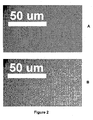
- the term “nano-textures” in reference to a coating on a contact lens or a surface of a contact lens is intended to describe wrinkle surface patterns that can be visually observed by examining the contact lens in hydrated state, according to the method of either reflection differential interference contrast (RDIC) or transmission differential interference contrast (TDIC) as described in Example 1, or according to atomic force microscopy (AFM) well known to a person skilled in the art.
- RDIC reflection differential interference contrast
- TDIC transmission differential interference contrast
- AFM atomic force microscopy
- Wrinkle surface patterns can have any kind of morphology, including, e.g., random and/or ordered worm-like patterns similar to what shown in Figures 1 (B) and 2(B) of this application, hexanogal patterns (e.g., shown in Figure 3 of the article by Guvendiren et al., "Swelling-Induced Surface Patterns in Hydrogels with Gradient Crosslinking Density," Adv. Funct. Mater. 2009,19: 3038-3045 , herein incorporated by reference in its entirety), or combinations thereof.
- the term "worm-like patterns” refers patterns composed of geometric shapes which assemble worms.
- the winkle surface patterns have a roughness (i.e., an arithmetical mean roughness, Ra) of from about 5 nm to about 600 nm, preferably from about 10 nm to about 400 nm, even more preferably from about 15 nm to about 200 nm, even more preferably from about 20 nm to about 100 nm.
- wrinkle surface patterns have a roughness sufficient low to have minimal adverse impact upon the visible light transmissibility of the contact lens under study.
- the minimal adverse impact of winkled surface patterns upon the visible light transmissibility of the contact lens under study is characterized by a reduction in light transmissibility, ( T T o ⁇ x ⁇ 100 % in which T is the 400-700 nm light transmissibility of a test lens with nano-textured surfaces and T o is a control lens made.of the same material but without nano-textured surfaces), of about 20% or less, preferably about 15% or less, more preferably about 10% or less, even more preferably about 5% or less.
- the term "partially penetrate” in reference to a polymeric coating material is intended to describe a process in which the polymeric coating material cannot penetrate into the core of a contact lens but can only be adsorbed/absorbed at and near the surface. Whether a polymeric coating material partially penetrates into a contact lens can be determined by examining fluorescence intensity profiles across the cross sections of a contact lens having a coating of the polymeric coating matering labelled with a fluorescent label in a con-focal laser fluorescence microscopy, as shown in Example.
- the invention is generally related to a method for making contact lenses, especially SiHy contact lenses, with nano-textured surfaces which has no or minimal adverse impact on the visible light (400 - 700 nm) transmissibility of the contact lens.
- methods for producing contact lenses are generaly designed to produce contact lenses having smooth surfaces.
- a method of the invention can be used to produce contact lenses that do not have smooth surface on sub-micron scale but instead have wrinkle surface patterns (i.e., nano-textures), imitating the natural surface of human cornea.
- the external surface of the corneal epithelium is not a perfectly smooth surface on sub-micron scale but rather exhibits a certain type of surface patterns (i.e., nano-textures) due to the microplicae present on the surface.
- a contact lens with nano-textured surfaces can be produced according a method of the invention involving creating a prime coating having nano-textures through controlled imbibition and/or depositions of a reactive polymeric coating material and fixing the nano-textures by crosslinking a hydrophilic polymeric material onto the prime coating to form a crosslinked polymeric coating that perserves the nano-textures of the prime coating and provides a nano-textured surface to the contact lens.
- a contact lens with nano-textured surfaces produced according to a method of the invention may provide the following advantages.
- the nano-textures of a contact lens of the invention can increase the surface area of the contact lens, more closely mimicking that of the natural cornea, while having no or minimal adverse effects upon the light transmissibility of the contact lens. It is believed that when the roughness of the nano-textured surfaces of the contact lens is comparable to the roughness of human cornea, the adverse effects of the nano-textures upon the visible light transmissibility of a contact lens would be minimal or negligible.
- the nano-textures may serve to increase the stability and thickness of the pre-lens tear film.
- the nano-textured surfaces may reduce frictional interaction between the lens and the corneal epithelial surface and may further enhance the biocompatibility of the contact lens.
- the crosslinked polymeric coating on the contact lens can be a non-silicone hydrdgel with high water content when fully hydrated and may impart to the contact lens high biocompatibility, because water is highly biocompatible with the tear and because high water content (e.g., > 75% H 2 O) in the crosslinked polymeric coating is located in and nears the anterior and posterior surfaces with which the eye is in direct contact arid where the biocompatibility counts most. It is believed that the outer layer with much higher water content and the nano-textures may have synergy in providing a "water-loving" surface which can attract tears to be spread on the lens surface.
- a contact lens of the invention may provide an improved wearing comfort.
- the invention provides a method for making contact lenses, preferably silicone hydrogel contact lenses, having nano-textured surfaces, comprising the steps of: (1) providing an organic-based coating solution including an organic-based solvent and a polymeric coating material dissolved in the organic-based solvent, wherein the polymeric coating material comprises multiple first reactive functional groups and multiple affinity groups or moieties; (2) contacting a contact lens with the organic-based coating solution to swell the contact lens and form an intermediary coating of the polymeric coating material on the contact lens, wherein the contact lens comprises, at and near the surface of the contact lens, monomeric units and/or hydrophobic moieties and/or segments capable of interacting with the affinity groups or moieties of the polymeric coating material so as to bind the polymeric coating material, wherein the average molecular weight of the polymeric coating material is selected to be sufficient high to ensure that the polymeric coating material partially penetrate into the contact lens swollen by the organic-based solvent; (3) contacting the swollen contact lens having the intermediary coating thereon with an aqueous
- organic-based solution refers to a solution which is a homogeneous mixture consisting of an organic-based solvent and one or more solutes dissolved in the organic based solvent.
- organic-based coating solution refers to an organic-based solution containing at least one polymeric coating material as a solute in the solution.
- organic-based solvent is intended to describe a solvent system which consists of one or more organic solvents and optionally about 30% or less, preferably about 20% or less, more preferably about 15% or less, even more preferably about 10% or less, in particular about 5% or less by weight of water relative to the weight of the solvent system.
- an organic-based solvent used in preparing an organic-based coating solution can swell a contact lens (to be coated) by at least about 50%, preferably at least about 75%, more preferably at least about 100%, even more preferably at least about 150%.
- Example of preferred organic solvents includes without limitation, tripropylene glycol methyl ether, dipropylene glycol methyl ether, ethylene glycol n-butyl ether, ketones (e.g., acetone, methyl ethyl ketone, etc.), diethylene glycol n-butyl ether, diethylene glycol methyl ether, ethylene glycol phenyl ether, propylene glycol methyl ether, propylene glycol methyl ether acetate, dipropylene glycol methyl ether acetate, propylene glycol n-propyl ether, dipropylene glycol n-propyl ether, tripropylene glycol n-butyl ether, propylene glycol n-butyl ether, dipropylene glycol n-butyl ether, tripropylene glycol n-butyl ether, propylene glycol n-butyl ether, dipropylene glycol n-buty
- a polymeric coating material must comprises (1) multiple reactive functional groups that can participate in a coupling reaction with the reactive functional groups of a reactive hydrophilic polymeric material in the presence or absence of a coupling agent to form a crosslinked polymeric coating; preferably selected from the group consisting of carboxyl groups (i.e., -COOH), azetidinium group, amino groups (i.e., primary and/or secondary amino groups), azlactone groups, isocyanate groups, epoxy groups, aziridine groups, thiol groups, hydroxyl groups, and combinations thereof, more preferably selected from the group consisting of carboxyl groups, azetidinium groups, amino groups, azlactone groups, isocyanate groups, epoxy groups, aziridine groups, thiol groups, and combinations thereof, even more preferably selected from the group consisting of carboxyl groups, azetidinium group, amino groups, epoxy groups, thiol groups, and combinations thereof, most preferably selected from the group consisting of carboxy
- the affinity groups of a polymeric coating material can be: carboxyl groups if a contact lens to be coated contains monomeric units of an amide-containing vinylic monomer (as described below) or an ammonium-containing vinylic monomer (as described below) (i.e., acidified primary, secondary or tertiary amino groups); ammonium groups if a contact lens to be coated contains monomeric units of a carboxyl-containing vinylic monomer (as described below); hydrophobic moieties or segments if a contact lens to be coated contains silicone components.
- the carboxyl groups of a polymeric coating material can interact with amide-type vinylic monomeric units in the lens material through either ionic/polar interaction or hydrogen bonding to maintain an affinity to the lens material; that the carboxyl groups of a polymeric coating material can interact with ammonium-containing vinylic monomeric units in the lens material through ionic/ionic interactions and hydrogen bonding to maintain an affinity to the lens material; that the ammonium groups of a polymeric coating material can interact with carboxyl-containing vinylic monomeric units in the lens material through either ionic/polar interaction or hydrogen bonding to maintain an affinity to the lens material; and that the hydrophobic moieties or segments of a polymeric coating material can interact with silicone components in the lens material through hydrophobic-hydrophobic interactions to maintain an affinity to the lens material.
- amide-type vinylic monomers includes without limitation N,N-dimethylacrylamide (DMA), N,N-dimethylmethacrylamide (DMMA), 2-acrylamidoglycolic acid, 3-acryloylamino-1-propanol, N-hydroxyethyl acrylamide, N-[tris(hydroxymethyl)methyl]-acrylamide, N-methyl-3-methylene-2-pyrrolidone, 1-ethyl-3-methylene-2-pyrrolidone, 1-methyl-5-methylene-2-pyrrolidone, 1-ethyl-5-methylene-2-pyrrolidone, 5-methyl-3-methylene-2-pyrrolidone, 5-ethyl-3-methylene-2-pyrrolidone, 1-n-propyl-3-methylene-2-pyrrolidone, 1-n-propyl-5-methylene-2-pyrrolidone, 1-isopropyl-3-methylene-2-pyrrolidon
- ammonium group refers to an acidified primary, secondary or tertiary amino group.
- ammonium-containing vinylic monomers include without limitation allylamine, vinylamine, trimethylammonium 2-hydroxy propylmethacrylate, amino-C 2 -C 4 alkyl (meth)acrylate, C 1 -C 4 alkylamino-C 2 -C 4 alkyl (meth)acrylate, vinylamine, amino-C 2 -C 4 alkyl (meth)acrylamide, C 1 -C 4 alkylamino-C 2 -C 4 alkyl (meth)acrylamide, di(C 1 -C 4 alkyl)amino-C 2 -C 4 alkyl (meth)acrylate, tri(C 1 -C 4 alkyl)amino-C 2 -C 4 alkyl (meth)acrylate, and mixtures thereof.
- carboxyl-containing vinylic monomers include without limitation acrylic acid, a C 1 -C 4 alkylacrylic acid (e.g., methacrylic acid, ethylacrylic acid, propylacrylic acid, butylacrylic acid), N,N-2-acrylamidoglycolic acid, beta methyl-acrylic acid (crotonic acid), alpha-phenyl acrylic acid, beta-acryloxy propionic acid, sorbic acid, angelic acid, cinnamic acid, 1-carobxy-4-phenyl butadiene-1,3, itaconic acid, citraconic acid, mesaconic acid, glutaconic acid, aconitic acid, maleic acid, fumaric acid, and combination thereof.
- acrylic acid e.g., methacrylic acid, ethylacrylic acid, propylacrylic acid, butylacrylic acid
- N,N-2-acrylamidoglycolic acid beta methyl-acrylic acid (crotonic acid)
- Any polymer or copolymer having above-described reactive functional and affinity groups can be used in the invention so long as it can be dissolved in an organic-based solvent at room temperature in an amount of from about 0.001% to about 1.5%, preferably from about 0.002% to about 1%, more preferably from 0.003% to about 0.5% by weight relative to the total weight of the organic-based coating solution.
- An organic-based coating solution can be prepared by dissolving a given amount of a polymeric coating material in an organic-based solvent (any one described above) to have a concentration described above. It is believed that an organic-based solvent can swell a contact lens so that a portion of the polymeric coating material may penetrate into the contact lens and increase the durability of the prime coating.
- the physical entanglement of the polymeric coating material with a lens material near lens surface may ensure subsequent differential shrinkage between the lens material and the polymeric coating material so as to generate nano-textures in the coating (new lens surface) during the step of contacting with water or a water-based solvent.
- Examples of preferred polymeric coating materials includes without limitation: (1) homopolymers of an ammonium-containing vinylic monomer (any one of those described above) or a caboxyl-containing vinylic monomer (any one of those described above); (2) copolymer of one or more ammonium-containing and/or carboxyl-containing vinylic monomers (those described above); (3) copolymer of one or more ammonium-containing and/or carboxyl-containing vinylic monomers (those described above) with a non-reactive vinylic monomer selected from the group consisting of (meth)acrylamide, N,N-dimethyl (meth)acrylamide, N-vinylpyrrolidone (NVP), N,N-dimethylaminoethyl (meth)acrylate, N,N-dimethylaminopropyl (meth)acrylamide, glycerol methacrylate, 3-acryloylamino-1-propanol, N-hydroxyethyl acrylamide, N -[tri
- silicone-containing vinylic monomers include without limitation N-[tris(trimethylsiloxy)silylpropyl]-(meth)acrylamide, N-[tris(dimethylpropylsiloxy)-silylpropyl]-(meth)acrylamide, N-[tris(dimethylphenylsiloxy)silylpropyl] (meth)acrylamide, N-[tris(dimethylethylsiloxy)silylpropyl] (meth)acrylamide, N-(2-hydroxy-3-(3-(bis(trimethylsilyloxy)methylsilyl)propyloxy)-2- methyl acrylamide; N-(2-hydroxy-3-(3-(bis(trimethylsilyloxy)methylsilyl)propyloxy)propyl) acrylamide; N,N-bis[2-hydroxy-3-(3-(bis(trimethylsilyloxy)methylsilyl)propyloxy)propyl]-2-methyl acrylamide
- siloxane-containing (meth)acrylamide monomers of formula (1) are N-[tris(trimethylsiloxy)silylpropyl]acrylamide, TRIS, N-[2-hydroxy-3-(3-(t-butyldimethylsilyl)propyloxy)propyl]acrylamide.
- a polymeric coating material can comprise monomeric units of one or more reactive vinylic monomers so as to have multiple reactive functional groups.
- exemplary reactive vinylics includes azetidinium-containing vinylic monomers, azlactone-containing vinylic monomers, isocyanate-containing vinylic monomers, epoxy-containing vinylic monomers, and aziridinyl-containing vinylic monomers.
- aziridinyl-containing vinylic monomers include without limitation 2-(1-aziridinyl) ethyl (meth)acrylate, 3-(1-aziridinyl) propyl (meth)acrylate, 4-(1-aziridinyl) butyl (meth)acrylate, 6-(1-aziridinyl) hexyl (meth)acrylate, and 8-(1-aziridinyl) octyl (meth)acrylate).
- epoxy-containing vinylic monomers include without limitation glycidyl (meth)acrylate, vinyl glycidyl ether, allyl glycidyl ether.
- isocyanate-containing vinylic monomers include without limitation 2-isocyanatoethyl (meth)acrylate, 3-isocyanatopropyl (meth)acrylate, 4-isocyanatobutyl (meth)acrylate, 6-isocyanatohexyl (meth)acrylate, 1-methyl-2-isocyanatoethyl methacrylate, and 1,1-dimethyl-2-isocyanatoethyl methacrylate.
- Examples of azlactone-containing vinylic monomers include without limitation 2-vinyl-4,4-dimethyl-1,3-oxazolin-5-one, 2-isopropenyl-4,4-dimethyl-1,3-oxazolin-5-one, 2-vinyl-4-methyl-4-ethyl-1,3-oxazolin-5-one, 2-isopropenyl-4-methyl-4-butyl-1,3-oxazolin-5-one, 2-vinyl-4,4-dibutyl-1,3-oxazolin-5-one, 2-isopropenyl-4-methyl-4-dodecyl-1,3-oxazolin-5-one, 2-isopropenyl-4,4-diphenyl-1,3-oxazolin-5-one, 2-isopropenyl-4,4-pentamethylene-1,3-oxazolin-5-one, 2-isopropenyl-4,4-tetramethylene-1,3-
- Azetidinium-containing vinylic monomers can be obtained by reacting epichlorohydrin with a vinylic monomer containing primary or secondary amino groups (any those described above) according to procedures similar to what described in EP1465931 (herein incorporated by reference in its entirety).
- a polymeric coating material is a polymer or copolymer comprising at least about 70% by mole, preferably at least about 80% by mole, more preferably at least about 90% by mole, even more preferably at least about 95% by mole of monomeric units of one or more carboxyl-containing vinylic monomers, wherein the one or more carboxyl-containing vinylic monomers are selected from the group consisting of acrylic acid, a C 1 -C 4 alkylacrylic acid (e.g., methacrylic acid, ethylacrylic acid, propylacrylic acid, butylacrylic acid), N,N-2-acrylamidoglycolic acid, beta methyl-acrylic acid (crotonic acid), alpha-phenyl acrylic acid, beta-acryloxy propionic acid, sorbic acid, angelic acid, cinnamic acid, 1-carobxy-4-phenyl butadiene-1,3, itaconic acid, citraconic acid, mesaconic acid, gluta
- Examples of preferred carboxyl-containing polymeric coating materials include without limitation linear or branched polyacrylic acid; linear or branched polymethacrylic acid; linear or branched poly(acrylic acid-co-acrylamide) having at least about 70% by mole, preferably at least about 80% by mole, more preferably at least about 90% by mole, even more preferably at least about 95% by mole of acrylic acid; linear or branched poly(methacrylic acid-co-acrylamide) having at least about 70% by mole, preferably at least about 80% by mole, more preferably at least about 90% by mole, even more preferably at least about 95% by mole of methacrylic acid; linear or branched poly(acrylic acid-co-vinylpyrrolidone) having at least about 70% by mole, preferably at least about 80% by mole, more preferably at least about 90% by mole, even more preferably at least about 95% by mole of acrylic acid; linear or branched poly(methacrylic acid-co-viny
- the weight average molecular weight M w of a polymeric coating material is preferably at least about 25,000 Daltons, more preferably at least about 50,000 Daltons, even more preferably at least about 75,000 Daltons, most preferably from about 100,000 to 1,000,000 Daltons.
- a contact lens can be any commercial contact lenses or any ones made according to any methods well known to a person skilled in the art.
- contact lenses can be produced in a conventional "spin-casting mold," as described for example in U.S. Patent No. 3,408,429 , or by the full cast-molding process in a static form, as described in U.S. Patent Nos. 4,347,198 ; 5,508,317 ; 5,583,463 ; 5,789,464 ; and 5,849,810 , or by lathe cutting of silicone hydrogel buttons as used in making customized contact lenses.
- a lens formulation typically is dispensed into molds and cured (i.e., polymerized and/or crosslinked) in molds for making contact lenses.
- a SiHy lens formulation for cast-molding or spin-cast molding or for making SiHy rods used in lathe-cutting of contact lenses generally comprises at least one components selected from the group consisting of a silicone-containing vinylic monomer, a silicone-containing vinylic macromer, a silicone-containing prepolymer, a hydrophilic vinylic monomer, a hydrophobic vinylic monomer, a crosslinking agent, a free-radical initiator (photoinitiator or thermal initiator), a hydrophilic vinylic macromer/prepolymer, and combination thereof, as well known to a person skilled in the art.
- a SiHy contact lens formulation can also comprise other necessary components known to a person skilled in the art, such as, for example, a UV-absorbing agent, a visibility tinting agent (e.g., dyes, pigments, or mixtures thereof), antimicrobial agents (e.g., preferably silver nanoparticles), a bioactive agent, leachable lubricants, leachable tear-stabilizing agents, and mixtures thereof, as known to a person skilled in the art.
- Resultant SiHy contact lenses then can be subjected to extraction with an extraction solvent to remove unpolymerized components from the resultant lenses and to hydration process, as known by a person skilled in the art.
- any suitable silicone-containing vinylic monomers or macromers can be used in the invention.
- polysiloxane-containing vinylic monomers or macromers and silicone-containing prepolymers can also be used in the invention.
- preferred polysiloxane-containing vinylic monomers or macromers are monomethacrylated or monoacrylated polydimethylsiloxanes of various molecular weight (e.g., mono-3-methacryloxypropyl terminated, mono-butyl terminated polydimethylsiloxane or mono-(3-methacryloxy-2-hydroxypropyloxy)propyl terminated, mono-butyl terminated polydimethylsiloxane); dimethacrylated or diacrylated polydimethylsiloxanes of various molecular weight; vinyl carbonate-terminated polydimethylsiloxanes; vinyl carbamate-terminated polydimethylsiloxane; vinyl terminated polydimethylsiloxanes of various molecular weight;
- Patent Nos. 4,259,467 , 4,260,725 , and 4,261,875 (herein incorporated by reference in their entireties).
- Di- and tri-block macromers consisting of polydimethylsiloxane and polyalkyleneoxides could also be of utility.
- methacrylate end capped polyethyleneoxide-block-polydimethylsiloxane-block-polyethyleneoxide to enhance oxygen permeability.
- Suitable monofunctional hydroxyl-functionalized siloxane-containing vinylic monomers/macromers and suitable multifunctional hydroxyl-functionalized siloxane-containing vinylic monomers/macromers are commercially available from Gelest, Inc, Morrisville, PA.
- Examples of preferred silicon-containing prepolymers include those described in commonly-owned US Patent Nos. 6,039,913 , 7,091,283 , 7,268,189 and 7,238,750 , 7,521,519 ; commonly-owned US patent application publication Nos. US 2008-0015315 A1 , US 2008-0143958 A1 , US 2008-0143003 A1 , US 2008-0234457 A1 , US 2008-0231798 A1 , and commonly-owned US patent application Nos. 61/180,449 and 61/180,453 ; all of which are incorporated herein by references in their entireties.
- hydrophilic vinylic monomers are N,N-dimethylacrylamide (DMA), N,N-dimethylmethacrylamide (DMMA), 2-acrylamidoglycolic acid, 3-acryloylamino-1-propanol, N-hydroxyethyl acrylamide, N -[tris(hydroxymethyl)methyl]-acrylamide, N-methyl-3-methylene-2-pyrrolidone, 1-ethyl-3-methylene-2-pyrrolidone, 1-methyl-5-methylene-2-pyrrolidone, 1-ethyl-5-methylene-2-pyrrolidone, 5-methyl-3-methylene-2-pyrrolidone, 5-ethyl-3-methylene-2-pyrrolidone, 1-n-propyl-3-methylene-2-pyrrolidone, 1-n-propyl-5-methylene-2-pyrrolidone, 1-isopropyl-3-methylene-2-pyrrolidone, 1-isopropyl-5-methylene-2-pyrrolidone, 1-is
- hydrophobic vinylic monomers examples include methylacrylate, ethylacrylate, propylacrylate, isopropylacrylate, cyclohexylacrylate, 2-ethylhexylacrylate, methylmethacrylate, ethylmethacrylate, propylmethacrylate, vinyl acetate, vinyl propionate, vinyl butyrate, vinyl valerate, styrene, chloroprene, vinyl chloride, vinylidene chloride, acrylonitrile, 1-butene, butadiene, methacrylonitrile, vinyl toluene, vinyl ethyl ether, perfluorohexylethyl-thio-carbonyl-aminoethyl-methacrylate, isobornyl methacrylate, trifluoroethyl methacrylate, hexafluoro-isopropyl methacrylate, hexafluorobutyl methacrylate
- cross-linking agents include without limitation tetraethyleneglycol diacrylate, triethyleneglycol diacrylate, ethyleneglycol diacylate, diethyleneglycol diacrylate, tetraethyleneglycol dimethacrylate, triethyleneglycol dimethacrylate, ethyleneglycol dimethacylate, diethyleneglycol dimethacrylate, trimethylopropane trimethacrylate, pentaerythritol tetramethacrylate, bisphenol A dimethacrylate, vinyl methacrylate, ethylenediamine dimethyacrylamide, ethylenediamine diacrylamide, glycerol dimethacrylate, triallyl isocyanurate, triallyl cyanurate, allylmethacrylate, allylmethacrylate, 1,3-bis(methacrylamidopropyl)-1,1,3,3-tetrakis(trimethylsiloxy)disiloxane, N,N'-methylenebis
- a preferred cross-linking agent is tetra(ethyleneglycol) diacrylate, tri(ethyleneglycol) diacrylate, ethyleneglycol diacrylate, di(ethyleneglycol) diacrylate, methylenebisacrylamide, triallyl isocyanurate, or triallyl cyanurate.
- the amount of a cross-linking agent used is expressed in the weight content with respect to the total polymer and is preferably in the range from about 0.05% to about 4%, and more preferably in the range from about 0.1 % to about 2%.
- thermal initiators examples include, but are not limited to, 2,2'-azobis (2,4-dimethylpentanenitrile), 2,2'-azobis (2-methylpropanenitrile), 2,2'-azobis (2-methylbutanenitrile), peroxides such as benzoyl peroxide, and the like.
- the thermal initiator is 2,2'-azobis(isobutyronitrile) (AIBN).
- Suitable photoinitiators are benzoin methyl ether, diethoxyacetophenone, a benzoylphosphine oxide, 1-hydroxycyclohexyl phenyl ketone and Darocur and Irgacur types, preferably Darocur 1173® and Darocur 2959®.
- benzoylphosphine initiators include 2,4,6-trimethylbenzoyldiphenylophosphine oxide; bis-(2,6-dichlorobenzoyl)-4-N-propylphenylphosphine oxide; and bis-(2,6-dichlorobenzoyl)-4-N-butylphenylphosphine oxide.
- Reactive photoinitiators which can be incorporated, for example, into a macromer or can be used as a special monomer are also suitable.
- reactive photoinitiators are those disclosed in EP 632 329 , herein incorporated by reference in its entirety.
- the polymerization can then be triggered off by actinic radiation, for example light, in particular UV light of a suitable wavelength.
- actinic radiation for example light, in particular UV light of a suitable wavelength.
- the spectral requirements can be controlled accordingly, if appropriate, by addition of suitable photosensitizers.
- a polymerizable UV-absorbing agent comprises a benzotriazole-moiety or a benzophenone-moiety.
- preferred polymerizable UV absorbers include without limitation 2-(2-hydroxy-5-vinylphenyl)-2H-benzotriazole, 2-(2-hydroxy-5-acrylyloxyphenyl)-2H-benzotriazole, 2-(2-hydroxy-3-methacrylamido methyl-5-tert octylphenyl)benzotriazole, 2-(2'-hydroxy-5'-methacrylamidophenyl)-5-chlorobenzotriazole, 2-(2'-hydroxy-5'-methacrylamidophenyl)-5-methoxybenzotriazole, 2-(2'-hydroxy-5'-methacryloxypropyl-3'-t-butyl-phenyl)-5-chlorobenzotriazole, 2-(2'-hydroxy-5'-hydroxy-5'-methacryloxypropyl-3'-t-butyl
- the bioactive agent is any compound that can prevent a malady in the eye or reduce the symptoms of an eye malady.
- the bioactive agent can be a drug, an amino acid (e.g., taurine, glycine, etc.), a polypeptide, a protein, a nucleic acid, or any combination thereof.
- amino acid e.g., taurine, glycine, etc.
- drugs useful herein include, but are not limited to, rebamipide, ketotifen, olaptidine, cromoglycolate, cyclosporine, nedocromil, levocabastine, lodoxamide, ketotifen, or the pharmaceutically acceptable salt or ester thereof.
- bioactive agents include 2-pyrrolidone-5-carboxylic acid (PCA), alpha hydroxyl acids (e.g., glycolic, lactic, malic, tartaric, mandelic and citric acids and salts thereof, etc.), linoleic and gamma linoleic acids, and vitamins (e.g., B5, A, B6, etc.).
- PCA 2-pyrrolidone-5-carboxylic acid
- alpha hydroxyl acids e.g., glycolic, lactic, malic, tartaric, mandelic and citric acids and salts thereof, etc.
- linoleic and gamma linoleic acids e.g., B5, A, B6, etc.
- leachable lubricants include without limitation mucin-like materials (e.g., polyglycolic acid) and non-crosllinkable hydrophilic polymers (i.e., without ethylenically unsaturated groups). Any hydrophilic polymers or copolymers without any ethylenically unsaturated groups can be used as leachable lubricants.
- non-crosslinkable hydrophilic polymers include, but are not limited to, polyvinyl alcohols (PVAs), polyamides, polyimides, polylactone, a homopolymer of a vinyl lactam, a copolymer of at least one vinyl lactam in the presence or in the absence of one or more hydrophilic vinylic comonomers, a homopolymer of acrylamide or methacrylamide, a copolymer of acrylamide or methacrylamide with one or more hydrophilic vinylic monomers, polyethylene oxide (i.e., polyethylene glycol (PEG)), a polyoxyethylene derivative, poly-N-N-dimethylacrylamide, polyacrylic acid, poly 2 ethyl oxazoline, heparin polysaccharides, polysaccharides, and mixtures thereof.
- the weight-average molecular weight M w of the non-crosslinkable hydrophilic polymer is preferably from 5,000 to 500,000, more preferably from 10,000 to 300,
- leachable tear-stabilizing agents include, without limitation, phospholipids, monoglycerides, diglycerides, triglycerides, glycolipids, glyceroglycolipids, sphingolipids, sphingo-glycolipids, fatty alcohols, fatty acids, mineral oils, and mixtures thereof.
- a tear stabilizing agent is a phospholipid, a monoglyceride, a diglyceride, a triglyceride, a glycolipid, a glyceroglycolipid, a sphingolipid, a sphingo-glycolipid, a fatty acid having 8 to 36 carbon atoms, a fatty alcohol having 8 to 36 carbon atoms, or a mixture thereof.
- a lens formulation can be a solution or a melt at a temperature from about 20°C to about 85°C.
- a polymerizable composition is a solution of all desirable components in a suitable solvent, or a mixture of suitable solvents.
- a lens formulation can be prepared by dissolving all of the desirable components in any suitable solvent known to a person skilled in the art. All of the exemplary solvents described above can be used in preparing a lens formulation.
- SiHy lens formulations have been described in numerous patents and patent applications published by the filing date of this application. All of them can be used in obtaining a SiHy lens which in turn becomes the inner layer of a SiHy contact lens of the invention., so long as they will yield a SiHy material having a Dk and water content specified above.
- a SiHy lens formulation for making commercial SiHy lenses such as, lotrafilcon A, lotrafilcon B, balafilcon A, galyfilcon A, senofilcon A, narafilcon A, narafilcon B, comfilcon A, enfilcon A, can also be used in making SiHy contact lenses.
- a mold for cast molding
- a mold generally comprises at least two mold sections (or portions) or mold halves, i.e. first and second mold halves.
- the first mold half defines a first molding (or optical) surface and the second mold half defines a second molding (or optical) surface.
- the first and second mold halves are configured to receive each other such that a lens forming cavity is formed between the first molding surface and the second molding surface.
- the molding surface of a mold half is the cavity-forming surface of the mold and in direct contact with lens-forming material.
- Methods of manufacturing mold sections for cast-molding a contact lens are generally well known to those of ordinary skill in the art.
- the process of the present invention is not limited to any particular method of forming a mold. In fact, any method of forming a mold can be used in the present invention.
- the first and second mold halves can be formed through various techniques, such as injection molding or lathing. Examples of suitable processes for forming the mold halves are disclosed in U.S. Patent Nos. 4,444,711 to Schad ; 4,460,534 to Boehm et al. ; 5,843,346 to Morrill ; and 5,894,002 to Boneberger et al. , which are also incorporated herein by reference.
- Virtually all materials known in the art for making molds can be used to make molds for making contact lenses.
- polymeric materials such as polyethylene, polypropylene, polystyrene, PMMA, Topas ® COC grade 8007-S10 (clear amorphous copolymer of ethylene and norbornene, from Ticona GmbH of Frankfurt, Germany and Summit, New Jersey), or the like can be used.
- Other materials that allow UV light transmission could be used, such as quartz glass and sapphire.
- reusable molds are used and the silicone-hydrogel lens-forming composition is cured actinically under a spatial limitation of actinic radiation to form a SiHy contact lens.
- preferred reusable molds are those disclosed in U.S. patent application Nos. 08/274,942 filed July 14, 1994 , 10/732,566 filed December 10, 2003 , 10/721,913 filed November 25, 2003 , and U.S. Patent No. 6,627,124 , which are incorporated by reference in their entireties.
- Reusable molds can be made of quartz, glass, sapphire, CaF 2 , a cyclic olefin copolymer (such as for example, Topas ® COC grade 8007-S10 (clear amorphous copolymer of ethylene and norbornene) from Ticona GmbH of Frankfurt, Germany and Summit, New Jersey, Zeonex® and Zeonor® from Zeon Chemicals LP, Louisville, KY), polymethylmethacrylate (PMMA), polyoxymethylene from DuPont (Delrin), Ultem® (polyetherimide) from G.E. Plastics, PrimoSpire®, etc..
- a cyclic olefin copolymer such as for example, Topas ® COC grade 8007-S10 (clear amorphous copolymer of ethylene and norbornene) from Ticona GmbH of Frankfurt, Germany and Summit, New Jersey, Zeonex® and Zeonor® from Zeon Chemicals LP, Louisville, KY
- Contacting of a contact lens with an organic-based solution of a polymeric coating material can occur by dipping the contact lens in a bath of a coating solution for a period of time or alternatively dipping the contact lens sequentially in a series of bath of coating solutions for a fixed shorter time period for each bath.
- the contacting time of a contact lens with a coating solution of a reactive polymer may last up to about 10 minutes, preferably from about 5 to about 360 seconds, more preferably from about 5 to about 250 seconds, even more preferably from about 5 to about 200 seconds.
- aqueous solution is intended to describe an homogeneous solution in which water is the solvent and at least one solute, which is selected from the group consisting of at least one organic solvent, at least one salt, at least one buffering agent, at least one lubricant (e.g., a hydrophilic polymer), at least one surfactant, and combination thereof, is dissolved in water.
- a solute which is selected from the group consisting of at least one organic solvent, at least one salt, at least one buffering agent, at least one lubricant (e.g., a hydrophilic polymer), at least one surfactant, and combination thereof, is dissolved in water.
- the aqueous solution used in shrinking the contact lens having the coating thereon cannot swell the contact lens by more than about 20%, preferably more than about 15%, more preferably more than about 10%, even more preferably more than about 5%; and that the amount of the at least one solute is about 30% or less, preferably about 20% or less, more preferably about 15% or less, even more preferably about 10% or less, in particular about 5% or less by weight relative to the weight of the aqueous solution. It should be understood that the above values of swelling are calculated based on Eq. (I) described above.
- Contacting of the swollen contact lens having the intermediary coating thereon with water or an aqueous solution can occur by dipping the contact lens in a bath of water or an aqueous solution for a period of time or alternatively dipping the contact lens sequentially in a series of bath of water or aqueous solutions for a fixed shorter time period for each bath.
- the contacting time of the swollen contact lens having the intermediary coating with water or an aqueous solution may last up to about 10 minutes, preferably from about 5 to about 360 seconds, more preferably from about 5 to about 250 seconds, even more preferably from about 5 to about 100 seconds.
- Winkled surface patterns i.e., nano-textures
- the resultant winkled surface patterns in the prime coating is not permanent and can gradually disappear under certain conditions, for example, if contact lenses with prime coatings having winkled surface patterns are hydrated with water overnight, or if the contact lenses are soaked in an organic based solvent for up to about 1 minute and followed by hydrating in water.
- the degree of nano-structures on the lens surface can be controlled in order to optimize the size and degree of the nano-structures so that they do not cause unacceptable light scattering.
- Methods of controlling the degree of nano-structures on the surface include but are not limited to the following. For examples, one can adjust the degree of lens swelling by appropriate selection of the organic solvent (or organic/water mixture) containing the primer coating polymer, adjust the rate at which the lens shrinks back to its equilibrium size in water by using an intermediate water/organic bath to slow the shrinkage rate, adjust the lens exposure times in the coating and rinsing baths, adjust the time between the application of the primer coating and the surface crosslinking step, and combinations thereof.
- the nano-textures in the prime coating are fixed (i.e., rendering the winkle surface pattern relatively permanent) by crosslinking the polymeric coating material with a water-soluble and crosslinkable hydrophilic polymeric material having multiple second reactive functional groups, to form a crosslinked polymeric coating that perserves the nano-textures of the prime coating and provides a nano-textured surface to the contact lens.
- the reactive functional groups of a water-soluble and crosslinkable hydrophilic polymeric material can be: carboxyl groups, azetidinium group, amino groups, azlactone groups, isocyanate groups, epoxy groups, aziridine groups, hydroxyl groups, thiol groups, or combinations thereof; preferably carboxyl groups, azetidinium groups, amino groups, azlactone groups, isocyanate groups, epoxy groups, aziridine groups, thiol groups, or combinations thereof; more preferably carboxyl groups, azetidinium group, amino groups, epoxy groups, thiol groups, or combinations thereof; even more preferably azetidinium group, epoxy groups, or combinations thereof, provided that one second reactive functional group can react (in a coupling reaction) with one first reactive functional group of the polymeric coating material in the presence or preferably absence of a coupling agent to form a crosslinkage.
- a "crosslinked hydrophilic polymeric coating” as used in this application means a layer of a crosslinked polymeric material having a three-dimensional network that can contain water when fully hydrated.
- the three-dimensional network of a crosslinked polymeric material can be formed by crosslinking of two or more linear or branched polymers through crosslinkages.
- Coupling reactions between a pair of reactive functional groups are well known reactions under the conditions that are customary for formation of covalent linkages.
- an amino group reacts with aldehyde group to form a Schiff base which may further be reduced;
- an amino group -NHR' reacts with an acid anhydride group to form an amide linkage (-CO-NR'-);
- an amino group -NHR' reacts with an isocyanate group to form a urea linkage (-NR"-C(O)-NH-);
- an amino group -NHR' reacts with an epoxy or aziridine group to form an amine bond (-C-NR'-);
- an amino group -NHR' reacts (ring-opening) with an azlactone group to form an alkylene-diamido linkage (-C(O)NH-alkylene-C(O)NR'-);
- an amino group -NHR' reacts with a carboxylic acid group in the presence of a coupling
- a coupling agent having two reactive functional groups can be a diisocyanate, a di-acid halide, a di-carboxylic acid compound, a di-acid halide compound, a di-azlactone compound, a di-epoxy compound, a diamine, or a diol.
- a person skilled in the art knows well to select a coupling reaction (e.g., anyone described above in this application) and conditions thereof to prepare a polysiloxane terminated with one or more ethylenically unsaturated groups.
- a diisocyanate, di-acid halide, di-carboxylic acid, di-azlactone, or di-epoxy compound can be used in the coupling of two hydroxyl, two amino groups, two carboxyl groups, two epoxy groups, or combination thereof; a diamine or dihydroxyl compound can be used in the coupling of two isocyanate, epoxy, aziridine, carboxylic acid, or azlactone groups or combinations thereof.
- the water-soluble and crosslinkable hydrophilic polymeric material preferably comprises, as the second reactive functional groups, thermally-crosslinkable groups, more preferably azetidinium groups and/or epoxy groups, even more preferably azetidinium groups.
- the water-soluble and crosslinkable hydrophilic polymeric material is a partially-crosslinked hydrophilic polymeric material that comprises a three-dimensional network and crosslinkable (preferably thermally-crosslinkable) groups (such as, e.g., azetidinium and/or epoxy groups), more preferably azetidinium groups within the network.
- crosslinkable preferably thermally-crosslinkable
- the term "partially-crosslinked" in reference to a hydrophilic polymeric material means that the crosslinkable groups of starting materials for making the hydrophilic polymeric material in a crosslinking reaction have not been fully consumed.
- the water-soluble and crosslinkable hydrophilic polymeric material comprises (i) from about 20% to about 95%, preferably from about 35% to about 90%, more preferably from about 50% to about 85%, by weight of first polymer chains derived from an epichlorohydrin-functionalized polyamine or polyamidoamine, (ii) from about 5% to about 80%, preferably from about 10% to about 65%, even more preferably from about 15% to about 50%, by weight of hydrophilic moieties or second polymer chains derived from at least one hydrophilicity-enhancing agent having at least one reactive functional group selected from the group consisting of amino group, carboxyl group, thiol group, and combination thereof, wherein the hydrophilic moieties or second polymer chains are covalently attached to the first polymer chains through one or more covalent linkages each formed between one azetitdinium group of the epichlorohydrin-functionalized polyamine or polyamidoamine and one amino, carboxyl or thiol group of the hydrophilic moieties
- the composition of the hydrophilic polymeric material is determined by the composition (based on the total weight of the reactants) of a reactants mixture used for preparing the thermally-crosslinkable hydrophilic polymeric material according to the crosslinking reactions shown in Scheme I above. For example, if a reactant mixture comprises about 75% by weight of an epichlorohydrin-functionalized polyamine or polyamidoamine and about 25% by weight of at least one hydrophilicity-enhancing agent based on the total weight of the reactants, then the resultant hydrophilic polymeric material comprise about 75% by weight of first polymer chains derived from the epichlorohydrin-functionalized polyamine or polyamidoamine and about 25% by weight of hydrophilic moieties or second polymer chains derived from said at least one hydrophilicity-enhancing agent.
- the azetidinium groups of the thermally-crosslinkable hydrophilic polymeric material are those azetidinium groups (of the epichlorohydrin-functionalized polyamine or polyamidoamine) which do not participate in crosslinking reactions for preparing the thermally-crosslinkable hydrophilic polymeric material.
- the crosslinked hydrophilic coating can be formed by simply heating a contact lens having the prime coating having nano-textures in an aqueous solution of a water-soluble and crosslinkable hydrophilic polymeric material to and at a temperature from about 40°C to about 140°C for a period of time sufficient to covalently attach the hydrophilic polymeric material onto the prime coating on the surface of the contact lens through covalent linkages each formed between one azetidinium group of the hydrophilic polymeric material and one of the first reactive functional groups of the polymeric coating material in the prime coating on the surface of the contact lens, thereby forming a crosslinked hydrophilic coating comprising nano-textures on the contact lens.
- An epichlorohydrin-functionalized polyamine or polyamidoamine can be obtained by reacting epichlorohydrin with a polyamine polymer or a polymer containing primary or secondary amino groups.
- a poly(alkylene imines) or a poly(amidoamine) which is a polycondensate derived from a polyamine and a dicarboxylic acid (e.g., adipic acid-diethylenetriamine copolymers) can react with epichlorohydrin to form an epichlorohydrin-functionalized polymer.
- a homopolymer or copolymer of aminoalkyl(meth)acrylate, mono-alkylaminoalkyl (meth)acrylate, aminoalkyl(meth)acrylamide, or mono-alkylaminoalkyl (meth)acrylamide can also react with epichlorohydrin to form an epichlorohydrin-functionalized polyamine.
- the reaction conditions for epichlorohydrin-functionalization of a polyamine or polyamidoamine polymer are taught in EP1465931 (herein incorporated by reference in its entirety).
- a preferred epichlorohydrin-functionalized polymer is polyaminoamide-epichlorohydrin (PAE) (or polyamide-polyamine-epichlorohydrin or polyamide-epichlorohydrin), such as, for example, Kymene® or Polycup ® resins (epichlorohydrin-functionalized adipic acid-diethylenetriamine copolymers) from Hercules or Polycup ® or Servamine ® resins from Servo/Delden.
- PAE polyaminoamide-epichlorohydrin
- PAE polyamide-polyamine-epichlorohydrin or polyamide-epichlorohydrin
- Kymene® or Polycup ® resins epichlorohydrin-functionalized adipic acid-diethylenetriamine copolymers
- hydrophilicity-enhancing agents can be used in the invention so long as they contain at least one amino group, at least one carboxyl group, and/or at least one thiol group.
- hydrophilicity-enhancing agents include without limitation: amino-, carboxyl- or thiol-containing monosaccharides (e.g., 3-amino-1,2-propanediol, 1-thiolglycerol, 5-keto-D-gluconic acid, galactosamine, glucosamine, galacturonic acid, gluconic acid, glucosaminic acid, mannosamine, saccharic acid 1,4-lactone, saccharide acid, Ketodeoxynonulosonic acid, N -methyl-D-glucamine, 1-amino-1-deoxy- ⁇ -D-galactose, 1-amino-1-deoxysorbitol, 1-methylamino-1-deoxysorbitol, N-aminoethyl gluconamide); amino-, carboxyl- or thiol-containing disaccharides (e.g., chondroitin disaccharide sodium salt, di( ⁇ -D-xylopyrano
- hydrophilicity-enhancing agents is hydrophilic polymers having one or more amino, carboxyl and/or thiol groups. More preferably, the content of the amino, carboxyl and/or thiol groups in a hydrophilic polymer as a hydrophilicity-enhancing agent is less than about 40%, preferably less than about 30%, more preferably less than about 20%, even more preferably less than about 10%, by weight based on the total weight of the hydrophilic polymer.
- hydrophilic polymers as hydrophilicity-enhancing agents are amino- or carboxyl-containing polysaccharides, for example, such as, carboxymethylcellulose (having a carboxyl content of about 40% or less, which is estimated based on the composition of repeating units, -[C 6 H 10-m O 5 (CH 2 CO 2 H) m ]- in which m is 1 to 3), carboxyethylcellulose (having a carboxyl content of about 36% or less, which is estimated based on the composition of repeating units, -[C6H 10-m O 5 (C 2 H 4 CO 2 H) m ]- in which m is 1 to 3) carboxypropylcellulose (having a carboxyl content of about 32% or less, which is estimated based on the composition of repeating units, -[C 6 H 10-m O 5 (C 3 H 6 CO 2 H) m ]-, in which m is 1 to 3), hyaluronic acid (having a carboxyl content
- hydrophilic polymers as hydrophilicity-enhancing agents include without limitation: poly(ethylene glycol) (PEG) with mono-amino, carboxyl or thiol group (e.g., PEG-NH 2 , PEG-SH, PEG-COOH); H 2 N-PEG-NH 2 ; HOOC-PEG-COOH; HS-PEG-SH; H 2 N-PEG-COOH; HOOC-PEG-SH; H 2 N-PEG-SH; multi-arm PEG with one or more amino, carboxyl or thiol groups; PEG dendrimers with one or more amino, carboxyl or thiol groups; a diamino- or dicarboxyl-terminated homo- or co-polymer of a non-reactive hydrophilic vinylic monomer; a monoamino- or monocarboxyl-terminated homo- or co-polymer of a non-reactive hydrophilic vinylic monomer; a copolymer
- a hydrophilic polymer as a hydrophilicity-enhancing agent is PEG-NH 2 ; PEG-SH; PEG-COOH; H 2 N-PEG-NH 2 ; HOOC-PEG-COOH; HS-PEG-SH; H 2 N-PEG-COOH; HOOC-PEG-SH; H 2 N-PEG-SH; multi-arm PEG with one or more amino, carboxyl or thiol groups; PEG dendrimers with one or more amino, carboxyl or thiol groups; a monoamino-, monocarboxyl-, diamino- or dicarboxyl-terminated homo- or copolymer of a non-reactive hydrophilic vinylic monomer selected from the group consisting of acryamide (AAm), N,N-dimethylacrylamide (DMA), N-vinylpyrrolidone (NVP), N-vinyl-N-methyl acetamide, glycerol (meth)
- the hydrophilicity-enhancing agent as a hydrophilicity-enhancing agent is PEG-NH 2 ; PEG-SH; PEG-COOH; monoamino-, monocarboxyl-, diamino- or dicarboxyl-terminated polyvinylpyrrolidone; monoamino-, monocarboxyl-, diamino- or dicarboxyl-terminated polyacrylamide; monoamino-, monocarboxyl-, diamino- or dicarboxyl-terminated poly(DMA); monoamino- or monocarboxyl-, diamino- or dicarboxyl-terminated poly(DMA-co-NVP); monoamino-, monocarboxyl-, diamino- or dicarboxyl-terminated poly(NVP-co-N,N-dimethylaminoethyl (meth)acrylate)); monoamino-, monocarboxyl-, diamino- or dicarboxyl
- PEGs with functional groups and multi-arm PEGs with functional groups can be obtained from various commercial suppliers, e.g., Polyscience, and Shearwater Polymers, zinc., etc.
- Monoamino-, monocarboxyl-, diamino- or dicarboxyl-terminated homo- or copolymers of one or more non-reactive hydrophilic vinylic monomers or of a phosphorylcholine-containing vinylic monomer can be prepared according to procedures described in U.S. Patent No. 6,218,508 , herein incorporated by reference in its entirety.
- a diamino- or dicarboxyl-terminated homo- or co-polymer of a non-reactive hydrophilic vinylic monomer the non-reactive vinylic monomer, a chain transfer agent with an amino or carboxyl group (e.g., 2-aminoethanethiol, 2-mercaptopropinic acid, thioglycolic acid, thiolactic acid, or other hydroxymercaptanes, aminomercaptans, or carboxyl-containing mercaptanes) and optionaly other vinylic monomer are copolymerized (thermally or actinically) with a reactive vinylic monomer (having an amino or carboxyl group), in the presence of an free-radical initiator.
- the molar ratio of chain transfer agent to that of all of vinylic monomers other than the reactive vinylic monomer is from about 1:5 to about 1:100, whereas the molar ratio of chain transfer agent to the reactive vinylic monomer is 1:1.
- the chain transfer agent with amino or carboxyl group is used to control the molecular weight of the resultant hydrophilic polymer and forms a terminal end of the resultant hydrophilic polymer so as to provide the resultant hydrophilic polymer with one terminal amino or carboxyl group, while the reactive vinylic monomer provides the other terminal carboxyl or amino group to the resultant hydrophilic polymer.
- a monoamino- or monocarboxyl-terminated homo- or co-polymer of a non-reactive hydrophilic vinylic monomer the non-reactive vinylic monomer, a chain transfer agent with an amino or carboxyl group (e.g., 2-aminoethanethiol, 2-mercaptopropinic acid, thioglycolic acid, thiolactic acid, or other hydroxymercaptanes, aminomercaptans, or carboxyl-containing mercaptanes) and optionally other vinylic monomers are copolymerized (thermally or actinically) in the absence of any reactive vinylic monomer.
- an amino or carboxyl group e.g., 2-aminoethanethiol, 2-mercaptopropinic acid, thioglycolic acid, thiolactic acid, or other hydroxymercaptanes, aminomercaptans, or carboxyl-containing mercaptanes
- Copolymers containing monomeric units derived from methacryloyloxyethyl phosphorylcholine and carboxyl, amino and/or thiol reactive functional groups can be obtained from NOP Corporation (e.g., LIPIDURE® -A and -AF).
- the weight average molecular weight M w of the hydrophilic polymer having at least one amino, carboxyl or thiol group (as a hydrophilicity-enhancing agent) as hydrophilicity-enhancing agent is preferably from about 500 to about 1,000,000, more preferably from about 1,000 to about 500,000, even more preferably from about 5,000 to about 250,000 Daltons.
- reaction between a hydrophilicity-enhancing agent and an epichlorohydrin-functionalized polyamine or polyamidoamine is carried out at a temperature of from about 40°C to about 100°C for a period of time sufficient (from about 0.3 hour to about 24 hours, preferably from about 1 hour to about 12 hours, even more preferably from about 2 hours to about 8 hours) to form a water-soluble and thermally-crosslinkable hydrophilic polymeric material containing azetidinium groups.
- concentration of a hydrophilicity-enhancing agent relative to an epichlorohydrin-functionalized polyamine or polyamidoamine must be selected not to render a resultant hydrophilic polymeric material water-insoluble (i.e., a solubility of less than 0.005 g per 100 ml of water at room temperature) and not to consume more than about 99%, preferably about 98%, more preferably about 97%, even more preferably about 96% of the azetidinium groups of the epichlorohydrin-functionalized polyamine or polyamidoamine.
- heating for forming a crosslinked hydrophilic coating is performed preferably by autoclaving a contact lens, preferably a SiHy contact lens that comprises a prime coating including nano-textures and is immersed in a packaging solution (i.e., a buffered aqueous solution) including a water-soluble thermally crosslinkabe hydrophilic polymeric material in a sealed lens package at a temperature of from about 118°C to about 125°C for approximately 20-90 minutes.
- the packaging solution is a buffered aqueous solution which is ophthalmically safe after autoclave.
- a SiHy contact lens which comprises a base coating and a layer of a water-soluble thermally crosslinkabe hydrophilic polymeric material on top of the base coating, immersed in a packaging solution (i.e., a buffered aqueous solution) in a sealed lens package at a temperature of from about 118°C to about 125°C for approximately 20-90 minutes.
- a packaging solution i.e., a buffered aqueous solution
- Lens packages are well known to a person skilled in the art for autoclaving and storing a soft contact lens. Any lens packages can be used in the invention.
- a lens package is a blister package which comprises a base and a cover, wherein the cover is detachably sealed to the base, wherein the base includes a cavity for receiving a sterile packaging solution and the contact lens.
- Lenses are packaged in individual packages, sealed, and sterilized (e.g., by autoclave at about 120°C or higher for at least 30 minutes) prior to dispensing to users.
- autoclave at about 120°C or higher for at least 30 minutes
- a person skilled in the art will understand well how to seal and sterilize lens packages.
- a packaging solution contains at least one buffering agent and one or more other ingredients known to a person skilled in the art.
- other ingredients include without limitation, tonicity agents, surfactants, antibacterial agents, preservatives, and lubricants (or water-soluble viscosity builders) (e.g., cellulose derivatives, polyvinyl alcohol, polyvinyl pyrrolidone).
- the packaging solution contains a buffering agent in an amount sufficient to maintain a pH of the packaging solution in the desired range, for example, preferably in a physiologically acceptable range of about 6 to about 8.5.
- a buffering agent in an amount sufficient to maintain a pH of the packaging solution in the desired range, for example, preferably in a physiologically acceptable range of about 6 to about 8.5.
- Any known, physiologically compatible buffering agents can be used.
- Suitable buffering agents as a constituent of the contact lens care composition according to the invention are known to the person skilled in the art. Examples are boric acid, borates, e.g. sodium borate, citric acid, citrates, e.g. potassium citrate, bicarbonates, e.g.
- TRIS (2-amino-2-hydroxymethyl-1,3-propanediol), Bis-Tris (Bis-(2-hydroxyethyl)-imino-tris-(hydroxymethyl)-methane), bis-aminopolyols, triethanolamine, ACES (N-(2-hydroxyethyl)-2-aminoethanesulfonic acid), BES (N,N-Bis(2-hydroxyethyl)-2-aminoethanesulfonic acid), HEPES (4-(2-hydroxyethyl)-1-piperazineethanesulfonic acid), MES (2-(N-morpholino)ethanesulfonic acid), MOPS (3-[N-morpholino]-propanesulfonic acid), PIPES (piperazine-N,N'-bis(2-ethanesulfonic acid), TES (N-[Tris(hydroxymethyl)methyl]-2-aminoethanesulfonic acid), salt
- each buffer agent in a packaging solution is preferably from 0.001 % to 2%, preferably from 0.01% to 1%; most preferably from about 0.05% to about 0.30% by weight.
- the packaging solution has a tonicity of from about 200 to about 450 milliosmol (mOsm), preferably from about 250 to about 350 mOsm.
- the tonicity of a packaging solution can be adjusted by adding organic or inorganic substances which affect the tonicity.
- Suitable occularly acceptable tonicity agents include, but are not limited to sodium chloride, potassium chloride, glycerol, propylene glycol, polyols, mannitols, sorbitol, xylitol and mixtures thereof.
- a packaging solution of the invention has a viscosity of from about 1 centipoise to about 10 centipoises, preferably from about 1 centipoise to about 5 centipoises, more preferably from about 1.2 centipoises to about 2.5 centipoises, at 25°C.
- the packaging solution comprises preferably from about 0.01 % to about 2%, more preferably from about 0.05% to about 1.5%, even more preferably from about 0.1% to about 1%, most preferably from about 0.2% to about 0.5%, by weight of a water-soluble and thermally-crosslinkable hydrophilic polymeric material of the invention.
- a packaging solution of the invention can contain a viscosity-enhancing polymer, a surfactant, and/or other components known to a person skilled in the art.
- the invention provides a silicone hdyrogel (SiHy) contact comprising a silicone hydrogel lens body and a non-silicone hydrogel coating thereon, wherein the coating comprises winkle surface patterns (nano-textures) having a roughness (i.e., an arithmetical mean roughness, Ra) of from about 5 nm to about 600 nm, preferably from about 10 nm to about 400 nm, even more preferably from about 15 nm to about 200 nm, even more preferably from about 20 nm to about 100 nm.
- a roughness i.e., an arithmetical mean roughness, Ra
- a SiHy contact lens of the invention has at least one of properties selected from the group consisting of (1) a surface hydrophilicity/wettability characterized by having an averaged water contact angle of preferably about 90 degrees or less, more preferably about 80 degrees or less, even more preferably about 70 degrees or less, most preferably about 60 degrees or less; (2) an oxygen transmissibility of at least about 50, preferably at least about 70, more preferably at least about 80, even more preferably at least about 90 barrers/mm; (3) an elastic modulus of about 1.5 MPa or less, preferably about 1.2 MPa or less, more preferably about 1.0 or less, even more preferably from about 0.3 MPa to about 1.0 MPa; (4) a water content of preferably from about 18% to about 70%, more preferably from about 20% to about 60% by weight when fully hydrated; and (5) combinations thereof.
- the water content of a silicone hydrogel contact lens can be measured according to Bulk Technique as disclosed in US 5,849,811 .
- the apparent oxygen permeability of a lens and oxygen transmissibility of a lens material is determined according to a technique similar to the one described in U.S. Patent No. 5,760,100 and in an article by Winterton et al., (The Cornea: Transactions of the World Congress on the Cornea 111, H.D. Cavanagh Ed., Raven Press: New York 1988, pp273-280 ), both of which are herein incorporated by reference in their entireties.
- Oxygen fluxes (J) are measured at 34°C in a wet cell (i.e.. gas streams are maintained at about 100% relative humidity) using a Dk1000 instrument (available from Applied Design and Development Co., Norcross, GA), or similar analytical instrument.
- An air stream having a known percentage of oxygen (e.g., 21 %), is passed across one side of the lens at a rate of about 10 to 20 cm 3 /min., while a nitrogen stream is passed on the opposite side of the lens at a rate of about 10 to 20 cm 3 /min.
- a sample is equilibrated in a test media (i.e., saline or distilled water) at the prescribed test temperature for at least 30 minutes prior to measurement but not more than 45 minutes. Any test media used as the overlayer is equilibrated at the prescribed test temperature for at least 30 minutes prior to measurement but not more than 45 minutes.
- the stir motor's speed is set to 1200 ⁇ 50 rpm, corresponding to an indicated setting of 400 ⁇ 15 on the stepper motor controller.
- the barometric pressure surrounding the system, P measured is measured.
- the thickness (t) of the lens in the area being exposed for testing is determined by measuring about 10 locations with a Mitotoya micrometer VL-50, or similar instrument, and averaging the measurements.
- the oxygen concentration in the nitrogen stream i.e., oxygen which diffuses through the lens
- the apparent oxygen transmissibility (Dk /t) of the material may be calculated by dividing the apparent oxygen permeability (Dk app ) by the average thickness (t) of the lens.
- the above described measurements are not corrected for the so-called boundary layer effect which is attributable to the use of a water or saline bath on top of the contact lens during the oxygen flux measurement.
- the boundary layer effect causes the reported value for the apparent Dk of a silicone hydrogel material to be lower than the actual intrinsic Dk value. Further, the relative impact of the boundary layer effect is greater for thinner lenses than with thicker lenses. The net effect is that the reported Dk appear to change as a function of lens thickness when it should remain constant.
- the intrinsic Dk value of a lens can be estimated based on a Dk value corrected for the surface resistance to oxygen flux caused by the boundary layer effect as follows.
- a thickness series should cover a thickness range of approximately 100 ⁇ m or more.
- the range of reference lens thicknesses will bracket the test lens thicknesses.
- the Dk app of these reference lenses must be measured on the same equipment as the test lenses and should ideally be measured contemporaneously with the test lenses.
- the equipment setup and measurement parameters should be held constant throughout the experiment. The individual samples may be measured multiple times if desired.
- R r ⁇ t Dk app - t Dk i n in which t is the thickness of the test lens (i.e., the reference lens too), and n is the number of the reference lenses measured.
- the residual oxygen resistance, R r is equal to a.
- the estimated intrinsic Dk of the test lens can be used to calculate what the apparent Dk (Dk a_std ) would have been for a standard thickness lens in the same test environment based on Equation 3.
- the standard thickness (t std ) for lotrafilcon A 85 ⁇ m.
- the standard thickness for lotrafilcon B 60 ⁇ m.
- Dk a_std t std / t std / Dk c + R r_std
- Water contact angle on a contact lens is a general measure of the surface hydrophilicity (or wetability) of the contact lens. In particular, a low water contact angle corresponds to more hydrophilic surface.
- Average contact angles (Sessile Drop) of contact lenses are measured using a VCA 2500 XE contact angle measurement device from AST, Inc., located in Boston, Massachusetts. This equipment is capable of measuring advancing or receding contact angles or sessile (static) contact angles. The measurements are performed on fully hydrated contact lenses and immediately after blot-drying as follows. A contact lens is removed from the vial and washed 3 times in ⁇ 200ml of fresh DI water in order to remove loosely bound packaging additives from the lens surface.
- the lens is then placed on top of a lint-free clean cloth (Alpha Wipe TX1009), dabbed well to remove surface water, mounted on the contact angle measurement pedestal, blown dry with a blast of dry air and finally the sessile drop contact angle is automatically measured using the software provided by the manufacturer.
- the DI water used for measuring the contact angle has a resistivity > 18M ⁇ cm and the droplet volume used is 2 ⁇ l.
- uncoated silicone hydrogel lenses (after autoclave) have a sessile drop contact angle around 120 degrees. The tweezers and the pedestal are washed well with Isopropanol and rinsed with DI water before coming in contact with the contact lenses.
- the intactness of a coating on the surface of a contact lens can be tested according to Sudan Black stain test as follow.
- Contact lenses with a coating are dipped into a Sudan Black dye solution (Sudan Black in vitamin E oil) and then rinsed extensively in water.
- Sudan Black dye is hydrophobic and has a great tendency to be adsorbed by a hydrophobic material or onto a hydrophobic lens surface or hydrophobic spots on a partially coated surface of a hydrophobic lens (e.g., silicone hydrogel contact lens). If the coating on a hydrophobic lens is intact, no staining spots should be observed on or in the lens. All of the lenses under test are fully hydrated.
- the lenses are digitally rubbed with Solo-care® multi-purpose lens care solution for 30 times and then rinsed with saline: The above procedure is repeated for a given times, e.g., from 1 to 30 times, (i.e., number of consecutive digital rubbing tests which imitate cleaning and soaking cycles).
- the lenses are then subjected to Sudan Black test (i.e., coating intactness test described above) to examine whether the coating is still intact.
- Sudan Black test i.e., coating intactness test described above
- staining spots e.g., staining spots covering no more than about 5% of the total lens surface. Water contact angles are measured to determine the coating durability.
- azetidinium content in PAE can be determined according to one of the following assays.
- PAE charge density i.e., azetidinium content
- PAE charge density can be determined according to PPVS assay, a colorimetric titration assay where the titrant is potassium vinyl sulfate (PPVS) and Toluidine Blue is the indicator.
- PPVS a colorimetric titration assay where the titrant is potassium vinyl sulfate
- Toluidine Blue is the indicator. See, S-K Kam and J. Gregory, "Charge determination of synthetic cationic polyelectrolytes by colloid titration," in Colloid & Surface A: Physicochem. Eng. Aspect, 159: 165-179 (1999 ).
- PPVS binds positively-charged species e.g., Toluidine Blue and the azetidinium groups of PAE. Decreases in Toluidine Blue absorbance intensities are indicative of proportionate PAE charge density (azetidinium content).
- PES-Na Assay is another colorimetric titration assay for determining PAE charge density (azetidinium content).
- the titrant is Sodium-polyethylensulphonate (PES-Na) instead of PPVS.
- PES-Na Sodium-polyethylensulphonate
- PCD assays are a potentiometric titration assay for determining PAE charge density (azetidinium content).
- the titrant is Sodium-polyethylensulphonate (PES-Na), PPVS or other titrant.
- the active positively charged moeity in PAE is the azetidinium group (AZR).
- the NMR ratio method is a ratio of the number of AZR group-specific protons versus the number of non-AZR related protons. This ratio is an indicator of the charge or AZR density for PAE.
- TDIC Transmission-Differential-Interference-Contrast
- Reflection-Differential-Interference-Contrast (RDIC) Method Lenses are placed on a glass slide and flattened by making 4 radial cuts every ⁇ 90 degrees. Excess saline is blown off the surface using compressed air. Lens surface is then examined using Nikon Optiphot-2 with reflection differential interference contrast optics for the presence of winkled surface patterns on the surfaces of a contact lens using 10x, 20x and 50x objective lenses. A representative image of each side is acquired using 50x objective lens. The contact lens is then flipped over, excess saline removed and the other side of the contact lens and is inspected in the same way. The obtained RDIC images are then evaluated to determine the presence of winkled surface patterns as shown in Figure 2 .
- DFLM Dark Field Light Microscopy
- This technique consists of a light source outside or blocked from the observer's field of view in order to illuminate a sample at an angle relative to normal transmitted light. Since the un-scattered light from the source is not gathered by the objective lens, it is not part of the image and the background of the image appears dark. Since the light source is illuminating the sample at an angle, the light observed in the sample image is that which is scatted by the sample toward the observer, contrast is then created between this scattered light from the sample and the dark background of the image. This contrast mechanism makes dark illumination especially useful for the observation of scattered phenomena such as haze.
- DFLM is used to evaluate the haziness of contact lenses as follows. It is believed that since the dark-field setup involves scattered light, dark-field data could provide the worst-case estimate of haziness.
- GSI grey scale intensity
- each image pixel is assigned a grey scale intensity (GSI) value in the range from 0-255. Zero represents a pixel that is perfectly black and 255 represents a pixel that is perfectly white. An increase in the scattered light captured in the image will produce pixels with higher GSI values. This GSI value can then be used as a mechanism to quantify the amount of scattered light observed in a dark field image.
- the haziness is expressed by averaging the GSI values of all pixels in an area of interest (AOI) (e.g., a whole lens or the lenticular zone or optical zone of a lens).
- AOI area of interest
- the experimental set-up consists of a microscope or equivalent optics, an attached digital camera and a dark field stand with ring light and variable intensity light source. Optics is designed/arranged so that the entirety of the contact lens to be observed fills the field of view (typically ⁇ 15mmx20mm field of view). Illumination is set to a level appropriate to observe the desired changes in the relevant samples. Light intensity is adjusted /calibrated to the same level for each set of samples using a density/light scattering standard as known to a person skilled in the art.
- a standard is composed of two overlapping plastic cover slips (identical and slight or moderately frosted).
- Such standard consists of areas with three different averaged GSI that include two areas with intermediate grey scale levels and saturated white (edges).
- the black areas represent the empty dark field.
- the black and saturated white areas can be used to verify gain and offset (contrast and brightness) settings of camera.
- the intermediate grey levels can provide three points to verify the linear response of the camera. Light intensity is adjusted so that the average GSI of the empty dark field approaches 0 and that of a defined AOI in a digital image of the standard is the same each time within ⁇ 5 GSI units.
- a contact lens is immersed in 0.2 ⁇ m-filtered phosphate buffer saline in a quartz Petri dish or a dish or similar clarity which is placed on the DFLM stand.
- An 8-bit grey scale digital image of the lens is then acquired as viewed using the calibrated illumination and the average GSI of a defined AOI within the portion of the image containing the lens is determined. This is repeated for a sample set of contact lenses.
- Light intensity calibration is re-evaluated periodically over the course of a test to ensure consistency.
- the level of haziness under DFLM examination refers to a DFLM haziness GSI 225 ⁇ x ⁇ 100 % .
- IPDI isophorone diisocyanate
- the reactor is held for 4.5 h at about 40° C, forming HO-PDMS-IPDI-PDMS-IPDI-PDMS-OH.
- MEK is then removed under reduced pressure.
- the terminal hydroxyl-groups are capped with methacryloyloxyethyl groups in a third step by addition of 7.77 g of isocyanatoethylmethacrylate (IEM) and an additional 0.063 g of DBTDL, forming IEM-PDMS-IPDI-PDMS-IPDI-PDMS-IEM.
- IEM isocyanatoethylmethacrylate
- 240.43 g of KF-6001 is added into a 1-L reactor equipped with stirring, thermometer, cryostat, dropping funnel, and nitrogen/vacuum inlet adapter, and then dried by application of high vacuum (2 ⁇ 10 -2 mBar). Then, under an atmosphere of dry nitrogen, 320 g of distilled MEK is then added into the reactor and the mixture is stirred thoroughly. 0.235 g of DBTDL is added to the reactor. After the reactor is warmed to 45°C, 45.86 g of IPDI are added through an addition funnel over 10 minutes to the reactor under moderate stirring. The reaction is kept for 2 hours at 60°C.
- Formulation I is prepared by dissolving components in 1-propanol to have the following composition: 33% by weight of CE-PDMS macromer prepared in Example 2, 17% by weight of N-[tris(trimethylsiloxy)-silylpropyl]acrylamide (TRIS-Am), 24% by weight of N,N-dimethylacrylamide (DMA), 0.5% by weight of N-(carbonyl-methoxypolyethylene glycol-2000)-1,2-disteaoyl-sn-glycero-3-phosphoethanolamin, sodium salt) (L-PEG), 1.0% by weight Darocur 1173 (DC1173), 0.1% by weight of visitint (5% copper phthalocyanine blue pigment dispersion in tris(trimethylsiloxy)silylpropylmethacrylate, TRIS), and 24.5% by weight of 1-propanol.
- TRIS tris(trimethylsiloxy)silylpropylmethacrylate
- Formulation II is prepared by dissolving components in 1-propanol to have the following composition: about 32% by weight of CE-PDMS macromer prepared in Example 2, about 21 % by weight of TRIS-Am, about 23% by weight of DMA, about 0.6% by weight of L-PEG, about 1% by weight of DC1173, about 0.1% by weight of visitint (5% copper phthalocyanine blue pigment dispersion in TRIS), about 0.8% by weight of DMPC, about 200 ppm H-tempo, and about 22% by weight of 1-propanol.
- Lenses are prepared by cast-molding from a lens formulation prepared above in a reusable mold (quartz female mold half and glass male mold half), similar to the mold shown in Figs. 1-6 in U.S. patent Nos.7,384,590 and 7,387,759 ( Figs. 1-6 ).
- the UV irradiation source is a Hamamatsu lamp with the WG335 +TM297 cut off filter at an intensity of about 4 mW./cm 2 .
- the lens formulation in the mold is irradiated with UV irradition for about 25 seconds. Cast-molded lenses are extracted with methyl ethyl ketone (MEK) (or propanol or isopropanol).
- MEK methyl ethyl ketone
- a polyacrylic acid coating solution (PAA-1) is prepared by dissolving an amount of PAA (M.W.: 450kDa, from Lubrizol) in a given volume of 1-propanol to have a concentration of about 0.1 % by weight and the pH is adjusted with formic acid to about 2.5.
- PAA-2 Another PAA coating solution (PAA-2) is prepared by dissolving an amount of PAA (M.W.: 450kDa, from Lubrizol) in a given volume of an organic-based solvent (50/50 1-propanol /H 2 O) to have a concentration of about 0.1% by weight and the pH is adjusted with formic acid to about 2.5.
- PAA PAA coating solution
- Poly(acrylamide-co-acrylic acid) partial sodium salt Poly(AAm-co-AA)(90/10) ( ⁇ 90% solid content, poly(AAm-co-AA) 90/10, Mw 200,000) is purchased from Polysciences, Inc. and used as received.
- PAE Korean, an azetidinium content of 0.46 assayed with NMR
- IPC in-package-crosslinking
- PBS phosphate buffered saline
- the IPC saline is heat pre-treated for about 4 hours at about 70°C (heat pretrreatment).
- poly(AAm-co-AA) and PAE are partially crosslinked to each other (i.e., not consuming all azetidinium groups of PAE) to form a water-soluble and thermally-crosslinkable hydrophilic polymeric material containing azetidinium groups within the branched polymer network in the IPC saline.
- the IPC saline is filtered using a 0.22micron polyether sulphone [PES] membrane filter and cooled down back to room temperature: 10 ppm hydrogen peroxide is then added to the final IPC saline to prevent bioburden growth and the IPC saline is filtered using a 0.22micron polyether sulphone [PES] membrane filter.
- PES polyether sulphone
- Lenses having a PAA prime coating thereon prepared above are placed in polypropylene lens packaging shells (one lens per shell) with 0.6 mL of the IPC saline (half of the saline is added prior to inserting the lens). The blisters are then sealed with foil and autoclaved for about 30 minutes at about 121°C, forming SiHy contact lenses with crosslinked hydrophilic coatings thereon.
- the resultant SiHy contact lense with crosslinked hydrophilic coatings thereon and a center thickness of about 0.95 microns have an oxygen permebility (Dk c or estimated intrinsic Dk) of about 142 to about 150 barrers, a bulk elastic modulus of about 0.72 to about 0.79 MPa, a water content of about 30% to about 33% by weight, a relative ion permeability of about 6 (relative to Alsacon lens), and a contact angle of from about 34 to about 47 degrees.
- Dk c or estimated intrinsic Dk oxygen permebility
- SiHy contact lenses the PAA prime coating of which is obtained according to either of the dipping processes 20-0 and 80-0, are determined to have an averaged DFLM haziness of about 73% and show wrinkle surface patterns ( Figures 1B and 2B ) that can be visually observed by examining the contact lens in hydrated state, according to the method of either RDIC or TDIC as described in Example 1.
- SiHy contact lenses the PAA prime coating of which is obtained according to either of the dipping processes 20-1 to 20-4, are determined to have a low averaged DFLM haziness of about 26% (probably due to the presence of visitint pigment particles) and show no noticeable wrinkle surface patterns ( Figures 1A and 2A ) when examined under either RDIC or TDIC as described in Example 1.
- a high percentage of SiHy contact lenses, the PAA prime coating of which is obtained according to either of the dipping process 20-5, are determined to have a moderate averaged DFLM haziness of about 45% and show slightly noticeable wrinkle surface patterns when examined under either RDIC or TDIC as described in Example 1.
- PAA-F Fluorescein tagged PAA
- PAA-F is synthesized in-house by covalently attaching 5-aminofluorescein to PAA (Mw 450k).
- Lenses are prepared by cast-molding from the lens formulation prepared above in Example 3 in a reusable mold (quartz female mold half and glass male mold half), similar to the mold shown in Figs. 1-6 in U.S. patent Nos.7,384,590 and 7,387,759 ( Figs. 1-6 ).
- the lens formulation in the molds is irradiated with UV irradition (13.0 mW/cm 2 ) for about 24 seconds.
- a PAA-F coating solution is prepared by dissolving an amount of PAA-F prepared above in a given volume of 1-PrOH/water (95/5) solvent mixture to have a concentration of about 0.036% by weight and the pH is adjusted with formic acid to about 2.5. 5% water is used in order to dissolve PAA-F.
- Cast-molded contact lenses are extracted and coated by dipping in the following series of baths: Dl water bath (about 56 seconds); 6 MEK baths (about 44, 56, 56, 56, 56, and 56 second respectively); Dl water bath (about 56 seconds); one bath of PAA-F coating solution (about 0.036% by weight, acidified with formic acid to about pH 2.5) in 1-PrOH/water (95/5) solvent mixture (about 44 seconds); one bath of a water/1-propanol 50%/50% mixture-(about 56 seconds); 4 DI water baths each for about 56 seconds; one PBS bath for about 56 seconds; and one DI water bath for about 56 seconds.
- Lenses having a PAA-LbL base coating thereon prepared above are placed in polypropylene lens packaging shells (one lens per shell) with 0.6 mL of the IPC saline prepared according to the procedures described in Example 3 (half of the saline is added prior to inserting the lens).
- the blisters are then sealed with foil and autoclaved for about 30 minutes at about 121°C, forming SiHy contact lenses with crosslinked coatings (PAA-x-hydrophilic polymeric material) thereon.
- a cross section of a hydrated SiHy lens with crosslinked coating (prepared above) is cut and placed between two glass cover slips and the image is collected on a con-focal laser fluorescent microscope (model # Zeiss LSM 510 Vis). It is scanned from the front curve side of the lens to the base curve side of the lens, or vice versa.
- the presence of PAA-F is shown by the green fluorescence and con-focal laser fluorescence microscopic images can be obtained.
- the examination of the con-focal laser fluorescence microscopic images reveals that the PAA-F rich layer is present on both lens surfaces (anterior and posterior surfaces) and at the peripheral edge, while no PAA-F is observed in the bulk material of the hydrated lens.
- FIG. 3 shows two representative the fluorescence intensity profiles along two lines across the lens cross section, one at the point where the lens thickness is about 100 ⁇ m (panel A) and the other at the point where the lens thickness is about 200 ⁇ m (panel B).
- the original points in Figure 3 are the center points between the anterior and posterior surfaces along the lines. It can be noticed in Figure 3 that there is a PAA-F-rich layer near the outermost surfaces of the SiHy lens with crosslinked coating, no PAA-F is present at the bulk of the lens, and the coating thickness is similar on these two cross-sections regardless the thickness of the cross-sections.
- the thickness of the PAA-F rich layer is estimated from the fluorescence intensity profile shown in Figure 3 by the distance from zero intensity, after crossing the peak intensity, to zero intensity again. Considering that there are possible contribution from unknown factors (such as scattering) to the fluorescence intensity, the minimum layer thickness is the thickness for which a florescent intensity of at least 10% of the maximum peak intensity is retained. Based on such estimation, the minimum PAA-F-rich layer thickness could be at least about 5 microns.
Landscapes
- Engineering & Computer Science (AREA)
- Physics & Mathematics (AREA)
- Ophthalmology & Optometry (AREA)
- Health & Medical Sciences (AREA)
- Mechanical Engineering (AREA)
- Manufacturing & Machinery (AREA)
- Optics & Photonics (AREA)
- General Physics & Mathematics (AREA)
- Nanotechnology (AREA)
- Chemical & Material Sciences (AREA)
- General Health & Medical Sciences (AREA)
- Eyeglasses (AREA)
- Application Of Or Painting With Fluid Materials (AREA)
- Coating Of Shaped Articles Made Of Macromolecular Substances (AREA)
- Treatments Of Macromolecular Shaped Articles (AREA)
Claims (20)
- Verfahren zur Herstellung von Kontaktlinsen, vorzugsweise Silikonhydrogelkontaktlinsen, mit nanotexturierten Oberflächen, umfassend die Schritte:(1) Bereitstellen einer Beschichtungslösung auf organischer Basis, umfassend ein Lösungsmittel auf organischer Basis und ein polymeres Beschichtungsmaterial, das in dem Lösungsmittel auf organischer Basis gelöst ist, worin das polymere Beschichtungsmaterial mehrere erste reaktive funktionelle Gruppen und mehrere Affinitätsgruppen oder -reste umfasst;(2) In-Kontakt-bringen einer Kontaktlinse mit der Beschichtungslösung auf organischer Basis, um die Kontaktlinse quellen zu lassen und eine Zwischenbeschichtung aus dem polymeren Beschichtungsmaterial auf der Kontaktlinse zu bilden, worin die Kontaktlinse an oder nahe der Oberfläche der Kontaktlinse monomere Einheiten und/oder hydrophobe Reste und/oder Segmente umfasst, die mit den Affinitätsgruppen oder -resten des polymeren Beschichtungsmaterials wechselwirken können, um das polymere Beschichtungsmaterial zu binden, worin das mittlere Molekulargewicht des polymeren Beschichtungsmaterials so ausgewählt wird, dass es ausreichend hoch ist, um sicherzustellen, dass das polymere Beschichtungsmaterial teilweise in die Kontaktlinse, die durch das Lösungsmittel auf organischer Basis aufgequollen wird, eindringt (und wobei es vorzugsweise mindestens etwa 25000 Dalton, mehr bevorzugt mindestens etwa 50000 Dalton, noch mehr bevorzugt mindestens etwa 75000 Dalton, am meisten bevorzugt von etwa 100000 bis 1000000 Dalton ist);(3) In-Kontakt-bringen der gequollenen Kontaktlinse mit der Zwischenbeschichtung darauf mit einer wässrigen Lösung oder vorzugsweise Wasser, um die Kontaktlinse mit der Zwischenbeschichtung darauf einzuschrumpfen, um eine erste Beschichtung mit Nanotexturen auf der Kontaktlinse zu bilden; und(4) Fixieren der Nanotexturen in der ersten Beschichtung durch Quervernetzen eines wasserlöslichen und quervernetzbaren hydrophilen polymeren Materials mit mehreren zweiten funktionellen reaktiven funktionellen Gruppen auf der ersten Beschichtung durch die ersten reaktiven funktionellen Gruppen, um eine quervernetzte polymere Beschichtung zu bilden, die die Nanotexturen der ersten Beschichtung beibehält und eine nanotexturierte Oberfläche für die Kontaktlinse bereitstellt, worin eine erste reaktive funktionelle Gruppe mit einer zweiten reaktiven funktionellen Gruppe in der Gegenwart oder Abwesenheit eines Kopplungsmittels reagieren kann, um eine Quervernetzung zwischen dem polymeren Beschichtungsmaterial und dem wasserlöslichen und quervernetzbaren hydrophilen polymeren Material zu bilden.
- Verfahren nach Anspruch 1, worin das Lösungsmittel auf organischer Basis ein Lösungsmittelsystem ist, das aus einem oder mehreren organischen Lösungsmitteln, und optional etwa 30 % oder weniger, vorzugsweise etwa 20 % oder weniger, mehr bevorzugt etwa 15 % oder weniger, noch mehr bevorzugt etwa 10 % oder weniger, insbesondere etwa 5 % oder weniger bezüglich des Gewichts Wasser relativ zu dem Gewicht des Lösungsmittelsystems besteht, worin das eine oder die mehreren organischen Lösungsmittel ausgewählt werden aus der Gruppe, bestehend aus Tripropylenglykolmethylether, Dipropylenglykolmethylether, Ethylenglykol-n-butylether, Aceton, Methylethylketon, Diethylenglykol-n-butylether, Diethylenglykolmethylether, Ethylenglykolphenylether, Propylenglykolmethylether, Propylenglykolmethyletheracetat, Dipropylenglykolmethyletheracetat, Propylenglykol-n-propylether, Dipropylenglykol-n-propylether, Tripropylenglykol-n-butylether, Propylenglykol-n-butylether, Dipropylenglykol-n-butylether,Tripropylenglykol-n-butylether, Propylenglykolphenylether, Dipropylenglykoldimethylether, Polyethylenglykole, Polypropylenglykole, Ethylacetat, Butylacetat, Amylacetat, Methyllactat, Ethyllactat, i-Propyllactat, ein C1-C12-Alkohol, 1-Methyl-2-Pyrrolidon, N,N-Dimethylpropionamid, Dimethylformamid, Dimethylacetamid, Diemethylpropionamid, N-Methyl-pyrrolidinon, 1,2-Propylenglykol, Polyethylenglykol mit einem Molekulargewicht von etwa 200 oder weniger, Tetrahydrofuran, Methylenchlorid und Kombinationen davon.
- Verfahren nach Anspruch 1 oder 2, worin die Kontaktlinse durch die Beschichtungslösung auf organischer Basis um mindestens etwa 50 %, vorzugsweise mindestens etwa 75 %, mehr bevorzugt mindestens etwa 100 Prozent, noch mehr bevorzugt mindestens etwa 150 % gequollen wird.
- Verfahren nach Anspruch 1, 2 oder 3, worin die ersten mehreren reaktiven funktionellen Gruppen ausgewählt werden aus der Gruppe, bestehend aus Carboxylgruppen, Azetidiniumgruppen, Aminogruppen, Azlactongruppen, Isocyanatgruppen, Epoxygruppen, Aziridingruppe, Thiolgruppen, Hydroxylgruppen und Kombinationen davon, mehr bevorzugt ausgewählt werden aus der Gruppe, bestehend aus Carboxylgruppen, Azetidiniumgruppen, Aminogruppen, Azlactongruppen, Isocyanatgruppen, Epoxygruppen, Aziridingruppen, Thiolgruppen und Kombinationen davon, noch mehr bevorzugt ausgewählt werden aus der Gruppe, bestehend aus Carboxylgruppen, Azetidiniumgruppe, Aminogruppen, Epoxygruppen, Thiolgruppen und Kombinationen davon, am meisten bevorzugt ausgewählt werden aus der Gruppe, bestehend aus Carboxylgruppen, Azetidiniumgruppe, Aminogruppen, Epoxygruppen, Thiolgruppen und Kombinationen davon, worin die Affinitätsgruppen oder -reste entweder identisch sind mit oder verschieden sind von den ersten reaktiven funktionellen Gruppen, und ausgewählt werden aus der Gruppe, bestehend aus Carboxylgruppen, Ammoniumgruppen, hydrophoben Resten, hydrophoben Segmenten und Kombinationen davon, vorzugsweise ausgewählt werden aus der Gruppe, bestehend aus Carboxylgruppen, Ammoniumgruppen und Kombinationen davon.
- Verfahren nach einem der Ansprüche 1 bis 4, worin das polymere Beschichtungsmaterial ist: (1) ein Homopolymer von einem Ammonium-enthaltenden Vinylmonomer oder einem Carboxyl-enthaltenden Vinylmonomer; (2) ein Copolymer von einem oder mehreren Ammonium-enthaltenden und/oder Carboxyl-enthaltenden Vinylmonomeren; (3) ein Copolymer von einem oder mehreren Ammonium-enthaltenden und/oder Carboxyl-enthaltenden Vinylmonomeren mit einem nichtreaktiven Vinylmonomer, ausgewählt aus der Gruppe, bestehend aus (Meth)acrylamid, N,N-Dimethyl(meth)acrylamid, N-Vinylpyrrolidon (NVP), N,N-Dimethylaminoethyl-(meth)acrylat, N,N-Dimethylaminopropyl(meth)acrylamid, Glycerolmeth-acrylat, 3-Acryloylamino-1-propanol, N-Hydroxyethylacrylamid, N-[tris-(Hydroxymethyl)methyl]-acrylamid, N-Methyl-3-methylen-2-pyrrolidon, 1-Ethyl-3-methylen-2-pyrrolidon, 1-Methyl-5-methylen-2-pyrrolidon, 1-Ethyl-5-methylen-2-pyrrolidon, 5-Methyl-3-methylen-2-pyrrolidon, 5-Ethyl-3-methylen-2-pyrrolidon, 2-Hydroxyethyl(meth)acrylat, Hydroxypropyl(meth)acrylat, C1-C4-Alkoxypolyethylenglykol(meth)acrylat mit einem Molekulargewicht im Gewichtsmittel von bis zu 1500 Dalton, N-Vinylformamid, N-Vinyl-acetamid, N-Vinylisopropylamid, N-Vinyl-N-methylacetamid, Allylalkohol, Vinylalkohol (hydrolysierte Form von Vinylacetat in dem Copolymer), ein Phosphorylcholin-enthaltendes Vinylmonomer und Kombinationen davon und optional mit einem oder mehreren reaktiven Vinylmonomeren mit einer reaktiven funktionellen Gruppe, ausgewählt aus der Gruppe bestehend aus Azetidiniumgruppe, Azlactongruppen, Isocyanatgruppen, Epoxygruppen, Aziridingruppen und Kombinationen davon; (4) Polyethylenimin (PEI); (5) Polyvinylalkohol mit anhängenden primären und/oder sekundären Aminogruppen; (6) ein Blockcopolymer, umfassend mindestens ein hydrophobes Segment (vorzugsweise ausgewählt aus der Gruppe, bestehend aus Polydimethylsiloxan, Poly(propylenoxid), Poly(butylenoxid), einer Polymerkette oder einem Segment, bestehend im Wesentlichen aus mindestens einem Silikon-enthaltenden Vinylmonomeren, C8-C16-Alkyl(meth)acrylat, C8-C16-Alkyl(meth)acrylamid und Kombinationen davon) und polymere Segmente mit reaktiven funktionellen Gruppen, ausgewählt aus der Gruppe, bestehend aus Azetidiniumgruppe, Azlactongruppen, Isocyanatgruppen, Epoxygruppen, Aziridingruppen, Thiolgruppen und Kombinationen davon; oder (7) eine Kombination davon.
- Verfahren nach einem der Ansprüche 1 bis 5, worin das polymere Beschichtungsmaterial ein Polymer oder Copolymer ist, umfassend mindestens etwa 70 Mol-%, vorzugsweise mindestens etwa 80 Mol-%, mehr bevorzugt mindestens etwa 90 Mol-%, noch mehr bevorzugt mindestens etwa 95 Mol.-% Monomereinheiten aus einem oder mehreren Carboxyl-enthaltenden Vinylmonomeren, worin das eine oder die mehreren Carboxyl-enthaltenden Vinylmonomere ausgewählt werden aus der Gruppe, bestehend aus Acrylsäure, einer C1-C4-Alkylacrylsäure (z.B. Methacrylsäure, Ethylacrylsäure, Propylacrylsäure, Butylacrylsäure), N,N-2-Acrylamido-glykolsäure, beta-Methylacrylsäure (Crotonsäure), alpha-Phenylacrylsäure, beta-Acryloxypropionsäure, Sorbinsäure, Angelicasäure, Zimtsäure, 1-Carboxy-4-phenyl-1,3-butadien, Itaconsäure, Citraconsäure, Mesaconsäure, Glutaconsäure, Aconitsäure, Maleinsäure, Fumarsäure und Kombinationen davon.
- Verfahren nach Anspruch 6, worin das polymere Beschichtungsmaterial ist: eine lineare oder verzweigte Polyacrylsäure; eine lineare oder verzweigte Polymethacrylsäure; ein lineares oder verzweigtes Poly(acrylsäure-co-acrylamid) mit mindestens etwa 70 Mol-%, vorzugsweise mindestens etwa 80 Mol-%, mehr bevorzugt mindestens etwa 90 Mol-%, noch mehr bevorzugt mindestens etwa 95 Mol-% Acrylsäure; ein lineares oder verzweigtes Poly(methacrylsäure-co-acrylamid) mit mindestens etwa 70 Mol-%, vorzugsweise mindestens etwa 80 Mol-%, mehr bevorzugt mindestens etwa 90 Mol-%, noch mehr bevorzugt mindestens etwa 95 Mol-% Methacrylsäure; ein lineares oder verzweigtes Poly(acrylsäure-co-vinylpyrrolidon) mit mindestens etwa 70 Mol-%, vorzugsweise mindestens etwa 80 Mol-%, mehr bevorzugt mindestens etwa 90 Mol-%, noch mehr bevorzugt mindestens etwa 95 Mol-% Acrylsäure; ein lineares oder verzweigtes Poly(methacrylsäure-co-vinylpyrrolidon) mit mindestens etwa 70 Mol-%, vorzugsweise mindestens etwa 80 Mol-%, mehr bevorzugt mindestens etwa 90 Mol-%, noch mehr bevorzugt mindestens etwa 95 Mol-% Methacrylsäure.
- Verfahren nach einem der Ansprüche 1 bis 7, worin die Kontaktlinse eine Silikonhydrogelkontaktlinse ist, erhalten durch Polymerisation einer Linsenformulierung, umfassend mindestens eine Komponente, ausgewählt aus der Gruppe, bestehend aus Silikon-enthaltendem Vinylmonomer, einem Silikon-enthaltendem Vinylmakromer, einem Silikon-enthaltendem Präpolymer, einem hydrophilen Vinylmonomer, einem hydrophoben Vinylmonomer, einem Quervernetzungsmittel, einem freies- Radikal-Initiator (Photoinitiator oder thermischer Initiator), einem hydrophilen VinylMakromer/Präpolymer, einem UV-Absorptionsmittel, einem Sichttönungsmittel (z.B. Farbstoffe, Pigmente oder Gemische davon), antimikrobiellen Mitteln (z.B. vorzugsweise Silber-Nanoteilchen), einem bioaktiven Mittel, einem auslaugbaren Gleitmittel, einem auslaugbaren Verschleißfestigkeitsmittel und Kombinationen davon.
- Verfahren nach einem der Ansprüche 1 bis 8, worin die zweiten reaktiven funktionellen Gruppen aus einem wasserlöslichen und quervernetzbaren hydrophilen Polymermaterial sind: Carboxylgruppen, Azetidiniumgruppe, Aminogruppen, Azlactongruppen, Isocyanatgruppen, Epoxygruppen, Aziridingruppen, Hydroxylgruppen, Thiolgruppen oder Kombinationen davon, vorzugsweise Carboxylgruppen, Azetidiniumgruppen, Aminogruppen, Azlactongruppen, Isocyanatgruppen, Epoxygruppen, Aziridingruppen, Thiolgruppen oder Kombinationen davon, mehr bevorzugt Carboxylgruppen, Azetidiniumgruppe, Aminogruppen, Epoxygruppen, Thiolgruppen oder Kombinationen davon, noch mehr bevorzugt Azetidiniumgruppe, Epoxygruppen oder Kombinationen davon, mit der Maßgabe, dass eine zweite reaktive funktionelle Gruppe in einer Kopplungsreaktion mit einer ersten reaktiven funktionellen Gruppe des polymeren Beschichtungsmaterials in der Gegenwart oder vorzugsweise in der Abwesenheit eines Kopplungsmittels reagieren kann, um eine Quervernetzung zu bilden.
- Verfahren nach einem der Ansprüche 1 bis 9, worin die zweiten reaktiven funktionellen Gruppen thermisch quervernetzbare Gruppen sind, mehr bevorzugt Azetidiniumgruppen und/oder Epoxygruppen, noch mehr bevorzugt Azetidiniumgruppen sind.
- Verfahren nach einem der Ansprüche 1 bis 10, worin das wasserlösliche und quervernetzbare hydrophile polymere Material ein teilweise quervernetztes hydrophiles polymeres Material ist, das ein dreidimensionales Netz-werk und die zweiten reaktiven funktionellen Gruppen in dem Netzwerk umfasst.
- Verfahren nach einem der Ansprüche 1 bis 11, worin das wasserlösliche und quervernetzbare hydrophile polymere Material umfasst: (i) von etwa 20 % bis etwa 95 %, vorzugsweise von etwa 35 % bis etwa 90 %, mehr bevorzugt von etwa 50 % bis etwa 85 % bezüglich des Gewichts der ersten Polymerketten, die von Epichlorhydrin-funktionalisiertem Polyamin oder Polyamidoamin abgeleitet sind, (ii) von etwa 5 % bis etwa 80 %, vorzugsweise von etwa 10 % bis etwa 65 %, noch mehr bevorzugt von etwa 15 % bis etwa 50 % bezüglich des Gewichts der hydrophilen Reste oder zweiten Polymerketten, die abgeleitet sind von mindestens einem Hydrophilie-verstärkenden Mittel mit mindestens einer reaktiven funktionellen Gruppe, ausgewählt aus der Gruppe, bestehend aus Aminogruppe, Carboxylgruppe, Thiolgruppe und Kombinationen davon, worin die hydrophilen Reste oder zweiten Polymerketten kovalent gebunden werden an die ersten Polymerketten durch eine oder mehrere kovalente Bindungen, jeweils gebildet zwischen einer Azetidiniumgruppe des Epichlorhydrin-funktionalisierten Polyamins oder Polyamidoamins und einer Amino-, Carboxyl- oder Thiolgruppe des Hydrophilie-verstärkenden Mittels, und (iii) Azetidiniumgruppen, die Teile der ersten Polymerketten sind oder anhängige oder terminale Gruppen, die kovalent an die ersten Polymerketten gebunden sind.
- Verfahren nach Anspruch 12, worin das Hydrophilie-verstärkende Mittel ist: ein Amino-, Carboxyl- oder Thiol-enthaltendes Monosaccharid (z.B. 3-Amino-1,2-propandiol, 1-Thioglycerol, 5-Keto-D-gluconsäure, Galactosamin, Glucosamin, Galacturonsäure, Gluconsäure, Glucosaminsäure, Mannosamin, Saccharinsäure-1,4-lacton, Saccharinsäure, Ketodeoxynonulosonsäure, N-Methyl-D-glucamin, 1-Amino-1-deoxy-ß-D-galactose, 1-Amino-1-deoxysorbitol, 1-Methylamino-1-deoxysorbitol, N-aminoethylgluconamid); ein Amino-, Carboxyl- oder Thiol-enthaltendes Disaccharid (z.B. Chondroitindisaccharid-Natriumsalz, di(ß-D-Xylopyranosyl)amin, Digalacturonsäure, Heparin-disaccharid, Hyaluronsäuredisaccharid, Lactobionsäure); ein Amino-, Carboxyl- oder Thiol-enthaltendes Oligosaccharid (z.B. Carboxymethyl-cyclodextrin-Natriumsalz, Trigalacturonsäure); oder Kombinationen davon.
- Verfahren nach Anspruch 12, worin das Hydrophilie-verstärkende Mittel ist: Carboxymethylcellulose mit einem Carboxylgehalt von etwa 40 % oder weniger, der abgeschätzt wird, basierend auf der Zusammensetzung sich wiederholender Einheiten, -[C6H10-mO5(CH2CO2H)m]-, worin m 1 bis 3 ist; Carboxyethylcellulose mit einem Carboxylgehalt von etwa 36 % oder weniger, der abgeschätzt wird, basierend auf der Zusammensetzung sich wiederholender Einheiten, -[C6H10-mO5(C2H4CO2H)m]-, worin m 1 bis 3 ist; Carboxypropylcellulose mit einem Carboxylgehalt von etwa 32 % oder weniger, der abgeschätzt wird, basierend auf der Zusammensetzung sich wiederholender Einheiten, -[C6H10-mO5(C3H6CO2H)m]-, worin m 1 bis 3 ist; Hyaluronsäure mit einem Carboxylgehalt von etwa 11 %, der abgeschätzt wird, basierend auf der Zusammensetzung sich wiederholender Einheiten, -(C13H20O9NCO2H)-; Chondroitinsulfat mit einem Carboxylgehalt von etwa 9,8 %, der abgeschätzt wird, basierend auf der Zusammensetzung von sich wiederholenden Einheiten, -(C12H18O13NSCO2H)-; oder eine Kombination davon.
- Verfahren nach Anspruch 12, worin das Hydrophilie-verstärkende Mittel ist: PEG-NH2; PEG-SH; PEG-COOH; H2N-PEG-NH2; HOOC-PEG-COOH; HS-PEG-SH; H2N-PEG-COOH; HOOC-PEG-SH; H2N-PEG-SH; mehrarmiges PEG mit einer oder mehreren Amino-, Carboxyl- oder Thiolgruppen; PEG-Dendrimere mit einer oder mehreren Amino-, Carboxyl- oder Thiolgruppen; ein Monoamino-, Monocarboxyl-, Diamino- oder Dicarboxyl-terminiertes Homo- oder Copolymer eines nichtreaktiven hydrophilen Vinylmonomers, ausgewählt aus der Gruppe, bestehend aus Acrylamid (AAm), N,N-Dimethylacrylamid (DMA), N-Vinylpyrrolidon (NVP), N-Vinyl-N-methylacetamid, Glycerol(meth)acrylat, Hydroxyethyl(meth)acrylat, N-Hydroxyethyl(meth)acrylamid, C1-C4-Alkoxypolyethylenglykol(meth)acrylat mit einem Molekulargewicht im Gewichtsmittel von bis zu 400 Dalton, Vinylalkohol, N-Methyl-3-methylen-2-pyrrolidon, 1-Methyl-5-methylen-2-pyrrolidon, 5-Methyl-3-methylen-2-pyrrolidon, N,N-Dimethylaminoethyl-(meth)acrylat, N,N-Dimethylaminopropyl(meth)acrylamid, (Meth)acryloyloxyethyl-phosphorylcholin und Kombinationen davon; ein Copolymer, das ein Polymerisationsprodukt einer Zusammensetzung ist, umfassend (1) von etwa 0,1 % bis etwa 30 %, vorzugsweise von etwa 0,5 % bis etwa 20 %, mehr bevorzugt von etwa 1 % bis etwa 15 % bezüglich des Gewichts (Meth)-acrylsäure, Allylamin und/oder Amino-C2-C4-Alkyl(meth)acrylat, und (2) mindestens ein nichtreaktives hydrophiles Vinylmonomer, ausgewählt aus der Gruppe, bestehend aus Acrylamid, N,N-Dimethylacrylamid, N-Vinyl-pyrrolidon, (Meth)acryloyloxyethylphosphorylcholin, N-Vinyl-N-methyl-acetamid, Glycerol(meth)acrylat, Hydroxyethyl(meth)acrylat, N-Hydroxy-ethyl(meth)acrylamid, C1-C4-Alkoxypolyethylenglykol(meth)acrylat mit einem Molekulargewicht im Gewichtsmittel von bis zu 400 Dalton, Vinylalkohol und eine Kombination davon; oder eine Kombination davon.
- Verfahren nach Anspruch 12, worin das Hydrophilie-verstärkende Mittel ist: PEG-NH2; PEG-SH; PEG-COOH, Monoamino-, Monocarboxyl-, Diamino- oder Dicarboxyl-terminiertes Polyvinylpyrrolidon; Monoamino-, Monocarboxyl-, Diamino- oder Dicarboxyl-terminiertes Polyacrylamid; Monoamino-, Monocarboxyl-, Diamino- oder Dicarboxyl-terminiertes Poly(DMA); Monoamino-, Monocarboxyl-, Diamino- oder Dicarboxyl-terminiertes Poly(DMA-co-NVP); Monoamino-, Monocarboxyl-, Diamino- oder Dicarboxyl-terminiertes Poly(NVP-co-N,N-dimethylaminoethyl(meth)acrylat)); Monoamino-, Monocarboxyl-, Diamino- oder Dicarboxyl-terminierter Polyvinylalkohol; Monoamino-, Monocarboxyl-, Diamino- oder Dicarboxyl-terminiertes Poly[(meth)-acryloyloxyethylphosphorylcholin]-homopolymer oder -copolymer; Monoamino-, Monocarboxyl-, Diamino- oder Dicarboxyl-terminierter Poly(NVP-co-vinyl-alkohol); Monoamino-, Monocarboxyl-, Diamino- oder Dicarboxyl-terminierter Poly(DMA-co-vinyl-alkohol); Poly[(meth)acrylsäure-co-acrylamid] mit von etwa 0,1 % bis etwa 30 %, vorzugsweise von etwa 0,5 % bis etwa 20 %, mehr bevorzugt von etwa 1 % bis etwa 15 % bezüglich des Gewichts (Meth)acrylsäure; Poly[(meth)acrylsäure-co-NVP] mit von etwa 0,1 % bis etwa 30 %, vorzugsweise von etwa 0,5 % bis etwa 20 %, mehr bevorzugt von etwa 1 % bis etwa 15 % bezüglich des Gewichts (Meth)acrylsäure; ein Copolymer, das ein Polymerisationsprodukt einer Zusammensetzung ist, umfassend (1) (Meth)acrylolyloxyethylphosphorylcholin und (2) von etwa 0,1 % bis etwa 30 %, vorzugsweise von etwa 0,5 % bis etwa 20 %, mehr bevorzugt von etwa 1 % bis etwa 15 % bezüglich des Gewichts (Meth)acrylsäure, Allylamin und/oder Amino-C2-C4-Alkyl(meth)acrylat; und eine Kombination davon; oder eine Kombination davon.
- Verfahren nach einem der Ansprüche 1 bis 16, worin der Schritt des Fixierens der Nano-Texturen in der ersten Beschichtung durchgeführt wird durch Autoklavieren der Kontaktlinse, die die erste Beschichtung mit Nano-Texturen umfasst, und eingetaucht ist in eine Packungslösung, die das wasserlösliche, quervernetzbare hydrophile Polymermaterial enthält in einer verschlossenen Linsenpackung bei einer Temperatur von etwa 118 °C bis etwa 125 °C für ungefähr 20 - 90 Minuten, worin die zweiten reaktiven funktionellen Gruppen des wasserlöslichen quervernetzbaren hydrophilen Polymermaterials Azetidinium-Gruppen und/oder Epoxy-Gruppen sind.
- Silikonhydrogelkontaktlinse, erhalten entsprechend einem Verfahren nach einem der Ansprüche 1 bis 17, worin die Silkonhydrogelkontaktlinse einen Silikonhydrogellinsenkörper und eine Nicht-Silkonhydrogel-Beschichtung darauf umfasst, worin die Beschichtung schneckenförmige (Winkle) Oberflächenmuster (Nanotexturen) aufweist, mit einer Rauigkeit (einer Rauigkeit im arithmetischen Mittel, Ra) von etwa 5 nm bis etwa 600 nm, vorzugsweise von etwa 10 nm bis etwa 400 nm, noch mehr bevorzugt von etwa 15 nm bis etwa 200 nm, noch mehr bevorzugt von etwa 20 bis etwa 100 nm.
- Silikonhydrogelkontaktlinse, nach Anspruch 18, worin die Silikonhydrogelkontaktlinse mindestens eine der Eigenschaften aufweist, ausgewählt aus der Gruppe, bestehend aus (1) einer Oberflächenhydrophilie/-benetzbarkeit, dadurch gekennzeichnet, dass sie einen mittleren Wasserkontaktwinkel von vorzugsweise etwa 90 Grad oder weniger, mehr bevorzugt etwa 80 Grad oder weniger, noch mehr bevorzugt etwa 70 Grad oder weniger, am meisten bevorzugt etwa 60 Grad oder weniger aufweist; (2) eine Sauerstofftransmissibilität von mindestens etwa 50, vorzugsweise mindestens etwa 70, mehr bevorzugt mindestens etwa 80, noch mehr bevorzugt mindestens etwa 90 Barrer/mm; (3) ein elastisches Widerstandsmoment von etwa 1,5 MPa oder weniger, vorzugsweise etwa 1,2 MPa oder weniger, mehr bevorzugt etwa 1,0 MPa oder weniger, noch mehr bevorzugt von etwa 0,3 MPa bis etwa 1,0 MPa; (4) einen Wassergehalt von vorzugsweise etwa 18 % bis etwa 70 %, mehr bevorzugt von etwa 20 % bis etwa 60 % bezüglich des Gewichts, wenn vollständig hydratisiert; und (5) Kombinationen davon.
- Silikonhydrogelkontaktlinse nach Anspruch 19, worin die Beschichtung wurmähnliche Muster umfasst, mit einer Rauigkeit (d.h. einer Rauigkeit im arithmetischen Mittel, Ra) von etwa 5 nm bis etwa 600 nm, vorzugsweise von etwa 10 nm bis etwa 400 nm, noch mehr bevorzugt von etwa 15 nm bis etwa 200 nm, noch mehr bevorzugt von etwa 20 nm bis etwa 100 nm.
Applications Claiming Priority (2)
| Application Number | Priority Date | Filing Date | Title |
|---|---|---|---|
| US201161494914P | 2011-06-09 | 2011-06-09 | |
| PCT/US2012/041207 WO2012170603A1 (en) | 2011-06-09 | 2012-06-07 | Silicone hydrogel lenses with nano-textured surfaces |
Publications (2)
| Publication Number | Publication Date |
|---|---|
| EP2718751A1 EP2718751A1 (de) | 2014-04-16 |
| EP2718751B1 true EP2718751B1 (de) | 2015-07-22 |
Family
ID=46321472
Family Applications (1)
| Application Number | Title | Priority Date | Filing Date |
|---|---|---|---|
| EP12728894.2A Active EP2718751B1 (de) | 2011-06-09 | 2012-06-07 | Silikon-hydrogel-linsen mit nanotexturierten oberflächen |
Country Status (9)
| Country | Link |
|---|---|
| US (2) | US9244195B2 (de) |
| EP (1) | EP2718751B1 (de) |
| JP (2) | JP5990579B2 (de) |
| CN (2) | CN103597378B (de) |
| CA (1) | CA2838242C (de) |
| HU (1) | HUE027812T2 (de) |
| MY (1) | MY163326A (de) |
| SG (1) | SG194955A1 (de) |
| WO (1) | WO2012170603A1 (de) |
Cited By (1)
| Publication number | Priority date | Publication date | Assignee | Title |
|---|---|---|---|---|
| EP3529284B1 (de) * | 2016-10-19 | 2023-06-28 | Alcon Inc. | Hydrophiles copolymer mit hängenden thiolgruppen |
Families Citing this family (47)
| Publication number | Priority date | Publication date | Assignee | Title |
|---|---|---|---|---|
| US9522980B2 (en) | 2010-05-06 | 2016-12-20 | Johnson & Johnson Vision Care, Inc. | Non-reactive, hydrophilic polymers having terminal siloxanes and methods for making and using the same |
| PL2461767T3 (pl) | 2010-07-30 | 2013-09-30 | Novartis Ag | Soczewki silikonowo-hydrożelowe z powierzchniami bogatymi w wodę |
| US8524215B2 (en) * | 2010-08-02 | 2013-09-03 | Janssen Biotech, Inc. | Absorbable PEG-based hydrogels |
| US9170349B2 (en) | 2011-05-04 | 2015-10-27 | Johnson & Johnson Vision Care, Inc. | Medical devices having homogeneous charge density and methods for making same |
| EP2780748B1 (de) * | 2011-11-15 | 2016-01-13 | Novartis AG | Siliciumhydrogellinse mit vernetzter hydrophiler beschichtung |
| KR20150023464A (ko) | 2012-05-25 | 2015-03-05 | 존슨 앤드 존슨 비젼 케어, 인코포레이티드 | 수용성 n-(2 하이드록시알킬) (메트)아크릴아미드 중합체 또는 공중합체를 포함하는 콘택트 렌즈 |
| US10073192B2 (en) | 2012-05-25 | 2018-09-11 | Johnson & Johnson Vision Care, Inc. | Polymers and nanogel materials and methods for making and using the same |
| US9244196B2 (en) | 2012-05-25 | 2016-01-26 | Johnson & Johnson Vision Care, Inc. | Polymers and nanogel materials and methods for making and using the same |
| US9422447B2 (en) * | 2012-06-14 | 2016-08-23 | Novartis Ag | Azetidinium-containing copolymers and uses thereof |
| US9395468B2 (en) * | 2012-08-27 | 2016-07-19 | Ocular Dynamics, Llc | Contact lens with a hydrophilic layer |
| MY172901A (en) * | 2012-12-17 | 2019-12-13 | Alcon Inc | Method for making improved uv-absorbing ophthalmic lenses |
| US9597227B2 (en) * | 2013-03-15 | 2017-03-21 | Abbott Medical Optics Inc. | Trans-sclera portal for delivery of therapeutic agents |
| EP3988992A1 (de) | 2013-11-15 | 2022-04-27 | Tangible Science, Inc. | Kontaktlinse mit einer hydrophilen schicht |
| CN107206119B (zh) | 2014-12-09 | 2021-01-29 | 实体科学公司 | 具有生物相容性层的医疗设备涂层 |
| BR112017015034A2 (pt) | 2015-02-23 | 2018-03-20 | Halliburton Energy Services, Inc. | polímero reticulado |
| US10336850B2 (en) | 2015-02-23 | 2019-07-02 | Hallibunon Energy Services, Inc. | Methods of use for crosslinked polymer compositions in subterranean formation operations |
| BR112017015188A2 (pt) | 2015-02-23 | 2018-01-16 | Halliburton Energy Services Inc | polímero reticulado |
| CA2973500C (en) | 2015-02-23 | 2019-09-24 | Halliburton Energy Services, Inc. | Crosslinked polymer compositions and methods for use in subterranean formation operations |
| WO2016145204A1 (en) * | 2015-03-11 | 2016-09-15 | University Of Florida Research Foundation, Inc. | Mesh size control of lubrication in gemini hydrogels |
| CN104888229B (zh) * | 2015-04-28 | 2017-10-10 | 金陵科技学院 | 一种用于水凝胶药物载体制备的环境友好的表面改性方法 |
| US10088663B2 (en) * | 2015-05-13 | 2018-10-02 | The Regents Of The University Of California | Device and method for tunable vapor condensed nanolenses |
| WO2018055489A1 (en) | 2016-09-20 | 2018-03-29 | Novartis Ag | Colored hydrogel contact lenses with lubricious coating thereon |
| WO2018055490A1 (en) | 2016-09-20 | 2018-03-29 | Novartis Ag | Hydrogel contact lenses with lubricious coating thereon |
| SG11201900640UA (en) | 2016-09-20 | 2019-04-29 | Novartis Ag | Process for producing contact lenses with durable lubricious coatings thereon |
| EP3515993B1 (de) | 2016-09-20 | 2021-11-10 | Alcon Inc. | Verfahren zur herstellung eines wasserlöslichen, thermisch vernetzbaren polymermaterials |
| CA3034602C (en) | 2016-10-19 | 2021-03-09 | Novartis Ag | Hydrophilic copolymer with one thiol-containing terminal group |
| US10782450B2 (en) | 2016-10-26 | 2020-09-22 | Alcon Inc. | Soft contact lenses with a lubricious coating covalently-attached thereon |
| MY189378A (en) | 2016-10-31 | 2022-02-08 | Alcon Inc | Method for producing surface coated contact lenses with wearing comfort |
| KR101893558B1 (ko) * | 2017-02-03 | 2018-08-30 | 에스케이씨 주식회사 | 플라스틱 렌즈용 중합성 조성물 |
| CN108913015B (zh) * | 2017-04-05 | 2020-08-04 | 中国科学院宁波材料技术与工程研究所 | 双网络有机硅水凝胶/纳米银复合材料、制法及应用 |
| TWI626253B (zh) * | 2017-05-25 | 2018-06-11 | 晶碩光學股份有限公司 | 水溶性矽高聚物、矽水膠組成物、矽水膠鏡片及其製造方法 |
| SG11202003457WA (en) | 2017-12-13 | 2020-07-29 | Alcon Inc | Method for producing mps-compatible water gradient contact lenses |
| WO2019186426A1 (en) * | 2018-03-28 | 2019-10-03 | Alcon Inc. | Method for making silicone hydrogel contact lenses |
| US12403001B2 (en) * | 2018-08-17 | 2025-09-02 | Agency For Science, Technology And Research | Lens for use in a human or animal body, and production methods thereof |
| DE102018127812B4 (de) | 2018-11-07 | 2020-06-18 | Fachhochschule Kiel | Kontaktlinse mit einer Oberflächenbeschichtung und Herstellungsverfahren |
| CA3130311A1 (en) * | 2019-02-15 | 2020-08-20 | Acuity Polymers, Inc. | Biocompatible polymeric coating containing therapeutic agents |
| IL266050B (en) | 2019-04-15 | 2021-03-25 | Israel Plastics And Rubber Center Ltd | A lubricious, therapeutic and abrasion-resistant coating for devices and methods for producing and using thereof |
| JP7509036B2 (ja) * | 2019-08-27 | 2024-07-02 | 東レ株式会社 | 医療デバイスの製造方法 |
| CN114502362B (zh) * | 2019-11-04 | 2024-03-26 | 爱尔康公司 | 具有不同柔软度表面的接触镜片 |
| HUE069050T2 (hu) | 2020-07-28 | 2025-02-28 | Alcon Inc | Puhább lencsefelületekkel rendelkezõ kontaktlencsék |
| TWI754546B (zh) * | 2021-02-09 | 2022-02-01 | 望隼科技股份有限公司 | 隱形眼鏡的製造方法 |
| CN113717334A (zh) * | 2021-07-06 | 2021-11-30 | 吉林爱惠瞳医用科技有限公司 | 一种高氧气透过率角膜接触镜及其制备方法 |
| WO2023068316A1 (ja) * | 2021-10-20 | 2023-04-27 | 興和株式会社 | コントラスト改善機能を有するソフトコンタクトレンズ用材料 |
| US12448516B2 (en) * | 2022-05-20 | 2025-10-21 | Interojo Inc. | Silicone hydrogel contact lenses |
| EP4573397A1 (de) * | 2022-08-17 | 2025-06-25 | Alcon Inc. | Kontaktlinse mit hydrogelbeschichtung darauf |
| WO2024161344A1 (en) * | 2023-02-02 | 2024-08-08 | Alcon Inc. | Water gradient silicone hydrogel contact lenses |
| CN119405912A (zh) * | 2025-01-06 | 2025-02-11 | 北京泰杰伟业科技股份有限公司 | 一种亲水涂层及其制备方法和应用 |
Family Cites Families (110)
| Publication number | Priority date | Publication date | Assignee | Title |
|---|---|---|---|---|
| NL128305C (de) | 1963-09-11 | |||
| US4042552A (en) | 1972-09-19 | 1977-08-16 | Warner-Lambert Company | Composition for hydrophilic lens blank and method of casting |
| US4045547A (en) | 1974-11-21 | 1977-08-30 | Warner-Lambert Company | Fabrication of soft contact lens and composition therefor |
| DE2614662A1 (de) * | 1975-04-07 | 1977-01-27 | Dow Chemical Co | Zusammensetzung zur herstellung von in wasser quellbaren gegenstaenden |
| US4182822A (en) | 1976-11-08 | 1980-01-08 | Chang Sing Hsiung | Hydrophilic, soft and oxygen permeable copolymer composition |
| US4343927A (en) | 1976-11-08 | 1982-08-10 | Chang Sing Hsiung | Hydrophilic, soft and oxygen permeable copolymer compositions |
| US4136250A (en) | 1977-07-20 | 1979-01-23 | Ciba-Geigy Corporation | Polysiloxane hydrogels |
| US4189546A (en) | 1977-07-25 | 1980-02-19 | Bausch & Lomb Incorporated | Polysiloxane shaped article for use in biomedical applications |
| US4153641A (en) | 1977-07-25 | 1979-05-08 | Bausch & Lomb Incorporated | Polysiloxane composition and contact lens |
| DE2839249A1 (de) | 1977-09-12 | 1979-03-22 | Toray Industries | Verfahren zur herstellung einer weichen kontaktlinse und ausgangsloesung zur durchfuehrung des verfahrens |
| US4261875A (en) | 1979-01-31 | 1981-04-14 | American Optical Corporation | Contact lenses containing hydrophilic silicone polymers |
| US4254248A (en) | 1979-09-13 | 1981-03-03 | Bausch & Lomb Incorporated | Contact lens made from polymers of polysiloxane and polycyclic esters of acrylic acid or methacrylic acid |
| US4276402A (en) | 1979-09-13 | 1981-06-30 | Bausch & Lomb Incorporated | Polysiloxane/acrylic acid/polcyclic esters of methacrylic acid polymer contact lens |
| US4259467A (en) | 1979-12-10 | 1981-03-31 | Bausch & Lomb Incorporated | Hydrophilic contact lens made from polysiloxanes containing hydrophilic sidechains |
| US4260725A (en) | 1979-12-10 | 1981-04-07 | Bausch & Lomb Incorporated | Hydrophilic contact lens made from polysiloxanes which are thermally bonded to polymerizable groups and which contain hydrophilic sidechains |
| US4341889A (en) | 1981-02-26 | 1982-07-27 | Bausch & Lomb Incorporated | Polysiloxane composition and biomedical devices |
| US4327203A (en) | 1981-02-26 | 1982-04-27 | Bausch & Lomb Incorporated | Polysiloxane with cycloalkyl modifier composition and biomedical devices |
| US4355147A (en) | 1981-02-26 | 1982-10-19 | Bausch & Lomb Incorporated | Polysiloxane with polycyclic modifier composition and biomedical devices |
| US4444711A (en) | 1981-12-21 | 1984-04-24 | Husky Injection Molding Systems Ltd. | Method of operating a two-shot injection-molding machine |
| US4661575A (en) | 1982-01-25 | 1987-04-28 | Hercules Incorporated | Dicyclopentadiene polymer product |
| US4460534A (en) | 1982-09-07 | 1984-07-17 | International Business Machines Corporation | Two-shot injection molding |
| US4486577A (en) | 1982-10-12 | 1984-12-04 | Ciba-Geigy Corporation | Strong, silicone containing polymers with high oxygen permeability |
| US4543398A (en) | 1983-04-28 | 1985-09-24 | Minnesota Mining And Manufacturing Company | Ophthalmic devices fabricated from urethane acrylates of polysiloxane alcohols |
| US4605712A (en) | 1984-09-24 | 1986-08-12 | Ciba-Geigy Corporation | Unsaturated polysiloxanes and polymers thereof |
| US4833218A (en) | 1984-12-18 | 1989-05-23 | Dow Corning Corporation | Hydrophilic silicone-organic copolymer elastomers containing bioactine agent |
| US4684538A (en) | 1986-02-21 | 1987-08-04 | Loctite Corporation | Polysiloxane urethane compounds and adhesive compositions, and method of making and using the same |
| DE3708308A1 (de) | 1986-04-10 | 1987-10-22 | Bayer Ag | Kontaktoptische gegenstaende |
| US4837289A (en) | 1987-04-30 | 1989-06-06 | Ciba-Geigy Corporation | UV- and heat curable terminal polyvinyl functional macromers and polymers thereof |
| US5070170A (en) | 1988-02-26 | 1991-12-03 | Ciba-Geigy Corporation | Wettable, rigid gas permeable, substantially non-swellable contact lens containing block copolymer polysiloxane-polyoxyalkylene backbone units, and use thereof |
| US4954587A (en) | 1988-07-05 | 1990-09-04 | Ciba-Geigy Corporation | Dimethylacrylamide-copolymer hydrogels with high oxygen permeability |
| JPH0651795B2 (ja) | 1988-09-16 | 1994-07-06 | 信越化学工業株式会社 | メタクリル官能性ジメチルポリシロキサン |
| US4954586A (en) | 1989-01-17 | 1990-09-04 | Menicon Co., Ltd | Soft ocular lens material |
| US5034461A (en) | 1989-06-07 | 1991-07-23 | Bausch & Lomb Incorporated | Novel prepolymers useful in biomedical devices |
| US5079319A (en) | 1989-10-25 | 1992-01-07 | Ciba-Geigy Corporation | Reactive silicone and/or fluorine containing hydrophilic prepolymers and polymers thereof |
| US5010141A (en) | 1989-10-25 | 1991-04-23 | Ciba-Geigy Corporation | Reactive silicone and/or fluorine containing hydrophilic prepolymers and polymers thereof |
| ZA908698B (en) * | 1989-11-01 | 1991-07-31 | Schering Corp | Colored contact lens having very natural appearance |
| US5219965A (en) | 1990-11-27 | 1993-06-15 | Bausch & Lomb Incorporated | Surface modification of polymer objects |
| AU647880B2 (en) | 1991-02-28 | 1994-03-31 | Ciba-Geigy Ag | Contact lenses made from thermoformable material |
| DE69216100T2 (de) | 1991-09-12 | 1997-06-12 | Bausch & Lomb Inc., Rochester, N.Y. | Benetzungsfaehige silikon-hydrogel-zusammensetzungen und verfahren zu deren herstellung |
| EP0537972B1 (de) | 1991-10-14 | 1996-07-10 | Nof Corporation | Behandlungslotion für Kontaktlinsen |
| BR9206889A (pt) | 1991-11-05 | 1995-05-02 | Bausch & Lomb | Método para melhorar a molhabilidade de hidrogéis, composição de hidrogel, dispositivo biomédico e lente de contato |
| US5358995A (en) | 1992-05-15 | 1994-10-25 | Bausch & Lomb Incorporated | Surface wettable silicone hydrogels |
| JP3195662B2 (ja) | 1992-08-24 | 2001-08-06 | 株式会社メニコン | 眼用レンズ材料 |
| JP2774233B2 (ja) | 1992-08-26 | 1998-07-09 | 株式会社メニコン | 眼用レンズ材料 |
| IL106922A (en) * | 1992-09-14 | 1998-08-16 | Novartis Ag | Composite materials with one or more wettable surfaces and process for their preparation |
| TW328535B (en) | 1993-07-02 | 1998-03-21 | Novartis Ag | Functional photoinitiators and their manufacture |
| US6800225B1 (en) | 1994-07-14 | 2004-10-05 | Novartis Ag | Process and device for the manufacture of mouldings and mouldings manufactured in accordance with that process |
| TW272976B (de) | 1993-08-06 | 1996-03-21 | Ciba Geigy Ag | |
| GB9321714D0 (en) | 1993-10-21 | 1993-12-15 | Sandoz Ltd | Improvements in or relating to organic compounds |
| US5894002A (en) | 1993-12-13 | 1999-04-13 | Ciba Vision Corporation | Process and apparatus for the manufacture of a contact lens |
| US5843346A (en) | 1994-06-30 | 1998-12-01 | Polymer Technology Corporation | Method of cast molding contact lenses |
| US5760100B1 (en) | 1994-09-06 | 2000-11-14 | Ciba Vision Corp | Extended wear ophthalmic lens |
| US5583463A (en) | 1995-05-30 | 1996-12-10 | Micron Technology, Inc. | Redundant row fuse bank circuit |
| TW429327B (en) | 1997-10-21 | 2001-04-11 | Novartis Ag | Single mould alignment |
| US6367929B1 (en) | 1998-03-02 | 2002-04-09 | Johnson & Johnson Vision Care, Inc. | Hydrogel with internal wetting agent |
| US6822016B2 (en) | 2001-09-10 | 2004-11-23 | Johnson & Johnson Vision Care, Inc. | Biomedical devices containing internal wetting agents |
| US5962548A (en) | 1998-03-02 | 1999-10-05 | Johnson & Johnson Vision Products, Inc. | Silicone hydrogel polymers |
| WO2000002937A1 (en) | 1998-07-08 | 2000-01-20 | Sunsoft Corporation | Interpenetrating polymer network hydrophilic hydrogels for contact lens |
| WO2000009042A1 (en) * | 1998-08-12 | 2000-02-24 | Novartis Ag | Corneal onlay |
| US6039913A (en) | 1998-08-27 | 2000-03-21 | Novartis Ag | Process for the manufacture of an ophthalmic molding |
| US5981675A (en) | 1998-12-07 | 1999-11-09 | Bausch & Lomb Incorporated | Silicone-containing macromonomers and low water materials |
| US6196683B1 (en) * | 1999-04-23 | 2001-03-06 | Wesley Jessen Corporation | Pearlescent contact lens |
| ES2206270T3 (es) | 1999-07-27 | 2004-05-16 | BAUSCH & LOMB INCORPORATED | Material para lentes de contacto. |
| CA2387021C (en) * | 1999-10-12 | 2009-09-01 | Johnson & Johnson Vision Care, Inc. | Contact lens coating selection and manufacturing process |
| AR027348A1 (es) * | 2000-02-04 | 2003-03-26 | Novartis Ag | Proceso para recubrir una superficie |
| US7521519B1 (en) | 2000-03-14 | 2009-04-21 | Novartis Ag | Organic compounds |
| MXPA02009352A (es) | 2000-03-24 | 2003-02-12 | Novartis | Prepolimeros entrelazables o polimerizables. |
| BR0109592A (pt) * | 2000-03-27 | 2004-12-07 | Jessen Wesley Corp | Lentes de contato fluorescentes |
| MXPA02011857A (es) * | 2000-05-30 | 2003-04-10 | Novartis Ag | Articulos recubiertos. |
| US6779888B2 (en) | 2000-07-28 | 2004-08-24 | Ocular Sciences, Inc. | Contact lenses with microchannels |
| US6886936B2 (en) | 2000-07-28 | 2005-05-03 | Ocular Sciences, Inc. | Contact lenses with blended microchannels |
| US6852353B2 (en) * | 2000-08-24 | 2005-02-08 | Novartis Ag | Process for surface modifying substrates and modified substrates resulting therefrom |
| AU2001289826A1 (en) * | 2000-08-24 | 2002-03-04 | Novartis Ag | Process for surface modifying substrates and modified substrates resulting therefrom |
| AU2001282933A1 (en) * | 2000-09-19 | 2002-04-02 | Bausch & Lomb Incorporated | Method for applying polymeric lens coating |
| US6811256B1 (en) * | 2000-12-08 | 2004-11-02 | Paul Douglas Becherer | Post-ophthalmologic procedure lenses and methods |
| US7879267B2 (en) * | 2001-08-02 | 2011-02-01 | J&J Vision Care, Inc. | Method for coating articles by mold transfer |
| GB0201165D0 (en) | 2002-01-18 | 2002-03-06 | Unilever Plc | Azetidinium modidfied poymers and fabric treatment composition |
| JP4086596B2 (ja) * | 2002-09-04 | 2008-05-14 | 富士フイルム株式会社 | 溶液製膜方法 |
| US7387759B2 (en) | 2002-12-17 | 2008-06-17 | Novartis Ag | System and method for curing polymeric moldings having a masking collar |
| US7384590B2 (en) | 2002-12-17 | 2008-06-10 | Novartis Ag | System and method for curing polymeric moldings |
| PT1704585T (pt) | 2003-12-19 | 2017-05-05 | Univ North Carolina Chapel Hill | Métodos para fabricar microestruturas e nanoestruturas isoladas usando litografia suave ou impressão litográfica |
| US7165839B2 (en) * | 2003-12-19 | 2007-01-23 | Novartis Ag | Method for producing tinted contact lenses |
| US8030369B2 (en) | 2004-10-13 | 2011-10-04 | Novartis Ag | Contact lenses with improved wearing comfort |
| US20060202368A1 (en) * | 2005-03-09 | 2006-09-14 | Yasuo Matsuzawa | Method for producing contact lenses |
| US9804295B2 (en) | 2005-05-05 | 2017-10-31 | Novartis Ag | Ophthalmic devices for sustained delivery of active compounds |
| US20070222095A1 (en) * | 2006-03-23 | 2007-09-27 | Diana Zanini | Process for making ophthalmic lenses |
| US7858000B2 (en) * | 2006-06-08 | 2010-12-28 | Novartis Ag | Method of making silicone hydrogel contact lenses |
| JP5271902B2 (ja) | 2006-07-12 | 2013-08-21 | ノバルティス アーゲー | コンタクトレンズ製造用の化学線架橋性コポリマー |
| EP2089069B1 (de) * | 2006-10-30 | 2016-01-27 | Novartis AG | Verfahren zum aufbringen einer beschichtung auf eine silikon-hydrogel-linse |
| BRPI0718543A2 (pt) | 2006-11-06 | 2013-11-12 | Novartis Ag | Dispositivos oculares e métodos de fabricação e uso dos mesmos |
| AR064286A1 (es) | 2006-12-13 | 2009-03-25 | Quiceno Gomez Alexandra Lorena | Produccion de dispositivos oftalmicos basados en la polimerizacion por crecimiento escalonado fotoinducida |
| CA2671740C (en) | 2006-12-13 | 2015-08-11 | Novartis Ag | Actinically curable silicone hydrogel copolymers and uses thereof |
| US7625598B2 (en) * | 2006-12-15 | 2009-12-01 | Bausch & Lomb Incorporated | Silicone contact lenses with wrinkled surface |
| WO2008087859A1 (ja) | 2007-01-16 | 2008-07-24 | Menicon Co., Ltd. | コンタクトレンズおよびコンタクトレンズの製造方法 |
| KR101375460B1 (ko) * | 2007-02-09 | 2014-03-18 | 노파르티스 아게 | 콘택트 렌즈용 가교형 다이온성 코팅재 |
| US20080206481A1 (en) * | 2007-02-26 | 2008-08-28 | Bausch & Lomb Incorporated | Silicone contact lenses with wrinkled surface |
| FR2913231B1 (fr) * | 2007-03-02 | 2009-07-10 | Essilor Int | Article ayant une surface nanotexturee a proprietes superhydrophobes. |
| RU2009138703A (ru) | 2007-03-22 | 2011-04-27 | Новартис АГ (CH) | Силиконсодержащие форполимеры с висящими гидрофильными полимерными цепями |
| CN101641206B (zh) | 2007-03-22 | 2013-03-20 | 诺瓦提斯公司 | 具有含悬挂的聚硅氧烷的聚合物链的预聚物 |
| US20080248263A1 (en) | 2007-04-02 | 2008-10-09 | Applied Microstructures, Inc. | Method of creating super-hydrophobic and-or super-hydrophilic surfaces on substrates, and articles created thereby |
| US20090032988A1 (en) | 2007-07-31 | 2009-02-05 | Diana Zanini | Ophthalmic lens processing to decrease dynamic contact angle |
| CA2704018C (en) * | 2007-12-20 | 2016-01-19 | Novartis Ag | Method for making contact lenses |
| WO2010056687A2 (en) * | 2008-11-13 | 2010-05-20 | Novartis Ag | Silicone hydrogel materials with chemically bound wetting agents |
| TWI506333B (zh) | 2008-12-05 | 2015-11-01 | Novartis Ag | 用以傳遞疏水性舒適劑之眼用裝置及其製造方法 |
| JP5575881B2 (ja) * | 2009-05-22 | 2014-08-20 | ノバルティス アーゲー | 化学線架橋性シロキサン含有コポリマー |
| EP2432821B1 (de) * | 2009-05-22 | 2017-08-30 | Novartis AG | Aktinisch vernetzbare siloxan-haltige copolymere |
| RU2555704C2 (ru) * | 2009-09-15 | 2015-07-10 | Новартис Аг | Преполимеры, применимые для изготовления поглощающих ультрафиолетовое излучение контактных линз |
| SG173578A1 (en) * | 2009-09-22 | 2011-09-29 | Coopervision Int Holding Co Lp | Wettable hydrogel materials for use in ophthalmic applications and methods |
| US8672475B2 (en) | 2009-10-01 | 2014-03-18 | Coopervision International Holding Company, LLC | Silicone hydrogel contact lenses and methods of making silicone hydrogel contact lenses |
| US9298019B2 (en) | 2010-05-04 | 2016-03-29 | Johnson & Johnson Vision Care, Inc. | Surface enhanced ophthalmic lens |
-
2012
- 2012-06-07 EP EP12728894.2A patent/EP2718751B1/de active Active
- 2012-06-07 MY MYPI2013003803A patent/MY163326A/en unknown
- 2012-06-07 JP JP2014514613A patent/JP5990579B2/ja active Active
- 2012-06-07 WO PCT/US2012/041207 patent/WO2012170603A1/en not_active Ceased
- 2012-06-07 SG SG2013084348A patent/SG194955A1/en unknown
- 2012-06-07 CA CA2838242A patent/CA2838242C/en active Active
- 2012-06-07 HU HUE12728894A patent/HUE027812T2/en unknown
- 2012-06-07 CN CN201280028304.8A patent/CN103597378B/zh active Active
- 2012-06-07 CN CN201610998845.3A patent/CN106896422B/zh active Active
- 2012-06-07 US US13/490,517 patent/US9244195B2/en active Active
-
2015
- 2015-12-14 US US14/967,825 patent/US20160097939A1/en not_active Abandoned
-
2016
- 2016-08-15 JP JP2016159142A patent/JP6378268B2/ja active Active
Cited By (1)
| Publication number | Priority date | Publication date | Assignee | Title |
|---|---|---|---|---|
| EP3529284B1 (de) * | 2016-10-19 | 2023-06-28 | Alcon Inc. | Hydrophiles copolymer mit hängenden thiolgruppen |
Also Published As
| Publication number | Publication date |
|---|---|
| CN106896422A (zh) | 2017-06-27 |
| HUE027812T2 (en) | 2016-11-28 |
| CA2838242C (en) | 2016-05-17 |
| WO2012170603A1 (en) | 2012-12-13 |
| CN103597378A (zh) | 2014-02-19 |
| EP2718751A1 (de) | 2014-04-16 |
| US20160097939A1 (en) | 2016-04-07 |
| US20120314185A1 (en) | 2012-12-13 |
| US9244195B2 (en) | 2016-01-26 |
| JP2014523542A (ja) | 2014-09-11 |
| CA2838242A1 (en) | 2012-12-13 |
| CN103597378B (zh) | 2017-02-15 |
| MY163326A (en) | 2017-09-15 |
| JP5990579B2 (ja) | 2016-09-14 |
| CN106896422B (zh) | 2021-03-23 |
| JP6378268B2 (ja) | 2018-08-22 |
| JP2016218468A (ja) | 2016-12-22 |
| SG194955A1 (en) | 2013-12-30 |
Similar Documents
| Publication | Publication Date | Title |
|---|---|---|
| EP2718751B1 (de) | Silikon-hydrogel-linsen mit nanotexturierten oberflächen | |
| US20220281190A1 (en) | Silicone hydrogel lenses with water-rich surfaces | |
| US11364695B2 (en) | Silicone hydrogel lenses with water-rich surfaces | |
| AU2017210561B2 (en) | Silicone hydrogel lenses with water-rich surfaces | |
| HK1192132B (en) | Silicone hydrogel lenses with water-rich surfaces | |
| HK1185530A (en) | Silicone hydrogel lenses with water-rich surfaces | |
| HK1185531A (en) | Silicone hydrogel lenses with water-rich surfaces | |
| HK1192132A (en) | Silicone hydrogel lenses with water-rich surfaces | |
| HK1165690B (en) | Silicone hydrogel lenses with water-rich surfaces |
Legal Events
| Date | Code | Title | Description |
|---|---|---|---|
| PUAI | Public reference made under article 153(3) epc to a published international application that has entered the european phase |
Free format text: ORIGINAL CODE: 0009012 |
|
| 17P | Request for examination filed |
Effective date: 20140108 |
|
| AK | Designated contracting states |
Kind code of ref document: A1 Designated state(s): AL AT BE BG CH CY CZ DE DK EE ES FI FR GB GR HR HU IE IS IT LI LT LU LV MC MK MT NL NO PL PT RO RS SE SI SK SM TR |
|
| DAX | Request for extension of the european patent (deleted) | ||
| GRAP | Despatch of communication of intention to grant a patent |
Free format text: ORIGINAL CODE: EPIDOSNIGR1 |
|
| INTG | Intention to grant announced |
Effective date: 20150204 |
|
| GRAS | Grant fee paid |
Free format text: ORIGINAL CODE: EPIDOSNIGR3 |
|
| GRAA | (expected) grant |
Free format text: ORIGINAL CODE: 0009210 |
|
| AK | Designated contracting states |
Kind code of ref document: B1 Designated state(s): AL AT BE BG CH CY CZ DE DK EE ES FI FR GB GR HR HU IE IS IT LI LT LU LV MC MK MT NL NO PL PT RO RS SE SI SK SM TR |
|
| REG | Reference to a national code |
Ref country code: GB Ref legal event code: FG4D |
|
| REG | Reference to a national code |
Ref country code: CH Ref legal event code: EP |
|
| REG | Reference to a national code |
Ref country code: IE Ref legal event code: FG4D |
|
| REG | Reference to a national code |
Ref country code: AT Ref legal event code: REF Ref document number: 738221 Country of ref document: AT Kind code of ref document: T Effective date: 20150815 |
|
| REG | Reference to a national code |
Ref country code: DE Ref legal event code: R096 Ref document number: 602012008972 Country of ref document: DE |
|
| REG | Reference to a national code |
Ref country code: AT Ref legal event code: MK05 Ref document number: 738221 Country of ref document: AT Kind code of ref document: T Effective date: 20150722 |
|
| REG | Reference to a national code |
Ref country code: LT Ref legal event code: MG4D |
|
| REG | Reference to a national code |
Ref country code: NL Ref legal event code: MP Effective date: 20150722 |
|
| PG25 | Lapsed in a contracting state [announced via postgrant information from national office to epo] |
Ref country code: FI Free format text: LAPSE BECAUSE OF FAILURE TO SUBMIT A TRANSLATION OF THE DESCRIPTION OR TO PAY THE FEE WITHIN THE PRESCRIBED TIME-LIMIT Effective date: 20150722 Ref country code: LT Free format text: LAPSE BECAUSE OF FAILURE TO SUBMIT A TRANSLATION OF THE DESCRIPTION OR TO PAY THE FEE WITHIN THE PRESCRIBED TIME-LIMIT Effective date: 20150722 Ref country code: GR Free format text: LAPSE BECAUSE OF FAILURE TO SUBMIT A TRANSLATION OF THE DESCRIPTION OR TO PAY THE FEE WITHIN THE PRESCRIBED TIME-LIMIT Effective date: 20151023 Ref country code: LV Free format text: LAPSE BECAUSE OF FAILURE TO SUBMIT A TRANSLATION OF THE DESCRIPTION OR TO PAY THE FEE WITHIN THE PRESCRIBED TIME-LIMIT Effective date: 20150722 Ref country code: NO Free format text: LAPSE BECAUSE OF FAILURE TO SUBMIT A TRANSLATION OF THE DESCRIPTION OR TO PAY THE FEE WITHIN THE PRESCRIBED TIME-LIMIT Effective date: 20151022 |
|
| PG25 | Lapsed in a contracting state [announced via postgrant information from national office to epo] |
Ref country code: IS Free format text: LAPSE BECAUSE OF FAILURE TO SUBMIT A TRANSLATION OF THE DESCRIPTION OR TO PAY THE FEE WITHIN THE PRESCRIBED TIME-LIMIT Effective date: 20151122 Ref country code: ES Free format text: LAPSE BECAUSE OF FAILURE TO SUBMIT A TRANSLATION OF THE DESCRIPTION OR TO PAY THE FEE WITHIN THE PRESCRIBED TIME-LIMIT Effective date: 20150722 Ref country code: HR Free format text: LAPSE BECAUSE OF FAILURE TO SUBMIT A TRANSLATION OF THE DESCRIPTION OR TO PAY THE FEE WITHIN THE PRESCRIBED TIME-LIMIT Effective date: 20150722 Ref country code: PL Free format text: LAPSE BECAUSE OF FAILURE TO SUBMIT A TRANSLATION OF THE DESCRIPTION OR TO PAY THE FEE WITHIN THE PRESCRIBED TIME-LIMIT Effective date: 20150722 Ref country code: SE Free format text: LAPSE BECAUSE OF FAILURE TO SUBMIT A TRANSLATION OF THE DESCRIPTION OR TO PAY THE FEE WITHIN THE PRESCRIBED TIME-LIMIT Effective date: 20150722 Ref country code: PT Free format text: LAPSE BECAUSE OF FAILURE TO SUBMIT A TRANSLATION OF THE DESCRIPTION OR TO PAY THE FEE WITHIN THE PRESCRIBED TIME-LIMIT Effective date: 20151123 Ref country code: AT Free format text: LAPSE BECAUSE OF FAILURE TO SUBMIT A TRANSLATION OF THE DESCRIPTION OR TO PAY THE FEE WITHIN THE PRESCRIBED TIME-LIMIT Effective date: 20150722 Ref country code: RS Free format text: LAPSE BECAUSE OF FAILURE TO SUBMIT A TRANSLATION OF THE DESCRIPTION OR TO PAY THE FEE WITHIN THE PRESCRIBED TIME-LIMIT Effective date: 20150722 |
|
| REG | Reference to a national code |
Ref country code: DE Ref legal event code: R097 Ref document number: 602012008972 Country of ref document: DE |
|
| PG25 | Lapsed in a contracting state [announced via postgrant information from national office to epo] |
Ref country code: IT Free format text: LAPSE BECAUSE OF FAILURE TO SUBMIT A TRANSLATION OF THE DESCRIPTION OR TO PAY THE FEE WITHIN THE PRESCRIBED TIME-LIMIT Effective date: 20150722 Ref country code: DK Free format text: LAPSE BECAUSE OF FAILURE TO SUBMIT A TRANSLATION OF THE DESCRIPTION OR TO PAY THE FEE WITHIN THE PRESCRIBED TIME-LIMIT Effective date: 20150722 Ref country code: CZ Free format text: LAPSE BECAUSE OF FAILURE TO SUBMIT A TRANSLATION OF THE DESCRIPTION OR TO PAY THE FEE WITHIN THE PRESCRIBED TIME-LIMIT Effective date: 20150722 Ref country code: SK Free format text: LAPSE BECAUSE OF FAILURE TO SUBMIT A TRANSLATION OF THE DESCRIPTION OR TO PAY THE FEE WITHIN THE PRESCRIBED TIME-LIMIT Effective date: 20150722 Ref country code: EE Free format text: LAPSE BECAUSE OF FAILURE TO SUBMIT A TRANSLATION OF THE DESCRIPTION OR TO PAY THE FEE WITHIN THE PRESCRIBED TIME-LIMIT Effective date: 20150722 |
|
| PLBE | No opposition filed within time limit |
Free format text: ORIGINAL CODE: 0009261 |
|
| STAA | Information on the status of an ep patent application or granted ep patent |
Free format text: STATUS: NO OPPOSITION FILED WITHIN TIME LIMIT |
|
| PG25 | Lapsed in a contracting state [announced via postgrant information from national office to epo] |
Ref country code: RO Free format text: LAPSE BECAUSE OF FAILURE TO SUBMIT A TRANSLATION OF THE DESCRIPTION OR TO PAY THE FEE WITHIN THE PRESCRIBED TIME-LIMIT Effective date: 20150722 |
|
| 26N | No opposition filed |
Effective date: 20160425 |
|
| PG25 | Lapsed in a contracting state [announced via postgrant information from national office to epo] |
Ref country code: SI Free format text: LAPSE BECAUSE OF FAILURE TO SUBMIT A TRANSLATION OF THE DESCRIPTION OR TO PAY THE FEE WITHIN THE PRESCRIBED TIME-LIMIT Effective date: 20150722 |
|
| REG | Reference to a national code |
Ref country code: HU Ref legal event code: AG4A Ref document number: E027812 Country of ref document: HU |
|
| PG25 | Lapsed in a contracting state [announced via postgrant information from national office to epo] |
Ref country code: BE Free format text: LAPSE BECAUSE OF FAILURE TO SUBMIT A TRANSLATION OF THE DESCRIPTION OR TO PAY THE FEE WITHIN THE PRESCRIBED TIME-LIMIT Effective date: 20150722 |
|
| PG25 | Lapsed in a contracting state [announced via postgrant information from national office to epo] |
Ref country code: MC Free format text: LAPSE BECAUSE OF FAILURE TO SUBMIT A TRANSLATION OF THE DESCRIPTION OR TO PAY THE FEE WITHIN THE PRESCRIBED TIME-LIMIT Effective date: 20150722 |
|
| REG | Reference to a national code |
Ref country code: CH Ref legal event code: PL |
|
| REG | Reference to a national code |
Ref country code: FR Ref legal event code: ST Effective date: 20170228 |
|
| PG25 | Lapsed in a contracting state [announced via postgrant information from national office to epo] |
Ref country code: CH Free format text: LAPSE BECAUSE OF NON-PAYMENT OF DUE FEES Effective date: 20160630 Ref country code: LI Free format text: LAPSE BECAUSE OF NON-PAYMENT OF DUE FEES Effective date: 20160630 Ref country code: FR Free format text: LAPSE BECAUSE OF NON-PAYMENT OF DUE FEES Effective date: 20160630 |
|
| PG25 | Lapsed in a contracting state [announced via postgrant information from national office to epo] |
Ref country code: NL Free format text: LAPSE BECAUSE OF FAILURE TO SUBMIT A TRANSLATION OF THE DESCRIPTION OR TO PAY THE FEE WITHIN THE PRESCRIBED TIME-LIMIT Effective date: 20150722 |
|
| PG25 | Lapsed in a contracting state [announced via postgrant information from national office to epo] |
Ref country code: SM Free format text: LAPSE BECAUSE OF FAILURE TO SUBMIT A TRANSLATION OF THE DESCRIPTION OR TO PAY THE FEE WITHIN THE PRESCRIBED TIME-LIMIT Effective date: 20150722 Ref country code: CY Free format text: LAPSE BECAUSE OF FAILURE TO SUBMIT A TRANSLATION OF THE DESCRIPTION OR TO PAY THE FEE WITHIN THE PRESCRIBED TIME-LIMIT Effective date: 20150722 |
|
| PG25 | Lapsed in a contracting state [announced via postgrant information from national office to epo] |
Ref country code: MK Free format text: LAPSE BECAUSE OF FAILURE TO SUBMIT A TRANSLATION OF THE DESCRIPTION OR TO PAY THE FEE WITHIN THE PRESCRIBED TIME-LIMIT Effective date: 20150722 Ref country code: TR Free format text: LAPSE BECAUSE OF FAILURE TO SUBMIT A TRANSLATION OF THE DESCRIPTION OR TO PAY THE FEE WITHIN THE PRESCRIBED TIME-LIMIT Effective date: 20150722 Ref country code: LU Free format text: LAPSE BECAUSE OF NON-PAYMENT OF DUE FEES Effective date: 20160607 Ref country code: MT Free format text: LAPSE BECAUSE OF NON-PAYMENT OF DUE FEES Effective date: 20160630 |
|
| PG25 | Lapsed in a contracting state [announced via postgrant information from national office to epo] |
Ref country code: BG Free format text: LAPSE BECAUSE OF FAILURE TO SUBMIT A TRANSLATION OF THE DESCRIPTION OR TO PAY THE FEE WITHIN THE PRESCRIBED TIME-LIMIT Effective date: 20150722 |
|
| PG25 | Lapsed in a contracting state [announced via postgrant information from national office to epo] |
Ref country code: AL Free format text: LAPSE BECAUSE OF FAILURE TO SUBMIT A TRANSLATION OF THE DESCRIPTION OR TO PAY THE FEE WITHIN THE PRESCRIBED TIME-LIMIT Effective date: 20150722 |
|
| REG | Reference to a national code |
Ref country code: HU Ref legal event code: GB9C Owner name: ALCON INC., CH Free format text: FORMER OWNER(S): NOVARTIS AG, CH |
|
| REG | Reference to a national code |
Ref country code: DE Ref legal event code: R081 Ref document number: 602012008972 Country of ref document: DE Owner name: ALCON INC., CH Free format text: FORMER OWNER: NOVARTIS AG, 4056 BASEL, CH |
|
| REG | Reference to a national code |
Ref country code: GB Ref legal event code: 732E Free format text: REGISTERED BETWEEN 20200123 AND 20200129 |
|
| P01 | Opt-out of the competence of the unified patent court (upc) registered |
Effective date: 20230504 |
|
| PGFP | Annual fee paid to national office [announced via postgrant information from national office to epo] |
Ref country code: DE Payment date: 20250521 Year of fee payment: 14 |
|
| PGFP | Annual fee paid to national office [announced via postgrant information from national office to epo] |
Ref country code: GB Payment date: 20250522 Year of fee payment: 14 |
|
| PGFP | Annual fee paid to national office [announced via postgrant information from national office to epo] |
Ref country code: IE Payment date: 20250523 Year of fee payment: 14 |
|
| PGFP | Annual fee paid to national office [announced via postgrant information from national office to epo] |
Ref country code: HU Payment date: 20250610 Year of fee payment: 14 |