EP2705037B1 - Substituierte imidazopyridine und imidazopyridazine und ihre verwendung - Google Patents
Substituierte imidazopyridine und imidazopyridazine und ihre verwendung Download PDFInfo
- Publication number
- EP2705037B1 EP2705037B1 EP12717331.8A EP12717331A EP2705037B1 EP 2705037 B1 EP2705037 B1 EP 2705037B1 EP 12717331 A EP12717331 A EP 12717331A EP 2705037 B1 EP2705037 B1 EP 2705037B1
- Authority
- EP
- European Patent Office
- Prior art keywords
- compound
- formula
- steht
- für
- methyl
- Prior art date
- Legal status (The legal status is an assumption and is not a legal conclusion. Google has not performed a legal analysis and makes no representation as to the accuracy of the status listed.)
- Not-in-force
Links
- 150000005233 imidazopyridazines Chemical class 0.000 title description 2
- 150000005232 imidazopyridines Chemical class 0.000 title description 2
- 150000001875 compounds Chemical class 0.000 claims description 261
- -1 p is a number 0 Chemical compound 0.000 claims description 223
- PXGOKWXKJXAPGV-UHFFFAOYSA-N Fluorine Chemical compound FF PXGOKWXKJXAPGV-UHFFFAOYSA-N 0.000 claims description 128
- 239000012453 solvate Substances 0.000 claims description 121
- 125000002496 methyl group Chemical group [H]C([H])([H])* 0.000 claims description 103
- 238000000034 method Methods 0.000 claims description 85
- 150000003839 salts Chemical class 0.000 claims description 76
- 229910052739 hydrogen Inorganic materials 0.000 claims description 73
- 239000001257 hydrogen Substances 0.000 claims description 72
- 229910052731 fluorine Inorganic materials 0.000 claims description 70
- 239000011737 fluorine Substances 0.000 claims description 70
- 125000002023 trifluoromethyl group Chemical group FC(F)(F)* 0.000 claims description 66
- 208000037265 diseases, disorders, signs and symptoms Diseases 0.000 claims description 61
- 239000002904 solvent Substances 0.000 claims description 57
- 125000002887 hydroxy group Chemical group [H]O* 0.000 claims description 45
- IJGRMHOSHXDMSA-UHFFFAOYSA-N Atomic nitrogen Chemical compound N#N IJGRMHOSHXDMSA-UHFFFAOYSA-N 0.000 claims description 38
- 239000012442 inert solvent Substances 0.000 claims description 36
- 238000011282 treatment Methods 0.000 claims description 36
- 125000004178 (C1-C4) alkyl group Chemical group 0.000 claims description 35
- 201000010099 disease Diseases 0.000 claims description 33
- 238000011321 prophylaxis Methods 0.000 claims description 32
- 239000002585 base Substances 0.000 claims description 30
- 208000035475 disorder Diseases 0.000 claims description 27
- ZAMOUSCENKQFHK-UHFFFAOYSA-N Chlorine atom Chemical group [Cl] ZAMOUSCENKQFHK-UHFFFAOYSA-N 0.000 claims description 23
- 125000001797 benzyl group Chemical group [H]C1=C([H])C([H])=C(C([H])=C1[H])C([H])([H])* 0.000 claims description 22
- 125000002915 carbonyl group Chemical group [*:2]C([*:1])=O 0.000 claims description 21
- 229910052757 nitrogen Inorganic materials 0.000 claims description 21
- XHXFXVLFKHQFAL-UHFFFAOYSA-N phosphoryl trichloride Chemical compound ClP(Cl)(Cl)=O XHXFXVLFKHQFAL-UHFFFAOYSA-N 0.000 claims description 20
- 239000003112 inhibitor Substances 0.000 claims description 17
- JYEUMXHLPRZUAT-UHFFFAOYSA-N 1,2,3-triazine Chemical group C1=CN=NN=C1 JYEUMXHLPRZUAT-UHFFFAOYSA-N 0.000 claims description 16
- 206010019280 Heart failures Diseases 0.000 claims description 16
- 239000000460 chlorine Chemical group 0.000 claims description 15
- QGZKDVFQNNGYKY-UHFFFAOYSA-N Ammonia Chemical compound N QGZKDVFQNNGYKY-UHFFFAOYSA-N 0.000 claims description 14
- 125000004206 2,2,2-trifluoroethyl group Chemical group [H]C([H])(*)C(F)(F)F 0.000 claims description 13
- CZPWVGJYEJSRLH-UHFFFAOYSA-N Pyrimidine Chemical compound C1=CN=CN=C1 CZPWVGJYEJSRLH-UHFFFAOYSA-N 0.000 claims description 13
- 229910052801 chlorine Chemical group 0.000 claims description 13
- 230000003176 fibrotic effect Effects 0.000 claims description 13
- 206010020772 Hypertension Diseases 0.000 claims description 12
- 229910052736 halogen Inorganic materials 0.000 claims description 12
- 150000002367 halogens Chemical class 0.000 claims description 12
- OWFXIOWLTKNBAP-UHFFFAOYSA-N isoamyl nitrite Chemical compound CC(C)CCON=O OWFXIOWLTKNBAP-UHFFFAOYSA-N 0.000 claims description 11
- 208000002815 pulmonary hypertension Diseases 0.000 claims description 11
- 208000001647 Renal Insufficiency Diseases 0.000 claims description 10
- 239000003814 drug Substances 0.000 claims description 10
- 201000006370 kidney failure Diseases 0.000 claims description 10
- 230000002829 reductive effect Effects 0.000 claims description 10
- NWZSZGALRFJKBT-KNIFDHDWSA-N (2s)-2,6-diaminohexanoic acid;(2s)-2-hydroxybutanedioic acid Chemical compound OC(=O)[C@@H](O)CC(O)=O.NCCCC[C@H](N)C(O)=O NWZSZGALRFJKBT-KNIFDHDWSA-N 0.000 claims description 9
- 206010002383 Angina Pectoris Diseases 0.000 claims description 9
- IKDUDTNKRLTJSI-UHFFFAOYSA-N hydrazine monohydrate Substances O.NN IKDUDTNKRLTJSI-UHFFFAOYSA-N 0.000 claims description 9
- 230000009424 thromboembolic effect Effects 0.000 claims description 9
- 125000001153 fluoro group Chemical group F* 0.000 claims description 8
- 208000028867 ischemia Diseases 0.000 claims description 8
- 238000004519 manufacturing process Methods 0.000 claims description 8
- 208000019553 vascular disease Diseases 0.000 claims description 8
- 206010003210 Arteriosclerosis Diseases 0.000 claims description 7
- 208000011775 arteriosclerosis disease Diseases 0.000 claims description 7
- 239000003146 anticoagulant agent Substances 0.000 claims description 6
- 229910021529 ammonia Inorganic materials 0.000 claims description 5
- 239000003054 catalyst Substances 0.000 claims description 5
- 239000002253 acid Substances 0.000 claims description 4
- 239000000546 pharmaceutical excipient Substances 0.000 claims description 4
- 229910052723 transition metal Inorganic materials 0.000 claims description 4
- 150000003624 transition metals Chemical class 0.000 claims description 4
- 150000007513 acids Chemical class 0.000 claims description 3
- 239000002220 antihypertensive agent Substances 0.000 claims description 3
- 229960004676 antithrombotic agent Drugs 0.000 claims description 3
- 231100000252 nontoxic Toxicity 0.000 claims description 3
- 230000003000 nontoxic effect Effects 0.000 claims description 3
- 229940082615 organic nitrates used in cardiac disease Drugs 0.000 claims description 3
- 125000004435 hydrogen atom Chemical class [H]* 0.000 claims 7
- LIUMDGLYGBIKBM-SFYKDHMMSA-N [(2s)-3-[[(2s)-1-[[(2s)-1-amino-1-oxopropan-2-yl]amino]-1-oxopropan-2-yl]amino]-2-[[3-[4-(3-chlorophenyl)phenyl]-1,2-oxazol-5-yl]methyl]-3-oxopropyl]-(4-bromophenyl)phosphinic acid Chemical compound C([C@@H](C(=O)N[C@@H](C)C(=O)N[C@@H](C)C(N)=O)CP(O)(=O)C=1C=CC(Br)=CC=1)C(ON=1)=CC=1C(C=C1)=CC=C1C1=CC=CC(Cl)=C1 LIUMDGLYGBIKBM-SFYKDHMMSA-N 0.000 claims 1
- 230000037356 lipid metabolism Effects 0.000 claims 1
- 239000003607 modifier Substances 0.000 claims 1
- ZMXDDKWLCZADIW-UHFFFAOYSA-N N,N-Dimethylformamide Chemical compound CN(C)C=O ZMXDDKWLCZADIW-UHFFFAOYSA-N 0.000 description 126
- LFQSCWFLJHTTHZ-UHFFFAOYSA-N Ethanol Chemical compound CCO LFQSCWFLJHTTHZ-UHFFFAOYSA-N 0.000 description 121
- WEVYAHXRMPXWCK-UHFFFAOYSA-N Acetonitrile Chemical compound CC#N WEVYAHXRMPXWCK-UHFFFAOYSA-N 0.000 description 120
- IAZDPXIOMUYVGZ-UHFFFAOYSA-N Dimethylsulphoxide Chemical compound CS(C)=O IAZDPXIOMUYVGZ-UHFFFAOYSA-N 0.000 description 72
- ZMANZCXQSJIPKH-UHFFFAOYSA-N Triethylamine Chemical compound CCN(CC)CC ZMANZCXQSJIPKH-UHFFFAOYSA-N 0.000 description 69
- UFHFLCQGNIYNRP-UHFFFAOYSA-N Hydrogen Chemical compound [H][H] UFHFLCQGNIYNRP-UHFFFAOYSA-N 0.000 description 65
- RTZKZFJDLAIYFH-UHFFFAOYSA-N Diethyl ether Chemical compound CCOCC RTZKZFJDLAIYFH-UHFFFAOYSA-N 0.000 description 60
- 125000001495 ethyl group Chemical group [H]C([H])([H])C([H])([H])* 0.000 description 59
- OKKJLVBELUTLKV-UHFFFAOYSA-N Methanol Chemical compound OC OKKJLVBELUTLKV-UHFFFAOYSA-N 0.000 description 57
- 150000002431 hydrogen Chemical class 0.000 description 55
- XLYOFNOQVPJJNP-UHFFFAOYSA-N water Substances O XLYOFNOQVPJJNP-UHFFFAOYSA-N 0.000 description 50
- 238000006243 chemical reaction Methods 0.000 description 49
- XEKOWRVHYACXOJ-UHFFFAOYSA-N Ethyl acetate Chemical compound CCOC(C)=O XEKOWRVHYACXOJ-UHFFFAOYSA-N 0.000 description 48
- JUJWROOIHBZHMG-UHFFFAOYSA-N Pyridine Chemical compound C1=CC=NC=C1 JUJWROOIHBZHMG-UHFFFAOYSA-N 0.000 description 48
- WYURNTSHIVDZCO-UHFFFAOYSA-N Tetrahydrofuran Chemical compound C1CCOC1 WYURNTSHIVDZCO-UHFFFAOYSA-N 0.000 description 44
- 125000001995 cyclobutyl group Chemical group [H]C1([H])C([H])([H])C([H])(*)C1([H])[H] 0.000 description 44
- 125000001559 cyclopropyl group Chemical group [H]C1([H])C([H])([H])C1([H])* 0.000 description 44
- 239000000203 mixture Substances 0.000 description 43
- YXFVVABEGXRONW-UHFFFAOYSA-N Toluene Chemical compound CC1=CC=CC=C1 YXFVVABEGXRONW-UHFFFAOYSA-N 0.000 description 39
- 238000004895 liquid chromatography mass spectrometry Methods 0.000 description 38
- UHOVQNZJYSORNB-UHFFFAOYSA-N Benzene Chemical compound C1=CC=CC=C1 UHOVQNZJYSORNB-UHFFFAOYSA-N 0.000 description 36
- BDAGIHXWWSANSR-UHFFFAOYSA-N methanoic acid Natural products OC=O BDAGIHXWWSANSR-UHFFFAOYSA-N 0.000 description 36
- VLKZOEOYAKHREP-UHFFFAOYSA-N n-Hexane Chemical compound CCCCCC VLKZOEOYAKHREP-UHFFFAOYSA-N 0.000 description 36
- 125000001997 phenyl group Chemical group [H]C1=C([H])C([H])=C(*)C([H])=C1[H] 0.000 description 35
- MWUXSHHQAYIFBG-UHFFFAOYSA-N Nitric oxide Chemical compound O=[N] MWUXSHHQAYIFBG-UHFFFAOYSA-N 0.000 description 34
- GQHTUMJGOHRCHB-UHFFFAOYSA-N 2,3,4,6,7,8,9,10-octahydropyrimido[1,2-a]azepine Chemical compound C1CCCCN2CCCN=C21 GQHTUMJGOHRCHB-UHFFFAOYSA-N 0.000 description 32
- DGAQECJNVWCQMB-PUAWFVPOSA-M Ilexoside XXIX Chemical compound C[C@@H]1CC[C@@]2(CC[C@@]3(C(=CC[C@H]4[C@]3(CC[C@@H]5[C@@]4(CC[C@@H](C5(C)C)OS(=O)(=O)[O-])C)C)[C@@H]2[C@]1(C)O)C)C(=O)O[C@H]6[C@@H]([C@H]([C@@H]([C@H](O6)CO)O)O)O.[Na+] DGAQECJNVWCQMB-PUAWFVPOSA-M 0.000 description 32
- SECXISVLQFMRJM-UHFFFAOYSA-N N-Methylpyrrolidone Chemical compound CN1CCCC1=O SECXISVLQFMRJM-UHFFFAOYSA-N 0.000 description 32
- 125000001511 cyclopentyl group Chemical group [H]C1([H])C([H])([H])C([H])([H])C([H])(*)C1([H])[H] 0.000 description 30
- 239000000243 solution Substances 0.000 description 30
- DKGAVHZHDRPRBM-UHFFFAOYSA-N Tert-Butanol Chemical compound CC(C)(C)O DKGAVHZHDRPRBM-UHFFFAOYSA-N 0.000 description 28
- 125000003226 pyrazolyl group Chemical group 0.000 description 26
- 125000004076 pyridyl group Chemical group 0.000 description 26
- XTHFKEDIFFGKHM-UHFFFAOYSA-N Dimethoxyethane Chemical compound COCCOC XTHFKEDIFFGKHM-UHFFFAOYSA-N 0.000 description 25
- YMWUJEATGCHHMB-UHFFFAOYSA-N Dichloromethane Chemical compound ClCCl YMWUJEATGCHHMB-UHFFFAOYSA-N 0.000 description 24
- UMJSCPRVCHMLSP-UHFFFAOYSA-N pyridine Natural products COC1=CC=CN=C1 UMJSCPRVCHMLSP-UHFFFAOYSA-N 0.000 description 24
- 238000005160 1H NMR spectroscopy Methods 0.000 description 22
- 125000001449 isopropyl group Chemical group [H]C([H])([H])C([H])(*)C([H])([H])[H] 0.000 description 22
- 125000002924 primary amino group Chemical group [H]N([H])* 0.000 description 22
- 125000000714 pyrimidinyl group Chemical group 0.000 description 22
- 125000001424 substituent group Chemical group 0.000 description 22
- YLQBMQCUIZJEEH-UHFFFAOYSA-N tetrahydrofuran Natural products C=1C=COC=1 YLQBMQCUIZJEEH-UHFFFAOYSA-N 0.000 description 22
- QTBSBXVTEAMEQO-UHFFFAOYSA-N Acetic acid Chemical compound CC(O)=O QTBSBXVTEAMEQO-UHFFFAOYSA-N 0.000 description 21
- KFZMGEQAYNKOFK-UHFFFAOYSA-N Isopropanol Chemical compound CC(C)O KFZMGEQAYNKOFK-UHFFFAOYSA-N 0.000 description 20
- LRHPLDYGYMQRHN-UHFFFAOYSA-N N-Butanol Chemical compound CCCCO LRHPLDYGYMQRHN-UHFFFAOYSA-N 0.000 description 20
- BDERNNFJNOPAEC-UHFFFAOYSA-N propan-1-ol Chemical compound CCCO BDERNNFJNOPAEC-UHFFFAOYSA-N 0.000 description 20
- 239000011734 sodium Substances 0.000 description 20
- OSWFIVFLDKOXQC-UHFFFAOYSA-N 4-(3-methoxyphenyl)aniline Chemical compound COC1=CC=CC(C=2C=CC(N)=CC=2)=C1 OSWFIVFLDKOXQC-UHFFFAOYSA-N 0.000 description 18
- KWYUFKZDYYNOTN-UHFFFAOYSA-M Potassium hydroxide Chemical compound [OH-].[K+] KWYUFKZDYYNOTN-UHFFFAOYSA-M 0.000 description 18
- 150000001412 amines Chemical class 0.000 description 18
- 125000001028 difluoromethyl group Chemical group [H]C(F)(F)* 0.000 description 18
- 235000019253 formic acid Nutrition 0.000 description 18
- 125000001715 oxadiazolyl group Chemical group 0.000 description 18
- 125000002971 oxazolyl group Chemical group 0.000 description 18
- 239000000126 substance Substances 0.000 description 18
- 125000001113 thiadiazolyl group Chemical group 0.000 description 18
- 125000000335 thiazolyl group Chemical group 0.000 description 18
- 125000001425 triazolyl group Chemical group 0.000 description 18
- JGFZNNIVVJXRND-UHFFFAOYSA-N N,N-Diisopropylethylamine (DIPEA) Chemical compound CCN(C(C)C)C(C)C JGFZNNIVVJXRND-UHFFFAOYSA-N 0.000 description 17
- 125000003373 pyrazinyl group Chemical group 0.000 description 17
- KDLHZDBZIXYQEI-UHFFFAOYSA-N Palladium Chemical compound [Pd] KDLHZDBZIXYQEI-UHFFFAOYSA-N 0.000 description 16
- 125000002393 azetidinyl group Chemical group 0.000 description 16
- GUVUOGQBMYCBQP-UHFFFAOYSA-N dmpu Chemical compound CN1CCCN(C)C1=O GUVUOGQBMYCBQP-UHFFFAOYSA-N 0.000 description 16
- 125000003386 piperidinyl group Chemical group 0.000 description 16
- 125000000719 pyrrolidinyl group Chemical group 0.000 description 16
- 125000003718 tetrahydrofuranyl group Chemical group 0.000 description 16
- 125000001412 tetrahydropyranyl group Chemical group 0.000 description 16
- RYHBNJHYFVUHQT-UHFFFAOYSA-N 1,4-Dioxane Chemical compound C1COCCO1 RYHBNJHYFVUHQT-UHFFFAOYSA-N 0.000 description 15
- XEEYBQQBJWHFJM-UHFFFAOYSA-N Iron Chemical group [Fe] XEEYBQQBJWHFJM-UHFFFAOYSA-N 0.000 description 15
- FAPWRFPIFSIZLT-UHFFFAOYSA-M Sodium chloride Chemical compound [Na+].[Cl-] FAPWRFPIFSIZLT-UHFFFAOYSA-M 0.000 description 15
- 229910052799 carbon Inorganic materials 0.000 description 15
- SBZXBUIDTXKZTM-UHFFFAOYSA-N diglyme Chemical compound COCCOCCOC SBZXBUIDTXKZTM-UHFFFAOYSA-N 0.000 description 15
- 150000002170 ethers Chemical class 0.000 description 15
- HEMHJVSKTPXQMS-UHFFFAOYSA-M sodium hydroxide Inorganic materials [OH-].[Na+] HEMHJVSKTPXQMS-UHFFFAOYSA-M 0.000 description 15
- WHXSMMKQMYFTQS-UHFFFAOYSA-N Lithium Chemical compound [Li] WHXSMMKQMYFTQS-UHFFFAOYSA-N 0.000 description 14
- UIIMBOGNXHQVGW-UHFFFAOYSA-M sodium bicarbonate Substances [Na+].OC([O-])=O UIIMBOGNXHQVGW-UHFFFAOYSA-M 0.000 description 14
- ZLMJMSJWJFRBEC-UHFFFAOYSA-N Potassium Chemical compound [K] ZLMJMSJWJFRBEC-UHFFFAOYSA-N 0.000 description 13
- ZOOGRGPOEVQQDX-KHLHZJAASA-N cyclic guanosine monophosphate Chemical compound C([C@H]1O2)O[P@](O)(=O)O[C@@H]1[C@H](O)[C@H]2N1C(N=C(NC2=O)N)=C2N=C1 ZOOGRGPOEVQQDX-KHLHZJAASA-N 0.000 description 13
- 125000003754 ethoxycarbonyl group Chemical group C(=O)(OCC)* 0.000 description 13
- 125000001160 methoxycarbonyl group Chemical group [H]C([H])([H])OC(*)=O 0.000 description 13
- 239000011591 potassium Substances 0.000 description 13
- 239000011541 reaction mixture Substances 0.000 description 13
- 229920006395 saturated elastomer Polymers 0.000 description 13
- 229910052708 sodium Inorganic materials 0.000 description 13
- XDTMQSROBMDMFD-UHFFFAOYSA-N Cyclohexane Chemical compound C1CCCCC1 XDTMQSROBMDMFD-UHFFFAOYSA-N 0.000 description 12
- CTQNGGLPUBDAKN-UHFFFAOYSA-N O-Xylene Chemical compound CC1=CC=CC=C1C CTQNGGLPUBDAKN-UHFFFAOYSA-N 0.000 description 12
- 150000001721 carbon Chemical group 0.000 description 12
- 125000004432 carbon atom Chemical group C* 0.000 description 12
- 229930195733 hydrocarbon Natural products 0.000 description 12
- 150000002430 hydrocarbons Chemical class 0.000 description 12
- WMFOQBRAJBCJND-UHFFFAOYSA-M lithium hydroxide Inorganic materials [Li+].[OH-] WMFOQBRAJBCJND-UHFFFAOYSA-M 0.000 description 12
- 239000012074 organic phase Substances 0.000 description 12
- 239000003208 petroleum Substances 0.000 description 12
- LPNYRYFBWFDTMA-UHFFFAOYSA-N potassium tert-butoxide Chemical compound [K+].CC(C)(C)[O-] LPNYRYFBWFDTMA-UHFFFAOYSA-N 0.000 description 12
- 238000010992 reflux Methods 0.000 description 12
- HXJUTPCZVOIRIF-UHFFFAOYSA-N sulfolane Chemical compound O=S1(=O)CCCC1 HXJUTPCZVOIRIF-UHFFFAOYSA-N 0.000 description 12
- 239000008096 xylene Substances 0.000 description 12
- NLXLAEXVIDQMFP-UHFFFAOYSA-N Ammonia chloride Chemical compound [NH4+].[Cl-] NLXLAEXVIDQMFP-UHFFFAOYSA-N 0.000 description 11
- WQDUMFSSJAZKTM-UHFFFAOYSA-N Sodium methoxide Chemical compound [Na+].[O-]C WQDUMFSSJAZKTM-UHFFFAOYSA-N 0.000 description 11
- 238000001816 cooling Methods 0.000 description 11
- 230000000694 effects Effects 0.000 description 11
- 238000002360 preparation method Methods 0.000 description 11
- WKBOTKDWSSQWDR-UHFFFAOYSA-N Bromine atom Chemical compound [Br] WKBOTKDWSSQWDR-UHFFFAOYSA-N 0.000 description 10
- 102000007637 Soluble Guanylyl Cyclase Human genes 0.000 description 10
- 108010007205 Soluble Guanylyl Cyclase Proteins 0.000 description 10
- 150000001298 alcohols Chemical class 0.000 description 10
- 230000015572 biosynthetic process Effects 0.000 description 10
- 125000002757 morpholinyl group Chemical group 0.000 description 10
- 125000003566 oxetanyl group Chemical group 0.000 description 10
- 229910000030 sodium bicarbonate Inorganic materials 0.000 description 10
- 235000017557 sodium bicarbonate Nutrition 0.000 description 10
- 241001465754 Metazoa Species 0.000 description 9
- 241000700159 Rattus Species 0.000 description 9
- 229910052783 alkali metal Inorganic materials 0.000 description 9
- 239000005557 antagonist Substances 0.000 description 9
- 239000003480 eluent Substances 0.000 description 9
- 208000017169 kidney disease Diseases 0.000 description 9
- 239000012071 phase Substances 0.000 description 9
- 125000004193 piperazinyl group Chemical group 0.000 description 9
- 238000002953 preparative HPLC Methods 0.000 description 9
- XQFGVGNRDPFKFJ-UHFFFAOYSA-N 1,2,3,5,6,7-hexahydropyrrolo[1,2-b]pyridazine Chemical compound N1CCC=C2CCCN21 XQFGVGNRDPFKFJ-UHFFFAOYSA-N 0.000 description 8
- VYPSYNLAJGMNEJ-UHFFFAOYSA-N Silicium dioxide Chemical compound O=[Si]=O VYPSYNLAJGMNEJ-UHFFFAOYSA-N 0.000 description 8
- GDTBXPJZTBHREO-UHFFFAOYSA-N bromine Substances BrBr GDTBXPJZTBHREO-UHFFFAOYSA-N 0.000 description 8
- 229910052794 bromium Inorganic materials 0.000 description 8
- 125000004850 cyclobutylmethyl group Chemical group C1(CCC1)C* 0.000 description 8
- 125000001301 ethoxy group Chemical group [H]C([H])([H])C([H])([H])O* 0.000 description 8
- 239000002244 precipitate Substances 0.000 description 8
- OKTJSMMVPCPJKN-UHFFFAOYSA-N Carbon Chemical compound [C] OKTJSMMVPCPJKN-UHFFFAOYSA-N 0.000 description 7
- 206010012289 Dementia Diseases 0.000 description 7
- PMZURENOXWZQFD-UHFFFAOYSA-L Sodium Sulfate Chemical compound [Na+].[Na+].[O-]S([O-])(=O)=O PMZURENOXWZQFD-UHFFFAOYSA-L 0.000 description 7
- 208000006011 Stroke Diseases 0.000 description 7
- 229910000288 alkali metal carbonate Inorganic materials 0.000 description 7
- 150000008041 alkali metal carbonates Chemical class 0.000 description 7
- 210000004369 blood Anatomy 0.000 description 7
- 239000008280 blood Substances 0.000 description 7
- FJDQFPXHSGXQBY-UHFFFAOYSA-L caesium carbonate Chemical compound [Cs+].[Cs+].[O-]C([O-])=O FJDQFPXHSGXQBY-UHFFFAOYSA-L 0.000 description 7
- 229910000024 caesium carbonate Inorganic materials 0.000 description 7
- 239000003795 chemical substances by application Substances 0.000 description 7
- NZZFYRREKKOMAT-UHFFFAOYSA-N diiodomethane Chemical compound ICI NZZFYRREKKOMAT-UHFFFAOYSA-N 0.000 description 7
- 229910052808 lithium carbonate Inorganic materials 0.000 description 7
- 210000002381 plasma Anatomy 0.000 description 7
- 229910000027 potassium carbonate Inorganic materials 0.000 description 7
- 229910000029 sodium carbonate Inorganic materials 0.000 description 7
- 239000011780 sodium chloride Substances 0.000 description 7
- 229910052938 sodium sulfate Inorganic materials 0.000 description 7
- 235000011152 sodium sulphate Nutrition 0.000 description 7
- 238000003756 stirring Methods 0.000 description 7
- 239000000725 suspension Substances 0.000 description 7
- 239000003826 tablet Substances 0.000 description 7
- 238000012360 testing method Methods 0.000 description 7
- HSINOMROUCMIEA-FGVHQWLLSA-N (2s,4r)-4-[(3r,5s,6r,7r,8s,9s,10s,13r,14s,17r)-6-ethyl-3,7-dihydroxy-10,13-dimethyl-2,3,4,5,6,7,8,9,11,12,14,15,16,17-tetradecahydro-1h-cyclopenta[a]phenanthren-17-yl]-2-methylpentanoic acid Chemical compound C([C@@]12C)C[C@@H](O)C[C@H]1[C@@H](CC)[C@@H](O)[C@@H]1[C@@H]2CC[C@]2(C)[C@@H]([C@H](C)C[C@H](C)C(O)=O)CC[C@H]21 HSINOMROUCMIEA-FGVHQWLLSA-N 0.000 description 6
- 125000004169 (C1-C6) alkyl group Chemical group 0.000 description 6
- ZCYVEMRRCGMTRW-UHFFFAOYSA-N 7553-56-2 Chemical compound [I] ZCYVEMRRCGMTRW-UHFFFAOYSA-N 0.000 description 6
- 230000001154 acute effect Effects 0.000 description 6
- 150000008044 alkali metal hydroxides Chemical class 0.000 description 6
- 150000001340 alkali metals Chemical class 0.000 description 6
- 239000003613 bile acid Substances 0.000 description 6
- 238000004128 high performance liquid chromatography Methods 0.000 description 6
- 229910052740 iodine Inorganic materials 0.000 description 6
- 239000011630 iodine Substances 0.000 description 6
- 229910052700 potassium Inorganic materials 0.000 description 6
- 229910000028 potassium bicarbonate Inorganic materials 0.000 description 6
- 235000015497 potassium bicarbonate Nutrition 0.000 description 6
- 239000011736 potassium bicarbonate Substances 0.000 description 6
- TYJJADVDDVDEDZ-UHFFFAOYSA-M potassium hydrogencarbonate Chemical compound [K+].OC([O-])=O TYJJADVDDVDEDZ-UHFFFAOYSA-M 0.000 description 6
- 230000008569 process Effects 0.000 description 6
- 230000009467 reduction Effects 0.000 description 6
- 238000007363 ring formation reaction Methods 0.000 description 6
- 208000011580 syndromic disease Diseases 0.000 description 6
- SGUVLZREKBPKCE-UHFFFAOYSA-N 1,5-diazabicyclo[4.3.0]-non-5-ene Chemical compound C1CCN=C2CCCN21 SGUVLZREKBPKCE-UHFFFAOYSA-N 0.000 description 5
- VHUUQVKOLVNVRT-UHFFFAOYSA-N Ammonium hydroxide Chemical compound [NH4+].[OH-] VHUUQVKOLVNVRT-UHFFFAOYSA-N 0.000 description 5
- 102000004190 Enzymes Human genes 0.000 description 5
- 108090000790 Enzymes Proteins 0.000 description 5
- 108010078321 Guanylate Cyclase Proteins 0.000 description 5
- 102000014469 Guanylate cyclase Human genes 0.000 description 5
- PCLIMKBDDGJMGD-UHFFFAOYSA-N N-bromosuccinimide Chemical compound BrN1C(=O)CCC1=O PCLIMKBDDGJMGD-UHFFFAOYSA-N 0.000 description 5
- 208000027418 Wounds and injury Diseases 0.000 description 5
- 235000011114 ammonium hydroxide Nutrition 0.000 description 5
- 230000037396 body weight Effects 0.000 description 5
- 238000004587 chromatography analysis Methods 0.000 description 5
- 230000008602 contraction Effects 0.000 description 5
- 230000006378 damage Effects 0.000 description 5
- 229940088598 enzyme Drugs 0.000 description 5
- 238000002474 experimental method Methods 0.000 description 5
- 239000000706 filtrate Substances 0.000 description 5
- 210000002216 heart Anatomy 0.000 description 5
- 125000000623 heterocyclic group Chemical group 0.000 description 5
- 230000001965 increasing effect Effects 0.000 description 5
- 238000011534 incubation Methods 0.000 description 5
- 230000000155 isotopic effect Effects 0.000 description 5
- RPDAUEIUDPHABB-UHFFFAOYSA-N potassium ethoxide Chemical compound [K+].CC[O-] RPDAUEIUDPHABB-UHFFFAOYSA-N 0.000 description 5
- 230000002265 prevention Effects 0.000 description 5
- 238000000746 purification Methods 0.000 description 5
- 238000003786 synthesis reaction Methods 0.000 description 5
- 230000001225 therapeutic effect Effects 0.000 description 5
- 238000004704 ultra performance liquid chromatography Methods 0.000 description 5
- 239000003643 water by type Substances 0.000 description 5
- 0 *c1nc(-c(nc2N3)nc(N)c2IC3=O)c2[n]1nc(*)c(*)c2* Chemical compound *c1nc(-c(nc2N3)nc(N)c2IC3=O)c2[n]1nc(*)c(*)c2* 0.000 description 4
- 102000015427 Angiotensins Human genes 0.000 description 4
- 108010064733 Angiotensins Proteins 0.000 description 4
- 206010004446 Benign prostatic hyperplasia Diseases 0.000 description 4
- YZCKVEUIGOORGS-OUBTZVSYSA-N Deuterium Chemical compound [2H] YZCKVEUIGOORGS-OUBTZVSYSA-N 0.000 description 4
- 208000004403 Prostatic Hyperplasia Diseases 0.000 description 4
- 229940083712 aldosterone antagonist Drugs 0.000 description 4
- 239000003513 alkali Substances 0.000 description 4
- 235000019270 ammonium chloride Nutrition 0.000 description 4
- 150000001540 azides Chemical class 0.000 description 4
- 230000006399 behavior Effects 0.000 description 4
- 230000036772 blood pressure Effects 0.000 description 4
- BVKZGUZCCUSVTD-UHFFFAOYSA-N carbonic acid Chemical class OC(O)=O BVKZGUZCCUSVTD-UHFFFAOYSA-N 0.000 description 4
- MVPPADPHJFYWMZ-UHFFFAOYSA-N chlorobenzene Chemical compound ClC1=CC=CC=C1 MVPPADPHJFYWMZ-UHFFFAOYSA-N 0.000 description 4
- 230000001684 chronic effect Effects 0.000 description 4
- DDRJAANPRJIHGJ-UHFFFAOYSA-N creatinine Chemical compound CN1CC(=O)NC1=N DDRJAANPRJIHGJ-UHFFFAOYSA-N 0.000 description 4
- 125000004093 cyano group Chemical group *C#N 0.000 description 4
- 229910052805 deuterium Inorganic materials 0.000 description 4
- 238000001035 drying Methods 0.000 description 4
- 150000003278 haem Chemical class 0.000 description 4
- 239000000543 intermediate Substances 0.000 description 4
- 238000001990 intravenous administration Methods 0.000 description 4
- 125000001972 isopentyl group Chemical group [H]C([H])([H])C([H])(C([H])([H])[H])C([H])([H])C([H])([H])* 0.000 description 4
- HQKMJHAJHXVSDF-UHFFFAOYSA-L magnesium stearate Chemical compound [Mg+2].CCCCCCCCCCCCCCCCCC([O-])=O.CCCCCCCCCCCCCCCCCC([O-])=O HQKMJHAJHXVSDF-UHFFFAOYSA-L 0.000 description 4
- 230000004060 metabolic process Effects 0.000 description 4
- 125000006626 methoxycarbonylamino group Chemical group 0.000 description 4
- 125000001570 methylene group Chemical group [H]C([H])([*:1])[*:2] 0.000 description 4
- 230000002093 peripheral effect Effects 0.000 description 4
- 229920000036 polyvinylpyrrolidone Polymers 0.000 description 4
- 235000013855 polyvinylpyrrolidone Nutrition 0.000 description 4
- 239000000843 powder Substances 0.000 description 4
- BNRNXUUZRGQAQC-UHFFFAOYSA-N sildenafil Chemical compound CCCC1=NN(C)C(C(N2)=O)=C1N=C2C(C(=CC=1)OCC)=CC=1S(=O)(=O)N1CCN(C)CC1 BNRNXUUZRGQAQC-UHFFFAOYSA-N 0.000 description 4
- 239000007787 solid Substances 0.000 description 4
- YYGNTYWPHWGJRM-UHFFFAOYSA-N (6E,10E,14E,18E)-2,6,10,15,19,23-hexamethyltetracosa-2,6,10,14,18,22-hexaene Chemical compound CC(C)=CCCC(C)=CCCC(C)=CCCC=C(C)CCC=C(C)CCC=C(C)C YYGNTYWPHWGJRM-UHFFFAOYSA-N 0.000 description 3
- PCTZLSCYMRXUGW-UHFFFAOYSA-N 1,1,1,2,2-pentafluorobutane Chemical group [CH2]CC(F)(F)C(F)(F)F PCTZLSCYMRXUGW-UHFFFAOYSA-N 0.000 description 3
- 125000004847 2-fluorobenzyl group Chemical group [H]C1=C([H])C(F)=C(C([H])=C1[H])C([H])([H])* 0.000 description 3
- HBAQYPYDRFILMT-UHFFFAOYSA-N 8-[3-(1-cyclopropylpyrazol-4-yl)-1H-pyrazolo[4,3-d]pyrimidin-5-yl]-3-methyl-3,8-diazabicyclo[3.2.1]octan-2-one Chemical class C1(CC1)N1N=CC(=C1)C1=NNC2=C1N=C(N=C2)N1C2C(N(CC1CC2)C)=O HBAQYPYDRFILMT-UHFFFAOYSA-N 0.000 description 3
- 239000005541 ACE inhibitor Substances 0.000 description 3
- 102100040214 Apolipoprotein(a) Human genes 0.000 description 3
- 229940127291 Calcium channel antagonist Drugs 0.000 description 3
- UGFAIRIUMAVXCW-UHFFFAOYSA-N Carbon monoxide Chemical compound [O+]#[C-] UGFAIRIUMAVXCW-UHFFFAOYSA-N 0.000 description 3
- 208000024172 Cardiovascular disease Diseases 0.000 description 3
- HTTJABKRGRZYRN-UHFFFAOYSA-N Heparin Chemical compound OC1C(NC(=O)C)C(O)OC(COS(O)(=O)=O)C1OC1C(OS(O)(=O)=O)C(O)C(OC2C(C(OS(O)(=O)=O)C(OC3C(C(O)C(O)C(O3)C(O)=O)OS(O)(=O)=O)C(CO)O2)NS(O)(=O)=O)C(C(O)=O)O1 HTTJABKRGRZYRN-UHFFFAOYSA-N 0.000 description 3
- 108010033266 Lipoprotein(a) Proteins 0.000 description 3
- 102100031545 Microsomal triglyceride transfer protein large subunit Human genes 0.000 description 3
- 208000009525 Myocarditis Diseases 0.000 description 3
- SJRJJKPEHAURKC-UHFFFAOYSA-N N-Methylmorpholine Chemical compound CN1CCOCC1 SJRJJKPEHAURKC-UHFFFAOYSA-N 0.000 description 3
- 150000001204 N-oxides Chemical class 0.000 description 3
- BHEOSNUKNHRBNM-UHFFFAOYSA-N Tetramethylsqualene Natural products CC(=C)C(C)CCC(=C)C(C)CCC(C)=CCCC=C(C)CCC(C)C(=C)CCC(C)C(C)=C BHEOSNUKNHRBNM-UHFFFAOYSA-N 0.000 description 3
- 239000004480 active ingredient Substances 0.000 description 3
- 125000000217 alkyl group Chemical group 0.000 description 3
- 125000003277 amino group Chemical group 0.000 description 3
- 238000004458 analytical method Methods 0.000 description 3
- 229940044094 angiotensin-converting-enzyme inhibitor Drugs 0.000 description 3
- 229940127218 antiplatelet drug Drugs 0.000 description 3
- 125000004429 atom Chemical group 0.000 description 3
- 239000002876 beta blocker Substances 0.000 description 3
- XQPRBTXUXXVTKB-UHFFFAOYSA-M caesium iodide Chemical compound [I-].[Cs+] XQPRBTXUXXVTKB-UHFFFAOYSA-M 0.000 description 3
- 239000002775 capsule Substances 0.000 description 3
- 229910002091 carbon monoxide Inorganic materials 0.000 description 3
- 210000004027 cell Anatomy 0.000 description 3
- 239000003354 cholesterol ester transfer protein inhibitor Substances 0.000 description 3
- DOBRDRYODQBAMW-UHFFFAOYSA-N copper(i) cyanide Chemical compound [Cu+].N#[C-] DOBRDRYODQBAMW-UHFFFAOYSA-N 0.000 description 3
- 206010012601 diabetes mellitus Diseases 0.000 description 3
- 230000035487 diastolic blood pressure Effects 0.000 description 3
- ZFLFWELESUDQFW-UHFFFAOYSA-N dimethyl 2,2-dimethyl-3-oxobutanedioate Chemical compound COC(=O)C(=O)C(C)(C)C(=O)OC ZFLFWELESUDQFW-UHFFFAOYSA-N 0.000 description 3
- PRAKJMSDJKAYCZ-UHFFFAOYSA-N dodecahydrosqualene Natural products CC(C)CCCC(C)CCCC(C)CCCCC(C)CCCC(C)CCCC(C)C PRAKJMSDJKAYCZ-UHFFFAOYSA-N 0.000 description 3
- 239000010408 film Substances 0.000 description 3
- 239000007789 gas Substances 0.000 description 3
- 230000036541 health Effects 0.000 description 3
- 239000007943 implant Substances 0.000 description 3
- 238000002513 implantation Methods 0.000 description 3
- 238000002347 injection Methods 0.000 description 3
- 239000007924 injection Substances 0.000 description 3
- 208000014674 injury Diseases 0.000 description 3
- PNDPGZBMCMUPRI-UHFFFAOYSA-N iodine Chemical compound II PNDPGZBMCMUPRI-UHFFFAOYSA-N 0.000 description 3
- 150000002500 ions Chemical class 0.000 description 3
- 229910052742 iron Inorganic materials 0.000 description 3
- 238000002955 isolation Methods 0.000 description 3
- 239000007788 liquid Substances 0.000 description 3
- 238000004949 mass spectrometry Methods 0.000 description 3
- PQUSVJVVRXWKDG-UHFFFAOYSA-N methyl 2-bromo-2-methylpropanoate Chemical compound COC(=O)C(C)(C)Br PQUSVJVVRXWKDG-UHFFFAOYSA-N 0.000 description 3
- KPADFPAILITQBG-UHFFFAOYSA-N non-4-ene Chemical compound CCCCC=CCCC KPADFPAILITQBG-UHFFFAOYSA-N 0.000 description 3
- 229910052763 palladium Inorganic materials 0.000 description 3
- 238000007911 parenteral administration Methods 0.000 description 3
- 239000008194 pharmaceutical composition Substances 0.000 description 3
- 239000000106 platelet aggregation inhibitor Substances 0.000 description 3
- 208000005069 pulmonary fibrosis Diseases 0.000 description 3
- 150000003254 radicals Chemical class 0.000 description 3
- 230000009103 reabsorption Effects 0.000 description 3
- 229940044601 receptor agonist Drugs 0.000 description 3
- 239000000018 receptor agonist Substances 0.000 description 3
- 239000002461 renin inhibitor Substances 0.000 description 3
- 229940086526 renin-inhibitors Drugs 0.000 description 3
- 239000000741 silica gel Substances 0.000 description 3
- 229910002027 silica gel Inorganic materials 0.000 description 3
- 238000011699 spontaneously hypertensive rat Methods 0.000 description 3
- 229940031439 squalene Drugs 0.000 description 3
- TUHBEKDERLKLEC-UHFFFAOYSA-N squalene Natural products CC(=CCCC(=CCCC(=CCCC=C(/C)CCC=C(/C)CC=C(C)C)C)C)C TUHBEKDERLKLEC-UHFFFAOYSA-N 0.000 description 3
- 230000000638 stimulation Effects 0.000 description 3
- 229910052717 sulfur Inorganic materials 0.000 description 3
- 238000001356 surgical procedure Methods 0.000 description 3
- 230000035488 systolic blood pressure Effects 0.000 description 3
- 102000004217 thyroid hormone receptors Human genes 0.000 description 3
- 108090000721 thyroid hormone receptors Proteins 0.000 description 3
- 238000000825 ultraviolet detection Methods 0.000 description 3
- 125000006218 1-ethylbutyl group Chemical group [H]C([H])([H])C([H])([H])C([H])([H])C([H])(*)C([H])([H])C([H])([H])[H] 0.000 description 2
- PAMIQIKDUOTOBW-UHFFFAOYSA-N 1-methylpiperidine Chemical compound CN1CCCCC1 PAMIQIKDUOTOBW-UHFFFAOYSA-N 0.000 description 2
- ZLDBLZONAAQMRB-UHFFFAOYSA-N 2-(2-fluorophenyl)-n-[(6-oxo-1h-pyridazin-3-yl)methyl]acetamide Chemical compound FC1=CC=CC=C1CC(=O)NCC1=NNC(=O)C=C1 ZLDBLZONAAQMRB-UHFFFAOYSA-N 0.000 description 2
- KUMKNGTWQNSAQW-UHFFFAOYSA-N 2-(2-fluorophenyl)acetyl chloride Chemical compound FC1=CC=CC=C1CC(Cl)=O KUMKNGTWQNSAQW-UHFFFAOYSA-N 0.000 description 2
- OFJRNBWSFXEHSA-UHFFFAOYSA-N 2-(3-amino-1,2-benzoxazol-5-yl)-n-[4-[2-[(dimethylamino)methyl]imidazol-1-yl]-2-fluorophenyl]-5-(trifluoromethyl)pyrazole-3-carboxamide Chemical compound CN(C)CC1=NC=CN1C(C=C1F)=CC=C1NC(=O)C1=CC(C(F)(F)F)=NN1C1=CC=C(ON=C2N)C2=C1 OFJRNBWSFXEHSA-UHFFFAOYSA-N 0.000 description 2
- 125000006176 2-ethylbutyl group Chemical group [H]C([H])([H])C([H])([H])C([H])(C([H])([H])*)C([H])([H])C([H])([H])[H] 0.000 description 2
- 125000004493 2-methylbut-1-yl group Chemical group CC(C*)CC 0.000 description 2
- 125000005916 2-methylpentyl group Chemical group 0.000 description 2
- 125000005917 3-methylpentyl group Chemical group 0.000 description 2
- NCGICGYLBXGBGN-UHFFFAOYSA-N 3-morpholin-4-yl-1-oxa-3-azonia-2-azanidacyclopent-3-en-5-imine;hydrochloride Chemical compound Cl.[N-]1OC(=N)C=[N+]1N1CCOCC1 NCGICGYLBXGBGN-UHFFFAOYSA-N 0.000 description 2
- OCKGFTQIICXDQW-ZEQRLZLVSA-N 5-[(1r)-1-hydroxy-2-[4-[(2r)-2-hydroxy-2-(4-methyl-1-oxo-3h-2-benzofuran-5-yl)ethyl]piperazin-1-yl]ethyl]-4-methyl-3h-2-benzofuran-1-one Chemical compound C1=C2C(=O)OCC2=C(C)C([C@@H](O)CN2CCN(CC2)C[C@H](O)C2=CC=C3C(=O)OCC3=C2C)=C1 OCKGFTQIICXDQW-ZEQRLZLVSA-N 0.000 description 2
- FVSUTDVFTJELGV-UHFFFAOYSA-N 5-bromo-7-[(2-fluorophenyl)methyl]imidazo[1,5-b]pyridazine Chemical compound FC1=CC=CC=C1CC1=NC(Br)=C2N1N=CC=C2 FVSUTDVFTJELGV-UHFFFAOYSA-N 0.000 description 2
- 125000004008 6 membered carbocyclic group Chemical group 0.000 description 2
- LOCZXGBSWKITNN-UHFFFAOYSA-N 6-fluoro-3-(3,3,4,4,4-pentafluorobutyl)imidazo[1,5-a]pyridine-1-carbonitrile Chemical compound C1=C(F)C=CC2=C(C#N)N=C(CCC(F)(F)C(F)(F)F)N21 LOCZXGBSWKITNN-UHFFFAOYSA-N 0.000 description 2
- FWXHCJDPQYHCSM-UHFFFAOYSA-N 7-[(2-fluorophenyl)methyl]imidazo[1,5-b]pyridazine Chemical compound FC1=CC=CC=C1CC1=NC=C2N1N=CC=C2 FWXHCJDPQYHCSM-UHFFFAOYSA-N 0.000 description 2
- HXKMJDVNMJUXBD-UHFFFAOYSA-N 7-[(2-fluorophenyl)methyl]imidazo[1,5-b]pyridazine-5-carbonitrile Chemical compound FC1=CC=CC=C1CC1=NC(C#N)=C2N1N=CC=C2 HXKMJDVNMJUXBD-UHFFFAOYSA-N 0.000 description 2
- 208000004476 Acute Coronary Syndrome Diseases 0.000 description 2
- 208000009304 Acute Kidney Injury Diseases 0.000 description 2
- USFZMSVCRYTOJT-UHFFFAOYSA-N Ammonium acetate Chemical compound N.CC(O)=O USFZMSVCRYTOJT-UHFFFAOYSA-N 0.000 description 2
- 239000005695 Ammonium acetate Substances 0.000 description 2
- XKRFYHLGVUSROY-UHFFFAOYSA-N Argon Chemical compound [Ar] XKRFYHLGVUSROY-UHFFFAOYSA-N 0.000 description 2
- CIWBSHSKHKDKBQ-JLAZNSOCSA-N Ascorbic acid Chemical compound OC[C@H](O)[C@H]1OC(=O)C(O)=C1O CIWBSHSKHKDKBQ-JLAZNSOCSA-N 0.000 description 2
- 201000001320 Atherosclerosis Diseases 0.000 description 2
- OYPRJOBELJOOCE-UHFFFAOYSA-N Calcium Chemical compound [Ca] OYPRJOBELJOOCE-UHFFFAOYSA-N 0.000 description 2
- 206010007556 Cardiac failure acute Diseases 0.000 description 2
- 206010007558 Cardiac failure chronic Diseases 0.000 description 2
- 208000031229 Cardiomyopathies Diseases 0.000 description 2
- HEDRZPFGACZZDS-UHFFFAOYSA-N Chloroform Chemical compound ClC(Cl)Cl HEDRZPFGACZZDS-UHFFFAOYSA-N 0.000 description 2
- 229940127328 Cholesterol Synthesis Inhibitors Drugs 0.000 description 2
- 208000006545 Chronic Obstructive Pulmonary Disease Diseases 0.000 description 2
- 229910021595 Copper(I) iodide Inorganic materials 0.000 description 2
- 201000003883 Cystic fibrosis Diseases 0.000 description 2
- 108010015742 Cytochrome P-450 Enzyme System Proteins 0.000 description 2
- 102000003849 Cytochrome P450 Human genes 0.000 description 2
- 206010012689 Diabetic retinopathy Diseases 0.000 description 2
- IAZDPXIOMUYVGZ-WFGJKAKNSA-N Dimethyl sulfoxide Chemical compound [2H]C([2H])([2H])S(=O)C([2H])([2H])[2H] IAZDPXIOMUYVGZ-WFGJKAKNSA-N 0.000 description 2
- 206010014561 Emphysema Diseases 0.000 description 2
- 206010048554 Endothelial dysfunction Diseases 0.000 description 2
- 102000002045 Endothelin Human genes 0.000 description 2
- 108050009340 Endothelin Proteins 0.000 description 2
- QUSNBJAOOMFDIB-UHFFFAOYSA-N Ethylamine Chemical compound CCN QUSNBJAOOMFDIB-UHFFFAOYSA-N 0.000 description 2
- LYCAIKOWRPUZTN-UHFFFAOYSA-N Ethylene glycol Chemical compound OCCO LYCAIKOWRPUZTN-UHFFFAOYSA-N 0.000 description 2
- 208000010412 Glaucoma Diseases 0.000 description 2
- 206010018364 Glomerulonephritis Diseases 0.000 description 2
- WQZGKKKJIJFFOK-GASJEMHNSA-N Glucose Natural products OC[C@H]1OC(O)[C@H](O)[C@@H](O)[C@@H]1O WQZGKKKJIJFFOK-GASJEMHNSA-N 0.000 description 2
- XKMLYUALXHKNFT-UUOKFMHZSA-N Guanosine-5'-triphosphate Chemical compound C1=2NC(N)=NC(=O)C=2N=CN1[C@@H]1O[C@H](COP(O)(=O)OP(O)(=O)OP(O)(O)=O)[C@@H](O)[C@H]1O XKMLYUALXHKNFT-UUOKFMHZSA-N 0.000 description 2
- 229940121710 HMGCoA reductase inhibitor Drugs 0.000 description 2
- VEXZGXHMUGYJMC-UHFFFAOYSA-N Hydrochloric acid Chemical compound Cl VEXZGXHMUGYJMC-UHFFFAOYSA-N 0.000 description 2
- CPELXLSAUQHCOX-UHFFFAOYSA-N Hydrogen bromide Chemical compound Br CPELXLSAUQHCOX-UHFFFAOYSA-N 0.000 description 2
- 102000004286 Hydroxymethylglutaryl CoA Reductases Human genes 0.000 description 2
- 108090000895 Hydroxymethylglutaryl CoA Reductases Proteins 0.000 description 2
- 206010020853 Hypertonic bladder Diseases 0.000 description 2
- 102100021711 Ileal sodium/bile acid cotransporter Human genes 0.000 description 2
- 208000022559 Inflammatory bowel disease Diseases 0.000 description 2
- GUBGYTABKSRVRQ-QKKXKWKRSA-N Lactose Natural products OC[C@H]1O[C@@H](O[C@H]2[C@H](O)[C@@H](O)C(O)O[C@@H]2CO)[C@H](O)[C@@H](O)[C@H]1O GUBGYTABKSRVRQ-QKKXKWKRSA-N 0.000 description 2
- 229940127470 Lipase Inhibitors Drugs 0.000 description 2
- 208000026139 Memory disease Diseases 0.000 description 2
- 206010027525 Microalbuminuria Diseases 0.000 description 2
- 208000034486 Multi-organ failure Diseases 0.000 description 2
- 208000010718 Multiple Organ Failure Diseases 0.000 description 2
- 238000005481 NMR spectroscopy Methods 0.000 description 2
- PVNIIMVLHYAWGP-UHFFFAOYSA-N Niacin Chemical compound OC(=O)C1=CC=CN=C1 PVNIIMVLHYAWGP-UHFFFAOYSA-N 0.000 description 2
- SNIOPGDIGTZGOP-UHFFFAOYSA-N Nitroglycerin Chemical compound [O-][N+](=O)OCC(O[N+]([O-])=O)CO[N+]([O-])=O SNIOPGDIGTZGOP-UHFFFAOYSA-N 0.000 description 2
- 239000000006 Nitroglycerin Substances 0.000 description 2
- 208000008589 Obesity Diseases 0.000 description 2
- 206010030113 Oedema Diseases 0.000 description 2
- 208000009722 Overactive Urinary Bladder Diseases 0.000 description 2
- 108010015181 PPAR delta Proteins 0.000 description 2
- 108010016731 PPAR gamma Proteins 0.000 description 2
- 102000000536 PPAR gamma Human genes 0.000 description 2
- 102100038831 Peroxisome proliferator-activated receptor alpha Human genes 0.000 description 2
- 102000004861 Phosphoric Diester Hydrolases Human genes 0.000 description 2
- 108090001050 Phosphoric Diester Hydrolases Proteins 0.000 description 2
- 108010022233 Plasminogen Activator Inhibitor 1 Proteins 0.000 description 2
- 102100039418 Plasminogen activator inhibitor 1 Human genes 0.000 description 2
- WCUXLLCKKVVCTQ-UHFFFAOYSA-M Potassium chloride Chemical compound [Cl-].[K+] WCUXLLCKKVVCTQ-UHFFFAOYSA-M 0.000 description 2
- 206010064911 Pulmonary arterial hypertension Diseases 0.000 description 2
- 206010037423 Pulmonary oedema Diseases 0.000 description 2
- 208000033626 Renal failure acute Diseases 0.000 description 2
- YASAKCUCGLMORW-UHFFFAOYSA-N Rosiglitazone Chemical compound C=1C=CC=NC=1N(C)CCOC(C=C1)=CC=C1CC1SC(=O)NC1=O YASAKCUCGLMORW-UHFFFAOYSA-N 0.000 description 2
- 201000001880 Sexual dysfunction Diseases 0.000 description 2
- PXIPVTKHYLBLMZ-UHFFFAOYSA-N Sodium azide Chemical compound [Na+].[N-]=[N+]=[N-] PXIPVTKHYLBLMZ-UHFFFAOYSA-N 0.000 description 2
- 208000030886 Traumatic Brain injury Diseases 0.000 description 2
- XSTXAVWGXDQKEL-UHFFFAOYSA-N Trichloroethylene Chemical group ClC=C(Cl)Cl XSTXAVWGXDQKEL-UHFFFAOYSA-N 0.000 description 2
- XSQUKJJJFZCRTK-UHFFFAOYSA-N Urea Chemical compound NC(N)=O XSQUKJJJFZCRTK-UHFFFAOYSA-N 0.000 description 2
- SECKRCOLJRRGGV-UHFFFAOYSA-N Vardenafil Chemical compound CCCC1=NC(C)=C(C(N=2)=O)N1NC=2C(C(=CC=1)OCC)=CC=1S(=O)(=O)N1CCN(CC)CC1 SECKRCOLJRRGGV-UHFFFAOYSA-N 0.000 description 2
- 206010052428 Wound Diseases 0.000 description 2
- OQQVFCKUDYMWGV-UHFFFAOYSA-N [5-[1-(phenylmethyl)-3-indazolyl]-2-furanyl]methanol Chemical compound O1C(CO)=CC=C1C(C1=CC=CC=C11)=NN1CC1=CC=CC=C1 OQQVFCKUDYMWGV-UHFFFAOYSA-N 0.000 description 2
- 230000009471 action Effects 0.000 description 2
- 206010069351 acute lung injury Diseases 0.000 description 2
- 239000000556 agonist Substances 0.000 description 2
- 208000006682 alpha 1-Antitrypsin Deficiency Diseases 0.000 description 2
- 235000019257 ammonium acetate Nutrition 0.000 description 2
- 229940043376 ammonium acetate Drugs 0.000 description 2
- 238000002399 angioplasty Methods 0.000 description 2
- 238000010171 animal model Methods 0.000 description 2
- 229940127219 anticoagulant drug Drugs 0.000 description 2
- 229940030600 antihypertensive agent Drugs 0.000 description 2
- 238000013459 approach Methods 0.000 description 2
- 239000008346 aqueous phase Substances 0.000 description 2
- YZXBAPSDXZZRGB-DOFZRALJSA-N arachidonic acid Chemical compound CCCCC\C=C/C\C=C/C\C=C/C\C=C/CCCC(O)=O YZXBAPSDXZZRGB-DOFZRALJSA-N 0.000 description 2
- 206010003119 arrhythmia Diseases 0.000 description 2
- 230000006793 arrhythmia Effects 0.000 description 2
- 230000033228 biological regulation Effects 0.000 description 2
- 238000009530 blood pressure measurement Methods 0.000 description 2
- 239000000872 buffer Substances 0.000 description 2
- 239000011575 calcium Substances 0.000 description 2
- 229910052791 calcium Inorganic materials 0.000 description 2
- 229950005499 carbon tetrachloride Drugs 0.000 description 2
- 230000000747 cardiac effect Effects 0.000 description 2
- 230000001413 cellular effect Effects 0.000 description 2
- 238000005119 centrifugation Methods 0.000 description 2
- 239000003153 chemical reaction reagent Substances 0.000 description 2
- 229960001701 chloroform Drugs 0.000 description 2
- 230000001906 cholesterol absorption Effects 0.000 description 2
- 208000020832 chronic kidney disease Diseases 0.000 description 2
- 230000027288 circadian rhythm Effects 0.000 description 2
- 208000019425 cirrhosis of liver Diseases 0.000 description 2
- 208000010877 cognitive disease Diseases 0.000 description 2
- 230000001276 controlling effect Effects 0.000 description 2
- LSXDOTMGLUJQCM-UHFFFAOYSA-M copper(i) iodide Chemical compound I[Cu] LSXDOTMGLUJQCM-UHFFFAOYSA-M 0.000 description 2
- QTMDXZNDVAMKGV-UHFFFAOYSA-L copper(ii) bromide Chemical compound [Cu+2].[Br-].[Br-] QTMDXZNDVAMKGV-UHFFFAOYSA-L 0.000 description 2
- ZYGHJZDHTFUPRJ-UHFFFAOYSA-N coumarin Chemical compound C1=CC=C2OC(=O)C=CC2=C1 ZYGHJZDHTFUPRJ-UHFFFAOYSA-N 0.000 description 2
- 229940109239 creatinine Drugs 0.000 description 2
- 230000007547 defect Effects 0.000 description 2
- 230000007850 degeneration Effects 0.000 description 2
- 238000010790 dilution Methods 0.000 description 2
- 239000012895 dilution Substances 0.000 description 2
- 239000002934 diuretic Substances 0.000 description 2
- 229940030606 diuretics Drugs 0.000 description 2
- 230000002526 effect on cardiovascular system Effects 0.000 description 2
- 239000000839 emulsion Substances 0.000 description 2
- 230000008694 endothelial dysfunction Effects 0.000 description 2
- ZUBDGKVDJUIMQQ-UBFCDGJISA-N endothelin-1 Chemical compound C([C@@H](C(=O)N[C@@H](CC(C)C)C(=O)N[C@@H](CC(O)=O)C(=O)N[C@@H]([C@@H](C)CC)C(=O)N[C@@H]([C@@H](C)CC)C(=O)N[C@@H](CC=1C2=CC=CC=C2NC=1)C(O)=O)NC(=O)[C@H]1NC(=O)[C@H](CC=2C=CC=CC=2)NC(=O)[C@@H](CC=2C=CC(O)=CC=2)NC(=O)[C@H](C(C)C)NC(=O)[C@H]2CSSC[C@@H](C(N[C@H](CO)C(=O)N[C@@H](CO)C(=O)N[C@H](CC(C)C)C(=O)N[C@@H](CCSC)C(=O)N[C@H](CC(O)=O)C(=O)N[C@@H](CCCCN)C(=O)N[C@@H](CCC(O)=O)C(=O)N2)=O)NC(=O)[C@@H](CO)NC(=O)[C@H](N)CSSC1)C1=CNC=N1 ZUBDGKVDJUIMQQ-UBFCDGJISA-N 0.000 description 2
- 239000000066 endothelium dependent relaxing factor Substances 0.000 description 2
- 229960001208 eplerenone Drugs 0.000 description 2
- JUKPWJGBANNWMW-VWBFHTRKSA-N eplerenone Chemical compound C([C@@H]1[C@]2(C)C[C@H]3O[C@]33[C@@]4(C)CCC(=O)C=C4C[C@H]([C@@H]13)C(=O)OC)C[C@@]21CCC(=O)O1 JUKPWJGBANNWMW-VWBFHTRKSA-N 0.000 description 2
- FUBBWDWIGBTUPQ-UHFFFAOYSA-N ethyl 2-[4-[3-[(4-fluorophenyl)-hydroxymethyl]-4-hydroxyphenoxy]-3,5-dimethylanilino]-2-oxoacetate Chemical compound CC1=CC(NC(=O)C(=O)OCC)=CC(C)=C1OC1=CC=C(O)C(C(O)C=2C=CC(F)=CC=2)=C1 FUBBWDWIGBTUPQ-UHFFFAOYSA-N 0.000 description 2
- 238000011156 evaluation Methods 0.000 description 2
- 235000013305 food Nutrition 0.000 description 2
- 239000008103 glucose Substances 0.000 description 2
- 229960003711 glyceryl trinitrate Drugs 0.000 description 2
- 239000008187 granular material Substances 0.000 description 2
- 230000026030 halogenation Effects 0.000 description 2
- 238000005658 halogenation reaction Methods 0.000 description 2
- 208000019622 heart disease Diseases 0.000 description 2
- 210000003709 heart valve Anatomy 0.000 description 2
- 210000003494 hepatocyte Anatomy 0.000 description 2
- 125000005842 heteroatom Chemical group 0.000 description 2
- 150000004677 hydrates Chemical class 0.000 description 2
- 239000002471 hydroxymethylglutaryl coenzyme A reductase inhibitor Substances 0.000 description 2
- 238000001727 in vivo Methods 0.000 description 2
- 230000002757 inflammatory effect Effects 0.000 description 2
- 238000007912 intraperitoneal administration Methods 0.000 description 2
- 238000011835 investigation Methods 0.000 description 2
- 125000000959 isobutyl group Chemical group [H]C([H])([H])C([H])(C([H])([H])[H])C([H])([H])* 0.000 description 2
- 125000004491 isohexyl group Chemical group C(CCC(C)C)* 0.000 description 2
- 210000003734 kidney Anatomy 0.000 description 2
- 239000008101 lactose Substances 0.000 description 2
- 150000002632 lipids Chemical class 0.000 description 2
- 210000001853 liver microsome Anatomy 0.000 description 2
- 235000019359 magnesium stearate Nutrition 0.000 description 2
- 230000002503 metabolic effect Effects 0.000 description 2
- STKNKTBXECUYNX-UHFFFAOYSA-N methyl 2-[3-[7-[(2-fluorophenyl)methyl]imidazo[1,5-b]pyridazin-5-yl]-5-oxo-2h-1,2,4-triazin-6-yl]-2-methylpropanoate Chemical compound N1=C(O)C(C(C)(C)C(=O)OC)=NN=C1C1=C2C=CC=NN2C(CC=2C(=CC=CC=2)F)=N1 STKNKTBXECUYNX-UHFFFAOYSA-N 0.000 description 2
- 239000002394 mineralocorticoid antagonist Substances 0.000 description 2
- 230000004048 modification Effects 0.000 description 2
- 238000012986 modification Methods 0.000 description 2
- XLFWDASMENKTKL-UHFFFAOYSA-N molsidomine Chemical compound O1C(N=C([O-])OCC)=C[N+](N2CCOCC2)=N1 XLFWDASMENKTKL-UHFFFAOYSA-N 0.000 description 2
- 229960004027 molsidomine Drugs 0.000 description 2
- 230000002107 myocardial effect Effects 0.000 description 2
- 208000010125 myocardial infarction Diseases 0.000 description 2
- 125000004108 n-butyl group Chemical group [H]C([H])([H])C([H])([H])C([H])([H])C([H])([H])* 0.000 description 2
- 125000000740 n-pentyl group Chemical group [H]C([H])([H])C([H])([H])C([H])([H])C([H])([H])C([H])([H])* 0.000 description 2
- 125000004123 n-propyl group Chemical group [H]C([H])([H])C([H])([H])C([H])([H])* 0.000 description 2
- 201000009925 nephrosclerosis Diseases 0.000 description 2
- 125000004433 nitrogen atom Chemical group N* 0.000 description 2
- 235000020824 obesity Nutrition 0.000 description 2
- 210000000056 organ Anatomy 0.000 description 2
- 208000020629 overactive bladder Diseases 0.000 description 2
- 125000004043 oxo group Chemical group O=* 0.000 description 2
- 229910052760 oxygen Inorganic materials 0.000 description 2
- NXJCBFBQEVOTOW-UHFFFAOYSA-L palladium(2+);dihydroxide Chemical compound O[Pd]O NXJCBFBQEVOTOW-UHFFFAOYSA-L 0.000 description 2
- 125000003538 pentan-3-yl group Chemical group [H]C([H])([H])C([H])([H])C([H])(*)C([H])([H])C([H])([H])[H] 0.000 description 2
- 108091008725 peroxisome proliferator-activated receptors alpha Proteins 0.000 description 2
- 230000003285 pharmacodynamic effect Effects 0.000 description 2
- 230000000144 pharmacologic effect Effects 0.000 description 2
- RLOWWWKZYUNIDI-UHFFFAOYSA-N phosphinic chloride Chemical compound ClP=O RLOWWWKZYUNIDI-UHFFFAOYSA-N 0.000 description 2
- HYAFETHFCAUJAY-UHFFFAOYSA-N pioglitazone Chemical compound N1=CC(CC)=CC=C1CCOC(C=C1)=CC=C1CC1C(=O)NC(=O)S1 HYAFETHFCAUJAY-UHFFFAOYSA-N 0.000 description 2
- 229920001223 polyethylene glycol Polymers 0.000 description 2
- 229920000136 polysorbate Polymers 0.000 description 2
- 229950008882 polysorbate Drugs 0.000 description 2
- 239000001267 polyvinylpyrrolidone Substances 0.000 description 2
- BDAWXSQJJCIFIK-UHFFFAOYSA-N potassium methoxide Chemical compound [K+].[O-]C BDAWXSQJJCIFIK-UHFFFAOYSA-N 0.000 description 2
- 230000003389 potentiating effect Effects 0.000 description 2
- 230000000019 pro-fibrinolytic effect Effects 0.000 description 2
- 239000000047 product Substances 0.000 description 2
- AQHHHDLHHXJYJD-UHFFFAOYSA-N propranolol Chemical compound C1=CC=C2C(OCC(O)CNC(C)C)=CC=CC2=C1 AQHHHDLHHXJYJD-UHFFFAOYSA-N 0.000 description 2
- 208000005333 pulmonary edema Diseases 0.000 description 2
- 230000002685 pulmonary effect Effects 0.000 description 2
- 238000011002 quantification Methods 0.000 description 2
- 230000001105 regulatory effect Effects 0.000 description 2
- 230000000452 restraining effect Effects 0.000 description 2
- 125000006413 ring segment Chemical group 0.000 description 2
- 229960001148 rivaroxaban Drugs 0.000 description 2
- KGFYHTZWPPHNLQ-AWEZNQCLSA-N rivaroxaban Chemical compound S1C(Cl)=CC=C1C(=O)NC[C@@H]1OC(=O)N(C=2C=CC(=CC=2)N2C(COCC2)=O)C1 KGFYHTZWPPHNLQ-AWEZNQCLSA-N 0.000 description 2
- 201000000306 sarcoidosis Diseases 0.000 description 2
- 230000037390 scarring Effects 0.000 description 2
- 125000002914 sec-butyl group Chemical group [H]C([H])([H])C([H])([H])C([H])(*)C([H])([H])[H] 0.000 description 2
- 125000003548 sec-pentyl group Chemical group [H]C([H])([H])C([H])([H])C([H])([H])C([H])(*)C([H])([H])[H] 0.000 description 2
- 231100000872 sexual dysfunction Toxicity 0.000 description 2
- 229960003310 sildenafil Drugs 0.000 description 2
- AKHNMLFCWUSKQB-UHFFFAOYSA-L sodium thiosulfate Chemical compound [Na+].[Na+].[O-]S([O-])(=O)=S AKHNMLFCWUSKQB-UHFFFAOYSA-L 0.000 description 2
- 235000019345 sodium thiosulphate Nutrition 0.000 description 2
- 241000894007 species Species 0.000 description 2
- 229960002256 spironolactone Drugs 0.000 description 2
- LXMSZDCAJNLERA-ZHYRCANASA-N spironolactone Chemical compound C([C@@H]1[C@]2(C)CC[C@@H]3[C@@]4(C)CCC(=O)C=C4C[C@H]([C@@H]13)SC(=O)C)C[C@@]21CCC(=O)O1 LXMSZDCAJNLERA-ZHYRCANASA-N 0.000 description 2
- 208000010110 spontaneous platelet aggregation Diseases 0.000 description 2
- 239000007858 starting material Substances 0.000 description 2
- 238000003860 storage Methods 0.000 description 2
- 238000007920 subcutaneous administration Methods 0.000 description 2
- 239000006228 supernatant Substances 0.000 description 2
- 208000024891 symptom Diseases 0.000 description 2
- 229960000835 tadalafil Drugs 0.000 description 2
- IEHKWSGCTWLXFU-IIBYNOLFSA-N tadalafil Chemical compound C1=C2OCOC2=CC([C@@H]2C3=C([C]4C=CC=CC4=N3)C[C@H]3N2C(=O)CN(C3=O)C)=C1 IEHKWSGCTWLXFU-IIBYNOLFSA-N 0.000 description 2
- RMMXLENWKUUMAY-UHFFFAOYSA-N telmisartan Chemical compound CCCC1=NC2=C(C)C=C(C=3N(C4=CC=CC=C4N=3)C)C=C2N1CC(C=C1)=CC=C1C1=CC=CC=C1C(O)=O RMMXLENWKUUMAY-UHFFFAOYSA-N 0.000 description 2
- VZGDMQKNWNREIO-UHFFFAOYSA-N tetrachloromethane Chemical compound ClC(Cl)(Cl)Cl VZGDMQKNWNREIO-UHFFFAOYSA-N 0.000 description 2
- 238000002560 therapeutic procedure Methods 0.000 description 2
- 230000009529 traumatic brain injury Effects 0.000 description 2
- 230000002485 urinary effect Effects 0.000 description 2
- 210000002229 urogenital system Anatomy 0.000 description 2
- 229960002381 vardenafil Drugs 0.000 description 2
- 235000012431 wafers Nutrition 0.000 description 2
- UGOMMVLRQDMAQQ-UHFFFAOYSA-N xphos Chemical compound CC(C)C1=CC(C(C)C)=CC(C(C)C)=C1C1=CC=CC=C1P(C1CCCCC1)C1CCCCC1 UGOMMVLRQDMAQQ-UHFFFAOYSA-N 0.000 description 2
- CEMAWMOMDPGJMB-UHFFFAOYSA-N (+-)-Oxprenolol Chemical compound CC(C)NCC(O)COC1=CC=CC=C1OCC=C CEMAWMOMDPGJMB-UHFFFAOYSA-N 0.000 description 1
- TXUICONDJPYNPY-UHFFFAOYSA-N (1,10,13-trimethyl-3-oxo-4,5,6,7,8,9,11,12,14,15,16,17-dodecahydrocyclopenta[a]phenanthren-17-yl) heptanoate Chemical compound C1CC2CC(=O)C=C(C)C2(C)C2C1C1CCC(OC(=O)CCCCCC)C1(C)CC2 TXUICONDJPYNPY-UHFFFAOYSA-N 0.000 description 1
- CYPYTURSJDMMMP-WVCUSYJESA-N (1e,4e)-1,5-diphenylpenta-1,4-dien-3-one;palladium Chemical compound [Pd].[Pd].C=1C=CC=CC=1\C=C\C(=O)\C=C\C1=CC=CC=C1.C=1C=CC=CC=1\C=C\C(=O)\C=C\C1=CC=CC=C1.C=1C=CC=CC=1\C=C\C(=O)\C=C\C1=CC=CC=C1 CYPYTURSJDMMMP-WVCUSYJESA-N 0.000 description 1
- NXWGWUVGUSFQJC-GFCCVEGCSA-N (2r)-1-[(2-methyl-1h-indol-4-yl)oxy]-3-(propan-2-ylamino)propan-2-ol Chemical compound CC(C)NC[C@@H](O)COC1=CC=CC2=C1C=C(C)N2 NXWGWUVGUSFQJC-GFCCVEGCSA-N 0.000 description 1
- DMYZJLOWGSRVKP-RTBURBONSA-N (2r,4r)-1-n-(4-chlorophenyl)-4-hydroxy-2-n-[4-(3-oxomorpholin-4-yl)phenyl]pyrrolidine-1,2-dicarboxamide Chemical compound N1([C@H](C[C@H](C1)O)C(=O)NC=1C=CC(=CC=1)N1C(COCC1)=O)C(=O)NC1=CC=C(Cl)C=C1 DMYZJLOWGSRVKP-RTBURBONSA-N 0.000 description 1
- AMNXBQPRODZJQR-DITALETJSA-N (2s)-2-cyclopentyl-2-[3-[(2,4-dimethylpyrido[2,3-b]indol-9-yl)methyl]phenyl]-n-[(1r)-2-hydroxy-1-phenylethyl]acetamide Chemical compound C1([C@@H](C=2C=CC=C(C=2)CN2C3=CC=CC=C3C3=C(C)C=C(N=C32)C)C(=O)N[C@@H](CO)C=2C=CC=CC=2)CCCC1 AMNXBQPRODZJQR-DITALETJSA-N 0.000 description 1
- ZXEIEKDGPVTZLD-NDEPHWFRSA-N (2s)-2-dodecylsulfanyl-n-(4-hydroxy-2,3,5-trimethylphenyl)-2-phenylacetamide Chemical compound O=C([C@@H](SCCCCCCCCCCCC)C=1C=CC=CC=1)NC1=CC(C)=C(O)C(C)=C1C ZXEIEKDGPVTZLD-NDEPHWFRSA-N 0.000 description 1
- LJCBAPRMNYSDOP-LVCYMWGESA-N (2s)-3-(7-carbamimidoylnaphthalen-2-yl)-2-[4-[(3s)-1-ethanimidoylpyrrolidin-3-yl]oxyphenyl]propanoic acid;hydron;chloride;pentahydrate Chemical compound O.O.O.O.O.Cl.C1N(C(=N)C)CC[C@@H]1OC1=CC=C([C@H](CC=2C=C3C=C(C=CC3=CC=2)C(N)=N)C(O)=O)C=C1 LJCBAPRMNYSDOP-LVCYMWGESA-N 0.000 description 1
- AJBMORBNKXNZSF-COSHMZDQSA-N (2s,3s,4s,5r,6r)-6-[(2r,3r,4s,5r,6r)-6-[(2r,3s,4s,5r,6r)-2-carboxy-4,5-dimethoxy-6-[(2r,3r,4s,5r,6s)-6-methoxy-4,5-disulfooxy-2-(sulfooxymethyl)oxan-3-yl]oxyoxan-3-yl]oxy-4,5-disulfooxy-2-(sulfooxymethyl)oxan-3-yl]oxy-4,5-dimethoxy-3-[(2r,3r,4s,5r,6r)-3,4 Chemical compound OS(=O)(=O)O[C@@H]1[C@@H](OS(O)(=O)=O)[C@@H](OC)O[C@H](COS(O)(=O)=O)[C@H]1O[C@H]1[C@H](OC)[C@@H](OC)[C@H](O[C@@H]2[C@@H]([C@@H](OS(O)(=O)=O)[C@H](O[C@H]3[C@@H]([C@@H](OC)[C@H](O[C@@H]4[C@@H]([C@@H](OC)[C@H](OC)[C@@H](COS(O)(=O)=O)O4)OC)[C@H](O3)C(O)=O)OC)[C@@H](COS(O)(=O)=O)O2)OS(O)(=O)=O)[C@H](C(O)=O)O1 AJBMORBNKXNZSF-COSHMZDQSA-N 0.000 description 1
- BIDNLKIUORFRQP-XYGFDPSESA-N (2s,4s)-4-cyclohexyl-1-[2-[[(1s)-2-methyl-1-propanoyloxypropoxy]-(4-phenylbutyl)phosphoryl]acetyl]pyrrolidine-2-carboxylic acid Chemical compound C([P@@](=O)(O[C@H](OC(=O)CC)C(C)C)CC(=O)N1[C@@H](C[C@H](C1)C1CCCCC1)C(O)=O)CCCC1=CC=CC=C1 BIDNLKIUORFRQP-XYGFDPSESA-N 0.000 description 1
- FJLGEFLZQAZZCD-MCBHFWOFSA-N (3R,5S)-fluvastatin Chemical compound C12=CC=CC=C2N(C(C)C)C(\C=C\[C@@H](O)C[C@@H](O)CC(O)=O)=C1C1=CC=C(F)C=C1 FJLGEFLZQAZZCD-MCBHFWOFSA-N 0.000 description 1
- BHKIPHICFOJGLD-HOFKKMOUSA-N (5s)-4-cyclohexyl-2-cyclopentyl-3-[(s)-fluoro-[4-(trifluoromethyl)phenyl]methyl]-7,7-dimethyl-6,8-dihydro-5h-quinolin-5-ol Chemical compound C1([C@@H](F)C=2C=CC(=CC=2)C(F)(F)F)=C(C2CCCCC2)C([C@@H](O)CC(C2)(C)C)=C2N=C1C1CCCC1 BHKIPHICFOJGLD-HOFKKMOUSA-N 0.000 description 1
- RWIUTHWKQHRQNP-ZDVGBALWSA-N (9e,12e)-n-(1-phenylethyl)octadeca-9,12-dienamide Chemical compound CCCCC\C=C\C\C=C\CCCCCCCC(=O)NC(C)C1=CC=CC=C1 RWIUTHWKQHRQNP-ZDVGBALWSA-N 0.000 description 1
- 125000006570 (C5-C6) heteroaryl group Chemical group 0.000 description 1
- METKIMKYRPQLGS-GFCCVEGCSA-N (R)-atenolol Chemical compound CC(C)NC[C@@H](O)COC1=CC=C(CC(N)=O)C=C1 METKIMKYRPQLGS-GFCCVEGCSA-N 0.000 description 1
- TWBNMYSKRDRHAT-RCWTXCDDSA-N (S)-timolol hemihydrate Chemical compound O.CC(C)(C)NC[C@H](O)COC1=NSN=C1N1CCOCC1.CC(C)(C)NC[C@H](O)COC1=NSN=C1N1CCOCC1 TWBNMYSKRDRHAT-RCWTXCDDSA-N 0.000 description 1
- KOHIRBRYDXPAMZ-YHBROIRLSA-N (S,R,R,R)-nebivolol Chemical compound C1CC2=CC(F)=CC=C2O[C@H]1[C@H](O)CNC[C@@H](O)[C@H]1OC2=CC=C(F)C=C2CC1 KOHIRBRYDXPAMZ-YHBROIRLSA-N 0.000 description 1
- ZUCFGSAENWHFPO-UHFFFAOYSA-N 1-[4-amino-2,6-di(propan-2-yl)phenyl]-3-[1-butyl-4-[3-(3-hydroxypropoxy)phenyl]-2-oxo-1,8-naphthyridin-3-yl]urea;hydrate;hydrochloride Chemical compound O.Cl.CC(C)C=1C=C(N)C=C(C(C)C)C=1NC(=O)NC=1C(=O)N(CCCC)C2=NC=CC=C2C=1C1=CC=CC(OCCCO)=C1 ZUCFGSAENWHFPO-UHFFFAOYSA-N 0.000 description 1
- PMGZJNCIQHGNLT-UHFFFAOYSA-N 1-[bis(2,2-dimethylpropanoyloxymethoxy)phosphoryl]-4-(3-phenoxyphenyl)butane-1-sulfonic acid Chemical compound CC(C)(C)C(=O)OCOP(=O)(OCOC(=O)C(C)(C)C)C(S(O)(=O)=O)CCCC1=CC=CC(OC=2C=CC=CC=2)=C1 PMGZJNCIQHGNLT-UHFFFAOYSA-N 0.000 description 1
- GUSVHVVOABZHAH-OPZWKQDFSA-N 1aw8p77hkj Chemical compound O([C@@H]1[C@@H](CO)O[C@H]([C@@H]([C@H]1O)O)O[C@@H]1C[C@@H]2CC[C@H]3[C@@H]4C[C@H]5[C@@H]([C@]4(CC[C@@H]3[C@@]2(C)CC1)C)[C@@H]([C@]1(OC[C@H](C)CC1)O5)C)[C@@H]1O[C@H](CO)[C@@H](O)[C@H](O)[C@H]1O GUSVHVVOABZHAH-OPZWKQDFSA-N 0.000 description 1
- WCAZJGCXFIWYKF-UHFFFAOYSA-N 2-(2-fluorophenyl)-n-[(6-oxo-4,5-dihydro-1h-pyridazin-3-yl)methyl]acetamide Chemical compound FC1=CC=CC=C1CC(=O)NCC1=NNC(=O)CC1 WCAZJGCXFIWYKF-UHFFFAOYSA-N 0.000 description 1
- SGTNSNPWRIOYBX-UHFFFAOYSA-N 2-(3,4-dimethoxyphenyl)-5-{[2-(3,4-dimethoxyphenyl)ethyl](methyl)amino}-2-(propan-2-yl)pentanenitrile Chemical compound C1=C(OC)C(OC)=CC=C1CCN(C)CCCC(C#N)(C(C)C)C1=CC=C(OC)C(OC)=C1 SGTNSNPWRIOYBX-UHFFFAOYSA-N 0.000 description 1
- DEMLYXMVPJAVFU-UHFFFAOYSA-N 2-(chloromethyl)oxirane;2-methyl-1h-imidazole Chemical compound ClCC1CO1.CC1=NC=CN1 DEMLYXMVPJAVFU-UHFFFAOYSA-N 0.000 description 1
- HZAXFHJVJLSVMW-UHFFFAOYSA-N 2-Aminoethan-1-ol Chemical compound NCCO HZAXFHJVJLSVMW-UHFFFAOYSA-N 0.000 description 1
- HQSRVYUCBOCBLY-XOOFNSLWSA-N 2-[(2r)-butan-2-yl]-4-[4-[4-[4-[[(2s,4r)-2-(4-chlorophenyl)-2-[(4-methyl-1,2,4-triazol-3-yl)sulfanylmethyl]-1,3-dioxolan-4-yl]methoxy]phenyl]piperazin-1-yl]phenyl]-1,2,4-triazol-3-one Chemical compound O=C1N([C@H](C)CC)N=CN1C1=CC=C(N2CCN(CC2)C=2C=CC(OC[C@H]3O[C@@](CSC=4N(C=NN=4)C)(OC3)C=3C=CC(Cl)=CC=3)=CC=2)C=C1 HQSRVYUCBOCBLY-XOOFNSLWSA-N 0.000 description 1
- CMLUGNQVANVZHY-POURPWNDSA-N 2-[1-[2-[(3r,5s)-1-(3-acetyloxy-2,2-dimethylpropyl)-7-chloro-5-(2,3-dimethoxyphenyl)-2-oxo-5h-4,1-benzoxazepin-3-yl]acetyl]piperidin-4-yl]acetic acid Chemical compound COC1=CC=CC([C@@H]2C3=CC(Cl)=CC=C3N(CC(C)(C)COC(C)=O)C(=O)[C@@H](CC(=O)N3CCC(CC(O)=O)CC3)O2)=C1OC CMLUGNQVANVZHY-POURPWNDSA-N 0.000 description 1
- FBMYKMYQHCBIGU-UHFFFAOYSA-N 2-[2-hydroxy-3-[[1-(1h-indol-3-yl)-2-methylpropan-2-yl]amino]propoxy]benzonitrile Chemical compound C=1NC2=CC=CC=C2C=1CC(C)(C)NCC(O)COC1=CC=CC=C1C#N FBMYKMYQHCBIGU-UHFFFAOYSA-N 0.000 description 1
- UOJMJBUYXYEPFX-UHFFFAOYSA-N 2-[4-(4-hydroxy-3-propan-2-ylphenoxy)-3,5-dimethylanilino]-2-oxoacetic acid Chemical compound C1=C(O)C(C(C)C)=CC(OC=2C(=CC(NC(=O)C(O)=O)=CC=2C)C)=C1 UOJMJBUYXYEPFX-UHFFFAOYSA-N 0.000 description 1
- MAZFRDBTLZIYRD-UHFFFAOYSA-N 2-[6-chloro-3-[(2,3,6-trifluorophenyl)methyl]imidazo[1,5-a]pyridin-1-yl]-4-iodo-5,5-dimethyl-7h-pyrrolo[2,3-d]pyrimidin-6-one Chemical compound N=1C(I)=C2C(C)(C)C(=O)NC2=NC=1C(=C1C=CC(Cl)=CN11)N=C1CC1=C(F)C=CC(F)=C1F MAZFRDBTLZIYRD-UHFFFAOYSA-N 0.000 description 1
- BQDJZBVIOXGKAE-UHFFFAOYSA-N 2-[6-chloro-3-[(2,3,6-trifluorophenyl)methyl]imidazo[1,5-a]pyridin-1-yl]-5,5-dimethyl-1,7-dihydropyrrolo[2,3-d]pyrimidine-4,6-dione Chemical compound N=1C(O)=C2C(C)(C)C(=O)NC2=NC=1C(=C1C=CC(Cl)=CN11)N=C1CC1=C(F)C=CC(F)=C1F BQDJZBVIOXGKAE-UHFFFAOYSA-N 0.000 description 1
- UWEUCVCHSVIPTA-UHFFFAOYSA-N 2-[6-chloro-3-[(2,3,6-trifluorophenyl)methyl]imidazo[1,5-a]pyridin-1-yl]-5,5-dimethyl-7h-pyrrolo[2,3-d]pyrimidin-6-one Chemical compound N=1C=C2C(C)(C)C(=O)NC2=NC=1C(=C1C=CC(Cl)=CN11)N=C1CC1=C(F)C=CC(F)=C1F UWEUCVCHSVIPTA-UHFFFAOYSA-N 0.000 description 1
- KZIPLUYEYHBLJL-UHFFFAOYSA-N 2-[6-fluoro-3-(3,3,4,4,4-pentafluorobutyl)imidazo[1,5-a]pyridin-1-yl]-4-iodo-5,5-dimethyl-7h-pyrrolo[2,3-d]pyrimidin-6-one Chemical compound N1=C(CCC(F)(F)C(F)(F)F)N2C=C(F)C=CC2=C1C1=NC(I)=C2C(C)(C)C(=O)NC2=N1 KZIPLUYEYHBLJL-UHFFFAOYSA-N 0.000 description 1
- GWNROXWHTYYTGR-UHFFFAOYSA-N 2-[6-fluoro-3-(3,3,4,4,4-pentafluorobutyl)imidazo[1,5-a]pyridin-1-yl]-5,5-dimethyl-1,7-dihydropyrrolo[2,3-d]pyrimidine-4,6-dione Chemical compound N1=C(CCC(F)(F)C(F)(F)F)N2C=C(F)C=CC2=C1C1=NC(O)=C2C(C)(C)C(=O)NC2=N1 GWNROXWHTYYTGR-UHFFFAOYSA-N 0.000 description 1
- GEEXHUHHRONSLO-UHFFFAOYSA-N 2-[6-fluoro-3-(3,3,4,4,4-pentafluorobutyl)imidazo[1,5-a]pyridin-1-yl]-5,5-dimethyl-7h-pyrrolo[2,3-d]pyrimidin-6-one Chemical compound N1=C(CCC(F)(F)C(F)(F)F)N2C=C(F)C=CC2=C1C1=NC=C2C(C)(C)C(=O)NC2=N1 GEEXHUHHRONSLO-UHFFFAOYSA-N 0.000 description 1
- TXIIZHHIOHVWJD-UHFFFAOYSA-N 2-[7-(2,2-dimethylpropanoylamino)-4,6-dimethyl-1-octyl-2,3-dihydroindol-5-yl]acetic acid Chemical compound CC(C)(C)C(=O)NC1=C(C)C(CC(O)=O)=C(C)C2=C1N(CCCCCCCC)CC2 TXIIZHHIOHVWJD-UHFFFAOYSA-N 0.000 description 1
- YRTIEPWWNGLZFE-UHFFFAOYSA-N 2-[7-[(2-fluorophenyl)methyl]imidazo[1,5-b]pyridazin-5-yl]-4-iodo-5,5-dimethyl-7h-pyrrolo[2,3-d]pyrimidin-6-one Chemical compound N=1C(I)=C2C(C)(C)C(=O)NC2=NC=1C(=C1C=CC=NN11)N=C1CC1=CC=CC=C1F YRTIEPWWNGLZFE-UHFFFAOYSA-N 0.000 description 1
- XUXWQIJNUJMGEJ-UHFFFAOYSA-N 2-[7-[(2-fluorophenyl)methyl]imidazo[1,5-b]pyridazin-5-yl]-5,5-dimethyl-1,7-dihydropyrrolo[2,3-d]pyrimidine-4,6-dione Chemical compound N=1C(O)=C2C(C)(C)C(=O)NC2=NC=1C(=C1C=CC=NN11)N=C1CC1=CC=CC=C1F XUXWQIJNUJMGEJ-UHFFFAOYSA-N 0.000 description 1
- AVENFKBGGOKYQU-UHFFFAOYSA-N 2-[7-[(2-fluorophenyl)methyl]imidazo[1,5-b]pyridazin-5-yl]-5,5-dimethyl-7h-pyrrolo[2,3-d]pyrimidin-6-one Chemical compound N=1C=C2C(C)(C)C(=O)NC2=NC=1C(=C1C=CC=NN11)N=C1CC1=CC=CC=C1F AVENFKBGGOKYQU-UHFFFAOYSA-N 0.000 description 1
- QHVBWSIFLCIXBD-UHFFFAOYSA-N 2-[[2-[3-(diaminomethylidene)-6-oxocyclohexa-1,4-dien-1-yl]oxy-3,5-difluoro-6-[3-(1-methyl-4,5-dihydroimidazol-2-yl)phenoxy]pyridin-4-yl]-methylamino]acetic acid Chemical compound N=1C(OC=2C=C(C=CC=2)C=2N(CCN=2)C)=C(F)C(N(CC(O)=O)C)=C(F)C=1OC1=CC(=C(N)N)C=CC1=O QHVBWSIFLCIXBD-UHFFFAOYSA-N 0.000 description 1
- NOIXNOMHHWGUTG-UHFFFAOYSA-N 2-[[4-[4-pyridin-4-yl-1-(2,2,2-trifluoroethyl)pyrazol-3-yl]phenoxy]methyl]quinoline Chemical class C=1C=C(OCC=2N=C3C=CC=CC3=CC=2)C=CC=1C1=NN(CC(F)(F)F)C=C1C1=CC=NC=C1 NOIXNOMHHWGUTG-UHFFFAOYSA-N 0.000 description 1
- JIVPVXMEBJLZRO-CQSZACIVSA-N 2-chloro-5-[(1r)-1-hydroxy-3-oxo-2h-isoindol-1-yl]benzenesulfonamide Chemical compound C1=C(Cl)C(S(=O)(=O)N)=CC([C@@]2(O)C3=CC=CC=C3C(=O)N2)=C1 JIVPVXMEBJLZRO-CQSZACIVSA-N 0.000 description 1
- CFZMBRPPEPBJAE-UHFFFAOYSA-N 2-chloro-7-[(2-fluorophenyl)methyl]imidazo[1,5-b]pyridazine Chemical compound FC1=CC=CC=C1CC1=NC=C2N1N=C(Cl)C=C2 CFZMBRPPEPBJAE-UHFFFAOYSA-N 0.000 description 1
- SGUAFYQXFOLMHL-UHFFFAOYSA-N 2-hydroxy-5-{1-hydroxy-2-[(4-phenylbutan-2-yl)amino]ethyl}benzamide Chemical compound C=1C=C(O)C(C(N)=O)=CC=1C(O)CNC(C)CCC1=CC=CC=C1 SGUAFYQXFOLMHL-UHFFFAOYSA-N 0.000 description 1
- YZQLWPMZQVHJED-UHFFFAOYSA-N 2-methylpropanethioic acid S-[2-[[[1-(2-ethylbutyl)cyclohexyl]-oxomethyl]amino]phenyl] ester Chemical compound C=1C=CC=C(SC(=O)C(C)C)C=1NC(=O)C1(CC(CC)CC)CCCCC1 YZQLWPMZQVHJED-UHFFFAOYSA-N 0.000 description 1
- 125000003903 2-propenyl group Chemical group [H]C([*])([H])C([H])=C([H])[H] 0.000 description 1
- AUYYCJSJGJYCDS-UHFFFAOYSA-N 2/3/6893 Natural products IC1=CC(CC(N)C(O)=O)=CC(I)=C1OC1=CC=C(O)C(I)=C1 AUYYCJSJGJYCDS-UHFFFAOYSA-N 0.000 description 1
- OPUKEZXLIQGREH-UHFFFAOYSA-N 3-[6-chloro-3-[(2,3,6-trifluorophenyl)methyl]imidazo[1,5-a]pyridin-1-yl]-7,7-dimethyl-5h-pyrrolo[2,3-e][1,2,4]triazin-6-one Chemical compound N=1N=C2C(C)(C)C(=O)NC2=NC=1C(=C1C=CC(Cl)=CN11)N=C1CC1=C(F)C=CC(F)=C1F OPUKEZXLIQGREH-UHFFFAOYSA-N 0.000 description 1
- MCVDTYQDGOWECI-UHFFFAOYSA-N 3-[6-fluoro-3-(3,3,4,4,4-pentafluorobutyl)imidazo[1,5-a]pyridin-1-yl]-7,7-dimethyl-5h-pyrrolo[2,3-e][1,2,4]triazin-6-one Chemical compound N1=C(CCC(F)(F)C(F)(F)F)N2C=C(F)C=CC2=C1C1=NN=C2C(C)(C)C(=O)NC2=N1 MCVDTYQDGOWECI-UHFFFAOYSA-N 0.000 description 1
- HROVYFQRWWKMTC-UHFFFAOYSA-N 3-[7-[(2-fluorophenyl)methyl]imidazo[1,5-b]pyridazin-5-yl]-7,7-dimethyl-5h-pyrrolo[2,3-e][1,2,4]triazin-6-one Chemical compound N=1N=C2C(C)(C)C(=O)NC2=NC=1C(=C1C=CC=NN11)N=C1CC1=CC=CC=C1F HROVYFQRWWKMTC-UHFFFAOYSA-N 0.000 description 1
- NOBZETMXGVAWIM-UHFFFAOYSA-N 4-[(2-carbamimidoyl-3,4-dihydro-1h-isoquinolin-7-yl)oxymethyl]-1-pyridin-4-ylpiperidine-4-carboxylic acid;methanesulfonic acid Chemical compound CS(O)(=O)=O.C1=C2CN(C(=N)N)CCC2=CC=C1OCC(CC1)(C(O)=O)CCN1C1=CC=NC=C1 NOBZETMXGVAWIM-UHFFFAOYSA-N 0.000 description 1
- BNSOCYVUMZHUCC-UHFFFAOYSA-N 4-amino-2-[6-chloro-3-[(2,3,6-trifluorophenyl)methyl]imidazo[1,5-a]pyridin-1-yl]-5,5-dimethyl-7h-pyrrolo[2,3-d]pyrimidin-6-one Chemical compound N=1C(N)=C2C(C)(C)C(=O)NC2=NC=1C(=C1C=CC(Cl)=CN11)N=C1CC1=C(F)C=CC(F)=C1F BNSOCYVUMZHUCC-UHFFFAOYSA-N 0.000 description 1
- LGEFDAIYRJCBED-UHFFFAOYSA-N 4-amino-2-[6-fluoro-3-(3,3,4,4,4-pentafluorobutyl)imidazo[1,5-a]pyridin-1-yl]-5,5-dimethyl-7h-pyrrolo[2,3-d]pyrimidin-6-one Chemical compound N1=C(CCC(F)(F)C(F)(F)F)N2C=C(F)C=CC2=C1C1=NC(N)=C2C(C)(C)C(=O)NC2=N1 LGEFDAIYRJCBED-UHFFFAOYSA-N 0.000 description 1
- JDGYCNSTUFQQSE-UHFFFAOYSA-N 4-amino-2-[7-[(2-fluorophenyl)methyl]imidazo[1,5-b]pyridazin-5-yl]-5,5-dimethyl-7h-pyrrolo[2,3-d]pyrimidin-6-one Chemical compound N=1C(N)=C2C(C)(C)C(=O)NC2=NC=1C(=C1C=CC=NN11)N=C1CC1=CC=CC=C1F JDGYCNSTUFQQSE-UHFFFAOYSA-N 0.000 description 1
- HQHJWKZOUHFUNE-UHFFFAOYSA-N 4-amino-5,5-dimethyl-6,7-dihydro-3H-pyrrolo[2,3-d]pyrimidin-2-one Chemical class N1C(=O)NC(N)=C2C(C)(C)CN=C21 HQHJWKZOUHFUNE-UHFFFAOYSA-N 0.000 description 1
- GAMYYCRTACQSBR-UHFFFAOYSA-N 4-azabenzimidazole Chemical compound C1=CC=C2NC=NC2=N1 GAMYYCRTACQSBR-UHFFFAOYSA-N 0.000 description 1
- KEWSCDNULKOKTG-UHFFFAOYSA-N 4-cyano-4-ethylsulfanylcarbothioylsulfanylpentanoic acid Chemical compound CCSC(=S)SC(C)(C#N)CCC(O)=O KEWSCDNULKOKTG-UHFFFAOYSA-N 0.000 description 1
- GBOUXQKMOPLPFB-UHFFFAOYSA-N 6-chloro-1-iodo-3-[(2,3,6-trifluorophenyl)methyl]imidazo[1,5-a]pyridine Chemical compound FC1=CC=C(F)C(CC=2N3C=C(Cl)C=CC3=C(I)N=2)=C1F GBOUXQKMOPLPFB-UHFFFAOYSA-N 0.000 description 1
- SEXLZRTWFVPUGW-UHFFFAOYSA-N 6-chloro-3-[(2,3,6-trifluorophenyl)methyl]imidazo[1,5-a]pyridine-1-carbonitrile Chemical compound FC1=CC=C(F)C(CC=2N3C=C(Cl)C=CC3=C(C#N)N=2)=C1F SEXLZRTWFVPUGW-UHFFFAOYSA-N 0.000 description 1
- XOJOEJHAUQKTID-UHFFFAOYSA-N 6-fluoro-1-iodo-3-(3,3,4,4,4-pentafluorobutyl)imidazo[1,5-a]pyridine Chemical compound C1=C(F)C=CC2=C(I)N=C(CCC(F)(F)C(F)(F)F)N21 XOJOEJHAUQKTID-UHFFFAOYSA-N 0.000 description 1
- 102100031126 6-phosphogluconolactonase Human genes 0.000 description 1
- 108010029731 6-phosphogluconolactonase Proteins 0.000 description 1
- KKJUPNGICOCCDW-UHFFFAOYSA-N 7-N,N-Dimethylamino-1,2,3,4,5-pentathiocyclooctane Chemical compound CN(C)C1CSSSSSC1 KKJUPNGICOCCDW-UHFFFAOYSA-N 0.000 description 1
- 206010001052 Acute respiratory distress syndrome Diseases 0.000 description 1
- 102000011767 Acute-Phase Proteins Human genes 0.000 description 1
- 108010062271 Acute-Phase Proteins Proteins 0.000 description 1
- 102000009027 Albumins Human genes 0.000 description 1
- 108010088751 Albumins Proteins 0.000 description 1
- UXOWGYHJODZGMF-QORCZRPOSA-N Aliskiren Chemical compound COCCCOC1=CC(C[C@@H](C[C@H](N)[C@@H](O)C[C@@H](C(C)C)C(=O)NCC(C)(C)C(N)=O)C(C)C)=CC=C1OC UXOWGYHJODZGMF-QORCZRPOSA-N 0.000 description 1
- GUBGYTABKSRVRQ-XLOQQCSPSA-N Alpha-Lactose Chemical compound O[C@@H]1[C@@H](O)[C@@H](O)[C@@H](CO)O[C@H]1O[C@@H]1[C@@H](CO)O[C@H](O)[C@H](O)[C@H]1O GUBGYTABKSRVRQ-XLOQQCSPSA-N 0.000 description 1
- WSVLPVUVIUVCRA-KPKNDVKVSA-N Alpha-lactose monohydrate Chemical compound O.O[C@@H]1[C@@H](O)[C@@H](O)[C@@H](CO)O[C@H]1O[C@@H]1[C@@H](CO)O[C@H](O)[C@H](O)[C@H]1O WSVLPVUVIUVCRA-KPKNDVKVSA-N 0.000 description 1
- 208000024827 Alzheimer disease Diseases 0.000 description 1
- 208000000044 Amnesia Diseases 0.000 description 1
- 206010002091 Anaesthesia Diseases 0.000 description 1
- 206010002199 Anaphylactic shock Diseases 0.000 description 1
- 206010002329 Aneurysm Diseases 0.000 description 1
- 101000988143 Antheraea pernyi Pheromone-binding protein 1 Proteins 0.000 description 1
- 208000019901 Anxiety disease Diseases 0.000 description 1
- 208000003017 Aortic Valve Stenosis Diseases 0.000 description 1
- 206010002915 Aortic valve incompetence Diseases 0.000 description 1
- 206010002921 Aortitis Diseases 0.000 description 1
- QNZCBYKSOIHPEH-UHFFFAOYSA-N Apixaban Chemical compound C1=CC(OC)=CC=C1N1C(C(=O)N(CC2)C=3C=CC(=CC=3)N3C(CCCC3)=O)=C2C(C(N)=O)=N1 QNZCBYKSOIHPEH-UHFFFAOYSA-N 0.000 description 1
- 239000004475 Arginine Substances 0.000 description 1
- 206010003178 Arterial thrombosis Diseases 0.000 description 1
- BSYNRYMUTXBXSQ-UHFFFAOYSA-N Aspirin Chemical compound CC(=O)OC1=CC=CC=C1C(O)=O BSYNRYMUTXBXSQ-UHFFFAOYSA-N 0.000 description 1
- XUKUURHRXDUEBC-KAYWLYCHSA-N Atorvastatin Chemical compound C=1C=CC=CC=1C1=C(C=2C=CC(F)=CC=2)N(CC[C@@H](O)C[C@@H](O)CC(O)=O)C(C(C)C)=C1C(=O)NC1=CC=CC=C1 XUKUURHRXDUEBC-KAYWLYCHSA-N 0.000 description 1
- XUKUURHRXDUEBC-UHFFFAOYSA-N Atorvastatin Natural products C=1C=CC=CC=1C1=C(C=2C=CC(F)=CC=2)N(CCC(O)CC(O)CC(O)=O)C(C(C)C)=C1C(=O)NC1=CC=CC=C1 XUKUURHRXDUEBC-UHFFFAOYSA-N 0.000 description 1
- 206010003658 Atrial Fibrillation Diseases 0.000 description 1
- 208000002102 Atrial Premature Complexes Diseases 0.000 description 1
- 206010003662 Atrial flutter Diseases 0.000 description 1
- 208000006808 Atrioventricular Nodal Reentry Tachycardia Diseases 0.000 description 1
- 229930003347 Atropine Natural products 0.000 description 1
- 208000006096 Attention Deficit Disorder with Hyperactivity Diseases 0.000 description 1
- 208000036864 Attention deficit/hyperactivity disease Diseases 0.000 description 1
- 208000023275 Autoimmune disease Diseases 0.000 description 1
- 206010061666 Autonomic neuropathy Diseases 0.000 description 1
- PTQXTEKSNBVPQJ-UHFFFAOYSA-N Avasimibe Chemical compound CC(C)C1=CC(C(C)C)=CC(C(C)C)=C1CC(=O)NS(=O)(=O)OC1=C(C(C)C)C=CC=C1C(C)C PTQXTEKSNBVPQJ-UHFFFAOYSA-N 0.000 description 1
- 238000012935 Averaging Methods 0.000 description 1
- 208000037157 Azotemia Diseases 0.000 description 1
- 239000005552 B01AC04 - Clopidogrel Substances 0.000 description 1
- 239000005528 B01AC05 - Ticlopidine Substances 0.000 description 1
- 206010048962 Brain oedema Diseases 0.000 description 1
- COVZYZSDYWQREU-UHFFFAOYSA-N Busulfan Chemical compound CS(=O)(=O)OCCCCOS(C)(=O)=O COVZYZSDYWQREU-UHFFFAOYSA-N 0.000 description 1
- 239000002083 C09CA01 - Losartan Substances 0.000 description 1
- 239000004072 C09CA03 - Valsartan Substances 0.000 description 1
- 239000002053 C09CA06 - Candesartan Substances 0.000 description 1
- 239000005537 C09CA07 - Telmisartan Substances 0.000 description 1
- 125000004399 C1-C4 alkenyl group Chemical group 0.000 description 1
- KSFOVUSSGSKXFI-GAQDCDSVSA-N CC1=C/2NC(\C=C3/N=C(/C=C4\N\C(=C/C5=N/C(=C\2)/C(C=C)=C5C)C(C=C)=C4C)C(C)=C3CCC(O)=O)=C1CCC(O)=O Chemical compound CC1=C/2NC(\C=C3/N=C(/C=C4\N\C(=C/C5=N/C(=C\2)/C(C=C)=C5C)C(C=C)=C4C)C(C)=C3CCC(O)=O)=C1CCC(O)=O KSFOVUSSGSKXFI-GAQDCDSVSA-N 0.000 description 1
- 201000002829 CREST Syndrome Diseases 0.000 description 1
- 206010007559 Cardiac failure congestive Diseases 0.000 description 1
- 206010007572 Cardiac hypertrophy Diseases 0.000 description 1
- 208000006029 Cardiomegaly Diseases 0.000 description 1
- JOATXPAWOHTVSZ-UHFFFAOYSA-N Celiprolol Chemical compound CCN(CC)C(=O)NC1=CC=C(OCC(O)CNC(C)(C)C)C(C(C)=O)=C1 JOATXPAWOHTVSZ-UHFFFAOYSA-N 0.000 description 1
- 206010008120 Cerebral ischaemia Diseases 0.000 description 1
- JZUFKLXOESDKRF-UHFFFAOYSA-N Chlorothiazide Chemical compound C1=C(Cl)C(S(=O)(=O)N)=CC2=C1NCNS2(=O)=O JZUFKLXOESDKRF-UHFFFAOYSA-N 0.000 description 1
- 229940122502 Cholesterol absorption inhibitor Drugs 0.000 description 1
- 102100037637 Cholesteryl ester transfer protein Human genes 0.000 description 1
- 229920001268 Cholestyramine Polymers 0.000 description 1
- 208000026151 Chronic thromboembolic pulmonary hypertension Diseases 0.000 description 1
- 229920002905 Colesevelam Polymers 0.000 description 1
- 229920002911 Colestipol Polymers 0.000 description 1
- 208000031288 Combined hyperlipidaemia Diseases 0.000 description 1
- 208000014526 Conduction disease Diseases 0.000 description 1
- 208000002330 Congenital Heart Defects Diseases 0.000 description 1
- 206010010356 Congenital anomaly Diseases 0.000 description 1
- 206010056370 Congestive cardiomyopathy Diseases 0.000 description 1
- RYGMFSIKBFXOCR-UHFFFAOYSA-N Copper Chemical compound [Cu] RYGMFSIKBFXOCR-UHFFFAOYSA-N 0.000 description 1
- 229910021590 Copper(II) bromide Inorganic materials 0.000 description 1
- 229920002261 Corn starch Polymers 0.000 description 1
- 208000011990 Corticobasal Degeneration Diseases 0.000 description 1
- 208000011231 Crohn disease Diseases 0.000 description 1
- 229920001651 Cyanoacrylate Polymers 0.000 description 1
- NOTFZGFABLVTIG-UHFFFAOYSA-N Cyclohexylethyl acetate Chemical compound CC(=O)OCCC1CCCCC1 NOTFZGFABLVTIG-UHFFFAOYSA-N 0.000 description 1
- 208000026292 Cystic Kidney disease Diseases 0.000 description 1
- NBSCHQHZLSJFNQ-GASJEMHNSA-N D-Glucose 6-phosphate Chemical compound OC1O[C@H](COP(O)(O)=O)[C@@H](O)[C@H](O)[C@H]1O NBSCHQHZLSJFNQ-GASJEMHNSA-N 0.000 description 1
- FBPFZTCFMRRESA-KVTDHHQDSA-N D-Mannitol Chemical compound OC[C@@H](O)[C@@H](O)[C@H](O)[C@H](O)CO FBPFZTCFMRRESA-KVTDHHQDSA-N 0.000 description 1
- XUIIKFGFIJCVMT-GFCCVEGCSA-N D-thyroxine Chemical compound IC1=CC(C[C@@H](N)C(O)=O)=CC(I)=C1OC1=CC(I)=C(O)C(I)=C1 XUIIKFGFIJCVMT-GFCCVEGCSA-N 0.000 description 1
- 206010067889 Dementia with Lewy bodies Diseases 0.000 description 1
- 101000783577 Dendroaspis angusticeps Thrombostatin Proteins 0.000 description 1
- 101000783578 Dendroaspis jamesoni kaimosae Dendroaspin Proteins 0.000 description 1
- 206010012335 Dependence Diseases 0.000 description 1
- 201000004624 Dermatitis Diseases 0.000 description 1
- 206010056340 Diabetic ulcer Diseases 0.000 description 1
- BWLUMTFWVZZZND-UHFFFAOYSA-N Dibenzylamine Chemical compound C=1C=CC=CC=1CNCC1=CC=CC=C1 BWLUMTFWVZZZND-UHFFFAOYSA-N 0.000 description 1
- XBPCUCUWBYBCDP-UHFFFAOYSA-N Dicyclohexylamine Chemical compound C1CCCCC1NC1CCCCC1 XBPCUCUWBYBCDP-UHFFFAOYSA-N 0.000 description 1
- 201000010046 Dilated cardiomyopathy Diseases 0.000 description 1
- 206010052804 Drug tolerance Diseases 0.000 description 1
- 208000032928 Dyslipidaemia Diseases 0.000 description 1
- 206010014418 Electrolyte imbalance Diseases 0.000 description 1
- 208000005189 Embolism Diseases 0.000 description 1
- 241000196324 Embryophyta Species 0.000 description 1
- 108010061435 Enalapril Proteins 0.000 description 1
- YARKMNAWFIMDKV-UHFFFAOYSA-N Epanolol Chemical compound C=1C=CC=C(C#N)C=1OCC(O)CNCCNC(=O)CC1=CC=C(O)C=C1 YARKMNAWFIMDKV-UHFFFAOYSA-N 0.000 description 1
- 208000010228 Erectile Dysfunction Diseases 0.000 description 1
- PIICEJLVQHRZGT-UHFFFAOYSA-N Ethylenediamine Chemical compound NCCN PIICEJLVQHRZGT-UHFFFAOYSA-N 0.000 description 1
- 229940123583 Factor Xa inhibitor Drugs 0.000 description 1
- 241000282324 Felis Species 0.000 description 1
- 206010057671 Female sexual dysfunction Diseases 0.000 description 1
- 108010049003 Fibrinogen Proteins 0.000 description 1
- 102000008946 Fibrinogen Human genes 0.000 description 1
- 206010016654 Fibrosis Diseases 0.000 description 1
- VFRROHXSMXFLSN-UHFFFAOYSA-N Glc6P Natural products OP(=O)(O)OCC(O)C(O)C(O)C(O)C=O VFRROHXSMXFLSN-UHFFFAOYSA-N 0.000 description 1
- 208000022461 Glomerular disease Diseases 0.000 description 1
- 206010018366 Glomerulonephritis acute Diseases 0.000 description 1
- 108010018962 Glucosephosphate Dehydrogenase Proteins 0.000 description 1
- 206010019196 Head injury Diseases 0.000 description 1
- 241000282412 Homo Species 0.000 description 1
- 101000880514 Homo sapiens Cholesteryl ester transfer protein Proteins 0.000 description 1
- 101001057135 Homo sapiens Melanoma-associated antigen H1 Proteins 0.000 description 1
- 208000023105 Huntington disease Diseases 0.000 description 1
- RKUNBYITZUJHSG-UHFFFAOYSA-N Hyosciamin-hydrochlorid Natural products CN1C(C2)CCC1CC2OC(=O)C(CO)C1=CC=CC=C1 RKUNBYITZUJHSG-UHFFFAOYSA-N 0.000 description 1
- 208000035150 Hypercholesterolemia Diseases 0.000 description 1
- 208000002682 Hyperkalemia Diseases 0.000 description 1
- 208000031226 Hyperlipidaemia Diseases 0.000 description 1
- 206010021036 Hyponatraemia Diseases 0.000 description 1
- 208000001953 Hypotension Diseases 0.000 description 1
- 101710156096 Ileal sodium/bile acid cotransporter Proteins 0.000 description 1
- 206010021518 Impaired gastric emptying Diseases 0.000 description 1
- 206010021639 Incontinence Diseases 0.000 description 1
- 102100025306 Integrin alpha-IIb Human genes 0.000 description 1
- 101710149643 Integrin alpha-IIb Proteins 0.000 description 1
- 206010022562 Intermittent claudication Diseases 0.000 description 1
- 102000004310 Ion Channels Human genes 0.000 description 1
- 108090000862 Ion Channels Proteins 0.000 description 1
- 206010048858 Ischaemic cardiomyopathy Diseases 0.000 description 1
- PIWKPBJCKXDKJR-UHFFFAOYSA-N Isoflurane Chemical compound FC(F)OC(Cl)C(F)(F)F PIWKPBJCKXDKJR-UHFFFAOYSA-N 0.000 description 1
- 208000002260 Keloid Diseases 0.000 description 1
- 208000006264 Korsakoff syndrome Diseases 0.000 description 1
- ODKSFYDXXFIFQN-BYPYZUCNSA-P L-argininium(2+) Chemical compound NC(=[NH2+])NCCC[C@H]([NH3+])C(O)=O ODKSFYDXXFIFQN-BYPYZUCNSA-P 0.000 description 1
- KDXKERNSBIXSRK-YFKPBYRVSA-N L-lysine Chemical compound NCCCC[C@H](N)C(O)=O KDXKERNSBIXSRK-YFKPBYRVSA-N 0.000 description 1
- 102000007330 LDL Lipoproteins Human genes 0.000 description 1
- 108010007622 LDL Lipoproteins Proteins 0.000 description 1
- 208000020358 Learning disease Diseases 0.000 description 1
- 206010024119 Left ventricular failure Diseases 0.000 description 1
- 201000002832 Lewy body dementia Diseases 0.000 description 1
- 102000003960 Ligases Human genes 0.000 description 1
- 108090000364 Ligases Proteins 0.000 description 1
- 229940086609 Lipase inhibitor Drugs 0.000 description 1
- 208000017170 Lipid metabolism disease Diseases 0.000 description 1
- 102000004895 Lipoproteins Human genes 0.000 description 1
- 108090001030 Lipoproteins Proteins 0.000 description 1
- 108010007859 Lisinopril Proteins 0.000 description 1
- 208000000185 Localized scleroderma Diseases 0.000 description 1
- 239000004472 Lysine Substances 0.000 description 1
- KDXKERNSBIXSRK-UHFFFAOYSA-N Lysine Natural products NCCCCC(N)C(O)=O KDXKERNSBIXSRK-UHFFFAOYSA-N 0.000 description 1
- 239000004425 Makrolon Substances 0.000 description 1
- 229930195725 Mannitol Natural products 0.000 description 1
- 102100027256 Melanoma-associated antigen H1 Human genes 0.000 description 1
- 208000001145 Metabolic Syndrome Diseases 0.000 description 1
- BZLVMXJERCGZMT-UHFFFAOYSA-N Methyl tert-butyl ether Chemical compound COC(C)(C)C BZLVMXJERCGZMT-UHFFFAOYSA-N 0.000 description 1
- 229920000168 Microcrystalline cellulose Polymers 0.000 description 1
- 208000019695 Migraine disease Diseases 0.000 description 1
- 206010053236 Mixed incontinence Diseases 0.000 description 1
- PCZOHLXUXFIOCF-UHFFFAOYSA-N Monacolin X Natural products C12C(OC(=O)C(C)CC)CC(C)C=C2C=CC(C)C1CCC1CC(O)CC(=O)O1 PCZOHLXUXFIOCF-UHFFFAOYSA-N 0.000 description 1
- 206010027982 Morphoea Diseases 0.000 description 1
- 208000007101 Muscle Cramp Diseases 0.000 description 1
- 201000002481 Myositis Diseases 0.000 description 1
- UEEJHVSXFDXPFK-UHFFFAOYSA-N N-dimethylaminoethanol Chemical compound CN(C)CCO UEEJHVSXFDXPFK-UHFFFAOYSA-N 0.000 description 1
- LQZMLBORDGWNPD-UHFFFAOYSA-N N-iodosuccinimide Chemical compound IN1C(=O)CCC1=O LQZMLBORDGWNPD-UHFFFAOYSA-N 0.000 description 1
- BPBXFNDVYYRGGU-UHFFFAOYSA-N NC(c(nc1Cc(cccc2)c2F)c2[n]1nccc2)=N Chemical compound NC(c(nc1Cc(cccc2)c2F)c2[n]1nccc2)=N BPBXFNDVYYRGGU-UHFFFAOYSA-N 0.000 description 1
- 229910002651 NO3 Inorganic materials 0.000 description 1
- 108020001621 Natriuretic Peptide Proteins 0.000 description 1
- 102000004571 Natriuretic peptide Human genes 0.000 description 1
- 206010028980 Neoplasm Diseases 0.000 description 1
- 206010029164 Nephrotic syndrome Diseases 0.000 description 1
- 208000007256 Nevus Diseases 0.000 description 1
- PXHVJJICTQNCMI-UHFFFAOYSA-N Nickel Chemical compound [Ni] PXHVJJICTQNCMI-UHFFFAOYSA-N 0.000 description 1
- NHNBFGGVMKEFGY-UHFFFAOYSA-N Nitrate Chemical compound [O-][N+]([O-])=O NHNBFGGVMKEFGY-UHFFFAOYSA-N 0.000 description 1
- 208000036576 Obstructive uropathy Diseases 0.000 description 1
- 208000010195 Onychomycosis Diseases 0.000 description 1
- 241000283973 Oryctolagus cuniculus Species 0.000 description 1
- 208000001132 Osteoporosis Diseases 0.000 description 1
- 208000002193 Pain Diseases 0.000 description 1
- 206010033645 Pancreatitis Diseases 0.000 description 1
- 206010033799 Paralysis Diseases 0.000 description 1
- 208000018737 Parkinson disease Diseases 0.000 description 1
- 208000000450 Pelvic Pain Diseases 0.000 description 1
- 229940122054 Peroxisome proliferator-activated receptor delta agonist Drugs 0.000 description 1
- 229940080774 Peroxisome proliferator-activated receptor gamma agonist Drugs 0.000 description 1
- 229940123333 Phosphodiesterase 5 inhibitor Drugs 0.000 description 1
- OAICVXFJPJFONN-UHFFFAOYSA-N Phosphorus Chemical compound [P] OAICVXFJPJFONN-UHFFFAOYSA-N 0.000 description 1
- 206010063985 Phytosterolaemia Diseases 0.000 description 1
- UJEWTUDSLQGTOA-UHFFFAOYSA-N Piretanide Chemical compound C=1C=CC=CC=1OC=1C(S(=O)(=O)N)=CC(C(O)=O)=CC=1N1CCCC1 UJEWTUDSLQGTOA-UHFFFAOYSA-N 0.000 description 1
- 229920002565 Polyethylene Glycol 400 Polymers 0.000 description 1
- 239000002202 Polyethylene glycol Substances 0.000 description 1
- TUZYXOIXSAXUGO-UHFFFAOYSA-N Pravastatin Natural products C1=CC(C)C(CCC(O)CC(O)CC(O)=O)C2C(OC(=O)C(C)CC)CC(O)C=C21 TUZYXOIXSAXUGO-UHFFFAOYSA-N 0.000 description 1
- 102000001253 Protein Kinase Human genes 0.000 description 1
- 206010037596 Pyelonephritis Diseases 0.000 description 1
- 239000007868 Raney catalyst Substances 0.000 description 1
- 229910000564 Raney nickel Inorganic materials 0.000 description 1
- 208000003782 Raynaud disease Diseases 0.000 description 1
- 206010038423 Renal cyst Diseases 0.000 description 1
- 206010063897 Renal ischaemia Diseases 0.000 description 1
- 206010063837 Reperfusion injury Diseases 0.000 description 1
- 206010038748 Restrictive cardiomyopathy Diseases 0.000 description 1
- 208000025747 Rheumatic disease Diseases 0.000 description 1
- 206010039163 Right ventricular failure Diseases 0.000 description 1
- RYMZZMVNJRMUDD-UHFFFAOYSA-N SJ000286063 Natural products C12C(OC(=O)C(C)(C)CC)CC(C)C=C2C=CC(C)C1CCC1CC(O)CC(=O)O1 RYMZZMVNJRMUDD-UHFFFAOYSA-N 0.000 description 1
- 108091006614 SLC10A2 Proteins 0.000 description 1
- 206010039710 Scleroderma Diseases 0.000 description 1
- 208000034189 Sclerosis Diseases 0.000 description 1
- 206010040047 Sepsis Diseases 0.000 description 1
- 206010040070 Septic Shock Diseases 0.000 description 1
- 206010040639 Sick sinus syndrome Diseases 0.000 description 1
- 208000002227 Sitosterolemia Diseases 0.000 description 1
- KEAYESYHFKHZAL-UHFFFAOYSA-N Sodium Chemical compound [Na] KEAYESYHFKHZAL-UHFFFAOYSA-N 0.000 description 1
- DBMJMQXJHONAFJ-UHFFFAOYSA-M Sodium laurylsulphate Chemical compound [Na+].CCCCCCCCCCCCOS([O-])(=O)=O DBMJMQXJHONAFJ-UHFFFAOYSA-M 0.000 description 1
- 208000005392 Spasm Diseases 0.000 description 1
- 208000007718 Stable Angina Diseases 0.000 description 1
- 229920002472 Starch Polymers 0.000 description 1
- 206010066218 Stress Urinary Incontinence Diseases 0.000 description 1
- NINIDFKCEFEMDL-UHFFFAOYSA-N Sulfur Chemical compound [S] NINIDFKCEFEMDL-UHFFFAOYSA-N 0.000 description 1
- 208000003734 Supraventricular Tachycardia Diseases 0.000 description 1
- 206010042602 Supraventricular extrasystoles Diseases 0.000 description 1
- 206010065342 Supraventricular tachyarrhythmia Diseases 0.000 description 1
- 206010051379 Systemic Inflammatory Response Syndrome Diseases 0.000 description 1
- 208000008253 Systolic Heart Failure Diseases 0.000 description 1
- 208000001871 Tachycardia Diseases 0.000 description 1
- 208000001163 Tangier disease Diseases 0.000 description 1
- 101000712605 Theromyzon tessulatum Theromin Proteins 0.000 description 1
- 229940122388 Thrombin inhibitor Drugs 0.000 description 1
- 208000001435 Thromboembolism Diseases 0.000 description 1
- 208000007536 Thrombosis Diseases 0.000 description 1
- AUYYCJSJGJYCDS-LBPRGKRZSA-N Thyrolar Chemical compound IC1=CC(C[C@H](N)C(O)=O)=CC(I)=C1OC1=CC=C(O)C(I)=C1 AUYYCJSJGJYCDS-LBPRGKRZSA-N 0.000 description 1
- 229910021626 Tin(II) chloride Inorganic materials 0.000 description 1
- 208000009205 Tinnitus Diseases 0.000 description 1
- 208000018452 Torsade de pointes Diseases 0.000 description 1
- 208000002363 Torsades de Pointes Diseases 0.000 description 1
- NGBFQHCMQULJNZ-UHFFFAOYSA-N Torsemide Chemical compound CC(C)NC(=O)NS(=O)(=O)C1=CN=CC=C1NC1=CC=CC(C)=C1 NGBFQHCMQULJNZ-UHFFFAOYSA-N 0.000 description 1
- VXFJYXUZANRPDJ-WTNASJBWSA-N Trandopril Chemical compound C([C@@H](C(=O)OCC)N[C@@H](C)C(=O)N1[C@@H](C[C@H]2CCCC[C@@H]21)C(O)=O)CC1=CC=CC=C1 VXFJYXUZANRPDJ-WTNASJBWSA-N 0.000 description 1
- 206010052779 Transplant rejections Diseases 0.000 description 1
- FNYLWPVRPXGIIP-UHFFFAOYSA-N Triamterene Chemical compound NC1=NC2=NC(N)=NC(N)=C2N=C1C1=CC=CC=C1 FNYLWPVRPXGIIP-UHFFFAOYSA-N 0.000 description 1
- 201000001943 Tricuspid Valve Insufficiency Diseases 0.000 description 1
- 206010044640 Tricuspid valve incompetence Diseases 0.000 description 1
- 206010044642 Tricuspid valve stenosis Diseases 0.000 description 1
- GSEJCLTVZPLZKY-UHFFFAOYSA-N Triethanolamine Chemical compound OCCN(CCO)CCO GSEJCLTVZPLZKY-UHFFFAOYSA-N 0.000 description 1
- YZCKVEUIGOORGS-NJFSPNSNSA-N Tritium Chemical compound [3H] YZCKVEUIGOORGS-NJFSPNSNSA-N 0.000 description 1
- 208000007814 Unstable Angina Diseases 0.000 description 1
- 208000000921 Urge Urinary Incontinence Diseases 0.000 description 1
- 208000012931 Urologic disease Diseases 0.000 description 1
- 201000004810 Vascular dementia Diseases 0.000 description 1
- 206010047115 Vasculitis Diseases 0.000 description 1
- 206010047249 Venous thrombosis Diseases 0.000 description 1
- 208000009729 Ventricular Premature Complexes Diseases 0.000 description 1
- 206010047289 Ventricular extrasystoles Diseases 0.000 description 1
- 206010065341 Ventricular tachyarrhythmia Diseases 0.000 description 1
- FZNCGRZWXLXZSZ-CIQUZCHMSA-N Voglibose Chemical compound OCC(CO)N[C@H]1C[C@](O)(CO)[C@@H](O)[C@H](O)[C@H]1O FZNCGRZWXLXZSZ-CIQUZCHMSA-N 0.000 description 1
- 201000008485 Wernicke-Korsakoff syndrome Diseases 0.000 description 1
- 201000008803 Wolff-Parkinson-white syndrome Diseases 0.000 description 1
- 206010048215 Xanthomatosis Diseases 0.000 description 1
- RQFCJASXJCIDSX-GIMIYPNGSA-N [(2s,3r,4s,5s)-5-(2-amino-6-oxo-3h-purin-9-yl)-3,4-dihydroxyoxolan-2-yl]methyl dihydrogen phosphate Chemical compound C1=2NC(N)=NC(=O)C=2N=CN1[C@H]1O[C@@H](COP(O)(O)=O)[C@H](O)[C@@H]1O RQFCJASXJCIDSX-GIMIYPNGSA-N 0.000 description 1
- YWXYYJSYQOXTPL-UNTFVMJOSA-N [(3s,3ar,6s,6as)-3-hydroxy-2,3,3a,5,6,6a-hexahydrofuro[3,2-b]furan-6-yl] nitrate Chemical compound [O-][N+](=O)O[C@H]1CO[C@@H]2[C@@H](O)CO[C@@H]21 YWXYYJSYQOXTPL-UNTFVMJOSA-N 0.000 description 1
- MOYKHGMNXAOIAT-OMMKOOBNSA-N [(3s,3as,6s,6ar)-3-nitrooxy-2,3,3a,5,6,6a-hexahydrofuro[3,2-b]furan-6-yl] nitrate Chemical compound [O-][N+](=O)O[C@H]1CO[C@H]2[C@@H](O[N+](=O)[O-])CO[C@@H]21 MOYKHGMNXAOIAT-OMMKOOBNSA-N 0.000 description 1
- XJLXINKUBYWONI-DQQFMEOOSA-N [[(2r,3r,4r,5r)-5-(6-aminopurin-9-yl)-3-hydroxy-4-phosphonooxyoxolan-2-yl]methoxy-hydroxyphosphoryl] [(2s,3r,4s,5s)-5-(3-carbamoylpyridin-1-ium-1-yl)-3,4-dihydroxyoxolan-2-yl]methyl phosphate Chemical compound NC(=O)C1=CC=C[N+]([C@@H]2[C@H]([C@@H](O)[C@H](COP([O-])(=O)OP(O)(=O)OC[C@@H]3[C@H]([C@@H](OP(O)(O)=O)[C@@H](O3)N3C4=NC=NC(N)=C4N=C3)O)O2)O)=C1 XJLXINKUBYWONI-DQQFMEOOSA-N 0.000 description 1
- 229960000446 abciximab Drugs 0.000 description 1
- 210000000683 abdominal cavity Anatomy 0.000 description 1
- 201000000690 abdominal obesity-metabolic syndrome Diseases 0.000 description 1
- 210000003815 abdominal wall Anatomy 0.000 description 1
- 230000009102 absorption Effects 0.000 description 1
- 238000010521 absorption reaction Methods 0.000 description 1
- 229960001138 acetylsalicylic acid Drugs 0.000 description 1
- 230000004913 activation Effects 0.000 description 1
- 239000012190 activator Substances 0.000 description 1
- 239000008186 active pharmaceutical agent Substances 0.000 description 1
- 231100000851 acute glomerulonephritis Toxicity 0.000 description 1
- 201000011040 acute kidney failure Diseases 0.000 description 1
- 201000005180 acute myocarditis Diseases 0.000 description 1
- 208000012998 acute renal failure Diseases 0.000 description 1
- YKIOKAURTKXMSB-UHFFFAOYSA-N adams's catalyst Chemical compound O=[Pt]=O YKIOKAURTKXMSB-UHFFFAOYSA-N 0.000 description 1
- 229950000221 adaprolol Drugs 0.000 description 1
- IPGLIOFIFLXLKR-AXYNENQYSA-N adaprolol Chemical compound C1=CC(OCC(O)CNC(C)C)=CC=C1CC(=O)OCCC1(C2)C[C@@H](C3)C[C@H]2C[C@@H]3C1 IPGLIOFIFLXLKR-AXYNENQYSA-N 0.000 description 1
- 230000001464 adherent effect Effects 0.000 description 1
- 239000002671 adjuvant Substances 0.000 description 1
- 239000003463 adsorbent Substances 0.000 description 1
- 201000000028 adult respiratory distress syndrome Diseases 0.000 description 1
- 239000000443 aerosol Substances 0.000 description 1
- 239000002170 aldosterone antagonist Substances 0.000 description 1
- 229960004601 aliskiren Drugs 0.000 description 1
- 125000003342 alkenyl group Chemical group 0.000 description 1
- 125000003545 alkoxy group Chemical group 0.000 description 1
- 125000004453 alkoxycarbonyl group Chemical group 0.000 description 1
- 125000004466 alkoxycarbonylamino group Chemical group 0.000 description 1
- 125000000304 alkynyl group Chemical group 0.000 description 1
- HSFWRNGVRCDJHI-UHFFFAOYSA-N alpha-acetylene Natural products C#C HSFWRNGVRCDJHI-UHFFFAOYSA-N 0.000 description 1
- 229960002213 alprenolol Drugs 0.000 description 1
- PAZJSJFMUHDSTF-UHFFFAOYSA-N alprenolol Chemical compound CC(C)NCC(O)COC1=CC=CC=C1CC=C PAZJSJFMUHDSTF-UHFFFAOYSA-N 0.000 description 1
- 229960002414 ambrisentan Drugs 0.000 description 1
- OUJTZYPIHDYQMC-LJQANCHMSA-N ambrisentan Chemical compound O([C@@H](C(OC)(C=1C=CC=CC=1)C=1C=CC=CC=1)C(O)=O)C1=NC(C)=CC(C)=N1 OUJTZYPIHDYQMC-LJQANCHMSA-N 0.000 description 1
- 150000001409 amidines Chemical class 0.000 description 1
- 229960002576 amiloride Drugs 0.000 description 1
- XSDQTOBWRPYKKA-UHFFFAOYSA-N amiloride Chemical compound NC(=N)NC(=O)C1=NC(Cl)=C(N)N=C1N XSDQTOBWRPYKKA-UHFFFAOYSA-N 0.000 description 1
- 229960000528 amlodipine Drugs 0.000 description 1
- ZPBWCRDSRKPIDG-UHFFFAOYSA-N amlodipine benzenesulfonate Chemical compound OS(=O)(=O)C1=CC=CC=C1.CCOC(=O)C1=C(COCCN)NC(C)=C(C(=O)OC)C1C1=CC=CC=C1Cl ZPBWCRDSRKPIDG-UHFFFAOYSA-N 0.000 description 1
- VZTDIZULWFCMLS-UHFFFAOYSA-N ammonium formate Chemical compound [NH4+].[O-]C=O VZTDIZULWFCMLS-UHFFFAOYSA-N 0.000 description 1
- 150000003863 ammonium salts Chemical class 0.000 description 1
- MZZLGJHLQGUVPN-HAWMADMCSA-N anacetrapib Chemical compound COC1=CC(F)=C(C(C)C)C=C1C1=CC=C(C(F)(F)F)C=C1CN1C(=O)O[C@H](C=2C=C(C=C(C=2)C(F)(F)F)C(F)(F)F)[C@@H]1C MZZLGJHLQGUVPN-HAWMADMCSA-N 0.000 description 1
- 229950000285 anacetrapib Drugs 0.000 description 1
- 230000037005 anaesthesia Effects 0.000 description 1
- 230000000202 analgesic effect Effects 0.000 description 1
- 208000003455 anaphylaxis Diseases 0.000 description 1
- 208000007502 anemia Diseases 0.000 description 1
- 239000003242 anti bacterial agent Substances 0.000 description 1
- 229940121363 anti-inflammatory agent Drugs 0.000 description 1
- 239000002260 anti-inflammatory agent Substances 0.000 description 1
- 230000003110 anti-inflammatory effect Effects 0.000 description 1
- 239000003963 antioxidant agent Substances 0.000 description 1
- 235000006708 antioxidants Nutrition 0.000 description 1
- 239000003698 antivitamin K Substances 0.000 description 1
- 230000036506 anxiety Effects 0.000 description 1
- 210000000709 aorta Anatomy 0.000 description 1
- 210000002376 aorta thoracic Anatomy 0.000 description 1
- 206010002906 aortic stenosis Diseases 0.000 description 1
- 201000002064 aortic valve insufficiency Diseases 0.000 description 1
- 229960003886 apixaban Drugs 0.000 description 1
- 239000007864 aqueous solution Substances 0.000 description 1
- 239000007900 aqueous suspension Substances 0.000 description 1
- 229940114079 arachidonic acid Drugs 0.000 description 1
- 235000021342 arachidonic acid Nutrition 0.000 description 1
- ODKSFYDXXFIFQN-UHFFFAOYSA-N arginine Natural products OC(=O)C(N)CCCNC(N)=N ODKSFYDXXFIFQN-UHFFFAOYSA-N 0.000 description 1
- 229910052786 argon Inorganic materials 0.000 description 1
- 210000001367 artery Anatomy 0.000 description 1
- 235000010323 ascorbic acid Nutrition 0.000 description 1
- 229960005070 ascorbic acid Drugs 0.000 description 1
- 239000011668 ascorbic acid Substances 0.000 description 1
- 238000003556 assay Methods 0.000 description 1
- 208000006673 asthma Diseases 0.000 description 1
- 229960002274 atenolol Drugs 0.000 description 1
- QVGXLLKOCUKJST-UHFFFAOYSA-N atomic oxygen Chemical compound [O] QVGXLLKOCUKJST-UHFFFAOYSA-N 0.000 description 1
- 229960005370 atorvastatin Drugs 0.000 description 1
- 230000001746 atrial effect Effects 0.000 description 1
- RKUNBYITZUJHSG-SPUOUPEWSA-N atropine Chemical compound O([C@H]1C[C@H]2CC[C@@H](C1)N2C)C(=O)C(CO)C1=CC=CC=C1 RKUNBYITZUJHSG-SPUOUPEWSA-N 0.000 description 1
- 229960000396 atropine Drugs 0.000 description 1
- 208000015802 attention deficit-hyperactivity disease Diseases 0.000 description 1
- 230000001363 autoimmune Effects 0.000 description 1
- 229950010046 avasimibe Drugs 0.000 description 1
- 229950003799 axitirome Drugs 0.000 description 1
- 230000008901 benefit Effects 0.000 description 1
- 235000010233 benzoic acid Nutrition 0.000 description 1
- 150000001559 benzoic acids Chemical class 0.000 description 1
- 229960004324 betaxolol Drugs 0.000 description 1
- CHDPSNLJFOQTRK-UHFFFAOYSA-N betaxolol hydrochloride Chemical compound [Cl-].C1=CC(OCC(O)C[NH2+]C(C)C)=CC=C1CCOCC1CC1 CHDPSNLJFOQTRK-UHFFFAOYSA-N 0.000 description 1
- 239000011230 binding agent Substances 0.000 description 1
- 230000003115 biocidal effect Effects 0.000 description 1
- 230000005540 biological transmission Effects 0.000 description 1
- 229960002781 bisoprolol Drugs 0.000 description 1
- VHYCDWMUTMEGQY-UHFFFAOYSA-N bisoprolol Chemical compound CC(C)NCC(O)COC1=CC=C(COCCOC(C)C)C=C1 VHYCDWMUTMEGQY-UHFFFAOYSA-N 0.000 description 1
- OIRCOABEOLEUMC-GEJPAHFPSA-N bivalirudin Chemical compound C([C@@H](C(=O)N[C@@H](CCC(O)=O)C(=O)N[C@@H](CCC(O)=O)C(=O)N[C@@H]([C@@H](C)CC)C(=O)N1[C@@H](CCC1)C(=O)N[C@@H](CCC(O)=O)C(=O)N[C@@H](CCC(O)=O)C(=O)N[C@@H](CC=1C=CC(O)=CC=1)C(=O)N[C@@H](CC(C)C)C(O)=O)NC(=O)[C@H](CC(O)=O)NC(=O)CNC(=O)[C@H](CC(N)=O)NC(=O)CNC(=O)CNC(=O)CNC(=O)CNC(=O)[C@H]1N(CCC1)C(=O)[C@H](CCCNC(N)=N)NC(=O)[C@H]1N(CCC1)C(=O)[C@H](N)CC=1C=CC=CC=1)C1=CC=CC=C1 OIRCOABEOLEUMC-GEJPAHFPSA-N 0.000 description 1
- 229960001500 bivalirudin Drugs 0.000 description 1
- 108010055460 bivalirudin Proteins 0.000 description 1
- 230000017531 blood circulation Effects 0.000 description 1
- 230000036765 blood level Effects 0.000 description 1
- 238000010241 blood sampling Methods 0.000 description 1
- 210000000988 bone and bone Anatomy 0.000 description 1
- 210000001185 bone marrow Anatomy 0.000 description 1
- 230000004097 bone metabolism Effects 0.000 description 1
- 229960003065 bosentan Drugs 0.000 description 1
- SXTRWVVIEPWAKM-UHFFFAOYSA-N bosentan hydrate Chemical compound O.COC1=CC=CC=C1OC(C(=NC(=N1)C=2N=CC=CN=2)OCCO)=C1NS(=O)(=O)C1=CC=C(C(C)(C)C)C=C1 SXTRWVVIEPWAKM-UHFFFAOYSA-N 0.000 description 1
- 208000006752 brain edema Diseases 0.000 description 1
- 239000006189 buccal tablet Substances 0.000 description 1
- 229950005341 bucindolol Drugs 0.000 description 1
- 229960004064 bumetanide Drugs 0.000 description 1
- MAEIEVLCKWDQJH-UHFFFAOYSA-N bumetanide Chemical compound CCCCNC1=CC(C(O)=O)=CC(S(N)(=O)=O)=C1OC1=CC=CC=C1 MAEIEVLCKWDQJH-UHFFFAOYSA-N 0.000 description 1
- 229960000330 bupranolol Drugs 0.000 description 1
- HQIRNZOQPUAHHV-UHFFFAOYSA-N bupranolol Chemical compound CC1=CC=C(Cl)C(OCC(O)CNC(C)(C)C)=C1 HQIRNZOQPUAHHV-UHFFFAOYSA-N 0.000 description 1
- 229960005069 calcium Drugs 0.000 description 1
- 239000000480 calcium channel blocker Substances 0.000 description 1
- LLSDKQJKOVVTOJ-UHFFFAOYSA-L calcium chloride dihydrate Chemical compound O.O.[Cl-].[Cl-].[Ca+2] LLSDKQJKOVVTOJ-UHFFFAOYSA-L 0.000 description 1
- 229940052299 calcium chloride dihydrate Drugs 0.000 description 1
- ZJKZKKPIKDNHDM-UHFFFAOYSA-L calcium;6-(5-carboxylato-5-methylhexoxy)-2,2-dimethylhexanoate Chemical compound [Ca+2].[O-]C(=O)C(C)(C)CCCCOCCCCC(C)(C)C([O-])=O ZJKZKKPIKDNHDM-UHFFFAOYSA-L 0.000 description 1
- 208000035269 cancer or benign tumor Diseases 0.000 description 1
- SGZAIDDFHDDFJU-UHFFFAOYSA-N candesartan Chemical compound CCOC1=NC2=CC=CC(C(O)=O)=C2N1CC(C=C1)=CC=C1C1=CC=CC=C1C1=NN=N[N]1 SGZAIDDFHDDFJU-UHFFFAOYSA-N 0.000 description 1
- 229960000932 candesartan Drugs 0.000 description 1
- 229960000830 captopril Drugs 0.000 description 1
- FAKRSMQSSFJEIM-RQJHMYQMSA-N captopril Chemical compound SC[C@@H](C)C(=O)N1CCC[C@H]1C(O)=O FAKRSMQSSFJEIM-RQJHMYQMSA-N 0.000 description 1
- 239000004202 carbamide Substances 0.000 description 1
- 230000023852 carbohydrate metabolic process Effects 0.000 description 1
- 235000021256 carbohydrate metabolism Nutrition 0.000 description 1
- 150000001735 carboxylic acids Chemical class 0.000 description 1
- 206010007625 cardiogenic shock Diseases 0.000 description 1
- PUXBGTOOZJQSKH-UHFFFAOYSA-N carprofen Chemical compound C1=C(Cl)C=C2C3=CC=C(C(C(O)=O)C)C=C3NC2=C1 PUXBGTOOZJQSKH-UHFFFAOYSA-N 0.000 description 1
- 229960001222 carteolol Drugs 0.000 description 1
- LWAFSWPYPHEXKX-UHFFFAOYSA-N carteolol Chemical compound N1C(=O)CCC2=C1C=CC=C2OCC(O)CNC(C)(C)C LWAFSWPYPHEXKX-UHFFFAOYSA-N 0.000 description 1
- 229960004195 carvedilol Drugs 0.000 description 1
- NPAKNKYSJIDKMW-UHFFFAOYSA-N carvedilol Chemical compound COC1=CC=CC=C1OCCNCC(O)COC1=CC=CC2=NC3=CC=C[CH]C3=C12 NPAKNKYSJIDKMW-UHFFFAOYSA-N 0.000 description 1
- 230000015556 catabolic process Effects 0.000 description 1
- 229960002320 celiprolol Drugs 0.000 description 1
- 230000004663 cell proliferation Effects 0.000 description 1
- 210000003169 central nervous system Anatomy 0.000 description 1
- 208000015114 central nervous system disease Diseases 0.000 description 1
- 230000003727 cerebral blood flow Effects 0.000 description 1
- 206010008118 cerebral infarction Diseases 0.000 description 1
- 238000000451 chemical ionisation Methods 0.000 description 1
- 229960001523 chlortalidone Drugs 0.000 description 1
- 229940125881 cholesteryl ester transfer protein inhibitor Drugs 0.000 description 1
- 238000013375 chromatographic separation Methods 0.000 description 1
- 208000022831 chronic renal failure syndrome Diseases 0.000 description 1
- 235000019504 cigarettes Nutrition 0.000 description 1
- KRKNYBCHXYNGOX-UHFFFAOYSA-N citric acid group Chemical group C(CC(O)(C(=O)O)CC(=O)O)(=O)O KRKNYBCHXYNGOX-UHFFFAOYSA-N 0.000 description 1
- 208000024980 claudication Diseases 0.000 description 1
- GKTWGGQPFAXNFI-HNNXBMFYSA-N clopidogrel Chemical compound C1([C@H](N2CC=3C=CSC=3CC2)C(=O)OC)=CC=CC=C1Cl GKTWGGQPFAXNFI-HNNXBMFYSA-N 0.000 description 1
- 229960003009 clopidogrel Drugs 0.000 description 1
- 238000000576 coating method Methods 0.000 description 1
- GMRWGQCZJGVHKL-UHFFFAOYSA-N colestipol Chemical compound ClCC1CO1.NCCNCCNCCNCCN GMRWGQCZJGVHKL-UHFFFAOYSA-N 0.000 description 1
- 229960002604 colestipol Drugs 0.000 description 1
- 238000007906 compression Methods 0.000 description 1
- 230000006835 compression Effects 0.000 description 1
- 208000028831 congenital heart disease Diseases 0.000 description 1
- 210000002808 connective tissue Anatomy 0.000 description 1
- 239000002872 contrast media Substances 0.000 description 1
- 229910052802 copper Inorganic materials 0.000 description 1
- 239000010949 copper Substances 0.000 description 1
- 239000008120 corn starch Substances 0.000 description 1
- 238000007887 coronary angioplasty Methods 0.000 description 1
- 208000029078 coronary artery disease Diseases 0.000 description 1
- 210000004351 coronary vessel Anatomy 0.000 description 1
- 229960000956 coumarin Drugs 0.000 description 1
- 235000001671 coumarin Nutrition 0.000 description 1
- 239000006071 cream Substances 0.000 description 1
- 239000012043 crude product Substances 0.000 description 1
- 125000000753 cycloalkyl group Chemical group 0.000 description 1
- 125000000582 cycloheptyl group Chemical group [H]C1([H])C([H])([H])C([H])([H])C([H])([H])C([H])(*)C([H])([H])C1([H])[H] 0.000 description 1
- 125000000113 cyclohexyl group Chemical group [H]C1([H])C([H])([H])C([H])([H])C([H])(*)C([H])([H])C1([H])[H] 0.000 description 1
- YBSJFWOBGCMAKL-UHFFFAOYSA-N dabigatran Chemical compound N=1C2=CC(C(=O)N(CCC(O)=O)C=3N=CC=CC=3)=CC=C2N(C)C=1CNC1=CC=C(C(N)=N)C=C1 YBSJFWOBGCMAKL-UHFFFAOYSA-N 0.000 description 1
- 229960003850 dabigatran Drugs 0.000 description 1
- 229950004181 dalcetrapib Drugs 0.000 description 1
- FEJVSJIALLTFRP-LJQANCHMSA-N darusentan Chemical compound COC1=CC(OC)=NC(O[C@H](C(O)=O)C(OC)(C=2C=CC=CC=2)C=2C=CC=CC=2)=N1 FEJVSJIALLTFRP-LJQANCHMSA-N 0.000 description 1
- 229950008833 darusentan Drugs 0.000 description 1
- VRLDVERQJMEPIF-UHFFFAOYSA-N dbdmh Chemical compound CC1(C)N(Br)C(=O)N(Br)C1=O VRLDVERQJMEPIF-UHFFFAOYSA-N 0.000 description 1
- 229960002887 deanol Drugs 0.000 description 1
- 238000006731 degradation reaction Methods 0.000 description 1
- 229960005227 delapril Drugs 0.000 description 1
- WOUOLAUOZXOLJQ-MBSDFSHPSA-N delapril Chemical compound C([C@@H](C(=O)OCC)N[C@@H](C)C(=O)N(CC(O)=O)C1CC2=CC=CC=C2C1)CC1=CC=CC=C1 WOUOLAUOZXOLJQ-MBSDFSHPSA-N 0.000 description 1
- 238000001514 detection method Methods 0.000 description 1
- 238000011161 development Methods 0.000 description 1
- 230000018109 developmental process Effects 0.000 description 1
- 229960001767 dextrothyroxine Drugs 0.000 description 1
- 201000009101 diabetic angiopathy Diseases 0.000 description 1
- 238000010586 diagram Methods 0.000 description 1
- 238000000502 dialysis Methods 0.000 description 1
- 230000003205 diastolic effect Effects 0.000 description 1
- 235000014113 dietary fatty acids Nutrition 0.000 description 1
- ZBCBWPMODOFKDW-UHFFFAOYSA-N diethanolamine Chemical compound OCCNCCO ZBCBWPMODOFKDW-UHFFFAOYSA-N 0.000 description 1
- FPUQGCOBYOXAED-UHFFFAOYSA-N diethyl 2-[[2-[3-(dimethylcarbamoyl)-4-[[2-[4-(trifluoromethyl)phenyl]benzoyl]amino]phenyl]acetyl]oxymethyl]-2-phenylpropanedioate Chemical compound C=1C=CC=CC=1C(C(=O)OCC)(C(=O)OCC)COC(=O)CC(C=C1C(=O)N(C)C)=CC=C1NC(=O)C1=CC=CC=C1C1=CC=C(C(F)(F)F)C=C1 FPUQGCOBYOXAED-UHFFFAOYSA-N 0.000 description 1
- HPNMFZURTQLUMO-UHFFFAOYSA-N diethylamine Chemical compound CCNCC HPNMFZURTQLUMO-UHFFFAOYSA-N 0.000 description 1
- 230000010339 dilation Effects 0.000 description 1
- 229960004166 diltiazem Drugs 0.000 description 1
- HSUGRBWQSSZJOP-RTWAWAEBSA-N diltiazem Chemical compound C1=CC(OC)=CC=C1[C@H]1[C@@H](OC(C)=O)C(=O)N(CCN(C)C)C2=CC=CC=C2S1 HSUGRBWQSSZJOP-RTWAWAEBSA-N 0.000 description 1
- UXGNZZKBCMGWAZ-UHFFFAOYSA-N dimethylformamide dmf Chemical compound CN(C)C=O.CN(C)C=O UXGNZZKBCMGWAZ-UHFFFAOYSA-N 0.000 description 1
- 230000003292 diminished effect Effects 0.000 description 1
- 229960002768 dipyridamole Drugs 0.000 description 1
- IZEKFCXSFNUWAM-UHFFFAOYSA-N dipyridamole Chemical compound C=12N=C(N(CCO)CCO)N=C(N3CCCCC3)C2=NC(N(CCO)CCO)=NC=1N1CCCCC1 IZEKFCXSFNUWAM-UHFFFAOYSA-N 0.000 description 1
- XRKMNJXYOFSTBE-UHFFFAOYSA-N disodium;iron(4+);nitroxyl anion;pentacyanide;dihydrate Chemical compound O.O.[Na+].[Na+].[Fe+4].N#[C-].N#[C-].N#[C-].N#[C-].N#[C-].O=[N-] XRKMNJXYOFSTBE-UHFFFAOYSA-N 0.000 description 1
- 239000002270 dispersing agent Substances 0.000 description 1
- 238000004090 dissolution Methods 0.000 description 1
- 238000009826 distribution Methods 0.000 description 1
- CETRZFQIITUQQL-UHFFFAOYSA-N dmso dimethylsulfoxide Chemical compound CS(C)=O.CS(C)=O CETRZFQIITUQQL-UHFFFAOYSA-N 0.000 description 1
- 231100000673 dose–response relationship Toxicity 0.000 description 1
- 239000008298 dragée Substances 0.000 description 1
- 239000006196 drop Substances 0.000 description 1
- 229940079593 drug Drugs 0.000 description 1
- 238000001647 drug administration Methods 0.000 description 1
- 238000009513 drug distribution Methods 0.000 description 1
- 239000000975 dye Substances 0.000 description 1
- 229960000622 edoxaban Drugs 0.000 description 1
- PSMMNJNZVZZNOI-SJILXJHISA-N edoxaban tosylate hydrate Chemical compound O.CC1=CC=C(S(O)(=O)=O)C=C1.N([C@H]1CC[C@@H](C[C@H]1NC(=O)C=1SC=2CN(C)CCC=2N=1)C(=O)N(C)C)C(=O)C(=O)NC1=CC=C(Cl)C=N1 PSMMNJNZVZZNOI-SJILXJHISA-N 0.000 description 1
- 230000002500 effect on skin Effects 0.000 description 1
- 229950005925 eflucimibe Drugs 0.000 description 1
- 238000000132 electrospray ionisation Methods 0.000 description 1
- XFLQIRAKKLNXRQ-UUWRZZSWSA-N elobixibat Chemical compound C12=CC(SC)=C(OCC(=O)N[C@@H](C(=O)NCC(O)=O)C=3C=CC=CC=3)C=C2S(=O)(=O)CC(CCCC)(CCCC)CN1C1=CC=CC=C1 XFLQIRAKKLNXRQ-UUWRZZSWSA-N 0.000 description 1
- 239000003995 emulsifying agent Substances 0.000 description 1
- 229960000873 enalapril Drugs 0.000 description 1
- GBXSMTUPTTWBMN-XIRDDKMYSA-N enalapril Chemical compound C([C@@H](C(=O)OCC)N[C@@H](C)C(=O)N1[C@@H](CCC1)C(O)=O)CC1=CC=CC=C1 GBXSMTUPTTWBMN-XIRDDKMYSA-N 0.000 description 1
- JJJFUHOGVZWXNQ-UHFFFAOYSA-N enbucrilate Chemical compound CCCCOC(=O)C(=C)C#N JJJFUHOGVZWXNQ-UHFFFAOYSA-N 0.000 description 1
- 206010014665 endocarditis Diseases 0.000 description 1
- 201000010048 endomyocardial fibrosis Diseases 0.000 description 1
- 239000002308 endothelin receptor antagonist Substances 0.000 description 1
- 210000003038 endothelium Anatomy 0.000 description 1
- 230000002708 enhancing effect Effects 0.000 description 1
- 229960002711 epanolol Drugs 0.000 description 1
- 229960003745 esmolol Drugs 0.000 description 1
- AQNDDEOPVVGCPG-UHFFFAOYSA-N esmolol Chemical compound COC(=O)CCC1=CC=C(OCC(O)CNC(C)C)C=C1 AQNDDEOPVVGCPG-UHFFFAOYSA-N 0.000 description 1
- 125000002534 ethynyl group Chemical group [H]C#C* 0.000 description 1
- 230000029142 excretion Effects 0.000 description 1
- 208000030533 eye disease Diseases 0.000 description 1
- OLNTVTPDXPETLC-XPWALMASSA-N ezetimibe Chemical compound N1([C@@H]([C@H](C1=O)CC[C@H](O)C=1C=CC(F)=CC=1)C=1C=CC(O)=CC=1)C1=CC=C(F)C=C1 OLNTVTPDXPETLC-XPWALMASSA-N 0.000 description 1
- 229960000815 ezetimibe Drugs 0.000 description 1
- 239000000194 fatty acid Substances 0.000 description 1
- 229930195729 fatty acid Natural products 0.000 description 1
- 150000004665 fatty acids Chemical class 0.000 description 1
- 229940012952 fibrinogen Drugs 0.000 description 1
- 229950010034 fidexaban Drugs 0.000 description 1
- 238000001914 filtration Methods 0.000 description 1
- 239000000796 flavoring agent Substances 0.000 description 1
- 235000019634 flavors Nutrition 0.000 description 1
- 239000012530 fluid Substances 0.000 description 1
- 229960003765 fluvastatin Drugs 0.000 description 1
- 239000006260 foam Substances 0.000 description 1
- 229960001318 fondaparinux Drugs 0.000 description 1
- KANJSNBRCNMZMV-ABRZTLGGSA-N fondaparinux Chemical compound O[C@@H]1[C@@H](NS(O)(=O)=O)[C@@H](OC)O[C@H](COS(O)(=O)=O)[C@H]1O[C@H]1[C@H](OS(O)(=O)=O)[C@@H](O)[C@H](O[C@@H]2[C@@H]([C@@H](OS(O)(=O)=O)[C@H](O[C@H]3[C@@H]([C@@H](O)[C@H](O[C@@H]4[C@@H]([C@@H](O)[C@H](O)[C@@H](COS(O)(=O)=O)O4)NS(O)(=O)=O)[C@H](O3)C(O)=O)O)[C@@H](COS(O)(=O)=O)O2)NS(O)(=O)=O)[C@H](C(O)=O)O1 KANJSNBRCNMZMV-ABRZTLGGSA-N 0.000 description 1
- 230000002431 foraging effect Effects 0.000 description 1
- 238000009472 formulation Methods 0.000 description 1
- 229960002490 fosinopril Drugs 0.000 description 1
- 210000001652 frontal lobe Anatomy 0.000 description 1
- 150000002238 fumaric acids Chemical class 0.000 description 1
- 229960003883 furosemide Drugs 0.000 description 1
- ZZUFCTLCJUWOSV-UHFFFAOYSA-N furosemide Chemical compound C1=C(Cl)C(S(=O)(=O)N)=CC(C(O)=O)=C1NCC1=CC=CO1 ZZUFCTLCJUWOSV-UHFFFAOYSA-N 0.000 description 1
- 125000002541 furyl group Chemical group 0.000 description 1
- 208000001288 gastroparesis Diseases 0.000 description 1
- 238000003304 gavage Methods 0.000 description 1
- 239000007903 gelatin capsule Substances 0.000 description 1
- 229940052308 general anesthetics halogenated hydrocarbons Drugs 0.000 description 1
- 230000001434 glomerular Effects 0.000 description 1
- 206010061989 glomerulosclerosis Diseases 0.000 description 1
- 125000000291 glutamic acid group Chemical group N[C@@H](CCC(O)=O)C(=O)* 0.000 description 1
- PCHJSUWPFVWCPO-UHFFFAOYSA-N gold Chemical compound [Au] PCHJSUWPFVWCPO-UHFFFAOYSA-N 0.000 description 1
- 229910052737 gold Inorganic materials 0.000 description 1
- 239000010931 gold Substances 0.000 description 1
- 230000002650 habitual effect Effects 0.000 description 1
- 150000008282 halocarbons Chemical class 0.000 description 1
- 230000002140 halogenating effect Effects 0.000 description 1
- 150000005826 halohydrocarbons Chemical class 0.000 description 1
- 230000035876 healing Effects 0.000 description 1
- 210000002837 heart atrium Anatomy 0.000 description 1
- 229960002897 heparin Drugs 0.000 description 1
- 229920000669 heparin Polymers 0.000 description 1
- 239000002628 heparin derivative Substances 0.000 description 1
- 230000002440 hepatic effect Effects 0.000 description 1
- 208000006454 hepatitis Diseases 0.000 description 1
- 231100000283 hepatitis Toxicity 0.000 description 1
- 125000001072 heteroaryl group Chemical group 0.000 description 1
- 239000000833 heterodimer Substances 0.000 description 1
- 238000004896 high resolution mass spectrometry Methods 0.000 description 1
- 230000003054 hormonal effect Effects 0.000 description 1
- 229960002003 hydrochlorothiazide Drugs 0.000 description 1
- XMBWDFGMSWQBCA-UHFFFAOYSA-N hydrogen iodide Chemical compound I XMBWDFGMSWQBCA-UHFFFAOYSA-N 0.000 description 1
- 201000005991 hyperphosphatemia Diseases 0.000 description 1
- 230000001631 hypertensive effect Effects 0.000 description 1
- 208000006575 hypertriglyceridemia Diseases 0.000 description 1
- 206010020871 hypertrophic cardiomyopathy Diseases 0.000 description 1
- 230000001969 hypertrophic effect Effects 0.000 description 1
- 208000026621 hypolipoproteinemia Diseases 0.000 description 1
- 230000036543 hypotension Effects 0.000 description 1
- 208000022368 idiopathic cardiomyopathy Diseases 0.000 description 1
- 125000002636 imidazolinyl group Chemical group 0.000 description 1
- 125000002883 imidazolyl group Chemical group 0.000 description 1
- 150000005237 imidazopyrimidines Chemical class 0.000 description 1
- 230000001900 immune effect Effects 0.000 description 1
- 230000001771 impaired effect Effects 0.000 description 1
- 229950005809 implitapide Drugs 0.000 description 1
- 201000001881 impotence Diseases 0.000 description 1
- 238000000338 in vitro Methods 0.000 description 1
- 208000035231 inattentive type attention deficit hyperactivity disease Diseases 0.000 description 1
- 238000010348 incorporation Methods 0.000 description 1
- NDDAHWYSQHTHNT-UHFFFAOYSA-N indapamide Chemical compound CC1CC2=CC=CC=C2N1NC(=O)C1=CC=C(Cl)C(S(N)(=O)=O)=C1 NDDAHWYSQHTHNT-UHFFFAOYSA-N 0.000 description 1
- 229960004569 indapamide Drugs 0.000 description 1
- 208000015181 infectious disease Diseases 0.000 description 1
- 208000027866 inflammatory disease Diseases 0.000 description 1
- 238000001802 infusion Methods 0.000 description 1
- 230000002401 inhibitory effect Effects 0.000 description 1
- 230000005764 inhibitory process Effects 0.000 description 1
- 229910052500 inorganic mineral Inorganic materials 0.000 description 1
- 239000001023 inorganic pigment Substances 0.000 description 1
- 238000001361 intraarterial administration Methods 0.000 description 1
- 230000003834 intracellular effect Effects 0.000 description 1
- 238000007918 intramuscular administration Methods 0.000 description 1
- 239000012336 iodinating agent Substances 0.000 description 1
- UQSXHKLRYXJYBZ-UHFFFAOYSA-N iron oxide Inorganic materials [Fe]=O UQSXHKLRYXJYBZ-UHFFFAOYSA-N 0.000 description 1
- 235000013980 iron oxide Nutrition 0.000 description 1
- VBMVTYDPPZVILR-UHFFFAOYSA-N iron(2+);oxygen(2-) Chemical class [O-2].[Fe+2] VBMVTYDPPZVILR-UHFFFAOYSA-N 0.000 description 1
- 208000002551 irritable bowel syndrome Diseases 0.000 description 1
- 230000000302 ischemic effect Effects 0.000 description 1
- 229960002725 isoflurane Drugs 0.000 description 1
- DXDRHHKMWQZJHT-FPYGCLRLSA-N isoliquiritigenin Chemical compound C1=CC(O)=CC=C1\C=C\C(=O)C1=CC=C(O)C=C1O DXDRHHKMWQZJHT-FPYGCLRLSA-N 0.000 description 1
- JBQATDIMBVLPRB-UHFFFAOYSA-N isoliquiritigenin Natural products OC1=CC(O)=CC=C1C1OC2=CC(O)=CC=C2C(=O)C1 JBQATDIMBVLPRB-UHFFFAOYSA-N 0.000 description 1
- 235000008718 isoliquiritigenin Nutrition 0.000 description 1
- 125000000555 isopropenyl group Chemical group [H]\C([H])=C(\*)C([H])([H])[H] 0.000 description 1
- 125000005928 isopropyloxycarbonyl group Chemical group [H]C([H])([H])C([H])(OC(*)=O)C([H])([H])[H] 0.000 description 1
- MOYKHGMNXAOIAT-JGWLITMVSA-N isosorbide dinitrate Chemical compound [O-][N+](=O)O[C@H]1CO[C@@H]2[C@H](O[N+](=O)[O-])CO[C@@H]21 MOYKHGMNXAOIAT-JGWLITMVSA-N 0.000 description 1
- 229960000201 isosorbide dinitrate Drugs 0.000 description 1
- YWXYYJSYQOXTPL-SLPGGIOYSA-N isosorbide mononitrate Chemical compound [O-][N+](=O)O[C@@H]1CO[C@@H]2[C@@H](O)CO[C@@H]21 YWXYYJSYQOXTPL-SLPGGIOYSA-N 0.000 description 1
- 229960003827 isosorbide mononitrate Drugs 0.000 description 1
- 125000001786 isothiazolyl group Chemical group 0.000 description 1
- 125000000842 isoxazolyl group Chemical group 0.000 description 1
- 210000004731 jugular vein Anatomy 0.000 description 1
- 210000001117 keloid Anatomy 0.000 description 1
- 229960001632 labetalol Drugs 0.000 description 1
- 229950005241 landiolol Drugs 0.000 description 1
- WMDSZGFJQKSLLH-RBBKRZOGSA-N landiolol Chemical compound O1C(C)(C)OC[C@H]1COC(=O)CCC(C=C1)=CC=C1OC[C@@H](O)CNCCNC(=O)N1CCOCC1 WMDSZGFJQKSLLH-RBBKRZOGSA-N 0.000 description 1
- 201000003723 learning disability Diseases 0.000 description 1
- 230000007786 learning performance Effects 0.000 description 1
- 230000003902 lesion Effects 0.000 description 1
- 239000003446 ligand Substances 0.000 description 1
- 238000004811 liquid chromatography Methods 0.000 description 1
- 239000006193 liquid solution Substances 0.000 description 1
- 229960002394 lisinopril Drugs 0.000 description 1
- CZRQXSDBMCMPNJ-ZUIPZQNBSA-N lisinopril dihydrate Chemical compound O.O.C([C@H](N[C@@H](CCCCN)C(=O)N1[C@@H](CCC1)C(O)=O)C(O)=O)CC1=CC=CC=C1 CZRQXSDBMCMPNJ-ZUIPZQNBSA-N 0.000 description 1
- 229910052744 lithium Inorganic materials 0.000 description 1
- YNESATAKKCNGOF-UHFFFAOYSA-N lithium bis(trimethylsilyl)amide Chemical compound [Li+].C[Si](C)(C)[N-][Si](C)(C)C YNESATAKKCNGOF-UHFFFAOYSA-N 0.000 description 1
- 210000004185 liver Anatomy 0.000 description 1
- 230000033001 locomotion Effects 0.000 description 1
- 230000006742 locomotor activity Effects 0.000 description 1
- 229960003566 lomitapide Drugs 0.000 description 1
- QKVKOFVWUHNEBX-UHFFFAOYSA-N lomitapide mesylate Chemical compound CS(O)(=O)=O.C12=CC=CC=C2C2=CC=CC=C2C1(C(=O)NCC(F)(F)F)CCCCN(CC1)CCC1NC(=O)C1=CC=CC=C1C1=CC=C(C(F)(F)F)C=C1 QKVKOFVWUHNEBX-UHFFFAOYSA-N 0.000 description 1
- 239000002171 loop diuretic Substances 0.000 description 1
- 229960004773 losartan Drugs 0.000 description 1
- KJJZZJSZUJXYEA-UHFFFAOYSA-N losartan Chemical compound CCCCC1=NC(Cl)=C(CO)N1CC1=CC=C(C=2C(=CC=CC=2)C=2[N]N=NN=2)C=C1 KJJZZJSZUJXYEA-UHFFFAOYSA-N 0.000 description 1
- 239000006210 lotion Substances 0.000 description 1
- 229960004844 lovastatin Drugs 0.000 description 1
- PCZOHLXUXFIOCF-BXMDZJJMSA-N lovastatin Chemical compound C([C@H]1[C@@H](C)C=CC2=C[C@H](C)C[C@@H]([C@H]12)OC(=O)[C@@H](C)CC)C[C@@H]1C[C@@H](O)CC(=O)O1 PCZOHLXUXFIOCF-BXMDZJJMSA-N 0.000 description 1
- QLJODMDSTUBWDW-UHFFFAOYSA-N lovastatin hydroxy acid Natural products C1=CC(C)C(CCC(O)CC(O)CC(O)=O)C2C(OC(=O)C(C)CC)CC(C)C=C21 QLJODMDSTUBWDW-UHFFFAOYSA-N 0.000 description 1
- 210000004072 lung Anatomy 0.000 description 1
- 159000000003 magnesium salts Chemical class 0.000 description 1
- WRUGWIBCXHJTDG-UHFFFAOYSA-L magnesium sulfate heptahydrate Chemical compound O.O.O.O.O.O.O.[Mg+2].[O-]S([O-])(=O)=O WRUGWIBCXHJTDG-UHFFFAOYSA-L 0.000 description 1
- 229940061634 magnesium sulfate heptahydrate Drugs 0.000 description 1
- 230000014759 maintenance of location Effects 0.000 description 1
- 150000002689 maleic acids Chemical class 0.000 description 1
- 230000003211 malignant effect Effects 0.000 description 1
- CUONGYYJJVDODC-UHFFFAOYSA-N malononitrile Chemical compound N#CCC#N CUONGYYJJVDODC-UHFFFAOYSA-N 0.000 description 1
- 210000004962 mammalian cell Anatomy 0.000 description 1
- 239000000594 mannitol Substances 0.000 description 1
- 235000010355 mannitol Nutrition 0.000 description 1
- 239000000463 material Substances 0.000 description 1
- 239000011159 matrix material Substances 0.000 description 1
- 230000007246 mechanism Effects 0.000 description 1
- 230000010534 mechanism of action Effects 0.000 description 1
- 230000001404 mediated effect Effects 0.000 description 1
- DKWNMCUOEDMMIN-PKOBYXMFSA-N melagatran Chemical compound C1=CC(C(=N)N)=CC=C1CNC(=O)[C@H]1N(C(=O)[C@H](NCC(O)=O)C2CCCCC2)CC1 DKWNMCUOEDMMIN-PKOBYXMFSA-N 0.000 description 1
- 229960002137 melagatran Drugs 0.000 description 1
- 229950008446 melinamide Drugs 0.000 description 1
- 230000006984 memory degeneration Effects 0.000 description 1
- 208000023060 memory loss Diseases 0.000 description 1
- 230000007334 memory performance Effects 0.000 description 1
- 229960003134 mepindolol Drugs 0.000 description 1
- 239000002207 metabolite Substances 0.000 description 1
- 125000000956 methoxy group Chemical group [H]C([H])([H])O* 0.000 description 1
- NLCOWFUSMKNBDI-UHFFFAOYSA-N methyl 2-[3-[6-chloro-3-[(2,3,6-trifluorophenyl)methyl]imidazo[1,5-a]pyridin-1-yl]-5-oxo-2h-1,2,4-triazin-6-yl]-2-methylpropanoate Chemical compound N1=C(O)C(C(C)(C)C(=O)OC)=NN=C1C1=C2C=CC(Cl)=CN2C(CC=2C(=C(F)C=CC=2F)F)=N1 NLCOWFUSMKNBDI-UHFFFAOYSA-N 0.000 description 1
- KQDAFBQUXAPUQZ-UHFFFAOYSA-N methyl 2-[3-[6-fluoro-3-(3,3,4,4,4-pentafluorobutyl)imidazo[1,5-a]pyridin-1-yl]-5-oxo-2h-1,2,4-triazin-6-yl]-2-methylpropanoate Chemical compound N1=C(O)C(C(C)(C)C(=O)OC)=NN=C1C1=C2C=CC(F)=CN2C(CCC(F)(F)C(F)(F)F)=N1 KQDAFBQUXAPUQZ-UHFFFAOYSA-N 0.000 description 1
- KXZDXMJBQNTYIG-UHFFFAOYSA-N methyl 3,3-dicyano-2,2-dimethylpropanoate Chemical compound COC(=O)C(C)(C)C(C#N)C#N KXZDXMJBQNTYIG-UHFFFAOYSA-N 0.000 description 1
- UJYSYPVQHFNBML-UHFFFAOYSA-N methyl 5-aminolevulinate hydrochloride Chemical compound [Cl-].COC(=O)CCC(=O)C[NH3+] UJYSYPVQHFNBML-UHFFFAOYSA-N 0.000 description 1
- YLGXILFCIXHCMC-JHGZEJCSSA-N methyl cellulose Chemical compound COC1C(OC)C(OC)C(COC)O[C@H]1O[C@H]1C(OC)C(OC)C(OC)OC1COC YLGXILFCIXHCMC-JHGZEJCSSA-N 0.000 description 1
- 229960002704 metipranolol Drugs 0.000 description 1
- BLWNYSZZZWQCKO-UHFFFAOYSA-N metipranolol hydrochloride Chemical compound [Cl-].CC(C)[NH2+]CC(O)COC1=CC(C)=C(OC(C)=O)C(C)=C1C BLWNYSZZZWQCKO-UHFFFAOYSA-N 0.000 description 1
- 229960002237 metoprolol Drugs 0.000 description 1
- IUBSYMUCCVWXPE-UHFFFAOYSA-N metoprolol Chemical compound COCCC1=CC=C(OCC(O)CNC(C)C)C=C1 IUBSYMUCCVWXPE-UHFFFAOYSA-N 0.000 description 1
- 239000008108 microcrystalline cellulose Substances 0.000 description 1
- 229940016286 microcrystalline cellulose Drugs 0.000 description 1
- 235000019813 microcrystalline cellulose Nutrition 0.000 description 1
- 206010027599 migraine Diseases 0.000 description 1
- 208000027061 mild cognitive impairment Diseases 0.000 description 1
- 235000013336 milk Nutrition 0.000 description 1
- 239000008267 milk Substances 0.000 description 1
- 210000004080 milk Anatomy 0.000 description 1
- 235000010755 mineral Nutrition 0.000 description 1
- 239000011707 mineral Substances 0.000 description 1
- 239000002480 mineral oil Substances 0.000 description 1
- 235000010446 mineral oil Nutrition 0.000 description 1
- 208000005907 mitral valve insufficiency Diseases 0.000 description 1
- 208000006887 mitral valve stenosis Diseases 0.000 description 1
- 238000002156 mixing Methods 0.000 description 1
- 239000002808 molecular sieve Substances 0.000 description 1
- VYQNWZOUAUKGHI-UHFFFAOYSA-N monobenzone Chemical compound C1=CC(O)=CC=C1OCC1=CC=CC=C1 VYQNWZOUAUKGHI-UHFFFAOYSA-N 0.000 description 1
- 125000002950 monocyclic group Chemical group 0.000 description 1
- 229910000402 monopotassium phosphate Inorganic materials 0.000 description 1
- 235000019796 monopotassium phosphate Nutrition 0.000 description 1
- 210000000214 mouth Anatomy 0.000 description 1
- 208000029744 multiple organ dysfunction syndrome Diseases 0.000 description 1
- 201000006417 multiple sclerosis Diseases 0.000 description 1
- 206010028537 myelofibrosis Diseases 0.000 description 1
- 208000031225 myocardial ischemia Diseases 0.000 description 1
- 210000004165 myocardium Anatomy 0.000 description 1
- WTQJBPHKPXERRZ-UHFFFAOYSA-N n'-amino-6-chloro-3-[(2,3,6-trifluorophenyl)methyl]imidazo[1,5-a]pyridine-1-carboximidamide Chemical compound N12C=C(Cl)C=CC2=C(C(N)=NN)N=C1CC1=C(F)C=CC(F)=C1F WTQJBPHKPXERRZ-UHFFFAOYSA-N 0.000 description 1
- BSJOWWBEVJNVSD-UHFFFAOYSA-N n'-amino-6-fluoro-3-(3,3,4,4,4-pentafluorobutyl)imidazo[1,5-a]pyridine-1-carboximidamide Chemical compound C1=C(F)C=CC2=C(C(/N)=N/N)N=C(CCC(F)(F)C(F)(F)F)N21 BSJOWWBEVJNVSD-UHFFFAOYSA-N 0.000 description 1
- HKBFDJILKGABJT-UHFFFAOYSA-N n'-amino-7-[(2-fluorophenyl)methyl]imidazo[1,5-b]pyridazine-5-carboximidamide Chemical compound N12N=CC=CC2=C(C(=N)NN)N=C1CC1=CC=CC=C1F HKBFDJILKGABJT-UHFFFAOYSA-N 0.000 description 1
- 125000001298 n-hexoxy group Chemical group [H]C([H])([H])C([H])([H])C([H])([H])C([H])([H])C([H])([H])C([H])([H])O* 0.000 description 1
- 125000001280 n-hexyl group Chemical group C(CCCCC)* 0.000 description 1
- 229960004255 nadolol Drugs 0.000 description 1
- VWPOSFSPZNDTMJ-UCWKZMIHSA-N nadolol Chemical compound C1[C@@H](O)[C@@H](O)CC2=C1C=CC=C2OCC(O)CNC(C)(C)C VWPOSFSPZNDTMJ-UCWKZMIHSA-N 0.000 description 1
- 239000007923 nasal drop Substances 0.000 description 1
- 229940100662 nasal drops Drugs 0.000 description 1
- 239000000692 natriuretic peptide Substances 0.000 description 1
- 229920005615 natural polymer Polymers 0.000 description 1
- 229960000619 nebivolol Drugs 0.000 description 1
- 229940105631 nembutal Drugs 0.000 description 1
- 201000008383 nephritis Diseases 0.000 description 1
- 230000002580 nephropathic effect Effects 0.000 description 1
- 230000007372 neural signaling Effects 0.000 description 1
- 230000001272 neurogenic effect Effects 0.000 description 1
- 229960003512 nicotinic acid Drugs 0.000 description 1
- 235000001968 nicotinic acid Nutrition 0.000 description 1
- 239000011664 nicotinic acid Substances 0.000 description 1
- 229960001597 nifedipine Drugs 0.000 description 1
- HYIMSNHJOBLJNT-UHFFFAOYSA-N nifedipine Chemical compound COC(=O)C1=C(C)NC(C)=C(C(=O)OC)C1C1=CC=CC=C1[N+]([O-])=O HYIMSNHJOBLJNT-UHFFFAOYSA-N 0.000 description 1
- 238000005935 nucleophilic addition reaction Methods 0.000 description 1
- 239000002674 ointment Substances 0.000 description 1
- 238000005580 one pot reaction Methods 0.000 description 1
- 229940100688 oral solution Drugs 0.000 description 1
- 229940100692 oral suspension Drugs 0.000 description 1
- 150000007524 organic acids Chemical class 0.000 description 1
- 239000003960 organic solvent Substances 0.000 description 1
- AHLBNYSZXLDEJQ-FWEHEUNISA-N orlistat Chemical compound CCCCCCCCCCC[C@H](OC(=O)[C@H](CC(C)C)NC=O)C[C@@H]1OC(=O)[C@H]1CCCCCC AHLBNYSZXLDEJQ-FWEHEUNISA-N 0.000 description 1
- 229960001243 orlistat Drugs 0.000 description 1
- 229950009478 otamixaban Drugs 0.000 description 1
- PFGVNLZDWRZPJW-OPAMFIHVSA-N otamixaban Chemical compound C([C@@H](C(=O)OC)[C@@H](C)NC(=O)C=1C=CC(=CC=1)C=1C=C[N+]([O-])=CC=1)C1=CC=CC(C(N)=N)=C1 PFGVNLZDWRZPJW-OPAMFIHVSA-N 0.000 description 1
- 208000024449 overflow incontinence Diseases 0.000 description 1
- 229960004570 oxprenolol Drugs 0.000 description 1
- 239000001301 oxygen Substances 0.000 description 1
- 125000004430 oxygen atom Chemical group O* 0.000 description 1
- 229950003510 pactimibe Drugs 0.000 description 1
- 230000036407 pain Effects 0.000 description 1
- 208000021090 palsy Diseases 0.000 description 1
- VWMZIGBYZQUQOA-QEEMJVPDSA-N pamaqueside Chemical compound O([C@@H]1[C@@H](CO)O[C@H]([C@@H]([C@H]1O)O)O[C@@H]1C[C@@H]2CC[C@H]3[C@@H]4C[C@H]5[C@@H]([C@]4(CC(=O)[C@@H]3[C@@]2(C)CC1)C)[C@@H]([C@]1(OC[C@H](C)CC1)O5)C)[C@@H]1O[C@H](CO)[C@@H](O)[C@H](O)[C@H]1O VWMZIGBYZQUQOA-QEEMJVPDSA-N 0.000 description 1
- 229950005482 pamaqueside Drugs 0.000 description 1
- 230000036961 partial effect Effects 0.000 description 1
- 239000006072 paste Substances 0.000 description 1
- 230000001575 pathological effect Effects 0.000 description 1
- 230000004963 pathophysiological condition Effects 0.000 description 1
- 230000037361 pathway Effects 0.000 description 1
- 239000008188 pellet Substances 0.000 description 1
- 229960002035 penbutolol Drugs 0.000 description 1
- KQXKVJAGOJTNJS-HNNXBMFYSA-N penbutolol Chemical compound CC(C)(C)NC[C@H](O)COC1=CC=CC=C1C1CCCC1 KQXKVJAGOJTNJS-HNNXBMFYSA-N 0.000 description 1
- WEXRUCMBJFQVBZ-UHFFFAOYSA-N pentobarbital Chemical compound CCCC(C)C1(CC)C(=O)NC(=O)NC1=O WEXRUCMBJFQVBZ-UHFFFAOYSA-N 0.000 description 1
- 230000008447 perception Effects 0.000 description 1
- 208000008494 pericarditis Diseases 0.000 description 1
- 229960002582 perindopril Drugs 0.000 description 1
- IPVQLZZIHOAWMC-QXKUPLGCSA-N perindopril Chemical compound C1CCC[C@H]2C[C@@H](C(O)=O)N(C(=O)[C@H](C)N[C@@H](CCC)C(=O)OCC)[C@H]21 IPVQLZZIHOAWMC-QXKUPLGCSA-N 0.000 description 1
- 208000027232 peripheral nervous system disease Diseases 0.000 description 1
- 208000033808 peripheral neuropathy Diseases 0.000 description 1
- 206010034674 peritonitis Diseases 0.000 description 1
- 239000000825 pharmaceutical preparation Substances 0.000 description 1
- SONNWYBIRXJNDC-VIFPVBQESA-N phenylephrine Chemical compound CNC[C@H](O)C1=CC=CC(O)=C1 SONNWYBIRXJNDC-VIFPVBQESA-N 0.000 description 1
- 229960001802 phenylephrine Drugs 0.000 description 1
- 150000004031 phenylhydrazines Chemical class 0.000 description 1
- 239000002590 phosphodiesterase V inhibitor Substances 0.000 description 1
- PJNZPQUBCPKICU-UHFFFAOYSA-N phosphoric acid;potassium Chemical compound [K].OP(O)(O)=O PJNZPQUBCPKICU-UHFFFAOYSA-N 0.000 description 1
- 229910052698 phosphorus Inorganic materials 0.000 description 1
- 239000011574 phosphorus Substances 0.000 description 1
- 230000035479 physiological effects, processes and functions Effects 0.000 description 1
- 230000035790 physiological processes and functions Effects 0.000 description 1
- 229960002508 pindolol Drugs 0.000 description 1
- PHUTUTUABXHXLW-UHFFFAOYSA-N pindolol Chemical compound CC(C)NCC(O)COC1=CC=CC2=NC=C[C]12 PHUTUTUABXHXLW-UHFFFAOYSA-N 0.000 description 1
- 229960005095 pioglitazone Drugs 0.000 description 1
- 229960001085 piretanide Drugs 0.000 description 1
- 229960002797 pitavastatin Drugs 0.000 description 1
- VGYFMXBACGZSIL-MCBHFWOFSA-N pitavastatin Chemical compound OC(=O)C[C@H](O)C[C@H](O)\C=C\C1=C(C2CC2)N=C2C=CC=CC2=C1C1=CC=C(F)C=C1 VGYFMXBACGZSIL-MCBHFWOFSA-N 0.000 description 1
- 230000010118 platelet activation Effects 0.000 description 1
- 231100000614 poison Toxicity 0.000 description 1
- 229920000515 polycarbonate Polymers 0.000 description 1
- 229940068918 polyethylene glycol 400 Drugs 0.000 description 1
- 230000002980 postoperative effect Effects 0.000 description 1
- 229960000206 potassium canrenoate Drugs 0.000 description 1
- JTZQCHFUGHIPDF-RYVBEKKQSA-M potassium canrenoate Chemical compound [K+].O=C1CC[C@]2(C)[C@H]3CC[C@](C)([C@](CC4)(O)CCC([O-])=O)[C@@H]4[C@@H]3C=CC2=C1 JTZQCHFUGHIPDF-RYVBEKKQSA-M 0.000 description 1
- 239000001103 potassium chloride Substances 0.000 description 1
- 235000011164 potassium chloride Nutrition 0.000 description 1
- 239000008057 potassium phosphate buffer Substances 0.000 description 1
- 159000000001 potassium salts Chemical class 0.000 description 1
- 239000003286 potassium sparing diuretic agent Substances 0.000 description 1
- 229940097241 potassium-sparing diuretic Drugs 0.000 description 1
- 229960002965 pravastatin Drugs 0.000 description 1
- TUZYXOIXSAXUGO-PZAWKZKUSA-N pravastatin Chemical compound C1=C[C@H](C)[C@H](CC[C@@H](O)C[C@@H](O)CC(O)=O)[C@H]2[C@@H](OC(=O)[C@@H](C)CC)C[C@H](O)C=C21 TUZYXOIXSAXUGO-PZAWKZKUSA-N 0.000 description 1
- IENZQIKPVFGBNW-UHFFFAOYSA-N prazosin Chemical compound N=1C(N)=C2C=C(OC)C(OC)=CC2=NC=1N(CC1)CCN1C(=O)C1=CC=CO1 IENZQIKPVFGBNW-UHFFFAOYSA-N 0.000 description 1
- 229960001289 prazosin Drugs 0.000 description 1
- 201000011461 pre-eclampsia Diseases 0.000 description 1
- 238000003825 pressing Methods 0.000 description 1
- 208000003476 primary myelofibrosis Diseases 0.000 description 1
- MFDFERRIHVXMIY-UHFFFAOYSA-N procaine Chemical compound CCN(CC)CCOC(=O)C1=CC=C(N)C=C1 MFDFERRIHVXMIY-UHFFFAOYSA-N 0.000 description 1
- 229960004919 procaine Drugs 0.000 description 1
- 238000012545 processing Methods 0.000 description 1
- 230000000750 progressive effect Effects 0.000 description 1
- 230000002062 proliferating effect Effects 0.000 description 1
- 230000035755 proliferation Effects 0.000 description 1
- 229960003712 propranolol Drugs 0.000 description 1
- 108060006633 protein kinase Proteins 0.000 description 1
- 230000006920 protein precipitation Effects 0.000 description 1
- 102000004169 proteins and genes Human genes 0.000 description 1
- 108090000623 proteins and genes Proteins 0.000 description 1
- 229950003776 protoporphyrin Drugs 0.000 description 1
- 210000003102 pulmonary valve Anatomy 0.000 description 1
- 208000009138 pulmonary valve stenosis Diseases 0.000 description 1
- 150000003217 pyrazoles Chemical class 0.000 description 1
- 125000003072 pyrazolidinyl group Chemical group 0.000 description 1
- 125000002098 pyridazinyl group Chemical group 0.000 description 1
- 125000000168 pyrrolyl group Chemical group 0.000 description 1
- 230000002285 radioactive effect Effects 0.000 description 1
- 229960003401 ramipril Drugs 0.000 description 1
- HDACQVRGBOVJII-JBDAPHQKSA-N ramipril Chemical compound C([C@@H](C(=O)OCC)N[C@@H](C)C(=O)N1[C@@H](C[C@@H]2CCC[C@@H]21)C(O)=O)CC1=CC=CC=C1 HDACQVRGBOVJII-JBDAPHQKSA-N 0.000 description 1
- 229950010535 razaxaban Drugs 0.000 description 1
- 239000003087 receptor blocking agent Substances 0.000 description 1
- 201000002793 renal fibrosis Diseases 0.000 description 1
- QEVHRUUCFGRFIF-MDEJGZGSSA-N reserpine Chemical compound O([C@H]1[C@@H]([C@H]([C@H]2C[C@@H]3C4=C(C5=CC=C(OC)C=C5N4)CCN3C[C@H]2C1)C(=O)OC)OC)C(=O)C1=CC(OC)=C(OC)C(OC)=C1 QEVHRUUCFGRFIF-MDEJGZGSSA-N 0.000 description 1
- 210000002345 respiratory system Anatomy 0.000 description 1
- 208000037803 restenosis Diseases 0.000 description 1
- 230000033764 rhythmic process Effects 0.000 description 1
- 229940099315 rimadyl Drugs 0.000 description 1
- 229960004586 rosiglitazone Drugs 0.000 description 1
- 229960000672 rosuvastatin Drugs 0.000 description 1
- BPRHUIZQVSMCRT-VEUZHWNKSA-N rosuvastatin Chemical compound CC(C)C1=NC(N(C)S(C)(=O)=O)=NC(C=2C=CC(F)=CC=2)=C1\C=C\[C@@H](O)C[C@@H](O)CC(O)=O BPRHUIZQVSMCRT-VEUZHWNKSA-N 0.000 description 1
- 201000000980 schizophrenia Diseases 0.000 description 1
- 230000036303 septic shock Effects 0.000 description 1
- 230000035939 shock Effects 0.000 description 1
- 208000007056 sickle cell anemia Diseases 0.000 description 1
- 230000011664 signaling Effects 0.000 description 1
- 229960002855 simvastatin Drugs 0.000 description 1
- RYMZZMVNJRMUDD-HGQWONQESA-N simvastatin Chemical compound C([C@H]1[C@@H](C)C=CC2=C[C@H](C)C[C@@H]([C@H]12)OC(=O)C(C)(C)CC)C[C@@H]1C[C@@H](O)CC(=O)O1 RYMZZMVNJRMUDD-HGQWONQESA-N 0.000 description 1
- 229960002578 sitaxentan Drugs 0.000 description 1
- PHWXUGHIIBDVKD-UHFFFAOYSA-N sitaxentan Chemical compound CC1=NOC(NS(=O)(=O)C2=C(SC=C2)C(=O)CC=2C(=CC=3OCOC=3C=2)C)=C1Cl PHWXUGHIIBDVKD-UHFFFAOYSA-N 0.000 description 1
- 208000019116 sleep disease Diseases 0.000 description 1
- 239000000779 smoke Substances 0.000 description 1
- 210000000329 smooth muscle myocyte Anatomy 0.000 description 1
- URGAHOPLAPQHLN-UHFFFAOYSA-N sodium aluminosilicate Chemical compound [Na+].[Al+3].[O-][Si]([O-])=O.[O-][Si]([O-])=O URGAHOPLAPQHLN-UHFFFAOYSA-N 0.000 description 1
- 229940083575 sodium dodecyl sulfate Drugs 0.000 description 1
- QDRKDTQENPPHOJ-UHFFFAOYSA-N sodium ethoxide Chemical compound [Na+].CC[O-] QDRKDTQENPPHOJ-UHFFFAOYSA-N 0.000 description 1
- 239000012312 sodium hydride Substances 0.000 description 1
- 229910000104 sodium hydride Inorganic materials 0.000 description 1
- 235000019333 sodium laurylsulphate Nutrition 0.000 description 1
- 229940083618 sodium nitroprusside Drugs 0.000 description 1
- 239000011877 solvent mixture Substances 0.000 description 1
- 229960002370 sotalol Drugs 0.000 description 1
- ZBMZVLHSJCTVON-UHFFFAOYSA-N sotalol Chemical compound CC(C)NCC(O)C1=CC=C(NS(C)(=O)=O)C=C1 ZBMZVLHSJCTVON-UHFFFAOYSA-N 0.000 description 1
- 230000002269 spontaneous effect Effects 0.000 description 1
- 239000007921 spray Substances 0.000 description 1
- 239000003381 stabilizer Substances 0.000 description 1
- 238000010561 standard procedure Methods 0.000 description 1
- 239000001119 stannous chloride Substances 0.000 description 1
- 235000011150 stannous chloride Nutrition 0.000 description 1
- 239000008107 starch Substances 0.000 description 1
- 235000019698 starch Nutrition 0.000 description 1
- 239000011550 stock solution Substances 0.000 description 1
- 230000035882 stress Effects 0.000 description 1
- 208000022170 stress incontinence Diseases 0.000 description 1
- 239000006190 sub-lingual tablet Substances 0.000 description 1
- 238000006467 substitution reaction Methods 0.000 description 1
- 150000003460 sulfonic acids Chemical class 0.000 description 1
- 239000011593 sulfur Substances 0.000 description 1
- 125000004434 sulfur atom Chemical group 0.000 description 1
- 239000000829 suppository Substances 0.000 description 1
- 230000008961 swelling Effects 0.000 description 1
- 206010042772 syncope Diseases 0.000 description 1
- 229920001059 synthetic polymer Polymers 0.000 description 1
- 230000006794 tachycardia Effects 0.000 description 1
- 229960005187 telmisartan Drugs 0.000 description 1
- 125000006633 tert-butoxycarbonylamino group Chemical group 0.000 description 1
- 125000006318 tert-butyl amino group Chemical group [H]N(*)C(C([H])([H])[H])(C([H])([H])[H])C([H])([H])[H] 0.000 description 1
- 125000000999 tert-butyl group Chemical group [H]C([H])([H])C(*)(C([H])([H])[H])C([H])([H])[H] 0.000 description 1
- 125000005931 tert-butyloxycarbonyl group Chemical group [H]C([H])([H])C(OC(*)=O)(C([H])([H])[H])C([H])([H])[H] 0.000 description 1
- WHRNULOCNSKMGB-UHFFFAOYSA-N tetrahydrofuran thf Chemical compound C1CCOC1.C1CCOC1 WHRNULOCNSKMGB-UHFFFAOYSA-N 0.000 description 1
- 125000000383 tetramethylene group Chemical group [H]C([H])([*:1])C([H])([H])C([H])([H])C([H])([H])[*:2] 0.000 description 1
- 230000000542 thalamic effect Effects 0.000 description 1
- 239000003451 thiazide diuretic agent Substances 0.000 description 1
- 125000001544 thienyl group Chemical group 0.000 description 1
- 125000004568 thiomorpholinyl group Chemical group 0.000 description 1
- 125000000464 thioxo group Chemical group S=* 0.000 description 1
- 239000003868 thrombin inhibitor Substances 0.000 description 1
- 230000002537 thrombolytic effect Effects 0.000 description 1
- PHWBOXQYWZNQIN-UHFFFAOYSA-N ticlopidine Chemical compound ClC1=CC=CC=C1CN1CC(C=CS2)=C2CC1 PHWBOXQYWZNQIN-UHFFFAOYSA-N 0.000 description 1
- 229960005001 ticlopidine Drugs 0.000 description 1
- 229960004605 timolol Drugs 0.000 description 1
- 201000005882 tinea unguium Diseases 0.000 description 1
- 231100000886 tinnitus Toxicity 0.000 description 1
- 229950004437 tiqueside Drugs 0.000 description 1
- COKMIXFXJJXBQG-NRFANRHFSA-N tirofiban Chemical compound C1=CC(C[C@H](NS(=O)(=O)CCCC)C(O)=O)=CC=C1OCCCCC1CCNCC1 COKMIXFXJJXBQG-NRFANRHFSA-N 0.000 description 1
- 229960003425 tirofiban Drugs 0.000 description 1
- 210000001519 tissue Anatomy 0.000 description 1
- 239000003106 tissue adhesive Substances 0.000 description 1
- 229960005461 torasemide Drugs 0.000 description 1
- 239000003440 toxic substance Substances 0.000 description 1
- 238000002054 transplantation Methods 0.000 description 1
- 229960001288 triamterene Drugs 0.000 description 1
- 125000004306 triazinyl group Chemical group 0.000 description 1
- 125000003258 trimethylene group Chemical group [H]C([H])([*:2])C([H])([H])C([H])([H])[*:1] 0.000 description 1
- 229910052722 tritium Inorganic materials 0.000 description 1
- 238000002604 ultrasonography Methods 0.000 description 1
- 238000000870 ultraviolet spectroscopy Methods 0.000 description 1
- 208000009852 uremia Diseases 0.000 description 1
- 206010046494 urge incontinence Diseases 0.000 description 1
- 208000014001 urinary system disease Diseases 0.000 description 1
- 210000001635 urinary tract Anatomy 0.000 description 1
- 201000002327 urinary tract obstruction Diseases 0.000 description 1
- 229960005486 vaccine Drugs 0.000 description 1
- 229960004699 valsartan Drugs 0.000 description 1
- SJSNUMAYCRRIOM-QFIPXVFZSA-N valsartan Chemical compound C1=CC(CN(C(=O)CCCC)[C@@H](C(C)C)C(O)=O)=CC=C1C1=CC=CC=C1C1=NN=N[N]1 SJSNUMAYCRRIOM-QFIPXVFZSA-N 0.000 description 1
- 230000001196 vasorelaxation Effects 0.000 description 1
- 230000002883 vasorelaxation effect Effects 0.000 description 1
- 208000003663 ventricular fibrillation Diseases 0.000 description 1
- 206010047302 ventricular tachycardia Diseases 0.000 description 1
- 229960001722 verapamil Drugs 0.000 description 1
- 125000000391 vinyl group Chemical group [H]C([*])=C([H])[H] 0.000 description 1
- 229920002554 vinyl polymer Polymers 0.000 description 1
- 206010047470 viral myocarditis Diseases 0.000 description 1
- 210000001835 viscera Anatomy 0.000 description 1
- 229940019333 vitamin k antagonists Drugs 0.000 description 1
- 238000003260 vortexing Methods 0.000 description 1
- 239000000080 wetting agent Substances 0.000 description 1
- 238000011706 wistar kyoto rat Methods 0.000 description 1
- 230000029663 wound healing Effects 0.000 description 1
- 239000000230 xanthan gum Substances 0.000 description 1
- 229920001285 xanthan gum Polymers 0.000 description 1
- 235000010493 xanthan gum Nutrition 0.000 description 1
- 229940082509 xanthan gum Drugs 0.000 description 1
- 230000031143 xenobiotic glucuronidation Effects 0.000 description 1
- ZXIBCJHYVWYIKI-PZJWPPBQSA-N ximelagatran Chemical compound C1([C@@H](NCC(=O)OCC)C(=O)N2[C@@H](CC2)C(=O)NCC=2C=CC(=CC=2)C(\N)=N\O)CCCCC1 ZXIBCJHYVWYIKI-PZJWPPBQSA-N 0.000 description 1
- 229960001522 ximelagatran Drugs 0.000 description 1
- 229960000537 xipamide Drugs 0.000 description 1
- MTZBBNMLMNBNJL-UHFFFAOYSA-N xipamide Chemical compound CC1=CC=CC(C)=C1NC(=O)C1=CC(S(N)(=O)=O)=C(Cl)C=C1O MTZBBNMLMNBNJL-UHFFFAOYSA-N 0.000 description 1
Classifications
-
- C—CHEMISTRY; METALLURGY
- C07—ORGANIC CHEMISTRY
- C07D—HETEROCYCLIC COMPOUNDS
- C07D519/00—Heterocyclic compounds containing more than one system of two or more relevant hetero rings condensed among themselves or condensed with a common carbocyclic ring system not provided for in groups C07D453/00 or C07D455/00
-
- A—HUMAN NECESSITIES
- A61—MEDICAL OR VETERINARY SCIENCE; HYGIENE
- A61K—PREPARATIONS FOR MEDICAL, DENTAL OR TOILETRY PURPOSES
- A61K31/00—Medicinal preparations containing organic active ingredients
- A61K31/33—Heterocyclic compounds
- A61K31/395—Heterocyclic compounds having nitrogen as a ring hetero atom, e.g. guanethidine or rifamycins
- A61K31/495—Heterocyclic compounds having nitrogen as a ring hetero atom, e.g. guanethidine or rifamycins having six-membered rings with two or more nitrogen atoms as the only ring heteroatoms, e.g. piperazine or tetrazines
- A61K31/505—Pyrimidines; Hydrogenated pyrimidines, e.g. trimethoprim
- A61K31/519—Pyrimidines; Hydrogenated pyrimidines, e.g. trimethoprim ortho- or peri-condensed with heterocyclic rings
-
- A—HUMAN NECESSITIES
- A61—MEDICAL OR VETERINARY SCIENCE; HYGIENE
- A61K—PREPARATIONS FOR MEDICAL, DENTAL OR TOILETRY PURPOSES
- A61K45/00—Medicinal preparations containing active ingredients not provided for in groups A61K31/00 - A61K41/00
- A61K45/06—Mixtures of active ingredients without chemical characterisation, e.g. antiphlogistics and cardiaca
-
- A—HUMAN NECESSITIES
- A61—MEDICAL OR VETERINARY SCIENCE; HYGIENE
- A61P—SPECIFIC THERAPEUTIC ACTIVITY OF CHEMICAL COMPOUNDS OR MEDICINAL PREPARATIONS
- A61P13/00—Drugs for disorders of the urinary system
- A61P13/12—Drugs for disorders of the urinary system of the kidneys
-
- A—HUMAN NECESSITIES
- A61—MEDICAL OR VETERINARY SCIENCE; HYGIENE
- A61P—SPECIFIC THERAPEUTIC ACTIVITY OF CHEMICAL COMPOUNDS OR MEDICINAL PREPARATIONS
- A61P7/00—Drugs for disorders of the blood or the extracellular fluid
- A61P7/02—Antithrombotic agents; Anticoagulants; Platelet aggregation inhibitors
-
- A—HUMAN NECESSITIES
- A61—MEDICAL OR VETERINARY SCIENCE; HYGIENE
- A61P—SPECIFIC THERAPEUTIC ACTIVITY OF CHEMICAL COMPOUNDS OR MEDICINAL PREPARATIONS
- A61P9/00—Drugs for disorders of the cardiovascular system
-
- A—HUMAN NECESSITIES
- A61—MEDICAL OR VETERINARY SCIENCE; HYGIENE
- A61P—SPECIFIC THERAPEUTIC ACTIVITY OF CHEMICAL COMPOUNDS OR MEDICINAL PREPARATIONS
- A61P9/00—Drugs for disorders of the cardiovascular system
- A61P9/04—Inotropic agents, i.e. stimulants of cardiac contraction; Drugs for heart failure
-
- A—HUMAN NECESSITIES
- A61—MEDICAL OR VETERINARY SCIENCE; HYGIENE
- A61P—SPECIFIC THERAPEUTIC ACTIVITY OF CHEMICAL COMPOUNDS OR MEDICINAL PREPARATIONS
- A61P9/00—Drugs for disorders of the cardiovascular system
- A61P9/10—Drugs for disorders of the cardiovascular system for treating ischaemic or atherosclerotic diseases, e.g. antianginal drugs, coronary vasodilators, drugs for myocardial infarction, retinopathy, cerebrovascula insufficiency, renal arteriosclerosis
-
- A—HUMAN NECESSITIES
- A61—MEDICAL OR VETERINARY SCIENCE; HYGIENE
- A61P—SPECIFIC THERAPEUTIC ACTIVITY OF CHEMICAL COMPOUNDS OR MEDICINAL PREPARATIONS
- A61P9/00—Drugs for disorders of the cardiovascular system
- A61P9/12—Antihypertensives
-
- C—CHEMISTRY; METALLURGY
- C07—ORGANIC CHEMISTRY
- C07D—HETEROCYCLIC COMPOUNDS
- C07D471/00—Heterocyclic compounds containing nitrogen atoms as the only ring hetero atoms in the condensed system, at least one ring being a six-membered ring with one nitrogen atom, not provided for by groups C07D451/00 - C07D463/00
- C07D471/02—Heterocyclic compounds containing nitrogen atoms as the only ring hetero atoms in the condensed system, at least one ring being a six-membered ring with one nitrogen atom, not provided for by groups C07D451/00 - C07D463/00 in which the condensed system contains two hetero rings
- C07D471/04—Ortho-condensed systems
-
- C—CHEMISTRY; METALLURGY
- C07—ORGANIC CHEMISTRY
- C07D—HETEROCYCLIC COMPOUNDS
- C07D487/00—Heterocyclic compounds containing nitrogen atoms as the only ring hetero atoms in the condensed system, not provided for by groups C07D451/00 - C07D477/00
- C07D487/02—Heterocyclic compounds containing nitrogen atoms as the only ring hetero atoms in the condensed system, not provided for by groups C07D451/00 - C07D477/00 in which the condensed system contains two hetero rings
- C07D487/04—Ortho-condensed systems
Definitions
- the present application relates to novel substituted imidazopyridines and imidazopyridazines, processes for their preparation, their use alone or in combinations for the treatment and / or prophylaxis of diseases and their use for the preparation of medicaments for the treatment and / or prophylaxis of diseases, in particular for treatment and / or prophylaxis of cardiovascular disease.
- cyclic guanosine monophosphate cGMP
- NO nitric oxide
- the guanylate cyclases catalyze the biosynthesis of cGMP from guanosine triphosphate (GTP).
- GTP guanosine triphosphate
- the previously known members of this family can be divided into two groups according to both structural features and the nature of the ligands: the particulate guanylate cyclases stimulable by natriuretic peptides and the soluble guanylate cyclases stimulable by NO.
- the soluble guanylate cyclases consist of two subunits and most likely contain one heme per heterodimer that is part of the regulatory center. This is central to the activation mechanism. NO can bind to the iron atom of the heme and thus significantly increase the activity of the enzyme. On the other hand, heme-free preparations can not be stimulated by NO. Also, carbon monoxide (CO) is able to bind to the central iron atom of the heme, with stimulation by CO being significantly less than by NO.
- CO carbon monoxide
- guanylate cyclase plays a crucial role in various physiological processes, in particular in the relaxation and proliferation of smooth muscle cells, platelet aggregation and adhesion, neuronal signaling and diseases based on a disturbance of the above operations.
- the NO / cGMP system may be suppressed, which may, for example, lead to hypertension, platelet activation, increased cell proliferation, endothelial dysfunction, arteriosclerosis, angina pectoris, heart failure, myocardial infarction, thrombosis, stroke and sexual dysfunction.
- a NO-independent treatment option for such diseases which is aimed at influencing the cGMP pathway in organisms, is a promising approach on account of the expected high efficiency and low side effects.
- soluble guanylate cyclase As stimulators of soluble guanylate cyclase be in WO 00/06569 fused pyrazole derivatives and in WO 03/095451 Carbamate-substituted 3-pyrimidinyl-pyrazolopyridines disclosed.
- WO 2008/031513 describes inter alia substituted imidazopyridne and imidazopyrimidines as stimulators of soluble guanylate cyclase. 4-Amino-5,5-dimethyl-5,7-dihydro-6H-pyrrolo [2,3-d] pyrimidones having imidazopyridine and pyrimidine substituents as sGC activators are disclosed in U.S. Pat WO 2010/065275 and WO 2011/149921 disclosed.
- the object of the present invention was to provide new substances which act as stimulators of soluble guanylate cyclase and have a similar or improved therapeutic profile over the compounds known from the prior art, for example with respect to their in vivo properties, such as their pharmacokinetic and pharmacodynamic Behavior and / or its metabolism profile and / or its dose-response relationship.
- the present invention relates to compounds of the general formula (I) as defined in claim 1.
- Compounds according to the invention are the compounds of the formula (I) and their salts, solvates and solvates of the salts comprising the compounds of the formulas below and their salts, solvates and solvates of the salts and of the formula (I) encompassed by formula (I), hereinafter referred to as exemplary compounds and their salts, solvates and solvates of the salts, as far as the compounds of formula (I), the compounds mentioned below are not already salts, solvates and solvates of the salts.
- Compounds of the invention are also N- oxides of the compounds of formula (I) and their salts, solvates and solvates of the salts.
- Salts used in the context of the present invention are physiologically acceptable salts of the compounds according to the invention. Also included are salts which are themselves unsuitable for pharmaceutical applications but can be used, for example, for the isolation or purification of the compounds of the invention.
- Physiologically acceptable salts of the compounds of the invention include acid addition salts of mineral acids, carboxylic acids and sulfonic acids, e.g. Salts of hydrochloric, hydrobromic, sulfuric, phosphoric, methanesulfonic, ethanesulfonic, toluenesulfonic, benzenesulfonic, naphthalenedisulfonic, formic, acetic, trifluoroacetic, propionic, lactic, tartaric, malic, citric, fumaric, maleic and benzoic acids.
- Salts of hydrochloric, hydrobromic, sulfuric, phosphoric, methanesulfonic, ethanesulfonic, toluenesulfonic, benzenesulfonic, naphthalenedisulfonic formic, acetic, trifluoroacetic, propionic, lactic, tartaric, malic, citric, fumaric, maleic and benzoic
- Physiologically acceptable salts of the compounds according to the invention also include salts of customary bases, such as, by way of example and by way of preference, alkali metal salts (for example sodium and potassium salts), alkaline earth salts (for example calcium and magnesium salts) and ammonium salts derived from ammonia or organic amines having from 1 to 16 carbon atoms, such as, by way of example and by way of preference, ethylamine, diethylamine, triethylamine, ethyldiisopropylamine, monoethanolamine, diethanolamine, triethanolamine, dicyclohexylamine, dimethylaminoethanol, procaine, dibenzylamine, N-methylmorpholine, arginine, lysine, ethylenediamine and N-methylpiperidine.
- customary bases such as, by way of example and by way of preference, alkali metal salts (for example sodium and potassium salts), alkaline earth salts (for example calcium and magnesium salt
- Solvates in the context of the invention are those forms of the compounds according to the invention which are in solid or liquid state by coordination with solvent molecules to form a complex. Hydrates are a special form of solvates that coordinate with water. As solvates, hydrates are preferred in the context of the present invention.
- the compounds of the invention may exist in different stereoisomeric forms depending on their structure, i. in the form of configurational isomers or optionally also as conformational isomers (enantiomers and / or diastereomers, including those in atropisomers).
- the present invention therefore includes the enantiomers and diastereomers and their respective mixtures. From such mixtures of enantiomers and / or diastereomers, the stereoisomerically uniform components can be isolated in a known manner; Preferably, chromatographic methods are used for this, in particular HPLC chromatography on achiral or chiral phase.
- the present invention encompasses all tautomeric forms.
- the present invention also includes all suitable isotopic variants of the compounds of the invention.
- An isotopic variant of a compound according to the invention is understood to mean a compound in which at least one atom within the compound according to the invention is exchanged for another atom of the same atomic number but with a different atomic mass than the atomic mass that usually or predominantly occurs in nature.
- isotopes which can be incorporated into a compound of the invention are those of hydrogen, carbon, nitrogen, oxygen, phosphorus, sulfur, fluorine, chlorine, bromine and iodine, such as 2 H (deuterium), 3 H (tritium), 13 C, 14 C, 15 N, 17 O, 18 O, 32 P, 33 P, 33 S, 34 S, 35 S, 36 S, 18 F, 36 Cl, 82 Br, 123 I, 124 I, 129 I and 131 I.
- isotopic variants of a compound of the invention such as, in particular, those in which one or more radioactive isotopes are incorporated, may be useful, for example, for the study of the mechanism of action or drug distribution in the body; Due to the comparatively easy production and detectability, compounds labeled with 3 H or 14 C isotopes in particular are suitable for this purpose.
- isotopes such as deuterium may result in certain therapeutic benefits as a result of greater metabolic stability of the compound, such as prolonging the body's half-life or reducing the required effective dose; Such modifications of the compounds of the invention may therefore optionally also constitute a preferred embodiment of the present invention.
- Isotopic variants of the compounds according to the invention can be prepared by the processes known to the person skilled in the art, for example by the methods described below and those in the exemplary embodiments reproduced rules by appropriate isotopic modifications of the respective reagents and / or starting compounds are used.
- the compounds of the formula (I-1) form a subgroup of the compounds of the formula (I) in which R 6 and R 7 are hydrogen.
- Cycloalkyl or carbocycle in the context of the invention is a monocyclic, saturated alkyl radical having in each case the number of carbon atoms specified. Examples which may be mentioned by way of example include cyclopropyl, cyclobutyl, cyclopentyl, cyclohexyl and cycloheptyl.
- Alkanediyl in the context of the invention is a linear or branched divalent alkyl radical having 1 to 4 carbon atoms. Examples which may be mentioned by way of example and by way of preference: methylene, ethane-1,2-diyl, ethane-1,1-diyl, propane-1,3-diyl, propane-1,1-diyl, propane-1,2-diyl, propane 2,2-diyl, butane-1,4-diyl, butane-1,2-diyl, butane-1,3-diyl and butane-2,3-diyl.
- Alkenyl in the context of the invention represents a linear or branched alkenyl radical having 2 to 4 carbon atoms and one double bond.
- alkenyl radical having 2 to 4 carbon atoms and one double bond.
- Alkynyl in the context of the invention represents a linear or branched alkynyl radical having 2 to 4 carbon atoms and a triple bond.
- alkynyl in the context of the invention: ethynyl, n-prop-1-yn-1-yl, n-prop-2-yn-1-yl, n-but-2-yn-1-yl and n-but-3-yl in-1-yl.
- Alkoxy in the context of the invention is a linear or branched alkoxy radical having 1 to 6 or 1 to 4 carbon atoms.
- Examples include: methoxy, ethoxy, n-propoxy, isopropoxy, 1-methylpropoxy, n-butoxy, iso-butoxy, tert-butoxy, n-pentoxy, iso-pentoxy, 1-ethylpropoxy, 1-methylbutoxy, 2-methylbutoxy , 3-methylbutoxy and n-hexoxy.
- Preference is given to a linear or branched alkoxy radical having 1 to 4 carbon atoms.
- Alkoxycarbonyl in the context of the invention represents a linear or branched alkoxy radical having 1 to 6 or 1 to 4 carbon atoms and an oxygen-bonded carbonyl group.
- alkoxycarbonyl in the context of the invention represents a linear or branched alkoxy radical having 1 to 6 or 1 to 4 carbon atoms and an oxygen-bonded carbonyl group.
- Alkoxycarbonylamino in the context of the invention represents an amino group having a linear or branched alkoxycarbonyl substituent which has 1 to 4 carbon atoms in the alkyl chain and is linked via the carbonyl group to the nitrogen atom.
- alkoxycarbonylamino represents an amino group having a linear or branched alkoxycarbonyl substituent which has 1 to 4 carbon atoms in the alkyl chain and is linked via the carbonyl group to the nitrogen atom.
- Mono-alkylamino in the context of the invention represents an amino group having a linear or branched alkyl substituent which has 1 to 6 carbon atoms.
- methylamino, ethylamino, n-propylamino, isopropylamino and tert-butylamino By way of example and preferably mention may be made of: methylamino, ethylamino, n-propylamino, isopropylamino and tert-butylamino.
- Di-alkylamino in the context of the invention represents an amino group having two identical or different linear or branched alkyl substituents, each having 1 to 6 carbon atoms. Examples which may be mentioned are: N, N- dimethylamino, N, N- diethylamino, N- ethyl- N- methylamino, N- methyl- N- n-propylamino, N- isopropyl- N- n-propylamino, N-tert. Butyl- N- methylamino, N- ethyl- N -n-pentylamino and N -n-hexyl- N- methylamino.
- Heterocyclyl or heterocycle in the context of the invention represents a saturated heterocycle having a total of 4 to 7 ring atoms which contains one or two ring heteroatoms from the series N, O, S, SO and / or SO 2 .
- Examples which may be mentioned are: azetidinyl, oxetanyl, pyrrolidinyl, pyrazolidinyl, imidazolinyl, tetrahydrofuranyl, piperidinyl, piperazinyl, tetrahydropyranyl, morpholinyl, thiomorpholinyl and Dioxidothiomorpholinyl.
- Preferred are azetidinyl, oxetanyl, pyrrolidinyl, tetrahydrofuranyl, piperidinyl, tetrahydropyranyl and morpholinyl.
- 5- or 6-membered heteroaryl is in the context of the invention for a monocyclic aromatic heterocycle (heteroaromatic) with a total of 5 or 6 ring atoms, up to three contains identical or different ring heteroatoms from the series N, O and / or S and is linked via a ring carbon atom or optionally via a ring nitrogen atom.
- a monocyclic aromatic heterocycle heterocycle with a total of 5 or 6 ring atoms, up to three contains identical or different ring heteroatoms from the series N, O and / or S and is linked via a ring carbon atom or optionally via a ring nitrogen atom.
- Examples which may be mentioned are: furyl, pyrrolyl, thienyl, pyrazolyl, imidazolyl, thiazolyl, oxazolyl, isoxazolyl, isothiazolyl, triazolyl, oxadiazolyl, thiadiazolyl, pyridyl, pyrimidinyl, pyridazinyl, pyrazinyl and triazinyl.
- Preference is given to pyrazolyl, oxazolyl, thiazolyl, triazolyl, oxadiazolyl, thiadiazolyl, pyridyl and pyrimidinyl.
- Halogen is in the context of the invention for fluorine, chlorine, bromine and iodine. Preference is given to bromine and iodine.
- An oxo group in the context of the invention is an oxygen atom which is bonded via a double bond to a carbon atom.
- a thiooxo group in the context of the invention represents a sulfur atom which is bonded via a double bond to a carbon atom.
- radicals are substituted in the compounds according to the invention, the radicals can, unless otherwise specified, be monosubstituted or polysubstituted. In the context of the present invention, the meaning is independent of each other for all radicals which occur repeatedly. Substitution with one, two or three identical or different substituents is preferred.
- treatment includes inhibiting, delaying, arresting, alleviating, attenuating, restraining, reducing, suppressing, restraining or curing a disease, a disease, a disease, an injury or a medical condition , the unfolding, the course or progression of such conditions and / or the symptoms of such conditions.
- therapy is understood to be synonymous with the term “treatment”.
- prevention means the avoidance or reduction of the risk, a disease, a disease, a disease, an injury or a health disorder, a development or a Progression of such conditions and / or to get, experience, suffer or have the symptoms of such conditions.
- the treatment or the prevention of a disease, a disease, a disease, an injury or a health disorder can be partial or complete.
- Inert solvents for process step (II) + (III) ⁇ (IV) are, for example, alcohols such as methanol, ethanol, n-propanol, isopropanol, n-butanol or tert-butanol, ethers such as diethyl ether, dioxane, dimethoxyethane, tetrahydrofuran, glycol dimethyl ether or diethylene glycol dimethyl ether, hydrocarbons such as benzene, xylene, toluene, hexane, cyclohexane or petroleum fractions, or other solvents such as dimethylformamide (DMF), dimethyl sulfoxide (DMSO), N, N'- dimethylpropyleneurea (DMPU), N- methylpyrrolidone (NMP), pyridine, Acetonitrile, sulfolane or even water. It is likewise possible to use mixtures of the solvents mentioned. Preference is given to
- Suitable bases for process step (II) + (III) ⁇ (IV) are alkali metal hydroxides such as lithium, sodium or potassium hydroxide, alkali metal carbonates such as lithium, sodium, potassium or cesium carbonate, alkali hydrogen carbonates such as sodium or potassium bicarbonate, alkali metal such Sodium or potassium methoxide, sodium or potassium ethoxide or potassium tert-butoxide, or organic amines such as triethylamine, diisopropylethylamine, pyridine, 1,8-diazabicyclo [5.4.0] undec-7-ene (DBU) or 1,5- Diazabicyclo [4.3.0] non-5-ene (DBN).
- DBU 1,8-diazabicyclo [5.4.0] undec-7-ene
- DBN 1,5- Diazabicyclo [4.3.0] non-5-ene
- the reaction (II) + (III) ⁇ (IV) is generally carried out in a temperature range from + 20 ° C to + 150 ° C, preferably at + 75 ° C to + 100 ° C, optionally in a microwave.
- the reaction may be carried out at normal, elevated or reduced pressure (e.g., from 0.5 to 5 bar). Generally, one works at normal pressure.
- Process step (IV) ⁇ (I-A) takes place with or without solvent.
- Suitable solvents are all organic solvents which are inert under the reaction conditions.
- Preferred solvent is dimethoxyethane.
- the reaction (IV) ⁇ (I-A) is generally carried out in a temperature range of + 20 ° C to + 100 ° C, preferably in the range of + 50 ° C to + 100 ° C, optionally in a microwave.
- the reaction may be carried out at normal, elevated or reduced pressure (e.g., in the range of 0.5 to 5 bar). Generally, one works at normal pressure.
- halogen source in the reaction (IV) ⁇ (I-A) are, for example, diiodomethane, a mixture of cesium iodide, iodine and copper (I) iodide or copper (II) bromide.
- the process step (IV) ⁇ (I-A) is carried out in the case of diiodomethane as a halogen source with a molar ratio of 10 to 30 moles of isopentyl nitrite and 10 to 30 moles of the iodine equivalent based on 1 mole of the compound of formula (IV).
- Inert solvents for process step (IA) ⁇ (IB) are alcohols such as methanol, ethanol, n-propanol, isopropanol, n-butanol, tert-butanol or 1,2-ethanediol, ethers such as diethyl ether, dioxane, tetrahydrofuran, glycol dimethyl ether or Diethylene glycol dimethyl ether, or other solvents such as dimethylformamide (DMF), N, N'-dimethylpropyleneurea (DMPU), N- methylpyrrolidone (NMP), pyridine or water. It is likewise possible to use mixtures of the solvents mentioned. Preferred is DMF.
- the reduction (I-A) ⁇ (I-B) is carried out with hydrogen in conjunction with transition metal catalysts such as palladium (10% on activated carbon), Raney nickel or palladium hydroxide.
- transition metal catalysts such as palladium (10% on activated carbon), Raney nickel or palladium hydroxide.
- the reaction (I-A) ⁇ (I-B) is generally carried out in a temperature range of + 20 ° C to + 50 ° C.
- the reaction may be carried out at normal or elevated pressure (e.g., in the range of 0.5 to 5 bar). Generally, one works at normal pressure.
- Inert solvents for process step (II) + (V) ⁇ (VI) are, for example, alcohols, such as methanol, ethanol, n-propanol, isopropanol, n-butanol or tert-butanol, ethers, such as diethyl ether, dioxane, dimethoxyethane, tetrahydrofuran, glycol dimethyl ether or diethylene glycol dimethyl ether, Hydrocarbons such as benzene, xylene, toluene, hexane, cyclohexane or petroleum fractions, or other solvents such as dimethylformamide (DMF), dimethyl sulfoxide (DMSO), N, N'- dimethylpropyleneurea (DMPU), N- methylpyrrolidone (NMP), pyridine or acetonitrile. It is likewise possible to use mixtures of the solvents mentioned. Preference is given to methanol or ethanol.
- Suitable bases for process step (II) + (V) ⁇ (VI) are alkali metal hydroxides such as lithium, sodium or potassium hydroxide, alkali metal carbonates such as lithium, sodium, potassium or cesium carbonate, alkali hydrogen carbonates such as sodium or potassium bicarbonate, alkali metal such Sodium or potassium methoxide, sodium or potassium ethoxide or potassium tert-butoxide, or organic amines such as triethylamine, diisopropylethylamine, pyridine, 1,8-diazabicyclo [5.4.0] undec-7-ene (DBU) or 1,5- Diazabicyclo [4.3.0] non-5-ene (DBN). Preference is given to sodium methoxide or sodium ethoxide.
- alkali metal hydroxides such as lithium, sodium or potassium hydroxide
- alkali metal carbonates such as lithium, sodium, potassium or cesium carbonate
- alkali hydrogen carbonates such as sodium or potassium bicarbonate
- the reaction (II) + (V) ⁇ (VI) is generally carried out in a temperature range from + 50 ° C to + 120 ° C, preferably from + 50 ° C to + 100 ° C, optionally in a microwave.
- the reaction may be carried out at normal or elevated pressure (e.g., in the range of 0.5 to 5 bar). Generally, one works at normal pressure.
- the reactions (VI) ⁇ (VII) and (XI) ⁇ (XII) can be carried out in a solvent which is inert under the reaction conditions or without a solvent.
- Preferred solvent is sulfolane.
- the reactions (VI) ⁇ (VII) and (XI) ⁇ (XII) are generally carried out in a temperature range from + 70 ° C to + 150 ° C, preferably from + 80 ° C to + 130 ° C, optionally in a microwave ,
- the reaction may be carried out at normal or elevated pressure (e.g., in the range of 0.5 to 5 bar). Generally, one works at normal pressure.
- reaction takes place (XI) ⁇ (XII) without solvent in a temperature range from 0 ° C to + 50 ° C at atmospheric pressure.
- the process step (VII) ⁇ (VIII) is carried out by reaction with sodium azide with intermediate formation of the azide derivatives, which are further reduced directly to the corresponding amines.
- Inert solvents for the azide formation are, for example, ethers such as diethyl ether, dioxane, dimethoxyethane, tetrahydrofuran, glycol dimethyl ether or diethylene glycol dimethyl ether, hydrocarbons such as benzene, xylene, toluene, hexane, cyclohexane or petroleum fractions, or other solvents such as dimethylformamide (DMF), dimethyl sulfoxide (DMSO), N , N'-dimethylpropyleneurea (DMPU), N- methylpyrrolidone (NMP), pyridine, acetonitrile or sulfolane. It is likewise possible to use mixtures of the solvents mentioned. Preferred is DMF.
- the azide is generally formed in a temperature range from + 50 ° C to + 100 ° C, preferably from + 60 ° C to + 80 ° C, at atmospheric pressure.
- the reduction is carried out in an inert solvent such as alcohols such as methanol, ethanol, n-propanol, isopropanol, n-butanol, tert-butanol or 1,2-ethanediol, ethers such as diethyl ether, dioxane, tetrahydrofuran, glycol dimethyl ether or diethylene glycol dimethyl ether, or others Solvents such as dimethylformamide (DMF), dimethyl sulfoxide (DMSO), N, N'- dimethylpropyleneurea (DMPU), N- methylpyrrolidone (NMP), pyridine, acetonitrile or water. It is likewise possible to use mixtures of the solvents mentioned. Preferred is DMF.
- solvents such as alcohols such as methanol, ethanol, n-propanol, isopropanol, n-butanol, tert-butanol or 1,2-ethanedi
- the reduction takes place at + 10 ° C to + 30 ° C with hydrogen in conjunction with transition metal catalysts such as palladium (10% on activated carbon), platinum dioxide or palladium hydroxide, or without hydrogen with stannous chloride and hydrochloric acid.
- transition metal catalysts such as palladium (10% on activated carbon), platinum dioxide or palladium hydroxide, or without hydrogen with stannous chloride and hydrochloric acid.
- reaction (VII) ⁇ (VIII) can also be carried out in a step analogous to process step (XII) ⁇ (XIII).
- the cyclizations (VIII) ⁇ (IC) and (XIII) ⁇ (ID) are carried out in a solvent which is inert under the reaction conditions, for example alcohols, such as methanol, ethanol, n-propanol, isopropanol, n-butanol or tert-butanol, ethers, such as Diethyl ether, dioxane, dimethoxyethane, tetrahydrofuran (THF), glycol dimethyl ether or diethylene glycol dimethyl ether, hydrocarbons such as benzene, xylene, toluene, hexane, cyclohexane or petroleum fractions, or other solvents such as dimethylformamide (DMF), dimethyl sulfoxide (DMSO), N, N'- dimethylpropyleneurea ( DMPU), N- methylpyrrolidone (NMP), pyridine, acetonitrile or sulfolane.
- Suitable bases for the process steps (VIII) ⁇ (IC) and (XIII) ⁇ (ID) are alkali metal hydroxides such as lithium, sodium or potassium hydroxide, alkali metal carbonates such as lithium, sodium, potassium or cesium carbonate, alkali metal bicarbonates such as sodium or Potassium bicarbonate, alkali metal such as sodium or potassium, sodium or potassium or potassium tert-butoxide, or organic amines such as triethylamine, diisopropylethylamine, pyridine, 1,8-diazabicyclo [5.4.0] undec-7-ene (DBU) or 1,5-diazabicyclo [4.3.0] non-5-ene (DBN). Preference is given to potassium tert-butoxide.
- alkali metal hydroxides such as lithium, sodium or potassium hydroxide
- alkali metal carbonates such as lithium, sodium, potassium or cesium carbonate
- alkali metal bicarbonates such as sodium or Potassium bicarbonate
- the reactions (VIII) ⁇ (I-C) and (XIII) ⁇ (I-D) are generally carried out in a temperature range from 0 ° C to + 50 ° C, preferably from + 10 ° C to + 30 ° C, optionally in a microwave.
- the reaction may be carried out at normal or elevated pressure (e.g., in the range of 0.5 to 5 bar). Generally, one works at normal pressure.
- the cyclization to (I-C) or (I-D) preferably takes place directly in the reduction of the azide to the corresponding amine (VIII) or in the reaction (XII) ⁇ (XIII) without addition of further reagents.
- the conversions are (VII) ⁇ (VIII) ⁇ (IC) and (IX) + (X) ⁇ (XI) ⁇ (XII) ⁇ (XIII) ⁇ (ID) without isolation of the intermediates.
- Inert solvents for process step (II) ⁇ (IX) are, for example, alcohols such as methanol, ethanol, n-propanol, isopropanol, n-butanol or tert-butanol, ethers such as diethyl ether, dioxane, dimethoxyethane, tetrahydrofuran, glycol dimethyl ether or diethylene glycol dimethyl ether, hydrocarbons such as benzene, xylene, toluene, hexane, cyclohexane or petroleum fractions, or other solvents such as dimethylformamide (DMF), dimethyl sulfoxide (DMSO), N, N'- dimethylpropyleneurea (DMPU), N- methylpyrrolidone (NMP), pyridine or acetonitrile. It is likewise possible to use mixtures of the solvents mentioned. Preferred is ethanol.
- Suitable bases for process step (II) ⁇ (IX) are alkali metal hydroxides such as lithium, sodium or potassium hydroxide, alkali metal carbonates such as lithium, sodium, potassium or cesium carbonate, alkali metal bicarbonates such as sodium or potassium bicarbonate, alkali metal such as sodium or potassium , Sodium or potassium ethoxide or potassium tert-butoxide, or organic amines such as triethylamine, diisopropylethylamine, pyridine, 1,8-diazabicyclo [5.4.0] undec-7-ene (DBU) or 1,5-diazabicyclo [4.3. 0] non-5-ene (DBN).
- DBU 1,8-diazabicyclo [5.4.0] undec-7-ene
- DBN 1,5-diazabicyclo [4.3. 0] non-5-ene
- triethylamine Preferably triethylamine.
- the reaction (II) ⁇ (IX) is generally carried out in a temperature range from 0 ° C to + 60 ° C, preferably from + 10 ° C to + 30 ° C.
- the reaction may be carried out at normal or elevated pressure (e.g., in the range of 0.5 to 5 bar). Generally, one works at normal pressure.
- Inert solvents for process step (IX) + (X) ⁇ (XI) are, for example, alcohols such as methanol, ethanol, n-propanol, isopropanol, n-butanol or tert-butanol, ethers such as diethyl ether, dioxane, dimethoxyethane, tetrahydrofuran, glycol dimethyl ether or diethylene glycol dimethyl ether, hydrocarbons such as benzene, xylene, toluene, hexane, cyclohexane or petroleum fractions, or other solvents such as dimethylformamide (DMF), dimethyl sulfoxide (DMSO), N, N'-dimethylpropyleneurea (DMPU), N- methylpyrrolidone (NMP), pyridine or acetonitrile. It is likewise possible to use mixtures of the solvents mentioned. Preference is given to methanol or ethanol.
- the reaction (IX) + (X) ⁇ (XI) is generally carried out in a temperature range from + 50 ° C to + 120 ° C, preferably from + 50 ° C to + 100 ° C, optionally in a microwave.
- the reaction may be carried out at normal or elevated pressure (e.g., in the range of 0.5 to 5 bar). Generally, one works at normal pressure.
- the reaction (XI) ⁇ (XII) can be carried out in a solvent which is inert under the reaction conditions or without a solvent.
- Preferred solvent is sulfolane.
- the reaction (XI) ⁇ (XII) is generally carried out in a temperature range from + 70 ° C to + 150 ° C, preferably from + 80 ° C to + 130 ° C, optionally in a microwave.
- the reaction may be carried out at normal or elevated pressure (e.g., in the range of 0.5 to 5 bar). Generally, one works at normal pressure.
- reaction takes place (XI) ⁇ (XII) without solvent in a temperature range from 0 ° C to + 50 ° C at atmospheric pressure.
- Process step (XII) ⁇ (XIII) takes place in a solvent which is inert under the reaction conditions.
- Suitable solvents are, for example, ethers, such as diethyl ether, dioxane, tetrahydrofuran, glycol dimethyl ether or diethylene glycol dimethyl ether, or other solvents, such as dimethylformamide (DMF), dimethyl sulfoxide (DMSO), N, N'-dimethylpropyleneurea (DMPU), N- methylpyrrolidone (NMP), pyridine, acetonitrile or water. It is likewise possible to use mixtures of the solvents mentioned. Preference is given to acetonitrile.
- the reaction (XII) ⁇ (XIII) is generally carried out in a temperature range from + 20 ° C to + 100 ° C, preferably from + 40 ° C to + 70 ° C, optionally in a microwave.
- the reaction may be carried out at normal or elevated pressure (e.g., in the range of 0.5 to 5 bar). Generally, one works at normal pressure.
- the cyclization (XIII) ⁇ (ID) is carried out in a solvent which is inert under the reaction conditions, for example alcohols, such as methanol, ethanol, n-propanol, isopropanol, n-butanol or tert-butanol, ethers, such as diethyl ether, dioxane, dimethoxyethane, tetrahydrofuran (cf.
- a solvent which is inert under the reaction conditions
- alcohols such as methanol, ethanol, n-propanol, isopropanol, n-butanol or tert-butanol
- ethers such as diethyl ether, dioxane, dimethoxyethane, tetrahydrofuran (cf.
- THF THF
- glycol dimethyl ether or diethylene glycol dimethyl ether hydrocarbons such as benzene, xylene, toluene, hexane, cyclohexane or petroleum fractions, or other solvents such as dimethylformamide (DMF), dimethyl sulfoxide (DMSO), N, N'-dimethylpropyleneurea (DMPU), N-methylpyrrolidone (NMP), pyridine, acetonitrile or sulfolane.
- DMF dimethylformamide
- DMSO dimethyl sulfoxide
- DMPU N, N'-dimethylpropyleneurea
- NMP N-methylpyrrolidone
- pyridine acetonitrile or sulfolane
- Suitable bases for process step (XIII) ⁇ (ID) are alkali metal hydroxides such as lithium, sodium or potassium hydroxide, alkali metal carbonates such as lithium, sodium, potassium or cesium carbonate, alkali hydrogen carbonates such as sodium or potassium bicarbonate, alkali metal such as sodium or potassium , Sodium or potassium ethoxide or potassium tert-butoxide, or organic amines such as triethylamine, diisopropylethylamine, pyridine, 1,8-diazabicyclo [5.4.0] undec-7-ene (DBU) or 1,5-diazabicyclo [4.3. 0] non-5-ene (DBN). Preference is given to potassium tert-butoxide.
- alkali metal hydroxides such as lithium, sodium or potassium hydroxide
- alkali metal carbonates such as lithium, sodium, potassium or cesium carbonate
- alkali hydrogen carbonates such as sodium or potassium bicarbonate
- alkali metal such as sodium or potassium
- the reaction (XIII) ⁇ (I-D) is generally carried out in a temperature range from 0 ° C to + 50 ° C, preferably from + 10 ° C to + 30 ° C, optionally in a microwave.
- the reaction may be carried out at normal or elevated pressure (e.g., in the range of 0.5 to 5 bar). Generally, one works at normal pressure.
- Suitable inert solvents for the halogenation (XIV) ⁇ are ethers, such as diethyl ether, dioxane, tetrahydrofuran, glycol dimethyl ether or diethylene glycol dimethyl ether, halohydrocarbons, such as dichloromethane, trichloromethane, tetrachloromethane, trichlorethylene or chlorobenzene, or other solvents, such as dimethylformamide (DMF), dimethyl sulfoxide (DMSO), N, N'-dimethylpropyleneurea (DMPU), N- methylpyrrolidone (NMP), pyridine or acetonitrile. It is likewise possible to use mixtures of the solvents mentioned. Preference is given to dichloromethane.
- the brominating agent in process step (XIV) ⁇ (XV) is elemental bromine with acetic acid, 1,3-dibromo-5,5-dimethylhydantoin and in particular N- bromosuccinimide (NBS).
- N-iodosuccinimide N-iodosuccinimide
- the halogenation (XIV) ⁇ (XV) is generally carried out in a temperature range of -10 ° C to + 50 ° C, preferably between 0 ° C and + 30 ° C.
- the reaction may be carried out at normal, elevated or reduced pressure (e.g., from 0.5 to 5 bar). Generally, one works at normal pressure.
- Inert solvents for process step (XV) ⁇ (XVI) are, for example, ethers, such as diethyl ether, dioxane, tetrahydrofuran, glycol dimethyl ether or diethylene glycol dimethyl ether, hydrocarbons, such as benzene, xylene, toluene, hexane, cyclohexane or petroleum fractions, or other solvents, such as dimethylformamide (DMF), dimethyl sulfoxide (DMSO), N, N'-dimethyl-propyleneurea (DMPU), N- methylpyrrolidone (NMP), pyridine or acetonitrile. It is likewise possible to use mixtures of the solvents mentioned. Preferred is DMSO.
- the reaction (XV) ⁇ (XVI) is generally carried out in a temperature range from + 20 ° C to + 180 ° C, preferably at + 100 ° C to + 160 ° C, optionally in a microwave.
- the reaction can be carried out at normal, elevated or at reduced pressure (for example from 0.5 to 5 bar). Generally, one works at normal pressure.
- reaction (XVI) ⁇ (II) is carried out by the methods known in the art in a two-stage process initially to form the iminoester with sodium methoxide in methanol at 0 ° C to + 40 ° C and subsequent nucleophilic addition of an ammonia equivalent such as ammonia or Ammonium chloride in acetic acid to give the amidine (VII) at +50 to + 150 ° C.
- an ammonia equivalent such as ammonia or Ammonium chloride in acetic acid
- Inert solvents for process step (XVII) ⁇ (XVIII) are alcohols, such as methanol, ethanol, n-propanol, isopropanol, n-butanol or tert-butanol, ethers, such as diethyl ether, dioxane, tetrahydrofuran, glycol dimethyl ether or diethylene glycol dimethyl ether, hydrocarbons, such as benzene, Xylene, toluene, hexane, cyclohexane or petroleum fractions, or other solvents such as dimethylformamide (DMF), dimethyl sulfoxide (DMSO), N, N'-dimethylpropyleneurea (DMPU), N- methylpyrrolidone (NMP), pyridine, acetonitrile or even water. It is likewise possible to use mixtures of the solvents mentioned. Preferred is ethanol.
- Suitable bases for process step (XVII) ⁇ (XVIII) are alkali metal hydroxides such as lithium, sodium or potassium hydroxide, alkali metal carbonates such as lithium, sodium, potassium or cesium carbonate, alkali hydrogen carbonates such as sodium or potassium bicarbonate, alkali metal such as sodium or potassium , Sodium or potassium ethoxide or potassium tert-butoxide, or organic amines such as triethylamine, diisopropylethylamine, pyridine, 1,8-diazabicyclo [5.4.0] undec-7-ene (DBU) or 1,5-diazabicyclo [4.3. 0] non-5-ene (DBN). Preferred is triethylamine.
- the reaction (XVII) ⁇ (XVIII) is generally carried out in a temperature range from + 20 ° C to + 150 ° C, preferably at + 80 ° C to + 120 ° C, optionally in a microwave.
- the reaction may be carried out at normal, elevated or reduced pressure (e.g., from 0.5 to 5 bar). Generally, one works at normal pressure.
- Inert solvents for process step (XVIII) + (XIX) ⁇ (XX) are ethers, such as diethyl ether, dioxane, tetrahydrofuran, glycol dimethyl ether or diethylene glycol dimethyl ether, hydrocarbons such as benzene, xylene, toluene, hexane, cyclohexane or petroleum fractions, halogenated hydrocarbons such as dichloromethane, trichloromethane, tetrachloromethane, trichlorethylene or chlorobenzene, or other solvents such as dimethylformamide (DMF), dimethyl sulfoxide (DMSO), N, N'-dimethylpropyleneurea (DMPU), N Methyl pyrrolidone (NMP), pyridine or acetonitrile. It is likewise possible to use mixtures of the solvents mentioned. Preference is given to acetonitrile.
- Suitable bases for process step (XVIII) + (XIX) ⁇ (XX) are alkali metal carbonates such as lithium, sodium, potassium or cesium carbonate, or organic amines such as triethylamine, diisopropylethylamine, pyridine, 1,8-diazabicyclo [5.4.0] undec-7-ene (DBU) or 1,5-diazabicyclo [4.3.0] non-5-ene (DBN). Preferred is triethylamine.
- the reaction (XVIII) + (XIX) ⁇ (XX) is generally carried out in a temperature range of -20 ° C to + 40 ° C, preferably at 0 ° C to + 20 ° C.
- the reaction may be carried out at normal, elevated or reduced pressure (e.g., from 0.5 to 5 bar). Generally, one works at normal pressure.
- the Oxdiation (XX) ⁇ (XXI) is preferably carried out in an organic acid such as formic acid or acetic acid, in the presence of elemental bromine at a temperature of + 40 ° C to + 100 ° C.
- the cyclization (XXI) ⁇ (XXII) is carried out without a solvent or in a solvent which is inert under the reaction conditions.
- Suitable solvents are, for example, hydrocarbons such as benzene, xylene, toluene, hexane, cyclohexane or petroleum fractions or other solvents such as dimethylformamide (DMF), dimethyl sulfoxide (DMSO), N, N'-dimethyl-propyleneurea (DMPU), N- methylpyrrolidone (NMP), Pyridine, sulfolane or acetonitrile.
- sulfolane is used.
- the cyclization (XXI) ⁇ (XXII) is generally carried out in a temperature range from + 50 ° C to + 140 ° C, preferably at + 80 ° C to + 120 ° C.
- the reaction may be carried out at normal, elevated or reduced pressure (e.g., from 0.5 to 5 bar). Generally, one works at normal pressure.
- Process step (XXII) ⁇ (XIV) is carried out in a solvent which is inert under the reaction conditions, for example alcohols, such as methanol, ethanol, n-propanol, isopropanol, n-butanol or tert-butanol, ethers, such as diethyl ether, dioxane, tetrahydrofuran, glycol dimethyl ether or Diethylene glycol dimethyl ether, hydrocarbons such as benzene, xylene, toluene, hexane, cyclohexane or petroleum fractions, or other solvents such as ethyl acetate, dimethylformamide (DMF), dimethyl sulfoxide (DMSO), N, N'-dimethylpropyleneurea (DMPU), N-methylpyrrolidone (NMP), pyridine, sulfolane or acetonitrile.
- a solvent which is inert under the reaction
- Suitable bases for process step (XXII) ⁇ (XIV) are organic amines such as triethylamine, diisopropylethylamine, pyridine, 1,8-diazabicyclo [5.4.0] undec-7-ene (DBU) or 1,5-diazabicyclo [4.3.0 ] non-5-en (DBN). Preferred is triethylamine.
- the cyclization (XXII) ⁇ (XIV) is generally carried out in a temperature range from 0 ° C to + 60 ° C, preferably at + 10 ° C to + 30 ° C.
- Scheme 5 shows by way of example the above-described preparation process: [a): hydrazine hydrate, triethylamine, ethanol, reflux; b): (2-fluorophenyl) acetyl chloride, triethylamine, acetonitrile; c): bromine, acetic acid, 50 ° C; d): phosphorus oxychloride, sulfolane, 100 ° C; e): palladium on carbon (5%), triethylamine, hydrogen, ethyl acetate].
- the compounds of the present invention act as potent stimulators of soluble guanylate cyclase and have a similar or improved therapeutic profile over the compounds known in the art, such as in vivo properties such as pharmacokinetic and pharmacodynamic behavior and / or dose Impact relationship and / or its security profile. They are therefore suitable for the treatment and / or prophylaxis of diseases in humans and animals.
- the compounds of the invention cause vasorelaxation and inhibition of platelet aggregation and lead to a reduction in blood pressure and to an increase in coronary blood flow. These effects are mediated via direct stimulation of soluble guanylate cyclase and intracellular cGMP increase.
- the compounds of the invention potentiate the action of cGMP level enhancing substances such as endothelium-derived relaxing factor (EDRF), NO donors, protoporphyrin IX, arachidonic acid or phenylhydrazine derivatives.
- the compounds according to the invention are suitable for the treatment and / or prophylaxis of cardiovascular, pulmonary, thromboembolic and fibrotic disorders.
- the compounds according to the invention can therefore be used in medicaments for the treatment and / or prophylaxis of cardiovascular diseases such as hypertension, acute and chronic heart failure, coronary heart disease, stable and unstable angina pectoris, peripheral and cardiac vascular diseases, arrhythmias, arrhythmia of the atria and the chambers and conduction disorders such for example atrio-ventricular blockades grade I-III (AB block I-III), supraventricular tachyarrhythmia, atrial fibrillation, atrial flutter, ventricular fibrillation, ventricular tachyarrhythmia, torsade de pointes tachycardia, atrial and ventricular extrasystoles, atrioventricular extrasystoles, Sick sinus syndrome, syncope, AV nodal reentrant tachycardia, Wolff-Parkinson-White syndrome, acute coronary syndrome (ACS), autoimmune heart disease (pericarditis, endocarditis, valvolitis, aortitis
- cardiac failure includes both acute and chronic manifestations of cardiac insufficiency, as well as more specific or related forms of disease such as acute decompensated heart failure, right heart failure, left heart failure, global insufficiency, ischemic cardiomyopathy, dilated cardiomyopathy, hypertrophic cardiomyopathy, idiopathic cardiomyopathy, congenital heart defects.
- heart failure heart valve defects mitral valve stenosis, mitral valve insufficiency, aortic valve stenosis, aortic regurgitation, tricuspid stenosis, tricuspid insufficiency, pulmonary valve stenosis, pulmonary valve, combined heart valve defects, heart muscle inflammation (myocarditis), chronic myocarditis, acute myocarditis, viral myocarditis, diabetic cardiac insufficiency, alcohol-toxic cardiomyopathy, cardiac storage diseases, diastolic cardiac insufficiency and systolic Heart failure and acute phases of Worsening of an existing chronic heart failure.
- myocarditis myocarditis
- chronic myocarditis chronic myocarditis
- acute myocarditis viral myocarditis
- diabetic cardiac insufficiency diabetic cardiac insufficiency
- alcohol-toxic cardiomyopathy cardiac storage diseases
- the compounds according to the invention may also be used for the treatment and / or prophylaxis of arteriosclerosis, lipid metabolism disorders, hypolipoproteinemias, dyslipidemias, hypertriglyceridemias, hyperlipidemias, hypercholesterolemias, abetelipoproteinaemia, sitosterolemia, xanthomatosis, Tangier's disease, obesity (obesity) and combined hyperlipidemias and the metabolic syndrome.
- the compounds of the invention may be used for the treatment and / or prophylaxis of primary and secondary Raynaud's phenomenon, microcirculatory disorders, claudication, peripheral and autonomic neuropathies, diabetic microangiopathies, diabetic retinopathy, diabetic ulcers on the extremities, gangrenous, CREST syndrome, erythematosis, onychomycosis , rheumatic diseases and to promote wound healing.
- the compounds according to the invention are suitable for the treatment of urological diseases such as benign prostatic syndrome (BPS), benign prostatic hyperplasia (BPH), benign prostatic hyperplasia (BPE), bladder emptying disorder (BOO), lower urinary tract syndromes (LUTS, including Feline's urological syndrome ( FUS), diseases of the urogenital system including neurogenic overactive bladder (OAB) and (IC), incontinence (UI) such as mixed, urge, stress, or overflow incontinence (MUI, UUI, SUI, OUI), pelvic pain, benign and malignant diseases of the organs of the male and female urogenital system.
- BPS benign prostatic syndrome
- BPH benign prostatic hyperplasia
- BPE benign prostatic hyperplasia
- BOO bladder emptying disorder
- LUTS lower urinary tract syndromes
- FUS Feline's urological syndrome
- FUS Feline's urological syndrome
- diseases of the urogenital system including neurogenic overactive bladder (OAB) and
- kidney diseases in particular of acute and chronic renal insufficiency, as well as of acute and chronic renal failure.
- renal insufficiency includes both acute and chronic manifestations of renal insufficiency, as well as underlying or related renal diseases such as renal hypoperfusion, intradialytic hypotension, obstructive uropathy, glomerulopathies, glomerulonephritis, acute glomerulonephritis, glomerulosclerosis, tubulo-interstitial disorders, nephropathic disorders such as primary and congenital kidney disease, nephritis, immunological kidney diseases such as renal transplant rejection, immune complex-induced kidney disease, nephropathy induced by toxic substances, contrast agent-induced nephropathy, diabetic and nondiabetic nephropathy, pyelonephritis, renal cysts, nephrosclerosis, hypertens
- the present invention also encompasses the use of the compounds of the invention for the treatment and / or prophylaxis of sequelae of renal insufficiency, such as pulmonary edema, cardiac insufficiency, uremia, anemia, electrolyte imbalances (e.g., hyperkalemia, hyponatremia) and disorders in bone and carbohydrate metabolism.
- sequelae of renal insufficiency such as pulmonary edema, cardiac insufficiency, uremia, anemia, electrolyte imbalances (e.g., hyperkalemia, hyponatremia) and disorders in bone and carbohydrate metabolism.
- the compounds according to the invention are also suitable for the treatment and / or prophylaxis of asthmatic diseases, pulmonary arterial hypertension (PAH) and other forms of pulmonary hypertension (PH), including left heart disease, HIV, sickle cell anemia, thromboembolism (CTEPH), sarcoidosis, COPD or Pulmonary fibrosis-associated pulmonary hypertension, chronic obstructive pulmonary disease (COPD), acute respiratory tract syndrome (ARDS), acute lung injury (ALI), alpha-1-antitrypsin deficiency (AATD), pulmonary fibrosis, pulmonary emphysema (eg, cigarette smoke-induced Pulmonary emphysema) and cystic fibrosis (CF).
- PAH pulmonary arterial hypertension
- PH pulmonary hypertension
- COPD chronic obstructive pulmonary disease
- ARDS acute respiratory tract syndrome
- ALI acute lung injury
- AATD alpha-1-antitrypsin deficiency
- CF
- the compounds described in the present invention are also agents for controlling central nervous system diseases characterized by disorders of the NO / cGMP system.
- they are suitable for improving perception, Concentration performance, learning performance or memory performance after cognitive disorders, such as occur in situations / diseases / syndromes such as "mild cognitive impairment", age-related learning and memory disorders, age-associated memory loss, vascular dementia, traumatic brain injury, stroke, dementia, after Strokes (post stroke dementia), post-traumatic traumatic brain injury, generalized attention deficit disorder, impaired concentration in children with learning and memory problems, Alzheimer's disease, dementia with Lewy bodies, dementia with degeneration of the frontal lobes including the pick's Syndrome, Parkinson's disease, progressive nuclear palsy, dementia with corticobasal degeneration, amyolateral sclerosis (ALS), Huntington's disease, demyelinization, multiple sclerosis, thalamic degeneration, Creutzfeld-Jacob dementia, HIV dementia, schizophrenia with dementia or Korsakoff -Psychosis. They are also suitable for
- the compounds according to the invention are also suitable for regulating cerebral blood flow and are effective agents for combating migraine. They are also suitable for the prophylaxis and control of the consequences of cerebral infarct events (Apoplexia cerebri) such as stroke, cerebral ischaemias and craniocerebral trauma , Likewise, the compounds of the invention can be used to combat pain and tinnitus.
- the compounds of the invention have anti-inflammatory action and can therefore be used as anti-inflammatory agents for the treatment and / or prophylaxis of sepsis (SIRS), multiple organ failure (MODS, MOF), inflammatory diseases of the kidney, chronic inflammatory bowel disease (IBD, Crohn's Disease, UC), pancreatitis , Peritonitis, rheumatoid diseases, inflammatory skin diseases as well as inflammatory eye diseases.
- SIRS sepsis
- MODS multiple organ failure
- IBD chronic inflammatory bowel disease
- UC chronic inflammatory bowel disease
- pancreatitis atitis
- Peritonitis rheumatoid diseases
- inflammatory skin diseases as well as inflammatory eye diseases.
- the compounds of the invention can also be used for the treatment and / or prophylaxis of autoimmune diseases.
- the compounds according to the invention are suitable for the treatment and / or prophylaxis of fibrotic disorders of the internal organs such as, for example, the lung, the heart, the kidney, the bone marrow and in particular the liver, as well as dermatological fibroses and fibrotic disorders of the eye.
- fibrotic disorders includes in particular the following terms liver fibrosis, Liver cirrhosis, pulmonary fibrosis, endomyocardial fibrosis, nephropathy, glomerulonephritis, interstitial renal fibrosis, fibrotic damage resulting from diabetes, bone marrow fibrosis and related fibrotic disorders, scleroderma, morphea, keloids, hypertrophic scarring (also after surgery), nevi, diabetic retinopathy, proliferative vitroretinopathy and diseases connective tissue (eg sarcoidosis).
- the compounds of the invention are useful for controlling postoperative scarring, e.g. as a result of glaucoma surgery.
- the compounds according to the invention can likewise be used cosmetically for aging and keratinizing skin.
- the compounds according to the invention are suitable for the treatment and / or prophylaxis of hepatitis, neoplasm, osteoporosis, glaucoma and gastroparesis.
- Another object of the present invention is the use of the compounds of the invention for the treatment and / or prophylaxis of diseases, in particular the aforementioned diseases.
- Another object of the present invention is the use of the compounds of the invention for the treatment and / or prophylaxis of heart failure, angina pectoris, hypertension, pulmonary hypertension, ischaemia, vascular disease, renal insufficiency, thromboembolic disorders, fibrotic diseases and arteriosclerosis.
- the present invention furthermore relates to the compounds according to the invention for use in a method for the treatment and / or prophylaxis of cardiac insufficiency, angina pectoris, hypertension, pulmonary hypertension, ischaemias, vascular disorders, renal insufficiency, thromboembolic disorders, fibrotic disorders and atherosclerosis.
- Another object of the present invention is the use of the compounds of the invention for the manufacture of a medicament for the treatment and / or prophylaxis of diseases, in particular the aforementioned diseases.
- Another object of the present invention is the use of the compounds of the invention for the manufacture of a medicament for the treatment and / or prophylaxis of heart failure, angina pectoris, hypertension, pulmonary hypertension, ischemia, vascular diseases, renal insufficiency, thromboembolic disorders, fibrotic diseases and arteriosclerosis.
- Another object of the present invention is a method for the treatment and / or prophylaxis of diseases, in particular the aforementioned diseases, using an effective amount of at least one of the compounds of the invention.
- the present invention further provides a method for the treatment and / or prophylaxis of cardiac insufficiency, angina pectoris, hypertension, pulmonary hypertension, ischaemias, vascular diseases, renal insufficiency, thromboembolic disorders, fibrotic diseases and atherosclerosis, using an effective amount of at least one of the compounds according to the invention ,
- Antithrombotic agents are preferably understood as meaning compounds from the group of platelet aggregation inhibitors, anticoagulants or profibrinolytic substances.
- the compounds according to the invention are administered in combination with a platelet aggregation inhibitor, such as, by way of example and by way of preference, aspirin, clopidogrel, ticlopidine or dipyridamole.
- a platelet aggregation inhibitor such as, by way of example and by way of preference, aspirin, clopidogrel, ticlopidine or dipyridamole.
- the compounds according to the invention are administered in combination with a thrombin inhibitor, such as, by way of example and by way of preference, ximelagatran, dabigatran, melagatran, bivalirudin or Clexane.
- a thrombin inhibitor such as, by way of example and by way of preference, ximelagatran, dabigatran, melagatran, bivalirudin or Clexane.
- the compounds according to the invention are administered in combination with a GPIIb / IIIa antagonist, such as, by way of example and by way of preference, tirofiban or abciximab.
- a GPIIb / IIIa antagonist such as, by way of example and by way of preference, tirofiban or abciximab.
- the compounds of the invention are used in combination with a factor Xa inhibitor, such as by way of example and preferably rivaroxaban (BAY 59-7939), DU-176b, apixaban, otamixaban, fidexaban, razaxaban, fondaparinux, idraparinux, PMD-3112 , YM-150, KFA-1982, EMD-503982, MCM-17, MLN-1021, DX 9065a, DPC 906, JTV 803, SSR-126512 or SSR-128428.
- a factor Xa inhibitor such as by way of example and preferably rivaroxaban (BAY 59-7939), DU-176b, apixaban, otamixaban, fidexaban, razaxaban, fondaparinux, idraparinux, PMD-3112 , YM-150, KFA-1982, EMD-503982, MCM-17
- the compounds according to the invention are administered in combination with heparin or a low molecular weight (LMW) heparin derivative.
- LMW low molecular weight
- the compounds according to the invention are administered in combination with a vitamin K antagonist, such as by way of example and preferably coumarin.
- antihypertensive agents are preferably compounds from the group of calcium antagonists, angiotensin AII antagonists, ACE inhibitors, endothelin antagonists, renin inhibitors, alpha-receptor blockers, beta-receptor blockers, mineralocorticoid receptor antagonists and diuretics.
- the compounds according to the invention are administered in combination with a calcium antagonist, such as, by way of example and by way of preference, nifedipine, amlodipine, verapamil or diltiazem.
- a calcium antagonist such as, by way of example and by way of preference, nifedipine, amlodipine, verapamil or diltiazem.
- the compounds according to the invention are administered in combination with an alpha-1-receptor blocker, such as by way of example and preferably prazosin.
- the compounds according to the invention are used in combination with a beta-receptor blocker, such as by way of example and preferably propranolol, atenolol, timolol, pindolol, alprenolol, oxprenolol, penbutolol, bupranolol, metipranolol, nadolol, mepindolol, carazalol, sotalol, Metoprolol, betaxolol, celiprolol, bisoprolol, carteolol, esmolol, labetalol, carvedilol, adaprolol, landiolol, nebivolol, epanolol or bucindolol.
- a beta-receptor blocker such as by way of example and preferably propranolol, atenolol, timolol
- the compounds according to the invention are administered in combination with an angiotensin AII antagonist, such as by way of example and preferably losartan, candesartan, valsartan, telmisartan or embursatan.
- an angiotensin AII antagonist such as by way of example and preferably losartan, candesartan, valsartan, telmisartan or embursatan.
- the compounds according to the invention are administered in combination with an ACE inhibitor such as, by way of example and by way of preference, enalapril, captopril, lisinopril, ramipril, delapril, fosinopril, quinopril, perindopril or trandopril.
- an ACE inhibitor such as, by way of example and by way of preference, enalapril, captopril, lisinopril, ramipril, delapril, fosinopril, quinopril, perindopril or trandopril.
- the compounds according to the invention are administered in combination with an endothelin antagonist such as, by way of example and by way of preference, bosentan, darusentan, ambrisentan or sitaxsentan.
- an endothelin antagonist such as, by way of example and by way of preference, bosentan, darusentan, ambrisentan or sitaxsentan.
- the compounds of the invention are administered in combination with a renin inhibitor, such as by way of example and preferably aliskiren, SPP-600 or SPP-800.
- a renin inhibitor such as by way of example and preferably aliskiren, SPP-600 or SPP-800.
- the compounds according to the invention are administered in combination with a mineralocorticoid receptor antagonist, such as by way of example and preferably spironolactone or eplerenone.
- a mineralocorticoid receptor antagonist such as by way of example and preferably spironolactone or eplerenone.
- the compounds of the present invention are used in combination with a loop diuretic such as furosemide, torasemide, bumetanide and piretanide with potassium sparing diuretics such as amiloride and triamterene with aldosterone antagonists such as spironolactone, potassium canrenoate and eplerenone and thiazide diuretics such as Hydrochlorothiazide, chlorthalidone, xipamide, and indapamide.
- a loop diuretic such as furosemide, torasemide, bumetanide and piretanide
- potassium sparing diuretics such as amiloride and triamterene with aldosterone antagonists such as spironolactone, potassium canrenoate and eplerenone and thiazide diuretics
- Hydrochlorothiazide chlorthalidone
- xipamide xipamide
- indapamide indapamide
- lipid metabolizing agents are preferably compounds from the group of CETP inhibitors, thyroid receptor agonists, cholesterol synthesis inhibitors such as HMG-CoA reductase or squalene synthesis inhibitors, the ACAT inhibitors, MTP inhibitors, PPAR-alpha, PPAR gamma and / or PPAR delta agonists, cholesterol absorption inhibitors, polymeric bile acid adsorbers, bile acid reabsorption inhibitors, lipase inhibitors and the lipoprotein (a) antagonists understood.
- CETP inhibitors such as HMG-CoA reductase or squalene synthesis inhibitors
- ACAT inhibitors such as HMG-CoA reductase or squalene synthesis inhibitors
- MTP inhibitors MTP inhibitors
- PPAR-alpha PPAR-alpha
- PPAR gamma and / or PPAR delta agonists cholesterol absorption inhibitors
- polymeric bile acid adsorbers
- the compounds according to the invention are administered in combination with a CETP inhibitor, such as by way of example and preferably dalcetrapib, BAY 60-5521, anacetrapib or CETP vaccine (CETi-1).
- a CETP inhibitor such as by way of example and preferably dalcetrapib, BAY 60-5521, anacetrapib or CETP vaccine (CETi-1).
- the compounds of the invention are administered in combination with a thyroid receptor agonist such as, by way of example and by way of preference, D-thyroxine, 3,5,3'-triiodothyronine (T3), CGS 23425 or axitirome (CGS 26214).
- a thyroid receptor agonist such as, by way of example and by way of preference, D-thyroxine, 3,5,3'-triiodothyronine (T3), CGS 23425 or axitirome (CGS 26214).
- the compounds according to the invention are administered in combination with an HMG-CoA reductase inhibitor from the class of statins, such as by way of example and preferably lovastatin, simvastatin, pravastatin, fluvastatin, atorvastatin, rosuvastatin or pitavastatin.
- statins such as by way of example and preferably lovastatin, simvastatin, pravastatin, fluvastatin, atorvastatin, rosuvastatin or pitavastatin.
- the compounds according to the invention are administered in combination with a squalene synthesis inhibitor, such as by way of example and preferably BMS-188494 or TAK-475.
- a squalene synthesis inhibitor such as by way of example and preferably BMS-188494 or TAK-475.
- the compounds according to the invention are administered in combination with an ACAT inhibitor, such as by way of example and preferably avasimibe, melinamide, pactimibe, eflucimibe or SMP-797.
- an ACAT inhibitor such as by way of example and preferably avasimibe, melinamide, pactimibe, eflucimibe or SMP-797.
- the compounds according to the invention are administered in combination with an MTP inhibitor such as, for example and preferably, implitapide, BMS-201038, R-103757 or JTT-130.
- an MTP inhibitor such as, for example and preferably, implitapide, BMS-201038, R-103757 or JTT-130.
- the compounds of the invention are administered in combination with a PPAR-gamma agonist such as, by way of example and by way of preference, pioglitazone or rosiglitazone.
- a PPAR-gamma agonist such as, by way of example and by way of preference, pioglitazone or rosiglitazone.
- the compounds according to the invention are administered in combination with a PPAR delta agonist, such as by way of example and preferably GW 501516 or BAY 68-5042.
- the compounds according to the invention are administered in combination with a cholesterol absorption inhibitor, such as by way of example and preferably ezetimibe, tiqueside or pamaqueside.
- a cholesterol absorption inhibitor such as by way of example and preferably ezetimibe, tiqueside or pamaqueside.
- the compounds according to the invention are administered in combination with a lipase inhibitor, such as, for example and preferably, orlistat.
- a lipase inhibitor such as, for example and preferably, orlistat.
- the compounds of the invention are administered in combination with a polymeric bile acid adsorbent such as, by way of example and by way of preference, cholestyramine, colestipol, colesolvam, cholesta gel or colestimide.
- a polymeric bile acid adsorbent such as, by way of example and by way of preference, cholestyramine, colestipol, colesolvam, cholesta gel or colestimide.
- ASBT IBAT
- AZD-7806 S-8921
- AK-105 AK-105
- BARI-1741 AK-105
- SC-435 SC-635.
- the compounds of the invention are administered in combination with a lipoprotein (a) antagonist such as, by way of example and by way of preference, gemcabene calcium (CI-1027) or nicotinic acid.
- a lipoprotein (a) antagonist such as, by way of example and by way of preference, gemcabene calcium (CI-1027) or nicotinic acid.
- compositions containing at least one compound of the invention usually together with one or more inert, non-toxic, pharmaceutically suitable excipients, and their use for the purposes mentioned above.
- the compounds according to the invention can act systemically and / or locally.
- they may be applied in a suitable manner, e.g. oral, parenteral, pulmonary, nasal, sublingual, lingual, buccal, rectal, dermal, transdermal, conjunctival, otic or as an implant or stent.
- the compounds according to the invention can be administered in suitable administration forms.
- the compounds of the invention rapidly and / or modified donating application forms containing the compounds of the invention in crystalline and / or amorphized and / or dissolved form, such as tablets (uncoated or coated Tablets, for example with enteric or delayed-dissolving or insoluble coatings which control the release of the compound of the invention), rapidly disintegrating in the oral cavity Tablets or films / wafers, films / lyophilisates, capsules (for example hard or soft gelatin capsules), dragees, granules, pellets, powders, emulsions, suspensions, aerosols or solutions.
- tablets uncoated or coated Tablets, for example with enteric or delayed-dissolving or insoluble coatings which control the release of the compound of the invention
- Tablets or films / wafers, films / lyophilisates capsules (for example hard or soft gelatin capsules), dragees, granules, pellets, powders, emulsions, suspensions, aerosols or solutions
- Parenteral administration can be accomplished by bypassing a resorption step (e.g., intravenous, intraarterial, intracardiac, intraspinal, or intralumbar) or by resorting to absorption (e.g., intramuscular, subcutaneous, intracutaneous, percutaneous, or intraperitoneal).
- a resorption step e.g., intravenous, intraarterial, intracardiac, intraspinal, or intralumbar
- absorption e.g., intramuscular, subcutaneous, intracutaneous, percutaneous, or intraperitoneal.
- parenteral administration are suitable as application forms u.a. Injection and infusion preparations in the form of solutions, suspensions, emulsions, lyophilisates or sterile powders.
- Inhalation medicaments including powder inhalers, nebulizers
- nasal drops solutions or sprays
- lingual, sublingual or buccal tablets films / wafers or capsules
- suppositories ear or ophthalmic preparations
- vaginal capsules aqueous suspensions (lotions, shake mixtures), lipophilic suspensions
- Ointments creams, transdermal therapeutic systems (eg patches), milk, pastes, foams, powdered powders, implants or stents.
- the compounds according to the invention can be converted into the stated administration forms. This can be done in a conventional manner by mixing with inert, non-toxic, pharmaceutically suitable excipients.
- excipients for example microcrystalline cellulose, lactose, mannitol
- solvents eg liquid polyethylene glycols
- emulsifiers and dispersing or wetting agents for example sodium dodecylsulfate, polyoxysorbitanoleate
- binders for example polyvinylpyrrolidone
- synthetic and natural polymers for example albumin
- stabilizers eg antioxidants such as ascorbic acid
- dyes eg, inorganic pigments such as iron oxides
- flavor and / or odor remedies include, among others.
- Excipients for example microcrystalline cellulose, lactose, mannitol
- solvents eg liquid polyethylene glycols
- emulsifiers and dispersing or wetting agents for example sodium dodecylsul
- the dosage is about 0.001 to 2 mg / kg, preferably about 0.001 to 1 mg / kg of body weight.
- Example 7A 543 mg (1.649 mmol) of Example 7A were initially charged in tert-butanol (30 ml) and treated with 222 mg (1.979 mmol) of potassium tert-butoxide. Subsequently, 301 mg (1.979 mmol) of Example 8A in tert-butanol (20 ml) were added dropwise and the mixture was heated to reflux for 2 hours. After cooling, water was added and extracted three times with ethyl acetate. The combined organic phases were concentrated and the residue was treated with a little ethyl acetate and a few drops of ethanol. Subsequently, diethyl ether was added. It formed a precipitate, which was filtered off. After drying under high vacuum, 290 mg of the target compound were obtained (43% of theory).
- Example 7A 1,600 g (4,858 mmol) of Example 7A were dissolved in 40 ml of ethanol and treated at 0 ° C with 1,966 g (19,433 mmol) of triethylamine and 304 mg (4.858 mmol) of hydrazine hydrate (80% solution in water). The mixture was stirred at RT overnight and then concentrated. The residue was used without further purification in the next step. This gave 1.63 g (73% of theory, 62% purity) of the title compound.
- Example 12A and 2331 g (26.031 mmol) of copper (I) cyanide were stirred in DMSO at 150 ° C for 5 h.
- the mixture was filtered through Celite, washed with ethyl acetate and the filtrate was then washed four times with a 3: 1 mixture of saturated aqueous ammonium chloride solution and conc. Extracted ammonia water (33%). It was then washed with saturated aqueous sodium chloride solution, the phases were separated and the organic phase was dried over sodium sulfate, filtered and concentrated. The residue was dried overnight in a high vacuum. 7.30 g of the title compound were obtained (95% of theory).
- Example 13A 3.98 g (12.372 mmol) of Example 13A were prepared in analogy to the procedure in WO 2010/065275 , Example 58, Step H, page 49 implemented. There was obtained 3.54 g of the title compound (84% of theory).
- Example 16A 10.00 g (24.505 mmol) of Example 16A were reacted in analogy to the procedure under Example 13A. This gave 6.98 g of the title compound (92% of theory).
- Example 17A 3,810 g (12,402 mmol) of Example 17A were reacted in analogy to the procedure under Example 14A. This gave 2.95 g of the title compound (73% of theory).
- Example 9A 215 mg (0.535 mmol) of Example 9A were initially charged in isopentyl nitrite (1548 ml) and diiodomethane (4045 ml) and heated to 85 ° C. for 3 hours. After cooling, the reaction mixture was concentrated and the residue was purified by preparative HPLC (acetonitrile: water (+0.05% formic acid) gradient). There were obtained 79 mg (28% of theory) of the target compound, and 20 mg of Example 2.
- Example 9A 215 mg (0.535 mmol) of Example 9A were initially charged in isopentyl nitrite (1548 ml) and diiodomethane (4045 ml) and heated to 85 ° C. for 3 hours. After cooling, the reaction mixture was concentrated and the residue was purified by preparative HPLC (acetonitrile: water (+0.05% formic acid) gradient). There were obtained 20 mg (9% of theory) of the target compound, and 79 mg of Example 1.
- Example 1 75 mg (0.146 mmol) of Example 1 were in dimethylformamide (10 ml) with 32 mg of palladium on activated carbon (10% strength) and hydrogenated for 4 hours at atmospheric pressure and 20 ° C. After filtration through Celite, it was purified by preparative HPLC (acetonitrile: water (+0.05% formic acid) gradient). Thirty mg of the target compound was obtained (53% of theory).
- Example 15A 556 mg (1.176 mmol) of Example 15A were initially charged in 1,2-dimethoxyethane (14 ml) and treated at room temperature with 305 mg (1.176 mmol) cesium iodide, 149 mg (0.588 mmol) iodine and 67 mg (0.353 mmol) copper (I. ) iodide offset. Subsequently, iso-pentyl nitrite (0.933 ml) was added and it was heated at 60 ° C overnight.
- Example 5 100 mg (0.171 mmol) of Example 5 were dissolved in DMF (9 ml) to give 41.1 mg of palladium on carbon (10%) in DMF (1 ml) and hydrogenated overnight at normal hydrogen pressure. It was then filtered through Celite, washed with DMF and concentrated to dryness. The residue was purified by preparative HPLC (acetonitrile: water (+0.05% formic acid) gradient) to give 27 mg of the title compound (34% of theory, 96% purity).
- Example 19A 585 mg (1.276 mmol) of Example 19A were reacted analogously to the procedure under Example 5. After purification by preparative HPLC (acetonitrile: water (+0.05% formic acid) gradient), 209 mg of the title compound were obtained (28% of theory).
- Example 8 100 mg (0.176 mmol) of Example 8 were hydrogenated in analogy to the procedure of Example 7. 24 mg of the title compound were obtained (30% of theory).
- aorta Rabbits are stunned and bled by a stroke of the neck.
- the aorta is harvested, detached from adherent tissue, divided into 1.5 mm wide rings and placed individually under bias in 5 ml organ baths with 37 ° C warm, carbogen-gassed Krebs-Henseleit solution of the following composition (in each case mM): Sodium chloride: 119; Potassium chloride: 4.8; Calcium chloride dihydrate: 1; Magnesium sulfate heptahydrate: 1.4; Potassium dihydrogen phosphate: 1.2; Sodium hydrogencarbonate: 25; Glucose: 10.
- the force of contraction is detected with Statham UC2 cells, amplified and digitized via A / D converters (DAS-1802 HC, Keithley Instruments Munich) and registered in parallel on chart recorders.
- DAS-1802 HC A / D converters
- phenylephrine is added cumulatively to the bath in increasing concentration.
- the substance to be examined is added in each subsequent course in increasing dosages and the height of the contraction is compared with the height of the contraction achieved in the last predistortion. This is used to calculate the concentration required to reduce the level of the control value by 50% (IC 50 value).
- the standard application volume is 5 ⁇ l, the DMSO content in the bath solution corresponds to 0.1%.
- IC 50 values for the compounds according to the invention are given in the table below (Table 1): ⁇ u> Table 1: ⁇ / u> Example no. IC 50 [nM] 3 72 4 42 11 30 12 276
- the cellular activity of the compounds of the invention is measured on a recombinant guanylate cyclase reporter cell line, as in F. Wunder et al., Anal. Biochem. 339, 104-112 (2005 ).
- a commercially available telemetry system from DATA SCIENCES INTERNATIONAL DSI, USA is used for the blood pressure measurement on awake rats described below.
- the system consists of 3 main components:
- Implantable transmitters Physiotel® telemetry transmitters
- Data acquisition computer are connected.
- the telemetry system allows a continuous recording of blood pressure heart rate and body movement on awake animals in their habitual habitat.
- the experimental animals are kept individually in Makrolon cages type 3 after transmitter implantation. You have free access to standard food and water.
- the day - night rhythm in the experimental laboratory is changed by room lighting at 6:00 in the morning and at 19:00 in the evening.
- the TA11 PA - C40 telemetry transmitters are surgically implanted into the experimental animals under aseptic conditions at least 14 days before the first trial.
- the animals so instrumented are repeatedly used after healing of the wound and ingrowth of the implant.
- the fasting animals are anesthetized with pentobabital (Nembutal, Sanofi: 50 mg / kg i.p.) and shaved and disinfected on the ventral side.
- pentobabital Nembutal, Sanofi: 50 mg / kg i.p.
- tissue adhesive VetBonD TM, 3M.
- the transmitter housing is fixed intraperitoneally to the abdominal wall musculature and the wound is closed in layers.
- an antibiotic is administered for infection prevention (Tardomyocel COMP Bayer 1ml / kg s.c.)
- a solvent-treated group of animals is used as a control.
- the existing telemetry measuring device is configured for 24 animals. Each trial is registered under a trial number (VYear month day).
- the instrumented rats living in the plant each have their own receiving antenna (1010 receivers, DSI).
- the implanted transmitters can be activated externally via a built-in magnetic switch. They will be put on the air during the trial run.
- the emitted signals can be recorded online by a data acquisition system (Dataquest TM A.R.T. for Windows, DSI) and processed accordingly. The storage of the data takes place in each case in a folder opened for this purpose which carries the test number.
- the measured value acquisition is repeated computer-controlled in 5-minute intervals.
- the absolute value of the source data is corrected in the diagram with the currently measured barometric pressure (Ambient Pressure Reference Monitor, APR-1) and stored in individual data. Further technical details can be found in the extensive documentation of the manufacturer (DSI).
- test substances will take place at 9 o'clock on the day of the experiment. Following the application, the parameters described above are measured for 24 hours.
- the collected individual data are sorted with the analysis software (DATAQUEST TM ART TM ANALYSIS).
- the blank will be here 2 hours before application assuming that the selected record comprises the period from 7:00 on the trial day to 9:00 on the following day.
- the data is smoothed over a presettable time by averaging (15 minutes average) and transferred as a text file to a disk.
- the presorted and compressed measured values are transferred to Excel templates and displayed in tabular form.
- the filing of the collected data takes place per experiment day in a separate folder that bears the test number. Results and test reports are sorted in folders and sorted by paper.
- the pharmacokinetic parameters of the compounds of the formula (I) according to the invention are determined in male Wister rats.
- the application volume is 5 mL / kg.
- Intravenous administration is by means of a species-specific plasma / DMSO formulation (99/1). Rats are placed in the right external jugular vein for ease of blood sampling prior to drug administration. The operation is carried out one day before the experiment under isoflurane anesthesia and with the administration of an analgesic (atropine / rimadyl (3/1) 0.1 mL sc). The substance administration is carried out iv bolus.
- the blood is drawn in rats after 0.033, 0.083, 0.17, 0.5, 1, 2, 3, 4, 6, 8, 24 and 27 hours.
- the blood is transferred to heparinized tubes at collection. So then the blood plasma is recovered by centrifugation and optionally stored at -20 ° C until further processing.
- the pharmacokinetic parameters such as AUC, Cmax , t 1/2 (terminal half-life), MRI (Mean Residence Time) and CL (clearance) are calculated from the plasma concentration-time profiles determined using the validated pharmacokinetic calculation program KinEx (v ,
- the blood / plasma distribution of the substance must be determined in order to adjust the pharmacokinetic parameters accordingly.
- a defined amount of substance is incubated in heparinized whole blood of the corresponding species for 20 min in a tumble roll mixer. After centrifugation at 1000 g, the concentration in the plasma is measured (see above) and determined by quotient of the C blood / C plasma value.
- CYP cytochrome P450
- the compounds of the invention were incubated at a concentration of about 0.1-10 ⁇ M.
- stock solutions of the compounds according to the invention with a concentration of 0.01-1 mM in acetonitrile were prepared, and then pipetted with a 1: 100 dilution into the incubation mixture.
- the liver microsomes and recombinant enzymes were incubated in 50 mM potassium phosphate buffer pH 7.4 with and without NADPH-generating system consisting of 1 mM NADP + , 10 mM glucose-6-phosphate and 1 unit glucose-6-phosphate dehydrogenase at 37 ° C.
- Primary hepatocytes were also incubated in suspension in Williams E medium also at 37 ° C.
- the incubation mixtures were stopped with acetonitrile (final concentration about 30%) and the protein was centrifuged off at about 15,000 ⁇ g. The samples thus stopped were either analyzed directly or stored at -20 ° C until analysis.
- the analysis is carried out by high performance liquid chromatography with ultraviolet and mass spectrometric detection (HPLC-UV-MS / MS).
- HPLC-UV-MS / MS ultraviolet and mass spectrometric detection
- the supernatants of the incubation samples are chromatographed with suitable C18-reversed-phase columns and variable eluent mixtures of acetonitrile and 10 mM aqueous ammonium formate solution or 0.05% formic acid.
- the UV chromatograms in combination with mass spectrometry data serve to identify, structure elucidate and quantitatively estimate the metabolites, and quantitative metabolic decrease of the compound of the invention in the incubation approaches.
- the compounds according to the invention can be converted into pharmaceutical preparations as follows:
- the mixture of compound of the invention, lactose and starch is granulated with a 5% solution (m / m) of the PVP in water.
- the granules are mixed after drying with the magnesium stearate for 5 minutes.
- This mixture is compressed with a conventional tablet press (for the tablet format see above).
- a pressing force of 15 kN is used as a guideline for the compression.
- a single dose of 100 mg of the compound of the invention corresponds to 10 ml of oral suspension.
- the rhodigel is suspended in ethanol, the compound according to the invention is added to the suspension. While stirring, the addition of water. Until the completion of the swelling of Rhodigels is stirred for about 6 h.
- the compound of the invention is suspended in the mixture of polyethylene glycol and polysorbate with stirring. The stirring is continued until complete dissolution of the compound according to the invention.
- the compound of the invention is dissolved at a concentration below saturation solubility in a physiologically acceptable solvent (e.g., isotonic saline, 5% glucose solution, and / or 30% PEG 400 solution).
- a physiologically acceptable solvent e.g., isotonic saline, 5% glucose solution, and / or 30% PEG 400 solution.
- the solution is sterile filtered and filled into sterile and pyrogen-free injection containers.
Landscapes
- Chemical & Material Sciences (AREA)
- Organic Chemistry (AREA)
- Health & Medical Sciences (AREA)
- Veterinary Medicine (AREA)
- Public Health (AREA)
- General Health & Medical Sciences (AREA)
- Animal Behavior & Ethology (AREA)
- Life Sciences & Earth Sciences (AREA)
- Medicinal Chemistry (AREA)
- Pharmacology & Pharmacy (AREA)
- Bioinformatics & Cheminformatics (AREA)
- Engineering & Computer Science (AREA)
- General Chemical & Material Sciences (AREA)
- Nuclear Medicine, Radiotherapy & Molecular Imaging (AREA)
- Chemical Kinetics & Catalysis (AREA)
- Cardiology (AREA)
- Heart & Thoracic Surgery (AREA)
- Epidemiology (AREA)
- Urology & Nephrology (AREA)
- Vascular Medicine (AREA)
- Diabetes (AREA)
- Hematology (AREA)
- Hospice & Palliative Care (AREA)
- Pharmaceuticals Containing Other Organic And Inorganic Compounds (AREA)
- Nitrogen And Oxygen Or Sulfur-Condensed Heterocyclic Ring Systems (AREA)
Description
- Die vorliegende Anmeldung betrifft neue substituierte Imidazopyridine und Imidazopyridazine, Verfahren zu ihrer Herstellung, ihre Verwendung allein oder in Kombinationen zur Behandlung und/oder Prophylaxe von Krankheiten sowie ihre Verwendung zur Herstellung von Arzneimitteln zur Behandlung und/oder Prophylaxe von Krankheiten, insbesondere zur Behandlung und/oder Prophylaxe von Herz-Kreislauf-Erkrankungen.
- Eines der wichtigsten zellulären Übertragungssysteme in Säugerzellen ist das cyclische Guanosinmonophosphat (cGMP). Zusammen mit Stickstoffmonoxid (NO), das aus dem Endothel freigesetzt wird und hormonelle und mechanische Signale überträgt, bildet es das NO/cGMP-System. Die Guanylatcyclasen katalysieren die Biosynthese von cGMP aus Guanosintriphosphat (GTP). Die bisher bekannten Vertreter dieser Familie lassen sich sowohl nach strukturellen Merkmalen als auch nach der Art der Liganden in zwei Gruppen aufteilen: Die partikulären, durch natriuretische Peptide stimulierbaren Guanylatcyclasen und die löslichen, durch NO stimulierbaren Guanylatcyclasen. Die löslichen Guanylatcyclasen bestehen aus zwei Untereinheiten und enthalten höchstwahrscheinlich ein Häm pro Heterodimer, das ein Teil des regulatorischen Zentrums ist. Dieses hat eine zentrale Bedeutung für den Aktivierungsmechanismus. NO kann an das Eisenatom des Häms binden und so die Aktivität des Enzyms deutlich erhöhen. Hämfreie Präparationen lassen sich hingegen nicht durch NO stimulieren. Auch Kohlenmonoxid (CO) ist in der Lage, an das Eisen-Zentralatom des Häms zu binden, wobei die Stimulierung durch CO deutlich geringer ist als die durch NO.
- Durch die Bildung von cGMP und der daraus resultierenden Regulation von Phosphodiesterasen, Ionenkanälen und Proteinkinasen spielt die Guanylatcyclase eine entscheidende Rolle bei unterschiedlichen physiologischen Prozessen, insbesondere bei der Relaxation und Proliferation glatter Muskelzellen, der Plättchenaggregation und -adhäsion, der neuronalen Signalübertragung sowie bei Erkrankungen, welche auf einer Störung der vorstehend genannten Vorgänge beruhen. Unter pathophysiologischen Bedingungen kann das NO/cGMP-System supprimiert sein, was zum Beispiel zu Bluthochdruck, einer Plättchenaktivierung, einer vermehrten Zellproliferation, endothelialer Dysfunktion, Arteriosklerose, Angina pectoris, Herzinsuffizienz, Myokardinfarkt, Thrombosen, Schlaganfall und sexueller Dysfunktion führen kann.
- Eine auf die Beeinflussung des cGMP-Signalweges in Organismen abzielende NO-unabhängige Behandlungsmöglichkeit für derartige Erkrankungen ist aufgrund der zu erwartenden hohen Effizienz und geringen Nebenwirkungen ein vielversprechender Ansatz.
- Zur therapeutischen Stimulation der löslichen Guanylatcyclase wurden bisher ausschließlich Verbindungen wie organische Nitrate verwendet, deren Wirkung auf NO beruht. Dieses wird durch Biokonversion gebildet und aktiviert die lösliche Guanylatcyclase durch Angriff am Eisen-Zentralatom des Häms. Neben den Nebenwirkungen gehört die Toleranzentwicklung zu den entscheidenden Nachteilen dieser Behandlungsweise.
- In den letzten Jahren wurden einige Substanzen beschrieben, die die lösliche Guanylatcyclase direkt, d.h. ohne vorherige Freisetzung von NO stimulieren, wie beispielsweise 3-(5'-Hydroxy-methyl-2'-furyl)-1-benzylindazol [YC-1; Wu et al., Blood 84 (1994), 4226; Mülsch et al., Brit. J. Pharmacol. 120 (1997), 681], Fettsäuren [Goldberg et al., J. Biol. Chem. 252 (1977), 1279], Diphenyliodonium-hexafluorophosphat [Pettibone et al., Eur. J. Pharmacol. 116 (1985), 307], Isoliquiritigenin [Yu et al., Brit. J. Pharmacol. 114 (1995), 1587] sowie verschiedene substituierte Pyrazol-Derivate (
WO 98/16223 - Als Stimulatoren der löslichen Guanylatcyclase werden in
WO 00/06569 WO 03/095451 WO 2008/031513 beschreibt unter anderem substituierte Imidazopyridne und Imidazopyrimidine als Stimulatoren der löslichen Guanylatcyclase. 4-Amino-5,5-dimethyl-5,7,dihydro-6H-pyrrolo[2,3-d]pyrimidone mit Imidazopyridin und -pyrimidin-Substituenten als sGC Aktivatoren werden inWO 2010/065275 undWO 2011/149921 offenbart. - Aufgabe der vorliegenden Erfindung war die Bereitstellung neuer Substanzen, die als Stimulatoren der löslichen Guanylatcyclase wirken und ein gleiches oder verbessertes therapeutisches Profil gegenüber den aus dem Stand der Technik bekannten Verbindungen aufweisen, wie beispielsweise hinsichtlich ihrer in-vivo Eigenschaften, wie beispielsweise ihrem pharmakokinetischem und pharmakodynamischem Verhalten und/oder ihres Metabolismus-Profils und/oder ihrer Dosis-Wirkungsbeziehung.
- Gegenstand der vorliegenden Erfindung sind Verbindungen der allgemeinen Formel (I)

- Erfindungsgemäße Verbindungen sind die Verbindungen der Formel (I) und deren Salze, Solvate und Solvate der Salze, die von Formel (I) umfassten Verbindungen der nachfolgend genannten Formeln und deren Salze, Solvate und Solvate der Salze sowie die von Formel (I) umfassten, nachfolgend als Ausführungsbeispiele genannten Verbindungen und deren Salze, Solvate und Solvate der Salze, soweit es sich bei den von Formel (I) umfassten, nachfolgend genannten Verbindungen nicht bereits um Salze, Solvate und Solvate der Salze handelt.
- Erfindungsgemäße Verbindungen sind ebenso N-Oxide der Verbindungen der Formel (I) sowie deren Salze, Solvate und Solvate der Salze.
- Als Salze sind im Rahmen der vorliegenden Erfindung physiologisch unbedenkliche Salze der erfindungsgemäßen Verbindungen bevorzugt. Umfasst sind auch Salze, die für pharmazeutische Anwendungen selbst nicht geeignet sind, jedoch beispielsweise für die Isolierung oder Reinigung der erfindungsgemäßen Verbindungen verwendet werden können.
- Physiologisch unbedenkliche Salze der erfindungsgemäßen Verbindungen umfassen Säureadditionssalze von Mineralsäuren, Carbonsäuren und Sulfonsäuren, z.B. Salze der Chlorwasserstoffsäure, Bromwasserstoffsäure, Schwefelsäure, Phosphorsäure, Methansulfonsäure, Ethansulfonsäure, Toluolsulfonsäure, Benzolsulfonsäure, Naphthalindisulfonsäure, Ameisensäure, Essigsäure, Trifluoressigsäure, Propionsäure, Milchsäure, Weinsäure, Äpfelsäure, Zitronensäure, Fumarsäure, Maleinsäure und Benzoesäure.
- Physiologisch unbedenkliche Salze der erfindungsgemäßen Verbindungen umfassen auch Salze üblicher Basen, wie beispielhaft und vorzugsweise Alkalimetallsalze (z.B. Natrium- und Kaliumsalze), Erdalkalisalze (z.B. Calcium- und Magnesiumsalze) und Ammoniumsalze, abgeleitet von Ammoniak oder organischen Aminen mit 1 bis 16 C-Atomen, wie beispielhaft und vorzugsweise Ethylamin, Diethylamin, Triethylamin, Ethyldiisopropylamin, Monoethanolamin, Diethanolamin, Triethanolamin, Dicyclohexylamin, Dimethylaminoethanol, Prokain, Dibenzylamin, N-Methylmorpholin, Arginin, Lysin, Ethylendiamin und N-Methylpiperidin.
- Als Solvate werden im Rahmen der Erfindung solche Formen der erfindungsgemäßen Verbindungen bezeichnet, welche in festem oder flüssigem Zustand durch Koordination mit Lösungsmittelmolekülen einen Komplex bilden. Hydrate sind eine spezielle Form der Solvate, bei denen die Koordination mit Wasser erfolgt. Als Solvate sind im Rahmen der vorliegenden Erfindung Hydrate bevorzugt.
- Die erfindungsgemäßen Verbindungen können in Abhängigkeit von ihrer Struktur in unterschiedlichen stereoisomeren Formen existieren, d.h. in Gestalt von Konfigurationsisomeren oder gegebenenfalls auch als Konformationsisomere (Enantiomere und/oder Diastereomere, einschließlich solcher bei Atropisomeren). Die vorliegende Erfindung umfasst deshalb die Enantiomere und Diastereomere und ihre jeweiligen Mischungen. Aus solchen Mischungen von Enantiomeren und/ oder Diastereomeren lassen sich die stereoisomer einheitlichen Bestandteile in bekannter Weise isolieren; vorzugsweise werden hierfür chromatographische Verfahren verwendet, insbesondere die HPLC-Chromatographie an achiraler bzw. chiraler Phase.
- Sofern die erfindungsgemäßen Verbindungen in tautomeren Formen vorkommen können, umfasst die vorliegende Erfindung sämtliche tautomere Formen.
- Die vorliegende Erfindung umfasst auch alle geeigneten isotopischen Varianten der erfindungsgemäßen Verbindungen. Unter einer isotopischen Variante einer erfindungsgemäßen Verbindung wird hierbei eine Verbindung verstanden, in welcher mindestens ein Atom innerhalb der erfindungsgemäßen Verbindung gegen ein anderes Atom der gleichen Ordnungszahl, jedoch mit einer anderen Atommasse als der gewöhnlich oder überwiegend in der Natur vorkommenden Atommasse ausgetauscht ist. Beispiele für Isotope, die in eine erfindungsgemäße Verbindung inkorporiert werden können, sind solche von Wasserstoff, Kohlenstoff, Stickstoff, Sauerstoff, Phosphor, Schwefel, Fluor, Chlor, Brom und Iod, wie 2H (Deuterium), 3H (Tritium), 13C, 14C, 15N, 17O, 18O, 32P, 33P, 33S, 34S, 35S, 36S, 18F, 36Cl, 82 Br, 123I, 124I, 129I und 131I. Bestimmte isotopische Varianten einer erfindungsgemäßen Verbindung, wie insbesondere solche, bei denen ein oder mehrere radioaktive Isotope inkorporiert sind, können von Nutzen sein beispielsweise für die Untersuchung des Wirkmechanismus oder der Wirkstoff-Verteilung im Körper; aufgrund der vergleichsweise leichten Herstell- und Detektierbarkeit sind hierfür insbesondere mit 3H- oder 14C-Isotopen markierte Verbindungen geeignet. Darüber hinaus kann der Einbau von Isotopen, wie beispielsweise von Deuterium, zu bestimmten therapeutischen Vorteilen als Folge einer größeren metabolischen Stabilität der Verbindung führen, wie beispielsweise eine Verlängerung der Halbwertszeit im Körper oder eine Reduktion der erforderlichen Wirkdosis; solche Modifikationen der erfindungsgemäßen Verbindungen können daher gegebenenfalls auch eine bevorzugte Ausführungsform der vorliegenden Erfindung darstellen. Isotopische Varianten der erfindungsgemäßen Verbindungen können nach den dem Fachmann bekannten Verfahren hergestellt werden, so beispielsweise nach den weiter unten beschriebenen Methoden und den bei den Ausführungsbeispielen wiedergegebenen Vorschriften, indem entsprechende isotopische Modifikationen der jeweiligen Reagentien und/oder Ausgangsverbindungen eingesetzt werden.
- In der Formel der Gruppe, für die L stehen kann, steht der Endpunkt der Linie, an dem das Zeichen # bzw. ## steht, nicht für ein Kohlenstoffatom beziehungsweise eine CH2-Gruppe, sondern ist Bestandteil der Bindung zu dem jeweils bezeichneten Atom, an das L gebunden ist.
- Die Verbindungen der Formel (I-1) bilden eine Untergruppe der Verbindungen der Formel (I), in welchen R6 und R7 für Wasserstoff stehen.
- Im Rahmen der vorliegenden Erfindung haben die Substituenten, soweit nicht anders spezifiziert, die folgende Bedeutung:
- Alkyl steht im Rahmen der Erfindung für einen linearen oder verzweigten Alkylrest mit der jeweils angegebenen Anzahl an Kohlenstoffatomen. Beispielhaft und vorzugsweise seien genannt: Methyl, Ethyl, n-Propyl, Isopropyl, n-Butyl, iso-Butyl, 1-Methylpropyl, tert.-Butyl, n-Pentyl, iso-Pentyl, 1-Ethylpropyl, 1-Methylbutyl, 2-Methylbutyl, 3-Methylbutyl, n-Hexyl, 1-Methylpentyl, 2-Methylpentyl, 3-Methylpentyl, 4-Methylpentyl, 3,3-Dimethylbutyl, 1-Ethylbutyl und 2-Ethylbutyl.
- Cycloalkyl bzw. Carbocyclus steht in Rahmen der Erfindung für einen monocyclischen, gesättigten Alkylrest mit der jeweils angegebenen Anzahl an Kohlenstoffatomen. Beispielhaft und vorzugsweise seien genannt: Cyclopropyl, Cyclobutyl, Cyclopentyl, Cyclohexyl und Cycloheptyl.
- Alkandiyl steht im Rahmen der Erfindung für einen linearen oder verzweigten divalenten Alkylrest mit 1 bis 4 Kohlenstoffatomen. Beispielhaft und vorzugsweise seien genannt: Methylen, Ethan-1,2-diyl, Ethan-1,1-diyl, Propan-1,3-diyl, Propan-1,1-diyl, Propan-1,2-diyl, Propan-2,2-diyl, Butan-1,4-diyl, Butan-1,2-diyl, Butan-1,3-diyl und Butan-2,3-diyl.
- Alkenyl steht im Rahmen der Erfindung für einen linearen oder verzweigten Alkenylrest mit 2 bis 4 Kohlenstoffatomen und einer Doppelbindung. Beispielhaft und vorzugsweise seien genannt: Vinyl, Allyl, Isopropenyl und n-But-2-en-1-yl.
- Alkinyl steht im Rahmen der Erfindung für einen linearen oder verzweigten Alkinylrest mit 2 bis 4 Kohlenstoffatomen und einer Dreifachbindung. Beispielhaft und vorzugsweise seien genannt: Ethinyl, n-Prop-1-in-1-yl, n-Prop-2-in-1-yl, n-But-2-in-1-yl und n-But-3-in-1-yl.
- Alkoxy steht im Rahmen der Erfindung für einen linearen oder verzweigten Alkoxyrest mit 1 bis 6 bzw. 1 bis 4 Kohlenstoffatomen. Beispielhaft seien genannt: Methoxy, Ethoxy, n-Propoxy, Isopropoxy, 1-Methylpropoxy, n-Butoxy, iso-Butoxy, tert.-Butoxy, n-Pentoxy, iso-Pentoxy, 1-Ethylpropoxy, 1-Methylbutoxy, 2-Methylbutoxy, 3-Methylbutoxy und n-Hexoxy. Bevorzugt ist ein linearer oder verzweigter Alkoxyrest mit 1 bis 4 Kohlenstoffatomen. Beispielhaft und vorzugsweise seien genannt: Methoxy, Ethoxy, n-Propoxy, Isopropoxy, 1-Methylpropoxy, n-Butoxy, iso-Butoxy, tert.-Butoxy,
- Alkoxycarbonyl steht im Rahmen der Erfindung für einen linearen oder verzweigten Alkoxyrest mit 1 bis 6 bzw. 1 bis 4 Kohlenstoffatomen und einer am Sauerstoff angebundenen Carbonylgruppe. Beispielhaft und vorzugsweise seien genannt: Methoxycarbonyl, Ethoxycarbonyl, n-Propoxycarbonyl, Isopropoxycarbonyl und tert.-Butoxycarbonyl.
- Alkoxycarbonylamino steht im Rahmen der Erfindung für eine Amino-Gruppe mit einem linearen oder verzweigten Alkoxycarbonyl-Substituenten, der 1 bis 4 Kohlenstoffatome in der Alkylkette aufweist und über die Carbonylgruppe mit dem N-Atom verknüpft ist. Beispielhaft und vorzugsweise seien genannt: Methoxycarbonylamino, Ethoxycarbonylamino, Propoxycarbonylamino, n-Butoxycarbonylamino, iso-Butoxycarbonylamino und tert.-Butoxycarbonylamino.
- Mono-alkylamino steht im Rahmen der Erfindung für eine Amino-Gruppe mit einem linearen oder verzweigten Alkylsubstituenten, der 1 bis 6 Kohlenstoffatome aufweist. Beispielhaft und vorzugsweise seien genannt: Methylamino, Ethylamino, n-Propylamino, Isopropylamino und tert.-Butylamino.
- Di-alkylamino steht im Rahmen der Erfindung für eine Amino-Gruppe mit zwei gleichen oder verschiedenen linearen oder verzweigten Alkylsubstituenten, die jeweils 1 bis 6 Kohlenstoffatome aufweisen. Beispielhaft und vorzugsweise seien genannt: N,N-Dimethylamino, N,N-Diethylamino, N-Ethyl-N-methylamino, N-Methyl-N-n-propylamino, N-Isopropyl-N-n-propylamino, N-tert.-Butyl-N-methylamino, N-Ethyl-N-n-pentylamino und N-n-Hexyl-N-methylamino.
- Heterocyclyl bzw. Heterocyclus steht im Rahmen der Erfindung für einen gesättigten Heterocyclus mit insgesamt 4 bis 7 Ringatomen, der ein oder zwei Ring-Heteroatome aus der Reihe N, O, S, SO und/oder SO2 enthält. Beispielhaft seien genannt: Azetidinyl, Oxetanyl, Pyrrolidinyl, Pyrazolidinyl, Imidazolinyl, Tetrahydrofuranyl, Piperidinyl, Piperazinyl, Tetrahydropyranyl, Morpholinyl, Thiomorpholinyl und Dioxidothiomorpholinyl. Bevorzugt sind Azetidinyl, Oxetanyl, Pyrrolidinyl, Tetrahydrofuranyl, Piperidinyl, Tetrahydropyranyl und Morpholinyl.
- 5- oder 6-gliedriges Heteroaryl steht im Rahmen der Erfindung für einen monocyclischen aromatischen Heterocyclus (Heteroaromaten) mit insgesamt 5 oder 6 Ringatomen, der bis zu drei gleiche oder verschiedene Ring-Heteroatome aus der Reihe N, O und/oder S enthält und über ein Ring-Kohlenstoffatom oder gegebenenfalls über ein Ring-Stickstoffatom verknüpft ist. Beispielhaft und vorzugsweise seien genannt: Furyl, Pyrrolyl, Thienyl, Pyrazolyl, Imidazolyl, Thiazolyl, Oxazolyl, Isoxazolyl, Isothiazolyl, Triazolyl, Oxadiazolyl, Thiadiazolyl, Pyridyl, Pyrimidinyl, Pyridazinyl, Pyrazinyl und Triazinyl. Bevorzugt sind: Pyrazolyl, Oxazolyl, Thiazolyl, Triazolyl, Oxadiazolyl, Thiadiazolyl, Pyridyl und Pyrimidinyl.
- Halogen steht im Rahmen der Erfindung für Fluor, Chlor, Brom und Iod. Bevorzugt sind Brom und Iod.
- Eine Oxo-Gruppe steht im Rahmen der Erfindung für ein Sauerstoffatom, das über eine Doppelbindung an ein Kohlenstoffatom gebunden ist.
- Eine Thiooxo-Gruppe steht im Rahmen der Erfindung für ein Schwefelatom, das über eine Doppelbindung an ein Kohlenstoffatom gebunden ist.
- Wenn Reste in den erfindungsgemäßen Verbindungen substituiert sind, können die Reste, soweit nicht anders spezifiziert, ein- oder mehrfach substituiert sein. Im Rahmen der vorliegenden Erfindung gilt, dass für alle Reste, die mehrfach auftreten, deren Bedeutung unabhängig voneinander ist. Eine Substitution mit ein, zwei oder drei gleichen oder verschiedenen Substituenten ist bevorzugt.
- Im Sinne der vorliegenden Erfindung umfasst der Begriff "Behandlung" oder "behandeln" ein Hemmen, Verzögern, Aufhalten, Lindern, Abschwächen, Einschränken, Verringern, Unterdrücken, Zurückdrängen oder Heilen einer Krankheit, eines Leidens, einer Erkrankung, einer Verletzung oder einer gesundheitlichen Störung, der Entfaltung, des Verlaufs oder des Fortschreitens solcher Zustände und/oder der Symptome solcher Zustände. Der Begriff "Therapie" wird hierbei als synonym mit dem Begriff "Behandlung" verstanden.
- Die Begriffe "Prävention", "Prophylaxe" oder "Vorbeugung" werden im Rahmen der vorliegenden Erfindung synonym verwendet und bezeichnen das Vermeiden oder Vermindern des Risikos, eine Krankheit, ein Leiden, eine Erkrankung, eine Verletzung oder eine gesundheitliche Störung, eine Entfaltung oder ein Fortschreiten solcher Zustände und/oder die Symptome solcher Zustände zu bekommen, zu erfahren, zu erleiden oder zu haben.
- Die Behandlung oder die Prävention einer Krankheit, eines Leidens, einer Erkrankung, einer Verletzung oder einer gesundheitlichen Störung können teilweise oder vollständig erfolgen.
- Gegenstand der vorliegenden Erfindung Verbindungen der Formel (I), in welcher
- A
- für Stickstoff oder CR3 steht,
wobei
R3 für Wasserstoff steht, - L
- für eine Gruppe #-CR4AR4B-(CR5AR5B)p-## steht,
wobei
# für die Anknüpfstelle an die Carbonylgruppe steht,
## für die Anknüpfstelle an den Pyrimidin- bzw. Triazinring steht,
p für eine Zahl 0 steht,
R4A für Wasserstoff, Fluor, Methyl oder Hydroxy steht,
R4B für Wasserstoff, Fluor, Trifluormethyl, 2,2,2-Trifluorethyl oder Methyl steht, - M
- für CH oder N steht,
- R1
- für 4,4,4-Trifluorbut-1-yl, 3,3,4,4-Tetrafluorbut-1-yl, 3,3,4,4,4-Pentafluorbut-1-yl oder Benzyl steht,
wobei Benzyl mit 1 bis 3 Substituenten Fluor substituiert ist, - R2
- für Fluor oder Chlor steht, wenn M für CH steht,
oder - R2
- für Wasserstoff steht, wenn M für N steht,
- R6
- für Wasserstoff steht,
- R7
- für Wasserstoff steht,
- Bevorzugt sind im Rahmen der vorliegenden Erfindung Verbindungen der Formel (I-1), in welcher

- A
- für Stickstoff oder CR3 steht,
wobei
R3 für Wasserstoff, Deuterium, Fluor, Difluormethyl, Trifluormethyl, (C1-C4)-Alkyl, Cyclopropyl oder Cyclobutyl steht, - L
- für eine Gruppe #-CR4AR4B-(CR5AR5B)p-## steht,
wobei
# für die Anknüpfstelle an die Carbonylgruppe steht,
## für die Anknüpfstelle an den Pyrimidin- bzw. Triazinring steht,
p für eine Zahl 0, 1 oder 2 steht,
R4A für Wasserstoff, Fluor, (C1-C4)-Alkyl, Hydroxy oder Amino steht,
R4B für Wasserstoff, Fluor, (C1-C4)-Alkyl, Trifluormethyl, (C1-C4)-Alkoxycarbonyl-amino oder Phenyl steht,
worin (C1-C4)-Alkyl mit 1 bis 3 Substituenten unabhängig voneinander ausgewählt aus der Gruppe Fluor, Trifluormethyl, Hydroxy, Hydroxycarbonyl und (C1-C4)-Alkoxycarbonyl substituiert sein kann,
oder - R4A und R4B
- zusammen mit dem Kohlenstoffatom, an das sie gebunden sind, eine Oxo-Gruppe, einen 3- bis 6-gliedrigen Carbocyclus oder einen 4- bis 6-gliedrigen Heterocyclus bilden,
worin der 3- bis 6-gliedrige Carbocyclus und der 4- bis 6-gliedrige Heterocyclus mit 1 oder 2 Substituenten unabhängig voneinander ausgewählt aus der Gruppe Fluor und (C1-C4)-Alkyl substituiert sein können,
oder - R4A und R4B
- zusammen mit dem Kohlenstoffatom, an das sie gebunden sind, eine (C2-C4)-Alkenyl-Gruppe bilden,
- R5A
- für Wasserstoff, Fluor, (C1-C4)-Alkyl oder Hydroxy steht,
- R5B
- für Wasserstoff, Fluor, (C1-C4)-Alkyl oder Trifluormethyl steht,
- M
- für CH oder N steht,
- R1
- für (C1-C6)-Alkyl oder Benzyl steht,
wobei (C1-C6)-Alkyl mit einem Substituenten Trifluormethyl substituiert ist,
wobei (C1-C6)-Alkyl mit 1 bis 3 Substituenten Fluor substituiert sein kann,
und
wobei Benzyl mit 1 bis 3 Substituenten Fluor substituiert ist, - R2
- für Wasserstoff, Fluor oder Chlor steht,
- Bevorzugt sind im Rahmen der vorliegenden Erfindung Verbindungen der Formel (I-1), in welcher
- A
- für Stickstoff oder CR3 steht,
wobei
R3 für Wasserstoff, Fluor, Difluormethyl, Trifluormethyl, Methyl, Ethyl oder Cyclopropyl steht, - L
- für eine Gruppe #-CR4AR4B-(CR5AR5B)p-## steht,
wobei
# für die Anknüpfstelle an die Carbonylgruppe steht,
## für die Anknüpfstelle an den Pyrimidin- bzw. Triazinring steht,
p für eine Zahl 0 oder 1 steht,
R4A für Wasserstoff, Fluor, Methyl, Ethyl oder Hydroxy steht,
R4B für Wasserstoff, Fluor, Methyl, Ethyl, Trifluormethyl, Methoxycarbonylamino oder Phenyl steht,
worin Methyl und Ethyl mit 1 bis 3 Substituenten unabhängig voneinander ausgewählt aus der Gruppe Fluor, Trifluormethyl oder Hydroxy substituiert sein können,
oder
R4A und R4B zusammen mit dem Kohlenstoffatom, an das sie gebunden sind, einen Cyclopropyl-, Cyclobutyl-, Cyclopentyl-, Azetidinyl-, Pyrrolidinyl-, Tetrahydrofuranyl-, Piperidinyl- oder Tetrahydropyranyl-Ring bilden,
worin der Cyclopropyl-, Cyclobutyl-, Cyclopentyl-, Azetidinyl-, Pyrrolidinyl-, Tetrahydrofuranyl-, Piperidinyl- und Tetrahydropyranyl-Ring mit 1 oder 2 Substituenten unabhängig voneinander ausgewählt aus der Gruppe Fluor und Methyl substituiert sein können,
R5A für Wasserstoff, Fluor, Methyl, Ethyl oder Hydroxy steht,
R5B für Wasserstoff, Fluor, Methyl, Ethyl oder Trifluormethyl steht, - M
- für CH steht,
- R1
- für 2,2,2-Trifluorethyl, 3,3,3-Trifluorprop-1-yl, 4,4,4-Trifluorbut-1yl, 3,3,4,4,4-Pentafluorbut-1yl oder Benzyl steht,
wobei Benzyl mit 1 bis 3 Substituenten Fluor substituiert ist, - R2
- für Fluor oder Chlor steht,
- Bevorzugt sind im Rahmen der vorliegenden Erfindung auch Verbindungen der Formel (I-1), in welcher
- A
- für Stickstoff oder CR3 steht,
wobei
R3 für Wasserstoff, Fluor, Difluormethyl, Trifluormethyl, Methyl, Ethyl oder Cyclopropyl steht, - L
- für eine Gruppe #-CR4AR4B-(CR5AR5B)p-## steht,
wobei
# für die Anknüpfstelle an die Carbonylgruppe steht,
## für die Anknüpfstelle an den Pyrimidin- bzw. Triazinring steht,
p für eine Zahl 0 oder 1 steht,
R4A für Wasserstoff, Fluor, Methyl, Ethyl oder Hydroxy steht,
R4B für Wasserstoff, Fluor, Methyl, Ethyl, Trifluormethyl, Methoxycarbonylamino oder Phenyl steht,
worin Methyl und Ethyl mit 1 bis 3 Substituenten unabhängig voneinander ausgewählt aus der Gruppe Fluor, Trifluormethyl oder Hydroxy substituiert sein können,
oder
R4A und R4B zusammen mit dem Kohlenstoffatom, an das sie gebunden sind, einen Cyclopropyl-, Cyclobutyl-, Cyclopentyl-, Azetidinyl-, Pyrrolidinyl-, Tetrahydrofuranyl-, Piperidinyl- oder Tetrahydropyranyl-Ring bilden,
worin der Cyclopropyl-, Cyclobutyl-, Cyclopentyl-, Azetidinyl-, Pyrrolidinyl-, Tetrahydrofuranyl-, Piperidinyl- und Tetrahydropyranyl-Ring mit 1 oder 2 Substituenten unabhängig voneinander ausgewählt aus der Gruppe Fluor und Methyl substituiert sein können,
R5A für Wasserstoff, Fluor, Methyl, Ethyl oder Hydroxy steht,
R5B für Wasserstoff, Fluor, Methyl, Ethyl oder Trifluormethyl steht, - M
- für N steht,
- R1
- für 2,2,2-Trifluorethyl, 3,3,3-Trifluorprop-1-yl, 4,4,4-Trifluorbut-1yl, 3,3,4,4,4-Pentafluorbut-1yl oder Benzyl steht,
wobei Benzyl mit 1 bis 3 Substituenten Fluor substituiert ist, - R2
- für Wasserstoff steht,
- Besonders bevorzugt sind im Rahmen der vorliegenden Erfindung Verbindungen der Formel (I-1), in welcher
- A
- für Stickstoff oder CR3 steht,
wobei
R3 für Wasserstoff steht, - L
- für eine Gruppe #-CR4AR4B-(CR5AR5B)p-## steht,
wobei
# für die Anknüpfstelle an die Carbonylgruppe steht,
## für die Anknüpfstelle an den Pyrimidin- bzw. Triazinring steht,
p für eine Zahl 0 steht,
R4A für Wasserstoff, Fluor, Methyl oder Hydroxy steht,
R4B für Wasserstoff, Fluor, Methyl oder Trifluormethyl steht,
oder
R4A und R4B zusammen mit dem Kohlenstoffatom, an das sie gebunden sind, einen Cyclopropyl- oder Cyclobutyl-Ring bilden,
worin der Cyclopropyl- und der Cyclobutyl-Ring mit 1 oder 2 Substituenten unabhängig voneinander ausgewählt aus der Gruppe Fluor und Methyl substituiert sein können, - M
- für CH steht,
- R1
- für 3,3,4,4,4-Pentafluorbut-1yl, 2-Fluorbenzyl oder 2,3,6-Trifluorbenzyl steht,
- R2
- für Fluor oder Chlor steht,
- Besonders bevorzugt sind im Rahmen der vorliegenden Erfindung Verbindungen der Formel (I-1), in welcher
- A
- für Stickstoff oder CR3 steht,
wobei
R3 für Wasserstoff steht, - L
- für eine Gruppe #-CR4AR4B-(CR5AR5B)p-## steht,
wobei
# für die Anknüpfstelle an die Carbonylgruppe steht,
## für die Anknüpfstelle an den Pyrimidin- bzw. Triazinring steht,
p für eine Zahl 0 steht,
R4A für Wasserstoff, Fluor, Methyl oder Hydroxy steht,
R4B für Wasserstoff, Fluor, Methyl oder Trifluormethyl steht,
oder
R4A und R4B zusammen mit dem Kohlenstoffatom, an das sie gebunden sind, einen Cyclopropyl- oder Cyclobutyl-Ring bilden, worin der Cyclopropyl- und der Cyclobutyl-Ring mit 1 oder 2 Substituenten unabhängig voneinander ausgewählt aus der Gruppe Fluor und Methyl substituiert sein können, - M
- für N steht,
- R1
- für 3,3,4,4,4-Pentafluorbut-1yl, 2-Fluorbenzyl oder 2,3,6-Trifluorbenzyl steht,
- R2
- für Wasserstoff steht,
- Bevorzugt sind im Rahmen der vorliegenden Erfindung auch Verbindungen der Formel (I) und (I-1), in welcher
- A
- für Stickstoff steht,
- Bevorzugt sind im Rahmen der vorliegenden Erfindung auch Verbindungen der Formel (I) und (I-1), in welcher
- A
- für CR3 steht,
wobei
R3 für Wasserstoff steht, - Bevorzugt sind im Rahmen der vorliegenden Erfindung auch Verbindungen der Formel (I) und (I-1), in welcher
- M
- für N steht,
- R2
- für Wasserstoff steht,
- Bevorzugt sind im Rahmen der vorliegenden Erfindung auch Verbindungen der Formel (I) und (I-1), in welcher
- M
- für CH steht,
- R2
- für Fluor oder Chlor steht,
- Bevorzugt sind im Rahmen der vorliegenden Erfindung auch Verbindungen der Formel (I) und (I-1), in welcher
- L
- für eine Gruppe #-CR4AR4B-(CR5AR5B)p-## steht,
wobei
# für die Anknüpfstelle an die Carbonylgruppe steht,
## für die Anknüpfstelle an den Pyrimidin- bzw. Triazinring steht,
p für eine Zahl 0 steht,
R4A für Wasserstoff, Fluor, Methyl oder Hydroxy steht,
R4B für Wasserstoff, Fluor, Methyl oder Trifluormethyl steht, - Bevorzugt sind im Rahmen der vorliegenden Erfindung auch Verbindungen der Formel (I) und (I-1), in welcher
- L
- für eine Gruppe #-CR4AR4B-(CR5AR5B)p-## steht,
wobei
# für die Anknüpfstelle an die Carbonylgruppe steht,
## für die Anknüpfstelle an den Pyrimidin- bzw. Triazinring steht,
p für eine Zahl 0 steht,
R4A für Wasserstoff, Fluor, Methyl oder Hydroxy steht,
R4B für Wasserstoff, Fluor, Methyl, Trifluormethyl, 2,2,2-Trifluorethyl oder 1,1,2,2,2-Pentafluorethyl steht, - Bevorzugt sind im Rahmen der vorliegenden Erfindung auch Verbindungen der Formel (I) und (I-1), in welcher
- L
- für eine Gruppe #-CR4AR4B-(CR5AR5B)p-## steht,
wobei
# für die Anknüpfstelle an die Carbonylgruppe steht,
## für die Anknüpfstelle an den Pyrimidin- bzw. Triazinring steht,
p für eine Zahl 0 steht,
R4A für Wasserstoff, Fluor, Methyl oder Hydroxy steht,
R4B für Trifluormethyl, 2,2,2-Trifluorethyl oder 1,1,2,2,2-Pentafluorethyl steht, - Bevorzugt sind im Rahmen der vorliegenden Erfindung auch Verbindungen der Formel (I) und (I-1), in welcher
- L
- für eine Gruppe #-CR4AR4B-(CR5AR5B)p-## steht,
wobei
# für die Anknüpfstelle an die Carbonylgruppe steht,
## für die Anknüpfstelle an den Pyrimidin- bzw. Triazinring steht,
p für eine Zahl 0 steht,
R4A für Methyl steht,
R4B für Methyl steht, - Bevorzugt sind im Rahmen der vorliegenden Erfindung auch Verbindungen der Formel (I) und (I-1), in welcher
- L
- für eine Gruppe #-CR4AR4B-(CR5AR5B)p-## steht,
wobei
# für die Anknüpfstelle an die Carbonylgruppe steht,
## für die Anknüpfstelle an den Pyrimidin- bzw. Triazinring steht,
p für eine Zahl 0 steht,
R4A und R4B zusammen mit dem Kohlenstoffatom, an das sie gebunden sind, einen Cyclopropyl-, Cyclobutyl-, Cyclopentyl-, Azetidinyl-, Pyrrolidinyl-, Tetrahydrofuranyl-, Piperidinyl- oder Tetrahydropyranyl-Ring bilden, - Bevorzugt sind im Rahmen der vorliegenden Erfindung auch Verbindungen der Formel (I), in welcher
- L
- für eine Gruppe #-CR4AR4B-(CR5AR5B)p-## steht,
wobei
# für die Anknüpfstelle an die Carbonylgruppe steht,
## für die Anknüpfstelle an den Pyrimidin- bzw. Triazinring steht,
p für eine Zahl 0 steht,
R4A und R4B zusammen mit dem Kohlenstoffatom, an das sie gebunden sind, einen Azetidinyl-, Pyrrolidinyl-, Tetrahydrofuranyl-, Piperidinyl- oder Tetrahydropyranyl-Ring bilden, - Bevorzugt sind im Rahmen der vorliegenden Erfindung auch Verbindungen der Formel (I) und (I-1), in welcher
- R1
- für Benzyl steht,
wobei Benzyl mit 1 bis 3 Substituenten Fluor substituiert ist, - Bevorzugt sind im Rahmen der vorliegenden Erfindung auch Verbindungen der Formel (I) und (I-1), in welcher
- R1
- für 2-Fluorbenzyl, 2,3-Difluorbenzyl oder 2,3,6-Trifluorbenzyl steht,
- Bevorzugt sind im Rahmen der vorliegenden Erfindung auch Verbindungen der Formel (I) und (I-1), in welcher
- R1
- für 2,2,2-Trifluorethyl, 3,3,3-Trifluorprop-1-yl, 4,4,4-Trifluorbut-1yl oder 3,3,4,4,4-Pentafluorbut-1yl steht,
- Bevorzugt sind im Rahmen der vorliegenden Erfindung auch Verbindungen der Formel (I), in welcher
- A
- für CR3 steht,
wobei
R3 für Wasserstoff steht, - L
- für eine Gruppe #-CR4AR4B-(CR5AR5B)p-## steht,
wobei
# für die Anknüpfstelle an die Carbonylgruppe steht,
## für die Anknüpfstelle an den Pyrimidinring steht,
p für eine Zahl 0 steht,
R4A für Wasserstoff, Fluor, Methyl, Ethyl, Hydroxy oder Amino steht,
R4B für Wasserstoff, Fluor, Difluormethyl, Trifluormethyl, (C1-C4)-Alkyl, Methoxycarbonylamino, Cyano, Cyclopropyl, Cyclobutyl, Cyclopentyl, Phenyl oder eine Gruppe der Formel -Q-R8 steht, worin (C1-C4)-Alkyl mit 1 bis 3 Substituenten unabhängig voneinander ausgewählt aus der Gruppe Fluor, Cyano, Trifluormethyl, Cyclopropyl, Cyclobutyl, Cyclopentyl, Hydroxy, Difluormethoxy, Trifluormethoxy, Methoxy, Ethoxy, Hydroxycarbonyl, Methoxycarbonyl, Ethoxycarbonyl und Amino substituiert sein kann,
und worin
Q für eine Bindung oder Methylen steht,
R8 für -(C=O)r NR9R10, -C(=S)-NR9R10, Oxadiazolonyl, Oxadiazolthionyl, Phenyl, Oxazolyl, Thiazolyl, Pyrazolyl, Triazolyl, Oxadiazolyl, Thiadiazolyl, Pyridyl, Pyrimidinyl oder Pyrazinyl steht,
worin
r die Zahl 0 oder 1 bedeutet,
R9 und R10 unabhängig voneinander jeweils für Wasserstoff, Methyl, Ethyl, iso-Propyl, Cyclopropyl, Cyclobutyl, Cyclopentyl, Oxetanyl, Azetidinyl, Tetrahydrofuranyl, Pyrrolidinyl, Tetrahydropyranyl, Piperidinyl, Piperazinyl, Morpholinyl, Phenyl, Pyrazolyl oder Pyridyl stehen,
worin Methyl, Ethyl und iso-Propyl weiterhin mit 1 oder 2 Substituenten unabhängig voneinander ausgewählt aus der Gruppe Fluor, Difluormethyl, Trifluormethyl, Cyclopropyl, Cyclobutyl, Cyclopentyl, Hydroxy, Difluormethoxy, Trifluormethoxy, Methoxy, Ethoxy, Hydroxycarbonyl, Methoxycarbonyl, Ethoxycarbonyl und Amino substituiert sein können,
und
worin Oxadiazolonyl, Oxadiazolthionyl, Phenyl, Oxazolyl, Thiazolyl, Pyrazolyl, Triazolyl, Oxadiazolyl, Thiadiazolyl, Pyridyl, Pyrimidinyl und Pyrazinyl ihrerseits mit 1 oder 2 Substituenten unabhängig voneinander ausgewählt aus der Gruppe Fluor, Chlor, Cyano, Difluormethyl, Trifluormethyl, Methyl, Ethyl, iso-Propyl, 2,2,2-Trifluorethyl, 1,1,2,2,2-Pentafluorethyl, Cyclopropyl, Cyclobutyl, Cyclopropylmetyl, Cyclobutylmethyl, Hydroxy, Methoxy und Ethoxy substituiert sein können, - Bevorzugt sind im Rahmen der vorliegenden Erfindung auch Verbindungen der Formel (I), in welcher
- A
- für N steht,
- L
- für eine Gruppe #-CR4AR4B-(CR5AR5B)p-## steht,
wobei
# für die Anknüpfstelle an die Carbonylgruppe steht,
## für die Anknüpfstelle an den Triazinring steht,
p für eine Zahl 0 steht,
R4A für Wasserstoff, Fluor, Methyl, Ethyl, Hydroxy oder Amino steht,
R4B für Wasserstoff, Fluor, Difluormethyl, Trifluormethyl, (C1-C4)-Alkyl, Methoxycarbonylamino, Cyano, Cyclopropyl, Cyclobutyl, Cyclopentyl, Phenyl oder eine Gruppe der Formel -Q-R8 steht,
worin (C1-C4)-Alkyl mit 1 bis 3 Substituenten unabhängig voneinander ausgewählt aus der Gruppe Fluor, Cyano, Trifluormethyl, Cyclopropyl, Cyclobutyl, Cyclopentyl, Hydroxy, Difluormethoxy, Trifluormethoxy, Methoxy, Ethoxy, Hydroxycarbonyl, Methoxycarbonyl, Ethoxycarbonyl und Amino substituiert sein kann,
und worin
Q für eine Bindung oder Methylen steht,
R8 für -(C=O)r-NR9R10, -C(=S)-NR9R10, Oxadiazolonyl, Oxadiazolthionyl, Phenyl, Oxazolyl, Thiazolyl, Pyrazolyl, Triazolyl, Oxadiazolyl, Thiadiazolyl, Pyridyl, Pyrimidinyl oder Pyrazinyl steht,
worin
r die Zahl 0 oder 1 bedeutet,
R9 und R10 unabhängig voneinander jeweils für Wasserstoff, Methyl, Ethyl, iso-Propyl, Cyclopropyl, Cyclobutyl, Cyclopentyl, Oxetanyl, Azetidinyl, Tetrahydrofuranyl, Pyrrolidinyl, Tetrahydropyranyl, Piperidinyl, Piperazinyl, Morpholinyl, Phenyl, Pyrazolyl oder Pyridyl stehen,
worin Methyl, Ethyl und iso-Propyl weiterhin mit 1 oder 2 Substituenten unabhängig voneinander ausgewählt aus der Gruppe Fluor, Difluormethyl, Trifluormethyl, Cyclopropyl, Cyclobutyl, Cyclopentyl, Hydroxy, Difluormethoxy, Trifluormethoxy, Methoxy, Ethoxy, Hydroxycarbonyl, Methoxycarbonyl, Ethoxycarbonyl und Amino substituiert sein können,
und
worin Oxadiazolonyl, Oxadiazolthionyl, Phenyl, Oxazolyl, Thiazolyl, Pyrazolyl, Triazolyl, Oxadiazolyl, Thiadiazolyl, Pyridyl, Pyrimidinyl und Pyrazinyl ihrerseits mit 1 oder 2 Substituenten unabhängig voneinander ausgewählt aus der Gruppe Fluor, Chlor, Cyano, Difluormethyl, Trifluormethyl, Methyl, Ethyl, iso-Propyl, 2,2,2-Trifluorethyl, 1,1,2,2,2-Pentafluorethyl, Cyclopropyl, Cyclobutyl, Cyclopropylmetyl, Cyclobutylmethyl, Hydroxy, Methoxy und Ethoxy substituiert sein können, - Bevorzugt sind im Rahmen der vorliegenden Erfindung auch Verbindungen der Formel (I), in welcher
- A
- für CR3 steht,
wobei
R3 für Wasserstoff steht, - L
- für eine Gruppe #-CR4AR4B-(CR5AR5B)p-## steht,
wobei
# für die Anknüpfstelle an die Carbonylgruppe steht,
## für die Anknüpfstelle an den Pyrimidinring steht,
p für eine Zahl 0 steht,
R4A für Wasserstoff, Fluor, Methyl oder Hydroxy steht,
R4B für Wasserstoff, Fluor, Trifluormethyl, 2,2,2-Trifluorethyl oder Methyl steht, sowie ihre Salze, Solvate und Solvate der Salze. - Bevorzugt sind im Rahmen der vorliegenden Erfindung auch Verbindungen der Formel (I), in welcher
- A
- für Stickstoff steht,
- L
- für eine Gruppe #-CR4AR4B-(CR5AR5B)p-## steht,
wobei
# für die Anknüpfstelle an die Carbonylgruppe steht,
## für die Anknüpfstelle an den Triazinring steht,
p für eine Zahl 0 steht,
R4A für Wasserstoff, Fluor, Methyl oder Hydroxy steht,
R4B für Wasserstoff, Fluor, Trifluormethyl, 2,2,2-Trifluorethyl oder Methyl steht, - Bevorzugt sind im Rahmen der vorliegenden Erfindung auch Verbindungen der Formel (I), in welcher
- A
- für CR3 steht,
wobei
R3 für Wasserstoff steht, - L
- für eine Gruppe #-CR4AR4B-(CR5AR5B)p-## steht,
wobei
# für die Anknüpfstelle an die Carbonylgruppe steht,
## für die Anknüpfstelle an den Pyrimidinring steht,
p für eine Zahl 0 steht,
R4A für Wasserstoff, Fluor, Methyl, Ethyl, Hydroxy oder Amino steht,
R4B für eine Gruppe der Formel -Q-R8 steht,
worin
Q für eine Bindung steht,
R8 für -(C=O)r-NR9R10, -C(=S)-NR9R10, Oxadiazolonyl, Oxadiazolthionyl, Phenyl, Oxazolyl, Thiazolyl, Pyrazolyl, Triazolyl, Oxadiazolyl, Thiadiazolyl, Pyridyl, Pyrimidinyl oder Pyrazinyl steht,
worin
r die Zahl 0 bedeutet,
R9 und R10 unabhängig voneinander jeweils für Wasserstoff, Methyl, Ethyl, iso-Propyl, Cyclopropyl, Cyclobutyl, Cyclopentyl, Oxetanyl, Azetidinyl, Tetrahydrofuranyl, Pyrrolidinyl, Tetrahydropyranyl, Piperidinyl, Piperazinyl, Morpholinyl, Phenyl, Pyrazolyl oder Pyridyl stehen,
worin Methyl, Ethyl und iso-Propyl ihrerseits mit 1 oder 2 Substituenten unabhängig voneinander ausgewählt aus der Gruppe Fluor, Difluormethyl, Trifluormethyl, Cyclopropyl, Cyclobutyl, Cyclopentyl, Hydroxy, Difluormethoxy, Trifluormethoxy, Methoxy, Ethoxy, Hydroxy-carbonyl, Methoxycarbonyl, Ethoxycarbonyl und Amino substituiert sein können,
und
worin Oxadiazolonyl, Oxadiazolthionyl, Phenyl, Oxazolyl, Thiazolyl, Pyrazolyl, Triazolyl, Oxadiazolyl, Thiadiazolyl, Pyridyl, Pyrimidinyl und Pyrazinyl ihrerseits mit 1 oder 2 Substituenten unabhängig voneinander ausgewählt aus der Gruppe Fluor, Chlor, Cyano, Difluormethyl, Trifluormethyl, Methyl, Ethyl, iso-Propyl, 2,2,2-Trifluorethyl, 1,1,2,2,2-Pentafluorethyl, Cyclopropyl, Cyclobutyl, Cyclopropylmetyl, Cyclobutylmethyl, Hydroxy, Methoxy und Ethoxy substituiert sein können, - Bevorzugt sind im Rahmen der vorliegenden Erfindung auch Verbindungen der Formel (I), in welcher
- A
- für N steht,
- L
- für eine Gruppe #-CR4AR4B-(CR5AR5B)p-## steht,
wobei
# für die Anknüpfstelle an die Carbonylgruppe steht,
## für die Anknüpfstelle an den Triazinring steht,
p für eine Zahl 0 steht,
R4A für Wasserstoff, Fluor, Methyl, Ethyl, Hydroxy oder Amino steht,
R4B für eine Gruppe der Formel -Q-R8 steht,
worin
Q für eine Bindung steht,
R8 für -(C=O)r-NR9R10, -C(=S)-NR9R10, Oxadiazolonyl, Oxadiazolthionyl, Phenyl, Oxazolyl, Thiazolyl, Pyrazolyl, Triazolyl, Oxadiazolyl, Thiadiazolyl, Pyridyl, Pyrimidinyl oder Pyrazinyl steht,
worin
r die Zahl 0 bedeutet,
R9 und R10 unabhängig voneinander jeweils für Wasserstoff, Methyl, Ethyl, iso-Propyl, Cyclopropyl, Cyclobutyl, Cyclopentyl, Oxetanyl, Azetidinyl, Tetrahydrofuranyl, Pyrrolidinyl, Tetrahydropyranyl, Piperidinyl, Piperazinyl, Morpholinyl, Phenyl, Pyrazolyl oder Pyridyl stehen,
worin Methyl, Ethyl und iso-Propyl ihrerseits mit 1 oder 2 Substituenten unabhängig voneinander ausgewählt aus der Gruppe Fluor, Difluormethyl, Trifluormethyl, Cyclopropyl, Cyclobutyl, Cyclopentyl, Hydroxy, Difluormethoxy, Trifluormethoxy, Methoxy, Ethoxy, Hydroxycarbonyl, Methoxycarbonyl, Ethoxycarbonyl und Amino substituiert sein können,
und
worin Oxadiazolonyl, Oxadiazolthionyl, Phenyl, Oxazolyl, Thiazolyl, Pyrazolyl, Triazolyl, Oxadiazolyl, Thiadiazolyl, Pyridyl, Pyrimidinyl und Pyrazinyl ihrerseits mit 1 oder 2 Substituenten unabhängig voneinander ausgewählt aus der Gruppe Fluor, Chlor, Cyano, Difluormethyl, Trifluormethyl, Methyl, Ethyl, iso-Propyl, 2,2,2-Trifluorethyl, 1,1,2,2,2-Pentafluorethyl, Cyclopropyl, Cyclobutyl, Cyclopropylmetyl, Cyclobutylmethyl, Hydroxy, Methoxy und Ethoxy substituiert sein können, - Die in den jeweiligen Kombinationen bzw. bevorzugten Kombinationen von Resten im einzelnen angegebenen Reste-Definitionen werden unabhängig von den jeweiligen angegebenen Kombina-tionen der Reste beliebig auch durch Reste-Definitionen anderer Kombinationen ersetzt.
- Besonders bevorzugt sind Kombinationen von zwei oder mehreren der oben genannten Vorzugsbereiche.
- Weiterer Gegenstand der Erfindung ist ein Verfahren zur Herstellung der erfindungsgemäßen Verbindungen der Formel (I) dadurch gekennzeichnet, dass man
- [A] eine Verbindung der Formel (II)

in einem inerten Lösungsmittel in Gegenwart einer geeigneten Base mit einer Verbindung der Formel (III)
T1 für (C1-C4)-Alkyl steht,
zu einer Verbindung der Formel (IV)
cyclisiert, diese anschließend in einem inerten Lösungsmittel mit iso-Pentylnitrit und einem Halogen-Äquivalent in eine Verbindung der Formel (I-A)
oder - [B] eine Verbindung der Formel (I-A) in einen inerten Lösungsmittel in Gegenwart eines geeigneten Übergangsmetallkatalysators zu einer Verbindung der Formel (I-B)

oder - [C] eine Verbindung der Formel (II) in einem inerten Lösungsmittel in Gegenwart einer geeigneten Base mit einer Verbindung der Formel (V)

- in welcher L die oben angegebene Bedeutung hat,
- R3A für Wasserstoff, Halogen, (C1-C4)-Alkyl oder Hydroxy steht und
- T2 für (C1-C4)-Alkyl steht,

umsetzt, diese anschliessend mit Phosphorylchlorid in eine Verbindung der Formel (VII)
überführt, diese im folgenden in einem inerten Lösungsmittel in eine entsprechende Azid-Verbindung überführt und diese direkt zu einer Verbindung der Formel (VIII)
reduziert, und diese dann in einem inerten Lösungsmittel in Gegenwart einer geeigneten Base zu einer Verbindung der Formel (I-C)
umsetzt,
oder - [D] eine Verbindung der Formel (II) in einem inerten Lösungsmittel in Gegenwart einer geeigneten Base mit Hydrazinhydrat zu einer Verbindung der Formel (IX)


- in welcher L die oben angegebene Bedeutung hat und
- T3 für (C1-C4)-Alkyl steht,

reagiert, diese anschliessend in eine Verbindung der Formel (XII)

umsetzt und schliesslich in einem inerten Lösungsmittel gegebenenfalls in Gegenwart einer geeigneten Base zu einer Verbindung der Formel (I-D)
- Die Verbindungen der Formeln (I-A), (I-B), (I-C) und (I-D) bilden zusammen die Gruppe der erfindungsgemäßen Verbindungen der Formel (I).
- Inerte Lösungsmittel für den Verfahrensschritt (II) + (III) → (IV) sind beispielsweise Alkohole wie Methanol, Ethanol, n-Propanol, Isopropanol, n-Butanol oder tert.-Butanol, Ether wie Diethylether, Dioxan, Dimethoxyethan, Tetrahydrofuran, Glykoldimethylether oder Diethylenglykoldimethylether, Kohlenwasserstoffe wie Benzol, Xylol, Toluol, Hexan, Cyclohexan oder Erdölfraktionen, oder andere Lösungsmittel wie Dimethylformamid (DMF), Dimethylsulfoxid (DMSO), N,N'-Dimethylpropylenharnstoff (DMPU), N-Methylpyrrolidon (NMP), Pyridin, Acetonitril, Sulfolan oder auch Wasser. Ebenso ist es möglich, Gemische der genannten Lösungsmittel einzusetzen. Bevorzugt ist tert.-Butanol oder Methanol.
- Geeignete Basen für den Verfahrensschritt (II) + (III) → (IV) sind Alkalihydroxide wie beispielsweise Lithium-, Natrium- oder Kaliumhydroxid, Alkalicarbonate wie Lithium-, Natrium-, Kalium- oder Cäsiumcarbonat, Alkalihydrogencarbonate wie Natrium- oder Kaliumhydrogencarbonat, Alkalialkoholate wie Natrium- oder Kaliummethanolat, Natrium- oder Kaliumethanolat oder Kalium-tert.-butylat, oder organische Amine wie Triethylamin, Diisopropylethylamin, Pyridin, 1,8-Diazabicyclo[5.4.0]undec-7-en (DBU) oder 1,5-Diazabicyclo[4.3.0]non-5-en (DBN). Bevorzugt ist Kalium-tert.-butylat oder Natriummethanolat.
- Die Reaktion (II) + (III) → (IV) wird im Allgemeinen in einem Temperaturbereich von +20°C bis +150°C, bevorzugt bei +75°C bis +100°C, gegebenenfalls in einer Mikrowelle, durchgeführt. Die Umsetzung kann bei normalem, erhöhtem oder bei erniedrigtem Druck erfolgen (z.B. von 0.5 bis 5 bar). Im Allgemeinen arbeitet man bei Normaldruck.
- Der Verfahrensschritt (IV) → (I-A) erfolgt mit oder ohne Lösungsmittel. Als Lösungsmittel eignen sich alle organischen Lösungsmittel, die unter den Reaktionsbedingungen inert sind. Bevorzugtes Lösungsmittel ist Dimethoxyethan.
- Die Reaktion (IV) → (I-A) erfolgt im Allgemeinen in einem Temperaturbereich von +20°C bis +100°C, bevorzugt im Bereich von +50°C bis +100°C, gegebenenfalls in einer Mikrowelle. Die Umsetzung kann bei normalem, erhöhtem oder erniedrigtem Druck durchgeführt werden (z.B. im Bereich von 0.5 bis 5 bar). Im Allgemeinen arbeitet man bei Normaldruck.
- Als Halogen-Quelle bei der Umsetzung (IV) → (I-A) eignen sich beispielsweise Diiodmethan, eine Mischung aus Cäsiumiodid, Iod und Kupfer-(I)-iodid oder Kupfer -(II)-bromid.
- Der Verfahrensschritt (IV) → (I-A) erfolgt im Fall von Diiodmethan als Halogenquelle mit einem Molverhältnis von 10 bis 30 Mol Isopentylnitrit und 10 bis 30 Mol des Iod-Äquivalents bezogen auf 1 Mol der Verbindung der Formel (IV).
- Inerte Lösungsmittel für den Verfahrensschritt (I-A) → (I-B) sind Alkohole wie Methanol, Ethanol, n-Propanol, Isopropanol, n-Butanol, tert.-Butanol oder 1,2-Ethandiol, Ether wie Diethylether, Dioxan, Tetrahydrofuran, Glykoldimethylether oder Diethylenglykoldimethylether, oder andere Lösungsmittel wie Dimethylformamid (DMF), N,N'-Dimethylpropylenharnstoff (DMPU), N-Methylpyrrolidon (NMP), Pyridin oder auch Wasser. Ebenso ist es möglich, Gemische der genannten Lösungsmittel einzusetzen. Bevorzugt ist DMF.
- Die Reduktion (I-A) → (I-B) erfolgt mit Wasserstoff in Verbindung mit Übergangsmetallkatalysatoren wie beispielsweise Palladium (10% auf Aktivkohle), Raney-Nickel oder Palladiumhydroxid.
- Die Reaktion (I-A) → (I-B) erfolgt im Allgemeinen in einem Temperaturbereich von +20°C bis +50°C. Die Umsetzung kann bei normalem oder erhöhtem Druck durchgeführt werden (z.B. im Bereich von 0.5 bis 5 bar). Im Allgemeinen arbeitet man bei Normaldruck.
- Inerte Lösungsmittel für den Verfahrensschritt (II) + (V) → (VI) sind beispielsweise Alkohole wie Methanol, Ethanol, n-Propanol, Isopropanol, n-Butanol oder tert.-Butanol, Ether wie Diethylether, Dioxan, Dimethoxyethan, Tetrahydrofuran, Glykoldimethylether oder Diethylenglykoldimethylether, Kohlenwasserstoffe wie Benzol, Xylol, Toluol, Hexan, Cyclohexan oder Erdölfraktionen, oder andere Lösungsmittel wie Dimethylformamid (DMF), Dimethylsulfoxid (DMSO), N,N'-Dimethylpropylenharnstoff (DMPU), N-Methylpyrrolidon (NMP), Pyridin oder Acetonitril. Ebenso ist es möglich, Gemische der genannten Lösungsmittel einzusetzen. Bevorzugt ist Methanol oder Ethanol.
- Geeignete Basen für den Verfahrensschritt (II) + (V) → (VI) sind Alkalihydroxide wie beispielsweise Lithium-, Natrium- oder Kaliumhydroxid, Alkalicarbonate wie Lithium-, Natrium-, Kalium- oder Cäsiumcarbonat, Alkalihydrogencarbonate wie Natrium- oder Kaliumhydrogencarbonat, Alkalialkoholate wie Natrium- oder Kaliummethanolat, Natrium- oder Kaliumethanolat oder Kalium-tert.-butylat, oder organische Amine wie Triethylamin, Diisopropylethylamin, Pyridin, 1,8-Diazabicyclo[5.4.0]undec-7-en (DBU) oder 1,5-Diazabicyclo[4.3.0]non-5-en (DBN). Bevorzugt ist Natriummethanolat oder Natriumethanolat.
- Die Reaktion (II) + (V) → (VI) erfolgt im Allgemeinen in einem Temperaturbereich von +50°C bis +120°C, bevorzugt von +50°C bis +100°C, gegebenenfalls in einer Mikrowelle. Die Umsetzung kann bei normalem oder erhöhtem Druck durchgeführt werden (z.B. im Bereich von 0.5 bis 5 bar). Im Allgemeinen arbeitet man bei Normaldruck.
- Die Umsetzungen (VI) → (VII) und (XI) → (XII) können in einem unter den Reaktionsbedingungen inerten Lösungsmittel oder ohne Lösungsmittel erfolgen. Bevorzugtes Lösungsmittel ist Sulfolan.
- Die Reaktionen (VI) → (VII) und (XI) → (XII) erfolgen im Allgemeinen in einem Temperaturbereich von +70°C bis +150°C, bevorzugt von +80°C bis +130°C, gegebenenfalls in einer Mikrowelle. Die Umsetzung kann bei normalem oder erhöhtem Druck durchgeführt werden (z.B. im Bereich von 0.5 bis 5 bar). Im Allgemeinen arbeitet man bei Normaldruck.
- Insbesondere bevorzugt erfolgt die Umsetzung (XI) → (XII) ohne Lösungsmittel in einem Temperaturbereich von 0°C bis +50°C bei Normaldruck.
- Der Verfahrensschritt (VII) → (VIII) erfolgt durch Reaktion mit Natriumazid unter intermediärer Bildung der Azid-Derivate, die direkt weiter zu den entsprechenden Aminen reduziert werden. Inerte Lösungsmittel für die Azidbildung sind beispielsweise Ether wie Diethylether, Dioxan, Dimethoxyethan, Tetrahydrofuran, Glykoldimethylether oder Diethylenglykoldimethylether, Kohlenwasserstoffe wie Benzol, Xylol, Toluol, Hexan, Cyclohexan oder Erdölfraktionen, oder andere Lösungsmittel wie Dimethylformamid (DMF), Dimethylsulfoxid (DMSO), N,N'-Dimethylpropylenharnstoff (DMPU), N-Methylpyrrolidon (NMP), Pyridin, Acetonitril oder Sulfolan. Ebenso ist es möglich, Gemische der genannten Lösungsmittel einzusetzen. Bevorzugt ist DMF.
- Die Azidbildung erfolgt erfolgt im Allgemeinen in einem Temperaturbereich von +50°C bis +100°C, bevorzugt von +60°C bis +80°C, bei Normaldruck.
- Die Reduktion erfolgt in einem inerten Lösungsmittel wie beispielsweise Alkoholen wie Methanol, Ethanol, n-Propanol, Isopropanol, n-Butanol, tert.-Butanol oder 1,2-Ethandiol, Ether wie Diethylether, Dioxan, Tetrahydrofuran, Glykoldimethylether oder Diethylenglykoldimethylether, oder anderen Lösungsmitteln wie Dimethylformamid (DMF), Dimethylsulfoxid (DMSO), N,N'-Dimethylpropylenharnstoff (DMPU), N-Methylpyrrolidon (NMP), Pyridin, Acetonitril oder auch Wasser. Ebenso ist es möglich, Gemische der genannten Lösungsmittel einzusetzen. Bevorzugt ist DMF.
- Die Reduktion erfolgt bei +10°C bis +30°C mit Wasserstoff in Verbindung mit Übergangsmetallkatalysatoren wie beispielsweise Palladium (10% auf Aktivkohle), Platindioxid oder Palladiumhydroxid, oder ohne Wasserstoff mit Zinn(II)chlorid und Salzsäure.
- Alternativ kann die Umsetzung (VII) → (VIII) auch in einer Stufe analog zum Verfahrensschritt (XII) → (XIII) durchgeführt werden.
- Die Cyclisierungen (VIII) → (I-C) und (XIII) → (I-D) erfolgen in einem unter den Reaktionsbedingungen inerten Lösungsmittel wie beispielsweise Alkohole wie Methanol, Ethanol, n-Propanol, Isopropanol, n-Butanol oder tert.-Butanol, Ether wie Diethylether, Dioxan, Dimethoxyethan, Tetrahydrofuran (THF), Glykoldimethylether oder Diethylenglykoldimethylether, Kohlenwasserstoffe wie Benzol, Xylol, Toluol, Hexan, Cyclohexan oder Erdölfraktionen, oder andere Lösungsmittel wie Dimethylformamid (DMF), Dimethylsulfoxid (DMSO), N,N'-Dimethylpropylenharnstoff (DMPU), N-Methylpyrrolidon (NMP), Pyridin, Acetonitril oder Sulfolan. Ebenso ist es möglich, Gemische der genannten Lösungsmittel einzusetzen. Bevorzugt ist THF.
- Geeignete Basen für die Verfahrensschritte (VIII) → (I-C) und (XIII) → (I-D) sind Alkalihydroxide wie beispielsweise Lithium-, Natrium- oder Kaliumhydroxid, Alkalicarbonate wie Lithium-, Natrium-, Kalium- oder Cäsiumcarbonat, Alkalihydrogencarbonate wie Natrium- oder Kaliumhydrogencarbonat, Alkalialkoholate wie Natrium- oder Kaliummethanolat, Natrium- oder Kaliumethanolat oder Kalium-tert.-butylat, oder organische Amine wie Triethylamin, Diisopropylethylamin, Pyridin, 1,8-Diazabicyclo[5.4.0]undec-7-en (DBU) oder 1,5-Diazabicyclo[4.3.0]-non-5-en (DBN). Bevorzugt ist Kalium-tert.-butylat.
- Die Reaktionen (VIII) → (I-C) und (XIII) → (I-D) erfolgen im Allgemeinen in einem Temperaturbereich von 0°C bis +50°C, bevorzugt von +10°C bis +30°C, gegebenenfalls in einer Mikrowelle. Die Umsetzung kann bei normalem oder erhöhtem Druck durchgeführt werden (z.B. im Bereich von 0.5 bis 5 bar). Im Allgemeinen arbeitet man bei Normaldruck.
- Bevorzugt erfolgt die Cyclisierung zu (I-C) bzw. (I-D) direkt bei der Reduktion des Azids zum entsprechenden Amin (VIII) bzw. bei der Umsetzung (XII) → (XIII) ohne Zugabe weiterer Reagentien.
- In einer alternativen Durchführung der Verfahren [C] bzw. [D] werden die Umwandlungen (VII) → (VIII) →(I-C) bzw. (IX) + (X) → (XI) → (XII) → (XIII) → (I-D) ohne Isolierung der Zwischenstufen durchgeführt.
- Inerte Lösungsmittel für den Verfahrensschritt (II) → (IX) sind beispielsweise Alkohole wie Methanol, Ethanol, n-Propanol, Isopropanol, n-Butanol oder tert.-Butanol, Ether wie Diethylether, Dioxan, Dimethoxyethan, Tetrahydrofuran, Glykoldimethylether oder Diethylenglykoldimethylether, Kohlenwasserstoffe wie Benzol, Xylol, Toluol, Hexan, Cyclohexan oder Erdölfraktionen, oder andere Lösungsmittel wie Dimethylformamid (DMF), Dimethylsulfoxid (DMSO), N,N'-Dimethylpropylenharnstoff (DMPU), N-Methylpyrrolidon (NMP), Pyridin oder Acetonitril. Ebenso ist es möglich, Gemische der genannten Lösungsmittel einzusetzen. Bevorzugt ist Ethanol.
- Geeignete Basen für den Verfahrensschritt (II) → (IX) sind Alkalihydroxide wie beispielsweise Lithium-, Natrium- oder Kaliumhydroxid, Alkalicarbonate wie Lithium-, Natrium-, Kalium- oder Cäsiumcarbonat, Alkalihydrogencarbonate wie Natrium- oder Kaliumhydrogencarbonat, Alkalialkoholate wie Natrium- oder Kaliummethanolat, Natrium- oder Kaliumethanolat oder Kalium-tert.-butylat, oder organische Amine wie Triethylamin, Diisopropylethylamin, Pyridin, 1,8-Diazabicyclo[5.4.0]undec-7-en (DBU) oder 1,5-Diazabicyclo[4.3.0]non-5-en (DBN). Bevorzugt Triethylamin.
- Die Reaktion (II) → (IX) erfolgt im Allgemeinen in einem Temperaturbereich von 0°C bis +60°C, bevorzugt von +10°C bis +30°C. Die Umsetzung kann bei normalem oder erhöhtem Druck durchgeführt werden (z.B. im Bereich von 0.5 bis 5 bar). Im Allgemeinen arbeitet man bei Normaldruck.
- Inerte Lösungsmittel für den Verfahrensschritt (IX) + (X) → (XI) sind beispielsweise Alkohole wie Methanol, Ethanol, n-Propanol, Isopropanol, n-Butanol oder tert.-Butanol, Ether wie Diethylether, Dioxan, Dimethoxyethan, Tetrahydrofuran, Glykoldimethylether oder Diethylenglykoldimethylether, Kohlenwasserstoffe wie Benzol, Xylol, Toluol, Hexan, Cyclohexan oder Erdölfraktionen, oder andere Lösungsmittel wie Dimethylformamid (DMF), Dimethylsulfoxid (DMSO), N,N'-Dimethylpropylenharnstoff (DMPU), N-Methylpyrrolidon (NMP), Pyridin oder Acetonitril. Ebenso ist es möglich, Gemische der genannten Lösungsmittel einzusetzen. Bevorzugt ist Methanol oder Ethanol.
- Die Reaktion (IX) + (X) → (XI) erfolgt im Allgemeinen in einem Temperaturbereich von +50°C bis +120°C, bevorzugt von +50°C bis +100°C, gegebenenfalls in einer Mikrowelle. Die Umsetzung kann bei normalem oder erhöhtem Druck durchgeführt werden (z.B. im Bereich von 0.5 bis 5 bar). Im Allgemeinen arbeitet man bei Normaldruck.
- Die Umsetzung (XI) → (XII) kann in einem unter den Reaktionsbedingungen inerten Lösungsmittel oder ohne Lösungsmittel erfolgen. Bevorzugtes Lösungsmittel ist Sulfolan.
- Die Reaktion (XI) → (XII) erfolgt im Allgemeinen in einem Temperaturbereich von +70°C bis +150°C, bevorzugt von +80°C bis +130°C, gegebenenfalls in einer Mikrowelle. Die Umsetzung kann bei normalem oder erhöhtem Druck durchgeführt werden (z.B. im Bereich von 0.5 bis 5 bar). Im Allgemeinen arbeitet man bei Normaldruck.
- Insbesondere bevorzugt erfolgt die Umsetzung (XI) → (XII) ohne Lösungsmittel in einem Temperaturbereich von 0°C bis +50°C bei Normaldruck.
- Der Verfahrensschritt (XII) → (XIII) erfolgt in einem unter den Reaktionsbedingungen inerten Lösungmittel. Geeignete Lösungsmittel sind beispielsweise Ether wie Diethylether, Dioxan, Tetrahydrofuran, Glykoldimethylether oder Diethylenglykoldimethylether, oder anderen Lösungsmitteln wie Dimethylformamid (DMF), Dimethylsulfoxid (DMSO), N,N'-Dimethylpropylenharnstoff (DMPU), N-Methylpyrrolidon (NMP), Pyridin, Acetonitril oder auch Wasser. Ebenso ist es möglich, Gemische der genannten Lösungsmittel einzusetzen. Bevorzugt ist Acetonitril.
- Die Reaktion (XII) → (XIII) erfolgt im Allgemeinen in einem Temperaturbereich von +20°C bis +100°C, bevorzugt von +40°C bis +70°C, gegebenenfalls in einer Mikrowelle. Die Umsetzung kann bei normalem oder erhöhtem Druck durchgeführt werden (z.B. im Bereich von 0.5 bis 5 bar). Im Allgemeinen arbeitet man bei Normaldruck.
- Die Cyclisierung (XIII) → (I-D) erfolgt in einem unter den Reaktionsbedingungen inerten Lösungsmittel wie beispielsweise Alkohole wie Methanol, Ethanol, n-Propanol, Isopropanol, n-Butanol oder tert.-Butanol, Ether wie Diethylether, Dioxan, Dimethoxyethan, Tetrahydrofuran (THF), Glykoldimethylether oder Diethylenglykoldimethylether, Kohlenwasserstoffe wie Benzol, Xylol, Toluol, Hexan, Cyclohexan oder Erdölfraktionen, oder andere Lösungsmittel wie Dimethylformamid (DMF), Dimethylsulfoxid (DMSO), N,N'-Dimethylpropylenharnstoff (DMPU), N-Methylpyrrolidon (NMP), Pyridin, Acetonitril oder Sulfolan. Ebenso ist es möglich, Gemische der genannten Lösungsmittel einzusetzen. Bevorzugt ist THF.
- Geeignete Basen für den Verfahrensschritt (XIII) → (I-D) sind Alkalihydroxide wie beispielsweise Lithium-, Natrium- oder Kaliumhydroxid, Alkalicarbonate wie Lithium-, Natrium-, Kalium- oder Cäsiumcarbonat, Alkalihydrogencarbonate wie Natrium- oder Kaliumhydrogencarbonat, Alkalialkoholate wie Natrium- oder Kaliummethanolat, Natrium- oder Kaliumethanolat oder Kalium-tert.-butylat, oder organische Amine wie Triethylamin, Diisopropylethylamin, Pyridin, 1,8-Diazabicyclo[5.4.0]undec-7-en (DBU) oder 1,5-Diazabicyclo[4.3.0]non-5-en (DBN). Bevorzugt ist Kalium-tert.-butylat.
- Die Reaktion (XIII) → (I-D) erfolgt im Allgemeinen in einem Temperaturbereich von 0°C bis +50°C, bevorzugt von +10°C bis +30°C, gegebenenfalls in einer Mikrowelle. Die Umsetzung kann bei normalem oder erhöhtem Druck durchgeführt werden (z.B. im Bereich von 0.5 bis 5 bar). Im Allgemeinen arbeitet man bei Normaldruck.
- Bevorzugt erfolgen die Umsetzungen (XI) → (XII) → (XIII) → (I-D) simultan in einer Eintopfreaktion ohne Isolierung der Zwischenstufen.
- Die beschriebenen Herstellverfahren können durch die folgenden Syntheseschemata (Schema 1 bis 3) beispielhaft verdeutlicht werden:


- Die Verbindungen der Formeln (III), (V) und (X) sind kommerziell erhältlich, literaturbekannt oder können in Analogie zu literaturbekannten Verfahren hergestellt werden.
- Die Verbindungen der Formel (II) sind literaturbekannt (siehe z.B.
WO 2010/065275 ) oder können hergestellt werden, indem man eine Verbindung der Formel (XIV)
in einem inerten Lösungsmittel mit einem geeigneten Halogenieriungsmittel in eine Verbindung der Formel (XV)
- in welcher M, R1, R2, R6 und R7 jeweils die oben angegebenen Bedeutungen haben und
- X1 für Halogen, insbesondere Brom oder Iod, steht,
- Als inerte Lösungsmittel für die Halogenierung (XIV) → (XV) eignen sich beispielsweise Ether wie Diethylether, Dioxan, Tetrahydrofuran, Glykoldimethylether oder Diethylenglykoldimethylether, Halogenkohlenwasserstoffe wie Dichlormethan, Trichlormethan, Tetrachlormethan, Trichlorethylen oder Chlorbenzol, oder andere Lösungsmittel wie Dimethylformamid (DMF), Dimethylsulfoxid (DMSO), N,N'-Dimethylpropylenharnstoff (DMPU), N-Methylpyrrolidon (NMP), Pyridin oder Acetonitril. Ebenso ist es möglich, Gemische der genannten Lösungsmittel einzusetzen. Bevorzugt ist Dichlormethan.
- Als Bromierungsmittel im Verfahrensschritt (XIV) → (XV) eignet sich elementares Brom mit Essigsäure, 1,3-Dibrom-5,5-dimethylhydantoin sowie insbesondere N-Bromsuccinimid (NBS).
- Als Iodierungsmittel im Verfahrensschritt (XIV) → (XV) eignet sich insbesondere N-Iodsuccinimid (NIS).
- Die Halogenierung (XIV) → (XV) wird im Allgemeinen in einem Temperaturbereich von -10°C bis +50°C durchgeführt, vorzugweise zwischen 0°C und +30°C. Die Umsetzung kann bei normalem, erhöhtem oder bei erniedrigtem Druck erfolgen (z.B. von 0.5 bis 5 bar). Im Allgemeinen arbeitet man bei Normaldruck.
- Inerte Lösungsmittel für den Verfahrensschritt (XV) → (XVI) sind beispielsweise Ether wie Diethylether, Dioxan, Tetrahydrofuran, Glykoldimethylether oder Diethylenglykoldimethylether, Kohlenwasserstoffe wie Benzol, Xylol, Toluol, Hexan, Cyclohexan oder Erdölfraktionen, oder andere Lösungsmittel wie Dimethylformamid (DMF), Dimethylsulfoxid (DMSO), N,N'-Dimethyl-propylenharnstoff (DMPU), N-Methylpyrrolidon (NMP), Pyridin oder Acetonitril. Ebenso ist es möglich, Gemische der genannten Lösungsmittel einzusetzen. Bevorzugt ist DMSO.
- Die Reaktion (XV) → (XVI) wird im Allgemeinen in einem Temperaturbereich von +20°C bis +180°C, bevorzugt bei +100°C bis +160°C, gegebenenfalls in einer Mikrowelle, durchgeführt. Die Umsetzung kann bei normalem, erhöhtem oder bei erniedrigtem Druck erfolgen (z.B. von 0.5 bis 5 bar). Im Allgemeinen arbeitet man bei Normaldruck.
- Die Umsetzung (XVI) → (II) erfolgt nach den dem Fachmann bekannten Methoden in einem zweistufigen Prozess zunächst unter Bildung des Iminoesters mit Natriummethanolat in Methanol bei 0°C bis +40°C und anschliessender nucleophiler Addition eines Ammoniak-Äquivalents wie beispielsweise Ammoniak oder Ammoniumchlorid in Essigsäure unter Bildung des Amidins (VII) bei +50 bis +150°C.
- Das beschriebene Herstellverfahren kann durch das folgende Syntheseschema (Schema 4) beispielhaft verdeutlicht werden:

- Die Verbindungen der Formel (XIV) können hergestellt werden, indem man eine Verbindung der Formel (XVII)

T5 für (C1-C4)-Alkyl steht,
in einem inerten Lösungsmittel in Gegenwart einer geeigneten Base mit Hydrazin-Hydrat zu der Verbindung der Formel (XVIII)

- in welcher R1 die oben angegebene Bedeutung hat und
- X2 für Halogen, insbsondere Chlor oder Brom, steht,
- Die Verbindungen der Formel (XVII) und (XVIII) sind kommerziell erhältlich, literaturbekannt oder können in Analogie zu literaturbekannten Verfahren hergestellt werden.
- Inerte Lösungsmittel für den Verfahrensschritt (XVII) → (XVIII) sind Alkohole wie Methanol, Ethanol, n-Propanol, Isopropanol, n-Butanol oder tert.-Butanol, Ether wie Diethylether, Dioxan, Tetrahydrofuran, Glykoldimethylether oder Diethylenglykoldimethylether, Kohlenwasserstoffe wie Benzol, Xylol, Toluol, Hexan, Cyclohexan oder Erdölfraktionen, oder andere Lösungsmittel wie Dimethylformamid (DMF), Dimethylsulfoxid (DMSO), N,N'-Dimethylpropylenharnstoff (DMPU), N-Methylpyrrolidon (NMP), Pyridin, Acetonitril oder auch Wasser. Ebenso ist es möglich, Gemische der genannten Lösungsmittel einzusetzen. Bevorzugt ist Ethanol.
- Geeignete Basen für den Verfahrensschritt (XVII) → (XVIII) sind Alkalihydroxide wie beispielsweise Lithium-, Natrium- oder Kaliumhydroxid, Alkalicarbonate wie Lithium-, Natrium-, Kalium- oder Cäsiumcarbonat, Alkalihydrogencarbonate wie Natrium- oder Kaliumhydrogencarbonat, Alkalialkoholate wie Natrium- oder Kaliummethanolat, Natrium- oder Kaliumethanolat oder Kalium-tert.-butylat, oder organische Amine wie Triethylamin, Diisopropylethylamin, Pyridin, 1,8-Diazabicyclo[5.4.0]undec-7-en (DBU) oder 1,5-Diazabicyclo[4.3.0]non-5-en (DBN). Bevorzugt ist Triethylamin.
- Die Reaktion (XVII) → (XVIII) wird im Allgemeinen in einem Temperaturbereich von +20°C bis +150°C, bevorzugt bei +80°C bis +120°C, gegebenenfalls in einer Mikrowelle, durchgeführt. Die Umsetzung kann bei normalem, erhöhtem oder bei erniedrigtem Druck erfolgen (z.B. von 0.5 bis 5 bar). Im Allgemeinen arbeitet man bei Normaldruck.
- Inerte Lösungsmittel für den Verfahrensschritt (XVIII) + (XIX) → (XX) sind Ether wie Diethylether, Dioxan, Tetrahydrofuran, Glykoldimethylether oder Diethylenglykoldimethylether, Kohlenwasserstoffe wie Benzol, Xylol, Toluol, Hexan, Cyclohexan oder Erdölfraktionen, Halogenkohlenwasserstoffe wie Dichlormethan, Trichlormethan, Tetrachlormethan, Trichlorethylen oder Chlorbenzol, oder andere Lösungsmittel wie Dimethylformamid (DMF), Dimethylsulfoxid (DMSO), N,N'-Dimethylpropylenharnstoff (DMPU), N-Methylpyrrolidon (NMP), Pyridin oder Acetonitril. Ebenso ist es möglich, Gemische der genannten Lösungsmittel einzusetzen. Bevorzugt ist Acetonitril.
- Geeignete Basen für den Verfahrensschritt (XVIII) + (XIX) → (XX) sind Alkalicarbonate wie Lithium-, Natrium-, Kalium- oder Cäsiumcarbonat, oder organische Amine wie Triethylamin, Diisopropylethylamin, Pyridin, 1,8-Diazabicyclo[5.4.0]undec-7-en (DBU) oder 1,5-Diazabicyclo-[4.3.0]non-5-en (DBN). Bevorzugt ist Triethylamin.
- Die Reaktion (XVIII) + (XIX) → (XX) wird im Allgemeinen in einem Temperaturbereich von - 20°C bis +40°C, bevorzugt bei 0°C bis +20°C durchgeführt. Die Umsetzung kann bei normalem, erhöhtem oder bei erniedrigtem Druck erfolgen (z.B. von 0.5 bis 5 bar). Im Allgemeinen arbeitet man bei Normaldruck.
- Die Oxdiation (XX) → (XXI) erfolgt bevorzugt in einer organischen Säure wie beispielsweise Ameisensäure oder Essigsäure, in Gegenwart von elementarem Brom bei einer Temperatur von +40°C bis +100°C.
- Die Cyclisierung (XXI) → (XXII) erfolgt ohne Lösungsmittel oder in einem Lösungsmittel, welches unter den Reaktionsbedingungen inert ist. Geeignete Lösungsmittel sind beispielsweise Kohlenwasserstoffe wie Benzol, Xylol, Toluol, Hexan, Cyclohexan oder Erdölfraktionen oder andere Lösungsmittel wie Dimethylformamid (DMF), Dimethylsulfoxid (DMSO), N,N'-Dimethyl-propylenharnstoff (DMPU), N-Methylpyrrolidon (NMP), Pyridin, Sulfolan oder Acetonitril. Bervorzugt wird Sulfolan eingesetzt.
- Die Cyclisierung (XXI) → (XXII) wird im Allgemeinen in einem Temperaturbereich von +50°C bis +140°C, bevorzugt bei +80°C bis +120°C durchgeführt. Die Umsetzung kann bei normalem, erhöhtem oder bei erniedrigtem Druck erfolgen (z.B. von 0.5 bis 5 bar). Im Allgemeinen arbeitet man bei Normaldruck.
- Der Verfahrensschritt (XXII) → (XIV) erfolgt in einem unter den Reaktionsbedingungen inerten Lösungsmittel wie beispielsweise Alkohole wie Methanol, Ethanol, n-Propanol, Isopropanol, n-Butanol oder tert.-Butanol, Ether wie Diethylether, Dioxan, Tetrahydrofuran, Glykoldimethylether oder Diethylenglykoldimethylether, Kohlenwasserstoffe wie Benzol, Xylol, Toluol, Hexan, Cyclohexan oder Erdölfraktionen, oder andere Lösungsmittel wie Essigsäureethylester, Dimethylformamid (DMF), Dimethylsulfoxid (DMSO), N,N'-Dimethylpropylenharnstoff (DMPU), N-Methylpyrrolidon (NMP), Pyridin, Sulfolan oder Acetonitril. Bevorzugt ist Essigsäureethylester.
- Geeignete Basen für den Verfahrensschritt (XXII) → (XIV) sind organische Amine wie Triethylamin, Diisopropylethylamin, Pyridin, 1,8-Diazabicyclo[5.4.0]undec-7-en (DBU) oder 1,5-Diazabicyclo[4.3.0]non-5-en (DBN). Bevorzugt ist Triethylamin.
- Die Cyclisierung (XXII) → (XIV) wird im Allgemeinen in einem Temperaturbereich von 0°C bis +60°C, bevorzugt bei +10°C bis +30°C durchgeführt.
- Das nachfolgende Schema (Schema 5) zeigt bespielhaft das zuvor beschriebene Herstellverfahren:

- Die erfindungsgemäßen Verbindungen wirken als potente Stimulatoren der löslichen Guanylatcyclase und weisen ein gleiches oder verbessertes therapeutisches Profil gegenüber den aus dem Stand der Technik bekannten Verbindungen auf, wie beispielsweise hinsichtlich ihrer in-vivo Eigenschaften, wie beispielsweise ihrem pharmakokinetischem und pharmakodynamischem Verhalten und/oder ihrer Dosis-Wirkungsbeziehung und/oder ihres Sicherheitsprofils. Sie eignen sich daher zur Behandlung und/ oder Prophylaxe von Erkrankungen bei Menschen und Tieren.
- Die erfindungsgemäßen Verbindungen bewirken eine Gefäßrelaxation und eine Hemmung der Thrombozytenaggregation und führen zu einer Blutdrucksenkung sowie zu einer Steigerung des koronaren Blutflusses. Diese Wirkungen sind über eine direkte Stimulation der löslichen Guanylatcyclase und einen intrazellulären cGMP-Anstieg vermittelt. Außerdem verstärken die erfindungsgemäßen Verbindungen die Wirkung von Substanzen, die den cGMP-Spiegel steigern, wie beispielsweise EDRF (endothelium-derived relaxing factor), NO-Donatoren, Protoporphyrin IX, Arachidonsäure oder Phenylhydrazin-Derivate.
- Die erfindungsgemäßen Verbindungen eignen sich zur Behandlung und/oder Prophylaxe von kardiovaskulären, pulmonalen, thromboembolischen und fibrotischen Erkrankungen.
- Die erfindungsgemäßen Verbindungen können daher in Arzneimitteln zur Behandlung und/oder Prophylaxe von kardiovaskulären Erkrankungen wie beispielsweise Bluthochdruck, akute und chronische Herzinsuffizienz, koronare Herzerkrankung, stabile und instabile Angina pectoris, periphere und kardiale Gefäßerkrankungen, Arrhythmien, Rhythmusstörungen der Vorhöfe und der Kammern sowie Überleitungsstörungen wie beispielsweise atrio-ventrikuläre Blockaden Grad I-III (AB-Block I-III), supraventrikuläre Tachyarrhythmie, Vorhofflimmern, Vorhoffflattern, Kammerflimmern, Kammerflattern, ventrikuläre Tachyarrhytmie, Torsade de pointes-Tachykardie, Extrasystolen des Vorhoffs und des Ventrikels, AV-junktionale Extrasystolen, Sick-Sinus Syndrom, Synkopen, AV-Knoten-Reentrytachykardie, Wolff-Parkinson-White-Syndrom, von akutem Koronarsyndrom (ACS), autoimmune Herzerkrankungen (Perikarditis, Endokarditis, Valvolitis, Aortitis, Kardiomyopathien), Schock wie kardiogenem Schock, septischem Schock und anaphylaktischem Schock, Aneurysmen, Boxerkardiomyopathie (premature ventricular contraction (PVC)), zur Behandlung und/oder Prophylaxe von thromboembolischen Erkrankungen und Ischämien wie myokardiale Ischämie, Myokardinfarkt, Hirnschlag, Herzhypertrophie, transistorischen und ischämischen Attacken, Präeklampsie, entzündliche kardiovaskuläre Erkrankungen, Spasmen der Koronararterien und peripherer Arterien, Ödembildung wie beispielsweise pulmonales Ödem, Hirnödem, renales Ödem oder Herzinsuffizienz-bedingtes Ödem, peripheren Durchblutungsstörungen, Reperfusionsschäden, arterielle und venöse Thrombosen, Mikroalbuminurie, Herzmuskelschwäche, endotheliale Dysfunktion, zur Verhinderung von Restenosen wie nach Thrombolysetherapien, percutan-transluminalen Angioplastien (PTA), transluminalen Koronarangioplastien (PTCA), Herztransplantationen und Bypass-Operationen, sowie mikro- und makrovaskuläre Schädigungen (Vasculitis), erhöhte Spiegel von Fibrinogen und von LDL geringer Dichte sowie erhöhte Konzentrationen von Plasminogenaktivator-Inhibitor 1 (PAI-1), sowie zur Behandlung und/oder Prophylaxe von erektiler Dysfunktion und weiblicher sexueller Dysfunktion eingesetzt werden.
- Im Sinne der vorliegenden Erfindung umfasst der Begriff Herzinsuffizienz sowohl akute als auch chronische Erscheinungsformen der Herzinsuffizienz, wie auch spezifischere oder verwandte Krankheitsformen wie akut dekompensierte Herzinsuffizienz, Rechtsherzinsuffizienz, Linksherzinsuffizienz, Globalinsuffizienz, ischämische Kardiomyopathie, dilatative Kardiomyopathie, hypertrophe Kardiomyopathie, idiopathische Kardiomyopathie, angeborene Herzfehler, Herzinsuffizienz bei Herzklappenfehlern, Mitralklappenstenose, Mitralklappeninsuffizienz, Aortenklappenstenose, Aortenklappeninsuffizienz, Trikuspidalstenose, Trikuspidalinsuffizienz, Pulmonalklappenstenose, Pulmonalklappeninsuffizienz, kombinierte Herzklappenfehler, Herzmuskelentzündung (Myokarditis), chronische Myokarditis, akute Myokarditis, virale Myokarditis, diabetische Herzinsuffizienz, alkoholtoxische Kardiomyopathie, kardiale Speichererkrankungen, diastolische Herzinsuffizienz sowie systolische Herzinsuffizienz und akute Phasen der Verschlechterung einer bestehenden chronischen Herzinsuffizienz (worsening heart failure).
- Darüber hinaus können die erfindungsgemäßen Verbindungen auch zur Behandlung und/oder Prophylaxe von Arteriosklerose, Lipidstoffwechselstörungen, Hypolipoproteinämien, Dyslipidämien, Hypertriglyceridämien, Hyperlipidämien, Hypercholesterolämien, Abetelipoproteinämie, Sitosterolämie, Xanthomatose, Tangier Krankheit, Fettsucht (Adipositas), Fettleibigkeit (Obesitas) und von kombinierten Hyperlipidämien sowie des Metabolischen Syndroms eingesetzt werden.
- Außerdem können die erfindungsgemäßen Verbindungen zur Behandlung und/oder Prophylaxe von primärem und sekundärem Raynaud-Phänomen, von Mikrozirkulationsstörungen, Claudicatio, peripheren und autonomen Neuropathien, diabetischen Mikroangiopathien, diabetischer Retinopathie, diabetischen Geschwüren an den Extremitäten, Gangren, CREST-Syndrom, Erythematose, Onychomykose, rheumatischen Erkrankungen sowie zur Förderung der Wundheilung verwendet werden.
- Weiterhin eignen sich die erfindungsgemäßen Verbindungen zur Behandlung urologischer Erkrankungen wie beispielsweise benignes Prostata-Syndrom (BPS), benigne Prostata-Hyperplasie (BPH), benigne Prostata Vergrösserung (BPE), Blasenentleerungsstörung (BOO), untere Harnwegssyndrome (LUTS, einschließlich Felines Urologisches Syndrom (FUS)), Erkrankungen des Urogenital-Systems einschliesslich neurogene überaktive Blase (OAB) und (IC), Inkontinenz (UI) wie beispielsweise Misch-, Drang-, Stress-, oder Überlauf-Inkontinenz (MUI, UUI, SUI, OUI), Beckenschmerzen, benigne und maligne Erkrankungen der Organe des männlichen und weiblichen Urogenital-Systems.
- Weiterhin eignen sich die erfindungsgemäßen Verbindungen zur Behandlung und/oder Prophylaxe von Nierenerkrankungen, insbesondere von aktuer und chronischer Niereninsuffizienz, sowie von akutem und chronischem Nierenversagen. Im Sinne der vorliegenden Erfindung umfasst der Begriff Niereninsuffizienz sowohl akute als auch chronische Erscheinungsformen der Niereninsuffizienz, wie auch zugrundeliegende oder verwandte Nierenerkrankungen wie renale Hypoperfusion, intradialytische Hypotonie, obstruktive Uropathie, Glomerulopathien, Glomerulonephritis, akute Glomerulonephritis, Glomerulosklerose, tubulointerstitielle Erkrankungen, nephropathische Erkrankungen wie primäre und angeborene Nierenerkrankung, Nierenentzündung, immunologische Nierenerkrankungen wie Nierentransplantatabstoßung, Immunkomplex-induzierte Nierenerkrankungen, durch toxische Substanzen induzierte Nephropathie, Kontrastmittelinduzierte Nephropathie, diabetische und nicht-diabetische Nephropathie, Pyelonephritis, Nierenzysten, Nephrosklerose, hypertensive Nephrosklerose und nephrotisches Syndrom, welche diagnostisch beispielsweise durch abnorm verminderte Kreatinin- und/oder Wasser-Ausscheidung, abnorm erhöhte Blutkonzentrationen von Harnstoff, Stickstoff, Kalium und/oder Kreatinin, veränderte Aktivität von Nierenenzymen wie z.B. Glutamylsynthetase, veränderte Urinosmolarität oder Urinmenge, erhöhte Mikroalbuminurie, Makroalbuminurie, Läsionen an Glomerula und Arteriolen, tubuläre Dilatation, Hyperphosphatämie und/oder die Notwendigkeit zur Dialyse charakterisiert werden können. Die vorliegende Erfindung umfasst auch die Verwendung der erfindungsgemäßen Verbindungen zur Behandlung und/oder Prophylaxe von Folgeerscheinungen einer Niereninsuffizienz, wie beispielsweise Lungenödem, Herzinsuffizienz, Urämie, Anämie, Elektrolytstörungen (z.B. Hyperkalämie, Hyponaträmie) und Störungen im Knochen- und Kohlenhydrat-Metabolismus.
- Weiterhin eignen sich die erfindungsgemäßen Verbindungen auch zur Behandlung und/oder Prophylaxe von asthmatischen Erkrankungen, pulmonaler arterieller Hypertonie (PAH) und anderen Formen der pulmonalen Hypertonie (PH), umfassend mit Linksherzerkrankung, HIV, Sichelzellanämie, Thromboembolien (CTEPH), Sarkoidose, COPD oder Lungenfibrose assoziierte pulmonale Hypertonie, der chronisch-obstruktive Lungenerkrankung (COPD), des akuten Atemwegssyndrom (ARDS), der akuten Lungenschädigung (ALI), der alpha-1-Antitrypsin-Defizienz (AATD), der Lungenfibrose, des Lungenemphysem (z.B. durch Zigarettenrauch induziertes Lungenemphysem) und der zystischen Fibrose (CF).
- Die in der vorliegenden Erfindung beschriebenen Verbindungen stellen auch Wirkstoffe zur Bekämpfung von Krankheiten im Zentralnervensystem dar, die durch Störungen des NO/cGMP-Systems gekennzeichnet sind. Insbesondere sind sie geeignet zur Verbesserung der Wahrnehmung, Konzentrationsleistung, Lernleistung oder Gedächtnisleistung nach kognitiven Störungen, wie sie insbesondere bei Situationen/Krankheiten/Syndromen auftreten wie "Mild cognitive impairment", altersassoziierten Lern- und Gedächtnisstörungen, altersassoziierten Gedächtnisverlusten, vaskulärer Demenz, Schädel-Hirn-Trauma, Schlaganfall, Demenz, die nach Schlaganfällen auftritt ("post stroke dementia"), post-traumatischem Schädel-Hirn-Trauma, allgemeinen Konzentrationsstörungen, Konzentrationsstörungen bei Kindern mit Lern- und Gedächtnisproblemen, Alzheimer'scher Krankheit, Demenz mit Lewy-Körperchen, Demenz mit Degeneration der Frontallappen einschliesslich des Pick's-Syndroms, Parkinson'scher Krankheit, progressiver nuclear palsy, Demenz mit corticobasaler Degeneration, Amyolateralsklerose (ALS), Huntington'scher Krankheit, Demyelinisation, Multipler Sklerose, Thalamischer Degeneration, Creutzfeld-Jacob-Demenz, HIV-Demenz, Schizophrenie mit Demenz oder Korsakoff-Psychose. Sie eignen sich auch zur Behandlung und/oder Prophylaxe von Erkrankungen des Zentralnervensystems wie Angst-, Spannungs- und Depressionszuständen, zentral-nervös bedingten Sexualdysfunktionen und Schlafstörungen sowie zur Regulierung krankhafter Störungen der Nahrungs-, Genuss- und Suchtmittelaufnahme.
- Weiterhin eignen sich die erfindungsgemäßen Verbindungen auch zur Regulation der cerebralen Durchblutung und stellen wirkungsvolle Mittel zur Bekämpfung von Migräne dar. Auch eignen sie sich zur Prophylaxe und Bekämpfung der Folgen cerebraler Infarktgeschehen (Apoplexia cerebri) wie Schlaganfall, cerebraler Ischämien und des Schädel-Hirn-Traumas. Ebenso können die erfindungsgemäßen Verbindungen zur Bekämpfung von Schmerzzuständen und Tinnitus eingesetzt werden.
- Zudem besitzen die erfindungsgemäßen Verbindungen antiinflammatorische Wirkung und können daher als entzündungshemmende Mittel zur Behandlung und/oder Prophylaxe von Sepsis (SIRS), multiplem Organversagen (MODS, MOF), entzündlichen Erkrankungen der Niere, chronischen Darmentzündungen (IBD, Crohn's Disease, UC), Pankreatitis, Peritonitis, rheumatoiden Erkrankungen, entzündlichen Hauterkrankungen sowie entzündlichen Augenerkrankungen eingesetzt werden.
- Des weiteren können die erfindungsgemäßen Verbindungen ebenfalls zur Behandlung und/ oder Prophylaxe von Autoimmunerkrankungen eingesetzt werden.
- Weiterhin sind die erfindungsgemäßen Verbindungen zur Behandlung und/oder Prophylaxe fibrotischer Erkrankungen der inneren Organe, wie beispielsweise der Lunge, des Herzens, der Niere, des Knochenmarks und insbesondere der Leber, sowie dermatologischer Fibrosen und fibrotischer Erkrankungen des Auges, geeignet. Im Sinne der vorliegenden Erfindungen umfasst der Begriff fibrotischer Erkrankungen insbesondere die folgenden Begriffe Leberfibrose, Leberzirrhose, Lungenfibrose, Endomyocardfibrose, Nephropathie, Glomerulonephritis, interstitielle Nierenfibrose, fibrotische Schäden in Folge von Diabetes, Knochenmarksfibrose und ähnliche fibrotische Erkrankungen, Sklerodermie, Morphaea, Keloide, hypertrophe Narbenbildung (auch nach chirurgischen Eingriffen), Naevi, diabetische Retinopathie, proliferative Vitroretinopathie und Erkrankungen des Bindegewebes (z.B. Sarkoidose).
- Weiterhin eignen sich die erfindungsgemäßen Verbindungen zur Bekämpfung postoperativer Narbenbildung, z.B. in Folge von Glaukom-Operationen.
- Die erfindungsgemäßen Verbindungen können ebenfalls kosmetisch bei alternder und verhornender Haut eingesetzt werden.
- Außerdem sind die erfindungsgemäßen Verbindungen zur Behandlung und/ oder Prophylaxe von Hepatitis, Neoplasma, Osteoporose, Glaukom und Gastroparese geeignet.
- Weiterer Gegenstand der vorliegenden Erfindung ist die Verwendung der erfindungsgemäßen Verbindungen zur Behandlung und/oder Prophylaxe von Erkrankungen, insbesondere der zuvor genannten Erkrankungen.
- Weiterer Gegenstand der vorliegenden Erfindung ist die Verwendung der erfindungsgemäßen Verbindungen zur Behandlung und/oder Prophylaxe von Herzinsuffizienz, Angina pectoris, Hypertonie, pulmonaler Hypertonie, Ischämien, Gefäßerkrankungen, Niereninsuffizienz, thromboembolischen Erkrankungen, fibrotischen Erkrankungen und Arteriosklerose.
- Weiterer Gegenstand der vorliegenden Erfindung sind die erfindungsgemäßen Verbindungen zur Verwendung in einem Verfahren zur Behandlung und/ oder Prophylaxe von Herzinsuffizienz, Angina pectoris, Hypertonie, pulmonaler Hypertonie, Ischämien, Gefäßerkrankungen, Niereninsuffizienz, thromboembolischen Erkrankungen, fibrotischen Erkrankungen und Arteriosklerose.
- Weiterer Gegenstand der vorliegenden Erfindung ist die Verwendung der erfindungsgemäßen Verbindungen zur Herstellung eines Arzneimittels zur Behandlung und/oder Prophylaxe von Erkrankungen, insbesondere der zuvor genannten Erkrankungen.
- Weiterer Gegenstand der vorliegenden Erfindung ist die Verwendung der erfindungsgemäßen Verbindungen zur Herstellung eines Arzneimittels zur Behandlung und/oder Prophylaxe von Herzinsuffizienz, Angina pectoris, Hypertonie, pulmonaler Hypertonie, Ischämien, Gefäßerkrankungen, Niereninsuffizienz, thromboembolischen Erkrankungen, fibrotischen Erkrankungen und Arteriosklerose.
- Weiterer Gegenstand der vorliegenden Erfindung ist ein Verfahren zur Behandlung und/oder Prophylaxe von Erkrankungen, insbesondere der zuvor genannten Erkrankungen, unter Verwendung einer wirksamen Menge von mindestens einer der erfindungsgemäßen Verbindungen.
- Weiterer Gegenstand der vorliegenden Erfindung ist ein Verfahren zur Behandlung und/oder Prophylaxe von Herzinsuffizienz, Angina pectoris, Hypertonie, pulmonaler Hypertonie, Ischämien, Gefäßerkrankungen, Niereninsuffizienz, thromboembolischen Erkrankungen, fibrotischen Erkrankungen und Arteriosklerose, unter Verwendung einer wirksamen Menge von mindestens einer der erfindungsgemäßen Verbindungen.
- Die erfindungsgemäßen Verbindungen können allein oder bei Bedarf in Kombination mit anderen Wirkstoffen eingesetzt werden. Weiterer Gegenstand der vorliegenden Erfindung sind Arzneimittel, enthaltend mindestens eine der erfindungsgemäßen Verbindungen und einen oder mehrere weitere Wirkstoffe, insbesondere zur Behandlung und/oder Prophylaxe der zuvor genannten Erkrankungen. Als geeignete Kombinationswirkstoffe seien beispielhaft und vorzugsweise genannt:
- organische Nitrate und NO-Donatoren, wie beispielsweise Natriumnitroprussid, Nitroglycerin, Isosorbidmononitrat, Isosorbiddinitrat, Molsidomin oder SIN-1, sowie inhalatives NO;
- Verbindungen, die den Abbau von cyclischem Guanosinmonophosphat (cGMP) inhibieren, wie beispielsweise Inhibitoren der Phosphodiesterasen (PDE) 1, 2 und/oder 5, insbesondere PDE 5-Inhibitoren wie Sildenafil, Vardenafil und Tadalafil;
- antithrombotisch wirkende Mittel, beispielhaft und vorzugsweise aus der Gruppe der Thrombozytenaggregationshemmer, der Antikoagulantien oder der profibrinolytischen Substanzen;
- den Blutdruck senkende Wirkstoffe, beispielhaft und vorzugsweise aus der Gruppe der Calcium-Antagonisten, Angiotensin AII-Antagonisten, ACE-Hemmer, Endothelin-Antagonisten, Renin-Inhibitoren, alpha-Rezeptoren-Blocker, beta-Rezeptoren-Blocker, Mineralocorticoid-Rezeptor-Antagonisten sowie der Diuretika; und/oder
- den Fettstoffwechsel verändernde Wirkstoffe, beispielhaft und vorzugsweise aus der Gruppe der Thyroidrezeptor-Agonisten, Cholesterinsynthese-Inhibitoren wie beispielhaft und vorzugsweise HMG-CoA-Reduktase- oder Squalensynthese-Inhibitoren, der ACAT-Inhibitoren, CETP-Inhibitoren, MTP-Inhibitoren, PPAR-alpha-, PPAR-gamma- und/oder PPAR-delta-Agonisten, Cholesterin-Absorptionshemmer, Lipase-Inhibitoren, polymeren Gallensäureadsorber, Gallensäure-Reabsorptionshemmer und Lipoprotein(a)-Antagonisten.
- Unter antithrombotisch wirkenden Mittel werden vorzugsweise Verbindungen aus der Gruppe der Thrombozytenaggregationshemmer, der Antikoagulantien oder der profibrinolytischen Substanzen verstanden.
- Bei einer bevorzugten Ausführungsform der Erfindung werden die erfindungsgemäßen Verbindungen in Kombination mit einem Thrombozytenaggregationshemmer, wie beispielhaft und vorzugsweise Aspirin, Clopidogrel, Ticlopidin oder Dipyridamol, verabreicht.
- Bei einer bevorzugten Ausführungsform der Erfindung werden die erfindungsgemäßen Verbindungen in Kombination mit einem Thrombin-Inhibitor, wie beispielhaft und vorzugsweise Ximelagatran, Dabigatran, Melagatran, Bivalirudin oder Clexane, verabreicht.
- Bei einer bevorzugten Ausführungsform der Erfindung werden die erfindungsgemäßen Verbindungen in Kombination mit einem GPIIb/IIIa-Antagonisten, wie beispielhaft und vorzugsweise Tirofiban oder Abciximab, verabreicht.
- Bei einer bevorzugten Ausführungsform der Erfindung werden die erfindungsgemäßen Verbindungen in Kombination mit einem Faktor Xa-Inhibitor, wie beispielhaft und vorzugsweise Rivaroxaban (BAY 59-7939), DU-176b, Apixaban, Otamixaban, Fidexaban, Razaxaban, Fondaparinux, Idraparinux, PMD-3112, YM-150, KFA-1982, EMD-503982, MCM-17, MLN-1021, DX 9065a, DPC 906, JTV 803, SSR-126512 oder SSR-128428, verabreicht.
- Bei einer bevorzugten Ausführungsform der Erfindung werden die erfindungsgemäßen Verbindungen in Kombination mit Heparin oder einem low molecular weight (LMW)-Heparin-Derivat verabreicht.
- Bei einer bevorzugten Ausführungsform der Erfindung werden die erfindungsgemäßen Verbindungen in Kombination mit einem Vitamin K-Antagonisten, wie beispielhaft und vorzugsweise Coumarin, verabreicht.
- Unter den Blutdruck senkenden Mitteln werden vorzugsweise Verbindungen aus der Gruppe der Calcium-Antagonisten, Angiotensin AII-Antagonisten, ACE-Hemmer, Endothelin-Antagonisten, Renin-Inhibitoren, alpha-Rezeptoren-Blocker, beta-Rezeptoren-Blocker, Mineralocorticoid-Rezeptor-Antagonisten sowie der Diuretika verstanden.
- Bei einer bevorzugten Ausführungsform der Erfindung werden die erfindungsgemäßen Verbindungen in Kombination mit einem Calcium-Antagonisten, wie beispielhaft und vorzugsweise Nifedipin, Amlodipin, Verapamil oder Diltiazem, verabreicht.
- Bei einer bevorzugten Ausführungsform der Erfindung werden die erfindungsgemäßen Verbindungen in Kombination mit einem alpha-1-Rezeptoren-Blocker, wie beispielhaft und vorzugsweise Prazosin, verabreicht.
- Bei einer bevorzugten Ausführungsform der Erfindung werden die erfindungsgemäßen Verbindungen in Kombination mit einem beta-Rezeptoren-Blocker, wie beispielhaft und vorzugsweise Propranolol, Atenolol, Timolol, Pindolol, Alprenolol, Oxprenolol, Penbutolol, Bupranolol, Metipranolol, Nadolol, Mepindolol, Carazalol, Sotalol, Metoprolol, Betaxolol, Celiprolol, Bisoprolol, Carteolol, Esmolol, Labetalol, Carvedilol, Adaprolol, Landiolol, Nebivolol, Epanolol oder Bucindolol, verabreicht.
- Bei einer bevorzugten Ausführungsform der Erfindung werden die erfindungsgemäßen Verbindungen in Kombination mit einem Angiotensin AII-Antagonisten, wie beispielhaft und vorzugsweise Losartan, Candesartan, Valsartan, Telmisartan oder Embursatan, verabreicht.
- Bei einer bevorzugten Ausführungsform der Erfindung werden die erfindungsgemäßen Verbindungen in Kombination mit einem ACE-Hemmer, wie beispielhaft und vorzugsweise Enalapril, Captopril, Lisinopril, Ramipril, Delapril, Fosinopril, Quinopril, Perindopril oder Trandopril, verabreicht.
- Bei einer bevorzugten Ausführungsform der Erfindung werden die erfindungsgemäßen Verbindungen in Kombination mit einem Endothelin-Antagonisten, wie beispielhaft und vorzugsweise Bosentan, Darusentan, Ambrisentan oder Sitaxsentan, verabreicht.
- Bei einer bevorzugten Ausführungsform der Erfindung werden die erfindungsgemäßen Verbindungen in Kombination mit einem Renin-Inhibitor, wie beispielhaft und vorzugsweise Aliskiren, SPP-600 oder SPP-800, verabreicht.
- Bei einer bevorzugten Ausführungsform der Erfindung werden die erfindungsgemäßen Verbindungen in Kombination mit einem Mineralocorticoid-Rezeptor-Antagonisten, wie beispielhaft und vorzugsweise Spironolacton oder Eplerenon, verabreicht.
- Bei einer bevorzugten Ausführungsform der Erfindung werden die erfindungsgemäßen Verbindungen in Kombination mit einem Schleifendiuretikum, wie beispielsweise Furosemid, Torasemid, Bumetanid und Piretanid, mit kaliumsparenden Diuretika wie beispielsweise Amilorid und Triamteren, mit Aldosteronantagonisten, wie beispielsweise Spironolacton, Kaliumcanrenoat und Eplerenon sowie Thiaziddiuretika, wie beispielsweise Hydrochlorothiazid, Chlorthalidon, Xipamid, und Indapamid, verabreicht.
- Unter den Fettstoffwechsel verändernden Mitteln werden vorzugsweise Verbindungen aus der Gruppe der CETP-Inhibitoren, Thyroidrezeptor-Agonisten, Cholesterinsynthese-Inhibitoren wie HMG-CoA-Reduktase- oder Squalensynthese-Inhibitoren, der ACAT-hihibitoren, MTP-Inhibitoren, PPAR-alpha-, PPAR-gamma- und/oder PPAR-delta-Agonisten, Cholesterin-Absorptionshemmer, polymeren Gallensäureadsorber, Gallensäure-Reabsorptionshemmer, Lipase-Inhibitoren sowie der Lipoprotein(a)-Antagonisten verstanden.
- Bei einer bevorzugten Ausführungsform der Erfindung werden die erfindungsgemäßen Verbindungen in Kombination mit einem CETP-Inhibitor, wie beispielhaft und vorzugsweise Dalcetrapib, BAY 60-5521, Anacetrapib oder CETP-vaccine (CETi-1), verabreicht.
- Bei einer bevorzugten Ausführungsform der Erfindung werden die erfindungsgemäßen Verbindungen in Kombination mit einem Thyroidrezeptor-Agonisten, wie beispielhaft und vorzugsweise D-Thyroxin, 3,5,3'-Triiodothyronin (T3), CGS 23425 oder Axitirome (CGS 26214), verabreicht.
- Bei einer bevorzugten Ausführungsform der Erfindung werden die erfindungsgemäßen Verbindungen in Kombination mit einem HMG-CoA-Reduktase-Inhibitor aus der Klasse der Statine, wie beispielhaft und vorzugsweise Lovastatin, Simvastatin, Pravastatin, Fluvastatin, Atorvastatin, Rosuvastatin oder Pitavastatin, verabreicht.
- Bei einer bevorzugten Ausführungsform der Erfindung werden die erfindungsgemäßen Verbindungen in Kombination mit einem Squalensynthese-Inhibitor, wie beispielhaft und vorzugsweise BMS-188494 oder TAK-475, verabreicht.
- Bei einer bevorzugten Ausführungsform der Erfindung werden die erfindungsgemäßen Verbindungen in Kombination mit einem ACAT-Inhibitor, wie beispielhaft und vorzugsweise Avasimibe, Melinamide, Pactimibe, Eflucimibe oder SMP-797, verabreicht.
- Bei einer bevorzugten Ausführungsform der Erfindung werden die erfindungsgemäßen Verbindungen in Kombination mit einem MTP-Inhibitor, wie beispielhaft und vorzugsweise Implitapide, BMS-201038, R-103757 oder JTT-130, verabreicht.
- Bei einer bevorzugten Ausführungsform der Erfindung werden die erfindungsgemäßen Verbindungen in Kombination mit einem PPAR-gamma-Agonisten, wie beispielhaft und vorzugsweise Pioglitazone oder Rosiglitazone, verabreicht.
- Bei einer bevorzugten Ausführungsform der Erfindung werden die erfindungsgemäßen Verbindungen in Kombination mit einem PPAR-delta-Agonisten, wie beispielhaft und vorzugsweise GW 501516 oder BAY 68-5042, verabreicht.
- Bei einer bevorzugten Ausführungsform der Erfindung werden die erfindungsgemäßen Verbindungen in Kombination mit einem Cholesterin-Absorptionshemmer, wie beispielhaft und vorzugsweise Ezetimibe, Tiqueside oder Pamaqueside, verabreicht.
- Bei einer bevorzugten Ausführungsform der Erfindung werden die erfindungsgemäßen Verbindungen in Kombination mit einem Lipase-Inhibitor, wie beispielhaft und vorzugsweise Orlistat, verabreicht.
- Bei einer bevorzugten Ausführungsform der Erfindung werden die erfindungsgemäßen Verbindungen in Kombination mit einem polymeren Gallensäureadsorber, wie beispielhaft und vorzugsweise Cholestyramin, Colestipol, Colesolvam, CholestaGel oder Colestimid, verabreicht.
- Bei einer bevorzugten Ausführungsform der Erfindung werden die erfindungsgemäßen Verbindungen in Kombination mit einem Gallensäure-Reabsorptionshemmer, wie beispielhaft und vorzugsweise ASBT (= IBAT)-Inhibitoren wie z.B. AZD-7806, S-8921, AK-105, BARI-1741, SC-435 oder SC-635, verabreicht.
- Bei einer bevorzugten Ausführungsform der Erfindung werden die erfindungsgemäßen Verbindungen in Kombination mit einem Lipoprotein(a)-Antagonisten, wie beispielhaft und vorzugsweise Gemcabene calcium (CI-1027) oder Nicotinsäure, verabreicht.
- Weiterer Gegenstand der vorliegenden Erfindung sind Arzneimittel, die mindestens eine erfindungsgemäße Verbindung, üblicherweise zusammen mit einem oder mehreren inerten, nichttoxischen, pharmazeutisch geeigneten Hilfsstoffen enthalten, sowie deren Verwendung zu den zuvor genannten Zwecken.
- Die erfindungsgemäßen Verbindungen können systemisch und/oder lokal wirken. Zu diesem Zweck können sie auf geeignete Weise appliziert werden, wie z.B. oral, parenteral, pulmonal, nasal, sublingual, lingual, buccal, rectal, dermal, transdermal, conjunctival, otisch oder als Implantat bzw. Stent.
- Für diese Applikationswege können die erfindungsgemäßen Verbindungen in geeigneten Applikationsformen verabreicht werden.
- Für die orale Applikation eignen sich nach dem Stand der Technik funktionierende, die erfindungsgemäßen Verbindungen schnell und/oder modifiziert abgebende Applikationsformen, die die erfindungsgemäßen Verbindungen in kristalliner und/oder amorphisierter und/oder gelöster Form enthalten, wie z.B. Tabletten (nicht-überzogene oder überzogene Tabletten, beispielsweise mit magensaftresistenten oder sich verzögert auflösenden oder unlöslichen Überzügen, die die Freisetzung der erfindungsgemäßen Verbindung kontrollieren), in der Mundhöhle schnell zerfallende Tabletten oder Filme/Oblaten, Filme/Lyophylisate, Kapseln (beispielsweise Hart- oder Weichgelatinekapseln), Dragees, Granulate, Pellets, Pulver, Emulsionen, Suspensionen, Aerosole oder Lösungen.
- Die parenterale Applikation kann unter Umgehung eines Resorptionsschrittes geschehen (z.B. intravenös, intraarteriell, intrakardial, intraspinal oder intralumbal) oder unter Einschaltung einer Resorption (z.B. intramuskulär, subcutan, intracutan, percutan oder intraperitoneal). Für die parenterale Applikation eignen sich als Applikationsformen u.a. Injektions- und Infusionszubereitungen in Form von Lösungen, Suspensionen, Emulsionen, Lyophilisaten oder sterilen Pulvern.
- Für die sonstigen Applikationswege eignen sich z.B. Inhalationsarzneiformen (u.a. Pulverinhalatoren, Nebulizer), Nasentropfen, -lösungen oder -sprays, lingual, sublingual oder buccal zu applizierende Tabletten, Filme/Oblaten oder Kapseln, Suppositorien, Ohren- oder Augenpräparationen, Vaginalkapseln, wäßrige Suspensionen (Lotionen, Schüttelmixturen), lipophile Suspensionen, Salben, Cremes, transdermale therapeutische Systeme (z.B. Pflaster), Milch, Pasten, Schäume, Streupuder, Implantate oder Stents.
- Bevorzugt sind die orale oder parenterale Applikation, insbesondere die orale Applikation.
- Die erfindungsgemäßen Verbindungen können in die angeführten Applikationsformen überführt werden. Dies kann in an sich bekannter Weise durch Mischen mit inerten, nichttoxischen, pharmazeutisch geeigneten Hilfsstoffen geschehen. Zu diesen Hilfsstoffen zählen u.a. Trägerstoffe (beispielsweise mikrokristalline Cellulose, Lactose, Mannitol), Lösungsmittel (z.B. flüssige Polyethylenglycole), Emulgatoren und Dispergier- oder Netzmittel (beispielsweise Natriumdodecylsulfat, Polyoxysorbitanoleat), Bindemittel (beispielsweise Polyvinylpyrrolidon), synthetische und natürliche Polymere (beispielsweise Albumin), Stabilisatoren (z.B. Antioxidantien wie beispielsweise Ascorbinsäure), Farbstoffe (z.B. anorganische Pigmente wie beispielsweise Eisenoxide) und Geschmacks- und/oder Geruchskorrigentien.
- Im Allgemeinen hat es sich als vorteilhaft erwiesen, bei parenteraler Applikation Mengen von etwa 0.001 bis 1 mg/kg, vorzugsweise etwa 0.01 bis 0.5 mg/kg Körpergewicht zur Erzielung wirksamer Ergebnisse zu verabreichen. Bei oraler Applikation beträgt die Dosierung etwa 0.001 bis 2 mg/kg, vorzugsweise etwa 0.001 bis 1 mg/kg Körpergewicht.
- Trotzdem kann es gegebenenfalls erforderlich sein, von den genannten Mengen abzuweichen, und zwar in Abhängigkeit von Körpergewicht, Applikationsweg, individuellem Verhalten gegenüber dem Wirkstoff, Art der Zubereitung und Zeitpunkt bzw. Intervall, zu welchem die Applikation erfolgt. So kann es in einigen Fällen ausreichend sein, mit weniger als der vorgenannten Mindestmenge auszukommen, während in anderen Fällen die genannte obere Grenze überschritten werden muss. Im Falle der Applikation größerer Mengen kann es empfehlenswert sein, diese in mehreren Einzelgaben über den Tag zu verteilen.
- Die nachfolgenden Ausführungsbeispiele erläutern die Erfindung. Die Erfindung ist nicht auf die Beispiele beschränkt.
- Die Prozentangaben in den folgenden Tests und Beispielen sind, sofern nicht anders angegeben, Gewichtsprozente; Teile sind Gewichtsteile. Lösungsmittelverhältnisse, Verdünnungsverhältnisse und Konzentrationsangaben von flüssig/flüssig-Lösungen beziehen sich jeweils auf das Volumen.
-
- aq.
- wässrige Lösung
- ber.
- Berechnet
- DCI
- direkte chemische Ionisation (bei MS)
- DMF
- Dimethylformamid
- DMSO
- Dimethylsulfoxid
- d. Th.
- der Theorie (bei Ausbeute)
- eq.
- Äquivalent(e)
- ESI
- Elektrospray-Ionisation (bei MS)
- Et
- Ethyl
- gef.
- Gefunden
- h
- Stunde(n)
- HPLC
- Hochdruck-, Hochleistungsflüssigchromatographie
- HRMS
- hochaufgelöste Massenspektrometrie
- konz.
- konzentriert
- LC/MS
- Flüssigchromatographie-gekoppelte Massenspektrometrie
- LiHMDS
- Lithiumhexamethyldisilazid
- Me
- Methyl
- min
- Minute(n)
- MS
- Massenspektrometrie
- NMR
- Kernresonanzspektrometrie
- Pd2dba3
- Tris-(dibenzylidenaceton)-dipalladium
- Ph
- Phenyl
- RT
- Raumtemperatur
- Rt
- Retentionszeit (bei HPLC)
- THF
- Tetrahydrofuran
- UV
- Ultraviolett-Spektrometrie
- v/v
- Volumen zu Volumen-Verhältnis (einer Lösung)
- XPHOS
- Dicyclohexyl-(2',4',6'-triisopropylbiphenyl-2-yl)-phosphin
- Instrument: Waters ACQUITY SQD UPLC System; Säule: Waters Acquity UPLC HSS T3 1,8µ 50 x 1 ml; Eluent A: 1 l Wasser + 0.25 ml 99%ige Ameisensäure, Eluent B: 1 l Acetonitril + 0.25 ml 99%ige Ameisensäure; Gradient: 0.0 min 90% A → 1.2 min 5% A → 2.0 min 5% A Ofen: 50°C; Fluss: 0.40 ml/min; UV-Detektion: 210 - 400 nm.
- Instrument: Micromass Quattro Premier mit Waters UPLC Acquity; Säule: Thermo Hypersil GOLD 1.9 µ 50 x 1 mm; Eluent A: 1 l Wasser + 0.5 ml 50%ige Ameisensäure, Eluent B: 1 l Acetonitril + 0.5 ml 50%ige Ameisensäure; Gradient: 0.0 min 97% A → 0.5 min 97% A → 3.2 min 5% A → 4.0 min 5% A Ofen: 50°C; Fluss: 0.3 ml/min; UV-Detektion: 210 nm.
- Instrument: Waters ACQUITY SQD UPLC System; Säule: Waters Acquity UPLC HSS T3 1.8 µ 30 x 2 mm; Eluent A: 1 l Wasser + 0.25 ml 99%ige Ameisensäure , Eluent B: 1 l Acetonitril + 0.25 ml 99%ige Ameisensäure; Gradient: 0.0 min 90% A → 1.2 min 5% A → 2.0 min 5% A Ofen: 50°C; Fluss: 0.60 ml/min; UV-Detektion: 208 - 400 nm.
-

- 200.00 g (1.101 mol) Methyl-5-amino-4-oxopentanoat-Hydrochlorid wurden in Ethanol (3500 ml) vorgelegt, mit 64.28 ml (1.321 mol) Hydrazinhydrat versetzt und anschliessend 45 min zum Rückfluss erhitzt. Nach Abkühlen wurde Triethylamin (152 ml) zugegeben und das Gemisch bis zur Trockene eingeengt. Zum Rückstand wurde Wasser (500 ml) gegeben und eingeengt. Danach wurde Ethanol (500 ml) zugegeben, eingeengt, danach zweimal Toluol (500 ml) zugegeben und bis zur Trockene eingeengt. Der Rückstand (140 g) wurde in Acetonitril (500 ml) gelöst und langsam bei 0°C zu einer Lösung von 307.85 g (1.784 mol) (2-Fluorphenyl)acetylchlorid (Herstellung: Journal of Organic Chemistry; 22; 1957; 879) und 304.86 ml (2.202 mol) Triethylamin in Acetonitril (1500 ml) und Molsieb getropft. Es wurde 3 Tage bei 20°C gerührt. Danach wurde filtriert und der Niederschlag wurde mit tert.-Butylmethylether gewaschen und anschliessend getrocknet. Es wurden 458 g der Zielverbindung erhalten (90 % d. Th.).
- LC-MS (Methode 1): Rt = 0.57 min; MS (EIpos): m/z = 264 [M+H]+.
-

- 458 g (1.740 mol) der unter Beispiel 1A erhaltenen Verbindung wurden in Essigsäure (2250 ml) vorgelegt und auf 50°C erwärmt. Bei dieser Temperatur wurde unter starkem Rühren 98.16 ml (1.914 mol) Brom zugetropft und anschliessend 3h bei 50°C weitergerührt. Nach Abkühlen wurde das Reaktionsgemisch bis zur Trockene eingeengt. Der Rückstand wurde mit gesättigter wässriger Natriumhydrogencarbonatlösung (4800 ml) verrührt. Danach wurde filtriert und der Niederschlag wurde mit wenig Wasser gewaschen. Das Filtrat wurde zweimal mit Essigsäureethylester extrahiert. Die organischen Phasen wurden vereinigt, getrocknet und eingeengt. Es wurden 117 g der Zielverbindung erhalten (25 % d. Th.).
- LC-MS (Methode 1): Rt = 0.56 min; MS (EIpos): m/z = 262 [M+H]+.
- 1H-NMR (400 MHz, DMSO-d6): δ [ppm] = 3.54 (s, 2H), 4.16 (d, 2H), 6.86 (d, 1H), 7.12-7.16 (m, 2H), 7.27-7.35 (m, 3H), 8.62 (t, 1H), 12.88 (s, 1H).
-

- 65.00 g (248.79 mmol) der unter Beispiel 2A erhaltenen Verbindung wurden in Sulfolan (780 ml) vorgelegt, mit 185.52 ml (1.990 mol) Phosphoroxychlorid versetzt und anschliessend 3h bei 100°C gerührt. Danach wurde am Hochvakuum der Überschuss an Phosphoroxychlorid abdestilliert, der Rückstand in Essigsäureethylester aufgenommen und zu einer gesättigten wässrigen Natriumhydrogencarbonatlösung gegeben. Es wurde mit Wasser verdünnt und danach mit Essigsäureethylester extrahiert. Die organischen Phasen wurden vereinigt, mit Wasser gewaschen, über Natriumsulfat getrocknet und eingeengt. Der Rückstand wurde mittels Chromatographie an Kieselgel (Laufmittel: Dichlormethan/Methanol 20:1 → 5:1 (v/v)) gereinigt, anschliessend mit Wasser gewaschen und mittels Chromatographie an Kieselgel (Laufmittel: Dichlormethan/Methanol 100:1 v/v) gereinigt. Es wurden 23.6 g der Zielverbindung erhalten (36 % d. Th.).
- LC-MS (Methode 1): Rt = 1.00 min; MS (EIpos): m/z = 262 [M+H]+.
- 1H-NMR (400 MHz, DMSO-d6): δ [ppm] = 4.40 (s, 2H), 6.84 (d, 1H), 7.10-7.33 (m, 4H), 7.55 (s, 1H), 8.19 (d, 1H).
-

- 2.004 g Palladium auf Kohle (5%-ig) wurden unter Argon vorgelegt und anschliessend mit 20.04 g (76.58 mmol) der unter Beispiel 3A erhaltenen Verbindung in Essigsäureethylester (750 ml) versetzt. Danach wurde 21.348 ml (153.159 mmol) Triethylamin zugegeben und das Reaktionsgemisch wurde 16 Stunden bei Wasserstoff-Normaldruck und 20°C hydriert. Anschliessend wurde das Reaktionsgemisch abermals mit der oben angegebenen Menge an Katalysator versetzt und eine weitere Nacht bei Wasserstoff-Normaldruck und 20°C hydriert. Im Anschluss daran wurde über Celite filtriert, mit Ethanol nachgewaschen, eingeengt und am Hochvakuum getrocknet. Es wurden 22.79 g der Zielverbindung erhalten (ca. 100 % d. Th., verunreinigt mit Triethylamin).
- LC-MS (Methode 1): Rt = 0.77 min; MS (EIpos): m/z = 228 [M+H]+.
- 1H-NMR (400 MHz, DMSO-d6): δ [ppm] = 4.44 (s, 2H), 6.70 (dd, 1H), 7.08-7.31 (m, 4H), 7.45 (s, 1H), 8.09 (dd, 1H), 8.28 (dd, 1H).
-

- 22.46 g (98.837 mmol) der unter Beispiel 4A erhaltenen Verbindung wurden in Dichlormethan (400 ml) vorgelegt und mit 17.591 g (98.837 mmol) N-Bromsuccinimid versetzt. Danach wurde das Gemisch 10 min bei 20°C gerührt. Anschliessend wurde das Reaktionsgemisch mit Wasser versetzt, die Phasen wurden separiert und die organische Phase wurde mit Wasser gewaschen. Die wässrige Phase wurde zweimal mit Dichlormethan extrahiert, die vereinigten organischen Phasen wurden mit gesättigter wässriger Natriumchloridlösung gewaschen, über Natriumsulfat getrocknet, filtriert und eingeengt. Es wurden 22.78 g der Zielverbindung erhalten (75% d. Th.).
- LC-MS (Methode 1): Rt = 1.05 min; MS (EIpos): m/z = 306, 308 [M+H, Brom-Muster]+.
- 1H-NMR (400 MHz, DMSO-d6): δ [ppm] = 4.45 (s, 2H), 6.81 (dd, 1H), 7.12-7.34 (m, 4H), 7.94 (dd, 1H), 8.28 (dd, 1H).
-

- 1.00 g (3.266 mmol) der unter Beispiel 5A erhaltenen Verbindung wurden in trockenem DMSO (25 ml) vorgelegt, mit 1.170 g (13.066 mmol) Kupfer-(I)-cyanid versetzt und 3.5h unter Rühren auf 170°C erhitzt. Danach wurde über Celite filtriert und mit Essigsäureethylester und Tetrahydrofuran nachgewaschen. Anschliessend wurde das Filtrat viermal mit einer Mischung aus gesättiger wässriger Ammoniumchlorid-Lösung/Ammoniakwasser (33 %) (3:1, v/v) extrahiert und einmal mit gesättigter wässriger Natriumchlorid-Lösung gewaschen. Die Phasen wurden separiert und die organische Phase wurde mit Natriumsulfat getrocknet, filtriert und eingeengt. Der Rückstand wurde im Ultraschallbad mit Ethanol aufgeschlossen und danach mit Wasser versetzt. Der sich bildende Niederschlag wurde abfiltriert, mit Ethanol nachgewaschen und anschliessend am Hochvakuum getrocknet. Es wurden 586 mg der Zielverbindung erhalten (71% d. Th.).
- LC-MS (Methode 1): Rt = 0.95 min; MS (EIpos): m/z = 253 [M+H]+.
- 1H-NMR (400 MHz, DMSO-d6): δ [ppm] = 4.49 (s, 2H), 7.13-7.35 (m, 5H), 8.40 (d, 1H), 8.61 (d, 1H).
-

- Zu 125 mg (2.315 mmol) Natriummethanolat in Methanol (10 ml) wurden 584 mg (2.315 mmol) der unter Beispiel 6A hergestellten Verbindung gegeben und 16 Stunden bei 20°C gerührt. Danach wurden 148 mg (2.778 mmol) Ammoniumchlorid und Essigsäure (0.517 ml) zugegeben und für 8h zum Rückfluss erhitzt. Danach wurde das Reaktionsgemisch bis zur Trockene eingeengt, der Rückstand in Wasser und Essigsäureethylester aufgenommen und mit 1N Natronlauge versetzt. Die Phasen wurden getrennt und die wässrige Phase wurde zweimal mit Essigsäureethylester extrahiert. Die vereinigten organischen Phasen wurden mit Natriumsulfat getrocknet, filtriert, eingeengt und anschliessend im Hochvakuum getrocknet. Es wurden 543 mg der Zielverbindung erhalten (71% d. Th.).
- LC-MS (Methode 1): Rt = 0.63 min; MS (EIpos): m/z = 270 [M+H]+.
-

- In THF (91 ml) wurden 1.816 g (45.411 mmol) Natriumhydrid (60% in Mineralöl) langsam mit 3 g (45.411 mmol) Malonsäuredinitril versetzt. Anschliessend wurden 5.876 ml (45.411 mmol) Methyl-2-brom-2-methylpropanoat zugegeben und es wurde 16 Stunden bei 20°C gerührt. Danach wurden nochmals 5.876 ml (45.411 mmol) Methyl-2-brom-2-methylpropanoat zugegeben und es wurde 16 Stunden auf 50°C erhitzt. Dann wurden abermals 1.762 ml (13.623) mmol) Methyl-2-brom-2-methylpropanoat zugegeben und es wurde weitere 4h auf 50°C erhitzt. Das Reaktionsgemisch wurde dann mit gesättigter wässriger Natriumhydrogencarbonat-Lösung versetzt und dreimal mit Essigsäureethylester extrahiert. Die vereinigten organischen Phasen wurden mit gesättigter wässriger Natriumchlorid-Lösung gewaschen, mit Natriumsulfat getrocknet, filtriert und bis zur Trockene eingeengt. Man erhielt 8.9 g Rohprodukt, welches per Chromatographie an Kieselgel (Cyclohexan-Essigsäureethylester 4:1) gereinigt wurde.
- Ausbeute: 6.47 g (85% d. Th.)
- 1H-NMR (400 MHz, DMSO-d6): δ [ppm] = 1.40 (s, 6H), 3.74 (s, 3H), 5.27 (s, 1H).
-

- 543 mg (1.649 mmol) Beispiel 7A wurden in tert.-Butanol (30 ml) vorgelegt und mit 222 mg (1.979 mmol) Kalium-tert.-butylat versetzt. Anschliessend wurden 301 mg (1.979 mmol) Beispiel 8A in tert.-Butanol (20 ml) zugetropft und die Mischung 2 Stunden zum Rückfluss erhitzt. Nach Abkühlen wurde mit Wasser versetzt und dreimal mit Essigsäureethylester extrahiert. Die vereinigten organischen Phasen wurden eingeengt und der Rückstand mit wenig Essigsäureethylester und einigen Tropfen Ethanol versetzt. Anschliessend wurde Diethylether zugegeben. Es bildete sich ein Niederschlag, der abfiltriert wurde. Nach Trocknung am Hochvakuum wurden 290 mg der Zielverbindung erhalten (43 % d. Th.).
- LC-MS (Methode 1): Rt = 0.85 min; MS (EIpos): m/z = 404 [M+H]+.
- 1H-NMR (400 MHz, DMSO-d6): δ [ppm] = 1.32 (s, 6H), 4.49 (s, 2H), 6.66 (s br, 2H), 6.95 (dd, 1H), 7.12-7.22 (m, 2H), 7.24-7.33 (m, 2H), 8.41 (dd, 1H), 8.98 (dd, 1H), 10.86 (s br, 1H).
-

- 1.600 g (4.858 mmol) Beispiel 7A wurden in 40 ml Ethanol gelöst und bei 0°C mit 1.966 g (19.433 mmol) Triethylamin sowie 304 mg (4.858 mmol) Hydrazinhydrat (80%-ige Lösung in Wasser) versetzt. Das Gemisch wurde über Nacht bei RT gerührt und anschließend eingeengt. Der Rückstand wurde ohne weitere Reinigung in der nächsten Stufe eingesetzt. Es wurden 1.63 g (73 % d. Th., 62 %ige Reinheit) der Titelverbindung erhalten.
- LC-MS (Methode 2): Rt = 1.43 min; MS (ESIpos): m/z = 285 (M+H)+
-

- 1.010 g (5.366 mmol) Dimethyl-2,2-dimethyl-3-oxobutandioat (beschrieben in J. Am. Chem. Soc. 124(14), 3680-3691; 2002) wurden in 30 ml Ethanol vorgelegt und zum Rückfluss erhitzt. Dazu wurden 1.630 g (ca. 3.577 mmol) der unter Beispiel 10A erhaltenen Verbindung als Suspension in 30 ml Ethanol langsam zugetropft. Das Gemisch wurde über Nacht zum Rückfluß erhitzt. Nach Einengen wurde der Rückstand ohne weitere Reinigung in der nächsten Stufe eingesetzt. Es wurden 2.00 g (40 % d. Th., 30 %ige Reinheit) der Titelverbindung erhalten.
- LC-MS (Methode 1): Rt = 1.01 min; MS (ESIpos): m/z = 423 (M+H)+
-

- Die Titelverbindung wurde in Analogie zur Vorschrift in
WO 2010/065275 , Beispiel 58, Seite 46-48 hergestellt. - LC-MS (Methode 1): Rt = 1.24 min; MS (ESIpos): m/z = 423 (M+H)+
-

- 10.00 g (23.664 mmol) Beispiel 12A und 2.331 g (26.031 mmol) Kupfer-(I)-cyanid wurden in DMSO 5 h bei 150°C gerührt. Der Ansatz wurde über Celite filtriert, mit Essigsäureethylester nachgewaschen und das Filtrat anschliessend viermal mit einer 3:1 Mischung aus gesättigter wässriger Ammoniumchloridlösung und konz. Ammoniakwasser (33%) extrahiert. Danach wurde mit gesättigter wässriger Natriumchloridlösung gewaschen, die Phasen separiert und die organische Phase über Natriumsulfat getrocknet, filtriert und eingeengt. Der Rückstand wurde über Nacht am Hochvakuum getrocknet. Es wurden 7.30 g der Titelverbindung erhalten (95% d. Th.).
- LC-MS (Methode 3): Rt = 1.09 min; MS (ESIpos): m/z = 322 (M+H)+
- 1H-NMR (400 MHz, DMSO-d6): δ [ppm] = 4.56 (s, 2H), 7.18-7.24 (m, 1H), 7.36 (d, 1H), 7.48-7.57 (m, 1H), 7.87 (d, 1H), 9.00 (s, 1H).
-

- 3.98 g (12.372 mmol) Beispiel 13A wurden in Analogie zur Vorschrift in
WO 2010/065275 , Beispiel 58, Step H, Seite 49 umgesetzt. Es wurden 3.54 g der Titelverbindung erhalten (84% d. Th.). - LC-MS (Methode 1): Rt = 0.66 min; MS (ESIpos): m/z = 339 (M+H)+
- 1H-NMR (400 MHz, DMSO-d6): δ [ppm] = 4.61 (s, 2H), 7.18-7.24 (m, 1H), 7.47-7.57 (m, 2H), 8.08 (d, 1H), 8.79 (br d, 3H), 9.03 (s, 1H).
- 4-Amino-2-[6-chlor-3-(2,3,6-trifluorbenzyl)imidazo[1,5-a]pyridin-1-yl]-5,5-dimethyl-5,7-dihydro-6H-pyrrolo[2,3-d]pyrimidin-6-on

- Die Verbindung ist beschrieben in
WO 2010/065275 , Beispiel 59, Seite 52. Es wurden 607 mg der Titelverbindung aus 500 mg Beispiel 14A erhalten (86% d. Th.). - LC-MS (Methode 2): Rt = 1.95 min; MS (ESIpos): m/z = 473 (M+H)+
-

- Die Titelverbindung wurde in Analogie zur Vorschrift in Beispiel 12A hergestellt.
- LC-MS (Methode 3): Rt = 1.24 min; MS (ESIpos): m/z = 409 (M+H)+
-

- 10.00 g (24.505 mmol) Beispiel 16A wurden in Analogie zur Vorschrift unter Beispiel 13A umgesetzt. Es wurden 6.98 g der Titelverbindung erhalten (92% d. Th.).
- LC-MS (Methode 3): Rt = 1.07 min; MS (ESIpos): m/z = 308 (M+H)+
-

- 3.810 g (12.402 mmol) Beispiel 17A wurden in Analogie zur Vorschrift unter Beispiel 14A umgesetzt. Es wurden 2.95 g der Titelverbindung erhalten (73% d. Th.).
- LC-MS (Methode 1): Rt = 0.64 min; MS (ESIpos): m/z = 325 (M+H)+
- 1H-NMR (400 MHz, DMSO-d6): δ [ppm] = 2.83-2.97 (m, 2H), 2H vermutlich unter Wassersignal, 7.53-7.58 (m, 1H), 8.16 (dd, 1H), 8.85 (s br, 3H), 8.92 (dd, 1H).
-

- Die Verbindung ist beschrieben in
WO 2010/065275 , Beispiel 109, Seite 64. Sie wurde in Analogie zu den Vorschriften unter Beispiel 15A hergestellt. - LC-MS (Methode 2): Rt = 1.92 min; MS (ESIpos): m/z = 459 (M+H)+
-

- 1.700 g (5.019 mmol) der Verbindung aus Beispiel 14A wurden in 35 ml Ethanol gelöst und bei 0°C mit 2.031 g (20.075 mmol) Triethylamin sowie 0.314 g (5.019 mmol) Hydrazinhydrat (80%-ige Lösung in Wasser) versetzt. Das Gemisch wurde über Nacht bei RT gerührt und anschließend am Rotationsverdampfer eingeengt. Es wurde eine Rohverbindung erhalten (2.08 g, 86 % d.Th., 73%ige Reinheit), die direkt weiter umgesetzt wurde.
- LC-MS (Methode 3): Rt = 0.65 min; MS (ESIpos): m/z = 354 (M+H)+
-

- 1.222 g (6.492 mmol) Dimethyl-2,2-dimethyl-3-oxobutandioat (beschrieben in J. Am. Chem. Soc. 124(14), 3680-3691; 2002) wurden in 30 ml Ethanol zum Rückfluss erhitzt. Danach wurde die Rohsubstanz aus Beispiel 20A (ca. 4.328 mmol) 20 ml Ethanol gelöst und zugetropft. Das Gemisch wurde über Nacht zum Rückfluss erhitzt. Nach dem Abkühlen wurde ein Feststoff abgesaugt, mit Ethanol gewaschen und das Filtrat eingeengt. Der Rückstand wurde für 30 min unter Rühren mit Diethylether versetzt und von einem sich bildenden Niederschlag filtriert und mit Diethylether nachgewaschen. Dieser Feststoff wurde über Nacht im Hochvakuum getrocknet. Es konnten so 1.67 g der Titelverbindung erhalten werden (55 % d. Th., 71%ige Reinheit).
- LC-MS (Methode 1): Rt = 1.07 min; MS (ESIpos): m/z = 492 (M+H)+
-

- 1.400 g (4.318 mmol) der Verbindung aus Beispiel 18A wurden in 30 ml Ethanol gelöst und bei 0°C mit 1.748 g (17.272 mmol) Triethylamin sowie 0.270 g (4.318 mmol) Hydrazinhydrat (80%-ige Lösung in Wasser) versetzt. Das Gemisch wurde über Nacht bei RT gerührt und anschließend am Rotationsverdampfer eingeengt. Es wurde eine Rohverbindung erhalten (1.70 g, 86 % d.Th., 74%ige Reinheit), die direkt weiter umgesetzt wurde.
- LC-MS (Methode 3): Rt = 0.65 min; MS (ESIpos): m/z = 340 (M+H)+
-

- 1.047 g (5.562 mmol) Dimethyl-2,2-dimethyl-3-oxobutandioat (beschrieben in J. Am. Chem. Soc. 124(14), 3680-3691; 2002) wurden in 20 ml Ethanol zum Rückfluss erhitzt. Danach wurde die Rohsubstanz aus Beispiel 22A (ca 3.708 mmol) in 20 ml Ethanol suspendiert und zugetropft. Das Gemisch wurde über Nacht zum Rückfluss erhitzt und nach dem Abkühlen eingeengt. Der Rückstand wurde für 30 min unter Rühren mit Diethylether versetzt, von einem sich bildenden Niederschlag filtriert und mit Diethylether nachgewaschen. Dieser Feststoff wurde über Nacht am Hochvakuum getrocknet. Es wurden 1.49 g der Titelverbindung erhalten (54 % d. Th., 64%ige Reinheit).
- LC-MS (Methode 3): Rt = 1.10 min; MS (ESIpos): m/z = 478 (M+H)+
-

- 215 mg (0.535 mmol) Beispiel 9A wurden in Isopentylnitrit (1.548 ml) und Diiodmethan (4.045 ml) vorgelegt und für 3 Stunden auf 85°C erhitzt. Nach Abkühlen wurde das Reaktionsgemisch eingeengt und der Rückstand wurde mittels präparativer HPLC gereinigt (Acetonitril:Wasser (+0.05 % Ameisensäure) - Gradient). Es wurden 79 mg (28 % d. Th.) der Zielverbindung erhalten, sowie 20 mg von Beispiel 2.
- LC-MS (Methode 1): Rt = 1.11 min; MS (EIpos): m/z = 515 [M+H]+.
- 1H-NMR (400 MHz, DMSO-d6): δ [ppm] = 1.40 (s, 6H), 4.52 (s, 2H), 6.95 (dd, 1H), 7.12-7.33 (m, 5H), 8.51 (dd, 1H), 8.72 (dd, 1H), 11.64 (s br, 1H).
-

- 215 mg (0.535 mmol) Beispiel 9A wurden in Isopentylnitrit (1.548 ml) und Diiodmethan (4.045 ml) vorgelegt und für 3 Stunden auf 85°C erhitzt. Nach Abkühlen wurde das Reaktionsgemisch eingeengt und der Rückstand wurde mittels präparativer HPLC gereinigt (Acetonitril:Wasser (+0.05 % Ameisensäure) - Gradient). Es wurden 20 mg (9 % d. Th.) der Zielverbindung erhalten, sowie 79 mg von Beispiel 1.
- LC-MS (Methode 1): Rt = 0.90 min; MS (EIpos): m/z = 405 [M+H]+.
- 1H-NMR (400 MHz, DMSO-d6): δ [ppm] = 1.31 (s, 6H), 4.55 (s, 2H), 7.12 (t, 1H), 7.18-7.23 (m, 2H), 7.30-7.36 (m, 2H), 8.58 (dd, 1H), 8.63 (d, 1H), 10.95 (s br, 1H), 11.52 (s br, 1H).
-

- 75 mg (0.146 mmol) Beispiel 1 wurden in Dimethylformamid (10 ml) mit 32 mg Palladium auf Aktivkohle (10%-ig) versetzt und 4 Stunden bei Wasserstoff-Normaldruck und 20°C hydriert. Nach Filtration über Celite wurde mittels präparativer HPLC gereinigt (Acetonitril:Wasser (+0.05 % Ameisensäure) - Gradient). Es wurden 30 mg der Zielverbindung erhalten (53 % d. Th.).
- LC-MS (Methode 1): Rt = 0.86 min; MS (EIpos): m/z = 389 [M+H]+.
- 1H-NMR (400 MHz, DMSO-d6): δ [ppm] = 1.35 (s, 6H), 4.51 (s, 2H), 7.04 (dd, 1H), 7.12-7.23 (m, 2H), 7.28-7.35 (m, 2H), 8.46 (dd, 1H), 8.51 (s, 1H), 8.88 (dd, 1H), 11.45 (s br, 1H).
-

- 1.00 g (0.733 mmol) der Verbindung aus Beispiel 12A wurde mit 4.991 ml Phosphorylchlorid versetzt und über Nacht bei RT gerührt. Das Reaktionsgemisch wurde in 48 ml Acetonitril gegeben und unter Eiskühlung zu 30.29 ml konzentrierter wässriger Ammoniak-Lösung (33%-ig) getropft. Es wurde 3 Tage bei Raumtemperatur gerührt. Anschliessend wurde bis zur Trockene eingeengt. Der Rückstand wurde mit Ethanol verrührt, abgesaugt und mit Ethanol nachgewaschen. Das Filtrat wurde anschliessend bis zur Trockene eingeengt. Der Rückstand wurde in Wasser und Essigsäureethylester aufgenommen und die Phasen getrennt. Die organische Phase wurde viermal mit Wasser und anschliessend einmal mit gesättigter wässriger Natriumchloridlösung gewaschen und danach eingeengt. Es folgte eine Reinigung mittels präparativer HPLC (Acetonitril:Wasser (+0.05 % Ameisensäure) - Gradient). Es wurden 153 mg der Zielverbindung erhalten (51 % d. Th.).
- LC-MS (Methode 3): Rt = 0.90 min; MS (EIpos): m/z = 390 [M+H]+.
- 1H-NMR (400 MHz, DMSO-d6): δ [ppm] = 1.43 (s, 6H), 4.54 (s, 2H), 7.09-7.23 (m, 3H), 7.26-7.35 (m, 2H), 8.52 (dd, 1H), 8.78 (dd, 1H), 12.04 (s br, 1H).
-

- 556 mg (1.176 mmol) Beispiel 15A wurden in 1,2-Dimethoxyethan (14 ml) vorgelegt und bei Raumtemperatur mit 305 mg (1.176 mmol) Cäsiumiodid, 149 mg (0.588 mmol) Iod und 67 mg (0.353 mmol) Kupfer-(I)-iodid versetzt. Anschliessend wurde iso-Pentylnitrit (0.933 ml) zugegeben und es wurde über Nacht auf 60°C erhitzt. Am nächsten Tag wurden nochmals 305 mg (1.176 mmol) Cäsiumiodid, 149 mg (0.588 mmol) Iod und 67 mg (0.353 mmol) Kupfer-(I)-iodid, sowie iso-Pentylnitrit (0.933 ml) zugegeben und es wurde für 3 Tage auf 60°C erhitzt. Nach Abkühlen wurde mit einem kleineren Ansatz vereinigt (ausgehend von 50 mg Beispiel 15A). Es wurde mit Essigsäureethylester und gesättigter wässriger Natriumthiosulfat extrahiert und die Phasen getrennt. Die organische Phase wurde noch zweimal mit gesättigter wässriger Natriumthiosulfat extrahiert. Anschliessend wurde die organische Phase mit gesättigter wässriger Natriumchloridlösung gewaschen, über Natriumsulfat getrocknet, filtriert, eingeengt und der Rückstand mittels präparativer HPLC gereinigt (Acetonitril:Wasser (+0.05 % Ameisensäure) - Gradient). Es wurden 236 mg der Titelverbindung erhalten (31% d. Th.).
- LC-MS (Methode 1): Rt = 1.28 min; MS (ESIpos): m/z = 584 (M+H)+
- 1H-NMR (400 MHz, DMSO-d6): δ [ppm] = 1.37 (s, 6H), 4.57 (s, 2H), 7.19-7.25 (m, 1H), 7.30 (dd, 1H), 7.48-7.56 (m, 1H), 8.43 (d, 1H), 8.87 (s, 1H), 11.58 (s, 1H).
- Neben der Titelverbindung wurden ausserdem 27 mg (5% d. Th., 90%ige Reinheit) 2-[6-Chlor-3-(2,3,6-trifluorbenzyl)imidazo[1,5-a]pyridin-1-yl]-4-hydroxy-5,5-dimethyl-5,7-dihydro-6H-pyrrolo[2,3-d]pyrimidin-6-on (Beispiel 6) erhalten.
-

- Entstanden als Nebenkomponente unter Beispiel 5. Ausbeute: 27 mg (5% d. Th., 90%ige Reinheit)
- LC-MS (Methode 1): Rt = 0.97 min; MS (ESIpos): m/z = 474 (M+H)+
- 1H-NMR (400 MHz, DMSO-d6): δ [ppm] = 1.28 (s, 6H), 4.59 (s, 2H), 7.18-7.20 (m, 1H), 7.41 (d, 1H), 7.48-7.55 (m, 1H), 8.31 (d, 1H), 8.95 (s, 1H), 10.93 (s, 1H), 11.04 (s, 1H).
-

- 100 mg (0.171 mmol) von Beispiel 5 wurden in DMF (9 ml) gelöst zu 41.1 mg Palladium auf Kohle (10%-ig) in DMF (1 ml) gegeben und über Nacht bei Wasserstoff-Normaldruck hydriert. Anschliessend wurde über Celite filtriert, mit DMF gewaschen und bis zur Trockene eingeengt. Der Rückstand wurde mittels präparativer HPLC gereinigt (Acetonitril:Wasser (+0.05 % Ameisensäure) - Gradient).Es wurden 27 mg der Titelverbindung erhalten (34% d. Th., 96 %ige Reinheit).
- LC-MS (Methode 2): Rt = 2.17 min; MS (ESIpos): m/z = 458 (M+H)+
- 1H-NMR (400 MHz, DMSO-d6): δ [ppm] = 1.33 (s, 6H), 4.56 (s, 2H), 7.17-7.25 (m, 2H), 7.48-7.56 (m, 1H), 8.46 (s, 1H), 8.51 (dd, 1H), 8.83 (s, 1H), 11.38 (s, 1H).
-

- 585 mg (1.276 mmol) Beispiel 19A wurden analog der Vorschrift unter Beispiel 5 umgesetzt. Nach Reinigung mittels präparativer HPLC (Acetonitril:Wasser (+0.05 % Ameisensäure) - Gradient) wurden 209 mg der Titelverbindung erhalten (28% d. Th.).
- LC-MS (Methode 1): Rt = 1.22 min; MS (ESIpos): m/z = 570 (M+H)+
- 1H-NMR (400 MHz, DMSO-d6): δ [ppm] = 1.40 (s, 6H), 2.80-2.96 (m, 2H), 2H vermutlich unter Wassersignal, 7.34(t, 1H), 8.46 (dd, 1H), 8.73 (d, 1H), 11.62 (s, 1H).
- Neben der Titelverbindung wurden ausserdem 89 mg (15% d. Th., 87%ige Reinheit) 2-[6-Fluor-3-(3,3,4,4,4-pentafluorbutyl)imidazo[1,5-a]pyridin-1-yl]-4-hydroxy-5,5-dimethyl-5,7-dihydro-6H-pyrrolo[2,3-d]pyrimidin-6-on (Beispiel 9) erhalten.
-

- Entstanden als Nebenkomponente unter Beispiel 8. Ausbeute: 89 mg (15% d. Th., 87%ige Reinheit)
- LC-MS (Methode 1): Rt = 0.96 min; MS (ESIpos): m/z = 460 (M+H)+
- 1H-NMR (400 MHz, DMSO-d6): δ [ppm] = 1.31 (s, 6H), 2.88-3.07 (m, 2H), 2H vermutlich unter Wassersignal, 7.45(t, 1H), 8.32 (dd, 1H), 8.81 (d, 1H), 10.91 (s, 1H), 11.56 (s, 1H).
-

- 100 mg (0.176 mmol) von Beispiel 8 wurden in Analogie zur Vorschrift unter Beispiel 7 hydriert. Es wurden 24 mg der Titelverbindung erhalten (30% d. Th.).
- LC-MS (Methode 3): Rt = 0.95 min; MS (ESIpos): m/z = 444 (M+H)+
- 1H-NMR (400 MHz, DMSO-d6): δ [ppm] = 1.36 (s, 6H), 2.84-2.95 (m, 2H), 2H vermutlich unter Wassersignal, 7.20-7.25 (m, 1H), 8.50 (s, 1H), 8.55 (dd, 1H), 8.68 (dd, 1H), 11.43 (s, 1H).
-

- 1.665 g (ca. 2.407 mmol, 71%ige Reinheit) der Verbindung aus Beispiel 21A wurden mit 16 ml Phosphorylchlorid versetzt und über Nacht bei RT gerührt. Das Reaktionsgemisch wurde in 160 ml Acetonitril gelöst und unter Eiskühlung in 100 ml konzentrierte wässriger Ammoniak-Lösung (33%-ig) eingerührt. Es wurde 3 Tage bei RT gerührt. Anschliessend wurde das Reaktionsgemisch eingeengt. Der Rückstand wurde in Wasser und Ethanol aufgenommen und 1h bei RT gerührt. Der entstandene Niederschlag wurde abgesaugt und mit Wasser und wenig Ethanol nachgewaschen. Man erhielt nach Trocknung im Hochvakuum 899 mg der Titelverbindung (63 % d. Th., 78%ige Reinheit). 700 mg dieses Produktes wurden mittels präparativer HPLC gereinigt (Acetonitril:Wasser (+0.05 % Ameisensäure) - Gradient). Es wurden 212 mg der Titelverbindung erhalten (19 % d. Th.).
- LC-MS (Methode 3): Rt = 1.03 min; MS (EIpos): m/z = 459 [M+H]+.
- 1H-NMR (400 MHz, DMSO-d6): δ [ppm] = 1.40 (s, 6H), 4.58 (s, 2H), 7.20-7.29 (m, 2H), 7.48-7.56 (m, 1H), 8.47 (d, 1H), 8.88 (s, 1H), 11.96 (br s, 1H).
-

- 1.490 g (ca. 2.026 mmol, 65%ige Reinheit) der Verbindung aus Beispiel 23A wurden mit 13 ml Phosphorylchlorid versetzt und über Nacht bei RT gerührt. Das Reaktionsgemisch wurde in 130 ml Acetonitril gelöst und unter Eiskühlung in 85 ml konzentrierte wässriger Ammoniak-Lösung (33%-ig) eingerührt. Es wurde 3 Tage bei RT gerührt. Anschliessend wurde das Reaktionsgemisch eingeengt. Der Rückstand wurde in Wasser und Ethanol aufgenommen und 1h bei RT gerührt. Der entstandene Niederschlag wurde abgesaugt und mit Wasser und wenig Ethanol nachgewaschen. Man erhielt nach Trocknung im Hochvakuum 839 mg der Titelverbindung (62 % d. Th., 67%ige Reinheit). 200 mg dieses Produktes wurden mittels präparativer HPLC gereinigt (Acetonitril:Wasser (+0.05 % Ameisensäure) - Gradient). Es wurden 71 mg der Titelverbindung erhalten (7 % d. Th.).
- LC-MS (Methode 1): Rt = 0.95 min; MS (EIpos): m/z = 445 [M+H]+.
- 1H-NMR (400 MHz, DMSO-d6): δ [ppm] = 1.43 (s, 6H), 2.83-2.96 (m, 2H), 2H vermutlich unter Wassersignal, 7.29-7.34 (m, 1H), 8.51 (dd, 1H), 8.74 (dd, 1H), 12.01 (br s, 1H).
- Die pharmakologische Wirkung der erfindungsgemäßen Verbindungen kann in folgenden Assays gezeigt werden:
- Kaninchen werden durch Nackenschlag betäubt und entblutet. Die Aorta wird entnommen, von anhaftendem Gewebe befreit, in 1.5 mm breite Ringe geteilt und einzeln unter einer Vorspannung in 5 ml-Organbäder mit 37°C warmer, Carbogen-begaster Krebs-Henseleit-Lösung folgender Zusammensetzung gebracht (jeweils mM): Natriumchlorid: 119; Kaliumchlorid: 4.8; Calciumchlorid-Dihydrat: 1; Magnesiumsulfat-Heptahydrat: 1.4; Kaliumdihydrogenphosphat: 1.2; Natriumhydrogencarbonat: 25; Glucose: 10. Die Kontraktionskraft wird mit Statham UC2-Zellen erfasst, verstärkt und über A/D-Wandler (DAS-1802 HC, Keithley Instruments München) digitalisiert sowie parallel auf Linienschreiber registriert. Zur Erzeugung einer Kontraktion wird Phenylephrin dem Bad kumulativ in ansteigender Konzentration zugesetzt. Nach mehreren Kontrollzyklen wird die zu untersuchende Substanz in jedem weiteren Durchgang in jeweils steigender Dosierung zugesetzt und die Höhe der Kontraktion mit der Höhe der im letzten Vordurchgang erreichten Kontraktion verglichen. Daraus wird die Konzentration errechnet, die erforderlich ist, um die Höhe des Kontrollwertes um 50% zu reduzieren (IC50-Wert). Das Standardapplikationsvolumen beträgt 5 µl, der DMSO-Anteil in der Badlösung entspricht 0.1%.
- Repräsentative IC50-Werte für die erfindungsgemäßen Verbindungen sind in der nachstehenden Tabelle (Tabelle 1) wiedergegeben:
Tabelle 1: Beispiel Nr. IC50 [nM] 3 72 4 42 11 30 12 276 - Die zelluläre Wirkung der erfindungsgemäßen Verbindungen wird an einer rekombinanten Guanylatcyclase-Reporterzelllinie, wie in F. Wunder et al., Anal. Biochem. 339, 104-112 (2005) beschrieben, bestimmt.
- Repräsentative Werte (MEC = minimal effektive Konzentration) für die erfindungsgemäßen Verbindungen sind in der nachstehenden Tabelle (Tabelle 2) wiedergegeben:
Tabelle 2: Beispiel Nr. MEC [µM] 1 0.1 3 0.03 4 0.03 7 0.01 11 0.03 12 1.0 - Für die im Folgenden beschriebene Blutdruckmessung an wachen Ratten wird ein im Handel erhältliches Telemetriesystem der Firma DATA SCIENCES INTERNATIONAL DSI, USA eingesetzt.
- Empfänger (Physiotel® Receiver), die über einen Multiplexer (DSI Data Exchange Matrix) mit einem
- Datenakquisitionscomputer
verbunden sind. - Die Telemetrieanlage ermöglicht eine kontinuierliche Erfassung von Blutdruck Herzfrequenz und Körperbewegung an wachen Tieren in ihrem gewohnten Lebensraum.
- Die Untersuchungen werden an ausgewachsenen weiblichen spontan hypertensiven Ratten (SHR Okamoto) mit einem Körpergewicht von >200 g durchgeführt. SHR/NCrl von Okamoto Kyoto School of Medicine, 1963 wurden aus männlichen Wistar Kyoto Ratten mit stark erhöhtem Blutdruck und weiblichen mit leicht erhöhtem Blutdruck gekreuzt und in der F13 an die U.S. National Institutes of Health abgegeben.
- Die Versuchstiere werden nach Senderimplantation einzeln in Makrolon - Käfigen Typ 3 gehalten. Sie haben freien Zugang zu Standardfutter und Wasser.
- Der Tag - Nacht - Rhythmus im Versuchslabor wird per Raumbeleuchtung um 6:00 Uhr morgens und um 19:00 Uhr abends gewechselt.
- Die eingesetzten Telemetriesender TA11 PA - C40 werden den Versuchstieren mindestens 14 Tage vor dem ersten Versuchseinsatz unter aseptischen Bedingungen chirurgisch implantiert. Die so instrumentierten Tiere sind nach Abheilen der Wunde und Einwachsen des Implantats wiederholt einsetzbar.
- Zur Implantation werden die nüchternen Tiere mit Pentobabital (Nembutal, Sanofi: 50mg/kg i.p. ) narkotisiert und an der Bauchseite weiträumig rasiert und desinfiziert. Nach Eröffnung des Bauchraumes entlang der Linea alba wird der flüssigkeitsgefüllte Meßkatheter des Systems oberhalb der Bifurcation nach cranial in die Aorta descendens eingesetzt und mit Gewebekleber (VetBonD TM, 3M) befestigt. Das Sendergehäuse wird intraperitoneal an der Bauchwandmuskulatur fixiert und die Wunde wird schichtweise verschlossen.
- Wenn nicht anders beschrieben werden die zu untersuchenden Substanzen jeweils einer Gruppe von Tieren (n = 6) per Schlundsonde oral verabreicht. Entsprechend einem Applikationsvolumen von 5 ml/kg Körpergewicht werden die Testsubstanzen in geeigneten Lösungsmittelgemischen gelöst oder in 0.5%-iger Tylose suspendiert.
- Eine Lösungsmittel- behandelte Gruppe von Tieren wird als Kontrolle eingesetzt.
- Die vorhandene Telemetrie - Meßeinrichtung ist für 24 Tiere konfiguriert. Jeder Versuch wird unter einer Versuchsnummer registiert (VJahr Monat Tag).
- Den in der Anlage lebenden instrumentierten Ratten ist jeweils eine eigene Empfangsantenne zugeordnet (1010 Receiver, DSI).
- Die implantierten Sender sind über einen eingebauten Magnetschalter von außen aktivierbar. Sie werden bei Versuchsvorlauf auf Sendung geschaltet. Die ausgestrahlten Signale können durch ein Datenakquisitionssystem (Dataquest TM A.R.T. for WINDOWS, DSI ) online erfasst und entsprechend aufgearbeitet werden. Die Ablage der Daten erfolgt jeweils in einem hierfür eröffneten Ordner der die Versuchsnummer trägt.
- Im Standardablauf werden über je 10 Sekunden Dauer gemessen:
- Systolischer Blutdruck (SBP)
- Diastolischer Blutdruck (DBP)
- Arterieller Mitteldruck (MAP)
- Herzfrequenz (HR)
- Aktivität (ACT).
- Die Messwerterfassung wird rechnergesteuert in 5 Minuten Abständen wiederholt. Die als Absolutwert erhobenen Quelldaten werden im Diagramm mit dem aktuell gemessenen Barometerdruck (Ambient Pressure Reference Monitor; APR-1) korrigiert und in Einzeldaten abgelegt. Weitere technische Details sind der umfangreichen Dokumentation der Herstellerfirma (DSI) zu entnehmen.
- Wenn nicht anders beschrieben erfolgt die Verabreichung der Prüfsubstanzen am Versuchstag um 9.00 Uhr. Im Anschluss an die Applikation werden die oben beschriebenen Parameter 24 Stunden gemessen.
- Nach Versuchsende werden die erhobenen Einzeldaten mit der Analysis-Software (DATAQUEST TM A. R.T. TM ANALYSIS) sortiert. Als Leerwert werden hier 2 Stunden vor Applikation angenommen, so dass der selektierte Datensatz den Zeitraum von 7:00 Uhr am Versuchstag bis 9:00 Uhr am Folgetag umfasst.
- Die Daten werden über eine voreinstellbare Zeit durch Mittelwertbestimmung geglättet (15 Minuten Average) und als Textdatei auf einen Datenträger übertragen. Die so vorsortierten und komprimierten Messwerte werden in Excel-Vorlagen übertragen und tabellarisch dargestellt. Die Ablage der erhobenen Daten erfolgt pro Versuchstag in einem eigenen Ordner, der die Versuchsnummer trägt. Ergebnisse und Versuchsprotokolle werden in Papierform nach Nummern sortiert in Ordnern abgelegt.
- Klaus Witte, Kai Hu, Johanna Swiatek, Claudia Müssig, Georg Ertl and Björn Lemmer: Experimental heart failure in rats: effects on cardiovascular circadian rhythms and on myocardial β-adrenergic signaling. Cardiovasc Res 47 (2): 203-405, 2000; Kozo Okamoto: Spontaneous hypertension in rats. Int Rev Exp Pathol 7: 227- 270, 1969; Maarten van den Buuse: Circadian Rhythms of Blood Pressure, Heart Rate, and Locomotor Activity in Spontaneously Hypertensive Rats as Measured With Radio-Telemetry. Physiology & Behavior 55(4): 783-787, 1994.
- Die pharmakokinetischen Parameter der erfindungsgemäßen Verbindungen der Formel (I) werden in männlichen Wister-Ratten bestimmt. Das Applikationsvolumen beträgt 5 mL/kg. Die intravenöse Gabe erfolgt mittels einer speziesspezifischen Plasma/DMSO-Formulierung (99/1). Den Ratten wird zur vereinfachten Blutabnahme vor der Substanzgabe ein Silikonkatheter in die rechte Vena jugularis externa gelegt. Die Operation erfolgt einen Tag vor dem Versuch unter Isofluran-Narkose und unter Gabe eines Analgetikums (Atropin/Rimadyl (3/1) 0.1 mL s.c.). Die Substanzgabe wird i.v. bolus durchgeführt. Die Blutabnahme erfolgt bei Ratten nach 0.033, 0.083, 0.17, 0.5, 1, 2, 3, 4, 6, 8, 24 und 27 Stunden. Das Blut wird bei der Entnahme in heparinisierte Röhrchen geleitet. So dann wird mittels Zentrifugation das Blutplasma gewonnen und gegebenenfalls bis zur weiteren Bearbeitung bei -20°C gelagert.
- Den Proben der erfindungsgemäßen Verbindungen der Formel (I), Kalibrierproben und QC's wird ein interner Standard zugesetzt (ZK 228859) und es folgt eine Proteinfällung mittels Acetonitril im Überschuss. Nach Zugabe eines Ammoniumacetat-Puffers (0.01 M, pH 6.8) und folgendem Vortexen wird bei 1000 g zentrifugiert und der Überstand mittels LC-MS/MS (API 4000, AB Sciex) vermessen. Die chromatographische Trennung wird auf einer 1100-HPLC von Agilent durchgeführt. Das Injektionsvolumen beträgt 20 µL. Als Trennsäule wird eine auf 40°C temperierte Gemini 5µ C18 110A 50x3mm der Fa. Phenomenex verwendet. Es wird ein binärer Laufmittelgradient bei 500 µL/min gefahren (A: 0.01M Ammoniumacetat-Puffer pH 6.8, B: 0.1 % Ameisensäure in Acetonitril): 0 Min. (90 % A), 1 Min. (90 % A), 3 Min. (10 % A), 4 Min. (10 % A), 4.50 Min. (90 % A), 6 Min. (90 % A). Die Temperatur der Turbo V Ionenquelle beträgt 400°C. Folgende MS-Geräteparameter werden benutzt: Curtain Gas 15 units, Ionsprayvoltage 4.8 kV, Gas 1 50 units, Gas 2 40 units, CAD Gas 8 units. Die Quantifizierung der Substanzen erfolgt anhand der Peakhöhen oder -flächen aus extrahierten Ionenchromatogrammen spezifischer MRM-Experimente.
- Aus den ermittelten Plasmakonzentration-Zeit-Verläufen werden die pharmakokinetischen Kenngrößen wie AUC, Cmax, t1/2 (terminale Halbwertszeit), MRT (Mean Residence Time) und CL (Clearance) mittels des validierten pharmakokinetischen Rechenprogramms KinEx (Vers.3) berechnet.
- Da die Substanzquantifizierung in Plasma durchgeführt wird, muss die Blut/Plasma-Verteilung der Substanz bestimmt werden, um die pharmakokinetischen Parameter entsprechend anpassen zu können. Dazu wird eine definierte Menge Substanz in heparinisiertem Vollblut der entsprechenden Spezies für 20 min im Taumelrollenmischer inkubiert. Nach Zentrifugation bei 1000g wird die Konzentration im Plasma gemessen (s.o.) und durch Quotientenbildung der CBlut/CPlasma-Wert ermittelt.
- Nach intravenöser Gabe von 0.3 mg/kg repräsentativer erfindungsgemäßer Verbindungen in Ratten wurden die in Tabelle 3 aufgeführten Werte erhoben:
Tabelle 3: Beispiel 11 12 CL Blut [L/h/kg] 0.03 0.16 Terminale Halbwertszeit [h] 7.2 5.2 Mean Residence Time [h] 9.4 4.6 - Zur Bestimmung des Metabolismus-Profils der erfindungsgemäßen Verbindungen werden diese mit rekombinanten humanen Cytochrom P450 (CYP) Enzymen, Lebermikrosomen oder mit primären frischen Hepatozyten verschiedener Tierspezies (z.B. Ratte, Hund) als auch humanen Ursprungs inkubiert, um Informationen über einen möglichst kompletten hepatischen Phase I- und Phase II-Metabolismus sowie über die am Metabolismus beteiligten Enzyme zu erhalten und zu vergleichen.
- Die erfindungsgemäßen Verbindungen wurden mit einer Konzentration von etwa 0.1-10 µM inkubiert. Dazu wurden Stammlösungen der erfindungsgemäßen Verbindungen mit einer Konzentration von 0.01-1 mM in Acetonitril hergestellt, und dann mit einer 1:100 Verdünnung in den Inkubationsansatz pipettiert. Die Lebermikrosomen und rekombinanten Enzyme wurden in 50 mM Kaliumphosphatpuffer pH 7.4 mit und ohne NADPH-generierendem System, bestehend aus 1 mM NADP+, 10 mm Glucose-6-phosphat und 1 Unit Glucose-6-phosphat Dehydrogenase, bei 37°C inkubiert. Primäre Hepatozyten wurden in Suspension in Williams E Medium ebenfalls bei 37°C inkubiert. Nach einer Inkubationszeit von 0 - 4h wurden die Inkubationsansätze mit Acetonitril abgestoppt (Endkonzentration ca. 30%) und das Protein bei ca. 15000 x g abzentrifugiert. Die so abgestoppten Proben wurden entweder direkt analysiert oder bis zur Analyse bei -20°C gelagert.
- Die Analyse erfolgt mittels Hochleistungsflüssigkeits-Chromatographie mit Ultraviolett- und massenspektrometrischer Detektion (HPLC-UV-MS/MS). Dazu werden die Überstände der Inkubationsproben mit geeigneten C18-reversed-phase-Säulen und variablen Eluenten-Gemischen aus Acetonitril und 10 mM wässriger Ammoniumformiat-Lösung oder 0.05 % Ameisensäure chromatographiert. Die UV-Chromatogramme in Verbindung mit massenspektrometrischen Daten dienen zur Identifizierung, Strukturaufklärung und quantitativen Abschätzung der Metabolite, und der quantitativen metabolischen Abnahme der erfindungsgemäßen Verbindung in den Inkubationsansätzen.
- Die erfindungsgemäßen Verbindungen können folgendermaßen in pharmazeutische Zubereitungen überführt werden:
- 100 mg der erfindungsgemäßen Verbindung, 50 mg Lactose (Monohydrat), 50 mg Maisstärke (nativ), 10 mg Polyvinylpyrrolidon (PVP 25) (Fa. BASF, Ludwigshafen, Deutschland) und 2 mg Magnesiumstearat.
- Tablettengewicht 212 mg. Durchmesser 8 mm, Wölbungsradius 12 mm.
- Die Mischung aus erfindungsgemäßer Verbindung, Lactose und Stärke wird mit einer 5%-igen Lösung (m/m) des PVPs in Wasser granuliert. Das Granulat wird nach dem Trocknen mit dem Magnesiumstearat 5 Minuten gemischt. Diese Mischung wird mit einer üblichen Tablettenpresse verpresst (Format der Tablette siehe oben). Als Richtwert für die Verpressung wird eine Presskraft von 15 kN verwendet.
- 1000 mg der erfindungsgemäßen Verbindung, 1000 mg Ethanol (96%), 400 mg Rhodigel® (Xanthan gum der Firma FMC, Pennsylvania, USA) und 99 g Wasser.
- Einer Einzeldosis von 100 mg der erfindungsgemäßen Verbindung entsprechen 10 ml orale Suspension.
- Das Rhodigel wird in Ethanol suspendiert, die erfindungsgemäße Verbindung wird der Suspension zugefügt. Unter Rühren erfolgt die Zugabe des Wassers. Bis zum Abschluß der Quellung des Rhodigels wird ca. 6 h gerührt.
- 500 mg der erfindungsgemäßen Verbindung, 2.5 g Polysorbat und 97 g Polyethylenglycol 400. Einer Einzeldosis von 100 mg der erfindungsgemäßen Verbindung entsprechen 20 g orale Lösung.
- Die erfindungsgemäße Verbindung wird in der Mischung aus Polyethylenglycol und Polysorbat unter Rühren suspendiert. Der Rührvorgang wird bis zur vollständigen Auflösung der erfindungsgemäßen Verbindung fortgesetzt.
- Die erfindungsgemäße Verbindung wird in einer Konzentration unterhalb der Sättigungslöslichkeit in einem physiologisch verträglichen Lösungsmittel (z.B. isotonische Kochsalzlösung, Glucoselösung 5% und/oder PEG 400-Lösung 30%) gelöst. Die Lösung wird steril filtriert und in sterile und pyrogenfreie Injektionsbehältnisse abgefüllt.

umsetzt, diese im Folgenden in einem inerten Lösungsmittel in eine Verbindung der Formel (II)


umsetzt, diese dann zu einer Verbindung der Formel (XXI)

oxidiert, diese weiterhin ohne Lösungsmittel oder in einem inerten Lösungsmittel mit Phosphoroxychlorid zu einer Verbindung der Formel (XXII)

cyclisiert, und abschließend in einem inerten Lösungsmittel in Gegenwart einer geeigneten Base hydriert.
Claims (8)
- Verbindung der Formel (I)
 A für Stickstoff oder CR3 steht,
wobei
R3 für Wasserstoff steht,L für eine Gruppe #-CR4AR4B-(CR5AR5B)p-## steht,
wobei
# für die Anknüpfstelle an die Carbonylgruppe steht,
## für die Anknüpfstelle an den Pyrimidin- bzw. Triazinring steht,
p für eine Zahl 0 steht,
R4A für Wasserstoff, Fluor, Methyl oder Hydroxy steht,
R4B für Wasserstoff, Fluor, Trifluormethyl, 2,2,2-Trifluorethyl oder Methyl steht,M für CH oder N steht,R1 für 4,4,4-Trifluorbut-1-yl, 3,3,4,4-Tetrafluorbut-1-yl, 3,3,4,4,4-Pentafluorbut-1-yl oder Benzyl steht,
wobei Benzyl mit 1 bis 3 Substituenten Fluor substituiert ist,R2 für Fluor oder Chlor steht, wenn M für CH steht,oderR2 für Wasserstoff steht, wenn M für N steht,R6 für Wasserstoff steht,R7 für Wasserstoff steht,sowie ihre Salze, Solvate und Solvate der Salze. - Verfahren zur Herstellung von Verbindungen der Formel (I), wie in Anspruch 1 den Ansprüchen 1 bis 4 definiert, dadurch gekennzeichnet, dass man[A] eine Verbindung der Formel (II)

in einem inerten Lösungsmittel in Gegenwart einer geeigneten Base mit einer Verbindung der Formel (III) in welcher L die in Anspruch 1 angegebene Bedeutung hat undT1 für (C1-C4)-Alkyl steht,zu einer Verbindung der Formel (IV)
cyclisiert, diese anschließend in einem inerten Lösungsmittel mit iso-Pentylnitrit und einem Halogen-Äquivalent in eine Verbindung der Formel (I-A)
überführt,
oder[B] eine Verbindung der Formel (I-A) in einen inerten Lösungsmittel in Gegenwart eines geeigneten Übergangsmetallkatalysators zu einer Verbindung der Formel (I-B)
umsetzt,
oder[C] eine Verbindung der Formel (II) in einem inerten Lösungsmittel in Gegenwart einer geeigneten Base mit einer Verbindung der Formel (V) R3A für Wasserstoff, Halogen, (C1-C4)-Alkyl oder Hydroxy steht undT2 für (C1-C4)-Aklyl steht,zu einer Verbindung der Formel (VI)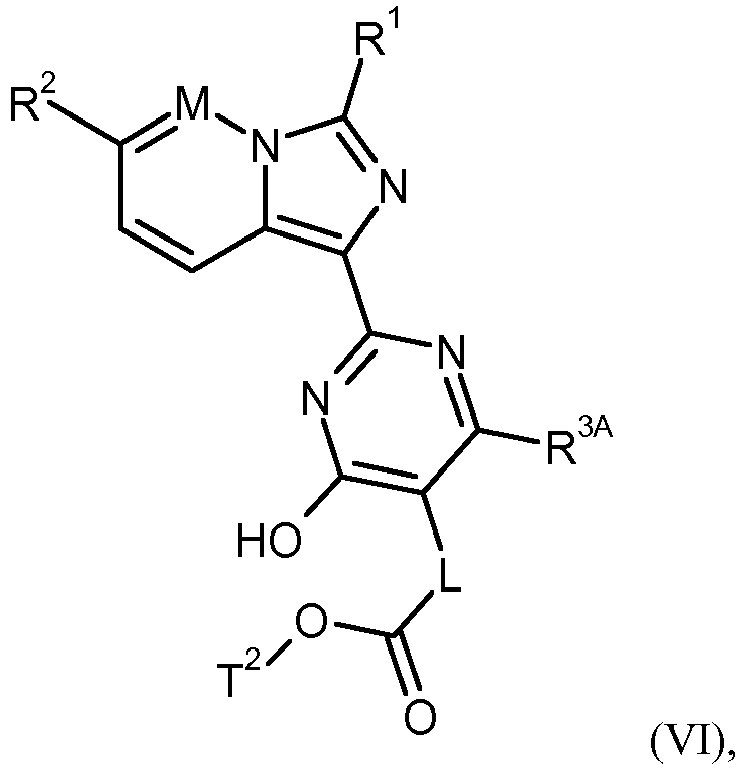
umsetzt, diese anschliessend mit Phosphorylchlorid in eine Verbindung der Formel (VII)
überführt, diese im folgenden in einem inerten Lösungsmittel in eine entsprechende Azid-Verbindung überführt und diese direkt zu einer Verbindung der Formel (VIII)
reduziert, und diese dann in einem inerten Lösungsmittel in Gegenwart einer geeigneten Base zu einer Verbindung der Formel (I-C)
umsetzt,
oder[D] eine Verbindung der Formel (II) in einem inerten Lösungsmittel in Gegenwart einer geeigneten Base mit Hydrazinhydrat zu einer Verbindung der Formel (IX)
umsetzt, diese dann in einem inerten Lösungsmittel mit einer Verbindung der Formel (X) in welcher L die in Anspruch 1 angegebene Bedeutung hat undT3 für (C1-C4)-Alkyl steht,zu einer Verbindung der Formel (XI)
reagiert, diese anschliessend in eine Verbindung der Formel (XII)
überführt, und diese direkt mit Ammoniak zu einer Verbindung der Formel (XIII)
umsetzt und schliesslich in einem inerten Lösungsmittel gegebenenfalls in Gegenwart einer geeigneten Base zu einer Verbindung der Formel (I-D)
cyclisiert,
gegebenenfalls die resultierenden Verbindungen der Formel (I-A), (I-B), (I-C) und (I-D) mit den entsprechenden (i) Lösungsmitteln und/oder (ii) Säuren oder Basen in ihre Solvate, Salze und/oder Solvate der Salze überführt. - Verbindung der Formel (I), wie in Anspruch 1 definiert, zur Verwendung in einem Verfahren zur Behandlung und/oder Prophylaxe von Krankheiten.
- Verwendung einer Verbindung der Formel (I), wie in Anspruch 1 definiert, zur Herstellung eines Arzneimittels zur Behandlung und/oder Prophylaxe von Herzinsuffizienz, Angina pectoris, Hypertonie, pulmonaler Hypertonie, Ischämien, Gefäßerkrankungen, Niereninsuffizienz, thromboembolischen Erkrankungen, fibrotischen Erkrankungen und Arteriosklerose.
- Verbindung der Formel (I), wie in Anspruch 1 definiert, zur Verwendung in einem Verfahren zur Behandlung und/oder Prophylaxe von Herzinsuffizienz, Angina pectoris, Hypertonie, pulmonaler Hypertonie, Ischämien, Gefäßerkrankungen, Niereninsuffizienz, thromboembolischen Erkrankungen, fibrotischen Erkrankungen und Arteriosklerose.
- Arzneimittel enthaltend eine Verbindung der Formel (I), wie in Anspruch 1 definiert, in Kombination mit einem inerten, nicht-toxischen, pharmazeutisch geeigneten Hilfsstoff.
- Arzneimittel enthaltend eine Verbindung der Formel (I), wie in Anspruch 1 definiert, in Kombination mit einem weiteren Wirkstoff ausgewählt aus der Gruppe bestehend aus organischen Nitraten, NO-Donatoren, cGMP-PDE-Inhibitoren, antithrombotisch wirkenden Mitteln, den Blutdruck senkenden Mitteln sowie den Fettstoffwechsel verändernden Mitteln.
- Arzneimittel nach Anspruch 6 oder 7 zur Behandlung und/oder Prophylaxe von Herz-insuffizienz, Angina pectoris, Hypertonie, pulmonaler Hypertonie, Ischämien, Gefäßerkrankungen, Niereninsuffizienz, thromboembolischen Erkrankungen, fibrotischen Erkrankungen und Arteriosklerose.
Applications Claiming Priority (3)
| Application Number | Priority Date | Filing Date | Title |
|---|---|---|---|
| DE102011075399A DE102011075399A1 (de) | 2011-05-06 | 2011-05-06 | Substituierte Imidazopyridine und Imidazopyridazine und ihre Verwendung |
| DE201210200356 DE102012200356A1 (de) | 2012-01-11 | 2012-01-11 | Substituierte Imidazopyridine und Imidazopyridazine und ihre Verwendung |
| PCT/EP2012/058046 WO2012152629A1 (de) | 2011-05-06 | 2012-05-02 | Substituierte imidazopyridine und imidazopyridazine und ihre verwendung |
Publications (2)
| Publication Number | Publication Date |
|---|---|
| EP2705037A1 EP2705037A1 (de) | 2014-03-12 |
| EP2705037B1 true EP2705037B1 (de) | 2016-06-22 |
Family
ID=46017899
Family Applications (1)
| Application Number | Title | Priority Date | Filing Date |
|---|---|---|---|
| EP12717331.8A Not-in-force EP2705037B1 (de) | 2011-05-06 | 2012-05-02 | Substituierte imidazopyridine und imidazopyridazine und ihre verwendung |
Country Status (7)
| Country | Link |
|---|---|
| US (1) | US20140171434A1 (de) |
| EP (1) | EP2705037B1 (de) |
| JP (1) | JP5976788B2 (de) |
| CN (1) | CN103649093B (de) |
| CA (1) | CA2834901A1 (de) |
| ES (1) | ES2592267T3 (de) |
| WO (1) | WO2012152629A1 (de) |
Families Citing this family (54)
| Publication number | Priority date | Publication date | Assignee | Title |
|---|---|---|---|---|
| ES2566963T3 (es) | 2007-11-21 | 2016-04-18 | Oregon Health & Science University | Anticuerpos monoclonales anti-factor XI y métodos de uso de los mismos |
| LT2373691T (lt) | 2008-12-18 | 2019-05-27 | Oregon Health & Science University | Anti-fxi antikūnai ir jų panaudojimo būdai |
| PL2604608T3 (pl) | 2009-11-27 | 2016-02-29 | Adverio Pharma Gmbh | Sposób wytwarzania {4,6-diamino-2-[1-(2-fluorobenzylo)-1H-pirazolo[3,4-b]pirydyn-3-ylo]pirymidyn-5-ylo}metylokarbaminianu metylu |
| CA2804470A1 (en) | 2010-07-09 | 2012-01-12 | Bayer Intellectual Property Gmbh | Ring-fused pyrimidines and triazines and use thereof for the treatment and/or prophylaxis of cardiovascular diseases |
| CA2804471A1 (en) | 2010-07-09 | 2012-01-12 | Bayer Intellectual Property Gmbh | Ring-fused 4 -aminopyrimidines and use thereof as stimulators of soluble guanylate cyclases |
| DE102010040233A1 (de) | 2010-09-03 | 2012-03-08 | Bayer Schering Pharma Aktiengesellschaft | Bicyclische Aza-Heterocyclen und ihre Verwendung |
| JP6005134B2 (ja) | 2011-04-21 | 2016-10-12 | バイエル・インテレクチュアル・プロパティ・ゲゼルシャフト・ミット・ベシュレンクテル・ハフツングBayer Intellectual Property GmbH | フルオロアルキル置換ピラゾロピリジンおよびその使用 |
| CA2834901A1 (en) * | 2011-05-06 | 2012-11-15 | Bayer Intellectual Property Gmbh | Substituted imidazopyridines and imidazopyridazines and the use thereof |
| PH12014500460A1 (en) * | 2011-09-02 | 2014-04-14 | Bayer Ip Gmbh | Substituted annellated pyrimidine and the use thereof |
| EP2594270A3 (de) * | 2011-11-18 | 2013-07-31 | BIP Patents | Verwendung von sGC-Stimulatoren, sGC-Aktivatoren, alleine und in Kombination mit PDE5-Hemmern zur Behandlung von systemischer Sklerose (SSc) |
| DE102012200349A1 (de) | 2012-01-11 | 2013-07-11 | Bayer Intellectual Property Gmbh | Substituierte annellierte Pyrimidine und Triazine und ihre Verwendung |
| DE102012200352A1 (de) | 2012-01-11 | 2013-07-11 | Bayer Intellectual Property Gmbh | Substituierte, annellierte Imidazole und Pyrazole und ihre Verwendung |
| DE102012200360A1 (de) | 2012-01-11 | 2013-07-11 | Bayer Intellectual Property Gmbh | Substituierte Triazine und ihre Verwendung |
| ES2644781T3 (es) | 2012-03-06 | 2017-11-30 | Bayer Intellectual Property Gmbh | Azabiciclos sustituidos y su uso |
| BR112014027952B1 (pt) | 2012-05-10 | 2022-06-21 | Bayer Pharma Aktiengesellschaft | Anticorpos monoclonais humanos capazes de se ligarem ao fator de coagulação xi, seu uso, composição farmacêutica e medicamento os compreendendo, ácido nucleico que o codifica, bem como vetor |
| CN104822680B (zh) | 2012-11-30 | 2016-10-12 | 安斯泰来制药株式会社 | 咪唑并吡啶化合物 |
| BR112015020298A2 (pt) | 2013-03-01 | 2017-07-18 | Bayer Pharma AG | pirimidinas de anel fundido substituídas com trifluormetil e uso das mesmas |
| CN105339368B (zh) | 2013-06-04 | 2017-08-15 | 拜耳制药股份公司 | 3‑芳基‑取代的咪唑并[1,2‑a]吡啶及其用途 |
| WO2014202493A1 (en) * | 2013-06-19 | 2014-12-24 | F. Hoffmann-La Roche Ag | Indolin-2-one or pyrrolo-pyridin/pyrimidin-2-one derivatives |
| WO2015004105A1 (de) * | 2013-07-10 | 2015-01-15 | Bayer Pharma Aktiengesellschaft | Benzyl-1h-pyrazolo[3,4-b]pyridine und ihre verwendung |
| EP3079701B1 (de) | 2013-12-11 | 2021-08-11 | Merck Sharp & Dohme Corp. | Lösliche guanylat-cyclase-aktivatoren |
| WO2015088886A1 (en) | 2013-12-11 | 2015-06-18 | Merck Sharp & Dohme Corp. | Soluble guanylate cyclase activators |
| EP3094327A1 (de) | 2014-01-13 | 2016-11-23 | Ironwood Pharmaceuticals, Inc. | Verwendung von sgc-stimulatoren zur behandlung von neuromuskulären störungen |
| WO2015124544A1 (de) * | 2014-02-19 | 2015-08-27 | Bayer Pharma Aktiengesellschaft | 3-(pyrimidin-2-yl)imidazo[1,2-a]pyridine |
| WO2015140254A1 (de) * | 2014-03-21 | 2015-09-24 | Bayer Pharma Aktiengesellschaft | Substituierte imidazo[1,2-a]pyridincarboxamide und ihre verwendung |
| JP2017508810A (ja) * | 2014-03-21 | 2017-03-30 | バイエル・ファルマ・アクティエンゲゼルシャフト | シアノ置換イミダゾ[1,2−a]ピリジンカルボキサミドおよびその使用 |
| WO2015187470A1 (en) | 2014-06-04 | 2015-12-10 | Merck Sharp & Dohme Corp. | Imidazo-pyrazine derivatives useful as soluble guanylate cyclase activators |
| WO2016030362A1 (de) | 2014-08-29 | 2016-03-03 | Bayer Pharma Aktiengesellschaft | Substituierte annellierte pyrimidine und ihre verwendung |
| WO2016030354A1 (de) | 2014-08-29 | 2016-03-03 | Bayer Pharma Aktiengesellschaft | Amino-substituierte annellierte pyrimidine und ihre verwendung |
| TW201625635A (zh) | 2014-11-21 | 2016-07-16 | 默沙東藥廠 | 作為可溶性鳥苷酸環化酶活化劑之三唑并吡基衍生物 |
| JP2017536396A (ja) | 2014-12-02 | 2017-12-07 | バイエル・ファルマ・アクティエンゲゼルシャフト | ヘテロアリール置換イミダゾ[1,2−a]ピリジンおよびその使用 |
| US20180169095A1 (en) | 2015-05-06 | 2018-06-21 | Bayer Pharma Aktiengesellschaft | The use of sgc stimulators, sgc activators, alone and combinations with pde5 inhibitors for the treatment of digital ulcers (du) concomitant to systemic sclerosis (ssc) |
| EP3303342B1 (de) | 2015-05-27 | 2021-03-17 | Merck Sharp & Dohme Corp. | Als lösliche guanylat-cyclase-aktivatoren geeignete imidazopyrazinylderivate |
| EP3310782B1 (de) | 2015-05-28 | 2021-12-01 | Merck Sharp & Dohme Corp. | Als lösliche guanylat-cyclase-aktivatoren geeignete imidazopyrazinylderivate |
| CN113750102A (zh) | 2015-07-23 | 2021-12-07 | 拜耳制药股份公司 | 可溶性鸟苷酸环化酶的刺激剂和/或活化剂及其用途 |
| JP2019502686A (ja) | 2015-12-14 | 2019-01-31 | アイアンウッド ファーマシューティカルズ インコーポレイテッド | 消化管括約筋機能障害の治療へのsGC刺激薬の使用 |
| WO2017107052A1 (en) | 2015-12-22 | 2017-06-29 | Merck Sharp & Dohme Corp. | Soluble guanylate cyclase stimulators |
| WO2017121692A1 (de) | 2016-01-15 | 2017-07-20 | Bayer Pharma Aktiengesellschaft | Substituierte sulfamide und ihre verwendung |
| WO2017121693A1 (de) | 2016-01-15 | 2017-07-20 | Bayer Pharma Aktiengesellschaft | Substituierte thiazol- und thiadiazolamide und ihre verwendung |
| WO2017121700A1 (de) | 2016-01-15 | 2017-07-20 | Bayer Pharma Aktiengesellschaft | 1,3-disubstituierte 1h-pyrazolo[3,4-b]pyridin- derivate und ihre verwendung als stimulatoren der löslichen guanylatcyclase |
| WO2017197555A1 (en) | 2016-05-16 | 2017-11-23 | Merck Sharp & Dohme Corp. | Fused pyrazine derivatives useful as soluble guanylate cyclase stimulators |
| EP3458063A4 (de) | 2016-05-18 | 2020-02-26 | Merck Sharp & Dohme Corp. | Verfahren zur verwendung von triazolo-pyrazinyl-löslichen guanylatcyclaseaktivatoren in fibrotischen erkrankungen |
| JP7101688B2 (ja) | 2016-10-11 | 2022-07-15 | バイエル・ファルマ・アクティエンゲゼルシャフト | sGC刺激薬とミネラルコルチコイド受容体拮抗薬とを含む組み合わせ |
| WO2018069148A1 (de) | 2016-10-11 | 2018-04-19 | Bayer Pharma Aktiengesellschaft | Kombination enthaltend sgc aktivatoren und mineralocorticoid-rezeptor-antagonisten |
| US20190381039A1 (en) | 2016-12-13 | 2019-12-19 | Cyclerion Therapeutics, Inc. | USE OF sGC STIMULATORS FOR THE TREATMENT OF ESOPHAGEAL MOTILITY DISORDERS |
| JP7090639B2 (ja) | 2017-04-11 | 2022-06-24 | サンシャイン・レイク・ファーマ・カンパニー・リミテッド | フッ素置換されたインダゾール化合物及びその使用 |
| JP2021523201A (ja) | 2018-05-15 | 2021-09-02 | バイエル アクチェンゲゼルシャフトBayer Aktiengesellschaft | 神経線維感作に関連する疾患を治療するための1,3−チアゾール−2−イル置換ベンズアミド |
| JP7542518B2 (ja) | 2018-07-11 | 2024-08-30 | ティセント セラピューティクス インコーポレーテッド | ミトコンドリア(mitochonrial)障害の処置のためのsGC刺激剤の使用 |
| AU2019401649B2 (en) | 2018-12-20 | 2025-08-28 | Incyte Corporation | Imidazopyridazine and imidazopyridine compounds as inhibitors of activin receptor-like kinase-2 |
| WO2020164008A1 (en) | 2019-02-13 | 2020-08-20 | Bayer Aktiengesellschaft | Process for the preparation of porous microparticles |
| AR122587A1 (es) | 2020-06-12 | 2022-09-21 | Incyte Corp | Compuestos de imidazopiridazina y sus usos |
| CN113735849B (zh) * | 2021-07-22 | 2022-10-11 | 安徽中医药大学 | 1-氰基咪唑并[1,5-a]吡啶类化合物及其合成方法 |
| CN113603687A (zh) * | 2021-08-02 | 2021-11-05 | 北京工业大学 | 一种氰基取代的咪唑[1,5-a]并吡啶合成新方法 |
| CN121399127A (zh) * | 2023-06-09 | 2026-01-23 | 海思科医药集团股份有限公司 | 一种吡咯并[2,3-d]嘧啶-4-胺衍生物及其在医药上的应用 |
Family Cites Families (9)
| Publication number | Priority date | Publication date | Assignee | Title |
|---|---|---|---|---|
| DE19642255A1 (de) | 1996-10-14 | 1998-04-16 | Bayer Ag | Verwendung von 1-Benzyl-3-(substituierten-hetaryl) -kondensierten Pyrazol-Derivaten |
| DE19834044A1 (de) * | 1998-07-29 | 2000-02-03 | Bayer Ag | Neue substituierte Pyrazolderivate |
| DE10220570A1 (de) | 2002-05-08 | 2003-11-20 | Bayer Ag | Carbamat-substituierte Pyrazolopyridine |
| DE102006043443A1 (de) * | 2006-09-15 | 2008-03-27 | Bayer Healthcare Ag | Neue aza-bicyclische Verbindungen und ihre Verwendung |
| EP2108641A1 (de) * | 2008-04-11 | 2009-10-14 | Laboratorios Almirall, S.A. | Neue substituierte Spiro[Cycloalkyl-1,3'-indo]-2'(1'H)-on-Derivate und ihre Verwendung als p38 mitogen-activated Kinase Inhibitoren |
| US8741910B2 (en) | 2008-11-25 | 2014-06-03 | Merck Sharp & Dohme Corp. | Soluble guanylate cyclase activators |
| MA34330B1 (fr) * | 2010-05-27 | 2013-06-01 | Merck Sharp & Dohme | Activateurs de guanylate cyclase soluble |
| DE102010040233A1 (de) * | 2010-09-03 | 2012-03-08 | Bayer Schering Pharma Aktiengesellschaft | Bicyclische Aza-Heterocyclen und ihre Verwendung |
| CA2834901A1 (en) * | 2011-05-06 | 2012-11-15 | Bayer Intellectual Property Gmbh | Substituted imidazopyridines and imidazopyridazines and the use thereof |
-
2012
- 2012-05-02 CA CA2834901A patent/CA2834901A1/en not_active Abandoned
- 2012-05-02 JP JP2014508787A patent/JP5976788B2/ja not_active Expired - Fee Related
- 2012-05-02 EP EP12717331.8A patent/EP2705037B1/de not_active Not-in-force
- 2012-05-02 CN CN201280033572.9A patent/CN103649093B/zh not_active Expired - Fee Related
- 2012-05-02 US US14/115,870 patent/US20140171434A1/en not_active Abandoned
- 2012-05-02 ES ES12717331.8T patent/ES2592267T3/es active Active
- 2012-05-02 WO PCT/EP2012/058046 patent/WO2012152629A1/de not_active Ceased
Also Published As
| Publication number | Publication date |
|---|---|
| WO2012152629A1 (de) | 2012-11-15 |
| ES2592267T3 (es) | 2016-11-29 |
| JP2014513112A (ja) | 2014-05-29 |
| US20140171434A1 (en) | 2014-06-19 |
| JP5976788B2 (ja) | 2016-08-24 |
| CA2834901A1 (en) | 2012-11-15 |
| CN103649093A (zh) | 2014-03-19 |
| EP2705037A1 (de) | 2014-03-12 |
| CN103649093B (zh) | 2017-07-07 |
Similar Documents
| Publication | Publication Date | Title |
|---|---|---|
| EP2699578B1 (de) | Fluoralkyl-substituierte pyrazolopyridine und ihre verwendung | |
| EP2822951B1 (de) | Substituierte azabicyclen und ihre verwendung | |
| EP2729476B1 (de) | Heteroaryl-substituierte pyrazolopyridine und ihre verwendung als stimulatoren der löslichen guanylatcyclase | |
| EP2635577B1 (de) | Substituierte 6-fluor-1h-pyrazolo[4,3-b]pyridine und ihre verwendung | |
| EP2961755B1 (de) | Trifluormethyl-substituierte annellierte pyrimidine und ihre verwendung | |
| EP2576547B1 (de) | Substituierte 5-fluor-1h-pyrazolopyridine und ihre verwendung | |
| EP2590987B1 (de) | Annellierte 4-aminopyrimidine und ihre verwendung als stimulatoren der löslichen guanylatcyclase | |
| EP2802580B1 (de) | Substituierte triazine derivate und ihre verwendung als stimulatoren der löslichen guanylatcyclase | |
| EP2961754B1 (de) | Benzyl-substituierte pyrazolopyridine und ihre verwendung | |
| EP2705037A1 (de) | Substituierte imidazopyridine und imidazopyridazine und ihre verwendung | |
| EP2682394A1 (de) | 1H-Pyrazolo[3,4-b]pyridin-Triazine Verbindungen und ihre Verwendung zur Behandlung bzw. Prophylaxe von Herz-Kreislauf-Erkrankungen | |
| DE102012200352A1 (de) | Substituierte, annellierte Imidazole und Pyrazole und ihre Verwendung | |
| EP2705038A1 (de) | Substituierte imidazopyridazine und ihre verwendung | |
| EP3019506A1 (de) | Benzyl-1h-pyrazolo[3,4-b]pyridine und ihre verwendung | |
| DE102010031667A1 (de) | Substituierte Methyl-pyrimidin-5-ylcarbamate und ihre Verwendung | |
| DE102010031666A1 (de) | Carbamat-substituierte Diaminopyrimidine und ihre Verwendung | |
| DE102011075399A1 (de) | Substituierte Imidazopyridine und Imidazopyridazine und ihre Verwendung | |
| DE102012200356A1 (de) | Substituierte Imidazopyridine und Imidazopyridazine und ihre Verwendung | |
| DE102011078715A1 (de) | Heteroaryl-substituierte Pyrazolopyridine und ihre Verwendung | |
| DE102011007890A1 (de) | Fluoralkyl-substituierte Pyrazolopyridine und ihre Verwendung | |
| DE102011007891A1 (de) | Annellierte 4-Aminopyrimidine und ihre Verwendung | |
| DE102012200357A1 (de) | Fluoralkyl-substituierte Pyrazolopyridine und ihre Verwendung | |
| DE102012200354A1 (de) | Heteroaryl-substituierte Pyrazolopyridine und ihre Verwendung | |
| DE102011082041A1 (de) | Substituierte annellierte Pyrimidine und ihre Verwendung | |
| DE102012200351A1 (de) | Substituierte annellierte Pyrimidine und ihre Verwendung |
Legal Events
| Date | Code | Title | Description |
|---|---|---|---|
| PUAI | Public reference made under article 153(3) epc to a published international application that has entered the european phase |
Free format text: ORIGINAL CODE: 0009012 |
|
| 17P | Request for examination filed |
Effective date: 20131206 |
|
| AK | Designated contracting states |
Kind code of ref document: A1 Designated state(s): AL AT BE BG CH CY CZ DE DK EE ES FI FR GB GR HR HU IE IS IT LI LT LU LV MC MK MT NL NO PL PT RO RS SE SI SK SM TR |
|
| DAX | Request for extension of the european patent (deleted) | ||
| 17Q | First examination report despatched |
Effective date: 20150105 |
|
| GRAP | Despatch of communication of intention to grant a patent |
Free format text: ORIGINAL CODE: EPIDOSNIGR1 |
|
| INTG | Intention to grant announced |
Effective date: 20150819 |
|
| INTG | Intention to grant announced |
Effective date: 20151216 |
|
| GRAS | Grant fee paid |
Free format text: ORIGINAL CODE: EPIDOSNIGR3 |
|
| GRAA | (expected) grant |
Free format text: ORIGINAL CODE: 0009210 |
|
| AK | Designated contracting states |
Kind code of ref document: B1 Designated state(s): AL AT BE BG CH CY CZ DE DK EE ES FI FR GB GR HR HU IE IS IT LI LT LU LV MC MK MT NL NO PL PT RO RS SE SI SK SM TR |
|
| REG | Reference to a national code |
Ref country code: GB Ref legal event code: FG4D Free format text: NOT ENGLISH |
|
| REG | Reference to a national code |
Ref country code: CH Ref legal event code: EP |
|
| REG | Reference to a national code |
Ref country code: IE Ref legal event code: FG4D Free format text: LANGUAGE OF EP DOCUMENT: GERMAN |
|
| REG | Reference to a national code |
Ref country code: AT Ref legal event code: REF Ref document number: 807598 Country of ref document: AT Kind code of ref document: T Effective date: 20160715 |
|
| REG | Reference to a national code |
Ref country code: DE Ref legal event code: R096 Ref document number: 502012007459 Country of ref document: DE |
|
| REG | Reference to a national code |
Ref country code: LT Ref legal event code: MG4D |
|
| REG | Reference to a national code |
Ref country code: NL Ref legal event code: MP Effective date: 20160622 |
|
| PG25 | Lapsed in a contracting state [announced via postgrant information from national office to epo] |
Ref country code: NO Free format text: LAPSE BECAUSE OF FAILURE TO SUBMIT A TRANSLATION OF THE DESCRIPTION OR TO PAY THE FEE WITHIN THE PRESCRIBED TIME-LIMIT Effective date: 20160922 Ref country code: LT Free format text: LAPSE BECAUSE OF FAILURE TO SUBMIT A TRANSLATION OF THE DESCRIPTION OR TO PAY THE FEE WITHIN THE PRESCRIBED TIME-LIMIT Effective date: 20160622 Ref country code: FI Free format text: LAPSE BECAUSE OF FAILURE TO SUBMIT A TRANSLATION OF THE DESCRIPTION OR TO PAY THE FEE WITHIN THE PRESCRIBED TIME-LIMIT Effective date: 20160622 |
|
| REG | Reference to a national code |
Ref country code: ES Ref legal event code: FG2A Ref document number: 2592267 Country of ref document: ES Kind code of ref document: T3 Effective date: 20161129 |
|
| PG25 | Lapsed in a contracting state [announced via postgrant information from national office to epo] |
Ref country code: LV Free format text: LAPSE BECAUSE OF FAILURE TO SUBMIT A TRANSLATION OF THE DESCRIPTION OR TO PAY THE FEE WITHIN THE PRESCRIBED TIME-LIMIT Effective date: 20160622 Ref country code: NL Free format text: LAPSE BECAUSE OF FAILURE TO SUBMIT A TRANSLATION OF THE DESCRIPTION OR TO PAY THE FEE WITHIN THE PRESCRIBED TIME-LIMIT Effective date: 20160622 Ref country code: SE Free format text: LAPSE BECAUSE OF FAILURE TO SUBMIT A TRANSLATION OF THE DESCRIPTION OR TO PAY THE FEE WITHIN THE PRESCRIBED TIME-LIMIT Effective date: 20160622 Ref country code: RS Free format text: LAPSE BECAUSE OF FAILURE TO SUBMIT A TRANSLATION OF THE DESCRIPTION OR TO PAY THE FEE WITHIN THE PRESCRIBED TIME-LIMIT Effective date: 20160622 Ref country code: GR Free format text: LAPSE BECAUSE OF FAILURE TO SUBMIT A TRANSLATION OF THE DESCRIPTION OR TO PAY THE FEE WITHIN THE PRESCRIBED TIME-LIMIT Effective date: 20160923 Ref country code: HR Free format text: LAPSE BECAUSE OF FAILURE TO SUBMIT A TRANSLATION OF THE DESCRIPTION OR TO PAY THE FEE WITHIN THE PRESCRIBED TIME-LIMIT Effective date: 20160622 |
|
| PG25 | Lapsed in a contracting state [announced via postgrant information from national office to epo] |
Ref country code: EE Free format text: LAPSE BECAUSE OF FAILURE TO SUBMIT A TRANSLATION OF THE DESCRIPTION OR TO PAY THE FEE WITHIN THE PRESCRIBED TIME-LIMIT Effective date: 20160622 Ref country code: SK Free format text: LAPSE BECAUSE OF FAILURE TO SUBMIT A TRANSLATION OF THE DESCRIPTION OR TO PAY THE FEE WITHIN THE PRESCRIBED TIME-LIMIT Effective date: 20160622 Ref country code: CZ Free format text: LAPSE BECAUSE OF FAILURE TO SUBMIT A TRANSLATION OF THE DESCRIPTION OR TO PAY THE FEE WITHIN THE PRESCRIBED TIME-LIMIT Effective date: 20160622 Ref country code: RO Free format text: LAPSE BECAUSE OF FAILURE TO SUBMIT A TRANSLATION OF THE DESCRIPTION OR TO PAY THE FEE WITHIN THE PRESCRIBED TIME-LIMIT Effective date: 20160622 Ref country code: IS Free format text: LAPSE BECAUSE OF FAILURE TO SUBMIT A TRANSLATION OF THE DESCRIPTION OR TO PAY THE FEE WITHIN THE PRESCRIBED TIME-LIMIT Effective date: 20161022 |
|
| PG25 | Lapsed in a contracting state [announced via postgrant information from national office to epo] |
Ref country code: SM Free format text: LAPSE BECAUSE OF FAILURE TO SUBMIT A TRANSLATION OF THE DESCRIPTION OR TO PAY THE FEE WITHIN THE PRESCRIBED TIME-LIMIT Effective date: 20160622 Ref country code: PL Free format text: LAPSE BECAUSE OF FAILURE TO SUBMIT A TRANSLATION OF THE DESCRIPTION OR TO PAY THE FEE WITHIN THE PRESCRIBED TIME-LIMIT Effective date: 20160622 Ref country code: PT Free format text: LAPSE BECAUSE OF FAILURE TO SUBMIT A TRANSLATION OF THE DESCRIPTION OR TO PAY THE FEE WITHIN THE PRESCRIBED TIME-LIMIT Effective date: 20161024 |
|
| REG | Reference to a national code |
Ref country code: DE Ref legal event code: R097 Ref document number: 502012007459 Country of ref document: DE |
|
| REG | Reference to a national code |
Ref country code: FR Ref legal event code: PLFP Year of fee payment: 6 |
|
| PLBE | No opposition filed within time limit |
Free format text: ORIGINAL CODE: 0009261 |
|
| STAA | Information on the status of an ep patent application or granted ep patent |
Free format text: STATUS: NO OPPOSITION FILED WITHIN TIME LIMIT |
|
| 26N | No opposition filed |
Effective date: 20170323 |
|
| PG25 | Lapsed in a contracting state [announced via postgrant information from national office to epo] |
Ref country code: DK Free format text: LAPSE BECAUSE OF FAILURE TO SUBMIT A TRANSLATION OF THE DESCRIPTION OR TO PAY THE FEE WITHIN THE PRESCRIBED TIME-LIMIT Effective date: 20160622 |
|
| PGFP | Annual fee paid to national office [announced via postgrant information from national office to epo] |
Ref country code: GB Payment date: 20170426 Year of fee payment: 6 Ref country code: DE Payment date: 20170426 Year of fee payment: 6 Ref country code: FR Payment date: 20170427 Year of fee payment: 6 |
|
| PG25 | Lapsed in a contracting state [announced via postgrant information from national office to epo] |
Ref country code: SI Free format text: LAPSE BECAUSE OF FAILURE TO SUBMIT A TRANSLATION OF THE DESCRIPTION OR TO PAY THE FEE WITHIN THE PRESCRIBED TIME-LIMIT Effective date: 20160622 Ref country code: LU Free format text: LAPSE BECAUSE OF NON-PAYMENT OF DUE FEES Effective date: 20170531 |
|
| PGFP | Annual fee paid to national office [announced via postgrant information from national office to epo] |
Ref country code: ES Payment date: 20170608 Year of fee payment: 6 Ref country code: IT Payment date: 20170522 Year of fee payment: 6 |
|
| REG | Reference to a national code |
Ref country code: CH Ref legal event code: PL |
|
| PG25 | Lapsed in a contracting state [announced via postgrant information from national office to epo] |
Ref country code: MC Free format text: LAPSE BECAUSE OF FAILURE TO SUBMIT A TRANSLATION OF THE DESCRIPTION OR TO PAY THE FEE WITHIN THE PRESCRIBED TIME-LIMIT Effective date: 20160622 |
|
| REG | Reference to a national code |
Ref country code: IE Ref legal event code: MM4A |
|
| PG25 | Lapsed in a contracting state [announced via postgrant information from national office to epo] |
Ref country code: LI Free format text: LAPSE BECAUSE OF NON-PAYMENT OF DUE FEES Effective date: 20170531 Ref country code: CH Free format text: LAPSE BECAUSE OF NON-PAYMENT OF DUE FEES Effective date: 20170531 |
|
| PG25 | Lapsed in a contracting state [announced via postgrant information from national office to epo] |
Ref country code: LU Free format text: LAPSE BECAUSE OF NON-PAYMENT OF DUE FEES Effective date: 20170502 |
|
| REG | Reference to a national code |
Ref country code: BE Ref legal event code: MM Effective date: 20170531 |
|
| PG25 | Lapsed in a contracting state [announced via postgrant information from national office to epo] |
Ref country code: IE Free format text: LAPSE BECAUSE OF NON-PAYMENT OF DUE FEES Effective date: 20170502 |
|
| REG | Reference to a national code |
Ref country code: AT Ref legal event code: MM01 Ref document number: 807598 Country of ref document: AT Kind code of ref document: T Effective date: 20170502 |
|
| PG25 | Lapsed in a contracting state [announced via postgrant information from national office to epo] |
Ref country code: AT Free format text: LAPSE BECAUSE OF NON-PAYMENT OF DUE FEES Effective date: 20170502 Ref country code: BE Free format text: LAPSE BECAUSE OF NON-PAYMENT OF DUE FEES Effective date: 20170531 |
|
| PG25 | Lapsed in a contracting state [announced via postgrant information from national office to epo] |
Ref country code: MT Free format text: LAPSE BECAUSE OF FAILURE TO SUBMIT A TRANSLATION OF THE DESCRIPTION OR TO PAY THE FEE WITHIN THE PRESCRIBED TIME-LIMIT Effective date: 20160622 |
|
| PG25 | Lapsed in a contracting state [announced via postgrant information from national office to epo] |
Ref country code: AL Free format text: LAPSE BECAUSE OF FAILURE TO SUBMIT A TRANSLATION OF THE DESCRIPTION OR TO PAY THE FEE WITHIN THE PRESCRIBED TIME-LIMIT Effective date: 20160622 |
|
| REG | Reference to a national code |
Ref country code: DE Ref legal event code: R119 Ref document number: 502012007459 Country of ref document: DE |
|
| GBPC | Gb: european patent ceased through non-payment of renewal fee |
Effective date: 20180502 |
|
| PG25 | Lapsed in a contracting state [announced via postgrant information from national office to epo] |
Ref country code: GB Free format text: LAPSE BECAUSE OF NON-PAYMENT OF DUE FEES Effective date: 20180502 Ref country code: FR Free format text: LAPSE BECAUSE OF NON-PAYMENT OF DUE FEES Effective date: 20180531 Ref country code: IT Free format text: LAPSE BECAUSE OF NON-PAYMENT OF DUE FEES Effective date: 20180502 Ref country code: DE Free format text: LAPSE BECAUSE OF NON-PAYMENT OF DUE FEES Effective date: 20181201 |
|
| PG25 | Lapsed in a contracting state [announced via postgrant information from national office to epo] |
Ref country code: HU Free format text: LAPSE BECAUSE OF FAILURE TO SUBMIT A TRANSLATION OF THE DESCRIPTION OR TO PAY THE FEE WITHIN THE PRESCRIBED TIME-LIMIT; INVALID AB INITIO Effective date: 20120502 |
|
| PG25 | Lapsed in a contracting state [announced via postgrant information from national office to epo] |
Ref country code: BG Free format text: LAPSE BECAUSE OF FAILURE TO SUBMIT A TRANSLATION OF THE DESCRIPTION OR TO PAY THE FEE WITHIN THE PRESCRIBED TIME-LIMIT Effective date: 20160622 |
|
| REG | Reference to a national code |
Ref country code: ES Ref legal event code: FD2A Effective date: 20190913 |
|
| PG25 | Lapsed in a contracting state [announced via postgrant information from national office to epo] |
Ref country code: ES Free format text: LAPSE BECAUSE OF NON-PAYMENT OF DUE FEES Effective date: 20180503 Ref country code: CY Free format text: LAPSE BECAUSE OF NON-PAYMENT OF DUE FEES Effective date: 20160622 |
|
| PG25 | Lapsed in a contracting state [announced via postgrant information from national office to epo] |
Ref country code: MK Free format text: LAPSE BECAUSE OF FAILURE TO SUBMIT A TRANSLATION OF THE DESCRIPTION OR TO PAY THE FEE WITHIN THE PRESCRIBED TIME-LIMIT Effective date: 20160622 |
|
| PG25 | Lapsed in a contracting state [announced via postgrant information from national office to epo] |
Ref country code: TR Free format text: LAPSE BECAUSE OF FAILURE TO SUBMIT A TRANSLATION OF THE DESCRIPTION OR TO PAY THE FEE WITHIN THE PRESCRIBED TIME-LIMIT Effective date: 20160622 |