EP2695668A1 - Verfahren zum Herstellen einer thermoresponsiven Filtrationsmembran und thermoresponsive Filtrationsmembran - Google Patents
Verfahren zum Herstellen einer thermoresponsiven Filtrationsmembran und thermoresponsive Filtrationsmembran Download PDFInfo
- Publication number
- EP2695668A1 EP2695668A1 EP12179780.7A EP12179780A EP2695668A1 EP 2695668 A1 EP2695668 A1 EP 2695668A1 EP 12179780 A EP12179780 A EP 12179780A EP 2695668 A1 EP2695668 A1 EP 2695668A1
- Authority
- EP
- European Patent Office
- Prior art keywords
- filtration membrane
- membrane
- thermoresponsive
- dopamine
- solution
- Prior art date
- Legal status (The legal status is an assumption and is not a legal conclusion. Google has not performed a legal analysis and makes no representation as to the accuracy of the status listed.)
- Granted
Links
Images



Classifications
-
- B—PERFORMING OPERATIONS; TRANSPORTING
- B01—PHYSICAL OR CHEMICAL PROCESSES OR APPARATUS IN GENERAL
- B01D—SEPARATION
- B01D67/00—Processes specially adapted for manufacturing semi-permeable membranes for separation processes or apparatus
- B01D67/0081—After-treatment of organic or inorganic membranes
- B01D67/0093—Chemical modification
- B01D67/00933—Chemical modification by addition of a layer chemically bonded to the membrane
-
- B—PERFORMING OPERATIONS; TRANSPORTING
- B01—PHYSICAL OR CHEMICAL PROCESSES OR APPARATUS IN GENERAL
- B01D—SEPARATION
- B01D69/00—Semi-permeable membranes for separation processes or apparatus characterised by their form, structure or properties; Manufacturing processes specially adapted therefor
- B01D69/02—Semi-permeable membranes for separation processes or apparatus characterised by their form, structure or properties; Manufacturing processes specially adapted therefor characterised by their properties
-
- B—PERFORMING OPERATIONS; TRANSPORTING
- B01—PHYSICAL OR CHEMICAL PROCESSES OR APPARATUS IN GENERAL
- B01D—SEPARATION
- B01D67/00—Processes specially adapted for manufacturing semi-permeable membranes for separation processes or apparatus
- B01D67/0081—After-treatment of organic or inorganic membranes
- B01D67/0088—Physical treatment with compounds, e.g. swelling, coating or impregnation
-
- B—PERFORMING OPERATIONS; TRANSPORTING
- B01—PHYSICAL OR CHEMICAL PROCESSES OR APPARATUS IN GENERAL
- B01D—SEPARATION
- B01D67/00—Processes specially adapted for manufacturing semi-permeable membranes for separation processes or apparatus
- B01D67/0081—After-treatment of organic or inorganic membranes
- B01D67/0093—Chemical modification
- B01D67/00931—Chemical modification by introduction of specific groups after membrane formation, e.g. by grafting
-
- B—PERFORMING OPERATIONS; TRANSPORTING
- B01—PHYSICAL OR CHEMICAL PROCESSES OR APPARATUS IN GENERAL
- B01D—SEPARATION
- B01D67/00—Processes specially adapted for manufacturing semi-permeable membranes for separation processes or apparatus
- B01D67/0081—After-treatment of organic or inorganic membranes
- B01D67/0095—Drying
-
- B—PERFORMING OPERATIONS; TRANSPORTING
- B01—PHYSICAL OR CHEMICAL PROCESSES OR APPARATUS IN GENERAL
- B01D—SEPARATION
- B01D71/00—Semi-permeable membranes for separation processes or apparatus characterised by the material; Manufacturing processes specially adapted therefor
- B01D71/06—Organic material
- B01D71/40—Polymers of unsaturated acids or derivatives thereof, e.g. salts, amides, imides, nitriles, anhydrides, esters
- B01D71/401—Polymers based on the polymerisation of acrylic acid, e.g. polyacrylate
-
- B—PERFORMING OPERATIONS; TRANSPORTING
- B01—PHYSICAL OR CHEMICAL PROCESSES OR APPARATUS IN GENERAL
- B01D—SEPARATION
- B01D71/00—Semi-permeable membranes for separation processes or apparatus characterised by the material; Manufacturing processes specially adapted therefor
- B01D71/06—Organic material
- B01D71/76—Macromolecular material not specifically provided for in a single one of groups B01D71/08 - B01D71/74
- B01D71/82—Macromolecular material not specifically provided for in a single one of groups B01D71/08 - B01D71/74 characterised by the presence of specified groups, e.g. introduced by chemical after-treatment
-
- B—PERFORMING OPERATIONS; TRANSPORTING
- B01—PHYSICAL OR CHEMICAL PROCESSES OR APPARATUS IN GENERAL
- B01D—SEPARATION
- B01D2323/00—Details relating to membrane preparation
- B01D2323/08—Specific temperatures applied
-
- B—PERFORMING OPERATIONS; TRANSPORTING
- B01—PHYSICAL OR CHEMICAL PROCESSES OR APPARATUS IN GENERAL
- B01D—SEPARATION
- B01D2325/00—Details relating to properties of membranes
- B01D2325/02—Details relating to pores or porosity of the membranes
- B01D2325/021—Pore shapes
- B01D2325/0212—Symmetric or isoporous membranes
-
- B—PERFORMING OPERATIONS; TRANSPORTING
- B01—PHYSICAL OR CHEMICAL PROCESSES OR APPARATUS IN GENERAL
- B01D—SEPARATION
- B01D2325/00—Details relating to properties of membranes
- B01D2325/02—Details relating to pores or porosity of the membranes
- B01D2325/022—Asymmetric membranes
-
- B—PERFORMING OPERATIONS; TRANSPORTING
- B01—PHYSICAL OR CHEMICAL PROCESSES OR APPARATUS IN GENERAL
- B01D—SEPARATION
- B01D2325/00—Details relating to properties of membranes
- B01D2325/02—Details relating to pores or porosity of the membranes
- B01D2325/0282—Dynamic pores-stimuli responsive membranes, e.g. thermoresponsive or pH-responsive
-
- B—PERFORMING OPERATIONS; TRANSPORTING
- B01—PHYSICAL OR CHEMICAL PROCESSES OR APPARATUS IN GENERAL
- B01D—SEPARATION
- B01D2325/00—Details relating to properties of membranes
- B01D2325/02—Details relating to pores or porosity of the membranes
- B01D2325/0283—Pore size
- B01D2325/02832—1-10 nm
-
- B—PERFORMING OPERATIONS; TRANSPORTING
- B01—PHYSICAL OR CHEMICAL PROCESSES OR APPARATUS IN GENERAL
- B01D—SEPARATION
- B01D2325/00—Details relating to properties of membranes
- B01D2325/02—Details relating to pores or porosity of the membranes
- B01D2325/0283—Pore size
- B01D2325/02833—Pore size more than 10 and up to 100 nm
-
- B—PERFORMING OPERATIONS; TRANSPORTING
- B01—PHYSICAL OR CHEMICAL PROCESSES OR APPARATUS IN GENERAL
- B01D—SEPARATION
- B01D61/00—Processes of separation using semi-permeable membranes, e.g. dialysis, osmosis or ultrafiltration; Apparatus, accessories or auxiliary operations specially adapted therefor
- B01D61/14—Ultrafiltration; Microfiltration
- B01D61/145—Ultrafiltration
-
- B—PERFORMING OPERATIONS; TRANSPORTING
- B01—PHYSICAL OR CHEMICAL PROCESSES OR APPARATUS IN GENERAL
- B01D—SEPARATION
- B01D61/00—Processes of separation using semi-permeable membranes, e.g. dialysis, osmosis or ultrafiltration; Apparatus, accessories or auxiliary operations specially adapted therefor
- B01D61/14—Ultrafiltration; Microfiltration
- B01D61/147—Microfiltration
Definitions
- the invention relates to a method for producing a thermoresponsive filtration membrane, in particular microfiltration membrane or ultrafiltration membrane, as well as a corresponding thermoresponsive filtration membrane.
- membranes are predominantly used today, which are produced by a so-called phase inversion process. These membranes are based on a polymeric backbone that has a continuous porosity, a porous structure that permeates the membrane. The size of the pores determines the separation properties, ie the size of the molecules which are retained by the membrane or which can penetrate the pores of the membrane. In addition to polymeric membranes, membranes are also used which are based on ceramic, glass or metallic materials based.
- the polymeric membranes produced by precipitating agent or non-solvent induced phase inversion usually have a more or less large statistical dispersion in the distribution of the pore size, cf. S. Nunes, K.-V. Peinemann (HrG.): Membrane Technology in the Chemical Industry, Wiley-VCH, Weinheim 2006, pp. 23-32 ,
- Such membranes are prone to so-called “fouling” and, because of the wide dispersion in the pore size distribution, do not permit precise separation of a substance mixture.
- fouling is meant a fast blocking of the large pores, since a large part of the liquid passing through the membrane first passes through the large pores. For some time, therefore, attempts have been made to produce isoporous membranes, ie, membranes having a low scatter in the distribution of their pore size.
- German patent no. 10 2006 045 282 The applicant discloses a method by which polymer membranes with isoporous separation-active surfaces can be produced.
- an amphiphilic block copolymer is dissolved in a casting solution with one or more solvents, spread to a film and the film immersed in a precipitation bath.
- This method takes advantage of the fact that the polymer blocks of the amphiphilic block copolymer are immiscible with each other.
- the block copolymers therefore form phases, for example a known micelle structure with spherical or cylindrical micelles.
- a near-surface part of the liquid solvent evaporates, so that in a near-surface layer of the film, the microphase morphology formed due to the self-assembly of the polymer blocks of the block copolymers solidifies, while in the bulk the casting solution, the block copolymers are still in solution.
- the resulting integral-asymmetric structure arises from a combination of two different thermodynamic processes.
- the process is feasible for block copolymers with different polymer components which segregate by means of microphase separation in a solvent.
- So was in DE 10 2006 045 282 A1 demonstrated the integrally-asymmetric structure of the block copolymer membranes using the example of a PS-b-P4VP (polystyrene-b-poly-4-vinylpyridine) based membrane. Similar results were also obtained with the chemically distinct PS- b -P2VP (polystyrene- b- poly-2-vinylpyridine) and PS- b -PEO (polystyrene- b- polyethylene oxide).
- polymeric membranes as well as non-polymeric Filtration membranes, such as those based on ceramics, are each usually only suitable for one application and are subject to fouling, ie clogging of the pores by addition of macromolecules or other polluting ingredients of liquids to be filtered.
- thermoresponsive membranes ie membranes whose separation properties depend on the temperature.
- membranes were prepared which were modified with poly ( N -isopropylacrylamide) (abbreviated pNIPAM).
- thermoresponsive Specify filtration membranes in particular microfiltration membranes or ultrafiltration membranes, and corresponding filtration membranes, which have a high Thermoresponsivitmaschine and high practicality, the process should be fast and safe.
- the invention is based on the basic idea that an existing membrane, for example a ceramic, metallic, polymeric or glass substrate-based membrane, is not directly modified with pNIPAM, but first receives a polydopamine coating.
- dopamine is initially present in a unpolymerized form in a dopamine solution, in which the filtration membrane is immersed or wetted with the filtration membrane, wherein subsequently the polydopamine layer is prepared by polymerizing the dopamine of the layer on the filtration membrane.
- the polydopamine layer adheres extremely well to different Surfaces and thus on a wide variety of membranes, so that a stable coating is achieved, which remains stable under various conditions of use.
- this polydopamine layer is modified by pN1-PAM and the membrane is made so thermoresponsive.
- the membrane itself below the dopamine layer is not or only slightly modified by pNIPAM.
- the polydopamine layer thus acts as a functionalizer for the membrane.
- the coating with a polydopamine layer has the further advantage that the polydopamine layer is very effective against fouling.
- the polydopamine-coated membrane is much less susceptible to blocking of pores by ingredients of the solutions to be filtered than the non-polydopamine-coated membrane.
- the functionalization takes place on the surface of the polydopamine layer, whereby the pNIPAM unfolds its (maximum) thermoresponsive effect.
- the pNIPAM is bound to the dopamine, in particular, the dopamine previously polymerized, for example, at a pH of 8.5 at room temperature.
- membranes that are already in the unmodified state have other responsivities have, for example, pH-responsive, retain this responsiveness even after the modification, ie after coating with dopamine, the polymerization of the dopamine layer and the functionalization with pNIPAM.
- Such membranes as used for example in DE 10 2006 045 282 Applicants are disclosed on the basis of PS-b-P4VP and have a pH responsiveness, they retain even after the modification according to the invention.
- the end-functionalized poly (N-isopropyl-acrylamide) is amine-terminated.
- the termination of pNIPAM with an amine at its end allows a particularly safe and simple modification of the polydopamine layer, since it very easily and safely binds with amine groups.
- n indicates the number of repeating monomer units.
- the poly (N-isopropylacrylamide) preferably has an average molecular weight M n of about 1,000 to 10,000, in particular between 2,000 and 4,000, in particular about 2,500.
- M n average molecular weight
- This size of pNIPAM is particularly suitable for the size of the pores in ultrafiltration membranes and nanofiltration membranes, the have a diameter of between 10 nm and 1 ⁇ m, preferably less than 100 nm in diameter.
- the filtration membrane is preferably immersed in a dopamine solution of dopamine hydrochloride, in particular dissolved in Tris buffer, preferably at room temperature, in particular for a period of 30 to 120 minutes, in particular 45 to 75 minutes.
- the filtration membrane in step b) is washed and / or dried, in particular at a temperature between 50 ° C and 70 ° C, preferably for at least 30 minutes, preferably between 45 minutes and 180 minutes.
- the filtration membrane is dried at 60 ° C for 60 minutes.
- the filtration membrane is immersed in a functionalization solution of pNIPAM-NH 2 , preferably dissolved in Tris buffer.
- Tris buffer is a weakly basic organic compound which has a good buffering effect.
- Main ingredient is tris (hydroxymethyl) aminomethane. It has a good buffer capacity in the pH range between 7.2 and 9.0.
- the filtration membrane is preferably shaken in the solution first in the solution for a period of 2 to 4 hours at a temperature of 50 ° C to 70 ° C and then for a period of more than 6 hours between 18 ° C and 25 ° C. , Under these Conditions results in an optimal modification of the filtration membrane or the polydopamine layer.
- the filtration membrane is preferably washed and / or dried after process step c).
- the dopamine solution and the coating solution have no solvents for the filtration membrane. This will not damage the underlying membrane during modification.
- the filtration membrane used is a, particularly isophoric and / or integrally asymmetric, block copolymer membrane, in particular based on a PS- b P4VP, a PS- b -P2VP or a PS-b-PEO block copolymer.
- These membranes have an integrally asymmetric structure in which a separation-active layer having an isophoric, microphase-separated structure transitions seamlessly into a foam-like structure of a solvent-induced phase transition.
- These are coated particularly advantageously by the polydopamine layer, already have a pH responsiveness and the modification with pNIPAM are additionally rendered thermoresponsive.
- the invention is not limited thereto, but applicable to all types of filtration membranes that can be coated with polydopamine.
- thermoresponsive filtration membrane in particular microfiltration membrane or ultrafiltration membrane, which is in particular produced or preparable by the method according to the invention described above, with a polydopamine coating which is functionalized with pNIPAM.
- This thermoresponsive filtration membrane has the above-described characteristics, features and advantages.
- an opening of pores of the filtration membrane above about 20 ° C, in particular above about 25 ° C, on.
- the temperature at which the transition from closed to open pores occurs due to the expansion of the tufts of pNIPAM chains depends inter alia on the concentration of the solution.
- the pores of the filtration membrane preferably have a diameter between 10 nm and 500 nm, in particular up to 100 nm. This refers to the non-closed state of the pores.
- thermoresponsive filtration membrane may in particular be a flat membrane or hollow fiber membrane.
- the filtration membrane is preferably additionally pH-responsive, wherein in particular a closure of the pores at a low pH, in particular below about 3.8 to 3.4, occurs.
- the threshold value of the pH depends on the type of membrane.
- the filtration membrane is a polymer membrane, in particular an isoporous and / or intregralasymmetric block copolymer membrane, in particular based on a PS- b -P4VP, a PS- b -P2VP or a PS-b-PEO block copolymer.
- Embodiments of the invention may satisfy individual features or a combination of several features.
- the block copolymer membranes were prepared according to the specification of the method described in German Pat. 10 2006 045 282 in the name of the Applicant, and have an isophoric, microphase-separated, surface-active surface layer which transitions smoothly and directly into a typical solvent-induced phase-separated sponge-like structure.
- the block copolymer membranes (about 4 cm x 4 cm) were immersed in a reaction solution of 2 mg / ml dopamine hydrochloride dissolved in 15 mM Tris buffer (tris (hydroxymethyl) aminomethane, pH 8.5-8.8, ultrapure water) and on a shaker Shaken for 60 min at room temperature in an open vessel. Subsequently, the membranes were washed three times for 30 min with ultrapure water and dried at 60 ° C.
- Tris buffer tris (hydroxymethyl) aminomethane, pH 8.5-8.8, ultrapure water
- pNIPAM-NH 2 from Sigma Aldrich with an average molecular weight M n of 2,500 (product no. 724823) was used.
- the membranes were characterized in the various phases before coating, after coating and after modification by NMR (Nuclear Magnetic Resonance), IR (Infrared Spectrometry), Water Flow Measurement and SEM (Scanning Electron Microscopy).
- Fig. 2 are IR spectra of the (a) PS b -P4VP membrane, (b) the polydopamine coated PS b -P4VP membrane, and (c) the polydopamine coated PS b -P4VP membrane after reaction with pNIPAM -NH 2 shown.
- the broadened signal at 3600-3200 cm -1 is attributed to the NH stretching vibration of secondary amides.
- the two small peaks at 1369 and 1388 cm -1 are assigned to the deformation vibrations of the isopropyl group of the pNIPAM framework.
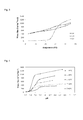
- FIG. 3 and FIG. 4 are shown water flow measurements with respect to the membrane of the invention and its precursor.
- the membrane modified with pNIPAM is thermo- and pH-responsive.
- Fig. 4 it is shown that the pNIPAM modified membrane is still pH responsive, a property possessed by the PS-b-P4VP membranes.
- water fluxes were measured as a function of the pH at five different temperatures between 25 ° C and 45 ° C. At all temperatures decreases according to Fig. 4 the water flux at pH values between 3.8 and 3.4, indicating that the membrane is still pH responsive.
- FIG. 5a ), 5b SEM images of the surface and transverse breakage of a PS- b -P4VP membrane are shown before modification with pNIPAM. It shows the typical integrally asymmetric structure in which the release-active surface has a regular isophoric microphase-separated structure resulting from the self-assembly of the block copolymers in evaporating a near-surface portion of the solvent, this regular structure turning into a typical sponge-like structure of solvent-induced phase inversion.
- FIG. 6a 6b) is shown in comparison to a SEM image of the surface or of the transverse fracture of a corresponding membrane after the modification with pNIPAM.
- the structure of the pores of the separation-active surface layer as well as the sponge-like structure in bulk has been preserved, whereby the diameter of the pores is decreased by the coating and the modification Has.
Landscapes
- Chemical & Material Sciences (AREA)
- Chemical Kinetics & Catalysis (AREA)
- Engineering & Computer Science (AREA)
- Inorganic Chemistry (AREA)
- Manufacturing & Machinery (AREA)
- Water Supply & Treatment (AREA)
- Health & Medical Sciences (AREA)
- Transplantation (AREA)
- Separation Using Semi-Permeable Membranes (AREA)
- Manufacture Of Porous Articles, And Recovery And Treatment Of Waste Products (AREA)
- Polymerisation Methods In General (AREA)
Abstract
Description
- Die Erfindung betrifft ein Verfahren zum Herstellen einer thermoresponsiven Filtrationsmembran, insbesondere Mikrofiltrationsmembran oder Ultrafiltrationsmembran, sowie eine entsprechende thermoresponsive Filtrationsmembran.
- Für die Filtration, insbesondere die Ultrafiltration, werden heutzutage überwiegend Membranen eingesetzt, die nach einem sogenannten Phaseninversionsverfahren hergestellt werden. Diese Membranen basieren auf einem polymeren Grundgerüst, das eine durchgehende Porosität aufweist, also eine poröse Struktur, die die Membran durchzieht. Die Größe der Poren bestimmt die Trenneigenschaften, also die Größe der Moleküle, die durch die Membran zurückgehalten werden bzw. die die Poren der Membran durchdringen können. Neben polymeren Membranen werden auch Membranen eingesetzt, die auf keramischen, gläsernen oder metallischen Materialien basieren.
- Die polymeren, durch fällungsmittel- oder nichtlösemittel induzierte Phaseninversion hergestellten Membranen weisen üblicherweise eine mehr oder weniger große statistische Streuung bei der Verteilung der Porengröße auf, vgl. S. Nunes, K.-V. Peinemann (HrG.): Membrane Technology in the Chemical Industry, Wiley-VCH, Weinheim 2006, S. 23-32. Solche Membranen neigen zum so genannten "Fouling" und lassen wegen der breiten Streuung in der Verteilung der Porengröße keine präzise Trennung eines Stoffgemisches zu. Unter "Fouling" versteht man ein schnelles Verblocken der großen Poren, da ein Großteil der durch die Membran tretenden Flüssigkeit zunächst durch die großen Poren tritt. Seit einiger Zeit wird daher versucht, isoporöse Membranen herzustellen, d.h. Membranen mit einer geringen Streuung in der Verteilung ihrer Porengröße.
- In dem deutschen Patent Nr.
10 2006 045 282 der Anmelderin ist ein Verfahren offenbart, mit dem Polymermembranen mit isoporösen trennaktiven Oberflächen herstellbar sind. Hierzu wird ein amphiphiles Blockcopolymer in einer Gießlösung mit einem oder mehreren Lösungsmitteln gelöst, zu einem Film ausgestrichen und der Film in ein Fällbad eingetaucht. - Dieses Verfahren nutzt den Umstand aus, dass die Polymerblöcke des amphiphilen Blockcopolymers untereinander nicht mischbar sind. In der Gießlösung bilden die Blockcopolymere daher Phasen aus, beispielsweise eine bekannte Mizellenstruktur mit sphärischen oder zylindrischen Mizellen. In einer kurzen Abdampfzeit verdampft ein oberflächennaher Teil des flüssigen Lösungsmittels, so dass in einer oberflächennahen Schicht des Films die Mikrophasenmorphologie, die sich aufgrund der Selbstorganisation der Polymerblöcke der Blockcopolymere ausgebildet hat, verfestigt, während im Bulk der Gießlösung sich die Blockcopolymere noch stets in Lösung befinden.
- Durch das Eintauchen dieses Films in ein Fällbad wird der Rest des Lösungsmittels verdrängt und es findet ein bekannter Phaseninversionsprozess statt, der in einer bekannten schwammartigen Struktur resultiert. In einigen Fällen bleibt dabei die zuvor eingestellte mikrophasenseparierte isoporöse Struktur der oberflächennahen Schicht trotz des Eintauchens in das Fällbad erhalten. Diese geht dann direkt in die schwammartige Struktur über. Weitere Angaben sind in
DE 10 2006 045 282 A1 enthalten, deren Offenbarung vollinhaltlich in der vorliegenden Patentanmeldung aufgenommen sein soll. - Die resultierende integral-asymmetrische Struktur entsteht aus einer Kombination von zwei verschiedenen thermodynamischen Prozessen. Das Verfahren ist für Blockcopolymere mit unterschiedlichen Polymerkomponenten durchführbar, die sich mittels Mikrophasenseparation in einem Lösungsmittel entmischen. So wurde in
DE 10 2006 045 282 A1 die integral-asymmetrische Struktur der Blockcopolymermembranen am Beispiel einer auf PS-b-P4VP (Polystyrol-b-Poly-4-Vinylpyridin) beruhenden Membran gezeigt. Ähnliche Resultate wurden auch mit den chemisch deutlich unterschiedlichen PS-b-P2VP (Polystyrol-b-Poly-2-Vinylpyridin) und PS-b-PEO (Polystyrol-b-Polyethylenoxid) erzielt. Das Ergebnis mit PS-b-P2VP ist in A. Jung et al. (2012), "Structure Formation of Integral Asymmetric Composite Membranes of Polystyrene-block-Poly(2-vinylpyridine) on a Nonwoven", Macromol. Mater. Eng.. doi: 10.1002/mame.201100359 veröffentlicht. Die Resultate mit PS-b-PEO sind in der deutschen Patentanmeldung Nr.10 2012 207 338.8 der Anmelderin gezeigt. - Diese und andere polymere Membranen, ebenso wie nicht-polymere Filtrationsmembranen, wie beispielsweise solche auf der Grundlage von Keramiken, sind jeweils üblicherweise nur für eine Anwendung verwendbar und unterliegen einem Fouling, also einem Verstopfen der Poren durch Anlagerung von Makromolekülen oder anderen verschmutzenden Inhaltsstoffen von zu filternden Flüssigkeiten.
- Seit einigen Jahren werden Forschungsarbeiten vorangetrieben, Filtrationsmembranen schaltbar zu machen, also ihre Trenneigenschaften von äußeren kontrollierbaren Bedingungen abhängig zu machen. Eine Möglichkeit hierzu ist die Herstellung thermoresponsiver Membranen, also von Membranen, deren Trenneigenschaften von der Temperatur abhängen. So wurden Membranen hergestellt, die mit Poly(N-isopropylacrylamid) (abgekürzt pNIPAM) modifiziert wurden.
- So zeigten T. Meng, R. Xie et al., Journal of Membrane Science 349 (1 - 2): 258 - 267 (2010) "A Thermo-Responsive Affinity Membrane with Nano-Structured Pores and Grafted Poly(N-isopropylacrylamide) Surface Layer for Hydrophobic Adsorption" eine Modifizierung von shirasu-porösen Glas (SPG) Membranen mit einer mittleren Porengröße von 1,8 µm, die durch plasmainduzierte Grafting-Polymerisation (Pfropfpolymerisation) modifiziert wurden. Dazu wurden nano-strukturierte Porenoberflächen durch die Deposition von Siliziumoxidnanopartikeln auf die Glasmembranporenoberflächen gebildet und pNIPAM-Büschel mittels Plasmainduktion auf die nano-strukturierte Porenoberfläche gegraftet. Die Porenoberflächen der Membran waren bei Temperaturen unterhalb von 20°C sehr hydrophil, oberhalb von 40°C sehr hydrophob.
- Gemäß P. F. Li, R. Xie et al., Journal of Membrane Science 337 (1 - 2): 310 - 317 (2009), "Thermo-responsive Gating Membranes with Controllable Length and Density of Poly(N-isopropylacrylamide) Chains Grafted by ATRP Method" wurde pNIPAM mittels ATRP (Atom-Transfer Radical Polymerization) auf modifizierte anodische Aluminiumoxidmembranen (AAO) gebracht. Die so produzierte Membran zeigte eine starke Temperaturabhängigkeit zwischen 25°C und 40°C für die diffusive Permeation von Vitamin B12.
- A. Nykänen, M. Nuopponen et al. berichteten in Macromolecules 40 (16): 5827 - 5834 (2007): "Phase Behavior and Temperature-Responsive Molecular Filters Based on Self-Assembly of Polystyrene-block-poly(N-isopropylacrylamide)-block-polystyrene" über die Herstellung von PS-pNIPAM-PS-Triblöcken, die anschließend mittels Spincoating auf Polyacrylnitrilmembranen gebracht wurden. Die gegrafteten Membranen zeigten ein deutliches temperaturabhängiges Schaltverhalten, wobei sich die Poren bei Temperaturen über 32°C schlossen.
- Schließlich wurde gemäß G.-Q. Zhai, L. Ying et al., Surface and Interface Analysis 36 (8): 1048 - 1051 (2004) "Surface and Interface Characterization of Smart Membranes" zunächst eine Lösung hergestellt, bei der pNIPAM in PVDF-g-PAAC- und PVDF-g-P4VP-Lösungen eingemischt wurden und anschließend Phaseninversionsmembranen hergestellt wurden. Die Porengröße der so hergestellten Membran vergrößerte sich mit steigender Temperatur und sinkendem pH-Wert der wässrigen Gießlösung. Auch der Fluss durch die Membran war temperatur- und pH-abhängig.
- Die zuvor genannten Herstellungsverfahren sind teilweise aufwendig und langwierig und führen zu Membranen, die zwar thermoresponsiv, jedoch wenig praxistauglich sind.
- Die der Erfindung zugrunde liegende Aufgabe liegt demgegenüber darin, ein alternatives Verfahren zum Herstellen von thermoresponsiven Filtrationsmembranen anzugeben, insbesondere Mikrofiltrationsmembranen oder Ultrafiltrationsmembranen, sowie entsprechende Filtrationsmembranen, die eine hohe Thermoresponsivitität sowie hohe Praxistauglichkeit aufweisen, wobei das Verfahren schnell und sicher sein soll.
- Diese Aufgabe wird gelöst durch ein Verfahren zum Herstellen einer thermoresponsiven Filtrationsmembran, insbesondere Mikrofiltrationsmembran oder Ultrafiltrationsmembran, mit den folgenden Verfahrensschritten:
- a) eine Filtrationsmembran wird mit einer Dopaminlösung benetzt oder beschichtet,
- b) das Dopamin der Dopaminlösung wird polymerisiert, um eine Polydopaminschicht zu ergeben, und
- c) die polydopaminbeschichtete Filtrationsmembran wird in eine Beschichtungslösung mit einem endfunktionalisierten Poly(N-isopropylacrylamid) getaucht und das Poly(N-isopropyl-acrylamid) wird an die Polydopaminschicht angebunden.
- Die Erfindung beruht auf dem Grundgedanken, dass eine vorhandene Membran, etwa eine keramische, metallische, polymere oder auf einem gläsernen Substrat basierende Membran, nicht direkt mit pNIPAM modifiziert wird, sondern zunächst eine Polydopaminbeschichtung erhält. Dazu ist Dopamin zunächst in einer unpolymerisierten Form in einer Dopaminlösung vorhanden, in die die Filtrationsmembran eingetaucht oder mit der die Filtrationsmembran benetzt wird, wobei anschließend die Polydopaminschicht durch Polymerisierung des Dopamins der Schicht auf der Filtrationsmembran hergestellt wird. Die Polydopaminschicht haftet extrem gut an verschiedenen Oberflächen und damit an einer großen Vielzahl von Membranen an, so dass eine stabile Beschichtung erreicht wird, die auch unter verschiedenartigen Anwendungsbedingungen stabil bleibt. Erfindungsgemäß wird diese Polydopaminschicht durch pN1-PAM modifiziert und die Membran derart thermoresponsiv gemacht. Die Membran selber unterhalb der Dopaminschicht wird nicht oder nur unwesentlich durch pNIPAM modifiziert. Die Polydopaminschicht wirkt somit als Funktionalisierungsmittler für die Membran.
- Die Beschichtung mit einer Polydopaminschicht hat den weiteren Vorteil, dass die Polydopaminschicht sehr wirksam gegen Fouling ist. Die polydopaminbeschichtete Membran ist sehr viel weniger anfällig für das Blockieren von Poren durch Inhaltsstoffe der zu filtrierenden Lösungen als die nicht-polydopaminbeschichtete Membran.
- Die Vorgehensweise, dass zunächst das Dopamin in der Dopaminbeschichtung polymerisiert wird und erst anschließend die Funktionalisierung bzw. Modifizierung mit pNIPAM geschieht, hat außerdem den Vorteil gegenüber einer direkten Modifizierung des Dopamins, dass die Polymerisierung und damit die flächige Beschichtung der Membran abgeschlossen ist und die Membran unterhalb der Polydopaminschicht somit vollständig geschützt ist.
- Außerdem findet die Funktionalisierung an der Oberfläche der Polydopaminschicht statt, wodurch das pNIPAM seine (maximale) thermoresponsive Wirkung entfaltet. Hierbei wird das pNIPAM an das Dopamin angebunden, wobei insbesondere das Dopamin vorher beispielsweise bei einem pH-Wert von 8.5 bei Raumtemperatur polymerisiert.
- Ein weiterer Vorteil des erfindungsgemäßen Verfahrens ist, dass Membranen, die bereits im unmodifizierten Zustand andere Responsivitäten aufweisen, beispielsweise pH-responsiv sind, diese Responsivität auch nach der Modifizierung, d.h. nach der Beschichtung mit Dopamin, der Polymerisierung der Dopaminschicht und der Funktionalisierung mit pNIPAM, behalten. Solche Membranen, wie sie beispielsweise in
DE 10 2006 045 282 der Anmelderin auf der Grundlage von PS-b-P4VP offenbart sind und die eine pH-Responsivität aufweisen, behalten diese auch nach der erfindungsgemäßen Modifizierung. - Vorzugsweise ist das endfunktionalisierte Poly(N-isopropyl-acrylamid) amin-terminiert. Die Terminierung von pNIPAM mit einem Amin an seinem Ende ermöglicht eine besonders sichere und einfache Modifizierung der Polydopaminschicht, da diese sehr leicht und sicher Bindungen mit Amingruppen eingeht.
- Die Strukturformel eines möglichen amin-terminierten pNIPAM sieht wie folgt aus:

- Vorzugsweise weist das Poly(N-isopropylacrylamid) ein mittleres Molekulargewicht Mn von etwa 1.000 bis 10.000, insbesondere zwischen 2.000 und 4.000, insbesondere bei etwa 2.500, auf. Diese Größe des pNIPAM ist besonders geeignet für die Größe der Poren bei Ultrafiltrationsmembranen und Nanofiltrationsmembranen, die einen Durchmesser zwischen 10 nm und 1 µm haben, vorzugsweise weniger als 100 nm Durchmesser.
- Bei der oben gezeigten Strukturformel ergibt sich bei einem durchschnittlichen Molekulargewicht zwischen 1.000 und 10.000 eine Anzahl von ca. 8 bis 90 Monomereinheiten.
- Im Verfahrensschritt a) wird die Filtrationsmembran vorzugsweise in eine Dopaminlösung aus Dopaminhydrochlorid, insbesondere gelöst in Trispuffer, getaucht, vorzugsweise bei Raumtemperatur, insbesondere für eine Dauer von 30 bis 120 Minuten, insbesondere 45 bis 75 Minuten.
- Vorzugsweise wird die Filtrationsmembran im Verfahrensschritt b) gewaschen und/oder getrocknet, insbesondere bei einer Temperatur zwischen 50°C und 70°C, vorzugsweise für mindestens 30 Minuten, vorzugsweise zwischen 45 Minuten und 180 Minuten. Beispielsweise wird die Filtrationsmembran 60 Minuten bei 60°C getrocknet.
- Vorzugsweise wird im Verfahrensschritt c) die Filtrationsmembran in eine Funktionalisierungslösung aus pNIPAM-NH2, vorzugsweise gelöst in Trispuffer, getaucht.
- Dabei ist Trispuffer eine schwach basische organische Verbindung, die eine gute Pufferwirkung besitzt. Hauptbestandteil ist Tris(hydroxymethyl)aminomethan. Sie besitzt eine gute Pufferkapazität im pH-Bereich zwischen 7,2 und 9,0.
- Die Filtrationsmembran wird im Verfahrensschritt c) vorzugsweise in der Lösung zunächst für eine Dauer von 2 bis 4 Stunden bei einer Temperatur von 50°C bis 70°C und anschließend für eine Dauer von mehr als 6 Stunden zwischen 18°C und 25°C geschüttelt. Unter diesen Bedingungen ergibt sich eine optimale Modifizierung der Filtrationsmembran bzw. der Polydopaminschicht.
- Vorzugsweise wird die Filtrationsmembran nach dem Verfahrensschritt c) gewaschen und/oder getrocknet.
- Vorteilhafterweise weisen die Dopaminlösung und die Beschichtungslösung keine Lösemittel für die Filtrationsmembran auf. Damit wird die zugrundeliegende Membran während der Modifikation nicht beschädigt.
- Vorzugsweise ist die verwendete Filtrationsmembran eine, insbesondere isoporöse und/oder integral-asymmetrische, Blockcopolymermembran, insbesondere auf der Grundlage eines PS-bP4VP, eines PS-b-P2VP oder eines PS-b-PEO Blockcopolymers. Diese Membranen weisen eine integralasymmetrische Struktur auf, bei der eine trennaktive Schicht mit einer isoporösen, mikrophasenseparierten Struktur übergangslos in eine schaumartige Struktur eines lösungsmittelinduzierten Phasenübergangs übergeht. Diese werden durch die Polydopaminschicht besonders vorteilhaft beschichtet, weisen bereits eine pH-Responsivität auf und werden die Modifikation mit pNIPAM zusätzlich thermoresponsiv gemacht. Die Erfindung ist hierauf allerdings nicht beschränkt, sondern auf alle Arten von Filtrationsmembranen anwendbar, die mit Polydopamin beschichtet werden können.
- Die der Erfindung zugrundeliegende Aufgabe wird auch durch eine thermoresponsive Filtrationsmembran gelöst, insbesondere Mikrofiltrationsmembran oder Ultrafiltrationsmembran, die insbesondere hergestellt oder herstellbar nach dem zuvor beschriebenen erfindungsgemäßen Verfahren ist, mit einer Polydopaminbeschichtung, die mit pNIPAM funktionalisiert ist. Diese thermoresponsive Filtrationsmembran weist die zuvor beschriebenen Eigenschaften, Merkmale und Vorteile auf.
- Vorzugsweise tritt eine Öffnung von Poren der Filtrationsmembran oberhalb von etwa 20°C, insbesondere oberhalb von etwa 25°C, auf. Die Temperatur, bei der der Übergang von geschlossenen zu offenen Poren aufgrund der Ausdehnung der Büschel von pNIPAM-Ketten auftritt, hängt unter anderem von der Konzentration der Lösung ab.
- Die Poren der Filtrationsmembran weisen vorzugsweise einen Durchmesser zwischen 10 nm und 500 nm, insbesondere bis zu 100 nm, auf. Dies bezieht sich auf den nicht geschlossenen Zustand der Poren.
- Die thermoresponsive Filtrationsmembran kann insbesondere eine Flachmembran oder Hohlfadenmembran sein.
- Die Filtrationsmembran ist vorzugsweise zusätzlich pH-responsiv, wobei insbesondere eine Schließung der Poren bei einem niedrigen pH-Wert, insbesondere unterhalb von etwa 3,8 bis 3,4, eintritt. Der Schwellwert des pH-Werts hängt von der Art der Membran ab.
- In einer bevorzugten Ausbildung der erfindungsgemäßen thermoresponsiven Filtrationsmembran ist die Filtrationsmembran eine Polymermembran, insbesondere eine isoporöse und/oder intregralasymmetrische Blockcopolymermembran, insbesondere auf der Grundlage eines PS-b-P4VP, eines PS-b-P2VP oder eines PS-b-PEO Blockcopolymers.
- Weitere Merkmale der Erfindung werden aus der Beschreibung erfindungsgemäßer Ausführungsformen zusammen mit den Ansprüchen und den beigefügten Figuren ersichtlich. Erfindungsgemäße Ausführungsformen können einzelne Merkmale oder eine Kombination mehrerer Merkmale erfüllen.
- Die Erfindung wird nachstehend ohne Beschränkung des allgemeinen Erfindungsgedankens anhand von Ausführungsbeispielen unter Bezugnahme auf die Figuren beschrieben, wobei bezüglich aller im Text nicht näher erläuterten erfindungsgemäßen Einzelheiten ausdrücklich auf die Figuren verwiesen wird. Es zeigen:
- Fig. 1
- Signale chemischer Verschiebungen einer polydopaminbeschichteten Membran mit und ohne Funktionalisierung mit pNIPAM,
- Fig. 2
- IR-Spektren von unbeschichteten, beschichteten und funktionalisierten Membranen,
- Fig. 3
- die Temperaturabhängigkeit des Wasserflusses einer unbeschichteten, einer beschichteten und einer modifizierten Membran,
- Fig. 4
- pH-Abhängigkeit des Wasserflusses einer modifizierten Membran bei verschiedenen Temperaturen,
- Fig. 5
- rasterelektronenmikroskopische Aufnahmen einer Oberfläche und eines Querbruchs einer unbeschichteten Membran und
- Fig. 6
- rasterelektronenmikroskopische Aufnahmen einer Oberfläche und eines Querbruchs einer beschichteten und modifizierten Membran.
- Im Folgenden wird die Erfindung anhand eines Beispiels einer Flachmembran auf der Grundlage des Blockcopolymers Polystyrolblock-poly-4-vinylpyridin (PS-b-P4VP) erläutert.
- Die Blockcopolymermembranen wurden nach der Vorgabe des Verfahrens, das im deutschen Patent Nr.
10 2006 045 282 der Anmelderin offenbart ist, hergestellt und weisen eine isoporöse, mikrophasenseparierte trennaktive Oberflächenschicht auf, die übergangslos und direkt in eine typische lösungsmittelinduzierte phasenseparierte schwammartige Struktur übergeht. - Die Blockcopolymermembranen (etwa 4 cm x 4 cm) wurden in eine Reaktionslösung aus 2mg/ml Dopamin Hydrochlorid, gelöst in 15 mM Trispuffer (Tris(hydroxymethyl)aminomethan, pH 8,5 - 8,8, Reinstwasser), getaucht und auf einem Schüttler 60 min bei Raumtemperatur in einem offenen Gefäß geschüttelt. Anschließend wurden die Membranen dreimal für 30 min mit Reinstwasser gewaschen und bei 60°C getrocknet.
- Zur Modifizierung wurde pNIPAM-NH2 von Sigma Aldrich mit einem mittleren Molekulargewicht Mn von 2.500 (Produkt Nr. 724823) verwendet.
- Die Membranen wurden in den verschiedenen Phasen vor der Beschichtung, nach der Beschichtung und nach der Modifikation mittels NMR (Nuclear Magnetic Resonance), IR (Infrarot-Spektrometrie), Wasserfluss-Messung und REM (Rasterelektronenmikroskopie) charakterisiert.
- In den
Fig. 1a) und 1b ) sind die Signale der chemischen Verschiebung im NMR gezeigt, wobei inFig. 1a ) die chemische Verschiebung der polydopaminbeschichteten und pNIPAM-modifizierten Membran gezeigt ist, während inFig. 1b ) zum Vergleich die chemische Verschiebung (chemical shift) der unmodifizierten polydopaminbeschichteten Membran gezeigt ist. Mit den Buchstaben a und b inFig. 1a ) sind Signale bei den chemischen Verschiebungen von 4,0 und 1,1 ppm gezeigt, die der Isopropylgruppe von pNIPAM zuzuordnen sind. Diese sind inFig. 1b ) nicht vorhanden. - In
Fig. 2 sind IR-Spektren der (a) PS-b-P4VP-Membran, (b) der mit Polydopamin beschichteten PS-b-P4VP-Membran und (c) der mit Polydopamin beschichteten PS-b-P4VP-Membran nach der Reaktion mit pNIPAM-NH2 gezeigt. - Zwischen den IR-Spektren der PS-b-P4VP-Membran vor und nach der Polydopaminbeschichtung gibt es keine signifikanten Unterschiede (vgl.
Fig. 2(a) und (b) ). Nach weiterer Umsetzung mit pNIPAM-NH2 (vgl.Fig. 2(c) ) zeigt das IR-Spektrum charakteristische Peaks für sekundäre Amide: die C=O Streckschwingung und die N-H in-plane Deformationsschwingung bei 1650 und 1550 cm-1. Das verbreiterte Signal bei 3600-3200 cm-1 ist der N-H-Streckschwingung sekundärer Amide zuzuordnen. Die beiden kleinen Peaks bei 1369 und 1388 cm-1 sind den Deformationsschwingungen der Isopropylgruppe des pNIPAM Gerüstes zuzuordnen. - In
Fig. 3 und Fig. 4 sind Wasserflussmessungen bezüglich der erfindungsgemäßen Membran sowie deren Vorläufer gezeigt. Daraus ergibt sich, dass die mit pNIPAM modifizierte Membran thermo- und pH-responsiv ist. - Hierzu wurden verschiedene Wasserflussmessungen in einem deadend System bei ca. 2,1 bar zwischen 3°C und 45°C durchgeführt. Die Ergebnisse sind in
Fig. 3 gezeigt. Bei der unbeschichteten Membran (a) und der polydopaminbeschichteten, aber unmodifizierten Membran (b) steigt der Wasserfluss mit der Temperatur in etwa linear an. Bei der mit pNIPAM modifizierten Membran (c) steigt der Wasserfluss im Bereich der sogenannten "lower critical solution temperature (LCST)" von pNIPAM bei ca. 25°C extrem steil an. Unter 25°C sind die Poren fast geschlossen. Typischerweise hat pNIPAM eine LCST bei ca. 30°C bis 32°C. - In
Fig. 4 ist gezeigt, dass die mit pNIPAM modifizierte Membran immer noch pH-responsiv ist, eine Eigenschaft, die die PS-b-P4VP-Membranen besitzen. Hierzu wurden Wasserflüsse in Abhängigkeit des pH-Werts bei fünf verschiedenen Temperaturen zwischen 25°C und 45°C gemessen. Bei allen Temperaturen verringert sich gemäßFig. 4 der Wasserfluss bei pH-Werten zwischen 3,8 und 3,4, was zeigt, dass die Membran weiterhin pH-responsiv ist. - In
Fig. 5a ), 5b) sind REM-Aufnahmen der Oberfläche und eines Querbruchs einer PS-b-P4VP-Membran vor der Modifizierung mit pNIPAM gezeigt. Es zeigt sich die typische integralasymmetrische Struktur, bei der die trennaktive Oberfläche eine regelmäßige isoporöse mikrophasenseparierte Struktur aufweist, die durch die Selbstorganisation der Blockcopolymere entsteht, beim Abdampfen eines oberflächennahen Teils des Lösungsmittels, wobei diese regelmäßige Struktur in eine typische schwammartige Struktur der lösungsmittelinduzierten Phaseninversion übergeht. - In
Fig. 6a ), 6b) ist im Vergleich dazu eine REM-Aufnahme der Oberfläche bzw. des Querbruchs einer entsprechenden Membran nach der Modifizierung mit pNIPAM gezeigt. Die Struktur der Poren der trennaktiven Oberflächenschicht als auch der schwammartigen Struktur im Bulk ist erhalten geblieben, wobei durch die Beschichtung und die Modifizierung der Durchmesser der Poren abgenommen hat. - Alle genannten Merkmale, auch die den Figuren allein zu entnehmenden sowie auch einzelne Merkmale, die in Kombination mit anderen Merkmalen offenbart sind, werden allein und in Kombination als zur Erfindung gehörend angesehen. Erfindungsgemäße Ausführungsformen können durch einzelne Merkmale oder eine Kombination mehrerer Merkmale erfüllt sein.
Claims (15)
- Verfahren zum Herstellen einer thermoresponsiven Filtrationsmembran, insbesondere Mikrofiltrationsmembran oder Ultrafiltrationsmembran, mit den folgenden Verfahrensschritten:a) eine Filtrationsmembran wird mit einer Dopaminlösung benetzt oder beschichtet,b) das Dopamin der Dopaminlösung wird polymerisiert, um eine Polydopaminschicht zu ergeben, undc) die polydopaminbeschichtete Filtrationsmembran wird in eine Beschichtungslösung mit einem endfunktionalisierten Poly(N-isopropylacrylamid) getaucht und das Poly(N-isopropylacrylamid) wird an die Polydopaminschicht angebunden.
- Verfahren nach Anspruch 1, dadurch gekennzeichnet, dass das endfunktionalisierte Poly(N-isopropylacrylamid) amin-terminiert ist.
- Verfahren nach Anspruch 1 oder 2, dadurch gekennzeichnet, dass das Poly(N-isopropylacrylamid) ein mittleres Molekulargewicht Mn von etwa 1.000 bis 10.000, insbesondere zwischen 2.000 und 4.000, insbesondere bei etwa 2.500, aufweist.
- Verfahren nach einem der Ansprüche 1 bis 3, dadurch gekennzeichnet, dass im Verfahrensschritt a) die Filtrationsmembran in eine Dopaminlösung aus Dopaminhydrochlorid, insbesondere gelöst in Trispuffer, getaucht wird, insbesondere bei Raumtemperatur, insbesondere für eine Dauer von 30 bis 120 Minuten, insbesondere 45 bis 75 Minuten.
- Verfahren nach einem der Ansprüche 1 bis 4, dadurch gekennzeichnet, dass die Filtrationsmembran im Verfahrensschritt b) gewaschen und/oder getrocknet wird, insbesondere bei einer Temperatur zwischen 50°C und 70°C, vorzugsweise für mindestens 30 Minuten, vorzugsweise zwischen 45 Minuten und 180 Minuten.
- Verfahren nach einem der Ansprüche 1 bis 5, dadurch gekennzeichnet, dass im Verfahrensschritt c) die Filtrationsmembran in eine Funktionalisierungslösung aus pNIPAM-NH2, insbesondere gelöst in Trispuffer, getaucht wird.
- Verfahren nach Anspruch 6, dadurch gekennzeichnet, dass die Filtrationsmembran in der Lösung zunächst für eine Dauer von 2 bis 4 Stunden bei einer Temperatur von 50°C bis 70°C und anschließend für eine Dauer von mehr als 6 Stunden zwischen 18°C und 25°C geschüttelt wird.
- Verfahren nach einem der Ansprüche 1 bis 7, dadurch gekennzeichnet, dass die Filtrationsmembran nach dem Verfahrensschritt c) gewaschen und/oder getrocknet wird.
- Verfahren nach einem der Ansprüche 1 bis 8, dadurch gekennzeichnet, dass die Dopaminlösung und die Beschichtungslösung keine Lösemittel für die Filtrationsmembran aufweisen.
- Verfahren nach einem der Ansprüche 1 bis 9, dadurch gekennzeichnet, dass die verwendete Filtrationsmembran eine, insbesondere isoporöse und/oder integral-asymmetrische, Blockcopolymermembran ist, insbesondere auf der Grundlage eines PS-b-P4VP, eines PS-b-P2VP oder eines PS-b-PEO Blockcopolymers.
- Thermoresponsive Filtrationsmembran, insbesondere Mikrofiltrationsmembran oder Ultrafiltrationsmembran, insbesondere hergestellt oder herstellbar nach einem Verfahren nach einem der Ansprüche 1 bis 10, mit einer Polydopaminbeschichtung, die mit pNIPAM funktionalisiert ist.
- Thermoresponsive Filtrationsmembran nach Anspruch 11, dadurch gekennzeichnet, dass eine Öffnung von Poren der Filtrationsmembran oberhalb von etwa 20°C, insbesondere oberhalb von etwa 25°C, auftritt.
- Thermoresponsive Filtrationsmembran nach Anspruch 11 oder 12, dadurch gekennzeichnet, dass die Poren der Filtrationsmembran einen Durchmesser zwischen 10 nm und 500 nm, insbesondere bis zu 100 nm, aufweisen.
- Thermoresponsive Filtrationsmembran nach einem der Ansprüche 11 bis 13, dadurch gekennzeichnet, dass die Filtrationsmembran zusätzlich pH-responsiv ist, wobei insbesondere eine Schließung der Poren bei einem niedrigen pH-Wert, insbesondere unterhalb von etwa 3,8 bis 3,4, eintritt.
- Thermoresponsive Filtrationsmembran nach einem der Ansprüche 11 bis 14, dadurch gekennzeichnet, dass die Filtrationsmembran eine Polymermembran, insbesondere eine isoporöse und/oder intregralasymmetrische Blockcopolymermembran, ist, insbesondere auf der Grundlage eines PS-b-P4VP, eines PS-bP2VP oder eines PS-b-PEO Blockcopolymers.
Priority Applications (7)
| Application Number | Priority Date | Filing Date | Title |
|---|---|---|---|
| EP12179780.7A EP2695668B1 (de) | 2012-08-09 | 2012-08-09 | Verfahren zum Herstellen einer thermoresponsiven Filtrationsmembran und thermoresponsive Filtrationsmembran |
| JP2015525758A JP2015531672A (ja) | 2012-08-09 | 2013-07-05 | 温度応答性濾過膜の製造方法及び温度応答性濾過膜 |
| KR20157005422A KR20150040326A (ko) | 2012-08-09 | 2013-07-05 | 열감응성 여과막의 제조방법 및 열감응성 여과막 |
| CN201380041944.7A CN104718015A (zh) | 2012-08-09 | 2013-07-05 | 制造温度响应性过滤膜的方法以及温度响应性过滤膜 |
| IN749DEN2015 IN2015DN00749A (de) | 2012-08-09 | 2013-07-05 | |
| PCT/EP2013/001988 WO2014023380A1 (de) | 2012-08-09 | 2013-07-05 | Verfahren zum herstellen einer thermoresponsiven filtrationsmembran und thermoresponsive filtrationsmembran |
| US14/616,041 US20150217237A1 (en) | 2012-08-09 | 2015-02-06 | Method for producing a thermoresponsive filtration membrane and thermoresponsive filtration membrane |
Applications Claiming Priority (1)
| Application Number | Priority Date | Filing Date | Title |
|---|---|---|---|
| EP12179780.7A EP2695668B1 (de) | 2012-08-09 | 2012-08-09 | Verfahren zum Herstellen einer thermoresponsiven Filtrationsmembran und thermoresponsive Filtrationsmembran |
Publications (2)
| Publication Number | Publication Date |
|---|---|
| EP2695668A1 true EP2695668A1 (de) | 2014-02-12 |
| EP2695668B1 EP2695668B1 (de) | 2017-10-11 |
Family
ID=48748158
Family Applications (1)
| Application Number | Title | Priority Date | Filing Date |
|---|---|---|---|
| EP12179780.7A Not-in-force EP2695668B1 (de) | 2012-08-09 | 2012-08-09 | Verfahren zum Herstellen einer thermoresponsiven Filtrationsmembran und thermoresponsive Filtrationsmembran |
Country Status (7)
| Country | Link |
|---|---|
| US (1) | US20150217237A1 (de) |
| EP (1) | EP2695668B1 (de) |
| JP (1) | JP2015531672A (de) |
| KR (1) | KR20150040326A (de) |
| CN (1) | CN104718015A (de) |
| IN (1) | IN2015DN00749A (de) |
| WO (1) | WO2014023380A1 (de) |
Cited By (1)
| Publication number | Priority date | Publication date | Assignee | Title |
|---|---|---|---|---|
| EP4201508A1 (de) | 2021-12-21 | 2023-06-28 | Gambro Lundia AB | Membran mit coating aus polydopamin und chondroitin sowie verfahren zu deren herstellung |
Families Citing this family (23)
| Publication number | Priority date | Publication date | Assignee | Title |
|---|---|---|---|---|
| EP3303473B1 (de) * | 2015-05-26 | 2020-05-13 | The University Of British Columbia | Polymere antifouling-beschichtungszusammensetzungen |
| JP6728684B2 (ja) * | 2016-01-05 | 2020-07-22 | 日立化成株式会社 | 分離材及びその製造方法、並びにカラム |
| CN105732996B (zh) * | 2016-04-21 | 2018-04-06 | 中国科学院理化技术研究所 | 一种表面改性的聚多巴胺纳米粒子Pickering乳液的制备方法 |
| US10781279B2 (en) | 2016-11-22 | 2020-09-22 | 3M Innovative Properties Company | Pentablock copolymers |
| EP3544720A4 (de) | 2016-11-22 | 2020-07-01 | 3M Innovative Properties Company | Poröse membrane mit pentablock-copolymeren und verfahren zur herstellung davon |
| JP6911464B2 (ja) * | 2017-03-31 | 2021-07-28 | 昭和電工マテリアルズ株式会社 | 分離材及びカラム |
| CN107286341B (zh) * | 2017-05-17 | 2020-03-10 | 四川大学 | 一种基于多巴胺的自聚合反应制备温度响应型表面的方法 |
| CN107298768B (zh) * | 2017-05-17 | 2020-08-21 | 四川大学 | 一种温度响应型复合开关膜的制备方法 |
| EP3434357A1 (de) * | 2017-07-27 | 2019-01-30 | Helmholtz-Zentrum Geesthacht Zentrum für Material- und Küstenforschung GmbH | Verfahren zur herstellung von isoporösen hohlfaserverbundmembranen |
| CN107357395A (zh) * | 2017-09-01 | 2017-11-17 | 联想(北京)有限公司 | 一种笔记本电脑 |
| CN107964318A (zh) * | 2017-12-08 | 2018-04-27 | 山东交通学院 | 一种基于多巴胺的温敏性表面涂层产品的制备方法 |
| US11466115B2 (en) | 2018-06-01 | 2022-10-11 | 3M Innovative Properties Company | Porous membranes including triblock copolymers |
| WO2020230606A1 (ja) | 2019-05-10 | 2020-11-19 | 住友ゴム工業株式会社 | 可塑剤、組成物及びタイヤ |
| CN111036100B (zh) * | 2019-12-31 | 2022-04-05 | 宁波日新恒力科技有限公司 | 一种用于处理中高温废水的超滤复合膜及其制备方法、应用 |
| CN112973478A (zh) * | 2020-02-25 | 2021-06-18 | 四川大学 | 温敏性超亲水性膜及其制备方法 |
| JP7424873B2 (ja) * | 2020-03-12 | 2024-01-30 | テルモ株式会社 | 人工肺およびその製造方法 |
| JP7772380B2 (ja) * | 2020-04-27 | 2025-11-18 | ザ トラスティーズ オブ プリンストン ユニバーシティー | 太陽の力を利用した水の精製および汚染除去用ゲル組成物 |
| CN115135711A (zh) | 2020-06-01 | 2022-09-30 | 住友橡胶工业株式会社 | 高分子复合材料、橡胶组合物和轮胎 |
| JP7533139B2 (ja) | 2020-11-11 | 2024-08-14 | 住友ゴム工業株式会社 | タイヤ |
| JP7615626B2 (ja) | 2020-11-11 | 2025-01-17 | 住友ゴム工業株式会社 | 可塑剤、組成物及びタイヤ |
| CN114618333B (zh) * | 2020-12-21 | 2023-06-20 | 南京工业大学 | 一种高效可控的制备双响应嵌段共聚物均孔膜的方法和应用 |
| CN112876732A (zh) * | 2021-01-21 | 2021-06-01 | 佛山市南海区苏科大环境研究院 | 一种复合蒸馏膜及其制备方法和应用 |
| CN114813807B (zh) * | 2022-04-19 | 2025-11-11 | 哈尔滨工业大学(深圳) | 一种基于拍摄氧化石墨烯碳纳米管复合膜断面图的观察方法 |
Citations (3)
| Publication number | Priority date | Publication date | Assignee | Title |
|---|---|---|---|---|
| US20020001571A1 (en) * | 1999-02-16 | 2002-01-03 | Wu Xiao Yu | Polymeric system for drug delivery and solute separation |
| DE102006045282A1 (de) | 2006-09-22 | 2008-04-03 | Gkss-Forschungszentrum Geesthacht Gmbh | Isoporöse Membran und Verfahren zu ihrer Herstellung |
| WO2011060631A1 (zh) * | 2009-11-23 | 2011-05-26 | 天津工业大学 | 温度响应膜及其制备方法 |
Family Cites Families (8)
| Publication number | Priority date | Publication date | Assignee | Title |
|---|---|---|---|---|
| CN1243044C (zh) * | 2003-07-16 | 2006-02-22 | 中国科学院化学研究所 | 具有浸润性可逆转变的温度响应性聚合物薄膜的制备方法 |
| JP5203563B2 (ja) * | 2005-11-08 | 2013-06-05 | 株式会社東芝 | 膜ろ過システム |
| WO2008049108A1 (en) * | 2006-10-19 | 2008-04-24 | Northwestern University | Surface-independent, surface-modifying, multifunctional coatings and applications thereof |
| WO2011005258A1 (en) * | 2009-07-09 | 2011-01-13 | Board Of Regents, The University Of Texas System | Polymer deposition and modification of membranes for fouling resistance |
| US20120048805A1 (en) * | 2010-07-16 | 2012-03-01 | University Of Texas At Austin | Method of modifying thin film composite membrane support structures for engineered osmosis applications |
| US9447407B2 (en) * | 2011-02-02 | 2016-09-20 | Agency For Science, Technology And Research | Double coating procedure for the membranes of bioartificial kidneys |
| JP6140689B2 (ja) * | 2011-05-16 | 2017-05-31 | アドヴァンスド ハイドロ インコーポレイテッドAdvanced Hydro Inc. | ポリドーパミン被覆を有する改良された膜 |
| US10239021B2 (en) * | 2012-06-14 | 2019-03-26 | Teledyne Scientific & Imaging, Llc | Fouling resistant coating for filtration membranes and methods of producing and using same |
-
2012
- 2012-08-09 EP EP12179780.7A patent/EP2695668B1/de not_active Not-in-force
-
2013
- 2013-07-05 KR KR20157005422A patent/KR20150040326A/ko not_active Withdrawn
- 2013-07-05 JP JP2015525758A patent/JP2015531672A/ja active Pending
- 2013-07-05 IN IN749DEN2015 patent/IN2015DN00749A/en unknown
- 2013-07-05 WO PCT/EP2013/001988 patent/WO2014023380A1/de not_active Ceased
- 2013-07-05 CN CN201380041944.7A patent/CN104718015A/zh active Pending
-
2015
- 2015-02-06 US US14/616,041 patent/US20150217237A1/en not_active Abandoned
Patent Citations (3)
| Publication number | Priority date | Publication date | Assignee | Title |
|---|---|---|---|---|
| US20020001571A1 (en) * | 1999-02-16 | 2002-01-03 | Wu Xiao Yu | Polymeric system for drug delivery and solute separation |
| DE102006045282A1 (de) | 2006-09-22 | 2008-04-03 | Gkss-Forschungszentrum Geesthacht Gmbh | Isoporöse Membran und Verfahren zu ihrer Herstellung |
| WO2011060631A1 (zh) * | 2009-11-23 | 2011-05-26 | 天津工业大学 | 温度响应膜及其制备方法 |
Non-Patent Citations (9)
| Title |
|---|
| A. NYKÄNEN; M. NUOPPONEN ET AL.: "Phase Behavior and Temperature-Responsive Molecular Filters Based on Self-Assembly of Polystyre- ne-block-poly(N-isopropylacrylamide)-block-polystyrene", MACROMOLECULES, vol. 40, no. 16, 2007, pages 5827 - 5834 |
| ADINA JUNG ET AL: "Structure Formation of Integral Asymmetric Composite Membranes of Polystyrene-block-Poly(2-vinylpyridine) on a Nonwoven", MACROMOLECULAR MATERIALS AND ENGINEERING, vol. 297, no. 8, 9 February 2012 (2012-02-09), pages 790 - 798, XP055049396, ISSN: 1438-7492, DOI: 10.1002/mame.201100359 * |
| ANTTI NYKÄNEN ET AL: "Phase Behavior and Temperature-Responsive Molecular Filters Based on Self-Assembly of Polystyrene- block -poly( N -isopropylacrylamide)- bloc k -polystyrene", MACROMOLECULES, vol. 40, no. 16, 1 August 2007 (2007-08-01), pages 5827 - 5834, XP055049394, ISSN: 0024-9297, DOI: 10.1021/ma070378i * |
| G.-Q. ZHAI; L. YING ET AL.: "Surface and Interface Characterization of Smart Membranes", SURFACE AND INTERFACE ANALYSIS, vol. 36, no. 8, 2004, pages 1048 - 1051 |
| LI P F ET AL: "Thermo-responsive gating membranes with controllable length and density of poly(N-isopropylacrylamide) chains grafted by ATRP method", JOURNAL OF MEMBRANE SCIENCE, ELSEVIER SCIENTIFIC PUBL.COMPANY. AMSTERDAM, NL, vol. 337, no. 1-2, 15 July 2009 (2009-07-15), pages 310 - 317, XP026130326, ISSN: 0376-7388, [retrieved on 20090415], DOI: 10.1016/J.MEMSCI.2009.04.010 * |
| MENG T ET AL: "A thermo-responsive affinity membrane with nano-structured pores and grafted poly(N-isopropylacrylamide) surface layer for hydrophobic adsorption", JOURNAL OF MEMBRANE SCIENCE, ELSEVIER SCIENTIFIC PUBL.COMPANY. AMSTERDAM, NL, vol. 349, no. 1-2, 1 March 2010 (2010-03-01), pages 258 - 267, XP026874436, ISSN: 0376-7388, [retrieved on 20091129] * |
| P. F. LI; R. XIE ET AL.: "Thermo-responsive Gating Membranes with Controllable Length and Density of Poly(N-isopropylacrylamide) Chains Grafted by ATRP Method", JOURNAL OF MEMBRANE SCIENCE, vol. 337, no. 1 - 2, 2009, pages 310 - 317 |
| S. NUNES, K.-V. PEINEMANN: "Membrane Technology in the Chemical Industry", 2006, WILEY-VCH, pages: 23 - 32 |
| T. MENG; R. XIE ET AL.: "A Thermo-Responsive Affinity Membrane with Nano-Structured Pores and Grafted Poly(N-isopropylacrylamide) Surface Layer for Hydrophobic Adsorption", JOURNAL OF MEMBRANE SCIENCE, vol. 349, no. 1 - 2, 2010, pages 258 - 267 |
Cited By (2)
| Publication number | Priority date | Publication date | Assignee | Title |
|---|---|---|---|---|
| EP4201508A1 (de) | 2021-12-21 | 2023-06-28 | Gambro Lundia AB | Membran mit coating aus polydopamin und chondroitin sowie verfahren zu deren herstellung |
| WO2023117812A1 (en) | 2021-12-21 | 2023-06-29 | Gambro Lundia Ab | Membrane coated with polydopamine and chondroitin and process for producing same |
Also Published As
| Publication number | Publication date |
|---|---|
| US20150217237A1 (en) | 2015-08-06 |
| WO2014023380A1 (de) | 2014-02-13 |
| JP2015531672A (ja) | 2015-11-05 |
| CN104718015A (zh) | 2015-06-17 |
| IN2015DN00749A (de) | 2015-07-10 |
| EP2695668B1 (de) | 2017-10-11 |
| KR20150040326A (ko) | 2015-04-14 |
Similar Documents
| Publication | Publication Date | Title |
|---|---|---|
| EP2695668B1 (de) | Verfahren zum Herstellen einer thermoresponsiven Filtrationsmembran und thermoresponsive Filtrationsmembran | |
| EP2695669B1 (de) | Membran mit isoporöser trennaktiver Schicht und Verfahren zur Herstellung einer Membran | |
| EP2063980B1 (de) | Isoporöse membran und verfahren zu ihrer herstellung | |
| EP2922620B1 (de) | Verfahren zur herstellung einer integral-asymmetrischen hohlfaden-polymermembran aus einem amphiphilen blockcopolymer, erhaltene hohlfadenmembran und deren verwendung | |
| EP3003538B1 (de) | Mikroporöse polyvinylidenfluorid-membran | |
| DE2837845C2 (de) | ||
| DE69620036T2 (de) | Hohlfaser-filtrationsmembran | |
| DE102014213027A1 (de) | Verfahren zur Herstellung einer Membran mit isoporöser trennaktiver Schicht mit einstellbarer Porengröße, Membran, Filtrationsmodul und Verwendung | |
| DE102012207338A1 (de) | Membran mit isoporöser trennaktiver Schicht und Verfahren zur Herstellung einer Membran | |
| WO2016071271A1 (de) | Mikroporöse polyvinylidenfluori d-flachmembran und ihre herstellung | |
| EP2024068A1 (de) | Ultrafiltrationsmembran | |
| DE2632185B2 (de) | Verfahren zur Herstellung von Membranen | |
| WO2010066654A1 (de) | Hydrophobe ozonstabile membran aus polyvinylidenfluorid | |
| DE3701633A1 (de) | Mikroporoese membran | |
| EP3056260A1 (de) | Verfahren zur Herstellung einer Trennmembran sowie mit dem Verfahren herstellbare Trennmembran | |
| DE2414795A1 (de) | Semipermeable membran und verfahren zu ihrer herstellung | |
| DE102012207344A1 (de) | Membran mit isoporöser trennaktiver Schicht und Verfahren zur Herstellung einer Membran | |
| EP1289636B1 (de) | Polyamidmembran mit erhöhter hydrolysestabilität und verfahren zu ihrer herstellung | |
| DE2625681A1 (de) | Trennmembran | |
| EP3697523B1 (de) | Verfahren zur herstellung einer porösen einlagigen polymermembran | |
| DE10236048B4 (de) | Membranen zur Entwässerung von flüssigen und dampfförmigen Organika/Wasser-Gemischen mit trennaktiven Schichten auf Basis von Polyacrylamid | |
| DE102004009877B4 (de) | Offenporige Filtrationsmembran und Verfahren zu deren Herstellung | |
| DE10240004B4 (de) | Membran mit säureamidhaltigen Trennschichten zur Entwässerung von flüssigen und dampfförmigen Organika/Wasser-Gemischen | |
| EP0840645B1 (de) | Membranen aus polyacrylnitril | |
| WO2015082546A1 (de) | Verfahren zur herstellung von poly-(meth)acrylnitril-basierten polymer-membranen, polymermembranen sowie lösungen zur herstellung einer polymermembran |
Legal Events
| Date | Code | Title | Description |
|---|---|---|---|
| AK | Designated contracting states |
Kind code of ref document: A1 Designated state(s): AL AT BE BG CH CY CZ DE DK EE ES FI FR GB GR HR HU IE IS IT LI LT LU LV MC MK MT NL NO PL PT RO RS SE SI SK SM TR |
|
| AX | Request for extension of the european patent |
Extension state: BA ME |
|
| PUAI | Public reference made under article 153(3) epc to a published international application that has entered the european phase |
Free format text: ORIGINAL CODE: 0009012 |
|
| 17P | Request for examination filed |
Effective date: 20140213 |
|
| RBV | Designated contracting states (corrected) |
Designated state(s): AL AT BE BG CH CY CZ DE DK EE ES FI FR GB GR HR HU IE IS IT LI LT LU LV MC MK MT NL NO PL PT RO RS SE SI SK SM TR |
|
| RIN1 | Information on inventor provided before grant (corrected) |
Inventor name: RANGOU, SOFIA Inventor name: ABETZ, VOLKER Inventor name: CLODT, JULIANA Inventor name: FILIZ, M. VOLKAN |
|
| 17Q | First examination report despatched |
Effective date: 20160518 |
|
| REG | Reference to a national code |
Ref country code: DE Ref legal event code: R079 Ref document number: 502012011420 Country of ref document: DE Free format text: PREVIOUS MAIN CLASS: B01D0069020000 Ipc: B01D0061140000 |
|
| GRAP | Despatch of communication of intention to grant a patent |
Free format text: ORIGINAL CODE: EPIDOSNIGR1 |
|
| STAA | Information on the status of an ep patent application or granted ep patent |
Free format text: STATUS: GRANT OF PATENT IS INTENDED |
|
| RIC1 | Information provided on ipc code assigned before grant |
Ipc: B01D 71/82 20060101ALI20170421BHEP Ipc: B01D 61/14 20060101AFI20170421BHEP Ipc: B01D 67/00 20060101ALI20170421BHEP Ipc: B01D 71/40 20060101ALI20170421BHEP Ipc: B01D 69/02 20060101ALI20170421BHEP |
|
| INTG | Intention to grant announced |
Effective date: 20170531 |
|
| GRAS | Grant fee paid |
Free format text: ORIGINAL CODE: EPIDOSNIGR3 |
|
| GRAA | (expected) grant |
Free format text: ORIGINAL CODE: 0009210 |
|
| STAA | Information on the status of an ep patent application or granted ep patent |
Free format text: STATUS: THE PATENT HAS BEEN GRANTED |
|
| RIN1 | Information on inventor provided before grant (corrected) |
Inventor name: RANGOU, SOFIA Inventor name: ABETZ, VOLKER Inventor name: CLODT, JULIANA Inventor name: FILIZ, M. VOLKAN |
|
| AK | Designated contracting states |
Kind code of ref document: B1 Designated state(s): AL AT BE BG CH CY CZ DE DK EE ES FI FR GB GR HR HU IE IS IT LI LT LU LV MC MK MT NL NO PL PT RO RS SE SI SK SM TR |
|
| REG | Reference to a national code |
Ref country code: GB Ref legal event code: FG4D Free format text: NOT ENGLISH |
|
| REG | Reference to a national code |
Ref country code: CH Ref legal event code: EP |
|
| REG | Reference to a national code |
Ref country code: IE Ref legal event code: FG4D Free format text: LANGUAGE OF EP DOCUMENT: GERMAN |
|
| REG | Reference to a national code |
Ref country code: AT Ref legal event code: REF Ref document number: 935542 Country of ref document: AT Kind code of ref document: T Effective date: 20171115 |
|
| REG | Reference to a national code |
Ref country code: DE Ref legal event code: R096 Ref document number: 502012011420 Country of ref document: DE |
|
| REG | Reference to a national code |
Ref country code: NL Ref legal event code: MP Effective date: 20171011 |
|
| REG | Reference to a national code |
Ref country code: LT Ref legal event code: MG4D |
|
| PG25 | Lapsed in a contracting state [announced via postgrant information from national office to epo] |
Ref country code: NL Free format text: LAPSE BECAUSE OF FAILURE TO SUBMIT A TRANSLATION OF THE DESCRIPTION OR TO PAY THE FEE WITHIN THE PRESCRIBED TIME-LIMIT Effective date: 20171011 |
|
| PG25 | Lapsed in a contracting state [announced via postgrant information from national office to epo] |
Ref country code: ES Free format text: LAPSE BECAUSE OF FAILURE TO SUBMIT A TRANSLATION OF THE DESCRIPTION OR TO PAY THE FEE WITHIN THE PRESCRIBED TIME-LIMIT Effective date: 20171011 Ref country code: SE Free format text: LAPSE BECAUSE OF FAILURE TO SUBMIT A TRANSLATION OF THE DESCRIPTION OR TO PAY THE FEE WITHIN THE PRESCRIBED TIME-LIMIT Effective date: 20171011 Ref country code: LT Free format text: LAPSE BECAUSE OF FAILURE TO SUBMIT A TRANSLATION OF THE DESCRIPTION OR TO PAY THE FEE WITHIN THE PRESCRIBED TIME-LIMIT Effective date: 20171011 Ref country code: NO Free format text: LAPSE BECAUSE OF FAILURE TO SUBMIT A TRANSLATION OF THE DESCRIPTION OR TO PAY THE FEE WITHIN THE PRESCRIBED TIME-LIMIT Effective date: 20180111 Ref country code: FI Free format text: LAPSE BECAUSE OF FAILURE TO SUBMIT A TRANSLATION OF THE DESCRIPTION OR TO PAY THE FEE WITHIN THE PRESCRIBED TIME-LIMIT Effective date: 20171011 |
|
| PG25 | Lapsed in a contracting state [announced via postgrant information from national office to epo] |
Ref country code: RS Free format text: LAPSE BECAUSE OF FAILURE TO SUBMIT A TRANSLATION OF THE DESCRIPTION OR TO PAY THE FEE WITHIN THE PRESCRIBED TIME-LIMIT Effective date: 20171011 Ref country code: HR Free format text: LAPSE BECAUSE OF FAILURE TO SUBMIT A TRANSLATION OF THE DESCRIPTION OR TO PAY THE FEE WITHIN THE PRESCRIBED TIME-LIMIT Effective date: 20171011 Ref country code: BG Free format text: LAPSE BECAUSE OF FAILURE TO SUBMIT A TRANSLATION OF THE DESCRIPTION OR TO PAY THE FEE WITHIN THE PRESCRIBED TIME-LIMIT Effective date: 20180111 Ref country code: GR Free format text: LAPSE BECAUSE OF FAILURE TO SUBMIT A TRANSLATION OF THE DESCRIPTION OR TO PAY THE FEE WITHIN THE PRESCRIBED TIME-LIMIT Effective date: 20180112 Ref country code: IS Free format text: LAPSE BECAUSE OF FAILURE TO SUBMIT A TRANSLATION OF THE DESCRIPTION OR TO PAY THE FEE WITHIN THE PRESCRIBED TIME-LIMIT Effective date: 20180211 Ref country code: LV Free format text: LAPSE BECAUSE OF FAILURE TO SUBMIT A TRANSLATION OF THE DESCRIPTION OR TO PAY THE FEE WITHIN THE PRESCRIBED TIME-LIMIT Effective date: 20171011 |
|
| REG | Reference to a national code |
Ref country code: DE Ref legal event code: R097 Ref document number: 502012011420 Country of ref document: DE |
|
| PG25 | Lapsed in a contracting state [announced via postgrant information from national office to epo] |
Ref country code: SK Free format text: LAPSE BECAUSE OF FAILURE TO SUBMIT A TRANSLATION OF THE DESCRIPTION OR TO PAY THE FEE WITHIN THE PRESCRIBED TIME-LIMIT Effective date: 20171011 Ref country code: CZ Free format text: LAPSE BECAUSE OF FAILURE TO SUBMIT A TRANSLATION OF THE DESCRIPTION OR TO PAY THE FEE WITHIN THE PRESCRIBED TIME-LIMIT Effective date: 20171011 Ref country code: DK Free format text: LAPSE BECAUSE OF FAILURE TO SUBMIT A TRANSLATION OF THE DESCRIPTION OR TO PAY THE FEE WITHIN THE PRESCRIBED TIME-LIMIT Effective date: 20171011 Ref country code: EE Free format text: LAPSE BECAUSE OF FAILURE TO SUBMIT A TRANSLATION OF THE DESCRIPTION OR TO PAY THE FEE WITHIN THE PRESCRIBED TIME-LIMIT Effective date: 20171011 |
|
| PLBE | No opposition filed within time limit |
Free format text: ORIGINAL CODE: 0009261 |
|
| STAA | Information on the status of an ep patent application or granted ep patent |
Free format text: STATUS: NO OPPOSITION FILED WITHIN TIME LIMIT |
|
| REG | Reference to a national code |
Ref country code: FR Ref legal event code: PLFP Year of fee payment: 7 |
|
| PG25 | Lapsed in a contracting state [announced via postgrant information from national office to epo] |
Ref country code: IT Free format text: LAPSE BECAUSE OF FAILURE TO SUBMIT A TRANSLATION OF THE DESCRIPTION OR TO PAY THE FEE WITHIN THE PRESCRIBED TIME-LIMIT Effective date: 20171011 Ref country code: SM Free format text: LAPSE BECAUSE OF FAILURE TO SUBMIT A TRANSLATION OF THE DESCRIPTION OR TO PAY THE FEE WITHIN THE PRESCRIBED TIME-LIMIT Effective date: 20171011 Ref country code: PL Free format text: LAPSE BECAUSE OF FAILURE TO SUBMIT A TRANSLATION OF THE DESCRIPTION OR TO PAY THE FEE WITHIN THE PRESCRIBED TIME-LIMIT Effective date: 20171011 Ref country code: RO Free format text: LAPSE BECAUSE OF FAILURE TO SUBMIT A TRANSLATION OF THE DESCRIPTION OR TO PAY THE FEE WITHIN THE PRESCRIBED TIME-LIMIT Effective date: 20171011 |
|
| 26N | No opposition filed |
Effective date: 20180712 |
|
| PG25 | Lapsed in a contracting state [announced via postgrant information from national office to epo] |
Ref country code: MT Free format text: LAPSE BECAUSE OF FAILURE TO SUBMIT A TRANSLATION OF THE DESCRIPTION OR TO PAY THE FEE WITHIN THE PRESCRIBED TIME-LIMIT Effective date: 20171011 |
|
| PG25 | Lapsed in a contracting state [announced via postgrant information from national office to epo] |
Ref country code: SI Free format text: LAPSE BECAUSE OF FAILURE TO SUBMIT A TRANSLATION OF THE DESCRIPTION OR TO PAY THE FEE WITHIN THE PRESCRIBED TIME-LIMIT Effective date: 20171011 |
|
| PG25 | Lapsed in a contracting state [announced via postgrant information from national office to epo] |
Ref country code: MC Free format text: LAPSE BECAUSE OF FAILURE TO SUBMIT A TRANSLATION OF THE DESCRIPTION OR TO PAY THE FEE WITHIN THE PRESCRIBED TIME-LIMIT Effective date: 20171011 |
|
| REG | Reference to a national code |
Ref country code: CH Ref legal event code: PL |
|
| PG25 | Lapsed in a contracting state [announced via postgrant information from national office to epo] |
Ref country code: LI Free format text: LAPSE BECAUSE OF NON-PAYMENT OF DUE FEES Effective date: 20180831 Ref country code: CH Free format text: LAPSE BECAUSE OF NON-PAYMENT OF DUE FEES Effective date: 20180831 Ref country code: LU Free format text: LAPSE BECAUSE OF NON-PAYMENT OF DUE FEES Effective date: 20180809 |
|
| REG | Reference to a national code |
Ref country code: BE Ref legal event code: MM Effective date: 20180831 |
|
| REG | Reference to a national code |
Ref country code: IE Ref legal event code: MM4A |
|
| PG25 | Lapsed in a contracting state [announced via postgrant information from national office to epo] |
Ref country code: IE Free format text: LAPSE BECAUSE OF NON-PAYMENT OF DUE FEES Effective date: 20180809 |
|
| PG25 | Lapsed in a contracting state [announced via postgrant information from national office to epo] |
Ref country code: BE Free format text: LAPSE BECAUSE OF NON-PAYMENT OF DUE FEES Effective date: 20180831 |
|
| REG | Reference to a national code |
Ref country code: AT Ref legal event code: MM01 Ref document number: 935542 Country of ref document: AT Kind code of ref document: T Effective date: 20180809 |
|
| PG25 | Lapsed in a contracting state [announced via postgrant information from national office to epo] |
Ref country code: AT Free format text: LAPSE BECAUSE OF NON-PAYMENT OF DUE FEES Effective date: 20180809 |
|
| PG25 | Lapsed in a contracting state [announced via postgrant information from national office to epo] |
Ref country code: TR Free format text: LAPSE BECAUSE OF FAILURE TO SUBMIT A TRANSLATION OF THE DESCRIPTION OR TO PAY THE FEE WITHIN THE PRESCRIBED TIME-LIMIT Effective date: 20171011 |
|
| PG25 | Lapsed in a contracting state [announced via postgrant information from national office to epo] |
Ref country code: HU Free format text: LAPSE BECAUSE OF FAILURE TO SUBMIT A TRANSLATION OF THE DESCRIPTION OR TO PAY THE FEE WITHIN THE PRESCRIBED TIME-LIMIT; INVALID AB INITIO Effective date: 20120809 Ref country code: PT Free format text: LAPSE BECAUSE OF FAILURE TO SUBMIT A TRANSLATION OF THE DESCRIPTION OR TO PAY THE FEE WITHIN THE PRESCRIBED TIME-LIMIT Effective date: 20171011 |
|
| PG25 | Lapsed in a contracting state [announced via postgrant information from national office to epo] |
Ref country code: CY Free format text: LAPSE BECAUSE OF FAILURE TO SUBMIT A TRANSLATION OF THE DESCRIPTION OR TO PAY THE FEE WITHIN THE PRESCRIBED TIME-LIMIT Effective date: 20171011 Ref country code: MK Free format text: LAPSE BECAUSE OF NON-PAYMENT OF DUE FEES Effective date: 20171011 |
|
| PG25 | Lapsed in a contracting state [announced via postgrant information from national office to epo] |
Ref country code: AL Free format text: LAPSE BECAUSE OF FAILURE TO SUBMIT A TRANSLATION OF THE DESCRIPTION OR TO PAY THE FEE WITHIN THE PRESCRIBED TIME-LIMIT Effective date: 20171011 |
|
| PGFP | Annual fee paid to national office [announced via postgrant information from national office to epo] |
Ref country code: FR Payment date: 20210823 Year of fee payment: 10 |
|
| PGFP | Annual fee paid to national office [announced via postgrant information from national office to epo] |
Ref country code: GB Payment date: 20210824 Year of fee payment: 10 Ref country code: DE Payment date: 20210819 Year of fee payment: 10 |
|
| REG | Reference to a national code |
Ref country code: DE Ref legal event code: R119 Ref document number: 502012011420 Country of ref document: DE |
|
| GBPC | Gb: european patent ceased through non-payment of renewal fee |
Effective date: 20220809 |
|
| PG25 | Lapsed in a contracting state [announced via postgrant information from national office to epo] |
Ref country code: FR Free format text: LAPSE BECAUSE OF NON-PAYMENT OF DUE FEES Effective date: 20220831 Ref country code: DE Free format text: LAPSE BECAUSE OF NON-PAYMENT OF DUE FEES Effective date: 20230301 |
|
| PG25 | Lapsed in a contracting state [announced via postgrant information from national office to epo] |
Ref country code: GB Free format text: LAPSE BECAUSE OF NON-PAYMENT OF DUE FEES Effective date: 20220809 |