EP2693366B1 - Robots comprising projectors for projecting images on identified projection surfaces - Google Patents
Robots comprising projectors for projecting images on identified projection surfaces Download PDFInfo
- Publication number
- EP2693366B1 EP2693366B1 EP13179101.4A EP13179101A EP2693366B1 EP 2693366 B1 EP2693366 B1 EP 2693366B1 EP 13179101 A EP13179101 A EP 13179101A EP 2693366 B1 EP2693366 B1 EP 2693366B1
- Authority
- EP
- European Patent Office
- Prior art keywords
- robot
- human
- control unit
- coupled
- electronic control
- Prior art date
- Legal status (The legal status is an assumption and is not a legal conclusion. Google has not performed a legal analysis and makes no representation as to the accuracy of the status listed.)
- Active
Links
Images



Classifications
-
- B—PERFORMING OPERATIONS; TRANSPORTING
- B25—HAND TOOLS; PORTABLE POWER-DRIVEN TOOLS; MANIPULATORS
- B25J—MANIPULATORS; CHAMBERS PROVIDED WITH MANIPULATION DEVICES
- B25J9/00—Programme-controlled manipulators
- B25J9/16—Programme controls
- B25J9/1694—Programme controls characterised by use of sensors other than normal servo-feedback from position, speed or acceleration sensors, perception control, multi-sensor controlled systems, sensor fusion
- B25J9/1697—Vision controlled systems
-
- B—PERFORMING OPERATIONS; TRANSPORTING
- B25—HAND TOOLS; PORTABLE POWER-DRIVEN TOOLS; MANIPULATORS
- B25J—MANIPULATORS; CHAMBERS PROVIDED WITH MANIPULATION DEVICES
- B25J9/00—Programme-controlled manipulators
- B25J9/16—Programme controls
- B25J9/1694—Programme controls characterised by use of sensors other than normal servo-feedback from position, speed or acceleration sensors, perception control, multi-sensor controlled systems, sensor fusion
-
- G—PHYSICS
- G05—CONTROLLING; REGULATING
- G05D—SYSTEMS FOR CONTROLLING OR REGULATING NON-ELECTRIC VARIABLES
- G05D1/00—Control of position, course, altitude or attitude of land, water, air or space vehicles, e.g. using automatic pilots
- G05D1/0094—Control of position, course, altitude or attitude of land, water, air or space vehicles, e.g. using automatic pilots involving pointing a payload, e.g. camera, weapon, sensor, towards a fixed or moving target
-
- G—PHYSICS
- G06—COMPUTING OR CALCULATING; COUNTING
- G06V—IMAGE OR VIDEO RECOGNITION OR UNDERSTANDING
- G06V40/00—Recognition of biometric, human-related or animal-related patterns in image or video data
- G06V40/10—Human or animal bodies, e.g. vehicle occupants or pedestrians; Body parts, e.g. hands
-
- G—PHYSICS
- G09—EDUCATION; CRYPTOGRAPHY; DISPLAY; ADVERTISING; SEALS
- G09G—ARRANGEMENTS OR CIRCUITS FOR CONTROL OF INDICATING DEVICES USING STATIC MEANS TO PRESENT VARIABLE INFORMATION
- G09G3/00—Control arrangements or circuits, of interest only in connection with visual indicators other than cathode-ray tubes
- G09G3/001—Control arrangements or circuits, of interest only in connection with visual indicators other than cathode-ray tubes using specific devices not provided for in groups G09G3/02 - G09G3/36, e.g. using an intermediate record carrier such as a film slide; Projection systems; Display of non-alphanumerical information, solely or in combination with alphanumerical information, e.g. digital display on projected diapositive as background
- G09G3/002—Control arrangements or circuits, of interest only in connection with visual indicators other than cathode-ray tubes using specific devices not provided for in groups G09G3/02 - G09G3/36, e.g. using an intermediate record carrier such as a film slide; Projection systems; Display of non-alphanumerical information, solely or in combination with alphanumerical information, e.g. digital display on projected diapositive as background to project the image of a two-dimensional display, such as an array of light emitting or modulating elements or a CRT
-
- H—ELECTRICITY
- H04—ELECTRIC COMMUNICATION TECHNIQUE
- H04N—PICTORIAL COMMUNICATION, e.g. TELEVISION
- H04N9/00—Details of colour television systems
- H04N9/12—Picture reproducers
- H04N9/31—Projection devices for colour picture display, e.g. using electronic spatial light modulators [ESLM]
- H04N9/3179—Video signal processing therefor
-
- H—ELECTRICITY
- H04—ELECTRIC COMMUNICATION TECHNIQUE
- H04N—PICTORIAL COMMUNICATION, e.g. TELEVISION
- H04N9/00—Details of colour television systems
- H04N9/12—Picture reproducers
- H04N9/31—Projection devices for colour picture display, e.g. using electronic spatial light modulators [ESLM]
- H04N9/3191—Testing thereof
- H04N9/3194—Testing thereof including sensor feedback
Definitions
- the present specification generally relates to robots and, more specifically, robots comprising projectors for projecting images on identified projection surfaces.
- Robots such as telepresence robots, may communicate image data to a human in the physical environment of the robot (e.g., image data of a remote party communicating via a telepresence robot to a party in the physical presence of the telepresence robot) by displaying the image data on a monitor, television, screen, display, or the like, for example.
- image data may be projected, it may be difficult to identify an appropriate surface (area) on which to project the image data so that one or more humans communicating with the robot may easily view the projected image.
- projection surfaces (areas) may be small, obstructed by objections, or behind one or more people in the physical environment.
- a telepresence robot uses a series of connectible modules and preferably includes a head module adapted to receive and cooperate with a third party telecommunication device that includes a display screen, wherein the module design provides cost advantages with respect to shipping and storage while also allowing flexibility in robot configuration and specialized applications.
- the document US 2010/289664 A1 discloses a light projection device, which includes a movable projector section which illuminates or displays information by projecting light while moving a projection position; a position detecting section which detects a position of a lost article instructed by a user; a view field detecting section which detects a view field of the user, and a controller section which controls said movable projection section based on the lost article detected by the position detecting section and the view field of the user detected by the view field detecting section, and either directly illuminates the lost article or projects guide information for guiding the user to the lost article within a view field of the user.
- a robot may recognize a human in the physical environment of the robot, identify a projection surface viewable by the human onto which an image may be projected, and project an image on the identified surface, such as an image of a human, a face, an avatar representative of the robot, or the like. More specifically, embodiments generally include a housing, an electronic control unit coupled to the housing, and a projector coupled to the housing and communicatively coupled with the housing. Embodiments generally recognize a human, identify a projection surface, and project an image on the identified projection surface with the projector.
- Embodiments generally include a human recognition module coupled to the housing and communicatively coupled with the electronic control unit for recognizing the human, a projection surface identification module coupled to the housing and communicatively coupled with the electronic control unit for identifying the projection surface.
- Some embodiments include a camera coupled to the housing and communicatively coupled with the electronic control unit for recognizing the human and identifying the projection surface.
- Still other embodiments include a microphone coupled to the housing and communicatively coupled with the electronic control unit for recognizing the human and a camera coupled to the housing and communicatively coupled with the electronic control unit for identifying the projection surface.
- FIG. 1 schematically depicts an embodiment of a robot 100 for projecting images on identified surfaces.
- the robot 100 comprises a housing 102 to which the various components of the robot 100 are coupled.
- the robot 100 depicted in FIG. 1 includes a plurality of drive wheels 114 rotatably coupled to the housing 102 operable to move the robot 100.
- the robot 100 may be configured to move in a manner other than utilizing wheels.
- the robot 100 may be any other type of robot including, but not limited to, a robot with drive tracks, a robot with legs, an aquatic robot, and a flying robot (e.g., an airplane robot, a helicopter robot, a blimp robot, etc.).
- the housing 102 may enclose some or all of the components of the robot 100. In other embodiments, at least some of the components of the robot 100 may be coupled to an outside surface of the housing 102.
- the housing 102 includes an electronic control unit 120 coupled to the housing 102.
- the electronic control unit 120 includes an electronic memory 122 that stores a set of machine readable instructions and a processor 124 for executing machine readable instructions.
- the electronic memory 122 may comprise RAM, ROM, flash memories, hard drives, or any device capable of storing machine readable instructions such that the machine readable instructions can be accessed by the processor 124.
- the machine readable instructions comprise logic or algorithm(s) written in any programming language of any generation (e.g., 1GL, 2GL, 3GL, 4GL, or 5GL) such as, for example, machine language that may be directly executed by the processor 124, or assembly language, object-oriented programming (OOP), scripting languages, microcode, etc., that may be compiled or assembled into machine readable instructions and stored in the electronic memory 122.
- the machine readable instructions may be written in a hardware description language (HDL), such as logic implemented via either a field-programmable gate array (FPGA) configuration or an application-specific integrated circuit (ASIC), or their equivalents. Accordingly, the methods described herein may be implemented in any conventional computer programming language, as pre-programmed hardware elements, or as a combination of hardware and software components.
- the electronic memory 122 may be implemented as one memory module or a plurality of memory modules.
- the processor 124 may be any device capable of executing machine readable instructions.
- the processor 124 may be an integrated circuit, a microchip, a computer, or any other computing device.
- the electronic memory 122 and the processor 124 are coupled to a communication path 104 that provides signal interconnectivity between various components and/or modules of the robot 100.
- the communication path 104 may communicatively couple any number of processors with one another, and allow the modules coupled to the communication path 104 to operate in a distributed computing environment.
- each of the modules may operate as a node that may send and/or receive data.
- the term "communicatively coupled” means that coupled components are capable of exchanging data signals with one another such as, for example, electrical signals via conductive medium, electromagnetic signals via air, optical signals via optical waveguides, and the like.
- the communication path 104 may be formed from any medium that is capable of transmitting a signal such as, for example, conductive wires, conductive traces, optical waveguides, or the like. Moreover, the communication path 104 may be formed from a combination of mediums capable of transmitting signals. In some embodiments, the communication path 104 comprises a combination of conductive traces, conductive wires, connectors, and buses that cooperate to permit the transmission of electrical data signals to components such as processors, memories, sensors, input devices, output devices, and communication devices.
- signal means a waveform (e.g., electrical, optical, magnetic, mechanical or electromagnetic), such as DC, AC, sinusoidal-wave, triangular-wave, square-wave, vibration, and the like, capable of traveling through a medium.
- waveform e.g., electrical, optical, magnetic, mechanical or electromagnetic
- the electronic memory 122 and the processor 124 are integral with the electronic control unit 120.
- the electronic control unit 120, the electronic memory 122, and the processor 124 may be discrete components communicatively coupled to one another without departing from the scope of the present disclosure.
- the communication path 104 communicatively couples the electronic control unit 120 with a plurality of other components of the robot 100.
- the embodiment of the robot 100 depicted in FIG. 1 includes an electronic control unit 120 communicatively coupled to: a projector 126, a human recognition module 128, a projection surface identification module 130, a wireless communicator 132, a speaker 134, a plurality of drive motors 140 coupled to the plurality of drive wheels 114, and a steering mechanism 150 coupled to at least one of the drive wheels 114.
- the projector 126 may be any device capable of transforming a data signal into an optical output, such as an image to be projected on a surface.
- the projector 126 may include one or more processors and one or more memories.
- the projector 126 may omit a processor and/or a memory.
- the projector 126 may be a compact, low-power projector, such as a pico projector.
- the human recognition module 128 may be any device capable of facilitating the identification of a human in the physical presence of the robot 100. In some embodiments, as will be explained more fully below, the human recognition module 128 may also identify a location of one or more people, which may be used to determine an appropriate projection surface. In other embodiments, the human recognition module 128 is a camera communicatively coupled to the electronic control unit 120. In such embodiments, the electronic control unit 120 may recognize a human in the physical presence of the robot 100 by employing facial recognition algorithms on images detected by the camera. In other embodiments, the human recognition module 128 is a microphone communicatively coupled to the electronic control unit 120.
- the electronic control unit 120 may recognize a human in the physical presence of the robot 100 by receiving a mechanical vibration at the microphone and transforming the received mechanical vibration into a signal indicative of human speech.
- the location and/or orientation of the human may be determined based on a direction of the received mechanical vibration.
- the human recognition module 128 may be a device other than a camera or a microphone that facilitates the recognition of a human, such as an object sensor, a heat sensor, a pressure sensor, a carbon dioxide sensor, etc.
- the projection surface identification module 130 may be any device capable of facilitating the identification of an appropriate projection surface for the robot 100 to project an image with the projector 126.
- the projection surface identification module 130 is a camera communicatively coupled to the electronic control unit 120.
- the electronic control unit 120 may recognize a one or more possible projection surfaces by processing an image detected by the camera. From the one or more possible projection surfaces, the electronic control unit 120 may identify a projection surface onto which to project an image.
- the projection surface identification module 130 may be a device other than a camera that facilitates the identification of a projection surface, such as a depth sensor, an object sensor, a laser sensor, etc.
- the projection surface identification module 130 may make reference to a known map stored in the electronic memory 122. In some embodiments, the projection surface identification module 130 may facilitate the identification of a plurality of potential projection surfaces and identify a best projection surface of the plurality of potential projection surfaces based on one or more determined characteristics of each potential projection surface (e.g., surface color, texture, reflectivity, size, shape, etc.).
- the wireless communicator 132 may be any device capable of wireless communication.
- the wireless communicator 132 may include a communication transceiver for sending and/or receiving data according to any wireless communication standard.
- the network interface hardware 118 may include a chipset (e.g., antenna, processors, machine readable instructions, etc.) to communicate with another device (e.g., a computer or a mobile device), over wireless computer networks such as, for example, a personal area network, a local area network, a wide area network, a cellular network, wireless fidelity (Wi-Fi), WiMax, Bluetooth, IrDA, Wireless USB, Z-Wave, ZigBee, or the like.
- Some embodiments of the robot 100 may not include the wireless communicator 132.
- the speaker 134 may be any device capable of transforming data signals transmitted on the communication path 104 into mechanical vibrations, such as in order to provide an audible indication of information communicated from the robot 100 to a human in the physical presence of the robot 100. Some embodiments of the robot 100 may not include the speaker 134.
- the robot 100 comprises a movement mechanism comprising one or more drive wheels 114 and one or more drive motors 140.
- the drive wheel 114 is rotatably coupled to the housing 102.
- the drive motor 140 is coupled to the drive wheel 114 such that the drive motor 140 rotates the drive wheel 114 to move the robot 100.
- the drive motor 140 is a battery powered electric motor that provides rotational energy to the drive wheel.
- a single drive motor 140 may rotate multiple wheels to propel the device. While the embodiment depicted in FIG.
- the drive wheels 114 may not be coupled to a separate drive motor 140, such as when one drive motor 140 drives multiple drive wheels 114.
- one or more of the drive wheels 114 may not be coupled to a drive motor 140, such as in an embodiment in which drive wheels 114 located in a front of the robot 100 are coupled to a drive motor 140, but wheels located in a rear of the robot 100 are not coupled to a drive motor 140.
- the robot 100 comprises a steering mechanism 150 coupled to the housing 102.
- the steering mechanism 150 directs the course of the robot 100 as the robot 100 moves.
- the steering mechanism may be a mechanical linkage for turning one or more of the drive wheels 114, a rack and pinion, a recirculating ball mechanism, an omni wheel, a mecanum wheel, or any other device suitable for directing the course of the robot 100 as the robot 100 moves.
- the robot 100 depicted in FIG. 1 includes a wheeled movement mechanism
- the robot 100 may include a movement mechanism other than a wheeled movement mechanism.
- the robot 100 may include a helicopter movement mechanism, which may include one or more rotors 320 coupled to one or more drive motors, as depicted in FIG. 4 .
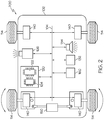
- FIG. 2 another embodiment of a robot 200 for projecting images on identified surfaces is schematically depicted.
- the robot 200 depicted in FIG. 2 differs from the robot 100 depicted in FIG. 1 because the robot 200 of FIG. 2 includes a camera 160 communicatively coupled to the electronic control unit 120, in place of the human recognition module 128 and the projection surface identification module 130 of the robot 100 of FIG. 1 .
- the camera 160 of the robot 200 facilitates both the recognition of a human in the physical presence of the robot 200 and the identification of an appropriate projection surface for the robot 200 to project an image with the projector 126.
- the camera 160 may facilitate the recognition of a human in the physical presence of the robot 200 by employing facial recognition algorithms on images detected by the camera 160, for example.
- the camera 160 may facilitate the identification of an appropriate projection surface based on an image received from the camera 160.
- the other depicted components of the robot 200 are substantially similar to the like numbered components of the robot 100, described above with reference to FIG. 1
- Machine readable instructions for recognizing a human (block 302), identifying a projection surface (block 304), and projecting an image (block 306) are stored in the electronic memory 122.
- a human recognition module such as the robot 100 of FIG. 1
- the machine readable instructions for recognizing a human when executed by the processor 124, the machine readable instructions for recognizing a human cause the robot to recognize a human using the human recognition module 128 in block 302.
- the human recognition module 128 comprises a camera or an embodiment lacking the human recognition module 128 and including a camera 160 (such as the robot 200 of FIG.
- the machine readable instructions of block 302 may cause the robot to recognize the human by receiving an input image from the camera and processing the input image using facial recognition algorithms to recognize a human.
- the Eigenfaces facial recognition algorithm may be employed to recognize the human.
- a facial recognition algorithm other than the Eigenfaces algorithm may be used, such as principal component analysis algorithm, an independent component analysis algorithm, a linear discriminate analysis algorithm, etc.
- the human recognition module 128 comprises a microphone
- the machine readable instructions may cause the robot to recognize the human by processing a signal received from the microphone using a voice recognition algorithm, such as a universal background model based algorithm or a joint factor analysis based algorithm.
- the machine readable instructions for identifying a projection surface when executed by the processor 124, the machine readable instructions for identifying a projection surface cause the robot to identify a projection surface using the projection surface identification module 130 in block 304.
- the projection surface identification module 130 comprises a camera or an embodiment lacking the projection surface identification module 130 and including a camera 160 (such as the robot 200 of FIG. 2 )
- the machine readable instructions may cause the robot to identify a projection surface by receiving an input image from the camera and processing the input image using projection surface identification algorithms.
- the projection surface identification algorithms may identify the projection surface based on surface color, texture, reflectivity, size, shape, etc.
- the machine readable instructions may cause the robot to identify a plurality of potential projection surfaces and identify a best projection surface of the plurality of potential projection surfaces based on one or more determined characteristics of each potential projection surface (e.g., surface color, texture, reflectivity, size, shape, etc.).
- the identified surface may be any surface on which an image may be projected including, but not limited to, a wall, a window, a cubicle, a screen, etc.
- the machine readable instructions for projecting an image cause the robot to project an image on the identified projection surface in block 306.
- the projected image may be of a remote communicating party utilizing the robot 100 to communicate with a receiving party located in the physical environment of the robot 100.
- the projected image may include the entire body of the communicating party.
- the projected image may include only a portion of the body of the communicating party, such as the face of the communicating party.
- the projected image may include a fictional representation of the communicating party, e.g., an avatar or the like.
- the projected image may be any other visual information conveyed by the robot 100 for viewing by a human located in the physical environment of the robot 100.
- the projected image may be a visual representation of the robot 100, such as an avatar, for example.
- Machine readable instructions for identifying a location of the human (block 402), identifying a projection area of the projection surface on which the human is capable of viewing the image (block 404), and causing the robot to move to a position in which the image is projected in the identified projection area (block 406) are stored in the electronic memory 122.
- a human recognition module 128 (such as the robot 100 of FIG. 1 )
- the machine readable instructions for identifying a location of the human may use the human recognition module 128 to identify the location of the human in block 402.
- the machine readable instructions may cause the robot to receive an input image from the camera and process the input image to determine a location of the human relative to a grid system or coordinate system stored in the electronic memory 122.
- the grid system or coordinate system is defined relative to map data including information pertaining to the physical environment in which the robot is present.
- an orientation of an identified human may be identified in addition to identifying a location of the human by, for example, determining a direction in which the human's eyes are directed by analyzing image data received from the camera.
- the machine readable instructions of block 402 may cause the robot to receive a mechanical vibration and provide a signal indicative of human speech to the electronic control unit 120, which may determine a location and/or orientation of the human based on the received speech signal.
- the machine readable instructions may cause the robot to identify a projection area of the projection surface on which the human is capable of viewing the image in block 404.
- a projection surface identification module 130 such as the robot 100 of FIG. 1
- the machine readable instructions of block 404 when executed by the processor 124, the machine readable instructions of block 404 cause the robot to identify the projection area on which the human is capable of viewing the image using the projection surface identification module 130.
- the projection surface identification module 130 comprises a camera or an embodiment lacking the projection surface identification module 130 and including a camera 160 (such as the robot 200 of FIG. 2 )
- the machine readable instructions may cause the robot to identify the projection area by receiving an input image from the camera and processing the input image using a projection area identification algorithm.
- the projection area identification algorithm may identify the projection area based on the location of the human and/or the orientation of the human such that the human is capable of viewing the image from the human's detected location and orientation.
- the machine readable instructions may cause the robot to move to a position in which the image is projected in the identified projection area in block 406.
- the movement mechanism of the robot may cause the robot to move to a position in which the image is projected in the identified projection area by, in the case of a wheeled robot, rolling and steering to the appropriate location.
- the robot may utilize any number of sonar sensors, laser range finders, on-board cameras, and the like for sensing the topographical information.
- the electronic memory 122 may stores a map or coordinate system representative of the physical environment in which the robot is present. Sensed topographical information may then transmitted to the electronic control unit 120, which may determine a relative position of the system.
- the movement mechanism may guide the robot to the position in which the image is projected in the identified projection area.
- the electronic memory 122 includes machine readable instructions that, when executed by the processor 124, cause the robot to detect movement of the human (e.g., by analyzing image data across frames of image data), predict a future location of the human based on the detected movement, and project the image on an area of a projection surface on which the human will be capable of viewing the image from the predicted future location.
- the robot may receive data with the wireless communicator 132.
- the projected image may be based on the received data.
- the projected image may be based on an image of a remote communicating party received via the wireless communicator 132.
- the received data may include other information wirelessly transmitted by a remote communicating party and received by the wireless communicator 132.
- the received data may include information automatically transmitted by a remote computing device and received by the wireless communicator 132.
- the mechanical output of the speaker may be based on information received wirelessly by the wireless communicator 132 (e.g., speech of the communicating party).
- an embodiment with a speaker 134 may communicate audible indications of information other than information received by the wireless communicator 132.
- machine readable instructions for determining a distance between the robot and the projection surface, determining a size of the projection surface, and scaling the projected image based on the determined distance and the determined size, such that the entire projected image is displayed on the projection surface are stored in the electronic memory 122.
- FIGS. 5 and 2 a perspective view of a wheeled robot 100 projecting an image 520 on a surface 500 viewable by a human 400 is schematically depicted.
- the robot 100 has recognized the human 400 using the camera 160 as described above, identified the projection surface 500 using the camera 160 as described above, moved to a proper position, and projected the image 520 on the identified projection surface 500 with the projector 126 as described above.
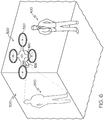
- FIGS. 6 and 2 a perspective view of a flying robot 300 projecting an image 520 on a surface 500 viewable by a human 400 is schematically depicted.
- the flying robot 300 has recognized the human 400 using the camera 160 as described above, identified the projection surface 500 using the camera 160 as described above, moved to a proper position and projected the image 520 on the identified projection surface 500 with the projector 126 as described above.
- a plurality of robots may each project a portion of an image on the projection surface, such that the collective portions form a single image.
- a first robot, a second robot, a third robot, and a fourth robot may each project a quadrant of an image on the identified projection surface. For example, the first robot may project the upper left quadrant of the image, the second robot may project the upper right quadrant of the image, the third robot may project the lower left quadrant of the image, and the fourth robot may project the lower right quadrant of the image.
- multiple wheeled robots may each project a portion of an image on a projection surface, such that the collective portions form a single image.
- multiple flying robots may each project a portion of an image on a projection surface, such that the collective portions form a single image.
- a combination of flying robots and wheeled robots may each project a portion of an image on a projection surface, such that the collective portions forma a single image.
- the embodiments described herein relate to robots comprising projectors for projecting images on identified projection surfaces.
- the embodiments provide a flexible and adaptive robotic projection system capable of identifying an appropriate projection surface for projecting an image to an identified human.
- the system may be small, lightweight, power efficient, and inexpensive because a relatively small robot can project a large image on a projection surface.
- a robot includes a housing, an electronic control unit coupled to the housing, a projector coupled to the housing, a human recognition module coupled to the housing, and a projection surface identification module coupled to the housing.
- the projector, the human recognition module, and the surface identification module are communicatively coupled with the electronic control unit.
- the electronic control unit includes a non-transitory memory that stores a set of machine readable instructions and a processor for executing the machine readable instructions. When executed by the processor, the machine readable instructions cause the robot to recognize a human using the human recognition module, identify a projection surface using the projection surface identification module, and project an image on the identified projection surface with the projector.
Landscapes
- Engineering & Computer Science (AREA)
- Multimedia (AREA)
- Signal Processing (AREA)
- General Physics & Mathematics (AREA)
- Physics & Mathematics (AREA)
- Theoretical Computer Science (AREA)
- Mechanical Engineering (AREA)
- Robotics (AREA)
- Human Computer Interaction (AREA)
- Computer Hardware Design (AREA)
- Aviation & Aerospace Engineering (AREA)
- Radar, Positioning & Navigation (AREA)
- Remote Sensing (AREA)
- Automation & Control Theory (AREA)
- Manipulator (AREA)
- Transforming Electric Information Into Light Information (AREA)
- Projection Apparatus (AREA)
Applications Claiming Priority (1)
| Application Number | Priority Date | Filing Date | Title |
|---|---|---|---|
| US13/566,219 US8983662B2 (en) | 2012-08-03 | 2012-08-03 | Robots comprising projectors for projecting images on identified projection surfaces |
Publications (3)
| Publication Number | Publication Date |
|---|---|
| EP2693366A2 EP2693366A2 (en) | 2014-02-05 |
| EP2693366A3 EP2693366A3 (en) | 2016-06-15 |
| EP2693366B1 true EP2693366B1 (en) | 2020-02-12 |
Family
ID=48900896
Family Applications (1)
| Application Number | Title | Priority Date | Filing Date |
|---|---|---|---|
| EP13179101.4A Active EP2693366B1 (en) | 2012-08-03 | 2013-08-02 | Robots comprising projectors for projecting images on identified projection surfaces |
Country Status (3)
| Country | Link |
|---|---|
| US (2) | US8983662B2 (enExample) |
| EP (1) | EP2693366B1 (enExample) |
| JP (2) | JP2014030897A (enExample) |
Families Citing this family (44)
| Publication number | Priority date | Publication date | Assignee | Title |
|---|---|---|---|---|
| TW201531104A (zh) * | 2014-01-24 | 2015-08-01 | Sintai Optical Shenzhen Co Ltd | 電子裝置 |
| WO2015146805A1 (ja) * | 2014-03-25 | 2015-10-01 | コニカミノルタ株式会社 | 投光装置、及び、投光方法 |
| JP6584017B2 (ja) * | 2014-07-18 | 2019-10-02 | エスゼット ディージェイアイ テクノロジー カンパニー リミテッドSz Dji Technology Co.,Ltd | 航空機に基づく画像投影方法、装置及び航空機 |
| CN105278759B (zh) * | 2014-07-18 | 2019-08-13 | 深圳市大疆创新科技有限公司 | 一种基于飞行器的图像投影方法、装置及飞行器 |
| US9501059B2 (en) * | 2014-09-12 | 2016-11-22 | Qualcomm Incorporated | Pocket robot |
| WO2016080321A1 (ja) * | 2014-11-21 | 2016-05-26 | シャープ株式会社 | 表示投影制御装置、表示投影システム、該表示投影制御装置の制御プログラム、該制御プログラムを記録したコンピュータ読み取り可能な記録媒体、および該表示投影制御装置の制御方法 |
| US10297179B2 (en) | 2015-02-03 | 2019-05-21 | Sony Corporation | Information processing apparatus, information processing method, and program |
| US9409645B1 (en) | 2015-03-02 | 2016-08-09 | Google, Inc. | Unmanned aerial vehicle for collaboration |
| US9682477B2 (en) | 2015-03-24 | 2017-06-20 | Toyota Jidosha Kabushiki Kaisha | Robot communication of intent and functioning |
| JP6456770B2 (ja) * | 2015-05-25 | 2019-01-23 | みこらった株式会社 | 移動型プロジェクションシステム及び移動型プロジェクション方法 |
| DE102015210879A1 (de) * | 2015-06-15 | 2016-12-15 | BSH Hausgeräte GmbH | Vorrichtung zur Unterstützung eines Nutzers in einem Haushalt |
| JP6239567B2 (ja) * | 2015-10-16 | 2017-11-29 | 株式会社プロドローン | 情報伝達装置 |
| US10956739B2 (en) * | 2016-06-27 | 2021-03-23 | Autodesk, Inc. | Augmented reality robotic system visualization |
| CN106131521A (zh) * | 2016-06-28 | 2016-11-16 | 旗瀚科技股份有限公司 | 一种机器人投影方法和装置 |
| EP3298874B1 (en) * | 2016-09-22 | 2020-07-01 | Honda Research Institute Europe GmbH | Robotic gardening device and method for controlling the same |
| US10722775B2 (en) * | 2016-09-27 | 2020-07-28 | Adidas Ag | Robotic training systems and methods |
| JP7031191B2 (ja) * | 2017-06-20 | 2022-03-08 | カシオ計算機株式会社 | 投影装置、投影方法及びプログラム |
| CN107222731B (zh) * | 2017-07-07 | 2019-03-15 | 上海思依暄机器人科技股份有限公司 | 一种投影方法、运动装置和机器人 |
| CN107222732A (zh) * | 2017-07-11 | 2017-09-29 | 京东方科技集团股份有限公司 | 自动投影方法以及投影机器人 |
| KR20190024190A (ko) * | 2017-08-31 | 2019-03-08 | (주)휴맥스 | 음성 인식 영상 피드백 제공 시스템 및 방법 |
| US10456682B2 (en) * | 2017-09-25 | 2019-10-29 | Sony Interactive Entertainment Inc. | Augmentation of a gaming controller via projection system of an autonomous personal companion |
| US11219837B2 (en) * | 2017-09-29 | 2022-01-11 | Sony Interactive Entertainment Inc. | Robot utility and interface device |
| JP7140487B2 (ja) * | 2017-10-25 | 2022-09-21 | キヤノン株式会社 | 情報処理装置、表示制御方法、及び、プログラム |
| JP6448071B2 (ja) * | 2018-02-23 | 2019-01-09 | 株式会社佐竹技研 | ドローン |
| WO2019204013A1 (en) | 2018-04-20 | 2019-10-24 | Covidien Lp | Systems and methods for surgical robotic cart placement |
| CN109015665A (zh) * | 2018-06-16 | 2018-12-18 | 佛山市豪洋电子有限公司 | 智能投影机器人 |
| JP6910659B2 (ja) * | 2018-12-18 | 2021-07-28 | みこらった株式会社 | 移動型プロジェクションシステム及び移動型プロジェクタ装置 |
| JP6607624B2 (ja) * | 2018-12-18 | 2019-11-20 | みこらった株式会社 | 移動型プロジェクションシステム及び移動型プロジェクタ装置 |
| US11196985B1 (en) * | 2018-12-28 | 2021-12-07 | Facebook, Inc. | Surface adaptation for projection-based augmented reality system |
| US11172189B1 (en) | 2018-12-28 | 2021-11-09 | Facebook, Inc. | User detection for projection-based augmented reality system |
| KR102688911B1 (ko) * | 2019-01-09 | 2024-07-29 | 삼성전자 주식회사 | 장착된 외부 전자 장치의 기능과 관련된 동작을 수행하는 전자 장치 및 방법 |
| JP6687954B2 (ja) * | 2019-03-28 | 2020-04-28 | みこらった株式会社 | 移動型プロジェクション装置及びプロジェクションシステム |
| WO2020256188A1 (ko) * | 2019-06-20 | 2020-12-24 | 엘지전자 주식회사 | 영상의 투사 방법 및 이를 구현하는 로봇 |
| CN111182279A (zh) * | 2019-09-23 | 2020-05-19 | 广东小天才科技有限公司 | 一种基于位置检测的投影显示方法及音箱 |
| JP6872276B2 (ja) * | 2020-03-27 | 2021-05-19 | みこらった株式会社 | 移動型プロジェクション装置及び移動型プロジェクション装置用プログラム |
| CN213186348U (zh) | 2020-08-27 | 2021-05-11 | 广景视睿科技(深圳)有限公司 | 一种投影设备 |
| US11726475B2 (en) | 2020-11-30 | 2023-08-15 | At&T Intellectual Property I, L.P. | Autonomous aerial vehicle airspace claiming and announcing |
| US12183110B2 (en) | 2020-11-30 | 2024-12-31 | At&T Intellectual Property I, L.P. | Autonomous aerial vehicle projection zone selection |
| US11797896B2 (en) | 2020-11-30 | 2023-10-24 | At&T Intellectual Property I, L.P. | Autonomous aerial vehicle assisted viewing location selection for event venue |
| US11443518B2 (en) | 2020-11-30 | 2022-09-13 | At&T Intellectual Property I, L.P. | Uncrewed aerial vehicle shared environment privacy and security |
| CN114274184B (zh) * | 2021-12-17 | 2024-05-24 | 重庆特斯联智慧科技股份有限公司 | 一种基于投影引导的物流机器人人机交互方法及系统 |
| CN114520902B (zh) * | 2021-12-28 | 2023-04-25 | 深圳季连科技有限公司 | 一种基于隐私保护的智能家居投影方法与系统 |
| EP4653986A1 (en) | 2023-02-27 | 2025-11-26 | Samsung Electronics Co., Ltd. | Electronic device and method for displaying media content on basis of user location, and non-transitory computer-readable storage medium |
| WO2025147153A1 (ko) * | 2024-01-05 | 2025-07-10 | 삼성전자주식회사 | 전자 장치 및 이의 제어 방법 |
Family Cites Families (64)
| Publication number | Priority date | Publication date | Assignee | Title |
|---|---|---|---|---|
| JPH06274098A (ja) * | 1993-03-24 | 1994-09-30 | Hitachi Denshi Ltd | 映像投影装置 |
| JP3594051B2 (ja) * | 1995-11-22 | 2004-11-24 | 東芝ライテック株式会社 | ムービングプロジェクターシステム |
| US6625299B1 (en) * | 1998-04-08 | 2003-09-23 | Jeffrey Meisner | Augmented reality technology |
| US6292713B1 (en) * | 1999-05-20 | 2001-09-18 | Compaq Computer Corporation | Robotic telepresence system |
| US6346950B1 (en) * | 1999-05-20 | 2002-02-12 | Compaq Computer Corporation | System and method for display images using anamorphic video |
| US6781606B2 (en) * | 1999-05-20 | 2004-08-24 | Hewlett-Packard Development Company, L.P. | System and method for displaying images using foveal video |
| US6845297B2 (en) * | 2000-05-01 | 2005-01-18 | Irobot Corporation | Method and system for remote control of mobile robot |
| US7404001B2 (en) * | 2002-03-27 | 2008-07-22 | Ericsson Ab | Videophone and method for a video call |
| US7729511B2 (en) * | 2002-09-24 | 2010-06-01 | Pilz Gmbh & Co. Kg | Method and device for safeguarding a hazardous area |
| US7119829B2 (en) * | 2003-07-31 | 2006-10-10 | Dreamworks Animation Llc | Virtual conference room |
| JPWO2005015466A1 (ja) * | 2003-08-07 | 2006-10-05 | 松下電器産業株式会社 | 生活支援システム及びその制御用プログラム |
| JP2005059186A (ja) * | 2003-08-19 | 2005-03-10 | Sony Corp | ロボット装置及びその制御方法 |
| JP2005176017A (ja) * | 2003-12-12 | 2005-06-30 | Olympus Corp | プロジェクタシステム |
| US7705877B2 (en) * | 2004-01-28 | 2010-04-27 | Hewlett-Packard Development Company, L.P. | Method and system for display of facial features on nonplanar surfaces |
| US7756614B2 (en) * | 2004-02-27 | 2010-07-13 | Hewlett-Packard Development Company, L.P. | Mobile device control system |
| JP2005292290A (ja) * | 2004-03-31 | 2005-10-20 | Olympus Corp | 移動ステージ装置及びプロジェクタ装置 |
| US8599239B2 (en) * | 2004-04-21 | 2013-12-03 | Telepresence Technologies, Llc | Telepresence systems and methods therefore |
| JP2005313291A (ja) * | 2004-04-30 | 2005-11-10 | Mitsubishi Heavy Ind Ltd | ロボット行動とリンクした映像表示方法とその装置 |
| JP2005331813A (ja) * | 2004-05-21 | 2005-12-02 | Seiko Epson Corp | 自走投影装置 |
| JP4196880B2 (ja) | 2004-05-24 | 2008-12-17 | セイコーエプソン株式会社 | 自動移動型空中浮遊映像表示装置 |
| US7706917B1 (en) * | 2004-07-07 | 2010-04-27 | Irobot Corporation | Celestial navigation system for an autonomous robot |
| JP2006043780A (ja) * | 2004-07-30 | 2006-02-16 | Shinshu Univ | 曲面顔画像表示を用いたコミュニケーションロボット |
| JP2006212717A (ja) | 2005-02-01 | 2006-08-17 | Advanced Telecommunication Research Institute International | ロボット装置 |
| US7252387B2 (en) * | 2005-03-21 | 2007-08-07 | Mitsubishi Electric Research Laboratories, Inc. | System and method for mechanically adjusting projector pose with six degrees of freedom for image alignment |
| US9534899B2 (en) * | 2005-03-25 | 2017-01-03 | Irobot Corporation | Re-localization of a robot for slam |
| JP4830438B2 (ja) * | 2005-10-04 | 2011-12-07 | トヨタ自動車株式会社 | 自律移動装置 |
| DE112006002894B4 (de) * | 2005-10-21 | 2021-11-11 | Deere & Company | Vernetztes Vielzweck-Roboterfahrzeug |
| JP2007229855A (ja) * | 2006-02-28 | 2007-09-13 | Toyota Motor Corp | 自律移動型ロボット |
| JP4857926B2 (ja) * | 2006-06-13 | 2012-01-18 | トヨタ自動車株式会社 | 自律移動装置 |
| US9084622B2 (en) * | 2006-08-02 | 2015-07-21 | Omnitek Partners Llc | Automated laser-treatment system with real-time integrated 3D vision system for laser debridement and the like |
| JP2008136963A (ja) * | 2006-12-04 | 2008-06-19 | Nec Corp | 透明保護材の製造方法及び該保護材を備える携帯端末 |
| JP2008260107A (ja) * | 2007-04-13 | 2008-10-30 | Yaskawa Electric Corp | 移動ロボットシステム |
| US8253770B2 (en) * | 2007-05-31 | 2012-08-28 | Eastman Kodak Company | Residential video communication system |
| JP2009123045A (ja) | 2007-11-16 | 2009-06-04 | Toyota Motor Corp | 移動ロボット及び移動ロボットの危険範囲の表示方法 |
| JP2010015076A (ja) * | 2008-07-07 | 2010-01-21 | Seiko Epson Corp | 表示システム、表示制御装置、および、表示制御方法 |
| US8649426B2 (en) * | 2008-09-18 | 2014-02-11 | Magor Communications Corporation | Low latency high resolution video encoding |
| US8446288B2 (en) * | 2008-10-15 | 2013-05-21 | Panasonic Corporation | Light projection device |
| JP2010128133A (ja) * | 2008-11-27 | 2010-06-10 | Univ Of Tokyo | 移動式情報重畳システム及び情報重畳方法 |
| KR20100086262A (ko) * | 2009-01-22 | 2010-07-30 | 삼성전자주식회사 | 로봇 및 그 제어방법 |
| WO2010102288A2 (en) * | 2009-03-06 | 2010-09-10 | The University Of North Carolina At Chapel Hill | Methods, systems, and computer readable media for shader-lamps based physical avatars of real and virtual people |
| US8477175B2 (en) * | 2009-03-09 | 2013-07-02 | Cisco Technology, Inc. | System and method for providing three dimensional imaging in a network environment |
| US8164617B2 (en) * | 2009-03-25 | 2012-04-24 | Cisco Technology, Inc. | Combining views of a plurality of cameras for a video conferencing endpoint with a display wall |
| US8897920B2 (en) * | 2009-04-17 | 2014-11-25 | Intouch Technologies, Inc. | Tele-presence robot system with software modularity, projector and laser pointer |
| JP2011137905A (ja) * | 2009-12-28 | 2011-07-14 | Fujitsu Ltd | 投影システム、投影処理プログラムおよび投影システムの制御方法 |
| US8503539B2 (en) * | 2010-02-26 | 2013-08-06 | Bao Tran | High definition personal computer (PC) cam |
| US8334889B2 (en) * | 2010-03-18 | 2012-12-18 | Tipd, Llc | Auto stereoscopic 3D telepresence using integral holography |
| JP5569073B2 (ja) * | 2010-03-18 | 2014-08-13 | 富士通株式会社 | サービス提供装置、サービス提供プログラム及びサービスロボット |
| JP5581770B2 (ja) * | 2010-03-26 | 2014-09-03 | ソニー株式会社 | ロボット装置及びロボット装置による情報提供方法 |
| US9014848B2 (en) * | 2010-05-20 | 2015-04-21 | Irobot Corporation | Mobile robot system |
| US8918213B2 (en) * | 2010-05-20 | 2014-12-23 | Irobot Corporation | Mobile human interface robot |
| US9183560B2 (en) * | 2010-05-28 | 2015-11-10 | Daniel H. Abelow | Reality alternate |
| US8694553B2 (en) * | 2010-06-07 | 2014-04-08 | Gary Stephen Shuster | Creation and use of virtual places |
| US20120056988A1 (en) * | 2010-09-07 | 2012-03-08 | David Stanhill | 3-d camera |
| US9946076B2 (en) * | 2010-10-04 | 2018-04-17 | Gerard Dirk Smits | System and method for 3-D projection and enhancements for interactivity |
| CA2720886A1 (en) * | 2010-11-12 | 2012-05-12 | Crosswing Inc. | Customizable virtual presence system |
| US9987506B2 (en) * | 2010-12-15 | 2018-06-05 | Robert Marcus | UAV—or personal flying device—delivered deployable descent device |
| US8570320B2 (en) * | 2011-01-31 | 2013-10-29 | Microsoft Corporation | Using a three-dimensional environment model in gameplay |
| US9578076B2 (en) * | 2011-05-02 | 2017-02-21 | Microsoft Technology Licensing, Llc | Visual communication using a robotic device |
| US8730295B2 (en) * | 2011-06-21 | 2014-05-20 | Broadcom Corporation | Audio processing for video conferencing |
| US20130083151A1 (en) * | 2011-09-30 | 2013-04-04 | Lg Electronics Inc. | Electronic device and method for controlling electronic device |
| US8977396B2 (en) * | 2012-03-20 | 2015-03-10 | Sony Corporation | Mobile robotic assistant for multipurpose applications |
| JP6262216B2 (ja) * | 2012-06-01 | 2018-01-17 | インテュイティブ サージカル オペレーションズ, インコーポレイテッド | 零空間を使用して操作アーム間の衝突を回避するためのシステム及び方法 |
| EP2854688B1 (en) * | 2012-06-01 | 2022-08-17 | Intuitive Surgical Operations, Inc. | Manipulator arm-to-patient collision avoidance using a null-space |
| US8908004B2 (en) * | 2012-06-14 | 2014-12-09 | Cisco Technology, Inc. | Flattened light reflection for telepresence |
-
2012
- 2012-08-03 US US13/566,219 patent/US8983662B2/en not_active Expired - Fee Related
-
2013
- 2013-08-02 EP EP13179101.4A patent/EP2693366B1/en active Active
- 2013-08-05 JP JP2013162242A patent/JP2014030897A/ja not_active Withdrawn
-
2015
- 2015-02-04 US US14/613,518 patent/US9943965B2/en active Active
-
2016
- 2016-12-15 JP JP2016243277A patent/JP6420303B2/ja not_active Expired - Fee Related
Non-Patent Citations (1)
| Title |
|---|
| None * |
Also Published As
| Publication number | Publication date |
|---|---|
| JP2017061034A (ja) | 2017-03-30 |
| US20150148960A1 (en) | 2015-05-28 |
| US9943965B2 (en) | 2018-04-17 |
| US20140039677A1 (en) | 2014-02-06 |
| JP2014030897A (ja) | 2014-02-20 |
| EP2693366A2 (en) | 2014-02-05 |
| EP2693366A3 (en) | 2016-06-15 |
| JP6420303B2 (ja) | 2018-11-07 |
| US8983662B2 (en) | 2015-03-17 |
Similar Documents
| Publication | Publication Date | Title |
|---|---|---|
| EP2693366B1 (en) | Robots comprising projectors for projecting images on identified projection surfaces | |
| US12393196B2 (en) | Systems and methods for training a robot to autonomously travel a route | |
| KR102597216B1 (ko) | 공항용 안내 로봇 및 그의 동작 방법 | |
| US9870718B2 (en) | Imaging devices including spacing members and imaging devices including tactile feedback devices | |
| US20200074683A1 (en) | Camera calibration | |
| US9530058B2 (en) | Visual-assist robots | |
| US10380914B2 (en) | Imaging gloves including wrist cameras and finger cameras | |
| KR20180070932A (ko) | 이동체 및 이동체의 제어 방법 | |
| US20230213944A1 (en) | Robot and control method therefor | |
| JP6150429B2 (ja) | ロボット制御システム、ロボット、出力制御プログラムおよび出力制御方法 | |
| JP2022511978A (ja) | エスカレータを検出するためのシステム、装置、及び方法 | |
| US11886198B2 (en) | Systems and methods for detecting blind spots for robots | |
| EP3865968B1 (en) | Systems for determining location using robots with deformable sensors | |
| US20200009734A1 (en) | Robot and operating method thereof | |
| US20230168689A1 (en) | Systems and methods for preserving data and human confidentiality during feature identification by robotic devices | |
| US11983006B2 (en) | Autonomously motile device with remote control | |
| KR20230077847A (ko) | 인공 지능 알고리즘이 적용된 자율 주행 로봇 | |
| WO2021252425A1 (en) | Systems and methods for wire detection and avoidance of the same by robots | |
| KR20210022394A (ko) | 시각 장애인용 이동 로봇 및 그 제어 방법 | |
| CN207669312U (zh) | 智能机器人 | |
| US12038760B1 (en) | System to manipulate sliding obstacles with non-holonomic autonomous mobile device | |
| Uddin Ahamad | Omobot: a Low-cost Mobile Robot for Autonomous Search and Fall Detection | |
| CN116820099A (zh) | 目标位置的确定方法、装置、机器人和存储介质 | |
| CN111300426A (zh) | 一种高智能人型机器人感测头的控制系统 |
Legal Events
| Date | Code | Title | Description |
|---|---|---|---|
| AK | Designated contracting states |
Kind code of ref document: A2 Designated state(s): AL AT BE BG CH CY CZ DE DK EE ES FI FR GB GR HR HU IE IS IT LI LT LU LV MC MK MT NL NO PL PT RO RS SE SI SK SM TR |
|
| AX | Request for extension of the european patent |
Extension state: BA ME |
|
| PUAI | Public reference made under article 153(3) epc to a published international application that has entered the european phase |
Free format text: ORIGINAL CODE: 0009012 |
|
| PUAL | Search report despatched |
Free format text: ORIGINAL CODE: 0009013 |
|
| AK | Designated contracting states |
Kind code of ref document: A3 Designated state(s): AL AT BE BG CH CY CZ DE DK EE ES FI FR GB GR HR HU IE IS IT LI LT LU LV MC MK MT NL NO PL PT RO RS SE SI SK SM TR |
|
| AX | Request for extension of the european patent |
Extension state: BA ME |
|
| RIC1 | Information provided on ipc code assigned before grant |
Ipc: B25J 9/16 20060101ALI20160511BHEP Ipc: G06K 9/00 20060101AFI20160511BHEP Ipc: H04N 9/31 20060101ALI20160511BHEP |
|
| STAA | Information on the status of an ep patent application or granted ep patent |
Free format text: STATUS: REQUEST FOR EXAMINATION WAS MADE |
|
| 17P | Request for examination filed |
Effective date: 20161207 |
|
| RBV | Designated contracting states (corrected) |
Designated state(s): AL AT BE BG CH CY CZ DE DK EE ES FI FR GB GR HR HU IE IS IT LI LT LU LV MC MK MT NL NO PL PT RO RS SE SI SK SM TR |
|
| STAA | Information on the status of an ep patent application or granted ep patent |
Free format text: STATUS: EXAMINATION IS IN PROGRESS |
|
| 17Q | First examination report despatched |
Effective date: 20170817 |
|
| GRAP | Despatch of communication of intention to grant a patent |
Free format text: ORIGINAL CODE: EPIDOSNIGR1 |
|
| STAA | Information on the status of an ep patent application or granted ep patent |
Free format text: STATUS: GRANT OF PATENT IS INTENDED |
|
| INTG | Intention to grant announced |
Effective date: 20190826 |
|
| GRAS | Grant fee paid |
Free format text: ORIGINAL CODE: EPIDOSNIGR3 |
|
| GRAA | (expected) grant |
Free format text: ORIGINAL CODE: 0009210 |
|
| STAA | Information on the status of an ep patent application or granted ep patent |
Free format text: STATUS: THE PATENT HAS BEEN GRANTED |
|
| AK | Designated contracting states |
Kind code of ref document: B1 Designated state(s): AL AT BE BG CH CY CZ DE DK EE ES FI FR GB GR HR HU IE IS IT LI LT LU LV MC MK MT NL NO PL PT RO RS SE SI SK SM TR |
|
| REG | Reference to a national code |
Ref country code: GB Ref legal event code: FG4D |
|
| REG | Reference to a national code |
Ref country code: CH Ref legal event code: EP |
|
| REG | Reference to a national code |
Ref country code: AT Ref legal event code: REF Ref document number: 1233104 Country of ref document: AT Kind code of ref document: T Effective date: 20200215 |
|
| REG | Reference to a national code |
Ref country code: IE Ref legal event code: FG4D |
|
| REG | Reference to a national code |
Ref country code: DE Ref legal event code: R096 Ref document number: 602013065630 Country of ref document: DE |
|
| PG25 | Lapsed in a contracting state [announced via postgrant information from national office to epo] |
Ref country code: RS Free format text: LAPSE BECAUSE OF FAILURE TO SUBMIT A TRANSLATION OF THE DESCRIPTION OR TO PAY THE FEE WITHIN THE PRESCRIBED TIME-LIMIT Effective date: 20200212 Ref country code: FI Free format text: LAPSE BECAUSE OF FAILURE TO SUBMIT A TRANSLATION OF THE DESCRIPTION OR TO PAY THE FEE WITHIN THE PRESCRIBED TIME-LIMIT Effective date: 20200212 Ref country code: NO Free format text: LAPSE BECAUSE OF FAILURE TO SUBMIT A TRANSLATION OF THE DESCRIPTION OR TO PAY THE FEE WITHIN THE PRESCRIBED TIME-LIMIT Effective date: 20200512 |
|
| REG | Reference to a national code |
Ref country code: LT Ref legal event code: MG4D |
|
| REG | Reference to a national code |
Ref country code: NL Ref legal event code: MP Effective date: 20200212 |
|
| PG25 | Lapsed in a contracting state [announced via postgrant information from national office to epo] |
Ref country code: LV Free format text: LAPSE BECAUSE OF FAILURE TO SUBMIT A TRANSLATION OF THE DESCRIPTION OR TO PAY THE FEE WITHIN THE PRESCRIBED TIME-LIMIT Effective date: 20200212 Ref country code: SE Free format text: LAPSE BECAUSE OF FAILURE TO SUBMIT A TRANSLATION OF THE DESCRIPTION OR TO PAY THE FEE WITHIN THE PRESCRIBED TIME-LIMIT Effective date: 20200212 Ref country code: IS Free format text: LAPSE BECAUSE OF FAILURE TO SUBMIT A TRANSLATION OF THE DESCRIPTION OR TO PAY THE FEE WITHIN THE PRESCRIBED TIME-LIMIT Effective date: 20200612 Ref country code: BG Free format text: LAPSE BECAUSE OF FAILURE TO SUBMIT A TRANSLATION OF THE DESCRIPTION OR TO PAY THE FEE WITHIN THE PRESCRIBED TIME-LIMIT Effective date: 20200512 Ref country code: GR Free format text: LAPSE BECAUSE OF FAILURE TO SUBMIT A TRANSLATION OF THE DESCRIPTION OR TO PAY THE FEE WITHIN THE PRESCRIBED TIME-LIMIT Effective date: 20200513 Ref country code: HR Free format text: LAPSE BECAUSE OF FAILURE TO SUBMIT A TRANSLATION OF THE DESCRIPTION OR TO PAY THE FEE WITHIN THE PRESCRIBED TIME-LIMIT Effective date: 20200212 |
|
| PG25 | Lapsed in a contracting state [announced via postgrant information from national office to epo] |
Ref country code: NL Free format text: LAPSE BECAUSE OF FAILURE TO SUBMIT A TRANSLATION OF THE DESCRIPTION OR TO PAY THE FEE WITHIN THE PRESCRIBED TIME-LIMIT Effective date: 20200212 |
|
| PG25 | Lapsed in a contracting state [announced via postgrant information from national office to epo] |
Ref country code: SK Free format text: LAPSE BECAUSE OF FAILURE TO SUBMIT A TRANSLATION OF THE DESCRIPTION OR TO PAY THE FEE WITHIN THE PRESCRIBED TIME-LIMIT Effective date: 20200212 Ref country code: RO Free format text: LAPSE BECAUSE OF FAILURE TO SUBMIT A TRANSLATION OF THE DESCRIPTION OR TO PAY THE FEE WITHIN THE PRESCRIBED TIME-LIMIT Effective date: 20200212 Ref country code: SM Free format text: LAPSE BECAUSE OF FAILURE TO SUBMIT A TRANSLATION OF THE DESCRIPTION OR TO PAY THE FEE WITHIN THE PRESCRIBED TIME-LIMIT Effective date: 20200212 Ref country code: EE Free format text: LAPSE BECAUSE OF FAILURE TO SUBMIT A TRANSLATION OF THE DESCRIPTION OR TO PAY THE FEE WITHIN THE PRESCRIBED TIME-LIMIT Effective date: 20200212 Ref country code: DK Free format text: LAPSE BECAUSE OF FAILURE TO SUBMIT A TRANSLATION OF THE DESCRIPTION OR TO PAY THE FEE WITHIN THE PRESCRIBED TIME-LIMIT Effective date: 20200212 Ref country code: PT Free format text: LAPSE BECAUSE OF FAILURE TO SUBMIT A TRANSLATION OF THE DESCRIPTION OR TO PAY THE FEE WITHIN THE PRESCRIBED TIME-LIMIT Effective date: 20200705 Ref country code: LT Free format text: LAPSE BECAUSE OF FAILURE TO SUBMIT A TRANSLATION OF THE DESCRIPTION OR TO PAY THE FEE WITHIN THE PRESCRIBED TIME-LIMIT Effective date: 20200212 Ref country code: CZ Free format text: LAPSE BECAUSE OF FAILURE TO SUBMIT A TRANSLATION OF THE DESCRIPTION OR TO PAY THE FEE WITHIN THE PRESCRIBED TIME-LIMIT Effective date: 20200212 Ref country code: ES Free format text: LAPSE BECAUSE OF FAILURE TO SUBMIT A TRANSLATION OF THE DESCRIPTION OR TO PAY THE FEE WITHIN THE PRESCRIBED TIME-LIMIT Effective date: 20200212 |
|
| REG | Reference to a national code |
Ref country code: DE Ref legal event code: R097 Ref document number: 602013065630 Country of ref document: DE |
|
| REG | Reference to a national code |
Ref country code: AT Ref legal event code: MK05 Ref document number: 1233104 Country of ref document: AT Kind code of ref document: T Effective date: 20200212 |
|
| PLBE | No opposition filed within time limit |
Free format text: ORIGINAL CODE: 0009261 |
|
| STAA | Information on the status of an ep patent application or granted ep patent |
Free format text: STATUS: NO OPPOSITION FILED WITHIN TIME LIMIT |
|
| 26N | No opposition filed |
Effective date: 20201113 |
|
| PG25 | Lapsed in a contracting state [announced via postgrant information from national office to epo] |
Ref country code: AT Free format text: LAPSE BECAUSE OF FAILURE TO SUBMIT A TRANSLATION OF THE DESCRIPTION OR TO PAY THE FEE WITHIN THE PRESCRIBED TIME-LIMIT Effective date: 20200212 Ref country code: IT Free format text: LAPSE BECAUSE OF FAILURE TO SUBMIT A TRANSLATION OF THE DESCRIPTION OR TO PAY THE FEE WITHIN THE PRESCRIBED TIME-LIMIT Effective date: 20200212 |
|
| PG25 | Lapsed in a contracting state [announced via postgrant information from national office to epo] |
Ref country code: SI Free format text: LAPSE BECAUSE OF FAILURE TO SUBMIT A TRANSLATION OF THE DESCRIPTION OR TO PAY THE FEE WITHIN THE PRESCRIBED TIME-LIMIT Effective date: 20200212 Ref country code: PL Free format text: LAPSE BECAUSE OF FAILURE TO SUBMIT A TRANSLATION OF THE DESCRIPTION OR TO PAY THE FEE WITHIN THE PRESCRIBED TIME-LIMIT Effective date: 20200212 |
|
| REG | Reference to a national code |
Ref country code: DE Ref legal event code: R082 Ref document number: 602013065630 Country of ref document: DE Representative=s name: TBK, DE Ref country code: DE Ref legal event code: R081 Ref document number: 602013065630 Country of ref document: DE Owner name: TOYOTA JIDOSHA KABUSHIKI KAISHA, TOYOTA-SHI, JP Free format text: FORMER OWNER: TOYOTA MOTOR ENGINEERING & MANUFACTURING NORTH AMERICA, INC., ERLANGER, KY., US |
|
| PG25 | Lapsed in a contracting state [announced via postgrant information from national office to epo] |
Ref country code: MC Free format text: LAPSE BECAUSE OF FAILURE TO SUBMIT A TRANSLATION OF THE DESCRIPTION OR TO PAY THE FEE WITHIN THE PRESCRIBED TIME-LIMIT Effective date: 20200212 |
|
| REG | Reference to a national code |
Ref country code: CH Ref legal event code: PL |
|
| PG25 | Lapsed in a contracting state [announced via postgrant information from national office to epo] |
Ref country code: LI Free format text: LAPSE BECAUSE OF NON-PAYMENT OF DUE FEES Effective date: 20200831 Ref country code: CH Free format text: LAPSE BECAUSE OF NON-PAYMENT OF DUE FEES Effective date: 20200831 Ref country code: LU Free format text: LAPSE BECAUSE OF NON-PAYMENT OF DUE FEES Effective date: 20200802 |
|
| REG | Reference to a national code |
Ref country code: BE Ref legal event code: MM Effective date: 20200831 |
|
| REG | Reference to a national code |
Ref country code: GB Ref legal event code: 732E Free format text: REGISTERED BETWEEN 20210624 AND 20210630 |
|
| PG25 | Lapsed in a contracting state [announced via postgrant information from national office to epo] |
Ref country code: BE Free format text: LAPSE BECAUSE OF NON-PAYMENT OF DUE FEES Effective date: 20200831 Ref country code: IE Free format text: LAPSE BECAUSE OF NON-PAYMENT OF DUE FEES Effective date: 20200802 |
|
| REG | Reference to a national code |
Ref country code: DE Ref legal event code: R079 Ref document number: 602013065630 Country of ref document: DE Free format text: PREVIOUS MAIN CLASS: G06K0009000000 Ipc: G06V0010000000 |
|
| PG25 | Lapsed in a contracting state [announced via postgrant information from national office to epo] |
Ref country code: TR Free format text: LAPSE BECAUSE OF FAILURE TO SUBMIT A TRANSLATION OF THE DESCRIPTION OR TO PAY THE FEE WITHIN THE PRESCRIBED TIME-LIMIT Effective date: 20200212 Ref country code: MT Free format text: LAPSE BECAUSE OF FAILURE TO SUBMIT A TRANSLATION OF THE DESCRIPTION OR TO PAY THE FEE WITHIN THE PRESCRIBED TIME-LIMIT Effective date: 20200212 Ref country code: CY Free format text: LAPSE BECAUSE OF FAILURE TO SUBMIT A TRANSLATION OF THE DESCRIPTION OR TO PAY THE FEE WITHIN THE PRESCRIBED TIME-LIMIT Effective date: 20200212 |
|
| PG25 | Lapsed in a contracting state [announced via postgrant information from national office to epo] |
Ref country code: MK Free format text: LAPSE BECAUSE OF FAILURE TO SUBMIT A TRANSLATION OF THE DESCRIPTION OR TO PAY THE FEE WITHIN THE PRESCRIBED TIME-LIMIT Effective date: 20200212 Ref country code: AL Free format text: LAPSE BECAUSE OF FAILURE TO SUBMIT A TRANSLATION OF THE DESCRIPTION OR TO PAY THE FEE WITHIN THE PRESCRIBED TIME-LIMIT Effective date: 20200212 |
|
| PGFP | Annual fee paid to national office [announced via postgrant information from national office to epo] |
Ref country code: GB Payment date: 20220630 Year of fee payment: 10 |
|
| PGFP | Annual fee paid to national office [announced via postgrant information from national office to epo] |
Ref country code: DE Payment date: 20220629 Year of fee payment: 10 |
|
| PGFP | Annual fee paid to national office [announced via postgrant information from national office to epo] |
Ref country code: FR Payment date: 20220709 Year of fee payment: 10 |
|
| P01 | Opt-out of the competence of the unified patent court (upc) registered |
Effective date: 20230427 |
|
| REG | Reference to a national code |
Ref country code: DE Ref legal event code: R119 Ref document number: 602013065630 Country of ref document: DE |
|
| GBPC | Gb: european patent ceased through non-payment of renewal fee |
Effective date: 20230802 |
|
| PG25 | Lapsed in a contracting state [announced via postgrant information from national office to epo] |
Ref country code: GB Free format text: LAPSE BECAUSE OF NON-PAYMENT OF DUE FEES Effective date: 20230802 |
|
| PG25 | Lapsed in a contracting state [announced via postgrant information from national office to epo] |
Ref country code: GB Free format text: LAPSE BECAUSE OF NON-PAYMENT OF DUE FEES Effective date: 20230802 Ref country code: FR Free format text: LAPSE BECAUSE OF NON-PAYMENT OF DUE FEES Effective date: 20230831 Ref country code: DE Free format text: LAPSE BECAUSE OF NON-PAYMENT OF DUE FEES Effective date: 20240301 |