EP2670585B1 - Renfort composite gaine d'une couche de polymere auto-adherente au caoutchouc - Google Patents
Renfort composite gaine d'une couche de polymere auto-adherente au caoutchouc Download PDFInfo
- Publication number
- EP2670585B1 EP2670585B1 EP20120703038 EP12703038A EP2670585B1 EP 2670585 B1 EP2670585 B1 EP 2670585B1 EP 20120703038 EP20120703038 EP 20120703038 EP 12703038 A EP12703038 A EP 12703038A EP 2670585 B1 EP2670585 B1 EP 2670585B1
- Authority
- EP
- European Patent Office
- Prior art keywords
- elastomer
- thermoplastic
- thermoplastic polymer
- styrene
- reinforcer according
- Prior art date
- Legal status (The legal status is an assumption and is not a legal conclusion. Google has not performed a legal analysis and makes no representation as to the accuracy of the status listed.)
- Active
Links
Images

Classifications
-
- B—PERFORMING OPERATIONS; TRANSPORTING
- B60—VEHICLES IN GENERAL
- B60C—VEHICLE TYRES; TYRE INFLATION; TYRE CHANGING; CONNECTING VALVES TO INFLATABLE ELASTIC BODIES IN GENERAL; DEVICES OR ARRANGEMENTS RELATED TO TYRES
- B60C9/00—Reinforcements or ply arrangement of pneumatic tyres
- B60C9/0042—Reinforcements made of synthetic materials
-
- B—PERFORMING OPERATIONS; TRANSPORTING
- B60—VEHICLES IN GENERAL
- B60C—VEHICLE TYRES; TYRE INFLATION; TYRE CHANGING; CONNECTING VALVES TO INFLATABLE ELASTIC BODIES IN GENERAL; DEVICES OR ARRANGEMENTS RELATED TO TYRES
- B60C9/00—Reinforcements or ply arrangement of pneumatic tyres
- B60C9/18—Structure or arrangement of belts or breakers, crown-reinforcing or cushioning layers
-
- B—PERFORMING OPERATIONS; TRANSPORTING
- B29—WORKING OF PLASTICS; WORKING OF SUBSTANCES IN A PLASTIC STATE IN GENERAL
- B29D—PRODUCING PARTICULAR ARTICLES FROM PLASTICS OR FROM SUBSTANCES IN A PLASTIC STATE
- B29D30/00—Producing pneumatic or solid tyres or parts thereof
- B29D30/06—Pneumatic tyres or parts thereof (e.g. produced by casting, moulding, compression moulding, injection moulding, centrifugal casting)
- B29D30/38—Textile inserts, e.g. cord or canvas layers, for tyres; Treatment of inserts prior to building the tyre
-
- D—TEXTILES; PAPER
- D02—YARNS; MECHANICAL FINISHING OF YARNS OR ROPES; WARPING OR BEAMING
- D02G—CRIMPING OR CURLING FIBRES, FILAMENTS, THREADS, OR YARNS; YARNS OR THREADS
- D02G3/00—Yarns or threads, e.g. fancy yarns; Processes or apparatus for the production thereof, not otherwise provided for
- D02G3/44—Yarns or threads characterised by the purpose for which they are designed
- D02G3/48—Tyre cords
-
- D—TEXTILES; PAPER
- D07—ROPES; CABLES OTHER THAN ELECTRIC
- D07B—ROPES OR CABLES IN GENERAL
- D07B1/00—Constructional features of ropes or cables
- D07B1/06—Ropes or cables built-up from metal wires, e.g. of section wires around a hemp core
-
- D—TEXTILES; PAPER
- D07—ROPES; CABLES OTHER THAN ELECTRIC
- D07B—ROPES OR CABLES IN GENERAL
- D07B1/00—Constructional features of ropes or cables
- D07B1/06—Ropes or cables built-up from metal wires, e.g. of section wires around a hemp core
- D07B1/0606—Reinforcing cords for rubber or plastic articles
- D07B1/0666—Reinforcing cords for rubber or plastic articles the wires being characterised by an anti-corrosive or adhesion promoting coating
-
- B—PERFORMING OPERATIONS; TRANSPORTING
- B29—WORKING OF PLASTICS; WORKING OF SUBSTANCES IN A PLASTIC STATE IN GENERAL
- B29D—PRODUCING PARTICULAR ARTICLES FROM PLASTICS OR FROM SUBSTANCES IN A PLASTIC STATE
- B29D30/00—Producing pneumatic or solid tyres or parts thereof
- B29D30/06—Pneumatic tyres or parts thereof (e.g. produced by casting, moulding, compression moulding, injection moulding, centrifugal casting)
- B29D30/38—Textile inserts, e.g. cord or canvas layers, for tyres; Treatment of inserts prior to building the tyre
- B29D2030/383—Chemical treatment of the reinforcing elements, e.g. cords, wires and filamentary materials, to increase the adhesion to the rubber
-
- B—PERFORMING OPERATIONS; TRANSPORTING
- B60—VEHICLES IN GENERAL
- B60C—VEHICLE TYRES; TYRE INFLATION; TYRE CHANGING; CONNECTING VALVES TO INFLATABLE ELASTIC BODIES IN GENERAL; DEVICES OR ARRANGEMENTS RELATED TO TYRES
- B60C9/00—Reinforcements or ply arrangement of pneumatic tyres
- B60C9/0007—Reinforcements made of metallic elements, e.g. cords, yarns, filaments or fibres made from metal
- B60C2009/0021—Coating rubbers for steel cords
-
- D—TEXTILES; PAPER
- D07—ROPES; CABLES OTHER THAN ELECTRIC
- D07B—ROPES OR CABLES IN GENERAL
- D07B2201/00—Ropes or cables
- D07B2201/20—Rope or cable components
- D07B2201/2001—Wires or filaments
- D07B2201/201—Wires or filaments characterised by a coating
- D07B2201/2012—Wires or filaments characterised by a coating comprising polymers
-
- D—TEXTILES; PAPER
- D07—ROPES; CABLES OTHER THAN ELECTRIC
- D07B—ROPES OR CABLES IN GENERAL
- D07B2201/00—Ropes or cables
- D07B2201/20—Rope or cable components
- D07B2201/2015—Strands
- D07B2201/2042—Strands characterised by a coating
- D07B2201/2044—Strands characterised by a coating comprising polymers
-
- D—TEXTILES; PAPER
- D07—ROPES; CABLES OTHER THAN ELECTRIC
- D07B—ROPES OR CABLES IN GENERAL
- D07B2201/00—Ropes or cables
- D07B2201/20—Rope or cable components
- D07B2201/2015—Strands
- D07B2201/2046—Strands comprising fillers
-
- D—TEXTILES; PAPER
- D07—ROPES; CABLES OTHER THAN ELECTRIC
- D07B—ROPES OR CABLES IN GENERAL
- D07B2205/00—Rope or cable materials
- D07B2205/20—Organic high polymers
- D07B2205/2003—Thermoplastics
-
- D—TEXTILES; PAPER
- D07—ROPES; CABLES OTHER THAN ELECTRIC
- D07B—ROPES OR CABLES IN GENERAL
- D07B2205/00—Rope or cable materials
- D07B2205/20—Organic high polymers
- D07B2205/2075—Rubbers, i.e. elastomers
- D07B2205/2082—Rubbers, i.e. elastomers being of synthetic nature, e.g. chloroprene
-
- D—TEXTILES; PAPER
- D07—ROPES; CABLES OTHER THAN ELECTRIC
- D07B—ROPES OR CABLES IN GENERAL
- D07B2501/00—Application field
- D07B2501/20—Application field related to ropes or cables
- D07B2501/2046—Tyre cords
-
- Y—GENERAL TAGGING OF NEW TECHNOLOGICAL DEVELOPMENTS; GENERAL TAGGING OF CROSS-SECTIONAL TECHNOLOGIES SPANNING OVER SEVERAL SECTIONS OF THE IPC; TECHNICAL SUBJECTS COVERED BY FORMER USPC CROSS-REFERENCE ART COLLECTIONS [XRACs] AND DIGESTS
- Y10—TECHNICAL SUBJECTS COVERED BY FORMER USPC
- Y10T—TECHNICAL SUBJECTS COVERED BY FORMER US CLASSIFICATION
- Y10T428/00—Stock material or miscellaneous articles
- Y10T428/29—Coated or structually defined flake, particle, cell, strand, strand portion, rod, filament, macroscopic fiber or mass thereof
- Y10T428/2913—Rod, strand, filament or fiber
- Y10T428/2933—Coated or with bond, impregnation or core
- Y10T428/2938—Coating on discrete and individual rods, strands or filaments
-
- Y—GENERAL TAGGING OF NEW TECHNOLOGICAL DEVELOPMENTS; GENERAL TAGGING OF CROSS-SECTIONAL TECHNOLOGIES SPANNING OVER SEVERAL SECTIONS OF THE IPC; TECHNICAL SUBJECTS COVERED BY FORMER USPC CROSS-REFERENCE ART COLLECTIONS [XRACs] AND DIGESTS
- Y10—TECHNICAL SUBJECTS COVERED BY FORMER USPC
- Y10T—TECHNICAL SUBJECTS COVERED BY FORMER US CLASSIFICATION
- Y10T428/00—Stock material or miscellaneous articles
- Y10T428/29—Coated or structually defined flake, particle, cell, strand, strand portion, rod, filament, macroscopic fiber or mass thereof
- Y10T428/2913—Rod, strand, filament or fiber
- Y10T428/2933—Coated or with bond, impregnation or core
- Y10T428/2964—Artificial fiber or filament
- Y10T428/2967—Synthetic resin or polymer
-
- Y—GENERAL TAGGING OF NEW TECHNOLOGICAL DEVELOPMENTS; GENERAL TAGGING OF CROSS-SECTIONAL TECHNOLOGIES SPANNING OVER SEVERAL SECTIONS OF THE IPC; TECHNICAL SUBJECTS COVERED BY FORMER USPC CROSS-REFERENCE ART COLLECTIONS [XRACs] AND DIGESTS
- Y10—TECHNICAL SUBJECTS COVERED BY FORMER USPC
- Y10T—TECHNICAL SUBJECTS COVERED BY FORMER US CLASSIFICATION
- Y10T428/00—Stock material or miscellaneous articles
- Y10T428/29—Coated or structually defined flake, particle, cell, strand, strand portion, rod, filament, macroscopic fiber or mass thereof
- Y10T428/2913—Rod, strand, filament or fiber
- Y10T428/2933—Coated or with bond, impregnation or core
- Y10T428/2964—Artificial fiber or filament
- Y10T428/2967—Synthetic resin or polymer
- Y10T428/2969—Polyamide, polyimide or polyester
Definitions
- the field of the present invention is that reinforcing elements or "reinforcements", in particular metal, used for reinforcing articles or semi-finished products of diene rubber such as for example pneumatic tires.
- the present invention relates more particularly to reinforcements of the hybrid or composite type consisting of at least one core, in particular metal, said core being covered or sheathed with a layer or sheath of thermoplastic material.
- thermoplastic materials such as for example polyamide or polyester
- thermoplastic materials such as for example polyamide or polyester
- various external aggressions such as oxidation or abrasion
- son or wire assemblies such as cables
- the patent application EP 0 962 562 a describes for example a reinforcement made of steel or aramid textile sheathed with a thermoplastic material such as polyester or polyamide, in order to improve its resistance to abrasion.
- the patent application FR 2,601,293 a discloses the sheathing of a wire rope with polyamide for use as a bead wire in a tire bead, this sheath advantageously allowing to adapt the shape of this bead wire to the structure and the operating conditions of the bead of the pneumatic tire. it strengthens.
- Patent documents FR 2,576,247 or US 4,754,794 have also described metal wires or cables that can be used as a bead wire in a tire bead, these wires or cables being doubly or even triply sheathed by two, respectively, three different thermoplastic materials (eg polyamides) having different melting temperatures, in order to a part to control the distance between these wires or cables, on the other hand to remove the risk of wear by friction or corrosion, for use as a rod in a tire bead.
- thermoplastic materials eg polyamides
- These reinforcements and sheathed polyester or polyamide material have, in addition to the aforementioned advantages of corrosion resistance, abrasion resistance and structural rigidity, that not insignificant to be then glued to matrices of diene rubber using simple "RFL" textile glues (resorcinol-formaldehyde-latex) comprising at least one diene elastomer such as natural rubber, adhesives which, in known manner, confer a satisfactory adhesion between textile fibers such as polyester or polyamide fibers and a diene rubber.
- RTL textile glues
- metal reinforcements not coated with adhesive metal layers such as brass, as well as surrounding rubber matrices devoid of metal salts such as cobalt salts, which are necessary in a manner known to maintain adhesive performance over time can advantageously be used.
- metal salts such as cobalt salts
- the RFL glues above are not without drawbacks; they contain in particular as basic substance formaldehyde (or formaldehyde) and resorcinol that it is desirable to eventually remove adhesive compositions, because of the recent evolution of European regulations on this type of products.
- the Applicants have discovered a new composite reinforcement of the self-adhering type, which also allows to achieve excellent levels of adhesion compared to the use of RFL glues, while providing a simplified manufacturing process, compared to the processes described in the applications WO 2010/105975 and WO 2010/136389 above, since only requiring a single cladding operation.
- thermoplastic polymer composition makes it possible to ensure a direct and efficient adhesion of the composite reinforcement of the invention to a diene elastomer matrix or composition such as those commonly used in pneumatic tires. especially at elevated temperature.
- the invention also relates to a method of manufacturing the composite reinforcement above, said method being characterized in that individually sheathing the wire or each reinforcing wire, or collectively several reinforcing son, with a layer of thermoplastic polymer composition comprising a thermoplastic polymer whose glass transition temperature is positive, a poly (p-phenylene ether) (“PPE”), and a functionalized unsaturated thermoplastic styrene thermoplastic elastomer (“TPS”) whose glass transition temperature is negative, said TPS elastomer carrying functional groups selected from epoxide, carboxyl, anhydride or acid ester groups.
- a layer of thermoplastic polymer composition comprising a thermoplastic polymer whose glass transition temperature is positive, a poly (p-phenylene ether) (“PPE”), and a functionalized unsaturated thermoplastic styrene thermoplastic elastomer (“TPS”) whose glass transition temperature is negative, said TPS elastomer carrying functional groups selected from epoxide
- the present invention also relates to the use of the composite reinforcement of the invention as a reinforcing element for semi-finished articles or semi-finished products made of rubber, particularly pneumatic tires, in particular those intended for equipping tourism-type motor vehicles, SUVs ( "Sport Utility Vehicles” ), two wheels (including bicycles, motorcycles), aircraft, such as industrial vehicles chosen from light trucks, "heavy goods vehicles” - that is to say, subway, bus, road transport equipment (trucks, tractors, trailers), off-the-road vehicles such as agricultural or civil engineering -, other transport or handling vehicles.
- SUVs Sport Utility Vehicles
- two wheels including bicycles, motorcycles
- aircraft such as industrial vehicles chosen from light trucks, "heavy goods vehicles” - that is to say, subway, bus, road transport equipment (trucks, tractors, trailers), off-the-road vehicles such as agricultural or civil engineering -, other transport or handling vehicles.
- the invention also relates per se to any article or semi-finished product made of rubber, in particular a tire, comprising a composite reinforcement according to the invention.
- any range of values designated by the expression "between a and b" represents the range of values from more than a to less than b (i.e. terminals a and b excluded) while any range of values designated by the term “from a to b” means the range from a to b (i.e., including the strict limits a and b).
- the composite reinforcement of the invention comprises a single thread or several reinforcing threads, said thread, individually each thread or collectively several threads being covered by a layer (monolayer) or sheath of the polymer composition thermoplastic stated above.
- the structure of the reinforcement of the invention is described in detail below.
- reinforcing thread is generally understood to mean any elongate element of great length relative to its cross section, whatever the shape of the latter, for example circular, oblong, rectangular or square. , or even flat, this wire may be rectilinear as non-rectilinear, for example twisted or corrugated.
- This reinforcing wire can take any known shape, it can act for example of a large elementary monofilament (for example and preferably equal to or greater than 50 microns), an elementary ribbon, a multifilament fiber (consisting of a plurality of elementary filaments of small diameter, typically less than 30 ⁇ m), a textile twist formed of several fibers twisted together, a textile or metal cable formed of several fibers or monofilaments cabled or twisted together, or an assembly, a group, a row of son such as for example a strip or strip comprising several of these monofilaments, fibers, twisted or cables grouped together, for example aligned in a main direction, rectilinear or not.
- a large elementary monofilament for example and preferably equal to or greater than 50 microns
- an elementary ribbon for example and preferably equal to or greater than 50 microns
- a multifilament fiber consisting of a plurality of elementary filaments of small diameter, typically less than 30 ⁇ m
- the wire or each reinforcing wire has a diameter which is preferably less than 5 mm, in particular within a range of 0.1 to 2 mm.
- the reinforcing wire is a metal reinforcing wire, in particular carbon steel such as those used in the " steel cords” type cables for tires; but it is of course possible to use other steels, for example stainless steels.
- carbon steel When carbon steel is used, its carbon content is preferably between 0.4% and 1.2%, especially between 0.5% and 1.1%.
- the invention applies in particular to any steel of the steel cord type with standard resistance (called “NT” for “Normal Tensile "), high resistance (called” HT “for " High Tensile "), very high resistance (called” SHT “for " Super High Tensile ”) as ultra-high resistance (called” UHT “for " Ultra High “ Tensile ").
- the steel could be coated with an adhesive layer such as brass or zinc.
- an adhesive layer such as brass or zinc.
- the rubber composition to be reinforced by a metal reinforcement according to the invention no longer requires the use in its formulation of metal salts such as cobalt salts.
- thermoplastic polymer composition constituting the above layer or sheath firstly comprises a thermoplastic polymer whose Tg (denoted T g1 ) is by definition positive, preferably greater than + 20 ° C., more preferably greater than + 30 ° C. vs.
- the melting temperature (denoted by Tf) of this thermoplastic polymer is preferably greater than 100 ° C., more preferably greater than 150 ° C., in particular greater than 200 ° C.
- This thermoplastic polymer is preferably chosen from the group consisting of polyamides, polyesters and polyimides, more particularly from the group consisting of aliphatic polyamides and polyesters.
- polyesters that may be mentioned for example are PET (polyethylene terephthalate), PEN (polyethylene naphthalate), PBT (polybutylene terephthalate), PBN (polybutylene naphthalate), PPT (polypropylene terephthalate), PPN (polypropylene naphthalate).
- the aliphatic polyamides there may be mentioned in particular polyamides 4-6, 6, 6-6, 11 or 12.
- This thermoplastic polymer is preferably an aliphatic polyamide, more preferably a polyamide 6 or a polyamide 11.
- the second essential constituent of the thermoplastic polymer composition is a functionalized unsaturated styrenic thermoplastic elastomer, said elastomer carrying epoxide, carboxyl, acid anhydride or acid ester groups or functional groups.
- the functional groups are epoxide groups, that is to say that the thermoplastic elastomer is an epoxidized elastomer.
- the Tg (T g2 or first lowest Tg or Tg) of said elastomer is by definition negative, preferably below -20 ° C, more preferably below -30 ° C.
- the difference in glass transition temperatures (T g1 -T g2 ) between the thermoplastic polymer and the unsaturated TPS elastomer is greater than 40 ° C., more preferably greater than 60 ° C. ° C.
- thermoplastic elastomers are thermoplastic elastomers in the form of block copolymers based on styrene.
- TPS thermoplastic elastomers
- intermediate structure between thermoplastic polymers and elastomers they consist in a known manner of rigid polystyrene blocks connected by flexible elastomer blocks, for example polybutadiene, polyisoprene or poly (ethylene / butylene).
- TPS copolymers are generally characterized by the presence of two glass transition peaks, the first peak (lowest temperature, negative, corresponding to T g2 ) being relative to the elastomer sequence of the TPS copolymer, the second peak (highest temperature, positive, typically around 80 ° C or higher) being relative to the thermoplastic portion (styrene blocks) of the TPS copolymer.
- TPS elastomers are often triblock elastomers with two rigid segments connected by a flexible segment.
- the rigid and flexible segments can be arranged linearly, star or connected.
- These TPS elastomers may also be diblock elastomers with a single rigid segment connected to a flexible segment.
- each of these segments or blocks contains at least more than 5, usually more than 10 base units (e.g., styrene units and isoprene units for a styrene / isoprene / styrene block copolymer).
- random diene copolymer elastomers such as for example SIR (styrene-isoprene copolymers) or SBR (styrene-butadiene copolymers) which, in a well-known manner, have no thermoplastic character .
- an essential characteristic of the TPS elastomer used in the composite reinforcement of the invention is that it is unsaturated.
- unsaturated TPS elastomer is defined by definition and well known a TPS elastomer which is provided with ethylenic unsaturations, that is to say which has carbon-carbon double bonds (conjugated or not); conversely, a TPS elastomer said saturated is of course a TPS elastomer which is free of such double bonds.
- a second essential characteristic of the TPS elastomer used in the composite reinforcement of the invention is that it is functionalized and carries functional groups chosen from epoxide, carboxyl, anhydride or acid ester groups or functional groups.
- this TPS elastomer is an epoxidized elastomer, that is to say one carrying one or more epoxide groups.
- the unsaturated elastomer is a copolymer comprising, as base units, styrene blocks (that is to say polystyrene) and diene (ie polydiene) blocks, especially isoprene blocks (polyisoprene).
- butadiene polybutadiene
- elastomer is chosen in particular from the group consisting of styrene / butadiene (SB), styrene / isoprene (SI), styrene / butadiene / butylene (SBB), styrene / butadiene / isoprene (SBI), styrene / butadiene / styrene block copolymers (SBS), styrene / butadiene / butylene / styrene (SBBS), styrene / isoprene / styrene (SIS), styrene / butadiene / isoprene / styrene (SBIS) and mixtures of these copolymers.
- SB styrene / butadiene
- SI styrene /
- this unsaturated elastomer is a triblock copolymer selected from the group consisting of styrene / butadiene / styrene (SBS), styrene / butadiene / butylene / styrene (SBBS), styrene / isoprene / styrene (SIS) block copolymers, styrene / butadiene / isoprene / styrene (SBIS) and mixtures of these copolymers; more particularly, it is an SBS or SIS, in particular an SBS.
- SBS styrene / butadiene / styrene
- SBBS styrene / butadiene / butylene / styrene
- SIS isoprene / styrene block copolymers
- SBIS isopren
- the styrene content in the unsaturated TPS elastomer is between 5 and 50%. Outside the indicated range, there is a risk of seeing the desired technical effect, namely a compromise of adhesion which is no longer optimal with respect to a part of the thermoplastic polymer layer, other than part of the diene elastomer for which the reinforcement is intended on the other hand.
- the styrene content is more preferably between 10 and 40%.
- the number-average molecular weight (denoted Mn) of the TPS elastomer is preferably between 5,000 and 500,000 g / mol, more preferably between 7,000 and 450,000.
- Unsaturated and epoxidized TPS elastomers such as, for example, SBS, are known and commercially available, for example from Daicel under the name "Epofriend”.
- thermoplastic polymer composition comprises, in combination with the thermoplastic polymer and the functionalized unsaturated TPS elastomer described above, at least one poly (p-phenylene ether) polymer (or poly (1,4-phenylene) -ether)) (abbreviated as "EPP").
- Thermoplastic polymers PPE are well known to those skilled in the art, they are solid resins at room temperature (20 ° C).
- the EPP used here has a glass transition temperature (hereinafter referred to as Tg 3 ) which is greater than 150 ° C., more preferably greater than 180 ° C.
- Tg 3 glass transition temperature
- Mn number-average molecular weight
- the EPP used is poly (2,6-dimethyl-1,4-phenylene ether) also sometimes referred to as polyphenylene oxide (or abbreviated as "PPO").
- PPO polyphenylene oxide
- Examples of such commercially available EPPs or PPOs are, for example, the PEP under the name “Xyron S202" from Asahi Kasei or the “Noryl SA120” EPP from Sabic.
- the amount of PPE polymer is adjusted so that the weight level of PPE is between 0.05 and 5 times, more preferably between 0.1 and Twice the weight content of styrene present in the functionalized TPS elastomer itself. Below the recommended minima, the adhesion of the composite reinforcement rubber can be decreased while beyond the maximum indicated, there is a risk of fragility of the layer.
- the weight ratio of PPE is more preferably still between 0.2 and 1.5 times the weight content of styrene in the TPS elastomer.
- Tg of the above thermoplastic polymers (T g1 , T g2 and T g3 ) is measured in a known manner by DSC ( Differential Scanning Calorimetry ), for example and unless otherwise specified in the present application, according to the ASTM D3418 standard of 1999. .
- the number-average molecular weight (Mn) is determined in a known manner by steric exclusion chromatography (SEC).
- SEC steric exclusion chromatography
- the sample is solubilized beforehand in tetrahydrofuran at a concentration of approximately 1 g / l; then the solution is filtered on a 0.45 ⁇ m porosity filter before injection.
- the equipment used is a chromatographic chain "WATERS alliance”.
- the elution solvent is tetrahydrofuran, the flow rate 0.7 ml / min, the system temperature 35 ° C and the analysis time 90 min.
- a set of four WATERS columns in series, of trade names "STYRAGEL"("HMW7","HMW6E” and two "HT6E" is used.
- the injected volume of the solution of the polymer sample is 100 ⁇ l.
- the detector is a differential refractometer "WATERS 2410" and its associated software for the exploitation of chromatographic data is the “WATERS MILLENIUM” system.
- the calculated average molar masses relate to a calibration curve made with polystyrene standards.
- thermoplastic polymer functionalized unsaturated TPS elastomer and PPE
- PPE functionalized unsaturated TPS elastomer
- additives such as dye, filler, plasticizer, tackifier, antioxidant or other stabilizer, crosslinking or vulcanization system such as sulfur and accelerator could be optionally added to the thermoplastic polymer composition described above.
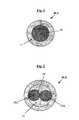
- the figure 1 attached shows very schematically (without respecting a specific scale), in cross section, a first example of a composite reinforcement according to the invention.
- This composite reinforcement denoted R-1 consists of a reinforcing thread (10) consisting of a unitary filament or monofilament of relatively high diameter (for example between 0.10 and 0.50 mm), for example made of carbon steel.
- a layer (11) comprising a thermoplastic polymer whose Tg (Tg 1 ) is positive, for example polyamide or polyester, a PPE such as PPO and a functionalised unsaturated TPS elastomer, for example SB, SBS , SBBS, SIS or SBIS of the epoxidized type, whose Tg (Tg 2 ) is negative; the minimum thickness of this layer is noted E m on this figure 1 .
- FIG. 2 schematizes in cross section a second example of a composite reinforcement according to the invention.
- This composite reinforcement denoted R-2 consists of a reinforcing thread (20) consisting in fact of two single filaments or monofilaments (20a, 20b) of relatively large diameter (for example between 0.10 and 0.50 mm) twisted or wired together, for example carbon steel; the reinforcing wire (20) is covered with a layer (21) of minimum thickness E m , comprising a thermoplastic polymer whose Tg (Tg 1 ) is positive, for example polyamide or polyester, an EPP such as PPO and a functionalized unsaturated TPS elastomer, for example an epoxidized SBS or SIS, for example SB, SBS, SBBS, SIS or SBIS, whose Tg (Tg 2 ) is negative.
- a thermoplastic polymer whose Tg (Tg 1 ) is positive, for example polyamide or polyester, an EPP such as PPO and a functionalized unsatur
- FIG 3 schematized in cross section another example of composite reinforcement according to the invention.
- This composite reinforcement denoted R-3 consists of three reinforcing threads (30) each consisting of two monofilaments (30a, 30b) of relatively large diameter (for example between 0.10 and 0.50 mm) twisted or cabled together, by example of carbon steel; the assembly constituted by the three reinforcing son (30) for example aligned is covered with a layer (31) comprising a thermoplastic polymer whose Tg (Tg 1 ) is positive, for example polyamide or polyester, a PPE such that PPO and an elastomer Functionalized unsaturated GST, for example SB, SBS, SBBS, SIS or SBIS of the epoxidized type, whose Tg (Tg 2 ) is negative.
- a thermoplastic polymer whose Tg (Tg 1 ) is positive, for example polyamide or polyester, a PPE such that PPO and an elastomer Functionalized unsaturated GST, for example SB, SBS
- This composite reinforcement R-4 comprises a reinforcing thread (40) consisting of a 1 + 6 structural steel wire, with a core wire or core wire (41a) and six filaments (41b) of the same diameter wound together in a helix around the central wire.
- This reinforcing wire or wire (40) is covered with a layer (42) of a polymer composition comprising a polyamide, a PPE such as PPO and a functionalized SBS elastomer, for example epoxidized.
- the minimum thickness E m of the sheath surrounding the wire or reinforcing son can vary to a very large extent depending on the particular embodiment of the invention. It is preferably between 1 ⁇ m and 2 mm, more preferably between 10 ⁇ m and 1 mm.
- the coating layer or sheath can be deposited individually on each of the reinforcement threads (in particular on each of the cables) (as a reminder that these reinforcing threads are unitary or not), as illustrated for example in Figures 1, 2 and 4 commented previously, or collectively deposited on several of the reinforcing son (especially on several of the cables) arranged appropriately, for example aligned in a main direction, as illustrated for example in the figure 3 .
- the composite reinforcement of the invention is prepared according to a specific process comprising at least the step according to which at least one (that is to say one or more) reinforcing thread is subjected to a sheathing operation, preferably by passing through through an extrusion head, by the above-described thermoplastic polymer composition layer comprising the thermoplastic polymer of which the Tg (Tg 1 ) is positive, the functionalized unsaturated thermoplastic styrene elastomer of which the Tg (Tg 2 ) is negative, and the PPE whose Tg (Tg 3 ) is preferably greater than 150 ° C.
- the above cladding step is conducted in a manner known to those skilled in the art, online and continuously; it consists for example simply to pass the reinforcing wire, through dies of suitable diameter, in an extrusion head heated to an appropriate temperature.
- the reinforcement son or son are preheated, for example by induction or by IR radiation, before passing through the head extrusion.
- the reinforcing son or son and sheathed are then cooled sufficiently to solidify the polymer layer, for example with air or other cold gas, or by passing through a bath of water. followed by a drying step.
- the composite reinforcement according to the invention thus obtained may optionally undergo heat treatment, directly at the extrusion outlet or subsequently after cooling.
- the covering of a reinforcing wire of diameter close to 0.6 mm, for example of a cable metal consisting simply of two elemental monofilaments of diameter 0.3 mm twisted together (as illustrated for example in the figure 2 ), by a layer of a polyamide composition, functionalized TPS elastomer and PPE, with a maximum thickness equal to about 0.4 mm, is produced on an extrusion-cladding line comprising two dies, a first die (counter-die or upstream die) of diameter equal to about 0.65 mm and a second die (or downstream die) of diameter equal to about 0.95 mm, both arranged in an extrusion head raised to about 230 ° vs.
- the polyamide mixture, functionalized TPS and PPE can be produced in situ, in the same extrusion head, the three components then being provided for example by three different feed hoppers; according to another possible embodiment, polyamide, TPS and EPP may also be used in the form of a premixed mixture, for example in the form of granules, a single feed hopper then being sufficient.
- the cable At the outlet of this cladding, the cable can be immersed in a tank filled with cold water, for cooling before passage of the receiving coil to the oven for drying.
- the cable (reinforcing wire) is advantageously preheated before passing through the extrusion head, for example by passing through an HF generator or through a heating tunnel.
- the composite reinforcement can for example pass through a tunnel furnace, for example several meters long, to undergo heat treatment under air.
- This treatment temperature is for example between 150 ° C and 300 ° C for treatment times of a few seconds to a few minutes depending on the case (for example between 10 s and 10 min), it being understood that the duration of treatment will be even shorter than the temperature will be high, and that the heat treatment should obviously not lead to reflow or even excessive softening of the thermoplastics used.
- the composite reinforcement of the invention is advantageously cooled, for example in air, to avoid problems of parasitic bonding during its winding on the final receiving coil.
- the previously described steps of the method of the invention may advantageously be completed by a final treatment of three-dimensional crosslinking of the reinforcement, to further reinforce the cohesion of its sheath, particularly in cases where this composite reinforcement is intended for use at a later date.
- relatively high temperature typically above 100 ° C.
- This crosslinking may be carried out by any known means, for example by physical crosslinking means such as ionic or electronic bombardment, or by chemical crosslinking means, for example by introducing a crosslinking agent (for example linseed oil) into the composition.
- a crosslinking agent for example linseed oil
- thermoplastic polymer for example during its extrusion, or by introducing into this composition a vulcanization system (that is to say a sulfur-based crosslinking system).
- Crosslinking may also be obtained during the baking of pneumatic tires (or more generally rubber articles) that the composite reinforcement of the invention is intended to reinforce, thanks to the own crosslinking system present in the diene rubber compositions constituting such bandages (or articles) and coming into contact with the composite reinforcement of the invention.
- the composite reinforcement of the invention can be used directly, that is to say without requiring any additional adhesive system, as a reinforcing element of a diene rubber matrix, for example in a tire. It is advantageously used for the reinforcement of pneumatic tires of all types of vehicles, in particular passenger vehicles or industrial vehicles such as heavy vehicles.
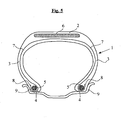
- the figure 5 attached shows very schematically (without respecting a specific scale), a radial section of a tire according to the invention for tourism type vehicle.
- This tire 1 has a crown 2 reinforced by a crown reinforcement or belt 6, two sidewalls 3 and two beads 4, each of these beads 4 being reinforced with a rod 5.
- the crown 2 is surmounted by a tread represented in this schematic figure.
- a carcass reinforcement 7 is wound around the two rods 5 in each bead 4, the upturn 8 of this armature 7 being for example disposed towards the outside of the tire 1 which is shown here mounted on its rim 9.
- the carcass reinforcement 7 is in known manner constituted of at least one sheet reinforced by so-called "radial” cables, for example textile or metal, that is to say that these cables are arranged substantially parallel to each other and s' extend from one bead to the other so as to form an angle of between 80 ° and 90 ° with the median circumferential plane (plane perpendicular to the axis of rotation of the tire which is located halfway between the two beads 4 and goes through the middle of the crown frame 6).
- radial cables for example textile or metal
- This tire 1 of the invention for example has the essential feature that at least one of its crown or carcass reinforcement comprises a composite reinforcement according to the invention.
- it is for example the rods 5 which could consist of a composite reinforcement according to the invention.
- the starting reinforcing thread is a steel cord (called “steel cord” ) for pneumatic tires (standard steel with 0.7% by weight of carbon), of 1x2 construction consisting of two elementary or monofilaments of diameter 0, 30 mm twisted together at a pitch of 10 mm. Its diameter is 0.6 mm.
- thermoplastic blend consisting of polyamide 6 (pump flow of about 42 g / min), epoxidized SBS (pump flow of about 12.6 g / min) and PPE (pump flow of about 5.4 g / min) (at 79/21/9 epoxidized polyamide / SBS / PPE weight ratios), is brought to a temperature of 230 ° C. and thus covers the wire (preheated to about 174 ° C. by passage through a generator HF) moving at a speed of 60 m / min.
- the composite reinforcement obtained is immersed continuously in a cooling tank filled with water at 5 ° C to cool its thermoplastic sheath, and then dried by an air nozzle.
- the glass transition temperatures, Tg 1 , Tg 2 and Tg 3 of the three types of polymers used above are respectively equal to approximately + 45 ° C., -95 ° C. and + 215 ° C. (for example, measured according to the operating mode).
- Mettler Toledo DSC "822-2” Helium atmosphere, samples previously brought from room temperature (20 ° C) to 100 ° C (20 ° C / min), then cooled rapidly to -140 ° C C, before final recording of the DSC curve from -140 ° C to + 300 ° C at 20 ° C / min).
- the assembly is subjected to a heat treatment of a duration of about 100 s, by passing at 3 m / min in a tunnel oven, under ambient atmosphere (air). raised to a temperature of 270 ° C.
- Composite reinforcements according to the invention are thus obtained (reinforcements R-2 as diagrammatically shown in FIG. figure 2 ), consisting of the starting steel cable sheathed with its layer of thermoplastic polymer composition (polyamide 6, EPP and epoxidized SBS elastomer) whose adhesion properties are optimal.
- the quality of the bond between the rubber and the composite reinforcements previously manufactured is then assessed by a test in which the force required to extract the reinforcements of a vulcanized rubber composition, also known as vulcanizate, is measured.
- This rubber composition is a conventional composition used for calendering tire belt metal plies, based on natural rubber, carbon black and conventional additives.
- the vulcanizate is a rubber block consisting of two plates of dimensions 200 mm by 4.5 mm and thickness 3.5 mm, applied one on the other before firing (the thickness of the resulting block is then 7 mm). It is during the manufacture of this block that the composite reinforcements (15 strands in total) are trapped between the two rubber plates in the state green, at equal distance and leaving on both sides of these plates a composite reinforcing end of sufficient length for the subsequent traction.
- the block comprising the reinforcements is then placed in a suitable mold and then cooked under pressure.
- the temperature and the cooking time are adapted to the targeted test conditions and left to the initiative of those skilled in the art; for example, in this case, the firing of the block is carried out at 160 ° C for 15 min, at a pressure of 16 bar.
- the test thus formed of the vulcanized block and the reinforcements is put in place in the jaws of a traction machine adapted to allow each reinforcement to be pulled apart from the rubber, at a speed and given temperature (for example, in the present case at 50 mm / min and 100 ° C).
- the adhesion levels are characterized by measuring the so-called pulling force (denoted F max ) for tearing the reinforcements from the specimen (average over 15 pulls).
- the composite reinforcement of the invention by its self-adhesive nature is a particularly interesting alternative, given the very high levels of adhesion obtained, especially at high temperature (100 ° C. or more), composite reinforcements of the prior art sheathed by a thermoplastic material such as polyamide or polyester, requiring in known manner the use of an RFL-type adhesive to ensure their subsequent adhesion to the rubber.
Landscapes
- Engineering & Computer Science (AREA)
- Mechanical Engineering (AREA)
- Textile Engineering (AREA)
- Ropes Or Cables (AREA)
- Compositions Of Macromolecular Compounds (AREA)
- Reinforced Plastic Materials (AREA)
- Tires In General (AREA)
- Laminated Bodies (AREA)
Applications Claiming Priority (2)
| Application Number | Priority Date | Filing Date | Title |
|---|---|---|---|
| FR1150858A FR2971188B1 (fr) | 2011-02-03 | 2011-02-03 | Renfort composite gaine d'une couche de polymere auto-adherente au caoutchouc |
| PCT/EP2012/051518 WO2012104281A1 (fr) | 2011-02-03 | 2012-01-31 | Renfort composite gaine d'une couche de polymere auto-adherente au caoutchouc |
Publications (2)
| Publication Number | Publication Date |
|---|---|
| EP2670585A1 EP2670585A1 (fr) | 2013-12-11 |
| EP2670585B1 true EP2670585B1 (fr) | 2015-04-22 |
Family
ID=44515149
Family Applications (1)
| Application Number | Title | Priority Date | Filing Date |
|---|---|---|---|
| EP20120703038 Active EP2670585B1 (fr) | 2011-02-03 | 2012-01-31 | Renfort composite gaine d'une couche de polymere auto-adherente au caoutchouc |
Country Status (7)
| Country | Link |
|---|---|
| US (1) | US9821606B2 (enExample) |
| EP (1) | EP2670585B1 (enExample) |
| JP (1) | JP6052555B2 (enExample) |
| KR (1) | KR20140046403A (enExample) |
| CN (1) | CN103338919B (enExample) |
| FR (1) | FR2971188B1 (enExample) |
| WO (1) | WO2012104281A1 (enExample) |
Families Citing this family (45)
| Publication number | Priority date | Publication date | Assignee | Title |
|---|---|---|---|---|
| FR2971266B1 (fr) * | 2011-02-03 | 2014-06-27 | Soc Tech Michelin | Materiau textile pourvu d'une colle thermoplastique |
| FR2975406B1 (fr) | 2011-05-18 | 2014-10-17 | Michelin Soc Tech | Cordon composite caoutchouteux pour bande de roulement de bandage pneumatique |
| FR2982884B1 (fr) | 2011-11-23 | 2014-06-06 | Michelin Soc Tech | Cable metallique a deux couches, gomme in situ par un elastomere thermoplastique insature |
| FR2982885B1 (fr) | 2011-11-23 | 2014-11-07 | Michelin Soc Tech | Procede de fabrication d'un cable metallique a deux couches gomme in situ par un elastomere thermoplastique insature |
| FR2995559B1 (fr) | 2012-09-17 | 2014-09-05 | Michelin & Cie | Pneumatique pourvu d'une bande de roulement comprenant un elastomere thermoplastique et du noir de carbone |
| FR3008996B1 (fr) | 2013-07-29 | 2016-01-01 | Michelin & Cie | Produit renforce a faible epaisseur et pneumatique comprenant ce produit |
| FR3008997B1 (fr) * | 2013-07-29 | 2016-01-01 | Michelin & Cie | Produit renforce a faible epaisseur et pneumatique comprenant ce produit |
| FR3008998B1 (fr) | 2013-07-29 | 2016-01-01 | Michelin & Cie | Produit renforce a faible epaisseur et pneumatique comprenant ce produit |
| FR3015505B1 (fr) * | 2013-12-20 | 2016-01-01 | Michelin & Cie | Composition de caoutchouc comprenant une resine de polyphenylene ether comme plastifiant |
| FR3015504B1 (fr) | 2013-12-20 | 2016-01-01 | Michelin & Cie | Composition de caoutchouc comprenant une resine de polyphenylene ether comme plastifiant |
| FR3020310B1 (fr) * | 2014-04-25 | 2016-04-15 | Michelin & Cie | Pneumatique comportant des epaisseurs de melanges caoutchouteux reduites et des elements de renforcement d'armature de carcasse gaines |
| FR3020311B1 (fr) * | 2014-04-25 | 2016-04-15 | Michelin & Cie | Pneumatique comprenant une nappe de carcasse comprenant des elements de renfort de carcasse gaines |
| FR3020369B1 (fr) | 2014-04-29 | 2016-05-06 | Michelin & Cie | Renfort plat multi-composite |
| JP6280436B2 (ja) * | 2014-05-02 | 2018-02-14 | 株式会社ブリヂストン | スチールワイヤ被覆用ゴム組成物およびこれを用いたスチールコードの製造方法 |
| FR3027026B1 (fr) | 2014-10-13 | 2016-12-09 | Michelin & Cie | Produit renforce comprenant une composition comprenant un accelerateur de vulcanisation rapide et pneumatique comprenant ledit produit renforce |
| FR3027028B1 (fr) | 2014-10-13 | 2016-12-09 | Michelin & Cie | Produit renforce comprenant une composition a faible taux de soufre et pneumatique comprenant ledit produit renforce |
| FR3027027B1 (fr) | 2014-10-13 | 2016-12-09 | Michelin & Cie | Produit renforce comprenant une composition comprenant un systeme oxyde metallique et derive d'acide stearique equilibre et pneumatique comprenant ledit produit renforce |
| FR3027025B1 (fr) | 2014-10-13 | 2016-12-09 | Michelin & Cie | Produit renforce comprenant une composition a faible taux de soufre et pneumatique comprenant ledit produit renforce |
| FR3032149B1 (fr) | 2015-02-03 | 2017-02-17 | Michelin & Cie | Pneu radial ayant une structure de ceinture tres fine |
| FR3032148B1 (fr) * | 2015-02-03 | 2017-02-17 | Michelin & Cie | Pneu radial ayant une structure de ceinture amelioree |
| FR3032147B1 (fr) * | 2015-02-03 | 2017-02-17 | Michelin & Cie | Pneu radial ayant une structure de ceinture amelioree |
| CN107709417A (zh) | 2015-05-28 | 2018-02-16 | 米其林集团总公司 | 由改进的玻璃树脂制成的多复合增强件 |
| FR3036651B1 (fr) | 2015-05-28 | 2017-05-19 | Michelin & Cie | Renfort plat multi-composite |
| FR3039095B1 (fr) * | 2015-07-21 | 2018-05-04 | Compagnie Generale Des Etablissements Michelin | Pneumatique comprenant des elements de renfort sous forme de bandelettes multicouches |
| FR3039096B1 (fr) * | 2015-07-21 | 2018-07-13 | Michelin & Cie | Pneumatique comprenant des elements de renfort sous forme de bandelettes partiellement superposees |
| FR3041282B1 (fr) | 2015-09-21 | 2017-10-20 | Michelin & Cie | Procede de fabrication d'un element de renfort gaine comprenant une etape de degraissage |
| DK201870778A1 (en) * | 2016-05-17 | 2019-01-22 | Hampidjan Hf. | Long lived synthetic rope for powered blocks |
| CN110753627B (zh) | 2017-06-16 | 2021-07-27 | 株式会社普利司通 | 轮胎用树脂金属复合部件和轮胎 |
| JP6785196B2 (ja) | 2017-06-16 | 2020-11-18 | 株式会社ブリヂストン | タイヤ用樹脂金属複合部材、及びタイヤ |
| JP2019001357A (ja) * | 2017-06-16 | 2019-01-10 | 株式会社ブリヂストン | タイヤ用樹脂金属複合部材、及びタイヤ |
| JP6785193B2 (ja) | 2017-06-16 | 2020-11-18 | 株式会社ブリヂストン | タイヤ用樹脂金属複合部材、及びタイヤ |
| JP6785194B2 (ja) | 2017-06-16 | 2020-11-18 | 株式会社ブリヂストン | タイヤ用樹脂金属複合部材、及びタイヤ |
| JP6785195B2 (ja) | 2017-06-16 | 2020-11-18 | 株式会社ブリヂストン | タイヤ用樹脂金属複合部材、及びタイヤ |
| CN111479765A (zh) | 2017-12-14 | 2020-07-31 | 米其林集团总公司 | 用于制备轮胎的加护套增强元件的导丝件 |
| WO2019115900A1 (fr) | 2017-12-15 | 2019-06-20 | Compagnie Generale Des Etablissements Michelin | Procédé de fabrication d'un produit renforcé par un élément de renfort |
| EP3728432A1 (fr) | 2017-12-19 | 2020-10-28 | Compagnie Generale Des Etablissements Michelin | Produit renforce comprenant une composition comprenant un compose polysulfuré et pneumatique comprenant ledit produit renforce |
| JPWO2019230822A1 (ja) | 2018-05-30 | 2021-07-29 | 株式会社ブリヂストン | タイヤ用樹脂金属複合部材、及びその製造方法、並びにタイヤ |
| FR3087197B1 (fr) | 2018-10-11 | 2020-10-23 | Michelin & Cie | Composant caoutchouc comprenant des elements de renforcement |
| WO2020128261A1 (fr) | 2018-12-21 | 2020-06-25 | Compagnie Generale Des Etablissements Michelin | Produit renforce comprenant une composition comportant un compose polysulfuré |
| FR3090644A3 (fr) | 2018-12-21 | 2020-06-26 | Michelin & Cie | Produit renforce comprenant une composition comportant un compose polysulfuré |
| FR3091206A3 (fr) | 2018-12-30 | 2020-07-03 | Michelin & Cie | Bloc guide-fil pour la fabrication d’éléments de renfort gainés pour pneumatiques |
| WO2021117418A1 (ja) * | 2019-12-12 | 2021-06-17 | 株式会社ブリヂストン | タイヤ用樹脂金属複合部材及びタイヤ |
| FR3112783B1 (fr) | 2020-07-24 | 2023-04-28 | Michelin & Cie | Produit renforcé obtenu par un procédé comprenant une étape de traitement thermique de la gaine |
| FR3143032A1 (fr) | 2022-12-08 | 2024-06-14 | Compagnie Generale Des Etablissements Michelin | Composite pour article de caoutchouc |
| FR3162670A1 (fr) | 2024-05-28 | 2025-12-05 | Compagnie Generale Des Etablissements Michelin | Bandage pour véhicule comprenant une nappe carcasse à déformabilité à cru améliorée |
Family Cites Families (74)
| Publication number | Priority date | Publication date | Assignee | Title |
|---|---|---|---|---|
| US3383340A (en) | 1965-05-12 | 1968-05-14 | Gen Electric | Reinforcing fillers for rubber |
| US3765998A (en) * | 1971-01-11 | 1973-10-16 | Allied Chem | Shapable fiber-reinforced low molecular weight polyethylene terephthalate |
| US3915939A (en) | 1974-02-21 | 1975-10-28 | Eastman Kodak Co | High temperature film forming polyamide polymers |
| US4173556A (en) | 1976-03-03 | 1979-11-06 | Monsanto Company | Elastoplastic compositions of rubber and polyamide |
| DE2816463C2 (de) | 1978-04-15 | 1982-02-18 | Asahi-Dow Ltd., Tokyo | Formmasse in Form von Zylindergranulat |
| DE3123716A1 (de) | 1981-06-15 | 1982-12-30 | Basf Ag, 6700 Ludwigshafen | Thermoplastische formmassen |
| FR2576247B1 (fr) | 1985-01-18 | 1987-07-31 | Michelin & Cie | Ensembles renforcants comportant des fils de renfort et une matrice; procede pour obtenir ces ensembles; articles comportant ces ensembles |
| FR2601293B1 (fr) | 1986-07-09 | 1988-11-18 | Michelin & Cie | Tringle gainee pour enveloppes de pneumatiques; procede pour realiser cette tringle; enveloppes de pneumatiques comportant cette tringle. |
| US4732928A (en) | 1985-10-02 | 1988-03-22 | Asahi Kasei Kogyo Kabushiki | Highly elastic thermoplastic elastomer composition |
| JP2629075B2 (ja) | 1992-01-21 | 1997-07-09 | アライド−シグナル・インコーポレーテッド | タイヤコードおよび複合材用の高モジュラスポリエステルヤーン |
| JPH069884A (ja) * | 1992-06-24 | 1994-01-18 | Mitsui Toatsu Chem Inc | 導電性樹脂組成物 |
| IT1277581B1 (it) | 1995-09-14 | 1997-11-11 | Enichem Elastomers | Composizione elastomerica utile come battistrada per pneumatici |
| JP3505897B2 (ja) | 1996-02-27 | 2004-03-15 | 三菱化学株式会社 | 熱可塑性エラストマー組成物 |
| US6077606A (en) | 1997-09-12 | 2000-06-20 | The Goodyear Tire & Rubber Company | Coated multi-filament reinforcing carbon yarn |
| EP0962562B1 (en) | 1998-06-05 | 2003-09-03 | W.L. GORE & ASSOCIATES GmbH | Yarn |
| AU1125299A (en) | 1998-10-28 | 2000-05-15 | Minnesota Mining And Manufacturing Company | Adhesive composition containing a block copolymer composition and polyphenylene oxide resin and products thereof |
| CN1145665C (zh) | 1999-05-28 | 2004-04-14 | 米凯林技术公司 | 用于轮胎的二烯弹性体和增强二氧化钛基的橡胶组合物 |
| US6346325B1 (en) | 1999-07-01 | 2002-02-12 | The Dow Chemical Company | Fiber-reinforced composite encased in a thermoplastic and method of making same |
| US20030075253A1 (en) | 1999-08-26 | 2003-04-24 | Antonio Serra | Process for producing tyres, tyres thus obtained and elastomeric compositions used therein |
| WO2001092402A1 (fr) | 2000-05-26 | 2001-12-06 | Societe De Technologie Michelin | Composition de caoutchouc utilisable comme bande de roulement de pneumatique |
| EP1299253B1 (fr) | 2000-06-29 | 2010-05-19 | Société de Technologie Michelin | Pneumatique a structure d'ancrage d'armature de carcasse perfectionnee |
| KR100803644B1 (ko) | 2000-09-11 | 2008-02-19 | 요코하마 고무 가부시키가이샤 | 타이어용 강철 코드 및 래디얼 타이어 |
| JP2002201577A (ja) | 2000-12-26 | 2002-07-19 | Times Engineering:Kk | Pc鋼材の防錆加工方法 |
| JP2004527666A (ja) | 2001-01-04 | 2004-09-09 | ソシエテ ド テクノロジー ミシュラン | タイヤのクラウン補強体の多層スチールケーブル |
| JP4627886B2 (ja) | 2001-01-10 | 2011-02-09 | 株式会社ブリヂストン | 複合強化ゴム材および空気入りタイヤ |
| US6903165B2 (en) | 2001-05-14 | 2005-06-07 | Daicel Chemical Industries, Ltd. | Process for producing epoxidized diene polymer |
| JP3797895B2 (ja) * | 2001-07-03 | 2006-07-19 | 日本ジーイープラスチックス株式会社 | ワイヤ・ケーブル被覆材用難燃性樹脂組成物 |
| KR100845750B1 (ko) | 2001-10-19 | 2008-07-11 | 제온 코포레이션 | 공액 디엔의 분리정제방법 및 분리정제장치 |
| US20030166772A1 (en) | 2002-01-07 | 2003-09-04 | Manoj Ajbani | Tread supporting ring for use with a rim for a tire having two beads |
| AU2003208965A1 (en) | 2002-02-04 | 2003-09-02 | Bridgestone Corporation | Belt for a pneumatic tire belt made of differente rubber compositions |
| US7045201B2 (en) | 2002-06-14 | 2006-05-16 | The Goodyear Tire & Rubber Company | Starch-modified aqueous adhesive dip, treated yarns therewith and tire having component of rubber composition containing such treated yarns |
| JP2004043670A (ja) | 2002-07-12 | 2004-02-12 | Daicel Degussa Ltd | 複合分散体及びその製造方法 |
| JP3786645B2 (ja) * | 2003-01-08 | 2006-06-14 | 住友電工スチールワイヤー株式会社 | 被覆pc鋼撚り線 |
| FR2854404B1 (fr) | 2003-04-29 | 2005-07-01 | Michelin Soc Tech | Procede d'obtention d'un elastomere greffe a groupes fonctionnels le long de la chaine et compositions de caoutchouc |
| US20040261928A1 (en) | 2003-06-27 | 2004-12-30 | Imhoff Serge Julien Auguste | Polyester cords and their use in runflat tires |
| US7414087B2 (en) | 2003-08-20 | 2008-08-19 | Sumitomo Rubber Industries, Ltd. | Rubber composition and pneumatic tire using the same |
| JP4054736B2 (ja) * | 2003-09-01 | 2008-03-05 | 有限会社よつあみ | 自己融着糸条の製造方法 |
| AU2003280837A1 (en) | 2003-11-17 | 2004-06-06 | Akihiro Yamamoto | Pneumatic tire and process for producing the same |
| FR2869618B1 (fr) | 2004-04-30 | 2008-10-10 | Michelin Soc Tech | Composition de caoutchouc a adhesion amelioree vis a vis d'un renfort metallique. |
| US20090065117A1 (en) | 2004-07-28 | 2009-03-12 | Pirelli Pneumatic S.P.A. | Tyre comprising an epoxidized elastomeric polymer and crosslinkable elastomeric composition |
| MX2007005647A (es) | 2005-07-07 | 2007-06-05 | Dow Global Technologies Inc | Concentrado termoplastico reforzado con fibra larga y metodo para su preparacion. |
| US20070066740A1 (en) | 2005-09-16 | 2007-03-22 | Odle Roy R | Annular or tubular shaped articles of novel polymer blends |
| DE602005019797D1 (de) | 2005-10-27 | 2010-04-15 | Yokohama Rubber Co Ltd | Thermoplastische elastomerzusammensetzung und herstellungsverfahren dafür |
| BRPI0602097B1 (pt) | 2006-05-25 | 2017-04-04 | Ge Plastic South America Ltda | processo de confecção de compósitos de poliamidas com fibras naturais e compósitos de poliamidas com fibras naturais |
| US7408116B2 (en) | 2006-06-23 | 2008-08-05 | Delphi Technologies, Inc. | Insulated non-halogenated heavy metal free vehicular cable |
| JP4252076B2 (ja) * | 2006-09-01 | 2009-04-08 | 株式会社オートネットワーク技術研究所 | 絶縁電線およびワイヤーハーネス |
| US7585906B2 (en) | 2007-02-28 | 2009-09-08 | Sabic Innovative Plastics Ip B.V. | Poly(arylene ether) composition, method, and article |
| US20080306215A1 (en) * | 2007-06-06 | 2008-12-11 | Abhimanyu Onkar Patil | Functionalization of olefin/diene copolymers |
| KR20100087158A (ko) | 2007-10-09 | 2010-08-03 | 크레이튼 폴리머즈 유.에스. 엘엘씨 | 특정 블록 공중합체로 제조된 최종 용도 제품 |
| EP2070952A1 (en) | 2007-12-14 | 2009-06-17 | Continental Aktiengesellschaft | Vulcanizable rubber mixture and its use for rubber products |
| JP2009301777A (ja) * | 2008-06-11 | 2009-12-24 | Autonetworks Technologies Ltd | 絶縁電線およびワイヤーハーネス |
| US8871866B2 (en) * | 2008-11-19 | 2014-10-28 | Sabic Global Technologies B.V. | Poly(arylene ether) composition and a covered conductor with flexible covering wall and large size conductor |
| EP2351621B1 (en) | 2008-10-30 | 2014-12-10 | Bridgestone Corporation | Carbon steel wire with high strength and excellent ductility and fatigue resistance, process for producing same, and method of evaluation |
| JP5287281B2 (ja) | 2009-01-19 | 2013-09-11 | 横浜ゴム株式会社 | 空気入りタイヤの製造方法及び空気入りタイヤ |
| FR2943269B1 (fr) | 2009-03-20 | 2011-04-22 | Michelin Soc Tech | Renfort composite auto-adherent |
| EP2421009B1 (en) | 2009-04-13 | 2013-06-05 | Yazaki Corporation | Resin composition for heat-resistant electric wire, and heat-resistant electric wire |
| FR2945826B1 (fr) | 2009-05-25 | 2011-12-02 | Michelin Soc Tech | Renfort composite auto-adherent |
| FR2948376B1 (fr) | 2009-07-23 | 2011-11-18 | Michelin Soc Tech | Objet pneumatique pourvu d'une couche etanche aux gaz a base d'un elastomere thermoplastique et d'une charge lamellaire. |
| FR2948320B1 (fr) | 2009-07-27 | 2011-07-29 | Michelin Soc Tech | Objet pneumatique pourvu d'une couche etanche aux gaz a base d'un elastomere thermoplastique et d'une charge lamellaire. |
| FR2948598B1 (fr) | 2009-07-31 | 2011-08-19 | Michelin Soc Tech | Renfort composite |
| FR2952076B1 (fr) | 2009-10-29 | 2011-12-02 | Michelin Soc Tech | Renfort composite |
| FR2954336B1 (fr) | 2009-12-23 | 2013-01-04 | Michelin Soc Tech | Objet pneumatique pourvu d'une couche etanche aux gaz a base d'un elastomere thermoplastique styrenique et d'un polyphenylene ether |
| FR2959234B1 (fr) | 2010-04-21 | 2013-09-27 | Michelin Soc Tech | Objet pneumatique pourvu d'une couche etanche aux gaz a base d'un elastomere thermoplastique et d'une resine hydrocarbonee. |
| FR2960879B1 (fr) | 2010-06-02 | 2012-07-13 | Michelin Soc Tech | Procede d'obtention d'une composition de caoutchouc comprenant une charge thermoplastique |
| FR2961818B1 (fr) | 2010-06-23 | 2012-07-20 | Michelin Soc Tech | Composition de caoutchouc comprenant une charge thermoplastique et un agent compatibilisant |
| FR2965208B1 (fr) | 2010-09-23 | 2012-10-12 | Michelin Soc Tech | Renfort composite |
| FR2971187B1 (fr) | 2011-02-03 | 2013-03-08 | Michelin Soc Tech | Renfort composite gaine d'une couche de polymere auto-adherente au caoutchouc |
| FR2971266B1 (fr) | 2011-02-03 | 2014-06-27 | Soc Tech Michelin | Materiau textile pourvu d'une colle thermoplastique |
| FR2975407B1 (fr) | 2011-05-18 | 2014-11-28 | Michelin Soc Tech | Cordon composite pour bande de roulement de bandage pneumatique |
| FR2982885B1 (fr) | 2011-11-23 | 2014-11-07 | Michelin Soc Tech | Procede de fabrication d'un cable metallique a deux couches gomme in situ par un elastomere thermoplastique insature |
| FR2982884B1 (fr) | 2011-11-23 | 2014-06-06 | Michelin Soc Tech | Cable metallique a deux couches, gomme in situ par un elastomere thermoplastique insature |
| FR2984225B1 (fr) | 2011-12-16 | 2014-04-25 | Michelin Soc Tech | Bandage pneumatique avec une bande de roulement comportant un feutre impregne |
| FR2986455B1 (fr) * | 2012-02-08 | 2014-10-31 | Michelin & Cie | Renfort composite gaine d'une couche de polymere auto-adherente au caoutchouc |
| FR2986456B1 (fr) | 2012-02-08 | 2014-03-07 | Michelin & Cie | Renfort composite gaine d'une couche de polymere auto-adherente au caoutchouc |
-
2011
- 2011-02-03 FR FR1150858A patent/FR2971188B1/fr not_active Expired - Fee Related
-
2012
- 2012-01-31 JP JP2013552179A patent/JP6052555B2/ja active Active
- 2012-01-31 WO PCT/EP2012/051518 patent/WO2012104281A1/fr not_active Ceased
- 2012-01-31 US US13/981,769 patent/US9821606B2/en active Active
- 2012-01-31 KR KR1020137023224A patent/KR20140046403A/ko not_active Withdrawn
- 2012-01-31 EP EP20120703038 patent/EP2670585B1/fr active Active
- 2012-01-31 CN CN201280007186.2A patent/CN103338919B/zh active Active
Also Published As
| Publication number | Publication date |
|---|---|
| JP2014510800A (ja) | 2014-05-01 |
| EP2670585A1 (fr) | 2013-12-11 |
| JP6052555B2 (ja) | 2016-12-27 |
| WO2012104281A1 (fr) | 2012-08-09 |
| US9821606B2 (en) | 2017-11-21 |
| FR2971188A1 (fr) | 2012-08-10 |
| KR20140046403A (ko) | 2014-04-18 |
| FR2971188B1 (fr) | 2013-03-08 |
| CN103338919B (zh) | 2016-01-20 |
| CN103338919A (zh) | 2013-10-02 |
| US20140045983A1 (en) | 2014-02-13 |
Similar Documents
| Publication | Publication Date | Title |
|---|---|---|
| EP2670585B1 (fr) | Renfort composite gaine d'une couche de polymere auto-adherente au caoutchouc | |
| EP2670609B1 (fr) | Renfort composite gaine d'une couche de polymere auto-adherente au caoutchouc et son et procédé de fabrication associé | |
| EP2494105B1 (fr) | Renfort composite auto-adherent | |
| EP2459358B1 (fr) | Renfort composite auto-adherent et son procédé de fabrication | |
| EP2812178B1 (fr) | Renfort composite gaine d'une couche de polymere auto-adherente au caoutchouc et procédé de fabrication associé | |
| EP2643515B1 (fr) | Renfort composite auto-adherent | |
| EP2618976B1 (fr) | Bandage pneumatique comportant un renfort composite auto-adherent | |
| EP2408612B1 (fr) | Renfort composite auto-adherent, son procédé de fabrication et bandage pneumatique | |
| EP2670905B1 (fr) | Composite de caoutchouc renforce d'un materiau textile pourvu d'une colle thermoplastique | |
| EP2435627B1 (fr) | Renfort composite auto-adherent, particulièrement pour les pneumatiques, et procédé de fabrication associé | |
| EP2618975B1 (fr) | Renfort composite et son procede de fabrication | |
| EP2812177B1 (fr) | Renfort composite gaine d'une couche de polymere auto-adherente au caoutchouc et procédé de fabrication associé | |
| WO2012016757A1 (fr) | Renfort composite |
Legal Events
| Date | Code | Title | Description |
|---|---|---|---|
| PUAI | Public reference made under article 153(3) epc to a published international application that has entered the european phase |
Free format text: ORIGINAL CODE: 0009012 |
|
| 17P | Request for examination filed |
Effective date: 20130903 |
|
| AK | Designated contracting states |
Kind code of ref document: A1 Designated state(s): AL AT BE BG CH CY CZ DE DK EE ES FI FR GB GR HR HU IE IS IT LI LT LU LV MC MK MT NL NO PL PT RO RS SE SI SK SM TR |
|
| DAX | Request for extension of the european patent (deleted) | ||
| GRAP | Despatch of communication of intention to grant a patent |
Free format text: ORIGINAL CODE: EPIDOSNIGR1 |
|
| INTG | Intention to grant announced |
Effective date: 20141218 |
|
| GRAS | Grant fee paid |
Free format text: ORIGINAL CODE: EPIDOSNIGR3 |
|
| GRAA | (expected) grant |
Free format text: ORIGINAL CODE: 0009210 |
|
| AK | Designated contracting states |
Kind code of ref document: B1 Designated state(s): AL AT BE BG CH CY CZ DE DK EE ES FI FR GB GR HR HU IE IS IT LI LT LU LV MC MK MT NL NO PL PT RO RS SE SI SK SM TR |
|
| REG | Reference to a national code |
Ref country code: GB Ref legal event code: FG4D Free format text: NOT ENGLISH |
|
| REG | Reference to a national code |
Ref country code: CH Ref legal event code: EP |
|
| REG | Reference to a national code |
Ref country code: AT Ref legal event code: REF Ref document number: 722947 Country of ref document: AT Kind code of ref document: T Effective date: 20150515 |
|
| REG | Reference to a national code |
Ref country code: IE Ref legal event code: FG4D Free format text: LANGUAGE OF EP DOCUMENT: FRENCH |
|
| REG | Reference to a national code |
Ref country code: DE Ref legal event code: R096 Ref document number: 602012006859 Country of ref document: DE Effective date: 20150603 |
|
| REG | Reference to a national code |
Ref country code: NL Ref legal event code: VDEP Effective date: 20150422 |
|
| REG | Reference to a national code |
Ref country code: AT Ref legal event code: MK05 Ref document number: 722947 Country of ref document: AT Kind code of ref document: T Effective date: 20150422 |
|
| REG | Reference to a national code |
Ref country code: LT Ref legal event code: MG4D |
|
| PG25 | Lapsed in a contracting state [announced via postgrant information from national office to epo] |
Ref country code: NL Free format text: LAPSE BECAUSE OF FAILURE TO SUBMIT A TRANSLATION OF THE DESCRIPTION OR TO PAY THE FEE WITHIN THE PRESCRIBED TIME-LIMIT Effective date: 20150422 |
|
| PG25 | Lapsed in a contracting state [announced via postgrant information from national office to epo] |
Ref country code: NO Free format text: LAPSE BECAUSE OF FAILURE TO SUBMIT A TRANSLATION OF THE DESCRIPTION OR TO PAY THE FEE WITHIN THE PRESCRIBED TIME-LIMIT Effective date: 20150722 Ref country code: PT Free format text: LAPSE BECAUSE OF FAILURE TO SUBMIT A TRANSLATION OF THE DESCRIPTION OR TO PAY THE FEE WITHIN THE PRESCRIBED TIME-LIMIT Effective date: 20150824 Ref country code: FI Free format text: LAPSE BECAUSE OF FAILURE TO SUBMIT A TRANSLATION OF THE DESCRIPTION OR TO PAY THE FEE WITHIN THE PRESCRIBED TIME-LIMIT Effective date: 20150422 Ref country code: HR Free format text: LAPSE BECAUSE OF FAILURE TO SUBMIT A TRANSLATION OF THE DESCRIPTION OR TO PAY THE FEE WITHIN THE PRESCRIBED TIME-LIMIT Effective date: 20150422 Ref country code: ES Free format text: LAPSE BECAUSE OF FAILURE TO SUBMIT A TRANSLATION OF THE DESCRIPTION OR TO PAY THE FEE WITHIN THE PRESCRIBED TIME-LIMIT Effective date: 20150422 Ref country code: LT Free format text: LAPSE BECAUSE OF FAILURE TO SUBMIT A TRANSLATION OF THE DESCRIPTION OR TO PAY THE FEE WITHIN THE PRESCRIBED TIME-LIMIT Effective date: 20150422 |
|
| PG25 | Lapsed in a contracting state [announced via postgrant information from national office to epo] |
Ref country code: RS Free format text: LAPSE BECAUSE OF FAILURE TO SUBMIT A TRANSLATION OF THE DESCRIPTION OR TO PAY THE FEE WITHIN THE PRESCRIBED TIME-LIMIT Effective date: 20150422 Ref country code: GR Free format text: LAPSE BECAUSE OF FAILURE TO SUBMIT A TRANSLATION OF THE DESCRIPTION OR TO PAY THE FEE WITHIN THE PRESCRIBED TIME-LIMIT Effective date: 20150723 Ref country code: AT Free format text: LAPSE BECAUSE OF FAILURE TO SUBMIT A TRANSLATION OF THE DESCRIPTION OR TO PAY THE FEE WITHIN THE PRESCRIBED TIME-LIMIT Effective date: 20150422 Ref country code: LV Free format text: LAPSE BECAUSE OF FAILURE TO SUBMIT A TRANSLATION OF THE DESCRIPTION OR TO PAY THE FEE WITHIN THE PRESCRIBED TIME-LIMIT Effective date: 20150422 Ref country code: IS Free format text: LAPSE BECAUSE OF FAILURE TO SUBMIT A TRANSLATION OF THE DESCRIPTION OR TO PAY THE FEE WITHIN THE PRESCRIBED TIME-LIMIT Effective date: 20150822 |
|
| REG | Reference to a national code |
Ref country code: FR Ref legal event code: PLFP Year of fee payment: 5 |
|
| REG | Reference to a national code |
Ref country code: DE Ref legal event code: R097 Ref document number: 602012006859 Country of ref document: DE |
|
| PG25 | Lapsed in a contracting state [announced via postgrant information from national office to epo] |
Ref country code: EE Free format text: LAPSE BECAUSE OF FAILURE TO SUBMIT A TRANSLATION OF THE DESCRIPTION OR TO PAY THE FEE WITHIN THE PRESCRIBED TIME-LIMIT Effective date: 20150422 Ref country code: DK Free format text: LAPSE BECAUSE OF FAILURE TO SUBMIT A TRANSLATION OF THE DESCRIPTION OR TO PAY THE FEE WITHIN THE PRESCRIBED TIME-LIMIT Effective date: 20150422 |
|
| PLBE | No opposition filed within time limit |
Free format text: ORIGINAL CODE: 0009261 |
|
| STAA | Information on the status of an ep patent application or granted ep patent |
Free format text: STATUS: NO OPPOSITION FILED WITHIN TIME LIMIT |
|
| PG25 | Lapsed in a contracting state [announced via postgrant information from national office to epo] |
Ref country code: SK Free format text: LAPSE BECAUSE OF FAILURE TO SUBMIT A TRANSLATION OF THE DESCRIPTION OR TO PAY THE FEE WITHIN THE PRESCRIBED TIME-LIMIT Effective date: 20150422 Ref country code: PL Free format text: LAPSE BECAUSE OF FAILURE TO SUBMIT A TRANSLATION OF THE DESCRIPTION OR TO PAY THE FEE WITHIN THE PRESCRIBED TIME-LIMIT Effective date: 20150422 Ref country code: RO Free format text: LAPSE BECAUSE OF NON-PAYMENT OF DUE FEES Effective date: 20150422 Ref country code: CZ Free format text: LAPSE BECAUSE OF FAILURE TO SUBMIT A TRANSLATION OF THE DESCRIPTION OR TO PAY THE FEE WITHIN THE PRESCRIBED TIME-LIMIT Effective date: 20150422 |
|
| 26N | No opposition filed |
Effective date: 20160125 |
|
| PG25 | Lapsed in a contracting state [announced via postgrant information from national office to epo] |
Ref country code: IT Free format text: LAPSE BECAUSE OF FAILURE TO SUBMIT A TRANSLATION OF THE DESCRIPTION OR TO PAY THE FEE WITHIN THE PRESCRIBED TIME-LIMIT Effective date: 20150422 |
|
| PG25 | Lapsed in a contracting state [announced via postgrant information from national office to epo] |
Ref country code: BE Free format text: LAPSE BECAUSE OF NON-PAYMENT OF DUE FEES Effective date: 20160131 Ref country code: SI Free format text: LAPSE BECAUSE OF FAILURE TO SUBMIT A TRANSLATION OF THE DESCRIPTION OR TO PAY THE FEE WITHIN THE PRESCRIBED TIME-LIMIT Effective date: 20150422 |
|
| PG25 | Lapsed in a contracting state [announced via postgrant information from national office to epo] |
Ref country code: LU Free format text: LAPSE BECAUSE OF FAILURE TO SUBMIT A TRANSLATION OF THE DESCRIPTION OR TO PAY THE FEE WITHIN THE PRESCRIBED TIME-LIMIT Effective date: 20160131 |
|
| REG | Reference to a national code |
Ref country code: CH Ref legal event code: PL |
|
| GBPC | Gb: european patent ceased through non-payment of renewal fee |
Effective date: 20160131 |
|
| PG25 | Lapsed in a contracting state [announced via postgrant information from national office to epo] |
Ref country code: MC Free format text: LAPSE BECAUSE OF FAILURE TO SUBMIT A TRANSLATION OF THE DESCRIPTION OR TO PAY THE FEE WITHIN THE PRESCRIBED TIME-LIMIT Effective date: 20150422 |
|
| PG25 | Lapsed in a contracting state [announced via postgrant information from national office to epo] |
Ref country code: CH Free format text: LAPSE BECAUSE OF NON-PAYMENT OF DUE FEES Effective date: 20160131 Ref country code: GB Free format text: LAPSE BECAUSE OF NON-PAYMENT OF DUE FEES Effective date: 20160131 Ref country code: LI Free format text: LAPSE BECAUSE OF NON-PAYMENT OF DUE FEES Effective date: 20160131 |
|
| REG | Reference to a national code |
Ref country code: IE Ref legal event code: MM4A |
|
| REG | Reference to a national code |
Ref country code: FR Ref legal event code: PLFP Year of fee payment: 6 |
|
| PG25 | Lapsed in a contracting state [announced via postgrant information from national office to epo] |
Ref country code: IE Free format text: LAPSE BECAUSE OF NON-PAYMENT OF DUE FEES Effective date: 20160131 |
|
| PG25 | Lapsed in a contracting state [announced via postgrant information from national office to epo] |
Ref country code: SE Free format text: LAPSE BECAUSE OF FAILURE TO SUBMIT A TRANSLATION OF THE DESCRIPTION OR TO PAY THE FEE WITHIN THE PRESCRIBED TIME-LIMIT Effective date: 20150422 |
|
| PG25 | Lapsed in a contracting state [announced via postgrant information from national office to epo] |
Ref country code: MT Free format text: LAPSE BECAUSE OF FAILURE TO SUBMIT A TRANSLATION OF THE DESCRIPTION OR TO PAY THE FEE WITHIN THE PRESCRIBED TIME-LIMIT Effective date: 20150422 |
|
| REG | Reference to a national code |
Ref country code: FR Ref legal event code: PLFP Year of fee payment: 7 |
|
| PG25 | Lapsed in a contracting state [announced via postgrant information from national office to epo] |
Ref country code: HU Free format text: LAPSE BECAUSE OF FAILURE TO SUBMIT A TRANSLATION OF THE DESCRIPTION OR TO PAY THE FEE WITHIN THE PRESCRIBED TIME-LIMIT; INVALID AB INITIO Effective date: 20120131 Ref country code: CY Free format text: LAPSE BECAUSE OF FAILURE TO SUBMIT A TRANSLATION OF THE DESCRIPTION OR TO PAY THE FEE WITHIN THE PRESCRIBED TIME-LIMIT Effective date: 20150422 Ref country code: SM Free format text: LAPSE BECAUSE OF FAILURE TO SUBMIT A TRANSLATION OF THE DESCRIPTION OR TO PAY THE FEE WITHIN THE PRESCRIBED TIME-LIMIT Effective date: 20150422 |
|
| PG25 | Lapsed in a contracting state [announced via postgrant information from national office to epo] |
Ref country code: TR Free format text: LAPSE BECAUSE OF FAILURE TO SUBMIT A TRANSLATION OF THE DESCRIPTION OR TO PAY THE FEE WITHIN THE PRESCRIBED TIME-LIMIT Effective date: 20150422 Ref country code: MK Free format text: LAPSE BECAUSE OF FAILURE TO SUBMIT A TRANSLATION OF THE DESCRIPTION OR TO PAY THE FEE WITHIN THE PRESCRIBED TIME-LIMIT Effective date: 20150422 |
|
| PG25 | Lapsed in a contracting state [announced via postgrant information from national office to epo] |
Ref country code: BG Free format text: LAPSE BECAUSE OF FAILURE TO SUBMIT A TRANSLATION OF THE DESCRIPTION OR TO PAY THE FEE WITHIN THE PRESCRIBED TIME-LIMIT Effective date: 20150422 |
|
| PG25 | Lapsed in a contracting state [announced via postgrant information from national office to epo] |
Ref country code: AL Free format text: LAPSE BECAUSE OF FAILURE TO SUBMIT A TRANSLATION OF THE DESCRIPTION OR TO PAY THE FEE WITHIN THE PRESCRIBED TIME-LIMIT Effective date: 20150422 |
|
| REG | Reference to a national code |
Ref country code: DE Ref legal event code: R081 Ref document number: 602012006859 Country of ref document: DE Owner name: COMPAGNIE GENERALE DES ETABLISSEMENTS MICHELIN, FR Free format text: FORMER OWNERS: COMPAGNIE GENERALE DES ETABLISSEMENTS MICHELIN, CLERMONT-FERRAND, FR; MICHELIN RECHERCHE ET TECHNIQUE S.A., GRANGES-PACCOT, CH |
|
| PGFP | Annual fee paid to national office [announced via postgrant information from national office to epo] |
Ref country code: DE Payment date: 20250121 Year of fee payment: 14 |
|
| PGFP | Annual fee paid to national office [announced via postgrant information from national office to epo] |
Ref country code: FR Payment date: 20250127 Year of fee payment: 14 |