EP2665043A1 - Method and system for providing information from a patient-specific model of blood flow - Google Patents
Method and system for providing information from a patient-specific model of blood flow Download PDFInfo
- Publication number
- EP2665043A1 EP2665043A1 EP20120171882 EP12171882A EP2665043A1 EP 2665043 A1 EP2665043 A1 EP 2665043A1 EP 20120171882 EP20120171882 EP 20120171882 EP 12171882 A EP12171882 A EP 12171882A EP 2665043 A1 EP2665043 A1 EP 2665043A1
- Authority
- EP
- European Patent Office
- Prior art keywords
- location
- touchscreen
- dimensional model
- model
- patient
- Prior art date
- Legal status (The legal status is an assumption and is not a legal conclusion. Google has not performed a legal analysis and makes no representation as to the accuracy of the status listed.)
- Ceased
Links
Images

Classifications
-
- A—HUMAN NECESSITIES
- A61—MEDICAL OR VETERINARY SCIENCE; HYGIENE
- A61B—DIAGNOSIS; SURGERY; IDENTIFICATION
- A61B34/00—Computer-aided surgery; Manipulators or robots specially adapted for use in surgery
- A61B34/10—Computer-aided planning, simulation or modelling of surgical operations
-
- A—HUMAN NECESSITIES
- A61—MEDICAL OR VETERINARY SCIENCE; HYGIENE
- A61B—DIAGNOSIS; SURGERY; IDENTIFICATION
- A61B5/00—Measuring for diagnostic purposes; Identification of persons
- A61B5/02—Detecting, measuring or recording for evaluating the cardiovascular system, e.g. pulse, heart rate, blood pressure or blood flow
- A61B5/02007—Evaluating blood vessel condition, e.g. elasticity, compliance
-
- A—HUMAN NECESSITIES
- A61—MEDICAL OR VETERINARY SCIENCE; HYGIENE
- A61B—DIAGNOSIS; SURGERY; IDENTIFICATION
- A61B5/00—Measuring for diagnostic purposes; Identification of persons
- A61B5/02—Detecting, measuring or recording for evaluating the cardiovascular system, e.g. pulse, heart rate, blood pressure or blood flow
- A61B5/021—Measuring pressure in heart or blood vessels
-
- A—HUMAN NECESSITIES
- A61—MEDICAL OR VETERINARY SCIENCE; HYGIENE
- A61B—DIAGNOSIS; SURGERY; IDENTIFICATION
- A61B5/00—Measuring for diagnostic purposes; Identification of persons
- A61B5/02—Detecting, measuring or recording for evaluating the cardiovascular system, e.g. pulse, heart rate, blood pressure or blood flow
- A61B5/026—Measuring blood flow
-
- A—HUMAN NECESSITIES
- A61—MEDICAL OR VETERINARY SCIENCE; HYGIENE
- A61B—DIAGNOSIS; SURGERY; IDENTIFICATION
- A61B5/00—Measuring for diagnostic purposes; Identification of persons
- A61B5/02—Detecting, measuring or recording for evaluating the cardiovascular system, e.g. pulse, heart rate, blood pressure or blood flow
- A61B5/026—Measuring blood flow
- A61B5/0263—Measuring blood flow using NMR
-
- A—HUMAN NECESSITIES
- A61—MEDICAL OR VETERINARY SCIENCE; HYGIENE
- A61B—DIAGNOSIS; SURGERY; IDENTIFICATION
- A61B5/00—Measuring for diagnostic purposes; Identification of persons
- A61B5/05—Detecting, measuring or recording for diagnosis by means of electric currents or magnetic fields; Measuring using microwaves or radio waves
- A61B5/055—Detecting, measuring or recording for diagnosis by means of electric currents or magnetic fields; Measuring using microwaves or radio waves involving electronic [EMR] or nuclear [NMR] magnetic resonance, e.g. magnetic resonance imaging
-
- A—HUMAN NECESSITIES
- A61—MEDICAL OR VETERINARY SCIENCE; HYGIENE
- A61B—DIAGNOSIS; SURGERY; IDENTIFICATION
- A61B5/00—Measuring for diagnostic purposes; Identification of persons
- A61B5/72—Signal processing specially adapted for physiological signals or for diagnostic purposes
- A61B5/7271—Specific aspects of physiological measurement analysis
- A61B5/7275—Determining trends in physiological measurement data; Predicting development of a medical condition based on physiological measurements, e.g. determining a risk factor
-
- A—HUMAN NECESSITIES
- A61—MEDICAL OR VETERINARY SCIENCE; HYGIENE
- A61B—DIAGNOSIS; SURGERY; IDENTIFICATION
- A61B5/00—Measuring for diagnostic purposes; Identification of persons
- A61B5/72—Signal processing specially adapted for physiological signals or for diagnostic purposes
- A61B5/7271—Specific aspects of physiological measurement analysis
- A61B5/7278—Artificial waveform generation or derivation, e.g. synthesizing signals from measured signals
-
- A—HUMAN NECESSITIES
- A61—MEDICAL OR VETERINARY SCIENCE; HYGIENE
- A61B—DIAGNOSIS; SURGERY; IDENTIFICATION
- A61B5/00—Measuring for diagnostic purposes; Identification of persons
- A61B5/74—Details of notification to user or communication with user or patient; User input means
- A61B5/742—Details of notification to user or communication with user or patient; User input means using visual displays
- A61B5/7425—Displaying combinations of multiple images regardless of image source, e.g. displaying a reference anatomical image with a live image
-
- A—HUMAN NECESSITIES
- A61—MEDICAL OR VETERINARY SCIENCE; HYGIENE
- A61B—DIAGNOSIS; SURGERY; IDENTIFICATION
- A61B5/00—Measuring for diagnostic purposes; Identification of persons
- A61B5/74—Details of notification to user or communication with user or patient; User input means
- A61B5/742—Details of notification to user or communication with user or patient; User input means using visual displays
- A61B5/7445—Display arrangements, e.g. multiple display units
-
- A—HUMAN NECESSITIES
- A61—MEDICAL OR VETERINARY SCIENCE; HYGIENE
- A61B—DIAGNOSIS; SURGERY; IDENTIFICATION
- A61B5/00—Measuring for diagnostic purposes; Identification of persons
- A61B5/74—Details of notification to user or communication with user or patient; User input means
- A61B5/7475—User input or interface means, e.g. keyboard, pointing device, joystick
- A61B5/748—Selection of a region of interest, e.g. using a graphics tablet
-
- A—HUMAN NECESSITIES
- A61—MEDICAL OR VETERINARY SCIENCE; HYGIENE
- A61B—DIAGNOSIS; SURGERY; IDENTIFICATION
- A61B6/00—Apparatus or devices for radiation diagnosis; Apparatus or devices for radiation diagnosis combined with radiation therapy equipment
- A61B6/02—Arrangements for diagnosis sequentially in different planes; Stereoscopic radiation diagnosis
- A61B6/03—Computed tomography [CT]
-
- A—HUMAN NECESSITIES
- A61—MEDICAL OR VETERINARY SCIENCE; HYGIENE
- A61B—DIAGNOSIS; SURGERY; IDENTIFICATION
- A61B6/00—Apparatus or devices for radiation diagnosis; Apparatus or devices for radiation diagnosis combined with radiation therapy equipment
- A61B6/02—Arrangements for diagnosis sequentially in different planes; Stereoscopic radiation diagnosis
- A61B6/03—Computed tomography [CT]
- A61B6/032—Transmission computed tomography [CT]
-
- A—HUMAN NECESSITIES
- A61—MEDICAL OR VETERINARY SCIENCE; HYGIENE
- A61B—DIAGNOSIS; SURGERY; IDENTIFICATION
- A61B6/00—Apparatus or devices for radiation diagnosis; Apparatus or devices for radiation diagnosis combined with radiation therapy equipment
- A61B6/46—Arrangements for interfacing with the operator or the patient
- A61B6/461—Displaying means of special interest
- A61B6/466—Displaying means of special interest adapted to display 3D data
-
- A—HUMAN NECESSITIES
- A61—MEDICAL OR VETERINARY SCIENCE; HYGIENE
- A61B—DIAGNOSIS; SURGERY; IDENTIFICATION
- A61B6/00—Apparatus or devices for radiation diagnosis; Apparatus or devices for radiation diagnosis combined with radiation therapy equipment
- A61B6/50—Apparatus or devices for radiation diagnosis; Apparatus or devices for radiation diagnosis combined with radiation therapy equipment specially adapted for specific body parts; specially adapted for specific clinical applications
- A61B6/504—Apparatus or devices for radiation diagnosis; Apparatus or devices for radiation diagnosis combined with radiation therapy equipment specially adapted for specific body parts; specially adapted for specific clinical applications for diagnosis of blood vessels, e.g. by angiography
-
- A—HUMAN NECESSITIES
- A61—MEDICAL OR VETERINARY SCIENCE; HYGIENE
- A61B—DIAGNOSIS; SURGERY; IDENTIFICATION
- A61B6/00—Apparatus or devices for radiation diagnosis; Apparatus or devices for radiation diagnosis combined with radiation therapy equipment
- A61B6/52—Devices using data or image processing specially adapted for radiation diagnosis
- A61B6/5211—Devices using data or image processing specially adapted for radiation diagnosis involving processing of medical diagnostic data
- A61B6/5217—Devices using data or image processing specially adapted for radiation diagnosis involving processing of medical diagnostic data extracting a diagnostic or physiological parameter from medical diagnostic data
-
- A—HUMAN NECESSITIES
- A61—MEDICAL OR VETERINARY SCIENCE; HYGIENE
- A61B—DIAGNOSIS; SURGERY; IDENTIFICATION
- A61B8/00—Diagnosis using ultrasonic, sonic or infrasonic waves
- A61B8/06—Measuring blood flow
-
- G—PHYSICS
- G06—COMPUTING OR CALCULATING; COUNTING
- G06F—ELECTRIC DIGITAL DATA PROCESSING
- G06F3/00—Input arrangements for transferring data to be processed into a form capable of being handled by the computer; Output arrangements for transferring data from processing unit to output unit, e.g. interface arrangements
- G06F3/01—Input arrangements or combined input and output arrangements for interaction between user and computer
- G06F3/017—Gesture based interaction, e.g. based on a set of recognized hand gestures
-
- G—PHYSICS
- G06—COMPUTING OR CALCULATING; COUNTING
- G06F—ELECTRIC DIGITAL DATA PROCESSING
- G06F3/00—Input arrangements for transferring data to be processed into a form capable of being handled by the computer; Output arrangements for transferring data from processing unit to output unit, e.g. interface arrangements
- G06F3/01—Input arrangements or combined input and output arrangements for interaction between user and computer
- G06F3/048—Interaction techniques based on graphical user interfaces [GUI]
- G06F3/0481—Interaction techniques based on graphical user interfaces [GUI] based on specific properties of the displayed interaction object or a metaphor-based environment, e.g. interaction with desktop elements like windows or icons, or assisted by a cursor's changing behaviour or appearance
- G06F3/04815—Interaction with a metaphor-based environment or interaction object displayed as three-dimensional, e.g. changing the user viewpoint with respect to the environment or object
-
- G—PHYSICS
- G06—COMPUTING OR CALCULATING; COUNTING
- G06F—ELECTRIC DIGITAL DATA PROCESSING
- G06F3/00—Input arrangements for transferring data to be processed into a form capable of being handled by the computer; Output arrangements for transferring data from processing unit to output unit, e.g. interface arrangements
- G06F3/01—Input arrangements or combined input and output arrangements for interaction between user and computer
- G06F3/048—Interaction techniques based on graphical user interfaces [GUI]
- G06F3/0484—Interaction techniques based on graphical user interfaces [GUI] for the control of specific functions or operations, e.g. selecting or manipulating an object, an image or a displayed text element, setting a parameter value or selecting a range
- G06F3/0486—Drag-and-drop
-
- G—PHYSICS
- G06—COMPUTING OR CALCULATING; COUNTING
- G06F—ELECTRIC DIGITAL DATA PROCESSING
- G06F3/00—Input arrangements for transferring data to be processed into a form capable of being handled by the computer; Output arrangements for transferring data from processing unit to output unit, e.g. interface arrangements
- G06F3/01—Input arrangements or combined input and output arrangements for interaction between user and computer
- G06F3/048—Interaction techniques based on graphical user interfaces [GUI]
- G06F3/0487—Interaction techniques based on graphical user interfaces [GUI] using specific features provided by the input device, e.g. functions controlled by the rotation of a mouse with dual sensing arrangements, or of the nature of the input device, e.g. tap gestures based on pressure sensed by a digitiser
- G06F3/0488—Interaction techniques based on graphical user interfaces [GUI] using specific features provided by the input device, e.g. functions controlled by the rotation of a mouse with dual sensing arrangements, or of the nature of the input device, e.g. tap gestures based on pressure sensed by a digitiser using a touch-screen or digitiser, e.g. input of commands through traced gestures
-
- G—PHYSICS
- G06—COMPUTING OR CALCULATING; COUNTING
- G06F—ELECTRIC DIGITAL DATA PROCESSING
- G06F30/00—Computer-aided design [CAD]
- G06F30/20—Design optimisation, verification or simulation
-
- G—PHYSICS
- G06—COMPUTING OR CALCULATING; COUNTING
- G06T—IMAGE DATA PROCESSING OR GENERATION, IN GENERAL
- G06T15/00—3D [Three Dimensional] image rendering
-
- G—PHYSICS
- G06—COMPUTING OR CALCULATING; COUNTING
- G06T—IMAGE DATA PROCESSING OR GENERATION, IN GENERAL
- G06T17/00—Three dimensional [3D] modelling, e.g. data description of 3D objects
-
- G—PHYSICS
- G06—COMPUTING OR CALCULATING; COUNTING
- G06T—IMAGE DATA PROCESSING OR GENERATION, IN GENERAL
- G06T19/00—Manipulating 3D models or images for computer graphics
- G06T19/20—Editing of 3D images, e.g. changing shapes or colours, aligning objects or positioning parts
-
- G—PHYSICS
- G16—INFORMATION AND COMMUNICATION TECHNOLOGY [ICT] SPECIALLY ADAPTED FOR SPECIFIC APPLICATION FIELDS
- G16B—BIOINFORMATICS, i.e. INFORMATION AND COMMUNICATION TECHNOLOGY [ICT] SPECIALLY ADAPTED FOR GENETIC OR PROTEIN-RELATED DATA PROCESSING IN COMPUTATIONAL MOLECULAR BIOLOGY
- G16B5/00—ICT specially adapted for modelling or simulations in systems biology, e.g. gene-regulatory networks, protein interaction networks or metabolic networks
-
- G—PHYSICS
- G16—INFORMATION AND COMMUNICATION TECHNOLOGY [ICT] SPECIALLY ADAPTED FOR SPECIFIC APPLICATION FIELDS
- G16H—HEALTHCARE INFORMATICS, i.e. INFORMATION AND COMMUNICATION TECHNOLOGY [ICT] SPECIALLY ADAPTED FOR THE HANDLING OR PROCESSING OF MEDICAL OR HEALTHCARE DATA
- G16H30/00—ICT specially adapted for the handling or processing of medical images
- G16H30/20—ICT specially adapted for the handling or processing of medical images for handling medical images, e.g. DICOM, HL7 or PACS
-
- G—PHYSICS
- G16—INFORMATION AND COMMUNICATION TECHNOLOGY [ICT] SPECIALLY ADAPTED FOR SPECIFIC APPLICATION FIELDS
- G16H—HEALTHCARE INFORMATICS, i.e. INFORMATION AND COMMUNICATION TECHNOLOGY [ICT] SPECIALLY ADAPTED FOR THE HANDLING OR PROCESSING OF MEDICAL OR HEALTHCARE DATA
- G16H50/00—ICT specially adapted for medical diagnosis, medical simulation or medical data mining; ICT specially adapted for detecting, monitoring or modelling epidemics or pandemics
- G16H50/50—ICT specially adapted for medical diagnosis, medical simulation or medical data mining; ICT specially adapted for detecting, monitoring or modelling epidemics or pandemics for simulation or modelling of medical disorders
-
- A—HUMAN NECESSITIES
- A61—MEDICAL OR VETERINARY SCIENCE; HYGIENE
- A61B—DIAGNOSIS; SURGERY; IDENTIFICATION
- A61B34/00—Computer-aided surgery; Manipulators or robots specially adapted for use in surgery
- A61B34/10—Computer-aided planning, simulation or modelling of surgical operations
- A61B2034/101—Computer-aided simulation of surgical operations
- A61B2034/102—Modelling of surgical devices, implants or prosthesis
- A61B2034/104—Modelling the effect of the tool, e.g. the effect of an implanted prosthesis or for predicting the effect of ablation or burring
-
- A—HUMAN NECESSITIES
- A61—MEDICAL OR VETERINARY SCIENCE; HYGIENE
- A61B—DIAGNOSIS; SURGERY; IDENTIFICATION
- A61B2576/00—Medical imaging apparatus involving image processing or analysis
- A61B2576/02—Medical imaging apparatus involving image processing or analysis specially adapted for a particular organ or body part
- A61B2576/023—Medical imaging apparatus involving image processing or analysis specially adapted for a particular organ or body part for the heart
-
- A—HUMAN NECESSITIES
- A61—MEDICAL OR VETERINARY SCIENCE; HYGIENE
- A61B—DIAGNOSIS; SURGERY; IDENTIFICATION
- A61B5/00—Measuring for diagnostic purposes; Identification of persons
- A61B5/02—Detecting, measuring or recording for evaluating the cardiovascular system, e.g. pulse, heart rate, blood pressure or blood flow
- A61B5/021—Measuring pressure in heart or blood vessels
- A61B5/022—Measuring pressure in heart or blood vessels by applying pressure to close blood vessels, e.g. against the skin; Ophthalmodynamometers
-
- G—PHYSICS
- G06—COMPUTING OR CALCULATING; COUNTING
- G06T—IMAGE DATA PROCESSING OR GENERATION, IN GENERAL
- G06T2200/00—Indexing scheme for image data processing or generation, in general
- G06T2200/04—Indexing scheme for image data processing or generation, in general involving 3D image data
-
- G—PHYSICS
- G06—COMPUTING OR CALCULATING; COUNTING
- G06T—IMAGE DATA PROCESSING OR GENERATION, IN GENERAL
- G06T2200/00—Indexing scheme for image data processing or generation, in general
- G06T2200/24—Indexing scheme for image data processing or generation, in general involving graphical user interfaces [GUIs]
-
- G—PHYSICS
- G06—COMPUTING OR CALCULATING; COUNTING
- G06T—IMAGE DATA PROCESSING OR GENERATION, IN GENERAL
- G06T2210/00—Indexing scheme for image generation or computer graphics
- G06T2210/41—Medical
-
- G—PHYSICS
- G06—COMPUTING OR CALCULATING; COUNTING
- G06T—IMAGE DATA PROCESSING OR GENERATION, IN GENERAL
- G06T2219/00—Indexing scheme for manipulating 3D models or images for computer graphics
- G06T2219/20—Indexing scheme for editing of 3D models
- G06T2219/2016—Rotation, translation, scaling
-
- Y—GENERAL TAGGING OF NEW TECHNOLOGICAL DEVELOPMENTS; GENERAL TAGGING OF CROSS-SECTIONAL TECHNOLOGIES SPANNING OVER SEVERAL SECTIONS OF THE IPC; TECHNICAL SUBJECTS COVERED BY FORMER USPC CROSS-REFERENCE ART COLLECTIONS [XRACs] AND DIGESTS
- Y02—TECHNOLOGIES OR APPLICATIONS FOR MITIGATION OR ADAPTATION AGAINST CLIMATE CHANGE
- Y02A—TECHNOLOGIES FOR ADAPTATION TO CLIMATE CHANGE
- Y02A90/00—Technologies having an indirect contribution to adaptation to climate change
- Y02A90/10—Information and communication technologies [ICT] supporting adaptation to climate change, e.g. for weather forecasting or climate simulation
Definitions
- Embodiments include methods and systems for using models of fluid flow and more particularly methods and systems for providing information from patient-specific models of blood flow.
- Coronary artery disease may produce coronary lesions in the blood vessels providing blood to the heart, such as a stenosis (abnormal narrowing of a blood vessel). As a result, blood flow to the heart may be restricted.
- a patient suffering from coronary artery disease may experience chest pain, referred to as chronic stable angina during physical exertion or unstable angina when the patient is at rest. A more severe manifestation of disease may lead to myocardial infarction, or heart attack.
- noninvasive tests may include electrocardiograms, biomarker evaluation from blood tests, treadmill tests, echocardiography, single positron emission computed tomography (SPECT), and positron emission tomography (PET).
- the noninvasive tests may provide indirect evidence of coronary lesions by looking for changes in electrical activity of the heart (e.g., using electrocardiography (ECG)), motion of the myocardium (e,g., using stress echocardiography), perfusion of the myocardium (e.g., using PET or SPECT), or metabolic changes (e.g., using biomarkers).
- ECG electrocardiography
- motion of the myocardium e.g., using stress echocardiography
- perfusion of the myocardium e.g., using PET or SPECT
- metabolic changes e.g., using biomarkers
- anatomic data may be obtained noninvasively using coronary computed tomographic angiography (CCTA).
- CCTA may be used for imaging of patients with chest pain and involves using computed tomography (CT) technology to image the heart and the coronary arteries following an intravenous infusion of a contrast agent.
- CT computed tomography
- CCTA cannot provide direct information on the functional significance of coronary lesions, e,g., whether the lesions affect blood flow.
- CCTA is purely a diagnostic test, it does not predict outcomes of interventions.
- diagnostic cardiac catheterization may include performing conventional coronary angiography (CCA) to gather anatomic data on coronary lesions by providing a doctor with an image of the size and shape of the arteries.
- CCA coronary angiography
- CCA also does not predict outcomes of interventions.
- a system for providing blood flow information for a patient may include at least one computer system including a touchscreen.
- the at least one computer system may be configured to display, on the touchscreen, a three-dimensional model representing at least a portion of an anatomical structure of the patient based on patient-specific data.
- the at least one computer system may also be configured to receive a first input relating to a first location on the touchscreen indicated by at least one pointing object controlled by a user, and the first location on the touchscreen may indicate a first location on the displayed three-dimensional model.
- the at least one computer system may be further configured to display first information on the touchscreen, and the first information may indicate a blood flow characteristic at the first location,
- a method for providing patient-specific blood flow information using at least one computer system including a touchscreen may include displaying, on the touchscreen, a three-dimensional model based on patient-specific data, The three-dimensional model may represent at least a portion of an anatomical structure of the patient.
- the method may also include receiving a first input relating to a first location on the touchscreen indicated by at least one pointing object controlled by a user, and the first location on the touchscreen may indicate a first location in the displayed three-dimensional model.
- the method may also include displaying first information on the touchscreen, and the first information may indicate a blood flow characteristic at the location in the three-dimensional model indicated by the first input.
- the method may further lnclude receiving a second input indicating a modification of the three-dimensional model and determining second information regarding the blood flow characteristic in the anatomical structure based on the modification of the three-dimensional model.
- a non-transitory computer readable medium for use on at least one computer system may contain computer-executable programming instructions for performing a method for providing patient-specific blood flow information.
- the at least one computer system may include a touchscreen, and the method may include displaying a three-dimensional model representing at least a portion of an anatomical structure of the patient based on patient-specific data and receiving a first input relating to a first location on the touchscreen indicated by at least one pointing object controlled by a user.
- the first input may indicate a location of a stent for placement in the anatomical structure.
- the method may also include displaying the stent on the three-dimensional model on the touchscreen and determining second information regarding a blood flow characteristic at a plurality of locations in the three-dimensional model based on a modification of the three-dimensional model reflecting the placement of the stent at the location indicated in the first input.
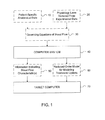
- Fig. 1 is a schematic diagram of a system for providing various information relating to blood flow in a specific patient, according to an embodiment
- Fig. 2 is an image showing calculated fractional flow reserve (FFR) within a three-dimensional model representing a portion of a patient's aorta and a plurality of coronary arteries emanating from the patient's aorta, according to an embodiment;
- FFR fractional flow reserve
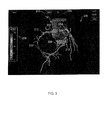
- Fig. 3 is an image showing calculated pressure gradient within a three-dimensional model representing a portion of a patient's aorta and a plurality of coronary arteries emanating from the patient's aorta, according to an embodiment
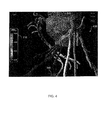
- Fig, 4 is an image showing calculated FFR within a three-dimensional model representing a portion of a patient's aorta and a plurality of coronary arteries emanating from the patient's aorta, and a stent for placement in a coronary artery, according to an embodiment
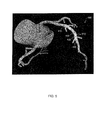
- Fig. 5 is an image showing a three-dimensional model representing a portion of a patient's aorta and a plurality of coronary arteries emanating from the patient's aorta, and a plurality of stents for placement in a coronary artery, according to an embodiment
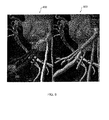
- Fig. 6 is an image showing a split screen with the model and stent of Fig. 4 in one screen portion and a three-dimensional model modified based on the placement of the stent in another screen portion, according to an embodiment.
- a method and system determines various information relating to blood flow in a specific patient using information retrieved from the patient,
- the determined information may relate to blood flow in the patient's coronary vasculature.
- the determined information may relate to blood flow in other areas of the patient's vasculature, such as carotid, peripheral, abdominal, renal, and cerebral vasculature.
- the coronary vasculature includes a complex network of vessels ranging from large arteries to arterioles, capillaries, venules, veins, etc.
- the coronary vasculature circulates blood to and within the heart and includes an aorta 2 ( Fig. 2 ) that supplies blood to a plurality of main coronary arteries 4 ( Fig. 2 ) e.g., the left anterior descending (LAD) artery, the left circumflex (LCX) artery, the right coronary (RCA) artery, etc.), which may further divide into branches of arteries or other types of vessels downstream from the aorta 2 and the main coronary arteries 4.
- LAD left anterior descending
- LCX left circumflex
- RCA right coronary
- the exemplary method and system may determine various information relating to blood flow within the aorta, the main coronary arteries, and/or other coronary arteries or vessels downstream from the main coronary arteries, Although the aorta and coronary arteries (and the branches that extend therefrom) are discussed below, the disclosed method and system may also apply to other types of vessels.
- the information determined by the disclosed methods and systems may include, but is not limited to, various blood flow characteristics or parameters, such as blood flow velocity, pressure gradient, pressure (or a ratio thereof), flow rate, and fractional flow reserve (FFR) at various locations in the aorta, the main coronary arteries, and/or other coronary arteries or vessels downstream from the main coronary arteries.
- This information may be used to determine whether a lesion is functionally significant and/or whether to treat the lesion, and/or to predict the results of various treatment options.
- This information may be determined using information obtained noninvasively from the patient. As a result, the decision whether to treat a lesion may be made without the cost and risk associated with invasive procedures.
- Fig. 1 shows aspects of a system for providing various information relating to coronary blood flow in a specific patient, according to an embodiment. Additional details relating to various embodiments of methods and systems for determining blood flow information in a specific patient are disclosed, for example, in U.S. Patent Application Publication No. 2012/0041739 entitled "Method And System For Patient-Specific Modeling Of Blood Flow,” which is incorporated by reference in its entirety.
- Patient-specific anatomical data 10 may be obtained, such as data regarding the geometry of the patient's heart, e.g., at least a portion of the patient's aorta, a proximal portion of the main coronary arteries (and the branches extending therefrom) connected to the aorta, and the myocardium.
- the patient-specific anatomical data 10 may be obtained noninvasively, e.g., using a noninvasive imaging method.
- CCTA is an imaging method in which a user may operate a computer tomography (CT) scanner to view and create images of structures, e.g., the myocardium, the aorta, the main coronary arteries, and other blood vessels connected thereto
- CT computer tomography
- other noninvasive imaging methods such as magnetic resonance imaging (MRI) or ultrasound (US)
- invasive imaging methods such as digital subtraction angiography (DSA)
- DSA digital subtraction angiography
- the resulting imaging data (e.g., provided by CCTA, MRI, etc.) may be provided by a third-party vendor, such as a radiology lab or a cardiologist, by the patient's physician, etc.
- patient-specific anatomical data 10 may also be determined from the patient noninvasively, e.g., blood pressure in the patient's brachial artery (e.g., using a pressure cuff), such as the maximum (systolic) and minimum (diastolic) pressures.
- a three-dimensional model 12 ( Figs. 2 and 3 ) of the patient's anatomy may be created using the patient-specific anatomical data 10.
- the portion of the patient's anatomy that is represented by the model 12 may include at least a portion of the aorta 2 and a proximal portion of the main coronary arterles 4 (and the branches extending or emanating therefrom) connected to the aorta 2.
- the three-dimensional model 12 may also include other portions of the patient's anatomy, such as the left and/or right ventricles, calcium and/or plaque within the coronary arteries 4 and/or the branches, other tissue connected to and/or surrounding the coronary arteries 4 and/or the branches, etc.
- Various physiological laws or relationship 20 relating to coronary blood flow may be deduced, e.g., from experimental data.
- a plurality of equations 30 relating to coronary blood flow may be determined,
- the equations 30 may be determined and solved using any numerical method, e.g., finite difference, finite volume, spectral, lattice Boltzmann, particle-based, level set, finite element methods, etc.
- the equations 30 may be solvable to determine information (e.g., pressure, pressure gradients, FFR, etc.) relating to the coronary blood flow in the patient's anatomy at various points in the anatomy represented by the model 12.
- the model 12 may be prepared for analysis and boundary conditions may be determined.
- the model 12 may be trimmed and discretized into a volumetric mesh, e.g., a finite element or finite volume mesh.
- the volumetric mesh may be used to generate the equations 30.
- Boundary conditions may be determined using the physiological laws 20 and incorporated into the equations 30.
- the boundary conditions may provide information about the model 12 at its boundaries, e,g., the inflow boundaries, the outflow boundaries, the vessel wall boundaries, etc.
- the inflow boundaries may include the boundaries through which flow is directed into the anatomy of the three-dimensional model, such as at an end of the aorta near the aortic root.
- Each inflow boundary may be assigned, e.g., with a prescribed value or field for velocity, flow rate, pressure, or other characteristic, by coupling a heart model and/or a lumped parameter model to the boundary, etc.
- the outflow boundaries may include the boundaries through which flow is directed outward from the anatomy of the three-dimensional model, such as at an end of the aorta near the aortic arch, and the downstream ends of the main coronary arteries and the branches that extend therefrom.
- Each outflow boundary can be assigned, e.g., by coupling a Jumped parameter or distributed (e.g., a one-dimensional wave propagation) model.
- the prescribed values for the inflow and/or outflow boundary conditions may be determined by noninvasively measuring physiologic characteristics of the patient, such as, but not limited to, cardiac output (the volume of blood flow from the heart), blood pressure, myocardial mass, etc.
- the vessel wall boundaries may include the physical boundaries of the aorta, the main coronary arteries, and/or other coronary arteries or vessels of the model 12.
- the equations 30 may be solved using a computer system 40. Based on the solved equations 30, the computer system 40 may output information 50 indicating one or more blood flow characteristics, such as FFR, blood pressure (or pressure gradient), blood flow, or blood velocity, determined based on the solution of the equations 30.
- the computer system 40 may output images generated based on the model 12 and the information 50 or other results of the computational analysis, as described below,
- the information 50 may be determined under simulated conditions of increased coronary blood flow or hyperemia conditions, e.g., conventionally induced by intravenous administration of adenosine.
- the boundary conditions described above may specifically model conditions of Increased coronary blood flow, hyperemia conditions, and/or the effect of adenosine.
- Fig. 2 shows a computed FFR model 100 that may be output from the computer system 40.
- the computed FFR model 100 may include the geometry of the anatomical structure based on the model 12 and may also indicate the information 50 output from the computer system 40, such as the values of FFR at various locations along three-dimensions in the model 12.
- FFR may be calculated as the ratio of the blood pressure at a particular location in the model 12 (e.g,, in a coronary artery) divided by the blood pressure in the aorta, e.g., at the inflow boundary of the model 12, under conditions of increased coronary blood flow or hyperemia conditions.
- a corresponding color, shade, pattern, or other visual indicator may be assigned to the respective FFR values throughout the computed FFR model 100 such that the computed FFR model 100 may visually indicate the variations in FFR throughout the model 100 without having to visually indicate the individual numerical values for each point in the model 100.
- a scale or key 110 may be provided that indicates which numerical values of FFR correspond to which colors, shades, patterns, or other visual indicators.
- the computed FFR model 100 may be provided in color, and a color spectrum may be used to indicate variations in computed FFR throughout the model 100.
- the color spectrum may include red, yellow, green, cyan, and blue, in order from lowest computed FFR (indicating functionally significant lesions) to highest computed FFR.
- the upper limit (blue) may indicate an FFR of 1.0
- the lower limit (red) may indicate approximately 0.7 (or 0.75 or 0.8) or less, with green indicating approximately 0.85 (or other value approximately halfway between the upper and lower limits).
- the lower limit may be determined based on a lower limit (e.g., 0.7, 0.75, or 0,8) used for determining whether the computed FFR indicates a functionally significant lesion or other feature that may require intervention.
- a lower limit e.g., 0.7, 0.75, or 0,8
- the computed FFR model 100 for some patients may show a majority or all of the aorta as blue or other color towards the higher end of the spectrum, and the colors may change gradually through the spectrum (e.g., towards the lower end of the spectrum (down to anywhere from red to blue)) towards the distal ends of the coronary arteries and the branches that extend therefrom.
- the distal ends of the coronary arteries for a particular patient may have different colors, e.g., anywhere from red to blue, depending on the local values of computed FFR determined for the respective distal ends.
- the computed FFR model 100 of Fig. 2 may show that, for this particular patient, under simulated hyperemia conditions, the computed FFR is generally uniform and approximately 1.0 in the aorta (e.g., as indicated by the color blue), and that the computed FFR gradually and continuously decreases (e.g., to values ranging from near 1,0 down to approximately 0.9, as indicated by gradually changing colors from blue to cyan or a mix of blue and cyan) as the blood flows downstream into the main coronary arteries and into the branches.
- the computed FFR gradually and continuously decreases (e.g., to values ranging from near 1,0 down to approximately 0.9, as indicated by gradually changing colors from blue to cyan or a mix of blue and cyan) as the blood flows downstream into the main coronary arteries and into the branches.
- areas 112 and 114 there may be sharper decreases in computed FFR.
- the computed FFR model 100 may indicate generally constant values (e.g., approximately 1.0, as Indicated by the color blue) or gradually decreasing values in computed FFR (e,g., to values ranging from near 1.0 down to approximately 0.9, as indicated by gradually changing colors from blue to cyan or a mix of blue and cyan).
- the computed FFR model 100 may indicate a drop in computed FFR to approximately 0.8 (e.g., as indicated by colors changing from blue and/or cyan, to green and/or yellow).
- the computed FFR model 100 may indicate generally constant values (e.g., approximately 0.8, as indicated by the colors green and/or yellow) or gradually decreasing values in computed FFR (e.g., to values slightly less than 0.8, as indicated by colors that are more yellow than green).
- the computed FFR model 100 may indicate a drop in computed FFR to approximately 0.7 or below (e.g., as indicated by colors changing from green and/or yellow, to red). Downstream of the area 114 and to the distal end of the coronary artery, the computed FFR model 100 may indicate that the computed FFR is approximately 0.7 or below (e.g., as indicated by the color red).
- a user may determine that the computed FFR has dropped below the lower limit used for determining the presence of a functionally significant lesion or other feature that may require intervention (e,g., based on the location(s) of areas colored red in the computed FFR model 100 or otherwise indicating a value of computed FFR that is below the lower limit), and the user may also be able to locate the functionally significant lesion(s).
- the user may locate the functionally significant lesion(s) based on the geometry of the artery or branch (e.g., using the computed FFR model 100). For example, the functionally significant lesion(s) may be located by finding a narrowing or stenosis located near (e.g., upstream from) the location(s) of the computed FFR model 100 indicating the local minimum FFR value.
- Fig. 3 shows a computed pressure gradient model 200 that may be output from the computer system 40.
- the computed pressure gradient model 200 may include the geometry of the anatomical structure based on the model 12 and may also indicate the information 50 output from the computer system 40, such as the values of blood pressure gradient at various locations along three-dimensions in the model 12.
- the computed pressure gradient model 200 may show the local blood pressure gradient (e.g., in millimeters of mercury (mmHg) per centimeter) throughout the model 12 under simulated hyperemia conditions or other conditions.
- mmHg millimeters of mercury
- a corresponding color, shade, pattern, or other visual indicator may be assigned to the respective pressures gradients such that the model 200 may visually indicate variations in pressure gradient throughout the model 200 without having to visually indicate the individual pressure gradient numerical values for each point in the model 200.
- a scale or key 210 may be provided that indicates which numerical values of pressure gradient correspond to which colors, shades, patterns, or other visual indicators.
- the computed pressure gradient model 200 may be provided in color, and a color spectrum may be used to indicate variations in pressure throughout the model 200.
- the color spectrum may include red, yellow, green, cyan, and blue, in order from highest pressure gradient, which may indicate functionally significant lesions, to lowest pressure gradient.
- the upper limit (red) may indicate approximately 20 mmHg/cm or more
- the lower limit (blue) may indicate approximately 0 mmHg/cm or less, with green indicating approximately 10 mmHg/cm (or other value approximately halfway between the upper and lower limits).
- the computed pressure gradient model 200 for some patients may show a majority or all of the aorta as blue and/or cyan, or other color towards the lower end of the spectrum, and the colors may change gradually through the spectrum (e.g., towards the higher end of the spectrum (up to red)) at areas having higher pressure gradients.
- the computed pressure gradient model 200 of Fig. 3 may show that, for this particular patient, under simulated hyperemia conditions, the pressure gradient may be generally uniform and approximately zero mmHg/cm (e.g., as indicated by the colors blue and/or cyan) in the aorta and in most of the main coronary arteries and the branches.
- the computed pressure gradient model 200 may indicate a gradual increase in pressure gradient such that some areas 212 in the main coronary arteries and the branches indicate values of approximately 5 mmHg/cm to approximately 10 mmHg/cm (e.g., as indicated by the colors cyan and/or green), some areas 214 in the main coronary arteries and the branches indicate values of approximately 10 mmHg/cm to approximately 15 mmHg/cm (e.g., as indicated by the colors green and/or yellow),and some areas 216 in the main coronary arteries and the branches indicate values of greater than approximately 15 mmHg/cm (e.g., as indicated by the colors yellow and/or red).
- some areas 212 in the main coronary arteries and the branches indicate values of approximately 5 mmHg/cm to approximately 10 mmHg/cm (e.g., as indicated by the colors cyan and/or green)
- some areas 214 in the main coronary arteries and the branches indicate values of approximately 10 mmHg/c
- a user may determine that the computed pressure gradient has increased above a certain level (e.g., approximately 20 mmHg/cm), which may indicate the presence of a functionally significant lesion or other feature that may require intervention, and the user may also be able to locate the functionally significant lesion(s).
- the user may locate the functionally significant leslon(s) based on the geometry of the artery or branch (e.g., using the computed pressure gradient model 200).
- the functionally significant lesion(s) may be located by finding a narrowing or stenosis located near the location(s) of the computed pressure gradient model 200 indicating a value of approximately 20 mmHg/cm or higher.
- the computer FFR model 100, the computed blood pressure gradient model 200, or other model may also include other information, such as geometry information (e.g., numerical values for vessel inner diameter, thickness, etc.), throughout the model 100 or 200.
- geometry information e.g., numerical values for vessel inner diameter, thickness, etc.
- the information relating to a particular location on the model may be displayed to the user upon selection of the location of the model as described below,
- the computer system 40 may allow the user to select whether to output the computed FFR model 100, the computed blood pressure gradient model 200, or other model, and/or to specify other color mappings or rendering styles (e.g., x-ray renderirig).
- the computer system 40 may include one or more non-transitory computer-readable storage devices that store Instructions that, when executed by a processor, computer system, etc., may perform any of the actions described herein for providing various information relating to blood flow in the patient.
- the computer system 40 may include a desktop or portable computer, a workstation, a server, a personal digital assistant, or any other computer system.
- the computer system 40 may include a processor, a read-only memory (ROM), a random access memory (RAM), an input/output (I/O) adapter for connecting peripheral devices (e.g., an input device, output device, storage device, etc.), a user interface adapter for connecting input devices such as a keyboard, a mouse, a touch screen, a voice input, and/or other devices, a communications adapter for connecting the computer system 40 to a network, a display adapter for connecting the computer system 40 to a display, etc.
- the display may be used to display the model 12 and/or any images generated by solving the equations 30 (e.g., the computed FFR model 100, the computed blood pressure gradient model 200, and/or the other models described below).
- the patient-specific anatomical data 10 may be transferred over a secure communication line (e.g., via a wireless or wired network) to the computer system 40, which may create the model 12 and solve the equations 30.
- the data 10 may be transferred from the third-party vendor that obtains the patient-specific anatomical data 10 to the computer system 40 operated by the patient's physician or other user.
- the computer system 40 may output the information 50 indicating one or more blood flow characteristics, the computed FFR model 100, the computed blood pressure gradient model 200, and/or other output from the computer system 40 based on the solution of the equations 30 to a tablet computer 70 (or other mobile or handheld computing device), such as Apple Inc.'s iPad®, over a secure communication line (e.g., via a wireless or wired network, using a web-based service, etc.).
- the tablet computer 70 may be operated by the patient's physician or other user, such as the patient.
- the tablet computer 70 may include a touchscreen. Various screenshots of the touchscreen are shown in Figs. 2-6 and described below.
- the touchscreen may be configured to receive input from the user based on contact by at least one of the user's digits (e.g., at least one of the user's fingers or thumbs) on a surface of the touchscreen as described below.
- the following description relates to embodiments in which the touchscreen is configured to receive input from contact by the user's finger(s) on the surface of the touchscreen.
- the touchscreen may be configured to receive input from the user based on contact or sensed proximity to the touchscreen by the user's flnger(s), the user's thumb(s), a stylus, another pointing object or instrument, or a combination thereof.
- the computer system 40 may perform more complicated operations, such as solving the equations 30, while the tablet computer 70 may be a portable system for displaying the results of the solution of the equations 30 by the computer system 40 and for performing less complicated computations.
- the tablet computer 70 may allow the patient's physician, the patient, or other user to access information from the model 12, 100, or 200, and manipulate the model 12, 100, or 200 as described below.
- the tablet computer 70 may also be configured to allow the user to select treatment options using the tablet computer 70,
- the tablet computer 70 may determine or predict the blood flow characteristic(s) (e.g., FFR, blood pressure (or pressure gradient), etc.) in the patient's anatomical structure based on the selected treatment options as described below.
- the blood flow characteristic(s) e.g., FFR, blood pressure (or pressure gradient), etc.
- the tablet computer 70 may provide two mode selection buttons 310 and 320 that allow the user to switch between two modes. Touching the first button 310 allows the user to select the first operating mode (e.g., an inspection mode), and touching the second button 320 allows the user to select the second operating mode (e.g., a percutaneous coronary intervention (PCI) mode).
- the first operating mode e.g., an inspection mode
- the second button 320 e.g., a percutaneous coronary intervention (PCI) mode
- Figs. 2 and 3 are images illustrating screen shots of the tablet computer 70 operating in the first operating mode.
- the tablet computer 70 may display information indicating one or more blood flow characteristics of the patient in the patient's current condition, e.g., the computed FFR model 100 ( Fig. 2 ), the computed pressure gradient model 200 ( Fig. 3 ), or other model providing the information 50 output from the computer system 40.
- Inputs received from the user using the tablet computer 70 in the first operating mode may allow the user to interact with and manipulate the displayed information regarding the patient's current condition.
- the tablet computer 70 may be configured to determine when the user's finger(s) contact the surface of the touchscreen at a location corresponding to a location on the displayed model 100 or 200 (and a corresponding location in the patient's anatomical structure). Based on this input, the tablet computer 70 may determine the numerical value of a blood flow characteristic (e.g., FFR, blood pressure (or pressure gradient), and/or other blood flow characteristic selected by the user) at the indicated location on the displayed model 100 or 200, and may display the determined numerical value.
- the displayed numerical value may be dynamically updated as the user drags the finger(s) along the surface of the touchscreen and along the displayed model 100 or 200.
- the user may touch any point on the model 12, 100, or 200 to determine the numerical value of any of the blood flow characteristics described above, e.g., FFR, blood pressure (or pressure gradient), and/or other blood flow characteristic, at that point.
- Additional information relating to the indicated point on the model 12, 100, or 200 may also be displayed to the user, such as geometry information (e.g., a numerical value of the vessel inner diameter, etc.).
- the tablet computer 70 may be configured to determine when the user's finger(s) contact the surface of the touchscreen for a predetermined time (e.g., a touch and hold) at a location corresponding to a location on the displayed model 100 or 200. Based on this input, the tablet computer 70 may create a tag or pin 330 that points to the indicated location within the displayed model 100 or 200. The user can then drag or move the pin 330 anywhere within the displayed model 100 or 200 to determine the numerical value of a blood flow characteristic at the indicated location on the displayed model 100 or 200 to which the pin 330 has been dragged. The numerical value may be dynamically updated as the pin 330 is dragged. The tablet computer 70 may display the determined numerical value within or near the pin 330. For example, in Figs.
- the pin 330 points to a location in one of the coronary arteries illustrated in the model 100 where the FFR value is 0.58.
- the pin 330 may also indicate other information regarding the indicated location, such as a dimension (e.g., diameter) of the vessel at the indicated location.
- the tablet computer 70 may allow the user to create more than one pin 330 to drag separately around the model 100 or 200, and remove the pin(s) 330, as desired.
- the tablet computer 70 may determine that the user has selected a particular coronary artery (and/or the branches connected thereto) and may fade (e.g., dim or decrease the brightness of) the other coronary arteries and branches.
- the selected location may become a new focal point of view for the displayed model 100 or 200, and/or a new local origin for transformations, such as rotation and zoom. This allows the user to focus in on a potential stenosis, and to rotate around or zoom to (or away from) any user-defined point.
- the tablet computer 70 may also be configured to determine when the user's finger(s) swipe or drag on the surface of the touchscreen (e.g., at a location away from the pin 330). Based on this input, the tablet computer 70 may rotate the displayed model 100 or 200. The amount and direction of rotation may depend on the distance that the finger(s) travel in contacting the surface of the touchscreen during the swipe and the direction of the swipe along the surface of the touchscreen.
- the tablet computer 70 may also be configured to determine when the user's fingers pinch the surface of the touchscreen. If the user's fingers move closer together, the tablet computer 70 may zoom out from the displayed model 100 or 200. If the user's fingers move away from each other, the tablet computer 70 may zoom in on the displayed model 100 or 200. The amount of the zoom may depend on the distance that the finger(s) travel in the pinch along the surface of the touchscreen.
- the tube angulation or other information for characterizing the direction from which the anatomical structure is being viewed may be displayed to the user and dynamically updated.
- the information may be provided in the form of left anterior oblique (LAO), right anterior oblique (RAO), caudal (CAUD), and/or cranial (CRAN) angles, e.g., LAO 20° and CRAN 0°, as known in the art.
- Figs. 4-6 are images illustrating screen shots of the tablet computer 70 operating in the second operating mode (e.g., the PCI mode) selected by the user by touching the second button 320,
- Inputs received from the user using the tablet computer 70 in the second operating mode allow the user to plan treatment options using the displayed model 400, which may be created based on the model 12 (e.g., a model reflecting the geometry of the patient's anatomical structure without additional information indicating blood flow charaoteristic(s)), the computed FFR model 100 ( Fig. 2 ), the computed pressure gradient model 200 ( Fig. 3 ), or other model providing information 50 indicating a blood flow characteristic of the patient in the patient's current condition.
- the tablet computer 70 may display predicted information regarding the blood flow characteristic(s) (e,g., FFR, blood pressure (or pressure gradient), etc.) based on the selected the treatment option.
- Fig. 4 shows a screen shot of the tablet computer 70 operating in the second operating mode to allow the user to select a treatment option using the model 400.
- the model 400 is created based on the computed FFR model 100.
- the model 400 may be created based on the model 12, the computed pressure gradient model 200, and/or other model.
- the tablet computer 70 may be configured to determine when the user's finger(s) contact the surface of the touchscreen (e.g., for a predetermined time (e.g., a touch and hold)) at a location corresponding to a location on the displayed model 400 (and a corresponding location in the patient's anatomical structure).
- the tablet computer 70 may display a stent 410 for planned insertion into the patient's anatomical structure (e,g., in a coronary artery).
- the tablet computer 70 may allow the user to place more than one stent 410 on the model 400, as shown in Fig. 5 , and remove the stent(s) 410, as desired.
- the stent 410 When initially placed on the model 400, the stent 410 may have a predetermined size or dimension, or other characteristics (e.g., diameter, length, material, wire thickness, wire configuration, etc.). The stent 410 may be initially placed so that the stent 410 is centered longitudinally with respect to the location selected by the user.
- the tablet computer 70 may be configured to determine when the user's finger(s) swipe or drag on the surface of the touchscreen. Based on this input, the tablet computer 70 may move the stent 410 along the model 400, For example, the stent 410 may move parallel to the centerline(s) of the coronary artery or arteries (or branches connected thereto). Also, the shape of the stent 410 may conform to bends and curves in the centerline(s), as shown in Figs. 4-6 , as the stent 410 is dragged or moved along the centerline(s).
- the amount and direction (e.g., upstream or downstream along the centerline(s)) of movement of the stent 410 may depend on the distance that the finger(s) travel in contacting the surface of the touchscreen during the swipe and the direction of the swipe along the surface of the touchscreen.
- the tablet computer 70 may also be configured to determine when the user's fingers pinch the surface of the touchscreen. If the user's fingers move closer together, the tablet computer 70 may shorten the stent 410 (e,g., in the longitudinal direction and/or the direction of the centerline(s)). If the user's fingers move away from each other, the tablet computer 70 may lengthen the stent 410 (e.g., in the longitudinal direction and/or the direction of the centerline(s)), The amount of the change in length may depend on the distance that the finger(s) travel along the surface of the touchscreen to form the pinch. Also, the change in length may be continuous or may be provided in Increments (e.g., approximately 4 millimeter increments or other increment).
- the change in length may be provided in increments that are generally equivalent to a length of one ring, and the touchscreen may show the ring(s) being added or removed from the stent 410 to shorten or lengthen the stent 410.
- FIG. 5 shows a screen shot of the tablet computer 70 operating in the second operating mode to allow the user to plan a treatment option associated with the placement of the stent 410 using the model 400, according to another embodiment.
- the tablet computer 70 may create one or more handles, such as a first handle 420, a second handle 430, and/or a third handle 440.
- the first handle 420 may be located at or near the center of the stent 410 along the longitudinal direction.
- the user may drag or move the stent 410 along the model 400 by pressing the first handle 420 and dragging the first handle 420 to a desired location on the model 400. Movement of the first handle 420 results in movement of the stent 410.
- the stent 410 may also move parallel to the centerline(s) of the coronary artery or arteries (or branches connected thereto) until the user removes the finger(s) from the first handle 420. Also, the shape of the stent 410 may conform to bends and curves in the centerline(s) as the stent 410 is dragged or moved along the centerline(s) with the first handle 420.
- the second and third handles 430, 440 may be located at or near the proximal and distal ends of the stent 410, respectively.
- the user may adjust the length of the stent 410 by pressing the second and/or the third handles 430, 440 and dragging the respective second and/or third handles 430, 440 along the model 400, thereby adjusting the locations of the respective proximal and distal ends of the stent 410. Movement of the second and/or third handles 430, 440 results in lengthening/shortening of the stent 410.
- the stent 410 may lengthen and extend along the proximal direction.
- the stent 410 may lengthen and extend along the distal direction.
- the new portion of the stent 410 that is added due to the lengthening may be formed parallel to the centerline(s) of the coronary artery or arteries (or branches connected thereto) and may conform to bends and curves in the centerline(s).
- the stent 410 may shorten when the user drags the second handle 430 along the model 400 in a distal direction toward the third handle 440 or when the user drags the third handle 440 along the model 400 in a proximal direction toward the second handle 430.
- the placement of the first handle 420 may be automatically adjusted so that the first handle 420 stays at or near the center of the stent 410.
- the handles 420, 430, 440 are user-friendly and allow the user to manipulate and adjust the stent 410 as desired.
- the numerical values of the length, the proximal diameter, and/or the distal diameter of the stent 410 may be displayed on the touchscreen, e.g., in a stent legend.
- the numerical values may be dynamically updated as the user adjusts the stent 410.
- the tablet computer 70 may provide a selection of stent models that are available for placement into the patient and may store the characteristics of those stent models. The user may select from the stent models, and the tablet computer 70 may retrieve the stored characteristics corresponding to the stent model selected by the user to determine the various characteristics of the stent 410, such as the dimensions of the stent 410.
- the stent 410 may be determined based on the stent model selected, such as the dimensions of the incremental changes in length (e.g., the size of the rings in a ring configuration) described above and/or the flexibility of the stent 410 (e.g,, the ability to conform to the bends and curves in the centerlines of the coronary arteries and branches).
- the various characteristics of the stent 410 and/or the stent model may be determined automatically and recommended by the tablet computer 70 based on various factors, such as the location of any FFR values that are less than 0.75 and the dimensions of the vessels at those locations, locations and dimensions of significant narrowing of the vessels, etc.
- the tablet computer 70 may also provide other treatment options for selection by the user, such as other types of surgery on the modeled anatomy that may result in a change in the geometry of the modeled anatomy.
- the tablet computer 70 may be used to plan a coronary artery bypass grafting procedure. Coronary artery bypass grafting may involve creating new lumens or passageways in the model 400.
- the tablet computer 70 may be configured to determine when the user's finger(s) contact the surface of the touchscreen (e.g., for a predetermined time (e.g., a touch and hold)) at a location corresponding to a location on the displayed model 400.
- the tablet computer 70 may display a bypass segment (not shown) for planned connection to the patient's anatomical structure (e.g., in a coronary artery), which has one end that is connected to the model 400 at the location indicated by the first input.
- the tablet computer 70 may then prompt the user to provide a second input identifying a second location for connecting the opposite end of the bypass segment to the patient's anatomical structure.
- the tablet computer 70 may recommend where to connect the bypass segment at one or both ends of the bypass segment.
- the tablet computer 70 may allow the user to place more than one bypass segment In the model, and remove the bypass segment(s), as desired.
- the tablet computer 70 may also allow the user to provide inputs (e.g., similar to the inputs described above, such as swiping and pinching) to change the location or dimension (e.g., diameter, length, etc.) of the bypass segment.
- the user may touch a calculate button 340, as shown in Fig. 4 .
- the tablet computer 70 recalculates the blood flow characteristic(s).
- the computer system 40 may create and transmit to the tablet computer 70 a reduced-order (e.g., zero-dimensional or one-dimensional) model 60 for modeling various treatment options, in addition to (or instead of) the information 50 indicating the blood flow characteristics in the patient's current condition, as disclosed, for example, in U.S. Patent Application Publication No.
- a reduced-order e.g., zero-dimensional or one-dimensional
- the reduced-order model 60 may be a lumped parameter model or other simplified model of the patient's anatomy that may be used to determine information about the coronary blood flow in the patient without having to solve the more complex system of equations 30 described above.
- the reduced-order model 60 may be created using information extracted from the computed models 100 and 200 (e.g., the blood pressure, flow, or velocity information determined by solving the equations 30 described above).
- the tablet computer 70 may adjust the reduced-order model 60 based on the treatment option selected by the user, and may solve a simplified set of equations based on the reduced-order model 60 to output information indicating one or more predicted blood flow characteristics (e.g., FFR, blood pressure (or pressure gradient), etc.) of the patient.
- the information may then be mapped or extrapolated to the three-dimensional model 12 of the patient's anatomical structure to display the effects of the selected treatment option on the coronary blood flow in the patient's anatomy, e.g., in a post-intervention model 500, as shown in Fig. 6 .
- the reduced-order model 60 may be solved with a simplified set of equations (compared to the equations 30), the reduced-order model 60 permits relatively rapid computation (e.g., compared to a full three-dimensional model) using the tablet computer 70 and may be used to solve for flow rate and pressure that may closely approximate the results of a full three-dimensional computational solution.
- the reduced-order model 60 allows for relatively rapid iterations to model various different treatment options.
- the inputs provided by the user to select the treatment option may be transmitted to the computer system 40 via the tablet computer 70 (e.g., via a wired or wireless connection).
- the computer system 40 may recalculate the information indicating the blood flow characteristic(s), e.g., by re-solving the equations 30 using the inputs provided by the user to select the treatment option.
- the computer system 40 may then transmit to the tablet computer 70 the information indicating the blood flow characieristic(s) based on this solution to the equations 30, and may also output to the tablet computer 70 images generated based on the model 12 and the determined information, such as the past-intervention model 500 shown in Fig. 6 .
- Fig. 6 shows a screen shot of the tablet computer 70 operating in the second operating mode after determining the information indicating the blood flow characterises) of the patient based on the selected treatment option, according to an embodiment.
- the screen shot shows a split screen provided by touchscreen, and the split screen may divide the screen into two or more portions. In the embodiment shown in Fig. 6 , two portions may be provided.
- the first portion of the split screen (the left side portion shown in Fig. 6 ) may show the pre-intervention model 400 ( Fig. 4 ) with the treatment option selected by the user (placement of the stent 410, as described above in connection with Fig. 4 ),
- the second portion of the split screen may show the post-intervention model 500 that reflects the information indicating the blood flow characteristic(s) of the patient based on selected treatment option.
- the post-intervention model 500 may show any change in geometry of the anatomical structure due to the selected treatment option.
- the past-intarventian model 500 shows a widening 510 of the lumen where the simulated stent 410 is placed,
- the post-intervention model 500 may also display the start and end points of the stent 410.
- the pre-intervention and post-intervention models 400, 500 indicate computed FFR.
- the split screen allows the user to view and compare information relating to the untreated patient (e.g., without the stent(s)), such as the model 400, side-by-side with information relating to the simulated treatment for the patient, such as the model 500.
- the same color, shade, pattern, or other visual indicators as the model 400 may be assigned to the respective FFR values for the model 500.
- the model 500 may also visually indicate the variations in FFR throughout the model 500 without having to specify the individual values for each point in the model 500.
- FFR is generally uniform and approximately 1.0 in the aorta (e.g., as indicated by the color blue), and that FFR gradually and continuously decreases (e.g., to values ranging from 1.0 down to approximately 0.9, as indicated by gradually changing colors from blue to cyan or a mix of blue and cyan) in the main coronary arteries and the branches.
- the post-interventional model 500 does not include the areas 112 and 114 of sharper decreases in FFR that are shown in the pre-interventional model 400.
- the split screen provides a comparison of the pre-interventional model 400 of the untreated patient (showing the patent's current condition) and the post-interventional model 500 for the proposed treatment to help the physician or other user to assess the results of various treatment options
- Either portion of the split screen may be configured to receive inputs from the user and may respond to the inputs as described above in connection with the first operating mode.
- the user may touch any location on the model(s) 400 and/or 500 to determine the numerical value of any of the blood flow characteristic(s) and/or geometry information at that location, e.g., by creating one or more pins 330 for moving around the model(s) 400 and/or 500.
- the numerical value of the blood flow characteristic(s) and/or geometry information at the same location in the other model 400 or 500 may also be displayed for comparison.
- another pin 330 may be automatically created at the same location in the other model 400 or 500.
- the split screen may provide mirrored pins 330 In the two displayed models such that movement of one pin 330 in one of the models due to user input is automatically mirrored by the pin 330 in the other model and the numerical values of the blood flow characteristic(s) and/or geometry information at the respective locations may be compared and updated dynamically as the pins 330 move.
- the user may adjust the rotation, zoom, and/or focal point for the model(s) 400 and/or 500.
- the rotation, zoom, and/or focal point for one of the models 400 or 500 is adjusted similarly.
- the first portion of the split screen may be configured to receive inputs from the user and may respond to the inputs as described above in connection with the second operating mode, For example, the user may select or adjust the treatment option using the pre-intervention model 400.
- the user may touch the calculate button 340, which may cause the tablet computer 70 to modify the reduced-order model 60 based on the new treatment option selected by the user.
- the tablet computer 70 may output a modified post-intervention model 500 that reflects the new treatment option selected by the user.
- the tablet computer 70 may transmit the new treatment option to the computer system 40, which will re-solve the equations 30 based on the new selected treatment option, and send the modified post-intervention model 500 to the tablet computer 70 for displaying to the user.
- the split screen may provide two portions for comparing the results of different treatment options.
- each portion of the split screen may be configured to receive inputs associated with selecting treatment options using the pre-intervention model 400 as described above and may be able to display different post-intervention models 500 based on the different treatment options selected.
- the split screen allows the user to repeatedly select new treatment options and use the tablet computer 70 to predict and compare the effects of various treatment options to each other and/or to information relating to the untreated patient.
- the reduced-order model 60 may allow the user to analyze and compare different treatment options more easily and quickly without having to solve the equations 30 each time a different treatment option is selected.
- the system may be used to predict a potential benefit of percutaneous coronary interventions on coronary artery blood flow in order to select the optimal interventional strategy, and/or to predict a potential benefit of coronary artery bypass grafting on coronary artery blood flow in order to select the optimal surgical strategy.
- the systems and methods disclosed herein may be incorporated into a portable software tool accessed by physicians and other users to provide patient-specific blood flow information and to plan treatment options.
- physicians and other users may use the portable software tool to predict the effect of medical, interventional, and/or surgical treatments on coronary artery blood flow.
- the portable software tool may be used to prevent, diagnose, manage, and/or treat disease in other portions of the cardiovascular system including arteries of the neck (e.g., carotid arteries), arteries in the head (e,g., cerebral arteries), arteries in the thorax, arteries in the abdomen (e.g., the abdominal aorta and its branches), arteries in the arms, or arteries in the legs (e.g., the femoral and popliteal arteries).
- the portable software tool may be interactive to enable physicians and other users to develop optimal personalized therapies for patients.
- the computer system 40 for solving the equations 30 governing blood flow may be provided as part of a web-based service or other service, e.g., a service provided by an entity that is separate from the physician.
- the service provider may, for example, operate the web-based service and may provide a web portal or other web-based application (e.g., run on a server or other computer system operated by the service provider) that is accessible to physicians or other users via a network or other methods of communicating data between computer systems.
- the patient-specific anatomical data 10 obtained noninvasively from the patient may be provided to the service provider, and the service provider may use the data to produce the three-dimensional model 12 or other models/meshes and/or any simulations or other results determined by solving the equations 30 described above in connection with Fig. 1 , such as the reduced-order model 60, the computed FFR model 100, and/or the computed blood pressure gradient model 200.
- the web-based service may transmit the models 60, 100, and/or 200 to the physician's tablet computer 70 (or other portable device).
- the physician may use the tablet computer 70 to interact with the models 100 or 200, and to provide inputs, e.g., to select possible treatment options and determine blood flow information based on the selected possible treatment options.
Landscapes
- Health & Medical Sciences (AREA)
- Engineering & Computer Science (AREA)
- Life Sciences & Earth Sciences (AREA)
- Physics & Mathematics (AREA)
- Medical Informatics (AREA)
- Public Health (AREA)
- General Health & Medical Sciences (AREA)
- Biomedical Technology (AREA)
- Surgery (AREA)
- Molecular Biology (AREA)
- Pathology (AREA)
- Heart & Thoracic Surgery (AREA)
- Animal Behavior & Ethology (AREA)
- Veterinary Medicine (AREA)
- Biophysics (AREA)
- Theoretical Computer Science (AREA)
- Nuclear Medicine, Radiotherapy & Molecular Imaging (AREA)
- General Engineering & Computer Science (AREA)
- Radiology & Medical Imaging (AREA)
- Physiology (AREA)
- General Physics & Mathematics (AREA)
- High Energy & Nuclear Physics (AREA)
- Cardiology (AREA)
- Optics & Photonics (AREA)
- Human Computer Interaction (AREA)
- Hematology (AREA)
- Computer Graphics (AREA)
- Vascular Medicine (AREA)
- Epidemiology (AREA)
- Primary Health Care (AREA)
- Software Systems (AREA)
- Computer Vision & Pattern Recognition (AREA)
- Computer Hardware Design (AREA)
- Bioinformatics & Cheminformatics (AREA)
- Architecture (AREA)
- Oral & Maxillofacial Surgery (AREA)
- Dentistry (AREA)
- Databases & Information Systems (AREA)
- Data Mining & Analysis (AREA)
- Signal Processing (AREA)
Priority Applications (1)
| Application Number | Priority Date | Filing Date | Title |
|---|---|---|---|
| EP17177516.6A EP3258446B1 (en) | 2012-05-14 | 2012-06-13 | Method and system for providing information from a patient-specific model of blood flow |
Applications Claiming Priority (1)
| Application Number | Priority Date | Filing Date | Title |
|---|---|---|---|
| US13/470,802 US8548778B1 (en) | 2012-05-14 | 2012-05-14 | Method and system for providing information from a patient-specific model of blood flow |
Related Child Applications (1)
| Application Number | Title | Priority Date | Filing Date |
|---|---|---|---|
| EP17177516.6A Division EP3258446B1 (en) | 2012-05-14 | 2012-06-13 | Method and system for providing information from a patient-specific model of blood flow |
Publications (1)
| Publication Number | Publication Date |
|---|---|
| EP2665043A1 true EP2665043A1 (en) | 2013-11-20 |
Family
ID=46545609
Family Applications (2)
| Application Number | Title | Priority Date | Filing Date |
|---|---|---|---|
| EP20120171882 Ceased EP2665043A1 (en) | 2012-05-14 | 2012-06-13 | Method and system for providing information from a patient-specific model of blood flow |
| EP17177516.6A Active EP3258446B1 (en) | 2012-05-14 | 2012-06-13 | Method and system for providing information from a patient-specific model of blood flow |
Family Applications After (1)
| Application Number | Title | Priority Date | Filing Date |
|---|---|---|---|
| EP17177516.6A Active EP3258446B1 (en) | 2012-05-14 | 2012-06-13 | Method and system for providing information from a patient-specific model of blood flow |
Country Status (9)
| Country | Link |
|---|---|
| US (15) | US8548778B1 (enExample) |
| EP (2) | EP2665043A1 (enExample) |
| JP (7) | JP5715316B1 (enExample) |
| KR (2) | KR101544691B1 (enExample) |
| CN (2) | CN108629851A (enExample) |
| AU (2) | AU2013263062B2 (enExample) |
| CA (1) | CA2867839C (enExample) |
| DE (3) | DE202012013322U1 (enExample) |
| WO (1) | WO2013173208A1 (enExample) |
Cited By (1)
| Publication number | Priority date | Publication date | Assignee | Title |
|---|---|---|---|---|
| DE102016222102A1 (de) * | 2016-11-10 | 2018-05-17 | Siemens Healthcare Gmbh | Behandlungsplanung für eine Stenose in einem Gefäßsegment anhand einer virtuellen hämodynamischen Analyse |
Families Citing this family (187)
| Publication number | Priority date | Publication date | Assignee | Title |
|---|---|---|---|---|
| US9905135B2 (en) | 2007-05-21 | 2018-02-27 | Jc3 Innovations, Llc | Medical device and procedure simulation and training |
| US9280916B2 (en) * | 2007-05-21 | 2016-03-08 | Johnson County Community College Foundation, Inc. | Healthcare training system and method |
| US9916773B2 (en) | 2007-05-21 | 2018-03-13 | Jc3 Innovations, Llc | Medical device and procedure simulation and training |
| US9892659B2 (en) | 2007-05-21 | 2018-02-13 | Johnson County Community College Foundation, Inc. | Medical device and procedure simulation and training |
| US9886874B2 (en) | 2007-05-21 | 2018-02-06 | Johnson County Community College Foundation, Inc. | Medical device and procedure simulation and training |
| US10186172B2 (en) | 2007-05-21 | 2019-01-22 | Jc3 Innovations, Llc | Blood glucose testing and monitoring system and method |
| IL184151A0 (en) | 2007-06-21 | 2007-10-31 | Diagnostica Imaging Software Ltd | X-ray measurement method |
| US8097712B2 (en) | 2007-11-07 | 2012-01-17 | Beelogics Inc. | Compositions for conferring tolerance to viral disease in social insects, and the use thereof |
| US8781555B2 (en) | 2007-11-26 | 2014-07-15 | C. R. Bard, Inc. | System for placement of a catheter including a signal-generating stylet |
| US9456766B2 (en) | 2007-11-26 | 2016-10-04 | C. R. Bard, Inc. | Apparatus for use with needle insertion guidance system |
| WO2009070616A2 (en) | 2007-11-26 | 2009-06-04 | C. R. Bard, Inc. | Integrated system for intravascular placement of a catheter |
| US9521961B2 (en) | 2007-11-26 | 2016-12-20 | C. R. Bard, Inc. | Systems and methods for guiding a medical instrument |
| US9405886B2 (en) | 2009-03-17 | 2016-08-02 | The Board Of Trustees Of The Leland Stanford Junior University | Method for determining cardiovascular information |
| US9532724B2 (en) | 2009-06-12 | 2017-01-03 | Bard Access Systems, Inc. | Apparatus and method for catheter navigation using endovascular energy mapping |
| US9349176B2 (en) * | 2009-07-15 | 2016-05-24 | Mayo Foundation For Medical Education And Research | Computer-aided detection (CAD) of intracranial aneurysms |
| US8962584B2 (en) | 2009-10-14 | 2015-02-24 | Yissum Research Development Company Of The Hebrew University Of Jerusalem, Ltd. | Compositions for controlling Varroa mites in bees |
| SG183407A1 (en) | 2010-03-08 | 2012-09-27 | Monsanto Technology Llc | Polynucleotide molecules for gene regulation in plants |
| US8315812B2 (en) | 2010-08-12 | 2012-11-20 | Heartflow, Inc. | Method and system for patient-specific modeling of blood flow |
| AU2012308694B2 (en) | 2011-09-13 | 2018-06-14 | Monsanto Technology Llc | Methods and compositions for weed control |
| US10806146B2 (en) | 2011-09-13 | 2020-10-20 | Monsanto Technology Llc | Methods and compositions for weed control |
| CA2848680C (en) | 2011-09-13 | 2020-05-19 | Monsanto Technology Llc | Methods and compositions for weed control |
| US10829828B2 (en) | 2011-09-13 | 2020-11-10 | Monsanto Technology Llc | Methods and compositions for weed control |
| CA2848695A1 (en) | 2011-09-13 | 2013-03-21 | Monsanto Technology Llc | Methods and composition for weed control comprising inhibiting ppg oxidase |
| AU2012308686B2 (en) | 2011-09-13 | 2018-05-10 | Monsanto Technology Llc | Methods and compositions for weed control |
| US10760086B2 (en) | 2011-09-13 | 2020-09-01 | Monsanto Technology Llc | Methods and compositions for weed control |
| US20130211244A1 (en) * | 2012-01-25 | 2013-08-15 | Surgix Ltd. | Methods, Devices, Systems, Circuits and Associated Computer Executable Code for Detecting and Predicting the Position, Orientation and Trajectory of Surgical Tools |
| US8548778B1 (en) * | 2012-05-14 | 2013-10-01 | Heartflow, Inc. | Method and system for providing information from a patient-specific model of blood flow |
| EP3358482A1 (en) | 2017-02-03 | 2018-08-08 | FEops NV | Method and system for determining a risk of hemodynamic compromise after cardiac intervention |
| US11331149B2 (en) | 2012-05-16 | 2022-05-17 | Feops Nv | Method and system for determining a risk of hemodynamic compromise after cardiac intervention |
| CA2873828A1 (en) | 2012-05-24 | 2013-11-28 | A.B. Seeds Ltd. | Naked dsrna for silencing target molecules in plant seeds |
| JP6301102B2 (ja) * | 2012-10-22 | 2018-03-28 | 学校法人藤田学園 | 医用画像診断装置、医用画像処理装置及び医用画像処理プログラム |
| US9814433B2 (en) | 2012-10-24 | 2017-11-14 | Cathworks Ltd. | Creating a vascular tree model |
| US10595807B2 (en) | 2012-10-24 | 2020-03-24 | Cathworks Ltd | Calculating a fractional flow reserve |
| US9943233B2 (en) | 2012-10-24 | 2018-04-17 | Cathworks Ltd. | Automated measurement system and method for coronary artery disease scoring |
| US9858387B2 (en) | 2013-01-15 | 2018-01-02 | CathWorks, LTD. | Vascular flow assessment |
| US10210956B2 (en) | 2012-10-24 | 2019-02-19 | Cathworks Ltd. | Diagnostically useful results in real time |
| WO2014084382A1 (ja) | 2012-11-30 | 2014-06-05 | 株式会社 東芝 | 医用画像処理装置 |
| EP2938399B1 (en) * | 2012-12-28 | 2020-04-15 | Cyberheart, Inc. | Blood-tissue surface based radiosurgical renal treatment planning |
| EP2941487A2 (en) | 2013-01-01 | 2015-11-11 | A.B. Seeds Ltd. | ISOLATED dsRNA MOLECULES AND METHODS OF USING SAME FOR SILENCING TARGET MOLECULES OF INTEREST |
| US10683505B2 (en) | 2013-01-01 | 2020-06-16 | Monsanto Technology Llc | Methods of introducing dsRNA to plant seeds for modulating gene expression |
| US9042613B2 (en) * | 2013-03-01 | 2015-05-26 | Heartflow, Inc. | Method and system for determining treatments by modifying patient-specific geometrical models |
| CN105074008A (zh) | 2013-03-13 | 2015-11-18 | 孟山都技术有限公司 | 用于杂草控制的方法和组合物 |
| CN105263329B (zh) | 2013-03-13 | 2020-09-18 | 孟山都技术公司 | 用于杂草控制的方法和组合物 |
| US9639666B2 (en) * | 2013-03-15 | 2017-05-02 | Covidien Lp | Pathway planning system and method |
| US10568328B2 (en) | 2013-03-15 | 2020-02-25 | Monsanto Technology Llc | Methods and compositions for weed control |
| US9135381B2 (en) | 2013-05-10 | 2015-09-15 | Stenomics, Inc. | Modeling and simulation system for optimizing prosthetic heart valve treatment |
| US20160216882A1 (en) * | 2013-06-26 | 2016-07-28 | Lucid Global, Llc | Virtual microscope tool for cardiac cycle |
| UA122662C2 (uk) | 2013-07-19 | 2020-12-28 | Монсанто Текнолоджі Ллс | Композиція та спосіб боротьби з leptinotarsa |
| US9850496B2 (en) | 2013-07-19 | 2017-12-26 | Monsanto Technology Llc | Compositions and methods for controlling Leptinotarsa |
| CN105517492B (zh) * | 2013-09-06 | 2019-10-18 | 皇家飞利浦有限公司 | 用于处理心脏数据的处理设备 |
| US9092743B2 (en) | 2013-10-23 | 2015-07-28 | Stenomics, Inc. | Machine learning system for assessing heart valves and surrounding cardiovascular tracts |
| EP3954298A3 (en) | 2013-10-24 | 2022-03-16 | Cathworks Ltd. | Vascular characteristic determination with correspondence modeling of a vascular tree |
| US10993628B2 (en) * | 2013-10-25 | 2021-05-04 | Philips Image Guided Therapy Corporation | Devices, systems, and methods for vessel assessment |
| RU2694950C2 (ru) | 2013-11-04 | 2019-07-18 | Монсанто Текнолоджи Ллс | Композиции и способы для борьбы с членистоногими паразитами и заражениями вредителями |
| UA119253C2 (uk) | 2013-12-10 | 2019-05-27 | Біолоджикс, Інк. | Спосіб боротьби із вірусом у кліща varroa та у бджіл |
| WO2015108982A2 (en) | 2014-01-15 | 2015-07-23 | Monsanto Technology Llc | Methods and compositions for weed control using epsps polynucleotides |
| JP6262027B2 (ja) | 2014-03-10 | 2018-01-17 | 東芝メディカルシステムズ株式会社 | 医用画像処理装置 |
| JP5835383B2 (ja) * | 2014-03-18 | 2015-12-24 | 株式会社リコー | 情報処理方法、情報処理装置、およびプログラム |
| JP5835384B2 (ja) | 2014-03-18 | 2015-12-24 | 株式会社リコー | 情報処理方法、情報処理装置、およびプログラム |
| CN106413390B (zh) | 2014-04-01 | 2019-09-27 | 孟山都技术公司 | 用于控制虫害的组合物和方法 |
| US9754082B2 (en) | 2014-05-30 | 2017-09-05 | Heartflow, Inc. | Systems and methods for reporting blood flow characteristics |
| CA2953347A1 (en) | 2014-06-23 | 2015-12-30 | Monsanto Technology Llc | Compositions and methods for regulating gene expression via rna interference |
| US11807857B2 (en) | 2014-06-25 | 2023-11-07 | Monsanto Technology Llc | Methods and compositions for delivering nucleic acids to plant cells and regulating gene expression |
| RU2021123470A (ru) | 2014-07-29 | 2021-09-06 | Монсанто Текнолоджи Ллс | Композиции и способы борьбы с насекомыми-вредителями |
| US9386933B2 (en) * | 2014-08-29 | 2016-07-12 | Heartflow, Inc. | Systems and methods for determination of blood flow characteristics and pathologies through modeling of myocardial blood supply |
| US10373719B2 (en) * | 2014-09-10 | 2019-08-06 | Intuitive Surgical Operations, Inc. | Systems and methods for pre-operative modeling |
| KR101601756B1 (ko) | 2014-09-30 | 2016-03-10 | 현대오트론 주식회사 | 산소 센서의 단선 진단 방법 및 그 장치 |
| US10080872B2 (en) | 2014-11-04 | 2018-09-25 | Abbott Cardiovascular Systems Inc. | System and method for FFR guidewire recovery |
| CN115813438A (zh) * | 2014-11-14 | 2023-03-21 | 皇家飞利浦有限公司 | 经皮冠状动脉介入(pci)规划接口以及相关联的设备、系统和方法 |
| JP6835719B2 (ja) * | 2014-12-08 | 2021-02-24 | コーニンクレッカ フィリップス エヌ ヴェKoninklijke Philips N.V. | 経皮的冠状動脈介入治療計画のためのベッド脇インターフェース |
| WO2016092420A1 (en) | 2014-12-08 | 2016-06-16 | Koninklijke Philips N.V. | Devices, systems, and methods for vessel assessment and intervention recommendation |
| WO2016092397A1 (en) * | 2014-12-08 | 2016-06-16 | Koninklijke Philips N.V. | Patient education for percutaneous coronary intervention treatments |
| JP6942632B2 (ja) | 2015-01-22 | 2021-09-29 | モンサント テクノロジー エルエルシー | Leptinotarsa防除用組成物及びその方法 |
| KR101863240B1 (ko) * | 2015-01-28 | 2018-06-01 | 주식회사 인피니트헬스케어 | 스텐트 추천 시스템 및 방법 |
| CN107530051B (zh) * | 2015-03-02 | 2021-03-16 | B-K医疗公司 | 使用向量速度超声(us)对血管内压变化的无创估计 |
| DE102015208804A1 (de) * | 2015-05-12 | 2016-11-17 | Siemens Healthcare Gmbh | Vorrichtung und Verfahren zum rechnergestützten Simulieren von chirurgischen Eingriffen |
| JP6701502B2 (ja) * | 2015-05-21 | 2020-05-27 | ニプロ株式会社 | 治療装置 |
| UY36703A (es) | 2015-06-02 | 2016-12-30 | Monsanto Technology Llc | Composiciones y métodos para la administración de un polinucleótido en una planta |
| WO2016196782A1 (en) | 2015-06-03 | 2016-12-08 | Monsanto Technology Llc | Methods and compositions for introducing nucleic acids into plants |
| US9785748B2 (en) | 2015-07-14 | 2017-10-10 | Heartflow, Inc. | Systems and methods for estimating hemodynamic forces acting on plaque and monitoring patient risk |
| US12008751B2 (en) | 2015-08-14 | 2024-06-11 | Elucid Bioimaging Inc. | Quantitative imaging for detecting histopathologically defined plaque fissure non-invasively |
| US11087459B2 (en) | 2015-08-14 | 2021-08-10 | Elucid Bioimaging Inc. | Quantitative imaging for fractional flow reserve (FFR) |
| US10176408B2 (en) | 2015-08-14 | 2019-01-08 | Elucid Bioimaging Inc. | Systems and methods for analyzing pathologies utilizing quantitative imaging |
| US11113812B2 (en) | 2015-08-14 | 2021-09-07 | Elucid Bioimaging Inc. | Quantitative imaging for detecting vulnerable plaque |
| US12026868B2 (en) | 2015-08-14 | 2024-07-02 | Elucid Bioimaging Inc. | Quantitative imaging for detecting histopathologically defined plaque erosion non-invasively |
| US11094058B2 (en) | 2015-08-14 | 2021-08-17 | Elucid Bioimaging Inc. | Systems and method for computer-aided phenotyping (CAP) using radiologic images |
| US11676359B2 (en) | 2015-08-14 | 2023-06-13 | Elucid Bioimaging Inc. | Non-invasive quantitative imaging biomarkers of atherosclerotic plaque biology |
| US11071501B2 (en) | 2015-08-14 | 2021-07-27 | Elucid Bioiwaging Inc. | Quantitative imaging for determining time to adverse event (TTE) |
| KR102449838B1 (ko) | 2015-09-01 | 2022-09-30 | 삼성전자주식회사 | 사용자의 인터랙션에 기초하여 3차원 오브젝트를 처리하는 방법 및 장치 |
| US11246661B2 (en) * | 2015-09-29 | 2022-02-15 | Imperial Innovations Limited | Devices systems and methods for coronary intervention assessment, planning, and treatment based on desired outcome |
| US10898267B2 (en) * | 2015-10-07 | 2021-01-26 | Koninklijke Philips N.V. | Mobile FFR simulation |
| CN108475540B (zh) | 2015-11-10 | 2022-02-22 | 哈特弗罗公司 | 用于使用来自过程的信息进行解剖建模的系统和方法描述 |
| WO2017091492A1 (en) | 2015-11-23 | 2017-06-01 | Heartflow, Inc. | Systems and methods for assessing organ and/or tissue transplantation by simulating one or more transplant characteristics |
| EP3384413B1 (en) * | 2015-12-03 | 2024-10-16 | HeartFlow, Inc. | Systems and methods for associating medical images with a patient |
| WO2017120369A1 (en) * | 2016-01-06 | 2017-07-13 | Boston Scientific Scimed, Inc. | Systems and methods for planning medical procedures |
| US10893832B2 (en) * | 2016-01-13 | 2021-01-19 | Tufts Medical Center, Inc. | Predictive instrument to identify patients for use of pharmacological cardiac metabolic support |
| US11090006B2 (en) | 2016-02-03 | 2021-08-17 | Cormetrics Llc | Modular sensing guidewire |
| US10278662B2 (en) | 2016-02-05 | 2019-05-07 | Toshiba Medical Systems Corporation | Image processing apparatus and medical image diagnostic apparatus |
| JP6833319B2 (ja) | 2016-02-12 | 2021-02-24 | 任天堂株式会社 | 情報処理プログラム、情報処理システム、情報処理方法、および情報処理装置 |
| JP6548199B2 (ja) * | 2016-02-16 | 2019-07-24 | 株式会社Pentas | ステントの長さ予測装置、ステントの長さ予測プログラム、およびステントの長さ予測方法 |
| US20170308997A1 (en) * | 2016-04-20 | 2017-10-26 | Abbott Laboratories Services Corp., Taiwan Branch | Method and system for processing an image frame showing a biodegradable medical device in a part of a human body |
| US10674986B2 (en) | 2016-05-13 | 2020-06-09 | General Electric Company | Methods for personalizing blood flow models |
| WO2017199246A1 (en) | 2016-05-16 | 2017-11-23 | Cathworks Ltd. | Vascular selection from images |
| JP7036742B2 (ja) | 2016-05-16 | 2022-03-15 | キャスワークス リミテッド | 血管評価システム |
| US11020563B2 (en) | 2016-07-14 | 2021-06-01 | C. R. Bard, Inc. | Automated catheter-to-vessel size comparison tool and related methods |
| WO2018018033A1 (en) * | 2016-07-22 | 2018-01-25 | Cornell University | Rapid prototyping and in vitro modeling of patient-specific coronary artery bypass grafts |
| US11298104B2 (en) * | 2016-08-10 | 2022-04-12 | Canon Medical Systems Corporation | Medical processing apparatus, ultrasound diagnostic apparatus, and medical processing method |
| CN106503482B (zh) * | 2016-09-14 | 2018-10-09 | 王�忠 | 一种用于定量分析药物干预前后生物分子网络中模块变化的方法 |
| DE102017217599A1 (de) | 2016-10-04 | 2018-04-05 | Toshiba Medical Systems Corporation | Medizinische Informationsverarbeitungsvorrichtung, Röntgen-CT-Vorrichtung und medizinisches Informationsverarbeitungsverfahren |
| KR101865701B1 (ko) * | 2016-10-06 | 2018-06-11 | 주식회사 메가젠임플란트 | 모바일 연동 임플란트 진단 시스템 |
| US10163209B2 (en) * | 2016-11-23 | 2018-12-25 | Toshiba Medical Systems Corporation | Medical image processing apparatus, medical image processing method, and X-ray CT apparatus |
| JP7032111B2 (ja) * | 2016-11-28 | 2022-03-08 | キヤノンメディカルシステムズ株式会社 | 医用画像処理装置、x線ct装置及び医用画像処理プログラム |
| DE102017221276B4 (de) | 2016-11-28 | 2025-03-27 | Canon Medical Systems Corporation | Medizinische Bildverarbeitungsvorrichtung, Röntgen-CT Vorrichtung und medizinisches Bildverarbeitungsverfahren |
| ES2836104T3 (es) * | 2016-12-15 | 2021-06-24 | Sintef Tto As | Método y proceso para proporcionar un modelo computacional específico de un sujeto utilizado para apoyar la decisión y hacer el diagnóstico de enfermedades cardiovasculares |
| US20180174068A1 (en) * | 2016-12-15 | 2018-06-21 | Sintef Tto As | Method and process for providing a subject-specific computational model used for treatment of cardiovascular diseases |
| JP7077319B2 (ja) | 2016-12-23 | 2022-05-30 | ハートフロー, インコーポレイテッド | 解剖学的モデルパラメータの機械学習 |
| US10102665B2 (en) * | 2016-12-30 | 2018-10-16 | Biosense Webster (Israel) Ltd. | Selecting points on an electroanatomical map |
| KR102700668B1 (ko) * | 2017-01-10 | 2024-08-30 | 삼성메디슨 주식회사 | 대상체의 초음파 영상을 디스플레이하는 방법 및 장치 |
| EP3378398A1 (en) | 2017-03-24 | 2018-09-26 | Koninklijke Philips N.V. | Myocardial ct perfusion image synthesis |
| US10453193B2 (en) | 2017-05-05 | 2019-10-22 | General Electric Company | Methods and system for shading a two-dimensional ultrasound image |
| CN107411778B (zh) * | 2017-05-17 | 2020-01-17 | 上海交通大学 | 一种末梢血管血流调节功能的无创检测系统 |
| EP3676853A1 (en) | 2017-08-29 | 2020-07-08 | HeartFlow, Inc. | Systems and methods for generating an anonymous interactive display in an extended timeout period |
| JP2020535566A (ja) * | 2017-09-19 | 2020-12-03 | コベストロ・エルエルシー | 生成物をカスタム設計するための技術 |
| JP2020536620A (ja) | 2017-10-06 | 2020-12-17 | エモリー ユニバーシティー | 1つ以上の動脈セグメントの血行動態情報を決定するための方法およびシステム |
| US20200243196A1 (en) * | 2017-10-10 | 2020-07-30 | Nec Corporation | Biological information processing system, biological information processing method, and biological information processing program recording medium |
| US10489969B2 (en) * | 2017-11-08 | 2019-11-26 | General Electric Company | Method and system for presenting shaded descriptors corresponding with shaded ultrasound images |
| JP6530043B2 (ja) * | 2017-12-12 | 2019-06-12 | キヤノンメディカルシステムズ株式会社 | 医用画像処理装置、医用画像処理方法および記録媒体 |
| US11871995B2 (en) | 2017-12-18 | 2024-01-16 | Hemolens Diagnostics Sp. Z O.O. | Patient-specific modeling of hemodynamic parameters in coronary arteries |
| EP3542757A1 (en) | 2018-03-23 | 2019-09-25 | FEops NV | Method and system for patient-specific virtual percutaneous structural heart intervention |
| JP7134687B2 (ja) * | 2018-04-20 | 2022-09-12 | キヤノンメディカルシステムズ株式会社 | X線診断装置、医用画像処理装置、及び医用画像診断装置 |
| EP3806742B1 (en) * | 2018-06-15 | 2024-04-17 | Pie Medical Imaging BV | Method and apparatus for quantitative hemodynamic flow analysis |
| CN108932058B (zh) * | 2018-06-29 | 2021-05-18 | 联想(北京)有限公司 | 显示方法、装置及电子设备 |
| CN112512409B (zh) * | 2018-07-30 | 2024-10-18 | 皇家飞利浦有限公司 | 血管内成像流程特异性工作流程引导和相关联的设备、系统和方法 |
| EP3852622B1 (en) | 2018-10-16 | 2025-04-02 | Bard Access Systems, Inc. | Safety-equipped connection systems and methods thereof for establishing electrical connections |
| WO2020086395A1 (en) * | 2018-10-22 | 2020-04-30 | Covestro Llc | Techniques to custom design products |
| CN111166316B (zh) * | 2018-11-13 | 2023-03-21 | 苏州润迈德医疗科技有限公司 | 基于造影图像计算造影瞬时无波型比率和造影舒张期压力比率的方法 |
| US10860295B1 (en) * | 2019-01-03 | 2020-12-08 | Amazon Technologies, Inc. | Automated detection of ambiguities in software design diagrams |
| CN109583146A (zh) * | 2019-01-18 | 2019-04-05 | 深圳市阅影科技有限公司 | 冠状动脉血流动力仿真数据处理方法和装置 |
| US10813612B2 (en) | 2019-01-25 | 2020-10-27 | Cleerly, Inc. | Systems and method of characterizing high risk plaques |
| CN109758228A (zh) * | 2019-02-28 | 2019-05-17 | 四川大学华西医院 | 基于三维重建的经颈静脉门体分流手术支架安置优化方法 |
| US12079994B2 (en) | 2019-04-01 | 2024-09-03 | Cathworks Ltd. | Methods and apparatus for angiographic image selection |
| CN109994198A (zh) * | 2019-04-03 | 2019-07-09 | 东南大学 | 一种动态心脏三维模型的重建方法 |
| CN110368087B (zh) * | 2019-06-06 | 2021-01-08 | 中国人民解放军北部战区总医院 | 一种信息处理方法和装置、及可读存储介质 |
| WO2020263791A1 (en) * | 2019-06-28 | 2020-12-30 | Covestro Llc | Methods for graphical depiction of a value of a property of a material |
| US11508063B2 (en) | 2019-08-05 | 2022-11-22 | Elucid Bioimaging Inc. | Non-invasive measurement of fibrous cap thickness |
| CN110693609B (zh) * | 2019-08-30 | 2020-07-10 | 上海杏脉信息科技有限公司 | 植入物介入模拟方法、选取方法、介质及设备 |
| EP4025132A4 (en) | 2019-09-20 | 2023-10-04 | Bard Access Systems, Inc. | AUTOMATIC VESSEL DETECTION TOOLS AND METHODS |
| US12039685B2 (en) | 2019-09-23 | 2024-07-16 | Cathworks Ltd. | Methods, apparatus, and system for synchronization between a three-dimensional vascular model and an imaging device |
| CN110742689B (zh) * | 2019-10-31 | 2021-11-23 | 北京理工大学 | 动脉夹层手术评估方法、装置、电子设备及存储介质 |
| US11969280B2 (en) | 2020-01-07 | 2024-04-30 | Cleerly, Inc. | Systems, methods, and devices for medical image analysis, diagnosis, risk stratification, decision making and/or disease tracking |
| KR20220124217A (ko) | 2020-01-07 | 2022-09-13 | 클리어리, 인크. | 의료 영상 분석, 진단, 위험도 층화, 의사 결정 및/또는 질환 추적을 위한 시스템, 방법 및 디바이스 |
| US20220392065A1 (en) | 2020-01-07 | 2022-12-08 | Cleerly, Inc. | Systems, methods, and devices for medical image analysis, diagnosis, risk stratification, decision making and/or disease tracking |
| EP3866107A1 (en) * | 2020-02-14 | 2021-08-18 | Koninklijke Philips N.V. | Model-based image segmentation |
| USD938963S1 (en) * | 2020-02-21 | 2021-12-21 | Universität Zürich | Display screen or portion thereof with graphical user interface for visual clot display |
| CN111312375A (zh) * | 2020-03-12 | 2020-06-19 | 上海杏脉信息科技有限公司 | 虚拟冠脉手术的搭桥分析方法、系统、介质及设备 |
| CN113952031B (zh) | 2020-07-21 | 2025-10-17 | 巴德阿克塞斯系统股份有限公司 | 磁跟踪超声探头及生成其3d可视化的系统、方法和设备 |
| WO2022031762A1 (en) | 2020-08-04 | 2022-02-10 | Bard Access Systems, Inc. | System and method for optimized medical component insertion monitoring and imaging enhancement |
| CN217907826U (zh) | 2020-08-10 | 2022-11-29 | 巴德阿克塞斯系统股份有限公司 | 医学分析系统 |
| CN215839160U (zh) | 2020-09-03 | 2022-02-18 | 巴德阿克塞斯系统股份有限公司 | 便携式超声探测器和系统 |
| US11992363B2 (en) | 2020-09-08 | 2024-05-28 | Bard Access Systems, Inc. | Dynamically adjusting ultrasound-imaging systems and methods thereof |
| EP4203799A1 (en) | 2020-09-10 | 2023-07-05 | Bard Access Systems, Inc. | Ultrasound probe with pressure measurement capability |
| CN216257172U (zh) | 2020-09-18 | 2022-04-12 | 巴德阿克塞斯系统股份有限公司 | 具有指示器远程控制能力的超声系统 |
| CN120788622A (zh) | 2020-09-25 | 2025-10-17 | 巴德阿克塞斯系统股份有限公司 | 超声成像系统和最小导管长度工具 |
| CN114376613B (zh) | 2020-10-02 | 2025-12-12 | 巴德阿克塞斯系统股份有限公司 | 超声探测器、超声系统及其方法 |
| CN216167530U (zh) | 2020-10-15 | 2022-04-05 | 巴德阿克塞斯系统股份有限公司 | 配置为生成目标区域的三维超声图像的超声成像系统 |
| CN112353494B (zh) * | 2020-11-14 | 2021-11-19 | 大连理工大学 | 升主动脉、主动脉弓及其三大分支参数化建模方法 |
| CN216933458U (zh) | 2020-11-24 | 2022-07-12 | 巴德阿克塞斯系统股份有限公司 | 目标识别和针引导系统 |
| CN114569156A (zh) | 2020-12-01 | 2022-06-03 | 巴德阿克塞斯系统股份有限公司 | 超声成像系统和用于识别多个血管中的一个或多个的方法 |
| US12048491B2 (en) | 2020-12-01 | 2024-07-30 | Bard Access Systems, Inc. | Ultrasound probe with target tracking capability |
| US12324704B2 (en) | 2020-12-14 | 2025-06-10 | Bard Access Systems, Inc. | Securement of hands-free ultrasound probe |
| CN217960146U (zh) | 2021-04-15 | 2022-12-06 | 巴德阿克塞斯系统股份有限公司 | 超声成像系统 |
| AU2021221667A1 (en) | 2021-04-21 | 2022-11-10 | Artrya Limited | A system for and method of identifying coronary artery disease |
| US12315076B1 (en) | 2021-09-22 | 2025-05-27 | Cathworks Ltd. | Four-dimensional motion analysis of a patient's coronary arteries and myocardial wall |
| EP4416686A1 (en) | 2021-10-14 | 2024-08-21 | FEops NV | Systems and methods for automatically detecting anatomical features for preoperative cardiac implant simulations |
| CN116058873A (zh) | 2021-11-03 | 2023-05-05 | 巴德阿克塞斯系统股份有限公司 | 通过基于多普勒和图像的脉管区分的互操作优化功能 |
| WO2023104599A1 (en) * | 2021-12-11 | 2023-06-15 | Koninklijke Philips N.V. | Automatic segmentation and treatment planning for a vessel with coregistration of physiology data and extraluminal data |
| EP4645221A3 (en) | 2022-02-10 | 2025-12-31 | Cathworks Ltd. | SYSTEM AND METHOD FOR SENSOR ANALYSIS BASED ON MACHINE LEARNING AND VASCULAR TREE SEGMENTATION |
| US12440180B2 (en) | 2022-03-10 | 2025-10-14 | Cleerly, Inc. | Systems, devices, and methods for non-invasive image-based plaque analysis and risk determination |
| US12406365B2 (en) | 2022-03-10 | 2025-09-02 | Cleerly, Inc. | Systems, devices, and methods for non-invasive image-based plaque analysis and risk determination |
| US20250143657A1 (en) | 2022-03-10 | 2025-05-08 | Cleerly, Inc. | Systems, devices, and methods for non-invasive image-based plaque analysis and risk determination |
| US20250217981A1 (en) | 2022-03-10 | 2025-07-03 | Cleerly, Inc. | Systems, methods, and devices for image-based plaque analysis and risk determination |
| CN116763338A (zh) | 2022-03-16 | 2023-09-19 | 巴德阿克塞斯系统股份有限公司 | 超声成像系统 |
| US12102481B2 (en) | 2022-06-03 | 2024-10-01 | Bard Access Systems, Inc. | Ultrasound probe with smart accessory |
| US12137989B2 (en) | 2022-07-08 | 2024-11-12 | Bard Access Systems, Inc. | Systems and methods for intelligent ultrasound probe guidance |
| US12446965B2 (en) | 2023-08-09 | 2025-10-21 | Cathworks Ltd. | Enhanced user interface and crosstalk analysis for vascular index measurement |
| WO2025106976A1 (en) * | 2023-11-17 | 2025-05-22 | The Johns Hopkins University | A method and system for predicting aneurysmal occlusion resulting from flow diverting stents |
| US12499646B1 (en) | 2024-06-12 | 2025-12-16 | Cathworks Ltd. | Three-dimensional sizing tool for cardiac assessment |
Citations (2)
| Publication number | Priority date | Publication date | Assignee | Title |
|---|---|---|---|---|
| US20060025681A1 (en) * | 2000-01-18 | 2006-02-02 | Abovitz Rony A | Apparatus and method for measuring anatomical objects using coordinated fluoroscopy |
| US20120041318A1 (en) * | 2010-08-12 | 2012-02-16 | Heartflow, Inc. | Method and system for patient-specific modeling of blood flow |
Family Cites Families (225)
| Publication number | Priority date | Publication date | Assignee | Title |
|---|---|---|---|---|
| US5205289A (en) | 1988-12-23 | 1993-04-27 | Medical Instrumentation And Diagnostics Corporation | Three-dimensional computer graphics simulation and computerized numerical optimization for dose delivery and treatment planning |
| US5151856A (en) * | 1989-08-30 | 1992-09-29 | Technion R & D Found. Ltd. | Method of displaying coronary function |
| US5119816A (en) | 1990-09-07 | 1992-06-09 | Sam Technology, Inc. | EEG spatial placement and enhancement method |
| JP3083606B2 (ja) | 1990-11-22 | 2000-09-04 | 株式会社東芝 | 医用診断支援システム |
| US5586199A (en) | 1991-10-02 | 1996-12-17 | Fujitsu Limited | Method for determining orientation of contour line segment in local area and for determining straight line and corner |
| US5343538A (en) | 1992-10-02 | 1994-08-30 | International Remote Imaging Systems, Inc. | Method and an apparatus for identifying an object using quantile partitions |
| US5687737A (en) | 1992-10-09 | 1997-11-18 | Washington University | Computerized three-dimensional cardiac mapping with interactive visual displays |
| DE69424733T2 (de) | 1993-04-20 | 2001-02-01 | General Electric Co., Schenectady | Graphisches digitalverarbeitungssystem und echtzeitvideosystem zur verbesserung der darstellung von körperstrukturen während eines chirugischen eingriffs. |
| JPH0779959A (ja) * | 1993-09-14 | 1995-03-28 | Toshiba Corp | X線診断装置 |
| US5881124A (en) | 1994-03-31 | 1999-03-09 | Arch Development Corporation | Automated method and system for the detection of lesions in medical computed tomographic scans |
| US5782762A (en) | 1994-10-27 | 1998-07-21 | Wake Forest University | Method and system for producing interactive, three-dimensional renderings of selected body organs having hollow lumens to enable simulated movement through the lumen |
| US6694163B1 (en) | 1994-10-27 | 2004-02-17 | Wake Forest University Health Sciences | Method and system for producing interactive, three-dimensional renderings of selected body organs having hollow lumens to enable simulated movement through the lumen |
| US5920319A (en) | 1994-10-27 | 1999-07-06 | Wake Forest University | Automatic analysis in virtual endoscopy |
| JPH11506950A (ja) | 1995-05-31 | 1999-06-22 | モレキュラー バイオシステムズ,インコーポレイテッド | コントラスト強調撮像を用いた自動境界線引きおよび部位寸法記入 |
| US6151404A (en) | 1995-06-01 | 2000-11-21 | Medical Media Systems | Anatomical visualization system |
| AU6273096A (en) | 1995-06-09 | 1997-01-09 | Interact Medical Technologies Corporation | Anatomical visualization system |
| US5582173A (en) | 1995-09-18 | 1996-12-10 | Siemens Medical Systems, Inc. | System and method for 3-D medical imaging using 2-D scan data |
| US5687208A (en) | 1995-10-06 | 1997-11-11 | Bhb General Partnership | Method of and apparatus for predicting computed tomography contrast enhancement with feedback |
| US5970182A (en) | 1995-11-15 | 1999-10-19 | Focus Imaging, S. A. | Registration process for myocardial images |
| US5682886A (en) | 1995-12-26 | 1997-11-04 | Musculographics Inc | Computer-assisted surgical system |
| US5825908A (en) | 1995-12-29 | 1998-10-20 | Medical Media Systems | Anatomical visualization and measurement system |
| US5729670A (en) | 1996-01-16 | 1998-03-17 | Ford Global Technologies, Inc. | Method for producing a mesh of quadrilateral/hexahedral elements for a body to be analyzed using finite element analysis |
| US6047080A (en) | 1996-06-19 | 2000-04-04 | Arch Development Corporation | Method and apparatus for three-dimensional reconstruction of coronary vessels from angiographic images |
| US6026173A (en) | 1997-07-05 | 2000-02-15 | Svenson; Robert H. | Electromagnetic imaging and therapeutic (EMIT) systems |
| US5947899A (en) | 1996-08-23 | 1999-09-07 | Physiome Sciences | Computational system and method for modeling the heart |
| US5971767A (en) | 1996-09-16 | 1999-10-26 | The Research Foundation Of State University Of New York | System and method for performing a three-dimensional virtual examination |
| US6343936B1 (en) | 1996-09-16 | 2002-02-05 | The Research Foundation Of State University Of New York | System and method for performing a three-dimensional virtual examination, navigation and visualization |
| US7194117B2 (en) | 1999-06-29 | 2007-03-20 | The Research Foundation Of State University Of New York | System and method for performing a three-dimensional virtual examination of objects, such as internal organs |
| US6331116B1 (en) | 1996-09-16 | 2001-12-18 | The Research Foundation Of State University Of New York | System and method for performing a three-dimensional virtual segmentation and examination |
| US5891030A (en) | 1997-01-24 | 1999-04-06 | Mayo Foundation For Medical Education And Research | System for two dimensional and three dimensional imaging of tubular structures in the human body |
| US8682045B2 (en) | 1997-02-25 | 2014-03-25 | Wake Forest University Health Sciences | Virtual endoscopy with improved image segmentation and lesion detection |
| US6035056A (en) | 1997-03-27 | 2000-03-07 | R2 Technology, Inc. | Method and apparatus for automatic muscle segmentation in digital mammograms |
| IT1297396B1 (it) | 1997-12-30 | 1999-09-01 | Francesco Buzzigoli | Metodo e dispositivo per la ricostruzione di immagini tridimensionali di vasi sanguigni, in particolare di arterie coronarie, o di altre |
| US6176838B1 (en) | 1998-01-29 | 2001-01-23 | Anzai Medical Kabushiki Kaisha | Method and apparatus for measuring hepatic blood flow amount |
| US7191110B1 (en) * | 1998-02-03 | 2007-03-13 | University Of Illinois, Board Of Trustees | Patient specific circulation model |
| CA2319119C (en) | 1998-02-03 | 2008-04-22 | The Board Of Trustees Of The University Of Illinois | Cerebral circulation model and applications |
| JP2002504385A (ja) | 1998-02-23 | 2002-02-12 | アルゴテック システムズ リミテッド | 自動経路立案方法 |
| US6117087A (en) | 1998-04-01 | 2000-09-12 | Massachusetts Institute Of Technology | Method and apparatus for noninvasive assessment of a subject's cardiovascular system |
| US6236878B1 (en) | 1998-05-22 | 2001-05-22 | Charles A. Taylor | Method for predictive modeling for planning medical interventions and simulating physiological conditions |
| US6045512A (en) | 1998-06-09 | 2000-04-04 | Baxter International Inc. | System and method for continuous estimation and display of cardiac ejection fraction and end diastolic volume |
| US6119574A (en) | 1998-07-02 | 2000-09-19 | Battelle Memorial Institute | Blast effects suppression system |
| US6381562B2 (en) | 1998-07-13 | 2002-04-30 | John A. Keane | Configurable bio-transport system simulator |
| US6950689B1 (en) | 1998-08-03 | 2005-09-27 | Boston Scientific Scimed, Inc. | Dynamically alterable three-dimensional graphical model of a body region |
| US6379041B1 (en) | 1998-11-02 | 2002-04-30 | Siemens Aktiengesellschaft | X-ray apparatus for producing a 3D image from a set of 2D projections |
| US6466205B2 (en) | 1998-11-19 | 2002-10-15 | Push Entertainment, Inc. | System and method for creating 3D models from 2D sequential image data |
| EP2302595A3 (en) | 1998-11-25 | 2011-04-06 | Wake Forest University Health Sciences | Virtual endoscopy with improved image segmentation and lesion detection |
| US6278460B1 (en) | 1998-12-15 | 2001-08-21 | Point Cloud, Inc. | Creating a three-dimensional model from two-dimensional images |
| CA2360572C (en) | 1999-01-15 | 2009-07-14 | Z-Kat, Inc. | Apparatus and method for measuring anatomical objects using coordinated fluoroscopy |
| US6129722A (en) * | 1999-03-10 | 2000-10-10 | Ruiz; Luis Antonio | Interactive corrective eye surgery system with topography and laser system interface |
| US6319743B1 (en) | 1999-04-14 | 2001-11-20 | Mykrolis Corporation | Method of making thin film piezoresistive sensor |
| US6793496B2 (en) | 1999-04-15 | 2004-09-21 | General Electric Company | Mathematical model and a method and apparatus for utilizing the model |
| US20020168618A1 (en) | 2001-03-06 | 2002-11-14 | Johns Hopkins University School Of Medicine | Simulation system for image-guided medical procedures |
| DE19922279A1 (de) | 1999-05-11 | 2000-11-16 | Friedrich Schiller Uni Jena Bu | Verfahren zur Generierung patientenspezifischer Implantate |
| US7778688B2 (en) | 1999-05-18 | 2010-08-17 | MediGuide, Ltd. | System and method for delivering a stent to a selected position within a lumen |
| FR2793926B1 (fr) | 1999-05-20 | 2001-07-20 | Univ Rennes | Procede de construction en trois dimensions d'un organe virtuel representatif d'un organe reel |
| US6266453B1 (en) | 1999-07-26 | 2001-07-24 | Computerized Medical Systems, Inc. | Automated image fusion/alignment system and method |
| US6605053B1 (en) * | 1999-09-10 | 2003-08-12 | Percardia, Inc. | Conduit designs and related methods for optimal flow control |
| DE60040001D1 (de) | 1999-09-20 | 2008-10-02 | Univ Illinois | Zirkulations-modell und anwendungen |
| US6711433B1 (en) | 1999-09-30 | 2004-03-23 | Siemens Corporate Research, Inc. | Method for providing a virtual contrast agent for augmented angioscopy |
| US7333648B2 (en) | 1999-11-19 | 2008-02-19 | General Electric Company | Feature quantification from multidimensional image data |
| DE19962666A1 (de) | 1999-12-23 | 2001-07-05 | Siemens Ag | Verfahren zum Rekonstruieren von 3D-Bilddaten bezüglich eines interessierenden Volumens eines Untersuchungsobjekts |
| DE10000185A1 (de) | 2000-01-05 | 2001-07-12 | Philips Corp Intellectual Pty | Verfahren zur Darstellung des zeitlichen Verlaufs des Blutflusses in einem Untersuchungsobjekt |
| US6606091B2 (en) | 2000-02-07 | 2003-08-12 | Siemens Corporate Research, Inc. | System for interactive 3D object extraction from slice-based medical images |
| AU2001235964A1 (en) | 2000-05-09 | 2001-11-20 | Paieon Inc. | System and method for three-dimensional reconstruction of an artery |
| AU2001268217A1 (en) | 2000-06-06 | 2001-12-17 | The Research Foundation Of State University Of New York | Computer aided visualization, fusion and treatment planning |
| US6650927B1 (en) | 2000-08-18 | 2003-11-18 | Biosense, Inc. | Rendering of diagnostic imaging data on a three-dimensional map |
| US6565514B2 (en) * | 2000-08-25 | 2003-05-20 | Radi Medical Systems Ab | Method and system for determining physiological variables |
| US20020035458A1 (en) | 2000-09-20 | 2002-03-21 | Chang-Hun Kim | Method and system for virtual surgery |
| JP4128082B2 (ja) | 2000-10-25 | 2008-07-30 | ザ ジョン ピー. ロバーツ リサーチ インスティテュート | 血流パラメータを算出する方法及び装置 |
| US6754376B1 (en) | 2000-11-22 | 2004-06-22 | General Electric Company | Method for automatic segmentation of medical images |
| US6829379B1 (en) * | 2000-11-27 | 2004-12-07 | Ge Medical Systems Global Technology Company, Llc | Methods and apparatus to assist and facilitate vessel analysis |
| US6666820B1 (en) | 2000-11-28 | 2003-12-23 | Michael D. Poole | Mathematical therapeutic outcomes model for predicting clinical efficacy therapies |
| US6487432B2 (en) | 2000-12-04 | 2002-11-26 | Ge Medical Systems Global Technologies Company Llc | Method and system for selecting and displaying medical image data |
| US7327862B2 (en) | 2001-04-30 | 2008-02-05 | Chase Medical, L.P. | System and method for facilitating cardiac intervention |
| US7526112B2 (en) | 2001-04-30 | 2009-04-28 | Chase Medical, L.P. | System and method for facilitating cardiac intervention |
| DE10122875C1 (de) | 2001-05-11 | 2003-02-13 | Siemens Ag | Kombiniertes 3D-Angio-Volumenrekonstruktionsverfahren |
| US7136064B2 (en) | 2001-05-23 | 2006-11-14 | Vital Images, Inc. | Occlusion culling for object-order volume rendering |
| US20050018885A1 (en) | 2001-05-31 | 2005-01-27 | Xuesong Chen | System and method of anatomical modeling |
| US7853312B2 (en) | 2001-06-07 | 2010-12-14 | Varian Medical Systems, Inc. | Seed localization system for use in an ultrasound system and method of using the same |
| US6718004B2 (en) | 2001-06-28 | 2004-04-06 | General Electric Company | Methods and apparatus for coronary-specific imaging reconstruction |
| WO2003007825A1 (en) | 2001-07-19 | 2003-01-30 | Atritech, Inc. | Individually customized device for covering the ostium of left atrial appendage |
| US7006955B2 (en) | 2001-10-15 | 2006-02-28 | General Electric Company | System and method for statistical design of ultrasound probe and imaging system |
| EP1442427B1 (en) | 2001-10-16 | 2005-12-28 | Koninklijke Philips Electronics N.V. | Method for automatic branch labelling |
| US7286866B2 (en) | 2001-11-05 | 2007-10-23 | Ge Medical Systems Global Technology Company, Llc | Method, system and computer product for cardiac interventional procedure planning |
| DE10162272A1 (de) | 2001-12-19 | 2003-07-10 | Philips Intellectual Property | Verfahren zur Unterstützung der Orientierung im Gefäßsystem |
| EP1481261A1 (en) | 2001-12-28 | 2004-12-01 | Koninklijke Philips Electronics N.V. | Viewing system having means for processing a sequence of ultrasound images for performing a quantitative estimation of a flow in a body organ |
| US20040225213A1 (en) * | 2002-01-22 | 2004-11-11 | Xingwu Wang | Magnetic resonance imaging coated assembly |
| JP2003245360A (ja) | 2002-02-26 | 2003-09-02 | Piolax Medical Device:Kk | ステント設計支援装置、ステント設計支援方法、ステント設計支援プログラム、及びステント設計支援プログラムを記録した記録媒体 |
| DE10210650B4 (de) | 2002-03-11 | 2005-04-28 | Siemens Ag | Verfahren zur dreidimensionalen Darstellung eines Untersuchungsbereichs eines Patienten in Form eines 3D-Rekonstruktionsbilds und medizinische Untersuchungs- und/oder Behandlungseinrichtung |
| AU2003209587A1 (en) | 2002-03-23 | 2003-10-08 | Philips Intellectual Property And Standards Gmbh | Method for interactive segmentation of a structure contained in an object |
| US6996262B2 (en) | 2002-05-20 | 2006-02-07 | General Electric Company | Method and apparatus of scoring an arterial obstruction |
| US20040034309A1 (en) | 2002-07-12 | 2004-02-19 | Auckland Uniservices Limited | Method and system of defining a model of one or more organs |
| EP1525558A2 (en) | 2002-07-19 | 2005-04-27 | Philips Intellectual Property & Standards GmbH | Simultaneous segmentation of multiple or composed objects by mesh adaptation |
| US7020510B2 (en) | 2002-07-25 | 2006-03-28 | Koninklijke Philips Electronics, N.V. | Optimal view map V.0.01 |
| TW558689B (en) | 2002-08-30 | 2003-10-21 | Univ Taipei Medical | Three-dimensional surgery simulation system and method |
| US7182602B2 (en) | 2002-09-10 | 2007-02-27 | The University Of Vermont And State Agricultural College | Whole-body mathematical model for simulating intracranial pressure dynamics |
| US7794230B2 (en) | 2002-09-10 | 2010-09-14 | University Of Vermont And State Agricultural College | Mathematical circulatory system model |
| US20040064298A1 (en) | 2002-09-26 | 2004-04-01 | Robert Levine | Medical instruction using a virtual patient |
| US6628743B1 (en) | 2002-11-26 | 2003-09-30 | Ge Medical Systems Global Technology Company, Llc | Method and apparatus for acquiring and analyzing cardiac data from a patient |
| US20060173283A1 (en) * | 2002-11-27 | 2006-08-03 | Oskar Axelsson | Method of magnetic resonance imaging |
| WO2006020920A2 (en) | 2003-01-29 | 2006-02-23 | Medtronic, Inc. | Catheter apparatus for treatment of heart arrhythmia |
| US20050043609A1 (en) | 2003-01-30 | 2005-02-24 | Gregory Murphy | System and method for facilitating cardiac intervention |
| EP1593087A4 (en) | 2003-01-30 | 2006-10-04 | Chase Medical Lp | METHOD AND SYSTEM FOR IMAGE PROCESSING AND CONTOUR EVALUATION |
| JP2006516440A (ja) | 2003-01-31 | 2006-07-06 | コーニンクレッカ フィリップス エレクトロニクス エヌ ヴィ | 三次元物体の再構築法 |
| US7574026B2 (en) | 2003-02-12 | 2009-08-11 | Koninklijke Philips Electronics N.V. | Method for the 3d modeling of a tubular structure |
| JP4421203B2 (ja) | 2003-03-20 | 2010-02-24 | 株式会社東芝 | 管腔状構造体の解析処理装置 |
| JP2006524087A (ja) | 2003-04-22 | 2006-10-26 | コーニンクレッカ フィリップス エレクトロニクス エヌ ヴィ | 血管造影x線写真撮影用の機器 |
| US7343196B2 (en) | 2003-05-09 | 2008-03-11 | Ge Medical Systems Global Technology Company Llc | Cardiac CT system and method for planning and treatment of biventricular pacing using epicardial lead |
| US7813785B2 (en) | 2003-07-01 | 2010-10-12 | General Electric Company | Cardiac imaging system and method for planning minimally invasive direct coronary artery bypass surgery |
| US20050010105A1 (en) | 2003-07-01 | 2005-01-13 | Sra Jasbir S. | Method and system for Coronary arterial intervention |
| EP1646963A1 (en) | 2003-07-08 | 2006-04-19 | Philips Intellectual Property & Standards GmbH | Reconstruction of the current flow in a vessel system |
| CN1830003A (zh) | 2003-08-04 | 2006-09-06 | 西门子共同研究公司 | 针对可视化的虚拟器官展开(unfolding) |
| US7505551B2 (en) | 2003-08-20 | 2009-03-17 | Koninklijke Philips Electronics N.V. | Method and device for flow reconstruction |
| DE602004031656D1 (de) | 2003-08-21 | 2011-04-14 | Philips Intellectual Property | Vorrichtung und verfahren zur erzeugung eines dreidimensionalen gefässmodelles |
| DE10340544B4 (de) | 2003-09-01 | 2006-08-03 | Siemens Ag | Vorrichtung zur visuellen Unterstützung einer elektrophysiologischen Katheteranwendung im Herzen |
| EP1665130A4 (en) | 2003-09-25 | 2009-11-18 | Paieon Inc | SYSTEM FOR THREE-DIMENSIONAL RECONSTRUCTION OF A TUBULAR ORGAN |
| JP2007507814A (ja) | 2003-10-07 | 2007-03-29 | エンテロス・インコーポレーテッド | 患者に固有の結果のシミュレーション |
| US20070014452A1 (en) | 2003-12-01 | 2007-01-18 | Mitta Suresh | Method and system for image processing and assessment of a state of a heart |
| US20050143777A1 (en) | 2003-12-19 | 2005-06-30 | Sra Jasbir S. | Method and system of treatment of heart failure using 4D imaging |
| US7333643B2 (en) | 2004-01-30 | 2008-02-19 | Chase Medical, L.P. | System and method for facilitating cardiac intervention |
| US7526115B2 (en) | 2004-02-23 | 2009-04-28 | Siemens Medical Solutions Usa, Inc. | System and method for toboggan based object segmentation using divergent gradient field response in images |
| US8010175B2 (en) | 2004-05-05 | 2011-08-30 | Siemens Medical Solutions Usa, Inc. | Patient-specific coronary territory mapping |
| WO2005107601A2 (en) | 2004-05-06 | 2005-11-17 | Focus Surgery, Inc. | Method and apparatus for the selective treatment of tissue |
| EP1774454A2 (en) | 2004-06-02 | 2007-04-18 | M2S, Inc. | Anatomical visualization and measurement system |
| EP1811896A4 (en) | 2004-06-23 | 2009-08-19 | M2S Inc | ANATOMICAL VISUALIZATION AND MEASURING SYSTEM |
| US7462153B2 (en) | 2004-07-23 | 2008-12-09 | Sonomedica, Inc. | Method and system for modeling cardiovascular disease using a probability regession model |
| US20080020362A1 (en) | 2004-08-10 | 2008-01-24 | Cotin Stephane M | Methods and Apparatus for Simulaton of Endovascular and Endoluminal Procedures |
| DE102004043676B4 (de) | 2004-09-09 | 2014-01-09 | Siemens Aktiengesellschaft | Verfahren zur Visualisierung von Plaqueablagerungen aus 3D-Bilddatensätzen von Gefäßstrukturen |
| WO2006063141A2 (en) | 2004-12-07 | 2006-06-15 | Medical Metrx Solutions, Inc. | Intraoperative c-arm fluoroscope datafusion system |
| EP1830701A1 (en) | 2004-12-08 | 2007-09-12 | Paieon Inc. | Method and apparatus for blood vessel parameter determinations |
| IL165636A0 (en) | 2004-12-08 | 2006-01-15 | Paieon Inc | Method and apparatus for finding the coronary velocity and flow and related parameters |
| WO2006062958A2 (en) | 2004-12-10 | 2006-06-15 | Worcester Polytechnic Institute | Image-based computational mechanical analysis and indexing for cardiovascular diseases |
| JP5122743B2 (ja) * | 2004-12-20 | 2013-01-16 | ゼネラル・エレクトリック・カンパニイ | インターベンショナルシステム内で3d画像を位置合わせするシステム |
| EP1835855B1 (en) | 2005-01-11 | 2017-04-05 | Volcano Corporation | Vascular image co-registration |
| EP1849120A2 (en) | 2005-01-21 | 2007-10-31 | The Board of Governors for Higher Education State of Rhode Island And Providence Plantations | Integrate finite element and circulatory model for predicting hemodynamic effects of left ventricular impairment, resynchronization and remodeling |
| CN101115989B (zh) | 2005-02-04 | 2012-09-05 | 皇家飞利浦电子股份有限公司 | 用于确定血管几何形状和流特征的系统 |
| CN101184428B (zh) | 2005-04-01 | 2013-09-25 | 视声公司 | 利用超声波使血管结构三维可视化的方法 |
| DE102005018327A1 (de) | 2005-04-20 | 2006-10-26 | Siemens Ag | Betriebsverfahren für einen Rechner, Betriebsverfahren für eine bildgebende medizintechnische Anlage und hiermit korrespondierende Gegenstände |
| US20060253024A1 (en) | 2005-04-26 | 2006-11-09 | Altmann Andres C | Software product for three-dimensional cardiac imaging using ultrasound contour reconstruction |
| US20060241445A1 (en) | 2005-04-26 | 2006-10-26 | Altmann Andres C | Three-dimensional cardial imaging using ultrasound contour reconstruction |
| US7893934B2 (en) | 2005-05-26 | 2011-02-22 | The Board Of Regents Of The University Of Oklahoma | Three-dimensional finite element modeling of human ear for sound transmission |
| JP4712631B2 (ja) | 2005-07-28 | 2011-06-29 | 京セラ株式会社 | 撮像装置 |
| JP2009504297A (ja) | 2005-08-17 | 2009-02-05 | コーニンクレッカ フィリップス エレクトロニクス エヌ ヴィ | 自動4d冠動脈モデリングおよび動きベクトル場推定のための方法および装置 |
| US7236559B2 (en) * | 2005-08-17 | 2007-06-26 | General Electric Company | Dual energy scanning protocols for motion mitigation and material differentiation |
| US20090156933A1 (en) | 2005-09-07 | 2009-06-18 | Koninklijke Philips Electronics, N.V. | Ultrasound system for reliable 3d assessment of right ventricle of the heart and method of doing the same |
| JP4159571B2 (ja) | 2005-09-14 | 2008-10-01 | Necインフロンティア株式会社 | バーコードリーダおよびそのスタートマージン検出方法 |
| US8639485B2 (en) | 2005-11-14 | 2014-01-28 | Immersion Medical, Inc. | Systems and methods for editing a model of a physical system for a simulation |
| US8303505B2 (en) * | 2005-12-02 | 2012-11-06 | Abbott Cardiovascular Systems Inc. | Methods and apparatuses for image guided medical procedures |
| CN101374462A (zh) | 2005-12-09 | 2009-02-25 | 皇家飞利浦电子股份有限公司 | 基于模型的流动分析和可视化 |
| JP4721893B2 (ja) | 2005-12-15 | 2011-07-13 | パナソニック株式会社 | 超音波診断装置 |
| US8105239B2 (en) | 2006-02-06 | 2012-01-31 | Maui Imaging, Inc. | Method and apparatus to visualize the coronary arteries using ultrasound |
| US20070231779A1 (en) | 2006-02-15 | 2007-10-04 | University Of Central Florida Research Foundation, Inc. | Systems and Methods for Simulation of Organ Dynamics |
| US8184367B2 (en) | 2006-02-15 | 2012-05-22 | University Of Central Florida Research Foundation | Dynamically focused optical instrument |
| US20070208277A1 (en) | 2006-03-06 | 2007-09-06 | Rioux Robert F | Vessel volume determination for embolization |
| EP2046223B1 (en) | 2006-04-12 | 2011-03-02 | NAVAB, Nassir | Virtual penetrating mirror device for visualizing virtual objects in angiographic applications |
| US20070293936A1 (en) | 2006-04-28 | 2007-12-20 | Dobak John D Iii | Systems and methods for creating customized endovascular stents and stent grafts |
| US7539532B2 (en) * | 2006-05-12 | 2009-05-26 | Bao Tran | Cuffless blood pressure monitoring appliance |
| US8364249B2 (en) | 2006-08-11 | 2013-01-29 | 3M Innovative Properties Company | Automatic generation of heart sounds and murmurs using a lumped-parameter recirculating pressure-flow model for the left heart |
| WO2008085193A2 (en) | 2006-08-14 | 2008-07-17 | University Of Maryland | Quantitative real-time 4d strees test analysis |
| ATE548968T1 (de) | 2006-09-06 | 2012-03-15 | Agency Science Tech & Res | Nachweis und lokalisierung eines gefässverschlusses aus angiografischen daten |
| DE102006046045B4 (de) | 2006-09-28 | 2014-05-28 | Siemens Aktiengesellschaft | Verfahren zur zweidimensionalen oder dreidimensionalen Bilddarstellung eines interessierenden Zielbereichs in einem Hohlorgan und medizinisches Untersuchungs- und Behandlungssystem |
| US8007437B2 (en) | 2006-11-08 | 2011-08-30 | Siemens Aktiengesellschaft | Method and apparatus for interactive 4-dimensional (4D) virtual endoscopy |
| US7792593B2 (en) | 2006-11-17 | 2010-09-07 | Siemens Aktiengesellschaft | Method and system for patient-specific production of a cardiac electrode |
| US7957574B2 (en) | 2006-11-22 | 2011-06-07 | General Electric Company | Methods and apparatus for generating a risk metric for soft plaque in vessels |
| US20080317310A1 (en) | 2006-12-08 | 2008-12-25 | Mitta Suresh | Method and system for image processing and assessment of blockages of heart blood vessels |
| US8543338B2 (en) | 2007-01-16 | 2013-09-24 | Simbionix Ltd. | System and method for performing computerized simulations for image-guided procedures using a patient specific model |
| US20080208068A1 (en) | 2007-02-26 | 2008-08-28 | Timothy Robertson | Dynamic positional information constrained heart model |
| EP2129284A4 (en) * | 2007-03-08 | 2012-11-28 | Sync Rx Ltd | IMAGING AND TOOLS FOR USE WITH MOBILE ORGANS |
| EP2358269B1 (en) * | 2007-03-08 | 2019-04-10 | Sync-RX, Ltd. | Image processing and tool actuation for medical procedures |
| JP5449651B2 (ja) | 2007-03-09 | 2014-03-19 | 株式会社東芝 | X線ct装置および心筋パーフュージョン情報生成システム |
| US7773719B2 (en) | 2007-03-26 | 2010-08-10 | Siemens Medical Solutions Usa, Inc. | Model-based heart reconstruction and navigation |
| US7734012B2 (en) * | 2007-04-11 | 2010-06-08 | The Invention Science Fund I, Llc | Volumetric type compton scattered X-ray visualization, imaging, or information provider |
| US9275190B2 (en) | 2007-04-23 | 2016-03-01 | Siemens Aktiengesellschaft | Method and system for generating a four-chamber heart model |
| US20080269611A1 (en) | 2007-04-24 | 2008-10-30 | Gianni Pedrizzetti | Flow characteristic imaging in medical diagnostic ultrasound |
| WO2008136098A1 (ja) | 2007-04-24 | 2008-11-13 | Olympus Medical Systems Corp. | 医療用画像処理装置及び医療用画像処理方法 |
| US7957570B2 (en) | 2007-05-03 | 2011-06-07 | General Electric Company | System and method to generate an illustration of a cardiac region of interest |
| US8718944B2 (en) * | 2007-05-22 | 2014-05-06 | Worcester Polytechnic Institute | Patient-specific image-based computational modeling and techniques for human heart surgery optimization |
| CN101686825B (zh) | 2007-06-21 | 2012-08-22 | 皇家飞利浦电子股份有限公司 | 使用动态模型调整用于动态医学成像的采集协议 |
| CN102172330B (zh) | 2007-07-10 | 2013-03-27 | 株式会社东芝 | X射线摄影装置以及图像处理显示装置 |
| CN101686822A (zh) | 2007-07-11 | 2010-03-31 | 皇家飞利浦电子股份有限公司 | 用于采集冠状血管,尤其是冠状静脉的3维图像的方法 |
| WO2009022940A1 (en) | 2007-08-09 | 2009-02-19 | Leo Antonovich Bokeriya | Method for forming a blood flow in surgically reconstituted segments of the blood circulatory system and devices for carrying our said method |
| US7942820B2 (en) | 2007-08-26 | 2011-05-17 | Philip Chidi Njemanze | Method and system for evaluation of the hemodynamic model in depression for diagnosis and treatment |
| JP2009070491A (ja) | 2007-09-13 | 2009-04-02 | Ricoh Co Ltd | 光情報記録媒体、光情報記録媒体への情報記録方法 |
| WO2009056147A1 (en) | 2007-10-31 | 2009-05-07 | Aarhus Universitet | Method for calculating pressures in a fluid stream through a tube section, especially a blood vessel with atherosclerotic plaque |
| US8355928B2 (en) * | 2007-12-05 | 2013-01-15 | Siemens Medical Solutions Usa, Inc. | Medical user interface and workflow management system |
| US20100036269A1 (en) * | 2008-08-07 | 2010-02-11 | Searete Llc, A Limited Liability Corporation Of The State Of Delaware | Circulatory monitoring systems and methods |
| US20090214438A1 (en) * | 2007-12-18 | 2009-08-27 | Institut Curie | Methods and compositions for the preparation and use of toxin conjugates |
| EP2248122A1 (en) * | 2008-02-25 | 2010-11-10 | Inventive Medical Limited | Medical training method and apparatus |
| US8128570B2 (en) | 2008-05-08 | 2012-03-06 | The General Electric Company | Personalized fluid assessment |
| US9427173B2 (en) | 2008-05-09 | 2016-08-30 | General Electric Company | Determining mechanical force on aneurysms from a fluid dynamic model driven by vessel blood flow information |
| JP5366612B2 (ja) | 2008-05-20 | 2013-12-11 | 株式会社東芝 | 画像処理装置、画像処理方法および画像処理プログラム |
| US8041095B2 (en) | 2008-06-11 | 2011-10-18 | Siemens Aktiengesellschaft | Method and apparatus for pretreatment planning of endovascular coil placement |
| US8200466B2 (en) | 2008-07-21 | 2012-06-12 | The Board Of Trustees Of The Leland Stanford Junior University | Method for tuning patient-specific cardiovascular simulations |
| US20100053209A1 (en) | 2008-08-29 | 2010-03-04 | Siemens Medical Solutions Usa, Inc. | System for Processing Medical Image data to Provide Vascular Function Information |
| US9405996B2 (en) | 2008-09-18 | 2016-08-02 | Siemens Aktiengesellschaft | Method and system for generating a personalized anatomical heart model |
| US8391950B2 (en) | 2008-09-30 | 2013-03-05 | Siemens Medical Solutions Usa, Inc. | System for multi-dimensional anatomical functional imaging |
| US7940886B2 (en) | 2008-10-03 | 2011-05-10 | Siemens Medical Solutions Usa, Inc. | 3D medical anatomical image system using 2D images |
| EP2346398B1 (en) * | 2008-10-23 | 2013-08-14 | Koninklijke Philips Electronics N.V. | Cardiac- and/or respiratory-gated image acquisition system for virtual anatomy enriched real-time 2d imaging in interventional radiofrequency ablation or pacemaker placement procedures |
| US20100130878A1 (en) | 2008-11-24 | 2010-05-27 | General Electric Company | Systems, apparatus and processes for automated blood flow assessment of vasculature |
| WO2010071896A2 (en) | 2008-12-19 | 2010-06-24 | Piedmont Healthcare, Inc. | System and method for lesion-specific coronary artery calcium quantification |
| US9405886B2 (en) * | 2009-03-17 | 2016-08-02 | The Board Of Trustees Of The Leland Stanford Junior University | Method for determining cardiovascular information |
| US8971600B2 (en) * | 2009-04-10 | 2015-03-03 | Hitachi Medical Corporation | Ultrasonic diagnosis apparatus and method for constructing distribution image of blood flow dynamic state |
| JP4926199B2 (ja) | 2009-04-16 | 2012-05-09 | 富士フイルム株式会社 | 診断支援装置、診断支援プログラムおよび診断支援方法 |
| US8428319B2 (en) | 2009-04-24 | 2013-04-23 | Siemens Aktiengesellschaft | Automatic measurement of morphometric and motion parameters of the coronary tree from a rotational X-ray sequence |
| US8527251B2 (en) | 2009-05-01 | 2013-09-03 | Siemens Aktiengesellschaft | Method and system for multi-component heart and aorta modeling for decision support in cardiac disease |
| US20100309228A1 (en) | 2009-06-04 | 2010-12-09 | Camilo Mattos | Displaying Multi-Dimensional Data Using a Rotatable Object |
| CN102625669B (zh) * | 2009-06-08 | 2015-09-23 | 核磁共振成像介入技术有限公司 | 能够近实时地跟踪和生成柔性体内装置的动态可视化的mri导向的介入系统 |
| CN102018511A (zh) * | 2009-09-18 | 2011-04-20 | 株式会社东芝 | 磁共振成像装置以及磁共振成像方法 |
| WO2011038044A2 (en) | 2009-09-23 | 2011-03-31 | Lightlab Imaging, Inc. | Lumen morphology and vascular resistance measurements data collection systems, apparatus and methods |
| US8311791B1 (en) * | 2009-10-19 | 2012-11-13 | Surgical Theater LLC | Method and system for simulating surgical procedures |
| US8369491B2 (en) | 2010-03-04 | 2013-02-05 | Verizon Patent And Licensing, Inc. | Automated answering party identification by a voice over internet protocol network |
| JP2011205345A (ja) | 2010-03-25 | 2011-10-13 | Nec Casio Mobile Communications Ltd | 撮像装置及びプログラム |
| JP4819964B2 (ja) * | 2010-03-31 | 2011-11-24 | 有限会社 杉浦技術士事務所 | 診察業務支援装置 |
| US8855396B2 (en) | 2010-05-25 | 2014-10-07 | Siemens Medical Solutions Usa, Inc. | System for detecting an invasive anatomical instrument |
| US20110316888A1 (en) * | 2010-06-28 | 2011-12-29 | Invensense, Inc. | Mobile device user interface combining input from motion sensors and other controls |
| US8157742B2 (en) * | 2010-08-12 | 2012-04-17 | Heartflow, Inc. | Method and system for patient-specific modeling of blood flow |
| JP5597069B2 (ja) | 2010-08-31 | 2014-10-01 | キヤノン株式会社 | 画像編集装置、その制御方法、及び、プログラム |
| US9119540B2 (en) | 2010-09-16 | 2015-09-01 | Siemens Aktiengesellschaft | Method and system for non-invasive assessment of coronary artery disease |
| US20120084064A1 (en) * | 2010-09-29 | 2012-04-05 | Nutech Ventures, Inc. | Model-based systems and methods for analyzing and predicting outcomes of vascular interventions and reconstructions |
| US9142061B2 (en) * | 2011-01-26 | 2015-09-22 | Rutgers, The State University Of New Jersey | Fluid flow analysis for cardiovascular diagnostics |
| CN107643828B (zh) | 2011-08-11 | 2021-05-25 | 视力移动技术有限公司 | 车辆、控制车辆的方法 |
| US10162932B2 (en) * | 2011-11-10 | 2018-12-25 | Siemens Healthcare Gmbh | Method and system for multi-scale anatomical and functional modeling of coronary circulation |
| US9877699B2 (en) | 2012-03-26 | 2018-01-30 | Teratech Corporation | Tablet ultrasound system |
| US8548778B1 (en) * | 2012-05-14 | 2013-10-01 | Heartflow, Inc. | Method and system for providing information from a patient-specific model of blood flow |
| US9516005B2 (en) | 2013-08-20 | 2016-12-06 | Airwatch Llc | Individual-specific content management |
-
2012
- 2012-05-14 US US13/470,802 patent/US8548778B1/en active Active
- 2012-06-13 EP EP20120171882 patent/EP2665043A1/en not_active Ceased
- 2012-06-13 DE DE202012013322.5U patent/DE202012013322U1/de not_active Expired - Lifetime
- 2012-06-13 EP EP17177516.6A patent/EP3258446B1/en active Active
- 2012-06-13 DE DE202012013320.9U patent/DE202012013320U1/de not_active Expired - Lifetime
- 2012-06-13 DE DE202012013321.7U patent/DE202012013321U1/de not_active Expired - Lifetime
-
2013
- 2013-05-13 KR KR1020157006423A patent/KR101544691B1/ko active Active
- 2013-05-13 CN CN201810467397.3A patent/CN108629851A/zh active Pending
- 2013-05-13 CA CA2867839A patent/CA2867839C/en active Active
- 2013-05-13 WO PCT/US2013/040714 patent/WO2013173208A1/en not_active Ceased
- 2013-05-13 AU AU2013263062A patent/AU2013263062B2/en active Active
- 2013-05-13 CN CN201380020548.6A patent/CN104246832B/zh active Active
- 2013-05-13 JP JP2015501959A patent/JP5715316B1/ja active Active
- 2013-05-13 KR KR1020147029309A patent/KR101544339B1/ko active Active
- 2013-09-18 US US14/030,801 patent/US8706457B2/en active Active
-
2014
- 2014-02-11 US US14/177,757 patent/US8768670B1/en active Active
- 2014-02-11 US US14/177,630 patent/US9517040B2/en active Active
- 2014-02-11 US US14/177,677 patent/US8768669B1/en active Active
- 2014-05-01 US US14/267,075 patent/US8855984B2/en active Active
- 2014-08-01 US US14/449,495 patent/US8914264B1/en active Active
- 2014-11-13 US US14/540,373 patent/US9168012B2/en active Active
- 2014-11-13 US US14/540,475 patent/US9002690B2/en active Active
- 2014-11-13 US US14/540,543 patent/US9063635B2/en active Active
- 2014-11-13 US US14/540,418 patent/US9063634B2/en active Active
-
2015
- 2015-02-04 US US14/614,109 patent/US20150173700A1/en not_active Abandoned
- 2015-03-12 JP JP2015049406A patent/JP5911156B2/ja active Active
- 2015-08-12 JP JP2015159314A patent/JP5926430B2/ja active Active
-
2016
- 2016-04-21 JP JP2016085094A patent/JP6034526B2/ja active Active
- 2016-09-16 US US15/268,031 patent/US10842568B2/en active Active
- 2016-10-27 JP JP2016210816A patent/JP6309591B2/ja active Active
-
2018
- 2018-01-31 AU AU2018200727A patent/AU2018200727B2/en active Active
- 2018-03-14 JP JP2018046990A patent/JP6524290B2/ja active Active
-
2019
- 2019-04-26 JP JP2019085519A patent/JP6770130B2/ja active Active
-
2020
- 2020-10-21 US US17/075,892 patent/US11826106B2/en active Active
-
2023
- 2023-10-24 US US18/493,171 patent/US20240050159A1/en active Pending
Patent Citations (3)
| Publication number | Priority date | Publication date | Assignee | Title |
|---|---|---|---|---|
| US20060025681A1 (en) * | 2000-01-18 | 2006-02-02 | Abovitz Rony A | Apparatus and method for measuring anatomical objects using coordinated fluoroscopy |
| US20120041318A1 (en) * | 2010-08-12 | 2012-02-16 | Heartflow, Inc. | Method and system for patient-specific modeling of blood flow |
| US20120041739A1 (en) | 2010-08-12 | 2012-02-16 | Heartflow, Inc. | Method and System for Patient-Specific Modeling of Blood Flow |
Non-Patent Citations (2)
| Title |
|---|
| GUANGLEI XIONG ET AL: "Virtual interventions for image-based blood flow computation", COMPUTER AIDED DESIGN, vol. 44, no. 1, 31 January 2012 (2012-01-31), pages 3 - 14, XP028117502, ISSN: 0010-4485, [retrieved on 20110113], DOI: 10.1016/J.CAD.2011.01.004 * |
| KIN CHOONG YOW ET AL: "Mobile commerce applications; Chapter 3 - Jave 2 Micro Edition for Wireless Enterprise Applications", 1 January 2004 (2004-01-01), pages 1 - 3, XP055301112, Retrieved from the Internet <URL:http://flylib.com/books/en/3.96.1.37/1/> [retrieved on 20160908] * |
Cited By (2)
| Publication number | Priority date | Publication date | Assignee | Title |
|---|---|---|---|---|
| DE102016222102A1 (de) * | 2016-11-10 | 2018-05-17 | Siemens Healthcare Gmbh | Behandlungsplanung für eine Stenose in einem Gefäßsegment anhand einer virtuellen hämodynamischen Analyse |
| US10828109B2 (en) | 2016-11-10 | 2020-11-10 | Siemens Healthcare Gmbh | Treatment planning for a stenosis in a vascular segment based on virtual hemodynamic analysis |
Also Published As
Similar Documents
| Publication | Publication Date | Title |
|---|---|---|
| US20240050159A1 (en) | Method and system for providing information from a patient-specific model of blood flow |
Legal Events
| Date | Code | Title | Description |
|---|---|---|---|
| PUAI | Public reference made under article 153(3) epc to a published international application that has entered the european phase |
Free format text: ORIGINAL CODE: 0009012 |
|
| 17P | Request for examination filed |
Effective date: 20120613 |
|
| AK | Designated contracting states |
Kind code of ref document: A1 Designated state(s): AL AT BE BG CH CY CZ DE DK EE ES FI FR GB GR HR HU IE IS IT LI LT LU LV MC MK MT NL NO PL PT RO RS SE SI SK SM TR |
|
| AX | Request for extension of the european patent |
Extension state: BA ME |
|
| STAA | Information on the status of an ep patent application or granted ep patent |
Free format text: STATUS: THE APPLICATION HAS BEEN REFUSED |
|
| 18R | Application refused |
Effective date: 20170307 |