EP2658905B1 - Flammschutzsystem - Google Patents
Flammschutzsystem Download PDFInfo
- Publication number
- EP2658905B1 EP2658905B1 EP11807928.4A EP11807928A EP2658905B1 EP 2658905 B1 EP2658905 B1 EP 2658905B1 EP 11807928 A EP11807928 A EP 11807928A EP 2658905 B1 EP2658905 B1 EP 2658905B1
- Authority
- EP
- European Patent Office
- Prior art keywords
- aryl
- alkyl
- polymer
- alkenyl
- alkoxy
- Prior art date
- Legal status (The legal status is an assumption and is not a legal conclusion. Google has not performed a legal analysis and makes no representation as to the accuracy of the status listed.)
- Not-in-force
Links
- 0 CCC(C)(C)c(cc1SC(C)(C)*)cc(SC(C)(C)N)c1O Chemical compound CCC(C)(C)c(cc1SC(C)(C)*)cc(SC(C)(C)N)c1O 0.000 description 3
- KPMLEEGOXKOYAI-UHFFFAOYSA-O C(c1ccc(COP(c2ccccc2)c2ccccc2)[oH+]1)OP(c1ccccc1)c1ccccc1 Chemical compound C(c1ccc(COP(c2ccccc2)c2ccccc2)[oH+]1)OP(c1ccccc1)c1ccccc1 KPMLEEGOXKOYAI-UHFFFAOYSA-O 0.000 description 1
- AUBOCPGIGWSTNB-UHFFFAOYSA-N CC1CC(C)(C)CC(C)(C)C1 Chemical compound CC1CC(C)(C)CC(C)(C)C1 AUBOCPGIGWSTNB-UHFFFAOYSA-N 0.000 description 1
- LLSOZIJKBRDLBQ-UHFFFAOYSA-O S=P(c1ccccc1)(c1ccccc1)OCc1ccc(C[OH+]P(c2ccccc2)(c2ccccc2)=S)[o]1 Chemical compound S=P(c1ccccc1)(c1ccccc1)OCc1ccc(C[OH+]P(c2ccccc2)(c2ccccc2)=S)[o]1 LLSOZIJKBRDLBQ-UHFFFAOYSA-O 0.000 description 1
Classifications
-
- C—CHEMISTRY; METALLURGY
- C08—ORGANIC MACROMOLECULAR COMPOUNDS; THEIR PREPARATION OR CHEMICAL WORKING-UP; COMPOSITIONS BASED THEREON
- C08J—WORKING-UP; GENERAL PROCESSES OF COMPOUNDING; AFTER-TREATMENT NOT COVERED BY SUBCLASSES C08B, C08C, C08F, C08G or C08H
- C08J9/00—Working-up of macromolecular substances to porous or cellular articles or materials; After-treatment thereof
- C08J9/0014—Use of organic additives
- C08J9/0038—Use of organic additives containing phosphorus
-
- B—PERFORMING OPERATIONS; TRANSPORTING
- B29—WORKING OF PLASTICS; WORKING OF SUBSTANCES IN A PLASTIC STATE IN GENERAL
- B29B—PREPARATION OR PRETREATMENT OF THE MATERIAL TO BE SHAPED; MAKING GRANULES OR PREFORMS; RECOVERY OF PLASTICS OR OTHER CONSTITUENTS OF WASTE MATERIAL CONTAINING PLASTICS
- B29B9/00—Making granules
- B29B9/12—Making granules characterised by structure or composition
-
- C—CHEMISTRY; METALLURGY
- C08—ORGANIC MACROMOLECULAR COMPOUNDS; THEIR PREPARATION OR CHEMICAL WORKING-UP; COMPOSITIONS BASED THEREON
- C08J—WORKING-UP; GENERAL PROCESSES OF COMPOUNDING; AFTER-TREATMENT NOT COVERED BY SUBCLASSES C08B, C08C, C08F, C08G or C08H
- C08J9/00—Working-up of macromolecular substances to porous or cellular articles or materials; After-treatment thereof
-
- C—CHEMISTRY; METALLURGY
- C08—ORGANIC MACROMOLECULAR COMPOUNDS; THEIR PREPARATION OR CHEMICAL WORKING-UP; COMPOSITIONS BASED THEREON
- C08J—WORKING-UP; GENERAL PROCESSES OF COMPOUNDING; AFTER-TREATMENT NOT COVERED BY SUBCLASSES C08B, C08C, C08F, C08G or C08H
- C08J9/00—Working-up of macromolecular substances to porous or cellular articles or materials; After-treatment thereof
- C08J9/0014—Use of organic additives
- C08J9/0033—Use of organic additives containing sulfur
-
- C—CHEMISTRY; METALLURGY
- C08—ORGANIC MACROMOLECULAR COMPOUNDS; THEIR PREPARATION OR CHEMICAL WORKING-UP; COMPOSITIONS BASED THEREON
- C08J—WORKING-UP; GENERAL PROCESSES OF COMPOUNDING; AFTER-TREATMENT NOT COVERED BY SUBCLASSES C08B, C08C, C08F, C08G or C08H
- C08J9/00—Working-up of macromolecular substances to porous or cellular articles or materials; After-treatment thereof
- C08J9/16—Making expandable particles
-
- C—CHEMISTRY; METALLURGY
- C08—ORGANIC MACROMOLECULAR COMPOUNDS; THEIR PREPARATION OR CHEMICAL WORKING-UP; COMPOSITIONS BASED THEREON
- C08J—WORKING-UP; GENERAL PROCESSES OF COMPOUNDING; AFTER-TREATMENT NOT COVERED BY SUBCLASSES C08B, C08C, C08F, C08G or C08H
- C08J9/00—Working-up of macromolecular substances to porous or cellular articles or materials; After-treatment thereof
- C08J9/16—Making expandable particles
- C08J9/20—Making expandable particles by suspension polymerisation in the presence of the blowing agent
-
- C—CHEMISTRY; METALLURGY
- C08—ORGANIC MACROMOLECULAR COMPOUNDS; THEIR PREPARATION OR CHEMICAL WORKING-UP; COMPOSITIONS BASED THEREON
- C08K—Use of inorganic or non-macromolecular organic substances as compounding ingredients
- C08K5/00—Use of organic ingredients
- C08K5/0008—Organic ingredients according to more than one of the "one dot" groups of C08K5/01 - C08K5/59
- C08K5/0066—Flame-proofing or flame-retarding additives
-
- C—CHEMISTRY; METALLURGY
- C08—ORGANIC MACROMOLECULAR COMPOUNDS; THEIR PREPARATION OR CHEMICAL WORKING-UP; COMPOSITIONS BASED THEREON
- C08K—Use of inorganic or non-macromolecular organic substances as compounding ingredients
- C08K5/00—Use of organic ingredients
- C08K5/36—Sulfur-, selenium-, or tellurium-containing compounds
- C08K5/37—Thiols
- C08K5/372—Sulfides, e.g. R-(S)x-R'
-
- C—CHEMISTRY; METALLURGY
- C08—ORGANIC MACROMOLECULAR COMPOUNDS; THEIR PREPARATION OR CHEMICAL WORKING-UP; COMPOSITIONS BASED THEREON
- C08K—Use of inorganic or non-macromolecular organic substances as compounding ingredients
- C08K5/00—Use of organic ingredients
- C08K5/49—Phosphorus-containing compounds
-
- C—CHEMISTRY; METALLURGY
- C08—ORGANIC MACROMOLECULAR COMPOUNDS; THEIR PREPARATION OR CHEMICAL WORKING-UP; COMPOSITIONS BASED THEREON
- C08L—COMPOSITIONS OF MACROMOLECULAR COMPOUNDS
- C08L81/00—Compositions of macromolecular compounds obtained by reactions forming in the main chain of the macromolecule a linkage containing sulfur with or without nitrogen, oxygen or carbon only; Compositions of polysulfones; Compositions of derivatives of such polymers
- C08L81/04—Polysulfides
-
- C—CHEMISTRY; METALLURGY
- C09—DYES; PAINTS; POLISHES; NATURAL RESINS; ADHESIVES; COMPOSITIONS NOT OTHERWISE PROVIDED FOR; APPLICATIONS OF MATERIALS NOT OTHERWISE PROVIDED FOR
- C09K—MATERIALS FOR MISCELLANEOUS APPLICATIONS, NOT PROVIDED FOR ELSEWHERE
- C09K21/00—Fireproofing materials
- C09K21/06—Organic materials
- C09K21/12—Organic materials containing phosphorus
-
- B—PERFORMING OPERATIONS; TRANSPORTING
- B29—WORKING OF PLASTICS; WORKING OF SUBSTANCES IN A PLASTIC STATE IN GENERAL
- B29B—PREPARATION OR PRETREATMENT OF THE MATERIAL TO BE SHAPED; MAKING GRANULES OR PREFORMS; RECOVERY OF PLASTICS OR OTHER CONSTITUENTS OF WASTE MATERIAL CONTAINING PLASTICS
- B29B9/00—Making granules
- B29B9/02—Making granules by dividing preformed material
- B29B9/06—Making granules by dividing preformed material in the form of filamentary material, e.g. combined with extrusion
- B29B9/065—Making granules by dividing preformed material in the form of filamentary material, e.g. combined with extrusion under-water, e.g. underwater pelletizers
-
- C—CHEMISTRY; METALLURGY
- C08—ORGANIC MACROMOLECULAR COMPOUNDS; THEIR PREPARATION OR CHEMICAL WORKING-UP; COMPOSITIONS BASED THEREON
- C08J—WORKING-UP; GENERAL PROCESSES OF COMPOUNDING; AFTER-TREATMENT NOT COVERED BY SUBCLASSES C08B, C08C, C08F, C08G or C08H
- C08J2201/00—Foams characterised by the foaming process
- C08J2201/02—Foams characterised by the foaming process characterised by mechanical pre- or post-treatments
- C08J2201/03—Extrusion of the foamable blend
-
- C—CHEMISTRY; METALLURGY
- C08—ORGANIC MACROMOLECULAR COMPOUNDS; THEIR PREPARATION OR CHEMICAL WORKING-UP; COMPOSITIONS BASED THEREON
- C08J—WORKING-UP; GENERAL PROCESSES OF COMPOUNDING; AFTER-TREATMENT NOT COVERED BY SUBCLASSES C08B, C08C, C08F, C08G or C08H
- C08J2325/00—Characterised by the use of homopolymers or copolymers of compounds having one or more unsaturated aliphatic radicals, each having only one carbon-to-carbon double bond, and at least one being terminated by an aromatic carbocyclic ring; Derivatives of such polymers
- C08J2325/02—Homopolymers or copolymers of hydrocarbons
- C08J2325/04—Homopolymers or copolymers of styrene
-
- C—CHEMISTRY; METALLURGY
- C08—ORGANIC MACROMOLECULAR COMPOUNDS; THEIR PREPARATION OR CHEMICAL WORKING-UP; COMPOSITIONS BASED THEREON
- C08J—WORKING-UP; GENERAL PROCESSES OF COMPOUNDING; AFTER-TREATMENT NOT COVERED BY SUBCLASSES C08B, C08C, C08F, C08G or C08H
- C08J2481/00—Characterised by the use of macromolecular compounds obtained by reactions forming in the main chain of the macromolecule a linkage containing sulfur with or without nitrogen, oxygen, or carbon only; Polysulfones; Derivatives of such polymers
- C08J2481/04—Polysulfides
-
- C—CHEMISTRY; METALLURGY
- C08—ORGANIC MACROMOLECULAR COMPOUNDS; THEIR PREPARATION OR CHEMICAL WORKING-UP; COMPOSITIONS BASED THEREON
- C08J—WORKING-UP; GENERAL PROCESSES OF COMPOUNDING; AFTER-TREATMENT NOT COVERED BY SUBCLASSES C08B, C08C, C08F, C08G or C08H
- C08J2485/00—Characterised by the use of macromolecular compounds obtained by reactions forming in the main chain of the macromolecule a linkage containing atoms other than silicon, sulfur, nitrogen, oxygen, and carbon; Derivatives of such polymers
- C08J2485/02—Characterised by the use of macromolecular compounds obtained by reactions forming in the main chain of the macromolecule a linkage containing atoms other than silicon, sulfur, nitrogen, oxygen, and carbon; Derivatives of such polymers containing phosphorus
Definitions
- the invention relates to a flame retardant system containing a phosphorus and a sulfur compound, a polymer composition, in particular as a foam, containing the flame retardant, processes for the preparation of the polymer composition and the use of the foamed polymer composition as an insulating material.
- the equipment of polymers, especially foams, with flame retardants is important for a variety of applications, such as polystyrene foam expanded polymer polystyrene (EPS) or expanded polystyrene foam boards (XPS) for insulating buildings.
- EPS polystyrene foam expanded polymer polystyrene
- XPS expanded polystyrene foam boards
- HBCD Hexabrom-cyclododecane
- dialkyl polysulfides are also disclosed as synergists for organophosphorus flame retardants for use in expandable (EPS) and extruded (XPS) polystyrene foams.
- phosphorus-sulfur compounds are described which optionally have di- or polysulfide groups.
- expandable polymers which contain as flame retardants a derivative of DOPO (9,1-dihydro-9-oxa-10-phosphaphenantrene-10-oxide) dissipative phosphorus compound and as additional flame retardants or synergists sulfur and / or a sulfur-containing compound.
- DOPO 9,1-dihydro-9-oxa-10-phosphaphenantrene-10-oxide
- AT 508 303 A1 relates to halogen-free flame-retardant, expandable polymers which contain a flame retardant system which comprises at least one phosphorus compound as flame retardant and at least one sulfur compound as synergist.
- JP 2004 277609 A describes a flame-retardant thermoplastic resin containing a boron-containing compound besides sulfur.
- the object is to provide further flame retardant systems which, at least in some areas, bring about improvements or reduce the disadvantages of the known systems.
- the invention further relates to the use of a mixture of the flame retardant synergist a) and the flame retardant b) as flame retardant system.
- Another object of the invention is a polymer composition, preferably a polymer foam, particularly preferably a polymer foam based on a styrene polymer containing one or more polymers and the flame retardant system according to the invention.
- the invention likewise relates to a process for the flame-retardant finishing of foamed or unfoamed polymers, wherein a melt of the polymer or the monomers from which the polymer is produced is mixed with the flame retardant system according to the invention.
- the invention also provides for the use of the polymer composition according to the invention as insulating and / or insulating material, in particular in the construction industry.
- the invention also relates to the use of the polymer composition according to the invention as packaging material.
- the flame retardant system according to the invention is distinguished, for example, by improved processability in the production of foams based on styrene polymers. It is particularly suitable for fire protection of foams with low density.
- the flame retardant system according to the invention contains one or more, preferably 1 to 3, more preferably 1 compound of the formula (I).
- the sulfur content of the sulfur compounds (I) is 15 to 40 wt .-%, based on the sulfur compound (I).
- poly preferred are (tert -Butylphenoldisulfid), poly (tert -Amylphenol-disulfide) and Diphenylphosphat phenomenon phosphated poly (tert-Butylphenoldisulfid).
- the sulfur content of the sulfur compounds (I) is preferably 5 to 80 wt .-%, more preferably 10 to 60 wt .-%, most preferably 15 to 40 wt .-%, based on the sulfur compound (I).
- the molecular weight of the sulfur compounds (I) is preferably at least 500 g / mol.
- Poly (tert-butylphenol disulfide) and poly (tert-amylphenol disulfide) are commercially available from Arkema, Colombes, France. The synthesis of such compounds is for example in the US 3,968,062 described.
- the weight ratio of sulfur compound (s) a) to phosphorus compound (s) b) is 1:10 to 10: 1, preferably 1: 8 to 8: 1, more preferably 1: 5 to 5: 1
- Flame retardant system according to the invention one or more, preferably 1 to 3, particularly preferably 1 or 2, in particular 1, phosphorus compound with a phosphorus content in the range of 5 to 80 wt .-%, based on phosphorus compound.
- Suitable phosphorus compounds are, for example, phosphates, phosphonates such as DOPO (9,10-dihydro-9-oxa-10-phosphaphenanthrene-10-oxide) and DOPO derivatives, phosphinates, phosphites and phosphinites. Examples of these are commercial products such as Exolit ® OP 930, Exolit ® OP 1312, HCA, HCA-HQ, Cyagard ® RF-1243 Fyrol ® PMP ® Phoslite IP A and Budit ® 833rd
- R 17 , R 18 , R 24 and R 25 are the same.
- the compounds of formula (III) are known in part from the literature.
- the synthesis succeeds, for example, by reacting the corresponding furan or thiophene-based diol parent with chlorophosphorus compounds in the presence of a base.
- the underlying reaction type of the reaction of chlorophosphorus compounds with alcohols is widely known in the literature [see, eg WO-A 2003/062251 ; Dhawan, Balram; Redmore, Derek, J. Org. Chem. (1986), 51 (2), 179-83 ; WO 96/17853 ; Kumar, K. Ananda; Kasthuraiah, M .; Reddy, C.
- the furan or thiophene-based diol bases are mostly commercially available or can easily be prepared by methods known from the literature starting from sugars [see, for example: WO 2006/063287 (Preparation of 2,5-bis (hydroxy-methyl) tetrahydrofuran); Cottier, Louis; Descotes, Gerard; Soro, Yaya. Synth. Comm. (2003), 33 (24), 4285-4255 ), (Preparation of 2,5-bis (hydroxymethyl) furan); CA 2196632 . Katritzky, Alan R .; Zhang, Zhongxing; Lang, Hengyuan; Jubran, Nusrallah; Lighter, Louis M .; Sweeny, Norman. J. Heterocycl. Chem. (1997), 34 (2), 561-565 ].
- the furan- or thiophene-based diols are partly present in enantiomerically or diastereomerically pure form.
- the furan or thiophene-based diols can be used in the form of their pure enantiomers or diastereomers. However, mixtures of the respective configuration isomers are preferred.
- chlorophosphorus derivatives necessary for the synthesis of the flame-retardant agonists are usually commercially available or can be prepared by synthesis routes which are well known in the literature [cf. Science of Synthesis (former Houben Weyl) 42 (2008 ) ; Houben Weyl E1-2 (1982 ) ; Houben Weyl 12 (1963-1964 ) ].
- Particularly preferred compounds of the formula (VII) are the compounds (VII-1) and (VII-2):
- the compounds of formula (VII) are known and partly commercially available, for example the compound (VII-1) under the name Fyrolflex ® RDP from ICL-IP Europe BV, and the compound (VII-2) under the name Fyrolflex ® BDP from ICL-IP-Europe BV.
- Particularly preferred compounds of the formula (VIII) are the compounds (VIII-1) and (VIII-2):
- the compound of formula (VIII) and derivatives thereof are known and some are commercially available, for example the compound (VIII-1) under the name ® FRX100 of FRX polymer (USA).
- the flame retardant system of the sulfur and phosphorus compounds according to the invention is generally used for the protection of polymers, in particular polymer foams. Amounts of from 2 to 15 parts by weight, based on the polymer, preferably from 5 to 10 parts by weight, based on the polymer, ensure adequate flame retardancy, in particular in the case of foams made from expandable styrene polymers.
- the amount of the flameproofing system according to the invention is preferably ⁇ 5 parts by weight, based on 100 parts by weight of polymer.
- the effectiveness of the flame retardant system according to the invention can be further improved by the addition of further suitable flame retardant synergists, such as the thermal radical formers dicumyl peroxide, di-tert-butyl peroxide.
- flame retardant synergists such as the thermal radical formers dicumyl peroxide, di-tert-butyl peroxide.
- thermal radical formers dicumyl peroxide, di-tert-butyl peroxide.
- 0.05 to 5 parts by weight of the flame retardant synergist based on the Likewise preferred is the use of 2,5-dimethyl-2,5-di ( tert -butylperoxy) hexyn-3, cumyl hydroperoxide, 1,3-bis ( tert- butylperoxyisopropyl) benzene and 1, 4-bis ( tert- butylperoxyisopropyl) benzene in the stated amounts.
- additional flame retardants such as melamine, melamine cyanurates, metal oxides, metal hydroxides, phosphates, phosphonates, DOPO (9,10-dihydro-9-oxa-10-phosphaphenanthren-10-oxide) or DOPO derivatives, phosphinates, phosphites, phosphinites, Expandable graphite or synergists such as Sb 2 O 3 , Sn compounds or nitroxyl radical-containing or releasing compounds are used.
- additional flame retardants such as melamine, melamine cyanurates, metal oxides, metal hydroxides, phosphates, phosphonates, DOPO (9,10-dihydro-9-oxa-10-phosphaphenanthren-10-oxide) or DOPO derivatives, phosphinates, phosphites, phosphinites, Expandable graphite or synergists such as Sb 2 O 3 , Sn compounds or nitroxyl radical-containing or releasing
- Suitable additional halogen-free flame retardants are commercially for example under the names Exolit ® OP 930, Exolit ® OP 1312 HCA ®, HCA-HQ ®, Cyagard ® RF-1243 Fyrol ® PMP, Phoslite ® IP-A, Melapur ® 200, Melapur ® MC or Budit ® 833 available.
- halogen-reduced materials can be obtained by using the flame retardant according to the invention and adding minor amounts of halogen-containing, in particular brominated flame retardants, such as hexabromocyclododecane (HBCD) or brominated styrene homo- or styrene copolymers / oligomers (eg styrene-butadiene Copolymers, as in WO-A 2007/058736 described), preferably in amounts ranging from 0.05 to 1, in particular 0.1 to 0.5 parts by weight (based on the polymer) are prepared.
- brominated flame retardants such as hexabromocyclododecane (HBCD) or brominated styrene homo- or styrene copolymers / oligomers (eg styrene-butadiene Copolymers, as in WO-A 2007/058736 described
- the flame retardant system according to the invention is halogen-free.
- composition of polymer, flame retardant system and other additives is particularly preferably halogen-free.
- the material to be protected according to the invention is preferably a polymer composition, i. a composition containing one or more polymers and preferably consisting of one or more polymers. Preference is given to thermoplastic polymers. Most preferably, the polymer composition is a foam.
- the flame retardant systems according to the invention are preferably used for the production of flame-retardant (or flame-retardant) polymers, in particular thermoplastic polymers.
- the flame retardant systems are preferably physically mixed with the corresponding polymer in the melt and then either as a polymer mixture with phosphorus contents between 0.05 parts by weight and 5 parts by weight and sulfur contents between 0.1 parts by weight and 10 wt. Parts (based on the polymer) initially finished and then further processed in a second process step together with the same or with another polymer.
- the addition of the flame retardant system according to the invention before, during and / or after the preparation by suspension polymerization is preferred.
- the invention also provides a, preferably thermoplastic, polymer composition containing one or more polymers and the flameproofing system according to the invention.
- foamed or unfoamed styrenic polymers including ABS, ASA, SAN, AMSAN, SB and HIPS polymers, polyimides, polysulfones, polyolefins such as polyethylene and polypropylene, polyacrylates, polyetheretherketones, polyurethanes, polycarbonates, polyphenylene oxides, unsaturated polyester resins, phenolic resins, aminoplasts, Epoxy resins, polyamides, polyethersulfones, polyether ketones and polyethersulfides, each individually or in mixture are used as polymer blends.
- thermoplastic polymers such as foamed or unfoamed styrene homopolymers and copolymers, in each case individually or in a mixture as polymer blends.
- the flame-retardant polymer foams preferably have (according to ISO 845) a density in the range from 5 to 150 kg / m 3 , particularly preferably in the range from 10 to 50 kg / m 3 , and are preferably more than 80%, particularly preferably 90 up to 100% closed-cell.
- Flame-retardant, expandable styrene polymers (EPS) and styrene-polymer extrusion foams (XPS) according to the invention can be prepared by adding the blowing agent and the flame retardant system according to the invention before, during or after the suspension polymerization or by mixing a blowing agent and the flameproofing system according to the invention into the polymer melt and subsequent extrusion and granulation under pressure to expandable granules (EPS) or by extrusion and relaxation using appropriately shaped nozzles to foam plates (XPS) or foam strands are processed.
- EPS expandable granules
- XPS foam plates
- styrene polymer includes polymers based on styrene, alpha-methylstyrene or mixtures of styrene and alpha-methylstyrene; This applies analogously to the styrene content in SAN, AMSAN, ABS, ASA, MBS and MABS (see below).
- Styrene polymers according to the invention are based on at least 50% by weight of styrene and / or alpha-methylstyrene monomers.
- the polymer is an expandable polystyrene (EPS).
- EPS expandable polystyrene
- the foam is a styrene polymer extrusion foam (XPS).
- Expandable styrenic polymers preferably have a molecular weight M w in the range from 180 000 to 300 000 g / mol, measured by gel permeation chromatography with refractometric detection (RI) over polystyrene standards. Due to the molecular weight degradation by shear and / or temperature, the molecular weight of the expandable polystyrene is usually about 10,000 to 40,000 g / mol below the molecular weight of the polystyrene used.
- the number average molecular weight M n is preferably less than 120,000 g / mol.
- styrene polymers to glassy polystyrene (GPPS), toughened polystyrene (HIPS), anionically polymerized polystyrene or toughened polystyrene (A-IPS), styrene-alpha-methylstyrene copolymers, acrylonitrile-butadiene-styrene polymers (ABS), styrene-butadiene copolymers (SB), styrene -Acrylonitrile copolymers (SAN), acrylonitrile-alpha-methylstyrene copolymers (AMSAN), styrene-maleic anhydride copolymers (SMA), styrene-methyl methacrylate copolymers (SMMA), styrene-N-phenylmaleimide copolymers (SPMI), acrylonitrile-styrene-acrylic esters (ASA), methyl methacrylate cop
- thermoplastic polymers such as polyamides (PA), polyolefins, such as polypropylene (PP) or polyethylene (PE), polyacrylates, such as polymethyl methacrylate (PMMA), polycarbonate ( PC), polyesters, such as polyethylene terephthalate (PET) or polybutylene terephthalate (PBT), polyethersulfones (PES), polyether ketones or polyether sulfides (PES) or mixtures thereof, generally in proportions of not more than 30% by weight, preferably in the range of 1 be mixed to 10 wt .-%, based on the polymer melt.
- PA polyamides
- PE polyolefins
- PMMA polymethyl methacrylate
- PC polycarbonate
- PET polyethylene terephthalate
- PBT polybutylene terephthalate
- PES polyethersulfones
- PES polyether ketones or polyether sulfides
- mixtures in the mentioned quantity ranges also with z.
- Suitable compatibilizers are e.g. Maleic anhydride-modified styrene copolymers, epoxy group-containing polymers or organosilanes.
- the styrene polymer melt may also be mixed with polymer recyclates of the above-mentioned thermoplastic polymers, in particular styrene polymers and expandable styrene polymers (EPS), in amounts which do not substantially impair their properties, generally in amounts of not more than 50% by weight, in particular in amounts of from 1 to 20 wt .-%.
- EPS expandable styrene polymers
- the blowing agent-containing styrene polymer melt generally contains one or more blowing agents in a homogeneous distribution in a proportion of 2 to 10 wt .-%, preferably 3 to 7 wt .-%, based on the propellant-containing styrene polymer melt.
- Suitable blowing agents are the physical blowing agents commonly used in EPS, such as aliphatic hydrocarbons having 2 to 7 carbon atoms, alcohols, ketones, ethers or halogenated hydrocarbons. Preference is given to using isobutane, n-butane, isopentane, n-pentane. For XPS, preference is given to using CO 2 or mixtures thereof with alcohols and / or C 2 -C 4 -carbonyl compounds, in particular ketones.
- finely distributed internal water droplets can be introduced into the styrene polymer matrix. This can be done for example by the addition of water in the molten styrene polymer matrix. The addition of the water can be done locally before, with or after the propellant dosage. A homogeneous distribution of the water can be achieved by means of dynamic or static mixers. As a rule, from 0 to 2, preferably from 0.05 to 1.5,% by weight of water, based on the styrene polymer, are sufficient.
- Expandable styrene polymers with at least 90% of the internal water in the form of inner water droplets with a diameter in the range of 0.5 to 15 microns form when foaming foams with sufficient cell count and homogeneous foam structure.
- the added amount of blowing agent and water is chosen such that the expandable styrene polymers (EPS) have an expansion capacity ⁇ , defined as bulk density before foaming / bulk density after foaming, at most 125, preferably 15 to 100.
- EPS expandable styrene polymers
- the expandable styrene polymer pellets (EPS) according to the invention generally have a bulk density of at most 700 g / l, preferably in the range from 590 to 660 g / l.
- bulk densities in the range of 590 to 1200 g / l may occur.
- the styrenic polymer melt may contain additives, nucleating agents, fillers, plasticizers, soluble and insoluble inorganic and / or organic dyes and pigments, e.g. IR absorbers, such as carbon black, graphite or aluminum powder, as well as other athermic materials, shared or spatially separated, e.g. be added via mixer or side extruder.
- the dyes and pigments are added in amounts ranging from 0.01 to 30, preferably in the range of 1 to 5 wt .-%.
- a dispersing aid e.g.
- Plasticizers are mineral oils, phthalates, which can be used in amounts of from 0.05 to 10% by weight, based on the styrene polymer. Analogously, these substances can also be added before, during or after the suspension polymerization to inventive EPS.
- the arrangement may include side extruders for incorporation of additives, e.g. of solids or thermally sensitive additives.
- the propellant-containing styrene polymer melt is usually conveyed through the nozzle plate at a temperature in the range from 140 to 300.degree. C., preferably in the range from 160 to 240.degree. Cooling down to the range of the glass transition temperature is not necessary.
- the nozzle plate is heated at least to the temperature of the blowing agent-containing polystyrene melt.
- the temperature of the nozzle plate is in the range of 20 to 100 ° C above the temperature of the blowing agent-containing polystyrene melt. This prevents polymer deposits in the nozzles and ensures trouble-free granulation.
- the diameter (D) of the nozzle bores at the nozzle exit in the range of 0.2 to 1.5 mm, preferably in the range of 0.3 to 1.2 mm, particularly preferably in the range of 0.3 to 0.8 mm. In this way, granule sizes of less than 2 mm, in particular in the range of 0.4 to 1.4 mm, can be set in a targeted manner even after strand expansion.
- EPS expandable styrene polymers
- suspension polymerization is preferably used as the monomer styrene alone. However, up to 20% of its weight may be replaced by other ethylenically unsaturated monomers such as alkylstyrenes, divinylbenzene, acrylonitrile, 1,1-diphenylethene or alpha-methylstyrene.
- ethylenically unsaturated monomers such as alkylstyrenes, divinylbenzene, acrylonitrile, 1,1-diphenylethene or alpha-methylstyrene.
- the customary auxiliaries such as peroxide initiators, suspension stabilizers, blowing agents, chain transfer agents, expanding aids, nucleating agents and plasticizers may be added.
- the flame retardant of the invention is added in the polymerization in amounts of 0.5 to 25 wt .-%, preferably from 5 to 15 wt .-%.
- Propellants are added in amounts of 2 to 10 wt .-%, based on monomer. It can be added before, during or after the polymerization of the suspension. Suitable propellants are, for example, aliphatic hydrocarbons having 4 to 6 carbon atoms. It is advantageous to use as suspension stabilizers inorganic Pickering dispersants, e.g. Magnesium pyrophosphate or calcium phosphate use.
- bead-shaped, substantially round particles having a mean diameter in the range of 0.2 to 2 mm are formed.
- the final expandable styrenic polymer granules may be coated by glycerol esters, antistatic agents or anticaking agents.
- the EPS granules may be coated with glycerol monostearate GMS (typically 0.25%), glycerol tristearate (typically 0.25%) finely divided silica Aerosil R972 (typically 0.12%) and Zn stearate (typically 0.15%), and antistatic ,
- the expandable styrene polymer granules can be prefoamed in a first step by means of hot air or water vapor to foam particles having a density in the range of 5 to 200 kg / m 3 , in particular 10 to 50 kg / m 3 and welded in a second step in a closed mold to particle moldings ,
- the expandable polystyrene particles can be made into polystyrene foams having densities of from 8 to 200 kg / m 3, preferably from 10 to 50 kg / m 3 .
- the expandable particles are prefoamed. This is usually done by heating the particles with water vapor in so-called pre-expanders.
- the pre-expanded particles are then welded into shaped bodies.
- the prefoamed particles are brought into forms that do not close in a gas-tight manner and subjected to steam. After cooling, the moldings can be removed.
- Foams according to the invention based on styrene polymers, in particular EPS and XPS, are suitable, for example, for use as insulating and / or insulating materials, in particular in the construction industry. Also preferred is the use as packaging materials. Preferred is a use as halogen-free insulating and / or insulating material, especially in the construction industry.
- Foams according to the invention in particular based on styrene polymers such as EPS and XPS, preferably exhibit a quenching time (fire test B2 according to DIN 4102 after a deposition time of 72 h and, unless stated otherwise, a foam density of 15 g / l) of ⁇ 15 sec, particularly preferably ⁇ 10 sec, and thus meet the conditions for passing the said fire test, as long as the flame height does not exceed the measurement mark indicated in the standard.
- a quenching time fire test B2 according to DIN 4102 after a deposition time of 72 h and, unless stated otherwise, a foam density of 15 g / l) of ⁇ 15 sec, particularly preferably ⁇ 10 sec
- the sulfur compounds SV1 and SV2 used in the experiments are commercially available compounds from Arkema, which are commercially available as Vultac 2 or Vultac 3 and Vultac TB7.
- the compound SV3 was synthesized according to the following synthesis instructions.
- the reaction mixture was washed with deionized water (3 x 200 mL), the resulting organic phase was dried over Na 2 SO 4 overnight.
- the Na 2 SO 4 was filtered off with suction and washed with methylene chloride (1 ⁇ 100 ml).
- the filtrate was concentrated on a rotary evaporator in vacuo (65 ° C, 77 mbar) and then dried at 60 ° C for 4 h at an oil pump vacuum.
- the product was obtained as a tan resin (83.3 g, 99% of theory), purity> 98% (based on P-NMR).
- the precipitated triethylammonium chloride is filtered off with suction through a Schlenk frit (nitrogen inert) and washed with toluene (1 ⁇ 300 ml).
- the filtrate is extracted by shaking with saturated, aqueous Na 2 CO 3 solution (2 ⁇ 500 ml), then washed with water (2 ⁇ 500 ml) and dried over Na 2 SO 4 overnight.
- the Na 2 SO 4 is filtered off with suction and washed with toluene (1 ⁇ 300 ml).
- the filtrate is concentrated on a rotary evaporator in vacuo (65 ° C, 77 mbar), then dried for 4 h at 80 ° C on an oil pump vacuum.
- the product is obtained as a red-brown oil (1046 g, 86% of theory), purity> 96% (based on 31 P-NMR).
- An aqueous emulsion of the product had pH 5.0.
- HBCD hexabromocyclododecane
- Expandable styrene polymers (extrusion process)
- the stated amounts in parts by weight relate to the total amount of polystyrene, 100 parts.
- the mixture of polystyrene melt, blowing agent and flame retardant was conveyed at 60 kg / h through a nozzle plate with 32 holes (diameter of the nozzle 0.75 mm). With the help of pressurized underwater granulation, compact granules with a narrow size distribution were produced.
- the molecular weight of the granules was 220,000 g / mol (Mw) and 80,000 g / mol (Mn) (determined by GPC, RI detector, PS as standard).
- the granules were prefoamed by the action of flowing steam and, after being stored for 12 hours by further treatment with steam, sealed in a closed mold to form foam blocks of a density of 15 kg / m 3 .
- the determination of the fire behavior of the foam panels was carried out after 72 hours of storage at a foam density of 15 kg / m 3 according to DIN 4102.
- Table 1 a Fire behavior of polymer compositions according to the invention (examples) and of comparative examples example Flame retardant (parts by weight based on polystyrene) Synergist (parts by weight based on polystyrene) Fire test (B2 according to DIN 4102) / extinguishing time (s) VB1 - - failed / burns off VB2 HBCD (4.0) - passed / 6.4 s 1 PV1 (5.0) SV1 (2,5) passed / 9.7 s 2 PV2 (2,5) SV2 (2,5) passed / 12.1 s 3 PV3 (2,5) SV1 (2,5) passed / 5.6 s 4 PV3 (2,5) SV2 (2,5) passed / 7.6 s 5 PV2 (2,5) SV3 (5.0) passed / 9.1 s 6 PV4 (2,5) SV3 (5.0) passed / 9.5 s 7 PV4 (2,5) SV1 (2,5) passed
- Polystyrene 158K was extruded with the respective flame retardant additives in an extruder (DSM Micro 15) at 180 ° C for 5 minutes.
- the Vicat test bars were injection molded with a Micro-Injection Molding Machine 10cc (DSM).
- Table 5 Influence of flame retardants on the Vicat softening temperature of polystyrene test specimens Ex. Flame retardant (parts by weight based on polystyrene) Vicat softening temperature VST / B / 50 (° C) (according to ISO 306) VB3 - 101 VB4 HBCD (4.0) 96 27 PV3 (2.5) + SV1 (2.5) 93 28 PV3 (1.0) + SV1 (2.5) 96 29 PV3 (1,0) + SV3 (2,5) 95 30 PV4 (1,0) + SV1 (2,5) 96 31 PV5 (1.0) + SV1 (2.5) 96
- the uniformly kneaded in the extruder at 180 ° C gel is passed through a calming zone and extruded after a residence time of 15 minutes with an outlet temperature of 105 ° C through a 300 mm wide and 1.5 mm wide nozzle into the atmosphere.
- the foam is passed through a molding channel connected to the extruder to form a foamed sheet having a cross section of 650 mm x 50 mm and a density of 35 g / l.
- the molecular weight of the polystyrene was 240,000 g / mol (Mw) and 70,000 g / mol (Mn) (determined by GPC, RI detector, PS as standard).
- the product was cut into plates. The fire behavior of the samples was tested with thicknesses of 10 mm after a deposition time of 30 days according to DIN 4102.
- Table 6 Fire behavior of polymer compositions according to the invention (examples) and of comparative examples example Flame retardant (wt .-% based on polystyrene) Synergist (wt% based on polystyrene) Fire test (B2 according to DIN 4102) / extinguishing time (s) VB21 - - failed / burns off VB22 HBCD (4.0) - passed / 7.2 s VB23 PV3 (5.0) - failed / burns off VB24 PV4 (5.0) - failed / burns off 32 PV3 (2,5) SV1 (2,5) passed / 5.8 s 33 PV3 (2,5) SV2 (2,5) passed / 7.7 s 34 PV3 (1,0) SV1 (2,5) passed / 6.1 s 35 PV3 (1,0) SV2 (3,5) passed / 5.5 s 36 PV3 (0.75) SV1 (2,5) passed / 6.0
Landscapes
- Chemical & Material Sciences (AREA)
- Organic Chemistry (AREA)
- Health & Medical Sciences (AREA)
- Chemical Kinetics & Catalysis (AREA)
- Medicinal Chemistry (AREA)
- Polymers & Plastics (AREA)
- Engineering & Computer Science (AREA)
- Materials Engineering (AREA)
- Mechanical Engineering (AREA)
- Compositions Of Macromolecular Compounds (AREA)
- Fireproofing Substances (AREA)
- Manufacture Of Porous Articles, And Recovery And Treatment Of Waste Products (AREA)
Description
- Die Erfindung betrifft ein Flammschutzsystem enthaltend eine Phosphor- und eine Schwefelverbindung, eine Polymerzusammensetzung, insbesondere als Schaumstoff, enthaltend das Flammschutzmittel, Verfahren zur Herstellung der Polymerzusammensetzung und die Verwendung der geschäumten Polymerzusammensetzung als Isoliermaterial.
- Die Ausrüstung von Polymeren, insbesondere Schaumstoffen, mit Flammschutzmitteln ist für eine Vielzahl von Anwendungen von Bedeutung, beispielsweise für Polystyrol-Partikelschaumstoffe aus expandierbarem Polystyrol (EPS) oder Polystyrol-Extrusionsschaumstoffplatten (XPS) zum Isolieren von Gebäuden.
- Derzeit werden als Flammschutzmittel in Kunststoffen hauptsächlich polyhalogenierte Kohlenwasserstoffe, gegebenenfalls in Kombination mit geeigneten Synergisten, beispielsweise organischen Peroxiden oder stickstoffhaltigen Verbindungen eingesetzt. Ein typischer Vertreter dieser klassischen Flammschutzmittel ist Hexabrom-cyclododecan (HBCD), welches beispielsweise in Polystyrol Anwendung findet. Aufgrund von Bioakkumulation sowie Persistenz von einigen polyhalogenierten Kohlenwasserstoffen ist es ein großes Bestreben in der Kunststoffindustrie, halogenierte Flammschutzmittel zu substituieren.
- Kombinationen von Schwefel mit Brom- und Phosphorverbindungen werden bereits in der
DE-A 16 94 945 als Flammschutzsysteme für Polystyrolschäume vorgeschlagen. - In der
EP-A 0 806 451 sind neben elementaren Schwefel auch Dialkylpolysulfide als Synergisten für phosphororganische Flammschutzmittel zum Einsatz in expandierbaren (EPS) und extrudierten (XPS) Polystyrolschäumen offenbart. - In der
WO 2009/035881 sind Phosphor-Schwefel-Verbindungen beschrieben, die gegebenenfalls Di- oder Polysulfidgruppen aufweisen. - In der
AT 508 304 A1 -
AT 508 303 A1 - In der
US 3,284,433 A werden Harze beschrieben, welche eine Kombination aus organischen Halogeniden und organischen Disulfiden als Flammschutzmittel enthalten. -
JP 2004 277609 A - Obwohl mit den bekannten Systemen bereits gute Ergebnisse erzielt werden, besteht doch ein breiter Raum für Verbesserungen, insbesondere was die Herstellung, anwendungstechnische Eigenschaften und Wechselwirkungen zwischen verschiedenen Zusätzen der zu schützenden Materialen angeht. So müssen z. B. erhöhte Mengen des konventionellen Flammschutzmittels HBCD eingesetzt werden, wenn zusätzlich athermane Stoffe wie Kreide oder Graphit anwesend sind.
- Aufgabe ist es daher, weitere Flammschutzsysteme bereitzustellen, die zumindest in Teilbereichen Verbesserungen bringen oder die Nachteile der bekannten Systeme vermindern.
- Es wurde gefunden, dass Flammschutzsysteme, die neben einer organischen Phosphorverbindung als Flammschutzmittel ein Oligo- oder Polysulfid als Flammschutzsynergisten enthalten, insbesondere beim Einsatz in Polymerschäumen hervorragende Eigenschaften aufweisen. Solche Verbindungen sind teilweise aus
US 3,968,062 ,US 4,873,290 undUS 2010/0249278A1 als Vulkanisierhilfsmittel bekannt. Einer Eignung als Flammschutzsynergisten lässt sich aus diesen Schriften nicht ableiten. - Gegenstand der Erfindung ist daher ein Flammschutzsystem, enthaltend
- a) mindestens eine Schwefelverbindung der Formel (I),
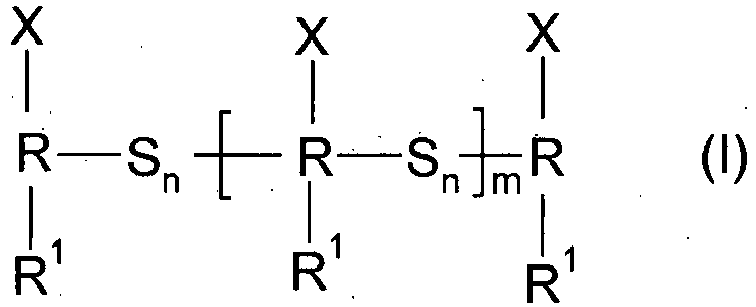
- R
- ist C6-C12-Aryl oder eine 5-10 gliedrige Heteroarylgruppe, die 1 bis 3 Heteroatome aus der Gruppe N, O und S enthält;
- X
- ist OR2, SR2, NR2R3, COOR2, CONR2R3 SO2R2, F, Cl, Br, H oder eine Gruppe Y1-P(Y2)p R'R";
- Y1
- ist O, oder S;
- Y2
- ist O oder S;
- p
- ist 0 oder 1;
- R', R"
- sind gleich oder verschieden, C1-C18-Alkyl, C2-C18-Alkenyl, C2-C18-Alkinyl, C6-C12-Aryl, C3-C10-Cycloalkyl C6-C12-Aryl-C1-C18-Alkyl, O-(C1-C18)-Alkyl, O-(C6-C12)-Aryl, O-(C3-C10)-Cycloalkyl oder (C6-C12)-Aryl-(C1-C18)-Alkyl-O;
- R1
- ist C1-C18-Alkyl, C2-C18-Alkenyl, C3-C18-Alkinyl, C3-C10-Cycloalkyl, O-(C1-C18)-Alkyl, O-(C2-C18)-Alkenyl, O-(C3-C18)-Alkinyl oder O-(C3-C10)-Cycloalkyl ;
- R2, R3
- sind gleich oder verschiedenH, C1-C18-Alkyl, C2-C18-Alkenyl, C3-C18-Alkinyl, C6-C10-Aryl, C3-C10-Cycloalkyl oder C6-C10-Aryl-C1-C18-Alkyl;
- n
- ist eine ganze Zahl von 2 bis 6 und
- m
- ist eine Zahl von 2 bis 500;
- b) mindestens eine halogenfreie organische Phosphorverbindung mit einem Phosphorgehalt im Bereich von 0,5 bis 40 Gew.-%, bezogen auf die Phosphorverbindung, wobei die Phosphorverbindung(en) b) gewählt sind aus
- b') Phosphorverbindungen der Formel (II),
(X1)s =PR4R5R6 (II)
wobei die Symbole und Indizes in der Formel (II) folgende Bedeutungen haben:- R4
- ist C1-C16-Alkyl, C1-C10-Hydroxyalkyl, C2-C16-Alkenyl, C1-C16-Alkoxy, C1-C16-Alkenoxy, C3-C10-Cycloalkyl, C3-C10-Cycloalkoxy, C6-C10-Aryl, C6-C10-Aryloxy, C6-C10-Aryl-C1-C16-Alkyl, C6-C10-Aryl-C1-C16-Alkoxy, SR12, COR13, COOR14, CONR15R16;
- R5
- ist C1-C16-Alkyl, C1-C10-Hydroxyalkyl, C1-C16-Alkenyl, C1-C16-Alkoxy, C1-C16-Alkenoxy, C3-C10-Cycloalkyl, C3-C10-Cycloalkoxy, C6-C10-Aryl, C6-C10-Aryloxy, C6-C10-Aryl-C1-C16-Alkyl, C6-C10-Aryl-C1-C16-Alkoxy, SR12, COR13, COOR14, CONR15R16;
- R6
- ist H, SH, SR7, OH, OR8 oder eine Gruppe
-(Y3)v-[P(= X2)uR9-(Y4)k]l-P(= X3)tR10R11;
wobei zwei Gruppen R4, R5, R6 zusammen mit dem Phosphoratom, an das sie gebunden sind, kein Ringsystem bilden; - X1, X2, X3
- sind gleich oder verschieden unabhängig voneinander O oder S;
- Y3, Y4
- sind gleich oder verschieden O oder S;
- R7, R8, R12, R13, R14, R15, R16
- sind gleich oder verschieden C1-C12-Alkyl, C3-C8-Cycloalkyl, das unsubstituiert oder durch eine oder mehrere C1-C4-Alkylgruppen substituiert ist, C2-C12-Alkenyl, C2-C12-Alkinyl, C6-C10-Aryl, C6-C10-Aryl-C1-C4-alkyl oder Hydroxy-(C1-C18)-alkyl;
- R9, R10, R11
- sind gleich oder verschieden unabhängig voneinander C1-C16-Alkyl, C2-C16-Alkenyl, C1-C16-Alkoxy, C1-C16-Alkenoxy, C3-C10-Cycloalkyl, C3-C10-Cycloalkoxy, C6-C10-Aryl, C6-C10-Aryloxy, C6-C10-Aryl-C1-C16-Alkyl, C6-C10-Aryl-C1-C16-Alkoxy, SR12, COR13, COOR14, CONR15R16,
- k, v
- sind 0 oder 1, falls Y3 bzw. Y4 O ist, und 1, 2, 3, 4, 5, 6, 7 oder 8, falls Y2 bzw. Y4 S ist, und
- l
- ist eine ganze Zahl von 0 bis 100;
- s, t, u
- sind unabhängig voneinander 0 oder 1;
- b") Phosphorverbindungen der Formel (III),
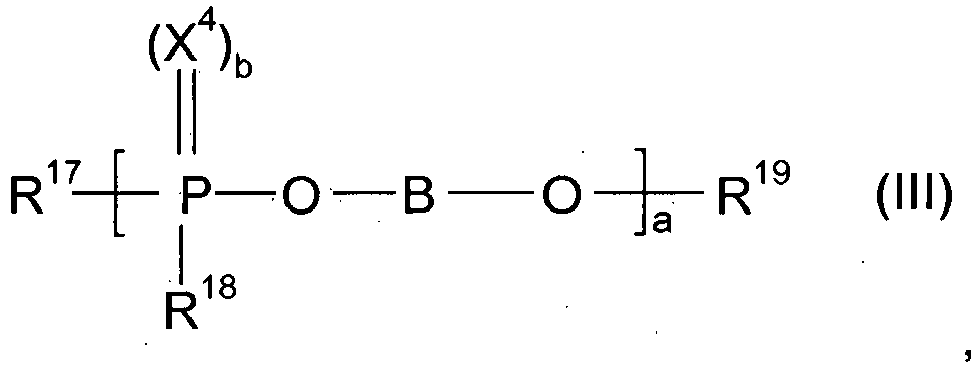
- B
- ist eine Gruppe

- R19
- ist -P(=X5)cR24R25, H, eine geradkettige oder verzweigte C1-C12-Alkylgruppe, C5-C6-Cycloalkyl, C6-C12-Aryl, Benzyl, wobei die vier letztgenannten Gruppen unsubstituiert oder durch einen oder mehrere Reste aus der Gruppe C1-C4-Alkyl und C2-C4-Alkenyl substituiert sind;
- R17, R18, R24 und R25
- sind gleich oder verschieden Wasserstoff, OH, C1-C16-Alkyl, C2-C16-Alkenyl, C1-C16-Alkoxy, C2-C16-Alkenoxy, C3-C10-Cycloalkyl, C3-C10-Cycloalkoxy, C6-C10-Aryl, C6-C10-Aryloxy, C6-C10-Aryl-C1-C16-Alkyl, C6-C10-Aryl-C1-C16-Alkoxy, SR26 COR27, COOR28, CONR29R30 oder zwei Reste R17, R18, R24, R25 bilden zusammen mit dem Phosphoratom, an das sie gebunden sind, oder einer Gruppe P-O-B-O-P ein Ringsystem;
- R20, R21, R22, R23
- sind gleich oder verschieden H, C1-C16-Alkyl, C2-C16-Alkenyl, C1-C16-Alkoxy, C2-C16-Alkenoxy;
- R26, R27, R28, R29, R30
- sind gleich oder verschieden H, C1-C16-Alkyl, C2-C16-Alkenyl, C6-C10-Aryl, C6-C10-Aryl-C1-C16-Alkyl, C6-C10-Aryl-C1-C16-Alkoxy;
- X4, X5
- sind gleich oder verschieden S oder O;
- b, c
- sind gleich oder verschieden, vorzugsweise gleich, 0 oder 1;
- X6, X7, X8, X9
- sind gleich oder verschieden S oder O und
- a
- ist eine natürliche Zahl von 1 bis 50.
- b"') oligomeren oder polymeren Phosphaten der Formel (VII),

- R26,R27,R28,R29
- sind gleich oder verschieden H, lineares oder verzweigtes C1-C16-Alkyl, lineares oder verzweigtes C2-C16-Alkenyl, lineares oder verzweigtes C2-C16-Alkinyl, C3-C10-Cycloalkyl, C6-C10-Aryl, Heteroaryl oder C6-C10-Aryl-C1-C10-Alkyl, wobei Aryl in den Resten R26 - R28 jeweils unabhängig voneinander unsubstituiert oder mit 1 bis 3 Resten aus der Gruppe C1-C10-Alkyl, C1-C10-Alkoxy, C6-C10-Aryl, C6-C10-Aryloxy, OH, CHO, COOH, CN, SH, SCH3, SO2CH3, SO2-C6-C10-Aryl, SO3H, COCH3, COC2H5, CO-C6-C10-Aryl und S-S-C6-C10-Aryl substituiert ist,
oder - R26,R27,R28,R29
- sind ein kationischer Rest aus der Gruppe der Metalle und stickstoffhaltigen Kationen,
- Z
- ist


- M
- ist -CH2-, -C(CF3)2-, -C(CH3)(C6H5)-, -C(CH3)(C2H5)-, -C(C6H5)2-1,3-Phenylen-C(CH3)2-, -C(CH3)2-1,4-Phenylen-C(CH3)2-,

- R30
- ist -CH3, -CH(CH3)2 oder C6H5 und
- n
- ist 1 bis 100;
- b"") oligomeren oder polymeren Phosphonaten der Formel (VIII),

- R30, R31, R32, R33 sind gleich oder verschieden H, lineares oder verzweigtes C1-C16-Alkyl, lineares oder verzweigtes C2-C16-Alkenyl, lineares oder verzweigtes C2-C16-Alkinyl, C3-C10-Cycloalkyl, C6-C10-Aryl, Heteroaryl oder C6-C10-Aryl-C1-C10-Alkyl; wobei Aryl in den Resten R30 - R33 jeweils unabhängig voneinander unsubstituiert oder mit 1 bis 3 Resten aus der Gruppe C1-C10-Alkyl, C1-C10Alkoxy, C6-C10-Aryl, C6-C10-Aryloxy, OH, CHO, COOH, CN, SH, SCH3, SO2CH3, SO2-C6-C10-Aryl, SO3H, COCH3, COC2H5, CO-C6-C10-Aryl und S-S-C6-C10-Aryl substituiert ist;
- Z
- ist


- M
- ist -CH2-, -C(CF3)2-, -C(CH3)(C6H5)-, -C(CH3)(C2H5)- -C(C6H5)2-1,3-Phenylen-C(CH3)2-, -C(CH3)2-1,4-Phenylen-C(CH3)2-, -O-, -S-,

- R34
- ist -CH3, -CH(CH3)2 oder C6H5 und
- f
- ist 1 bis 1000.
- Weiterhin Gegenstand der Erfindung ist die Verwendung einer Mischung des Flammschutzsynergisten a) und des Flammschutzmittels b) als Flammschutzsystem.
- Ein weiterer Gegenstand der Erfindung ist eine Polymerzusammensetzung, bevorzugt ein Polymerschaum, besonders bevorzugt ein Polymerschaum auf Basis eines Styrolpolymers, enthaltend ein oder mehrere Polymere und das erfindungsgemäße Flammschutzsystem.
- Ebenso Gegenstand der Erfindung ist ein Verfahren zur flammhemmenden Ausrüstung von geschäumten oder ungeschäumten Polymeren, wobei man eine Schmelze des Polymers oder die Monomere, aus denen das Polymer erzeugt wird, mit dem erfindungsgemäßen Flammschutzsystem vermischt.
- Gegenstand der Erfindung ist auch die Verwendung der erfindungsgemäßen Polymerzusammensetzung als Dämm- und/oder Isoliermaterial insbesondere in der Bauindustrie. Gegenstand der Erfindung ist auch die Verwendung der erfindungsgemäßen Polymerzusammensetzung als Verpackungsmaterial.
- Das erfindungsgemäße Flammschutzsystem zeichnet sich beispielsweise durch eine verbesserte Prozessierbarkeit bei der Herstellung von Schaumstoffen basierend auf Styrolpolymeren aus. Es eignet sich insbesondere zum Brandschutz von Schäumen mit geringer Dichte.
- Vorteilhaft ist es, dass bei Zusatz athermaner Verbindungen die Wirkung als Flammschutzsystem im Allgemeinen nicht beeinflusst wird.
- Das erfindungsgemäße Flammschutzsystem enthält eine oder mehrere, vorzugsweise 1 bis 3, besonders bevorzugt 1 Verbindung der Formel (I).
- Bevorzugt sind Verbindungen der Formel (I), in denen alle Symbole und Indizes die bevorzugten Bedeutungen haben.
- Bevorzugt sind auch Verbindungen der Formel (I), in denen die Symbole und Indizes die bevorzugten Bedeutungen haben und R1 C6-C12-Aryl ist.
- Besonders bevorzugt haben die Symbole und Indizes in der Formel (I) folgende Bedeutungen:
- R
- ist besonders bevorzugt C6-C10-Aryl.
- X
- ist besonders bevorzugt OR2, SR2, NR2R3, COOR2, COONR2R3, SO2R2 oder eine Gruppe Y1-P(Y2)pR'R".
- Y1
- ist besonders bevorzugt O oder S.
- Y2
- ist besonders bevorzugt O oder S.
- p
- ist besonders bevorzugt 0 oder 1.
- R', R"
- sind besonders bevorzugt gleich und sind C1-C18-Alkyl, C6-C12-Aryl, O-(C1-C18)-Alkyl oder O-(C6-C12-Aryl).
- R1
- ist besonders bevorzugt C1-C16-Alkyl.
- R2, R3
- sind besonders bevorzugt gleich und sind H, C1-C18-Alkyl oder C6-C12-Aryl.
- n
- ist besonders bevorzugt eine ganze Zahl von 2 bis 4.
- m
- ist besonders bevorzugt eine Zahl von 2 bis 250.
- Besonders bevorzugt sind Verbindungen der Formel (I), in denen alle Symbole und Indizes die besonders bevorzugten Bedeutungen haben.
- Ganz besonders bevorzugt haben die Symbole und Indizes in der Formel (I) folgende Bedeutungen:
- R
- ist ganz besonders bevorzugt Phenyl.
- X
- ist ganz besonders bevorzugt OR2 oder eine Gruppe O-P(O)pR'R".
- p
- ist ganz besonders bevorzugt 0 oder 1.
- R', R"
- sind ganz besonders bevorzugt gleich und sind C1-C6-Alkyl, C6-C12-Aryl, O-(C1-C6)-Alkyl oder O-(C6-C12)-Aryl.
- R1
- ist ganz besonders bevorzugt eine C1-C10- Alkylgruppe.
- R2
- ist ganz besonders bevorzugt H oder eine C1-C6-Alkylgruppe.
- n
- ist ganz besonders bevorzugt eine ganze Zahl von 2 bis 3.
- m
- ist ganz besonders bevorzugt eine Zahl von 3 bis 150.
- Ganz besonders bevorzugt sind Verbindungen der Formel (I), bei denen alle Symbole und Indizes die ganz besonders bevorzugten Bedeutungen haben. Ebenso ganz besonders bevorzugt beträgt der Schwefelgehalt der Schwefelverbindungen (I) 15 bis 40 Gew.-%, bezogen auf die Schwefelverbindung (I).
- Insbesondere bevorzugt haben die Symbole und Indizes in der Formel (I) folgende Bedeutungen:
- R
- ist insbesondere bevorzugt Phenyl, bei dem die Gruppen X und R1 in paraStellung stehen.
- X
- ist insbesondere bevorzugt OH oder eine Gruppe O-P(O)(O-Phenyl)2.
- R1
- ist insbesondere bevorzugt t-C4H9 oder t-C5H11.
- n
- ist insbesondere bevorzugt 2.
- m
- ist insbesondere bevorzugt eine Zahl von 3 bis 100.
- Insbesondere bevorzugt sind Verbindungen der Formel (I), bei denen alle Symbole und Indizes die insbesondere bevorzugten Bedeutungen haben.
- Weiterhin insbesondere bevorzugt sind die in den Beispielen aufgeführten Verbindungen Poly-(tert-Butylphenoldisulfid), Poly-(tert-Amylphenol-disulfid) und mit Diphenylphosphatgruppen phosphatiertes Poly-(tert.-Butylphenoldisulfid).
- Der Schwefelgehalt der Schwefelverbindungen (I) beträgt vorzugsweise 5 bis 80 Gew.-%, besonders bevorzugt 10 bis 60 Gew.-%, ganz besonders bevorzugt 15 bis 40 Gew.-%, bezogen auf die Schwefelverbindung (I). Das Molekulargewicht der Schwefelverbindungen (I) beträgt vorzugsweise mindestens 500 g/mol.
- Poly-(tert-Butylphenoldisulfid) und Poly-(tert-Amylphenoldisulfid) sind von Arkema, Colombes, Frankreich, kommerziell erhältlich. Die Synthese solcher Verbindungen ist beispielsweise in der
US 3,968,062 beschrieben. - Das Gewichtverhältnis von Schwefelverbindung(en) a) zu Phosphorverbindung(en) b) beträgt 1 : 10 bis 10 :1, bevorzugt 1 : 8 - 8 :1, besonders bevorzugt 1 : 5 bis 5 : 1. Als Komponente b) enthält das erfindungsgemäße Flammschutzsystem eine oder mehrere, vorzugsweise 1 bis 3, besonders bevorzugt 1 oder 2, insbesondere 1, Phosphorverbindung mit einem Phosphorgehalt im Bereich von 5 bis 80 Gew.-%, bezogen auf Phosphorverbindung.
- Geeignete Phosphorverbindungen sind beispielsweise Phosphate, Phosphonate, wie DOPO (9,10-Dihydro-9-oxa-10-phosphaphenanthren-10-oxid) und DOPO-Derivate, Phosphinate, Phosphite und Phosphinite. Beispielsweise sind dies kommerzielle Produkte wie Exolit® OP 930, Exolit® OP 1312, HCA, HCA-HQ, Cyagard® RF-1243, Fyrol® PMP, Phoslite® IP-A und Budit® 833.
- Bevorzugt haben die Symbole und Indizes in Phosphorverbindungen der Formel (II) folgende Bedeutungen:
- R4
- ist bevorzugt C1-C16-Alkyl, C1-C10-Hydroxyalkyl, C2-C16-Alkenyl, C1-C16-Alkoxy, C2-C16-Alkenoxy, C3-C10-Cycloalkyl, C3-C10-Cycloalkoxy, C6-C10-Aryl, C6-C10-Aryloxy, C6-C10-Aryl-C1-C16-Alkyl, C6-C10-Aryl-C1-C16-Alkoxy.
- R5
- ist bevorzugt C1-C16-Alkyl, C1-C10-Hydroxyalkyl, C2-C16-Alkenyl, C1-C16-Alkoxy, C2-C16-Alkenoxy, C3-C10-Cycloalkyl, C3-C10-Cycloalkoxy, C6-C10-Aryl, C6-C10-Aryl-C1-C16-Alkyl, C6-C10-Aryl-C1-C16-Alkoxy.
- R6
- ist bevorzugt H, SH, SR7, OH, OR8 oder eine Gruppe: -(Y3)v-[P(= X2)uR9 -(Y4)k]l-P(= X3)tR10R11.
- X1, X2 und X3
- sind bevorzugt gleich oder verschieden unabhängig voneinander O oder S.
- Y3, Y4
- sind bevorzugt gleich oder verschieden O oder S.
- R7, R8
- sind bevorzugt gleich oder verschieden C1-C12-Alkyl, C3-C8-Cycloalkyl, das unsubstituiert oder durch eine oder mehrere C1-C4-Alkylgruppen substituiert ist, C2-C12-Alkenyl, C2-C12-Alkinyl, C6-C10-Aryl oder C6-C10-Aryl-C1-C4-alkyl.
- R9, R10, R11
- sind bevorzugt gleich oder verschieden unabhängig voneinander C1-C16-Alkyl, C2-C16-Alkenyl, C1-C16-Alkoxy, C2-C16-Alkenoxy, C3-C10-Cycloalkyl, C3-C10-Cycloalkoxy, C6-C10-Aryl, C6-C10-Aryloxy, C6-C10-Aryl-C1-C16-Alkyl, C6-C10-Aryl-C1-C16-Alkoxy, SR12, COR13, COOR14, CONR15R16.
- k, v
- sind bevorzugt 1, falls Y3 bzw. Y4 O ist, und 1 oder 2, falls Y3 bzw. Y4 S ist.
- l
- ist bevorzugt eine ganze Zahl von 0 bis 10.
- s, t, u
- sind bevorzugt 1.
- Bevorzugt sind Verbindungen der Formel (II), in denen alle Symbole und Indizes die bevorzugten Bedeutungen haben.
- Besonders bevorzugt haben die Symbole und Indizes in der Formel (II) folgende Bedeutungen:
- R4
- ist besonders bevorzugt C1-C8-Alkyl, C1-C8-Alkoxy, Cyclohexyl, Phenyl, Phenoxy, Benzyl, Benzyloxy.
- R5
- ist besonders bevorzugt C1-C8-Alkyl, C1-C8-Alkoxy, Cyclohexyl, Phenyl, Benzyl, Benzyloxy.
- R6
- ist besonders bevorzugt H, SH, SR7, OH, OR8 oder eine Gruppe -(Y3)k-P(= X3)tR10R11.
- X1 und X3
- sind besonders bevorzugt gleich oder verschieden O oder S.
- Y3
- ist besonders bevorzugt O oder S.
- R7, R8
- sind besonders bevorzugt gleich oder verschieden C1-C8-Alkyl, Cyclohexyl, Phenyl oder Benzyl.
- R10, R11
- sind besonders bevorzugt gleich oder verschieden C1-C8-Alkyl, C1-C8-Alkoxy, Cyclohexyl, Phenyl, Phenoxy, Benzyl und Benzyloxy.
- k
- ist besonders bevorzugt 1, falls Y3 O ist, und 1 oder 2, falls Y3 S ist.
- s und t
- sind besonders bevorzugt 1.
- Besonders bevorzugt sind Verbindungen der Formel (II), bei denen die Symbole und Indizes die besonders bevorzugten Bedeutungen haben.
- Insbesondere bevorzugt haben die Symbole und Indizes in der Formel (II) folgende Bedeutungen:
- R4
- ist insbesondere bevorzugt Phenyl oder Phenoxy.
- R5
- ist insbesondere bevorzugt Phenyl.
- R6
- ist insbesondere bevorzugt H, SH, SR7, OH, OR8 oder eine Gruppe -(Y3)k-P(= X3)tR10R11.
- X1 und X3
- sind insbesondere bevorzugt gleich oder verschieden O oder S.
- Y3
- ist insbesondere bevorzugt O oder S.
- R7, R8
- sind insbesondere bevorzugt gleich oder verschieden Cyclohexyl, Phenyl oder Benzyl.
- R10, R11
- sind insbesondere bevorzugt gleich oder verschieden Phenyl, Phenoxy.
- k
- ist insbesondere bevorzugt 1, falls Y3 O ist, und 1 oder 2, falls Y3 S ist.
- s und t
- sind insbesondere bevorzugt 1.
- Insbesondere bevorzugt sind Verbindungen der Formel (II), in denen die Symbole und Indizes die insbesondere bevorzugten Bedeutungen haben.
- Weiterhin insbesondere bevorzugt sind Verbindungen der Formel (II), in denen die Symbole und Indizes die insbesondere bevorzugten Bedeutungen haben und R5 Phenoxy ist.
- Weiterhin bevorzugt sind folgende Gruppen von Verbindungen der Formel (II):
S=PR4R5-H (IIa)
S=PR4R5-SH (IIb)
S=PR4R5-OH (IIc)
S=PR4R5-S-Phenyl (IId)
S=PR4R5-O-Phenyl (IIe)
S=PR4R5-S-Benzyl (IIf)
S=PR4R5-O-Benzyl (IIg)
S=PR4R5-P(= S)R10R11 (IIh)
S=PR4R5-S-P(= S)R10R11 (IIi)
S=PR4R5-S-S-P(= S)R10R11 (IIj)
S=PR4R5-O-P(= S)R10R11 (IIk)
O=PR4R5-H (IIl)
O=PR4R5-SH (IIm)
O=PR4R5-OH (IIn)
O=PR4R5-S-Phenyl (IIo)
O=PR4R5-O-Phenyl (IIp)
O=PR4R5-S-Benzyl (IIq)
O=PR4R5-P(=S)R10R11 (IIr)
O=PR4R5-S-P(=S)R10R11 (IIs)
O=PR4R5-S-S-P(=S)R10R11 (IIt)
O=PR4R5-O-P(=S)R10R11 (IIu)
O=PR4R5-P(=O)R10R11 (IIv)
O=PR4R5-S-P(=O)R10R11 (IIw)
O=PR4R5-S-S-P(=O)R10R11 (IIx)
O=PR4R5-O-P(=O)R10R11 (IIy)
wobei die Symbole die in der Formel (II) angegebenen Bedeutungen haben. - Insbesondere bevorzugt sind die folgenden Komponenten b),
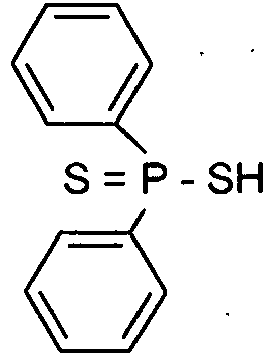
Diphenyldithiophosphinsäure 
Bis(diphenylphosphinthioyl)disulfid 
1,1,2,2-Tetraphenyldiphosphindisulfid O=P(O-Ph)3 Triphenylphosphat - Weiterhin bevorzugte Phosphorverbindungen sind solche der Formel (III), wobei die Symbole in der Formel (III) folgende Bedeutung haben:
- B ist bevorzugt eine Gruppe der Formel (IV), (V) oder (VI).
- R19 ist bevorzugt (X5)cPR24R25 oder H.
- R17, R18, R24, R25 sind bevorzugt gleich oder verschieden C6-C10-Aryl, C6-C10-Aryloxy, C6-C10-Aryl-C1-C16-Alkyl oder C6-C10-Aryl-C1-C16-Alkoxy.
- R20, R21, R22, R23 sind bevorzugt H, C1-C16-Alkyl, C2-C16-Alkenyl, C1-C16-Alkoxy, C1-C16-Alkenoxy,
- X4, X5 sind bevorzugt gleich oder verschieden S oder O.
- b, c sind bevorzugt gleich 0 oder 1.
- X6, X7, X8, X9 sind bevorzugt O.
- a ist bevorzugt eine natürliche Zahl von 1 bis 30.
- Bevorzugt sind Verbindungen der Formel (III), in denen alle Symbole die bevorzugten Bedeutungen haben.
- Besonders bevorzugt haben die Symbole in der Formel (III) folgende Bedeutung:
- B ist besonders bevorzugt eine Gruppe der Formel (IV), (V) oder (VI).
- R19 ist besonders bevorzugt (X5)cPR24R25.
- R17, R18, R24, R25 sind besonders bevorzugt gleich oder verschieden Phenyl, Phenoxy, Phenyl-C1-C16-Alkyl, Phenyl-C1-C16-Alkoxy.
- R20, R21, R22, R23 sind besonders bevorzugt H.
- X4, X5 sind besonders bevorzugt gleich oder verschieden S oder O.
- b, c sind besonders bevorzugt gleich 0 oder 1.
- X6, X7, X8, X9 sind besonders bevorzugt O.
- a ist besonders bevorzugt 1.
- Besonders bevorzugt sind Verbindungen der Formel (III), in denen alle Symbole und Indizes die besonders bevorzugten Bedeutungen haben.
- Bevorzugt sind Verbindungen der Formel (III), in denen R17 und R18 gleich sind.
- Weiterhin bevorzugt sind Verbindungen der Formel (III), in denen R17 und R24 oder R17 und R25 gleich sind. Weiterhin besonders bevorzugt sind Verbindungen der Formel (III), in denen R18 und R24 oder R18 und R25 gleich sind.
- Weiter bevorzugt sind Verbindungen, in denen R17, R18, R24 und R25 gleich sind.
- Insbesondere bevorzugt haben die Symbole und Indizes in der Formel (III) folgende Bedeutung:
- B ist insbesondere bevorzugt eine Gruppe der Formel (IV), (V) oder (VI).
- R19 ist insbesondere bevorzugt (X5)cPR24R25.
- R17, R18, R24, R25 sind insbesondere bevorzugt gleich und sind Phenyl oder Phenoxy.
- R20, R21, R22, R23 sind insbesondere bevorzugt H.
- X4, X5 sind insbesondere bevorzugt gleich S oder O.
- b, c sind insbesondere bevorzugt gleich und sind 0 oder 1.
- X6, X7, X8, X9 sind insbesondere bevorzugt Sauerstoff.
- a ist insbesondere bevorzugt 1.
- Insbesondere bevorzugt sind Verbindungen der Formel (III), in denen alle Symbole und Indizes die insbesondere bevorzugten Bedeutungen haben.
- Bevorzugt sind auch Verbindungen der Formel (III), in denen jeweils zwei der Reste R17, R18, R24, R25 zusammen mit dem Phosphoratom, an das sie gebunden sind, oder der Gruppe P-O-B-O-P- ein drei- bis zwölfgliedriges Ringsystem bilden.
- Bevorzugt sind weiterhin Verbindungen der Formel (III), in denen zwei Reste R17, R18, R24, R25 zusammen kein Ringsystem bilden.
- Weiterhin insbesondere bevorzugt sind die folgenden Verbindungen der Formel (III):


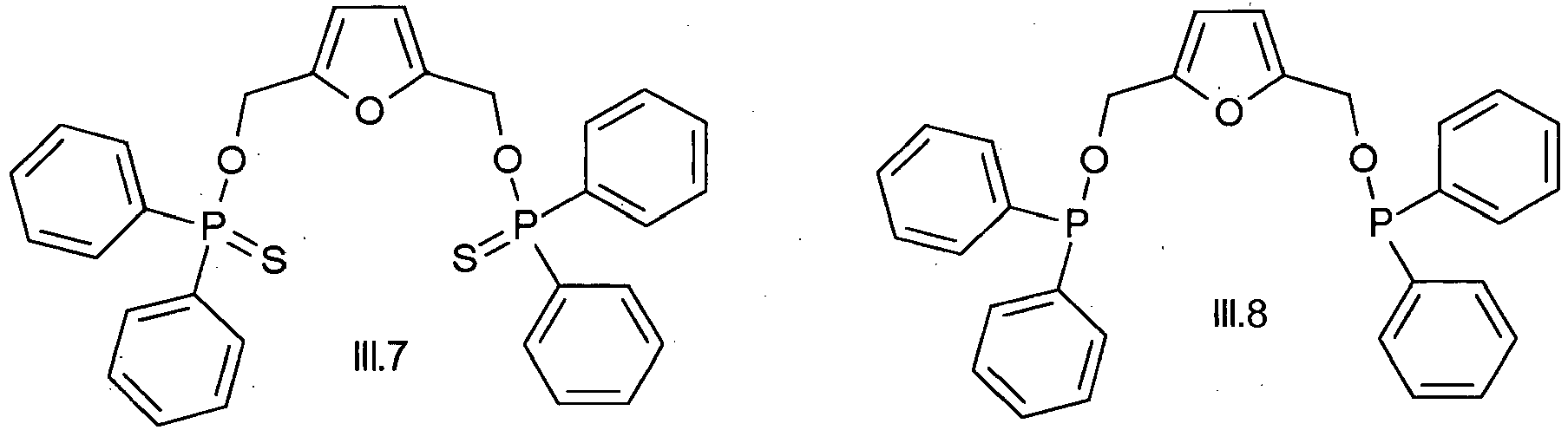


- Die Verbindungen der Formel (III) sind teilweise aus der Literatur bekannt. Die Synthese gelingt beispielsweise durch Umsetzung der entsprechenden furan- oder thiophen-basierten Diolgrundkörper mit Chlorphosphorverbindungen in Gegenwart einer Base. Der zugrundeliegende Reaktionstyp der Umsetzung von Chlorphosphorverbindungen mit Alkoholen ist in der Literatur weitreichend bekannt [siehe z.B.
WO-A 2003/062251 ; Dhawan, Balram; Redmore, Derek, J. Org. Chem. (1986), 51(2), 179-83;WO 96/17853 - Die furan- oder thiophenbasierten Diol-Grundkörper sind größtenteils kommerziell erhältlich oder können leicht nach literaturbekannten Methoden ausgehend von Zuckern dargestellt werden [siehe z.B.:
WO 2006/063287 (Darstellung von 2,5-Bis(hydroxy-methyl)tetrahydrofuran); Cottier, Louis; Descotes, Gerard; Soro, Yaya. Synth. Comm. (2003), 33(24), 4285 - 4295),(Darstellung von 2,5-Bis(hydroxymethyl)furan);CA 2196632 , Katritzky, Alan R.; Zhang, Zhongxing; Lang, Hengyuan; Jubran, Nusrallah; Leichter, Louis M.; Sweeny, Norman. J. Heterocycl. Chem. (1997), 34(2), 561-565]. - Auch die Darstellung von in 2,5-Position substituierten furanbasierten Derivaten ist in der Literatur wohlbekannt (R5 -R8 ganz oder teilweise gleich oder verschieden ungleich H):
- z.B. die Darstellung α2,α5-arylierter 2,5-Bis(hydroxymethyl)furane): Ishii, Akihiko; Horikawa, Yasuaki; Takaki, Ikuo; Shibata, Jun; Nakayama, Juzo; Hoshino,-Masamatsu, Tetrahedron Lett. (1991), 32(34), 4313-16; Jang, Yong-Sung; Kim, Han-Je; Lee, Phil-Ho; Lee, Chang-Hee. Tetrahedron Lett. (2000), 41(16), 2919-2923, oder
- z.B. die Darstellung α2,α5-alkylierter 2,5-Bis(hydroxymethyl)furane): Krauss, Juergen; Unterreitmeier, Doris; Antlsperger, Dorothee, Archiv der Pharmazie, (2003), 336(8), 381-384.
- z.B. die Darstellung α2,α5-alkylierter 2,5-Bis(hydroxymethyl)tetrahydrofurane): Walba, D. M.; Wand, M. D.; Wilkes, M. C., J. Am. Chem. Soc., (1979), 101(15), 4396-4397.
z.B. die Darstellung α2,α5-alkenylierter 2,5-Bis(hydroxymethyl)tetrahydrofurane): Morimoto, Yoshiki; Kinoshita, Takamasa; Iwai, Toshiyuki, Chirality (2002), 14(7), 578-586. - Auch die Synthese in 2,5-Position unsymmetrisch substituierter furanbasierender Diole dieser Art ist literaturbekannt, z.B. die Darstellung α2-alkylierter 2,5-Bis(hydroxy-methyl)tetrahydrofurane): Donohoe, Timothy J.; Williams, Oliver; Churchill, Gwydian H, Angew. Chem. Int. Ed. (2008), 47(15), 2869-2871; oder die Synthese α2-alkylierter, α5 alkinylierter 2,5-Bis(hydroxymethyl)tetrahydrofurane): Abe, Masato; Kubo, Akina; Yamamoto, Shuhei; Hatoh, Yoshinori; Murai, Masatoshi; Hattori, Yasunao; Makabe, Hidefumi; Nishioka, Takaaki; Miyoshi, Hideto. Biochemistry (2008), 47(23), 6260-6266;
oder die Darstellung α2,alkoxylierter 2,5-Bis(hydroxymethyl)furane:Lu, Dan; Li, Pingya; Liu, Jinping; Li, Haijun, CN 101544624 A . - Auch ist die Synthese der Thioanaloga (X=S) von (II) ist literaturbekannt [vgl. Kuszmann, J.; Sohar, P., Carbohydrate Research (1972), 21(1), 19-27].

- Ebenso ist die Synthese der Thioanaloga (X=S) von (III). [vgl. Garrigues, Bernard., Phosph., Sulfur and Silicon (1990), 53(1-4), 75-9.] bzw. substituierter Thioanaloga von III, z.B. α2,α5-arylierter 2,5-Bis(hydroxymethyl)thiophene bekannt [vgl. Kumaresan, D.; Agarwal, Neeraj; Gupta, Iti; Ravikanth, M. Tetrahedron (2002), 58(26), 5347-5356.]
- Weiterhin ist die Synthese der Thioanaloga (X=S) von (IV) beschrieben [vgl. Luttringhaus, A.; Merz, H. Archiv der Pharmazie und Berichte der Deutschen Pharmazeutischen Gesellschaft (1960), 293 881-890.] bzw. substituierter Thioanaloga von IV, z.B. α2,α5-alkylierter 2,5-Bis(hydroxymethyl)tetrahydrothiophene bekannt [vgl. Block, Eric; Ahmad, Saleem. Phosph. Sulfur and the Related Elements (1985), 25(2), 139-145.]
- Die furan- oder thiophenbasierten Diole liegen teilweise in enantiomeren- bzw. diastereomerenreiner Form vor. Die furan- oder thiophenbasierten Diole können in Form ihrer reinen Enantiomere oder Diastereomere eingesetzt werden. Bevorzugt sind jedoch Mischungen der respektiven Konfigurationsisomere.
- Die zur Synthese der Flammschutzagonisten notwendigen Chlorphosphorderivate sind üblicherweise kommerziell erhältlich oder lassen sich über in der Literatur gut bekannte Synthesewege darstellen [vgl. Science of Synthesis (former Houben Weyl) 42 (2008 ); Houben Weyl E1-2 (1982 ); Houben Weyl 12 (1963-1964 )].
- Weiterhin bevorzugt als Phosphorverbindungen b) sind oligomere oder polymere Phosphate der Formel (VII), wobei die Symbole und Indices in der Formel (VII) folgende Bedeutung haben:
- R30
- ist bevorzugt Phenyl.
- Z
- ist bevorzugt
- n
- ist bevorzugt 1 bis 50, besonders bevorzugt 1 bis 10.
- Bevorzugt sind Verbindungen der Formel VII, bei denen alle Symbole und Indizes die bevorzugten Bedeutungen haben.
- Besonders bevorzugte Verbindungen der Formel (VII) sind die Verbindungen (VII-1) und (VII-2):


- Die Verbindungen der Formel (VII) sind bekannt und teilweise kommerziell erhältlich, z.B. die Verbindung (VII-1) unter der Bezeichnung Fyrolflex® RDP von der ICL-IP-Europe BV, und die Verbindung (VII-2) unter der Bezeichnung Fyrolflex® BDP von der ICL-IP-Europe BV.
- Weiterhin bevorzugt als Phosphorverbindungen b) sind oligomere oder polymeren Phosphonate der Formel (VIII), wobei die Symbole und Indices in der Formel (VIII) folgende Bedeutung haben:
- R31 und R34 sind bevorzugt Phenyl.
- R32 und R33 sind bevorzugt Phenyl, Methyl, Ethyl.
- Z
- ist bevorzugt

- f
- ist bevorzugt 1 bis 1000, besonders bevorzugt 100 bis 500.
- Bevorzugt sind Verbindungen der Formel (VIII), bei denen alle Symbole und Indizes die bevorzugten Bedeutungen haben.
- Besonders bevorzugte Verbindungen der Formel (VIII) sind die Verbindungen (VIII-1) und (VIII-2):


- Die Verbindung der Formel (VIII) sowie Derivate hiervon sind bekannt und teilweise kommerziell erhältlich, z.B. die Verbindung (VIII-1) unter der Bezeichnung FRX100® von FRX Polymers (USA). Das erfindungsgemäße Flammschutzsystem aus den genannten Schwefel- und Phosphorverbindungen wird in der Regel zum Schutz von Polymeren, insbesondere Polymerschäumen eingesetzt. Mengen von 2 bis 15 Gew.-Teile, bezogen auf das Polymer, bevorzugt 5 bis 10 Gew.-Teile, bezogen auf das Polymer, gewährleisten insbesondere bei Schaumstoffen aus expandierbaren Styrolpolymeren einen ausreichenden Flammschutz.
- Ebenso bevorzugt ist der Einsatz in einer Menge im Bereich von 0,2 bis 20 Gew.-Teilen, bezogen auf das Polymer. Mengen von 0,5 bis 15 Gew.-Teilen, bezogen auf das Polymer, bevorzugt 0,75 bis 10 Gew.-Teilen, bezogen auf das Polymer, besonders bevorzugt 1 bis 5 Gew.-Teilen, bezogen auf das Polymer, gewährleisten insbesondere bei Schaumstoffen aus expandierbaren Styrolpolymeren einen ausreichenden Flammschutz.
- Werden als Phosporverbindungen b) solche der Formel VII eingesetzt, beträgt die Menge des erfindungsgemäßen Flammschutzsystems (d.h. die Summe der Komponenten a) und b)) bevorzugt ≤ 5 Gew.-Teile, bezogen auf 100 Gew.-Teile Polymer.
- Die Angabe von Gewichtsteilen bezieht sich dabei im Rahmen dieser Anmeldung - soweit nicht anders angegeben - stets auf 100 Gew.-Teile der Verbindung, insbesondere des Polymers, das flammhemmend ausgerüstet wird, ohne Berücksichtigung von etwaigen Additiven.
- Die Wirksamkeit des erfindungsgemäßen Flammschutzsystems kann durch den Zusatz weiterer geeigneter Flammschutzsynergisten, wie die thermischen Radikalbildner Dicumylperoxid, Di-tert-butylperoxid" noch weiter verbessert werden. In diesem Falle werden üblicherweise 0,05 bis 5 Gew.-Teile des Flammschutzsynergisten, bezogen auf das Polymer, eingesetzt. Ebenso bevorzugt ist der Einsatz von 2,5-Dimethyl-2,5-di-(tert-butyl-peroxy)hexin-3, Cumylhydroperoxid, 1,3-Bis-(tert-butylperoxyisopropyl)benzol und 1,4-Bis-(tert-butylperoxyisopropyl)benzol in den genannten Mengen.
- Auch können zusätzlich weitere Flammschutzmittel, wie Melamin, Melamincyanurate, Metalloxide, Metallhydroxide, Phosphate, Phosphonate, DOPO (9,10-Dihydro-9-oxa-10-phosphaphenanthren-10-oxid) oder DOPO-Derivate, Phosphinate, Phosphite, Phosphinite, Blähgraphit oder Synergisten wie Sb2O3, Sn-Verbindungen oder Nitroxyl-Radikale enthaltende oder freisetzende Verbindungen, eingesetzt werden. Geeignete zusätzliche halogenfreie Flammschutzmittel sind beispielsweise im Handel unter den Bezeichnungen Exolit® OP 930, Exolit® OP 1312, HCA®, HCA-HQ®, Cyagard® RF-1243, Fyrol® PMP, Phoslite® IP-A, Melapur® 200, Melapur® MC oder Budit® 833 erhältlich.
- Falls auf die vollständige Halogenfreiheit verzichtet werden kann, können halogenreduzierte Materialien durch die Verwendung des erfindungsgemäßen Flammschutzmittels und den Zusatz geringerer Mengen an halogenhaltigen, insbesondere bromierten Flammschutzmitteln, wie Hexabromcyclododecan (HBCD) oder bromierten Styrolhomo- bzw. Styrolcopolymeren/-oligomeren (z.B. Styrol-Butadien-Copolymeren, wie in
WO-A 2007/058736 beschrieben), bevorzugt in Mengen im Bereich von 0,05 bis 1, insbesondere 0,1 bis 0,5 Gew.- Teile (bezogen auf das Polymer), hergestellt werden. - In einer bevorzugten Ausführungsform ist das erfindungsgemäße Flammschutzsystem halogenfrei.
- Besonders bevorzugt ist die Zusammensetzung aus Polymer, Flammschutzsystem und weiteren Zusatzstoffen halogenfrei.
- Bei dem erfindungsgemäß zu schützenden Material handelt es sich vorzugsweise um eine Polymerzusammensetzung, d.h. eine Zusammensetzung, die ein oder mehrere Polymere enthält und bevorzugt aus einem oder mehreren Polymeren besteht. Bevorzugt sind thermoplastische Polymere. Besonders bevorzugt ist die Polymerzusammensetzung ein Schaumstoff.
- Die erfindungsgemäßen Flammschutzsysteme werden bevorzugt für die Herstellung flammhemmend ausgerüsteter (bzw. flammgeschützter) Polymere, insbesondere thermoplastischer Polymere, verwendet. Hierfür werden die Flammschutzsysteme vorzugsweise physikalisch mit dem entsprechenden Polymer in der Schmelze vermischt und dann entweder als Polymermischung mit Phosphorgehalten zwischen 0,05 Gew.-Teile und 5 Gew.-Teile und Schwefelgehalten zwischen 0,1 Gew.-Teile und 10 Gew.-Teile (bezogen auf das Polymer) zunächst fertig konfektioniert und dann in einem zweiten Verfahrensschritt zusammen mit demselben oder mit einem anderen Polymer weiterverarbeitet. Alternativ ist im Falle von Styrolpolymeren auch der Zusatz des erfindungsgemäßen Flammschutzsystems vor, während und/oder nach der Herstellung durch Suspensionspolymerisation bevorzugt.
- Gegenstand der Erfindung ist auch eine, vorzugsweise thermoplastische Polymerzusammensetzung, enthaltend eine oder mehrere Polymere und das erfindungsgemäße Flammsch utzsystem.
- Als Polymer können beispielsweise geschäumte oder ungeschäumte Styrolpolymere, einschließlich ABS, ASA, SAN, AMSAN, SB und HIPS Polymere, Polyimide, Polysulfone, Polyolefine wie Polyethylen und Polypropylen, Polyacrylate, Polyetheretherketone, Polyurethane, Polycarbonate, Polyphenylenoxide, ungesättigte Polyesterharze, Phenolharze, Aminoplaste, Epoxidharze, Polyamide, Polyethersulfone, Polyetherketone und Polyethersulfide, jeweils einzeln oder in Mischung als Polymerblends eingesetzt werden.
- Bevorzugt sind thermoplastische Polymere, wie geschäumte oder ungeschäumte Styrolhomopolymere und -copolymere jeweils einzeln oder in Mischung als Polymerblends.
- Bevorzugt sind flammgeschützte Polymerschaumstoffe, insbesondere auf Basis von Styrolpolymeren, vorzugsweise EPS und XPS.
- Die flammgeschützten Polymerschaumstoffe weisen (nach ISO 845) bevorzugt eine Dichte im Bereich von 5 bis 150 kg/m3, besonders bevorzugt im Bereich von 10 bis 50 kg/m3, auf und sind bevorzugt zu mehr als 80 %, besonders bevorzugt zu 90 bis 100 % geschlossenzellig.
- Erfindungsgemäße flammgeschützte, expandierbare Styrolpolymere (EPS) und Styrol-polymerextrusionsschaumstoffe (XPS) können durch Zugabe des Treibmittels und des erfindungsgemäßen Flammschutzsystems vor, während oder nach der Suspensionspolymerisation oder durch Einmischen eines Treibmittels und des erfindungsgemäßen Flammschutzsystems in die Polymerschmelze und anschließende Extrusion und Granulierung unter Druck zu expandierbaren Granulaten (EPS) oder durch Extrusion und Entspannung unter Verwendung entsprechend geformter Düsen zu Schaumstoffplatten (XPS) oder Schaumstoffsträngen verarbeitet werden.
- Erfindungsgemäß umfasst der Begriff Styrolpolymer Polymere, auf Basis von Styrol, alpha-Methylstyrol oder Mischungen von Styrol und alpha-Methylstyrol; analog gilt dies für den Styrolanteil in SAN, AMSAN, ABS, ASA, MBS und MABS (siehe unten). Erfindungsgemäße Styrolpolymere basieren auf mindestens 50 Gew.-% Styrol und/oder alpha-Methylstyrol Monomeren.
- In einer bevorzugten Ausführungsform ist das Polymer ein expandierbares Polystyrol (EPS).
- In einer weiteren bevorzugten Ausführungsform ist der Schaumstoff ein Styrolpolymerextrusionsschaumstoff (XPS).
- Bevorzugt weisen expandierbare Styrolpolymere ein Molekulargewicht Mw im Bereich von 180.000 bis 300.000 g/mol, gemessen mittels Gelpermeationschromatographie mit refraktiometrischer Detektion (RI) gegenüber Polystyrolstandards, auf. Aufgrund des Molekulargewichtsabbaus durch Scherung und/oder Temperatureinwirkung liegt das Molekulargewicht des expandierbaren Polystyrols in der Regel etwa 10.000 bis 40.000 g/mol unter dem Molekulargewicht des eingesetzten Polystyrols. Das zahlenmittlere Molekulargewicht Mn ist bevorzugt kleiner als 120.000 g/mol.
- Bevorzugt sind als Styrolpolymere glasklares Polystyrol (GPPS), Schlagzähpolystyrol (HIPS), anionisch polymerisiertes Polystyrol- oder Schlagzähpolystyrol (A-IPS), Styrolalpha-Methylstyrol-Copolymere, Acrylnitril-Butadien-Styrolpolymerisate (ABS), StyrolButadien-Copolymere (SB), Styrol-Acrylnitril-Copolymere (SAN), Acrylnitril-alpha-Methylstyrol-Copolymere (AMSAN), Styrol-Maleinsäureanhydrid-Copolymere (SMA), Styrol-Methylmethacrylat-Copolymere (SMMA), Styrol-N-Phenylmaleinimid-Copolymere (SPMI), Acrylnitril-Styrol-Acrylester (ASA), Methylmethacrylat-Butadien-Styrol (MBS), Methylmethacrylat-Acrylnitril-Butadien-Styrol (MABS)-polymerisate oder Mischungen davon oder mit Polyphenylenether (PPE).
- Die genannten Styrolpolymere können zur Verbesserung der mechanischen Eigenschaften oder der Temperaturbeständigkeit gegebenenfalls unter Verwendung von Verträglichkeitsvermittlern mit thermoplastischen Polymeren, wie Polyamiden (PA), Polyolefinen, wie Polypropylen (PP) oder Polyethylen (PE), Polyacrylaten, wie Polymethylmethacrylat (PMMA), Polycarbonat (PC), Polyestern, wie Polyethylenterephthalat (PET) oder Polybutylenterephthalat (PBT), Polyethersulfonen (PES), Polyetherketonen oder Polyethersulfiden (PES) oder Mischungen davon in der Regel in Anteilen von insgesamt bis maximal 30 Gew.-%, bevorzugt im Bereich von 1 bis 10 Gew.-%, bezogen auf die Polymerschmelze, abgemischt werden. Des Weiteren sind Mischungen in den genannten Mengenbereichen auch mit z. B hydrophob modifizierten oder funktionalisierten Polymeren oder Oligomeren, Kautschuken, wie Polyacrylaten oder Polydienen, z.B. Styrol-Butadien-Blockcopolymeren oder biologisch abbaubaren aliphatischen oder aliphatisch/aromatischen Copolyestern möglich.
- Als Verträglichkeitsvermittler eignen sich z.B. Maleinsäureanhydrid-modifizierte Styrolcopolymere, epoxidgruppenhaltige Polymere oder Organosilane.
- Der Styrolpolymerschmelze können auch Polymerrecyklate der genannten thermoplastischen Polymeren, insbesondere Styrolpolymere und expandierbare Styrolpolymere (EPS) in Mengen zugemischt werden, die deren Eigenschaften nicht wesentlich verschlechtern, in der Regel in Mengen von maximal 50 Gew.-%, insbesondere in Mengen von 1 bis 20 Gew.-%.
- Die treibmittelhaltige Styrolpolymerschmelze enthält in der Regel ein oder mehrere Treibmittel in homogener Verteilung in einem Anteil von insgesamt 2 bis 10 Gew.-% bevorzugt 3 bis 7 Gew.-%, bezogen auf die treibmittelhaltige Styrolpolymerschmelze. Als Treibmittel, eigenen sich die üblicherweise in EPS eingesetzten physikalische Treibmittel, wie aliphatischen Kohlenwasserstoffe mit 2 bis 7 Kohlenstoffatomen, Alkohole, Ketone, Ether oder halogenierte Kohlenwasserstoffe. Bevorzugt wird iso-Butan, n-Butan, iso-Pentan, n-Pentan eingesetzt. Für XPS wird bevorzugt CO2 oder dessen Mischungen mit Alkoholen und/oder C2-C4-Carbonylverbindungen, insbesondere Ketonen, eingesetzt.
- Zur Verbesserung der Verschäumbarkeit können feinverteilte Innenwassertröpfchen in die Styrolpolymermatrix eingebracht werden. Dies kann beispielsweise durch die Zugabe von Wasser in die aufgeschmolzene Styrolpolymermatrix erfolgen. Die Zugabe des Wassers kann örtlich vor, mit oder nach der Treibmitteldosierung erfolgen. Eine homogene Verteilung des Wassers kann mittels dynamischer oder statischer Mischer erreicht werden. In der Regel sind 0 bis 2, bevorzugt 0,05 bis 1,5 Gew.-% Wasser, bezogen auf das Styrolpolymer, ausreichend.
- Expandierbare Styrolpolymere (EPS) mit mindestens 90% des Innenwassers in Form von Innenwassertröpfchen mit einem Durchmesser im Bereich von 0,5 bis 15 µm bilden beim Verschäumen Schaumstoffe mit ausreichender Zellzahl und homogener Schaumstruktur.
- Die zugesetzte Treibmittel- und Wassermenge wird so gewählt, dass die expandierbaren Styrolpolymere (EPS) ein Expansionsvermögen α, definiert als Schüttdichte vor dem Verschäumen/Schüttdichte nach dem Verschäumen höchstens 125 bevorzugt 15 bis 100 aufweisen.
- Die erfindungsgemäßen expandierbaren Styrolpolymergranulate (EPS) weisen in der Regel eine Schüttdichte von höchstens 700 g/l bevorzugt im Bereich von 590 bis 660 g/l auf. Bei Verwendung von Füllstoffen können in Abhängigkeit von der Art und Menge des Füllstoffes Schüttdichten im Bereich von 590 bis 1200 g/l auftreten.
- Des Weiteren können der Styrolpolymerschmelze Additive, Keimbildner, Füllstoffe, Weichmacher, lösliche und unlösliche anorganische und/oder organische Farbstoffe und Pigmente, z.B. IR-Absorber, wie Ruß, Graphit oder Aluminiumpulver sowie weitere athermane Materialien gemeinsam oder räumlich getrennt, z.B. über Mischer oder Seitenextruder zugegeben werden. In der Regel werden die Farbstoffe und Pigmente in Mengen im Bereich von 0,01 bis 30, bevorzugt im Bereich von 1 bis 5 Gew.-% zugesetzt. Zur homogenen und mikrodispersen Verteilung der Pigmente in dem Styrolpolymer kann es insbesondere bei polaren Pigmenten zweckmäßig sein ein Dispergierhilfsmittel, z.B. Organosilane, epoxygruppenhaltige Polymere oder Maleinsäureanhydrid-gepfropfte Styrolpolymere, einzusetzen. Bevorzugte Weichmacher sind Mineralöle, Phthalate, die in Mengen von 0,05 bis 10 Gew.-%, bezogen auf das Styrolpolymerisat, eingesetzt werden können. Analog können diese Stoffe auch vor, während oder nach der Suspensionspolymerisation zu erfindungsgemäßem EPS zugegeben werden.
- Zur Herstellung der erfindungsgemäßen expandierbaren Styrolpolymerisate nach dem Granulierverfahren kann das Treibmittel in die Polymerschmelze eingemischt werden. Ein mögliches Verfahren umfasst die Stufen a) Schmelzerzeugung, b) Mischen c) Kühlen d) Fördern und e) Granulieren. Jede dieser Stufen kann durch die in der Kunststoffverarbeitung bekannten Apparate oder Apparatekombinationen ausgeführt werden. Zur Einmischung eignen sich statische oder dynamische Mischer, beispielsweise Extruder. Die Polymerschmelze kann direkt aus einem Polymerisationsreaktor entnommen werden oder direkt in dem Mischextruder oder einem separaten Aufschmelzextruder durch Aufschmelzen von Polymergranulaten erzeugt werden. Die Kühlung der Schmelze kann in den Mischaggregaten oder in separaten Kühlern erfolgen. Für die Granulierung kommen beispielsweise die druckbeaufschlagte Unterwassergranulierung, Granulierung mit rotierenden Messern und Kühlung durch Sprühvernebelung von Temperierflüssigkeiten oder Zerstäubungsgranulation in Betracht. Zur Durchführung des Verfahrens geeignete Apparateanordnungen sind z.B.:
- Polymerisationsreaktor - statischer Mischer/Kühler - Granulator
- Polymerisationsreaktor - Extruder - Granulator
- Extruder- statischer Mischer- Granulator
- Extruder- Granulator.
- Weiterhin kann die Anordnung Seitenextruder zur Einbringung von Additiven, z.B. von Feststoffen oder thermisch empfindlichen Zusatzstoffen aufweisen.
- Die treibmittelhaltige Styrolpolymerschmelze wird in der Regel mit einer Temperatur im Bereich von 140 bis 300°C, bevorzugt im Bereich von 160 bis 240°C durch die Düsenplatte gefördert. Eine Abkühlung bis in den Bereich der Glasübergangstemperatur ist nicht notwendig.
- Die Düsenplatte wird mindestens auf die Temperatur der treibmittelhaltigen Polystyrolschmelze beheizt. Bevorzugt liegt die Temperatur der Düsenplatte im Bereich von 20 bis 100°C über der Temperatur der treibmittelhaltigen Polystyrolschmelze. Dadurch werden Polymerablagerungen in den Düsen verhindert und eine störungsfreie Granulierung gewährleistet.
- Um marktfähige Granulatgrößen zu erhalten, sollte der Durchmesser (D) der Düsenbohrungen am Düsenaustritt im Bereich von 0,2 bis 1,5 mm, bevorzugt im Bereich von 0,3 bis 1,2 mm, besonders bevorzugt im Bereich von 0,3 bis 0,8 mm liegen. Damit lassen sich auch nach Strangaufweitung Granulatgrößen unter 2 mm, insbesondere im Bereich 0,4 bis 1,4 mm gezielt einstellen.
- Besonders bevorzugt ist ein Verfahren zur Herstellung von halogenfrei flammgeschützten, expandierbaren Styrolpolymeren (EPS), umfassend die Schritte
- a) Einmischen eines organischen Treibmittels und 1-25 Gew.-% des erfindungsgemäßen Flammschutzsystems in die Polymerschmelze mittels eines statischen oder dynamischen Mischers bei einer Temperatur von mindestens 150°C,
- b) Kühlen der treibmittelhaltigen Styrolpolymerschmelze auf eine Temperatur von mindestens 120°C
- c) Austrag durch eine Düsenplatte mit Bohrungen, deren Durchmesser am Düsenaustritt höchstens 1,5 mm beträgt und
- d) Granulieren der treibmittelhaltigen Schmelze direkt hinter der Düsenplatte unter Wasser bei einem Druck im Bereich von 1 bis 20 bar.
- Bevorzugt ist es auch, die expandierbaren Styrolpolymere (EPS) durch Suspensionspolymerisation in wässriger Suspension in Gegenwart des erfindungsgemäßen Flammschutzsystems und eines organischen Treibmittels herzustellen.
- Bei der Suspensionspolymerisation wird als Monomer bevorzugt Styrol allein eingesetzt. Es kann jedoch zu bis zu 20 % seines Gewichts durch andere ethylenisch ungesättigte Monomere, wie Alkylstyrole, Divinylbenzol, Acrylnitril, 1,1-Diphenylethen oder alpha-Methylstyrol ersetzt sein.
- Bei der Suspensionspolymerisation können die üblichen Hilfsmittel, wie Peroxidinitiatoren, Suspensionsstabilisatoren, Treibmittel, Kettenüberträger, Expandierhilfsmittel, Keimbildner und Weichmacher zugesetzt werden. Das erfindungsgemäße Flammschutzmittel wird bei der Polymerisation in Mengen von 0,5 bis 25 Gew.-%, vorzugsweise von 5 bis 15 Gew.-%, zugesetzt. Treibmittel werden in Mengen von 2 bis 10 Gew.-%, bezogen auf Monomer zugesetzt. Man kann sie vor, während oder nach der Polymerisation der Suspension zusetzen. Geeignete Treibmittel sind zum Beispiel aliphatische Kohlenwasserstoffe mit 4 bis 6 Kohlenstoffatomen. Es ist vorteilhaft, als Suspensionsstabilisatoren anorganische Pickering-Dispergatoren, z.B. Magnesiumpyrophosphat oder Calciumphosphat einzusetzen.
- Bei der Suspensionspolymerisation entstehen perlförmige, im Wesentlichen runde Teilchen mit einem mittleren Durchmesser im Bereich von 0,2 bis 2 mm.
- Zur Verbesserung der Verarbeitbarkeit können die fertigen expandierbaren Styrolpolymergranulate durch Glycerinester, Antistatika oder Antiverklebungsmittel beschichten werden.
- Das EPS Granulat kann mit Glycerinmonostearat GMS (typischerweise 0,25 %), Glycerintristearat (typischerweise 0,25 %) feinteiliger Kieselsäure Aerosil R972 (typischerweise 0,12 %) und Zn-Stearat (typischerweise 0,15 %), sowie Antistatikum beschichtet werden.
- Die expandierbaren Styrolpolymergranulate können in einem ersten Schritt mittels Heißluft oder Wasserdampf zu Schaumpartikeln mit einer Dichte im Bereich von 5 bis 200 kg/m3, insbesondere 10 bis 50 kg/m3 vorgeschäumt und in einem zweiten Schritt in einer geschlossenen Form zu Partikelformteilen verschweißt werden.
- Die expandierbaren Polystyrolteilchen können zu Polystyrolschaumstoffen mit Dichten von 8 bis 200 kg/m3 bevorzugt von 10 bis 50 kg/m3, verarbeitet werden. Hierzu werden die expandierbaren Partikel vorgeschäumt. Dies geschieht zumeist durch Erwärmen der Partikel mit Wasserdampf in sogenannten Vorschäumern. Die so vorgeschäumten Partikel werden danach zu Formkörpern verschweißt. Hierzu werden die vorgeschäumten Partikel in nicht gasdicht schließende Formen gebracht und mit Wasserdampf beaufschlagt. Nach dem Abkühlen können die Formteile entnommen werden.
- In einer weiteren bevorzugten Ausführungsform ist der Schaumstoff ein extrudiertes Polystyrol (XPS), erhältlich durch:
- (a) Erhitzen einer Polymerkomponente P zur Ausbildung einer Polymerschmelze,
- (b) Einbringen einer Treibmittelkomponente T in die Polymerschmelze zur Ausbildung einer schäumbaren Schmelze,
- (c) Extrusion der schäumbaren Schmelze in einen Bereich niedrigeren Drucks unter Aufschäumen zu einem Extrusionsschaum und
- (d) Zugabe des erfindungsgemäßen Flammschutzsystems sowie gegebenenfalls weiterer Hilfs- und Zusatzstoffe in mindestens einem der Schritte a) und/oder b).
- Erfindungsgemäße Schaumstoffe auf Basis von Styrolpolymeren, insbesondere EPS und XPS, eignen sich beispielsweise zur Verwendung als Dämm- und/oder Isolierstoffe, insbesondere in der Bauindustrie. Ebenso bevorzugt ist die Verwendung als Verpackungsmaterialien. Bevorzugt ist eine Verwendung als halogenfreies Dämm- und/oder Isoliermaterial, insbesondere in der Bauindustrie.
- Erfindungsgemäße Schaumstoffe, insbesondere auf Basis von Styrolpolymeren, wie EPS und XPS, zeigen bevorzugt eine Verlöschzeit (Brandtest B2 nach DIN 4102 nach einer Ablagerungszeit von 72 h und, wenn nicht anders angegeben, einer Schaumstoffdichte von 15 g/l) von ≤ 15 sec, besonders bevorzugt ≤ 10 sec, und erfüllen damit die Bedingungen zum Bestehen des genannten Brandtests, solange die Flammenhöhedie in der Norm angegebene Messmarke nicht überschreitet.
- Die Erfindung wird durch die nachfolgenden Beispiele näher erläutert, ohne sie dadurch zu beschränken.
-

Poly-(tert-Butylphenoldisulfid) SV1 
Poly-(tert-Amylphenoldisulfid) SV2 
Phosphatiertes Poly-(tert-Butylphenoldisulfid) SV3 -

Triphenylphosphat PV1 
Bis(diphenylphosphinothioyl)disulfid PV2 
Phosphorsäure-6-(diphenoxy-phosphoryloxi)-hexahydro-furo[3,2-b]-furan-3ylester diphenylester PV3 
Poly-[Resorcinol bis(diphenyl phosphat)] PV4 
Poly-[Bisphenol A-bis(diphenyl phosphat)] PV5 - Bei den in den Versuchen eingesetzte Schwefelverbindungen SV1 und SV2 handelt es sich um kommerziell erhältliche Verbindungen der Firma Arkema, die als Vultac 2 bzw. Vultac 3 und Vultac TB7 im Handel sind. Die Verbindung SV3 wurde gemäß nachfolgend angegebener Synthesevorschrift synthetisiert.
- 1000 mL-Rührapparatur, Argoninertisierung
-
42,6g (0,1 mol) Poly-(tert-Butylphenoldisulfid) 22,3g (0,22mol) Triethylamin 53,7g (0,2mol) Chlordiphenylphosphat 250ml Methylenchlorid - In einer 1 L-Standardrührapparatur wurde Poly-(tert-Butylphenoldisulfid) (42,6 g 0,1 mol) in Methylenchlorid (250 mL) und Triethylamin (22,3 g, 0,22 mol) bei Raumtemperatur (RT) eingebracht. Bei 23 bis 31 °C wurde Chlordiphenylphosphat (53,7 g, 0,2 mol) innerhalb von 30 min unter Rühren zugetropft. Eine exotherme Reaktion war zu beobachten. Der Ansatz wurde 4,5 h bei 40 °C Ölbadtemperatur nachgerührt, anschließend auf R.T. abgekühlt. Hierbei bildeten sich 2 Phasen aus. Reaktionskontrolle der dunklen, klaren Unterphase via 31P-NMR indizierte quantitativen Umsatz. Das Reaktionsgemisch wurde mit entionisiertem Wasser (3 x 200 mL) gewaschen, die resultierende organische Phase wurde über Na2SO4 über Nacht getrocknet. Das Na2SO4 wurde abgesaugt und mit Methylenchlorid (1x 100 mL) nachgewaschen. Das Filtrat wurde am Rotationsverdampfer im Vakuum eingeengt (65 °C, 77 mbar) und anschließend 4 h bei 60°C am Ölpumpenvakuum getrocknet.
- Das Produkt wurde als gelbbraunes Harz (83,3 g, 99 % d.Th.) erhalten, Reinheit >98 % (basierend auf P-NMR).
- 31P-NMR (CDCl3), [ppm] : (-17.4)-(-18.6) Multiplett.
- Die in den Versuchen eingesetzten organischen Phosphorverbindungen PV 1 bis 5 wurden nach bekannten Vorschriften synthetisiert oder kommerziell erworben:
- PV1: Disflamoll TP (Lanxess)
- PV2: M. G. Zimin; N. G. Zabirov; V. Smirnov; Zhournal Obschei Khimii; 1980; 50; 1; 24-30.
- PV3:
- Synthese von Isosorbid-bis-diphenylphosphat:
- 4000 ml-Rührapparatur, Argoninertisierung
-
- 298,2 g (2,0 mol) Isosorbid 98 %
- 506 g (5,0 mol) Triethylamin
- 2000 mL Toluol
- 1120 g (4,0 mol) Chlordiphenylphosphat 96 %
- In einer 4 L-Standardrührapparatur wird aufgeschmolzenes Isosorbid (298,2 g, 2 mol) in Toluol (2000 mL) bei RT eingebracht. Hierbei fällt ein Großteil des Isosorbids wieder aus. Der Ansatz wird auf 80°C erwärmt (90% des Isosorbids sind gelöst). Die Lösung wird anschließend wieder auf RT kommen gelassen. Bei 22 bis 42°C wird Chlordiphenylphosphat (1120 g, 4,0 mol) innerhalb von 5 h zugetropft. Der gelbe, trübe Ansatz wird über Nacht bei RT nachgerührt. Reaktionskontrolle via 31P-NMR indiziert quantitativen Umsatz.
- Das ausgefallene Triethylammoniumchlorid wird über eine Schlenckfritte (Stickstoffinertisiert) absaugt und mit Toluol (1x 300 mL) nachgewaschen. Das Filtrat wird mit gesättigter, wässriger Na2CO3-Lösung (2 x 500 mL) ausgeschüttelt, anschließend mit Wasser (2 x 500 mL) gewaschen und über Na2SO4 über Nacht getrocknet. Das Na2SO4 wird abgesaugt und mit Toluol (1x 300 mL) nachgewaschen. Das Filtrat wird am Rotationsverdampfer im Vakuum eingeengt (65 °C, 77 mbar), anschließend 4 h bei 80°C am Ölpumpenvakuum getrocknet.
Das Produkt wird als rotbraunes Öl (1046g, 86 % d.Th.) erhalten, Reinheit > 96 % (basierend auf 31 P-NMR).
Eine wässrige Emulsion des Produkts wies pH 5,0 auf. - 31P-NMR (toluol d8 ), [ppm] : -11.2 (d, 3JP,H=7 Hz), -11.9 (d, 3JP,H=7 Hz) (2 Isomere).
1H-NMR (toluol d8 ), [ppm] : 7.37-7.22 (m, 8 H, ar), 7.16-7.00 (m, 8 H, ar), 7.00-6.89 (m, 4H, ar), 5.15-5.01 (m, 1 H, CHisosorbid), 4.95-4.82 (m, 1 H, CHisosorbid), 4.62-4.52 (m, 1 H, CHisosorbid), 4.50-4.40 (m, 1 H, CHisosorbid), 4.08-3.96 (m, 1 H, CHisosorbid), 3.83-3.71 (m, 1 H, CHisosorbid), 3.69-3.59 (m, 1 H, CHisosorbid), 3.59-3.47 (m, 1 H, CHisosorbid). - PV4:
- Fyrolflex® RDP (ICL-IP Europe BV)
- PV5:
- Fyrolflex® BDP (ICL-IP Europe BV)
- Die Ermittlung des Brandverhaltens der Schaumstoffplatten erfolgte bei einer Schaumstoffdichte von 15 kg/m3 nach DIN 4102 (Brandtest B2).
- Als Vergleichsversuch wurde Hexabromcyclododecan (im Folgenden als HBCD bezeichnet) eingesetzt.
- 7 Gew.-Teile n-Pentan wurden in eine Polystyrolschmelze aus PS 148H (Mw = 240 000 g/mol, Mn = 87 000 g/mol bestimmt mittels GPC, RI-Detektor, PS als Standard) der BASF SE mit einer Viskositätszahl VZ von 83 ml/g eingemischt. Nach Abkühlen der treibmittelhaltigen Schmelze von ursprünglich 260°C auf eine Temperatur von 190°C, wurde eine Polystyrolschmelze, welche die in der Tabelle genannten Flammschutzmittel enthielt, über einen Seitenstromextruder in den Hauptstrom eingemischt (Tabelle 1 a).
- In einigen Versuchen wurden 3,6 Gew.-Teile Graphit zu der Polymerschmelze zudosiert (Tabelle 1b).
- Die angegebenen Mengen in Gew.-Teilen beziehen sich auf die gesamte Polystyrolmenge, 100 Teile.
- Das Gemisch aus Polystyrolschmelze, Treibmittel und Flammschutzmittel wurde mit 60 kg/h durch eine Düsenplatte mit 32 Bohrungen (Durchmesser der Düsen 0,75 mm) gefördert. Mit Hilfe einer druckbeaufschlagten Unterwassergranulierung wurden kompakte Granulate mit enger Größenverteilung hergestellt.
- Das Molekulargewicht der Granulate betrug 220 000 g/mol (Mw) bzw. 80 000 g/mol (Mn) (bestimmt mittels GPC, RI-Detektor, PS als Standard).
- Durch Einwirkung von strömendem Wasserdampf wurden die Granulate vorgeschäumt und nach 12-stündiger Lagerung durch weitere Behandlung mit Wasserdampf in einer geschlossenen Form zu Schaumstoffblöcken einer Dichte von 15 kg/m3 verschweißt. Die Ermittlung des Brandverhaltens der Schaumstoffplatten erfolgte nach 72-stündiger Lagerung bei einer Schaumstoffdichte von 15 kg/m3 nach DIN 4102.
- Die Ergebnisse sind in Tabelle 1 zusammengestellt:
Tabelle 1 a: Brandverhalten von erfindungsgemäßen Polymerzusammensetzungen (Beispiele) und von Vergleichsbeispielen Beispiel Flammschutzmittel (Gew.-Teile bezogen auf Polystyrol) Synergist (Gew.-Teile bezogen auf Polystyrol) Brandtest (B2 nach DIN 4102) / Verlöschzeit (s) VB1 - - nicht bestanden / brennt ab VB2 HBCD (4,0) - bestanden / 6,4 s 1 PV1 (5,0) SV1 (2,5) bestanden / 9,7 s 2 PV2 (2,5) SV2 (2,5) bestanden / 12,1 s 3 PV3 (2,5) SV1 (2,5) bestanden / 5,6 s 4 PV3 (2,5) SV2 (2,5) bestanden / 7,6 s 5 PV2 (2,5) SV3 (5,0) bestanden / 9,1 s 6 PV4 (2,5) SV3 (5,0) bestanden / 9,5 s 7 PV4 (2,5) SV1 (2,5) bestanden / 8,6 s 8 PV4 (2,5) SV2 (2,5) bestanden / 7,2 s 9 PV1 (1,0) SV1 (2,5) bestanden / 7,5 s 10 PV1 (1,0) SV2 (3,5) bestanden / 7,1 s 11 PV3 (1,0) SV1 (2,5) bestanden / 9,3 s 12 PV3 (1,0) SV2 (3,5) bestanden / 8,6 s 14 PV4 (1,0) SV1 (2,5) bestanden / 6,5 s 14 PV4 (1,0) SV2 (3,5) bestanden / 7,8 s Tabelle 1b: Brandverhalten von erfindungsgemäßen Potymerzusammensetzungen enthaltend 3,6 Gew.-Teile Graphit (Beispiele) und von Vergleichsbeispielen Beispiel Flammschutzmittel (Gew.-Teile bezogen auf Polystyrol) Synergist (Gew.-Teile bezogen auf Polystyrol) Brandtest (B2 nach DIN 4102) / Verlöschzeit (s) VB3 - - nicht bestanden / brennt ab VB4 HBCD (4,0) - bestanden / 8,1 s 15 PV1 (1,0) SV1 (2,5) bestanden / 5,0 s 16 PV1 (1,0) SV2 (3,5) bestanden / 8,8 s 17 PV3 (1,0) SV1 (2,5) bestanden / 7,9 s 18 PV3 (0,5) SV1 (3,5) bestanden / 8,2 s 19 PV3 (1,0) SV2 (3,5) bestanden / 7,5 s 20 PV4 (1,0) SV1 (2,5) bestanden / 3,8 s 21 PV4 (1,0) SV2 (3,5) bestanden / 4,5 s 22 PV5 (1,0) SV1 (3,5) bestanden / 5,6 s 23 PV5 (1,0) SV2 (3,5) bestanden / 9,2 s Tabelle 2: Einfluss der Schaumstoffdichte von Polystyrolschaumstoffprüfkörpern hergestellt aus EPS auf das Brandergebnis Beispiel Flammschutzmittel (Gew.-Teile bezogen auf Polystyrol) Schaumstoffdichte [kg/m3] (ISO 845) Brandtest (B2 nach DIN 4102) / Verlöschzeit (s) 3 PV3 (2,5) + SV2 (2,5) 14,8 bestanden / 5,6 s 24 PV3 (2,5) + SV2 (2,5) 25,2 bestanden / 7,0 s 25 PV3 (2,5) + SV2 (2,5) 51,6 bestanden / 12,1 s 26 PV3 (2,5) + SV2 (2,5) 111,8 bestanden /14,5 s Tabelle 3: Einfluss der Flammschutzmittel auf die Wärmeformbeständigkeit von Polystyrolschaumstoffprüfkörpern hergestellt aus EPS Beispiel Flammschutzmittel (Gew.-Teile bezogen auf Polystyrol) Wärmeformbeständigkeit (nach DIN EN 1604; Lineare Maßänderung nach 48 h, 70 °C) (%) VB1 - 0,0 VB2 HBCD (4,0) 0,5 1 PV1 (5,0) + SV1 (2,5) 2,1 2 PV2 (2,5) + SV2 (2,5) 1,5 3 PV3 (2,5) + SV1 (2,5) 1,5 4 PV3 (2,5) + SV2 (2,5) 1,7 7 PV4 (2,5) + SV1 (2,5) 1,9 8 PV4 (2,5) + SV2 (3,5) 2,0 9 PV1 (1,0) + SV1 (2,5) 0,7 10 PV1 (1,0) + SV2 (3,5) 0,9 11 PV3 (1,0) + SV1 (2,5) 0,5 12 PV3 (1,0) + SV1 (3,5) 0,6 13 PV4 (1,0) + SV1 (2,5) 0,7 14 PV4 (1,0) + SV2 (3,5) 0,8 Tabelle 4: Einfluss der Flammschutzmittel auf die Druckspannung von Polystyrolschaumstoffprüfkörpern hergestellt aus EPS Bsp. Flammschutzmittel (Gew.-Teile bezogen auf Polystyrol) Druckspannung (kPa) (nach ISO 844) VB2 HBCD (4,0) 75,2 1 PV1 (5,0)+SV1 (2,5) 71,6 3 PV3 (2,5)+SV2 (2,5) 73,3 4 PV3 (2,5)+SV1 (2,5) 72,7 - Polystyrol 158K wurde mit den jeweiligen Flammschutz-Additiven in einem Extruder (DSM Micro 15) bei 180 °C während 5 min extrudiert. Die Vicat-Teststäbe wurden mit einer Micro-Injection Moulding Machine 10cc, (Fa. DSM) spritzgegossen.
- Die Ergebnisse der Vicat-Messungen sind in Tabelle 5 zusammengefasst.
Tabelle 5: Einfluss der Flammschutzmittel auf die Vicat-Erweichungstemperatur von Polystyrolprüfkörpern Bsp. Flammschutzmittel (Gew.-Teile bezogen auf Polystyrol) Vicat-Erweichungstemperatur VST/B/50 (°C) (nach ISO 306) VB3 - 101 VB4 HBCD (4,0) 96 27 PV3 (2,5)+SV1 (2,5) 93 28 PV3 (1,0)+SV1(2.5) 96 29 PV3 (1,0)+SV3(2,5) 95 30 PV4 (1,0) + SV1 (2,5) 96 31 PV5 (1,0) + SV1 (2,5) 96 - 100 Gew.-Teile Polystyrol 158K (Mw = 261 000 g/mol, Mn = 77 000 g/mol bestimmt mittels GPC, RI-Detektor, PS als Standard) der BASF SE mit einer Viskositätszahl von 98 ml/g, 0,1 Teile Talkum als Keimbildner zur Regelung der Zellgröße und die in der Tabelle angegebenen Teile an Flammschutzmitteln sowie gegebenenfalls Schwefel werden einem Extruder mit einem inneren Schneckendurchmesser von 120 mm kontinuierlich zugeführt. Durch eine in den Extruder angebrachte Einlassöffnung wird gleichzeitig ein Treibmittelgemisch aus 3,25 Gew. Teilen Ethanol und 3,5 Gew. Teilen CO2 kontinuierlich eingedrückt. Das in dem Extruder bei 180 °C gleichmäßig geknetete Gel wird durch eine Beruhigungszone geführt und nach einer Verweilzeit von 15 Minuten mit einer Austrittstemperatur von 105 °C durch eine 300 mm breite und 1,5 mm weite Düse in die Atmosphäre extrudiert. Der Schaum wird durch einen mit dem Extruder verbundenen Formkanal geführt, wobei eine geschäumte Plattenbahn mit einem Querschnitt 650 mm x 50 mm und einer Dichte von 35 g/l entsteht. Das Molekulargewicht des Polystyrols betrug 240 000 g/mol (Mw) bzw. 70 000 g/mol (Mn) (bestimmt mittels GPC, RI-Detektor, PS als Standard). Das Produkt wurde in Platten geschnitten. Geprüft wurde das Brandverhalten der Proben mit Dicken von 10 mm nach einer Ablagerungszeit von 30 Tagen nach DIN 4102.
- Die Ergebnisse der Beispiele sind in der Tabelle 6 zusammengefasst.
Tabelle 6: Brandverhalten von erfindungsgemäßen Polymerzusammensetzungen (Beispiele) und von Vergleichsbeispielen Beispiel Flammschutzmittel (Gew.-% bezogen auf Polystyrol) Synergist (Gew.-% bezogen auf Polystyrol) Brandtest (B2 nach DIN 4102) / Verlöschzeit (s) VB21 - - nicht bestanden / brennt ab VB22 HBCD (4,0) - bestanden / 7,2 s VB23 PV3 (5,0) - nicht bestanden / brennt ab VB24 PV4 (5,0) - nicht bestanden / brennt ab 32 PV3 (2,5) SV1 (2,5) bestanden / 5,8 s 33 PV3 (2,5) SV2 (2,5) bestanden / 7,7 s 34 PV3 (1,0) SV1 (2,5) bestanden / 6,1 s 35 PV3 (1,0) SV2 (3,5) bestanden / 5,5 s 36 PV3 (0,75) SV1 (2,5) bestanden / 6,0 s 37 PV3 (0,75) SV2 (2,5) bestanden / 8,4 s 38 PV3 (0,5) SV1 (3,5) bestanden / 3,9 s 39 PV3 (0,5) SV2 (4,0) bestanden / 7,0 s 40 PV1 (1,0) SV1 (2,5) bestanden / 5,3 s 41 PV4 (1,0) SV1 (2,5) bestanden / 4,4 s 42 PV4 (1,0) SV2 (3,5) bestanden / 6,3 s 43 PV5 (1,0) SV1 (2,5) bestanden / 8,8 s 44 PV5 (1,0) SV2 (3,5) bestanden / 9,1 s

Claims (19)
- Flammschutzsystem, enthaltenda) mindestens eine Schwefelverbindung der Formel (I),
 R ist C6-C12-Aryl oder eine 5-10 gliedrige Heteroarylgruppe, die ein bis drei Heteroatome aus der Gruppe N, O und S enthält;X ist OR2, SR2, NR2R3, COOR2, CONR2R3, SO2R2, F, Cl, Br, H oder eine Gruppe Y1-P(Y2)pR'R";Y1 ist O oder S;Y2 ist O oder S;p ist 0 oder 1;R', R" sind gleich oder verschieden C1-C18-Alkyl, C2-C18-Alkenyl, C2-C18-Alkinyl, C3-C10-Cycloalkyl, C6-C12-Aryl, C6-C12-Aryl-C1-C18-Alkyl, O-(C1-C18)-Alkyl, O-(C3-C10)-Cycloalkyl, O-(C6-C12)-Aryl, (C6-C12)-Aryl-(C1-C18)-Alkyl-O;R1 ist C1-C18 Alkyl, C2-C18-Alkenyl, C3-C18-Alkinyl, C3-C10-Cycloalkyl, O-(C1-C18)-Alkyl, O-(C2-C18)-Alkenyl, O-(C3-C18)-Alkinyl oder O-(C3-C10)-Cycloalkyl;R2, R3 sind gleich oder verschieden H, C1-C18-Alkyl, C2-C18-Alkenyl, C3-C18-Alkinyl, C3-C10-Cycloalkyl, C6-C10-Aryl oder C6-C10-Aryl-C1-C18-Alkyl;n ist eine ganze Zahl von 2 bis 6 undm ist eine Zahl von 2 bis 500.b) mindestens eine halogenfreie organische Phosphorverbindung mit einem Phosphorgehalt im Bereich von 0,5 bis 40 Gew.-%, bezogen auf die Phosphorverbindung, wobei die Phosphorverbindung(en) b) gewählt sind ausb') Phosphorverbindungen der Formel (II),
(X1)s =PR4R5R6 (II)
wobei die Symbole und Indizes in der Formel (II) folgende Bedeutungen haben:R4 ist C1-C16-Alkyl, C1-C10Hydroxyalkyl, C2-C16-Alkenyl, C1-C16-Alkoxy, C1-C16-Alkenoxy, C3-C10-Cycloalkyl, C3-C10-Cycloalkoxy, C6-C10-Aryl, C6-C10-Aryloxy, C6-C10-Aryl-C1-C16-Alkyl, C6-C10-Aryl-C1-C16-Alkoxy, SR12, COR13, COOR14, CONR15R16;R5 ist C1-C16-Alkyl, C1-C10-Hydroxyalkyl, C1-C16-Alkenyl, C1-C16-Alkoxy, C1-C16-Alkenoxy, C3-C10-Cycloalkyl, C3-C10-Cycloalkoxy, C6-C10-Aryl, C6-C10-Aryloxy, C6-C10-Aryl-C1-C16-Alkyl, C6-C10-Aryl-C1-C16-Alkoxy, SR12, COR13, COOR14, CONR15R16;R6 ist H, SH, SR7, OH, OR8 oder eine Gruppe
-(Y3)v-[P(= X2)uR9-(Y4)k]l-P(= X3)tR10R11;
wobei zwei Gruppen R4, R5, R6 zusammen mit dem Phosphoratom, an das sie gebunden sind, kein Ringsystem bilden;X1, X2, X3 sind gleich oder verschieden unabhängig voneinander O oder S;Y3, Y4 sind gleich oder verschieden O oder S;R7, R8, R12, R13, R14, R15, R16 sind gleich oder verschieden C1-C12-Alkyl, C3-C8-Cycloalkyl, das unsubstituiert oder durch eine oder mehrere C1-C4-Alkylgruppen substituiert ist, C2-C12-Alkenyl, C2-C12-Alkinyl, C6-C10-Aryl, C6-C10-Aryl-C1-C4-alkyl oder Hydroxy-(C1-C18)-alkyl;R9, R10, R11 sind gleich oder verschieden unabhängig voneinander C1-C16-Alkyl, C2-C16-Alkenyl, C1-C16-Alkoxy, C1-C16-Alkenoxy, C3-C10-Cycloalkyl, C3-C10-Cycloalkoxy, C6-C10-Aryl, C6-C10-Aryloxy, C6-C10-Aryl-C1-C16-Alkyl, C6-C10-Aryl-C1-C16-Alkoxy, SR12, COR13, COOR14, CONR15R16;k, v sind 0 oder 1, falls Y3 bzw. Y4 O ist, und 1, 2, 3, 4, 5, 6, 7 oder 8, falls Y2 bzw. Y4 S ist, undl ist eine ganze Zahl von 0 bis 100;s, t, u sind unabhängig voneinander 0 oder 1;b") Phosphorverbindungen der Formel (III),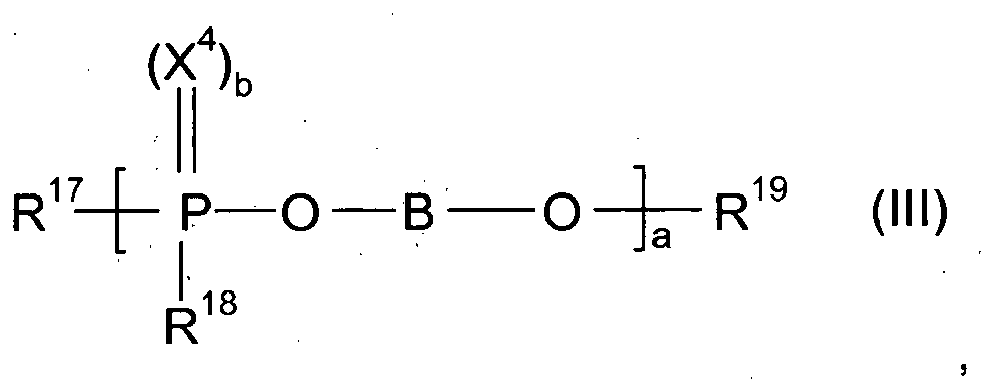 B ist eine Gruppe
 R19 ist -P(=X5)cR24R25, H, eine geradkettige oder verzweigte C1-C12-Alkylgruppe, C5-C6-Cycloalkyl, C6-C12-Aryl, Benzyl, wobei die vier letztgenannten Gruppen unsubstituiert oder durch einen oder mehrere Reste aus der Gruppe C1-C4-Alkyl und C2-C4-Alkenyl substituiert sind;R17, R18, R24 und R25 sind gleich oder verschieden Wasserstoff, OH, C1-C16-Alkyl, C2-C16-Alkenyl, C1-C16-Alkoxy, C2-C16-Alkenoxy, C3-C10-Cycloalkyl, C3-C10-Cycloalkoxy, C6-C10-Aryl, C6-C10-Aryloxy, C6-C10-Aryl-C1-C16-Alkyl, C6-C10-Aryl-C1-C16-Alkoxy, SR26 COR27, COOR28, CONR29R30 oder zwei Reste R17, R18, R24, R25 bilden zusammen mit dem Phosphoratom, an das sie gebunden sind, oder einer Gruppe P-O-B-O-P ein Ringsystem;R20, R21, R22, R23 sind gleich oder verschieden H, C1-C16-Alkyl, C2-C16-Alkenyl, C1-C16-Alkoxy, C2-C16-Alkenoxy;R26, R27, R28, R29, R30 sind gleich oder verschieden H, C1-C16-Alkyl, C2-C16-Alkenyl, C6-C10-Aryl, C6-C10-Aryl-C1-C16-Alkyl, C6-C10-Aryl-C1-C16-Alkoxy;X4, X5 sind gleich oder verschieden S oder O;b, c sind gleich oder verschieden, vorzugsweise gleich, 0 oder 1;X6, X7, X8, X9 sind gleich oder verschieden S oder O unda ist eine natürliche Zahl von 1 bis 50.b"') oligomeren oder polymeren Phosphaten der Formel (VII),
 R26,R27,R28,R29 sind gleich oder verschieden H, lineares oder verzweigtes C1-C16-Alkyl, lineares oder verzweigtes C2-C16-Alkenyl, lineares oder verzweigtes C2-C16-Alkinyl, C3-C10-Cycloalkyl, C6-C10-Aryl, Heteroaryl oder C6-C10-Aryl-C1-C10-Alkyl, wobei Aryl in den Resten R26 - R28 jeweils unabhängig voneinander unsubstituiert oder mit 1 bis 3 Resten aus der Gruppe C1-C10-Alkyl, C1-C10-Alkoxy, C6-C10-Aryl, C6-C10-Aryloxy, OH, CHO, COOH, CN, SH, SCH3, SO2CH3, SO2-C6-C10-Aryl, SO3H, COCH3, COC2H5, CO-C6-C10-Aryl und S-S-C6-C10-Aryl substituiert ist,
oderR26,R27,R28,R29 sind ein kationischer Rest aus der Gruppe der Metalle und stickstoffhaltigen Kationen,Z ist
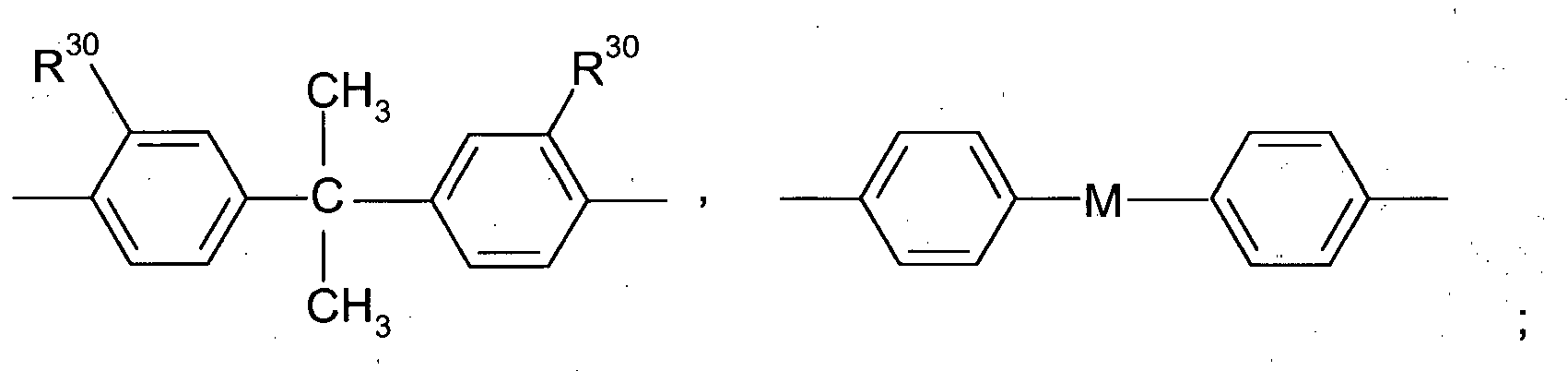 M ist -CH2-, -C(CF3)2-, -C(CH3)(C6H5)-, -C(CH3)(C2H5)-, -C(C6H5)2-1,3-Phenylen-C(CH3)2-, -C(CH3)2-1,4-Phenylen-C(CH3)2-,
 R30 ist -CH3, -CH(CH3)2 oder C6H5 undn ist 1 bis 100;b"") oligomeren oder polymeren Phosphonaten der Formel (VIII),
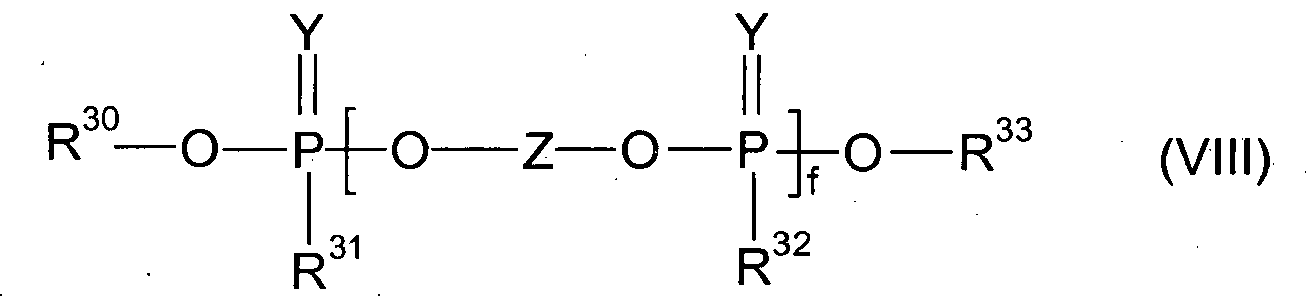 R30, R31, R32, R33 sind gleich oder verschieden H, lineares oder verzweigtes C1-C16-Alkyl, lineares oder verzweigtes C2-C16-Alkenyl, lineares oder verzweigtes C2-C16-Alkinyl, C3-C10-Cycloalkyl, C6-C10-Aryl, Heteroaryl oder C6-C10-Aryl-C1-C10-Alkyl; wobei Aryl in den Resten R30 - R33 jeweils unabhängig voneinander unsubstituiert oder mit 1 bis 3 Resten aus der Gruppe C1-C10-Alkyl, C1-C10-Alkoxy, C6-C10-Aryl, C6-C10-Aryloxy, OH, CHO, COOH, CN, SH, SCH3, SO2CH3, SO2-C6-C10-Aryl, SO3H, COCH3, COC2H5, CO-C6-C10-Aryl und S-S-C6-C10-Aryl substituiert ist;Z ist
 M ist -CH2-, -C(CF3)2-, -C(CH3)(C6H5)-, -C(CH3)(C2H5)-, -C(C6H5)2-1,3-Phenylen-C(CH3)2-, -C(CH3)2-1,4-Phenylen-C(CH3)2-, -O-, -S-,
 R34 ist -CH3, -CH(CH3)2 oder C6H5 undf ist 1 bis 1000.
 - Flammschutzsystem gemäß Anspruch 1, wobei die Symbole in der Formel (I) folgende Bedeutungen haben:R ist C6-C10-Aryl,X ist OR2, SR2, NR2R3, COOR2, COONR2R3, SO2R2 oder eine Gruppe Y1-P(Y2)pR'R";Y1 ist O oder S;Y2 ist O oder S;p ist 0 oder 1;R', R" sind gleich und sind C1-C18-Alkyl, C6-C12-Aryl, O-(C1-C18)-Alkyl oder O-(C6-C, 2-Aryl;R1 ist C1-C16-Alkyl;R2, R3 sind gleich und sind H, C1-C18-Alkyl oder C6-C12-Aryl;n st 2 - 4 undm ist eine Zahl von 2 bis 250.
- Flammschutzsystem gemäß Anspruch 1 oder 2, wobei die Verbindung(en) der Formel (I) ausgewählt sind aus Poly-(tert.-Butylphenoldisulfid-), Poly-(tert-Amylphenoldisulfid) und mit Diphenylphosphatgruppen phosphatiertem Poly-(tert.-Butylphenoldisulfid).
- Verwendung einer Mischung der Flammschutzsynergisten a) und Flammschutzmittel b) gemäß einem der Ansprüche 1 bis 3 als Flammschutzsystem.
- Verfahren zur flammhemmenden Ausrüstung von geschäumten oder ungeschäumten Polymeren, wobei man eine Schmelze des Polymers oder die Monomere, aus denen das Polymer erzeugt wird, mit dem Flammschutzsystem gemäß einem der Ansprüche 1 bis 3 vermischt.
- Polymerzusammensetzung, enthaltend ein oder mehrere Polymere und ein Flammschutzsystem gemäß einem der Ansprüche 1 bis 3.
- Polymerzusammensetzung gemäß Anspruch 6, enthaltend 0,1 bis 15 Gew.-Teile (bezogen auf 100 Gew.-Teile Polymer) an dem Flammschutzsystem.
- Polymerzusammensetzung gemäß Anspruch 6 oder 7, dadurch gekennzeichnet, dass sie halogenfrei ist.
- Polymerzusammensetzung gemäß einem der Ansprüche 6 bis 8, enthaltend ein Styrol polymer.
- Polymerzusammensetzung gemäß einem der Ansprüche 6 bis 8, dadurch gekennzeichnet, dass das Polymer ein Schaumstoff ist.
- Polymerzusammensetzung gemäß Anspruch 10, dadurch gekennzeichnet, dass der Polymerschaumstoff eine Dichte von 5 bis 150 g/l aufweist.
- Polymerzusammensetzung gemäß Anspruch 9, in Form eines expandierbaren Styrolpolymers (EPS).
- Verfahren zur Herstellung eines expandierbaren Styrolpolymers (EPS) gemäß Anspruch 12, umfassend die Schritte:a) Einmischen eines organischen Treibmittels und eines Flammschutzsystems gemäß einem der Ansprüche 1 bis 3 sowie gegebenenfalls weiterer Hilfs- und Zusatzstoffe in eine Styrolpolymerschmelze mittels statischer und/oder dynamischer Mischer bei einer Temperatur von mindestens 150°C,b) Kühlen der treibmittelhaltigen Styrolpolymerschmelze auf eine Temperatur von mindestens 120°C,c) Austrag durch eine Düsenplatte mit Bohrungen, deren Durchmesser am Düsenaustritt höchstens 1,5 mm beträgt undd) Granulieren der treibmittelhaltigen Schmelze direkt hinter der Düsenplatte unter Wasser bei einem Druck im Bereich von 1 bis 20 bar.
- Verfahren zur Herstellung eines expandierbaren Styrolpolymers gemäß Anspruch 12, umfassend die Schritte:a) Polymerisation einer oder mehrerer Styrolmonomere in Suspension;b) Zugabe eines Flammschutzsystems gemäß einem der Ansprüche 1 bis 3 sowie gegebenenfalls weiterer Hilfs- und Zusatzstoffe vor, während und/oder nach der Polymerisation;c) Zugabe eines organischen Treibmittels vor, während und/oder nach der Polymerisation undd) Abtrennen der expadierbaren ein Flammschutzsystem gemäß einem der Ansprüche 1 bis 3 enthaltenden Styrolpolymerteilchen von der Suspension.
- Polymerzusammensetzung gemäß Anspruch 9 in Form eines Styrolpolymerextrusionsschaumstoffes (XPS).
- Polymerzusammensetzung gemäß einem der Ansprüche 9-12 oder 15, enthaltend als zusätzliche Komponente einen oder mehrere IR-Absorber.
- Verfahren zur Herstellung eines Styrolextrusionsschaumstoffes (XPS) gemäß Anspruch 15, umfassend die Schritte:a) Erhitzen einer Polymerkomponente P, die mindestens ein Styrolpolymer enthält, zur Ausbildung einer Polymerschmelze,b) Einbringen einer Treibmittelkomponente T in die Polymerschmelze zur Ausbildung einer schäumbaren Schmelze,c) Extrusion der schäumbaren Schmelze in einen Bereich niedrigeren Drucks unter Aufschäumen zu einem Extrusionsschaum undd) Zugabe eines Flammschutzsystems gemäß einem der Ansprüche 1 bis 3 sowie gegebenenfalls weiterer Hilfs- und Zusatzstoffe in mindestens einem der Schritte a) und b).
- Verfahren gemäß Anspruch 13 oder 17, wobei als Zusatzstoff ein oder mehrere IR-Absorber zugesetzt werden.
- Verwendung einer halogenfreien Polymerzusammensetzung gemäß Anspruch 12 und/oder einer halogenfreien Polymerzusammensetzung gemäß Anspruch 15 in expandierter Form als Dämm- und/oder Isoliermaterial.
Priority Applications (2)
| Application Number | Priority Date | Filing Date | Title |
|---|---|---|---|
| EP11807928.4A EP2658905B1 (de) | 2010-12-27 | 2011-12-23 | Flammschutzsystem |
| PL11807928T PL2658905T3 (pl) | 2010-12-27 | 2011-12-23 | System ogniochronny |
Applications Claiming Priority (4)
| Application Number | Priority Date | Filing Date | Title |
|---|---|---|---|
| EP10197052 | 2010-12-27 | ||
| EP11187484 | 2011-11-02 | ||
| PCT/EP2011/073958 WO2012089667A1 (de) | 2010-12-27 | 2011-12-23 | Flammschutzsystem |
| EP11807928.4A EP2658905B1 (de) | 2010-12-27 | 2011-12-23 | Flammschutzsystem |
Publications (2)
| Publication Number | Publication Date |
|---|---|
| EP2658905A1 EP2658905A1 (de) | 2013-11-06 |
| EP2658905B1 true EP2658905B1 (de) | 2015-09-16 |
Family
ID=45476487
Family Applications (1)
| Application Number | Title | Priority Date | Filing Date |
|---|---|---|---|
| EP11807928.4A Not-in-force EP2658905B1 (de) | 2010-12-27 | 2011-12-23 | Flammschutzsystem |
Country Status (12)
| Country | Link |
|---|---|
| EP (1) | EP2658905B1 (de) |
| JP (1) | JP6118265B2 (de) |
| KR (1) | KR101951964B1 (de) |
| CN (1) | CN103415557B (de) |
| BR (1) | BR112013016682A2 (de) |
| HU (1) | HUE026076T2 (de) |
| MX (1) | MX346033B (de) |
| PL (1) | PL2658905T3 (de) |
| PT (1) | PT2658905E (de) |
| RU (1) | RU2013135140A (de) |
| TW (1) | TW201241161A (de) |
| WO (1) | WO2012089667A1 (de) |
Families Citing this family (9)
| Publication number | Priority date | Publication date | Assignee | Title |
|---|---|---|---|---|
| WO2013135701A1 (de) * | 2012-03-13 | 2013-09-19 | Basf Se | Synthese von polyphenoldisulfiden |
| EP2690125A1 (de) * | 2012-07-27 | 2014-01-29 | Basf Se | Verfahren zur Aufreinigung von Polyphenoldisulfiden |
| EP2706086A1 (de) | 2012-09-05 | 2014-03-12 | Basf Se | Verfahren zur Herstellung von Schaumstoffplatten niedriger Dichte durch Extrusion von Styrolpolymeren unter Verwendung von Hydrofluorolefinen als Treibmittel |
| EP2733166A1 (de) | 2012-11-20 | 2014-05-21 | Basf Se | Verfahren zur herstellung von expandierbaren styrolpolymergranulaten und styrolpolymerschaumstoffen mit verringertem restmonomerengehalt |
| WO2015177347A1 (de) * | 2014-05-22 | 2015-11-26 | Basf Se | Halogenfreie flammschutzmischungen für polyolefinschaumstoffe |
| CN107641290A (zh) * | 2016-07-21 | 2018-01-30 | 广东广山新材料股份有限公司 | 一种阻燃树脂组合物、热固性树脂组合物、阻燃性工程塑料及复合金属基板 |
| CN107254142A (zh) * | 2016-07-21 | 2017-10-17 | 广东广山新材料股份有限公司 | 一种阻燃树脂组合物、热固性树脂组合物、复合金属基板及阻燃电子材料 |
| DE102019135325A1 (de) | 2019-12-19 | 2021-06-24 | Hochschule Hamm-Lippstadt, Körperschaft des öffentlichen Rechts | Flammgeschützte Copolymere und Formmassen |
| EP4263753B1 (de) | 2020-12-17 | 2024-10-09 | Hochschule Hamm-Lippstadt, Körperschaft des öffentlichen Rechts | Brandhindernde copolymere und formmassen |
Family Cites Families (11)
| Publication number | Priority date | Publication date | Assignee | Title |
|---|---|---|---|---|
| US3284544A (en) * | 1963-04-01 | 1966-11-08 | Dow Chemical Co | Self-extinguishing alkenyl aromatic resins containing organic polysulfide |
| CA2203306A1 (en) * | 1996-05-06 | 1997-11-06 | Albemarle Corporation | Flame retardant compositions for use in styrenic polymers |
| JP2000053828A (ja) * | 1998-08-12 | 2000-02-22 | Daicel Chem Ind Ltd | 難燃性スチレン系樹脂組成物 |
| ATE251196T1 (de) * | 1998-12-09 | 2003-10-15 | Basf Ag | Verfahren zur herstellung von expandierbaren polystyrolteilchen |
| DE19856759A1 (de) * | 1998-12-09 | 2000-06-15 | Basf Ag | Flammgeschützte Polystyrolschaumstoffe |
| JP2004277609A (ja) * | 2003-03-17 | 2004-10-07 | Kanegafuchi Chem Ind Co Ltd | 難燃性熱可塑性樹脂組成物および発泡体 |
| EP2449019B1 (de) * | 2009-07-03 | 2014-01-01 | Krems Chemie Chemical Services AG | Neue derivate von 9,10-dihydro-9-oxa-10-phosphaphenanthren-10-on |
| AT508304A1 (de) * | 2009-09-24 | 2010-12-15 | Sunpor Kunststoff Gmbh | Flammgeschützte expandierbare polymerisate |
| AT508303A1 (de) * | 2009-09-24 | 2010-12-15 | Sunpor Kunststoff Gmbh | Flammgeschützte expandierbare polymerisate |
| PL2480598T3 (pl) * | 2009-09-24 | 2015-03-31 | Sunpor Kunststoff Gmbh | Ognioodporne spienialne produkty polimeryzacji styrenu |
| EP2553008B1 (de) * | 2010-04-01 | 2016-08-24 | Basf Se | Flammschutzmittel |
-
2011
- 2011-12-23 CN CN201180068442.4A patent/CN103415557B/zh not_active Expired - Fee Related
- 2011-12-23 RU RU2013135140/05A patent/RU2013135140A/ru not_active Application Discontinuation
- 2011-12-23 WO PCT/EP2011/073958 patent/WO2012089667A1/de not_active Ceased
- 2011-12-23 EP EP11807928.4A patent/EP2658905B1/de not_active Not-in-force
- 2011-12-23 JP JP2013546687A patent/JP6118265B2/ja not_active Expired - Fee Related
- 2011-12-23 BR BR112013016682A patent/BR112013016682A2/pt not_active IP Right Cessation
- 2011-12-23 KR KR1020137019906A patent/KR101951964B1/ko not_active Expired - Fee Related
- 2011-12-23 PT PT118079284T patent/PT2658905E/pt unknown
- 2011-12-23 PL PL11807928T patent/PL2658905T3/pl unknown
- 2011-12-23 HU HUE11807928A patent/HUE026076T2/en unknown
- 2011-12-23 MX MX2013007564A patent/MX346033B/es active IP Right Grant
- 2011-12-27 TW TW100148990A patent/TW201241161A/zh unknown
Also Published As
| Publication number | Publication date |
|---|---|
| JP6118265B2 (ja) | 2017-04-19 |
| BR112013016682A2 (pt) | 2016-10-04 |
| CN103415557A (zh) | 2013-11-27 |
| PT2658905E (pt) | 2016-01-14 |
| KR20140019317A (ko) | 2014-02-14 |
| MX346033B (es) | 2017-03-01 |
| MX2013007564A (es) | 2013-10-30 |
| HUE026076T2 (en) | 2016-05-30 |
| EP2658905A1 (de) | 2013-11-06 |
| PL2658905T3 (pl) | 2016-02-29 |
| JP2014506280A (ja) | 2014-03-13 |
| TW201241161A (en) | 2012-10-16 |
| RU2013135140A (ru) | 2015-02-10 |
| WO2012089667A1 (de) | 2012-07-05 |
| CN103415557B (zh) | 2015-11-25 |
| KR101951964B1 (ko) | 2019-02-25 |
Similar Documents
| Publication | Publication Date | Title |
|---|---|---|
| EP2513251B1 (de) | Flammschutzmittel | |
| EP2553008B1 (de) | Flammschutzmittel | |
| EP2478044B1 (de) | Halogenfreie, flammgeschützte polymerschaumstoffe, enthaltend mindestens eine oligophosphorverbindung | |
| EP1791896B1 (de) | Halogenfreie, flammgeschützte polymerschaumstoffe | |
| WO2012089667A1 (de) | Flammschutzsystem | |
| EP2449018B1 (de) | Flammgeschützte expandierbare polymerisate | |
| EP2480598A1 (de) | Flammgeschützte expandierbare polymerisate | |
| EP2531552A2 (de) | Halogenfreie, phosphorhaltige flammgeschützte polymerschaumstoffe | |
| EP4077481B1 (de) | Flammgeschützte copolymere und formmassen | |
| EP2574614B1 (de) | Flammgeschützte Polymerschaumstoffe mit halogenfreien, phosphorhaltigen Flammschutzmitteln auf Zuckerbasis | |
| EP4263753B1 (de) | Brandhindernde copolymere und formmassen | |
| WO2013017417A1 (de) | Polymeres flammschutzmittel | |
| WO2011095552A1 (de) | Flammschutzmittel | |
| US20120172467A1 (en) | Flame retardant system | |
| DE102004034515A1 (de) | Selbstverlöschender Styrolpolymer-Partikelschaumstoff | |
| AT508303A1 (de) | Flammgeschützte expandierbare polymerisate | |
| AT509959B1 (de) | Flammgeschützte expandierbare polymerisate |
Legal Events
| Date | Code | Title | Description |
|---|---|---|---|
| PUAI | Public reference made under article 153(3) epc to a published international application that has entered the european phase |
Free format text: ORIGINAL CODE: 0009012 |
|
| 17P | Request for examination filed |
Effective date: 20130729 |
|
| AK | Designated contracting states |
Kind code of ref document: A1 Designated state(s): AL AT BE BG CH CY CZ DE DK EE ES FI FR GB GR HR HU IE IS IT LI LT LU LV MC MK MT NL NO PL PT RO RS SE SI SK SM TR |
|
| DAX | Request for extension of the european patent (deleted) | ||
| 17Q | First examination report despatched |
Effective date: 20140514 |
|
| GRAP | Despatch of communication of intention to grant a patent |
Free format text: ORIGINAL CODE: EPIDOSNIGR1 |
|
| INTG | Intention to grant announced |
Effective date: 20150414 |
|
| GRAS | Grant fee paid |
Free format text: ORIGINAL CODE: EPIDOSNIGR3 |
|
| GRAA | (expected) grant |
Free format text: ORIGINAL CODE: 0009210 |
|
| AK | Designated contracting states |
Kind code of ref document: B1 Designated state(s): AL AT BE BG CH CY CZ DE DK EE ES FI FR GB GR HR HU IE IS IT LI LT LU LV MC MK MT NL NO PL PT RO RS SE SI SK SM TR |
|
| REG | Reference to a national code |
Ref country code: GB Ref legal event code: FG4D Free format text: NOT ENGLISH |
|
| REG | Reference to a national code |
Ref country code: CH Ref legal event code: EP |
|
| REG | Reference to a national code |
Ref country code: IE Ref legal event code: FG4D Free format text: LANGUAGE OF EP DOCUMENT: GERMAN |
|
| REG | Reference to a national code |
Ref country code: AT Ref legal event code: REF Ref document number: 749788 Country of ref document: AT Kind code of ref document: T Effective date: 20151015 |
|
| REG | Reference to a national code |
Ref country code: DE Ref legal event code: R096 Ref document number: 502011007906 Country of ref document: DE |
|
| REG | Reference to a national code |
Ref country code: RO Ref legal event code: EPE |
|
| REG | Reference to a national code |
Ref country code: FR Ref legal event code: PLFP Year of fee payment: 5 |
|
| REG | Reference to a national code |
Ref country code: PT Ref legal event code: SC4A Free format text: AVAILABILITY OF NATIONAL TRANSLATION Effective date: 20151214 |
|
| PG25 | Lapsed in a contracting state [announced via postgrant information from national office to epo] |
Ref country code: LV Free format text: LAPSE BECAUSE OF FAILURE TO SUBMIT A TRANSLATION OF THE DESCRIPTION OR TO PAY THE FEE WITHIN THE PRESCRIBED TIME-LIMIT Effective date: 20150916 Ref country code: LT Free format text: LAPSE BECAUSE OF FAILURE TO SUBMIT A TRANSLATION OF THE DESCRIPTION OR TO PAY THE FEE WITHIN THE PRESCRIBED TIME-LIMIT Effective date: 20150916 |
|
| REG | Reference to a national code |
Ref country code: LT Ref legal event code: MG4D |
|
| REG | Reference to a national code |
Ref country code: NO Ref legal event code: T2 Effective date: 20150916 |
|
| PG25 | Lapsed in a contracting state [announced via postgrant information from national office to epo] |
Ref country code: RS Free format text: LAPSE BECAUSE OF FAILURE TO SUBMIT A TRANSLATION OF THE DESCRIPTION OR TO PAY THE FEE WITHIN THE PRESCRIBED TIME-LIMIT Effective date: 20150916 Ref country code: SE Free format text: LAPSE BECAUSE OF FAILURE TO SUBMIT A TRANSLATION OF THE DESCRIPTION OR TO PAY THE FEE WITHIN THE PRESCRIBED TIME-LIMIT Effective date: 20150916 Ref country code: HR Free format text: LAPSE BECAUSE OF FAILURE TO SUBMIT A TRANSLATION OF THE DESCRIPTION OR TO PAY THE FEE WITHIN THE PRESCRIBED TIME-LIMIT Effective date: 20150916 |
|
| REG | Reference to a national code |
Ref country code: NL Ref legal event code: FP |
|
| PG25 | Lapsed in a contracting state [announced via postgrant information from national office to epo] |
Ref country code: EE Free format text: LAPSE BECAUSE OF FAILURE TO SUBMIT A TRANSLATION OF THE DESCRIPTION OR TO PAY THE FEE WITHIN THE PRESCRIBED TIME-LIMIT Effective date: 20150916 Ref country code: IS Free format text: LAPSE BECAUSE OF FAILURE TO SUBMIT A TRANSLATION OF THE DESCRIPTION OR TO PAY THE FEE WITHIN THE PRESCRIBED TIME-LIMIT Effective date: 20160116 Ref country code: ES Free format text: LAPSE BECAUSE OF FAILURE TO SUBMIT A TRANSLATION OF THE DESCRIPTION OR TO PAY THE FEE WITHIN THE PRESCRIBED TIME-LIMIT Effective date: 20150916 Ref country code: SK Free format text: LAPSE BECAUSE OF FAILURE TO SUBMIT A TRANSLATION OF THE DESCRIPTION OR TO PAY THE FEE WITHIN THE PRESCRIBED TIME-LIMIT Effective date: 20150916 |
|
| REG | Reference to a national code |
Ref country code: HU Ref legal event code: AG4A Ref document number: E026076 Country of ref document: HU |
|
| REG | Reference to a national code |
Ref country code: GR Ref legal event code: EP Ref document number: 20150402701 Country of ref document: GR Effective date: 20160414 Ref country code: DE Ref legal event code: R097 Ref document number: 502011007906 Country of ref document: DE |
|
| PLBE | No opposition filed within time limit |
Free format text: ORIGINAL CODE: 0009261 |
|
| STAA | Information on the status of an ep patent application or granted ep patent |
Free format text: STATUS: NO OPPOSITION FILED WITHIN TIME LIMIT |
|
| PG25 | Lapsed in a contracting state [announced via postgrant information from national office to epo] |
Ref country code: LU Free format text: LAPSE BECAUSE OF FAILURE TO SUBMIT A TRANSLATION OF THE DESCRIPTION OR TO PAY THE FEE WITHIN THE PRESCRIBED TIME-LIMIT Effective date: 20151223 Ref country code: MC Free format text: LAPSE BECAUSE OF FAILURE TO SUBMIT A TRANSLATION OF THE DESCRIPTION OR TO PAY THE FEE WITHIN THE PRESCRIBED TIME-LIMIT Effective date: 20150916 |
|
| REG | Reference to a national code |
Ref country code: CH Ref legal event code: PL |
|
| 26N | No opposition filed |
Effective date: 20160617 |
|
| PG25 | Lapsed in a contracting state [announced via postgrant information from national office to epo] |
Ref country code: DK Free format text: LAPSE BECAUSE OF FAILURE TO SUBMIT A TRANSLATION OF THE DESCRIPTION OR TO PAY THE FEE WITHIN THE PRESCRIBED TIME-LIMIT Effective date: 20150916 |
|
| REG | Reference to a national code |
Ref country code: IE Ref legal event code: MM4A |
|
| PG25 | Lapsed in a contracting state [announced via postgrant information from national office to epo] |
Ref country code: CH Free format text: LAPSE BECAUSE OF NON-PAYMENT OF DUE FEES Effective date: 20151231 Ref country code: LI Free format text: LAPSE BECAUSE OF NON-PAYMENT OF DUE FEES Effective date: 20151231 Ref country code: IE Free format text: LAPSE BECAUSE OF NON-PAYMENT OF DUE FEES Effective date: 20151223 |
|
| PG25 | Lapsed in a contracting state [announced via postgrant information from national office to epo] |
Ref country code: SI Free format text: LAPSE BECAUSE OF FAILURE TO SUBMIT A TRANSLATION OF THE DESCRIPTION OR TO PAY THE FEE WITHIN THE PRESCRIBED TIME-LIMIT Effective date: 20150916 |
|
| REG | Reference to a national code |
Ref country code: FR Ref legal event code: PLFP Year of fee payment: 6 |
|
| PG25 | Lapsed in a contracting state [announced via postgrant information from national office to epo] |
Ref country code: BG Free format text: LAPSE BECAUSE OF FAILURE TO SUBMIT A TRANSLATION OF THE DESCRIPTION OR TO PAY THE FEE WITHIN THE PRESCRIBED TIME-LIMIT Effective date: 20150916 Ref country code: SM Free format text: LAPSE BECAUSE OF FAILURE TO SUBMIT A TRANSLATION OF THE DESCRIPTION OR TO PAY THE FEE WITHIN THE PRESCRIBED TIME-LIMIT Effective date: 20150916 |
|
| PG25 | Lapsed in a contracting state [announced via postgrant information from national office to epo] |
Ref country code: CY Free format text: LAPSE BECAUSE OF FAILURE TO SUBMIT A TRANSLATION OF THE DESCRIPTION OR TO PAY THE FEE WITHIN THE PRESCRIBED TIME-LIMIT Effective date: 20150916 |
|
| PG25 | Lapsed in a contracting state [announced via postgrant information from national office to epo] |
Ref country code: MT Free format text: LAPSE BECAUSE OF FAILURE TO SUBMIT A TRANSLATION OF THE DESCRIPTION OR TO PAY THE FEE WITHIN THE PRESCRIBED TIME-LIMIT Effective date: 20150916 |
|
| REG | Reference to a national code |
Ref country code: FR Ref legal event code: PLFP Year of fee payment: 7 |
|
| PG25 | Lapsed in a contracting state [announced via postgrant information from national office to epo] |
Ref country code: MK Free format text: LAPSE BECAUSE OF FAILURE TO SUBMIT A TRANSLATION OF THE DESCRIPTION OR TO PAY THE FEE WITHIN THE PRESCRIBED TIME-LIMIT Effective date: 20150916 |
|
| PG25 | Lapsed in a contracting state [announced via postgrant information from national office to epo] |
Ref country code: AL Free format text: LAPSE BECAUSE OF FAILURE TO SUBMIT A TRANSLATION OF THE DESCRIPTION OR TO PAY THE FEE WITHIN THE PRESCRIBED TIME-LIMIT Effective date: 20150916 |
|
| PGFP | Annual fee paid to national office [announced via postgrant information from national office to epo] |
Ref country code: TR Payment date: 20221205 Year of fee payment: 12 Ref country code: RO Payment date: 20221212 Year of fee payment: 12 Ref country code: PT Payment date: 20221202 Year of fee payment: 12 Ref country code: NO Payment date: 20221220 Year of fee payment: 12 Ref country code: CZ Payment date: 20221221 Year of fee payment: 12 |
|
| PGFP | Annual fee paid to national office [announced via postgrant information from national office to epo] |
Ref country code: HU Payment date: 20221203 Year of fee payment: 12 Ref country code: GR Payment date: 20221223 Year of fee payment: 12 |
|
| PGFP | Annual fee paid to national office [announced via postgrant information from national office to epo] |
Ref country code: GB Payment date: 20231219 Year of fee payment: 13 |
|
| PGFP | Annual fee paid to national office [announced via postgrant information from national office to epo] |
Ref country code: NL Payment date: 20231226 Year of fee payment: 13 Ref country code: IT Payment date: 20231221 Year of fee payment: 13 Ref country code: FR Payment date: 20231226 Year of fee payment: 13 Ref country code: FI Payment date: 20231228 Year of fee payment: 13 Ref country code: AT Payment date: 20231219 Year of fee payment: 13 |
|
| PGFP | Annual fee paid to national office [announced via postgrant information from national office to epo] |
Ref country code: PL Payment date: 20231201 Year of fee payment: 13 Ref country code: BE Payment date: 20231226 Year of fee payment: 13 |
|
| PGFP | Annual fee paid to national office [announced via postgrant information from national office to epo] |
Ref country code: DE Payment date: 20231227 Year of fee payment: 13 |
|
| PG25 | Lapsed in a contracting state [announced via postgrant information from national office to epo] |
Ref country code: CZ Free format text: LAPSE BECAUSE OF NON-PAYMENT OF DUE FEES Effective date: 20231223 |
|
| PG25 | Lapsed in a contracting state [announced via postgrant information from national office to epo] |
Ref country code: RO Free format text: LAPSE BECAUSE OF NON-PAYMENT OF DUE FEES Effective date: 20231223 Ref country code: CZ Free format text: LAPSE BECAUSE OF NON-PAYMENT OF DUE FEES Effective date: 20231223 |
|
| PG25 | Lapsed in a contracting state [announced via postgrant information from national office to epo] |
Ref country code: PT Free format text: LAPSE BECAUSE OF NON-PAYMENT OF DUE FEES Effective date: 20240624 |
|
| PG25 | Lapsed in a contracting state [announced via postgrant information from national office to epo] |
Ref country code: PT Free format text: LAPSE BECAUSE OF NON-PAYMENT OF DUE FEES Effective date: 20240624 |
|
| PG25 | Lapsed in a contracting state [announced via postgrant information from national office to epo] |
Ref country code: GR Free format text: LAPSE BECAUSE OF NON-PAYMENT OF DUE FEES Effective date: 20240712 |
|
| PG25 | Lapsed in a contracting state [announced via postgrant information from national office to epo] |
Ref country code: HU Free format text: LAPSE BECAUSE OF NON-PAYMENT OF DUE FEES Effective date: 20231224 |
|
| PG25 | Lapsed in a contracting state [announced via postgrant information from national office to epo] |
Ref country code: GR Free format text: LAPSE BECAUSE OF NON-PAYMENT OF DUE FEES Effective date: 20240712 Ref country code: NO Free format text: LAPSE BECAUSE OF NON-PAYMENT OF DUE FEES Effective date: 20231231 Ref country code: HU Free format text: LAPSE BECAUSE OF NON-PAYMENT OF DUE FEES Effective date: 20231224 |
|
| REG | Reference to a national code |
Ref country code: DE Ref legal event code: R119 Ref document number: 502011007906 Country of ref document: DE |
|
| PG25 | Lapsed in a contracting state [announced via postgrant information from national office to epo] |
Ref country code: FI Free format text: LAPSE BECAUSE OF NON-PAYMENT OF DUE FEES Effective date: 20241223 |
|
| REG | Reference to a national code |
Ref country code: NL Ref legal event code: MM Effective date: 20250101 |
|
| REG | Reference to a national code |
Ref country code: AT Ref legal event code: MM01 Ref document number: 749788 Country of ref document: AT Kind code of ref document: T Effective date: 20241223 |
|
| GBPC | Gb: european patent ceased through non-payment of renewal fee |
Effective date: 20241223 |
|
| PG25 | Lapsed in a contracting state [announced via postgrant information from national office to epo] |
Ref country code: NL Free format text: LAPSE BECAUSE OF NON-PAYMENT OF DUE FEES Effective date: 20250101 |
|
| REG | Reference to a national code |
Ref country code: BE Ref legal event code: MM Effective date: 20241231 |
|
| PG25 | Lapsed in a contracting state [announced via postgrant information from national office to epo] |
Ref country code: DE Free format text: LAPSE BECAUSE OF NON-PAYMENT OF DUE FEES Effective date: 20250701 |
|
| PG25 | Lapsed in a contracting state [announced via postgrant information from national office to epo] |
Ref country code: IT Free format text: LAPSE BECAUSE OF NON-PAYMENT OF DUE FEES Effective date: 20241223 |
|
| PG25 | Lapsed in a contracting state [announced via postgrant information from national office to epo] |
Ref country code: BE Free format text: LAPSE BECAUSE OF NON-PAYMENT OF DUE FEES Effective date: 20241231 Ref country code: GB Free format text: LAPSE BECAUSE OF NON-PAYMENT OF DUE FEES Effective date: 20241223 |
|
| PG25 | Lapsed in a contracting state [announced via postgrant information from national office to epo] |
Ref country code: AT Free format text: LAPSE BECAUSE OF NON-PAYMENT OF DUE FEES Effective date: 20241223 Ref country code: FR Free format text: LAPSE BECAUSE OF NON-PAYMENT OF DUE FEES Effective date: 20241231 |
|
| PG25 | Lapsed in a contracting state [announced via postgrant information from national office to epo] |
Ref country code: TR Free format text: LAPSE BECAUSE OF NON-PAYMENT OF DUE FEES Effective date: 20231223 |
|
| PG25 | Lapsed in a contracting state [announced via postgrant information from national office to epo] |
Ref country code: PL Free format text: LAPSE BECAUSE OF NON-PAYMENT OF DUE FEES Effective date: 20241223 |