EP2478044B1 - Halogenfreie, flammgeschützte polymerschaumstoffe, enthaltend mindestens eine oligophosphorverbindung - Google Patents
Halogenfreie, flammgeschützte polymerschaumstoffe, enthaltend mindestens eine oligophosphorverbindung Download PDFInfo
- Publication number
- EP2478044B1 EP2478044B1 EP10751679.1A EP10751679A EP2478044B1 EP 2478044 B1 EP2478044 B1 EP 2478044B1 EP 10751679 A EP10751679 A EP 10751679A EP 2478044 B1 EP2478044 B1 EP 2478044B1
- Authority
- EP
- European Patent Office
- Prior art keywords
- flame
- retardant
- halogen
- free
- polymer
- Prior art date
- Legal status (The legal status is an assumption and is not a legal conclusion. Google has not performed a legal analysis and makes no representation as to the accuracy of the status listed.)
- Not-in-force
Links
- 229920000642 polymer Polymers 0.000 title claims description 79
- 239000006260 foam Substances 0.000 title claims description 42
- 150000001875 compounds Chemical class 0.000 title claims description 24
- PPBRXRYQALVLMV-UHFFFAOYSA-N Styrene Chemical compound C=CC1=CC=CC=C1 PPBRXRYQALVLMV-UHFFFAOYSA-N 0.000 claims description 78
- 239000003063 flame retardant Substances 0.000 claims description 59
- RNFJDJUURJAICM-UHFFFAOYSA-N 2,2,4,4,6,6-hexaphenoxy-1,3,5-triaza-2$l^{5},4$l^{5},6$l^{5}-triphosphacyclohexa-1,3,5-triene Chemical compound N=1P(OC=2C=CC=CC=2)(OC=2C=CC=CC=2)=NP(OC=2C=CC=CC=2)(OC=2C=CC=CC=2)=NP=1(OC=1C=CC=CC=1)OC1=CC=CC=C1 RNFJDJUURJAICM-UHFFFAOYSA-N 0.000 claims description 37
- DAPZRBJQPPDZGH-UHFFFAOYSA-N diphenylphosphanyl(diphenyl)phosphane Chemical compound C1=CC=CC=C1P(C=1C=CC=CC=1)P(C=1C=CC=CC=1)C1=CC=CC=C1 DAPZRBJQPPDZGH-UHFFFAOYSA-N 0.000 claims description 18
- 239000004604 Blowing Agent Substances 0.000 claims description 16
- 238000000034 method Methods 0.000 claims description 16
- XLYOFNOQVPJJNP-UHFFFAOYSA-N water Substances O XLYOFNOQVPJJNP-UHFFFAOYSA-N 0.000 claims description 16
- 238000001816 cooling Methods 0.000 claims description 13
- 125000002015 acyclic group Chemical group 0.000 claims description 11
- 239000000203 mixture Substances 0.000 claims description 11
- 230000008569 process Effects 0.000 claims description 9
- 238000004519 manufacturing process Methods 0.000 claims description 8
- 238000002156 mixing Methods 0.000 claims description 6
- 238000006116 polymerization reaction Methods 0.000 claims description 6
- 230000003068 static effect Effects 0.000 claims description 6
- ZWRMRAPCUFXCEQ-UHFFFAOYSA-N 1,2,3,4,5-pentakis-phenylpentaphospholane Chemical compound C1=CC=CC=C1P1P(C=2C=CC=CC=2)P(C=2C=CC=CC=2)P(C=2C=CC=CC=2)P1C1=CC=CC=C1 ZWRMRAPCUFXCEQ-UHFFFAOYSA-N 0.000 claims description 3
- BWGNESOTFCXPMA-UHFFFAOYSA-N Dihydrogen disulfide Chemical compound SS BWGNESOTFCXPMA-UHFFFAOYSA-N 0.000 claims description 3
- 125000004437 phosphorous atom Chemical group 0.000 claims description 3
- 229920006327 polystyrene foam Polymers 0.000 claims description 3
- UGFAIRIUMAVXCW-UHFFFAOYSA-N Carbon monoxide Chemical compound [O+]#[C-] UGFAIRIUMAVXCW-UHFFFAOYSA-N 0.000 claims description 2
- UCKMPCXJQFINFW-UHFFFAOYSA-N Sulphide Chemical compound [S-2] UCKMPCXJQFINFW-UHFFFAOYSA-N 0.000 claims description 2
- 239000007900 aqueous suspension Substances 0.000 claims description 2
- 239000000155 melt Substances 0.000 claims description 2
- 125000000041 C6-C10 aryl group Chemical group 0.000 claims 2
- 239000011324 bead Substances 0.000 claims 1
- 150000004770 chalcogenides Chemical class 0.000 claims 1
- 238000005453 pelletization Methods 0.000 claims 1
- YXFVVABEGXRONW-UHFFFAOYSA-N Toluene Chemical compound CC1=CC=CC=C1 YXFVVABEGXRONW-UHFFFAOYSA-N 0.000 description 24
- 229920006248 expandable polystyrene Polymers 0.000 description 22
- 239000004793 Polystyrene Substances 0.000 description 20
- 229920002223 polystyrene Polymers 0.000 description 20
- UHOVQNZJYSORNB-UHFFFAOYSA-N Benzene Chemical compound C1=CC=CC=C1 UHOVQNZJYSORNB-UHFFFAOYSA-N 0.000 description 15
- 239000008187 granular material Substances 0.000 description 10
- 239000003380 propellant Substances 0.000 description 10
- QGJOPFRUJISHPQ-UHFFFAOYSA-N Carbon disulfide Chemical compound S=C=S QGJOPFRUJISHPQ-UHFFFAOYSA-N 0.000 description 9
- IJGRMHOSHXDMSA-UHFFFAOYSA-N Atomic nitrogen Chemical compound N#N IJGRMHOSHXDMSA-UHFFFAOYSA-N 0.000 description 8
- 238000005469 granulation Methods 0.000 description 8
- 230000003179 granulation Effects 0.000 description 8
- 239000002245 particle Substances 0.000 description 8
- 229910052698 phosphorus Inorganic materials 0.000 description 8
- -1 phosphorus compound Chemical class 0.000 description 8
- 238000012360 testing method Methods 0.000 description 8
- 239000004795 extruded polystyrene foam Substances 0.000 description 7
- 239000000243 solution Substances 0.000 description 7
- GRPTWLLWXYXFLX-UHFFFAOYSA-N 1,1,2,2,3,3-hexabromocyclodecane Chemical compound BrC1(Br)CCCCCCCC(Br)(Br)C1(Br)Br GRPTWLLWXYXFLX-UHFFFAOYSA-N 0.000 description 6
- WEVYAHXRMPXWCK-UHFFFAOYSA-N Acetonitrile Chemical compound CC#N WEVYAHXRMPXWCK-UHFFFAOYSA-N 0.000 description 6
- RTZKZFJDLAIYFH-UHFFFAOYSA-N Diethyl ether Chemical compound CCOCC RTZKZFJDLAIYFH-UHFFFAOYSA-N 0.000 description 6
- LFQSCWFLJHTTHZ-UHFFFAOYSA-N Ethanol Chemical compound CCO LFQSCWFLJHTTHZ-UHFFFAOYSA-N 0.000 description 6
- 125000004122 cyclic group Chemical group 0.000 description 6
- 238000010557 suspension polymerization reaction Methods 0.000 description 6
- 229920001169 thermoplastic Polymers 0.000 description 6
- DXZMANYCMVCPIM-UHFFFAOYSA-L zinc;diethylphosphinate Chemical compound [Zn+2].CCP([O-])(=O)CC.CCP([O-])(=O)CC DXZMANYCMVCPIM-UHFFFAOYSA-L 0.000 description 6
- 238000006243 chemical reaction Methods 0.000 description 5
- IMDXZWRLUZPMDH-UHFFFAOYSA-N dichlorophenylphosphine Chemical compound ClP(Cl)C1=CC=CC=C1 IMDXZWRLUZPMDH-UHFFFAOYSA-N 0.000 description 5
- 238000002474 experimental method Methods 0.000 description 5
- 238000005187 foaming Methods 0.000 description 5
- 229910052736 halogen Inorganic materials 0.000 description 5
- 150000002367 halogens Chemical class 0.000 description 5
- 238000003756 stirring Methods 0.000 description 5
- 239000000725 suspension Substances 0.000 description 5
- OFBQJSOFQDEBGM-UHFFFAOYSA-N Pentane Chemical compound CCCCC OFBQJSOFQDEBGM-UHFFFAOYSA-N 0.000 description 4
- XYFCBTPGUUZFHI-UHFFFAOYSA-N Phosphine Chemical compound P XYFCBTPGUUZFHI-UHFFFAOYSA-N 0.000 description 4
- XECAHXYUAAWDEL-UHFFFAOYSA-N acrylonitrile butadiene styrene Chemical compound C=CC=C.C=CC#N.C=CC1=CC=CC=C1 XECAHXYUAAWDEL-UHFFFAOYSA-N 0.000 description 4
- 229920000122 acrylonitrile butadiene styrene Polymers 0.000 description 4
- 239000004676 acrylonitrile butadiene styrene Substances 0.000 description 4
- 238000009826 distribution Methods 0.000 description 4
- 238000001125 extrusion Methods 0.000 description 4
- 229910052757 nitrogen Inorganic materials 0.000 description 4
- 239000000049 pigment Substances 0.000 description 4
- 238000002360 preparation method Methods 0.000 description 4
- 229910052717 sulfur Inorganic materials 0.000 description 4
- OKTJSMMVPCPJKN-UHFFFAOYSA-N Carbon Chemical compound [C] OKTJSMMVPCPJKN-UHFFFAOYSA-N 0.000 description 3
- 239000004743 Polypropylene Substances 0.000 description 3
- VYPSYNLAJGMNEJ-UHFFFAOYSA-N Silicium dioxide Chemical compound O=[Si]=O VYPSYNLAJGMNEJ-UHFFFAOYSA-N 0.000 description 3
- HEMHJVSKTPXQMS-UHFFFAOYSA-M Sodium hydroxide Chemical compound [OH-].[Na+] HEMHJVSKTPXQMS-UHFFFAOYSA-M 0.000 description 3
- 239000000654 additive Substances 0.000 description 3
- 125000003545 alkoxy group Chemical group 0.000 description 3
- DWSWCPPGLRSPIT-UHFFFAOYSA-N benzo[c][2,1]benzoxaphosphinin-6-ium 6-oxide Chemical compound C1=CC=C2[P+](=O)OC3=CC=CC=C3C2=C1 DWSWCPPGLRSPIT-UHFFFAOYSA-N 0.000 description 3
- 238000009835 boiling Methods 0.000 description 3
- 230000000052 comparative effect Effects 0.000 description 3
- 229920001577 copolymer Polymers 0.000 description 3
- 239000000945 filler Substances 0.000 description 3
- 239000010439 graphite Substances 0.000 description 3
- 229910002804 graphite Inorganic materials 0.000 description 3
- 239000000178 monomer Substances 0.000 description 3
- 239000002667 nucleating agent Substances 0.000 description 3
- 229910052760 oxygen Inorganic materials 0.000 description 3
- 239000011574 phosphorus Substances 0.000 description 3
- 239000004014 plasticizer Substances 0.000 description 3
- 239000004417 polycarbonate Substances 0.000 description 3
- 229920000515 polycarbonate Polymers 0.000 description 3
- 229920006393 polyether sulfone Polymers 0.000 description 3
- 229920001155 polypropylene Polymers 0.000 description 3
- 238000010992 reflux Methods 0.000 description 3
- 150000003839 salts Chemical class 0.000 description 3
- 239000003381 stabilizer Substances 0.000 description 3
- PBXXXGUNYFXOTC-UHFFFAOYSA-N (2-methyl-2-phenylpentan-3-yl)benzene Chemical compound C=1C=CC=CC=1C(C)(C)C(CC)C1=CC=CC=C1 PBXXXGUNYFXOTC-UHFFFAOYSA-N 0.000 description 2
- MYRTYDVEIRVNKP-UHFFFAOYSA-N 1,2-Divinylbenzene Chemical compound C=CC1=CC=CC=C1C=C MYRTYDVEIRVNKP-UHFFFAOYSA-N 0.000 description 2
- VBICKXHEKHSIBG-UHFFFAOYSA-N 1-monostearoylglycerol Chemical compound CCCCCCCCCCCCCCCCCC(=O)OCC(O)CO VBICKXHEKHSIBG-UHFFFAOYSA-N 0.000 description 2
- CSCPPACGZOOCGX-UHFFFAOYSA-N Acetone Chemical compound CC(C)=O CSCPPACGZOOCGX-UHFFFAOYSA-N 0.000 description 2
- HEDRZPFGACZZDS-UHFFFAOYSA-N Chloroform Chemical compound ClC(Cl)Cl HEDRZPFGACZZDS-UHFFFAOYSA-N 0.000 description 2
- FYYHWMGAXLPEAU-UHFFFAOYSA-N Magnesium Chemical compound [Mg] FYYHWMGAXLPEAU-UHFFFAOYSA-N 0.000 description 2
- 229920000877 Melamine resin Polymers 0.000 description 2
- 239000004952 Polyamide Substances 0.000 description 2
- 239000004698 Polyethylene Substances 0.000 description 2
- JUJWROOIHBZHMG-UHFFFAOYSA-N Pyridine Chemical compound C1=CC=NC=C1 JUJWROOIHBZHMG-UHFFFAOYSA-N 0.000 description 2
- NINIDFKCEFEMDL-UHFFFAOYSA-N Sulfur Chemical compound [S] NINIDFKCEFEMDL-UHFFFAOYSA-N 0.000 description 2
- WYURNTSHIVDZCO-UHFFFAOYSA-N Tetrahydrofuran Chemical compound C1CCOC1 WYURNTSHIVDZCO-UHFFFAOYSA-N 0.000 description 2
- 150000001298 alcohols Chemical class 0.000 description 2
- 125000001931 aliphatic group Chemical group 0.000 description 2
- 150000001338 aliphatic hydrocarbons Chemical class 0.000 description 2
- 238000013459 approach Methods 0.000 description 2
- 125000004432 carbon atom Chemical group C* 0.000 description 2
- 239000013078 crystal Substances 0.000 description 2
- GPAYUJZHTULNBE-UHFFFAOYSA-N diphenylphosphine Chemical compound C=1C=CC=CC=1PC1=CC=CC=C1 GPAYUJZHTULNBE-UHFFFAOYSA-N 0.000 description 2
- 239000000975 dye Substances 0.000 description 2
- 125000003700 epoxy group Chemical group 0.000 description 2
- 239000004794 expanded polystyrene Substances 0.000 description 2
- 239000007789 gas Substances 0.000 description 2
- 239000000383 hazardous chemical Substances 0.000 description 2
- NNPPMTNAJDCUHE-UHFFFAOYSA-N isobutane Chemical compound CC(C)C NNPPMTNAJDCUHE-UHFFFAOYSA-N 0.000 description 2
- QWTDNUCVQCZILF-UHFFFAOYSA-N isopentane Chemical compound CCC(C)C QWTDNUCVQCZILF-UHFFFAOYSA-N 0.000 description 2
- 150000002576 ketones Chemical class 0.000 description 2
- 239000011777 magnesium Substances 0.000 description 2
- 229910052749 magnesium Inorganic materials 0.000 description 2
- 239000011159 matrix material Substances 0.000 description 2
- 238000002844 melting Methods 0.000 description 2
- 230000008018 melting Effects 0.000 description 2
- 229910000000 metal hydroxide Inorganic materials 0.000 description 2
- 150000004692 metal hydroxides Chemical class 0.000 description 2
- 238000000465 moulding Methods 0.000 description 2
- 239000003921 oil Substances 0.000 description 2
- 239000012044 organic layer Substances 0.000 description 2
- 150000001282 organosilanes Chemical class 0.000 description 2
- 229910000073 phosphorus hydride Inorganic materials 0.000 description 2
- 229920003023 plastic Polymers 0.000 description 2
- 239000004033 plastic Substances 0.000 description 2
- 229920003229 poly(methyl methacrylate) Polymers 0.000 description 2
- 229920000058 polyacrylate Polymers 0.000 description 2
- 229920002647 polyamide Polymers 0.000 description 2
- 229920001707 polybutylene terephthalate Polymers 0.000 description 2
- 229920000573 polyethylene Polymers 0.000 description 2
- 229920000139 polyethylene terephthalate Polymers 0.000 description 2
- 239000005020 polyethylene terephthalate Substances 0.000 description 2
- 239000004926 polymethyl methacrylate Substances 0.000 description 2
- 229920000098 polyolefin Polymers 0.000 description 2
- 229920001955 polyphenylene ether Polymers 0.000 description 2
- 239000011541 reaction mixture Substances 0.000 description 2
- 239000002904 solvent Substances 0.000 description 2
- 238000003860 storage Methods 0.000 description 2
- 239000011593 sulfur Substances 0.000 description 2
- VZGDMQKNWNREIO-UHFFFAOYSA-N tetrachloromethane Chemical compound ClC(Cl)(Cl)Cl VZGDMQKNWNREIO-UHFFFAOYSA-N 0.000 description 2
- CYTQBVOFDCPGCX-UHFFFAOYSA-N trimethyl phosphite Chemical compound COP(OC)OC CYTQBVOFDCPGCX-UHFFFAOYSA-N 0.000 description 2
- KJWHEZXBZQXVSA-UHFFFAOYSA-N tris(prop-2-enyl) phosphite Chemical compound C=CCOP(OCC=C)OCC=C KJWHEZXBZQXVSA-UHFFFAOYSA-N 0.000 description 2
- DCXXMTOCNZCJGO-UHFFFAOYSA-N tristearoylglycerol Chemical compound CCCCCCCCCCCCCCCCCC(=O)OCC(OC(=O)CCCCCCCCCCCCCCCCC)COC(=O)CCCCCCCCCCCCCCCCC DCXXMTOCNZCJGO-UHFFFAOYSA-N 0.000 description 2
- HGTUJZTUQFXBIH-UHFFFAOYSA-N (2,3-dimethyl-3-phenylbutan-2-yl)benzene Chemical group C=1C=CC=CC=1C(C)(C)C(C)(C)C1=CC=CC=C1 HGTUJZTUQFXBIH-UHFFFAOYSA-N 0.000 description 1
- SHRRVNVEOIKVSG-UHFFFAOYSA-N 1,1,2,2,3,3-hexabromocyclododecane Chemical compound BrC1(Br)CCCCCCCCCC(Br)(Br)C1(Br)Br SHRRVNVEOIKVSG-UHFFFAOYSA-N 0.000 description 1
- CUALLVCSKGZVKC-UHFFFAOYSA-N 1,2,3,4-tetraphenyltetraphosphetane Chemical compound C1=CC=CC=C1P1P(C=2C=CC=CC=2)P(C=2C=CC=CC=2)P1C1=CC=CC=C1 CUALLVCSKGZVKC-UHFFFAOYSA-N 0.000 description 1
- DEIGXXQKDWULML-UHFFFAOYSA-N 1,2,5,6,9,10-hexabromocyclododecane Chemical compound BrC1CCC(Br)C(Br)CCC(Br)C(Br)CCC1Br DEIGXXQKDWULML-UHFFFAOYSA-N 0.000 description 1
- RYHBNJHYFVUHQT-UHFFFAOYSA-N 1,4-Dioxane Chemical compound C1COCCO1 RYHBNJHYFVUHQT-UHFFFAOYSA-N 0.000 description 1
- XMNIXWIUMCBBBL-UHFFFAOYSA-N 2-(2-phenylpropan-2-ylperoxy)propan-2-ylbenzene Chemical compound C=1C=CC=CC=1C(C)(C)OOC(C)(C)C1=CC=CC=C1 XMNIXWIUMCBBBL-UHFFFAOYSA-N 0.000 description 1
- NLHHRLWOUZZQLW-UHFFFAOYSA-N Acrylonitrile Chemical compound C=CC#N NLHHRLWOUZZQLW-UHFFFAOYSA-N 0.000 description 1
- 229910002012 Aerosil® Inorganic materials 0.000 description 1
- 229920001634 Copolyester Polymers 0.000 description 1
- 239000001692 EU approved anti-caking agent Substances 0.000 description 1
- VEXZGXHMUGYJMC-UHFFFAOYSA-N Hydrochloric acid Chemical compound Cl VEXZGXHMUGYJMC-UHFFFAOYSA-N 0.000 description 1
- DGAQECJNVWCQMB-PUAWFVPOSA-M Ilexoside XXIX Chemical compound C[C@@H]1CC[C@@]2(CC[C@@]3(C(=CC[C@H]4[C@]3(CC[C@@H]5[C@@]4(CC[C@@H](C5(C)C)OS(=O)(=O)[O-])C)C)[C@@H]2[C@]1(C)O)C)C(=O)O[C@H]6[C@@H]([C@H]([C@@H]([C@H](O6)CO)O)O)O.[Na+] DGAQECJNVWCQMB-PUAWFVPOSA-M 0.000 description 1
- 229920009204 Methacrylate-butadiene-styrene Polymers 0.000 description 1
- 229910021586 Nickel(II) chloride Inorganic materials 0.000 description 1
- 229910019142 PO4 Inorganic materials 0.000 description 1
- OAICVXFJPJFONN-UHFFFAOYSA-N Phosphorus Chemical compound [P] OAICVXFJPJFONN-UHFFFAOYSA-N 0.000 description 1
- 239000004721 Polyphenylene oxide Substances 0.000 description 1
- 239000006096 absorbing agent Substances 0.000 description 1
- 230000009471 action Effects 0.000 description 1
- 125000002723 alicyclic group Chemical group 0.000 description 1
- 125000003342 alkenyl group Chemical group 0.000 description 1
- 125000003302 alkenyloxy group Chemical group 0.000 description 1
- 125000000217 alkyl group Chemical group 0.000 description 1
- XYLMUPLGERFSHI-UHFFFAOYSA-N alpha-Methylstyrene Chemical compound CC(=C)C1=CC=CC=C1 XYLMUPLGERFSHI-UHFFFAOYSA-N 0.000 description 1
- XAGFODPZIPBFFR-UHFFFAOYSA-N aluminium Chemical compound [Al] XAGFODPZIPBFFR-UHFFFAOYSA-N 0.000 description 1
- 238000004458 analytical method Methods 0.000 description 1
- 239000002216 antistatic agent Substances 0.000 description 1
- 239000012300 argon atmosphere Substances 0.000 description 1
- 125000003118 aryl group Chemical group 0.000 description 1
- 239000012298 atmosphere Substances 0.000 description 1
- QVGXLLKOCUKJST-UHFFFAOYSA-N atomic oxygen Chemical compound [O] QVGXLLKOCUKJST-UHFFFAOYSA-N 0.000 description 1
- BZDKYAZTCWRUDZ-UHFFFAOYSA-N buta-1,3-diene;methyl 2-methylprop-2-enoate;prop-2-enenitrile;styrene Chemical compound C=CC=C.C=CC#N.COC(=O)C(C)=C.C=CC1=CC=CC=C1 BZDKYAZTCWRUDZ-UHFFFAOYSA-N 0.000 description 1
- WWNGFHNQODFIEX-UHFFFAOYSA-N buta-1,3-diene;methyl 2-methylprop-2-enoate;styrene Chemical compound C=CC=C.COC(=O)C(C)=C.C=CC1=CC=CC=C1 WWNGFHNQODFIEX-UHFFFAOYSA-N 0.000 description 1
- 239000001506 calcium phosphate Substances 0.000 description 1
- 229910000389 calcium phosphate Inorganic materials 0.000 description 1
- 235000011010 calcium phosphates Nutrition 0.000 description 1
- 230000001914 calming effect Effects 0.000 description 1
- 239000006229 carbon black Substances 0.000 description 1
- 230000015556 catabolic process Effects 0.000 description 1
- 230000008859 change Effects 0.000 description 1
- 239000003795 chemical substances by application Substances 0.000 description 1
- XGRJZXREYAXTGV-UHFFFAOYSA-N chlorodiphenylphosphine Chemical compound C=1C=CC=CC=1P(Cl)C1=CC=CC=C1 XGRJZXREYAXTGV-UHFFFAOYSA-N 0.000 description 1
- 238000009833 condensation Methods 0.000 description 1
- 230000005494 condensation Effects 0.000 description 1
- 238000002425 crystallisation Methods 0.000 description 1
- 230000008025 crystallization Effects 0.000 description 1
- 238000006731 degradation reaction Methods 0.000 description 1
- 238000001514 detection method Methods 0.000 description 1
- LSXWFXONGKSEMY-UHFFFAOYSA-N di-tert-butyl peroxide Chemical compound CC(C)(C)OOC(C)(C)C LSXWFXONGKSEMY-UHFFFAOYSA-N 0.000 description 1
- XZTWHWHGBBCSMX-UHFFFAOYSA-J dimagnesium;phosphonato phosphate Chemical compound [Mg+2].[Mg+2].[O-]P([O-])(=O)OP([O-])([O-])=O XZTWHWHGBBCSMX-UHFFFAOYSA-J 0.000 description 1
- AFABGHUZZDYHJO-UHFFFAOYSA-N dimethyl butane Natural products CCCC(C)C AFABGHUZZDYHJO-UHFFFAOYSA-N 0.000 description 1
- 239000002270 dispersing agent Substances 0.000 description 1
- 230000000694 effects Effects 0.000 description 1
- 229920001971 elastomer Polymers 0.000 description 1
- 230000007613 environmental effect Effects 0.000 description 1
- 150000002148 esters Chemical class 0.000 description 1
- 150000002170 ethers Chemical class 0.000 description 1
- 230000007717 exclusion Effects 0.000 description 1
- 238000005227 gel permeation chromatography Methods 0.000 description 1
- 230000009477 glass transition Effects 0.000 description 1
- YQEMORVAKMFKLG-UHFFFAOYSA-N glycerine monostearate Natural products CCCCCCCCCCCCCCCCCC(=O)OC(CO)CO YQEMORVAKMFKLG-UHFFFAOYSA-N 0.000 description 1
- SVUQHVRAGMNPLW-UHFFFAOYSA-N glycerol monostearate Natural products CCCCCCCCCCCCCCCCC(=O)OCC(O)CO SVUQHVRAGMNPLW-UHFFFAOYSA-N 0.000 description 1
- 150000002314 glycerols Chemical class 0.000 description 1
- 150000008282 halocarbons Chemical class 0.000 description 1
- 231100000206 health hazard Toxicity 0.000 description 1
- 238000010438 heat treatment Methods 0.000 description 1
- 229920005669 high impact polystyrene Polymers 0.000 description 1
- 239000004797 high-impact polystyrene Substances 0.000 description 1
- 229920001519 homopolymer Polymers 0.000 description 1
- 229910052739 hydrogen Inorganic materials 0.000 description 1
- IXCSERBJSXMMFS-UHFFFAOYSA-N hydrogen chloride Substances Cl.Cl IXCSERBJSXMMFS-UHFFFAOYSA-N 0.000 description 1
- 229910000041 hydrogen chloride Inorganic materials 0.000 description 1
- 238000010348 incorporation Methods 0.000 description 1
- 239000003999 initiator Substances 0.000 description 1
- 238000001746 injection moulding Methods 0.000 description 1
- 238000009413 insulation Methods 0.000 description 1
- 239000001282 iso-butane Substances 0.000 description 1
- 239000010410 layer Substances 0.000 description 1
- 239000007788 liquid Substances 0.000 description 1
- 239000007791 liquid phase Substances 0.000 description 1
- JDSHMPZPIAZGSV-UHFFFAOYSA-N melamine Chemical compound NC1=NC(N)=NC(N)=N1 JDSHMPZPIAZGSV-UHFFFAOYSA-N 0.000 description 1
- 229910052751 metal Inorganic materials 0.000 description 1
- 239000002184 metal Substances 0.000 description 1
- 229910044991 metal oxide Inorganic materials 0.000 description 1
- 150000004706 metal oxides Chemical class 0.000 description 1
- 229920012128 methyl methacrylate acrylonitrile butadiene styrene Polymers 0.000 description 1
- 239000002480 mineral oil Substances 0.000 description 1
- IJDNQMDRQITEOD-UHFFFAOYSA-N n-butane Chemical compound CCCC IJDNQMDRQITEOD-UHFFFAOYSA-N 0.000 description 1
- QMMRZOWCJAIUJA-UHFFFAOYSA-L nickel dichloride Chemical compound Cl[Ni]Cl QMMRZOWCJAIUJA-UHFFFAOYSA-L 0.000 description 1
- 150000002894 organic compounds Chemical class 0.000 description 1
- 150000002903 organophosphorus compounds Chemical class 0.000 description 1
- 239000001301 oxygen Substances 0.000 description 1
- 239000008188 pellet Substances 0.000 description 1
- 150000002978 peroxides Chemical class 0.000 description 1
- 239000012071 phase Substances 0.000 description 1
- 125000001997 phenyl group Chemical group [H]C1=C([H])C([H])=C(*)C([H])=C1[H] 0.000 description 1
- 235000021317 phosphate Nutrition 0.000 description 1
- 150000003013 phosphoric acid derivatives Chemical class 0.000 description 1
- OJMIONKXNSYLSR-UHFFFAOYSA-N phosphorous acid Chemical compound OP(O)O OJMIONKXNSYLSR-UHFFFAOYSA-N 0.000 description 1
- 125000005498 phthalate group Chemical class 0.000 description 1
- 229920001643 poly(ether ketone) Polymers 0.000 description 1
- 229920000728 polyester Polymers 0.000 description 1
- 229920000570 polyether Polymers 0.000 description 1
- 239000000843 powder Substances 0.000 description 1
- 238000012545 processing Methods 0.000 description 1
- UMJSCPRVCHMLSP-UHFFFAOYSA-N pyridine Natural products COC1=CC=CN=C1 UMJSCPRVCHMLSP-UHFFFAOYSA-N 0.000 description 1
- 238000001953 recrystallisation Methods 0.000 description 1
- 230000009467 reduction Effects 0.000 description 1
- 239000005060 rubber Substances 0.000 description 1
- 239000000377 silicon dioxide Substances 0.000 description 1
- 230000035943 smell Effects 0.000 description 1
- 239000011734 sodium Substances 0.000 description 1
- 229910052708 sodium Inorganic materials 0.000 description 1
- 239000007787 solid Substances 0.000 description 1
- 239000007921 spray Substances 0.000 description 1
- 238000004544 sputter deposition Methods 0.000 description 1
- 230000006641 stabilisation Effects 0.000 description 1
- 238000011105 stabilization Methods 0.000 description 1
- 239000011145 styrene acrylonitrile resin Substances 0.000 description 1
- 229920003048 styrene butadiene rubber Polymers 0.000 description 1
- 229920001909 styrene-acrylic polymer Polymers 0.000 description 1
- 239000000126 substance Substances 0.000 description 1
- 150000004763 sulfides Chemical class 0.000 description 1
- 239000000454 talc Substances 0.000 description 1
- 229910052623 talc Inorganic materials 0.000 description 1
- 238000005496 tempering Methods 0.000 description 1
- YLQBMQCUIZJEEH-UHFFFAOYSA-N tetrahydrofuran Natural products C=1C=COC=1 YLQBMQCUIZJEEH-UHFFFAOYSA-N 0.000 description 1
- 239000004416 thermosoftening plastic Substances 0.000 description 1
- 238000012546 transfer Methods 0.000 description 1
- QORWJWZARLRLPR-UHFFFAOYSA-H tricalcium bis(phosphate) Chemical compound [Ca+2].[Ca+2].[Ca+2].[O-]P([O-])([O-])=O.[O-]P([O-])([O-])=O QORWJWZARLRLPR-UHFFFAOYSA-H 0.000 description 1
- BDZBKCUKTQZUTL-UHFFFAOYSA-N triethyl phosphite Chemical compound CCOP(OCC)OCC BDZBKCUKTQZUTL-UHFFFAOYSA-N 0.000 description 1
- XZZNDPSIHUTMOC-UHFFFAOYSA-N triphenyl phosphate Chemical compound C=1C=CC=CC=1OP(OC=1C=CC=CC=1)(=O)OC1=CC=CC=C1 XZZNDPSIHUTMOC-UHFFFAOYSA-N 0.000 description 1
- XOOUIPVCVHRTMJ-UHFFFAOYSA-L zinc stearate Chemical compound [Zn+2].CCCCCCCCCCCCCCCCCC([O-])=O.CCCCCCCCCCCCCCCCCC([O-])=O XOOUIPVCVHRTMJ-UHFFFAOYSA-L 0.000 description 1
Classifications
-
- C—CHEMISTRY; METALLURGY
- C08—ORGANIC MACROMOLECULAR COMPOUNDS; THEIR PREPARATION OR CHEMICAL WORKING-UP; COMPOSITIONS BASED THEREON
- C08J—WORKING-UP; GENERAL PROCESSES OF COMPOUNDING; AFTER-TREATMENT NOT COVERED BY SUBCLASSES C08B, C08C, C08F, C08G or C08H
- C08J9/00—Working-up of macromolecular substances to porous or cellular articles or materials; After-treatment thereof
-
- C—CHEMISTRY; METALLURGY
- C08—ORGANIC MACROMOLECULAR COMPOUNDS; THEIR PREPARATION OR CHEMICAL WORKING-UP; COMPOSITIONS BASED THEREON
- C08J—WORKING-UP; GENERAL PROCESSES OF COMPOUNDING; AFTER-TREATMENT NOT COVERED BY SUBCLASSES C08B, C08C, C08F, C08G or C08H
- C08J9/00—Working-up of macromolecular substances to porous or cellular articles or materials; After-treatment thereof
- C08J9/0014—Use of organic additives
- C08J9/0038—Use of organic additives containing phosphorus
-
- B—PERFORMING OPERATIONS; TRANSPORTING
- B29—WORKING OF PLASTICS; WORKING OF SUBSTANCES IN A PLASTIC STATE IN GENERAL
- B29C—SHAPING OR JOINING OF PLASTICS; SHAPING OF MATERIAL IN A PLASTIC STATE, NOT OTHERWISE PROVIDED FOR; AFTER-TREATMENT OF THE SHAPED PRODUCTS, e.g. REPAIRING
- B29C44/00—Shaping by internal pressure generated in the material, e.g. swelling or foaming ; Producing porous or cellular expanded plastics articles
-
- C—CHEMISTRY; METALLURGY
- C08—ORGANIC MACROMOLECULAR COMPOUNDS; THEIR PREPARATION OR CHEMICAL WORKING-UP; COMPOSITIONS BASED THEREON
- C08J—WORKING-UP; GENERAL PROCESSES OF COMPOUNDING; AFTER-TREATMENT NOT COVERED BY SUBCLASSES C08B, C08C, C08F, C08G or C08H
- C08J9/00—Working-up of macromolecular substances to porous or cellular articles or materials; After-treatment thereof
- C08J9/22—After-treatment of expandable particles; Forming foamed products
- C08J9/228—Forming foamed products
- C08J9/232—Forming foamed products by sintering expandable particles
-
- C—CHEMISTRY; METALLURGY
- C08—ORGANIC MACROMOLECULAR COMPOUNDS; THEIR PREPARATION OR CHEMICAL WORKING-UP; COMPOSITIONS BASED THEREON
- C08K—Use of inorganic or non-macromolecular organic substances as compounding ingredients
- C08K5/00—Use of organic ingredients
- C08K5/49—Phosphorus-containing compounds
- C08K5/50—Phosphorus bound to carbon only
-
- C—CHEMISTRY; METALLURGY
- C09—DYES; PAINTS; POLISHES; NATURAL RESINS; ADHESIVES; COMPOSITIONS NOT OTHERWISE PROVIDED FOR; APPLICATIONS OF MATERIALS NOT OTHERWISE PROVIDED FOR
- C09K—MATERIALS FOR MISCELLANEOUS APPLICATIONS, NOT PROVIDED FOR ELSEWHERE
- C09K21/00—Fireproofing materials
- C09K21/02—Inorganic materials
- C09K21/04—Inorganic materials containing phosphorus
-
- C—CHEMISTRY; METALLURGY
- C09—DYES; PAINTS; POLISHES; NATURAL RESINS; ADHESIVES; COMPOSITIONS NOT OTHERWISE PROVIDED FOR; APPLICATIONS OF MATERIALS NOT OTHERWISE PROVIDED FOR
- C09K—MATERIALS FOR MISCELLANEOUS APPLICATIONS, NOT PROVIDED FOR ELSEWHERE
- C09K21/00—Fireproofing materials
- C09K21/06—Organic materials
- C09K21/12—Organic materials containing phosphorus
-
- C—CHEMISTRY; METALLURGY
- C08—ORGANIC MACROMOLECULAR COMPOUNDS; THEIR PREPARATION OR CHEMICAL WORKING-UP; COMPOSITIONS BASED THEREON
- C08J—WORKING-UP; GENERAL PROCESSES OF COMPOUNDING; AFTER-TREATMENT NOT COVERED BY SUBCLASSES C08B, C08C, C08F, C08G or C08H
- C08J2325/00—Characterised by the use of homopolymers or copolymers of compounds having one or more unsaturated aliphatic radicals, each having only one carbon-to-carbon double bond, and at least one being terminated by an aromatic carbocyclic ring; Derivatives of such polymers
- C08J2325/02—Homopolymers or copolymers of hydrocarbons
- C08J2325/04—Homopolymers or copolymers of styrene
Definitions
- the invention relates to halogen-free, flame-retardant polymer foams which contain at least one acyclic oligophosphorus compound as flame retardant, and to processes for their preparation.
- Flame retardant polymer foam finishing is important for a variety of applications, such as expandable polystyrene (EPS) or expanded polystyrene (XPS) expanded polystyrene foam for building insulation.
- EPS expandable polystyrene
- XPS expanded polystyrene
- the US 4,111,899 describes cyclic or alicyclic oligophosphorus compounds having one or more PP bonds, which are used in amounts of about 1000 ppm for the stabilization of thermoplastics, in particular polycarbonates, in heat and / or oxygen injection molding.
- the US 6,369,140 describes, inter alia, cyclic oligophosphines in low concentrations as stabilizers for polyolefins against degradation by heat, mechanical stress or light.
- the WO 2009/030708 describes cyclic and polymeric arylphosphines as flame retardants in various plastics, for example polycarbonates or acrylonitrile-butadiene-styrene copolymers (ABS).
- the EP-A 834 529 describes expandable styrene polymers containing as halogen-free flame retardant a mixture of a phosphorus compound and a dehydrating metal hydroxide.
- a mixture of a phosphorus compound and a dehydrating metal hydroxide Preferably, 5 to 10 wt .-% Mg (OH) 2 and 5 to 10 wt .-% triphenyl phosphate (TPP) are incorporated in an extruder in molten polystyrene and granulated and the granules in aqueous suspension with blowing agent nachim ceremoniesgniert.
- the WO 00/34342 describes a process for the preparation of expandable polystyrene by suspension polymerization of styrene in the presence of 5-50 wt .-% expandable graphite and optionally 2 to 20 wt .-% of a phosphorus compound as a flame retardant.
- DOP 9,10-dihydro-9-oxa-10-phospha-phenanthren-10-oxide
- Halogen-free flame retardants must be used to achieve the same flame retardancy of halogen-containing flame retardants usually in significantly higher amounts. Therefore, halogen-free flame retardants that can be used in thermoplastic polymers, such as polystyrene, often not be used in polymer foams, since they either interfere with the foaming process or affect the mechanical and thermal properties of the polymer foam. Moreover, in the production of expandable polystyrene by suspension polymerization, the high levels of flame retardant can reduce the stability of the suspension.
- the object of the invention was therefore to find a halogen-free flame retardant for polymer foams, in particular for expandable polystyrene (EPS) or polystyrene extrusion foam (XPS), which does not significantly affect the foaming process and the mechanical properties and in particular allows the production of predominantly closed-cell polymer foams.
- EPS expandable polystyrene
- XPS polystyrene extrusion foam
- halogen-free, flame-retardant polymer foams which contain as flame retardants at least one acyclic Oligophosphonreritati according to claim 1.
- these oligophosphorus compounds in polymer foams have a significantly better effectiveness as flame retardants than the halogen-free flame retardants conventionally used for polymer foams.
- the phosphorus content of the oligophosphorus compounds is preferably in the range from 5 to 50% by weight, in particular in the range from 8 to 25% by weight.
- Preferred flame retardants contain at least one acylic Oligophosphinhalkogenid having 2 to 6 phosphorus atoms and at least one phosphorus-phosphorus bond. Preferably, all phosphorus atoms are linearly or cyclically linked by P-P bonds.
- Suitable oligophosphorus compounds are, for example, those having the structures Ia, Ib or Ic:
- the radicals R 1 -R 4 may independently of one another be selected from the group of C 1 -C 16 -alkyl, C 1 -C 16 -alkenyl, C 1 -C 16 -alkoxy, C 1 -C 16 -alkenyloxy, C C 3 -C 10 -cycloalkyl, C 3 -C 10 -cycloalkoxy, C 6 -C 10 -aryl, C 6 -C 10 -aryloxy, C 6 -C 10 -aryl-C 1 -C 16 -alkyl, C 6 - C 10 -aryl-C 1 -C 16 alkoxy, NR 2 R 3 , COR 2 , COOR 2 and CONR 2 R 3 , and the radicals X 1 and X 2 - independently of one another are O or S.
- oligophosphorus compounds has one of the following structures IIa, IIb or IIc: wherein the radicals R 1 -R 5 are independently selected from the group of C 1 -C 16 alkyl, C 1 -C 16 alkenyl, C 1 -C 16 alkoxy, C 1 -C 16 alkenyloxy, C C 3 -C 10 -cycloalkyl, C 3 -C 10 -cycloalkoxy, C 6 -C 10 -aryl, C 6 -C 10 -aryloxy, C 6 -C 10 -aryl-C 1 -C 16 -alkyl, C 6 - C 10 -aryl-C 1 -C 16 alkoxy, NR 2 R 3 , COR 2 , COOR 2 and CONR 2 R 3 , and the radicals X 1 and X 2 independently of one another are O or S.
- Particularly preferred flame retardants are tetraphenyldiphosphine monoxide, tetraphenyldiphosphine monosulfide, tetraphenyldiphosphine dioxide, tetraphenyldiphosphine disulfide, tetraphenyldiphosphine oxide sulfide, 1,1,3,3-tetramethoxy-2-phenyltriphosphine-1,3-dioxide, 1,1,3,3-tetraethoxy-2-phenyltriphosphine-1 , 3-dioxide, 1,1,3,3-tetraallyloxy-2-phenyltriphosphine-1,3-dioxide or mixtures thereof.
- the halogen-free, flame-retarded polymer foams according to the invention generally contain the cyclic or acyclic oligophosphorus compounds in an amount in the range from 0.5 to 25% by weight, based on the polymer foam. Amounts of 5 -15 wt .-%, based on the polymer foam. ensure sufficient flame retardancy, especially in foams made of expandable polystyrene.
- the effectiveness of the oligophosphorus compounds can be further improved by the addition of suitable flame retardant synergists, such as the thermal radical formers dicumyl peroxide, di-tert-butyl peroxide or dicumyl.
- suitable flame retardant synergists such as the thermal radical formers dicumyl peroxide, di-tert-butyl peroxide or dicumyl.
- 0.05 to 5 parts by weight of the flame retardant synergists are usually used in addition to the oligophosphorus compound.
- flame retardants such as melamine, melamine cyanurates, metal oxides, metal hydroxides, phosphates, phosphinates, expandable graphite or synergists such as Sb 2 O 3 or Zn compounds may additionally be used.
- Suitable additional halogen-free flame retardants are commercially available under the names Exolit OP 930, Exolit OP 1312, DOPO, HCA-HQ, M-Ester Cyagard RF-1241, Cyagard RF-1243, Fyrol PMP, AlPi, Melapur 200, Melapur MC, APP ,
- halogen-reduced foams can be used in amounts in the range from 0.05 to 1 by using the oligophosphorus compound according to the invention and adding smaller amounts of halogen-containing, in particular brominated flame retardants, such as hexabromocyclodecane (HBCD). in particular 0.1 to 0.5 wt .-% are produced.
- halogen-containing, in particular brominated flame retardants such as hexabromocyclodecane (HBCD).
- the halogen-free, flame-retardant polymer foams preferably have a density in the range from 5 to 200 kg / m 3 , particularly preferably in the range from 10 to 50 kg / m 3 and are preferably more than 80%, more preferably 95 to 100% closed-cell.
- the halogen-free, flame-retarded polymer foams preferably comprise a thermoplastic polymer, in particular a styrene polymer.
- EPS expandable styrene polymers
- XPS styrene polymer extrusion foams
- the expandable styrene polymer preferably has a molecular weight M w in the range from 120,000 to 400,000 g / mol, particularly preferably in the range from 180,000 to 300,000 g / mol, measured by gel permeation chromatography with refractometric detection (RI) in relation to polystyrene standards. Due to the reduction in molecular weight by shear and / or temperature, the molecular weight of the expandable polystyrene is usually about 10,000 g / mol below the molecular weight of the polystyrene used.
- styrene polymers preference is given to glass-clear polystyrene (GPPS), toughened polystyrene (HIPS), anionically polymerized polystyrene or toughened polystyrene (A-IPS), styrene- ⁇ -methstyrene copolymers, acrylonitrile-butadiene-styrene polymers (ABS), styrene-acrylonitrile (SAN), Acrylonitrile-styrene-acrylic ester (ASA), methyl methacrylate-butadiene-styrene (MBS), methyl methacrylate-acrylonitrile-butadiene-styrene (MABS) - polymers or mixtures thereof or with polyphenylene ether (PPE) used.
- GPPS glass-clear polystyrene
- HIPS toughened polystyrene
- A-IPS anionically polymerized polystyrene or
- the styrene polymers mentioned may be used to improve the mechanical properties or the temperature resistance optionally using compatibilizers with thermoplastic polymers, such as polyamides (PA), polyolefins, such as polypropylene (PP) or polyethylene (PE), polyacrylates, such as polymethyl methacrylate (PMMA), polycarbonate ( PC), polyesters, such as polyethylene terephthalate (PET) or polybutylene terephthalate (PBT), polyethersulfones (PES), polyether ketones or polyether sulfides (PES) or mixtures thereof, generally in proportions of not more than 30% by weight, preferably in the range of 1 be mixed to 10 wt .-%, based on the polymer melt.
- thermoplastic polymers such as polyamides (PA), polyolefins, such as polypropylene (PP) or polyethylene (PE), polyacrylates, such as polymethyl methacrylate (PMMA), polycarbonate ( PC), polyesters, such as polyethylene ter
- mixtures in the above amounts ranges with z.
- rubbers such as polyacrylates or polydienes, z.
- Suitable compatibilizers are e.g. Maleic anhydride-modified styrene copolymers, polymers containing epoxy groups or organosilanes.
- the styrene polymer melt may also be mixed with polymer recyclates of the above-mentioned thermoplastic polymers, in particular styrene polymers and expandable styrene polymers (EPS), in amounts which do not substantially impair their properties, generally in amounts of not more than 50% by weight, in particular in amounts of from 1 to 20 wt .-%.
- EPS expandable styrene polymers
- the propellant-containing styrene polymer melt generally contains one or more propellants in a homogeneous distribution in a proportion of 2 to 10 wt .-%, preferably 3 to 7 wt .-%, based on the propellant-containing styrene polymer melt.
- Suitable blowing agents are the physical blowing agents commonly used in EPS, such as aliphatic hydrocarbons having 2 to 7 carbon atoms, alcohols, ketones, ethers or halogenated hydrocarbons. Preference is given to using isobutane, n-butane, isopentane, n-pentane. For XPS, preference is given to using CO 2 or mixtures with alcohols or ketones.
- finely distributed internal water droplets can be introduced into the styrene polymer matrix. This can be done for example by the addition of water in the molten styrene polymer matrix. The addition of the water can be done locally before, with or after the propellant dosage. A homogeneous distribution of the water can be achieved by means of dynamic or static mixers. As a rule, from 0 to 2, preferably from 0.05 to 1.5,% by weight of water, based on the styrene polymer, are sufficient.
- Expandable styrene polymers with at least 90% of the internal water in the form of inner water droplets with a diameter in the range of 0.5 to 15 microns form when foaming foams with sufficient cell count and homogeneous foam structure.
- the amount of blowing agent and water added is chosen so that the expandable styrene polymers (EPS) have an expansion capacity ⁇ , defined as bulk density before foaming / bulk density after foaming, at most 125, preferably 25 to 100.
- EPS expandable styrene polymers
- the expandable styrene polymer pellets (EPS) according to the invention generally have a bulk density of at most 700 g / l, preferably in the range from 590 to 660 g / l.
- bulk densities in the range of 590 to 1200 g / l may occur.
- the styrenic polymer melt may contain additives, nucleating agents, fillers, plasticizers, soluble and insoluble inorganic and / or organic dyes and pigments, e.g. IR absorbers such as carbon black, graphite or aluminum powder together or spatially separated, e.g. be added via mixer or side extruder.
- the dyes and pigments are added in amounts ranging from 0.01 to 30, preferably in the range of 1 to 5 wt .-%.
- a dispersing aid for example organosilanes, polymers containing epoxy groups or maleic anhydride-grafted styrene polymers.
- Preferred plasticizers are mineral oils, phthalates, which can be used in amounts of from 0.05 to 10% by weight, based on the styrene polymer.
- the arrangement may include side extruders for incorporation of additives, e.g. of solids or thermally sensitive additives.
- the propellant-containing styrene polymer melt is usually conveyed through the nozzle plate at a temperature in the range from 140 to 300.degree. C., preferably in the range from 160 to 240.degree. Cooling down to the range of the glass transition temperature is not necessary.
- the nozzle plate is heated at least to the temperature of the blowing agent-containing polystyrene melt.
- the temperature of the nozzle plate is in the range of 20 to 100 ° C above the temperature of the blowing agent-containing polystyrene melt. This prevents polymer deposits in the nozzles and ensures trouble-free granulation.
- the diameter (D) of the nozzle bores at the nozzle exit should be in the range from 0.2 to 1.5 mm, preferably in the range from 0.3 to 1.2 mm, particularly preferably in the range from 0.3 to 0 , 8 mm lie. In this way, granule sizes of less than 2 mm, in particular in the range of 0.4 to 1.4 mm, can be set in a targeted manner even after strand expansion.
- EPS expandable styrene polymers
- suspension polymerization is preferably used as the monomer styrene alone. However, up to 20% of its weight may be replaced by other ethylenically unsaturated monomers such as alkylstyrenes, divinylbenzene, acrylonitrile, 1,1-diphenyl ether or ⁇ -methylstyrene.
- ethylenically unsaturated monomers such as alkylstyrenes, divinylbenzene, acrylonitrile, 1,1-diphenyl ether or ⁇ -methylstyrene.
- the customary auxiliaries for example peroxide initiators, suspension stabilizers, blowing agents, chain transfer agents, expanding auxiliaries, nucleating agents and plasticizers may be added.
- the cyclic or acyclic oligophosphorus compound of the present invention is added in the polymerization in amounts of from 0.5 to 25% by weight, preferably from 5 to 15% by weight.
- Propellants are added in amounts of 3 to 10 wt .-%, based on monomer. It can be added before, during or after the polymerization of the suspension. Suitable propellants are aliphatic hydrocarbons having 4 to 6 carbon atoms. It is advantageous to use inorganic Pickering dispersants, for example magnesium pyrophosphate or calcium phosphate, as suspension stabilizers.
- bead-shaped, substantially round particles having an average diameter in the range of 0.2 to 2 mm are formed.
- the final expandable styrenic polymer granules may be coated by glycerol esters, antistatic agents or anticaking agents.
- the EPS granules may be coated with glycerol monostearate GMS (typically 0.25%), glycerol tristearate (typically 0.25%) finely divided silica Aerosil R972 (typically 0.12%) and Zn stearate (typically 0.15%), and antistatic ,
- the expandable styrene polymer granules according to the invention can be prefoamed in a first step by means of hot air or steam into foam particles having a density in the range of 8 to 200 kg / m 3 , in particular 10 to 50 kg / m 3 and in a second step in a closed mold to particle moldings be welded.
- the expandable polystyrene particles can be made into polystyrene foams having densities of from 8 to 200 kg / m 3, preferably from 10 to 50 kg / m 3 .
- the expandable particles are prefoamed. This is usually done by heating the particles with water vapor in so-called pre-expanders.
- the pre-expanded particles are then welded into shaped bodies.
- the prefoamed particles are brought into forms that do not close in a gas-tight manner and subjected to steam. After cooling, the moldings can be removed.
- organic phosphorus compounds FR1 to FR 9 used as flame retardants in the examples were synthesized according to the following preparation instructions:
- Tetraphenyldiphosphine dioxide and tetraphenyldiphosphine disulfide from tetraphenyldiphosphine (after: W. Kuchen, H. Buchwald, Chem. Ber., 1958, 91, 2871-2877 .)
- Tetraphenyldiphosphine monooxide (according to: E. Fluck, H. Binder, Inorg. Nucl. Chem. Letters, 1967, 3, 307-313.)
- Tetraphenyldiphosphine monosulfide (according to: H. Matschiner, F. Krech, A. Steinert, Z. Anorg., Allg. Chem., 1969, 371, 256-262.)
- Phosphine, phosphite and toluene are placed in the flask with stirring. Within 0,5h heated to 113 ° C (120 ° C bath temperature). Stirred for 6h at this temperature, with a slight evolution of gas is visible. After that, no gas evolution was seen. 31 P-NMR from the reaction solution shows complete conversion.
- Pentaphenylcyclopentaphosphine (Reference): (according to: W.A. Henderson, M.Epstein, F.S.Saichter, J.Am.Chem.Soc., 1963, 85, 2462-2466.)
- Phenyldichlorophosphine (8.9 g, 0.05 mol) was added with stirring to 1.2 g (0.05 mol) of magnesium turnings in 50 mL of tetrahydrofuran as solvent.
- the reaction was highly exothermic and required a condensation condenser, slow addition of the phenyldichlorophosphine and temporary external cooling in a water bath.
- salt began to precipitate. The addition was complete after 30 minutes. After several hours, only traces of metal remained.
- the salt was dissolved by adding a small amount of acetone and magnesium was filtered off.
- 30 mL Upon addition of 30 mL, a two-phase system with an organic layer and a salt water layer was formed.
- 4.0 g (84%) of tetraphenylcyclotetraphosphine having a melting point of 148-152 ° C was precipitated.
- the mixture of polystyrene melt, blowing agent and flame retardant was at 60 kg / h through a nozzle plate with 32 holes (diameter of the nozzle 0.75 mm) promoted. With the help of pressurized underwater granulation, compact granules with a narrow size distribution were produced.
- the granules were prefoamed by the action of flowing steam and, after being stored for 12 hours by further treatment with steam, sealed in a closed mold to form foam blocks of a density of 15 kg / m 3 .
- the uniformly kneaded in the extruder at 180 ° C gel is passed through a calming zone and extruded after a residence time of 15 minutes with an outlet temperature of 105 ° C through a 300 mm wide and 1.5 mm wide nozzle into the atmosphere.
- the foam is passed through a mold channel connected to the extruder to form a foamed sheet having a cross section of 650 mm x 50 mm and a density of 35 g / l.
- the product was cut into plates.
- the fire behavior of the samples was tested after a storage time of 30 days according to DIN 4102.
- Table 2 Type and amount of the flame retardant used and the extinguishing times are summarized in Table 2.
- Examples 11-15 and Comparative Experiment V4 passed the fire test B2.
- Table 2 Fire test on Examples 11-15 example Flame retardants Flame retardant amount% by weight based on polystyrene Fire test B2 (DIN 4102) extinguishing time [s]
Landscapes
- Chemical & Material Sciences (AREA)
- Organic Chemistry (AREA)
- Engineering & Computer Science (AREA)
- Materials Engineering (AREA)
- Health & Medical Sciences (AREA)
- Chemical Kinetics & Catalysis (AREA)
- Medicinal Chemistry (AREA)
- Polymers & Plastics (AREA)
- Inorganic Chemistry (AREA)
- Compositions Of Macromolecular Compounds (AREA)
- Manufacture Of Porous Articles, And Recovery And Treatment Of Waste Products (AREA)
- Fireproofing Substances (AREA)
Description
- Die Erfindung betrifft halogenfreie, flammgeschützte Polymerschaumstoffe, die als Flammschutzmittel mindestens eine acyclische Oligophosphorverbindung enthalten, sowie Verfahren zu ihrer Herstellung.
- Die Ausrüstung von Polymerschaumstoffen mit Flammschutzmitteln ist für eine Vielzahl von Anwendungen von Bedeutung, beispielsweise für Polystyrol-Partikelschaumstoffe aus expandierbarem Polystyrol (EPS) oder Polystyrol-Extrusionsschaumstoffplatten (XPS) zum Isolieren von Gebäuden. Dabei werden für Polystyrol-Homo- und Copolymere bisher überwiegend halogenhaltige, insbesondere bromierte organische Verbindungen eingesetzt. Eine Reihe dieser bromierten Substanzen ist jedoch auf Grund ihrer potentiellen Umwelt- und Gesundheitsgefährdung in der Diskussion.
- Die
US 4,111,899 beschreibt cyclische oder alicylclische Oligophosphorverbindungen mit ein oder mehreren P-P-Bindungen, die in Mengen von ca. 1000 ppm zur Stabilisierung von thermoplastischen Kunststoffen, insbesondere Polycarbonaten, bei Hitze - und/oder Sauerstoffeinwirkung beim Spritzgießen eingesetzt werden. - Die
US 6,369,140 beschreibt unter anderem cyclische Oligophosphine in geringen Konzentrationen als Stabilisatoren für Polyolefine gegen Abbau durch Hitze, mechanische Belastung oder Licht. - Die
WO 2009/030708 beschreibt cyclische und polymere Arylphosphine als Flammschutzmittel in verschiedenen Kunststoffen, beispielsweise Polycarbonaten oder Acrylonitril-Butadien-Styrol-Copolymeren (ABS). - Die
EP-A 834 529 - Die
WO 00/34342 - Die Verwendung von 9,10-Dihydro-9-oxa-10-phospha-phenanthren-10-oxid (DOP) und dessen Derivate zur Herstellung von halogenfrei, flammgeschützten Polymerschaumstoffen ist aus
WO 2006/027241 bekannt. - Halogenfreie Flammschutzmittel müssen zur Erreichung der gleichen Flammschutzwirkung von halogenhaltigen Flammschutzmitteln in der Regel in deutlich höhere Mengen eingesetzt werden. Deshalb können halogenfreie Flammschutzmittel, die bei thermoplastischen Polymeren, wie Polystyrol einsetzbar sind, häufig nicht bei Polymerschaumstoffen eingesetzt werden, da sie entweder den Schäumprozess stören oder die mechanischen und thermischen Eigenschaften des Polymerschaumstoffes beeinflussen. Bei der Herstellung von expandierbarem Polystyrol durch Suspensionspolymerisation können außerdem die hohen Flammschutzmittelmengen die Stabilität der Suspension verringern.
- Die Wirkung der bei thermoplastischen Polymeren eingesetzten Flammschutzmittel bei Polymerschaumstoffen ist häufig aufgrund des unterschiedlichen Brandverhaltens und unterschiedlicher Brandtests nicht vorhersagbar.
- Aufgabe der Erfindung war es daher, ein halogenfreies Flammschutzmittel für Polymerschaumstoffe, insbesondere für expandierbares Polystyrol (EPS) oder Polystyrol-Extrusionsschaumstoffplatten (XPS) zu finden, das den Schäumprozess und die mechanischen Eigenschaften nicht wesentlich beeinflusst und insbesondere die Herstellung von überwiegend geschlossenzelligen Polymerschaumstoffen ermöglicht.
- Demgemäß wurden halogenfreie, flammgeschützte Polymerschaumstoffe, gefunden, welche als Flammschutzmittel mindestens eine acyclische Oligophosphonrerbindung gemäss Anspruch 1 enthalten. Überraschenderweise zeigen diese Oligophosphorverbindungen in Polymerschaumstoffen eine wesentlich bessere Wirksamkeit als Flammschutzmittel gegenüber den üblicherweise für Polymerschaumstoffen eingesetzten halogenfreien Flammschutzmitteln.
- Bevorzugt liegt der Phosphorgehalt der Oligophosphorverbindungen im Bereich von 5 - 50 Gew.-%, insbesondere im Bereich von 8 bis 25 Gew.-%. Bevorzugte Flammschutzmittel enthalten mindestens ein acylisches Oligophosphinhalkogenid mit 2 bis 6 Phosphoratomen und mindestens einer Phosphor-Phosphorbindung. Bevorzugt sind alle Phosphoratome linear oder cyclisch durch P-P-Bindungen miteinander verknüpft.
- Geeignete Oligophosphorverbindungen sind beispielsweise solche mit den Strukturen la, Ib oder Ic:

- Die Reste R1-R4 können unabhängig von einander ausgewählt sein aus der Gruppe von C1-C16-alkyl, C1-C16-alkenyl, C1-C16-alkoxy, C1-C16-alkenyloxy, C3-C10-cycloalkyl, C3-C10-cycloalkoxy, C6-C10-aryl, C6-C10-aryloxy, C6-C10-aryl-C1-C16-alkyl, C6-C10-aryl-C1-C16-alkoxy, NR2R3, COR2, COOR2 und CONR2R3, und die Reste X1 und X2- unabhängig voneinander O oder S bedeuten.
- Eine weitere Gruppe von geeigneten Oligophosphorverbindungen weisen eine der folgenden Strukturen IIa, IIb oder IIc auf:
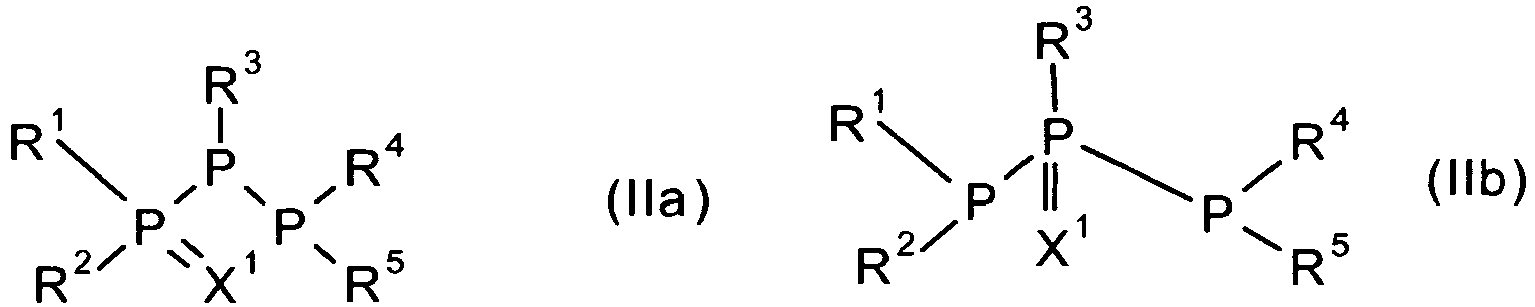

- Als Flammschutzmittel besonders bevorzugt werden Tetraphenyldiphosphinmonoxid, Tetraphenyldiphosphinmonosulfid, Tetraphenyldiphosphindioxid, Tetraphenyldiphosphindisulfid, Tetraphenyldiphosphinoxidsulfid, 1,1,3,3-Tetramethoxy-2-phenyltriphosphin-1,3-dioxid, 1,1,3,3-Tetraethoxy-2-phenyltriphosphin-1,3-dioxid, 1,1,3,3-Tetraallyloxy-2-phenyltriphosphin-1,3-dioxid oder Mischungen davon eingesetzt werden.
- Die erfindungsgemäßen halogenfreien, flammgeschützten Polymerschaumstoffe enthalten die cyclischen oder acyclischen Oligophosphorverbindungen in der Regel in einer Menge im Bereich von 0,5 bis 25 Gew.-%, bezogen auf den Polymerschaumstoff. Mengen von 5 -15 Gew.-%, bezogen auf den Polymerschaumstoff. gewährleisten insbesondere bei Schaumstoffen aus expandierbarem Polystyrol einen ausreichenden Flammschutz.
- Die Wirksamkeit der Oligophosphorverbindungen kann durch den Zusatz geeigneter Flammschutzsynergisten, wie die thermischen Radikalbildner Dicumylperoxid, Di-tert-butylperoxid oder Dicumyl noch weiter verbessert werden. In diesem Falle werden üblicherweise zusätzlich zu der Oligophosphorverbindung 0,05 bis 5 Gew. Teile des Flammschutzsynergisten eingesetzt.
- Auch können zusätzlich weiter Flammschutzmittel, wie Melamin, Melamincyanurate, Metalloxide, Metallhydroxide, Phosphate, Phosphinate, Blähgraphit oder Synergisten wie Sb2O3 oder Zn-Verbindungen eingesetzt werden. Geeignete zusätzliche halogenfreie Flammschutzmittel sind im Handel unter der Bezeichnung Exolit OP 930, Exolit OP 1312, DOPO, HCA-HQ, M-Ester Cyagard RF-1241, Cyagard RF-1243, Fyrol PMP, AlPi, Melapur 200, Melapur MC, APP erhältlich.
- Falls auf die vollständige Halogenfreiheit des Polymerschaumstoffes verzichtet werden kann, können halogenreduzierte Schaumstoffe durch die Verwendung der erfindungsgemäßen Oligophosphorverbindung und den Zusatz geringerer Mengen an halogenhaltigen, insbesondere bromierten Flammschutzmitteln, wie Hexabromcyclodecan (HBCD), bevorzugt in Mengen im Bereich von 0,05 bis 1, insbesondere 0,1 bis 0,5 Gew.-% hergestellt werden.
- Die halogenfreien, flammgeschützten Polymerschaumstoffe weisen bevorzugt eine Dichte im Bereich von 5 bis 200 kg/m3, besonders bevorzugt im Bereich von 10 bis 50 kg/m3 auf und sind bevorzugt zu mehr als 80 %, besonders bevorzugt zu 95 bis 100% geschlossenzellig.
- Bevorzugt enthalten die halogenfreien, flammgeschützten Polymerschaumstoffe ein thermoplastisches Polymer, insbesondere ein Styrolpolymer.
- Die erfindungsgemäßen halogenfrei flammgeschützten, expandierbaren Styrolpolymeren (EPS) und Styrolpolymerextrusionschaumstoffen (XPS) können durch Einmischen eines Treibmittels und der Oligophosphorverbindung in die Polymerschmelze und anschließende Extrusion und Granulierung unter Druck zu expandierbaren Granulaten (EPS) oder durch Extrusion und Entspannung unter Verwendung entsprechend geformter Düsen zu Schaumstoffplatten (XPS) oder Schaumstoffsträngen verarbeitet werden.
- Bevorzugt weist das expandierbare Styrolpolymer ein Molekulargewicht Mw im Bereich von 120.000 bis 400.000 g/mol, besonders bevorzugt im Bereich von 180.000 bis 300.000 g/mol, gemessen mittels Gelpermeationschromatographie mit refraktiometrischer Detektion (RI) gegenüber Polystyrolstandards, auf. Aufgrund des Molekulargewichtsabbaus durch Scherung und/oder Temperatureinwirkung liegt das Molekulargewicht des expandierbaren Polystyrols in der Regel etwa 10.000 g/mol unter dem Molekulargewicht des eingesetzten Polystyrols.
- Bevorzugt werden als Styrolpolymere glasklares Polystyrol (GPPS), Schlagzähpolystyrol (HIPS), anionisch polymerisiertes Polystyrol oder Schlagzähpolystyrol (A-IPS), Styrol-α-Methstyrol-copolymere, Acrylnitril-Butadien-Styrolpolymerisate (ABS), Styrol-Acrylnitril (SAN), Acrylnitril-Styrol-Acrylester (ASA), Methylmethacrylat-Butadien-Styrol (MBS), Methylmethacrylat-Acrylnitril-Butadien-Styrol (MABS)- polymerisate oder Mischungen davon oder mit Polyphenylenether (PPE) eingesetzt.
- Die genannten Styrolpolymeren können zur Verbesserung der mechanischen Eigenschaften oder der Temperaturbeständigkeit gegebenenfalls unter Verwendung von Verträglichkeitsvermittlern mit thermoplastischen Polymeren, wie Polyamiden (PA), Polyolefinen, wie Polypropylen (PP) oder Polyethylen (PE), Polyacrylaten, wie Polymethylmethacrylat (PMMA), Polycarbonat (PC), Polyestern, wie Polyethylenterephthalat (PET) oder Polybutylenterephthalat (PBT), Polyethersulfonen (PES), Polyetherketonen oder Polyethersulfiden (PES) oder Mischungen davon in der Regel in Anteilen von insgesamt bis maximal 30 Gew.-%, bevorzugt im Bereich von 1 bis 10 Gew.-%, bezogen auf die Polymerschmelze, abgemischt werden. Des weiteren sind Mischungen in den genannten Mengenbereichen auch mit z. B hydrophob modifizierten oder funktionalisierten Polymeren oder Oligomeren, Kautschuken, wie Polyacrylaten oder Polydienen, z. B. Styrol-Butadien-Blockcopolymeren oder biologisch abbaubaren aliphatischen oder aliphatisch/aromatischen Copolyestern möglich.
- Als Verträglichkeitsvermittler eignen sich z.B. Maleinsäureanhydrid-modifizierte Styrolcopolymere, Epoxidgruppenhaltige Polymere oder Organosilane.
- Der Styrolpolymerschmelze können auch Polymerrecyklate der genannten thermoplastischen Polymeren, insbesondere Styrolpolymere und expandierbare Styrolpolymere (EPS) in Mengen zugemischt werden, die deren Eigenschaften nicht wesentlich verschlechtern, in der Regel in Mengen von maximal 50 Gew.-%, insbesondere in Mengen von 1 bis 20 Gew.-%.
- Die treibmittelhaltige Styrolpolymerschmelze enthält in der Regel eine oder mehrere Treibmittel in homogener Verteilung in einem Anteil von insgesamt 2 bis 10 Gew.-% bevorzugt 3 bis 7 Gew.-%, bezogen auf die treibmittelhaltige Styrolpolymerschmelze. Als Treibmittel, eigenen sich die üblicherweise in EPS eingesetzten physikalische Treibmittel, wie aliphatischen Kohlenwasserstoffe mit 2 bis 7 Kohlenstoffatomen, Alkohole, Ketone, Ether oder halogenierte Kohlenwasserstoffe. Bevorzugt wird iso-Butan, n-Butan, iso-Pentan, n-Pentan eingesetzt. Für XPS wird bevorzugt CO2 oder Mischungen mit Alkoholen oder Ketonen eingesetzt.
- Zur Verbesserung der Verschäumbarkeit können feinverteilte Innenwassertröpfchen in die Styrolpolymermatrix eingebracht werden. Dies kann beispielsweise durch die Zugabe von Wasser in die aufgeschmolzene Styrolpolymermatrix erfolgen. Die Zugabe des Wassers kann örtlich vor, mit oder nach der Treibmitteldosierung erfolgen. Eine homogene Verteilung des Wassers kann mittels dynamischen oder statischen Mischern erreicht werden. In der Regel sind 0 bis 2, bevorzugt 0,05 bis 1,5 Gew.-% Wasser, bezogen auf das Styrolpolymer, ausreichend.
- Expandierbare Styrolpolymere (EPS) mit mindestens 90% des Innenwassers in Form von Innenwassertröpfchen mit einem Durchmesser im Bereich von 0,5 bis 15 µm bilden beim Verschäumen Schaumstoffe mit ausreichender Zellzahl und homogener Schaumstruktur.
- Die zugesetzte Treibmittel- und Wassermenge wird so gewählt, dass die expandierbaren Styrolpolymeren (EPS) ein Expansionsvermögen α, definiert als Schüttdichte vor dem Verschäumen/Schüttdichte nach dem Verschäumen höchstens 125 bevorzugt 25 bis 100 aufweisen.
- Die erfindungsgemäßen expandierbaren Styrolpolymergranulate (EPS) weisen in der Regel eine Schüttdichte von höchstens 700 g/l bevorzugt im Bereich von 590 bis 660 g/l auf. Bei Verwendung von Füllstoffen können in Abhängigkeit von der Art und Menge des Füllstoffes Schüttdichten im Bereich von 590 bis 1200 g/l auftreten.
- Des weiteren können der Styrolpolymerschmelze Additive, Keimbildner, Füllstoffe, Weichmacher, lösliche und unlösliche anorganische und/oder organische Farbstoffe und Pigmente, z.B. IR-Absorber, wie Ruß, Graphit oder Aluminiumpulver gemeinsam oder räumlich getrennt, z.B. über Mischer oder Seitenextruder zugegeben werden. In der Regel werden die Farbstoffe und Pigmente in Mengen im Bereich von 0,01 bis 30, bevorzugt im Bereich von 1 bis 5 Gew.-% zugesetzt. Zur homogenen und mikrodispersen Verteilung der Pigmente in dem Styrolpolymer kann es insbesondere bei polaren Pigmenten zweckmäßig sein ein Dispergierhilfsmittel, z.B Organosilane, epoxygruppenhaltige Polymere oder Maleinsäureanhydrid-gepfropfte Styrolpolymere, einzusetzen. Bevorzugte Weichmacher sind Mineralöle, Phthalate, die in Mengen von 0,05 bis 10 Gew.-%, bezogen auf das Styrolpolymerisat, eingesetzt werden können.
- Zur Herstellung der erfindungsgemäßen expandierbaren Styrolpolymerisate kann das Treibmittel in die Polymerschmelze eingemischt werden. Ein mögliches Verfahren umfasst die Stufen a) Schmelzerzeugung, b) Mischen c) Kühlen d) Fördern und e) Granulieren. Jede dieser Stufen kann durch die in der Kunststoffverarbeitung bekannten Apparate oder Apparatekombinationen ausgeführt werden. Zur Einmischung eignen sich statische oder dynamische Mischer, beispielsweise Extruder. Die Polymerschmelze kann direkt aus einem Polymerisationsreaktor entnommen werden oder direkt in dem Mischextruder oder einem separaten Aufschmelzextruder durch Aufschmelzen von Polymergranulaten erzeugt werden. Die Kühlung der Schmelze kann in den Mischaggregaten oder in separaten Kühlern erfolgen. Für die Granulierung kommen beispielsweise die druckbeaufschlagte Unterwassergranulierung, Granulierung mit rotierenden Messern und Kühlung durch Sprühvernebelung von Temperierflüssigkeiten oder Zerstäubungsgranulation in Betracht. Zur Durchführung des Verfahrens geeignete Apparateanordnungen sind z.B.:
- a) Polymerisationsreaktor - statischer Mischer/Kühler - Granulator
- b) Polymerisationsreaktor - Extruder - Granulator
- c) Extruder - statischer Mischer - Granulator
- d) Extruder - Granulator
- Weiterhin kann die Anordnung Seitenextruder zur Einbringung von Additiven, z.B. von Feststoffen oder thermisch empfindlichen Zusatzstoffen aufweisen.
- Die treibmittelhaltige Styrolpolymerschmelze wird in der Regel mit einer Temperatur im Bereich von 140 bis 300°C, bevorzugt im Bereich von 160 bis 240°C durch die Düsenplatte gefördert. Eine Abkühlung bis in den Bereich der Glasübergangstemperatur ist nicht notwendig.
- Die Düsenplatte wird mindestens auf die Temperatur der treibmittelhaltigen Polystyrolschmelze beheizt. Bevorzugt liegt die Temperatur der Düsenplatte im Bereich von 20 bis 100°C über der Temperatur der treibmittelhaltigen Polystyrolschmelze. Dadurch werden Polymerablagerungen in den Düsen verhindert und eine störungsfreie Granulierung gewährleistet.
- Um marktfähige Granulatgrößen zu erhalten sollte der Durchmesser (D) der Düsenbohrungen am Düsenaustritt im Bereich von 0,2 bis 1,5 mm, bevorzugt im Bereich von 0,3 bis 1,2 mm, besonders bevorzugt im Bereich von 0,3 bis 0,8 mm liegen. Damit lassen sich auch nach Strangaufweitung Granulatgrößen unter 2 mm, insbesondere im Bereich 0,4 bis 1,4 mm gezielt einstellen.
- Besonders bevorzugt wird ein Verfahren zur Herstellung von halogenfrei flammgeschützten, expandierbaren Styrolpolymeren (EPS), umfassend die Schritte
- a) Einmischen eines organischen Treibmittels und 1-25 Gew.-% der erfindungsgemäßen acyclischen Oligophosphorverbindung in die Polymerschmelze mittels statischen oder dynamischen Mischer bei einer Temperatur von mindestens 150°C,
- b) Kühlen der treibmittelhaltigen Styrolpolymerschmelze auf eine Temperatur von 120°C oder höher,
- c) Austrag durch eine Düsenplatte mit Bohrungen, deren Durchmesser am Düsenaustritt höchstens 1,5 mm beträgt und
- d) Granulieren der treibmittelhaltigen Schmelze direkt hinter der Düsenplatte unter Wasser bei einem Druck im Bereich von 1 bis 20 bar.
- Es ist auch möglich, die erfindungsgemäßen, expandierbaren Styrolpolymeren (EPS) durch Suspensionspolymerisation herzustellen.
- Bei der Suspensionspolymerisation wird als Monomer bevorzugt Styrol allein eingesetzt. Es kann jedoch zu bis zu 20 % seines Gewichts durch andere ethylenisch ungesättigte Monomere, wie Alkylstyrole, Divinylbenzol, Acrylnitril, 1,1-Diphenylether oder a-Methylstyrol ersetzt sein.
- Bei der Suspensionspolymerisation können die üblichen Hilfsmittel, wie z.B. Peroxidinitiatoren, Suspensionsstabilisatoren, Treibmittel, Kettenüberträger, Expandierhilfsmittel, Keimbildner und Weichmacher zugesetzt werden. Die erfindungsgemäße cyclischen oder acyclischen Oligophosphorverbindung wird bei der Polymerisation in Mengen von 0,5 bis 25 Gew.-%, vorzugsweise von 5 bis 15 Gew.-%, zugesetzt. Treibmittel werden in Mengen von 3 bis 10 Gew.-%, bezogen auf Monomer zugesetzt. Man kann sie vor, während oder nach der Polymerisation der Suspension zusetzen. Geeignete Treibmittel sind aliphatische Kohlenwasserstoffe mit 4 bis 6 Kohlenstoffatomen. Es ist vorteilhaft, als Suspensionsstabilisatoren anorganische Pickering-Dispergatoren, z.B. Magnesiumpyrophosphat oder Calciumphosphat einzusetzen.
- Bei der Suspensionspolymerisation entstehen perlförmige, im wesentlichen runde Teilchen mit einem mittleren Durchmesser im Bereich von 0,2 bis 2 mm.
- Zur Verbesserung der Verarbeitbarkeit können die fertigen expandierbaren Styrolpolymergranulate durch Glycerinester, Antistatika oder Antiverklebungsmittel beschichten werden.
- Das EPS Granulat kann mit Glycerinmonostearat GMS (typischerweise 0,25 %), Glycerintristearat (typischerweise 0,25 %) feinteiliger Kieselsäure Aerosil R972 (typischerweise 0,12 %) und Zn-Stearat (typischerweise 0,15 %), sowie Antistatikum beschichtet werden.
- Die erfindungsgemäßen expandierbaren Styrolpolymergranulate können in einem ersten Schritt mittels Heißluft oder Wasserdampf zu Schaumpartikeln mit einer Dichte im Bereich von 8 bis 200 kg/m3, insbesondere 10 bis 50 kg/m3 vorgeschäumt und in einem 2. Schritt in einer geschlossenen Form zu Partikelformteilen verschweißt werden.
- Die expandierbaren Polystyrolteilchen können zu Polystyrolschaumstoffen mit Dichten von 8 bis 200 kg/m3 bevorzugt von 10 bis 50 kg/m3, verarbeitet werden. Hierzu werden die expandierbaren Partikel vorgeschäumt. Dies geschieht zumeist durch Erwärmen der Partikel mit Wasserdampf in sogenannten Vorschäumern. Die so vorgeschäumten Partikel werden danach zu Formkörpern verschweißt. Hierzu werden die vorgeschäumten Partikel in nicht gasdicht schließende Formen gebracht und mit Wasserdampf beaufschlagt. Nach Abkühlen können die Formteile entnommen werden.
- Eingesetzte Flammschutzmittel FR 1 - FR 10
-

Tetraphenyldiphosphinmonoxid FR1 
Tetraphenyldiphosphinsulfid FR2 
Tetraphenyldiphosphindioxid FR3 
Tetraphenyldiphosphindisulfid FR4 
Tetraphenyldiphosphinoxidsulfid FR5 -

Pentaphenylpentaphospholan FR6 -

1,1,3,3-Tetramethoxy-2-phenyltriphosphin-1,3-dioxid FR7 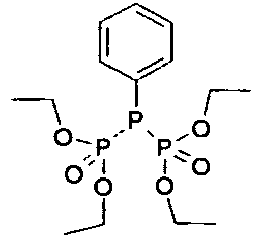
1,1,3,3-Tetraethoxy-2-phenyltriphosphin-1,3-dioxid FR8 
1,1,3,3-Tetraallyloxy-2-phenyltriphosphin-1,3-dioxid FR9 - Die in den Beispielen als Flammschutzmittel eingesetzten organischen Phosphorverbindungen FR1 bis FR 9 wurden entsprechend den nachfolgenden Herstellvorschriften synthetisiert:
- Tetraphenyldiphosphindioxid und Tetraphenyldiphosphindisulfid aus Tetraphenyldiphosphin: (nach: W. Kuchen, H. Buchwald, Chem. Ber., 1958, 91, 2871-2877.)
- Eine Lösung von 6 g (0.0325 Mol) Diphenylphosphin und 7.1 g (0.0325 Mol) Diphenylchlorphosphin in 100 ccm Ligroin (Sdp. 90- 100 °C, über Natrium destilliert) wurde unter Rühren und Rückfluß im Stickstoffstrom 3,5 Stdn. erwärmt. Hierbei spaltete sich lebhaft Chlorwasserstoff ab. Beim Abkühlen unter ständigem Rühren fiel Tetraphenyldiphosphin als weißes, feinkrist. Pulver aus, das unter Luftausschluß abgesaugt, mehrfach mit Ligroin gewaschen, i. Hochvak. getrocknet und unter Stickstoff aufbewahrt wurde. Schmp. (im evakuierten Röhrchen) 120.5 °C; Sdp.1 258 -260 °C. Leicht loslich in Benzol, Toluol, Tetrachlorkohlenstoff und Pyridin (mit gelber Farbe), wenig löslich in Äther, Äthanol und Ligroin. Ausb. ca. 80 % d. Th. C24H20P2 (370.4) Ber. P 16.73 Gef. P 16.62 Mol.-Gew. 391.6, 374.9 (nach RAST)
- In eine Suspension von 3.3 g Tetraphenyldiphosphin in 30 ccm absol. Toluol wurde unter Eiskühlung 3 Stdn. ein sorgfaltig getrockneter Luftstrom eingeleitet. Die zunächst farblose flüssige Phase färbte sich hierbei gelblich. Nach dieser Zeit wurde kurz zum Sieden erwärmt und noch soviel Toluol (ca. 30ccm) zugegeben, bis alles gelöst war. Beim Abkühlen schieden sich aus der klaren Lösung feine, weiße Kristalle aus, die nach mehrfacher Kristallisation aus Toluol im evakuierten Röhrchen scharf bei 167°C schmolzen. Ausb. 1.9 g (53 % d. Th.). C24H20O2P2 (402.4) Ber. P 15.40 Gef. P 15.38 Mol.-Gew. 418.5, 409.8 (nach RAST)
- 10.8 g Tetraphenyldiphosphin und 1.9 g Schwefel wurden in Schwefelkohlenstoff unter Stickstoff 8 Stdn. unter Rückfluß erwärmt. Beim Abkühlen schieden sich aus der klaren Lösung farblose Nadeln aus, die, aus Äthanol/Wasser umkristallisiert, bei 168.5°C schmolzen. Ausb. 4.2 g. Weitere 1.2 g der Verbindung wurden durch Einengen der Schwefelkohlenstofflösung und durch wiederholtes Umkristallisieren des hierbei abgeschiedenen krist. Produktes erhalten. Gesamtausb. 5.4 g (42.4 % d. Th.). Es ist löslich in Chloroform, Benzol, Toluol, Dioxan, Ather und verändert sich selbst beim Erwärmen mit verd. Natronlauge nicht merklich. C24H2OP2S2 (434.5) Ber. P 14.26 S 14.75 Gef. P 14.29 S 14.78 MolGew. 419.1, 427.6 (nach RAST)
- 22 g (0,1 Mol) Diphenylphosphinchlorid werden mit 21,6 g (0,1 Mol) Diphenylphosphinigsäuremethylester, in 100 ml absolutem Benzol im schwachen Stickstoffstrom 2 Stunden am Rückfluß zum Sieden erhitzt. Anschließend wird das Benzol im Rotationsverdampfer abdestiiliert. Dabei fällt Tetraphenyldiphosphinmonoxid. in Form farbloser Kristalle an, die aus wenig Benzol umkristallisiert werden können. Ausbeute: 37 g, d.i. 93,5% d.Th.,Fp.158—161 °C (im Vakuum) Analyse C24H20P2O ber. C: 74,61%; H: 5,22%; P: 16,03%; O 4,14% gef. C: 74,01% H: 5,42% P: 15,56%
- 5 g Tetraphenyldiphosphin werden in 50 ml Schwefelkohlenstoff gelöst und mit 0,43 g Schwefel umgesetzt. Nach dem Abdestillieren des Lösungsmittels wird der Rückstand mehrmals aus Benzin (Kp. 115°C) umkristallisiert. Fp. 138°C; Ausbeute 1,2 g (22 % d. Th.). C24H2OP2S (402,4) ber. P 15,39 % (gef. 15,15%); ber. S 7,97% (gef. 7,91%).
1,1,3,3-Tetraallyloxy-2-phenyltriphosphin-1,3-dioxid - Diese Verbindung wurde wie folgt synthetisiert:

- Ansatz:
44,7g 0,25mol Dichlorphenylphosphin 101,1g 0,5mol Triallylphosphit 100ml Acetonitril - Dichlorphenylphosphin und Acetonitril im Kolben unter Rühren vorgelegt. Innerhalb 52min bei 22-36°C das Triallylphosphit zugetropft. Auf ca. 68°C aufgeheizt und 1,5h gerührt. 31 P-NMR aus der Reaktionslösung zeigt fast vollst. Umsatz. Am nächsten Tag weitere 4h bei ca. 68°C (leichter Rückfluss) nachgerührt. Am Rotationsverdampfer eingeengt. Anschließend bei 80°C und 0,1 mbar Ölpumpenvakuum für 4h getrocknet. Rohausbeute: 92,54g (86 %), Reinheit (NMR): 60 %. 31P-NMR (toluold8), [ppm] : 28.9 (d, 1JP,P=165 Hz), -59.9 (t, 1JP,P=164 Hz)
- Analog K. M. Abraham, J.R.v. Wazer, Inorg. Chem. 1976, 15, 9, 2322-2323 synthetisiert nach Demik, N. N.; Kabachnik, M. M.; Novikova, Z. S.; Beletskaya, I. P.; J. Gen. Chem. USSR (Engl. Transl.); English; 61; 2; 1991; 460 - 461; Zhurnal Obshchei Khimii; Russian; 61; 2; 1991; 506 - 507.

-
44,7g 0,25mol Dichlorphenylphosphin 62,04g 0,5mol Trimethylphosphit 100ml Toluol - Phosphin, Phosphit und Toluol im Kolben unter Rühren vorgelegt. Innerhalb 0,5h auf 113°C (120°C Badtemperatur) erwärmt. 6h bei dieser Temperatur gerührt, wobei eine leichte Gasentwicklung sichtbar ist. Danach war keine Gasentwicklung mehr zu sehen. 31 P-NMR aus der Reaktionslösung zeigt vollst. Umsatz.
- Reaktionsgemisch am Rotationsverdampfer eingeengt. Rückstand riecht übelst nach Trimethylphosphit. Mit MTB-Ether versetzt und erneut eingeengt. Rückstand an der Ölpumpe (0.1 mbar) im Vakuum bei 60°C für 5h getrocknet. Rohausbeute: 67,66g (83%), Reinheit (NMR): 78 %.
1,1,3,3-Tetraethoxy-2-phenyltriphosphin-1,3-dioxid - Herstellung nach Demik, N. N.; Kabachnik, M. M.; Novikova, Z. S.; Beletskaya, I. P.; J. Gen. Chem. USSR (Engl. Transl.); English; 61; 2; 1991; 460 -461; Zhurnal Obshchei Khimii; Russian; 61; 2; 1991; 506 - 507.
- Eine Mischung aus 0,05 mol Phenylphosphordichlorid, 0,1 mol Triethylphosphite und 5 mol% wasserfreiem Nickelchlorid wurde 30 Minuten bei 150°C in trockenen ArgonAtmosphäre erhitzt. Die Reaktionsmischung wurde fraktioniert. Die Ausbeute betrug 94%, Siedepunkt 99°C (0,2 mm).
- Phenyldichlorphosphin (8.9 g, 0.05 mol) wurde unter Rühren zu 1.2 g (0.05 mol) Magnesiumspäne in 50 mL Tetrahydrofuran als Lösungsmittel gegeben. Die Reaktion war stark exotherm und benötigte einen Kondensationskühler, langsame Zugabe des Phenyldichlorphosphins und zeitweise externe Kühlung in einem Wasserbad. Nachdem das meiste des Phosphins zugegeben war, begann Salz auszufallen. Die Zugabe war nach 30 Minuten beendet. Nach mehreren Stunden verblieben nur Spuren von Metall. Das Salz wurde durch Zugabe einer kleinen Menge Aceton aufgelöst und Magnesium abfiltriert. Nach Zugabe von 30 mL bildete sich ein Zweiphasensystem mit einer organischen Schicht und einer Salzwasserschicht. Nach Zugabe einer zweiten Portion Wasser zu der organischen Schicht, fielen 4,0 g (84%) Tetraphenylcyclotetraphosphine mit einem Schmelzpunkt von 148-152°C an.
- 7 Gew.-Teile n-Pentan wurden in eine Polystyrolschmelze aus PS 148G der BASF SE mit einer Viskositätszahl VZ von 83 ml/g eingemischt. Nach Abkühlen der treibmittelhaltigen Schmelze von ursprünglich 260°C auf eine Temperatur von 190°C, wurde eine Polystyrolschmelze, welche die in der Tabelle genannten Flammschutzmittel enthielt, über einen Seitenstromextruder in den Hauptstrom eingemischt. Die angegebenen Mengen in Gew.-Teilen beziehen sich auf die gesamte Polystyrolmenge.
- Das Gemisch aus Polystyrolschmelze, Treibmittel und Flammschutzmittel wurde mit 60 kg/h durch eine Düsenplatte mit 32 Bohrungen (Durchmesser der Düsen 0,75 mm) gefördert. Mit Hilfe einer druckbeaufschlagten Unterwassergranulierung wurden kompakte Granulate mit enger Größenverteilung hergestellt.
- Durch Einwirkung von strömendem Wasserdampf wurden die Granulate vorgeschäumt und nach 12-stündiger Lagerung durch weitere Behandlung mit Wasserdampf in einer geschlossenen Form zu Schaumstoffblöcken einer Dichte von 15 kg/m3 verschweißt.
- Die Ermittlung des Brandverhaltens der Schaumstoffplatten erfolgte nach 72-stündiger Lagerung bei einer Schaumstoffdichte von 15 kg/m3 nach DIN 4102. Art und Menge des eingesetzten Flammschutzmittels und die Verlöschzeiten sind in Tabelle 1 zusammengestellt. Die Beispiele 1 bis 10 und der Vergleichsversuch V1 haben den Brandtest B2 bestanden.
- Analog den Beispielen 1 bis 3 wurde expandierbares Polystyrol mit Flammschutzmitteln hergestellt:
- V1 Hexabromcyclododecan (HBCD)
- V2 9,14-Dihydro-9-oxa-10-phosphaphenanthren-10-oxid (DOP) (nach
WO 2006/027241 ) - V3 kein Flammschutzmittel
- 100 Gew.Teile Polystyrol 158K der BASF SE mit einer Viskositätszahl von 98 ml/g, 0,1 Teile Talkum als Keimbildner zur Regelung der Zellgröße und die in der Tabelle angegebenen Teile an Flammschutzmitteln sowie gegebenenfalls Flammschutzmittelsynergisten (z.B. 2,3-Diphenyl-2,4-dimethylbutan) wurden einem Extruder mit einem inneren Schneckendurchmesser von 120 mm kontinuierlich zugeführt. Durch eine in den Extruder angebrachte Einlassöffnung wird gleichzeitig ein Treibmittelgemisch aus 3,25 Gew. Teilen Ethanol und 3,5 Gew. Teilen CO2 kontinuierlich eingedrückt. Das in dem Extruder bei 180 °C gleichmäßig geknetete Gel wird durch eine Beruhigungszone geführt und nach einer Verweilzeit von 15 Minuten mit einer Austrittstemperatur von 105 °C durch eine 300 mm breite und 1,5 mm weite Düse in die Atmosphäre extrudiert. Der Schaum wird durch einen mit dem Extruder verbundenen Formkanal geführt, wobei eine geschäumte Plattenbahn mit einem Querschnitt 650 mmx50 mm und einer Dichte von 35g/l entsteht. Das Produkt wurde in Platten geschnitten. Geprüft wurde das Brandverhalten der Proben nach einer Ablagerungszeit von 30 Tagen nach DIN 4102.
- Art und Menge des eingesetzten Flammschutzmittels und die Verlöschzeiten sind in Tabelle 2 zusammengestellt. Die Beispiele 11 - 15 und der Vergleichsversuch V4 haben den Brandtest B2 bestanden.
Tabelle 2: Brandtest an den Beispielen 11 - 15 Beispiel Flammschutzmittel Flammschutzmittelmenge Gew-% bezogen auf Polystyrol Brandtest B2 (DIN 4102) Verlöschzeit [s] V4 HBCD 4 9,4 s 11 FR 1 8 7,9 12 FR 2 8 9,8 13 FR 3 8 8,9 14 FR 4 8 9,1 15 FR 4 6 7,1 + 0,2 Teile 2,3- diphenyl-2,4-dimethylbutan
| Beispiel | Flammschutzmittel | Flammschutzmittelmenge Gew-% bezogen auf Polystyrol | Brandtest B2 (DIN 4102) Verlöschzeit [s] |
| V1 | HBCD | 4 | 6,4 s |
| 1 | FR 1 | 8 | 7,1 |
| 2 | FR 2 | 8 | 5,8 |
| 3 | FR 3 | 8 | 6,9 |
| 4 | FR 4 | 8 | 5,1 |
| 5 | FR 5 | 8 | 7,9 |
| 6 (Referenz) | FR 6 | 8 | 5,4 |
| 7 | FR 7 | 8 | 7,9 |
| 8 | FR 8 | 8 | 5,9 |
| 9 | FR 9 | 8 | 8,1 |
| 10 | FR 10 | 8 | 5,6 |
| V2 | DOP | 8 | 20 s,n.b. |
| V3 | - | brennt ab, n.b. |
| n.b.: Brandtest B2 nicht bestanden |
Claims (13)
- Halogenfreie, flammgeschützte Polymerschaumstoffe, dadurch gekennzeichnet, dass sie als Flammschutzmittel mindestens eine acyclische Oligophosphorverbindung, ausgewählt aus acylischen Oligophoshinchalkogeniden mit 2 bis 6 Phosphoratomen und mindestens einer Phosphor-Phosphorbindung, enthalten.
- Halogenfreie, flammgeschützte Polymerschaumstoffe nach Anspruch 1, dadurch gekennzeichnet, dass die Oligophosphorverbindung eine der folgenden Strukturen Ia oder Ib

- Halogenfreie, flammgeschützte Polymerschaumstoffe nach Anspruch 1, dadurch gekennzeichnet, dass die Oligophosphorverbindung eine der folgenden Strukturen IIa, IIb oder IIc


- Halogenfreie, flammgeschützte Polymerschaumstoffe nach Anspruch 1, dadurch gekennzeichnet, dass sie als Flammschutzmittel Tetraphenyldiphosphinmonoxid, Tetraphenyldiphosphinmonosulfid, Tetraphenyldiphosphindioxid, Tetraphenyldiphosphindisulfid, Tetraphenyldiphosphinoxidsulfid, Pentaphenylpentaphospholan, 1,1,3,3-Tetramethoxy-2-phenyltriphosphin-1,3-dioxid, 1,1,3,3-Tetraethoxy-2-phenyltriphosphin-1,3-dioxid, 1,1,3,3-Tetraallyloxy-2-phenyltriphosphin-1,3-dioxid oder Mischungen davon enthalten.
- Halogenfreie, flammgeschützte Polymerschaumstoffe nach einem der Ansprüche 1 bis 4, dadurch gekennzeichnet, dass sie die acyclischen Oligophosphorverbindungen in einer Menge im Bereich von 0,5 bis 25 Gew.-%, bezogen auf den Polymerschaumstoff, enthalten.
- Halogenfreie, flammgeschützte Polymerschaumstoffe nach einem der Ansprüche 1 bis 5, dadurch gekennzeichnet, dass sie eine Dichte im Bereich von 5 bis 200 kg/m3 aufweisen.
- Halogenfreie, flammgeschützte Polymerschaumstoffe nach einem der Ansprüche 1 bis 6, dadurch gekennzeichnet, dass mehr als 80 % der Zellen geschlossenzellig sind.
- Halogenfreie, flammgeschützte Polymerschaumstoffe nach einem der Ansprüche 1 bis 7, dadurch gekennzeichnet, dass sie als Polymer ein Styrolpolymer enthalten.
- Verfahren zur Herstellung von halogenfrei flammgeschützten, expandierbaren Styrolpolymeren (EPS) oder von flammgeschützten Styrolpolymerextrusionschaumstoffen (XPS), dadurch gekennzeichnet, dass als Flammschutzmittel eine acyclische Oligophosphorverbindung gemäß einem der Ansprüche 1 bis 5 eingesetzt wird.
- Verfahren zur Herstellung von halogenfrei flammgeschützten, expandierbaren Styrolpolymeren (EPS), umfassend die Schrittea) Einmischen eines organischen Treibmittels und 1-25 Gew.-% acyclischen Oligophosphorverbindungen gemäß einem der Ansprüche 1 bis 4 in eine Styrolpolymerschmelze mittels statischen oder dynamischen Mischer bei einer Temperatur von mindestens 150°C,b) Kühlen der treibmittelhaltigen Styrolpolymerschmelze auf eine Temperatur von mindestens 120°Cc) Austrag durch eine Düsenplatte mit Bohrungen, deren Durchmesser am Düsenaustritt höchstens 1,5 mm beträgt undd) Granulieren der treibmittelhaltigen Schmelze direkt hinter der Düsenplatte unter Wasser bei einem Druck im Bereich von 1 bis 20 bar.
- Verfahren zur Herstellung von halogenfrei flammgeschützten, expandierbaren Styrolpolymeren (EPS) durch Polymerisation von Styrol in wässriger Suspension in Gegenwart eines organischen Treibmittels und eines Flammschutzmittels, dadurch gekennzeichnet, dass als Flammschutzmittel acyclische Oligophosphorverbindungen gemäß einem der Ansprüche 1 bis 5 eingesetzt werden.
- Halogenfrei flammgeschützte expandierbare Styrolpolymere (EPS), erhältlich nach einem der Ansprüche 9 bis 11.
- Verfahren zur Herstellung von halogenfrei, flammgeschützten Polystyrolpartikelschaumstoffen, dadurch gekennzeichnet, dass man expandierdierbare, Styrolpolymere gemäß Anspruch 12 in einem ersten Schritt mittels Heißluft oder Wasserdampf zu Schaumpartikeln mit einer Dichte im Bereich von 8 bis 200 g/l vorschäumt und in einem 2. Schritt in einer geschlossenen Form verschweißt.
Priority Applications (2)
| Application Number | Priority Date | Filing Date | Title |
|---|---|---|---|
| PL10751679T PL2478044T3 (pl) | 2009-09-14 | 2010-09-10 | Bezfluorowcowe, ogniochronne polimerowe tworzywa piankowe zawierające co najmniej jeden związek oligofosforowy |
| EP10751679.1A EP2478044B1 (de) | 2009-09-14 | 2010-09-10 | Halogenfreie, flammgeschützte polymerschaumstoffe, enthaltend mindestens eine oligophosphorverbindung |
Applications Claiming Priority (3)
| Application Number | Priority Date | Filing Date | Title |
|---|---|---|---|
| EP09170196 | 2009-09-14 | ||
| PCT/EP2010/063304 WO2011029901A1 (de) | 2009-09-14 | 2010-09-10 | Halogenfreie, flammgeschützte polymerschaumstoffe, enthaltend mindestens eine oligophosphorverbindung |
| EP10751679.1A EP2478044B1 (de) | 2009-09-14 | 2010-09-10 | Halogenfreie, flammgeschützte polymerschaumstoffe, enthaltend mindestens eine oligophosphorverbindung |
Publications (2)
| Publication Number | Publication Date |
|---|---|
| EP2478044A1 EP2478044A1 (de) | 2012-07-25 |
| EP2478044B1 true EP2478044B1 (de) | 2013-07-17 |
Family
ID=42829298
Family Applications (1)
| Application Number | Title | Priority Date | Filing Date |
|---|---|---|---|
| EP10751679.1A Not-in-force EP2478044B1 (de) | 2009-09-14 | 2010-09-10 | Halogenfreie, flammgeschützte polymerschaumstoffe, enthaltend mindestens eine oligophosphorverbindung |
Country Status (9)
| Country | Link |
|---|---|
| US (1) | US20120178842A1 (de) |
| EP (1) | EP2478044B1 (de) |
| KR (1) | KR20120083406A (de) |
| CN (1) | CN102482445A (de) |
| BR (1) | BR112012005740A2 (de) |
| MX (1) | MX2012002896A (de) |
| PL (1) | PL2478044T3 (de) |
| RU (1) | RU2012114679A (de) |
| WO (1) | WO2011029901A1 (de) |
Families Citing this family (13)
| Publication number | Priority date | Publication date | Assignee | Title |
|---|---|---|---|---|
| US8759411B2 (en) * | 2010-02-01 | 2014-06-24 | Basf Se | Derivatives of diphosphines as flame retardants for polyurethanes |
| US20110196052A1 (en) * | 2010-02-05 | 2011-08-11 | Basf Se | Flame retardants |
| KR101824277B1 (ko) * | 2010-04-01 | 2018-01-31 | 바스프 에스이 | 난연제 |
| US9115312B2 (en) | 2010-04-01 | 2015-08-25 | Basf Se | Flame retardant |
| US8636929B2 (en) | 2010-05-21 | 2014-01-28 | Basf Se | Nanoporous foamed active compound-containing preparations based on pharmaceutically acceptable thermoplastically workable polymers |
| AT511509A1 (de) | 2011-04-18 | 2012-12-15 | Sunpor Kunststoff Gmbh | Expandierbare polymerisate aus celluloseacetatbutyrat und styrolpolymerisat |
| AT511090B1 (de) | 2011-04-18 | 2012-09-15 | Sunpor Kunststoff Gmbh | Flammgeschützte expandierbare polymerisate |
| EP2706086A1 (de) | 2012-09-05 | 2014-03-12 | Basf Se | Verfahren zur Herstellung von Schaumstoffplatten niedriger Dichte durch Extrusion von Styrolpolymeren unter Verwendung von Hydrofluorolefinen als Treibmittel |
| ES2759323T3 (es) | 2013-12-27 | 2020-05-08 | Dow Global Technologies Llc | Copolímeros retardantes de llama de monómeros de fosfato de dialquil (met)acriloiloxialquilo o fosfonato de dialquil (met)acriloiloxialquilo y espumas de polímero basadas hechas de los mismos |
| ES2672250T3 (es) | 2014-03-27 | 2018-06-13 | Basf Se | Compuestos derivados de heptafósforo como retardadores de llama |
| CN107109008A (zh) | 2014-12-05 | 2017-08-29 | Sabic环球技术有限责任公司 | 阻燃性聚苯乙烯组合物 |
| CN106589200B (zh) * | 2016-12-24 | 2018-10-02 | 上海普信高分子材料有限公司 | 一种阻燃型聚苯乙烯的制备方法 |
| CN107880418A (zh) * | 2017-11-01 | 2018-04-06 | 安徽铭能保温科技有限公司 | 一种采用微胶囊化发泡剂生产挤塑聚苯板的方法 |
Family Cites Families (16)
| Publication number | Priority date | Publication date | Assignee | Title |
|---|---|---|---|---|
| US4111899A (en) * | 1977-07-20 | 1978-09-05 | The Dow Chemical Company | Heat stabilized thermoplastic resins containing compounds with phosphorus to phosphorus bonds |
| ES2101673T3 (es) * | 1987-12-18 | 1997-07-16 | Bayer Ag | Uso de fosfanos y/o difosfanos en la fabricacion de plasticos a base de isocianato. |
| US5011866A (en) * | 1989-11-08 | 1991-04-30 | The Dow Chemical Company | Insulating alkenyl aromatic polymer foam |
| US6369140B1 (en) * | 1993-03-25 | 2002-04-09 | Clariant Finance (Bvi) Limited | Phosphorus compounds |
| US5811470A (en) * | 1996-05-06 | 1998-09-22 | Albemarle Corporation | Flame retardant styrenic polymers |
| DE19640886A1 (de) | 1996-10-04 | 1998-04-09 | Basf Ag | Halogenfreie Flammschutzmittel enthaltende expandierbare Styrolpolymerisate |
| US6444714B1 (en) | 1998-12-09 | 2002-09-03 | Basf Aktiengesellshaft | Method for producing expandable polystyrene particles |
| US6391931B1 (en) * | 1999-04-28 | 2002-05-21 | 3M Innovative Properties Co | Uniform small cell foams and a continuous process for making same |
| JP3772211B2 (ja) * | 2002-08-12 | 2006-05-10 | 独立行政法人産業技術総合研究所 | 有機リン化合物を含む難燃剤及びこれを含有する難燃性樹脂組成物 |
| DE102004044380A1 (de) * | 2004-09-10 | 2006-03-30 | Basf Ag | Halogenfreie, flammgeschützte Polymerschaumstoffe |
| NL1028357C2 (nl) * | 2005-02-21 | 2006-08-22 | Synbra Tech Bv | Deeltjesvormig, expandeerbaar polystyreen (EPS), werkwijze ter vervaardiging van deeltjesvormig expandeerbaar polystyreen, alsmede een bijzondere toepassing van polystyreenschuimmateriaal. |
| CN101842416B (zh) * | 2007-09-04 | 2013-05-15 | 巴斯夫欧洲公司 | 作为阻燃剂的环状膦 |
| WO2009035881A2 (en) * | 2007-09-13 | 2009-03-19 | Dow Global Technologies, Inc. | Phosphorus-sulfur fr additives and polymer systems containing same |
| CN102471535B (zh) * | 2009-07-24 | 2013-12-11 | 巴斯夫欧洲公司 | 在芳族和/或杂芳族环氧树脂中作为阻燃剂的二膦衍生物 |
| US8759411B2 (en) * | 2010-02-01 | 2014-06-24 | Basf Se | Derivatives of diphosphines as flame retardants for polyurethanes |
| US8691896B2 (en) * | 2010-02-05 | 2014-04-08 | Basf Se | Halogen-free, phosphorus-containing flame-retardant polymer foams |
-
2010
- 2010-09-10 KR KR1020127009483A patent/KR20120083406A/ko not_active Withdrawn
- 2010-09-10 CN CN2010800405898A patent/CN102482445A/zh active Pending
- 2010-09-10 MX MX2012002896A patent/MX2012002896A/es not_active Application Discontinuation
- 2010-09-10 BR BR112012005740A patent/BR112012005740A2/pt not_active IP Right Cessation
- 2010-09-10 RU RU2012114679/05A patent/RU2012114679A/ru not_active Application Discontinuation
- 2010-09-10 US US13/394,348 patent/US20120178842A1/en not_active Abandoned
- 2010-09-10 EP EP10751679.1A patent/EP2478044B1/de not_active Not-in-force
- 2010-09-10 PL PL10751679T patent/PL2478044T3/pl unknown
- 2010-09-10 WO PCT/EP2010/063304 patent/WO2011029901A1/de not_active Ceased
Also Published As
| Publication number | Publication date |
|---|---|
| WO2011029901A1 (de) | 2011-03-17 |
| EP2478044A1 (de) | 2012-07-25 |
| PL2478044T3 (pl) | 2013-12-31 |
| CN102482445A (zh) | 2012-05-30 |
| KR20120083406A (ko) | 2012-07-25 |
| MX2012002896A (es) | 2012-04-02 |
| RU2012114679A (ru) | 2013-11-10 |
| BR112012005740A2 (pt) | 2019-09-24 |
| US20120178842A1 (en) | 2012-07-12 |
Similar Documents
| Publication | Publication Date | Title |
|---|---|---|
| EP2478044B1 (de) | Halogenfreie, flammgeschützte polymerschaumstoffe, enthaltend mindestens eine oligophosphorverbindung | |
| EP2513251B1 (de) | Flammschutzmittel | |
| EP1791896B1 (de) | Halogenfreie, flammgeschützte polymerschaumstoffe | |
| EP2449018B1 (de) | Flammgeschützte expandierbare polymerisate | |
| EP2658905B1 (de) | Flammschutzsystem | |
| EP2553008B1 (de) | Flammschutzmittel | |
| US20120264837A1 (en) | Flameproof expandable polymerizates | |
| AT511090B1 (de) | Flammgeschützte expandierbare polymerisate | |
| EP2531552A2 (de) | Halogenfreie, phosphorhaltige flammgeschützte polymerschaumstoffe | |
| EP4077481B1 (de) | Flammgeschützte copolymere und formmassen | |
| US20110196052A1 (en) | Flame retardants | |
| EP2531557A1 (de) | Flammschutzmittel | |
| EP2574614B1 (de) | Flammgeschützte Polymerschaumstoffe mit halogenfreien, phosphorhaltigen Flammschutzmitteln auf Zuckerbasis | |
| EP4263753B1 (de) | Brandhindernde copolymere und formmassen | |
| AT509959B1 (de) | Flammgeschützte expandierbare polymerisate | |
| AT508507A1 (de) | Flammgeschützte expandierbare polymerisate |
Legal Events
| Date | Code | Title | Description |
|---|---|---|---|
| PUAI | Public reference made under article 153(3) epc to a published international application that has entered the european phase |
Free format text: ORIGINAL CODE: 0009012 |
|
| 17P | Request for examination filed |
Effective date: 20120416 |
|
| AK | Designated contracting states |
Kind code of ref document: A1 Designated state(s): AL AT BE BG CH CY CZ DE DK EE ES FI FR GB GR HR HU IE IS IT LI LT LU LV MC MK MT NL NO PL PT RO SE SI SK SM TR |
|
| DAX | Request for extension of the european patent (deleted) | ||
| GRAP | Despatch of communication of intention to grant a patent |
Free format text: ORIGINAL CODE: EPIDOSNIGR1 |
|
| GRAS | Grant fee paid |
Free format text: ORIGINAL CODE: EPIDOSNIGR3 |
|
| GRAA | (expected) grant |
Free format text: ORIGINAL CODE: 0009210 |
|
| AK | Designated contracting states |
Kind code of ref document: B1 Designated state(s): AL AT BE BG CH CY CZ DE DK EE ES FI FR GB GR HR HU IE IS IT LI LT LU LV MC MK MT NL NO PL PT RO SE SI SK SM TR |
|
| REG | Reference to a national code |
Ref country code: GB Ref legal event code: FG4D Free format text: NOT ENGLISH |
|
| REG | Reference to a national code |
Ref country code: CH Ref legal event code: EP |
|
| REG | Reference to a national code |
Ref country code: IE Ref legal event code: FG4D Free format text: LANGUAGE OF EP DOCUMENT: GERMAN |
|
| REG | Reference to a national code |
Ref country code: AT Ref legal event code: REF Ref document number: 622204 Country of ref document: AT Kind code of ref document: T Effective date: 20130815 |
|
| REG | Reference to a national code |
Ref country code: DE Ref legal event code: R096 Ref document number: 502010004077 Country of ref document: DE Effective date: 20130912 |
|
| REG | Reference to a national code |
Ref country code: NL Ref legal event code: T3 |
|
| REG | Reference to a national code |
Ref country code: LT Ref legal event code: MG4D |
|
| REG | Reference to a national code |
Ref country code: PL Ref legal event code: T3 |
|
| PG25 | Lapsed in a contracting state [announced via postgrant information from national office to epo] |
Ref country code: NO Free format text: LAPSE BECAUSE OF FAILURE TO SUBMIT A TRANSLATION OF THE DESCRIPTION OR TO PAY THE FEE WITHIN THE PRESCRIBED TIME-LIMIT Effective date: 20131017 Ref country code: PT Free format text: LAPSE BECAUSE OF FAILURE TO SUBMIT A TRANSLATION OF THE DESCRIPTION OR TO PAY THE FEE WITHIN THE PRESCRIBED TIME-LIMIT Effective date: 20131118 Ref country code: SE Free format text: LAPSE BECAUSE OF FAILURE TO SUBMIT A TRANSLATION OF THE DESCRIPTION OR TO PAY THE FEE WITHIN THE PRESCRIBED TIME-LIMIT Effective date: 20130717 Ref country code: IS Free format text: LAPSE BECAUSE OF FAILURE TO SUBMIT A TRANSLATION OF THE DESCRIPTION OR TO PAY THE FEE WITHIN THE PRESCRIBED TIME-LIMIT Effective date: 20131117 Ref country code: HR Free format text: LAPSE BECAUSE OF FAILURE TO SUBMIT A TRANSLATION OF THE DESCRIPTION OR TO PAY THE FEE WITHIN THE PRESCRIBED TIME-LIMIT Effective date: 20130717 Ref country code: CY Free format text: LAPSE BECAUSE OF FAILURE TO SUBMIT A TRANSLATION OF THE DESCRIPTION OR TO PAY THE FEE WITHIN THE PRESCRIBED TIME-LIMIT Effective date: 20130904 Ref country code: LT Free format text: LAPSE BECAUSE OF FAILURE TO SUBMIT A TRANSLATION OF THE DESCRIPTION OR TO PAY THE FEE WITHIN THE PRESCRIBED TIME-LIMIT Effective date: 20130717 |
|
| PGFP | Annual fee paid to national office [announced via postgrant information from national office to epo] |
Ref country code: FR Payment date: 20130930 Year of fee payment: 4 |
|
| PG25 | Lapsed in a contracting state [announced via postgrant information from national office to epo] |
Ref country code: SI Free format text: LAPSE BECAUSE OF FAILURE TO SUBMIT A TRANSLATION OF THE DESCRIPTION OR TO PAY THE FEE WITHIN THE PRESCRIBED TIME-LIMIT Effective date: 20130717 Ref country code: LV Free format text: LAPSE BECAUSE OF FAILURE TO SUBMIT A TRANSLATION OF THE DESCRIPTION OR TO PAY THE FEE WITHIN THE PRESCRIBED TIME-LIMIT Effective date: 20130717 Ref country code: FI Free format text: LAPSE BECAUSE OF FAILURE TO SUBMIT A TRANSLATION OF THE DESCRIPTION OR TO PAY THE FEE WITHIN THE PRESCRIBED TIME-LIMIT Effective date: 20130717 Ref country code: GR Free format text: LAPSE BECAUSE OF FAILURE TO SUBMIT A TRANSLATION OF THE DESCRIPTION OR TO PAY THE FEE WITHIN THE PRESCRIBED TIME-LIMIT Effective date: 20131018 Ref country code: ES Free format text: LAPSE BECAUSE OF FAILURE TO SUBMIT A TRANSLATION OF THE DESCRIPTION OR TO PAY THE FEE WITHIN THE PRESCRIBED TIME-LIMIT Effective date: 20131028 |
|
| PGFP | Annual fee paid to national office [announced via postgrant information from national office to epo] |
Ref country code: PL Payment date: 20130904 Year of fee payment: 4 Ref country code: NL Payment date: 20131003 Year of fee payment: 4 Ref country code: IT Payment date: 20130930 Year of fee payment: 4 |
|
| BERE | Be: lapsed |
Owner name: BASF SE Effective date: 20130930 |
|
| PG25 | Lapsed in a contracting state [announced via postgrant information from national office to epo] |
Ref country code: CY Free format text: LAPSE BECAUSE OF FAILURE TO SUBMIT A TRANSLATION OF THE DESCRIPTION OR TO PAY THE FEE WITHIN THE PRESCRIBED TIME-LIMIT Effective date: 20130717 |
|
| PG25 | Lapsed in a contracting state [announced via postgrant information from national office to epo] |
Ref country code: RO Free format text: LAPSE BECAUSE OF FAILURE TO SUBMIT A TRANSLATION OF THE DESCRIPTION OR TO PAY THE FEE WITHIN THE PRESCRIBED TIME-LIMIT Effective date: 20130717 Ref country code: EE Free format text: LAPSE BECAUSE OF FAILURE TO SUBMIT A TRANSLATION OF THE DESCRIPTION OR TO PAY THE FEE WITHIN THE PRESCRIBED TIME-LIMIT Effective date: 20130717 Ref country code: SK Free format text: LAPSE BECAUSE OF FAILURE TO SUBMIT A TRANSLATION OF THE DESCRIPTION OR TO PAY THE FEE WITHIN THE PRESCRIBED TIME-LIMIT Effective date: 20130717 Ref country code: CZ Free format text: LAPSE BECAUSE OF FAILURE TO SUBMIT A TRANSLATION OF THE DESCRIPTION OR TO PAY THE FEE WITHIN THE PRESCRIBED TIME-LIMIT Effective date: 20130717 Ref country code: MC Free format text: LAPSE BECAUSE OF FAILURE TO SUBMIT A TRANSLATION OF THE DESCRIPTION OR TO PAY THE FEE WITHIN THE PRESCRIBED TIME-LIMIT Effective date: 20130717 Ref country code: DK Free format text: LAPSE BECAUSE OF FAILURE TO SUBMIT A TRANSLATION OF THE DESCRIPTION OR TO PAY THE FEE WITHIN THE PRESCRIBED TIME-LIMIT Effective date: 20130717 |
|
| PLBE | No opposition filed within time limit |
Free format text: ORIGINAL CODE: 0009261 |
|
| STAA | Information on the status of an ep patent application or granted ep patent |
Free format text: STATUS: NO OPPOSITION FILED WITHIN TIME LIMIT |
|
| 26N | No opposition filed |
Effective date: 20140422 |
|
| REG | Reference to a national code |
Ref country code: IE Ref legal event code: MM4A |
|
| PG25 | Lapsed in a contracting state [announced via postgrant information from national office to epo] |
Ref country code: BE Free format text: LAPSE BECAUSE OF NON-PAYMENT OF DUE FEES Effective date: 20130930 Ref country code: IE Free format text: LAPSE BECAUSE OF NON-PAYMENT OF DUE FEES Effective date: 20130910 |
|
| REG | Reference to a national code |
Ref country code: DE Ref legal event code: R097 Ref document number: 502010004077 Country of ref document: DE Effective date: 20140422 |
|
| PGFP | Annual fee paid to national office [announced via postgrant information from national office to epo] |
Ref country code: DE Payment date: 20131129 Year of fee payment: 4 |
|
| REG | Reference to a national code |
Ref country code: DE Ref legal event code: R119 Ref document number: 502010004077 Country of ref document: DE |
|
| REG | Reference to a national code |
Ref country code: CH Ref legal event code: PL |
|
| GBPC | Gb: european patent ceased through non-payment of renewal fee |
Effective date: 20140910 |
|
| PG25 | Lapsed in a contracting state [announced via postgrant information from national office to epo] |
Ref country code: SM Free format text: LAPSE BECAUSE OF FAILURE TO SUBMIT A TRANSLATION OF THE DESCRIPTION OR TO PAY THE FEE WITHIN THE PRESCRIBED TIME-LIMIT Effective date: 20130717 |
|
| REG | Reference to a national code |
Ref country code: DE Ref legal event code: R119 Ref document number: 502010004077 Country of ref document: DE Effective date: 20150401 |
|
| REG | Reference to a national code |
Ref country code: FR Ref legal event code: ST Effective date: 20150529 |
|
| PG25 | Lapsed in a contracting state [announced via postgrant information from national office to epo] |
Ref country code: MT Free format text: LAPSE BECAUSE OF FAILURE TO SUBMIT A TRANSLATION OF THE DESCRIPTION OR TO PAY THE FEE WITHIN THE PRESCRIBED TIME-LIMIT Effective date: 20130717 Ref country code: NL Free format text: LAPSE BECAUSE OF NON-PAYMENT OF DUE FEES Effective date: 20150401 Ref country code: TR Free format text: LAPSE BECAUSE OF FAILURE TO SUBMIT A TRANSLATION OF THE DESCRIPTION OR TO PAY THE FEE WITHIN THE PRESCRIBED TIME-LIMIT Effective date: 20130717 |
|
| PG25 | Lapsed in a contracting state [announced via postgrant information from national office to epo] |
Ref country code: LU Free format text: LAPSE BECAUSE OF NON-PAYMENT OF DUE FEES Effective date: 20130910 Ref country code: DE Free format text: LAPSE BECAUSE OF NON-PAYMENT OF DUE FEES Effective date: 20150401 Ref country code: CH Free format text: LAPSE BECAUSE OF NON-PAYMENT OF DUE FEES Effective date: 20140930 Ref country code: HU Free format text: LAPSE BECAUSE OF FAILURE TO SUBMIT A TRANSLATION OF THE DESCRIPTION OR TO PAY THE FEE WITHIN THE PRESCRIBED TIME-LIMIT; INVALID AB INITIO Effective date: 20100910 Ref country code: BG Free format text: LAPSE BECAUSE OF FAILURE TO SUBMIT A TRANSLATION OF THE DESCRIPTION OR TO PAY THE FEE WITHIN THE PRESCRIBED TIME-LIMIT Effective date: 20130717 Ref country code: MK Free format text: LAPSE BECAUSE OF FAILURE TO SUBMIT A TRANSLATION OF THE DESCRIPTION OR TO PAY THE FEE WITHIN THE PRESCRIBED TIME-LIMIT Effective date: 20130717 Ref country code: LI Free format text: LAPSE BECAUSE OF NON-PAYMENT OF DUE FEES Effective date: 20140930 Ref country code: GB Free format text: LAPSE BECAUSE OF NON-PAYMENT OF DUE FEES Effective date: 20140910 |
|
| PG25 | Lapsed in a contracting state [announced via postgrant information from national office to epo] |
Ref country code: FR Free format text: LAPSE BECAUSE OF NON-PAYMENT OF DUE FEES Effective date: 20140930 Ref country code: IT Free format text: LAPSE BECAUSE OF NON-PAYMENT OF DUE FEES Effective date: 20140910 |
|
| REG | Reference to a national code |
Ref country code: PL Ref legal event code: LAPE |
|
| PG25 | Lapsed in a contracting state [announced via postgrant information from national office to epo] |
Ref country code: PL Free format text: LAPSE BECAUSE OF NON-PAYMENT OF DUE FEES Effective date: 20140910 |
|
| REG | Reference to a national code |
Ref country code: AT Ref legal event code: MM01 Ref document number: 622204 Country of ref document: AT Kind code of ref document: T Effective date: 20150910 |
|
| PG25 | Lapsed in a contracting state [announced via postgrant information from national office to epo] |
Ref country code: AT Free format text: LAPSE BECAUSE OF NON-PAYMENT OF DUE FEES Effective date: 20150910 |
|
| PG25 | Lapsed in a contracting state [announced via postgrant information from national office to epo] |
Ref country code: AL Free format text: LAPSE BECAUSE OF FAILURE TO SUBMIT A TRANSLATION OF THE DESCRIPTION OR TO PAY THE FEE WITHIN THE PRESCRIBED TIME-LIMIT Effective date: 20130717 |