EP2595997B1 - Kupfer(i)-komplexe für opto-elektronische vorrichtungen - Google Patents
Kupfer(i)-komplexe für opto-elektronische vorrichtungen Download PDFInfo
- Publication number
- EP2595997B1 EP2595997B1 EP11746501.3A EP11746501A EP2595997B1 EP 2595997 B1 EP2595997 B1 EP 2595997B1 EP 11746501 A EP11746501 A EP 11746501A EP 2595997 B1 EP2595997 B1 EP 2595997B1
- Authority
- EP
- European Patent Office
- Prior art keywords
- complex
- copper
- emitter
- smaller
- emission
- Prior art date
- Legal status (The legal status is an assumption and is not a legal conclusion. Google has not performed a legal analysis and makes no representation as to the accuracy of the status listed.)
- Active
Links
- 0 CCC(C1C)*1N Chemical compound CCC(C1C)*1N 0.000 description 3
- IYRGXJIJGHOCFS-UHFFFAOYSA-N Cc(cc1)nc2c1ccc1c2nc(C)cc1 Chemical compound Cc(cc1)nc2c1ccc1c2nc(C)cc1 IYRGXJIJGHOCFS-UHFFFAOYSA-N 0.000 description 1
- PVTRCSGOYHXHEX-UHFFFAOYSA-N Clc1c(ccc2c3nc(CCCC4)c4c2Cl)c3nc2c1CCCC2 Chemical compound Clc1c(ccc2c3nc(CCCC4)c4c2Cl)c3nc2c1CCCC2 PVTRCSGOYHXHEX-UHFFFAOYSA-N 0.000 description 1
Images



Classifications
-
- C—CHEMISTRY; METALLURGY
- C07—ORGANIC CHEMISTRY
- C07F—ACYCLIC, CARBOCYCLIC OR HETEROCYCLIC COMPOUNDS CONTAINING ELEMENTS OTHER THAN CARBON, HYDROGEN, HALOGEN, OXYGEN, NITROGEN, SULFUR, SELENIUM OR TELLURIUM
- C07F1/00—Compounds containing elements of Groups 1 or 11 of the Periodic Table
- C07F1/08—Copper compounds
-
- C—CHEMISTRY; METALLURGY
- C09—DYES; PAINTS; POLISHES; NATURAL RESINS; ADHESIVES; COMPOSITIONS NOT OTHERWISE PROVIDED FOR; APPLICATIONS OF MATERIALS NOT OTHERWISE PROVIDED FOR
- C09K—MATERIALS FOR MISCELLANEOUS APPLICATIONS, NOT PROVIDED FOR ELSEWHERE
- C09K11/00—Luminescent materials, e.g. electroluminescent or chemiluminescent
- C09K11/06—Luminescent materials, e.g. electroluminescent or chemiluminescent containing organic luminescent materials
-
- C—CHEMISTRY; METALLURGY
- C07—ORGANIC CHEMISTRY
- C07D—HETEROCYCLIC COMPOUNDS
- C07D471/00—Heterocyclic compounds containing nitrogen atoms as the only ring hetero atoms in the condensed system, at least one ring being a six-membered ring with one nitrogen atom, not provided for by groups C07D451/00 - C07D463/00
- C07D471/02—Heterocyclic compounds containing nitrogen atoms as the only ring hetero atoms in the condensed system, at least one ring being a six-membered ring with one nitrogen atom, not provided for by groups C07D451/00 - C07D463/00 in which the condensed system contains two hetero rings
- C07D471/04—Ortho-condensed systems
-
- C—CHEMISTRY; METALLURGY
- C07—ORGANIC CHEMISTRY
- C07F—ACYCLIC, CARBOCYCLIC OR HETEROCYCLIC COMPOUNDS CONTAINING ELEMENTS OTHER THAN CARBON, HYDROGEN, HALOGEN, OXYGEN, NITROGEN, SULFUR, SELENIUM OR TELLURIUM
- C07F5/00—Compounds containing elements of Groups 3 or 13 of the Periodic Table
- C07F5/02—Boron compounds
- C07F5/027—Organoboranes and organoborohydrides
-
- C—CHEMISTRY; METALLURGY
- C07—ORGANIC CHEMISTRY
- C07F—ACYCLIC, CARBOCYCLIC OR HETEROCYCLIC COMPOUNDS CONTAINING ELEMENTS OTHER THAN CARBON, HYDROGEN, HALOGEN, OXYGEN, NITROGEN, SULFUR, SELENIUM OR TELLURIUM
- C07F9/00—Compounds containing elements of Groups 5 or 15 of the Periodic Table
- C07F9/02—Phosphorus compounds
- C07F9/28—Phosphorus compounds with one or more P—C bonds
- C07F9/50—Organo-phosphines
- C07F9/5027—Polyphosphines
-
- C—CHEMISTRY; METALLURGY
- C07—ORGANIC CHEMISTRY
- C07F—ACYCLIC, CARBOCYCLIC OR HETEROCYCLIC COMPOUNDS CONTAINING ELEMENTS OTHER THAN CARBON, HYDROGEN, HALOGEN, OXYGEN, NITROGEN, SULFUR, SELENIUM OR TELLURIUM
- C07F9/00—Compounds containing elements of Groups 5 or 15 of the Periodic Table
- C07F9/02—Phosphorus compounds
- C07F9/28—Phosphorus compounds with one or more P—C bonds
- C07F9/50—Organo-phosphines
- C07F9/5045—Complexes or chelates of phosphines with metallic compounds or metals
-
- C—CHEMISTRY; METALLURGY
- C07—ORGANIC CHEMISTRY
- C07F—ACYCLIC, CARBOCYCLIC OR HETEROCYCLIC COMPOUNDS CONTAINING ELEMENTS OTHER THAN CARBON, HYDROGEN, HALOGEN, OXYGEN, NITROGEN, SULFUR, SELENIUM OR TELLURIUM
- C07F9/00—Compounds containing elements of Groups 5 or 15 of the Periodic Table
- C07F9/02—Phosphorus compounds
- C07F9/547—Heterocyclic compounds, e.g. containing phosphorus as a ring hetero atom
- C07F9/6561—Heterocyclic compounds, e.g. containing phosphorus as a ring hetero atom containing systems of two or more relevant hetero rings condensed among themselves or condensed with a common carbocyclic ring or ring system, with or without other non-condensed hetero rings
-
- C—CHEMISTRY; METALLURGY
- C09—DYES; PAINTS; POLISHES; NATURAL RESINS; ADHESIVES; COMPOSITIONS NOT OTHERWISE PROVIDED FOR; APPLICATIONS OF MATERIALS NOT OTHERWISE PROVIDED FOR
- C09B—ORGANIC DYES OR CLOSELY-RELATED COMPOUNDS FOR PRODUCING DYES, e.g. PIGMENTS; MORDANTS; LAKES
- C09B57/00—Other synthetic dyes of known constitution
-
- C—CHEMISTRY; METALLURGY
- C09—DYES; PAINTS; POLISHES; NATURAL RESINS; ADHESIVES; COMPOSITIONS NOT OTHERWISE PROVIDED FOR; APPLICATIONS OF MATERIALS NOT OTHERWISE PROVIDED FOR
- C09B—ORGANIC DYES OR CLOSELY-RELATED COMPOUNDS FOR PRODUCING DYES, e.g. PIGMENTS; MORDANTS; LAKES
- C09B57/00—Other synthetic dyes of known constitution
- C09B57/008—Triarylamine dyes containing no other chromophores
-
- C—CHEMISTRY; METALLURGY
- C09—DYES; PAINTS; POLISHES; NATURAL RESINS; ADHESIVES; COMPOSITIONS NOT OTHERWISE PROVIDED FOR; APPLICATIONS OF MATERIALS NOT OTHERWISE PROVIDED FOR
- C09B—ORGANIC DYES OR CLOSELY-RELATED COMPOUNDS FOR PRODUCING DYES, e.g. PIGMENTS; MORDANTS; LAKES
- C09B57/00—Other synthetic dyes of known constitution
- C09B57/10—Metal complexes of organic compounds not being dyes in uncomplexed form
-
- C—CHEMISTRY; METALLURGY
- C09—DYES; PAINTS; POLISHES; NATURAL RESINS; ADHESIVES; COMPOSITIONS NOT OTHERWISE PROVIDED FOR; APPLICATIONS OF MATERIALS NOT OTHERWISE PROVIDED FOR
- C09B—ORGANIC DYES OR CLOSELY-RELATED COMPOUNDS FOR PRODUCING DYES, e.g. PIGMENTS; MORDANTS; LAKES
- C09B69/00—Dyes not provided for by a single group of this subclass
- C09B69/10—Polymeric dyes; Reaction products of dyes with monomers or with macromolecular compounds
- C09B69/109—Polymeric dyes; Reaction products of dyes with monomers or with macromolecular compounds containing other specific dyes
-
- H—ELECTRICITY
- H10—SEMICONDUCTOR DEVICES; ELECTRIC SOLID-STATE DEVICES NOT OTHERWISE PROVIDED FOR
- H10K—ORGANIC ELECTRIC SOLID-STATE DEVICES
- H10K85/00—Organic materials used in the body or electrodes of devices covered by this subclass
- H10K85/30—Coordination compounds
- H10K85/321—Metal complexes comprising a group IIIA element, e.g. Tris (8-hydroxyquinoline) gallium [Gaq3]
- H10K85/322—Metal complexes comprising a group IIIA element, e.g. Tris (8-hydroxyquinoline) gallium [Gaq3] comprising boron
-
- H—ELECTRICITY
- H10—SEMICONDUCTOR DEVICES; ELECTRIC SOLID-STATE DEVICES NOT OTHERWISE PROVIDED FOR
- H10K—ORGANIC ELECTRIC SOLID-STATE DEVICES
- H10K85/00—Organic materials used in the body or electrodes of devices covered by this subclass
- H10K85/30—Coordination compounds
- H10K85/361—Polynuclear complexes, i.e. complexes comprising two or more metal centers
-
- H—ELECTRICITY
- H10—SEMICONDUCTOR DEVICES; ELECTRIC SOLID-STATE DEVICES NOT OTHERWISE PROVIDED FOR
- H10K—ORGANIC ELECTRIC SOLID-STATE DEVICES
- H10K85/00—Organic materials used in the body or electrodes of devices covered by this subclass
- H10K85/30—Coordination compounds
- H10K85/371—Metal complexes comprising a group IB metal element, e.g. comprising copper, gold or silver
-
- C—CHEMISTRY; METALLURGY
- C09—DYES; PAINTS; POLISHES; NATURAL RESINS; ADHESIVES; COMPOSITIONS NOT OTHERWISE PROVIDED FOR; APPLICATIONS OF MATERIALS NOT OTHERWISE PROVIDED FOR
- C09K—MATERIALS FOR MISCELLANEOUS APPLICATIONS, NOT PROVIDED FOR ELSEWHERE
- C09K2211/00—Chemical nature of organic luminescent or tenebrescent compounds
- C09K2211/10—Non-macromolecular compounds
- C09K2211/1003—Carbocyclic compounds
- C09K2211/1007—Non-condensed systems
-
- C—CHEMISTRY; METALLURGY
- C09—DYES; PAINTS; POLISHES; NATURAL RESINS; ADHESIVES; COMPOSITIONS NOT OTHERWISE PROVIDED FOR; APPLICATIONS OF MATERIALS NOT OTHERWISE PROVIDED FOR
- C09K—MATERIALS FOR MISCELLANEOUS APPLICATIONS, NOT PROVIDED FOR ELSEWHERE
- C09K2211/00—Chemical nature of organic luminescent or tenebrescent compounds
- C09K2211/10—Non-macromolecular compounds
- C09K2211/1003—Carbocyclic compounds
- C09K2211/1011—Condensed systems
-
- C—CHEMISTRY; METALLURGY
- C09—DYES; PAINTS; POLISHES; NATURAL RESINS; ADHESIVES; COMPOSITIONS NOT OTHERWISE PROVIDED FOR; APPLICATIONS OF MATERIALS NOT OTHERWISE PROVIDED FOR
- C09K—MATERIALS FOR MISCELLANEOUS APPLICATIONS, NOT PROVIDED FOR ELSEWHERE
- C09K2211/00—Chemical nature of organic luminescent or tenebrescent compounds
- C09K2211/10—Non-macromolecular compounds
- C09K2211/1018—Heterocyclic compounds
- C09K2211/1025—Heterocyclic compounds characterised by ligands
- C09K2211/1029—Heterocyclic compounds characterised by ligands containing one nitrogen atom as the heteroatom
-
- C—CHEMISTRY; METALLURGY
- C09—DYES; PAINTS; POLISHES; NATURAL RESINS; ADHESIVES; COMPOSITIONS NOT OTHERWISE PROVIDED FOR; APPLICATIONS OF MATERIALS NOT OTHERWISE PROVIDED FOR
- C09K—MATERIALS FOR MISCELLANEOUS APPLICATIONS, NOT PROVIDED FOR ELSEWHERE
- C09K2211/00—Chemical nature of organic luminescent or tenebrescent compounds
- C09K2211/18—Metal complexes
- C09K2211/188—Metal complexes of other metals not provided for in one of the previous groups
-
- H—ELECTRICITY
- H10—SEMICONDUCTOR DEVICES; ELECTRIC SOLID-STATE DEVICES NOT OTHERWISE PROVIDED FOR
- H10K—ORGANIC ELECTRIC SOLID-STATE DEVICES
- H10K50/00—Organic light-emitting devices
- H10K50/10—OLEDs or polymer light-emitting diodes [PLED]
- H10K50/11—OLEDs or polymer light-emitting diodes [PLED] characterised by the electroluminescent [EL] layers
-
- H—ELECTRICITY
- H10—SEMICONDUCTOR DEVICES; ELECTRIC SOLID-STATE DEVICES NOT OTHERWISE PROVIDED FOR
- H10K—ORGANIC ELECTRIC SOLID-STATE DEVICES
- H10K85/00—Organic materials used in the body or electrodes of devices covered by this subclass
- H10K85/60—Organic compounds having low molecular weight
- H10K85/649—Aromatic compounds comprising a hetero atom
- H10K85/657—Polycyclic condensed heteroaromatic hydrocarbons
- H10K85/6572—Polycyclic condensed heteroaromatic hydrocarbons comprising only nitrogen in the heteroaromatic polycondensed ring system, e.g. phenanthroline or carbazole
-
- Y—GENERAL TAGGING OF NEW TECHNOLOGICAL DEVELOPMENTS; GENERAL TAGGING OF CROSS-SECTIONAL TECHNOLOGIES SPANNING OVER SEVERAL SECTIONS OF THE IPC; TECHNICAL SUBJECTS COVERED BY FORMER USPC CROSS-REFERENCE ART COLLECTIONS [XRACs] AND DIGESTS
- Y02—TECHNOLOGIES OR APPLICATIONS FOR MITIGATION OR ADAPTATION AGAINST CLIMATE CHANGE
- Y02E—REDUCTION OF GREENHOUSE GAS [GHG] EMISSIONS, RELATED TO ENERGY GENERATION, TRANSMISSION OR DISTRIBUTION
- Y02E10/00—Energy generation through renewable energy sources
- Y02E10/50—Photovoltaic [PV] energy
- Y02E10/549—Organic PV cells
-
- Y—GENERAL TAGGING OF NEW TECHNOLOGICAL DEVELOPMENTS; GENERAL TAGGING OF CROSS-SECTIONAL TECHNOLOGIES SPANNING OVER SEVERAL SECTIONS OF THE IPC; TECHNICAL SUBJECTS COVERED BY FORMER USPC CROSS-REFERENCE ART COLLECTIONS [XRACs] AND DIGESTS
- Y02—TECHNOLOGIES OR APPLICATIONS FOR MITIGATION OR ADAPTATION AGAINST CLIMATE CHANGE
- Y02P—CLIMATE CHANGE MITIGATION TECHNOLOGIES IN THE PRODUCTION OR PROCESSING OF GOODS
- Y02P70/00—Climate change mitigation technologies in the production process for final industrial or consumer products
- Y02P70/50—Manufacturing or production processes characterised by the final manufactured product
Definitions
- the present invention relates to the use of soluble copper (I) complex (Cu (I) complexes) as emitters in OLEDs (organic light emitting diodes) and in other optoelectronic arrangements.
- This new technology is based on the principle of OLEDs, Organic Light Emitting Diodes.
- the use of special metal-organic materials (molecules) many new opto-electronic applications, eg. As in the field of organic solar cell, organic field effect transistors, organic photodiodes, etc. from.
- OLEDs consist predominantly of organic layers, which are also flexible and inexpensive to manufacture.
- OLED components can be designed over a large area as lighting fixtures, but also as small pixels for displays.
- OLEDs Compared to conventional technologies, such as liquid crystal displays (LCDs), plasma displays or cathode ray tubes (CRTs), OLEDs have numerous advantages, such as a low operating voltage of a few volts, a thin structure of several hundred nm, high-efficiency self-luminous pixels , a high contrast and a good resolution as well as the possibility to display all colors. Furthermore, in an OLED light is generated directly when applying electrical voltage, instead of only modulating it.
- LCDs liquid crystal displays
- CRTs cathode ray tubes
- OLEDs are usually realized in layer structures.
- Fig. 1 a basic structure of an OLED shown. Due to the applied external voltage on a transparent indium-tin-oxide anode (ITO) and a thin metal cathode are injected from the anode positive holes and the cathode negative electrons. These differently charged charge carriers enter the emission layer via intermediate layers, which may also include here not drawn hole or electron blocking layers. There, the oppositely charged charge carriers meet at or near doped emitter molecules and recombine.
- the emitter molecules are typically incorporated into matrix molecules or polymer matrices (eg, from 2 to 10 weight percent), with the matrix materials chosen to also facilitate hole and electron transport.
- This electroluminescent compound can then go into a specific electronic excited state, which is then converted as completely as possible and largely avoiding radiation-free deactivation processes by emitting light in the associated ground state.
- triplet emission which is referred to as phosphorescence
- all excitons are exploited, converted and emitted as light (triplet harvesting), so that in this case the internal quantum efficiency can reach the value of 100%, if the excited with and energetically over the triplet state singlet state completely relaxed in the triplet state (inter-system crossing, ISC) and non-radiation competitive processes remain meaningless.
- ISC inter-system crossing
- the triplet emitters suitable for triplet harvesting typically employ transition metal complex compounds in which the metal is selected from the third period of the transition metals. These are predominantly very expensive precious metals such as iridium, platinum or gold. (See also H. Yersin, Top. Curr. Chem. 2004, 241, 1 and MA Baldo, DF O'Brien, ME Thompson, SR Forrest, Phys. Rev. B 1999, 60, 14422 ).
- the copper (I) complex is particularly soluble in particular in at least one of the following solvents: polar hydrocarbons such as. For example, dichloromethane, chloroform, 1,2-dichloroethane, 1,1,1-trichloroethane, perchlorethylene, toluene, chlorobenzene, 1,2-dichlorobenzene, tetrahydrofuran, diethyl ether, acetone, Methyl ethyl ketone, nitromethane, dimethylsulfoxide, dimethylformamide, methanol and ethanol.
- polar hydrocarbons such as. For example, dichloromethane, chloroform, 1,2-dichloroethane, 1,1,1-trichloroethane, perchlorethylene, toluene, chlorobenzene, 1,2-dichlorobenzene, tetrahydrofuran, diethyl ether, acetone, Methyl ethyl ketone
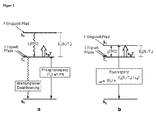
- Fig. 2a an energy level scheme for transition metal complexes with little or little impact spin-orbit coupling (eg, metal complexes of the first period of the transition metals or metal complexes with ligand-centered triplet states) is shown schematically. Based on this scheme, the photophysical electroluminescence properties of these molecules will be explained.
- the hole-electron recombination leads to a statistical average of 25% for the occupation of the singlet state (1 singlet path) and 75% for the occupation of the ⁇ E 1 (S 1 -T 1 ) deeper triplet state (3 triplet paths).
- the excitation that enters the S 1 state relaxes to the T 1 state due to the inter-system crossing (ISC) process, which is usually faster for transition-metal-organic complexes than for 10 -12 s.
- ISC inter-system crossing
- the radiative emission lifetime of the triplet state is very long (eg, 100 ⁇ s to 1000 ⁇ s or longer) for these metal complexes of the first period of the transition metals. Emitters with such long decay times are hardly suitable for OLED applications.
- Int (S 1 ⁇ S 0 ) / Int (T 1 ⁇ S 0 ) represents the intensity ratio of the emission from the S 1 state and the T 1 state
- k B is the Boltzmann constant
- T is the absolute temperature
- k (S 1 ) / k (T 1 ) is the rate ratio of the corresponding transition processes in the electronic ground state S 0 .
- this ratio is between 10 2 to 10 4 .
- Particularly preferred according to the invention are molecules having a rate ratio of 10 3 to 10 4 .
- ⁇ E (S 1 -T 1 ) represents the energy difference ⁇ E 2 (S 1 -T 1 ) according to Fig. 2b ,
- ⁇ (S 1 ) is the fluorescence lifetime without reoccupation
- ⁇ av is the emission lifetime determined when the reoccurrence channel is opened by the two states T 1 and S 1 (see FIG Fig. 2b ).
- the other sizes have been defined above.
- Equation (2) should again be explained by a numerical example.
- DE (S 1 -T 1 ) 800 cm -1 and a decay time of the fluorescent S 1 state of 50 ns, an emission decay time (of the two states) of ⁇ av ⁇ 2 ⁇ s results. This cooldown is shorter than most of the very good Ir (III) or Pt (II) triplet emitters.
- the Cu (I) complexes according to the invention having the properties described above, ie having a small singlet-triplet energy difference ⁇ E (S 1 -T 1 ), are preferably to be described by the general formula A given below.
- the electronic transitions, which control the optical behavior of these Cu (I) complexes, show a pronounced metal-to-ligand charge transfer character. With this transition type is a relatively small value of the - known in the art - quantum mechanical exchange integral connected. This then results in the desired small energy difference ⁇ E (S 1 -T 1 ).
- the invention relates to a method for selecting Cu (I) complexes whose ⁇ E (S 1 -T 1 ) value lies between the lowest excited singlet (S 1 ) and the underlying triplet state (T 1 ) is less than 2500 cm -1 , preferably less than 1500 cm -1 , more preferably less than 1000 cm -1 , most preferably less than 500 cm -1 .
- the determination of the ⁇ E (S 1 -T 1 ) value can be carried out both by quantum mechanical calculations by means of computer programs known in the prior art (eg by means of turbomole programs with execution of TDDFT and taking account of CC 2 calculations) or explained below - be carried out experimentally.
- the energy differences according to the invention can be achieved with ⁇ E (S 1 -T 1 ) of less than 2500 cm -1 or less than 1500 cm -1 or less than 1000 cm -1 or even less than 500 cm -1 .
- any commercially available spectrophotometer can be used.
- a plot of the (logarithmic) intensity ratios ln ⁇ Int (S 1 ⁇ S 0 ) / Int (T 1 ⁇ S 0 ) ⁇ measured against the reciprocal value of the absolute temperature T at various temperatures generally yields a straight line.
- the measurement is carried out in a temperature range from room temperature (300 K) to 77 K or to 4.2 K, wherein the temperature is adjusted by means of a cryostat.
- the intensities are determined from the (corrected) spectra, where Int (S 1 ⁇ S 0 ) and Int (T 1 ⁇ S 0 ) represent the integrated fluorescence or phosphorescence band intensities which are determined by means of the programs belonging to the spectrophotometer to let.
- the respective transitions (band intensities) can be easily identified since the triplet band is at lower energy than the singlet band and gains in intensity with decreasing temperature.
- the measurements are carried out in oxygen-free dilute solutions (about 10 -2 mol L -1 ) or on thin films of the corresponding molecules or on films doped with the corresponding molecules.
- a solution is used as the sample, it is advisable to use a solvent or solvent mixture which forms glasses at low temperatures, such as 2-methyltetrahydrofuran, butyronitrile, toluene, ethanol or aliphatic hydrocarbons.
- a solvent or solvent mixture which forms glasses at low temperatures, such as 2-methyltetrahydrofuran, butyronitrile, toluene, ethanol or aliphatic hydrocarbons.
- a film is used as a sample, the use of a matrix with a significantly higher singlet and triplet energy than that of the Cu (I) complexes (emitter molecules), eg. B. PMMA (polymethylmethacrylate). This film can be applied from solution.
- the line slope is - ⁇ E (S 1 -T 1 ) / k B.
- a simple, approximate estimate of the ⁇ E (S 1 -T 1 ) value can also be made by recording the fluorescence and phosphorescence spectra at low temperature (eg 77 K or 4.2 K using a cryostat) , The ⁇ E (S 1 -T 1 ) value then corresponds approximately to the energy difference between the high-energy rising edges of the fluorescence or phosphorescence band.
- Another method of determining the ⁇ E (S 1 -T 1 ) value is by measuring the emission decay times with a commercial meter.
- the emission lifetime ⁇ av as a function of temperature with the help of a cryostat for the range between 4.2 K or z. B. 20 K and 300 K measured.
- the formula (4) and the emission life for the triplet state ⁇ (T 1 ) measured at low temperature it is possible to fit the measured values with the formula (4), and the ⁇ E (S 1 -T 1 ) is obtained. -Value.
- this quenching mechanism is prevented by the presence of sterically demanding substituents on the diimine ligand NnN (in particular in positions 2 and 9 of 1,10-phenanthroline or in positions 3 and 3 'of 2,2'-bipyridine) or greatly reduced by preventing the geometry changes around the Cu atom.
- substituents on the diimine ligand NnN in particular in positions 2 and 9 of 1,10-phenanthroline or in positions 3 and 3 'of 2,2'-bipyridine
- substitutions contribute to the protection of the Cu center from unwanted chemical reactions with nucleophilic substances (solvents, impurities, easily coordinating matrix materials). Even a methyl group leads to a noticeable "stiffening" of the resulting Cu complexes.
- the alkyl and aryl radicals may also be substituted (eg with halogens, alkoxy or silane groups, etc.) or lead to fused ring systems (see Example 2).
- the diimine ligand is preferably either a substituted 2,2'-bipyridine or a substituted 1,10-phenanthroline ligand.
- the syntheses of different, substituted bpy and phen ligands have already been discussed several times in scientific papers (G. Chelucci, RP Thummel, Chem. Rev. 2002, 102, 3129, C. Kaes, A. Katz, MW Hosseini, Chem 2000, 100, 3553, M. Schstoff, H. Ammon, Eur. J. Inorg. Chem. 1998, 785. M. Heller, US Schubert J. Org. Chem. 2002, 67, 8269.) and are therefore assigned to Specialist known.
- the functional group can be linked via a bridge to the diimine ligand, wherein z.
- ether, thioether, ester, amide, methylene, silane, ethylene, ethyne bridges offer.
- the ligand described in the literature (4,4'-bis (5- (hexylthio) -2,2'-bithien-5'-yl) -2,2'-bipyridines) illustrates the possibility of attachment of an electron-conducting substituent a bpy ligand by means of a Stille coupling ( C.-Y. Chen, M. Wang, J.-Y. Li, N. Pootrakulchote, L. Facebookei, C.- Ngoc-le, J.-D. Decoppet, J.-H. Tsai, C. Grätzel, C.-G. Wu, SM Zakeeruddin, M. Graetzel, ACS Nano 2009, 3, 3103 ).
- the radical R 1 can also be an electron-conducting, hole-conducting or solubility-increasing substituent. This leads to the following diimine ligands:
- the diimine ligand is substituted with one of the functional groups defined below.
- the radical R 1 can also be an electron-conducting, hole-conducting or solubility-increasing substituent. This leads to the following diimine ligands:
- Substituents # are defined as above (bpy and phen ligands).
- the functional groups (FG) can either be single or multiple bound to the NnN ligand. Identical or different functional groups can be used. The functional groups may also be symmetrical or asymmetrical. For synthetic reasons, a two-fold substitution of identical functional groups is usually advantageous.
- Nonpolar functional groups FG increase the solubility in non-polar solvents and lower the solubility in polar solvents.
- Nonpolar groups are z.
- B. alkyl groups [CH 3 - (CH 2 ) n -] (n 1 - 30), also branched, substituted alkyl groups, eg. B. with halogens.
- partially or perfluorinated alkyl groups and perfluorinated oligo- and polyether, z. For example, [- (CF 2 ) 2 -O] n - and (-CF 2 -O) n - (n 2 - 500).
- the optoelectronic device is a white light OLED, wherein the first emitter complex is a red light emitter, the second emitter complex is a green light emitter, and the third emitter complex is a blue light emitter.
- Phen1 4,7-dichloro-2,9-dimethyl-1,10-phenanthroline, Phen1 is prepared according to literature ( M. Schstoff, H. Ammon Eur. J. Org. Chem. 1998, 785 .) produced.
- n-HexMgBr and CuBr are added.
- Phen2 is purified by column chromatography on silica gel.
- Phen3 is again ( M. Schstoff, H. Ammon Eur. J. Org. Chem. 1998, 785 .) produced.
- Phen4 is analogous to Phen2 .
- 2,4,7,9-tetra-methyl-1,10-phenanthroline, Phen5 prepared according to ( G. Butt, RD Topsom, J. Heterocyclic Chem. 1981, 18, 641 ).
- the 2,4,7,9-tetrabromomethylene-1,10-phenanthroline, Phen6, is prepared by side chain bromination using NBS and isolated by column chromatography (SiO 2 ). The reaction with n-HexLi leads to Phen7 .
- 1,10-phenanthroline ligands that increase the solubility in polar solvents, especially water
- the Diether Phen10a and the monoether Phen10b are analogous to the literature ( Koning, JW de Boer, A. Meetsma, RM Kellogg, ARKIVOC 2004, 189 ).
- the isolation is carried out by column chromatography.
- 1,10-phenanthroline ligands functionalized with a hole-conductor group
- Phen12 4- (diphenylamino) phenylboronic acid (Aldrich) is coupled with Phen8 to form Phen12 .
- 1,10-phenanthroline ligands functionalized with an electron-conducting group
- the brominated 1,2,4-triazole is prepared according to ( XJ Feng, PL Wu, HL Tam, KF Li, MS Wong, CH Cheah, Chem. - Eur. J. 2009, 15, 11681 ) produced.
- nBuLi and B (OMe) 3 By reaction with nBuLi and B (OMe) 3 and subsequent hydrolysis with dilute HCl, the boronic acid is synthesized.
- the boronic acid is finally reacted analogously to Example 7 to the ligand Phen14 .
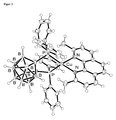
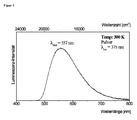
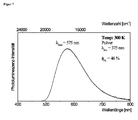
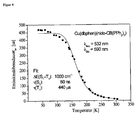
- FIG. 3 is an ORTEP image of a Cu (dophene) ( nido -CB (PPh 2 ) 2 ) molecule is shown. Its luminescence properties, measured on a solid sample at room temperature, are in FIG. 3 shown. Table 1.
- Photoluminescence data for Cu (doping) ( ⁇ i> nido ⁇ / i> -CB (PPh ⁇ sub> 2 ⁇ / sub>) ⁇ sub> 2 ⁇ / sub>) (measured under nitrogen blanket gas atmosphere)
- Quantum yield ⁇ PL 55% 40%
- the drawn curve represents a fit function according to equation (4). The resulting fit values for ⁇ (S 1 ) and ⁇ E (S 1 -T 1 ) are in the FIG. 8 entered.
Landscapes
- Chemical & Material Sciences (AREA)
- Organic Chemistry (AREA)
- Engineering & Computer Science (AREA)
- Materials Engineering (AREA)
- Inorganic Chemistry (AREA)
- Health & Medical Sciences (AREA)
- Life Sciences & Earth Sciences (AREA)
- Biochemistry (AREA)
- General Health & Medical Sciences (AREA)
- Molecular Biology (AREA)
- Physics & Mathematics (AREA)
- High Energy & Nuclear Physics (AREA)
- Electroluminescent Light Sources (AREA)
- Nitrogen Condensed Heterocyclic Rings (AREA)
Applications Claiming Priority (2)
| Application Number | Priority Date | Filing Date | Title |
|---|---|---|---|
| DE201010031831 DE102010031831A1 (de) | 2010-07-20 | 2010-07-20 | Singulett-Harvesting mit löslichen Kupfer(I)-Komplexen für opto-elektronische Vorrichtungen |
| PCT/EP2011/062491 WO2012010650A1 (de) | 2010-07-20 | 2011-07-20 | Kupfer(i)-komplexe für opto-elektronische vorrichtungen |
Publications (2)
| Publication Number | Publication Date |
|---|---|
| EP2595997A1 EP2595997A1 (de) | 2013-05-29 |
| EP2595997B1 true EP2595997B1 (de) | 2015-09-16 |
Family
ID=44503792
Family Applications (1)
| Application Number | Title | Priority Date | Filing Date |
|---|---|---|---|
| EP11746501.3A Active EP2595997B1 (de) | 2010-07-20 | 2011-07-20 | Kupfer(i)-komplexe für opto-elektronische vorrichtungen |
Country Status (7)
| Country | Link |
|---|---|
| US (1) | US9024026B2 (enExample) |
| EP (1) | EP2595997B1 (enExample) |
| JP (1) | JP2013539455A (enExample) |
| KR (1) | KR20140010359A (enExample) |
| CN (1) | CN103052644A (enExample) |
| DE (1) | DE102010031831A1 (enExample) |
| WO (1) | WO2012010650A1 (enExample) |
Families Citing this family (32)
| Publication number | Priority date | Publication date | Assignee | Title |
|---|---|---|---|---|
| DE102011089687A1 (de) * | 2011-12-22 | 2013-06-27 | Hartmut Yersin | Singulett-Harvesting mit speziellen organischen Molekülen ohne Metallzentren für opto-elektronische Vorrichtungen |
| DE102012101067A1 (de) * | 2012-02-09 | 2013-08-14 | Rafal Czerwieniec | Optische Sauerstoff-Sensoren mit Kupfer(I)-Komplexen |
| CN102851024B (zh) * | 2012-09-28 | 2014-05-14 | 太原理工大学 | 基于双(2-二苯基磷苯基)醚配体的有机电致发光材料 |
| DE102013100181A1 (de) * | 2013-01-09 | 2014-07-10 | Cynora Gmbh | Thermisch aktivierte Fluoreszenz und Singulett-Harvesting mit rigiden Metall-Komplexen für opto-elektronische Vorrichtungen |
| DE102013105053A1 (de) * | 2013-05-16 | 2014-11-20 | Cynora Gmbh | Kupfer(I)- und Silber(I)-Komplexe als Leuchtstoffe in Energiespar- und Leuchtstofflampen |
| JP6080303B2 (ja) * | 2013-05-27 | 2017-02-15 | 公立大学法人大阪市立大学 | 銅錯体化合物、銅錯体化合物の製造方法、医療診断用蛍光色素、太陽電池、並びに、発光素子 |
| DE102013212775B4 (de) * | 2013-06-28 | 2015-07-02 | Technische Universität Braunschweig | Verfahren und Verwendung von Kupferverbindungen zur Messung einer katalytischen Oberflächenaktivität |
| CN103450887A (zh) * | 2013-08-22 | 2013-12-18 | 贵州大学 | 一类共轭型菲啰啉-吡啶荧光试剂及其制备方法和应用 |
| DE102013111552A1 (de) * | 2013-10-21 | 2015-04-23 | Osram Oled Gmbh | Organisches lichtemittierendes Bauelement |
| CN103626789A (zh) * | 2013-11-22 | 2014-03-12 | 中国计量学院 | 一种双核亚铜配合物发光材料及其制备方法 |
| KR20160100961A (ko) | 2013-12-20 | 2016-08-24 | 바스프 에스이 | 매우 짧은 감쇠 시간을 갖는 고효율 oled 장치 |
| CN103880867B (zh) * | 2014-03-03 | 2016-11-23 | 中国计量学院 | 一种双核亚铜配合物绿色发光材料及其制备方法 |
| KR102661925B1 (ko) | 2015-06-03 | 2024-05-02 | 유디씨 아일랜드 리미티드 | 매우 짧은 붕괴 시간을 갖는 고효율 oled 소자 |
| CN105440015B (zh) * | 2015-12-01 | 2017-12-29 | 天津师范大学 | 铜配合物可见光下催化2‑甲基喹啉与四氢异喹啉偶联反应的制备方法 |
| EP3407361A1 (en) * | 2017-05-24 | 2018-11-28 | Ecole Polytechnique Fédérale de Lausanne (EPFL) | Redox melts formed by copper (i)/(ii) complexes as charge transfer and charge storage materials |
| EP3591725A1 (en) * | 2018-07-02 | 2020-01-08 | Novaled GmbH | Electronic device, method for preparing the same and a display device comprising the same |
| CN108864156B (zh) * | 2018-07-25 | 2020-09-04 | 汕头大学 | 一种具有二元发射的发光有机金属银配合物及其制备与应用 |
| US20220048836A1 (en) | 2018-09-12 | 2022-02-17 | Merck Patent Gmbh | Materials for organic electroluminescent devices |
| TW202030902A (zh) | 2018-09-12 | 2020-08-16 | 德商麥克專利有限公司 | 電致發光裝置 |
| TWI826522B (zh) | 2018-09-12 | 2023-12-21 | 德商麥克專利有限公司 | 電致發光裝置 |
| EP3935129B1 (en) | 2019-03-04 | 2023-11-29 | Merck Patent GmbH | Ligands for nano-sized materials |
| JP7598873B2 (ja) | 2019-04-11 | 2024-12-12 | メルク パテント ゲゼルシャフト ミット ベシュレンクテル ハフツング | 有機エレクトロルミネッセンス素子のための材料 |
| TWI843884B (zh) * | 2019-09-06 | 2024-06-01 | 日本放送協會 | 有機薄膜及有機薄膜之製造方法、有機電致發光元件、顯示裝置、照明裝置、有機薄膜太陽電池、薄膜電晶體、光電轉換元件、塗料組成物、有機電致發光元件用材料 |
| KR102937291B1 (ko) | 2019-11-04 | 2026-03-11 | 유디씨 아일랜드 리미티드 | 유기 전계 발광 디바이스용 재료 |
| TW202134252A (zh) | 2019-11-12 | 2021-09-16 | 德商麥克專利有限公司 | 有機電致發光裝置用材料 |
| TW202136181A (zh) | 2019-12-04 | 2021-10-01 | 德商麥克專利有限公司 | 有機電致發光裝置用的材料 |
| CN115052865A (zh) | 2020-01-29 | 2022-09-13 | 默克专利有限公司 | 苯并咪唑衍生物 |
| US20230337537A1 (en) | 2020-03-23 | 2023-10-19 | Merck Patent Gmbh | Materials for organic electroluminescent devices |
| KR102776384B1 (ko) | 2020-05-06 | 2025-03-10 | 삼성디스플레이 주식회사 | 발광 소자 및 이를 포함하는 전자 장치 |
| KR102797538B1 (ko) | 2020-05-19 | 2025-04-21 | 삼성디스플레이 주식회사 | 유기 발광 소자 및 이를 포함한 전자 장치 |
| CN113416539B (zh) * | 2021-05-06 | 2022-03-22 | 北京师范大学 | 高量子产率可溶液加工的固体蓝色荧光-红色磷光碳量子有机框架及其制备和应用 |
| EP4619484A1 (en) | 2022-11-17 | 2025-09-24 | Merck Patent GmbH | Materials for organic electroluminescent devices |
Family Cites Families (7)
| Publication number | Priority date | Publication date | Assignee | Title |
|---|---|---|---|---|
| US1028479A (en) | 1911-11-20 | 1912-06-04 | Charles M Morgan | Display-card. |
| JP2003332074A (ja) * | 2002-05-09 | 2003-11-21 | Canon Inc | 金属配位化合物を用いた発光素子 |
| JP4208657B2 (ja) * | 2003-07-15 | 2009-01-14 | キヤノン株式会社 | 発光素子 |
| DE102007031261A1 (de) | 2007-07-05 | 2009-01-08 | Universtität Regensburg | Lumineszierende Metallkomplexe mit sperrigen Hilfsliganden |
| DE102008048336A1 (de) * | 2008-09-22 | 2010-03-25 | Merck Patent Gmbh | Einkernige neutrale Kupfer(I)-Komplexe und deren Verwendung zur Herstellung von optoelektronischen Bauelementen |
| US20110198580A1 (en) * | 2008-12-22 | 2011-08-18 | E.I. Du Pont De Nemours And Company | Photoactive composition and electronic device made with the composition |
| DE102009007038A1 (de) * | 2009-02-02 | 2010-08-05 | Merck Patent Gmbh | Metallkomplexe |
-
2010
- 2010-07-20 DE DE201010031831 patent/DE102010031831A1/de not_active Withdrawn
-
2011
- 2011-07-20 CN CN2011800355234A patent/CN103052644A/zh active Pending
- 2011-07-20 JP JP2013520152A patent/JP2013539455A/ja active Pending
- 2011-07-20 KR KR20137001396A patent/KR20140010359A/ko not_active Withdrawn
- 2011-07-20 US US13/810,848 patent/US9024026B2/en active Active
- 2011-07-20 EP EP11746501.3A patent/EP2595997B1/de active Active
- 2011-07-20 WO PCT/EP2011/062491 patent/WO2012010650A1/de not_active Ceased
Also Published As
| Publication number | Publication date |
|---|---|
| EP2595997A1 (de) | 2013-05-29 |
| JP2013539455A (ja) | 2013-10-24 |
| DE102010031831A1 (de) | 2012-01-26 |
| US20130150581A1 (en) | 2013-06-13 |
| WO2012010650A1 (de) | 2012-01-26 |
| US9024026B2 (en) | 2015-05-05 |
| KR20140010359A (ko) | 2014-01-24 |
| CN103052644A (zh) | 2013-04-17 |
Similar Documents
| Publication | Publication Date | Title |
|---|---|---|
| EP2595997A1 (de) | Kupfer(i)-komplexe für opto-elektronische vorrichtungen | |
| EP2729477B1 (de) | Kupfer (i) komplexe für opto-elektronische vorrichtungen | |
| EP2739702B1 (de) | Singulett-harvesting mit zweikernigen kupfer(i)-komplexen für opto-elektronische vorrichtungen | |
| EP3216797B1 (de) | Dinukleare platin-carben-komplexe und deren verwendung in oleds | |
| EP2329542B1 (de) | Materialien für organische elektrolumineszenzvorrichtungen | |
| EP2082447B1 (de) | Oled-anzeige mit verlängerter lebensdauer | |
| EP2007779B1 (de) | Heteroleptische übergangsmetall-carben-komplexe und deren verwendung in organischen leuchtdioden (oleds) | |
| EP2205615B1 (de) | Übergangsmetallkomplexe mit verbrückten carbenliganden und deren verwendung in oleds | |
| EP3299437B1 (de) | Übergangsmetallkomplexe mit carbenliganden als emitter für organische licht-emittierende dioden (oleds) | |
| EP2251396A2 (de) | Mischungen von organischen zur Emission befähigten Halbleitern und Matrixmaterialien, deren Verwendung und Elektronikbauteile diese enthaltend | |
| EP1649731A1 (de) | Organisches elektrolumineszenzelement | |
| WO2009053278A1 (de) | Verwendung von substituierten tris(diphenylamino)-triazinverbindungen in oleds | |
| DE10330761A1 (de) | Mischungen von organischen zur Emission befähigten Halbleitern und Matrixmaterialien, deren Verwendung und Elektronikbauteile enthaltend dieses | |
| WO2014108430A1 (de) | Thermisch aktivierte fluoreszenz und singulett-harvesting mit rigiden metall-komplexen für opto-elektronische vorrichtungen | |
| EP3911716B1 (de) | Materialien für organische elektrolumineszenzvorrichtungen | |
| DE102016104929A1 (de) | Organische Moleküle zur Verwendung als Emitter | |
| DE102005003634A1 (de) | Triarylamin-Derivate II mit raumfüllenden Seitengruppen und Verwendung in elektrolumineszenten und elektrofotografischen Vorrichtung | |
| DE10357318A1 (de) | Organisches Elektrolumineszenzelement |
Legal Events
| Date | Code | Title | Description |
|---|---|---|---|
| PUAI | Public reference made under article 153(3) epc to a published international application that has entered the european phase |
Free format text: ORIGINAL CODE: 0009012 |
|
| 17P | Request for examination filed |
Effective date: 20130125 |
|
| AK | Designated contracting states |
Kind code of ref document: A1 Designated state(s): AL AT BE BG CH CY CZ DE DK EE ES FI FR GB GR HR HU IE IS IT LI LT LU LV MC MK MT NL NO PL PT RO RS SE SI SK SM TR |
|
| DAX | Request for extension of the european patent (deleted) | ||
| RAP1 | Party data changed (applicant data changed or rights of an application transferred) |
Owner name: CYNORA GMBH |
|
| 17Q | First examination report despatched |
Effective date: 20140509 |
|
| REG | Reference to a national code |
Ref country code: DE Ref legal event code: R079 Ref document number: 502011007894 Country of ref document: DE Free format text: PREVIOUS MAIN CLASS: C07F0001080000 Ipc: C07F0009500000 |
|
| RIC1 | Information provided on ipc code assigned before grant |
Ipc: H01L 51/50 20060101ALI20150129BHEP Ipc: C07F 5/02 20060101ALI20150129BHEP Ipc: C07D 471/04 20060101ALI20150129BHEP Ipc: H01L 51/00 20060101ALI20150129BHEP Ipc: C07F 9/50 20060101AFI20150129BHEP Ipc: C09K 11/06 20060101ALI20150129BHEP Ipc: C07F 9/6561 20060101ALI20150129BHEP |
|
| GRAP | Despatch of communication of intention to grant a patent |
Free format text: ORIGINAL CODE: EPIDOSNIGR1 |
|
| INTG | Intention to grant announced |
Effective date: 20150402 |
|
| GRAS | Grant fee paid |
Free format text: ORIGINAL CODE: EPIDOSNIGR3 |
|
| GRAA | (expected) grant |
Free format text: ORIGINAL CODE: 0009210 |
|
| AK | Designated contracting states |
Kind code of ref document: B1 Designated state(s): AL AT BE BG CH CY CZ DE DK EE ES FI FR GB GR HR HU IE IS IT LI LT LU LV MC MK MT NL NO PL PT RO RS SE SI SK SM TR |
|
| REG | Reference to a national code |
Ref country code: GB Ref legal event code: FG4D Free format text: NOT ENGLISH |
|
| REG | Reference to a national code |
Ref country code: CH Ref legal event code: EP |
|
| REG | Reference to a national code |
Ref country code: IE Ref legal event code: FG4D Free format text: LANGUAGE OF EP DOCUMENT: GERMAN |
|
| REG | Reference to a national code |
Ref country code: AT Ref legal event code: REF Ref document number: 749739 Country of ref document: AT Kind code of ref document: T Effective date: 20151015 |
|
| REG | Reference to a national code |
Ref country code: DE Ref legal event code: R096 Ref document number: 502011007894 Country of ref document: DE |
|
| REG | Reference to a national code |
Ref country code: NL Ref legal event code: MP Effective date: 20150916 |
|
| PG25 | Lapsed in a contracting state [announced via postgrant information from national office to epo] |
Ref country code: NO Free format text: LAPSE BECAUSE OF FAILURE TO SUBMIT A TRANSLATION OF THE DESCRIPTION OR TO PAY THE FEE WITHIN THE PRESCRIBED TIME-LIMIT Effective date: 20151216 Ref country code: FI Free format text: LAPSE BECAUSE OF FAILURE TO SUBMIT A TRANSLATION OF THE DESCRIPTION OR TO PAY THE FEE WITHIN THE PRESCRIBED TIME-LIMIT Effective date: 20150916 Ref country code: LT Free format text: LAPSE BECAUSE OF FAILURE TO SUBMIT A TRANSLATION OF THE DESCRIPTION OR TO PAY THE FEE WITHIN THE PRESCRIBED TIME-LIMIT Effective date: 20150916 Ref country code: GR Free format text: LAPSE BECAUSE OF FAILURE TO SUBMIT A TRANSLATION OF THE DESCRIPTION OR TO PAY THE FEE WITHIN THE PRESCRIBED TIME-LIMIT Effective date: 20151217 Ref country code: LV Free format text: LAPSE BECAUSE OF FAILURE TO SUBMIT A TRANSLATION OF THE DESCRIPTION OR TO PAY THE FEE WITHIN THE PRESCRIBED TIME-LIMIT Effective date: 20150916 |
|
| REG | Reference to a national code |
Ref country code: LT Ref legal event code: MG4D |
|
| PG25 | Lapsed in a contracting state [announced via postgrant information from national office to epo] |
Ref country code: HR Free format text: LAPSE BECAUSE OF FAILURE TO SUBMIT A TRANSLATION OF THE DESCRIPTION OR TO PAY THE FEE WITHIN THE PRESCRIBED TIME-LIMIT Effective date: 20150916 Ref country code: SE Free format text: LAPSE BECAUSE OF FAILURE TO SUBMIT A TRANSLATION OF THE DESCRIPTION OR TO PAY THE FEE WITHIN THE PRESCRIBED TIME-LIMIT Effective date: 20150916 Ref country code: RS Free format text: LAPSE BECAUSE OF FAILURE TO SUBMIT A TRANSLATION OF THE DESCRIPTION OR TO PAY THE FEE WITHIN THE PRESCRIBED TIME-LIMIT Effective date: 20150916 |
|
| PG25 | Lapsed in a contracting state [announced via postgrant information from national office to epo] |
Ref country code: NL Free format text: LAPSE BECAUSE OF FAILURE TO SUBMIT A TRANSLATION OF THE DESCRIPTION OR TO PAY THE FEE WITHIN THE PRESCRIBED TIME-LIMIT Effective date: 20150916 |
|
| PG25 | Lapsed in a contracting state [announced via postgrant information from national office to epo] |
Ref country code: IS Free format text: LAPSE BECAUSE OF FAILURE TO SUBMIT A TRANSLATION OF THE DESCRIPTION OR TO PAY THE FEE WITHIN THE PRESCRIBED TIME-LIMIT Effective date: 20160116 Ref country code: CZ Free format text: LAPSE BECAUSE OF FAILURE TO SUBMIT A TRANSLATION OF THE DESCRIPTION OR TO PAY THE FEE WITHIN THE PRESCRIBED TIME-LIMIT Effective date: 20150916 Ref country code: EE Free format text: LAPSE BECAUSE OF FAILURE TO SUBMIT A TRANSLATION OF THE DESCRIPTION OR TO PAY THE FEE WITHIN THE PRESCRIBED TIME-LIMIT Effective date: 20150916 Ref country code: ES Free format text: LAPSE BECAUSE OF FAILURE TO SUBMIT A TRANSLATION OF THE DESCRIPTION OR TO PAY THE FEE WITHIN THE PRESCRIBED TIME-LIMIT Effective date: 20150916 Ref country code: SK Free format text: LAPSE BECAUSE OF FAILURE TO SUBMIT A TRANSLATION OF THE DESCRIPTION OR TO PAY THE FEE WITHIN THE PRESCRIBED TIME-LIMIT Effective date: 20150916 |
|
| PG25 | Lapsed in a contracting state [announced via postgrant information from national office to epo] |
Ref country code: PT Free format text: LAPSE BECAUSE OF FAILURE TO SUBMIT A TRANSLATION OF THE DESCRIPTION OR TO PAY THE FEE WITHIN THE PRESCRIBED TIME-LIMIT Effective date: 20160118 Ref country code: RO Free format text: LAPSE BECAUSE OF FAILURE TO SUBMIT A TRANSLATION OF THE DESCRIPTION OR TO PAY THE FEE WITHIN THE PRESCRIBED TIME-LIMIT Effective date: 20150916 Ref country code: PL Free format text: LAPSE BECAUSE OF FAILURE TO SUBMIT A TRANSLATION OF THE DESCRIPTION OR TO PAY THE FEE WITHIN THE PRESCRIBED TIME-LIMIT Effective date: 20150916 |
|
| REG | Reference to a national code |
Ref country code: DE Ref legal event code: R097 Ref document number: 502011007894 Country of ref document: DE |
|
| PLBE | No opposition filed within time limit |
Free format text: ORIGINAL CODE: 0009261 |
|
| REG | Reference to a national code |
Ref country code: FR Ref legal event code: PLFP Year of fee payment: 6 |
|
| STAA | Information on the status of an ep patent application or granted ep patent |
Free format text: STATUS: NO OPPOSITION FILED WITHIN TIME LIMIT |
|
| 26N | No opposition filed |
Effective date: 20160617 |
|
| PG25 | Lapsed in a contracting state [announced via postgrant information from national office to epo] |
Ref country code: DK Free format text: LAPSE BECAUSE OF FAILURE TO SUBMIT A TRANSLATION OF THE DESCRIPTION OR TO PAY THE FEE WITHIN THE PRESCRIBED TIME-LIMIT Effective date: 20150916 |
|
| PG25 | Lapsed in a contracting state [announced via postgrant information from national office to epo] |
Ref country code: SI Free format text: LAPSE BECAUSE OF FAILURE TO SUBMIT A TRANSLATION OF THE DESCRIPTION OR TO PAY THE FEE WITHIN THE PRESCRIBED TIME-LIMIT Effective date: 20150916 |
|
| PG25 | Lapsed in a contracting state [announced via postgrant information from national office to epo] |
Ref country code: BE Free format text: LAPSE BECAUSE OF NON-PAYMENT OF DUE FEES Effective date: 20160731 |
|
| REG | Reference to a national code |
Ref country code: CH Ref legal event code: PL |
|
| PG25 | Lapsed in a contracting state [announced via postgrant information from national office to epo] |
Ref country code: MC Free format text: LAPSE BECAUSE OF FAILURE TO SUBMIT A TRANSLATION OF THE DESCRIPTION OR TO PAY THE FEE WITHIN THE PRESCRIBED TIME-LIMIT Effective date: 20150916 |
|
| PG25 | Lapsed in a contracting state [announced via postgrant information from national office to epo] |
Ref country code: LI Free format text: LAPSE BECAUSE OF NON-PAYMENT OF DUE FEES Effective date: 20160731 Ref country code: CH Free format text: LAPSE BECAUSE OF NON-PAYMENT OF DUE FEES Effective date: 20160731 |
|
| REG | Reference to a national code |
Ref country code: IE Ref legal event code: MM4A |
|
| REG | Reference to a national code |
Ref country code: FR Ref legal event code: PLFP Year of fee payment: 7 |
|
| PG25 | Lapsed in a contracting state [announced via postgrant information from national office to epo] |
Ref country code: IE Free format text: LAPSE BECAUSE OF NON-PAYMENT OF DUE FEES Effective date: 20160720 |
|
| PG25 | Lapsed in a contracting state [announced via postgrant information from national office to epo] |
Ref country code: LU Free format text: LAPSE BECAUSE OF NON-PAYMENT OF DUE FEES Effective date: 20160720 |
|
| REG | Reference to a national code |
Ref country code: AT Ref legal event code: MM01 Ref document number: 749739 Country of ref document: AT Kind code of ref document: T Effective date: 20160720 |
|
| PG25 | Lapsed in a contracting state [announced via postgrant information from national office to epo] |
Ref country code: AT Free format text: LAPSE BECAUSE OF NON-PAYMENT OF DUE FEES Effective date: 20160720 |
|
| PG25 | Lapsed in a contracting state [announced via postgrant information from national office to epo] |
Ref country code: HU Free format text: LAPSE BECAUSE OF FAILURE TO SUBMIT A TRANSLATION OF THE DESCRIPTION OR TO PAY THE FEE WITHIN THE PRESCRIBED TIME-LIMIT; INVALID AB INITIO Effective date: 20110720 Ref country code: CY Free format text: LAPSE BECAUSE OF FAILURE TO SUBMIT A TRANSLATION OF THE DESCRIPTION OR TO PAY THE FEE WITHIN THE PRESCRIBED TIME-LIMIT Effective date: 20150916 Ref country code: SM Free format text: LAPSE BECAUSE OF FAILURE TO SUBMIT A TRANSLATION OF THE DESCRIPTION OR TO PAY THE FEE WITHIN THE PRESCRIBED TIME-LIMIT Effective date: 20150916 |
|
| PG25 | Lapsed in a contracting state [announced via postgrant information from national office to epo] |
Ref country code: MT Free format text: LAPSE BECAUSE OF FAILURE TO SUBMIT A TRANSLATION OF THE DESCRIPTION OR TO PAY THE FEE WITHIN THE PRESCRIBED TIME-LIMIT Effective date: 20150916 Ref country code: MK Free format text: LAPSE BECAUSE OF FAILURE TO SUBMIT A TRANSLATION OF THE DESCRIPTION OR TO PAY THE FEE WITHIN THE PRESCRIBED TIME-LIMIT Effective date: 20150916 Ref country code: TR Free format text: LAPSE BECAUSE OF FAILURE TO SUBMIT A TRANSLATION OF THE DESCRIPTION OR TO PAY THE FEE WITHIN THE PRESCRIBED TIME-LIMIT Effective date: 20150916 |
|
| REG | Reference to a national code |
Ref country code: FR Ref legal event code: PLFP Year of fee payment: 8 |
|
| PG25 | Lapsed in a contracting state [announced via postgrant information from national office to epo] |
Ref country code: BG Free format text: LAPSE BECAUSE OF FAILURE TO SUBMIT A TRANSLATION OF THE DESCRIPTION OR TO PAY THE FEE WITHIN THE PRESCRIBED TIME-LIMIT Effective date: 20150916 |
|
| PG25 | Lapsed in a contracting state [announced via postgrant information from national office to epo] |
Ref country code: AL Free format text: LAPSE BECAUSE OF FAILURE TO SUBMIT A TRANSLATION OF THE DESCRIPTION OR TO PAY THE FEE WITHIN THE PRESCRIBED TIME-LIMIT Effective date: 20150916 |
|
| REG | Reference to a national code |
Ref country code: DE Ref legal event code: R081 Ref document number: 502011007894 Country of ref document: DE Owner name: SAMSUNG DISPLAY CO., LTD., YONGIN-SI, KR Free format text: FORMER OWNER: CYNORA GMBH, 76646 BRUCHSAL, DE Ref country code: DE Ref legal event code: R082 Ref document number: 502011007894 Country of ref document: DE Representative=s name: DR. WEITZEL & PARTNER PATENT- UND RECHTSANWAEL, DE |
|
| REG | Reference to a national code |
Ref country code: GB Ref legal event code: 732E Free format text: REGISTERED BETWEEN 20220609 AND 20220615 |
|
| P01 | Opt-out of the competence of the unified patent court (upc) registered |
Effective date: 20230516 |
|
| PGFP | Annual fee paid to national office [announced via postgrant information from national office to epo] |
Ref country code: DE Payment date: 20250624 Year of fee payment: 15 |
|
| PGFP | Annual fee paid to national office [announced via postgrant information from national office to epo] |
Ref country code: GB Payment date: 20260624 Year of fee payment: 16 |
|
| PGFP | Annual fee paid to national office [announced via postgrant information from national office to epo] |
Ref country code: IT Payment date: 20260623 Year of fee payment: 16 |
|
| PGFP | Annual fee paid to national office [announced via postgrant information from national office to epo] |
Ref country code: FR Payment date: 20260625 Year of fee payment: 16 |