EP2581407A1 - Vulkanisierbare Zusammensetzungen auf Basis Epoxygruppen-haltiger Nitrilkautschuke - Google Patents
Vulkanisierbare Zusammensetzungen auf Basis Epoxygruppen-haltiger Nitrilkautschuke Download PDFInfo
- Publication number
- EP2581407A1 EP2581407A1 EP11290470.1A EP11290470A EP2581407A1 EP 2581407 A1 EP2581407 A1 EP 2581407A1 EP 11290470 A EP11290470 A EP 11290470A EP 2581407 A1 EP2581407 A1 EP 2581407A1
- Authority
- EP
- European Patent Office
- Prior art keywords
- iii
- weight
- acid
- parts
- chloride
- Prior art date
- Legal status (The legal status is an assumption and is not a legal conclusion. Google has not performed a legal analysis and makes no representation as to the accuracy of the status listed.)
- Withdrawn
Links
- 229920000459 Nitrile rubber Polymers 0.000 title claims abstract description 132
- 125000003700 epoxy group Chemical group 0.000 title claims abstract description 110
- 150000001875 compounds Chemical class 0.000 title claims description 22
- 239000000203 mixture Substances 0.000 claims abstract description 116
- 238000004132 cross linking Methods 0.000 claims abstract description 101
- -1 cyclic polyene Chemical class 0.000 claims abstract description 98
- 239000000178 monomer Substances 0.000 claims abstract description 78
- 150000001993 dienes Chemical class 0.000 claims abstract description 43
- 239000003431 cross linking reagent Substances 0.000 claims abstract description 42
- 239000002841 Lewis acid Substances 0.000 claims abstract description 30
- 150000002825 nitriles Chemical class 0.000 claims abstract description 25
- 239000007848 Bronsted acid Substances 0.000 claims abstract description 23
- KUAZQDVKQLNFPE-UHFFFAOYSA-N thiram Chemical compound CN(C)C(=S)SSC(=S)N(C)C KUAZQDVKQLNFPE-UHFFFAOYSA-N 0.000 claims abstract description 16
- 229960002447 thiram Drugs 0.000 claims abstract description 16
- 239000012990 dithiocarbamate Substances 0.000 claims abstract description 13
- 150000004659 dithiocarbamates Chemical class 0.000 claims abstract description 13
- 150000003585 thioureas Chemical class 0.000 claims abstract description 10
- 150000004657 carbamic acid derivatives Chemical class 0.000 claims abstract description 9
- 238000002156 mixing Methods 0.000 claims abstract description 5
- 239000004971 Cross linker Substances 0.000 claims description 52
- 239000002253 acid Substances 0.000 claims description 40
- NIXOWILDQLNWCW-UHFFFAOYSA-M Acrylate Chemical compound [O-]C(=O)C=C NIXOWILDQLNWCW-UHFFFAOYSA-M 0.000 claims description 38
- UQSXHKLRYXJYBZ-UHFFFAOYSA-N Iron oxide Chemical compound [Fe]=O UQSXHKLRYXJYBZ-UHFFFAOYSA-N 0.000 claims description 29
- KAKZBPTYRLMSJV-UHFFFAOYSA-N Butadiene Chemical compound C=CC=C KAKZBPTYRLMSJV-UHFFFAOYSA-N 0.000 claims description 28
- 150000002148 esters Chemical class 0.000 claims description 28
- XLOMVQKBTHCTTD-UHFFFAOYSA-N Zinc monoxide Chemical compound [Zn]=O XLOMVQKBTHCTTD-UHFFFAOYSA-N 0.000 claims description 27
- CIWBSHSKHKDKBQ-JLAZNSOCSA-N Ascorbic acid Chemical compound OC[C@H](O)[C@H]1OC(=O)C(O)=C1O CIWBSHSKHKDKBQ-JLAZNSOCSA-N 0.000 claims description 25
- TWRXJAOTZQYOKJ-UHFFFAOYSA-L Magnesium chloride Chemical compound [Mg+2].[Cl-].[Cl-] TWRXJAOTZQYOKJ-UHFFFAOYSA-L 0.000 claims description 25
- KWGKDLIKAYFUFQ-UHFFFAOYSA-M lithium chloride Chemical compound [Li+].[Cl-] KWGKDLIKAYFUFQ-UHFFFAOYSA-M 0.000 claims description 25
- JIAARYAFYJHUJI-UHFFFAOYSA-L zinc dichloride Chemical compound [Cl-].[Cl-].[Zn+2] JIAARYAFYJHUJI-UHFFFAOYSA-L 0.000 claims description 25
- LMBWSYZSUOEYSN-UHFFFAOYSA-N diethyldithiocarbamic acid Chemical compound CCN(CC)C(S)=S LMBWSYZSUOEYSN-UHFFFAOYSA-N 0.000 claims description 23
- 229950004394 ditiocarb Drugs 0.000 claims description 23
- JOXIMZWYDAKGHI-UHFFFAOYSA-N toluene-4-sulfonic acid Chemical compound CC1=CC=C(S(O)(=O)=O)C=C1 JOXIMZWYDAKGHI-UHFFFAOYSA-N 0.000 claims description 23
- YBKBEKGVHFHCRI-UHFFFAOYSA-L zinc;piperidine-1-carbodithioate Chemical compound [Zn+2].[S-]C(=S)N1CCCCC1.[S-]C(=S)N1CCCCC1 YBKBEKGVHFHCRI-UHFFFAOYSA-L 0.000 claims description 23
- QTBSBXVTEAMEQO-UHFFFAOYSA-N Acetic acid Chemical compound CC(O)=O QTBSBXVTEAMEQO-UHFFFAOYSA-N 0.000 claims description 22
- 229910052717 sulfur Inorganic materials 0.000 claims description 22
- FCSHMCFRCYZTRQ-UHFFFAOYSA-N N,N'-diphenylthiourea Chemical compound C=1C=CC=CC=1NC(=S)NC1=CC=CC=C1 FCSHMCFRCYZTRQ-UHFFFAOYSA-N 0.000 claims description 21
- VZCYOOQTPOCHFL-OWOJBTEDSA-N Fumaric acid Chemical compound OC(=O)\C=C\C(O)=O VZCYOOQTPOCHFL-OWOJBTEDSA-N 0.000 claims description 20
- VZCYOOQTPOCHFL-UHFFFAOYSA-N trans-butenedioic acid Natural products OC(=O)C=CC(O)=O VZCYOOQTPOCHFL-UHFFFAOYSA-N 0.000 claims description 20
- 229940096818 dipentamethylenethiuram disulfide Drugs 0.000 claims description 19
- KNBRWWCHBRQLNY-UHFFFAOYSA-N piperidine-1-carbothioylsulfanyl piperidine-1-carbodithioate Chemical compound C1CCCCN1C(=S)SSC(=S)N1CCCCC1 KNBRWWCHBRQLNY-UHFFFAOYSA-N 0.000 claims description 19
- VOZRXNHHFUQHIL-UHFFFAOYSA-N glycidyl methacrylate Chemical compound CC(=C)C(=O)OCC1CO1 VOZRXNHHFUQHIL-UHFFFAOYSA-N 0.000 claims description 18
- SHFJWMWCIHQNCP-UHFFFAOYSA-M hydron;tetrabutylazanium;sulfate Chemical compound OS([O-])(=O)=O.CCCC[N+](CCCC)(CCCC)CCCC SHFJWMWCIHQNCP-UHFFFAOYSA-M 0.000 claims description 18
- 150000007517 lewis acids Chemical class 0.000 claims description 18
- NLHHRLWOUZZQLW-UHFFFAOYSA-N Acrylonitrile Chemical compound C=CC#N NLHHRLWOUZZQLW-UHFFFAOYSA-N 0.000 claims description 17
- 150000007513 acids Chemical class 0.000 claims description 17
- WTEOIRVLGSZEPR-UHFFFAOYSA-N boron trifluoride Chemical compound FB(F)F WTEOIRVLGSZEPR-UHFFFAOYSA-N 0.000 claims description 16
- PSCMQHVBLHHWTO-UHFFFAOYSA-K indium(iii) chloride Chemical compound Cl[In](Cl)Cl PSCMQHVBLHHWTO-UHFFFAOYSA-K 0.000 claims description 16
- AMXOYNBUYSYVKV-UHFFFAOYSA-M lithium bromide Chemical compound [Li+].[Br-] AMXOYNBUYSYVKV-UHFFFAOYSA-M 0.000 claims description 16
- 238000002360 preparation method Methods 0.000 claims description 16
- 150000002118 epoxides Chemical group 0.000 claims description 15
- RBTARNINKXHZNM-UHFFFAOYSA-K iron trichloride Chemical compound Cl[Fe](Cl)Cl RBTARNINKXHZNM-UHFFFAOYSA-K 0.000 claims description 15
- AXZKOIWUVFPNLO-UHFFFAOYSA-N magnesium;oxygen(2-) Chemical compound [O-2].[Mg+2] AXZKOIWUVFPNLO-UHFFFAOYSA-N 0.000 claims description 15
- RPQRDASANLAFCM-UHFFFAOYSA-N oxiran-2-ylmethyl prop-2-enoate Chemical compound C=CC(=O)OCC1CO1 RPQRDASANLAFCM-UHFFFAOYSA-N 0.000 claims description 15
- PDQAZBWRQCGBEV-UHFFFAOYSA-N Ethylenethiourea Chemical compound S=C1NCCN1 PDQAZBWRQCGBEV-UHFFFAOYSA-N 0.000 claims description 14
- WPYMKLBDIGXBTP-UHFFFAOYSA-N benzoic acid Chemical compound OC(=O)C1=CC=CC=C1 WPYMKLBDIGXBTP-UHFFFAOYSA-N 0.000 claims description 14
- JEIPFZHSYJVQDO-UHFFFAOYSA-N iron(III) oxide Inorganic materials O=[Fe]O[Fe]=O JEIPFZHSYJVQDO-UHFFFAOYSA-N 0.000 claims description 14
- 229910052760 oxygen Inorganic materials 0.000 claims description 14
- 229920000642 polymer Polymers 0.000 claims description 14
- BOXSVZNGTQTENJ-UHFFFAOYSA-L zinc dibutyldithiocarbamate Chemical compound [Zn+2].CCCCN(C([S-])=S)CCCC.CCCCN(C([S-])=S)CCCC BOXSVZNGTQTENJ-UHFFFAOYSA-L 0.000 claims description 14
- KMNUDJAXRXUZQS-UHFFFAOYSA-L zinc;n-ethyl-n-phenylcarbamodithioate Chemical compound [Zn+2].CCN(C([S-])=S)C1=CC=CC=C1.CCN(C([S-])=S)C1=CC=CC=C1 KMNUDJAXRXUZQS-UHFFFAOYSA-L 0.000 claims description 14
- 239000000872 buffer Substances 0.000 claims description 13
- KWPNNZKRAQDVPZ-UHFFFAOYSA-N 1,3-bis(2-methylphenyl)thiourea Chemical compound CC1=CC=CC=C1NC(=S)NC1=CC=CC=C1C KWPNNZKRAQDVPZ-UHFFFAOYSA-N 0.000 claims description 12
- GSFSVEDCYBDIGW-UHFFFAOYSA-N 2-(1,3-benzothiazol-2-yl)-6-chlorophenol Chemical compound OC1=C(Cl)C=CC=C1C1=NC2=CC=CC=C2S1 GSFSVEDCYBDIGW-UHFFFAOYSA-N 0.000 claims description 12
- YPXCVTQZYYXWFJ-UHFFFAOYSA-N 2-(2-ethenoxyethyl)-3-propyloxirane Chemical compound CCCC1OC1CCOC=C YPXCVTQZYYXWFJ-UHFFFAOYSA-N 0.000 claims description 12
- NIXOWILDQLNWCW-UHFFFAOYSA-N 2-Propenoic acid Natural products OC(=O)C=C NIXOWILDQLNWCW-UHFFFAOYSA-N 0.000 claims description 12
- VSCWAEJMTAWNJL-UHFFFAOYSA-K aluminium trichloride Chemical compound Cl[Al](Cl)Cl VSCWAEJMTAWNJL-UHFFFAOYSA-K 0.000 claims description 12
- RKQOSDAEEGPRER-UHFFFAOYSA-L zinc diethyldithiocarbamate Chemical compound [Zn+2].CCN(CC)C([S-])=S.CCN(CC)C([S-])=S RKQOSDAEEGPRER-UHFFFAOYSA-L 0.000 claims description 12
- DUBNHZYBDBBJHD-UHFFFAOYSA-L ziram Chemical compound [Zn+2].CN(C)C([S-])=S.CN(C)C([S-])=S DUBNHZYBDBBJHD-UHFFFAOYSA-L 0.000 claims description 12
- BUZICZZQJDLXJN-UHFFFAOYSA-N 3-azaniumyl-4-hydroxybutanoate Chemical compound OCC(N)CC(O)=O BUZICZZQJDLXJN-UHFFFAOYSA-N 0.000 claims description 11
- OFOBLEOULBTSOW-UHFFFAOYSA-N Propanedioic acid Natural products OC(=O)CC(O)=O OFOBLEOULBTSOW-UHFFFAOYSA-N 0.000 claims description 11
- VZCYOOQTPOCHFL-UPHRSURJSA-N maleic acid Chemical compound OC(=O)\C=C/C(O)=O VZCYOOQTPOCHFL-UPHRSURJSA-N 0.000 claims description 11
- 239000011976 maleic acid Substances 0.000 claims description 11
- 229920006395 saturated elastomer Polymers 0.000 claims description 11
- HUMLQUKVJARKRN-UHFFFAOYSA-M sodium;n,n-dibutylcarbamodithioate Chemical compound [Na+].CCCCN(C([S-])=S)CCCC HUMLQUKVJARKRN-UHFFFAOYSA-M 0.000 claims description 11
- 239000011787 zinc oxide Substances 0.000 claims description 11
- SMZOUWXMTYCWNB-UHFFFAOYSA-N 2-(2-methoxy-5-methylphenyl)ethanamine Chemical compound COC1=CC=C(C)C=C1CCN SMZOUWXMTYCWNB-UHFFFAOYSA-N 0.000 claims description 10
- 239000004593 Epoxy Substances 0.000 claims description 10
- HCHKCACWOHOZIP-UHFFFAOYSA-N Zinc Chemical compound [Zn] HCHKCACWOHOZIP-UHFFFAOYSA-N 0.000 claims description 10
- 235000010323 ascorbic acid Nutrition 0.000 claims description 10
- 239000011668 ascorbic acid Substances 0.000 claims description 10
- 229960005070 ascorbic acid Drugs 0.000 claims description 10
- XEEYBQQBJWHFJM-UHFFFAOYSA-N iron Substances [Fe] XEEYBQQBJWHFJM-UHFFFAOYSA-N 0.000 claims description 10
- 229910001629 magnesium chloride Inorganic materials 0.000 claims description 10
- 239000000395 magnesium oxide Substances 0.000 claims description 10
- CPLXHLVBOLITMK-UHFFFAOYSA-N magnesium oxide Inorganic materials [Mg]=O CPLXHLVBOLITMK-UHFFFAOYSA-N 0.000 claims description 10
- SONJTKJMTWTJCT-UHFFFAOYSA-K rhodium(iii) chloride Chemical compound [Cl-].[Cl-].[Cl-].[Rh+3] SONJTKJMTWTJCT-UHFFFAOYSA-K 0.000 claims description 10
- 239000011701 zinc Substances 0.000 claims description 10
- 229910052725 zinc Inorganic materials 0.000 claims description 10
- 239000011592 zinc chloride Substances 0.000 claims description 10
- 235000005074 zinc chloride Nutrition 0.000 claims description 10
- WRIDQFICGBMAFQ-UHFFFAOYSA-N (E)-8-Octadecenoic acid Natural products CCCCCCCCCC=CCCCCCCC(O)=O WRIDQFICGBMAFQ-UHFFFAOYSA-N 0.000 claims description 9
- WWILHZQYNPQALT-UHFFFAOYSA-N 2-methyl-2-morpholin-4-ylpropanal Chemical compound O=CC(C)(C)N1CCOCC1 WWILHZQYNPQALT-UHFFFAOYSA-N 0.000 claims description 9
- LQJBNNIYVWPHFW-UHFFFAOYSA-N 20:1omega9c fatty acid Natural products CCCCCCCCCCC=CCCCCCCCC(O)=O LQJBNNIYVWPHFW-UHFFFAOYSA-N 0.000 claims description 9
- TXLINXBIWJYFNR-UHFFFAOYSA-N 4-phenylpyridine-2-carbonitrile Chemical compound C1=NC(C#N)=CC(C=2C=CC=CC=2)=C1 TXLINXBIWJYFNR-UHFFFAOYSA-N 0.000 claims description 9
- QSBYPNXLFMSGKH-UHFFFAOYSA-N 9-Heptadecensaeure Natural products CCCCCCCC=CCCCCCCCC(O)=O QSBYPNXLFMSGKH-UHFFFAOYSA-N 0.000 claims description 9
- RWSOTUBLDIXVET-UHFFFAOYSA-N Dihydrogen sulfide Chemical class S RWSOTUBLDIXVET-UHFFFAOYSA-N 0.000 claims description 9
- 229910021578 Iron(III) chloride Inorganic materials 0.000 claims description 9
- CERQOIWHTDAKMF-UHFFFAOYSA-M Methacrylate Chemical compound CC(=C)C([O-])=O CERQOIWHTDAKMF-UHFFFAOYSA-M 0.000 claims description 9
- 239000005642 Oleic acid Substances 0.000 claims description 9
- ZQPPMHVWECSIRJ-UHFFFAOYSA-N Oleic acid Natural products CCCCCCCCC=CCCCCCCCC(O)=O ZQPPMHVWECSIRJ-UHFFFAOYSA-N 0.000 claims description 9
- 235000021355 Stearic acid Nutrition 0.000 claims description 9
- 150000005690 diesters Chemical class 0.000 claims description 9
- 239000001530 fumaric acid Substances 0.000 claims description 9
- QXJSBBXBKPUZAA-UHFFFAOYSA-N isooleic acid Natural products CCCCCCCC=CCCCCCCCCC(O)=O QXJSBBXBKPUZAA-UHFFFAOYSA-N 0.000 claims description 9
- 238000004519 manufacturing process Methods 0.000 claims description 9
- QIQXTHQIDYTFRH-UHFFFAOYSA-N octadecanoic acid Chemical compound CCCCCCCCCCCCCCCCCC(O)=O QIQXTHQIDYTFRH-UHFFFAOYSA-N 0.000 claims description 9
- OQCDKBAXFALNLD-UHFFFAOYSA-N octadecanoic acid Natural products CCCCCCCC(C)CCCCCCCCC(O)=O OQCDKBAXFALNLD-UHFFFAOYSA-N 0.000 claims description 9
- ZQPPMHVWECSIRJ-KTKRTIGZSA-N oleic acid Chemical compound CCCCCCCC\C=C/CCCCCCCC(O)=O ZQPPMHVWECSIRJ-KTKRTIGZSA-N 0.000 claims description 9
- CHKVPAROMQMJNQ-UHFFFAOYSA-M potassium bisulfate Chemical compound [K+].OS([O-])(=O)=O CHKVPAROMQMJNQ-UHFFFAOYSA-M 0.000 claims description 9
- 229910000343 potassium bisulfate Inorganic materials 0.000 claims description 9
- 239000008117 stearic acid Substances 0.000 claims description 9
- NLXLAEXVIDQMFP-UHFFFAOYSA-N Ammonia chloride Chemical compound [NH4+].[Cl-] NLXLAEXVIDQMFP-UHFFFAOYSA-N 0.000 claims description 8
- VHUUQVKOLVNVRT-UHFFFAOYSA-N Ammonium hydroxide Chemical compound [NH4+].[OH-] VHUUQVKOLVNVRT-UHFFFAOYSA-N 0.000 claims description 8
- 229910021604 Rhodium(III) chloride Inorganic materials 0.000 claims description 8
- 125000003118 aryl group Chemical group 0.000 claims description 8
- 229910052799 carbon Inorganic materials 0.000 claims description 8
- 229910052736 halogen Inorganic materials 0.000 claims description 8
- STMDPCBYJCIZOD-UHFFFAOYSA-N 2-(2,4-dinitroanilino)-4-methylpentanoic acid Chemical compound CC(C)CC(C(O)=O)NC1=CC=C([N+]([O-])=O)C=C1[N+]([O-])=O STMDPCBYJCIZOD-UHFFFAOYSA-N 0.000 claims description 7
- JJRUAPNVLBABCN-UHFFFAOYSA-N 2-(ethenoxymethyl)oxirane Chemical compound C=COCC1CO1 JJRUAPNVLBABCN-UHFFFAOYSA-N 0.000 claims description 7
- PTBAHIRKWPUZAM-UHFFFAOYSA-N 2-(oxiran-2-yl)ethyl 2-methylprop-2-enoate Chemical compound CC(=C)C(=O)OCCC1CO1 PTBAHIRKWPUZAM-UHFFFAOYSA-N 0.000 claims description 7
- ZADXFVHUPXKZBJ-UHFFFAOYSA-N 2-[(4-ethenylphenyl)methoxymethyl]oxirane Chemical compound C1=CC(C=C)=CC=C1COCC1OC1 ZADXFVHUPXKZBJ-UHFFFAOYSA-N 0.000 claims description 7
- OENZCYOCXAUZOT-UHFFFAOYSA-N 2-[2-(2-ethenylphenyl)-1-[2-(2-ethenylphenyl)-1-(oxiran-2-yl)ethoxy]ethyl]oxirane Chemical compound C=CC1=CC=CC=C1CC(C1OC1)OC(C1OC1)CC1=CC=CC=C1C=C OENZCYOCXAUZOT-UHFFFAOYSA-N 0.000 claims description 7
- CWMLFHKGLMSMPE-UHFFFAOYSA-N 2-[2-(3-ethenylphenyl)-1-[2-(3-ethenylphenyl)-1-(oxiran-2-yl)ethoxy]ethyl]oxirane Chemical compound C=CC1=CC=CC(CC(OC(CC=2C=C(C=C)C=CC=2)C2OC2)C2OC2)=C1 CWMLFHKGLMSMPE-UHFFFAOYSA-N 0.000 claims description 7
- VXEGSRKPIUDPQT-UHFFFAOYSA-N 4-[4-(4-methoxyphenyl)piperazin-1-yl]aniline Chemical compound C1=CC(OC)=CC=C1N1CCN(C=2C=CC(N)=CC=2)CC1 VXEGSRKPIUDPQT-UHFFFAOYSA-N 0.000 claims description 7
- 229910015900 BF3 Inorganic materials 0.000 claims description 7
- AJZRXKAXBVGYMQ-UHFFFAOYSA-N C(N)(SCCC1CCCCC1)=S.[Na] Chemical compound C(N)(SCCC1CCCCC1)=S.[Na] AJZRXKAXBVGYMQ-UHFFFAOYSA-N 0.000 claims description 7
- QAOWNCQODCNURD-UHFFFAOYSA-N Sulfuric acid Chemical compound OS(O)(=O)=O QAOWNCQODCNURD-UHFFFAOYSA-N 0.000 claims description 7
- HZXJVDYQRYYYOR-UHFFFAOYSA-K scandium(iii) trifluoromethanesulfonate Chemical compound [Sc+3].[O-]S(=O)(=O)C(F)(F)F.[O-]S(=O)(=O)C(F)(F)F.[O-]S(=O)(=O)C(F)(F)F HZXJVDYQRYYYOR-UHFFFAOYSA-K 0.000 claims description 7
- 239000005049 silicon tetrachloride Substances 0.000 claims description 7
- 150000004670 unsaturated fatty acids Chemical class 0.000 claims description 7
- 235000021122 unsaturated fatty acids Nutrition 0.000 claims description 7
- BTXXTMOWISPQSJ-UHFFFAOYSA-N 4,4,4-trifluorobutan-2-one Chemical compound CC(=O)CC(F)(F)F BTXXTMOWISPQSJ-UHFFFAOYSA-N 0.000 claims description 6
- FDWQGNULGGFFDP-UHFFFAOYSA-N 5-ethenyl-7-oxabicyclo[4.1.0]heptane Chemical compound C=CC1CCCC2OC12 FDWQGNULGGFFDP-UHFFFAOYSA-N 0.000 claims description 6
- BQACOLQNOUYJCE-FYZZASKESA-N Abietic acid Natural products CC(C)C1=CC2=CC[C@]3(C)[C@](C)(CCC[C@@]3(C)C(=O)O)[C@H]2CC1 BQACOLQNOUYJCE-FYZZASKESA-N 0.000 claims description 6
- RSWGJHLUYNHPMX-UHFFFAOYSA-N Abietic-Saeure Natural products C12CCC(C(C)C)=CC2=CCC2C1(C)CCCC2(C)C(O)=O RSWGJHLUYNHPMX-UHFFFAOYSA-N 0.000 claims description 6
- ATRRKUHOCOJYRX-UHFFFAOYSA-N Ammonium bicarbonate Chemical compound [NH4+].OC([O-])=O ATRRKUHOCOJYRX-UHFFFAOYSA-N 0.000 claims description 6
- 239000005711 Benzoic acid Substances 0.000 claims description 6
- 235000011054 acetic acid Nutrition 0.000 claims description 6
- 239000001099 ammonium carbonate Substances 0.000 claims description 6
- 235000012501 ammonium carbonate Nutrition 0.000 claims description 6
- 239000000908 ammonium hydroxide Substances 0.000 claims description 6
- 235000011114 ammonium hydroxide Nutrition 0.000 claims description 6
- BFNBIHQBYMNNAN-UHFFFAOYSA-N ammonium sulfate Chemical compound N.N.OS(O)(=O)=O BFNBIHQBYMNNAN-UHFFFAOYSA-N 0.000 claims description 6
- 229910052921 ammonium sulfate Inorganic materials 0.000 claims description 6
- 235000011130 ammonium sulphate Nutrition 0.000 claims description 6
- 235000010233 benzoic acid Nutrition 0.000 claims description 6
- 229910052794 bromium Inorganic materials 0.000 claims description 6
- 239000000460 chlorine Substances 0.000 claims description 6
- 229910052801 chlorine Inorganic materials 0.000 claims description 6
- 229910052731 fluorine Inorganic materials 0.000 claims description 6
- 150000002367 halogens Chemical class 0.000 claims description 6
- LIKBJVNGSGBSGK-UHFFFAOYSA-N iron(3+);oxygen(2-) Chemical compound [O-2].[O-2].[O-2].[Fe+3].[Fe+3] LIKBJVNGSGBSGK-UHFFFAOYSA-N 0.000 claims description 6
- 238000000034 method Methods 0.000 claims description 6
- 229910000402 monopotassium phosphate Inorganic materials 0.000 claims description 6
- 235000019796 monopotassium phosphate Nutrition 0.000 claims description 6
- 150000004671 saturated fatty acids Chemical class 0.000 claims description 6
- 235000003441 saturated fatty acids Nutrition 0.000 claims description 6
- NCWSYEUMCNBLPU-UHFFFAOYSA-N 1-(oxiran-2-yl)propyl 2-methylprop-2-enoate Chemical compound CC(=C)C(=O)OC(CC)C1CO1 NCWSYEUMCNBLPU-UHFFFAOYSA-N 0.000 claims description 5
- HPRNPSLJNKWKCO-UHFFFAOYSA-N 1-(oxiran-2-yl)propyl prop-2-enoate Chemical compound C=CC(=O)OC(CC)C1CO1 HPRNPSLJNKWKCO-UHFFFAOYSA-N 0.000 claims description 5
- QPLDLSVMHZLSFG-UHFFFAOYSA-N Copper oxide Chemical compound [Cu]=O QPLDLSVMHZLSFG-UHFFFAOYSA-N 0.000 claims description 5
- NBIIXXVUZAFLBC-UHFFFAOYSA-N Phosphoric acid Chemical class OP(O)(O)=O NBIIXXVUZAFLBC-UHFFFAOYSA-N 0.000 claims description 5
- LSNNMFCWUKXFEE-UHFFFAOYSA-N Sulfurous acid Chemical compound OS(O)=O LSNNMFCWUKXFEE-UHFFFAOYSA-N 0.000 claims description 5
- 239000010949 copper Substances 0.000 claims description 5
- BNIILDVGGAEEIG-UHFFFAOYSA-L disodium hydrogen phosphate Chemical compound [Na+].[Na+].OP([O-])([O-])=O BNIILDVGGAEEIG-UHFFFAOYSA-L 0.000 claims description 5
- 229910000037 hydrogen sulfide Inorganic materials 0.000 claims description 5
- PJNZPQUBCPKICU-UHFFFAOYSA-N phosphoric acid;potassium Chemical compound [K].OP(O)(O)=O PJNZPQUBCPKICU-UHFFFAOYSA-N 0.000 claims description 5
- 125000002924 primary amino group Chemical group [H]N([H])* 0.000 claims description 5
- 230000008569 process Effects 0.000 claims description 5
- 239000010948 rhodium Substances 0.000 claims description 5
- AUMBZPPBWALQRO-UHFFFAOYSA-L zinc;n,n-dibenzylcarbamodithioate Chemical compound [Zn+2].C=1C=CC=CC=1CN(C(=S)[S-])CC1=CC=CC=C1.C=1C=CC=CC=1CN(C(=S)[S-])CC1=CC=CC=C1 AUMBZPPBWALQRO-UHFFFAOYSA-L 0.000 claims description 5
- ONCOIMJOLUOSDB-UHFFFAOYSA-N 2-(5-ethenoxypentyl)oxirane Chemical compound C=COCCCCCC1CO1 ONCOIMJOLUOSDB-UHFFFAOYSA-N 0.000 claims description 4
- USFZMSVCRYTOJT-UHFFFAOYSA-N Ammonium acetate Chemical compound N.CC(O)=O USFZMSVCRYTOJT-UHFFFAOYSA-N 0.000 claims description 4
- XWAQKEXERZZTHM-UHFFFAOYSA-N [NH4+].CC([O-])=O.CCCCCCCCCCCCC(c1ccccc1)S(O)(=O)=O Chemical compound [NH4+].CC([O-])=O.CCCCCCCCCCCCC(c1ccccc1)S(O)(=O)=O XWAQKEXERZZTHM-UHFFFAOYSA-N 0.000 claims description 4
- 125000003545 alkoxy group Chemical group 0.000 claims description 4
- 125000004414 alkyl thio group Chemical group 0.000 claims description 4
- 125000003368 amide group Chemical group 0.000 claims description 4
- 125000003710 aryl alkyl group Chemical group 0.000 claims description 4
- 125000005110 aryl thio group Chemical group 0.000 claims description 4
- 125000004104 aryloxy group Chemical group 0.000 claims description 4
- 125000003917 carbamoyl group Chemical group [H]N([H])C(*)=O 0.000 claims description 4
- ORTQZVOHEJQUHG-UHFFFAOYSA-L copper(II) chloride Chemical compound Cl[Cu]Cl ORTQZVOHEJQUHG-UHFFFAOYSA-L 0.000 claims description 4
- 239000010931 gold Substances 0.000 claims description 4
- 125000001072 heteroaryl group Chemical group 0.000 claims description 4
- 125000004446 heteroarylalkyl group Chemical group 0.000 claims description 4
- 229910052740 iodine Inorganic materials 0.000 claims description 4
- 125000004043 oxo group Chemical group O=* 0.000 claims description 4
- 229920000728 polyester Polymers 0.000 claims description 4
- 229920001296 polysiloxane Polymers 0.000 claims description 4
- CYFLXLSBHQBMFT-UHFFFAOYSA-N sulfamoxole Chemical group O1C(C)=C(C)N=C1NS(=O)(=O)C1=CC=C(N)C=C1 CYFLXLSBHQBMFT-UHFFFAOYSA-N 0.000 claims description 4
- 125000000475 sulfinyl group Chemical group [*:2]S([*:1])=O 0.000 claims description 4
- AKEJUJNQAAGONA-UHFFFAOYSA-N sulfur trioxide Chemical compound O=S(=O)=O AKEJUJNQAAGONA-UHFFFAOYSA-N 0.000 claims description 4
- 125000005300 thiocarboxy group Chemical group C(=S)(O)* 0.000 claims description 4
- 125000000464 thioxo group Chemical group S=* 0.000 claims description 4
- XOLBLPGZBRYERU-UHFFFAOYSA-N tin dioxide Chemical compound O=[Sn]=O XOLBLPGZBRYERU-UHFFFAOYSA-N 0.000 claims description 4
- 125000000391 vinyl group Chemical group [H]C([*])=C([H])[H] 0.000 claims description 4
- UEZVMMHDMIWARA-UHFFFAOYSA-N Metaphosphoric acid Chemical compound OP(=O)=O UEZVMMHDMIWARA-UHFFFAOYSA-N 0.000 claims description 3
- 239000004952 Polyamide Substances 0.000 claims description 3
- 150000001345 alkine derivatives Chemical class 0.000 claims description 3
- 125000004453 alkoxycarbonyl group Chemical group 0.000 claims description 3
- 125000004397 aminosulfonyl group Chemical group NS(=O)(=O)* 0.000 claims description 3
- 235000019270 ammonium chloride Nutrition 0.000 claims description 3
- 150000003863 ammonium salts Chemical class 0.000 claims description 3
- VUUVKWNNQKHCDC-UHFFFAOYSA-M azanium sodium dihydrogen phosphate chloride Chemical compound [NH4+].[Na+].[Cl-].OP(O)([O-])=O VUUVKWNNQKHCDC-UHFFFAOYSA-M 0.000 claims description 3
- 150000001642 boronic acid derivatives Chemical class 0.000 claims description 3
- 125000004452 carbocyclyl group Chemical group 0.000 claims description 3
- 125000002915 carbonyl group Chemical group [*:2]C([*:1])=O 0.000 claims description 3
- XQRLCLUYWUNEEH-UHFFFAOYSA-N diphosphonic acid Chemical compound OP(=O)OP(O)=O XQRLCLUYWUNEEH-UHFFFAOYSA-N 0.000 claims description 3
- 150000004676 glycans Chemical class 0.000 claims description 3
- 125000005553 heteroaryloxy group Chemical group 0.000 claims description 3
- 239000012948 isocyanate Substances 0.000 claims description 3
- 150000002513 isocyanates Chemical class 0.000 claims description 3
- 235000019799 monosodium phosphate Nutrition 0.000 claims description 3
- 229910000403 monosodium phosphate Inorganic materials 0.000 claims description 3
- 229920002647 polyamide Polymers 0.000 claims description 3
- 229920000515 polycarbonate Polymers 0.000 claims description 3
- 239000004417 polycarbonate Substances 0.000 claims description 3
- 229920000570 polyether Polymers 0.000 claims description 3
- 229920001228 polyisocyanate Polymers 0.000 claims description 3
- 239000005056 polyisocyanate Substances 0.000 claims description 3
- 229920005862 polyol Polymers 0.000 claims description 3
- 150000003077 polyols Chemical class 0.000 claims description 3
- 229920001282 polysaccharide Polymers 0.000 claims description 3
- 239000005017 polysaccharide Substances 0.000 claims description 3
- 229920002635 polyurethane Polymers 0.000 claims description 3
- 239000004814 polyurethane Substances 0.000 claims description 3
- QYHFIVBSNOWOCQ-UHFFFAOYSA-N selenic acid Chemical class O[Se](O)(=O)=O QYHFIVBSNOWOCQ-UHFFFAOYSA-N 0.000 claims description 3
- 125000004469 siloxy group Chemical group [SiH3]O* 0.000 claims description 3
- AJPJDKMHJJGVTQ-UHFFFAOYSA-M sodium dihydrogen phosphate Chemical compound [Na+].OP(O)([O-])=O AJPJDKMHJJGVTQ-UHFFFAOYSA-M 0.000 claims description 3
- NONOKGVFTBWRLD-UHFFFAOYSA-N thioisocyanate group Chemical group S(N=C=O)N=C=O NONOKGVFTBWRLD-UHFFFAOYSA-N 0.000 claims description 3
- 125000003396 thiol group Chemical group [H]S* 0.000 claims description 3
- 239000005695 Ammonium acetate Substances 0.000 claims description 2
- 229910021592 Copper(II) chloride Inorganic materials 0.000 claims description 2
- VTLYFUHAOXGGBS-UHFFFAOYSA-N Fe3+ Chemical compound [Fe+3] VTLYFUHAOXGGBS-UHFFFAOYSA-N 0.000 claims description 2
- 229910003771 Gold(I) chloride Inorganic materials 0.000 claims description 2
- 229910003803 Gold(III) chloride Inorganic materials 0.000 claims description 2
- ABLZXFCXXLZCGV-UHFFFAOYSA-N Phosphorous acid Chemical compound OP(O)=O ABLZXFCXXLZCGV-UHFFFAOYSA-N 0.000 claims description 2
- NNBZRMINUVCKKA-UHFFFAOYSA-N S(=O)(O)OSS(=O)(=O)O Chemical class S(=O)(O)OSS(=O)(=O)O NNBZRMINUVCKKA-UHFFFAOYSA-N 0.000 claims description 2
- 229910021627 Tin(IV) chloride Inorganic materials 0.000 claims description 2
- PTFCDOFLOPIGGS-UHFFFAOYSA-N Zinc dication Chemical compound [Zn+2] PTFCDOFLOPIGGS-UHFFFAOYSA-N 0.000 claims description 2
- 235000019257 ammonium acetate Nutrition 0.000 claims description 2
- 229940043376 ammonium acetate Drugs 0.000 claims description 2
- UORVGPXVDQYIDP-UHFFFAOYSA-N borane Chemical compound B UORVGPXVDQYIDP-UHFFFAOYSA-N 0.000 claims description 2
- 229910000085 borane Inorganic materials 0.000 claims description 2
- YNYHGRUPNQLZHB-UHFFFAOYSA-M copper(1+);trifluoromethanesulfonate Chemical compound [Cu+].[O-]S(=O)(=O)C(F)(F)F YNYHGRUPNQLZHB-UHFFFAOYSA-M 0.000 claims description 2
- 150000001913 cyanates Chemical class 0.000 claims description 2
- FDWREHZXQUYJFJ-UHFFFAOYSA-M gold monochloride Chemical compound [Cl-].[Au+] FDWREHZXQUYJFJ-UHFFFAOYSA-M 0.000 claims description 2
- RJHLTVSLYWWTEF-UHFFFAOYSA-K gold trichloride Chemical compound Cl[Au](Cl)Cl RJHLTVSLYWWTEF-UHFFFAOYSA-K 0.000 claims description 2
- 125000000623 heterocyclic group Chemical group 0.000 claims description 2
- 150000002527 isonitriles Chemical class 0.000 claims description 2
- CGTGVSBVWWZIDT-UHFFFAOYSA-N isoquinolin-6-yl(trimethyl)stannane Chemical compound C1=NC=CC2=CC([Sn](C)(C)C)=CC=C21 CGTGVSBVWWZIDT-UHFFFAOYSA-N 0.000 claims description 2
- 230000003647 oxidation Effects 0.000 claims description 2
- 238000007254 oxidation reaction Methods 0.000 claims description 2
- 229920000233 poly(alkylene oxides) Polymers 0.000 claims description 2
- 229920001521 polyalkylene glycol ether Polymers 0.000 claims description 2
- 150000003567 thiocyanates Chemical class 0.000 claims description 2
- HPGGPRDJHPYFRM-UHFFFAOYSA-J tin(iv) chloride Chemical compound Cl[Sn](Cl)(Cl)Cl HPGGPRDJHPYFRM-UHFFFAOYSA-J 0.000 claims description 2
- FEONEKOZSGPOFN-UHFFFAOYSA-K tribromoiron Chemical compound Br[Fe](Br)Br FEONEKOZSGPOFN-UHFFFAOYSA-K 0.000 claims description 2
- RTZKZFJDLAIYFH-UHFFFAOYSA-N Diethyl ether Chemical compound CCOCC RTZKZFJDLAIYFH-UHFFFAOYSA-N 0.000 claims 2
- RNGRBOULPSEYNL-UHFFFAOYSA-N 1,3-dioctylthiourea Chemical compound CCCCCCCCNC(=S)NCCCCCCCC RNGRBOULPSEYNL-UHFFFAOYSA-N 0.000 claims 1
- WBIQQQGBSDOWNP-UHFFFAOYSA-N 2-dodecylbenzenesulfonic acid Chemical compound CCCCCCCCCCCCC1=CC=CC=C1S(O)(=O)=O WBIQQQGBSDOWNP-UHFFFAOYSA-N 0.000 claims 1
- 239000001166 ammonium sulphate Substances 0.000 claims 1
- BVKZGUZCCUSVTD-UHFFFAOYSA-N carbonic acid Chemical class OC(O)=O BVKZGUZCCUSVTD-UHFFFAOYSA-N 0.000 claims 1
- 229960004643 cupric oxide Drugs 0.000 claims 1
- NDLPOXTZKUMGOV-UHFFFAOYSA-N oxo(oxoferriooxy)iron hydrate Chemical compound O.O=[Fe]O[Fe]=O NDLPOXTZKUMGOV-UHFFFAOYSA-N 0.000 claims 1
- 239000012991 xanthate Substances 0.000 abstract description 8
- OFHCOWSQAMBJIW-AVJTYSNKSA-N alfacalcidol Chemical compound C1(/[C@@H]2CC[C@@H]([C@]2(CCC1)C)[C@H](C)CCCC(C)C)=C\C=C1\C[C@@H](O)C[C@H](O)C1=C OFHCOWSQAMBJIW-AVJTYSNKSA-N 0.000 abstract 1
- 229920001971 elastomer Polymers 0.000 description 45
- 239000005060 rubber Substances 0.000 description 39
- 238000006116 polymerization reaction Methods 0.000 description 21
- NINIDFKCEFEMDL-UHFFFAOYSA-N Sulfur Chemical compound [S] NINIDFKCEFEMDL-UHFFFAOYSA-N 0.000 description 13
- 239000000654 additive Substances 0.000 description 12
- 238000006243 chemical reaction Methods 0.000 description 12
- 239000011593 sulfur Substances 0.000 description 12
- 239000003054 catalyst Substances 0.000 description 11
- 238000007906 compression Methods 0.000 description 11
- 230000006835 compression Effects 0.000 description 11
- 238000005984 hydrogenation reaction Methods 0.000 description 10
- 150000002894 organic compounds Chemical class 0.000 description 10
- 150000003839 salts Chemical class 0.000 description 10
- 238000004073 vulcanization Methods 0.000 description 10
- 229920001577 copolymer Polymers 0.000 description 9
- 229910052757 nitrogen Inorganic materials 0.000 description 9
- IJGRMHOSHXDMSA-UHFFFAOYSA-N Atomic nitrogen Chemical compound N#N IJGRMHOSHXDMSA-UHFFFAOYSA-N 0.000 description 8
- LVHBHZANLOWSRM-UHFFFAOYSA-N itaconic acid Chemical compound OC(=O)CC(=C)C(O)=O LVHBHZANLOWSRM-UHFFFAOYSA-N 0.000 description 8
- 150000002763 monocarboxylic acids Chemical class 0.000 description 8
- 229920001897 terpolymer Polymers 0.000 description 8
- XLYOFNOQVPJJNP-UHFFFAOYSA-N water Substances O XLYOFNOQVPJJNP-UHFFFAOYSA-N 0.000 description 8
- 125000004183 alkoxy alkyl group Chemical group 0.000 description 7
- 125000005907 alkyl ester group Chemical group 0.000 description 7
- 239000003426 co-catalyst Substances 0.000 description 7
- 239000000945 filler Substances 0.000 description 7
- 235000021313 oleic acid Nutrition 0.000 description 7
- 239000000047 product Substances 0.000 description 7
- VEXZGXHMUGYJMC-UHFFFAOYSA-M Chloride anion Chemical compound [Cl-] VEXZGXHMUGYJMC-UHFFFAOYSA-M 0.000 description 6
- OAICVXFJPJFONN-UHFFFAOYSA-N Phosphorus Chemical compound [P] OAICVXFJPJFONN-UHFFFAOYSA-N 0.000 description 6
- 229910052783 alkali metal Inorganic materials 0.000 description 6
- 125000000217 alkyl group Chemical group 0.000 description 6
- 229910052782 aluminium Inorganic materials 0.000 description 6
- 239000013065 commercial product Substances 0.000 description 6
- 239000000806 elastomer Substances 0.000 description 6
- 239000003995 emulsifying agent Substances 0.000 description 6
- QAOWNCQODCNURD-UHFFFAOYSA-M hydrogensulfate Chemical compound OS([O-])(=O)=O QAOWNCQODCNURD-UHFFFAOYSA-M 0.000 description 6
- ZFSLODLOARCGLH-UHFFFAOYSA-N isocyanuric acid Chemical compound OC1=NC(O)=NC(O)=N1 ZFSLODLOARCGLH-UHFFFAOYSA-N 0.000 description 6
- 229910052698 phosphorus Inorganic materials 0.000 description 6
- 229920001707 polybutylene terephthalate Polymers 0.000 description 6
- 150000003254 radicals Chemical class 0.000 description 6
- 230000035882 stress Effects 0.000 description 6
- 239000000126 substance Substances 0.000 description 6
- CBKJLMZJKHOGEQ-UHFFFAOYSA-N 2-(oxiran-2-yl)ethyl prop-2-enoate Chemical compound C=CC(=O)OCCC1CO1 CBKJLMZJKHOGEQ-UHFFFAOYSA-N 0.000 description 5
- RPNUMPOLZDHAAY-UHFFFAOYSA-N Diethylenetriamine Chemical compound NCCNCCN RPNUMPOLZDHAAY-UHFFFAOYSA-N 0.000 description 5
- 241001441571 Hiodontidae Species 0.000 description 5
- ATJFFYVFTNAWJD-UHFFFAOYSA-N Tin Chemical compound [Sn] ATJFFYVFTNAWJD-UHFFFAOYSA-N 0.000 description 5
- 229920000122 acrylonitrile butadiene styrene Polymers 0.000 description 5
- XAGFODPZIPBFFR-UHFFFAOYSA-N aluminium Chemical compound [Al] XAGFODPZIPBFFR-UHFFFAOYSA-N 0.000 description 5
- 229940018560 citraconate Drugs 0.000 description 5
- GJPICBWGIJYLCB-UHFFFAOYSA-N dodecyl phenylmethanesulfonate Chemical compound CCCCCCCCCCCCOS(=O)(=O)CC1=CC=CC=C1 GJPICBWGIJYLCB-UHFFFAOYSA-N 0.000 description 5
- 238000005649 metathesis reaction Methods 0.000 description 5
- KDLHZDBZIXYQEI-UHFFFAOYSA-N palladium Substances [Pd] KDLHZDBZIXYQEI-UHFFFAOYSA-N 0.000 description 5
- 125000005207 tetraalkylammonium group Chemical group 0.000 description 5
- 229910052718 tin Inorganic materials 0.000 description 5
- GPUKMTQLSWHBLZ-UHFFFAOYSA-N 1-phenyltridecane-1-sulfonic acid Chemical compound CCCCCCCCCCCCC(S(O)(=O)=O)C1=CC=CC=C1 GPUKMTQLSWHBLZ-UHFFFAOYSA-N 0.000 description 4
- JAHNSTQSQJOJLO-UHFFFAOYSA-N 2-(3-fluorophenyl)-1h-imidazole Chemical compound FC1=CC=CC(C=2NC=CN=2)=C1 JAHNSTQSQJOJLO-UHFFFAOYSA-N 0.000 description 4
- FTOAOBMCPZCFFF-UHFFFAOYSA-N 5,5-diethylbarbituric acid Chemical compound CCC1(CC)C(=O)NC(=O)NC1=O FTOAOBMCPZCFFF-UHFFFAOYSA-N 0.000 description 4
- RRHGJUQNOFWUDK-UHFFFAOYSA-N Isoprene Chemical compound CC(=C)C=C RRHGJUQNOFWUDK-UHFFFAOYSA-N 0.000 description 4
- CERQOIWHTDAKMF-UHFFFAOYSA-N Methacrylic acid Chemical compound CC(=C)C(O)=O CERQOIWHTDAKMF-UHFFFAOYSA-N 0.000 description 4
- KJTLSVCANCCWHF-UHFFFAOYSA-N Ruthenium Chemical compound [Ru] KJTLSVCANCCWHF-UHFFFAOYSA-N 0.000 description 4
- VYPSYNLAJGMNEJ-UHFFFAOYSA-N Silicium dioxide Chemical compound O=[Si]=O VYPSYNLAJGMNEJ-UHFFFAOYSA-N 0.000 description 4
- 150000001252 acrylic acid derivatives Chemical class 0.000 description 4
- XECAHXYUAAWDEL-UHFFFAOYSA-N acrylonitrile butadiene styrene Chemical compound C=CC=C.C=CC#N.C=CC1=CC=CC=C1 XECAHXYUAAWDEL-UHFFFAOYSA-N 0.000 description 4
- 239000004676 acrylonitrile butadiene styrene Substances 0.000 description 4
- 239000012190 activator Substances 0.000 description 4
- 125000003178 carboxy group Chemical group [H]OC(*)=O 0.000 description 4
- 239000003795 chemical substances by application Substances 0.000 description 4
- 238000007720 emulsion polymerization reaction Methods 0.000 description 4
- 230000009477 glass transition Effects 0.000 description 4
- 229920006168 hydrated nitrile rubber Polymers 0.000 description 4
- 125000002887 hydroxy group Chemical group [H]O* 0.000 description 4
- 125000002768 hydroxyalkyl group Chemical group 0.000 description 4
- 229910052738 indium Inorganic materials 0.000 description 4
- APFVFJFRJDLVQX-UHFFFAOYSA-N indium atom Chemical compound [In] APFVFJFRJDLVQX-UHFFFAOYSA-N 0.000 description 4
- 239000003999 initiator Substances 0.000 description 4
- 239000004816 latex Substances 0.000 description 4
- 229920000126 latex Polymers 0.000 description 4
- 239000011133 lead Substances 0.000 description 4
- PXHVJJICTQNCMI-UHFFFAOYSA-N nickel Substances [Ni] PXHVJJICTQNCMI-UHFFFAOYSA-N 0.000 description 4
- 150000002978 peroxides Chemical class 0.000 description 4
- 239000011574 phosphorus Substances 0.000 description 4
- 229910052707 ruthenium Inorganic materials 0.000 description 4
- HQHCYKULIHKCEB-UHFFFAOYSA-N tetradecanedioic acid Chemical compound OC(=O)CCCCCCCCCCCCC(O)=O HQHCYKULIHKCEB-UHFFFAOYSA-N 0.000 description 4
- RIOQSEWOXXDEQQ-UHFFFAOYSA-N triphenylphosphine Chemical compound C1=CC=CC=C1P(C=1C=CC=CC=1)C1=CC=CC=C1 RIOQSEWOXXDEQQ-UHFFFAOYSA-N 0.000 description 4
- QKUGKZFASYQCGO-VOTSOKGWSA-N (e)-4-oxo-4-phenylmethoxybut-2-enoic acid Chemical compound OC(=O)\C=C\C(=O)OCC1=CC=CC=C1 QKUGKZFASYQCGO-VOTSOKGWSA-N 0.000 description 3
- QKUGKZFASYQCGO-SREVYHEPSA-N (z)-4-oxo-4-phenylmethoxybut-2-enoic acid Chemical compound OC(=O)\C=C/C(=O)OCC1=CC=CC=C1 QKUGKZFASYQCGO-SREVYHEPSA-N 0.000 description 3
- ZWEHNKRNPOVVGH-UHFFFAOYSA-N 2-Butanone Chemical compound CCC(C)=O ZWEHNKRNPOVVGH-UHFFFAOYSA-N 0.000 description 3
- XQESJWNDTICJHW-UHFFFAOYSA-N 2-[(2-hydroxy-5-methyl-3-nonylphenyl)methyl]-4-methyl-6-nonylphenol Chemical compound CCCCCCCCCC1=CC(C)=CC(CC=2C(=C(CCCCCCCCC)C=C(C)C=2)O)=C1O XQESJWNDTICJHW-UHFFFAOYSA-N 0.000 description 3
- QUEPLWQMCBQXGI-UHFFFAOYSA-N 3-phenylmethoxycarbonylbut-3-enoic acid Chemical compound OC(=O)CC(=C)C(=O)OCC1=CC=CC=C1 QUEPLWQMCBQXGI-UHFFFAOYSA-N 0.000 description 3
- HRPVXLWXLXDGHG-UHFFFAOYSA-N Acrylamide Chemical class NC(=O)C=C HRPVXLWXLXDGHG-UHFFFAOYSA-N 0.000 description 3
- OKTJSMMVPCPJKN-UHFFFAOYSA-N Carbon Chemical compound [C] OKTJSMMVPCPJKN-UHFFFAOYSA-N 0.000 description 3
- LYCAIKOWRPUZTN-UHFFFAOYSA-N Ethylene glycol Chemical compound OCCO LYCAIKOWRPUZTN-UHFFFAOYSA-N 0.000 description 3
- PEDCQBHIVMGVHV-UHFFFAOYSA-N Glycerine Chemical compound OCC(O)CO PEDCQBHIVMGVHV-UHFFFAOYSA-N 0.000 description 3
- DNIAPMSPPWPWGF-UHFFFAOYSA-N Propylene glycol Chemical compound CC(O)CO DNIAPMSPPWPWGF-UHFFFAOYSA-N 0.000 description 3
- YXFVVABEGXRONW-UHFFFAOYSA-N Toluene Chemical compound CC1=CC=CC=C1 YXFVVABEGXRONW-UHFFFAOYSA-N 0.000 description 3
- 239000000370 acceptor Substances 0.000 description 3
- 150000001340 alkali metals Chemical class 0.000 description 3
- 150000001356 alkyl thiols Chemical class 0.000 description 3
- 230000003712 anti-aging effect Effects 0.000 description 3
- 150000001491 aromatic compounds Chemical class 0.000 description 3
- 125000004432 carbon atom Chemical group C* 0.000 description 3
- HNEGQIOMVPPMNR-IHWYPQMZSA-N citraconic acid Chemical compound OC(=O)C(/C)=C\C(O)=O HNEGQIOMVPPMNR-IHWYPQMZSA-N 0.000 description 3
- 230000000052 comparative effect Effects 0.000 description 3
- 150000001990 dicarboxylic acid derivatives Chemical class 0.000 description 3
- 150000001991 dicarboxylic acids Chemical class 0.000 description 3
- 235000014113 dietary fatty acids Nutrition 0.000 description 3
- 239000000194 fatty acid Substances 0.000 description 3
- 229930195729 fatty acid Natural products 0.000 description 3
- 239000000835 fiber Substances 0.000 description 3
- 150000002391 heterocyclic compounds Chemical class 0.000 description 3
- 229940079826 hydrogen sulfite Drugs 0.000 description 3
- 230000007774 longterm Effects 0.000 description 3
- 150000002734 metacrylic acid derivatives Chemical class 0.000 description 3
- 229910052751 metal Chemical class 0.000 description 3
- 239000002184 metal Chemical class 0.000 description 3
- 125000004433 nitrogen atom Chemical group N* 0.000 description 3
- BASFCYQUMIYNBI-UHFFFAOYSA-N platinum Substances [Pt] BASFCYQUMIYNBI-UHFFFAOYSA-N 0.000 description 3
- 229910052703 rhodium Inorganic materials 0.000 description 3
- MHOVAHRLVXNVSD-UHFFFAOYSA-N rhodium atom Chemical compound [Rh] MHOVAHRLVXNVSD-UHFFFAOYSA-N 0.000 description 3
- 239000007787 solid Substances 0.000 description 3
- 239000000243 solution Substances 0.000 description 3
- 239000002904 solvent Substances 0.000 description 3
- 238000010408 sweeping Methods 0.000 description 3
- 229910052723 transition metal Inorganic materials 0.000 description 3
- 150000003624 transition metals Chemical class 0.000 description 3
- CQTWKJBRSAUYDS-HJWRWDBZSA-N (Z)-4-cycloheptyloxy-3-methyl-4-oxobut-2-enoic acid Chemical compound C1(CCCCCC1)OC(\C(\C)=C/C(=O)O)=O CQTWKJBRSAUYDS-HJWRWDBZSA-N 0.000 description 2
- ZXRHETJGWHMBRM-SREVYHEPSA-N (Z)-4-cyclopentyloxy-3-methyl-4-oxobut-2-enoic acid Chemical compound C1(CCCC1)OC(\C(\C)=C/C(=O)O)=O ZXRHETJGWHMBRM-SREVYHEPSA-N 0.000 description 2
- BVCYGKIVZPIAMH-BQYQJAHWSA-N (e)-4-cycloheptyloxy-4-oxobut-2-enoic acid Chemical compound OC(=O)\C=C\C(=O)OC1CCCCCC1 BVCYGKIVZPIAMH-BQYQJAHWSA-N 0.000 description 2
- QCAHYQPONLPBNQ-AATRIKPKSA-N (e)-4-cyclopentyloxy-4-oxobut-2-enoic acid Chemical compound OC(=O)\C=C\C(=O)OC1CCCC1 QCAHYQPONLPBNQ-AATRIKPKSA-N 0.000 description 2
- XLYMOEINVGRTEX-ONEGZZNKSA-N (e)-4-ethoxy-4-oxobut-2-enoic acid Chemical compound CCOC(=O)\C=C\C(O)=O XLYMOEINVGRTEX-ONEGZZNKSA-N 0.000 description 2
- GPTNZCCQHNGXMS-VOTSOKGWSA-N (e)-4-oxo-4-phenoxybut-2-enoic acid Chemical compound OC(=O)\C=C\C(=O)OC1=CC=CC=C1 GPTNZCCQHNGXMS-VOTSOKGWSA-N 0.000 description 2
- KLQUBJNPMISOLG-CLFYSBASSA-N (z)-3-methyl-4-oxo-4-phenylmethoxybut-2-enoic acid Chemical compound OC(=O)/C=C(/C)C(=O)OCC1=CC=CC=C1 KLQUBJNPMISOLG-CLFYSBASSA-N 0.000 description 2
- BVCYGKIVZPIAMH-FPLPWBNLSA-N (z)-4-cycloheptyloxy-4-oxobut-2-enoic acid Chemical compound OC(=O)\C=C/C(=O)OC1CCCCCC1 BVCYGKIVZPIAMH-FPLPWBNLSA-N 0.000 description 2
- ZMQWRASVUXJXGM-SREVYHEPSA-N (z)-4-cyclohexyloxy-4-oxobut-2-enoic acid Chemical compound OC(=O)\C=C/C(=O)OC1CCCCC1 ZMQWRASVUXJXGM-SREVYHEPSA-N 0.000 description 2
- QCAHYQPONLPBNQ-WAYWQWQTSA-N (z)-4-cyclopentyloxy-4-oxobut-2-enoic acid Chemical compound OC(=O)\C=C/C(=O)OC1CCCC1 QCAHYQPONLPBNQ-WAYWQWQTSA-N 0.000 description 2
- GPTNZCCQHNGXMS-SREVYHEPSA-N (z)-4-oxo-4-phenoxybut-2-enoic acid Chemical compound OC(=O)\C=C/C(=O)OC1=CC=CC=C1 GPTNZCCQHNGXMS-SREVYHEPSA-N 0.000 description 2
- AYAUWVRAUCDBFR-ARJAWSKDSA-N (z)-4-oxo-4-propoxybut-2-enoic acid Chemical compound CCCOC(=O)\C=C/C(O)=O AYAUWVRAUCDBFR-ARJAWSKDSA-N 0.000 description 2
- MYRTYDVEIRVNKP-UHFFFAOYSA-N 1,2-Divinylbenzene Chemical compound C=CC1=CC=CC=C1C=C MYRTYDVEIRVNKP-UHFFFAOYSA-N 0.000 description 2
- 238000005160 1H NMR spectroscopy Methods 0.000 description 2
- SDJHPPZKZZWAKF-UHFFFAOYSA-N 2,3-dimethylbuta-1,3-diene Chemical compound CC(=C)C(C)=C SDJHPPZKZZWAKF-UHFFFAOYSA-N 0.000 description 2
- XFCMNSHQOZQILR-UHFFFAOYSA-N 2-[2-(2-methylprop-2-enoyloxy)ethoxy]ethyl 2-methylprop-2-enoate Chemical compound CC(=C)C(=O)OCCOCCOC(=O)C(C)=C XFCMNSHQOZQILR-UHFFFAOYSA-N 0.000 description 2
- INQDDHNZXOAFFD-UHFFFAOYSA-N 2-[2-(2-prop-2-enoyloxyethoxy)ethoxy]ethyl prop-2-enoate Chemical compound C=CC(=O)OCCOCCOCCOC(=O)C=C INQDDHNZXOAFFD-UHFFFAOYSA-N 0.000 description 2
- SLGZCLLUMAVHTL-UHFFFAOYSA-N 2-[2-(oxiran-2-yl)ethylidene]hexanoic acid Chemical compound CCCCC(C(O)=O)=CCC1CO1 SLGZCLLUMAVHTL-UHFFFAOYSA-N 0.000 description 2
- XNMQEEKYCVKGBD-UHFFFAOYSA-N 2-butyne Chemical compound CC#CC XNMQEEKYCVKGBD-UHFFFAOYSA-N 0.000 description 2
- KJNHXAQSUDGEAK-UHFFFAOYSA-N 2-ethyl-4-(oxiran-2-yl)but-2-enoic acid Chemical compound CCC(C(O)=O)=CCC1CO1 KJNHXAQSUDGEAK-UHFFFAOYSA-N 0.000 description 2
- KUDUQBURMYMBIJ-UHFFFAOYSA-N 2-prop-2-enoyloxyethyl prop-2-enoate Chemical compound C=CC(=O)OCCOC(=O)C=C KUDUQBURMYMBIJ-UHFFFAOYSA-N 0.000 description 2
- 125000003903 2-propenyl group Chemical group [H]C([*])([H])C([H])=C([H])[H] 0.000 description 2
- CPGFMWPQXUXQRX-UHFFFAOYSA-N 3-amino-3-(4-fluorophenyl)propanoic acid Chemical compound OC(=O)CC(N)C1=CC=C(F)C=C1 CPGFMWPQXUXQRX-UHFFFAOYSA-N 0.000 description 2
- MZKAPEHLYVLVSW-UHFFFAOYSA-N 3-cycloheptyloxycarbonylbut-3-enoic acid Chemical compound OC(=O)CC(=C)C(=O)OC1CCCCCC1 MZKAPEHLYVLVSW-UHFFFAOYSA-N 0.000 description 2
- SSXZBUGTRRPNGB-UHFFFAOYSA-N 3-cyclopentyloxycarbonylbut-3-enoic acid Chemical compound OC(=O)CC(=C)C(=O)OC1CCCC1 SSXZBUGTRRPNGB-UHFFFAOYSA-N 0.000 description 2
- QOXOZONBQWIKDA-UHFFFAOYSA-N 3-hydroxypropyl Chemical group [CH2]CCO QOXOZONBQWIKDA-UHFFFAOYSA-N 0.000 description 2
- AYKYXWQEBUNJCN-UHFFFAOYSA-N 3-methylfuran-2,5-dione Chemical compound CC1=CC(=O)OC1=O AYKYXWQEBUNJCN-UHFFFAOYSA-N 0.000 description 2
- PGZYFKWYHCLTIX-UHFFFAOYSA-N 3-phenoxycarbonylbut-3-enoic acid Chemical compound OC(=O)CC(=C)C(=O)OC1=CC=CC=C1 PGZYFKWYHCLTIX-UHFFFAOYSA-N 0.000 description 2
- PAYRUJLWNCNPSJ-UHFFFAOYSA-N Aniline Chemical compound NC1=CC=CC=C1 PAYRUJLWNCNPSJ-UHFFFAOYSA-N 0.000 description 2
- BVKZGUZCCUSVTD-UHFFFAOYSA-M Bicarbonate Chemical class OC([O-])=O BVKZGUZCCUSVTD-UHFFFAOYSA-M 0.000 description 2
- LSNNMFCWUKXFEE-UHFFFAOYSA-M Bisulfite Chemical compound OS([O-])=O LSNNMFCWUKXFEE-UHFFFAOYSA-M 0.000 description 2
- WKBOTKDWSSQWDR-UHFFFAOYSA-N Bromine atom Chemical compound [Br] WKBOTKDWSSQWDR-UHFFFAOYSA-N 0.000 description 2
- SOGAXMICEFXMKE-UHFFFAOYSA-N Butylmethacrylate Chemical compound CCCCOC(=O)C(C)=C SOGAXMICEFXMKE-UHFFFAOYSA-N 0.000 description 2
- UESBDWLYVVSWAG-LUAWRHEFSA-N CCOC(/C(\CC1CCCCC1)=C\C(O)=O)=O Chemical compound CCOC(/C(\CC1CCCCC1)=C\C(O)=O)=O UESBDWLYVVSWAG-LUAWRHEFSA-N 0.000 description 2
- PLWYTWJTOKFNOO-CLFYSBASSA-N COC(\C(\CC1CCCC1)=C/C(=O)O)=O Chemical compound COC(\C(\CC1CCCC1)=C/C(=O)O)=O PLWYTWJTOKFNOO-CLFYSBASSA-N 0.000 description 2
- VTYYLEPIZMXCLO-UHFFFAOYSA-L Calcium carbonate Chemical compound [Ca+2].[O-]C([O-])=O VTYYLEPIZMXCLO-UHFFFAOYSA-L 0.000 description 2
- KXDHJXZQYSOELW-UHFFFAOYSA-M Carbamate Chemical compound NC([O-])=O KXDHJXZQYSOELW-UHFFFAOYSA-M 0.000 description 2
- ZAMOUSCENKQFHK-UHFFFAOYSA-N Chlorine atom Chemical compound [Cl] ZAMOUSCENKQFHK-UHFFFAOYSA-N 0.000 description 2
- FBPFZTCFMRRESA-FSIIMWSLSA-N D-Glucitol Natural products OC[C@H](O)[C@H](O)[C@@H](O)[C@H](O)CO FBPFZTCFMRRESA-FSIIMWSLSA-N 0.000 description 2
- FBPFZTCFMRRESA-JGWLITMVSA-N D-glucitol Chemical compound OC[C@H](O)[C@@H](O)[C@H](O)[C@H](O)CO FBPFZTCFMRRESA-JGWLITMVSA-N 0.000 description 2
- 229920001174 Diethylhydroxylamine Polymers 0.000 description 2
- IAZDPXIOMUYVGZ-UHFFFAOYSA-N Dimethylsulphoxide Chemical compound CS(C)=O IAZDPXIOMUYVGZ-UHFFFAOYSA-N 0.000 description 2
- JIGUQPWFLRLWPJ-UHFFFAOYSA-N Ethyl acrylate Chemical compound CCOC(=O)C=C JIGUQPWFLRLWPJ-UHFFFAOYSA-N 0.000 description 2
- XLYMOEINVGRTEX-ARJAWSKDSA-N Ethyl hydrogen fumarate Chemical compound CCOC(=O)\C=C/C(O)=O XLYMOEINVGRTEX-ARJAWSKDSA-N 0.000 description 2
- YCKRFDGAMUMZLT-UHFFFAOYSA-N Fluorine atom Chemical compound [F] YCKRFDGAMUMZLT-UHFFFAOYSA-N 0.000 description 2
- GYHNNYVSQQEPJS-UHFFFAOYSA-N Gallium Chemical compound [Ga] GYHNNYVSQQEPJS-UHFFFAOYSA-N 0.000 description 2
- VEXZGXHMUGYJMC-UHFFFAOYSA-N Hydrochloric acid Chemical compound Cl VEXZGXHMUGYJMC-UHFFFAOYSA-N 0.000 description 2
- CPELXLSAUQHCOX-UHFFFAOYSA-N Hydrogen bromide Chemical compound Br CPELXLSAUQHCOX-UHFFFAOYSA-N 0.000 description 2
- 206010020751 Hypersensitivity Diseases 0.000 description 2
- 238000004566 IR spectroscopy Methods 0.000 description 2
- BAPJBEWLBFYGME-UHFFFAOYSA-N Methyl acrylate Chemical compound COC(=O)C=C BAPJBEWLBFYGME-UHFFFAOYSA-N 0.000 description 2
- VVQNEPGJFQJSBK-UHFFFAOYSA-N Methyl methacrylate Chemical compound COC(=O)C(C)=C VVQNEPGJFQJSBK-UHFFFAOYSA-N 0.000 description 2
- HXKCUQDTMDYZJD-UHFFFAOYSA-N Methyl selenac Chemical compound CN(C)C(=S)S[Se](SC(=S)N(C)C)(SC(=S)N(C)C)SC(=S)N(C)C HXKCUQDTMDYZJD-UHFFFAOYSA-N 0.000 description 2
- 239000006057 Non-nutritive feed additive Substances 0.000 description 2
- CBENFWSGALASAD-UHFFFAOYSA-N Ozone Chemical compound [O-][O+]=O CBENFWSGALASAD-UHFFFAOYSA-N 0.000 description 2
- 238000001069 Raman spectroscopy Methods 0.000 description 2
- PPBRXRYQALVLMV-UHFFFAOYSA-N Styrene Chemical compound C=CC1=CC=CC=C1 PPBRXRYQALVLMV-UHFFFAOYSA-N 0.000 description 2
- HEDRZPFGACZZDS-MICDWDOJSA-N Trichloro(2H)methane Chemical compound [2H]C(Cl)(Cl)Cl HEDRZPFGACZZDS-MICDWDOJSA-N 0.000 description 2
- 150000003926 acrylamides Chemical class 0.000 description 2
- 150000007824 aliphatic compounds Chemical class 0.000 description 2
- 229910052784 alkaline earth metal Inorganic materials 0.000 description 2
- 150000001342 alkaline earth metals Chemical class 0.000 description 2
- 239000004411 aluminium Substances 0.000 description 2
- PRKQVKDSMLBJBJ-UHFFFAOYSA-N ammonium carbonate Chemical compound N.N.OC(O)=O PRKQVKDSMLBJBJ-UHFFFAOYSA-N 0.000 description 2
- 235000011162 ammonium carbonates Nutrition 0.000 description 2
- HIVLDXAAFGCOFU-UHFFFAOYSA-N ammonium hydrosulfide Chemical compound [NH4+].[SH-] HIVLDXAAFGCOFU-UHFFFAOYSA-N 0.000 description 2
- 150000008064 anhydrides Chemical class 0.000 description 2
- 239000004760 aramid Substances 0.000 description 2
- 229920003235 aromatic polyamide Polymers 0.000 description 2
- QVGXLLKOCUKJST-UHFFFAOYSA-N atomic oxygen Chemical compound [O] QVGXLLKOCUKJST-UHFFFAOYSA-N 0.000 description 2
- ZETCGWYACBNPIH-UHFFFAOYSA-N azane;sulfurous acid Chemical compound N.OS(O)=O ZETCGWYACBNPIH-UHFFFAOYSA-N 0.000 description 2
- HNYOPLTXPVRDBG-UHFFFAOYSA-N barbituric acid Chemical compound O=C1CC(=O)NC(=O)N1 HNYOPLTXPVRDBG-UHFFFAOYSA-N 0.000 description 2
- TZCXTZWJZNENPQ-UHFFFAOYSA-L barium sulfate Chemical compound [Ba+2].[O-]S([O-])(=O)=O TZCXTZWJZNENPQ-UHFFFAOYSA-L 0.000 description 2
- 239000002585 base Substances 0.000 description 2
- USBHFGNOYVOTON-UHFFFAOYSA-K bis(dimethylcarbamothioylsulfanyl)bismuthanyl n,n-dimethylcarbamodithioate Chemical compound [Bi+3].CN(C)C([S-])=S.CN(C)C([S-])=S.CN(C)C([S-])=S USBHFGNOYVOTON-UHFFFAOYSA-K 0.000 description 2
- IISBACLAFKSPIT-UHFFFAOYSA-N bisphenol A Chemical compound C=1C=C(O)C=CC=1C(C)(C)C1=CC=C(O)C=C1 IISBACLAFKSPIT-UHFFFAOYSA-N 0.000 description 2
- GDTBXPJZTBHREO-UHFFFAOYSA-N bromine Substances BrBr GDTBXPJZTBHREO-UHFFFAOYSA-N 0.000 description 2
- CQEYYJKEWSMYFG-UHFFFAOYSA-N butyl acrylate Chemical compound CCCCOC(=O)C=C CQEYYJKEWSMYFG-UHFFFAOYSA-N 0.000 description 2
- UTOVMEACOLCUCK-PLNGDYQASA-N butyl maleate Chemical compound CCCCOC(=O)\C=C/C(O)=O UTOVMEACOLCUCK-PLNGDYQASA-N 0.000 description 2
- 239000006229 carbon black Substances 0.000 description 2
- 125000000753 cycloalkyl group Chemical group 0.000 description 2
- RLULIUSIDLLCSW-UHFFFAOYSA-N diethylcarbamothioylsulfanylselanyl n,n-diethylcarbamodithioate Chemical compound CCN(CC)C(=S)S[Se]SC(=S)N(CC)CC RLULIUSIDLLCSW-UHFFFAOYSA-N 0.000 description 2
- FVCOIAYSJZGECG-UHFFFAOYSA-N diethylhydroxylamine Chemical compound CCN(O)CC FVCOIAYSJZGECG-UHFFFAOYSA-N 0.000 description 2
- XBDQKXXYIPTUBI-UHFFFAOYSA-N dimethylselenoniopropionate Natural products CCC(O)=O XBDQKXXYIPTUBI-UHFFFAOYSA-N 0.000 description 2
- 239000003822 epoxy resin Substances 0.000 description 2
- 125000005448 ethoxyethyl group Chemical group [H]C([H])([H])C([H])([H])OC([H])([H])C([H])([H])* 0.000 description 2
- 125000001495 ethyl group Chemical group [H]C([H])([H])C([H])([H])* 0.000 description 2
- 239000011737 fluorine Substances 0.000 description 2
- XLYMOEINVGRTEX-UHFFFAOYSA-N fumaric acid monoethyl ester Natural products CCOC(=O)C=CC(O)=O XLYMOEINVGRTEX-UHFFFAOYSA-N 0.000 description 2
- NKHAVTQWNUWKEO-UHFFFAOYSA-N fumaric acid monomethyl ester Natural products COC(=O)C=CC(O)=O NKHAVTQWNUWKEO-UHFFFAOYSA-N 0.000 description 2
- 229910052733 gallium Inorganic materials 0.000 description 2
- 125000003055 glycidyl group Chemical group C(C1CO1)* 0.000 description 2
- 229910001385 heavy metal Inorganic materials 0.000 description 2
- 239000001257 hydrogen Substances 0.000 description 2
- 229910052739 hydrogen Inorganic materials 0.000 description 2
- WABPQHHGFIMREM-UHFFFAOYSA-N lead(0) Chemical compound [Pb] WABPQHHGFIMREM-UHFFFAOYSA-N 0.000 description 2
- 239000007788 liquid Substances 0.000 description 2
- 239000011159 matrix material Substances 0.000 description 2
- OFHMODDLBXETIK-UHFFFAOYSA-N methyl 2,3-dichloropropanoate Chemical compound COC(=O)C(Cl)CCl OFHMODDLBXETIK-UHFFFAOYSA-N 0.000 description 2
- NKHAVTQWNUWKEO-IHWYPQMZSA-N methyl hydrogen fumarate Chemical compound COC(=O)\C=C/C(O)=O NKHAVTQWNUWKEO-IHWYPQMZSA-N 0.000 description 2
- 239000006082 mold release agent Substances 0.000 description 2
- NKHAVTQWNUWKEO-NSCUHMNNSA-N monomethyl fumarate Chemical compound COC(=O)\C=C\C(O)=O NKHAVTQWNUWKEO-NSCUHMNNSA-N 0.000 description 2
- 238000000465 moulding Methods 0.000 description 2
- 125000004108 n-butyl group Chemical group [H]C([H])([H])C([H])([H])C([H])([H])C([H])([H])* 0.000 description 2
- 150000002826 nitrites Chemical class 0.000 description 2
- 239000003921 oil Substances 0.000 description 2
- 239000001301 oxygen Substances 0.000 description 2
- 229910052763 palladium Inorganic materials 0.000 description 2
- 239000002245 particle Substances 0.000 description 2
- PNJWIWWMYCMZRO-UHFFFAOYSA-N pent‐4‐en‐2‐one Natural products CC(=O)CC=C PNJWIWWMYCMZRO-UHFFFAOYSA-N 0.000 description 2
- VLTRZXGMWDSKGL-UHFFFAOYSA-N perchloric acid Chemical compound OCl(=O)(=O)=O VLTRZXGMWDSKGL-UHFFFAOYSA-N 0.000 description 2
- 150000004714 phosphonium salts Chemical group 0.000 description 2
- 229920000768 polyamine Polymers 0.000 description 2
- 229920000647 polyepoxide Polymers 0.000 description 2
- 229920001223 polyethylene glycol Polymers 0.000 description 2
- 150000003242 quaternary ammonium salts Chemical class 0.000 description 2
- 230000002787 reinforcement Effects 0.000 description 2
- XWGJFPHUCFXLBL-UHFFFAOYSA-M rongalite Chemical compound [Na+].OCS([O-])=O XWGJFPHUCFXLBL-UHFFFAOYSA-M 0.000 description 2
- 229910052706 scandium Inorganic materials 0.000 description 2
- SIXSYDAISGFNSX-UHFFFAOYSA-N scandium atom Chemical compound [Sc] SIXSYDAISGFNSX-UHFFFAOYSA-N 0.000 description 2
- 239000000377 silicon dioxide Substances 0.000 description 2
- FDNAPBUWERUEDA-UHFFFAOYSA-N silicon tetrachloride Chemical compound Cl[Si](Cl)(Cl)Cl FDNAPBUWERUEDA-UHFFFAOYSA-N 0.000 description 2
- 159000000000 sodium salts Chemical class 0.000 description 2
- GMMWMIAEAROZCW-UHFFFAOYSA-M sodium;n-(2-cyclohexylethyl)carbamodithioate Chemical compound [Na+].[S-]C(=S)NCCC1CCCCC1 GMMWMIAEAROZCW-UHFFFAOYSA-M 0.000 description 2
- 239000000600 sorbitol Substances 0.000 description 2
- 125000001424 substituent group Chemical group 0.000 description 2
- 150000003460 sulfonic acids Chemical class 0.000 description 2
- 229910052716 thallium Inorganic materials 0.000 description 2
- BKVIYDNLLOSFOA-UHFFFAOYSA-N thallium Chemical compound [Tl] BKVIYDNLLOSFOA-UHFFFAOYSA-N 0.000 description 2
- 239000010936 titanium Substances 0.000 description 2
- 230000007704 transition Effects 0.000 description 2
- ITMCEJHCFYSIIV-UHFFFAOYSA-M triflate Chemical compound [O-]S(=O)(=O)C(F)(F)F ITMCEJHCFYSIIV-UHFFFAOYSA-M 0.000 description 2
- 229920002554 vinyl polymer Polymers 0.000 description 2
- 239000003039 volatile agent Substances 0.000 description 2
- IFNXAMCERSVZCV-UHFFFAOYSA-L zinc;2-ethylhexanoate Chemical compound [Zn+2].CCCCC(CC)C([O-])=O.CCCCC(CC)C([O-])=O IFNXAMCERSVZCV-UHFFFAOYSA-L 0.000 description 2
- JNYAEWCLZODPBN-JGWLITMVSA-N (2r,3r,4s)-2-[(1r)-1,2-dihydroxyethyl]oxolane-3,4-diol Chemical class OC[C@@H](O)[C@H]1OC[C@H](O)[C@H]1O JNYAEWCLZODPBN-JGWLITMVSA-N 0.000 description 1
- 125000004209 (C1-C8) alkyl group Chemical group 0.000 description 1
- PMJHHCWVYXUKFD-SNAWJCMRSA-N (E)-1,3-pentadiene Chemical group C\C=C\C=C PMJHHCWVYXUKFD-SNAWJCMRSA-N 0.000 description 1
- IFPUNCJUPWJHCB-SOFGYWHQSA-N (E)-3-cyclopentyl-4-methoxy-4-oxobut-2-enoic acid Chemical compound COC(\C(=C\C(=O)O)\C1CCCC1)=O IFPUNCJUPWJHCB-SOFGYWHQSA-N 0.000 description 1
- IFPUNCJUPWJHCB-VURMDHGXSA-N (Z)-3-cyclopentyl-4-methoxy-4-oxobut-2-enoic acid Chemical compound COC(\C(=C/C(=O)O)\C1CCCC1)=O IFPUNCJUPWJHCB-VURMDHGXSA-N 0.000 description 1
- ZJYCLOLEIIBKBW-SREVYHEPSA-N (Z)-4-(1-ethylcyclohexyl)oxy-4-oxobut-2-enoic acid Chemical compound OC(=O)\C=C/C(=O)OC1(CC)CCCCC1 ZJYCLOLEIIBKBW-SREVYHEPSA-N 0.000 description 1
- YXVCXHNQDCQCPE-PLNGDYQASA-N (Z)-4-(1-methylcyclopentyl)oxy-4-oxobut-2-enoic acid Chemical compound OC(=O)\C=C/C(=O)OC1(C)CCCC1 YXVCXHNQDCQCPE-PLNGDYQASA-N 0.000 description 1
- VMEZXMFPKOMWHR-UHFFFAOYSA-N (dimethylamino)methyl prop-2-enoate Chemical compound CN(C)COC(=O)C=C VMEZXMFPKOMWHR-UHFFFAOYSA-N 0.000 description 1
- ZJYCLOLEIIBKBW-VOTSOKGWSA-N (e)-4-(1-ethylcyclohexyl)oxy-4-oxobut-2-enoic acid Chemical compound OC(=O)/C=C/C(=O)OC1(CC)CCCCC1 ZJYCLOLEIIBKBW-VOTSOKGWSA-N 0.000 description 1
- YXVCXHNQDCQCPE-SNAWJCMRSA-N (e)-4-(1-methylcyclopentyl)oxy-4-oxobut-2-enoic acid Chemical compound OC(=O)/C=C/C(=O)OC1(C)CCCC1 YXVCXHNQDCQCPE-SNAWJCMRSA-N 0.000 description 1
- UTOVMEACOLCUCK-SNAWJCMRSA-N (e)-4-butoxy-4-oxobut-2-enoic acid Chemical compound CCCCOC(=O)\C=C\C(O)=O UTOVMEACOLCUCK-SNAWJCMRSA-N 0.000 description 1
- ZMQWRASVUXJXGM-VOTSOKGWSA-N (e)-4-cyclohexyloxy-4-oxobut-2-enoic acid Chemical compound OC(=O)\C=C\C(=O)OC1CCCCC1 ZMQWRASVUXJXGM-VOTSOKGWSA-N 0.000 description 1
- AYAUWVRAUCDBFR-ONEGZZNKSA-N (e)-4-oxo-4-propoxybut-2-enoic acid Chemical compound CCCOC(=O)\C=C\C(O)=O AYAUWVRAUCDBFR-ONEGZZNKSA-N 0.000 description 1
- YZUIBMVKWXNSHB-WAYWQWQTSA-N (z)-3-methyl-4-oxo-4-propoxybut-2-enoic acid Chemical compound CCCOC(=O)C(\C)=C/C(O)=O YZUIBMVKWXNSHB-WAYWQWQTSA-N 0.000 description 1
- HWQBUJSWKVPMFY-PLNGDYQASA-N (z)-4-ethoxy-3-methyl-4-oxobut-2-enoic acid Chemical compound CCOC(=O)C(\C)=C/C(O)=O HWQBUJSWKVPMFY-PLNGDYQASA-N 0.000 description 1
- BGMFJTUTJOZHHZ-ARJAWSKDSA-N (z)-4-methoxy-3-methyl-4-oxobut-2-enoic acid Chemical compound COC(=O)C(\C)=C/C(O)=O BGMFJTUTJOZHHZ-ARJAWSKDSA-N 0.000 description 1
- GWYSWOQRJGLJPA-UHFFFAOYSA-N 1,1,2,2-tetrafluoropropyl 2-methylprop-2-enoate Chemical compound CC(=C)C(=O)OC(F)(F)C(C)(F)F GWYSWOQRJGLJPA-UHFFFAOYSA-N 0.000 description 1
- JWTGRKUQJXIWCV-UHFFFAOYSA-N 1,2,3-trihydroxypropyl 2-methylprop-2-enoate Chemical compound CC(=C)C(=O)OC(O)C(O)CO JWTGRKUQJXIWCV-UHFFFAOYSA-N 0.000 description 1
- ZXHDVRATSGZISC-UHFFFAOYSA-N 1,2-bis(ethenoxy)ethane Chemical compound C=COCCOC=C ZXHDVRATSGZISC-UHFFFAOYSA-N 0.000 description 1
- WFLOTYSKFUPZQB-UHFFFAOYSA-N 1,2-difluoroethene Chemical group FC=CF WFLOTYSKFUPZQB-UHFFFAOYSA-N 0.000 description 1
- KOMNUTZXSVSERR-UHFFFAOYSA-N 1,3,5-tris(prop-2-enyl)-1,3,5-triazinane-2,4,6-trione Chemical compound C=CCN1C(=O)N(CC=C)C(=O)N(CC=C)C1=O KOMNUTZXSVSERR-UHFFFAOYSA-N 0.000 description 1
- VDYWHVQKENANGY-UHFFFAOYSA-N 1,3-Butyleneglycol dimethacrylate Chemical compound CC(=C)C(=O)OC(C)CCOC(=O)C(C)=C VDYWHVQKENANGY-UHFFFAOYSA-N 0.000 description 1
- XSZYESUNPWGWFQ-UHFFFAOYSA-N 1-(2-hydroperoxypropan-2-yl)-4-methylcyclohexane Chemical compound CC1CCC(C(C)(C)OO)CC1 XSZYESUNPWGWFQ-UHFFFAOYSA-N 0.000 description 1
- NIIBEFULKZQXKX-UHFFFAOYSA-N 1-carbamoyl-3-(methylcarbamoyl)urea Chemical compound CNC(=O)NC(=O)NC(N)=O NIIBEFULKZQXKX-UHFFFAOYSA-N 0.000 description 1
- CQDDDLREQHQBRR-UHFFFAOYSA-N 1-cyanoethyl prop-2-enoate Chemical compound N#CC(C)OC(=O)C=C CQDDDLREQHQBRR-UHFFFAOYSA-N 0.000 description 1
- FPFVPEGEWVRCGK-UHFFFAOYSA-N 1-ethenoxy-2-fluoroethane Chemical compound FCCOC=C FPFVPEGEWVRCGK-UHFFFAOYSA-N 0.000 description 1
- CFMTUIKADIKXIQ-UHFFFAOYSA-N 1-ethenoxy-3-fluoropropane Chemical compound FCCCOC=C CFMTUIKADIKXIQ-UHFFFAOYSA-N 0.000 description 1
- GLIWMVHZVCUEHQ-UHFFFAOYSA-N 1-ethenyl-2-(fluoromethyl)benzene Chemical compound FCC1=CC=CC=C1C=C GLIWMVHZVCUEHQ-UHFFFAOYSA-N 0.000 description 1
- QAQSNXHKHKONNS-UHFFFAOYSA-N 1-ethyl-2-hydroxy-4-methyl-6-oxopyridine-3-carboxamide Chemical compound CCN1C(O)=C(C(N)=O)C(C)=CC1=O QAQSNXHKHKONNS-UHFFFAOYSA-N 0.000 description 1
- LHBQGXZUVXFJRH-UHFFFAOYSA-N 1-hydroxybut-3-en-2-one Chemical compound OCC(=O)C=C LHBQGXZUVXFJRH-UHFFFAOYSA-N 0.000 description 1
- 125000004066 1-hydroxyethyl group Chemical group [H]OC([H])([*])C([H])([H])[H] 0.000 description 1
- VBHXIMACZBQHPX-UHFFFAOYSA-N 2,2,2-trifluoroethyl prop-2-enoate Chemical compound FC(F)(F)COC(=O)C=C VBHXIMACZBQHPX-UHFFFAOYSA-N 0.000 description 1
- QKELQLDEOHJSHB-UHFFFAOYSA-N 2,6-bis(sulfanylidene)-1,3-diazinan-4-one Chemical compound O=C1CC(=S)NC(=S)N1 QKELQLDEOHJSHB-UHFFFAOYSA-N 0.000 description 1
- QHVBLSNVXDSMEB-UHFFFAOYSA-N 2-(diethylamino)ethyl prop-2-enoate Chemical compound CCN(CC)CCOC(=O)C=C QHVBLSNVXDSMEB-UHFFFAOYSA-N 0.000 description 1
- WHYNPZNWIJZXHX-UHFFFAOYSA-N 2-(prop-2-enoylamino)ethyl prop-2-enoate Chemical compound C=CC(=O)NCCOC(=O)C=C WHYNPZNWIJZXHX-UHFFFAOYSA-N 0.000 description 1
- GOXQRTZXKQZDDN-UHFFFAOYSA-N 2-Ethylhexyl acrylate Chemical compound CCCCC(CC)COC(=O)C=C GOXQRTZXKQZDDN-UHFFFAOYSA-N 0.000 description 1
- TXBCBTDQIULDIA-UHFFFAOYSA-N 2-[[3-hydroxy-2,2-bis(hydroxymethyl)propoxy]methyl]-2-(hydroxymethyl)propane-1,3-diol Chemical compound OCC(CO)(CO)COCC(CO)(CO)CO TXBCBTDQIULDIA-UHFFFAOYSA-N 0.000 description 1
- KWIPUXXIFQQMKN-UHFFFAOYSA-N 2-azaniumyl-3-(4-cyanophenyl)propanoate Chemical compound OC(=O)C(N)CC1=CC=C(C#N)C=C1 KWIPUXXIFQQMKN-UHFFFAOYSA-N 0.000 description 1
- AEPWOCLBLLCOGZ-UHFFFAOYSA-N 2-cyanoethyl prop-2-enoate Chemical compound C=CC(=O)OCCC#N AEPWOCLBLLCOGZ-UHFFFAOYSA-N 0.000 description 1
- WDQMWEYDKDCEHT-UHFFFAOYSA-N 2-ethylhexyl 2-methylprop-2-enoate Chemical compound CCCCC(CC)COC(=O)C(C)=C WDQMWEYDKDCEHT-UHFFFAOYSA-N 0.000 description 1
- XIMFTYYMYOBGOG-UHFFFAOYSA-N 2-hydroxy-2-(2-oxo-2-propoxyethyl)butanedioic acid Chemical compound CCCOC(=O)CC(O)(C(O)=O)CC(O)=O XIMFTYYMYOBGOG-UHFFFAOYSA-N 0.000 description 1
- 125000000954 2-hydroxyethyl group Chemical group [H]C([*])([H])C([H])([H])O[H] 0.000 description 1
- OMIGHNLMNHATMP-UHFFFAOYSA-N 2-hydroxyethyl prop-2-enoate Chemical compound OCCOC(=O)C=C OMIGHNLMNHATMP-UHFFFAOYSA-N 0.000 description 1
- HFCUBKYHMMPGBY-UHFFFAOYSA-N 2-methoxyethyl prop-2-enoate Chemical compound COCCOC(=O)C=C HFCUBKYHMMPGBY-UHFFFAOYSA-N 0.000 description 1
- UFFYQSOLZWNGSO-UHFFFAOYSA-N 2-methyl-n-[3-[1-[3-(2-methylprop-2-enoylamino)propoxy]ethoxy]propyl]prop-2-enamide Chemical compound CC(=C)C(=O)NCCCOC(C)OCCCNC(=O)C(C)=C UFFYQSOLZWNGSO-UHFFFAOYSA-N 0.000 description 1
- TVONJMOVBKMLOM-UHFFFAOYSA-N 2-methylidenebutanenitrile Chemical compound CCC(=C)C#N TVONJMOVBKMLOM-UHFFFAOYSA-N 0.000 description 1
- FRQQKWGDKVGLFI-UHFFFAOYSA-N 2-methylundecane-2-thiol Chemical compound CCCCCCCCCC(C)(C)S FRQQKWGDKVGLFI-UHFFFAOYSA-N 0.000 description 1
- VFZKVQVQOMDJEG-UHFFFAOYSA-N 2-prop-2-enoyloxypropyl prop-2-enoate Chemical compound C=CC(=O)OC(C)COC(=O)C=C VFZKVQVQOMDJEG-UHFFFAOYSA-N 0.000 description 1
- RXBOCDZLKBPILN-UHFFFAOYSA-N 2-propylheptyl prop-2-enoate Chemical compound CCCCCC(CCC)COC(=O)C=C RXBOCDZLKBPILN-UHFFFAOYSA-N 0.000 description 1
- RVBUGGBMJDPOST-UHFFFAOYSA-N 2-thiobarbituric acid Chemical compound O=C1CC(=O)NC(=S)N1 RVBUGGBMJDPOST-UHFFFAOYSA-N 0.000 description 1
- LILPOSVDSDEBCD-UHFFFAOYSA-N 2-thiocyanatoethyl thiocyanate Chemical compound N#CSCCSC#N LILPOSVDSDEBCD-UHFFFAOYSA-N 0.000 description 1
- KGIGUEBEKRSTEW-UHFFFAOYSA-N 2-vinylpyridine Chemical compound C=CC1=CC=CC=N1 KGIGUEBEKRSTEW-UHFFFAOYSA-N 0.000 description 1
- LYJULXSXXSDOJA-UHFFFAOYSA-N 3-(1-ethylcyclohexyl)oxycarbonylbut-3-enoic acid Chemical compound OC(=O)CC(=C)C(=O)OC1(CC)CCCCC1 LYJULXSXXSDOJA-UHFFFAOYSA-N 0.000 description 1
- NGDAEKXSRNRFQY-UHFFFAOYSA-N 3-(1-methylcyclopentyl)oxycarbonylbut-3-enoic acid Chemical compound OC(=O)CC(=C)C(=O)OC1(C)CCCC1 NGDAEKXSRNRFQY-UHFFFAOYSA-N 0.000 description 1
- QVZBVVSVFLIPER-UHFFFAOYSA-N 3-(carbamoylcarbamoyl)-1,1-diethylurea Chemical compound CCN(CC)C(=O)NC(=O)NC(N)=O QVZBVVSVFLIPER-UHFFFAOYSA-N 0.000 description 1
- NQHWGQCRGNOLOD-UHFFFAOYSA-N 3-cyclohexyloxycarbonylbut-3-enoic acid Chemical compound OC(=O)CC(=C)C(=O)OC1CCCCC1 NQHWGQCRGNOLOD-UHFFFAOYSA-N 0.000 description 1
- IZUVGRMMRWJVKU-UHFFFAOYSA-N 3-ethoxycarbonylbut-3-enoic acid Chemical compound CCOC(=O)C(=C)CC(O)=O IZUVGRMMRWJVKU-UHFFFAOYSA-N 0.000 description 1
- QZPSOSOOLFHYRR-UHFFFAOYSA-N 3-hydroxypropyl prop-2-enoate Chemical compound OCCCOC(=O)C=C QZPSOSOOLFHYRR-UHFFFAOYSA-N 0.000 description 1
- KBFJHOCTSIMQKL-UHFFFAOYSA-N 3-methoxycarbonylbut-3-enoic acid Chemical compound COC(=O)C(=C)CC(O)=O KBFJHOCTSIMQKL-UHFFFAOYSA-N 0.000 description 1
- OFNISBHGPNMTMS-UHFFFAOYSA-N 3-methylideneoxolane-2,5-dione Chemical compound C=C1CC(=O)OC1=O OFNISBHGPNMTMS-UHFFFAOYSA-N 0.000 description 1
- ATVJXMYDOSMEPO-UHFFFAOYSA-N 3-prop-2-enoxyprop-1-ene Chemical compound C=CCOCC=C ATVJXMYDOSMEPO-UHFFFAOYSA-N 0.000 description 1
- NEAHVGRDHLQWPP-UHFFFAOYSA-N 3-propoxycarbonylbut-3-enoic acid Chemical compound CCCOC(=O)C(=C)CC(O)=O NEAHVGRDHLQWPP-UHFFFAOYSA-N 0.000 description 1
- SJECZPVISLOESU-UHFFFAOYSA-N 3-trimethoxysilylpropan-1-amine Chemical compound CO[Si](OC)(OC)CCCN SJECZPVISLOESU-UHFFFAOYSA-N 0.000 description 1
- BBDKZWKEPDTENS-UHFFFAOYSA-N 4-Vinylcyclohexene Chemical compound C=CC1CCC=CC1 BBDKZWKEPDTENS-UHFFFAOYSA-N 0.000 description 1
- YSIUOTWIDXMASD-UHFFFAOYSA-N 4-[(3-ethenylphenyl)methoxy]-n-phenylaniline Chemical compound C=CC1=CC=CC(COC=2C=CC(NC=3C=CC=CC=3)=CC=2)=C1 YSIUOTWIDXMASD-UHFFFAOYSA-N 0.000 description 1
- VVAAYFMMXYRORI-UHFFFAOYSA-N 4-butoxy-2-methylidene-4-oxobutanoic acid Chemical compound CCCCOC(=O)CC(=C)C(O)=O VVAAYFMMXYRORI-UHFFFAOYSA-N 0.000 description 1
- DENHXEKPORGHGI-UHFFFAOYSA-N 4-cyanobutyl 2-methylprop-2-enoate Chemical compound CC(=C)C(=O)OCCCCC#N DENHXEKPORGHGI-UHFFFAOYSA-N 0.000 description 1
- NCUIENNBLKSXPV-UHFFFAOYSA-N 4-cyclohexyl-3-ethoxycarbonylbut-3-enoic acid Chemical compound CCOC(=O)C(CC(O)=O)=CC1CCCCC1 NCUIENNBLKSXPV-UHFFFAOYSA-N 0.000 description 1
- AFACWZNKSRYDTD-UHFFFAOYSA-N 4-cyclopentyl-3-methoxycarbonylbut-3-enoic acid Chemical compound COC(=O)C(CC(O)=O)=CC1CCCC1 AFACWZNKSRYDTD-UHFFFAOYSA-N 0.000 description 1
- RTTAGBVNSDJDTE-UHFFFAOYSA-N 4-ethoxy-2-methylidene-4-oxobutanoic acid Chemical compound CCOC(=O)CC(=C)C(O)=O RTTAGBVNSDJDTE-UHFFFAOYSA-N 0.000 description 1
- OIYTYGOUZOARSH-UHFFFAOYSA-N 4-methoxy-2-methylidene-4-oxobutanoic acid Chemical compound COC(=O)CC(=C)C(O)=O OIYTYGOUZOARSH-UHFFFAOYSA-N 0.000 description 1
- PSQZLWHRJMYZHD-UHFFFAOYSA-N 5-amino-1,3-diazinane-2,4,6-trione Chemical compound NC1C(=O)NC(=O)NC1=O PSQZLWHRJMYZHD-UHFFFAOYSA-N 0.000 description 1
- CMWDWOZYVQQAMI-UHFFFAOYSA-N 5-benzylidene-1,3-diazinane-2,4,6-trione Chemical compound O=C1NC(=O)NC(=O)C1=CC1=CC=CC=C1 CMWDWOZYVQQAMI-UHFFFAOYSA-N 0.000 description 1
- HRRVLSKRYVIEPR-UHFFFAOYSA-N 6-hydroxy-5-nitroso-1H-pyrimidine-2,4-dione Chemical compound OC1=NC(O)=C(N=O)C(O)=N1 HRRVLSKRYVIEPR-UHFFFAOYSA-N 0.000 description 1
- 239000004953 Aliphatic polyamide Substances 0.000 description 1
- FDQGNLOWMMVRQL-UHFFFAOYSA-N Allobarbital Chemical compound C=CCC1(CC=C)C(=O)NC(=O)NC1=O FDQGNLOWMMVRQL-UHFFFAOYSA-N 0.000 description 1
- 239000004604 Blowing Agent Substances 0.000 description 1
- BTBUEUYNUDRHOZ-UHFFFAOYSA-N Borate Chemical compound [O-]B([O-])[O-] BTBUEUYNUDRHOZ-UHFFFAOYSA-N 0.000 description 1
- CPELXLSAUQHCOX-UHFFFAOYSA-M Bromide Chemical compound [Br-] CPELXLSAUQHCOX-UHFFFAOYSA-M 0.000 description 1
- DNLAOJSEJDVLHC-NTMALXAHSA-N C(C)OC(\C(=C/C(=O)O)\C1CCCCC1)=O Chemical compound C(C)OC(\C(=C/C(=O)O)\C1CCCCC1)=O DNLAOJSEJDVLHC-NTMALXAHSA-N 0.000 description 1
- DNLAOJSEJDVLHC-UHFFFAOYSA-N CCOC(=O)C(=CC(O)=O)C1CCCCC1 Chemical compound CCOC(=O)C(=CC(O)=O)C1CCCCC1 DNLAOJSEJDVLHC-UHFFFAOYSA-N 0.000 description 1
- RYGMFSIKBFXOCR-UHFFFAOYSA-N Copper Chemical compound [Cu] RYGMFSIKBFXOCR-UHFFFAOYSA-N 0.000 description 1
- XFXPMWWXUTWYJX-UHFFFAOYSA-N Cyanide Chemical compound N#[C-] XFXPMWWXUTWYJX-UHFFFAOYSA-N 0.000 description 1
- 239000004641 Diallyl-phthalate Substances 0.000 description 1
- KCXVZYZYPLLWCC-UHFFFAOYSA-N EDTA Chemical compound OC(=O)CN(CC(O)=O)CCN(CC(O)=O)CC(O)=O KCXVZYZYPLLWCC-UHFFFAOYSA-N 0.000 description 1
- JOYRKODLDBILNP-UHFFFAOYSA-N Ethyl urethane Chemical compound CCOC(N)=O JOYRKODLDBILNP-UHFFFAOYSA-N 0.000 description 1
- 239000004606 Fillers/Extenders Substances 0.000 description 1
- UFHFLCQGNIYNRP-UHFFFAOYSA-N Hydrogen Chemical compound [H][H] UFHFLCQGNIYNRP-UHFFFAOYSA-N 0.000 description 1
- YZCKVEUIGOORGS-UHFFFAOYSA-N Hydrogen atom Chemical compound [H] YZCKVEUIGOORGS-UHFFFAOYSA-N 0.000 description 1
- WOBHKFSMXKNTIM-UHFFFAOYSA-N Hydroxyethyl methacrylate Chemical compound CC(=C)C(=O)OCCO WOBHKFSMXKNTIM-UHFFFAOYSA-N 0.000 description 1
- GYCMBHHDWRMZGG-UHFFFAOYSA-N Methylacrylonitrile Chemical compound CC(=C)C#N GYCMBHHDWRMZGG-UHFFFAOYSA-N 0.000 description 1
- 238000005481 NMR spectroscopy Methods 0.000 description 1
- 239000004677 Nylon Substances 0.000 description 1
- IWFAGAJVQCABOH-FPLPWBNLSA-N OC(=O)/C=C(/C)C(=O)OC1=CC=CC=C1 Chemical compound OC(=O)/C=C(/C)C(=O)OC1=CC=CC=C1 IWFAGAJVQCABOH-FPLPWBNLSA-N 0.000 description 1
- 229920002732 Polyanhydride Polymers 0.000 description 1
- 239000002202 Polyethylene glycol Substances 0.000 description 1
- 239000004721 Polyphenylene oxide Substances 0.000 description 1
- BUGBHKTXTAQXES-UHFFFAOYSA-N Selenium Chemical compound [Se] BUGBHKTXTAQXES-UHFFFAOYSA-N 0.000 description 1
- UIIMBOGNXHQVGW-DEQYMQKBSA-M Sodium bicarbonate-14C Chemical compound [Na+].O[14C]([O-])=O UIIMBOGNXHQVGW-DEQYMQKBSA-M 0.000 description 1
- DBMJMQXJHONAFJ-UHFFFAOYSA-M Sodium laurylsulphate Chemical compound [Na+].CCCCCCCCCCCCOS([O-])(=O)=O DBMJMQXJHONAFJ-UHFFFAOYSA-M 0.000 description 1
- 239000004809 Teflon Substances 0.000 description 1
- 229920006362 Teflon® Polymers 0.000 description 1
- ZMZDMBWJUHKJPS-UHFFFAOYSA-M Thiocyanate anion Chemical compound [S-]C#N ZMZDMBWJUHKJPS-UHFFFAOYSA-M 0.000 description 1
- RTAQQCXQSZGOHL-UHFFFAOYSA-N Titanium Chemical compound [Ti] RTAQQCXQSZGOHL-UHFFFAOYSA-N 0.000 description 1
- GSEJCLTVZPLZKY-UHFFFAOYSA-N Triethanolamine Chemical compound OCCN(CCO)CCO GSEJCLTVZPLZKY-UHFFFAOYSA-N 0.000 description 1
- ZJCCRDAZUWHFQH-UHFFFAOYSA-N Trimethylolpropane Chemical compound CCC(CO)(CO)CO ZJCCRDAZUWHFQH-UHFFFAOYSA-N 0.000 description 1
- 239000007983 Tris buffer Substances 0.000 description 1
- YIMQCDZDWXUDCA-UHFFFAOYSA-N [4-(hydroxymethyl)cyclohexyl]methanol Chemical compound OCC1CCC(CO)CC1 YIMQCDZDWXUDCA-UHFFFAOYSA-N 0.000 description 1
- YDONNITUKPKTIG-UHFFFAOYSA-N [Nitrilotris(methylene)]trisphosphonic acid Chemical compound OP(O)(=O)CN(CP(O)(O)=O)CP(O)(O)=O YDONNITUKPKTIG-UHFFFAOYSA-N 0.000 description 1
- QORKUXJCVRDNFL-UHFFFAOYSA-N [fluoro(phenyl)methyl] 2-methylprop-2-enoate Chemical compound CC(=C)C(=O)OC(F)C1=CC=CC=C1 QORKUXJCVRDNFL-UHFFFAOYSA-N 0.000 description 1
- 239000000853 adhesive Substances 0.000 description 1
- 230000001070 adhesive effect Effects 0.000 description 1
- 150000001337 aliphatic alkines Chemical class 0.000 description 1
- 150000007933 aliphatic carboxylic acids Chemical class 0.000 description 1
- 125000001931 aliphatic group Chemical group 0.000 description 1
- 229920003231 aliphatic polyamide Polymers 0.000 description 1
- 239000003513 alkali Substances 0.000 description 1
- 125000005250 alkyl acrylate group Chemical group 0.000 description 1
- 125000005210 alkyl ammonium group Chemical group 0.000 description 1
- 125000005119 alkyl cycloalkyl group Chemical group 0.000 description 1
- XYLMUPLGERFSHI-UHFFFAOYSA-N alpha-Methylstyrene Chemical compound CC(=C)C1=CC=CC=C1 XYLMUPLGERFSHI-UHFFFAOYSA-N 0.000 description 1
- 150000001408 amides Chemical class 0.000 description 1
- 150000001412 amines Chemical class 0.000 description 1
- 229940090948 ammonium benzoate Drugs 0.000 description 1
- 150000003868 ammonium compounds Chemical class 0.000 description 1
- CAMXVZOXBADHNJ-UHFFFAOYSA-N ammonium nitrite Chemical compound [NH4+].[O-]N=O CAMXVZOXBADHNJ-UHFFFAOYSA-N 0.000 description 1
- 238000004458 analytical method Methods 0.000 description 1
- 125000000129 anionic group Chemical class 0.000 description 1
- 150000001450 anions Chemical group 0.000 description 1
- 239000007864 aqueous solution Substances 0.000 description 1
- 159000000032 aromatic acids Chemical class 0.000 description 1
- 229910052785 arsenic Inorganic materials 0.000 description 1
- RQNWIZPPADIBDY-UHFFFAOYSA-N arsenic atom Chemical group [As] RQNWIZPPADIBDY-UHFFFAOYSA-N 0.000 description 1
- DCYNAHFAQKMWDW-UHFFFAOYSA-N azane;carbamodithioic acid Chemical class N.NC(S)=S DCYNAHFAQKMWDW-UHFFFAOYSA-N 0.000 description 1
- 230000008901 benefit Effects 0.000 description 1
- BODUWJSFPLUDMP-UHFFFAOYSA-N benzo[lmn][3,8]phenanthroline-1,3,6,8(2h,7h)-tetrone Chemical compound C1=CC(C(=O)NC2=O)=C3C2=CC=C2C(=O)NC(=O)C1=C32 BODUWJSFPLUDMP-UHFFFAOYSA-N 0.000 description 1
- 125000001797 benzyl group Chemical class [H]C1=C([H])C([H])=C(C([H])=C1[H])C([H])([H])* 0.000 description 1
- 230000015572 biosynthetic process Effects 0.000 description 1
- SMPWDQQFZPIOGD-OWOJBTEDSA-N bis(2-hydroxyethyl) (e)-but-2-enedioate Chemical compound OCCOC(=O)\C=C\C(=O)OCCO SMPWDQQFZPIOGD-OWOJBTEDSA-N 0.000 description 1
- SMPWDQQFZPIOGD-UPHRSURJSA-N bis(2-hydroxyethyl) (z)-but-2-enedioate Chemical compound OCCOC(=O)\C=C/C(=O)OCCO SMPWDQQFZPIOGD-UPHRSURJSA-N 0.000 description 1
- KGDPCYLOLUTZEO-UHFFFAOYSA-N bis(2-hydroxyethyl) 2-methylidenebutanedioate Chemical compound OCCOC(=O)CC(=C)C(=O)OCCO KGDPCYLOLUTZEO-UHFFFAOYSA-N 0.000 description 1
- QOLRMRIVONNWSS-UHFFFAOYSA-N bis(2-hydroxypropyl) 2-methylidenebutanedioate Chemical compound CC(O)COC(=O)CC(=C)C(=O)OCC(C)O QOLRMRIVONNWSS-UHFFFAOYSA-N 0.000 description 1
- ZPOLOEWJWXZUSP-WAYWQWQTSA-N bis(prop-2-enyl) (z)-but-2-enedioate Chemical compound C=CCOC(=O)\C=C/C(=O)OCC=C ZPOLOEWJWXZUSP-WAYWQWQTSA-N 0.000 description 1
- QUDWYFHPNIMBFC-UHFFFAOYSA-N bis(prop-2-enyl) benzene-1,2-dicarboxylate Chemical compound C=CCOC(=O)C1=CC=CC=C1C(=O)OCC=C QUDWYFHPNIMBFC-UHFFFAOYSA-N 0.000 description 1
- 239000007853 buffer solution Substances 0.000 description 1
- QNRMTGGDHLBXQZ-UHFFFAOYSA-N buta-1,2-diene Chemical compound CC=C=C QNRMTGGDHLBXQZ-UHFFFAOYSA-N 0.000 description 1
- 125000000484 butyl group Chemical group [H]C([*])([H])C([H])([H])C([H])([H])C([H])([H])[H] 0.000 description 1
- YYRMJZQKEFZXMX-UHFFFAOYSA-L calcium bis(dihydrogenphosphate) Chemical compound [Ca+2].OP(O)([O-])=O.OP(O)([O-])=O YYRMJZQKEFZXMX-UHFFFAOYSA-L 0.000 description 1
- 229910000019 calcium carbonate Inorganic materials 0.000 description 1
- 229940062672 calcium dihydrogen phosphate Drugs 0.000 description 1
- FUFJGUQYACFECW-UHFFFAOYSA-L calcium hydrogenphosphate Chemical compound [Ca+2].OP([O-])([O-])=O FUFJGUQYACFECW-UHFFFAOYSA-L 0.000 description 1
- 229910000389 calcium phosphate Inorganic materials 0.000 description 1
- CSNJTIWCTNEOSW-UHFFFAOYSA-N carbamothioylsulfanyl carbamodithioate Chemical compound NC(=S)SSC(N)=S CSNJTIWCTNEOSW-UHFFFAOYSA-N 0.000 description 1
- IETKMTGYQIVLRF-UHFFFAOYSA-N carbon monoxide;rhodium;triphenylphosphane Chemical compound [Rh].[O+]#[C-].C1=CC=CC=C1P(C=1C=CC=CC=1)C1=CC=CC=C1.C1=CC=CC=C1P(C=1C=CC=CC=1)C1=CC=CC=C1.C1=CC=CC=C1P(C=1C=CC=CC=1)C1=CC=CC=C1 IETKMTGYQIVLRF-UHFFFAOYSA-N 0.000 description 1
- 239000002041 carbon nanotube Substances 0.000 description 1
- 229910021393 carbon nanotube Inorganic materials 0.000 description 1
- 150000001735 carboxylic acids Chemical class 0.000 description 1
- XTEGARKTQYYJKE-UHFFFAOYSA-N chloric acid Chemical compound OCl(=O)=O XTEGARKTQYYJKE-UHFFFAOYSA-N 0.000 description 1
- 229940005991 chloric acid Drugs 0.000 description 1
- MVPPADPHJFYWMZ-UHFFFAOYSA-N chlorobenzene Chemical compound ClC1=CC=CC=C1 MVPPADPHJFYWMZ-UHFFFAOYSA-N 0.000 description 1
- QBWCMBCROVPCKQ-UHFFFAOYSA-N chlorous acid Chemical compound OCl=O QBWCMBCROVPCKQ-UHFFFAOYSA-N 0.000 description 1
- 229940077239 chlorous acid Drugs 0.000 description 1
- PMMYEEVYMWASQN-IMJSIDKUSA-N cis-4-Hydroxy-L-proline Chemical compound O[C@@H]1CN[C@H](C(O)=O)C1 PMMYEEVYMWASQN-IMJSIDKUSA-N 0.000 description 1
- 229940018557 citraconic acid Drugs 0.000 description 1
- 229910017052 cobalt Inorganic materials 0.000 description 1
- 239000010941 cobalt Substances 0.000 description 1
- GUTLYIVDDKVIGB-UHFFFAOYSA-N cobalt atom Chemical compound [Co] GUTLYIVDDKVIGB-UHFFFAOYSA-N 0.000 description 1
- 238000013329 compounding Methods 0.000 description 1
- 239000000470 constituent Substances 0.000 description 1
- 229910052802 copper Inorganic materials 0.000 description 1
- LDHQCZJRKDOVOX-NSCUHMNNSA-N crotonic acid Chemical compound C\C=C\C(O)=O LDHQCZJRKDOVOX-NSCUHMNNSA-N 0.000 description 1
- 238000002425 crystallisation Methods 0.000 description 1
- 230000008025 crystallization Effects 0.000 description 1
- XLJMAIOERFSOGZ-UHFFFAOYSA-M cyanate Chemical compound [O-]C#N XLJMAIOERFSOGZ-UHFFFAOYSA-M 0.000 description 1
- 125000004966 cyanoalkyl group Chemical group 0.000 description 1
- GYBNBQFUPDFFQX-UHFFFAOYSA-N cyclohex-3-ene-1-carbonitrile Chemical compound N#CC1CCC=CC1 GYBNBQFUPDFFQX-UHFFFAOYSA-N 0.000 description 1
- 238000013016 damping Methods 0.000 description 1
- 230000001627 detrimental effect Effects 0.000 description 1
- 125000004386 diacrylate group Chemical group 0.000 description 1
- BVEWMNTVZPFPQI-UHFFFAOYSA-N dialuric acid Chemical compound OC1C(=O)NC(=O)NC1=O BVEWMNTVZPFPQI-UHFFFAOYSA-N 0.000 description 1
- RAABOESOVLLHRU-UHFFFAOYSA-N diazene Chemical compound N=N RAABOESOVLLHRU-UHFFFAOYSA-N 0.000 description 1
- 229910000071 diazene Inorganic materials 0.000 description 1
- 235000019700 dicalcium phosphate Nutrition 0.000 description 1
- 238000000113 differential scanning calorimetry Methods 0.000 description 1
- JJQZDUKDJDQPMQ-UHFFFAOYSA-N dimethoxy(dimethyl)silane Chemical compound CO[Si](C)(C)OC JJQZDUKDJDQPMQ-UHFFFAOYSA-N 0.000 description 1
- UBCPEZPOCJYHPM-UHFFFAOYSA-N dimethoxy-methyl-octadecylsilane Chemical compound CCCCCCCCCCCCCCCCCC[Si](C)(OC)OC UBCPEZPOCJYHPM-UHFFFAOYSA-N 0.000 description 1
- ORHSGYTWJUDWKU-UHFFFAOYSA-N dimethoxymethyl(ethenyl)silane Chemical compound COC(OC)[SiH2]C=C ORHSGYTWJUDWKU-UHFFFAOYSA-N 0.000 description 1
- YYLGKUPAFFKGRQ-UHFFFAOYSA-N dimethyldiethoxysilane Chemical compound CCO[Si](C)(C)OCC YYLGKUPAFFKGRQ-UHFFFAOYSA-N 0.000 description 1
- DMBHHRLKUKUOEG-UHFFFAOYSA-N diphenylamine Chemical compound C=1C=CC=CC=1NC1=CC=CC=C1 DMBHHRLKUKUOEG-UHFFFAOYSA-N 0.000 description 1
- ZPWVASYFFYYZEW-UHFFFAOYSA-L dipotassium hydrogen phosphate Chemical compound [K+].[K+].OP([O-])([O-])=O ZPWVASYFFYYZEW-UHFFFAOYSA-L 0.000 description 1
- GYQBBRRVRKFJRG-UHFFFAOYSA-L disodium pyrophosphate Chemical compound [Na+].[Na+].OP([O-])(=O)OP(O)([O-])=O GYQBBRRVRKFJRG-UHFFFAOYSA-L 0.000 description 1
- 125000003438 dodecyl group Chemical group [H]C([H])([H])C([H])([H])C([H])([H])C([H])([H])C([H])([H])C([H])([H])C([H])([H])C([H])([H])C([H])([H])C([H])([H])C([H])([H])C([H])([H])* 0.000 description 1
- 239000000975 dye Substances 0.000 description 1
- NFDRPXJGHKJRLJ-UHFFFAOYSA-N edtmp Chemical compound OP(O)(=O)CN(CP(O)(O)=O)CCN(CP(O)(O)=O)CP(O)(O)=O NFDRPXJGHKJRLJ-UHFFFAOYSA-N 0.000 description 1
- 125000004185 ester group Chemical group 0.000 description 1
- QRGLHPKCXDINKY-UHFFFAOYSA-N ethenyl 2,3,4,5,6-pentafluorobenzoate Chemical compound FC1=C(F)C(F)=C(C(=O)OC=C)C(F)=C1F QRGLHPKCXDINKY-UHFFFAOYSA-N 0.000 description 1
- FWDBOZPQNFPOLF-UHFFFAOYSA-N ethenyl(triethoxy)silane Chemical compound CCO[Si](OCC)(OCC)C=C FWDBOZPQNFPOLF-UHFFFAOYSA-N 0.000 description 1
- NKSJNEHGWDZZQF-UHFFFAOYSA-N ethenyl(trimethoxy)silane Chemical compound CO[Si](OC)(OC)C=C NKSJNEHGWDZZQF-UHFFFAOYSA-N 0.000 description 1
- WOXXJEVNDJOOLV-UHFFFAOYSA-N ethenyl-tris(2-methoxyethoxy)silane Chemical compound COCCO[Si](OCCOC)(OCCOC)C=C WOXXJEVNDJOOLV-UHFFFAOYSA-N 0.000 description 1
- RSIHJDGMBDPTIM-UHFFFAOYSA-N ethoxy(trimethyl)silane Chemical compound CCO[Si](C)(C)C RSIHJDGMBDPTIM-UHFFFAOYSA-N 0.000 description 1
- SUPCQIBBMFXVTL-UHFFFAOYSA-N ethyl 2-methylprop-2-enoate Chemical compound CCOC(=O)C(C)=C SUPCQIBBMFXVTL-UHFFFAOYSA-N 0.000 description 1
- KDKYADYSIPSCCQ-UHFFFAOYSA-N ethyl acetylene Natural products CCC#C KDKYADYSIPSCCQ-UHFFFAOYSA-N 0.000 description 1
- 239000004744 fabric Substances 0.000 description 1
- 150000004665 fatty acids Chemical class 0.000 description 1
- 150000002191 fatty alcohols Chemical class 0.000 description 1
- 125000003709 fluoroalkyl group Chemical group 0.000 description 1
- 229920002313 fluoropolymer Polymers 0.000 description 1
- 239000004811 fluoropolymer Substances 0.000 description 1
- 238000009472 formulation Methods 0.000 description 1
- 125000000524 functional group Chemical group 0.000 description 1
- 238000007306 functionalization reaction Methods 0.000 description 1
- 238000001879 gelation Methods 0.000 description 1
- 239000011521 glass Substances 0.000 description 1
- 150000002357 guanidines Chemical class 0.000 description 1
- 229940093915 gynecological organic acid Drugs 0.000 description 1
- 239000002638 heterogeneous catalyst Substances 0.000 description 1
- 238000009904 heterogeneous catalytic hydrogenation reaction Methods 0.000 description 1
- 125000004051 hexyl group Chemical group [H]C([H])([H])C([H])([H])C([H])([H])C([H])([H])C([H])([H])C([H])([H])* 0.000 description 1
- 238000009905 homogeneous catalytic hydrogenation reaction Methods 0.000 description 1
- 125000004435 hydrogen atom Chemical group [H]* 0.000 description 1
- 229910000042 hydrogen bromide Inorganic materials 0.000 description 1
- ZMZDMBWJUHKJPS-UHFFFAOYSA-N hydrogen thiocyanate Natural products SC#N ZMZDMBWJUHKJPS-UHFFFAOYSA-N 0.000 description 1
- 230000007062 hydrolysis Effects 0.000 description 1
- 238000006460 hydrolysis reaction Methods 0.000 description 1
- QWPPOHNGKGFGJK-UHFFFAOYSA-N hypochlorous acid Chemical compound ClO QWPPOHNGKGFGJK-UHFFFAOYSA-N 0.000 description 1
- 230000006872 improvement Effects 0.000 description 1
- 238000010348 incorporation Methods 0.000 description 1
- 229910052741 iridium Inorganic materials 0.000 description 1
- GKOZUEZYRPOHIO-UHFFFAOYSA-N iridium atom Chemical compound [Ir] GKOZUEZYRPOHIO-UHFFFAOYSA-N 0.000 description 1
- 125000001449 isopropyl group Chemical group [H]C([H])([H])C([H])(*)C([H])([H])[H] 0.000 description 1
- PBOSTUDLECTMNL-UHFFFAOYSA-N lauryl acrylate Chemical compound CCCCCCCCCCCCOC(=O)C=C PBOSTUDLECTMNL-UHFFFAOYSA-N 0.000 description 1
- 239000003446 ligand Substances 0.000 description 1
- 239000004611 light stabiliser Substances 0.000 description 1
- HQRPHMAXFVUBJX-UHFFFAOYSA-M lithium;hydrogen carbonate Chemical compound [Li+].OC([O-])=O HQRPHMAXFVUBJX-UHFFFAOYSA-M 0.000 description 1
- 238000011068 loading method Methods 0.000 description 1
- FPYJFEHAWHCUMM-UHFFFAOYSA-N maleic anhydride Chemical compound O=C1OC(=O)C=C1 FPYJFEHAWHCUMM-UHFFFAOYSA-N 0.000 description 1
- HNEGQIOMVPPMNR-NSCUHMNNSA-N mesaconic acid Chemical compound OC(=O)C(/C)=C/C(O)=O HNEGQIOMVPPMNR-NSCUHMNNSA-N 0.000 description 1
- 150000002736 metal compounds Chemical class 0.000 description 1
- SINFYWWJOCXYFD-UHFFFAOYSA-N methoxymethyl prop-2-enoate Chemical compound COCOC(=O)C=C SINFYWWJOCXYFD-UHFFFAOYSA-N 0.000 description 1
- YDKNBNOOCSNPNS-UHFFFAOYSA-N methyl 1,3-benzoxazole-2-carboxylate Chemical compound C1=CC=C2OC(C(=O)OC)=NC2=C1 YDKNBNOOCSNPNS-UHFFFAOYSA-N 0.000 description 1
- 125000002496 methyl group Chemical group [H]C([H])([H])* 0.000 description 1
- KNRCVAANTQNTPT-UHFFFAOYSA-N methyl-5-norbornene-2,3-dicarboxylic anhydride Chemical compound O=C1OC(=O)C2C1C1(C)C=CC2C1 KNRCVAANTQNTPT-UHFFFAOYSA-N 0.000 description 1
- HNEGQIOMVPPMNR-UHFFFAOYSA-N methylfumaric acid Natural products OC(=O)C(C)=CC(O)=O HNEGQIOMVPPMNR-UHFFFAOYSA-N 0.000 description 1
- BFXIKLCIZHOAAZ-UHFFFAOYSA-N methyltrimethoxysilane Chemical compound CO[Si](C)(OC)OC BFXIKLCIZHOAAZ-UHFFFAOYSA-N 0.000 description 1
- 239000002480 mineral oil Substances 0.000 description 1
- 150000007522 mineralic acids Chemical class 0.000 description 1
- 235000019691 monocalcium phosphate Nutrition 0.000 description 1
- 229940074369 monoethyl fumarate Drugs 0.000 description 1
- 229940005650 monomethyl fumarate Drugs 0.000 description 1
- 238000010068 moulding (rubber) Methods 0.000 description 1
- ZIUHHBKFKCYYJD-UHFFFAOYSA-N n,n'-methylenebisacrylamide Chemical compound C=CC(=O)NCNC(=O)C=C ZIUHHBKFKCYYJD-UHFFFAOYSA-N 0.000 description 1
- UUORTJUPDJJXST-UHFFFAOYSA-N n-(2-hydroxyethyl)prop-2-enamide Chemical class OCCNC(=O)C=C UUORTJUPDJJXST-UHFFFAOYSA-N 0.000 description 1
- KGNDVXPHQJMHLX-UHFFFAOYSA-N n-(3-trimethoxysilylpropyl)cyclohexanamine Chemical compound CO[Si](OC)(OC)CCCNC1CCCCC1 KGNDVXPHQJMHLX-UHFFFAOYSA-N 0.000 description 1
- GFSJJVJWCAMZEV-UHFFFAOYSA-N n-(4-anilinophenyl)-2-methylprop-2-enamide Chemical compound C1=CC(NC(=O)C(=C)C)=CC=C1NC1=CC=CC=C1 GFSJJVJWCAMZEV-UHFFFAOYSA-N 0.000 description 1
- HKLPOBRVSAUJSG-UHFFFAOYSA-N n-(4-anilinophenyl)prop-2-enamide Chemical compound C1=CC(NC(=O)C=C)=CC=C1NC1=CC=CC=C1 HKLPOBRVSAUJSG-UHFFFAOYSA-N 0.000 description 1
- 125000001280 n-hexyl group Chemical group C(CCCCC)* 0.000 description 1
- 125000000740 n-pentyl group Chemical group [H]C([H])([H])C([H])([H])C([H])([H])C([H])([H])C([H])([H])* 0.000 description 1
- 125000004123 n-propyl group Chemical group [H]C([H])([H])C([H])([H])C([H])([H])* 0.000 description 1
- 230000007935 neutral effect Effects 0.000 description 1
- 229910052759 nickel Inorganic materials 0.000 description 1
- 229920001778 nylon Polymers 0.000 description 1
- ACLZYRNSDLQOIA-UHFFFAOYSA-N o-tolylthiourea Chemical compound CC1=CC=CC=C1NC(N)=S ACLZYRNSDLQOIA-UHFFFAOYSA-N 0.000 description 1
- 125000002347 octyl group Chemical group [H]C([*])([H])C([H])([H])C([H])([H])C([H])([H])C([H])([H])C([H])([H])C([H])([H])C([H])([H])[H] 0.000 description 1
- 150000002889 oleic acids Chemical class 0.000 description 1
- 229920002601 oligoester Polymers 0.000 description 1
- 150000007524 organic acids Chemical class 0.000 description 1
- 235000005985 organic acids Nutrition 0.000 description 1
- 150000001451 organic peroxides Chemical class 0.000 description 1
- 229910052762 osmium Inorganic materials 0.000 description 1
- SYQBFIAQOQZEGI-UHFFFAOYSA-N osmium atom Chemical compound [Os] SYQBFIAQOQZEGI-UHFFFAOYSA-N 0.000 description 1
- 150000002918 oxazolines Chemical class 0.000 description 1
- QUPCNWFFTANZPX-UHFFFAOYSA-M paramenthane hydroperoxide Chemical compound [O-]O.CC(C)C1CCC(C)CC1 QUPCNWFFTANZPX-UHFFFAOYSA-M 0.000 description 1
- WXZMFSXDPGVJKK-UHFFFAOYSA-N pentaerythritol Chemical compound OCC(CO)(CO)CO WXZMFSXDPGVJKK-UHFFFAOYSA-N 0.000 description 1
- DDBREPKUVSBGFI-UHFFFAOYSA-N phenobarbital Chemical compound C=1C=CC=CC=1C1(CC)C(=O)NC(=O)NC1=O DDBREPKUVSBGFI-UHFFFAOYSA-N 0.000 description 1
- 229920001568 phenolic resin Polymers 0.000 description 1
- 239000005011 phenolic resin Substances 0.000 description 1
- 150000003009 phosphonic acids Chemical class 0.000 description 1
- 230000000704 physical effect Effects 0.000 description 1
- 239000000049 pigment Substances 0.000 description 1
- PMJHHCWVYXUKFD-UHFFFAOYSA-N piperylene Natural products CC=CC=C PMJHHCWVYXUKFD-UHFFFAOYSA-N 0.000 description 1
- FFNMBRCFFADNAO-UHFFFAOYSA-N pirenzepine hydrochloride Chemical compound [H+].[H+].[Cl-].[Cl-].C1CN(C)CCN1CC(=O)N1C2=NC=CC=C2NC(=O)C2=CC=CC=C21 FFNMBRCFFADNAO-UHFFFAOYSA-N 0.000 description 1
- 239000004014 plasticizer Substances 0.000 description 1
- 229910052697 platinum Inorganic materials 0.000 description 1
- 229920000058 polyacrylate Polymers 0.000 description 1
- 229920002959 polymer blend Polymers 0.000 description 1
- 229920001451 polypropylene glycol Polymers 0.000 description 1
- 239000005077 polysulfide Substances 0.000 description 1
- 229920001021 polysulfide Polymers 0.000 description 1
- 150000008117 polysulfides Polymers 0.000 description 1
- 230000008092 positive effect Effects 0.000 description 1
- 235000015497 potassium bicarbonate Nutrition 0.000 description 1
- 229910000028 potassium bicarbonate Inorganic materials 0.000 description 1
- 239000011736 potassium bicarbonate Substances 0.000 description 1
- DJEHXEMURTVAOE-UHFFFAOYSA-M potassium bisulfite Chemical compound [K+].OS([O-])=O DJEHXEMURTVAOE-UHFFFAOYSA-M 0.000 description 1
- 235000010259 potassium hydrogen sulphite Nutrition 0.000 description 1
- TYJJADVDDVDEDZ-UHFFFAOYSA-M potassium hydrogencarbonate Chemical compound [K+].OC([O-])=O TYJJADVDDVDEDZ-UHFFFAOYSA-M 0.000 description 1
- ZOCLAPYLSUCOGI-UHFFFAOYSA-M potassium hydrosulfide Chemical compound [SH-].[K+] ZOCLAPYLSUCOGI-UHFFFAOYSA-M 0.000 description 1
- 239000000843 powder Substances 0.000 description 1
- FBCQUCJYYPMKRO-UHFFFAOYSA-N prop-2-enyl 2-methylprop-2-enoate Chemical compound CC(=C)C(=O)OCC=C FBCQUCJYYPMKRO-UHFFFAOYSA-N 0.000 description 1
- 235000019260 propionic acid Nutrition 0.000 description 1
- 125000001436 propyl group Chemical group [H]C([*])([H])C([H])([H])C([H])([H])[H] 0.000 description 1
- PNXMTCDJUBJHQJ-UHFFFAOYSA-N propyl prop-2-enoate Chemical compound CCCOC(=O)C=C PNXMTCDJUBJHQJ-UHFFFAOYSA-N 0.000 description 1
- 235000013772 propylene glycol Nutrition 0.000 description 1
- IUVKMZGDUIUOCP-BTNSXGMBSA-N quinbolone Chemical compound O([C@H]1CC[C@H]2[C@H]3[C@@H]([C@]4(C=CC(=O)C=C4CC3)C)CC[C@@]21C)C1=CCCC1 IUVKMZGDUIUOCP-BTNSXGMBSA-N 0.000 description 1
- 230000009257 reactivity Effects 0.000 description 1
- 229920005989 resin Polymers 0.000 description 1
- 239000011347 resin Substances 0.000 description 1
- 229910052702 rhenium Inorganic materials 0.000 description 1
- WUAPFZMCVAUBPE-UHFFFAOYSA-N rhenium atom Chemical compound [Re] WUAPFZMCVAUBPE-UHFFFAOYSA-N 0.000 description 1
- FCQRKDSALKMOGU-UHFFFAOYSA-K rhodium(3+);triphenylphosphane;trichloride Chemical compound Cl[Rh](Cl)Cl.C1=CC=CC=C1P(C=1C=CC=CC=1)C1=CC=CC=C1.C1=CC=CC=C1P(C=1C=CC=CC=1)C1=CC=CC=C1.C1=CC=CC=C1P(C=1C=CC=CC=1)C1=CC=CC=C1 FCQRKDSALKMOGU-UHFFFAOYSA-K 0.000 description 1
- JIYNFFGKZCOPKN-UHFFFAOYSA-N sbb061129 Chemical compound O=C1OC(=O)C2C1C1C=C(C)C2C1 JIYNFFGKZCOPKN-UHFFFAOYSA-N 0.000 description 1
- 238000007789 sealing Methods 0.000 description 1
- 125000003548 sec-pentyl group Chemical group [H]C([H])([H])C([H])([H])C([H])([H])C([H])(*)C([H])([H])[H] 0.000 description 1
- 150000004756 silanes Chemical class 0.000 description 1
- 150000004760 silicates Chemical class 0.000 description 1
- 125000003808 silyl group Chemical group [H][Si]([H])([H])[*] 0.000 description 1
- 239000011734 sodium Substances 0.000 description 1
- 235000010378 sodium ascorbate Nutrition 0.000 description 1
- PPASLZSBLFJQEF-RKJRWTFHSA-M sodium ascorbate Substances [Na+].OC[C@@H](O)[C@H]1OC(=O)C(O)=C1[O-] PPASLZSBLFJQEF-RKJRWTFHSA-M 0.000 description 1
- 229960005055 sodium ascorbate Drugs 0.000 description 1
- 235000019333 sodium laurylsulphate Nutrition 0.000 description 1
- PPASLZSBLFJQEF-RXSVEWSESA-M sodium-L-ascorbate Chemical compound [Na+].OC[C@H](O)[C@H]1OC(=O)C(O)=C1[O-] PPASLZSBLFJQEF-RXSVEWSESA-M 0.000 description 1
- 238000011105 stabilization Methods 0.000 description 1
- 239000007858 starting material Substances 0.000 description 1
- 238000001256 steam distillation Methods 0.000 description 1
- 238000006467 substitution reaction Methods 0.000 description 1
- 150000003452 sulfinic acid derivatives Chemical class 0.000 description 1
- 229940124530 sulfonamide Drugs 0.000 description 1
- 150000003456 sulfonamides Chemical class 0.000 description 1
- 125000003375 sulfoxide group Chemical group 0.000 description 1
- 150000003463 sulfur Chemical class 0.000 description 1
- 125000004434 sulfur atom Chemical group 0.000 description 1
- 150000003464 sulfur compounds Chemical class 0.000 description 1
- 239000004094 surface-active agent Substances 0.000 description 1
- 238000009864 tensile test Methods 0.000 description 1
- 125000000999 tert-butyl group Chemical group [H]C([H])([H])C(*)(C([H])([H])[H])C([H])([H])[H] 0.000 description 1
- ISXSCDLOGDJUNJ-UHFFFAOYSA-N tert-butyl prop-2-enoate Chemical compound CC(C)(C)OC(=O)C=C ISXSCDLOGDJUNJ-UHFFFAOYSA-N 0.000 description 1
- RKHXQBLJXBGEKF-UHFFFAOYSA-M tetrabutylphosphanium;bromide Chemical compound [Br-].CCCC[P+](CCCC)(CCCC)CCCC RKHXQBLJXBGEKF-UHFFFAOYSA-M 0.000 description 1
- BFKJFAAPBSQJPD-UHFFFAOYSA-N tetrafluoroethene Chemical group FC(F)=C(F)F BFKJFAAPBSQJPD-UHFFFAOYSA-N 0.000 description 1
- RVQZQLYGXXOJIM-UHFFFAOYSA-N tetrauret Chemical compound NC(=O)NC(=O)NC(=O)NC(N)=O RVQZQLYGXXOJIM-UHFFFAOYSA-N 0.000 description 1
- 150000003557 thiazoles Chemical class 0.000 description 1
- 150000003568 thioethers Chemical class 0.000 description 1
- 229910052719 titanium Inorganic materials 0.000 description 1
- APEJMQOBVMLION-VOTSOKGWSA-N trans-cinnamamide Chemical compound NC(=O)\C=C\C1=CC=CC=C1 APEJMQOBVMLION-VOTSOKGWSA-N 0.000 description 1
- LDHQCZJRKDOVOX-UHFFFAOYSA-N trans-crotonic acid Natural products CC=CC(O)=O LDHQCZJRKDOVOX-UHFFFAOYSA-N 0.000 description 1
- WLPUWLXVBWGYMZ-UHFFFAOYSA-N tricyclohexylphosphine Chemical compound C1CCCCC1P(C1CCCCC1)C1CCCCC1 WLPUWLXVBWGYMZ-UHFFFAOYSA-N 0.000 description 1
- HXOGQBSDPSMHJK-UHFFFAOYSA-N triethoxy(6-methylheptyl)silane Chemical compound CCO[Si](OCC)(OCC)CCCCCC(C)C HXOGQBSDPSMHJK-UHFFFAOYSA-N 0.000 description 1
- UWSYCPWEBZRZNJ-UHFFFAOYSA-N trimethoxy(2,4,4-trimethylpentyl)silane Chemical compound CO[Si](OC)(OC)CC(C)CC(C)(C)C UWSYCPWEBZRZNJ-UHFFFAOYSA-N 0.000 description 1
- SZEMGTQCPRNXEG-UHFFFAOYSA-M trimethyl(octadecyl)azanium;bromide Chemical compound [Br-].CCCCCCCCCCCCCCCCCC[N+](C)(C)C SZEMGTQCPRNXEG-UHFFFAOYSA-M 0.000 description 1
- QXJQHYBHAIHNGG-UHFFFAOYSA-N trimethylolethane Chemical compound OCC(C)(CO)CO QXJQHYBHAIHNGG-UHFFFAOYSA-N 0.000 description 1
- XHGIFBQQEGRTPB-UHFFFAOYSA-N tris(prop-2-enyl) phosphate Chemical compound C=CCOP(=O)(OCC=C)OCC=C XHGIFBQQEGRTPB-UHFFFAOYSA-N 0.000 description 1
- MLIKYFGFHUYZAL-UHFFFAOYSA-K trisodium;hydron;phosphonato phosphate Chemical compound [Na+].[Na+].[Na+].OP([O-])(=O)OP([O-])([O-])=O MLIKYFGFHUYZAL-UHFFFAOYSA-K 0.000 description 1
- WNVQBUHCOYRLPA-UHFFFAOYSA-N triuret Chemical compound NC(=O)NC(=O)NC(N)=O WNVQBUHCOYRLPA-UHFFFAOYSA-N 0.000 description 1
- 239000001993 wax Substances 0.000 description 1
- 239000013585 weight reducing agent Substances 0.000 description 1
- 150000003751 zinc Chemical class 0.000 description 1
- 150000007934 α,β-unsaturated carboxylic acids Chemical class 0.000 description 1
Classifications
-
- C—CHEMISTRY; METALLURGY
- C08—ORGANIC MACROMOLECULAR COMPOUNDS; THEIR PREPARATION OR CHEMICAL WORKING-UP; COMPOSITIONS BASED THEREON
- C08K—Use of inorganic or non-macromolecular organic substances as compounding ingredients
- C08K3/00—Use of inorganic substances as compounding ingredients
- C08K3/30—Sulfur-, selenium- or tellurium-containing compounds
-
- C—CHEMISTRY; METALLURGY
- C08—ORGANIC MACROMOLECULAR COMPOUNDS; THEIR PREPARATION OR CHEMICAL WORKING-UP; COMPOSITIONS BASED THEREON
- C08L—COMPOSITIONS OF MACROMOLECULAR COMPOUNDS
- C08L15/00—Compositions of rubber derivatives
-
- C—CHEMISTRY; METALLURGY
- C08—ORGANIC MACROMOLECULAR COMPOUNDS; THEIR PREPARATION OR CHEMICAL WORKING-UP; COMPOSITIONS BASED THEREON
- C08F—MACROMOLECULAR COMPOUNDS OBTAINED BY REACTIONS ONLY INVOLVING CARBON-TO-CARBON UNSATURATED BONDS
- C08F236/00—Copolymers of compounds having one or more unsaturated aliphatic radicals, at least one having two or more carbon-to-carbon double bonds
- C08F236/02—Copolymers of compounds having one or more unsaturated aliphatic radicals, at least one having two or more carbon-to-carbon double bonds the radical having only two carbon-to-carbon double bonds
- C08F236/04—Copolymers of compounds having one or more unsaturated aliphatic radicals, at least one having two or more carbon-to-carbon double bonds the radical having only two carbon-to-carbon double bonds conjugated
- C08F236/12—Copolymers of compounds having one or more unsaturated aliphatic radicals, at least one having two or more carbon-to-carbon double bonds the radical having only two carbon-to-carbon double bonds conjugated with nitriles
-
- C—CHEMISTRY; METALLURGY
- C08—ORGANIC MACROMOLECULAR COMPOUNDS; THEIR PREPARATION OR CHEMICAL WORKING-UP; COMPOSITIONS BASED THEREON
- C08J—WORKING-UP; GENERAL PROCESSES OF COMPOUNDING; AFTER-TREATMENT NOT COVERED BY SUBCLASSES C08B, C08C, C08F, C08G or C08H
- C08J3/00—Processes of treating or compounding macromolecular substances
- C08J3/20—Compounding polymers with additives, e.g. colouring
-
- C—CHEMISTRY; METALLURGY
- C08—ORGANIC MACROMOLECULAR COMPOUNDS; THEIR PREPARATION OR CHEMICAL WORKING-UP; COMPOSITIONS BASED THEREON
- C08K—Use of inorganic or non-macromolecular organic substances as compounding ingredients
- C08K3/00—Use of inorganic substances as compounding ingredients
- C08K3/18—Oxygen-containing compounds, e.g. metal carbonyls
- C08K3/20—Oxides; Hydroxides
- C08K3/22—Oxides; Hydroxides of metals
-
- C—CHEMISTRY; METALLURGY
- C08—ORGANIC MACROMOLECULAR COMPOUNDS; THEIR PREPARATION OR CHEMICAL WORKING-UP; COMPOSITIONS BASED THEREON
- C08K—Use of inorganic or non-macromolecular organic substances as compounding ingredients
- C08K3/00—Use of inorganic substances as compounding ingredients
- C08K3/18—Oxygen-containing compounds, e.g. metal carbonyls
- C08K3/24—Acids; Salts thereof
-
- C—CHEMISTRY; METALLURGY
- C08—ORGANIC MACROMOLECULAR COMPOUNDS; THEIR PREPARATION OR CHEMICAL WORKING-UP; COMPOSITIONS BASED THEREON
- C08K—Use of inorganic or non-macromolecular organic substances as compounding ingredients
- C08K5/00—Use of organic ingredients
-
- C—CHEMISTRY; METALLURGY
- C08—ORGANIC MACROMOLECULAR COMPOUNDS; THEIR PREPARATION OR CHEMICAL WORKING-UP; COMPOSITIONS BASED THEREON
- C08K—Use of inorganic or non-macromolecular organic substances as compounding ingredients
- C08K5/00—Use of organic ingredients
- C08K5/0008—Organic ingredients according to more than one of the "one dot" groups of C08K5/01 - C08K5/59
- C08K5/0025—Crosslinking or vulcanising agents; including accelerators
-
- C—CHEMISTRY; METALLURGY
- C08—ORGANIC MACROMOLECULAR COMPOUNDS; THEIR PREPARATION OR CHEMICAL WORKING-UP; COMPOSITIONS BASED THEREON
- C08K—Use of inorganic or non-macromolecular organic substances as compounding ingredients
- C08K5/00—Use of organic ingredients
- C08K5/04—Oxygen-containing compounds
- C08K5/09—Carboxylic acids; Metal salts thereof; Anhydrides thereof
-
- C—CHEMISTRY; METALLURGY
- C08—ORGANIC MACROMOLECULAR COMPOUNDS; THEIR PREPARATION OR CHEMICAL WORKING-UP; COMPOSITIONS BASED THEREON
- C08K—Use of inorganic or non-macromolecular organic substances as compounding ingredients
- C08K5/00—Use of organic ingredients
- C08K5/16—Nitrogen-containing compounds
- C08K5/17—Amines; Quaternary ammonium compounds
- C08K5/19—Quaternary ammonium compounds
-
- C—CHEMISTRY; METALLURGY
- C08—ORGANIC MACROMOLECULAR COMPOUNDS; THEIR PREPARATION OR CHEMICAL WORKING-UP; COMPOSITIONS BASED THEREON
- C08K—Use of inorganic or non-macromolecular organic substances as compounding ingredients
- C08K5/00—Use of organic ingredients
- C08K5/36—Sulfur-, selenium-, or tellurium-containing compounds
-
- C—CHEMISTRY; METALLURGY
- C08—ORGANIC MACROMOLECULAR COMPOUNDS; THEIR PREPARATION OR CHEMICAL WORKING-UP; COMPOSITIONS BASED THEREON
- C08L—COMPOSITIONS OF MACROMOLECULAR COMPOUNDS
- C08L15/00—Compositions of rubber derivatives
- C08L15/005—Hydrogenated nitrile rubber
-
- C—CHEMISTRY; METALLURGY
- C08—ORGANIC MACROMOLECULAR COMPOUNDS; THEIR PREPARATION OR CHEMICAL WORKING-UP; COMPOSITIONS BASED THEREON
- C08L—COMPOSITIONS OF MACROMOLECULAR COMPOUNDS
- C08L51/00—Compositions of graft polymers in which the grafted component is obtained by reactions only involving carbon-to-carbon unsaturated bonds; Compositions of derivatives of such polymers
- C08L51/04—Compositions of graft polymers in which the grafted component is obtained by reactions only involving carbon-to-carbon unsaturated bonds; Compositions of derivatives of such polymers grafted on to rubbers
-
- C—CHEMISTRY; METALLURGY
- C08—ORGANIC MACROMOLECULAR COMPOUNDS; THEIR PREPARATION OR CHEMICAL WORKING-UP; COMPOSITIONS BASED THEREON
- C08L—COMPOSITIONS OF MACROMOLECULAR COMPOUNDS
- C08L9/00—Compositions of homopolymers or copolymers of conjugated diene hydrocarbons
- C08L9/02—Copolymers with acrylonitrile
-
- C—CHEMISTRY; METALLURGY
- C08—ORGANIC MACROMOLECULAR COMPOUNDS; THEIR PREPARATION OR CHEMICAL WORKING-UP; COMPOSITIONS BASED THEREON
- C08J—WORKING-UP; GENERAL PROCESSES OF COMPOUNDING; AFTER-TREATMENT NOT COVERED BY SUBCLASSES C08B, C08C, C08F, C08G or C08H
- C08J3/00—Processes of treating or compounding macromolecular substances
- C08J3/24—Crosslinking, e.g. vulcanising, of macromolecules
-
- C—CHEMISTRY; METALLURGY
- C08—ORGANIC MACROMOLECULAR COMPOUNDS; THEIR PREPARATION OR CHEMICAL WORKING-UP; COMPOSITIONS BASED THEREON
- C08K—Use of inorganic or non-macromolecular organic substances as compounding ingredients
- C08K3/00—Use of inorganic substances as compounding ingredients
- C08K3/30—Sulfur-, selenium- or tellurium-containing compounds
- C08K2003/3045—Sulfates
- C08K2003/3072—Iron sulfates
Definitions
- the invention relates to vulcanizable compositions based on epoxy group-containing, optionally completely or partially hydrogenated nitrile rubbers and special crosslinkers, a process for their preparation, a process for the preparation of vulcanizates thereof, the vulcanizates thus obtained and fully or partially hydrogenated nitrile rubbers containing epoxy groups.
- Nitrile rubbers also abbreviated to "NBR” for short, are understood to mean rubbers which are copolymers or terpolymers of at least one ⁇ , ⁇ -unsaturated nitrile, at least one conjugated diene and optionally one or more further copolymerizable monomers.
- NBR and HNBR have been firmly established in the field of specialty elastomers for many years. They have an excellent property profile in the form of excellent oil resistance, good heat resistance, excellent resistance to ozone and chemicals, the latter being even more pronounced in the case of HNBR than NBR. NBR and HNBR also have very good mechanical and performance properties. For this reason they are widely used in a wide variety of applications and are e.g. used in the manufacture of sealing gaskets, hoses, belts and damping elements in the automotive sector, as well as for stators, borehole seals and valve seals in the field of oil production, as well as for many parts of the electrical industry, engineering and shipbuilding.
- ABS-g-GMA glycidyl methacrylate grafted acrylonitrile-butadiene-styrene copolymers
- PBT polybutylene terephthalate
- WO-A-02/46254 are functionalized Quaterpolymere based on conjugated dienes, vinyl-substituted aromatic compounds, olefinically unsaturated nitriles and hydroxyl-containing or epoxy-containing monomers, rubber mixtures based thereon and their use for the production of rubber moldings of all kinds described.
- the rubber mixtures may according to page 8, line 27 and page 9, lines 18-19 contain the usual crosslinkers.
- lines 28 to 30 as crosslinkers for example, elemental sulfur and sulfur donors, such as polysulfides, such as dithiocarbamates and Thiurampolysulfide called.
- vulcanization accelerators can be used in addition to the crosslinker (eg amines, guanidines, thioureas, thiazoles, thiurams, dithiocarbamates, xanthates and sulfonamide (page 9, lines 25, 26).) It is stated that these additives are used in conventional amounts (page 9, line 21) Whether and in what form the compression set of corresponding moldings can be influenced at high temperatures and in the long-term loading by specially composed crosslinking systems is the WO-A-2002/46254 not to be taken. According to the examples of WO-A-02/46254 The sulfur crosslinker is used in amounts of 1.5 parts by weight based on 100 parts by weight of all rubbers contained in the vulcanizable mixture.
- crosslinker eg amines, guanidines, thioureas, thiazoles, thiurams, dithiocarbamates, xanthates and sulfonamide (page 9, lines 25,
- JP-A-2005/120143 relates to rubbers containing repeating units of an unsaturated nitrile, at least one acrylic ester, an epoxy monomer, at least one non-conjugated cyclic polyene and optionally further unsaturated monomers, such as butadiene.
- unsaturated nitrile at least one acrylic ester
- epoxy monomer at least one epoxy monomer
- non-conjugated cyclic polyene such as butadiene
- optionally further unsaturated monomers such as butadiene.
- sulfur, organic peroxides or metal salts of aromatic or aliphatic carboxylic acids or their anhydrides are mentioned.
- Glycidyl methacrylate grafted nitrile rubbers which are used as compatibilizers in polymer blends. They are prepared by peroxidically initiated grafting reaction of glycidyl methacrylate on the NBR rubber.
- oxazolines can be formed from nitrile and epoxide functions as a follow-up reaction or carboxy groups are formed from nitriles by hydrolysis, which can likewise react with epoxy groups. It will. Evidence suggests that these crosslinks have a detrimental effect on the mechanical properties of the ABS and the blend, and further conclude that strong acids can cause the formation of a gel or network in the SAN matrix, provided that the MGE terpolymer is present ,
- the organic compound (1) is preferably a heterocyclic, aromatic or aliphatic compound.
- the heterocyclic compounds preferably include parbanic acid, aloxan, aloxantine, aloxan-5-oxime, barbituric acid, 5-hydroxybarbituric acid, 5-benzalbarbituric acid, 5-aminobarbituric acid, 5-hydroxyiminobarbituric acid, 5,5-diethylbarbituric acid, 5-ethyl-5-phenylbarbituric acid, 5- (1-methylbutyl) -5- (allyl) barbituric acid, 5,5-diallylbarbituric acid, isocyanuric acid and pseudo-acid, and compounds in which the oxygen in the above-mentioned heterocyclic compounds is replaced by a sulfur atom, eg 2,4-dithiobarbituric acid and 2-thiobarbituric.
- Preferred aromatic compounds are pyromelite diimide, melittriimide and 1,4,5,8-naphthaldiimide and the corresponding thioimides.
- Examples of aliphatic compounds are triuret, 1-methyltriuret, 1,1-diethyltriuret and tetrauret and the corresponding thioureas.
- an epoxy group-containing butadiene / acrylonitrile copolymer elastomer is vulcanized with the aid of a crosslinker.
- crosslinkers according to Table 10 of US-A-5,334,666 Mixtures of isocyanuric acid (1.8 phr) and OTMeABr (octadecyltrimethylammonium bromide) (1.6 phr), 5,5-diethylbarbituric acid (2.5 phr) and OTMeABr (1.6 phr) and of isocyanuric acid (1.8 phr) and CePyBr (cetylpyridinium bromide) (1.4 phr). According to the comparative example, only 1 phr of ammonium benzoate is used as the crosslinker.
- JP 01-113477 A relates to an adhesive obtained by adding a crosslinker (eg Nadic methyl anhydride, ie methyl 5-norbornene-2,3-dicarboxylic anhydride) to a base component comprising 100 parts by weight of an epoxy resin, 1 to 40% by weight.
- a crosslinker eg Nadic methyl anhydride, ie methyl 5-norbornene-2,3-dicarboxylic anhydride
- a base component comprising 100 parts by weight of an epoxy resin, 1 to 40% by weight.
- Described is the use of
- US 2010/0152365 A1 is a carboxylic acid-modified nitrile copolymer latex is known, which is used for the production of moldings and which can not trigger allergic reactions due to the absence of sulfur and a vulcanization accelerator and has other positive properties
- the copolymer latex glycidyl ( contain meth) acrylate.
- an ionic crosslinker has been used, which does not trigger allergic reactions.
- Zinc oxide is called an ionic crosslinker.
- US 2010/0152365 A1 it does not describe whether and in which way, by selecting a suitable crosslinker system, the compression set can be improved at higher temperatures and long exposure times.
- epoxy group-containing elastomer compositions which, in addition to an epoxy group-containing elastomer (1) a polycarboxylic acid having at least two (2) a quaternary compound selected from the group consisting of quaternary ammonium salts and quaternary phosphonium salts, and (3) a processing aid.
- the mixture of components (1) and (2) is used as a crosslinker.
- a terpolymer based on butadiene, acrylonitrile and glycidyl methacrylate is vulcanized by means of a crosslinker system.
- the crosslinker used is cetyltrinethylammonium bromide (2phr) / tetradecanedioic acid (2.2 phr) or tetrabutylphosphonium bromide (1.5phr) / tetradecanedioic acid (2.2 phr).
- the object of the present invention was to provide a thermally stable crosslinking system for epoxide-containing nitrile rubbers, which can be substantially reduced or completely avoided in vulcanizable compositions based on epoxy-containing nitrile rubbers, the use of peroxide or sulfur-containing crosslinkers around the compression set at high temperatures and in particular long exposure times are further improved.
- the new crosslinking system is said to avoid the disadvantages of existing crosslinkers, to be easy to incorporate into the vulcanizable nitrile rubber compositions, and to allow a crosslinking reaction under uncomplicated conditions.
- the crosslinkers used should thus have good handleability and be used successfully equally for epoxide-containing nitrile rubbers and epoxide-containing hydrogenated nitrile rubbers.
- the crosslinked epoxide group-containing (H) NBR rubbers should have very good to very good values in the compression set test, especially at high temperatures and in long-term use, show a good combination of elongation at break and tensile stress and thus an alternative or improvement to the conventional systems Offer.
- thermally stable networks can be built up in the vulcanizable composition when using the abovementioned crosslinkers (ii) according to the invention in combination with at least one crosslinking accelerator (iii).
- the crosslinking or vulcanization is catalyzed by the Lewis and / or Bronsted acid (s) (ii) and the crosslinking accelerator (iii).
- the Lewis and / or Bronsted acid (s) can also be used in the form of a buffer mixture containing them.
- crosslinkers e.g. Sulfur, sulfur donors and peroxides and other crosslinking accelerators
- Sulfur, sulfur donors and peroxides and other crosslinking accelerators can be drastically reduced, or it can even be completely dispensed with.
- the sum of crosslinking agents other than those mentioned under (ii) and other crosslinking accelerators than that mentioned under (iii) is at a maximum of 2.5 parts by weight, preferably not more than 2 , 25 parts by weight, more preferably at most at an amount of 2 parts by weight, most preferably at most at an amount of 1.5 parts by weight, especially at most at an amount of 1 part by weight, particularly preferably maximum at an amount of 0.5 parts by weight and particularly particularly preferably at a maximum of 0.4 parts by weight, based on 100 parts by weight of the epoxy group-containing, optionally fully or partially hydrogenated nitrile rubber (i) ,
- the vulcanizable composition contains one or more rubbers other than those mentioned under (i), all of the abovementioned maximum amounts and their preferred form of preparation for other crosslinking agents than those mentioned under (ii) and other crosslinking accelerators than those given in (ii) iii) to 100 parts by weight of the sum of the epoxy group-containing, optionally completely or partially hydrogenated nitrile rubber (i) and all other rubbers contained in the composition.
- the vulcanizable compositions according to the invention have the advantage of being vulcanizates with improved, ie lower Compression set, especially at higher temperatures and this often in shorter curing times.
- the vulcanizable composition has no crosslinkers other than the crosslinker (ii) and no crosslinking accelerator at all other than that mentioned under (iii).
- the vulcanizable composition contains no cocatalysts, especially no heavy metal-containing cocatalysts.
- the vulcanizable composition according to the invention contains no crosslinkers other than the crosslinker (s) (ii) and at the same time also no crosslinking accelerator other than that mentioned in (iii) and furthermore no cocatalysts, in particular no heavy metal-containing cocatalysts.
- the crosslinking density can be controlled by the proportion of the epoxy groups in the nitrile rubber and can be adjusted in wide ranges.
- the vulcanizates obtained show excellent values in the compression set at temperatures from room temperature to temperatures of 150 ° C.
- Lewis or Brönsted acids any suitable inorganic or organic acids can be used. It has been found that Lewis acids, which are electron pair acceptors, or Brönstedt acids, which are proton donors and a pK s value in the range of -12 to +13, preferably in the range of -11 to +12, particularly preferably in the range of -10.5 to +10, most preferably in the range of -10 to +9.5 and in particular in the range of -10 to + 8 have to use.
- the Lewis and / or Bronsted acid (s) used in each case can alternatively also be part of a buffer mixture.
- a salt of the acid In this is typically present in addition to the respective acid, a salt of the acid.
- the acid and the acid salt are preferably present in a molar ratio of 99.9% to 0.1% of the acid and 0.1% to 99.9% of the acid salt. Particularly preferred is a molar ratio of 99.0 to 1% of the acid and 1 to 99.0% of the acid salt.
- the vulcanizable composition according to the invention as crosslinker (ii) preferably contains at least one inorganic or organic Bronsted and / or Lewis acid. Alternatively, it may be contained in a used buffer mixture.
- Salts, complex compounds or oxides of the alkali metals, alkaline earth metals, transition metals, semimetals or the elements aluminum and tin are particularly preferably used as Lewis acids.
- Lewis acids are boron trifluoride, boron trihydride, ammonium nitrite, indium (III) chloride.
- the vulcanizable composition according to the invention may contain as crosslinker (ii) at least one Bronsted acid.
- Preferred are Brönsted acids which are proton donors and have a pK s value in the range of -12 to +13, preferably in the range of -11.
- hydrogen sulfate preference is given to an alkali metal hydrogensulfate or a hydrogensulfate having a quaternary nitrogen atom in the counterion; particular preference is given to a tetraalkylammonium hydrogensulfate, in particular a tetra (C 1 -C 12 ) alkylammonium hydrogensulfate, or an ammonium hydrogensulfate.
- tetraalkylammonium hydrogensulfate preference is given to a tetra (C 1 -C 12 ) alkylammonium hydrogensulfate, or an ammonium hydrogensulfate.
- particularly preferred hydrogen sulfates are potassium hydrogen sulfate and tetra-n-butylammonium hydrogen sulfate.
- Preferred hydrogen sulfites are an alkali metal hydrogen sulfite or a hydrogen sulfite having a quaternary nitrogen atom in the counterion, in particular a tetraalkylammonium hydrogen sulfite or an ammonium hydrogen sulfite.
- Examples of preferred hydrogen sulfites are potassium hydrogen sulfite and ammonium hydrogen sulfite.
- Preferred hydrogen sulfides are an alkali metal hydrogen sulfide or a hydrogen sulfide having a quaternary nitrogen atom in the counterion, in particular a tetraalkylammonium hydrogen sulfide or an ammonium hydrogen sulfide.
- Examples of preferred hydrogen sulfides are potassium hydrogen sulfide and ammonium hydrogen sulfide.
- mono- or dihydrogen phosphates are also suitable, mono- or dihydrogen phosphates, diphosphonic acid or a partial ester thereof, meta-phosphoric acid, triphosphonic acids and their partial esters as crosslinkers (ii).
- bicarbonates are preferably sodium bicarbonate, potassium bicarbonate and lithium bicarbonate in question.
- ammonium salt are preferably ammonium chloride, ammonium sulfate, ammonium carbonate, ammonium hydroxide and ammonium acetate in question.
- crosslinkers (ii) are an acid of the halogens, a hypohalous acid, a halogenated acid, a halogen acid or a perhalogenic acid, preference is given to hydrochloric acid, hydrogen bromide, hypochlorous acid, chlorous acid, chloric acid and perchloric acid.
- crosslinkers (ii) are inorganic or organic sulfonic acids ; preference is given to organic sulfonic acids, particularly preferably alkylbenzylsulfonic acids, in particular dodecylbenzylsulfonic acid and p-toluenesulfonic acid.
- crosslinkers (ii) it is also possible to use inorganic or organic phosphonic acids whose mono- or diesters are used; aminotrimethylene-phosphonic acid and ethylenediaminetetra (methylenephosphonic acid) are preferred.
- Suitable organic carboxylic acids are preferably ascorbic acid, acetic acid, propionic acid, acrylic acid, fumaric acid, maleic acid, benzoic acid, abietic acid, saturated and unsaturated fatty acids, in particular stearic acid and oleic acid.
- An example of a suitable buffer system is a mixture of ascorbic acid and sodium ascorbate.
- At least one crosslinking accelerator selected from the group consisting of thiurams, xanthogenates, thioureas, dithiocarbamates and carbamates is used as component (iii).
- the vulcanizable composition contains, as component (iii), at least one crosslinking accelerator selected from the group consisting of thiurams, xanthogenates, dithiocarbamates and carbamates.
- Preferred thiurams are thiuram monosulphide, thiuram disulphide or thiurampol sulphides.
- Examples of preferred thiurams are tetramethylthiuram disulfide (TMTD), tetramethylthiuram monosulfide (TMTM), tetraethylthiuram disulfide (TETD), dipentamethylenethiuram tetrasulfide (DPTT), dipentamethylenethiuram hexasulfide (DPTH), Dipentamethylene urea ammonium sulfide (DPTM), dipentamethylene thiuram disulfide (DPTD), N, N-diethyl-N, N'-diphenylthiuram disulfide (EPTDM) or dimethyl diphenyl thiuram disulfide (MPTD).
- TMTD tetramethylthiuram disulfide
- TMTM tetramethylthiuram monosulf
- xanthates preferably the alkali metal or zinc salts of xanthates and Arylguanidinxanthogenate eligible.
- preferred xanthates are arylguanidinium xanthates, bisxanthogenates or polyxanthogenates, zinc isopropylxanthogenate (ZIX) or its water-soluble sodium salt (NaIX).
- Preferred thioureas are ethylenethanol (ETU), diphenylthiourea (DPTU), 1,3-di-o-tolylthiourea (DTTU) or diethyltiourea (DPTU).
- ETU ethylenethanol
- DPTU diphenylthiourea
- DTTU 1,3-di-o-tolylthiourea
- DPTU diethyltiourea
- Preferred dithiocarbamates are the metal and ammonium dithiocarbamates .
- Examples of preferred dithiocarbamates are zinc dimethyldithiocarbamate (ZDMC), zinc diethyldithiocarbamate (ZDEC), zinc dibutyldithiocarbamate (ZDBC), zinc ethylphenyldithiocarbamate (ZEPC), zinc dibenzyl dithiocarbamate (ZDBC), zinc pentamethylenedithiocarbamate (ZPD), zinc-N-pentamethylendithiocarbamat (Z5MC) Zinklupetidindindithiocarbamat (ZLD), zinc dialkyldithiophosphate ( ZDT), zinc 2-ethylhexanoate (ZEH), Zinkdinonyldithiocarbamat (ZNDNC), bismuth dimethyl dithiocarbamate (BIDD), nickel (NDBC) Seleniumdiethyldithiocarbamate (
- the preferred carbamate is hexamethylenediaminocarbamate.
- the amount of the crosslinker (ii) and the crosslinking accelerator (iii) may be selected depending on the concentration of the epoxy groups in the nitrile rubber:
- the Lewis and / or Bronsted acids or buffer mixtures containing them and the crosslinking accelerator (iii) are added to the epoxy group-containing, optionally fully or partially hydrogenated nitrile rubber after its preparation. These are therefore not compounds which are free or already present in the preparation of the optionally completely or partially hydrogenated nitrile rubber or in its compounding, but rather of separately added acids or the defined crosslinking accelerators.
- the addition is made to Nitrile rubber after its preparation. As a result, a partial crosslinking or partial gelation is already avoided during the production of the nitrile rubber.
- Epoxy group-containing nitrile rubber
- any suitable, optionally wholly or partially hydrogenated nitrile rubbers can be used in the vulcanizable compositions, the repeat units derived from at least one conjugated diene, at least one ⁇ , ⁇ -unsaturated nitrile and optionally contain one or more other copolymerizable monomers, but no non-conjugated cyclic polyene and are epoxy group-containing.
- the epoxy groups can either be applied to the nitrile rubber by subsequent grafting or grafting of epoxy group-containing compounds or else be due to repeat units of an epoxy group-containing monomer additionally used in the preparation of the nitrile rubber.
- vulcanizable composition preference is given to using epoxy-containing, optionally fully or partially hydrogenated nitrile rubbers, the repeat units of at least one nitrile, at least one conjugated diene, at least one epoxy-group-containing monomer and optionally one or more further copolymerizable monomers, but none. conjugated cyclic polyene.
- the epoxy group-containing nitrile rubbers are usually prepared by co-polymerizing the aforementioned monomers to produce the epoxy group-containing nitrile rubber. In this case, there is no graft rubber grafted with epoxy group-containing monomers, but a rubber in which the epoxy group-containing monomer was incorporated into the polymer main chain in the course of the polymerization in the form of repeating units.
- radicals R, R 1 to R 6 and the repeating units Y of the general formula (I) are each mono- or polysubstituted.
- the following radicals from the meanings for R, R 1 to R 6 have such a single or multiple substitution: alkyl, carbocyclyl, heterocyclyl, aryl, heteroaryl, arylalkyl, heteroarylalkyl, alkoxy, aryloxy, alkylthio, arylthio, amino, amido , Carbamoyl, F, Cl, Br, I, hydroxy, phosphonato, phosphinato, sulfanyl, thiocarboxy, sulfinyl, sulfono, sulfino, sulfeno, sulfamoyl, silyl, silyloxy, carbonyl, carboxy, oxycarbonyl, oxysulfonyl, oxo, thioxo, borates, selenates and epoxy.
- Substituents are - as far as chemically stable compounds arise - all meanings in question, which can assume R.
- Particularly suitable substituents are alkyl, carbocyclyl, aryl, halogen, preferably fluorine, chlorine, bromine or iodine, nitrile (CN) and carboxy.
- an epoxy group-containing monomer of the general formula (I) in which X, R, R 1 to R 6 and m have the meanings given above for the general formula (I), p and n are identical or different and in the Range from 0 to 100. More preferably, X, R, R 1 to R 6 and m have the meanings given above for the general formula (I), and p ranges from 0 to 100 and n is zero.
- this epoxy group-containing monomer has the general structure (Ia) wherein X, R, R 1 to R 6 , m and p have the meanings given above for the general formula (I).
- epoxy group-containing monomers are 2-ethylglycidyl acrylate, 2-ethylglycidyl methacrylate, 2- (n-propyl) glycidyl acrylate, 2- (n-propyl) glycidyl methacrylate, 2- (n-butyl) glycidyl acrylate, 2- (n-butyl) glycidyl methacrylate , Glycidylmethylacrylate, glycidylmethylmethacrylate, glycidylacrylate, (3 ', 4'-epoxyheptyl) -2-ethylacrylate, (3', 4'-epoxyheptyl) -2-ethylmethacrylate, (6', 7'-epoxyheptyl) acrylate, (6 ', 7'-epoxyheptyl) methacrylate, allyl glycidyl ether, allyl 3,4-epoxy
- a glycidyl (alkyl) acrylate is preferably used as the epoxy group-containing monomer. Particular preference is given to using glycidyl acrylate or glycidyl methacrylate.
- Sodium dibutyldithiocarbamate (SBC) and sodium cyclohexylethyldithiocarbamate (SHEC) in the vulcanizable composition other crosslinking agents than those mentioned under (ii) only in an amount of less than 2.5 parts by weight, preferably only up to 1 part by weight and more preferably only to to 0.75 parts by weight, based on 100 parts by weight of the epoxy group-containing, optionally fully or partially hydrogenated nitrile rubber (i) are included and other crosslinking accelerators than those mentioned under (iii) only in an amount of less than 2.5 Parts by weight, preferably only up to 1 wt. Part and more preferably only up to 0.75 parts by weight, based on 100 parts by weight of the epoxy group-containing, optionally completely or partially hydrogenated nitrile rubber (i) are included.
- SBC Sodium dibutyldithiocarbamate
- SHEC sodium cyclohexylethyldithiocarbamate
- the conjugated diene in the epoxy group-containing nitrile rubber may be of any nature. Preference is given to using (C 4 -C 6 ) conjugated dienes. Particular preference is given to 1,2-butadiene, 1, 3-butadiene, isoprene, 2,3-dimethylbutadiene, piperylene or mixtures thereof. Particular preference is given to 1,3-butadiene and isoprene or mixtures thereof. Very particular preference is given to 1,3-butadiene.
- any known ⁇ , ⁇ -unsaturated nitrile can be used, preferred are (C 3 -C 5 ) - ⁇ , ⁇ -unsaturated nitriles such as acrylonitrile, methacrylonitrile, ethacrylonitrile or mixtures thereof. Particularly preferred is acrylonitrile.
- copolymerizable monomers it is possible, if desired, for example, to use aromatic vinyl monomers, preferably styrene, ⁇ -methylstyrene and vinylpyridine, fluorine-containing vinyl monomers, preferably fluoroethylvinylether, fluoropropylvinylether, o-fluoromethylstyrene, vinylpentafluorobenzoate, difluoroethylene and tetrafluoroethylene, or else copolymerizable antiageing monomers, preferably N- ( 4-anilinophenyl) acrylamide, N- (4-anilinophenyl) methacrylamide, N- (4-anilinophenyl) cinnamide, N- (4-anilinophenyl) crotonamide, N-phenyl-4- (3-vinylbenzyloxy) aniline and N-phenyl- 4- (4-vinytbenzyloxy) aniline and non-conjugated die
- hydroxyl-containing monomers may be used as copolymerizable termonomers, preferably hydroxyalkyl (meth) acrylates.
- hydroxyalkyl (meth) acrylates preferably hydroxyalkyl (meth) acrylates.
- Suitable hydroxyalkyl acrylate monomers are 2-hydroxyethyl (meth) acrylate, 2-hydroxypropyl (meth) acrylate, 3-hydroxypropyl (meth) acrylate, 3-chloro-2-hydroxypropyl (meth) acrylate, 3-phenoxy-2-hydroxypropyl (meth ) acrylate, glycerol mono (meth) acrylate, hydroxybutyl (meth) acrylate, 3-chloro-2-hydroxypropyl (meth) acrylate, hydroxyhexyl (meth) acrylate, hydroxyoctyl (meth) acrylate, hydroxytethyl (meth) acrylamide, 2-hydroxypropyl (meth) acrylate, 3-hydroxypropyl (meth) acrylamide, di (ethylene glycol) itaconate, di (propylene glycol) itaconate, bis (2-hydroxypropyl) itaconate, bis (2-hydroxyethyl) itaconate
- carboxy-containing, copolymerizable termonomers can be used as further copolymerizable monomers, for example ⁇ , ⁇ -unsaturated monocarboxylic acids, their esters, ⁇ , ⁇ -unsaturated dicarboxylic acids, their mono- or diesters or their corresponding anhydrides or amides.
- ⁇ -unsaturated monocarboxylic acids may preferably be acrylic acid and methacrylic acid be used.
- esters of ⁇ , ⁇ -unsaturated monocarboxylic acids preferably their alkyl esters and alkoxyalkyl esters.
- the alkyl esters in particular C 1 -C 18 alkyl esters of ⁇ , ⁇ -unsaturated monocarboxylic acids
- Particular preference is given to alkyl esters, in particular C 1 -C 18 alkyl esters of acrylic acid or methacrylic acid, in particular methyl acrylate, ethyl acrylate, propyl acrylate, n-butyl acrylate, tert Butyl acrylate, 2-ethylhexyl acrylate, n-dodecyl acrylate, methyl methacrylate, ethyl methacrylate, butyl methacrylate and 2-ethylhexyl methacrylate.
- alkoxyalkyl esters of the ⁇ , ⁇ -unsaturated monocarboxylic acids particularly preferably alkoxyalkyl esters of acrylic acid or of methacrylic acid, in particular C 2 -C 12 -alkoxyalkyl esters of acrylic acid or of methacrylic acid, very particularly preferably methoxymethyl acrylate, methoxyethyl (meth) acrylate, ethoxyethyl (meth) acrylate and methoxyethyl (meth) acrylate.
- alkyl esters such as those mentioned above, with alkoxyalkyl esters, for example in the form of the abovementioned.
- cyanoalkyl acrylate and cyanoalkyl methacrylate in which the C atom number of the cyanoalkyl group is 2-12, preferably ⁇ -cyanoethyl acrylate, ⁇ -cyanoethyl acrylate and cyanobutyl methacrylate.
- hydroxyalkyl acrylates and hydroxyalkyl methacrylate in which the C atom number of the hydroxyalkyl groups is 1-12, preferably 2-hydroxyethyl acrylate, 2-hydroxyethyl methacrylate and 3-hydroxypropyl acrylate; It is also possible to use fluorine-substituted benzyl-containing acrylates or methacrylates, preferably fluorobenzyl acrylate, and fluorobenzyl methacrylate. It is also possible to use fluoroalkyl-containing acrylates and methacrylates, preferably trifluoroethyl acrylate and tetrafluoropropyl methacrylate. It is also possible to use amino-containing ⁇ , ⁇ -unsaturated carboxylic acid esters, such as dimethylaminomethyl acrylate and diethylaminoethyl acrylate.
- copolymerizable monomers which can also be used are ⁇ , ⁇ -unsaturated dicarboxylic acids, preferably maleic acid, fumaric acid, crotonic acid, itaconic acid, citraconic acid and mesaconic acid.
- ⁇ , ⁇ -unsaturated dicarboxylic acid anhydrides preferably maleic anhydride, itaconic anhydride, citraconic anhydride and mesaconic anhydride.
- ⁇ , ⁇ -unsaturated dicarboxylic acid mono- or diesters may be, for example, alkyl, preferably C 1 -C 10 -alkyl, in particular ethyl, n-propyl, iso-propyl, n-butyl, tert.
- alkoxyalkyl preferably C 2 -C 12 alkoxyalkyl, especially preferably C 3 -C 8 - alkoxyalkyl, hydroxyalkyl, preferably C 1 -C 12 hydroxyalkyl, particularly preferably C 2 -C 8 - hydroxyalkyl, cycloalkyl, preferably C 5 -C 12 -cycloalkyl, particularly preferably C 6 -C 12 -Cycloalkyl, alkylcycloalkyl, preferably C 6 -C 12 -alkylcycloalkyl, particularly preferably C 2 -C 10 -alkylcycloalkyl, aryl, preferably C 6 -C 14 -aryl mono- or diesters, wherein in the case of Diester can also be mixed esters.
- alkyl esters of ⁇ , ⁇ -unsaturated monocarboxylic acids are methyl (meth) acrylate, ethyl (meth) acrylate, propyl (meth) acrylate, n-butyl (meth) acrylate, t-butyl (meth) acrylate, hexyl (meth) acrylate , 2-ethylhexyl (meth) acrylate, octyl (meth) acrylate, 2-propylheptyl acrylate and lauryl (meth) acrylate.
- n-butyl acrylate is used.
- alkoxyalkyl esters of the ⁇ , ⁇ -unsaturated monocarboxylic acids are methoxyethyl (meth) acrylate, ethoxyethyl (meth) acrylate and methoxyethyl (meth) acrylate.
- methoxyethyl acrylate is used.
- esters of ⁇ for example, polyethylene glycol (meth) acrylate, polypropylene glycol (meth) acrylate, N- (2-hydroxyethyl) acrylamides, N- (2-hydroxymethyl) acrylamides and urethane (meth) acrylate are used.
- the analog diesters can be used based on the aforementioned monoester groups, wherein the ester groups may also be chemically different.
- Radical polymerizable compounds which contain at least two olefinic double bonds per molecule are also suitable as further copolymerizable monomers.
- polyunsaturated compounds are acrylates, methacrylates or itaconates of polyols such as, for example, ethylene glycol diacrylate, diethylene glycol dimethacrylate, triethylene glycol diacrylate, butanediol-1,4-diacrylate, 1,2-propanediol diacrylate, 1,3-butanediol dimethacrylate, neopentyl glycol diacrylate, trimethylol propane di (meth) acrylate, trimethylolethane di (meth) acrylate, glycerol di- and triacrylate, pentaerythritol di-, tri- and tetraacrylate or methacrylate, dipentaerythritol tetra, penta and hexaacrylate or methacrylate or itacon
- polyunsaturated monomers it is also possible to use acrylamides such as, for example, methylene-bisacrylamide, hexamethylene-1,6-bisacrylamide, diethylenetriamine-tris-methacrylamide, bis (methacrylamido-propoxy) ethane or 2-acrylamido-ethyl acrylate.
- acrylamides such as, for example, methylene-bisacrylamide, hexamethylene-1,6-bisacrylamide, diethylenetriamine-tris-methacrylamide, bis (methacrylamido-propoxy) ethane or 2-acrylamido-ethyl acrylate.
- polyunsaturated vinyl and allyl compounds are divinylbenzene, ethylene glycol divinyl ether, diallyl phthalate, allyl methacrylate, diallyl maleate, triallyl isocyanurate or triallyl phosphate.
- the proportions of the respective monomers in the epoxy group-containing, optionally fully or partially hydrogenated nitrile rubbers to be used according to the invention can vary within wide limits.
- the proportion of or the sum of the conjugated dienes is usually in the range from 39.75 to 90% by weight, preferably in the range from 44 to 88% by weight, more preferably from 45.75 to 87 and in particular from 47.5 to 85 Wt .-% based on the total nitrile rubber.
- the proportion of or the sum of the ⁇ , ⁇ -unsaturated nitriles is usually from 5 to 60 wt .-%, preferably from 10 to 55 wt .-%, particularly preferably 13 to 53 wt .-% and in particular 15 to 51 wt. -% based on total nitrile rubber.
- the proportion of epoxy group-containing monomers is preferably from 0.25 to 35% by weight, more preferably from 1 to 30% by weight, particularly preferably from 1.25 to 25% by weight and in particular from 1.5 to 18% by weight. % based on total nitrile rubber.
- the proportions of all monomers must add up to 100 wt .-% each.
- the amount of the epoxy group-containing monomer in the nitrile rubber (i), the amount of the crosslinking agent (ii) and the crosslinking accelerator (iii) and the ratio of the epoxy groups to the crosslinking agent (ii) and the crosslinking accelerator (iii) are adjusted depending on the desired degree of crosslinking.
- the ratio of epoxy groups to the amount of crosslinker (ii) and crosslinking accelerator (iii) can be adjusted according to the respective requirements.
- the optional further copolymerizable monomers may be present in amounts of from 0 to 50% by weight, based on the total nitrile rubber (i).
- corresponding proportions of the conjugated diene (s) and / or the ⁇ , ⁇ -unsaturated nitriles and / or the epoxy group-containing monomer are replaced by the proportions of the additional monomers, the proportions of all the monomers again being in each case 100% by weight .-% have to sum up.
- the preparation of such epoxy group-containing, optionally completely or partially hydrogenated nitrile rubbers is well known to the person skilled in the art.
- the epoxy group-containing nitrile rubber is usually prepared by a so-called emulsion polymerization. This is carried out in the presence of emulsifiers, which typically are um water-soluble salts of anionic emulsifiers or neutral emulsifiers.
- emulsifiers typically are um water-soluble salts of anionic emulsifiers or neutral emulsifiers.
- molecular weight regulators which are generally alkylthiols containing 12-16 carbon atoms, preferably tert-dodecylmercaptans (t-DDM).
- t-DDM tert-dodecylmercaptans
- the polymerization To carry out the polymerization, all or individual components of the initiator system are added at the beginning of the polymerization and / or during the polymerization. The addition in portions of all and individual components during the polymerization is preferred. By a sequential addition, the reaction rate can be controlled. To achieve a uniform course of polymerization, only part of the initiator system is used for the start of the polymerization, and the remainder is metered in during the polymerization. Usually, the polymerization is started with 10 to 80% by weight, preferably 30-50% by weight, of the total amount of initiator. The addition of individual components of the initiator system is possible. If you want to produce chemically uniform products, the monomers are dosed.
- acrylonitrile and butadiene are replenished when the composition is outside the azeotropic butadiene / acrylonitrile ratio.
- the polymerization time is in the range of 5 h to 15 h and depends mainly. from the acrylonitrile content of the monomer mixture and from the polymerization temperature. The latter is in the range of 0 to 30 ° C, preferably in the range of 5 to 25 ° C.
- the polymerization Upon achieving conversions in the range of 50 to 90%, preferably in the range of 60 to 85%, the polymerization is typically terminated by the addition of a common stopper.
- the amount of water used in the emulsion polymerization is in the range of 100 to 900 parts by weight, preferably in the range of 120 to 500 parts by weight, more preferably in the range of 150 to 400 parts by weight of water based on 100 parts by weight the monomer mixture.
- the polymerization can be carried out either batchwise or continuously in a stirred tank cascade. To remove unreacted monomers and volatiles, the stopped latex is subjected to a steam distillate.
- temperatures in the range of 70 ° C to 150 ° C are used, wherein at temperatures ⁇ 100 ° C, the pressure is reduced.
- a post-stabilization of the latex with emulsifier can take place.
- the abovementioned emulsifiers in amounts of 0.1 to 2.5% by weight, preferably 0.5 to 2.0% by weight. % based on 100 parts by weight of nitrile rubber.
- the production of the epoxy group-containing nitrile rubber (a) is followed by a metathesis reaction for reducing the molecular weight of the nitrile rubber or (b) a metathesis reaction and a subsequent hydrogenation or (c) only one hydrogenation.
- a metathesis reaction for reducing the molecular weight of the nitrile rubber or (b) a metathesis reaction and a subsequent hydrogenation or (c) only one hydrogenation.
- These metathesis or hydrogenation reactions are well known in the art and described in the literature.
- the metathesis is off , WO-A-02/100941 as well as the WO-A-02/100905 known and can be used for molecular weight reduction.
- the hydrogenation can be carried out using homogeneous or heterogeneous hydrogenation catalysts.
- the catalysts used are usually based on rhodium, ruthenium or titanium, but it is also possible to use platinum, iridium, palladium, rhenium, ruthenium, osmium, cobalt or copper either as metal or preferably in the form of metal compounds (see, for example, US Pat US-A-3,700,637 . DE-A-25 39 132 . EP-A-0 134 023 . DE-OS 35 41 689 . DE-OS 35 40 918 . EP-A-0 298 386 . DE-OS 35 29 252 . DE-OS 34 33 392 . US-A-4,464,515 and US-A-4,503,196 ).
- Suitable catalysts and solvents for homogeneous phase hydrogenation are described below and are also exhaustive DE-A-25 39 132 and the EP-A-0 471 250 known.
- the selective hydrogenation can be achieved, for example, in the presence of a rhodium- or ruthenium-containing catalyst.
- a catalyst of the general formula can be used (R 1 m B) 1 MX n . wherein M is ruthenium or rhodium, R 1 are the same or different and represent a C 1 -C 8 alkyl group, a C 4 -C 8 cycloalkyl group, a C 6 -C 15 aryl group or a C 7 -C 15 aralkyl group.
- X is hydrogen or an anion, preferably halogen and more preferably chlorine or bromine
- 1 is 2,3 or 4
- m is 2 or 3
- n is 1, 2 or 3, preferably 1 or 3.
- Preferred catalysts are tris (triphenylphosphine) rhodium (I) chloride, tris (triphenylphosphine) rhodium (III) chloride and tris (dimethyl sulfoxide) rhodium (III) chloride and tetrakis ( phenyl phenylphosphine) rhodium hydride of the formula (C 6 H 5 ) 3 P) 4 RhH and the corresponding compounds in which the triphenylphosphine has been wholly or partly replaced by tricyclohexylphosphine.
- the catalyst can be used in small quantities. An amount in the range of 0.01-1% by weight, preferably in the range of 0.03-0.5% by weight, and more preferably in the range of 0.1-0.3% by weight based on the weight of the polymer are suitable.
- co-catalyst which is a ligand of the formula R 1 m B, where R 1 , m and B have the meanings given above for the catalyst.
- R 1 , m and B have the meanings given above for the catalyst.
- m is 3
- B is phosphorus and the radicals R 1 may be the same or be different.
- co-catalysts with trialkyl, tricycloalkyl, triaryl, triaralkyl, diaryl-monoalkyl, diaryl-monocycloalkyl, dialkyl-monoaryl, dialkylmonocycloalkyl, dicycloalkyl-monoaryl or dicyclalkyl-monoaryl radicals.
- co-catalysts can be found, for example, in US-A-4,631,315 , Preferred co-catalyst is triphenylphosphine.
- the co-catalyst is preferably used in amounts in a range of 0.3-5 wt.%, Preferably in the range of 0.5-4 wt.%, Based on the weight of the nitrile rubber to be hydrogenated.
- the weight ratio of the rhodium-containing catalyst to the cocatalyst is preferably in the range from 1: 3 to 1:55, particularly preferably in the range from 1: 5 to 1:45, based on 100 parts by weight of the nitrile rubber to be hydrogenated, preferably 0, 1 to 33 parts by weight of the co-catalyst, preferably 0.5 to 20 and very particularly preferably 1 to 5 parts by weight, in particular more than 2 but less than 5 parts by weight of co-catalyst based on 100 parts by weight of the nitrile rubber to be hydrogenated.
- the practical implementation of the hydrogenation is the expert from US-A-6,683,136 known. It is usually carried out by subjecting the nitrile rubber to be hydrogenated in a solvent such as toluene or monochlorobenzene at a temperature in the range of 100 to 150 ° C and a pressure in the range of 50 to 150 bar for 2 to 10 hours with hydrogen.
- a solvent such as toluene or monochlorobenzene
- hydrogenation is understood as meaning a conversion of the double bonds present in the starting nitrile rubber to at least 50%, preferably 70-100%, particularly preferably 80-100%.
- the determination of the degree of hydrogenation is well known to the person skilled in the art and can be carried out, for example, by Raman or IR spectroscopy (see, for example, EP-A-0 897 933 for determination by Raman spectroscopy or US-A-6,522,408 for determination by IR spectroscopy).
- heterogeneous catalysts are usually supported catalysts based on palladium, z. B. supported on carbon, silica, calcium carbonate or barium sulfate.
- Epoxy-containing fully or partially hydrogenated nitrile rubbers are not yet known.
- the invention thus also provides epoxy group-containing, fully or partially hydrogenated nitrile rubbers having repeating units derived from at least one conjugated diene, at least one ⁇ , ⁇ -unsaturated nitrile and optionally one or more other copolymerizable monomers, but no non-conjugated cyclic polyene .
- the epoxy group-containing, optionally completely or partially hydrogenated nitrile rubbers according to the invention usually have Mooney viscosities (ML (1 + 4 @ 100 ° C.)) in the range from 10 to 1.60, preferably from 15 to 150 Mooney units, particularly preferably from 20 to 150 Mooney units and especially 25 to 145 Mooney units.
- the values for the Mooney viscosity (ML 1 + 4 @ 100 ° C.) are determined by means of a shear disk viscometer in accordance with DIN 53523/3 or ASTM D 1646 at 100 ° C.
- the glass transition temperatures of the epoxy group-containing, optionally wholly or partially hydrogenated nitrile rubbers according to the invention are in the range from -80 ° C to + 20 ° C, preferably in the range from -70 ° C to + 10 ° and more preferably in the range of -60 ° C. up to 0 ° C.
- a preferred embodiment of the invention comprises vulcanizable compositions which additionally comprise (iv) at least one filler.
- These fillers are exclusively compounds which are not already covered by the crosslinkers (ii) or crosslinking accelerators (iii) according to the invention. It is possible to use, for example, Carbon black, silica, carbon nanotubes, teflon (the latter preferably in powder form) or silicates.
- the vulcanizable compositions according to the invention may also contain one or more additives familiar to the rubber expert. These too are exclusively compounds which do not fall under the definition of the crosslinkers (ii) or crosslinking accelerators (iii) according to the invention.
- additives include filler activators, anti-aging agents, anti-reversion agents, light stabilizers, antiozonants, processing aids, plasticizers, mineral oils, tackifiers, blowing agents, dyes, pigments, waxes, resins, extenders, cure retarders, as well as other or other additives known in the rubber industry (US Pat. Ullmann's Encyclopedia of Industrial Chemistry, VCH Verlagsgesellschaft mbH, D-69451 Weinheim, 1993, vol. A 23 "Chemicals and Additives", pp. 366-417 ).
- Suitable filler activators are, for example, organic silanes, preferably vinyltrimethyloxysilane, vinyldimethoxymethylsilane, vinyltriethoxysilane, vinyltris (2-methoxyethoxy) silane, N-cyclohexyl-3-aminopropyltrimethoxysilane, 3-aminopropyltrimethoxysilane, methyltrimethoxysilane, methylthiethoxysilane, dimethyldimethoxysilane, dimethyldiethoxysilane, trimethylethoxysilane, Isooctyltrimethoxysilane, isooctyltriethoxysilane, hexadccyltrimethoxysilane or (octadecyl) methyldimethoxysilane.
- organic silanes preferably vinyltrimethyloxysilane, vinyldimethoxymethylsilane, vinyltriethoxysilane, vinyltris (2
- filler activators include, for example, surfactants such as triethanolamine.
- the amount of filler activators is usually 0 to 10 parts by weight, based on 100 parts by weight of the epoxide group-containing, optionally fully or partially hydrogenated nitrile rubber.
- the vulcanizable compositions all those known to the person skilled in the art, which are customary in amounts of 0 to 5 parts by weight, preferably 0.5 to 3 parts by weight, based on 100 parts by weight of the epoxide group-containing hydrogenated nitrile rubbers are used.
- Suitable mold release agents are, for example, saturated or partially unsaturated fatty and oleic acids and derivatives thereof (fatty acid esters, fatty acid salts, fatty alcohols, fatty acid amides). Furthermore, it is possible to use products which can be applied to the mold surface, such as, for example, products based on low molecular weight silicone compounds, products based on fluoropolymers and products based on phenolic resins.
- the mold release agents are used in amounts of 0 to 10 parts by weight, preferably 0.5 to 5 parts by weight, based on 100 parts by weight of the epoxide group-containing, optionally hydrogenated nitrile rubber.
- fibers made of glass, according to the doctrine of US Patent No. 4,826,721 is possible as well as the reinforcement by cords, fabrics, fibers of aliphatic and aromatic polyamides (Nylon ® , Aramid ® ), polyesters and natural fiber products.
- the invention further provides the process for preparing the vulcanizable compositions by mixing at least one epoxy group-containing, optionally fully or partially hydrogenated nitrile rubber (i) with at least one Lewis and / or Bronsted acid (ii) and at least one crosslinking accelerator (iii).
- This mixing process can be carried out in all mixing apparatuses familiar to the person skilled in the art.
- the at least one crosslinker (ii) and the at least one crosslinking agent (iii) are added to the nitrile rubber (i). If one or more fillers and one or more other rubber additives are used, these can also be mixed in any order.
- the invention further provides a process for the preparation of vulcanizates based on an epoxy group-containing, optionally completely or partially hydrogenated nitrile rubber, characterized in that the aforementioned vulcanizable composition is crosslinked with increasing temperature.
- the crosslinking may take place at temperatures in the range of preferably 20 to 250 ° C, more preferably 50 to 230 ° C take place.
- the duration of the crosslinking reaction is in the range of one (1) minute to several days.
- the invention also relates to the vulcanizates obtainable in this way.
- These vulcanizates contain crosslinked epoxy group-containing, optionally fully or partially hydrogenated nitrile rubbers. They show very good values in the compression strain test at room temperature, 100 ° C. and 150 ° C. and furthermore a high tensile stress with good elongation at break.
- the nitrogen content for determining the acrylonitrile content (“ACN content”) is determined in the epoxy-group-containing, optionally wholly or partially hydrogenated nitrile rubbers according to DIN 53 625 according to Kjeldahl. Due to the content of polar comonomers, the epoxy group-containing, optionally hydrogenated nitrile rubbers are usually soluble in methyl ethyl ketone at 20 ° C> 85 wt.%.
- Mooney viscosity (ML 1 + 4 @ 100 ° C.) are determined in each case by means of a shear disk viscometer in accordance with DIN 53523/3 or ASTM D 1646 at 100 ° C.
- the determination of the MSR is carried out in each case by means of a shear disk viscometer according to ISO 289-4: 2003 (E) at 100 ° C.
- Shore A hardness was measured according to ASTM-D2240-81.
- the preparation of the nitrile rubber was carried out batchwise in a 5 liter autoclave with stirrer.
- the autoclave batch used 1.25 kg of the monomer mixture and a total of 2.1 kg of water and EDTA in an equimolar amount relative to the Fe-II. From this amount of water 1.9 kg were submitted with the emulsifier in an autoclave and rinsed with a stream of nitrogen. Thereafter, the destabilized monomers and the amount of the molecular weight regulator t-DDM indicated in Table 1 were added and the reactor was sealed.
- the polymerizations were the addition of the premix solution of Fe ( ⁇ ) SO 4, and para-menthane hydroperoxide (Trigonox ® NT50) is started.
- the course of the polymerization was followed by gravimetric conversion determinations.
- the polymerization was stopped by addition of an aqueous solution of diethylhydroxylamine. Unreacted monomers and other volatiles were removed by steam distillation.
- the dried NBR rubber was characterized by Mooney viscosity, MSR, ACN content and glass transition temperature.
- the content of the termonomer was determined by 1 H-NMR analysis.
- the obtained solid rubber had the in Tabe. 2 specified properties. ⁇ b> ⁇ u> Table 2: ⁇ / u> Properties of the epoxy group-containing nitrile rubber A ⁇ / b> nitrile rubber A ACN content (%) 32.2 Mooney viscosity ML (1 + 4 at 100 ° C) (Mu) 31 MSR (Mu / s) 0.671 Incorporation of termonomer (wt%) 4.7 Glass transition temperature T G (° C) -25.1
- the vulcanizates V1 to V4 were prepared from the nitrile rubber terpolymer A as described below.
- the components of the vulcanizable mixtures are based on 100 parts of rubber and given in Tables 3, 7 and 11.
- the blends were made in a Banbury mixer.
- the rubber and all additives listed in Table 3, 7 or 11 were mixed for a total of 4 minutes at a maximum temperature of up to 120 ° C.
- the rubber was introduced into the mixer, after 1 minute all further additives were added and after 2 more minutes a sweeping step was carried out. After a total of 4 minutes, the rubber was ejected from the mixer. The compound was vulcanized at the indicated temperatures.
- the vulcanizate obtained had the properties given in Tables 4 to 6.
- the blends were made in a Banbury mixer.
- the rubber and all the additives listed in Table 7 were mixed for a total of 4 minutes at a maximum temperature of up to 120 ° C.
- the rubber was introduced into the mixer, after 1 minute all further additives were added and after 2 more minutes a sweeping step was carried out. After a total of 4 minutes, the rubber was ejected from the mixer. The compound was vulcanized at a temperature of 190 ° C for 30 minutes.
- the vulcanizates obtained had the properties given in Tables 8 to 10: ⁇ b> ⁇ u> Table 8: ⁇ / u> Vulcanizates V2 and V3; Vulcanization course in MDR (190 ° C / 30 minutes) ⁇ / b> vulcanized V2 V3 S max (dNm) 30.3 28.3 t 10 (min) 2.4 0.8 t 95 (min) 22.4 20.5 vulcanized V2 V3 crosslinking temperature ° C 190 crosslinking time min 30 30 TS MPa 15.9 16.1 EB % 198 233 M50 MPa 2.7 3.4 M100 MPa 6.4 7.3 M300 MPa hardness Shore A 69 74 vulcanized V2 V3 Temperature and time: 100 ° C, 24 hours DVR % Temperature and time: 150 ° C, 24 hours DVR %
- both the required crosslinking time for vulcanization of the rubber compounds can be shortened and, at the same time, the long-term compression set at 150 ° C. can be improved.
- Table 11 Composition of vulcanizable compound for vulcanizate V4 (Inventive Example) ⁇ / b> Vulcanizable mixture for V4 Polymer A 100 CORAX ® N 550/30 50 DIPLAST ® TM 8-10 / ST 5 TBAHS 1 Vulcacite P Extra N 1 Total phr 157 density g / cc 1.14
- the mixture was made in a Banbury mixer.
- the rubber and all additives listed in Table 11 were mixed for a total of 4 minutes at a maximum temperature of up to 120 ° C.
- the rubber was introduced into the mixer, after 1 minute all further additives were added and after 2 more minutes a sweeping step was carried out. After a total of 4 minutes, the rubber was ejected from the mixer. The compound was vulcanized at a temperature of 190 ° C for 25 minutes.
- the vulcanizate obtained had the properties given in Tables 12 to 14: ⁇ b> ⁇ u> Table 12: Vulcanizate V4, vulcanization course in MDR (190 ° C, 25 minutes) ⁇ / b> vulcanized V4 S max (dNm) 30.3 t 10 (min) 3.0 t 95 (min) 23.4 mixture V4 crosslinking temperature ° C 190 crosslinking time min 25 TS MPa 19.2 EB % 308 M50 MPa 2.5 M100 MPa 5.6 M300 MPa 18.6 hardness Shore A 72 mixture V4 Temperature and time: 110 ° C; 24 hours DVR % Temperature and time: 150 ° C; 24 hours DVR %
Landscapes
- Chemical & Material Sciences (AREA)
- Health & Medical Sciences (AREA)
- Chemical Kinetics & Catalysis (AREA)
- Medicinal Chemistry (AREA)
- Polymers & Plastics (AREA)
- Organic Chemistry (AREA)
- Compositions Of Macromolecular Compounds (AREA)
- Epoxy Resins (AREA)
Abstract
Description
- Die Erfindung betrifft vulkanisierbare Zusammensetzungen auf Basis von Epoxygruppen-haltigen, optional ganz oder teilweise hydrierten Nitrilkautschuken und speziellen Vernetzern, ein Verfahren zu deren Herstellung, ein Verfahren zur Herstellung von Vulkanisaten daraus, die so erhaltenen Vulkanisate sowie Epoxygruppen-haltige ganz oder teilweise hydrierte Nitrilkautschuke.
- Unter Nitrilkautschuken, abgekürzt oft auch als "NBR" bezeichnen, werden Kautschuke verstanden, bei denen es sich um Co- oder Terpolymere aus mindestens einem α,β-ungesättigten Nitril, mindestens einem konjugierten Dien und gegebenenfalls einem oder mehreren weiteren copolymerisierbaren Monomeren handelt. Unter hydrierten Nitrilkautschuken ("HNBR") werden entsprechende Co- oder Terpolymere verstanden, bei denen die C=C-Doppelbindungen der einpolymerisierten Dieneinheiten ganz oder teilweise hydriert sind.
- Sowohl NBR als auch HNBR nehmen seit vielen Jahren einen festen Platz im Bereich der Spezialelastomere ein. Sie verfügen über ein ausgezeichnetes Eigenschaftsprofil in Form einer ausgezeichneten Ölbeständigkeit, einer guten Hitzebeständigkeit, einer hervorragenden Beständigkeit gegen Ozon und Chemikalien, wobei letztere im Fall des HNBR noch ausgeprägter als beim NBR sind. NBR und HNBR weisen ferner sehr gute mechanische sowie anwendungstechnische Eigenschaften auf. Aus diesem Grund finden sie breite Verwendung in den verschiedensten Anwendungsgcbieten und werden z.B. eingesetzt zur Herstellung von Dichturigen, Schläuchen, Riemen und Dämpfungselementen im Automobilsektor, ferner für Statoren, Bohrlochdichtungen und Ventildichtungen im Bereich der Ölförderung sowie auch für zahlreiche Teile der Elektroindustrie, des Maschinen- und Schiffsbaus. Kommerziell erhältlich sind ein Vielzahl unterschiedlicher Typen, die sich je nach Anwendungsbereich durch unterschiedliche Monomere, Molekulargewichte, Polydispersitäten sowie mechanische und physikalische Eigenschaften auszeichnen. Neben den Standardtypen werden vor allem Spezialtypen, die sich durch Gehalte spezieller Termonomere oder besondere Funktionalisierungen zunehmend nachgefragt.
- Im praktischen Einsatz der (H)NBR Kautschuke kommt dabei auch der Vulkanisation der Kautschuke, d.h. insbesondere dem Vernetzersystem und den Vulkanisationsbedingungen, eine wachsende Bedeutung zu. So wurden neben den bereits seit vielen Jahrzehnten existierenden klassischen Kautschuk-Vernetzungssystemen auf Basis von Peroxiden bzw. Schwefel in den letzten Jahren diverse neue Konzepte zur alternativen Vernetzung entwickelt. Derartige Vernetzungskonzepte beziehen auch Polymere mit ein, die aufgrund funktioneller Gruppen nicht allen Vernetzungformen und -agentien zugänglich sind und daher eine besondere Herausforderung darstellen.
- In
US-A-4,094,831 wird die Vernetzung von Co- oder Terpolymeren aus konjugierten C4-C10-konjugierten Dienen, ggf. zusätzlich C2-C14-Olefinen und einem Epoxygruppen-enthaltenden Monomer durch Einsatz von Mono- und Polyaminen, Mono- und Polyanhydriden sowie Mono- und Polycarbonsäuren beschrieben. Acrylnitril wird zur Herstellung dieser Co- oder Terpolymeren nicht als Monomer eingsetzt. - In Polymer 46 (2005) 7632-7643 wird die Herstellung von Glycidylmetliacrylat gegrafteten Acrylnitril-Butadien-Styrol Copolymeren (ABS-g-GMA) durch Emulsionspolymerisation beschrieben. Aus diesem ABS-g-GMA Polymeren wird anschließend mit Polybutylenterephthalat (PBT) ein Blend hergestellt. Berichtet wird über ein gute Dispergierbarkeit der ABS-g-GMA Teilchen in der PBT Matrix, was auf Reaktion zwischen den Carboxyl/Hydroxy-Gruppen der PBT Kettenenden und den Epoxygruppen der GMA Einheiten an der Grenzfläche zurückgeführt wird.
- In
WO-A-02/46254 WO-A-2002/46254 WO-A-02/46254 -
JP-A-2005/120143 - In European Polymer Journal 37 (2001), Seiten 547-557 sind mit Glycidylmethacrylat gepfropfte Nitrilkautschuke beschrieben, die als Verträglichmacher in Polymermischungen eingesetzt werden. Sie werden durch peroxidisch initiierte Pfropfungsreaktion von Glycidylmethacrylat auf den NBR-Kautschuk hergestellt.
- In
EP-A-0 160 399 werden Quaterpolymere basierend auf einem Cyano-substituierten Alkyl-(meth)acrylat, einem Alkylacrylat, einem vernetzbaren Monomer und einem weiteren ungesättigen Monomer für Anwendungen v.a. im Automotive Bereich beschrieben, wo eine hohe Einsatzemperatur, eine gute Beständigkeit gegenüber Ozon- sowie saurem Benzin oder Gasohol gefordert werden. Als vernetzbares Monomer kann auch ein Epoxygruppen-enthaltendes Monomer eingesetzt werden. Zur Vernetzung werden bei ungesättigten Polymeren Schwefel, Schwefelspender oder Peroxide genannt, bei vorhandenen Epoxidgruppen die Vernetzung dieser durch Polyamine und deren Salze, Ammoniumverbindungen oder in Kombination mit herkömmlichen Vernetzungssystemen. - In Polymer 40 (1999), Seiten 3665-3676 wird beschrieben, ein spezielles Methylmethacrylat/Glycidylmethacrylat/Ethylacrylat-Terpolymer (MGE) einzusetzen, um die Verträglichkeit von Polybutylenterephthalat (PBT) mit Acrylnitril-Butadien-Styrol-Terpolymeren (ABS) in Blends zu erhöhen. Es wird angegeben, dass verbleibende Restmengen an Säuren in dem durch Emulsionspolymerisation hergestellten ABS zu Vernetzungsreaktiouen unter Einbeziehung der EpoxyFunktionalitäten von MGE führen können. Beschrieben wird, dass aus Nitril- und Epoxidfunktionen als Folgereaktion Oxazoline gebildet werden können oder aus Nitrilen durch Hydrolyse Carboxygruppen entstehen, die ebenfalls mit Epoxygruppen reagieren können. Es werden. Belege dafür präsentiert, dass diese Vernetzungen einen nachteiligen Effekt auf die mechanischen Eigenschaften des ABS und des Blends haben und ferner geschlussfolgert, dass starke Säuren die Bildung eines Gels oder eines vernetzten Netzwerks in der SAN-Matrix verursachen können, sofern das MGE-Terpolymer anwesend ist.
- In
US 5,334,666 A werden vulkanisierbare Epoxygruppen-enthaltende Elastomerzusammensetzungen beschrieben. Diese Zusammensetzungen umfassen ein Epoxygruppen-enthaltendes Elastomer sowie ein Vernetzersystem enthaltend (I) eine organische Verbindung, die zwei Strukturelemente -C(=X)-NH-C(=Y)- aufweist, worin X und X unabhängig vonein-ander Sauerstoff oder Schwefel darstellen, und (2) eine quaternäre Verbindung, die aus quaternären Ammoniumsalzen und quaternären Phosphoniumsalzen ausgewählt ist. Bei der organischen Verbindung (1) handelt es sich bevorzugt um eine heterocyclische, aromatische oder aliphatische Verbindung. Dabei umfassen die heterocyclischen Verbindungen bevorzugt Parbaninsäure, Aloxan, Aloxantin, Aloxan-5-oxim, Barbitursäure, 5-Hydroxybarbitursäure, 5-Benzalbarbitursäure, 5-Aminobarbitursäure, 5-Hydroxyiminobarbitursäure, 5,5-Diethylbarbitursäure, 5-Ethyl-5-phenylbarbitursäure, 5-(1-Methylbutyl)-5-(allyl)barbitursäure, 5,5-Diallylbarbitursäure, Isocyanursäure und Pseudoharnsäure, sowie Verbindungen, worin der Sauerstoff in den vorstehend genannten heterocyclischen Verbindungen durch ein Schwefelatom ausgetauscht ist, z.B. 2,4-Dithiobarbitursäure und 2-Thiobarbitursäure. Bevorzugte aromatische Verbindungen sind Pyromelitdiimid, Melittriimid und 1,4,5,8-Naphthaldiimid sowie die entsprechenden Thioimide. Beispiele für aliphatische Verbindungen sind Triuret, 1-Methyltriuret, 1,1-Diethyltriuret und Tetrauret und die entsprechenden Thioharnstoffe. In Beispiel 5 wird ein Epoxygruppen-enthaltendes Butadien/Acrylnitril-Copolymerelastomer mit Hilfe eines Vernetzers vulkanisiert. Als Vernetzer werden gemäß Tabelle 10 derUS-A-5,334,666 Mischungen aus Isocyanursäure (1,8 phr) und OTMeABr (Octadecyltrimethylammoniumbromid) (1,6 phr), 5,5-Diethylbarbitursäure (2,5 phr) und OTMeABr (1,6 phr) bzw. aus Isocyanursäure (1,8 phr) und CePyBr (Cetylpyridiniumbromid) (1,4 phr) eingesetzt, Gemäß dem Vergleichsbeispiel wird ausschließlich 1phr Ammoniumbenzoat als Vernetzer eingesetzt. -
JP 01-113477 A - Aus
US 2010/0152365 A1 ist ein Carbonsäure-modifzierter Nitril-Copolymer-Latex bekannt, der zur Herstellung von Formkörpern eingesetzt wird und der aufgrund der Abwesenheit von Schwefel und einem Vulkanisationsbeschleuniger keine allergischen Reaktionen auslösen kann und weitere positive Eigenschaften aufweist Als vernetzbares ungesättigtes Monomer kann der Copolymer-Latex Glycidyl(meth)acrylat enthalten. Als Vernetzer kann ein ionischer Vernetzer eingesetzt worden, der keine allergischen Reaktionen auslöst. In Anspruch 16 inUS 2010/0152365 A1 wird Zinkoxid als ionischer Vernetzer genannt.US 2010/0152365 A1 beschreibt jedoch nicht, ob und in welcher Weise durch Auswahl eines geeigneten Vernetzersystems der Druckverformungsrest bei höheren Temperaturen und langen Belastungszeiten verbessert werden kann. - Aus
US-A-4,650,834 sind Epoxygruppen-haltige Elastomerzusammensetzungen bekannt, die neben einem Epoxygruppen-enthaltenden Elastomer (1) eine Polycarbonsäure mit mindestens zwei Carboxylgruppen im Molekül, (2) eine quartäre Verbindung, ausgewählt aus der Gruppe bestehend aus quartären Ammoniumsalzen und quartären Phosphoniumsalzen, und (3) ein Verarbeitungshilfsmittel aufweisen. Die Mischung aus den Komponenten (1) und (2) wird als Vernetzer eingesetzt. In Beispiel 5 wird ein Terpolymer basierend auf Butadien, Acrylnitril und Glycidylmethacrylat mit Hilfe eines Vernetzersystems vulkanisiert. Als Vernetzersystem wird Cetyltrinethylammoniumbromid (2phr)/ Tetradecandionsäure (2.2 phr) bzw. Tetrabutylphosphoniumbromid (1.5phr)/Tetradecandionsäure (2.2 phr) eingesetzt. - Die Aufgabe der vorliegenden Erfindung bestand in der Bereitstellung eines thermisch stabilen Vernetzungssystems für Epoxidgruppen-haltige Nitrilkautschuke, wodurch in vulkanisierbaren Zusammensetzungen auf Basis von Epoxygruppen-haltigen Nitrilkautschuken der Einsatz von peroxidischen oder schwefelhaltigen Vernetzern substanziell verringert oder ganz vermieden werden kann rund die Druckverformungsreste bei hohen Temperaturen und insbesondere langen Belastungszeiten weiter verbessert werden.
- Das neue Vernetzungsystem soll die Nachteile der bestehenden Vernetzer vermeiden, einfach in die vulkanisierbaren Nitrilkautschukzusammensetzungen einzubringen sein und eine Vernetzungsreaktion unter unkomplizierten Bedingungen ermöglichen. Die eingesetzten Vernetzer sollten somit eine gute Handhabbarkeit aufweisen und gleichermaßen für Epoxidgruppen-haltige Nitrilkautschuke als auch Epoxidgruppen-haltige hydrierte Nitrilkautschuke erfolgreich einsetzbar sein. Die damit vernetzten Epoxidgruppen-haltigen (H)NBR Kautschuke sollen möglichst gute bis sehr gute Werte im Druckverformungstest aufweisen, insbesondere unter hohen Temperaturen und in der Langzeitanwendung, eine gute Kombination von Bruchdehnung und Zugspannung zeigen und damit eine Alternative bzw. Verbesserung zu den herkömmlichen Systemen bieten.
- Die Aufgabe wird gelöst durch eine vulkanisierbare Zusammensetzung enthaltend
- (i) mindestens einen Epoxygruppen-haltigen, optional ganz oder teilweise hydrierten Nitrilkautschuk, der Wiederholungseinheiten abgeleitet von mindestens einem konjugierten Dien, mindestens einem α,β-ungesättigten Nitril und gegebenenfalls einem oder mehreren weiteren copolymerisierbaren Monomeren, jedoch keinem nicht-konjugierten cyclischen Polyen enthält und
- (ii) mindestens eine Lewis- und/oder Brönstedt-Säure als Vernetzer und
- (iii) mindestens einen Vernetzungsbeschleuniger ausgewählt aus der Gruppe bestehend aus Thiuramen, Xanthogenaten, Thioharnstoffen, Dithiocarbamaten und Carbamaten,
- Überraschenderweise können beim erfindungsgemäßen Einsatz der zuvor genannten Vernetzer (ii) in Kombination mit mindestens einem Vernetzungsbeschleuniger (iii) in der vulkanisierbaren Zusammensetzung thermisch stabile Netzwerke aufgebaut werden. Die Vernetzung bzw. Vulkanisation wird durch die Lewis- und/oder Brönsted-Säure(n) (ii) und den Vernetzungsbeschleuniger (iii) katalysiert.
- In einer alternativen Ausführungsform kann man die Lewis- und/oder Brönsted-Säure(n) auch in Form eines diese enthaltenden Puffergemischs einsetzen.
- Die eingesetzte Menge anderer Vernetzer wie z.B. Schwefel, Schwefelspendern und Peroxiden und anderer Vernetzungsbeschleuniger kann drastisch reduziert werden, bzw. es kann sogar vollkommen darauf verzichet werden.
- In einer Ausführungsform enthält die vulkanisierbare Zusammensetzung
- andere Vernetzungsbeschleuniger als die unter (iii) genannten nur in einer Menge von unter 2,5 Gew.-Teilen bezogen auf 100 Gew.-Teile des Epoxgruppen-haltigen, optional ganz oder teilweise hydrierten Nitritkautschuks (i) und gleichzeitig
- andere Vernetzer als die unter (ii) genannten maximal bis zu einer Menge von 2,3 Gew.-Teilen, bevorzugt maximal bis zu einer Menge von 2,25 Gew.-Teilen, besonders bevorzugt maximal bis zu einer Menge von 2 Gew.-Teilen, ganz besonders bevorzugt maximal bis zu einer Menge von 1,5 Gew.-Teilen, inbesondere maximal bis zu einer Menge von 1 Gew.-Teil, inbesondere bevorzugt maximal bis zu einer Menge von 0,5 Gew.-Teilen und insbesondere besonders bevorzugt maximal bis zu einer Menge von 0,4 Gew.-Teilen, jeweils auch bezogen auf 100 Gew.-Teile des Epoxygruppen-haltigen, optional ganz oder teilweise hydrierten Nitrilkautschuks (i).
- In einer weiteren Ausführungsform enthält die vulkanisierbare Zusammensetzung
- andere Vernetzer als die unter (ii) genannten nur in einer Menge von unter 2,5 Gew.-Teilen bezogen auf 100 Gew.-Teile des Epoxgruppen-haltigen, optional ganz oder teilweise hydrierten Nitritkautschuks (i) und gleichzeitig
- andere Vernetzungsbeschleuniger als die unter (iii) genannten maximal bis zu einer Menge von 2,3 Gew.-Teilen, bevorzugt maximal bis zu einer Menge von 2,25 Gew.-Teilen, besonders bevorzugt maximal bis zu einer Menge von 2 Gew.-Teilen, ganz besonders bevorzugt maximal bis zu einer Menge von 1,5 Gew.-Teilen, inbesondere maximal bis zu einer Menge von 1 Gew.-Teil, inbesondere bevorzugt maximal bis zu einer Menge von 0,5 Gew.-Teilen und insbesondere besonders bevorzugt maximal bis zu einer Menge von 0,4 Gew.-Teilen, jeweils auch bezogen auf 100 Gew.-Teile des Epoxygruppen-haltigen, optional ganz oder teilweise hydrierten Nitrilkautschuks (i).
- In einer weiteren Ausführungsform enthält die vulkanisierbare Zusammensetzung
- andere Vernetzer als die unter (ii) genannten nur in einer Menge von bis zu 1 Gew.-Teil bezogen auf 100 Gew.-Teile des Epoxgruppen-haltigen, optional ganz oder teilweise hydrierten Nitrilkautschuks (i) und gleichzeitig
- andere Vernetzungsbeschleuniger als die unter (iii) genannten maximal bis zu einer Menge von 2,3 Gew.-Teilen, bevorzugt maximal bis zu einer Menge von 2,25 Gew.-Teilen, besonders bevorzugt maximal bis zu einer Menge von 2 Gew.-Teilen, ganz besonders bevorzugt maximal bis zu einer Menge von 1,5 Gew.-Teilen, inbesondere maximal bis zu einer Menge von 1 Gew.-Teil, inbesondere bevorzugt maximal bis zu einer Menge von 0,5 Gew.-Teilen und insbesondere besonders bevorzugt maximal bis zu einer Menge von 0,4 Gew.-Teilen, jeweils auch bezogen auf 100 Gew.-Teile des Epoxygruppen-haltigen, optional ganz oder teilweise hydrierten Nitrilkautschuks (i).
- In einer weiteren Ausführungsform enthält die vulkanisierbare Zusammensetzung, jeweils bezogen auf 100 Gew.-Teile des Epoxygruppen-haltigen, optional ganz oder teilweise hydrierten Nitrilkautschuks (i),
- andere Vernetzer als die unter (ii) genannten maximal bis zu einer Menge von 2,3 Gew.-Teilen und gleichzeitig andere Vernetzungsbeschleuniger als die unter (iii) genannten maximal bis zu einer Menge von 2,3 Gew.-Teilen,
- bevorzugt andere Vernetzer als die unter (ii) genannten maximal bis zu einer Menge von 2,25 Gew.-Teilen und gleichzeitig andere Vernetzungsbeschleuniger als die unter (iii) genannten maximal bis zu einer Menge von 2,25 Gew.-Teilen,
- besonders bevorzugt andere Vernetzer als die unter (ii) genannten maximal bis zu einer Menge von 2 Gew.-Teilen und gleichzeitig andere Vernetzungsbeschleuniger als die unter (iii) genannten maximal bis zu einer Menge von 2 Gew.-Teilen,
- ganz besonders bevorzugt andere Vernetzer als die unter (ii) genannten maximal bis zu einer Menge von 1,5 Gew.-Teilen und gleichzeitig andere Vernetzungsbeschleuniger als die unter (iii) genannten maximal bis zu einer Menge von 1,5 Gew.-Teilen,
- insbesondere andere Vernetzer als die unter (ii) genannten maximal bis zu einer Menge von 1. Gew.-Teil und gleichzeitig andere Vernetzungsbeschleuniger als die unter (iii) genannten maximal bis zu einer Menge von 1 Gew.-Teil,
- insbesondere bevorzugt andere Vernetzer als die unter (ii) genannten maximal bis zu einer Menge von 0,5 Gew.-Teilen und andere Vernetzungsbeschleuniger als die unter (iii) genannten maximal bis zu einer Menge von 0,5 Gew.-Teilen,
- insbesondere besonders bevorzugt andere Vernetzer als die unter (ii) genannten maximal bis zu einer Menge von 0,4 Gew.-Teilen und andere Vernetzungsbeschleuniger als die unter (iii) genannten maximal bis zu einer Menge von 0,4 Gew.-Teilen und
- insbesondere ganz besonders bevorzugt überhaupt keinen anderen Vernetzer als die unter (ii) genannten und überhaupt keinen anderen Vernetzungsbeschleuniger als die unter (iii) genannten aufweist.
- In einer weiteren Ausführungsform der vulkanisierbaren Zusammensetzung liegt die Summe aus anderen Vernetzern als den unter (ii) genannten sowie anderen Vernetzungsbeschleunigern als den unter (iii) genannten maximal bei einer Menge von 2,5 Gew.-Teilen, bevorzugt maximal bei einer Menge von 2,25 Gew.-Teilen, besonders bevorzugt maximal bei einer Menge von 2 Gew.-Teilen, ganz besonders bevorzugt maximal bei einer Menge von 1,5 Gew.-Teilen, inbesondere maximal bei einer Menge von 1 Gew.-Teil, inbesondere bevorzugt maximal bei einer Menge von 0,5 Gew.-Teilen und insbesondere besonders bevorzugt maximal bei einer Menge von 0,4 Gew.-Teilen, bezogen auf 100 Gew.-Teile des Epoxygruppen-haltigen, optional ganz oder teilweise hydrierten Nitrilkautschuks (i).
- Alle vorgenannten, in irgendeiner Form bevorzugten Ausführungsformen bezüglich der entsprechend angegebenen verringerten Maximalgehalte für die Anwesenheit anderer Vernetzer als den unter (ii) genannten und die Anwesenheit anderer Vernetzungsbeschleunigern als den unter (iii) genannten gelten auch für die im Rahmen dieser Anmeldung noch angegebenen bevorzugten Ausführungsformen der vulkanisierbaren Zusammensetzung, die eine chemisch speziellere Definition der Komponenten (i), (ii) und/oder (iii) aufweisen.
- Sofern die vulkanisierbare Zusammensetzung noch ein oder mehrere andere Kautschuke als die unter (i) genannten enthält, so beziehen sich alle vorgenannten maximalen Mengenangaben und deren in irgendeiner Form bevorzugten Ausfübrungsformen für andere Vernetzer als die unter (ii) genannten und andere Vernetzungsbeschleuniger als die unter (iii) genannten auf 100 Gew.-Teile der Summe des Epoxygruppen-haltigen, optional ganz oder teilweise hydrierten Nitrilkautschuks (i) und aller anderen in der Zusammensetzung enthaltenen Kautschuke.
- Gegenüber vulkanisierbaren Zusammensetzungen, die neben dem Vernetzer (ii) keinen Vernetzungsbeschleuniger (iii) beinhalten, weisen die erfindungsgemäßen vulkanisierbaren Zusammensetzungen den Vorteil auf, zu Vulkanisaten mit verbessertem, also niedrigerem Compression Set zu führen, insbesondere bei höheren Temperaturen und dies in oftmals kürzeren Vernetzungszeiten.
- Möglich ist es, dass die vulkanisierbare Zusammensetzung überhaupt keine anderen Vernetzer außer dem/den Vernetzern (ii) und überhaupt keinen weiteren Vernetzungsbeschleuniger als den unter (iii) genannten aufweist. Zudem ist es möglich auf den Einsatz der bekannten Cokatalysatoren zu verzichten, so dass schwermetallfreie Vulkanisate zugänglich sind. In einer Ausführungsform enthält die vulkanisierbare Zusammensetzung keine Cokatalysatoren, insbesondere keine schwermetallhaltigen Cokatalysatoren. In einer weiteren Ausführungsform enthält die erfindungsgemäße vulkanisierbare Zusammensetzung keine anderen Vernetzer außer dem/den Vernetzern (ii) und gleichzeitig auch keinen anderen Vernetzungsbeschleuniger als dem/den in (iii) genannten und ferner keine Cokatalysatoren, insbesondere keine schwermetallhaltigen Cokatalysatoren. Die Vernetzungsdichte kann durch den Anteil der Epoxygruppen im Nitrilkautschuk gesteuert werden und in weiten Bereichen eingestellt werden. Die erhaltenen Vulkanisate zeigen exzellente Werte im Druckverformungsrest bei Temperaturen von Raumtemperatur bis zu Temperaturen von 150°C.
- In einer Ausführungsform kann es sich bei dem Nitrilkautschuk auch um einen ganz oder teilweise hydrierten Nitrilkautschuk handeln, bei dem die in den Wiederholungseinheiten des Nitrilkautschuks vorhandenen C=C Doppelbindungen ganz oder teilweise hydriert sind.
- Als Lewis- oder Brönsted-Säuren können beliebige geeignete anorganische oder organische Säuren eingesetzt werden. Es hat sich bewährt, Lewis-Säuren, die Elektronenpaarakzeptoren darstellen, oder Brönstedt Säuren, die Protonendonatoren darstellen und einen pKs-Wert im Bereich von -12 bis +13, bevorzugt im Bereich von -11 bis +12, besonders bevorzugt im Bereich von -10,5 bis +10, ganz besonders bevorzugt im Bereich von -10 bis +9,5 und insbesondere im Bereich von -10 bis + 8 aufweisen, einzusetzen.
- Die jeweils eingesetzten Lewis- und/oder Brönsted-Säure(n) können alternativ auch Bestandteil eines Puffergemisches sein. In diesem liegt typischerweise neben der jeweiligen Säure ein Salz der Säure vor. In derartigen Puffergemischen liegen die Säure und das Säuresalz vorzugsweise in einem molaren Verhältnis von 99,9 % bis 0,1 % der Säure und 0,1 % bis 99,9 % des Säuresalzes vor. Besonders bevorzugt ist ein molares Verhältnis von 99,0 bis 1 % der Säure und 1 bis 99,0 % des Säuresalzes.
- Bevorzugt enthält die erfindungsgemäße vulkanisierbare Zusammensetzung als Vernetzer (ii) mindestens eine anorganische oder organische Brönsted- und/oder Lewis-Säure. Alternativ kann diese in einem eingesetztenPuffergemisch enthalten sein.
- Als Lewis-Säuren können, soweit es sich dabei jeweils um Elektronenpaarakzeptoren handelt,
- (a) Übergangs- oder Halbmetalle in ihrer elementaren Form eingesetzt werden oder
- (b) Alkyl- oder Arylverbindungen, Ester, Salze, Komplexverbindungen oder Oxide der Alkali-, Erdaikali-, Übcrgangs- oder Halbmetalle, von Aluminium, Gallium, Indium, Zinn, Thallium, Blei, Stickstoff oder Phosphor.
- Bevorzugt werden als Lewis-Säuren, soweit es sich dabei jeweils um Elektronenpaarakzeptoren handelt,
- (a) Übergangs- oder Halbmetalle in elementarer Form eingesetzt, oder
- (b) Alkyl- oder Arylverbindungen, Ester, Salze, Komplexverbindungen oder Oxide der Alkali-, Erdalkali-, Übergangs- oder Halbmetalle, von Aluminium, Indium, Zinn. Blei oder Phosphor.
- Besonders bevorzugt werden als Lewis-Säuren Salze, Komplexverbindungen oder Oxide der Alkali-, Erdalkali-, Übergangs-, Halbmetalle oder der Elemente Aluminium und Zinn eingesetzt.
- Beispiele bevorzugter Lewis-Säuren sind Bortrifluorid, Bortrihydrid, Almniniurntrichlorid, Indium(III)chlorid. Kupfer(II)chlorid, Kupfer(I)triflat, Gold(III)chlorid, Gold(I)chlorid, Zinkchlorid, Zinkoxid, Zinn(IV)oxid, Zinn(IV)chlorid, Kupfer(II)oxid, Eisen(II)oxid, Eisen(III)oxid, Eisen(III)bromid, Eisen(III)chlorid, Schwefeltrioxid, Siliciumtetrachlorid, Lithiumbromid, Lithiumchlorid, Magnesiumoxid, Magnesiumchlorid, Scandium(III)triflat, Rhodium(III)chlorid und Komplexe der folgenden Elemente in den folgenden Oxidationsstufen Co(III), Al(III), Fe(III) Fe(II), Ti(IV), Sn(IV), Co(II), Ni(0), Ni(II), Cu(II), Cu(I), Zn(II), Pb(II), Sn(II), Sn(IV), Ag(I), Au(I), Au(III), Pd(II), Pt(II), Sc(III), Ir(III), Rh(III) und In(III). Alle vorgenannten speziellen Lewis-Säuren können dabei jeweils als Hydrat, mit einer beliebigen Anzahl an Kristallwasser, oder Anhydrat eingesetzt werden.
- Die erfindungsgemäße vulkanisierbare Zusammensetzung kann als Vernetzer (ii) mindestens eine Brönstedt-Säure enthalten. Bevorzugt sind Brönsted-Säuren, die Protonendonatoren darstellen und einen pKs-Wert im Bereich von -12 bis +13, bevorzugt im Bereich von -11. bis +12, besonders bevorzugt im Bereich von -10,5 bis +10, ganz besonders bevorzugt im Bereich von -10 bis +9,5 und insbesondere im Bereich von -10 bis + 8 aufweisen, Besonders bevorzugt ist diese ausgewählt aus der Gruppe bestehend aus Schwefelsäure, Hydrogensulfaten, schweflige Säure, Hydrogensulfiten, Schwefelwasserstoff, Hydrogensulfiden, Monohydrogenphosphaten, Dihydrogenphosphaten, Diphosphonsäure, deren Teilester, meta-Phosphorsäure, Triphosphonsäure, deren Teilestern, Hydrogencarbonaten, Säuren der Halogene, Unterhatogenigen Säuren, Halogenigen Säuren, Halogensäuren, Perhalogensäuren, Ammoniumsalzen, anorganischen und organischen Sulfon-, Carbon-, Phosphonsäure, deren Mono- oder Diestern. Alternativ können auch diese enthaltende Puffergemische eingesetzt werden.
- Als Hydrogensulfat kommen bevorzugt ein Alkalihydrogensulfat oder ein Hydrogensulfat mit einem quartären Stickstoffatom im Gegenion in Frage, besonders bevorzugt ist ein Tetraalkylammoniumhydrogensulfat, insbesondere ein Tetra(C1-C12)alkylammonium-hydrogensulfat, oder ein Ammoniumhydrogensulfat. Beispiele insbesondere bevorzugter Hydrogensulfate sind Kaliumhydrogensulfat und Tetra-n-butylammoniumhydrogensulfat.
- Als Hydrogensulfit kommen bevorzugt ein Alkalihydrogensulfit oder ein Hydrogensulfit mit einem quartären Stickstoffatom im Gegenion, insbesondere ein Tetraalkylammoniumhydrogensulfit oder ein Ammoniumhydrogensulfit in Frage. Beispiele bevorzugter Hydrogensulfite sind Kaliumhydrogensulfit und Ammoniumhydrogensulfit.
- Als Hydrogensulfid kommen bevorzugt ein Alkalihydrogensulfid oder ein Hydrogensulfid mit einem quartären Stickstoffatom im Gegenion, inbesondere ein Tetraalkylammoniumhydrogensulfid oder ein Ammoniumhydrogensulfid in Frage. Beispiele bevorzugter Hydrogensulfide sind Kaliumhydrogensulfid und Ammoniumhydrogensulfid.
- Weiterhin kommen Mono- oder Dihydrogenphosphate, Diphosphonsäure oder ein Teilester davon, meta-Phosphorsäure, Triphosphonsäuren und deren Teilester als Vernetzer (ii) in Frage. Bevorzugt sind 1-Hydroxyethyl-(1,1-diphosphonsäure), Dikaliumhydrogenphosphat, Kaliumdihydrogenphosphat, Dinatriumhydrogenphosphat, Natriumdihydrogenphosphat, Calciumhydrogenphosphat, Calciumdihydrogenphosphat, Trinatriumhydrogendiphosphat und Dinatriumdihydrogendiphosphat.
- Als Hydrogencarbonate kommen bevorzugt Natriumhydrogencarbonat, Kaliumhydrogencarbonat und Lithiumhydrogencarbonat in Frage.
- Als Ammoniumsalz kommen bevorzugt Ammoniumchlorid, Ammoniumsulfat, Ammoniumcarbonat, Ammoniumhydroxid und Ammoniumacetat in Frage.
- Als Vernetzer (ii) kommen weiterhin eine Säure der Halogene, eine unterhalogenige Säure, eine halogenige Säure, eine Halogensäure oder eine Perhalogensäure in Frage, bevorzugt sind Salzsäure, Bromwasserstoff, hypochlorige Säure, chlorige Säure, Chlorsäure und Perchlorsäure.
- Als Vernetzer (ii) kommen ferner anorganische oder organische Sulfonsäuren in Frage, bevorzugt sind organische Sulfonsäuren, besonders bevorzugt Alkylbenzylsulfonsäuren, insbesondere Dodecylbenzylsulfonsäure und p-Toluolsulfonsäure.
- Als Vernetzer (ii) können ferner anorganische oder organische Phosphonsäure, deren Mono-oder Diester eingesetzt werden, bevorzugt sind Aminotrimethylen-phosphonsäure und Ethylendiamintetra(methylenphosphonsäure).
- Als organische Carbonsäure kommen bevorzugt Ascorbinsäure, Essigsäure, Propionsäure, Acrylsäure, Fumarsäure, Maleinsäure, Benzoesäure, Abietinsäure, gesättigte und ungesättigte Fettsäuren insbesondere Stearinsäure und Ölsäure in Frage.
- Ein Beispiel eines geeigneten Puffersystems ist ein Gemisch aus Ascorbinsäure und Natriumascorbat.
- In den vulkanisierbaren Zusammensetzungen dieser Erfindung wird als Komponente (iii) mindestens ein Vernetzungsbeschleuniger ausgewählt aus der Gruppe bestehend aus Thiuramen, Xanthogenaten, Thioharnstoffen, Dithiocarbamaten und Carbamaten eingesetzt.
- In einer bevorzugten Ausführungsform enthält die vulkanisierbare Zusammensetzung als Komponente (iii) mindestens einen Vernetzungsbeschleuniger ausgewählt aus der Gruppe bestehend aus Thiuramen, Xanthogenaten, Dithiocarbamaten und Carbamaten.
- Sie sind in ihrem Vulkamsationsverhalten oftmals so schnell, dass sie praktischerweise auf Grund ihrer Reaktivität nicht in konventionellen Vernetzungssystemen zum Einsatz kommen.
- Als Thiurame kommen bevorzugt ein Thiurammonosulfid, Thiuramdisulfid oder Thiurampolysulfide in Frage. Beispiele bevorzugter Thiurame sind Tetramethylthiuramdisulfid (TMTD), Tetramethylthiurammonosulfid (TMTM), Tetraethylthiuramdisulfid (TETD), Dipentamethylenthiuramtetrasulfid (DPTT), Dipentamethylenthiuramhexasulfid (DPTH), Dipentamethylenehiurammonosulfid (DPTM), Dipentamethylenthiuramdisulfid (DPTD), N,N-Diethyl-N,N'-diphenylthiuramdisulfid (EPTDM) oder Dimethyldiphenylthiuramdisulfid (MPTD).
- Als Xanthogenate kommen bevorzugt die Alkali- oder Zink-Salze der Xanthogenate sowie die Arylguanidinxanthogenate in Frage. Beispiele bevorzugter Xanthogenate sind Arylguanidiniumxanthogenate, -bisxanthogenate oder -polyxanthogenate, Zinkisopropylxanthogenat (ZIX) oder dessen wasserlösliche Natriumsalz (NaIX).
- Als Thioharnstoffe kommen bevorzugt Ethylenthioharstoff (ETU), Diphenylthioharnstoff (DPTU), 1,3-di-o-tolylthioharnstoff (DTTU) oder Diethyltioharnstoff (DPTU) in Frage.
- Als Dithiocarbamate kommen bevorzugt die Metall- und die Ammoniumdithiocarbamate in Frage. Beispiele bevorzugter Dithiocarbamate sind Zinkdimethyldithiocarbamat (ZDMC), Zinkdiethyldithiocarbamat (ZDEC), Zinkdibutyldithiocarbamat (ZDBC), Zinkethylphenyldithiocarbamat (ZEPC), Zinkdibenzyldithiocarbamat (ZDBC), Zinkpentamethylendithiocarbamat (ZPD), Zink-N-pentamethylendithiocarbamat (Z5MC), Zinklupetidindindithiocarbamat (ZLD), Zinkdialkyldithiophosphat (ZDT), Zink-2-ethylhexanoat (ZEH), Zinkdinonyldithiocarbamat (ZNDNC), Bismuth dimethyl dithiocarbamate (BIDD), Nickeldibutyldithiocarbamat (NDBC), Seleniumdiethyldithiocarbamate (SeEDC), Seleniumdimethyldithiocarbamat (SeDMC), Natriumdiethyldithiocarbamat (SEDC), Telluriumdiethyldithiocarbamat (TeEDC), Telluriumdiethyldithiocarbamate (TeDEC), Natriumdimethyldithiocarbamate(SMDC), Natriumdibutyldithiocarbamat (SBC) oder Natriumcyclohexylethyldithiocarbamat (SHEC).
- Als Carbamat kommt bevorzugt Hexamethylendiaminocarbamat in Frage.
-
- (i) mindestens einen Epoxygruppen-haltigen, optional ganz oder teilweise hydrierten Nitrilkautschuk, der Wiederholungseinheiten abgeleitet von mindestens einem konjugierten Dien, mindestens einem α,β-ungesättigten Nitril und gegebenenfalls einem oder mehreren weiteren copolymerisierbaren Monomeren, jedoch keinem nicht-konjugierten cyclischen Polyen enthält,
- (ii) mindestens eine Lewis- und/oder Brönstedt-Säure als Vernetzer und
- (iii) mindestens einen Vernetzungsbeschleuniger ausgewählt aus der Gruppe bestehend aus Thiuramen, Xanthogenaten, Dithiocarbamaten und Carbamaten,
wobei in der vulkanisierbaren Zusammensetzung andere Vernetzer als die unter (ii) genannten nur in einer Menge von unter 2,5 Gew.-Teilen bezogen auf 100 Gew.-Teile des Epoxgruppen-haltigen, optional ganz oder teilweise hydrierten Nitrilkautschuks (i) enthalten sind und andere Vernetzungsbeschleuniger als die unter (iii) genannten nur in einer Menge von unter 2,5 Gew.-Teilen bezogen auf 100 Gew.-Teile des Epoxgruppen-haltigen, optional ganz oder teilweise hydrierten Nitrilkautschuks (i) enthalten sind. - In einer bevorzugten Ausführungsform enthält die erfindungsgemäße vulkanisierbare Zusammensetzung
- (i) mindestens einen Epoxygruppen-haltigen, optional ganz oder teilweise hydrierten Nitrilkautschuk, der Wiederholungseinheiten abgeleitet von mindestens einem konjugierten Dien, mindestens einem α,β-ungesättigten Nitril und gegebenenfalls einem oder mehreren weiteren copolymerisierbaren Monomeren, jedoch keinem nicht-konjugierten cyclischen Polyen enthält,
- (ii) mindestens eine Lewis-Säure ausgewählt aus der Gruppe bestehend aus Bortrifluorid, Aluminiumtrichlorid, Indium(III)chlorid, Zinkchlorid, Zinkoxid, Eisen(II)oxid, Eisen(III)oxid, Eisen(III)chlorid, Siliciumtetrachlorid, Lithiumbromid, Lithiumchlorid, Magnesiumoxid, Magnesiumchlorid, Scandium(III)triflat und Rhodium(III)chlorid und/oder eine Brönstedt-Säure ausgewählt aus der Gruppe bestehend aus Kaliumhydrogensulfat, Ammoniumhydrogensulfat, Tetraalkylammoniumhydrogensulfat, insbesondere Tetra-n-butylammmoniumhydrogensulfat, Kaliumdihydrogenphosphat, Dinatriumhydrogen-phosphat, Natriumdihydrogenphosphat Ammoniumchlorid, Ammoniumsulfat, Ammoniumcarbonat, Ammoniumhydroxid, Ammoniumacetat Dodecylbenzylsulfonsäure, p-Toluolsulfonsäure Ascorbinsäure, Essigsäure, Acrylsäure, Fumarsäure, Maleinsäure, Benzoesäure, Abietinsäure, gesättigte und ungesättigte Fettsäuren insbesondere Stearinsäure und Ölsäure oder ein diese enthaltendes Puffergemisch als Vernetzer, und
- (iii) mindestens einen Vernetzungsbeschleuniger ausgewählt aus der Gruppe bestehend aus Hexamethylendiaminocarbamat, Tetramethylthiuramdisulfid (TMTD), Tetramethylthiuraminonosulfid (TMTM), Tetraethylthiuramdisulfid (TETD), Dipentamethylenthiurammonosulfid (DPTM), Dipentamethylenthiuramdisulfid (DPTD), Dimethyldiphenylthiuramdisulfid (MPTD), Arylguanidiniumxanthogenate, Zinkisopropylxanthogenat (ZIX), Ethylenthioharstoff (ETU), Diphenylthioharnstoff (DPTU), 1,3-Di-o-tolylthioharnstoff (DTTU), Diethyltioharnstoff (DPTU), Zinkdimethyldithiocarbamat (ZDMC), Zinkdiethyldithiocarbamat (ZDEC), Zinkdibutyldithiocarbamat (ZDBC), Zinkethylphenyldithiocarbamat (ZEPC), Zinkdibenzyldithiocarbamat (ZDBC), Zinkpentamethylendithiocarbamat (ZPD), Natriumdiethyldithiocarbamat (SEDC), Natriumdimethyldithiocarbamate(SMDC), Natriumdibutyldithiocarbamat (SBC) und Natriumcyclohexylethyldithiocarbamat (SHEC) wobei in der vulkanisierbaren Zusammensetzung andere Vernetzer als die unter (ii) genannten nur in einer Menge von unter 2,5 Gew.-Teilen bezogen auf 100 Gew.-Teile des epoxygruppen-haltigen Nitrilkautschuks (i) enthalten sind und andere Vernetzungsbeschleuniger als die unter (iii) genannten nur in einer Menge von unter 2,5 Gew.-Teilen bezogen auf 100 Gew.-Teile des Epoxgruppen-haltigen, optional ganz oder teilweise hydrierten Nitrilkautschuks (i) enthalten sind.
- Die Menge des Vernetzers (ii) und des Vernetzungsbeschleunigers (iii) kann in Abhängigkeit von der Konzentration der Epoxygruppen im Nitrilkautschuk gewählt werden:
- Die vulkanisierbare Zusammensetzung enthält üblicherweise
- (i) mindestens einen Epoxygruppen-haltigen, optional ganz oder teilweise hydrierten Nitrilkautschuk, der Wiederholungseinheiten abgeleitet von mindestens einem konjugierten Dien, mindestens einem α,β-ungesättigten Nitril und gegebenenfalls einem oder mehreren weiteren copolymerisierbaren Monomeren, jedoch keinem nicht-konjugierten cyclischen Polyen enthält, und
- (ii) 0,01 bis 30 Gew.-Teile, bevorzugt 0,05 bis 25 Gew.-Teile, besonders bevorzugt 0,1 bis 15 Gew.-Teile und insbesondere 0,2 bis 10 Gew.-Teile, jeweils auf 100 Gew.Teile des Nitrilkautschuks (i) bezogen, mindestens einer Lewis- und/oder Brönsted-Säure oder eines diese enthaltenden Puffergemischs,
- (iii) 0,01 bis 10 Gew.-Teile, bevorzugt 0,05 bis 7,5 Gew.-Teile, besonders bevorzugt 0,075 bis 5 Gew.-Teile und insbesondere 0,1 bis 3 Gew.-Teile, jeweils auf 100 Gcw.Teile des Nitrilkautschuks (i) bezogen, mindestens eines Vernetzungsbeschleunigers ausgewählt aus der Gruppe bestehend aus Thiuramen, Xanthogenaten, Thioharnstoffen, Dithiocarbamaten und Carbamate, bevorzugt ausgewählt aus der Gruppe bestehend aus Thiuramen, Xanthogenaten, Dithiocarbamaten und Carbamaten,
- Erfindungsgemäß werden die Lewis- und/oder Brönsted-Säuren oder diese enthaltende Puffergemische und der Vernetzungsbeschleuniger (iii) dem Epoxygruppen-haltigen, optional ganz oder teilweise hydrierten Nitrilkautschuk nach dessen Herstellung zugesetzt. Es handelt sich damit nicht um Verbindungen, die bei der Herstellung des optional ganz oder teilweise hydrierten Nitrilkautschuks oder bei dessen Compoundierung frei werden oder bereits vorliegen, sondern um separat zudosierte Säuren bzw. die definierten Vernetzungsbeschleuniger. Der Zusatz erfolgt zum Nitrilkautschuk nach dessen Herstellung. Hierdurch wird eine Teilvernetzung bzw. Teilvergelung bereits bei der Herstellung des Nitrilkautschuks vermieden.
- Als Epoxygruppen-haltige, optional ganz oder teilweise hydrierte Nitrilkautschuke (i) können in den erfindungsgemäßen vulkanisierbaren Zusammensetzungen beliebige geeignete, gegebenenfalls ganz oder teilweise hydrierte Nitrilkautschuke eingesetzt werden, die Wiederholungseinheiten abgeleitet von mindestens einem konjugierten Dien, mindestens einem α,β-ungesättigten Nitril und gegebenenfalls einem oder mehreren weiteren copolymerisierbaren Monomeren, jedoch keinem nicht-konjugierten cyclischen Polyen aufweisen und Epoxygruppen-haltig sind.
- Die Epoxygruppen können entweder durch nachträgliches Graften oder Pfropfen von Epoxygruppen-haltigen Verbindungen auf den Nitrilkautschuk aufgebracht werden oder aber auf Wiederholungseinheiten eines bei der Herstellung des Nitrilkautschuks zusätzlich eingesetzten Epoxygruppen-haltigen Monomers zurückzuführen sein.
- Bevorzugt werden in der erfindungsgemäßen vulkanisierbaren Zusammensetzung solche Epoxygruppen-haltigen, optional ganz oder teilweise hydrierten Nitrilkautschuke eingesetzt, die Wiederholungseinheiten mindestens eines Nitrils, mindestens eines konjugierten Diens, mindestens eines Epoxygruppen-haltigen Monomers und optional eines oder mehrere weiterer copolymerisierbarer Monomere, jedoch keinem nicht-konjugierten cyclischen Polyen, enthalten.
- Die Epoxygruppen-haltigen Nitrilkautschuke werden üblicherweise hergestellt, indem man die vorgenannten Monomere zur Herstellung des Epoxygruppen-haltigen Nitrilkautschuks gemeinsam polymerisiert. Es liegt in diesem Fall kein Pfropfkautschuk vor, der mit Epoxygruppen-haltigen Monomeren gepfropft wurde, sondern ein Kautschuk, bei dem das Epoxygruppen-haltige Monomer im Rahmen der Polymerisation in Form von Wiederholungseinheiten in die Polymerhauptkette eingebaut wurde.
- Die zur Herstellung der Epoxygruppen-haltigen Nitrilkautschuke eingesetzten Epoxygruppen-haltigen Monomere besitzen bevorzugt die allgemeine Formel (I)

- m
- 0 oder 1 ist.
- X
- für O, O(CR2)p, (CR2)pO, C(=O)O, C(=O)C(CR2)p, C(=O)NR, (CR2)p, N(R), N(R)(CR2)p, P(R), P(R)(CR2)p, P(=O)(R), P(=O)(R)(CR2)p, S, S(CR2)p, S(=O), S(=O)(CR2)p, S(=O)2(CR2), oder S(=O)2 steht, wobei R in diesen Resten gleich oder verschieden sind und die gleiche Bedeutungen besitzen kann wie R1-R6,
- Y
- für Wiederholungseinheiten eines oder mehrerer, ein- oder mehrfach ungesättigter Monomeren steht, umfassend konjugierte oder nicht-konjugierte Diene, Alkine und Vinylverbindungen, oder für ein Strukturelement, welches sich ableitet von Polymeren umfassend Polyether, insbesondere Polyalkylenglykolether und Polyalkylenoxide, Polysiloxane, Polyole, Polycarbonate, Polyurethane, Polyisocyanate, Polysaccharide, Polyester und Polyamide,
- n und p
- gleich oder verschieden sind und jeweils im Bereich von 0 bis 10.000 liegen,
- R, R1, R2, R3, R4, R5 und R6
- gleich oder verschieden sind und für H, einen linearen oder verzweigten, gesättigten, ein- oder mehrfach ungesättigten Alkylrest, einen gesättigten, ein-oder mehrfach ungesättigten Carbo- oder Heterocyctylrest, Aryl, Heteroaryl, Arylalkyl, Heteroarylalkyl, Alkoxy, Aryloxy, Heteroaryloxy, Amino, Amido, Carbamoyl, Alkylthio, Arylthio, Sulfanyl, Thiocarboxy, Sulfinyl, Sulfono, Sulfino, Sulfeno, Sulfonsäuren, Sulfamoyl, Hydroxyimino, Alkoxycarbonyl, F, Cl, Br, I, Hydroxy, Phosphonato, Phosphinato, Silyl, Silyloxy, Nitril, Borate, Selenate, Carbonyl, Carboxy, Oxycarbonyl, Oxysulfonyl, Oxo, Thioxo, Epoxy, Cyanate, Thiocyanate, Isocyanate, Thioisocyanate oder Isocyanide stehen.
- Optional sind die für die Reste R, R1 bis R6 und die Wiederholungseinheiten Y der allgemeinen Formel (I) genannten Bedeutungen jeweils ein- oder mehrfach substituiert.
- Bevorzugt weisen die folgenden Reste aus den Bedeutungen für R, R1 bis R6 eine derartige ein-oder mehrfache Substitution auf: Alkyl, Carbocyclyl, Heterocyclyl, Aryl, Heteroaryl, Arylalkyl, Heteroarylalkyl, Alkoxy, Aryloxy, Alkylthio, Arylthio, Amino, Amido, Carbamoyl, F, Cl, Br, I, Hydroxy, Phosphonato, Phosphinato, Sulfanyl, Thiocarboxy, Sulfinyl, Sulfono, Sulfino, Sulfeno, Sulfamoyl, Silyl, Silyloxy, Carbonyl, Carboxy, Oxycarbonyl, Oxysulfonyl, Oxo, Thioxo, Borate, Selenate und Epoxy. Als Substituenten kommen - soweit sich chemisch stabile Verbindungen ergeben - alle Bedeutungen in Frage, die R annehmen kann. Besonders geeignet als Substituenten sind Alkyl, Carbocyclyl, Aryl, Halogen, bevorzugt Fluor, Chlor, Brom oder Iod, Nitril (CN) und Carboxy.
- Besonders bevorzugt wird ein Epoxygruppen-haltiges Monomer der allgemeinen Formel (I) eingesetzt, worin X, R, R1 bis R6 und m die zuvor für die allgemeine Formel (I) genannten Bedeutungen besitzen, p und n gleich oder verschieden sind und im Bereich von 0 bis 100 liegen. Insbesondere bevorzugt besitzen X, R, R1 bis R6 und m die zuvor für die allgemeine Formel (I) genannten Bedeutungen und p liegt im Bereich von 0 bis 100 und n ist gleich Null.Dieses Epoxygruppen-haltiges Monomer besitzt somit die allgemeine Struktur (Ia)
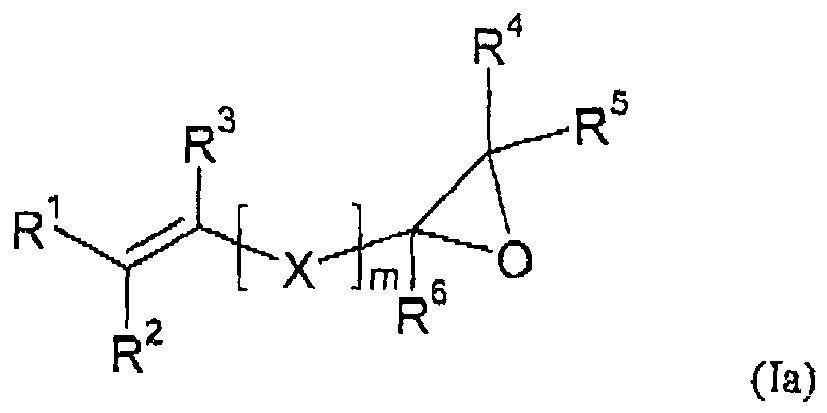
X, R, R1 bis R6, m und p die zuvor für die allgemeine Formel (I) genannten Bedeutungen besitzen. - Inbesondere bevorzugt wird ein Epoxygruppen-haltiges Monomer der allgemeinen Formel (I) eingesetzt, worin X, R und R1 bis R6 die zuvor für die allgemeine Formel (I) genannten Bedeutungen besitzen, m gleich 1 ist, p gleich 1 ist und n gleich Null ist.
- Bevorzugte Beispiele Epoxygruppen-haltiger Monomere sind 2-Ethylglycidylacrylat, 2-Ethylglycidylmethacrylat, 2-(n-Propyl)glycidylacrylat, 2-(n-Propyl)glycidylmethacrylat, 2-(n-Butyl)glycidylacrylat, 2-(n-Butyl)glycidylmethacrylat, Glycidylmethylacrylat, Glycidylmethyl-methacrylat, Glycidylacrylat, (3',4'-Epoxyheptyl)-2-ethylacrylat, (3´,4´-Epoxyheptyl)-2-ethylmethacrylat, (6',7'-Epoxyheptyl)acrylat, (6',7'-Epoxyheptyl)methacrylat, Allylglycidylether, Allyl-3,4-epoxyheptylether, 6,7-,Epoxyheptylallylether, Vinylglycidylether, Vinyl-3,4-epoxyheptylether, 3,4-Epoxyheptylvinylether, 6,7-Epoxyheptylvinylether, o-Vinylbenzylglycidylether, m-Vinylbenzylglycidylether, p-Vinylbenzylglycidylether, 3-Vinylcyclohexenoxid.
- Als Epoxygruppen-haltiges Monomer wird vorzugsweise ein Glycidyl(alkyl)acrylat eingesetzt. Besonders bevorzugt werden Glycidylacrylat oder Glycidylmethacrylat eingesetzt.
- In einer bevorzugten Ausführungsform enthält die erfindungsgemäße vulkanisierbare Zusammensetzung
- (i) mindestens einen Epoxygruppen-haltigen, optional ganz oder teiweise hydrierten Nitrilkautschuk, der Wiederholungseinheiten abgeleitet von mindestens einem konjugierten Dien, mindestens einem α,β-ungesättigten Nitril, mindestens einem Epoxygruppen-haltigen Monomer ausgewählt aus der Gruppe bestehend aus 2-Ethylglycidylacrylat, 2-Ethylglycidylmethacrylat, 2-(n-Propyl) glycidylacrylat, 2-(n-Propyl)glycidylmethacrylat, 2-(n-Butyl)glycidylacrylat, 2-(n-Butyl) glycidylmethacrylat, Glycidylmethylacrylat, Glycidylmethyl-methacrylat, Glycidylacrylat, (3',4'-Epoxyheptyl)-2-ethylacrylat, (3',4'-Epoxyheptyl)-2-ethyl-methacrylat, (6',7'-Epoxy- heptyl)acrylat, (6',7'-Epoxyheptyl)methacrylat, Allylglycidylether, Allyl-3,4-epoxy-heptylether, 6,7-Epoxyheptylallylether, Vinylglycidylether. Vinyl-3,4-epoxyheptylether, 3,4-Epoxyheptylvinylether, 6,7-Epoxyheptylvinylether, o-Vinylbenzylglycidylether, m-Vinylbenzylglycidylether, p-Vinylbenzylglycidylether und 3-Vinylcyclohexenoxid, und gegebenenfalls einem oder mehreren weiteren copolymerisierbaren Monomeren, jedoch keinem nicht-konjugierten cyclischen Polyen, enthält,
- (ii) mindestens eine Lewis-Säure ausgewählt aus der Gruppe bestehend aus Bortrifluorid, Aluminiumtrichlorid, Indium(III)chlorid, Zinkchlorid, Zinkoxid, Eisen(II)oxid, Eisen(III)oxid, Eisen(III)chlorid, Siliciumtetrachlorid, Lithiumbromid, Lithiumchlorid, Magnesiumoxid, Magnesiumchlorid, Scandium(III)triflat, Rhodium(III)chlorid und/oder eine Brönstedt-Säure ausgewählt aus der Gruppe bestehend aus Kaliumhydrogensulfat, Ammoniumhydrogensulfat, Tetraalkylammoniumhydrogensulfat, insbesondere Tetra-n-butylammoniumhydrogensulfat Kaliumdihydrogenphosphat, Dinatriutnhydrogenphosphat, Natriumdihydrogenphosphat Ammoniumchlorid, Ammoniumsulfat, Ammoniumcarbonat, Ammoniumhydroxid, Ammoniumacetat Dodecylbenzylsulfonsäure, p-Toluolsulfonsäure Ascorbinsäure, Essigsäure, Acrylsäure, Fumarsäure, Maleinsäure, Benzoesäure, Abietinsäure, gesättigte und ungesättigte Fettsäuren insbesondere Stearinsäure und Ölsäure oder ein diese enthaltendes Puffergemisch als Vernetzer und
- (iii) mindestens einen Vernetzungsbeschleuniger ausgewählt aus der Gruppe bestehend aus Hexamethylendiaminocarbamat, Tetramethylthiuramdisulfid (TMTD), Tetramethylthiurammonosulfid (TMTM), Tetraethylthiuramdisulfid (TETD), Dipentamethylenthiurammonosulfid (DPTM), Dipentamethylenthiuramdisulfid (DPTD), Dimethyldiphenylthiuramdisulfid (MPTD), Arylguanidiniumxanthogenate, Zinkisopropylxanthogenat (ZIX), Ethylenthioharstoff (ETU), Diphenylthioharnstoff (DPTU), 1,3-di-o-tolylthioharnstoff (DTTU), Diethyltioharnstoff (DPTU), Zinkdimethyldithiocarbamat (ZDMC), Zinkdiethyldithiocarbamat (ZDEC), Zinkdibutyldithiocarbamat (ZDBC), Zinkethylphenyldithiocarbamat (ZEPC), Zinkdibenzyldithiocarbamat (ZDBC), Zinkpentamethylendithiocarbamat (ZPD), Natriumdiethyldithiocarbamat (SEDC), Natriumdimethyldithiocarbamate(SMDC),
- Natriumdibutyldithiocarbamat (SBC) und Natriumcyclohexylethyldithiocarbamat (SHEC) wobei in der vulkanisierbaren Zusammensetzung andere Vernetzer als die unter (ii) genannten nur in einer Menge von unter 2,5 Gew.-Teilen, bevorzugt nur bis zu 1 Gew. Teil und besonders bevorzugt nur bis zu 0,75 Gew.Teilen, bezogen auf 100 Gcw.-Teile des epoxgruppen-haltigen, optional ganz oder teilweise hydrierten Nitrilkautschuks (i) enthalten sind und andere Vernetzungsbeschleuniger als die unter (iii) genannten nur in einer Menge von unter 2,5 Gew.-Teilen, bevorzugt nur bis zu 1 Gew. Teil und besonders bevorzugt nur bis zu 0,75 Gew.Teilen, bezogen auf 100 Gew.-Teile des Epoxgruppen-haltigen, optional ganz oder teilweise hydrierten Nitrilkautschuks (i) enthalten sind.
- In einer besonders bevorzugten Ausführungsform enthält die erfindungsgemäße vulkanisierbare Zusammensetzung
- (i) mindestens einen Epoxygruppen-haltigen, optional ganz oder teilweise hydrierten Nitrilkautschuk, der Wiederholungseinheiten abgeleitet von mindestens einem konjugierten Dien, mindestens einem α,β-ungesättigten Nitril, von Glycidylacrylat und/oder Glycidylmethacrylat und gegebenenfalls einem oder mehreren weiteren copolymerisierbaren Monomeren, jedoch keinem nicht-konjugierten cyclischen Polyen enthält,
- (ii) mindestens eine Lewis-Säure ausgewählt aus der Gruppe bestehend aus Aluminiumtrichlorid, Zinkchlorid, Zinkoxid, Eisen(II)oxid, Eisen(III)oxid, Eisen(III)chlorid, Lithiumchlorid, Magnesiumoxid, Magnesiumchlorid, oder Brönstedt-Säure ausgewählt aus der Gruppe bestehend aus Kaliumhydrogensulfat, Ammoniumhydrogensulfat, Tetra-n-butylammoniumhydrogensulfat, Dodecylbenzylsulfonsäure, p-Toluolsulfonsäure Ascorbinsäure, Stearinsäure und Ölsäure oder ein diese enthaltendes Puffergemisch als Vernetzer und
- (iii) mindestens einen Vernetzungsbeschleuniger ausgewählt aus der Gruppe bestehend aus Hexamethylendiaminocarbamat, Tetramethylthiuramdisulfid (TMTD), Tetramethylthiurammonosulfid (TMTM), Tetraethylthiuramdisulfid (TETD), Dipentamethylenthiuramdisulfid (DPTD), Zinkisopropylxanthogenat (ZIX), Ethylenthioharstoff (ETU), 1,3-di-o-tolylthioharnstoff (DTTU), Zinkdimethyldithiocarbamat (ZDMC), Zinkdiethyldithiocarbamat (ZDEC), Zinkdibutyldithiocarbamat (ZDBC), Zinkethylphenyldithiocarbamat (ZEPC), Zinkpentamethylendithiocarbamat (ZPD), Natriumdiethyldithiocarbamat (SEDC) und Natriumcyclohexylethyldithiocarbamat (SHEC)
- Das konjugierte Dien im Epoxygruppen-haltigen Nitrilkautschuk kann von jeder Natur sein. Bevorzugt werden (C4-C6) konjugierte Diene eingesetzt. Besonders bevorzugt sind 1,2-Butadien, 1.,3-Butadien, Isopren, 2,3-Dimethylbutadien, Piperylen oder Gemische daraus. Insbesondere bevorzugt sind 1,3-Butadien und Isopren oder Gemische daraus. Ganz besonders bevorzugt ist 1.3-Butadien.
- Als α,β-ungesättigtes Nitril kann jedes bekannte α,β-ungesättigte Nitril eingesetzt werden, bevorzugt sind (C3-C5)-α,β-ungesättigte Nitrile wie Acrylnitril, Methacrylnitril, Ethacrylnitril oder Mischungen davon. Besonders bevorzugt ist Acrylnitril.
- Als weitere copolymerisierbare Monomere können - falls gewünscht - beispielsweise aromatische Vinylmonomere, bevorzugt Styrol, α-Methylstyrol und Vinylpyridin, fluorhaltige Vinylmonomere, bevorzugt Fluorethylvinylether, fluorpropylvinylether, o-Fluormethylstyrol, Vinylpentafluorbenzoat, Difluoroethylen und Tetrafluoroethylen, oder auch copolymerisierbare Antiageing Monomere, bevorzugt N-(4-anilinophenyl) acrylamid, N-(4-anilinophenyl) methacrylamid, N-(4-anilinphenyl) cinnamide, N-(4-anilinophenyl) crotonamid, N-phenyl-4-(3-vinylbenzyloxy) anilin und N-phenyl-4-(4-vinytbenzyloxy) anilin eingesetzt werden sowie nicht-konjugierte Diene, wie 4-Cyanocyclohexen und 4-Vinylcyclohexen, oder auch Alkine, wie 1-oder 2-Butin.
- Weiterhin können als copolymerisierbare Termonomere Hydroxylgruppen-haltige Monomere eingesetzt werden, vorzugsweise Hydroxyalkyl(meth)acrylate. Es können aber auch entsprechend substituierte (Meth)acrylamine eingesetzt werden.
- Beispiele geeigneter Hydroxyalkylacrylatmonomere sind 2-Hydroxyethyl(meth)acrylat, 2-Hydroxypropyl(meth)acrylat, 3-Hydroxypropyl(meth)acrylat, 3-Chlor-2-hydroxypropyl(meth)-acrylat, 3-Phenoxy-2-hydroxypropyl(meth)acrylat, Glycerinmono(meth)acrylat, Hydroxybutyl-(meth)acrylat, 3-Chlor-2-hydroxypropyl(meth)acrylat, Hydroxyhexyl(meth)acrylat, Hydroxyoctyl-(meth)acrytat, Hydroxytnethyl(meth)acrylamid, 2-Hydroxypropyl(meth)acrylat, 3-Hydroxypropyl-(meth)acrylamid, Di-(Ethylenglykol)itaconat, Di-(Propylenglykol)itaconat, Bis(2-Hydroxypropyl)-itaconat, Bis(2-Hydroxyethyl)itaconat, Bis(2-Hydroxyethyl)fumarat, Bis(2-Hydroxyethyl)maleat und Hydroxymethylvinylketon.
- Alternativ können als weitere copolymerisierbare Monomere carboxygruppenhaltige, copolymerisierbare Termonomere eingesetzt werden, beispielsweise α,β-ungesättigte Monocarbonsäuren, deren Ester, α,β-ungesättigte Dicarbonsäuren, deren Mono- oder -Diester oder deren entsprechenden Anhydride oder Amide.
- Als α,β-ungesättigte Monocarbonsäuren können bevorzugt Acrylsäure und Methacrylsäure eingesetzt werden.
- Einsetzbar sind auch Ester der α,β-ungesättigten Monocarbonsäuren, bevorzugt deren Alkylester und Alkoxyalkylester. Bevorzugt sind die Alkylester, insbesondere C1-C18 Alkylester der α,β-ungesättigten Monocarbonsäuren, Besonders bevorzugt sind Alkylester, insbesondere C1-C18 Alkylester der Acrylsäure oder der Methacrylsäure, insbesondere Methylacrylat, Ethylacrylat, Propylacrylat, n-Butylacrylat, tert-Butylacrylat, 2-Ethylhexylacrylat, n-Dodecylacrylat, Methylmethacrylat, Ethylmethacrylate, Butylmethacrylat und 2-Ethylhexyl-methacrylat. Bevorzugt sind auch Alkoxyalkylester der α,β-ungesättigten Monocarbonsäuren, besonders bevorzugt Alkoxyalkylester der Acrylsäure oder der Methacrylsäure, insbesondere C2-C12-Alkoxyalkylester der Acrylsäure oder der Methacrylsäure, ganz besonders bevorzugt Methoxymethylacrylat, Methoxyethyl(meth)acrylat, Ethoxyethyl(meth)acrylat und Methoxyethyl-(meth)acrylat. Einsetzbar sind auch Mischungen von Alkylestern, wie z.B. den vorgenannten, mit Alkoxyalkylestern, z.B. in Form der vorgenannten. Einsetzbar sind auch Cyanoalkylacrylat and Cyanoalkylmethacrylate, in denen die C-Atom-Zahl der Cyanoalkylgruppe 2-12 beträgt, vorzugsweise α-Cyanoethylacrylat, β-Cyanoethylacrylat und Cyanobutylmethacrylat. Einsetzbar sind auch Hydroxyalkylacrylate and Hydroxyalkylmethacrylat, in denen die C-Atom-Zahl der Hydroxyalkylgruppen 1-12 beträgt, vorzugsweise 2-Hydroxyethylacrylat, 2-Hydroxyethylmethacrylat und 3-Hydroxypropylacrylat; Einseztbar sind auch Fluor-substituierte Benzylgruppenhaltige Acrylate oder Methacrylate, vorzugtsweise Fluorobenzylacrylat, und Fluorobenzylmethacrylat. Einsetzbar sind auch Fluoroalkylgruppen haltige Acrylate und Methacrylate, vorzugsweise Trifluoroethylacrylat und Tetrafluoropropylmethacrylat. Einsetzbar sind auch Aminogruppenhaltige α,β-ungesättigte Carbonsäureester wie Dimethylaminomethylacrylat und Diethylaminoethylacrylat.
- Als weitere copolymerisierbare Monomere können ferner α,β-ungesättigte Dicarbonsäuren, bevorzugt Maleinsäure, Fumarsäure, Crotonsäure, Itaconsäure, Citraconsäure und Mesaconsäure, eingesetzt werden.
- Eingesetzt werden können ferner α,β-ungesättigte Dicarbonsäureanhydride, bevorzugt Maleinsäureanhydrid, Itaconsäureanhydrid, Citraconsäureanhydrid und Mesaconsäureanhydrid.
- Eingesetzt werden können ferner Mono- oder Diester von α,β-ungesättigten Dicarbonsäuren.
- Bei diesen α,β-ungesättigten Dicarbonsäuremono- oder diestern kann es sich beispielsweise handeln um Alkyl-, bevorzugt C1-C10-Alkyl, insbesondere Ethyl-, n-Propyl-, iso-Propyl, n-Butyl-, tert.-Butyl, n-Pentyl- oder n-Hexyl-, Alkoxyalkyl-, bevorzugt C2-C12 Alkoxyalkyl-, besonders bevorzugt C3-C8- Alkoxyalkyl, Hydroxyalkyl, bevorzugt C1-C12 Hydroxyalkyl-, besonders bevorzugt C2-C8- Hydroxyalkyl, Cycloalkyl-, bevorzugt C5-C12-Cycloalkyl-, besonders bevorzugt C6-C12-Cycloalkyl, Alkylcycloalkyl-, bevorzugt C6-C12-Alkylcycloalkyl-, besonders bevorzugt C2-C10-Alkylcycloalkyl, Aryl-, bevorzugt C6-C14-Aryl-Mono- oder -Diester, wobei es sich im Fall der Diester jeweils auch um gemischte Ester handeln kann.
- Besonders bevorzugte Alkylester von α,β-ungesättigten Monocarbonsäuren sind Methyl(meth)acrylat, Ethyl(meth)acrylat, Propyl(meth)acrylat, n-Butyl(meth)acrylat, t-Butyl(meth)acrylat, Hexyl(meth)acrylat, 2-Ethlyhexyl(meth)acrylat, Octyl(meth)acrylat, 2-Propylheptylacrylat und Lauryl(meth)acrylat. Insbesondere wird n-Butylacrylat eingesetzt.
- Besonders bevorzugte Alkoxyalkylester der α,β-ungesättigten Monocarbonsäuren sind Methoxyethyl(meth)acrylat, Ethoxyethyl(meth)acrylat und Methoxyethyl(meth)acrylat. Insbesondere wird Methoxyethylacrylat eingesetzt.
- Als sonstige Ester der α,β-ungesättigten Monocarbonsäuren werden ferner beispielsweise Polyethylenglykol(meth)acrylat, Polypropylenglykol(meth)acrylat,N-(2-Hydroxyethyl)acrylamide, N-(2-Hydroxymethyl)acrylamide und Urethan(meth)acrylat eingesetzt.
- Beispiele von α,β-ungesättigten Dicarbonsäuremonoestern umfassen
- ● Maleinsäuremonoalkylester, bevorzugt Monomethylmaleat, Monoethylmaleat, Monopropyl maleat und Mono-n-butylmaleat;
- ● Maleinsäuremonocycloalkylester, bevorzugt Monocyclopentylmaleat, Monocyclohexyl maleat und Monocycloheptylmaleat;
- ● Maleinsäuremonoalkylcycloalkylester, bevorzugt Monomethylcyclopentylmaleat und Monoethylcyclohexylmaleat;
- ● Maleinsäuremonoarylester, bevorzugt Monophenylmaleat;
- ● Maleinsäuremonobenzylester, bevorzugt Monobenzylmaleat;
- ● Fumarsäuremonoalkylester, bevorzugt Monomethylfumarat, Monoethylfumarat, Monopropyl fumarat und Mono-n-butyl fumarat;
- ● Fumarsäuremonocycloalkylester, bevorzugt Monocyclopentylfumarat, Monocyclohexyl fumarat und Monocycloheptylfumarat;
- ● Fumarsäuremonoalkylcycloalkylester, bevorzugt Monomethylcyclopentylfumarat und Monoethylcyclohexylfumarat;
- ● Fumarsäuremonoarylester, bevorzugt Monophenylfumarat;
- ● Fumarsäuremonobenzylester, bevorzugt Monobenzylfumarat;
- ● Citraconsäuremonoalkylester, bevorzugt Monomethylcitraconat, Monoethylcitraconat, Monopropylcitraconat und Mono-n-butyl citraconat;
- ● Citraconsäuremonocycloalkylester, bevorzugt Monocyclopentylcitraconat, Monocyclohexyl citraconat und Monocycloheptylcitraconat;
- ● Citraconsäuremonoalkylcycloalkylester, bevorzugt Monomethylcyclopentylcitraconat und Monoethylcyclohexylcitraconat;
- ● Citraconsäuremonoarylester, bevorzugt Monophenylcitraconat;
- ● Citraconsäuremonobenzylester, bevorzgut Monobenzylcitraconat;
- ● Itaconsäuremonoalkylester, bevorzugt Monomethylitaconat, Monoethylitaconat, Monopropyl itaconat und Mono-n-butyl itaconat;
- ● Itaconsäuremonocycloalkylester, bevorzugt Monocyclopentylitaconat, Monocyclohexyl itaconat und Monocycloheptylitaconat;
- ● Itaconsäuremonoalkylcycloalkylester, bevorzugt Monomethylcyclopentylitaconat und Monoethylcyclohexylitaconat;
- ● ltaconsäuremonoarylester, bevorzugt Monophenylitaconat;
- ● Itaconsäuremonobenzylester, bevorzugt Monobenzylitaconat.
- ● Mesaconsäuremonoalkylester, bevorzugt Mesaconsäuremonoethylester;
- Als α,β-ungesättigte Dicarbonsäurediester können die analogen Diester basierend auf den zuvor genannten Monoestergruppen eingesetzt werden, wobei es sich bei den Estergruppen auch um chemisch verschiedene handeln kann.
- Als weitere copolymerisierbare Monomere kommen ferner radikalisch polymerisierbare Verbindungen mit in Betracht, die pro Molekül mindestens zwei olefinische Doppelbindungen enthalten. Beispiele mehrfach ungesättigter Verbindungen sind Acrylate, Methacrylate oder Itaconate von Polyolen wie z.B. Ethylenglykoldiacrylat, Diethylenglykoldimethacrylat, Triethylenglylkoldiacrylat, Butandiol-1,4-diacrylat, Propandiol-1,2-diacrylat, Butandiol-1,3-dimethacrylat, Neopentylglykoldiacrylat, Trimethylolpropandi(meth)acrylat, Trimethylolethan-di(meth)acrylat, Glycerindi- und -triacrylat, Pentaerythritdi-, -tri- und tetraacrylat oder - methacrylat, Dipentaerythrittetra, -penta- und hexaacrylat oder -methacrylat oder -itaconat, Sorbittetraacrylat, Sorbithexamethacrylat, Diacrylate oder Dimethacrylate von 1,4-Cyclohexandiol, 1,4-Dimethylolcyclohexan, 2,2-Bis(4-hydroxyphenyl)propan, von Polyethylenglykolen oder von Oligoestern oder Oligourethanen mit endständigen Hydroxylgruppen. Als mehrfach ungesättigte Monomere können auch Acrylamide verwendet werden wie z.B. Methylen-bisacrylamid, Hexamethylen-1,6-bisacrylamid, Diethylentriamin-tris-methacrylamid, Bis(methacrylamido-propoxy)ethan oder 2-Acrylamido-ethylacrylat. Beispiele für mehrfach ungesättigte Vinyl- und Allylverbindungen sind Divinylbenzol, Ethylenglykoldivinylether, Diallylphthalat, Allylmethacrylat, Diallylmaleat, Triallylisocyanurat oder Triallylphosphat.
- In einer bevorzugten Ausführungsform enthält die erfindungsgemäße vulkanisierbare Zusammensetzung
- (i) mindestens einen Epoxygruppen-haltigen, optional ganz oder teilweise hydrierten Nitrikautschuk, der Wiederholungseinheiten abgeleitet von a) Acrylnitril, b) 1,3-Butadien, c) mindestens einem Epoxygruppen-haltigen Monomer ausgewählt aus der Gruppe bestehend aus 2-Ethylglycidylacrylat, 2-Ethylglycidylmethacrylat, 2-(n-Propyl) glycidylacrylat, 2-(n-Propyl)glycidylmethacrylat, 2-(n-Butyl)glycidylacrylat, 2-(n-Butyl) glycidylmethacrylat, Glycidylmethylacrylat, Glycidylmethyl-methacrylat, Glycidylacrylat, (3',4'-Epoxyheptyl)-2-ethylacrylat, (3',4'-Epoxyheptyl)-2-ethyl-methacrylat, (6',7'-Epoxy-heptyl)acrylat, (6',7'-Epoxyheptyl)methacrylat, Allylglycidylether, Allyl-3,4-epoxy-heptylether, 6,7-Epoxyheptylallytether, Vinylglycidylether, Vinyl-3,4-epoxyheptylether, 3,4-Epoxyheptylvinylether, 6,7-Epoxyheptylvinylether, o-Vinylbenzylglycidylether, m-Vinylbenzylglycidylether, p-Vinylbenzylglycidylether und 3-Vinylcyclohexenoxid, und d) gegebenenfalls einem oder mehreren weiteren copolymerisierbaren Monomeren, jedoch keinem nicht-konjugierten cyclischen Polyen enthält,
- (ii) mindestens eine Lewis-Säure ausgewählt aus der Gruppe bestehend aus Aluminiumtrichlorid, Zinkchlorid, Zinkoxid, Eisen(II)oxid, Eisen(III)oxid, Eisen(III)chlorid, Lithiumchlorid, Magnesiumoxid und Magnesiumchlorid, oder eine Brönstedt-Säure ausgewählt aus der Gruppe bestehend aus Kaliumhydrogensulfat, Ammoniumhydrogensulfat, Tetra-n-butylammoniumhydrogensulfat, Dodecylbenzylsulfonsäure, p-Toluolsulfonsäure Ascorbinsäure, Stearinsäure und Ölsäure oder einem diese enthaltendes Puffergemisch als Vernetzer und
- (iii) mindestens einen Vernetzungsbeschleuniger ausgewählt aus der Gruppe bestehend aus Hexamethylendiaminocarbamat, Tetramethylthiuramdisulfid (TMTD), Tetramethylthiurammonosulfid (TMTM), Tetraethylthiuramdisulfid (TETD), Dipentamethylenthiuramdisulfid (DPTD), Zinkisopropylxanthogenat (ZIX), Ethylenthioharstoff (ETU), 1,3-Di-o-tolylthioharnstoff (DTTU), Zinkdimethyldithiocarbamat (ZDMC), Zinkdiethyldithiocarbamat (ZDEC), Zinkdibutyldithiocarbamat (ZDBC), Zinkethylphenyldithiocarbamat (ZEPC), Zinkpentamethylendithiocarbamat (ZPD), Natriumdiethyldithiocarbamat (SEDC) und Natriumcyclohexylethyldithiocarbamat (SHEC),
- In einer besonders bevorzugten Ausführungsform enthält die erfindungsgemäße vulkanisierbare Zusammensetzung
- (i) mindestens einen Epoxygruppen-haltigen, optional ganz oder teilweise hydrierten Nitrilkautschuk, der Wiederholungseinheiten abgeleitet von a) Acrylnitril, b) 1,3-Butadien, c) Glycidylacrylat und/oder Glycidylmethacrylat und d) gegebenenfalls einem oder mehreren weiteren copolymerisierbaren Monomeren, jedoch keinem nicht-konjugierten cyclischen Polyen enthält,
- (ii) mindestens eine Lewis-Säure ausgewählt aus der Gruppe bestehend aus Alummiumtrichlorid, Zinkchlorid, Zinkoxid, Eisen(II)oxid, Eisen(III)oxid, Fisen(III)chlorid, Lithiumchlorid, Magnesiumoxid und Magnesiumchlorid, oder eine Brönstedt-Säure ausgewählt aus der Gruppe bestehend aus Kaliumhydrogensulfat, Ammoniumhydrogensulfat, Tetra-n-butylammoniumhydrogensulfat, Dodecylbenzylsulfonsäure, p-Toluolsulfonsäure Ascorbinsäure, Stearinsäure und Ölsäure oder einem diese enthaltendes Puffergemisch als Vernetzer und
- (iii) mindestens einen Vernetzungsbcschleuniger ausgewählt aus der Gruppe bestehend aus Hexamethylendiaminocarbamat, Tetramethylthiuramdisulfid (TMTD), Tetramethylthiurammonosulfid (TMTM), Tetraethylthiuramdisulfid (TETD), Dipentamethylenthiuramdisulfid (DPTD), Zinkisopropylxanthogenat (ZIX), Ethylenthioharstoff (ETU), 1,3-Di-o-tolylthioharnstoff (DTTU), Zinkdimethyldithiocarbamat (ZDMC), Zinkdiethyldithiocarbamat (ZDEC), Zinkdibutyldithiocarbamat (ZDBC), Zinkethylphenyldithiocarbamat (ZEPC), Zinkpentamethylendithiocarbamat (ZPD), Natriumdiethyldithiocarbamat (SEDC) und Natriumcyclohexylethyldithiocarbamat (SHEC)
wobei in der vulkanisierbaren Zusammensetzung andere Vernetzer als die unter (ii) genannten nur in einer Menge unter 2,5 Gew.-Teilen, bevorzugt nur bis zu 1 Gew.-Teil und besonders bevorzugt nur bis zu 0,75 Gew.-Teilen, bezogen auf 100 Gew.-Teile des epoxgruppen-haltigen, optional ganz oder teilweise hydrierten Nitrilkautschuks (i) enthalten sind und andere Vernetzungsbeschleuniger als die unter (iii) genannten nur in einer Menge von unter 2,5 Gew.-Teilen, bevorzugt nur bis zu 1 Gew.-Teil und besonders bevorzugt nur bis zu 0,75 Gew.-Teilen, bezogen auf 100 Gew.-Teile des Epoxgruppen-haltigen, optional ganz oder teilweise hydrierten Nitrilkautschuks (i) enthalten sind. - Die Anteile an den jeweiligen Monomeren in den erfindungsgemäß einzusetzenden epoxygruppenhaltigen, optional ganz oder teilweise hydrierten Nitrilkautschuken können in weiten Bereichen schwanken.
- Der Anteil des oder der Summe der konjugierten Diene liegt üblicherweise im Bereich von 39,75 bis 90 Gew.-%, bevorzugt im Bereich von 44 bis 88 Gew.-%, besonders bevorzugt 45,75 bis 87 und insbesondere 47,5 bis 85 Gew.-% bezogen auf den gesamten Nitrilkautschuk.
- Der Anteil des oder der Summe der α,β-ungesättigten Nitrile liegt üblicherweise bei 5 bis 60 Gew.-%, bevorzugt bei 10 bis 55 Gew.-%, besonders bevorzugt 13 bis 53 Gew.-% und insbesondere 15 bis 51 Gew.-% bezogen auf gesamten Nitrilkautschuk.
- Der Anteil an Epoxygruppen-haltigen Monomeren beträgt vorzugsweise 0,25 bis 35 Gew.-%, besonders bevorzugt 1 bis 30 Gew.-%, besonders bevorzugt 1,25 bis 25 Gew.-% und insbesondere 1,5 bis 18 Gew.-% bezogen auf gesamten Nitrilkautschuk.
- Die Anteile aller Monomere müssen sich jeweils zu 100 Gew.-% aufsummieren.
- Die Menge an Epoxygruppen-haltigem Monomer im Nitrilkautschuk (i), die Menge des Vernetzers (ii) und des Vernetzungsbeschleunigers (iii) und das Mengenverhältnis von Epoxygruppen zu Vernetzer (ii) und Vernetzungsbeschleuniger (iii) wird je nach gewünschtem Vernetzungsgrad eingestellt. Durch Einstellung des Verhältnisses von Epoxygruppen zur Menge des Vernetzers (ii) und Vernetzungsbeschleunigers (iii) können die Bruchdehnung und Zugspannung den jeweiligen Erfordernissen entsprechend eingestellt werden..
- Die optionalen weiteren copolymerisierbaren Monomere können je nach Art in Mengen von 0 bis 50 Gew.%, bezogen auf den gesamten Nitrilkautschuk (i) vorliegen. In diesem Fall werden entsprechende Anteile des oder der konjugierten Diene und/oder des oder der α,β-ungesättigten Nitrile und/oder des Epoxygruppen-haltigen Monomers durch die Anteile der zusätzlichen Monomere ersetzt, wobei sich die Anteile aller Monomere erneut jeweils zu 100 Gew.-% aufsummieren müssen.
- Die Herstellung derartiger Epoxygruppen-haltiger, optional ganz oder teilweise hydrierter Nitrilkautschuke ist dem Fachmann hinlänglich bekannt. Der Epoxygruppen-haltige Nitrilkautschuk wird üblicherweise über eine sogenannte Emulsionspolymerisation hergestellt. Diese wird in Gegenwart von Emulgatoren durchgeführt, bei denen es sich typiselierweise um wasserlösliche Salze anionischer Emulgatoren oder auch neutrale Emulgatoren handelt. Ferner wird häufig in Gegenwart sogenannter Molekulargewichtsregler polymerisiert, bei denen sich in der Regel um Alkylthiole handelt, die 12-16 Kohlenstoffatome enthalten, bevorzugt um tert.Dodecylmercaptane (t-DDM). Solche Alkylthiole bzw. (Isomeren)-Mischungen von Alkylthiolen sind entweder käuflich erhältlich oder aber nach Verfahren, die in der Literatur hinlänglich beschrieben sind, für den Fachmann herstellbar.
- Zur Durchführung der Polymerisation werden sämtliche oder einzelne Komponenten des Initiatorsystems zu Beginn der Polymerisation und/oder während der Polymerisation zudosiert. Die portionsweise Zugabe sämtlicher sowie einzelner Komponenten während der Polymerisation ist bevorzugt. Durch eine sequentielle Zugabe lässt sich die Reaktionsgeschwindigkeit steuern. Zur Erzielung eines gleichmäßigen Polymerisationsverlaufs wird für den Start der Polymerisation nur ein Teil des Initiatorsystems verwendet und der Rest während der Polymerisation nachdosiert. Üblicherweise startet man die Polymerisation mit 10 bis 80 Gew. %, vorzugsweise 30-50 Gew. % der Gesamtmenge an Initiator. Auch die Nachdosierung einzelner Bestandteile des Initiatorsystems ist möglich. Will man chemisch einheitliche Produkte herstellen, so werden die Monomere dosiert. Insbesondere Acrylnitril und Butadien werden nachdosiert, wenn die Zusammensetzung außerhalb des azeotropen Butadien/Acrylnitril-Verhältnisses liegt. Vorzugsweise erfolgt eine Nachdosierung bei NBR-Typen mit Acrylnitrilgehalten von 10 bis 34 Gew.% sowie bei den Typen mit 40 bis 50 Gew.% Acrylnitril (W. Hofmann, Rubber Chem. Technol. 36 (1963). Die Polymerisationszeit liegt im Bereich von 5 h bis 15 h und hängt v.a.. vom Acrylnitrilgehalt der Monomermischung und von der Polymerisationstemperatur ab. Letztere liegt im Bereich von 0 bis 30°C, bevorzugt im Bereich von 5 bis 25°C. Bei Erreichung von Umsätzen im Bereich von 50 bis 90%, vorzugsweise im Bereich von 60 bis 85% wird die Polymerisation typischerweise durch Zusatz eines geläufigen Stoppers beendet. Die bei der Emulsionspolymerisation verwendete Wassermenge liegt im Bereich von 100 bis 900 Gew.-Teilen, bevorzugt im Bereich von 120 bis 500 Gew.-Teilen, besonders bevorzugt im Bereich von 150 bis 400 Gew.-Teilen Wasser bezogen auf 100 Gew.-Teile der Monomermischung. Die Polymerisation kann entweder diskontinuierlich oder auch kontinuierlich in einer Rührkesselkaskade durchgerührt werden. Zur Entfernung nicht umgesetzter Monomere sowie flüchtiger Bestandteile wird der abgestoppte Latex einer Wasserdampfdestillatian unterzogen. Hierbei werden Temperaturen im Bereich von 70°C bis 150°C angewandt, wobei bei Temperaturen <100°C der Druck reduziert wird. Vor der Entfernung der flüchtigen Bestandteile kann eine Nachstabilisierung des Latex mit Emulgator erfolgen. Hierfür verwendet man zweckmäßigerweise die zuvor genannten Emulgatoren in Mengen von 0,1 bis 2,5 Gew. %, vorzugsweise 0,5 bis 2,0 ,Gew. % bezogen auf 100 Gew.-Teile Nitrilkautschuk.
- Es ist auch möglich, dass sich an die Herstellung des Epoxygruppen-haltigen Nitrilkautschuks (a) eine Metathese-Reaktion zur Reduktion des Molekulargewichts des Nitrilkautschuks oder (b) eine Metathese-Reaktion und eine nachfolgenden Hydrierung oder (c) nur eine Hydrierung anschließt. Diese Metathese- bzw. Hydrierungsreaktionen sind bei dem Fachmann hinlänglich bekannt und in der Literatur beschrieben. Die Metathese ist beispielsweise aus
WO-A-02/100941 WO-A-02/100905 - Die Hydrierung kann unter Einsatz homogener oder heterogener Hydrierkatalysatoren durchgeführt werden. Die eingesetzten Katalysatoren basieren üblicherweise auf Rhodium, Ruthenium oder Titan, es können aber auch Platin, Iridium, Palladium, Rhenium, Ruthenium, Osmium, Kobalt oder Kupfer entweder als Metall, oder aber bevorzugt in Form von Metallverbindungen eingesetzt werden (siehe z.B.
US-A-3,700,637 ,DE-A-25 39 132 ,EP-A- 0 134 023 ,DE-OS- 35 41 689 DE-OS- 35 40 918 EP-A-0 298 386 ,DE-OS- 35 29 252 DE-OS- 34 33 392 US-A-4,464,515 undUS-A-4,503,196 ). - Geeignete Katalysatoren und Lösungsmittel für eine Hydrierung in homogener Phase werden im Folgenden beschrieben und sind auch aus
DE-A-25 39 132 und derEP-A-0 471 250 bekannt. Die selektive Hydrierung kann beispielsweise in Gegenwart eines Rhodium- oder Ruthenium-haltigen Katalysators erreicht werden, Einsetzbar ist beispielsweise ein Katalysator der allgemeinen Formel
(R1 mB)1 M Xn.
worin M Ruthenium oder Rhodium ist, R1 gleich oder verschieden sind und eine C1-C8 Alkylgruppe, eine C4-C8 Cycloalkylgruppe, eine C6-C15 Aryl-Gruppe oder eine C7-C15 Aralkylgruppe darstellen. B ist Phosphor, Arsen, Schwefel oder eine Sulfoxid-Gruppe S=O, X ist Wasserstoff oder ein Anion, vorzugsweise Halogen und besonders bevorzugt Chlor oder Brom, 1 ist 2,3 oder 4, m ist 2 oder 3 und n ist 1,2 oder 3, bevorzugt 1 oder 3. Bevorzugte Katalysatoren sind Tris(triphenylphosphin)-rhodium(I)-chlorid, Tris(triphenylphosphin)-rhodium(III)-chlorid und Tris(dimethylsulfoxid)-rhodium(III)-chlorid sowie Tetrakis(tnphenylphosphin)-rhodium-hydrid der Formel (C6H5)3P)4RhH und die entsprechenden Verbindungen, in denen das Triphenylphosphin ganz oder teilweise durch Tricyclohexylphosphin ersetzt wurde. Der Katalysator kann in kleinen Mengen benutzt werden. Eine Menge im Bereich von 0,01-1 Gew.%, bevorzugt im Bereich von 0,03-0,5 Gew.% und besonders bevorzugt im Bereich von 0,1-0,3 Gew.% bezogen auf das Gewicht des Polymers sind geeignet. - Üblicherweise ist es sinnvoll, den Katalysator zusammen mit einem Co-Katalysator zu verwenden, der ein Ligand der Formel R1 mB ist, wobei R1, m und B die zuvor für den Katalysator genannten Bedeutungen besitzen. Bevorzugt ist m gleich 3, B gleich Phosphor und die Reste R1 können gleich oder verschieden sein. Bevorzugt handelt es sich um Co-Katalysatoren mit Trialkyl, Tricycloalkyl, Triaryl, Triaralkyl, Diaryl-monoalkyl, Diaryl-monocycloalkyl, Dialkyl-monoaryl, Dialkylmonocycloalkyl, Dicycloalkyl-monoaryl oder Dicyclalkyl-monoaryl-Resten.
- Beispiele von Co-Katalysatoren finden sich beispielsweise in
US-A-4,631,315 . Bevorzugter Co-Katalysator ist Triphenylphosphin. Der Co-Katalysator wird bevorzugt in Mengen in einem Bereich von 0,3-5 Gew.%, bevorzugt im Bereich von 0,5-4 Gew.% eingesetzt, bezogen auf das Gewicht des zu hydrierenden Nitrilkautschuks. Bevorzugt liegt ferner das Gewichtsverhältnis des Rhodium-haltigen Katalysators zum Co-Katalysator im Bereich von 1:3 bis 1:55, besonders bevorzugt im Bereich von 1:5 bis 1:45, bezogen auf 100 Gewichtsteile des zu hydrierenden Nitrilkautschuks werden vorzugsweise 0,1 bis 33 Gewichtsteile des Co-Katalyators, bevorzugt 0,5 bis 20 und ganz besonders bevorzugt 1 bis 5 Gewichtsteile, insbesondere mehr als 2 aber weniger als 5 Gewichtsteile Co-Katalysator bezogen auf 100 Gewichtsteile des zu hydrierenden Nitril-kautschuks eingesetzt. - Die praktische Durchführung der Hydrierung ist dem Fachmann aus
US-A-6,683,136 bekannt. Sie erfolgt üblicherweise, indem man den zu hydrierenden Nitrilkautschuk in einem Lösungsmittel wie Toluol oder Monochlorbenzol bei einer Temperatur im Bereich von 100 bis 150 °C und einem Druck im Bereich von 50 bis 150 bar für 2 bis 10 h mit Wasserstoff beaufschlagt. - Unter Hydrierung wird im Rahmen dieser Erfindung eine Umsetzung der im Ausgangs-Nitrilkautschuk vorhandenen Doppelbindungen zu mindestens 50 %, bevorzugt 70-100%, besonders bevorzugt 80-100%, verstanden. Die Bestimmung des Hydriergrads ist dem Fachmann wohl bekannt und kann beispielsweise durch Raman- oder IR-Spektroskopie erfolgen (siehe z.B. EPA-0 897 933 für die Bestimmung durch Raman-Spektroskopie oder
US-A-6,522,408 für die Bestimmung über IR-Spektroskopie). - Bei Einsatz heterogener Katalysatoren handelt es sich üblicherweise um geträgerte Katalysatoren auf der Basis von Palladium, die z. B. auf Kohle, Kieselsäure, Calciumcarbonat oder Bariumsulfat geträgert sind.
- Epoxygruppen-haltige ganz oder teilweise hydrierte Nitrilkautschuke sind bisher nicht bekannt. Gegenstand der Erfindung sind somit auch Epoxygruppen-haltige, ganz oder teilweise hydrierte Nitrilkautschuke, die Wiederholungseinheiten abgeleitet von mindestens einem konjugierten Dien, mindestens einem α,β-ungesättigten Nitril und gegebenenfalls einem oder mehreren weiteren copolymerisierbaren Monomeren, jedoch keinem nicht-konjugierten cyclischen Polyen aufweisen. Die erfindungsgemäßen Epoxygruppen-haltigen, optional ganz oder teilweise hydrierten Nitrilkautschuke besitzen üblicherweise Mooney-Viskositäten (ML (1+4 @100°C)) im Bereich von 10 bis 1.60, bevorzugt von 15 bis 150 Mooney-Einheiten, besonders bevorzugt von 20 bis 150 Mooney-Einheiten und insbesondere 25 bis 145 Mooney-Einheiten auf. Die Bestimmung der Werte für die Mooney-Viskosität (ML 1+4 @100°C) erfolgt mittels eines Scherscheibenviskosimeters nach DIN 53523/3 bzw. ASTM D 1646 bei 100°C.
- Die Epoxygruppen-haltigen, optional ganz oder teilweise hydrierten Nitrilkautschuke besitzen typischerweise ferner eine Polydispersität PDI = Mw/Mn, wobei Mw das Gewichtsmittel und Mn das Zahlenmittel des Molekulargewichts darstellt, im Bereich von 1,0 bis 6,0 und bevorzugt im Bereich von 1,5 bis 5,0,
- Die Glastemperaturen der erfindungsgemäßen Epoxygruppen-haltigen, optional ganz oder teilweise hydrierten Nitrilkautschuke liegen im Bereich von -80°C bis +20°C, vorzugsweise im Bereich von -70°C bis +10° und besonders bevorzugt im Bereich von -60°C bis 0°C.
- In einer bevorzugten erfindungsgemäßen Ausftlhrungsform handelt es sich um vulkanisierbare Zusammensetzungen, die (iv) zusätzlich mindestens einen Füllstoff enthalten. Bei diesem Füllstoff handelt es sich ausschließlich um Verbindungen, die nicht bereits von den erfindungsgemäßen Vernetzern (ii) oder Vernetzungsbeschleunigern (iii) umfasst werden. Eingesetzt werden können z.B. Ruß, Kieselsäure, Kohlenstoff Nanotubes, Teflon (letzteres bevorzugt in Pulverform) oder Silikate.
- In weiteren Ausführungsformen können die erfindungsgemäßen vulkanisierbare Zusammensetzungen auch noch ein oder mehrere dem Kautschukfachmann geläufige Additive enthalten. Auch bei diesen handelt es sich ausschließlich um Verbindungen, die nicht unter die Definition der erfindungsgemäßen Vernetzer (ii) oder Vernetzungsbeschleunigern (iii) fallen. Diese Additive umfassen Füllstoffaktivatoren, Alterungsschutzmittel, Reversionsschutzmittel, Lichtschutzmittel, Ozonschutzmittel, Verarbeitungshilfsmittel, Weichmacher, Mineralöle, Tackifier, Treibmittel, Farbstoffe, Pigmente, Wachse, Harze, Streckmittel, Vulkanisationsverzögerer, sowie weitere oder anderen Additive, die in der Gummündustrie bekannt sind (Ullmann's Encyclopedia of Industrial Chemistry, VCH Verlagsgesellschaft mbH, D-69451 Weinheim, 1993, vol A 23 "Chemicals and Additives", S. 366-417).
- Als Füllstoffaktivatoren kommen z.B. organische Silane, bevorzugt Vinyltrimethyloxysilan, Vinyldimethoxymethylsilan, Vinyltriethoxysilan, Vinyltris(2-methoxy-ethoxy)silan, N-Cyclohexyl-3-aminopropyltrimethoxysilan, 3-Aminopropyl-trimethoxysilan, Methyltrimethoxysilan, Methylthiethoxysilan, Dimethyldimethoxysilan, Dimethyldiethoxysilan, Trimethylethoxysilan, Isooctyltrimethoxysilan, Isooctyltriethoxysilan, Hexadccyltrimethoxysilan oder (Octadecyl)methyl-dimethoxysilan in Betracht. Weitere Füllstoffaktivatoren stellen zum Beispiel grenzflächenaktive Substanzen wie Triethanolamin. Trimethylolpropan, Hexantriol und Polyethylenglycole mit Molekulargewichten von 74 bis 10 000 g/mol dar. Die Menge an Füllstoffaktivatoren beträgt üblicherweise 0 bis 10 Gew.-Teile, bezogen auf 100 Gew.-Teile des Epoxidgruppen-haltigen, optional ganz oder teilweise hydrierten Nitrilkautschuks.
- Als Alterungsschutzmittel können den vulkanisierbaren Zusammensetzungen alle dem Fachmann bekannten zugesetzt werden, die üblicherweise in Mengen von 0 bis 5 Gew.-Teile, bevorzugt 0,5 bis 3 Gew.-Teile, bezogen auf 100 Gew.-Teile des Epoxidgruppen-haltigen, optional hydrierten Nitrilkautschuks eingesetzt werden.
- Als Formtrennmittel kommen z.B. gesättigte oder teilweise ungesättigte Fett- und Ölsäuren und deren Derivate (Fettsäureester, Fettsäuresalze, Fettalkohole, Fettsäureamide) in Betracht. Weiterhin können auf die Formoberfläche applizierbare Produkte, wie z.B. Produkte auf Basis von niedermolekularen Silikonverbindungen, Produkte auf Basis von Fluorpolymeren sowie Produkte auf Basis von Phenolharzen eingesetzt werden. Die Formtrennmittel werden in Mengen von 0 bis 10 Gew.-Teile, bevorzugt 0,5 bis 5 Gew.-Teile, bezogen auf 100 Gew.-Teile des Epoxidgruppen-haltigen, optional hydrierten Nitrilkautschuks eingesetzt.
- Auch die Verstärkung mit Festigkeitsträgern (Fasern) aus Glas, nach der Lehre von
US-A-4,826,721 ist möglich sowie die Verstärkung durch Corde, Gewebe, Fasern aus aliphatischen und aromatischen Polyamiden (Nylon®, Aramid®), Polyestern und Naturfaserprodukten. - Gegenstand der Erfindung ist ferner das Verfahren zur Herstellung der vulkanisierbaren Zusammensetzungen durch Mischen mindestens eines Epoxygruppen-haltigen, optional ganz oder teilweise hydrierten Nitrilkautschuks (i) mit mindestens einer Lewis- und/oder Brönsted-Säure (ii) und mindestens einem Vernetzungsbeschleuniger (iii). Dieser Mischvorgang kann in allen dem Fachmann geläufigen Mischapparaturen erfolgen. Üblicherweise werden der mindestens eine Vernetzer (ii) und der mindestens eine Vernetzungsbescbleuniger (iii) zum Nitrilkautschuk (i) zudosiert. Sofern ein oder mehrere Füllstoffe sowie ein oder mehrere weitere Kautschukadditive verwendet werden, können auch diese in beliebiger Reihenfolge eingemischt werden.
- Gegenstand der Erfindung ist weiterhin ein Verfahren zur Herstellung von Vulkanisaten auf Basis eines Epoxygruppen-haltigen, optional ganz oder teilweise hydrierten Nitrilkautschuks, dadurch gekennzeichnet, dass die zuvor genannte vulkanisierbare Zusammensetzung unter Erhöhung der Temperatur vernetzt wird. Die Vernetzung kann bei Temperaturen im Bereich von vorzugsweise 20 bis 250°C, besonders bevorzugt 50 bis 230°C erfolgen. Die Dauer der Vernetzungsreaktion liegt im Bereich von einer (1) Minute bis mehrere Tage.
- Gegenstand der Erfindung sind auch die so erhältlichen Vulkanisate, Diese Vulkanisate enthalten vernetzte Epoxygruppen-haltige, optional ganz oder teilweise hydrierten Nitrilkautschuke. Sie zeigen sehr gute Werte im Druckverfornaungstest bei Raumtemperatur, 100°C und 150°C und des weiteren eine hohe Zugspannung bei guten Bruchdehnungen.
- Der Stickstoffgehalt zur Bestimmung des Acrylnitrilgehalts ("ACN-Gehalt") wird in den erfindungsgemäßen Epoxygruppen-haltigen, optional ganz oder teilweise hydrierten Nitrilkautschuken gemäß DIN 53 625 nach Kjeldahl bestimmt. Aufgrund des Gehalts an polaren Comonomeren sind die Epoxygruppen-haltigen, optional hydrierten Nitrilkautschuke üblicherweise in Methylethylketon bei 20°C> 85 Gew. % löslich.
- Die Bestimmung der Glasübergangstemperatur, sowie deren sogenannte Onset- und Offsetpunkte erfolgt mittels dynamischer Differenzkalorimetrie (engl.: Differential Scanning Calorimetry - DSC) nach ASTM E 1356-03 bzw. nach DIN 11357-2.
- Die Bestimmung der Mikrostruktur und des Termonomergehaltes der einzelnen Polymere erfolgte mittels 1H NMR (Gerät: Bruker DPX400 mit Software XWIN-NMR 3.1, Messfrequenz 400 MHz, Lösemittel CDCl3).
- Die Bestimmung der Werte für die Mooney-Viskosität (ML 1+4@100°C) erfolgt jeweils mittels eines Scherscheibenviskosimeters nach DIN 53523/3 bzw. ASTM D 1646 bei 100°C. Die Bestimmung des MSR (Mooney Stress Relaxation) erfolgt jeweils mittels eines Scherscheibenviskosimeters nach ISO 289-4:2003(E) bei 100°C.
- Der Vulkanisationsverlauf im MDR und dessen analytischen Daten wurden an einem Monsanto-Rheometer MDR 2000 nach ASTM D5289-95 gemessen.
- Der Druckverformungsrest ("DVR") (engl.: Compression Set) bei der angegebenen Temperatur wurde nach DIN 53517 gemessen.
- Die Härte nach Shore A wurde nach ASTM-D2240-81 gemessen.
- Die Zugversuche zur Bestimmung der Spannung in Abhängigkeit von der Deformation wurden nach DIN 53504 bzw. ASTM D412-80 durchgeführt.
- Die in den nachfolgenden Tabellen angegebenen Abkürzungen haben folgende Bedeutungen:
- "RT"
- Raumtemperatur (23 ± 2 °C)
- "TS"
- Tensile strength (engl.), Zugspannung, gemessen bei RT
- "EB"
- Elongation at break (engl.), Bruchdehnung, gemessen bei RT
- "M50"
- Modul bei 50% Dehnung, gemessen bei RT
- "M100"
- Modul bei 100% Dehnung, gemessen bei RT
- "M300"
- Modul bei 300% Dehnung, gemessen bei RT
- "S min"
- ist das minimale Drehmoment der Vemetzungsisotherme
- "S max"
- ist das maximale Drehmoment der Vernetzungsisotherme
- "Delta S"
- ist "S max- S min"
- "t10"
- ist die Zeit, wenn 10 % von S max erreicht werden
- "t50"
- ist die Zeit, wenn 50% von S max erreicht werden
- "t90"
- ist die Zeit, wenn 90% von S max erreicht werden
- "t95"
- ist die Zeit, wenn 95% von S max erreicht werden
- "TS2"
- bedeutet die Zeit, bis die Mooney-Viskosität sich um zwei Einheiten erhöht hat im Vergleich zum Ausgangspunkt
- Die nachfolgenden Chemikalien wurden als Handelsprodukte der jeweils angegebenen Firmen bezogen oder stammen aus Produktionsanlagen der angegebenen Firmen.
-
- TBAHS
- Tetrabutylammoniumhydrogensulfat (Sigma Aldrich Chemie GmbH)
-
- Vulkacit P Extra N
- Zink Ethylphenyldithiocarbamat (Lanxess Deutschland GmbH)
- VULCOFAC HDC
- Hexamethylendiaminocarbamat (Safic-Alcan Deutschland GmbH)
-
- Corax® N550/30
- Ruß (Handelsprodukt der Evonik Degussa)
- Diplast® TM 8- 10/ST
- Trioctylmellitat (Handelsprodukt der Lonza SpA)
- Luvomaxx® CDPA
- p-Dicumyldiphenylamin (Handelsprodukt von Lehmann & Voss)
- Mischung Wingstay®
- 29/Naugawhite: Mischung aus 25 g Sorbilenc Mix (Mischung aus Sorbitanestern und ethoxylierten Sorbitanestern) der Fa. Lamberti, 38 g Naughawhite (2,2'-Methylenbis(6-nonyl-p-cresol)) der Fa. Chemtura, 125 g Wingstay® 29 (styrolisiertes Diphenylamin) der Fa. Eliokem und 63 g Wasser
- "Prämix-Lösung Fe(II)SO4"
- enthält 0,986 g Fe(II)SO4*7 H2O und 2,0 g Rongalit®C in 400g Wasser
- Rongalit® C
- Natriumsalz eines Sulfinsäurederivates (Handelsprodukt der BASF SE)
- t-DDM
- tertiäres Dodecylmercaptan (Lanxess Deutschland GmbH)
- Texapon® K-12
- Natrium-Laurylsulfat (Handelsprodukt der Cognis Deutschland GmbH& Co.KG)
- Trigonox® NT 50
- p-Menthanhydroperoxid (Handelsprodukt der Akzo-Degussa)
- Die Herstellung des in den folgenden Beispielserien eingesetzten Nitrilkautschukes A erfolgte nach der in Tabelle 1 angegebenen Basisrezeptur, wobei sämtliche Einsatzstoffe in Gew.-Teilen bezogen auf 100 Gew.-Teile der Monomermischung angegeben sind. Tabelle 1 nennt auch die jeweiligen Polymerisationsbedingungen.
Tabelle 1: Herstellung des Nitrilkautschukes A Nitrilkautschuk A Butadien 58,5 Acrylnitril 35,5 Glycidylmethacrylat (GMA) 6 Gesamt-Wassermenge 220 Texapon® K-12 2,6 Na2SO4 0,12 pH 7 t-DDM 0,54 Trigonox® NT 50 0,02 Prämix Lösung Fe(II)SO4 0,026 Diethylhydroxylamin 0,2 Wingstay® 29 / Naugawhite 0,18 Polymerisationstemperatur [°C] 8,0±0,5 Polymerisationsumsatz [%] 80 Polymerisationszeit [h] 7 - Die Herstellung des Nitrilkautschukes erfolgte diskontinuierlich in einem 5L-Autoklaven mit Rührwerk. Bei dem Autoklavenansatz wurde 1,25 kg der Monomermischung und eine Gesamtwassermenge von 2,1 kg sowie EDTA in einer äquimolaren Menge bezogen auf das Fe-II verwendet. Von dieser Wassermenge wurden 1,9 kg mit dem Emulgator im Autoklaven vorgelegt und mit einem Stickstoffstrom gespült. Danach wurden die entstabilisierten Monomeren und die in Tabelle 1 angegebene Menge des Molekulargewichtsreglers t-DDM zugegeben und der Reaktor verschlossen. Nach der Thermostatisierung des Reaktorinhalts wurden die Polymerisationen durch die Zugabe der Prämix-Lösung Fe(Π)SO4 und von para-Menthanhydroperoxid (Trigonox® NT50) gestartet. Der Polymerisationsverlauf wurde durch gravimetrische Umsatzbestimmungen verfolgt. Bei Erreichen des in Tabelle 1 angegebenen Umsatzes wurde die Polymerisation durch Zugabe einer wässrigen Lösung von Diethylhydroxylamin abgestoppt. Nicht umgesetzte Monomere und sonstige flüchtige Bestandteile wurden mittels Wasserdampfdestillation entfernt.
- Der getrocknete NBR-Kautschuk wurde durch die Mooney-Viskosität, ihren MSR, den ACN-Gehalt und die Glasübergangstemeratur charakterisiert. Der Gehalt des Termonomers wurde durch 1H-NMR Analyse bestimmt. Der erhaltene Festkautschuk hatte die in Tabe. 2 angegebenen Eigenschaften.
Tabelle 2: Eigenschaften des Epoxygruppen-haltigen Nitrilkautschukes A Nitrilkautschuk A ACN-Gehalt (%) 32,2 Mooney Viskosität ML(1+4 at 100°C) (Mu) 31 MSR (Mu/s) 0,671 Einbau Termonomer (Gew%) 4,7 Glasübergangstemperatur TG (°C) -25,1 - Aus dem Nitrilkautschukterpolymeren A wurden wie nachstehend beschrieben die Vulkanisate V1 bis V4 hergestellt. Die Bestandteile der vulkanisierbaren Mischungen sind auf 100 Teile Kautschuk bezogen und in Tabelle 3, 7 und 11 angegeben.
- Die Mischungen wurden in einem Banbury Mixer hergestellt. Hierzu wurden jeweils der Kautschuk und alle in Tabelle 3, 7 bzw. 11 genannten Zuschlagstoffe insgesamt 4 Minuten bei einer maximalen Temperatur von bis zu 120 °C gemischt. Der Kautschuk wurde hierzu im Mischer vorgelegt, nach 1 Minute alle weiteren Zuschlagstoffe hinzugegeben und nach 2 weiteren Minuten ein Kehrschritt durchgeführt. Nach insgesamt 4 Minuten wurde der Kautschuk aus dem Mischer ausgeworfen. Der Compound wurde bei den angegebenen Temperaturen vulkanisiert. Das erhaltene Vulkanisat hatte die in den Tabellen 4 bis 6 angegebenen Eigenschaften.
Tabelle 3: Zusammensetzung der vulkanisierbaren Mischung für Vulkanisat V1 (Vergleichsbeispiel) Vulkamnisierbare Mischung für V1 Polymer A 100 CORAX® N 550/30 50 DIPLAST® TM 8-10/ST 5 TBAHS 1 Total phr 156 Dichte g/ccm 1,139 Tabelle 4: Vulkanisat V1; Vulkanisationsverlauf im MDR (190°C/30 Minuten) Vulkanisat V1 S max (dNm) 32,0 t10 (min) 2,2 t95 (min) 26,5 Tabelle 5: Vulkanisat V1, Eigenschaften Vulkanisat V1 Vernetzungstemperatur °C 190 Vernetzungszeit min 30 TS MPa 20,4 EB % 232 M50 MPa 3,3 M100 MPa 8,3 M300 MPa Härte Shore A 74 Tabelle 6: Vulkanisat V1, Druckverformungsrest bei 150°C Vulkanisat V1 Temperatur und Zeit: 150°C/24 Stunden DVR % Temperatur und Zeit:150°C/168 Stunden DVR % Tabelle 7: Zusammensetzung der vulkanisierbaren Mischungen für Vulkanisate V2 und V3 (Erfindungsgemäße Beispiele) Vulkanisatebare Mischung für V2 V3 Polymer A 100 100 CORAX® N 550/30 50 50 DIPLAST® TM 8-10/ST 5 5 TBAHS 1 1 Vulcacit P Extra N 1 VULCOFAC HDC 1 Total phr 157 157 Dichte g/ccm 1,14 1,14 - Die Mischungen wurden in einem Banbury Mixer hergestellt. Hierzu wurden der Kautschuk und alle in Tabelle 7 genannten Zuschlagstoffe insgesamt 4 Minuten bei einer maximalen Temperatur von bis zu 120 °C gemischt. Der Kautschuk wurde hierzu im Mischer vorgelegt, nach 1 Minute alle weiteren Zuschlagstoffe hinzugegeben und nach 2 weiteren Minuten ein Kehrschritt durchgeführt. Nach insgesamt 4 Minuten wurde der Kautschuk aus dem Mischer ausgeworfen. Der Compound wurde bei einer Temperatur von 190 °C für 30 min vulkanisiert.
- Die erhaltenen Vulkanisate hatten die in den Tabellen 8 bis 10 angegebenen Eigenschaften:
Tabelle 8: Vulkanisate V2 und V3; Vulkanisationsverlauf im MDR (190°C/30 Minuten) Vulkanisat V2 V3 S max (dNm) 30,3 28,3 t10 (min) 2,4 0,8 t95 (min) 22,4 20,5 Tabelle 9: Vulkanisate V2 und V3; Eigenschaften Vulkanisat V2 V3 Vernetzungstemperatur °C 190 Vernetzungszeit min 30 30 TS MPa 15,9 16,1 EB % 198 233 M50 MPa 2,7 3,4 M100 MPa 6,4 7,3 M300 MPa Härte Shore A 69 74 Tabelle 10: Vulkanisate V2 und V3; Druckverformungsrest bei 100°C und 150°C Vulkanisat V2 V3 Temperatur und Zeit: 100°C, 24 Stunden DVR % Temperatur und Zeit: 150°C, 24 Stunden DVR % - Durch die Verwendung eines Vernetzungsbeschleunigers läßt sich somit sowohl die benötigte Vernetzungszeit zur Vulkanisierung der Kautschuknischungen verkürzen als auch gleichzeitig der Langzeit-Druckverformungsrest bei 150 °C verbessern.
Tabelle 11: Zusammensetzung der vulkanisierbaren Mischung für Vulkanisat V4 (Erfindungsgemäßes Beispiel) Vulkanisierbar Mischung für V4 Polymer A 100 CORAX® N 550/30 50 DIPLAST® TM 8-10/ST 5 TBAHS 1 Vulcacit P Extra N 1 Total phr 157 Dichte g/ccm 1,14 - Die Mischung wurden in einem Banbury Mixer hergestellt. Hierzu wurden der Kautschuk und alle in Tabelle 11 genannten Zuschlagstoffe insgesamt 4 Minuten bei einer maximalen Temperatur von bis zu 120 °C gemischt. Der Kautschuk wurde hierzu im Mischer vorgelegt, nach 1 Minute alle weiteren Zuschlagstoffe hinzugegeben und nach 2 weiteren Minuten ein Kehrschritt durchgeführt. Nach insgesamt 4 Minuten wurde der Kautschuk aus dem Mischer ausgeworfen. Der Compound wurde bei einer Temperatur von 190 °C für 25 min vulkanisiert.
- Das erhaltene Vulkanisat hatte die in den Tabellen 12 bis 14 angegebenen Eigenschaften:
Tabelle 12: Vulkanisat V4, Vulkanisationsverlauf im MDR (190°C, 25 Minuten) Vulkanisat V4 S max(dNm) 30,3 t10 (min) 3,0 t95 (min) 23,4 Tabelle 13: Vulkanisat V4, Eigenschaften Mischung V4 Vernetzungstemperatur °C 190 Vernetzungszeit min 25 TS MPa 19,2 EB % 308 M50 MPa 2,5 M100 MPa 5,6 M300 MPa 18,6 Härte Shore A 72 Tabelle 14: Vulkanisat V4; Druckverformungsrest bei 150°C Mischung V4 Temperatur und Zeit: 110°C; 24 Stunden DVR % Temperatur und Zeit: 150°C; 24 Stunden DVR % - Auch mit diesen reduzierten Vernetzungszeiten lassen sich ungewöhnlich gute Druckverformungsreste 150 °C einstellen.
Claims (13)
- Vulkanisierbare Zusammensetzung enthaltend(i) mindestens einen Epoxygruppen-haltigen, optional ganz oder teilweise hydrierten Nitrilkautschuk, der Wiederholungseinheiten abgeleitet von mindestens einem konjugierten Dien, mindestens einem α,β-ungesättigten Nitril und gegebenenfalls einem oder mehreren weiteren copolymerisierbaren Monomeren, jedoch keinem nicht-konjugierten cyclischen Polyen enthält,(ii) mindestens eine Lewis- und/oder Brönstedt-Säure als Vernetzer, und(iii) mindestens einen Vernetzungsbeschleuniger ausgewählt aus der Gruppe bestehend aus Thiuramen, Xanthogenaten, Thioharnstoffen, Dithiocarbamaten und Carbamaten, wobei in der vulkanisierbaren Zusammensetzung andere Vernetzer als die unter (ii) genannten nur in einer Menge von unter 2,5 Gew.-Teilen bezogen auf 100 Gew.-Teile des Epoxgruppen-haltigen, optional ganz oder teilweise hydrierten Nitrilkautschuks (i) und andere Vernetzungsbeschleuniger als die unter (iii) genannten nur in einer Menge von unter 2,5 Gew.-Teilen bezogen auf 100 Gew.-Teile des Epoxgruppen-haltigen, optional ganz oder teilweise hydrierten Nitrilkautschuks (i) enthalten sind.
- Vulkanisierbare Zusammensetzung nach Anspruch 1, dadurch gekennzeichnet, dass sie jeweils bezogen auf 100 Gew.-Teile des Epoxygruppen-haltigen, optional ganz oder teilweise hydrierten Nitrilkautschuks (i)- andere Vernetzer als die unter (ii) genannten maximal bis zu einer Menge von 2,3 Gew.-Teilen und gleichzeitig andere Vernetzungsbeschleuniger als die unter (iii) genannten maximal bis zu einer Menge von 2,3 Gew.-Teilen enthalten,- bevorzugt andere Vernetzer als die unter (ii) genannten maximal bis zu einer Menge von 2,25 Gew.-Teilen und gleichzeitig andere Vernetzungsbeschleuniger als die unter (iii) genannten maximal bis zu einer Menge von 2,25 Gew.-Teilen,- besonders bevorzugt andere Vernetzer als die unter (ii) genannten maximal bis zu einer Menge von 2 Gew.-Teilen und gleichzeitig andere Vernetzungsbeschleuniger als die unter (iii) genannten maximal bis zu einer Menge von 2 Gew.-Teilen,- ganz besonders bevorzugt andere Vernetzer als die unter (ii) genannten maximal bis zu einer Menge von 1,5 Gew.-Teilen und gleichzeitig andere Vernetzungsbeschleuniger als die unter (iii) genannten maximal bis zu einer Menge von 1,5 Gew.-Teilen,- insbesondere andere Vernetzer als die unter (ii) genannten maximal bis zu einer Menge von 1 Gew.-Teil und gleichzeitig andere Vernetzungsbeschleuniger als die unter (iii) genannten maximal bis zu einer Menge von 1 Gew.-Teil,- insbesondere bevorzugt andere Vernetzer als die unter (ii) genannten maximal bis zu einer Menge von 0,5 Gew.-Teilen und andere Vernetzungsbeschleuniger als die unter (iii) genannten maximal bis zu einer Menge von 0,5 Gew.-Teilen,- insbesondere besonders bevorzugt andere Vernetzer als die unter (ii) genannten maximal bis zu einer Menge von 0,4 Gew.-Teilen und andere Vernetzungsbeschleuniger als die unter (iii) genannten maximal bis zu einer Menge von 0,4 Gew.-Teilen und- insbesondere ganz besonders bevorzugt überhaupt keinen anderen Vernetzer als die unter (ii) genannten und überhaupt keinen anderen Vernetzungsbeschleuniger als die unter (iii) genannten enthalten.
- Vulkanisierbare Zusammensetzung nach Anspruch 1 oder 2, dadurch gekennzeichnet, dass als Lewis-Säure(n) Bortrifluorid, Bortrihydrid, Aluminiumtrichlorid, Indium(III)chlorid, Kupfer(II)chlorid, Kupfer(I)triflat, Gold(III)chlorid, Gold(I)chlorid, Zinkchlorid, Zinkoxid, Zinn(IV)oxid, Zinn(IV)chlorid, Kupfer(II)oxid, Eisen(II)oxid, Eisen(III)oxid, Eisen(III) bromid, Eisen(III)chlorid, Schwefeltrioxid, Siliciumtetrachlorid, Lithiumbromid, Lithiumchlorid, Magnesiumoxid, Magnesiumchlorid, Scandium(III)triflat, Rhodium(III)chlorid oder Komplexe der folgenden Elemente in den Oxidationsstufen Co(III), Al(III), Fe(III), Fe(II), Ti(IV), Sn(IV), Co(II), Ni(0), Ni(II), Cu(II), Cu(I), Zn(II), Pb(II), Sn(II), Sn(IV), Ag(I), Au(I), Au(III), Pd(II), Pt(II), Sc(III), Ir(III), Rh(III) und In(III) eingesetzt werden.
- Vulkanisierbare Zusammensetzung nach einem der Ansprüche 1 bis 3, dadurch gekennzeichnet, dass als Brönstedt-Säure(n) solche ausgewählt aus der Gruppe bestehend aus Schwefelsäure, Hydrogensulfaten, schweflige Säure, Hydrogensulfiten, Schwefelwasserstoff, Hydrogensulfiden, Hydrogenphosphaten, Dihydrogenphosphaten, Diphosphonsäure, deren Teilester, meta-Phosphorsäure, Triphosphonsäure, deren Teilestern, Hydrogencarbonaten, Säuren der Halogene, Unterhalogenigen Säuren, Halogenigen Säuren, Halogensäuren, Perhalogensäuren, Ammoniumsalzen, anorganischen und organischen Sulfon-, Carbon-, Phosphonsäure, deren Mono- oder Diestern eingesetzt werden.
- Vulkanisierbare Zusammensetzung nach Anspruch 1 enthaltend(i) mindestens einen Epoxygruppen-haltigen, optional ganz oder teilweise hydrierten Nitrilkautschuk, der Wiederholungseinheiten abgeleitet von mindestens einem konjugierten Dien, mindestens einem α,β-ungesättigten Nitril und gegebenenfalls einem oder mehreren weiteren copolymerisierbaren Monomeren, jedoch keinem nicht-konjugierten cyclischen Polyen enthält,(ii) mindestens eine Lewis-Säure ausgewählt aus der Gruppe bestehend aus Bortrifluorid, Aluminiumtrichlorid, Indium(III)chlorid, Zinkchlorid, Zinkoxid, Eisen(II)oxid, Eisen(III)oxid, Eisen(III)chlorid, Siliciumtetrachlorid, Lithiumbromid, Lithiumchlorid, Magnesiumoxid, Magnesiumchlorid, Scandium(III)triflat und Rhodium(III)chlorid und/oder eine Brönstedt-Säure ausgewählt aus der Gruppe bestehend aus Kaliumhydrogensulfat, Ammoniumhydrogensulfat, Tetraalkylammoniumhydrogensulfaten, insbesondere Tetra-n-butylammmoniumhydrogensulfat, Kaliumdihydrogenphosphat, Dinatriumhydrogenphosphat, Natriumdihydrogenphosphat Ammoniumchlorid, Ammoniumsulfat, Ammoniumcarbonat, Ammoniumhydroxid, Ammoniumacetat Dodecylbenzylsulfonsäure, p-Toluolsulfonsäure Ascorbinsäure, Essigsäure, Acrylsäure, Fumarsäure, Maleinsäure, Benzoesäure, Abietinsäure, gesättigten und ungesättigten Fettsäuren, insbesondere Stearinsäure und Ölsäure, oder ein diese enthaltendes Puffergemisch als Vernetzer, und(iii) mindestens einen Vernetzungsbeschleuniger ausgewählt aus der Gruppe bestehend aus Hexamethylendiaminocarbamat, Tetramethylthiuramdisulfid (TMTD), Tetramethylthiurammonosulfid (TMTM), Tetraethylthiuramdisulfid (TETD), Dipentamethylenthiurammonosulfid (DPTM), Dipentamethylenthiuramdisulfid (DPTD), Dimethyldiphenyl-thiuramdisulfid (MPTD), Arylguanidiniumxanthogenate, Zinkisopropylxanthogenat (ZIX), Ethylenthioharstoff (ETU), Diphenylthioharnstoff (DPTU), 1,3-Dio-tolylthioharnstoff (DTTU), Diethyltioharnstoff (DPTU), Zinkdimethyldithiocarbamat (ZDMC), Zinkdiethyldithiocarbamat (ZDEC), Zinkdibutyldithiocarbamat (ZDBC), Zinkethylphenyldithiocarbamat (ZEPC), Zinkdibenzyldithiocarbamat (ZDBC), Zinkpentamethylendithiocarbamat (ZPD), Natriumdiethyldithiocarbamat (SEDC), Natriumdimethyldithiocarbamate(SMDC), Natriumdibutyldithiocarbamat (SBC) und Natriumcyclohexylethyldithiocarbamat (SHEC),
wobei in der vulkanisierbaren Zusammensetzung andere Vernetzer als die unter (ii) genannten nur in einer Menge von unter 2,5 Gew.-Teilen, bevorzugt bis zu 1 Gew.-Teil und besonders bevorzugt bis zu 0,75 Gew.Teil, bezogen auf 100 Gew.-Teile des epoxygruppen-haltigen optional ganz oder teilweise hydrierten Nitrilkautschuks (i) enthalten sind und andere Vernetzungsbeschleuniger als die unter (iii) genannten nur in einer Menge von unter 2,5 Gew.-Teilen, bevorzugt bis zu 1 Gew.-Teil und besonders bevorzugt bis zu 0,75 Gew.Teil, bezogen auf 100 Gew.-Teile des Epoxgruppen-haltigen, optional ganz oder teilweise hydrierten Nitrilkautschuks (i) enthalten sind. - Vulkanisierbare Zusammensetzung nach einem der Ansprüche 1 bis 5, dadurch gekennzeichnet, dass als Epoxygruppen-haltiger, optional ganz oder teilweise hydrierter Nitrilkautschuk (i) ein solcher eingesetzt wird, bei dem die Epoxygruppen durch nachträgliches Graften oder Pfropfen von Epoxygruppen-haltigen Verbindungen auf den Nitrilkautschuk aufgebracht werden oder aber ein solcher, der Wiederholungseinheiten mindestens eines Nitrils, mindestens eines konjugierten Diens, mindestens eines Epoxygruppen-haltigen Monomers und optional eines oder mehrere weiterer copolymerisierbarer Monomere, jedoch keiner nicht-konjugierter cyclischer Polyene, aufweist.
- Vulkanisierbare Zusammensetzung nach einem der Ansprüche 1 bis 6, dadurch gekennzeichnet, dass der Epoxidgruppen-haltige ganz oder teilweise hydrierte Nitrilkautschuk (i) Wiederholungseinheiten eines Epoxygruppen-haltigen Monomere der allgemeinen Formel (I) aufweist
 m 0 oder 1 ist undX für O, O(CR2)p, (CR2)pO, C(=O)O, C(=O)O(CR2)p, C(=O)NR, (CR2)p, N(R), N(R)(CR2)p, P(R), P(R)(CR2)p, P(=O)(R), P(=O)(R)(CR2)p, S, S(CR2)p, S(=O), S(=O)(CR2)p, S(=O)2(CR2)p oder S(=O)2 steht, wobei R in diesen Resten die gleiche Bedeutungen besitzen kann wie R1-R6Y für Wiederholungseinheiten eines oder mehrerer, ein- oder mehrfach ungesättigter Monomeren steht, umfassend konjugierte oder nicht-konjugierte Diene, Alkine und Vinylverbindungen, oder für ein Strukturelement, welches sich ableitet von Polymeren umfassend Polyether, insbesondere Polyalkylenglykolether und Polyalkylenoxide, Polysiloxane, Polyole, Polycarbonate, Polyurethane, Polyisocyanate, Polysaccharide, Polyester und Polyamide,n und p gleich oder verschieden sind und jeweils im Bereich von 0 bis 10.000 liegen, undR, R1, R2, R3, R4, R5 und R6 gleich oder verschieden sind und für H, einen linearen oder verzweigten, gesättigten, ein- oder mehrfach ungesättigten Alkylrest, einen gesättigten, ein- oder mehrfach ungesättigten Carbo- oder Heterocyclylrest, Aryl, Heteroaryl, Arylalkyl, Heteroarylalkyl, Alkoxy, Aryloxy, Heteroaryloxy, Amino, Amido, Carbamoyl, Alkylthio, Arylthio, Sulfanyl, Thiocarboxy, Sulfinyl, Sulfono, Sulfino, Sulfeno, Sulfonsäuren, Sulfamoyl, Hydroxyimino, Alkoxycarbonyl, F, Cl, Br, I, Hydroxy, Phosphonato, Phosphinato, Silyl, Silyloxy, Nitril, Borate, Selenate, Carbonyl, Carboxy, Oxycarbonyl, Oxysulfonyl, Oxo, Thioxo, Epoxy, Cyanate, Thiocyanate, Isocyanate, Thioisocyanate oder Isocyanide stehen.
 - Vulkanisierbare Zusammensetzung nach einem der Ansprüche 1 bis 7, dadurch gekennzeichnet, dass der Epoxidgruppen-haltige ganz oder teilweise hydrierte Nitrilkautschuk (i) Wiederholungseinheiten eines Epoxygruppen-haltigen Monomers enthält aus der Gruppe 2-Ethylglycidylacrylat, 2-Ethylglycidylmethacrylat, 2-(n-Propyl)-glycidylacrylat, 2-(n-Propyl)glycidylmethacrylat, 2-(n-Butyl)glycidylacrylat, 2-(n-Butyl)-glycidylmethacrylat, Glycidylmethacrylat, Glycidylmethyl-methacrylat, Glycidylacrylat, (3ʹ,4ʹ-Epoxyheptyl)-2-ethylacrylat, (3',4'-Epoxyheptyl)-2-ethylmethacrylat, (6ʹ,7ʹ-Epoxyheptyl)acrylat, (6ʹ,7ʹ-Epoxyheptyl)methacrylat, Allylglycidylether, Allyl-3,4-epoxy-heptylether, 6,7-Epoxyheptylallylether, Vinylglycidylether, Vinyl-3,4-epoxyheptylether, 3,4-Epoxyheptylvinylether, 6,7-Epoxyheptylvinylether, o-Vinyl-benzylglycidylether, m-Vinylbenzylglycidylether, p-Vinylbenzylglycidylether und 3-Vinylcyclohexenoxid.
- Vulkanisierbare Zusammensetzung nach Anspruch 1 oder 2, enthaltend(i) mindestens einen Epoxygruppen-haltigen, optional ganz oder teiweise hydrierten Nitrilkautschuk, der Wiederholungseinheiten abgeleitet von a) Butadien, b) Acrylnitril, c) mindestens einem Epoxygruppen-haltigen Monomer ausgewählt aus der Gruppe bestehend aus 2-Ethylglycidylacrylat, 2-Ethylglycidylmethacrylat, 2-(n-Propyl)glycidylacrylat, 2-(n-Propyl)glycidylmethacrylat, 2-(n-Butyl)glycidylacrylat, 2-(n-Butyl) glycidylmethacrylat, Glycidylmethacrylat, Glycidylmethyl-methacrylat, Glycidylacrylat, (3ʹ,4ʹ-Epoxyheptyl)-2-ethylacrylat, (3ʹ,4ʹ-Epoxyheptyl)-2-ethyl-methacrylat, (6ʹ,7ʹ-Epoxyheptyl)acrylat, (6ʹ,7ʹ-Epoxyheptyl)methacrylat, Allylglycidylether, Allyl-3,4-epoxyheptylether, 6,7-Epoxyheptylallylether, Vinylglycidylether, Vinyl-3,4-epoxyheptylether, 3,4-Epoxyheptylvinylether, 6,7-Epoxyheptylvinylether, o-Vinylbenzylglycidylether, m-Vinylbenzylglycidylether, p-Vinylbenzyl-glycidylether und 3-Vinyicyciohexenoxid, und gegebenenfalls einem oder mehreren weiteren copolymerisierbaren Monomeren, jedoch keinem nicht-konjugierten cyclischen Polyen, enthält,(ii) mindestens eine Lewis-Säure ausgewählt aus der Gruppe bestehend aus Bortrifluorid, Aluminiumtrichlorid, Indium(III)chlorid, Zinkchlorid, Zinkoxid, Eisen(II)oxid, Eisen(III)oxid, Eisen(III)chlorid, Siliciumtetrachlorid, Lithiumbromid, Lithiumchlorid, Magnesiumoxid, Magnesiumchlorid, Scandium(III)triflat, Rhodium(III)chlorid und/oder mindestens eine Brönstedt-Säure ausgewählt aus der Gruppe bestehend aus Kaliumhydrogensulfat, Ammoniumhydrogensulfat, Tetraalkylammoniumhydrogensulfaten, insbesondere Tetra-n-butylammonium-hydrogensulfat, Kaliumdihydrogenphosphat, Dinatriumhydrogenphosphat, Natriumdihydrogenphosphat Ammoniumchlorid, Ammoniumsulfat, Ammonium-carbonat, Ammoniumhydroxid, Ammoniumacetat Dodecylbenzylsulfonsäure, p-Toluolsulfonsäure Ascorbinsäure, Essigsäure, Acrylsäure, Fumarsäure, Maleinsäure, Benzoesäure, Abietinsäure, gesättigten und ungesättigten Fettsäuren insbesondere Stearinsäure und Ölsäure als Vernetzer, und(iii) mindestens einen Vernetzungsbeschleuniger ausgewählt aus der Gruppe bestehend aus Hexamethylendiaminocarbamat, Tetramethylthiuramdisulfid (TMTD), Tetramethylthiurammonosulfid (TMTM), Tetraethylthiuramdisulfid (TETD), Dipentamethylenthiurammonosulfid (DPTM), Dipentamethylenthiuramdisulfid (DPTD), Dimethyldiphenylthiuramdisulfid (MPTD), Arylguanidiniumxanthogenate, Zinkisopropylxanthogenat (ZIX), Ethylenthioharstoff (ETU), Diphenylthioharnstoff (DPTU), 1,3-di-o-tolylthioharnstoff (DTTU), Diethyltioharnstoff (DPTU), Zinkdimethyldithiocarbamat (ZDMC), Zinkdiethyldithiocarbamat (ZDEC), Zinkdibutyldithiocarbamat (ZDBC), Zinkethylphenyldithiocarbamat (ZEPC), Zinkdibenzyldithiocarbamat (ZDBC), Zinkpentamethylendithiocarbamat (ZPD), Natriumdiethyldithiocarbamat (SEDC), Natriumdimethyldithiocarbamate(SMDC), Natriumdibutyldithiocarbamat (SBC) und Natriumcyclohexylethyldithiocarbamat (SHEC),wobei in der vulkanisierbaren Zusammensetzung andere Vernetzer als die unter (ii) genannten nur in einer Menge von unter 2,5 Gew.-Teilen, bevorzugt bis zu 1 Gew.Teil und besonders bevorzugt bis zu 0,75 Gew.-Teil, bezogen auf 100 Gew.-Teile des epoxgruppen-haltigen, optional ganz oder teilweise hydrierten Nitrilkautschuks (i) enthalten sind und andere Vernetzungsbeschleuniger als die unter (iii) genannten nur in einer Menge von unter 2,5 Gew.-Teilen, bevorzugt bis zu 1 Gew.Teil und besonders bevorzugt bis zu 0,75 Gew.-Teil, bezogen auf 100 Gew.-Teile des Epoxgruppen-haltigen, optional ganz oder teilweise hydrierten Nitrilkautschuks (i) enthalten sind.
- Vulkanisierbare Zusammensetzung nach Anspruch 1 oder 2, enthaltend(i) mindestens einen Epoxygruppen-haltigen, optional ganz oder teilweise hydrierten Nitrilkautschuk, der Wiederholungseinheiten abgeleitet von a) Acrylnitril, b) 1,3-Butadien, c) Glycidylacrylat und/oder Glycidylmethacrylat und d) gegebenenfalls einem oder mehreren weiteren copolymerisierbaren Monomeren, jedoch keinem nicht-konjugierten cyclischen Polyen enthält,(ii) mindestens eine Lewis-Säure ausgewählt aus der Gruppe bestehend aus Bortrifluorid, Aluminiumtrichlorid, Indium(III)chlorid, Zinkchlorid, Zinkoxid, Eisen(II)oxid, Eisen(III)oxid, Eisen(III)chlorid, Siliciumtetrachlorid, Lithiumbromid, Lithiumchlorid, Magnesiumoxid, Magnesiumchlorid, Scandium(III)triflat, Rhodium(III)chlorid und/oder mindestens eine Brönstedt-Säure ausgewählt aus der Gruppe bestehend aus Kaliumhydrogensulfat, Ammoniumhydrogensulfat, Tetraalkylammoniumhydrogensulfaten, insbesondere Tetra-n-butylammonium-hydrogensulfat, Kaliumdihydrogenphosphat, Dinatriumhydrogenphosphat, Natriumdihydrogenphosphat Ammoniumchlorid, Ammoniumsulfat, Ammonium-carbonat, Ammoniumhydroxid, Ammoniumacetat Dodecylbenzylsulfonsäure, p-Toluolsulfonsäure Ascorbinsäure, Essigsäure, Acrylsäure, Fumarsäure, Maleinsäure, Benzoesäure, Abietinsäure, gesättigten und ungesättigten Fettsäuren insbesondere Stearinsäure und Ölsäure als Vernetzer, und(iii) mindestens einen Vernetzungsbeschleuniger ausgewählt aus der Gruppe bestehend aus Hexamethylendiaminocarbamat, Tetramethylthiuramdisulfid (TMTD), Tetramethylthiurammonosulfid (TMTM), Tetraethylthiuramdisulfid (TETD), Dipentamethylenthiuramdisulfid (DPTD), Zinkisopropylxanthogenat (ZIX), Ethylenthioharstoff (ETU), 1,3-Di-o-tolylthioharnstoff (DTTU), Zinkdimethyldithiocarbamat (ZDMC), Zinkdiethyldithiocarbamat (ZDEC), Zinkdibutyldithiocarbamat (ZDBC), Zinkethylphenyldithiocarbamat (ZEPC), Zinkpentamethylendithiocarbamat (ZPD), Natriumdiethyldithiocarbamat (SEDC) und Natriumcyclohexylethyldithiocarbamat (SHEC),
wobei in der vulkanisierbaren Zusammensetzung andere Vernetzer als die unter (ii) genannten nur in einer Menge unter 2,5 Gew.-Teilen %, bevorzugt nur bis zu 1 Gew. Teil und besonders bevorzugt nur bis zu 0,75 Gew.Teilen, bezogen auf 100 Gew.-Teile des epoxgruppen-haltigen, optional ganz oder teilweise hydrierten Nitrilkautschuks (i) enthalten sind und andere Vernetzungsbeschleuniger als die unter (iii) genannten nur in einer Menge von unter 2,5 Gew.-Teilen, bevorzugt nur bis zu 1 Gew. Teil und besonders bevorzugt nur bis zu 0,75 Gew.Teilen, bezogen auf 100 Gew.-Teile des Epoxgruppen-haltigen, optional ganz oder teilweise hydrierten Nitrilkautschuks (i) enthalten sind. - Verfahren zur Herstellung einer vulkanisierbaren Zusammensetzung nach einem der Ansprüche 1 bis 10 durch Mischen mindestens eines Epoxygruppen-haltigen, ganz oder teilweise hydrierten Nitrilkautschuks (i) mit mindestens einer Lewis- und/oder Brönsted-Säure (ii).
- Verfahren zur Herstellung von Vulkanisaten auf Basis eines Epoxygruppen-haltigen, optional ganz oder teilweise hydrierten Nitrilkautschuks, dadurch gekennzeichnet, dass die vulkanisierbare Zusammensetzung nach einem der Ansprüche 1 bis 10 unter Erhöhung der Temperatur, bevorzugt im Bereich von 20 bis 250°C, besonders bevorzugt im Bereich von 50 bis 230°C vernetzt wird.
- Vulkanisate basierend auf einem vernetzten Epoxygruppen-haltigen, optional ganz oder teilweise hydrierten Nitrilkautschuk nach einem der Ansprüche 1 bis 10.
Priority Applications (12)
| Application Number | Priority Date | Filing Date | Title |
|---|---|---|---|
| EP11290470.1A EP2581407A1 (de) | 2011-10-11 | 2011-10-11 | Vulkanisierbare Zusammensetzungen auf Basis Epoxygruppen-haltiger Nitrilkautschuke |
| RU2014118644A RU2622655C2 (ru) | 2011-10-11 | 2012-10-10 | Вулканизующиеся композиции на основе содержащих эпоксидные группы нитрильных каучуков |
| BR112014008604-4A BR112014008604B1 (pt) | 2011-10-11 | 2012-10-10 | Composição vulcanizável, processo para a produção de uma composição vulcanizável, processo para a produção de vulcanizados, e, vulcanizados |
| MX2014004404A MX373760B (es) | 2011-10-11 | 2012-10-10 | Composiciones vulcanizables basadas en cauchos de nitrilo que contienen grupos epoxi. |
| CA2851395A CA2851395C (en) | 2011-10-11 | 2012-10-10 | Vulcanizable compositions based on nitrile rubbers containing epoxy groups |
| EP12769686.2A EP2766418B1 (de) | 2011-10-11 | 2012-10-10 | Vulkanisierbare zusammensetzungen auf basis epoxygruppen-haltiger nitrilkautschuke |
| CN201280050257.7A CN104024318B (zh) | 2011-10-11 | 2012-10-10 | 基于含环氧基团的丁腈橡胶的可固化组合物 |
| KR1020147012239A KR101612461B1 (ko) | 2011-10-11 | 2012-10-10 | 에폭시 기-함유 니트릴 고무를 기재로 하는 가황성 조성물 |
| JP2014535051A JP2014528506A (ja) | 2011-10-11 | 2012-10-10 | エポキシ基を有するニトリルゴムを主成分とする加硫可能な組成物 |
| US14/350,393 US20140256886A1 (en) | 2011-10-11 | 2012-10-10 | Vulcanisable compositions based on epoxy group-containing nitrile rubbers |
| PCT/EP2012/070067 WO2013053763A1 (de) | 2011-10-11 | 2012-10-10 | Vulkanisierbare zusammensetzungen auf basis epoxygruppen-haltiger nitrilkautschuke |
| TW101137482A TWI571484B (zh) | 2011-10-11 | 2012-10-11 | 以含環氧基之腈橡膠為基質的可硫化組成物 |
Applications Claiming Priority (1)
| Application Number | Priority Date | Filing Date | Title |
|---|---|---|---|
| EP11290470.1A EP2581407A1 (de) | 2011-10-11 | 2011-10-11 | Vulkanisierbare Zusammensetzungen auf Basis Epoxygruppen-haltiger Nitrilkautschuke |
Publications (1)
| Publication Number | Publication Date |
|---|---|
| EP2581407A1 true EP2581407A1 (de) | 2013-04-17 |
Family
ID=47002896
Family Applications (2)
| Application Number | Title | Priority Date | Filing Date |
|---|---|---|---|
| EP11290470.1A Withdrawn EP2581407A1 (de) | 2011-10-11 | 2011-10-11 | Vulkanisierbare Zusammensetzungen auf Basis Epoxygruppen-haltiger Nitrilkautschuke |
| EP12769686.2A Not-in-force EP2766418B1 (de) | 2011-10-11 | 2012-10-10 | Vulkanisierbare zusammensetzungen auf basis epoxygruppen-haltiger nitrilkautschuke |
Family Applications After (1)
| Application Number | Title | Priority Date | Filing Date |
|---|---|---|---|
| EP12769686.2A Not-in-force EP2766418B1 (de) | 2011-10-11 | 2012-10-10 | Vulkanisierbare zusammensetzungen auf basis epoxygruppen-haltiger nitrilkautschuke |
Country Status (11)
| Country | Link |
|---|---|
| US (1) | US20140256886A1 (de) |
| EP (2) | EP2581407A1 (de) |
| JP (1) | JP2014528506A (de) |
| KR (1) | KR101612461B1 (de) |
| CN (1) | CN104024318B (de) |
| BR (1) | BR112014008604B1 (de) |
| CA (1) | CA2851395C (de) |
| MX (1) | MX373760B (de) |
| RU (1) | RU2622655C2 (de) |
| TW (1) | TWI571484B (de) |
| WO (1) | WO2013053763A1 (de) |
Cited By (4)
| Publication number | Priority date | Publication date | Assignee | Title |
|---|---|---|---|---|
| EP2868677A1 (de) * | 2013-10-30 | 2015-05-06 | LANXESS Deutschland GmbH | Nitrilgruppenhaltiger Copolymerkautschuk |
| EP2868676A1 (de) * | 2013-10-30 | 2015-05-06 | LANXESS Deutschland GmbH | Funktionalisierter nitrilgruppenhaltiger Copolymerkautschuk |
| CN107189148A (zh) * | 2017-07-17 | 2017-09-22 | 南京金三力高分子科技有限公司 | 一种耐高温彩色氢化丁腈橡胶材料及其制备方法 |
| EP2658909B1 (de) * | 2010-12-29 | 2019-12-11 | ARLANXEO Deutschland GmbH | Vulkanisierbare zusammensetzungen auf basis epoxygruppen-haltiger nitrilkautschuke |
Families Citing this family (10)
| Publication number | Priority date | Publication date | Assignee | Title |
|---|---|---|---|---|
| EP2471851A1 (de) | 2010-12-29 | 2012-07-04 | LANXESS Deutschland GmbH | Vulkanisierbare Zusammensetzungen auf Basis Epoxygruppen-haltiger Nitrilkautschuke |
| EP2581409A1 (de) | 2011-10-11 | 2013-04-17 | Lanxess Deutschland GmbH | Vulkanisierbare Zusammensetzungen auf Basis Epoxygruppen-haltiger Nitrilkautschuke |
| CN105199319A (zh) * | 2015-09-24 | 2015-12-30 | 苏州宽温电子科技有限公司 | 一种增韧型环氧树脂、制备方法及应用 |
| CN107559472B (zh) * | 2017-09-30 | 2019-06-25 | 南京晟强橡塑有限公司 | 一种阀盖体 |
| RU2669640C1 (ru) * | 2017-10-06 | 2018-10-12 | Наиль Тимирзянович Гайнуллин | Способ получения эластомерного материала для обкладки статора винтового забойного двигателя или винтового насоса |
| RU2669837C1 (ru) * | 2017-12-12 | 2018-10-16 | Публичное акционерное общество "СИБУР Холдинг" | Способ получения карбоксилированного латекса, карбоксилированный латекс и клеевая композиция на его основе |
| JP7423526B2 (ja) * | 2017-12-21 | 2024-01-29 | アランセオ・ドイチュランド・ゲーエムベーハー | 改善されたホットエア抵抗を持った加硫hnbr製品 |
| CN109370071B (zh) * | 2018-09-30 | 2021-10-01 | 航天材料及工艺研究所 | 一种具有修复性的丁腈橡胶体系及其制备方法与修复方法 |
| CN113429545A (zh) * | 2021-07-06 | 2021-09-24 | 湖北铁神新材料有限公司 | 一种水性环氧磷酸酯树脂和食用油储罐内壁涂料及其制备方法 |
| CN118812785A (zh) * | 2024-07-29 | 2024-10-22 | 淄博齐翔腾达化工股份有限公司 | 一种速硫化改性丁腈胶乳 |
Citations (4)
| Publication number | Priority date | Publication date | Assignee | Title |
|---|---|---|---|---|
| EP0559515A1 (de) * | 1992-02-18 | 1993-09-08 | Nippon Zeon Co., Ltd. | Elastomerzusammensetzung |
| WO2001026750A1 (en) * | 1999-10-08 | 2001-04-19 | Satish Jain | A bladder shell for inflatable balls |
| CN101130679A (zh) * | 2006-08-25 | 2008-02-27 | 比亚迪股份有限公司 | 一种胶粘剂及其制备方法 |
| EP2386600A1 (de) * | 2010-04-15 | 2011-11-16 | LANXESS Deutschland GmbH | Isocyanatgruppen-enthaltende Vernetzer für Nitrilkautschuke |
Family Cites Families (41)
| Publication number | Priority date | Publication date | Assignee | Title |
|---|---|---|---|---|
| US3700637A (en) | 1970-05-08 | 1972-10-24 | Shell Oil Co | Diene-nitrile rubbers |
| US3697489A (en) * | 1970-08-05 | 1972-10-10 | Borg Warner | High temperature nitrile elastomer |
| DE2539132C2 (de) | 1975-09-03 | 1987-04-09 | Bayer Ag, 5090 Leverkusen | Verwendung hydrierter Dien-Copolymere als temperaturbeständige Materialien auf dem Dichtungssektor |
| US4094831A (en) | 1976-10-22 | 1978-06-13 | The Goodyear Tire & Rubber Company | Green strength of elastomers |
| CA1220300A (en) | 1982-12-08 | 1987-04-07 | Polysar Limited | Polymer hydrogenation process |
| CA1203047A (en) | 1982-12-08 | 1986-04-08 | Hormoz Azizian | Polymer hydrogenation process |
| CA1227597A (en) * | 1982-12-08 | 1987-09-29 | Polysar Limited | Sulfur vulcanizable polymer compositions |
| DE3329974A1 (de) | 1983-08-19 | 1985-02-28 | Bayer Ag, 5090 Leverkusen | Herstellung von hydrierten nitrilkautschuken |
| CA1260194A (en) | 1984-03-28 | 1989-09-26 | Japan Synthetic Rubber Co Ltd | MULTI-COMPONENT COPOLYMER RUBBER, ITS PRODUCTION, AND PRODUCT SO OBTAINED |
| JPS6126620A (ja) | 1984-07-18 | 1986-02-05 | Nippon Zeon Co Ltd | エポキシ基含有エラストマ−加硫性組成物 |
| DE3433392A1 (de) | 1984-09-12 | 1986-03-20 | Bayer Ag, 5090 Leverkusen | Hydrierung nitrilgruppenhaltiger ungesaettigter polymerer |
| DE3529252A1 (de) | 1985-08-16 | 1987-02-19 | Bayer Ag | Verfahren zur selektiven hydrierung ungesaettigter verbindungen |
| DE3540918A1 (de) | 1985-11-19 | 1987-05-21 | Bayer Ag | Verfahren zur selektiven hydrierung ungesaettigter verbindungen |
| DE3541689A1 (de) | 1985-11-26 | 1987-05-27 | Bayer Ag | Verfahren zur selektiven hydrierung nitrilgruppenhaltiger ungesaettigter polymerer |
| DE3618907A1 (de) | 1986-06-05 | 1987-12-10 | Bayer Ag | Verbundwerkstoffe aus vorbehandeltem fasermaterial und vulkanisaten aus hnbr |
| US5334666A (en) | 1986-08-29 | 1994-08-02 | Nippon Zeon Co., Ltd. | Vulcanizable elastomer composition comprising epoxy group-containing elastomer, organic compound having at least two -C(X)-NH-C(Y)-bonds (X=O or S, Y=O or S), quaternary ammonium or phosphonium salt, and optionally a urea or thiourea compound |
| US4774288A (en) * | 1986-12-01 | 1988-09-27 | Polysar Limited | Resin cure system for hydrogenated nitrile polymer |
| US4816525A (en) | 1987-07-06 | 1989-03-28 | University Of Waterloo | Polymer hydrogenation process |
| JPH0747725B2 (ja) | 1987-10-26 | 1995-05-24 | サンスター技研株式会社 | フレキシブルプリント基板用接着剤 |
| CA2018188A1 (en) * | 1989-08-25 | 1991-02-25 | Steven John Miller | Calcium sulfate as a partial replacement for titanium dioxide in white compounds |
| DE4025781A1 (de) | 1990-08-15 | 1992-02-20 | Bayer Ag | Hydrierte butadien/isopren/(meth-)acrylnitril- copolymerisate |
| IT1277581B1 (it) * | 1995-09-14 | 1997-11-11 | Enichem Elastomers | Composizione elastomerica utile come battistrada per pneumatici |
| DE19805612A1 (de) | 1998-02-12 | 1999-08-19 | Bayer Ag | Verfahren zur kontrollierten Herstellung oder Modifizierung von polymeren Produkten mittels IR-ATR-Spektroskopie |
| US6066697A (en) * | 1998-08-25 | 2000-05-23 | The University Of Akron | Thermoplastic compositions containing elastomers and fluorine containing thermoplastics |
| JP4281130B2 (ja) * | 1998-11-10 | 2009-06-17 | Jsr株式会社 | ゴム組成物 |
| AU2622901A (en) * | 1999-12-30 | 2001-07-16 | General Electric Company | Method and system for providing globalized color matching capabilities |
| JP2001192505A (ja) * | 2000-01-12 | 2001-07-17 | Jsr Corp | ゴム組成物 |
| JP2002012703A (ja) * | 2000-04-27 | 2002-01-15 | Jsr Corp | ゴム組成物 |
| JP2002145965A (ja) * | 2000-08-30 | 2002-05-22 | Jsr Corp | 共役ジエン系ゴム及び油展ゴム並びにこれらを含むゴム組成物 |
| JP4899262B2 (ja) * | 2000-11-13 | 2012-03-21 | Jsr株式会社 | 不飽和ニトリル−共役ジエン系ゴム及びゴム組成物並びにこれらの製造方法 |
| DE10060222A1 (de) | 2000-12-04 | 2002-06-13 | Bayer Ag | Quaterpolymere mit funktionellen Hydroxyl- oder Epoxy-Gruppen |
| CA2329844A1 (en) | 2000-12-28 | 2002-06-28 | Bayer Inc. | Esbo enhanced hydrogenation |
| US6673881B2 (en) | 2001-06-12 | 2004-01-06 | Bayer Inc. | Process for the preparation of low molecular weight hydrogenated nitrile rubber |
| CA2350280A1 (en) | 2001-06-12 | 2002-12-12 | Bayer Inc. | Low molecular weight hydrogenated nitrile rubber |
| US20030096917A1 (en) * | 2001-08-23 | 2003-05-22 | Sumitomo Rubber Industries, Ltd. | Polymer composition for conductive roller, polymer composition, conductive roller, and conductive belt |
| JP3933966B2 (ja) * | 2002-03-15 | 2007-06-20 | 日本ゼオン株式会社 | ジエン系ゴム、その製造方法、ならびにゴム組成物、その製造方法および架橋物 |
| JP2005120143A (ja) | 2003-10-14 | 2005-05-12 | Jsr Corp | エポキシ基含有ゴム、該製造法、該組成物及び積層体 |
| JPWO2007034898A1 (ja) * | 2005-09-22 | 2009-03-26 | 株式会社クラレ | ゴム組成物および架橋物 |
| JP2008088241A (ja) * | 2006-09-29 | 2008-04-17 | Jsr Corp | 耐油耐候性ゴム組成物とその成形体 |
| JP5272226B2 (ja) | 2008-12-16 | 2013-08-28 | エルジー・ケム・リミテッド | カルボン酸変性ニトリル系共重合体ラテックス、これを含むディップ成形用ラテックス組成物 |
| EP2471852A1 (de) * | 2010-12-29 | 2012-07-04 | Lanxess Deutschland GmbH | Vulkanisierbare Zusammensetzungen auf Basis Epoxygruppen-haltiger Nitrilkautschuke |
-
2011
- 2011-10-11 EP EP11290470.1A patent/EP2581407A1/de not_active Withdrawn
-
2012
- 2012-10-10 BR BR112014008604-4A patent/BR112014008604B1/pt not_active IP Right Cessation
- 2012-10-10 MX MX2014004404A patent/MX373760B/es active IP Right Grant
- 2012-10-10 US US14/350,393 patent/US20140256886A1/en not_active Abandoned
- 2012-10-10 WO PCT/EP2012/070067 patent/WO2013053763A1/de not_active Ceased
- 2012-10-10 CN CN201280050257.7A patent/CN104024318B/zh not_active Expired - Fee Related
- 2012-10-10 EP EP12769686.2A patent/EP2766418B1/de not_active Not-in-force
- 2012-10-10 RU RU2014118644A patent/RU2622655C2/ru active
- 2012-10-10 CA CA2851395A patent/CA2851395C/en not_active Expired - Fee Related
- 2012-10-10 JP JP2014535051A patent/JP2014528506A/ja active Pending
- 2012-10-10 KR KR1020147012239A patent/KR101612461B1/ko not_active Expired - Fee Related
- 2012-10-11 TW TW101137482A patent/TWI571484B/zh not_active IP Right Cessation
Patent Citations (4)
| Publication number | Priority date | Publication date | Assignee | Title |
|---|---|---|---|---|
| EP0559515A1 (de) * | 1992-02-18 | 1993-09-08 | Nippon Zeon Co., Ltd. | Elastomerzusammensetzung |
| WO2001026750A1 (en) * | 1999-10-08 | 2001-04-19 | Satish Jain | A bladder shell for inflatable balls |
| CN101130679A (zh) * | 2006-08-25 | 2008-02-27 | 比亚迪股份有限公司 | 一种胶粘剂及其制备方法 |
| EP2386600A1 (de) * | 2010-04-15 | 2011-11-16 | LANXESS Deutschland GmbH | Isocyanatgruppen-enthaltende Vernetzer für Nitrilkautschuke |
Non-Patent Citations (1)
| Title |
|---|
| DATABASE WPI Week 200904, Derwent World Patents Index; AN 2009-A80689, XP002671461 * |
Cited By (8)
| Publication number | Priority date | Publication date | Assignee | Title |
|---|---|---|---|---|
| EP2658909B1 (de) * | 2010-12-29 | 2019-12-11 | ARLANXEO Deutschland GmbH | Vulkanisierbare zusammensetzungen auf basis epoxygruppen-haltiger nitrilkautschuke |
| EP2868677A1 (de) * | 2013-10-30 | 2015-05-06 | LANXESS Deutschland GmbH | Nitrilgruppenhaltiger Copolymerkautschuk |
| EP2868676A1 (de) * | 2013-10-30 | 2015-05-06 | LANXESS Deutschland GmbH | Funktionalisierter nitrilgruppenhaltiger Copolymerkautschuk |
| WO2015063162A1 (en) * | 2013-10-30 | 2015-05-07 | Lanxess Deutschland Gmbh | Copolymer rubber containing nitrile groups |
| WO2015063164A1 (en) * | 2013-10-30 | 2015-05-07 | Lanxess Deutschland Gmbh | Functionalized copolymer rubber containing nitrile groups |
| CN105764941A (zh) * | 2013-10-30 | 2016-07-13 | 阿朗新科德国有限责任公司 | 含有腈基团的官能化的共聚物橡胶 |
| KR20160084379A (ko) * | 2013-10-30 | 2016-07-13 | 아란세오 도이치란드 게엠베하 | 니트릴 기 함유 공중합체 고무 |
| CN107189148A (zh) * | 2017-07-17 | 2017-09-22 | 南京金三力高分子科技有限公司 | 一种耐高温彩色氢化丁腈橡胶材料及其制备方法 |
Also Published As
| Publication number | Publication date |
|---|---|
| MX373760B (es) | 2020-03-24 |
| CA2851395C (en) | 2020-03-24 |
| CN104024318A (zh) | 2014-09-03 |
| WO2013053763A1 (de) | 2013-04-18 |
| US20140256886A1 (en) | 2014-09-11 |
| JP2014528506A (ja) | 2014-10-27 |
| EP2766418B1 (de) | 2018-03-07 |
| CA2851395A1 (en) | 2013-04-18 |
| TW201331278A (zh) | 2013-08-01 |
| KR20140084134A (ko) | 2014-07-04 |
| BR112014008604B1 (pt) | 2020-12-15 |
| EP2766418A1 (de) | 2014-08-20 |
| MX2014004404A (es) | 2014-08-27 |
| RU2014118644A (ru) | 2015-11-20 |
| RU2622655C2 (ru) | 2017-06-19 |
| KR101612461B1 (ko) | 2016-04-14 |
| BR112014008604A2 (pt) | 2017-04-18 |
| CN104024318B (zh) | 2016-10-26 |
| TWI571484B (zh) | 2017-02-21 |
Similar Documents
| Publication | Publication Date | Title |
|---|---|---|
| EP2766418B1 (de) | Vulkanisierbare zusammensetzungen auf basis epoxygruppen-haltiger nitrilkautschuke | |
| EP2766422B1 (de) | Vulkanisierbare zusammensetzungen auf basis epoxygruppen-haltiger nitrilkautschuke | |
| EP2658909B1 (de) | Vulkanisierbare zusammensetzungen auf basis epoxygruppen-haltiger nitrilkautschuke | |
| EP2658908B1 (de) | Vulkanisierbare zusammensetzungen auf basis epoxygruppen-haltiger nitrilkautschuke | |
| EP2868677A1 (de) | Nitrilgruppenhaltiger Copolymerkautschuk | |
| EP2558526A2 (de) | Isocyanatgruppen-enthaltende vernetzer für nitrilkautschuke | |
| EP3333196A1 (de) | Hydrierte nitril-dien-carbonsäureester-copolymere | |
| EP2423234A1 (de) | Kautschukblends aus verschiedenen Nitrilkautschuken | |
| EP2751188B1 (de) | Vulkanisierbare zusammensetzungen auf basis von epoxygruppen-haltigen ethylen-vinylacetat-copolymerisaten | |
| EP2298824A1 (de) | Nitrilkautschuke und deren Herstellung in organischen Lösungsmitteln | |
| EP2385074A1 (de) | Nitrilkautschuke und deren Herstellung in organischen Lösungsmitteln |
Legal Events
| Date | Code | Title | Description |
|---|---|---|---|
| PUAI | Public reference made under article 153(3) epc to a published international application that has entered the european phase |
Free format text: ORIGINAL CODE: 0009012 |
|
| AK | Designated contracting states |
Kind code of ref document: A1 Designated state(s): AL AT BE BG CH CY CZ DE DK EE ES FI FR GB GR HR HU IE IS IT LI LT LU LV MC MK MT NL NO PL PT RO RS SE SI SK SM TR |
|
| AX | Request for extension of the european patent |
Extension state: BA ME |
|
| RAP1 | Party data changed (applicant data changed or rights of an application transferred) |
Owner name: LANXESS DEUTSCHLAND GMBH |
|
| 17P | Request for examination filed |
Effective date: 20131017 |
|
| RBV | Designated contracting states (corrected) |
Designated state(s): AL AT BE BG CH CY CZ DE DK EE ES FI FR GB GR HR HU IE IS IT LI LT LU LV MC MK MT NL NO PL PT RO RS SE SI SK SM TR |
|
| STAA | Information on the status of an ep patent application or granted ep patent |
Free format text: STATUS: THE APPLICATION HAS BEEN WITHDRAWN |
|
| 18W | Application withdrawn |
Effective date: 20160705 |