US6683136B2 - Epoxidized soybean oil enhanced hydrogenation of nitrile copolymer - Google Patents
Epoxidized soybean oil enhanced hydrogenation of nitrile copolymer Download PDFInfo
- Publication number
- US6683136B2 US6683136B2 US10/027,762 US2776201A US6683136B2 US 6683136 B2 US6683136 B2 US 6683136B2 US 2776201 A US2776201 A US 2776201A US 6683136 B2 US6683136 B2 US 6683136B2
- Authority
- US
- United States
- Prior art keywords
- process according
- catalyst
- copolymer
- weight
- epoxidized
- Prior art date
- Legal status (The legal status is an assumption and is not a legal conclusion. Google has not performed a legal analysis and makes no representation as to the accuracy of the status listed.)
- Expired - Fee Related, expires
Links
- 238000005984 hydrogenation reaction Methods 0.000 title claims abstract description 83
- 229920001577 copolymer Polymers 0.000 title claims abstract description 66
- 239000003549 soybean oil Substances 0.000 title claims description 6
- 235000012424 soybean oil Nutrition 0.000 title claims description 6
- 238000000034 method Methods 0.000 claims abstract description 44
- 239000003054 catalyst Substances 0.000 claims abstract description 35
- 239000003426 co-catalyst Substances 0.000 claims abstract description 35
- 229920001971 elastomer Polymers 0.000 claims abstract description 9
- 239000005060 rubber Substances 0.000 claims abstract description 9
- 150000004696 coordination complex Chemical class 0.000 claims abstract description 7
- RIOQSEWOXXDEQQ-UHFFFAOYSA-N triphenylphosphine Chemical group C1=CC=CC=C1P(C=1C=CC=CC=1)C1=CC=CC=C1 RIOQSEWOXXDEQQ-UHFFFAOYSA-N 0.000 claims description 34
- KAKZBPTYRLMSJV-UHFFFAOYSA-N Butadiene Chemical group C=CC=C KAKZBPTYRLMSJV-UHFFFAOYSA-N 0.000 claims description 12
- 229910052739 hydrogen Inorganic materials 0.000 claims description 12
- 239000001257 hydrogen Substances 0.000 claims description 12
- MVPPADPHJFYWMZ-UHFFFAOYSA-N chlorobenzene Chemical group ClC1=CC=CC=C1 MVPPADPHJFYWMZ-UHFFFAOYSA-N 0.000 claims description 11
- 150000001875 compounds Chemical class 0.000 claims description 11
- UFHFLCQGNIYNRP-UHFFFAOYSA-N Hydrogen Chemical compound [H][H] UFHFLCQGNIYNRP-UHFFFAOYSA-N 0.000 claims description 10
- 150000001993 dienes Chemical class 0.000 claims description 8
- 125000003118 aryl group Chemical group 0.000 claims description 6
- NLHHRLWOUZZQLW-UHFFFAOYSA-N Acrylonitrile Chemical group C=CC#N NLHHRLWOUZZQLW-UHFFFAOYSA-N 0.000 claims description 5
- 239000000203 mixture Substances 0.000 claims description 5
- 150000002825 nitriles Chemical class 0.000 claims description 5
- KDLHZDBZIXYQEI-UHFFFAOYSA-N Palladium Chemical compound [Pd] KDLHZDBZIXYQEI-UHFFFAOYSA-N 0.000 claims description 4
- 235000012343 cottonseed oil Nutrition 0.000 claims description 4
- 239000000178 monomer Substances 0.000 claims description 4
- 229910052698 phosphorus Inorganic materials 0.000 claims description 4
- BASFCYQUMIYNBI-UHFFFAOYSA-N platinum Chemical compound [Pt] BASFCYQUMIYNBI-UHFFFAOYSA-N 0.000 claims description 4
- QBERHIJABFXGRZ-UHFFFAOYSA-M rhodium;triphenylphosphane;chloride Chemical compound [Cl-].[Rh].C1=CC=CC=C1P(C=1C=CC=CC=1)C1=CC=CC=C1.C1=CC=CC=C1P(C=1C=CC=CC=1)C1=CC=CC=C1.C1=CC=CC=C1P(C=1C=CC=CC=1)C1=CC=CC=C1 QBERHIJABFXGRZ-UHFFFAOYSA-M 0.000 claims description 4
- 125000004209 (C1-C8) alkyl group Chemical group 0.000 claims description 3
- IAZDPXIOMUYVGZ-UHFFFAOYSA-N Dimethylsulphoxide Chemical compound CS(C)=O IAZDPXIOMUYVGZ-UHFFFAOYSA-N 0.000 claims description 3
- 235000019483 Peanut oil Nutrition 0.000 claims description 3
- 229910052785 arsenic Inorganic materials 0.000 claims description 3
- 235000015278 beef Nutrition 0.000 claims description 3
- 125000004432 carbon atom Chemical group C* 0.000 claims description 3
- 239000002285 corn oil Substances 0.000 claims description 3
- 235000005687 corn oil Nutrition 0.000 claims description 3
- 239000002385 cottonseed oil Substances 0.000 claims description 3
- 239000000944 linseed oil Substances 0.000 claims description 3
- 235000021388 linseed oil Nutrition 0.000 claims description 3
- 229910052751 metal Inorganic materials 0.000 claims description 3
- 239000002184 metal Substances 0.000 claims description 3
- 239000004006 olive oil Substances 0.000 claims description 3
- 235000008390 olive oil Nutrition 0.000 claims description 3
- 239000000312 peanut oil Substances 0.000 claims description 3
- 229910052717 sulfur Inorganic materials 0.000 claims description 3
- 239000003760 tallow Substances 0.000 claims description 3
- 239000002383 tung oil Substances 0.000 claims description 3
- NIXOWILDQLNWCW-UHFFFAOYSA-N 2-Propenoic acid Natural products OC(=O)C=C NIXOWILDQLNWCW-UHFFFAOYSA-N 0.000 claims description 2
- RYGMFSIKBFXOCR-UHFFFAOYSA-N Copper Chemical compound [Cu] RYGMFSIKBFXOCR-UHFFFAOYSA-N 0.000 claims description 2
- CERQOIWHTDAKMF-UHFFFAOYSA-N Methacrylic acid Chemical compound CC(=C)C(O)=O CERQOIWHTDAKMF-UHFFFAOYSA-N 0.000 claims description 2
- GYCMBHHDWRMZGG-UHFFFAOYSA-N Methylacrylonitrile Chemical group CC(=C)C#N GYCMBHHDWRMZGG-UHFFFAOYSA-N 0.000 claims description 2
- 235000019482 Palm oil Nutrition 0.000 claims description 2
- 229910021604 Rhodium(III) chloride Inorganic materials 0.000 claims description 2
- KJTLSVCANCCWHF-UHFFFAOYSA-N Ruthenium Chemical compound [Ru] KJTLSVCANCCWHF-UHFFFAOYSA-N 0.000 claims description 2
- 229910052801 chlorine Inorganic materials 0.000 claims description 2
- 229910017052 cobalt Inorganic materials 0.000 claims description 2
- 239000010941 cobalt Substances 0.000 claims description 2
- GUTLYIVDDKVIGB-UHFFFAOYSA-N cobalt atom Chemical compound [Co] GUTLYIVDDKVIGB-UHFFFAOYSA-N 0.000 claims description 2
- 239000003240 coconut oil Substances 0.000 claims description 2
- 235000019864 coconut oil Nutrition 0.000 claims description 2
- 239000003026 cod liver oil Substances 0.000 claims description 2
- 235000012716 cod liver oil Nutrition 0.000 claims description 2
- 229910052802 copper Inorganic materials 0.000 claims description 2
- 239000010949 copper Substances 0.000 claims description 2
- 229910052741 iridium Inorganic materials 0.000 claims description 2
- GKOZUEZYRPOHIO-UHFFFAOYSA-N iridium atom Chemical compound [Ir] GKOZUEZYRPOHIO-UHFFFAOYSA-N 0.000 claims description 2
- 150000002739 metals Chemical class 0.000 claims description 2
- 229910052762 osmium Inorganic materials 0.000 claims description 2
- SYQBFIAQOQZEGI-UHFFFAOYSA-N osmium atom Chemical compound [Os] SYQBFIAQOQZEGI-UHFFFAOYSA-N 0.000 claims description 2
- 229910052763 palladium Inorganic materials 0.000 claims description 2
- 239000003346 palm kernel oil Substances 0.000 claims description 2
- 235000019865 palm kernel oil Nutrition 0.000 claims description 2
- 239000002540 palm oil Substances 0.000 claims description 2
- 229910052697 platinum Inorganic materials 0.000 claims description 2
- 229910052702 rhenium Inorganic materials 0.000 claims description 2
- WUAPFZMCVAUBPE-UHFFFAOYSA-N rhenium atom Chemical compound [Re] WUAPFZMCVAUBPE-UHFFFAOYSA-N 0.000 claims description 2
- 229910052703 rhodium Inorganic materials 0.000 claims description 2
- 239000010948 rhodium Substances 0.000 claims description 2
- MHOVAHRLVXNVSD-UHFFFAOYSA-N rhodium atom Chemical compound [Rh] MHOVAHRLVXNVSD-UHFFFAOYSA-N 0.000 claims description 2
- FCQRKDSALKMOGU-UHFFFAOYSA-K rhodium(3+);triphenylphosphane;trichloride Chemical compound Cl[Rh](Cl)Cl.C1=CC=CC=C1P(C=1C=CC=CC=1)C1=CC=CC=C1.C1=CC=CC=C1P(C=1C=CC=CC=1)C1=CC=CC=C1.C1=CC=CC=C1P(C=1C=CC=CC=1)C1=CC=CC=C1 FCQRKDSALKMOGU-UHFFFAOYSA-K 0.000 claims description 2
- 229910052707 ruthenium Inorganic materials 0.000 claims description 2
- 150000001735 carboxylic acids Chemical class 0.000 claims 3
- 229910020008 S(O) Inorganic materials 0.000 claims 2
- 239000003849 aromatic solvent Substances 0.000 claims 2
- SMZOUWXMTYCWNB-UHFFFAOYSA-N 2-(2-methoxy-5-methylphenyl)ethanamine Chemical compound COC1=CC=C(C)C=C1CCN SMZOUWXMTYCWNB-UHFFFAOYSA-N 0.000 claims 1
- 239000007983 Tris buffer Substances 0.000 claims 1
- 125000003710 aryl alkyl group Chemical group 0.000 claims 1
- 239000000872 buffer Substances 0.000 claims 1
- 125000003700 epoxy group Chemical group 0.000 claims 1
- 239000000370 acceptor Substances 0.000 description 21
- 229920013648 Perbunan Polymers 0.000 description 15
- 238000006243 chemical reaction Methods 0.000 description 15
- 229920013647 Krynac Polymers 0.000 description 9
- 239000002253 acid Substances 0.000 description 9
- 150000002118 epoxides Chemical group 0.000 description 9
- 239000003446 ligand Substances 0.000 description 9
- 239000000243 solution Substances 0.000 description 8
- 239000002904 solvent Substances 0.000 description 7
- 238000005160 1H NMR spectroscopy Methods 0.000 description 6
- 0 CC*C(C)CC1NC1[C@@](C)*C(C)=[U] Chemical compound CC*C(C)CC1NC1[C@@](C)*C(C)=[U] 0.000 description 6
- 238000004566 IR spectroscopy Methods 0.000 description 6
- 229920000459 Nitrile rubber Polymers 0.000 description 5
- 239000003795 chemical substances by application Substances 0.000 description 5
- 150000002148 esters Chemical class 0.000 description 5
- 239000003921 oil Substances 0.000 description 5
- 235000019198 oils Nutrition 0.000 description 5
- PMJHHCWVYXUKFD-SNAWJCMRSA-N (E)-1,3-pentadiene Chemical compound C\C=C\C=C PMJHHCWVYXUKFD-SNAWJCMRSA-N 0.000 description 4
- SDJHPPZKZZWAKF-UHFFFAOYSA-N 2,3-dimethylbuta-1,3-diene Chemical compound CC(=C)C(C)=C SDJHPPZKZZWAKF-UHFFFAOYSA-N 0.000 description 4
- XKRFYHLGVUSROY-UHFFFAOYSA-N Argon Chemical compound [Ar] XKRFYHLGVUSROY-UHFFFAOYSA-N 0.000 description 4
- IJGRMHOSHXDMSA-UHFFFAOYSA-N Atomic nitrogen Chemical compound N#N IJGRMHOSHXDMSA-UHFFFAOYSA-N 0.000 description 4
- RRHGJUQNOFWUDK-UHFFFAOYSA-N Isoprene Chemical compound CC(=C)C=C RRHGJUQNOFWUDK-UHFFFAOYSA-N 0.000 description 4
- 150000007513 acids Chemical class 0.000 description 4
- 150000001408 amides Chemical class 0.000 description 4
- 235000014113 dietary fatty acids Nutrition 0.000 description 4
- 239000003925 fat Substances 0.000 description 4
- 235000019197 fats Nutrition 0.000 description 4
- 239000000194 fatty acid Substances 0.000 description 4
- 229930195729 fatty acid Natural products 0.000 description 4
- 150000004665 fatty acids Chemical class 0.000 description 4
- PMJHHCWVYXUKFD-UHFFFAOYSA-N piperylene Natural products CC=CC=C PMJHHCWVYXUKFD-UHFFFAOYSA-N 0.000 description 4
- 230000035484 reaction time Effects 0.000 description 4
- AYEKOFBPNLCAJY-UHFFFAOYSA-O thiamine pyrophosphate Chemical compound CC1=C(CCOP(O)(=O)OP(O)(O)=O)SC=[N+]1CC1=CN=C(C)N=C1N AYEKOFBPNLCAJY-UHFFFAOYSA-O 0.000 description 4
- ZWEHNKRNPOVVGH-UHFFFAOYSA-N 2-Butanone Chemical compound CCC(C)=O ZWEHNKRNPOVVGH-UHFFFAOYSA-N 0.000 description 3
- ZMXDDKWLCZADIW-UHFFFAOYSA-N N,N-Dimethylformamide Chemical compound CN(C)C=O ZMXDDKWLCZADIW-UHFFFAOYSA-N 0.000 description 3
- YXFVVABEGXRONW-UHFFFAOYSA-N Toluene Chemical compound CC1=CC=CC=C1 YXFVVABEGXRONW-UHFFFAOYSA-N 0.000 description 3
- 238000013019 agitation Methods 0.000 description 3
- 125000004169 (C1-C6) alkyl group Chemical group 0.000 description 2
- PFEOZHBOMNWTJB-UHFFFAOYSA-N CCC(C)CC Chemical compound CCC(C)CC PFEOZHBOMNWTJB-UHFFFAOYSA-N 0.000 description 2
- RRUWVMDXKNZATD-UHFFFAOYSA-N CCCC1OC1CC(C)=O Chemical compound CCCC1OC1CC(C)=O RRUWVMDXKNZATD-UHFFFAOYSA-N 0.000 description 2
- LFQSCWFLJHTTHZ-UHFFFAOYSA-N Ethanol Chemical compound CCO LFQSCWFLJHTTHZ-UHFFFAOYSA-N 0.000 description 2
- 238000005033 Fourier transform infrared spectroscopy Methods 0.000 description 2
- OAICVXFJPJFONN-UHFFFAOYSA-N Phosphorus Chemical group [P] OAICVXFJPJFONN-UHFFFAOYSA-N 0.000 description 2
- VYPSYNLAJGMNEJ-UHFFFAOYSA-N Silicium dioxide Chemical compound O=[Si]=O VYPSYNLAJGMNEJ-UHFFFAOYSA-N 0.000 description 2
- PPBRXRYQALVLMV-UHFFFAOYSA-N Styrene Chemical compound C=CC1=CC=CC=C1 PPBRXRYQALVLMV-UHFFFAOYSA-N 0.000 description 2
- WYURNTSHIVDZCO-UHFFFAOYSA-N Tetrahydrofuran Chemical compound C1CCOC1 WYURNTSHIVDZCO-UHFFFAOYSA-N 0.000 description 2
- XLOMVQKBTHCTTD-UHFFFAOYSA-N Zinc monoxide Chemical compound [Zn]=O XLOMVQKBTHCTTD-UHFFFAOYSA-N 0.000 description 2
- 150000007824 aliphatic compounds Chemical class 0.000 description 2
- 125000000217 alkyl group Chemical group 0.000 description 2
- 238000004458 analytical method Methods 0.000 description 2
- 229910052786 argon Inorganic materials 0.000 description 2
- 230000009286 beneficial effect Effects 0.000 description 2
- 235000014121 butter Nutrition 0.000 description 2
- 239000004568 cement Substances 0.000 description 2
- 238000007334 copolymerization reaction Methods 0.000 description 2
- 239000000839 emulsion Substances 0.000 description 2
- 238000002474 experimental method Methods 0.000 description 2
- 125000001183 hydrocarbyl group Chemical group 0.000 description 2
- 238000002347 injection Methods 0.000 description 2
- 239000007924 injection Substances 0.000 description 2
- YCWSUKQGVSGXJO-NTUHNPAUSA-N nifuroxazide Chemical group C1=CC(O)=CC=C1C(=O)N\N=C\C1=CC=C([N+]([O-])=O)O1 YCWSUKQGVSGXJO-NTUHNPAUSA-N 0.000 description 2
- 229910052757 nitrogen Inorganic materials 0.000 description 2
- 239000011574 phosphorus Substances 0.000 description 2
- 238000012545 processing Methods 0.000 description 2
- 238000005070 sampling Methods 0.000 description 2
- 229920006395 saturated elastomer Polymers 0.000 description 2
- 229920006301 statistical copolymer Polymers 0.000 description 2
- DCXXMTOCNZCJGO-UHFFFAOYSA-N tristearoylglycerol Chemical compound CCCCCCCCCCCCCCCCCC(=O)OCC(OC(=O)CCCCCCCCCCCCCCCCC)COC(=O)CCCCCCCCCCCCCCCCC DCXXMTOCNZCJGO-UHFFFAOYSA-N 0.000 description 2
- XJOLBNJKWACAKB-UHFFFAOYSA-N (2,3-dimethoxyphenyl)-diphenylphosphane Chemical class COC1=CC=CC(P(C=2C=CC=CC=2)C=2C=CC=CC=2)=C1OC XJOLBNJKWACAKB-UHFFFAOYSA-N 0.000 description 1
- CUXYLFPMQMFGPL-WPOADVJFSA-N (9Z,11E,13E)-octadeca-9,11,13-trienoic acid Chemical compound CCCC\C=C\C=C\C=C/CCCCCCCC(O)=O CUXYLFPMQMFGPL-WPOADVJFSA-N 0.000 description 1
- 238000011925 1,2-addition Methods 0.000 description 1
- JAHNSTQSQJOJLO-UHFFFAOYSA-N 2-(3-fluorophenyl)-1h-imidazole Chemical compound FC1=CC=CC(C=2NC=CN=2)=C1 JAHNSTQSQJOJLO-UHFFFAOYSA-N 0.000 description 1
- KCVSMGBGFUGLMU-UHFFFAOYSA-N 2-cyclopenta-2,4-dien-1-ylethyl-(2-diphenylphosphanylethyl)-phenylphosphane Chemical compound C(CP(CCP(c1ccccc1)c1ccccc1)c1ccccc1)C1C=CC=C1 KCVSMGBGFUGLMU-UHFFFAOYSA-N 0.000 description 1
- MICCAWHGLAEEEX-UHFFFAOYSA-N 2-cyclopenta-2,4-dien-1-ylethyl-(3-diphenylphosphanylpropyl)-phenylphosphane Chemical compound C(CP(CCC1C=CC=C1)c1ccccc1)CP(c1ccccc1)c1ccccc1 MICCAWHGLAEEEX-UHFFFAOYSA-N 0.000 description 1
- PTFVEGSFABPRIA-UHFFFAOYSA-N 2-cyclopenta-2,4-dien-1-ylethyl-(4-diphenylphosphanylbutyl)-phenylphosphane Chemical compound C(CCP(c1ccccc1)c1ccccc1)CP(CCC1C=CC=C1)c1ccccc1 PTFVEGSFABPRIA-UHFFFAOYSA-N 0.000 description 1
- YGRVCNYIEKLRED-UHFFFAOYSA-N 4,4-diphenylbutylphosphane Chemical compound C=1C=CC=CC=1C(CCCP)C1=CC=CC=C1 YGRVCNYIEKLRED-UHFFFAOYSA-N 0.000 description 1
- JLBJTVDPSNHSKJ-UHFFFAOYSA-N 4-Methylstyrene Chemical compound CC1=CC=C(C=C)C=C1 JLBJTVDPSNHSKJ-UHFFFAOYSA-N 0.000 description 1
- SFUCQIUDZBXOOP-UHFFFAOYSA-N 4-bis(4-cyanophenyl)phosphanylbenzonitrile Chemical compound C1=CC(C#N)=CC=C1P(C=1C=CC(=CC=1)C#N)C1=CC=C(C#N)C=C1 SFUCQIUDZBXOOP-UHFFFAOYSA-N 0.000 description 1
- QISOBCMNUJQOJU-UHFFFAOYSA-N 4-bromo-1h-pyrazole-5-carboxylic acid Chemical compound OC(=O)C=1NN=CC=1Br QISOBCMNUJQOJU-UHFFFAOYSA-N 0.000 description 1
- 235000017060 Arachis glabrata Nutrition 0.000 description 1
- 244000105624 Arachis hypogaea Species 0.000 description 1
- 235000010777 Arachis hypogaea Nutrition 0.000 description 1
- 235000018262 Arachis monticola Nutrition 0.000 description 1
- CPELXLSAUQHCOX-UHFFFAOYSA-M Bromide Chemical compound [Br-] CPELXLSAUQHCOX-UHFFFAOYSA-M 0.000 description 1
- ZAMOUSCENKQFHK-UHFFFAOYSA-N Chlorine atom Chemical compound [Cl] ZAMOUSCENKQFHK-UHFFFAOYSA-N 0.000 description 1
- 244000060011 Cocos nucifera Species 0.000 description 1
- 235000013162 Cocos nucifera Nutrition 0.000 description 1
- 239000004606 Fillers/Extenders Substances 0.000 description 1
- VZCYOOQTPOCHFL-OWOJBTEDSA-N Fumaric acid Natural products OC(=O)\C=C\C(O)=O VZCYOOQTPOCHFL-OWOJBTEDSA-N 0.000 description 1
- 235000010469 Glycine max Nutrition 0.000 description 1
- 244000068988 Glycine max Species 0.000 description 1
- VEXZGXHMUGYJMC-UHFFFAOYSA-N Hydrochloric acid Chemical compound Cl VEXZGXHMUGYJMC-UHFFFAOYSA-N 0.000 description 1
- OYHQOLUKZRVURQ-HZJYTTRNSA-N Linoleic acid Chemical compound CCCCC\C=C/C\C=C/CCCCCCCC(O)=O OYHQOLUKZRVURQ-HZJYTTRNSA-N 0.000 description 1
- 240000006240 Linum usitatissimum Species 0.000 description 1
- 235000004431 Linum usitatissimum Nutrition 0.000 description 1
- CERQOIWHTDAKMF-UHFFFAOYSA-M Methacrylate Chemical compound CC(=C)C([O-])=O CERQOIWHTDAKMF-UHFFFAOYSA-M 0.000 description 1
- NTIZESTWPVYFNL-UHFFFAOYSA-N Methyl isobutyl ketone Chemical compound CC(C)CC(C)=O NTIZESTWPVYFNL-UHFFFAOYSA-N 0.000 description 1
- UIHCLUNTQKBZGK-UHFFFAOYSA-N Methyl isobutyl ketone Natural products CCC(C)C(C)=O UIHCLUNTQKBZGK-UHFFFAOYSA-N 0.000 description 1
- 240000007817 Olea europaea Species 0.000 description 1
- 240000002834 Paulownia tomentosa Species 0.000 description 1
- 235000010678 Paulownia tomentosa Nutrition 0.000 description 1
- NINIDFKCEFEMDL-UHFFFAOYSA-N Sulfur Chemical group [S] NINIDFKCEFEMDL-UHFFFAOYSA-N 0.000 description 1
- 240000008042 Zea mays Species 0.000 description 1
- 235000005824 Zea mays ssp. parviglumis Nutrition 0.000 description 1
- 235000002017 Zea mays subsp mays Nutrition 0.000 description 1
- LYEZAEXHLSEXON-UHFFFAOYSA-N [RhH3].C1(=CC=CC=C1)P(C1=CC=CC=C1)C1=CC=CC=C1.C1(=CC=CC=C1)P(C1=CC=CC=C1)C1=CC=CC=C1.C1(=CC=CC=C1)P(C1=CC=CC=C1)C1=CC=CC=C1.C1(=CC=CC=C1)P(C1=CC=CC=C1)C1=CC=CC=C1 Chemical compound [RhH3].C1(=CC=CC=C1)P(C1=CC=CC=C1)C1=CC=CC=C1.C1(=CC=CC=C1)P(C1=CC=CC=C1)C1=CC=CC=C1.C1(=CC=CC=C1)P(C1=CC=CC=C1)C1=CC=CC=C1.C1(=CC=CC=C1)P(C1=CC=CC=C1)C1=CC=CC=C1 LYEZAEXHLSEXON-UHFFFAOYSA-N 0.000 description 1
- 239000012190 activator Substances 0.000 description 1
- 230000002411 adverse Effects 0.000 description 1
- 150000001338 aliphatic hydrocarbons Chemical class 0.000 description 1
- 125000003545 alkoxy group Chemical group 0.000 description 1
- XYLMUPLGERFSHI-UHFFFAOYSA-N alpha-Methylstyrene Chemical compound CC(=C)C1=CC=CC=C1 XYLMUPLGERFSHI-UHFFFAOYSA-N 0.000 description 1
- 235000020661 alpha-linolenic acid Nutrition 0.000 description 1
- 150000001412 amines Chemical class 0.000 description 1
- 150000008064 anhydrides Chemical class 0.000 description 1
- 150000001450 anions Chemical group 0.000 description 1
- 239000003963 antioxidant agent Substances 0.000 description 1
- 238000013459 approach Methods 0.000 description 1
- 150000001491 aromatic compounds Chemical class 0.000 description 1
- RQNWIZPPADIBDY-UHFFFAOYSA-N arsenic atom Chemical group [As] RQNWIZPPADIBDY-UHFFFAOYSA-N 0.000 description 1
- DGJOCBJPCSLLKK-UHFFFAOYSA-N bis(2,3-dimethoxyphenyl)-phenylphosphane Chemical class COC1=CC=CC(P(C=2C=CC=CC=2)C=2C(=C(OC)C=CC=2)OC)=C1OC DGJOCBJPCSLLKK-UHFFFAOYSA-N 0.000 description 1
- FOZRTQVZEZIVAK-UHFFFAOYSA-N bis(2,3-dimethylphenyl)-phenylphosphane Chemical class CC1=CC=CC(P(C=2C=CC=CC=2)C=2C(=C(C)C=CC=2)C)=C1C FOZRTQVZEZIVAK-UHFFFAOYSA-N 0.000 description 1
- 229940006460 bromide ion Drugs 0.000 description 1
- NTXGQCSETZTARF-UHFFFAOYSA-N buta-1,3-diene;prop-2-enenitrile Chemical compound C=CC=C.C=CC#N NTXGQCSETZTARF-UHFFFAOYSA-N 0.000 description 1
- CQEYYJKEWSMYFG-UHFFFAOYSA-N butyl acrylate Chemical compound CCCCOC(=O)C=C CQEYYJKEWSMYFG-UHFFFAOYSA-N 0.000 description 1
- 239000006229 carbon black Substances 0.000 description 1
- 239000011203 carbon fibre reinforced carbon Substances 0.000 description 1
- 125000003178 carboxy group Chemical group [H]OC(*)=O 0.000 description 1
- 239000000460 chlorine Substances 0.000 description 1
- MVPPADPHJFYWMZ-IDEBNGHGSA-N chlorobenzene Chemical group Cl[13C]1=[13CH][13CH]=[13CH][13CH]=[13CH]1 MVPPADPHJFYWMZ-IDEBNGHGSA-N 0.000 description 1
- 238000013329 compounding Methods 0.000 description 1
- 239000000470 constituent Substances 0.000 description 1
- 235000005822 corn Nutrition 0.000 description 1
- 125000000753 cycloalkyl group Chemical group 0.000 description 1
- IQIRNRBHGWXSLV-UHFFFAOYSA-N cyclohexyl(diphenyl)arsane Chemical compound C1CCCCC1[As](C=1C=CC=CC=1)C1=CC=CC=C1 IQIRNRBHGWXSLV-UHFFFAOYSA-N 0.000 description 1
- BOHNWWTZVYEMMA-UHFFFAOYSA-N dibutyl(phenyl)arsane Chemical compound CCCC[As](CCCC)C1=CC=CC=C1 BOHNWWTZVYEMMA-UHFFFAOYSA-N 0.000 description 1
- MUBZDQFQOYOFBM-UHFFFAOYSA-N diethyl(phenyl)arsane Chemical compound CC[As](CC)C1=CC=CC=C1 MUBZDQFQOYOFBM-UHFFFAOYSA-N 0.000 description 1
- LVTCZSBUROAWTE-UHFFFAOYSA-N diethyl(phenyl)phosphane Chemical compound CCP(CC)C1=CC=CC=C1 LVTCZSBUROAWTE-UHFFFAOYSA-N 0.000 description 1
- PFLORXVMVNHPEC-UHFFFAOYSA-N diphenyl-(2,3,4-trimethylphenyl)phosphane Chemical class CC1=C(C)C(C)=CC=C1P(C=1C=CC=CC=1)C1=CC=CC=C1 PFLORXVMVNHPEC-UHFFFAOYSA-N 0.000 description 1
- 238000001035 drying Methods 0.000 description 1
- 230000000694 effects Effects 0.000 description 1
- 238000007720 emulsion polymerization reaction Methods 0.000 description 1
- 125000001495 ethyl group Chemical group [H]C([H])([H])C([H])([H])* 0.000 description 1
- 239000000945 filler Substances 0.000 description 1
- 235000004426 flaxseed Nutrition 0.000 description 1
- 238000010528 free radical solution polymerization reaction Methods 0.000 description 1
- 150000004820 halides Chemical class 0.000 description 1
- 229910052736 halogen Inorganic materials 0.000 description 1
- 125000005843 halogen group Chemical group 0.000 description 1
- 150000002367 halogens Chemical class 0.000 description 1
- 239000012760 heat stabilizer Substances 0.000 description 1
- 150000002431 hydrogen Chemical class 0.000 description 1
- 125000004435 hydrogen atom Chemical group [H]* 0.000 description 1
- DLINORNFHVEIFE-UHFFFAOYSA-N hydrogen peroxide;zinc Chemical compound [Zn].OO DLINORNFHVEIFE-UHFFFAOYSA-N 0.000 description 1
- 125000002887 hydroxy group Chemical group [H]O* 0.000 description 1
- 150000002576 ketones Chemical class 0.000 description 1
- OYHQOLUKZRVURQ-IXWMQOLASA-N linoleic acid Natural products CCCCC\C=C/C\C=C\CCCCCCCC(O)=O OYHQOLUKZRVURQ-IXWMQOLASA-N 0.000 description 1
- 238000004519 manufacturing process Methods 0.000 description 1
- 150000002736 metal compounds Chemical class 0.000 description 1
- 125000005395 methacrylic acid group Chemical group 0.000 description 1
- ZJAKNSASNSLIOG-UHFFFAOYSA-N methyl 4-bis(4-methoxycarbonylphenyl)phosphanylbenzoate Chemical compound C1=CC(C(=O)OC)=CC=C1P(C=1C=CC(=CC=1)C(=O)OC)C1=CC=C(C(=O)OC)C=C1 ZJAKNSASNSLIOG-UHFFFAOYSA-N 0.000 description 1
- UJNZOIKQAUQOCN-UHFFFAOYSA-N methyl(diphenyl)phosphane Chemical compound C=1C=CC=CC=1P(C)C1=CC=CC=C1 UJNZOIKQAUQOCN-UHFFFAOYSA-N 0.000 description 1
- LVHBHZANLOWSRM-UHFFFAOYSA-N methylenebutanedioic acid Natural products OC(=O)CC(=C)C(O)=O LVHBHZANLOWSRM-UHFFFAOYSA-N 0.000 description 1
- 125000002560 nitrile group Chemical group 0.000 description 1
- 235000014593 oils and fats Nutrition 0.000 description 1
- 239000003960 organic solvent Substances 0.000 description 1
- 235000020232 peanut Nutrition 0.000 description 1
- 125000001997 phenyl group Chemical group [H]C1=C([H])C([H])=C(*)C([H])=C1[H] 0.000 description 1
- VWSSOSUSCXKKKL-UHFFFAOYSA-N phenyl-bis(2,3,4-trimethoxyphenyl)phosphane Chemical class COC1=C(OC)C(OC)=CC=C1P(C=1C(=C(OC)C(OC)=CC=1)OC)C1=CC=CC=C1 VWSSOSUSCXKKKL-UHFFFAOYSA-N 0.000 description 1
- OHUBTNCFAYBUKT-UHFFFAOYSA-N phenyl-bis(2,3,4-trimethylphenyl)phosphane Chemical class CC1=C(C)C(C)=CC=C1P(C=1C(=C(C)C(C)=CC=1)C)C1=CC=CC=C1 OHUBTNCFAYBUKT-UHFFFAOYSA-N 0.000 description 1
- 239000004014 plasticizer Substances 0.000 description 1
- 125000001436 propyl group Chemical group [H]C([*])([H])C([H])([H])C([H])([H])[H] 0.000 description 1
- 230000005588 protonation Effects 0.000 description 1
- 239000000377 silicon dioxide Substances 0.000 description 1
- 239000007787 solid Substances 0.000 description 1
- 238000010561 standard procedure Methods 0.000 description 1
- 239000007858 starting material Substances 0.000 description 1
- 239000000758 substrate Substances 0.000 description 1
- 125000003375 sulfoxide group Chemical group 0.000 description 1
- 239000011593 sulfur Chemical group 0.000 description 1
- 229920001897 terpolymer Polymers 0.000 description 1
- YLQBMQCUIZJEEH-UHFFFAOYSA-N tetrahydrofuran Natural products C=1C=COC=1 YLQBMQCUIZJEEH-UHFFFAOYSA-N 0.000 description 1
- VZCYOOQTPOCHFL-UHFFFAOYSA-N trans-butenedioic acid Natural products OC(=O)C=CC(O)=O VZCYOOQTPOCHFL-UHFFFAOYSA-N 0.000 description 1
- TUQOTMZNTHZOKS-UHFFFAOYSA-N tributylphosphine Chemical compound CCCCP(CCCC)CCCC TUQOTMZNTHZOKS-UHFFFAOYSA-N 0.000 description 1
- WLPUWLXVBWGYMZ-UHFFFAOYSA-N tricyclohexylphosphine Chemical group C1CCCCC1P(C1CCCCC1)C1CCCCC1 WLPUWLXVBWGYMZ-UHFFFAOYSA-N 0.000 description 1
- DMEUUKUNSVFYAA-UHFFFAOYSA-N trinaphthalen-1-ylphosphane Chemical compound C1=CC=C2C(P(C=3C4=CC=CC=C4C=CC=3)C=3C4=CC=CC=C4C=CC=3)=CC=CC2=C1 DMEUUKUNSVFYAA-UHFFFAOYSA-N 0.000 description 1
- BPLUKJNHPBNVQL-UHFFFAOYSA-N triphenylarsine Chemical compound C1=CC=CC=C1[As](C=1C=CC=CC=1)C1=CC=CC=C1 BPLUKJNHPBNVQL-UHFFFAOYSA-N 0.000 description 1
- JRIXTOAARDBEIG-UHFFFAOYSA-N tris(2,3,4-trimethoxyphenyl)phosphane Chemical class COC1=C(OC)C(OC)=CC=C1P(C=1C(=C(OC)C(OC)=CC=1)OC)C1=CC=C(OC)C(OC)=C1OC JRIXTOAARDBEIG-UHFFFAOYSA-N 0.000 description 1
- PADOFXALCIVUFS-UHFFFAOYSA-N tris(2,3-dimethoxyphenyl)phosphane Chemical class COC1=CC=CC(P(C=2C(=C(OC)C=CC=2)OC)C=2C(=C(OC)C=CC=2)OC)=C1OC PADOFXALCIVUFS-UHFFFAOYSA-N 0.000 description 1
- COIOYMYWGDAQPM-UHFFFAOYSA-N tris(2-methylphenyl)phosphane Chemical compound CC1=CC=CC=C1P(C=1C(=CC=CC=1)C)C1=CC=CC=C1C COIOYMYWGDAQPM-UHFFFAOYSA-N 0.000 description 1
- VSFCYBMPSJKBDJ-UHFFFAOYSA-N tris(4-ethoxyphenyl)arsane Chemical compound C1=CC(OCC)=CC=C1[As](C=1C=CC(OCC)=CC=1)C1=CC=C(OCC)C=C1 VSFCYBMPSJKBDJ-UHFFFAOYSA-N 0.000 description 1
- -1 vinyl compound Chemical class 0.000 description 1
- 125000000391 vinyl group Chemical group [H]C([*])=C([H])[H] 0.000 description 1
- 229920002554 vinyl polymer Polymers 0.000 description 1
- 239000011787 zinc oxide Substances 0.000 description 1
- 229940105296 zinc peroxide Drugs 0.000 description 1
- DTOSIQBPPRVQHS-UHFFFAOYSA-N α-Linolenic acid Chemical compound CCC=CCC=CCC=CCCCCCCCC(O)=O DTOSIQBPPRVQHS-UHFFFAOYSA-N 0.000 description 1
Images

Classifications
-
- C—CHEMISTRY; METALLURGY
- C08—ORGANIC MACROMOLECULAR COMPOUNDS; THEIR PREPARATION OR CHEMICAL WORKING-UP; COMPOSITIONS BASED THEREON
- C08C—TREATMENT OR CHEMICAL MODIFICATION OF RUBBERS
- C08C19/00—Chemical modification of rubber
- C08C19/02—Hydrogenation
Definitions
- the present invention relates to a process of hydrogenating a nitrile-diene copolymer rubber.
- Nitrile rubbers obtained by the emulsion copolymerization of (meth)acrylonitrile with conjugated dienes, for example, butadiene, and optionally small amounts of other comonomers are known, for example, from German Pat. No. 658,172.
- metal-complex catalyzed hydrogenation of a nitrile-diene copolymer rubber in the presence of a cocatalyst, can be accelerated by the addition of a small amount of a proton acceptor that is non-coordinating with the metal-complex catalyst.
- the amount of co-catalyst used can be lowered in the presence of the proton acceptor.
- the present invention provides a process of hydrogenating a nitrile copolymer rubber, which comprises subjecting the copolymer to hydrogenation in the presence of a hydrogenation catalyst, a co-catalyst, and a proton acceptor that is non-coordinating with the metal-complex catalyst.
- FIG. 1 shows a graph of the average percent hydrogenation of Krynac® X7.40 vs. time, as a function of the amount of added ESBO.
- the non-coordinating proton acceptor is to be understood generally as any compound, which will accept a proton through protonation of a basic moiety.
- the proton acceptor should not coordinate with the metal of the hydrogenation catalyst. Some proton acceptors may coordinate with the metal-complex catalyst. This coordination is not desirable. Proton acceptors that have a significant adverse effect on the hydrogenation reaction should be avoided.
- the non-coordinating proton acceptor may be a mono-, di-, or triacylglycerol comprising epoxide moieties, preferably a triacylglycerol comprising epoxide moieties.
- non-coordinating proton acceptor may be a molecule of formula (I):
- R 1 , R 2 , and R 3 are, independently of each other, hydrogen or a group of formula (II):
- R 1 , R 2 or R 3 is other than hydrogen.
- a specific example of such a non-coordinating proton acceptor is selected from the group of epoxidized soy bean oil (ESBO), epoxidized linseed oil, epoxidized corn oil, epoxidized coconut oil, epoxidized cottonseed oil, epoxidized olive oil, epoxidized palm oil, epoxidized palm kernel oil, epoxidized peanut oil, epoxidized cod liver oil, epoxidized tung oil, epoxidized beef tallow, and epoxidized butter, and a mixture of two or more of the above compounds.
- ESBO epoxidized soy bean oil
- Epoxidized peanut oil, epoxidized cottonseed oil, epoxidized corn oil, epoxidized soybean oil, epoxidized olive oil, epoxidized linseed oil, and epoxidized tung oil are preferably used as non-coordinating proton acceptors.
- the non-coordinating proton acceptor is more preferably epoxidized soy bean oil (ESBO).
- epoxidized compounds are formed from the corresponding oils and fats, using standard methods known in the art for converting unsaturated compounds into epoxides.
- Table 1 provides a list of these corresponding fats and oils, showing the percentages of the constituent fatty acids in each fat or oil.
- Linoieic acid cis, cis-9, 12-octadecadienoic acid.
- the non-coordinating proton acceptor may also be an ester comprising epoxide moieties.
- Such an ester may be an ester of a fatty acid comprising epoxide moieties of formula (III):
- R 4 is a hydrocarbyl group, for example, a C 1 -C 6 alkyl group.
- the non-coordinating proton acceptor may also be an amide comprising epoxide moieties.
- Such an amide may be an amide of a fatty acid comprising epoxide moieties of formula (V):
- R 5 and R 6 are chosen, independently of each other, from hydrogen, and a hydrocarbyl group, e.g. a C 1 -C 6 alkyl group.
- the non-coordinating proton acceptor may suitably be used in the range of from 0.3 to 20 parts by weight per hundred parts by weight of copolymer, preferably 0.5 to 10 parts by weight per hundred parts by weight of copolymer, most preferably 0.5 to 5 parts by weight, per hundred parts by weight of copolymer.
- conjugated dienes are used in copolymer rubbers and all can be used in the process of the present invention. Mention is made of 1,3-butadiene, isoprene, 2,3-dimethyl-1,3-butadiene, 1,3-pentadiene and piperylene, of which 1,3-butadiene is preferred.
- the nitrile is normally acrylonitrile or methacrylonitrile, of which acrylonitrile is preferred.
- the copolymer that undergoes hydrogenation in the present invention may comprise from 95 to 50% by weight, preferably 70 to 60% by weight of conjugated diene, and from 5 to 50% by weight, preferably 30 to 40% by weight of an unsaturated nitrile.
- the copolymer may also contain up to about 45%, preferably up to 40%, more preferably up to 10%, of one or more copolymerizable monomers, for example, an ester of an unsaturated acid, such as ethyl, propyl or butyl acrylate or methacrylate, or a vinyl compound, for example, styrene, ⁇ -methylstyrene or a corresponding compound bearing an alkyl substituent on the phenyl ring, for instance, a p-alkylstyrene such as p-methylstyrene.
- copolymerizable monomers include ⁇ , ⁇ -unsaturated acids, for example, acrylic, methacrylic, ethacrylic, crotonic, maleic (possibly in the form of its anhydride), fumaric or itaconic acid, and other conjugated dienes, for example 2,3-dimethyl-1,3-butadiene, 1,3-pentadiene, isoprene, and piperylene.
- the copolymer is a solid that has a molecular weight in excess of about 60,000, most preferably in excess of about 100,000. There is effectively no upper limit on the molecular weight of the copolymer, however, the molecular weight of the copolymer will usually not exceed 1,000,000.
- the copolymer that is to be hydrogenated can be made in known manner, by emulsion or solution polymerization, resulting in a statistical copolymer.
- the copolymer will have a backbone composed entirely of carbon atoms. It will have some vinyl side-chains, caused by 1,2-addition of the conjugated diene during the copolymerization. It will also have double bonds in the backbone from 1,4-addition of the diene. Some of these double bonds will be in the cis and most in the trans orientation.
- These carbon—carbon double bonds are selectively hydrogenated by the process of the present invention, without concomitant hydrogenation of the nitrile groups present in the copolymer. If carboxyl groups (from an ⁇ , ⁇ -unsaturated acid) are present, it is desired that these should not undergo hydrogenation.
- a complex of rhodium or palladium is generally used as the catalyst, although platinum, iridium, rhenium, ruthenium, osmium, cobalt or copper in the form of the metals, but preferably in the form of metal compounds, may also be used, cf. for example U.S. Pat. No. 3,700,637; DE-PS 2,539,132; EP 134 023; DE-OS 35 41 689; DE-OS 35 40 918; EP-A 298 386; DE-OS 3529252; DE-OS 34 33 392; U.S. Pat. No. 4,464,515; and U.S. Pat. No. 4,503,196, all of which are incorporated herein by reference.
- Suitable catalysts and solvents for hydrogenation in the homogeneous phase are described in the following, and in GB 1558491 of Bayer AG and in EP 471,250, incorporated herein by reference. It is not intended to restrict the catalysts and solvents for hydrogenation useful for the invention, and these are provided only by way of example.
- the hydrogenation can be achieved by means of a rhodium-complex catalyst.
- the preferred catalyst is of the formula (VII):
- each R is a C 1 -C 8 -alkyl group, a C 4 -C 8 -cycloalkyl group a C 6 -C 15 -aryl group or a C 7 -C 15 -aralkyl group;
- X is hydrogen or an anion, preferably a halide and more preferably a chloride or bromide ion; I is 2, 3 or 4, preferably 3; m is 2 or 3; and n is 1, 2 or 3, preferably 1 or 3.
- Preferred catalysts are tris-(triphenylphosphine)-rhodium(I)-chloride, tris(triphenylphosphine)-rhodium(III)-chloride and tris-(dimethylsulfoxide)-rhodium(III)-chloride, and tetrakis- (triphenylphosphine)-rhodium hydride of formula ((C 6 H 5 ) 3 P) 4 RhH, and the corresponding compounds in which triphenylphosphine moieties are replaced by tricyclohexylphosphine moieties.
- the catalyst can be used in small quantities. An amount in the range of 0.01 to 1.0%, preferably 0.02% to 0.6%,more preferably 0.03 to 0.2%, most preferably 0.06 to 0.12% by weight based on the weight of copolymer is suitable.
- the catalyst is used with a co-catalyst that is a ligand of formula R m B, where R, m and B are as defined above, and m is preferably 3.
- B is phosphorus
- the R groups can be the same or different.
- co-catalyst ligands are given in U.S. Pat. No. 4,631,315, the disclosure of which is incorporated by reference.
- Examples of co-catalyst ligands given in U.S. Pat. No 4,631,315 include triphenylphosphine, diethylphenylphosphine, tritolylphosphine, trinaphthylphosphine, diphenylmethylphosphine, diphenylbutylphosphine, tris-(p-carbomethoxyphenyl)-phosphine, tris-(p-cyanophenyl)-phosphine, tributylphosphine, tris-(trimethoxyphenyl)-phosphines, bis-(trimethylphenyl)-phenyl-phosphines, bis-(trimethoxyphenyl)-phenylphosphines, trimethyl phenyldiphenylphosphines, trimethoxyphenyidiphenyl-phosphines, tris-(d imethylphenyl)-phenylphos
- co-catalyst ligands are bisphosphines corresponding to the formula (VIII):
- m represents an integer from 1 to 10 and the groups R 7 , R 8 , R 9 , R 10 which may be the same or different represent alkyl, cycloalkyl, aryl, or aralkyl radicals, these groups optionally being substituted by alkyl, hydroxy, alkoxy, carbalkoxy or halogen groups.
- co-catalyst ligands are compounds corresponding to the formula (IX):
- ligands examples include 1,4-diphospha-6-cyclopentadienyl-1,1,4-triphenylhexane, preferably 1,5-diphospha-7-cyclopentadienyl-1,1,5-triphenylheptane and, in particular, 1,6-diphospha-8-cyclopentadienyl-1,1,6-triphenyloctane.
- the preferred co-catalyst ligand is triphenylphosphine.
- the co-catalyst ligand is suitably used in an amount in the range of from 0.1 to 33% more 0.2 to 20%, preferably 0.3 to 5%, more preferably 0.5 to 4%, based on the weight of the copolymer.
- the weight ratio of the catalyst compound to co-catalyst is in the range 1:3 to 1:66, preferably in the range 1:5 to 1:45.
- Triphenylphosphine is difficult to separate from the hydrogenated copolymer product, and if it is present in any significant quantity may create some difficulties in processing of the hydrogenated product.
- the use of a non-coordinating proton acceptor lowers the amount of triphenylphosphine cocatalyst needed in the hydrogenation reaction, without lowering the efficiency of the reaction.
- Use of a proton acceptor in place of part of the co-catalyst therefore, gives rise to significant and unexpected advantages.
- the hydrogenation reaction can be carried out in solution.
- the solvent must be one that will dissolve the copolymer. This limitation excludes use of unsubstituted aliphatic hydrocarbons.
- Suitable organic solvents are aromatic compounds including halogenated aryl compounds of 6 to 12 carbon atoms. The preferred halogen is chlorine and the preferred solvent is a chlorobenzene, especially monochlorobenzene (MCB).
- Other solvents that can be used include toluene, halogenated aliphatic compounds, especially chlorinated aliphatic compounds, ketones such as methyl ethyl ketone and methyl isobutyl ketone, tetrahydrofuran and dimethylformamide.
- the concentration of copolymer in the solvent is not particularly critical but is suitably in the range from 1 to 20% by weight, preferably from 2.5 to 15% by weight and more preferably 10 to 15% by weight.
- the concentration of the solution may depend upon the molecular weight of the copolymer rubber that is to be hydrogenated. Rubbers of higher molecular weight are more difficult to dissolve, and so are used at lower concentration.
- the reaction can be carried out in a wide range of pressures, from 10 to 250 atm. and preferably from 50 to 100 atm.
- the temperature range can also be wide. Temperatures from 40 to 160°, preferably 100 to 160° C., are suitable and from 110 to 140° C. are preferred. Under these conditions, the hydrogenation is usually completed in about 3 to 7 hours, although longer or shorter reaction times can be used if required.
- the reaction is carried out, with agitation, in an autoclave.
- the mixture can be worked up by any suitable method.
- One method is to distill off the solvent.
- Another method is to inject steam, followed by drying the copolymer.
- Another method is to add an alcohol, to cause the copolymer to coagulate.
- the copolymer of the present invention can be compounded with any of the usual compounding agents, for example fillers such as carbon black or silica, heat stabilizers, antioxidants, activators such as zinc oxide or zinc peroxide, curing agents, co-agents, processing oils and extenders.
- compounding agents for example fillers such as carbon black or silica, heat stabilizers, antioxidants, activators such as zinc oxide or zinc peroxide, curing agents, co-agents, processing oils and extenders.
- FIG. 1 is a graph of the average percent hydrogenation of Krynac® X7.40 vs. time, as a function of the amount of added ESBO.
- Example 1 illustrates hydrogenation of a carboxylated acrylonitrile-butadiene rubber, Krynac® X7.40 (available from Bayer) with-out the addition of a proton acceptor.
- Example 2 illustrates the hydrogenation of Krynac® X7.40 in the presence of ESBO as proton acceptor.
- the copolymer solution was transferred to a 2 gallon Parr high pressure reactor and nitrogen/argon was then passed through the copolymer solution for 10 minutes.
- the reactor was then degassed 3 times with pure H 2 (100-200 psi) under full agitation. The temperature of the reactor was raised to 130° C.
- % hydrogenation (% hyd.) were determined by IR spectroscopy and 1 H-NMR. Table 2 gives the values of % hydrogenation (% hyd.) as a function of time for three separate runs, as well as the average values of % hydrogenation determined as a function of time for all three runs. The average values of % hydrogenation are plotted as a function of time in FIG. 1 .
- Copolymer Load 6%; Catalyst Load: 0.076 phr; Co-catalyst Load: 1.26 phr.
- Copolymer load 6%; Catalyst Load: 0.076; Co-catalyst Load: 1.26 phr.
- Examples 3 and 4 show the hydrogenation of an acrylonitrile-butadiene copolymer, Perbunan® NT 3429T (available from Bayer), without and with the addition of ESBO, respectively.
- Copolymer Load 12%; Catalyst Load: 0.045 phr; Co-catalyst Load: 1 phr.
- Example 5 A hydrogenation reaction was carried out as in Example 3, except that 2.0 phr of ESBO was added to the copolymer cement before the hydrogenation.
- the hydrogenation results are summarized in Table 5.
- Copolymer Load 12%; Catalyst Load: 0.045 phr; Co-catalyst Load: 1 phr.
- Perbunan® NT 3429T occurred much faster than that of the carboxylated copolymer, Krynac® X7.40.
- an acrylonitrile-butadiene copolymer can be hydrogenated easily to 97-98% saturation, than the rate of hydrogenation slows down significantly. It is well known that the age properties of a hydrogenated acrylonitrile-butadiene copolymer improve significantly as the percent hydrogenation approaches 100. It is economically beneficial to hydrogenate an acrylonitrile-butadiene copolymer to greater than 99% as quickly as possible. As shown in Table 4 and 5, the presence of ESBO increases the rate of hydrogenation of Perbunan® NT 3429T.
- This example shows the hydrogenation of Perbunan® NT 3429T using 2 phr ESBO, in the absence of the triphenylphosphine co-catalyst.
- Copolymer Load 12%; Catalyst load: 0.045 phr.
- This example shows the hydrogenation of Perbunan® NT 3429T using 0.3 phr triphenylphosphine co-catalyst, in the absence of ESBO.
- Copolymer Load 12%; Catalyst Load: 0.045 phr; Triphenylphosphine: 0.3 phr.
- This example shows the hydrogenation of Perbunan® NT 3429T, using 0.3 phr triphenylphosphine co-catalyst, and 2 phr ESBO.
- Substrate Perbunan® NT 3429 T; Copolymer load: 12%; Catalyst load: 0.045 phr; TPP: 0.3 phr.
Landscapes
- Chemical & Material Sciences (AREA)
- General Chemical & Material Sciences (AREA)
- Health & Medical Sciences (AREA)
- Chemical Kinetics & Catalysis (AREA)
- Medicinal Chemistry (AREA)
- Polymers & Plastics (AREA)
- Organic Chemistry (AREA)
- Addition Polymer Or Copolymer, Post-Treatments, Or Chemical Modifications (AREA)
- Catalysts (AREA)
Abstract
The present invention provides a process of hydrogenating a nitrile copolymer rubber, which comprises subjecting the copolymer to hydrogenation in the presence of a hydrogenation catalyst, a co-catalyst, and a proton acceptor that is non-coordinating with the metal-complex catalyst.
Description
The present invention relates to a process of hydrogenating a nitrile-diene copolymer rubber.
Nitrile rubbers obtained by the emulsion copolymerization of (meth)acrylonitrile with conjugated dienes, for example, butadiene, and optionally small amounts of other comonomers are known, for example, from German Pat. No. 658,172. In addition, it is known from U.S. Pat. No. 3,700,637 that nitrile rubbers of this type can be hydrogenated, the strength of the products thus obtained being improved, compared with the non-hydrogenated starting material.
According to German published Patent Application No. 25 39 132, the hydrogenation of statistical acrylonitrile butadiene copolymers in solution also gives products having improved properties. In this case, the reaction is selective with respect to the extent of hydrogenation.
It has now been found that metal-complex catalyzed hydrogenation of a nitrile-diene copolymer rubber, in the presence of a cocatalyst, can be accelerated by the addition of a small amount of a proton acceptor that is non-coordinating with the metal-complex catalyst. In addition, it has also been found that the amount of co-catalyst used can be lowered in the presence of the proton acceptor.
Accordingly, the present invention provides a process of hydrogenating a nitrile copolymer rubber, which comprises subjecting the copolymer to hydrogenation in the presence of a hydrogenation catalyst, a co-catalyst, and a proton acceptor that is non-coordinating with the metal-complex catalyst.
FIG. 1 shows a graph of the average percent hydrogenation of Krynac® X7.40 vs. time, as a function of the amount of added ESBO.
The non-coordinating proton acceptor is to be understood generally as any compound, which will accept a proton through protonation of a basic moiety. The proton acceptor should not coordinate with the metal of the hydrogenation catalyst. Some proton acceptors may coordinate with the metal-complex catalyst. This coordination is not desirable. Proton acceptors that have a significant adverse effect on the hydrogenation reaction should be avoided.
The non-coordinating proton acceptor may be a mono-, di-, or triacylglycerol comprising epoxide moieties, preferably a triacylglycerol comprising epoxide moieties.
More specifically, the non-coordinating proton acceptor may be a molecule of formula (I): 
where R1, R2, and R3 are, independently of each other, hydrogen or a group of formula (II): 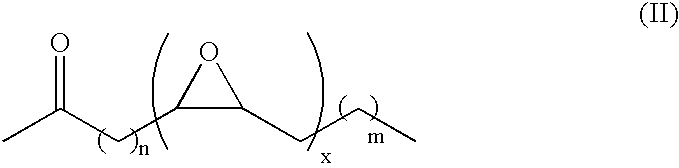
where n=1 to 7,
x=1 to 3, and
m=1 to 6.
wherein at least one of R1, R2 or R3 is other than hydrogen.
A specific example of such a non-coordinating proton acceptor is selected from the group of epoxidized soy bean oil (ESBO), epoxidized linseed oil, epoxidized corn oil, epoxidized coconut oil, epoxidized cottonseed oil, epoxidized olive oil, epoxidized palm oil, epoxidized palm kernel oil, epoxidized peanut oil, epoxidized cod liver oil, epoxidized tung oil, epoxidized beef tallow, and epoxidized butter, and a mixture of two or more of the above compounds.
Epoxidized peanut oil, epoxidized cottonseed oil, epoxidized corn oil, epoxidized soybean oil, epoxidized olive oil, epoxidized linseed oil, and epoxidized tung oil are preferably used as non-coordinating proton acceptors.
The non-coordinating proton acceptor is more preferably epoxidized soy bean oil (ESBO).
These epoxidized compounds are formed from the corresponding oils and fats, using standard methods known in the art for converting unsaturated compounds into epoxides.
Table 1 provides a list of these corresponding fats and oils, showing the percentages of the constituent fatty acids in each fat or oil.
| TABLE 1 |
| Fatty Acid Composition of Fats and Oils. |
| Unsaturated acids, % |
| Saturated acids, % | Enoic | Dienoic | Trienoic |
| Fat or Oil | C8 | C10 | C12 | C14 | C16 | C18 | >C18 | <C16 | C16 | C18 | >C18 | C18 | C18 |
| Beef tallow | 0.2 | 2-3 | 25-30 | 21-26 | 0.4-1 | 0.5 | 2-3 | 39-42 | 0.3 | 2 | |||
| Butter | 1-2a | 2-3 | 1-4 | 8-13 | 25-32 | 8-13 | 0.4-2 | 1-2 | 2-5 | 22-29 | 0.2-1.5 | 3 | |
| Coconut | 5-9 | 4-10 | 44-51 | 13-18 | 7-10 | 1-4 | 5-8 | 0-1 | 1-3 | ||||
| Corn | 0-2 | 8-10 | 1-4 | 1-2 | 30-50 | 0-2 | 34-56 | ||||||
| Cottonseed | 0-3 | 17-23 | 1-3 | 23-44 | 0-1 | 34-55 | |||||||
| Lard | 1 | 25-30 | 12-6 | 0.2 | 2-5 | 41-51 | 2-3 | 3-8 | |||||
| Olive | 0-1 | 0-2 | 7-20 | 1-3 | 0-1 | 1-3 | 53-86 | 0-3 | 4-22 | ||||
| Palm | 1-6 | 32-47 | 1-6 | 40-52 | 2-11 | ||||||||
| Palm | 2-4 | 3-7 | 45-52 | 14-19 | 6-9 | 1-3 | 1-2 | 0-1 | 10-18 | 1-2 | |||
| kernal | |||||||||||||
| Peanut | 0.5 | 6-11 | 3-6 | 5-10 | 1-2 | 39-66 | 17-38 | ||||||
| Soybean | 0.3 | 7-11 | 2-5 | 1-3 | 0-1 | 22-34 | 50-60 | 2-10 | |||||
| C20 | >C20 | |||||||||||||
| Codliver | 2-6 | 7-14 | 0-1 | 0-2 | 10-20 | 25-31 | 25-32 | 10-20 | ||||||
| Linseed | 0.2 | 5-9 | 4-7 | 0.5-1 | 9-29 | 8-29b | 45-67c | |||||||
| Tung | 4-13 | 8-15 | 78-82d | |||||||||||
| a3-4% C4 1-2% C6. | ||||||||||||||
| bLinoieic acid, cis, cis-9, 12-octadecadienoic acid. | ||||||||||||||
| cLinolenic acid, cis, cis, cis-9, 12, 15-octadecatrienoic acid. | ||||||||||||||
| dEleostearic acid, cis, trans, trans-9, 11, 13-octadecatrienoic acid, and 3-6% saturated acids. | ||||||||||||||
The non-coordinating proton acceptor may also be an ester comprising epoxide moieties. Such an ester may be an ester of a fatty acid comprising epoxide moieties of formula (III): 
or an ester of an alcohol comprising epoxide moieties of formula (IV): 
where, in each formula n=1 to 7
x=1 to 3,
m=1to 6, and
R4 is a hydrocarbyl group, for example, a C1-C6 alkyl group.
The non-coordinating proton acceptor may also be an amide comprising epoxide moieties. Such an amide may be an amide of a fatty acid comprising epoxide moieties of formula (V): 
or an amide of an amine comprising epoxide moieties of formula (VI): 
where n=1 to 7,
x=1 to 3,
m=1 to 6, and
R5 and R6 are chosen, independently of each other, from hydrogen, and a hydrocarbyl group, e.g. a C1-C6 alkyl group.
The non-coordinating proton acceptor may suitably be used in the range of from 0.3 to 20 parts by weight per hundred parts by weight of copolymer, preferably 0.5 to 10 parts by weight per hundred parts by weight of copolymer, most preferably 0.5 to 5 parts by weight, per hundred parts by weight of copolymer.
Many conjugated dienes are used in copolymer rubbers and all can be used in the process of the present invention. Mention is made of 1,3-butadiene, isoprene, 2,3-dimethyl-1,3-butadiene, 1,3-pentadiene and piperylene, of which 1,3-butadiene is preferred.
The nitrile is normally acrylonitrile or methacrylonitrile, of which acrylonitrile is preferred.
The copolymer that undergoes hydrogenation in the present invention may comprise from 95 to 50% by weight, preferably 70 to 60% by weight of conjugated diene, and from 5 to 50% by weight, preferably 30 to 40% by weight of an unsaturated nitrile. The copolymer may also contain up to about 45%, preferably up to 40%, more preferably up to 10%, of one or more copolymerizable monomers, for example, an ester of an unsaturated acid, such as ethyl, propyl or butyl acrylate or methacrylate, or a vinyl compound, for example, styrene, α-methylstyrene or a corresponding compound bearing an alkyl substituent on the phenyl ring, for instance, a p-alkylstyrene such as p-methylstyrene. Other copolymerizable monomers include α,β-unsaturated acids, for example, acrylic, methacrylic, ethacrylic, crotonic, maleic (possibly in the form of its anhydride), fumaric or itaconic acid, and other conjugated dienes, for example 2,3-dimethyl-1,3-butadiene, 1,3-pentadiene, isoprene, and piperylene. Preferably, the copolymer is a solid that has a molecular weight in excess of about 60,000, most preferably in excess of about 100,000. There is effectively no upper limit on the molecular weight of the copolymer, however, the molecular weight of the copolymer will usually not exceed 1,000,000.
The copolymer that is to be hydrogenated can be made in known manner, by emulsion or solution polymerization, resulting in a statistical copolymer. The copolymer will have a backbone composed entirely of carbon atoms. It will have some vinyl side-chains, caused by 1,2-addition of the conjugated diene during the copolymerization. It will also have double bonds in the backbone from 1,4-addition of the diene. Some of these double bonds will be in the cis and most in the trans orientation. These carbon—carbon double bonds are selectively hydrogenated by the process of the present invention, without concomitant hydrogenation of the nitrile groups present in the copolymer. If carboxyl groups (from an α,β-unsaturated acid) are present, it is desired that these should not undergo hydrogenation.
Processes for the hydrogenation of NBR are known and may also be used for the production of the hydrogenation products according to the present invention. A complex of rhodium or palladium, is generally used as the catalyst, although platinum, iridium, rhenium, ruthenium, osmium, cobalt or copper in the form of the metals, but preferably in the form of metal compounds, may also be used, cf. for example U.S. Pat. No. 3,700,637; DE-PS 2,539,132; EP 134 023; DE-OS 35 41 689; DE-OS 35 40 918; EP-A 298 386; DE-OS 3529252; DE-OS 34 33 392; U.S. Pat. No. 4,464,515; and U.S. Pat. No. 4,503,196, all of which are incorporated herein by reference.
Suitable catalysts and solvents for hydrogenation in the homogeneous phase are described in the following, and in GB 1558491 of Bayer AG and in EP 471,250, incorporated herein by reference. It is not intended to restrict the catalysts and solvents for hydrogenation useful for the invention, and these are provided only by way of example. The hydrogenation can be achieved by means of a rhodium-complex catalyst. The preferred catalyst is of the formula (VII):
in which each R is a C1-C8-alkyl group, a C4-C8-cycloalkyl group a C6-C15-aryl group or a C7-C15-aralkyl group; B is phosphorus, arsenic, sulfur, or a sulfoxide group S=0; X is hydrogen or an anion, preferably a halide and more preferably a chloride or bromide ion; I is 2, 3 or 4, preferably 3; m is 2 or 3; and n is 1, 2 or 3, preferably 1 or 3. Preferred catalysts are tris-(triphenylphosphine)-rhodium(I)-chloride, tris(triphenylphosphine)-rhodium(III)-chloride and tris-(dimethylsulfoxide)-rhodium(III)-chloride, and tetrakis- (triphenylphosphine)-rhodium hydride of formula ((C6H5)3P)4RhH, and the corresponding compounds in which triphenylphosphine moieties are replaced by tricyclohexylphosphine moieties. The catalyst can be used in small quantities. An amount in the range of 0.01 to 1.0%, preferably 0.02% to 0.6%,more preferably 0.03 to 0.2%, most preferably 0.06 to 0.12% by weight based on the weight of copolymer is suitable.
The catalyst is used with a co-catalyst that is a ligand of formula RmB, where R, m and B are as defined above, and m is preferably 3. Preferably B is phosphorus, and the R groups can be the same or different. Thus, there can be used a triaryl, trialkyl, tricycloalkyl, diaryl monoalkyl, dialkyl monoaryl, diaryl monocycloalkyl, dialkyl monocycloalkyl, dicycloalkyl monoaryl or dicycloalkyl monoaryl co-catalysts. Examples of co-catalyst ligands are given in U.S. Pat. No. 4,631,315, the disclosure of which is incorporated by reference. Examples of co-catalyst ligands given in U.S. Pat. No 4,631,315 include triphenylphosphine, diethylphenylphosphine, tritolylphosphine, trinaphthylphosphine, diphenylmethylphosphine, diphenylbutylphosphine, tris-(p-carbomethoxyphenyl)-phosphine, tris-(p-cyanophenyl)-phosphine, tributylphosphine, tris-(trimethoxyphenyl)-phosphines, bis-(trimethylphenyl)-phenyl-phosphines, bis-(trimethoxyphenyl)-phenylphosphines, trimethyl phenyldiphenylphosphines, trimethoxyphenyidiphenyl-phosphines, tris-(d imethylphenyl)-phenylphosphines, tris-(dimethoxyphenyl)-phosphines, bis-(dimethylphenyl)-phenyl-phosphines, bis-(dimethoxyphenyl)-phenylphosphines, dimethylphenyidiphenylphosphines, dimethoxyphenyldiphenylphosphines, triphenylarsine, ditolylphenylarsine, tris-(4-ethoxyphenyl)-arsine, diphenylcyclohexylarsine, dibutylphenylarsine and diethylphenylarsine are preferred ligands.
Further examples of co-catalyst ligands are bisphosphines corresponding to the formula (VIII): 
in which m represents an integer from 1 to 10 and the groups R7, R8, R9, R10 which may be the same or different represent alkyl, cycloalkyl, aryl, or aralkyl radicals, these groups optionally being substituted by alkyl, hydroxy, alkoxy, carbalkoxy or halogen groups.
Other examples of co-catalyst ligands are compounds corresponding to the formula (IX): 
wherein q and r which may be the same or different represent an integer from 1 to 6 and the radicals R11, R12 and R13 which may be the same or different have the same meaning as R7-R10.
Examples of such ligands are 1,4-diphospha-6-cyclopentadienyl-1,1,4-triphenylhexane, preferably 1,5-diphospha-7-cyclopentadienyl-1,1,5-triphenylheptane and, in particular, 1,6-diphospha-8-cyclopentadienyl-1,1,6-triphenyloctane.
The preferred co-catalyst ligand is triphenylphosphine. The co-catalyst ligand is suitably used in an amount in the range of from 0.1 to 33% more 0.2 to 20%, preferably 0.3 to 5%, more preferably 0.5 to 4%, based on the weight of the copolymer. Preferably, the weight ratio of the catalyst compound to co-catalyst is in the range 1:3 to 1:66, preferably in the range 1:5 to 1:45.
Triphenylphosphine is difficult to separate from the hydrogenated copolymer product, and if it is present in any significant quantity may create some difficulties in processing of the hydrogenated product. The use of a non-coordinating proton acceptor lowers the amount of triphenylphosphine cocatalyst needed in the hydrogenation reaction, without lowering the efficiency of the reaction. In addition, It is not necessary to remove an ESBO-like proton acceptor from the final copolymer as it has the additional beneficial property of acting as a plasticizer. Use of a proton acceptor in place of part of the co-catalyst, therefore, gives rise to significant and unexpected advantages.
The hydrogenation reaction can be carried out in solution. The solvent must be one that will dissolve the copolymer. This limitation excludes use of unsubstituted aliphatic hydrocarbons. Suitable organic solvents are aromatic compounds including halogenated aryl compounds of 6 to 12 carbon atoms. The preferred halogen is chlorine and the preferred solvent is a chlorobenzene, especially monochlorobenzene (MCB). Other solvents that can be used include toluene, halogenated aliphatic compounds, especially chlorinated aliphatic compounds, ketones such as methyl ethyl ketone and methyl isobutyl ketone, tetrahydrofuran and dimethylformamide. The concentration of copolymer in the solvent is not particularly critical but is suitably in the range from 1 to 20% by weight, preferably from 2.5 to 15% by weight and more preferably 10 to 15% by weight. The concentration of the solution may depend upon the molecular weight of the copolymer rubber that is to be hydrogenated. Rubbers of higher molecular weight are more difficult to dissolve, and so are used at lower concentration.
The reaction can be carried out in a wide range of pressures, from 10 to 250 atm. and preferably from 50 to 100 atm. The temperature range can also be wide. Temperatures from 40 to 160°, preferably 100 to 160° C., are suitable and from 110 to 140° C. are preferred. Under these conditions, the hydrogenation is usually completed in about 3 to 7 hours, although longer or shorter reaction times can be used if required. Preferably, the reaction is carried out, with agitation, in an autoclave.
To extract the copolymer from the hydrogenation mixture, the mixture can be worked up by any suitable method. One method is to distill off the solvent. Another method is to inject steam, followed by drying the copolymer. Another method is to add an alcohol, to cause the copolymer to coagulate.
The copolymer of the present invention can be compounded with any of the usual compounding agents, for example fillers such as carbon black or silica, heat stabilizers, antioxidants, activators such as zinc oxide or zinc peroxide, curing agents, co-agents, processing oils and extenders. Such compounds and co-agents are known to persons skilled in the art.
The invention is further illustrated in the following non-limiting examples and the accompanying drawing, of which:
FIG. 1 is a graph of the average percent hydrogenation of Krynac® X7.40 vs. time, as a function of the amount of added ESBO.
Example 1 illustrates hydrogenation of a carboxylated acrylonitrile-butadiene rubber, Krynac® X7.40 (available from Bayer) with-out the addition of a proton acceptor. Example 2 illustrates the hydrogenation of Krynac® X7.40 in the presence of ESBO as proton acceptor.
In an experiment with a 6% copolymer load, 184 g of Krynac® X7.40 (a statistical terpolymer of methacrylic acid (7%)-acrylonitrile (28%)-butadiene (65%), ML 1+4/100° C.=40) was dissolved in 2.7 kg of monochlorobenzene. The copolymer solution was transferred to a 2 gallon Parr high pressure reactor and nitrogen/argon was then passed through the copolymer solution for 10 minutes. The reactor was then degassed 3 times with pure H2 (100-200 psi) under full agitation. The temperature of the reactor was raised to 130° C. and a solution of 0.139 g (0.076 phr) of tris-(triphenylphosphine)-rhodium-(I)chloride and 2.2 g of triphenylphosphine in 60 mL of monochlorobenzene was then charged to the reactor under hydrogen. The temperature was raised to 138° C. and the pressure of the reactor was set at 1200 psi. The reaction temperature and hydrogen pressures of the reactor were maintained constant throughout the whole reaction. The degree of hydrogenation was monitored by sampling after a certain reaction time followed by FTIR analysis of the sample. The hydrogenation was carried out for a certain period of time at 138° C. under a hydrogen pressure of 1200 psi. The monochlorobenzene was removed by the injection of steam and the copolymer was dried in an oven at 80° C. The values of % hydrogenation (% hyd.) were determined by IR spectroscopy and 1H-NMR. Table 2 gives the values of % hydrogenation (% hyd.) as a function of time for three separate runs, as well as the average values of % hydrogenation determined as a function of time for all three runs. The average values of % hydrogenation are plotted as a function of time in FIG. 1.
| TABLE 2 |
| Hydrogenation of Krynac ® X7.40 in the Absence of ESBO. |
| Run 1 | |
Run 3 | Average | |
| Time (min) | % hyd. | % hyd. | % hyd. | % hyd. |
| 0 | 0 | 0 | 0 | 0 |
| 60 | 77.5 | 64.9 | 66.4 | 69.6 |
| 120 | 83.2 | 74.8 | 76.7 | 78.2 |
| 180 | 85 | 81.5 | 83.7 | 83.4 |
| 240 | 85 | 83 | 83.7 | 83.9 |
Copolymer Load: 6%; Catalyst Load: 0.076 phr; Co-catalyst Load: 1.26 phr.
Hydrogenation reactions were carried out as in Example 1, except that 2 or 7 phr of ESBO was added to the copolymer cement before the copolymer hydrogenation. Table 3 gives the values of % hydrogenation (% hyd., as determined by IR spectroscopy and 1H-NMR) as a function of time for two different groups of runs; each group of runs was conducted with a different amount of ESBO added (2 or 7 phr ESBO). The average values of % hydrogenation determined as a function of time from the two runs of each group are also shown. These average values of % hydrogenation were plotted as a function of time in FIG. 1.
| TABLE 3 |
| Hydrogenation of Krynac ® X7.40 in the Presence of ESBO. |
| 2 |
7 phr ESBO |
| Time | Run 1 | |
Average | Run 1 | |
Average |
| (min) | % hyd. | % hyd. | % hyd. | % hyd. | % hyd. | % hyd. |
| 0 | 0 | 0 | 0 | 0 | 0 | 0 |
| 60 | 82.6 | 81.5 | 82.0 | 86.2 | 71.8 | 79 |
| 120 | 87.8 | 88.0 | 87.9 | 92.3 | 83.4 | 87.8 |
| 180 | 89.4 | 89.5 | 89.4 | 93.6 | 90.2 | 91.9 |
| 240 | 90.2 | 90.3 | 90.2 | 94.1 | 92.6 | 93.4 |
Copolymer load: 6%; Catalyst Load: 0.076; Co-catalyst Load: 1.26 phr.
It is evident that the presence of ESBO accelerated the rate of hydrogenation of Krynac® X7.40. In the cases where no ESBO was added, less than 85% hydrogenation was achieved. With 2 phr ESBO greater than 85% hydrogenation was achieved.
Examples 3 and 4 show the hydrogenation of an acrylonitrile-butadiene copolymer, Perbunan® NT 3429T (available from Bayer), without and with the addition of ESBO, respectively.
In an experiment with a 12% copolymer load, 392 g of Perbunan® NT 3429T (statistical copolymer of acrylonitrile (34%)-butadiene (66%), Mooney ML 1+4=30) was dissolved in 2.6 kg of monochlorobenzene. The copolymer lution was transferred to a 2 gallon Parr high pressure reactor and nitrogen/argon was then passed through the copolymer solution for 10 minutes. The reactor was then degassed 3 times with pure H2 (100-200 psi) under full agitation. The temperature of the reactor was raised to 130° C. and a solution of 0.176 g (0.045 phr) of tris-(triphenylphosphine)rhodium (1) chloride catalyst and 3.92 g of co-catalyst triphenylphosphine in 60 mL of monochlorobenzene was then charged to the reactor under hydrogen. The temperature was then raised to 138° C. and the pressure of the reactor was set at 1200 psi. The reaction temperature and hydrogen pressure of the reactor were maintained constant throughout the reaction. The degree of hydrogenation was monitored by sampling after a certain reaction time followed by FTIR analysis of the sample. The hydrogenation was carried out after a certain period of time at 138° C. under a hydrogen pressure of 1200 psi. The chlorobenzene was removed by the injection of steam and the copolymer was dried in an oven at 80° C. The hydrogenation results (as determined by IR spectroscopy and 1H-NMR) of two runs are given in Table 4.
| TABLE 4 |
| Hydrogenation of Perbunan ® NT 3429T in the Presence of 1 |
| phr Triphenyiphosphine. |
| Time | Run 1 | Run 2 |
| (min) | % hyd. | % hyd. |
| 0 | 0 | 0 |
| 60 | 90.6 | 87.2 |
| 120 | 96.9 | 96.7 |
| 180 | 98.4 | 98.7 |
| 240 | 98.9 | 99.2 |
Copolymer Load: 12%; Catalyst Load: 0.045 phr; Co-catalyst Load: 1 phr.
A hydrogenation reaction was carried out as in Example 3, except that 2.0 phr of ESBO was added to the copolymer cement before the hydrogenation. The hydrogenation results are summarized in Table 5.
| TABLE 5 |
| Hydrogenation of Perbunan ® NT 3429T in the presence of 1 |
| phr triphenyiphosphine and 2.0 phr ESBO. |
| Time (min) | % hyd. | ||
| 0 | 0 | ||
| 60 | 89.4 | ||
| 120 | 97.7 | ||
| 180 | 99.3 | ||
Copolymer Load: 12%; Catalyst Load: 0.045 phr; Co-catalyst Load: 1 phr.
The hydrogenation of Perbunan® NT 3429T occurred much faster than that of the carboxylated copolymer, Krynac® X7.40. In general, an acrylonitrile-butadiene copolymer can be hydrogenated easily to 97-98% saturation, than the rate of hydrogenation slows down significantly. It is well known that the age properties of a hydrogenated acrylonitrile-butadiene copolymer improve significantly as the percent hydrogenation approaches 100. It is economically beneficial to hydrogenate an acrylonitrile-butadiene copolymer to greater than 99% as quickly as possible. As shown in Table 4 and 5, the presence of ESBO increases the rate of hydrogenation of Perbunan® NT 3429T. Without ESBO, the percent hydrogenation was between 96.7 and 96.9% after two hours; 98.9-99.2% hydrogenation was achieved after four hours of reaction. With the addition of ESBO, the percent hydrogenation was about 97.7% after two hours. A total of 99.3% hydrogenation was achieved in only three hours of reaction. The use of ESBO, therefore, saves about 25% reaction time.
This example shows the hydrogenation of Perbunan® NT 3429T using 2 phr ESBO, in the absence of the triphenylphosphine co-catalyst.
Following the procedure of Example 3, the hydrogenation reaction of Perbunan® NT 3429T (butadiene (66%)-acrylonitrile (34%), Mooney ML 1+4=30) was carried out in the presence of 2 phr ESBO. The hydrogenation results (as determined by IR spectroscopy and 1 H-NMR) are given in Table 6.
| TABLE 6 |
| Hydrogenation of Perbunan ® NT 3429T in the Absence of |
| Triphenyiphosphine Co-catalyst and in the Presence of 2 phr |
| ESBO. |
| Time (min) | % hyd. | ||
| 0 | 0 | ||
| 60 | 61.9 | ||
| 120 | 65.6 | ||
| 180 | 73.5 | ||
| 240 | 78.8 | ||
Copolymer Load: 12%; Catalyst load: 0.045 phr.
Without the use of co-catalyst, the percent hydrogenation reached only 78.8% after 4 hours of reaction. This result indicates that it is necessary to have a certain amount of co-catalyst present in order to have a reasonably fast hydrogenation reaction.
This example shows the hydrogenation of Perbunan® NT 3429T using 0.3 phr triphenylphosphine co-catalyst, in the absence of ESBO.
Following the procedure of Example 3, hydrogenation reactions of Perbunan® NT 3429T (butadiene (66%)-acrylonitrile (34%), Mooney ML 1+4=30) were carried out in the absence of ESBO. The hydrogenation results (as determined by IR spectroscopy and 1H-NMR) are given in Table 7.
| TABLE 7 |
| Hydrogenation of Perbunan ® NT 3429T in the Presence of |
| 0.3 phr Triphenyiphosphine and 0 phr ESBO. |
| Run 1 | |
|
| Time (min) | % hyd. | % hyd. |
| 0 | 0 | 0 |
| 60 | 84.6 | 84 |
| 120 | 94.9 | 96 |
| 180 | 97.5 | 97.5 |
| 240 | 98.6 | 98.4 |
Copolymer Load: 12%; Catalyst Load: 0.045 phr; Triphenylphosphine: 0.3 phr.
When 0.3 phr TPP was used as co-catalyst, 97.5% hydrogenation was achieved in 3 hours, but only 98.4-98.6% hydrogenation was achieved in 4 hours of reaction, which is slower than the reaction with 1 phr triphenylphosphine (example 3, table 4).
This example shows the hydrogenation of Perbunan® NT 3429T, using 0.3 phr triphenylphosphine co-catalyst, and 2 phr ESBO.
Following the procedure of Example 3, hydrogenation reactions of butadiene-acrylonitrile 34% ACN (Mooney ML 1+4=30) were carried out in the presence of 2 phr ESBO. The hydrogenation results (as determined by IR spectroscopy and 1H-NMR) are given in Table 8.
| TABLE 8 |
| Hydrogenation of Perbunan ® NT 3429T in the Presence of |
| 0.3 phr TPP and 2 phr ESBO. |
| Run 1 | |
Run 3 | |||
| Time (min) | % hyd. | % hyd. | % hyd. | ||
| 0 | 0 | 0 | 0 | ||
| 60 | 88.1 | 89.2 | 86.1 | ||
| 120 | 96.4 | 97.4 | 94.8 | ||
| 180 | 98.6 | 98.9 | 98.4 | ||
| 240 | 99.3 | 99.5 | 99.2 | ||
Substrate: Perbunan® NT 3429 T; Copolymer load: 12%; Catalyst load: 0.045 phr; TPP: 0.3 phr.
With the use of 0.3 phr TPP co-catalyst and 2 phr ESBO, 96.4-96.6% hydrogenation was achieved in 3 hours, and 99.2-99.5% hydrogenation was achieved in 4 hours of reaction. These hydrogenation results are as good as those of reactions with 1 phr triphenylphosphine.
This example demonstrates that the addition of a proton acceptor can reduce the amount of co-catalyst loading and still result in enhanced hydrogenation efficiency. In this example, we show that the presence of 2 phr ESBO can permit a reduction of 0.7 phr in the amount of triphenylphosphine co-catalyst used.
Although the invention has been described in detail in the foregoing for the purpose of illustration, it is to be understood that such detail is solely for that purpose and that variations can be made therein by those skilled in the art without departing from the spirit and scope of the invention except as it may be limited by the claims.
Claims (31)
1. A process of hydrogenating a nitrile copolymer rubber, which comprises the step of subjecting the copolymer rubber to hydrogenation in the presence of a metal-complex hydrogenation catalyst, a co-catalyst, and a proton acceptor that is non-coordinating with the metal-complex catalyst, wherein the non-coordinating proton acceptor is a triacyiglycerol comprising epoxide moieties.
2. A process according to claim 1 , wherein the non-coordinating proton acceptor is a molecule of formula: 
wherein R1, R2, and R3 are, independently of each other, hydrogen or a group of formula: 
where n=1 to 7,
x=1 to 3, and
m=1 to 6,
wherein at least one of R1, R2 or R3 is other than hydrogen.
3. A process according to claim 2 , wherein the non-coordinating proton acceptor is a member selected from the group consisting of epoxidized soy bean oil, epoxidized linseed oil, epoxidized corn oil, epoxidized coconut oil, epoxidized cottonseed oil, epoxidized olive oil, epoxidized palm oil, epoxidized palm kernel oil, epoxidized peanut oil, epoxidized cod liver oil, epoxidized tung oil, epoxidized beef tallow, and epoxidized buffer, and mixture of two or more of the said members.
4. A process according to claim 3 , wherein the non-coordinating proton acceptor is epoxidized soy bean oil.
5. A process according to claim 1 , wherein the copolymer comprises from 95 to 50% by weight of a conjugated diene, from 5 to 50% by weight of an unsaturated nitrile and from 0 to 45% by weight of a copolymerizable monomer.
6. A process according to claim 5 , wherein the conjugated diene is 1,3 butadiene.
7. A process according to claim 5 , wherein the unsaturated nitrile is acrylonitrile.
8. A process according to claim 5 , wherein the unsaturated nitrile is methacrylonitrile.
9. A process according to claim 5 , wherein the copolymerizable monomer is an αβ-unsaturated carboxylic acid.
10. A process according to claim 9 , wherein the αβ-unsaturated carboxylic acid is acrylic acid.
11. A process according to claim 9 , wherein the αβ-unsaturated carboxylic acid is methacrylic acid.
12. A process according to claim 1 , wherein the non-coordinating proton acceptor is used in the range of from 0.3 to 20 parts by weight per hundred parts by weight of copolymer.
13. A process according to claim 12 , wherein the non-coordinating proton acceptor is used in the range of from 0.5 to 10 parts by weight per hundred parts by weight of copolymer.
14. A process according to claim 13 , wherein the non-coordinating proton acceptor is used in the range of from 0.5 to 5 parts by weight per hundred parts by weight of copolymer.
15. A process according to claim 1 , wherein the hydrogenation catalyst is selected from the group consisting of rhodium, platinum, iridium, palladium, rhenium, ruthenium, osmium, cobalt, copper, and complexes of these metals.
16. A process according to claim 15 , wherein the hydrogenation catalyst is a rhodium-complex catalyst.
17. A process according to claim 16 , wherein the rhodium-complex catalyst is a complex compound of the following formula: (RmB)lRhXn
wherein,
R is a C1-C8 alkyl, C6-C15 aryl, or C7-C15 aralkyl;
B is P, As, S, or S(O);
X is Cl or Br;
l is 2,3 or 4;
m is 2 or 3;
and n is 1, 2 or 3.
18. A process according to claim 17 , wherein l is 3, and n is 1 or 3.
19. A process according to claim 16 , wherein the rhodium-complex catalyst is selected from the group consisting of tris(triphenylphosphine)-rhodium (I) chloride, tris(triphenylphosphine)-rhodium(III) chloride and tris(dimethyl sulfoxide)-rhodium(III) chloride.
20. A process according to claim 16 , wherein the rhodium-complex catalyst is used in an amount of from 0.01 to 1.0% by weight of the dissolved copolymer.
21. A process according to claim 20 , wherein the rhodium-complex catalyst is used in an amount of from 0.02 to 0.6% by weight of the dissolved copolymer.
22. A process according to claim 21 , wherein the rhodium-complex catalyst is used in an amount of from 0.03 to 0.2% by weight of the dissolved copolymer.
23. A process according to claim 22 , wherein the co-catalyst is a compound of formula RmB, wherein,
R is a C1-C8 alkyl, C6-C15 aryl, or C7-C15 arakyl;
B is P, As, S, or S(O);
and m is 2 or 3.
24. A process according to claim 23 , wherein the co-catalyst is triphenylphosphine.
25. A process according to claim 23 , wherein the amount of co-catalyst is in the range 0.1 to 33 parts by weight per hundred parts by weight of copolymer.
26. A process according to claim 25 , wherein the amount of co-catalyst is in the range 0.2 to 20 parts by weight per hundred parts by weight of copolymer.
27. A process according to claim 26 , wherein the amount of co-catalyst is in the range 0.3 to 5 parts by weight per hundred parts by weight of copolymer.
28. A process according to claim 1 , wherein the weight ratio of catalyst to co-catalyst is in the range of 1:3 to 1:66.
29. A process according to claim 1 , wherein the reduction is performed in a halogenated aromatic solvent of 6 to 12 carbon atoms.
30. A process according to claim 29 , wherein the halogenated aromatic solvent is monochlorobenzene.
31. A process according to claim 1 , which is carried out at a temperature in the range of 40° C. to 160° C. and a pressure in the range 10 to 250 atmospheres.
Applications Claiming Priority (3)
| Application Number | Priority Date | Filing Date | Title |
|---|---|---|---|
| CA2329844 | 2000-12-28 | ||
| CA2,329,844 | 2000-12-28 | ||
| CA002329844A CA2329844A1 (en) | 2000-12-28 | 2000-12-28 | Esbo enhanced hydrogenation |
Publications (2)
| Publication Number | Publication Date |
|---|---|
| US20020128393A1 US20020128393A1 (en) | 2002-09-12 |
| US6683136B2 true US6683136B2 (en) | 2004-01-27 |
Family
ID=4168007
Family Applications (1)
| Application Number | Title | Priority Date | Filing Date |
|---|---|---|---|
| US10/027,762 Expired - Fee Related US6683136B2 (en) | 2000-12-28 | 2001-12-19 | Epoxidized soybean oil enhanced hydrogenation of nitrile copolymer |
Country Status (5)
| Country | Link |
|---|---|
| US (1) | US6683136B2 (en) |
| EP (1) | EP1219640A3 (en) |
| JP (1) | JP2002212203A (en) |
| CA (1) | CA2329844A1 (en) |
| MX (1) | MXPA01012875A (en) |
Cited By (64)
| Publication number | Priority date | Publication date | Assignee | Title |
|---|---|---|---|---|
| US20070049700A1 (en) * | 2005-08-30 | 2007-03-01 | Werner Obrecht | Method for the degradation of nitrile rubber by metathesis in the presence of ruthenium- or osmium-based catalysts |
| US20070049699A1 (en) * | 2005-07-14 | 2007-03-01 | Lanxess Inc. | Process for the preparation of low mooney nitrile terpolymers |
| US20070055018A1 (en) * | 2005-09-06 | 2007-03-08 | Dirk Achten | Crosslinkable compositions, thermoplastic elastomers obtainable therefrom and their use |
| US20070135579A1 (en) * | 2005-12-14 | 2007-06-14 | Lanxess Deutschland Gmbh | Microgel-containing vulcanizable composition based on hydrogenated nitrile rubber |
| US20070142564A1 (en) * | 2005-12-21 | 2007-06-21 | Lanxess Deutschland Gmbh | Hydrogenated nitrile rubber with narrow molecular weight distribution, a process for its preparation and a method of use |
| US20070142621A1 (en) * | 2005-12-21 | 2007-06-21 | Lanxess Deutschland Gmbh | Synthetic rubber with narrow molecular weight distribution, a process for its preparation and a method of use |
| US20070208206A1 (en) * | 2006-02-22 | 2007-09-06 | Werner Obrecht | Novel catalyst systems and a process for reacting chemical compounds in the presence of said catalyst systems |
| US20080064822A1 (en) * | 2006-02-22 | 2008-03-13 | Werner Obrecht | Process for degrading nitrile rubbers in the presence of catalysts having an increased activity |
| US20080076881A1 (en) * | 2006-08-30 | 2008-03-27 | Werner Obrecht | Process for the metathetic degradation of nitrile rubbers |
| US20080293889A1 (en) * | 2007-05-22 | 2008-11-27 | Lanxess Deutschland Gmbh | Nitrile rubbers |
| US20080293868A1 (en) * | 2007-05-22 | 2008-11-27 | Lanxess Deutschland Gmbh | Nitrile rubbers |
| US20080293869A1 (en) * | 2007-05-22 | 2008-11-27 | Lanxess Deutschland Gmbh | Nitrile rubbers |
| EP2028195A1 (en) | 2007-08-21 | 2009-02-25 | Lanxess Deutschland GmbH | Metathesis of nitrile rubbers in the presence of transition metal complex catalysts |
| EP2027920A1 (en) | 2007-08-21 | 2009-02-25 | Lanxess Deutschland GmbH | Catalysts for metathesis reactions |
| DE102007039527A1 (en) | 2007-08-21 | 2009-02-26 | Lanxess Deutschland Gmbh | New ruthenium- and osmium-carbene-complex catalysts, which are bonded with chiral carbon atoms or over double bonds at a catalyst base skeleton, useful e.g. in metathesis-reactions, preferably in ring closing metathesis reactions |
| DE102007039526A1 (en) | 2007-08-21 | 2009-02-26 | Lanxess Deutschland Gmbh | Catalyst systems and their use for metathesis reactions |
| DE102007039695A1 (en) | 2007-08-22 | 2009-02-26 | Lanxess Deutschland Gmbh | New ruthenium- and osmium-carbene-complex catalysts, which are bonded with chiral carbon atoms or over double bonds at a catalyst base skeleton, useful e.g. in metathesis-reactions, preferably in ring closing metathesis reactions |
| DE102007039525A1 (en) | 2007-08-21 | 2009-02-26 | Lanxess Deutschland Gmbh | Process for metathesis degradation of nitrile rubber |
| EP2072537A1 (en) | 2007-12-17 | 2009-06-24 | Lanxess Inc. | Hydrogenation of diene-based polymers |
| EP2072534A1 (en) | 2007-12-17 | 2009-06-24 | LANXESS Inc. | Hydrogenation of diene-based polymers |
| US20090292064A1 (en) * | 2005-09-30 | 2009-11-26 | Dirk Achten | Crosslinkable compositions, processes for the preparation thereof and the use thereof |
| EP2145681A1 (en) | 2008-07-08 | 2010-01-20 | Lanxess Deutschland GmbH | Method for the reduction of the molecular weight of nitrile rubber |
| US20100093944A1 (en) * | 2008-07-08 | 2010-04-15 | Lanxess Deutschland Gmbh | Catalyst systems and their use for metathesis reactions |
| EP2267037A1 (en) | 2009-06-26 | 2010-12-29 | LANXESS Deutschland GmbH | Use of wholly or partially hydrated nitrile rubbers |
| EP2289623A1 (en) | 2009-08-31 | 2011-03-02 | LANXESS Deutschland GmbH | Metathesis of nitrile rubbers in the presence of transition metal catalysts |
| EP2289622A1 (en) | 2009-08-31 | 2011-03-02 | LANXESS Deutschland GmbH | Ruthenium based catalysts for the metathesis of nitrile rubbers |
| WO2011023771A1 (en) | 2009-08-31 | 2011-03-03 | Lanxess Deutschland Gmbh | Vulcanizable polymer composition comprising a low molecular weight optionally hydrogenated nitrile rubber |
| US20110059279A1 (en) * | 2008-01-29 | 2011-03-10 | Lanxess Deutschland Gmbh | Nitrile rubbers which optionally contain alkylthio terminal groups and which are optionally hydrogenated |
| EP2298824A1 (en) | 2009-09-17 | 2011-03-23 | LANXESS Deutschland GmbH | Nitrile rubbers and production of same in organic solvents |
| WO2011032832A1 (en) | 2009-09-17 | 2011-03-24 | Lanxess Deutschland Gmbh | Nitrile rubbers and production thereof in organic solvents |
| EP2316861A1 (en) | 2009-11-03 | 2011-05-04 | LANXESS Deutschland GmbH | Nitrile rubbers |
| US20110123747A1 (en) * | 2008-01-29 | 2011-05-26 | Lanxess Deutschland Gmbh | Nitrile rubbers which optionally contain alkylthio terminal groups and which are optionally hydrogenated |
| US20110123748A1 (en) * | 2008-01-29 | 2011-05-26 | Lanxess Deutschland Gmbh | Nitrile rubbers which optionally contain alkylthio terminal groups and which are optionally hydrogenated |
| EP2368917A1 (en) | 2010-03-25 | 2011-09-28 | LANXESS International SA | Process for the production of water and solvent-free hydrogenated nitrile rubbers |
| EP2385074A1 (en) | 2010-05-07 | 2011-11-09 | LANXESS Deutschland GmbH | Nitrile rubbers and production of same in organic solvents |
| EP2386600A1 (en) | 2010-04-15 | 2011-11-16 | LANXESS Deutschland GmbH | Cross-linking agent for nitrile rubbers containing isocyanate groups |
| EP2418225A1 (en) | 2010-08-09 | 2012-02-15 | LANXESS Deutschland GmbH | Partially hydrated nitrile rubbers |
| EP2423238A1 (en) | 2010-08-31 | 2012-02-29 | LANXESS Deutschland GmbH | Method for producing nitrile rubbers in organic solvents |
| EP2423234A1 (en) | 2010-08-31 | 2012-02-29 | LANXESS Deutschland GmbH | Rubber blends from different nitrile rubbers |
| EP2423235A1 (en) | 2010-08-31 | 2012-02-29 | LANXESS Deutschland GmbH | Method for producing nitrile rubbers in organic solvents |
| EP2471851A1 (en) | 2010-12-29 | 2012-07-04 | LANXESS Deutschland GmbH | Vulcanisable compounds based on nitrile rubbers containing epoxy groups |
| EP2471852A1 (en) | 2010-12-29 | 2012-07-04 | Lanxess Deutschland GmbH | Vulcanisable compounds based on nitrile rubbers containing epoxy groups |
| EP2484700A1 (en) | 2011-02-04 | 2012-08-08 | LANXESS Deutschland GmbH | Functionalised nitrile rubbers and their manufacture |
| WO2012175725A1 (en) | 2011-06-24 | 2012-12-27 | Lanxess Deutschland Gmbh | Solution polymerization/co-polymerization of dienes, hydrogenation of dienerubbers and hydrogenated dienerubbers |
| EP2554558A1 (en) | 2011-08-02 | 2013-02-06 | Lanxess Deutschland GmbH | Method for producing nitrile rubbers in organic solvents |
| EP2565229A1 (en) | 2011-09-02 | 2013-03-06 | LANXESS Deutschland GmbH | Vulcanisable compounds on the basis of ethylene vinyl acetate copolymerisates containing epoxy groups |
| EP2581409A1 (en) | 2011-10-11 | 2013-04-17 | Lanxess Deutschland GmbH | Vulcanisable compounds on the basis of nitrile rubbers containing epoxy groups |
| WO2013053763A1 (en) | 2011-10-11 | 2013-04-18 | Lanxess Deutschland Gmbh | Vulcanisable compositions based on epoxy group-containing nitrile rubbers |
| WO2013098052A2 (en) | 2011-12-28 | 2013-07-04 | Lanxess Deutschland Gmbh | Metathesis of nitrile rubbers in the presence of transition metal complex catalysts |
| EP3034518A1 (en) | 2014-12-19 | 2016-06-22 | Lanxess Deutschland GmbH | Color stable nitrile rubbers |
| EP3196239A1 (en) | 2016-01-25 | 2017-07-26 | ARLANXEO Deutschland GmbH | Vulcanisable compounds on the basis of hydrogenated nitrile rubber, method for their preparation and their use |
| EP3248989A1 (en) | 2016-05-23 | 2017-11-29 | University Of Waterloo | Hydrogenation of nitrile groups in hydrogenated nitrile butadiene rubber and tandem hydrogenation of nitrile groups and olefinic groups in nitrile butadiene rubber using a ruthenium or rhodium complex and a basic reagent |
| EP3248988A1 (en) | 2016-05-23 | 2017-11-29 | University Of Waterloo | Hydrogenation of nitrile groups in hydrogenated nitrile butadiene rubber and tandem hydrogenation of nitrile groups and olefinic groups in nitrile butadiene rubber using an unsupported rhodium containing catalyst |
| EP3255088A1 (en) | 2016-06-07 | 2017-12-13 | ARLANXEO Deutschland GmbH | Use of vulcanizable compositions and vulcanizates in contact with silane-coated wollastonite containing coolant |
| WO2019034572A1 (en) | 2017-08-16 | 2019-02-21 | Arlanxeo Deutschland Gmbh | VULCANIZABLE COMPOSITIONS CONTAIN HYDROGENATED NITRIL RUBBER, VOLUMES MANUFACTURED FROM THE SAME AND THEIR USE |
| WO2019057703A1 (en) | 2017-09-20 | 2019-03-28 | Arlanxeo Deutschland Gmbh | VULCANIZABLE HNBR COMPOSITION WITH HIGH HEAT-CONDUCTIVITY |
| WO2019110658A1 (en) | 2017-12-08 | 2019-06-13 | Arlanxeo Deutschland Gmbh | Process for producing nitrile rubbers using ruthenium complex catalysts |
| US10414901B2 (en) | 2014-02-03 | 2019-09-17 | Arlanxeo Deutschland Gmbh | Stabilized rubbers |
| WO2019207096A1 (en) | 2018-04-27 | 2019-10-31 | Arlanxeo Deutschland Gmbh | Use of ruthenium and osmium catalysts for the metathesis of nitrile rubber |
| WO2020020677A1 (en) | 2018-07-23 | 2020-01-30 | Arlanxeo Deutschland Gmbh | Method for producing hydrogenated nitrile rubber and hnbr compositions thereof |
| WO2020020629A1 (en) | 2018-07-23 | 2020-01-30 | Arlanxeo Deutschland Gmbh | Use of catalysts for the metathesis of nitrile rubber |
| WO2020120207A2 (en) | 2018-12-12 | 2020-06-18 | Arlanxeo Deutschland Gmbh | Catalyst system containing a metathesis catalyst and at least one phenolic compound and a process for metathesis of nitrile-butadiene rubber (nbr) using the catalyst system |
| WO2020126345A1 (en) | 2018-12-17 | 2020-06-25 | Arlanxeo Deutschland Gmbh | Process for preparing hnbr solutions with alternative solvents |
| WO2020126343A1 (en) | 2018-12-19 | 2020-06-25 | Arlanxeo Deutschland Gmbh | Electrode composition for a cathode of a cell of a lithium-ion battery, a cathode slurry composition, a cathode and the battery incorporating it |
Families Citing this family (6)
| Publication number | Priority date | Publication date | Assignee | Title |
|---|---|---|---|---|
| CN104338558B (en) * | 2014-09-11 | 2017-04-05 | 华南理工大学 | Hydridization dendrimers supported bi-metallic nano-particle catalyst and preparation method and application |
| CN105622783B (en) * | 2014-10-29 | 2017-06-30 | 中国石油化工股份有限公司 | A kind of preparation method of copolymer |
| CN106179504B (en) * | 2016-07-11 | 2018-10-09 | 华南理工大学 | Hydridization dendrimers metal supported catalyst and the preparation method and application thereof |
| CN106512993B (en) * | 2016-08-30 | 2018-11-16 | 北京化工大学 | Palladium-ruthenium bimetal nano catalyst preparation and plus hydrogen application |
| CN106423283B (en) * | 2016-08-31 | 2019-05-17 | 北京化工大学 | Diamine transition metal complex catalyst and the preparation method and application thereof |
| EP3781309A1 (en) | 2018-04-20 | 2021-02-24 | ARLANXEO Deutschland GmbH | Hydrogenation catalyst compositions and their use for hydrogenation of nitrile rubber |
Citations (10)
| Publication number | Priority date | Publication date | Assignee | Title |
|---|---|---|---|---|
| DE658172C (en) | 1930-05-06 | 1938-08-06 | Ig Farbenindustrie Ag | Process for the preparation of polymerization products |
| US3673281A (en) | 1971-01-29 | 1972-06-27 | Basf Ag | Catalytic hydrogenation of polymers containing double bonds |
| US3700637A (en) | 1970-05-08 | 1972-10-24 | Shell Oil Co | Diene-nitrile rubbers |
| GB1558491A (en) | 1975-09-03 | 1980-01-03 | Bayer Ag | Hydrogenation of polymers |
| US4464515A (en) * | 1982-12-08 | 1984-08-07 | Polysar Limited | Polymer hydrogenation process |
| US4631315A (en) | 1984-09-12 | 1986-12-23 | Bayer Aktiengesellschaft | Hydrogenation of nitrile group-containing unsaturated polymers |
| US4647627A (en) * | 1984-09-08 | 1987-03-03 | Bayer Aktiengesellschaft | Low molecular weight copolymers and covulcanisates produced therefrom |
| US5075388A (en) * | 1990-12-13 | 1991-12-24 | Rempel Garry L | Amine modified hydrogenation of nitrile rubber |
| NL1004993C2 (en) | 1997-01-14 | 1998-07-15 | Dsm Nv | Preparation of ruthenium complex hydrogenation catalysts |
| US20020123574A1 (en) * | 2000-12-22 | 2002-09-05 | Paul Nguyen | Process for the production of hydrogenated nitrile rubber |
-
2000
- 2000-12-28 CA CA002329844A patent/CA2329844A1/en not_active Abandoned
-
2001
- 2001-12-13 MX MXPA01012875A patent/MXPA01012875A/en not_active Application Discontinuation
- 2001-12-17 EP EP01129343A patent/EP1219640A3/en not_active Withdrawn
- 2001-12-19 US US10/027,762 patent/US6683136B2/en not_active Expired - Fee Related
- 2001-12-27 JP JP2001396245A patent/JP2002212203A/en active Pending
Patent Citations (10)
| Publication number | Priority date | Publication date | Assignee | Title |
|---|---|---|---|---|
| DE658172C (en) | 1930-05-06 | 1938-08-06 | Ig Farbenindustrie Ag | Process for the preparation of polymerization products |
| US3700637A (en) | 1970-05-08 | 1972-10-24 | Shell Oil Co | Diene-nitrile rubbers |
| US3673281A (en) | 1971-01-29 | 1972-06-27 | Basf Ag | Catalytic hydrogenation of polymers containing double bonds |
| GB1558491A (en) | 1975-09-03 | 1980-01-03 | Bayer Ag | Hydrogenation of polymers |
| US4464515A (en) * | 1982-12-08 | 1984-08-07 | Polysar Limited | Polymer hydrogenation process |
| US4647627A (en) * | 1984-09-08 | 1987-03-03 | Bayer Aktiengesellschaft | Low molecular weight copolymers and covulcanisates produced therefrom |
| US4631315A (en) | 1984-09-12 | 1986-12-23 | Bayer Aktiengesellschaft | Hydrogenation of nitrile group-containing unsaturated polymers |
| US5075388A (en) * | 1990-12-13 | 1991-12-24 | Rempel Garry L | Amine modified hydrogenation of nitrile rubber |
| NL1004993C2 (en) | 1997-01-14 | 1998-07-15 | Dsm Nv | Preparation of ruthenium complex hydrogenation catalysts |
| US20020123574A1 (en) * | 2000-12-22 | 2002-09-05 | Paul Nguyen | Process for the production of hydrogenated nitrile rubber |
Non-Patent Citations (1)
| Title |
|---|
| Alger, "Polymer Science Dictionary", 2nd ed., Chapman & Hall, New York, p. 69, 335 (1997). * |
Cited By (126)
| Publication number | Priority date | Publication date | Assignee | Title |
|---|---|---|---|---|
| US20070049699A1 (en) * | 2005-07-14 | 2007-03-01 | Lanxess Inc. | Process for the preparation of low mooney nitrile terpolymers |
| US20070049700A1 (en) * | 2005-08-30 | 2007-03-01 | Werner Obrecht | Method for the degradation of nitrile rubber by metathesis in the presence of ruthenium- or osmium-based catalysts |
| US7470750B2 (en) | 2005-08-30 | 2008-12-30 | Lanxess Deutschland Gmbh | Method for the degradation of nitrile rubber by metathesis in the presence of ruthenium- or osmium-based catalysts |
| US20070055018A1 (en) * | 2005-09-06 | 2007-03-08 | Dirk Achten | Crosslinkable compositions, thermoplastic elastomers obtainable therefrom and their use |
| EP1762593A1 (en) | 2005-09-06 | 2007-03-14 | Lanxess Deutschland GmbH | Crosslinkable Compositions, thermoplastic elastomers obtained therefrom and their use |
| US8013070B2 (en) | 2005-09-06 | 2011-09-06 | Lanxess Deutschland Gmbh | Crosslinkable compositions, thermoplastic elastomers obtainable therefrom and their use |
| US20090292064A1 (en) * | 2005-09-30 | 2009-11-26 | Dirk Achten | Crosslinkable compositions, processes for the preparation thereof and the use thereof |
| US7645833B2 (en) | 2005-09-30 | 2010-01-12 | Lanxess Deutschland Gmbh | Crosslinkable compositions, processes for the preparation thereof and the use thereof |
| US8716407B2 (en) | 2005-12-14 | 2014-05-06 | Lanxess Deutschland Gmbh | Microgel containing vulcanizable composition based on hydrogenated nitrile rubber |
| US9321910B2 (en) | 2005-12-14 | 2016-04-26 | Lanxess Deutschland Gmbh | Microgel-containing vulcanizable composition based on hydrogenated nitrile rubber |
| US20070135579A1 (en) * | 2005-12-14 | 2007-06-14 | Lanxess Deutschland Gmbh | Microgel-containing vulcanizable composition based on hydrogenated nitrile rubber |
| US7737193B2 (en) | 2005-12-21 | 2010-06-15 | Lanxess Deutschland Gmbh | Hydrogenated nitrile rubber with narrow molecular weight distribution, a process for its preparation and a method of use |
| US20070142621A1 (en) * | 2005-12-21 | 2007-06-21 | Lanxess Deutschland Gmbh | Synthetic rubber with narrow molecular weight distribution, a process for its preparation and a method of use |
| US7763703B2 (en) | 2005-12-21 | 2010-07-27 | Lanxess Deutschland Gmbh | Synthetic rubber with narrow molecular weight distribution, a process for its preparation and a method of use |
| US20070142564A1 (en) * | 2005-12-21 | 2007-06-21 | Lanxess Deutschland Gmbh | Hydrogenated nitrile rubber with narrow molecular weight distribution, a process for its preparation and a method of use |
| US20100249351A1 (en) * | 2005-12-21 | 2010-09-30 | Lanxess Deutschland Gmbh | Synthetic rubber with narrow molecular weight distribution, a process for its preparation and a method of use |
| US7932346B2 (en) * | 2005-12-21 | 2011-04-26 | Lanxess Deutschland Gmbh | Synthetic rubber with narrow molecular weight distribution, a process for its preparation and a method of use |
| US20070208206A1 (en) * | 2006-02-22 | 2007-09-06 | Werner Obrecht | Novel catalyst systems and a process for reacting chemical compounds in the presence of said catalyst systems |
| US8530584B2 (en) | 2006-02-22 | 2013-09-10 | Lanxess Deutschland Gmbh | Process for reacting chemical compounds in the presence of catalyst systems |
| US8609782B2 (en) | 2006-02-22 | 2013-12-17 | Lanxess Deutschland Gmbh | Process for degrading nitrile rubbers in the presence of catalysts having an increased activity |
| US20080064822A1 (en) * | 2006-02-22 | 2008-03-13 | Werner Obrecht | Process for degrading nitrile rubbers in the presence of catalysts having an increased activity |
| US20110077360A1 (en) * | 2006-02-22 | 2011-03-31 | Lanxess Deutschland Gmbh | Process for reacting chemical compounds in the presence of catalyst systems |
| US8957161B2 (en) | 2006-02-22 | 2015-02-17 | Lanxess Deutschland Gmbh | Process for reacting chemical compounds in the presence of catalyst systems |
| US20080076881A1 (en) * | 2006-08-30 | 2008-03-27 | Werner Obrecht | Process for the metathetic degradation of nitrile rubbers |
| US7662889B2 (en) | 2006-08-30 | 2010-02-16 | Lanxess Deutschland Gmbh | Process for the metathetic degradation of nitrile rubbers |
| US20080293869A1 (en) * | 2007-05-22 | 2008-11-27 | Lanxess Deutschland Gmbh | Nitrile rubbers |
| US20080293868A1 (en) * | 2007-05-22 | 2008-11-27 | Lanxess Deutschland Gmbh | Nitrile rubbers |
| US20080293889A1 (en) * | 2007-05-22 | 2008-11-27 | Lanxess Deutschland Gmbh | Nitrile rubbers |
| US7923518B2 (en) | 2007-05-22 | 2011-04-12 | Lanxess Deutschland Gmbh | Nitrile rubbers |
| US8664340B2 (en) | 2007-05-22 | 2014-03-04 | Lanxess Deutschland Gmbh | Nitrile rubbers |
| US8389623B2 (en) | 2007-05-22 | 2013-03-05 | Lanxess Deutschland Gmbh | Nitrile rubbers |
| US7875683B2 (en) | 2007-08-21 | 2011-01-25 | Lanxess Deutschland Gmbh | Process for the metathetic degradation of nitrile rubber |
| DE102007039526A1 (en) | 2007-08-21 | 2009-02-26 | Lanxess Deutschland Gmbh | Catalyst systems and their use for metathesis reactions |
| EP2028195A1 (en) | 2007-08-21 | 2009-02-25 | Lanxess Deutschland GmbH | Metathesis of nitrile rubbers in the presence of transition metal complex catalysts |
| EP2027920A1 (en) | 2007-08-21 | 2009-02-25 | Lanxess Deutschland GmbH | Catalysts for metathesis reactions |
| DE102007039527A1 (en) | 2007-08-21 | 2009-02-26 | Lanxess Deutschland Gmbh | New ruthenium- and osmium-carbene-complex catalysts, which are bonded with chiral carbon atoms or over double bonds at a catalyst base skeleton, useful e.g. in metathesis-reactions, preferably in ring closing metathesis reactions |
| US20090076227A1 (en) * | 2007-08-21 | 2009-03-19 | Lanxess Deutschland Gmbh | Process for the metathetic degradation of nitrile rubber |
| US8362154B2 (en) | 2007-08-21 | 2013-01-29 | Lanxess Deutschland Gmbh | Metathesis of nitrile rubbers in the presence of transition metal complex catalysts |
| US20090069516A1 (en) * | 2007-08-21 | 2009-03-12 | Lanxess Deutschland Gmbh | Catalyst systems and their use for metathesis reactions |
| DE102007039525A1 (en) | 2007-08-21 | 2009-02-26 | Lanxess Deutschland Gmbh | Process for metathesis degradation of nitrile rubber |
| US7737233B2 (en) | 2007-08-21 | 2010-06-15 | Lanxess Deutschland Gmbh | Catalyst systems and their use for metathesis reactions |
| US8507398B2 (en) | 2007-08-21 | 2013-08-13 | Lanxess Deutschland Gmbh | Catalysts for metathesis reactions |
| DE102007039695A1 (en) | 2007-08-22 | 2009-02-26 | Lanxess Deutschland Gmbh | New ruthenium- and osmium-carbene-complex catalysts, which are bonded with chiral carbon atoms or over double bonds at a catalyst base skeleton, useful e.g. in metathesis-reactions, preferably in ring closing metathesis reactions |
| US7897695B2 (en) | 2007-12-17 | 2011-03-01 | Lanxess Inc. | Hydrogenation of diene-based polymers |
| US8084548B2 (en) | 2007-12-17 | 2011-12-27 | Lanxess Inc. | Hydrogenation of diene-based polymers |
| EP2072537A1 (en) | 2007-12-17 | 2009-06-24 | Lanxess Inc. | Hydrogenation of diene-based polymers |
| EP2072534A1 (en) | 2007-12-17 | 2009-06-24 | LANXESS Inc. | Hydrogenation of diene-based polymers |
| US20090270562A1 (en) * | 2007-12-17 | 2009-10-29 | Lanxess Inc. | Hydrogenation of diene-based polymers |
| US8623981B2 (en) | 2008-01-29 | 2014-01-07 | Lanxess Deutschland Gmbh | Nitrile rubbers which optionally contain alkylthio terminal groups and which are optionally hydrogenated |
| US8664315B2 (en) | 2008-01-29 | 2014-03-04 | Lanxess Deutschland Gmbh | Nitrile rubbers which optionally contain alkylthio terminal groups and which are optionally hydrogenated |
| US20110123747A1 (en) * | 2008-01-29 | 2011-05-26 | Lanxess Deutschland Gmbh | Nitrile rubbers which optionally contain alkylthio terminal groups and which are optionally hydrogenated |
| US20110123748A1 (en) * | 2008-01-29 | 2011-05-26 | Lanxess Deutschland Gmbh | Nitrile rubbers which optionally contain alkylthio terminal groups and which are optionally hydrogenated |
| US20110059279A1 (en) * | 2008-01-29 | 2011-03-10 | Lanxess Deutschland Gmbh | Nitrile rubbers which optionally contain alkylthio terminal groups and which are optionally hydrogenated |
| US20100093944A1 (en) * | 2008-07-08 | 2010-04-15 | Lanxess Deutschland Gmbh | Catalyst systems and their use for metathesis reactions |
| US20100087600A1 (en) * | 2008-07-08 | 2010-04-08 | Lanxess Deutschland Gmbh | Catalyst Systems and their use for Metathesis Reactions |
| EP2145681A1 (en) | 2008-07-08 | 2010-01-20 | Lanxess Deutschland GmbH | Method for the reduction of the molecular weight of nitrile rubber |
| US8536277B2 (en) | 2008-07-08 | 2013-09-17 | Lanxess Deutschland Gmbh | Catalyst systems and their use for metathesis reactions |
| EP2267037A1 (en) | 2009-06-26 | 2010-12-29 | LANXESS Deutschland GmbH | Use of wholly or partially hydrated nitrile rubbers |
| WO2011023674A1 (en) | 2009-08-31 | 2011-03-03 | Lanxess Deutschland Gmbh | Ruthenium based catalysts for the metathesis of nitrile rubbers |
| WO2011023763A1 (en) | 2009-08-31 | 2011-03-03 | Lanxess Deutschland Gmbh | Metathesis of nitrile rubbers in the presence of transition metal catalysts |
| WO2011023771A1 (en) | 2009-08-31 | 2011-03-03 | Lanxess Deutschland Gmbh | Vulcanizable polymer composition comprising a low molecular weight optionally hydrogenated nitrile rubber |
| EP2289622A1 (en) | 2009-08-31 | 2011-03-02 | LANXESS Deutschland GmbH | Ruthenium based catalysts for the metathesis of nitrile rubbers |
| EP2289623A1 (en) | 2009-08-31 | 2011-03-02 | LANXESS Deutschland GmbH | Metathesis of nitrile rubbers in the presence of transition metal catalysts |
| EP2298824A1 (en) | 2009-09-17 | 2011-03-23 | LANXESS Deutschland GmbH | Nitrile rubbers and production of same in organic solvents |
| WO2011032832A1 (en) | 2009-09-17 | 2011-03-24 | Lanxess Deutschland Gmbh | Nitrile rubbers and production thereof in organic solvents |
| US8436091B2 (en) | 2009-11-03 | 2013-05-07 | Lanxess Deutschland Gmbh | Nitrile rubbers |
| US20110190441A1 (en) * | 2009-11-03 | 2011-08-04 | Lanxess Deutschland Gmbh | Nitrile rubbers |
| EP2316860A1 (en) | 2009-11-03 | 2011-05-04 | LANXESS Deutschland GmbH | Nitrile rubbers |
| EP2316861A1 (en) | 2009-11-03 | 2011-05-04 | LANXESS Deutschland GmbH | Nitrile rubbers |
| WO2011117214A1 (en) | 2010-03-25 | 2011-09-29 | Lanxess Deutschland Gmbh | Process for the production of water and solvent-free hydrogenated nitrile rubbers |
| EP2368917A1 (en) | 2010-03-25 | 2011-09-28 | LANXESS International SA | Process for the production of water and solvent-free hydrogenated nitrile rubbers |
| WO2011141275A2 (en) | 2010-04-15 | 2011-11-17 | Lanxess Deutschland Gmbh | Cross-linking agents containing isocyanate groups for nitrile rubbers |
| EP2386600A1 (en) | 2010-04-15 | 2011-11-16 | LANXESS Deutschland GmbH | Cross-linking agent for nitrile rubbers containing isocyanate groups |
| EP2385074A1 (en) | 2010-05-07 | 2011-11-09 | LANXESS Deutschland GmbH | Nitrile rubbers and production of same in organic solvents |
| US9428592B2 (en) * | 2010-08-09 | 2016-08-30 | Lanxess Deutschland Gmbh | Partially hydrogenated nitrile rubbers |
| US20130345366A1 (en) * | 2010-08-09 | 2013-12-26 | Lanxess Deutschland Gmbh | Partially hydrogenated nitrile rubbers |
| WO2012019978A1 (en) | 2010-08-09 | 2012-02-16 | Lanxess Deutschland Gmbh | Partially hydrogenated nitrile rubbers |
| EP2418225A1 (en) | 2010-08-09 | 2012-02-15 | LANXESS Deutschland GmbH | Partially hydrated nitrile rubbers |
| WO2012028506A1 (en) | 2010-08-31 | 2012-03-08 | Lanxess Deutschland Gmbh | Rubber blends consisting of different nitrile rubbers |
| WO2012028503A1 (en) | 2010-08-31 | 2012-03-08 | Lanxess Deutschland Gmbh | Method for producing nitrile rubbers in organic solvents |
| EP2423238A1 (en) | 2010-08-31 | 2012-02-29 | LANXESS Deutschland GmbH | Method for producing nitrile rubbers in organic solvents |
| EP2423234A1 (en) | 2010-08-31 | 2012-02-29 | LANXESS Deutschland GmbH | Rubber blends from different nitrile rubbers |
| EP2423235A1 (en) | 2010-08-31 | 2012-02-29 | LANXESS Deutschland GmbH | Method for producing nitrile rubbers in organic solvents |
| WO2012028501A1 (en) | 2010-08-31 | 2012-03-08 | Lanxess Deutschland Gmbh | Method for producing nitrile rubbers in organic solvents |
| WO2012089817A1 (en) | 2010-12-29 | 2012-07-05 | Lanxess Deutschland Gmbh | Compositions that can be vulcanized and that are based on nitrile rubbers containing epoxy groups |
| US9650452B2 (en) | 2010-12-29 | 2017-05-16 | Arlanxeo Deutschland Gmbh | Vulcanizable compositions based on nitrile rubbers containing epoxy groups |
| EP2471851A1 (en) | 2010-12-29 | 2012-07-04 | LANXESS Deutschland GmbH | Vulcanisable compounds based on nitrile rubbers containing epoxy groups |
| EP2471852A1 (en) | 2010-12-29 | 2012-07-04 | Lanxess Deutschland GmbH | Vulcanisable compounds based on nitrile rubbers containing epoxy groups |
| US9868806B2 (en) | 2010-12-29 | 2018-01-16 | Arlanxeo Deutschland Gmbh | Compositions that can be vulcanized and that are based on nitrile rubbers containing epoxy groups |
| WO2012089804A1 (en) | 2010-12-29 | 2012-07-05 | Lanxess Deutschland Gmbh | Vulcanizable compositions based on nitrile rubbers containing epoxy groups |
| WO2012104183A1 (en) | 2011-02-04 | 2012-08-09 | Lanxess Deutschland Gmbh | Functionalised nitrile rubbers and the production thereof |
| EP2484700A1 (en) | 2011-02-04 | 2012-08-08 | LANXESS Deutschland GmbH | Functionalised nitrile rubbers and their manufacture |
| US10011664B2 (en) | 2011-02-04 | 2018-07-03 | Arlanxeo Deutschland Gmbh | Functionalized nitrile rubbers and the production thereof |
| WO2012175725A1 (en) | 2011-06-24 | 2012-12-27 | Lanxess Deutschland Gmbh | Solution polymerization/co-polymerization of dienes, hydrogenation of dienerubbers and hydrogenated dienerubbers |
| WO2013017610A1 (en) | 2011-08-02 | 2013-02-07 | Lanxess Deutschland Gmbh | Process for producing nitrile rubbers in organic solvents |
| EP2554558A1 (en) | 2011-08-02 | 2013-02-06 | Lanxess Deutschland GmbH | Method for producing nitrile rubbers in organic solvents |
| EP2565229A1 (en) | 2011-09-02 | 2013-03-06 | LANXESS Deutschland GmbH | Vulcanisable compounds on the basis of ethylene vinyl acetate copolymerisates containing epoxy groups |
| US10100188B2 (en) | 2011-09-02 | 2018-10-16 | Arlanxeo Deutschland Gmbh | Compositions that can be vulcanized and that are based on ethylene/vinyl acetate copolymers containing epoxy groups |
| WO2013030352A1 (en) | 2011-09-02 | 2013-03-07 | Lanxess Deutschland Gmbh | Compositions that can be vulcanized and that are based on ethylene/vinyl acetate copolymers containing epoxy groups |
| EP2581409A1 (en) | 2011-10-11 | 2013-04-17 | Lanxess Deutschland GmbH | Vulcanisable compounds on the basis of nitrile rubbers containing epoxy groups |
| WO2013053761A1 (en) | 2011-10-11 | 2013-04-18 | Lanxess Deutschland Gmbh | Vulcanisable compositions based on epoxy group-containing nitrile rubbers |
| WO2013053763A1 (en) | 2011-10-11 | 2013-04-18 | Lanxess Deutschland Gmbh | Vulcanisable compositions based on epoxy group-containing nitrile rubbers |
| US9725547B2 (en) | 2011-10-11 | 2017-08-08 | Arlanxeo Deutschland Gmbh | Vulcanisable compositions based on epoxy group-containing nitrile rubbers |
| WO2013098052A2 (en) | 2011-12-28 | 2013-07-04 | Lanxess Deutschland Gmbh | Metathesis of nitrile rubbers in the presence of transition metal complex catalysts |
| US10414901B2 (en) | 2014-02-03 | 2019-09-17 | Arlanxeo Deutschland Gmbh | Stabilized rubbers |
| EP3034518A1 (en) | 2014-12-19 | 2016-06-22 | Lanxess Deutschland GmbH | Color stable nitrile rubbers |
| EP3196239A1 (en) | 2016-01-25 | 2017-07-26 | ARLANXEO Deutschland GmbH | Vulcanisable compounds on the basis of hydrogenated nitrile rubber, method for their preparation and their use |
| WO2017129494A1 (en) | 2016-01-25 | 2017-08-03 | Arlanxeo Deutschland Gmbh | Vulcanizable compositions based on hydrogenated nitrile rubber, method for producing same, and use thereof |
| EP3248988A1 (en) | 2016-05-23 | 2017-11-29 | University Of Waterloo | Hydrogenation of nitrile groups in hydrogenated nitrile butadiene rubber and tandem hydrogenation of nitrile groups and olefinic groups in nitrile butadiene rubber using an unsupported rhodium containing catalyst |
| EP3248989A1 (en) | 2016-05-23 | 2017-11-29 | University Of Waterloo | Hydrogenation of nitrile groups in hydrogenated nitrile butadiene rubber and tandem hydrogenation of nitrile groups and olefinic groups in nitrile butadiene rubber using a ruthenium or rhodium complex and a basic reagent |
| EP3255088A1 (en) | 2016-06-07 | 2017-12-13 | ARLANXEO Deutschland GmbH | Use of vulcanizable compositions and vulcanizates in contact with silane-coated wollastonite containing coolant |
| WO2017211645A1 (en) | 2016-06-07 | 2017-12-14 | Arlanxeo Deutschland Gmbh | Use of vulcanizable compositions and vulcanizates in contact with coolant, comprising silane-coated wollastonite |
| WO2019034572A1 (en) | 2017-08-16 | 2019-02-21 | Arlanxeo Deutschland Gmbh | VULCANIZABLE COMPOSITIONS CONTAIN HYDROGENATED NITRIL RUBBER, VOLUMES MANUFACTURED FROM THE SAME AND THEIR USE |
| WO2019057703A1 (en) | 2017-09-20 | 2019-03-28 | Arlanxeo Deutschland Gmbh | VULCANIZABLE HNBR COMPOSITION WITH HIGH HEAT-CONDUCTIVITY |
| US11407843B2 (en) | 2017-12-08 | 2022-08-09 | Arlanxeo Deutschland Gmbh | Process for producing nitrile rubbers using ruthenium complex catalysts |
| WO2019110658A1 (en) | 2017-12-08 | 2019-06-13 | Arlanxeo Deutschland Gmbh | Process for producing nitrile rubbers using ruthenium complex catalysts |
| WO2019207096A1 (en) | 2018-04-27 | 2019-10-31 | Arlanxeo Deutschland Gmbh | Use of ruthenium and osmium catalysts for the metathesis of nitrile rubber |
| US11203679B2 (en) | 2018-04-27 | 2021-12-21 | Arlanxeo Deutschland Gmbh | Use of ruthenium and osmium catalysts for the metathesis of nitrile rubber |
| WO2020020629A1 (en) | 2018-07-23 | 2020-01-30 | Arlanxeo Deutschland Gmbh | Use of catalysts for the metathesis of nitrile rubber |
| US11311868B2 (en) | 2018-07-23 | 2022-04-26 | Arlanxeo Deutschland Gmbh | Use of catalysts for the metathesis of nitrile rubber |
| WO2020020677A1 (en) | 2018-07-23 | 2020-01-30 | Arlanxeo Deutschland Gmbh | Method for producing hydrogenated nitrile rubber and hnbr compositions thereof |
| WO2020120207A2 (en) | 2018-12-12 | 2020-06-18 | Arlanxeo Deutschland Gmbh | Catalyst system containing a metathesis catalyst and at least one phenolic compound and a process for metathesis of nitrile-butadiene rubber (nbr) using the catalyst system |
| US11673130B2 (en) | 2018-12-12 | 2023-06-13 | Arlanxeo Deutschland Gmbh | Catalyst system containing a metathesis catalyst and at least one phenolic compound and a process for metathesis of nitrile-butadiene rubber (NBR) using the catalyst system |
| WO2020126345A1 (en) | 2018-12-17 | 2020-06-25 | Arlanxeo Deutschland Gmbh | Process for preparing hnbr solutions with alternative solvents |
| US11958924B2 (en) | 2018-12-17 | 2024-04-16 | Arlanxeo Deutschland Gmbh | Process for preparing HNBR solutions with alternative solvents |
| WO2020126343A1 (en) | 2018-12-19 | 2020-06-25 | Arlanxeo Deutschland Gmbh | Electrode composition for a cathode of a cell of a lithium-ion battery, a cathode slurry composition, a cathode and the battery incorporating it |
Also Published As
| Publication number | Publication date |
|---|---|
| US20020128393A1 (en) | 2002-09-12 |
| MXPA01012875A (en) | 2002-07-09 |
| EP1219640A2 (en) | 2002-07-03 |
| JP2002212203A (en) | 2002-07-31 |
| CA2329844A1 (en) | 2002-06-28 |
| EP1219640A3 (en) | 2002-11-13 |
Similar Documents
| Publication | Publication Date | Title |
|---|---|---|
| US20020128393A1 (en) | Esbo enhanced hydrogenation | |
| KR920001317B1 (en) | Polymer Hydrogenation Method | |
| US6673881B2 (en) | Process for the preparation of low molecular weight hydrogenated nitrile rubber | |
| US7381781B2 (en) | Process for the preparation of low molecular weight hydrogenated nitrile rubber | |
| US7585920B2 (en) | Process for the preparation of low molecular weight hydrogenated nitrile rubber | |
| US9802972B2 (en) | Ruthenium- or osmium-based complex catalysts | |
| CN1120851C (en) | Method for selective hydrogenation of ethylene unsatuated double bouds in polymerizates | |
| US10000583B2 (en) | Nano-sized hydrogenated diene-based latex particles | |
| JP2003532772A (en) | Improved rubber composition | |
| US10441948B2 (en) | Ruthenium-or osmium-based complex catalysts | |
| US7091284B2 (en) | Hydrogenated nitrile rubbers with improved low-temperature properties | |
| CN109312118B (en) | Curable compositions comprising silane coated wollastonite and use of cured rubber in contact with a coolant | |
| US11312791B2 (en) | Hydrogenation of nitrile rubber | |
| CA2368684A1 (en) | Esbo enhanced hydrogenation | |
| EP0751151B1 (en) | Hydrogenation of diene copolymers | |
| US6602962B2 (en) | Process for the production of hydrogenated nitrile rubber | |
| CA2357465A1 (en) | Process for the preparation of low molecular weight hydrogenated nitrile rubber | |
| JPH0338556A (en) | Selective hydrogenation of olefin containing nitrile group | |
| KR20020095475A (en) | Improved Rubber Composition | |
| HK1062570B (en) | Hydrogenated nitrile rubbers with improved low-temperature properties |
Legal Events
| Date | Code | Title | Description |
|---|---|---|---|
| AS | Assignment |
Owner name: BAYER, INC., CANADA Free format text: ASSIGNMENT OF ASSIGNORS INTEREST;ASSIGNORS:GUO, SHARON X.;NGUYEN, PAUL;REEL/FRAME:012416/0905;SIGNING DATES FROM 20010222 TO 20010227 |
|
| AS | Assignment |
Owner name: LANXESS INC., CANADA Free format text: ASSIGNMENT OF ASSIGNORS INTEREST;ASSIGNOR:BAYER INC.;REEL/FRAME:017186/0200 Effective date: 20040701 |
|
| REMI | Maintenance fee reminder mailed | ||
| LAPS | Lapse for failure to pay maintenance fees | ||
| STCH | Information on status: patent discontinuation |
Free format text: PATENT EXPIRED DUE TO NONPAYMENT OF MAINTENANCE FEES UNDER 37 CFR 1.362 |
|
| FP | Lapsed due to failure to pay maintenance fee |
Effective date: 20080127 |