EP2569013B1 - Humanized and chimeric monoclonal antibodies to cd47 - Google Patents
Humanized and chimeric monoclonal antibodies to cd47 Download PDFInfo
- Publication number
- EP2569013B1 EP2569013B1 EP11781385.7A EP11781385A EP2569013B1 EP 2569013 B1 EP2569013 B1 EP 2569013B1 EP 11781385 A EP11781385 A EP 11781385A EP 2569013 B1 EP2569013 B1 EP 2569013B1
- Authority
- EP
- European Patent Office
- Prior art keywords
- antibody
- humanized
- antibodies
- human
- seq
- Prior art date
- Legal status (The legal status is an assumption and is not a legal conclusion. Google has not performed a legal analysis and makes no representation as to the accuracy of the status listed.)
- Active
Links
Images




Classifications
-
- C—CHEMISTRY; METALLURGY
- C07—ORGANIC CHEMISTRY
- C07K—PEPTIDES
- C07K16/00—Immunoglobulins [IG], e.g. monoclonal or polyclonal antibodies
- C07K16/18—Immunoglobulins [IG], e.g. monoclonal or polyclonal antibodies against material from animals or humans
- C07K16/28—Immunoglobulins [IG], e.g. monoclonal or polyclonal antibodies against material from animals or humans against receptors, cell surface antigens or cell surface determinants
- C07K16/2803—Immunoglobulins [IG], e.g. monoclonal or polyclonal antibodies against material from animals or humans against receptors, cell surface antigens or cell surface determinants against the immunoglobulin superfamily
-
- A—HUMAN NECESSITIES
- A61—MEDICAL OR VETERINARY SCIENCE; HYGIENE
- A61P—SPECIFIC THERAPEUTIC ACTIVITY OF CHEMICAL COMPOUNDS OR MEDICINAL PREPARATIONS
- A61P35/00—Antineoplastic agents
-
- A—HUMAN NECESSITIES
- A61—MEDICAL OR VETERINARY SCIENCE; HYGIENE
- A61P—SPECIFIC THERAPEUTIC ACTIVITY OF CHEMICAL COMPOUNDS OR MEDICINAL PREPARATIONS
- A61P35/00—Antineoplastic agents
- A61P35/02—Antineoplastic agents specific for leukemia
-
- A—HUMAN NECESSITIES
- A61—MEDICAL OR VETERINARY SCIENCE; HYGIENE
- A61P—SPECIFIC THERAPEUTIC ACTIVITY OF CHEMICAL COMPOUNDS OR MEDICINAL PREPARATIONS
- A61P37/00—Drugs for immunological or allergic disorders
- A61P37/02—Immunomodulators
- A61P37/04—Immunostimulants
-
- C—CHEMISTRY; METALLURGY
- C07—ORGANIC CHEMISTRY
- C07K—PEPTIDES
- C07K16/00—Immunoglobulins [IG], e.g. monoclonal or polyclonal antibodies
- C07K16/18—Immunoglobulins [IG], e.g. monoclonal or polyclonal antibodies against material from animals or humans
- C07K16/28—Immunoglobulins [IG], e.g. monoclonal or polyclonal antibodies against material from animals or humans against receptors, cell surface antigens or cell surface determinants
- C07K16/2896—Immunoglobulins [IG], e.g. monoclonal or polyclonal antibodies against material from animals or humans against receptors, cell surface antigens or cell surface determinants against molecules with a "CD"-designation, not provided for elsewhere
-
- C—CHEMISTRY; METALLURGY
- C07—ORGANIC CHEMISTRY
- C07K—PEPTIDES
- C07K16/00—Immunoglobulins [IG], e.g. monoclonal or polyclonal antibodies
- C07K16/46—Hybrid immunoglobulins
- C07K16/461—Igs containing Ig-regions, -domains or -residues form different species
- C07K16/464—Igs containing CDR-residues from one specie grafted between FR-residues from another
- C07K16/465—Igs containing CDR-residues from one specie grafted between FR-residues from another with additional modified FR-residues
-
- G—PHYSICS
- G01—MEASURING; TESTING
- G01N—INVESTIGATING OR ANALYSING MATERIALS BY DETERMINING THEIR CHEMICAL OR PHYSICAL PROPERTIES
- G01N33/00—Investigating or analysing materials by specific methods not covered by groups G01N1/00 - G01N31/00
- G01N33/48—Biological material, e.g. blood, urine; Haemocytometers
- G01N33/50—Chemical analysis of biological material, e.g. blood, urine; Testing involving biospecific ligand binding methods; Immunological testing
- G01N33/68—Chemical analysis of biological material, e.g. blood, urine; Testing involving biospecific ligand binding methods; Immunological testing involving proteins, peptides or amino acids
- G01N33/6872—Intracellular protein regulatory factors and their receptors, e.g. including ion channels
-
- C—CHEMISTRY; METALLURGY
- C07—ORGANIC CHEMISTRY
- C07K—PEPTIDES
- C07K2317/00—Immunoglobulins specific features
- C07K2317/20—Immunoglobulins specific features characterized by taxonomic origin
- C07K2317/24—Immunoglobulins specific features characterized by taxonomic origin containing regions, domains or residues from different species, e.g. chimeric, humanized or veneered
-
- C—CHEMISTRY; METALLURGY
- C07—ORGANIC CHEMISTRY
- C07K—PEPTIDES
- C07K2317/00—Immunoglobulins specific features
- C07K2317/50—Immunoglobulins specific features characterized by immunoglobulin fragments
- C07K2317/56—Immunoglobulins specific features characterized by immunoglobulin fragments variable (Fv) region, i.e. VH and/or VL
- C07K2317/565—Complementarity determining region [CDR]
-
- C—CHEMISTRY; METALLURGY
- C07—ORGANIC CHEMISTRY
- C07K—PEPTIDES
- C07K2317/00—Immunoglobulins specific features
- C07K2317/50—Immunoglobulins specific features characterized by immunoglobulin fragments
- C07K2317/56—Immunoglobulins specific features characterized by immunoglobulin fragments variable (Fv) region, i.e. VH and/or VL
- C07K2317/567—Framework region [FR]
-
- C—CHEMISTRY; METALLURGY
- C07—ORGANIC CHEMISTRY
- C07K—PEPTIDES
- C07K2317/00—Immunoglobulins specific features
- C07K2317/70—Immunoglobulins specific features characterized by effect upon binding to a cell or to an antigen
-
- C—CHEMISTRY; METALLURGY
- C07—ORGANIC CHEMISTRY
- C07K—PEPTIDES
- C07K2317/00—Immunoglobulins specific features
- C07K2317/70—Immunoglobulins specific features characterized by effect upon binding to a cell or to an antigen
- C07K2317/71—Decreased effector function due to an Fc-modification
-
- C—CHEMISTRY; METALLURGY
- C07—ORGANIC CHEMISTRY
- C07K—PEPTIDES
- C07K2317/00—Immunoglobulins specific features
- C07K2317/70—Immunoglobulins specific features characterized by effect upon binding to a cell or to an antigen
- C07K2317/73—Inducing cell death, e.g. apoptosis, necrosis or inhibition of cell proliferation
- C07K2317/732—Antibody-dependent cellular cytotoxicity [ADCC]
-
- C—CHEMISTRY; METALLURGY
- C07—ORGANIC CHEMISTRY
- C07K—PEPTIDES
- C07K2317/00—Immunoglobulins specific features
- C07K2317/70—Immunoglobulins specific features characterized by effect upon binding to a cell or to an antigen
- C07K2317/73—Inducing cell death, e.g. apoptosis, necrosis or inhibition of cell proliferation
- C07K2317/734—Complement-dependent cytotoxicity [CDC]
-
- C—CHEMISTRY; METALLURGY
- C07—ORGANIC CHEMISTRY
- C07K—PEPTIDES
- C07K2317/00—Immunoglobulins specific features
- C07K2317/70—Immunoglobulins specific features characterized by effect upon binding to a cell or to an antigen
- C07K2317/76—Antagonist effect on antigen, e.g. neutralization or inhibition of binding
-
- C—CHEMISTRY; METALLURGY
- C07—ORGANIC CHEMISTRY
- C07K—PEPTIDES
- C07K2317/00—Immunoglobulins specific features
- C07K2317/90—Immunoglobulins specific features characterized by (pharmaco)kinetic aspects or by stability of the immunoglobulin
- C07K2317/94—Stability, e.g. half-life, pH, temperature or enzyme-resistance
Definitions
- Macrophages clear pathogens and damaged or aged cells from the blood stream via phagocytosis.
- Cell-surface CD47 interacts with its receptor on macrophages, SIRP ⁇ , to inhibit phagocytosis of normal, healthy cells.
- CD47 is a broadly expressed transmembrane glycoprotein with a single Ig-like domain and five membrane spanning regions, which functions as a cellular ligand for SIRP ⁇ with binding mediated through the NH 2 -terminal V-like domain of SIRP ⁇ .
- SIRP ⁇ is expressed primarily on myeloid cells, including macrophages, granulocytes, myeloid dendritic cells (DCs), mast cells, and their precursors, including hematopoietic stem cells.
- SIRP ⁇ inhibits the phagocytosis of host cells by macrophages, where the ligation of SIRP ⁇ on macrophages by CD47 expressed on the host target cell generates an inhibitory signal mediated by SHP-1 that negatively regulates phagocytosis.
- SIRP ⁇ acts to detect signals provided by "self,” to negatively control innate immune effector function against these cells.
- CD47 In keeping with the role of CD47 to inhibit phagocytosis of normal cells, there is evidence that it is transiently upregulated on hematopoietic stem cells (HSCs) and progenitors just prior to and during their migratory phase, and that the level of CD47 on these cells determines the probability that they are engulfed in vivo.
- HSCs hematopoietic stem cells
- CD47 is also constitutively upregulated on a number of cancers, including myeloid leukemias. Overexpression of CD47 on a myeloid leukemia line increases its pathogenicity by allowing it to evade phagocytosis. We conclude that CD47 upregulation is an important mechanism that provides protection to normal HSCs during inflammation-mediated mobilization, and that leukemic progenitors co-opt this ability in order to evade macrophage killing.
- anti-CD47 antibodies including humanized antibodies and single-chain Fvs, capable of inducing apoptosis of nucleated blood cells.
- the present invention relates to anti-CD47 antibodies having low immunogenicity in humans.
- the present invention provides an isolated chimeric or humanized antibody that specifically binds to human CD47, wherein said antibody comprises a heavy chain having each of the CDR sequences set forth in SEQ ID NOs:20-22 and a light chain having each of the CDR sequences set forth in SEQ ID NOs:23-25.
- the present invention also provides a polynucleotide encoding an antibody of the invention; a cell that produces an antibody of the invention; and a pharmaceutical composition comprising an antibody of the invention.
- the present invention also provides an antibody or pharmaceutical composition of the invention, for use in the treatment of disease.
- the present invention also provides a method of detecting the presence of CD47 in a biological sample or tissue, the method comprising: contacting said sample or tissues with an antibody of the invention, and determining the presence of antibody bound to said tissue or sample.
- the present invention also provides a process for producing an antibody of the invention, comprising culturing the cell of the invention so that the nucleic acid of the invention is expressed, and optionally recovering the antibody from the cell culture.
- the antibodies of the invention bind to and neutralize human CD47, and find use in various therapeutic methods. Preferred are non-activating antibodies.
- Embodiments of the invention include isolated antibodies and derivatives and fragments thereof, pharmaceutical formulations comprising one or more of the humanized or chimeric anti-CD47 monoclonal antibodies; and cell lines that produce these monoclonal antibodies.
- Antibodies of interest include the provided humanized or chimeric antibodies, and variants thereof.
- the monoclonal antibodies of the invention find particular utility as reagents for the diagnosis and immunotherapy of disease associated with CD47 in humans, particularly in cancer therapy.
- An advantage of the monoclonal antibodies of the invention derives from the humanization process.
- in vivo use of the monoclonal antibodies of the invention for immunotherapy greatly reduces the problems of significant host immune response to the antibodies.
- the anti-CD47 antibody may be a full length chimeric or humanized antibody, e.g. having a human immunoglobulin constant region of any isotype, e.g. IgG1, IgG2a, IgG2b, IgG3, IgG4, IgA, etc. or an antibody fragment, e.g. a F(ab') 2 fragment, and F(ab) fragment, etc. Fragments comprising CDR regions are also of interest, e.g. for imaging purposes.
- the antibody may be labeled with a detectable label, immobilized on a solid phase and/or conjugated with a heterologous compound.
- the antibody may also be provided as a bispecific or multispecific antibody reactive with a second antigen, particularly including cancer antigens.
- Diagnostic and therapeutic uses for the antibody are contemplated, particularly relating to the detection and elimination of undesirable cells expressing CD47.
- a method for determining the presence of CD47 expressing cancer cells comprising exposing a patient sample suspected of containing CD47 expressing cancer cells to the anti-CD47 antibody and determining binding of the antibody to the sample.
- a kit comprising the antibody and instructions for using the antibody.
- the antibodies of the invention are particularly efficacious in the treatment of disease, e.g. increasing the phagocytosis of CD47 expressing cells.
- Treatment may be systemic or localized, e.g. delivery by intratumoral injection, etc.
- Embodiments of the invention include isolated antibodies and derivatives and fragments thereof that comprise CDR sequences, usually in combination with framework sequences from a human variable region.
- an antibody comprises at least one light chain comprising the 3 light chain CDR sequences situated in a variable region framework, which may be, without limitation, a human or mouse variable region framework, and at least one heavy chain comprising the 3 heavy chain CDR sequences situated in a variable region framework, which may be, without limitation, a human or mouse variable region framework.
- an alternative antibody that comprises an amino acid sequence variant of one or more of the CDRs of the antibodies, which variant comprises one or more amino acid insertion(s) within or adjacent to a CDR residue and/or deletion(s) within or adjacent to a CDR residue and/or substitution(s) of CDR residue(s) (with substitution(s) being the preferred type of amino acid alteration for generating such variants).
- Such variants will normally having a binding affinity for human CD47 of at least about 10 -8 M and will bind to the same epitope as an antibody having the amino acid sequence of those set forth herein.
- the light chain CDR3 may be modified to mutate the de-amidation site.
- Various forms of the antibodies are contemplated herein.
- the antibody may be a full length antibody, e.g. having a human immunoglobulin constant region of any isotype, e.g. IgG1, IgG2a, IgG2b, IgG3, IgG4, IgA, etc. or an antibody fragment, e.g. a F(ab') 2 fragment, and F(ab) fragment, etc.
- the antibody may be labeled with a detectable label, immobilized on a solid phase and/or conjugated with a heterologous compound.
- the invention further provides: isolated nucleic acid encoding the antibodies and variants thereof; a vector comprising that nucleic acid, optionally operably linked to control sequences recognized by a host cell transformed with the vector; a host cell comprising that vector; a process for producing the antibody comprising culturing the host cell so that the nucleic acid is expressed and, optionally, recovering the antibody from the host cell culture (e.g. from the host cell culture medium).
- the invention also provides a composition comprising one or more of the human anti-CD47 antibodies and a pharmaceutically acceptable carrier or diluent. This composition for therapeutic use is sterile and may be lyophilized, e.g. being provided as a pre-pack in a unit dose with diluent and delivery device, e.g. inhaler, syringe, etc.
- the present invention relates to humanized monoclonal antibodies which are specific for CD47. Also disclosed is a nucleic acid, and amino acid sequence of such antibodies. The antibodies find use in therapeutic and diagnostic methods associated with CD47.
- Treatment refers to both therapeutic treatment and prophylactic or preventative measures. Those in need of treatment include those already with the disorder as well as those in which the disorder is to be prevented.
- mammal for purposes of treatment refers to any animal classified as a mammal, including humans, domestic and farm animals, and zoo, sports, or pet animals, such as dogs, horses, cats, cows, etc. Preferably, the mammal is human.
- antibody is used in the broadest sense and specifically covers monoclonal antibodies (including full length monoclonal antibodies), polyclonal antibodies, multispecific antibodies (e.g., bispecific antibodies), and antibody fragments so long as they exhibit the desired biological activity.
- Antibodies (Abs) and “immunoglobulins” (Igs) are glycoproteins having the same structural characteristics. While antibodies exhibit binding specificity to a specific antigen, immunoglobulins include both antibodies and other antibody-like molecules which lack antigen specificity. Polypeptides of the latter kind are, for example, produced at low levels by the lymph system and at increased levels by myelomas.
- epitopic determinants means any antigenic determinant on an antigen to which the paratope of an antibody binds.
- Epitopic determinants usually consist of chemically active surface groupings of molecules such as amino acids or sugar side chains and usually have specific three dimensional structural characteristics, as well as specific charge characteristics.
- “Native antibodies and immunoglobulins” are usually heterotetrameric glycoproteins of about 150,000 daltons, composed of two identical light (L) chains and two identical heavy (H) chains. Each light chain is linked to a heavy chain by one covalent disulfide bond, while the number of disulfide linkages varies between the heavy chains of different immunoglobulin isotypes. Each heavy and light chain also has regularly spaced intrachain disulfide bridges. Each heavy chain has at one end a variable domain (V H ) followed by a number of constant domains.
- V H variable domain
- Each light chain has a variable domain at one end (V L ) and a constant domain at its other end; the constant domain of the light chain is aligned with the first constant domain of the heavy chain, and the light chain variable domain is aligned with the variable domain of the heavy chain.
- Particular amino acid residues are believed to form an interface between the light- and heavy-chain variable domains ( Clothia et al., J. Mol. Biol. 186:651 (1985 ); Novotny and Haber, Proc. Natl. Acad. Sci. U.S.A. 82:4592 (1985 )).
- variable refers to the fact that certain portions of the variable domains differ extensively in sequence among antibodies and are used in the binding and specificity of each particular antibody for its particular antigen. However, the variability is not evenly distributed throughout the variable domains of antibodies. It is concentrated in three segments called complementarity-determining regions (CDRs) or hypervariable regions both in the light-chain and the heavy-chain variable domains. The more highly conserved portions of variable domains are called the framework (FR).
- CDRs complementarity-determining regions
- FR framework
- the variable domains of native heavy and light chains each comprise four FR regions, largely adopting a ⁇ -sheet configuration, connected by three CDRs, which form loops connecting, and in some cases forming part of, the ⁇ -sheet structure.
- the CDRs in each chain are held together in close proximity by the FR regions and, with the CDRs from the other chain, contribute to the formation of the antigen-binding site of antibodies (see Kabat et al., Sequences of Proteins of Immunological Interest, Fifth Edition, National Institute of Health, Bethesda, Md. (1991 )).
- the constant domains are not involved directly in binding an antibody to an antigen, but exhibit various effector functions, such as participation of the antibody in antibody-dependent cellular toxicity.
- the CDR sequences of exemplary anti-CD47 heavy and light chains combinations are set forth in the sequence listing, including B6H12: SEQ ID NO:3-8; 5F9: SEQ ID NO:20-25; and 8B6: SEQ ID NO:28-33.
- the CDR sequences for a particularly heavy and light chain combination as set forth in B6H12, 5F9 and 8B6 will be maintained in a combination, i.e. a humanized antibody will comprise both B6H12 heavy chain CDR sequences and B6H12 heavy chain CDR sequences; or both 5F9 heavy chain CDR sequences and 5F9 heavy chain CDR sequences, or 8B6 heavy chain CDR sequences and 8B6 heavy chain CDR sequences.
- Papain digestion of antibodies produces two identical antigen-binding fragments, called “Fab” fragments, each with a single antigen-binding site, and a residual "Fc” fragment, whose name reflects its ability to crystallize readily. Pepsin treatment yields an F(ab') 2 fragment that has two antigen-combining sites and is still capable of cross-linking antigen.
- Fv is the minimum antibody fragment which contains a complete antigen-recognition and -binding site.
- this region consists of a dimer of one heavy- and one light-chain variable domain in tight, non-covalent association.
- scFv single-chain Fv species
- one heavy- and one light-chain variable domain can be covalently linked by a flexible peptide linker such that the light and heavy chains can associate in a "dimeric" structure analogous to that in a two-chain Fv species. It is in this configuration that the three CDRs of each variable domain interact to define an antigen-binding site on the surface of the VH-VL dimer.
- the Fab fragment also contains the constant domain of the light chain and the first constant domain (CH1) of the heavy chain.
- Fab' fragments differ from Fab fragments by the addition of a few residues at the carboxy terminus of the heavy chain CH1 domain including one or more cysteines from the antibody hinge region.
- Fab'-SH is the designation herein for Fab' in which the cysteine residue(s) of the constant domains bear a free thiol group.
- F(ab') 2 antibody fragments originally were produced as pairs of Fab' fragments which have hinge cysteines between them. Other chemical couplings of antibody fragments are also known.
- immunoglobulins There are five major classes of immunoglobulins: IgA, IgD, IgE, IgG, and IgM, and several of these can be further divided into subclasses (isotypes), e.g., IgG 1 , IgG 2 , IgG 3 , IgG 4 , IgA 1 , IgA 2 .
- the heavy-chain constant domains that correspond to the different classes of immunoglobulins are called ⁇ , ⁇ , ⁇ , ⁇ , and ⁇ , respectively.
- the subunit structures and three-dimensional configurations of different classes of immunoglobulins are well known.
- Antibody fragment and all grammatical variants thereof, as used herein are defined as a portion of an intact antibody comprising the antigen binding site or variable region of the intact antibody, wherein the portion is free of the constant heavy chain domains (i.e. CH2, CH3, and CH4, depending on antibody isotype) of the Fc region of the intact antibody.
- constant heavy chain domains i.e. CH2, CH3, and CH4, depending on antibody isotype
- antibody fragments include Fab, Fab', Fab'-SH, F(ab') 2 , and Fv fragments; diabodies; any antibody fragment that is a polypeptide having a primary structure consisting of one uninterrupted sequence of contiguous amino acid residues (referred to herein as a "single-chain antibody fragment” or “single chain polypeptide"), including without limitation (1) single-chain Fv (scFv) molecules (2) single chain polypeptides containing only one light chain variable domain, or a fragment thereof that contains the three CDRs of the light chain variable domain, without an associated heavy chain moiety and (3) single chain polypeptides containing only one heavy chain variable region, or a fragment thereof containing the three CDRs of the heavy chain variable region, without an associated light chain moiety; and multispecific or multivalent structures formed from antibody fragments.
- single-chain antibody fragment single-chain Fv
- the heavy chain(s) can contain any constant domain sequence (e.g. CH1 in the IgG isotype) found in a non-Fc region of an intact antibody, and/or can contain any hinge region sequence found in an intact antibody, and/or can contain a leucine zipper sequence fused to or situated in the hinge region sequence or the constant domain sequence of the heavy chain(s).
- any constant domain sequence e.g. CH1 in the IgG isotype
- conjugate as described and claimed herein is defined as a heterogeneous molecule formed by the covalent attachment of one or more antibody fragment(s) to one or more polymer molecule(s), wherein the heterogeneous molecule is water soluble, i.e. soluble in physiological fluids such as blood, and wherein the heterogeneous molecule is free of any structured aggregate.
- a conjugate of interest is PEG.
- structured aggregate refers to (1) any aggregate of molecules in aqueous solution having a spheroid or spheroid shell structure, such that the heterogeneous molecule is not in a micelle or other emulsion structure, and is not anchored to a lipid bilayer, vesicle or liposome; and (2) any aggregate of molecules in solid or insolubilized form, such as a chromatography bead matrix, that does not release the heterogeneous molecule into solution upon contact with an aqueous phase.
- conjugate encompasses the aforementioned heterogeneous molecule in a precipitate, sediment, bioerodible matrix or other solid capable of releasing the heterogeneous molecule into aqueous solution upon hydration of the solid.
- mAb monoclonal antibody
- monoclonal antibody refers to an antibody obtained from a population of substantially homogeneous antibodies, i.e., the individual antibodies comprising the population are identical except for possible naturally occurring mutations that may be present in minor amounts.
- Monoclonal antibodies are highly specific, being directed against a single antigenic site. Each mAb is directed against a single determinant on the antigen.
- the monoclonal antibodies are advantageous in that they can be synthesized by hybridoma culture, uncontaminated by other immunoglobulins.
- the modifier "monoclonal” indicates the character of the antibody as being obtained from a substantially homogeneous population of antibodies, and is not to be construed as requiring production of the antibody by any particular method.
- the monoclonal antibodies may be made in an immortalized B cell or hybridoma thereof, or may be made by recombinant DNA methods.
- the monoclonal antibodies herein include hybrid and recombinant antibodies produced by splicing a variable (including hypervariable) domain of an anti-CD47 antibody with a constant domain (e.g. "humanized” antibodies), or a light chain with a heavy chain, or a chain from one species with a chain from another species, or fusions with heterologous proteins, regardless of species of origin or immunoglobulin class or subclass designation, as well as antibody fragments (e.g., Fab, F(ab') 2 , and Fv), so long as they exhibit the desired biological activity.
- the monoclonal antibodies herein specifically include "chimeric" antibodies (immunoglobulins) in which a portion of the heavy and/or light chain is identical with or homologous to corresponding sequences in antibodies derived from a particular species or belonging to a particular antibody class or subclass, while the remainder of the chain(s) is identical with or homologous to corresponding sequences in antibodies derived from another species or belonging to another antibody class or subclass, as well as fragments of such antibodies, so long as they exhibit the desired biological activity.
- chimeric antibodies immunoglobulins in which a portion of the heavy and/or light chain is identical with or homologous to corresponding sequences in antibodies derived from a particular species or belonging to a particular antibody class or subclass, while the remainder of the chain(s) is identical with or homologous to corresponding sequences in antibodies derived from another species or belonging to another antibody class or subclass, as well as fragments of such antibodies, so long as they exhibit the desired biological activity.
- an “isolated” antibody is one which has been identified and separated and/or recovered from a component of its natural environment. Contaminant components of its natural environment are materials which would interfere with diagnostic or therapeutic uses for the antibody, and may include enzymes, hormones, and other proteinaceous or nonproteinaceous solutes.
- the antibody will be purified (1) to greater than 75% by weight of antibody as determined by the Lowry method, and most preferably more than 80%, 90% or 99% by weight, or (2) to homogeneity by SDS-PAGE under reducing or nonreducing conditions using Coomassie blue or, preferably, silver stain.
- Isolated antibody includes the antibody in situ within recombinant cells since at least one component of the antibody's natural environment will not be present. Ordinarily, however, isolated antibody will be prepared by at least one purification step.
- epitope tag polypeptide has enough residues to provide an epitope against which an antibody can be made, yet is short enough such that it does not interfere with activity of the CD47 antibody.
- the epitope tag preferably is sufficiently unique so that the antibody specific for the epitope does not substantially cross-react with other epitopes.
- Suitable tag polypeptides generally have at least 6 amino acid residues and usually between about 8-50 amino acid residues (preferably between about 9-30 residues). Examples include the c-myc tag and the 8F9, 3C7, 6E10, G4, B7 and 9E10 antibodies thereto ( Evan et al., Mol. Cell. Biol. 5(12):3610-3616 (1985 )); and the Herpes Simplex virus glycoprotein D (gD) tag and its antibody ( Paborsky et al., Protein Engineering 3(6):547-553 (1990 )).
- label when used herein refers to a detectable compound or composition which is conjugated directly or indirectly to the antibody.
- the label may itself be detectable by itself (e.g., radioisotope labels or fluorescent labels) or, in the case of an enzymatic label, may catalyze chemical alteration of a substrate compound or composition which is detectable.
- solid phase is meant a non-aqueous matrix to which the antibody of the present invention can adhere.
- solid phases encompassed herein include those formed partially or entirely of glass (e.g. controlled pore glass), polysaccharides (e.g., agarose), polyacrylamides, polystyrene, polyvinyl alcohol and silicones.
- the solid phase can comprise the well of an assay plate; in others it is a purification column (e.g. an affinity chromatography column). This term also includes a discontinuous solid phase of discrete particles, such as those described in U.S. Pat. No. 4,275,149 .
- the present invention is directed to humanized or chimeric monoclonal antibodies that are specifically reactive with and neutralize CD47, and cell lines that produce such antibodies.
- Variable regions of exemplary antibodies are provided. Antibodies of interest include these provided combinations, as well as fusions of the variable regions to appropriate constant regions or fragments of constant regions, e.g. to generate F(ab)' antibodies.
- Variable regions of interest include at least one CDR sequence of the provided anti-CD47 antibody, where a CDR may be 3, 4, 5, 6, 7, 8, 9, 10, 11, 12 or more amino acids.
- antibodies of interest include a variable region as set forth in the provided antibodies, or pairs of variable regions sequences as set forth herein.
- a polypeptide of interest has a contiguous sequence of at least about 10 amino acids, at least about 15 amino acids, at least about 20 amino acids, at least about 25 amino acids, at least about 30 amino acids, up to the complete provided variable region.
- Polypeptides of interest also include variable regions sequences that differ by up to one, up to two, up to 3, up to 4, up to 5, up to 6 or more amino acids as compared to the amino acids sequence set forth herein.
- a polypeptide of interest is at least about 80%, at least about 85%, at least about 90%, at least about 95%, at least about 99% identical to the amino acid sequence set forth herein.
- single chain antibodies can be constructed according to the method of U.S. Pat. No. 4,946,778 to Ladner et al. .
- Single chain antibodies comprise the variable regions of the light and heavy chains joined by a flexible linker moiety.
- the single domain antibody which comprises an isolate VH single domain.
- the invention also provides isolated nucleic acids encoding the humanized or chimeric anti-CD47 antibodies, vectors and host cells comprising the nucleic acid, and recombinant techniques for the production of the antibody.
- Nucleic acids of interest may be at least about 80% identical to the provided nucleic acid sequences, at least about 85%, at least about 90%, at least about 95%, at least about 99%, or identical.
- a contiguous nucleotide sequence as set forth in any one of SEQ ID NO:1-6 of at least about 20 nt., at least about 25 nt, at least about 50 nt., at least about 75 nt, at least about 100 nt, and up to the complete provided sequence may be used.
- Such contiguous sequences may encode a CDR sequence, or may encode a complete variable region.
- a variable region sequence may be fused to any appropriate constant region sequence.
- the nucleic acid encoding it is inserted into a replicable vector for further cloning (amplification of the DNA) or for expression.
- DNA encoding the monoclonal antibody is readily isolated and sequenced using conventional procedures (e.g., by using oligonucleotide probes that are capable of binding specifically to genes encoding the heavy and light chains of the antibody).
- Many vectors are available.
- the vector components generally include, but are not limited to, one or more of the following: a signal sequence, an origin of replication, one or more marker genes, an enhancer element, a promoter, and a transcription termination sequence.
- the anti-CD47 antibody of this invention may be produced recombinantly not only directly, but also as a fusion polypeptide with a heterologous or homologous polypeptide, which include a signal sequence or other polypeptide having a specific cleavage site at the N-terminus of the mature protein or polypeptide, an immunoglobulin constant region sequence, and the like.
- a heterologous signal sequence selected preferably may be one that is recognized and processed (i.e., cleaved by a signal peptidase) by the host cell.
- the signal sequence is substituted by a prokaryotic signal sequence selected.
- an "isolated" nucleic acid molecule is a nucleic acid molecule that is identified and separated from at least one contaminant nucleic acid molecule with which it is ordinarily associated in the natural source of the antibody nucleic acid.
- An isolated nucleic acid molecule is other than in the form or setting in which it is found in nature. Isolated nucleic acid molecules therefore are distinguished from the nucleic acid molecule as it exists in natural cells.
- an isolated nucleic acid molecule includes a nucleic acid molecule contained in cells that ordinarily express the antibody where, for example, the nucleic acid molecule is in a chromosomal location different from that of natural cells.
- Suitable host cells for cloning or expressing the DNA are the prokaryote, yeast, or higher eukaryote cells.
- useful mammalian host cell lines are monkey kidney CV1 line transformed by SV40 (COS-7, ATCC CRL 1651); human embryonic kidney line (293 or 293 cells subcloned for growth in suspension culture, Graham et al., J. Gen Virol. 36:59 (1977 )); baby hamster kidney cells (BHK, ATCC CCL 10); Chinese hamster ovary cells/- DHFR(CHO, Urlaub et al., Proc. Natl. Acad. Sci. USA 77:4216 (1980 )); mouse sertoli cells (TM4, Mather, Biol. Reprod.
- monkey kidney cells (CV1 ATCC CCL 70); African green monkey kidney cells (VERO-76, ATCC CRL-1587); human cervical carcinoma cells (HELA, ATCC CCL 2); canine kidney cells (MDCK, ATCC CCL 34); buffalo rat liver cells (BRL 3A, ATCC CRL 1442); human lung cells (W138, ATCC CCL 75); human liver cells (Hep G2, HB 8065); mouse mammary tumor (MMT 060562, ATCC CCL51); TR1 cells ( Mather et al., Annals N.Y. Acad. Sci. 383:44-68 (1.982 )); MRC 5 cells; FS4 cells; and a human hepatoma line (Hep G2).
- Host cells are transformed with the above-described expression or cloning vectors for anti-CD47 antibody production and cultured in conventional nutrient media modified as appropriate for inducing promoters, selecting transformants, or amplifying the genes encoding the desired sequences.
- the antibody composition prepared from the cells can be purified using, for example, hydroxylapatite chromatography, gel electrophoresis, dialysis, and affinity chromatography, with affinity chromatography being the preferred purification technique.
- affinity chromatography is the preferred purification technique.
- the suitability of protein A as an affinity ligand depends on the species and isotype of any immunoglobulin Fc domain that is present in the antibody.
- Protein A can be used to purify antibodies that are based on human ⁇ 1, ⁇ 2, or ⁇ 4 heavy chains ( Lindmark et al., J. Immunol. Meth. 62:1-13 (1983 )). Protein G is recommended for human ⁇ 3 ( Guss et al., EMBO J. 5:15671575 (1986 )).
- the matrix to which the affinity ligand is attached is most often agarose, but other matrices are available. Mechanically stable matrices such as controlled pore glass or poly(styrenedivinyl)benzene allow for faster flow rates and shorter processing times than can be achieved with agarose. Where the antibody comprises a CH 3 domain, the Bakerbond ABXTM resin (J. T. Baker, Phillipsburg, N.J.) is useful for purification.
- the mixture comprising the antibody of interest and contaminants may be subjected to low pH hydrophobic interaction chromatography using an elution buffer at a pH between about 2.5-4.5, preferably performed at low salt concentrations (e.g., from about 0-0.25M salt).
- the humanized or chimeric monoclonal antibodies of the invention can be used in the modulation of phagocytosis, including the methods set forth in International Application PCT/US2009/000319 (published as WO 2009/091601 ).
- antibody compositions may be administered to increase phagocytosis of cancer cells expressing CD47.
- the humanized or chimeric monoclonal antibodies of the invention can be used in vitro and in vivo to monitor the course of CD47 disease therapy.
- a particular therapeutic regimen aimed at ameliorating disease is effective.
- the monoclonal antibodies of the invention may be used in vitro in immunoassays in which they can be utilized in liquid phase or bound to a solid phase carrier.
- the monoclonal antibodies in these immunoassays can be detectably labeled in various ways.
- types of immunoassays which can utilize monoclonal antibodies of the invention are flow cytometry, e.g. FACS, MACS, immunohistochemistry, competitive and non-competitive immunoassays in either a direct or indirect format; and the like.
- Detection of the antigens using the monoclonal antibodies of the invention can be done utilizing immunoassays which are run in either the forward, reverse, or simultaneous modes, including immunohistochemical assays on physiological samples.
- Those of skill in the art will know, or can readily discern, other immunoassay formats without undue experimentation.
- the monoclonal antibodies of the invention can be bound to many different carriers and used to detect the presence of CD47 expressing cells.
- carriers include glass, polystyrene, polypropylene, polyethylene, dextran, nylon, amylases, natural and modified celluloses, polyacrylamides, agaroses and magnetite.
- the nature of the carrier can be either soluble or insoluble for purposes of the invention. Those skilled in the art will know of other suitable carriers for binding monoclonal antibodies, or will be able to ascertain such, using routine experimentation.
- a label may be covalently or non-covalently attached to an antibody of the invention or a fragment thereof, including fragments consisting or comprising of CDR sequences.
- Examples of the types of labels which can be used in the present invention include enzymes, radioisotopes, fluorescent compounds, colloidal metals, chemiluminescent compounds, and bio-luminescent compounds.
- Those of ordinary skill in the art will know of other suitable labels for binding to the monoclonal antibodies of the invention, or will be able to ascertain such, using routine experimentation.
- the binding of these labels to the monoclonal antibodies of the invention can be done using standard techniques common to those of ordinary skill in the art.
- the antibody or a fragment thereof is attached to a nanoparticle, e.g. for use in imaging.
- Useful nanoparticles are those known in the art, for example including without limitation, Raman-silica-gold-nanoparticle (R-Si-Au-NP).
- the R-Si-Au-NPs consist of a Raman organic molecule, with a narrow-band spectral signature, adsorbed onto a gold core. Because the Raman organic molecule can be changed, each nanoparticles can carry its own signature, thereby allowing multiple nanoparticles to be independently detected simultaneously by multiplexing.
- the entire nanoparticle is encapsulated in a silica shell to hold the Raman organic molecule on the gold nanocore.
- Optional polyethylene glycol (PEG)-ylation of R-Si-Au-NPs increases their bioavailability and provides functional "handles" for attaching targeting moieties (see Thakor et al (2011) Sci Transl Med. 3(79):79ra33 ; Jokerst et al. (2011) Small. 7(5):625-33 ; Gao et al. (2011) Biomaterials. 32(8):2141-8 ).
- CD47 may be detected by the monoclonal antibodies of the invention when present in biological fluids and on tissues, in vivo or in vitro. Any sample containing a detectable amount of CD47 can be used.
- a sample can be a liquid such as urine, saliva, cerebrospinal fluid, blood, serum and the like, or a solid or semi-solid such as tissues, feces, and the like, or, alternatively, a solid tissue such as those commonly used in histological diagnosis.
- Another labeling technique which may result in greater sensitivity consists of coupling the antibodies to low molecular weight haptens. These haptens can then be specifically detected by means of a second reaction. For example, it is common to use haptens such as biotin, which reacts with avidin, or dinitrophenol, pyridoxal, or fluorescein, which can react with specific anti-hapten antibodies.
- the antibody of the present invention can be provided in a kit, i.e., a packaged combination of reagents in predetermined amounts with instructions for performing the diagnostic assay.
- the kit will include substrates and cofactors required by the enzyme (e.g., a substrate precursor which provides the detectable chromophore or fluorophore).
- substrates and cofactors required by the enzyme e.g., a substrate precursor which provides the detectable chromophore or fluorophore
- other additives may be included such as stabilizers, buffers (e.g., a block buffer or lysis buffer) and the like.
- the relative amounts of the various reagents may be varied widely to provide for concentrations in solution of the reagents which substantially optimize the sensitivity of the assay.
- the reagents may be provided as dry powders, usually lyophilized, including excipients which on dissolution will provide a reagent solution having the appropriate concentration.
- Therapeutic formulations comprising one or more antibodies of the invention are prepared for storage by mixing the antibody having the desired degree of purity with optional physiologically acceptable carriers, excipients or stabilizers ( Remington's Pharmaceutical Sciences 16th edition, Osol, A. Ed. (1980 )), in the form of lyophilized formulations or aqueous solutions.
- the antibody composition will be formulated, dosed, and administered in a fashion consistent with good medical practice. Factors for consideration in this context include the particular disorder being treated, the particular mammal being treated, the clinical condition of the individual patient, the cause of the disorder, the site of delivery of the agent, the method of administration, the scheduling of administration, and other factors known to medical practitioners.
- the "therapeutically effective amount" of the antibody to be administered will be governed by such considerations, and is the minimum amount necessary to prevent the CD47 associated disease.
- the therapeutic dose may be at least about 0.01 ⁇ g/kg body weight, at least about 0.05 ⁇ g/kg body weight; at least about 0.1 ⁇ g/kg body weight, at least about 0.5 ⁇ g/kg body weight, at least about 1 ⁇ g/kg body weight, at least about 2.5 ⁇ g/kg body weight, at least about 5 ⁇ g/kg body weight, and not more than about 100 ⁇ g/kg body weight. It will be understood by one of skill in the art that such guidelines will be adjusted for the molecular weight of the active agent, e.g. in the use of antibody fragments, or in the use of antibody conjugates.
- the dosage may also be varied for localized administration, e.g. intranasal, inhalation, etc., or for systemic administration, e.g. i.m., i.p., i.v., and the like.
- the antibody need not be, but is optionally formulated with one or more agents that potentiate activity, or that otherwise increase the therapeutic effect. These are generally used in the same dosages and with administration routes as used hereinbefore or about from 1 to 99% of the heretofore employed dosages.
- Acceptable carriers, excipients, or stabilizers are non-toxic to recipients at the dosages and concentrations employed, and include buffers such as phosphate, citrate, and other organic acids; antioxidants including ascorbic acid and methionine; preservatives (such as octadecyidimethylbenzyl ammonium chloride; hexamethonium chloride; benzalkonium chloride, benzethonium chloride; phenol, butyl or benzyl alcohol; alkyl parabens such as methyl or propyl paraben; catechol; resorcinol; cyclohexanol; 3-pentanol; and m-cresol); low molecular weight (less than about 10 residues) polypeptides; proteins, such as serum albumin, gelatin, or immunoglobulins; hydrophilic polymers such as polyvinylpyrrolidone; amino acids such as glycine, glutamine, asparagine, histidine,
- the active ingredients may also be entrapped in microcapsule prepared, for example, by coacervation techniques or by interfacial polymerization, for example, hydroxymethylcellulose or gelatin-microcapsule and poly-(methylmethacylate) microcapsule, respectively, in colloidal drug delivery systems (for example, liposomes, albumin microspheres, microemulsions, nano-particles and nanocapsules) or in macroemulsions.
- colloidal drug delivery systems for example, liposomes, albumin microspheres, microemulsions, nano-particles and nanocapsules
- the anti-CD47 antibody is administered by any suitable means, including parenteral, subcutaneous, intraperitoneal, intrapulmonary, and intranasal.
- Parenteral infusions include intramuscular, intravenous, intraarterial, intraperitoneal, or subcutaneous administration.
- the anti-CD47 antibody is suitably administered by pulse infusion, particularly with declining doses of the antibody.
- the appropriate dosage of antibody will depend on the type of disease to be treated, as defined above, the severity and course of the disease, whether the antibody is administered for preventive purposes, previous therapy, the patient's clinical history and response to the antibody, and the discretion of the attending physician.
- the antibody is suitably administered to the patient at one time or over a series of treatments.
- the article of manufacture comprises a container and a label.
- Suitable containers include, for example, bottles, vials, syringes, and test tubes.
- the containers may be formed from a variety of materials such as glass or plastic.
- the container holds a composition which is effective for treating the condition and may have a sterile access port (for example the container may be an intravenous solution bag or a vial having a stopper pierceable by a hypodermic injection needle).
- the active agent in the composition is the anti-CD47 antibody.
- the label on, or associated with, the container indicates that the composition is used for treating the condition of choice.
- the article of manufacture may further comprise a second container comprising a pharmaceutically-acceptable buffer, such as phosphate-buffered saline, Ringer's solution and dextrose solution. It may further include other materials desirable from a commercial and user standpoint, including other buffers, diluents, filters, needles, syringes, and package inserts with instructions for use.
- a pharmaceutically-acceptable buffer such as phosphate-buffered saline, Ringer's solution and dextrose solution.
- It may further include other materials desirable from a commercial and user standpoint, including other buffers, diluents, filters, needles, syringes, and package inserts with instructions for use.
- a humanized B6H12 antibody by CDR grafting.
- the humanized B6H12 antibody showed comparable CD47 binding to that of chimeric B6H12.
- Both chimeric and humanized B6H12 antibodies enable phagocytosis of cancer cells in vitro.
- the chimeric and humanized antibodies will be less immunogenic than the native mouse antibody when administered to human patients as part of anti-cancer therapy.
- CD47 is a widely expressed transmembrane protein; however, we found that CD47 was more highly expressed on AML LSC than their normal counterparts, and that increased CD47 expression predicted worse overall survival in three independent cohorts of adult AML patients.
- CD47 serves as the ligand for signal regulatory protein alpha (SIRP ⁇ ), which is expressed on phagocytic cells including macrophages and dendritic cells, that when activated initiates a signal transduction cascade resulting in inhibition of phagocytosis.
- SIRP ⁇ signal regulatory protein alpha
- Antibody V cloning and sequencing involved the initial isolation of RNA from hybridoma cells (Qiagen), and preparation of cDNA. cDNA sequences encoding the heavy and light chain variable regions of the B6H12 monoclonal antibody were obtained using 5' RACE-PCR techniques (Clontech) and were sequenced using standard DNA sequencing techniques.
- B6H12/hIgG1 chimeric antibody Construction of B6H12/hIgG1 chimeric antibody.
- the following primers were used:
- mouse anti-CD47 B6H12 antibody Humanization of mouse anti-CD47 B6H12 antibody was performed by installing CDR residues from the mouse antibody into human germline framework (FR) sequences. Briefly, mouse B6H12 was humanized by judicious recruitment of corresponding CDR residues and a few FR residues into the human sequences. Differences between mouse B6H12 and the human FR residues were individually modeled to investigate their possible influence on CDR conformation. Humanized VH and VL genes were synthesized by McLab (South San Francisco, CA).
- Stable cell lines expressing chimeric or humanized B6H12 were established by transfection of the expression construct into CHOS cells using DMRIEC transfection reagent (Invitrogen) according to the manufacturer's instructions. Three days later, transfected cells were selected under 500 ug/ml G418. Stable clones were isolated by limited dilution in 96-well plates. To screen G418-resistant clones for their ability to secrete antibody, supernatants of the transfected cells were tested by ELISA. Briefly, 96-well plates (Nunc, Roskilde, Denmark) were coated with 1 ug/ml goat anti-human Fc gamma antibody in PBS for 16 h at 4°C.
- Antibody purification and characterization The culture supernatant was applied to protein G Sepharose columns. The column was washed with phosphate-buffered saline (PBS) pH 8.0, and protein was then eluted with eluting buffer (glycine pH 2.0). The eluted fractions were collected in tubes containing neutralizing buffer (2M Tris-HCl, pH 8.0) to adjust the pH to approximately 7.0. Finally, purified samples were dialyzed against phosphate-buffered saline (PBS). Purity of the eluted antibody fraction was analyzed by sodium dodecyl sulfate polyacrylamide gel electrophoresis (SDS-PAGE) on 10% gels under reducing or non-reducing conditions. Bands were visualized by Coomassie brilliant blue staining.
- PBS phosphate-buffered saline
- SDS-PAGE sodium dodecyl sulfate polyacrylamide gel electrophoresis
- Binding specificity by ELISA Microtiter plates were coated with 100 ⁇ l purified human CD47-Fc fusion protein at 1.0 ⁇ g/ml in PBS, and then blocked with 100 ⁇ l of 0.4% BSA in PBS. Dilutions of the B6H12 chimeric or humanized antibody were added to each well and incubated for 1 hour at room temperature. A known murine anti-CD47 antibody was used as a positive control, and human IgG1 was used as an isotype control. The plates were washed with PBS/Tween and then incubated with a goat anti-human kappa-specific secondary reagent conjugated to horseradish peroxidase for 1 hour at room temperature. After washing, the plates were developed with OPT substrate, and analyzed at OD of 520 nm.
- Binding specificity by FACS YB2/0 cells that had been stably transfected with human CD47 were incubated with various amounts of chimeric B6H12, humanized B6H12, or a human IgG1 isotype control antibody on ice for 1 hr. The cells were washed three times with FACS buffer (PBS containing 0.5% BSA and 0.05% NaN 3 ). PE labeled goat anti-human antibody was added as a secondary antibody, and the samples were incubated on ice for another 1 hour. Samples were washed and analyzed using a FACSAria (Becton-Dickinson, San Jose, CA, USA).
- FACS buffer PBS containing 0.5% BSA and 0.05% NaN 3
- PE labeled goat anti-human antibody was added as a secondary antibody, and the samples were incubated on ice for another 1 hour. Samples were washed and analyzed using a FACSAria (Becton-Dickinson, San Jose,
- Binding inhibition of the chimeric B6H12 antibody to human CD47 by the mouse antibody B6H12 or an isotype control antibody was measured using FACS.
- CD47-transfected YB2/0 cells were harvested and washed twice with FACS buffer (PBS containing 0.5% BSA and 0.05% NaN 3 ). Then chimeric B6H12 was added to the cells at a final concentration of 1 ug/ml with various amounts of mouse B6H12 antibody or an isotype control antibody and incubated for 1 hour on ice.
- binding inhibition of the mouse B6H12 antibody to human CD47 was measured by adding various amounts of the chimeric B6H12 or an isotype control antibody.
- HL-60 cells were CFSE-labeled and incubated with mouse bone marrow-derived macrophages in the presence of 10 ⁇ g/ml IgG1 isotype control, mouse B6H12, chimeric B6H12, or humanized B6H12 antibody for 2 hr. Cells were then analyzed by fluorescence microscopy to determine the phagocytic index (number of cells ingested per 100 macrophages). Statistical analysis using Student's t-test was performed with GraphPad Prism.
- B6H12 chimeric antibodies Production and characterization of B6H12 chimeric antibodies.
- the heavy chain variable region of B6H12 that includes its native signal peptide sequence at the NH 2 terminus was fused to the constant region of the human ⁇ 1 heavy chain and then cloned into a mammalian expression vector.
- the light chain variable region of B6H12 that includes its native signal peptide sequence at the NH 2 terminus was fused to the constant region of human ⁇ light chain and introduced into the vector encoding the B6H12 heavy chain.
- the resulting single expression vector was then transfected into mammalian cells.
- Expressed chimeric B6H12 antibody was purified and examined by SDS-PAGE analysis.
- Humanized B6H12 was examined.
- Human CD47-transfected YB2/0 cells which have been shown to express membrane-bound CD47, were used for flow cytometry analysis.
- Humanized B6H12 bound CD47 expressed on the cell surface, and the binding activity was equivalent to the chimeric B6H12 antibody ( Figure 5 ).
- humanized B6H12 showed comparable binding activity to chimeric B6H12 antibody ( Figure 6 ).
- Mouse B6H12 antibody is known to block the interaction between CD47 and SIRP ⁇ , an inhibitory receptor expressed on macrophages, and thereby enable phagocytosis of the CD47-expressing cells.
- SIRP ⁇ an inhibitory receptor expressed on macrophages
- Phagocytosis was assessed by counting the number of ingested CFSE-labeled HL-60 target cells within the mouse macrophages visualized by fluorescence microscopy. As shown in Figure 7 , both chimeric and humanized B6H12 efficiently enabled phagocytosis, at levels comparable to that of the native mouse B6H12 antibody. In contrast, an isotype control antibody did not trigger macrophage-mediated phagocytosis. These results demonstrate that chimeric and humanized B6H12 are able to function in a similar manner as the native mouse B6H12 antibody.
- Chimeric and mouse B6H12 antibodies competed each other for antigen binding ( Figure 3 ), indicating that chimeric B6H12 antibody retains the antigen binding of the mouse antibody and recognizes the same antigen epitope. Furthermore, humanized B6H12 antibody binds to both soluble and membrane-bound CD47 equivalently to the chimeric antibody ( Figures 5 and 6 ). Chimeric and humanized B6H12 also showed efficient ability to enable phagocytosis as compared to the original mouse B6H12 antibody ( Figure 7 ). These results suggest that our engineered antibodies form functionally active IgGs.
- Antibodies exhibit four main effector functions: antibody-dependent cellular cytotoxicity (ADCC), phagocytosis, complement-dependent cytotoxicity (CDC), and half-life/clearance rate. Each of these effector functions is mediated through interaction with a specific set of receptors and cell types: ADCC and phagocytosis through interaction of cell-bound mAbs with Fc gamma receptors (Fc ⁇ R), CDC through interaction of cell-bound mAbs with the series of soluble blood proteins that constitute the complement system (e.g. C1q, C3, C4, etc.), and half-life/clearance rate through binding of antibodies to the neonatal Fc receptor (FcRn).
- ADCC antibody-dependent cellular cytotoxicity
- CDC complement-dependent cytotoxicity
- FcRn Fc gamma receptor
- Activating antibodies typically of the human IgG1 subclass, are dependent on an activating Fc-domain.
- Monoclonal antibodies that function by blocking a ligand-receptor interaction can function without utilizing effector mechanisms. In these cases, effector functions may be disadvantageous as they may contribute to unwanted cytotoxicity. Unwanted agonism through crosslinking by FcR-expressing cells could trigger inappropriate activation of FcR-expressing cells and subsequent cytokine storm and associated toxic effects. Therefore, proper choice of IgG subclass or use of an IgG engineered to abrogate effector function is required.
- murine B6H12 functioned as a blocking antibody, and a B6H12 F(ab)'2 fragment showed similar efficacy to the full length murine B6H12 in in vitro phagocytosis assays.
- development of non-activating B6H12 monoclonal antibodies with fewer side effects is beneficial.
- antibody-based fragments lacking an Fc-domain provides the simplest way to avoid Fc-dependent effector mechanisms. From a manufacturing point of view, antibody-based fragments represent an attractive strategy as high yields are routinely obtained in well-characterized and cost-effective lower eukaryotic and prokaryotic expression systems.
- Recombinant antibody technologies have made monovalent (e.g. Fab, scFv, nanobodies, and dAbs), bivalent (e.g. F(ab') 2 , diabodies, and minibodies) and multivalent (e.g. triabodies and pentabodies) formats available.
- Combinations of therapeutic antibodies are also increasingly being used that may bring the additional benefit of targeting multiple epitopes or antigens. Combinations may be more effective against disease targets that are commonly heterogeneous and may thereby limit resistance or escape.
- BsAb bispecific antibody
- B6H12 will synergize with additional FcR-engaging antibodies to eliminate target cells. This synergy may be recapitulated in B6H12 BsAbs reactive with CD47 on one hand and an additional surface antigen on a tumor target cell on the other. Such a reagent may focus immune effector functions towards the target cells.
- chimeric and humanized B6H12 antibodies retain the ability to specifically bind CD47 and are able to induce phagocytosis in vitro. These antibodies may be less immunogenic, and thus are more suitable as potential clinical therapeutics.
- the heavy chain variable regions comprise CDR1, CDR2, and CDR3 sequences; and the light chain variable regions comprise CDR1, CDR2, and CDR3 sequences ( Figure 9 and 10 ).
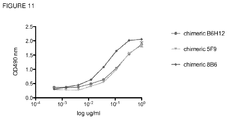
- CD47 binding activities of chimeric 5F9 and 8B6 were constructed and expressed. Purified antibodies were analyzed by SDS-PAGE, demonstrating that native IgG antibodies were formed for both. Then, binding activities of chimeric 5F9 and 8B6 were tested using ELISA by coating human CD47 soluble protein in the 96-well plates. As shown in figure 11 , both chimeric 5F9 and 8B6 bound the antigen at comparable levels to that of chimeric B6H12 antibody.
- human antibody framework regions FR
- the FRs of the mouse 5F9 VL region were found to have the highest homology with IGKV2 subgroup.
- the FRs of the mouse 5F9 VH region exhibited the highest homology with human VH-1 subgroup. Identical residues in the FRs were retained and non-identical residues were either retained or substituted based on molecular modeling.
- Three versions of each humanized VH and VL were designed. Sequence alignments of each version together with human germline sequences are indicated in figure 12 .
- Phagocytosis induced by 5F9 and 8B6 antibodies Phagocytosis induced by 5F9 and 8B6 antibodies.
- B6H12 antibody is known to block the interaction between CD47 and SIRP ⁇ that is expressed on macrophages and in turn to activate macrophages for phagocytic response.
- 5F9 and 8B6 antibodies ability to induce phagocytosis, we incubated the antibodies with human peripheral blood-derived macrophages and HL-60 target cells for 2 hr, and assessed phagocytosis by counting the number of ingested CFSE-labeled HL-60 cells under a microscope. As shown in Figure 14 , both mouse and chimeric 5F9 were able to elicit phagocytosis efficiently, as did chimeric 8B6.
- humanized 5F9 antibodies also displayed effective phagocytic activity.
- isotype control antibodies did not trigger macrophage-mediated phagocytosis.
Landscapes
- Health & Medical Sciences (AREA)
- Chemical & Material Sciences (AREA)
- Immunology (AREA)
- Life Sciences & Earth Sciences (AREA)
- Organic Chemistry (AREA)
- Medicinal Chemistry (AREA)
- General Health & Medical Sciences (AREA)
- Molecular Biology (AREA)
- Proteomics, Peptides & Aminoacids (AREA)
- Biochemistry (AREA)
- Engineering & Computer Science (AREA)
- Genetics & Genomics (AREA)
- Biophysics (AREA)
- Hematology (AREA)
- Animal Behavior & Ethology (AREA)
- Veterinary Medicine (AREA)
- Public Health (AREA)
- Pharmacology & Pharmacy (AREA)
- Nuclear Medicine, Radiotherapy & Molecular Imaging (AREA)
- General Chemical & Material Sciences (AREA)
- Chemical Kinetics & Catalysis (AREA)
- Biomedical Technology (AREA)
- Urology & Nephrology (AREA)
- Cell Biology (AREA)
- Biotechnology (AREA)
- General Physics & Mathematics (AREA)
- Microbiology (AREA)
- Pathology (AREA)
- Food Science & Technology (AREA)
- Physics & Mathematics (AREA)
- Analytical Chemistry (AREA)
- Oncology (AREA)
- Bioinformatics & Cheminformatics (AREA)
- Peptides Or Proteins (AREA)
- Medicines Containing Antibodies Or Antigens For Use As Internal Diagnostic Agents (AREA)
- Preparation Of Compounds By Using Micro-Organisms (AREA)
- Micro-Organisms Or Cultivation Processes Thereof (AREA)
- Measuring Or Testing Involving Enzymes Or Micro-Organisms (AREA)
Priority Applications (4)
| Application Number | Priority Date | Filing Date | Title |
|---|---|---|---|
| EP16200105.1A EP3181149A1 (en) | 2010-05-14 | 2011-05-13 | Humanized and chimeric monoclonal antibodies to cd47 |
| EP23214925.2A EP4349868A3 (en) | 2010-05-14 | 2011-05-13 | Humanized and chimeric monoclonal antibodies to cd47 |
| EP20198499.4A EP3789038B1 (en) | 2010-05-14 | 2011-05-13 | Humanized and chimeric monoclonal antibodies to cd47 |
| HRP20170254TT HRP20170254T1 (hr) | 2010-05-14 | 2011-05-13 | Humanizirana i kimerna monoklonska protutijela usmjerena na cd47 |
Applications Claiming Priority (2)
| Application Number | Priority Date | Filing Date | Title |
|---|---|---|---|
| US39565210P | 2010-05-14 | 2010-05-14 | |
| PCT/US2011/036535 WO2011143624A2 (en) | 2010-05-14 | 2011-05-13 | Humanized and chimeric monoclonal antibodies to cd47 |
Related Child Applications (3)
| Application Number | Title | Priority Date | Filing Date |
|---|---|---|---|
| EP20198499.4A Division EP3789038B1 (en) | 2010-05-14 | 2011-05-13 | Humanized and chimeric monoclonal antibodies to cd47 |
| EP16200105.1A Division EP3181149A1 (en) | 2010-05-14 | 2011-05-13 | Humanized and chimeric monoclonal antibodies to cd47 |
| EP23214925.2A Division EP4349868A3 (en) | 2010-05-14 | 2011-05-13 | Humanized and chimeric monoclonal antibodies to cd47 |
Publications (3)
| Publication Number | Publication Date |
|---|---|
| EP2569013A2 EP2569013A2 (en) | 2013-03-20 |
| EP2569013A4 EP2569013A4 (en) | 2015-04-08 |
| EP2569013B1 true EP2569013B1 (en) | 2016-11-23 |
Family
ID=44915009
Family Applications (4)
| Application Number | Title | Priority Date | Filing Date |
|---|---|---|---|
| EP11781385.7A Active EP2569013B1 (en) | 2010-05-14 | 2011-05-13 | Humanized and chimeric monoclonal antibodies to cd47 |
| EP20198499.4A Active EP3789038B1 (en) | 2010-05-14 | 2011-05-13 | Humanized and chimeric monoclonal antibodies to cd47 |
| EP23214925.2A Pending EP4349868A3 (en) | 2010-05-14 | 2011-05-13 | Humanized and chimeric monoclonal antibodies to cd47 |
| EP16200105.1A Ceased EP3181149A1 (en) | 2010-05-14 | 2011-05-13 | Humanized and chimeric monoclonal antibodies to cd47 |
Family Applications After (3)
| Application Number | Title | Priority Date | Filing Date |
|---|---|---|---|
| EP20198499.4A Active EP3789038B1 (en) | 2010-05-14 | 2011-05-13 | Humanized and chimeric monoclonal antibodies to cd47 |
| EP23214925.2A Pending EP4349868A3 (en) | 2010-05-14 | 2011-05-13 | Humanized and chimeric monoclonal antibodies to cd47 |
| EP16200105.1A Ceased EP3181149A1 (en) | 2010-05-14 | 2011-05-13 | Humanized and chimeric monoclonal antibodies to cd47 |
Country Status (13)
| Country | Link |
|---|---|
| US (6) | US9017675B2 (cg-RX-API-DMAC7.html) |
| EP (4) | EP2569013B1 (cg-RX-API-DMAC7.html) |
| JP (6) | JP6166177B2 (cg-RX-API-DMAC7.html) |
| AU (5) | AU2011252851B2 (cg-RX-API-DMAC7.html) |
| CA (2) | CA2797720C (cg-RX-API-DMAC7.html) |
| DK (2) | DK3789038T3 (cg-RX-API-DMAC7.html) |
| ES (2) | ES2937174T3 (cg-RX-API-DMAC7.html) |
| HR (2) | HRP20221260T1 (cg-RX-API-DMAC7.html) |
| HU (2) | HUE060541T2 (cg-RX-API-DMAC7.html) |
| LT (1) | LT3789038T (cg-RX-API-DMAC7.html) |
| PL (1) | PL3789038T3 (cg-RX-API-DMAC7.html) |
| PT (2) | PT2569013T (cg-RX-API-DMAC7.html) |
| WO (1) | WO2011143624A2 (cg-RX-API-DMAC7.html) |
Cited By (3)
| Publication number | Priority date | Publication date | Assignee | Title |
|---|---|---|---|---|
| EP3345924A1 (en) | 2017-01-10 | 2018-07-11 | Universität Duisburg-Essen | Use of cd47 antibodies |
| US11292836B2 (en) | 2017-08-29 | 2022-04-05 | Innovent Biologics (Suzhou) Co., Ltd. | Anti-CD47 antibodies and uses thereof |
| US11655296B2 (en) | 2018-03-27 | 2023-05-23 | Innovent Biologics (Suzhou) Co., Ltd. | Anti-CD47 antibody and use thereof |
Families Citing this family (176)
| Publication number | Priority date | Publication date | Assignee | Title |
|---|---|---|---|---|
| CA2711370C (en) | 2008-01-15 | 2017-06-13 | The Board Of Trustees Of The Leland Stanford Junior University | Markers of acute myeloid leukemia stem cells |
| US11072655B2 (en) | 2008-01-15 | 2021-07-27 | The Board Of Trustees Of The Leland Stanford Junior University | Markers of acute myeloid leukemia stem cells |
| PT3056515T (pt) * | 2008-01-15 | 2019-07-19 | Univ Leland Stanford Junior | Métodos para manipulação da fagocitose mediada por cd47 |
| DK2429574T3 (da) | 2009-05-15 | 2015-06-22 | Univ Health Network | Sammensætninger og fremgangsmåder til behandling af hæmatologiske cancere der targeterer sirp-cd47-interaktionen |
| AU2011252851B2 (en) * | 2010-05-14 | 2016-10-06 | The Board Of Trustees Of The Leland Stanford Junior University | Humanized and chimeric monoclonal antibodies to CD47 |
| US9873918B2 (en) | 2011-08-11 | 2018-01-23 | Albert Einstein College Of Medicine, Inc. | Treatment of acute myeloid leukemia and myelodysplastic syndromes |
| ME03512B (me) | 2012-02-06 | 2020-04-20 | Inhibrx Inc | Cd47 antitijela i postupci za njihovu upotrebu |
| RU2693078C2 (ru) | 2012-12-03 | 2019-07-01 | Новиммун С.А. | Анти-cd47 антитела и способы их применения |
| MX2015007446A (es) * | 2012-12-12 | 2015-12-07 | Vasculox Inc | Anticuerpos terapeuticos para cd47. |
| US9221908B2 (en) | 2012-12-12 | 2015-12-29 | Vasculox, Inc. | Therapeutic CD47 antibodies |
| ME03550B (me) | 2012-12-17 | 2020-07-20 | Trillium Therapeutics Inc | Lečenje cd47+ obolelih ćelija sa sirp alfa-fc fuzijama |
| WO2014121093A1 (en) | 2013-01-31 | 2014-08-07 | Thomas Jefferson University | Fusion proteins that facilitate cancer cell destruction |
| EP3311824B1 (en) | 2013-02-05 | 2020-03-25 | The Board of Trustees of the Leland Stanford Junior University | Cd47 targeted therapies for the treatment of infectious disease |
| SG10201706383XA (en) * | 2013-02-06 | 2017-09-28 | Inhibrx Lp | Non-platelet depleting and non-red blood cell depleting cd47 antibodies and methods of use thereof |
| CA2905418C (en) | 2013-03-13 | 2023-03-28 | The United States Of America, As Represented By The Secretary, Department Of Health And Human Services | Methods for modulating chemotherapeutic cytotoxicity |
| CN105189556A (zh) | 2013-03-15 | 2015-12-23 | 小利兰·斯坦福大学托管委员会 | 用于实现治疗有效剂量的抗cd47剂的方法 |
| WO2014179132A1 (en) | 2013-04-29 | 2014-11-06 | The Board Of Trustees Of The Leland Stanford Junior University | Use of anti-cd47 agents to enhance immunization |
| SG11201601823TA (en) | 2013-09-13 | 2016-04-28 | Genentech Inc | Methods and compositions comprising purified recombinant polypeptides |
| PL3044323T3 (pl) | 2013-09-13 | 2022-06-27 | F.Hoffmann-La Roche Ag | Sposoby wykrywania i ilościowego oznaczania białka komórki gospodarza w liniach komórkowych |
| ES2765483T3 (es) * | 2013-09-18 | 2020-06-09 | Univ Leland Stanford Junior | Modulación de las vías de eferocitosis para el tratamiento de una enfermedad aterosclerótica |
| US11046763B2 (en) | 2014-01-08 | 2021-06-29 | The Board Of Trustees Of The Leland Stanford Junior University | Targeted therapy for small cell lung cancer |
| ES2811274T3 (es) | 2014-04-18 | 2021-03-11 | Univ Leland Stanford Junior | Anticuerpos monoclonales humanizados y quiméricos para CD99 |
| ES2751915T5 (es) | 2014-08-15 | 2022-12-23 | Merck Patent Gmbh | Proteínas de fusión de inmunoglobulina con SIRP alfa |
| ES2945588T3 (es) | 2014-08-26 | 2023-07-04 | Univ Leland Stanford Junior | Injerto de células madre con una combinación de un agente dirigido a las células madre y modulación de señalización inmunoreguladora |
| US10822411B2 (en) * | 2014-09-15 | 2020-11-03 | The Board Of Trustees Of The Leland Stanford Junior University | Targeting aneurysm disease by modulating phagocytosis pathways |
| AU2015329696A1 (en) | 2014-10-10 | 2017-04-27 | The United States Of America, As Represented By The Secretary, Department Of Health And Human Services | Methods to eliminate cancer stem cells by targeting CD47 |
| WO2016065329A1 (en) | 2014-10-24 | 2016-04-28 | The Board Of Trustees Of The Leland Stanford Junior University | Compositions and methods for inducing phagocytosis of mhc class i positive cells and countering anti-cd47/sirpa resistance |
| WO2016081423A1 (en) * | 2014-11-18 | 2016-05-26 | Janssen Pharmaceutica Nv | Cd47 antibodies, methods, and uses |
| EP3247464B1 (en) | 2015-01-21 | 2019-09-18 | The Board of Trustees of the Leland Stanford Junior University | Use of tlr agonist and anti-cd47 agent to enhance phagocytosis of cancer cells |
| ES2838925T3 (es) | 2015-02-27 | 2021-07-02 | Univ Leland Stanford Junior | Terapia de combinación para el tratamiento de la ateroesclerosis |
| AR103868A1 (es) * | 2015-03-04 | 2017-06-07 | Sorrento Therapeutics Inc | Anticuerpos anti-cd47 como agentes terapéuticos |
| DK3277725T3 (da) | 2015-03-30 | 2021-01-11 | Regeneron Pharma | Konstante tungkædeområder med reduceret binding til FC-gammareceptorer |
| RU2740672C2 (ru) | 2015-08-07 | 2021-01-19 | ЭйЭлЭкс Онколоджи Инк. | Конструкции, имеющие sirp-альфа домен или его вариант |
| ES2894335T5 (es) | 2015-08-26 | 2024-06-27 | Univ Leland Stanford Junior | Reducción mejorada de células objetivo con bloqueo de CD47 y un agonista coestimulador inmune |
| CN116425875A (zh) | 2015-09-18 | 2023-07-14 | 安驰肿瘤公司 | 治疗性cd47抗体 |
| US9650441B2 (en) | 2015-09-21 | 2017-05-16 | Erasmus University Medical Center | Anti-CD47 antibodies and methods of use |
| PT3370768T (pt) * | 2015-11-03 | 2022-04-21 | Janssen Biotech Inc | Anticorpos que se ligam especificamente ao pd-1 e seus usos |
| JP6976960B2 (ja) | 2015-11-27 | 2021-12-08 | カーサリクス プロプライエタリー リミテッド | 遺伝子改変された細胞およびその使用 |
| KR102988978B1 (ko) | 2015-12-11 | 2026-07-10 | 더 보드 어브 트러스티스 어브 더 리랜드 스탠포드 주니어 유니버시티 | Cd47 및 egfr의 이중 표적화를 이용한 암의 치료 |
| CA3011097C (en) | 2016-01-11 | 2022-12-20 | Forty Seven, Inc. | Humanized, mouse or chimeric anti-cd47 monoclonal antibodies |
| AU2017210224B2 (en) | 2016-01-21 | 2024-02-08 | The Board Of Trustees Of The Leland Stanford Junior University | Treatment of cancer with combinations of immunoregulatory agents |
| KR20240016445A (ko) * | 2016-04-15 | 2024-02-06 | 더 보드 어브 트러스티스 어브 더 리랜드 스탠포드 주니어 유니버시티 | 암의 치료에서 항-cd47 제제의 치료적으로 효과적인 용량을 결정하고 달성하는 방법 |
| US9957576B2 (en) | 2016-04-21 | 2018-05-01 | The Board Of Trustees Of The Leland Stanford Junior University | Methods for determining responsiveness to an anti-CD47 agent |
| US11142548B2 (en) | 2016-05-10 | 2021-10-12 | Sorbonne Universite | Agents that activate CD47 and their use in the treatment of inflammation |
| CN106117354B (zh) * | 2016-06-24 | 2020-01-14 | 安徽未名细胞治疗有限公司 | 一种全人源抗CD47的全分子IgG抗体及其应用 |
| JP7241677B2 (ja) * | 2016-07-19 | 2023-03-17 | テバ・ファーマシューティカルズ・オーストラリア・ピーティワイ・リミテッド | 抗cd47併用療法 |
| WO2018014068A1 (en) * | 2016-07-19 | 2018-01-25 | Teva Pharmaceuticals Australia Pty Ltd | Attenuated type i ifn cd47 combination therapy |
| EP3493845A4 (en) | 2016-08-03 | 2020-04-15 | The Board of Trustees of the Leland Stanford Junior University | INTERRUPTION OF FC RECEPTOR USE ON MACROPHAGES TO IMPROVE THE EFFECTIVENESS OF ANTI-SIRPALPHA ANTIBODY THERAPY |
| US20200140565A1 (en) | 2016-10-20 | 2020-05-07 | I-Mab | Novel cd47 monoclonal antibodies and uses thereof |
| EP3529276A4 (en) | 2016-10-21 | 2020-06-17 | Arch Oncology, Inc. | CD47 THERAPEUTIC ANTIBODIES |
| EP3532497B1 (en) | 2016-10-26 | 2024-07-24 | The Board of Trustees of the Leland Stanford Junior University | Modified immunoglobulin hinge regions to reduce hemagglutination |
| CA3042581A1 (en) | 2016-11-03 | 2018-05-11 | Trillium Therapeutics Inc. | Enhancement of cd47 blockade therapy by proteasome inhibitors |
| EP3538557A4 (en) * | 2016-11-08 | 2020-11-18 | Ablexis, LLC | ANTI-CD47 ANTIBODY |
| TW201819413A (zh) * | 2016-11-28 | 2018-06-01 | 大陸商江蘇恆瑞醫藥股份有限公司 | Cd47抗體、其抗原結合片段及其醫藥用途 |
| KR102607101B1 (ko) * | 2017-01-26 | 2023-11-29 | 제트엘아이피 홀딩 리미티드 | Cd47 항원 결합 유닛 및 그것의 사용 |
| IL301075B2 (en) | 2017-01-30 | 2024-05-01 | Univ Leland Stanford Junior | A genotoxic matching regimen for stem cell transplantation |
| CN108424461B (zh) * | 2017-02-14 | 2023-03-31 | 亘喜生物科技(上海)有限公司 | Cd47-car-t细胞 |
| CN110300603B (zh) | 2017-02-14 | 2023-04-14 | 亘喜生物科技(上海)有限公司 | Cd47-car-t细胞 |
| CA3053392A1 (en) | 2017-02-28 | 2018-09-07 | The Board Of Trustees Of The Leland Stanford Junior University | Antifibrotic activity of cd47 blockade |
| WO2018165015A1 (en) | 2017-03-09 | 2018-09-13 | The Board Of Trustees Of The Leland Stanford Junior University | Treatment of pediatric brain tumors with targeting of cd47 pathway |
| WO2018236904A1 (en) | 2017-06-19 | 2018-12-27 | Surface Oncology, Inc. | COMBINATION OF ANTI-CD47 ANTIBODIES AND CELL DEATH INDUCING AGENTS, AND USES THEREOF |
| ES2976558T3 (es) | 2017-06-21 | 2024-08-05 | The Board Of Trustees Of The Leland Stanfordjunior Univ | Parámetros de dosificación para terapias de direccionamiento de CD47 en neoplasias hematológicas |
| WO2019014398A1 (en) | 2017-07-11 | 2019-01-17 | Actym Therapeutics, Inc. | MODIFIED IMMUNOSTIMULATORY BACTERIAL STRAINS AND USES THEREOF |
| MX2020001309A (es) | 2017-08-02 | 2020-08-20 | Phanes Therapeutics Inc | Anticuerpos anti-cd47 y sus usos. |
| WO2019034895A1 (en) | 2017-08-18 | 2019-02-21 | Ultrahuman Four Limited | LIAISON AGENTS |
| EA039662B1 (ru) | 2017-10-03 | 2022-02-24 | Закрытое Акционерное Общество "Биокад" | Антитела, специфичные к cd47 и pd-l1 |
| EP4194470A1 (en) | 2017-10-18 | 2023-06-14 | Forty Seven, Inc. | Treatment of ovarian cancer with anti-cd47 and anti-pd-l1 |
| PL4177270T3 (pl) | 2017-10-18 | 2024-11-18 | Forty Seven, Inc. | Terapia nowotworu złośliwego jajnika w oparciu o środek anty-cd47 |
| AR113862A1 (es) * | 2017-12-01 | 2020-06-17 | Seattle Genetics Inc | Anticuerpos anti-cd47 y sus usos para tratar cáncer |
| WO2019129054A1 (zh) | 2017-12-27 | 2019-07-04 | 信达生物制药(苏州)有限公司 | 三链抗体、其制备方法及其用途 |
| BR112020014202A2 (pt) | 2018-01-12 | 2020-12-01 | Aurigene Discovery Technologies Limited | compostos de 1,2,4-oxadiazol como inibidores de vias de sinalização cd47 |
| US12398209B2 (en) | 2018-01-22 | 2025-08-26 | Janssen Biotech, Inc. | Methods of treating cancers with antagonistic anti-PD-1 antibodies |
| EP3752190B1 (en) | 2018-02-12 | 2022-07-06 | Forty Seven, Inc. | Anti-cancer regimen using anti-cd47 and anti-cd20 antibodies |
| CN110144009B (zh) * | 2018-02-14 | 2020-01-21 | 上海洛启生物医药技术有限公司 | Cd47单域抗体及其用途 |
| GB201804860D0 (en) * | 2018-03-27 | 2018-05-09 | Ultrahuman Two Ltd | CD47 Binding agents |
| WO2019200357A1 (en) | 2018-04-12 | 2019-10-17 | Surface Oncology, Inc. | Biomarker for cd47 targeting therapeutics and uses therefor |
| CN110538321B (zh) * | 2018-05-29 | 2023-03-10 | 江苏恒瑞医药股份有限公司 | 一种cd47抗体药物组合物及其用途 |
| CN110577597B (zh) * | 2018-06-11 | 2021-10-22 | 康诺亚生物医药科技(成都)有限公司 | 一种阻断CD47和SIRPα相互作用的抗体 |
| EP3808376A4 (en) | 2018-06-17 | 2021-09-01 | L&L Biopharma Co., Ltd. | CLDN18.2 ANTIBODY, BISPECIFIC ANTIBODY, ADC AND CAR, AND APPLICATIONS THEREOF |
| WO2020009725A1 (en) * | 2018-07-05 | 2020-01-09 | Trican Biotechnology Co., Ltd | Human anti-cd47 antibodies and uses thereof |
| MX2020013068A (es) | 2018-07-10 | 2021-03-02 | Univ Kobe Nat Univ Corp | Anticuerpo anti proteína reguladora de señales alfa sirpalfana. |
| CA3176812A1 (en) | 2018-07-11 | 2020-01-16 | Actym Therapeutics, Inc. | Engineered immunostimulatory bacterial strains and uses thereof |
| MY204234A (en) | 2018-08-27 | 2024-08-16 | Regeneron Pharma | Use of raman spectroscopy in downstream purification |
| WO2020047161A2 (en) | 2018-08-28 | 2020-03-05 | Actym Therapeutics, Inc. | Engineered immunostimulatory bacterial strains and uses thereof |
| KR102587442B1 (ko) * | 2018-08-31 | 2023-10-11 | 난징 산홈 팔마세우티칼 컴퍼니 리미티드 | 항-cd47 항체 또는 그 적용 |
| US12331320B2 (en) | 2018-10-10 | 2025-06-17 | The Research Foundation For The State University Of New York | Genome edited cancer cell vaccines |
| AU2019375193A1 (en) | 2018-11-08 | 2021-05-13 | Aurigene Oncology Limited | Combination of small molecule CD-47 inhibitors with other anti-cancer agents |
| UA128431C2 (uk) | 2018-11-26 | 2024-07-10 | Форті Севен, Інк. | ГУМАНІЗОВАНЕ АНТИТІЛО ДО c-Kit |
| KR20210094609A (ko) | 2018-11-28 | 2021-07-29 | 포티 세븐, 인코포레이티드 | 절제 레짐에 대해 저항성인 유전적으로 변형된 hspc |
| CN113166257B (zh) | 2018-12-03 | 2023-05-30 | 上海开拓者生物医药有限公司 | Cd47抗体及其制备方法和应用 |
| JP2022521624A (ja) * | 2019-02-26 | 2022-04-11 | イノベント バイオロジックス (スウツォウ) カンパニー,リミテッド | 抗cd47抗体を含む製剤、その調製方法および使用 |
| EP3936526A4 (en) | 2019-03-06 | 2023-03-08 | Jiangsu Hengrui Pharmaceuticals Co., Ltd. | BIFUNCTIONAL FUSION PROTEIN AND PHARMACEUTICAL USE THEREOF |
| WO2020198353A1 (en) * | 2019-03-26 | 2020-10-01 | Forty Seven, Inc. | Multispecific agents for treatment of cancer |
| WO2020206033A1 (en) | 2019-04-02 | 2020-10-08 | Kenjockety Biotechnology, Inc. | Efflux pump-cancer antigen multi-specific antibodies and compositions, reagents, kits and methods related thereto |
| CN110003335B (zh) * | 2019-04-12 | 2023-07-04 | 深圳普瑞金生物药业股份有限公司 | Cd47单域抗体、核酸及试剂盒 |
| CA3141130A1 (en) | 2019-05-31 | 2020-12-03 | ALX Oncology Inc. | Methods of treating cancer with sirp alpha fc fusion in combination with an immune checkpoint inhibitor |
| TW202112354A (zh) * | 2019-06-05 | 2021-04-01 | 美商西雅圖遺傳學公司 | 遮蔽抗體調配物 |
| TW202112801A (zh) | 2019-06-05 | 2021-04-01 | 美商西雅圖遺傳學公司 | 純化遮蔽抗體之方法 |
| AU2020315598B2 (en) | 2019-07-16 | 2024-12-12 | Gilead Sciences, Inc. | HIV vaccines and methods of making and using |
| US20220288118A1 (en) * | 2019-07-31 | 2022-09-15 | Forty Seven, Inc. | Depletion regimes for engineered t-cell or nk-cell therapy |
| JP7808546B2 (ja) | 2019-09-03 | 2026-01-29 | 中山康方生物医▲藥▼有限公司 | 抗cd47モノクローナル抗体及びその使用 |
| AU2020350205A1 (en) | 2019-09-18 | 2022-05-12 | Lamkap Bio Alpha AG | Bispecific antibodies against CEACAM5 and CD3 |
| CN112646038B (zh) | 2019-10-11 | 2025-06-03 | 迈威(上海)生物科技股份有限公司 | 抗人Trop-2抗体及其应用 |
| PH12022550835A1 (en) | 2019-10-18 | 2023-07-03 | Forty Seven Inc | Combination therapies for treating myelodysplastic syndromes and acute myeloid leukemia |
| NZ786589A (en) | 2019-10-31 | 2025-03-28 | Forty Seven Llc | Anti-cd47 and anti-cd20 based treatment of blood cancer |
| WO2021108693A1 (en) | 2019-11-27 | 2021-06-03 | ALX Oncology Inc. | Combination therapies for treating cancer |
| GB201918230D0 (en) | 2019-12-11 | 2020-01-22 | Prec Therapeutics Ltd | Antibodies and their uses |
| CN115362003B (zh) | 2019-12-24 | 2024-03-22 | 卡尔那生物科学株式会社 | 二酰基甘油激酶调节化合物 |
| CN114929749A (zh) | 2020-01-09 | 2022-08-19 | 信达生物制药(苏州)有限公司 | 抗cd47抗体和抗cd20抗体的组合在制备用于预防或治疗肿瘤的药物中的应用 |
| US12692311B2 (en) | 2020-01-29 | 2026-07-28 | William Robert Arathoon Living Trust Dated August 29, 2016 | Anti-MDR1 antibodies and uses thereof |
| TWI890283B (zh) | 2020-02-14 | 2025-07-11 | 美商基利科學股份有限公司 | 結合ccr8之抗體及融合蛋白及其用途 |
| WO2021170772A1 (en) | 2020-02-26 | 2021-09-02 | Aprea Therapeutics Ab | Combination treatment with a p53 reactivator and an inhibitor of cd47 mediated signaling |
| WO2021170082A1 (zh) | 2020-02-28 | 2021-09-02 | 南京圣和药业股份有限公司 | 抗cd47/抗pd-l1抗体及其应用 |
| US12091681B2 (en) | 2020-03-27 | 2024-09-17 | Mendus B.V. | Ex vivo use of modified cells of leukemic origin for enhancing the efficacy of adoptive cell therapy |
| CN113461817B (zh) | 2020-03-31 | 2025-04-18 | 苏州泽璟生物制药股份有限公司 | 一种抗人cd47抗体及其抗原结合片段、制备方法和应用 |
| US20240294635A1 (en) | 2020-04-02 | 2024-09-05 | Chia Tai Tianqing Pharmaceutical Group Co., Ltd. | Antigen-binding polypeptide binding to cd47, and use thereof |
| EP4168449A1 (en) | 2020-06-22 | 2023-04-26 | MorphoSys AG | Anti-tumor combination therapy comprising anti-cd19 antibody and polypeptides blocking the sirpa-cd47 innate immune checkpoint |
| WO2022003568A1 (en) | 2020-06-30 | 2022-01-06 | Dcprime B.V. | Use of leukemia-derived cells in ovarian cancer vaccines |
| CA3200514A1 (en) | 2020-11-03 | 2022-05-12 | Rdiscovery, LLC | Therapies for treatment of cancer and phagocytosis-deficiency related diseases |
| WO2022095970A1 (zh) | 2020-11-06 | 2022-05-12 | 百奥泰生物制药股份有限公司 | 双特异抗体及其应用 |
| EP4253415A4 (en) | 2020-11-12 | 2024-10-02 | Mabwell (Shanghai) Bioscience Co., Ltd. | Antibody and preparation method therefor |
| US12551584B1 (en) | 2020-12-07 | 2026-02-17 | Actinium Pharmaceuticals, Inc. | Lewis Y radioimmunotherapy for the treatment of cancer |
| WO2022130016A1 (en) | 2020-12-18 | 2022-06-23 | Instil Bio (Uk) Limited | Tumor infiltrating lymphocytes and anti-cd47 therapeutics |
| JP7454044B2 (ja) | 2020-12-23 | 2024-03-21 | グアンドン ファポン バイオファーマ インコーポレイテッド | Cd47を標的とする抗体及びその使用 |
| CN116917322A (zh) | 2021-02-19 | 2023-10-20 | 沙裴隆有限公司 | 针对pd-l1及cd47的双特异性单域抗体及其用途 |
| BR112023016713A2 (pt) | 2021-02-19 | 2023-10-31 | Seoul Nat Univ R&Db Foundation | Anticorpo ou um fragmento de ligação ao antígeno do mesmo, molécula de ácido nucleico, métodos para produzir um anticorpo ou um fragmento de ligação ao antígeno do mesmo e para detectar agrupamento de diferenciação 47 ou determinar uma quantidade de agrupamento de diferenciação 47 em uma amostra, e, uso do anticorpo ou de um fragmento de ligação ao antígeno do mesmo |
| WO2022190058A1 (en) | 2021-03-12 | 2022-09-15 | Dcprime B.V. | Methods of vaccination and use of cd47 blockade |
| WO2022206975A1 (zh) * | 2021-04-02 | 2022-10-06 | 原启生物科技(上海)有限责任公司 | Cldn18.2抗原结合蛋白及其用途 |
| TW202302145A (zh) | 2021-04-14 | 2023-01-16 | 美商基利科學股份有限公司 | CD47/SIRPα結合及NEDD8活化酶E1調節次單元之共抑制以用於治療癌症 |
| JP2024520902A (ja) | 2021-05-13 | 2024-05-27 | エーエルエックス オンコロジー インコーポレイテッド | がんを治療するための併用療法 |
| EP4353265A4 (en) | 2021-06-10 | 2024-10-02 | ONO Pharmaceutical Co., Ltd. | METHOD OF TREATING CANCER BY MEANS OF A COMBINATION OF A CD47 INHIBITOR, AN IMMUNE CHECKPOINT INHIBITOR AND STANDARD THERAPY |
| EP4359413A1 (en) | 2021-06-23 | 2024-05-01 | Gilead Sciences, Inc. | Diacylglyercol kinase modulating compounds |
| CN117355531A (zh) | 2021-06-23 | 2024-01-05 | 吉利德科学公司 | 二酰基甘油激酶调节化合物 |
| MX2023014762A (es) | 2021-06-23 | 2024-01-15 | Gilead Sciences Inc | Compuestos moduladores de diacilglicerol quinasa. |
| JP7651018B2 (ja) | 2021-06-23 | 2025-03-25 | ギリアード サイエンシーズ, インコーポレイテッド | ジアシルグリセロールキナーゼ調節化合物 |
| US20240165229A1 (en) | 2021-06-29 | 2024-05-23 | Seagen Inc. | Methods of treating cancer with a combination of a nonfucosylated anti-cd70 antibody and a cd47 antagonist |
| CN115702931A (zh) | 2021-08-06 | 2023-02-17 | 百奥泰生物制药股份有限公司 | 抗pd-l1/cd47双特异抗体在治疗疾病中的应用 |
| CN115925940B (zh) * | 2021-08-24 | 2026-02-27 | 上海鑫湾生物科技有限公司 | 特异性结合cd47的抗体、其重组溶瘤病毒及其用途 |
| AR127270A1 (es) * | 2021-10-09 | 2024-01-03 | Hutchmed Ltd | Formulación de anticuerpos anti-cd47 |
| CN115991784A (zh) | 2021-10-19 | 2023-04-21 | 宝船生物医药科技(上海)有限公司 | 抗cd47-cldn18.2双特异性抗体及其用途 |
| EP4423078A1 (en) | 2021-10-28 | 2024-09-04 | Gilead Sciences, Inc. | Pyridizin-3(2h)-one derivatives |
| PE20241186A1 (es) | 2021-10-29 | 2024-06-03 | Gilead Sciences Inc | Compuestos de cd73 |
| WO2023092089A1 (en) | 2021-11-19 | 2023-05-25 | Kist (Korea Institute Of Science And Technology) | Therapeutic compounds for red blood cell-mediated delivery of an active pharmaceutical ingredient to a target cell |
| CN118488948A (zh) | 2021-12-22 | 2024-08-13 | 吉利德科学公司 | Ikaros锌指家族降解剂及其用途 |
| US20240124412A1 (en) | 2021-12-22 | 2024-04-18 | Gilead Sciences, Inc. | Ikaros zinc finger family degraders and uses thereof |
| EP4458862A4 (en) * | 2021-12-27 | 2026-05-06 | Shanghai Sinobay Biotechnology Co Ltd | BI-SPECIFIC T-LYMPHOCYTE ACTIVATOR, RECOMINATING ONCOLYTIC VIRUS OF THIS ONE AND ASSOCIATED USE |
| CA3248911A1 (en) | 2022-01-28 | 2023-08-03 | Gilead Sciences, Inc. | POLY(ADENOSINE DIPHOSPHATE-RIBOSE) POLYMERASE 7 INHIBITORS |
| EP4479084A1 (en) | 2022-02-14 | 2024-12-25 | Sana Biotechnology, Inc. | Methods of treating patients exhibiting a prior failed therapy with hypoimmunogenic cells |
| CN114573710A (zh) * | 2022-02-16 | 2022-06-03 | 南方医科大学珠江医院 | 一种靶向抗原同时外泌cd47抗体的免疫细胞及其应用 |
| PL4245756T3 (pl) | 2022-03-17 | 2025-02-17 | Gilead Sciences, Inc. | Środki degradujące palec cynkowy z rodziny ikaros i ich zastosowania |
| WO2023183313A1 (en) | 2022-03-22 | 2023-09-28 | Sana Biotechnology, Inc. | Engineering cells with a transgene in b2m or ciita locus and associated compositions and methods |
| AU2023240346A1 (en) | 2022-03-24 | 2024-09-19 | Gilead Sciences, Inc. | Combination therapy for treating trop-2 expressing cancers |
| TWI876305B (zh) | 2022-04-05 | 2025-03-11 | 美商基利科學股份有限公司 | 用於治療結腸直腸癌之組合療法 |
| EP4511127A1 (en) | 2022-04-21 | 2025-02-26 | Gilead Sciences, Inc. | Kras g12d modulating compounds |
| EP4527853A1 (en) | 2022-05-19 | 2025-03-26 | Shaperon Inc. | Bispecific humanized single domain antibody to pd-l1 and cd47, and use thereof |
| WO2024006929A1 (en) | 2022-07-01 | 2024-01-04 | Gilead Sciences, Inc. | Cd73 compounds |
| CA3259040A1 (en) | 2022-07-12 | 2024-01-18 | Gilead Sciences, Inc. | HIV Immunogenic Polypeptides and Vaccines and Their Uses |
| US20240091351A1 (en) | 2022-09-21 | 2024-03-21 | Gilead Sciences, Inc. | FOCAL IONIZING RADIATION AND CD47/SIRPa DISRUPTION ANTICANCER COMBINATION THERAPY |
| CN119968212A (zh) * | 2022-10-14 | 2025-05-09 | 南京传奇生物科技有限公司 | 靶向cd47的抗体及其用途 |
| EP4638436A1 (en) | 2022-12-22 | 2025-10-29 | Gilead Sciences, Inc. | Prmt5 inhibitors and uses thereof |
| WO2024146553A1 (en) * | 2023-01-04 | 2024-07-11 | Wuxi Biologics (Shanghai) Co., Ltd. | Antibodies against cd47, method for preparing the same, and use thereof |
| CN116836290B (zh) * | 2023-01-04 | 2024-10-22 | 科弈(浙江)药业科技有限公司 | 针对pd-l1和cd47的双特异性抗体、其制备方法及其用途 |
| WO2024215754A1 (en) | 2023-04-11 | 2024-10-17 | Gilead Sciences, Inc. | Kras modulating compounds |
| PE20260121A1 (es) | 2023-04-21 | 2026-01-16 | Gilead Sciences Inc | Inhibidores de prmt5 y usos de los mismos |
| JP2026522894A (ja) | 2023-06-30 | 2026-07-09 | ギリアード サイエンシーズ, インコーポレイテッド | Kras調節化合物 |
| CN121568935A (zh) | 2023-07-26 | 2026-02-24 | 吉利德科学公司 | Parp7抑制剂 |
| AU2024297978A1 (en) | 2023-07-26 | 2026-02-05 | Gilead Sciences, Inc. | Parp7 inhibitors |
| EP4516807A1 (en) | 2023-08-28 | 2025-03-05 | Consorcio Centro de Investigación Biomédica en Red | Compositions for use in a method of providing improved hematopoietic stem cell engraftment |
| EP4774280A1 (en) | 2023-09-08 | 2026-07-15 | Gilead Sciences, Inc. | Kras g12d modulating compounds |
| US20250109147A1 (en) | 2023-09-08 | 2025-04-03 | Gilead Sciences, Inc. | Kras g12d modulating compounds |
| WO2025096589A1 (en) | 2023-11-03 | 2025-05-08 | Gilead Sciences, Inc. | Prmt5 inhibitors and uses thereof |
| US20250230168A1 (en) | 2023-12-22 | 2025-07-17 | Gilead Sciences, Inc. | Azaspiro wrn inhibitors |
| WO2025245003A1 (en) | 2024-05-21 | 2025-11-27 | Gilead Sciences, Inc. | Prmt5 inhibitors and uses thereof |
| US20260098049A1 (en) | 2024-08-12 | 2026-04-09 | Gilead Sciences, Inc. | Kras modulating compounds |
| US20260130893A1 (en) | 2024-10-21 | 2026-05-14 | Gilead Sciences, Inc. | Prmt5 inhibitors and uses thereof |
| WO2026136515A1 (en) | 2024-12-19 | 2026-06-25 | Gilead Sciences, Inc. | Parp7 inhibitors |
Family Cites Families (54)
| Publication number | Priority date | Publication date | Assignee | Title |
|---|---|---|---|---|
| GB1549776A (en) | 1975-08-07 | 1979-08-08 | Girling Ltd | Double acting valved pistons |
| US4275149A (en) | 1978-11-24 | 1981-06-23 | Syva Company | Macromolecular environment control in specific receptor assays |
| JPS5547656U (cg-RX-API-DMAC7.html) | 1978-09-22 | 1980-03-28 | ||
| US4867973A (en) | 1984-08-31 | 1989-09-19 | Cytogen Corporation | Antibody-therapeutic agent conjugates |
| US4946778A (en) | 1987-09-21 | 1990-08-07 | Genex Corporation | Single polypeptide chain binding molecules |
| US5057604A (en) * | 1988-08-03 | 1991-10-15 | Washington University | Novel monoclonal antibodies |
| US5530101A (en) * | 1988-12-28 | 1996-06-25 | Protein Design Labs, Inc. | Humanized immunoglobulins |
| JPH0747841B2 (ja) | 1991-02-15 | 1995-05-24 | ゼニヤ海洋サービス株式会社 | 浮体の自沈装置 |
| PT528767E (pt) * | 1991-08-21 | 2000-06-30 | Novartis Ag | Derivados de anticorpos |
| US5792852A (en) * | 1992-11-16 | 1998-08-11 | Cancer Research Fund Of Contra Costa | Polynucleotides encoding modified antibodies with human milk fat globule specificity |
| US6986890B1 (en) * | 1996-11-21 | 2006-01-17 | Kyowa Hakko Kogyo Co., Ltd. | Anti-human VEGF receptor Flt-1 monoclonal antibody |
| US6908763B1 (en) | 1997-08-22 | 2005-06-21 | The Board Of Trustees Of The Leland Stanford Junior University | Mammalian common lymphoid progenitor cell |
| US6051228A (en) * | 1998-02-19 | 2000-04-18 | Bristol-Myers Squibb Co. | Antibodies against human CD40 |
| US6491917B1 (en) | 1998-07-31 | 2002-12-10 | Stemcell Technologies Inc. | Antibody composition for debulking blood and bone marrow samples from CML patients |
| ATE413466T1 (de) * | 1998-09-02 | 2008-11-15 | Diadexus Inc | Verfahren zur diagnose, bewertung sowie bilddarstellung verschiedener krebserkrankungen |
| AU1208200A (en) * | 1998-10-15 | 2000-05-01 | Genetics Institute Inc. | Secreted expressed sequence tags (sests) |
| US20030096976A1 (en) * | 1998-11-17 | 2003-05-22 | Hong Hyo Jeong | Humanized antibodies LB-00503 and LB-00506 specific for human 4-1BB and pharmaceutical compositions comprising said humanized antibodies |
| AU2940900A (en) * | 1999-03-10 | 2000-09-28 | Chugai Seiyaku Kabushiki Kaisha | Single-stranded fv inducing apoptosis |
| US20090087878A9 (en) * | 1999-05-06 | 2009-04-02 | La Rosa Thomas J | Nucleic acid molecules associated with plants |
| DE60036470T2 (de) | 1999-06-29 | 2008-06-19 | The Board Of Trustees Of The Leland Stanford Junior University, Palo Alto | Untereinheiten von myeloid-progenitorzellen von säugern |
| ATE510855T1 (de) | 2000-03-06 | 2011-06-15 | Univ Kentucky Res Found | Verwendung eines antikörpers oder eines immunotoxins, der bzw. das selektiv an cd123 bindet zur beeinträchtigung hämatologischer krebs-vorläuferzellen |
| US6838250B2 (en) * | 2000-03-31 | 2005-01-04 | Ortho-Clinical Diagnostics, Inc. | Immunoassay for C-reactive protein |
| CN1308447C (zh) * | 2000-10-20 | 2007-04-04 | 中外制药株式会社 | 低分子化的激动剂抗体 |
| US7408041B2 (en) * | 2000-12-08 | 2008-08-05 | Alexion Pharmaceuticals, Inc. | Polypeptides and antibodies derived from chronic lymphocytic leukemia cells and uses thereof |
| US20050118164A1 (en) | 2001-03-09 | 2005-06-02 | William Herman | Targeted ligands |
| US20050142539A1 (en) | 2002-01-14 | 2005-06-30 | William Herman | Targeted ligands |
| JP3632668B2 (ja) | 2002-02-18 | 2005-03-23 | ミノルタ株式会社 | デジタルカメラ |
| CA2480059C (en) * | 2002-03-22 | 2015-11-24 | Amrad Operations Pty. Ltd. | Monoclonal antibody against interleukin-13 receptor alpha 1 (il-13r.alpha.1) |
| AR045563A1 (es) * | 2003-09-10 | 2005-11-02 | Warner Lambert Co | Anticuerpos dirigidos a m-csf |
| JP4637749B2 (ja) | 2003-11-11 | 2011-02-23 | 中外製薬株式会社 | ヒト化抗cd47抗体 |
| US7622112B2 (en) * | 2003-12-05 | 2009-11-24 | Jody Berry | Anti-SARS monoclonal antibodies |
| US20070287163A1 (en) | 2004-05-17 | 2007-12-13 | Crucell Holland B.V. | Methods for Diagnosis of Acute Myeloid Leukemia |
| EP1853630A1 (en) * | 2004-10-22 | 2007-11-14 | Applied Molecular Evolution Inc. | Methods of optimizing antibody variable region binding affinity |
| EP2172487A1 (en) | 2005-04-22 | 2010-04-07 | Morphotek Inc. | Antibodies with Immune Effector Activity that Internalize in Folate Receptor Alpha-Positive Cells |
| CA2613818C (en) * | 2005-06-30 | 2013-08-27 | Centocor, Inc. | Anti-il-23 antibodies, compositions, methods and uses |
| US7888486B2 (en) * | 2005-08-19 | 2011-02-15 | Wyeth Llc | Antagonist antibodies against GDF-8 |
| ME02705B (me) * | 2005-08-31 | 2017-10-20 | Merck Sharp & Dohme | Inženjerisana anti-il-23 antitela |
| WO2007033221A2 (en) | 2005-09-13 | 2007-03-22 | The General Hospital Corporation | Methods and compositions for inhibition of immune responses |
| KR101336106B1 (ko) | 2005-09-16 | 2013-12-05 | 얀센 파마슈티카 엔.브이. | 히스타민 h3 수용체의 조절제로서 사이클로프로필 아민 |
| US20090191202A1 (en) * | 2005-09-29 | 2009-07-30 | Jamieson Catriona Helen M | Methods for manipulating phagocytosis mediated by CD47 |
| US7514229B2 (en) | 2005-09-29 | 2009-04-07 | The Board Of Trustees Of The Leland Stanford Junior University | Methods for diagnosing and evaluating treatment of blood disorders |
| WO2007064919A2 (en) * | 2005-12-02 | 2007-06-07 | Genentech, Inc. | Binding polypeptides with restricted diversity sequences |
| WO2007133811A2 (en) * | 2006-05-15 | 2007-11-22 | Viral Logic Systems Technology Corp. | Cd47 related compositions and methods for treating immunological diseases and disorders |
| CA2657621A1 (en) * | 2006-07-14 | 2008-01-17 | Aviva Biosciences Corporation | Methods and compositions for detecting rare cells from a biological sample |
| WO2008035894A1 (en) * | 2006-09-19 | 2008-03-27 | Sungkyunkwan University Foundation For Corporate Collaboration | Antiviral agent against animal viruses |
| WO2008073316A2 (en) | 2006-12-07 | 2008-06-19 | The Board Of Trustees Of The Leland Stanford Junior University | Identification and isolation of acute myeloid leukemia stem cells |
| US8026345B2 (en) * | 2007-01-08 | 2011-09-27 | Hoffmann-La Roche Inc. | Characterization and identification of unique human adiponectin isoforms and antibodies |
| JP4453724B2 (ja) | 2007-06-29 | 2010-04-21 | 株式会社デンソー | 車両用冷凍サイクル装置 |
| AU2008282863A1 (en) * | 2007-07-31 | 2009-02-05 | Merck Sharp & Dohme Corp. | IGF-1R specific antibodies useful in the detection and diagnosis of cellular proliferative disorders |
| TW200944231A (en) * | 2007-11-30 | 2009-11-01 | Glaxo Group Ltd | Antigen-binding constructs |
| PT3056515T (pt) | 2008-01-15 | 2019-07-19 | Univ Leland Stanford Junior | Métodos para manipulação da fagocitose mediada por cd47 |
| WO2010017332A2 (en) * | 2008-08-07 | 2010-02-11 | The Government Of The United States Of America, As Represented By The Secretary Of The Department Of Health & Human Services | Radioprotectants targeting thrombospondin-1 and cd47 |
| EP2497025A1 (en) | 2009-11-04 | 2012-09-12 | ST-Ericsson (France) SAS | Dynamic management of random access memory |
| AU2011252851B2 (en) * | 2010-05-14 | 2016-10-06 | The Board Of Trustees Of The Leland Stanford Junior University | Humanized and chimeric monoclonal antibodies to CD47 |
-
2011
- 2011-05-13 AU AU2011252851A patent/AU2011252851B2/en active Active
- 2011-05-13 ES ES20198499T patent/ES2937174T3/es active Active
- 2011-05-13 HU HUE20198499A patent/HUE060541T2/hu unknown
- 2011-05-13 HR HRP20221260TT patent/HRP20221260T1/hr unknown
- 2011-05-13 CA CA2797720A patent/CA2797720C/en active Active
- 2011-05-13 EP EP11781385.7A patent/EP2569013B1/en active Active
- 2011-05-13 CA CA3138956A patent/CA3138956A1/en active Pending
- 2011-05-13 LT LTEP20198499.4T patent/LT3789038T/lt unknown
- 2011-05-13 WO PCT/US2011/036535 patent/WO2011143624A2/en not_active Ceased
- 2011-05-13 EP EP20198499.4A patent/EP3789038B1/en active Active
- 2011-05-13 HR HRP20170254TT patent/HRP20170254T1/hr unknown
- 2011-05-13 EP EP23214925.2A patent/EP4349868A3/en active Pending
- 2011-05-13 DK DK20198499.4T patent/DK3789038T3/da active
- 2011-05-13 DK DK11781385.7T patent/DK2569013T3/da active
- 2011-05-13 PL PL20198499.4T patent/PL3789038T3/pl unknown
- 2011-05-13 PT PT117813857T patent/PT2569013T/pt unknown
- 2011-05-13 ES ES11781385.7T patent/ES2616010T3/es active Active
- 2011-05-13 PT PT201984994T patent/PT3789038T/pt unknown
- 2011-05-13 HU HUE11781385A patent/HUE031778T2/en unknown
- 2011-05-13 JP JP2013510355A patent/JP6166177B2/ja active Active
- 2011-05-13 EP EP16200105.1A patent/EP3181149A1/en not_active Ceased
-
2012
- 2012-11-13 US US13/675,274 patent/US9017675B2/en active Active
-
2015
- 2015-03-12 US US14/656,431 patent/US9382320B2/en active Active
-
2016
- 2016-06-07 US US15/175,848 patent/US20160304609A1/en not_active Abandoned
- 2016-08-08 JP JP2016156023A patent/JP6943549B2/ja active Active
- 2016-12-14 AU AU2016273893A patent/AU2016273893A1/en not_active Abandoned
-
2018
- 2018-06-20 AU AU2018204448A patent/AU2018204448A1/en not_active Abandoned
-
2019
- 2019-07-12 JP JP2019130492A patent/JP6964631B2/ja active Active
-
2020
- 2020-05-13 AU AU2020203132A patent/AU2020203132B2/en active Active
- 2020-12-01 US US17/108,731 patent/US11014985B2/en active Active
-
2021
- 2021-04-21 US US17/236,810 patent/US11807684B2/en active Active
- 2021-10-19 JP JP2021170804A patent/JP7199494B2/ja active Active
-
2022
- 2022-12-20 JP JP2022202871A patent/JP7412521B2/ja active Active
-
2023
- 2023-05-01 AU AU2023202660A patent/AU2023202660B2/en active Active
- 2023-09-28 US US18/477,254 patent/US20240084006A1/en not_active Abandoned
- 2023-12-26 JP JP2023219295A patent/JP7763230B2/ja active Active
Cited By (4)
| Publication number | Priority date | Publication date | Assignee | Title |
|---|---|---|---|---|
| EP3345924A1 (en) | 2017-01-10 | 2018-07-11 | Universität Duisburg-Essen | Use of cd47 antibodies |
| WO2018130513A1 (en) | 2017-01-10 | 2018-07-19 | Matthias Totzeck | Use of cd47 antibodies |
| US11292836B2 (en) | 2017-08-29 | 2022-04-05 | Innovent Biologics (Suzhou) Co., Ltd. | Anti-CD47 antibodies and uses thereof |
| US11655296B2 (en) | 2018-03-27 | 2023-05-23 | Innovent Biologics (Suzhou) Co., Ltd. | Anti-CD47 antibody and use thereof |
Also Published As
Similar Documents
| Publication | Publication Date | Title |
|---|---|---|
| US11807684B2 (en) | Humanized and chimeric monoclonal antibodies to CD47 | |
| CA2939293C (en) | Anti sirp-alpha antibodies and bi-specific macrophage enhancing antibodies | |
| EP3131917B1 (en) | Humanized and chimeric monoclonal antibodies to cd99 | |
| US20190112374A1 (en) | Humanized and chimeric monoclonal antibodies to cd47 | |
| HK40107903A (en) | Humanized and chimeric monoclonal antibodies to cd47 | |
| HK40042380A (en) | Humanized and chimeric monoclonal antibodies to cd47 | |
| HK40042380B (en) | Humanized and chimeric monoclonal antibodies to cd47 | |
| CA3206295A1 (en) | Sars-cov-2 antibodies |
Legal Events
| Date | Code | Title | Description |
|---|---|---|---|
| PUAI | Public reference made under article 153(3) epc to a published international application that has entered the european phase |
Free format text: ORIGINAL CODE: 0009012 |
|
| 17P | Request for examination filed |
Effective date: 20121126 |
|
| AK | Designated contracting states |
Kind code of ref document: A2 Designated state(s): AL AT BE BG CH CY CZ DE DK EE ES FI FR GB GR HR HU IE IS IT LI LT LU LV MC MK MT NL NO PL PT RO RS SE SI SK SM TR |
|
| AX | Request for extension of the european patent |
Extension state: BA ME |
|
| RIC1 | Information provided on ipc code assigned before grant |
Ipc: C07K 16/28 20060101ALI20150127BHEP Ipc: C12P 21/08 20060101ALI20150127BHEP Ipc: C12N 5/16 20060101ALI20150127BHEP Ipc: G01N 33/68 20060101ALI20150127BHEP Ipc: C12N 5/07 20100101ALI20150127BHEP Ipc: A61K 39/395 20060101AFI20150127BHEP |
|
| A4 | Supplementary search report drawn up and despatched |
Effective date: 20150305 |
|
| RIC1 | Information provided on ipc code assigned before grant |
Ipc: C12N 5/16 20060101ALI20150227BHEP Ipc: G01N 33/68 20060101ALI20150227BHEP Ipc: A61K 39/395 20060101AFI20150227BHEP Ipc: C07K 16/28 20060101ALI20150227BHEP Ipc: C12N 5/07 20100101ALI20150227BHEP Ipc: C12P 21/08 20060101ALI20150227BHEP |
|
| RAP1 | Party data changed (applicant data changed or rights of an application transferred) |
Owner name: THE BOARD OF TRUSTEES OF THE LELAND STANFORD JUNIO |
|
| RAP1 | Party data changed (applicant data changed or rights of an application transferred) |
Owner name: THE BOARD OF TRUSTEES OF THE LELAND STANFORD JUNIO |
|
| 17Q | First examination report despatched |
Effective date: 20160202 |
|
| GRAP | Despatch of communication of intention to grant a patent |
Free format text: ORIGINAL CODE: EPIDOSNIGR1 |
|
| INTG | Intention to grant announced |
Effective date: 20160602 |
|
| GRAS | Grant fee paid |
Free format text: ORIGINAL CODE: EPIDOSNIGR3 |
|
| GRAA | (expected) grant |
Free format text: ORIGINAL CODE: 0009210 |
|
| RAP1 | Party data changed (applicant data changed or rights of an application transferred) |
Owner name: THE BOARD OF TRUSTEES OF THE LELAND STANFORD JUNIO |
|
| AK | Designated contracting states |
Kind code of ref document: B1 Designated state(s): AL AT BE BG CH CY CZ DE DK EE ES FI FR GB GR HR HU IE IS IT LI LT LU LV MC MK MT NL NO PL PT RO RS SE SI SK SM TR |
|
| AX | Request for extension of the european patent |
Extension state: BA ME |
|
| REG | Reference to a national code |
Ref country code: GB Ref legal event code: FG4D |
|
| REG | Reference to a national code |
Ref country code: CH Ref legal event code: EP |
|
| REG | Reference to a national code |
Ref country code: IE Ref legal event code: FG4D |
|
| REG | Reference to a national code |
Ref country code: AT Ref legal event code: REF Ref document number: 847266 Country of ref document: AT Kind code of ref document: T Effective date: 20161215 |
|
| REG | Reference to a national code |
Ref country code: DE Ref legal event code: R096 Ref document number: 602011032737 Country of ref document: DE |
|
| REG | Reference to a national code |
Ref country code: NL Ref legal event code: FP |
|
| REG | Reference to a national code |
Ref country code: PT Ref legal event code: SC4A Ref document number: 2569013 Country of ref document: PT Date of ref document: 20170208 Kind code of ref document: T Free format text: AVAILABILITY OF NATIONAL TRANSLATION Effective date: 20170130 |
|
| REG | Reference to a national code |
Ref country code: DK Ref legal event code: T3 Effective date: 20170207 |
|
| REG | Reference to a national code |
Ref country code: HR Ref legal event code: TUEP Ref document number: P20170254 Country of ref document: HR |
|
| PG25 | Lapsed in a contracting state [announced via postgrant information from national office to epo] |
Ref country code: LV Free format text: LAPSE BECAUSE OF FAILURE TO SUBMIT A TRANSLATION OF THE DESCRIPTION OR TO PAY THE FEE WITHIN THE PRESCRIBED TIME-LIMIT Effective date: 20161123 |
|
| REG | Reference to a national code |
Ref country code: SE Ref legal event code: TRGR |
|
| REG | Reference to a national code |
Ref country code: LT Ref legal event code: MG4D |
|
| REG | Reference to a national code |
Ref country code: NO Ref legal event code: T2 Effective date: 20161123 |
|
| REG | Reference to a national code |
Ref country code: HR Ref legal event code: T1PR Ref document number: P20170254 Country of ref document: HR |
|
| REG | Reference to a national code |
Ref country code: FR Ref legal event code: PLFP Year of fee payment: 7 |
|
| PG25 | Lapsed in a contracting state [announced via postgrant information from national office to epo] |
Ref country code: LT Free format text: LAPSE BECAUSE OF FAILURE TO SUBMIT A TRANSLATION OF THE DESCRIPTION OR TO PAY THE FEE WITHIN THE PRESCRIBED TIME-LIMIT Effective date: 20161123 Ref country code: GR Free format text: LAPSE BECAUSE OF FAILURE TO SUBMIT A TRANSLATION OF THE DESCRIPTION OR TO PAY THE FEE WITHIN THE PRESCRIBED TIME-LIMIT Effective date: 20170224 |
|
| PG25 | Lapsed in a contracting state [announced via postgrant information from national office to epo] |
Ref country code: PL Free format text: LAPSE BECAUSE OF FAILURE TO SUBMIT A TRANSLATION OF THE DESCRIPTION OR TO PAY THE FEE WITHIN THE PRESCRIBED TIME-LIMIT Effective date: 20161123 Ref country code: RS Free format text: LAPSE BECAUSE OF FAILURE TO SUBMIT A TRANSLATION OF THE DESCRIPTION OR TO PAY THE FEE WITHIN THE PRESCRIBED TIME-LIMIT Effective date: 20161123 |
|
| REG | Reference to a national code |
Ref country code: ES Ref legal event code: FG2A Ref document number: 2616010 Country of ref document: ES Kind code of ref document: T3 Effective date: 20170609 |
|
| REG | Reference to a national code |
Ref country code: HU Ref legal event code: AG4A Ref document number: E031778 Country of ref document: HU |
|
| PG25 | Lapsed in a contracting state [announced via postgrant information from national office to epo] |
Ref country code: CZ Free format text: LAPSE BECAUSE OF FAILURE TO SUBMIT A TRANSLATION OF THE DESCRIPTION OR TO PAY THE FEE WITHIN THE PRESCRIBED TIME-LIMIT Effective date: 20161123 Ref country code: RO Free format text: LAPSE BECAUSE OF FAILURE TO SUBMIT A TRANSLATION OF THE DESCRIPTION OR TO PAY THE FEE WITHIN THE PRESCRIBED TIME-LIMIT Effective date: 20161123 Ref country code: SK Free format text: LAPSE BECAUSE OF FAILURE TO SUBMIT A TRANSLATION OF THE DESCRIPTION OR TO PAY THE FEE WITHIN THE PRESCRIBED TIME-LIMIT Effective date: 20161123 Ref country code: EE Free format text: LAPSE BECAUSE OF FAILURE TO SUBMIT A TRANSLATION OF THE DESCRIPTION OR TO PAY THE FEE WITHIN THE PRESCRIBED TIME-LIMIT Effective date: 20161123 |
|
| REG | Reference to a national code |
Ref country code: DE Ref legal event code: R097 Ref document number: 602011032737 Country of ref document: DE |
|
| PG25 | Lapsed in a contracting state [announced via postgrant information from national office to epo] |
Ref country code: BG Free format text: LAPSE BECAUSE OF FAILURE TO SUBMIT A TRANSLATION OF THE DESCRIPTION OR TO PAY THE FEE WITHIN THE PRESCRIBED TIME-LIMIT Effective date: 20170223 Ref country code: SM Free format text: LAPSE BECAUSE OF FAILURE TO SUBMIT A TRANSLATION OF THE DESCRIPTION OR TO PAY THE FEE WITHIN THE PRESCRIBED TIME-LIMIT Effective date: 20161123 |
|
| PLBE | No opposition filed within time limit |
Free format text: ORIGINAL CODE: 0009261 |
|
| STAA | Information on the status of an ep patent application or granted ep patent |
Free format text: STATUS: NO OPPOSITION FILED WITHIN TIME LIMIT |
|
| 26N | No opposition filed |
Effective date: 20170824 |
|
| PG25 | Lapsed in a contracting state [announced via postgrant information from national office to epo] |
Ref country code: SI Free format text: LAPSE BECAUSE OF FAILURE TO SUBMIT A TRANSLATION OF THE DESCRIPTION OR TO PAY THE FEE WITHIN THE PRESCRIBED TIME-LIMIT Effective date: 20161123 |
|
| PG25 | Lapsed in a contracting state [announced via postgrant information from national office to epo] |
Ref country code: MC Free format text: LAPSE BECAUSE OF FAILURE TO SUBMIT A TRANSLATION OF THE DESCRIPTION OR TO PAY THE FEE WITHIN THE PRESCRIBED TIME-LIMIT Effective date: 20161123 |
|
| REG | Reference to a national code |
Ref country code: FR Ref legal event code: PLFP Year of fee payment: 8 |
|
| PG25 | Lapsed in a contracting state [announced via postgrant information from national office to epo] |
Ref country code: MT Free format text: LAPSE BECAUSE OF NON-PAYMENT OF DUE FEES Effective date: 20170513 |
|
| REG | Reference to a national code |
Ref country code: AT Ref legal event code: UEP Ref document number: 847266 Country of ref document: AT Kind code of ref document: T Effective date: 20161123 |
|
| REG | Reference to a national code |
Ref country code: HR Ref legal event code: ODRP Ref document number: P20170254 Country of ref document: HR Payment date: 20190513 Year of fee payment: 9 |
|
| PG25 | Lapsed in a contracting state [announced via postgrant information from national office to epo] |
Ref country code: CY Free format text: LAPSE BECAUSE OF NON-PAYMENT OF DUE FEES Effective date: 20161123 |
|
| PG25 | Lapsed in a contracting state [announced via postgrant information from national office to epo] |
Ref country code: MK Free format text: LAPSE BECAUSE OF FAILURE TO SUBMIT A TRANSLATION OF THE DESCRIPTION OR TO PAY THE FEE WITHIN THE PRESCRIBED TIME-LIMIT Effective date: 20161123 |
|
| PG25 | Lapsed in a contracting state [announced via postgrant information from national office to epo] |
Ref country code: TR Free format text: LAPSE BECAUSE OF FAILURE TO SUBMIT A TRANSLATION OF THE DESCRIPTION OR TO PAY THE FEE WITHIN THE PRESCRIBED TIME-LIMIT Effective date: 20161123 |
|
| REG | Reference to a national code |
Ref country code: HR Ref legal event code: ODRP Ref document number: P20170254 Country of ref document: HR Payment date: 20200505 Year of fee payment: 10 |
|
| PG25 | Lapsed in a contracting state [announced via postgrant information from national office to epo] |
Ref country code: AL Free format text: LAPSE BECAUSE OF FAILURE TO SUBMIT A TRANSLATION OF THE DESCRIPTION OR TO PAY THE FEE WITHIN THE PRESCRIBED TIME-LIMIT Effective date: 20161123 Ref country code: IS Free format text: LAPSE BECAUSE OF FAILURE TO SUBMIT A TRANSLATION OF THE DESCRIPTION OR TO PAY THE FEE WITHIN THE PRESCRIBED TIME-LIMIT Effective date: 20170323 |
|
| REG | Reference to a national code |
Ref country code: HR Ref legal event code: ODRP Ref document number: P20170254 Country of ref document: HR Payment date: 20210430 Year of fee payment: 11 |
|
| REG | Reference to a national code |
Ref country code: FR Ref legal event code: PLFP Year of fee payment: 12 |
|
| REG | Reference to a national code |
Ref country code: HR Ref legal event code: ODRP Ref document number: P20170254 Country of ref document: HR Payment date: 20220504 Year of fee payment: 12 |
|
| REG | Reference to a national code |
Ref country code: HR Ref legal event code: ODRP Ref document number: P20170254 Country of ref document: HR Payment date: 20230510 Year of fee payment: 13 |
|
| P01 | Opt-out of the competence of the unified patent court (upc) registered |
Effective date: 20230515 |
|
| REG | Reference to a national code |
Ref country code: HR Ref legal event code: ODRP Ref document number: P20170254 Country of ref document: HR Payment date: 20240509 Year of fee payment: 14 |
|
| REG | Reference to a national code |
Ref country code: HR Ref legal event code: ODRP Ref document number: P20170254 Country of ref document: HR Payment date: 20250508 Year of fee payment: 15 |
|
| PGFP | Annual fee paid to national office [announced via postgrant information from national office to epo] |
Ref country code: GB Payment date: 20260324 Year of fee payment: 16 |
|
| PGFP | Annual fee paid to national office [announced via postgrant information from national office to epo] |
Ref country code: NL Payment date: 20260424 Year of fee payment: 16 Ref country code: LU Payment date: 20260429 Year of fee payment: 16 |
|
| REG | Reference to a national code |
Ref country code: HR Ref legal event code: ODRP Ref document number: P20170254 Country of ref document: HR Payment date: 20260423 Year of fee payment: 16 |
|
| REG | Reference to a national code |
Ref country code: CH Ref legal event code: U11 Free format text: ST27 STATUS EVENT CODE: U-0-0-U10-U11 (AS PROVIDED BY THE NATIONAL OFFICE) Effective date: 20260601 |
|
| PGFP | Annual fee paid to national office [announced via postgrant information from national office to epo] |
Ref country code: HU Payment date: 20260521 Year of fee payment: 16 |
|
| PGFP | Annual fee paid to national office [announced via postgrant information from national office to epo] |
Ref country code: ES Payment date: 20260605 Year of fee payment: 16 |
|
| PGFP | Annual fee paid to national office [announced via postgrant information from national office to epo] |
Ref country code: DK Payment date: 20260513 Year of fee payment: 16 |
|
| PGFP | Annual fee paid to national office [announced via postgrant information from national office to epo] |
Ref country code: IT Payment date: 20260428 Year of fee payment: 16 |
|
| PGFP | Annual fee paid to national office [announced via postgrant information from national office to epo] |
Ref country code: DE Payment date: 20260422 Year of fee payment: 16 |
|
| PGFP | Annual fee paid to national office [announced via postgrant information from national office to epo] |
Ref country code: NO Payment date: 20260512 Year of fee payment: 16 |
|
| PGFP | Annual fee paid to national office [announced via postgrant information from national office to epo] |
Ref country code: FI Payment date: 20260515 Year of fee payment: 16 Ref country code: SE Payment date: 20260427 Year of fee payment: 16 Ref country code: AT Payment date: 20260427 Year of fee payment: 16 |
|
| PGFP | Annual fee paid to national office [announced via postgrant information from national office to epo] |
Ref country code: BE Payment date: 20260422 Year of fee payment: 16 Ref country code: CH Payment date: 20260601 Year of fee payment: 16 Ref country code: IE Payment date: 20260424 Year of fee payment: 16 |
|
| PGFP | Annual fee paid to national office [announced via postgrant information from national office to epo] |
Ref country code: HR Payment date: 20260423 Year of fee payment: 16 |
|
| PGFP | Annual fee paid to national office [announced via postgrant information from national office to epo] |
Ref country code: PT Payment date: 20260506 Year of fee payment: 16 |
|
| PGFP | Annual fee paid to national office [announced via postgrant information from national office to epo] |
Ref country code: FR Payment date: 20260421 Year of fee payment: 16 |