EP2568284A2 - Verfahren zur Simulation der Verformung einer Gummiverbindung mit Füllpartikeln - Google Patents
Verfahren zur Simulation der Verformung einer Gummiverbindung mit Füllpartikeln Download PDFInfo
- Publication number
- EP2568284A2 EP2568284A2 EP12005295A EP12005295A EP2568284A2 EP 2568284 A2 EP2568284 A2 EP 2568284A2 EP 12005295 A EP12005295 A EP 12005295A EP 12005295 A EP12005295 A EP 12005295A EP 2568284 A2 EP2568284 A2 EP 2568284A2
- Authority
- EP
- European Patent Office
- Prior art keywords
- rubber compound
- specimen
- rubber
- stem
- finite element
- Prior art date
- Legal status (The legal status is an assumption and is not a legal conclusion. Google has not performed a legal analysis and makes no representation as to the accuracy of the status listed.)
- Withdrawn
Links
- 229920001971 elastomer Polymers 0.000 title claims abstract description 126
- 239000005060 rubber Substances 0.000 title claims abstract description 126
- 150000001875 compounds Chemical class 0.000 title claims abstract description 96
- 239000000945 filler Substances 0.000 title claims abstract description 30
- 238000000034 method Methods 0.000 title claims abstract description 27
- 239000002245 particle Substances 0.000 title claims abstract description 25
- 230000005540 biological transmission Effects 0.000 claims abstract description 28
- 238000000851 scanning transmission electron micrograph Methods 0.000 claims abstract description 28
- 238000004088 simulation Methods 0.000 claims abstract description 18
- 238000010894 electron beam technology Methods 0.000 claims description 18
- 239000000463 material Substances 0.000 description 7
- VYPSYNLAJGMNEJ-UHFFFAOYSA-N Silicium dioxide Chemical compound O=[Si]=O VYPSYNLAJGMNEJ-UHFFFAOYSA-N 0.000 description 6
- 238000004458 analytical method Methods 0.000 description 6
- NINIDFKCEFEMDL-UHFFFAOYSA-N Sulfur Chemical compound [S] NINIDFKCEFEMDL-UHFFFAOYSA-N 0.000 description 5
- 239000006185 dispersion Substances 0.000 description 5
- 229910052717 sulfur Inorganic materials 0.000 description 5
- 239000011593 sulfur Substances 0.000 description 5
- 238000004073 vulcanization Methods 0.000 description 5
- 238000010586 diagram Methods 0.000 description 4
- 230000000873 masking effect Effects 0.000 description 4
- 238000005259 measurement Methods 0.000 description 4
- 239000000126 substance Substances 0.000 description 4
- 239000000377 silicon dioxide Substances 0.000 description 3
- 229920002943 EPDM rubber Polymers 0.000 description 2
- 244000043261 Hevea brasiliensis Species 0.000 description 2
- 229920000459 Nitrile rubber Polymers 0.000 description 2
- 239000005062 Polybutadiene Substances 0.000 description 2
- 229920005683 SIBR Polymers 0.000 description 2
- 229920005549 butyl rubber Polymers 0.000 description 2
- 238000004364 calculation method Methods 0.000 description 2
- 239000006229 carbon black Substances 0.000 description 2
- 125000004122 cyclic group Chemical group 0.000 description 2
- 229920003049 isoprene rubber Polymers 0.000 description 2
- 239000011159 matrix material Substances 0.000 description 2
- 229920003052 natural elastomer Polymers 0.000 description 2
- 229920001194 natural rubber Polymers 0.000 description 2
- 229920001084 poly(chloroprene) Polymers 0.000 description 2
- 229920002857 polybutadiene Polymers 0.000 description 2
- 229920003048 styrene butadiene rubber Polymers 0.000 description 2
- 238000005987 sulfurization reaction Methods 0.000 description 2
- OVSKIKFHRZPJSS-UHFFFAOYSA-N 2,4-D Chemical compound OC(=O)COC1=CC=C(Cl)C=C1Cl OVSKIKFHRZPJSS-UHFFFAOYSA-N 0.000 description 1
- 239000006087 Silane Coupling Agent Substances 0.000 description 1
- 239000002174 Styrene-butadiene Substances 0.000 description 1
- 239000000654 additive Substances 0.000 description 1
- 239000004927 clay Substances 0.000 description 1
- 229910052570 clay Inorganic materials 0.000 description 1
- 230000003247 decreasing effect Effects 0.000 description 1
- ZLNQQNXFFQJAID-UHFFFAOYSA-L magnesium carbonate Chemical compound [Mg+2].[O-]C([O-])=O ZLNQQNXFFQJAID-UHFFFAOYSA-L 0.000 description 1
- 239000001095 magnesium carbonate Substances 0.000 description 1
- 229910000021 magnesium carbonate Inorganic materials 0.000 description 1
- VTHJTEIRLNZDEV-UHFFFAOYSA-L magnesium dihydroxide Chemical compound [OH-].[OH-].[Mg+2] VTHJTEIRLNZDEV-UHFFFAOYSA-L 0.000 description 1
- 239000000347 magnesium hydroxide Substances 0.000 description 1
- 229910001862 magnesium hydroxide Inorganic materials 0.000 description 1
- 230000000704 physical effect Effects 0.000 description 1
- 238000003672 processing method Methods 0.000 description 1
- 239000012744 reinforcing agent Substances 0.000 description 1
- 241000894007 species Species 0.000 description 1
- 239000000454 talc Substances 0.000 description 1
- 229910052623 talc Inorganic materials 0.000 description 1
- 230000000007 visual effect Effects 0.000 description 1
- 239000004636 vulcanized rubber Substances 0.000 description 1
Images





Classifications
-
- G—PHYSICS
- G01—MEASURING; TESTING
- G01N—INVESTIGATING OR ANALYSING MATERIALS BY DETERMINING THEIR CHEMICAL OR PHYSICAL PROPERTIES
- G01N33/00—Investigating or analysing materials by specific methods not covered by groups G01N1/00 - G01N31/00
- G01N33/44—Resins; Plastics; Rubber; Leather
- G01N33/445—Rubber
Definitions
- the present invention relates to a computerized method for simulating deformation of rubber compound with filler particles, more particularly to a method for generating a finite element model of the rubber compound capable of accurately simulating the deformation.
- rubber compounds used in rubber products e.g. tires and the like contain fillers, e.g. carbon black, silica and the like as reinforcing agents.
- a rubber compound generally shows different viscoelastic properties depending on the strain rate. Accordingly, it is also important for precise simulations to generate a finite element model having the stress dependence on strain rate of the rubber compound.
- a method for simulating deformation of rubber compound including a rubber component and filler particles comprises:
- the focal point of the scanning transmission electron microscope is preferably set in a thickness center region of a specimen of the rubber compound.
- a specimen of the rubber compound is tilted with respect to the central axis of the scanning transmission electron microscope, and the STEM images are took at different tilt angles of the specimen of the rubber compound, while the focal point of the scanning transmission electron microscope is set in a thickness center region of the specimen of the rubber compound based on an apparent thickness measured along the direction of the electron beam axis across the specimen of the rubber compound.
- the thickness of the specimen of the rubber compound is preferably 200 to 1500 nm.
- the distance between the specimen of the rubber compound and a detector for the transmission electrons of the scanning transmission electron microscope is preferably 8 to 150 cm.
- the range on the specimen in which a clear image can be obtained becomes increased, and thereby it becomes possible to obtain the rubber compound model in which the dispersion of the filler particles is more accurately simulated.
- a two-dimensional or three-dimensional finite element model of the rubber compound (c) is generated by the use of a scanning transmission electron microscope 100 shown in Fig. 3 and a computer (not shown). Then, using the computer, a simulation of deformation of the rubber compound is carried out by making deformation calculation on the finite element model in order to analyze the rubber compound (c).
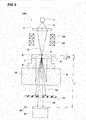
- the scanning transmission electron microscope (STEM) 100 comprises: an electron gun 1 directed perpendicularly to a horizontal plane and capable of emitting electrons downward; a focusing lens 3 for focusing the electrons as an electron beam 2 on a specimen 5 of the rubber compound (c); scanning coils 4 including an X-direction scanning coil 4x and a Y-direction scanning coil 4Y for deflecting the electron beam 2 in the X-direction and Y-direction to scan the specimen 5; a specimen holder 6 for holding the specimen 5; and a specimen stage 9 on which the specimen holder 6 is detachably fixed.
- STEM scanning transmission electron microscope
- an electron beam pass-through hole 8 is formed along the central axis (O) of the scanning transmission electron microscope 100 so that transmission electrons 7 which penetrate through the specimen 5 can pass through the hole 8.
- an electron beam pass-through hole 10 is formed along the central axis (O) and continuously from the electron beam pass-through hole 8 so that the transmission electrons 7 can pass through the hole 10.
- the microscope 100 further provided on the downstream side of the specimen stage 9 with a scattering angle limiting aperture 11 in order to limit the passing-through of the transmission electrons 7. Further, on the downstream side of the scattering angle limiting aperture 11, there is disposed a detector 20 for the transmission electrons 15 passing through the aperture 11.
- the detector 20 comprises a scintillator 13 and a photoelectron multiplier tube 14.
- the scintillator 13 reemits the energy of the incident electrons 12 passing though the aperture 11, in the form of light.
- the photoelectron multiplier tube 14 converts the incident light from the scintillator 13 to an electronic signal.
- the above-mentioned specimen stage 9, scattering angle limiting aperture 11, scintillator 13 and photoelectron multiplier tube 14 are arranged in a specimen room of a casing main body (not shown) of the microscope system 100.
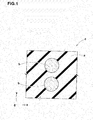
- the analysis object to be simulated and analyzed is a rubber compound (c) comprising a rubber component (a) as the matrix rubber and filler particles (b) dispersed in the matrix rubber as shown in Fig. 1 .
- the rubber component (a) can be, for example, natural rubber (NR), isoprene rubber (IR), butyl rubber (IIR), butadiene rubber (BR), styrene butadiene rubber (SBR), styrene isoprene butadiene rubber (SIBR), ethylene-propylene-diene rubber (EPDM), chloroprene rubber (CR), acrylonitrile butadiene rubber (NBR) and the like.
- NR natural rubber
- IR isoprene rubber
- IIR butyl rubber
- BR butadiene rubber
- SBR styrene butadiene rubber
- SIBR styrene isoprene butadiene rubber
- EPDM chloroprene rubber
- the filler (b) can be carbon black, silica, clay, talc, magnesium carbonate, magnesium hydroxide and the like.
- the rubber component (a) and filler (b) are not limited to these examples.
- various additives, e.g. sulfur, vulcanization accelerator and the like may be added in the rubber compound (c),
- a slice of the rubber compound having a constant thickness (t) is used as the above-mentioned specimen 5.
- FIG. 2 A flow chart implementing the simulating method as an embodiment of the present invention is shown in Fig. 2 .
- This method comprises the following steps S1-S5.
- the specimen holder 6 with the specimen 5 is attached to the specimen stage 9 by an operating personnel.
- the electron beam 2 emitted from the electron gun 1 and accelerated by an accelerator (not shown) and focused by the focusing lens 3 is scanned on the specimen 5 by the X-direction and Y-direction scanning coils 4X and 4Y.
- the electrons 7, which penetrate through the specimen 5 with or without scattered, go out from the lower surface of the specimen 5.
- the outgoing electrons 7 travel through the holes 8 and 10 to the scattering angle limiting aperture 11 which allows the electrons having particular scattering angles to pass through it.
- the electrons 12 passing through the scattering angle limiting aperture 11 go into the scintillator 13, and thereby the energy of the incident electrons 12 is reemitted in the form of light.
- the light is converted to an electronic signal.
- the electrical signal is amplified and converted to digital data by an amplifier and A/D converter (not shown).
- the digital data are transmitted to a display (not shown) in which, according to the transmitted signal, brightness modulation is made, and an electron beam transmission image reflecting the internal structure of the specimen 5 is displayed as a STEM image, and at the same time, the digital data are stored in a memory of the computer.
- a plurality of STEM images corresponding to the scan positions are acquired as the STEM images' dataset.
- the intensity and scattering angle of the outgoing electrons 7 are varied depending on the internal state, thickness and/or atomic species of the specimen 5.
- the scattering angle is also varied by the accelerating voltage. For example, if the accelerating voltage is decreased, the electrons are scattered more in the specimen 5, and the scattering angle or outgoing angle from the lower surface of the specimen 5 with respect to the central axis (O) is increased.
- the scattering angle limiting aperture 11 may be provided in its center with a masking shield 17 for further limiting the passing of the electrons 7 although the example shown in Fig. 3 is not provided with such masking shield.
- the electron beam transmission image becomes a bright-field image when the additional masking shield is not used, but it becomes a dark-field image if the masking shield is used.
- the camera length L1 namely the distance between the specimen 5 and the scintillator 13 is preferably set in a range of from 8 to 150 cm.
- the accelerating voltage for the electron beam may be set in a range of 100 to 3000 kV depending on the specimen 5.
- a plurality of images of the rubber compound (c) are took from different angles with respect to the central axis (O) of the scanning transmission electron microscope 100.
- the microscope 100 is provided with a specimen tilting device (not shown) to tilt the specimen 5 with respect to the central axis (O).
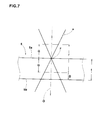
- the specimen 5 can be held at different tilt angles ⁇ with respect to a horizontal plane H.
- the computer outputs a control signal to the specimen tilting device and according thereto the device tilts the specimen 5 at a specific angle ⁇ .
- the variable range of the angle ⁇ of the specimen 5 is -90 to +90 degrees, preferably -70 to +70 degrees. However, if the specimen is a round bar of the rubber compound, the variable range of the angle ⁇ may be -180 to +180 degrees.
- the specimen 5 is tilted at a measuring start angle ⁇ and in this tilted state, the STEM images or the dataset thereof are acquired as explained above. Then, until a measuring stop angle ⁇ , the process of changing the tilt angle of the specimen 5 and acquiring the dataset of the STEM images of the specimen 5 at that tilt angle are repeated at a step in a range of from 0.5 to 4 degrees, preferably 1 to 2 degrees in order to obtain the after-mentioned slice images clearly and efficiently.
- the measuring start angle ⁇ and measuring stop angle ⁇ can be arbitrarily set on the microscope by using a controller.
- the measuring start angle ⁇ is +70 degrees
- the measuring stop angle ⁇ is -70 degrees.
- the focal point F of the electron beam (e) is set at the upper surface 5a of the specimen 5.
- the thickness (t) of the specimen 5 is 1000 nm
- the depth (f) of field of the microscope is 1200 nm (or +/-600 nm)
- the focal point F is set at the surface 5a of the specimen 5
- a lower part B having 400 nm thickness of the specimen 5 is outside the depth of field, and accordingly, a clear image of such part B can not be obtained.
- This problem is liable to occur with increase in the thickness (t).
- the focal point F of the electron beam (e) is set in a thickness center region C of the specimen 5 as shown in Fig. 6(a) .
- the range on the specimen 5 in which a clear image can be obtained becomes increased. It is desirable that the depth (f) of field can completely overlaps or encompass the thickness (t) of the specimen 5.
- the upper surface 5a and the lower surface 5b of the specimen 5 are perpendicular to the electron beam axis (namely, the incidence angle is equal to 90 deg.).
- the upper surface 5a and the lower surface 5b of the specimen 5 are inclined with respect to the electron beam axis (namely, the incidence angle is not equal to 90 deg.). Under such inclined state, the thickness of the specimen 5 measured along the electron beam axis is referred to as apparent thickness (t') in contrast to the real thickness (t) measured perpendicularly to the upper surface 5a.
- the central region C may be off-centered, but preferably it is centered on the center of the real/apparent thickness.
- the real thickness (t) may be less than 200 nm as usual, but it is preferably set in a range of from 200 to 1500 nm, more preferably 500 to 1000 nm.
- the dispersion of the filler particles including a compact cluster having a diameter of 200 nm or more can be accurately simulated.
- the focal point F is adjusted by the focusing lens 3 and/or specimen stage 9 by the use of a focal point adjuster of the microscope system 100.
- a three-dimensional structure of the rubber compound is reconstructed as numerical data (hereinafter the "3D dataset") by executing a tomographic method with the computer, and the 3D dataset is stored in a memory of the computer.
- those acquired by changing the tilt angle of the specimen 5 as explained above can be preferably used. But, it is also possible to use those acquired by not changing the tilt angle, namely acquired at a single tilt angle of the specimen 5 preferably zero degree with respect to the central axis (O) of the microscope 100.
- the computer can create and output various images as visual information as well as numerical data.
- Fig. 8 shows such created image which is a perspective view of the filler particles dispersed in the rubber compound.
- slice images of the rubber compound (c) taken along predetermined sections of the rubber compound (c) are reconstructed by the computer as numerical data (herein after the "slice image dataset"), and the slice image dataset is stored in a memory of the computer.
- the above-mentioned predetermined sections of the rubber compound can be arbitrarily determined according to the coordinate system (cartesian or polar or cylindrical) employed in the subsequent step S4.
- the slice image is subjected to an image processing to divide the entire region of the slice image into a domain of the rubber component (a), a domain of the filler particle (b) and/or a domain of other component if any.
- micro regions of the slice image are each identified whether it is a rubber domain or a filler domain (or other domain if any).
- the generated model 5a of the rubber compound comprises a domain 21 of the rubber component (a), a plurality of domains 22 of the filler particles (b), and a domain of other component if any.
- the filler particle domain 22 is as usual discretized into a finite number of elements eb.
- the rubber component (a) is as usual discretized into a finite number of elements eb.
- Fig. 9(a) shows a section of a small part of the rubber compound model 5a taken along a corresponding slice image, wherein the shadowed areas indicate the filler particle domains 22.
- Fig. 9(b) is a closeup thereof showing some elements.
- the rubber compound model 5a is a structured grid model having boundary GD (L1 and L2) at even intervals P in the x-axis direction, y-axis direction and z-axis direction (not shown).
- a three-dimensional finite element model 5a can be generated as shown in Fig. 10 .
- a two-dimensional finite element model 5a can be generated as shown in Fig. 9(a) .
- a grid e.g. structured grid
- element e.g. quadrilateral element, hexahedral element or the like
- the computer determines whether the element belongs to the rubber component or the filler particle or other component if any.
- step S4 information is defined on the elements eb, which is required for simulations or numerical analyses conducted by the use of a numerical analysis method, e.g. a finite element method or the like.
- information includes at least indexes and coordinate values of node points (n) of each element eb.
- material characteristics material characteristics of the part of the rubber compound which part is represented by the concerned element are defined.
- material constants corresponding to physical properties of the rubber component or filler are defined and stored in a memory of the computer as numerical data.
- this step in order to accurately simulate deformation of the rubber compound, the stress dependence on strain rate of the rubber component is defined on the elements of the rubber component domain 21.
- a technique to change parameters in the molecular chain network theory as disclosed in Japanese patent No. 4594043 can be employed.
- This step can be implemented as a step separate from the former step S4, but preferably incorporated in the step S4.
- step S5 using the finite element model 5a of the rubber compound, a simulation of deformation of the rubber compound is carried out under given conditions.
- a known method e.g. homogeneization method (asymptotic expansion homogeneization method) or the like can be employed.
- SBR Suditomo Chemical company, Limited: SBR1502
- silica Rhodia Japan Ltd.: 115Gr
- silane coupling agent Si69
- sulfur Tesurumi chemical. Co. Ltd.: Powdered sulfur
- vulcanization accelerator A Ouchi Shinko Chemical Industrial Co., Ltd.: NOCCELER NS
- vulcanization accelerator B Ouchi Shinko Chemical Industrial Co., Ltd.: NOCCELER D
- the materials except for the sulfur and vulcanization accelerators were kneaded for four minutes at 160 degrees C. Then, the kneaded materials to which the sulfur and vulcanization accelerators were added was further kneaded by the use of a open roll kneader for two minutes at 100 degrees C, and a raw rubber compound was prepared. The raw rubber compound was vulcanized for thirty minutes at 175 degrees C.
- the vulcanized rubber was sliced by using the ultramicrotome, and a specimen having a thickness of 500 nm was prepared.
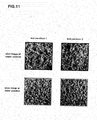
- STEM images of the specimen were acquired by changing the tilt angle of the specimen from -60 to +60 degrees at a step of 1 degree, wherein, in the case of test condition 1, the focal point was set at the thickness center of the specimen, and in the case of test condition 2, the focal point was set at the upper surface of the specimen.
- Fig. 11 shows slice images at the upper position A1 and lower position A2 of each of three-dimensional structures created from the 3D dataset.
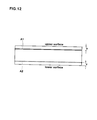
- the upper and lower positions A1 and A2 are at 40 nm from the upper and lower surfaces, respectively, as shown in Fig. 12 .
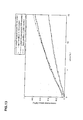
- the simulation results are shown in Fig. 13 together with the actual measurements obtained from the rubber compound. As shown, the simulation results have a high correlation with the actual measurements.
Landscapes
- Health & Medical Sciences (AREA)
- Life Sciences & Earth Sciences (AREA)
- Chemical & Material Sciences (AREA)
- Engineering & Computer Science (AREA)
- Food Science & Technology (AREA)
- Medicinal Chemistry (AREA)
- Physics & Mathematics (AREA)
- Analytical Chemistry (AREA)
- Biochemistry (AREA)
- General Health & Medical Sciences (AREA)
- General Physics & Mathematics (AREA)
- Immunology (AREA)
- Pathology (AREA)
- Analysing Materials By The Use Of Radiation (AREA)
- Compositions Of Macromolecular Compounds (AREA)
Applications Claiming Priority (1)
| Application Number | Priority Date | Filing Date | Title |
|---|---|---|---|
| JP2011197464A JP2013057638A (ja) | 2011-09-09 | 2011-09-09 | ゴム材料のシミュレーション方法 |
Publications (2)
| Publication Number | Publication Date |
|---|---|
| EP2568284A2 true EP2568284A2 (de) | 2013-03-13 |
| EP2568284A3 EP2568284A3 (de) | 2013-03-20 |
Family
ID=47076005
Family Applications (1)
| Application Number | Title | Priority Date | Filing Date |
|---|---|---|---|
| EP12005295A Withdrawn EP2568284A3 (de) | 2011-09-09 | 2012-07-19 | Verfahren zur Simulation der Verformung einer Gummiverbindung mit Füllpartikeln |
Country Status (4)
| Country | Link |
|---|---|
| US (1) | US20130066607A1 (de) |
| EP (1) | EP2568284A3 (de) |
| JP (1) | JP2013057638A (de) |
| CN (1) | CN102999655A (de) |
Cited By (2)
| Publication number | Priority date | Publication date | Assignee | Title |
|---|---|---|---|---|
| KR20160086850A (ko) * | 2013-11-14 | 2016-07-20 | 스미토모 고무 고교 가부시키가이샤 | 고분자 재료의 시뮬레이션 방법 |
| EP3062091A4 (de) * | 2013-11-15 | 2017-06-28 | Sumitomo Rubber Industries, Ltd. | Verfahren zur überwachung der verformung eines elastischen materials und abbildungsvorrichtung zur projektion von bildern des elastischen materials |
Families Citing this family (3)
| Publication number | Priority date | Publication date | Assignee | Title |
|---|---|---|---|---|
| CN103366048B (zh) * | 2013-06-25 | 2017-06-06 | 上海师范大学 | 建立车辆与地面耦合的一体式动力学模型的方法 |
| CN108709801B (zh) * | 2018-04-16 | 2020-09-22 | 四川理工学院 | 一种检测载荷下高聚物复合材料中填料分散状态的方法 |
| CN110874820B (zh) * | 2018-08-29 | 2023-04-11 | 阿里巴巴集团控股有限公司 | 一种物料仿真形变数据获取方法及装置 |
Citations (1)
| Publication number | Priority date | Publication date | Assignee | Title |
|---|---|---|---|---|
| EP1657657A2 (de) | 2004-11-15 | 2006-05-17 | Sumitomo Rubber Industries, Ltd. | Methode zur Simulation von Deformierungen von Gummimaterial |
Family Cites Families (28)
| Publication number | Priority date | Publication date | Assignee | Title |
|---|---|---|---|---|
| US5176765A (en) * | 1988-04-13 | 1993-01-05 | Bridgestone Corporation | Pneumatic tire having outer tread layer of foam rubber |
| US6051834A (en) * | 1991-05-15 | 2000-04-18 | Hitachi, Ltd. | Electron microscope |
| WO1998038669A1 (en) * | 1997-02-28 | 1998-09-03 | Arizona Board Of Regents | Atomic focusers in electron microscopy |
| BR0011098A (pt) * | 1999-05-31 | 2002-03-26 | Pirelli | Pneu com baixa resistência ao rolamento para veìculos, banda de rodagem com baixa resistência ao rolamento para pneus de veìculo, e, método para redução da resistência ao rolamento de um pneu |
| KR20020033732A (ko) * | 1999-07-16 | 2002-05-07 | 마이클 이. 카루짜 | 최적 탄성 회복을 위해 정해진 모폴로지를 가지는열가소성 가황고무 |
| EP1293917B1 (de) * | 2001-09-18 | 2005-07-27 | Sumitomo Rubber Industries Ltd. | Verfahren zur Simulation eines rollenden Reifens |
| EP1526468B1 (de) * | 2003-10-17 | 2009-09-30 | Sumitomo Rubber Industries Limited | Verfahren zur Simulation von viskoelastischem Material |
| JP4533643B2 (ja) * | 2004-02-26 | 2010-09-01 | 株式会社島精機製作所 | 人体モデルへのニットガーメントの着装シミュレーション方法とその装置、並びにそのプログラム |
| US7373284B2 (en) * | 2004-05-11 | 2008-05-13 | Kimberly-Clark Worldwide, Inc. | Method of evaluating the performance of a product using a virtual environment |
| CN1595404A (zh) * | 2004-06-24 | 2005-03-16 | 上海交通大学 | 橡胶制品挤出口模的数字化设计方法 |
| JP4563733B2 (ja) * | 2004-06-25 | 2010-10-13 | 株式会社日立ハイテクノロジーズ | 走査透過電子顕微鏡及びそれを用いた電子線エネルギー分光方法 |
| JP4608306B2 (ja) * | 2004-12-21 | 2011-01-12 | 住友ゴム工業株式会社 | タイヤのシミュレーション方法 |
| EP1796130A1 (de) * | 2005-12-06 | 2007-06-13 | FEI Company | Verfahren zur Bestimmung der Koeffizienten der Aberrationsfunktion einer Teilchenstrahllinse |
| JP2008084643A (ja) * | 2006-09-27 | 2008-04-10 | Fujitsu Ltd | 電子顕微鏡及び立体観察方法 |
| JP4399471B2 (ja) * | 2007-02-28 | 2010-01-13 | 株式会社日立ハイテクノロジーズ | 電子分光器を備えた透過型電子顕微鏡 |
| JP2008286545A (ja) * | 2007-05-15 | 2008-11-27 | Toyota Motor Corp | ゴム部品のシミュレーション方法および装置 |
| EP2063450A1 (de) * | 2007-11-21 | 2009-05-27 | FEI Company | Verfahren zum Erhalten eines Rastertransmissionsbildes einer Probe in einer teilchenoptischen Vorrichtung |
| JP2010091330A (ja) * | 2008-10-06 | 2010-04-22 | Sumitomo Chemical Co Ltd | 配向関数の解析方法及び解析システム |
| JP5649583B2 (ja) * | 2008-10-31 | 2015-01-07 | エフ イー アイ カンパニFei Company | 加工終点検出方法及び装置 |
| JP4603082B2 (ja) * | 2009-02-03 | 2010-12-22 | 株式会社ブリヂストン | ゴム材料の変形挙動予測装置及びゴム材料の変形挙動予測方法 |
| JP4588100B1 (ja) * | 2009-06-26 | 2010-11-24 | 株式会社ブリヂストン | ゴム複合体及びゴム組成物 |
| JP5670096B2 (ja) * | 2009-11-17 | 2015-02-18 | 日本電子株式会社 | トモグラフィー法を用いた試料の3次元画像取得方法及び装置 |
| JP5208910B2 (ja) * | 2009-12-07 | 2013-06-12 | 株式会社日立ハイテクノロジーズ | 透過型電子顕微鏡及び試料観察方法 |
| NL2006308C2 (en) * | 2010-03-01 | 2013-05-27 | Zeiss Carl Nts Gmbh | Transmission electron microscope. |
| JP5767477B2 (ja) * | 2011-01-14 | 2015-08-19 | 住友ゴム工業株式会社 | ゴム材料の観察方法 |
| JP5186015B2 (ja) * | 2011-03-07 | 2013-04-17 | 住友ゴム工業株式会社 | フィラー配合ゴムの有限要素モデルの作成方法 |
| JP2013044607A (ja) * | 2011-08-23 | 2013-03-04 | Sumitomo Rubber Ind Ltd | ゴム材料の観察方法 |
| JP5395864B2 (ja) * | 2011-09-14 | 2014-01-22 | 住友ゴム工業株式会社 | ゴム材料のシミュレーション方法 |
-
2011
- 2011-09-09 JP JP2011197464A patent/JP2013057638A/ja active Pending
-
2012
- 2012-07-19 EP EP12005295A patent/EP2568284A3/de not_active Withdrawn
- 2012-07-20 US US13/554,179 patent/US20130066607A1/en not_active Abandoned
- 2012-08-15 CN CN2012103027721A patent/CN102999655A/zh active Pending
Patent Citations (5)
| Publication number | Priority date | Publication date | Assignee | Title |
|---|---|---|---|---|
| EP1657657A2 (de) | 2004-11-15 | 2006-05-17 | Sumitomo Rubber Industries, Ltd. | Methode zur Simulation von Deformierungen von Gummimaterial |
| CN1776696A (zh) | 2004-11-15 | 2006-05-24 | 住友橡胶工业株式会社 | 模拟橡胶材料形变的方法 |
| JP2006138810A (ja) | 2004-11-15 | 2006-06-01 | Sumitomo Rubber Ind Ltd | ゴム材料のシミュレーション方法 |
| US7292966B2 (en) | 2004-11-15 | 2007-11-06 | Sumitomo Rubber Industries, Ltd. | Method of simulating deformation of rubber material |
| JP4594043B2 (ja) | 2004-11-15 | 2010-12-08 | 住友ゴム工業株式会社 | ゴム材料のシミュレーション方法 |
Cited By (5)
| Publication number | Priority date | Publication date | Assignee | Title |
|---|---|---|---|---|
| KR20160086850A (ko) * | 2013-11-14 | 2016-07-20 | 스미토모 고무 고교 가부시키가이샤 | 고분자 재료의 시뮬레이션 방법 |
| US20160283624A1 (en) * | 2013-11-14 | 2016-09-29 | Sumitomo Rubber Industries, Ltd. | Simulation method for polymer material |
| EP3062092A4 (de) * | 2013-11-14 | 2017-08-30 | Sumitomo Rubber Industries, Ltd. | Simulationsverfahren für ein polymermaterial |
| EP3062091A4 (de) * | 2013-11-15 | 2017-06-28 | Sumitomo Rubber Industries, Ltd. | Verfahren zur überwachung der verformung eines elastischen materials und abbildungsvorrichtung zur projektion von bildern des elastischen materials |
| US10274438B2 (en) | 2013-11-15 | 2019-04-30 | Sumitomo Rubber Industries, Ltd. | Method for observing deformation of elastic material and apparatus for capturing projection image of elastic material |
Also Published As
| Publication number | Publication date |
|---|---|
| JP2013057638A (ja) | 2013-03-28 |
| EP2568284A3 (de) | 2013-03-20 |
| US20130066607A1 (en) | 2013-03-14 |
| CN102999655A (zh) | 2013-03-27 |
Similar Documents
| Publication | Publication Date | Title |
|---|---|---|
| EP2562534A2 (de) | Verfahren zur Analyse einer Kautschukverbindung mit Füllerpartikeln | |
| EP2568284A2 (de) | Verfahren zur Simulation der Verformung einer Gummiverbindung mit Füllpartikeln | |
| US20140324401A1 (en) | Method for simulating rubber material | |
| JP6578200B2 (ja) | 高分子材料中の充填剤構造解析方法 | |
| EP2570808B1 (de) | Verfahren zur Simulation der Verformung einer Kautschukverbindung | |
| KR102381017B1 (ko) | 가교 고무의 가교 소밀을 평가하는 방법 | |
| Aldrin et al. | Protocol for reliability assessment of structural health monitoring systems incorporating model-assisted probability of detection (MAPOD) approach | |
| US20160283624A1 (en) | Simulation method for polymer material | |
| JP5187810B2 (ja) | 膜厚測定方法及び試料作製方法、並びに、膜厚測定装置及び試料作製装置 | |
| JP2013054578A (ja) | ゴム材料のシミュレーション方法 | |
| JP2020027084A (ja) | 架橋構造可視化方法 | |
| JP5767541B2 (ja) | ゴム材料のシミュレーション方法 | |
| US10690593B2 (en) | Sample analyzer and recording medium recording sample analysis program | |
| Long et al. | Statistical characterization of intragrain misorientations at large strains using high-energy x-ray diffraction: Application to hydrogen embrittlement | |
| JP7359660B2 (ja) | ゴム材料の変形解析方法 | |
| Daniels et al. | A Bayesian hierarchical model for methane emission source apportionment | |
| JP2013167505A (ja) | 薄膜試料の作製方法及び膜厚測定方法 | |
| JP6904890B2 (ja) | 破壊原因の推定方法および推定システム、並びに応力レベルの推定方法および推定システム | |
| Menčík | Bayesian Methods | |
| Wang et al. | APPLICATION OF STATISTICAL METHODS FOR ASSESSMENT OF COMPONENTS OF VARIANCE IN PROBABILITY OF DETECTION MODELS | |
| JP2021081337A (ja) | ゴム材料の変形解析方法 | |
| Schuetz et al. | Reducing the influence of environmental scattering in industrial computed tomography by system optimisation and correction algorithms | |
| JP2013044607A (ja) | ゴム材料の観察方法 | |
| JPH0443944A (ja) | 凹凸の大きい試料での定量測定法 |
Legal Events
| Date | Code | Title | Description |
|---|---|---|---|
| PUAL | Search report despatched |
Free format text: ORIGINAL CODE: 0009013 |
|
| PUAI | Public reference made under article 153(3) epc to a published international application that has entered the european phase |
Free format text: ORIGINAL CODE: 0009012 |
|
| AK | Designated contracting states |
Kind code of ref document: A2 Designated state(s): AL AT BE BG CH CY CZ DE DK EE ES FI FR GB GR HR HU IE IS IT LI LT LU LV MC MK MT NL NO PL PT RO RS SE SI SK SM TR |
|
| AX | Request for extension of the european patent |
Extension state: BA ME |
|
| AK | Designated contracting states |
Kind code of ref document: A3 Designated state(s): AL AT BE BG CH CY CZ DE DK EE ES FI FR GB GR HR HU IE IS IT LI LT LU LV MC MK MT NL NO PL PT RO RS SE SI SK SM TR |
|
| AX | Request for extension of the european patent |
Extension state: BA ME |
|
| RIC1 | Information provided on ipc code assigned before grant |
Ipc: G01N 33/44 20060101AFI20130212BHEP |
|
| 17P | Request for examination filed |
Effective date: 20130909 |
|
| RBV | Designated contracting states (corrected) |
Designated state(s): AL AT BE BG CH CY CZ DE DK EE ES FI FR GB GR HR HU IE IS IT LI LT LU LV MC MK MT NL NO PL PT RO RS SE SI SK SM TR |
|
| 17Q | First examination report despatched |
Effective date: 20131105 |
|
| STAA | Information on the status of an ep patent application or granted ep patent |
Free format text: STATUS: THE APPLICATION IS DEEMED TO BE WITHDRAWN |
|
| 18D | Application deemed to be withdrawn |
Effective date: 20141021 |