EP2554584A1 - Polymilchsäurezusammensetzung, aus schaumstoff geformter artikel daraus und herstellungsverfahren dafür - Google Patents
Polymilchsäurezusammensetzung, aus schaumstoff geformter artikel daraus und herstellungsverfahren dafür Download PDFInfo
- Publication number
- EP2554584A1 EP2554584A1 EP11762850A EP11762850A EP2554584A1 EP 2554584 A1 EP2554584 A1 EP 2554584A1 EP 11762850 A EP11762850 A EP 11762850A EP 11762850 A EP11762850 A EP 11762850A EP 2554584 A1 EP2554584 A1 EP 2554584A1
- Authority
- EP
- European Patent Office
- Prior art keywords
- polylactic acid
- acid composition
- molded article
- foam
- polyisocyanate
- Prior art date
- Legal status (The legal status is an assumption and is not a legal conclusion. Google has not performed a legal analysis and makes no representation as to the accuracy of the status listed.)
- Withdrawn
Links
Images


Classifications
-
- C—CHEMISTRY; METALLURGY
- C08—ORGANIC MACROMOLECULAR COMPOUNDS; THEIR PREPARATION OR CHEMICAL WORKING-UP; COMPOSITIONS BASED THEREON
- C08G—MACROMOLECULAR COMPOUNDS OBTAINED OTHERWISE THAN BY REACTIONS ONLY INVOLVING UNSATURATED CARBON-TO-CARBON BONDS
- C08G63/00—Macromolecular compounds obtained by reactions forming a carboxylic ester link in the main chain of the macromolecule
- C08G63/91—Polymers modified by chemical after-treatment
-
- B—PERFORMING OPERATIONS; TRANSPORTING
- B29—WORKING OF PLASTICS; WORKING OF SUBSTANCES IN A PLASTIC STATE IN GENERAL
- B29C—SHAPING OR JOINING OF PLASTICS; SHAPING OF MATERIAL IN A PLASTIC STATE, NOT OTHERWISE PROVIDED FOR; AFTER-TREATMENT OF THE SHAPED PRODUCTS, e.g. REPAIRING
- B29C44/00—Shaping by internal pressure generated in the material, e.g. swelling or foaming ; Producing porous or cellular expanded plastics articles
- B29C44/34—Auxiliary operations
- B29C44/3442—Mixing, kneading or conveying the foamable material
- B29C44/3446—Feeding the blowing agent
-
- B—PERFORMING OPERATIONS; TRANSPORTING
- B29—WORKING OF PLASTICS; WORKING OF SUBSTANCES IN A PLASTIC STATE IN GENERAL
- B29C—SHAPING OR JOINING OF PLASTICS; SHAPING OF MATERIAL IN A PLASTIC STATE, NOT OTHERWISE PROVIDED FOR; AFTER-TREATMENT OF THE SHAPED PRODUCTS, e.g. REPAIRING
- B29C44/00—Shaping by internal pressure generated in the material, e.g. swelling or foaming ; Producing porous or cellular expanded plastics articles
- B29C44/34—Auxiliary operations
- B29C44/58—Moulds
- B29C44/586—Moulds with a cavity increasing in size during foaming
-
- B—PERFORMING OPERATIONS; TRANSPORTING
- B29—WORKING OF PLASTICS; WORKING OF SUBSTANCES IN A PLASTIC STATE IN GENERAL
- B29C—SHAPING OR JOINING OF PLASTICS; SHAPING OF MATERIAL IN A PLASTIC STATE, NOT OTHERWISE PROVIDED FOR; AFTER-TREATMENT OF THE SHAPED PRODUCTS, e.g. REPAIRING
- B29C48/00—Extrusion moulding, i.e. expressing the moulding material through a die or nozzle which imparts the desired form; Apparatus therefor
- B29C48/022—Extrusion moulding, i.e. expressing the moulding material through a die or nozzle which imparts the desired form; Apparatus therefor characterised by the choice of material
-
- B—PERFORMING OPERATIONS; TRANSPORTING
- B29—WORKING OF PLASTICS; WORKING OF SUBSTANCES IN A PLASTIC STATE IN GENERAL
- B29C—SHAPING OR JOINING OF PLASTICS; SHAPING OF MATERIAL IN A PLASTIC STATE, NOT OTHERWISE PROVIDED FOR; AFTER-TREATMENT OF THE SHAPED PRODUCTS, e.g. REPAIRING
- B29C48/00—Extrusion moulding, i.e. expressing the moulding material through a die or nozzle which imparts the desired form; Apparatus therefor
- B29C48/25—Component parts, details or accessories; Auxiliary operations
- B29C48/36—Means for plasticising or homogenising the moulding material or forcing it through the nozzle or die
- B29C48/365—Means for plasticising or homogenising the moulding material or forcing it through the nozzle or die using pumps, e.g. piston pumps
- B29C48/37—Gear pumps
-
- B—PERFORMING OPERATIONS; TRANSPORTING
- B29—WORKING OF PLASTICS; WORKING OF SUBSTANCES IN A PLASTIC STATE IN GENERAL
- B29C—SHAPING OR JOINING OF PLASTICS; SHAPING OF MATERIAL IN A PLASTIC STATE, NOT OTHERWISE PROVIDED FOR; AFTER-TREATMENT OF THE SHAPED PRODUCTS, e.g. REPAIRING
- B29C48/00—Extrusion moulding, i.e. expressing the moulding material through a die or nozzle which imparts the desired form; Apparatus therefor
- B29C48/25—Component parts, details or accessories; Auxiliary operations
- B29C48/36—Means for plasticising or homogenising the moulding material or forcing it through the nozzle or die
- B29C48/50—Details of extruders
- B29C48/505—Screws
- B29C48/64—Screws with two or more threads
- B29C48/655—Screws with two or more threads having three or more threads
-
- C—CHEMISTRY; METALLURGY
- C08—ORGANIC MACROMOLECULAR COMPOUNDS; THEIR PREPARATION OR CHEMICAL WORKING-UP; COMPOSITIONS BASED THEREON
- C08G—MACROMOLECULAR COMPOUNDS OBTAINED OTHERWISE THAN BY REACTIONS ONLY INVOLVING UNSATURATED CARBON-TO-CARBON BONDS
- C08G18/00—Polymeric products of isocyanates or isothiocyanates
- C08G18/06—Polymeric products of isocyanates or isothiocyanates with compounds having active hydrogen
- C08G18/28—Polymeric products of isocyanates or isothiocyanates with compounds having active hydrogen characterised by the compounds used containing active hydrogen
- C08G18/40—High-molecular-weight compounds
- C08G18/42—Polycondensates having carboxylic or carbonic ester groups in the main chain
- C08G18/4266—Polycondensates having carboxylic or carbonic ester groups in the main chain prepared from hydroxycarboxylic acids and/or lactones
- C08G18/428—Lactides
-
- C—CHEMISTRY; METALLURGY
- C08—ORGANIC MACROMOLECULAR COMPOUNDS; THEIR PREPARATION OR CHEMICAL WORKING-UP; COMPOSITIONS BASED THEREON
- C08G—MACROMOLECULAR COMPOUNDS OBTAINED OTHERWISE THAN BY REACTIONS ONLY INVOLVING UNSATURATED CARBON-TO-CARBON BONDS
- C08G18/00—Polymeric products of isocyanates or isothiocyanates
- C08G18/06—Polymeric products of isocyanates or isothiocyanates with compounds having active hydrogen
- C08G18/28—Polymeric products of isocyanates or isothiocyanates with compounds having active hydrogen characterised by the compounds used containing active hydrogen
- C08G18/65—Low-molecular-weight compounds having active hydrogen with high-molecular-weight compounds having active hydrogen
- C08G18/66—Compounds of groups C08G18/42, C08G18/48, or C08G18/52
- C08G18/6633—Compounds of group C08G18/42
- C08G18/6637—Compounds of group C08G18/42 with compounds of group C08G18/32 or polyamines of C08G18/38
- C08G18/664—Compounds of group C08G18/42 with compounds of group C08G18/32 or polyamines of C08G18/38 with compounds of group C08G18/3203
- C08G18/6644—Compounds of group C08G18/42 with compounds of group C08G18/32 or polyamines of C08G18/38 with compounds of group C08G18/3203 having at least three hydroxy groups
-
- C—CHEMISTRY; METALLURGY
- C08—ORGANIC MACROMOLECULAR COMPOUNDS; THEIR PREPARATION OR CHEMICAL WORKING-UP; COMPOSITIONS BASED THEREON
- C08G—MACROMOLECULAR COMPOUNDS OBTAINED OTHERWISE THAN BY REACTIONS ONLY INVOLVING UNSATURATED CARBON-TO-CARBON BONDS
- C08G18/00—Polymeric products of isocyanates or isothiocyanates
- C08G18/06—Polymeric products of isocyanates or isothiocyanates with compounds having active hydrogen
- C08G18/70—Polymeric products of isocyanates or isothiocyanates with compounds having active hydrogen characterised by the isocyanates or isothiocyanates used
- C08G18/72—Polyisocyanates or polyisothiocyanates
- C08G18/73—Polyisocyanates or polyisothiocyanates acyclic
-
- C—CHEMISTRY; METALLURGY
- C08—ORGANIC MACROMOLECULAR COMPOUNDS; THEIR PREPARATION OR CHEMICAL WORKING-UP; COMPOSITIONS BASED THEREON
- C08G—MACROMOLECULAR COMPOUNDS OBTAINED OTHERWISE THAN BY REACTIONS ONLY INVOLVING UNSATURATED CARBON-TO-CARBON BONDS
- C08G63/00—Macromolecular compounds obtained by reactions forming a carboxylic ester link in the main chain of the macromolecule
- C08G63/02—Polyesters derived from hydroxycarboxylic acids or from polycarboxylic acids and polyhydroxy compounds
- C08G63/06—Polyesters derived from hydroxycarboxylic acids or from polycarboxylic acids and polyhydroxy compounds derived from hydroxycarboxylic acids
- C08G63/08—Lactones or lactides
-
- C—CHEMISTRY; METALLURGY
- C08—ORGANIC MACROMOLECULAR COMPOUNDS; THEIR PREPARATION OR CHEMICAL WORKING-UP; COMPOSITIONS BASED THEREON
- C08G—MACROMOLECULAR COMPOUNDS OBTAINED OTHERWISE THAN BY REACTIONS ONLY INVOLVING UNSATURATED CARBON-TO-CARBON BONDS
- C08G63/00—Macromolecular compounds obtained by reactions forming a carboxylic ester link in the main chain of the macromolecule
- C08G63/88—Post-polymerisation treatment
-
- C—CHEMISTRY; METALLURGY
- C08—ORGANIC MACROMOLECULAR COMPOUNDS; THEIR PREPARATION OR CHEMICAL WORKING-UP; COMPOSITIONS BASED THEREON
- C08J—WORKING-UP; GENERAL PROCESSES OF COMPOUNDING; AFTER-TREATMENT NOT COVERED BY SUBCLASSES C08B, C08C, C08F, C08G or C08H
- C08J3/00—Processes of treating or compounding macromolecular substances
- C08J3/24—Crosslinking, e.g. vulcanising, of macromolecules
-
- C—CHEMISTRY; METALLURGY
- C08—ORGANIC MACROMOLECULAR COMPOUNDS; THEIR PREPARATION OR CHEMICAL WORKING-UP; COMPOSITIONS BASED THEREON
- C08J—WORKING-UP; GENERAL PROCESSES OF COMPOUNDING; AFTER-TREATMENT NOT COVERED BY SUBCLASSES C08B, C08C, C08F, C08G or C08H
- C08J9/00—Working-up of macromolecular substances to porous or cellular articles or materials; After-treatment thereof
- C08J9/04—Working-up of macromolecular substances to porous or cellular articles or materials; After-treatment thereof using blowing gases generated by a previously added blowing agent
- C08J9/12—Working-up of macromolecular substances to porous or cellular articles or materials; After-treatment thereof using blowing gases generated by a previously added blowing agent by a physical blowing agent
- C08J9/122—Hydrogen, oxygen, CO2, nitrogen or noble gases
-
- C—CHEMISTRY; METALLURGY
- C08—ORGANIC MACROMOLECULAR COMPOUNDS; THEIR PREPARATION OR CHEMICAL WORKING-UP; COMPOSITIONS BASED THEREON
- C08K—Use of inorganic or non-macromolecular organic substances as compounding ingredients
- C08K3/00—Use of inorganic substances as compounding ingredients
- C08K3/18—Oxygen-containing compounds, e.g. metal carbonyls
- C08K3/24—Acids; Salts thereof
- C08K3/26—Carbonates; Bicarbonates
-
- C—CHEMISTRY; METALLURGY
- C08—ORGANIC MACROMOLECULAR COMPOUNDS; THEIR PREPARATION OR CHEMICAL WORKING-UP; COMPOSITIONS BASED THEREON
- C08K—Use of inorganic or non-macromolecular organic substances as compounding ingredients
- C08K3/00—Use of inorganic substances as compounding ingredients
- C08K3/34—Silicon-containing compounds
-
- C—CHEMISTRY; METALLURGY
- C08—ORGANIC MACROMOLECULAR COMPOUNDS; THEIR PREPARATION OR CHEMICAL WORKING-UP; COMPOSITIONS BASED THEREON
- C08K—Use of inorganic or non-macromolecular organic substances as compounding ingredients
- C08K5/00—Use of organic ingredients
- C08K5/16—Nitrogen-containing compounds
- C08K5/29—Compounds containing one or more carbon-to-nitrogen double bonds
-
- B—PERFORMING OPERATIONS; TRANSPORTING
- B29—WORKING OF PLASTICS; WORKING OF SUBSTANCES IN A PLASTIC STATE IN GENERAL
- B29C—SHAPING OR JOINING OF PLASTICS; SHAPING OF MATERIAL IN A PLASTIC STATE, NOT OTHERWISE PROVIDED FOR; AFTER-TREATMENT OF THE SHAPED PRODUCTS, e.g. REPAIRING
- B29C48/00—Extrusion moulding, i.e. expressing the moulding material through a die or nozzle which imparts the desired form; Apparatus therefor
- B29C48/03—Extrusion moulding, i.e. expressing the moulding material through a die or nozzle which imparts the desired form; Apparatus therefor characterised by the shape of the extruded material at extrusion
-
- B—PERFORMING OPERATIONS; TRANSPORTING
- B29—WORKING OF PLASTICS; WORKING OF SUBSTANCES IN A PLASTIC STATE IN GENERAL
- B29C—SHAPING OR JOINING OF PLASTICS; SHAPING OF MATERIAL IN A PLASTIC STATE, NOT OTHERWISE PROVIDED FOR; AFTER-TREATMENT OF THE SHAPED PRODUCTS, e.g. REPAIRING
- B29C48/00—Extrusion moulding, i.e. expressing the moulding material through a die or nozzle which imparts the desired form; Apparatus therefor
- B29C48/25—Component parts, details or accessories; Auxiliary operations
- B29C48/36—Means for plasticising or homogenising the moulding material or forcing it through the nozzle or die
- B29C48/50—Details of extruders
- B29C48/76—Venting, drying means; Degassing means
-
- B—PERFORMING OPERATIONS; TRANSPORTING
- B29—WORKING OF PLASTICS; WORKING OF SUBSTANCES IN A PLASTIC STATE IN GENERAL
- B29K—INDEXING SCHEME ASSOCIATED WITH SUBCLASSES B29B, B29C OR B29D, RELATING TO MOULDING MATERIALS OR TO MATERIALS FOR MOULDS, REINFORCEMENTS, FILLERS OR PREFORMED PARTS, e.g. INSERTS
- B29K2067/00—Use of polyesters or derivatives thereof, as moulding material
- B29K2067/04—Polyesters derived from hydroxycarboxylic acids
- B29K2067/046—PLA, i.e. polylactic acid or polylactide
-
- C—CHEMISTRY; METALLURGY
- C08—ORGANIC MACROMOLECULAR COMPOUNDS; THEIR PREPARATION OR CHEMICAL WORKING-UP; COMPOSITIONS BASED THEREON
- C08G—MACROMOLECULAR COMPOUNDS OBTAINED OTHERWISE THAN BY REACTIONS ONLY INVOLVING UNSATURATED CARBON-TO-CARBON BONDS
- C08G2101/00—Manufacture of cellular products
-
- C—CHEMISTRY; METALLURGY
- C08—ORGANIC MACROMOLECULAR COMPOUNDS; THEIR PREPARATION OR CHEMICAL WORKING-UP; COMPOSITIONS BASED THEREON
- C08J—WORKING-UP; GENERAL PROCESSES OF COMPOUNDING; AFTER-TREATMENT NOT COVERED BY SUBCLASSES C08B, C08C, C08F, C08G or C08H
- C08J2201/00—Foams characterised by the foaming process
- C08J2201/02—Foams characterised by the foaming process characterised by mechanical pre- or post-treatments
- C08J2201/024—Preparation or use of a blowing agent concentrate, i.e. masterbatch in a foamable composition
-
- C—CHEMISTRY; METALLURGY
- C08—ORGANIC MACROMOLECULAR COMPOUNDS; THEIR PREPARATION OR CHEMICAL WORKING-UP; COMPOSITIONS BASED THEREON
- C08J—WORKING-UP; GENERAL PROCESSES OF COMPOUNDING; AFTER-TREATMENT NOT COVERED BY SUBCLASSES C08B, C08C, C08F, C08G or C08H
- C08J2201/00—Foams characterised by the foaming process
- C08J2201/02—Foams characterised by the foaming process characterised by mechanical pre- or post-treatments
- C08J2201/026—Crosslinking before of after foaming
-
- C—CHEMISTRY; METALLURGY
- C08—ORGANIC MACROMOLECULAR COMPOUNDS; THEIR PREPARATION OR CHEMICAL WORKING-UP; COMPOSITIONS BASED THEREON
- C08J—WORKING-UP; GENERAL PROCESSES OF COMPOUNDING; AFTER-TREATMENT NOT COVERED BY SUBCLASSES C08B, C08C, C08F, C08G or C08H
- C08J2201/00—Foams characterised by the foaming process
- C08J2201/02—Foams characterised by the foaming process characterised by mechanical pre- or post-treatments
- C08J2201/03—Extrusion of the foamable blend
-
- C—CHEMISTRY; METALLURGY
- C08—ORGANIC MACROMOLECULAR COMPOUNDS; THEIR PREPARATION OR CHEMICAL WORKING-UP; COMPOSITIONS BASED THEREON
- C08J—WORKING-UP; GENERAL PROCESSES OF COMPOUNDING; AFTER-TREATMENT NOT COVERED BY SUBCLASSES C08B, C08C, C08F, C08G or C08H
- C08J2203/00—Foams characterized by the expanding agent
- C08J2203/08—Supercritical fluid
-
- C—CHEMISTRY; METALLURGY
- C08—ORGANIC MACROMOLECULAR COMPOUNDS; THEIR PREPARATION OR CHEMICAL WORKING-UP; COMPOSITIONS BASED THEREON
- C08J—WORKING-UP; GENERAL PROCESSES OF COMPOUNDING; AFTER-TREATMENT NOT COVERED BY SUBCLASSES C08B, C08C, C08F, C08G or C08H
- C08J2367/00—Characterised by the use of polyesters obtained by reactions forming a carboxylic ester link in the main chain; Derivatives of such polymers
- C08J2367/04—Polyesters derived from hydroxy carboxylic acids, e.g. lactones
Definitions
- the present invention relates to a polylactic acid composition, a polylactic acid foam molded article and a method of producing the foam molded article.
- Polylactic acid is produced from starch which is a recycled material and is an environmentally friendly resin because of the biodegradability. Products produced using polylactic acid can be disposed of by landfill as compost because of the biodegradability. Although polystyrene foam molded articles are frequently used as e.g. food containers and cushioning packaging materials, they are needed to be collected for disposal or be recycled by reason of the non-biodegradability.
- Patent document 1 describes a method of producing a foam molded article by adding polyalcohols such as glycerin, erythritol and pentaerythritol or polycarboxylic acids such as trimellitic acid and pyromellitic acid to polylactic acid which is substantially amorphous, and cross-linking by polyisocyanate to increase the molecular weight.
- polyalcohols such as glycerin, erythritol and pentaerythritol or polycarboxylic acids such as trimellitic acid and pyromellitic acid
- the compounding amount of polyisocyanate is 0.3 to 3% by weight and preferably 0.7 to 2% by weight.
- polyisocyanate is insufficient, since a molecular weight of polylactic acid after reactions is too low, only foam molded products with a low expansion ratio can be obtained.
- polyisocyanate is excessive, good foam molded products cannot be obtained because gelation occurs.
- a foam molded article is foam-molded as follows: after impregnated with a foaming agent, pre-expanded beads are transferred and poured into a mold, and the beads are heated with steam to foam.
- foaming agents hydrocarbons such as propane, n-butane, iso-butane, n-pentane, iso-pentane, neopentane, cyclopentane and hexane; halogenated hydrocarbons such as chloromethane, methylene chloride and dichlorodifluoromethane; and ethers such as dimethylether and methylethylether are used, and as auxiliary foaming agents, alcohols having 1 to 4 carbon atoms, ketones, ethers, benzene, toluene and the like are used.
- Patent Document 2 describes that a foam nucleating agent is preferably combined to form uniform and fine foam cells, and the foam nucleating agents to be used are preferably particulate solids e.g. inorganic particles such as talc, silica, kaoline, zeolite, mica and alumina; carbonate or bicarbonate; salts such as alkali metal salts of carboxylic acids.
- the foam nucleating agents to be used are preferably particulate solids e.g. inorganic particles such as talc, silica, kaoline, zeolite, mica and alumina; carbonate or bicarbonate; salts such as alkali metal salts of carboxylic acids.
- An object of the present invention is to inexpensively provide a method and device of producing a polylactic acid composition having a stable high viscosity, which composition is appropriate for foam molding having a high expansion ratio, and a foam molded article having a high expansion ratio formed of said high viscosity polylactic acid.
- the polylactic acid composition of the present invention is a polylactic acid composition obtained by mechanically grinding polylactic acid, which polylactic acid is cross-linked by polyisocyanate, by applying a shear force in an inert gas atmosphere, said polylactic acid composition obtained by the grinding being characterized by having an MI value of 0.05 or more and 5 or less, which MI value is measured at 190°C under a load of 21.6 kg in accordance with JIS K7210 (ISO 1133).
- a method of producing a polylactic acid foam molded article is characterized by comprising a step of mechanically grinding said polylactic acid composition by applying a shear force, using a device equipped with an injection molding machine (B) or an extrusion molding machine (G), an orifice portion (S) and a foaming mold (P), in a foaming gas atmosphere in the orifice portion (S).
- a foam cell membrane can be thinner because there are not gelled portions which are obstructive factors of a high expansion ratio foaming, and polylactic acid portions having a considerably high molecular weight, thus, a foam molded article having a high expansion ratio can be provided stably and inexpensively.
- the foam molded article of the present invention which uses a polylactic acid composition having stable high melt viscosity without adding polyalcohols and polycarboxylic acids, is a sheet and a container of the foam molded article, which sheet and container can practically stand hot water.
- the polylactic acid composition of the present invention is a polylactic acid composition obtained by mechanically grinding polylactic acid, which polylactic acid is cross-linked by polyisocyanate, by applying a shear force in an inert gas atmosphere, said polylactic acid composition obtained by the grinding being characterized by having an MI value of 0.05 or more and 5 or less, which MI value is measured at 190°C under a load of 21.6 kg in accordance with JIS K7210 (ISO 1133).
- Another embodiment of the present invention is a polylactic acid composition wherein said polyisocyanate is triisocyanate, tetraisocyanate or diisocyanate, or which polylactic acid composition comprises any of the adduct forms of said polyisocyanates.
- polylactic acid composition wherein 0.4 to 5% by weight of polyisocyanate is combined on the basis of polylactic acid.
- another embodiment of the present invention is said polylactic acid composition containing 0.5 to 5% by weight of calcium carbonate or talc particle.
- another embodiment of the present invention is a foam molded article formed of said polylactic acid composition.
- the foam molded articles include those by foam-molding of pre-expanded beads and those by direct extrusion molding without producing beads.
- another embodiment of the present invention is an excellent heat-resistant foam molded article which can maintain the form of a molded article container without deformation after 3 minutes of pouring 90°C hot water into the container.
- a method of producing a polylactic acid foam molded article is characterized by comprising a step of mechanically grinding said polylactic acid composition by applying a shear force, using a device equipped with an injection molding machine (B) or an extrusion molding machine (G), an orifice portion (S) and a foaming mold (P), in a foaming gas atmosphere in the orifice portion (S).
- Another embodiment of the present invention is a method of producing a foam molded article of the polylactic acid composition which is cross-linked and thickened by polyisocyanate which is triisocyanate, tetraisocyanate or diisocyanate, or by any of the adduct forms of said polyisocyanates.
- Another embodiment of the present invention is a method of producing a foam molded article using said thickened polylactic acid composition wherein 0.4 to 5% by weight of a polyisocyanate is combined on the basis of polylactic acid.
- Another embodiment of the present invention is a method of producing a foam molded article using said thickened polylactic acid composition containing 0.5 to 5% by weight of calcium carbonate or talc particle.
- Isocyanate is reacted with a low-molecular-weight polyalcohol and polycarboxylic acid to generate gelled substances because of the high reactivity.
- the reaction with high molecules is a reaction with terminal groups, and if the amount of isocyanate is not excessive, a reticulated structure of gelation does not occur.
- molecules having a considerably high molecular weight are generated by developing uneven reactions.
- high molecules having a molecular weight of 2 million or more in polystyrene equivalent by GPC measurement are partially present, stretching unevenness of a foam cell membrane occurs and high expansion ratio foaming becomes difficult. More preferred is a composition which does not contain high molecules having a molecular weight of 1.5 million or more in polystyrene equivalent.
- Patent Document 1 it is surmised that because the viscosity is unstable by reason of the considerably large molecules, equilibrium reaction occurs by adding a polyalcohol and a polycarboxylic acid to decrease the molecular weights of the considerably large molecules and a stable foam cell membrane can be obtained.
- a monoalcohol and a monocarboxylic acid are used instead of a polyalcohol and a polycarboxylic acid, the molecular weights significantly decreases. This is reversing the order of importance.
- the present inventors found that the molecular weights of considerably large molecules, which are generated by the above uneven reactions with isocyanate, decrease by crushing by superfluidity in supercritical conditions of an inert gas to obtain a stable foam cell membrane, and further found that even when 5% by weight of polyisocyanate is combined on the basis of polylactic acid, a gel is not confirmed in cross-linking reactions in supercritical and subcritical conditions, thereby completing the present invention.
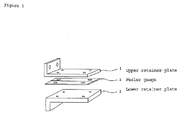
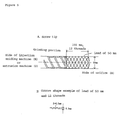
- the polylactic acid composition is passed through an orifice portion at a high speed under supercritical conditions of nitrogen gas, which orifice portion (S) for example has the shape of a tip of a grinding portion in a screw diameter of 50 mm shown in Fig. 5 and is composed of a slit consisting of (1), (2) and (3) shown in Fig. 1 , e.g. a slit portion of 0.1 mm square and 150 mm long.
- the speed is, for example when 10 ml of the composition is extruded at a stroke of 30 seconds, a high speed of 100,000 cm/30 sec (33 m/sec).
- the orifice portion (S) is absent and is composed of only a grinding portion of a screw tip, grinding ability is extremely lowered.
- a preset temperature of the portion is preferably a range of 160 to 180°C, and the pressure thereof usually comes to equilibrium with input of the raw materials in a range of 6 to 12 MPa.
- the amount of an inert gas becomes insufficient, the raw material polylactic acid cannot pass through the orifice (S) at a high speed and obviously the raw materials are not inserted into the screw and only a small quantity is leaked out from the orifice (S).
- condition of 160°C or more and 6 MPa or more is numerical values to sufficiently satisfy the supercritical conditions of nitrogen (-147°C, 3.39 MPa.).
- the conditions of temperature and pressure in the portion related to supercriticality in the present invention is confirmed to be from 160 to 170°C and from 6 to 12 MPa.
- a foaming agent is impregnated into polylactic acid beads while heating under high pressure.
- polylactic acid is crystalline, crystallization occurs at this time and microcrystalline network is developed.
- a melting point of polylactic acid is usually 160°C or more and steam at normal pressure used for final foam molding is 100°C or less.
- the micro crystals generated when a foaming agent was impregnated prevent stretching of a foam cell membrane to obtain a high expansion ratio. Thus, amorphous polylactic acid is used.
- heat-resistance of amorphous polylactic acid is low, thus it cannot be used as a container for hot water.
- crystalline polylactic acid the heat-resistance is improved by microcrystalline network, therefore it can be used for a hot water container.
- the mouth portion of a PET bottle is white because spherocrystal is caused by crystallization.
- the mouth portion of the bottle is not crystallized because it cannot be stretched. After blow molding, crystallization by heating is carried out to provide heat-resistance.
- Heat-resistance is inversely proportional to mobility of molecules. As the molecular weight increases, the heat resistance is improved. Liquid paraffin is the form of a liquid at normal temperature, while paraffin having a slightly higher molecular weight is a solid at normal temperature. A melting point of polyethylene having a further higher molecular weight is approximately 130°C. A melting point of ultrahigh molecular weight polyethylene increases to 150°C. The theory is the same as a difference between force to roll a small snowball and force to roll a big snowball.
- polylactic acid is a condensation polymer
- the molecular weight varies depending on an equilibrium amount of water.
- the molecular weight dramatically decreases and the molecular weight drops to an equilibrium molecular weight corresponding to an water amount.
- a vent hole is placed at the initial molten stage in an extrusion machine and moisture is absorbed by a vacuum pump.
- Polylactic acid used in the present invention may be crystalline or amorphous.
- Amorphous polylactic acid wherein DL-forms are copolymerized is used for pre-expanded beads impregnated with a foaming agent.
- crystalline polylactic acid is preferred because the heat-resistance is improved.
- Complex polylactic acid which D-form and L-form are mixed is more preferred because the heat-resistance is further improved.
- a number average molecular weight of said raw material polylactic acid is preferably 1,000 or more, more preferably 5, 000 or more, and further preferably 10,000 or more. As the molecular weight of the raw material polylactic acid decreases, the compounding amount of polyisocyanate, which is reacted to obtain required viscosity when molding at a high expansion ratio, increases. This is an economic disadvantage.
- polylactic acid by the ring-opening solution polymerization of lactic acid dimer is 10,000 or less
- a polyisocyanate solution or a low temperature solution is added beforehand in an amount of 0.5 to 5% by weight, and polylactic acid which is branched like LDPE and which is polymerized to the number average molecular weight 500,000 or more can be used as the polylactic acid materials of the present invention.
- the raw material polylactic acid is dried by usual methods such as vacuum drying beforehand and moisture percentage is controlled.
- the moisture percentage of the raw material polylactic acid is preferably 500 ppm or less, and further preferably 100 ppm or less. More preferred is 50 ppm or less.
- Polyisocyanate to be used for the present invention is divalent or more polyisocyanate, and preferably triisocyanate or tetraisocyanate, or contains the adduct forms of diisocyanate.
- trivalent or more polyisocyanate is used, branches occur on a high molecular chain of polylactic acid and membrane strength becomes high, thus the expansion ratio can be improved.
- Polyisocyanate may be isocyanate compounds containing 2 or more isocyanate groups in the molecule.
- polyisocyanate include aliphatic diisocyanates such as 1,6-hexamethylene diisocyanate, 3-isocyanatomethyl-3,5,5-trimethylcyclohexyl isocyanate (isophorone diisocyanate), 1,4-tetramethylene diisocyanate, 2,4,4-trimethyl hexamethylene diisocyanate, 2,2,4-trimethyl hexamethylene diisocyanate, dicyclohexylmethane-4,4'-diisocyanate, methylcyclohexyl-2,4-diisocyanate, methylcyclohexyl-2,6-diisocyanate, xylylene diisocyanate, 1,3-bis(isocyanate)methylcyclohexane, tetramethyl xylylene diisocyanate, trans-cyclohexan
- Branches occurs on a polylactic acid molecular chain by using trivalent or more polyisocyanate, and that is preferred because the strength of a foam cell membrane increases. This phenomenon is same as that when a film is produced using polyethylene, low density polyethylene having branches on a high molecular chain is more suitable than straight high density polyethylene.
- the amount of polyisocyanate to be combined varies depending on the molecular weight of the raw material polylactic acid. Also it varies depending on the molecular weight distribution of polylactic acid. As low molecular weight polylactic acid increases, the more amount of polylactic acid to be combined requires to obtain suitable melting viscosity for foaming. The amount is preferably approximately 0.5 to 5% by weight based on polylactic acid. When the compounding amount of polyisocyanate is too little, melting viscosity appropriate for foaming cannot be obtained and the expansion ratio is lowered. Also, when the amount is too much, gelation occurs and the expansion ratio is lowered.
- a method of producing the polylactic acid composition of the present invention requires a step of, after increasing the molecular weight of the polylactic acid composition by coupling reactions of polylactic acid and polyisocyanate, grinding considerably large polylactic acid molecules by mechanically applying a large shear force in supercritical conditions of an inert gas. Without this step, considerably large polylactic acid molecules partially prevent a foam cell membrane from expanding and a foam molded article having a high expansion ratio cannot be obtained.
- inert gases of the present invention which do not react with polylactic acid include nitrogen gas, helium gas, argon gas, methane gas, ethane gas, propane gas, butane gas, ethylene gas, propylene gas and the like.
- nitrogen gas which easily reaches the supercritical conditions and which is cheap and nonflammable is preferred.
- These gases may be used in combination.
- the supercritical point of nitrogen gas is (-147°C, 3.39 MPa) and that of methane gas is (-83°C, 4.6 MPa).
- That of ethane gas is (32.4°C, 4.88 MPa).
- propane gas is (93.8°C, 4.25 MPa).
- butane gas is (152°C, 3.38 MPa).
- an inert gas is supplied in a certain amount to be combined in an amount of 0.1 to 2% by weight based on raw material polylactic acid, and the gas is collected and reused after trapping moisture.
- a general means for applying more pressure than the pressure of supercritical points is pressure devices such as s plunger pump, a gear pump and a screw, and a means for heating higher than the temperature of supercritical points is heating devices such as a cast heater and a jacket heater.
- a melting point of polylactic acid varies depending on a degree of copolymerization, and is approximately 170°C or less.
- polylactic acid is reacted with polyisocyanate at a higher temperature than the melting point of polylactic acid materials to be used.
- polyisocyanate which is not in the form of a liquid at normal temperature is melted by heating and is quantitatively added to polylactic acid materials in a semi-molten state by a plunger pump and the like to react with the polylactic acid.
- biodegradable polymers can be combined without having a significantly bad influence on physicality of foam molded articles.
- biodegradable polymers include polycaprolactam, polybutylene succinate, polyhydroxybutyrate, poly(hydroxybutyrate/hydroxyhexanoate), (polylactic acid/polybutylene succinate type)block copolymer, poly(caprolactone/putylene succinate, poly(putylene succinate/adipate), poly(putylene succinate/carbonate, poly(ethylene terephthalate/succinate), poly(putylene adipate/terephthalate), poly(tetramethylene adipate/terephthalate), and the like.
- a foaming nucleating agent is preferably combined to form uniform and fine foaming cells.
- foaming nucleating agents include inorganic particles such as talc, silica, kaoline, zeolite, mica and alumina; carbonate or bicarbonate such as calcium carbonate; alkali metal salts of carboxylic acid; and the like.
- calcium carbonate and talc are preferred because they are soft and microscopic particles thereof can be obtained cheaply.
- particle diameters of the foaming nucleating agents are preferably 1 ⁇ m or less, and more preferably 0.5 ⁇ m or less.
- the amount of a foaming nucleating agent to be combined is preferably 0.5 to 5% by weight based on polylactic acid composition.
- the amount of a foaming nucleating agent to be combined is too little, the size of cells easily becomes uneven, and when the amount is too much, a high expansion ratio is hard to be obtained.
- an inert foaming gas such as nitrogen gas is supplied to the polylactic acid composition of the present invention in a molten state by side-injection to foam.
- foam molding is carried out under conditions of high temperature and high pressure more than those of supercritical points and subcritical conditions of inert foaming gases such as nitrogen gas since foam molded articles having fine cells can be obtained.
- inert foaming gases in addition to nitrogen gas include as foaming agents hydrocarbons such as propane, n-butane, isobutane, n-pentane, iso-pentane, neopentane, cyclopentane, hexane and butane; halogenated hydrocarbons such as chloromethane, methylene chloride and dichlorodifluoromethane; ethers such as dimethylether and methylethylether. Also, as auxiliary foaming agents, alcohol having 1 to 4 carbon atoms, ketones, ethers, benzene, toluene and the like are used. These foaming agents can be used in combination.
- hydrocarbons such as propane, n-butane, isobutane, n-pentane, iso-pentane, neopentane, cyclopentane, hexane and butane
- halogenated hydrocarbons such as chloromethane
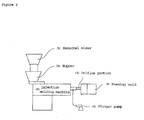
- a production system of the foam molded articles of the present invention is composed of an injection molding machine (B), a Henschel mixer (L), a hopper (A), an orifice portion (S) and a foaming mold (P) as an example of a simple system shown in Figure 2 .
- a hollow portion of the foaming mold (P) used in the present invention is movable. It is suitable for simple shaped products and not suitable for complicated shaped products.
- injections of a molten polymer starts when the hollow portion is in a thin state (e.g. 0.1 mm, Fig. 4A ), and in the second step, it is gradually expanded to a final shape ( Fig. 4B ).
- temperature of the polymer is lowered to suitable temperature of 100°C or less, the polymer becomes solidified, and in the meantime, the polymer is measured and injected to be a specified expansion ratio.
- a given foaming product is obtained by foaming at a higher temperature than softening temperature of the polymer over 30 seconds to 1 minute and then cooling to stabilize. Because of the foaming and cooling time, this injection molding cycle takes longer time than a general injection molding cycle which has only the cooling time.
- the production system has a structure connecting a generally known T-die instead of an adapter (F) and a foaming mold (P) shown in Figure 3 .
- additives which are generally used such as colorants, flame retardants, fresheners, stabilizing agents, antibacterial agents and fungicides can be used without influencing biodegradability and quality of the foaming molded articles.
- MI values were measured as weight (g) for 10 minutes or weight (g) equivalent to that for 10 minutes by the method in which a polylactic acid composition after reactions with polyisocyanate flowed under conditions of an orifice diameter of 2 mm and an orifice long of 10 mm at 190°C under a load of 21.6 kg, and the raw material polylactic acid flowed under conditions of an orifice diameter of 1 mm and an orifice long of 10 mm under a load of 2.16 kg, in accordance with JIS K7210 (ISO1133).
- L-lactide and D-lactide were purified by recrystallization using ethyl acetate.
- 90 parts by weight of the purified L-lactide, 10 parts by weight of the purified D-lactide and 0.5 parts by weight of tin octylate as a catalyst were charged, followed by deaeration under reduced pressure, and then ring-opening polymerization was carried out under polymerization conditions, i.e. in N2 atmosphere at 190°C for 0.5, 1 and 2 hours.
- a production system having a structure shown in Figure 2 was used.
- a processing machine composed of a Henschel mixer for mixing and stirring (L), a hopper for supplying materials (A), an injection molding machine (B), a plunger pump for supplying foaming gas (E), an orifice (S) and a foaming mold (P) was used.
- T1, T2 and T3 were 22 times. All of the heat-resistance was excellent. After defoaming, the MI values of T1, T2 and T3 measured under a load of 21.6 kg were 0.5, 0.2 and 0.1, respectively. Also, considerably large molecular weight substances of 1.5 million or more in polystyrene equivalent were not detected by GPC measurement of T1, T2 and T3.
- Example 2 Beads and foam molded articles
- a general underwater cutter was fixed, and the device was used.
- the screw used in the device did not have an orifice groove, and this portion was used in the form of an screw outer diameter as it was.
- the orifice was composed by inserting a sleeve, having an inner diameter bigger by 0.2 mm than the screw outer diameter, into a cylinder of this portion.
- Example 1 the temperature and pressure in the orifice portion were set up to be the supercritical state of the inert gas (nitrogen).
- the pellets were dried in a vacuum drier at 80°C for 24 hours, and then the dried pellets were put into an aluminum bag sealed with nitrogen and they were stored, and circular pellets of the polylactic acid composition of the present invention were produced.
- a given amount of said beads was poured into a mold and the mold was heated and foamed by steam for 1 minute to produce a foam molded article T4 of the polylactic acid composition of the present invention.
- the expansion ratio of the foam molded article was 28 times. All of the heat-resistance was excellent.
- the MI value of the foam molded product measured under a load of 21.6 kg was 0.2. Considerably large molecular weight substances of 1.5 million or more in polystyrene equivalent were not detected by GPC measurement.
- comparative products C1, C2 and C3 were produced in the same conditions except that the orifice portion (S) providing a shear force in Example 1 was removed, and all of C1, C2 and C3 had the expansion ratios of under 5 times, which expansion ratios were partially uneven. Since the expansion ratio did not increase to a given value, they could not be molded in a box shape.
- Considerably large molecular weight substances of above 2 million in polystyrene equivalent by GPC measurement were measured in an amount of 1% by weight or more. This is surmised that because the orifice portion (S) providing a shear force was removed, the polylactic acid composition having considerably large molecular weight prevented a foam cell membrane from stretching and the expansion ratios did not increase.
- Example 2 For comparison, the sleeve used in Example 2 was removed and a larger sleeve by 2 mm than the screw outer diameter was inserted to be used.
- a comparative product produced in the same conditions as in Example 2 had an expansion ratio of under 5 times, which expansion ratio was partially uneven. Since the expansion ratio did not increase to a given value, it could not be molded in a box shape.
- Considerably large molecular weight substances of above 2 million in polystyrene equivalent by GPC measurement were measured in an amount of 1% by weight or more.
- a foam molded article C33 was produced in the same manner as in Example 1 except that the compounding amount of an adduct form of 1,6-hexamethylene diisocyanate and trimethylolpropane was changed into 0.3 parts by weight, and the MI value of C33 under a load of 21.6 kg was 8. It could not be molded in a box shape because the viscosity was insufficient and the expansion ratio was low.
- a foam molded article C43 was produced in the same manner as in Example 1 except that the compounding amount of an adduct form of 1,6-hexamethylene diisocyanate and trimethylolpropane was changed into 3 parts by weight, and the MI value of C43 under a load of 21.6 kg was 0.003. It could not be molded in a box shape because the viscosity was too high and the expansion ratio was low.
- a production system having a structure shown in Figure 2 was used.
- a processing machine composed of a Henschel mixer for mixing and stirring (L), a hopper for supplying materials (A), an injection molding machine (B), a plunger pump for supplying a foaming gas (E), an orifice (S) and a foaming mold (P) was used.
- a foam molded product T33 of the present invention was produced in the same manner as the above except that the amount of fine talc powder was changed into 0.3 parts by weight, and the MI value of T33 under a load of 21.6 kg was still 0.1 but the heat-resistance was good.
- T11, T12 and T13 were 20 times. All of the heat-resistance was excellent.
- the MI values of T11, T12 and T13 measured under a load of 21.6 kg were 0.5, 0.2 and 0.1, respectively. Also, considerably large molecular weight substances of 1.5 million or more in polystyrene equivalent were not detected by GPC measurement of T1, T2 and T3.
- the temperature and pressure were adjusted to be the supercritical state of an inert gas (the mixed gas of nitrogen gas and methanol) in the orifice portion.
- the heat-resistance of the sheet was excellent.
- the MI value of the foam molded product measured under a load of 21.6 kg was 0.2. Considerably large molecular weight substances of 1.5 million or more in polystyrene equivalent were not detected by GPC measurement.
- comparative products C1, C2 and C3 were produced in the same conditions except that the orifice portion (S) providing a shear force in Example 3 was removed, and all of C1, C2 and C3 had the expansion ratios of under 5 times, which expansion ratios were partially uneven.
- Considerably large molecular weight substances of above 2 million in polystyrene equivalent by GPC measurement were measured in an amount of 1% by weight or more. This is surmised that because the orifice portion (S) providing a shear force was removed, the polylactic acid composition having considerably large molecular weight prevented a foam cell membrane from stretching and the expansion ratios did not increase.
- a comparative product C4 was produced in the same conditions except that the orifice portion (S) providing a shear force in Example 4 was removed, and C4 had the expansion ratio of under 5 times, which expansion ratio was partially uneven. Since the expansion ratio did not increase to a given value, it could not be molded in a box shape. Considerably large molecular weight substances of above 2 million in polystyrene equivalent by GPC measurement were measured in an amount of 1% by weight or more.
- a foam molded product T33 of the present invention was produced in the same manner as that of T3 in Example 3 except that the amount of fine talc powder was changed into 0.3 parts by weight, and the MI value of T33 under a load of 21.6 kg was still 0.1 but the heat-resistance was good.
- a foam molded article C33 was produced in the same manner as in Example 3 except that the compounding amount of an adduct form of 1,6-hexamethylene diisocyanate and trimethylolpropane was changed into 0.5 parts by weight, and the MI value of C33 under a load of 21.6 kg was 4.2, and the heat-resistance was good.
- a foam molded article C33 was produced in the same manner as in Example 4 except that the compounding amount of an adduct form of 1,6-hexamethylene diisocyanate and trimethylolpropane was changed into 0.25 parts by weight, and the MI value of C33 under a load of 21.6 kg was 7. Although the optimal condition was searched, the expansion ratio was stopped at 3.8 times.
- a foam molded article C43 was produced in the same manner as in Example 2 except that the compounding amount of an adduct form of 1,6-hexamethylene diisocyanate and trimethylolpropane was changed into 3 parts by weight, and the MI value of C43 under a load of 21.6 kg was 0.003, and the suitable expansion ratio condition could not be found because the viscosity was too high to easily extrude.
Landscapes
- Chemical & Material Sciences (AREA)
- Polymers & Plastics (AREA)
- Health & Medical Sciences (AREA)
- Chemical Kinetics & Catalysis (AREA)
- Medicinal Chemistry (AREA)
- Organic Chemistry (AREA)
- Engineering & Computer Science (AREA)
- Mechanical Engineering (AREA)
- Materials Engineering (AREA)
- General Chemical & Material Sciences (AREA)
- Biological Depolymerization Polymers (AREA)
- Manufacture Of Porous Articles, And Recovery And Treatment Of Waste Products (AREA)
- Polyurethanes Or Polyureas (AREA)
- Compositions Of Macromolecular Compounds (AREA)
- Injection Moulding Of Plastics Or The Like (AREA)
Applications Claiming Priority (2)
| Application Number | Priority Date | Filing Date | Title |
|---|---|---|---|
| JP2010092595 | 2010-03-29 | ||
| PCT/JP2011/057822 WO2011122626A1 (ja) | 2010-03-29 | 2011-03-29 | ポリ乳酸組成物、その発泡成形品と製造方法 |
Publications (2)
| Publication Number | Publication Date |
|---|---|
| EP2554584A1 true EP2554584A1 (de) | 2013-02-06 |
| EP2554584A4 EP2554584A4 (de) | 2015-04-01 |
Family
ID=44712321
Family Applications (1)
| Application Number | Title | Priority Date | Filing Date |
|---|---|---|---|
| EP11762850.3A Withdrawn EP2554584A4 (de) | 2010-03-29 | 2011-03-29 | Polymilchsäurezusammensetzung, aus schaumstoff geformter artikel daraus und herstellungsverfahren dafür |
Country Status (7)
| Country | Link |
|---|---|
| US (1) | US8921434B2 (de) |
| EP (1) | EP2554584A4 (de) |
| JP (1) | JP5730856B2 (de) |
| CN (1) | CN102858859B (de) |
| BR (1) | BR112012024637A2 (de) |
| CA (1) | CA2793431A1 (de) |
| WO (1) | WO2011122626A1 (de) |
Cited By (1)
| Publication number | Priority date | Publication date | Assignee | Title |
|---|---|---|---|---|
| WO2016194006A1 (en) * | 2015-06-05 | 2016-12-08 | Council Of Scientific & Industrial Research | A one step process for the pelletisation of poly lactic acid without melt processing |
Families Citing this family (23)
| Publication number | Priority date | Publication date | Assignee | Title |
|---|---|---|---|---|
| TWI386419B (zh) | 2004-12-20 | 2013-02-21 | Ube Industries | 聚丁二烯橡膠之製造方法及橡膠組合物 |
| JP5887912B2 (ja) * | 2011-12-21 | 2016-03-16 | 富士ゼロックス株式会社 | 樹脂組成物および樹脂成形体 |
| NL2008466C2 (en) * | 2012-03-12 | 2013-09-16 | Paperfoam B V | A method and apparatus for manufacturing sustainable products with a blown, foam structure. |
| US9878479B2 (en) | 2013-12-30 | 2018-01-30 | Toray Plastics (America), Inc. | Method to direct compound extruded structure for the production of irradiation crosslinked polypropylene foam |
| US9663958B2 (en) | 2013-12-31 | 2017-05-30 | Toray Plastics (America), Inc. | Methods of producing foam structures from recycled metallized polyolefin material |
| US9669600B2 (en) | 2014-12-30 | 2017-06-06 | Toray Plastics (America), Inc. | Coextruded, crosslinked multilayer polyolefin foam structures from recycled polyolefin foam material and methods of making the same |
| US9821533B2 (en) | 2014-12-30 | 2017-11-21 | Toray Plastics (America), Inc. | Coextruded, crosslinked multilayer polyolefin foam structures from recycled metallized polyolefin material and methods of making the same |
| US10384388B2 (en) | 2014-12-30 | 2019-08-20 | Toray Plastics (America), Inc. | Coextruded, crosslinked multilayer polyolefin foam structures and methods of making the same |
| JP6691754B2 (ja) * | 2015-08-31 | 2020-05-13 | 延儒 周 | ポリ乳酸発泡成形材料、その発泡成形品と製造方法 |
| CN105523241B (zh) * | 2015-12-29 | 2018-06-15 | 西安双健包装有限公司 | 一种包装生产设备 |
| TWI605069B (zh) * | 2016-10-04 | 2017-11-11 | Yan-Ru Zhou | Polylactic acid foaming molding material, foamed molded article and manufacturing method thereof |
| US11007761B2 (en) | 2017-03-31 | 2021-05-18 | Toray Plastics (America), Inc. | Method of making coextruded, cross-linked polyolefin foam with TPU cap layers |
| US10501598B2 (en) | 2017-06-29 | 2019-12-10 | Toray Plastics (America), Inc. | Method of making coextruded, crosslinked multilayer polyolefin foam structures from recycled crosslinked polyolefin foam material |
| US10843429B2 (en) | 2018-05-21 | 2020-11-24 | O2 Partners, Llc | Biodegradable, industrially compostable, and recyclable injection molded microcellular flexible foams |
| AU2019272664B2 (en) | 2018-05-21 | 2024-07-25 | O2 Partners, Llc | Biodegradable and industrially compostable injection moulded microcellular flexible foams, and a method of manufacturing the same |
| CN109776848B (zh) * | 2019-01-08 | 2020-06-30 | 恒天纤维集团有限公司 | 聚乳酸聚合熔体直接制备聚乳酸发泡制品的方法及装置 |
| US11590677B2 (en) | 2019-03-29 | 2023-02-28 | Toray Plastics (America), Inc. | Method of making coextruded, crosslinked polyolefin foam with KEE cap layers |
| US11590730B2 (en) | 2019-03-29 | 2023-02-28 | Toray Plastics (America), Inc. | Coextruded, crosslinked polyolefin foam with KEE cap layers |
| CN111375222B (zh) * | 2020-03-27 | 2021-06-18 | 箐谷生物科技(嘉兴)有限公司 | 聚乳酸容器制品的模外结晶生产线 |
| JP2022027146A (ja) * | 2020-07-31 | 2022-02-10 | 株式会社リコー | 発泡体、発泡シート、製造物、及び発泡体の製造方法 |
| AU2021379913A1 (en) | 2020-11-16 | 2023-05-04 | O2 Partners, Llc | Recyclable, biodegradable, and industrially compostable extruded foams, and methods of manufacturing the same |
| TW202446587A (zh) | 2023-02-22 | 2024-12-01 | 美商O2夥伴有限責任公司 | 可循環利用、可生物降解且產業上可製成堆肥之泡棉和製造該泡棉之方法 |
| CN118371310A (zh) * | 2024-05-24 | 2024-07-23 | 福建中烟工业有限责任公司 | 一种聚乳酸母粒的粉碎方法、聚乳酸颗粒的制备方法及卷烟 |
Family Cites Families (13)
| Publication number | Priority date | Publication date | Assignee | Title |
|---|---|---|---|---|
| JPS60202358A (ja) | 1984-03-27 | 1985-10-12 | Nippon Telegr & Teleph Corp <Ntt> | 超音波診断方法 |
| JP3394063B2 (ja) * | 1993-03-31 | 2003-04-07 | 三井化学株式会社 | 乳酸系ポリマー発泡体成形物及びその製造方法 |
| WO1999021915A1 (fr) * | 1997-10-29 | 1999-05-06 | Kanebo, Limited | Composition de resine biodegradable et capable de former de la mousse |
| JP3802681B2 (ja) * | 1998-06-30 | 2006-07-26 | 株式会社カネカ | 生分解性を有する発泡性樹脂組成物 |
| JP3871822B2 (ja) * | 1998-12-09 | 2007-01-24 | 株式会社カネカ | 生分解性を有する発泡性樹脂組成物 |
| JP2001098044A (ja) * | 1999-09-30 | 2001-04-10 | Kanebo Ltd | 生分解性で発泡性を有するポリ乳酸樹脂組成物 |
| ATE543862T1 (de) * | 2004-03-26 | 2012-02-15 | Natureworks Llc | Mit kohlendioixd getriebene extrudierte polylactidschaumstoffe |
| JP4480600B2 (ja) | 2005-02-21 | 2010-06-16 | 積水化成品工業株式会社 | ポリ乳酸系樹脂発泡シートの製造方法 |
| JP2007186692A (ja) * | 2005-12-15 | 2007-07-26 | Kaneka Corp | ポリ乳酸系樹脂発泡性粒子の製造方法 |
| JP4794335B2 (ja) * | 2006-03-22 | 2011-10-19 | シーピー化成株式会社 | ポリ乳酸系樹脂製発泡シート製容器の製造方法 |
| WO2007145905A2 (en) * | 2006-06-06 | 2007-12-21 | Darnel, Inc. | Low density polylactic acid polymeric foam and articles made thereof |
| JP4530426B2 (ja) * | 2007-09-12 | 2010-08-25 | 花王株式会社 | ポリ乳酸樹脂射出成形体の製造方法 |
| JP2009235316A (ja) * | 2008-03-28 | 2009-10-15 | Toray Ind Inc | ポリ乳酸系樹脂発泡体 |
-
2011
- 2011-03-29 WO PCT/JP2011/057822 patent/WO2011122626A1/ja not_active Ceased
- 2011-03-29 CA CA2793431A patent/CA2793431A1/en not_active Abandoned
- 2011-03-29 EP EP11762850.3A patent/EP2554584A4/de not_active Withdrawn
- 2011-03-29 US US13/636,223 patent/US8921434B2/en active Active
- 2011-03-29 CN CN201180016776.7A patent/CN102858859B/zh active Active
- 2011-03-29 JP JP2012508345A patent/JP5730856B2/ja active Active
- 2011-03-29 BR BR112012024637A patent/BR112012024637A2/pt not_active IP Right Cessation
Cited By (1)
| Publication number | Priority date | Publication date | Assignee | Title |
|---|---|---|---|---|
| WO2016194006A1 (en) * | 2015-06-05 | 2016-12-08 | Council Of Scientific & Industrial Research | A one step process for the pelletisation of poly lactic acid without melt processing |
Also Published As
| Publication number | Publication date |
|---|---|
| EP2554584A4 (de) | 2015-04-01 |
| WO2011122626A1 (ja) | 2011-10-06 |
| JPWO2011122626A1 (ja) | 2013-07-08 |
| CN102858859B (zh) | 2014-03-26 |
| BR112012024637A2 (pt) | 2017-08-08 |
| US20130203877A1 (en) | 2013-08-08 |
| JP5730856B2 (ja) | 2015-06-10 |
| CA2793431A1 (en) | 2011-10-06 |
| US8921434B2 (en) | 2014-12-30 |
| CN102858859A (zh) | 2013-01-02 |
Similar Documents
| Publication | Publication Date | Title |
|---|---|---|
| US8921434B2 (en) | Polylactic acid composition, foam molded article thereof and method of producing the same | |
| JP6691754B2 (ja) | ポリ乳酸発泡成形材料、その発泡成形品と製造方法 | |
| US10518444B2 (en) | Compostable or biobased foams | |
| CN101193956B (zh) | 聚羟基链烷酸酯树脂发泡粒子及其成形体、和该树脂发泡粒子的制造方法 | |
| US5314927A (en) | Polyester foamed articles and method for producing the same | |
| EP1947127B1 (de) | Expandierte polyhydroxyalkanoatharzperle, formkörper daraus und verfahren zur herstellung der expandierten harzperle | |
| JP7639645B2 (ja) | 発泡シート、製造物、成形体及び発泡シートの製造方法 | |
| JP7392881B1 (ja) | 発泡シート、発泡シートの製造方法、製造物、及び成型体 | |
| WO2013058056A1 (ja) | ポリ乳酸系樹脂発泡粒子の製造方法 | |
| JP2003147110A (ja) | ポリオレフィン系重合体組成物発泡体およびその製造方法 | |
| KR20210109006A (ko) | 폴리락트산 수지 발포 시트, 수지 성형품, 및 폴리락트산 수지 발포 시트의 제조 방법 | |
| JP4960122B2 (ja) | 型内発泡成形用ポリ乳酸系樹脂発泡粒子の製造方法 | |
| CN118562264A (zh) | 泡沫片材和模制产品 | |
| CN117946504A (zh) | 聚乳酸树脂组合物、聚乳酸树脂发泡体及其制造方法 | |
| CA2778641A1 (en) | Method of producing compostable or biobased foams | |
| JP2000017037A (ja) | 生分解性を有する発泡性樹脂組成物 | |
| TWI605069B (zh) | Polylactic acid foaming molding material, foamed molded article and manufacturing method thereof | |
| JP2003301066A (ja) | 遺棄分解性の良好な軽量構造材、断熱材及びその製造方法 | |
| EP4624127A1 (de) | Verfahren zur herstellung von pellets mit polyhydroxyalkanoat und damit hergestellte pellets | |
| JP2011213906A (ja) | ポリ乳酸系樹脂発泡粒子、その製造方法および発泡成形体 | |
| KR20140023132A (ko) | 상용성이 우수한 생분해 폴리락트산계 고분자블렌드 조성물, 그를 이용한 내열성의 압출발포시트 및 그로부터 제조된 발포성형체 | |
| JP2011213905A (ja) | ポリ乳酸系樹脂発泡粒子、その製造方法および発泡成形体 | |
| CA2778582A1 (en) | Compostable or biobased foams |
Legal Events
| Date | Code | Title | Description |
|---|---|---|---|
| PUAI | Public reference made under article 153(3) epc to a published international application that has entered the european phase |
Free format text: ORIGINAL CODE: 0009012 |
|
| 17P | Request for examination filed |
Effective date: 20121029 |
|
| AK | Designated contracting states |
Kind code of ref document: A1 Designated state(s): AL AT BE BG CH CY CZ DE DK EE ES FI FR GB GR HR HU IE IS IT LI LT LU LV MC MK MT NL NO PL PT RO RS SE SI SK SM TR |
|
| DAX | Request for extension of the european patent (deleted) | ||
| A4 | Supplementary search report drawn up and despatched |
Effective date: 20150302 |
|
| RIC1 | Information provided on ipc code assigned before grant |
Ipc: C08G 67/04 20060101ALI20150220BHEP Ipc: C08K 3/34 20060101ALI20150220BHEP Ipc: C08J 3/12 20060101ALI20150220BHEP Ipc: C08L 101/16 20060101ALI20150220BHEP Ipc: C08L 67/04 20060101ALI20150220BHEP Ipc: B29C 47/00 20060101ALI20150220BHEP Ipc: C08K 3/26 20060101ALI20150220BHEP Ipc: C08J 9/12 20060101AFI20150220BHEP Ipc: C08G 63/91 20060101ALI20150220BHEP Ipc: C08J 3/24 20060101ALI20150220BHEP Ipc: C08G 63/08 20060101ALI20150220BHEP Ipc: B29C 45/00 20060101ALI20150220BHEP |
|
| STAA | Information on the status of an ep patent application or granted ep patent |
Free format text: STATUS: THE APPLICATION HAS BEEN WITHDRAWN |
|
| 18W | Application withdrawn |
Effective date: 20151211 |