EP2545219B1 - Betonteil mit einer unterseitigen Kunststoffplatte - Google Patents
Betonteil mit einer unterseitigen Kunststoffplatte Download PDFInfo
- Publication number
- EP2545219B1 EP2545219B1 EP20110710720 EP11710720A EP2545219B1 EP 2545219 B1 EP2545219 B1 EP 2545219B1 EP 20110710720 EP20110710720 EP 20110710720 EP 11710720 A EP11710720 A EP 11710720A EP 2545219 B1 EP2545219 B1 EP 2545219B1
- Authority
- EP
- European Patent Office
- Prior art keywords
- concrete
- fibers
- fiber
- concrete body
- embedded
- Prior art date
- Legal status (The legal status is an assumption and is not a legal conclusion. Google has not performed a legal analysis and makes no representation as to the accuracy of the status listed.)
- Active
Links
Images
Classifications
-
- E—FIXED CONSTRUCTIONS
- E01—CONSTRUCTION OF ROADS, RAILWAYS, OR BRIDGES
- E01B—PERMANENT WAY; PERMANENT-WAY TOOLS; MACHINES FOR MAKING RAILWAYS OF ALL KINDS
- E01B1/00—Ballastway; Other means for supporting the sleepers or the track; Drainage of the ballastway
- E01B1/002—Ballastless track, e.g. concrete slab trackway, or with asphalt layers
- E01B1/005—Ballastless track, e.g. concrete slab trackway, or with asphalt layers with sleeper shoes
-
- E—FIXED CONSTRUCTIONS
- E01—CONSTRUCTION OF ROADS, RAILWAYS, OR BRIDGES
- E01B—PERMANENT WAY; PERMANENT-WAY TOOLS; MACHINES FOR MAKING RAILWAYS OF ALL KINDS
- E01B3/00—Transverse or longitudinal sleepers; Other means resting directly on the ballastway for supporting rails
- E01B3/46—Transverse or longitudinal sleepers; Other means resting directly on the ballastway for supporting rails made from different materials
-
- E—FIXED CONSTRUCTIONS
- E01—CONSTRUCTION OF ROADS, RAILWAYS, OR BRIDGES
- E01B—PERMANENT WAY; PERMANENT-WAY TOOLS; MACHINES FOR MAKING RAILWAYS OF ALL KINDS
- E01B9/00—Fastening rails on sleepers, or the like
- E01B9/68—Pads or the like, e.g. of wood, rubber, placed under the rail, tie-plate, or chair
-
- Y—GENERAL TAGGING OF NEW TECHNOLOGICAL DEVELOPMENTS; GENERAL TAGGING OF CROSS-SECTIONAL TECHNOLOGIES SPANNING OVER SEVERAL SECTIONS OF THE IPC; TECHNICAL SUBJECTS COVERED BY FORMER USPC CROSS-REFERENCE ART COLLECTIONS [XRACs] AND DIGESTS
- Y10—TECHNICAL SUBJECTS COVERED BY FORMER USPC
- Y10T—TECHNICAL SUBJECTS COVERED BY FORMER US CLASSIFICATION
- Y10T428/00—Stock material or miscellaneous articles
- Y10T428/249921—Web or sheet containing structurally defined element or component
- Y10T428/249924—Noninterengaged fiber-containing paper-free web or sheet which is not of specified porosity
- Y10T428/249928—Fiber embedded in a ceramic, glass, or carbon matrix
Definitions
- the invention relates to a concrete part with a plastic plate, in particular a concrete sleeper, according to the preamble of claim 1.
- EP-B-1 298 252 EP-B-1 298 252 .
- EP-A-1 445 378 and WO 2009/108972 elastic plastic layers are fixed by means of a random fiber layer at the bottom of railway sleepers such that a textile random fiber layer is glued or welded both in or on the plastic layer and is connected in concrete by incorporation of the fibers in the cement mortar or a separately applied composite, eg adhesive .
- a separately applied composite eg adhesive
- geotextile or nonwoven fabrics are used as random fiber layers for the connection between the exemplary railway sleepers and an elastic sleeper reinforcement.
- Geotextile nonwovens have only limited properties of non-positive, the functionality of a combination of fully effecting applications.
- Plastic braids with stiff fiber structures can not relocate the mineral structures in the fresh concrete so intensively that all connecting structures are completely embedded in the concrete. Defects occur between the composite medium and concrete, which, for example, impair a defined elasticity behavior, lead to pumping effects when water enters and disturb the microstructure in the concrete.
- the object of the invention is to provide a concrete component with a plastic plate in particular as a concrete sleeper with a lower-side plastic soles, which / can be easily produced and whose or their plastic plate or insole is reliably connected to the concrete body mechanically.
- the fibers have a substantially circular or elliptical cross-section, wherein the aspect ratio of the ellipse is not greater than 1: 2.
- the fibers are affine to the components used for the concrete body during its production.
- nonwovens and nonwoven-like random fiber materials such as e.g. Felts (made by needling, finishes, fiber gradients and fiber forms) are only conditionally suitable to be independently bound by the fresh concrete through the occurring during the setting process of the concrete hydration so that the application requirements is guaranteed.
- a special fiber-containing random fiber layer is used for the production of the concrete component with plastic plate or the concrete sleeper with bottom plastic reinforcement as a mechanical connection between these two elements, so that the fiber ends as a result of the Hydration Suction of the concrete in its capillary and / or gel pores of the concrete and are held in the set condition of the concrete in this.
- the random fiber layer can be connected on its side facing away from the underside of the concrete sleeper with a single or multi-layer plastic plate, either before or after the connection of the random fiber layer with the concrete body.
- the random fiber layer and the concrete are coordinated so that the hydration suction sucks the connecting fiber structures in the fresh concrete.
- Hydration as a reaction between water and cement causes the formation of cementum.
- tricalcium aluminate and tricalcium silicate cause a high reaction rate and strength development of the cement paste.
- the calcium sulfate content influences or delays the action of tricalcium aluminate.
- the fresh concrete is characterized by a high content of tricalcium and its interaction with the properties of other clinker constituents (essentially tricalcium silicate, Dlcalciumsilikat and Tetracalciumaluminatferrit) of not yet in the setting and hardening stage fresh concrete property, fine fiber and foil-like calcium silicate hydrates and small crystals Calcium hydroxide to form.
- the calcium aluminate sulfate hydrates are formed as acicular trisulfates, the so-called ettringite.
- This Hydrratationsssog is, as far as known, used in any known concrete technology as process engineering advantage. The use of similar effects is known only in the application of aftertreatment agents in concrete road construction.
- the gel pores with a proportion of preferably about 25% of the gel volume and a pore radius of 10 -7 mm to 10 -5 mm are suitable for absorbing fibers of a material placed on the fresh concrete, if these fibers have an implied structure over the capillary and gel pores Texture.
- the capillary and gel pores generally have a cylindrical shape and taper with increasing pore depth to so-called bottle pores.
- the fibers which are suitable for use of the hydration suction must be conclusive in such a way that they can penetrate both in the cylindrical and in the tapered part of the pores according to the invention.
- the capillary pores with pore radii between in particular 10 -5 mm to 10 -1 mm complement the gel pores in the pore size almost without technically disadvantageous transition.
- a tangled fiber structure of PE or PET with fiber diameters of, in particular, about 20 ⁇ m to 40 ⁇ m is used.
- These fiber diameters and the fiber density used, suitably 40 to 130 threads / mm 2, provide the compatibility between hydration suction, capillary and gel pores, fiber diameter and fiber density required for the aspiration of the fibers.
- the fibers available for incorporation into the concrete should have free ends in a defined proportion of preferably 20% to 50%. Only a limited proportion of preferably less than 50% of the fibers should be formed as a loop.
- the free ends of the fibers should not be exclusively straight; a proportion of e.g. 10% to 60% should be curved such that the angle of curvature is at least 30 ° but not more than 90 °.
- the fiber cross-section should be circular to elliptical, with the aspect ratio of the ellipse not exceeding 1: 2.
- the fibers themselves should be freed from residues of fiber or knit making which could affect affinity for cement paste, gel or make-up water.
- Suitable materials for the fibers are the known plastic fiber materials (for example thermoplastics such as PE or PET), metals (metal fibers) or also renewable or vegetable raw materials.
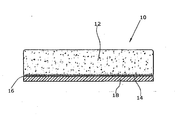
- Bottom 14 has a partially embedded in this random fiber layer 16, which is mechanically connected by gluing or welding or other ways with a single or multi-layer plastic plate 18.
- the drawn in the drawing for reasons of comprehensible representation distance between the bottom 14 of the concrete body 12 and the plastic plate 18 does not necessarily have to be present.
- This free fiber content consists of fiber ends and fiber loops.
- the fiber loops are enclosed by the cement paste when placed on the fresh concrete of a concrete sleeper in production and lead to a basic strength of the connection.
- tear strengths between the concrete and the elastic coating of about 0.3 N / mm 2 to 0.5 N / mm 2 can be achieved. These values are within the limits of the technical requirements of railway operators and their regulations.
- Hydrationssoges for frictional integration of free fiber ends in the fresh concrete leads to break-off strength of about 1.5 N / mm 2 and thus allows the assurance of high quality standards of the webs and optimal system redundancy.
Landscapes
- Engineering & Computer Science (AREA)
- Architecture (AREA)
- Civil Engineering (AREA)
- Structural Engineering (AREA)
- Mechanical Engineering (AREA)
- Road Paving Structures (AREA)
- Laminated Bodies (AREA)
- Curing Cements, Concrete, And Artificial Stone (AREA)
Description
- Die Erfindung betrifft ein Betonteil mit einer Kunststoffplatte, insbesondere eine Betonschwelle, nach dem Oberbegriff des Anspruchs 1.
- Bei bekannten Verbundsystemen zwischen textilen Faserstrukturen und Beton, wie zum Beispiel bei der Besohlungen von Bahnschwellen aus Spannbeton bzw. Beton sind technische Lösungen bekannt, bei denen Fasern mit den Betonkonstruktionen kraftschlüssig verbunden werden.
- Gemäß
EP-B-1 298 252 ,EP-A-1 445 378 undWO-A-2009/108972 werden zum Beispiel elastische Kunststoffschichten mittels einer Wirrfaserschicht an der Unterseite von Bahnschwellen derart fixiert, dass eine textile Wirrfaserschicht sowohl in oder auf der Kunststoffschicht verklebt oder verschweißt ist und im Beton durch Einbindung der Fasern in den Zementmörtel oder einen separat aufgetragenen Verbundstoff, z.B. Kleber verbunden wird. Als Wirrfaserschichten zur Verbindung zwischen den als Beispiel benannten Bahnschwellen und einer elastischen Schwellenbesohlung werden z.B. Geotextil- bzw. Vliesstoffe verwendet. - Die Mehrzahl bekannter Vliese und auch anderer Verbindungsmedien wie z.B. Geotextilvliesstoffe verfügen lediglich über eingeschränkte Eigenschaften kraftschlüssiger, die Funktionalität eines Verbundes uneingeschränkt bewirkender Applikationen.
- Kunststoffgeflechte mit steifen Faserstrukturen können beispielsweise die Mineralstrukturen im Frischbeton nicht so intensiv umverlagern, dass alle Verbindungsstrukturen vollständig im Beton eingebunden sind. Es entstehen Fehlstellen zwischen Verbundmedium und Beton, die zum Beispiel ein definiertes Elastizitätsverhalten beeinträchtigen, bei Wässerzutritt zu Pumpeffekten führen und die Gefügestruktur im Beton stören.
- Aufgabe der Erfindung ist es, ein Betonbauteil mit einer Kunststoffplatte insbesondere als Betonschwelle mit einer unterseitigen Kunststoff-Besohlung, das/die sich einfach herstellen lässt und dessen bzw. deren Kunststoffplatte bzw. -Besohlung zuverlässig an den Betonkörper mechanisch angebunden ist.
- Zur Lösung dieser Aufgabe wird mit der Erfindung ein Betonbauteil mit iener Kunststoffplatte, insbesondere eine Betonschwelle mit einer unterseitigen Kunststoff-Besohlung vorgeschlagen, das/die versehen ist mit
- einem Betonkörper, der eine Unterseite aufweist, und
- einer Kunststoffplatte, die an der Unterseite des Betonkörpers angeordnet ist,
- wobei die ein- oder mehrlagige Kunststoffplatte mit dem Betonkörper durch eine Wirrfaserschicht verbunden ist, die Fasern aufweist, welche mit der Kunststoffplatte verbunden und/oder in den Betonkörper eingebettet sind.
- Bei diesem Betonbauteil ist erfindungsgemäß vorgesehen,
- dass die Wirrfaserschicht Fasern mit einem Durchmesser zwischen 15 µm und 50 µm sowie mit einer Dichte von 20 bis 200 Fasern je Quadratmillimeter aufweist und
- dass etwa 20 % bis 60 % der Fasern mit in den Betonkörper eingebetteten freien Enden und die eingebetteten Faserabschnitte der anderen Fasern als Schlingen ausgebildet sind,
- wobei etwa 10 % bis 60 % der in dem Beton eingebetteten freien Fäserenden relativ zur Unterseite des Betonkörpers um 30° bis 90° gekrümmt sind.
- In vorteilhafter Weise weisen die Fasern einen im Wesentlichen kreisförmigen oder elliptischen Querschnitt auf, wobei das Seitenverhältnis der Ellipse nicht größer als 1:2 ist.
- Gemäß einer weiteren vorteilhaften Ausgestaltung der Erfindung sind die Fasern affin zu den für den Betonkörper bei dessen Herstellung verwendeten Komponenten.
- Es hat sich herausgestellt, dass bekannte Vliese und vliesähnliche Wirrfasermaterialien wie z.B. Filze (hergestellt durch Vernadelung, Appreturen, Faserverläufe und Faserformen) nur bedingt geeignet sind, selbstständig vom Frischbeton durch den im Abbindeprozess des Betons auftretenden Hydratationssog derart angebunden zu werden, dass die anforderungsgerechte Applikation gewährleistet ist.
- Bei der Erfindung wird für die Herstellung des Betonbauteils mit Kunststoffplatte bzw. der Betonschwelle mit unterseitiger Kunststoff-Besohlung als mechanische Verbindung zwischen diesen beiden Elementen eine spezielle Fasern aufweisende Wirrfaserschicht verwendet, so dass die Faserenden in Folge des Hydratationssoges des Betons bei dessen Abbinden in Kapillar- und/oder Gelporen des Betons gelangen und im abgebundenen Zustand des Betons in diesem gehalten sind. Dabei kann die Wirrfaserschicht auf ihrer der Unterseite der Betonschwelle abgewandten Seite mit einer ein- oder mehrlagigen Kunststoffplatte verbunden werden, und zwar entweder vor oder nach der Verbindung der Wirrfaserschicht mit dem Betonkörper.
- Aus der Erkenntnis, dass Frischbeton unter definierbaren Rezeptur- und Verarbeitungsbedingungen einen Hydratationssog entwickelt, sind also erfindunsgemäß die Wirrfaserschicht und der Beton so aufeinander abgestimmt, dass der Hydratationssog die verbindenden Faserstrukturen in den Frischbeton einsaugt.
- Zur technischen Nutzung dieses Hydratationssoges sind die nachfolgenden betontechnologischen, zementchemischen, textiltechnischen und applikationsspezifischen Kriterien in ihrem zusammenhängenden Wirkprozess als erfindungsgemäße Lösung definiert.
- Die Hydratation als Reaktion zwischen Wasser und Zement bewirkt die Bildung des Zementsteins. Einige der Hauptbestandteile des Zements, die beim Brennen der Ausgangsstoffe entstehen und in der Klinkerphase eine weitere Modifizierung erfahren, bewirken unterschiedliche Reaktionsabläufe zwischen dem Anmachwasser und eben diesen Zementbestandteilen.
- Insbesondere bewirken Tricalciumaluminat und Tricalciumsilicat eine hohe Reaktionsgeschwindigkeit und die Festigkeitsentwicklung des Zementsteins. Der Calciumsulfatanteil (Gips) beeinflusst bzw. verzögert die Wirkung des Tricalciumaluminats. Erfindungsgemäß ist bei der Eignungsprüfung für die Betonrezeptierung durch die Wahl der Zementsorte das Verfahren zu modifizieren bzw. zu optimieren.
- Der Frischbeton erfährt durch einen hohen Gehalt an Tricalciumaluminat und dessen Zusammenwirken mit den Eigenschaften der anderen Klinkerbestandteile (im Wesentlichen Tricalciumsilikat, Dlcalciumsilikat und Tetracalciumaluminatferrit) des noch nicht im Abbinde- und Erhärtungsstadium befindlichen Frischbetons die Eigenschaft, feine faser- und folienartige Calciumsilicathydrate und kleine Kristalle aus Calciumhydroxyd zu bilden.
- Weiterhin entstehen bei Reaktion der Aluminate mit Calciumsulfat die Calciumaluminatsulfathydrate als nadelförmige Trisulfate, das so genannte Ettringit.
- Die Reaktion des Tricalciumaluminats mit den Calciumsulfaten ist mit einer Volumenvergrößerung verbunden, die im noch nicht erstarrten Beton insoweit folgenlos ist, als ein Ettringittreiben nicht entsteht.
- Die Volumenvergrößerung bewirkt jedoch in dem in der Bildung befindlichen Zementgel und den darin enthaltenen Kapillar- und Gelporen den als solchen bezeichneten Hydratationssog.
- Dieser Hydratationssog wird, soweit bekannt, in keiner bekannten Betontechnologie als verfahrenstechnischer Vorteil genutzt. Ausschließlich bei der Applikation von Nachbehandlungsmitteln im Betonstraßenbau ist die Nutzung ähnliche Effekte bekannt.
- Erfindungsgemäß wird für die gezielte Einbindung von Fasern in die Frischbetonoberfläche der betontechnologische Hydratationssog technisch und wirtschaftlich genutzt.
- Die Gelporen sind mit einem Anteil von vorzugsweise etwa 25 % des Gelvolumens und einem Porenradius von 10-7 mm bis 10-5 mm geeignet, Fasern eines auf den Frischbeton aufgelegten Materials anzusaugen, wenn diese Fasern gegenüber den Kapillar- und Gelporen eine konkludente Struktur und Beschaffenheit aufweisen. Die Kapillar- und Gelporen weisen im Allgemeinen eine zylindrische Form auf und verjüngen sich mit zunehmender Porentiefe zu so genannten Flaschenporen. Die zur Nutzung des Hydratationssoges geeigneten Fasern müssen dahingehend konkludent sein, dass sie sowohl im zylindrischen, als auch im verjüngenden Teil der Poren erfindungsgemäß eindringen können. Die Kapillarporen mit Porenradien zwischen insbesondere 10-5 mm bis 10-1 mm ergänzen die Gelporen in der Porengröße nahezu ohne technisch nachteilig wirkenden Übergang.
- Bei den am Beispiel einer Schwellenbesohlung verwendeten Geotextilien wird eine Wirrfaserstruktur aus PE bzw. PET mit Fäserdurchmessern von insbesondere ca. 20 µm bis 40 µm verwendet. Diese Faserdurchmesser und die verwendete Faserdichte von zweckmäßigerweise 40 bis 130 Fäden/mm2 bietet die für das Ansaugen der Fasern erforderliche Kompatibilität zwischen Hydratationssog, Kapillar- und Gelporen, Faserdurchmesser und Faserdichte.
- Als weitere Bedingungen zur Wirksamkeit der eigenständigen Aufnahme von Fasern definierter Faserstärke und Faserdichte infolge Hydratationssog sind die freie Faserlänge, die geometrische Form der Fasern und ihre Querschnittsgestaltung sowie deren Ausrichtung und Affinität gegenüber dem Anmachwasser sowie dem Zementgel erfindungsgemäß definierbar. Dies betrifft zum Beispiel solche Geotextile oder andere Wirrfaserstrukturen bzw. Fasermaterialien, die in deren Herstellungsprozess hydrophob ausgestattet werden oder/und durch die Verdüsung einen der Hydratationsporengeometrie nicht verträglichen z.B. rechteckigen Querschnitt haben.
- Danach sollten die für die Einbindung in den Beton verfügbaren Fasern in einem definierten Anteil von vorzugsweise 20% bis 50 % freie Enden besitzen. Nur ein begrenzter Anteil von vorzugsweise weniger als 50 % der Fasern sollte als Schlinge ausgebildet sein. Die freien Enden der Fasern sollten nicht ausschließlich gerade verlaufen; ein Anteil von z.B. 10 % bis 60 % sollte derart gekrümmt sein, dass der Krümmungswinkel mindestens 30°, jedoch nicht mehr als 90° beträgt.
- Der Faserquerschnitt sollte kreisrund bis elliptisch sein, wobei das Seitenverhältnis der Ellipse nicht größer als 1:2 sein sollte.
- Die Fasern selbst sollten von Rückständen der Faser- oder Gewirkherstellung befreit sein, die eine Affinität zum Zementleim, zum Gel oder zum Anmachwasser beeinträchtigen könnten. Als Materialien für die Fasern kommen die bekannten Kunststofffasermaterialien (z.B. Thermoplaste wie PE oder PET), Metalle (Metallfasern) oder auch nachwachsende bzw. pflanzliche Rohstoffe in Frage.
- Nachfolgend wird anhand der Zeichnung, die einen Querschnitt durch eine Betonschwelle mit unterseitig über eine Wirrfaserschicht mechanisch angebundener elastischer Kunststoffplatte zeigt, ein Ausführungsbeispiel der Erfindung näher erläutert.
- In der Zeichnung ist beispielhaft eine Betonschwelle 10 mit einem bewehrten, schlaff bewehrten oder nicht bewehrten Beton-(voll-)körper 12, der an seiner
- Unterseite 14 eine teilweise in diese eingebettete Wirrfaserschicht 16 aufweist, die durch Verkleben oder Verschweißen oder auf andere Art mechanisch mit einer ein- oder mehrlagigen Kunststoffplatte 18 verbunden ist. Der in der Zeichnung aus Gründen der verständlicheren Darstellung eingezeichnete Abstand zwischen der Unterseite 14 des Betonkörpers 12 und der Kunststoffplatte 18 braucht nicht notwendigerweise vorhanden zu sein.
- Bei den als Schwellenbesohlung bezeichneten unterseitigen elastischen Beschichtungen von Bahnschwellen aus Beton bzw. Spannbeton werden in die elastischen Beschichtungsmaterialien Wirrfaserschichten mit definierten Fasereigenschaften eingeschmolzen.
- Diese Wirrfaserschichten verfügen nach einseitig etwa hälftiger Einbindung in die elastischen Materialien über einen nicht eingebundenen, von den elastischen Materialien aufragenden Faseranteil zur Anbindung an die Betonschwellen.
- Dieser freie Faseranteil besteht aus Faserenden und Faserschlingen. Die Faserschlingen werden beim Auflegen auf den Frischbeton einer in der Fertigung befindlichen Betonschwelle vom Zementleim umschlossen und führen zu einer Grundfestigkeit der Anbindung.
- Mit dieser Grundfestigkeit lassen sich Abreißfestigkeiten zwischen dem Beton und der elastischen Beschichtung von etwa 0,3 N/mm2 bis 0,5 N/mm2 erreichen. Diese Werte liegen im Grenzbereich der technischen Anforderungen von Bahnbetreibern und deren Regelwerken.
- Die technische Nutzung des Hydratationssoges zur kraftschlüssigen Einbindung freier Faserenden in den Frischbeton führt zu Abreißfestigkeiten von über 1,5 N/mm2 und ermöglicht damit die Sicherung hoher Qualitätsansprüche der Bahnen und eine optimale Systemredundanz.
- Bei Faserdurchmessern von ca. 25 µm bis ca. 40 µm und einer Faserdichte zwischen 40 und 130 Fasern je mm2 sowie der Verwendung calciumsulfatarmer Zemente werden die freien Faserenden in den in der Bildung befindlichen Ettringit unter Nutzung des Hydratationssoges angesaugt. Die im Umfeld der hierdurch entstehenden Matrix aus Fasern und Zementleim unter atmosphärischem Druck befindliche Luft dient nur bedingt als Rezipient. Ein weiterer technischer Zusammenhang besteht zur Hydratationsenergie. Damit besteht auch die Möglichkeit unter Bedingungen geminderten Luftdrucks (z.B. Vakuumbeton) nach diesem Prinzip elastische Kunststoffe an Betonschwellen zu applizieren.
- Die Erfindung wurde vorstehend anhand einer Betonschwelle als Anwendungsfall eines Betonbauteils erläutert. Es versteht sich von selbst, dass die Erfindung damit aber auf Betonschwellen nicht beschränkt ist, sondern Anwendung überall dort findet, wo der Betonkörper eines Betonbauteils mit einer Kunststoffplatte mechanisch verbunden werden muss.
Claims (3)
- Betonbauteil mit einer Kunststoffplatte, insbesondere Betonschwelle mit einer unterseitigen Kunststoff-Besohlung, mit- einem Betonkörper (12), der eine Unterseite (14) aufweist, und- einer Kunststoffplatte (18), die an der Unterseite (14) des Betonkörpers (12) angeordnet ist,- wobei die ein- oder mehrlagige Kunststoffplatte (18) mit dem Betonkörper (12) durch eine Wirrfaserschicht (16) verbunden ist, die Fasern aufweist, welche mit der Kunststoffplatte (18) verbunden und/oder in den Betonkörper (12) eingebettet sind,
dadurch gekennzeichnet ,- dass die Wirrfaserschicht (16) Fasern mit einem Durchmesser zwischen 15 µm und 50 µm sowie mit einer Dichte von 20 bis 200 Fasern je Quadratmillimeter aufweist und- dass etwa 20 % bis 60 % der Fasern mit in den Betonkörper (12) eingebetteten freien Enden und die eingebetteten Faserabschnitte der anderen Fasern als Schlingen ausgebildet sind,- wobei etwa 10 % bis 60 % der in dem Beton eingebetteten freien Faserenden relativ zur Unterseite (14) des Betonkörpers (12) um 30° bis 90° gekrümmt sind. - Betonbauten nach Anspruch 1, dadurch gekennzeichnet, dass die Fasern einen im wesentlichen kreisförmigen oder elliptischen Querschnitt aufweisen, wobei das Seitenverhältnis der Ellipse nicht größer als 1:2 ist.
- Betonbauteil nach Anspruch 1 oder 2, dadurch gekennzeichnet, dass die Fasern affin zu den für den Betonkörper (12) bei dessen Herstellung verwendeten Komponenten sind.
Priority Applications (4)
| Application Number | Priority Date | Filing Date | Title |
|---|---|---|---|
| PL11710720T PL2545219T3 (pl) | 2010-03-12 | 2011-03-11 | Część betonowa ze spodnią płytą z tworzywa sztucznego |
| EP20110710720 EP2545219B1 (de) | 2010-03-12 | 2011-03-11 | Betonteil mit einer unterseitigen Kunststoffplatte |
| SI201130371T SI2545219T1 (sl) | 2010-03-12 | 2011-03-11 | Betonski element s plastično podlago na spodnji strani |
| HRP20150045TT HRP20150045T1 (hr) | 2010-03-12 | 2011-03-11 | Betonski element s plastiäśnim donjim dijelom |
Applications Claiming Priority (4)
| Application Number | Priority Date | Filing Date | Title |
|---|---|---|---|
| EP10156347 | 2010-03-12 | ||
| EP10156352 | 2010-03-12 | ||
| EP20110710720 EP2545219B1 (de) | 2010-03-12 | 2011-03-11 | Betonteil mit einer unterseitigen Kunststoffplatte |
| PCT/EP2011/053709 WO2011110669A1 (de) | 2010-03-12 | 2011-03-11 | Betonschwelle und verfahren zu ihrer herstellung |
Publications (2)
| Publication Number | Publication Date |
|---|---|
| EP2545219A1 EP2545219A1 (de) | 2013-01-16 |
| EP2545219B1 true EP2545219B1 (de) | 2014-11-05 |
Family
ID=44146636
Family Applications (1)
| Application Number | Title | Priority Date | Filing Date |
|---|---|---|---|
| EP20110710720 Active EP2545219B1 (de) | 2010-03-12 | 2011-03-11 | Betonteil mit einer unterseitigen Kunststoffplatte |
Country Status (12)
| Country | Link |
|---|---|
| US (1) | US20130059144A1 (de) |
| EP (1) | EP2545219B1 (de) |
| CN (1) | CN102906335B (de) |
| DK (1) | DK2545219T3 (de) |
| ES (1) | ES2528144T3 (de) |
| HR (1) | HRP20150045T1 (de) |
| PL (1) | PL2545219T3 (de) |
| PT (1) | PT2545219E (de) |
| RS (1) | RS53765B1 (de) |
| RU (1) | RU2557440C2 (de) |
| SI (1) | SI2545219T1 (de) |
| WO (1) | WO2011110669A1 (de) |
Cited By (3)
| Publication number | Priority date | Publication date | Assignee | Title |
|---|---|---|---|---|
| WO2019201761A1 (de) | 2018-04-19 | 2019-10-24 | Rst-Rail Systems And Technologies Gmbh | Schwellensohlen für trockenen beton |
| DE102022134100A1 (de) | 2022-12-20 | 2024-06-20 | Het Elastomertechnik Gmbh | Verfahren zur Herstellung von Schwellensohlen für ein Bahngleis mit Schotterbettung |
| EP4488055A1 (de) | 2023-07-07 | 2025-01-08 | Johanna Sophie Gärlich | Unterlage für einen bahnschwellen-betonkörper und herstellungsverfahren |
Families Citing this family (13)
| Publication number | Priority date | Publication date | Assignee | Title |
|---|---|---|---|---|
| AT513946B1 (de) * | 2013-01-17 | 2014-12-15 | Getzner Werkstoffe Holding Gmbh | Bahnschwelle |
| CN103161099A (zh) * | 2013-03-29 | 2013-06-19 | 无锡恒畅铁路轨枕有限公司 | 混凝土轨枕 |
| CN103194938A (zh) * | 2013-03-29 | 2013-07-10 | 无锡恒畅铁路轨枕有限公司 | 混凝土轨枕 |
| CN103161100A (zh) * | 2013-03-29 | 2013-06-19 | 无锡恒畅铁路轨枕有限公司 | 高强度混凝土轨枕 |
| CN103194939A (zh) * | 2013-03-29 | 2013-07-10 | 无锡恒畅铁路轨枕有限公司 | 混凝土轨枕 |
| CN103147367A (zh) * | 2013-03-29 | 2013-06-12 | 无锡恒畅铁路轨枕有限公司 | 混凝土轨枕 |
| CN103147364A (zh) * | 2013-03-29 | 2013-06-12 | 无锡恒畅铁路轨枕有限公司 | 混凝土轨枕 |
| DE102014112326A1 (de) * | 2014-08-27 | 2016-03-03 | GKT Gummi- und Kunststofftechnik Fürstenwalde GmbH | Schwellensohle und Verfahren zur Herstellung einer Schwellensohle |
| DE102017116093A1 (de) * | 2017-07-18 | 2019-01-24 | Dätwyler Sealing Technologies Deutschland Gmbh | Dichtungsprofil zur Einbettung in ein Formteil aus aushärtbarem Material |
| WO2019152621A1 (en) * | 2018-01-31 | 2019-08-08 | 3M Innovative Properties Company | Article including composite layer and method of making the article |
| JP6674504B2 (ja) * | 2018-06-07 | 2020-04-01 | 株式会社イノアックコーポレーション | まくらぎ用パッド |
| CN114206605A (zh) | 2019-08-07 | 2022-03-18 | 3M创新有限公司 | 带材、包括带材和复合层的制品及相关方法 |
| JP2025031213A (ja) * | 2023-08-25 | 2025-03-07 | 日清紡ケミカル株式会社 | 枕木パッド及び弾性枕木 |
Family Cites Families (9)
| Publication number | Priority date | Publication date | Assignee | Title |
|---|---|---|---|---|
| US6426029B1 (en) * | 1995-10-10 | 2002-07-30 | Donald R. Hiscock | Lamination between plastic resins and cement |
| US7192643B2 (en) * | 2001-08-22 | 2007-03-20 | 3M Innovative Properties Company | Toughened cementitious composites |
| DK1298252T4 (da) | 2001-10-01 | 2011-09-05 | Rst Rail Systems And Technologies Gmbh | Jernbanesvelle med belægning på undersiden |
| DE10304768B3 (de) * | 2003-02-05 | 2004-08-05 | Rst-Rail Systems And Technologies Gmbh | Bahnschwelle mit unterseitiger Beschichtung und Abrissprüfung bei einer derartigen Bahnschwelle |
| DE102004063636A1 (de) * | 2004-12-31 | 2006-07-13 | Pfleiderer Infrastrukturtechnik Gmbh & Co. Kg | Betonschwelle für hohe dynamische Lasten |
| FR2906269B1 (fr) * | 2006-09-22 | 2008-12-19 | Alstom Transport Sa | Traverse de chemin de fer |
| AT506529B1 (de) * | 2008-03-06 | 2010-05-15 | Getzner Werkstoffe Holding Gmbh | Schwellensohle |
| RU76649U1 (ru) * | 2008-04-17 | 2008-09-27 | Открытое Акционерное Общество "Российские Железные Дороги" | Железобетонная шпала с упругими прокладками на подошве |
| FR2935399B1 (fr) * | 2008-09-02 | 2012-10-12 | Sateba Systeme Vagneux | Semelle viscoelastique, ensemble comportant un bloc et une semelle precitee, et procedes de fabrication correspondants. |
-
2011
- 2011-03-11 HR HRP20150045TT patent/HRP20150045T1/hr unknown
- 2011-03-11 SI SI201130371T patent/SI2545219T1/sl unknown
- 2011-03-11 EP EP20110710720 patent/EP2545219B1/de active Active
- 2011-03-11 WO PCT/EP2011/053709 patent/WO2011110669A1/de not_active Ceased
- 2011-03-11 CN CN201180013641.5A patent/CN102906335B/zh active Active
- 2011-03-11 RU RU2012143479/11A patent/RU2557440C2/ru active
- 2011-03-11 RS RS20150013A patent/RS53765B1/sr unknown
- 2011-03-11 PL PL11710720T patent/PL2545219T3/pl unknown
- 2011-03-11 ES ES11710720.1T patent/ES2528144T3/es active Active
- 2011-03-11 PT PT11710720T patent/PT2545219E/pt unknown
- 2011-03-11 DK DK11710720.1T patent/DK2545219T3/en active
- 2011-03-11 US US13/634,351 patent/US20130059144A1/en not_active Abandoned
Cited By (5)
| Publication number | Priority date | Publication date | Assignee | Title |
|---|---|---|---|---|
| WO2019201761A1 (de) | 2018-04-19 | 2019-10-24 | Rst-Rail Systems And Technologies Gmbh | Schwellensohlen für trockenen beton |
| DE102022134100A1 (de) | 2022-12-20 | 2024-06-20 | Het Elastomertechnik Gmbh | Verfahren zur Herstellung von Schwellensohlen für ein Bahngleis mit Schotterbettung |
| WO2024132642A1 (de) | 2022-12-20 | 2024-06-27 | Het Elastomertechnik Gmbh | Verfahren zur herstellung von schwellensohlen für ein bahngleis mit schotterbettung |
| EP4488055A1 (de) | 2023-07-07 | 2025-01-08 | Johanna Sophie Gärlich | Unterlage für einen bahnschwellen-betonkörper und herstellungsverfahren |
| DE102024118885A1 (de) | 2023-07-07 | 2025-01-09 | Johanna Sophie Gärlich | Unterlage für einen Bahnschwellen-Betonkörper und Herstellungsverfahren |
Also Published As
| Publication number | Publication date |
|---|---|
| DK2545219T3 (en) | 2015-01-26 |
| RU2012143479A (ru) | 2014-05-10 |
| ES2528144T3 (es) | 2015-02-04 |
| CN102906335A (zh) | 2013-01-30 |
| SI2545219T1 (sl) | 2015-04-30 |
| RU2557440C2 (ru) | 2015-07-20 |
| CN102906335B (zh) | 2015-08-05 |
| PL2545219T3 (pl) | 2015-04-30 |
| RS53765B1 (sr) | 2015-06-30 |
| US20130059144A1 (en) | 2013-03-07 |
| PT2545219E (pt) | 2015-02-05 |
| WO2011110669A1 (de) | 2011-09-15 |
| EP2545219A1 (de) | 2013-01-16 |
| HRP20150045T1 (hr) | 2015-05-08 |
Similar Documents
| Publication | Publication Date | Title |
|---|---|---|
| EP2545219B1 (de) | Betonteil mit einer unterseitigen Kunststoffplatte | |
| EP0062731B1 (de) | Bauplatte aus Gips und Verfahren zu deren Herstellung | |
| DE112014003893T5 (de) | Eine schallabsorbierende Mikropartikelplatte sowie deren Herstellungsverfahren | |
| DE102005024408A1 (de) | Verstärkung von Schaumwerkstoffen | |
| DE3445396A1 (de) | Verfahren zum aufbringen einer korrosionsfesten kunstharzbeschichtung auf die oberflaeche einer betonkonstruktion | |
| EP0258734A2 (de) | Bauplatte im Schichtenaufbau und Verfahren zu ihrer Herstellung | |
| EP0475000B1 (de) | Beschichtungssystem | |
| EP0732464A1 (de) | Verfahren zur Herstellung von armierten Beschichtungen, insbesondere auf Betonoberflächen, und zugehöriges Armierungsnetz | |
| DE69725284T2 (de) | Verstärkung für betonteile und verstärkte betonteile | |
| DE102015119700A1 (de) | Verfahren zur Konditionierung der Oberflächen pultrudierter und/oder anderweitig durch Harze oder Kleber zusammengefasster Carbonfasern zu Carbonfaserprofilen oder Carbonfaserflächen und Anordnung zur Durchführung des Verfahrens | |
| EP2758610B1 (de) | Bauplatte mit geschäumtem kern und einer abdeckung mit nanozusatzstoffen | |
| EP4035857B1 (de) | Verfahren zur herstellung von armierten 3d-gedruckten beton- bzw. mörtelbasierten objekten | |
| WO2014005710A1 (de) | Faserverstärkter mineralischer baustoff | |
| EP2374769A1 (de) | Zuschlagstoff für die Ausbildung einer Schallabtsorptionsschicht einer Lärmschutzeinrichtung und Lärmschutzeinrichtung | |
| DE102011013739A1 (de) | Bauplatte | |
| EP1991734B1 (de) | Baubereichsbahn | |
| EP3642291B1 (de) | Filmklebstoff sowie verfahren zu dessen herstellung | |
| DE10349298B4 (de) | Filtermaterial und Verfahren zu dessen Herstellung | |
| CH633220A5 (en) | Laminated board | |
| DE1000144B (de) | Putztraeger, insbesondere fuer Decken und Waende | |
| DE102012001055A1 (de) | Bauteil | |
| EP3266605A1 (de) | Bauplatte mit armierungsgewebe und verfahren zu deren herstellung | |
| AT412700B (de) | Verfahren zur herstellung eines mehrlagigen bandartigen formteiles | |
| EP1936064B1 (de) | Fugenband | |
| EP4414340A1 (de) | Kombination für die herstellung einer bewehrten lagerfugenmörtelschicht eines bewehrten mauerwerks, derartige lagerfugenmörtelschicht, bewehrtes mauerwerk mit einer derartigen lagerfugenmörtelschicht sowie verfahren zur herstellung einer derartigen lagerfugenmörtelschicht und eines bewehrten mauerwerks |
Legal Events
| Date | Code | Title | Description |
|---|---|---|---|
| PUAI | Public reference made under article 153(3) epc to a published international application that has entered the european phase |
Free format text: ORIGINAL CODE: 0009012 |
|
| 17P | Request for examination filed |
Effective date: 20120926 |
|
| AK | Designated contracting states |
Kind code of ref document: A1 Designated state(s): AL AT BE BG CH CY CZ DE DK EE ES FI FR GB GR HR HU IE IS IT LI LT LU LV MC MK MT NL NO PL PT RO RS SE SI SK SM TR |
|
| DAX | Request for extension of the european patent (deleted) | ||
| GRAP | Despatch of communication of intention to grant a patent |
Free format text: ORIGINAL CODE: EPIDOSNIGR1 |
|
| GRAJ | Information related to disapproval of communication of intention to grant by the applicant or resumption of examination proceedings by the epo deleted |
Free format text: ORIGINAL CODE: EPIDOSDIGR1 |
|
| INTG | Intention to grant announced |
Effective date: 20140401 |
|
| GRAP | Despatch of communication of intention to grant a patent |
Free format text: ORIGINAL CODE: EPIDOSNIGR1 |
|
| INTC | Intention to grant announced (deleted) | ||
| GRAJ | Information related to disapproval of communication of intention to grant by the applicant or resumption of examination proceedings by the epo deleted |
Free format text: ORIGINAL CODE: EPIDOSDIGR1 |
|
| GRAP | Despatch of communication of intention to grant a patent |
Free format text: ORIGINAL CODE: EPIDOSNIGR1 |
|
| INTG | Intention to grant announced |
Effective date: 20140506 |
|
| INTG | Intention to grant announced |
Effective date: 20140528 |
|
| GRAS | Grant fee paid |
Free format text: ORIGINAL CODE: EPIDOSNIGR3 |
|
| GRAA | (expected) grant |
Free format text: ORIGINAL CODE: 0009210 |
|
| AK | Designated contracting states |
Kind code of ref document: B1 Designated state(s): AL AT BE BG CH CY CZ DE DK EE ES FI FR GB GR HR HU IE IS IT LI LT LU LV MC MK MT NL NO PL PT RO RS SE SI SK SM TR |
|
| REG | Reference to a national code |
Ref country code: GB Ref legal event code: FG4D Free format text: NOT ENGLISH |
|
| REG | Reference to a national code |
Ref country code: CH Ref legal event code: EP |
|
| REG | Reference to a national code |
Ref country code: AT Ref legal event code: REF Ref document number: 694745 Country of ref document: AT Kind code of ref document: T Effective date: 20141115 |
|
| REG | Reference to a national code |
Ref country code: IE Ref legal event code: FG4D Free format text: LANGUAGE OF EP DOCUMENT: GERMAN |
|
| REG | Reference to a national code |
Ref country code: DE Ref legal event code: R096 Ref document number: 502011004878 Country of ref document: DE Effective date: 20141224 |
|
| REG | Reference to a national code |
Ref country code: HR Ref legal event code: TUEP Ref document number: P20150045 Country of ref document: HR |
|
| REG | Reference to a national code |
Ref country code: RO Ref legal event code: EPE |
|
| REG | Reference to a national code |
Ref country code: DK Ref legal event code: T3 Effective date: 20150121 |
|
| REG | Reference to a national code |
Ref country code: NL Ref legal event code: T3 Ref country code: ES Ref legal event code: FG2A Ref document number: 2528144 Country of ref document: ES Kind code of ref document: T3 Effective date: 20150204 |
|
| REG | Reference to a national code |
Ref country code: PT Ref legal event code: SC4A Free format text: AVAILABILITY OF NATIONAL TRANSLATION Effective date: 20150115 |
|
| REG | Reference to a national code |
Ref country code: SE Ref legal event code: TRGR |
|
| REG | Reference to a national code |
Ref country code: SK Ref legal event code: T3 Ref document number: E 17922 Country of ref document: SK |
|
| REG | Reference to a national code |
Ref country code: GR Ref legal event code: EP Ref document number: 20150400088 Country of ref document: GR Effective date: 20150220 |
|
| REG | Reference to a national code |
Ref country code: NO Ref legal event code: T2 Effective date: 20141105 |
|
| REG | Reference to a national code |
Ref country code: EE Ref legal event code: FG4A Ref document number: E010313 Country of ref document: EE Effective date: 20150120 |
|
| PG25 | Lapsed in a contracting state [announced via postgrant information from national office to epo] |
Ref country code: IS Free format text: LAPSE BECAUSE OF FAILURE TO SUBMIT A TRANSLATION OF THE DESCRIPTION OR TO PAY THE FEE WITHIN THE PRESCRIBED TIME-LIMIT Effective date: 20150305 |
|
| REG | Reference to a national code |
Ref country code: PL Ref legal event code: T3 |
|
| REG | Reference to a national code |
Ref country code: HR Ref legal event code: T1PR Ref document number: P20150045 Country of ref document: HR |
|
| PG25 | Lapsed in a contracting state [announced via postgrant information from national office to epo] |
Ref country code: CY Free format text: LAPSE BECAUSE OF FAILURE TO SUBMIT A TRANSLATION OF THE DESCRIPTION OR TO PAY THE FEE WITHIN THE PRESCRIBED TIME-LIMIT Effective date: 20141105 |
|
| REG | Reference to a national code |
Ref country code: HU Ref legal event code: AG4A Ref document number: E022932 Country of ref document: HU |
|
| REG | Reference to a national code |
Ref country code: DE Ref legal event code: R097 Ref document number: 502011004878 Country of ref document: DE |
|
| PLBE | No opposition filed within time limit |
Free format text: ORIGINAL CODE: 0009261 |
|
| STAA | Information on the status of an ep patent application or granted ep patent |
Free format text: STATUS: NO OPPOSITION FILED WITHIN TIME LIMIT |
|
| 26N | No opposition filed |
Effective date: 20150806 |
|
| PG25 | Lapsed in a contracting state [announced via postgrant information from national office to epo] |
Ref country code: MC Free format text: LAPSE BECAUSE OF FAILURE TO SUBMIT A TRANSLATION OF THE DESCRIPTION OR TO PAY THE FEE WITHIN THE PRESCRIBED TIME-LIMIT Effective date: 20141105 |
|
| REG | Reference to a national code |
Ref country code: FR Ref legal event code: PLFP Year of fee payment: 6 |
|
| PG25 | Lapsed in a contracting state [announced via postgrant information from national office to epo] |
Ref country code: MT Free format text: LAPSE BECAUSE OF FAILURE TO SUBMIT A TRANSLATION OF THE DESCRIPTION OR TO PAY THE FEE WITHIN THE PRESCRIBED TIME-LIMIT Effective date: 20141105 |
|
| REG | Reference to a national code |
Ref country code: FR Ref legal event code: PLFP Year of fee payment: 7 |
|
| PGFP | Annual fee paid to national office [announced via postgrant information from national office to epo] |
Ref country code: GR Payment date: 20170321 Year of fee payment: 7 |
|
| PG25 | Lapsed in a contracting state [announced via postgrant information from national office to epo] |
Ref country code: SM Free format text: LAPSE BECAUSE OF FAILURE TO SUBMIT A TRANSLATION OF THE DESCRIPTION OR TO PAY THE FEE WITHIN THE PRESCRIBED TIME-LIMIT Effective date: 20141105 |
|
| REG | Reference to a national code |
Ref country code: FR Ref legal event code: PLFP Year of fee payment: 8 |
|
| PG25 | Lapsed in a contracting state [announced via postgrant information from national office to epo] |
Ref country code: AL Free format text: LAPSE BECAUSE OF FAILURE TO SUBMIT A TRANSLATION OF THE DESCRIPTION OR TO PAY THE FEE WITHIN THE PRESCRIBED TIME-LIMIT Effective date: 20141105 |
|
| PG25 | Lapsed in a contracting state [announced via postgrant information from national office to epo] |
Ref country code: GR Free format text: LAPSE BECAUSE OF NON-PAYMENT OF DUE FEES Effective date: 20181003 |
|
| REG | Reference to a national code |
Ref country code: HR Ref legal event code: ODRP Ref document number: P20150045 Country of ref document: HR Payment date: 20190305 Year of fee payment: 9 |
|
| REG | Reference to a national code |
Ref country code: HR Ref legal event code: ODRP Ref document number: P20150045 Country of ref document: HR Payment date: 20200227 Year of fee payment: 10 |
|
| REG | Reference to a national code |
Ref country code: EE Ref legal event code: HC1A Ref document number: E010313 Country of ref document: EE |
|
| REG | Reference to a national code |
Ref country code: HR Ref legal event code: ODRP Ref document number: P20150045 Country of ref document: HR Payment date: 20210903 Year of fee payment: 11 |
|
| REG | Reference to a national code |
Ref country code: HR Ref legal event code: ODRP Ref document number: P20150045 Country of ref document: HR Payment date: 20220301 Year of fee payment: 12 |
|
| REG | Reference to a national code |
Ref country code: HR Ref legal event code: ODRP Ref document number: P20150045 Country of ref document: HR Payment date: 20230302 Year of fee payment: 13 |
|
| P01 | Opt-out of the competence of the unified patent court (upc) registered |
Effective date: 20230526 |
|
| REG | Reference to a national code |
Ref country code: HR Ref legal event code: ODRP Ref document number: P20150045 Country of ref document: HR Payment date: 20240229 Year of fee payment: 14 |
|
| REG | Reference to a national code |
Ref country code: HR Ref legal event code: ODRP Ref document number: P20150045 Country of ref document: HR Payment date: 20250303 Year of fee payment: 15 |
|
| PGFP | Annual fee paid to national office [announced via postgrant information from national office to epo] |
Ref country code: PT Payment date: 20250306 Year of fee payment: 15 |
|
| PGFP | Annual fee paid to national office [announced via postgrant information from national office to epo] |
Ref country code: BG Payment date: 20250318 Year of fee payment: 15 |
|
| PGFP | Annual fee paid to national office [announced via postgrant information from national office to epo] |
Ref country code: LV Payment date: 20250325 Year of fee payment: 15 Ref country code: SI Payment date: 20250226 Year of fee payment: 15 Ref country code: EE Payment date: 20250318 Year of fee payment: 15 |
|
| PGFP | Annual fee paid to national office [announced via postgrant information from national office to epo] |
Ref country code: PL Payment date: 20250303 Year of fee payment: 15 Ref country code: CZ Payment date: 20250226 Year of fee payment: 15 |
|
| PGFP | Annual fee paid to national office [announced via postgrant information from national office to epo] |
Ref country code: SK Payment date: 20250227 Year of fee payment: 15 |
|
| PGFP | Annual fee paid to national office [announced via postgrant information from national office to epo] |
Ref country code: ES Payment date: 20250416 Year of fee payment: 15 |
|
| PGFP | Annual fee paid to national office [announced via postgrant information from national office to epo] |
Ref country code: IT Payment date: 20250331 Year of fee payment: 15 |
|
| PGFP | Annual fee paid to national office [announced via postgrant information from national office to epo] |
Ref country code: CH Payment date: 20250401 Year of fee payment: 15 |
|
| PGFP | Annual fee paid to national office [announced via postgrant information from national office to epo] |
Ref country code: MK Payment date: 20250226 Year of fee payment: 15 |
|
| REG | Reference to a national code |
Ref country code: CH Ref legal event code: U11 Free format text: ST27 STATUS EVENT CODE: U-0-0-U10-U11 (AS PROVIDED BY THE NATIONAL OFFICE) Effective date: 20260401 |
|
| PGFP | Annual fee paid to national office [announced via postgrant information from national office to epo] |
Ref country code: SE Payment date: 20260323 Year of fee payment: 16 |
|
| PGFP | Annual fee paid to national office [announced via postgrant information from national office to epo] |
Ref country code: LT Payment date: 20260226 Year of fee payment: 16 Ref country code: GB Payment date: 20260324 Year of fee payment: 16 |
|
| REG | Reference to a national code |
Ref country code: HR Ref legal event code: ODRP Ref document number: P20150045 Country of ref document: HR Payment date: 20260306 Year of fee payment: 16 |
|
| PGFP | Annual fee paid to national office [announced via postgrant information from national office to epo] |
Ref country code: NO Payment date: 20260320 Year of fee payment: 16 Ref country code: DE Payment date: 20260213 Year of fee payment: 16 Ref country code: DK Payment date: 20260323 Year of fee payment: 16 Ref country code: IE Payment date: 20260323 Year of fee payment: 16 |
|
| PGFP | Annual fee paid to national office [announced via postgrant information from national office to epo] |
Ref country code: HR Payment date: 20260306 Year of fee payment: 16 Ref country code: AT Payment date: 20260319 Year of fee payment: 16 |
|
| PGFP | Annual fee paid to national office [announced via postgrant information from national office to epo] |
Ref country code: FI Payment date: 20260320 Year of fee payment: 16 Ref country code: RO Payment date: 20260310 Year of fee payment: 16 Ref country code: LU Payment date: 20260320 Year of fee payment: 16 Ref country code: BE Payment date: 20260323 Year of fee payment: 16 |
|
| PGFP | Annual fee paid to national office [announced via postgrant information from national office to epo] |
Ref country code: HU Payment date: 20260306 Year of fee payment: 16 Ref country code: NL Payment date: 20260323 Year of fee payment: 16 |
|
| PGFP | Annual fee paid to national office [announced via postgrant information from national office to epo] |
Ref country code: RS Payment date: 20260304 Year of fee payment: 16 |
|
| PGFP | Annual fee paid to national office [announced via postgrant information from national office to epo] |
Ref country code: FR Payment date: 20260325 Year of fee payment: 16 |
|
| PGFP | Annual fee paid to national office [announced via postgrant information from national office to epo] |
Ref country code: TR Payment date: 20260303 Year of fee payment: 16 |