EP2536001A1 - Power supply device - Google Patents
Power supply device Download PDFInfo
- Publication number
- EP2536001A1 EP2536001A1 EP11739778A EP11739778A EP2536001A1 EP 2536001 A1 EP2536001 A1 EP 2536001A1 EP 11739778 A EP11739778 A EP 11739778A EP 11739778 A EP11739778 A EP 11739778A EP 2536001 A1 EP2536001 A1 EP 2536001A1
- Authority
- EP
- European Patent Office
- Prior art keywords
- battery
- power source
- equalizing
- parallel
- switch
- Prior art date
- Legal status (The legal status is an assumption and is not a legal conclusion. Google has not performed a legal analysis and makes no representation as to the accuracy of the status listed.)
- Withdrawn
Links
- HBBGRARXTFLTSG-UHFFFAOYSA-N Lithium ion Chemical compound [Li+] HBBGRARXTFLTSG-UHFFFAOYSA-N 0.000 claims description 14
- 229910001416 lithium ion Inorganic materials 0.000 claims description 14
- 238000009434 installation Methods 0.000 abstract 1
- 238000007600 charging Methods 0.000 description 67
- 238000007599 discharging Methods 0.000 description 28
- 239000008186 active pharmaceutical agent Substances 0.000 description 18
- 239000013256 coordination polymer Substances 0.000 description 12
- 238000000034 method Methods 0.000 description 12
- 238000010586 diagram Methods 0.000 description 11
- 238000001514 detection method Methods 0.000 description 10
- 238000004891 communication Methods 0.000 description 9
- 239000003990 capacitor Substances 0.000 description 8
- 238000012544 monitoring process Methods 0.000 description 7
- 230000007423 decrease Effects 0.000 description 5
- 230000007257 malfunction Effects 0.000 description 4
- 230000005856 abnormality Effects 0.000 description 3
- 230000009977 dual effect Effects 0.000 description 3
- 238000005259 measurement Methods 0.000 description 3
- 230000008569 process Effects 0.000 description 3
- 230000007704 transition Effects 0.000 description 3
- XEEYBQQBJWHFJM-UHFFFAOYSA-N Iron Chemical compound [Fe] XEEYBQQBJWHFJM-UHFFFAOYSA-N 0.000 description 2
- PXHVJJICTQNCMI-UHFFFAOYSA-N Nickel Chemical compound [Ni] PXHVJJICTQNCMI-UHFFFAOYSA-N 0.000 description 2
- 238000006243 chemical reaction Methods 0.000 description 2
- 230000001627 detrimental effect Effects 0.000 description 2
- 238000002955 isolation Methods 0.000 description 2
- 229910000625 lithium cobalt oxide Inorganic materials 0.000 description 2
- BFZPBUKRYWOWDV-UHFFFAOYSA-N lithium;oxido(oxo)cobalt Chemical compound [Li+].[O-][Co]=O BFZPBUKRYWOWDV-UHFFFAOYSA-N 0.000 description 2
- 238000004519 manufacturing process Methods 0.000 description 2
- 229910000652 nickel hydride Inorganic materials 0.000 description 2
- 238000012545 processing Methods 0.000 description 2
- WHXSMMKQMYFTQS-UHFFFAOYSA-N Lithium Chemical compound [Li] WHXSMMKQMYFTQS-UHFFFAOYSA-N 0.000 description 1
- 229910006467 Li—Ni—Mn—Co Inorganic materials 0.000 description 1
- 229910018539 Ni—Mn—Co Inorganic materials 0.000 description 1
- 230000002159 abnormal effect Effects 0.000 description 1
- 238000013459 approach Methods 0.000 description 1
- 230000005540 biological transmission Effects 0.000 description 1
- OJIJEKBXJYRIBZ-UHFFFAOYSA-N cadmium nickel Chemical compound [Ni].[Cd] OJIJEKBXJYRIBZ-UHFFFAOYSA-N 0.000 description 1
- 150000001875 compounds Chemical class 0.000 description 1
- 230000000694 effects Effects 0.000 description 1
- 238000005516 engineering process Methods 0.000 description 1
- 230000005669 field effect Effects 0.000 description 1
- 239000000446 fuel Substances 0.000 description 1
- 238000005286 illumination Methods 0.000 description 1
- 229910052742 iron Inorganic materials 0.000 description 1
- 229910052744 lithium Inorganic materials 0.000 description 1
- 230000007774 longterm Effects 0.000 description 1
- 238000012423 maintenance Methods 0.000 description 1
- 239000000463 material Substances 0.000 description 1
- 239000000203 mixture Substances 0.000 description 1
- 230000003287 optical effect Effects 0.000 description 1
- 238000010278 pulse charging Methods 0.000 description 1
- 239000002994 raw material Substances 0.000 description 1
- 238000011084 recovery Methods 0.000 description 1
- 230000009467 reduction Effects 0.000 description 1
- 230000008439 repair process Effects 0.000 description 1
- 230000001629 suppression Effects 0.000 description 1
- 238000012546 transfer Methods 0.000 description 1
- 239000013585 weight reducing agent Substances 0.000 description 1
Images




Classifications
-
- H—ELECTRICITY
- H02—GENERATION; CONVERSION OR DISTRIBUTION OF ELECTRIC POWER
- H02J—CIRCUIT ARRANGEMENTS OR SYSTEMS FOR SUPPLYING OR DISTRIBUTING ELECTRIC POWER; SYSTEMS FOR STORING ELECTRIC ENERGY
- H02J7/00—Circuit arrangements for charging or depolarising batteries or for supplying loads from batteries
- H02J7/0013—Circuit arrangements for charging or depolarising batteries or for supplying loads from batteries acting upon several batteries simultaneously or sequentially
- H02J7/0014—Circuits for equalisation of charge between batteries
- H02J7/0016—Circuits for equalisation of charge between batteries using shunting, discharge or bypass circuits
-
- H—ELECTRICITY
- H01—ELECTRIC ELEMENTS
- H01M—PROCESSES OR MEANS, e.g. BATTERIES, FOR THE DIRECT CONVERSION OF CHEMICAL ENERGY INTO ELECTRICAL ENERGY
- H01M10/00—Secondary cells; Manufacture thereof
- H01M10/42—Methods or arrangements for servicing or maintenance of secondary cells or secondary half-cells
- H01M10/425—Structural combination with electronic components, e.g. electronic circuits integrated to the outside of the casing
-
- H—ELECTRICITY
- H01—ELECTRIC ELEMENTS
- H01M—PROCESSES OR MEANS, e.g. BATTERIES, FOR THE DIRECT CONVERSION OF CHEMICAL ENERGY INTO ELECTRICAL ENERGY
- H01M10/00—Secondary cells; Manufacture thereof
- H01M10/42—Methods or arrangements for servicing or maintenance of secondary cells or secondary half-cells
- H01M10/44—Methods for charging or discharging
- H01M10/441—Methods for charging or discharging for several batteries or cells simultaneously or sequentially
-
- H—ELECTRICITY
- H01—ELECTRIC ELEMENTS
- H01M—PROCESSES OR MEANS, e.g. BATTERIES, FOR THE DIRECT CONVERSION OF CHEMICAL ENERGY INTO ELECTRICAL ENERGY
- H01M10/00—Secondary cells; Manufacture thereof
- H01M10/42—Methods or arrangements for servicing or maintenance of secondary cells or secondary half-cells
- H01M10/46—Accumulators structurally combined with charging apparatus
- H01M10/465—Accumulators structurally combined with charging apparatus with solar battery as charging system
-
- Y—GENERAL TAGGING OF NEW TECHNOLOGICAL DEVELOPMENTS; GENERAL TAGGING OF CROSS-SECTIONAL TECHNOLOGIES SPANNING OVER SEVERAL SECTIONS OF THE IPC; TECHNICAL SUBJECTS COVERED BY FORMER USPC CROSS-REFERENCE ART COLLECTIONS [XRACs] AND DIGESTS
- Y02—TECHNOLOGIES OR APPLICATIONS FOR MITIGATION OR ADAPTATION AGAINST CLIMATE CHANGE
- Y02E—REDUCTION OF GREENHOUSE GAS [GHG] EMISSIONS, RELATED TO ENERGY GENERATION, TRANSMISSION OR DISTRIBUTION
- Y02E60/00—Enabling technologies; Technologies with a potential or indirect contribution to GHG emissions mitigation
- Y02E60/10—Energy storage using batteries
Definitions
- the present invention relates to a power source apparatus provided with a high capacity array of batteries to obtain both high output voltage and high output current.
- a power source apparatus with both high output voltage and high output current has many batteries (or battery cells) connected in series to increase the output voltage.
- the series-connected batteries are charged by the same current and discharged by the same current. Accordingly, if all the batteries have exactly the same characteristics, no imbalance (between batteries) will develop in battery voltage or remaining charge capacity.
- batteries cannot be manufactured with exactly the same characteristics. With the repetition of charge-discharge cycles, battery voltage and/or remaining charge capacity imbalance will develop between batteries. Further, battery voltage imbalance can cause over-charging or over-discharging of a specific battery (a battery with low capacity or high internal resistance). To avoid these detrimental effects, a vehicle power source apparatus has been developed with cell balancing capability that detects the voltage of each battery and eliminates imbalance between battery cells.
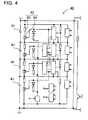
- the vehicle power source apparatus 40 cited in JP 2006-149068 has a discharge circuit 42 connected in parallel with each battery 41 in the series-connected battery array.
- Each discharge circuit 42 is a series-connection of a discharge resistor 43 and a switching device 44.
- a battery 41 that has become high in voltage is discharged through its discharge circuit 42 to restore cell balance and eliminate disparity between batteries 41.
- a discharge circuit 42 lowers the voltage of a specific battery 41 by switching the switching device 44 ON to discharge the battery 41 through the discharge resistor 43.
- This power source apparatus 40 can eliminate imbalance between the series-connected batteries 41.
- high output voltage can be attained by connecting many batteries in series, but the current capacity is that of the individual batteries. Since the power output of a power source apparatus is proportional to the product of voltage and current, increasing the current can further increase the power output. Specifically, by connecting many batteries in series and parallel, both the output current and output voltage can be increased to further increase the power output of the power source apparatus.
- voltages of the series-connected batteries can be equalized to eliminate imbalance in the same manner cited in JP 2006-149068 .
- the present invention was developed considering the types of prior art problems described above. Thus, it is a primary object of the present invention to provide a power source apparatus that can efficiently equalize the battery cells while connecting many cells in series and parallel.
- the power source apparatus of the present invention connects a plurality of battery cells in parallel with a configuration having a plurality of battery cells connected in parallel as battery packs, a plurality of battery packs connected in series as battery units, and a plurality of battery units connected in parallel to an output line.
- the power source apparatus can be provided with first equalizing circuits to control remaining capacity variation between the plurality of battery units, and second equalizing circuits to control remaining capacity variation between all the series-connected battery packs that make up each battery unit.
- This configuration eliminates non-uniformity between battery units with the first equalizing circuits, and eliminates non-uniformity between the battery packs included in each battery unit with the second equalizing circuits to maintain cell balance between the many battery cells included in the power source apparatus.
- Cell balancing is not performed on a cell by cell basis, but rather on a block by block basis achieving the positive feature that cell balance can be restored rapidly and efficiently.
- a second equalizing circuit 24 can be connected in parallel with each battery pack 20, and can be provided with a second series circuit configured with a second (current) limiting resistor 25 and a second equalizing switch 26. This allows non-uniformity between the battery packs in each battery unit to be eliminated via the second equalizing circuits.
- connections between the battery packs 20 in each battery unit 10 can be made with detachable connectors. This allows easy connection and replacement of battery packs. In particular, when a battery pack malfunctions, it can be easily replaced to shorten apparatus down-time, and since all the battery packs do not need to be replaced, the positive feature of cost reduction is achieved.
- each battery pack 20 can be configured with a plurality of parallel blocks connected in series, and each parallel block can have a plurality of battery cells 31 connected in parallel. Further, a third equalizing circuit 34 can be provided with each parallel block to equalize the plurality of parallel blocks in each battery pack 20. This allows non-uniformity among the plurality of parallel blocks included in a battery pack to also be eliminated.
- the array of batteries can have a capacity of 1 KVA to 100 KVA.
- battery units 10 can be connected to the output line OL in a detachable manner.
- the power source apparatus for the seventh aspect of the present invention can be provided with a power source controller 2 to control parallel connecting switches 12 and equalizing switches.
- the power source controller 2 can turn a parallel connecting switch 12 ON to connect a battery unit 10 in parallel, and can turn the parallel connecting switch 12 OFF and the equalizing switch ON to equalize the battery unit 10.
- this (active cell balancing) method has the positive feature that power can be used effectively to charge lower voltage battery units and increase their voltage, reduce the battery unit voltage difference ⁇ VU, and reduce the time required for equalization.
- battery cells 31 that make up the battery packs 20 can be lithium ion batteries.
- the power source apparatus for the ninth aspect of the present invention can be provided with a switch control circuit 6 connected in parallel with the first equalizing circuits 14 and parallel connecting switches 12 to control the parallel connecting switches 12 and first equalizing switches 16.
- the switch control circuit 6 can turn the first equalizing switch 16 in the first equalizing circuit 14 ON to connect the battery unit 10 to the load LD and limit surge current with a first (current) limiting resistor 15.
- the switch control circuit 6 can turn the parallel connecting switch 12 ON to connect the battery unit 10 to the load LD. This can prevent surge current in the load by using the first equalizing circuits for the dual purpose of surge current suppression instead of providing a special-purpose circuit to prevent surge current in the load.
- components with the same name and label indicate components that are the same or have the same properties and their detailed description is appropriately abbreviated.
- a single component can serve multiple functions and a plurality of structural elements of the invention can be implemented with the same component.
- the functions of a single component can be divided among a plurality of components.
- explanations used to describe part of one embodiment may be used in other embodiments and descriptions.
- Figs. 1-3 show the power source apparatus 100 for the first embodiment of the present invention.
- Fig. 1 is a block diagram of the power source system using the power source apparatus 100
- Fig. 2 is a block diagram showing the battery units 10 in Fig. 1 during equalization
- Fig. 3 is a block diagram of one of the battery packs 20 that make up a battery unit 10 in Fig. 1 .
- the power source system shown in these figures is provided with a power source apparatus 100, a load LD, and a charging power supply CP. After being charged by the charging power supply CP, the power source apparatus 100 drives the load LD.
- the power source apparatus 100 has a charging mode, a discharging mode, and an equalizing mode to equalize the battery units 10 (described later).
- the load LD and the charging power supply CP are connected to the power source apparatus 100 through a discharge switch DS and a charging switch CS respectively.
- the discharge switch DS and the charging switch CS are controlled ON and OFF by the power source apparatus 100 power source controller 2.
- the power source controller 2 switches the charging switch CS ON and the discharge switch DS OFF to allow the power source apparatus 100 to be charged from the charging power supply CP.
- the power source apparatus 100 can be switched to the discharging mode depending on demand by the load LD.
- the power source controller 2 switches the charging switch CS OFF and the discharge switch DS ON to allow discharge from the power source apparatus 100 to the load LD. Further, depending on requirements, both the charging switch CS and the discharge switch DS can be turned ON to allow power to be simultaneously supplied to the load LD while charging the power source apparatus 100.
- the load LD driven by the power source apparatus 100 is connected to the power source apparatus 100 through the discharge switch DS.
- the power source controller 2 switches the discharge switch DS ON to connect and drive the load LD with power from the power source apparatus 100.
- a switching device such as a field effect transistor (FET) can be used as the discharge switch DS.
- FET field effect transistor
- the discharge switch DS is controlled ON and OFF by the power source apparatus 100 power source controller 2.
- the charging power supply CP is connected in series with the charging switch CS.
- the charging switch CS is turned ON to charge the power source apparatus 100 with the charging power supply CP. Further, when full-charge of the power source apparatus 100 is detected, the charging switch CS is switched OFF. These switching operations are performed by the power source controller 2.
- Power generating systems including those that utilize renewable energy sources such as solar, wind, tidal, and geothermal; or fuel cells, gas power generators, and commercial power sources can be used as the charging power supply CP. In the example of Fig. 1 , solar panels are used as the charging power supply CP.
- a switching device such as a FET can also be used as the charging switch CS.
- the charging switch CS is also controlled ON and OFF by the power source apparatus 100 power source controller 2.
- the charging switch CS is connected between the charging power supply CP and the power source apparatus 100 to control charging of the power source apparatus 100. Charging is not performed by a technique such as voltage conversion through a direct current to direct current (DC/DC) converter, but rather pulse charging is performed using ON and OFF switching of the charging switch CS. This allows high efficiency and simplification of the circuitry.
- DC/DC direct current to direct current
- the power source apparatus 100 is provided with parallel connecting switches 12 connected to each battery unit 10, first equalizing circuits 14 to equalize the battery units 10, OR circuits 4 (logic gates) connected to the parallel connecting switches 12, the first equalizing circuits 14, and the battery units 10, and the power source controller 2 connected to the OR circuits 4.
- Each parallel connecting switch 12 connects a battery unit 10 to an output line OL to connect the battery units 10 in parallel through the parallel connecting switches 12.
- Devices such as insulated gate bipolar transistors (IGBTs) can be used as the parallel connecting switches 12.
- Each first equalizing circuit 14 is configured as a first series circuit with a first limiting resistor 15 (15A and 15B in Fig. 1 ) and a first equalizing switch 16 (16A and 16B in Fig. 1 ).
- a device such as a FET can be used as the first equalizing switch 16.
- the first equalizing switch 16 and the parallel connecting switch 12 are controlled ON and OFF in accordance with the charging mode, the discharging mode, and the equalizing mode. During normal operation in the charging mode and the discharging mode, each parallel connecting switch 12 is in the ON state and each first equalizing switch 16 is in the OFF state. However, in the equalizing mode, the applicable parallel connecting switch 12 is switched OFF and the applicable first equalizing switch 16 is switched ON.
- the power source controller 2 is connected with each battery unit 10, each OR circuit 4, the discharge switch DS, and the charging switch CS.
- the power source apparatus 100 shown in Fig. 1 has two battery units 10 connected in parallel, and is controlled by the power source controller 2 to drive the load LD and charge each battery unit 10 with the charging power supply CP.
- the power source controller 2 switches the discharge switch DS and the charging switch CS ON and OFF depending on the mode (charging mode or discharging mode).
- the power source controller 2 is connected to each battery unit 10, and switches each first equalizing switch 16 and parallel connecting switch 12 ON and OFF to perform equalization between battery units 10 in accordance with signals from the battery units 10.
- the power source controller 2 when the power source controller 2 receives a signal indicating an abnormality from a battery unit 10 via the input terminal DI of the parent battery pack 20 (described later), the power source controller 2 controls a parallel connecting switch 12 to disconnect that battery unit 10.
- the power source controller 2 can be made up of circuitry that includes a central processing unit such as a micro-processing unit (MPU).
- MPU micro-processing unit
- a power source apparatus with two battery units 10 is described.
- the battery units in this example are controlled by a single power source controller
- the power source apparatus can be configured with a plurality of power source controllers when there are a large number of battery units.
- the power source controller in the example of Fig. 1 is separate from the battery units, it can also be disposed inside the battery units.
- the capabilities of the power source controller can be included in the battery pack control circuit 39 in the parent battery pack 20 (described later).
- the power source controller 2 is provided with a communication interface to communicate with externally connected equipment.
- the power source controller 2 is connected to an external host computer HT and communicates via known protocols such as universal asynchronous receiver transmitter (UART) and recommended standard-232 (RS-232C) protocols.
- UART universal asynchronous receiver transmitter
- RS-232C recommended standard-232
- a user interface can be provided to allow direct user control of the power source system.
- an input device such as a keyboard, mouse, touch-panel, or console (terminal) can be connected as a user interface for the power source controller, and inputs can be made such as specifying the maximum current or setting the utilization of connected battery units.
- An indicator panel or warning lights can also be provided to alert the user when a battery pack 20 abnormality develops.
- the output voltage (unit voltage) of the two battery units 10A, 10B are compared by the power source controller 2 during the discharging mode.
- the battery unit voltage difference ⁇ VU is greater than or equal to a battery unit threshold voltage (such as 1V)
- the system transitions to the equalizing mode to equalize the battery units 10.
- the total voltage of the parent battery pack 20 and each child battery pack 20 (described later) is computed by the battery pack control circuit 39 in the parent battery pack, and that total is sent to the power source controller 2 as the battery unit voltage.
- the sum of the output voltages of all the battery packs 20 in each battery unit 10 can also be computed in the power source controller 2, and a voltage sensor can also be provided with each battery unit.
- each battery pack 20 has lithium ion rechargeable batteries as battery cells 31, has twenty four cells connected in parallel, and is a series-connection of thirteen of the parallel connected cells.
- This type of battery pack 20 has a specified output voltage of 50V and output current of 30A.
- equalization is described based on Fig. 2 when the voltage of battery unit 10A becomes greater than the voltage of battery unit 10B.
- the power source controller 2 turns OFF the charging switch CS and the discharge switch DS.
- the power source controller 2 turns the parallel connecting switch 12A in battery unit 10A OFF and the first equalizing switch 16A ON.
- the parallel connecting switch 12B in battery unit 10B is left in the ON state and the first equalizing switch 16B is left in the OFF state the same as in the discharging mode.
- This connects battery unit 10A with battery unit 10B through the first series circuit of battery unit 10A as shown by the arrows in Fig. 2 .
- the power source controller 2 monitors the battery unit voltage difference ⁇ VU to determine whether or not to perform battery unit equalization after completing charging of each battery unit 10 at the point of transition to the discharging mode.
- the technique described above can utilize battery unit power in an effective manner.
- the voltage of the low voltage battery unit increases due to charging to reduce the battery unit voltage difference ⁇ VU, it has the positive feature that the time required for equalization can be reduced.
- a battery unit 10 is made up of a plurality of connected battery packs 20. Each battery unit 10 is connected to the output line OL through a parallel connecting switch 12.
- battery unit 10A and battery unit 10B are the same type of battery units 10. As mentioned previously, although two battery units 10 are used in the figures, it is also possible to connect three or more battery units.
- a battery unit 10 with a plurality of battery packs 20 connected together one of the battery packs 20 functions as the parent battery pack with the other battery packs 20 serving as child battery packs controlled by the parent battery pack.
- the parent battery pack monitors the child battery packs and reports status to the power source controller 2.
- the parent battery pack and child battery packs are configured as the same type of battery pack 20. Specifically, all the battery packs 20 are made with a common structure and since a battery pack 20 can function as a parent battery pack or a child battery pack depending on the connecting configuration, manufacturing cost can be reduced.
- the battery pack 20 connected at the lower end of the battery unit 10 is used as the parent battery pack, and all the other battery packs 20 are used as child battery packs.
- Each battery pack 20 in Fig. 1 is provided with signal terminals and power terminals.
- a battery pack input terminal DI, a battery pack error output terminal DA, and a battery pack output terminal DO are provided as signal terminals for the battery pack control circuit 39.
- the battery pack input terminal DI is a terminal for inputting signals from other battery packs and the power source controller 2.
- the battery pack output terminal DO is a terminal for outputting signals to other battery packs and the power source controller 2.
- the battery pack error output terminal DA is a terminal for outputting information conveying battery pack abnormality outside the battery pack.
- battery pack error output terminals DA are connected to the OR circuits 4.
- Each battery pack 20 is also provided with a positive terminal and a negative terminal as output terminals for the battery cells 31 connected together in the battery pack 20. Positive terminals and negative terminals of adjacent battery packs 20 are connected to connect the battery packs 20 series and increase output voltage.
- each battery unit 10 in Fig. 1 includes one parent battery pack and a plurality of child battery packs.
- the parent battery pack and child battery packs are connected in a string arrangement.
- the output terminal DO of the previous battery pack 20 is connected to the input terminal DI of the next battery pack 20.
- the input terminal DI of the parent battery pack is connected with the output of the power source controller 2.
- the output terminal DO of the last child battery pack is left unconnected. Note in this type of daisy-chain connection, the output terminal DO of the last child battery pack can also be connected to a terminator such as a termination resistor to indicate the position of the end of the signal line.
- the battery pack input terminal DI, battery pack error output terminal DE, and battery pack output terminal DO connect to two signal lines for data communication with the power source controller 2.
- Data communication can be via a method such as packet communication that designates the destination of transmission.
- each battery pack has a preassigned unique identifier (address), and packets for packet communication include the address of the destination battery pack and commands issued to that battery pack. This allows data communication targeted to individual battery packs over a common signal line.
- Methods of assigning a unique address to each battery pack are applied as appropriate and include automatic allocation by the power source controller depending on the battery pack connecting scheme, and manual setting of switches such as dual inline package (DIP) switches in each battery pack.
- DIP dual inline package
- addresses can be set when the user presses a specially provided address setting switch, or when connection of a child battery pack is detected automatically by the parent battery pack.
- address setting can be performed when the terminator is connected.
- a detection device such as a micro-switch or shorting pin can be disposed in the connecting region of the of the battery pack output terminal DO, and when the terminator is connected, the micro-switch physically closes or the detection signal line short circuits to automatically activate address allocation. In this case, it is desirable to establish a detection signal line separate from the power line and other signal lines.
- the child battery pack with the terminator connected obtains its address, and subsequently a signal is sent to allocate the address of the next connected child battery pack.
- address allocation signals are successively issued to the child battery packs in their connection order.
- the parent battery pack receives an address, the fact that addresses have been allocated to all the battery packs is recognized, and the address allocation process is ended.
- the parent battery pack can acquire battery data (such as battery voltage, temperature, and error data) from each child battery pack using a communication protocol (for example, a protocol that uses a master-slave relation) such as RS-485.
- a communication protocol for example, a protocol that uses a master-slave relation
- Various data signals can be communicated from the parent battery pack to the power source controller 2 via a communication protocol such as RS-485.
- each battery unit 10 has one parent battery pack and four child battery packs connected for a total of five battery packs 20 in each battery unit 10 (in the figure, each battery unit is shown as a column of three battery packs with two battery packs not shown).
- Signal line connection between battery packs 20 is made by detachable connectors. This allows battery packs 20 to be easily connected and disconnected, which is advantageous during maintenance operations.
- Each battery pack error output terminal DA is connected to an OR circuit 4.
- An OR circuit 4 is provided with each battery unit 10. Accordingly, in each battery unit 10, one parent battery pack and four child battery packs are connected to the OR circuit 4. If a stop-signal (error signal) is output to the OR circuit 4 from any one of the battery packs, the parallel connecting switch 12 is opened to disconnect that battery pack (and its associated battery unit) from the power source apparatus. In this manner, even if a battery pack malfunction develops, all other battery packs can be protected by disconnecting the affected battery pack (and its associated battery unit). Malfunctions include abnormal conditions such as over-charging and over-discharging.
- the power source controller 2 receives signals indicating the error condition and notifies the user urging replacement of the affected battery pack. Power source system recovery can be achieved by the user replacing only the affected battery pack. This system architecture can reduce repair cost by making it possible to replace only the affected battery pack, and since battery pack replacement is made simple by the use of detachable connectors, maintainability is improved.
- the OR circuits 4 are connected with the power source controller 2 through a common bus line.
- the OR circuit 4 provided with each battery unit 10 is connected to the parallel connecting switch 12 and to the power source controller 2.
- the power source controller 2 turns the parallel connecting switch 12 OFF and notifies the user for battery pack 20 replacement when it receives an error signal from the battery pack control circuit 39 in a battery unit 10.
- the power source controller 2 can urge battery pack replacement by sending that information from its communication interface to externally connected equipment.
- the power source controller 2 can convey the need for battery pack replacement to the user by display on an indicator panel or by illumination of warning lights.
- system architecture is not limited to that of the example shown in Fig. 1 .
- Each battery pack 20 is provided with a second equalizing circuit 24 configured as a second series circuit having a second limiting resistor 25 and a second equalizing switch 26.
- a second series circuit is connected in parallel with each battery pack 20, and those second equalizing circuits 24 operate to eliminate non-uniformity among the battery packs 20.
- the second equalizing circuits 24 operate to equalize battery pack 20 voltages to eliminate imbalance.
- a battery pack 20 with high voltage is discharged through the second limiting resistor 25 of the second equalizing circuit 24.
- the present invention does not limit the equalizing circuits to circuitry that discharges batteries through current limiting resistors (passive cell balancing).
- an equalizing circuit could discharge a high voltage battery into a charge storage device such as a capacitor or another battery, and transfer that accumulated charge by discharging the charge storage device to a low voltage battery to eliminate voltage differences between batteries (active cell balancing).
- the second equalizing circuit 24 shown in Fig. 3 has the second limiting resistor 25 and second equalizing switch 26 connected in series as the second series circuit.
- the power source controller 2 or the battery pack control circuit 39 detects the voltages of each battery pack 20 and equalizes the battery packs 20 in a battery unit 10 by controlling the second equalizing switches 26 ON and OFF.
- a second series circuit having a second limiting resistor 25 and second equalizing switch 26 is connected in parallel with each battery pack 20. When the voltage of a battery pack 20 becomes high, the second equalizing switch 26 of the second equalizing circuit 24 is switched ON by the battery pack control circuit 39, and the battery pack 20 is discharged through the second limiting resistor 25 to reduce and equalize battery pack 20 voltage.
- Battery pack control circuits 39 provided with micro-processors compare battery pack 20 voltages, and control the second equalizing switches 26 to equalize the voltages of all the battery packs 20.
- the battery pack control circuit 39 switches ON the second equalizing switch 26 in the second series circuit connected with that battery pack 20.
- the second equalizing switch 26 is turned OFF.
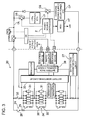
- Fig. 3 shows a block diagram of one of the battery packs 20 included in a battery unit 10.
- This battery pack 20 is connected as a parent battery pack in the example of Fig. 1 .
- the battery pack 20 is provided with an assembly of battery cells 31 having a plurality of cells connected in series and parallel, a current fuse connected in series with the assembly of battery cells 31, a battery monitoring circuit 33, a battery pack current detection circuit 37, and a battery pack control circuit 39 primarily made up of a micro-processor with the capability to judge cell balance.
- the battery pack 20 is housed in a battery pack case.
- a standard 19-inch rack-mount case such as that used in server computer back-up power supplies can be used as the battery pack case. This can improve versatility by utilizing a commonly available chassis such as a server rack.
- the current fuse physically opens the circuit in an over-current situation to protect the battery pack 20.
- the battery monitoring circuit 33 detects the voltage of each block of parallel-connected battery cells 31 and sends that data to the battery pack control circuit 39.
- the battery pack control circuit 39 detects battery pack 20 over-charging in the charging mode and protects the battery cells 31 from over-charging by limiting the charging current.
- the battery pack control circuit 39 detects battery pack 20 over-discharging and protects the battery cells 31 from over-discharging by limiting the discharge current.
- the battery pack input terminal DI and battery pack output terminal DO are connected to the battery pack control circuit 39 via isolation devices.
- the battery pack error output terminal DA is connected to the battery pack control circuit 39 via a photo-coupler (optical isolation device). This isolates each signal terminal with respect to external connection.
- the number of connected battery packs 20 can be adjusted to easily meet the requirements of large-scale applications. Further, even if malfunction occurs in a battery cell, only the battery pack that includes that battery cell needs to be isolated from the system and replaced. This has the positive feature that replacement costs can be reduced.
- the battery pack current detection circuit 37 detects charging and discharging current and sends that data to the battery pack control circuit 39.
- the battery pack current detection circuit 37 can detect battery pack current from the voltage across a current detection resistor connected in series with the battery pack 30.
- Temperature sensors that detect battery cell 31 temperature and voltage sensors that detect the voltage of each block of parallel-connected battery cells 31 are connected to the battery monitoring circuit 33.
- Thermistors can be used as the temperature sensors.
- the battery monitoring circuit 33 detects over-charging or over-discharging based on battery cell 31 temperature and battery cell 31 or parallel block voltage. If over-charging or over-discharging is detected, a signal is output to the OR circuit 4 from the battery pack error output terminal DA to open the parallel connecting switch 12 and disconnect the battery unit containing the affected battery pack. As described below, this capability is employed when error detection by the battery pack control circuit 39 does not function properly.
- Data such as battery voltage values converted by analog to digital (A/D) conversion are output from the battery monitoring circuit 33 to the battery pack control circuit 39. Based on battery voltage values, conditions such as over-charging and over-discharging are judged in the battery pack control circuit 39. In the event of an error condition such as over-charging or over-discharging, error data is transmitted from the child battery packs to the parent battery pack. In addition, values such as battery voltage for each battery pack are transmitted as data from the child battery packs to the parent battery pack.
- the battery pack control circuit 39 of the parent battery pack communicates that to the power source controller 2. In that situation, the power source controller 2 turns the parallel connecting switch 12 (for that battery unit 10) OFF via the OR circuit 4.
- the battery pack control circuit 39 in the parent battery pack also acquires the battery voltages of the child battery packs and the parent battery pack, adds those voltages to obtain a total value, and transmits that total to the power source controller 2.
- Each battery pack 20 has parallel blocks with a plurality of battery cells 31 connected in parallel, and a plurality of parallel blocks are in turn connected in series. However, it is also possible for a battery pack to have no series-connected battery cells and only parallel-connected battery cells. In the example of Fig. 3 , since the assembly of batteries is made up of parallel blocks with twenty four parallel-connected battery cells 31 and thirteen parallel blocks in turn connected in series, a total of 312 battery cells 31 are used in the battery pack 20. This battery pack 20 is used with a specified voltage of 50V and a specified current of 30A. Since a battery unit 10 shown in Fig.
- each battery unit 10 uses a total of 1560 battery cells 31 to achieve a specified voltage of 250V and a specified current of 30A. Further, by connecting a plurality of these battery units in parallel, a high reliability power source apparatus is formed.
- the total number of batteries used sets the capacity of the array of batteries depending on the application. For example, capacity can be 1 KVA to 100 KVA.
- battery cells 31 that have rectangular outer cases can be used as the battery cells 31.
- Rechargeable batteries such as lithium ion rechargeable batteries, nickel hydride batteries, and nickel cadmium batteries are appropriate for use as battery cells 31.
- the use of lithium ion rechargeable batteries is desirable. Since lithium ion rechargeable batteries have high energy density (charge capacity density), they are appropriate for compactness and weight reduction. Further, compared with nickel hydride batteries and lead storage batteries, lithium ion rechargeable batteries can be charged and discharged over a wider temperature range allowing efficient charging and discharging.
- the positive electrode of the lithium ion rechargeable battery can be a three-component electrode.
- This type of lithium ion rechargeable battery uses a mixture of Li-Ni-Mn-Co compound oxides and lithium cobalt oxide instead of just lithium cobalt oxide used in prior art.
- high voltage charging can be performed with good thermal stability, and the maximum charging voltage can be increased to 4.3V to increase charge capacity.
- the battery cell 31 charging voltage lower than the voltage for determining full-charge.
- the voltage for judging full-charge is set to 4V. This contributes to lengthening battery cell lifetime.
- the specified voltage is used as the nominal voltage of the battery pack, which is made up of battery cells 31 (for lithium ion battery cells, the voltage is approximately 3.7V to 4.0V per cell times the number of series-connections). It is desirable to choose the nominal voltage below the maximum output operating voltage Vop of the solar cell panel, which is the charging power supply CP. More preferably, the specified voltage is selected to be 70% to 90% of Vop. Since there are inter-related effects between the solar panel operating voltage and battery pack voltage, charging power drops for a battery pack voltage that is far from Vop. Compared with battery pack voltage as a function of depth of discharge, the relative voltage of the solar panel increases. Accordingly, when charging to full-charge, it is preferable for the voltage near the full-charge state to approach Vop. It is also necessary to select an appropriate battery pack voltage considering solar panel voltage variation with temperature. Therefore, a battery pack voltage in the range mentioned above is preferable.
- the present embodiment can charge the battery cells 31 without a DC/DC converter and avoid internal power loss that accompanies DC/DC converter use. This enables high efficiency charging, eliminates any need for DC/DC converter replacement, and reduces the number of parts in the system. As a result, increased reliability due to lower failure rate, reduced cost, and improved prospects for long-term maintenance-free operation can be achieved. Since the voltage in the present embodiment is within the range mentioned above, a DC/DC converter is unnecessary for battery cell 31 charging.
- a battery pack control circuit 39 which is provided with the capability to judge cell balance, controls equalization of the voltages of the battery packs 20 connected in series in a battery unit 10 via the previously described second equalizing circuits 24.
- the battery pack control circuit 39 in the battery pack 20 acting as the parent battery pack acquires the voltages of each battery pack 20 in the battery unit 10, compares those voltages, and maintains cell balance by discharging battery packs 20 when necessary.
- Each block of parallel-connected battery cells 31 is provided with a third equalizing circuit 34 to eliminate non-uniformity among parallel blocks.
- a third equalizing circuit 34 is connected in parallel with each parallel block.
- Each third equalizing circuit 34 is configured as a third series circuit provided with a third limiting resistor 35 and a third equalizing switch 36 connected in parallel with each parallel block.
- the third equalizing switches 36 are controlled ON and OFF by the battery pack control circuit 39.
- Third equalizing circuits 34 eliminate voltage imbalance among the blocks of parallel-connected battery cells 31.
- the third equalizing circuits 34 in Fig. 3 discharge parallel blocks with high voltage through the third limiting resistors 35 to eliminate voltage imbalance.
- a third equalizing circuit 34 is provided with a third series circuit, which is the third limiting resistor 35 connected in series with the third equalizing switch 36.
- the battery pack control circuit 39 detects the voltage of each parallel block, and controls the third equalizing switches 36 ON and OFF to equalize the parallel blocks in a battery pack 20.
- Third series circuits made up of third limiting resistors 35 and third equalizing switches 36 are connected in parallel with each block of parallel-connected battery cells 31.
- the battery pack control circuit 39 switches ON the third equalizing switch 36 in the third series circuit connected with that parallel block. As a result, that block of parallel-connected battery cells 31 discharges through the third limiting resistor 35 and the voltage of the parallel block decreases. When the voltage drops to a given parallel block voltage, equalization of that parallel block is complete and the third equalizing switch 36 is turned OFF.
- the battery pack control circuit 39 compares voltages between all of the parallel blocks, and controls the third equalizing switches 36 to equalize the voltages of all the parallel blocks.
- first equalizing circuits 14 imbalance between battery packs inside a battery unit is eliminated by second equalizing circuits 24, and imbalance between blocks of parallel-connected battery cells inside a battery pack is eliminated by third equalizing circuits 34.
- second equalizing circuits 24 imbalance between blocks of parallel-connected battery cells inside a battery pack is eliminated by third equalizing circuits 34.
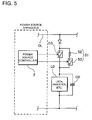
- the power source apparatus shown in Fig. 1 can also have a surge current protection circuit connected to its output-side.
- a surge current protection circuit 51 is configured as a current limiting resistor 52, which prevents surge current from flowing in the load LD, connected in series with a switching device 53.
- the surge current protection circuit 51 is connected in parallel with the discharge switch DS.
- surge current can flow in the load LD and over-current can have detrimental effects on components such as switches and fuses (not illustrated).
- Surge current is primarily due to the charging current for the high capacitance electrolytic capacitor CD connected in parallel with the load LD.
- the surge current protection circuit 51 switching device 53 is turned ON to limit surge current flow in the load LD with the current limiting resistor 52.
- a switch control circuit 6 is connected in parallel with the first equalizing circuits 14 and parallel connecting switches 12 to control the parallel connecting switches 12 and first equalizing switches 16.
- the switch control circuit 6 switches the first equalizing switch 16 in the first equalizing circuit 14 ON with the parallel connecting switch 12 in the OFF state when a battery unit 10 is connected to the load LD (i.e.when the discharge switch DS is turned ON).
- the battery unit 10 is connected to the load LD through the first limiting resistor 15 and the flow of surge current to the load LD and electrolytic capacitor CD is limited by the first limiting resistor 15.
- the maximum value (peak value) of the surge current is determined by the size of the first limiting resistor 15. For example, if the value of the first limiting resistor 15 is 100 ⁇ and the voltage of the battery unit 10 is 250V, the peak value of the surge current is limited to 2.5A.
- the switch control circuit 6 turns the parallel connecting switch 12 ON. After turning the parallel connecting switch 12 ON, the switch control circuit 6 switches the first equalizing switch 16 OFF.
- the switch control circuit 6 could turn the parallel connecting switch 12 ON and the first equalizing switch 16 OFF simultaneously, or the parallel connecting switch 12 could be turned ON immediately after the first equalizing switch 16 is turned OFF.
- Fig. 7 shows a flow-chart for connecting the power source apparatus shown in Fig. 6 with a load LD.
- the flow-chart describes connection of a battery unit 10 with the load LD by the following steps.
- Power is supplied to activate the power source controller 2 enabling it to detect current flow in the load LD.
- the electrolytic capacitor CD in parallel with the load LD becomes charged and surge current no longer flows, the voltage of the battery unit 10 and the voltage on the output line OL become approximately equal and the detected voltage difference drops to within the measurement error range. Specifically, If the voltage difference between the battery unit 10 and the output line OL is within the margin of error for that measurement, the electrolytic capacitor CD in parallel with the load LD is in the charged state and there is no surge current flow.
- surge current in the load LD is detected and compared with as set value, and the voltage difference between the battery unit 10 and the output line OL is also detected to determine if surge current is flowing. Consequently, in this power source apparatus, the parallel connecting switch 12 can be switched ON in a state more reliably determined to have no surge current flow.
- the battery unit described above is in the singular form, the procedure is the same for a plurality of battery units.
- the absence of surge current flow could also be determined by (either) detecting battery unit output current and comparing it with a set value or detecting the voltage difference between the battery unit and the output line.
- the power source apparatus of the present invention can be used advantageously in applications such as a power source apparatus in the home or manufacturing facility that is charged by solar power or late-night (reduced-rate) power.
Landscapes
- Engineering & Computer Science (AREA)
- Manufacturing & Machinery (AREA)
- Chemical & Material Sciences (AREA)
- Chemical Kinetics & Catalysis (AREA)
- Electrochemistry (AREA)
- General Chemical & Material Sciences (AREA)
- Power Engineering (AREA)
- Microelectronics & Electronic Packaging (AREA)
- Life Sciences & Earth Sciences (AREA)
- Sustainable Development (AREA)
- Sustainable Energy (AREA)
- Charge And Discharge Circuits For Batteries Or The Like (AREA)
- Secondary Cells (AREA)
- Battery Mounting, Suspending (AREA)
Applications Claiming Priority (3)
| Application Number | Priority Date | Filing Date | Title |
|---|---|---|---|
| JP2010025984 | 2010-02-08 | ||
| JP2010107761A JP5143185B2 (ja) | 2010-02-08 | 2010-05-07 | 電源装置 |
| PCT/JP2011/052143 WO2011096430A1 (ja) | 2010-02-08 | 2011-02-02 | 電源装置 |
Publications (1)
| Publication Number | Publication Date |
|---|---|
| EP2536001A1 true EP2536001A1 (en) | 2012-12-19 |
Family
ID=44355426
Family Applications (1)
| Application Number | Title | Priority Date | Filing Date |
|---|---|---|---|
| EP11739778A Withdrawn EP2536001A1 (en) | 2010-02-08 | 2011-02-02 | Power supply device |
Country Status (5)
| Country | Link |
|---|---|
| US (1) | US9030167B2 (enExample) |
| EP (1) | EP2536001A1 (enExample) |
| JP (1) | JP5143185B2 (enExample) |
| CN (2) | CN104393641B (enExample) |
| WO (1) | WO2011096430A1 (enExample) |
Cited By (7)
| Publication number | Priority date | Publication date | Assignee | Title |
|---|---|---|---|---|
| EP2724440A4 (en) * | 2011-09-02 | 2015-08-12 | Samsung Sdi Co Ltd | DATA TRANSMISSION PROCEDURE, DATA TRANSMISSION DEVICE AND ENERGY STORAGE SYSTEM THEREWITH |
| EP2747238A3 (en) * | 2012-12-20 | 2017-03-15 | Nokia Technologies Oy | Balancing of battery cells connected in parallel |
| EP3236557A1 (de) * | 2016-04-21 | 2017-10-25 | enfas GmbH | Energiespeichersystem |
| EP2639923A3 (en) * | 2012-03-15 | 2018-01-24 | Hitachi, Ltd. | Battery system |
| EP3393000A4 (en) * | 2016-10-21 | 2019-01-30 | LG Chem, Ltd. | Charging voltage supply apparatus and supply method |
| FR3141294A1 (fr) * | 2022-10-21 | 2024-04-26 | Vitesco Technologies | Activation de batterie d’un système électrique d’alimentation pour véhicule par un circuit de précharge |
| EP4572076A4 (en) * | 2022-11-08 | 2025-11-19 | Contemporary Amperex Technology Hong Kong Ltd | BATTERY SYSTEM, CONTROL METHOD, CONTROL UNIT AND RECORDING MEDIA |
Families Citing this family (88)
| Publication number | Priority date | Publication date | Assignee | Title |
|---|---|---|---|---|
| US8330419B2 (en) * | 2009-04-10 | 2012-12-11 | The Regents Of The University Of Michigan | Dynamically reconfigurable framework for a large-scale battery system |
| FR2971645B1 (fr) * | 2011-02-10 | 2014-02-28 | Commissariat Energie Atomique | Dispositif de protection d'une source de tension contre les surintensites de courant |
| US20120248868A1 (en) * | 2011-04-04 | 2012-10-04 | Fahim Usshihab Mobin | Swappable battery car and battery car station |
| JP5703497B2 (ja) * | 2011-04-18 | 2015-04-22 | ▲華▼▲為▼▲終▼端有限公司 | 電池、電池アセンブリ、およびユーザ装置 |
| US9341678B2 (en) * | 2011-09-28 | 2016-05-17 | Alliance For Sustainable Energy, Llc | Fail-safe designs for large capacity battery systems |
| JP2013078227A (ja) * | 2011-09-30 | 2013-04-25 | Sanyo Electric Co Ltd | 残容量調整装置 |
| JP5502918B2 (ja) * | 2011-10-13 | 2014-05-28 | 株式会社日本自動車部品総合研究所 | 組電池の充放電装置 |
| JP6119143B2 (ja) * | 2011-11-01 | 2017-04-26 | 日産自動車株式会社 | 電源の制御装置 |
| TWI443929B (zh) * | 2011-11-16 | 2014-07-01 | Via Tech Inc | 電池控制電路、系統和方法 |
| JP2013126343A (ja) * | 2011-12-16 | 2013-06-24 | Hitachi Ltd | 蓄電デバイスを備えた電力蓄積システム |
| JP5801176B2 (ja) * | 2011-12-19 | 2015-10-28 | 株式会社東芝 | 蓄電装置及びその保守方法 |
| US9136713B1 (en) * | 2012-01-13 | 2015-09-15 | Win Cheng | Proactive and highly efficient active balance apparatus for a battery power system |
| US9461484B2 (en) * | 2012-01-30 | 2016-10-04 | Nec Energy Devices, Ltd. | Electricity storage system, method for controlling secondary battery packs, and secondary battery pack |
| JP5748689B2 (ja) * | 2012-02-28 | 2015-07-15 | 三菱重工業株式会社 | 電池システム |
| CN103308741A (zh) * | 2012-03-16 | 2013-09-18 | 鸿富锦精密工业(深圳)有限公司 | 服务器及其电流检测预警系统 |
| CN104170205B (zh) | 2012-03-19 | 2018-03-16 | 艾达司股份有限公司 | 平衡校正装置及蓄电系统 |
| JP5864320B2 (ja) * | 2012-03-19 | 2016-02-17 | Evtd株式会社 | バランス補正装置および蓄電システム |
| US9070950B2 (en) | 2012-03-26 | 2015-06-30 | Semiconductor Energy Laboratory Co., Ltd. | Power storage element, manufacturing method thereof, and power storage device |
| US10690725B2 (en) * | 2012-03-29 | 2020-06-23 | Atieva, Inc. | Battery state-of-charge estimation |
| DE102012012765A1 (de) * | 2012-06-27 | 2014-01-02 | Volkswagen Aktiengesellschaft | Verfahren und Vorrichtung zum Laden eines elektrischen Energiespeichers |
| JP2014017954A (ja) * | 2012-07-07 | 2014-01-30 | Hitachi Koki Co Ltd | 電源装置 |
| US9318910B2 (en) * | 2012-09-06 | 2016-04-19 | Samsung Sdi Co., Ltd. | Cell balancing circuit and cell balancing method using the same |
| JP5856934B2 (ja) * | 2012-09-14 | 2016-02-10 | 株式会社日立製作所 | 蓄電池システムの制御方法 |
| US9172259B2 (en) * | 2012-11-29 | 2015-10-27 | Samsung Sdi Co., Ltd. | Apparatus for managing battery, and energy storage system |
| JP6223171B2 (ja) | 2012-12-28 | 2017-11-01 | 株式会社半導体エネルギー研究所 | 蓄電装置の制御システム、蓄電システム、及び電気機器 |
| US9281696B2 (en) * | 2013-02-27 | 2016-03-08 | Fu-Sheng Tsai | Current steering circuit and current steering method for controlling branch current flowing through branch |
| US10464507B2 (en) * | 2013-03-07 | 2019-11-05 | Samsung Sdi Co., Ltd. | Battery management system and switching method thereof |
| TWI627812B (zh) * | 2013-04-05 | 2018-06-21 | 美商線性科技股份有限公司 | 電壓補償主動電池平衡的裝置、系統及方法 |
| KR102028923B1 (ko) * | 2013-04-11 | 2019-10-08 | 에스케이이노베이션 주식회사 | 배터리 밸런싱 장치 및 방법 |
| KR20140128468A (ko) * | 2013-04-18 | 2014-11-06 | 에스케이이노베이션 주식회사 | 배터리 밸런싱 장치 및 방법 |
| KR101563075B1 (ko) * | 2014-01-07 | 2015-10-23 | 에스케이이노베이션 주식회사 | 에너지 저장 시스템의 배터리 랙 밸런싱 장치 및 방법 |
| GB2522242A (en) * | 2014-01-20 | 2015-07-22 | Nokia Technologies Oy | Additional battery pack |
| US9385542B2 (en) * | 2014-06-26 | 2016-07-05 | Hong Kong Applied Science and Technology Research Institute Company, Limited | Serial multi-battery charger with independent simultaneous charge and discharge |
| JP2016158333A (ja) * | 2015-02-23 | 2016-09-01 | 三洋電機株式会社 | 電源システム |
| JP6584798B2 (ja) * | 2015-03-12 | 2019-10-02 | 株式会社日立製作所 | 蓄電システム及び蓄電池電車 |
| KR102559199B1 (ko) | 2015-11-02 | 2023-07-25 | 삼성전자주식회사 | 배터리 관리 방법 및 배터리 관리 장치 |
| WO2017083847A1 (en) * | 2015-11-13 | 2017-05-18 | NextEv USA, Inc. | Charging devices and regenerative braking system within wheel portions |
| CN105429227A (zh) * | 2015-12-16 | 2016-03-23 | 浙江大学 | 一种用于水下潜器的电池管理及控制系统 |
| WO2017135069A1 (ja) * | 2016-02-01 | 2017-08-10 | パナソニックIpマネジメント株式会社 | 管理装置、及び蓄電システム |
| JP2017158265A (ja) * | 2016-02-29 | 2017-09-07 | パナソニックIpマネジメント株式会社 | 電力供給システム、及び電力変換システム |
| KR101837548B1 (ko) * | 2016-04-07 | 2018-04-26 | 삼화콘덴서공업 주식회사 | 커패시터 관리 시스템 |
| DK179053B1 (en) * | 2016-04-16 | 2017-09-18 | Lithium Balance As | Cell balancing method and system |
| JP6693350B2 (ja) * | 2016-09-06 | 2020-05-13 | トヨタ自動車株式会社 | 複数の電池スタックの電圧均等化方法 |
| KR102895997B1 (ko) * | 2016-12-15 | 2025-12-03 | 현대자동차주식회사 | 배터리 시스템 및 그 제어 방법 |
| WO2018129516A2 (en) | 2017-01-09 | 2018-07-12 | Milwaukee Electric Tool Corporation | Battery pack |
| JP6802723B2 (ja) * | 2017-01-31 | 2020-12-16 | 株式会社デンソーテン | 蓄電装置および蓄電制御方法 |
| GB2559793B (en) * | 2017-02-20 | 2020-07-08 | Ge Aviat Systems Ltd | Battery pack with reduced voltage variance |
| JP2018182961A (ja) * | 2017-04-18 | 2018-11-15 | Necプラットフォームズ株式会社 | 制御装置 |
| CN107276154B (zh) * | 2017-06-19 | 2023-04-28 | 广东电网有限责任公司惠州供电局 | 自适应蓄电池单体均衡装置 |
| US11233419B2 (en) * | 2017-08-10 | 2022-01-25 | Zoox, Inc. | Smart battery circuit |
| US20190052109A1 (en) * | 2017-08-14 | 2019-02-14 | Lucas STURNFIELD | Coupling system and apparatus for parallel interconnection of independent battery modules |
| CN109435769B (zh) * | 2017-08-31 | 2021-05-14 | 比亚迪股份有限公司 | 电池均衡系统、车辆、电池均衡方法及存储介质 |
| JP7320734B2 (ja) * | 2018-01-30 | 2023-08-04 | パナソニックIpマネジメント株式会社 | 車両用電源システム、管理装置 |
| CN110323818A (zh) * | 2018-03-30 | 2019-10-11 | 加百裕工业股份有限公司 | 并联电池系统及方法 |
| KR102361334B1 (ko) * | 2018-05-09 | 2022-02-09 | 주식회사 엘지에너지솔루션 | 배터리 제어 장치 및 이를 포함하는 에너지 저장 시스템 |
| WO2019243950A1 (ja) | 2018-06-22 | 2019-12-26 | 株式会社半導体エネルギー研究所 | 蓄電装置の異常検知方法、及び蓄電装置の制御装置 |
| US11451072B2 (en) * | 2018-07-10 | 2022-09-20 | Samsung Sdi Co., Ltd. | Battery system |
| CN108767940B (zh) * | 2018-08-07 | 2024-05-14 | 西安爱科赛博电气股份有限公司 | 一种串联充电电池并联充电主动均衡装置及主动均衡方法 |
| US10778006B2 (en) * | 2018-09-24 | 2020-09-15 | Texas Instruments Incorporated | Chip position sensing for battery protectors |
| KR102347920B1 (ko) * | 2018-10-12 | 2022-01-05 | 주식회사 엘지에너지솔루션 | 배터리 관리 장치 및 방법 |
| CN112533788B (zh) * | 2018-10-26 | 2023-12-01 | 康明斯公司 | 处于不同荷电状态(soc)的多个电池组的电池充电和放电 |
| JP7189009B2 (ja) * | 2018-12-25 | 2022-12-13 | トヨタ自動車株式会社 | 車両の制御装置 |
| US11145917B2 (en) * | 2019-02-11 | 2021-10-12 | International Business Machines Corporation | Cell balancing network to heat battery pack |
| JP7323745B2 (ja) * | 2019-04-02 | 2023-08-09 | 株式会社今仙電機製作所 | 二次電池システム |
| JP7059982B2 (ja) * | 2019-05-27 | 2022-04-26 | 株式会社オートネットワーク技術研究所 | 車載用バックアップ電源装置 |
| GB2584829B (en) * | 2019-06-04 | 2023-01-11 | Jaguar Land Rover Ltd | Vehicle traction battery circuit and control system |
| CN110350632B (zh) * | 2019-08-20 | 2024-09-03 | 深圳市道通智能航空技术股份有限公司 | 一种电池均衡自放电电路和无人机 |
| CN112703653B (zh) * | 2019-08-23 | 2023-12-15 | 华为技术有限公司 | 充电系统和方法 |
| KR102847214B1 (ko) * | 2019-10-17 | 2025-08-14 | 삼성에스디아이 주식회사 | 배터리 시스템 |
| CN113875113B (zh) | 2019-10-22 | 2024-02-27 | 株式会社Lg新能源 | 用于使并联连接的电池组平衡的装置和方法 |
| US11476690B2 (en) | 2019-10-25 | 2022-10-18 | Samsung Sdi Co., Ltd. | Power supply system |
| KR102678278B1 (ko) * | 2020-01-20 | 2024-06-26 | 주식회사 엘지에너지솔루션 | 종단 저항 설정 회로 및 이를 포함하는 배터리 관리 시스템 |
| US11605839B2 (en) * | 2020-02-10 | 2023-03-14 | Anduril Industries, Inc. | Battery system |
| CN113315186B (zh) * | 2020-02-27 | 2024-02-27 | Oppo广东移动通信有限公司 | 充电控制电路及电子设备 |
| TW202137620A (zh) * | 2020-03-25 | 2021-10-01 | 飛宏科技股份有限公司 | 雙埠電池充電系統及其充電方法 |
| KR102365552B1 (ko) * | 2020-04-28 | 2022-02-21 | 에너테크인터내셔널 주식회사 | 다수의 병렬 연결된 고전압 배터리 제어 장치 및 그 방법 |
| US20220069593A1 (en) * | 2020-09-01 | 2022-03-03 | Sion Power Corporation | Multiplexed battery management system |
| WO2022115134A1 (en) | 2020-11-30 | 2022-06-02 | Nikola Corporation | High voltage electrical system for battery electric vehicle |
| US12291112B2 (en) | 2020-11-30 | 2025-05-06 | Nikola Corporation | High voltage battery conditioning for battery electric vehicle |
| CA3201775A1 (en) | 2020-11-30 | 2022-06-02 | Nikola Corporation | Electric vehicle battery frame assembly |
| US11820241B2 (en) | 2020-11-30 | 2023-11-21 | Nikola Corporation | Battery pack assembly |
| JP7292319B2 (ja) | 2021-02-25 | 2023-06-16 | プライムプラネットエナジー&ソリューションズ株式会社 | 電池システムおよび制御方法 |
| JP2022135394A (ja) * | 2021-03-05 | 2022-09-15 | いすゞ自動車株式会社 | 充電量調整装置および車両 |
| JP2023074109A (ja) * | 2021-11-17 | 2023-05-29 | 株式会社カネカ | 二次電池システム |
| US20230327460A1 (en) * | 2022-04-09 | 2023-10-12 | Sehat Sutardja | Active battery balancer using spare cell |
| TWI845138B (zh) * | 2023-01-31 | 2024-06-11 | 光陽工業股份有限公司 | 電動車的多電池並串聯供電控制方法 |
| CN116054351B (zh) * | 2023-02-24 | 2024-08-13 | 深圳市钜盛开发有限公司 | 一种储能电源均衡方法、系统和充电装置 |
| JP7584071B1 (ja) * | 2023-11-01 | 2024-11-15 | 株式会社Pxp | 電力デバイス |
Family Cites Families (18)
| Publication number | Priority date | Publication date | Assignee | Title |
|---|---|---|---|---|
| US5455749A (en) * | 1993-05-28 | 1995-10-03 | Ferber; Andrew R. | Light, audio and current related assemblies, attachments and devices with conductive compositions |
| US5721482A (en) * | 1996-01-16 | 1998-02-24 | Hewlett-Packard Company | Intelligent battery and method for providing an advance low battery warning for a battery powered device such as a defibrillator |
| US5951459A (en) * | 1997-08-29 | 1999-09-14 | Orthosoft, L.L.C. | Magnetic coil for pulsed electromagnetic field |
| FR2805934B1 (fr) * | 2000-03-01 | 2002-07-26 | Agence Spatiale Europeenne | Procede et dispositif d'equilibrage des charges d'une pluralite de cellules de batteries montees en serie |
| DE10246761A1 (de) * | 2002-10-07 | 2004-04-15 | Hilti Ag | Batteriebetriebene Elektrohandwerkzeugmaschine |
| JP4065232B2 (ja) * | 2003-12-11 | 2008-03-19 | 三洋電機株式会社 | 電池の充電方法 |
| JP4186916B2 (ja) | 2004-11-18 | 2008-11-26 | 株式会社デンソー | 組電池管理装置 |
| US7279867B2 (en) * | 2005-12-02 | 2007-10-09 | Southwest Electronic Energy Corporation | Method for balancing cells or groups of cells in a battery pack |
| US7199556B1 (en) * | 2005-12-02 | 2007-04-03 | Southwest Electronic Energy Corporation | Method for extending power duration for lithium ion batteries |
| JP2007300701A (ja) * | 2006-04-27 | 2007-11-15 | Sanyo Electric Co Ltd | 車両用の電源装置 |
| JP4890110B2 (ja) * | 2006-06-09 | 2012-03-07 | 株式会社Nttファシリティーズ | 電池管理システム |
| JP2009011022A (ja) * | 2007-06-26 | 2009-01-15 | Nissan Motor Co Ltd | 組電池の容量調整装置および容量調整方法 |
| JP5279261B2 (ja) * | 2007-12-27 | 2013-09-04 | 三洋電機株式会社 | 充電状態均等化装置及びこれを具えた組電池システム |
| TW200937798A (en) * | 2008-02-29 | 2009-09-01 | Cheng Uei Prec Ind Co Ltd | Balance circuit for battery pack |
| JPWO2009113530A1 (ja) * | 2008-03-11 | 2011-07-21 | 三洋電機株式会社 | 充電状態均等化装置及びこれを具えた組電池システム |
| JP5187040B2 (ja) | 2008-07-16 | 2013-04-24 | 東芝三菱電機産業システム株式会社 | 充電池の充電装置 |
| JP2010029015A (ja) * | 2008-07-23 | 2010-02-04 | Mitsubishi Heavy Ind Ltd | 組電池システム |
| JP5529402B2 (ja) | 2008-08-13 | 2014-06-25 | 三菱重工業株式会社 | 蓄電システム |
-
2010
- 2010-05-07 JP JP2010107761A patent/JP5143185B2/ja active Active
-
2011
- 2011-02-02 CN CN201410666025.5A patent/CN104393641B/zh not_active Expired - Fee Related
- 2011-02-02 CN CN201180008697.1A patent/CN102754301B/zh not_active Expired - Fee Related
- 2011-02-02 WO PCT/JP2011/052143 patent/WO2011096430A1/ja not_active Ceased
- 2011-02-02 EP EP11739778A patent/EP2536001A1/en not_active Withdrawn
- 2011-02-02 US US13/577,745 patent/US9030167B2/en active Active
Non-Patent Citations (1)
| Title |
|---|
| See references of WO2011096430A1 * |
Cited By (8)
| Publication number | Priority date | Publication date | Assignee | Title |
|---|---|---|---|---|
| EP2724440A4 (en) * | 2011-09-02 | 2015-08-12 | Samsung Sdi Co Ltd | DATA TRANSMISSION PROCEDURE, DATA TRANSMISSION DEVICE AND ENERGY STORAGE SYSTEM THEREWITH |
| EP2639923A3 (en) * | 2012-03-15 | 2018-01-24 | Hitachi, Ltd. | Battery system |
| EP2747238A3 (en) * | 2012-12-20 | 2017-03-15 | Nokia Technologies Oy | Balancing of battery cells connected in parallel |
| EP3236557A1 (de) * | 2016-04-21 | 2017-10-25 | enfas GmbH | Energiespeichersystem |
| EP3393000A4 (en) * | 2016-10-21 | 2019-01-30 | LG Chem, Ltd. | Charging voltage supply apparatus and supply method |
| US10811887B2 (en) | 2016-10-21 | 2020-10-20 | Lg Chem, Ltd. | Charging voltage supply apparatus and supply method |
| FR3141294A1 (fr) * | 2022-10-21 | 2024-04-26 | Vitesco Technologies | Activation de batterie d’un système électrique d’alimentation pour véhicule par un circuit de précharge |
| EP4572076A4 (en) * | 2022-11-08 | 2025-11-19 | Contemporary Amperex Technology Hong Kong Ltd | BATTERY SYSTEM, CONTROL METHOD, CONTROL UNIT AND RECORDING MEDIA |
Also Published As
| Publication number | Publication date |
|---|---|
| US20120313439A1 (en) | 2012-12-13 |
| WO2011096430A1 (ja) | 2011-08-11 |
| US9030167B2 (en) | 2015-05-12 |
| JP5143185B2 (ja) | 2013-02-13 |
| CN102754301A (zh) | 2012-10-24 |
| CN102754301B (zh) | 2015-02-04 |
| CN104393641A (zh) | 2015-03-04 |
| JP2011182623A (ja) | 2011-09-15 |
| CN104393641B (zh) | 2016-08-31 |
Similar Documents
| Publication | Publication Date | Title |
|---|---|---|
| US9030167B2 (en) | Power source apparatus | |
| US9837811B2 (en) | Power source apparatus formed by combining a plurality of modules | |
| KR102210890B1 (ko) | 배터리 시스템, 및 배터리 시스템의 관리 방법 | |
| CN103081280B (zh) | 电源系统 | |
| EP2658027A1 (en) | Power supply system | |
| KR102876299B1 (ko) | 배터리 시스템 및 배터리 시스템의 운용 방법 | |
| KR20100029058A (ko) | 트랜스포머를 사용하는 셀 밸런싱 시스템 | |
| US10491013B2 (en) | Battery system having battery manager | |
| CN103683374A (zh) | 电池系统和能量存储系统 | |
| JP6056581B2 (ja) | 組電池の異常検出装置 | |
| CN106536261A (zh) | 电池组系统和用于运行电池组系统的方法 | |
| US11936222B2 (en) | BMS architecture for energy storage | |
| JP2012205384A (ja) | 蓄電池集合体制御システム | |
| WO2012157475A1 (ja) | 電源システム及び電源システムの識別情報設定方法並びに電池ユニット | |
| EP3014726B1 (en) | Energy storage system | |
| KR102734149B1 (ko) | 개별 팩간 에너지 차이를 이용한 병렬 전지팩 충전방법 및 시스템 | |
| KR102808623B1 (ko) | 쌍안정릴레이를 이용한 병렬 전지팩 제어시스템 및 그 방법 | |
| JP2011147203A (ja) | 充電電池の過充電保護装置 | |
| EP3795411B1 (en) | Storage battery monitoring system, battery pack, and electric vehicle | |
| CN216929650U (zh) | 储能电池系统的及时备援控制装置 | |
| CN205385325U (zh) | 模块化智能电池管理系统 | |
| CN211480911U (zh) | 电池包保护电路及电池包 | |
| CN118040101A (zh) | 一体式多余度电池系统 | |
| AU2024384420A1 (en) | Energy storage system and protection apparatus and protection method thereof | |
| CN113675924A (zh) | 电池主动均衡装置、芯片、电池管理系统及用电设备 |
Legal Events
| Date | Code | Title | Description |
|---|---|---|---|
| PUAI | Public reference made under article 153(3) epc to a published international application that has entered the european phase |
Free format text: ORIGINAL CODE: 0009012 |
|
| 17P | Request for examination filed |
Effective date: 20120808 |
|
| AK | Designated contracting states |
Kind code of ref document: A1 Designated state(s): AL AT BE BG CH CY CZ DE DK EE ES FI FR GB GR HR HU IE IS IT LI LT LU LV MC MK MT NL NO PL PT RO RS SE SI SK SM TR |
|
| DAX | Request for extension of the european patent (deleted) | ||
| STAA | Information on the status of an ep patent application or granted ep patent |
Free format text: STATUS: THE APPLICATION HAS BEEN WITHDRAWN |
|
| 18W | Application withdrawn |
Effective date: 20140120 |