EP2512453B2 - Granulat für pharmazeutische Präparate sowie Verfahren und Vorrichtungen zu ihrer Herstellung - Google Patents
Granulat für pharmazeutische Präparate sowie Verfahren und Vorrichtungen zu ihrer Herstellung Download PDFInfo
- Publication number
- EP2512453B2 EP2512453B2 EP10793226.1A EP10793226A EP2512453B2 EP 2512453 B2 EP2512453 B2 EP 2512453B2 EP 10793226 A EP10793226 A EP 10793226A EP 2512453 B2 EP2512453 B2 EP 2512453B2
- Authority
- EP
- European Patent Office
- Prior art keywords
- granules
- length
- granule
- cylinder
- predetermined
- Prior art date
- Legal status (The legal status is an assumption and is not a legal conclusion. Google has not performed a legal analysis and makes no representation as to the accuracy of the status listed.)
- Active
Links
Images



Classifications
-
- A—HUMAN NECESSITIES
- A61—MEDICAL OR VETERINARY SCIENCE; HYGIENE
- A61K—PREPARATIONS FOR MEDICAL, DENTAL OR TOILETRY PURPOSES
- A61K31/00—Medicinal preparations containing organic active ingredients
- A61K31/60—Salicylic acid; Derivatives thereof
- A61K31/606—Salicylic acid; Derivatives thereof having amino groups
-
- A—HUMAN NECESSITIES
- A61—MEDICAL OR VETERINARY SCIENCE; HYGIENE
- A61K—PREPARATIONS FOR MEDICAL, DENTAL OR TOILETRY PURPOSES
- A61K31/00—Medicinal preparations containing organic active ingredients
- A61K31/60—Salicylic acid; Derivatives thereof
- A61K31/609—Amides, e.g. salicylamide
-
- A—HUMAN NECESSITIES
- A61—MEDICAL OR VETERINARY SCIENCE; HYGIENE
- A61K—PREPARATIONS FOR MEDICAL, DENTAL OR TOILETRY PURPOSES
- A61K9/00—Medicinal preparations characterised by special physical form
- A61K9/0012—Galenical forms characterised by the site of application
- A61K9/0053—Mouth and digestive tract, i.e. intraoral and peroral administration
-
- A—HUMAN NECESSITIES
- A61—MEDICAL OR VETERINARY SCIENCE; HYGIENE
- A61K—PREPARATIONS FOR MEDICAL, DENTAL OR TOILETRY PURPOSES
- A61K9/00—Medicinal preparations characterised by special physical form
- A61K9/14—Particulate form, e.g. powders, Processes for size reducing of pure drugs or the resulting products, Pure drug nanoparticles
- A61K9/16—Agglomerates; Granulates; Microbeadlets ; Microspheres; Pellets; Solid products obtained by spray drying, spray freeze drying, spray congealing,(multiple) emulsion solvent evaporation or extraction
- A61K9/1605—Excipients; Inactive ingredients
- A61K9/1629—Organic macromolecular compounds
- A61K9/1635—Organic macromolecular compounds obtained by reactions only involving carbon-to-carbon unsaturated bonds, e.g. polyvinyl pyrrolidone, poly(meth)acrylates
-
- A—HUMAN NECESSITIES
- A61—MEDICAL OR VETERINARY SCIENCE; HYGIENE
- A61K—PREPARATIONS FOR MEDICAL, DENTAL OR TOILETRY PURPOSES
- A61K9/00—Medicinal preparations characterised by special physical form
- A61K9/14—Particulate form, e.g. powders, Processes for size reducing of pure drugs or the resulting products, Pure drug nanoparticles
- A61K9/16—Agglomerates; Granulates; Microbeadlets ; Microspheres; Pellets; Solid products obtained by spray drying, spray freeze drying, spray congealing,(multiple) emulsion solvent evaporation or extraction
- A61K9/1605—Excipients; Inactive ingredients
- A61K9/1629—Organic macromolecular compounds
- A61K9/1652—Polysaccharides, e.g. alginate, cellulose derivatives; Cyclodextrin
-
- A—HUMAN NECESSITIES
- A61—MEDICAL OR VETERINARY SCIENCE; HYGIENE
- A61K—PREPARATIONS FOR MEDICAL, DENTAL OR TOILETRY PURPOSES
- A61K9/00—Medicinal preparations characterised by special physical form
- A61K9/14—Particulate form, e.g. powders, Processes for size reducing of pure drugs or the resulting products, Pure drug nanoparticles
- A61K9/16—Agglomerates; Granulates; Microbeadlets ; Microspheres; Pellets; Solid products obtained by spray drying, spray freeze drying, spray congealing,(multiple) emulsion solvent evaporation or extraction
- A61K9/1682—Processes
- A61K9/1694—Processes resulting in granules or microspheres of the matrix type containing more than 5% of excipient
-
- A—HUMAN NECESSITIES
- A61—MEDICAL OR VETERINARY SCIENCE; HYGIENE
- A61K—PREPARATIONS FOR MEDICAL, DENTAL OR TOILETRY PURPOSES
- A61K9/00—Medicinal preparations characterised by special physical form
- A61K9/48—Preparations in capsules, e.g. of gelatin, of chocolate
- A61K9/50—Microcapsules having a gas, liquid or semi-solid filling; Solid microparticles or pellets surrounded by a distinct coating layer, e.g. coated microspheres, coated drug crystals
- A61K9/5005—Wall or coating material
- A61K9/5021—Organic macromolecular compounds
- A61K9/5036—Polysaccharides, e.g. gums, alginate; Cyclodextrin
- A61K9/5042—Cellulose; Cellulose derivatives, e.g. phthalate or acetate succinate esters of hydroxypropyl methylcellulose
-
- A—HUMAN NECESSITIES
- A61—MEDICAL OR VETERINARY SCIENCE; HYGIENE
- A61P—SPECIFIC THERAPEUTIC ACTIVITY OF CHEMICAL COMPOUNDS OR MEDICINAL PREPARATIONS
- A61P1/00—Drugs for disorders of the alimentary tract or the digestive system
-
- A—HUMAN NECESSITIES
- A61—MEDICAL OR VETERINARY SCIENCE; HYGIENE
- A61P—SPECIFIC THERAPEUTIC ACTIVITY OF CHEMICAL COMPOUNDS OR MEDICINAL PREPARATIONS
- A61P1/00—Drugs for disorders of the alimentary tract or the digestive system
- A61P1/04—Drugs for disorders of the alimentary tract or the digestive system for ulcers, gastritis or reflux esophagitis, e.g. antacids, inhibitors of acid secretion, mucosal protectants
-
- A—HUMAN NECESSITIES
- A61—MEDICAL OR VETERINARY SCIENCE; HYGIENE
- A61P—SPECIFIC THERAPEUTIC ACTIVITY OF CHEMICAL COMPOUNDS OR MEDICINAL PREPARATIONS
- A61P29/00—Non-central analgesic, antipyretic or antiinflammatory agents, e.g. antirheumatic agents; Non-steroidal antiinflammatory drugs [NSAID]
Definitions
- the present invention relates to improved granular pharmaceutical preparations, together with improved methods and use of an apparatus for preparation of granules.
- Such methods are especially useful for making solid oral dose pharmaceutical preparations, for instance those comprising granules having an active pharmaceutical ingredient of which the release rate needs to be predetermined (controlled) and are particularly suited to the production of granules comprising 5-aminosalicylic acid (5-ASA) for the treatment of inflammatory bowel disease.
- 5-ASA 5-aminosalicylic acid
- the granules may comprise excipients such as surfactants, diluents, or disintegrating agents.
- Granules containing active pharmaceutical ingredients (API) can be coated subsequent to the granulation. By careful choice of the coating it is possible to control how fast and in what part of the digestive system the drug is released. In addition to the coating, controlling the physical characteristics of granules, such as size, roughness, morphology and porosity, is important as these parameters at least partly determine the amount of coating to be used.
- Granulates can be produced by either building up particles from an initial seed or by breaking down a larger material into smaller sized particles.
- cylinder-shaped granules are subjected to a spheronisation process, which produces spherically shaped particles, i.e. particles which for instance roll randomly as there is not or no longer just a single axis around which the particle can roll.
- a non-spheronised cylinder-shaped granule is characterised by the presence of a single axis around which the granule can roll.
- spheronised granules may also be referred to as pelletised granules or pellets.
- Dedicated apparatuses exist for spheronising or pelletising granules.
- Typical operations employed in sorting the granules are fluidised beds or various types of sieves.
- the currently utilised procedures suffer from a number of weaknesses as will be discussed below.
- WO2001/03089 describes devices for sorting pharmaceutical particles based on fluidisation principles.
- the housing chambers employed in these devices are equipped with rotating filters intended to retain particles larger than a desired minimum while the rotation of the filter portions will prevent clogging of the filter with (undesired) fine particles unavoidably formed during the preparation process.
- Application of fluidised beds for separation of particles is mainly useful for separating particles with aspect ratios close to 1, as the particles will tend to align with the fluidising stream in a way to minimise friction, i.e. longer particles can generally not be effectively separated from shorter particles with comparable widths.
- US2004/0033266 discloses methods to obtain pharmaceutical particles of so-called monomodal size distributions. This is achieved by ultrasonicating large agglomerated particles resting on a screen with a mesh aperture size defining the intended particle size. The ultrasonication will break down the agglomerates into smaller particles which will then pass through the apertures and be collected on another screen with smaller holes.
- the methods are optimally suited for crystal agglomerates, which are held together by electrostatic interactions. The methods are much less suited for more complex types of particles or granulates, or those with aspect ratios significantly different from 1.
- US2005/0269433 discloses integrated processes for producing granules from dry powders. Granulates produced in an early step of the process are milled and sorted in an intermediate, semi-dry state which is advantageous when the intermediate is size separated using screens or sieves.
- size separation through sieves has a problem similar to that of fluidised beds: particles can pass through the holes if their smallest dimensions are below those of the holes, and all but very long particles will eventually pass through the sieve. Accordingly, sieving methods fail to discriminate moderate to high-aspect-ratio particles from low-aspect-ratio particles.
- a pharmaceutical preparation comprising extruded granules of which each has an active pharmaceutical ingredient and of which each has a predetermined axis and the same predetermined cross-sectional profile, wherein at least 80% by number of those granules, preferably 85%, most preferably 90% have an aspect ratio less than 2.2, preferably less than 2.1, most preferably less than 2.
- Each of these percentages is understood to embrace percentages within plus/minus 10%. At least 80% is therefore also considered to include 70%. It is possible that each of those granules has the same active pharmaceutical ingredient.
- those granules form at least 10% by number, 30% by number, 50% by number, 70% by number, 90% by number, or even 100% by number of the pharmaceutically active granules of a single dose of the pharmaceutical preparation.
- the granules referred to above are non-spheronised.
- Spheronised granules are considered to have sphere-like shapes and no angular or edge-like features. Often, a spheronised granule rolls randomly as there is not or no longer just a single axis around which the granules can roll. Non-spheronised granules possess angular or edge-like features to the extent that rolling around more than one axis is not possible.
- At least 80% by number of those granules, preferably 90%, most preferably 95% have an aspect ratio greater than 0.7, preferably greater than 0.9, most preferably greater than 1.0.
- those granules have a median aspect ratio above 1.1, most preferably above 1.2, and below 1.7, preferably below 1.6, most preferably below 1.5.
- Preferred embodiments of the first aspect of the invention are provided wherein those granules have a span of the aspect ratio less than 0.9, preferably less than 0.8, more preferably less than 0.7, even more preferably less than 0.6, most preferably less than 0.5.
- At least one of the numerical descriptions provided above applies to all the granules of the preparation, or where applicable, at least to those having an aspect ratio greater than 1.
- such embodiments are able to exhibit a more controlled and reproducible dissolution profile, that is, a greater majority of granules dissolve within a given time window after immersion in solvent, and a smaller proportion of granules dissolve outside this window.
- Such embodiments can release the majority of their active ingredient after a well-defined interval and are thus especially suited to applications where a well defined release after immersion in a solvent is required, such as in oral dose pharmaceuticals.
- pharmacologists prefer to have a well-defined and preferably narrow aspect ratio distribution, so that further processing, transporting, etc. can more easily be modeled and present less fluctuations which would otherwise be caused by some of the extremely large (or small) granules in the tails of the distribution.
- the smallest cross-sectional dimension is between 0.25mm and 2.5mm, preferably between 0.5mm and 2mm, most preferably between 0.6mm and 1.8mm. In a very suitable embodiment, the smallest cross-sectional dimension is fixed at 0.95mm
- Such embodiments are particularly suitable for the production of convenient dose forms including oral dose forms such as tablets, sachets and filled capsules.
- Possible dosage forms which are envisaged by the present application are - in addition to the above-mentioned granules - tablets, capsules, sachets or pills.
- the granules can be used as such as a preferred dosage form, can be filled into capsules or sachets or can be further compressed into tablets or pills.
- Further dosage forms which are also encompassed by the present application are drinks or syrups, elixirs, tinctures, suspensions, solutions, hydrogels, films, lozenges, chewing gums, orally disintegrating tablets, mouth-washes, toothpaste, lip balms, medicated shampoos, nanosphere suspensions and microsphere tablets, as well as aerosols, inhalers, nebulisers, smoking or freebase powder forms and dosage forms for topical application like creams, gels, liniments or balms, lotions, ointments, ear drops, eye drops and skin patches.
- suppositories which can be used e.g. rectally or vaginally. All these dosage forms are well-known to a person skilled in the art.
- Preferred dosage forms according to the present invention are granules, coated granules, tablets, pellets, suppositories and emulsions. Even more preferred are granules and tablets.
- Most preferred embodiments of the present invention are represented by granules, either per se or filled in e.g. a sachet or a capsule or granules further processed to a tablet or pill.
- the granules of the present invention can all be further processed (e.g. dissolved), as late as shortly before administration, into any one of the above-mentioned dosage forms.
- the granules comprise one or more active pharmaceutical ingredients and, optionally, one or more pharmaceutically acceptable excipients, such as fillers, binders, etc.
- the granules of the present invention can comprise any possible active ingredient which shall be formulated into a pharmaceutical composition.
- the present invention is concerned in particular with the provision of improved properties of the resultant granules - independent of the actual pharmaceutical ingredient used - the invention does not depend on the selection of the actual active ingredient.
- active ingredients in that context could be selected from anti-inflammatory compounds, anti-cancer compounds, anti-diabetes compounds, cardiovascular compounds like compounds for the treatment of high blood pressure, antibiotics, compounds for the treatment of infertility and compounds for the treatment of neurodegenerative disorders.
- the active ingredient would be an ingredient which should be delivered with a controlled, e.g. a delayed release. That is, the granules of the present invention comprising such an active ingredient might be provided with a coating, or at least a number of those granules might be provided with a coating. Thus, in a preferred embodiment the present invention is directed to granules with coatings and in particular to granules comprising active ingredients which shall be released in a controlled manner, whereby these granules have a coating.
- this coating is a pharmacologically acceptable coating and it is particularly preferred that the coating is an enteric coating, a prolonged release coating or a delayed release coating; all such coatings are well known to a person skilled in the art.
- active ingredients which could be provided in such granules for controlled release, which comprise a coating could be selected from nateglinide (Starlix ® ), metoprolol (Seloken ZOK ® ) and esomeprazole (Nexium ® ).
- the present invention encompasses ingredients which are anti-inflammatory pharmaceutical ingredients.
- Particularly preferred are aminosalicylic acid or pharmacologically acceptable salts or esters thereof, thus being encompassed by the scope of the present claims.
- Even further preferred embodiments of the invention are provided, wherein the aminosalicylic acid is 5'-aminosalicylic acid (5-ASA).
- This pharmaceutical product is often referred to as PENTASA, of which a tablet (500) would, for instance, contain 500 mg 5-ASA.
- Non-medical ingredients are micro crystalline cellulose, ethylcellulose, magnesium stearate, povidone, and talc.
- Such embodiments are advantageous in improving the integrity of the dose form in manufacture, storage and use.
- the pharmaceutical preparation is suitable for treating inflammatory bowel disease. Further preferred embodiments of the first aspect of the invention are provided wherein the pharmaceutical preparation is suitable for treating ulcerative colitis, Crohn's disease, dyspepsia, high blood pressure, diabetes type I or II, neurodegenerative disorders, inflammatory disorders, cardiovascular disorders, or cancer.
- any active ingredient can be formulated by the present invention; thus, the active ingredient does not limit the scope thereof, which is defined only by the scope of the claims.
- Such embodiments are of particular utility and exhibit improved properties when compared with other commonly-available treatments for such conditions.
- Preferred embodiments of the first aspect of the invention are provided wherein the granules are compressed into a tablet.
- Other preferred embodiments of the first aspect of the invention are provided wherein the granules are enclosed inside a sachet.
- Yet other preferred embodiments of the first aspect of the invention are provided wherein the granules are enclosed inside a capsule.
- a method of producing a pharmaceutical preparation comprising the steps of: producing extruded, non-spheronised granules having a predetermined cross-sectional profile and a predetermined axis; sorting the granules into at least one fraction according to their aspect ratio; and selecting for further processing those granules in a given fraction or given fractions.
- the step of sorting the granules is effected by passing the granules through a length separator.
- the granules remain free from characteristics which result from a spheronization process, before the granules are subjected to the step of sorting, wherein the length separator comprises a surface having cavities formed therein, the surface being arranged to follow a predetermined path such that a granule on the surface, having a predetermined relationship between the dimensions of a given cavity and the length of the granule, will fall and be classified into a given fraction.
- Such embodiments are able to produce granules which are non-spheronised and which exhibit a more controlled and reproducible dissolution profile, and are thus especially suited to applications where a well defined release after immersion in a solvent is required, such as in oral dose pharmaceuticals.
- the granules may form at least 10% by number, 30% by number, 50% by number, 70% by number, 90% by number, or even 100% by number of the pharmaceutically active granules of a single dose of the pharmaceutical preparation.
- the length separator comprises a surface having cavities formed therein, the surface being arranged to follow a predetermined path such that a granule on the surface having a predetermined relationship between the dimensions of a given cavity and the length of the granule will fall and be classified into a given fraction.
- Such embodiments are especially effective at rapidly and effectively achieving the required granule distributions on laboratory and production scales. Such embodiments are able also to achieve a continuous, rather than discontinuous, process, and can produce improvements in yield and process time.
- Preferred embodiments of the second aspect of the invention are provided wherein the granules are prepared by: passing a homogenised wet mass through an extruding screen having apertures with predetermined dimensions formed therein; and comminuting the extruded mass to form granules.
- Such embodiments are convenient to form on production scales and allow well-defined aspect ratios to be determined.
- Preferred embodiments of the second aspect of the invention are provided wherein the surface is a cylinder, the predetermined path is rotary about the axis of the cylinder, and a receptacle for collecting the granules to be classified into a given fraction is positioned off-axis of the cylinder.
- Such embodiments are able to be applied to large quantities of granules without requiring a large equipment footprint.
- the cylinder is arranged to rotate at less than 1 revolution per second.
- Preferred embodiments of the present invention are provided having an inner diameter of between 10 cm and 200 cm.
- Particularly preferred embodiments are provided wherein the cylinder is arranged to rotate at peripheral surface speeds of less than 1 m/s.
- Such embodiments are able to produce a particularly improved granule aspect ratio distribution, and may also improve the time in which for a certain number of granules a preferred aspect ratio distribution is reached.
- the cavities of the surface are each suitable for hosting a single granule of predetermined dimensions.
- Such embodiments are able to particularly effectively extract well-defined fractions of granules.
- Such embodiments allow a reduction in waste and improvement in usable yield, and in particularly preferred embodiments permit such an improvement in yield without significant increase in apparatus footprint.
- a use of a length separator in a method for producing a pharmaceutical preparation wherein the use occurs during selecting extruded granules of which each has a predetermined axis and the same predetermined cross-sectional profile and of which at least a number have an active pharmaceutical ingredient.
- each of the granules has an active pharmaceutical ingredient, and even more preferably, that active pharmaceutical ingredient is the same for each of the granules.
- the granules are non-spheronised granules.
- the method for producing a pharmaceutical preparation comprises applying a coating to selected granules so that the active pharmaceutical ingredient is released with a predetermined rate.
- the length separator comprises a surface having a number of identically preshaped cavities formed therein. Each cavity is suitable for hosting a single granule.
- the surface is arranged to follow a predetermined path, so that a granule initially kept in a cavity will fall out of the cavity at a position along the predetermined path. That position depends on the length of the respective granule.
- This particular length separator allows for an efficient and straightforward way of separating granules having a length shorter than a predetermined length. It is possible to set the predetermined length such that the selected granules are no longer likely to fracture up into smaller granules. Accordingly, the amount of total surface area of the granules is stable in that it will not significantly alter during further processing. On that basis it is possible to apply a coating to a large batch of the selected granules, such that a coating has a predetermined thickness and the release rate of the active pharmaceutical ingredient can accurately be controlled.
- the selected granules may form at least 10% by number, 30% by number, 50% by number, 70% by number, 90% by number, or even 100% by number of the pharmaceutically active granules of a single dose of the pharmaceutical preparation.
- granules comprising an active pharmaceutical ingredient tend to fragment during the coating process, particularly when the granules have a relatively large aspect ratio.
- a long, rod-shaped granule, having a high aspect ratio will tend to fragment across the length direction during further processing.
- Such behaviour is a feature of geometry, and particularly of aspect ratio, provided that the major dimensions of the granule are much larger than the microstructure of the granule.
- short granules (of aspect ratio less than 1) will tend to abrade on edges and faces during processing to a slightly more spherical configuration.
- abrasion also referred to as attrition
- attrition is not considered to be a form of spheronisation, as the granules will not reach a stage in which more directions for rolling become available, or in which a dominant predetermined axis and/or cross-section is not recognisable.
- the granules still have edge-like features.
- aspect ratio is ratio of longest to shortest dimension, or of shortest to longest dimension, when discussing an extruded granule having a predetermined axis (e.g. the axis of extrusion) and being of defined cross-section (e.g. the extrusion cross-section), it is most useful to define aspect ratio in terms of granule length along its predetermined axis, i.e. the extrusion axis, divided by the smallest cross-sectional dimension (the diameter in the case of particles having a circular cross-section). In the present application, we use this definition since it is the ratio between these dimensions that is considered to have the greatest impact on fracture properties.
- extruded granules typically have a recognizable axis, for example an axis of rotational or mirror symmetry, along which the cross-section perpendicular to that axis is substantially similar, barring broken corners or slight variations in the manufacturing process, or even slight tapering of the granule toward one or both ends.
- This is typically the extrusion axis in extruded granules. It can also be defined as the axis perpendicular to which the dominant cross-sectional profile is substantially similar to that of the other granules. So, while the granules may individually vary in length along such an axis, they will all exhibit substantially similar cross-sections perpendicular to it.
- predetermined axis may be seen to refer to an axis imposed on a granule to be formed even before the granule is formed.
- the axis is predetermined in the sense that it is determined by the apparatus used for forming a lengthy fiber-like material prior to its fragmentation into granules.
- a predetermined axis may thus be defined as an axis imposed onto the granule to be formed before its formation in a granulation process.
- predetermined cross-sectional profile It is imposed onto the granule before its formation in a granulation process, by the apparatus used for forming a lengthy fiber-like material, which results upon fragmentation of that material into the granules.
- the granules have rod, prism or cylindrical type geometry, and applied forces are believed to tend to snap the granule at some point along this axis, reducing its length but not substantially affecting its cross-section.
- the aspect ratio as defined above is small, applied forces are believed to tend to abrade or crush the granule, altering its cross-section.
- the aspect ratio as defined above is close to or less than one, the probability of applied forces fracturing the granule along this axis is believed to become low or minimal, and abrasion and crushing may become the dominant fracture mode.
- aspect ratio as given above is considered to be both very useful for characterising the present invention and understanding its behaviour, and is also entirely consistent with aspect ratios less than 1, which are, in other less useful definitions of aspect ratio, not defined.
- this definition of aspect ratio becomes identical to the alternative definition as largest dimension divided by smallest dimension.
- the dissolution profile is likely to become faster and less well-defined, in that some of the granules will dissolve well in advance of others, as those granules having received a lower amount of coating on a freshly generated surface will dissolve more rapidly.
- Such granules, in oral dosage forms, may release their active ingredient undesirably early, e.g. in the stomach rather than the intestine. As a result, it was concluded that it is preferable to exclude granules exceeding a certain length from the coating process in order to accomplish a more uniform coating of the granules.
- Embodiments of the present invention are of use in the pharmaceutical field for producing granules comprising a desired active pharmaceutical ingredient or even a combination of several active ingredients.
- the granules used as starting material for the present invention suitably have a common cross-sectional profile.
- the three-dimensional shape may be cylindrical, ellipsoidal, or any other shape desired, for example a triangular, rectangular or other polygonal prism.
- the shape is cylindrical, i.e. the diameter of each granule is along its length essentially identical to the diameter of any of the other granules. Thus, only the length dimension varies.
- the present invention is also applicable to mixtures having a variety of profile geometries in the granules, for example a mixture of circular and hexagonal prismatic granules.
- the granules are produced by extrusion.
- the extruder comprises a screen, which has numerous holes with a diameter of between 0.6 and 1.8 mm, preferably 0.9 mm.
- the thickness of the screen is between 0.9 and 2.0 mm; preferably, the thickness of the screen is 1.5 mm.
- the holes are arranged with a geometry which imparts the desired cross-sectional profile to the extruded granules, for example circular holes for producing cylindrical granules, or triangular holes for triangular prismatic granules.
- Each hole can have the same cross-section through the screen or be tapered in either direction, compared to any of the other holes.
- the holes are tapered, each hole having a cross-section at the inlet side of the screen that is larger than the cross-section at the outlet side of the screen, the preferred outlet diameter is 0.9 mm and the preferred inlet diameter is 0.95 mm.
- the granules may be dried in a suitable device.
- the drying device is a fluid bed.
- oven drying irradiation with e.g. infrared, ultraviolet or microwaves, and freeze-drying.
- a fluid bed it may be designed in such a way that the dwelling time in the fluid bed is approximately 2 hours. However, shorter or longer times are also contemplated, depending on the dimensions and composition of the granules.
- the fluid bed is separated in two parts. In the first part the granules are dried on the surface to avoid their sticking together. In this part a random mixing of the granules takes place. In the second part of the fluid bed the final drying takes place and the granules are guided through the fluid bed by a suitable pattern of holes in the bottom plate of the fluid bed.
- the granules When the granules are dry they are discharged from the fluid bed and may be transferred to a mill to reduce the length of the granules.
- the milling process is preferably conducted with a conical mill, however other milling types may be used, such as bead mills, jet mills, blenders, or manual comminution.
- the milling may generate a small amount of fines that may be removed by sieving before the granules are ready for treatment in accordance with the present invention.
- the present invention is also realisable without milling.
- the wet mass employed in the production of the granules used in the present invention may be prepared by any suitable process depending among other factors on the specific active pharmaceutical ingredient and the pharmaceutical formulation.
- the exact composition of the wet mass will determine the parameters of the extrusion and optional drying step; selection of suitable parameters is well within the capacity of those skilled in the art.
- the wet mass, as extruded into fiber-like material is chopped into shorter fragments of such fibers, to influence or even fix the length of the majority of the granules produced in this way. This may result in a more uniform length distribution, with a well-defined narrow peak.
- the selection of granules having a required length distribution may then be applied as a form of quality control.
- a method of selecting granules having the required length distribution is thus in any case preferably employed.
- One embodiment of such a method uses a length separator to sort the granules, which comprises a surface provided with a number of pre-shaped cavities, each suitable for hosting one of the granules.
- a surface may be termed a cavitied surface.
- the surface is arranged to follow a predetermined path so that from each cavity a granule hosted therein will fall out at a drop-out position along the path. Each drop-out position is determined by the longest dimension of the granule hosted in the respective cavity.
- the length separator further comprises a collector for collecting granules from at least one predetermined drop-out position.
- a collector for collecting granules from at least one predetermined drop-out position.
- An embodiment of such a length separator comprises a rotatable cylinder having an essentially horizontally oriented axis provided on the interior surface with a number of cavities, for instance an array of cavities.
- the term "essentially horizontally" also comprises embodiments in which the rotating cylinder is slightly inclined, e.g. the cylinder may be inclined 1-15 degrees, suitably 2 to 6 degrees, relative to the horizontal position.
- the inclination is typically in the direction of an outlet, such that the particles treated in the length separator are assisted by gravity in the movement from the inlet towards the outlet.
- the reverse arrangement is possible, with the outlet and higher than the inlet end, to maximise dwell time in the separator.
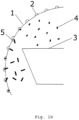
- Fig. 1a discloses a schematic drawing of an exemplary length separator 13.
- the length separator 13 comprises a cylinder or mantle 1 internally provided with cavities 2, preferably in the entire circumference thereof.
- the arrow depicts the direction of the rotation.
- a trough 3 is provided, as at least part of a collector.
- Fig. 1b shows a detail of the apparatus shown in Fig. 1a .
- the granule 4 is of a length below a certain cut-off value and is therefore received by the trough 3, while the length of granule 5 is above the cut-off value and therefore remains in the cavitied cylinder.
- the cavities in the interior surface of the cylinder are provided in an array.
- the cavities may be provided in a pattern or randomly and the cavities are usually substantially evenly distributed.
- cavities are provided in essentially the entire circumference of the cylinder.
- cavities are provided along essentially the entire length of the cylinder, such as at least 60%, preferably at least 70% and most preferably at least 85% of the length.
- the shape of the cavities may be any geometrical form, such as cylindrical, teardrop shaped, hemispherical, box shaped, polyhedral, etc.
- the cavities are cylindrical, such that the centre axes of the cavity cylinders are directed towards the rotational axis of the rotating cylinder.
- asymmetrical or "tear-drop" cavities may be provided. In such a "tear-drop" part of the cavity, the leading part of the cavity with respect to the direction of movement of the cavity, is relatively shallow. The trailing part of the cavity is relatively deep, the deeper part of the cavity being in the trailing part of the cavity.
- different cylindrical portions of the cylinder may have differently constructed and/or dimensioned cavities in order to extract various length fractions; combinations of different cavities at any particular axial portion are also contemplated, depending on the selection criteria.
- the cavities may be prepared by various methods providing the desired geometrical shape. Thus, the cavities may be prepared by embossing, milling, drilling etc. of a surface. The cavities may be indents, in which case the surface may be referred to as an indented surface.
- the surface which is provided with the number of pre-shaped cavities is preferably a stainless steel.
- This has the advantage that the surface can be cleaned up and prepared to a standard required for use of the surface within the pharmaceutical industry.
- the cavities can be formed by local deformation of the surface; forming the cavities by embossing (or deep drawing) in a stainless steel cylinder is possible.
- Such cavities exhibit a particular benefit when granules of an active pharmaceutical ingredients are treated with a length separator having such a surface, that as the cavities have a smooth surface without edges (as opposed to cavities formed by, e.g., drilling), the granules rarely get stuck in the cavities and are therefore less prone to breakage.
- the geometrical shape of the cavities depends on the desired separation profile, and thus the distribution of granule lengths to be obtained.
- the cavities In one configuration, wherein the surface provided with a number of pre-shaped cavities is part of a cylinder, the cavities have parallel to the surface a longest dimension ranging from 0.5 to 3 mm. In the event a cavity is cylindrical, this longest dimension corresponds to the diameter. In a preferred configuration, the diameter is between 1 to 3 mm, more preferred 1.5 to 2.5 mm. The diameter is an important parameter in determination of the so-called cut-off value, i.e. the value at which larger particles are excluded.
- the cavity is tapered along a direction into which the surface will follow the predetermined path. The latter configuration is particularly suitable for preventing granules from being blocked in the cavity. Other variables which may be adjusted to optimise the effectiveness of the cavities include depth or cavity and steepness of the cavity bending edges.
- the diameter of the cylinder is typically between 10 cm to 100 cm.
- the diameter may be larger in certain embodiments, for example those in which granules of lower density are processed. Generally, however, the diameter is selected in the range of 25 to 90 cm, suitably 40 to 70 cm, to obtain a desired productivity in terms of amount of granules (kg) treated per hour.
- the length of the cylinder may be selected in accordance with the desired capacity. In general, the length is between 10 cm and 200 cm, suitably 100 to 200 cm and preferably 130 to 160 cm. A typical relationship between length and diameter is from 0.5:1 to 5:1; in presently preferred configurations, from 1:1 to 3:1. In a particularly presently preferred configuration the diameter is about 60 cm and the length of the separator is about 150 cm.
- the rate of rotation is generally selected so as to obtain a sufficient productivity.
- the rate of rotation is selected together with the diameter to obtain a centrifugal acceleration below 1/2g, preferably below 1/10 g , more preferred below 1/100 g.
- the diameter of the essentially horizontally rotating cylinder is 10 cm to 200 cm and the rotational speed may be selected in the range of 10 to 100 rpm (revolutions per minute), preferably 20 to 50 rpm, and most preferably 25 to 40 rpm.
- the selected granules may then be conveyed to an outlet for further treatment.
- the granules are transported in a chute after they have been recovered in the trough.
- the chute is connected to the outlet.
- the chute may be slightly sloped and/or vibrating to assist the selected granules in the movement towards the outlet.
- the chute may be a part of the trough or may be provided separately.
- the trough comprises an upper stationary part receiving the selected granules and a slightly sloped lower vibrating part conveying the selected granules towards an outlet. The separation of the upper stationary and the lower vibrating part provides for easy servicing of the apparatus.
- Other means for transportation of the selected granules may include a screw conveyor.
- Fig. 1c shows a view of a particular length separator such as may be usable in one embodiment of the method of the present invention.
- the length separator comprises a rotatable cylinder 1, at the interior surface provided with cavities.
- the cylinder 1 is rotated at a constant speed by an electric motor (not shown).
- a trough is positioned in the cylinder.
- the trough consists of an upper stationary trough 6 for receiving the selected granules and a slightly sloped lower vibrating conveyor 7.
- the selected granules (termed the in-size fraction) are conveyed in the lower vibrating conveyor 7 of the trough towards an exit 8.
- the granules discharged from the exit 8 are received by a transporter 9.
- the particles received by transporter 9 are transported to a storage container (not shown).
- the remaining granules in the rotating cylinder (termed the oversize fraction) are discharged to a transporter 10 and conveyed to a storage container.
- the upper stationary trough 6 of the trough is mounted on a rotatable axle 11, using bearings.
- the lower vibrating conveyor 7 of the trough is vibrated in axial direction by the rotation of a disc provided with buttons.
- the lower trough 6 of the trough is flexibly mounted on the axle 11 through a plate spring 12 for holding the vibrating conveyor.
- the oversize fraction may be recycled for a further treatment in the length separator.
- the recycling step may include that the longer particles are comminuted by milling and returned for renewed treatment in accordance with step b).
- the granules for recycling may be milled by a conical mill or similar means.
- the granules being embodiments of the present invention and being obtainable by embodiments of the method of the invention generally have a narrower granule length distribution than those obtainable by mere sieving of equivalent starting granular material.
- Granule size distributions, and the descriptive statistics thereof, are determined in accordance with the "Determination of Granule Length Distribution" as set out in below "Example 2". Such a method is applicable to both coated and uncoated particles.
- small fines may be produced by a process of friction related attrition. This, however, does not alter the overall shape of the granules and is certainly not a form of spheronisation.
- the selected granules may be used for the preparation of a pharmaceutical composition.
- the selection step is followed by a step of applying onto the selected granules a pharmaceutically acceptable coating material.
- the granules may contain one or more pharmaceutically acceptable binders or fillers or a mixture thereof.
- Suitable binders include acacia, gelatin, hydroxypropyl cellulose, hydroxypropylmethyl cellulose, methyl cellulose, polyethylene glycol (PEG), povidone, sucrose, starch or a mixture of any of these.
- Povidone polyvinyl pyrrolidone, PVP
- Binders may be used in a total amount of 1 to 10, or 2 to 8, or 3 to 7, or 4 to 6, or 5 % by weight of the granules.
- Suitable fillers include inter alia microcrystalline cellulose. Fillers may be used in a total amount of 10 to 70, or 20 to 60, or 40 to 50, or 50 % by weight of the granules.
- the granules may be coated in any coating device applicable to the process.
- any coating device applicable to the process.
- the skilled person will readily know which devices would be suitable for the present process, such as for example a fluid bed system, e.g. a Kugel coater.
- the coating material is applied to the selected granules as a solution, and coating of the selected granules is provided upon evaporation of the solvent.
- the granules are preferably coated with a polymer dissolved in a suitable solvent for the polymer, preferably an organic solvent such as acetone.
- the granules selected for coating are unlikely to further fragment into shorter granules, it is possible to use a coater in which the forces exerted on the granules are relatively high, so that the coating can occur within a relatively short space of time.
- the surface area is measured, or known on the basis of earlier measurements carried out for granules produced and selected in the same way.
- any type of measurement is in principle suitable. However, usually the measurement will be based on image analysis of a representative and statistically relevant sample of the selected granules. The image analysis will further be referred to below. Based on a known correlation between the amount of polymer per surface area and the dissolution rate profile, the amount of polymer needed can be predicted from the determined surface area of the granules.
- the selected coating polymer inter alia depends on the desired release pattern, e.g., delayed release or extended release.
- Release-modifying coating agents which extend the release of the active pharmaceutical ingredient include ethyl cellulose, carnauba wax, shellac or a mixture thereof.
- Enteric or delayed release coating agents include polymethacrylate, commercially available in the form of Eudragits, e.g. Eudragit L 100 or Eudragit NE 40 D.
- Eudragit L 100 or Eudragit NE 40 D When an extended release pattern is desired, ethyl cellulose is the most preferred coating agent.
- the granule size distribution of the coated granules of the present embodiment of the invention is similar to that of the uncoated granules obtainable by the method of the present invention, as the coating thickness does not have a substantive influence on the length of the granules, and the granules have been selected to avoid the occurrence of significant fragmentation in the coating process.
- the granule size distribution or the granules aspect ratio distribution, can be obtained on the basis of microscopy combined with image analysis, for instance as described by Cynthia S. Randall in Chapter 6, Particle Size Distribution, of the book titled "Physical Characterisation of Pharmaceutical Solids” edited by Harry G. Brittain, 1995 .
- the active pharmaceutical ingredient is 5-aminosalicylic acid (5-ASA) or any salt or ester thereof.
- the salts of 5-ASA may be acid addition salts, in particular the hydrochloride, but any pharmaceutically acceptable, non-toxic organic or inorganic acid may be used.
- 5-aminosalicylic acid is also known by synonyms including mesalazine, 5-aminosalicylic acid, 2-hydroxy-5-aminobenzoic acid; 3-carboxy-4-hydroxyaniline, 5-asa, mesalamine, rowasa and 5-amino-2-hydroxybenzoic acid, and has the molecular formula C 7 H 7 NO 3 and a molecular weight of 153.14. It is registered under Cas registry number 89-57-6 and Amsterdamcs 201-919-1.
- salts formed with the carboxylic acid group may also be used.
- alkali metal salts K, Na
- alkaline earth metal salts Ca, Mg
- any pharmaceutically acceptable, non-toxic salt may be used.
- the Na and Ca salts are preferred.
- Applicable esters include e.g. straight chain or branched C 1 -C 18 alkyl esters, e.g. methyl, ethyl, propyl, isopropyl, butyl, isobutyl, amyl, hexyl, heptyl, octyl, nonyl, decyl, lauryl, myristyl, cetyl, and stearyl, etc., straight chain or branched C 2 -C 18 alkenyl esters, e.g. vinyl, allyl, undecenyl, oleyl, linolenyl, etc., C 3 -C 8 cycloalkyl esters, e.g.
- C 1 -C 18 alkyl esters e.g. methyl, ethyl, propyl, isopropyl, butyl, isobutyl, amyl, hexyl, heptyl,
- cyclopropyl cyclobutyl, cyclopentyl, cyclohexyl, cycloheptyl and cyclooctyl, etc.
- aryl esters e.g. phenyl, toluyl, xylyl, naphthyl, etc.
- alicyclic esters e.g. menthyl, etc.
- aralkyl esters e.g. benzyl, phenethyl, etc.
- the selection of the active ingredient depends on the selected type of formulation, the disease pattern, especially the site and type of the disease, and the desired release of the active ingredient.
- the physical state and solubility characteristics of the 5-ASA derivatives must be taken into account when selecting a suitable carrier composition for the ingredient.
- the preferred active pharmaceutical ingredient at present is the free acid, 5-aminosalicylic acid.
- the effective oral dose depends on the extent of the disease and for adults usually amounts to 0.5-1.0 g four times a day, or alternatively 2.0-4.0 g once daily. Generally about 20 mg/kg body weight of 5-ASA or a salt or ester thereof (calculated as 5-ASA) will be the recommended initial daily dosage subject to adjustment in accordance with the observed results of the treatment.
- the preferred release pattern is a continuous release following arrival in the small intestine.
- This release was originally designed so as to enable the pharmaceutical composition, e.g. Pentasa ® , to be effective against both Crohn's disease and ulcerative colitis.
- the release pattern can be controlled by varying different parameters of the coating.
- the skilled person will be able to readily determine how such release conditions may be achieved; nonetheless, for the sake of completeness the skilled person may find the disclosure of WO 81/02671 , which is hereby incorporated by reference, of some benefit in achieving a particular release profile.
- the granules comprise 5-ASA.
- the granules may be prepared by wet mixing of 5-ASA with a solution of a binder, such as polyvinylpyrrolidone (PVP, Povidone) in water (e.g. 21.3% w/w).
- a binder such as polyvinylpyrrolidone (PVP, Povidone) in water (e.g. 21.3% w/w).
- PVP polyvinylpyrrolidone
- aqueous solution of PVP are mixed and added to the extruder.
- 5-ASA and the aqueous solution of PVP may be mixed in the extruder.
- the wet mass consisting of 5-ASA and PVP is extruded through a screen and allowed to fall into the device for drying of the wet granules.
- the aqueous solvent is preferably water of a suitable quality, but may contain additives, such as chelating agents, antioxidants, reducing agents, buffers and pH adjusting agents.
- the granules comprising 5-ASA as the active pharmaceutical ingredient may specifically be prepared as described in, e.g., WO 97/23199 , WO 03/032952 or WO 2004/093884 , incorporated herein by reference.
- the granules contain prior to coating 5-ASA and binder only, as described in WO 2004/093884 .
- the present method is utilised for the preparation of prolonged release tablets, sachets or capsules useful for the treatment of ulcerative colitis or Crohn's disease.
- the coating material is a cellulose derivative, such as ethyl cellulose.
- the excipients comprise a tablet carrier, such as microcrystalline cellulose, a lubricant, such as magnesium stearate and optionally further excipients such as talc.
- Comparative Example A Production of granules for tablets comprising 5-ASA (water based granulation process)
- the manufacturing process for 5-ASA tablets can be divided into a number of steps: preparation of granulation liquid; mixing of 5-ASA with water and PVP; extrusion; fluid bed drying; milling; sieving; coating; sieving again, purging, dry blending with excipients, and compression to tablets
- the fluid bed was constructed in such a way that the overall dwelling time in the fluid bed was approximately 21 ⁇ 2 hours.
- Step 5 The drums containing the dry granules were placed upside down on top of the mill and the granules were gently milled using a screen. After passing the mill, the granules were allowed to fall into a drum.
- Step 6 The granules were sieved using a Mogensen vibration sieve with screen dimension 0.8 mm. Granules which passed the screen were discarded.
- Step 7 200 kg of sieved granules were coated in a Kugel coater, being a fluid bed system, with a coating liquid consisting of ethylcellulose dissolved in acetone.
- the surface area of the granules was measured prior to the coating process.
- the prediction of the quantity of polymer that was necessary to apply on the granules has been developed based on the fact that there is a correlation between the amount of polymer per surface area and the dissolution rate of the granules. Once the surface area characteristics for a given granulation size distribution is known, the calculated quantity of polymer may be repeatedly used on comparable batches of granules. After finishing the coating process, the coated granules were loaded into a drum for further processing.
- Step 8 After the coating process, the coated granules were sieved in a Prodima rotation sieve. Large lumps were discarded.
- Step 9 After sieving, the batch of coated granules was divided into two drums for purging with compressed air or nitrogen. The granules were purged for 6-14 hours, although shorter times, such as 30 minutes, are also considered reasonable in practice. This purging process was necessary to reduce the amount of residual solvent (acetone) in the coated granules.
- Step 10 178.56 kg coated Pentasa granules were weighed out and loaded into the Prodima blender together with 69.34 kg microcrystalline cellulose. After mixing for 210 seconds the blender was stopped. 0.335 kg magnesium stearate and 3.02 kg talc were added to the blend and the ingredients were mixed for 90 seconds. The blend gave approximately 335,000 tablets.
- Step 11 The final blend of coated granules and excipients was compressed on a rotary tabletting machine. Weight of each of the tablets: 750 mg. Dedusting of the tablets was performed as an in-line process with the tabletting machine. After dedusting the tablets were loaded into bulk containers holding approximately 30,000 tablets each.
- Example A The manufacturing method followed closely the manufacturing method described in Example A, with some modifications.
- no tablets were made, so no dry blending with excipients was performed (Step 10) and no tableting performed (Step 11).
- the amount of ethylcellulose is reduced as there is no compaction to a tablet, and thus a reduction in the amount of coating applied is needed to obtain the desired dissolution profile.
- the manufacturing process for the formulation can be divided into a number of steps: preparation of granulation liquid; granulation of 5-ASA with water and PVP; extrusion; fluid bed drying; milling; sieving; coating; sieving; and purging.
- Step 7 When the coating step was performed and followed by production scale sieving acceptable release characteristics were achieved. After finishing the coating process, the coated granules were loaded into a drum for further processing.
- Table 2 Composition of granules for sachets 5-ASA 94.3% by weight PVP 4.7% by weight Ethylcellulose 1.0% by weight
- Example 1 Demonstration of classification of granules by cavitied cylinder separator.
- granules from one batch were applied to the cavitied cylinder separator furnished with cavities of 1500 ⁇ m, 1750 ⁇ m or 2000 ⁇ m diameter, respectively.
- the length distribution of the starting material was similar to that shown in Fig. 2 , and the results of the classification experiments are shown in Fig. 3a to 3c showing the length distributions of the trough and the rotating cylinder fractions. Examples of granules obtained in the trough and the rotating cylinder fractions are depicted in Fig. 4a and 4b respectively.
- Ferret diameter was calculated based on an angular resolution of 5 and all values are given in mm with a resolution of 0.01 mm.
- the classification experiments performed showed that the cavitied cylinder separator was capable of producing an in-size fraction with a median granule length of ⁇ 1500 ⁇ m and a span of -0.5. This is by far superior to the sieving technique which produced granules with a median length of 1800-2000 ⁇ m and a span of ⁇ 0.8.
- the cavitied cylinder separator was thus able to produce a fraction of granules with a smaller median length and a much more narrow size distribution.
- the specific surface area obtained by fractionating granules in the cavities cylinder separator showed a higher specific surface area for the trough (in-size) fraction than for the cylinder fraction.
- Example 3 Influence of parameter values on cavitied cylinder separator classification process.
- Breakage of the granules during the coating step may be problematic due to difficulties arising in predicting the dissolution profile of the coated granules. This is relevant for both manufacturing processes described in comparative Examples A and B.
- a set of experiments was set up.
- a batch of granules was prepared as described in comparative Example A, and the length distributions before and after coating were measured. Uncoated granules from the batch were classified in a cavitied cylinder separator and then coated as described in comparative Example A.
- the cavitied cylinder separator employed in the experiment contained an array of tear-drop shaped cavities of 2000 ⁇ m size. Length distributions of uncoated granules classified by treatment with the cavitied cylinder separator and of the length sorted granules after coating were measured. The results of the length distribution measurements are shown in Fig. 5 .
- Tablet granules are generally coated with an excess of coating (ethylcellulose) compared to the sachet granules in order to compensate for the effect of the subsequent compression step.
- coating ethylcellulose
- samples of the tablet granules are withdrawn during the spraying phase, after an amount of coating has been applied that corresponds to the coating amount applied on the sachet granules. The data sets are therefore directly comparable in all relevant factors.
- Table 9 Statistics for the dissolution (90 minutes) of coated PENTASA 95% sachet and PENTASA tablet granule batches for samples withdrawn during the spray phase at a coating factor of 2.0 ⁇ 10 -4 .
- S.D. standard deviation
- R.S.D. relative standard deviation
- the standard deviation of the dissolution of comparative PENTASA tablet granules is 2.8 times larger than that of PENTASA 95% sachet granules obtained in accordance with the present invention (4.4%).
- the variance (spread) of the dissolution results for the inventive product is much more narrow (19.0) than for the comparative, unclassified product (157.0).
- embodiments wherein at least 80% by number of the granules, preferably 85%, most preferably 90% have an aspect ratio less than 2.2, preferably less than 2.1, most preferably less than 2 are considered to exhibit degrees of improvement in the dissolution properties of the pharmaceutical preparation through the reduction in the tail above the median. In some cases, it may be desired to narrow the distribution further, and embodiments wherein 80%, 85% or even 90% of granules have aspect ratio less than 1.9, 1.7, 1.5 or 1.2 may also be preferred.
- the percentages referred to above include percentages within a range of plus/minus 10%. At least 80% is therefore also considered to include 70%.
- Embodiments wherein the granules have a median aspect ratio below 1.7, preferably below 1.6, most preferably below 1.5 are also considered to exhibit improvements in the dissolution properties of the pharmaceutical preparation through improvements in the centring of the distribution around a preferred value. In some cases, it may be desired to bring the median aspect ratio as close to 1 as possible, and so embodiments having a median aspect ratio below 1.4, 1.3, 1.2 or 1.1 will also be preferred.
- embodiments wherein the granules have a span of the aspect ratio less than 0.9, preferably less than 0.8, most preferably less than 0.7 are also considered to exhibit improvements in the dissolution properties of the pharmaceutical preparation through improvements in the central sharpness of the distribution.
- it is preferred to bring the median aspect ratio particularly close to 1 it may also be very useful to apply the techniques of the present invention to produce embodiments having span of the aspect ratio lower than 0.5, lower than 0.4 or even lower than 0.3.
- the amount of granules per sachet can be about 2 grams, corresponding to about 2000 granules. However, also other amounts may be suitable for oral dosage.
Landscapes
- Health & Medical Sciences (AREA)
- Bioinformatics & Cheminformatics (AREA)
- Engineering & Computer Science (AREA)
- Life Sciences & Earth Sciences (AREA)
- Pharmacology & Pharmacy (AREA)
- Animal Behavior & Ethology (AREA)
- General Health & Medical Sciences (AREA)
- Public Health (AREA)
- Veterinary Medicine (AREA)
- Medicinal Chemistry (AREA)
- Chemical & Material Sciences (AREA)
- Epidemiology (AREA)
- Chemical Kinetics & Catalysis (AREA)
- General Chemical & Material Sciences (AREA)
- Nuclear Medicine, Radiotherapy & Molecular Imaging (AREA)
- Organic Chemistry (AREA)
- Physiology (AREA)
- Pain & Pain Management (AREA)
- Rheumatology (AREA)
- Nutrition Science (AREA)
- Medicinal Preparation (AREA)
- Pharmaceuticals Containing Other Organic And Inorganic Compounds (AREA)
- Medicines That Contain Protein Lipid Enzymes And Other Medicines (AREA)
Claims (17)
- Pharmazeutisches Präparat umfassend extrudierte, nicht abgerundete Körner, von denen jedes einen Wirkstoff aufweist und von denen jedes eine vorbestimmte Achse und das gleiche vorbestimmte Querschnittsprofil aufweisen, wobei
mindestens 80 % der Anzahl der Körner ein Aspektverhältnis von weniger als 2,2 und mehr als 0,7 aufweist, und wobei die Körner ein mittleres Aspektverhältnis über 1,1 und unterhalb von 1,7 aufweisen, wobei das Aspektverhältnis als Kornlänge entlang der vorbestimmten Achse geteilt durch die kleinste Ausdehnung in Querschnittsrichtung definiert ist. - Pharmazeutisches Präparat nach Anspruch 1,
wobei die Körner eine Spanne des Aspektverhältnisses von weniger als 0,9 aufweisen. - Pharmazeutisches Präparat nach Anspruch 1 oder Anspruch 2, wobei die kleinste Querschnittsausdehnung zwischen 0,25 mm und 2,5 mm ist.
- Pharmazeutisches Präparat nach einem der vorhergehenden Ansprüche, wobei mindestens eine Anzahl der Körner mit einer Beschichtung bereitgestellt ist.
- Pharmazeutisches Präparat nach Anspruch 4, wobei die Beschichtung das Freigeben des Wirkstoffs steuert.
- Pharmazeutisches Präparat nach einem der vorhergehenden Ansprüche, wobei der Wirkstoff ein entzündungshemmender Wirkstoff ist.
- Pharmazeutisches Präparat nach einem der vorhergehenden Ansprüche, wobei der Wirkstoff 5-Aminosalicylsäure ist.
- Verfahren zum Herstellen eines pharmazeutischen Präparats, die folgenden Schritte umfassend: Herstellen von extrudierten, nicht abgerundeten Körnern, die ein vorbestimmtes Querschnittsprofil und eine vorbestimmte Achse aufweisen; Sortieren der nicht abgerundeten Körner in mindestens einen Teil entsprechend ihrem Aspektverhältnis; und Wählen für eine weitere Bearbeitung der nicht abgerundeten Körner eines gegebenen Verhältnisses oder mehrerer gegebener Verhältnisse, wobei der Schritt des Sortierens der nicht abgerundeten Körner durch ein Führen der nicht abgerundeten Körner durch einen Längentrenner ausgeführt wird, wobei
die Körner keine Eigenschaften aufweisen, die von einem Abrundungsprozess resultieren, bevor die Körner dem Schritt des Sortierens ausgesetzt werden, wobei der Längentrenner eine Oberfläche aufweist, die Vertiefungen darin ausgebildet aufweist, wobei die Oberfläche angeordnet ist, sodass sie einem vorbestimmten Pfad folgt, sodass ein Korn an der Oberfläche, das eine vorbestimmte Beziehung zwischen der Ausdehnung einer gegebenen Vertiefung und der Länge des Korns aufweist, fällt und in einen gegebenen Teil klassifiziert wird. - Verfahren nach Anspruch 8, wobei die Körner vorbereitet werden durch: Führen einer homogenisierten, feuchten Masse durch eine Extruderdüse, die Öffnungen mit vorbestimmten Ausdehnungen darin ausgebildet aufweist; und Zerkleinern der extrudierten Masse, um Körner auszubilden.
- Verfahren nach Anspruch 8 oder Anspruch 9, wobei die Oberfläche ein Zylinder ist, der vorbestimmte Pfad sich um die Achse des Zylinders dreht und ein Behälter zum Sammeln der Körner, die in einen bestimmten Teil klassifiziert werden, zur Achse des Zylinders versetzt positioniert ist.
- Verfahren nach einem der Ansprüche 8 bis 10, wobei die Vertiefungen der Oberfläche jeweils geeignet sind, um ein einzelnes Korn einer vorbestimmten Ausdehnung aufzunehmen.
- Verfahren nach einem der Ansprüche 8 bis 11, wobei die gewählten Körner die Eigenschaften der Körner nach einem der Ansprüche 1 bis 3 aufweisen.
- Verfahren nach einem der Ansprüche 8-12, wobei die gewählten Körner ferner mit einer pharmazeutischen Beschichtung beschichtet sind, die geeignet ist, um eine Entzündungs-Darmkrankheit zu behandeln.
- Verfahren nach einem der Ansprüche 8 bis 12, wobei die Körner, die nicht für eine weitere Verarbeitung gewählt wurden, ferner wiederholt zerkleinert und darauf folgend wieder entsprechend ihrem Aspektverhältnis sortiert werden.
- Verfahren nach Anspruch 14, wobei die Körner, die nicht für eine weitere Verarbeitung gewählt wurden, ferner wiederholt in demselben Prozess wie dem Sortieren der Körner in einem früheren Schritt des Sortierens sortiert werden.
- Verwendung eines Längentrenners in einem Verfahren zum Herstellen eines pharmazeutischen Präparats, wobei die Verwendung während einem Auswählen von extrudierten, nicht abgerundeten Körnern stattfindet, von denen jedes eine vorbestimmte Achse und das gleiche vorbestimmte Querschnittsprofil aufweisen und von denen mindestens eine Anzahl einen Wirkstoff aufweist, wobei der Längentrenner eine Oberfläche aufweist, die eine Anzahl von identisch vorgeformten Vertiefungen darin ausgebildet aufweist, wobei jede Vertiefung geeignet ist, um ein einzelnes, nicht abgerundetes Korn aufzunehmen, wobei die Oberfläche angeordnet ist, sodass sie einem vorbestimmten Pfad folgt, sodass ein nicht abgerundetes Korn, das ursprünglich in einer Vertiefung gehalten wurde, aus der Vertiefung an einer Position entlang des vorbestimmten Pfads herausfällt, wobei diese Position von der Länge des jeweiligen nicht abgerundeten Korns abhängt.
- Verwendung nach Anspruch 16, wobei das Verfahren zum Herstellen eines pharmazeutischen Präparats ein Aufbringen einer Beschichtung auf ausgewählte nicht abgerundete Körner umfasst, sodass der Wirkstoff mit einer vorbestimmten Rate freigegeben wird.
Priority Applications (4)
| Application Number | Priority Date | Filing Date | Title |
|---|---|---|---|
| EP10793226.1A EP2512453B2 (de) | 2009-12-18 | 2010-12-15 | Granulat für pharmazeutische Präparate sowie Verfahren und Vorrichtungen zu ihrer Herstellung |
| RS20161111A RS55438B2 (sr) | 2009-12-18 | 2010-12-15 | Granule za farmaceutske preparate, postupci i uređaj za njihovu proizvodnju |
| HRP20161639TT HRP20161639T4 (hr) | 2009-12-18 | 2010-12-15 | Granule za farmaceutske pripravke, metode i uređaj za njihovu proizvodnju |
| SI201031345T SI2512453T2 (sl) | 2009-12-18 | 2010-12-15 | Granule za farmacevtske preparate, metode in naprave za njihovo proizvodnjo |
Applications Claiming Priority (3)
| Application Number | Priority Date | Filing Date | Title |
|---|---|---|---|
| EP09179877A EP2340812A1 (de) | 2009-12-18 | 2009-12-18 | Granulat für pharmazeutische Präparate sowie Verfahren und Vorrichtungen zu ihrer Herstellung |
| EP10793226.1A EP2512453B2 (de) | 2009-12-18 | 2010-12-15 | Granulat für pharmazeutische Präparate sowie Verfahren und Vorrichtungen zu ihrer Herstellung |
| PCT/EP2010/069733 WO2011073245A2 (en) | 2009-12-18 | 2010-12-15 | Granules for pharmaceutical preparations, methods and apparatus for their production |
Publications (3)
| Publication Number | Publication Date |
|---|---|
| EP2512453A2 EP2512453A2 (de) | 2012-10-24 |
| EP2512453B1 EP2512453B1 (de) | 2016-11-09 |
| EP2512453B2 true EP2512453B2 (de) | 2025-03-12 |
Family
ID=42110308
Family Applications (2)
| Application Number | Title | Priority Date | Filing Date |
|---|---|---|---|
| EP09179877A Withdrawn EP2340812A1 (de) | 2009-12-18 | 2009-12-18 | Granulat für pharmazeutische Präparate sowie Verfahren und Vorrichtungen zu ihrer Herstellung |
| EP10793226.1A Active EP2512453B2 (de) | 2009-12-18 | 2010-12-15 | Granulat für pharmazeutische Präparate sowie Verfahren und Vorrichtungen zu ihrer Herstellung |
Family Applications Before (1)
| Application Number | Title | Priority Date | Filing Date |
|---|---|---|---|
| EP09179877A Withdrawn EP2340812A1 (de) | 2009-12-18 | 2009-12-18 | Granulat für pharmazeutische Präparate sowie Verfahren und Vorrichtungen zu ihrer Herstellung |
Country Status (28)
| Country | Link |
|---|---|
| US (2) | US8765185B2 (de) |
| EP (2) | EP2340812A1 (de) |
| JP (1) | JP5593396B2 (de) |
| KR (1) | KR101882880B1 (de) |
| CN (2) | CN105769772A (de) |
| AR (1) | AR079536A1 (de) |
| AU (1) | AU2010332884B2 (de) |
| BR (1) | BR112012014935B1 (de) |
| CA (1) | CA2784235C (de) |
| DK (1) | DK2512453T4 (de) |
| ES (1) | ES2612870T5 (de) |
| FI (1) | FI2512453T4 (de) |
| HR (1) | HRP20161639T4 (de) |
| HU (1) | HUE031228T2 (de) |
| IL (1) | IL220319A (de) |
| JO (1) | JO3762B1 (de) |
| LT (1) | LT2512453T (de) |
| MX (2) | MX351365B (de) |
| NL (1) | NL1038373C2 (de) |
| NZ (1) | NZ600582A (de) |
| PL (1) | PL2512453T5 (de) |
| PT (1) | PT2512453T (de) |
| RS (1) | RS55438B2 (de) |
| RU (1) | RU2584349C2 (de) |
| SI (1) | SI2512453T2 (de) |
| TW (1) | TWI511723B (de) |
| WO (1) | WO2011073245A2 (de) |
| ZA (1) | ZA201204441B (de) |
Families Citing this family (15)
| Publication number | Priority date | Publication date | Assignee | Title |
|---|---|---|---|---|
| US20070042143A1 (en) * | 2003-04-23 | 2007-02-22 | Ferring B.V. | Sachet for a pharmaceutical composition |
| ES2972135T3 (es) | 2008-10-02 | 2024-06-11 | Salix Pharmaceuticals Inc | Tratamiento de encefalopatía hepática usando rifaximina |
| EP2340812A1 (de) | 2009-12-18 | 2011-07-06 | Ferring International Center S.A. | Granulat für pharmazeutische Präparate sowie Verfahren und Vorrichtungen zu ihrer Herstellung |
| US20140141075A1 (en) | 2012-11-21 | 2014-05-22 | Warner Chilcott Company, Llc | 5-aminosalicylic acid capsule formulation |
| DE202017102645U1 (de) * | 2017-05-03 | 2018-08-06 | Romaco Kilian Gmbh | Ablaufvorrichtung für Presslinge einer Rundläufer-Tablettenpresse sowie Rundläufer-Tablettenpresse mit Ablaufvorrichtung |
| RU2667637C1 (ru) * | 2017-06-26 | 2018-09-21 | Гермес Арцнаймиттель ГмбХ | Фармацевтическая композиция для перорального применения, содержащая n-ацетилцистеин с маскированным вкусом |
| EP3459527B1 (de) | 2017-09-20 | 2022-11-23 | Tillotts Pharma Ag | Verfahren zur herstellung einer festen dosierungsform mit antikörpern durch nassgranulation, -extrusion und -sphäronisierung |
| ES2938609T3 (es) | 2017-09-20 | 2023-04-13 | Tillotts Pharma Ag | Preparación de formas farmacéuticas sólidas que comprenden anticuerpos mediante estratificación de solución/suspensión |
| EP3459529A1 (de) | 2017-09-20 | 2019-03-27 | Tillotts Pharma Ag | Herstellung von festen darreichungsformen mit verzögerter freisetzung mit antikörpern durch sprühtrocknung |
| KR102161235B1 (ko) * | 2020-07-22 | 2020-09-29 | 주식회사 피티케이 | 이송 일체형 과립 제조 장치 및 방법 |
| JP7296600B2 (ja) * | 2020-08-18 | 2023-06-23 | ユーハ味覚糖株式会社 | 口中速崩壊性固形食品及びその製造方法 |
| CN114472139A (zh) * | 2022-01-04 | 2022-05-13 | 安徽宏信药业发展有限公司 | 一种中药药丸干燥筛选装置 |
| CN115445902B (zh) * | 2022-09-21 | 2023-06-06 | 重庆科技学院 | 一种条形颗粒物三维尺寸分选方法及装置 |
| WO2024200722A1 (en) | 2023-03-28 | 2024-10-03 | Tillotts Pharma Ag | Solid oral dosage form comprising antibodies for sustained release in the lower gastrointestinal tract |
| CN116942532B (zh) * | 2023-09-20 | 2023-12-12 | 北京爱力佳医药科技有限公司 | 一种粉状药物制备装置 |
Citations (1)
| Publication number | Priority date | Publication date | Assignee | Title |
|---|---|---|---|---|
| EP1547601A1 (de) † | 2003-12-23 | 2005-06-29 | Ferring B.V. | Beschichtungsverfahren |
Family Cites Families (22)
| Publication number | Priority date | Publication date | Assignee | Title |
|---|---|---|---|---|
| WO1981002671A1 (en) | 1980-03-20 | 1981-10-01 | Ferring Farma Lab | Pharmaceutical composition and method for the treatment of colitis ulcerosa and crohn's disease by oral administration |
| EP0274479B1 (de) | 1986-03-10 | 1993-07-14 | Cri International, Inc. | Verfahren zur Sortierung und Isolierung von Katalysator-Formteilchen nach ihrer Länge |
| US4720473A (en) * | 1986-03-10 | 1988-01-19 | Cri International, Inc. | Production of improved catalyst-type particles using length and density grading |
| JPH0827133B2 (ja) | 1993-07-13 | 1996-03-21 | 不二パウダル株式会社 | 湿潤粉粒体の処理装置 |
| KR100542544B1 (ko) | 1995-12-21 | 2006-05-10 | 파마슈티스크 라보라토리움 페링 에이/에스 | 5-아미노살리실산을함유하는방출제어형경구용약제학적조성물및장질환을치료하는방법 |
| US6004581A (en) | 1995-12-21 | 1999-12-21 | Farmaceutisk Laboratorium Ferring A/S | Modified release oral pharmaceutical composition and method for the treatment of bowel diseases |
| AUPO637197A0 (en) | 1997-04-23 | 1997-05-15 | F.H. Faulding & Co. Limited | Taste-masked pharmaceutical compositions |
| DE19724181A1 (de) * | 1997-06-09 | 1998-12-10 | Bayer Ag | Multiple-unit-retard-Zubereitungen und Verfahren zu ihrer Herstellung |
| JP2000128774A (ja) | 1998-10-26 | 2000-05-09 | Tanabe Seiyaku Co Ltd | 薬物を含有する球形微粒子の製法 |
| US6146685A (en) | 1998-11-05 | 2000-11-14 | Delsys Pharmaceutical Corporation | Method of deposition a dry powder and dispensing device |
| NZ513037A (en) * | 1999-01-29 | 2003-05-30 | Disphar Internat B | Coated sustained release pharmaceutical composition for the release of an agent in the gastrointestinal tract |
| US6735487B1 (en) | 1999-07-01 | 2004-05-11 | Ods Properties, Inc. | Interactive wagering system with promotions |
| GB0113841D0 (en) * | 2001-06-07 | 2001-08-01 | Boots Co Plc | Therapeutic agents |
| ATE371441T1 (de) * | 2001-10-15 | 2007-09-15 | Ferring Bv | Verfahren zur herstellung einer pharmazeutischen zubereitung mit 5-aminosalicylsäure zur verwendung bei der behandlung von colitis ulcerosa und morbus crohn |
| US8282955B2 (en) | 2001-10-15 | 2012-10-09 | Ferring B.V. | Method for the preparation of a pharmaceutical composition comprising 5-aminosalicylic acid for use in treatment of ulcerative colitis and Crohn's disease |
| US7445796B2 (en) | 2002-08-19 | 2008-11-04 | L. Perrigo Company | Pharmaceutically active particles of a monomodal particle size distribution and method |
| US20070042143A1 (en) * | 2003-04-23 | 2007-02-22 | Ferring B.V. | Sachet for a pharmaceutical composition |
| EP1470819A1 (de) * | 2003-04-23 | 2004-10-27 | Ferring B.V. | Sachet mit hohem Anteil an Mesalazin |
| US7207505B2 (en) | 2004-06-04 | 2007-04-24 | Bender Martin P | Method for producing small granules |
| DE102004028977A1 (de) * | 2004-06-16 | 2006-01-05 | Add Advanced Drug Delivery Technologies Ltd. | Neutralpellets |
| JP2009521402A (ja) | 2005-11-17 | 2009-06-04 | テバ ファーマシューティカル インダストリーズ リミティド | プロパルギル化アミノインダンの分離のための方法 |
| EP2340812A1 (de) | 2009-12-18 | 2011-07-06 | Ferring International Center S.A. | Granulat für pharmazeutische Präparate sowie Verfahren und Vorrichtungen zu ihrer Herstellung |
-
2009
- 2009-12-18 EP EP09179877A patent/EP2340812A1/de not_active Withdrawn
-
2010
- 2010-11-10 NL NL1038373A patent/NL1038373C2/en not_active IP Right Cessation
- 2010-12-15 FI FIEP10793226.1T patent/FI2512453T4/fi active
- 2010-12-15 BR BR112012014935-0A patent/BR112012014935B1/pt active IP Right Grant
- 2010-12-15 MX MX2014011350A patent/MX351365B/es unknown
- 2010-12-15 AU AU2010332884A patent/AU2010332884B2/en active Active
- 2010-12-15 RS RS20161111A patent/RS55438B2/sr unknown
- 2010-12-15 HU HUE10793226A patent/HUE031228T2/en unknown
- 2010-12-15 SI SI201031345T patent/SI2512453T2/sl unknown
- 2010-12-15 KR KR1020127018413A patent/KR101882880B1/ko active Active
- 2010-12-15 LT LTEP10793226.1T patent/LT2512453T/lt unknown
- 2010-12-15 MX MX2012006851A patent/MX2012006851A/es active IP Right Grant
- 2010-12-15 RU RU2012124834/15A patent/RU2584349C2/ru active
- 2010-12-15 WO PCT/EP2010/069733 patent/WO2011073245A2/en not_active Ceased
- 2010-12-15 DK DK10793226.1T patent/DK2512453T4/da active
- 2010-12-15 CA CA2784235A patent/CA2784235C/en active Active
- 2010-12-15 EP EP10793226.1A patent/EP2512453B2/de active Active
- 2010-12-15 JP JP2012543713A patent/JP5593396B2/ja active Active
- 2010-12-15 CN CN201610133023.9A patent/CN105769772A/zh active Pending
- 2010-12-15 US US13/516,145 patent/US8765185B2/en active Active
- 2010-12-15 JO JOP/2010/0446A patent/JO3762B1/ar active
- 2010-12-15 CN CN201080063456.2A patent/CN102791257B/zh active Active
- 2010-12-15 ES ES10793226T patent/ES2612870T5/es active Active
- 2010-12-15 HR HRP20161639TT patent/HRP20161639T4/hr unknown
- 2010-12-15 NZ NZ600582A patent/NZ600582A/en unknown
- 2010-12-15 PT PT107932261T patent/PT2512453T/pt unknown
- 2010-12-15 PL PL10793226.1T patent/PL2512453T5/pl unknown
- 2010-12-17 TW TW099144475A patent/TWI511723B/zh active
- 2010-12-20 AR ARP100104755A patent/AR079536A1/es not_active Application Discontinuation
-
2012
- 2012-06-12 IL IL220319A patent/IL220319A/en active IP Right Grant
- 2012-06-15 ZA ZA2012/04441A patent/ZA201204441B/en unknown
-
2014
- 2014-05-16 US US14/279,806 patent/US9114083B2/en active Active
Patent Citations (1)
| Publication number | Priority date | Publication date | Assignee | Title |
|---|---|---|---|---|
| EP1547601A1 (de) † | 2003-12-23 | 2005-06-29 | Ferring B.V. | Beschichtungsverfahren |
Also Published As
Similar Documents
| Publication | Publication Date | Title |
|---|---|---|
| EP2512453B2 (de) | Granulat für pharmazeutische Präparate sowie Verfahren und Vorrichtungen zu ihrer Herstellung | |
| EP2081669B1 (de) | Verfahren und vorrichtung zur herstellung von granulaten | |
| EP2285354B1 (de) | Verfahren zur herstellung einer tablette mit geringem wirkstoffgehalt | |
| EP2285355B1 (de) | Verfahren zur herstellung einer tablette mit hohem wirkstoffgehalt | |
| WO2009135949A2 (en) | Process for preparing a very high drug load tablet | |
| HK1175410B (en) | Granules for pharmaceutical preparations, methods and apparatus for their production | |
| HK1175410A (en) | Granules for pharmaceutical preparations, methods and apparatus for their production |
Legal Events
| Date | Code | Title | Description |
|---|---|---|---|
| PUAI | Public reference made under article 153(3) epc to a published international application that has entered the european phase |
Free format text: ORIGINAL CODE: 0009012 |
|
| 17P | Request for examination filed |
Effective date: 20120712 |
|
| AK | Designated contracting states |
Kind code of ref document: A2 Designated state(s): AL AT BE BG CH CY CZ DE DK EE ES FI FR GB GR HR HU IE IS IT LI LT LU LV MC MK MT NL NO PL PT RO RS SE SI SK SM TR |
|
| AX | Request for extension of the european patent |
Extension state: BA ME |
|
| REG | Reference to a national code |
Ref country code: HK Ref legal event code: DE Ref document number: 1175410 Country of ref document: HK |
|
| GRAP | Despatch of communication of intention to grant a patent |
Free format text: ORIGINAL CODE: EPIDOSNIGR1 |
|
| INTG | Intention to grant announced |
Effective date: 20160520 |
|
| GRAS | Grant fee paid |
Free format text: ORIGINAL CODE: EPIDOSNIGR3 |
|
| GRAA | (expected) grant |
Free format text: ORIGINAL CODE: 0009210 |
|
| AK | Designated contracting states |
Kind code of ref document: B1 Designated state(s): AL AT BE BG CH CY CZ DE DK EE ES FI FR GB GR HR HU IE IS IT LI LT LU LV MC MK MT NL NO PL PT RO RS SE SI SK SM TR |
|
| AX | Request for extension of the european patent |
Extension state: BA ME |
|
| REG | Reference to a national code |
Ref country code: GB Ref legal event code: FG4D |
|
| REG | Reference to a national code |
Ref country code: AT Ref legal event code: REF Ref document number: 843239 Country of ref document: AT Kind code of ref document: T Effective date: 20161115 Ref country code: CH Ref legal event code: EP |
|
| REG | Reference to a national code |
Ref country code: IE Ref legal event code: FG4D |
|
| REG | Reference to a national code |
Ref country code: HR Ref legal event code: TUEP Ref document number: P20161639 Country of ref document: HR |
|
| REG | Reference to a national code |
Ref country code: RO Ref legal event code: EPE |
|
| REG | Reference to a national code |
Ref country code: PT Ref legal event code: SC4A Ref document number: 2512453 Country of ref document: PT Date of ref document: 20161216 Kind code of ref document: T Free format text: AVAILABILITY OF NATIONAL TRANSLATION Effective date: 20161209 |
|
| REG | Reference to a national code |
Ref country code: NL Ref legal event code: FP |
|
| REG | Reference to a national code |
Ref country code: DE Ref legal event code: R096 Ref document number: 602010037892 Country of ref document: DE |
|
| REG | Reference to a national code |
Ref country code: SE Ref legal event code: TRGR |
|
| REG | Reference to a national code |
Ref country code: DK Ref legal event code: T3 Effective date: 20170104 |
|
| REG | Reference to a national code |
Ref country code: NO Ref legal event code: T2 Effective date: 20161109 |
|
| REG | Reference to a national code |
Ref country code: HR Ref legal event code: T1PR Ref document number: P20161639 Country of ref document: HR |
|
| REG | Reference to a national code |
Ref country code: EE Ref legal event code: FG4A Ref document number: E012935 Country of ref document: EE Effective date: 20161213 |
|
| REG | Reference to a national code |
Ref country code: ES Ref legal event code: FG2A Ref document number: 2612870 Country of ref document: ES Kind code of ref document: T3 Effective date: 20170519 |
|
| REG | Reference to a national code |
Ref country code: SK Ref legal event code: T3 Ref document number: E 22950 Country of ref document: SK |
|
| REG | Reference to a national code |
Ref country code: GR Ref legal event code: EP Ref document number: 20160403096 Country of ref document: GR Effective date: 20170410 |
|
| REG | Reference to a national code |
Ref country code: HU Ref legal event code: AG4A Ref document number: E031228 Country of ref document: HU |
|
| REG | Reference to a national code |
Ref country code: DE Ref legal event code: R026 Ref document number: 602010037892 Country of ref document: DE |
|
| PLBI | Opposition filed |
Free format text: ORIGINAL CODE: 0009260 |
|
| PLBI | Opposition filed |
Free format text: ORIGINAL CODE: 0009260 |
|
| PG25 | Lapsed in a contracting state [announced via postgrant information from national office to epo] |
Ref country code: SM Free format text: LAPSE BECAUSE OF FAILURE TO SUBMIT A TRANSLATION OF THE DESCRIPTION OR TO PAY THE FEE WITHIN THE PRESCRIBED TIME-LIMIT Effective date: 20161109 |
|
| 26 | Opposition filed |
Opponent name: INTAS PHARMACEUTICALS LTD. Effective date: 20170808 Opponent name: COOKE, RICHARD Effective date: 20170808 |
|
| PLAX | Notice of opposition and request to file observation + time limit sent |
Free format text: ORIGINAL CODE: EPIDOSNOBS2 |
|
| 26 | Opposition filed |
Opponent name: TILLOTTS PHARMA AG Effective date: 20170809 |
|
| PG25 | Lapsed in a contracting state [announced via postgrant information from national office to epo] |
Ref country code: MC Free format text: LAPSE BECAUSE OF FAILURE TO SUBMIT A TRANSLATION OF THE DESCRIPTION OR TO PAY THE FEE WITHIN THE PRESCRIBED TIME-LIMIT Effective date: 20161109 |
|
| REG | Reference to a national code |
Ref country code: FR Ref legal event code: ST Effective date: 20170831 |
|
| PG25 | Lapsed in a contracting state [announced via postgrant information from national office to epo] |
Ref country code: FR Free format text: LAPSE BECAUSE OF NON-PAYMENT OF DUE FEES Effective date: 20170109 |
|
| REG | Reference to a national code |
Ref country code: HK Ref legal event code: GR Ref document number: 1175410 Country of ref document: HK |
|
| PLBB | Reply of patent proprietor to notice(s) of opposition received |
Free format text: ORIGINAL CODE: EPIDOSNOBS3 |
|
| PG25 | Lapsed in a contracting state [announced via postgrant information from national office to epo] |
Ref country code: CY Free format text: LAPSE BECAUSE OF FAILURE TO SUBMIT A TRANSLATION OF THE DESCRIPTION OR TO PAY THE FEE WITHIN THE PRESCRIBED TIME-LIMIT Effective date: 20161109 |
|
| PG25 | Lapsed in a contracting state [announced via postgrant information from national office to epo] |
Ref country code: MK Free format text: LAPSE BECAUSE OF FAILURE TO SUBMIT A TRANSLATION OF THE DESCRIPTION OR TO PAY THE FEE WITHIN THE PRESCRIBED TIME-LIMIT Effective date: 20161109 |
|
| PG25 | Lapsed in a contracting state [announced via postgrant information from national office to epo] |
Ref country code: MT Free format text: LAPSE BECAUSE OF NON-PAYMENT OF DUE FEES Effective date: 20161215 |
|
| PLAB | Opposition data, opponent's data or that of the opponent's representative modified |
Free format text: ORIGINAL CODE: 0009299OPPO |
|
| R26 | Opposition filed (corrected) |
Opponent name: COOKE, RICHARD Effective date: 20170808 |
|
| REG | Reference to a national code |
Ref country code: HR Ref legal event code: ODRP Ref document number: P20161639 Country of ref document: HR Payment date: 20181206 Year of fee payment: 9 |
|
| REG | Reference to a national code |
Ref country code: AT Ref legal event code: UEP Ref document number: 843239 Country of ref document: AT Kind code of ref document: T Effective date: 20161109 |
|
| REG | Reference to a national code |
Ref country code: CH Ref legal event code: PK Free format text: BERICHTIGUNGEN |
|
| RIC2 | Information provided on ipc code assigned after grant |
Ipc: A61K 9/16 20060101AFI20190213BHEP Ipc: A61K 9/50 20060101ALI20190213BHEP Ipc: A61K 31/609 20060101ALI20190213BHEP |
|
| APBM | Appeal reference recorded |
Free format text: ORIGINAL CODE: EPIDOSNREFNO |
|
| APBP | Date of receipt of notice of appeal recorded |
Free format text: ORIGINAL CODE: EPIDOSNNOA2O |
|
| APAH | Appeal reference modified |
Free format text: ORIGINAL CODE: EPIDOSCREFNO |
|
| APBQ | Date of receipt of statement of grounds of appeal recorded |
Free format text: ORIGINAL CODE: EPIDOSNNOA3O |
|
| REG | Reference to a national code |
Ref country code: HR Ref legal event code: ODRP Ref document number: P20161639 Country of ref document: HR Payment date: 20191206 Year of fee payment: 10 |
|
| TPAC | Observations filed by third parties |
Free format text: ORIGINAL CODE: EPIDOSNTIPA |
|
| PLAB | Opposition data, opponent's data or that of the opponent's representative modified |
Free format text: ORIGINAL CODE: 0009299OPPO |
|
| R26 | Opposition filed (corrected) |
Opponent name: INTAS PHARMACEUTICALS LTD. Effective date: 20170808 |
|
| PLAB | Opposition data, opponent's data or that of the opponent's representative modified |
Free format text: ORIGINAL CODE: 0009299OPPO |
|
| REG | Reference to a national code |
Ref country code: HR Ref legal event code: ODRP Ref document number: P20161639 Country of ref document: HR Payment date: 20201202 Year of fee payment: 11 |
|
| R26 | Opposition filed (corrected) |
Opponent name: TILLOTTS PHARMA AG Effective date: 20170809 |
|
| REG | Reference to a national code |
Ref country code: EE Ref legal event code: HC1A Ref document number: E012935 Country of ref document: EE |
|
| REG | Reference to a national code |
Ref country code: HR Ref legal event code: ODRP Ref document number: P20161639 Country of ref document: HR Payment date: 20211206 Year of fee payment: 12 |
|
| APBU | Appeal procedure closed |
Free format text: ORIGINAL CODE: EPIDOSNNOA9O |
|
| PLAY | Examination report in opposition despatched + time limit |
Free format text: ORIGINAL CODE: EPIDOSNORE2 |
|
| PLBC | Reply to examination report in opposition received |
Free format text: ORIGINAL CODE: EPIDOSNORE3 |
|
| PLAY | Examination report in opposition despatched + time limit |
Free format text: ORIGINAL CODE: EPIDOSNORE2 |
|
| REG | Reference to a national code |
Ref country code: HR Ref legal event code: ODRP Ref document number: P20161639 Country of ref document: HR Payment date: 20221202 Year of fee payment: 13 |
|
| P01 | Opt-out of the competence of the unified patent court (upc) registered |
Effective date: 20230513 |
|
| PLAB | Opposition data, opponent's data or that of the opponent's representative modified |
Free format text: ORIGINAL CODE: 0009299OPPO |
|
| REG | Reference to a national code |
Ref country code: HR Ref legal event code: ODRP Ref document number: P20161639 Country of ref document: HR Payment date: 20231204 Year of fee payment: 14 |
|
| R26 | Opposition filed (corrected) |
Opponent name: TILLOTTS PHARMA AG Effective date: 20170809 |
|
| REG | Reference to a national code |
Ref country code: CH Ref legal event code: PK Free format text: BERICHTIGUNGEN |
|
| RIC2 | Information provided on ipc code assigned after grant |
Ipc: A61P 29/00 20060101ALI20240207BHEP Ipc: A61P 1/04 20060101ALI20240207BHEP Ipc: A61P 1/00 20060101ALI20240207BHEP Ipc: A61K 31/609 20060101ALI20240207BHEP Ipc: A61K 9/50 20060101ALI20240207BHEP Ipc: A61K 9/16 20060101AFI20240207BHEP |
|
| REG | Reference to a national code |
Ref country code: HR Ref legal event code: ODRP Ref document number: P20161639 Country of ref document: HR Payment date: 20241203 Year of fee payment: 15 |
|
| PGFP | Annual fee paid to national office [announced via postgrant information from national office to epo] |
Ref country code: BE Payment date: 20241224 Year of fee payment: 15 |
|
| PGFP | Annual fee paid to national office [announced via postgrant information from national office to epo] |
Ref country code: EE Payment date: 20241230 Year of fee payment: 15 |
|
| PUAH | Patent maintained in amended form |
Free format text: ORIGINAL CODE: 0009272 |
|
| STAA | Information on the status of an ep patent application or granted ep patent |
Free format text: STATUS: PATENT MAINTAINED AS AMENDED |
|
| 27A | Patent maintained in amended form |
Effective date: 20250312 |
|
| AK | Designated contracting states |
Kind code of ref document: B2 Designated state(s): AL AT BE BG CH CY CZ DE DK EE ES FI FR GB GR HR HU IE IS IT LI LT LU LV MC MK MT NL NO PL PT RO RS SE SI SK SM TR |
|
| REG | Reference to a national code |
Ref country code: DE Ref legal event code: R102 Ref document number: 602010037892 Country of ref document: DE |
|
| PGFP | Annual fee paid to national office [announced via postgrant information from national office to epo] |
Ref country code: DE Payment date: 20241227 Year of fee payment: 15 |
|
| PGFP | Annual fee paid to national office [announced via postgrant information from national office to epo] |
Ref country code: ES Payment date: 20250114 Year of fee payment: 15 |
|
| PGFP | Annual fee paid to national office [announced via postgrant information from national office to epo] |
Ref country code: CH Payment date: 20250101 Year of fee payment: 15 |
|
| REG | Reference to a national code |
Ref country code: ES Ref legal event code: DC2A Ref document number: 2612870 Country of ref document: ES Kind code of ref document: T5 Effective date: 20250509 |
|
| REG | Reference to a national code |
Ref country code: DK Ref legal event code: T4 Effective date: 20250527 |
|
| REG | Reference to a national code |
Ref country code: SE Ref legal event code: RPEO |
|
| REG | Reference to a national code |
Ref country code: NL Ref legal event code: FP |
|
| REG | Reference to a national code |
Ref country code: HR Ref legal event code: T4IZ Ref document number: P20161639 Country of ref document: HR |
|
| REG | Reference to a national code |
Ref country code: SK Ref legal event code: T5 Ref document number: E 22950 Country of ref document: SK |
|
| REG | Reference to a national code |
Ref country code: EE Ref legal event code: LD4A Ref document number: E012935 Country of ref document: EE |
|
| REG | Reference to a national code |
Ref country code: GR Ref legal event code: EP Ref document number: 20250401083 Country of ref document: GR Effective date: 20250707 |
|
| PGFP | Annual fee paid to national office [announced via postgrant information from national office to epo] |
Ref country code: PT Payment date: 20251202 Year of fee payment: 16 |
|
| REG | Reference to a national code |
Ref country code: CH Ref legal event code: U11 Free format text: ST27 STATUS EVENT CODE: U-0-0-U10-U11 (AS PROVIDED BY THE NATIONAL OFFICE) Effective date: 20260101 |
|
| REG | Reference to a national code |
Ref country code: HR Ref legal event code: ODRP Ref document number: P20161639 Country of ref document: HR Payment date: 20251202 Year of fee payment: 16 |
|
| PGFP | Annual fee paid to national office [announced via postgrant information from national office to epo] |
Ref country code: IS Payment date: 20251229 Year of fee payment: 16 |
|
| PGFP | Annual fee paid to national office [announced via postgrant information from national office to epo] |
Ref country code: LT Payment date: 20251201 Year of fee payment: 16 Ref country code: GB Payment date: 20251223 Year of fee payment: 16 |
|
| PGFP | Annual fee paid to national office [announced via postgrant information from national office to epo] |
Ref country code: NO Payment date: 20251218 Year of fee payment: 16 |
|
| PGFP | Annual fee paid to national office [announced via postgrant information from national office to epo] |
Ref country code: AT Payment date: 20251218 Year of fee payment: 16 |
|
| PGFP | Annual fee paid to national office [announced via postgrant information from national office to epo] |
Ref country code: IT Payment date: 20251218 Year of fee payment: 16 Ref country code: FI Payment date: 20251222 Year of fee payment: 16 Ref country code: DK Payment date: 20251222 Year of fee payment: 16 |
|
| PGFP | Annual fee paid to national office [announced via postgrant information from national office to epo] |
Ref country code: LU Payment date: 20251222 Year of fee payment: 16 Ref country code: HR Payment date: 20251202 Year of fee payment: 16 Ref country code: HU Payment date: 20251211 Year of fee payment: 16 Ref country code: NL Payment date: 20251222 Year of fee payment: 16 |
|
| PGFP | Annual fee paid to national office [announced via postgrant information from national office to epo] |
Ref country code: TR Payment date: 20251202 Year of fee payment: 16 Ref country code: AL Payment date: 20251230 Year of fee payment: 16 Ref country code: GR Payment date: 20251218 Year of fee payment: 16 |
|
| PGFP | Annual fee paid to national office [announced via postgrant information from national office to epo] |
Ref country code: SE Payment date: 20251222 Year of fee payment: 16 |
|
| PGFP | Annual fee paid to national office [announced via postgrant information from national office to epo] |
Ref country code: IE Payment date: 20251218 Year of fee payment: 16 Ref country code: CZ Payment date: 20251208 Year of fee payment: 16 |
|
| PGFP | Annual fee paid to national office [announced via postgrant information from national office to epo] |
Ref country code: LV Payment date: 20251219 Year of fee payment: 16 |
|
| PGFP | Annual fee paid to national office [announced via postgrant information from national office to epo] |
Ref country code: PL Payment date: 20251205 Year of fee payment: 16 Ref country code: BG Payment date: 20251223 Year of fee payment: 16 |
|
| PGFP | Annual fee paid to national office [announced via postgrant information from national office to epo] |
Ref country code: SK Payment date: 20251201 Year of fee payment: 16 Ref country code: RO Payment date: 20251210 Year of fee payment: 16 |
|
| PGFP | Annual fee paid to national office [announced via postgrant information from national office to epo] |
Ref country code: RS Payment date: 20251201 Year of fee payment: 16 |
|
| PGFP | Annual fee paid to national office [announced via postgrant information from national office to epo] |
Ref country code: SI Payment date: 20251202 Year of fee payment: 16 |