EP2508285B1 - Dustproof structure for movable support section in cutting machine - Google Patents
Dustproof structure for movable support section in cutting machine Download PDFInfo
- Publication number
- EP2508285B1 EP2508285B1 EP10833061.4A EP10833061A EP2508285B1 EP 2508285 B1 EP2508285 B1 EP 2508285B1 EP 10833061 A EP10833061 A EP 10833061A EP 2508285 B1 EP2508285 B1 EP 2508285B1
- Authority
- EP
- European Patent Office
- Prior art keywords
- dust
- supporting annular
- annular portion
- elastic member
- movable cover
- Prior art date
- Legal status (The legal status is an assumption and is not a legal conclusion. Google has not performed a legal analysis and makes no representation as to the accuracy of the status listed.)
- Active
Links
Images


Classifications
-
- B—PERFORMING OPERATIONS; TRANSPORTING
- B23—MACHINE TOOLS; METAL-WORKING NOT OTHERWISE PROVIDED FOR
- B23D—PLANING; SLOTTING; SHEARING; BROACHING; SAWING; FILING; SCRAPING; LIKE OPERATIONS FOR WORKING METAL BY REMOVING MATERIAL, NOT OTHERWISE PROVIDED FOR
- B23D47/00—Sawing machines or sawing devices working with circular saw blades, characterised only by constructional features of particular parts
-
- B—PERFORMING OPERATIONS; TRANSPORTING
- B25—HAND TOOLS; PORTABLE POWER-DRIVEN TOOLS; MANIPULATORS
- B25F—COMBINATION OR MULTI-PURPOSE TOOLS NOT OTHERWISE PROVIDED FOR; DETAILS OR COMPONENTS OF PORTABLE POWER-DRIVEN TOOLS NOT PARTICULARLY RELATED TO THE OPERATIONS PERFORMED AND NOT OTHERWISE PROVIDED FOR
- B25F5/00—Details or components of portable power-driven tools not particularly related to the operations performed and not otherwise provided for
- B25F5/02—Construction of casings, bodies or handles
-
- B—PERFORMING OPERATIONS; TRANSPORTING
- B27—WORKING OR PRESERVING WOOD OR SIMILAR MATERIAL; NAILING OR STAPLING MACHINES IN GENERAL
- B27B—SAWS FOR WOOD OR SIMILAR MATERIAL; COMPONENTS OR ACCESSORIES THEREFOR
- B27B9/00—Portable power-driven circular saws for manual operation
-
- B—PERFORMING OPERATIONS; TRANSPORTING
- B27—WORKING OR PRESERVING WOOD OR SIMILAR MATERIAL; NAILING OR STAPLING MACHINES IN GENERAL
- B27G—ACCESSORY MACHINES OR APPARATUS FOR WORKING WOOD OR SIMILAR MATERIALS; TOOLS FOR WORKING WOOD OR SIMILAR MATERIALS; SAFETY DEVICES FOR WOOD WORKING MACHINES OR TOOLS
- B27G19/00—Safety guards or devices specially adapted for wood saws; Auxiliary devices facilitating proper operation of wood saws
- B27G19/02—Safety guards or devices specially adapted for wood saws; Auxiliary devices facilitating proper operation of wood saws for circular saws
- B27G19/04—Safety guards or devices specially adapted for wood saws; Auxiliary devices facilitating proper operation of wood saws for circular saws for manually-operated power-driven circular saws
Definitions
- the present invention relates to a cutting machine with a dust-proof structure of a movable cover support portion of a cutting machine according to the preamble of claim 1 that is suitable for a case in which it is required to have high dust-proofness against dust generated by cutting processing or grinding processing.
- US 5,140,754 A discloses a power tool protective hood positioning system.
- JP 2005-1896 discloses a handheld cutting machine, which is constructed such that a user holds the machine by hand and performs cutting processing while moving the same along a cutting object, and is configured such that a cutting machine main body is supported on an upper surface side of a base that is placed on the cutting object.
- the cutting machine main body includes a circular cutting blade that is rotated by an electric motor.
- the cutting blade is arranged such that a lower portion thereof is protruded from a lower surface side of the base to be cut into the cutting object.
- An upper portion of the cutting blade is covered by a main body case, and the lower portion protruded from the lower surface side of the base is covered by a movable cover.
- the movable cover is rotatably supported on the main body case, so as to be opened and closed depending on a cutting amount of the cutting blade into the cutting object, and is spring-biased to a closing direction.
- This movable cover is positioned in the upper surface side of the base and is rotatably supported on an outer circumferential side of a cylindrical bearing box of the main body case.
- the bearing box has a bearing that rotatably supports a spindle to which the cutting blade is attached.
- Cutting powder blown up from a cutting part by the cutting processing can be scattered into the main body case including surroundings of the bearing box.
- a rotatably supporting portion of the movable cover formed between the movable cover and the bearing box is an appropriate clearance (gap) in a radial direction and an axial direction in order to secure smooth opening and closing operation of the movable cover.
- dust such as the cutting powder can enter the clearance between the rotatably supporting portion of the movable cover and the bearing box. This may disturb a smooth opening and closing operation of the movable cover.
- a technique taught by, for example, JP 2005-1896 A1 is suggested as a dust-proof measure.
- a second bearing for supporting the movable cover is attached to the outer circumferential side of the bearing box apart from the bearing for supporting the spindle.
- the movable cover is rotatably supported via the second bearing, so that the clearance can be eliminated.
- a seal member of the second bearing is shielded by a seal cover, so as to perform dust-proofing.
- the second bearing is used in addition to the first bearing that rotatably supports the spindle on the main body case, so that the movable cover is rotatably supported on the bearing box. This may lead to increased costs. Therefore, it is desirable to provide a technique that is capable of reliably taking a dust-proof measure in the rotatably supporting portion of the movable cover without using such a special bearing.
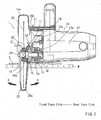
- FIG. 1 shows a cutting machine 1 which is referred to as a handheld circular saw.
- the cutting machine 1 includes a base 2 that is placed on an upper surface of a cutting object W, and a cutting machine main body 10 that is supported on an upper surface side of the base 2.
- the cutting machine main body 10 includes an electric motor 12 as a drive source, which motor is positioned in a rear face of the main body case 11.
- a rotational output of the electric motor 12 is transmitted to a spindle 14 via a reduction gear train 13.
- the reduction gear train 13 is composed of a pinion gear 12a of the electric motor 12 and a drive gear 13a meshing with each other and is received within a gear box 18.
- the drive gear 13a is secured to the spindle 14.
- the spindle 14 is rotatably supported on the main body case 11 via bearings 15 and 16.
- the front face-side bearing 15 is held on an inner circumferential side of a bearing box 17.
- a seal member 15a for dust-proofing is attached to a front side of the bearing 15 while it is positioned in the inner circumferential side of the bearing box 15.
- the rear face-side bearing 16 is held on the gear box 18.
- the bearing box 17 is attached to a front face side of the gear box 18.
- a distal end side of the spindle 14 protrudes from the bearing box 17 and reaches an interior portion of the main body case 11.
- a circular cutting blade 20 is attached to a distal end portion of the spindle 14.
- the cutting blade 20 is attached to the spindle 14 while being held between an outer side fixture flange 21 and an inner side fixture flange 22 in a thickness direction, so as to not move in an axial direction and a rotational direction.
- a holding condition of the fixture flanges 21 and 22 is secured by a fixing screw 23 threaded into a distal end of the spindle 14.
- a circumferential peripheral portion (a blade tip) corresponding to a substantially upper half circumference of the cutting blade 20 is covered by a cover portion 11a of the main body case 11.
- a substantially lower half circumference of the cutting blade 20 is protruded from a lower surface side of the base 2 via a window portion 2a formed in the base 2.
- a protruded portion of the cutting blade 20 that is protruded from the lower surface side of the base 2 can be cut into the cutting object W.
- the circumferential peripheral portion (the blade tip) of the cutting blade 20 corresponding to the range protruded from the lower surface side of the base 2 is covered by a movable cover 25.
- the movable cover 25 is rotatably supported on the bearing box 17.
- the movable cover 25 is configured to move between a closed position in which the blade tip of the cutting blade 20 is entirely covered thereby within the range protruded from the lower surface side of the base 2 and a fully opened position in which the blade tip of the cutting blade 20 is entirely exposed within the range protruded from the lower surface side of the base 2.
- the movable cover 25 and the bearing box 17 that supports the movable cover 25 are shown in FIG. 2 in detail.
- the movable cover 25 includes a cross-sectionally U-shaped cover portion 25a that covers the blade tip of the cutting blade 20, and a cylindrical supporting annular portion 25b that supports the cover portion 25a on the bearing box 17.
- a rotating boss portion 17a of the bearing box 17 is inserted into an inner circumferential side of the supporting annular portion 25b, so that the movable cover 25 can be rotatably supported to rotate coaxially with the spindle 14.
- An internal diameter of the supporting annular portion 25b with respect to an external diameter of the rotating boss portion 17a is appropriately set such that looseness cannot be formed therebetween within a range in which a smooth rotational action of the movable cover 25 is not impeded, and a clearance formed therebetween is set to be as small as possible.
- a tension spring 24 is interposed between the supporting annular portion 25b and the bearing box 17.
- the movable cover 25 is biased in a closing direction by the tension spring 24.
- a shouldered axial restricting portion 17b is formed in an outer circumference of the bearing box 17, which portion is positioned in a rear face side of the rotating boss portion 17a. Additionally, a retaining ring 19 is attached to the outer circumference of the bearing box 17, which ring is positioned in a front face side of the rotating boss portion 17a.
- the supporting annular portion 25b is restricted from being axially displaced by the axial restricting portion 17b and the retaining ring 19. Accordingly, the retaining ring 19 may function as an axial restricting portion that restricts the supporting annular portion 25b from displacing toward a front face side thereof.
- a circular flat-plate-shaped washer 19a is interleaved between the supporting annular portion 25b and the retaining ring 19.
- the supporting annular portion 25b is positioned between the retaining ring 19 as the axial restricting portion and the axial restricting portion 17b, so that axial displacement (backlash) thereof can be restricted.
- deflection (backlash) of the movable cover 25 in right-and-left directions (in directions of arrows X in FIG. 1 ) of the cutting advancing direction is restricted.
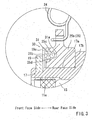
- a dust-proof structure 30 of a first embodiment includes a configuration in which a ring spring 31 is disposed between a front face-side end surface of the supporting annular portion 25b and the washer 19a.
- the ring spring 31 corresponds to an elastic member described in the claims.
- the ring spring 31 is molded by using a high-strength resin (for example, polyacetal) having high slidability and reduced coefficient of friction and has an annular shape (C-shape), so as to have a biasing force in a diameter reducing direction.
- the ring spring 31 is fitted in an annular recessed portion 25c that is formed in the front face-side end surface of the supporting annular portion 25b.
- an inclined surface 25d is formed between a side wall portion positioned in a smaller-diameter side (a lower side in FIG. 3 ) of the recessed portion 25c and a bottom portion thereof.
- the inclined surface 25d is inclined in a direction that goes down toward a side wall portion positioned in an outer circumferential side (an upper side in FIG. 3 ).
- the ring spring 31 is attached while it is pushed into the recessed portion 25c. As a result, the ring spring 31 is attached in a condition in which it is pressed against the inclined surface 25d.
- the ring spring 31 is held within the recessed portion 25c in a condition in which it is displaced in a diameter increasing direction against the biasing force thereof As a result, the ring spring 31 is pressed against the washer 19a (toward the retaining ring 19) by an axial component of the biasing force thereof to the inclined surface 25d.
- the ring spring 31 has a pressing surface against the inclined surface 25d and a pressing surface against the washer 19a that are respectively formed as flat surfaces 31a and 31b over the entire circumference thereof. Therefore, the ring spring 31 is pressed against the inclined surface 25d and the washer 19a in a surface contact manner.
- the ring spring 31 is not simply circular in cross section and has the flat surfaces 31a and 31b that are formed over the entire circumference thereof, so as to be respectively pressed against the inclined surface 25d and the washer 19a in the surface contact manner. Therefore, the ring spring 31 can reliably transmit a pressing force while securing high slidability, so as to be smoothly deformed in the diameter increasing direction and the diameter reducing direction.
- the ring spring 31 may provide an axial elastic force to the supporting annular portion 25b, so as to prevent the backlash thereof and to ensure a dust-blocking function (a dust-proof function).
- the ring spring 31 is elastically pressed against the recessed portion 25c of the supporting annular portion 25b and the washer 19a over the entire circumference thereof. Therefore, a dust entry path from a dust generation site (a side of the cutting blade 20) to the inner circumferential side of the supporting annular portion 25b is closed in an intermediate portion thereof, so that the dust can be prevented from entering the inner circumferential side of the supporting annular portion 25b.
- the ring spring 31 having high slidability is pressed against the retaining ring 19 as the axial restricting portion via the washer 19a, thereby performing dust-proofing.
- the ring spring 31 having a larger diameter can be pressed against the retaining ring via the washer that can be machined in an arbitrary size. Therefore, with regard to the size of the ring spring that can be used, a degree of freedom in selection can be increased.
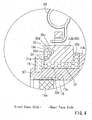
- an intermediate sleeve 32 can be interposed between the supporting annular portion 25b of the movable cover 25 and the bearing box 17 (a second embodiment).
- the intermediate sleeve 32 can be molded by using a high-strength resin having high slidability (reduced frictional resistance), and can include a cylindrical body 32a that is sandwiched between an inner circumferential surface of the supporting annular portion 25b and the rotating boss portion 17a of the bearing box 17, and a flange portion 32b that projects from a rear face-side end portion of the cylindrical body 32a and is sandwiched between a rear face-side end portion of the supporting annular portion 25b and the axial restricting portion 17b of the bearing box 17.
- the intermediate sleeve 32 is secured to an outer circumferential side of the rotating boss portion 17a, so as to not be displaced in a rotational direction and an axial direction.
- the clearance between the supporting annular portion 25b of the movable cover 25 and the cylindrical body 32a of the intermediate sleeve 32 can be further reduced, so as to enhance the dust-proofness. Further, backlash between the supporting annular portion 25b and the cylindrical portion 32a can be eliminated, so that the movable cover 25 can be smoothly opened and closed.
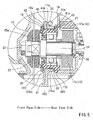
- FIG. 5 A dust-proof structure 40 of a third embodiment in which a further change is added is shown in FIG. 5 .
- two rubber rings 42 and 43 are used as the elastic member in place of the ring spring 31 in the first and second embodiments. Elements that are the same in the first and second embodiments will be identified by the same reference numerals and a detailed description of such elements may be omitted.
- a front portion of the spindle 14 is rotatably supported by the bearing 15.
- the bearing 15 is held on the bearing case 17.
- a supporting annular portion 41a of a movable cover 41 is rotatably supported on the rotating boss portion 17a of the bearing case 17.
- the supporting annular portion 41a has a cylindrical shape, and is restricted from being axially displaced by the axial restricting portion 17b of the bearing case 17 and the retaining ring 19.
- an internal diameter of the supporting annular portion 41a and an external diameter of the rotating boss portion 17a are set to such dimensions that allow the movable cover 41 to smoothly rotate within a range in which deflection (displacement in directions of arrow X in FIG. 1 ) is not generated therein.
- the washer 19a is interleaved between a front face-side end surface of the supporting annular portion 41a and the retaining ring 19.
- the rubber rings 42 and 43 each having an annular shape are respectively attached to both of the front face-side end surface and a rear face-side end surface of the supporting annular portion 41a.
- inexpensive members that are referred to as O-rings are used for the rubber rings 42 and 43.
- the rubber rings 42 and 43 can be reduced in cost as compared to the ring spring 31.
- Both of the rubber rings 42 and 43 are respectively fitted into recesses 41b and 41c that are formed in both of the end surfaces of the supporting annular portion 41a.
- inclined surfaces are respectively formed in the recesses 41b and 41c, and the rubber rings 42 and 43 are respectively pressed against the inclined surfaces. Therefore, the front face-side rubber ring 42 is pressed against the inclined surface of the recessed portion 41b with an appropriate pressing force by the washer 19a, so as to be expanded in a diameter increasing direction. Conversely, the rear face-side rubber ring 43 is pressed against the inclined surface of the recessed portion 41c with an appropriate pressing force by the axial restricting portion 17b, so as to be expanded in a diameter increasing direction. As a result, the rubber rings 42 and 43 are respectively elastically pressed against the washer 19a and the axial restricting portion 17b with reaction forces caused by pressing.
- a dust entry path from a side of the cutting blade 20 (a dust generation site) to an inner circumferential side of the supporting annular portion 41a is closed in an intermediate portion thereof and in both of a front face side and a rear face side by the two rubber rings 42 and 43 thus attached.
- the dust-proof structure 40 of the third embodiment thus constructed, the dust can be prevented from entering the inner circumferential side of the supporting annular portion 41a and surroundings thereof by the two rubber rings 42 and 43. Therefore, it is possible to secure high dust-proofness even if an enough clearance is set between the supporting annular portion 41a and the supporting boss portion 17a of the bearing case 17 in order to secure a smooth opening and closing operation of the movable cover 41.
- a bearing conventionally used to rotationally support a movable cover can be omitted. As a result, it is possible to reduce costs of a supporting structure.
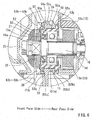
- a dust-proof structure 50 according to a fourth embodiment (not showing all features of the claims) is shown in FIG. 6 .
- the fourth embodiment is a dust-proof structure that is mainly based on a labyrinth structure unlike an elastic member sealing structure in the first to third embodiments, which corresponds to an embodiment of a related aspect. Elements that are the same in the first to third embodiments will be identified by the same reference numerals and a detailed description of such elements may be omitted.
- a supporting annular portion 51a of a movable cover 51 is rotatably supported on a rotating boss portion 52a of a bearing box 52.
- the movable cover 51 is biased in a closing direction by the tension spring 24 that is disposed between the supporting annular portion 51a and the bearing box 52.
- the supporting annular portion 51a is restricted from being displaced toward a front face side by the retaining ring 19 attached to the bearing box 52, and is restricted from being displaced toward a rear face side by an axial restricting portion 52b that is attached to a rear face-side end portion of the bearing box 52.
- a recessed portion 51c is formed in a front face-side end surface of the supporting annular portion 51a over the entire circumference thereof.
- a circumferential peripheral edge portion of a dust-proof washer 53 enters the recessed portion 51c.
- the dust-proof washer 53 is held between a flange portion 14a of the spindle 14 and the inner side fixture flange 22, so as to rotate integrally with the spindle 14.
- the circumferential peripheral edge portion of the dust-proof washer 53 is bent at a right angle toward the rear face side, so as to form a bent portion 53a that is introduced into the recessed portion 51c without contacting the same.
- a dust-proof rim 52c is formed in an axial restricting portion 52b of a bearing box 52 over the entire circumference thereof while it is projected toward the front face side. As shown therein, the dust-proof rim 52c is projected so as to cover an outer circumferential side of a rear face-side end portion of the supporting annular portion 51a.
- the clearance between the rear face-side end portion of the supporting annular portion 51a and the axial restricting portion 52b is shielded by the dust-proof rim 52c from the side of the cutting blade 20 (the dust generation site), so that dust-proofing in a clearance between the rear face-side end portion of the supporting annular portion 51a and the axial restricting portion 52b and in the inner circumferential side of the supporting annular portion 51a can be performed.
- a plurality of fins 53b to 53b are provided to a front face-side circumferential periphery of the dust-proof washer 53 so as to project toward the front face side.
- the fins 53b to 53b are positioned at regular intervals in a circumferential direction, and are projected so as to not interfere with the fixture flange 22. Due to the fins 53b to 53b, the dust-proof washer 53, when rotates integrally with the spindle 14, can function as a dust-proof fan.
- a front face side of the supporting annular portion 51a of the movable cover 51 is shielded from the side of the cutting blade 20 by the bent portion 53a of the dust-proof washer 53, and a rear face side thereof is shielded from the side of the cutting blade 20 by the dust-proof rim 52c of the gear box 52.
- the dust can be prevented from entering the clearance between the front face-side end portion of the supporting annular portion 51a and the retaining ring 19 and the clearance between the rear face-side end portion of the supporting annular portion 51a and the axial restricting portion 52b.
- the dust can be prevented from entering the inner circumferential side of the supporting annular portion 51a.
- the dust-proof washer 53 that rotates integrally with the spindle 14 can function as the dust-proof fan. Therefore, the dust generated in the side of the cutting blade 20 can be prevented from being easily blown toward the supporting annular portion 51a. As a result, a rotatably supporting portion in which the supporting annular portion 51a is supported on the bearing box 52 can have increased dust-proofness.
- both of the bent portion 53a of the dust-proof washer 53 and the dust-proof rim 52c of the bearing box 52 do not contact the supporting annular portion 51a.
- a rotational operation of the supporting annular portion 51a with respect to the bearing box 52 cannot be obstructed, so that an opening and closing operation of the movable cover 51 can be smoothly performed.
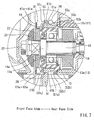
- a dust-proof structure 60 according to a fifth embodiment (not showing all features of the claims) that is modified from the fourth embodiment is shown in FIG. 7 .
- the dust-proof structure 60 of the fifth embodiment is different from the fourth embodiment in that a dust-proof fan 61 is used instead of the dust-proof washer 53 of the fourth embodiment.
- Elements that are the same in the fourth embodiment will be identified by the same reference numerals and a detailed description of such elements may be omitted.
- the dust-proof fan 61 is circumferentially integrally attached to the inner side fixture flange 22. Therefore, the dust-proof fan 61 can rotate integrally with the spindle 14.
- a plurality of fins 61a to 61a are circumferentially provided to the dust-proof fan 61. As will be illustrated, each of the fins 61a is shaped to be elongated toward the rear face side as it is closer to an outer periphery thereof.
- a rear face-side protruding portion 61b of each of the fins 61a enters the recessed portion 51c formed in the front face-side end portion of the supporting annular portion 51a without interfering therewith.
- the dust-proof fan 61 can rotate integrally with the spindle 14. Therefore, the rear face-side protruding portion 61b of each of the fins 61a of the dust-proof fan 61 moves at high speed along an interior surface of the recessed portion 51c. As a result, an outer circumferential side (the side of the cutting blade 20) of the clearance between the front face-side end surface of the supporting annular portion 51a and the retaining ring 19 can substantially be shielded by the fins 61a to 61a of the dust-proof fan 61.
- the clearance between the front face-side end surface of the supporting annular portion 51a and the retaining ring 19 that restricts the supporting annular portion 51a from displacing toward the front face side can be shielded from the side of the cutting blade 20 by the rear face-side protruding portion 61b of each of the fins 61a rotating at high speed.
- the clearance between the rear face-side end surface of the supporting annular portion 51a and the axial restricting portions 52b that restricts the supporting annular portion 51a from displacing toward the rear face side can be shielded from the side of the rotary knife 20 by the dust-proof rim 52c.
- the dust can be prevented from entering the inner circumferential side of the supporting annular portion 51a.
- the rotatably supporting portion in which the supporting annular portion 51a is supported on the bearing box 52 can have increased dust-proofness.
- the second bearing used in the conventional art can be omitted, so as to achieve cost reduction.
- the dust generated in the side of the cutting blade 20 can be blown away by the dust-proof fan 61.
- the high dust-proofness near the supporting annular portion 51a can be secured in this respect.
- a dust-proof structure 70 of a sixth embodiment (not showing all features of the claims) is shown in FIG. 8 .
- the sixth embodiment is constructed to have both of the elastic member sealing structure and the labyrinth structure, so that dust-proof performance can be further increased. Elements that are the same in the embodiments described above will be identified by the same reference numerals and a detailed description of such elements may be omitted.
- the dust-proof structure 70 of the sixth embodiment has features in the structure of a supporting annular portion 71a of a movable cover 71 and a bearing box 72.
- the supporting annular portion 71a of the movable cover 71 is rotatably supported on a rotating boss portion 72a of the bearing box 72.
- the supporting annular portion 71a is restricted from being displaced toward a front face side thereof by the retaining ring 19.
- the supporting annular portion 71a is restricted from being displaced toward a rear face side thereof by an axial restricting portion 72b that is attached to the bearing box 72.
- a ring-shaped dust-proof cover 73 is attached to the front face side of the supporting annular portion 71a. A clearance between the retaining ring 19 and a front face-side end surface of the supporting annular portion 71a is shielded from the side of the cutting blade 20 (the dust generation site) by the dust-proof cover 73.
- Integrally provided to the supporting annular portion 71a is a second dust-proof wall portion 71b that projects toward the rear face side thereof.
- the second dust-proof wall portion 71b is cylindrically formed along an outer circumferential side of the supporting annular portion 71a.
- integrally provided to the axial restricting portion 72b of the bearing box 72 is a cylindrical first dust-proof wall portion 72c that projects toward a front face side thereof.
- the first dust-proof wall portion 72c formed in the bearing box 72 enters an inner circumferential side of the second dust-proof wall portion 71b formed in the supporting annular portion 71a.
- a recessed portion 72d similar to the recessed portion 25c of the first embodiment is formed in the front face side of the axial restricting portion 72b of the bearing box 72.
- the recessed portion 72d is positioned in an outer circumferential side of the first dust-proof wall portion 72c.
- an annular ring spring 74 is fitted into the recessed portion 72d.
- An inclined surface is formed in an inner circumferential side of the recessed portion 72d so as to be positioned between a side wall portion and a bottom portion thereof. The ring spring 74 is pressed against the inclined surface.
- the ring spring 74 is pressed against the inclined surface formed in the recessed portion 72d by the second dust-proof wall portion 71b formed in the supporting annular portion 71a, so as to be displaced in a diameter increasing direction against a biasing force thereof. As a result, the ring spring 74 can be pressed against a distal end surface of the second dust-proof wall portion 71b by an axial component of a reaction force of the biasing force.
- the tension spring 24 for biasing the movable cover 71 toward a closing direction is interposed between the supporting annular portion 71a and the bearing box 72.
- the tension spring 24 is positioned along an outer circumferential surface of the second dust-proof wall portion 71b formed in the supporting annular portion 71a.
- the clearance between the front face-side end surface of the supporting annular portion 71a and the retaining ring 19 can be shielded from the side of the cutting blade 20 (the dust generation site) by the dust-proof washer 73, so that dust-proofing therein can be performed.
- a clearance between the rear face side of the supporting annular portion 71a and the axial restricting portions 72b can be shielded from the side of the cutting blade 20 by the second dust-proof wall portion 71b and the first dust-proof wall portion 72c, so that dust-proofing therein can be performed.
- the inclined surface 25d is formed within the recessed portion 25c such that the ring spring 31 can be displaced in the diameter increasing direction.
- an inclined surface can be formed in the retaining ring 19 or the washer 19a such that the ring spring 31 as the elastic member can be reliably displaced in the diameter increasing direction.
- the ring spring 31 is interposed between the front-side end surface (the recessed portion 25c) of the supporting annular portion 25b and the retaining ring 19 as the front-side axial restricting portion.
- a ring spring 31 can be interposed between the back-side end surface of the supporting annular portion 25b and the back-side axial restricting portion 17b.
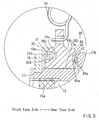
- a recessed portion 81 is formed in a back surface of the supporting annular portion 25b, and a mouth corner portion 81a of the recessed portion 81 is pressed against a flat surface 82a of an elastic member 82.
- a front side of the supporting annular portion 25b is provided with the dust-proof structure 30 of the first embodiment.
- the flat surface 82a (an inclined surface) of the elastic member 82 can be pressed between the supporting annular portion 25b and the axial restricting portion 17b, so that the elastic member 82 can be displaced in the diameter increasing direction.
- the dust entry path into the inner circumferential side of the supporting annular portion 25b can be reliably closed while the smooth opening and closing operation of the movable cover 25 can be secured.
- the flat surface 82a of the elastic member 82 may function as an inclined surface that displaces the elastic member 82 in the diameter increasing direction.
- the recessed portion 81 can be formed as a shouldered portion by removing an outer circumferential-side wall portion 83 (a portion to the right of a broken line in FIG. 9 ) thereof. Additionally, an annular wall portion that projects rearward (toward the elastic member) can be provided to the back surface of the supporting annular portion 25b in place of the recessed portion, so that a corner portion of the wall portion can be pressed against the inclined surface of the elastic member.
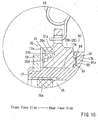
- an annular wall portion 91 that projects rearward is formed in the back surface of the supporting annular portion 25b, and the wall portion 91 includes an inclined surface 91a that is capable of displacing an elastic member 92 in the diameter increasing direction.
- the elastic member 92 is received within a recessed portion 93 that is formed in the axial restricting portion 17b. Even by the dust-proof structure 90, the elastic member 92 can be pressed between the inclined surface 91a of the supporting annular portion 25b and the recessed portion 93 of the axial restricting portion 17b, so as to be displaced in the diameter increasing direction.
- the dust entry path into the inner circumferential side of the supporting annular portion 25b can be closed while the smooth opening and closing operation of the movable cover 25 can be secured.
- the recessed portion 93 can be formed as a shouldered portion by removing an outer circumferential-side wall portion 94 (a portion to the left of a broken line in FIG. 10 ) thereof.
- the ring spring 31 has the flat surface 31a as the pressing surface against the inclined surface 25d, so as to be pressed against the inclined surface 25d in the surface contact manner. Further, the ring spring 31 has the flat surface 31b as the pressing surface against the retaining ring 19 (the washer 19a), so as to be pressed against the retaining ring 19 in the surface contact manner.
- the flat surfaces 31a and 31b may be omitted.
- the handheld cutting machine that is moved on the cutting object W by a user is exemplified as the cutting machine.
- the exemplified dust-proof structures can be applied to a tabletop type cutting machine in which a cutting blade is cut into the cutting object secured on a table by lowering a cutting machine main body with respect to the cutting object.
Landscapes
- Engineering & Computer Science (AREA)
- Mechanical Engineering (AREA)
- Life Sciences & Earth Sciences (AREA)
- Wood Science & Technology (AREA)
- Forests & Forestry (AREA)
- Sawing (AREA)
Applications Claiming Priority (2)
| Application Number | Priority Date | Filing Date | Title |
|---|---|---|---|
| JP2009271534A JP5501743B2 (ja) | 2009-11-30 | 2009-11-30 | 切断機における可動カバー支持部の防塵構造 |
| PCT/JP2010/069809 WO2011065214A1 (ja) | 2009-11-30 | 2010-11-08 | 切断機における可動カバー支持部の防塵構造 |
Publications (3)
| Publication Number | Publication Date |
|---|---|
| EP2508285A1 EP2508285A1 (en) | 2012-10-10 |
| EP2508285A4 EP2508285A4 (en) | 2015-07-29 |
| EP2508285B1 true EP2508285B1 (en) | 2018-01-03 |
Family
ID=44066317
Family Applications (1)
| Application Number | Title | Priority Date | Filing Date |
|---|---|---|---|
| EP10833061.4A Active EP2508285B1 (en) | 2009-11-30 | 2010-11-08 | Dustproof structure for movable support section in cutting machine |
Country Status (5)
| Country | Link |
|---|---|
| US (1) | US8813375B2 (enExample) |
| EP (1) | EP2508285B1 (enExample) |
| JP (1) | JP5501743B2 (enExample) |
| CN (1) | CN102665984B (enExample) |
| WO (1) | WO2011065214A1 (enExample) |
Families Citing this family (5)
| Publication number | Priority date | Publication date | Assignee | Title |
|---|---|---|---|---|
| JP2014079874A (ja) * | 2012-09-26 | 2014-05-08 | Makita Corp | 動力工具 |
| WO2018131218A1 (ja) * | 2017-01-10 | 2018-07-19 | 株式会社マキタ | 結束機 |
| DE102020100574B4 (de) | 2020-01-13 | 2024-02-08 | Festool Gmbh | Führungsschiene zum Führen einer Hand-Werkzeugmaschine |
| CN112385425B (zh) * | 2020-12-01 | 2026-03-20 | 格力博(江苏)股份有限公司 | 电动工具 |
| JP2024172309A (ja) * | 2023-05-31 | 2024-12-12 | 株式会社マキタ | 作業機 |
Family Cites Families (19)
| Publication number | Priority date | Publication date | Assignee | Title |
|---|---|---|---|---|
| US1672238A (en) * | 1926-08-13 | 1928-06-05 | J D Wallace & Company | Electric handsaw |
| US4685214A (en) * | 1985-10-04 | 1987-08-11 | Fmc Corporation | Protective guard unit for metal working tool |
| JPS6441901U (enExample) * | 1987-09-07 | 1989-03-13 | ||
| JPH0727121Y2 (ja) * | 1988-09-14 | 1995-06-21 | 日立工機株式会社 | 携帯用集塵丸のこ |
| JP2501707Y2 (ja) * | 1989-10-14 | 1996-06-19 | 日立工機株式会社 | 携帯用電動切断工具 |
| US5023999A (en) * | 1990-08-09 | 1991-06-18 | Ryobi Motor Products Corp. | Unitized tool construction |
| US5140754A (en) * | 1991-09-24 | 1992-08-25 | Textron Inc. | Power tool protective hood positioning system and method of manufacturing the same |
| JP2584955Y2 (ja) * | 1993-07-29 | 1998-11-11 | 日立工機株式会社 | 丸 鋸 |
| SE506590C2 (sv) * | 1996-05-13 | 1998-01-19 | Electrolux Ab | Sprängskydd vid cirkelformigt verktyg |
| JP2001047407A (ja) * | 1999-08-10 | 2001-02-20 | Makita Corp | 携帯式電動丸鋸機 |
| JP2003251601A (ja) * | 2002-03-05 | 2003-09-09 | Ryobi Ltd | 電動工具 |
| US6739060B1 (en) * | 2003-04-29 | 2004-05-25 | Durq Machinery Corp. | Sawing machine with dustproof assembly |
| JP2005001896A (ja) * | 2003-06-09 | 2005-01-06 | Fuji Heavy Ind Ltd | ガラス切断装置 |
| SE528265C2 (sv) * | 2005-02-18 | 2006-10-10 | Mats Johansson | Kap- och dammuppsamlingsaggregat samt arbetsmaskin med sådant aggregat |
| AU2007272946A1 (en) * | 2006-07-13 | 2008-01-17 | Eastway Fair Company Limited | Portable power tool for cutting concrete board and other substrates |
| JP4780528B2 (ja) * | 2006-09-20 | 2011-09-28 | 日立工機株式会社 | 卓上切断機 |
| US20080066323A1 (en) * | 2006-09-20 | 2008-03-20 | Crain Cutter Company, Inc. | Yieldable drive mechanism for a toe-kick saw |
| JP2008188716A (ja) * | 2007-02-06 | 2008-08-21 | Yamashin Seikyo Kk | 丸鋸切断機 |
| US8037610B2 (en) * | 2008-12-30 | 2011-10-18 | Crain Cutter Co., Inc. | Powered groover with airflow fin |
-
2009
- 2009-11-30 JP JP2009271534A patent/JP5501743B2/ja active Active
-
2010
- 2010-11-08 EP EP10833061.4A patent/EP2508285B1/en active Active
- 2010-11-08 US US13/510,457 patent/US8813375B2/en active Active
- 2010-11-08 WO PCT/JP2010/069809 patent/WO2011065214A1/ja not_active Ceased
- 2010-11-08 CN CN201080058138.7A patent/CN102665984B/zh active Active
Non-Patent Citations (1)
| Title |
|---|
| None * |
Also Published As
| Publication number | Publication date |
|---|---|
| US20120240416A1 (en) | 2012-09-27 |
| CN102665984B (zh) | 2014-07-16 |
| CN102665984A (zh) | 2012-09-12 |
| JP5501743B2 (ja) | 2014-05-28 |
| US8813375B2 (en) | 2014-08-26 |
| WO2011065214A1 (ja) | 2011-06-03 |
| EP2508285A1 (en) | 2012-10-10 |
| EP2508285A4 (en) | 2015-07-29 |
| JP2011110685A (ja) | 2011-06-09 |
Similar Documents
| Publication | Publication Date | Title |
|---|---|---|
| US8813375B2 (en) | Dust-proof structure of movable cover supporting portion of cutting machine | |
| JP6573631B2 (ja) | メカニカルシール装置 | |
| EP2452785A2 (en) | Rotary tool | |
| US11014214B2 (en) | Working machine | |
| WO2015098548A1 (ja) | パワーステアリング装置 | |
| KR101779753B1 (ko) | 가공 장치 | |
| US20150367495A1 (en) | Power tool | |
| EP2436484A2 (en) | Rotary tools | |
| WO2017154522A1 (ja) | 卓上切断機 | |
| JP6068134B2 (ja) | 電動工具 | |
| CN204263366U (zh) | 手提式切割机 | |
| JP2011110685A5 (enExample) | ||
| US20120055312A1 (en) | Band saw having adjustable blade guide | |
| JP2016016469A (ja) | 回転工具 | |
| JP5587079B2 (ja) | 可動カバーの取付け構造および切断機 | |
| JP7286444B2 (ja) | 携帯用切断機 | |
| JP4890879B2 (ja) | 電動工具の防塵構造 | |
| JP5403622B2 (ja) | 扇状ギヤ用防塵カバー | |
| JP6387664B2 (ja) | 異物侵入防止構造、これを有するアクチュエータ及び工作機械 | |
| JP2020118234A (ja) | 減速装置 | |
| KR101078230B1 (ko) | 자동차 도어 윈도 개폐용 모터의 회전축 자유단 지지 구조 및 이에 사용되는 방진 부싱 | |
| JP2020118237A (ja) | 減速装置 | |
| JP2020118236A (ja) | 減速装置 | |
| JP2006242305A (ja) | ギア取付構造 | |
| JP5325674B2 (ja) | シール装置 |
Legal Events
| Date | Code | Title | Description |
|---|---|---|---|
| PUAI | Public reference made under article 153(3) epc to a published international application that has entered the european phase |
Free format text: ORIGINAL CODE: 0009012 |
|
| 17P | Request for examination filed |
Effective date: 20120524 |
|
| AK | Designated contracting states |
Kind code of ref document: A1 Designated state(s): AL AT BE BG CH CY CZ DE DK EE ES FI FR GB GR HR HU IE IS IT LI LT LU LV MC MK MT NL NO PL PT RO RS SE SI SK SM TR |
|
| DAX | Request for extension of the european patent (deleted) | ||
| RA4 | Supplementary search report drawn up and despatched (corrected) |
Effective date: 20150630 |
|
| RIC1 | Information provided on ipc code assigned before grant |
Ipc: B23D 45/16 20060101ALI20150624BHEP Ipc: B27G 3/00 20060101ALI20150624BHEP Ipc: B27G 19/04 20060101ALI20150624BHEP Ipc: B25F 5/02 20060101ALI20150624BHEP Ipc: B23D 47/00 20060101AFI20150624BHEP Ipc: B27B 9/00 20060101ALI20150624BHEP |
|
| 17Q | First examination report despatched |
Effective date: 20170202 |
|
| GRAP | Despatch of communication of intention to grant a patent |
Free format text: ORIGINAL CODE: EPIDOSNIGR1 |
|
| INTG | Intention to grant announced |
Effective date: 20170728 |
|
| GRAS | Grant fee paid |
Free format text: ORIGINAL CODE: EPIDOSNIGR3 |
|
| GRAJ | Information related to disapproval of communication of intention to grant by the applicant or resumption of examination proceedings by the epo deleted |
Free format text: ORIGINAL CODE: EPIDOSDIGR1 |
|
| GRAL | Information related to payment of fee for publishing/printing deleted |
Free format text: ORIGINAL CODE: EPIDOSDIGR3 |
|
| GRAR | Information related to intention to grant a patent recorded |
Free format text: ORIGINAL CODE: EPIDOSNIGR71 |
|
| INTC | Intention to grant announced (deleted) | ||
| INTG | Intention to grant announced |
Effective date: 20171011 |
|
| GRAA | (expected) grant |
Free format text: ORIGINAL CODE: 0009210 |
|
| AK | Designated contracting states |
Kind code of ref document: B1 Designated state(s): AL AT BE BG CH CY CZ DE DK EE ES FI FR GB GR HR HU IE IS IT LI LT LU LV MC MK MT NL NO PL PT RO RS SE SI SK SM TR |
|
| REG | Reference to a national code |
Ref country code: GB Ref legal event code: FG4D |
|
| REG | Reference to a national code |
Ref country code: CH Ref legal event code: EP Ref country code: AT Ref legal event code: REF Ref document number: 959760 Country of ref document: AT Kind code of ref document: T Effective date: 20180115 |
|
| REG | Reference to a national code |
Ref country code: IE Ref legal event code: FG4D |
|
| REG | Reference to a national code |
Ref country code: DE Ref legal event code: R096 Ref document number: 602010047855 Country of ref document: DE |
|
| REG | Reference to a national code |
Ref country code: NL Ref legal event code: MP Effective date: 20180103 |
|
| REG | Reference to a national code |
Ref country code: LT Ref legal event code: MG4D |
|
| REG | Reference to a national code |
Ref country code: AT Ref legal event code: MK05 Ref document number: 959760 Country of ref document: AT Kind code of ref document: T Effective date: 20180103 |
|
| PG25 | Lapsed in a contracting state [announced via postgrant information from national office to epo] |
Ref country code: NL Free format text: LAPSE BECAUSE OF FAILURE TO SUBMIT A TRANSLATION OF THE DESCRIPTION OR TO PAY THE FEE WITHIN THE PRESCRIBED TIME-LIMIT Effective date: 20180103 |
|
| PG25 | Lapsed in a contracting state [announced via postgrant information from national office to epo] |
Ref country code: CY Free format text: LAPSE BECAUSE OF FAILURE TO SUBMIT A TRANSLATION OF THE DESCRIPTION OR TO PAY THE FEE WITHIN THE PRESCRIBED TIME-LIMIT Effective date: 20180103 Ref country code: HR Free format text: LAPSE BECAUSE OF FAILURE TO SUBMIT A TRANSLATION OF THE DESCRIPTION OR TO PAY THE FEE WITHIN THE PRESCRIBED TIME-LIMIT Effective date: 20180103 Ref country code: FI Free format text: LAPSE BECAUSE OF FAILURE TO SUBMIT A TRANSLATION OF THE DESCRIPTION OR TO PAY THE FEE WITHIN THE PRESCRIBED TIME-LIMIT Effective date: 20180103 Ref country code: LT Free format text: LAPSE BECAUSE OF FAILURE TO SUBMIT A TRANSLATION OF THE DESCRIPTION OR TO PAY THE FEE WITHIN THE PRESCRIBED TIME-LIMIT Effective date: 20180103 Ref country code: ES Free format text: LAPSE BECAUSE OF FAILURE TO SUBMIT A TRANSLATION OF THE DESCRIPTION OR TO PAY THE FEE WITHIN THE PRESCRIBED TIME-LIMIT Effective date: 20180103 Ref country code: NO Free format text: LAPSE BECAUSE OF FAILURE TO SUBMIT A TRANSLATION OF THE DESCRIPTION OR TO PAY THE FEE WITHIN THE PRESCRIBED TIME-LIMIT Effective date: 20180403 |
|
| PG25 | Lapsed in a contracting state [announced via postgrant information from national office to epo] |
Ref country code: AT Free format text: LAPSE BECAUSE OF FAILURE TO SUBMIT A TRANSLATION OF THE DESCRIPTION OR TO PAY THE FEE WITHIN THE PRESCRIBED TIME-LIMIT Effective date: 20180103 Ref country code: SE Free format text: LAPSE BECAUSE OF FAILURE TO SUBMIT A TRANSLATION OF THE DESCRIPTION OR TO PAY THE FEE WITHIN THE PRESCRIBED TIME-LIMIT Effective date: 20180103 Ref country code: PL Free format text: LAPSE BECAUSE OF FAILURE TO SUBMIT A TRANSLATION OF THE DESCRIPTION OR TO PAY THE FEE WITHIN THE PRESCRIBED TIME-LIMIT Effective date: 20180103 Ref country code: RS Free format text: LAPSE BECAUSE OF FAILURE TO SUBMIT A TRANSLATION OF THE DESCRIPTION OR TO PAY THE FEE WITHIN THE PRESCRIBED TIME-LIMIT Effective date: 20180103 Ref country code: IS Free format text: LAPSE BECAUSE OF FAILURE TO SUBMIT A TRANSLATION OF THE DESCRIPTION OR TO PAY THE FEE WITHIN THE PRESCRIBED TIME-LIMIT Effective date: 20180503 Ref country code: BG Free format text: LAPSE BECAUSE OF FAILURE TO SUBMIT A TRANSLATION OF THE DESCRIPTION OR TO PAY THE FEE WITHIN THE PRESCRIBED TIME-LIMIT Effective date: 20180403 Ref country code: GR Free format text: LAPSE BECAUSE OF FAILURE TO SUBMIT A TRANSLATION OF THE DESCRIPTION OR TO PAY THE FEE WITHIN THE PRESCRIBED TIME-LIMIT Effective date: 20180404 Ref country code: LV Free format text: LAPSE BECAUSE OF FAILURE TO SUBMIT A TRANSLATION OF THE DESCRIPTION OR TO PAY THE FEE WITHIN THE PRESCRIBED TIME-LIMIT Effective date: 20180103 |
|
| REG | Reference to a national code |
Ref country code: DE Ref legal event code: R097 Ref document number: 602010047855 Country of ref document: DE |
|
| PG25 | Lapsed in a contracting state [announced via postgrant information from national office to epo] |
Ref country code: AL Free format text: LAPSE BECAUSE OF FAILURE TO SUBMIT A TRANSLATION OF THE DESCRIPTION OR TO PAY THE FEE WITHIN THE PRESCRIBED TIME-LIMIT Effective date: 20180103 Ref country code: RO Free format text: LAPSE BECAUSE OF FAILURE TO SUBMIT A TRANSLATION OF THE DESCRIPTION OR TO PAY THE FEE WITHIN THE PRESCRIBED TIME-LIMIT Effective date: 20180103 Ref country code: EE Free format text: LAPSE BECAUSE OF FAILURE TO SUBMIT A TRANSLATION OF THE DESCRIPTION OR TO PAY THE FEE WITHIN THE PRESCRIBED TIME-LIMIT Effective date: 20180103 Ref country code: IT Free format text: LAPSE BECAUSE OF FAILURE TO SUBMIT A TRANSLATION OF THE DESCRIPTION OR TO PAY THE FEE WITHIN THE PRESCRIBED TIME-LIMIT Effective date: 20180103 |
|
| PLBE | No opposition filed within time limit |
Free format text: ORIGINAL CODE: 0009261 |
|
| STAA | Information on the status of an ep patent application or granted ep patent |
Free format text: STATUS: NO OPPOSITION FILED WITHIN TIME LIMIT |
|
| PG25 | Lapsed in a contracting state [announced via postgrant information from national office to epo] |
Ref country code: SK Free format text: LAPSE BECAUSE OF FAILURE TO SUBMIT A TRANSLATION OF THE DESCRIPTION OR TO PAY THE FEE WITHIN THE PRESCRIBED TIME-LIMIT Effective date: 20180103 Ref country code: SM Free format text: LAPSE BECAUSE OF FAILURE TO SUBMIT A TRANSLATION OF THE DESCRIPTION OR TO PAY THE FEE WITHIN THE PRESCRIBED TIME-LIMIT Effective date: 20180103 Ref country code: DK Free format text: LAPSE BECAUSE OF FAILURE TO SUBMIT A TRANSLATION OF THE DESCRIPTION OR TO PAY THE FEE WITHIN THE PRESCRIBED TIME-LIMIT Effective date: 20180103 Ref country code: CZ Free format text: LAPSE BECAUSE OF FAILURE TO SUBMIT A TRANSLATION OF THE DESCRIPTION OR TO PAY THE FEE WITHIN THE PRESCRIBED TIME-LIMIT Effective date: 20180103 |
|
| 26N | No opposition filed |
Effective date: 20181005 |
|
| PG25 | Lapsed in a contracting state [announced via postgrant information from national office to epo] |
Ref country code: SI Free format text: LAPSE BECAUSE OF FAILURE TO SUBMIT A TRANSLATION OF THE DESCRIPTION OR TO PAY THE FEE WITHIN THE PRESCRIBED TIME-LIMIT Effective date: 20180103 |
|
| REG | Reference to a national code |
Ref country code: CH Ref legal event code: PL |
|
| GBPC | Gb: european patent ceased through non-payment of renewal fee |
Effective date: 20181108 |
|
| PG25 | Lapsed in a contracting state [announced via postgrant information from national office to epo] |
Ref country code: MC Free format text: LAPSE BECAUSE OF FAILURE TO SUBMIT A TRANSLATION OF THE DESCRIPTION OR TO PAY THE FEE WITHIN THE PRESCRIBED TIME-LIMIT Effective date: 20180103 Ref country code: LU Free format text: LAPSE BECAUSE OF NON-PAYMENT OF DUE FEES Effective date: 20181108 |
|
| REG | Reference to a national code |
Ref country code: BE Ref legal event code: MM Effective date: 20181130 |
|
| REG | Reference to a national code |
Ref country code: IE Ref legal event code: MM4A |
|
| PG25 | Lapsed in a contracting state [announced via postgrant information from national office to epo] |
Ref country code: CH Free format text: LAPSE BECAUSE OF NON-PAYMENT OF DUE FEES Effective date: 20181130 Ref country code: LI Free format text: LAPSE BECAUSE OF NON-PAYMENT OF DUE FEES Effective date: 20181130 |
|
| PG25 | Lapsed in a contracting state [announced via postgrant information from national office to epo] |
Ref country code: FR Free format text: LAPSE BECAUSE OF NON-PAYMENT OF DUE FEES Effective date: 20181130 Ref country code: IE Free format text: LAPSE BECAUSE OF NON-PAYMENT OF DUE FEES Effective date: 20181108 |
|
| PG25 | Lapsed in a contracting state [announced via postgrant information from national office to epo] |
Ref country code: BE Free format text: LAPSE BECAUSE OF NON-PAYMENT OF DUE FEES Effective date: 20181130 |
|
| PG25 | Lapsed in a contracting state [announced via postgrant information from national office to epo] |
Ref country code: GB Free format text: LAPSE BECAUSE OF NON-PAYMENT OF DUE FEES Effective date: 20181108 |
|
| PG25 | Lapsed in a contracting state [announced via postgrant information from national office to epo] |
Ref country code: MT Free format text: LAPSE BECAUSE OF NON-PAYMENT OF DUE FEES Effective date: 20181108 |
|
| PG25 | Lapsed in a contracting state [announced via postgrant information from national office to epo] |
Ref country code: TR Free format text: LAPSE BECAUSE OF FAILURE TO SUBMIT A TRANSLATION OF THE DESCRIPTION OR TO PAY THE FEE WITHIN THE PRESCRIBED TIME-LIMIT Effective date: 20180103 |
|
| PG25 | Lapsed in a contracting state [announced via postgrant information from national office to epo] |
Ref country code: PT Free format text: LAPSE BECAUSE OF FAILURE TO SUBMIT A TRANSLATION OF THE DESCRIPTION OR TO PAY THE FEE WITHIN THE PRESCRIBED TIME-LIMIT Effective date: 20180103 |
|
| PG25 | Lapsed in a contracting state [announced via postgrant information from national office to epo] |
Ref country code: MK Free format text: LAPSE BECAUSE OF NON-PAYMENT OF DUE FEES Effective date: 20180103 Ref country code: HU Free format text: LAPSE BECAUSE OF FAILURE TO SUBMIT A TRANSLATION OF THE DESCRIPTION OR TO PAY THE FEE WITHIN THE PRESCRIBED TIME-LIMIT; INVALID AB INITIO Effective date: 20101108 |
|
| PGFP | Annual fee paid to national office [announced via postgrant information from national office to epo] |
Ref country code: DE Payment date: 20250930 Year of fee payment: 16 |