EP2503544A1 - Vibrationssensor für Musikinstrument, und Steg - Google Patents
Vibrationssensor für Musikinstrument, und Steg Download PDFInfo
- Publication number
- EP2503544A1 EP2503544A1 EP12001939A EP12001939A EP2503544A1 EP 2503544 A1 EP2503544 A1 EP 2503544A1 EP 12001939 A EP12001939 A EP 12001939A EP 12001939 A EP12001939 A EP 12001939A EP 2503544 A1 EP2503544 A1 EP 2503544A1
- Authority
- EP
- European Patent Office
- Prior art keywords
- film
- musical instrument
- vibration sensor
- electrode film
- saddle
- Prior art date
- Legal status (The legal status is an assumption and is not a legal conclusion. Google has not performed a legal analysis and makes no representation as to the accuracy of the status listed.)
- Withdrawn
Links
Images



Classifications
-
- G—PHYSICS
- G10—MUSICAL INSTRUMENTS; ACOUSTICS
- G10H—ELECTROPHONIC MUSICAL INSTRUMENTS; INSTRUMENTS IN WHICH THE TONES ARE GENERATED BY ELECTROMECHANICAL MEANS OR ELECTRONIC GENERATORS, OR IN WHICH THE TONES ARE SYNTHESISED FROM A DATA STORE
- G10H3/00—Instruments in which the tones are generated by electromechanical means
- G10H3/12—Instruments in which the tones are generated by electromechanical means using mechanical resonant generators, e.g. strings or percussive instruments, the tones of which are picked up by electromechanical transducers, the electrical signals being further manipulated or amplified and subsequently converted to sound by a loudspeaker or equivalent instrument
- G10H3/14—Instruments in which the tones are generated by electromechanical means using mechanical resonant generators, e.g. strings or percussive instruments, the tones of which are picked up by electromechanical transducers, the electrical signals being further manipulated or amplified and subsequently converted to sound by a loudspeaker or equivalent instrument using mechanically actuated vibrators with pick-up means
- G10H3/18—Instruments in which the tones are generated by electromechanical means using mechanical resonant generators, e.g. strings or percussive instruments, the tones of which are picked up by electromechanical transducers, the electrical signals being further manipulated or amplified and subsequently converted to sound by a loudspeaker or equivalent instrument using mechanically actuated vibrators with pick-up means using a string, e.g. electric guitar
- G10H3/185—Instruments in which the tones are generated by electromechanical means using mechanical resonant generators, e.g. strings or percussive instruments, the tones of which are picked up by electromechanical transducers, the electrical signals being further manipulated or amplified and subsequently converted to sound by a loudspeaker or equivalent instrument using mechanically actuated vibrators with pick-up means using a string, e.g. electric guitar in which the tones are picked up through the bridge structure
-
- G—PHYSICS
- G10—MUSICAL INSTRUMENTS; ACOUSTICS
- G10H—ELECTROPHONIC MUSICAL INSTRUMENTS; INSTRUMENTS IN WHICH THE TONES ARE GENERATED BY ELECTROMECHANICAL MEANS OR ELECTRONIC GENERATORS, OR IN WHICH THE TONES ARE SYNTHESISED FROM A DATA STORE
- G10H2220/00—Input/output interfacing specifically adapted for electrophonic musical tools or instruments
- G10H2220/461—Transducers, i.e. details, positioning or use of assemblies to detect and convert mechanical vibrations or mechanical strains into an electrical signal, e.g. audio, trigger or control signal
- G10H2220/465—Bridge-positioned, i.e. assembled to or attached with the bridge of a stringed musical instrument
-
- G—PHYSICS
- G10—MUSICAL INSTRUMENTS; ACOUSTICS
- G10H—ELECTROPHONIC MUSICAL INSTRUMENTS; INSTRUMENTS IN WHICH THE TONES ARE GENERATED BY ELECTROMECHANICAL MEANS OR ELECTRONIC GENERATORS, OR IN WHICH THE TONES ARE SYNTHESISED FROM A DATA STORE
- G10H2220/00—Input/output interfacing specifically adapted for electrophonic musical tools or instruments
- G10H2220/461—Transducers, i.e. details, positioning or use of assemblies to detect and convert mechanical vibrations or mechanical strains into an electrical signal, e.g. audio, trigger or control signal
- G10H2220/525—Piezoelectric transducers for vibration sensing or vibration excitation in the audio range; Piezoelectric strain sensing, e.g. as key velocity sensor; Piezoelectric actuators, e.g. key actuation in response to a control voltage
- G10H2220/531—Piezoelectric transducers for vibration sensing or vibration excitation in the audio range; Piezoelectric strain sensing, e.g. as key velocity sensor; Piezoelectric actuators, e.g. key actuation in response to a control voltage made of piezoelectric film
-
- Y—GENERAL TAGGING OF NEW TECHNOLOGICAL DEVELOPMENTS; GENERAL TAGGING OF CROSS-SECTIONAL TECHNOLOGIES SPANNING OVER SEVERAL SECTIONS OF THE IPC; TECHNICAL SUBJECTS COVERED BY FORMER USPC CROSS-REFERENCE ART COLLECTIONS [XRACs] AND DIGESTS
- Y10—TECHNICAL SUBJECTS COVERED BY FORMER USPC
- Y10T—TECHNICAL SUBJECTS COVERED BY FORMER US CLASSIFICATION
- Y10T29/00—Metal working
- Y10T29/42—Piezoelectric device making
Definitions
- the present invention relates to a vibration sensor for a musical instrument and a pickup saddle.
- a pickup saddle which includes a vibration sensor converting a string vibration of a guitar or the like into an electrical signal and which supports a string (for example, see PCT International Publication No. WO2008/117483A1 ).
- a vibration sensor is interposed between a saddle and an instrument body, it is possible to stably convert a string vibration into an electrical signal without damaging the appearance of a musical instrument by building the vibration sensor in the saddle.
- WO2008/117483A1 is bonded to an outer shell member constituting the profile of the pickup saddle with an adhesive in a state where a piezoelectric element is interposed between two electrode plates and the resultant is wound with a thread and temporarily fixed.
- PCT International Publication No. WO2008/117483A1 discloses a technique of bonding or applying an insulating shield material to the surface of the vibration sensor before the vibration sensor is bonded to the outer shell member so as to shield the vibration sensor from electromagnetic waves which causes noise in the output of the vibration sensor.
- the manufacturing method including the fixing of the electrode plates and the bonding and application of an insulating shield material includes many processes requiring manual work and thus raises the manufacturing cost thereof.
- An advantage of some aspects of the invention is that it provides a vibration sensor for a musical instrument and a pickup saddle which have stable output characteristics and high durability.
- a vibration sensor for a musical instrument including: a substrate; a first electrode film that is formed on the substrate; a piezoelectric film that is formed on the first electrode film; a second electrode film that is formed on the piezoelectric film; an insulating film that is formed on the second electrode film; and a shield film that is formed on the insulating film, the shield film being made of a conductive material, electrically connected to the first electrode film and insulated from the second electrode film by the insulating film.
- the piezoelectric film is directly coupled to two electrode films, the bonding strength between the piezoelectric film and the electrode films is large. Accordingly, the contact state between the piezoelectric film and the electrode films does not easily vary, even when a large force acts on the piezoelectric film and the electrodes during the musical performance. Therefore, it is possible to implement a sensor for a musical instrument which have stable output characteristics and high durability. Since the sensor for a musical instrument is manufactured through the use of a thin film forming technique, the positional precision of each layer is high and the sensor can be manufactured with a small thickness and a small size at a low cost. The insulating film and the shield film can be stacked on the second electrode film through the use of a thin film forming technique. That is, according to the aspect of the invention, it is possible to enhance a S/N ratio and durability and to suppress the manufacturing cost.
- the vibration sensor for a musical instrument may further include an insulating film that is directly coupled to the second electrode film to overlap with the second electrode film and a shield film that is directly coupled to the insulating film, the piezoelectric film, and the first electrode film to overlap with the insulating film, that is formed of a conductive material, and that is insulated from the second electrode film with the insulating film.
- An end face of the piezoelectric film directly coupled to the shield film may be sloped. Specifically, the end face of the piezoelectric film may be sloped so that the piezoelectric film is widened toward the substrate.
- At least part of the end face of the first electrode film may be located inward from the sloped end face of the piezoelectric film, and the second electrode film may reach the substrate along the sloped end face of the piezoelectric film.
- a film formed of a magnetic material may be formed on the rear surface of the substrate.
- the rear surface of the substrate means a surface corresponding to the backside of the surface on which the first electrode film, the piezoelectric film, the second electrode film, the insulating film, and the shield film are stacked.
- the first electrode film, the second electrode film, or at least part of the shield film may be formed of a magnetic material.
- the substrate may be formed of Si, Si compound, zirconia, glass, or glass ceramic. Since zirconia has high toughness, the durability of the vibration sensor for a musical instrument can be further enhanced and it is thus easy to fix the vibration sensor for a musical instrument to a vibration member such as a saddle in a state where the vibration sensor is curved. In addition, zirconia is high in heat resistance and bending strength. Accordingly, it is possible to endure high-temperature heat in the manufacturing process thereof and to endure warpage due to the difference in thermal expansion coefficients between the stacked materials. Even when the substrate is formed thin, the substrate is not easily cracked in the manufacturing process.
- the zirconia may be partially-stabilized zirconia.
- the partially-stabilized zirconia includes, for example, yttria, thereby enhancing the toughness and the heat resistance.
- a pickup saddle including a saddle that supports a string and the vibration sensor for a musical instrument that is fixed to the saddle. According to this aspect, it is possible to implement a pickup saddle in which the vibration sensor for a musical instrument is inconspicuous and which can achieve stable output characteristics.
- the location to which the vibration sensor for a musical instrument is fixed may be the inside of the saddle or the outside thereof.
- the vibration sensor for a musical instrument may be fixed to the saddle in a state where the vibration sensor is curved.
- the vibration sensor for a musical instrument can be fixed to a region having any shape. Accordingly, it is possible to achieve excellent output characteristics or to fix the vibration sensor for a musical instrument to the saddle in an inconspicuous region.
- the pickup saddle may further include a sensor receiving section that is formed in the saddle and that receives the vibration sensor for a musical instrument and a filler that fills a region in the sensor receiving section other than the vibration sensor for a musical instrument.
- the vibration sensor for a musical instrument may be received in the sensor receiving section in a state where the substrate is curved.
- the top surface of the saddle supporting the string may be a curved surface and the vibration sensor for a musical instrument may be fixed to the top surface of the saddle.
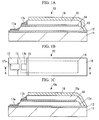
- FIGS. 1A and 1B show a vibration sensor for a musical instrument of a first embodiment according to the present invention.
- FIG. 1A is a cross-sectional view showing the vibration sensor taken along line A-A of FIG. 1B .
- the vibration sensor for a musical instrument 10 is, for example, a sensor for detecting string vibration of a guitar 1 shown in FIG. 9 .
- the vibration sensor for a musical instrument 10 is a laminated structure manufactured through the use of a thin film forming technique such as a screen printing technique or a semiconductor manufacturing technique.
- a substrate 11, a first electrode film 12, a piezoelectric film 13, a second electrode film 14, an insulating film 15, and a shield film 16 constituting the vibration sensor for a musical instrument 10 are incorporated into a body by direction bonding without using an adhesive or the like.
- the outer size of the vibration sensor for a musical instrument 10 can be arbitrarily set depending on the shape of a saddle 20.
- the thickness of the vibration sensor for a musical instrument 10 detecting vibration of six strings of a guitar can be 0.1 mm to 3 mm
- the width of the vibration sensor for a musical instrument 10 can be 1 mm to 8 mm
- the length of the vibration sensor for a musical instrument 10 can be 3 mm to 80 mm.
- the substrate 11 is, for example, a plate-like member with a thickness of about 0.2 mm. Durability for enduring a load acting during the performance of the musical instrument and heat resistance for enduring a thermal load in the manufacturing process such as heat treatment on the piezoelectric film 13 are required for the substrate 11.
- the substrate 11 can be formed of silicon, glass, glass ceramic, or metal. Particularly, zirconia (ZrO 2 ) for example, partially-stabilized zirconia containing yttria, can be suitable used as the material of the substrate 11. Since zirconia has high heat resistance, it can satisfactorily endure the heat treatment on the piezoelectric film 13. When the substrate 11 is formed of zirconia, the toughness of the substrate 11 is high, thereby enhancing the durability and using the vibration sensor for a musical instrument 10 in a state where the vibration sensor is curved.
- the first electrode film 12 overlapping with the top surface of the substrate 11 is, for example, a conductive film with a thickness of 2 ⁇ m.
- the first electrode film 12 is formed of metal such as platinum (Pt).
- the first electrode film 12 is formed through the use of a thin film forming technique such as a screen printing method and a sputtering method. Accordingly, the first electrode film 12 is directly coupled to the top surface of the substrate 11.
- An electrode pad 17a for electrical connection to a conductor wire (ground line) of a ground potential is formed in an end portion of the top surface of the first electrode film 12.
- the electrode pad 17a is formed of, for example, aluminum (Al).
- the conductor wire may be directly connected to the first electrode film 12 with the first electrode film 12 as an electrode pad, without forming an electrode pad on the first electrode film 12.
- the piezoelectric film 13 overlapping with the top surface of the first electrode film 12 is a film formed of, for example, a piezoelectric material with a thickness of 35 ⁇ m.
- the piezoelectric film 13 is formed of a piezoelectric material such as PZT (Piezoelectric Zirconate Titanate).
- the piezoelectric film 13 is formed on the surface of the first electrode film 12 through the use of a thin film forming technique such as a sol-gel method, a sputtering method, a CVD method, and a screen printing method. Accordingly, the piezoelectric film 13 is directly coupled to the top surface of the first electrode film 12.
- the end face of the piezoelectric film 13 can be sloped.
- the step coverage of the layer formed with the end face of the piezoelectric film 13 and the top surface of the first electrode film 12 as an underlying surface is improved, thereby enhancing the bonding strength.
- the second electrode film 14 overlapping with the top surface of the piezoelectric film 13 is, for example, a conductive film with a thickness of about 2 ⁇ m.
- the second electrode film 14 is formed with an area equal to that of the top surface of the piezoelectric film 13 or smaller than that of the top surface of the piezoelectric film 13.
- the second electrode film 14 is formed of metal such as gold (Au) and aluminum (Al).
- the second electrode film 14 is formed through the use of a thin film forming technique such as a screen printing method and a sputtering method. Accordingly, the second electrode film 14 is directly coupled to the top surface of the piezoelectric film 13.
- An electrode pad 17b for electrical connection to a conductor wire is formed in an end portion on the surface of the second electrode film 14.
- the electrode pad 17b is formed of, for example, aluminum (Al).
- a conductor line may be directly connected to the second electrode film 14 with the second electrode film 14 as an electrode pad, without forming an electrode pad on the second electrode
- the insulating film 15 overlapping with the top surface of the second electrode film 14 covers the entire top surface of the second electrode film 14 except for the end portion on which the electrode pad 17b is formed.
- the insulating film 15 is formed of, for example, an insulating film such as polyimide with a thickness of 40 ⁇ m.
- the insulating film 15 is formed through the use of a thin film forming technique such as a screen printing method, a spin coating method, a laminating method, a CVD method, a sputtering method, a vapor deposition method, and a vapor-deposition and polymerization method. Accordingly, the insulating film 15 is directly coupled to the top surface of the second electrode film 14.
- the shield film 16 overlapping with the top surface of the insulating film 15 is formed of, for example, a conductive material such as aluminum with a thickness of 2 ⁇ m.
- the shield film 16 covers most of the top surface of the vibration sensor for a musical instrument 10 and is coupled to the grounded first electrode film 12. Accordingly, the shield film 16 serves as an electromagnetic shield along with the grounded first electrode film 12.
- the shield film 16 is formed through the use of a thin film forming technique such as a sputtering method, a CVD method, a screen printing method, and a plating method. Accordingly, the shield film 16 is directly coupled to the insulating film 15, the piezoelectric film 13, and the first electrode film 12. In FIG.
- an end portion of the insulating film 15 is formed at the same position as the end portion of the piezoelectric film 13, but is not limited to this position.
- the end portion of the insulating film 15 may retreat from the end portion of the piezoelectric film 13.
- the end face of the piezoelectric film 13 may be covered with an insulating film 15a as in a vibration sensor for a musical instrument 10a shown in FIG. 1C .
- the layers on the substrate 11 constituting the vibration sensor for a musical instrument 10 are formed through the use of the thin film forming techniques, the bonding strength between the layers directly coupled to each other is high (in the specification, when an upper layer is formed on a lower layer through the use of the thin film forming techniques, it is stated that the upper layer is "directly coupled to" the lower layer). Accordingly, even when a large load acts thereon during the musical performance, the separation of the piezoelectric film 13 and the first electrode film 12 from each other or the separation of the piezoelectric film 13 and the second electrode film 14 from each other does not easily occur. Therefore, it is possible to prevent the separation of the electrode in the vibration sensor for a musical instrument 10 or the short circuit between the electrodes.
- the shield film 16 By forming the shield film 16 into a body through the use of the thin film forming technique, it is possible to enhance the S/N ratio and to suppress the manufacturing cost. As a result, it is possible to implement a vibration sensor for a musical instrument 10 with high reliability which can endure use in a concert hall or the like having a large amount of noise.
- Fine patterns with high size precision and high positioning precision may be formed on each layer on the substrate 11 through the use of a photolithography technique. Accordingly, it is easy to reduce the size of the vibration sensor for a musical instrument 10. As a result, it is possible to easily implement a vibration sensor for a musical instrument 10 which is inconspicuous.
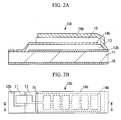
- FIG. 2A is a cross-sectional view taken along line A-A of FIG. 2B .
- a film formed of a magnetic material is formed on the rear surface of the substrate so as to enhance a magnetic shield effect from noise based on a magnetic field.
- a film is formed on the rear surface of the substrate 11 out of magnetic metal such as iron (Fe), nickel (Ni), and cobalt (Co), alloy thereof, or alloy containing magnetic metal, whereby a magnetic shield film 18 is formed.
- magnetic metal such as iron (Fe), nickel (Ni), and cobalt (Co), alloy thereof, or alloy containing magnetic metal
- the magnetic shield film 18 may be formed of nonmagnetic metal.
- a soft magnetic material such as permalloy has a high magnetic shield effect, which is preferable.
- the shield film may include two layers of a nonmagnetic metal film of copper (Cu) or the like and a magnetic film of permalloy or the like. It is possible to prevent the magnetic noise by the use of the copper film and to achieve the magnetic shield effect by the use of the permalloy film.
- the pattern of the second electrode film 14b extends to the substrate 11 along the end face of the piezoelectric film 13.
- at least part of the end face of the first electrode film 12b needs to be located inward from the end face of the piezoelectric film 13 along which the second electrode film 14b extends so as not to bring the second electrode film 14b into direct contact with the first electrode film 12b.
- the second electrode film 14b is divided into multiple areas depending on the arrangement of the strings, as shown in FIG. 2B . Signals can be individually extracted from the divided areas.
- conductor wires are directly connected to the first electrode film 12b and the second electrode film 14b as an electrode pad, without particularly forming an electrode pad, as shown in FIGS. 2A and 2B .
- the piezoelectric film and the second electrode film may be divided into multiple areas depending on the arrangement of the strings and a damping material may be interposed between the neighboring areas of the piezoelectric film.
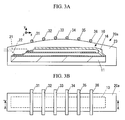
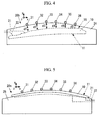
- FIGS. 3A and 3B and FIGS. 4 and 5 show pickup saddles 20a, 20b, and 20c of the first, second, and third embodiments using the above-mentioned vibration sensor for a musical instrument 10.
- FIG. 3A is a cross-sectional view taken along line A-A of FIG. 3B .
- the pickup saddles 20a, 20b, and 20c serve as a saddle 20 supporting strings 31 to 36 of a stringed instrument such as the guitar 1 shown in FIG. 9 and also serve as a pickup converting the vibrations of the strings 31 to 36 into electrical signals.
- the top surfaces of saddle bodies 23, 24, and 25 supporting multiple strings 31 to 36 have a shape including a curved surface.
- Conductor wires 21 and 22 connected to the electrode pads 17a and 17b of the vibration sensor for a musical instrument 10 are drawn to the outside of the saddle body 23 and are connected to an amplifier or the like.
- the conductor wires 21 and 22 are drawn from the side surface of the saddle body 23.
- the conductor wires 21 and 22 may be drawn from the bottom surface of the saddle body 23 to shade the wires 21 and 22 with the saddle body 23 from view.
- the pickup saddles 20a and 20b of the first and second embodiments include saddle bodies 23 and 24 receiving the vibration sensor for a musical instrument 10 therein.
- the vibration sensor for a musical instrument 10 By receiving the vibration sensor for a musical instrument 10 in the saddle bodies 23 and 24, it is possible to make the vibration sensor for a musical instrument 10 inconspicuous.
- a cavity for receiving the vibration sensor for a musical instrument 10 is formed in each of the saddle body 23 and 24.
- the vibration sensor for a musical instrument 10 is fixed to the saddle bodies 23 and 24 with a posture in which the shield film 16 is located close to the top surfaces of the saddle bodies 23 and 24 and the substrate 11 is located close to the bottom surfaces of the saddle bodies 23 and 24.
- the vibration sensor for a musical instrument 10 When the vibration sensor for a musical instrument 10 is fixed with this posture, the first electrode film 12 and the second electrode film 14 face each other in the y direction and thus the vibration in the y direction of the strings 31 to 36 is detected by the vibration sensor for a musical instrument 10.
- the vibration sensor for a musical instrument may be fixed so that the shield film 16 may be located close to the bottom surfaces of the saddle bodies 23 and 24.
- the vibration sensor for a musical instrument 10 can be small in size and thus may be fixed to the saddle bodies 23 and 24 so as to face the first electrode film 12 and the second electrode film 14 each other in the x direction to detect the vibration in the x direction, or may be fixed to the saddle bodies 23 and 24 so as to face the first electrode film 12 and the second electrode film 14 each other in the z direction to detect the vibration in the z direction. In any direction other than the x, y, and z directions, the first electrode film 12 and the second electrode film 14 may be made to face each other to detect the vibration in any direction.
- the vibration sensor for a musical instrument 10 may be divided into multiple parts, and may be fixed to the saddle bodies 23 and 24. That is, smaller vibration sensors for a musical instrument corresponding to the number of strings 31 to 36 may be built in the saddle bodies 23 and 24 to detect the vibrations of different strings by the use of different vibration sensors for a musical instrument 10.
- the vibration sensor for a musical instrument 10 can be fixed to the saddle bodies 24 and 25 in a state where the vibration sensor is curved, as shown in FIGS. 4 and 5 .
- the distances d1 to d6 from the strings 31 to 36 to the vibration sensor for a musical instrument 10 may be independently adjusted by curving the vibration sensor for a musical instrument 10.
- the period of time and the magnitude of attenuation until the vibrations of the strings 31 to 36 propagate to the vibration sensor for a musical instrument 10 depend on the distances d1 to d6 from the strings 31 to 36 to the vibration sensor for a musical instrument 10.
- the vibration sensor for a musical instrument 10 is fixed in a state where it is curved along the top surface of the saddle body 25, so that the vibration sensor for a musical instrument 10 is brought into direct contact with the strings 31 to 36.
- the vibration sensor for a musical instrument 10 it is preferable that the vibration sensor for a musical instrument 10 be fixed to the top surface of the saddle body 25 with a posture in which the substrate 11 comes in contact with the strings 31 to 36.
- the vibration sensor for a musical instrument 10 be fixed to the top surface of the saddle body 25 with a posture in which the substrate 11 comes in contact with the strings 31 to 36.
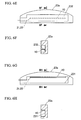
- FIG. 6B is a cross-sectional view taken along line 6B-6B of FIG. 6A .
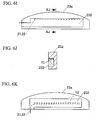
- FIGS. 6D , 6F , 6H and 6J are cross-sectional views taken along line 6D-6D of FIG. 6C , line 6F-6F of FIG. 6E , line 6H-6H of FIG. 6G , and line 6J-6J of FIG. 6I , respectively.
- the sensor receiving section 231 having a concave portion is formed in a side surface of the saddle body 23a.
- the sensor receiving section 231 includes an area for drawing out a conductor line.
- the vibration sensor for a musical instrument 10 is received in the sensor receiving section 231 so as to detect the vibration, for example, in the y direction.
- the gap between the sensor receiving section 231 formed in the saddle body 23a and the vibration sensor for a musical instrument 10 received therein is filled with a resin 232 as a filler, as shown in FIGS. 6E and 6F , whereby the pickup saddle having the vibration sensor for a musical instrument 10 built therein is completed.
- the appearance of the pickup saddle is not damaged even when the vibration sensor for a musical instrument 10 is built therein.
- the sensor receiving section formed in the saddle body may penetrate the saddle body.
- the vibration sensor for a musical instrument 10 may be fixed to one surface of the sensor receiving section 231 with an adhesive or the like, and then the gap may be filled with the resin 232 as shown in FIGS. 6I and 6J .
- the vibration sensor for a musical instrument 10 can be securely fixed to the saddle body 23a, it is possible to efficiently detect the vibrations of the strings by the use of the vibration sensor for a musical instrument 10.
- Pores or unevenness may be formed in one surface of the sensor receiving section 231 to which the vibration sensor for a musical instrument 10 is fixed. Since the pores or recesses can hold an unnecessary adhesive or the like, it is possible to easily mount the vibration sensor for a musical instrument 10 on the saddle body 23a so as to reduce the minimum gap between the vibration sensor for a musical instrument 10 and the saddle body 23a.
- the conductor wires 21 and 22 may be drawn from the bottom surface of the saddle body 23a to shade the wires 21 and 22 with the saddle body 23 from view, as shown in FIG. 6K .
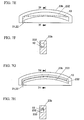
- FIG. 7B is a cross-sectional view taken along line 7B-7B of FIG. 7A .
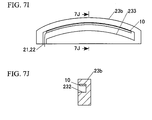
- FIGS. 7D , 7F , 7H and 7J are cross-sectional views taken along line 7D-7D of FIG. 7C , line 7F-7F of FIG. 7E , line 7H-7H of FIG. 7G , and line 7J-7J of FIG. 7I , respectively.
- the sensor receiving section 233 is formed in a curved shape along the surface of the saddle body 23b coming in contact with the strings. Then, as shown in FIGS. 7C and 7D , the vibration sensor for a musical instrument 10 is received in the sensor receiving section 233 in a curved state through the use of the side surface of the sensor receiving section 233. Then, as shown in FIGS. 7E and 7F , the gap of the sensor receiving section 233 is filled with the resin 232. As shown in FIGS.
- the gap of the sensor receiving section 233 may be filled incompletely with the resin 232.
- the other gap may be filled with an addition resin.
- the gap may be filled with the resin 232.
- the shape of the sensor receiving section is not limited to the shape shown in FIG.
- the a point of inflection such as an S shape or a wavy shape 10 may be mounted thereon even when the shape of the sensor receiving section includes a curved surface having a point of inflection such as an S shape or a wavy shape.
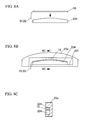
- the vibration sensor for a musical instrument 10 may be fixed to a curved surface of a pedestal 234 as shown in FIG. 8A , the vibration sensor for a musical instrument 10 is received in the sensor receiving section 231 along with the pedestal 234 as shown in FIGS. 8B and 8C , and the gap may be filled with the resin 232 as shown in FIGS. 8D and 8E .
- FIG. 8C is a cross-sectional view taken along line 8C-8C of FIG. 8B
- FIG. 8E is a cross-sectional view taken along line 8E-8E of FIG. 8D .
- the conductor wires 21 and 22 are drawn from the bottom surface of the saddle body 23b to shade the wires 21 and 22 with the saddle body 23 from view.
- the invention can be applied to vibration sensors for a musical instrument or pickup saddles used in other stringed instruments such as violins or cellos.
- the size of the vibration sensor can be arbitrarily set depending on the size of the pickup saddle or the instrument body.
Landscapes
- Physics & Mathematics (AREA)
- Engineering & Computer Science (AREA)
- Acoustics & Sound (AREA)
- Multimedia (AREA)
- Electrophonic Musical Instruments (AREA)
Applications Claiming Priority (1)
| Application Number | Priority Date | Filing Date | Title |
|---|---|---|---|
| JP2011065215 | 2011-03-24 |
Publications (1)
| Publication Number | Publication Date |
|---|---|
| EP2503544A1 true EP2503544A1 (de) | 2012-09-26 |
Family
ID=45939086
Family Applications (1)
| Application Number | Title | Priority Date | Filing Date |
|---|---|---|---|
| EP12001939A Withdrawn EP2503544A1 (de) | 2011-03-24 | 2012-03-20 | Vibrationssensor für Musikinstrument, und Steg |
Country Status (4)
| Country | Link |
|---|---|
| US (1) | US8586851B2 (de) |
| EP (1) | EP2503544A1 (de) |
| JP (1) | JP5929375B2 (de) |
| CN (1) | CN102693717B (de) |
Families Citing this family (8)
| Publication number | Priority date | Publication date | Assignee | Title |
|---|---|---|---|---|
| JP3099012B1 (ja) | 1999-11-29 | 2000-10-16 | ニューリー株式会社 | 静圧支承ユニット |
| JP5585005B2 (ja) * | 2009-06-03 | 2014-09-10 | ヤマハ株式会社 | 電気弦楽器のピックアップ装置 |
| US20180254031A1 (en) * | 2015-09-14 | 2018-09-06 | Ichiro Katayama | Pickup and stringed instrument with pickup |
| CN106548769A (zh) * | 2015-09-20 | 2017-03-29 | 张大勇 | 触摸控制的数码筝 |
| JP2018152736A (ja) * | 2017-03-13 | 2018-09-27 | ヤマハ株式会社 | センサーユニット |
| US10379074B2 (en) * | 2017-12-21 | 2019-08-13 | NeoTek Energy, Inc. | System and method for shielded chemical sensing using a fine-line shielded sensing structure |
| CN115132157B (zh) * | 2021-03-24 | 2025-10-10 | 雅马哈株式会社 | 弦乐器及音响效果装置 |
| GB202109957D0 (en) | 2021-07-09 | 2021-08-25 | Audio Inventions Ltd | A reed for a musical instrument |
Citations (4)
| Publication number | Priority date | Publication date | Assignee | Title |
|---|---|---|---|---|
| WO1998002869A1 (en) * | 1996-07-15 | 1998-01-22 | Markley, Donald, Dean | Pliable pickup for stringed instrument |
| US6023019A (en) * | 1994-03-11 | 2000-02-08 | Baggs; Lloyd R. | Flexible pickup circuit assembly for stringed instruments |
| US20040105560A1 (en) * | 2002-11-28 | 2004-06-03 | Akio Naniki | Piezoelectric transducer adapted to bridge of stringed instrument |
| WO2008117483A1 (ja) | 2007-03-26 | 2008-10-02 | Takamine Gakki Co., Ltd. | 弦楽器用のサドル、ギター、及び、サドルの製造方法 |
Family Cites Families (22)
| Publication number | Priority date | Publication date | Assignee | Title |
|---|---|---|---|---|
| JPH0529518Y2 (de) | 1985-05-29 | 1993-07-28 | ||
| JPS62111600A (ja) * | 1985-11-11 | 1987-05-22 | Sony Corp | 圧電センサ−用基板の製造方法 |
| US5670733A (en) * | 1986-04-28 | 1997-09-23 | Fishman; Lawrence R. | Musical instrument transducer |
| JPH01126692U (de) | 1987-12-28 | 1989-08-30 | ||
| US5123325A (en) * | 1991-04-05 | 1992-06-23 | Turner Robert A | Film piezoelectric pickup for stringed musical instruments |
| JPH0594896U (ja) * | 1992-05-22 | 1993-12-24 | ヤマハ株式会社 | 弦楽器用ピックアップ |
| JPH06235733A (ja) * | 1992-12-14 | 1994-08-23 | Clarion Co Ltd | 加速度センサ及び角速度センサ |
| JPH07239685A (ja) * | 1994-03-01 | 1995-09-12 | Yamaha Corp | 電気弦楽器のピックアップ装置 |
| FI961688A0 (fi) * | 1996-04-17 | 1996-04-17 | Nandorex Oy | Omvandlare foer straenginstrument |
| US6677514B2 (en) * | 1999-07-02 | 2004-01-13 | Fishman Transducers, Inc. | Coaxial musical instrument transducer |
| US6248947B1 (en) * | 2000-01-31 | 2001-06-19 | Pick-Up The World, Inc. | Transducer for musical instruments |
| FI118369B (fi) * | 2000-12-19 | 2007-10-15 | Emfitech Oy | Sähkömekaaninen muunnin ja menetelmä sähkömekaanisen muuntimen valmistamiseksi |
| JP3656609B2 (ja) * | 2002-03-18 | 2005-06-08 | ヤマハ株式会社 | 弦楽器用サドル及びこれを用いたピックアップ装置 |
| JP2004111939A (ja) * | 2002-08-29 | 2004-04-08 | Ngk Insulators Ltd | 積層型圧電素子及びその製造方法 |
| US7157640B2 (en) * | 2003-06-17 | 2007-01-02 | Baggs Lloyd R | Undersaddle pickup for stringed musical instrument |
| JP4251110B2 (ja) * | 2004-05-19 | 2009-04-08 | ヤマハ株式会社 | 撥弦楽器用ピックアップ装置と撥弦楽器 |
| TWI298482B (en) * | 2005-04-28 | 2008-07-01 | Yamaha Corp | Stringed musical instrument, transducer for the same and its mounting structure on the same |
| JP2007295280A (ja) * | 2006-04-25 | 2007-11-08 | Toshiba Corp | 電子素子 |
| JP5036412B2 (ja) * | 2007-06-05 | 2012-09-26 | エルメック電子工業株式会社 | 圧電センサおよび電子弦楽器 |
| JP5453791B2 (ja) * | 2008-12-05 | 2014-03-26 | ヤマハ株式会社 | 圧電体素子及びその製造方法、並びに該圧電体素子を用いた角速度センサ |
| JP5585005B2 (ja) * | 2009-06-03 | 2014-09-10 | ヤマハ株式会社 | 電気弦楽器のピックアップ装置 |
| JP5663901B2 (ja) * | 2010-03-05 | 2015-02-04 | ヤマハ株式会社 | ピックアップ装置 |
-
2012
- 2012-03-19 JP JP2012062216A patent/JP5929375B2/ja not_active Expired - Fee Related
- 2012-03-20 EP EP12001939A patent/EP2503544A1/de not_active Withdrawn
- 2012-03-21 US US13/425,652 patent/US8586851B2/en not_active Expired - Fee Related
- 2012-03-22 CN CN201210077409.4A patent/CN102693717B/zh not_active Expired - Fee Related
Patent Citations (4)
| Publication number | Priority date | Publication date | Assignee | Title |
|---|---|---|---|---|
| US6023019A (en) * | 1994-03-11 | 2000-02-08 | Baggs; Lloyd R. | Flexible pickup circuit assembly for stringed instruments |
| WO1998002869A1 (en) * | 1996-07-15 | 1998-01-22 | Markley, Donald, Dean | Pliable pickup for stringed instrument |
| US20040105560A1 (en) * | 2002-11-28 | 2004-06-03 | Akio Naniki | Piezoelectric transducer adapted to bridge of stringed instrument |
| WO2008117483A1 (ja) | 2007-03-26 | 2008-10-02 | Takamine Gakki Co., Ltd. | 弦楽器用のサドル、ギター、及び、サドルの製造方法 |
Also Published As
| Publication number | Publication date |
|---|---|
| JP5929375B2 (ja) | 2016-06-08 |
| CN102693717B (zh) | 2015-08-12 |
| US20120240752A1 (en) | 2012-09-27 |
| JP2012212134A (ja) | 2012-11-01 |
| CN102693717A (zh) | 2012-09-26 |
| US8586851B2 (en) | 2013-11-19 |
Similar Documents
| Publication | Publication Date | Title |
|---|---|---|
| US8586851B2 (en) | Vibration sensor for musical instrument and pickup saddle | |
| KR101230945B1 (ko) | 마그네토 임피던스 센서 소자 | |
| JP5815353B2 (ja) | コイル配線素子およびコイル配線素子の製造方法 | |
| JP4947168B2 (ja) | 音響センサ | |
| JP4673630B2 (ja) | 電気機械変換器のための防湿技術 | |
| CN104737316B (zh) | 磁电传感器和其制造方法 | |
| US6931700B2 (en) | Method of manufacturing thin film piezoelectric elements | |
| KR20150105224A (ko) | 백플레이트 요소가 없는 이중 다이아프램 mems 마이크로폰 | |
| US5987987A (en) | Angular velocity sensor, related method for manufacturing the sensor, and piezoelectric vibrator element used in this sensor | |
| CN107305215A (zh) | 经由磁极片减少加速度计中的偏置 | |
| JP4273847B2 (ja) | 磁気センサの製造方法 | |
| EP0981754A1 (de) | Sensor | |
| JP4881041B2 (ja) | 磁気センサ装置 | |
| JP5606021B2 (ja) | 電流センサの製造方法 | |
| JP5075489B2 (ja) | 磁気デバイスおよびその製造方法 | |
| JP2004184127A (ja) | 応力センサ | |
| JP2013200198A (ja) | 振動センサ及びピックアップ機能付サドル | |
| JP7127349B2 (ja) | 半導体装置およびその製造方法 | |
| JP2009267207A (ja) | 信号伝送装置および信号伝送装置の製造方法 | |
| JP4295523B2 (ja) | 多層配線基板 | |
| CN121547714B (zh) | 一种指向性麦克风及其加工方法 | |
| JP2012039197A (ja) | 電気機械変換装置及びその作製方法 | |
| JP2025167086A (ja) | 磁界検出素子 | |
| US6635158B1 (en) | Electro ceramic MEMS structure with controlled actuator gap | |
| JP2013200369A (ja) | 楽器用振動センサ,ピックアップサドルおよび弦楽器 |
Legal Events
| Date | Code | Title | Description |
|---|---|---|---|
| PUAI | Public reference made under article 153(3) epc to a published international application that has entered the european phase |
Free format text: ORIGINAL CODE: 0009012 |
|
| AK | Designated contracting states |
Kind code of ref document: A1 Designated state(s): AL AT BE BG CH CY CZ DE DK EE ES FI FR GB GR HR HU IE IS IT LI LT LU LV MC MK MT NL NO PL PT RO RS SE SI SK SM TR |
|
| AX | Request for extension of the european patent |
Extension state: BA ME |
|
| 17P | Request for examination filed |
Effective date: 20130326 |
|
| STAA | Information on the status of an ep patent application or granted ep patent |
Free format text: STATUS: THE APPLICATION HAS BEEN WITHDRAWN |
|
| 18W | Application withdrawn |
Effective date: 20160908 |