EP2501650B1 - Verfahren zur herstellung von hydridosilanen - Google Patents
Verfahren zur herstellung von hydridosilanen Download PDFInfo
- Publication number
- EP2501650B1 EP2501650B1 EP10788261.5A EP10788261A EP2501650B1 EP 2501650 B1 EP2501650 B1 EP 2501650B1 EP 10788261 A EP10788261 A EP 10788261A EP 2501650 B1 EP2501650 B1 EP 2501650B1
- Authority
- EP
- European Patent Office
- Prior art keywords
- generic formula
- halosilane
- process according
- group
- catalyst
- Prior art date
- Legal status (The legal status is an assumption and is not a legal conclusion. Google has not performed a legal analysis and makes no representation as to the accuracy of the status listed.)
- Not-in-force
Links
- BLRPTPMANUNPDV-UHFFFAOYSA-N Silane Chemical class [SiH4] BLRPTPMANUNPDV-UHFFFAOYSA-N 0.000 title claims description 27
- 238000004519 manufacturing process Methods 0.000 title claims description 3
- 238000000034 method Methods 0.000 claims description 37
- 239000003054 catalyst Substances 0.000 claims description 33
- 229910052794 bromium Inorganic materials 0.000 claims description 20
- 229910052801 chlorine Inorganic materials 0.000 claims description 20
- 229910052731 fluorine Inorganic materials 0.000 claims description 20
- 125000004122 cyclic group Chemical group 0.000 claims description 17
- JUJWROOIHBZHMG-UHFFFAOYSA-N Pyridine Chemical compound C1=CC=NC=C1 JUJWROOIHBZHMG-UHFFFAOYSA-N 0.000 claims description 14
- 150000001875 compounds Chemical class 0.000 claims description 13
- 238000005984 hydrogenation reaction Methods 0.000 claims description 13
- -1 polycyclic amines Chemical class 0.000 claims description 11
- 239000000203 mixture Substances 0.000 claims description 10
- 125000002619 bicyclic group Chemical group 0.000 claims description 7
- 229910052751 metal Inorganic materials 0.000 claims description 7
- 239000002184 metal Substances 0.000 claims description 7
- UMJSCPRVCHMLSP-UHFFFAOYSA-N pyridine Natural products COC1=CC=CN=C1 UMJSCPRVCHMLSP-UHFFFAOYSA-N 0.000 claims description 6
- NFDXQGNDWIPXQL-UHFFFAOYSA-N 1-cyclooctyldiazocane Chemical group C1CCCCCCC1N1NCCCCCC1 NFDXQGNDWIPXQL-UHFFFAOYSA-N 0.000 claims description 5
- 239000003795 chemical substances by application Substances 0.000 claims description 5
- 239000012973 diazabicyclooctane Substances 0.000 claims description 4
- 125000005842 heteroatom Chemical group 0.000 claims description 3
- AZWXAPCAJCYGIA-UHFFFAOYSA-N bis(2-methylpropyl)alumane Chemical compound CC(C)C[AlH]CC(C)C AZWXAPCAJCYGIA-UHFFFAOYSA-N 0.000 claims description 2
- 229910052987 metal hydride Inorganic materials 0.000 claims description 2
- 150000004681 metal hydrides Chemical class 0.000 claims description 2
- 238000000926 separation method Methods 0.000 claims description 2
- 229910010084 LiAlH4 Inorganic materials 0.000 claims 1
- 125000001072 heteroaryl group Chemical group 0.000 claims 1
- 150000004757 linear silanes Chemical class 0.000 claims 1
- 239000012280 lithium aluminium hydride Substances 0.000 claims 1
- 239000012279 sodium borohydride Substances 0.000 claims 1
- 229910000033 sodium borohydride Inorganic materials 0.000 claims 1
- 239000000460 chlorine Substances 0.000 description 45
- RTZKZFJDLAIYFH-UHFFFAOYSA-N Diethyl ether Chemical compound CCOCC RTZKZFJDLAIYFH-UHFFFAOYSA-N 0.000 description 24
- YXFVVABEGXRONW-UHFFFAOYSA-N Toluene Chemical compound CC1=CC=CC=C1 YXFVVABEGXRONW-UHFFFAOYSA-N 0.000 description 18
- 239000007787 solid Substances 0.000 description 18
- 239000002904 solvent Substances 0.000 description 15
- 238000006243 chemical reaction Methods 0.000 description 13
- PZKOFHKJGUNVTM-UHFFFAOYSA-N trichloro-[dichloro(trichlorosilyl)silyl]silane Chemical compound Cl[Si](Cl)(Cl)[Si](Cl)(Cl)[Si](Cl)(Cl)Cl PZKOFHKJGUNVTM-UHFFFAOYSA-N 0.000 description 13
- UHOVQNZJYSORNB-UHFFFAOYSA-N Benzene Chemical compound C1=CC=CC=C1 UHOVQNZJYSORNB-UHFFFAOYSA-N 0.000 description 12
- VLKZOEOYAKHREP-UHFFFAOYSA-N n-Hexane Chemical compound CCCCCC VLKZOEOYAKHREP-UHFFFAOYSA-N 0.000 description 12
- 239000000047 product Substances 0.000 description 12
- 239000011541 reaction mixture Substances 0.000 description 11
- URLKBWYHVLBVBO-UHFFFAOYSA-N Para-Xylene Chemical group CC1=CC=C(C)C=C1 URLKBWYHVLBVBO-UHFFFAOYSA-N 0.000 description 8
- OFBQJSOFQDEBGM-UHFFFAOYSA-N Pentane Chemical compound CCCCC OFBQJSOFQDEBGM-UHFFFAOYSA-N 0.000 description 8
- DIOQZVSQGTUSAI-UHFFFAOYSA-N decane Chemical compound CCCCCCCCCC DIOQZVSQGTUSAI-UHFFFAOYSA-N 0.000 description 8
- SNRUBQQJIBEYMU-UHFFFAOYSA-N dodecane Chemical compound CCCCCCCCCCCC SNRUBQQJIBEYMU-UHFFFAOYSA-N 0.000 description 8
- IVSZLXZYQVIEFR-UHFFFAOYSA-N m-xylene Chemical group CC1=CC=CC(C)=C1 IVSZLXZYQVIEFR-UHFFFAOYSA-N 0.000 description 8
- TVMXDCGIABBOFY-UHFFFAOYSA-N octane Chemical compound CCCCCCCC TVMXDCGIABBOFY-UHFFFAOYSA-N 0.000 description 8
- 238000002360 preparation method Methods 0.000 description 8
- RWRDLPDLKQPQOW-UHFFFAOYSA-N Pyrrolidine Chemical compound C1CCNC1 RWRDLPDLKQPQOW-UHFFFAOYSA-N 0.000 description 7
- 229910003902 SiCl 4 Inorganic materials 0.000 description 7
- XUIMIQQOPSSXEZ-UHFFFAOYSA-N Silicon Chemical compound [Si] XUIMIQQOPSSXEZ-UHFFFAOYSA-N 0.000 description 7
- 230000015572 biosynthetic process Effects 0.000 description 7
- 150000003254 radicals Chemical class 0.000 description 7
- LXEXBJXDGVGRAR-UHFFFAOYSA-N trichloro(trichlorosilyl)silane Chemical compound Cl[Si](Cl)(Cl)[Si](Cl)(Cl)Cl LXEXBJXDGVGRAR-UHFFFAOYSA-N 0.000 description 7
- 238000005133 29Si NMR spectroscopy Methods 0.000 description 6
- WEVYAHXRMPXWCK-UHFFFAOYSA-N Acetonitrile Chemical compound CC#N WEVYAHXRMPXWCK-UHFFFAOYSA-N 0.000 description 6
- 239000005046 Chlorosilane Substances 0.000 description 6
- XDTMQSROBMDMFD-UHFFFAOYSA-N Cyclohexane Chemical compound C1CCCCC1 XDTMQSROBMDMFD-UHFFFAOYSA-N 0.000 description 6
- KOPOQZFJUQMUML-UHFFFAOYSA-N chlorosilane Chemical class Cl[SiH3] KOPOQZFJUQMUML-UHFFFAOYSA-N 0.000 description 6
- 229910052723 transition metal Inorganic materials 0.000 description 6
- 150000003624 transition metals Chemical class 0.000 description 6
- 239000003039 volatile agent Substances 0.000 description 6
- NQRYJNQNLNOLGT-UHFFFAOYSA-N Piperidine Chemical compound C1CCNCC1 NQRYJNQNLNOLGT-UHFFFAOYSA-N 0.000 description 5
- KAESVJOAVNADME-UHFFFAOYSA-N Pyrrole Chemical compound C=1C=CNC=1 KAESVJOAVNADME-UHFFFAOYSA-N 0.000 description 5
- 239000007788 liquid Substances 0.000 description 5
- 229910052757 nitrogen Inorganic materials 0.000 description 5
- 238000003756 stirring Methods 0.000 description 5
- 238000003786 synthesis reaction Methods 0.000 description 5
- RYHBNJHYFVUHQT-UHFFFAOYSA-N 1,4-Dioxane Chemical compound C1COCCO1 RYHBNJHYFVUHQT-UHFFFAOYSA-N 0.000 description 4
- XTHFKEDIFFGKHM-UHFFFAOYSA-N Dimethoxyethane Chemical compound COCCOC XTHFKEDIFFGKHM-UHFFFAOYSA-N 0.000 description 4
- IMNFDUFMRHMDMM-UHFFFAOYSA-N N-Heptane Chemical compound CCCCCCC IMNFDUFMRHMDMM-UHFFFAOYSA-N 0.000 description 4
- 229910004298 SiO 2 Inorganic materials 0.000 description 4
- WYURNTSHIVDZCO-UHFFFAOYSA-N Tetrahydrofuran Chemical compound C1CCOC1 WYURNTSHIVDZCO-UHFFFAOYSA-N 0.000 description 4
- LMGZGXSXHCMSAA-UHFFFAOYSA-N cyclodecane Chemical compound C1CCCCCCCCC1 LMGZGXSXHCMSAA-UHFFFAOYSA-N 0.000 description 4
- WJTCGQSWYFHTAC-UHFFFAOYSA-N cyclooctane Chemical compound C1CCCCCCC1 WJTCGQSWYFHTAC-UHFFFAOYSA-N 0.000 description 4
- 239000004914 cyclooctane Substances 0.000 description 4
- NNBZCPXTIHJBJL-UHFFFAOYSA-N decalin Chemical compound C1CCCC2CCCCC21 NNBZCPXTIHJBJL-UHFFFAOYSA-N 0.000 description 4
- 238000007210 heterogeneous catalysis Methods 0.000 description 4
- AUHZEENZYGFFBQ-UHFFFAOYSA-N mesitylene Substances CC1=CC(C)=CC(C)=C1 AUHZEENZYGFFBQ-UHFFFAOYSA-N 0.000 description 4
- 125000001827 mesitylenyl group Chemical group [H]C1=C(C(*)=C(C([H])=C1C([H])([H])[H])C([H])([H])[H])C([H])([H])[H] 0.000 description 4
- NFHFRUOZVGFOOS-UHFFFAOYSA-N palladium;triphenylphosphane Chemical compound [Pd].C1=CC=CC=C1P(C=1C=CC=CC=1)C1=CC=CC=C1.C1=CC=CC=C1P(C=1C=CC=CC=1)C1=CC=CC=C1.C1=CC=CC=C1P(C=1C=CC=CC=1)C1=CC=CC=C1.C1=CC=CC=C1P(C=1C=CC=CC=1)C1=CC=CC=C1 NFHFRUOZVGFOOS-UHFFFAOYSA-N 0.000 description 4
- CVLHDNLPWKYNNR-UHFFFAOYSA-N pentasilolane Chemical compound [SiH2]1[SiH2][SiH2][SiH2][SiH2]1 CVLHDNLPWKYNNR-UHFFFAOYSA-N 0.000 description 4
- BASFCYQUMIYNBI-UHFFFAOYSA-N platinum Substances [Pt] BASFCYQUMIYNBI-UHFFFAOYSA-N 0.000 description 4
- 150000004756 silanes Chemical class 0.000 description 4
- FDNAPBUWERUEDA-UHFFFAOYSA-N silicon tetrachloride Chemical compound Cl[Si](Cl)(Cl)Cl FDNAPBUWERUEDA-UHFFFAOYSA-N 0.000 description 4
- CSCPPACGZOOCGX-UHFFFAOYSA-N Acetone Chemical compound CC(C)=O CSCPPACGZOOCGX-UHFFFAOYSA-N 0.000 description 3
- YMWUJEATGCHHMB-UHFFFAOYSA-N Dichloromethane Chemical compound ClCCl YMWUJEATGCHHMB-UHFFFAOYSA-N 0.000 description 3
- ZMXDDKWLCZADIW-UHFFFAOYSA-N N,N-Dimethylformamide Chemical compound CN(C)C=O ZMXDDKWLCZADIW-UHFFFAOYSA-N 0.000 description 3
- 125000003710 aryl alkyl group Chemical group 0.000 description 3
- KDLHZDBZIXYQEI-UHFFFAOYSA-N palladium Substances [Pd] KDLHZDBZIXYQEI-UHFFFAOYSA-N 0.000 description 3
- 229910000077 silane Inorganic materials 0.000 description 3
- 239000010703 silicon Substances 0.000 description 3
- 229910052710 silicon Inorganic materials 0.000 description 3
- IMNIMPAHZVJRPE-UHFFFAOYSA-N triethylenediamine Chemical compound C1CN2CCN1CC2 IMNIMPAHZVJRPE-UHFFFAOYSA-N 0.000 description 3
- VEDJZFSRVVQBIL-UHFFFAOYSA-N trisilane Chemical compound [SiH3][SiH2][SiH3] VEDJZFSRVVQBIL-UHFFFAOYSA-N 0.000 description 3
- LZDKZFUFMNSQCJ-UHFFFAOYSA-N 1,2-diethoxyethane Chemical compound CCOCCOCC LZDKZFUFMNSQCJ-UHFFFAOYSA-N 0.000 description 2
- RXYPXQSKLGGKOL-UHFFFAOYSA-N 1,4-dimethylpiperazine Chemical compound CN1CCN(C)CC1 RXYPXQSKLGGKOL-UHFFFAOYSA-N 0.000 description 2
- RRQYJINTUHWNHW-UHFFFAOYSA-N 1-ethoxy-2-(2-ethoxyethoxy)ethane Chemical compound CCOCCOCCOCC RRQYJINTUHWNHW-UHFFFAOYSA-N 0.000 description 2
- CNJRPYFBORAQAU-UHFFFAOYSA-N 1-ethoxy-2-(2-methoxyethoxy)ethane Chemical compound CCOCCOCCOC CNJRPYFBORAQAU-UHFFFAOYSA-N 0.000 description 2
- CAQYAZNFWDDMIT-UHFFFAOYSA-N 1-ethoxy-2-methoxyethane Chemical compound CCOCCOC CAQYAZNFWDDMIT-UHFFFAOYSA-N 0.000 description 2
- 229910018072 Al 2 O 3 Inorganic materials 0.000 description 2
- HEDRZPFGACZZDS-UHFFFAOYSA-N Chloroform Chemical compound ClC(Cl)Cl HEDRZPFGACZZDS-UHFFFAOYSA-N 0.000 description 2
- IAZDPXIOMUYVGZ-UHFFFAOYSA-N Dimethylsulphoxide Chemical compound CS(C)=O IAZDPXIOMUYVGZ-UHFFFAOYSA-N 0.000 description 2
- SMWDFEZZVXVKRB-UHFFFAOYSA-N Quinoline Chemical compound N1=CC=CC2=CC=CC=C21 SMWDFEZZVXVKRB-UHFFFAOYSA-N 0.000 description 2
- 229910052784 alkaline earth metal Inorganic materials 0.000 description 2
- 125000002947 alkylene group Chemical group 0.000 description 2
- 150000004945 aromatic hydrocarbons Chemical class 0.000 description 2
- 125000000732 arylene group Chemical group 0.000 description 2
- ZSIQJIWKELUFRJ-UHFFFAOYSA-N azepane Chemical compound C1CCCNCC1 ZSIQJIWKELUFRJ-UHFFFAOYSA-N 0.000 description 2
- SIPUZPBQZHNSDW-UHFFFAOYSA-N bis(2-methylpropyl)aluminum Chemical compound CC(C)C[Al]CC(C)C SIPUZPBQZHNSDW-UHFFFAOYSA-N 0.000 description 2
- 239000006227 byproduct Substances 0.000 description 2
- 125000004432 carbon atom Chemical group C* 0.000 description 2
- 239000000470 constituent Substances 0.000 description 2
- 238000010276 construction Methods 0.000 description 2
- 229940019778 diethylene glycol diethyl ether Drugs 0.000 description 2
- SBZXBUIDTXKZTM-UHFFFAOYSA-N diglyme Chemical compound COCCOCCOC SBZXBUIDTXKZTM-UHFFFAOYSA-N 0.000 description 2
- POLCUAVZOMRGSN-UHFFFAOYSA-N dipropyl ether Chemical compound CCCOCCC POLCUAVZOMRGSN-UHFFFAOYSA-N 0.000 description 2
- PZPGRFITIJYNEJ-UHFFFAOYSA-N disilane Chemical compound [SiH3][SiH3] PZPGRFITIJYNEJ-UHFFFAOYSA-N 0.000 description 2
- 150000002170 ethers Chemical class 0.000 description 2
- 125000005549 heteroarylene group Chemical group 0.000 description 2
- 238000007172 homogeneous catalysis Methods 0.000 description 2
- 229930195733 hydrocarbon Natural products 0.000 description 2
- 150000002430 hydrocarbons Chemical class 0.000 description 2
- 125000004435 hydrogen atom Chemical group [H]* 0.000 description 2
- 229910052740 iodine Inorganic materials 0.000 description 2
- 229910052747 lanthanoid Inorganic materials 0.000 description 2
- 150000002602 lanthanoids Chemical class 0.000 description 2
- 150000002739 metals Chemical class 0.000 description 2
- 125000004433 nitrogen atom Chemical group N* 0.000 description 2
- 229910052763 palladium Inorganic materials 0.000 description 2
- WEYVCQFUGFRXOM-UHFFFAOYSA-N perazine Chemical compound C1CN(C)CCN1CCCN1C2=CC=CC=C2SC2=CC=CC=C21 WEYVCQFUGFRXOM-UHFFFAOYSA-N 0.000 description 2
- 150000004885 piperazines Chemical class 0.000 description 2
- 229910052697 platinum Inorganic materials 0.000 description 2
- 229910052703 rhodium Inorganic materials 0.000 description 2
- 239000010948 rhodium Substances 0.000 description 2
- 229910052707 ruthenium Inorganic materials 0.000 description 2
- 229920006395 saturated elastomer Polymers 0.000 description 2
- 239000002002 slurry Substances 0.000 description 2
- 239000007858 starting material Substances 0.000 description 2
- YLQBMQCUIZJEEH-UHFFFAOYSA-N tetrahydrofuran Natural products C=1C=COC=1 YLQBMQCUIZJEEH-UHFFFAOYSA-N 0.000 description 2
- CXWXQJXEFPUFDZ-UHFFFAOYSA-N tetralin Chemical compound C1=CC=C2CCCCC2=C1 CXWXQJXEFPUFDZ-UHFFFAOYSA-N 0.000 description 2
- GETQZCLCWQTVFV-UHFFFAOYSA-N trimethylamine Chemical group CN(C)C GETQZCLCWQTVFV-UHFFFAOYSA-N 0.000 description 2
- 229910052725 zinc Inorganic materials 0.000 description 2
- 238000005160 1H NMR spectroscopy Methods 0.000 description 1
- XVMSFILGAMDHEY-UHFFFAOYSA-N 6-(4-aminophenyl)sulfonylpyridin-3-amine Chemical compound C1=CC(N)=CC=C1S(=O)(=O)C1=CC=C(N)C=N1 XVMSFILGAMDHEY-UHFFFAOYSA-N 0.000 description 1
- ZCYVEMRRCGMTRW-UHFFFAOYSA-N 7553-56-2 Chemical compound [I] ZCYVEMRRCGMTRW-UHFFFAOYSA-N 0.000 description 1
- WKBOTKDWSSQWDR-UHFFFAOYSA-N Bromine atom Chemical compound [Br] WKBOTKDWSSQWDR-UHFFFAOYSA-N 0.000 description 1
- OKTJSMMVPCPJKN-UHFFFAOYSA-N Carbon Chemical compound [C] OKTJSMMVPCPJKN-UHFFFAOYSA-N 0.000 description 1
- ZAMOUSCENKQFHK-UHFFFAOYSA-N Chlorine atom Chemical compound [Cl] ZAMOUSCENKQFHK-UHFFFAOYSA-N 0.000 description 1
- PXGOKWXKJXAPGV-UHFFFAOYSA-N Fluorine Chemical compound FF PXGOKWXKJXAPGV-UHFFFAOYSA-N 0.000 description 1
- 229910010082 LiAlH Inorganic materials 0.000 description 1
- KJTLSVCANCCWHF-UHFFFAOYSA-N Ruthenium Chemical compound [Ru] KJTLSVCANCCWHF-UHFFFAOYSA-N 0.000 description 1
- 239000003513 alkali Substances 0.000 description 1
- 229910052783 alkali metal Inorganic materials 0.000 description 1
- 150000001340 alkali metals Chemical class 0.000 description 1
- 150000001342 alkaline earth metals Chemical class 0.000 description 1
- 125000000217 alkyl group Chemical group 0.000 description 1
- 150000001412 amines Chemical class 0.000 description 1
- 125000003118 aryl group Chemical group 0.000 description 1
- 125000004429 atom Chemical group 0.000 description 1
- GDTBXPJZTBHREO-UHFFFAOYSA-N bromine Substances BrBr GDTBXPJZTBHREO-UHFFFAOYSA-N 0.000 description 1
- 229910052799 carbon Inorganic materials 0.000 description 1
- 230000003197 catalytic effect Effects 0.000 description 1
- 239000007795 chemical reaction product Substances 0.000 description 1
- 150000001804 chlorine Chemical class 0.000 description 1
- 238000004140 cleaning Methods 0.000 description 1
- 238000003776 cleavage reaction Methods 0.000 description 1
- 230000000052 comparative effect Effects 0.000 description 1
- 238000001816 cooling Methods 0.000 description 1
- 229910052802 copper Inorganic materials 0.000 description 1
- 125000000058 cyclopentadienyl group Chemical group C1(=CC=CC1)* 0.000 description 1
- 238000005695 dehalogenation reaction Methods 0.000 description 1
- VQKBYKIKHWSKDL-UHFFFAOYSA-N difluoro-bis(trifluorosilyl)silane Chemical compound F[Si](F)(F)[Si](F)(F)[Si](F)(F)F VQKBYKIKHWSKDL-UHFFFAOYSA-N 0.000 description 1
- 238000004821 distillation Methods 0.000 description 1
- 238000007700 distillative separation Methods 0.000 description 1
- 238000003487 electrochemical reaction Methods 0.000 description 1
- 150000002148 esters Chemical class 0.000 description 1
- 239000011737 fluorine Substances 0.000 description 1
- 229910052736 halogen Inorganic materials 0.000 description 1
- 125000005843 halogen group Chemical group 0.000 description 1
- 150000002367 halogens Chemical class 0.000 description 1
- 125000004474 heteroalkylene group Chemical group 0.000 description 1
- 239000011630 iodine Substances 0.000 description 1
- 229910052741 iridium Inorganic materials 0.000 description 1
- 150000002576 ketones Chemical class 0.000 description 1
- 150000004706 metal oxides Chemical class 0.000 description 1
- 229910052755 nonmetal Inorganic materials 0.000 description 1
- 229910052762 osmium Inorganic materials 0.000 description 1
- 150000004893 oxazines Chemical class 0.000 description 1
- 229960002195 perazine Drugs 0.000 description 1
- 238000006068 polycondensation reaction Methods 0.000 description 1
- 125000003367 polycyclic group Chemical group 0.000 description 1
- 238000000746 purification Methods 0.000 description 1
- 125000002943 quinolinyl group Chemical group N1=C(C=CC2=CC=CC=C12)* 0.000 description 1
- MHOVAHRLVXNVSD-UHFFFAOYSA-N rhodium atom Chemical compound [Rh] MHOVAHRLVXNVSD-UHFFFAOYSA-N 0.000 description 1
- 238000007363 ring formation reaction Methods 0.000 description 1
- 229910052706 scandium Inorganic materials 0.000 description 1
- SIXSYDAISGFNSX-UHFFFAOYSA-N scandium atom Chemical compound [Sc] SIXSYDAISGFNSX-UHFFFAOYSA-N 0.000 description 1
- 230000007017 scission Effects 0.000 description 1
- 230000002269 spontaneous effect Effects 0.000 description 1
- 239000000126 substance Substances 0.000 description 1
- 125000001424 substituent group Chemical group 0.000 description 1
- 239000012970 tertiary amine catalyst Substances 0.000 description 1
- 150000003512 tertiary amines Chemical class 0.000 description 1
- HTCXJJZPNJOAGE-UHFFFAOYSA-N tetrakis(trichlorosilyl)silane Chemical compound Cl[Si](Cl)(Cl)[Si]([Si](Cl)(Cl)Cl)([Si](Cl)(Cl)Cl)[Si](Cl)(Cl)Cl HTCXJJZPNJOAGE-UHFFFAOYSA-N 0.000 description 1
- 150000003852 triazoles Chemical class 0.000 description 1
- 229910052727 yttrium Inorganic materials 0.000 description 1
- VWQVUPCCIRVNHF-UHFFFAOYSA-N yttrium atom Chemical compound [Y] VWQVUPCCIRVNHF-UHFFFAOYSA-N 0.000 description 1
Images

Classifications
-
- C—CHEMISTRY; METALLURGY
- C01—INORGANIC CHEMISTRY
- C01B—NON-METALLIC ELEMENTS; COMPOUNDS THEREOF; METALLOIDS OR COMPOUNDS THEREOF NOT COVERED BY SUBCLASS C01C
- C01B33/00—Silicon; Compounds thereof
- C01B33/08—Compounds containing halogen
- C01B33/107—Halogenated silanes
- C01B33/10773—Halogenated silanes obtained by disproportionation and molecular rearrangement of halogenated silanes
-
- C—CHEMISTRY; METALLURGY
- C01—INORGANIC CHEMISTRY
- C01B—NON-METALLIC ELEMENTS; COMPOUNDS THEREOF; METALLOIDS OR COMPOUNDS THEREOF NOT COVERED BY SUBCLASS C01C
- C01B33/00—Silicon; Compounds thereof
- C01B33/04—Hydrides of silicon
-
- C—CHEMISTRY; METALLURGY
- C01—INORGANIC CHEMISTRY
- C01B—NON-METALLIC ELEMENTS; COMPOUNDS THEREOF; METALLOIDS OR COMPOUNDS THEREOF NOT COVERED BY SUBCLASS C01C
- C01B33/00—Silicon; Compounds thereof
- C01B33/04—Hydrides of silicon
- C01B33/043—Monosilane
-
- C—CHEMISTRY; METALLURGY
- C01—INORGANIC CHEMISTRY
- C01B—NON-METALLIC ELEMENTS; COMPOUNDS THEREOF; METALLOIDS OR COMPOUNDS THEREOF NOT COVERED BY SUBCLASS C01C
- C01B33/00—Silicon; Compounds thereof
- C01B33/08—Compounds containing halogen
- C01B33/107—Halogenated silanes
-
- Y—GENERAL TAGGING OF NEW TECHNOLOGICAL DEVELOPMENTS; GENERAL TAGGING OF CROSS-SECTIONAL TECHNOLOGIES SPANNING OVER SEVERAL SECTIONS OF THE IPC; TECHNICAL SUBJECTS COVERED BY FORMER USPC CROSS-REFERENCE ART COLLECTIONS [XRACs] AND DIGESTS
- Y10—TECHNICAL SUBJECTS COVERED BY FORMER USPC
- Y10T—TECHNICAL SUBJECTS COVERED BY FORMER US CLASSIFICATION
- Y10T428/00—Stock material or miscellaneous articles
- Y10T428/31504—Composite [nonstructural laminate]
- Y10T428/31652—Of asbestos
- Y10T428/31663—As siloxane, silicone or silane
Definitions
- the invention relates to a process for the preparation of hydridosilanes from halosilanes.
- Hydridosilanes or their mixtures are described in the literature as possible starting materials for the production of silicon layers. Hydridosilanes are compounds which essentially contain only silicon and hydrogen atoms. Hydridosilanes can be gaseous, liquid or solid and, in the case of solids, are essentially soluble in solvents such as toluene or cyclohexane or in liquid silanes such as cyclopentasilane , Examples which may be mentioned are monosilane, disilane, trisilane, cyclopentasilane and neopentasilane.
- the dehydropolymerization reaction can be 1) thermal ( US 6,027,705 A in the event that no catalyst is used) and / or 2) by using catalysts such as a) elemental transition metals (heterogeneous catalysis; US 6,027,705 A in the case of platinum group metals, ie, Ru, Rh, Pd, Os, Ir, Pt; US 5,700,400 A for metals of group 3B-7B and 8 - ie the transition metals / lanthanides without Cu and Zn group), b) non-metal oxides (heterogeneous catalysis; US 6,027,705 A in the case Al 2 O 3 or SiO 2 are used), c) hydridic cyclopentadienyl complexes of scandium,
- transition-metal complexes (homogeneous catalysis; US 5,700,400 A for complexes of the metals of the group 3B - 7B and 8 - ie the transition metals / lanthanides without Cu and Zn group; JP 02-184513 A ) or e) certain transition metals immobilized on a support (heterogeneous catalysis; US 6,027,705 A in the case that platinum group metals are used on a support such as SiO 2 , US 5,700,400 A for ruthenium, rhodium, palladium or platinum immobilized on carbon, SiO 2 or Al 2 O 3 ) or transition metal complexes (heterogeneous catalysis, US 6,027,705 A in the case of platinum group metal complexes being used on a support such as SiO 2 ).
- higher hydridosilanes can also be prepared by dehalogenation and polycondensation of halosilanes with alkali metals ( GB 2 077 710 A ).
- this process also does not lead to sufficiently high yields.
- this method is only slightly selective.
- tetrachlorosilane is not readily volatile at room temperature and atmospheric pressure and thus not deducted, but consuming distilled off.
- WO 2008/051328 A1 In order to produce neopentasilane-containing compositions, it is necessary to react a hexahalodisilane of the formula X 3 SiSiX 3 with a tertiary amine catalyst to form a first mixture comprising tetrakis (trihalosilyl) silane (Si (SiX 3 ) 4 ) and tetrahalosilane.
- the two main constituents tetrakis (trihalosilyl) silane and tetrahalosilane can be separated from one another.
- the resulting tetrakis (trihalosilyl) silane can be converted to neopentasilane (Si (SiH 3 ) 4 ) by hydrogenation with diisobutylaluminum hydride.
- this method does not lead to satisfactory yields due to the reaction equation (4 Si 2 Cl 6 ⁇ Si 5 Cl 12 + 3 SiCl 4 ).
- This method not only solves the problems posed by the state of the art, but also leads, with a better space-time yield, to purer hydridosilanes.
- Halosilanes of the generic formula Si n X 2n + 2 with at least three or four silicon atoms can have a linear or branched structure.
- Particularly suitable for the process according to the invention are linear halosilanes.
- the at least one halosilane of the generic formula Si n X 2n + 2 is a compound selected from the group of octahalogentrisilanes or Dekahalogentetrasilane, ie the compounds of the generic formula.
- Si 3 X 8 or Si 4 X 10 with X F, Cl, Br and / or I.
- octahalogentrisilanes are particularly preferred.
- octafluorotrisilane, octachlorotrisilane, octabromotrisilane, and octaiodtrisilane are particularly preferred.
- octachlorotrisilane for the process according to the invention.
- octachlorotrisilane in the process according to the invention has the advantage that, as a primary process product (in addition to SiX 4 ), neopentasilane can be prepared in significantly higher yields and in substantially higher purity than according to other processes according to the prior art.
- the proportion of the at least one halosilane in the reaction mixture used in the process is preferably at least 60, preferably at least 80 wt .-% based on the total mass of the reaction mixture. Most preferably, the reaction mixture contains only the at least one catalyst and the or the halosilanes.
- a halosilane or more halosilanes can be used. Preferably, only a halosilane is used. If more halosilanes are used, preferably at least one halosilane is present as octahalogenetrisilane in a proportion of at least 20, preferably at least 80% by weight, based on the mixture of halosilanes.
- the generic formula of the catalyst describes a preferred group of catalysts which may be tertiary (optionally cyclic, bicyclic or tricyclic) amines or nitrogen-containing heteroaromatics.
- the catalyst in this case is particularly preferably a tertiary amine, ie a catalyst of the generic formula NRR'R " where R, R 'and R "are -Ph, -PhCH 3 , -PhC 2 H 5 , -PhC 3 H 7 , -CH 2 (C 6 H 4 ) CH 3 , -CH 2 (C 6 H 4 ) C 2 H 5, -C 2 H 4 (C 6 H 4) C 2 H 5, -C 2 H 4 (C 6 H 4) C 3 H 7, -C 6 H 3 (C 6 H 4) -C 3 H 7 , -C 6 H 2 (CH 3 ) 3 , -C 6 H 3 (CH 3 ) 2 , -C 8 H 7 , -C 8 H 6 CH 3 , -PhNR "'R”", -PhCH 2 NR "'R'', -PhC 2 H 4
- Corresponding catalysts are alkylnitriles.
- NRR 'a R' b Y c the generic formula NRR 'a R' b Y c describes various catalysts with at least one further heteroatom having a cyclic or bi- (if necessary. Poly) cyclic structure.
- the radical R, R 'or R " which may not be involved in ring formation, is then selected from the group consisting of --C 1 -C 12 -alkyl, -C 1 -C 12 -aryl, -C 1 -C 12 -aralkyl, -C 1 -C 12 -aminoalkyl; -C 1 -C 12 -aminoaryl, -C 1 -C 12 -aminoaralkyl, preferably -Ph, -PhCH 3 , -PhC 2 H 5 , -PhC 3 H 7 , -CH 2 (C 6 H 4 ) CH 3 , -CH 2 (C 6 H 4 ) C 2 H 5 , -C 2 H 4 (C 6 H 4 ) C 2 H 5 , -C 2 H 4 (C 6 H 4 ) C 3 H 7 , -C 6 H 2 (CH 2 (C 6 H 4 ) -C 3 H 7 , -C 6 H
- the catalyst of the generic formula NRR 'a R' b Y c with c 1 to a bicyclic or polycyclic amino compound.
- catalysts selected from the group of compounds consisting of cyclic, bicyclic-n or polycyclic amines with or without further heteroatoms are used.
- the catalyst used may be diazabicyclooctane, pyridine and N, N-1,4-dimethylpiperazine. These catalysts are particularly well suited to catalyze the reaction of octahalogentrisilanes to the corresponding tetrakis (trihalosilyl) silanes (Si (SiX 3 ) 4 ).
- the proportion of the at least one catalyst, based on the amount of chlorosilane used, in the process according to the invention for the preparation of hydridosilanes, in particular neopentasilane, is preferably between 0.001 and 1% by weight.
- the catalyst can be used as a pure substance or as a slurry in a solvent such as e.g. Diethyl ether, preferably in proportions of the catalyst from 1 to 25 wt .-% based on the total mass of the slurry used.
- a solvent such as e.g. Diethyl ether
- the reaction can be carried out in the presence or absence of a solvent.
- the process according to the invention is preferably carried out without solvent. If it is carried out in the presence of a solvent, solvents selected from the group consisting of linear, branched or cyclic saturated, unsaturated or aromatic hydrocarbons having one to 12 carbon atoms (optionally partially or fully halogenated), ethers, ketones and esters are used.
- n-pentane n-hexane, n-hepta n, n-octane, n-decane, dodecane, cyclohexane, cyclooctane, cyclodecane, dicyclopentane, benzene, toluene, m-xylene, p-xylene, mesitylene, tetrahydronaphthalene, Decahydronaphthalene, diethyl ether, dipropyl ether, ethylene glycol dimethyl ether, ethylene glycol diethyl ether, ethylene glycol methyl ethyl ether, diethylene glycol dimethyl ether, diethylene glycol diethyl ether, diethylene glycol methyl ethyl ether, tetrahydrofuran, acetone, p-dioxane.
- solvents are the hydrocarbons n-pentane, n-hexane, n-hexane, n-octane, n-decane, dodecane, cyclohexane, cyclooctane, cyclodecane, benzene, toluene, m-xylene, p-xylene, mesitylene.
- the solvent may constitute 0.01 to 90% by weight of the total mass.
- the catalyst-assisted reaction of the halosilane of the generic formula Si n X 2n + 2 is preferably carried out at temperatures of -78 to 300 ° C and pressures of 1 mbar to 5 bar.
- the catalyst-assisted reaction of the halosilane is particularly preferably carried out at 10 ° -50 ° C. and 900 to 1100 mbar.
- the resulting tetrahalosilane before hydrogenation of the resulting Halogerisilan the generic formula Si m X 2m + 2 is preferably separated. More preferably, this is done by distilling off or stripping SiX 4 at temperatures from -30 to +100 ° C and pressures of 0.01 to 1100 mbar, preferably at temperatures of +20 to +30 ° C and pressures of 0.02 to 0.2 mbar.
- the at least one halosilane of the generic formula Si m X 2m + 2 is hydrogenated to form a hydridosilane of the generic formula Si m H 2m + 2 .
- This is preferably carried out using at least one hydrogenating agent selected from the group of metal hydrides of a metal of the 1st to 3rd main group (especially alkali or alkaline earth metal hydrides) or the group of hydridic compounds consisting of LiAlH 4 , NaBH 4 , iBu 2 AlH.
- the hydrogenating agent is iBu2AlH.
- the hydridosilanes which can be prepared by the process according to the invention also include compounds which essentially contain only silicon and hydrogen atoms. These hydridosilanes may be gaseous, liquid or solid and, in the case of solids, are substantially soluble in solvents such as toluene or cyclohexane or in liquid silanes such as cyclopentasilane. Examples include disilane, trisilane, cyclopentasilane and neopentasilane. These hydridosilanes can also have a linear or branched structure with Si-H bonds.
- the process according to the invention is particularly suitable for the preparation of branched hydridosilanes. In particular, it is particularly suitable for the choice of suitable starting materials for the preparation of neopentasilane.
- the hydrogenating agent is preferably present in a 2 to 30-fold, preferably 10 to 15-fold molar excess, based on the present halosilanes.
- the hydrogenation can also be carried out in the presence or absence of a solvent.
- the hydrogenation is preferably carried out without solvent.
- a solvent preferably usable solvents can be selected from the group consisting of linear, branched or cyclic saturated, unsaturated or aromatic hydrocarbons having one to 12 carbon atoms and ethers.
- n-pentane n-hexane, n-heptane, n-octane, n-decane, dodecane, cyclohexane, cyclooctane, cyclodecane, Dicyclopentane, benzene, toluene, m-xylene, p-xylene, mesitylene, tetrahydronaphthalene, decahydronaphthalene, diethyl ether, dipropyl ether, ethylene glycol dimethyl ether, ethylene glycol diethyl ether, ethylene glycol methyl ethyl ether, diethylene glycol dimethyl ether, diethylene glycol diethyl ether, diethylene glycol methyl ethyl ether, tetrahydrofuran, p-dioxane, acetonitrile.
- Particularly suitable solvents are the hydrocarbons n-pentane, n-hexane, n-hexane, n-octane, n-decane, dodecane, cyclohexane, cyclooctane, cyclodecane, benzene, toluene, m-xylene, p-xylene, mesitylene.
- the solvent may constitute 0.01 to 90% by weight of the total mass.
- the hydrogenation of the halosilane of the generic formula Si m X 2m + 2 is preferably carried out at temperatures of -78 to 300 ° C and pressures of 500 mbar to 5 bar.
- the hydrogenation is particularly preferably carried out at -10 to 30 ° C. and 900 to 1100 mbar.
- Si 3 Cl 8 and higher chlorosilanes can be catalytically rearranged to Si 5 Cl 12 .
- the yields are higher than in the case of the use of Si 2 Cl 6 .
- the reaction rate is significantly greater relative to the use of Si 2 Cl 6 .
Landscapes
- Chemical & Material Sciences (AREA)
- Organic Chemistry (AREA)
- Inorganic Chemistry (AREA)
- Organic Low-Molecular-Weight Compounds And Preparation Thereof (AREA)
- Silicon Compounds (AREA)
Description
- Die Erfindung betrifft ein Verfahren zur Herstellung von Hydridosilanen aus Halogensilanen.
- Hydridosilane bzw. ihre Gemische sind in der Literatur als mögliche Edukte für die Erzeugung von Siliciumschichten beschrieben. Dabei sind unter Hydridosilanen Verbindungen zu verstehen, die im Wesentlichen lediglich Silicium- und Wasserstoffatome enthalten., Hydridosilane können gasförmig, flüssig oder fest sein und sind - im Falle von Feststoffen - im Wesentlichen löslich in Lösemitteln wie Toluol oder Cyclohexan oder in flüssigen Silanen wie Cyclopentasilan. Als Beispiele seien Monosilan, Disilan, Trisilan, Cyclopentasilan und Neopentasilan genannt. Hydridosilane mit mindestens drei bzw. vier Siliciumatomen können eine lineare, verzweigte oder (ggf. bi-/poly-)cyclische Struktur mit Si-H-Bindungen aufweisen und lassen sich durch die jeweiligen generischen Formeln SinH2n+2 (linear bzw. verzweigt; mit n ≥ 2), SinH2n (cyclisch; mit n ≥ 3) oder SinH2(n-i) (bi- bzw. polycyclisch; n ≥ 4; i = {Zahl der Cyclen} - 1) beschreiben.
- Viele Verfahren zur Herstellung von Hydridosilanen beruhen auf einer Dehydropolymerisationsreaktion von niederen Hydridosilanen, insbesondere SiH4, zu höheren Silanen unter formaler H2-Abspaltung. Die Dehydropolymerisationsreaktion kann dabei 1) thermisch (
US 6,027,705 A für den Fall, dass kein Katalysator eingesetzt wird) und/oder 2) durch Einsatz von Katalysatoren wie a) elementaren Übergangsmetallen (heterogene Katalyse;US 6,027,705 A für den Fall, dass Platingruppen-Metalle, d.h. Ru, Rh, Pd, Os, Ir, Pt, eingesetzt werden;US 5,700,400 A für Metalle der Gruppe 3B-7B und 8 - d.h. die Übergangsmetalle/Lanthanide ohne Cu- und Zn-Gruppe), b) Nichtmetalloxiden (heterogene Katalyse;US 6,027,705 A für den Fall, dass Al2O3 oder SiO2 eingesetzt werden), c) hydridischen Cyclopentadienyl-Komplexen von Scandium, Yttrium oder seltenen Erden (homogene Katalyse;US 4,965,386 A ,US 5,252,766 A ), d) Übergangsmetall-Komplexen (homogene Katalyse;US 5,700,400 A für Komplexe der Metalle der Gruppe 3B - 7B und 8 - d.h. die Übergangsmetalle/Lanthanide ohne Cu-und Zn-Gruppe;JP 02-184513 A US 6,027,705 A für den Fall, dass Platingruppen-Metalle auf einem Träger wie z.B. SiO2 eingesetzt werden,US 5,700,400 A für auf Kohlenstoff, SiO2 oder Al2O3 immobilisiertes Ruthenium, Rhodium, Palladium oder Platin) oder Übergangsmetallkomplexen (heterogene katalyse,US 6,027,705 A für den Fall, dass Platingruppen-Metallkomplexe auf einem Träger wie z.B. SiO2 eingesetzt werden) durchgeführt werden. All diese Verfahren weisen jedoch den Nachteil auf, dass die eingesetzten niederen Hydridosilane selbst erst aufwändig hergestellt werden müssen. Weiterhin ist an diesen Verfahren nachteilig, dass sie aufgrund der Selbstentzündlichkeit der Edukte einen hohen apparativen Aufwand erfordern. Schließlich konnten mit diesen Verfahren bislang keine ausreichend hohen Ausbeuten realisiert werden. Weiterhin ist eine aufwändige Reinigung erforderlich. - Ein anderes Verfahren zur Herstellung von Hydridosilanen, bei dem Dihalosilane, ggf. zusammen mit Trihalosilanen und/oder Tetrahalosilanen, auf elektrochemischem Wege umgesetzt werden, beschreibt z.B.
EP 0 673 960 A1 . Auch dieses Verfahren hat jedoch den Nachteil, dass es aufgrund der elektrochemischen Reaktionsführung einen hohen apparativen Aufwand und weiterhin hohe Energiedichten erfordert. Schließlich sind auch hier zuvor die jeweiligen Di- bzw. Trihalosilane erst aufwändig herzustellen. - Alternativ können höhere Hydridosilane auch durch Dehalogenierung und Polykondensation von Halosilanen mit Alkalimetallen hergestellt werden (
GB 2 077 710 A - A. Kaczmarczyk et al., J. Inorg. Nucl. Chem., 1964, Vol. 26, 421-425 bzw. G. Urry, J. Inorg. Nucl. Chem., 1964, Vol. 26, 409-414 lehren den katalytischen Aufbau höherer Chlorsilane aus niederen Chlorsilanen, insbesondere den Aufbau von Pentasilicium-dodekachlorid (dem Chloranalogen von Neopentasilan, Si(SiH3)4). So Iehrt A . Kaczmarczyk et al., J. Inorg. Nucl. Chem., 1964, Vol. 26, 421-425 die Synthese von Pentasiliciumdodekachlorid aus Hexachlordisilan unter Entstehung von Tetrachlorsilan. Weiterhin wird dort beschrieben, dass bei einem entsprechenden Einsatz von Octachlortrisilan Pentasiliciumdodekachlorid und Hexachlordisilan entsteht. Bei dem dort eingesetzten Katalysator handelt es sich um Trimethylamin. G. Urry, J. Inorg. Nucl. Chem., 1964, Vol. 26, 409-414 lehren die trimethylaminkatalysierte Synthese von Pentasiliciumdodekachlorid aus Hexachlordisilan unter Entstehung von Tetrachlorsilan bzw. aus Octachlortrisilan unter Entstehung von Hexachlordisilan. Die Hydrierung der Produkte zu Hydridosilanen wird dort nicht beschrieben. Weiterhin werden nach diesen Verfahren nicht zufrieden stellende Ausbeuten an höheren Perchlorsilanen erreicht. Darüber hinaus ist bei der Synthesevariante einsetzend Octachlortrisilan nachteilig, dass das entstehende Nebenprodukt Hexachlordisilan im Gegensatz zu dem bei der auf Hexachlordisilan basierenden Verfahrensvariante entstehenden Tetrachlorsilan bei Raumtemperatur und Normaldruck nicht leicht flüchtig ist und somit nicht abgezogen, sondern aufwändig abdestilliert werden muss.
-
WO 2008/051328 A1 Iehrt, zur Erzeugung Neopentasilan-haltiger Zusammensetzungen ein Hexahalodisilan der Formel X3SiSiX3 mit einem tertiären Aminkatalysator unter Bildung einer ersten Mischung umfassend Tetrakis(trihalosilyl)silan (Si(SiX3)4) und Tetrahalosilan umzusetzen. Die beiden Hauptbestandteile Tetrakis(trihalosilyl)silan und Tetrahalosilan können voneinander separiert werden. Das erhaltene Tetrakis-(trihalosilyl)silan kann durch Hydrierung mit Diisobutylaluminiumhydrid in Neopentasilan (Si(SiH3)4) umgewandelt werden. Doch auch dieses Verfahren führt aufgrund der Reaktionsgleichung (4 Si2Cl6 → Si5Cl12 + 3 SiCl4) noch nicht zu zufrieden stellenden Ausbeuten. - Es stellt sich somit die Aufgabe, die beschriebenen Nachteile des Standes der Technik zu vermeiden. Insbesondere stellt sich die Aufgabe, ein Verfahren bereitzustellen, mit dem aus Halogensilanen schneller und in höherer Ausbeute Hydridosilane, insbesondere Neopentasilan, hergestellt werden können, ohne dass Nebenprodukte entstehen, die aufwändig abzutrennen sind.
- Diese Aufgabe wird vorliegend gelöst durch das erfindungsgemäße Verfahren zur Herstellung von Hydridosilanen aus Halogensilanen, bei dem
- a)
- i) mindestens ein Halogensilan der generischen Formel. SinX2n+2 (mit n ≥ 3 und X = F, Cl, Br und/oder I) und
- ii) mindestens ein Katalysator der generischen Formel
NRR'aR"bYc
mit a = 0 oder 1, b = 0 oder 1, und c = 0 oder 1, und
- aa)
- R, R' und/oder R" gleich -C1-C12-Alkyl, -C1-C12-Aryl, -C1-C12-Aralkyl, -C1-C12-Aminoalkyl, -C1-C12-Aminoaryl, -C1-C12-Aminoaralkyl, insbesondere bevorzugt -Ph, -PhCH3, -PhC2H5, -PhC3H7, -CH2(C6H4)CH3, -CH2(C6H4)C2H5, -C2H4(C6H4)C2H5, -C2H4(C6H4)C3H7, -C3H6(C6H4)-C3H7, -C6H2(CH3)3, -C6H3(CH3)2, -C8H7, -C8H6CH3, -PhNR"'R"", -PhCH2NR"'R"", -PhC2H4NR"'R"", -PhC3H6NR"'R"", -CH2(C6H4)CH2NR"'R"", -CH2(C6H4)C2H4-NR"'R"", -C2H4(C6H4)C2H4NR"'R"", -C2H4(C6H4)C3H6NR'"R"", -C3H6(C6H4)C3H6NR""R"", -CH2NR""R"", -C2H4NR'"R"", -C3H6NR"'R"", -C4H8NR"'R"", -C5H10NR"'R"", -C6H12NR"'R"", -C7H14NR'"R"",-C8H16NR'"R"", -C9H18NR"'R"" und/öder -C10H20NR'"R"" (mit R"' und R"" = -C1-C10-Alkyl, -C1-C10-Aryl und/oder -C1-C10-Aralkyl) sind,
und/oder - zwei oder drei Reste R, R' und R" im Falle von c = 0 gemeinsam ein N einschließendes cyclisehes oder bicydisches, heteroaliphatisches oder heteraromatisches System bilden,
insbesondere handelt es sich dabei bevorzugt bei dem cyclischen oder bicyclischen, heteroaliphatischen oder heterarornatischen System um ein Pyrrolidin-, Pyrrol-, Piperidin-, Pyridin-, Hexa-methylenimin-, Azatropiliden- oder ein Chinolin-Ringsystem, - mit der Maßgabe, dass mindestens ein Rest R, R' oder R" nicht -CH3 ist
und/oder
- R, R' und/oder R" gleich -C1-C12-Alkyl, -C1-C12-Aryl, -C1-C12-Aralkyl, -C1-C12-Aminoalkyl, -C1-C12-Aminoaryl, -C1-C12-Aminoaralkyl, insbesondere bevorzugt -Ph, -PhCH3, -PhC2H5, -PhC3H7, -CH2(C6H4)CH3, -CH2(C6H4)C2H5, -C2H4(C6H4)C2H5, -C2H4(C6H4)C3H7, -C3H6(C6H4)-C3H7, -C6H2(CH3)3, -C6H3(CH3)2, -C8H7, -C8H6CH3, -PhNR"'R"", -PhCH2NR"'R"", -PhC2H4NR"'R"", -PhC3H6NR"'R"", -CH2(C6H4)CH2NR"'R"", -CH2(C6H4)C2H4-NR"'R"", -C2H4(C6H4)C2H4NR"'R"", -C2H4(C6H4)C3H6NR'"R"", -C3H6(C6H4)C3H6NR""R"", -CH2NR""R"", -C2H4NR'"R"", -C3H6NR"'R"", -C4H8NR"'R"", -C5H10NR"'R"", -C6H12NR"'R"", -C7H14NR'"R"",-C8H16NR'"R"", -C9H18NR"'R"" und/öder -C10H20NR'"R"" (mit R"' und R"" = -C1-C10-Alkyl, -C1-C10-Aryl und/oder -C1-C10-Aralkyl) sind,
- bb)
- R und R' und/oder R" (im Falle von c = 1) gleich -C1-C12-Alkylen, -C1-C12-Arylen, -C1-C12-Aralkylen, -C1-C12-Heteroalkylen, -C1-C12-Hetero-arylen, -C1-C12-Heteroaralkylen und/oder -N=,
insbesondere bevorzugt -CH2-, -C2H4-, -C3H6-, -C4H8-, -C5H10-,-C6H12-, -C7H14-, -C8H16-, -C9H18-, -C10H20-, -Ph-, -PhCH2-,-PhC2H4-, -PhC3H6-, -CH2(C6H4)CH2-, -CH2(C6H4)C2H4-,-C2H4(C6H4)C2H4-, -C2H4(C6H4)C3H6-, -C3H6(C6H4)C3H6-,-C6H(CH3)3-, -C6H2(CH3)2-, -CH=, -CH=CH-, -N=, -N=CH-und/oder -CH=N-, ist,
oder
- R und R' und/oder R" (im Falle von c = 1) gleich -C1-C12-Alkylen, -C1-C12-Arylen, -C1-C12-Aralkylen, -C1-C12-Heteroalkylen, -C1-C12-Hetero-arylen, -C1-C12-Heteroaralkylen und/oder -N=,
- cc)
- (im Falle von a = b = c = 0) R = ≡C-R"' (mit R'" = -C1-C10-Alkyl, -C1-C10-Aryl und/oder -C1-C10-Aralkyl) ist,
unter Bildung eines Gemisches umfassend mindestens ein Halogensilan der generischen Formel SimX2m+2 (mit m > n und X = F, Cl, Br und/oder I) und SiX4 (mit X = F, Cl, Br und/oder I) umgesetzt werden,
und
- (im Falle von a = b = c = 0) R = ≡C-R"' (mit R'" = -C1-C10-Alkyl, -C1-C10-Aryl und/oder -C1-C10-Aralkyl) ist,
- aa)
- b) das mindestens eine Halogensilan der generischen Formel SimX2m+2 unter Bildung eines Hydridosilans der generischen Formel SimH2m+2 hydriert wird,
- Dies Verfahren löst nicht nur die sich gegenüber dem Stand der Technik stellenden Aufgaben, sondern führt darüber hinaus auch mit besserer Raumzeit-Ausbeute zu reineren Hydridosilanen.
- Bei dem bei dem erfindungsgemäßen Verfahren eingesetzten Halogensilan handelt es sich um eine Verbindung, die im Wesentlichen nur aus Siliciumatomen und Halogenatomen (Halogen = Fluor, Chlor, Brom, Iod) besteht und die mindestens drei Siliciumatome aufweist. Halogensilane der generischen Formel SinX2n+2 mit mindestens drei bzw. vier Siliciumatomen können eine lineare oder verzweigte Struktur aufweisen.
- Besonders gut für das erfindungsgemäße Verfahren einsetzbar sind lineare Halogensilane.
- Bevorzugt ist das mindestens eine Halogensilan der generischen Formel SinX2n+2 eine Verbindung ausgewählt aus der Gruppe der Octahalogentrisilane oder der Dekahalogentetrasilane, d.h. der Verbindungen der generischen Formel. Si3X8 bzw. Si4X10 mit X = F, Cl, Br und/oder I.
- Ganz besonders bevorzugt sind Octahalogentrisilane. Von diesen Verbindungen sind wiederum Octafluortrisilan, Octachlortrisilan, Octabromtrisilan, und Octaiodtrisilan, d.h. die Verbindungen der generischen Formel Si3X8 mit X = F, Cl, Br oder I, besonders bevorzugt. Ganz besonders bevorzugt wird für das erfindungsgemäße Verfahren Octachlortrisilan eingesetzt. Der Einsatz von Octachlortrisilan hat bei dem erfindungsgemäßen Verfahren den Vorteil, dass als primäres Verfahrensprodukt (neben SiX4) Neopentasilan in wesentlich höheren Ausbeuten und in wesentlich höherer Reinheit als nach anderen Verfahren gemäß dem Stand der Technik hergestellt werden kann.
- Der Anteil des mindestens einen Halogensilans an dem bei dem Verfahren eingesetzten Reaktionsgemisch beträgt vorzugsweise mindestens 60, bevorzugt mindestens 80 Gew.-% bezogen auf die Gesamtmasse des Reaktionsgemisches. Ganz besonders bevorzugt enthält das Reaktionsgemisch nur den mindestens einen Katalysator und das bzw. die Halogensilane.
- Bei dem erfindungsgemäßen Verfahren können ein Halogensilan oder mehrere Halogensilane eingesetzt werden. Bevorzugt wird nur ein Halogensilan eingesetzt. Werden mehrere Halogensilane eingesetzt, liegt bevorzugt mindestens ein Halogensilan als Octahalogentrisilan in einem Anteil von mindestens 20, bevorzugt mindestens 80 Gew.-% bezogen auf die Mischung an Halogensilanen vor.
- Bei dem bei dem erfindungsgemäßen Verfahren einsetzbaren Katalysator handelt es sich um einen Katalysator der generischen Formel
NRR'aR"bYc
mit a = 0 oder 1, b = 0 oder 1, und c = 0 oder 1, und
- Für den Fall, dass c = 0 und a und b = 1 ist, beschreibt die generische Formel des Katalysators eine bevorzugte Gruppe von Katalysatoren, die tertiäre (ggf. cyclische, bicyclische oder tricyclische) Amine oder stickstoffhaltige Heteroaromaten sein können.
- Besonders bevorzugt handelt es sich im Falle von a = b = 1 und c = 0 bei dem Katalysator in diesem Fall um ein tertiäres Amin, d.h. um einen Katalysator der generischen Formel
NRR'R",
bei dem R, R' und R" gleich -Ph, -PhCH3, -PhC2H5, -PhC3H7, -CH2(C6H4)CH3, -CH2(C6H4)C2H5, -C2H4(C6H4)C2H5, -C2H4(C6H4)C3H7, -C3H6(C6H4)-C3H7, -C6H2(CH3)3, -C6H3(CH3)2, -C8H7, -C8H6CH3, -PhNR"'R"", -PhCH2NR"'R"", -PhC2H4NR"'R"", -PhC3H6NR'"R"", -CH2(C8H4)CH2NR'"R"", -CH2(C6H4)C2H4NR'"R"", -C2H4(C6H4)-C2H4NR'"R"", -C2H4(C6H4)C3H6NR"'R"", -C3H6(C6H4)C3H6NR'"R"", -CH2NR'"R"", -C2H4NR"'R"", -C3H6NR""R"", -C4H8NR'"R"", -C5H10NR"'R"", -C6H12NR"'R"",-C7H14NR"'R"", C8H16NR"'R"", -C9H18NR"'R"" und/oder -C10H20NR"'R"" (mit R'" und R"" = -C1-C10-Alkyl, -C1-C10-Aryl und/oder -C1-C10-Aralkyl) sind, mit der Maßgabe, dass mindestens ein Rest R, R' oder R" nicht -CH3 ist. - Vorzugsweise können zwei oder drei Reste R, R' und R" im Falle von c = 0 und a = 1 und b = 0 oder 1 gemeinsam ein N einschließendes cyclisches oder bicyclisches, heteroaliphatisches oder heteraromatisches System bilden. Bevorzugt handelt es sich dabei bei den resultierenden Katalysatoren um cyclische oder bicyclische, heteroaliphatische oder heteraromatische Ringsysteme, bevorzugt um Pyrrolidin, Pyrrol, Piperidin, Pyridin, Hexamethylenimin, Azatropiliden oder Chinolin.
- Bevorzugt kann (im Falle von a = b = c = 0) R auch ≡C-R"' (mit R'" = -C1-C10-Alkyl, -C1-C10-Aryl und/oder -C1-C10-Aralkyl) sein. Entsprechende Katalysatoren sind Alkylnitrile.
- Für den Fall, dass c = 1 ist, beschreibt die generische Formel NRR'aR"bYc verschiedene Katalysatoren mit mindestens einem weiteren Heteroatom mit cyclischer bzw. bi-(ggf. poly)cyclischer Struktur.
- Bevorzugte einfach cyclische Strukturen, z.B. Triazole, Oxazine oder Piperazine, resultieren in dem Fall,
dass Y =


- Ganz besonders bevorzugt handelt es sich bei dem Katalysator der generischen Formel NRR'aR"bYc mit c = 1 um eine bi- oder polycyclische Aminoverbindung. Bi- oder polycyclische Aminverbindungen resultieren für den Fall, dass
Y =

und eine entsprechende Auswahl der Reste R, R' und R" aus der Gruppe bestehend aus -C1-C12-Alkylen-, -C1-C12-Arylen-, -C1-C12-Aralkylen-, -C1-C12-Heteroalkylen-, -C1-C12-Heteroarylen- und -C1-C12-Heteroaralkylenresten und/oder -N= getroffen wird. Weiter bevorzugt sind die Reste R, R' und R" ausgewählt aus der Gruppe bestehend aus -CH2-, -C2H4-, -C3H6-, -C4H8-, -C5H10-, -C6H12-, -C7H14-, -C8H16-, -C9H18-, -C10H20-, -Ph-, -PhCH2-, -PhC2H4-, -PhC3H6-, -CH2(C6H4)CH2-, -CH2(C6H4)C2H4-, -C2H4(C6H4)C2H4-, -C2H4(C6H4)C3H6-, -C3H6(C6H4)C3H6-, -C6H(CH3)3-, -C6H2(CH3)2-, -CH=, -CH=CH-, -N=, -N=CH- und/oder -CH=N- Ganz besonders bevorzugte Katalysatoren sind Azabicycloalkane und Piperazine, insbesondere Diazabicyclooctan und N,N-1,4-Dimethylpiperazin. - Die besten Ergebnisse können erzielt werden, wenn bei dem erfindungsgemäßen Verfahren Katalysatoren ausgewählt aus der Gruppe an Verbindungen bestehend aus cyclischen, bicyclische-n oder polycyclischen Aminen mit oder ohne weiteren Heteroatomen eingesetzt werden.
- Noch weiter bevorzugt kann als Katalysator Diazabicyclooctan, Pyridin und N,N-1,4-Dimethylpiperazin eingesetzt werden. Diese Katalysatoren eignen sich besonders gut dazu, die Umsetzung von Octahalogentrisilanen zu den entsprechenden Tetrakis-(trihalosilyl)silanen (Si(SiX3)4) zu katalysieren.
- Ebenfalls Gegenstand der vorliegenden Erfindung ist somit ein Verfahren zur Herstellung von Neopentasilan, bei dem
- a)
- i) mindestens ein Octahalogentrisilan der generischen Formel Si3X8 mit X = F, Cl, Br und/oder I mit
- ii) mindestens einem Katalysator ausgewählt aus der Gruppe bestehend aus Diazabicyclooctan, Pyridin und N,N-1,4-Dimethylpi,perazin
unter Bildung eines Gemisches umfassend mindestens ein Halogensilan der generischen Formel Si5X12 (mit X = F, Cl, Br und/oder I) und SiX4 (mit X = F, Cl, Br und/oder I) umgesetzt wird, und
- b) das mindestens eine Halogensilan der generischen Formel Si5X12 unter Bildung von Neopentasilan hydriert wird.
- Der Anteil des mindestens einen Katalysators, bezogen auf die eingesetzte Menge an Chlorsilan beträgt bei dem erfindungsgemäßen Verfahren zur Herstellung von Hydridosilane, insbesondere Neopentasilan, bevorzugt zwischen 0,001 und 1 Gew.-%.
- Der Katalysator kann dabei als Reinsubstanz oder als Aufschlämmung in einem Lösemittel wie z.B. Diethylether, bevorzugt in Anteilen des Katalysators von 1 - 25 Gew.-% bezogen auf die Gesamtmasse der Aufschlämmung, eingesetzt werden.
- Die Reaktion kann in An- oder Abwesenheit eines Lösemittels erfolgen. Bevorzugt wird das erfindungsgemäße Verfahren ohne Lösemittel durchgeführt. Wird es doch in Gegenwart eines Lösemittels durchgeführt, können als bevorzugte Lösemittel Lösemittel ausgewählt aus der Gruppe bestehend aus linearen, verzweigten oder cyclischen gesättigten, ungesättigten oder aromatischen Kohlenwasserstoffen mit einem bis 12 Kohlenstoffatomen (ggf. partiell oder vollständig halogeniert), Ethern, Ketonen und Estern eingesetzt werden. Besonders bevorzugt sind n-Pentan, n-Hexan, n-Hepta n, n-Oktan, n-Dekan, Dodekan, Cyclohexan, Cyclooctan, Cyclodekan, Dicyclopentan, Benzol, Toluol, m-Xylol, p-Xylol, Mesitylen, Tetrahydronäphtalin, Decahydronaphtalin, Diethylether, Dipropylether, Ethylenglycoldimethylether, Ethylenglycoldiethylether, Ethylenglycolmethylethylether, Diethylenglycoldimethylether, Diethylenglycoldiethylether, Diethylenglycolmethylethylether, Tetrahydrofuran, Aceton, p-Dioxan, . Acetonitril, Dimethylformamid, Dimethylsulfoxid, Dichlormethan und Chloroform. Besonders gut einsetzbare Lösemittel sind die Kohlenwasserstoffe n-Pentan, n-Hexan, n-Hexan, n-Oktan, n-Dekan, Dodekan, Cyclohexan, Cyclooctan, Cyclodekan, Benzol, Toluol, m-Xylol, p-Xylol, Mesitylen. Das Lösemittel kann 0,01 bis 90 Gew.% der Gesamtmasse ausmachen.
- Die katalysatorunterstützte Umsetzung des Halogensilans der generischen Formel SinX2n+2 erfolgt bevorzugt bei Temperaturen von -78 bis 300 °C und Drücken von 1 mbar bis 5 bar. Besonders bevorzugt erfolgt die katalysatorunterstützte Umsetzung des Halogensilans bei 10 - 50 °C und 900 bis 1100 mbar.
- Nach der Bildung des Gemisches enthaltend mindestens ein Halogensilan der generischen Formel SimX2m+2 (mit m > n und X = F, Cl, Br und/oder I) und SiX4 kann dies Gemisch prinzipiell ohne eine weitere Aufreinigung für die nachfolgende Hydrierung eingesetzt werden.
- Bevorzugt wird jedoch das entstandene Tetrahalogensilan vor der Hydrierung von dem entstandenen Halogerisilan der generischen Formel SimX2m+2 abgetrennt. Weiter bevorzugt erfolgt dies über ein Abdestillieren bzw. Abziehen von SiX4 bei Temperaturen von -30 bis +100 °C und Drücken von 0,01 bis 1100 mbar, bevorzugt bei Temperaturen von +20 bis +30 °C und Drücken von 0,02 bis 0,2 mbar.
- Das mindestens eine Halogensilan der generischen Formel SimX2m+2 wird unter Bildung eines Hydridosilans der generischen Formel SimH2m+2 hydriert. Bevorzugt erfolgt dies unter Einsatz mindestens eines Hydrierungsmittels ausgewählt aus der Gruppe der Metallhydride eines Metalls der 1. bis 3. Hauptgruppe (insbesondere Alkali- oder Erdalkalimetallhydride) oder der Gruppe der hydridischen Verbindungen bestehend aus LiAlH4, NaBH4, iBu2AlH. Besonders bevorzugt handelt es sich bei dem Hydrierungsmittel um iBu2AlH.
- Auch unter den nach dem erfindungsgemäßen Verfahren herstellbaren Hydridosilanen sind Verbindungen zu verstehen, die im Wesentlichen lediglich Silicium- und Wasserstoffatome enthalten. Diese Hydridosilane können gasförmig, flüssig oder fest sein und sind - im Falle von Feststoffen - im Wesentlichen löslich in Lösemitteln wie Toluol oder Cyclohexan oder in flüssigen Silanen wie Cyclopentasilan. Als Beispiele seien Disilan, Trisilan, Cyclopentasilan und Neopentasilan genannt. Auch diese Hydridosilanen können eine lineare oder verzweigte Struktur mit Si-H-Bindungen aufweisen. Das erfindungsgemäße Verfahren eignet sich besonders gut zur Herstellung verzweigter Hydridosilane. Insbesondere eignet es sich besonders gut bei Wahl geeigneter Edukte zur Herstellung von Neopentasilan.
- Bei der Hydrierung liegt das Hydrierungsmittel bevorzugt in einem 2- bis 30-fachen, bevorzugt 10- bis 15-fachen molaren Überschuß, bezogen auf die anwesenden Halogensilane, vor.
- Auch die Hydrierung kann in An- oder Abwesenheit eines Lösemittels erfolgen. Bevorzugt wird die Hydrierung ohne Lösemittel durchgeführt. Wird doch in Anwesenheit eines Lösemittels hydriert, können bevorzugt einsetzbare Lösemittel auswählt werden aus der Gruppe bestehend aus linearen, verzweigten oder cyclischen gesättigten, ungesättigten oder aromatischen Kohlenwasserstoffen mit einem bis 12 Kohlenstoffatomen und Ethern. Besonders bevorzugt sind n-Pentan, n-Hexan, n-Heptan, n-Oktan, n-Dekan, Dodekan, Cyclohexan, Cyclooctan, Cyclodekan, Dicyclopentan, Benzol, Toluol, m-Xylol, p-Xylol, Mesitylen, Tetrahydronaphtalin, Decahydronaphtalin, Diethylether, Dipropylether, Ethylenglycoldimethylether, Ethylenglycoldiethylether, Ethylenglycolmethylethylether, Diethylenglycoldimethylether, Diethylenglycoldiethylether, Diethylenglycolmethylethylether, Tetrahydrofuran, p-Dioxan, Acetonitril,. Besonders gut einsetzbare Lösemittel sind die Kohlenwasserstoffe n-Pentan, n-Hexan, n-Hexan, n-Oktan, n-Dekan, Dodekan, Cyclohexan, Cyclooctan, Cyclodekan, Benzol, Toluol, m-Xylol, p-Xylol, Mesitylen. Das Lösemittel kann 0,01 bis 90 Gew.% der Gesamtmasse ausmachen.
- Die Hydrierung des Halogensilans der generischen Formel SimX2m+2 erfolgt bevorzugt bei Temperaturen von -78 bis 300 °C und Drücken von 500 mbar bis 5 bar. Besonders bevorzugt erfolgt die Hydrierung bei -10 - 30 °C und 900 bis 1100 mbar.
- Die folgenden Beispiele sollen den Gegenstand der Erfindung weiter ergänzend erläutern, ohne selbst beschränkend zu wirken.
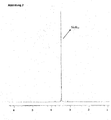
- 50,8 g (0,14 mol) Octachlortrisilan wurden bei Raumtemperatur unter Rühren 40,0 mg (3,6x10⁻⁴ mol; 0,25mol%) 1,4-Diazabicyclo[2.2.2]octan in 0,5 ml Diethylether versetzt, woraufhin sich das Reaktionsgemisch durch den gebildeten weißen Feststoff innerhalb von 2 Stunden verfestigte. Nach Entfernung der flüchtigen Bestandteile (SiCl4) bei 40 °C im Vakuum (0,05 mbar) verbleibt das Produkt Si5Cl12 als weißer, kristalliner Feststoff. Als verbleibendes Hauptprodukt entsteht It. 29Si-NMR Spektroskopie (vgl.
Abbildung 1 ) praktisch reines Si5Cl12. Die Ausbeuten deuten auf die nachfolgende Reaktionsgleichung hin: 2 Si3C18 → Si5Cl12 + SiCl4Ausbeute Si5Cl12: 37.0 g Ausbeute SiCl4: 13.0g - 5,1 g (0,014 mol) Octachlortrisilan wurden bei Raumtemperatur unter Rühren mit einer Lösung von 3,7 mg (3,3x10⁻⁵ mol; 0,25mol%) N,N-Dimethylpiperazin in 0,04 ml Diethylether versetzt, woraufhin sich das Reaktionsgemisch durch den gebildeten weißen Feststoff innerhalb von 2 Stunden verfestigte. Nach Entfernung der flüchtigen Bestandteile bei 40 °C im Vakuum (0,05 mbar) verbleibt das Produkt als weißer, kristalliner Feststoff, der mittels 29Si-NMR Spektroskopie als reines Si5Cl12 identifiert werden konnte.
Ausbeute Si5C112: 3.7 g - 5,1 g (0,014 mol) Octachlortrisilan wurden bei Raumtemperatur unter Rühren mit 4,4 mg (4.0x10⁻⁵ mol; 0.3 mol%) N,N-Dimethylpiperazin versetzt, woraufhin sich das Reaktionsgemisch durch den gebildeten weißen Feststoff innerhalb von 24 Stunden verfestigte. Nach Entfernung der flüchtigen Bestandteile bei 40 °C im Vakuum (0,05 mbar) verbleibt das Produkt als weißer, kristalliner Feststoff, der mittels 29Si-NMR Spektroskopie als reines Si5Cl12 identifiert werden konnte.
Ausbeute Si5Cl12: 3,7 g - 5,1 g (0,014 mol) Octachlortrisilan wurden bei Raumtemperatur unter Rühren mit einer Lösung von 2,8 mg (3,5x10⁻⁵ mol; 0,25mol%) Pyridin in 0,04 ml Diethylether versetzt, woraufhin sich das Reaktionsgemisch durch den gebildeten weißen Feststoff innerhalb von 12 Stunden verfestigte. Nach Entfernung der flüchtigen Bestandteile bei 40 °C im Vakuum (0,05 mbar) verbleibt das Produkt als kristalliner Feststoff, der mittels 29Si-NMR Spektroskopie als reines Si5Cl12 identifiert werden konnte.
Ausbeute Si5Cl12: 3,7_g - 5,1 g (0,014 mol) Octachlortrisilan wurden bei Raumtemperatur unter Rühren mit 3.5 mg (4.2x10⁻⁵ mol; 0.3mol%) Pyridin versetzt, woraufhin sich das Reaktionsgemisch durch den gebildeten weißen Feststoff innerhalb von 12 Stunden verfestigte. Nach Entfernung der flüchtigen Bestandteile bei 40 °C im Vakuum (0,05 mbar) verbleibt das Produkt als kristalliner Feststoff, der mittels 29Si-NMR Spektroskopie als reines Si5Cl12 identifiert werden konnte. Die Ausbeuten deuten auf die nachfolgende Reaktionsgleichung hin:
Ausbeute Si5Cl12: 3,7 g - 50 g eines aus der Synthese von Octachlortrisilan stammenden, nach der destillativen Abtrennung von Octachlortrisilan verbleibenden Gemisches höherer Chlorsilane mit mindestens 4 Si-Atomen wurde bei Raumtemperatur unter Rühren mit 40,0 mg (3,6x10⁻⁴ mol) 1,4-Diazabicyclo[2.2.2]octan in 0,5 ml Diethylether versetzt, woraufhin sich das Reaktionsgemisch durch den gebildeten weißen Feststoff innerhalb von 12 Stunden verfestigte. Nach Entfernung der flüchtigen Bestandteile (SiCl4) bei 40 °C im Vakuum (0,05 mbar) verbleibt ein weißer, kristalliner Feststoff.
Ausbeute Si5Cl12: 44,0 g Ausbeute SiCl4: 6,0 g - Fazit: Auch höhere Chlorsilane lassen sich katalytisch zu Si5Cl12 umlagern. Die Ausbeute steigt sogar im Vergleich zu Di- oder Trisilan noch an, während die Produktqualität durchaus ansprechend bleibt. Die Reaktionsgeschwindigkeit ist relativ zu Si3Cl8 etwas geringer.
- 38,0 g (0,067 mol) Tetrakis(trichlorsilyl)silan wurden unter Eiskühlung mit 131 g (0,92 mol) Diisobutylaluminiumhydrid versetzt und über Nacht bei Raumtemperatur gerührt. Anschließend wurde das Produkt durch Umkondensieren im Vakuum (0,05 mbar, Raumtemperatur) aus dem Reaktionsgemisch isoliert; wobei eine klare, farblose Flüssigkeit erhalten wurden.
Das 1H-NMR (Abbildung 2 ) zeigt als Hauptprodukt Si5H12Ausbeute: 9,7 g - 60 g (0,22 mol) Hexachlordisilan wurden bei Raumtemperatur unter Rühren mit 60,0 mg (5,4x10⁻⁴ mol; 0,24mol%) 1,4-Diazabicyclo[2.2.2]octan in 0,5 ml Diethylether versetzt, woraufhin sich das Reaktionsgemisch durch den gebildeten weißen Feststoff innerhalb von 15 Stunden verfestigte. Nach Entfernung der flüchtigen Bestandteile bei 40 °C im Vakuum (0,05 mbar) verbleibt das Produkt als weißer, kristalliner Feststoff. Als Reaktionsprodukt entsteht It. 29Si-NMR Spektroskopie praktisch reines Si5Cl12.
Ausbeute Si5Cl12: 29,6 g Ausbeute SiCl4: 28,0 g - Si3Cl8 und höhere Chlorsilane lassen sich katalytisch zu Si5Cl12 umlagern. Die Ausbeuten sind höher als im Falle des Einsatzes von Si2Cl6. Die Reaktionsgeschwindigkeit ist relativ zu dem Einsatz von Si2Cl6 deutlich größer.
Claims (8)
- Verfahren zur Herstellung von Hydridosilanen aus Halogensilanen,
dadurch gekennzeichnet, dassa)i) mindestens ein Halogensilan der generischen Formel SinX2n+2 (mit n ≥ 3 und X = F, Cl, Br und/oder I) undii) mindestens ein Katalysator der generischen Formel
NRR'aR"bYc
mit a = 0 oder 1, b = 0 oder 1, und c = 0 oder 1, und
 aa)- R, R' und/oder R" gleich -C1-C12-Alkyl, -C1-C12-Aryl, -C1-C12-Aralkyl, -C1-C12-Aminoalkyl, -C1-C12-Aminoaryl, -C1-C12-Aminoaralkyl, und/oder- zwei oder drei Reste R, R' und R" im Falle von c = 0 gemeinsam ein N einschließendes cyclisches oder bicyclisches, heteroaliphatisches oder heteraromatisches System bilden,- mit der Maßgabe, dass mindestens ein Rest R,R' oder R" nicht -CH3 ist
und/oderbb)- R und R' und/oder R" (im Falle von c = 1) gleich -C1-C12-Alkylen, -C1-C12-Arylen, -C1-C12-Aralkylen, -C1-C12-Heteroalkylen, -C1-C12-Hetero-arylen, -C1-C12-Heteroaralkylen und/oder -N= ist,
odercc)- (im Falle von a = b = c = 0) R = ≡C-R"' (mit R'" = -C1-C10-Alkyl, -C1-C10-Aryl und/oder -C1-C10-Aralkyl) ist,
unter Bildung eines Gemisches umfassend mindestens ein Halogensilan der generischen Formel SimX2m+2 (mit m > n und X = F, Cl, Br und/oder I) und SiX4 (mit X = F, Cl, Br und/oder I) umgesetzt werden,
undb) das mindestens eine Halogensilan der generischen Formel ,SimX2m+2 unter Bildung eines Hydridosilans der generischen Formel SimH2m+2 hydriert wird. - Verfahren nach einem Anspruch 1
dadurch gekennzeichnet, dass
das Halogensilan der generischen Formel SinX2n+2 ein lineares Silan ist. - Verfahren nach Anspruch 1 oder 2,
dadurch gekennzeichnet, dass
das mindestens eine Halogensilan eine Verbindung ausgewählt aus der Gruppe der Verbindungen mit der generischen Formel Si3X8 oder Si4X10 mit X = F, Cl, Br und/oder I ist. - Verfahren nach einem der vorhergehenden Ansprüche,
dadurch gekennzeichnet, dass
der Katalysator ausgewählt aus der Gruppe an Verbindungen bestehend aus cyclischen, bicyclischen oder polycyclischen Aminen mit oder ohne weiteren Heteroatomen ist. - Verfahren nach Anspruch 4,
dadurch gekennzeichnet, dass
der Katalysator Diazabicyclooctan, Pyridin oder N,N-1,4-Dimethylpiperazin ist. - Verfahren nach einem der vorhergehenden Ansprüche,
dadurch gekennzeichnet, dass
dass vor der Hydrierung eine Abtrennung des mindestens einen Halogensilans der generischen Formel SimX2m+2 von SiX4 durch Abdestillieren bzw. Abziehen von SiX4 bei Temperaturen von -30 bis +100 °C und Drücken von 0,01 bis 1100 mbar erfolgt. - Verfahren nach einem der vorhergehenden Ansprüche,
dadurch gekennzeichnet, dass
die Hydrierung durch Zugabe mindestens eines Hydrierungsmittels ausgewählt aus der Gruppe der Metallhydride eines Metalls der 1. bis 3. Hauptgruppe oder der Gruppe der hydridischen Verbindungen bestehend aus LiAlH4, NaBH4, iBu2AlH erfolgt. - Verfahren nach Anspruch 7,
dadurch gekennzeichnet, dass
das Hydrierungsmittel bevorzugt in einem 2- bis 30-fachen, bevorzugt 10- bis 15-fachen molaren Überschuß, bezogen auf die anwesenden Halogensilane, vorliegt.
Applications Claiming Priority (2)
| Application Number | Priority Date | Filing Date | Title |
|---|---|---|---|
| DE102009053804A DE102009053804B3 (de) | 2009-11-18 | 2009-11-18 | Verfahren zur Herstellung von Hydridosilanen |
| PCT/EP2010/067016 WO2011061088A1 (de) | 2009-11-18 | 2010-11-08 | Verfahren zur herstellung von hydridosilanen |
Publications (2)
| Publication Number | Publication Date |
|---|---|
| EP2501650A1 EP2501650A1 (de) | 2012-09-26 |
| EP2501650B1 true EP2501650B1 (de) | 2016-09-07 |
Family
ID=43571278
Family Applications (1)
| Application Number | Title | Priority Date | Filing Date |
|---|---|---|---|
| EP10788261.5A Not-in-force EP2501650B1 (de) | 2009-11-18 | 2010-11-08 | Verfahren zur herstellung von hydridosilanen |
Country Status (11)
| Country | Link |
|---|---|
| US (1) | US9017630B2 (de) |
| EP (1) | EP2501650B1 (de) |
| JP (1) | JP5832441B2 (de) |
| KR (1) | KR101766498B1 (de) |
| CN (1) | CN102596806B (de) |
| AU (1) | AU2010321106B2 (de) |
| DE (1) | DE102009053804B3 (de) |
| ES (1) | ES2604350T3 (de) |
| MY (1) | MY160145A (de) |
| TW (1) | TWI504566B (de) |
| WO (1) | WO2011061088A1 (de) |
Families Citing this family (28)
| Publication number | Priority date | Publication date | Assignee | Title |
|---|---|---|---|---|
| DE102005041137A1 (de) | 2005-08-30 | 2007-03-01 | Degussa Ag | Reaktor, Anlage und großtechnisches Verfahren zur kontinuierlichen Herstellung von hochreinem Siliciumtetrachlorid oder hochreinem Germaniumtetrachlorid |
| DE102007007874A1 (de) | 2007-02-14 | 2008-08-21 | Evonik Degussa Gmbh | Verfahren zur Herstellung höherer Silane |
| DE102007050199A1 (de) * | 2007-10-20 | 2009-04-23 | Evonik Degussa Gmbh | Entfernung von Fremdmetallen aus anorganischen Silanen |
| DE102007059170A1 (de) * | 2007-12-06 | 2009-06-10 | Evonik Degussa Gmbh | Katalysator und Verfahren zur Dismutierung von Wasserstoff enthaltenden Halogensilanen |
| DE102008004396A1 (de) * | 2008-01-14 | 2009-07-16 | Evonik Degussa Gmbh | Anlage und Verfahren zur Verminderung des Gehaltes von Elementen, wie Bor, in Halogensilanen |
| DE102008002537A1 (de) * | 2008-06-19 | 2009-12-24 | Evonik Degussa Gmbh | Verfahren zur Entfernung von Bor enthaltenden Verunreinigungen aus Halogensilanen sowie Anlage zur Durchführung des Verfahrens |
| DE102008043422B3 (de) | 2008-11-03 | 2010-01-07 | Evonik Degussa Gmbh | Verfahren zur Aufreinigung niedermolekularer Hydridosilane |
| DE102009002758A1 (de) | 2009-04-30 | 2010-11-11 | Evonik Degussa Gmbh | Bandgap Tailoring von Solarzellen aus Flüssigsilan mittels Germanium-Zugabe |
| DE102009027730A1 (de) | 2009-07-15 | 2011-01-27 | Evonik Degussa Gmbh | Verahren und Verwendung von aminofunktionellen Harzen zur Dismutierung von Halogensilanen und zur Entfernung von Fremdmetallen |
| DE102009048087A1 (de) | 2009-10-02 | 2011-04-07 | Evonik Degussa Gmbh | Verfahren zur Herstellung höherer Hydridosilane |
| DE102009053806A1 (de) | 2009-11-18 | 2011-05-19 | Evonik Degussa Gmbh | Verfahren zur Herstellung von Siliciumschichten |
| DE102010002342A1 (de) | 2010-02-25 | 2011-08-25 | Evonik Degussa GmbH, 45128 | Verwendung der spezifischen Widerstandsmessung zur indirekten Bestimmung der Reinheit von Silanen und Germanen und ein entsprechendes Verfahren |
| DE102010040231A1 (de) | 2010-09-03 | 2012-03-08 | Evonik Degussa Gmbh | p-Dotierte Siliciumschichten |
| DE102010041842A1 (de) | 2010-10-01 | 2012-04-05 | Evonik Degussa Gmbh | Verfahren zur Herstellung höherer Hydridosilanverbindungen |
| DE102010043648A1 (de) | 2010-11-09 | 2012-05-10 | Evonik Degussa Gmbh | Verfahren zur selektiven Spaltung höherer Silane |
| DE102010062984A1 (de) | 2010-12-14 | 2012-06-14 | Evonik Degussa Gmbh | Verfahren zur Herstellung höherer Halogen- und Hydridosilane |
| DE102010063823A1 (de) | 2010-12-22 | 2012-06-28 | Evonik Degussa Gmbh | Verfahren zur Herstellung von Hydridosilanen |
| DE102011004058A1 (de) | 2011-02-14 | 2012-08-16 | Evonik Degussa Gmbh | Monochlorsilan, Verfahren und Vorrichtung zu dessen Herstellung |
| DE102012221669A1 (de) | 2012-11-27 | 2014-05-28 | Evonik Industries Ag | Verfahren zum Herstellen kohlenstoffhaltiger Hydridosilane |
| DE102012224202A1 (de) | 2012-12-21 | 2014-07-10 | Evonik Industries Ag | Verfahren zum Hydrieren höherer Halogen-haltiger Silanverbindungen |
| DE102013010102A1 (de) * | 2013-06-18 | 2014-12-18 | Evonik Industries Ag | Formulierungen umfassend Hydridosilane und Hydridosilan-Oligomere, Verfahren zu ihrer Herstellung und ihrer Verwendung |
| DE102013010101A1 (de) * | 2013-06-18 | 2014-12-18 | Evonik Industries Ag | Formulierungen umfassend Hydridosilane und Hydridosilan-Oligomere, Verfahren zu ihrer Herstellung und ihrer Verwendung |
| DE102014018435A1 (de) * | 2014-12-10 | 2016-06-16 | Silicon Products Bitterfeld GmbH&CO.KG | Verfahren zur Gewinnung von Hexachlordisilan aus in Prozessabgasströmen enthaltenen Gemischen von Chlorsilanen |
| EP3409645B1 (de) * | 2017-06-01 | 2019-10-02 | Evonik Degussa GmbH | Triphenylgermylsilan und trichlorsilyl-trichlorgerman für die erzeugung von germanium-silizium-schichten sowie verfahren zu deren herstellung aus trichlorsilyl-triphenylgerman |
| US12264074B2 (en) * | 2017-06-29 | 2025-04-01 | Nata Semiconductor Materials Co., Ltd. | Synthesis of 1,1,1-trichlorodisilane |
| EP3587348B1 (de) | 2018-06-29 | 2021-08-11 | Evonik Operations GmbH | Teilhydrierte chlorsilane und verfahren zur herstellung davon durch selektive hydrierung |
| EP3659964A1 (de) | 2018-11-28 | 2020-06-03 | Hysilabs, SAS | Katalysiertes verfahren zur herstellung von wasserstoff aus silylierten derivaten als wasserstoffträgerverbindungen |
| CN115417413B (zh) * | 2022-08-31 | 2024-01-09 | 南大光电半导体材料有限公司 | 一种新戊硅烷中间体制备方法及其应用 |
Family Cites Families (32)
| Publication number | Priority date | Publication date | Assignee | Title |
|---|---|---|---|---|
| GB2077710B (en) * | 1980-06-11 | 1983-10-12 | Nat Res Dev | Synthesising a polysilane |
| US4395389A (en) * | 1982-03-01 | 1983-07-26 | Ethyl Corporation | Chlorosilane disproportionation process |
| JPS60176915A (ja) * | 1984-02-21 | 1985-09-11 | Central Glass Co Ltd | ジシランの製造法 |
| JPH02184513A (ja) * | 1989-01-11 | 1990-07-19 | Tonen Sekiyukagaku Kk | ジシランおよびトリシランの製造方法 |
| US4965386A (en) * | 1990-03-26 | 1990-10-23 | E. I. Du Pont De Nemours And Company | Hydrosilation, and dehydrocondensation of silicon hydrides, catalyzed by scandium, yttrium and rare earth metal compounds |
| US5252766A (en) * | 1990-09-14 | 1993-10-12 | Director-General Of Agency Of Industrial Science | Method for producing polysilanes |
| US5700400A (en) * | 1993-06-15 | 1997-12-23 | Nippon Oil Co., Ltd. | Method for producing a semiconducting material |
| JP3598388B2 (ja) * | 1994-03-22 | 2004-12-08 | 大阪瓦斯株式会社 | ポリシラン類の製造方法 |
| US6027705A (en) * | 1998-01-08 | 2000-02-22 | Showa Denko K.K. | Method for producing a higher silane |
| JP2003119200A (ja) * | 2001-10-10 | 2003-04-23 | Jsr Corp | シラン類の製造方法 |
| JP2003313190A (ja) * | 2002-04-19 | 2003-11-06 | Jsr Corp | シラン類の製造方法 |
| DE102004037675A1 (de) | 2004-08-04 | 2006-03-16 | Degussa Ag | Verfahren und Vorrichtung zur Reinigung von Wasserstoffverbindungen enthaltendem Siliciumtetrachlorid oder Germaniumtetrachlorid |
| DE102004045245B4 (de) | 2004-09-17 | 2007-11-15 | Degussa Gmbh | Vorrichtung und Verfahren zur Herstellung von Silanen |
| DE102005041137A1 (de) | 2005-08-30 | 2007-03-01 | Degussa Ag | Reaktor, Anlage und großtechnisches Verfahren zur kontinuierlichen Herstellung von hochreinem Siliciumtetrachlorid oder hochreinem Germaniumtetrachlorid |
| DE102005046105B3 (de) | 2005-09-27 | 2007-04-26 | Degussa Gmbh | Verfahren zur Herstellung von Monosilan |
| US8147789B2 (en) | 2006-10-24 | 2012-04-03 | Dow Corning Corporation | Composition comprising neopentasilane and method of preparing same |
| DE102007007874A1 (de) | 2007-02-14 | 2008-08-21 | Evonik Degussa Gmbh | Verfahren zur Herstellung höherer Silane |
| DE102007014107A1 (de) | 2007-03-21 | 2008-09-25 | Evonik Degussa Gmbh | Aufarbeitung borhaltiger Chlorsilanströme |
| DE102007050199A1 (de) | 2007-10-20 | 2009-04-23 | Evonik Degussa Gmbh | Entfernung von Fremdmetallen aus anorganischen Silanen |
| DE102007050573A1 (de) | 2007-10-23 | 2009-04-30 | Evonik Degussa Gmbh | Großgebinde zur Handhabung und für den Transport von hochreinen und ultra hochreinen Chemikalien |
| DE102007059170A1 (de) | 2007-12-06 | 2009-06-10 | Evonik Degussa Gmbh | Katalysator und Verfahren zur Dismutierung von Wasserstoff enthaltenden Halogensilanen |
| DE102008004397A1 (de) | 2008-01-14 | 2009-07-16 | Evonik Degussa Gmbh | Verfahren zur Verminderung des Gehaltes von Elementen, wie Bor, in Halogensilanen sowie Anlage zur Durchführung des Verfahrens |
| DE102008004396A1 (de) | 2008-01-14 | 2009-07-16 | Evonik Degussa Gmbh | Anlage und Verfahren zur Verminderung des Gehaltes von Elementen, wie Bor, in Halogensilanen |
| EP2135844A1 (de) | 2008-06-17 | 2009-12-23 | Evonik Degussa GmbH | Verfahren zur Herstellung höherer Hydridosilane |
| DE102008002537A1 (de) | 2008-06-19 | 2009-12-24 | Evonik Degussa Gmbh | Verfahren zur Entfernung von Bor enthaltenden Verunreinigungen aus Halogensilanen sowie Anlage zur Durchführung des Verfahrens |
| DE102008043422B3 (de) | 2008-11-03 | 2010-01-07 | Evonik Degussa Gmbh | Verfahren zur Aufreinigung niedermolekularer Hydridosilane |
| DE102009002758A1 (de) | 2009-04-30 | 2010-11-11 | Evonik Degussa Gmbh | Bandgap Tailoring von Solarzellen aus Flüssigsilan mittels Germanium-Zugabe |
| DE102009027728A1 (de) | 2009-07-15 | 2011-01-20 | Evonik Degussa Gmbh | Verfahren zur Behandlung von Katalysator-Präkursoren |
| DE102009027730A1 (de) | 2009-07-15 | 2011-01-27 | Evonik Degussa Gmbh | Verahren und Verwendung von aminofunktionellen Harzen zur Dismutierung von Halogensilanen und zur Entfernung von Fremdmetallen |
| DE102010002342A1 (de) | 2010-02-25 | 2011-08-25 | Evonik Degussa GmbH, 45128 | Verwendung der spezifischen Widerstandsmessung zur indirekten Bestimmung der Reinheit von Silanen und Germanen und ein entsprechendes Verfahren |
| DE102010002405A1 (de) | 2010-02-26 | 2011-09-01 | Evonik Degussa Gmbh | Verfahren zur Oligomerisierung von Hydridosilanen, die mit dem Verfahren herstellbaren Oligomerisate und ihre Verwendung |
| DE102010040231A1 (de) | 2010-09-03 | 2012-03-08 | Evonik Degussa Gmbh | p-Dotierte Siliciumschichten |
-
2009
- 2009-11-18 DE DE102009053804A patent/DE102009053804B3/de not_active Expired - Fee Related
-
2010
- 2010-11-08 US US13/504,331 patent/US9017630B2/en not_active Expired - Fee Related
- 2010-11-08 MY MYPI2012001983A patent/MY160145A/en unknown
- 2010-11-08 JP JP2012539266A patent/JP5832441B2/ja not_active Expired - Fee Related
- 2010-11-08 ES ES10788261.5T patent/ES2604350T3/es active Active
- 2010-11-08 AU AU2010321106A patent/AU2010321106B2/en not_active Ceased
- 2010-11-08 EP EP10788261.5A patent/EP2501650B1/de not_active Not-in-force
- 2010-11-08 KR KR1020127012723A patent/KR101766498B1/ko not_active Expired - Fee Related
- 2010-11-08 CN CN201080052337.7A patent/CN102596806B/zh not_active Expired - Fee Related
- 2010-11-08 WO PCT/EP2010/067016 patent/WO2011061088A1/de not_active Ceased
- 2010-11-15 TW TW099139202A patent/TWI504566B/zh not_active IP Right Cessation
Also Published As
| Publication number | Publication date |
|---|---|
| KR101766498B1 (ko) | 2017-08-08 |
| EP2501650A1 (de) | 2012-09-26 |
| AU2010321106A1 (en) | 2012-05-10 |
| JP5832441B2 (ja) | 2015-12-16 |
| AU2010321106B2 (en) | 2014-10-02 |
| US9017630B2 (en) | 2015-04-28 |
| CN102596806B (zh) | 2015-12-16 |
| TWI504566B (zh) | 2015-10-21 |
| TW201134763A (en) | 2011-10-16 |
| ES2604350T3 (es) | 2017-03-06 |
| KR20120120133A (ko) | 2012-11-01 |
| US20120214005A1 (en) | 2012-08-23 |
| CN102596806A (zh) | 2012-07-18 |
| DE102009053804B3 (de) | 2011-03-17 |
| WO2011061088A1 (de) | 2011-05-26 |
| MY160145A (en) | 2017-02-28 |
| JP2013511459A (ja) | 2013-04-04 |
Similar Documents
| Publication | Publication Date | Title |
|---|---|---|
| DE102009053804B3 (de) | Verfahren zur Herstellung von Hydridosilanen | |
| EP2655254B1 (de) | Verfahren zur herstellung von hydridosilanen | |
| EP2651825B1 (de) | Verfahren zur herstellung höherer halogen- und hydridosilane | |
| EP2507172B1 (de) | Verfahren zur herstellung von oligosilanen | |
| EP2935091B1 (de) | Verfahren zum hydrieren höherer halogen-haltiger silanverbindungen | |
| DE102011110040A1 (de) | Verfahren zur Herstellung von Chlorsilanen mittels hoch-siedender Chlorsilane oder chlorsilanhaltiger Gemische | |
| EP2334599A1 (de) | Verfahren zur herstellung von neopentasilanen | |
| DE19812587C1 (de) | Verfahren zur Hydrierung halogensubstituierter Siliziumverbindungen | |
| EP2467390B1 (de) | Katalysator zur hydrodechlorierung von chlorsilanen zu hydrogensilanen und verfahren zur darstellung von hydrogensilanen mit diesem katalysator | |
| DE69930733T2 (de) | Herstellung von substituierten (amino)alkoxysilanen | |
| DE102012216356A1 (de) | Verfahren zur Herstellung von Chlorsilanen mittels hochsiedender Chlorsilane oder chlorsilanhaltiger Gemische | |
| EP3653577B1 (de) | Tris(trichlorsilyl)dichlorogallylgerman, verfahren zu dessen herstellung und dessen verwendung | |
| DE2101207A1 (de) | Cyclische Stickstoff enthaltende Organosihciumverbindungen | |
| DE102023131728A1 (de) | Verfahren zur Herstellung von Hydridoalkoxysilanen | |
| DE102015105690B4 (de) | Verfahren zum Herstellen einer cyclischen Silanverbindung | |
| WO2022111758A1 (de) | Polycyclische silicium-germanium-verbindungen, verfahren zur herstellung derselben sowie die verwendung derselben zum herstellen eines si- und ge-enthaltenden festkörpers |
Legal Events
| Date | Code | Title | Description |
|---|---|---|---|
| PUAI | Public reference made under article 153(3) epc to a published international application that has entered the european phase |
Free format text: ORIGINAL CODE: 0009012 |
|
| 17P | Request for examination filed |
Effective date: 20120424 |
|
| AK | Designated contracting states |
Kind code of ref document: A1 Designated state(s): AL AT BE BG CH CY CZ DE DK EE ES FI FR GB GR HR HU IE IS IT LI LT LU LV MC MK MT NL NO PL PT RO RS SE SI SK SM TR |
|
| DAX | Request for extension of the european patent (deleted) | ||
| 17Q | First examination report despatched |
Effective date: 20131104 |
|
| GRAP | Despatch of communication of intention to grant a patent |
Free format text: ORIGINAL CODE: EPIDOSNIGR1 |
|
| INTG | Intention to grant announced |
Effective date: 20160513 |
|
| GRAS | Grant fee paid |
Free format text: ORIGINAL CODE: EPIDOSNIGR3 |
|
| GRAA | (expected) grant |
Free format text: ORIGINAL CODE: 0009210 |
|
| AK | Designated contracting states |
Kind code of ref document: B1 Designated state(s): AL AT BE BG CH CY CZ DE DK EE ES FI FR GB GR HR HU IE IS IT LI LT LU LV MC MK MT NL NO PL PT RO RS SE SI SK SM TR |
|
| REG | Reference to a national code |
Ref country code: GB Ref legal event code: FG4D Free format text: NOT ENGLISH |
|
| REG | Reference to a national code |
Ref country code: CH Ref legal event code: EP |
|
| REG | Reference to a national code |
Ref country code: IE Ref legal event code: FG4D Free format text: LANGUAGE OF EP DOCUMENT: GERMAN |
|
| REG | Reference to a national code |
Ref country code: AT Ref legal event code: REF Ref document number: 826668 Country of ref document: AT Kind code of ref document: T Effective date: 20161015 |
|
| REG | Reference to a national code |
Ref country code: DE Ref legal event code: R096 Ref document number: 502010012378 Country of ref document: DE |
|
| REG | Reference to a national code |
Ref country code: FR Ref legal event code: PLFP Year of fee payment: 7 |
|
| REG | Reference to a national code |
Ref country code: NL Ref legal event code: FP |
|
| REG | Reference to a national code |
Ref country code: LT Ref legal event code: MG4D |
|
| PG25 | Lapsed in a contracting state [announced via postgrant information from national office to epo] |
Ref country code: LT Free format text: LAPSE BECAUSE OF FAILURE TO SUBMIT A TRANSLATION OF THE DESCRIPTION OR TO PAY THE FEE WITHIN THE PRESCRIBED TIME-LIMIT Effective date: 20160907 Ref country code: NO Free format text: LAPSE BECAUSE OF FAILURE TO SUBMIT A TRANSLATION OF THE DESCRIPTION OR TO PAY THE FEE WITHIN THE PRESCRIBED TIME-LIMIT Effective date: 20161207 Ref country code: FI Free format text: LAPSE BECAUSE OF FAILURE TO SUBMIT A TRANSLATION OF THE DESCRIPTION OR TO PAY THE FEE WITHIN THE PRESCRIBED TIME-LIMIT Effective date: 20160907 Ref country code: HR Free format text: LAPSE BECAUSE OF FAILURE TO SUBMIT A TRANSLATION OF THE DESCRIPTION OR TO PAY THE FEE WITHIN THE PRESCRIBED TIME-LIMIT Effective date: 20160907 Ref country code: RS Free format text: LAPSE BECAUSE OF FAILURE TO SUBMIT A TRANSLATION OF THE DESCRIPTION OR TO PAY THE FEE WITHIN THE PRESCRIBED TIME-LIMIT Effective date: 20160907 |
|
| PG25 | Lapsed in a contracting state [announced via postgrant information from national office to epo] |
Ref country code: LV Free format text: LAPSE BECAUSE OF FAILURE TO SUBMIT A TRANSLATION OF THE DESCRIPTION OR TO PAY THE FEE WITHIN THE PRESCRIBED TIME-LIMIT Effective date: 20160907 Ref country code: SE Free format text: LAPSE BECAUSE OF FAILURE TO SUBMIT A TRANSLATION OF THE DESCRIPTION OR TO PAY THE FEE WITHIN THE PRESCRIBED TIME-LIMIT Effective date: 20160907 Ref country code: GR Free format text: LAPSE BECAUSE OF FAILURE TO SUBMIT A TRANSLATION OF THE DESCRIPTION OR TO PAY THE FEE WITHIN THE PRESCRIBED TIME-LIMIT Effective date: 20161208 |
|
| REG | Reference to a national code |
Ref country code: ES Ref legal event code: FG2A Ref document number: 2604350 Country of ref document: ES Kind code of ref document: T3 Effective date: 20170306 |
|
| PG25 | Lapsed in a contracting state [announced via postgrant information from national office to epo] |
Ref country code: RO Free format text: LAPSE BECAUSE OF FAILURE TO SUBMIT A TRANSLATION OF THE DESCRIPTION OR TO PAY THE FEE WITHIN THE PRESCRIBED TIME-LIMIT Effective date: 20160907 Ref country code: EE Free format text: LAPSE BECAUSE OF FAILURE TO SUBMIT A TRANSLATION OF THE DESCRIPTION OR TO PAY THE FEE WITHIN THE PRESCRIBED TIME-LIMIT Effective date: 20160907 |
|
| PG25 | Lapsed in a contracting state [announced via postgrant information from national office to epo] |
Ref country code: BG Free format text: LAPSE BECAUSE OF FAILURE TO SUBMIT A TRANSLATION OF THE DESCRIPTION OR TO PAY THE FEE WITHIN THE PRESCRIBED TIME-LIMIT Effective date: 20161207 Ref country code: IS Free format text: LAPSE BECAUSE OF FAILURE TO SUBMIT A TRANSLATION OF THE DESCRIPTION OR TO PAY THE FEE WITHIN THE PRESCRIBED TIME-LIMIT Effective date: 20170107 Ref country code: SM Free format text: LAPSE BECAUSE OF FAILURE TO SUBMIT A TRANSLATION OF THE DESCRIPTION OR TO PAY THE FEE WITHIN THE PRESCRIBED TIME-LIMIT Effective date: 20160907 Ref country code: PL Free format text: LAPSE BECAUSE OF FAILURE TO SUBMIT A TRANSLATION OF THE DESCRIPTION OR TO PAY THE FEE WITHIN THE PRESCRIBED TIME-LIMIT Effective date: 20160907 Ref country code: CZ Free format text: LAPSE BECAUSE OF FAILURE TO SUBMIT A TRANSLATION OF THE DESCRIPTION OR TO PAY THE FEE WITHIN THE PRESCRIBED TIME-LIMIT Effective date: 20160907 Ref country code: PT Free format text: LAPSE BECAUSE OF FAILURE TO SUBMIT A TRANSLATION OF THE DESCRIPTION OR TO PAY THE FEE WITHIN THE PRESCRIBED TIME-LIMIT Effective date: 20170109 Ref country code: SK Free format text: LAPSE BECAUSE OF FAILURE TO SUBMIT A TRANSLATION OF THE DESCRIPTION OR TO PAY THE FEE WITHIN THE PRESCRIBED TIME-LIMIT Effective date: 20160907 |
|
| REG | Reference to a national code |
Ref country code: DE Ref legal event code: R097 Ref document number: 502010012378 Country of ref document: DE |
|
| REG | Reference to a national code |
Ref country code: CH Ref legal event code: PL |
|
| PLBE | No opposition filed within time limit |
Free format text: ORIGINAL CODE: 0009261 |
|
| STAA | Information on the status of an ep patent application or granted ep patent |
Free format text: STATUS: NO OPPOSITION FILED WITHIN TIME LIMIT |
|
| PG25 | Lapsed in a contracting state [announced via postgrant information from national office to epo] |
Ref country code: LI Free format text: LAPSE BECAUSE OF NON-PAYMENT OF DUE FEES Effective date: 20161130 Ref country code: DK Free format text: LAPSE BECAUSE OF FAILURE TO SUBMIT A TRANSLATION OF THE DESCRIPTION OR TO PAY THE FEE WITHIN THE PRESCRIBED TIME-LIMIT Effective date: 20160907 Ref country code: CH Free format text: LAPSE BECAUSE OF NON-PAYMENT OF DUE FEES Effective date: 20161130 |
|
| 26N | No opposition filed |
Effective date: 20170608 |
|
| REG | Reference to a national code |
Ref country code: IE Ref legal event code: MM4A |
|
| PG25 | Lapsed in a contracting state [announced via postgrant information from national office to epo] |
Ref country code: SI Free format text: LAPSE BECAUSE OF FAILURE TO SUBMIT A TRANSLATION OF THE DESCRIPTION OR TO PAY THE FEE WITHIN THE PRESCRIBED TIME-LIMIT Effective date: 20160907 |
|
| PG25 | Lapsed in a contracting state [announced via postgrant information from national office to epo] |
Ref country code: LU Free format text: LAPSE BECAUSE OF NON-PAYMENT OF DUE FEES Effective date: 20161130 |
|
| REG | Reference to a national code |
Ref country code: FR Ref legal event code: PLFP Year of fee payment: 8 |
|
| PG25 | Lapsed in a contracting state [announced via postgrant information from national office to epo] |
Ref country code: IE Free format text: LAPSE BECAUSE OF NON-PAYMENT OF DUE FEES Effective date: 20161108 |
|
| REG | Reference to a national code |
Ref country code: AT Ref legal event code: MM01 Ref document number: 826668 Country of ref document: AT Kind code of ref document: T Effective date: 20161108 |
|
| PG25 | Lapsed in a contracting state [announced via postgrant information from national office to epo] |
Ref country code: AT Free format text: LAPSE BECAUSE OF NON-PAYMENT OF DUE FEES Effective date: 20161108 |
|
| PGFP | Annual fee paid to national office [announced via postgrant information from national office to epo] |
Ref country code: DE Payment date: 20171121 Year of fee payment: 8 Ref country code: FR Payment date: 20171121 Year of fee payment: 8 Ref country code: NL Payment date: 20171120 Year of fee payment: 8 |
|
| PGFP | Annual fee paid to national office [announced via postgrant information from national office to epo] |
Ref country code: ES Payment date: 20171220 Year of fee payment: 8 Ref country code: BE Payment date: 20171120 Year of fee payment: 8 Ref country code: IT Payment date: 20171124 Year of fee payment: 8 Ref country code: GB Payment date: 20171123 Year of fee payment: 8 |
|
| PG25 | Lapsed in a contracting state [announced via postgrant information from national office to epo] |
Ref country code: CY Free format text: LAPSE BECAUSE OF FAILURE TO SUBMIT A TRANSLATION OF THE DESCRIPTION OR TO PAY THE FEE WITHIN THE PRESCRIBED TIME-LIMIT Effective date: 20160907 Ref country code: HU Free format text: LAPSE BECAUSE OF FAILURE TO SUBMIT A TRANSLATION OF THE DESCRIPTION OR TO PAY THE FEE WITHIN THE PRESCRIBED TIME-LIMIT; INVALID AB INITIO Effective date: 20101108 |
|
| PG25 | Lapsed in a contracting state [announced via postgrant information from national office to epo] |
Ref country code: TR Free format text: LAPSE BECAUSE OF FAILURE TO SUBMIT A TRANSLATION OF THE DESCRIPTION OR TO PAY THE FEE WITHIN THE PRESCRIBED TIME-LIMIT Effective date: 20160907 Ref country code: MK Free format text: LAPSE BECAUSE OF FAILURE TO SUBMIT A TRANSLATION OF THE DESCRIPTION OR TO PAY THE FEE WITHIN THE PRESCRIBED TIME-LIMIT Effective date: 20160907 Ref country code: MC Free format text: LAPSE BECAUSE OF FAILURE TO SUBMIT A TRANSLATION OF THE DESCRIPTION OR TO PAY THE FEE WITHIN THE PRESCRIBED TIME-LIMIT Effective date: 20160907 |
|
| PG25 | Lapsed in a contracting state [announced via postgrant information from national office to epo] |
Ref country code: MT Free format text: LAPSE BECAUSE OF FAILURE TO SUBMIT A TRANSLATION OF THE DESCRIPTION OR TO PAY THE FEE WITHIN THE PRESCRIBED TIME-LIMIT Effective date: 20160907 |
|
| PG25 | Lapsed in a contracting state [announced via postgrant information from national office to epo] |
Ref country code: AL Free format text: LAPSE BECAUSE OF FAILURE TO SUBMIT A TRANSLATION OF THE DESCRIPTION OR TO PAY THE FEE WITHIN THE PRESCRIBED TIME-LIMIT Effective date: 20160907 |
|
| REG | Reference to a national code |
Ref country code: DE Ref legal event code: R119 Ref document number: 502010012378 Country of ref document: DE |
|
| REG | Reference to a national code |
Ref country code: NL Ref legal event code: MM Effective date: 20181201 |
|
| GBPC | Gb: european patent ceased through non-payment of renewal fee |
Effective date: 20181108 |
|
| REG | Reference to a national code |
Ref country code: BE Ref legal event code: MM Effective date: 20181130 |
|
| PG25 | Lapsed in a contracting state [announced via postgrant information from national office to epo] |
Ref country code: NL Free format text: LAPSE BECAUSE OF NON-PAYMENT OF DUE FEES Effective date: 20181201 |
|
| PG25 | Lapsed in a contracting state [announced via postgrant information from national office to epo] |
Ref country code: FR Free format text: LAPSE BECAUSE OF NON-PAYMENT OF DUE FEES Effective date: 20181130 Ref country code: DE Free format text: LAPSE BECAUSE OF NON-PAYMENT OF DUE FEES Effective date: 20190601 Ref country code: IT Free format text: LAPSE BECAUSE OF NON-PAYMENT OF DUE FEES Effective date: 20181108 |
|
| PG25 | Lapsed in a contracting state [announced via postgrant information from national office to epo] |
Ref country code: BE Free format text: LAPSE BECAUSE OF NON-PAYMENT OF DUE FEES Effective date: 20181130 |
|
| PG25 | Lapsed in a contracting state [announced via postgrant information from national office to epo] |
Ref country code: GB Free format text: LAPSE BECAUSE OF NON-PAYMENT OF DUE FEES Effective date: 20181108 |
|
| REG | Reference to a national code |
Ref country code: ES Ref legal event code: FD2A Effective date: 20200102 |
|
| PG25 | Lapsed in a contracting state [announced via postgrant information from national office to epo] |
Ref country code: ES Free format text: LAPSE BECAUSE OF NON-PAYMENT OF DUE FEES Effective date: 20181109 |