EP2498212A1 - Information processing apparatus, terminal apparatus, information presentation system, calculation method of evaluation scores, and program. - Google Patents
Information processing apparatus, terminal apparatus, information presentation system, calculation method of evaluation scores, and program. Download PDFInfo
- Publication number
- EP2498212A1 EP2498212A1 EP20120157780 EP12157780A EP2498212A1 EP 2498212 A1 EP2498212 A1 EP 2498212A1 EP 20120157780 EP20120157780 EP 20120157780 EP 12157780 A EP12157780 A EP 12157780A EP 2498212 A1 EP2498212 A1 EP 2498212A1
- Authority
- EP
- European Patent Office
- Prior art keywords
- scores
- weight
- score
- items
- item
- Prior art date
- Legal status (The legal status is an assumption and is not a legal conclusion. Google has not performed a legal analysis and makes no representation as to the accuracy of the status listed.)
- Withdrawn
Links
Images









Classifications
-
- G—PHYSICS
- G06—COMPUTING OR CALCULATING; COUNTING
- G06Q—INFORMATION AND COMMUNICATION TECHNOLOGY [ICT] SPECIALLY ADAPTED FOR ADMINISTRATIVE, COMMERCIAL, FINANCIAL, MANAGERIAL OR SUPERVISORY PURPOSES; SYSTEMS OR METHODS SPECIALLY ADAPTED FOR ADMINISTRATIVE, COMMERCIAL, FINANCIAL, MANAGERIAL OR SUPERVISORY PURPOSES, NOT OTHERWISE PROVIDED FOR
- G06Q30/00—Commerce
- G06Q30/02—Marketing; Price estimation or determination; Fundraising
-
- G—PHYSICS
- G06—COMPUTING OR CALCULATING; COUNTING
- G06F—ELECTRIC DIGITAL DATA PROCESSING
- G06F16/00—Information retrieval; Database structures therefor; File system structures therefor
- G06F16/90—Details of database functions independent of the retrieved data types
- G06F16/95—Retrieval from the web
- G06F16/953—Querying, e.g. by the use of web search engines
- G06F16/9535—Search customisation based on user profiles and personalisation
-
- G—PHYSICS
- G06—COMPUTING OR CALCULATING; COUNTING
- G06Q—INFORMATION AND COMMUNICATION TECHNOLOGY [ICT] SPECIALLY ADAPTED FOR ADMINISTRATIVE, COMMERCIAL, FINANCIAL, MANAGERIAL OR SUPERVISORY PURPOSES; SYSTEMS OR METHODS SPECIALLY ADAPTED FOR ADMINISTRATIVE, COMMERCIAL, FINANCIAL, MANAGERIAL OR SUPERVISORY PURPOSES, NOT OTHERWISE PROVIDED FOR
- G06Q30/00—Commerce
- G06Q30/06—Buying, selling or leasing transactions
- G06Q30/0601—Electronic shopping [e-shopping]
- G06Q30/0631—Recommending goods or services
Definitions
- the present technology relates to an information processing apparatus, a terminal apparatus, an information presentation system, a calculation method of evaluation scores, and a program.
- Such a mechanism is realized by using, for example, a method of cooperative filtering described in Japanese Patent Application Laid-Open No. 2003-167901 .
- the cooperative filtering is a method of extracting recommended commodities by using information (for example, a purchase history) about users having similar preferences. If the cooperative filtering is used, recommended commodities can be presented even to a new user who has no purchase history by using information about users whose preferences are similar to preferences of the user. However, if the number of users is small and it is hard to find users having similar preferences, it is difficult to present suitable recommended commodities fitting to preferences of the target user.
- the content-based filtering is a method of extracting recommended commodities to be presented to the user by using the purchase history of the user.
- the content-based filtering is a method of extracting recommended commodities by analyzing the purchase history of each user and thus, if this method is used, suitable recommended commodities can be extracted even if it is difficult to find users having similar preferences such as when the number of users is small. However, it is difficult for a user whose purchase history is small to present suitable recommended commodities fitting to preferences of the target user.
- the cooperative filtering and the content-based filtering have, as described above, respective advantages and disadvantages.
- commodities are illustrated here as objects to be presented to the user, there may be a case when other users are presented, music content or video content is presented, or some kind of information is presented.
- objects to be presented to the user are called items.
- the common cooperative filtering and content-based filtering are illustrated here as methods of recommending items and these methods have been improved by many people.
- various recommendation algorithms that can be used for item recommendation are proposed.
- each of such recommendation algorithms has advantages and disadvantages and no recommendation algorithm that can achieve suitable recommendation results in any circumstances is known. Therefore, a technology to use plural recommendation algorithms according to circumstances or to suitably combine the plural recommendation algorithms is desired.
- Some embodiments relate to apparatus for selecting an item to recommend to a user from a plurality of items, the apparatus comprising at least one processor, and at least one memory storing processor-executable instructions configured to cause the at least one processor to calculate a first set of scores indicating degrees of association between items of the plurality of items using a first scoring algorithm having a first scale, calculate a second set of scores indicating degrees of association between items of the plurality of items using a second scoring algorithm having a second scale; adjust the second set of scores to match the second scale to the first scale, calculate a third set of scores for the plurality of items by combining the first set of scores and the adjusted second set of scores, and select an item to recommend to the user from the plurality of items based on the third set of scores.
- Some embodiments relate to a method for selecting an item to recommend to a user from a plurality of items, the method comprising calculating a first set of scores indicating degrees of association between items of the plurality of items using a first scoring algorithm having a first scale, calculating a second set of scores indicating degrees of association between items of the plurality of items using a second scoring algorithm having a second scale, adjusting the second set of scores, using at least one processor, to match the second scale to the first scale, calculating a third set of scores for the plurality of items by combining the first set of scores and the adjusted second set of scores, and selecting an items to recommend to the user from the plurality of items based on the third set of scores.
- Some embodiments relate to at least one computer-readable storage medium encoded with computer-executable instructions that, when executed, perform a method for selecting an item to recommend to a user from a plurality of items, the method comprising calculating a first set of scores indicating degrees of association between items of the plurality of items using a first scoring algorithm having a first scale, calculating a second set of scores indicating degrees of association between items of the plurality of items using a second scoring algorithm having a second scale, adjusting the second set of scores to match the second scale to the first scale, calculating a third set of scores for the plurality of items by combining the first set of scores and the adjusted second set of scores, and selecting an item to recommend to the user from the plurality of items based on the third set of scores.
- Some embodiments relate to apparatus for selecting an item to recommend to a user from a plurality of items, the apparatus comprising means for calculating a first set of scores indicating degrees of association between items of the plurality of items using a first scoring algorithm having a first scale, means for calculating a second set of scores indicating degrees of association between items of the plurality of items using a second scoring algorithm having a second scale, means for adjusting the second set of scores to match the second scale to the first scale, means for calculating a third set of scores for the plurality of items by combining the first set of scores and the adjusted second set of scores, and means for selecting an item to recommend to the user from the plurality of items based on the third set of scores.
- FIG. 10 the functional configuration of a server apparatus 100 according to an embodiment of the present technology will be described with reference to FIG. 10 .
- the functional configuration of a user terminal 200 according to an embodiment of the present technology will be described with reference to FIG. 11 .
- the derivation method of a correction function according to an embodiment of the present technology will be described with reference to FIG. 12 .
- the setting method of a weight according to an embodiment of the present technology will be described with reference to FIG. 13 .
- FIG. 14 the flow of recommendation processing according to an embodiment of the present technology will be described with reference to FIG. 14 .
- the calculation method of an integrated associated score according to an embodiment of the present technology will be described with reference to FIG. 15 .
- scoring algorithms e.g., recommendation algorithms
- Cooperative filtering and content-based filtering are cited here as an example recommendation algorithms to be combined, but recommendation algorithms that can be combined are not limited to the above example.
- the cooperative filtering has the advantage of being able to obtain recommendation results with high precision when there are many feedback logs for an item.
- the cooperative filtering has the disadvantage of being unable to use when the number of logs is small.
- the feedback means the purchase of an item, the selection of an item, viewing of an item, browsing of detailed information about an item, pressing of the Like/Dislike buttons, reviewing and the like.
- the content-based filtering has the advantage of being able to obtain stable recommendation results regardless of the number of logs. On the other hand, the content-based filtering has the disadvantage of using systematic metadata for recommendation. If the cooperative filtering is contrasted with the content-based filtering, the cooperative filtering can output more precise recommendation results when there are many feedback logs.
- the cooperative filtering and the content-based filtering have respective advantages and disadvantages. Therefore, it is preferable to use the cooperative filtering or the content-based filtering according to circumstances.
- the inventors of the present technology attempted to develop a recommendation algorithm capable of providing high-precision recommendation results regardless of circumstances by combining plural recommendation algorithms (for example, the cooperative filtering and the content-based filtering).
- the inventors of the present technology reviewed a method of simply combining plural recommendation algorithms (hereinafter, referred to as a first recommendation algorithm and a second recommendation algorithm).
- a first recommendation algorithm and a second recommendation algorithm.
- the inventors of the present technology reviewed a recommendation system that selects recommended items based on an associated score Q obtained by linearly combining an associated score A calculated by using the first recommendation algorithm and an associated score B calculated by using the second recommendation algorithm. The method will briefly be described below.
- the recommendation system first calculates the associated score A(i, j) between an item i and an item j by using the first recommendation algorithm (step S11).
- the recommendation system also calculates the associated score B(i, j) between the item i and the item j by using the second recommendation algorithm (step S11).
- the recommendation system calculates the associated score Q(i, j) by linearly combining the two associated scores A(i, j) and B(i, j) calculated in step S11 (step S12).
- the recommendation system calculates the associated score Q(i, j) by, for example, Formula (1) shown below, where q1 and q2 are predetermined constants.
- the recommendation system selects recommended items based on the associated score Q(i, j) calculated in step S12 (step S13). If the item to be a seed of recommendation is i, the item for which the associated score Q(i, j) is large is selected as a recommended item.
- the coefficients q1 and q2 are weights that decide whether to attach more importance to the first recommendation algorithm or to the second recommendation algorithm. If, for example, q1>q2 is set, recommendation results by the first recommendation algorithm are expected to be strongly reflected and if q1 ⁇ q2 is set, recommendation results by the second recommendation algorithm are expected to be strongly reflected.
- the inventors of the present technology also reviewed a method of optimizing the weight for each combination of recommendation algorithms, but came to a conclusion that it is difficult to decide the optimal weight because the optimal weight needs to be decided after adequately analyzing characteristics of recommendation algorithms. Moreover, if the optimal weight changes in accordance with the number of logs or the number of pieces of metadata, it is difficult to significantly change the weight once decided. Therefore, the inventors of the present technology developed a method of appropriately correcting the score system. The method and a recommendation system to which the method is applied will be described below.
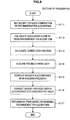
- FIG. 6 is an explanatory view providing an overview of the combination method of recommendation algorithms according to an embodiment of the present technology.
- the recommendation system first calculates the associated score A(i, j) between the item i and the item j by using the first recommendation algorithm (step S101).
- the recommendation system also calculates the associated score B(i, j) between the item i and the item j by using the second recommendation algorithm (step S101).
- the recommendation system matches score systems of the two associated scores A(i, j) and B(i, j) calculated in step S101 (step S102). For example, the recommendation system calculates an associated score B'(i, j) by adjusting (e.g., correcting) the associated score B(i, j) (step S102)
- the recommendation system calculates the associated score Q(i, j) by linearly combining the associated score A(i, j) calculated in step S101 and the associated score B'(i,j) calculated in step S102 (step S103).
- the recommendation system calculates the associated score Q(i, j) by, for example, Formula (2) shown below, where q1 and q2 are predetermined constants.
- the recommendation system selects recommended items based on the associated score Q(i, j) calculated in step S103 (step S104). If the item to be a seed of recommendation is i, the item for which the associated score Q(i, j) is large is selected as a recommended item.
- the coefficients q1 and q2 are weights that decide whether to attach more importance to the first recommendation algorithm or to the second recommendation algorithm.
- the recommendation system corrects the associated score B(i, j).
- the correction method will supplementarily be described with reference to FIG. 7 .
- the recommendation system corrects the associated score B(i, j) so that the inclination of a regression line for a set of(Xn, Yn) approaches 1. Note that, as will be described, later, a result of regression analysis of(Xn, Yn) is not necessarily a straight line.
- FIG. 8 is an explanatory view illustrating the system configuration of a recommendation system according to an embodiment of the present technology.
- the recommendation system mainly includes the server apparatus 100 and the user terminal 200.
- the server apparatus 100 and the user terminal 200 are connected by a network 10.
- An administrator terminal 20 is connected to the network 10.
- a storage apparatus 130 is connected to the server apparatus 100.
- the storage apparatus 130 may be contained in the server apparatus 100 or connected to the server apparatus 100 via the network 10 or another communication network.
- the storage apparatus 130 stores information, for example, an item, metadata attached to the item, and a log of feedback on the item given by a user.
- the storage apparatus 130 stores information such as calculation results of associated scores by individual recommendation algorithms, weights used when recommendation algorithms are combined, correction functions used for correcting associated scores, and correction amounts of weights.
- FIG. 9 is an explanatory view providing an overview of processing performed by the recommendation system according to an embodiment of the present technology.
- a system administrator first sets the weight for each combination of recommendation algorithms by using the administrator terminal 20 (step S111).
- the weight set in step S111 is stored in the storage apparatus 130 by the server apparatus 100.
- the server apparatus 100 calculates associated scores by individual recommendation algorithms (step S112). If, for example, feedback is given on some item (seed), the server apparatus 100 calculates associated scores for the item by individual recommendation algorithms.
- the associated scores calculated in step S112 are stored in the storage apparatus 130.
- the server apparatus 100 generates a correction function by using associated scores stored in the storage apparatus 130 (step S113). For example, the server apparatus 100 generates a correction function f that approximates the score system of the associated score A(i, j) calculated by the first recommendation algorithm by correcting the associated score B(i, j) calculated by the second recommendation algorithm. That is, the server apparatus 100 generates the correction function f so that A(i, j) ⁇ f(B(i, j)) holds.
- the correction function f generated in step S113 is stored in the storage apparatus 130.
- the server apparatus 100 acquires feedback input by the user via the user terminal 200 (step S114).
- the server apparatus 100 adjusts (e.g., corrects) the weight used in common in the system in accordance with the feedback acquired in step S114 (step S115).
- the weight corrected in step S115 and used in common in the system is stored in the storage apparatus 130.
- the server apparatus 100 corrects the weight for each user in accordance with the feedback acquired in step S114 (step S116).
- the weight for each user corrected in step S116 is stored in the storage apparatus 130.
- the server apparatus 100 corrects the associated scores calculated in step S112 by the correction function generated in step S113 and then combines associated scores by using the weights corrected in steps S115 and S116. Further, the server apparatus 100 selects items to be recommended to the user based on the combined associated score. Then, the server apparatus 100 recommends the selected items to the user (step S117) before terminating a sequence of processing.
- the server apparatus 100 corrects the associated scores calculated in step S112 by the correction function generated in step S113 and then combines associated scores by using the weights corrected in steps S115 and S116. Further, the server apparatus 100 selects items to be recommended to the user based on the combined associated score. Then, the server apparatus 100 recommends the selected items to the user (step S117) before terminating a sequence of processing.
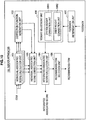
- FIG. 10 is an explanatory view illustrating the functional configuration of the server apparatus 100 according to an embodiment of the present technology.
- the server apparatus 100 mainly includes plural individual associated score calculation units 101, a correction function generation unit 102, an individual associated score correction unit 103, an integrated associated score calculation unit 104, and a recommended item selection unit 105. Further, the server apparatus 100 includes a weight adjustment unit 106 and a feedback determination unit 107.
- the weight adjustment unit 106 includes a system weight correction unit 1061 and a user weight correction unit 1062. Three units of the individual associated score calculation unit 101 are provided in the example of FIG. 10 , but the number of the individual associated score calculation units 101 is increased/decreased in accordance with the number of recommendation algorithms to be combined.
- a server apparatus 100 The functional configuration of a server apparatus 100 will be described below along the flow of (1) Pre-processing and (2) Processing to select items r (hereinafter, recommended items r) in accordance with feedback on an item s (hereinafter, a seed item s) given by the user.
- the server apparatus 100 matches score systems of associated scores to be combined by using a correction function.
- the server apparatus 100 generates the correction function f by using existing item information.
- the server apparatus 100 acquires a predetermined number of items s that could become the seed items s from the storage apparatus 130. Further, the server apparatus 100 acquires a predetermined number of items r that could become the recommended items r from the storage apparatus 130.
- the items s, r acquired here are input into the individual associated score calculation units 101,
- the individual associated score calculation units 101 calculates associated scores of the items s, r by using respective allocated recommendation algorithms. For example, the individual associated score calculation units 101 to which the first recommendation algorithm is allocated calculates the associated score A(s, r). The individual associated score calculation units 101 to which the second recommendation algorithm is allocated calculates the associated score B(s, r). If three or more recommendation algorithms are combined, the individual associated score calculation units 101 to which one of third to N-th recommendation algorithms (N ⁇ 3) is allocated calculates one of associated scores C(s, r), D(s, r), ... For convenience of description, a case when two recommendation algorithms are combined will be considered.
- the associated scores A(s, r) and B(s, r) calculated by the individual associated score calculation units 101 are stored in the storage unit 130 and also input into the correction function generation unit 102. Note that plural sets of the associated scores A(s, r) and B(s, r) are input into the correction function generation unit 102. After the associated scores A(s, r) and B(s, r) are input, the correction function generation unit 102 generates the correction function f by using the input associated scores A(s, r) and B(s, r). For example, if, as shown in FIG.
- the correction function f is a linear function in the example of FIG. 3 , but the correction function f may not be a linear function depending on the combination of recommendation algorithms.
- the correction function generation unit 102 generates the non-linear correction function f by performing a non-linear regression analysis such as polynomial regression, power regression, logarithmic regression, and exponential regression.
- the correction function generation unit 102 uses, for example, a regression algorithm such as the Expectation Maximization (EM) algorithm and Wake-Sleep algorithm for regression analysis.
- EM Expectation Maximization
- the correction function f generated by the correction function generation unit 102 in this manner is stored in the storage unit 130 and also input into the individual associated score correction unit 103.
- the derivation method of the correction function f has been described as one piece of pre-processing.
- the pre-processing includes settings of the weights q1, q2.
- the weights q1, q2 are set by the system administrator via the administrator terminal 20 in advance.
- the weights q1, q2 set by the system administrator are stored in the storage apparatus 130.
- recommended items r for the seed item s can be recommended.
- the individual associated score calculation unit 101 acquires items r1 r2, ... to be candidates of the recommended items r from the storage apparatus 130.
- the individual associated score calculation units 101 using the first recommendation algorithm acquires items r1A, r2A, ... from the storage apparatus 130.
- the individual associated score calculation units 101 using the second recommendation algorithm acquires items r1B, r2B, ... from the storage apparatus 130.
- the individual associated score calculation unit 101 having acquired the items r1A, r2A, ... to be candidates of the recommended items r calculates the associated scores A(s, r1A), A(s, r2A), ... between the seed item s and the items r1A, r2A, ...
- the individual associated score calculation unit 101 having acquired the items r1B, r2B, ... to be candidates of the recommended items r calculates the associated scores B(s, r1B), B(s, r2B), ... between the seed item s and the items r1B, r2B, ...
- the associated scores A(s, r1A), A(s, r2A), ... B(s, r1B), B(s, r2B), ... calculated by the individual associated score calculation unit 101 are input into the individual associated score correction unit 103.
- the individual associated score correction unit 103 acquires the correction function f from the storage apparatus 130. Then, the individual associated score correction unit 103 corrects the associated scores B(s, r1B), B(s, r2B), ... by using the correction function f to generate new associated scores B'(s, r1B), B'(s, r2B), ... More specifically, the individual associated score correction unit 103 calculates f(B(s, r1B)), f(B(s, r2B)), ...
- the new associated scores B'(s, r1B), B'(s, r2B), ... calculated by the individual associated score correction unit 103 and the associated scores A(s, r1A), A(s, r2A), ... are input into the integrated associated score calculation unit 104.
- the integrated associated score calculation unit 104 calculates a new associated score (hezeinafter, an integrated associated score) Q(s, r) (r ⁇ (r1A, r2A,..., r1B, r2B,... ⁇ ) by linearly combining the input associated scores A(s, r1A), A(s, r2A), ... B'(s, r1B), B'(s, r2B), ...
- the integrated associated score calculation unit 104 calculates the integrated associated score Q(s, r) by using, for example, the weights q1, q2 acquired from the storage apparatus 130.
- the integrated associated score Q(s, r) calculated by the integrated associated score calculation unit 104 is provided to the user terminal 200.
- the integrated associated score Q(s, r) calculated by the integrated associated score calculation unit 104 is input into the recommended item selection unit 105.
- the recommended item selection unit 105 selects a predetermined number of items r in descending order of input integrated associated score Q(s, r) as recommended items. Then, the recommended item selection unit 105 provides the selected recommended items r to the user terminal 200.
- the weights q1, q2 will supplementarily be described. As described above, the weights q1, q2 are set by the system administrator in advance. However, the weights q1, q2 set by the system administrator may not suit user's preferences. Thus, a mechanism capable of adjusting the weights q1, q2 in accordance with feedback of the user is mounted in the server apparatus 100 according to an embodiment of the present technology. Adjustments of the weights q1, q2 are made by the weight adjustment unit 106.
- the feedback is input into the feedback determination unit 107.
- the feedback determination unit 107 determines whether the input feedback indicates a positive trend or a negative trend. For example, the purchase of an item, the selection of an item, viewing of an item, browsing of detailed information about an item, pressing of the Like button, and reviewing with a high score are feedback indicating a positive trend. On the other hand, pressing of the Dislike button and reviewing with a low score are examples of feedback indicating a negative trend.
- a determination result by the feedback determination unit 107 is input into the weight adjustment unit 106.
- the weight adjustment unit 106 adjusts the weights q1, q2 in accordance with the determination result.
- a concrete adjustment method of the weight by the weight adjustment unit 106 will be described in detail later.
- the weights q1, q2 adjusted by the weight adjustment unit 106 are stored in the storage apparatus 130.
- the functional configuration of the server apparatus 100 has been described.
- the functional configuration of the server apparatus 100 shown in FIG. 10 is only an example and modifications such as omission of a portion of the functional configuration and addition of a new functional configuration may be made.
- the server apparatus 100 may be configured to provide only integrated associated scores to the user terminal 200 by omitting the recommended item selection unit 105.
- the server apparatus 100 may be configured to use the weights q1, q2 set by the system administrator permanently by omitting the weight adjustment unit 106 and the feedback determination unit 107.
- FIG. 11 is an explanatory view illustrating the functional configuration of the user terminal 200 according to an embodiment of the present technology in more detail.
- the user terminal 200 mainly includes a feedback notification unit 201, an integrated associated score acquisition unit 202, a recommended item acquisition unit 203, and an information presentation unit 204.
- the user terminal 200 can be embodied, as shown in FIG. 8 , in various forms.
- the user terminal 200 also has an input unit and a display unit mounted thereon.
- an input device such as a keyboard, mouse, touch sensor, and remote controller can be exemplified.
- the display unit a display device such as a liquid crystal display, organic electroluminescence display can be exemplified.
- the user terminal 200 is used, for example, to browse items and give feedback on an item. If the user gives feedback on an item by using the input unit, the feedback is input into the feedback notification unit 201. When the feedback is input, the feedback notification unit 201 sends the input feedback to the server apparatus 100 and request recommendation of items from the server apparatus 100. When the request is received, as described above, the server apparatus 100 provides the integrated associated score Q(s, r) relating to the seed item s and the recommended items r to the user terminal 200.
- the user terminal 200 acquires the integrated associated score Q(s, r) from the server apparatus 100 by using a function of the integrated associated score acquisition unit 202.
- the integrated associated score acquisition unit 202 inputs the acquired integrated associated score Q(s, r) into the information presentation unit 204.
- the user terminal 200 also acquires the recommended items r from the server apparatus 100 by using a function of the recommended item acquisition unit 203.
- the recommended item acquisition unit 203 input the acquired recommended items r into the information presentation unit 204.
- the information presentation unit 204 presents the recommended items r in descending order of input integrated associated score Q(s, r).
- the functional configuration of the user terminal 200 has been described.
- the functional configuration of the user terminal 200 shown in FIG. 11 is only an example and modifications such as omission of a portion of the functional configuration and addition of a new functional configuration may be made.
- the user terminal 200 may be configured to present only integrated associated scores to the user by omitting the recommended item acquisition unit 203.
- the user terminal 200 may be configured to present the recommended items r to the user in the order in which the recommended items r are provided from the server apparatus 100 by omitting the integrated associated score acquisition unit 202.
- the pre-processing described below is mainly performed by the server apparatus 100.
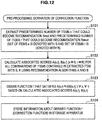
- FIG. 12 is an explanatory view illustrating the derivation method of a correction function according to an embodiment of the present technology.
- the server apparatus 100 first extracts a predetermined number of items s that could become a recommendation Seed (seed item) and a predetermined number of items r that could become a recommendation Result (recommended item) through the function of the individual associated score calculation units 101 (step S121).
- a set of the items s is denoted as S and a set of the items r is denoted as R.
- the server apparatus 100 calculates the associated scores A(s, r) and B(s, r) for all combinations of s ⁇ S and r ⁇ R through the function of the individual associated score calculation units 101 (step S122).
- the server apparatus 100 derives a correction function f through the function of the correction function generation unit 102 so that the associated scores have a relationship A(s, r) ⁇ f(B(s, r))( ⁇ s ⁇ S, ⁇ r ⁇ R) (step S123).
- the server apparatus 100 stores the correction function f derived in step S123 in the storage apparatus 130 through the function of the correction function generation unit 102 (step S124),
- FIG. 13 is an explanatory view illustrating the setting method of a weight according to an embodiment of the present technology.
- the server apparatus 100 stores the weights q1, q2 set by the system administrator for combinations of recommendation algorithms in the storage apparatus 130 (step S131).
- the system administrator inputs the weights q1, q2 by using the administrator terminal 20.
- the weights q1, q2 input into the administrator terminal 20 are input into the server apparatus 100 via the network 10.
- the weights q1, q2 input into the server apparatus 100 are stored, as described above, in the storage apparatus 130.
- the setting method of the weights q1, q2 described here is the setting method of weights in the pre-processing.
- the adjustment method of the weights q1, q2 in accordance with user's feedback will be described in detail later.
- FIG. 14 is an explanatory view illustrating the flow of recommendation processing according to an embodiment of the present technology.
- the recommendation processing described below is mainly performed by the server apparatus 100.
- the server apparatus 100 receives a presentation request of recommended items for the seed item s' from the user terminal 200 (step S141).
- the server apparatus 100 calculates associated scores A(s', r1A), A(s', r2A), ... indicating the relationship between the seed item s' and recommended item candidates r1A, r2A, ... by using the first recommendation algorithm A through the function of the individual associated score calculation units 101 (step S142).
- the server apparatus 100 calculates associated scores B(s', r1B), B(s', r2B), ... indicating the relationship between the seed item s' and recommended item candidates r1B, r2B, ... by using the second recommendation algorithm B through the function of the individual associated score calculation units 101 (step S143).
- the server apparatus 100 corrects the associated scores B(s', r1B), B(s', r2B), ... by using the correction function f through the function of the individual associated, score correction unit 103 to calculate new associated scores B'(s', r1B), B'(s', r2B), ... (step S144).
- B'(s', r1B) is defined as f(B(s', r1B))
- B'(s', r2B) is defined as f(B(s', r2B)).
- the server apparatus 100 calculates integrated associated scores Q(s', r1A), Q(s', r2A), ..., Q(s', r1B), Q(s', r2B), ... by using the weights q1, q2 through the function of the integrated associated score calculation unit 104 (step S145).
- the server apparatus 100 provides the integrated associated scores Q(s', r1A), Q(s', r2A), ..., Q(s', r1B), Q(s', r2B), ... calculated in step S145 to the user terminal 200 through the function of the integrated associated score calculation unit 104 (step S146).
- the system administrator sets the weights like q1 ⁇ q2, the system administrator attaches more importance to the second recommendation algorithm B than the first recommendation algorithm A.
- the associated score B( ⁇ ) is not corrected by the correction function f, as shown in FIG. 16 , contrary to the intention of the system administrator, the first recommendation algorithm A may be predominant.
- the associated score B( ⁇ ) is corrected by the correction function f, as shown in FIG. 17 , an appropriate result can be obtained without being affected by a difference of score systems even if the score systems are significantly different like this example.
- plural recommendation algorithms can be combined while the intention contained in the weight setting being appropriately being reflected.
- the method of combining two recommendation algorithms has been described.
- the method according to an embodiment of the present technology can be extended to a method of combining three or more recommendation algorithms.
- the method of combining three recommendation algorithms hereinafter, called the present extension example
- the pre-processing described below is mainly performed by the server apparatus 100.
- FIG. 18 is an explanatory view illustrating the derivation method of a correction function according to the present extension example.
- the server apparatus 100 first extracts a predetermined number of items s that could become a recommendation Seed (seed item) and a predetermined number of items r that could become a recommendation Result (recommended item) through the function of the individual associated score calculation units 101 (step S151).
- a set of the items s is denoted as S and a set of the items r is denoted as R.
- the server apparatus 100 calculates the associated scores A(s, r), B(s, r) and C(s, r) for all combinations of s ⁇ S and r ⁇ R through the function of the individual associated score calculation units 101 (step S152).
- the server apparatus 100 derives a correction function g through the function of the correction function generation unit 102 so that the associated scores have a relationship A(s, r) ⁇ g(C(s, r))( ⁇ s ⁇ S, ⁇ r ⁇ R) (step S154).
- the server apparatus 100 stores the correction functions f and g derived in steps S153 and S154 in the storage apparatus 130 through the function of the correction function generation unit 102 (step S155).
- FIG. 19 is an explanatory view illustrating the setting method of the weight according to the present extension example.
- the server apparatus 100 stores the weights q1, q2, q3 set by the system administrator for combinations of recommendation algorithms in the storage apparatus 130 (step S161).
- the system administrator inputs the weights q1, q2, q3 by using the administrator terminal 20.
- the weights q1, q2, q3 input into the administrator terminal 20 are input into the server apparatus 100 via the network 10.
- the weights q1, q2, q3 input into the server apparatus 100 are stored, as described above, in the storage apparatus 130.
- the setting method of the weights q1, q2, q3 described here is the setting method of weights in the pre-processing.
- the weights q1, q2, q3 set here may be corrected in accordance with user's feedback.
- FIG. 20 is an explanatory view illustrating the flow of recommendation processing according to the present extension example.
- the recommendation processing described below is mainly performed by the server apparatus 100.
- the server apparatus 100 receives a presentation request of recommended items for the seed item s' from the user terminal 200 (step S171).
- the server apparatus 100 calculates associated scores A(s', r1A), A(s', r2A), ... indicating the relationship between the seed item s' and recommended item candidates r1A, r2A, ... by using the first recommendation algorithm A through the function of the individual associated score calculation units 101 (step S172).
- the server apparatus 100 calculates associated scores B(s', r1B), B(s', r2B), ... indicating the relationship between the seed item s' and recommended item candidates r1B, r2B, ... by using the second recommendation algorithm B through the function of the individual associated score calculation units 101 (step S173).
- the server apparatus 100 calculates associated scores C(s', r1C), C(s', r2C), ... indicating the relationship between the seed item s' and recommended item candidates r1C, r2C, ... by using the third recommendation algorithm C through the function of the individual associated score calculation units 101 (step S174).
- the server apparatus 100 corrects the associated scores B(s', r1B), B(s', r2B), ... by using the correction function f through the function of the individual associated score correction unit 103 to calculate new associated scores B'(s', r1B), B'(s', r2B), ... (step S175), B'(s', r1B) is defined as f(B(s', r1B)) and B'(s', r2B) is defined as f(B(s', r2B)).
- the server apparatus 100 corrects the associated scores C(s', r1C), C(s', r2C), ...
- C'(s', r1C) is defined as g(C(s', r1C)) and C'(s', r2C) is defined as g(C(s', r2C)).
- the server apparatus 100 calculates, based on Formula (5) below, integrated associated scores Q(s', r1A), Q(s', r2A), ..., Q(s', r1B), Q(s', r2B), ... Q(s', r1C), Q(s', r2C), ... by using the weights q1, q2, q3 through the function of the integrated associated score calculation unit 104 (step S177).
- the server apparatus 100 provides the integrated associated scores Q(s', r1A), Q(s', r2A), ..., Q(s', r1B), Q(s', r2B), ... Q(s', r1C), Q(s', r2C), ... calculated in step S177 to the user terminal 200 through the function of the integrated associated score calculation unit 104 (step S178).
- the adjustment method of the weight that has been left out is realized mainly by the function of the weight adjustment unit 106 of the functions of the server apparatus 100.
- the weight considered here includes a weight commonly used throughout the system (hereinafter, called a system weight) and a weight individualized for each user (hereinafter, called a user weight).
- a system weight a weight commonly used throughout the system
- a user weight a weight individualized for each user
- FIG. 21 is an explanatory view illustrating an example (adjustment example #1) of the adjustment method of the system weight according to an embodiment of the present technology.
- the server apparatus 100 first acquires feedback input by the user (step S181). Next, the server apparatus 100 determines whether or not the acquired feedback is feedback indicating a positive trend through the function of the feedback determination unit 107 (step S182). If the acquired feedback is determined to be feedback indicating a positive trend, the server apparatus 100 proceeds to step S183. On the other hand, if the acquired feedback is determined not to be feedback indicating a positive trend, the server apparatus 100 proceeds to step S184.
- step S185 the server apparatus 100 proceeds to step S185.
- the system weight correction unit 1061 determines whether the two associated scores A(s, r) and B(s, r) satisfy the condition of A(s, r)>f(B(s, r)) (step S185). If the condition of A(s, r)>f(B(s, r)) is determined to be satisfied, the server apparatus 100 proceeds to step S186. On the other hand, if the condition of A(s, r)>f(B(s, r)) is determined not to be satisfied, the server apparatus 100 proceeds to step S187.
- step S186 the system weight correction unit 1061 corrects the weights q1, q2 based on Formula (6) below (step S186).
- step S187 the system weight correction unit 1061 corrects the weights q1, q2 based on Formula (7) below (step S187).
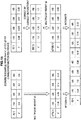
- the server apparatus 100 recommends items r1, r2 to the user based on these integrated associated scores Q( ⁇ ).
- the server apparatus 100 corrects the weights q1, q2 (system weights). If the feedback indicates a positive trend, in the example of FIG. 22 , the server apparatus 100 increases the weight q1 by which the associated score A( ⁇ ) is multiplied by d0 and decreases the weight q2 by which the associated score B( ⁇ ) is multiplied by d0. On the other hand, if the feedback indicates a negative trend, in the example of FIG. 22 , the server apparatus 100 decreases the weight q1 by which the associated score A( ⁇ ) is multiplied by d0 and increases the weight q2 by which the associated score B( ⁇ ) is multiplied by d0.
- the system weights q1, q2 can be adjusted by the above method in accordance with user's feedback on recommended items.
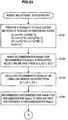
- FIGS. 23 and 24 are explanatory views illustrating an example (adjustment example #2) of the adjustment method of the system weight according to an embodiment of the present technology.
- the server apparatus 100 first prepares plural calculation methods of the integrated associated score through the function of the weight adjustment unit 106 (step S191). For example, three calculation methods shown as Formulas (8) to (10) below are prepared, z1 and z2 are predetermined coefficients satisfying the condition 0 ⁇ z2 ⁇ 1 ⁇ z1. After the plural calculation methods of the integrated associated score being prepared, the server apparatus 100 selects one calculation method of the integrated associated score when presentation of recommendation Results (recommended items) for the recommendation Seed s (seed item s) is requested (step S192). Next, the server apparatus 100 calculates integrated associated scores by using the calculation method selected in step S192 and recommends the recommended item r based on the calculation results (step S194).
- three calculation methods shown as Formulas (8) to (10) below are prepared, z1 and z2 are predetermined coefficients satisfying the condition 0 ⁇ z2 ⁇ 1 ⁇ z1.
- the server apparatus 100 selects one calculation method of the integrated associated score when presentation of recommendation Results (recommended items) for the recommendation Seed s (seed item s)
- the server apparatus 100 waits for feedback on the recommended item r and determines whether feedback is received (step S195). If feedback is received, the server apparatus 100 proceeds to step S196. On the other hand, no feedback is received, the server apparatus 100 proceeds to step S197. For example, the server apparatus 100 waits for feedback for a predetermined time after the recommended item r being recommended to the user and if no feedback is received after the predetermined time passes, the server apparatus 100 proceeds to step S197.
- step S196 the server apparatus 100 determines whether the method shown in Formula (8) above (hereinafter, the method of Q( ⁇ )) is used as the calculation method of the integrated associated score in step S193 (see FIG. 23 ) (step S196). If the method of Q( ⁇ ) is used as the calculation method of the integrated associated score, the server apparatus 100 proceeds to step S197. On the other hand, if the method of Q( ⁇ ) is not used as the calculation method of the integrated associated score, the server apparatus 100 proceeds to step S198. If the processing proceeds to step S197, the server apparatus 100 does nothing about adjustments of the weights q1, q2 (step S197).
- step S198 the server apparatus 100 determines whether feedback indicates a positive trend through the function of the feedback determination unit 107 (step S198). If the feedback is determined to indicate a positive trend, the server apparatus 100 proceeds to step S199. On the other hand, if the feedback is determined not to indicate a positive trend, the server apparatus 100 proceeds to step S200.
- step S201 the system weight correction unit 1061 determines whether Q'( ⁇ ) is used (step S201). If Q'( ⁇ ) is used, the server apparatus 100 proceeds to step S202. On the other hand, if Q'( ⁇ ) is not used, the server apparatus 100 proceeds to step S203.
- Recommendation results using Q'( ⁇ ) are results in which the associated score A( ⁇ ) is stressed. Thus, if feedback on a recommendation result using Q'( ⁇ ) is given, a recommendation result more suitable to user's preferences can be obtained by increasing the weight attached to the associated score A( ⁇ ).
- step S202 the system weight correction unit 1061 corrects the weights q1, q2 based on Formula (6) above (step S202).
- step S203 the system weight correction unit 1061 corrects the weights q1, q2 based on Formula (7) above (step S203).
- the server apparatus 100 terminates a sequence of processing related to adjustments of the system weight.
- the adjustment method of the system weight according to an embodiment of the present technology has been described.
- the method in which system weights are adjusted each time user's feedback is received is shown in the above description, but the adjustment timing of the system weights may be changed as shown below.
- a method by which when an opportunity to correct the weight by Formula (6) or (7) above occurs, the number of times of occurrence of such an opportunity is counted and the weight is corrected with a correction amount in accordance with the count can be considered.
- the adjustment method of the user weight according to an embodiment of the present technology will be described.
- the system weights q1, q2 commonly used throughout the system have been described, but an idea of user weights q1'(u), q2'(u) is introduced here.
- u denotes the index to identify individual users.
- the user weights q1'(u), q2'(u) are different from user to user.
- the integrated associated score Q( ⁇ ) is expressed like, for example, Formula (11) or Formula (12) below.
- the server apparatus 100 decides a correction amount by the method shown in FIGS 21 , 23 and 24 to allocate a portion of the correction amount to the system weights q1, q2 and the rest thereof to the user weights q1', q2'. It is assumed that the system administrator sets the ratio of correction amount to both weights in advance. It is preferable to set the ratio of both weights in such a way that a larger correction amount is allocated to the user weights q1', q2'. Further, the ratio of the correction amount allocated to the user weights q1', q2' may be decided in accordance with
- an item group hereinafter, called a first item group
- an item group hereinafter, called a second item group
- an item group hereinafter, called a second item group
- an item that should be stressed for some reason such as campaigns, events, or business reasons belongs to the first item group.
- the server apparatus 100 preferably updates a correction function stored in the storage apparatus 130 by periodically executing regeneration of the correction function through the function of the correction function generation unit 102.
- the associated score for some item may be 0 depending on the type of recommendation algorithms.
- the calculation method of an integrated associated score described above if used, a value that is smaller by a portion of the integrated associated score for the item is obtained. Therefore, for items whose integrated associated score becomes a small value because no associated score is added by some recommendation algorithm, for example, an integrated associated score may be calculated by using remaining recommendation algorithms excluding the recommendation algorithm that adds no associated score.
- the integrated associated score for an item whose associated score B(s, r) is 0 may be adjusted to decrease.
- each structural element of the server apparatus 100 and the user terminal 200 described above can be performed by using, for example, the hardware configuration of the information processing apparatus shown in FIG. 25 . That is, the function of each structural element can be realized by controlling the hardware shown in FIG. 25 using a computer program. Additionally, the mode of this hardware is arbitrary, and may be a personal computer, a mobile information terminal such as a mobile phone, a PHS or a PDA, a game machine, or various types of information appliances. Moreover, the PHS is an abbreviation for Personal Handy-phone System. Also, the PDA is an abbreviation for Personal Digital Assistant.
- this hardware mainly includes a CPU 902, a ROM 904, a RAM 906, a host bus 908, and a bridge 910. Furthermore, this hardware includes an external bus 912, an interface 914, an input unit 916, an output unit 918, a storage unit 920, a drive 922, a connection port 924, and a communication unit 926.
- the CPU is an abbreviation for Central Processing Unit.
- the ROM is an abbreviation for Read Only Memory.
- the RAM is an abbreviation for Random Access Memory.
- the CPU 902 functions as an arithmetic processing unit or a control unit, for example, and controls entire operation or a part of the operation of each structural element based on various programs recorded on the ROM 904, the RAM 906, the storage unit 920, or a removal recording medium 928.
- the ROM 904 is means for storing, for example, a program to be loaded on the CPU 902 or data or the like used in an arithmetic operation.
- the RAM 906 temporarily or perpetually stores, for example, a program to be loaded on the CPU 902 or various parameters or the like arbitrarily changed in execution of the program.
- the host bus 908 capable of performing high-speed data transmission.
- the host bus 908 is connected through the bridge 910 to the external bus 912 whose data transmission speed is relatively low, for example.
- the input unit 916 is, for example, a mouse, a keyboard, a touch panel, a button, a switch, or a lever.
- the input unit 916 may be a remote control that can transmit a control signal by using an infrared ray or other radio waves.
- the output unit 918 is, for example, a display device such as a CRT, an LCD, a PDP or an ELD, an audio output device such as a speaker or headphones, a printer, a mobile phone, or a facsimile, that can visually or auditorily notify a user of acquired information.
- a display device such as a CRT, an LCD, a PDP or an ELD
- an audio output device such as a speaker or headphones, a printer, a mobile phone, or a facsimile, that can visually or auditorily notify a user of acquired information.
- the CRT is an abbreviation for Cathode Ray Tube.
- the LCD is an abbreviation for Liquid Crystal Display.
- the PDP is an abbreviation for Plasma Display Panel.
- the ELD is an abbreviation for Electro-Luminescence Display.
- the storage unit 920 is a device for storing various data.
- the storage unit 920 is, for example, a magnetic storage device such as a hard disk drive (HDD), a semiconductor storage device, an optical storage device, or a magneto-optical storage device.
- the HDD is an abbreviation for Hard Disk Drive.
- the drive 922 is a device that reads information recorded on the removal recording medium 928 such as a magnetic disk, an optical disk, a magneto-optical disk, or a semiconductor memory, or writes information in the removal recording medium 928.
- the removal recording medium 928 is, for example, a DVD medium, a Blu-ray medium, an HD-DVD medium, various types of semiconductor storage media, or the like.
- the removal recording medium 928 may be, for example, an electronic device or an IC card on which a non-contact IC chip is mounted.
- the IC is an abbreviation for Integrated Circuit.
- the connection port 924 is a port such as an USB port, an IEEE1394 port, a SCSI, an RS-232C port, or a port for connecting an externally connected device 930 such as an optical audio terminal.
- the externally connected device 930 is, for example, a printer, a mobile music player, a digital camera, a digital video camera, or an IC recorder.
- the USB is an abbreviation for Universal Serial Bus.
- the SCSI is an abbreviation for Small Computer System Interface.
- the communication unit 926 is a communication device to be connected to a network 932, and is, for example, a communication card for a wired or wireless LAN, Bluetooth (registered trademark), or WUSB, an optical communication router, an ADSL router, or a modem for various types of communication.
- the network 932 connected to the communication unit 926 is configured from a wire-connected or wirelessly connected network, and is the Internet, a home-use LAN, infrared communication, visible light communication, broadcasting, or satellite communication, for example.
- the LAN is an abbreviation for Local Area Network.
- the WUSB is an abbreviation for Wireless USB.
- the ADSL is an abbreviation for Asymmetric Digital Subscriber Line.
- the functional configuration of the above information processing apparatus can be expressed as follows.
- the information processing apparatus includes a first score calculation unit, a second score calculation unit, a scale conversion unit, and an evaluation score calculation unit described below.
- the first score calculation unit is a unit that calculates a first score indicating the degree of association between items.
- the second score calculation unit is a unit that calculates a second score indicating the degree of association between items. For example, the first score calculation unit calculates a first score by using a first recommendation algorithm.
- the second score calculation unit calculates a first score by using a second recommendation algorithm, which is different from the first recommendation algorithm.
- the scale conversion unit converts a second score calculated by the second score calculation unit to the scale comparable to the scale of a first score calculated by the first score calculation unit based on relationship information indicating a relationship between the first score calculated by the first score calculation unit and the second score calculated by the second score calculation unit for the same item set to calculate a post-conversion score.
- the first score and the second score are calculated by using different recommendation algorithms.
- the first score and the second score have mutually different score systems. Therefore, the scale conversion unit converts the second score to fit to the score system of the first score.
- the evaluation score calculation unit calculates an evaluation score by combining a first score calculated by the first score calculation unit and a post-conversion score calculated by the scale conversion unit for the same item set.
- the server apparatus 100 is an example of the information processing apparatus.
- the user terminal 200 is an example of the terminal apparatus.
- the recommendation system is an example of the information presentation system.
- the individual associated score calculation unit 101 is an example of the first score calculation unit, second score calculation unit, and third to N-th score calculation units (N ⁇ 3).
- the individual associated score correction unit 103 is an example of the scale conversion unit.
- the integrated associated score calculation unit 104 is an example of the evaluation score calculation unit/evaluation score presentation unit.
- the correction function generation unit 102 is an example of a related information generation unit.
- the weight adjustment unit 106 is an example of a count unit, adjustment implementation unit, count comparison unit, and individual weight management unit.
- the recommended item selection unit 105 is an example of a recommended item detection unit and recommendation unit.
- the integrated associated score acquisition unit 202 is an example of an evaluation score acquisition unit.
- Some embodiments may comprise a computer readable storage medium (or multiple computer readable media) (e.g., a computer memory, one or more floppy discs, compact discs (CD), optical discs, digital video disks (DVD), magnetic tapes, flash memories, circuit configurations in Field Programmable Gate Arrays or other semiconductor devices, or other tangible computer storage medium) encoded with one or more programs that, when executed on one or more computers or other processors, perform methods that implement the various embodiments discussed above.
- a computer readable storage medium may retain information for a sufficient time to provide computer-executable instructions in a non-transitory form.
- Such a computer readable storage medium or media can be transportable, such that the program or programs stored thereon can be loaded onto one or more different computers or other processors to implement various aspects of the present invention as discussed above.
- the term "computer-readable storage medium” encompasses only a computer-readable medium that can be considered to be a manufacture (i.e., article of manufacture) or a machine.
- the invention may be embodied as a computer readable medium other than a computer-readable storage medium, such as a propagating signal.
- the present technology can adopt the following configurations.
Landscapes
- Engineering & Computer Science (AREA)
- Business, Economics & Management (AREA)
- Accounting & Taxation (AREA)
- Finance (AREA)
- Theoretical Computer Science (AREA)
- Development Economics (AREA)
- Strategic Management (AREA)
- Physics & Mathematics (AREA)
- General Physics & Mathematics (AREA)
- Databases & Information Systems (AREA)
- General Business, Economics & Management (AREA)
- Marketing (AREA)
- Economics (AREA)
- Entrepreneurship & Innovation (AREA)
- Game Theory and Decision Science (AREA)
- Data Mining & Analysis (AREA)
- General Engineering & Computer Science (AREA)
- Information Retrieval, Db Structures And Fs Structures Therefor (AREA)
Applications Claiming Priority (1)
| Application Number | Priority Date | Filing Date | Title |
|---|---|---|---|
| JP2011050478A JP2012190061A (ja) | 2011-03-08 | 2011-03-08 | 情報処理装置、端末装置、情報提示システム、評価スコアの算出方法、及びプログラム |
Publications (1)
| Publication Number | Publication Date |
|---|---|
| EP2498212A1 true EP2498212A1 (en) | 2012-09-12 |
Family
ID=45808223
Family Applications (1)
| Application Number | Title | Priority Date | Filing Date |
|---|---|---|---|
| EP20120157780 Withdrawn EP2498212A1 (en) | 2011-03-08 | 2012-03-01 | Information processing apparatus, terminal apparatus, information presentation system, calculation method of evaluation scores, and program. |
Country Status (4)
| Country | Link |
|---|---|
| US (1) | US9031941B2 (https=) |
| EP (1) | EP2498212A1 (https=) |
| JP (1) | JP2012190061A (https=) |
| CN (1) | CN102682153A (https=) |
Cited By (1)
| Publication number | Priority date | Publication date | Assignee | Title |
|---|---|---|---|---|
| CN105617657A (zh) * | 2015-12-22 | 2016-06-01 | 北京奇虎科技有限公司 | 游戏智能推荐方法及装置 |
Families Citing this family (20)
| Publication number | Priority date | Publication date | Assignee | Title |
|---|---|---|---|---|
| US9420319B1 (en) * | 2012-06-07 | 2016-08-16 | Audible, Inc. | Recommendation and purchase options for recommemded products based on associations between a user and consumed digital content |
| CN104077693B (zh) * | 2013-03-27 | 2016-10-26 | 腾讯科技(深圳)有限公司 | 商品对比方法、服务器、客户端及电子商务系统 |
| JP5693649B2 (ja) | 2013-05-07 | 2015-04-01 | カルチュア・コンビニエンス・クラブ株式会社 | 市場調査・分析システム |
| JP2015032254A (ja) | 2013-08-06 | 2015-02-16 | ソニー株式会社 | 情報処理装置、情報処理方法、及び、プログラム |
| JP6059122B2 (ja) * | 2013-10-11 | 2017-01-11 | カルチュア・コンビニエンス・クラブ株式会社 | 顧客データ解析システム |
| JP6059123B2 (ja) | 2013-10-16 | 2017-01-11 | カルチュア・コンビニエンス・クラブ株式会社 | 顧客データ分析・検証システム |
| CN104090893B (zh) * | 2013-12-13 | 2015-11-18 | 深圳市腾讯计算机系统有限公司 | 推荐算法优化方法、装置及系统 |
| US10096040B2 (en) | 2014-01-31 | 2018-10-09 | Walmart Apollo, Llc | Management of the display of online ad content consistent with one or more performance objectives for a webpage and/or website |
| WO2016111065A1 (ja) * | 2015-01-09 | 2016-07-14 | ソニー株式会社 | 情報処理システム、情報処理装置、制御方法、およびプログラム |
| US10783550B2 (en) * | 2015-01-30 | 2020-09-22 | Walmart Apollo, Llc | System for optimizing sponsored product listings for seller performance in an e-commerce marketplace and method of using same |
| JP6572691B2 (ja) * | 2015-09-08 | 2019-09-11 | 富士通株式会社 | 検索方法、検索プログラムおよび検索装置 |
| CN106776660A (zh) | 2015-11-25 | 2017-05-31 | 阿里巴巴集团控股有限公司 | 一种信息推荐方法及装置 |
| US11586635B2 (en) * | 2017-01-11 | 2023-02-21 | Meta Platforms, Inc. | Methods and systems for ranking comments on a post in an online service |
| JP7041844B2 (ja) * | 2018-04-02 | 2022-03-25 | トヨタ自動車株式会社 | 情報処理装置及びカーシェアリングサービス用の制御プログラム |
| US11487835B2 (en) | 2018-08-06 | 2022-11-01 | Rakuten Group, Inc. | Information processing system, information processing method, and program |
| CN111831706B (zh) * | 2020-06-30 | 2025-08-05 | 新华三大数据技术有限公司 | 一种应用之间关联规则的挖掘方法、装置及存储介质 |
| KR20230023954A (ko) * | 2021-08-11 | 2023-02-20 | 삼성전자주식회사 | 아이템을 사용자에게 추천하기 위한 전자 장치 및 방법 |
| JP7394512B2 (ja) * | 2021-09-17 | 2023-12-08 | Lineヤフー株式会社 | 情報処理装置、情報処理方法及び情報処理プログラム |
| JP7819049B2 (ja) * | 2022-07-08 | 2026-02-24 | キヤノン株式会社 | 情報処理装置及びその制御方法とプログラム |
| JP7632783B2 (ja) * | 2022-12-12 | 2025-02-19 | ネイバー コーポレーション | マルチモーダルフィーチャに基づいた検索結果を提供する方法、コンピュータ装置、およびコンピュータプログラム |
Citations (2)
| Publication number | Priority date | Publication date | Assignee | Title |
|---|---|---|---|---|
| JP2003167901A (ja) | 2001-11-29 | 2003-06-13 | Kddi Corp | 協調フィルタリング方法、協調フィルタリング装置及び協調フィルタリングプログラム |
| JP2011050478A (ja) | 2009-08-31 | 2011-03-17 | Uni Charm Corp | 折畳装置 |
Family Cites Families (21)
| Publication number | Priority date | Publication date | Assignee | Title |
|---|---|---|---|---|
| US6314420B1 (en) * | 1996-04-04 | 2001-11-06 | Lycos, Inc. | Collaborative/adaptive search engine |
| JP2001160133A (ja) * | 1999-12-01 | 2001-06-12 | Hitachi Ltd | コンピュータマッピングシステム |
| US7406436B1 (en) * | 2001-03-22 | 2008-07-29 | Richard Reisman | Method and apparatus for collecting, aggregating and providing post-sale market data for an item |
| WO2003021231A2 (en) * | 2001-09-05 | 2003-03-13 | Genicon Sciences Corporation | Method and apparatus for normalization and deconvolution of assay data |
| US20060277091A1 (en) * | 2003-04-02 | 2006-12-07 | Kochikar Vivekanand P | Automated method for quantitative measurement of benefits in a plurality of self-assessing, knowledge sharing communities |
| US7219090B2 (en) * | 2003-04-25 | 2007-05-15 | Overture Services, Inc. | Method and system for blending search engine results from disparate sources into one search result |
| WO2005072405A2 (en) * | 2004-01-27 | 2005-08-11 | Transpose, Llc | Enabling recommendations and community by massively-distributed nearest-neighbor searching |
| CN1661604A (zh) * | 2004-02-25 | 2005-08-31 | 松下电器产业株式会社 | 移动终端的活动记录分析和自动信息推荐系统及方法 |
| JP2006350923A (ja) * | 2005-06-20 | 2006-12-28 | Ricoh Co Ltd | 交換部品推定システム、交換部品推定方法および交換部品推定プログラム |
| US7558769B2 (en) * | 2005-09-30 | 2009-07-07 | Google Inc. | Identifying clusters of similar reviews and displaying representative reviews from multiple clusters |
| JP4240096B2 (ja) * | 2006-09-21 | 2009-03-18 | ソニー株式会社 | 情報処理装置および方法、プログラム並びに記録媒体 |
| JP2008293211A (ja) * | 2007-05-23 | 2008-12-04 | Hitachi Ltd | アイテム推薦システム |
| IL184069A0 (en) * | 2007-06-19 | 2007-10-31 | Nimrod Steinbock | A process of time-space collaborative |
| US8275764B2 (en) * | 2007-08-24 | 2012-09-25 | Google Inc. | Recommending media programs based on media program popularity |
| WO2009049276A1 (en) * | 2007-10-12 | 2009-04-16 | Patientslikeme, Inc. | Personalized management and monitoring of medical conditions |
| US8010536B2 (en) * | 2007-11-20 | 2011-08-30 | Samsung Electronics Co., Ltd. | Combination of collaborative filtering and cliprank for personalized media content recommendation |
| CN101206751A (zh) * | 2007-12-25 | 2008-06-25 | 北京科文书业信息技术有限公司 | 基于数据挖掘的顾客推荐系统及其方法 |
| JP4591794B2 (ja) * | 2008-04-22 | 2010-12-01 | ソニー株式会社 | 情報処理装置および方法、並びにプログラム |
| JP4645676B2 (ja) * | 2008-04-28 | 2011-03-09 | ソニー株式会社 | 情報処理装置、関連アイテムの提供方法、及びプログラム |
| JP4911536B2 (ja) * | 2008-09-30 | 2012-04-04 | ヤフー株式会社 | 地域情報検索装置、地域情報検索装置の制御方法、地域情報検索システム、および地域情報検索システムの制御方法 |
| US8515950B2 (en) * | 2008-10-01 | 2013-08-20 | Microsoft Corporation | Combining log-based rankers and document-based rankers for searching |
-
2011
- 2011-03-08 JP JP2011050478A patent/JP2012190061A/ja not_active Ceased
-
2012
- 2012-03-01 CN CN2012100562067A patent/CN102682153A/zh active Pending
- 2012-03-01 US US13/409,460 patent/US9031941B2/en not_active Expired - Fee Related
- 2012-03-01 EP EP20120157780 patent/EP2498212A1/en not_active Withdrawn
Patent Citations (2)
| Publication number | Priority date | Publication date | Assignee | Title |
|---|---|---|---|---|
| JP2003167901A (ja) | 2001-11-29 | 2003-06-13 | Kddi Corp | 協調フィルタリング方法、協調フィルタリング装置及び協調フィルタリングプログラム |
| JP2011050478A (ja) | 2009-08-31 | 2011-03-17 | Uni Charm Corp | 折畳装置 |
Non-Patent Citations (1)
| Title |
|---|
| The only identifiable technical aspects of the claimed invention relate to the use of conventional, general-purpose data processing technology for processing data of an inherently non-technical nature. The information technology employed is considered to have been generally known as it was widely available to everyone at the date of filing/priority of the present application. The notoriety of such prior art cannot reasonably be contested. Accordingly, no documentary evidence is found to be required. For further details see the Notice from the European Patent Office dated 1 October 2007 (OJ 11/2007; p592-593) and the accompanying Opinion. * |
Cited By (2)
| Publication number | Priority date | Publication date | Assignee | Title |
|---|---|---|---|---|
| CN105617657A (zh) * | 2015-12-22 | 2016-06-01 | 北京奇虎科技有限公司 | 游戏智能推荐方法及装置 |
| CN105617657B (zh) * | 2015-12-22 | 2019-06-18 | 北京奇虎科技有限公司 | 游戏智能推荐方法及装置 |
Also Published As
| Publication number | Publication date |
|---|---|
| JP2012190061A (ja) | 2012-10-04 |
| US9031941B2 (en) | 2015-05-12 |
| CN102682153A (zh) | 2012-09-19 |
| US20120233183A1 (en) | 2012-09-13 |
Similar Documents
| Publication | Publication Date | Title |
|---|---|---|
| EP2498212A1 (en) | Information processing apparatus, terminal apparatus, information presentation system, calculation method of evaluation scores, and program. | |
| US9183562B2 (en) | Method and system for determining touchpoint attribution | |
| CN108833458B (zh) | 一种应用推荐方法、装置、介质及设备 | |
| US20160062950A1 (en) | Systems and methods for anomaly detection and guided analysis using structural time-series models | |
| US20160050129A1 (en) | Performance assessment based on analysis of resources | |
| WO2019184583A1 (zh) | 基于电子书的活动内容推送方法及电子设备 | |
| US9256688B2 (en) | Ranking content items using predicted performance | |
| US20160275533A1 (en) | Segment Membership Determination for Content Provisioning | |
| CN107563781A (zh) | 一种信息投放效果归因方法及装置 | |
| US20110307323A1 (en) | Content items for mobile applications | |
| CN111415180B (zh) | 资源价值调整方法、装置、服务器及存储介质 | |
| US20170330243A1 (en) | Bid recommendations for budget constrained campaigns | |
| US20180005261A9 (en) | A method , computer readable medium and system for determining touchpoint attribution | |
| US20140257972A1 (en) | Method, computer readable medium and system for determining true scores for a plurality of touchpoint encounters | |
| JP6946082B2 (ja) | 広告配信支援装置、広告配信支援方法、およびプログラム | |
| TWI682341B (zh) | 推廣信息的展現方法及裝置 | |
| CN115185606A (zh) | 业务配置参数的获得方法、装置、设备及存储介质 | |
| CN106682054B (zh) | 一种终端应用推荐方法、装置和系统 | |
| CN109146551A (zh) | 一种广告推荐方法、服务器及计算机可读介质 | |
| WO2015148420A1 (en) | User inactivity aware recommendation system | |
| JP6679237B2 (ja) | 入札調整装置、入札調整方法および入札調整プログラム | |
| KR101937849B1 (ko) | 키워드 노출빈도에 기초한 광고설정 자동 제어방법, 광고 서버 및 컴퓨터로 판독 가능한 기록매체 | |
| CN113010869B (zh) | 用于管理数字内容的方法、装置、设备和可读存储介质 | |
| US11978071B2 (en) | Methods and apparatus to determine reach with time dependent weights | |
| CN112966199B (zh) | 一种页面调整收益的确定方法、装置、电子设备和介质 |
Legal Events
| Date | Code | Title | Description |
|---|---|---|---|
| PUAI | Public reference made under article 153(3) epc to a published international application that has entered the european phase |
Free format text: ORIGINAL CODE: 0009012 |
|
| 17P | Request for examination filed |
Effective date: 20120301 |
|
| AK | Designated contracting states |
Kind code of ref document: A1 Designated state(s): AL AT BE BG CH CY CZ DE DK EE ES FI FR GB GR HR HU IE IS IT LI LT LU LV MC MK MT NL NO PL PT RO RS SE SI SK SM TR |
|
| AX | Request for extension of the european patent |
Extension state: BA ME |
|
| STAA | Information on the status of an ep patent application or granted ep patent |
Free format text: STATUS: THE APPLICATION HAS BEEN WITHDRAWN |
|
| 18W | Application withdrawn |
Effective date: 20150313 |