EP2423948A2 - Connexion latérale pour une résistance à film mince sans trou d'interconnexion et son procédé de fabrication - Google Patents
Connexion latérale pour une résistance à film mince sans trou d'interconnexion et son procédé de fabrication Download PDFInfo
- Publication number
- EP2423948A2 EP2423948A2 EP11178590A EP11178590A EP2423948A2 EP 2423948 A2 EP2423948 A2 EP 2423948A2 EP 11178590 A EP11178590 A EP 11178590A EP 11178590 A EP11178590 A EP 11178590A EP 2423948 A2 EP2423948 A2 EP 2423948A2
- Authority
- EP
- European Patent Office
- Prior art keywords
- thin film
- film resistor
- layer
- substrate
- over
- Prior art date
- Legal status (The legal status is an assumption and is not a legal conclusion. Google has not performed a legal analysis and makes no representation as to the accuracy of the status listed.)
- Withdrawn
Links
Images





Classifications
-
- H—ELECTRICITY
- H10—SEMICONDUCTOR DEVICES; ELECTRIC SOLID-STATE DEVICES NOT OTHERWISE PROVIDED FOR
- H10W—GENERIC PACKAGES, INTERCONNECTIONS, CONNECTORS OR OTHER CONSTRUCTIONAL DETAILS OF DEVICES COVERED BY CLASS H10
- H10W20/00—Interconnections in chips, wafers or substrates
- H10W20/40—Interconnections external to wafers or substrates, e.g. back-end-of-line [BEOL] metallisations or vias connecting to gate electrodes
- H10W20/498—Resistive arrangements or effects of, or between, wiring layers
-
- H—ELECTRICITY
- H10—SEMICONDUCTOR DEVICES; ELECTRIC SOLID-STATE DEVICES NOT OTHERWISE PROVIDED FOR
- H10D—INORGANIC ELECTRIC SEMICONDUCTOR DEVICES
- H10D1/00—Resistors, capacitors or inductors
- H10D1/40—Resistors
- H10D1/47—Resistors having no potential barriers
-
- H—ELECTRICITY
- H10—SEMICONDUCTOR DEVICES; ELECTRIC SOLID-STATE DEVICES NOT OTHERWISE PROVIDED FOR
- H10W—GENERIC PACKAGES, INTERCONNECTIONS, CONNECTORS OR OTHER CONSTRUCTIONAL DETAILS OF DEVICES COVERED BY CLASS H10
- H10W20/00—Interconnections in chips, wafers or substrates
- H10W20/01—Manufacture or treatment
- H10W20/031—Manufacture or treatment of conductive parts of the interconnections
- H10W20/032—Manufacture or treatment of conductive parts of the interconnections of conductive barrier, adhesion or liner layers
- H10W20/038—Manufacture or treatment of conductive parts of the interconnections of conductive barrier, adhesion or liner layers covering conductive structures
- H10W20/039—Manufacture or treatment of conductive parts of the interconnections of conductive barrier, adhesion or liner layers covering conductive structures also covering sidewalls of the conductive structures
-
- H—ELECTRICITY
- H10—SEMICONDUCTOR DEVICES; ELECTRIC SOLID-STATE DEVICES NOT OTHERWISE PROVIDED FOR
- H10W—GENERIC PACKAGES, INTERCONNECTIONS, CONNECTORS OR OTHER CONSTRUCTIONAL DETAILS OF DEVICES COVERED BY CLASS H10
- H10W20/00—Interconnections in chips, wafers or substrates
- H10W20/01—Manufacture or treatment
- H10W20/071—Manufacture or treatment of dielectric parts thereof
- H10W20/074—Manufacture or treatment of dielectric parts thereof of dielectric parts comprising thin functional dielectric layers, e.g. dielectric etch-stop, barrier, capping or liner layers
- H10W20/077—Manufacture or treatment of dielectric parts thereof of dielectric parts comprising thin functional dielectric layers, e.g. dielectric etch-stop, barrier, capping or liner layers on sidewalls or on top surfaces of conductors
-
- H—ELECTRICITY
- H10—SEMICONDUCTOR DEVICES; ELECTRIC SOLID-STATE DEVICES NOT OTHERWISE PROVIDED FOR
- H10W—GENERIC PACKAGES, INTERCONNECTIONS, CONNECTORS OR OTHER CONSTRUCTIONAL DETAILS OF DEVICES COVERED BY CLASS H10
- H10W20/00—Interconnections in chips, wafers or substrates
- H10W20/01—Manufacture or treatment
- H10W20/031—Manufacture or treatment of conductive parts of the interconnections
- H10W20/032—Manufacture or treatment of conductive parts of the interconnections of conductive barrier, adhesion or liner layers
- H10W20/0375—Manufacture or treatment of conductive parts of the interconnections of conductive barrier, adhesion or liner layers comprising multiple stacked thin barrier, adhesion or liner layers not being formed in openings in dielectrics
Definitions
- the present disclosure is directed to thin film resistors, and more particularly, to thin film resistors that laterally connect conductive layers of adjacent interconnect.
- Precision resistors provide stable resistances for integrated circuits used in various precision electronic devices, such as pacemakers, printers, and testing or measuring instruments. Each electronic device utilizes specific resistance values and operates in different conditions. Manufacturers tailor precise resistance values for each electronic device by controlling the size of the resistor and by using materials having low temperature and voltage coefficients. However, the performance of these precision resistors is often impacted by variations in operating conditions, like temperature and voltage. Manufacturers strive to achieve tight tolerances with respect to resistance and size to better attain precise, stable resistances.
- Diffused resistors have a dopant introduced into a polysilicon resistor layer in the substrate, forming a doped active region, such as a P-well or P-body in the substrate.
- High-ohmic polysilicon resistors have temperature coefficients of resistance in the range of 1,000 and 3,000 parts per million per degree Celsius with resistances in the range of 1 k and 10k ohms/square.
- the resistance of a doped polysilicon layer changes with temperature because the carriers are activated, which can cause performance drifts that follow the operating temperature.
- a length and width of the doped resistor layer, a depth of diffusion, and a resistivity of the dopant control the specific resistance achieved.
- Junction isolation techniques isolate the diffused resistor from other elements in the substrate. These isolation techniques, which take up precious space on the substrate, minimize the adverse impacts of space charge effects of p-n junctions that can alter the resistance as the operating voltage and frequency change. To compensate for these changes in resistance, manufacturers often include additional circuitry adjacent the resistor, thereby using more substrate area surrounding the resistor.
- Laser trimming removes or cuts away portions of a polysilicon resistor layer to increase the resistance. More particularly, the laser alters the shape of the resistor to achieve a desired resistance value. As with diffused resistors, laser trimmed resistors use large areas of the substrate in order to achieve precise resistor values. The large area dimensions also allow these resistors to dissipate heat to the substrate. The large size of these resistors impacts the density of devices in the integrated circuit. As a result of the continued miniaturization of integrated circuits, manufacturers strive to reduce the space used for precision resistors.
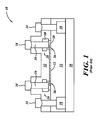
- Figure 1 is a known electronic device 10 having a precision resistor 12 connected to an upper metal layer 14 through a plurality of conductive vias 16 as disclosed in U.S. Patent No. 7,410,879 to Hill et al.
- the electronic device includes a first metal layer 18 formed on a substrate 20.
- the precision resistor is formed on a first dielectric layer 22 that overlies the first metal layer 18 and the substrate 20.
- a resistor head contact structure 24 is formed over ends 26 of the precision resistor 12.
- the resistor head contact structure 24 includes a titanium tungsten layer 28 and a second dielectric layer 30.
- a thin film resistor layer is generally evaporated or sputtered on the substrate 20 and then patterned and etched to form the resistor 12.
- an electrical connection is made to the ends 26 using two mask layers: one to shape the resistor 12 and one to form the resistor head contact structures 24.
- These resistor head contact structures 24 protect the resistor during the via etch that will electrically connect upper metal layer 14 to the resistor 12.
- a third dielectric layer 32 is formed overlying the precision resistor 12, the resistor head contact structure 24, and the first dielectric layer 22.
- the plurality of vias 16 are formed through the third dielectric layer 32 and filled with a conductive material to electrically connect the precision resistor 12 to the upper metal layer 14. Having the precision resistor 12 separated from the first metal layer 18 by the first dielectric layer 22 and having the precision resistor 12 separated from the upper metal layer 14 limits the manufacturer's ability to reduce the size of the electronic device. More particularly, having the first metal layer 18 and the resistor 12 separated by the first dielectric layer 22 adds significant vertical dimensions to the electronic device 10.
- FIG. 2 is an isometric view of a known technique for forming precision resistors without vias connecting upper metal layers to the resistors.
- An electronic device 40 has a tantalum nitride resistor 42 formed directly on exposed portions of an aluminum layer 44 and on a planarized dielectric layer 46 as disclosed in U.S. Patent No. 5,485,138 to Morris .
- the aluminum layer 44 is formed on a lower level dielectric layer 48 formed on a gallium-arsenide substrate 50.
- the process of forming the resistor 42 includes depositing the aluminum layer 44 directly on the lower level dielectric layer 48 and then patterning and etching the aluminum to form metal lines.
- the dielectric layer 46 is then formed over the aluminum layer 44.
- a planarization step smoothes a top surface of the dielectric layer 46.
- an area of between 1 and 1,000 angstroms of the top of the aluminum layer 44 is exposed.
- a tantalum nitride layer is then deposited and etched to form the tantalum nitride resistor 42.
- the resistor 42 is significantly larger than the aluminum layer 44, which adds additional vertical dimensions to the electronic device 40.
- Thin film resistors are attractive for high precision analog and mixed signal applications that have size constraints. Thin-film resistors are generally more precise than diffused and laser trimmed polysilicon resistors. Several parameters define performance of thin film resistors including the resistor's value, the resistor's tolerance, and the temperature coefficient of resistance. The temperature coefficient of resistance provides an adequate means to measure the performance of a resistor. Thin film resistors have superior temperature coefficient of resistance and voltage coefficients of resistance, i.e., a low thermal coefficient of resistance and a low voltage coefficient of resistance. Thin film resistors also have good resistor matching and stability under thermal stress for use in integrated circuits to implement a specific functionality, including biasing of active devices, serving as voltage dividers, and assisting in impedance matching, to name a few.
- Radio frequency (RF) circuits utilize thin film resistors for input/output circuitry in both radio frequency complementary metal-oxide semiconductors (CMOS) and RF silicon germanium technology.
- CMOS radio frequency complementary metal-oxide semiconductors
- CMOS radio frequency complementary metal-oxide semiconductors
- CMOS radio frequency complementary metal-oxide semiconductors
- CMOS radio frequency complementary metal-oxide semiconductors
- CMOS radio frequency complementary metal-oxide semiconductors
- CMOS radio frequency complementary metal-oxide semiconductors
- CMOS radio frequency complementary metal-oxide semiconductors
- CMOS radio frequency complementary metal-oxide semiconductors
- CMOS radio frequency complementary metal-oxide semiconductors
- silicon germanium technology RF silicon germanium technology
- the present disclosure describes a thin film resistor that laterally connects adjacent interconnect structures in an integrated circuit.
- Each interconnect structure includes a first conductor and a second conductor.
- a thin film resistor layer is formed over the interconnect structures and directly connects sidewalls of the first conductors to each other.
- the thin film resistor layer is also over the substrate extending between the interconnect structures.
- a portion of the thin film resistor layer is covered by a photoresist, leaving the remainder of the integrated circuit uncovered and exposed to an etch. After the etch, the photoresist is removed and the thin film resistor remains.
- the thin film resistor may include a plurality of resistive layers, such as two chromium silicon layers that have different resistance values and different temperature coefficients of resistance. Each resistive layer may be in the range of 50 and 500 angstroms in thickness. The plurality of resistive layers are deposited in succession in a deposition chamber without breaking the vacuum conditions.
- the thin film resistor may be covered by a dielectric cap, such as a silicon nitride layer between 400 and 600 angstroms in thickness.
- the dielectric cap provides the thin film resistor with good stability and temperature characteristics while protecting the thin film resistor layer from subsequent processing steps.
- the thin film resistor layer is very sensitive to damage from plasma etches, and if not protected such damage can impact the sheet resistance and temperature coefficient of resistance.
- the dielectric layer can act as a heat sink to dissipate heat away from the thin film resistor.
- the interconnect structures may include a protective coating that prevents the etch from damaging the second conductor during removal of the excess thin film resistor layer.
- the protective coating reduces the concerns raised by misalignment of the photoresist because even if there is misalignment, the protective coating prevents the etch from damaging the interconnect structures. This allows for minimum spacing between interconnect structures to be achieved. Laterally connecting adjacent interconnect structures through the first conductor eliminates the need for the processing steps of forming the resistor head contact structures and the vias that connect the resistor to the next metal level as described above with respect to the prior art.
- the thin film resistor provides thermally stable thin film resistors capable of achieving precise resistance values in a small area.
- a method comprising forming a first conductive layer over a substrate; forming a second conductive layer over the first conductive layer; forming first and second interconnect structures over a substrate, the forming including: removing portions of the first and second conductive layers to firm the first interconnect structure spaced from the second interconnect structure over the substrate, each interconnect structure having the first conductive layer and the second conductive layer; forming a restive layer over the first and second interconnect structures and the substrate; and defining a thin film resistor electrically connecting sidewalls of the first conductive layers of the first and second interconnect structures to each other, the defining include removing portions of the resistive layer.
- the method may further comprise forming a protective coating over the second conductive layer prior to forming the first and second interconnect structures.
- the method defining the thin film resistor may further comprise forming a photoresist layer over portions of a top surface of the first and second interconnect structures and over a portion of the substrate between the first and second interconnect structures; and etching the resistive layer to expose the substrate not covered by the photoresist layer.
- the method may further comprise forming a dielectric layer over the first and second interconnect structures and the thin film resistor; forming conductive vias through the dielectric layer to the first and second interconnect structures; and forming a third and a fourth interconnect structure coupled to the first and second interconnect structures, respectively, through the vias.
- the method may further comprise forming a dielectric cap over the thin film resistor.
- the method forming the resistive layer may include forming a first resistive layer over the substrate and forming a second resistor layer over the first resistor layer.
- a method comprising forming first and second interconnect structures over a substrate, each interconnect structure having a first conductor layer; forming a resistive layer over the substrate electrically connecting sidewalls of the first conductor layers of the first and second interconnect structures together, and defining a thin film resistor between first and second interconnect structures by removing portions of the resistive layer.
- the method may further comprise forming a second conductor layer over the first conductor layer of the first and second interconnect structures.
- the method wherein the resistive layer may be less than 200 angstroms in thickness.
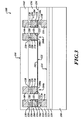
- Figure 3 is a cross-sectional view of a portion of an integrated circuit 100 having a thin film resistor 102 laterally connecting a first interconnect structure 104a and a second interconnect structure 104b of a plurality of interconnect structures 104.
- Each interconnect structure 104 includes a first conductive layer 106 and a second conductive layer 124.
- the thin film resistor 102 connects the first conductive layers 106a, 106b of the first and second interconnect structures 104a, 104b.
- the integrated circuit 100 includes a substrate 108 onto which a plurality of transistors, diodes, and other electronic devices (not shown in this cross-section) are formed in conjunction with the thin film resistor 102 to make the integrated circuit 100 operational.
- the substrate 108 may be monocrystalline silicon, gallium-arsenide, or an alternative material onto which integrated circuits are formed.
- a first interlevel dielectric layer 110 is formed on the substrate 108 to be used as insulation between transistors and other active components formed at other locations in the integrated circuit 100.
- the first interlevel dielectric layer 110 may be a deposited layer of oxide or other insulating material.
- the first interlevel dielectric may be a premetal dielectric layer (such as borophosphosilicate glass (BPSG)).
- BPSG borophosphosilicate glass
- a second interlevel dielectric 112 is formed over the first interlevel dielectric layer 110, which may be used to provide a top planar surface 114 after the transistors or other components are formed.
- the second interlevel dielectric may be an insulating material, such as tetraethyl orthosilicate (TEOS).
- TEOS tetraethyl orthosilicate
- the second interlevel dielectric 112 also isolates the transistors or other components from a plurality of first conductive structures 116.
- the BPSG may be 6,000 angstroms thick and the
- first conductive structures 116 Formation of the first conductive structures 116 is well known in the art and will not be described in detail. A variety of metals or other conductive materials, such as aluminum, can be used to form the first conductive structures 116.
- a third interlevel dielectric 118 isolates the plurality of first conductive structures 116 from each other and other devices formed in or over the substrate 108.
- the third interlevel dielectric 118 may include a plurality of layers, such as multiple depositions of the same material or layers of different dielectric materials.
- the third interlevel dielectric 118 may be planarized after formation by a chemical mechanical polish or other techniques that remove irregularities from the surface of the integrated circuit 100.
- a plurality of first conductive vias 120 are formed through the third interlevel dielectric 118 to expose a top surface 122 of the first conductive structures 116.
- the first conductive vias 120 can be formed of any conductive material, such as tungsten, copper, or aluminum, to provide an electrical connection to the plurality of first conductive structures 116.
- a barrier layer (not shown) may be formed as a protective barrier to line the first conductive vias 120 prior to forming the conductive material in the first conductive vias 120.
- the barrier layer may be titanium tungsten or titanium nitride.
- the plurality of interconnect structures 104 including the first and second interconnect structures 104a, 104b, are formed over the third interlevel dielectric 118. Methods of forming the plurality of interconnect structures 104 are described in more detail with respect to Figures 6-8 .
- Each of the interconnect structures 104 have sidewalls 131 that are transverse to a top surface 121 of the third interlevel dielectric layer 118.
- Each of the plurality of interconnect structures 104 includes a first conductor 106 formed over the third interlevel dielectric 118 and a second conductor 124 over the first conductor 106.
- An antireflective coating 126 overlies the second conductor 124.
- the antireflective coating 126 is optional and can be omitted.
- Each of the plurality of interconnect structures 104 have a protective coating 128, on the antireflective coating 126 or directly on the second conductor 124, that forms a top surface 130 of the interconnect structures 104.
- the thin film resistor 102 is formed by deposition of a thin film resistor layer over the third interlevel dielectric 118 and the interconnect structures 104.
- Numerous resistive materials may be utilized to form the thin film resistor 102, including, but not limited to, metallic films like chromium silicon, nickel chromium, tantalum nitride, tantalum aluminum, and titanium nitride. These materials have better performance than conventional polysilicon resistors because they can form a wide range of sheet resistances, have good tolerance, are easily reproducible, and have low temperature coefficients of resistance, have linear behavior, and have low parasitic capacitance values. These resistive materials are generally formed by an evaporation technique, a sputter technique, or a chemical vapor deposition technique.
- the resistive value of the thin film resistor 102 is called the sheet resistance, which is a measure of resistance in thin films that have a uniform thickness.
- the thin film resistor 102 has a controllable sheet resistance and a controllable temperature coefficient of resistance, which both depend on the composition of the material and the process conditions. In some products, a temperature coefficient of resistance of zero is desired.
- chromium silicon films have been developed for use in precision integrated circuits, such as temperature sensors and current sensors. Chromium silicon achieves a high sheet resistivity in the range of 2,000 and 3,000 ohms/square, which results in a high resistance in a small area of the integrated circuit. Resistance of chromium silicon films depends on the percentage of silicon in the composition and can be easily tailored to meet the resistance specifications of a particular integrated circuit. Chromium silicon also exhibits a low temperature coefficient of resistance in the range of ⁇ 250 parts per million per degrees Celsius (ppm/C) and can reach a near-zero temperature coefficient of resistance with specialized processing.
- ppm/C parts per million per degrees Celsius
- the thin film resistor 102 may be formed to have a thickness of less than 100 angstroms. In other embodiments, the thin film resistor 102 may have a thickness in the range of 50 and 500 angstroms. With these small thicknesses, the thin film resistor 102 can be formed between adjacent interconnect structures 104 without negatively impacting the interlevel dielectric planarization of subsequent levels in the integrated circuit 100.
- the first and second interconnect structures 104a, 104b are electrically connected to the thin film resistor 102 through the first conductors 106a and 106b. This eliminates the need to form vias to connect a thin film resistor to the next metal or conductive layer as in Figure 1 . Instead, the first conductors 106a, 106b allow the thin film resistor 102 to be formed on the same level of the integrated circuit 100 as the first and second interconnect structures 104a, 104b. This significantly reduces manufacturing time and costs by reducing the processing steps and reducing the amount of materials used to complete the integrated circuit 100. Also, the overall vertical and horizontal dimensions of the integrated circuit are decreased.
- vertical portions 132 of the thin film resistor layer remain on sidewalls of the interconnect structures 104.
- the vertical portions 132 of the thin film resistor layer do not remain in the final product. Their existence depends on how the manufacturer decides to pattern and form the thin film resistor 102 and how to expose the top surface 130 of the interconnect structures 104. If the vertical portions 132 of the thin film resistor layer are left intact, these vertical portions 132 protect the interconnect structure from under etch when the thin film resistor 102 is defined and portions of the third interlevel dielectric 118 are reexposed.
- Alternative structures will be described in more detail below, with respect to Figures 6-20 .
- the thin film resistor layer on the top surface 130 of the interconnect structures 104 is partially or fully removed when defining the thin film resistor 102.
- the protective coating 128 prevents the etch chemistry from damaging the second conductors 124 and the antireflective coating 126 during the removal of the thin film resistor layer from the top surfaces 130 of the interconnect structures 104. Some of the protective coating 128 may be removed during the etch; however, the protective coating 128 prevents damage to the second conductors 124 during removal of the excess thin film resistor layer.
- a surface 134 of the third interlevel dielectric 118 is exposed when the thin film resistor 102 is patterned from the thin film resistor layer.
- an etch to remove the thin film resistor layer may over etch and remove some amount of the exposed third interlevel dielectric 118 to form the surface 134. The over etch may occur to ensure the excess portions of the thin film resistor layer are removed, thereby avoiding shorting adjacent interconnect structures 104 that are not intended to be electrically connected.
- a fourth interlevel dielectric 136 is formed over the top surfaces 130 of the interconnect structures 104, the thin film resistor 102, and the surface 134 of the third interlevel dielectric 118.
- a plurality of second conductive vias 138 extend through the fourth interlevel dielectric 136 and the protective coating 128 to expose the antireflective coating 126 or the second conductor 124.
- the plurality of second conductive vias 138 have a conductive material formed within in order to provide an electrical connection from a plurality of second conductive structures 140 to the interconnect structures 104.
- the second conductive structures 140 are formed as is known in the prior art and will not be described in detail herein.
- a fifth interlevel dielectric 142 forms a top surface 144 of the integrated circuit 100 as shown.
- additional metal layers and other structures can be formed as desired to make the integrated circuit operational.
- Additional thin film resistors similar to the thin film resistor 102 may be formed at other locations as desired.
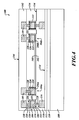
- Figure 4 is a cross-sectional view of the integrated circuit 100 having the thin film resistor 102 covered by a dielectric cap 105.
- the thin film resistor 102 is chromium silicon and the dielectric cap 105 is silicon nitride. This combination results in the thin film resistor 102 having an ultra low temperature coefficient of resistance of less than 10 ppm/C.
- the silicon nitride cap protects the chromium silicon from plasma etch steps. If left uncovered, the silicon in the chromium silicon can react with the oxygen in the etch chamber and change the resistance of the thin film resistor layer.
- a pattern and etch are performed to form the desired thin film resistor 102.
- a size and shape of the thin film resistor 102 are related to the desired resistance value for the thin film resistor 102.
- Figure 5 is a cross-sectional view of the integrated circuit 100 having a thin film resistor 102 having a first and a second thin film resistor layer 103a, 103b.
- the thin film resistor 102 is covered by the dielectric cap 105 described above.
- Precise and reliable resistance values are reproducible by depositing multiple thin film resistor layers in succession.
- a stack of thin film resistor layers combine the elementary properties of the individual layers.
- the first and second thin film resistor layers 103a, 103b may be deposited with multiple deposition steps in a single physical vapor deposition machine, without a break in vacuum conditions.
- Figures 6-11 are cross-sectional views of an integrated circuit 148 at various stages of a method of forming the interconnect structures 104 and the thin film resistor 102.
- a first conductor layer 152 is formed over a substrate 150, which includes a partially formed integrated circuit structure. Details of the integrated circuit structure are not shown because various components may be included.
- the substrate 150 may include the first and second interlevel dielectrics 110 and 112.
- the substrate 150 may have a plurality of transistors or active devices, metal layers, and interlevel dielectric layers formed on a monocrystalline silicon chip.
- the substrate 150 may include all of the components of Figures 3-5 that are formed prior to planarizing the third interlevel dielectric 118.
- the first conductor layer 152 is a 500 to 1,000 angstrom layer of titanium. Titanium is sufficiently conductive to allow good electrical connection between the first conductor 106 and the thin film resistor 102.
- the first conductor layer may be sputtered or deposited over the substrate 150 to form a conformal layer. Other conductive materials may be substituted for or combined with titanium, such as titanium nitride, titanium tungsten, chromium, tantalum nitride, and tantalum silicon nitride.
- the first conductor layer is 500 to 1,000 angstroms in thickness.
- a second conductor layer 154 is formed overlying the first conductor layer 152.
- the second conductor layer 154 may be formed using known metal formation techniques with materials such as aluminum, aluminum copper alloys, copper, or other suitable conductive materials.
- the second conductor layer 154 may be formed to have a thickness between 2,000 angstroms and 1 micron.
- the second conductor layer 154 is significantly larger than the first conductor layer 152.
- the first conductor layer 152 is a barrier that protects the second conductor layer 154 from diffusion from other elements in the substrate.
- An antireflective coating layer 156 is formed overlying the second conductor layer 154.
- the antireflective coating layer 156 is optional and can be included depending on the type of metal used to form the second conductors 124.
- the antireflective coating layer 156 may be a 500 angstrom thick layer of titanium nitride. Other suitable antireflective coatings may also be used.
- a protective coating layer 158 is formed overlying the antireflective coating layer 156.
- a material for the protective coating layer 158 is selected to have different etch chemistry from the second conductor 154.
- the protective coating layer 158 will be a dielectric if the second conductor layer 154 is metallic. This is to prevent an over etch or otherwise act as a stopping layer when future pattern and etch steps threaten to damage the second conductor 154.
- the protective coating layer 158 may be a deposited layer of silicon dioxide, such as a TEOS layer in the range of 1,000 and 2,000 angstroms in thickness.
- the protective coating layer 158 may be a silicon nitride, silicon carbide, or other dielectric.
- a photoresist pattern 160 is formed to define the interconnect structures 104.
- the photoresist pattern 160 protects the interconnect structures 104 as excess portions of the first conductor layer 152, the second conductor layer 154, the antireflective coating layer 156, and the protective coating layer 158 are removed to reexpose a top surface 162 of the substrate 150, see Figure 7 .
- the etch used to define the interconnect structures 104 may overetch past the top surface 162 of the substrate 150 and form a recess as shown in Figures 14 , 19, and 20 .
- each interconnect structure 104 can be between 5,000 angstroms and 1 micron in thickness. After defining the interconnect structures 104, each interconnect structure 104 includes the first conductor 106, the second conductor 124, the antireflective coating 126, and the protective coating 128 as previously described in Figures 3-5 .
- a thin film resistor layer 164 is formed overlying the interconnect structures 104 and the top surface 162 of the substrate 150.
- the thin film resistor layer 164 is a 50 to 500 angstrom resistive film. However, other thicknesses are possible.
- Temperature coefficient of resistance is the resistance-change factor per degree Celsius of temperature change.
- a positive temperature coefficient of resistance for a material means that its resistance increases with an increase in temperature. Pure metals typically have positive temperature coefficient of resistance. Temperature coefficients of resistance approaching zero can be obtained by alloying certain metals, and thus have negligible variation of temperature.
- a negative temperature coefficient of resistance for a material means that its resistance decreases with an increase in temperature.
- Semiconductor materials like carbon, silicon, and germanium, typically have a negative temperature coefficient of resistance. Therefore, selection of the material to form the thin film resistor layer 164 will contemplate the temperature coefficient of resistance in light of expected process conditions.
- the thin film resistor layer 164 may be chromium silicon, platinum, titanium nitride, tantalum nitride, tantalum aluminum, or nickel chromium, to name a few. As mentioned above, the sheet resistance of the thin film resistor layer 164 depends on the material selected, the length and width of the final resistor 102, and the operating conditions. Variations in the chemical composition of the thin film resistor layer also impact the sheet resistance.
- the amount of silicon can be varied to alter the resistance.
- Chromium silicon with 25% silicon can achieve 1 k ohms/square sheet resistance with a temperature coefficient of resistance of less than 100 ppm/C.
- the silicon is increased to 40%, then the chromium silicon layer can achieve 10k ohms/square sheet resistance with a temperature coefficient of resistance between 100 and 1,000 ppm/C.
- the silicon content is 85%, a 100k ohms/square sheet resistance with a temperature coefficient of resistance between 1,000 and 10,000 ppm/C can be achieved.
- a chromium silicon resistor with 25% silicon has a higher sheet resistance with a lower temperature coefficient of resistance than other materials such as tantalum nitride and tantalum aluminum, which both have less than 0.1 k ohms/square with a temperature coefficient of resistance between 50 and 100 ppm/C.
- the chromium silicon resistor with 40% silicon has a higher sheet resistance of 10k ohms/square at a temperature coefficient of resistance of 500 ppm/C as compared to a tantalum silicon nitride film, which has a resistance around 0.1 k ohms/square.
- the chromium silicon with 85% silicon has a higher resistance and a higher temperature coefficient of resistance than a high-ohmic polysilicon resistor or a diffused resistor.
- the thin film resistor layer 164 is deposited conformally over the interconnect structures and the top surface of the substrate 150.
- a physical vapor deposition (PVD) technique or a PVD sputter technique may be used to form the thin film resistor layer 164.
- PVD physical vapor deposition
- a sputtering process such as Magnetron Sputtering uses a sputter gas, such as argon krypton, supplied to a vacuum chamber.
- a sputter target the cathode connected to a DC power supply, is negatively biased. As the cathode voltage increases, electrons are ejected from the sputter target's surface. Electrons collide with the argon atoms in the sputter gas to create Ar + ions and more electrons.
- Rotation magnetic fields help maintain plasma by retaining electrons near the target surface. Electrons hop on the target surface area to ionize sputter gas. The Ar + ions are accelerated across the plasma sheath to kick out atoms from the target surface. Then the sputtered atoms travel across to the substrate where they are deposited as the resistive film.
- the PVD sputter technique can be used to form a chromium silicon film using low power, such as 100 Watts with a process temperate of 350 degrees Celsius. Other temperature and power settings are also suitable. Low power is one factor in forming very thin films.
- the thin film resistor layer 164 is deposited with an argon gas flow of 45 standard cubic centimeters per minute with a nitrogen gas flow of 2 standard cubic centimeters per minute for 40 to 50 seconds. An increase of nitrogen or oxygen in the deposition chamber results in more negative temperature coefficients of resistance for the thin film.
- the thin film resistor layer has a resistance range between 1 k and 2k ohms/square.
- Thin film resistors formed in accordance with the present disclosure can achieve a temperature coefficient of resistance in the range of zero to 100 ppm/C.
- a low temperature coefficient of resistance depends on the material composition and the sheet resistance.
- a thin film resistor layer formed from a target of chromium boride (85%), silicon (10%), and silicon carbide (5%) has a sheet resistance of around 2k ohms/square with a temperature coefficient of resistance in the range of negative 100 ppm/C to positive 150 ppm/C, depending on a thickness of the layer.
- This combination of materials have bi-modal grains sizes with small grains 3-5 nanometers in diameter and large grain sizes of 10 nanometers in diameter.
- a thin film resistor layer formed from a target of chromium boride (55%), silicon (30%), and silicon carbide (15%) has a sheet resistance of around 5k ohms/square with a temperature coefficient of resistance around negative 420 ppm/C. This film's temperature coefficient of resistance is weakly dependent on thickness.
- a thin film resistor layer formed from a target of chromium boride (35%), silicon (45%), and silicon carbide (25%) has a sheet resistance of around 25k ohms/square with a temperature coefficient of resistance in the range of negative 1,800 ppm/C and negative 1,500 ppm/C, depending on the thickness of the layer.
- Both the thin film resistor layer properties and the deposition conditions impact the resistance and temperature coefficient of resistance of the thin film resistor. Controlling the target's condition and the deposition conditions contribute to obtaining a low temperature coefficient of resistance.
- Forming the thin film resistor layer 164 laterally connecting sidewalls of adjacent interconnect structures allows precise control of resistance and temperature coefficient of resistance. For example, a high resistance in a small area, such as a sheet resistivity in the range of 2,000 to 3,000 ohms/square, may be achieved.
- a good electrical connection is achieved between the thin film resistor layer 164 and the first conductors 106 in each interconnect structure 104.
- the reduced thickness of the thin film resistor layer 164 and the lateral electrical connection allows a significant reduction in thickness of the integrated circuit 148.
- a dielectric cap layer 165 is formed overlying the thin film resistor layer 164.
- the dielectric cap layer 165 may have a thickness in the range of 200 to 1,000 Angstroms.
- the dielectric cap layer 165 is a dielectric that provides protection and stability for the thin film resistor layer 164.
- the dielectric cap layer 165 adds stability to the thin film resistor 102 without increasing the size of the integrated circuit 148. Including the dielectric cap layer 165 over the thin film resistor layer 164 provides long term resistance stability and generates improved voltage coefficients.
- the thin film resistor layer 164 is a 50 to 100 angstrom chromium silicon layer and the dielectric cap layer 165 is a silicon nitride cap layer in the range of 200 to 500 angstroms.
- Utilizing chromium silicon with silicon nitride achieves a stable sheet resistance with an ultra low temperature coefficient of resistance, such as a temperature coefficient of resistance between negative 10 ppm/C and positive 10 ppm/C.
- a temperature coefficient of resistance in the range of negative 250 ppm/C and positive 250 ppm/C can be achieved.
- a temperature coefficient of resistance of zero can be achieved.
- a hard mask may be deposited to permanently protect the thin film resistor.
- a titanium tungsten barrier layer may be deposited.
- the hard mask will protect the thin film resistor from chemically reacting with subsequent insulation or passivation layers. In locations where vias are formed, the hard mask can be removed with a wet etch, such as with hydrogen peroxide.
- a photoresist pattern 166 defines the thin film resistor 102 from the thin film resistor layer 164.
- the photoresist pattern 166 covers a top surface 168 of the dielectric cap layer 165 over the interconnect structures 104.
- the photoresist pattern 166 also covers the dielectric cap layer 165 over the thin film resistor 102 to be defined between the first interconnect structure 104a and the second interconnect structure 104b.
- the complexity of the masking can be reduced by only covering the desired thin film resistor 102.
- a spacing between the interconnect structures 104 can be reduced as a result of incorporating the protective coating 128 in the interconnect structures 104.
- the spacing between the interconnect structures is reduced.
- the challenge is to open the space between interconnect structures 104 not connected by the thin film resistor 102.
- the protective coating 128 allows reduced coverage by the photoresist pattern.
- the photoresist pattern 166 extends to edges 170 formed by vertical portions of the thin film resistor layer 164 and the dielectric cap layer 165 along vertical portions of the interconnect structures 104. Only horizontal portions 172 of the thin film resistor layer 164 and the dielectric cap layer 165 are exposed to an etch intended to define the thin film resistor 102 between the first and second interconnect structures 104a, 104b.
- the photoresist pattern 166 could extend past edges 170 to cover an amount of the horizontal portions 172 of the thin film resistor layer 164. As mentioned above, the challenge is to open and fully remove the thin film resistor layer 164 between interconnect structures 104 not connected by the thin film resistor 102. When the photoresist pattern 166 extends past the edges 170, opening the small spacing between the interconnect structures becomes more challenging. Having the photoresist pattern 166 extend past the edges 170 risks shorting the thin film resistor by not etching enough of the horizontal portions 172.
- the photoresist pattern 166 can be formed to be flush with the edges 170 or may only partially cover the top surface 168 of the interconnect structures 104.
- the photoresist pattern 166 can be incorporated in less than sub-half-micron technologies and allow for sufficient removal of the horizontal portions 172 between adjacent interconnect structures 104.
- the etch to remove the horizontal portions 172 of the thin film resistor layer 164 can also etch the second conductors 124. Depending on the severity of the over etch, the integrity of the affected interconnect structure may be compromised to a non-operational level. If the protective coating 128 is not included, there is a risk that the second conductors 124 will be damaged when the etch removes the thin film resistor layer 164 from the top of the interconnect structures 104. This risk is particularly acute when considering the difficulty in accurately and robustly stopping the etch, such as with endpoint detection.
- any misalignment of the photoresist pattern 166 or intentional partial exposure of the top surface 168 is not a problem because the protective coating 128 will prevent the etch from damaging the second conductors 124.
- using TEOS as the protective coating 128 protects the second conductors 124 when removing the thin film resistor layer 164 since a dielectric has a different etch chemistry than the thin film resistor layer.
- the photoresist pattern 166 provides a minimum spacing between interconnect structures 104 where the horizontal portions 172 of the thin film resistor layer 164 are desired to be removed. Even if mask misalignment causes the photoresist pattern 166 to be located inward from the edge 170, the interconnect structures will not be damaged by the etch.
- Figure 10 is a cross-sectional view of the integrated circuit 148 after the etch to define the thin film resistor 102.
- the thin film resistor layer remains intact over each interconnect structure 104 since the photoresist pattern 166 extended to the edges 170.
- the etch to define the thin film resistor 102 and to remove the horizontal portions 172 is long enough to fully remove the horizontal portions 172. If the etch is not complete and some of the horizontal portions 172 remain, the integrated circuit 148 may not function because the interconnect structures 104 may remain electrically connected through the thin film resistor 102.
- the etch may be prolonged to over etch and expose the surface 134 of the substrate 150, which is below the top surface 162.
- the photoresist pattern 166 By covering the thin film resistor 102 during the etch with the photoresist pattern 166, the small amount of space between the interconnect structures 104 can be opened up.
- the vertical portions 132 that remain after removing the horizontal portions 172 protect the interconnect structures 104 from being undercut during the etch.
- a thickness of the vertical portions 132 may be reduced during the etch to remove the horizontal portions 172.
- the photoresist pattern 166 may be formed to only cover a portion of the top surface 168 of the dielectric cap layer 165 over the thin film resistor layer 164 that is over the first and second interconnect structures 104a, 104b and to not cover the other interconnect structures 104 not covered by the photoresist pattern 166.
- the etch to remove the horizontal portions 172 of the thin film resistor layer 164 and the dielectric cap layer 165 will expose the surface 134 of the substrate 150.
- the etch will also remove the dielectric cap layer 165 and the thin film resistor layer 164 not protected by the photoresist pattern 166 on the top of the interconnect structures 104 not associated with the thin film resistor 102. Some or all of the protecting coating 128 may be removed from these other interconnect structures 104.
- the antireflective coating 126 may be reexposed by this etch. In embodiments where the antireflective coating 126 is omitted, the thickness of the protective coating 128 may be selected to prevent damage to the second conductor 124. If the photoresist pattern does not cover all of the interconnect structures, the uncovered interconnect structures will not require additional processing before protecting them with the fourth interlevel dielectric 136 and forming the plurality of second conductive vias 138 (as shown in Figure 3 ).
- Figure 11 is the integrated circuit 148 after removal of the dielectric cap layer 165 and the thin film resistor layer 164 that remained on the interconnect structures 104 after removing the horizontal portions 172 of the thin film resistor layer 164. Some or all of the protective coating 128 may be removed when thin film resistor layer 164 is removed from the top of the interconnect structures 104.
- a top surface 133 of the protective coating 128 is exposed. This may be achieved in a variety of ways. For example, a dielectric layer (not shown) may be formed over the integrated circuit 148 and then a chemical mechanical polish may be used to expose the top surface 133. Alternatively, the photoresist pattern 166 may be formed to only cover the thin film resistor 102 such that the other top surface 133 is exposed when the horizontal portions 172 are removed.
- the thin film resistor 102 connects adjacent interconnect structures directly together without needing vias to connect the resistor to the interconnects. This significantly reduces the space used to form the integrated circuit 148. In addition, the space between interconnect structures can be reduced when the protective coating 128 is incorporated in the interconnect structures.
- R angle is the resistance at a contact angle between the thin film resistor 102 and the first conductors 106.
- R TF is the resistance of the thin film resistor 102.
- the equation determines the resistance of R CS in parallel with R top in parallel with R side .
- the overall resistance is most impacted by the R angle between the first conductors 106 and the thin film resistor 102.
- R CS ⁇ R top and R LC then R total is approximately equal to 2(R CS + R angle ) + R TF .
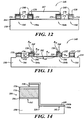
- Figure 12 is a cross-sectional view of the integrated circuit 148 having an alternative photoresist pattern 167 formed over the thin film resistor 102.
- the photoresist pattern 167 is intentionally formed inward from the edge 170 on the top surface 168 of the interconnect structures 104.
- the protective coating 128 prevents the etch from damaging the second conductor 124 in the interconnect structures 104 during an uncovered etch.
- the photoresist pattern 167 may be formed to only cover a portion of the top surface 168 of the thin film resistor layer 164 over the first and second interconnect structures 104a, 104b. The top surface 168 of the other interconnect structures 104 are not covered by the photoresist pattern 167.
- the protective coating 128 may be a TEOS layer or other silicon dielectric layer. The protective coating 128 may also be a plurality of layers tailored to protect the second conductors 124 and depending on the type of material used for the second conductors 124.
- Figure 13 is a cross-sectional view of the integrated circuit 148 of Figure 12 after the thin film resistor 102 has been defined and the photoresist 167 has been removed. As the etch removes the horizontal portions 172 of the thin film resistor layer 164, the surface 134 of the substrate 150 is exposed and the thin film resistor layer 164 not protected by the photoresist pattern 167 is removed from the top of the associated interconnect structures 104. Some or all of the protective coating 128 may be removed from these interconnect structures 104.
- a portion of the top surface 168 of the first and second interconnect structures 104a, 104b exposed by the photoresist pattern 167 is removed during the etch. Some or all of the protective coating 128 is also removed during the etch and the antireflective coating 126 is reexposed. In embodiments where the antireflective coating 126 is omitted, the thickness of the protective coating 128 may be selected to prevent damage to the second conductor 124.
- the interconnect structures do not require additional processing before protecting them with the fourth interlevel dielectric 136 and forming the plurality of second conductive vias 138 (as shown in Figure 3 ).
- Figure 14 is an enhanced view of one of the interconnect structures 104 electrically connected to the thin film resistor 102 through the first conductor 106.
- the interconnect structure 104 includes the second conductor 124 over the first conductor 162 and the antireflective coating 126 over the second conductor 124. Only a portion of the protective coating 128 remains after the thin film resistor 102 is defined from the first and second thin film resistor layers 103a, 103b.
- a photoresist pattern similar to the photoresist pattern 167 in Figure 12 was used to define the thin film resistor 102.
- the thin film resistor 102 is formed in a recess 210 in the substrate 150.
- the recess 210 is formed when the interconnect structures 104 are formed over the substrate 150.
- the etch to define the individual interconnect structures can over etch the substrate 150 and form the recess 210.
- the thickness of the first and second thin film resistor layers 103a, 103b and the dielectric cap 105 are significantly less than a depth of the recess 210 below the top surface 162 of the substrate 150.
- the thin film resistor may be a single thin film resistor or a plurality of thin film resistor layers.
- the formation of the thin film resistor layers depend on the target material and gas and temperature conditions of the deposition chamber.
- a plurality of layers having different chemical compositions can be deposited to achieve a desired resistance value for the thin film resistor.
- the first resistor layer 103a may be a chromium silicon film having a negative temperature coefficient of resistance, such as -360 ppm/C.
- the second resistor layer 103b may be another chromium silicon film having a positive temperature coefficient resistance, such as +400 ppm/C.
- a resistance value of the thin film resistor can be determined by calculating the parallel resistance values of the first and second resistor layers 103a, 103b.
- a near zero temperature coefficient of resistance can be achieved by forming the first resistive layer having the negative temperature coefficient resistance and the second resistive layer the positive temperature coefficient resistance.
- the first resistive layer 103a has a thickness in the range of 100 and 150 angstroms.
- the second resistive layer 103b has a thickness in the range of 20 and 50 angstroms.
- the first resistive layer 103a acts as a liner, electrically coupling the second resistive layer 103b to the interconnect structures.
- the first resistive layer 103a provides better continuity for the lateral contact.
- the first and second resistive layer 103a, 103b may be alloys formed from the same elements, but having different resistance values and different temperature coefficients of resistance caused by variations in deposition techniques. Alternatively, the first and second resistive layers may be alloy compositions that are formed from different elements.
- the first and second resistive layers 103a, 103b may be various thicknesses and have various sheet resistances.
- the vertically stacked arrangement of the first and second resistive layers is a parallel resistor structure.
- the deposition target and gas conditions are selected for each resistive layer so that the overall resistance of the plurality of resistive layers in parallel equals a desired resistance value for the thin film resistor.
- the target for first resistor layer 103a could be chromium boride (85%), silicon (10%), and silicon carbide (5%).
- the target for the second resistor layer 103b could be chromium boride (55%), silicon (30%), and silicon carbide (15%).
- a third resistor layer (not shown) could be formed on the second resistor layer 103b from a target of chromium boride (35%), silicon (45%), and silicon carbide (25%).
- the combination of the first, second, and third resistor layers forms the thin film resistor 302.
- the thin film resistor having three resistive layers formed in accordance with the above referenced targets has a sheet resistance of 200 ohms/square and a temperature coefficient of resistance near zero ppm/C.
- the plurality of thin film resistor layers can be deposited with a single machine without disrupting vacuum conditions.
- the plurality of films will compensate each other to achieve desired electrical properties.
- a film with a negative temperature coefficient of resistance can be covered with a film having a positive temperature coefficient of resistance.
- the combination of the positive and negative temperature coefficients of resistance provide for near zero temperature coefficient of resistance values.
- the plurality of thin film resistor layers provide for stable sheet resistances of less than one percent variation across a wafer.
- Figures 15-18 are cross-sectional views of another embodiment of the thin film resistor 102 laterally connecting sloped interconnect structures 174 over the substrate 150.
- the sloped interconnect structures 174 include a titanium conductor layer 176 and a metal layer 178.
- the titanium conductor layer 176 may be formed directly on the substrate 150 or spaced from the substrate by a dielectric layer (not shown).
- the titanium conductor layer may include a titanium layer and a titanium nitride layer. As described above, other materials besides titanium may be used for the conductor layer 176.
- the metal layer 178 may be aluminum, copper, or other metallic materials.
- the metal layer 178 may have an aluminum copper silicon composition.
- the sloped interconnect structures 174 have angled sidewalls such that the interconnect structures are trapezoidal, i.e ., tapered toward an upper surface 180.
- the optimized profile of the interconnect structures is a compromise between the vertical and sloped sidewalls in Figures 3 and 15 , respectively.
- the thin film resistor 102 is formed from a thin film resistor layer 164 in accordance with the methods and compositions described above.
- the dielectric cap layer 165 is formed over the thin film resistor layer 164 for stability.
- a photoresist pattern 184 is formed over the sloped interconnect structures 174 such that a portion of the upper surface 180 is covered.
- the photoresist pattern 184 is inward from an edge 187 of the dielectric cap layer 165, which begins the slope down toward horizontal portions 186.
- the photoresist pattern 184 may extend to the edge 187 of the dielectric cap layer 165. Having the photoresist pattern 184 extend over the full top surface 180 of the interconnect structures 174 provides protection for the top surface. Accordingly, the protective coating 128 described above, can be omitted.
- Figure 17 is the cross-sectional view of the thin film resistor 102 after the etch removes the horizontal portions 186 not protected by the photoresist pattern 184.
- Vertical portions 188 of the thin film resistor layer 164 are completely removed if the photoresist pattern 184 only covers the upper surface 180 of the sloped interconnect structures 174. However, if the photoresist pattern 184 extends past the upper surface 180, portions or all of the vertical portions 188 may remain on sidewalls 190 of the sloped interconnect structures 174.
- the thin film resistor 102 electrically connects the sloped interconnect structures 174 through the conductor layer 176. This lateral connection provides the thin film resistor on the integrated circuit without the extra interlevel dielectrics and vias typically used for precision resistors. Therefore the overall dimension of the integrated circuit is reduced.
- Figure 18 is the thin film resistor 102 with the cap 105 after the photoresist is removed.
- Various interlevel dielectrics and vias may be formed to couple the thin film resistor to other interconnect structures in the integrated circuit, as shown in Figure 3 .
- Upper horizontal portions 192 can be removed or vias can be formed through the upper horizontal portions 192 to electrically connect the interconnect structures to other components in the integrated circuit.
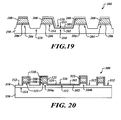
- FIG 19 is yet another embodiment of an integrated circuit 200 having a thin film resistor 202 with a dielectric cap 205.
- the integrated circuit 200 includes a substrate 250 that may have a plurality of active devices formed therein.
- a plurality of sloped interconnect structures 204 are formed over the substrate 250.
- Each interconnect structure 204 includes a first conductor 206 and a second conductor 208 and has sidewalls that are transverse to a top surface 214 of the substrate 250.
- recesses 210 are formed in the substrate 250 between the interconnect structures 204.
- the recesses 210 may be formed by over-etching the interconnect structures and by removal of the photoresist.
- the thin film resistor 202 is deposited and covered with the dielectric cap 205.
- the thin film resistor 202 has a top surface 212 below the top surface 214 of the substrate 250.
- the dielectric cap 205 also has a top surface 216 below the top surface of the substrate 250.
- the thin film resistor 202 and the dielectric cap 205 are significantly smaller than the interconnect structures and smaller than the first conductors 206.
- Figure 20 is a cross-sectional view of an integrated circuit 300 having a thin film resistor 302 connecting first and second interconnect structures 304a, 304b.
- the thin film resistor 302 is protected from subsequent processing steps by a dielectric cap 305.
- the integrated circuit 300 includes a substrate 350, which may include a plurality of active devices, such as CMOS and bipolar transistors.
- a top surface 314 of the substrate 350 may be may be a planarized layer of dielectric material formed over the transistors or other metal levels.
- a first dielectric layer 310 is formed over the substrate 350.
- the first dielectric 310 may be a silicon nitride layer or other dielectric material.
- An etch used to define the interconnect structures 304 may overetch the first dielectric layer 310 and form a recessed surface 312.
- the interconnect structures 304 include a first conductor 306 over the first dielectric layer 310 and a second conductor 308 over the first conductor 306.
- a protective coating 328 is formed over the second conductor 308.
- the protective coating 328 prevents the second conductor 308 from damage during an etch to define the thin film resistor 302.
- a photoresist pattern (not shown) was used that fully covered a top surface of the thin film resistor 302 and the dielectric cap 305 over the first and second interconnects 304a, 304b.
- the other interconnect structures 304, adjacent the first and second interconnect structures 304a, 304b were not protected by the photoresist pattern.
- the protective coating 328 prevents the etch that removes the excess thin film resistor 302 from damaging the second conductors 308.
- the thin film resistor 302 and the dielectric cap are formed over the interconnect structures 304 and over the recessed surface 312 of the first dielectric layer 310. Accordingly, a top surface 316 of the dielectric cap 305 is below a top surface 315 of the first dielectric layer 310.
- the thin film resistor 302 is formed to have a first portion 320 in contact with the recessed surface 312 of the first dielectric layer 310 between the first and second interconnect structures 304a, 304b.
- the thin film resistor 302 also has second portions 322 in contact with sidewalls of the first and second interconnect structures 304a, 304b.
- the configuration of the thin film resistor 302 between the first dielectric layer 310 and the dielectric cap 305 assists in heat dissipation, thereby making the film more stable.
- the heat is propagated from the thin film resistor to the first and second conductors, avoiding temperature extremes that can be caused by the joule effect. This also results in more stable current values per changes in operating temperature of the thin film resistor 302.
- the first dielectric 310 and the dielectric cap 305 are silicon nitride.
- Figure 21 is a simplified isometric view of a partial integrated circuit 400 having a first interconnect structure 404a spaced from a second interconnect structure 404b formed on a planar surface 421 of a dielectric layer 410.
- the dielectric layer 410 may be formed over a substrate that has active and passive devices formed thereon.
- a thin film resistor 402 laterally connects sidewalls 431 of the first and second interconnect structures 404a, 404b together.
- the first and second interconnect structures 404a and 404b each include a first conductive layer 406a, 406b and a second conductive layer 424a, 424b, respectively.
- the first and second interconnect structures 404a, 404b extend across the planar surface 421 to connect various electronic components formed in and over the substrate.
- the thin film resistor 402 is formed over a portion of the substrate between the first and second interconnect structures 404a, 404b. The size of the portion of the substrate covered by the thin film resistor will vary depending on the desired resistive value and characteristics of the resistive material used to form the thin film resistor.
- Figure 22 is a top down view of the partial integrated circuit 400 of Figure 21 .
- the first interconnect structure 404a extends between a first contact 405 and a second contact 407, which are spaced from each other on the integrated circuit.
- the first contact 405 may couple to an upper metal level in the integrated circuit 400.
- the first contact 405 may connect to one of the plurality of first conductive vias 120 in Figure 3 that connects the first interconnect structure 104a to one of the second conductive structures 140.
- the second contact 407 may couple to an active element at a level below the first interconnect structure 404a.
- the active element may be a transistor or a first metal level of the integrated circuit, such as metal one.
- the second interconnect structure 404b extends between a third contact 409 and a fourth contact 411, which are spaced from each other on the integrated circuit 400.
- the third and fourth contacts 409, 411 connect the second interconnect structure to other elements of the integrated circuit 400.
- the third contact 409 couples the second interconnect structure 404b to an element (not shown) that is above the second interconnect structure in the integrated circuit 400.
- the fourth contact 411 couples the second interconnect structure 404b to another element (not shown) that is below the second interconnect structure 404b on the integrated circuit 400.
- the thin film resistor 402 is formed to abut sidewalls 431 of the first and second interconnect structures 404a, 404b, electrically connecting the interconnect structures together. In one embodiment, the thin film resistor 402 is formed adjacent the first contact 405 and the third contact 409 of the first and second interconnect structures 404a, 404b, respectively.
- An alternative embodiment uses additional process steps to obtain a first conductor that is wider than the second conductor so that more of the thin film resistor is in contact with the first conductor.
- the first conductor could form a step having a top surface and a sidewall onto which the thin film resistor may be formed. Accordingly, the thin film resistor would have direct electrical contact with the top and sidewall instead of only the sidewall.
- Advantages of the uncovered etch of the thin film resistor layer to form the thin film resistor include overcoming mask overlay process margin constraints and allows for integration of the thin film resistor into existing products with minimal space between interconnect structures.
- Prior art methods use a mask for the resistor and for the metal lines, with an overlap. This method improves process margins and robustness for masking because the manufacturer only needs to mask thin film resistor areas. The simpler masking reduces time and material costs. Also manufacturing constraints based on choosing thin film materials to have either good etch selectivity to metal or to the antireflective coating or to have observable endpoint trace differences for endpoint detection are removed.
Landscapes
- Semiconductor Integrated Circuits (AREA)
- Internal Circuitry In Semiconductor Integrated Circuit Devices (AREA)
Applications Claiming Priority (1)
| Application Number | Priority Date | Filing Date | Title |
|---|---|---|---|
| US12/862,589 US8659085B2 (en) | 2010-08-24 | 2010-08-24 | Lateral connection for a via-less thin film resistor |
Publications (2)
| Publication Number | Publication Date |
|---|---|
| EP2423948A2 true EP2423948A2 (fr) | 2012-02-29 |
| EP2423948A3 EP2423948A3 (fr) | 2012-08-29 |
Family
ID=44514563
Family Applications (1)
| Application Number | Title | Priority Date | Filing Date |
|---|---|---|---|
| EP11178590A Withdrawn EP2423948A3 (fr) | 2010-08-24 | 2011-08-24 | Connexion latérale pour une résistance à film mince sans trou d'interconnexion et son procédé de fabrication |
Country Status (3)
| Country | Link |
|---|---|
| US (1) | US8659085B2 (fr) |
| EP (1) | EP2423948A3 (fr) |
| CN (2) | CN202259277U (fr) |
Cited By (4)
| Publication number | Priority date | Publication date | Assignee | Title |
|---|---|---|---|---|
| WO2014134384A3 (fr) * | 2013-02-28 | 2014-10-23 | Texas Instruments Incorporated | Circuit intégré comportant différentes résistances de même niveau |
| WO2022146486A1 (fr) * | 2020-12-31 | 2022-07-07 | Microchip Technology Incorporated | Résistance à couches minces pourvue de contacts améliorés |
| US11626474B2 (en) | 2020-12-31 | 2023-04-11 | Microchip Technology Incorporated | Thin-film resistor (TFR) with improved contacts |
| US11858269B2 (en) | 2019-06-17 | 2024-01-02 | Hewlett-Packard Development Company, L.P. | Cavitation plate to protect a heating component and detect a condition |
Families Citing this family (30)
| Publication number | Priority date | Publication date | Assignee | Title |
|---|---|---|---|---|
| US8558654B2 (en) | 2008-09-17 | 2013-10-15 | Stmicroelectronics (Grenoble 2) Sas | Vialess integration for dual thin films—thin film resistor and heater |
| US8786396B2 (en) | 2008-09-17 | 2014-07-22 | Stmicroelectronics Pte. Ltd. | Heater design for heat-trimmed thin film resistors |
| US8436426B2 (en) * | 2010-08-24 | 2013-05-07 | Stmicroelectronics Pte Ltd. | Multi-layer via-less thin film resistor |
| US8927909B2 (en) | 2010-10-11 | 2015-01-06 | Stmicroelectronics, Inc. | Closed loop temperature controlled circuit to improve device stability |
| US8809861B2 (en) | 2010-12-29 | 2014-08-19 | Stmicroelectronics Pte Ltd. | Thin film metal-dielectric-metal transistor |
| KR20130040283A (ko) * | 2011-10-14 | 2013-04-24 | 주식회사 동부하이텍 | 반도체 소자 및 그 제조방법 |
| US8526214B2 (en) | 2011-11-15 | 2013-09-03 | Stmicroelectronics Pte Ltd. | Resistor thin film MTP memory |
| US8598681B2 (en) | 2011-12-30 | 2013-12-03 | Stmicroelectronics Pte Ltd. | Temperature switch with resistive sensor |
| US9177910B2 (en) * | 2012-04-18 | 2015-11-03 | Micron Technology, Inc. | Interconnect structures for integrated circuits and their formation |
| US9627467B2 (en) * | 2013-09-06 | 2017-04-18 | Taiwan Semiconductor Manufacturing Company, Ltd. | Thin film resistor integrated between interconnect levels and contacting an underlying dielectric layer protrusion |
| JP6376750B2 (ja) * | 2013-12-10 | 2018-08-22 | ローム株式会社 | 半導体装置および半導体装置の製造方法 |
| TWI594384B (zh) * | 2016-02-26 | 2017-08-01 | 世界先進積體電路股份有限公司 | 半導體裝置結構 |
| US10381303B2 (en) * | 2016-07-01 | 2019-08-13 | Vanguard International Semiconductor Corporation | Semiconductor device structures |
| TWI610318B (zh) * | 2016-08-30 | 2018-01-01 | Nuvoton Technology Corporation | 零溫度係數電阻元件及其製造方法、負溫度係數電阻材料的製造方法 |
| KR102184449B1 (ko) | 2016-11-09 | 2020-12-01 | 삼성전자주식회사 | 반도체 소자 |
| CN108461482B (zh) * | 2017-02-17 | 2020-06-09 | 中芯国际集成电路制造(上海)有限公司 | 一种半导体器件及其制造方法 |
| US10304772B2 (en) | 2017-05-19 | 2019-05-28 | Taiwan Semiconductor Manufacturing Co., Ltd. | Semiconductor device structure with resistive element |
| US10665713B2 (en) * | 2017-09-28 | 2020-05-26 | Mitsubishi Electric Corporation | Silicon carbide semiconductor device |
| US10515852B2 (en) * | 2017-11-09 | 2019-12-24 | Taiwan Semiconductor Manufacturing Co., Ltd. | Structure and formation method of semiconductor device with resistive element |
| JP7015754B2 (ja) * | 2018-08-30 | 2022-02-03 | ルネサスエレクトロニクス株式会社 | 半導体装置 |
| US11031542B2 (en) * | 2019-05-02 | 2021-06-08 | International Business Machines Corporation | Contact via with pillar of alternating layers |
| CN110601696B (zh) * | 2019-07-18 | 2023-08-11 | 中国空间技术研究院 | 一种基于双芯片实现的抗辐射高压数模转换系统及方法 |
| US11678589B2 (en) * | 2020-02-21 | 2023-06-13 | Applied Materials, Inc. | Method of making high critical temperature metal nitride layer |
| WO2021168007A1 (fr) | 2020-02-21 | 2021-08-26 | Applied Materials, Inc. | Couche de nitrure métallique à température critique élevée avec couche de germe d'oxyde ou d'oxynitrure |
| US11335635B2 (en) * | 2020-04-08 | 2022-05-17 | Globalfoundries Singapore Pte. Ltd. | Thin film resistors of semiconductor devices |
| KR102933114B1 (ko) * | 2020-09-10 | 2026-03-03 | 엘지이노텍 주식회사 | 인쇄회로기판 및 이의 제조 방법 |
| US12132075B2 (en) * | 2021-08-26 | 2024-10-29 | Taiwan Semiconductor Manufacturing Company, Ltd. | Method (and related apparatus) for forming a resistor over a semiconductor substrate |
| US12080454B2 (en) * | 2021-11-26 | 2024-09-03 | Texas Instruments Incorporated | Nickel chromium aluminum thin film resistor |
| CN116648772A (zh) * | 2021-12-22 | 2023-08-25 | 华为技术有限公司 | 芯片及其形成方法、电子设备 |
| WO2025245120A1 (fr) * | 2024-05-20 | 2025-11-27 | 3D Glass Solutions, Inc. | Résistance à couche mince stabilisée en température |
Citations (2)
| Publication number | Priority date | Publication date | Assignee | Title |
|---|---|---|---|---|
| US5485138A (en) | 1993-05-10 | 1996-01-16 | Texas Instruments Incorporated | Thin film resistor and method for manufacturing the same |
| US7410879B1 (en) | 2005-07-11 | 2008-08-12 | National Semiconductor Corporation | System and method for providing a dual via architecture for thin film resistors |
Family Cites Families (51)
| Publication number | Priority date | Publication date | Assignee | Title |
|---|---|---|---|---|
| US3289046A (en) | 1964-05-19 | 1966-11-29 | Gen Electric | Component chip mounted on substrate with heater pads therebetween |
| US3416959A (en) | 1965-02-26 | 1968-12-17 | Gen Electric | Method of forming carbon resistor films |
| US4125854A (en) | 1976-12-02 | 1978-11-14 | Mostek Corporation | Symmetrical cell layout for static RAM |
| US4104607A (en) | 1977-03-14 | 1978-08-01 | The United States Of America As Represented By The Secretary Of The Navy | Zero temperature coefficient of resistance bi-film resistor |
| US4392992A (en) | 1981-06-30 | 1983-07-12 | Motorola, Inc. | Chromium-silicon-nitrogen resistor material |
| US4752814A (en) | 1984-03-12 | 1988-06-21 | Xerox Corporation | High voltage thin film transistor |
| JPS61100956A (ja) | 1984-10-22 | 1986-05-19 | Nec Corp | モノブリツド集積回路 |
| US4746896A (en) | 1986-05-08 | 1988-05-24 | North American Philips Corp. | Layered film resistor with high resistance and high stability |
| US4766411A (en) | 1986-05-29 | 1988-08-23 | U.S. Philips Corporation | Use of compositionally modulated multilayer thin films as resistive material |
| IT1197776B (it) | 1986-07-15 | 1988-12-06 | Gte Telecom Spa | Processo per l'ottenimento di circuiti passivi a strato sottile con linee resistive a differenti resistenze di strato e circuito passivo realizzato con il processo suddetto |
| US5037766A (en) | 1988-12-06 | 1991-08-06 | Industrial Technology Research Institute | Method of fabricating a thin film polysilicon thin film transistor or resistor |
| US5135888A (en) | 1989-01-18 | 1992-08-04 | Sgs-Thomson Microelectronics, Inc. | Field effect device with polycrystalline silicon channel |
| US5268651A (en) | 1991-09-23 | 1993-12-07 | Crystal Semiconductor Corporation | Low drift resistor structure |
| JP3026656B2 (ja) | 1991-09-30 | 2000-03-27 | 株式会社デンソー | 薄膜抵抗体の製造方法 |
| US5468672A (en) | 1993-06-29 | 1995-11-21 | Raytheon Company | Thin film resistor and method of fabrication |
| US5494845A (en) | 1993-08-17 | 1996-02-27 | Raytheon Company | Method of fabrication of bilayer thin film resistor |
| US5466484A (en) | 1993-09-29 | 1995-11-14 | Motorola, Inc. | Resistor structure and method of setting a resistance value |
| KR950034754A (ko) | 1994-05-06 | 1995-12-28 | 윌리엄 이. 힐러 | 폴리실리콘 저항을 형성하는 방법 및 이 방법으로부터 제조된 저항 |
| US5623097A (en) | 1994-11-24 | 1997-04-22 | Ricoh Company, Ltd. | Thermal-type flow sensor |
| US5640023A (en) | 1995-08-31 | 1997-06-17 | Sgs-Thomson Microelectronics, Inc. | Spacer-type thin-film polysilicon transistor for low-power memory devices |
| US5821960A (en) | 1995-09-18 | 1998-10-13 | Hitachi Koki Co., Ltd. | Ink jet recording head having first and second connection lines |
| US6281090B1 (en) | 1996-10-16 | 2001-08-28 | Macdermid, Incorporated | Method for the manufacture of printed circuit boards with plated resistors |
| JP3374680B2 (ja) * | 1996-11-06 | 2003-02-10 | 株式会社デンソー | 半導体装置の製造方法 |
| US6211032B1 (en) * | 1998-11-06 | 2001-04-03 | National Semiconductor Corporation | Method for forming silicon carbide chrome thin-film resistor |
| JP3473485B2 (ja) * | 1999-04-08 | 2003-12-02 | 日本電気株式会社 | 薄膜抵抗体およびその製造方法 |
| DE10023871C1 (de) | 2000-05-16 | 2001-09-27 | Infineon Technologies Ag | Feldeffekttransistor und Verfahren zum Herstellen eines Feldeffekttransistors |
| US6426268B1 (en) * | 2000-11-28 | 2002-07-30 | Analog Devices, Inc. | Thin film resistor fabrication method |
| KR100463434B1 (ko) | 2001-12-04 | 2004-12-23 | 삼성전기주식회사 | 매립된 레지스터를 갖는 인쇄회로기판 및 이의 제조방법 |
| US6504226B1 (en) | 2001-12-20 | 2003-01-07 | Stmicroelectronics, Inc. | Thin-film transistor used as heating element for microreaction chamber |
| US6891747B2 (en) | 2002-02-20 | 2005-05-10 | Stmicroelectronics S.R.L. | Phase change memory cell and manufacturing method thereof using minitrenches |
| US6890062B2 (en) | 2002-05-14 | 2005-05-10 | Lexmark International, Inc. | Heater chip configuration for an inkjet printhead and printer |
| US6817702B2 (en) | 2002-11-13 | 2004-11-16 | Eastman Kodak Company | Tapered multi-layer thermal actuator and method of operating same |
| US7838875B1 (en) | 2003-01-22 | 2010-11-23 | Tsang Dean Z | Metal transistor device |
| US7338637B2 (en) | 2003-01-31 | 2008-03-04 | Hewlett-Packard Development Company, L.P. | Microfluidic device with thin-film electronic devices |
| US7012499B2 (en) | 2003-06-02 | 2006-03-14 | International Business Machines Corporation | Method of fabrication of thin film resistor with 0 TCR |
| DE60310915D1 (de) | 2003-08-05 | 2007-02-15 | St Microelectronics Srl | Verfahren zur Herstellung einer Anordnung von Phasenwechselspeichern in Kupfer-Damaszenertechnologie sowie entsprechend hergestellte Anordnungen von Phasenwechselspeichern |
| US7999352B2 (en) | 2004-02-19 | 2011-08-16 | Ricoh Company, Ltd. | Semiconductor device |
| TWI266568B (en) | 2004-03-08 | 2006-11-11 | Brain Power Co | Method for manufacturing embedded thin film resistor on printed circuit board |
| KR100572330B1 (ko) | 2004-09-15 | 2006-04-18 | 삼성전자주식회사 | 저항 패턴을 갖는 비휘발성 기억 소자 및 그 형성 방법 |
| US7306552B2 (en) | 2004-12-03 | 2007-12-11 | Samsung Electronics Co., Ltd. | Semiconductor device having load resistor and method of fabricating the same |
| JP4407556B2 (ja) | 2005-03-29 | 2010-02-03 | 日本電気株式会社 | セッション中継装置、セッション中継方法およびプログラム |
| US7416951B2 (en) | 2005-09-29 | 2008-08-26 | Texas Instruments Incorporated | Thin film resistors integrated at two different metal interconnect levels of single die |
| EP1811564B1 (fr) | 2006-01-20 | 2010-03-10 | STMicroelectronics S.r.l. | Dispositif fusible à base de mémoire à changement de phase et méthode de programmation associée |
| US7696603B2 (en) | 2006-01-26 | 2010-04-13 | Texas Instruments Incorporated | Back end thin film capacitor having both plates of thin film resistor material at single metallization layer |
| US7427926B2 (en) | 2006-01-26 | 2008-09-23 | Microsoft Corporation | Establishing communication between computing-based devices through motion detection |
| JP2008226963A (ja) | 2007-03-09 | 2008-09-25 | Hitachi Ltd | 半導体装置及びその製造方法 |
| US8242876B2 (en) | 2008-09-17 | 2012-08-14 | Stmicroelectronics, Inc. | Dual thin film precision resistance trimming |
| US8436426B2 (en) | 2010-08-24 | 2013-05-07 | Stmicroelectronics Pte Ltd. | Multi-layer via-less thin film resistor |
| US8927909B2 (en) | 2010-10-11 | 2015-01-06 | Stmicroelectronics, Inc. | Closed loop temperature controlled circuit to improve device stability |
| US8809861B2 (en) | 2010-12-29 | 2014-08-19 | Stmicroelectronics Pte Ltd. | Thin film metal-dielectric-metal transistor |
| US9159413B2 (en) | 2010-12-29 | 2015-10-13 | Stmicroelectronics Pte Ltd. | Thermo programmable resistor based ROM |
-
2010
- 2010-08-24 US US12/862,589 patent/US8659085B2/en not_active Expired - Fee Related
-
2011
- 2011-08-23 CN CN201120318222XU patent/CN202259277U/zh not_active Expired - Lifetime
- 2011-08-23 CN CN2011102515206A patent/CN102376708A/zh active Pending
- 2011-08-24 EP EP11178590A patent/EP2423948A3/fr not_active Withdrawn
Patent Citations (2)
| Publication number | Priority date | Publication date | Assignee | Title |
|---|---|---|---|---|
| US5485138A (en) | 1993-05-10 | 1996-01-16 | Texas Instruments Incorporated | Thin film resistor and method for manufacturing the same |
| US7410879B1 (en) | 2005-07-11 | 2008-08-12 | National Semiconductor Corporation | System and method for providing a dual via architecture for thin film resistors |
Cited By (4)
| Publication number | Priority date | Publication date | Assignee | Title |
|---|---|---|---|---|
| WO2014134384A3 (fr) * | 2013-02-28 | 2014-10-23 | Texas Instruments Incorporated | Circuit intégré comportant différentes résistances de même niveau |
| US11858269B2 (en) | 2019-06-17 | 2024-01-02 | Hewlett-Packard Development Company, L.P. | Cavitation plate to protect a heating component and detect a condition |
| WO2022146486A1 (fr) * | 2020-12-31 | 2022-07-07 | Microchip Technology Incorporated | Résistance à couches minces pourvue de contacts améliorés |
| US11626474B2 (en) | 2020-12-31 | 2023-04-11 | Microchip Technology Incorporated | Thin-film resistor (TFR) with improved contacts |
Also Published As
| Publication number | Publication date |
|---|---|
| CN202259277U (zh) | 2012-05-30 |
| US8659085B2 (en) | 2014-02-25 |
| US20120049323A1 (en) | 2012-03-01 |
| EP2423948A3 (fr) | 2012-08-29 |
| CN102376708A (zh) | 2012-03-14 |
Similar Documents
| Publication | Publication Date | Title |
|---|---|---|
| EP2423950B1 (fr) | Procédé de fabrication d'une résistance à film mince sans trou d'interconnexion dotée d'un capuchon diélectrique | |
| US8659085B2 (en) | Lateral connection for a via-less thin film resistor | |
| US8436426B2 (en) | Multi-layer via-less thin film resistor | |
| US6993814B2 (en) | Method of fabricating a capacitor having sidewall spacer protecting the dielectric layer | |
| US20090015369A1 (en) | Semiconductor device and method for manufacturing the same | |
| US8531003B2 (en) | Semiconductor device and manufacturing method of the same | |
| US7358592B2 (en) | Semiconductor device | |
| US8766405B2 (en) | Semiconductor device and method of manufacturing the same | |
| EP3090446A2 (fr) | Résistance à couche mince métallique et procédé associé | |
| US8629488B2 (en) | Method for manufacturing an energy storage device and structure therefor | |
| JP4776199B2 (ja) | 半導体装置の製造方法 | |
| US6225183B1 (en) | Method of fabricating a thin-film resistor having stable resistance | |
| JP4549075B2 (ja) | 半導体装置及びその製造方法 | |
| US20050093108A1 (en) | Insulating layer having decreased dielectric constant and increased hardness | |
| US7669313B2 (en) | Method for fabricating a thin film resistor semiconductor structure | |
| US6747353B2 (en) | Barrier layer for copper metallization in integrated circuit fabrication | |
| US6607962B2 (en) | Globally planarized backend compatible thin film resistor contact/interconnect process | |
| EP1566831A2 (fr) | Dispositif a semi-conducteurs et procédé de fabrication dudit dispositif | |
| US11670439B2 (en) | Thin-film resistor (TFR) module | |
| US20050230833A1 (en) | Semiconductor device | |
| KR100270962B1 (ko) | 반도체 집적회로의 커패시터 제조방법 | |
| JP2011066310A (ja) | 薄膜抵抗素子、および、その製造方法 | |
| JP2005252160A (ja) | 半導体装置 | |
| US20060040459A1 (en) | Method to produce thin film resistor with no resistor head using dry etch | |
| US20090001581A1 (en) | Metal line of semiconductor device and method of forming the same |
Legal Events
| Date | Code | Title | Description |
|---|---|---|---|
| AK | Designated contracting states |
Kind code of ref document: A2 Designated state(s): AL AT BE BG CH CY CZ DE DK EE ES FI FR GB GR HR HU IE IS IT LI LT LU LV MC MK MT NL NO PL PT RO RS SE SI SK SM TR |
|
| AX | Request for extension of the european patent |
Extension state: BA ME |
|
| PUAI | Public reference made under article 153(3) epc to a published international application that has entered the european phase |
Free format text: ORIGINAL CODE: 0009012 |
|
| PUAL | Search report despatched |
Free format text: ORIGINAL CODE: 0009013 |
|
| AK | Designated contracting states |
Kind code of ref document: A3 Designated state(s): AL AT BE BG CH CY CZ DE DK EE ES FI FR GB GR HR HU IE IS IT LI LT LU LV MC MK MT NL NO PL PT RO RS SE SI SK SM TR |
|
| AX | Request for extension of the european patent |
Extension state: BA ME |
|
| RIC1 | Information provided on ipc code assigned before grant |
Ipc: H01L 23/522 20060101ALI20120723BHEP Ipc: H01L 49/02 20060101AFI20120723BHEP |
|
| 17P | Request for examination filed |
Effective date: 20130227 |
|
| 17Q | First examination report despatched |
Effective date: 20160916 |
|
| STAA | Information on the status of an ep patent application or granted ep patent |
Free format text: STATUS: EXAMINATION IS IN PROGRESS |
|
| STAA | Information on the status of an ep patent application or granted ep patent |
Free format text: STATUS: THE APPLICATION IS DEEMED TO BE WITHDRAWN |
|
| 18D | Application deemed to be withdrawn |
Effective date: 20170127 |