EP2423293A2 - Verfahren zur Herstellung von SiAlON Oxynitrid-Leuchtstoffen - Google Patents
Verfahren zur Herstellung von SiAlON Oxynitrid-Leuchtstoffen Download PDFInfo
- Publication number
- EP2423293A2 EP2423293A2 EP11156400A EP11156400A EP2423293A2 EP 2423293 A2 EP2423293 A2 EP 2423293A2 EP 11156400 A EP11156400 A EP 11156400A EP 11156400 A EP11156400 A EP 11156400A EP 2423293 A2 EP2423293 A2 EP 2423293A2
- Authority
- EP
- European Patent Office
- Prior art keywords
- firing
- fluorescent substance
- intermediate product
- mixture
- oxynitride fluorescent
- Prior art date
- Legal status (The legal status is an assumption and is not a legal conclusion. Google has not performed a legal analysis and makes no representation as to the accuracy of the status listed.)
- Withdrawn
Links
Images



Classifications
-
- C—CHEMISTRY; METALLURGY
- C09—DYES; PAINTS; POLISHES; NATURAL RESINS; ADHESIVES; COMPOSITIONS NOT OTHERWISE PROVIDED FOR; APPLICATIONS OF MATERIALS NOT OTHERWISE PROVIDED FOR
- C09K—MATERIALS FOR MISCELLANEOUS APPLICATIONS, NOT PROVIDED FOR ELSEWHERE
- C09K11/00—Luminescent materials, e.g. electroluminescent or chemiluminescent
- C09K11/08—Luminescent materials, e.g. electroluminescent or chemiluminescent containing inorganic luminescent materials
- C09K11/77—Luminescent materials, e.g. electroluminescent or chemiluminescent containing inorganic luminescent materials containing rare earth metals
- C09K11/7728—Luminescent materials, e.g. electroluminescent or chemiluminescent containing inorganic luminescent materials containing rare earth metals containing europium
-
- C—CHEMISTRY; METALLURGY
- C09—DYES; PAINTS; POLISHES; NATURAL RESINS; ADHESIVES; COMPOSITIONS NOT OTHERWISE PROVIDED FOR; APPLICATIONS OF MATERIALS NOT OTHERWISE PROVIDED FOR
- C09K—MATERIALS FOR MISCELLANEOUS APPLICATIONS, NOT PROVIDED FOR ELSEWHERE
- C09K11/00—Luminescent materials, e.g. electroluminescent or chemiluminescent
- C09K11/08—Luminescent materials, e.g. electroluminescent or chemiluminescent containing inorganic luminescent materials
- C09K11/77—Luminescent materials, e.g. electroluminescent or chemiluminescent containing inorganic luminescent materials containing rare earth metals
-
- C—CHEMISTRY; METALLURGY
- C01—INORGANIC CHEMISTRY
- C01B—NON-METALLIC ELEMENTS; COMPOUNDS THEREOF; METALLOIDS OR COMPOUNDS THEREOF NOT COVERED BY SUBCLASS C01C
- C01B21/00—Nitrogen; Compounds thereof
- C01B21/082—Compounds containing nitrogen and non-metals and optionally metals
- C01B21/0821—Oxynitrides of metals, boron or silicon
-
- C—CHEMISTRY; METALLURGY
- C01—INORGANIC CHEMISTRY
- C01B—NON-METALLIC ELEMENTS; COMPOUNDS THEREOF; METALLOIDS OR COMPOUNDS THEREOF NOT COVERED BY SUBCLASS C01C
- C01B21/00—Nitrogen; Compounds thereof
- C01B21/082—Compounds containing nitrogen and non-metals and optionally metals
- C01B21/0821—Oxynitrides of metals, boron or silicon
- C01B21/0826—Silicon aluminium oxynitrides, i.e. sialons
-
- C—CHEMISTRY; METALLURGY
- C09—DYES; PAINTS; POLISHES; NATURAL RESINS; ADHESIVES; COMPOSITIONS NOT OTHERWISE PROVIDED FOR; APPLICATIONS OF MATERIALS NOT OTHERWISE PROVIDED FOR
- C09K—MATERIALS FOR MISCELLANEOUS APPLICATIONS, NOT PROVIDED FOR ELSEWHERE
- C09K11/00—Luminescent materials, e.g. electroluminescent or chemiluminescent
- C09K11/08—Luminescent materials, e.g. electroluminescent or chemiluminescent containing inorganic luminescent materials
- C09K11/55—Luminescent materials, e.g. electroluminescent or chemiluminescent containing inorganic luminescent materials containing beryllium, magnesium, alkali metals or alkaline earth metals
-
- C—CHEMISTRY; METALLURGY
- C09—DYES; PAINTS; POLISHES; NATURAL RESINS; ADHESIVES; COMPOSITIONS NOT OTHERWISE PROVIDED FOR; APPLICATIONS OF MATERIALS NOT OTHERWISE PROVIDED FOR
- C09K—MATERIALS FOR MISCELLANEOUS APPLICATIONS, NOT PROVIDED FOR ELSEWHERE
- C09K11/00—Luminescent materials, e.g. electroluminescent or chemiluminescent
- C09K11/08—Luminescent materials, e.g. electroluminescent or chemiluminescent containing inorganic luminescent materials
- C09K11/59—Luminescent materials, e.g. electroluminescent or chemiluminescent containing inorganic luminescent materials containing silicon
-
- C—CHEMISTRY; METALLURGY
- C09—DYES; PAINTS; POLISHES; NATURAL RESINS; ADHESIVES; COMPOSITIONS NOT OTHERWISE PROVIDED FOR; APPLICATIONS OF MATERIALS NOT OTHERWISE PROVIDED FOR
- C09K—MATERIALS FOR MISCELLANEOUS APPLICATIONS, NOT PROVIDED FOR ELSEWHERE
- C09K11/00—Luminescent materials, e.g. electroluminescent or chemiluminescent
- C09K11/08—Luminescent materials, e.g. electroluminescent or chemiluminescent containing inorganic luminescent materials
- C09K11/64—Luminescent materials, e.g. electroluminescent or chemiluminescent containing inorganic luminescent materials containing aluminium
-
- C—CHEMISTRY; METALLURGY
- C09—DYES; PAINTS; POLISHES; NATURAL RESINS; ADHESIVES; COMPOSITIONS NOT OTHERWISE PROVIDED FOR; APPLICATIONS OF MATERIALS NOT OTHERWISE PROVIDED FOR
- C09K—MATERIALS FOR MISCELLANEOUS APPLICATIONS, NOT PROVIDED FOR ELSEWHERE
- C09K11/00—Luminescent materials, e.g. electroluminescent or chemiluminescent
- C09K11/08—Luminescent materials, e.g. electroluminescent or chemiluminescent containing inorganic luminescent materials
- C09K11/77—Luminescent materials, e.g. electroluminescent or chemiluminescent containing inorganic luminescent materials containing rare earth metals
- C09K11/7728—Luminescent materials, e.g. electroluminescent or chemiluminescent containing inorganic luminescent materials containing rare earth metals containing europium
- C09K11/77348—Silicon Aluminium Nitrides or Silicon Aluminium Oxynitrides
-
- C—CHEMISTRY; METALLURGY
- C01—INORGANIC CHEMISTRY
- C01P—INDEXING SCHEME RELATING TO STRUCTURAL AND PHYSICAL ASPECTS OF SOLID INORGANIC COMPOUNDS
- C01P2002/00—Crystal-structural characteristics
- C01P2002/50—Solid solutions
- C01P2002/52—Solid solutions containing elements as dopants
-
- C—CHEMISTRY; METALLURGY
- C01—INORGANIC CHEMISTRY
- C01P—INDEXING SCHEME RELATING TO STRUCTURAL AND PHYSICAL ASPECTS OF SOLID INORGANIC COMPOUNDS
- C01P2002/00—Crystal-structural characteristics
- C01P2002/70—Crystal-structural characteristics defined by measured X-ray, neutron or electron diffraction data
- C01P2002/72—Crystal-structural characteristics defined by measured X-ray, neutron or electron diffraction data by d-values or two theta-values, e.g. as X-ray diagram
-
- C—CHEMISTRY; METALLURGY
- C01—INORGANIC CHEMISTRY
- C01P—INDEXING SCHEME RELATING TO STRUCTURAL AND PHYSICAL ASPECTS OF SOLID INORGANIC COMPOUNDS
- C01P2002/00—Crystal-structural characteristics
- C01P2002/80—Crystal-structural characteristics defined by measured data other than those specified in group C01P2002/70
- C01P2002/84—Crystal-structural characteristics defined by measured data other than those specified in group C01P2002/70 by UV- or VIS- data
Definitions
- the present embodiment relates to a process for production of an oxynitride fluorescent substance.
- a white light-emitting LED device which is a single device comprising a fluorescent substance and a semi-conductor light-emitting element such as LED in combination so as to give off white light, is becoming popularly used nowadays as a light source for illumination and the like.
- the fluorescent substance employed in the white light-emitting LED device is required to exhibit high luminous efficiency when excited by near UV to blue light.
- various oxynitride fluorescent substances have been proposed.
- WO07/105631 discloses a green light-emitting oxynitride fluorescent substance, whose crystal structure is disclosed to be the same as Sr 3 Al 3 Si 13 O 2 N 21 in JP-A 2010-31201 (KOKAI ).
- the present embodiment resides in a process for production of an oxynitride fluorescent substance, comprising a step in which a compound represented by the formula: (Sr,Eu) 2 Si 5 N 8 , silicon nitride and aluminum nitride are mixed and then fired in a nitrogen atmosphere under high pressure.
- a compound represented by the formula: (Sr,Eu) 2 Si 5 N 8 is used in place of the conventional material.
- silicon nitride, silicon powder or a combination thereof and aluminum nitride are mixed and then fired in a nitrogen atmosphere under high (increased) pressure.
- a second process of the embodiment comprises two steps: that is, the first step in which an intermediate product represented by (Sr,Eu) 2 Si 5 N 8 is synthesized from a compound containing oxygen and strontium, such as, strontium oxide (SrO) and strontium hydroxide (Sr(OH) 2 ), which are inexpensive materials; and the second step in which the intermediate product and other materials are fired in the same manner as in the above first process.
- a mixture is used that contains first-phase crystals having the same crystal structure as Sr 2 Al 2 Si 10 O 4 N 14 and second-phase crystals having the same crystal structure as Sr 2 Al 3 Si 7 ON 13.
- the oxynitride fluorescent substance aimed by each process of the embodiment has the same crystal structure as Sr 3 Al 3 Si 13 O 2 N 21 .
- such oxynitride fluorescent substance is often referred to as "Sr 3 Al 3 Si 13 O 2 N 21 -type phosphor".
- This type of fluorescent substance is based on Sr 3 Al 3 Si 13 O 2 N 21 phosphor, but the phosphor is modified by replacing its constituting elements (i.e., Sr, AI, Si, O and N) with other elements or by doping with other metal elements such as Eu.
- the Sr 3 Al 3 Si 13 O 2 N 21 -type phosphor can be identified by X-ray diffraction or neutron diffraction. This means that the Sr 3 Al 3 Si 13 O 2 N 21 -type phosphor includes not only a substance exhibiting the same XRD profile as Sr 3 Al 3 Si 13 O 2 N 21 but also a substance having a crystal structure in which the constituting elements are so doped with other elements as to change the lattice constants within particular ranges.
- the constituting elements of Sr 3 Al 3 Si 13 O 2 N 21 crystal may be replaced with other elements in such a way described below in detail. Specifically, Sr in the crystal may be replaced with the emission center element Eu.
- AI and Si may be partly substituted with each other, and at the same time O and N may be partly substituted with each other.
- examples of that substance include Sr 3 Al 2 Si 14 ON 22 , Sr 3 AlSi 15 N 23 , Sr 3 Al 4 Si 12 O 3 N 20 , Sr 3 Al 5 Si 11 O 4 N 19 and Sr 3 Al 6 Si 10 O 5 N 18. These substances have crystal structures belonging to the Sr 3 Al 3 Si 13 O 2 N 21 -type crystal.
- the crystal is slightly doped with Eu or the like, it can be judged by the following simple method whether or not the doped crystal belongs to the Sr 3 Al 3 Si 13 O 2 N 21 type phosphor. Specifically, after an oxynitride fluorescent substance is produced by the process of the embodiment, the XRD profile thereof is measured and then the positions of the diffraction peaks are compared with those in the XRD profile of Sr 3 Al 3 Si 13 O 2 N 21 . As a result, if the positions of the main peaks are identical, the produced substance can be regarded as a Sr 3 Al 3 Si 13 O 2 N 21 -type phosphor. As the main peaks for comparison, it is preferred to select 10 peaks having strong diffraction intensity.
- the Sr 3 Al 3 Si 13 O 2 N 21 -type phosphor aimed by the process of the embodiment is preferably represented by the following formula: (Sr 1-x EU x ) a AlSi b O c N d in which x, a, b, c and d are numbers satisfying the conditions of 0 ⁇ x ⁇ 1 (preferably, 0.0 ⁇ x ⁇ 0.3), 0.93 ⁇ a ⁇ 1.3 (preferably, 0.93 ⁇ a ⁇ 1.1), 4.0 ⁇ b ⁇ 5.8 (preferably, 4.0 ⁇ b ⁇ 4.3), 0.6 ⁇ c ⁇ 1.0 (preferably, 0.6 ⁇ c ⁇ 0.9) and 6 ⁇ d ⁇ 11 (preferably, 6 ⁇ d ⁇ 8), respectively.
- This fluorescent substance is characterized by containing oxygen only in a small amount.
- the ratio c/a in the above formula namely, the ratio by mole of oxygen to the sum of strontium and europium, is preferably less than 1.0 because such fluorescent substance has excellent luminance characteristics.
- a compound represented by (Sr,Eu) 2 Si 5 N 8 is used as a material to produce the above Sr 3 Al 3 Si 13 O 2 N 21 -type phosphor.
- the compound (Sr,Eu) 2 Si 5 N 8 can be synthesized by any method, such as, by the method described in Xie et al., Chem. Mater. 18, 5578(2006 ), in which a mixture of SrCO 3 , Eu 2 O 3 and Si 3 N 4 is fired at 1600°C under 0.5 Mpa in a nitrogen atmosphere to synthesize (Sr,Eu) 2 Si 5 N 8 .
- the synthesized (Sr,Eu) 2 Si 5 N 8 is then fired together with other materials that supply complementary components necessary for constituting the aimed oxynitride fluorescent substance, to produce the oxynitride fluorescent substance.
- the materials other than (Sr,Eu) 2 Si 5 N 8 are silicon nitride, silicon powder or a combination thereof and aluminum nitride. In the first process, those materials are mixed and then the mixture is fired in a nitrogen atmosphere under high pressure.
- the materials include no oxide. That is for the purpose of controlling the oxygen content in the resultant oxynitride fluorescent substance. If the oxygen content is too high, the resultant product contains variant phase crystals in such a large amount that the total luminance characteristics are impaired.
- the material mixture contains silicon nitride, silicon powder or a combination thereof as a silicon source. Since silicon powder is apt to prevent the formation of variant phase crystals, it is preferred to adopt silicon powder as the silicon source. It is not clear why silicon powder prevents the formation of variant phase crystals, but is presumed because silicon powder has relatively high reactivity as compared with silicon nitride and the like.
- the silicon powder preferably has a small mean particle size. Specifically, the mean particle size is preferably less than 150 ⁇ m, further preferably less than 50 ⁇ m. On the other hand, however, if the silicon powder contains oxygen and other impurities, the resultant luminance characteristics are often impaired. From this viewpoint, the silicon powder preferably has a large mean particle size. Specifically, the mean particle size is preferably not less than 5 ⁇ m.
- the "mean particle size" means a 50% median diameter, which can be determined by means of, for example, a laser diffraction/scattering particle size analyzer manufactured by HORIBA, Ltd.
- aluminum oxide Al 2 O 3
- Al that is, the total amount of aluminum in aluminum nitride and aluminum oxide
- Si that is, the total amount of silicon in (Sr,Eu) 2 Si 5 N 8 and the after-added silicon substances such as silicon nitride and silicon powder
- the ratio by mole among the sum of Sr and Eu, Al that is, the total amount of aluminum in aluminum nitride and aluminum oxide
- Si that is, the total amount of silicon in (Sr,Eu) 2 Si 5 N 8 and the after-added silicon substances such as silicon nitride and silicon powder
- the material mixture used in the final step is so prepared as to contain Sr, Eu, Al and Si in such amounts that the molar ratio among Sr+Eu, Al and Si may correspond to a:1:b of (Sr 1-x EU x ) a AlSi b O c N d .
- Si may volatilize during the firing procedure in the final step.
- the amount of silicon nitride or silicon powder is preferably designed to be larger than the theoretical value.
- the firing is preferably carried out at a low temperature. If the firing temperature is 1700°C or more, it is possible in most cases to obtain a fluorescent substance having satisfying characteristics.
- the firing temperature is, therefore, preferably 1700°C or more. Further, from the viewpoint of improving the yield, the firing temperature is preferably 1800°C or more.
- the materials are fired in a nitrogen atmosphere under high pressure.
- the pressure needs to be higher than atmospheric pressure, and is generally 5 atm or more, preferably 7 to 10 atm.
- the firing container used in the firing procedure.
- the firing container is preferably a BN crucible.
- (Sr,Eu) 2 Si 5 N 8 is used as one of the starting materials.
- (Sr,Eu) 2 Si 5 N 8 may be synthesized and then continuously or discontinuously fired together with other materials that supply complementary components necessary for constituting the aimed oxynitride fluorescent substance, to produce the oxynitride fluorescent substance.
- the oxynitride fluorescent substance can be produced by two steps, that is,
- a compound containing oxygen and strontium is used as the Sr source.
- the compound containing oxygen and strontium include strontium oxide (SrO) and strontium hydroxide (Sr(OH) 2 ), which are hydroscopic but easy to weigh out and treat in air unless they are left for long time. In addition, they are inexpensive materials. Accordingly, from the industrial viewpoint, it is greatly significant to adopt them in place of Sr 3 N 2 , which is expensive and unstable. Further, since they are apt to reduce the above problem, SrO and Sr(OH) 2 are favorable materials.
- a firing container used in the firing procedure is made of non-oxide material.
- the container include firing containers made of boron nitride (BN) or silicon carbide (SiC). That kind of firing containers enables to reduce sufficiently the oxygen content of the intermediate product obtained in the first step.
- a firing container made of oxide such as alumina is used in the first step, the intermediate product contains oxygen in such a large amount that variant phase crystals are formed in a considerable amount in the oxynitride fluorescent substance obtained in the second step. Since the variant phase crystals are obstructive factors hindering the fluorescent substance from emitting luminescence, the substance containing the variant phase crystals exhibits poor luminance efficiency.
- the materials in the first step of the second process according to the embodiment include a compound of europium, which serves as the emission center element, and a compound of silicon, which constitutes a part of the phosphor crystal.
- a compound of europium compound As the europium compound, EU 2 O 3 is used. Although other europium compounds such as EU 2 N 3 are usable, EU 2 O 3 is preferred in view of production cost. However, if the intermediate product is required to contain oxygen only in a very small amount, a considerable amount of EU 2 N 3 may be used in combination.
- As the silicon compound Si 3 N 4 or Si powder is used. These silicon compounds contain oxygen only in small amounts, and hence are advantageous to keep the oxygen content at a low level in the intermediate product. Further, they are chemically stable enough to treat in air without problems or difficulties.
- the intermediate product obtained in the first step indispensably contains a component represented by (Sr,Eu) 2 Si 5 N 8 .
- This component therefore, corresponds to the aforementioned material in the first process of the embodiment.
- the component emits orange or red luminescence having an emission peak in the wavelength range of 600 nm or longer.
- the intermediate product may contain other oxygen-containing phases such as (Sr,Eu) 2 SiO 4 .
- the firing temperature in the first step is preferably about in the range of 1300 to 1600°C. If the temperature is below this range, the (Sr,Eu) 2 Si 5 N 8 phase may be formed insufficiently. On the other hand, if the temperature is above the range, the resultant substance is liable to have composition different from the aimed composition, for example.
- the firing procedure in the first step is carried out in an atmosphere containing hydrogen and nitrogen, namely, in a reductive atmosphere, so as to reduce the oxygen content in the intermediate product.
- an atmosphere containing hydrogen and nitrogen namely, in a reductive atmosphere
- the atmosphere may contain other inert gases, but needs to contain oxygen in as small an amount as possible.
- the firing pressure is carried out generally under atmospheric pressure.
- the intermediate product obtained in the first step is mixed with at least one of silicon nitride, silicon powder or a combination thereof and with aluminum nitride (AIN), to prepare a material mixture.
- the materials are then made to react, so as to produce the aimed oxynitride fluorescent substance.
- the intermediate product obtained in the first step corresponds to the (Sr,Eu) 2 Si 5 N 8 material in the aforementioned first process of the embodiment. Accordingly, the auxiliary material and the firing conditions in the second step can be the same as those in the first process of the embodiment.
- the firing container used in the second step There is no particular restriction on the firing container used in the second step.
- the non-oxide material-made container used in the first step may be successively used again in the second step. Since the firing temperature in the second step is relatively high, the firing container is preferably a BN crucible.
- SrO or Sr(OH) 2 can be used as one of the materials. Since they are inexpensive and chemically stable, the process enables to reduce the production cost and to produce an oxynitride fluorescent substance containing variant phase crystals, which impair the luminance characteristics, only in such a small amount as to have high luminance efficiency.
- a third process of the embodiment comprises a step in which a mixture containing first-phase crystals having the same crystal structure as Sr 2 Al 2 Si 10 O 4 N 14 and second-phase crystals having the same crystal structure as Sr 2 Al 3 Si 7 ON 13 is placed in a firing container and then fired in a nitrogen atmosphere under high pressure.
- the first-phase crystal gives the X-ray diffraction pattern shown in JCPDS card No.89-8113, and Sr in the crystal may be partly replaced with Eu.
- Al and Si may be partly substituted with each other and/or O and N may be partly substituted with each other.
- the second-phase crystal is shown in JP-A 2010-106127(KOKAI ), and Sr in the crystal may be also partly replaced with Eu. Further, also unless the crystal structure is essentially changed, Al and Si may be partly substituted with each other and/or O and N may be partly substituted with each other.
- the first-phase and second-phase crystals may be separately and independently prepared as two different substances and then mixed.
- the mixture can be directly produced.
- the mixture can be produced by mixing and firing a compound represented by the formula: (Sr,Eu) 2 Si 5 N 8 , silicon powder or silicon nitride, and aluminum nitride in an atmosphere containing hydrogen and nitrogen.
- the material mixture in the third process of the embodiment corresponds to that in the first process and also to that in the second step of the second process.
- the material mixture of the third process can be obtained by pre-firing the materials in an atmosphere containing hydrogen and nitrogen before the firing procedure in the first process or in the second step of the second process.
- the mixture thus obtained by performing the pre-firing in the first or second process can be regarded as a precursor of green light-emitting fluorescent substance.
- the precursor is fired in a nitrogen atmosphere under high pressure, to produce a green light-emitting fluorescent substance.
- the third process of the embodiment enables to produce an oxynitride fluorescent substance containing variant phase crystals only in such a small amount as to have high luminance efficiency.
- the third process can be combined with the first or second process, and thereby the variant phase crystals can be reduced to improve remarkably the luminance efficiency.
- the pre-firing temperature is preferably high enough to promote the aimed reaction efficiently. On the other hand, however, the temperature is preferably low enough to prevent the reaction from proceeding unevenly and to prevent the formation of variant phase crystals.
- the pre-firing temperature is preferably 1400 to 1650°C, more preferably 1500 to 1650°C.
- the pre-firing procedure is carried out in a reductive atmosphere containing hydrogen and nitrogen. There is no particular restriction on the ratio between hydrogen and nitrogen in the atmosphere, but the ratio is generally in the range of 2:98 to 75:25.
- the atmosphere may contain other inert gases, but needs to contain oxygen in as small an amount as possible.
- There is no particular restriction on the pre-firing pressure and hence the pre-firing procedure is carried out generally under atmospheric pressure.
- the materials are fired under the same conditions as in the first process or in the second step of the second process, to obtain the aimed oxynitride fluorescent substance.
- the materials may be further subjected to additional firing.
- the additional firing procedure can be carried out at a temperature higher by 50 to 200°C than the firing temperature of the firing procedure, so as to fire the materials completely and, as a result, to improve the yield and/or purity of the resultant oxynitride fluorescent substance.
- the firing container used in the additional firing procedure there is no particular restriction on the firing container used in the additional firing procedure.
- the firing container is preferably a BN crucible.
- the starting materials SrO, EU 2 O 3 and Si powder in the amounts of 7.46 g, 1.41 g and 5.62 g, respectively, were weighed out and dry-mixed.
- the composition ratio (molar ratio) of the elements Sr:Eu:Si was 1.8:0.2:5.0.
- the mixture was placed in a BN container and then fired at 1500°C for 8 hours under atmospheric pressure in a reductive atmosphere in which flow rates of H 2 and N 2 were 5 L/min. and 5 L/min., respectively, to obtain an intermediate product in the first step.
- the intermediate product emitted orange luminescence having a peak at about 650 nm when excited by UV light at 365 nm.
- the observed emission spectrum was shown in Figure 1 .
- the intermediate product was subjected to X-ray diffraction measurement by use of Cu-K ⁇ line, to obtain a diffraction pattern shown in Figure 2 .
- the diffraction pattern had many diffraction lines corresponding to lines of the pattern shown in Xie et al., Chem. Mater. 18, 5578(2006 ), and therefore it was verified that the intermediate product contained at least a component represented by (Sr,Eu) 2 Si 5 N 8.
- the intermediate product was then subjected to composition analysis, to measure the ratio by mole of oxygen to the sum of strontium and europium. As a result, the ratio was found to be 0.44 and thereby it was verified that the intermediate product contained oxygen only in a small amount.
- the intermediate product obtained in the first step Si 3 N 4 and AIN in the amounts of 8.20 g, 3.09 g and 1.48 g, respectively, were weighed out and dry-mixed.
- the composition ratio (molar ratio) of the elements Sr:Eu:Al:Si was 0.9:0.1:1.0:4.3.
- the mixture was placed in a BN crucible and then fired at 1850°C for 8 hours under 7.5 atm of N 2 atmosphere, to synthesize a green-light emitting oxynitride fluorescent substance.
- the obtained fluorescent substance was subjected to X-ray diffraction measurement by use of Cu-Ka line, to obtain a diffraction pattern shown in Figure 3 .
- the diffraction pattern had many diffraction lines corresponding to lines of the pattern shown in JP-A 2010-31201(KOKAI ). For example, both patterns had the same lines at the diffraction angles of about 20°, 26° and 32°. Further, the obtained substance exhibited an emission spectrum shown in Figure 4 when excited by UV light at 365 nm. The emission intensity of the obtained substance was compared with that of the green-light emitting fluorescent substance produced in Comparative Example 1, and thereby it was found that the luminance efficiency of the obtained substance was 1.2 times as high as that of the substance produced in Comparative Example 1.
- the starting materials SrO, Eu 2 O 3 and Si 3 N 4 in the amounts of 9.33 g, 1.76 g and 4.68 g, respectively, were weighed out and dry-mixed.
- the composition ratio (molar ratio) of the elements Sr:Eu:Si was 0.9:0.1:1.0.
- the mixture was placed in a SiC-made container and then fired at 1400°C for 8 hours under atmospheric pressure in a reductive atmosphere in which flow rates of H 2 and N 2 were 5 L/min. and 5 L/min., respectively, to obtain an intermediate product in the first step.
- the intermediate product emitted orange luminescence having a peak at about 640 nm when excited by UV light at 365 nm.
- the intermediate product was subjected to X-ray diffraction measurement, and thereby verified to contain a component represented by (Sr,Eu) 2 Si 5 N 8 .
- the intermediate product was then subjected to composition analysis, to measure the ratio by mole of oxygen to the sum of strontium and europium. As a result, the ratio was found to be 0.73, and thereby it was verified that the intermediate product contained oxygen only in a small amount.
- the intermediate product obtained in the first step Si 3 N 4 and AIN in the amounts of 5.35 g, 4.21 g and 1.11 g, respectively, were weighed out and dry-mixed.
- the composition ratio (molar ratio) of the elements Sr:Eu:Al:Si was 0.9:0.1:1.0:4.3.
- the mixture was placed in a BN crucible and then fired at 1850°C for 8 hours under 7.5 atm of N 2 atmosphere, to synthesize a green-light emitting oxynitride fluorescent substance.
- the fluorescent substance was subjected to X-ray diffraction measurement.
- the obtained diffraction pattern had many diffraction lines corresponding to lines of the pattern shown in JP-A 2010-31201(KOKAI ). Further, the fluorescent substance was excited by UV light to measure emission intensity, and thereby it was found that the luminance efficiency of the produced substance was 1.05 times as high as that of the green-light emitting fluorescent substance produced in Comparative Example 1.
- Sr(OH) 2 , Eu 2 O 3 and Si powder in the amounts of 10.95 g, 1.76 g and 5.62 g, respectively, were weighed out and dry-mixed.
- the composition ratio (molar ratio) of the elements Sr:Eu:Si was 0.9:0.1:2.0.
- the mixture was placed in a BN container and then fired at 1600°C for 8 hours under atmospheric pressure in a reductive atmosphere in which flow rates of H 2 and N 2 were 5 L/min, and 5 L/min., respectively, to obtain an intermediate product in the first step.
- the intermediate product emitted yellowish orange luminescence having a peak at about 650 nm when excited by UV light at 365 nm.
- the intermediate product was subjected to X-ray diffraction measurement, and thereby verified to contain a component represented by (Sr,Eu) 2 Si 5 N 8 .
- the intermediate product was then subjected to composition analysis, to measure the ratio by mole of oxygen to the sum of strontium and europium. As a result, the ratio was found to be 0.34, and thereby it was verified that the intermediate product contained oxygen only in a small amount.
- the intermediate product obtained in the first step Si 3 N 4 and AIN in the amounts of 4.59 g, 2.62 g and 0.98 g, respectively, were weighed out and dry-mixed.
- the composition ratio (molar ratio) of the elements Sr:Eu:Al:Si was 0.9:0.1:1,0:4.3.
- the mixture was placed in a BN crucible and then fired at 1800°C for 8 hours under 7.5 atm of N 2 atmosphere, to synthesize a green-light emitting oxynitride fluorescent substance of Example 3. This fluorescent substance was subjected to X-ray diffraction measurement.
- the obtained diffraction pattern had many diffraction lines corresponding to lines of the pattern shown in JP-A 2010-31201(KOKAI ). Further, the fluorescent substance was excited by UV light to measure emission intensity, and thereby it was found that the luminance efficiency of the produced substance was 0.5 times as high as that of the green-light emitting fluorescent substance produced in Comparative Examples 1.
- the fluorescent substance of Example 3 was pulverized in a mortar.
- the pulverized substance was placed in a BN crucible and then subjected to additional firing at 1900°C for 8 hours under 7.5 atm of N 2 atmosphere, to synthesize a green-light emitting oxynitride fluorescent substance of Example 4.
- This fluorescent substance was subjected to X-ray diffraction measurement.
- the obtained diffraction pattern had many diffraction lines corresponding to lines of the pattern shown in JP-A 2010-31201(KOKAI ).
- the fluorescent substance was excited by UV light to measure emission intensity, and thereby it was found that the luminance efficiency of the produced substance was 1.15 times as high as that of the green-light emitting fluorescent substance produced in Comparative Example 1.
- Sr 2 Si 5 N 8 :Eu phosphor was synthesized from SrCO 3 , Eu 2 O 3 and Si 3 N 4.
- the composition ratio (molar ratio) of the elements Sr:Eu:Al:Si was 0.9:0.1:1.0:4.3.
- the mixture was placed in a BN crucible and then fired at 1850°C for 8 hours under 7.5 atm of N 2 atmosphere, to synthesize a green-light emitting oxynitride fluorescent substance of Example 5.
- This fluorescent substance was subjected to X-ray diffraction measurement.
- the obtained diffraction pattern had many diffraction lines corresponding to lines of the pattern shown in JP-A 2010-31201(KOKAI ).
- the fluorescent substance was excited by UV light to measure emission intensity, and thereby it was found that the luminance efficiency of the produced substance was 1.05 times as high as that of the green-light emitting fluorescent substance produced in Comparative Example 1.
- SrCO 3 , EU 2 O 3 and Si powder in the amounts of 26.58 g, 3.52 g and 5.62 g, respectively, were weighed out and dry-mixed.
- the composition ratio (molar ratio) of the elements Sr:Eu:Si was 0.9:0.1:1.0.
- the mixture was placed in an alumina crucible and then fired at 1400°C for 4 hours under atmospheric pressure in a reductive atmosphere in which flow rates of H 2 and N 2 were 5 L/min. and 5 L/min., respectively, to obtain an intermediate product in the first step.
- the intermediate product emitted yellow luminescence having a peak at about 590 nm when excited by UV light at 365 nm.
- the intermediate product was subjected to X-ray diffraction measurement, to obtain a diffraction pattern having many diffraction lines corresponding to lines of the pattern shown in JCPDS card No.39-1256. It was, therefore, verified that the intermediate product contained Sr 2 SiO 4 phase as the main phase.
- the intermediate product was then subjected to composition analysis, to measure the ratio by mole of oxygen to the sum of strontium and europium. As a result, the ratio was found to be 1.5, and thereby it was verified that the intermediate product contained oxygen in a large amount.
- the intermediate product obtained in the first step Si 3 N 4 and AIN in the amounts of 4.80 g, 4.68 g and 1.23 g, respectively, were weighed out and dry-mixed.
- the composition ratio (molar ratio) of the elements Sr:Eu:Al:Si was 0.9:0.1:1.0:4.3.
- the mixture was placed in a BN crucible and then fired at 1850°C for 8 hours under 7.5 atm of N 2 atmosphere, to synthesize a fluorescent substance of Comparative Example 2.
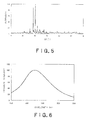
- This fluorescent substance was subjected to X-ray diffraction measurement, to obtain a diffraction pattern shown in Figure 5 .
- the obtained diffraction pattern was very different from the pattern shown in JP-A 2010-31201(KOKAI ), and hence it was verified that the substance of Comparative Example 2 had many variant phase crystals.
- the obtained substance exhibited an emission spectrum having a peak with broad half-width when excited by UV light at 365 nm.
- the emission intensity of the obtained substance was compared with that of the green-light emitting fluorescent substance produced in Comparative Example 1, and thereby it was found that the luminance efficiency of the obtained substance was only 0.68 times as high as that of the substance produced in Comparative Example 1.
- the starting materials SrO, EU 2 O 3 and Si powder in the amounts of 9.33 g, 1.76 g and 2.81 g, respectively, were weighed out and dry-mixed.
- the composition ratio (molar ratio) of the elements Sr:Eu:Si was 0.9:0.1:1.0.
- the mixture was placed in a BN container and then fired at 1500°C for 8 hours under atmospheric pressure in a reductive atmosphere in which flow rates of H 2 and N 2 were 5 L/min, and 5 L/min., respectively, to obtain an intermediate product in the first step.
- the intermediate product emitted reddish orange luminescence having a peak at about 640 nm when excited by UV light at 365 nm.
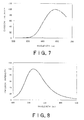
- the observed emission spectrum was shown in Figure 7 .
- the intermediate product was subjected to X-ray diffraction measurement by use of Cu-K ⁇ line, to obtain a diffraction pattern having many diffraction lines corresponding to lines of the pattern shown in Xie et al., Chem. Mater. 18, 5578(2006 ). It was, therefore, verified that the intermediate product contained at least a component represented by (Sr,EU) 2 Si 5 N 8 .
- the intermediate product obtained in the first step Si powder having a mean particle size of 20 ⁇ m and AlN in the amounts of 5.28 g, 3.37 g and 1.48 g, respectively, were weighed out and dry-mixed.
- the composition ratio (molar ratio) of the elements Sr:Eu:Al:Si was 0.9:0.1:1.0:4.3.
- the mixture was placed in a BN crucible and then fired at 1850°C for 8 hours under 7.5 atm of N 2 atmosphere, to synthesize a green-light emitting oxynitride fluorescent substance.
- the obtained substance exhibited an emission spectrum shown in Figure 8 when excited by UV light at 365 nm.
- the emission intensity of the obtained substance was compared with that of the green-light emitting fluorescent substance produced in Comparative Example 1, and thereby it was found that the luminance efficiency of the obtained substance was 1.1 times as high as that of the substance produced in Comparative Example 1.
- the intermediate product obtained in the first step Si powder and AIN in the amounts of 8.86 g, 3.03 g and 2.03 g, respectively, were weighed out and dry-mixed.
- the composition ratio (molar ratio) of the elements Sr:Eu:Al:Si was 0.9:0.1:1.1:4.4.
- the mixture was placed in a BN crucible and then pre-fired at 1600°C for 8 hours under atmospheric pressure in a reductive atmosphere in which flow rates of H 2 and N 2 were 5 L/min. and 5 L/min., respectively, to obtain a precursor of green light emitting fluorescent substance.
- the obtained precursor was subjected to X-ray diffraction measurement by use of Cu-K ⁇ line, to obtain a diffraction pattern shown in Figure 9 . From the obtained diffraction pattern, it was verified that the precursor contained first-phase crystals having the same crystal structure as Sr 2 Al 2 Si 10 O 4 N 14 and second-phase crystals having the same crystal structure as Sr 2 Al 3 Si 7 ON 13 .
- the precursor obtained by pre-firing was placed in a BN crucible and then fired at 1850°C for 8 hours under 7.5 atm of N 2 atmosphere, to synthesize a green-light emitting fluorescent substance.
- the obtained fluorescent substance was excited by UV light at 365 nm to measure emission intensity, and thereby it was found that the luminance efficiency of the produced substance was 1.2 times as high as that of the green-light emitting fluorescent substance produced in Comparative Example 1.
- the starting materials Sr(OH) 2 , Eu 2 O 3 and Si powder in the amounts of 13.1 g, 2.11 g and 8.09 g, respectively, were weighed out and dry-mixed.
- the composition ratio (molar ratio) of the elements Sr:Eu:Si was 0.9:0.1:2.4.
- the mixture was placed in a BN container and then fired at 1400°C for 8 hours under atmospheric pressure in a reductive atmosphere in which flow rates of H 2 and N 2 were 5 L/min. and 5 L/min., respectively, to obtain an intermediate product in the first step.
- the intermediate product emitted reddish orange luminescence having a peak at about 655 nm when excited by UV light at 365 nm.
- the intermediate product obtained in the first step Si 3 N 4 and AIN in the amounts of 9.92 g, 4.42 g and 1.94 g, respectively, were weighed out and dry-mixed.
- the composition ratio (molar ratio) of the elements Sr:Eu:Al:Si was 0.9:0.1:1.05:4.5.
- the mixture was placed in a BN crucible and then pre-fired at 1600°C for 8 hours under atmospheric pressure in a reductive atmosphere in which flow rates of H 2 and N 2 were 5 L/min. and 5 L/min., respectively, to obtain a precursor of green light emitting fluorescent substance.
- the obtained precursor was subjected to X-ray diffraction measurement by use of Cu-K ⁇ line, and thereby verified to contain first-phase crystals having the same crystal structure as Sr 2 Al 2 Si 10 O 4 N 14 and second-phase crystals having the same crystal structure as Sr 2 Al 3 Si 7 ON 13 .
- the precursor obtained by pre-firing was placed in a BN crucible and then fired at 1850°C for 8 hours under 7.5 atm of N 2 atmosphere, to synthesize a green-light emitting fluorescent substance.
- the obtained fluorescent substance was excited by UV light at 365 nm to measure emission intensity, and thereby it was found that the luminance efficiency of the produced substance was 1.15 times as high as that of the green-light emitting fluorescent substance produced in Comparative Example 1.
Landscapes
- Chemical & Material Sciences (AREA)
- Organic Chemistry (AREA)
- Inorganic Chemistry (AREA)
- Engineering & Computer Science (AREA)
- Materials Engineering (AREA)
- Luminescent Compositions (AREA)
Applications Claiming Priority (2)
| Application Number | Priority Date | Filing Date | Title |
|---|---|---|---|
| JP2010193789 | 2010-08-31 | ||
| JP2011021727A JP5127940B2 (ja) | 2010-08-31 | 2011-02-03 | 蛍光体の製造方法 |
Publications (2)
| Publication Number | Publication Date |
|---|---|
| EP2423293A2 true EP2423293A2 (de) | 2012-02-29 |
| EP2423293A3 EP2423293A3 (de) | 2012-06-20 |
Family
ID=44863295
Family Applications (1)
| Application Number | Title | Priority Date | Filing Date |
|---|---|---|---|
| EP11156400A Withdrawn EP2423293A3 (de) | 2010-08-31 | 2011-03-01 | Verfahren zur Herstellung von SiAlON Oxynitrid-Leuchtstoffen |
Country Status (6)
| Country | Link |
|---|---|
| US (2) | US8628686B2 (de) |
| EP (1) | EP2423293A3 (de) |
| JP (1) | JP5127940B2 (de) |
| KR (1) | KR20120021188A (de) |
| CN (1) | CN102382647A (de) |
| TW (1) | TWI441900B (de) |
Cited By (2)
| Publication number | Priority date | Publication date | Assignee | Title |
|---|---|---|---|---|
| EP2426187A3 (de) * | 2010-09-02 | 2012-06-27 | Kabushiki Kaisha Toshiba | Fluoreszente Substanz und lichtemittierende Vorrichtung damit |
| EP2636717A1 (de) * | 2012-03-08 | 2013-09-11 | Kabushiki Kaisha Toshiba | Phosphore und Herstellungsverfahren dafür |
Families Citing this family (9)
| Publication number | Priority date | Publication date | Assignee | Title |
|---|---|---|---|---|
| JP5874635B2 (ja) * | 2010-08-19 | 2016-03-02 | 宇部興産株式会社 | 珪窒化物蛍光体用窒化珪素粉末並びにそれを用いたSr3Al3Si13O2N21系蛍光体、β−サイアロン蛍光体及びそれらの製造方法 |
| JP5851214B2 (ja) * | 2011-11-16 | 2016-02-03 | 株式会社東芝 | 蛍光体、発光装置、および蛍光体の製造方法 |
| KR101930310B1 (ko) * | 2012-06-15 | 2018-12-18 | 엘지이노텍 주식회사 | 산질화물 형광체 및 그를 포함한 발광소자 패키지 |
| KR102017497B1 (ko) * | 2012-07-16 | 2019-09-03 | 엘지이노텍 주식회사 | 산질화물 형광체 및 그를 포함한 발광소자 패키지 |
| JP6195117B2 (ja) * | 2013-12-03 | 2017-09-13 | パナソニックIpマネジメント株式会社 | 酸塩化物蛍光体、発光装置、照明装置、及び車両 |
| JP2016060845A (ja) * | 2014-09-18 | 2016-04-25 | 株式会社東芝 | 蛍光体、蛍光体の製造方法、およびそれを用いた発光装置 |
| WO2017157157A1 (zh) * | 2016-03-18 | 2017-09-21 | 深圳市绎立锐光科技开发有限公司 | 一种氮化铝基质的荧光陶瓷的制备方法及相关荧光陶瓷 |
| KR101863083B1 (ko) | 2016-12-27 | 2018-05-31 | 성균관대학교산학협력단 | 산질화물 장잔광 형광체 및 이의 제조 방법 |
| US10600604B2 (en) | 2017-06-23 | 2020-03-24 | Current Lighting Solutions, Llc | Phosphor compositions and lighting apparatus thereof |
Citations (5)
| Publication number | Priority date | Publication date | Assignee | Title |
|---|---|---|---|---|
| WO2007105631A1 (ja) | 2006-03-10 | 2007-09-20 | Kabushiki Kaisha Toshiba | 蛍光体および発光装置 |
| JP2010031201A (ja) | 2008-07-31 | 2010-02-12 | Toshiba Corp | 蛍光体およびそれを用いた発光装置 |
| JP2010106127A (ja) | 2008-10-29 | 2010-05-13 | Toshiba Corp | 赤色蛍光体およびそれを用いた発光装置 |
| JP2010193789A (ja) | 2009-02-25 | 2010-09-09 | Kubota Corp | 農用供給装置 |
| JP2011021727A (ja) | 2009-07-17 | 2011-02-03 | Institute Of National Colleges Of Technology Japan | 免震構造 |
Family Cites Families (9)
| Publication number | Priority date | Publication date | Assignee | Title |
|---|---|---|---|---|
| EP1878778A4 (de) * | 2005-03-31 | 2012-04-04 | Mitsubishi Chem Corp | Fluoreszenzstoff, fluoreszenzstoffblatt und verfahren zur herstellung dafür sowie auf dem fluoreszenzstoff basierende lumineszenzvorrichtung |
| US7443094B2 (en) * | 2005-03-31 | 2008-10-28 | Dowa Electronics Materials Co., Ltd. | Phosphor and manufacturing method of the same, and light emitting device using the phosphor |
| EP1995294A4 (de) * | 2006-02-10 | 2012-06-06 | Mitsubishi Chem Corp | Leuchtstoff, herstellungsverfahren dafür, leuchtstoff enthaltende zusammensetzung, lichtemittierende vorrichtung, bilddisplay und beleuchtungsvorrichtung |
| JP5227503B2 (ja) * | 2006-09-29 | 2013-07-03 | Dowaエレクトロニクス株式会社 | 蛍光体、蛍光体シート及び蛍光体の製造方法、並びに当該蛍光体を用いた発光装置 |
| JP5578597B2 (ja) | 2007-09-03 | 2014-08-27 | 独立行政法人物質・材料研究機構 | 蛍光体及びその製造方法、並びにそれを用いた発光装置 |
| KR20100075886A (ko) | 2007-09-04 | 2010-07-05 | 코닌클리즈케 필립스 일렉트로닉스 엔.브이. | 복합체 사이아론계 세라믹 재료를 포함하는 발광 장치 |
| JP5395342B2 (ja) | 2007-09-18 | 2014-01-22 | 株式会社東芝 | 蛍光体および発光装置 |
| JP5549969B2 (ja) | 2009-02-12 | 2014-07-16 | 独立行政法人物質・材料研究機構 | 窒化物系または酸窒化物系の蛍光体原料混合物及びEuを含むSr2Si5N8、CaAlSiN3又はSrAlSiN3蛍光体の製造方法 |
| JP5851214B2 (ja) * | 2011-11-16 | 2016-02-03 | 株式会社東芝 | 蛍光体、発光装置、および蛍光体の製造方法 |
-
2011
- 2011-02-03 JP JP2011021727A patent/JP5127940B2/ja active Active
- 2011-02-28 US US13/036,410 patent/US8628686B2/en active Active
- 2011-03-01 TW TW100106731A patent/TWI441900B/zh active
- 2011-03-01 EP EP11156400A patent/EP2423293A3/de not_active Withdrawn
- 2011-04-29 CN CN2011101115244A patent/CN102382647A/zh active Pending
- 2011-07-29 KR KR1020110075615A patent/KR20120021188A/ko not_active Ceased
-
2013
- 2013-11-07 US US14/074,049 patent/US8877095B2/en active Active
Patent Citations (5)
| Publication number | Priority date | Publication date | Assignee | Title |
|---|---|---|---|---|
| WO2007105631A1 (ja) | 2006-03-10 | 2007-09-20 | Kabushiki Kaisha Toshiba | 蛍光体および発光装置 |
| JP2010031201A (ja) | 2008-07-31 | 2010-02-12 | Toshiba Corp | 蛍光体およびそれを用いた発光装置 |
| JP2010106127A (ja) | 2008-10-29 | 2010-05-13 | Toshiba Corp | 赤色蛍光体およびそれを用いた発光装置 |
| JP2010193789A (ja) | 2009-02-25 | 2010-09-09 | Kubota Corp | 農用供給装置 |
| JP2011021727A (ja) | 2009-07-17 | 2011-02-03 | Institute Of National Colleges Of Technology Japan | 免震構造 |
Non-Patent Citations (1)
| Title |
|---|
| XIE ET AL., CHEM. MATER., vol. 18, 2006, pages 5578 |
Cited By (7)
| Publication number | Priority date | Publication date | Assignee | Title |
|---|---|---|---|---|
| EP2426187A3 (de) * | 2010-09-02 | 2012-06-27 | Kabushiki Kaisha Toshiba | Fluoreszente Substanz und lichtemittierende Vorrichtung damit |
| US8471459B2 (en) | 2010-09-02 | 2013-06-25 | Kabushiki Kaisha Toshiba | Fluorescent substance and light-emitting device employing the same |
| EP2636717A1 (de) * | 2012-03-08 | 2013-09-11 | Kabushiki Kaisha Toshiba | Phosphore und Herstellungsverfahren dafür |
| CN103305215A (zh) * | 2012-03-08 | 2013-09-18 | 株式会社东芝 | 荧光体及其制造方法 |
| TWI456029B (zh) * | 2012-03-08 | 2014-10-11 | 東芝股份有限公司 | 螢光體及其製造方法 |
| CN103305215B (zh) * | 2012-03-08 | 2015-01-28 | 株式会社东芝 | 荧光体及其制造方法 |
| US9187693B2 (en) | 2012-03-08 | 2015-11-17 | Kabushiki Kaisha Toshiba | Phosphors and method for producing thereof |
Also Published As
| Publication number | Publication date |
|---|---|
| TW201209136A (en) | 2012-03-01 |
| JP5127940B2 (ja) | 2013-01-23 |
| KR20120021188A (ko) | 2012-03-08 |
| US20120049115A1 (en) | 2012-03-01 |
| US8628686B2 (en) | 2014-01-14 |
| CN102382647A (zh) | 2012-03-21 |
| JP2012072346A (ja) | 2012-04-12 |
| US8877095B2 (en) | 2014-11-04 |
| US20140054500A1 (en) | 2014-02-27 |
| EP2423293A3 (de) | 2012-06-20 |
| TWI441900B (zh) | 2014-06-21 |
Similar Documents
| Publication | Publication Date | Title |
|---|---|---|
| US8877095B2 (en) | Process for production of fluorescent substance | |
| EP1685211B1 (de) | Verfahren zur herstellung von verbindungen, die auf nitridosilicaten basieren, leuchtstoffe, diese enthaltend und diese verwendende lichtemittierende vorrichtungen | |
| US7074346B2 (en) | Sialon-based oxynitride phosphor, process for its production, and use thereof | |
| CN1886484B (zh) | 具有确定色温的发射白光的发光二极管 | |
| US7229571B2 (en) | Phosphor for white LED and a white LED | |
| EP2426187B1 (de) | Fluoreszente Substanz und lichtemittierende Vorrichtung damit | |
| EP2428544A1 (de) | Rot-fluoreszierende Substanz in lichtemittierender Vorrichtung und lichtemittierende Vorrichtung damit | |
| EP2636717B1 (de) | Phosphore und Herstellungsverfahren dafür | |
| JP2012062472A (ja) | 緑色蛍光体およびその製造方法、ならびにそれを含む白色発光素子 | |
| CN1886482A (zh) | 高效发光物质 | |
| US20110291142A1 (en) | Oxynitride phosphor, method for preparing the same, and light-emitting device | |
| CN1856561A (zh) | 发绿光的发光二极管 | |
| JP4356563B2 (ja) | 酸窒化物蛍光体、酸窒化物蛍光体の製造方法及び白色発光素子 | |
| WO2009003988A1 (en) | Ce3+, eu2+ and mn2+ - activated alkaline earth silicon nitride phosphors and white-light emitting led | |
| EP2009078A1 (de) | Ce3+- und Eu2+-aktivierte Alkali-Erdsilizium-Nitridphosphore | |
| KR20030020413A (ko) | 고효율 발광물질 | |
| KR101856534B1 (ko) | 산질화물계 형광체 및 이를 포함하는 발광장치 | |
| JP7248906B2 (ja) | 窒化物蛍光体及び発光装置 | |
| CN1946829B (zh) | 磷光体 | |
| JP6256868B2 (ja) | 赤色珪素酸窒化物蛍光体の製造方法 | |
| JP2004263020A (ja) | 白色led用蛍光体とそれを用いた白色led | |
| US20140175971A1 (en) | White light-emitting device | |
| JP2007210831A (ja) | ニトリドシリケート系化合物及びその製造方法、並びにニトリドシリケート系蛍光体 | |
| TWI383034B (zh) | 二相以矽酸鹽為主的黃色磷光體 |
Legal Events
| Date | Code | Title | Description |
|---|---|---|---|
| 17P | Request for examination filed |
Effective date: 20110301 |
|
| AK | Designated contracting states |
Kind code of ref document: A2 Designated state(s): AL AT BE BG CH CY CZ DE DK EE ES FI FR GB GR HR HU IE IS IT LI LT LU LV MC MK MT NL NO PL PT RO RS SE SI SK SM TR |
|
| AX | Request for extension of the european patent |
Extension state: BA ME |
|
| PUAI | Public reference made under article 153(3) epc to a published international application that has entered the european phase |
Free format text: ORIGINAL CODE: 0009012 |
|
| PUAL | Search report despatched |
Free format text: ORIGINAL CODE: 0009013 |
|
| AK | Designated contracting states |
Kind code of ref document: A3 Designated state(s): AL AT BE BG CH CY CZ DE DK EE ES FI FR GB GR HR HU IE IS IT LI LT LU LV MC MK MT NL NO PL PT RO RS SE SI SK SM TR |
|
| AX | Request for extension of the european patent |
Extension state: BA ME |
|
| RIC1 | Information provided on ipc code assigned before grant |
Ipc: C09K 11/64 20060101AFI20120515BHEP |
|
| 17Q | First examination report despatched |
Effective date: 20130221 |
|
| STAA | Information on the status of an ep patent application or granted ep patent |
Free format text: STATUS: THE APPLICATION IS DEEMED TO BE WITHDRAWN |
|
| 18D | Application deemed to be withdrawn |
Effective date: 20130904 |