EP2401078B1 - Verfahren zur anreicherung eines homogenkatalysators aus einem prozessstrom - Google Patents
Verfahren zur anreicherung eines homogenkatalysators aus einem prozessstrom Download PDFInfo
- Publication number
- EP2401078B1 EP2401078B1 EP10711629.5A EP10711629A EP2401078B1 EP 2401078 B1 EP2401078 B1 EP 2401078B1 EP 10711629 A EP10711629 A EP 10711629A EP 2401078 B1 EP2401078 B1 EP 2401078B1
- Authority
- EP
- European Patent Office
- Prior art keywords
- membrane
- catalyst
- separation
- high boilers
- catalyst system
- Prior art date
- Legal status (The legal status is an assumption and is not a legal conclusion. Google has not performed a legal analysis and makes no representation as to the accuracy of the status listed.)
- Not-in-force
Links
- 239000003054 catalyst Substances 0.000 title claims description 110
- 238000000034 method Methods 0.000 title claims description 90
- 230000008569 process Effects 0.000 title claims description 51
- 239000012528 membrane Substances 0.000 claims description 150
- 238000000926 separation method Methods 0.000 claims description 108
- 229920000642 polymer Polymers 0.000 claims description 40
- 238000007037 hydroformylation reaction Methods 0.000 claims description 38
- 239000000047 product Substances 0.000 claims description 32
- 239000012466 permeate Substances 0.000 claims description 27
- 238000006243 chemical reaction Methods 0.000 claims description 24
- 239000002815 homogeneous catalyst Substances 0.000 claims description 21
- 239000010948 rhodium Substances 0.000 claims description 21
- 239000012465 retentate Substances 0.000 claims description 20
- 229910052703 rhodium Inorganic materials 0.000 claims description 19
- MHOVAHRLVXNVSD-UHFFFAOYSA-N rhodium atom Chemical compound [Rh] MHOVAHRLVXNVSD-UHFFFAOYSA-N 0.000 claims description 18
- 150000001299 aldehydes Chemical class 0.000 claims description 14
- 239000000203 mixture Substances 0.000 claims description 14
- 150000001336 alkenes Chemical class 0.000 claims description 13
- 229910052751 metal Inorganic materials 0.000 claims description 12
- 239000002184 metal Substances 0.000 claims description 12
- 238000004821 distillation Methods 0.000 claims description 10
- 239000003085 diluting agent Substances 0.000 claims description 9
- 150000004696 coordination complex Chemical class 0.000 claims description 8
- 150000002903 organophosphorus compounds Chemical class 0.000 claims description 8
- 229910052739 hydrogen Inorganic materials 0.000 claims description 5
- UGFAIRIUMAVXCW-UHFFFAOYSA-N Carbon monoxide Chemical compound [O+]#[C-] UGFAIRIUMAVXCW-UHFFFAOYSA-N 0.000 claims description 4
- JKIJEFPNVSHHEI-UHFFFAOYSA-N Phenol, 2,4-bis(1,1-dimethylethyl)-, phosphite (3:1) Chemical compound CC(C)(C)C1=CC(C(C)(C)C)=CC=C1OP(OC=1C(=CC(=CC=1)C(C)(C)C)C(C)(C)C)OC1=CC=C(C(C)(C)C)C=C1C(C)(C)C JKIJEFPNVSHHEI-UHFFFAOYSA-N 0.000 claims description 4
- 229910002091 carbon monoxide Inorganic materials 0.000 claims description 4
- 239000001257 hydrogen Substances 0.000 claims description 4
- 238000004519 manufacturing process Methods 0.000 claims description 4
- UFHFLCQGNIYNRP-UHFFFAOYSA-N Hydrogen Chemical compound [H][H] UFHFLCQGNIYNRP-UHFFFAOYSA-N 0.000 claims description 3
- 238000006053 organic reaction Methods 0.000 claims description 3
- XFRVVPUIAFSTFO-UHFFFAOYSA-N 1-Tridecanol Chemical compound CCCCCCCCCCCCCO XFRVVPUIAFSTFO-UHFFFAOYSA-N 0.000 claims 2
- 239000000470 constituent Substances 0.000 claims 1
- 239000000178 monomer Substances 0.000 claims 1
- 239000013110 organic ligand Substances 0.000 claims 1
- 230000000737 periodic effect Effects 0.000 claims 1
- 210000004379 membrane Anatomy 0.000 description 144
- 239000003446 ligand Substances 0.000 description 33
- 238000009835 boiling Methods 0.000 description 14
- 230000014759 maintenance of location Effects 0.000 description 14
- 239000000463 material Substances 0.000 description 13
- 239000011541 reaction mixture Substances 0.000 description 13
- PQNFLJBBNBOBRQ-UHFFFAOYSA-N indane Chemical compound C1=CC=C2CCCC2=C1 PQNFLJBBNBOBRQ-UHFFFAOYSA-N 0.000 description 10
- -1 C atom aldehydes Chemical class 0.000 description 9
- 239000004205 dimethyl polysiloxane Substances 0.000 description 8
- 239000007789 gas Substances 0.000 description 8
- 229920000435 poly(dimethylsiloxane) Polymers 0.000 description 8
- 239000004642 Polyimide Substances 0.000 description 6
- 239000006227 byproduct Substances 0.000 description 6
- 239000000919 ceramic Substances 0.000 description 6
- 229920001721 polyimide Polymers 0.000 description 6
- 238000002360 preparation method Methods 0.000 description 6
- 239000000243 solution Substances 0.000 description 6
- 239000007858 starting material Substances 0.000 description 6
- 239000000126 substance Substances 0.000 description 6
- BGEHHAVMRVXCGR-UHFFFAOYSA-N tridecanal Chemical compound CCCCCCCCCCCCC=O BGEHHAVMRVXCGR-UHFFFAOYSA-N 0.000 description 6
- 150000002430 hydrocarbons Chemical class 0.000 description 5
- 125000005647 linker group Chemical group 0.000 description 5
- 150000003283 rhodium Chemical class 0.000 description 5
- 239000002904 solvent Substances 0.000 description 5
- LFQSCWFLJHTTHZ-UHFFFAOYSA-N Ethanol Chemical compound CCO LFQSCWFLJHTTHZ-UHFFFAOYSA-N 0.000 description 4
- 101001001642 Xenopus laevis Serine/threonine-protein kinase pim-3 Proteins 0.000 description 4
- 150000001298 alcohols Chemical class 0.000 description 4
- 239000007795 chemical reaction product Substances 0.000 description 4
- 238000000354 decomposition reaction Methods 0.000 description 4
- 230000000694 effects Effects 0.000 description 4
- 230000035699 permeability Effects 0.000 description 4
- OJMIONKXNSYLSR-UHFFFAOYSA-N phosphorous acid Chemical compound OP(O)O OJMIONKXNSYLSR-UHFFFAOYSA-N 0.000 description 4
- 230000000717 retained effect Effects 0.000 description 4
- 241000894007 species Species 0.000 description 4
- 238000010626 work up procedure Methods 0.000 description 4
- OUFCBJZGDJFSIK-UHFFFAOYSA-N 11-methyldodecanal Chemical compound CC(C)CCCCCCCCCC=O OUFCBJZGDJFSIK-UHFFFAOYSA-N 0.000 description 3
- 239000004952 Polyamide Substances 0.000 description 3
- 238000005882 aldol condensation reaction Methods 0.000 description 3
- 230000015572 biosynthetic process Effects 0.000 description 3
- 229910052799 carbon Inorganic materials 0.000 description 3
- 125000004432 carbon atom Chemical group C* 0.000 description 3
- 239000007859 condensation product Substances 0.000 description 3
- 239000012530 fluid Substances 0.000 description 3
- 230000004907 flux Effects 0.000 description 3
- 229930195733 hydrocarbon Natural products 0.000 description 3
- 239000007788 liquid Substances 0.000 description 3
- JRZJOMJEPLMPRA-UHFFFAOYSA-N olefin Natural products CCCCCCCC=C JRZJOMJEPLMPRA-UHFFFAOYSA-N 0.000 description 3
- 150000003003 phosphines Chemical class 0.000 description 3
- 125000005538 phosphinite group Chemical group 0.000 description 3
- AQSJGOWTSHOLKH-UHFFFAOYSA-N phosphite(3-) Chemical class [O-]P([O-])[O-] AQSJGOWTSHOLKH-UHFFFAOYSA-N 0.000 description 3
- XRBCRPZXSCBRTK-UHFFFAOYSA-N phosphonous acid Chemical compound OPO XRBCRPZXSCBRTK-UHFFFAOYSA-N 0.000 description 3
- 229920002647 polyamide Polymers 0.000 description 3
- 238000011084 recovery Methods 0.000 description 3
- 239000007787 solid Substances 0.000 description 3
- XLYOFNOQVPJJNP-UHFFFAOYSA-N water Substances O XLYOFNOQVPJJNP-UHFFFAOYSA-N 0.000 description 3
- CRSBERNSMYQZNG-UHFFFAOYSA-N 1 -dodecene Natural products CCCCCCCCCCC=C CRSBERNSMYQZNG-UHFFFAOYSA-N 0.000 description 2
- IJGRMHOSHXDMSA-UHFFFAOYSA-N Atomic nitrogen Chemical compound N#N IJGRMHOSHXDMSA-UHFFFAOYSA-N 0.000 description 2
- OKTJSMMVPCPJKN-UHFFFAOYSA-N Carbon Chemical compound [C] OKTJSMMVPCPJKN-UHFFFAOYSA-N 0.000 description 2
- SNRUBQQJIBEYMU-UHFFFAOYSA-N Dodecane Natural products CCCCCCCCCCCC SNRUBQQJIBEYMU-UHFFFAOYSA-N 0.000 description 2
- PXHVJJICTQNCMI-UHFFFAOYSA-N Nickel Chemical compound [Ni] PXHVJJICTQNCMI-UHFFFAOYSA-N 0.000 description 2
- 239000002033 PVDF binder Substances 0.000 description 2
- XYFCBTPGUUZFHI-UHFFFAOYSA-N Phosphine Chemical compound P XYFCBTPGUUZFHI-UHFFFAOYSA-N 0.000 description 2
- 239000004696 Poly ether ether ketone Substances 0.000 description 2
- 239000002253 acid Substances 0.000 description 2
- 150000007513 acids Chemical class 0.000 description 2
- 125000002252 acyl group Chemical group 0.000 description 2
- 238000006555 catalytic reaction Methods 0.000 description 2
- 239000002131 composite material Substances 0.000 description 2
- 150000001875 compounds Chemical class 0.000 description 2
- 230000001419 dependent effect Effects 0.000 description 2
- 238000000151 deposition Methods 0.000 description 2
- 229940069096 dodecene Drugs 0.000 description 2
- 125000004435 hydrogen atom Chemical class [H]* 0.000 description 2
- 238000005984 hydrogenation reaction Methods 0.000 description 2
- VNWKTOKETHGBQD-UHFFFAOYSA-N methane Chemical compound C VNWKTOKETHGBQD-UHFFFAOYSA-N 0.000 description 2
- 239000012229 microporous material Substances 0.000 description 2
- 239000003960 organic solvent Substances 0.000 description 2
- 229910052760 oxygen Inorganic materials 0.000 description 2
- FVZVCSNXTFCBQU-UHFFFAOYSA-N phosphanyl Chemical group [PH2] FVZVCSNXTFCBQU-UHFFFAOYSA-N 0.000 description 2
- 229920002312 polyamide-imide Polymers 0.000 description 2
- 229920002530 polyetherether ketone Polymers 0.000 description 2
- 229920005597 polymer membrane Polymers 0.000 description 2
- 229920002981 polyvinylidene fluoride Polymers 0.000 description 2
- 239000012779 reinforcing material Substances 0.000 description 2
- 238000003786 synthesis reaction Methods 0.000 description 2
- 229910052723 transition metal Inorganic materials 0.000 description 2
- 150000003624 transition metals Chemical class 0.000 description 2
- XTTGYFREQJCEML-UHFFFAOYSA-N tributyl phosphite Chemical compound CCCCOP(OCCCC)OCCCC XTTGYFREQJCEML-UHFFFAOYSA-N 0.000 description 2
- HVLLSGMXQDNUAL-UHFFFAOYSA-N triphenyl phosphite Chemical compound C=1C=CC=CC=1OP(OC=1C=CC=CC=1)OC1=CC=CC=C1 HVLLSGMXQDNUAL-UHFFFAOYSA-N 0.000 description 2
- RIOQSEWOXXDEQQ-UHFFFAOYSA-N triphenylphosphine Chemical compound C1=CC=CC=C1P(C=1C=CC=CC=1)C1=CC=CC=C1 RIOQSEWOXXDEQQ-UHFFFAOYSA-N 0.000 description 2
- COIOYMYWGDAQPM-UHFFFAOYSA-N tris(2-methylphenyl)phosphane Chemical compound CC1=CC=CC=C1P(C=1C(=CC=CC=1)C)C1=CC=CC=C1C COIOYMYWGDAQPM-UHFFFAOYSA-N 0.000 description 2
- BWHDROKFUHTORW-UHFFFAOYSA-N tritert-butylphosphane Chemical compound CC(C)(C)P(C(C)(C)C)C(C)(C)C BWHDROKFUHTORW-UHFFFAOYSA-N 0.000 description 2
- 239000012855 volatile organic compound Substances 0.000 description 2
- POFMQEVZKZVAPQ-UHFFFAOYSA-N 1,1,1',1'-tetramethyl-3,3'-spirobi[2h-indene]-5,5',6,6'-tetrol Chemical compound C12=CC(O)=C(O)C=C2C(C)(C)CC11C2=CC(O)=C(O)C=C2C(C)(C)C1 POFMQEVZKZVAPQ-UHFFFAOYSA-N 0.000 description 1
- CYKGPNINZJCRFL-UHFFFAOYSA-N 1,3,4,6-tetrafluorocyclohexa-3,5-diene-1,2-dicarbonitrile Chemical compound FC1=C(F)C(C#N)C(F)(C#N)C(F)=C1 CYKGPNINZJCRFL-UHFFFAOYSA-N 0.000 description 1
- OMDCSPXITNMPHV-UHFFFAOYSA-N 2h-oxaphosphinine Chemical compound O1PC=CC=C1 OMDCSPXITNMPHV-UHFFFAOYSA-N 0.000 description 1
- GNETVOUSGGAEDK-UHFFFAOYSA-N 4-bis[4-(dimethylamino)phenyl]phosphanyl-n,n-dimethylaniline Chemical compound C1=CC(N(C)C)=CC=C1P(C=1C=CC(=CC=1)N(C)C)C1=CC=C(N(C)C)C=C1 GNETVOUSGGAEDK-UHFFFAOYSA-N 0.000 description 1
- JRPPVSMCCSLJPL-UHFFFAOYSA-N 7-methyloctanal Chemical compound CC(C)CCCCCC=O JRPPVSMCCSLJPL-UHFFFAOYSA-N 0.000 description 1
- SNFCXVRWFNAHQX-UHFFFAOYSA-N 9,9'-spirobi[fluorene] Chemical class C12=CC=CC=C2C2=CC=CC=C2C21C1=CC=CC=C1C1=CC=CC=C21 SNFCXVRWFNAHQX-UHFFFAOYSA-N 0.000 description 1
- GXXFPQGHCPOFSD-UHFFFAOYSA-N 9,9'-spirobi[fluorene]-2,2'-diamine Chemical compound C12=CC=CC=C2C2=CC=C(N)C=C2C21C1=CC=CC=C1C1=CC=C(N)C=C12 GXXFPQGHCPOFSD-UHFFFAOYSA-N 0.000 description 1
- NLHHRLWOUZZQLW-UHFFFAOYSA-N Acrylonitrile Chemical compound C=CC#N NLHHRLWOUZZQLW-UHFFFAOYSA-N 0.000 description 1
- 239000002028 Biomass Substances 0.000 description 1
- 229920001747 Cellulose diacetate Polymers 0.000 description 1
- BONASJKBJAQWML-UHFFFAOYSA-N OPO.OP(O)O Chemical class OPO.OP(O)O BONASJKBJAQWML-UHFFFAOYSA-N 0.000 description 1
- BOBIVTKCBMKFJH-UHFFFAOYSA-N P.P(O)O Chemical class P.P(O)O BOBIVTKCBMKFJH-UHFFFAOYSA-N 0.000 description 1
- GYPUIXZFFQOUPO-UHFFFAOYSA-N PO.OPO Chemical class PO.OPO GYPUIXZFFQOUPO-UHFFFAOYSA-N 0.000 description 1
- QFIJGEIKVGDVHA-UHFFFAOYSA-N PO.P(O)(O)O Chemical class PO.P(O)(O)O QFIJGEIKVGDVHA-UHFFFAOYSA-N 0.000 description 1
- 239000004962 Polyamide-imide Substances 0.000 description 1
- 239000004695 Polyether sulfone Substances 0.000 description 1
- 239000004698 Polyethylene Substances 0.000 description 1
- 239000004793 Polystyrene Substances 0.000 description 1
- 229920001328 Polyvinylidene chloride Polymers 0.000 description 1
- 239000004809 Teflon Substances 0.000 description 1
- 229920006362 Teflon® Polymers 0.000 description 1
- 238000009825 accumulation Methods 0.000 description 1
- 238000006359 acetalization reaction Methods 0.000 description 1
- 125000001931 aliphatic group Chemical group 0.000 description 1
- 125000000217 alkyl group Chemical group 0.000 description 1
- PNEYBMLMFCGWSK-UHFFFAOYSA-N aluminium oxide Inorganic materials [O-2].[O-2].[O-2].[Al+3].[Al+3] PNEYBMLMFCGWSK-UHFFFAOYSA-N 0.000 description 1
- 150000001413 amino acids Chemical class 0.000 description 1
- 150000005840 aryl radicals Chemical class 0.000 description 1
- QVGXLLKOCUKJST-UHFFFAOYSA-N atomic oxygen Chemical compound [O] QVGXLLKOCUKJST-UHFFFAOYSA-N 0.000 description 1
- BHXFKXOIODIUJO-UHFFFAOYSA-N benzene-1,4-dicarbonitrile Chemical group N#CC1=CC=C(C#N)C=C1 BHXFKXOIODIUJO-UHFFFAOYSA-N 0.000 description 1
- 230000000903 blocking effect Effects 0.000 description 1
- 230000031709 bromination Effects 0.000 description 1
- 238000005893 bromination reaction Methods 0.000 description 1
- 238000010367 cloning Methods 0.000 description 1
- 230000000052 comparative effect Effects 0.000 description 1
- 239000012141 concentrate Substances 0.000 description 1
- 229910052593 corundum Inorganic materials 0.000 description 1
- 238000000280 densification Methods 0.000 description 1
- 230000008021 deposition Effects 0.000 description 1
- 238000001514 detection method Methods 0.000 description 1
- NSSMTQDEWVTEKN-UHFFFAOYSA-N diethoxy(methyl)phosphane Chemical compound CCOP(C)OCC NSSMTQDEWVTEKN-UHFFFAOYSA-N 0.000 description 1
- LMZLQYYLELWCCW-UHFFFAOYSA-N dimethoxy(phenyl)phosphane Chemical compound COP(OC)C1=CC=CC=C1 LMZLQYYLELWCCW-UHFFFAOYSA-N 0.000 description 1
- QXKPLZDCTKREIA-UHFFFAOYSA-N diphenoxy(phenyl)phosphane Chemical compound C=1C=CC=CC=1OP(C=1C=CC=CC=1)OC1=CC=CC=C1 QXKPLZDCTKREIA-UHFFFAOYSA-N 0.000 description 1
- 238000007599 discharging Methods 0.000 description 1
- 238000007323 disproportionation reaction Methods 0.000 description 1
- 238000007700 distillative separation Methods 0.000 description 1
- 238000009826 distribution Methods 0.000 description 1
- 150000002148 esters Chemical class 0.000 description 1
- JCRCPEDXAHDCAJ-UHFFFAOYSA-N ethoxy(diphenyl)phosphane Chemical compound C=1C=CC=CC=1P(OCC)C1=CC=CC=C1 JCRCPEDXAHDCAJ-UHFFFAOYSA-N 0.000 description 1
- 238000001704 evaporation Methods 0.000 description 1
- 230000008020 evaporation Effects 0.000 description 1
- 238000002474 experimental method Methods 0.000 description 1
- 239000011552 falling film Substances 0.000 description 1
- 239000010408 film Substances 0.000 description 1
- 238000003958 fumigation Methods 0.000 description 1
- 239000003365 glass fiber Substances 0.000 description 1
- VOZRXNHHFUQHIL-UHFFFAOYSA-N glycidyl methacrylate Chemical compound CC(=C)C(=O)OCC1CO1 VOZRXNHHFUQHIL-UHFFFAOYSA-N 0.000 description 1
- 125000005843 halogen group Chemical group 0.000 description 1
- 238000007172 homogeneous catalysis Methods 0.000 description 1
- 238000005669 hydrocyanation reaction Methods 0.000 description 1
- 230000006872 improvement Effects 0.000 description 1
- 230000004941 influx Effects 0.000 description 1
- 239000004615 ingredient Substances 0.000 description 1
- 239000012784 inorganic fiber Substances 0.000 description 1
- 229910052809 inorganic oxide Inorganic materials 0.000 description 1
- 239000011159 matrix material Substances 0.000 description 1
- 238000005374 membrane filtration Methods 0.000 description 1
- 150000002739 metals Chemical class 0.000 description 1
- 238000005649 metathesis reaction Methods 0.000 description 1
- OAADXJFIBNEPLY-UHFFFAOYSA-N methoxy(diphenyl)phosphane Chemical compound C=1C=CC=CC=1P(OC)C1=CC=CC=C1 OAADXJFIBNEPLY-UHFFFAOYSA-N 0.000 description 1
- 244000005700 microbiome Species 0.000 description 1
- 239000003345 natural gas Substances 0.000 description 1
- 229910052759 nickel Inorganic materials 0.000 description 1
- 229910052757 nitrogen Inorganic materials 0.000 description 1
- 230000003606 oligomerizing effect Effects 0.000 description 1
- 125000002524 organometallic group Chemical group 0.000 description 1
- 230000003647 oxidation Effects 0.000 description 1
- 238000007254 oxidation reaction Methods 0.000 description 1
- 239000001301 oxygen Substances 0.000 description 1
- 239000002245 particle Substances 0.000 description 1
- 238000005373 pervaporation Methods 0.000 description 1
- UPDNYUVJHQABBS-UHFFFAOYSA-N phenoxy(diphenyl)phosphane Chemical compound C=1C=CC=CC=1OP(C=1C=CC=CC=1)C1=CC=CC=C1 UPDNYUVJHQABBS-UHFFFAOYSA-N 0.000 description 1
- LNUBYTUNCMSQRF-UHFFFAOYSA-N phosphane phosphinous acid Chemical class P.PO LNUBYTUNCMSQRF-UHFFFAOYSA-N 0.000 description 1
- ZOGYOOUMDVKYLM-UHFFFAOYSA-N phosphane phosphorous acid Chemical class P.OP(O)O ZOGYOOUMDVKYLM-UHFFFAOYSA-N 0.000 description 1
- 229910000073 phosphorus hydride Inorganic materials 0.000 description 1
- 230000000704 physical effect Effects 0.000 description 1
- 230000010287 polarization Effects 0.000 description 1
- 229920001643 poly(ether ketone) Polymers 0.000 description 1
- 229920003229 poly(methyl methacrylate) Polymers 0.000 description 1
- 229920002492 poly(sulfone) Polymers 0.000 description 1
- 229920002239 polyacrylonitrile Polymers 0.000 description 1
- 229920006393 polyether sulfone Polymers 0.000 description 1
- 229920000573 polyethylene Polymers 0.000 description 1
- 229920002959 polymer blend Polymers 0.000 description 1
- 238000010094 polymer processing Methods 0.000 description 1
- 239000004926 polymethyl methacrylate Substances 0.000 description 1
- 229920002223 polystyrene Polymers 0.000 description 1
- 229920001343 polytetrafluoroethylene Polymers 0.000 description 1
- 239000004810 polytetrafluoroethylene Substances 0.000 description 1
- 239000004800 polyvinyl chloride Substances 0.000 description 1
- 229920000915 polyvinyl chloride Polymers 0.000 description 1
- 239000005033 polyvinylidene chloride Substances 0.000 description 1
- 239000002243 precursor Substances 0.000 description 1
- 108090000623 proteins and genes Proteins 0.000 description 1
- 102000004169 proteins and genes Human genes 0.000 description 1
- 238000000746 purification Methods 0.000 description 1
- 238000004064 recycling Methods 0.000 description 1
- IKGXIBQEEMLURG-NVPNHPEKSA-N rutin Chemical compound O[C@@H]1[C@H](O)[C@@H](O)[C@H](C)O[C@H]1OC[C@@H]1[C@@H](O)[C@H](O)[C@@H](O)[C@H](OC=2C(C3=C(O)C=C(O)C=C3OC=2C=2C=C(O)C(O)=CC=2)=O)O1 IKGXIBQEEMLURG-NVPNHPEKSA-N 0.000 description 1
- 150000003839 salts Chemical class 0.000 description 1
- 238000004062 sedimentation Methods 0.000 description 1
- 239000011949 solid catalyst Substances 0.000 description 1
- 125000006850 spacer group Chemical group 0.000 description 1
- 230000006641 stabilisation Effects 0.000 description 1
- 238000011105 stabilization Methods 0.000 description 1
- 238000012360 testing method Methods 0.000 description 1
- 125000000383 tetramethylene group Chemical group [H]C([H])([*:1])C([H])([H])C([H])([H])C([H])([H])[*:2] 0.000 description 1
- 238000009997 thermal pre-treatment Methods 0.000 description 1
- 239000010409 thin film Substances 0.000 description 1
- 238000012546 transfer Methods 0.000 description 1
- IFXORIIYQORRMJ-UHFFFAOYSA-N tribenzylphosphane Chemical compound C=1C=CC=CC=1CP(CC=1C=CC=CC=1)CC1=CC=CC=C1 IFXORIIYQORRMJ-UHFFFAOYSA-N 0.000 description 1
- TUQOTMZNTHZOKS-UHFFFAOYSA-N tributylphosphine Chemical compound CCCCP(CCCC)CCCC TUQOTMZNTHZOKS-UHFFFAOYSA-N 0.000 description 1
- WLPUWLXVBWGYMZ-UHFFFAOYSA-N tricyclohexylphosphine Chemical compound C1CCCCC1P(C1CCCCC1)C1CCCCC1 WLPUWLXVBWGYMZ-UHFFFAOYSA-N 0.000 description 1
- DHWBYAACHDUFAT-UHFFFAOYSA-N tricyclopentylphosphane Chemical compound C1CCCC1P(C1CCCC1)C1CCCC1 DHWBYAACHDUFAT-UHFFFAOYSA-N 0.000 description 1
- BDZBKCUKTQZUTL-UHFFFAOYSA-N triethyl phosphite Chemical compound CCOP(OCC)OCC BDZBKCUKTQZUTL-UHFFFAOYSA-N 0.000 description 1
- RXJKFRMDXUJTEX-UHFFFAOYSA-N triethylphosphine Chemical compound CCP(CC)CC RXJKFRMDXUJTEX-UHFFFAOYSA-N 0.000 description 1
- CYTQBVOFDCPGCX-UHFFFAOYSA-N trimethyl phosphite Chemical compound COP(OC)OC CYTQBVOFDCPGCX-UHFFFAOYSA-N 0.000 description 1
- DMEUUKUNSVFYAA-UHFFFAOYSA-N trinaphthalen-1-ylphosphane Chemical compound C1=CC=C2C(P(C=3C4=CC=CC=C4C=CC=3)C=3C4=CC=CC=C4C=CC=3)=CC=CC2=C1 DMEUUKUNSVFYAA-UHFFFAOYSA-N 0.000 description 1
- SJHCUXCOGGKFAI-UHFFFAOYSA-N tripropan-2-yl phosphite Chemical compound CC(C)OP(OC(C)C)OC(C)C SJHCUXCOGGKFAI-UHFFFAOYSA-N 0.000 description 1
- QOPBTFMUVTXWFF-UHFFFAOYSA-N tripropyl phosphite Chemical compound CCCOP(OCCC)OCCC QOPBTFMUVTXWFF-UHFFFAOYSA-N 0.000 description 1
- ILLOBGFGKYTZRO-UHFFFAOYSA-N tris(2-ethylhexyl) phosphite Chemical compound CCCCC(CC)COP(OCC(CC)CCCC)OCC(CC)CCCC ILLOBGFGKYTZRO-UHFFFAOYSA-N 0.000 description 1
- MHDLYQWLYLNKDL-UHFFFAOYSA-N tris(2-tert-butyl-4-methoxyphenyl) phosphite Chemical compound CC(C)(C)C1=CC(OC)=CC=C1OP(OC=1C(=CC(OC)=CC=1)C(C)(C)C)OC1=CC=C(OC)C=C1C(C)(C)C MHDLYQWLYLNKDL-UHFFFAOYSA-N 0.000 description 1
- HBYRZSMDBQVSHO-UHFFFAOYSA-N tris(2-tert-butyl-4-methylphenyl) phosphite Chemical compound CC(C)(C)C1=CC(C)=CC=C1OP(OC=1C(=CC(C)=CC=1)C(C)(C)C)OC1=CC=C(C)C=C1C(C)(C)C HBYRZSMDBQVSHO-UHFFFAOYSA-N 0.000 description 1
- LFNXCUNDYSYVJY-UHFFFAOYSA-N tris(3-methylphenyl)phosphane Chemical compound CC1=CC=CC(P(C=2C=C(C)C=CC=2)C=2C=C(C)C=CC=2)=C1 LFNXCUNDYSYVJY-UHFFFAOYSA-N 0.000 description 1
- UYUUAUOYLFIRJG-UHFFFAOYSA-N tris(4-methoxyphenyl)phosphane Chemical compound C1=CC(OC)=CC=C1P(C=1C=CC(OC)=CC=1)C1=CC=C(OC)C=C1 UYUUAUOYLFIRJG-UHFFFAOYSA-N 0.000 description 1
- FEVFLQDDNUQKRY-UHFFFAOYSA-N tris(4-methylphenyl) phosphite Chemical compound C1=CC(C)=CC=C1OP(OC=1C=CC(C)=CC=1)OC1=CC=C(C)C=C1 FEVFLQDDNUQKRY-UHFFFAOYSA-N 0.000 description 1
- WXAZIUYTQHYBFW-UHFFFAOYSA-N tris(4-methylphenyl)phosphane Chemical compound C1=CC(C)=CC=C1P(C=1C=CC(C)=CC=1)C1=CC=C(C)C=C1 WXAZIUYTQHYBFW-UHFFFAOYSA-N 0.000 description 1
- NZIQBDROTUFRHZ-UHFFFAOYSA-N tritert-butyl phosphite Chemical compound CC(C)(C)OP(OC(C)(C)C)OC(C)(C)C NZIQBDROTUFRHZ-UHFFFAOYSA-N 0.000 description 1
- 238000004804 winding Methods 0.000 description 1
- 229910001845 yogo sapphire Inorganic materials 0.000 description 1
- 239000010457 zeolite Substances 0.000 description 1
Images

Classifications
-
- B—PERFORMING OPERATIONS; TRANSPORTING
- B01—PHYSICAL OR CHEMICAL PROCESSES OR APPARATUS IN GENERAL
- B01J—CHEMICAL OR PHYSICAL PROCESSES, e.g. CATALYSIS OR COLLOID CHEMISTRY; THEIR RELEVANT APPARATUS
- B01J31/00—Catalysts comprising hydrides, coordination complexes or organic compounds
- B01J31/40—Regeneration or reactivation
- B01J31/4015—Regeneration or reactivation of catalysts containing metals
- B01J31/4023—Regeneration or reactivation of catalysts containing metals containing iron group metals, noble metals or copper
- B01J31/4038—Regeneration or reactivation of catalysts containing metals containing iron group metals, noble metals or copper containing noble metals
- B01J31/4046—Regeneration or reactivation of catalysts containing metals containing iron group metals, noble metals or copper containing noble metals containing rhodium
-
- B—PERFORMING OPERATIONS; TRANSPORTING
- B01—PHYSICAL OR CHEMICAL PROCESSES OR APPARATUS IN GENERAL
- B01J—CHEMICAL OR PHYSICAL PROCESSES, e.g. CATALYSIS OR COLLOID CHEMISTRY; THEIR RELEVANT APPARATUS
- B01J31/00—Catalysts comprising hydrides, coordination complexes or organic compounds
- B01J31/40—Regeneration or reactivation
-
- B—PERFORMING OPERATIONS; TRANSPORTING
- B01—PHYSICAL OR CHEMICAL PROCESSES OR APPARATUS IN GENERAL
- B01J—CHEMICAL OR PHYSICAL PROCESSES, e.g. CATALYSIS OR COLLOID CHEMISTRY; THEIR RELEVANT APPARATUS
- B01J31/00—Catalysts comprising hydrides, coordination complexes or organic compounds
- B01J31/16—Catalysts comprising hydrides, coordination complexes or organic compounds containing coordination complexes
- B01J31/18—Catalysts comprising hydrides, coordination complexes or organic compounds containing coordination complexes containing nitrogen, phosphorus, arsenic or antimony as complexing atoms, e.g. in pyridine ligands, or in resonance therewith, e.g. in isocyanide ligands C=N-R or as complexed central atoms
-
- B—PERFORMING OPERATIONS; TRANSPORTING
- B01—PHYSICAL OR CHEMICAL PROCESSES OR APPARATUS IN GENERAL
- B01J—CHEMICAL OR PHYSICAL PROCESSES, e.g. CATALYSIS OR COLLOID CHEMISTRY; THEIR RELEVANT APPARATUS
- B01J31/00—Catalysts comprising hydrides, coordination complexes or organic compounds
- B01J31/16—Catalysts comprising hydrides, coordination complexes or organic compounds containing coordination complexes
- B01J31/18—Catalysts comprising hydrides, coordination complexes or organic compounds containing coordination complexes containing nitrogen, phosphorus, arsenic or antimony as complexing atoms, e.g. in pyridine ligands, or in resonance therewith, e.g. in isocyanide ligands C=N-R or as complexed central atoms
- B01J31/1845—Catalysts comprising hydrides, coordination complexes or organic compounds containing coordination complexes containing nitrogen, phosphorus, arsenic or antimony as complexing atoms, e.g. in pyridine ligands, or in resonance therewith, e.g. in isocyanide ligands C=N-R or as complexed central atoms the ligands containing phosphorus
- B01J31/185—Phosphites ((RO)3P), their isomeric phosphonates (R(RO)2P=O) and RO-substitution derivatives thereof
-
- C—CHEMISTRY; METALLURGY
- C07—ORGANIC CHEMISTRY
- C07C—ACYCLIC OR CARBOCYCLIC COMPOUNDS
- C07C29/00—Preparation of compounds having hydroxy or O-metal groups bound to a carbon atom not belonging to a six-membered aromatic ring
- C07C29/74—Separation; Purification; Use of additives, e.g. for stabilisation
- C07C29/76—Separation; Purification; Use of additives, e.g. for stabilisation by physical treatment
- C07C29/80—Separation; Purification; Use of additives, e.g. for stabilisation by physical treatment by distillation
-
- C—CHEMISTRY; METALLURGY
- C07—ORGANIC CHEMISTRY
- C07C—ACYCLIC OR CARBOCYCLIC COMPOUNDS
- C07C31/00—Saturated compounds having hydroxy or O-metal groups bound to acyclic carbon atoms
- C07C31/02—Monohydroxylic acyclic alcohols
- C07C31/125—Monohydroxylic acyclic alcohols containing five to twenty-two carbon atoms
-
- B—PERFORMING OPERATIONS; TRANSPORTING
- B01—PHYSICAL OR CHEMICAL PROCESSES OR APPARATUS IN GENERAL
- B01J—CHEMICAL OR PHYSICAL PROCESSES, e.g. CATALYSIS OR COLLOID CHEMISTRY; THEIR RELEVANT APPARATUS
- B01J2231/00—Catalytic reactions performed with catalysts classified in B01J31/00
- B01J2231/30—Addition reactions at carbon centres, i.e. to either C-C or C-X multiple bonds
- B01J2231/32—Addition reactions to C=C or C-C triple bonds
- B01J2231/321—Hydroformylation, metalformylation, carbonylation or hydroaminomethylation
-
- B—PERFORMING OPERATIONS; TRANSPORTING
- B01—PHYSICAL OR CHEMICAL PROCESSES OR APPARATUS IN GENERAL
- B01J—CHEMICAL OR PHYSICAL PROCESSES, e.g. CATALYSIS OR COLLOID CHEMISTRY; THEIR RELEVANT APPARATUS
- B01J2531/00—Additional information regarding catalytic systems classified in B01J31/00
- B01J2531/80—Complexes comprising metals of Group VIII as the central metal
- B01J2531/82—Metals of the platinum group
- B01J2531/822—Rhodium
Definitions
- the present invention relates to a process for the enrichment of a homogeneous catalyst from a process stream containing this homogeneous catalyst as a component.
- To enrich the process stream is passed over at least one membrane.
- catalyst systems used in homogeneous catalysis generally have to be completely or partially removed from the respective reaction mixture.
- Reasons for this may be requirements for product purity or the recovery of the catalyst system as a valuable material, which z. B. can be returned to the reaction directly or indirectly.
- transition metal complexes such as.
- rhodium As rhodium as a catalyst or when using expensive ligands, the separation of the catalyst system due to the catalyst costs is an important process step.
- Technical processes that are carried out using transition metal complexes in a homogeneous phase for example, telomerization, metathesis, hydrogenation or hydroformylation.
- Technically widespread and associated with relatively high catalyst costs are reactions with rhodium complexes.
- Rhodium complexes are used as catalyst z.
- B. used in the industrial hydroformylation of olefins to the richer in a C atom aldehydes and / or alcohols.
- rhodium complexes with phosphine, phosphite, phosphonite or phosphinite ligands are used as catalyst.
- the type of separation can have a significant impact on the economics of the overall process.
- the separation of the catalyst from the reaction mixture can be carried out in the simplest manner exclusively by thermal separation processes, for example by the reaction product and optionally starting material from the catalyst-containing reaction mixture is separated by evaporation.
- a disadvantage of such processes is that the catalyst and / or the ligand can decompose during the distillation.
- the catalyst residues in the distillation residue often can not be converted into an active catalyst system during the process. They must therefore be rejected and processed consuming before being returned to the process. This applies in particular to the workup of hydroformylation mixtures which comprise, as catalysts, rhodium complexes with ligands which complex the rhodium more weakly than phosphines.
- these ligand complexes can decompose due to the lack of stabilization by carbon monoxide, which can lead to a clustering of rhodium.
- the rhodium clusters can not be converted to the active catalyst under hydroformylation conditions.
- a partial decomposition of the ligands may occur.
- a potentially gentle separation of homogeneous catalyst systems offers the concentration of homogeneous catalyst-containing process streams with membranes in single or multi-stage interconnection.
- EP 0 781 166 describes the separation of dissolved rhodium-organophosphite complex catalyst and free ligand from a non-aqueous hydroformylation reaction mixture on a membrane of at least 90% by mass of the catalyst and the free ligand.
- the membrane polymer Teflon, polydimethylsiloxane (PDMS), polyethylene, polyisobutadiene, polystyrene, polymethyl methacrylate, polyvinyl chloride, cellulose diacetate, polyvinylidene chloride and polyacrylonitrile are listed. The separation of the high boiler from the catalyst system is not described.
- EP 1 232 008 describes the separation of high boilers from a catalyst recycle stream by means of a membrane (PDMS).
- the recycle stream is obtained during the work-up by distillation of a discharge of a metal-organically catalyzed reaction. This educts and the primary products are distilled off and as Sumpfeck remains a high-mix, in which the catalyst system is dissolved. This is returned to the reactor. Since small amounts of high boilers are formed in the process, part of it must be separated in order to keep the concentration of high boilers constant.
- the separation of the high boilers from the bottom product is carried out with the addition of a diluent.
- the membrane materials which can be used in principle include polydimethylsiloxane (PDMS), polyimide (PI), polyamideimide (PAI), acrylonitrile / glycidyl methacrylate (PANGMA), polyamide (PA), polyetheretherketone (PEEK), polymers with intrinsic microporosity (PIM) and hydrophobized ceramic membranes.
- PDMS polydimethylsiloxane
- PI polyimide
- PAI polyamideimide
- PANGMA acrylonitrile / glycidyl methacrylate
- PA polyamide
- PEEK polyetheretherketone
- PIM polymers with intrinsic microporosity
- hydrophobized ceramic membranes For the Hochsiederausschleusung with membranes, however, no details such as usable membrane types are mentioned.
- the exemplified catalyst has a molecular weight of about 12,000 daltons and is thus over an order of magnitude over the usual catalysts used industrially. A transfer to technically relevant and smaller molecular weight catalyst systems, is out with the statement DE 10 2005 060784A1 not possible.
- the listed membranes are exclusively porous membranes whose separation limits, as shown below, are not suitable for the catalyst system according to the invention.
- the listed membranes apart from various ceramic membranes, only polytetrafluoroethylene, polyvinylidene fluoride (PVDF), polysulfone, polyethersulfone, polydimethylsiloxane (PDMS), polyether ketone, polyamide and polyimide as possible membrane materials.
- PIM-based membranes are potentially also useful for the separation of chiral molecules such as amino acids, for the separation of organics z.
- chiral molecules such as amino acids
- PIM-based membranes are potentially also useful for the separation of chiral molecules such as amino acids, for the separation of organics z.
- alcohol from aqueous systems for isomer separation in pharmacy and biotechnology for the separation of proteins or other thermally unstable components, in fermenters and bioreactors for fumigation and biomass separation and removal of microorganisms from air and water.
- WO 2005/113121 A1 the production of composite membranes with a thin layer of a microporous material with high intrinsic Microporosity described.
- possible applications of the membranes are also mentioned, such as fluid separation and the separation of low molecular weight solids from fluids. Mention is also made of the separation of hydrogen and hydrocarbons, N 2 or CO, the separation of CO 2 , H 2 O and H 2 S from natural gas, the separation of nitrogen and oxygen, the separation of VOCs (Volatile Organic Compounds) and other lower Hydrocarbons of air and other gases, the separation of traces of organic components from aqueous streams and the separation of low molecular weight components and oligomers of fluids and in particular of solvents.
- a disadvantage of the processes known from the prior art is that the processes either can not separate the catalyst system sufficiently gently and thus maintain activity and / or the active catalyst systems can not be sufficiently retained.
- the processes either can not separate the catalyst system sufficiently gently and thus maintain activity and / or the active catalyst systems can not be sufficiently retained.
- an active catalyst system of less than 1500 g / mol which has a significantly lower molecular weight than the clustered catalyst species, there is the difficulty with a membrane components having a molecular weight of less than 100 g / mol to separate.
- the membrane must be sufficiently permeable to the organic components to enable an economical process.
- the object was to develop a method that the catalyst system containing Process stream (eg, reactor effluent or bottoms) in a catalyst system enriched stream and a catalyst system depleted stream separates and has a large degree of retention for the catalyst system, in particular for the metal component.
- Process stream eg, reactor effluent or bottoms
- the technical object of the invention is therefore to provide a process for the preparation of a homogeneous catalyst in which the Catalyst system can be enriched or separated while maintaining its activity, the process must have a large retention rate for the catalyst system, no diluents for the recovery are necessary and also no clustering of the metal portion of the catalyst or decomposition of the catalyst complex is observed.
- This technical object is achieved by a method for enriching a homogeneous catalyst from a process stream containing this homogeneous catalyst as an ingredient, wherein the process stream is passed over at least one membrane and wherein the membranes wholly or partly consists of a polymer having planar polymer units, the are linked together by a rigid linker, wherein the linker is twisted in such that at least one planar polymer unit is connected via the linker in a non-coplanar arrangement with at least one second planar polymer unit.
- PIM intrinsic microporosity
- high boilers are produced from an organic reaction product of a metal-catalyzed reaction as well as from a distillate bottoms enriched with high-boiling components, which contains high-boiling components, metal complexes, clusters and free ligands by means of one or more membrane (s) .
- Product and educts can be separated from the catalyst system, wherein the retention for the metal component per membrane is greater than 70% and greater than 60% for the free ligand, when the separation on membranes containing polymers with intrinsic microporosity (PIM), he follows.
- the method is carried out with a separation limit of 400 to 2000 g / mol in the temperature range of 40 to 150 ° C and in a range of transmembrane pressure (differential pressure across the membrane) of 5 to 60 bar.
- High boilers for the purposes of the invention are substances which boil higher than the primary hydroformylation products (aldehydes and / or alcohols having one carbon atom more than the olefin used) and have higher molecular weights and are formed during the hydroformylation. These include aldolization products and acetalization products as well as esters formed by the reaction of alcohols and acids, where the alcohols and acids are formed by disproportionation of aldehydes. High boilers present in hydroformylation process streams generally have boiling points above 55 ° C at 0.1 MPa.
- the polymers within the polymer structures have spirobisind bonds which function as linkers.
- the polymers within the polymer structures have substituted or unsubstituted spiro-bis (indane) substuctures which function as linkers.
- Spirobisindanitatien in the context of the invention are 1,1'-spirobis [indane], 1,2'-spirobis [indane] and 2,2'-spirobis [indan]; their structures can be represented as follows:
- the spirobisindane bond is not a chemical bond in the strict sense, but rather a substructure located between the polymers.
- An especially preferred spirobisindane bond is the substructure of 3,3,3 ', 3'-tetramethyl-1,1'-spirobis [indane]:
- release-active membrane material are polymers which have repeating units of one or more of the following formula, where n represents the number of units and is preferably between 10 and 100,000.
- PIM intrinsic microporosity polymers
- enrichment means not only the enrichment of the homogeneous catalyst, but also the complete separation of the homogeneous catalyst from the process stream.
- membranes based on PIM have a particularly high retention of solids dissolved in organic solvents, such as homogeneous catalysts and their ligands, and at the same time have a high permeate flux compared to previous membranes.
- the amount of synthesis gas should be superimposed during separation at least in the stoichiometric amount needed to form the active catalyst species in order to prevent the formation of inactive or even irreversibly precipitated catalyst species.
- the process according to the invention can be carried out using one, two or more membrane (s) or using one, two or more membrane separation steps. Depending on the separation performance of the membrane and the desired retention, the desired retention can be achieved by connecting several membrane separation steps in series.
- two or more membrane separation steps can be carried out.
- the membrane separation steps can be carried out directly one after the other.
- the series connection can be carried out in such a way that either the retentate or the permeate, preferably the permeate of a first membrane separation step is passed as a feed stream in a further membrane separation step.
- the membrane separation steps optionally following the first membrane separation step according to the invention may also be carried out under similar conditions as the first one.
- one or more membranes may be used.
- two or more membranes are used in a membrane separation step.
- a membrane which is more permeable is preferably used in a membrane separation step preceding a membrane separation step.
- the resulting classification leads to a better permeability in the downstream membrane separation step.
- the upper temperature limit in the membrane separation steps is predetermined by the stability of the membrane used and the stability of the catalyst system.
- the lower temperature limit is dependent on the viscosity of the solution to be separated and the temperature-dependent solubility of the catalyst system therein.
- the membrane step in particular the first membrane step, is preferably carried out at a temperature of 60 to 90 ° C. If in the process according to the invention for the separation of catalyst from hydroformylation reaction mixtures those are used which are obtained in the hydroformylation of C 8 olefins, the membrane step, in particular the first membrane step, is preferably carried out at a temperature of 40 to 80 ° C. On the one hand, carrying out the process according to the invention at the preferred temperatures can bring about a higher flow through the membrane.
- the transmembrane pressure (pressure at the membrane between retentate and permeate side), in which the process according to the invention is preferably carried out, is preferably from 5 to 60 bar, more preferably from 10 to 30 bar.
- PIM membranes can be used which are suitable on the basis of their chemical or physical properties are metal complex catalysts, in particular organophosphorus metal complex catalyst, to a degree of at least 60%, in particular more than 80% retain and have a separation limit of 400 to 2000 g / mol.
- metal complex catalysts in particular organophosphorus metal complex catalyst
- Another prerequisite for the usability of the membrane is that the membrane must be stable to all present in the reaction mixture compounds, in particular to the solvents.
- microporous also means materials that could be termed nanoporous. There are so far two classes of intrinsically microporous materials. Zeolites and amorphous activated carbon. Due to the lack of solubility in organic solvents, no films and thus no membranes can be produced from these materials. This is different with polymers.
- PIM polymer with intrinsic microporosity
- PIM-1 polymer with intrinsic microporosity
- the CA Index name is 1,4-benzenedicarbonitrile, 2,3,5,6-tetrafluoropolymer with 2,2 ', 3,3'-tetrahydro-3,3,3', 3'-tetramethyl-1,1 ' Spirobi [1H-indene] -5,5 ', 6,6'-tetrol with the CA number 676450-48-9.
- PIM-1 is obtained from the reaction of 5,5 ', 6,6'-tetrahydroxy-3,3,3', 3'-tetramethyl-1,1-spirobisindane with 2,3,5,6-tetrafluorophthalonitrile:
- the comonomer 3 is generated by bromination of spirobisindane.
- starting substances are 9,9'-spirobifluorenes, modified as 2,2'-dicarboxy-9,9'-spiroflourene or 2,2'-diamino-9,9'-spirobifluorene, which are suitable for the preparation of intrinsically microporous polyamides and polyimides are suitable.
- the membranes may have other materials.
- the membranes may have support or support materials to which the PIM is applied as a thin, release-active layer.
- the inventively usable membrane reinforcing materials such as.
- particles of inorganic oxides or inorganic fibers such as.
- ceramic or glass fibers which increase the stability of the membrane especially against pressure fluctuations or high pressure differences.
- the thickness of the separating layer of the membrane for the method according to the invention is preferably 10-1000 nm, more preferably 100-700 nm.
- the membranes are preferably used in the process according to the invention in the form of membrane modules.
- the membranes are arranged so that the retentate side of the membrane can be flowed over in such a way that the concentration polarization of the separated components, here catalyst ligandsystem, counteracted and also the necessary driving force (pressure) can be impressed.
- the permeate is combined in the permeate collection space on the permeate side of the membrane and removed from the module.
- Common membrane modules have the membrane in the form of membrane discs, membrane pads or membrane pockets.
- the membranes are preferably used in the form of membrane modules, the membrane modules with open-channel pillow module systems, in which the Membranes to membrane pockets or pads are thermally welded or glued, or open-channel (wide-spacer) winding modules in which the membranes are bonded or welded to membrane pockets or membrane pads and are wound with feed spacers around a Permeatsammelrohr.
- the Reynolds number is between 55 and 13500, preferably between 100 and 3500, and very particularly preferably between 170 and 900.
- the kinematic viscosity should be less than 10 mPas and preferably 1 mPas. At these flow conditions deposits are avoided.
- the process is preferably carried out when using wound membranes with a tube length of 1 m and a pressure drop of 1.5 bar and a kinematic viscosity of the medium of 1 mPas to avoid deposits on the membrane, that the membrane separation step, in particular first membrane separation step with an overflow velocity at the membrane of 0.1 to 15 m / sec., Preferably 0.2 to 4 m / sec, preferably from 0.3 to 1 m / sec is present.
- the inventive method is operated such that the solution to be separated is driven as an influx on the membrane and the retentate is partially recycled to the membrane.
- the partial flow which is returned to the membrane, previously combined with the solution to be separated.
- the portion of the retentate stream that is not recycled to the membrane is either used as a feed stream for one or more subsequent separation stages, or recycled to the reaction.
- the membrane separation step a stream with a low content of high boilers and high proportion of primary products, as is the case in a reactor without prior constriction of high boilers supplied, the volume flow ratio of permeate to feed stream from the reactor (without recycled retentate) 1 to 1.1 to 1 to 5, preferably from 1 to 1.4 to 1 to 3, and more preferably from 1 to 1.6 to 1 to 2.
- the volume flow ratio of permeate stream to feed stream from the reactor is preferably 1 to 5 to 1 to 20, preferably from 1 to 7.5 to 1 to 12.5, and more preferably from 1 to 9 to 1 to 11.
- the volumetric flow ratio of the flow conducted to the membrane, in particular to the first membrane of the first membrane separation step (inflow from the reactor including recycled retentate) to permeate flow is from 10 to 10,000 to 1, preferably from 50 to 5,000 to 1 and more preferably from 200 to 2,000 to 1. It is therefore preferably a relatively high volume flow in a circle over the membrane.
- the size of the part of the retentate stream which is recycled to the reaction or fed to a further separation results from the difference between feed stream (without recycled retentate) and permeate stream.
- the reaction effluent of a reaction catalyzed by organic metal complexes can be used directly or a concentrate prepared therefrom.
- the reaction effluents contain educts, primary products, by-products such as high boilers, the catalyst system and optionally a solvent.
- the catalyst system in particular the metal complex, remains predominantly in the retentate.
- the permeate which is worked up in a further separation stage, starting materials, products and high boilers are separated together. In this case, the permeate stream is much larger than the retentate stream, which is not recycled to the membrane. This requires a large membrane area and a non-optimal retention of the catalyst system.
- thermal separation step may, for. B. by one or more thermal separation equipment, such.
- thermal separation equipment such as thin-film evaporator, falling film evaporator, flash evaporator or distillation columns can be realized.
- starting materials and primary products are separated off as the top product.
- the bottom product is a mixture of high boilers and the catalyst system.
- the reaction mixture is a hydroformylation mixture
- the overhead product usually contains the hydroformylation product, such as.
- olefins or aliphatics and optionally used in the hydroformylation solvent, which has a boiling point in the range of hydroformylation or lower, which can be fed to a further workup.
- a mixture is obtained which contains the complex catalyst and / or free ligand, optionally a solvent boiling higher than the hydroformylation product, and high boilers formed during the hydroformylation.
- the proportion of high boilers in the bottom product is between 50 and 98% by mass, in particular between 60 and 90% by mass.
- the reaction mixture can be separated by means of a membrane into a stream with a higher catalyst concentration and a stream with a lower catalyst concentration.
- the stream with the higher catalyst concentration is returned to the reactor.
- the stream with the lower catalyst concentration is fed to the thermal separation step.
- a method of this kind is described, for example, in DE 10 2005 046250.2 described.
- mixtures can be separated which are formed in reactions using homogeneously dissolved metal catalysts.
- reactions include hydrogenations, hydroformylations, metatheses, hydrocyanations and hydrocarboxyalkylations of olefins. Preference is given to working up hydroformylation mixtures which contain rhodium complex catalysts.
- the hydroformylation reaction mixtures can be prepared from processes for the hydroformylation of olefins, preferably having 2 to 25 carbon atoms, more preferably 4 to 16, most preferably 6 to 12 and especially 8, 9, 10, 11 or 12 carbon atoms, to the corresponding aldehydes come.
- the hydroformylation reaction mixture very particularly preferably contains, as hydroformylation product, an aldehyde which is selected from aldehydes having 5 to 17 hydrocarbon atoms, preferably 9 or 13 hydrocarbon atoms, in particular isononanal and isotridecanal.
- the complex catalysts present in the hydroformylation reaction mixture and / or free organophosphorus ligands may be the compounds and complexes known in the art.
- the complex catalysts or the free ligands have such ligands selected from the phosphines, phosphites, phosphinites, phosphonites.
- the Ligands may have one or more phosphino, phosphito-, phosphonito or phosphinito groups. It is also possible that the ligands have two or more different groups selected from the phosphino, phosphito-, phosphonito- or phosphinito groups.
- the ligands may be bisphosphites, bisphosphines, bisphosphonites, bisphosphinites, phosphine phosphites, phosphine phosphonites, phosphine phosphinites, phosphite phosphonites, phosphite phosphinites or phosphonite phosphinites.
- the ligands of the complex catalyst and the free ligands may be the same or different.
- the organophosphorus ligands of the complex catalyst and the free ligands are the same.
- Examples of usable complex catalysts or ligands and their preparation and use in the hydroformylation can, for. B. EP 0 213 639 . EP 0 214 622 . EP 0 155 508 . EP 0 781 166 . EP 1209164 . EP 1201675 . DE 10114868 . DE 10140083 . DE 10140086 . DE 10210918 or WO 2003/078444 are taken, to which express reference is made.
- Phosphines triphenylphosphine, tris (p-tolyl) phosphine, tris (m-tolyl) phosphine, tris (o-tolyl) phosphine, tris (p-methoxyphenyl) phosphine, tris (p-dimethylamino-phenyl) phosphine, tricyclohexylphosphine, tricyclopentylphosphine, Triethylphosphine, tri (1-naphthyl) phosphine, tribenzylphosphine, tri-n-butylphosphine, tri-t-butylphosphine.
- Phosphines triphenylphosphine, tris (p-tolyl) phosphine, tris (m-tolyl) phosphine, tris (o-tolyl) phosphine, tris (p-methoxyphenyl
- Phosphites trimethyl phosphite, triethyl phosphite, tri-n-propyl phosphite, tri-i-propyl phosphite, tri-n-butyl phosphite, tri-i-butyl phosphite, tri-t-butyl phosphite, tris (2-ethylhexyl) phosphite, triphenyl phosphite, tris (2, 4-di-t-butylphenyl) phosphite, tris (2-t-butyl-4-methoxyphenyl) phosphite, tris (2-t-butyl-4-methylphenyl) phosphite, tris (p-cresyl) phosphite.
- Phosphonites methyldiethoxyphosphine, phenyldimethoxyphosphine, phenyldiphenoxyphosphine, 2-phenoxy-2H-dibenzo [c, e] [1,2] oxaphosphorine and its Derivatives in which the hydrogen atoms are wholly or partly replaced by alkyl and / or aryl radicals or halogen atoms.
- Common phosphinite ligands are diphenyl (phenoxy) phosphine and its derivatives diphenyl (methoxy) phosphine and diphenyl (ethoxy) phosphine.
- the hydroformylation mixtures may comprise an acyl or heteroacyl phosphite or an acyl or heteroacyl phosphite group-containing ligand as the organophosphorus ligand.
- Acyl phosphites or acyl phosphite-containing ligands, their preparation and their use in the hydroformylation are described, for example, in US Pat DE 100 53 272 described.
- Heteroacyl phosphites and heteroacyl phosphite-containing ligands, their preparation and their use in the hydroformylation are described, for example, in US Pat DE 10 2004 013 514 described.
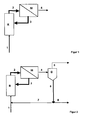
- Fig. 1 the educts (1) of the hydroformylation, olefin and synthesis gas, the reactor (R) are fed.
- the oxidation of the olefin to aldehyde takes place.
- Reacted educt such as aldehyde and by-products and secondary products including high boilers such as aldol condensation products and unreacted educt and the catalyst system are discharged as reaction mixture (2) from the reactor and fed to a selective membrane separation step (M).
- Fig. 2 shows an extension of the method Fig. 1 in that the permeate (4) of the membrane separation step is fed to a thermal separation step (D).
- the permeate stream (4) is separated into a stream of higher-boiling components, such as by-products of the reaction section and catalyst separation non-retained catalyst components (6), and into a product stream (5) containing a lower boiling, predominantly aldehyde.
- stream (6) or a partial stream (8) of stream (6) can be discharged from the process. Unless it is necessary to remove the entire stream (6), it may be advantageous to recycle the remaining stream (7) of the reaction, especially if stream (7) still contains parts of the catalyst system.
- stream 6 it may be advantageous to pass stream 6 through a second membrane separation step into a stream (7) enriched with catalyst (6) and a catalyst depleted stream (8) for discharging high boiling components to separate (see Fig. 3 ).
- a catalyst depleted stream (8) for discharging high boiling components to separate (see Fig. 3 ).
- the interconnection after Fig. 3 may also be advantageous without the membrane separation step after the reaction.
- Such an interconnection shows Fig. 4 ,
- a tributene prepared by oligomerizing linear butenes on nickel-containing solid catalysts is used to prepare the tride channel.
- the organophosphorus compound is tris (2,4-di-tert-butylphenyl) phosphite.
- the reaction is a rhodium / phosphite-catalyzed hydrofomylation of a dodecene mixture (tri-n-butene).
- the rhodium precursor used is rhodium acetylacetonato dicarbonyl and the ligand used is tris (2,4-di-tert-butylphenyl) phosphite.
- the rhodium concentration was 10 mg / kg.
- the rhodium to ligand ratio was 20.
- Reacted educt such as the aldehyde (isotridecanal) and by-products and secondary products including high boilers such as aldol condensation products and unreacted educt and the catalyst system are fed to a thermal separation step, the high-boiling and catalyst-enriched bottom is fed to the membrane separation step.
- the high boiler share is over 50%.
- the molar mass difference between active catalyst species and the high boilers is less than 500 g / mol.
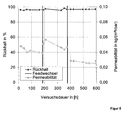
- the rhodium retention with a PIM membrane in the high-boiler stream is more than 95% ( Fig. 5 ).
- the membrane filtration was carried out by way of example at a transmembrane pressure of 25 bar and a temperature of 60 ° C.
- the feed-side overflow was 1.7 m / s, the pipe pressure loss was below 1 bar, the Reynolds number was about 1200.
- This high retention could be demonstrated for a test duration of more than 20 days.
- the resulting permeate fluxes are between 0.63 and 1.41 kg / (m 2 h).
- the rhodium concentrations in the feed of the membrane separation step are 50 to 133 mg / kg.
- Table 1 shows the corresponding results for a selection of in DE 10 2005 060784A1 mentioned membrane types.
- the feed of the membrane separation step is a rhodium / phosphite-catalyzed hydrofomylation of dodecene enriched in a high-boiling reaction by a thermal separation step. Accordingly, this stream contains reacted starting material such as the aldehyde (isotridecanal) and by-products and secondary products, including high boilers such as aldol condensation products and unreacted educt and the catalyst system.
- the ceramic membranes of Inopor ® and Velterop ® have a good permeate flux, but they can not sufficiently retain the catalyst system.
- the polymer membranes have an increased, but insufficient retention for the catalyst compared to the ceramic membranes.
- the polyimide membrane Starmem 240 ® also has an unsuitably low permeability.
- TMP transmembrane pressure Herst./Membran material Rh feed Rh permeate support River TMP Temp.
Landscapes
- Chemical & Material Sciences (AREA)
- Organic Chemistry (AREA)
- Engineering & Computer Science (AREA)
- Materials Engineering (AREA)
- Chemical Kinetics & Catalysis (AREA)
- Inorganic Chemistry (AREA)
- Organic Low-Molecular-Weight Compounds And Preparation Thereof (AREA)
- Low-Molecular Organic Synthesis Reactions Using Catalysts (AREA)
- Separation Using Semi-Permeable Membranes (AREA)
- Physical Or Chemical Processes And Apparatus (AREA)
- Polyethers (AREA)
- Catalysts (AREA)
Priority Applications (1)
| Application Number | Priority Date | Filing Date | Title |
|---|---|---|---|
| PL10711629T PL2401078T3 (pl) | 2009-02-27 | 2010-02-23 | Sposób wzbogacania katalizatora jednorodnego ze strumienia procesowego |
Applications Claiming Priority (2)
| Application Number | Priority Date | Filing Date | Title |
|---|---|---|---|
| DE102009001225A DE102009001225A1 (de) | 2009-02-27 | 2009-02-27 | Verfahren zur Anreicherung eines Homogenkatalysators aus einem Prozessstrom |
| PCT/EP2010/052242 WO2010097376A1 (de) | 2009-02-27 | 2010-02-23 | Verfahren zur anreicherung eines homogenkatalysators aus einem prozessstrom |
Publications (2)
| Publication Number | Publication Date |
|---|---|
| EP2401078A1 EP2401078A1 (de) | 2012-01-04 |
| EP2401078B1 true EP2401078B1 (de) | 2013-10-23 |
Family
ID=42144907
Family Applications (1)
| Application Number | Title | Priority Date | Filing Date |
|---|---|---|---|
| EP10711629.5A Not-in-force EP2401078B1 (de) | 2009-02-27 | 2010-02-23 | Verfahren zur anreicherung eines homogenkatalysators aus einem prozessstrom |
Country Status (15)
| Country | Link |
|---|---|
| US (1) | US8969628B2 (enExample) |
| EP (1) | EP2401078B1 (enExample) |
| JP (1) | JP5623435B2 (enExample) |
| KR (1) | KR101593259B1 (enExample) |
| CN (1) | CN102333593B (enExample) |
| BR (1) | BRPI1009755B1 (enExample) |
| DE (1) | DE102009001225A1 (enExample) |
| ES (1) | ES2442769T3 (enExample) |
| MX (1) | MX2011009008A (enExample) |
| MY (1) | MY153102A (enExample) |
| PL (1) | PL2401078T3 (enExample) |
| RU (1) | RU2011139168A (enExample) |
| SG (1) | SG174170A1 (enExample) |
| WO (1) | WO2010097376A1 (enExample) |
| ZA (1) | ZA201105351B (enExample) |
Families Citing this family (33)
| Publication number | Priority date | Publication date | Assignee | Title |
|---|---|---|---|---|
| DE102007054885A1 (de) * | 2007-11-15 | 2009-05-20 | Evonik Degussa Gmbh | Verfahren zur Fraktionierung oxidischer Nanopartikel durch Querstrom-Membranfiltration |
| DE102008043422B3 (de) | 2008-11-03 | 2010-01-07 | Evonik Degussa Gmbh | Verfahren zur Aufreinigung niedermolekularer Hydridosilane |
| DE102009001230A1 (de) | 2009-02-27 | 2010-09-02 | Evonik Oxeno Gmbh | Verfahren zur Abtrennung und teilweiser Rückführung von Übergangsmetallen bzw. deren katalytisch wirksamen Komplexverbindungen aus Prozessströmen |
| US20120123079A1 (en) | 2009-07-23 | 2012-05-17 | Evonik Fibres Gmbh | Polyimide membranes made of polymerization solutions |
| DE102009047351A1 (de) | 2009-12-01 | 2011-06-09 | Evonik Goldschmidt Gmbh | Komposit-Siliconmembranen mit hoher Trennwirkung |
| DE102011082441A1 (de) | 2011-09-09 | 2013-03-14 | Evonik Oxeno Gmbh | Strahlschlaufenreaktor mit Nanofiltration |
| GB201117950D0 (en) | 2011-10-18 | 2011-11-30 | Imp Innovations Ltd | Membranes for separation |
| DE102012202779A1 (de) * | 2012-02-23 | 2013-08-29 | Evonik Oxeno Gmbh | Verfahren und Vorrichtung zur technischen Hydroformylierung von Isobuten und zum Auftrennen des Produktgemisches |
| MX2015004527A (es) | 2012-10-12 | 2015-07-14 | Evonik Degussa Gmbh | Mezcla de bisfosfitos y su uso como mezcla catalizadora en la hidroformilacion. |
| DE102012223572A1 (de) | 2012-12-18 | 2014-06-18 | Evonik Industries Ag | Steuerung der Viskosität von Reaktionslösungen in Hydroformylierungverfahren |
| DE102013203117A1 (de) | 2013-02-26 | 2014-08-28 | Evonik Industries Ag | Optimierte Trenntechnik zur Aufarbeitung von homogen katalysierten Hydroformylierungsmischungen |
| KR102126255B1 (ko) | 2013-03-29 | 2020-06-24 | 제이에스알 가부시끼가이샤 | 조성물, 패턴이 형성된 기판의 제조 방법, 막 및 그의 형성 방법, 및 화합물 |
| DE102013215004A1 (de) * | 2013-07-31 | 2015-02-05 | Evonik Industries Ag | Membrankaskade mit sinkender Trenntemperatur |
| DE102014209421A1 (de) | 2014-05-19 | 2015-11-19 | Evonik Degussa Gmbh | Membrangestützte Katalysatorabtrennung bei der Epoxidierung von cyclischen, ungesättigten C12-Verbindungen zum Beispiel Cyclododecen (CDEN) |
| US9920168B2 (en) | 2015-03-17 | 2018-03-20 | Dow Global Technologies Llc | Polymers of intrinsic microporosity |
| DE112016002429T5 (de) | 2015-05-29 | 2018-02-22 | Dow Global Technologies Llc | Isatincopolymere mit intrinsischer microporosität |
| WO2016206008A1 (en) | 2015-06-24 | 2016-12-29 | Dow Global Technologies Llc | Isatin copolymers having intrinsic microporosity |
| WO2017091357A1 (en) | 2015-11-24 | 2017-06-01 | Dow Global Technologies Llc | Troger's base polymers having intrinsic microporosity |
| RU2741385C2 (ru) * | 2016-03-07 | 2021-01-25 | Шелл Интернэшнл Рисерч Маатсхаппий Б.В. | Способ извлечения металлического компонента |
| EP3510080A1 (en) | 2016-09-12 | 2019-07-17 | Dow Global Technologies, LLC | Polymer including troger's base and isatin moieties and having intrinsic microporosity |
| CN109689731A (zh) * | 2016-09-20 | 2019-04-26 | 陶氏环球技术有限责任公司 | 包括具有特勒格碱和螺双茚部分的子单元的具有固有微孔性的聚合物 |
| EP3762391A4 (en) | 2018-03-08 | 2022-08-03 | ExxonMobil Technology and Engineering Company | SPIROCENTRIC COMPOUNDS AND POLYMERS THEREOF |
| US20210013536A1 (en) * | 2018-06-29 | 2021-01-14 | Sepion Technologies, Inc. | Membranes for aqueous redox flow batteries |
| CN120049075A (zh) | 2018-07-27 | 2025-05-27 | 福恩能源公司 | 用于电化学电池的负电极 |
| DE202019001414U1 (de) | 2019-02-01 | 2019-04-12 | Evonik Canada Inc. | Vorrichtung zum Trennen von Gaskomponenten aus einem Gasstrom mit veränderlicher Zusammensetzung oder Strömungsrate |
| CN115066429A (zh) | 2020-02-11 | 2022-09-16 | 巴斯夫欧洲公司 | 二异丁烯的低压醛化 |
| EP4183900B1 (en) * | 2020-07-17 | 2025-12-10 | Panasonic Intellectual Property Management Co., Ltd. | Electrode catalyst for water electrolysis cells, water electrolysis cell, and water electrolysis device |
| WO2022014243A1 (ja) * | 2020-07-17 | 2022-01-20 | パナソニックIpマネジメント株式会社 | 水電解セルの電極触媒、水電解セル、及び水電解装置 |
| ES2974422T3 (es) | 2020-07-30 | 2024-06-27 | Evonik Oxeno Gmbh & Co Kg | Procedimiento para la preparación de aldehídos y separación del sistema catalítico mediante separación por membrana |
| ES2992645T3 (en) | 2021-11-19 | 2024-12-16 | Evonik Oxeno Gmbh & Co Kg | Process for producing aldehydes and cooling a mass flow |
| ES2992663T3 (en) | 2021-11-19 | 2024-12-16 | Evonik Oxeno Gmbh & Co Kg | Process for producing aldehydes and cooling a mass flow |
| EP4223737A1 (de) * | 2022-02-08 | 2023-08-09 | Evonik Operations GmbH | Optimierte thermische trennung durch vorherigen gasaustausch |
| CN119775550B (zh) * | 2024-11-01 | 2025-10-10 | 山东大学 | 一种可溶性单位点的钌基自具微孔聚合物催化剂及其制备方法和应用 |
Family Cites Families (69)
| Publication number | Priority date | Publication date | Assignee | Title |
|---|---|---|---|---|
| US4599206A (en) | 1984-02-17 | 1986-07-08 | Union Carbide Corporation | Transition metal complex catalyzed reactions |
| US4668651A (en) | 1985-09-05 | 1987-05-26 | Union Carbide Corporation | Transition metal complex catalyzed processes |
| US4748261A (en) | 1985-09-05 | 1988-05-31 | Union Carbide Corporation | Bis-phosphite compounds |
| US4759776A (en) | 1986-12-08 | 1988-07-26 | Air Products And Chemicals, Inc. | Polytrialkylgermylpropyne polymers and membranes |
| DE3820294C1 (enExample) | 1988-06-15 | 1989-10-05 | Th. Goldschmidt Ag, 4300 Essen, De | |
| DE3933420C1 (enExample) | 1989-10-06 | 1991-03-07 | Th. Goldschmidt Ag, 4300 Essen, De | |
| DE4009889C1 (enExample) | 1990-03-28 | 1991-06-13 | Th. Goldschmidt Ag, 4300 Essen, De | |
| US5260402A (en) | 1990-06-21 | 1993-11-09 | Th. Goldschmidt Ag | Curable organopolysiloxanes with oxyalkylene ether groups linked through SiOC groups, their synthesis and use |
| KR970703805A (ko) | 1995-05-01 | 1997-08-09 | 유니온 카바이드 케미칼즈 앤드 플라스틱스 테크놀러지 코포레이션 | 막 분리방법(Membrane Separation) |
| DE19654340A1 (de) * | 1996-12-24 | 1998-08-06 | Huels Chemische Werke Ag | Verfahren zur Herstellung von höheren Oxo-Alkoholen |
| DE19801437A1 (de) * | 1998-01-16 | 1999-07-22 | Basf Ag | Verfahren zur Herstellung von Aldehyden |
| KR100338136B1 (ko) | 1998-03-03 | 2002-05-24 | 울프 크라스텐센, 스트라쎄 로텐베르그 | 오르가노폴리실록산 및 오르가노폴리실록산의 제조방법 |
| DE19836246A1 (de) | 1998-08-11 | 2000-02-24 | Goldschmidt Ag Th | Strahlenhärtbare Beschichtungsmassen |
| EP1103303A1 (en) | 1999-11-23 | 2001-05-30 | Dsm N.V. | Process to separate a rhodium/phosphite ligand complex and free phosphite ligand complex from a hydroformylation mixture |
| DE10053272A1 (de) | 2000-10-27 | 2002-05-08 | Oxeno Olefinchemie Gmbh | Neue Bisphosphitverbindungen und deren Metallkomplexe |
| DE10058383A1 (de) | 2000-11-24 | 2002-05-29 | Oxeno Olefinchemie Gmbh | Neue Phosphininverbindungen und deren Metallkomplexe |
| DE10114868C1 (de) | 2001-03-26 | 2002-10-31 | Oxeno Olefinchemie Gmbh | Verfahren zur Herstellung von Diphosphinen und deren Verwendung |
| DE10140086A1 (de) | 2001-08-16 | 2003-02-27 | Oxeno Olefinchemie Gmbh | Neue Phosphitverbindungen und neue Phosphitmetallkomplexe |
| DE10140083A1 (de) | 2001-08-16 | 2003-02-27 | Oxeno Olefinchemie Gmbh | Neue Phosphitverbindungen und deren Metallkomplexe |
| CN1639177B (zh) | 2002-03-11 | 2010-05-05 | 陶氏技术投资有限责任公司 | 用于羰基化过程的双亚磷酸酯 |
| DE10210918B4 (de) | 2002-03-13 | 2004-06-03 | Oxeno Olefinchemie Gmbh | Verfahren zur Herstellung von Bisphosphiten |
| DE10220801A1 (de) * | 2002-05-10 | 2003-11-20 | Oxeno Olefinchemie Gmbh | Verfahren zur Rhodium-katalysierten Hydroformylierung von Olefinen unter Reduzierung der Rhodiumverluste |
| DE10220799A1 (de) | 2002-05-10 | 2003-12-11 | Oxeno Olefinchemie Gmbh | Verfahren zur Herstellung von C13-Alkoholgemischen |
| DE10248111A1 (de) | 2002-10-15 | 2004-04-29 | Goldschmidt Ag | Verwendung von Photoinitiatoren vom Typ Hydroxyalkylphenon in strahlenhärtbaren Organopolysiloxanen für die Herstellung von abhäsiven Beschichtungen |
| GB0317557D0 (en) | 2003-07-26 | 2003-08-27 | Univ Manchester | Microporous polymer material |
| DE10341137A1 (de) | 2003-09-06 | 2005-03-31 | Goldschmidt Ag | Verwendung von hydroxyfunktionellen Polyalkylorganosiloxanen als Lösungsmittel für kationische Photoinitiatoren für die Verwendung in strahlenhärtbaren Siliconen |
| DE10359764A1 (de) | 2003-12-19 | 2005-07-14 | Goldschmidt Ag | Polysiloxane mit über SiOC-Gruppen gebundenen (Meth)acrylsäureestergruppen, Verfahren zu deren Herstellung sowie deren Verwendung als strahlenhärtbare abhäsive Beschichtung |
| DE102004013514A1 (de) | 2004-03-19 | 2005-10-06 | Oxeno Olefinchemie Gmbh | Verfahren zur Hydroformylierung von Olefinen in Anwesenheit von neuen phosphororganischen Verbindungen |
| GB0411463D0 (en) | 2004-05-22 | 2004-06-23 | Univ Manchester | Thin layer composite membrane |
| DE102005001041A1 (de) | 2005-01-07 | 2006-07-20 | Goldschmidt Gmbh | Neuartige Siloxanblockcopolymere |
| DE102005001039B4 (de) | 2005-01-07 | 2017-11-09 | Evonik Degussa Gmbh | Verfahren zur Herstellung von Äquilibrierungsprodukten von Organosiloxanen und die so erhältlichen Organopolysiloxane |
| DE102005004706A1 (de) | 2005-02-02 | 2006-08-10 | Goldschmidt Gmbh | UV-Licht absorbierende quaternäre Polysiloxane |
| DE102005043742A1 (de) | 2005-09-14 | 2007-03-22 | Goldschmidt Gmbh | Verwendung von Epoxy-funktionellen Silanen als Haftungsadditiv für kationisch strahlenhärtende Silikontrennbeschichtungen |
| DE102005046250B4 (de) * | 2005-09-27 | 2020-10-08 | Evonik Operations Gmbh | Anlage zur Abtrennung von organischen Übergangsmetallkomplexkatalysatoren |
| DE102005051939A1 (de) | 2005-10-29 | 2007-05-03 | Goldschmidt Gmbh | Verfahren zur Herstellung von organisch modifizierten Polyorganosiloxanen |
| DE102005056246A1 (de) | 2005-11-25 | 2007-06-06 | Goldschmidt Gmbh | Gepfropfte Polyether-Copolymerisate und deren Verwendung zur Stabilisierung von Schaumstoffen |
| DE102005060784A1 (de) | 2005-12-16 | 2007-06-28 | Basf Ag | Verfahren zur Rückgewinnung eines an Hydroformylierungskatalysator angereicherten Stroms |
| DE102005061782A1 (de) | 2005-12-23 | 2007-06-28 | Goldschmidt Gmbh | Silikonhaltige Pfropfmischpolymere auf Basis styroloxidbasierter Silikonpolyether |
| DE102006003618A1 (de) * | 2006-01-26 | 2007-08-02 | Oxeno Olefinchemie Gmbh | Verfahren zur Abtrennung von Metall-Komplexkatalysatoren aus Telomerisationsgemischen |
| DE102006005100A1 (de) | 2006-02-04 | 2007-08-09 | Goldschmidt Gmbh | Verfahren zur Herstellung organomodifizierter Siloxane |
| DE102006008387A1 (de) | 2006-02-21 | 2007-08-30 | Goldschmidt Gmbh | Verfahren zur Herstellung von siloxanhaltigen Trennbeschichtungen |
| DE102006027339A1 (de) | 2006-06-13 | 2007-12-20 | Goldschmidt Gmbh | Kationisch strahlenhärtende Controlled Release Beschichtungsmassen |
| DE102006041089A1 (de) | 2006-09-01 | 2008-03-06 | Evonik Goldschmidt Gmbh | Verwendung von gepfropften Polyethersiloxanmischpolymeren zur Verbesserung der Kältestabilität von Entschäumern in wässrigen Dispersionen |
| DE102006041088A1 (de) | 2006-09-01 | 2008-03-06 | Evonik Goldschmidt Gmbh | Siliconhaltige, blockweise aufgebaute Pfropfmischpolymere |
| DE102006041971A1 (de) | 2006-09-07 | 2008-03-27 | Evonik Goldschmidt Gmbh | Verwendung von partikulären Emulgatoren in abhäsiven siloxanhaltigen Beschichtungsmassen |
| DE102007005508A1 (de) | 2007-02-03 | 2008-08-07 | Evonik Goldschmidt Gmbh | Verfahren zur Reduktion des Trennwert-Anstiegs bei der Herstellung von No-Label-Look-Etiketten |
| DE102007041028A1 (de) | 2007-08-29 | 2009-03-05 | Evonik Goldschmidt Gmbh | Verwendung estermodifizierter Organopolysiloxane zur Herstellung kosmetischer oder pharmazeutischer Kompositionen |
| DE102007044148A1 (de) | 2007-09-15 | 2009-03-26 | Evonik Goldschmidt Gmbh | Neuartige siloxanhaltige Blockcopolymere, Verfahren zu deren Herstellung und deren Verwendung für Schmiermittel |
| DE102007054885A1 (de) | 2007-11-15 | 2009-05-20 | Evonik Degussa Gmbh | Verfahren zur Fraktionierung oxidischer Nanopartikel durch Querstrom-Membranfiltration |
| DE102008000243A1 (de) | 2008-02-06 | 2009-08-13 | Evonik Goldschmidt Gmbh | Neuartige Kompatibilisierungsmittel zur Verbesserung der Lagerstabilität von Polyolmischungen |
| DE102008000287A1 (de) | 2008-02-13 | 2009-08-20 | Evonik Goldschmidt Gmbh | Reaktives, flüssiges Keramikbindemittel |
| DE102008001786A1 (de) | 2008-05-15 | 2009-11-26 | Evonik Goldschmidt Gmbh | Verwendung organomodifizierter Siloxanblockcopolymere als Pflegewirkstoff zur Pflege von menschlichen oder tierischen Körperteilen |
| DE102008001788A1 (de) | 2008-05-15 | 2009-11-26 | Evonik Goldschmidt Gmbh | Verwendung organomodifizierter Siloxanblockcopolymere zur Herstellung kosmetischer oder pharmazeutischer Zusammensetzungen |
| DE102008040986A1 (de) | 2008-08-05 | 2010-02-11 | Evonik Goldschmidt Gmbh | Hydrophobierung von Bauelementen aus Mineralfasern |
| DE102008041601A1 (de) | 2008-08-27 | 2010-03-04 | Evonik Goldschmidt Gmbh | Verfahren zur Herstellung verzweigter SiH-funtioneller Polysiloxane und deren Verwendung zur Herstellung flüssiger, SiC- oder SiOC-verknüpfter, verzweigter organomodifizierter Polysiloxane |
| DE102008041652A1 (de) | 2008-08-28 | 2010-03-04 | Evonik Oxeno Gmbh | Vorrichtung und Verfahren für die kontinuierliche Umsetzung einer Flüssigkeit mit einem Gas |
| DE102008041870A1 (de) | 2008-09-08 | 2010-03-11 | Evonik Degussa Gmbh | Reaktor mit Titansilikat-Rezyklierung |
| DE102008042381A1 (de) | 2008-09-26 | 2010-04-01 | Evonik Goldschmidt Gmbh | Emulgator-Systeme für kosmetische und pharmazeutische Öl-in-Wasser-Emulsionen |
| EP2334172B1 (en) | 2008-10-17 | 2015-01-21 | Evonik Degussa GmbH | Agrochemical oil compositions comprising alkylpolysiloxane adjuvants of high silicone character |
| DE102008043422B3 (de) | 2008-11-03 | 2010-01-07 | Evonik Degussa Gmbh | Verfahren zur Aufreinigung niedermolekularer Hydridosilane |
| DE102009001230A1 (de) | 2009-02-27 | 2010-09-02 | Evonik Oxeno Gmbh | Verfahren zur Abtrennung und teilweiser Rückführung von Übergangsmetallen bzw. deren katalytisch wirksamen Komplexverbindungen aus Prozessströmen |
| DE102009015211A1 (de) | 2009-03-31 | 2010-10-14 | Evonik Goldschmidt Gmbh | Selbstvernetzende Polysiloxane in Beschichtungen von Enzymimmobilisaten |
| DE102009002415A1 (de) | 2009-04-16 | 2010-10-21 | Evonik Goldschmidt Gmbh | Emulgator enthaltend glycerinmodifizierte Organopolysiloxane |
| DE102009003275A1 (de) | 2009-05-20 | 2010-11-25 | Evonik Goldschmidt Gmbh | Verzweigte Polydimethylsiloxan-Polyoxyalkylen Copolymere, ein Verfahren zu ihrer Herstellung und ihre Verwendung als Anti-Vernebelungsadditiv in UV-härtenden Silikonen |
| DE102009028636A1 (de) | 2009-08-19 | 2011-02-24 | Evonik Goldschmidt Gmbh | Neuartige Urethangruppen enthaltende silylierte Präpolymere und Verfahren zu deren Herstellung |
| DE102009028640A1 (de) | 2009-08-19 | 2011-02-24 | Evonik Goldschmidt Gmbh | Härtbare Masse enthaltend Urethangruppen aufweisende silylierte Polymere und deren Verwendung in Dicht- und Klebstoffen, Binde- und/oder Oberflächenmodifizierungsmitteln |
| DE102010002178A1 (de) | 2010-02-22 | 2011-08-25 | Evonik Goldschmidt GmbH, 45127 | Verfahren zur Herstellung von Amin-Amid-funktionellen Siloxanen |
| DE102010002180A1 (de) | 2010-02-22 | 2011-08-25 | Evonik Goldschmidt GmbH, 45127 | Stickstoffhaltige silizium-organische Pfropfmischpolymere |
| DE102010031087A1 (de) | 2010-07-08 | 2012-01-12 | Evonik Goldschmidt Gmbh | Neuartige polyestermodifizierte Organopolysiloxane |
-
2009
- 2009-02-27 DE DE102009001225A patent/DE102009001225A1/de not_active Withdrawn
-
2010
- 2010-02-23 WO PCT/EP2010/052242 patent/WO2010097376A1/de not_active Ceased
- 2010-02-23 CN CN201080009645.1A patent/CN102333593B/zh not_active Expired - Fee Related
- 2010-02-23 ES ES10711629.5T patent/ES2442769T3/es active Active
- 2010-02-23 EP EP10711629.5A patent/EP2401078B1/de not_active Not-in-force
- 2010-02-23 BR BRPI1009755-4A patent/BRPI1009755B1/pt not_active IP Right Cessation
- 2010-02-23 MX MX2011009008A patent/MX2011009008A/es active IP Right Grant
- 2010-02-23 MY MYPI2011004020 patent/MY153102A/en unknown
- 2010-02-23 US US13/203,639 patent/US8969628B2/en not_active Expired - Fee Related
- 2010-02-23 PL PL10711629T patent/PL2401078T3/pl unknown
- 2010-02-23 JP JP2011551482A patent/JP5623435B2/ja not_active Expired - Fee Related
- 2010-02-23 RU RU2011139168/04A patent/RU2011139168A/ru not_active Application Discontinuation
- 2010-02-23 KR KR1020117019820A patent/KR101593259B1/ko not_active Expired - Fee Related
- 2010-02-23 SG SG2011062072A patent/SG174170A1/en unknown
-
2011
- 2011-07-20 ZA ZA2011/05351A patent/ZA201105351B/en unknown
Also Published As
| Publication number | Publication date |
|---|---|
| KR101593259B1 (ko) | 2016-02-12 |
| EP2401078A1 (de) | 2012-01-04 |
| PL2401078T3 (pl) | 2014-03-31 |
| KR20110124759A (ko) | 2011-11-17 |
| CN102333593B (zh) | 2014-08-27 |
| US20120046503A1 (en) | 2012-02-23 |
| JP2012519061A (ja) | 2012-08-23 |
| JP5623435B2 (ja) | 2014-11-12 |
| RU2011139168A (ru) | 2013-04-10 |
| BRPI1009755B1 (pt) | 2018-02-14 |
| SG174170A1 (en) | 2011-10-28 |
| ZA201105351B (en) | 2012-10-31 |
| DE102009001225A1 (de) | 2010-09-02 |
| BRPI1009755A2 (pt) | 2016-03-15 |
| ES2442769T3 (es) | 2014-02-13 |
| CN102333593A (zh) | 2012-01-25 |
| MX2011009008A (es) | 2011-11-29 |
| MY153102A (en) | 2014-12-31 |
| WO2010097376A1 (de) | 2010-09-02 |
| US8969628B2 (en) | 2015-03-03 |
Similar Documents
| Publication | Publication Date | Title |
|---|---|---|
| EP2401078B1 (de) | Verfahren zur anreicherung eines homogenkatalysators aus einem prozessstrom | |
| EP1931472B1 (de) | Verfahren zur abtrennung von organischen übergangsmetallkomplexkatalysatoren | |
| EP3027298B1 (de) | Membrankaskade mit sinkender trenntemperatur | |
| EP2935187B1 (de) | Steuerung der viskosität von reaktionslösungen in hydroformylierungverfahren | |
| DE69518426T2 (de) | Membrantrennung | |
| EP2401060B1 (de) | Verfahren zur abtrennung und teilweisen rückführung von rhodium bzw. dessen katalytisch wirksamen komplexverbindungen aus prozessströmen | |
| EP3750627B1 (de) | Verfahren zur abtrennung von einer oder mehreren komponente(n) aus einem gemisch | |
| EP3060334B1 (de) | Strahlschlaufenreaktor mit nanofiltration und gasseparator | |
| EP3059005A1 (de) | Abtrennung eines homogenkatalysators aus einem reaktionsgemisch mit hilfe organophiler nanofiltration unter besonderer berücksichtigung eines membran-leistungsindikators | |
| DE102012202779A1 (de) | Verfahren und Vorrichtung zur technischen Hydroformylierung von Isobuten und zum Auftrennen des Produktgemisches | |
| DE102013208759A1 (de) | Abtrennung von Homogenkatalysatoren mittels einer geregelten Membrantrenneinheit | |
| EP3112373B1 (de) | Neuer vierzähniger phosphor-ligand mit hostanox o3 leitstruktur | |
| EP3038751B1 (de) | Geträgerte zusammensetzung und deren verwendung in verfahren zur hydroformylierung von ungesättigten verbindungen | |
| DE102005060784A1 (de) | Verfahren zur Rückgewinnung eines an Hydroformylierungskatalysator angereicherten Stroms | |
| EP4574804A1 (de) | Verfahren zur umsetzung von dibuten mit vorheriger destillation |
Legal Events
| Date | Code | Title | Description |
|---|---|---|---|
| PUAI | Public reference made under article 153(3) epc to a published international application that has entered the european phase |
Free format text: ORIGINAL CODE: 0009012 |
|
| 17P | Request for examination filed |
Effective date: 20110715 |
|
| AK | Designated contracting states |
Kind code of ref document: A1 Designated state(s): AT BE BG CH CY CZ DE DK EE ES FI FR GB GR HR HU IE IS IT LI LT LU LV MC MK MT NL NO PL PT RO SE SI SK SM TR |
|
| DAX | Request for extension of the european patent (deleted) | ||
| 17Q | First examination report despatched |
Effective date: 20120604 |
|
| GRAP | Despatch of communication of intention to grant a patent |
Free format text: ORIGINAL CODE: EPIDOSNIGR1 |
|
| INTG | Intention to grant announced |
Effective date: 20130529 |
|
| GRAS | Grant fee paid |
Free format text: ORIGINAL CODE: EPIDOSNIGR3 |
|
| GRAA | (expected) grant |
Free format text: ORIGINAL CODE: 0009210 |
|
| RAP1 | Party data changed (applicant data changed or rights of an application transferred) |
Owner name: EVONIK DEGUSSA GMBH |
|
| AK | Designated contracting states |
Kind code of ref document: B1 Designated state(s): AT BE BG CH CY CZ DE DK EE ES FI FR GB GR HR HU IE IS IT LI LT LU LV MC MK MT NL NO PL PT RO SE SI SK SM TR |
|
| REG | Reference to a national code |
Ref country code: GB Ref legal event code: FG4D Free format text: NOT ENGLISH |
|
| REG | Reference to a national code |
Ref country code: CH Ref legal event code: EP |
|
| REG | Reference to a national code |
Ref country code: AT Ref legal event code: REF Ref document number: 637240 Country of ref document: AT Kind code of ref document: T Effective date: 20131115 |
|
| REG | Reference to a national code |
Ref country code: IE Ref legal event code: FG4D Free format text: LANGUAGE OF EP DOCUMENT: GERMAN |
|
| REG | Reference to a national code |
Ref country code: DE Ref legal event code: R096 Ref document number: 502010005153 Country of ref document: DE Effective date: 20131219 |
|
| REG | Reference to a national code |
Ref country code: RO Ref legal event code: EPE |
|
| REG | Reference to a national code |
Ref country code: SE Ref legal event code: TRGR |
|
| REG | Reference to a national code |
Ref country code: NL Ref legal event code: T3 |
|
| REG | Reference to a national code |
Ref country code: ES Ref legal event code: FG2A Ref document number: 2442769 Country of ref document: ES Kind code of ref document: T3 Effective date: 20140213 |
|
| REG | Reference to a national code |
Ref country code: LT Ref legal event code: MG4D |
|
| PG25 | Lapsed in a contracting state [announced via postgrant information from national office to epo] |
Ref country code: IS Free format text: LAPSE BECAUSE OF FAILURE TO SUBMIT A TRANSLATION OF THE DESCRIPTION OR TO PAY THE FEE WITHIN THE PRESCRIBED TIME-LIMIT Effective date: 20140223 Ref country code: HR Free format text: LAPSE BECAUSE OF FAILURE TO SUBMIT A TRANSLATION OF THE DESCRIPTION OR TO PAY THE FEE WITHIN THE PRESCRIBED TIME-LIMIT Effective date: 20131023 Ref country code: FI Free format text: LAPSE BECAUSE OF FAILURE TO SUBMIT A TRANSLATION OF THE DESCRIPTION OR TO PAY THE FEE WITHIN THE PRESCRIBED TIME-LIMIT Effective date: 20131023 Ref country code: NO Free format text: LAPSE BECAUSE OF FAILURE TO SUBMIT A TRANSLATION OF THE DESCRIPTION OR TO PAY THE FEE WITHIN THE PRESCRIBED TIME-LIMIT Effective date: 20140123 Ref country code: LT Free format text: LAPSE BECAUSE OF FAILURE TO SUBMIT A TRANSLATION OF THE DESCRIPTION OR TO PAY THE FEE WITHIN THE PRESCRIBED TIME-LIMIT Effective date: 20131023 |
|
| PG25 | Lapsed in a contracting state [announced via postgrant information from national office to epo] |
Ref country code: CY Free format text: LAPSE BECAUSE OF FAILURE TO SUBMIT A TRANSLATION OF THE DESCRIPTION OR TO PAY THE FEE WITHIN THE PRESCRIBED TIME-LIMIT Effective date: 20131023 Ref country code: LV Free format text: LAPSE BECAUSE OF FAILURE TO SUBMIT A TRANSLATION OF THE DESCRIPTION OR TO PAY THE FEE WITHIN THE PRESCRIBED TIME-LIMIT Effective date: 20131023 |
|
| PG25 | Lapsed in a contracting state [announced via postgrant information from national office to epo] |
Ref country code: PT Free format text: LAPSE BECAUSE OF FAILURE TO SUBMIT A TRANSLATION OF THE DESCRIPTION OR TO PAY THE FEE WITHIN THE PRESCRIBED TIME-LIMIT Effective date: 20140224 |
|
| REG | Reference to a national code |
Ref country code: DE Ref legal event code: R097 Ref document number: 502010005153 Country of ref document: DE |
|
| PG25 | Lapsed in a contracting state [announced via postgrant information from national office to epo] |
Ref country code: EE Free format text: LAPSE BECAUSE OF FAILURE TO SUBMIT A TRANSLATION OF THE DESCRIPTION OR TO PAY THE FEE WITHIN THE PRESCRIBED TIME-LIMIT Effective date: 20131023 |
|
| PG25 | Lapsed in a contracting state [announced via postgrant information from national office to epo] |
Ref country code: IT Free format text: LAPSE BECAUSE OF FAILURE TO SUBMIT A TRANSLATION OF THE DESCRIPTION OR TO PAY THE FEE WITHIN THE PRESCRIBED TIME-LIMIT Effective date: 20131023 Ref country code: CZ Free format text: LAPSE BECAUSE OF FAILURE TO SUBMIT A TRANSLATION OF THE DESCRIPTION OR TO PAY THE FEE WITHIN THE PRESCRIBED TIME-LIMIT Effective date: 20131023 Ref country code: SK Free format text: LAPSE BECAUSE OF FAILURE TO SUBMIT A TRANSLATION OF THE DESCRIPTION OR TO PAY THE FEE WITHIN THE PRESCRIBED TIME-LIMIT Effective date: 20131023 |
|
| PLBE | No opposition filed within time limit |
Free format text: ORIGINAL CODE: 0009261 |
|
| STAA | Information on the status of an ep patent application or granted ep patent |
Free format text: STATUS: NO OPPOSITION FILED WITHIN TIME LIMIT |
|
| PG25 | Lapsed in a contracting state [announced via postgrant information from national office to epo] |
Ref country code: MC Free format text: LAPSE BECAUSE OF FAILURE TO SUBMIT A TRANSLATION OF THE DESCRIPTION OR TO PAY THE FEE WITHIN THE PRESCRIBED TIME-LIMIT Effective date: 20131023 Ref country code: LU Free format text: LAPSE BECAUSE OF FAILURE TO SUBMIT A TRANSLATION OF THE DESCRIPTION OR TO PAY THE FEE WITHIN THE PRESCRIBED TIME-LIMIT Effective date: 20140223 Ref country code: DK Free format text: LAPSE BECAUSE OF FAILURE TO SUBMIT A TRANSLATION OF THE DESCRIPTION OR TO PAY THE FEE WITHIN THE PRESCRIBED TIME-LIMIT Effective date: 20131023 |
|
| REG | Reference to a national code |
Ref country code: CH Ref legal event code: PL |
|
| 26N | No opposition filed |
Effective date: 20140724 |
|
| GBPC | Gb: european patent ceased through non-payment of renewal fee |
Effective date: 20140223 |
|
| PG25 | Lapsed in a contracting state [announced via postgrant information from national office to epo] |
Ref country code: LI Free format text: LAPSE BECAUSE OF NON-PAYMENT OF DUE FEES Effective date: 20140228 Ref country code: CH Free format text: LAPSE BECAUSE OF NON-PAYMENT OF DUE FEES Effective date: 20140228 |
|
| REG | Reference to a national code |
Ref country code: DE Ref legal event code: R097 Ref document number: 502010005153 Country of ref document: DE Effective date: 20140724 |
|
| REG | Reference to a national code |
Ref country code: IE Ref legal event code: MM4A |
|
| PG25 | Lapsed in a contracting state [announced via postgrant information from national office to epo] |
Ref country code: GB Free format text: LAPSE BECAUSE OF NON-PAYMENT OF DUE FEES Effective date: 20140223 Ref country code: IE Free format text: LAPSE BECAUSE OF NON-PAYMENT OF DUE FEES Effective date: 20140223 |
|
| PG25 | Lapsed in a contracting state [announced via postgrant information from national office to epo] |
Ref country code: SI Free format text: LAPSE BECAUSE OF FAILURE TO SUBMIT A TRANSLATION OF THE DESCRIPTION OR TO PAY THE FEE WITHIN THE PRESCRIBED TIME-LIMIT Effective date: 20131023 |
|
| REG | Reference to a national code |
Ref country code: FR Ref legal event code: PLFP Year of fee payment: 7 |
|
| PG25 | Lapsed in a contracting state [announced via postgrant information from national office to epo] |
Ref country code: MT Free format text: LAPSE BECAUSE OF FAILURE TO SUBMIT A TRANSLATION OF THE DESCRIPTION OR TO PAY THE FEE WITHIN THE PRESCRIBED TIME-LIMIT Effective date: 20131023 |
|
| REG | Reference to a national code |
Ref country code: AT Ref legal event code: MM01 Ref document number: 637240 Country of ref document: AT Kind code of ref document: T Effective date: 20150223 |
|
| PG25 | Lapsed in a contracting state [announced via postgrant information from national office to epo] |
Ref country code: SM Free format text: LAPSE BECAUSE OF FAILURE TO SUBMIT A TRANSLATION OF THE DESCRIPTION OR TO PAY THE FEE WITHIN THE PRESCRIBED TIME-LIMIT Effective date: 20131023 |
|
| PG25 | Lapsed in a contracting state [announced via postgrant information from national office to epo] |
Ref country code: AT Free format text: LAPSE BECAUSE OF NON-PAYMENT OF DUE FEES Effective date: 20150223 |
|
| PG25 | Lapsed in a contracting state [announced via postgrant information from national office to epo] |
Ref country code: BG Free format text: LAPSE BECAUSE OF FAILURE TO SUBMIT A TRANSLATION OF THE DESCRIPTION OR TO PAY THE FEE WITHIN THE PRESCRIBED TIME-LIMIT Effective date: 20131023 Ref country code: GR Free format text: LAPSE BECAUSE OF FAILURE TO SUBMIT A TRANSLATION OF THE DESCRIPTION OR TO PAY THE FEE WITHIN THE PRESCRIBED TIME-LIMIT Effective date: 20140124 |
|
| PG25 | Lapsed in a contracting state [announced via postgrant information from national office to epo] |
Ref country code: TR Free format text: LAPSE BECAUSE OF FAILURE TO SUBMIT A TRANSLATION OF THE DESCRIPTION OR TO PAY THE FEE WITHIN THE PRESCRIBED TIME-LIMIT Effective date: 20131023 Ref country code: HU Free format text: LAPSE BECAUSE OF FAILURE TO SUBMIT A TRANSLATION OF THE DESCRIPTION OR TO PAY THE FEE WITHIN THE PRESCRIBED TIME-LIMIT; INVALID AB INITIO Effective date: 20100223 |
|
| REG | Reference to a national code |
Ref country code: FR Ref legal event code: PLFP Year of fee payment: 8 |
|
| REG | Reference to a national code |
Ref country code: FR Ref legal event code: PLFP Year of fee payment: 9 |
|
| PG25 | Lapsed in a contracting state [announced via postgrant information from national office to epo] |
Ref country code: MK Free format text: LAPSE BECAUSE OF FAILURE TO SUBMIT A TRANSLATION OF THE DESCRIPTION OR TO PAY THE FEE WITHIN THE PRESCRIBED TIME-LIMIT Effective date: 20131023 |
|
| PGFP | Annual fee paid to national office [announced via postgrant information from national office to epo] |
Ref country code: NL Payment date: 20190218 Year of fee payment: 10 |
|
| PGFP | Annual fee paid to national office [announced via postgrant information from national office to epo] |
Ref country code: ES Payment date: 20190321 Year of fee payment: 10 Ref country code: RO Payment date: 20190125 Year of fee payment: 10 Ref country code: DE Payment date: 20190219 Year of fee payment: 10 Ref country code: PL Payment date: 20190213 Year of fee payment: 10 |
|
| PGFP | Annual fee paid to national office [announced via postgrant information from national office to epo] |
Ref country code: SE Payment date: 20190218 Year of fee payment: 10 Ref country code: FR Payment date: 20190220 Year of fee payment: 10 Ref country code: BE Payment date: 20190218 Year of fee payment: 10 |
|
| REG | Reference to a national code |
Ref country code: DE Ref legal event code: R119 Ref document number: 502010005153 Country of ref document: DE |
|
| REG | Reference to a national code |
Ref country code: SE Ref legal event code: EUG |
|
| REG | Reference to a national code |
Ref country code: NL Ref legal event code: MM Effective date: 20200301 |
|
| REG | Reference to a national code |
Ref country code: BE Ref legal event code: MM Effective date: 20200229 |
|
| PG25 | Lapsed in a contracting state [announced via postgrant information from national office to epo] |
Ref country code: RO Free format text: LAPSE BECAUSE OF NON-PAYMENT OF DUE FEES Effective date: 20200223 Ref country code: SE Free format text: LAPSE BECAUSE OF NON-PAYMENT OF DUE FEES Effective date: 20200224 |
|
| PG25 | Lapsed in a contracting state [announced via postgrant information from national office to epo] |
Ref country code: NL Free format text: LAPSE BECAUSE OF NON-PAYMENT OF DUE FEES Effective date: 20200301 |
|
| PG25 | Lapsed in a contracting state [announced via postgrant information from national office to epo] |
Ref country code: DE Free format text: LAPSE BECAUSE OF NON-PAYMENT OF DUE FEES Effective date: 20200901 Ref country code: FR Free format text: LAPSE BECAUSE OF NON-PAYMENT OF DUE FEES Effective date: 20200229 |
|
| PG25 | Lapsed in a contracting state [announced via postgrant information from national office to epo] |
Ref country code: BE Free format text: LAPSE BECAUSE OF NON-PAYMENT OF DUE FEES Effective date: 20200229 |
|
| PG25 | Lapsed in a contracting state [announced via postgrant information from national office to epo] |
Ref country code: ES Free format text: LAPSE BECAUSE OF NON-PAYMENT OF DUE FEES Effective date: 20200224 |
|
| PG25 | Lapsed in a contracting state [announced via postgrant information from national office to epo] |
Ref country code: PL Free format text: LAPSE BECAUSE OF NON-PAYMENT OF DUE FEES Effective date: 20200223 |