EP2385991B1 - Nucleic acid amplification with allele-specific suppression of sequence variants - Google Patents
Nucleic acid amplification with allele-specific suppression of sequence variants Download PDFInfo
- Publication number
- EP2385991B1 EP2385991B1 EP10700205.7A EP10700205A EP2385991B1 EP 2385991 B1 EP2385991 B1 EP 2385991B1 EP 10700205 A EP10700205 A EP 10700205A EP 2385991 B1 EP2385991 B1 EP 2385991B1
- Authority
- EP
- European Patent Office
- Prior art keywords
- oligonucleotide
- target sequence
- variant
- nucleic acid
- amplification
- Prior art date
- Legal status (The legal status is an assumption and is not a legal conclusion. Google has not performed a legal analysis and makes no representation as to the accuracy of the status listed.)
- Active
Links
Images




Classifications
-
- C—CHEMISTRY; METALLURGY
- C12—BIOCHEMISTRY; BEER; SPIRITS; WINE; VINEGAR; MICROBIOLOGY; ENZYMOLOGY; MUTATION OR GENETIC ENGINEERING
- C12Q—MEASURING OR TESTING PROCESSES INVOLVING ENZYMES, NUCLEIC ACIDS OR MICROORGANISMS; COMPOSITIONS OR TEST PAPERS THEREFOR; PROCESSES OF PREPARING SUCH COMPOSITIONS; CONDITION-RESPONSIVE CONTROL IN MICROBIOLOGICAL OR ENZYMOLOGICAL PROCESSES
- C12Q1/00—Measuring or testing processes involving enzymes, nucleic acids or microorganisms; Compositions therefor; Processes of preparing such compositions
- C12Q1/68—Measuring or testing processes involving enzymes, nucleic acids or microorganisms; Compositions therefor; Processes of preparing such compositions involving nucleic acids
- C12Q1/6844—Nucleic acid amplification reactions
- C12Q1/6858—Allele-specific amplification
Definitions
- the invention relates to the field of nucleic acid-based molecular diagnostics, and more specifically, to an improved method of amplification of nucleic acid sequences with allele-specific suppression of amplification of undesired sequence variants.
- Nucleic acid-based diagnostic tests are widely used in medicine, forensics and environmental applications. Detecting variations in a particular nucleic acid sequence provides information about polymorphisms and mutations, including disease-causing mutations. For example, detecting an individual's mutant genotype provides disease carrier status for genetic counseling. A more challenging task is detecting somatic mutations that arise in tissues and cause disease or disease progression. For example, many cancers are caused by a particular mutation. Later, additional mutations accumulate in cancer cells during tumor progression. See Lea et al. (2007) Genetic pathways and mutation profiles of human cancers: site and exposure-specific patterns, Carcinogenesis, 28(9):1851-1858 . Downward, J. (2003) Targeting RAS signaling pathways in cancer therapy (2005), Nature Rev.
- a major challenge in detecting a cancer-related mutation is the rare nature of the mutation, especially when it first arises in a single cell during carcinogenesis. Initially, only a subpopulation of cells carries the mutation, while the surrounding cells still carry the wild-type sequence. Therefore, in a nucleic acid isolate, the newly-mutated nucleic acid is obscured by the excess of the wild-type nucleic acid.
- Many allele-specific detection methods involve preferential amplification of the sequence of interest (mutant sequence) over the undesired sequence (wild-type sequence).
- the selectivity of the assay is not perfect, i.e. the undesired sequence is also amplified, but a lot less efficiently than the desired sequence. Because the undesired (wild-type) sequence is present in great molar excess over the mutant sequence, the disadvantage is erased and the wild-type sequence is amplified predominantly, obscuring the presence of the mutant sequence.
- U.S. Patent No. 5,849,497 and Application Publication No. 2009/0053720 filed on August 5, 2008 , teach using an amplification blocker that would prevent the amplification of the competing undesired sequence.
- the blocker is a non-extendible oligonucleotide which forms a stable hybrid with the undesired sequence (but not with the desired sequence) downstream of one of the amplification primers.
- a DNA polymerase deficient in the 5'-3'-nuclease activity is unable to complete the extension of the primer.
- the target sequence exists in the form of more than one variant, comprising the steps of providing a sample comprising the target sequence and a variant, providing two oligonucleotides 10 that bind to the target and variant molecule and a third oligonucleotide that binds with higher affinity to the variant sequence in a distance of less than 60 nucleotides to the binding site of one of the primers.
- the third oligonucleotide specifically inhibits the amplification of the undesired variant.
- the blocking probe (third oligonucleotide) is also used as a detection probe.
- the above method has several technical limitations. A longer blocker oligonucleotide is more efficient at blocking, but may be unable to discriminate, thus blocking amplification of all sequence variants. A shorter blocker may be unable to block any amplification efficiently. In some sequence contexts, there may be so few differences that a blocker is capable of very weak discrimination. Therefore, in some loci of clinical interest, the blocker alone is insufficient to solve the technical problems of allele-specific amplification.
- the present invention is an improved method of selective amplification of a desired variant of a target sequence, for which said target sequence exists in the form of more than one variant, the method comprising the steps of: providing a sample possibly comprising at least one variant of the target sequence in a reaction mixture; providing a first oligonucleotide, capable of hybridizing to more than one variant of the target sequence; providing a second oligonucleotide, capable of hybridizing to more than one variant of the target sequence, wherein at least a fraction of said second oligonucleotide contains a modified base in one or more nucleotides at or near the 3'-terminus; said modified base is modified at the exocyclic amino group; providing a third oligonucleotide, capable of hybridizing to the desired variant of the target sequence with the lesser affinity than to the undesired variants of the target sequence and designed to hybridize to the same strand and between 0 and 60 nucleotides downstream of said second oligonucleotide; providing
- the present invention is an improved method of selective amplification of certain variants of the target sequence, enhanced by allele-specific suppression of amplification of one or more of the other variants of the target sequence.
- a “biological sample” or “sample” refers to any substance possibly containing a nucleic acid of interest.
- the sample can be obtained by any means known to those of skill in the art.
- Such sample can be an amount of tissue or fluid, or a purified fraction thereof, isolated from a human or other animal, including, but not limited to: body fluid, such as plasma, serum, spinal fluid, saliva, peritoneal fluid, lymphatic fluid, aqueous or vitreous humor, synovial fluid, urine, tears, seminal fluid, vaginal fluids, pulmonary effusion, serosal fluid; tissue, including blood, normal tissues, tumors and paraffin embedded tissues. Samples also can also be (or be derived from) in vitro cell cultures.
- the samples can include conditioned medium, cells and cell components.
- the nucleic acid can be obtained from a biological sample by procedures well known in the art.
- a "blocker oligonucleotide” as used herein refers to an oligonucleotide that:
- the blocker oligonucleotide typically includes a modification at the 3' end to prevent extension of the blocker oligonucleotide by a polymerase.
- target sequence refers to a nucleotide sequence to be detected in a biological sample.
- the target sequence can be a portion of a larger sequence or an isolated nucleic acid.
- a blocker oligonucleotide can impair amplification of one or more variants of the target sequence, so that the amplification of such variants is undetectable, or is less detectable, compared to a control reaction lacking the blocker oligonucleotide.
- nucleic acid and “polynucleotide” are used interchangeably, and refer to a polymer of RNA, DNA, as well as modified forms thereof such as peptide nucleic acids (PNA), locked nucleic acids (LNA), and the like. There is no intended distinction in length between the term “nucleic acid” and “polynucleotide.”
- An “oligonucleotide” is a generally shorter nucleic acid, which is commonly single-stranded.
- a nucleic acid is either single-stranded or double-stranded and will generally contain phosphodiester bonds, although in some cases, nucleic acid analogs are included that may have alternate backbones, including, for example, phosphoramide ( Beaucage et al. (1993) Tetrahedron 49(10): 1925 ; Letsinger (1970) J. Org. Chem. 35:3800 ; SRocl et al. (1977) Eur. J. Biochem. 81:579 ; Letsinger et al. (1986) Nucl. Acids Res. 14: 3487 ; Sawai et al. (1984) Chem. Lett. 805 ; Letsinger et al. (1988) J. Am. Chem.
- nucleic acids containing one or more carbocyclic sugars are also included within the definition of nucleic acids ( Jenkins et al. (1995) Chem. Soc. Rev. pp 169-176 ).
- nucleic acid analogs are also described in, e.g., Rawls, C & E News Jun. 2, 1997 page 35 . These modifications of the ribose-phosphate backbone may be done to facilitate the addition of additional moieties such as labeling moieties, or to alter the stability and half-life of such molecules in physiological environments.
- Nucleic acids generally contain the typical nitrogenous bases (adenine, guanine cytosine, thymine and uracil). However, nucleic acids may also contain non-naturally occurring heterocyclic or other modified bases. In particular, such bases are described in Seela et al. (1991) Helv. Chim. Acta 74:1790 , Grein et al. (1994) Bioorg. Med. Chem. Lett. 4:971-976 , and Seela et al. (1999) Helv. Chim. Acta 82:1640 .
- bases include 7-deazapurines (e.g., 7-deazaguanine, 7-deazaadenine, etc.), pyrazolo[3,4-d]pyrimidines, propynyl-dN (e.g., propynyl-dU, propynyl-dC, etc.), and the like. See, e.g., U.S. Pat. No. 5,990,303 .
- heterocyclic bases include hypoxanthine, inosine, xanthine, 8-aza derivatives of 2-aminopurine, 2,6-diaminopurine, 2-amino-6-chloropurine, hypoxanthine, 7-deaza-8-aza derivatives of adenine, guanine, 2-aminopurine, 2,6-diaminopurine, 2-amino-6-chloropurine, hypoxanthine, inosine and xanthine; 6-azacytidine; 5-fluorocytidine; 5-chlorocytidine; 5-iodocytidine; 5-bromocytidine; 5-methylcytidine; 5-propynylcytidine; 5-bromovinyluracil; 5-fluorouracil; 5-chlorouracil; 5-iodouracil; 5-bromouracil; 5-trifluoromethyluracil; 5-methoxymethyluracil; 5-ethy
- non-naturally occurring bases and nucleotides are 5-propynyl pyrimidines, described in U.S. Pat. Nos. 5,484,908 ; and other modified pyrimidines described in U.S. Pat. Nos. 5,645,985 and 5,830,653 .
- bicyclo nucleotides are described in U.S. Pat. No. 6,639,059 .
- Other modified purines and pyrimidines used in primers to increase the specificity of an amplification reaction were described in U.S. patent No. 6,011,611 .
- primer extension refers to the ability of a nucleotide incorporating biocatalyst, such as a polymerase, to add one or more nucleotides to the 3' terminus of a primer.
- “Conditions suitable for primer extension” refer to conditions under which primers that hybridize to a template nucleic acid are extended by a nucleotide-incorporating biocatalyst, such as a polymerase. For example, such conditions occur during a polymerase chain reaction (PCR) annealing and extension step.
- PCR polymerase chain reaction
- a nucleic acid is "complementary" in relation to another nucleic acid when at least a subsequence of the nucleic acid can combine in an antiparallel association with at least a subsequence of the other nucleic acid to form a duplex.
- each base of the oligonucleotide in an oligonucleotide that is "fully complementary” to a particular nucleic acid sequence, each base of the oligonucleotide is complementary to the corresponding base in the particular sequence.
- An oligonucleotide is "partially complementary" to a particular nucleic acid sequence when one or more of the bases in the oligonucleotide are not complementary (“mismatched") with the corresponding bases in the other nucleic acid.
- Modified bases are generally considered to be complementary to the same base as their non-modified precursors.
- 7-deazaguanine is considered to be complementary to cytosine and N6-benzyl-adenine is considered to be complementary to thymine.
- a “primer nucleic acid” or “primer” is an oligonucleotide that can hybridize to a target nucleic acid (sometimes called template nucleic acid) and permit chain extension or elongation by a nucleotide incorporating biocatalyst, such as a polymerase, under appropriate reaction conditions.
- a primer nucleic acid is typically a natural or synthetic oligonucleotide, ranging from about 6 to about 100 nucleotides in length, although most commonly primers are between 15 and 35 nucleotides in length. Short primer nucleic acids generally require lower temperatures to form sufficiently stable hybrid complexes with template nucleic acids.
- a primer that is at least partially complementary to the template nucleic acid is typically sufficient for extension to occur.
- a primer can be labeled, if desired, by incorporating a label detectable by spectroscopic, photochemical, biochemical, immunochemical, chemical or other techniques.
- useful labels include; radioisotopes, fluorescent dyes, electron-dense reagents, enzymes (as commonly used in ELISA), haptens, and proteins for which antisera or monoclonal antibodies are available. Many of these and other labels are described herein or are otherwise known in the art.
- the term "probe” refers to an oligonucleotide (or other nucleic acid sequence) which, under suitable conditions, can form a duplex structure with a region of a target nucleic acid, due to partial or complete complementarity with at least a subsequence in the target nucleic acid.
- the probe is typically labeled to allow detection of the target nucleic acid.
- the 3'-terminus of the probe is typically designed to prevent extension of the probe by a nucleotide incorporating biocatalyst.
- a chemical moiety such as biotin or a phosphate group
- These chemical moieties at the 3'-end can serve a dual purpose by also acting as a label for subsequent detection or capture of the nucleic acid to which the probe has hybridized.
- Prohibiting extension can also be achieved by removing the 3'-OH or by using a nucleotide that lacks a 3'-OH such as a dideoxynucleotide, or by adding a bulky group that blocks extension by steric hindrance.
- the blocker oligonucleotides of the invention can optionally function as probes.
- 5' to 3' nuclease activity or "5'-3' nuclease activity” refers to an activity of a nucleic acid polymerase, typically associated with the nucleic acid strand synthesis, whereby nucleotides are removed from the 5' end of nucleic acid strand, e.g., E. coli DNA polymerase I has this activity, whereas the Klenow fragment does not.
- nucleic acid polymerase substantially lacking the 5'-3' nuclease activity or "5'-3'- nuclease-deficient enzyme", or for simplicity, “nuclease-deficient enzyme” refer to a polymerase that has 50% or less of the 5'-3' activity than Taq DNA polymerase.
- the methods of measuring the 5'-3' nuclease activity and conditions for measurement have been described in U.S. Patent No. 5,466,591 .
- the examples of polymerases lacking the 5'-3' nuclease activity include the Stoffel fragment of Taq DNA polymerase ( U.S. Patent No. 5,466,591 ), mutants of Thermus africanus DNA polymerase ( U.S. Patent No.
- 5'-3' nuclease deficient enzymes may also be chimeras, i.e. chimeric proteins, composed of domains derived from more than one species and having mutations that eliminate the 5'-3' nuclease activity ( U.S. Patent Nos. 5,795,762 and 6,228,628 ).
- thermostable DNA polymerases include those from Thermus thermophilus, Thermus caldophilus, Thermus sp. Z05 (see, e.g., U.S. Patent No. 5,674,738 ), Thermus aquaticus, Thermus flavus, Thermus filiformis, Thermus sp. sps17, Deinococcus radiodurans, Hot Spring family B / clone 7, Bacillus stearothermophilus, Bacillus caldotenax, Escherichia coli, Thermotoga maritima, Thermotoga neapolitana and Thermosipho africanus.
- the full nucleic acid and amino acid sequences for numerous thermostable DNA polymerases are available in the public databases.
- T m refers to the “melting temperature.”
- the melting temperature is the temperature at which one half of a population of double-stranded nucleic acid molecules (i.e. nucleic acid duplexes that are completely or partially complementary), become dissociated into single strands.
- the prediction of a T m of a duplex polynucleotide takes into account the base sequence as well as other factors, including structural and sequence characteristics, the degree of complementarity, the nature of the oligomeric linkages and the ionic strength of the solution. Methods for predicting and experimentally determining T m are known in the art.
- T m is traditionally determined by a melting curve analysis, wherein a duplex nucleic acid molecule is gradually heated and the state of association/dissociation of the duplex is monitored by measuring a change in a detectable parameter that correlates with the melting of the duplex. The change in the parameter is plotted against the change in temperature. The T m is determined from this melting curve.
- a term "hot start” in the context of a nucleic acid amplification reaction is a protocol, where at least one critical reagent is withheld from the reaction mixture (or, if present in the reaction mixture, the reagent remains inactive) until the temperature is raised sufficiently to provide the necessary hybridization specificity of the primer or primers.
- a "hot start enzyme” is an enzyme, typically a nucleic acid polymerase, capable of acting as the "withheld” or inactive reagent in a hot start protocol.
- the present invention is an improvement of the selective amplification of nucleic acids, which uses allele-specific suppression of amplification of the undesired variants of the target sequence.
- a schematic diagram of the method of the present invention is shown on Figure 1 .
- the diagram shows a double-stranded nucleic acid target and a blocker oligonucleotide, capable of annealing to the target downstream of one of the primers (arrows).
- the 3'-terminus of the primer positioned upstream of the blocker is chemically modified.
- F represents a fluorescent reporter moiety and Q represents a fluorescence quencher, conjugated to the blocker oligonucleotide.
- the improvement of the present invention is based on the discovery that the relative proximity of the primer and the blocker oligonucleotide, as well as certain chemical modifications of the primer and the polymerase, greatly improve selective amplification.
- the general method of suppressing amplification of the undesired variants of the target sequence is taught in the U.S. Application Publication No. 2009/0053720, filed on August 5, 2008 .
- the success of the allele-specific suppression of amplification by the blocker oligonucleotide depends on the stability of the hybrid between the blocker oligonucleotide and the target.
- the hybrid with the blocker is more stable (as in the case of the undesirable sequences)
- amplification is suppressed by the blocker.
- the hybrid with the blocker is less stable (as in the case of the sequence to be amplified)
- amplification takes place.
- a traditional way of increasing the stability of a nucleic acid hybrid is to increase the length of the hybridizing nucleic acids.
- increased length of the blocker oligonucleotide will impair discrimination.
- the amplification of all variants of the target sequence will become suppressed. Therefore, for any given target sequence, the ability to optimize the blocker oligonucleotide is limited.
- the blocker oligonucleotide is typically designed to hybridize anywhere between the two primer oligonucleotides.
- the blocker or blockers can hybridize to one or both strands of the target nucleic acid.
- the only known requirement was that the blocker must hybridize downstream of and to the same strand as the primer whose extension is to be suppressed.
- the distance between the 3'-end of the primer and the 5'-end of the blocker oligonucleotide affects the efficiency of blocking.
- the optimal distance between the respective ends of the primer and blocker is between 0 and 60 nucleotides.
- the optimal distance within that range may be determined empirically, using the guidance provided herein.
- the 3'-end of the primer, positioned upstream of the blocker oligonucleotide and hybridizing to the same strand is chemically modified to improve the degree of blocking.
- chemical modifications are found in allele-specific primers, i.e. primers that match a desired sequence variant but have mismatches with the undesired sequence variants.
- the examples of chemical modifications that affect the specificity of amplification primers are described in the U.S. Patent No. 6,011,611 . These modifications include covalent attachments at the exocyclic amino groups of certain nitrogenous bases.
- the chemical modification of the primer plays a role in the success of the allele-specific suppression of amplification by the blocker oligonucleotide.
- the effect is especially surprising because the primers themselves are not allele-specific as the prior art would require.
- the primers are equally complementary to both the desired and the undesired sequence variants.
- the present invention is a selective amplification assay with allele-specific suppression of the amplification of the undesired sequence variant, which is conducted in the presence of a small amount of the desired sequence variant and a molar excess of the undesired sequence variant.
- the ratio of the desired to the undesired sequence variant is 1:1, 1:20, 1:100, 1:1000 or higher.
- the blocker oligonucleotide of the present invention is designed to anneal and hybridize to the portion of the target sequence located between the primer-binding sites.
- the blocker or blockers can be designed to hybridize to one or both strands of the target nucleic acid.
- the blocker oligonucleotide is designed to form a hybrid with a higher melting temperature with the undesired versions of the target sequence than with the desired version.
- the design of the blocker oligonucleotide for the suppression of amplification of the undesired sequence variants has been described in the U.S. Application Publication No. 2009/0053720 , filed on August 5, 2008 .
- the blocker is designed to incorporate one or more mismatches with the desired variant of the target sequence. With the other variants of the target sequence, the blocker has fewer mismatches or none at all. Because the degree of complementarity affects the melting temperature of the nucleic acid hybrid, the T m of the hybrid formed between the blocker oligonucleotide and the desired variant of the target sequence would preferably be the lowest among all the hybrids formed by the blocker oligonucleotide. In addition to the degree of complementarity, the melting temperature of the oligonucleotide is also affected by the presence and number of the unconventional bases, which can be "stabilizing" (e.g.
- 5-methyl cytosine and propynyl uridine or "destabilizing" (e.g. N 6 -benzyl adenosine) as is known in the art.
- destabilizing e.g. N 6 -benzyl adenosine
- such bases may be incorporated into the blocker oligonucleotide to further modulate its melting temperature.
- the blocker oligonucleotide must be positioned between the two amplification primers and hybridize downstream of and to the same strand as the primer whose extension is to be suppressed.
- the relative position of the blocker and the primer oligonucleotides greatly affects the ability of the blocker to suppress amplification.
- the blocker may be positioned 0 to 60, for example 0, 1, 2, 3 or more nucleotides downstream of the 3'-end of one of the primers, and hybridize to the same strand as that upstream primer.
- the blocker oligonucleotide may be designed "manually" or using any one of the oligo design software programs known to the practitioners of the art, including Visual OMP (DNA Software, Inc., Ann Arbor, Mich.), Oligo 6 (Stratagene, La Jolla, Calif.), Sequencher (Gene Codes, Ann Arbor, Mich.) and DNAStar (DNAStar, Inc., Madison, Wis.)
- the goal of the design process is to create a blocker oligonucleotide with different thermodynamic stability of the hybrids between the different variants of target sequence and the blocker under the temperatures and conditions of a particular amplification assay.
- the blocker oligonucleotide has a dual function as a probe for the detection of amplification of the target sequence.
- the blocker oligonucleotide may be labeled with any type of a detectable label known in the art.
- the label may be fluorescent, chemiluminescent, radioactive, enzymatic, etc.
- Such a blocker-probe oligonucleotide may be used in any number of detection methods, such as amplification detection ("growth curve") as well as a post-amplification melting assay.
- one or more blocker oligonucleotides can be used.
- the blocker oligonucleotides may be designed to hybridize to one strand of the nucleic acid to be amplified, or separate blockers may be designed to hybridize to both strands.
- the oligonucleotides may be used in the same or different rounds of the amplification reaction. For example, where the second round of amplification involves a primer positioned internally to the primer used in the first round, a blocker positioned internally to such second-round primer may be used in the second or subsequent rounds of amplification. All or at least one of the blocker oligonucleotides should be designed according to the guidelines of the present invention.
- the amplification primers of the present invention are oligonucleotides at least partially complementary to at least one of the existing variants of the target sequence.
- the length of the primer may range between 6 and 100 nucleotides, although most primers typically range between 15 and 35 nucleotides.
- the methods of optimizing the primers for nucleic acid amplification have been described; for example, in PCR Protocols: A Guide to Methods and Applications, Innis et al., eds., (1990) Academic Press .
- primers are synthetic oligonucleotides, composed of A, C, G and T nucleotides.
- unconventional base nucleotides not normally found in nucleic acids, can also be used.
- modified bases are known to increase specificity of amplification, see U.S. Patent No. 6,001,011 .
- These modifications include alkyl, aryl or alkyl-aryl groups covalently linked to an exocyclic amino group of the nucleobase.
- the traditional use of these modified bases in amplification primers is to reduce non-specific amplification.
- the nucleotides with bases covalently modified at the exocyclic amino groups also increase the degree of suppression of amplification using the blocker oligonucleotide.
- thermostable polymerase lacking the 5'-3' nuclease activity may be used in the present invention. It is sometimes desirable to use an enzyme without the proof-reading (3'-5'-exonuclease) activity.
- a suitable enzyme is ⁇ Z05 polymerase. It may sometimes be desirable to have an enzyme with a "hot start" capability, such as the reversibly modified enzymes described in U.S. Patent Nos. 5,677,152 and 5,773,528 .
- a hot-start enzyme is ⁇ Z05-Gold polymerase.
- Detection of the amplification products according to the present invention may be accomplished by any method known in the art. These detection methods include the use of labeled primers and probes as well as various nucleic acid-binding dyes.
- the means of detection may be specific to one variant of the target sequence, or may be generic to all variants of the target sequence or even to all double stranded DNA.
- the non-specific detection methods may be used where the amplification of the undesired variants of the target is minimal and expected to fall below the detection limit of the method.
- the amplification products may be detected after the amplification has been completed, for example, by gel electrophoresis of the unlabeled products and staining of the gel with a nucleic acid-binding dye.
- the amplification products may carry a radioactive or a chemical label, either by virtue of incorporation during synthesis or by virtue of having a labeled primer.
- the labeled amplification products may be detected with suitable radiological or chemical tools known in the art.
- the product After electrophoresis, the product may also be detected with a target-specific probe labeled by any one of the methods known in the art.
- the labeled probe may also be applied to the target without electrophoresis, i.e. in a "dot blot" assay or the like.
- the presence of the amplification product may be detected in a homogeneous assay, i.e. an assay where the nascent product is detected during the cycles of amplification, and no post-amplification handling is required.
- a homogeneous assay using a nuclease probe has been described for example, in U.S. Patent No. 5,210,015 .
- Homogeneous amplification assay using nucleic acid-intercalating dyes has been described for example, in U.S. Patent Nos. 5,871,908 and 6,569,627 .
- the homogeneous assay may also employ fluorescent probe or probes labeled with two interacting fluorophores.
- probes include "molecular beacon” probes ( Tyagi et al., (1996) Nat. Biotechnol., 14:303-308 ) or fluorescently labeled nuclease probes ( Livak et al., (1995) PCR Meth. Appl., 4:357-362 ).
- Yet another embodiment of the present invention is a method where the amplification products are detected and identified by determining their unique melting temperatures (T m ).
- T m melting temperatures
- melting of an entire amplicon is monitored using a fluorescent compound that specifically binds duplex nucleic acids.
- measuring the temperature-dependent change in fluorescence of the duplex-intercalating dyes has been described in U.S. Patent No. 5,871,908 .
- the decrease in fluorescence reflects the melting of the amplicon, allowing one to determine the T m of the amplicon.
- the hybrid is formed between target DNA and one or more fluorescently labeled probes.
- the probes are labeled with at least two fluorophore moieties, forming a FRET pair.
- one of the moieties forming the FRET pair is a non-fluorescent quencher.
- the moieties forming the FRET pair may be conjugated to the same or separate probe molecules.
- the change in temperature that results in melting or formation of the template-probe hybrid is accompanied by a measurable change in fluorescence, due to the change in physical distance between the members of the FRET pair.
- the nucleic acid strands resulting from the extension of these primers are referred to as "excess strand” and "limiting strand” respectively.
- the ratio of the excess primer to the limiting primer can be selectively manipulated and be between 200:1 and 2:1, but typically about 9:1 to 5:1. Due to an excess of the primer, the excess strand accumulates in a linear fashion in single-stranded form. This excess single strand is useful for certain post-PCR analysis methods.
- the present invention involves asymmetric PCR, followed by a post-PCR characterization of the amplicons via melting temperature analysis.
- Asymmetric PCR followed by a T m analysis has been described in a U.S. Application Publication No. 2007/0072211 .
- the asymmetric PCR is conducted in the presence of one or more labeled probes.
- the melting and annealing of the probes is associated with a measurable change in fluorescence, which is reflective of the formation or melting of the nucleic acid duplex.
- the melt probes are designed to hybridize to the "excess strand," i.e. the amplicon strand that results from the extension of the excess primer, and accumulates in a single-stranded form.
- hybridization probes The design of hybridization probes is known in the art. Whether the probe is to serve as a nuclease probe, a single hybridization probe or a member of a pair of hybridization probes, the design of the probe oligonucleotide is guided by the same principles, known in the art and described herein and applied either manually or with a help of software.
- the blocker oligonucleotide binding adjacently to one of the primers in order to suppress amplification of the undesired variant of the sequence, may also serve as a hybridization probe or a melt probe or both.
- a hybridization probe or a melt probe or both may also serve as a hybridization probe or a melt probe or both.
- the oligonucleotide should have a different hybrid melting temperature with different variants of the target sequence, but each of the melting temperatures should fall within the range detectable in a particular system. In most cases, this would involve melting temperatures that are measurably distinct, yet relatively close.
- the probe or probes are oligonucleotides separate from the blocker oligonucleotide.
- the probe oligonucleotides can be labeled by incorporating moieties detectable by various methods, including radiological, spectroscopic, photochemical, biochemical, immunochemical or chemical.
- the labels can include dyes, for example of the fluorescein family (FAM, HEX, TET, JOE, NAN and ZOE), rhodamine family (Texas Red, ROX, R110, R6G and TAMRA), cyanine family (Cy2, Cy3, Cy5 and Cy7) coumarin family, oxazine family, thiazine family, squaranine family and other families of fluorescent dyes suitable for the labeling and detection of nucleic acids.
- FAM fluorescein family
- HEX HEX
- TET TET
- JOE JOE
- NAN rhodamine family
- rhodamine family Texas Red, ROX, R110, R6G and TAMRA
- cyanine family Cy2, Cy3, Cy5 and
- a fluorescent dye may be paired with a non-fluorescent quencher moiety, exemplified by Black Hole QuenchersTM (Biosearch Tech., Novato, Calif.), Eclipse Dark QuenchersTM (Epoch Biosciences, Bothell, Wash.) and Iowa Black (Integrated DNA Tech., Coralville, Iowa).
- the present invention involves detection of disease-related mutations, including cancer-related mutations in the presence of the wild-type, i.e. non-mutated nucleic acid sequences. It is generally known that during cancer progression, the tumor cells accumulate mutations that confer selective advantages to the mutant cells, see Downward, J. (2003) Targeting RAS signaling pathways in cancer therapy (2005), Nature Rev. Cancer, 3:11-22 . Often the mutations confer resistance to anti-tumor agents used in therapy, see Pao et al. (2005) KRAS mutations and primary resistance of lung adenocarcinomas to gefitinib and or erlotinib, PLoS Medicine, 2(1), e17 . Detecting such mutations will spare the patients the trouble and unnecessary risk associated with taking an ineffective drug with unpleasant side effects. More broadly, detecting the cancer-related mutations is informative for prognosis of the existing disease, as well as for initial cancer screening.
- the present invention may be applied to detection of somatic mutations that arise in a subpopulation of cells.
- the amplification primers may be designed to hybridize to the sequences flanking the suspected mutation site.
- a blocker oligonucleotide may be designed to be perfectly (or nearly perfectly) complementary to the wild-type sequence but have one or more mismatches with the mutant sequence. The design of the blocker oligonucleotide must assure that it forms a stable hybrid with the wild-type sequence but forms an unstable (or significantly less stable) hybrid with the mutant sequence under the conditions where annealing and extension of the specific primers is to take place.
- oligonucleotide design using the available tools of oligonucleotide design, one would be able to design a blocker oligonucleotide, such that under the typical conditions of an amplification reaction, the melting temperature of the hybrid formed by the blocker and the wild-type sequence would be higher than the annealing temperature used during thermocycling. At the same time, the melting temperature of the hybrid formed by the blocker and the mutant sequence would be lower than the annealing temperature used during thermocycling.
- the oligonucleotide primers may be designed to flank any number of the suspected mutation sites of interest for a particular disease or condition, such as for example, mutations listed in Downward, J. (2003), supra.
- the nucleic acid sample may be obtained from fresh or preserved patient tissues and non-diseased control tissues, including the formalin-fixed paraffin-embedded tissues (FFPET).
- FFFPET formalin-fixed paraffin-embedded tissues
- KRAS mutations have been found in 20-30% of non-small cell lung cancer, 30-40% of colorectal cancer and up to 90% of pancreatic cancer, Yeang et al., (2008) Combinatorial pattern of somatic gene mutations in cancer, FASEB J, 22:2605-2622 .
- KRAS mutations confer resistance to the drugs that target the Epidermal Growth Factor Receptor (EGFR). The resistance seems to apply to the EGFR-targeting drugs regardless of the mechanism of action: both tyrosine kinase inhibitors and anti-EGFR antibodies lose their effectiveness against the KRAS-mutant cells.
- EGFR Epidermal Growth Factor Receptor
- the KRAS gene is an especially suitable target for a mutation detection assay: about 99% of all mutations occur in only three codons: codon 12 (88%), codon 13 (10%) and codon 61 (1-3%). Such clustering of mutations allows the design of a small number of allele-specific primers or probes that would cover the entire spectrum of clinically relevant mutations.
- the invention provides a reaction mixture for selective amplification of nucleic acids with allele-specific suppression of amplification of the undesired sequence variants.
- the reaction mixture comprises a first and a second oligonucleotide, capable of hybridizing to more than one variant of the target sequence, wherein at least a fraction of the second oligonucleotide contains a modified base in one or more nucleotides at or near the 3'-terminus; wherein said modified base is modified at the exocyclic amino group; a third oligonucleotide, capable of hybridizing to the desired variant of the target sequence with the lesser affinity than to the undesired variants of the target sequence and designed to hybridize between 0 and 60 nucleotides downstream of said second oligonucleotide; a nucleic acid polymerase substantially lacking the 5'-3' nuclease activity and having a hot-start capability; and optionally, a target nucleic acid known to exist in more than one sequence variant.
- the reaction mixture further comprises the reagents and solutions generally necessary for the amplification and optionally, detection of nucleic acids, including nucleic acid precursors, i.e. nucleoside triphosphates, and organic and inorganic ions, suitable for the support of the activity of the polymerase, and optionally, a detectable label.
- nucleic acid precursors i.e. nucleoside triphosphates
- organic and inorganic ions suitable for the support of the activity of the polymerase
- a detectable label e.
- the amounts of the first and second oligonucleotides in the mixture are unequal, such that the first oligonucleotide is present in excess.
- said third oligonucleotide is labeled.
- the target nucleic acid comprises all or portion of the KRAS gene sequence.
- the target sequence includes one or more of the KRAS codons 12, 13 and 61.
- kits for conducting selective amplification of nucleic acids with allele-specific suppression of amplification of the undesired sequence variants The kit generally includes assay-specific components as well as components generally required for performing nucleic acid amplification assays.
- the kit of the present invention typically includes first and second oligonucleotides, capable of hybridizing to more than one variant of the target sequence, wherein at least a fraction of the second oligonucleotide contains a modified base in one or more nucleotides at or near the 3'-terminus; wherein said modified base is modified at the exocyclic amino group; a third oligonucleotide, capable of hybridizing to the desired variant of the target sequence with the lesser affinity than to the undesired variants of the target sequence and designed to hybridize between 0 and 60 nucleotides downstream of said second oligonucleotide; a nucleic acid polymerase substantially lacking the 5'-3' nuclease activity and having a hot-start capability; and optionally, a control nucleic acid sequence comprising an amount of at least one version of the target sequence.
- the amounts of the first and second oligonucleotides contained in the kit are unequal, such that the first oligonucleotide is present in excess.
- more than one version of the control nucleic acid sequence may be enclosed.
- said third oligonucleotide is labeled.
- the kit of the present invention typically includes one or more of nucleic acid precursors, such as nucleoside triphosphates (deoxyribonucleoside triphosphates or ribonucleoside triphosphates), optionally, a pyrophosphatase, for minimizing pyrophosphorolysis of nucleic acids, a uracil N-glycosylase (UNG) for protection against carry-over contamination of amplification reactions, pre-made reagents and buffers necessary for the amplification reaction and optionally, detection, and a set of instructions for conducting allele-specific amplification of the present invention.
- nucleic acid precursors such as nucleoside triphosphates (deoxyribonucleoside triphosphates or ribonucleoside triphosphates)
- a pyrophosphatase for minimizing pyrophosphorolysis of nucleic acids
- UNG uracil N-glycosylase
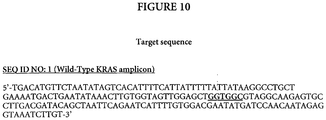
- the examples below utilize a fragment of the KRAS gene, exon 2 (SEQ ID NO: 1), Figure 10 , as the target sequence.
- the mutant sequences contain various missense mutations at either codon 12 or codon 13 of exon 2. Codons 12 and 13 are the underlined bases in SEQ ID NO: 1 shown on Figure 10 .
- the probe (SEQ ID NO: 5) is perfectly matched to the wild type sequence.
- the mutant sequences have one or more mismatches with the probe.
- the same probe (SEQ. ID. NO: 5) is used as both amplification detection probe and a melt probe. Further, the probe serves as a suppressor of amplification of the wild-type sequence.
- exon 3 sequences were co-amplified in the same reaction with the KRAS exon 2 sequences using the upstream primer SEQ ID NO. 6, downstream primer SEQ ID NO. 7 and detection probe SEQ ID NO. 8. For simplicity, the results of amplification of exon 3 sequences, detected in a separate wavelength channel, are not shown.
- the primer and probe sequences are shown in Table 1.
- Each 50 ⁇ l reaction contained 10 4 copies of either wild-type or mutant target sequence, 0.7 ⁇ M exon 2 upstream (excess) primer (SEQ ID NO: 2), 0.025 ⁇ M of the first exon 2 downstream (limiting) primer (SEQ ID NO: 3, without the chemical modification) and 0.075 ⁇ M of the second exon 2 downstream (limiting) primer (SEQ.
- a mixture of two limiting primers was used for exon 2: 1 ⁇ 4 of the first primer (SEQ ID NO: 3) with an unmodified 3'-terminal cytosine, and % of the second primer (SEQ ID NO: 4) with an N 4 benzylated 3'-terminal cytosine.
- This ratio of two limiting primers in the reaction allowed for optimal degree of wild-type suppression (see example 2): when the mutant DNA was absent, the wild-type DNA was amplified. However, when the mutant DNA was also present, the mutant DNA was amplified preferentially over the wild-type (data not shown).
- Amplification and melt analysis were performed using the Roche LightCycler 480 instrument.
- the reactions were subjected to the following temperature profile: 50°C for 5 minutes (UNG step), 95°C for 10 minutes (polymerase activation), followed by 50 cycles of 95°C for 10 seconds and 61°C for 40 seconds. Fluorescence data was collected at the end of each 61°C step to generate the growth curves (not shown).
- the reactions were then subjected to the melt analysis: after the last amplification cycle, the temperature was raised to 95°C for 1 second, reduced to 40°C for 1 minute, then increased to 95°C, while fluorescence was being measured for each 1.0°C increase in temperature. Finally, the temperature was reduced to 40°C to end the melt assay.
- the results of the melt assay are shown in Figure 2 .
- the raw data (“melt curves”) are shown as fluorescence in the 450-500 nm wavelength interval with the change in temperature.
- the derivative data (“melt peaks”) are shown as a first derivative (dF/dT) of the fluorescence in the same temperature interval.
- the mutant targets are shown as solid lines and the wild-type template is shown as a dashed line.
- the melt probe (SEQ ID NO: 5) emits fluorescent light of the desired wavelength when it is bound to the target nucleic acid in a duplex. With the increase in temperature, a drop in fluorescence is observed as the probe dissociates from the duplex. In the dissociated, single-stranded form, the probe assumes a conformation wherein the quencher (BHQ-2) quenches fluorescence of the fluorophore (FAM).
- Fig. 2 show a distinct melting profile for the mutant sequences (solid lines) and the wild-type sequence (dotted line).
- the mutant samples are identified by a lower melt peak maximum (T m ) than the wild type sample.
- T m melt peak maximum
- the lower T m is due to a lower degree of complementarity between the probe and the mutant sequence.
- the mutant peaks show variation in T m because the samples contain different mutations in codon 12 or codon 13.
- the amplification and melt analysis were performed on a mixture of wild type target and a mutant target in the same tube.
- Each 50 ⁇ l reaction contained 8,000 copies of target DNA comprising a mixture of the wild-type and mutant sequences.
- the mutant sequence comprised either 1% or 5% of the total copy number in the reaction, the remaining 99% or 95% being the wild-type sequence.
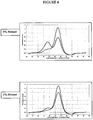
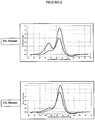
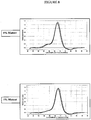
- the amplification and melt analysis were performed using the conditions and temperature profile as generally described for Example 1, with modification indicated for each particular experiment. The results are shown on Figures 3-8 .
- the mutant targets are identified by a lower melt peak maximum (T m ) than the wild type targets.
- the solid lines represent "suppressive conditions", while the dashed lines represent "control conditions" specified for each experiment.
- the suppressive conditions are: the limiting primer is a mixture of SEQ ID NO: 3 and 4 and the enzyme has a hot-start capability ( ⁇ Z05 GOLD).
- the control conditions are: the limiting primer is only SEQ ID NO: 3 (without the 3'-terminal chemical modification) and the enzyme has no hot-start capability ( ⁇ Z05).
- the pH was adjusted to 8.3, and the polymerase activation step was removed from the cycling profile.
- Figure 4 shows the results of an experiment identical to that on Figure 3 , except both suppressive and control conditions employ the use of the hot-start enzyme ⁇ Z05 GOLD.
- the mixture of SEQ ID NO: 3 and 4 was used for the suppressive conditions, and SEQ ID NO: 3 only (no chemical modification) for the control conditions.
- Figure 5 shows the results of an experiment identical to that on Figure 3 , except both suppressive and control conditions employ the use of the hot-start enzyme ⁇ Z05 GOLD.
- the mixture of SEQ ID NO: 3 and 4 was used for the suppressive conditions and SEQ ID NO: 4 only (with chemical modification) was used for the control conditions.
- the results demonstrate that using the combination of primers tempers the amount of suppression and ensures that the wild-type sequences are amplified in the absence of the mutant sequences.
- Figure 6 shows the results of an experiment identical to that on Figure 3 , except both suppressive and control conditions employ the use of the mixture of SEQ NO: 3 and 4.
- the suppressive conditions use a hot-start enzyme ⁇ Z05 GOLD, while the control conditions use a non-hot-start enzyme ⁇ Z05.
- Figure 7 shows the results of an experiment identical to that on Figure 3 , except both suppressive and control conditions employ the use of SEQ NO: 4 only (with a chemical modification).
- the suppressive conditions use a hot-start enzyme ⁇ Z05 GOLD, while the control conditions use a non-hot-start enzyme ⁇ Z05.
- Figure 8 shows the results of an experiment identical to that on Figure 7 , except both suppressive and control conditions employ the use of SEQ NO: 3 only (no chemical modification).
- the suppressive conditions use a hot-start enzyme ⁇ Z05 GOLD, while the control conditions use a non-hot-start enzyme ⁇ Z05.
- the "suppressive" conditions yielded no suppression.
- the mutant sequence constitutes 1% of the total target sequence, the mutant sequence is not detectable without the wild-type suppression.
- the yield of the mutant amplicons is also noticeably improved by the wild-type suppression.
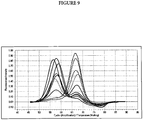
- amplification and melt analysis were performed on DNA extracted from seven commercially obtained FFPET samples. Each 50 ⁇ l reaction contained 25ng of FFPET DNA, extracted from 3 x 10 ⁇ m sections of tissue and quantified on a Nanodrop spectrophotometer. A reaction containing 5% of the mutant target mixed with 95% wild-type target was used as a control (dotted line). The amplification and melt analysis were performed using the conditions and temperature profile described in Example 1, except the exon 3 primers and probes were not present in the reaction mixture, the amount of ⁇ Z05 GOLD polymerase was reduced to 0.3 units/ ⁇ l and magnesium acetate was reduced to 2.5mM. The results are shown in Figure 9 as melting peaks.
- the mutant targets are identified by a lower melt peak maximum (T m ) than the wild type targets.
- T m melt peak maximum
- the dashed lines show wild-type sequences while the solid lines show patient samples where mutant sequences are present. Some patient samples contain both the wild-type and the mutant sequences.
- FFPET DNA is known to be highly fragmented and difficult to amplify and detect.
- the results in Figure 9 clearly show successful amplification and detection of the mutant DNA present in the background of the wild-type DNA in the FFPET sample.
- the variation among T m 's of the mutant targets reflects different codon 12 or 13 mutations of the KRAS gene as verified by sequencing (data not shown).
Landscapes
- Chemical & Material Sciences (AREA)
- Life Sciences & Earth Sciences (AREA)
- Organic Chemistry (AREA)
- Engineering & Computer Science (AREA)
- Zoology (AREA)
- Wood Science & Technology (AREA)
- Proteomics, Peptides & Aminoacids (AREA)
- Health & Medical Sciences (AREA)
- Biophysics (AREA)
- Chemical Kinetics & Catalysis (AREA)
- Immunology (AREA)
- Microbiology (AREA)
- Molecular Biology (AREA)
- Analytical Chemistry (AREA)
- Physics & Mathematics (AREA)
- Biotechnology (AREA)
- Biochemistry (AREA)
- Bioinformatics & Cheminformatics (AREA)
- General Engineering & Computer Science (AREA)
- General Health & Medical Sciences (AREA)
- Genetics & Genomics (AREA)
- Measuring Or Testing Involving Enzymes Or Micro-Organisms (AREA)
- Preparation Of Compounds By Using Micro-Organisms (AREA)
Applications Claiming Priority (2)
| Application Number | Priority Date | Filing Date | Title |
|---|---|---|---|
| US14311309P | 2009-01-07 | 2009-01-07 | |
| PCT/EP2010/000030 WO2010079127A1 (en) | 2009-01-07 | 2010-01-07 | Nucleic acid amplification with allele-specific suppression of sequence variants |
Publications (2)
| Publication Number | Publication Date |
|---|---|
| EP2385991A1 EP2385991A1 (en) | 2011-11-16 |
| EP2385991B1 true EP2385991B1 (en) | 2017-05-17 |
Family
ID=41682254
Family Applications (1)
| Application Number | Title | Priority Date | Filing Date |
|---|---|---|---|
| EP10700205.7A Active EP2385991B1 (en) | 2009-01-07 | 2010-01-07 | Nucleic acid amplification with allele-specific suppression of sequence variants |
Country Status (7)
| Country | Link |
|---|---|
| US (1) | US8206929B2 (enExample) |
| EP (1) | EP2385991B1 (enExample) |
| JP (1) | JP5785095B2 (enExample) |
| CN (2) | CN106702000A (enExample) |
| CA (1) | CA2747068C (enExample) |
| ES (1) | ES2634428T3 (enExample) |
| WO (1) | WO2010079127A1 (enExample) |
Families Citing this family (15)
| Publication number | Priority date | Publication date | Assignee | Title |
|---|---|---|---|---|
| KR101550489B1 (ko) * | 2010-03-08 | 2015-09-07 | 다나-파버 캔서 인스티튜트 인크. | 기준 차단 서열을 이용한 완전 cold-pcr 풍부화 |
| EP3333269B1 (en) | 2011-03-31 | 2021-05-05 | Dana-Farber Cancer Institute, Inc. | Methods to enable multiplex cold-pcr |
| EP2744916A4 (en) | 2011-07-13 | 2015-06-17 | Primeradx Inc | MULTIMODAL PROCEDURE FOR THE SIMULTANEOUS DETECTION AND QUANTIFICATION OF MULTIPLE NUCLEIC ACIDS IN ONE SAMPLE |
| GB201116876D0 (en) | 2011-09-30 | 2011-11-16 | Epistem Ltd | Mutational analysis of JAK2 |
| AU2014200958B2 (en) | 2013-02-25 | 2016-01-14 | Seegene, Inc. | Detection of nucleotide variation on target nucleic acid sequence |
| EP3022319B1 (en) | 2013-07-15 | 2023-05-17 | Seegene, Inc. | Detection of target nucleic acid sequence by pto cleavage and extension-dependent immobilized oligonucleotide hybridization |
| US10913977B2 (en) | 2013-07-24 | 2021-02-09 | Dana-Farber Cancer Institute, Inc. | Methods and compositions to enable enrichment of minor DNA alleles by limiting denaturation time in PCR or simply enable enrichment of minor DNA alleles by limiting the denaturation time in PCR |
| KR101757473B1 (ko) | 2013-10-18 | 2017-07-13 | 주식회사 씨젠 | hCTO를 이용하는 PTO 절단 및 연장 분석에 의한 고상에서의 타겟 핵산 서열 검출 |
| JP2016535987A (ja) | 2013-10-20 | 2016-11-24 | トローバジーン インコーポレイテッド | 核酸配列の合成及び濃縮 |
| CN114032234A (zh) * | 2014-05-19 | 2022-02-11 | 威廉马歇莱思大学 | 使用重叠非等位基因特异性引物和等位基因特异性阻断剂寡核苷酸进行等位基因特异性扩增 |
| JP5813263B1 (ja) * | 2015-03-31 | 2015-11-17 | 日鉄住金環境株式会社 | 遺伝子変異の検出方法及びそれに用いる蛍光標識オリゴヌクレオチド |
| WO2018111835A1 (en) | 2016-12-12 | 2018-06-21 | Dana-Farber Cancer Institute, Inc. | Compositions and methods for molecular barcoding of dna molecules prior to mutation enrichment and/or mutation detection |
| US11174511B2 (en) | 2017-07-24 | 2021-11-16 | Dana-Farber Cancer Institute, Inc. | Methods and compositions for selecting and amplifying DNA targets in a single reaction mixture |
| WO2023025218A1 (zh) * | 2021-08-25 | 2023-03-02 | 南京金斯瑞生物科技有限公司 | 一种用于检测单碱基突变的引物组和基因芯片方法 |
| EP4402283A4 (en) * | 2021-09-13 | 2025-11-12 | Nexgen Cancer Detection Llc | METHODS FOR DETECTING A TARGET POLYNUCLEOTIDE IN A SAMPLE |
Family Cites Families (40)
| Publication number | Priority date | Publication date | Assignee | Title |
|---|---|---|---|---|
| US4469863A (en) | 1980-11-12 | 1984-09-04 | Ts O Paul O P | Nonionic nucleic acid alkyl and aryl phosphonates and processes for manufacture and use thereof |
| US5235033A (en) | 1985-03-15 | 1993-08-10 | Anti-Gene Development Group | Alpha-morpholino ribonucleoside derivatives and polymers thereof |
| US5034506A (en) | 1985-03-15 | 1991-07-23 | Anti-Gene Development Group | Uncharged morpholino-based polymers having achiral intersubunit linkages |
| DE3529478A1 (de) | 1985-08-16 | 1987-02-19 | Boehringer Mannheim Gmbh | 7-desaza-2'desoxyguanosin-nukleotide, verfahren zu deren herstellung und deren verwendung zur nukleinsaeure-sequenzierung |
| US5466591A (en) | 1986-08-22 | 1995-11-14 | Hoffmann-La Roche Inc. | 5' to 3' exonuclease mutations of thermostable DNA polymerases |
| US5405774A (en) | 1986-08-22 | 1995-04-11 | Hoffmann-La Roche Inc. | DNA encoding a mutated thermostable nucleic acid polymerase enzyme from thermus species sps17 |
| US5795762A (en) | 1986-08-22 | 1998-08-18 | Roche Molecular Systems, Inc. | 5' to 3' exonuclease mutations of thermostable DNA polymerases |
| US5374553A (en) | 1986-08-22 | 1994-12-20 | Hoffmann-La Roche Inc. | DNA encoding a thermostable nucleic acid polymerase enzyme from thermotoga maritima |
| US5455170A (en) | 1986-08-22 | 1995-10-03 | Hoffmann-La Roche Inc. | Mutated thermostable nucleic acid polymerase enzyme from Thermus species Z05 |
| US5216141A (en) | 1988-06-06 | 1993-06-01 | Benner Steven A | Oligonucleotide analogs containing sulfur linkages |
| US5602240A (en) | 1990-07-27 | 1997-02-11 | Ciba Geigy Ag. | Backbone modified oligonucleotide analogs |
| US5386023A (en) | 1990-07-27 | 1995-01-31 | Isis Pharmaceuticals | Backbone modified oligonucleotide analogs and preparation thereof through reductive coupling |
| US5210015A (en) | 1990-08-06 | 1993-05-11 | Hoffman-La Roche Inc. | Homogeneous assay system using the nuclease activity of a nucleic acid polymerase |
| ATE197718T1 (de) | 1990-09-28 | 2000-12-15 | Hoffmann La Roche | Gereinigte thermostabile nukleinsäurepolymerase aus thermosipho africanus |
| JPH04234422A (ja) | 1990-10-31 | 1992-08-24 | Internatl Business Mach Corp <Ibm> | 二重硬化エポキシバックシール処方物 |
| US5484908A (en) | 1991-11-26 | 1996-01-16 | Gilead Sciences, Inc. | Oligonucleotides containing 5-propynyl pyrimidines |
| EP0637965B1 (en) | 1991-11-26 | 2002-10-16 | Isis Pharmaceuticals, Inc. | Enhanced triple-helix and double-helix formation with oligomers containing modified pyrimidines |
| TW393513B (en) | 1991-11-26 | 2000-06-11 | Isis Pharmaceuticals Inc | Enhanced triple-helix and double-helix formation with oligomers containing modified pyrimidines |
| US5644048A (en) | 1992-01-10 | 1997-07-01 | Isis Pharmaceuticals, Inc. | Process for preparing phosphorothioate oligonucleotides |
| DE4234086A1 (de) | 1992-02-05 | 1993-08-12 | Diagen Inst Molekularbio | Verfahren zur bestimmung von in vitro amplifizierten nukleinsaeuresequenzen |
| US5637684A (en) | 1994-02-23 | 1997-06-10 | Isis Pharmaceuticals, Inc. | Phosphoramidate and phosphorothioamidate oligomeric compounds |
| GB9513271D0 (en) | 1995-06-29 | 1995-09-06 | Johnson James G | Stress free fish harvester |
| US5773258A (en) | 1995-08-25 | 1998-06-30 | Roche Molecular Systems, Inc. | Nucleic acid amplification using a reversibly inactivated thermostable enzyme |
| DE69739357D1 (de) | 1996-06-04 | 2009-05-28 | Univ Utah Res Found | Überwachung der hybridisierung während pcr |
| DK0866071T3 (da) * | 1997-03-20 | 2005-01-17 | Hoffmann La Roche | Modificerede primere |
| US5849497A (en) | 1997-04-03 | 1998-12-15 | The Research Foundation Of State University Of New York | Specific inhibition of the polymerase chain reaction using a non-extendable oligonucleotide blocker |
| US6228628B1 (en) | 1997-07-09 | 2001-05-08 | Roche Molecular Systems | Mutant chimeric DNA polymerase |
| JP3274396B2 (ja) | 1997-11-07 | 2002-04-15 | 株式会社東芝 | パターン測定方法 |
| CN100432237C (zh) * | 1999-03-19 | 2008-11-12 | 宝生物工程株式会社 | 用于扩增核酸序列的方法 |
| IL145496A0 (en) | 1999-03-24 | 2002-06-30 | Exiqon As | Improved synthesis of [2.2.1] bicyclo nucleosides |
| WO2000066783A2 (en) | 1999-05-04 | 2000-11-09 | Ortho-Clinical Diagnostics, Inc. | Rapid and efficient capture of dna from sample without using cell lysing reagent |
| AU7878301A (en) * | 2000-08-23 | 2002-03-04 | Takara Shuzo Co | Method of amplifying nucleic acid |
| US6479242B1 (en) * | 2000-10-26 | 2002-11-12 | Cleveland State University | Method for genotyping of single nucleotide polymorphism |
| GB0101397D0 (en) | 2001-01-19 | 2001-03-07 | Amersham Pharm Biotech Uk Ltd | Suppression of non-specific nucleic acid amplication |
| EP1253205A1 (en) | 2001-04-24 | 2002-10-30 | LION Bioscience AG | Method of blocking amplification of selected sequences |
| US7198897B2 (en) * | 2001-12-19 | 2007-04-03 | Brandeis University | Late-PCR |
| CA2624917C (en) * | 2005-10-05 | 2013-07-09 | F. Hoffmann-La Roche Ag | Non-fluorescent energy transfer |
| US7803543B2 (en) | 2007-01-19 | 2010-09-28 | Chang Gung University | Methods and kits for the detection of nucleotide mutations using peptide nucleic acid as both PCR clamp and sensor probe |
| US8071338B2 (en) | 2007-08-08 | 2011-12-06 | Roche Molecular Systems, Inc. | Suppression of amplification using an oligonucleotide and a polymerase significantly lacking 5′-3′ nuclease activity |
| EP2247601B1 (en) | 2008-07-02 | 2013-04-10 | Avexa Limited | Thiazopyrimidinones and uses thereof |
-
2010
- 2010-01-06 US US12/683,111 patent/US8206929B2/en active Active
- 2010-01-07 WO PCT/EP2010/000030 patent/WO2010079127A1/en not_active Ceased
- 2010-01-07 CN CN201710109955.4A patent/CN106702000A/zh active Pending
- 2010-01-07 EP EP10700205.7A patent/EP2385991B1/en active Active
- 2010-01-07 JP JP2011544052A patent/JP5785095B2/ja active Active
- 2010-01-07 CA CA2747068A patent/CA2747068C/en active Active
- 2010-01-07 CN CN2010800043562A patent/CN102272333A/zh active Pending
- 2010-01-07 ES ES10700205.7T patent/ES2634428T3/es active Active
Also Published As
| Publication number | Publication date |
|---|---|
| CA2747068A1 (en) | 2010-07-15 |
| US20100173311A1 (en) | 2010-07-08 |
| JP5785095B2 (ja) | 2015-09-24 |
| WO2010079127A1 (en) | 2010-07-15 |
| CA2747068C (en) | 2014-04-08 |
| CN106702000A (zh) | 2017-05-24 |
| JP2012514451A (ja) | 2012-06-28 |
| ES2634428T3 (es) | 2017-09-27 |
| CN102272333A (zh) | 2011-12-07 |
| EP2385991A1 (en) | 2011-11-16 |
| US8206929B2 (en) | 2012-06-26 |
Similar Documents
| Publication | Publication Date | Title |
|---|---|---|
| US8206929B2 (en) | Nucleic acid amplification with allele-specific suppression of sequence variants | |
| JP5745774B2 (ja) | 多重定量的核酸増幅及び融解アッセイ | |
| EP2337865B1 (en) | Allele-specific amplification using a primer with a modified nucleotide | |
| EP2510117B1 (en) | Allele-specific amplification of nucleic acids | |
| US20100143901A1 (en) | Nuclease-Free Real-Time Detection of Nucleic Acids | |
| US20160369330A1 (en) | Compositions for improved allele-specific pcr | |
| WO2016096814A1 (en) | Allele-specific amplification of nucleic acids using blocking oligonucleotides for wild type suppression | |
| CA2781133C (en) | Preferential amplification of mrna over dna using chemically modified primers | |
| HK1238301A1 (en) | Nucleic acid amplification with allele-specific suppression of sequence variants | |
| HK1164941A (en) | Nucleic acid amplification with allele-specific suppression of sequence variants |
Legal Events
| Date | Code | Title | Description |
|---|---|---|---|
| PUAI | Public reference made under article 153(3) epc to a published international application that has entered the european phase |
Free format text: ORIGINAL CODE: 0009012 |
|
| 17P | Request for examination filed |
Effective date: 20110808 |
|
| AK | Designated contracting states |
Kind code of ref document: A1 Designated state(s): AT BE BG CH CY CZ DE DK EE ES FI FR GB GR HR HU IE IS IT LI LT LU LV MC MK MT NL NO PL PT RO SE SI SK SM TR |
|
| DAX | Request for extension of the european patent (deleted) | ||
| 17Q | First examination report despatched |
Effective date: 20160204 |
|
| GRAP | Despatch of communication of intention to grant a patent |
Free format text: ORIGINAL CODE: EPIDOSNIGR1 |
|
| STAA | Information on the status of an ep patent application or granted ep patent |
Free format text: STATUS: GRANT OF PATENT IS INTENDED |
|
| INTG | Intention to grant announced |
Effective date: 20170125 |
|
| GRAS | Grant fee paid |
Free format text: ORIGINAL CODE: EPIDOSNIGR3 |
|
| GRAA | (expected) grant |
Free format text: ORIGINAL CODE: 0009210 |
|
| STAA | Information on the status of an ep patent application or granted ep patent |
Free format text: STATUS: THE PATENT HAS BEEN GRANTED |
|
| AK | Designated contracting states |
Kind code of ref document: B1 Designated state(s): AT BE BG CH CY CZ DE DK EE ES FI FR GB GR HR HU IE IS IT LI LT LU LV MC MK MT NL NO PL PT RO SE SI SK SM TR |
|
| REG | Reference to a national code |
Ref country code: GB Ref legal event code: FG4D |
|
| REG | Reference to a national code |
Ref country code: CH Ref legal event code: EP |
|
| REG | Reference to a national code |
Ref country code: IE Ref legal event code: FG4D |
|
| REG | Reference to a national code |
Ref country code: AT Ref legal event code: REF Ref document number: 894526 Country of ref document: AT Kind code of ref document: T Effective date: 20170615 |
|
| REG | Reference to a national code |
Ref country code: DE Ref legal event code: R096 Ref document number: 602010042386 Country of ref document: DE |
|
| REG | Reference to a national code |
Ref country code: NL Ref legal event code: MP Effective date: 20170517 |
|
| REG | Reference to a national code |
Ref country code: ES Ref legal event code: FG2A Ref document number: 2634428 Country of ref document: ES Kind code of ref document: T3 Effective date: 20170927 |
|
| REG | Reference to a national code |
Ref country code: LT Ref legal event code: MG4D |
|
| REG | Reference to a national code |
Ref country code: AT Ref legal event code: MK05 Ref document number: 894526 Country of ref document: AT Kind code of ref document: T Effective date: 20170517 |
|
| PG25 | Lapsed in a contracting state [announced via postgrant information from national office to epo] |
Ref country code: AT Free format text: LAPSE BECAUSE OF FAILURE TO SUBMIT A TRANSLATION OF THE DESCRIPTION OR TO PAY THE FEE WITHIN THE PRESCRIBED TIME-LIMIT Effective date: 20170517 Ref country code: GR Free format text: LAPSE BECAUSE OF FAILURE TO SUBMIT A TRANSLATION OF THE DESCRIPTION OR TO PAY THE FEE WITHIN THE PRESCRIBED TIME-LIMIT Effective date: 20170818 Ref country code: FI Free format text: LAPSE BECAUSE OF FAILURE TO SUBMIT A TRANSLATION OF THE DESCRIPTION OR TO PAY THE FEE WITHIN THE PRESCRIBED TIME-LIMIT Effective date: 20170517 Ref country code: LT Free format text: LAPSE BECAUSE OF FAILURE TO SUBMIT A TRANSLATION OF THE DESCRIPTION OR TO PAY THE FEE WITHIN THE PRESCRIBED TIME-LIMIT Effective date: 20170517 Ref country code: HR Free format text: LAPSE BECAUSE OF FAILURE TO SUBMIT A TRANSLATION OF THE DESCRIPTION OR TO PAY THE FEE WITHIN THE PRESCRIBED TIME-LIMIT Effective date: 20170517 Ref country code: NO Free format text: LAPSE BECAUSE OF FAILURE TO SUBMIT A TRANSLATION OF THE DESCRIPTION OR TO PAY THE FEE WITHIN THE PRESCRIBED TIME-LIMIT Effective date: 20170817 |
|
| PG25 | Lapsed in a contracting state [announced via postgrant information from national office to epo] |
Ref country code: NL Free format text: LAPSE BECAUSE OF FAILURE TO SUBMIT A TRANSLATION OF THE DESCRIPTION OR TO PAY THE FEE WITHIN THE PRESCRIBED TIME-LIMIT Effective date: 20170517 Ref country code: LV Free format text: LAPSE BECAUSE OF FAILURE TO SUBMIT A TRANSLATION OF THE DESCRIPTION OR TO PAY THE FEE WITHIN THE PRESCRIBED TIME-LIMIT Effective date: 20170517 Ref country code: SE Free format text: LAPSE BECAUSE OF FAILURE TO SUBMIT A TRANSLATION OF THE DESCRIPTION OR TO PAY THE FEE WITHIN THE PRESCRIBED TIME-LIMIT Effective date: 20170517 Ref country code: PL Free format text: LAPSE BECAUSE OF FAILURE TO SUBMIT A TRANSLATION OF THE DESCRIPTION OR TO PAY THE FEE WITHIN THE PRESCRIBED TIME-LIMIT Effective date: 20170517 Ref country code: BG Free format text: LAPSE BECAUSE OF FAILURE TO SUBMIT A TRANSLATION OF THE DESCRIPTION OR TO PAY THE FEE WITHIN THE PRESCRIBED TIME-LIMIT Effective date: 20170817 Ref country code: IS Free format text: LAPSE BECAUSE OF FAILURE TO SUBMIT A TRANSLATION OF THE DESCRIPTION OR TO PAY THE FEE WITHIN THE PRESCRIBED TIME-LIMIT Effective date: 20170917 |
|
| REG | Reference to a national code |
Ref country code: FR Ref legal event code: PLFP Year of fee payment: 9 |
|
| PG25 | Lapsed in a contracting state [announced via postgrant information from national office to epo] |
Ref country code: EE Free format text: LAPSE BECAUSE OF FAILURE TO SUBMIT A TRANSLATION OF THE DESCRIPTION OR TO PAY THE FEE WITHIN THE PRESCRIBED TIME-LIMIT Effective date: 20170517 Ref country code: DK Free format text: LAPSE BECAUSE OF FAILURE TO SUBMIT A TRANSLATION OF THE DESCRIPTION OR TO PAY THE FEE WITHIN THE PRESCRIBED TIME-LIMIT Effective date: 20170517 Ref country code: SK Free format text: LAPSE BECAUSE OF FAILURE TO SUBMIT A TRANSLATION OF THE DESCRIPTION OR TO PAY THE FEE WITHIN THE PRESCRIBED TIME-LIMIT Effective date: 20170517 Ref country code: CZ Free format text: LAPSE BECAUSE OF FAILURE TO SUBMIT A TRANSLATION OF THE DESCRIPTION OR TO PAY THE FEE WITHIN THE PRESCRIBED TIME-LIMIT Effective date: 20170517 Ref country code: RO Free format text: LAPSE BECAUSE OF FAILURE TO SUBMIT A TRANSLATION OF THE DESCRIPTION OR TO PAY THE FEE WITHIN THE PRESCRIBED TIME-LIMIT Effective date: 20170517 |
|
| REG | Reference to a national code |
Ref country code: DE Ref legal event code: R097 Ref document number: 602010042386 Country of ref document: DE |
|
| PG25 | Lapsed in a contracting state [announced via postgrant information from national office to epo] |
Ref country code: SM Free format text: LAPSE BECAUSE OF FAILURE TO SUBMIT A TRANSLATION OF THE DESCRIPTION OR TO PAY THE FEE WITHIN THE PRESCRIBED TIME-LIMIT Effective date: 20170517 |
|
| PLBE | No opposition filed within time limit |
Free format text: ORIGINAL CODE: 0009261 |
|
| STAA | Information on the status of an ep patent application or granted ep patent |
Free format text: STATUS: NO OPPOSITION FILED WITHIN TIME LIMIT |
|
| 26N | No opposition filed |
Effective date: 20180220 |
|
| PG25 | Lapsed in a contracting state [announced via postgrant information from national office to epo] |
Ref country code: SI Free format text: LAPSE BECAUSE OF FAILURE TO SUBMIT A TRANSLATION OF THE DESCRIPTION OR TO PAY THE FEE WITHIN THE PRESCRIBED TIME-LIMIT Effective date: 20170517 |
|
| PG25 | Lapsed in a contracting state [announced via postgrant information from national office to epo] |
Ref country code: LU Free format text: LAPSE BECAUSE OF NON-PAYMENT OF DUE FEES Effective date: 20180107 |
|
| REG | Reference to a national code |
Ref country code: IE Ref legal event code: MM4A |
|
| REG | Reference to a national code |
Ref country code: BE Ref legal event code: MM Effective date: 20180131 |
|
| PG25 | Lapsed in a contracting state [announced via postgrant information from national office to epo] |
Ref country code: BE Free format text: LAPSE BECAUSE OF NON-PAYMENT OF DUE FEES Effective date: 20180131 |
|
| PG25 | Lapsed in a contracting state [announced via postgrant information from national office to epo] |
Ref country code: IE Free format text: LAPSE BECAUSE OF NON-PAYMENT OF DUE FEES Effective date: 20180107 |
|
| PG25 | Lapsed in a contracting state [announced via postgrant information from national office to epo] |
Ref country code: MC Free format text: LAPSE BECAUSE OF FAILURE TO SUBMIT A TRANSLATION OF THE DESCRIPTION OR TO PAY THE FEE WITHIN THE PRESCRIBED TIME-LIMIT Effective date: 20170517 |
|
| PG25 | Lapsed in a contracting state [announced via postgrant information from national office to epo] |
Ref country code: MT Free format text: LAPSE BECAUSE OF NON-PAYMENT OF DUE FEES Effective date: 20180107 |
|
| PG25 | Lapsed in a contracting state [announced via postgrant information from national office to epo] |
Ref country code: TR Free format text: LAPSE BECAUSE OF FAILURE TO SUBMIT A TRANSLATION OF THE DESCRIPTION OR TO PAY THE FEE WITHIN THE PRESCRIBED TIME-LIMIT Effective date: 20170517 |
|
| PG25 | Lapsed in a contracting state [announced via postgrant information from national office to epo] |
Ref country code: HU Free format text: LAPSE BECAUSE OF FAILURE TO SUBMIT A TRANSLATION OF THE DESCRIPTION OR TO PAY THE FEE WITHIN THE PRESCRIBED TIME-LIMIT; INVALID AB INITIO Effective date: 20100107 Ref country code: PT Free format text: LAPSE BECAUSE OF FAILURE TO SUBMIT A TRANSLATION OF THE DESCRIPTION OR TO PAY THE FEE WITHIN THE PRESCRIBED TIME-LIMIT Effective date: 20170517 |
|
| PG25 | Lapsed in a contracting state [announced via postgrant information from national office to epo] |
Ref country code: MK Free format text: LAPSE BECAUSE OF NON-PAYMENT OF DUE FEES Effective date: 20170517 Ref country code: CY Free format text: LAPSE BECAUSE OF FAILURE TO SUBMIT A TRANSLATION OF THE DESCRIPTION OR TO PAY THE FEE WITHIN THE PRESCRIBED TIME-LIMIT Effective date: 20170517 |
|
| PGFP | Annual fee paid to national office [announced via postgrant information from national office to epo] |
Ref country code: GB Payment date: 20251220 Year of fee payment: 17 |
|
| PGFP | Annual fee paid to national office [announced via postgrant information from national office to epo] |
Ref country code: FR Payment date: 20251217 Year of fee payment: 17 |
|
| REG | Reference to a national code |
Ref country code: CH Ref legal event code: U11 Free format text: ST27 STATUS EVENT CODE: U-0-0-U10-U11 (AS PROVIDED BY THE NATIONAL OFFICE) Effective date: 20260201 |
|
| PGFP | Annual fee paid to national office [announced via postgrant information from national office to epo] |
Ref country code: ES Payment date: 20260202 Year of fee payment: 17 |
|
| PGFP | Annual fee paid to national office [announced via postgrant information from national office to epo] |
Ref country code: DE Payment date: 20251217 Year of fee payment: 17 |
|
| PGFP | Annual fee paid to national office [announced via postgrant information from national office to epo] |
Ref country code: IT Payment date: 20260107 Year of fee payment: 17 |
|
| PGFP | Annual fee paid to national office [announced via postgrant information from national office to epo] |
Ref country code: CH Payment date: 20260201 Year of fee payment: 17 |