EP2381029A1 - Verfahren zum Betreiben einer Waschmaschine und Waschmaschine - Google Patents
Verfahren zum Betreiben einer Waschmaschine und Waschmaschine Download PDFInfo
- Publication number
- EP2381029A1 EP2381029A1 EP10401061A EP10401061A EP2381029A1 EP 2381029 A1 EP2381029 A1 EP 2381029A1 EP 10401061 A EP10401061 A EP 10401061A EP 10401061 A EP10401061 A EP 10401061A EP 2381029 A1 EP2381029 A1 EP 2381029A1
- Authority
- EP
- European Patent Office
- Prior art keywords
- water
- tub
- drum
- phase
- value
- Prior art date
- Legal status (The legal status is an assumption and is not a legal conclusion. Google has not performed a legal analysis and makes no representation as to the accuracy of the status listed.)
- Granted
Links
Images


Classifications
-
- D—TEXTILES; PAPER
- D06—TREATMENT OF TEXTILES OR THE LIKE; LAUNDERING; FLEXIBLE MATERIALS NOT OTHERWISE PROVIDED FOR
- D06F—LAUNDERING, DRYING, IRONING, PRESSING OR FOLDING TEXTILE ARTICLES
- D06F58/00—Domestic laundry dryers
- D06F58/32—Control of operations performed in domestic laundry dryers
- D06F58/34—Control of operations performed in domestic laundry dryers characterised by the purpose or target of the control
- D06F58/36—Control of operational steps, e.g. for optimisation or improvement of operational steps depending on the condition of the laundry
- D06F58/44—Control of operational steps, e.g. for optimisation or improvement of operational steps depending on the condition of the laundry of conditioning or finishing, e.g. for smoothing or removing creases
-
- D—TEXTILES; PAPER
- D06—TREATMENT OF TEXTILES OR THE LIKE; LAUNDERING; FLEXIBLE MATERIALS NOT OTHERWISE PROVIDED FOR
- D06F—LAUNDERING, DRYING, IRONING, PRESSING OR FOLDING TEXTILE ARTICLES
- D06F2103/00—Parameters monitored or detected for the control of domestic laundry washing machines, washer-dryers or laundry dryers
- D06F2103/16—Washing liquid temperature
-
- D—TEXTILES; PAPER
- D06—TREATMENT OF TEXTILES OR THE LIKE; LAUNDERING; FLEXIBLE MATERIALS NOT OTHERWISE PROVIDED FOR
- D06F—LAUNDERING, DRYING, IRONING, PRESSING OR FOLDING TEXTILE ARTICLES
- D06F2103/00—Parameters monitored or detected for the control of domestic laundry washing machines, washer-dryers or laundry dryers
- D06F2103/18—Washing liquid level
-
- D—TEXTILES; PAPER
- D06—TREATMENT OF TEXTILES OR THE LIKE; LAUNDERING; FLEXIBLE MATERIALS NOT OTHERWISE PROVIDED FOR
- D06F—LAUNDERING, DRYING, IRONING, PRESSING OR FOLDING TEXTILE ARTICLES
- D06F2105/00—Systems or parameters controlled or affected by the control systems of washing machines, washer-dryers or laundry dryers
- D06F2105/08—Draining of washing liquids
-
- D—TEXTILES; PAPER
- D06—TREATMENT OF TEXTILES OR THE LIKE; LAUNDERING; FLEXIBLE MATERIALS NOT OTHERWISE PROVIDED FOR
- D06F—LAUNDERING, DRYING, IRONING, PRESSING OR FOLDING TEXTILE ARTICLES
- D06F39/00—Details of washing machines not specific to a single type of machines covered by groups D06F9/00 - D06F27/00
- D06F39/40—Steam generating arrangements
-
- D—TEXTILES; PAPER
- D06—TREATMENT OF TEXTILES OR THE LIKE; LAUNDERING; FLEXIBLE MATERIALS NOT OTHERWISE PROVIDED FOR
- D06F—LAUNDERING, DRYING, IRONING, PRESSING OR FOLDING TEXTILE ARTICLES
- D06F58/00—Domestic laundry dryers
- D06F58/20—General details of domestic laundry dryers
- D06F58/203—Laundry conditioning arrangements
Definitions
- the invention relates to a method for operating a washing machine with a tub for holding washing liquid for treating laundry and a radiator, wherein the method comprises a washing phase, a rinsing phase and a spin phase with a subsequent evaporation phase, wherein for the evaporation phase water in the tub until is admitted to a predetermined limit G, which does not reach the drum, but can be heated by the radiator.
- the laundry For washing laundry in a drum type washing machine, the laundry is moved in the rotating drum, whereby the wetting of the laundry with the washing liquid and the washing mechanism are effected. In this case, there is water in the tub or in the drum, wherein the dirt is flushed out by the movement of the laundry.
- the laundry After the washing and rinsing phases, the laundry is usually dewatered by a spin phase in which the drum is rotated at a speed at which the laundry rests against the drum shell and by centrifugal effect, the water from the laundry penetrates.
- the laundry is heavily used, so that wrinkles occur. In order to eliminate this, it is out of the EP 1 275 767 A1 known to supply steam to the laundry after spinning.
- the steam supply causes a loosening and wrinkling of the laundry, so that the ironing is facilitated.
- an amount of water is admitted, which is so low that the drum or the laundry items do not come into contact with the water.
- a particularly accurate detection of the amount of water introduced is necessary.
- the invention is therefore based on the object to provide a method in which a simple way of precise metering of the amount of water introduced into the tub for the evaporation is provided.
- the main advantage of the method according to the invention is that with the already existing sensors in the washing machine a very accurate and metrologically finely granular the amount of water in the tub is determined. This can be very precisely a small amount of water, in contrast to the required amount of water for a washing phase, let into the tub, as it is necessary for the vapor phase.
- the water inlet is controlled by means of an inlet valve.
- the inlet valve can be controlled very easily and accurately by means of a control device.
- step b) the values of the pressure sensor are additionally used for the detection of pressure fluctuations, wherein the drum is moved.
- step b) an additionally detected value of a water quantity counter is used for the second plausibility check.
- the clocked sequence of actions is particularly reliable and easy to provide by means of a microprocessor control.
- the already existing for the control of the washing process microprocessor control can easily take over the plausibility check for the water level control in a simple way.
- step b) the predetermined value for the temperature sensor has a rise value in the range of 3K to 5K after the water inlet, the value of the pressure sensor is a value of 20 mm Ws and the value for the recorded pressure fluctuations is about 3 mm Ws to 5 mm Ws.
- the pressure fluctuation is detected with the drum rotating.
- step a) at a pressure value of less than 7 mm Ws the step a) ends and the drain device is activated, wherein the step a) is then repeated at least once to an initial value for the water level in the tub recognize.
- the detection of these limits is very easy, so that no expensive precision components are needed in the washing machine.
- a drain device for emptying the tub is activated after completion of step b) when the amount of water introduced exceeds the predetermined amount of water by a threshold, wherein subsequently steps a) and b) are repeated.
- the invention further relates to a washing machine with a tub for holding washing liquid for treating laundry, a horizontally rotatably mounted drum in the tub, a motor for rotating the drum, a radiator, a water inlet device, a radiator and a control device for controlling the individual phases of the selected control program, a pressure sensor for detecting the water level and pressure fluctuations in the tub and a Temperartursensor for detecting the water temperature in the tub, the control device is configured to a plausibility check of the detected values of the pressure sensor and the temperature sensor for activating and deactivating the water inlet device and the drain device for Admitting a predetermined amount of water to generate steam by means of the radiator perform.
- the washing machine further comprises at least one water meter, which is connected downstream of the water supply device and is in communication with the control device, wherein the control device is configured to use the detected values of this water meter for the plausibility check.
- the inclusion of the water quantity meter provides a further parameter for the plausibility check, whereby more accurate and less error-prone the predetermined water level can be set in the tub.
- Fig. 1 is a purely schematic representation of a washing machine 1, shown with a tub 2.
- the position and direction information refer to the operational installation position of the washing machine 1.
- a rotatably mounted and driven by an electric motor 13 drum 3 is arranged, which moves the laundry items located in the tub 2 8.
- the drum 3 is in the present Embodiment made of stainless steel and provided with a variety of openings for the flooding.
- the housing 4 has a loading opening 9, via which the interior of the drum 3 can be reached through the sealing sleeve 6.
- the loading opening 9 can be closed by means of a door 5.
- a radiator 7 is arranged, which can heat the washing liquid in the tub.
- an inlet valve 15 is sketched, which provides the running in of the water from the supply network.
- the water is passed through the connecting pipe 14 in the tub 2, wherein in the dispenser 11 entered detergent is flushed into the tub 2.
- a drain device 12 is arranged, which leads the spent washing liquid or the rinse water from the tub 2 to the drain line 12c, which usually opens into a sewer.
- the control device 18 controls the inlet valve 15, the activity of the drain device 12, the drive motor 13, which is energized via the power unit or a frequency converter 16, and the radiator 7th
- Fig. 1 is also shown that the level of the washing liquid 19 is just below the drum 3, so that it does not come into contact with water. Furthermore, it can be seen that at the level G of the radiator 7 is completely under water, so that now can be generated with this steam.
- a pressure sensor 17b the water level and pressure fluctuations with moving drum is detected. With the temperature sensor, the water temperature in the tub 3 and the water meter 17c, the amount of water taken is detected.
- the intake valve 15 is controlled by the controller 18 in response to these detected values.
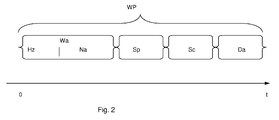
- a complete sequence of a washing program WP is shown in a diagram.
- the individual phases within the wash program WP are shown on the time axis t.
- the program sequence WP shown here comprises a washing phase Wa, a rinsing phase Sp and a spinning phase Sc.
- the radiator 7 is controlled accordingly to heat the washing liquid 19 to the predetermined temperature.
- the vapor phase Da which adjoins the spin phase Sc or can also be carried out separately, steam is generated in the tub 2, which causes the pieces of laundry 8 to wrinkle off.
- water is added to the tub to a predetermined limit G, which does not reach the drum, but can be heated by the radiator (7).
- Fig. 3 outlines as a state diagram the phase Da, in which the steam for treating the laundry 8 is generated and is supplied into the treatment room in the interior of the tub 2 and the drum 3 of the laundry.
- state S1 is checked whether there is no residual water in the tub 2.
- a plausibility check is carried out on the basis of the detected sensor signals of the temperature sensor 17a (detected temperature) and the pressure sensor 17b (detected pressure), so that it can be clearly and reliably determined on the basis of this test whether there is still an unduly high or too little residual water in the tub 2 , If the plausibility check shows that in the tub a residual amount of water that does not correspond to the initial value, the state change to state S4, in which the drain device 12, such as drain valve or drain pump 12a is activated to empty the tub 2 and then in to bring the initial state.
- the drain device 12 such as drain valve or drain pump 12a
- the state change takes place in the state S1, in which it is checked again whether the amount of water in the tub 2 corresponds to the initial state. If it is determined that the tub 2 is in the initial state, the state S2 is changed. In state S2 water is introduced into the tub 2, in which the control device 18, the inlet valve 15 is activated and thus opens, so that water passes through the supply lines in the tub 2. In this case, the signals of the pressure sensor 17b, of the water quantity counter 17c and of the temperature sensor 17a are detected constantly and clocked and subjected to a plausibility check.
- the predetermined water level is set very precisely and with precision in terms of measurement, whereby the water level is chosen so that the heating element 7 is completely under water, but the drum 3 is not reached by the water. If, due to unpredictable errors, a water level that exceeds the predetermined value is reached, the system changes to state S4.
- the drain device 12 is activated to empty the tub and the procedure begins again. If it is determined that the water level has reached the predetermined value, then the state S3 is changed. In this state, the radiator 7 is activated, so that steam is generated, with which the laundry items 8 are applied inside the drum.
- the drum can be rotated reversely or not reversing, so that a loose movement of the laundry items 8 is caused.
- the above-mentioned water level control can also be used for other phases of the washing process, for example for supplying the fresh water for the washing phase Wa or for the rinsing phase Sp.
Landscapes
- Engineering & Computer Science (AREA)
- Textile Engineering (AREA)
- Control Of Washing Machine And Dryer (AREA)
Abstract
Description
- Die Erfindung betrifft ein Verfahren zum Betreiben einer Waschmaschine mit einem Laugenbehälter zur Aufnahme von Waschflüssigkeit zum Behandeln von Wäsche und einem Heizkörper, wobei das Verfahren eine Waschphase, eine Spülphase und eine Schleuderphase mit einer anschließenden Bedampfungsphase umfasst, wobei für die Bedampfungsphase Wasser in den Laugenbehälter bis zu einem vorgegebenen Grenzwert G eingelassen wird, welches die Trommel nicht erreicht, jedoch vom Heizkörper erhitzt werden kann.
- Zum Waschen von Wäsche in einer Trommelwaschmaschine wird die Wäsche in der drehenden Trommel bewegt, wodurch die Benetzung bzw. Durchfeuchtung der Wäsche mit der Waschflüssigkeit und der Waschmechanik bewirkt werden. Hierbei befindet sich Wasser im Laugenbehälter bzw. in der Trommel, wobei durch die Bewegung der Wäsche der Schmutz ausgespült wird. Nach den Wasch- und Spülphasen wird die Wäsche meistens durch eine Schleuderphase entwässert, in dem die Trommel mit einer Drehzahl gedreht wird, bei der die Wäsche am Trommelmantel anliegt und durch Zentrifugalwirkung das Wasser aus der Wäsche herausdringt. Hierbei werden die Wäschestücke stark beansprucht, so dass Knitter entstehen. Um diese etwas zu beseitigen, ist es aus der
EP 1 275 767 A1 bekannt, der Wäsche nach dem Schleudern Dampf zuzuführen. Die Dampfzuführung bewirkt eine Auflockerung und Entknitterung der Wäschestücke, so dass das Bügeln erleichtert wird. Bei dieser bekannten Waschmaschine wird hierzu in den Laugenbehälter nach dem Schleudern eine Wassermenge eingelassen, die so gering ist, dass die Trommel bzw. die Wäschestücke nicht mit dem Wasser in Berührung kommen. Bei sehr kleinem Volumen unterhalb der Trommel ist hierzu eine besonders genaue Erfassung der eingelassenen Wassermenge notwendig. - Aus der
EP 1 507 031 B1 ist es bekannt, in einem separaten Dampferzeuger den Wasserstand mit Hilfe eines Wasserpegelsensors zu erfassen, der mehrere sogenannte Stabelektroden enthält, die je nach Länge für jeweils einen vorgegebenen Pegel bestimmt sind. Die Elektroden haben jedoch den Nachteil, dass sich daran Kalkablagerungen bilden können, wodurch Messwerte verfälscht bzw. die genaue Pegelerfassung beeinträchtigt wird. - Aus der
DE 41 38 636 A1 ist es bekannt, anhand des Drucksignals eines Drucksensors die in den Laugenbehälter eingelassene Wassermenge zu erfassen. Anhand des zeitlichen Druckverlaufs wird der Wassereinlauf gesteuert. Für die Erfassung von sehr kleinen Wassermengen, bezogen auf die Wassermenge, die zu Waschen verwendet wird, ist dieses Verfahren zu ungenau. - Der Erfindung liegt deshalb die Aufgabe zu Grunde, ein Verfahren bereitzustellen, bei dem auf einfache Weise eine genaue Dosierung der in den Laugenbehälter eingelassenen Wassermenge für die Bedampfung bereitgestellt wird.
- Die Aufgabe wird durch ein Verfahren mit den Merkmalen des Anspruchs 1 und durch eine Waschmaschine mit den Merkmalen des Anspruchs 9 gelöst. Vorteilhafte Ausführungen ergeben sich aus den jeweils abhängigen Ansprüchen.
- Der wesentliche Vorteil des erfindungsgemäßen Verfahrens ist, dass mit den ohnehin vorhandenen Sensoren in der Waschmaschine eine sehr genau und messtechnisch feingranular die Wassermenge im Laugenbehälter ermittelt wird. Dadurch kann sehr genau eine kleine Wassermenge, im Gegensatz zu der benötigten Wassermenge für eine Waschphase, in den Laugenbehälter eingelassen werden, wie es für die Dampfphase notwendig ist.
- Das erfindungsgemäße Verfahren umfasst hierzu die Schritte
- a) Prüfen, ob der Laugenbehälter einen Initialzustand aufweist, wobei der Initialzustand anhand einer ersten Plausibilitätsprüfung von erfassten Werten des Drucksensors erfolgt. Der Initialzustand beschreibt hierbei eine vorbestimmte Menge Restwasser, die nach vorherigem Abpumpen beim vorher ablaufenden Waschprogramm durch die Ablaufleitungen wieder in den Laugenbehälter zurückfließt. Diese Wassermenge ist so bemessen, dass ein schwimmerbetätigter Verschlusskörper den Laugenablauf im Laugenbehälter verschließt. In einer anderen Ausführung ist der Initialzustand durch einen zumindest nahezu entleerten Laugenbehälter definiert.
- b) Einlassen einer vorbestimmten Wassermenge in den Laugenbehälter, so dass der Heizkörper sich im Wasser befindet und die Trommel nicht vom Wasser berührt wird, wobei die eingelassene Wassermenge anhand einer zweiten Plausibiltätsprüfung aus einer Berechnung aus einem erfassten Wert des Drucksensors und einem erfassten Wert des Temperatursensors erfolgt, wobei in Abhängigkeit des Ergebnisses der Plausibilitätsprüfung das Wasser in den Laugenbehälter eingelassen wird,
- c) Erzeugen von Dampf durch Aktivierung des Heizkörpers.
- Hierbei ist es zweckmäßig, dass der Wassereinlauf mittels eines Einlassventils gesteuert wird. Das Einlassventil kann sehr einfach und genau mittels einer Steuereinrichtung gesteuert werden.
- In einer zweckmäßigen Ausführung werden im Schritt b) die Werte des Drucksensors zusätzlich für die Erfassung von Druckschwankungen verwendet, wobei die Trommel bewegt wird. Das hat den Vorteil, dass durch die Dynamik im Druckverlauf über einen definierten Zeitraum die im Laugenebehälter befindliche Wassermenge aufgrund der Vielzahl von erfassten Druckwerten und der anschließenden Rechenoperationen noch genauer ermittelt werden kann.
- In einer vorteilhaften Weiterbildung wird im Schritt b) ein zusätzlich erfasster Wert eines Wassermengenzählers für die zweite Plausibilitätsprüfung herangezogen. Durch die Berücksichtigung eines weiteren erfassten Sensorwerts für die Plausibilitätsprüfung kann die eingelassene Wassermenge noch genauer und feiner abgestimmt werden.
- In einer zweckmäßigen Ausführung ist der Schritt b) in zumindest zwei Teilschritte aufgeteilt, wobei im Teilschritt
- b1) die tatsächliche Wassermenge im Laugenbehälter mittels der Plausibilitätsprüfung ermittelt wird und im Teilschritt
- b2) das Öffnen des Einlassventils zum Einlassen einer vorbestimmten Teilmenge in den Laugenbehälter erfolgt, wenn die ermittelte Wassermenge kleiner als die vorbestimmte Wassermenge ist und
- Wiederholen der Teilschritte b1) und b2) so oft, bis die ermittelte Wassermenge im Laugenbehälter gleich oder größer der vorbestimmten Wassermenge ist.
- Die getaktete Abfolge der Aktionen ist mittels einer Mikroprozessorsteuerung besonders zuverlässig und einfach bereitzustellen. Die ohnehin für die Steuerung des Waschprozesses vorhandene Mikroprozessorsteuerung kann auf einfache Weise auch die Plausibilitätsprüfung für die Wasserstandsregelung vollständig übernehmen.
- Bei einer Haushaltswaschmaschine, die üblicherweise ein Trommelvolumen im Bereich von 50 bis 80 I aufweist, ist es zweckmäßig, dass im Schritt b) der vorgegebene Wert für den Temperatursensor einen Anstiegswert im Bereich von 3K bis 5K nach dem Wassereinlauf, der Wert des Drucksensors eine Wert von 20 mm Ws und der Wert für die erfassten Druckschwankungen etwa 3 mm Ws bis 5 mm Ws beträgt. Die Druckschwankung wird bei rotierender Trommel erfasst. Diese Werte sind optimal auf die Laugenbehältergeometrien für Haushaltswaschmaschinen abgestimmt.
- Insgesamt ist es zweckmäßig, dass im Schritt a) bei einem Druckwert von weniger als 7 mm Ws der Schritt a) beendet und die Ablaufeinrichtung aktiviert wird, wobei anschließend der Schritt a) zumindest einmal wiederholt wird, um einen Initalwert für den Wasserstand im Laugenbehälter zu erkennen. Die Erfassung dieser Grenzwerte ist sehr einfach möglich, so dass keine teuren Präzisionsbauteile in der Waschmaschine benötigt werden.
- In einer weiteren zweckmäßigen Ausführung wird nach Beenden des Schrittes b) eine Ablaufeinrichtung zum Entleeren des Laugenbehälters aktiviert, wenn die eingelassene Wassermenge die vorgegebene Wassermenge um einen Schwellwert überschreitet, wobei anschließend die Schritte a) und b) wiederholt werden. Hierbei wird zwar etwas mehr Wasser verbraucht, jedoch ist kommt dies nur bei seltenen, temporären Fehlfunktionen der Sensoren oder Fehlinterpretationen der erfassten Werte vor.
- Die Erfindung betrifft ferner eine Waschmaschine mit einem Laugenbehälter zur Aufnahme von Waschflüssigkeit zum Behandeln von Wäsche, einer im Laugenbehälter horizontal drehbar gelagerten Trommel, einem Motor zum Drehen der Trommel, einem Heizkörper, einer Wasserzulaufeinrichtung, einem Heizkörper und einer Steuereinrichtung zum Steuern der einzelnen Phasen des ausgewählten Waschprogramms, einem Drucksensor zur Erfassung des Wasserpegels und Druckschwankungen im Laugenbehälter und einem Temperartursensor zur Erfassung der Wassertemperatur im Laugenbehälter, wobei die Steuereinrichtung dafür konfiguriert ist, eine Plausibilitätsprüfung der erfassten Werte des Drucksensors und des Temperatursensors zur Aktivierung und Deaktivierung der Wasserzulaufeinrichtung und der Ablaufeinrichtung zum Einlassen einer vorbestimmten Wassermenge, um Dampf mittels des Heizkörpers zu erzeugen, durchzuführen.
- In einer zweckmäßigen Weiterbildung umfasst die Waschmaschine ferner zumindest einen Wassermengenzähler, der der Wasserzuflaufeinrichtung nachgeschaltet ist und mit der Steuereinrichtung in Verbindung steht, wobei die Steuereinrichtung dazu konfiguriert ist, die erfassten Werte dieses Wassermengenzählers für die Plausibilitätsprüfung zu verwenden. Durch die Aufnahme des Wassermengenzählers wird ein weiterer Parameter für die Plausibilitätsprüfung bereitgestellt, wodurch genauer und weniger fehlerbehaftet der vorgegebene Wasserstand im Laugenbehälter eingestellt werden kann.
- Ein Ausführungsbeispiel der Erfindung ist in den Zeichnungen rein schematisch dargestellt und wird nachfolgend näher beschrieben. Es zeigen
- Fig. 1:
- eine Waschmaschine in einer skizzierten Schnittdarstellung,
- Fig. 2:
- ein Waschprogramm als Diagramm im zeitlichen Ablauf und
- Fig. 3:
- ein Zustandsdiagramm für eine Dampfphase.
- In
Fig. 1 ist in rein schematischer Darstellung eine Waschmaschine 1, mit einem Laugenbehälter 2 dargestellt. Die Positions- und Richtungsangaben beziehen sich auf die betriebsgemäße Aufstellposition der Waschmaschine 1. Innerhalb des Laugenbehälters 2 ist eine drehbar gelagerte und über einen elektrischen Motor 13 angetriebene Trommel 3 angeordnet, die die im Laugenbehälter 2 befindlichen Wäschestücke 8 bewegt. Die Trommel 3 ist im vorliegenden Ausführungsbeispiel aus Edelstahl hergestellt und mit einer Vielzahl an Öffnungen für die Durchflutung versehen. Das Gehäuse 4 hat eine Beladungsöffnung 9, über die das Innere der Trommel 3 durch die Dichtungsmanschette 6 hindurch erreichbar ist. Die Beladungsöffnung 9 ist mittels einer Tür 5 verschließbar. Im unteren Bereich des Laugenbehälters 2 ist ein Heizkörper 7 angeordnet, der die Waschflüssigkeit im Laugenbehälter erhitzen kann. Im oberen Bereich der Maschine 1 ist ein Einlassventil 15 skizziert, welches das Einlaufen des Wassers aus dem Versorgungsnetz bereitstellt. Über den Einspülkasten 11 wird das Wasser über das Verbindungsrohr 14 in den Laugenbehälter 2 geleitet, wobei im Einspülkasten 11 eingegebenes Waschmittel mit in den Laugenbehälter 2 gespült wird. Unterhalb des Laugenbehälters 2 ist eine Ablaufeinrichtung 12 angeordnet, die die verbrauchte Waschflüssigkeit oder das Spülwasser aus dem Laugenbehälter 2 zur Ablaufleitung 12c herausführt, die in der Regel in einen Abwasserkanal mündet. Die Steuereinrichtung 18 steuert das Einlassventil 15, die Aktivität der Ablaufeinrichtung 12 den Antriebsmotor 13, der über das Leistungsteil oder einen Frequenzumrichter 16 bestromt wird, und den Heizkörper 7. - In
Fig. 1 ist ferner dargestellt, dass sich der Pegel der Waschflüssigkeit 19 knapp unterhalb der Trommel 3 befindet, so dass diese nicht mit Wasser in Berührung kommt. Ferner ist zu erkennen, dass beim Pegel G der Heizkörper 7 vollständig unter Wasser liegt, so dass nun mit diesem Dampf erzeugt werden kann. Mittels eines Drucksensors 17b wird der Wasserstand und Druckschwankungen bei bewegter Trommel erfasst. Mit dem Temperatursensor wird die Wassertemperatur im Laugenbehälter 3 und mit dem Wassermengenzähler 17c wird die eingelassene Wassermenge erfasst. Das Einlassventil 15 wird in Abhängigkeit dieser erfassten Werte von der Steuereinrichtung 18 gesteuert. - In
Fig. 2 ist beispielhaft ein kompletter Ablauf eines Waschprogramms WP in einem Diagramm dargestellt. Auf der Zeitachse t sind die einzelnen Phasen innerhalb des Waschprogramms WP aufgezeigt. Der hier dargestellte Programmablauf WP umfasst eine Waschphase Wa, eine Spülphase Sp und eine Schleuderphase Sc. In diesen einzelnen Phasen wird der Wasserzulauf 15 und der Ablauf 12 entsprechend gesteuert. Auch der Heizkörper 7 wird entsprechend gesteuert, um die Waschflüssigkeit 19 auf die vorgegebene Temperatur zu erwärmen. In der Dampfphase Da, die sich der Schleuderphase Sc anschliesst bzw. auch separat durchgeführt werden kann, wird im Laugenbehälter 2 Dampf erzeugt, der ein Entknittern der Wäschestücke 8 bewirkt. In dieser Phase Da wird Wasser in den Laugenbehälter bis zu einem vorgegebenen Grenzwert G eingelassen, der die Trommel nicht erreicht, jedoch vom Heizkörper (7) erhitzt werden kann. -
Fig. 3 skizziert als Zustandsdiagramm die Phase Da, in der der Dampf zum Behandeln der Wäsche 8 erzeugt wird und in den Behandlungsraum in das Innere des Laugenbehälters 2 und der Trommel 3 der Wäsche zugeführt wird. - Im Zustand S1 wird geprüft, ob sich im Laugenbehälter 2 kein Restwasser mehr befindet. Hierzu wird aufgrund der erfassten Sensorsignale des Temperatursensors 17a (erfasste Temperatur) und des Drucksensors 17b (erfasster Druck) eine Plausibilitätsprüfung durchgeführt, so dass aufgrund dieser Prüfung eindeutig und zuverlässig festgestellt werden kann, ob sich noch unzulässig viel oder zu wenig Restwasser im Laugenbehälter 2 befindet. Wenn die Plausibilitätsprüfung ergibt, dass sich im Laugenbehälter eine Restwassermenge, die nicht dem Initialwert entspricht, so erfolgt der Zustandswechsel in den Zustand S4, in dem die Ablaufeinrichtung 12, wie Ablaufventil oder Ablaufpumpe 12a aktiviert wird, um den Laugenbehälter 2 zu entleeren und anschließend in den Initialzustand zu bringen. Nach einer voreingestellten Zeit, beispielsweise 10 Sek. bis 50 Sek, erfolgt der Zustandswechsel in den Zustand S1, in dem wieder geprüft wird, ob die Wassermenge im Laugenbehälter 2 dem Initialzustand entspricht. Wenn festgestellt wird, dass sich der Laugenbehälter 2 im Initialzustand befindet, wird in den Zustand S2 gewechselt. Im Zustand S2 wird Wasser in den Laugenbehälter 2 eingelassen, in dem die Steuereinrichtung 18 das Zulaufventil 15 aktiviert und damit öffnet, so dass Wasser über die Zuleitungen in den Laugenbehälter 2 gelangt. Hierbei werden ständig oder getaktet die Signale des Drucksensors 17b, des Wassermengenzählers 17c und des Temperatursensors 17a erfasst und einer Plausibilitätsprüfung unterzogen. Anhand des Ergebnisses der Plausibilitätsprüfung wird der vorgegebene Wasserstand sehr genau und messtechnisch feingranular eingestellt, wobei hierbei der Wasserstand so gewählt ist, dass der Heizkörper 7 vollständig unter Wasser liegt, die Trommel 3 jedoch nicht vom Wasser erreicht wird. Ergibt sich aufgrund von unvorhersehbaren Fehlern ein Wasserstand, der den vorgegebenen übersteigt, so wird in den Zustand S4 gewechselt. Hierbei wird, wie oben bereits erörtert, die Ablaufeinrichtung 12 aktiviert, um den Laugenbehälter zu entleeren und die Prozedur beginnt von neuem. Wenn festgestellt wird, dass der Wasserstand den vorgegebenen Wert erreicht hat, so wird in den Zustand S3 gewechselt. In diesem Zustand wird der Heizkörper 7 aktiviert, so dass Dampf erzeugt wird, mit dem die Wäschestücke 8 im Inneren der Trommel beaufschlagt werden. Die Trommel kann hierbei reversierend oder nicht reversierend gedreht werden, so dass eine lockere Bewegung der Wäschestücke 8 verursacht wird.
- Die oben genannte Wasserstandsregelung kann auch für andere Phasen des Waschprozesses verwendet werden, beispielsweise zum Zuführen des Frischwassers für die Waschphase Wa oder für die Spülphase Sp.
Claims (10)
- Verfahren zum Betreiben einer Waschmaschine (1) mit einem Laugenbehälter (2) zur Aufnahme von Waschflüssigkeit (19) zum Behandeln von Wäsche (8), einem Heizkörper (7), wobei das Verfahren eine Waschphase (Wa), eine Spülphase (Sp) und eine Schleuderphase (Sc) mit einer anschließenden Bedampfungsphase (Da) umfasst, wobei für die Bedampfungsphase (Da) Wasser in den Laugenbehälter bis zu einem vorgegebenen Grenzwert G eingelassen wird, welches die Trommel nicht erreicht, jedoch vom Heizkörper (7) erhitzt werden kann,
umfassend die Schritte- a) Prüfen, ob der Laugenbehälter (2) einen Initialzustand aufweist, wobei der Initialzustand anhand einer ersten Plausibilitätsprüfung von erfassten Werten des Drucksensors (17b) erfolgt,- b) Einlassen einer vorbestimmten Wassermenge in den Laugenbehälter (2), so dass sich der Heizkörper (7) im Wasser befindet und die Trommel (3) nicht vom Wasser berührt wird, wobei die eingelassene Wassermenge anhand einer zweiten Plausibiltätsprüfung aus einer Berechnung aus einem erfassten Wert des Drucksensors (17b) und einem erfassten Wert des Temperatursensors (17a) erfolgt, wobei in Abhängigkeit des Ergebnisses der Plausibilitätsprüfung das Wasser in den Laugenbehälter (2) eingelassen wird,- c) Erzeugen von Dampf durch Aktivierung des Heizkörpers (7). - Verfahren nach Anspruch 1,
dadurch gekennzeichnet,
dass der Wassereinlauf mittels eines Einlassventils (15) gesteuert wird. - Verfahren nach Anspruch 1 oder 2,
dadurch gekennzeichnet,
dass im Schritt b) die Werte des Drucksensors (17b) zusätzlich für die Erfassung von Druckschwankungen verwendet werden, wobei die Trommel bewegt wird. - Verfahren nach Anspruch 1, 2 oder 3,
dadurch gekennzeichnet,
dass im Schritt b) zusätzlich ein erfasster Wert eines Wassermengenzählers (17c) für die zweite Plausibilitätsprüfung herangezogen wird. - Verfahren nach Anspruch 2,
dadurch gekennzeichnet,
dass der Schritt b) in zumindest zwei Teilschritte aufgeteilt ist, wobei im Teilschritt- b1) die tatsächliche Wassermenge im Laugenbehälter mittels der Plausibilitätsprüfung ermittelt wird und im Teilschritt- b2) das Öffnen des Einlassventils (15) zum Einlassen einer vorbestimmten Teilmenge in den Laugenbehälter (2) erfolgt, wenn die ermittelte Wassermenge kleiner als die vorbestimmte Wassermenge ist und- Wiederholen der Teilschritte b1) und b2) so oft, bis die ermittelte Wassermenge im Laugenbehälter (2) gleich oder größer der vorbestimmten Wassermenge ist. - Verfahren nach Anspruch 3,
dadurch gekennzeichnet,
dass im Schritt b) der vorgegebene Wert für den Temperatursensor (17a) einen Anstiegswert im Bereich von 3K bis 5K nach dem Wassereinlauf, der Wert des Drucksensors (17b) eine Wert imm Bereich von 15 bis 30 mm Ws und der Wert für die erfassten Druckschwankungen im Bereich von 3 mm Ws bis 5 m Ws beträgt. - Verfahren nach Anspruch 1,
dadurch gekennzeichnet,
dass im Schritt a) bei einem Druckwert von weniger als 7 mm Ws bei rotierender Trommel (3) der Schritt a) beendet und die Ablaufeinrichtung (12) aktiviert wird, wobei anschließend der Schritt a) zumindest einmal wiederholt wird, um einen Initalwert für den Wasserstand im Laugenbehälter (2) zu erkennen. - Verfahren nach Anspruch 1, 2 oder 3,
dadurch gekennzeichnet,
dass nach Beenden des Schrittes b) die Ablaufeinrichtung (12) zum Entleeren des Laugenbehälters (2) aktiviert wird, wenn die eingelassene Wassermenge die vorgegebene Wassermenge um einen Schwellwert überschreitet, wobei anschließend die Schritte a) und b) wiederholt werden. - Waschmaschine (1) mit einem Laugenbehälter (2) zur Aufnahme von Waschflüssigkeit (19) zum Behandeln von Wäsche (8), einer im Laugenbehälter (2) horizontal drehbar gelagerte Trommel (3), einem Motor (13) zum Drehen der Trommel (3), einem Heizkörper (7), einer Wasserzulaufeinrichtung (15), einem Heizkörper (7) und einer Steuereinrichtung (16, 18) zum Steuern der einzelnen Phasen (Wa, Sp, Sc, Da) des ausgewählten Waschprogramms (WP), einem Drucksensor (17b) zur Erfassung des Wasserpegels und Druckschwankungen im Laugenbehälter (2) und einem Temperartursensor (17a) zur Erfassung der Wassertemperatur im Laugenbehälter (2), wobei die Steuereinrichtung (16, 18) dafür konfiguriert ist, eine Plausibilitätsprüfung der erfassten Werte des Drucksensors (17b) und des Temperatursensors (17a) zur Aktivierung und Deaktivierung der Wasserzulaufeinrichtung (15) und der Ablaufeinrichtung (12) zum Einlassen einer vorbestimmten Wassermenge, um Dampf mittels des Heizkörpers (7) zu erzeugen, durchzuführen.
- Waschmaschine (1) nach Anspruch 9,
gekennzeichnet durch zumindest einen Wassermengenzähler (17c), der der Wasserzuflaufeinrichtung (15) nachgeschaltet ist und mit der Steuereinrichtung (16, 18) in Verbindung steht, wobei die Steuereinrichtung (16, 18) dazu konfiguriert ist, die erfassten Werte dieses Wassermengenzählers (17c) für die Plausibilitätsprüfung zu verwenden.
Priority Applications (3)
| Application Number | Priority Date | Filing Date | Title |
|---|---|---|---|
| PL10401061T PL2381029T5 (pl) | 2010-04-26 | 2010-04-26 | Sposób eksploatacji pralki |
| EP10401061.6A EP2381029B2 (de) | 2010-04-26 | 2010-04-26 | Verfahren zum Betreiben einer Waschmaschine |
| ES10401061T ES2387648T5 (es) | 2010-04-26 | 2010-04-26 | Procedimiento de funcionamiento de una máquina lavadora |
Applications Claiming Priority (1)
| Application Number | Priority Date | Filing Date | Title |
|---|---|---|---|
| EP10401061.6A EP2381029B2 (de) | 2010-04-26 | 2010-04-26 | Verfahren zum Betreiben einer Waschmaschine |
Publications (3)
| Publication Number | Publication Date |
|---|---|
| EP2381029A1 true EP2381029A1 (de) | 2011-10-26 |
| EP2381029B1 EP2381029B1 (de) | 2012-07-04 |
| EP2381029B2 EP2381029B2 (de) | 2020-09-02 |
Family
ID=42990296
Family Applications (1)
| Application Number | Title | Priority Date | Filing Date |
|---|---|---|---|
| EP10401061.6A Active EP2381029B2 (de) | 2010-04-26 | 2010-04-26 | Verfahren zum Betreiben einer Waschmaschine |
Country Status (3)
| Country | Link |
|---|---|
| EP (1) | EP2381029B2 (de) |
| ES (1) | ES2387648T5 (de) |
| PL (1) | PL2381029T5 (de) |
Cited By (6)
| Publication number | Priority date | Publication date | Assignee | Title |
|---|---|---|---|---|
| CN103459697A (zh) * | 2012-03-30 | 2013-12-18 | 松下电器产业株式会社 | 衣物处理装置 |
| DE102013100872B3 (de) * | 2013-01-29 | 2014-02-27 | Miele & Cie. Kg | Waschmaschine |
| EP2740827A1 (de) | 2012-12-04 | 2014-06-11 | Miele & Cie. KG | Waschmaschine mit Dampferzeugungsvorrichtung und Verfahren zu deren Betrieb |
| EP2759630A2 (de) | 2013-01-29 | 2014-07-30 | Miele & Cie. KG | Verfahren zum Betreiben einer Waschmaschine |
| DE102014105026A1 (de) * | 2014-04-09 | 2015-10-15 | Miele & Cie. Kg | Verfahren zum Betreiben einer Waschmaschine und Waschmaschine |
| CN109576944A (zh) * | 2017-09-28 | 2019-04-05 | 无锡小天鹅股份有限公司 | 衣物处理装置及其控制方法 |
Families Citing this family (1)
| Publication number | Priority date | Publication date | Assignee | Title |
|---|---|---|---|---|
| DE102024206443A1 (de) * | 2024-07-09 | 2026-01-15 | BSH Hausgeräte GmbH | Wäschebehandlungsgerät mit einer Bedampfungsfunktion und ein Verfahren zum Bedampfen von Wäsche |
Citations (2)
| Publication number | Priority date | Publication date | Assignee | Title |
|---|---|---|---|---|
| WO2006129912A1 (en) * | 2005-05-31 | 2006-12-07 | Lg Electronics Inc. | A washing machine generating and using the steam |
| DE102007041906A1 (de) * | 2007-09-04 | 2009-03-05 | BSH Bosch und Siemens Hausgeräte GmbH | Verfahren zum Einlassen von Wasser in eine Wäschebehandlungsmaschine sowie hierzu geeignete Wäschebehandlungsmaschine |
Family Cites Families (7)
| Publication number | Priority date | Publication date | Assignee | Title |
|---|---|---|---|---|
| DE1485100A1 (de) † | 1965-06-29 | 1970-01-15 | Reichert Dipl Ing Werner | Vorrichtung zum Steuern eines Waschautomaten od.dgl. |
| JPH0323493A (ja) † | 1989-06-20 | 1991-01-31 | Pioneer Electron Corp | 液晶表示装置 |
| DE10014871A1 (de) † | 2000-03-24 | 2001-10-11 | Miele & Cie | Verfahren zur Sensierung von Restwasser bei einer programmgesteuerten Geschirrspülmaschine oder Waschmaschine, sowie Spül- oder Waschmaschine zur Durchführung des Verfahrens |
| CH695383A5 (de) † | 2001-07-10 | 2006-04-28 | V Zug Ag | Wäschetrockner oder Waschautomat mit Bedampfungsvorrichtung. |
| US7600402B2 (en) † | 2003-11-04 | 2009-10-13 | Lg Electronics Inc. | Washing apparatus and control method thereof |
| BRMU8400198Y1 (pt) † | 2004-03-16 | 2014-09-09 | Nilko Metalurgia Ltda | Aperfeiçoamentos introduzidos em armário para abrigo de equipamentos de telecomunicações |
| IT1391862B1 (it) † | 2008-09-23 | 2012-01-27 | Indesit Co Spa | Macchina di lavaggio, in particolare una lavatrice, una lavasciugatrice o una lavastoviglie provvista di un dispositivo di rilevazione della temperatura della resistenza elettrica di riscaldamento del liquido di lavaggio. |
-
2010
- 2010-04-26 ES ES10401061T patent/ES2387648T5/es active Active
- 2010-04-26 PL PL10401061T patent/PL2381029T5/pl unknown
- 2010-04-26 EP EP10401061.6A patent/EP2381029B2/de active Active
Patent Citations (2)
| Publication number | Priority date | Publication date | Assignee | Title |
|---|---|---|---|---|
| WO2006129912A1 (en) * | 2005-05-31 | 2006-12-07 | Lg Electronics Inc. | A washing machine generating and using the steam |
| DE102007041906A1 (de) * | 2007-09-04 | 2009-03-05 | BSH Bosch und Siemens Hausgeräte GmbH | Verfahren zum Einlassen von Wasser in eine Wäschebehandlungsmaschine sowie hierzu geeignete Wäschebehandlungsmaschine |
Cited By (11)
| Publication number | Priority date | Publication date | Assignee | Title |
|---|---|---|---|---|
| CN103459697A (zh) * | 2012-03-30 | 2013-12-18 | 松下电器产业株式会社 | 衣物处理装置 |
| EP2832911A4 (de) * | 2012-03-30 | 2015-03-25 | Panasonic Corp | Vorrichtung zur behandlung von kleidungsstücken |
| CN103459697B (zh) * | 2012-03-30 | 2015-12-02 | 松下电器产业株式会社 | 衣物处理装置 |
| EP2740827A1 (de) | 2012-12-04 | 2014-06-11 | Miele & Cie. KG | Waschmaschine mit Dampferzeugungsvorrichtung und Verfahren zu deren Betrieb |
| DE102013100872B3 (de) * | 2013-01-29 | 2014-02-27 | Miele & Cie. Kg | Waschmaschine |
| EP2759630A2 (de) | 2013-01-29 | 2014-07-30 | Miele & Cie. KG | Verfahren zum Betreiben einer Waschmaschine |
| DE102013100863A1 (de) | 2013-01-29 | 2014-07-31 | Miele & Cie. Kg | Verfahren zum Betreiben einer Waschmaschine |
| EP2759630A3 (de) * | 2013-01-29 | 2014-12-17 | Miele & Cie. KG | Verfahren zum Betreiben einer Waschmaschine |
| DE102013100863B4 (de) * | 2013-01-29 | 2015-02-12 | Miele & Cie. Kg | Verfahren zum Betreiben einer Waschmaschine |
| DE102014105026A1 (de) * | 2014-04-09 | 2015-10-15 | Miele & Cie. Kg | Verfahren zum Betreiben einer Waschmaschine und Waschmaschine |
| CN109576944A (zh) * | 2017-09-28 | 2019-04-05 | 无锡小天鹅股份有限公司 | 衣物处理装置及其控制方法 |
Also Published As
| Publication number | Publication date |
|---|---|
| ES2387648T3 (es) | 2012-09-27 |
| PL2381029T5 (pl) | 2021-07-05 |
| PL2381029T3 (pl) | 2012-10-31 |
| EP2381029B1 (de) | 2012-07-04 |
| ES2387648T5 (es) | 2021-04-09 |
| EP2381029B2 (de) | 2020-09-02 |
Similar Documents
| Publication | Publication Date | Title |
|---|---|---|
| EP2381029B1 (de) | Verfahren zum Betreiben einer Waschmaschine und Waschmaschine | |
| DE102008008645B3 (de) | Verfahren zum Behandeln von Wäsche in einer Waschmaschine | |
| DE3002786C2 (de) | Verfahren und Anordnung zur Programmsteuerung einer Waschmaschine | |
| DE102008055643A1 (de) | Verfahren zum Betreiben einer Waschmaschine und Waschmaschine | |
| DE10339252A1 (de) | Verfahren zum Überprüfen von Ventilen in einem programmgesteuerten wasserführenden Haushaltgerät | |
| DE102008046465A1 (de) | Verfahren zum Betreiben einer Waschmaschine und Waschmaschine | |
| EP3004448A1 (de) | Verfahren zum betrieb einer waschmaschine mit einer verbesserten restfeuchte der wäsche sowie hierzu geeignete waschmaschine | |
| DE102008025294A1 (de) | Verfahren zum Reinigen eines Garraums und Gargerät hierfür | |
| EP3036365B1 (de) | Wäschepflegegerät | |
| EP0517205B1 (de) | Verfahren zur Wasserenthärtung und Haushaltsmaschine, insbesondere Geschirrspüler, zur Durchführung dieses Verfahrens | |
| DE3904222A1 (de) | Verfahren und vorrichtung zur programmablaufsteuerung von waschmaschinen | |
| DE102007052184A1 (de) | Verfahren zum Steuern einer Wäschebehandlungsmaschine | |
| EP2402498A1 (de) | Verfahren zum Betreiben einer Wäschebehandlungsmaschine mit Dampferzeugungseinrichtung und Wäschebehandlungsmaschine | |
| WO2009010404A1 (de) | Verfahren zur behandlung von wäsche sowie hierzu geeignete programmgesteuerte waschmaschine | |
| EP3077580A1 (de) | Verfahren zur behandlung von wäsche mit verbesserter benetzungsphase und hierzu geeignete waschmaschine | |
| EP2426246B1 (de) | Verfahren zum Betreiben einer Waschmaschine mit Umfluteinrichtung und Waschmaschine | |
| DE102014113252A1 (de) | Vorrichtung und Verfahren zur Fleckenvorbehandlung, Waschautomat und Verwendung einer Umflutungsdüse | |
| DE3146566C2 (de) | Verfahren zum Überwachen der Funktionstüchtigkeit von an ein elektronisches Steuergerät angeschlossenen Arbeitsorganen und Meßwertgebern in einem Haushaltgerät | |
| EP3186429B1 (de) | Wäschepflegegerät mit einer zuführeinrichtung | |
| EP2474658B1 (de) | Frontbeschickbare Wäschebehandlungsmaschine, wie Waschmaschine oder Waschtrockner, mit einer Steuereinrichtung | |
| EP2740827B1 (de) | Waschmaschine mit Dampferzeugungsvorrichtung und Verfahren zu deren Betrieb | |
| DE102010028141A1 (de) | Verfahren zur Behandlung von Wäsche in einer Trommelwaschmaschine unter verbesserten Schöpfbedingungen | |
| DE102014106078B4 (de) | Feuchtwaschverfahren | |
| DE102012111505A1 (de) | Verfahren zum Betreiben einer Wasch- oder Geschirrspülmaschine und Wasch- oder Geschirrspülmaschine zur Durchführung des Verfahrens | |
| EP2256240B1 (de) | Verfahren zum Waschen von Wäsche in einer Waschmaschine und Waschmaschine |
Legal Events
| Date | Code | Title | Description |
|---|---|---|---|
| 17P | Request for examination filed |
Effective date: 20110615 |
|
| AK | Designated contracting states |
Kind code of ref document: A1 Designated state(s): AT BE BG CH CY CZ DE DK EE ES FI FR GB GR HR HU IE IS IT LI LT LU LV MC MK MT NL NO PL PT RO SE SI SK SM TR |
|
| AX | Request for extension of the european patent |
Extension state: AL BA ME RS |
|
| PUAI | Public reference made under article 153(3) epc to a published international application that has entered the european phase |
Free format text: ORIGINAL CODE: 0009012 |
|
| GRAP | Despatch of communication of intention to grant a patent |
Free format text: ORIGINAL CODE: EPIDOSNIGR1 |
|
| GRAS | Grant fee paid |
Free format text: ORIGINAL CODE: EPIDOSNIGR3 |
|
| GRAA | (expected) grant |
Free format text: ORIGINAL CODE: 0009210 |
|
| AK | Designated contracting states |
Kind code of ref document: B1 Designated state(s): AT BE BG CH CY CZ DE DK EE ES FI FR GB GR HR HU IE IS IT LI LT LU LV MC MK MT NL NO PL PT RO SE SI SK SM TR |
|
| REG | Reference to a national code |
Ref country code: GB Ref legal event code: FG4D Free format text: NOT ENGLISH |
|
| REG | Reference to a national code |
Ref country code: CH Ref legal event code: EP |
|
| REG | Reference to a national code |
Ref country code: AT Ref legal event code: REF Ref document number: 565228 Country of ref document: AT Kind code of ref document: T Effective date: 20120715 |
|
| REG | Reference to a national code |
Ref country code: DE Ref legal event code: R084 Ref document number: 502010000989 Country of ref document: DE |
|
| REG | Reference to a national code |
Ref country code: IE Ref legal event code: FG4D Free format text: LANGUAGE OF EP DOCUMENT: GERMAN |
|
| REG | Reference to a national code |
Ref country code: DE Ref legal event code: R096 Ref document number: 502010000989 Country of ref document: DE Effective date: 20120830 |
|
| REG | Reference to a national code |
Ref country code: ES Ref legal event code: GC2A Effective date: 20120822 |
|
| REG | Reference to a national code |
Ref country code: DE Ref legal event code: R084 Ref document number: 502010000989 Country of ref document: DE Effective date: 20120720 |
|
| REG | Reference to a national code |
Ref country code: ES Ref legal event code: FG2A Ref document number: 2387648 Country of ref document: ES Kind code of ref document: T3 Effective date: 20120927 |
|
| REG | Reference to a national code |
Ref country code: PL Ref legal event code: LICE Effective date: 20120810 Ref country code: PL Ref legal event code: T3 |
|
| REG | Reference to a national code |
Ref country code: SK Ref legal event code: T3 Ref document number: E 12331 Country of ref document: SK Ref country code: SK Ref legal event code: QA4A Ref document number: E 12331 Country of ref document: SK Effective date: 20120914 |
|
| REG | Reference to a national code |
Ref country code: NL Ref legal event code: VDEP Effective date: 20120704 |
|
| PG25 | Lapsed in a contracting state [announced via postgrant information from national office to epo] |
Ref country code: SI Free format text: LAPSE BECAUSE OF FAILURE TO SUBMIT A TRANSLATION OF THE DESCRIPTION OR TO PAY THE FEE WITHIN THE PRESCRIBED TIME-LIMIT Effective date: 20120704 |
|
| REG | Reference to a national code |
Ref country code: LT Ref legal event code: MG4D Effective date: 20120718 |
|
| PG25 | Lapsed in a contracting state [announced via postgrant information from national office to epo] |
Ref country code: LT Free format text: LAPSE BECAUSE OF FAILURE TO SUBMIT A TRANSLATION OF THE DESCRIPTION OR TO PAY THE FEE WITHIN THE PRESCRIBED TIME-LIMIT Effective date: 20120704 Ref country code: HR Free format text: LAPSE BECAUSE OF FAILURE TO SUBMIT A TRANSLATION OF THE DESCRIPTION OR TO PAY THE FEE WITHIN THE PRESCRIBED TIME-LIMIT Effective date: 20120704 Ref country code: FI Free format text: LAPSE BECAUSE OF FAILURE TO SUBMIT A TRANSLATION OF THE DESCRIPTION OR TO PAY THE FEE WITHIN THE PRESCRIBED TIME-LIMIT Effective date: 20120704 Ref country code: NO Free format text: LAPSE BECAUSE OF FAILURE TO SUBMIT A TRANSLATION OF THE DESCRIPTION OR TO PAY THE FEE WITHIN THE PRESCRIBED TIME-LIMIT Effective date: 20121004 Ref country code: IS Free format text: LAPSE BECAUSE OF FAILURE TO SUBMIT A TRANSLATION OF THE DESCRIPTION OR TO PAY THE FEE WITHIN THE PRESCRIBED TIME-LIMIT Effective date: 20121104 Ref country code: CY Free format text: LAPSE BECAUSE OF FAILURE TO SUBMIT A TRANSLATION OF THE DESCRIPTION OR TO PAY THE FEE WITHIN THE PRESCRIBED TIME-LIMIT Effective date: 20120704 |
|
| PG25 | Lapsed in a contracting state [announced via postgrant information from national office to epo] |
Ref country code: LV Free format text: LAPSE BECAUSE OF FAILURE TO SUBMIT A TRANSLATION OF THE DESCRIPTION OR TO PAY THE FEE WITHIN THE PRESCRIBED TIME-LIMIT Effective date: 20120704 Ref country code: PT Free format text: LAPSE BECAUSE OF FAILURE TO SUBMIT A TRANSLATION OF THE DESCRIPTION OR TO PAY THE FEE WITHIN THE PRESCRIBED TIME-LIMIT Effective date: 20121105 Ref country code: GR Free format text: LAPSE BECAUSE OF FAILURE TO SUBMIT A TRANSLATION OF THE DESCRIPTION OR TO PAY THE FEE WITHIN THE PRESCRIBED TIME-LIMIT Effective date: 20121005 Ref country code: SE Free format text: LAPSE BECAUSE OF FAILURE TO SUBMIT A TRANSLATION OF THE DESCRIPTION OR TO PAY THE FEE WITHIN THE PRESCRIBED TIME-LIMIT Effective date: 20120704 |
|
| PG25 | Lapsed in a contracting state [announced via postgrant information from national office to epo] |
Ref country code: NL Free format text: LAPSE BECAUSE OF FAILURE TO SUBMIT A TRANSLATION OF THE DESCRIPTION OR TO PAY THE FEE WITHIN THE PRESCRIBED TIME-LIMIT Effective date: 20120704 |
|
| PLBI | Opposition filed |
Free format text: ORIGINAL CODE: 0009260 |
|
| PG25 | Lapsed in a contracting state [announced via postgrant information from national office to epo] |
Ref country code: DK Free format text: LAPSE BECAUSE OF FAILURE TO SUBMIT A TRANSLATION OF THE DESCRIPTION OR TO PAY THE FEE WITHIN THE PRESCRIBED TIME-LIMIT Effective date: 20120704 Ref country code: RO Free format text: LAPSE BECAUSE OF FAILURE TO SUBMIT A TRANSLATION OF THE DESCRIPTION OR TO PAY THE FEE WITHIN THE PRESCRIBED TIME-LIMIT Effective date: 20120704 Ref country code: EE Free format text: LAPSE BECAUSE OF FAILURE TO SUBMIT A TRANSLATION OF THE DESCRIPTION OR TO PAY THE FEE WITHIN THE PRESCRIBED TIME-LIMIT Effective date: 20120704 Ref country code: CZ Free format text: LAPSE BECAUSE OF FAILURE TO SUBMIT A TRANSLATION OF THE DESCRIPTION OR TO PAY THE FEE WITHIN THE PRESCRIBED TIME-LIMIT Effective date: 20120704 |
|
| 26 | Opposition filed |
Opponent name: INDESIT COMPANY S.P.A. Effective date: 20130403 |
|
| PLAX | Notice of opposition and request to file observation + time limit sent |
Free format text: ORIGINAL CODE: EPIDOSNOBS2 |
|
| REG | Reference to a national code |
Ref country code: DE Ref legal event code: R026 Ref document number: 502010000989 Country of ref document: DE Effective date: 20130403 |
|
| PG25 | Lapsed in a contracting state [announced via postgrant information from national office to epo] |
Ref country code: BG Free format text: LAPSE BECAUSE OF FAILURE TO SUBMIT A TRANSLATION OF THE DESCRIPTION OR TO PAY THE FEE WITHIN THE PRESCRIBED TIME-LIMIT Effective date: 20121004 |
|
| PLBB | Reply of patent proprietor to notice(s) of opposition received |
Free format text: ORIGINAL CODE: EPIDOSNOBS3 |
|
| BERE | Be: lapsed |
Owner name: MIELE & CIE. K.G. Effective date: 20130430 |
|
| PG25 | Lapsed in a contracting state [announced via postgrant information from national office to epo] |
Ref country code: MC Free format text: LAPSE BECAUSE OF FAILURE TO SUBMIT A TRANSLATION OF THE DESCRIPTION OR TO PAY THE FEE WITHIN THE PRESCRIBED TIME-LIMIT Effective date: 20120704 |
|
| REG | Reference to a national code |
Ref country code: IE Ref legal event code: MM4A |
|
| PG25 | Lapsed in a contracting state [announced via postgrant information from national office to epo] |
Ref country code: BE Free format text: LAPSE BECAUSE OF NON-PAYMENT OF DUE FEES Effective date: 20130430 |
|
| PG25 | Lapsed in a contracting state [announced via postgrant information from national office to epo] |
Ref country code: IE Free format text: LAPSE BECAUSE OF NON-PAYMENT OF DUE FEES Effective date: 20130426 |
|
| REG | Reference to a national code |
Ref country code: CH Ref legal event code: PL |
|
| GBPC | Gb: european patent ceased through non-payment of renewal fee |
Effective date: 20140426 |
|
| PG25 | Lapsed in a contracting state [announced via postgrant information from national office to epo] |
Ref country code: GB Free format text: LAPSE BECAUSE OF NON-PAYMENT OF DUE FEES Effective date: 20140426 Ref country code: LI Free format text: LAPSE BECAUSE OF NON-PAYMENT OF DUE FEES Effective date: 20140430 Ref country code: CH Free format text: LAPSE BECAUSE OF NON-PAYMENT OF DUE FEES Effective date: 20140430 |
|
| PG25 | Lapsed in a contracting state [announced via postgrant information from national office to epo] |
Ref country code: MT Free format text: LAPSE BECAUSE OF FAILURE TO SUBMIT A TRANSLATION OF THE DESCRIPTION OR TO PAY THE FEE WITHIN THE PRESCRIBED TIME-LIMIT Effective date: 20120704 |
|
| PG25 | Lapsed in a contracting state [announced via postgrant information from national office to epo] |
Ref country code: SM Free format text: LAPSE BECAUSE OF FAILURE TO SUBMIT A TRANSLATION OF THE DESCRIPTION OR TO PAY THE FEE WITHIN THE PRESCRIBED TIME-LIMIT Effective date: 20120704 |
|
| PG25 | Lapsed in a contracting state [announced via postgrant information from national office to epo] |
Ref country code: HU Free format text: LAPSE BECAUSE OF FAILURE TO SUBMIT A TRANSLATION OF THE DESCRIPTION OR TO PAY THE FEE WITHIN THE PRESCRIBED TIME-LIMIT; INVALID AB INITIO Effective date: 20100426 Ref country code: MK Free format text: LAPSE BECAUSE OF FAILURE TO SUBMIT A TRANSLATION OF THE DESCRIPTION OR TO PAY THE FEE WITHIN THE PRESCRIBED TIME-LIMIT Effective date: 20120704 Ref country code: LU Free format text: LAPSE BECAUSE OF NON-PAYMENT OF DUE FEES Effective date: 20130426 |
|
| APAH | Appeal reference modified |
Free format text: ORIGINAL CODE: EPIDOSCREFNO |
|
| APBM | Appeal reference recorded |
Free format text: ORIGINAL CODE: EPIDOSNREFNO |
|
| APBP | Date of receipt of notice of appeal recorded |
Free format text: ORIGINAL CODE: EPIDOSNNOA2O |
|
| APBQ | Date of receipt of statement of grounds of appeal recorded |
Free format text: ORIGINAL CODE: EPIDOSNNOA3O |
|
| REG | Reference to a national code |
Ref country code: FR Ref legal event code: PLFP Year of fee payment: 7 |
|
| REG | Reference to a national code |
Ref country code: AT Ref legal event code: MM01 Ref document number: 565228 Country of ref document: AT Kind code of ref document: T Effective date: 20150426 |
|
| PG25 | Lapsed in a contracting state [announced via postgrant information from national office to epo] |
Ref country code: AT Free format text: LAPSE BECAUSE OF NON-PAYMENT OF DUE FEES Effective date: 20150426 |
|
| PLAB | Opposition data, opponent's data or that of the opponent's representative modified |
Free format text: ORIGINAL CODE: 0009299OPPO |
|
| R26 | Opposition filed (corrected) |
Opponent name: INDESIT COMPANY S.P.A. Effective date: 20130403 |
|
| PLAB | Opposition data, opponent's data or that of the opponent's representative modified |
Free format text: ORIGINAL CODE: 0009299OPPO |
|
| R26 | Opposition filed (corrected) |
Opponent name: WHIRLPOOL EMEA S.P.A. Effective date: 20130403 |
|
| REG | Reference to a national code |
Ref country code: FR Ref legal event code: PLFP Year of fee payment: 8 |
|
| PLAB | Opposition data, opponent's data or that of the opponent's representative modified |
Free format text: ORIGINAL CODE: 0009299OPPO |
|
| R26 | Opposition filed (corrected) |
Opponent name: WHIRLPOOL EMEA S.P.A. Effective date: 20130403 |
|
| REG | Reference to a national code |
Ref country code: FR Ref legal event code: PLFP Year of fee payment: 9 |
|
| PLAB | Opposition data, opponent's data or that of the opponent's representative modified |
Free format text: ORIGINAL CODE: 0009299OPPO |
|
| R26 | Opposition filed (corrected) |
Opponent name: WHIRLPOOL EMEA S.P.A. Effective date: 20130403 |
|
| APBU | Appeal procedure closed |
Free format text: ORIGINAL CODE: EPIDOSNNOA9O |
|
| PUAH | Patent maintained in amended form |
Free format text: ORIGINAL CODE: 0009272 |
|
| STAA | Information on the status of an ep patent application or granted ep patent |
Free format text: STATUS: PATENT MAINTAINED AS AMENDED |
|
| 27A | Patent maintained in amended form |
Effective date: 20200902 |
|
| AK | Designated contracting states |
Kind code of ref document: B2 Designated state(s): AT BE BG CH CY CZ DE DK EE ES FI FR GB GR HR HU IE IS IT LI LT LU LV MC MK MT NL NO PL PT RO SE SI SK SM TR |
|
| REG | Reference to a national code |
Ref country code: DE Ref legal event code: R102 Ref document number: 502010000989 Country of ref document: DE |
|
| REG | Reference to a national code |
Ref country code: SK Ref legal event code: T5 Ref document number: E 12331 Country of ref document: SK |
|
| REG | Reference to a national code |
Ref country code: ES Ref legal event code: DC2A Ref document number: 2387648 Country of ref document: ES Kind code of ref document: T5 Effective date: 20210409 |
|
| PGFP | Annual fee paid to national office [announced via postgrant information from national office to epo] |
Ref country code: PL Payment date: 20230307 Year of fee payment: 14 |
|
| P01 | Opt-out of the competence of the unified patent court (upc) registered |
Effective date: 20230529 |
|
| PGFP | Annual fee paid to national office [announced via postgrant information from national office to epo] |
Ref country code: IT Payment date: 20230421 Year of fee payment: 14 Ref country code: FR Payment date: 20230421 Year of fee payment: 14 Ref country code: ES Payment date: 20230515 Year of fee payment: 14 |
|
| PGFP | Annual fee paid to national office [announced via postgrant information from national office to epo] |
Ref country code: TR Payment date: 20230412 Year of fee payment: 14 Ref country code: SK Payment date: 20230414 Year of fee payment: 14 |
|
| REG | Reference to a national code |
Ref country code: SK Ref legal event code: MM4A Ref document number: E 12331 Country of ref document: SK Effective date: 20240426 |
|
| PG25 | Lapsed in a contracting state [announced via postgrant information from national office to epo] |
Ref country code: FR Free format text: LAPSE BECAUSE OF NON-PAYMENT OF DUE FEES Effective date: 20240430 |
|
| PG25 | Lapsed in a contracting state [announced via postgrant information from national office to epo] |
Ref country code: SK Free format text: LAPSE BECAUSE OF NON-PAYMENT OF DUE FEES Effective date: 20240426 |
|
| PG25 | Lapsed in a contracting state [announced via postgrant information from national office to epo] |
Ref country code: SK Free format text: LAPSE BECAUSE OF NON-PAYMENT OF DUE FEES Effective date: 20240426 Ref country code: FR Free format text: LAPSE BECAUSE OF NON-PAYMENT OF DUE FEES Effective date: 20240430 |
|
| PG25 | Lapsed in a contracting state [announced via postgrant information from national office to epo] |
Ref country code: IT Free format text: LAPSE BECAUSE OF NON-PAYMENT OF DUE FEES Effective date: 20240426 |
|
| REG | Reference to a national code |
Ref country code: ES Ref legal event code: FD2A Effective date: 20250530 |
|
| PGFP | Annual fee paid to national office [announced via postgrant information from national office to epo] |
Ref country code: DE Payment date: 20250430 Year of fee payment: 16 |
|
| PG25 | Lapsed in a contracting state [announced via postgrant information from national office to epo] |
Ref country code: ES Free format text: LAPSE BECAUSE OF NON-PAYMENT OF DUE FEES Effective date: 20240427 |