EP2379346B1 - Bandage pneumatique dont la zone sommet est pourvue d'une sous-couche reduisant le bruit de roulage - Google Patents
Bandage pneumatique dont la zone sommet est pourvue d'une sous-couche reduisant le bruit de roulage Download PDFInfo
- Publication number
- EP2379346B1 EP2379346B1 EP09767988.0A EP09767988A EP2379346B1 EP 2379346 B1 EP2379346 B1 EP 2379346B1 EP 09767988 A EP09767988 A EP 09767988A EP 2379346 B1 EP2379346 B1 EP 2379346B1
- Authority
- EP
- European Patent Office
- Prior art keywords
- tyre according
- tread
- particles
- phr
- sublayer
- Prior art date
- Legal status (The legal status is an assumption and is not a legal conclusion. Google has not performed a legal analysis and makes no representation as to the accuracy of the status listed.)
- Not-in-force
Links
Images

Classifications
-
- B—PERFORMING OPERATIONS; TRANSPORTING
- B60—VEHICLES IN GENERAL
- B60C—VEHICLE TYRES; TYRE INFLATION; TYRE CHANGING; CONNECTING VALVES TO INFLATABLE ELASTIC BODIES IN GENERAL; DEVICES OR ARRANGEMENTS RELATED TO TYRES
- B60C9/00—Reinforcements or ply arrangement of pneumatic tyres
- B60C9/18—Structure or arrangement of belts or breakers, crown-reinforcing or cushioning layers
-
- B—PERFORMING OPERATIONS; TRANSPORTING
- B60—VEHICLES IN GENERAL
- B60C—VEHICLE TYRES; TYRE INFLATION; TYRE CHANGING; CONNECTING VALVES TO INFLATABLE ELASTIC BODIES IN GENERAL; DEVICES OR ARRANGEMENTS RELATED TO TYRES
- B60C1/00—Tyres characterised by the chemical composition or the physical arrangement or mixture of the composition
- B60C1/0016—Compositions of the tread
-
- B—PERFORMING OPERATIONS; TRANSPORTING
- B60—VEHICLES IN GENERAL
- B60C—VEHICLE TYRES; TYRE INFLATION; TYRE CHANGING; CONNECTING VALVES TO INFLATABLE ELASTIC BODIES IN GENERAL; DEVICES OR ARRANGEMENTS RELATED TO TYRES
- B60C11/00—Tyre tread bands; Tread patterns; Anti-skid inserts
- B60C11/0041—Tyre tread bands; Tread patterns; Anti-skid inserts comprising different tread rubber layers
- B60C11/005—Tyre tread bands; Tread patterns; Anti-skid inserts comprising different tread rubber layers with cap and base layers
-
- B—PERFORMING OPERATIONS; TRANSPORTING
- B60—VEHICLES IN GENERAL
- B60C—VEHICLE TYRES; TYRE INFLATION; TYRE CHANGING; CONNECTING VALVES TO INFLATABLE ELASTIC BODIES IN GENERAL; DEVICES OR ARRANGEMENTS RELATED TO TYRES
- B60C19/00—Tyre parts or constructions not otherwise provided for
- B60C19/002—Noise damping elements provided in the tyre structure or attached thereto, e.g. in the tyre interior
-
- C—CHEMISTRY; METALLURGY
- C08—ORGANIC MACROMOLECULAR COMPOUNDS; THEIR PREPARATION OR CHEMICAL WORKING-UP; COMPOSITIONS BASED THEREON
- C08K—Use of inorganic or non-macromolecular organic substances as compounding ingredients
- C08K3/00—Use of inorganic substances as compounding ingredients
- C08K3/02—Elements
- C08K3/04—Carbon
-
- C—CHEMISTRY; METALLURGY
- C08—ORGANIC MACROMOLECULAR COMPOUNDS; THEIR PREPARATION OR CHEMICAL WORKING-UP; COMPOSITIONS BASED THEREON
- C08L—COMPOSITIONS OF MACROMOLECULAR COMPOUNDS
- C08L21/00—Compositions of unspecified rubbers
-
- C—CHEMISTRY; METALLURGY
- C08—ORGANIC MACROMOLECULAR COMPOUNDS; THEIR PREPARATION OR CHEMICAL WORKING-UP; COMPOSITIONS BASED THEREON
- C08L—COMPOSITIONS OF MACROMOLECULAR COMPOUNDS
- C08L7/00—Compositions of natural rubber
-
- C—CHEMISTRY; METALLURGY
- C08—ORGANIC MACROMOLECULAR COMPOUNDS; THEIR PREPARATION OR CHEMICAL WORKING-UP; COMPOSITIONS BASED THEREON
- C08L—COMPOSITIONS OF MACROMOLECULAR COMPOUNDS
- C08L9/00—Compositions of homopolymers or copolymers of conjugated diene hydrocarbons
-
- B—PERFORMING OPERATIONS; TRANSPORTING
- B60—VEHICLES IN GENERAL
- B60C—VEHICLE TYRES; TYRE INFLATION; TYRE CHANGING; CONNECTING VALVES TO INFLATABLE ELASTIC BODIES IN GENERAL; DEVICES OR ARRANGEMENTS RELATED TO TYRES
- B60C11/00—Tyre tread bands; Tread patterns; Anti-skid inserts
- B60C11/0008—Tyre tread bands; Tread patterns; Anti-skid inserts characterised by the tread rubber
- B60C2011/0016—Physical properties or dimensions
- B60C2011/0033—Thickness of the tread
-
- C—CHEMISTRY; METALLURGY
- C08—ORGANIC MACROMOLECULAR COMPOUNDS; THEIR PREPARATION OR CHEMICAL WORKING-UP; COMPOSITIONS BASED THEREON
- C08K—Use of inorganic or non-macromolecular organic substances as compounding ingredients
- C08K3/00—Use of inorganic substances as compounding ingredients
- C08K3/01—Use of inorganic substances as compounding ingredients characterized by their specific function
- C08K3/013—Fillers, pigments or reinforcing additives
-
- C—CHEMISTRY; METALLURGY
- C08—ORGANIC MACROMOLECULAR COMPOUNDS; THEIR PREPARATION OR CHEMICAL WORKING-UP; COMPOSITIONS BASED THEREON
- C08K—Use of inorganic or non-macromolecular organic substances as compounding ingredients
- C08K3/00—Use of inorganic substances as compounding ingredients
- C08K3/02—Elements
- C08K3/08—Metals
-
- C—CHEMISTRY; METALLURGY
- C08—ORGANIC MACROMOLECULAR COMPOUNDS; THEIR PREPARATION OR CHEMICAL WORKING-UP; COMPOSITIONS BASED THEREON
- C08K—Use of inorganic or non-macromolecular organic substances as compounding ingredients
- C08K3/00—Use of inorganic substances as compounding ingredients
- C08K3/18—Oxygen-containing compounds, e.g. metal carbonyls
- C08K3/20—Oxides; Hydroxides
- C08K3/22—Oxides; Hydroxides of metals
-
- Y—GENERAL TAGGING OF NEW TECHNOLOGICAL DEVELOPMENTS; GENERAL TAGGING OF CROSS-SECTIONAL TECHNOLOGIES SPANNING OVER SEVERAL SECTIONS OF THE IPC; TECHNICAL SUBJECTS COVERED BY FORMER USPC CROSS-REFERENCE ART COLLECTIONS [XRACs] AND DIGESTS
- Y10—TECHNICAL SUBJECTS COVERED BY FORMER USPC
- Y10T—TECHNICAL SUBJECTS COVERED BY FORMER US CLASSIFICATION
- Y10T152/00—Resilient tires and wheels
- Y10T152/10—Tires, resilient
- Y10T152/10495—Pneumatic tire or inner tube
Definitions
- the invention relates to tires for motor vehicles and rubber compositions used for the manufacture of such tires.
- the noise emitted by a rolling tire originates, inter alia, from the vibrations of its structure consecutive to the contact of the tire with the irregularities of the roadway, also causing a generation of various acoustic waves.
- the whole thing finally comes in the form of noise, both inside and outside the vehicle.
- the amplitude of these various manifestations is dependent on the vibration modes of the tire itself but also on the nature of the coating on which the vehicle moves.
- the frequency range corresponding to the noise generated by the tires typically ranges from about 20 to about 4000 Hz.
- noise noise refers rather to the perceived overall level in the vehicle and in a frequency range up to 2000 Hz.
- the noise called “cavity” refers to the annoyance due to the resonance of the cavity of inflating the tire envelope.
- the various interactions between the tire and the road surface, the tire and the air, which will cause discomfort to the residents of the vehicle when the latter is driving on a road are relevant. floor.
- We also distinguish in this case several sources of noise such as the noise says “indentation” due to the impact of roughness of the road in the contact area, the noise called “friction” essentially generated at the output of the contact area, the noise “called sculpture” from the arrangement of the elements of sculpture and resonance in the different furrows.
- the frequency range concerned here typically corresponds to a range of about 300 to 3000 Hz.
- a first object of the invention relates to a radial tire for a motor vehicle, as set forth in claim 1.
- the state of the art consists in particular of documents D1 ( JP02-170841 ) and D2 ( JP11-334316 ) cited in the international search report.
- D1 describes the use of metal particles in a part of the tread which is intended to come into contact very quickly with the ground, in order to improve the grip on ice or snow.
- the underlayer is by definition an inner portion of the tire, in new condition as in the worn state, not intended to come into contact with the road, unlike the case of D1.
- D2 certainly teaches a real underlayer, but the use in this underlayer of 8 to 25 phr of metal short fibers, this as a protective layer against cuts. D2 does not suggest levels as high as those of the present invention greater than 50 phr, nor the use of particles in powder form, for a purpose otherwise completely different which is, in the case of the present invention, that of reducing rolling noise.
- this noise-reducing elastomeric underlayer is internal to the tread, constituting the part commonly known as the "base” of a so-called “ cap - base " tread.
- the underlayer or base is of course an uncut part that is to say not intended to come into contact with the road during the rolling of the tire, unlike the radially outer portion intended to come into contact of the road and therefore by definition carved.
- the noise-reducing sub-layer is external (ie, does not belong) to the tread, disposed between the tread and the belt.
- the underlayer is an internal part of the tire of the invention, not visible from the outside of said tire, in other words without contact with air or an inflation gas.
- the tires of the invention are particularly intended for equipping tourism-type motor vehicles, including 4x4 vehicles (four-wheel drive) and SUV vehicles ( “Sport Utility Vehicles "), two-wheeled vehicles (especially motorcycles) as vehicles.
- industrial vehicles chosen in particular from vans and "heavy goods vehicles” (ie, metro, buses, road transport equipment such as trucks, tractors, trailers, off-the-road vehicles such as agricultural or civil engineering).
- the invention relates to the above tires both in the green (i.e., before firing) and the fired (i.e., after crosslinking or vulcanization) state.
- the invention also relates to the use as a noise-reducing layer, in a tire, of an elastomeric sub-layer whose formulation is as defined above.
- any range of values designated by the expression “between a and b” represents the range of values greater than "a” and less than “b” (i.e., terminals a and b excluded) while any range of values designated by the term “from a to b” means the range of values from "a" to "b” (i.e., including the strict limits a and b).
- the tire of the invention therefore has the essential feature of being provided with a sub-layer or noise-reducing base comprising a rubber composition which comprises at least one diene elastomer, as a high-density filler more than 50 phr. in the form of particulate powder to density greater than 4 g / cm 3 , optionally a reinforcing filler and other optional additives which will be described in detail below.
- a sub-layer or noise-reducing base comprising a rubber composition which comprises at least one diene elastomer, as a high-density filler more than 50 phr. in the form of particulate powder to density greater than 4 g / cm 3 , optionally a reinforcing filler and other optional additives which will be described in detail below.
- the diene elastomers can be classified in known manner into two categories: those known as “essentially unsaturated” and those known as “essentially saturated”.
- butyl rubbers, copolymers of dienes and alpha-olefins type EPDM fall into the category of essentially saturated diene elastomers, having a diene origin ratio that is low or very low, always less than 15% (% in moles)
- essentially unsaturated diene elastomer is understood to mean a diene elastomer derived at least in part from conjugated diene monomers having a level of units or units of diene origin (conjugated dienes) which is greater than 15% (mol%).
- the term “highly unsaturated” diene elastomer is particularly understood to mean a diene elastomer having a content of units of diene origin (conjugated dienes) which is greater than 50%.
- At least one diene elastomer of the highly unsaturated type in particular a diene elastomer chosen from the group consisting of polybutadienes (BR) (in particular those having a cis-1,4 bond ratio greater than 90%), polyisoprenes (NR), natural rubber (NR), butadiene copolymers, isoprene copolymers (other than IIR) and mixtures of these elastomers.
- BR polybutadienes
- NR polyisoprenes
- NR natural rubber
- butadiene copolymers isoprene copolymers (other than IIR) and mixtures of these elastomers.
- Such copolymers are more preferably selected from the group consisting of butadiene-styrene copolymers (SBR), isoprene-butadiene copolymers (BIR), isoprene-styrene copolymers (SIR), isoprene-copolymers of butadiene-styrene (SBIR) and mixtures of such copolymers.
- SBR butadiene-styrene copolymers
- BIR isoprene-butadiene copolymers
- SIR isoprene-styrene copolymers
- SBIR isoprene-copolymers of butadiene-styrene
- the elastomers can be for example block, statistical, sequenced, microsequenced, and be prepared in dispersion or in solution; they may be coupled and / or starred or functionalized with a coupling agent and / or starring or functionalization.
- the diene elastomer is chosen from the group consisting of natural rubber, synthetic polyisoprenes and polybutadienes having a cis-1,4 bond ratio of greater than 90%, copolymers of butadiene-styrene and mixtures of these elastomers.
- Polybutadienes and in particular those having a 1,2-unit content of between 4% and 80%, or those having a cis-1,4 content of greater than 80%, polyisoprenes and copolymers of butadiene- styrene and in particular those having a styrene content of between 5% and 50% by weight and more particularly between 20% and 40%, a 1,2-butadiene content of the butadiene part of between 4% and 65%, a content of trans-1,4 bonds between 20% and 80%, butadiene-isoprene copolymers and in particular those having an isoprene content of between 5% and 90% by weight and a glass transition temperature ("Tg" - measured according to ASTM D3418-82) from -80 ° C.
- Tg glass transition temperature
- the isoprene-styrene copolymers and in particular those having a styrene content of between 5% and 50% by weight and a Tg of between -50 ° C. and -10 ° C.
- the elastomer sublayer comprises, as diene elastomer, at least 40 phr, more preferably at least 50 phr (as a reminder, "phr” meaning parts by weight for one hundred parts of elastomer) of synthetic rubber or synthetic polyisoprene, the latter possibly being combined or not with a second diene elastomer, in particular an SBR copolymer (SBR solution or emulsion) or a polybutadiene having a cis-1 bonding ratio, 4 which is preferably greater than 90%.
- SBR copolymer SBR solution or emulsion
- polybutadiene having a cis-1 bonding ratio 4 which is preferably greater than 90%.
- the underlayer comprises, as diene elastomer, 40 to 80 phr (more preferably 50 to 80 phr) of synthetic rubber or synthetic polyisoprene, with 20 to 60 pce (preferably 20 to 50 phr) an SBR copolymer or a polybutadiene having a cis-1,4 bond ratio which is preferably greater than 90%, more preferably still greater than 95%.
- the sub-layer comprises, as diene elastomer, at least 40 phr, more preferably at least 50 phr, of a polybutadiene (BR) having a cis-1,4 bonds greater than 90%, more preferably still greater than 95%. More preferably, said polybutadiene is then used in a blend with natural rubber or synthetic polyisoprene.
- BR polybutadiene
- the diene elastomer used is a ternary blend (mixture) of NR (or IR), BR and SBR.
- the composition comprises from 40 to 80 phr of NR (or IR) and from 20 to 60 phr of BR and SBR.
- diene elastomers of the treads according to the invention could be associated, in a minor amount, synthetic elastomers other than diene, or even polymers other than elastomers, for example thermoplastic polymers.
- the essential characteristic of the elastomer sublayer of the tire of the invention is that it comprises more than 50 phr, preferably between 50 and 600 phr, of a high density filler, the density or density of the particles of which is greater than 4. g / cm 3 , preferably greater than 4.5 g / cm 3 , more preferably still greater than 5 g / cm 3 .
- Such high density fillers are well known to those skilled in the tire industry, they have been used essentially until now in tire treads, as a replacement or complement to less dense conventional fillers such as silica or carbon black. to try to improve some of their properties of use or compromise of properties such as for example rolling resistance, resistance to wear or adhesion (see in particular patents US 6,734,245 and US 6,838,495 ).
- the high density charge used may be in the form of isometric or anisometric particles. It is preferably of micrometric size, that is to say that it is in the form of "microparticles" whose size is by definition greater than one micrometer. Preferably, these microparticles have a median diameter (or a median size if the particles are not substantially spherical), denoted hereinafter "D", which is between 1 and 500 microns; more preferably, the median diameter D of the particles is between 2 and 400 ⁇ m, in particular between 2 and 200 ⁇ m.
- D median diameter
- the high density charge is in powder form. According to another preferred embodiment (whether in powder form or not), it is in the form of solid particles, but particles or hollow beads with high density could also be used.
- the high density charge rate is more preferably between 50 and 500 phr. Below the minimum indicated, the technical effect is insufficient, while beyond the maximum recommended, we risk exposing our to problems of increase of the module, weakening of the composition, as well as difficulties load dispersion and processability, not to mention a significant penalty for hysteresis. For all these reasons, this rate is more particularly included in a range of 70 to 400 phr, especially in a range of 90 to 350 phr.
- the high density charge is preferably metallic (i.e., based on metal or a metal derivative); it is preferably constituted by metals such as alkaline-earth metals, transition metals or rare earths, or else by derivatives of such metals such as, for example, sulphates, carbonates, sulphides, oxides and / or hydroxides, particularly by oxides such metals.
- alkaline earth metals mention will be made in particular of barium and strontium.
- transition metals mention will be made in particular of iron, copper, tin, zinc, molybdenum, silver, niobium, tungsten, rhenium, tantalum, hafnium and bismuth.
- Manganese In the case of rare earths, mention will in particular be made of lanthanum, neodymium, cerium or samarium.
- the metal of the high-density filler is chosen from the group consisting of iron, copper, tin, nickel and the like. Zinc, Tungsten, Bismuth, Cerium, Neodymium and mixtures of these metals.
- metals and / or metal derivatives, particularly metal oxides are preferably chosen from those whose density is greater than 5 g / cm 3 .
- particularly preferred metal oxides mention may be made especially of those selected from the group consisting of Fe 2 O 3 (density 5.1 g / cm 3 ), ZnO (5.7 g / cm 3 ), CuO ( 6.3 / cm 3 ), SnO 2 (7.0 g / cm 3 ), WO 3 (7.2 g / cm 3 ), CeO 2 (7.3 g / cm 3 ), Nd 2 O 3 (7 g / cm 3 ), , 2 g / cm 3 ), Bi 2 O 3 (8.9 g / cm 3 ) and mixtures of such oxides.
- the introduction of the high density filler into the elastomeric composition can be carried out according to various known methods, for example by solution mixing, by mass mixing in an internal mixer, or by extrusion mixing.
- the elastomeric underlayer may also comprise a so-called reinforcing filler known for its ability to reinforce a rubber composition that can be used for the manufacture of tires, for example an organic filler such as carbon black, or a reinforcing inorganic filler such as silica to which is associated in a known manner a coupling agent.
- a so-called reinforcing filler known for its ability to reinforce a rubber composition that can be used for the manufacture of tires, for example an organic filler such as carbon black, or a reinforcing inorganic filler such as silica to which is associated in a known manner a coupling agent.
- such a reinforcing filler preferably consists of nanoparticles whose average size (in mass) is less than one micrometer, generally less than 500 nm, most often between 20 and 200 nm, and more preferably between 20 and 150 nm.
- the density of this reinforcing filler is generally less than 3 g / cm 3 , in particular less than 2.5 g / cm 3 .
- the amount of total reinforcing filler is between 0 and 100 phr. Above 100 phr, there is a risk of increasing the hysteresis and therefore the rolling resistance of the tires. For this reason, the total reinforcing filler content is more preferably between 2 and 50 phr.
- carbon blacks are suitable all carbon blacks conventionally used in tires or their treads (so-called pneumatic grade black).
- Blacks carbon could for example already be incorporated into the diene elastomer, in particular isoprene in the form of a masterbatch (see for example applications WO 97/36724 or WO 99/16600 ).
- organic fillers other than carbon blacks
- Reinforcing inorganic filler means any inorganic or mineral filler, irrespective of its color and origin (natural or synthetic), also called “white” filler, “clear” filler or sometimes “non-black filler” "As opposed to carbon black, capable of reinforcing on its own, with no other means than an intermediate coupling agent, a rubber composition for the manufacture of tires, in other words able to replace, in its function of reinforcement, a conventional carbon black of pneumatic grade; such a filler is generally characterized, in known manner, by the presence of hydroxyl groups (-OH) on its surface.
- -OH hydroxyl groups
- Suitable reinforcing inorganic fillers are, in particular, mineral fillers of the siliceous type, in particular silica (SiO 2 ).
- the silica used may be any reinforcing silica known to those skilled in the art, in particular any precipitated or fumed silica having a BET surface and a CTAB specific surface both less than 450 m 2 / g, preferably from 30 to 400 m 2 / g, especially between 60 and 300 m 2 / g.
- HDS highly dispersible precipitated silicas
- the Ultrasil 7000 and Ultrasil 7005 silicas from Degussa mention may be made of, for example, the Ultrasil 7000 and Ultrasil 7005 silicas from Degussa, the Zeosil 1165MP, 1135MP and 1115MP silicas from Rhodia, the Hi-Sil EZ150G silica from the PPG company, the Zeopol 8715, 8745 and 8755 silicas of the Huber Company.
- an at least bifunctional coupling agent (or bonding agent) is used in a well-known manner to ensure a sufficient chemical and / or physical connection between the inorganic filler (surface of its particles) and the diene elastomer.
- organosilanes or at least bifunctional polyorganosiloxanes are used.
- Polysulphurized silanes called “symmetrical” or “asymmetrical” silanes according to their particular structure, are used, as described, for example, in the applications WO03 / 002648 (or US 2005/016651 ) and WO03 / 002649 (or US 2005/016650 ).
- polysulphurized silanes mention may be made more particularly of polysulfides (especially disulfides, trisulphides or tetrasulfides) of bis- (C 1 -C 4 alkoxyl) -alkyl (C 1 -C 4 ) silyl-alkyl (C 1 -C 4 )), such as, for example, bis (3-trimethoxysilylpropyl) or bis (3-triethoxysilylpropyl) polysulfides.
- polysulfides especially disulfides, trisulphides or tetrasulfides of bis- (C 1 -C 4 alkoxyl) -alkyl (C 1 -C 4 ) silyl-alkyl (C 1 -C 4 )
- bis- (C 1 -C 4 alkoxyl) -alkyl (C 1 -C 4 ) silyl-alkyl (C 1 -C 4 ) such as, for example, bis (3-
- TESPT bis (3-triethoxysilylpropyl) tetrasulfide
- TESPD bis (3-triethoxysilylpropyl) tetrasulfide
- TESPD bis-disulfide ( triethoxysilylpropyl)
- polysulfides in particular disulphides, trisulphides or tetrasulfides
- polysulfides of bis- (monoalkoxyl (C 1 -C 4 ) -dialkyl (C 1 -C 4 ) silylpropyl), plus particularly bis-monoethoxydimethylsilylpropyl tetrasulfide as described in the patent application WO 02/083782 aforementioned (or US 7,217,751 ).
- silanes carrying at least one thiol function (-SH) (called mercaptosilanes) and / or of at least one blocked thiol function, as described for example in patents or patent applications US 6,849,754 , WO 99/09036 , WO 2006/023815 , WO 2007/098080 .
- the content of coupling agent is preferably between 2 and 15 phr, more preferably between 3 and 12 phr.
- the elastomer composition of the noise-reducing sub-layer may also comprise all or part of the usual additives normally used in tire rubber compositions, in particular those intended for the manufacture of tread bases of structural treads.
- “cap-base” such as, for example, protective agents such as chemical antioxidants, anti-oxidants, plasticizing agents or extension oils, whether the latter are aromatic or non-aromatic in nature, in particular very low or no aromatic, for example of the naphthenic or paraffinic type, high or preferably low viscosity, MES or TDAE oils, vegetable oils, fillers other than those mentioned above, for example lamellar fillers (eg phyllosilicates such as kaolin, talc, mica, graphite, clays or modified clays ( "organo clays” )) capable of further improving the barrier effect, high-level hydrocarbon plasticizing resins Tg (preferably greater than 30 ° C), tackifying resins, reinforcing resins, acceptors or methylene donors, a crosslinking system
- the elastomer composition of the underlayer may also contain coupling enhancers when a coupling agent is used, inorganic filler recovery agents when an inorganic filler is used, or more generally, bleaching agents.
- coupling enhancers when a coupling agent is used, inorganic filler recovery agents when an inorganic filler is used, or more generally, bleaching agents.
- these agents are for example hydroxysilanes or hydrolysable silanes such as alkyl-alkoxysilanes, polyols, polyethers, amines, hydroxylated or hydrolysable polyorganosiloxanes.
- the rubber compositions forming the underlayer are manufactured in suitable mixers, for example using two successive preparation phases according to a general procedure well known to those skilled in the art: a first thermomechanical working or mixing phase (sometimes referred to as “non-productive” phase) at high temperature, up to a maximum temperature of between 130 ° C and 200 ° C, preferably between 145 ° C and 185 ° C, followed by a second phase of mechanical work (sometimes qualified "Productive" phase) at a lower temperature, typically below 120 ° C, for example between 60 ° C and 100 ° C, finishing phase during which is incorporated the crosslinking system or vulcanization.
- a first thermomechanical working or mixing phase sometimes referred to as "non-productive” phase
- a second phase of mechanical work sometimes qualified "Productive” phase
- the first (non-productive) phase is carried out in a single thermomechanical step during which all the necessary constituents, the possible coating agents, are introduced into a suitable mixer such as a conventional internal mixer. or of complementary implementation and other various additives, with the exception of the crosslinking system.
- a suitable mixer such as a conventional internal mixer. or of complementary implementation and other various additives, with the exception of the crosslinking system.
- the low temperature crosslinking system is then incorporated, generally in an external mixer such as a roll mill; the whole is then mixed (productive phase) for a few minutes, for example between 5 and 15 min.
- the actual crosslinking system is preferably based on sulfur and a primary vulcanization accelerator, in particular a sulfenamide type accelerator.
- a primary vulcanization accelerator in particular a sulfenamide type accelerator.
- various known secondary accelerators or vulcanization activators such as zinc oxide, stearic acid, guanidine derivatives (especially diphenylguanidine), etc.
- the sulfur content is preferably between 0.5 and 5 phr, that of the primary accelerator is preferably between 0.5 and 8 phr.
- accelerator primary or secondary
- any compound capable of acting as an accelerator of vulcanization of diene elastomers in the presence of sulfur in particular thiazole-type accelerators and their derivatives, accelerators of thiuram type, zinc dithiocarbamates.
- These accelerators are more preferably selected from the group consisting of 2-mercaptobenzothiazyl disulfide (abbreviated "MBTS”), N-cyclohexyl-2-benzothiazyl sulfenamide (abbreviated “CBS”), N, N-dicyclohexyl-2-benzothiazyl sulfenamide (“DCBS”), N-tert-butyl-2-benzothiazylsulfenamide (“TBBS”), N-tert-butyl-2-benzothiazylsulfenimide (“TBSI”), zinc dibenzyldithiocarbamate (“ZBEC”) and mixtures thereof. these compounds.
- MBTS 2-mercaptobenzothiazyl disulfide
- CBS N-cyclohexyl-2-benzothiazyl sulfenamide
- DCBS N-dicyclohexyl-2-benzothiazyl sulfenamide
- the final composition thus obtained is then calendered, for example in the form of a sheet or a plate, in particular for a characterization in the laboratory, or else extruded in the form of a rubber profile that can be used directly as an elastomer underlayer.
- anti-noise for example as part " base " of a tread.
- the vulcanization (or cooking) is conducted in a known manner at a temperature generally between 130 ° C and 200 ° C, for a sufficient time which may vary for example between 5 and 90 min depending in particular on the cooking temperature, the system of vulcanization adopted and the kinetics of vulcanization of the composition under consideration.
- the undercoat has, in the vulcanized state (ie, after curing), a density or density which is greater than 1.4 g / cm 3 , in particular between 1.5 and 3.0 g. / cm 3 .
- Its secant modulus in extension (E10) is preferably less than 30 MPa, more preferably between 3 and 30 MPa, in particular in a range of 4 to 20 MPa.
- the rubber composition described above is therefore used, in the tire of the invention, as a noise-reducing elastomer sub-layer disposed circumferentially inside the crown of the tire, between firstly the most radially outer portion of the tire. its tread, that is to say the portion intended to come into contact with the road during driving, and secondly the belt reinforcing said top.
- the underlayer described here is by definition an inner portion of the tire of the invention, located within its structure itself and not intended to come into contact with the road; this sub-layer does not give on the outside of the tire that is to say that it is not visible from the outside of said tire (without contact with the air or an inflation gas), in the state new as in the worn state.
- cap means the carved portion of the tread intended to contact the road
- base means the uncut portion of the tread, of a different formulation, which is not intended for get in touch with the road.
- Treads with cap-base structure whose base has been specifically formulated to reduce the noise emitted by tires, by incorporation of foam rubber or a specific volume of hollow charges such as hollow glass beads, for example have have been described in patent documents US 5,417,267 , US 6,216,757 and US 6626216 .
- the thickness of the underlayer is preferably between 0.5 and 5 mm, especially in a range of 1 to 3 mm.
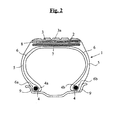
- the figures 1 and 2 annexed represent in radial section, very schematically (especially without respect of a specific scale), two preferred examples of pneumatic tires for motor vehicle with radial carcass reinforcement, according to the invention.
- the figure 1 illustrates a first possible embodiment of the invention, according to which the noise-reducing elastomeric sub-layer (3b) is integrated with the tread (3) itself, and arranged radially under the portion (3a) of the tread (3) which is intended to come into contact with the road during driving.
- the tire (1) schematically comprises a crown region (2) comprising a tread (3) (for simplicity, having a very simple sculpture) whose radially outer portion (3a) is intended to come into contact with the road , two inextensible beads (4) in which is anchored a carcass reinforcement (6).
- the top (2), joined to said beads (4) by two sides (5), is known per se reinforced by a crown reinforcement or "belt" (7) at least partly metallic and radially external to the carcass reinforcement (6) passing through this crown zone (2), this belt (7) consisting for example of at least two superposed crossed plies reinforced by metal cables.
- the carcass reinforcement (6) is here anchored in each bead (4) by winding around two rods (4a, 4b), the upturn (6a, 6b) of this armature (6) being for example arranged outwardly tire (1) which is shown here mounted on its rim (9).
- the carcass reinforcement (6) consists of at least one ply reinforced by radial textile cords, that is to say that these cords are arranged substantially parallel to each other and extend from a bead to the other so as to form an angle of between 80 ° and 90 ° with the median circumferential plane (plane perpendicular to the axis of rotation of the tire which is located halfway between the two beads 4 and passes through the middle of the crown frame 7).
- this tire (1) further comprises, in known manner, a layer of rubber or inner elastomer (commonly called “ inner liner “ or “ inner liner ”) which defines the radially inner face of the tire and which is intended to protect the sheet carcass of the air diffusion from the interior space to the tire.
- inner liner or “ inner liner ”
- This tire (1) according to the invention is characterized in that the base portion (3b) of its tread (3) is constituted by the underlayer which has been described in detail above.
- the figure 2 illustrates another possible embodiment of the invention, according to which the noise-reducing sub-layer (8) is external to the tread (ie, distinct from the tread), this time arranged in the top (2) in under the tread (ie, radially inwardly of the latter) and above the belt (ie, radially outwardly from the latter), in other words between the tread (3) and the belt (7).
- the noise-reducing sub-layer (8) is external to the tread (ie, distinct from the tread), this time arranged in the top (2) in under the tread (ie, radially inwardly of the latter) and above the belt (ie, radially outwardly from the latter), in other words between the tread (3) and the belt (7).
- the elastomeric underlayer offers the tires of the invention improved sound barrier properties, as demonstrated in the tire rolling tests that follow.
- C-1 a rubber composition (hereinafter referred to as C-1) was prepared, the formulation of which is given in Table 1, the rate of the different products being expressed in phr (parts by weight per hundred parts of total elastomer, here consisting of 60 phr of NR and 40 phr of BR).
- composition thus obtained with a density of approximately 1.7 g / cm 3 , was then calendered in the form of a base (underlayer) of a cap-base type tread , followed by the latter. incorporated in a passenger car tire (dimensions 225/55 R17) as shown in figure 1 .
- This tire (noted P-1) according to the invention was compared to a control tire (hereinafter referred to as P-2) of identical dimensions and construction also provided with a strip of bearing structure cap-base whose base this time had a conventional composition (hereinafter noted C-2, density 1.1 g / cm 3 ), the same formulation as that of the composition C-1 but devoid of high density load (weight of the tire P-2 300 g lower than that of the tire P-1); in addition, in order to be able to compare the anti-noise efficiency of the two layers with isorigidity (that is to say for a Shore A hardness identical), the rigidity of the composition C-1 had to be increased by using 50 phr of carbon black (N550).
- N550 50 phr of carbon black
- a rolling test is conducted in which the sound level emitted is evaluated by measuring the sound pressure level near the tire, during the driving of the tire.
- vehicle thanks to microphones placed at a very close distance from the tire (a method known as "Microphone Near Tire” or DTM). More specifically, two microphones, fixed on the chassis of the vehicle, are arranged at a distance of about 20 cm from the tire, one at the entry of the contact area of the tire with the ground, the other at the exit from this contact area.
- the vehicle used is a Toyota brand vehicle ("Celsior").
- the road surface used for this test is a semi-rough asphalt.
- the speed of the vehicle is adjusted to 60km / h and when passing through the measurement area, the engine is switched off (gearbox in neutral) and the recording of the sound pressure is triggered.
- the control tire P-2 containing the composition C-2 as an underlayer is used here as a reference tire.
- Table 2 express the differences in sound level recorded between the tire P-1 according to the invention and the control tire P-2, in a range of frequencies investigated from 700 to 1900 Hz (in steps of 200 Hz). . These differences are expressed in acoustic energy (dB (A)) which corresponds to the integration of the acoustic pressure as a function of the frequency over the considered frequency range, a negative value indicating a reduction of the noise with respect to the reference.
- dB (A) acoustic energy
Landscapes
- Chemical & Material Sciences (AREA)
- Health & Medical Sciences (AREA)
- Chemical Kinetics & Catalysis (AREA)
- Medicinal Chemistry (AREA)
- Polymers & Plastics (AREA)
- Organic Chemistry (AREA)
- Engineering & Computer Science (AREA)
- Mechanical Engineering (AREA)
- Compositions Of Macromolecular Compounds (AREA)
- Tires In General (AREA)
Applications Claiming Priority (2)
| Application Number | Priority Date | Filing Date | Title |
|---|---|---|---|
| FR0858716A FR2939724B1 (fr) | 2008-12-17 | 2008-12-17 | Bandage pneumatique dont le sommet est pourvu d'une couche anti-bruit. |
| PCT/EP2009/008832 WO2010069510A1 (fr) | 2008-12-17 | 2009-12-10 | Bandage pneumatique dont la zone sommet est pourvue d'une sous-couche reduisant le bruit de roulage |
Publications (2)
| Publication Number | Publication Date |
|---|---|
| EP2379346A1 EP2379346A1 (fr) | 2011-10-26 |
| EP2379346B1 true EP2379346B1 (fr) | 2015-02-25 |
Family
ID=40674155
Family Applications (1)
| Application Number | Title | Priority Date | Filing Date |
|---|---|---|---|
| EP09767988.0A Not-in-force EP2379346B1 (fr) | 2008-12-17 | 2009-12-10 | Bandage pneumatique dont la zone sommet est pourvue d'une sous-couche reduisant le bruit de roulage |
Country Status (5)
| Country | Link |
|---|---|
| US (1) | US20110259498A1 (enExample) |
| EP (1) | EP2379346B1 (enExample) |
| JP (1) | JP5603877B2 (enExample) |
| FR (1) | FR2939724B1 (enExample) |
| WO (1) | WO2010069510A1 (enExample) |
Families Citing this family (32)
| Publication number | Priority date | Publication date | Assignee | Title |
|---|---|---|---|---|
| FR2954333B1 (fr) * | 2009-12-23 | 2012-03-02 | Michelin Soc Tech | Pneumatique dont la zone sommet est pourvue d'une sous-couche comportant un elastomere thermoplastique |
| FR2961516B1 (fr) * | 2010-06-17 | 2015-06-26 | Michelin Soc Tech | Bandage pneumatique dont la ceinture est pourvue d'une gomme d'enrobage reduisant les bruits de roulage |
| FR2975998B1 (fr) | 2011-06-01 | 2013-06-14 | Michelin Soc Tech | Pneumatique pour vehicule dont la bande de roulement comporte une composition de caoutchouc thermo-expansible |
| FR2975999B1 (fr) | 2011-06-01 | 2014-07-04 | Michelin Soc Tech | Pneu dont la bande de roulement comporte une composition de caoutchouc thermo-expansible reduisant les bruits de roulage |
| CN103747967B (zh) * | 2011-06-30 | 2016-03-23 | 米其林企业总公司 | 充气轮胎胎面 |
| EP2727745B1 (en) * | 2011-06-30 | 2016-08-10 | Compagnie Générale des Etablissements Michelin | Pneumatic tire tread |
| US9205707B2 (en) * | 2011-06-30 | 2015-12-08 | Compagnie Generale Des Etablissements Michelin | Pneumatic tire tread |
| EP2727746B1 (en) * | 2011-06-30 | 2016-08-10 | Compagnie Générale des Etablissements Michelin | Pneumatic tire tread |
| CN102991274B (zh) * | 2011-09-15 | 2015-07-29 | 建大橡胶(中国)有限公司 | 自行车轮胎 |
| FR2984903B1 (fr) | 2011-12-22 | 2014-05-09 | Michelin Soc Tech | Pneu dont la bande de roulement comporte une composition de caoutchouc thermo-expansible reduisant les bruits de roulage |
| US20130340906A1 (en) * | 2012-06-26 | 2013-12-26 | Bradley J. Harris | D speed agriculture tires |
| WO2015097918A1 (en) * | 2013-12-27 | 2015-07-02 | Compagnie Generale Des Etablissements Michelin | A tire having a tread comprising particles of silicone rubber |
| WO2016002091A1 (en) * | 2014-06-30 | 2016-01-07 | Compagnie Generale Des Etablissements Michelin | A tire improved in noise |
| JP6607456B2 (ja) * | 2014-10-30 | 2019-11-20 | 株式会社 アコースティックイノベーションズ | 振動抑制タイヤ |
| JP6582596B2 (ja) * | 2015-06-19 | 2019-10-02 | 横浜ゴム株式会社 | ゴム組成物 |
| EP3356464B1 (en) * | 2015-09-30 | 2020-11-04 | Compagnie Générale des Etablissements Michelin | A tire comprising a rubber composition |
| EP3356462B1 (en) * | 2015-09-30 | 2020-05-20 | Compagnie Générale des Etablissements Michelin | A tire comprising a rubber composition |
| EP3368601B1 (en) * | 2015-09-30 | 2021-11-24 | Compagnie Générale des Etablissements Michelin | A tire comprising a rubber composition |
| EP3356463B1 (en) * | 2015-09-30 | 2020-05-13 | Compagnie Générale des Etablissements Michelin | A tire comprising a rubber composition |
| JP6679876B2 (ja) * | 2015-10-15 | 2020-04-15 | 横浜ゴム株式会社 | タイヤ用ゴム組成物 |
| JP6657759B2 (ja) * | 2015-10-15 | 2020-03-04 | 横浜ゴム株式会社 | タイヤ用ゴム組成物 |
| JP6682799B2 (ja) * | 2015-10-15 | 2020-04-15 | 横浜ゴム株式会社 | タイヤ用ゴム組成物 |
| JP6597159B2 (ja) * | 2015-10-15 | 2019-10-30 | 横浜ゴム株式会社 | 冬用タイヤ用ゴム組成物 |
| JP6701664B2 (ja) * | 2015-10-16 | 2020-05-27 | 横浜ゴム株式会社 | タイヤ用ゴム組成物 |
| JP6701665B2 (ja) * | 2015-10-16 | 2020-05-27 | 横浜ゴム株式会社 | タイヤ用ゴム組成物 |
| CA3008805C (en) * | 2015-12-17 | 2023-10-31 | Compagnie Generale Des Etablissements Michelin | A tire comprising a tread |
| WO2020096026A1 (en) | 2018-11-08 | 2020-05-14 | Compagnie Generale Des Etablissements Michelin | An article, in particular a tire |
| US20200353776A1 (en) * | 2019-05-09 | 2020-11-12 | The Goodyear Tire & Rubber Company | Radial tire |
| JP7476657B2 (ja) * | 2020-05-13 | 2024-05-01 | 住友ゴム工業株式会社 | タイヤ |
| US12472776B2 (en) | 2020-06-11 | 2025-11-18 | Compagnie Generale Des Etablissements Michelin | Low-noise tire |
| EP3967482B1 (en) * | 2020-09-09 | 2025-05-14 | Bridgestone Bandag, LLC | Method for forming a gum roll |
| EP4186712B1 (en) * | 2021-11-26 | 2024-12-04 | Sumitomo Rubber Industries, Ltd. | Tire |
Family Cites Families (15)
| Publication number | Priority date | Publication date | Assignee | Title |
|---|---|---|---|---|
| NL296932A (enExample) * | 1962-08-30 | |||
| FR1399709A (fr) * | 1964-04-09 | 1965-05-21 | Fr Du Pneu Englebert Soc | Enveloppe pour pneumatique |
| GB1262669A (en) * | 1969-03-17 | 1972-02-02 | Eric Frederick Baxter | Improvements in and relating to solid and pneumatic tyres |
| IT1120713B (it) * | 1979-12-12 | 1986-03-26 | Pirelli | Pneumatico per autoveicoli avente un basso assorbimento di potenza e un'elevata direzionabilita |
| JPS5876308A (ja) * | 1981-10-31 | 1983-05-09 | Yokohama Rubber Co Ltd:The | 高荷重用空気入りラジアルタイヤ |
| JPS58156406A (ja) * | 1982-03-12 | 1983-09-17 | Shigeru Watanabe | 粉塵防止対策のスノ−タイヤ |
| JPS60255505A (ja) * | 1984-05-31 | 1985-12-17 | Yokohama Rubber Co Ltd:The | 空気入りタイヤ |
| JP2664229B2 (ja) * | 1988-12-24 | 1997-10-15 | 毅 池田 | 防滑材および車輌用滑り止め装置 |
| FR2722505B1 (fr) * | 1994-07-15 | 1996-09-27 | Michelin & Cie | Compositions elastomeres chargees a la silice utilisables pour des enveloppes de pneumatiques |
| JPH11334316A (ja) * | 1998-05-28 | 1999-12-07 | Sumitomo Rubber Ind Ltd | 空気入りタイヤおよびその製造方法 |
| US6455613B1 (en) * | 2000-08-18 | 2002-09-24 | The Goodyear Tire & Rubber Company | Tire with component of rubber composition which contains modified fumed silica reinforcement |
| US6734245B2 (en) * | 2001-04-23 | 2004-05-11 | Bridgestone/Firestone North American Tire, Llc | High density metal oxide fillers in rubber compounds |
| JP4522689B2 (ja) * | 2003-10-28 | 2010-08-11 | 九州白水株式会社 | 無機系補強剤配合ゴム組成物 |
| KR101461253B1 (ko) * | 2007-05-15 | 2014-11-12 | 스미토모 고무 고교 가부시키가이샤 | 타이어용 고무 조성물 및 공기 주입 타이어 |
| US8182626B2 (en) * | 2008-10-30 | 2012-05-22 | Continental Ag | Tire composition with improved vulcanizing agent |
-
2008
- 2008-12-17 FR FR0858716A patent/FR2939724B1/fr not_active Expired - Fee Related
-
2009
- 2009-12-10 US US13/132,349 patent/US20110259498A1/en not_active Abandoned
- 2009-12-10 WO PCT/EP2009/008832 patent/WO2010069510A1/fr not_active Ceased
- 2009-12-10 JP JP2011541169A patent/JP5603877B2/ja not_active Expired - Fee Related
- 2009-12-10 EP EP09767988.0A patent/EP2379346B1/fr not_active Not-in-force
Also Published As
| Publication number | Publication date |
|---|---|
| EP2379346A1 (fr) | 2011-10-26 |
| JP2012512090A (ja) | 2012-05-31 |
| JP5603877B2 (ja) | 2014-10-08 |
| FR2939724B1 (fr) | 2012-04-13 |
| FR2939724A1 (fr) | 2010-06-18 |
| US20110259498A1 (en) | 2011-10-27 |
| WO2010069510A1 (fr) | 2010-06-24 |
Similar Documents
| Publication | Publication Date | Title |
|---|---|---|
| WO2010069510A1 (fr) | Bandage pneumatique dont la zone sommet est pourvue d'une sous-couche reduisant le bruit de roulage | |
| EP2370271B1 (fr) | Bandage pneumatique dont la zone sommet est pourvue d'une couche barriere a eau | |
| EP2516536B1 (fr) | Pneumatique dont la zone sommet est pourvue d'une sous-couche comportant un elastomere thermoplastique. | |
| EP2516537B1 (fr) | Pneumatique dont la zone sommet est pourvue d'une sous-couche comportant un elastomere thermoplastique | |
| EP2493976B1 (fr) | Bandage pneumatique dont la paroi interne est pourvue d'une couche de caoutchouc thermo-expansible | |
| EP2547727B1 (fr) | Flanc pour pneumatique | |
| EP2999741B1 (fr) | Melange interne pour pneumatique a resistance a la fissuration amelioree | |
| EP2516177B1 (fr) | Article notamment pneumatique avec melange de caoutchouc externe comportant un sel de lanthanide | |
| EP2582746A1 (fr) | Bandage pneumatique dont la ceinture est pourvue d'une gomme d'enrobage reduisant les bruits de roulage | |
| EP2414445A1 (fr) | Composition de caoutchouc et pneumatique utilisant cette composition. | |
| WO2003066352A1 (fr) | Bande de roulement pour pneumatique | |
| FR3060013A1 (fr) | Composition de caoutchouc a base de polyisoprene epoxyde | |
| WO2011147712A1 (fr) | Bandage pneumatique dont la zone sommet est pourvue d'une couche interne reduisant les bruits de roulage | |
| EP3463930B1 (fr) | Pneumatique comprenant un système de réticulation comprenant un peroxyde, un oxyde métallique et un acide organique insature | |
| WO2011147711A1 (fr) | Bandage pneumatique dont la zone sommet est pourvue d'une couche interne reduisant les bruits de roulage | |
| WO2015014577A1 (fr) | Pneu dont la zone sommet est pourvue d'une couche interne reduisant les bruits de roulage | |
| EP2646260A1 (fr) | Pneumatique comportant une sous-couche de bande de roulement a base de caoutchouc nitrile. | |
| EP3774388A1 (fr) | Composition de caoutchouc comprenant une charge renforçante a faible surface specifique | |
| WO2011147713A1 (fr) | Bandage pneumatique dont la ceinture est pourvue d'une gomme d'enrobage reduisant les bruits de roulage | |
| WO2013087873A1 (fr) | Bandage pneumatique comportant un cordon composite de recreusage | |
| FR3163944A1 (fr) | Produit renforcé à base d’au moins un élément de renfort métallique et d’une composition de caoutchouc. |
Legal Events
| Date | Code | Title | Description |
|---|---|---|---|
| PUAI | Public reference made under article 153(3) epc to a published international application that has entered the european phase |
Free format text: ORIGINAL CODE: 0009012 |
|
| 17P | Request for examination filed |
Effective date: 20110718 |
|
| AK | Designated contracting states |
Kind code of ref document: A1 Designated state(s): AT BE BG CH CY CZ DE DK EE ES FI FR GB GR HR HU IE IS IT LI LT LU LV MC MK MT NL NO PL PT RO SE SI SK SM TR |
|
| DAX | Request for extension of the european patent (deleted) | ||
| 17Q | First examination report despatched |
Effective date: 20120709 |
|
| RAP1 | Party data changed (applicant data changed or rights of an application transferred) |
Owner name: MICHELIN RECHERCHE ET TECHNIQUE S.A. Owner name: COMPAGNIE GENERALE DES ETABLISSEMENTS MICHELIN |
|
| GRAP | Despatch of communication of intention to grant a patent |
Free format text: ORIGINAL CODE: EPIDOSNIGR1 |
|
| INTG | Intention to grant announced |
Effective date: 20140724 |
|
| GRAS | Grant fee paid |
Free format text: ORIGINAL CODE: EPIDOSNIGR3 |
|
| GRAA | (expected) grant |
Free format text: ORIGINAL CODE: 0009210 |
|
| AK | Designated contracting states |
Kind code of ref document: B1 Designated state(s): AT BE BG CH CY CZ DE DK EE ES FI FR GB GR HR HU IE IS IT LI LT LU LV MC MK MT NL NO PL PT RO SE SI SK SM TR |
|
| REG | Reference to a national code |
Ref country code: GB Ref legal event code: FG4D Free format text: NOT ENGLISH |
|
| REG | Reference to a national code |
Ref country code: CH Ref legal event code: EP |
|
| REG | Reference to a national code |
Ref country code: IE Ref legal event code: FG4D Free format text: LANGUAGE OF EP DOCUMENT: FRENCH |
|
| REG | Reference to a national code |
Ref country code: DE Ref legal event code: R096 Ref document number: 602009029589 Country of ref document: DE Effective date: 20150409 |
|
| REG | Reference to a national code |
Ref country code: AT Ref legal event code: REF Ref document number: 711619 Country of ref document: AT Kind code of ref document: T Effective date: 20150415 |
|
| REG | Reference to a national code |
Ref country code: NL Ref legal event code: VDEP Effective date: 20150225 |
|
| REG | Reference to a national code |
Ref country code: AT Ref legal event code: MK05 Ref document number: 711619 Country of ref document: AT Kind code of ref document: T Effective date: 20150225 |
|
| REG | Reference to a national code |
Ref country code: LT Ref legal event code: MG4D |
|
| PG25 | Lapsed in a contracting state [announced via postgrant information from national office to epo] |
Ref country code: SE Free format text: LAPSE BECAUSE OF FAILURE TO SUBMIT A TRANSLATION OF THE DESCRIPTION OR TO PAY THE FEE WITHIN THE PRESCRIBED TIME-LIMIT Effective date: 20150225 Ref country code: ES Free format text: LAPSE BECAUSE OF FAILURE TO SUBMIT A TRANSLATION OF THE DESCRIPTION OR TO PAY THE FEE WITHIN THE PRESCRIBED TIME-LIMIT Effective date: 20150225 Ref country code: FI Free format text: LAPSE BECAUSE OF FAILURE TO SUBMIT A TRANSLATION OF THE DESCRIPTION OR TO PAY THE FEE WITHIN THE PRESCRIBED TIME-LIMIT Effective date: 20150225 Ref country code: HR Free format text: LAPSE BECAUSE OF FAILURE TO SUBMIT A TRANSLATION OF THE DESCRIPTION OR TO PAY THE FEE WITHIN THE PRESCRIBED TIME-LIMIT Effective date: 20150225 Ref country code: NO Free format text: LAPSE BECAUSE OF FAILURE TO SUBMIT A TRANSLATION OF THE DESCRIPTION OR TO PAY THE FEE WITHIN THE PRESCRIBED TIME-LIMIT Effective date: 20150525 Ref country code: LT Free format text: LAPSE BECAUSE OF FAILURE TO SUBMIT A TRANSLATION OF THE DESCRIPTION OR TO PAY THE FEE WITHIN THE PRESCRIBED TIME-LIMIT Effective date: 20150225 |
|
| PG25 | Lapsed in a contracting state [announced via postgrant information from national office to epo] |
Ref country code: IS Free format text: LAPSE BECAUSE OF FAILURE TO SUBMIT A TRANSLATION OF THE DESCRIPTION OR TO PAY THE FEE WITHIN THE PRESCRIBED TIME-LIMIT Effective date: 20150625 Ref country code: AT Free format text: LAPSE BECAUSE OF FAILURE TO SUBMIT A TRANSLATION OF THE DESCRIPTION OR TO PAY THE FEE WITHIN THE PRESCRIBED TIME-LIMIT Effective date: 20150225 Ref country code: GR Free format text: LAPSE BECAUSE OF FAILURE TO SUBMIT A TRANSLATION OF THE DESCRIPTION OR TO PAY THE FEE WITHIN THE PRESCRIBED TIME-LIMIT Effective date: 20150526 Ref country code: LV Free format text: LAPSE BECAUSE OF FAILURE TO SUBMIT A TRANSLATION OF THE DESCRIPTION OR TO PAY THE FEE WITHIN THE PRESCRIBED TIME-LIMIT Effective date: 20150225 |
|
| PG25 | Lapsed in a contracting state [announced via postgrant information from national office to epo] |
Ref country code: NL Free format text: LAPSE BECAUSE OF FAILURE TO SUBMIT A TRANSLATION OF THE DESCRIPTION OR TO PAY THE FEE WITHIN THE PRESCRIBED TIME-LIMIT Effective date: 20150225 |
|
| PG25 | Lapsed in a contracting state [announced via postgrant information from national office to epo] |
Ref country code: CZ Free format text: LAPSE BECAUSE OF FAILURE TO SUBMIT A TRANSLATION OF THE DESCRIPTION OR TO PAY THE FEE WITHIN THE PRESCRIBED TIME-LIMIT Effective date: 20150225 Ref country code: DK Free format text: LAPSE BECAUSE OF FAILURE TO SUBMIT A TRANSLATION OF THE DESCRIPTION OR TO PAY THE FEE WITHIN THE PRESCRIBED TIME-LIMIT Effective date: 20150225 Ref country code: EE Free format text: LAPSE BECAUSE OF FAILURE TO SUBMIT A TRANSLATION OF THE DESCRIPTION OR TO PAY THE FEE WITHIN THE PRESCRIBED TIME-LIMIT Effective date: 20150225 Ref country code: RO Free format text: LAPSE BECAUSE OF FAILURE TO SUBMIT A TRANSLATION OF THE DESCRIPTION OR TO PAY THE FEE WITHIN THE PRESCRIBED TIME-LIMIT Effective date: 20150225 Ref country code: SK Free format text: LAPSE BECAUSE OF FAILURE TO SUBMIT A TRANSLATION OF THE DESCRIPTION OR TO PAY THE FEE WITHIN THE PRESCRIBED TIME-LIMIT Effective date: 20150225 |
|
| REG | Reference to a national code |
Ref country code: DE Ref legal event code: R097 Ref document number: 602009029589 Country of ref document: DE |
|
| PG25 | Lapsed in a contracting state [announced via postgrant information from national office to epo] |
Ref country code: PL Free format text: LAPSE BECAUSE OF FAILURE TO SUBMIT A TRANSLATION OF THE DESCRIPTION OR TO PAY THE FEE WITHIN THE PRESCRIBED TIME-LIMIT Effective date: 20150225 |
|
| REG | Reference to a national code |
Ref country code: FR Ref legal event code: PLFP Year of fee payment: 7 |
|
| PG25 | Lapsed in a contracting state [announced via postgrant information from national office to epo] |
Ref country code: IT Free format text: LAPSE BECAUSE OF FAILURE TO SUBMIT A TRANSLATION OF THE DESCRIPTION OR TO PAY THE FEE WITHIN THE PRESCRIBED TIME-LIMIT Effective date: 20150225 |
|
| PLBE | No opposition filed within time limit |
Free format text: ORIGINAL CODE: 0009261 |
|
| STAA | Information on the status of an ep patent application or granted ep patent |
Free format text: STATUS: NO OPPOSITION FILED WITHIN TIME LIMIT |
|
| 26N | No opposition filed |
Effective date: 20151126 |
|
| PG25 | Lapsed in a contracting state [announced via postgrant information from national office to epo] |
Ref country code: SI Free format text: LAPSE BECAUSE OF FAILURE TO SUBMIT A TRANSLATION OF THE DESCRIPTION OR TO PAY THE FEE WITHIN THE PRESCRIBED TIME-LIMIT Effective date: 20150225 |
|
| PG25 | Lapsed in a contracting state [announced via postgrant information from national office to epo] |
Ref country code: BE Free format text: LAPSE BECAUSE OF NON-PAYMENT OF DUE FEES Effective date: 20151231 |
|
| PG25 | Lapsed in a contracting state [announced via postgrant information from national office to epo] |
Ref country code: LU Free format text: LAPSE BECAUSE OF FAILURE TO SUBMIT A TRANSLATION OF THE DESCRIPTION OR TO PAY THE FEE WITHIN THE PRESCRIBED TIME-LIMIT Effective date: 20151210 Ref country code: MC Free format text: LAPSE BECAUSE OF FAILURE TO SUBMIT A TRANSLATION OF THE DESCRIPTION OR TO PAY THE FEE WITHIN THE PRESCRIBED TIME-LIMIT Effective date: 20150225 |
|
| REG | Reference to a national code |
Ref country code: CH Ref legal event code: PL |
|
| GBPC | Gb: european patent ceased through non-payment of renewal fee |
Effective date: 20151210 |
|
| REG | Reference to a national code |
Ref country code: IE Ref legal event code: MM4A |
|
| PG25 | Lapsed in a contracting state [announced via postgrant information from national office to epo] |
Ref country code: IE Free format text: LAPSE BECAUSE OF NON-PAYMENT OF DUE FEES Effective date: 20151210 Ref country code: CH Free format text: LAPSE BECAUSE OF NON-PAYMENT OF DUE FEES Effective date: 20151231 Ref country code: LI Free format text: LAPSE BECAUSE OF NON-PAYMENT OF DUE FEES Effective date: 20151231 Ref country code: GB Free format text: LAPSE BECAUSE OF NON-PAYMENT OF DUE FEES Effective date: 20151210 |
|
| REG | Reference to a national code |
Ref country code: FR Ref legal event code: PLFP Year of fee payment: 8 |
|
| PG25 | Lapsed in a contracting state [announced via postgrant information from national office to epo] |
Ref country code: SM Free format text: LAPSE BECAUSE OF FAILURE TO SUBMIT A TRANSLATION OF THE DESCRIPTION OR TO PAY THE FEE WITHIN THE PRESCRIBED TIME-LIMIT Effective date: 20150225 Ref country code: HU Free format text: LAPSE BECAUSE OF FAILURE TO SUBMIT A TRANSLATION OF THE DESCRIPTION OR TO PAY THE FEE WITHIN THE PRESCRIBED TIME-LIMIT; INVALID AB INITIO Effective date: 20091210 Ref country code: BG Free format text: LAPSE BECAUSE OF FAILURE TO SUBMIT A TRANSLATION OF THE DESCRIPTION OR TO PAY THE FEE WITHIN THE PRESCRIBED TIME-LIMIT Effective date: 20150225 |
|
| PG25 | Lapsed in a contracting state [announced via postgrant information from national office to epo] |
Ref country code: CY Free format text: LAPSE BECAUSE OF FAILURE TO SUBMIT A TRANSLATION OF THE DESCRIPTION OR TO PAY THE FEE WITHIN THE PRESCRIBED TIME-LIMIT Effective date: 20150225 |
|
| PG25 | Lapsed in a contracting state [announced via postgrant information from national office to epo] |
Ref country code: MT Free format text: LAPSE BECAUSE OF FAILURE TO SUBMIT A TRANSLATION OF THE DESCRIPTION OR TO PAY THE FEE WITHIN THE PRESCRIBED TIME-LIMIT Effective date: 20150225 Ref country code: TR Free format text: LAPSE BECAUSE OF FAILURE TO SUBMIT A TRANSLATION OF THE DESCRIPTION OR TO PAY THE FEE WITHIN THE PRESCRIBED TIME-LIMIT Effective date: 20150225 |
|
| REG | Reference to a national code |
Ref country code: FR Ref legal event code: PLFP Year of fee payment: 9 |
|
| PG25 | Lapsed in a contracting state [announced via postgrant information from national office to epo] |
Ref country code: PT Free format text: LAPSE BECAUSE OF FAILURE TO SUBMIT A TRANSLATION OF THE DESCRIPTION OR TO PAY THE FEE WITHIN THE PRESCRIBED TIME-LIMIT Effective date: 20150225 Ref country code: MK Free format text: LAPSE BECAUSE OF FAILURE TO SUBMIT A TRANSLATION OF THE DESCRIPTION OR TO PAY THE FEE WITHIN THE PRESCRIBED TIME-LIMIT Effective date: 20150225 |
|
| PGFP | Annual fee paid to national office [announced via postgrant information from national office to epo] |
Ref country code: FR Payment date: 20221222 Year of fee payment: 14 Ref country code: DE Payment date: 20221213 Year of fee payment: 14 |
|
| REG | Reference to a national code |
Ref country code: DE Ref legal event code: R081 Ref document number: 602009029589 Country of ref document: DE Owner name: COMPAGNIE GENERALE DES ETABLISSEMENTS MICHELIN, FR Free format text: FORMER OWNERS: COMPAGNIE GENERALE DES ETABLISSEMENTS MICHELIN, CLERMONT-FERRAND, FR; MICHELIN RECHERCHE ET TECHNIQUE S.A., GRANGES-PACCOT, CH |
|
| REG | Reference to a national code |
Ref country code: DE Ref legal event code: R119 Ref document number: 602009029589 Country of ref document: DE |
|
| PG25 | Lapsed in a contracting state [announced via postgrant information from national office to epo] |
Ref country code: DE Free format text: LAPSE BECAUSE OF NON-PAYMENT OF DUE FEES Effective date: 20240702 |
|
| PG25 | Lapsed in a contracting state [announced via postgrant information from national office to epo] |
Ref country code: FR Free format text: LAPSE BECAUSE OF NON-PAYMENT OF DUE FEES Effective date: 20231231 |
|
| PG25 | Lapsed in a contracting state [announced via postgrant information from national office to epo] |
Ref country code: FR Free format text: LAPSE BECAUSE OF NON-PAYMENT OF DUE FEES Effective date: 20231231 Ref country code: DE Free format text: LAPSE BECAUSE OF NON-PAYMENT OF DUE FEES Effective date: 20240702 |