EP2325699B1 - Electrophotographic toner and method for producing the same - Google Patents
Electrophotographic toner and method for producing the same Download PDFInfo
- Publication number
- EP2325699B1 EP2325699B1 EP10191752.4A EP10191752A EP2325699B1 EP 2325699 B1 EP2325699 B1 EP 2325699B1 EP 10191752 A EP10191752 A EP 10191752A EP 2325699 B1 EP2325699 B1 EP 2325699B1
- Authority
- EP
- European Patent Office
- Prior art keywords
- toner
- mass
- particles
- parts
- dispersion
- Prior art date
- Legal status (The legal status is an assumption and is not a legal conclusion. Google has not performed a legal analysis and makes no representation as to the accuracy of the status listed.)
- Active
Links
Images


Classifications
-
- G—PHYSICS
- G03—PHOTOGRAPHY; CINEMATOGRAPHY; ANALOGOUS TECHNIQUES USING WAVES OTHER THAN OPTICAL WAVES; ELECTROGRAPHY; HOLOGRAPHY
- G03G—ELECTROGRAPHY; ELECTROPHOTOGRAPHY; MAGNETOGRAPHY
- G03G9/00—Developers
- G03G9/08—Developers with toner particles
- G03G9/09—Colouring agents for toner particles
- G03G9/0906—Organic dyes
-
- G—PHYSICS
- G03—PHOTOGRAPHY; CINEMATOGRAPHY; ANALOGOUS TECHNIQUES USING WAVES OTHER THAN OPTICAL WAVES; ELECTROGRAPHY; HOLOGRAPHY
- G03G—ELECTROGRAPHY; ELECTROPHOTOGRAPHY; MAGNETOGRAPHY
- G03G9/00—Developers
- G03G9/08—Developers with toner particles
- G03G9/0802—Preparation methods
- G03G9/0804—Preparation methods whereby the components are brought together in a liquid dispersing medium
-
- G—PHYSICS
- G03—PHOTOGRAPHY; CINEMATOGRAPHY; ANALOGOUS TECHNIQUES USING WAVES OTHER THAN OPTICAL WAVES; ELECTROGRAPHY; HOLOGRAPHY
- G03G—ELECTROGRAPHY; ELECTROPHOTOGRAPHY; MAGNETOGRAPHY
- G03G9/00—Developers
- G03G9/08—Developers with toner particles
- G03G9/0821—Developers with toner particles characterised by physical parameters
-
- G—PHYSICS
- G03—PHOTOGRAPHY; CINEMATOGRAPHY; ANALOGOUS TECHNIQUES USING WAVES OTHER THAN OPTICAL WAVES; ELECTROGRAPHY; HOLOGRAPHY
- G03G—ELECTROGRAPHY; ELECTROPHOTOGRAPHY; MAGNETOGRAPHY
- G03G9/00—Developers
- G03G9/08—Developers with toner particles
- G03G9/087—Binders for toner particles
- G03G9/08784—Macromolecular material not specially provided for in a single one of groups G03G9/08702 - G03G9/08775
- G03G9/08795—Macromolecular material not specially provided for in a single one of groups G03G9/08702 - G03G9/08775 characterised by their chemical properties, e.g. acidity, molecular weight, sensitivity to reactants
-
- G—PHYSICS
- G03—PHOTOGRAPHY; CINEMATOGRAPHY; ANALOGOUS TECHNIQUES USING WAVES OTHER THAN OPTICAL WAVES; ELECTROGRAPHY; HOLOGRAPHY
- G03G—ELECTROGRAPHY; ELECTROPHOTOGRAPHY; MAGNETOGRAPHY
- G03G9/00—Developers
- G03G9/08—Developers with toner particles
- G03G9/087—Binders for toner particles
- G03G9/08784—Macromolecular material not specially provided for in a single one of groups G03G9/08702 - G03G9/08775
- G03G9/08797—Macromolecular material not specially provided for in a single one of groups G03G9/08702 - G03G9/08775 characterised by their physical properties, e.g. viscosity, solubility, melting temperature, softening temperature, glass transition temperature
-
- G—PHYSICS
- G03—PHOTOGRAPHY; CINEMATOGRAPHY; ANALOGOUS TECHNIQUES USING WAVES OTHER THAN OPTICAL WAVES; ELECTROGRAPHY; HOLOGRAPHY
- G03G—ELECTROGRAPHY; ELECTROPHOTOGRAPHY; MAGNETOGRAPHY
- G03G9/00—Developers
- G03G9/08—Developers with toner particles
- G03G9/09—Colouring agents for toner particles
- G03G9/0926—Colouring agents for toner particles characterised by physical or chemical properties
-
- G—PHYSICS
- G03—PHOTOGRAPHY; CINEMATOGRAPHY; ANALOGOUS TECHNIQUES USING WAVES OTHER THAN OPTICAL WAVES; ELECTROGRAPHY; HOLOGRAPHY
- G03G—ELECTROGRAPHY; ELECTROPHOTOGRAPHY; MAGNETOGRAPHY
- G03G9/00—Developers
- G03G9/08—Developers with toner particles
- G03G9/09—Colouring agents for toner particles
- G03G9/0928—Compounds capable to generate colouring agents by chemical reaction
-
- G—PHYSICS
- G03—PHOTOGRAPHY; CINEMATOGRAPHY; ANALOGOUS TECHNIQUES USING WAVES OTHER THAN OPTICAL WAVES; ELECTROGRAPHY; HOLOGRAPHY
- G03G—ELECTROGRAPHY; ELECTROPHOTOGRAPHY; MAGNETOGRAPHY
- G03G9/00—Developers
- G03G9/08—Developers with toner particles
- G03G9/093—Encapsulated toner particles
-
- G—PHYSICS
- G03—PHOTOGRAPHY; CINEMATOGRAPHY; ANALOGOUS TECHNIQUES USING WAVES OTHER THAN OPTICAL WAVES; ELECTROGRAPHY; HOLOGRAPHY
- G03G—ELECTROGRAPHY; ELECTROPHOTOGRAPHY; MAGNETOGRAPHY
- G03G9/00—Developers
- G03G9/08—Developers with toner particles
- G03G9/093—Encapsulated toner particles
- G03G9/09392—Preparation thereof
Definitions
- Embodiments described herein relate to a technique for an electrophotographic toner capable of erasing an image formed on a recording medium by a decolorization operation.
- a kneading pulverization method is a method for producing desired toner particles by melt-kneading a binder resin, a color former compound, a color developing agent, a release agent such as a wax, a charge control agent, and the like, cooling the resulting kneaded material, finely pulverizing the cooled material, and then, classifying the resulting fine particles.
- a method for producing a decolorable toner characterized by comprising:
- the particles prepared by fusing the particles resulting from the encapsulation of at least the color former compound and the color developing agent and the particles containing at least the binder resin is washed until the electrical conductivity of the filtrate becomes 10 ⁇ S /cm or less.
- the produced toner has a pH at 25°C of from 6 to 7.5 when dispersed in water with a pH of from 5.5 to 7 at a mass ratio of toner/water of 1/10.
- the upper limit of the content of an acidic metal salt contained in the produced toner is 1% by mass.
- a decolorable toner according to this embodiment contains a color former compound, a color developing agent, a binder resin, and a release agent, and has a pH at 25°C of from 6 to 9 when dispersed in water with a pH of from 5.5 to 7 at a mass ratio of toner/water of 1/10.
- a decolorable toner is produced by a kneading pulverization method.
- a kneading pulverization method there is a limit to the reduction in the particle diameter of the toner by a kneading pulverization method (see the US patent document 2009/087767 ).
- the present inventors conceived a method for producing a toner through a step of aggregating and fusing a color former compound and a color developing agent, and a binder resin in a dispersion medium as one example.
- a monovalent or polyvalent acidic metal salt such as magnesium sulfate or aluminum sulfate can be used as an aggregating agent.
- metal salt such as magnesium sulfate or aluminum sulfate
- a pH adjusting agent or a surfactant can also be added to the dispersion medium.
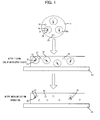
- the numeral 11 denotes a decolorable toner
- the numeral 13 denotes a color developing agent
- the numeral 15 denotes a color former compound
- the numeral 19 denotes a fine particle resulting from the encapsulation of the color developing agent 13 and the color former compound 15.
- the numeral 21 denotes a pH adjusting agent
- the numeral 23 denotes a metal salt.
- the numeral 31 denotes a bond
- the numeral 33 denotes a base material.
- the toner 11 containing the fine particles 19 resulting from the encapsulation of the color developing agent 13 and the color former compound 15 is fixed and an image is formed on the base material 33.
- the color developing agent 13 and the color former compound 15 are bound to each other and the color former compound is in a color developed state.
- the color developing agent 13 and the color former compound 15 are dissociated from each other, and the color is erased, whereby the image can be erased.
- the metal salt 23 or the pH adjusting agent 21 remained in the toner, the metal salt 23 or the pH adjusting agent 21 reacted with part of the color former compound 15 during the decolorization operation, and the part of the color former compound 15 was maintained in the color developed state in some cases. As a result, even when the decolorization operation was performed, the image could not be sufficiently erased in some cases.
- the pH of a toner at 25°C when the toner is dispersed in water with a pH of from 5.5 to 7 at a mass ratio of toner/water of 1/10 (hereinafter also simply referred to as "dispersion pH") to 6 to 9
- the binding between the color former compound and the metal salt or the pH adjusting agent remaining in the toner can be inhibited during the decolorization operation, and also the surfactant remaining in the toner can be inhibited, and therefore, a toner which is capable of sufficiently erasing the image and has favorable environmental variability can be obtained.
- the dispersion pH is from 6 to 7.5.
- the dispersion pH of the toner is less than 6, the reaction between the leuco dye and the acidic metal salt during the decolorization operation cannot be inhibited as compared with the case where the dispersion pH is within the above range. Therefore, the image density cannot be decreased as compared with the case where the dispersion pH is within the above range.
- the dispersion pH of the toner is more than 9, the hygroscopicity is increased as compared with the case where the dispersion pH is within the above range, and therefore, the environmental variability of the toner is markedly increased.
- the formed image may be unclear in some cases.
- an acidic metal salt can be used as the aggregating agent.
- the upper limit of the content of the acidic metal salt is preferably 1% by mass based on the total mass of the toner.
- the "acidic metal salt” refers to a metal salt showing an acidic pH when dissolved in water.
- the acidic metal salt include metal salts formed by the combination of a strong acid with a weak base such as sodium sulfate, disodium hydrogen phosphate, magnesium sulfate, and aluminum sulfate.
- a metal salt is used as the aggregating agent in, for example the aggregation and fusion step, and is mainly mixed in the toner in, for example, the aggregation and fusion step.
- the lower limit of the content of the metal salt is not particularly limited, however, it can be set to, for example, 0. That is, the toner according to this embodiment can be configured to contain practically no metal salt.
- the toner according to this embodiment contains a coloring agent, a binder resin, and a release agent.
- the coloring agent refers to one kind of compound or a composition that imparts a color to the toner.
- the coloring agent contains a color former compound and a color developing agent.
- the color former compound is an electron donating compound which accepts a proton from the color developing agent when binding thereto.
- the color former compound is not particularly limited and can be appropriately determined by a person skilled in the art, however, for example, a leuco dye can be used.
- the leuco dye include diphenylmethane phthalides, phenylindolyl phthalides, indolyl phthalides, diphenylmethane azaphthalides, phenylindolyl azaphthalides, fluorans, styrynoquinolines, and diaza-rhodamine lactones.
- the color developing agent to be used in this embodiment is an electron accepting compound which donates a proton to the color former compound such as a leuco dye.
- examples thereof include phenols, metal salts of phenols, metal salts of carboxylic acids, aromatic carboxylic acids, aliphatic carboxylic acids having 2 to 5 carbon atoms, benzophenones, sulfonic acids, sulfonates, phosphoric acids, metal salts of phosphoric acids, acidic phosphoric acid esters, metal salts of acidic phosphoric acid esters, phosphorous acids, metal salts of phosphorous acids, monophenols, polyphenols, 1,2,3-triazole, and derivatives thereof.
- Additional examples thereof include those having, as a substituent, an alkyl group, an aryl group, an acyl group, an alkoxycarbonyl group, a carboxy group or an ester thereof, an amide group, a halogen group, and bisphenols, trisphenols, phenol-aldehyde condensed resins, and metal salts thereof. These compounds may be used by mixing two or more of them.
- the binder resin constituting the toner according to this embodiment is not particularly limited and can be appropriately determined by a person skilled in the art.
- the binder resin for example, a polyester resin obtained by subjecting a dicarboxylic acid component and a diol component to an esterification reaction followed by polycondensation, or a polystyrene resin can be used.
- examples of the dicarboxylic acid component include aromatic dicarboxylic acids such as terephthalic acid, phthalic acid, and isophthalic acid; and aliphatic carboxylic acids such as fumaric acid, maleic acid, succinic acid, adipic acid, sebacic acid, glutaric acid, pimelic acid, oxalic acid, malonic acid, citraconic acid, and itaconic acid.
- aromatic dicarboxylic acids such as terephthalic acid, phthalic acid, and isophthalic acid
- aliphatic carboxylic acids such as fumaric acid, maleic acid, succinic acid, adipic acid, sebacic acid, glutaric acid, pimelic acid, oxalic acid, malonic acid, citraconic acid, and itaconic acid.
- examples of the diol component include aliphatic diols such as ethylene glycol, propylene glycol, 1,4-butanediol, 1,3-butanediol, 1,5-pentanediol, 1,6-hexanediol, neopentyl glycol, trimethylene glycol, trimethylolpropane, and pentaerythritol; alicyclic diols such as 1,4-cyclohexanediol and 1,4-cyclohexanedimethanol; and an ethylene oxide or propylene oxide adduct of bisphenol A or the like.
- aliphatic diols such as ethylene glycol, propylene glycol, 1,4-butanediol, 1,3-butanediol, 1,5-pentanediol, 1,6-hexanediol, neopentyl glycol, trimethylene glycol, trimethylol
- the above polyester component may be converted so as to have a crosslinking structure using a trivalent or higher polyvalent carboxylic acid component or a trihydric or higher polyhydric alcohol component such as 1,2,4-benzenetricarboxylic acid (trimellitic acid) or glycerin.
- a trivalent or higher polyvalent carboxylic acid component or a trihydric or higher polyhydric alcohol component such as 1,2,4-benzenetricarboxylic acid (trimellitic acid) or glycerin.
- polyester resins having different compositions may be mixed and used.
- the polyester resin may be crystalline or noncrystalline.
- polystyrene resin a polystyrene resin obtained by copolymerization of an aromatic vinyl component and a (meth)acrylic acid ester component is preferred.
- aromatic vinyl component include styrene, ⁇ -methylstyrene, o-methylstyrene, and p-chlorostyrene.
- acrylic acid ester component include ethyl acrylate, propyl acrylate, butyl acrylate, 2-ethylhexyl acrylate, butyl methacrylate, ethyl methacrylate, and methyl methacrylate.
- butyl acrylate is generally used.
- the polymerization method an emulsion polymerization method is generally employed, and the resin is obtained by radical polymerization of monomers of the respective components in an aqueous phase containing an emulsifying agent.
- the glass transition temperatures of the polyester resin and the polystyrene resin are preferably 30°C or higher and 55°C or lower. If the glass transition temperature is lower than 30°C, an unnatural gloss appears after decolorization in a region where the toner is placed, and also the storage stability of the toner is deteriorated. Meanwhile, if the glass transition temperature is higher than 55°C, the low-temperature fixability cannot be obtained.
- the weight average molecular weight Mw of the polyester resin is preferably 5000 or more and 30000 or less.
- the weight average molecular weight Mw of the polystyrene resin is preferably 10000 or more and 70000 or less. If the weight average molecular weight Mw of the polyester resin is less than 5000 (in the case of the polystyrene resin, less than 10000), the heat-resistant storage stability of the toner is deteriorated as compared with the case where the weight average molecular weight Mw is in the above range.
- the fixing temperature is increased as compared with the case where the weight average molecular weight Mw is in the above range, and therefore, it is not preferred from the viewpoint of suppression of power consumption in the fixation treatment.
- the release agent to be contained in the toner is not particularly limited.
- examples thereof include aliphatic hydrocarbon waxes such as low-molecular weight polyethylenes, low-molecular weight polypropylenes, polyolefin copolymers, polyolefin waxes, microcrystalline waxes, paraffin waxes, and Fischer-Tropsch waxes; oxides of aliphatic hydrocarbon waxes such as polyethylene oxide waxes or block copolymers thereof; vegetable waxes such as candelilla wax, carnauba wax, Japan wax, jojoba wax, and rice wax; animal waxes such as bees wax, lanolin, and whale wax; mineral waxes such as ozokerite, ceresin, and petrolatum; waxes containing, as a main component, a fatty acid ester such as montanic acid ester wax and castor wax; and deoxidation products resulting from deoxidation of a part or the whole of a fatty acid ester such as de
- saturated linear fatty acids such as palmitic acid, stearic acid, montanic acid, and long-chain alkyl carboxylic acids having a longer chain alkyl group
- unsaturated fatty acids such as brassidic acid, eleostearic acid, and parinaric acid
- saturated alcohols such as stearyl alcohol, eicosyl alcohol, behenyl alcohol, carnaubyl alcohol, ceryl alcohol, melissyl alcohol, and long-chain alkyl alcohols having a longer chain alkyl group
- polyhydric alcohols such as sorbitol
- fatty acid amides such as linoleic acid amide, oleic acid amide, and lauric acid amide
- saturated fatty acid bisamides such as methylenebisstearic acid amide, ethylenebiscaprylic acid amide, ethylenebislauric acid amide, and hexamethylenebisstearic acid amide
- unsaturated fatty acid amides such as ethylene
- ком ⁇ онент such as a decolorizing agent, a charge control agent, and an external additive may be contained or retained on the outer surface thereof.
- the decolorizing agent is a substance which is preferentially compatible with the color developing agent and therefore has an action of reducing the interaction between the color former compound and the color developing agent to effect decolorization, and a known substance can be used in this embodiment.
- the toner according to this embodiment can be decolorized by heating even if the toner does not contain a decolorizing agent, however, by incorporating the decolorizing agent, a decolorization treatment can be more promptly performed.
- the decolorizing agent can be, for example, incorporated in the below-mentioned fine particles resulting from the encapsulation of the color former compound and the color developing agent.
- a metal-containing azo compound is used, and the metal element is preferably a complex or a complex salt of iron, cobalt, or chromium, or a mixture thereof.
- a metal-containing salicylic acid derivative compound can also be used.
- the metal element is preferably a complex or a complex salt of zirconium, zinc, chromium, or boron, or a mixture thereof.
- inorganic fine particles can be externally added and mixed in an amount of from 0.01 to 20% by mass based on the total mass of the toner particles.
- silica, titania, alumina, strontium titanate, tin oxide can be used alone or by mixing two or more of them.
- those surface-treated with a hydrophobizing agent are used from the viewpoint of improvement of environmental stability.
- resin fine particles having a size of 1 ⁇ m or less may be externally added for improving the cleaning property.
- the contents of the respective components constituting the toner are not particularly limited and can be appropriately determined by a person skilled in the art.
- first dispersion liquid a dispersion liquid of fine particles resulting from the encapsulation of a color former compound and a color developing agent (hereinafter, also referred to as "first dispersion liquid”) is prepared.
- the preparation can be performed by dispersing fine particles prepared according to a known microencapsulation method in a dispersion medium such as water.
- a dispersion medium such as water.
- Specific examples of the method which can be adopted include a coacervation method, an interfacial polymerization method, an in situ polymerization method, and a spray drying method. More specifically, the preparation can be performed according to the method described in, for example, JP-A-60-264285 .
- the color former compound and the color developing agent Prior to the preparation of the first dispersion liquid, the color former compound and the color developing agent are bound to each other in advance by heating so that the color former compound is converted to a color developed state, whereby a coloring agent can be formed.
- the coloring agent can be formed according to a known method.
- a dispersion liquid of fine particles containing a binder resin and a release agent (hereinafter, also referred to as "second dispersion liquid") is prepared.
- the second dispersion liquid can be obtained by, for example, forming fine particles by a mechanical emulsification method through mechanical shearing using a polyester resin and a release agent in a dispersion medium.
- a dispersion liquid in which emulsion polymerized fine particles of a styrene acrylic resin and a release agent are dispersed or a dispersion liquid containing a release agent and particles obtained by depositing a binder resin dissolved in an organic solvent through a phase inversion emulsification method can be used.
- the first dispersion liquid and the second dispersion liquid are mixed, and the fine particles resulting from the encapsulation of the color former compound and the color developing agent and the fine particles containing the binder resin and the release agent are subjected to an aggregation treatment (Act 103). Thereafter, the aggregated fine particles are subjected to a fusion treatment (Act 104).
- the first dispersion liquid and the second dispersion liquid are mixed, and then, an aggregating agent is added to the resulting mixture while heating and stirring the mixture. Subsequently, the mixed dispersion liquid was further heated to effect the aggregation treatment.
- the kind of the aggregating agent and the addition amount thereof can be appropriately determined by a person skilled in the art according to the kinds of the color former compound, color developing agent, binder resin, and other components, the dispersion stability of the fine particles subjected to the aggregation treatment in the dispersion liquid, the particle diameter of the aggregated particles obtained after fusing. Further, the heating temperature in the aggregation treatment can also be appropriately determined by a person skilled in the art according to the kinds of the color former compound, color developing agent, binder resin, and other components.
- a monovalent metal salt such as sodium chloride, potassium chloride, lithium chloride, or sodium sulfate
- a divalent metal salt such as magnesium chloride, calcium chloride, magnesium sulfate, calcium nitrate, zinc chloride, ferric chloride, or ferric sulfate
- a trivalent metal salt such as aluminum sulfate or aluminum chloride
- the heating temperature in the fusion treatment can be determined according to the kind of the binder resin to be used (specifically, the glass transition temperature Tg of the binder resin to be used). More specifically, the heating temperature can be appropriately determined in a range from the glass transition temperature of the binder resin to the decolorization initiation temperature (a temperature at which the color former compound and the color developing agent bound to each other are dissociated from each other to initiate decolorization).
- such a component when another component such as a decolorizing agent is incorporated, such a component may be mixed, for example, in the step of preparing the fine particles resulting from the encapsulation of the color former compound and the color developing agent or the step of aggregation treatment.
- aggregation and fusion may sometimes be performed simultaneously according to the kind of the binder resin, the concentration of the solid content, or the kind of the aggregating agent.
- a pH adjusting agent or a surfactant can be added.
- the first dispersion liquid and the second dispersion liquid are mixed, and the mixed dispersion liquid is heated to a temperature of 40°C. Subsequently, while stirring the mixed dispersion liquid, aluminum sulfate as the aggregating agent is added thereto. Then, while stirring the mixed dispersion liquid, the temperature of the mixed dispersion liquid is gradually raised to 80°C and the mixed dispersion liquid is maintained at the temperature, whereby fused particles are obtained.
- the particle diameter of the fused particles can be set to, for example, 10 ⁇ m.
- the release agent is incorporated in the fine particles containing the binder resin, however, the invention is not limited thereto.
- the release agent may be added to the mixed dispersion liquid in the aggregation step of Act 103, thereby incorporating the release agent in the toner to be produced.
- an apparatus for use in washing is not particularly limited, however, for example, a centrifugal separator, a filter press, is preferably used.
- the washing liquid for example, water, ion exchanged water, purified water, water adjusted to acidic pH, water adjusted to basic pH, can be used.
- the washing step by repeating washing and filtration, a water-containing cake is obtained.
- the washing is performed until the pH of the filtrate when washing (hereinafter also referred to as "washing filtrate") at 25°C becomes 6 to 9.
- the upper limit of the electrical conductivity of the washing filtrate at this time is preferably 10 ⁇ S/cm at 25°C.
- the lower limit of the electrical conductivity is not particularly limited, however, it can be set to, for example, 0.05 ⁇ S/cm in consideration of the washing water to be used for washing.
- the obtained water-containing cake is dried until the water content becomes about 1% by mass by a given drying method such as a flash dryer, a vibration dryer, or an oven, whereby a dried material is obtained.
- the dried material is then crushed by a given method, whereby a toner is formed.
- the formed toner can be subjected to an external addition treatment using silica, titanium oxide, or the like.
- the color former compound and the color developing agent are encapsulated, however, the invention is not limited thereto.
- the toner according to this embodiment is mixed with a carrier in the same manner as a common toner and is prepared as a developer.
- the thus prepared developer is placed in, for example, an image forming apparatus such as multifunction peripheral (MFP) and is used for forming an image on a recording medium.
- MFP multifunction peripheral
- the resin is melted and penetrates into the recording medium, and thereafter, the resin is solidified, thereby forming an image on the recording medium (fixation treatment).
- the image formed on the recording medium can be erased by performing a decolorization treatment for the toner.
- the decolorization treatment can be performed by heating the recording medium on which the image is formed at a heating temperature not lower than the decolorization initiation temperature so as to dissociate the color former compound and the color developing agent bound to each other from each other.
- the resulting mixture was emulsified and dispersed, and the resulting dispersion was continuously stirred at 90°C for about 1 hour. Thereafter, 2 parts by mass of a watersoluble aliphatic modified amine as a reaction agent was added thereto, and the resulting dispersion was kept at a liquid temperature of 90°C and continuously stirred for about 3 hours, whereby colorless encapsulated particles were obtained. Then, this encapsulated particle dispersion was placed in a freezer to develop a color, whereby a dispersion of blue color developed particles was obtained. The volume average particle diameter of the thus obtained color developed particles was measured using SALD-7000 (manufactured by Shimadzu Corporation) and found to be 2 ⁇ m. Incidentally, the complete decolorization temperature Th was 79°C, and the complete color development temperature Tc was -10°C.
- the dispersion liquid was subjected to a pulverization treatment at 180°C and 150 MPa using NANO 3000 (manufactured by Beryu Co., Ltd.) provided with a high-pressure pipe for heat exchange having a length of 12 m immersed in an oil bath as a heating unit, a high-pressure pipe having nozzles having diameters of 0.13 ⁇ m and 0.28 ⁇ m, respectively, arranged in a row therein as a pressure applying unit, a medium-pressure pipe having cells having pore diameters of 0.4, 1.0, 0.75, 1.5, and 1.0 ⁇ m, respectively, arranged in a row therein as a pressure reducing unit, and a heat exchange pipe having a length of 12 m capable of cooling with tap water as a cooling unit.
- NANO 3000 manufactured by Beryu Co., Ltd.
- the dispersion liquid was cooled to 30°C, whereby a dispersion of toner component particles was obtained.
- the volume average particle diameter of the thus obtained particles was measured using SALD-7000 (manufactured by Shimadzu Corporation) and found to be 0.5 ⁇ m.
- This toner dispersion liquid C was filtered and washed with ion exchanged water in an amount of 1670 parts by mass in total.
- the electrical conductivity of the filtrate after completion of washing was 8 ⁇ S/cm (measured by using electrical conductivity meter ES-51 manufactured by Horiba, Ltd., hereinafter the same shall apply).
- the pH of the washing filtrate at 25°C was 6.8 (the same temperature condition shall apply to the other Examples and Comparative Examples).
- the washed toner was dried using a vacuum dryer until the water content became 1.0% by mass or less, whereby dried particles were obtained.
- the obtained toner was mixed with a ferrite carrier coated with a silicone resin, and an image was output using a MFP (e-studio 4520c) manufactured by Toshiba Tec Corporation.
- the temperature of the fixing device was set to 70°C, the paper feed rate was adjusted to 30 mm/sec, and a paper on which a color developed image having an image density of 0.7 was formed was obtained.
- the obtained paper having an image formed thereon was conveyed at a paper feed rate of 200 mm/sec by setting the temperature of the fixing device to 150°C, and it was confirmed that a clearly erased image was obtained.
- the obtained toner was mixed with a ferrite carrier coated with a silicone resin under an LL environment (temperature: 10°C, humidity: 20%, hereinafter the same shall apply) and an HH environment (temperature: 30°C, humidity: 80%, hereinafter the same shall apply), and the charge amount thereof was measured for both conditions, respectively.
- the ratio of the charge amount HH/LL was 75%.
- the ratio of the charge amount HH/LL is preferably 50% or more, more preferably 65% or more. If the ratio of the charge amount HH/LL is less than 50%, the environmental dependence of the toner is large, and the amount of development under the LL environment cannot be controlled or toner scattering under the HH environment occurs.
- this toner dispersion liquid was filtered and washed with ion exchanged water in an amount of 1000 parts by mass in total.
- the electrical conductivity of the filtrate after completion of washing was 7 ⁇ S/cm.
- the pH of the washing filtrate was 7.5.
- the washed toner was dried using a vacuum dryer until the water content became 1.0% by mass or less, whereby dried particles were obtained.
- the obtained toner was mixed with a ferrite carrier coated with a silicone resin, and an image was output using a MFP (e-studio 4520c) manufactured by Toshiba Tec Corporation.
- the temperature of the fixing device was set to 70°C, the paper feed rate was adjusted to 30 mm/sec, and a paper on which a color developed image having an image density of 0.8 was formed was obtained.
- the obtained paper having an image formed thereon was conveyed at a paper feed rate of 200 mm/sec by setting the temperature of the fixing device to 150°C, and it was confirmed that a clearly erased image was obtained.
- the obtained toner was mixed with a ferrite carrier coated with a silicone resin under the LL environment and the HH environment, and the charge amount thereof was measured for both conditions, respectively.
- the ratio of the charge amount HH/LL was 79%.
- this toner dispersion liquid was filtered and washed with ion exchanged water in an amount of 1000 parts by mass in total.
- the electrical conductivity of the filtrate after completion of washing was 15 ⁇ S/cm. Further, the pH of the washing filtrate was 7.7. Thereafter, the washed toner was dried using a vacuum dryer until the water content became 1.0% by mass or less, whereby dried particles were obtained.
- the obtained toner was mixed with a ferrite carrier coated with a silicone resin, and an image was output using a MFP (e-studio 4520c) manufactured by Toshiba Tec Corporation.
- the temperature of the fixing device was set to 70°C, the paper feed rate was adjusted to 30 mm/sec, and a paper on which a color developed image having an image density of 0.8 was formed was obtained.
- the obtained paper having an image formed thereon was conveyed at a paper feed rate of 200 mm/sec by setting the temperature of the fixing device to 150°C, and it was confirmed that a clearly erased image was obtained.
- the obtained toner was mixed with a ferrite carrier coated with a silicone resin under the LL environment and the HH environment, and the charge amount thereof was measured for both conditions, respectively.
- the ratio of the charge amount HH/LL was 67%.
- a toner was produced in the same manner as in Example 1 except that washing with ion exchanged water in an amount of 3000 parts by mass was performed. At this time, the electrical conductivity of the filtrate after completion of washing was 1 ⁇ S/cm. Further, the pH of the washing filtrate was 6.2. Thereafter, the washed toner was dried using a vacuum dryer until the water content became 1.0% by mass or less, whereby dried particles were obtained.
- the obtained toner was mixed with a ferrite carrier coated with a silicone resin, and an image was output using a MFP (e-studio 4520c) manufactured by Toshiba Tec Corporation.
- the temperature of the fixing device was set to 70°C, the paper feed rate was adjusted to 30 mm/sec, and a paper on which a color developed image having an image density of 1.0 was formed was obtained.
- the obtained paper having an image formed thereon was conveyed at a paper feed rate of 200 mm/sec by setting the temperature of the fixing device to 150°C, and it was confirmed that a clearly erased image was obtained.
- the obtained toner was mixed with a ferrite carrier coated with a silicone resin under the LL environment and the HH environment, and the charge amount thereof was measured for both conditions, respectively.
- the ratio of the charge amount HH/LL was 82%.
- a toner was produced in the same manner as in Example 1 except that washing with ion exchanged water in an amount of 500 parts by mass was performed.
- the electrical conductivity of the filtrate after completion of washing was 17 ⁇ S/cm. Further, the pH of the washing filtrate was 8.9.
- 2 parts by mass of hydrophobic silica and 0.5 parts by mass of titanium oxide were adhered to the surfaces of the toner particles, whereby a decolorable toner was obtained.
- the particle diameter of the thus obtained toner was measured using Multisizer 3 (manufactured by Beckman Coulter, Inc.) and it was found that the 50% volume average particle diameter Dv was 9.8 ⁇ m. Further, the dispersion pH of the obtained toner was measured and found to be 8.7. Incidentally, the content of the metal salt in the toner was 0.8%.
- the obtained toner was mixed with a ferrite carrier coated with a silicone resin, and an image was output using a MFP (e-studio 4520c) manufactured by Toshiba Tec Corporation.
- the temperature of the fixing device was set to 70°C, the paper feed rate was adjusted to 30 mm/sec, and a paper on which a color developed image having an image density of 0.7 was formed was obtained.
- the obtained paper having an image formed thereon was conveyed at a paper feed rate of 200 mm/sec by setting the temperature of the fixing device to 150°C, and it was confirmed that a clearly erased image was obtained.
- the obtained toner was mixed with a ferrite carrier coated with a silicone resin under the LL environment and the HH environment, and the charge amount thereof was measured for both conditions, respectively.
- the ratio of the charge amount HH/LL was 51%.
- a toner was produced in the same manner as in Example 1 except that the toner dispersion liquid was filtered and washed with ion exchanged water in an amount of 167 parts by mass in total.
- the electrical conductivity of the filtrate after completion of washing was 32 ⁇ S/cm. Further, the pH of the washing filtrate was 9.8.
- the obtained toner was mixed with a ferrite carrier coated with a silicone resin, and an image was output using a MFP (e-studio 4520c) manufactured by Toshiba Tec Corporation.
- the temperature of the fixing device was set to 70°C, the paper feed rate was adjusted to 30 mm/sec, and a paper on which an unclear image having an image density of 0.2 was formed was obtained.
- the obtained paper having an image formed thereon was conveyed at a paper feed rate of 200 mm/sec by setting the temperature of the fixing device to 150°C, and it was confirmed that a clearly erased image was obtained.
- the obtained toner was mixed with a ferrite carrier coated with a silicone resin under the LL environment and the HH environment, and the charge amount thereof was measured for both conditions, respectively.
- the ratio of the charge amount HH/LL was 32%.
- this toner dispersion liquid was filtered and washed with ion exchanged water in an amount of 1670 parts by mass in total.
- the electrical conductivity of the filtrate after completion of washing was 14 ⁇ S/cm.
- the pH of the washing filtrate was 6.0.
- the washed toner was dried using a vacuum dryer until the water content became 1.0% by mass or less, whereby dried particles were obtained.
- the obtained toner was mixed with a ferrite carrier coated with a silicone resin, and an image was output using a MFP (e-studio 4520c) manufactured by Toshiba Tec Corporation.
- the temperature of the fixing device was set to 70°C, the paper feed rate was adjusted to 30 mm/sec, and a paper on which a color developed image having an image density of 0.6 was formed was obtained.
- the obtained paper having an image formed thereon was conveyed at a paper feed rate of 200 mm/sec by setting the temperature of the fixing device to 150°C, however, partly colored regions remained on the paper and the erasure of the image was incomplete.
- the obtained toner was mixed with a ferrite carrier coated with a silicone resin under the LL environment and the HH environment, and the charge amount thereof was measured for both conditions, respectively.
- the ratio of the charge amount HH/LL was 67%.
- this toner dispersion liquid was filtered and washed with ion exchanged water in an amount of 2500 parts by mass in total.
- the electrical conductivity of the filtrate after completion of washing was 9 ⁇ S/cm.
- the pH of the washing filtrate was 6.4.
- the washed toner was dried using a vacuum dryer until the water content became 1.0% by mass or less, whereby dried particles were obtained.
- the obtained toner was mixed with a ferrite carrier coated with a silicone resin, and an image was output using a MFP (e-studio 4520c) manufactured by Toshiba Tec Corporation.
- the temperature of the fixing device was set to 70°C, the paper feed rate was adjusted to 30 mm/sec, and a paper on which a color developed image having an image density of 0.7 was formed was obtained.
- the obtained paper having an image formed thereon was conveyed at a paper feed rate of 200 mm/sec by setting the temperature of the fixing device to 150°C, however, partly colored regions remained on the paper and the erasure of the image was incomplete.
- the obtained toner was mixed with a ferrite carrier coated with a silicone resin under the LL environment and the HH environment, and the charge amount thereof was measured for both conditions, respectively.
- the ratio of the charge amount HH/LL was 76%.
- the dispersion pH was determined as follows. To the toner, pure water with a pH of from 5.5 to 7 was added at a mass ratio of toner/pure water of 1/10, and the resulting mixture was subjected to a dispersion treatment for 10 minutes using an ultrasonic disperser. Then, the resulting dispersion liquid was filtered, and the pH of the filtrate was measured.
- the content of aluminum sulfate was determined as follows. First, a powder containing the toner materials and a known concentration of aluminum sulfate was molded using a press-molding machine, and a calibration curve was created by a fluorescent X-ray analysis. Subsequently, each of the toners prepared in the respective Examples was molded into a pellet by a press-molding machine and the resulting pellet was subjected to a fluorescent X-ray analysis. Then, the content of aluminum sulfate in the toner was calculated from the calibration curve.
- the color developing property was evaluated based on the image density obtained using a Macbeth densitometer.
- the decolorizing property was evaluated by visual observation.
- a toner capable of decreasing the image density by a decolorization operation can be provided.
Landscapes
- Physics & Mathematics (AREA)
- General Physics & Mathematics (AREA)
- Spectroscopy & Molecular Physics (AREA)
- Chemical & Material Sciences (AREA)
- Chemical Kinetics & Catalysis (AREA)
- General Chemical & Material Sciences (AREA)
- Developing Agents For Electrophotography (AREA)
Applications Claiming Priority (1)
| Application Number | Priority Date | Filing Date | Title |
|---|---|---|---|
| US26349409P | 2009-11-23 | 2009-11-23 |
Publications (2)
| Publication Number | Publication Date |
|---|---|
| EP2325699A1 EP2325699A1 (en) | 2011-05-25 |
| EP2325699B1 true EP2325699B1 (en) | 2014-06-11 |
Family
ID=43618825
Family Applications (1)
| Application Number | Title | Priority Date | Filing Date |
|---|---|---|---|
| EP10191752.4A Active EP2325699B1 (en) | 2009-11-23 | 2010-11-18 | Electrophotographic toner and method for producing the same |
Country Status (5)
| Country | Link |
|---|---|
| US (3) | US8404420B2 (https=) |
| EP (1) | EP2325699B1 (https=) |
| JP (1) | JP5211143B2 (https=) |
| KR (1) | KR101248732B1 (https=) |
| CN (1) | CN102073230B (https=) |
Families Citing this family (4)
| Publication number | Priority date | Publication date | Assignee | Title |
|---|---|---|---|---|
| EP2325699B1 (en) * | 2009-11-23 | 2014-06-11 | Toshiba TEC Kabushiki Kaisha | Electrophotographic toner and method for producing the same |
| JP5955788B2 (ja) * | 2013-01-17 | 2016-07-20 | 東芝テック株式会社 | 消去可能なトナー |
| JP6018693B2 (ja) * | 2014-12-26 | 2016-11-02 | 花王株式会社 | 静電荷像現像用トナーの製造方法 |
| US20200117109A1 (en) * | 2018-10-12 | 2020-04-16 | Toshiba Tec Kabushiki Kaisha | Decolorizable toner, toner cartridge, image forming apparatus, decolorizing system, decolorizing method, and decolorizing device |
Family Cites Families (18)
| Publication number | Priority date | Publication date | Assignee | Title |
|---|---|---|---|---|
| JPS60264285A (ja) | 1984-06-13 | 1985-12-27 | Pilot Ink Co Ltd | 可逆性感熱記録組成物 |
| EP0542286B1 (en) * | 1991-11-14 | 1996-07-17 | Showa Denko Kabushikikaisha | Decolorizable toner |
| JPH0665568A (ja) * | 1992-08-19 | 1994-03-08 | Sakura Color Prod Corp | 熱変色性組成物 |
| DE69937656T2 (de) * | 1998-01-23 | 2008-05-21 | Kabushiki Kaisha Toshiba, Kawasaki | Entfärbemethode von entfärbendem Aufzeichnungsmaterial |
| US6203603B1 (en) | 1998-08-04 | 2001-03-20 | Kabushiki Kaisha Toshiba | Erasable image forming material |
| JP3474780B2 (ja) * | 1998-08-04 | 2003-12-08 | 株式会社東芝 | 消去可能な画像形成材料 |
| JP2000284520A (ja) * | 1999-03-31 | 2000-10-13 | Toshiba Corp | 消去可能な画像形成材料 |
| JP4127464B2 (ja) | 2001-03-28 | 2008-07-30 | 大日精化工業株式会社 | 可消色性画像の消色方法 |
| JP3954574B2 (ja) * | 2004-01-20 | 2007-08-08 | 株式会社東芝 | 消色可能な画像形成材料 |
| JP4412060B2 (ja) | 2004-06-04 | 2010-02-10 | コニカミノルタビジネステクノロジーズ株式会社 | 静電荷像現像用トナー及びその製造方法 |
| JP4084346B2 (ja) * | 2004-11-08 | 2008-04-30 | 株式会社東芝 | 消去可能な画像形成材料 |
| JP4797755B2 (ja) | 2006-04-05 | 2011-10-19 | 富士ゼロックス株式会社 | 画像形成装置 |
| JP2008070780A (ja) * | 2006-09-15 | 2008-03-27 | Toshiba Corp | 消去可能な画像形成材料及びその製造方法 |
| JP4442676B2 (ja) * | 2007-10-01 | 2010-03-31 | 富士ゼロックス株式会社 | 光定着用カラートナー及びその製造方法、並びに、静電荷像現像剤、プロセスカートリッジ及び画像形成装置 |
| JP2010144008A (ja) * | 2008-12-17 | 2010-07-01 | Fuji Xerox Co Ltd | 樹脂組成物、電子写真用トナー、電子写真用現像剤、トナーカートリッジ、プロセスカートリッジ及び画像形成装置 |
| CN101807018B (zh) | 2009-02-16 | 2013-10-16 | 东芝泰格有限公司 | 显影剂及其制造方法 |
| US20110014558A1 (en) | 2009-07-15 | 2011-01-20 | Kabushiki Kaisha Toshiba | Developing agent and method for producing the same |
| EP2325699B1 (en) * | 2009-11-23 | 2014-06-11 | Toshiba TEC Kabushiki Kaisha | Electrophotographic toner and method for producing the same |
-
2010
- 2010-11-18 EP EP10191752.4A patent/EP2325699B1/en active Active
- 2010-11-19 CN CN2010105537113A patent/CN102073230B/zh active Active
- 2010-11-22 US US12/951,165 patent/US8404420B2/en active Active
- 2010-11-22 KR KR1020100116175A patent/KR101248732B1/ko active Active
- 2010-11-24 JP JP2010261686A patent/JP5211143B2/ja active Active
-
2013
- 2013-02-26 US US13/776,846 patent/US8642240B2/en active Active
- 2013-12-09 US US14/100,229 patent/US9170512B2/en active Active
Also Published As
| Publication number | Publication date |
|---|---|
| KR101248732B1 (ko) | 2013-03-28 |
| US9170512B2 (en) | 2015-10-27 |
| EP2325699A1 (en) | 2011-05-25 |
| JP2011113094A (ja) | 2011-06-09 |
| US8642240B2 (en) | 2014-02-04 |
| US20110123916A1 (en) | 2011-05-26 |
| US20130183616A1 (en) | 2013-07-18 |
| US8404420B2 (en) | 2013-03-26 |
| US20140093819A1 (en) | 2014-04-03 |
| CN102073230B (zh) | 2013-03-06 |
| JP5211143B2 (ja) | 2013-06-12 |
| KR20110057075A (ko) | 2011-05-31 |
| CN102073230A (zh) | 2011-05-25 |
Similar Documents
| Publication | Publication Date | Title |
|---|---|---|
| JP5480851B2 (ja) | トナーおよびその製造方法 | |
| JP5584599B2 (ja) | 消去可能なトナー及びその製造方法 | |
| JP2012063766A (ja) | トナーの製造方法 | |
| US9170512B2 (en) | Electrophotographic toner | |
| KR101164338B1 (ko) | 소거 가능한 전자 사진용 토너 및 소거 가능한 전자 사진용 토너의 제조 방법 | |
| JP5437324B2 (ja) | 消色性トナーおよびその製造方法 | |
| JP5588320B2 (ja) | トナー、およびトナーの製造方法 | |
| US9128394B2 (en) | Electrophotographic toner and method for producing the same | |
| JP5739276B2 (ja) | 電子写真用トナーの製造方法 | |
| EP2325698A1 (en) | Electrophotographic toner and method for producing electrophotographic toner | |
| US9933721B2 (en) | Electrophotographic toner and method for producing the same | |
| US20130196264A1 (en) | Electrophotographic toner and method for producing the same | |
| CN102445870B (zh) | 电子照相用色调剂及其制造方法 | |
| US9798260B2 (en) | Decolorizable toner | |
| US20120082931A1 (en) | Producing method of toner | |
| JP2013008028A (ja) | カプセルトナーおよびその製造方法 |
Legal Events
| Date | Code | Title | Description |
|---|---|---|---|
| PUAI | Public reference made under article 153(3) epc to a published international application that has entered the european phase |
Free format text: ORIGINAL CODE: 0009012 |
|
| 17P | Request for examination filed |
Effective date: 20101118 |
|
| AK | Designated contracting states |
Kind code of ref document: A1 Designated state(s): AL AT BE BG CH CY CZ DE DK EE ES FI FR GB GR HR HU IE IS IT LI LT LU LV MC MK MT NL NO PL PT RO RS SE SI SK SM TR |
|
| AX | Request for extension of the european patent |
Extension state: BA ME |
|
| REG | Reference to a national code |
Ref country code: DE Ref legal event code: R079 Ref document number: 602010016601 Country of ref document: DE Free format text: PREVIOUS MAIN CLASS: G03G0009080000 Ipc: G03G0009093000 |
|
| RIC1 | Information provided on ipc code assigned before grant |
Ipc: G03G 9/087 20060101ALI20131107BHEP Ipc: G03G 9/093 20060101AFI20131107BHEP Ipc: G03G 9/08 20060101ALI20131107BHEP Ipc: G03G 9/09 20060101ALI20131107BHEP |
|
| GRAP | Despatch of communication of intention to grant a patent |
Free format text: ORIGINAL CODE: EPIDOSNIGR1 |
|
| INTG | Intention to grant announced |
Effective date: 20140107 |
|
| GRAS | Grant fee paid |
Free format text: ORIGINAL CODE: EPIDOSNIGR3 |
|
| GRAA | (expected) grant |
Free format text: ORIGINAL CODE: 0009210 |
|
| RIN1 | Information on inventor provided before grant (corrected) |
Inventor name: ARAKI, SATOSHI |
|
| AK | Designated contracting states |
Kind code of ref document: B1 Designated state(s): AL AT BE BG CH CY CZ DE DK EE ES FI FR GB GR HR HU IE IS IT LI LT LU LV MC MK MT NL NO PL PT RO RS SE SI SK SM TR |
|
| RAP1 | Party data changed (applicant data changed or rights of an application transferred) |
Owner name: TOSHIBA TEC KABUSHIKI KAISHA |
|
| REG | Reference to a national code |
Ref country code: GB Ref legal event code: FG4D |
|
| REG | Reference to a national code |
Ref country code: CH Ref legal event code: EP |
|
| REG | Reference to a national code |
Ref country code: IE Ref legal event code: FG4D |
|
| REG | Reference to a national code |
Ref country code: AT Ref legal event code: REF Ref document number: 672525 Country of ref document: AT Kind code of ref document: T Effective date: 20140715 |
|
| REG | Reference to a national code |
Ref country code: DE Ref legal event code: R096 Ref document number: 602010016601 Country of ref document: DE Effective date: 20140724 |
|
| PG25 | Lapsed in a contracting state [announced via postgrant information from national office to epo] |
Ref country code: LT Free format text: LAPSE BECAUSE OF FAILURE TO SUBMIT A TRANSLATION OF THE DESCRIPTION OR TO PAY THE FEE WITHIN THE PRESCRIBED TIME-LIMIT Effective date: 20140611 Ref country code: NO Free format text: LAPSE BECAUSE OF FAILURE TO SUBMIT A TRANSLATION OF THE DESCRIPTION OR TO PAY THE FEE WITHIN THE PRESCRIBED TIME-LIMIT Effective date: 20140911 Ref country code: FI Free format text: LAPSE BECAUSE OF FAILURE TO SUBMIT A TRANSLATION OF THE DESCRIPTION OR TO PAY THE FEE WITHIN THE PRESCRIBED TIME-LIMIT Effective date: 20140611 Ref country code: GR Free format text: LAPSE BECAUSE OF FAILURE TO SUBMIT A TRANSLATION OF THE DESCRIPTION OR TO PAY THE FEE WITHIN THE PRESCRIBED TIME-LIMIT Effective date: 20140912 |
|
| REG | Reference to a national code |
Ref country code: NL Ref legal event code: VDEP Effective date: 20140611 |
|
| REG | Reference to a national code |
Ref country code: AT Ref legal event code: MK05 Ref document number: 672525 Country of ref document: AT Kind code of ref document: T Effective date: 20140611 |
|
| REG | Reference to a national code |
Ref country code: LT Ref legal event code: MG4D |
|
| PG25 | Lapsed in a contracting state [announced via postgrant information from national office to epo] |
Ref country code: SE Free format text: LAPSE BECAUSE OF FAILURE TO SUBMIT A TRANSLATION OF THE DESCRIPTION OR TO PAY THE FEE WITHIN THE PRESCRIBED TIME-LIMIT Effective date: 20140611 Ref country code: RS Free format text: LAPSE BECAUSE OF FAILURE TO SUBMIT A TRANSLATION OF THE DESCRIPTION OR TO PAY THE FEE WITHIN THE PRESCRIBED TIME-LIMIT Effective date: 20140611 Ref country code: HR Free format text: LAPSE BECAUSE OF FAILURE TO SUBMIT A TRANSLATION OF THE DESCRIPTION OR TO PAY THE FEE WITHIN THE PRESCRIBED TIME-LIMIT Effective date: 20140611 Ref country code: LV Free format text: LAPSE BECAUSE OF FAILURE TO SUBMIT A TRANSLATION OF THE DESCRIPTION OR TO PAY THE FEE WITHIN THE PRESCRIBED TIME-LIMIT Effective date: 20140611 |
|
| PG25 | Lapsed in a contracting state [announced via postgrant information from national office to epo] |
Ref country code: RO Free format text: LAPSE BECAUSE OF FAILURE TO SUBMIT A TRANSLATION OF THE DESCRIPTION OR TO PAY THE FEE WITHIN THE PRESCRIBED TIME-LIMIT Effective date: 20140611 Ref country code: PT Free format text: LAPSE BECAUSE OF FAILURE TO SUBMIT A TRANSLATION OF THE DESCRIPTION OR TO PAY THE FEE WITHIN THE PRESCRIBED TIME-LIMIT Effective date: 20141013 Ref country code: CZ Free format text: LAPSE BECAUSE OF FAILURE TO SUBMIT A TRANSLATION OF THE DESCRIPTION OR TO PAY THE FEE WITHIN THE PRESCRIBED TIME-LIMIT Effective date: 20140611 Ref country code: EE Free format text: LAPSE BECAUSE OF FAILURE TO SUBMIT A TRANSLATION OF THE DESCRIPTION OR TO PAY THE FEE WITHIN THE PRESCRIBED TIME-LIMIT Effective date: 20140611 Ref country code: ES Free format text: LAPSE BECAUSE OF FAILURE TO SUBMIT A TRANSLATION OF THE DESCRIPTION OR TO PAY THE FEE WITHIN THE PRESCRIBED TIME-LIMIT Effective date: 20140611 Ref country code: SK Free format text: LAPSE BECAUSE OF FAILURE TO SUBMIT A TRANSLATION OF THE DESCRIPTION OR TO PAY THE FEE WITHIN THE PRESCRIBED TIME-LIMIT Effective date: 20140611 |
|
| PG25 | Lapsed in a contracting state [announced via postgrant information from national office to epo] |
Ref country code: PL Free format text: LAPSE BECAUSE OF FAILURE TO SUBMIT A TRANSLATION OF THE DESCRIPTION OR TO PAY THE FEE WITHIN THE PRESCRIBED TIME-LIMIT Effective date: 20140611 Ref country code: IS Free format text: LAPSE BECAUSE OF FAILURE TO SUBMIT A TRANSLATION OF THE DESCRIPTION OR TO PAY THE FEE WITHIN THE PRESCRIBED TIME-LIMIT Effective date: 20141011 Ref country code: NL Free format text: LAPSE BECAUSE OF FAILURE TO SUBMIT A TRANSLATION OF THE DESCRIPTION OR TO PAY THE FEE WITHIN THE PRESCRIBED TIME-LIMIT Effective date: 20140611 Ref country code: AT Free format text: LAPSE BECAUSE OF FAILURE TO SUBMIT A TRANSLATION OF THE DESCRIPTION OR TO PAY THE FEE WITHIN THE PRESCRIBED TIME-LIMIT Effective date: 20140611 |
|
| REG | Reference to a national code |
Ref country code: DE Ref legal event code: R097 Ref document number: 602010016601 Country of ref document: DE |
|
| PLBE | No opposition filed within time limit |
Free format text: ORIGINAL CODE: 0009261 |
|
| STAA | Information on the status of an ep patent application or granted ep patent |
Free format text: STATUS: NO OPPOSITION FILED WITHIN TIME LIMIT |
|
| PG25 | Lapsed in a contracting state [announced via postgrant information from national office to epo] |
Ref country code: IT Free format text: LAPSE BECAUSE OF FAILURE TO SUBMIT A TRANSLATION OF THE DESCRIPTION OR TO PAY THE FEE WITHIN THE PRESCRIBED TIME-LIMIT Effective date: 20140611 Ref country code: DK Free format text: LAPSE BECAUSE OF FAILURE TO SUBMIT A TRANSLATION OF THE DESCRIPTION OR TO PAY THE FEE WITHIN THE PRESCRIBED TIME-LIMIT Effective date: 20140611 |
|
| 26N | No opposition filed |
Effective date: 20150312 |
|
| REG | Reference to a national code |
Ref country code: DE Ref legal event code: R097 Ref document number: 602010016601 Country of ref document: DE Effective date: 20150312 |
|
| PG25 | Lapsed in a contracting state [announced via postgrant information from national office to epo] |
Ref country code: LU Free format text: LAPSE BECAUSE OF FAILURE TO SUBMIT A TRANSLATION OF THE DESCRIPTION OR TO PAY THE FEE WITHIN THE PRESCRIBED TIME-LIMIT Effective date: 20141118 Ref country code: BE Free format text: LAPSE BECAUSE OF FAILURE TO SUBMIT A TRANSLATION OF THE DESCRIPTION OR TO PAY THE FEE WITHIN THE PRESCRIBED TIME-LIMIT Effective date: 20140611 Ref country code: MC Free format text: LAPSE BECAUSE OF FAILURE TO SUBMIT A TRANSLATION OF THE DESCRIPTION OR TO PAY THE FEE WITHIN THE PRESCRIBED TIME-LIMIT Effective date: 20140611 |
|
| REG | Reference to a national code |
Ref country code: CH Ref legal event code: PL |
|
| PG25 | Lapsed in a contracting state [announced via postgrant information from national office to epo] |
Ref country code: SI Free format text: LAPSE BECAUSE OF FAILURE TO SUBMIT A TRANSLATION OF THE DESCRIPTION OR TO PAY THE FEE WITHIN THE PRESCRIBED TIME-LIMIT Effective date: 20140611 Ref country code: CH Free format text: LAPSE BECAUSE OF NON-PAYMENT OF DUE FEES Effective date: 20141130 Ref country code: LI Free format text: LAPSE BECAUSE OF NON-PAYMENT OF DUE FEES Effective date: 20141130 |
|
| REG | Reference to a national code |
Ref country code: IE Ref legal event code: MM4A |
|
| REG | Reference to a national code |
Ref country code: FR Ref legal event code: PLFP Year of fee payment: 6 |
|
| PG25 | Lapsed in a contracting state [announced via postgrant information from national office to epo] |
Ref country code: IE Free format text: LAPSE BECAUSE OF NON-PAYMENT OF DUE FEES Effective date: 20141118 |
|
| PG25 | Lapsed in a contracting state [announced via postgrant information from national office to epo] |
Ref country code: SM Free format text: LAPSE BECAUSE OF FAILURE TO SUBMIT A TRANSLATION OF THE DESCRIPTION OR TO PAY THE FEE WITHIN THE PRESCRIBED TIME-LIMIT Effective date: 20140611 |
|
| PG25 | Lapsed in a contracting state [announced via postgrant information from national office to epo] |
Ref country code: BG Free format text: LAPSE BECAUSE OF FAILURE TO SUBMIT A TRANSLATION OF THE DESCRIPTION OR TO PAY THE FEE WITHIN THE PRESCRIBED TIME-LIMIT Effective date: 20140611 Ref country code: CY Free format text: LAPSE BECAUSE OF FAILURE TO SUBMIT A TRANSLATION OF THE DESCRIPTION OR TO PAY THE FEE WITHIN THE PRESCRIBED TIME-LIMIT Effective date: 20140611 |
|
| PG25 | Lapsed in a contracting state [announced via postgrant information from national office to epo] |
Ref country code: TR Free format text: LAPSE BECAUSE OF FAILURE TO SUBMIT A TRANSLATION OF THE DESCRIPTION OR TO PAY THE FEE WITHIN THE PRESCRIBED TIME-LIMIT Effective date: 20140611 Ref country code: HU Free format text: LAPSE BECAUSE OF FAILURE TO SUBMIT A TRANSLATION OF THE DESCRIPTION OR TO PAY THE FEE WITHIN THE PRESCRIBED TIME-LIMIT; INVALID AB INITIO Effective date: 20101118 Ref country code: MT Free format text: LAPSE BECAUSE OF FAILURE TO SUBMIT A TRANSLATION OF THE DESCRIPTION OR TO PAY THE FEE WITHIN THE PRESCRIBED TIME-LIMIT Effective date: 20140611 |
|
| REG | Reference to a national code |
Ref country code: FR Ref legal event code: PLFP Year of fee payment: 7 |
|
| REG | Reference to a national code |
Ref country code: FR Ref legal event code: PLFP Year of fee payment: 8 |
|
| PG25 | Lapsed in a contracting state [announced via postgrant information from national office to epo] |
Ref country code: MK Free format text: LAPSE BECAUSE OF FAILURE TO SUBMIT A TRANSLATION OF THE DESCRIPTION OR TO PAY THE FEE WITHIN THE PRESCRIBED TIME-LIMIT Effective date: 20140611 |
|
| REG | Reference to a national code |
Ref country code: FR Ref legal event code: PLFP Year of fee payment: 9 |
|
| PG25 | Lapsed in a contracting state [announced via postgrant information from national office to epo] |
Ref country code: AL Free format text: LAPSE BECAUSE OF FAILURE TO SUBMIT A TRANSLATION OF THE DESCRIPTION OR TO PAY THE FEE WITHIN THE PRESCRIBED TIME-LIMIT Effective date: 20140611 |
|
| PGFP | Annual fee paid to national office [announced via postgrant information from national office to epo] |
Ref country code: GB Payment date: 20240926 Year of fee payment: 15 |
|
| PGFP | Annual fee paid to national office [announced via postgrant information from national office to epo] |
Ref country code: FR Payment date: 20240909 Year of fee payment: 15 |
|
| PGFP | Annual fee paid to national office [announced via postgrant information from national office to epo] |
Ref country code: DE Payment date: 20240925 Year of fee payment: 15 |