EP2304261B2 - Verfahren zum herstellen eines bremssattels - Google Patents
Verfahren zum herstellen eines bremssattels Download PDFInfo
- Publication number
- EP2304261B2 EP2304261B2 EP09777399.8A EP09777399A EP2304261B2 EP 2304261 B2 EP2304261 B2 EP 2304261B2 EP 09777399 A EP09777399 A EP 09777399A EP 2304261 B2 EP2304261 B2 EP 2304261B2
- Authority
- EP
- European Patent Office
- Prior art keywords
- calliper
- recess
- machining tool
- section
- supporting face
- Prior art date
- Legal status (The legal status is an assumption and is not a legal conclusion. Google has not performed a legal analysis and makes no representation as to the accuracy of the status listed.)
- Active
Links
Images



Classifications
-
- B—PERFORMING OPERATIONS; TRANSPORTING
- B23—MACHINE TOOLS; METAL-WORKING NOT OTHERWISE PROVIDED FOR
- B23C—MILLING
- B23C3/00—Milling particular work; Special milling operations; Machines therefor
-
- F—MECHANICAL ENGINEERING; LIGHTING; HEATING; WEAPONS; BLASTING
- F16—ENGINEERING ELEMENTS AND UNITS; GENERAL MEASURES FOR PRODUCING AND MAINTAINING EFFECTIVE FUNCTIONING OF MACHINES OR INSTALLATIONS; THERMAL INSULATION IN GENERAL
- F16D—COUPLINGS FOR TRANSMITTING ROTATION; CLUTCHES; BRAKES
- F16D55/00—Brakes with substantially-radial braking surfaces pressed together in axial direction, e.g. disc brakes
- F16D55/02—Brakes with substantially-radial braking surfaces pressed together in axial direction, e.g. disc brakes with axially-movable discs or pads pressed against axially-located rotating members
- F16D55/22—Brakes with substantially-radial braking surfaces pressed together in axial direction, e.g. disc brakes with axially-movable discs or pads pressed against axially-located rotating members by clamping an axially-located rotating disc between movable braking members, e.g. movable brake discs or brake pads
-
- F—MECHANICAL ENGINEERING; LIGHTING; HEATING; WEAPONS; BLASTING
- F16—ENGINEERING ELEMENTS AND UNITS; GENERAL MEASURES FOR PRODUCING AND MAINTAINING EFFECTIVE FUNCTIONING OF MACHINES OR INSTALLATIONS; THERMAL INSULATION IN GENERAL
- F16D—COUPLINGS FOR TRANSMITTING ROTATION; CLUTCHES; BRAKES
- F16D55/00—Brakes with substantially-radial braking surfaces pressed together in axial direction, e.g. disc brakes
- F16D2055/0004—Parts or details of disc brakes
- F16D2055/0016—Brake calipers
-
- F—MECHANICAL ENGINEERING; LIGHTING; HEATING; WEAPONS; BLASTING
- F16—ENGINEERING ELEMENTS AND UNITS; GENERAL MEASURES FOR PRODUCING AND MAINTAINING EFFECTIVE FUNCTIONING OF MACHINES OR INSTALLATIONS; THERMAL INSULATION IN GENERAL
- F16D—COUPLINGS FOR TRANSMITTING ROTATION; CLUTCHES; BRAKES
- F16D2125/00—Components of actuators
- F16D2125/18—Mechanical mechanisms
- F16D2125/20—Mechanical mechanisms converting rotation to linear movement or vice versa
- F16D2125/22—Mechanical mechanisms converting rotation to linear movement or vice versa acting transversely to the axis of rotation
- F16D2125/28—Cams; Levers with cams
- F16D2125/32—Cams; Levers with cams acting on one cam follower
-
- F—MECHANICAL ENGINEERING; LIGHTING; HEATING; WEAPONS; BLASTING
- F16—ENGINEERING ELEMENTS AND UNITS; GENERAL MEASURES FOR PRODUCING AND MAINTAINING EFFECTIVE FUNCTIONING OF MACHINES OR INSTALLATIONS; THERMAL INSULATION IN GENERAL
- F16D—COUPLINGS FOR TRANSMITTING ROTATION; CLUTCHES; BRAKES
- F16D2250/00—Manufacturing; Assembly
-
- F—MECHANICAL ENGINEERING; LIGHTING; HEATING; WEAPONS; BLASTING
- F16—ENGINEERING ELEMENTS AND UNITS; GENERAL MEASURES FOR PRODUCING AND MAINTAINING EFFECTIVE FUNCTIONING OF MACHINES OR INSTALLATIONS; THERMAL INSULATION IN GENERAL
- F16D—COUPLINGS FOR TRANSMITTING ROTATION; CLUTCHES; BRAKES
- F16D2250/00—Manufacturing; Assembly
- F16D2250/0092—Tools or machines for producing linings
-
- Y—GENERAL TAGGING OF NEW TECHNOLOGICAL DEVELOPMENTS; GENERAL TAGGING OF CROSS-SECTIONAL TECHNOLOGIES SPANNING OVER SEVERAL SECTIONS OF THE IPC; TECHNICAL SUBJECTS COVERED BY FORMER USPC CROSS-REFERENCE ART COLLECTIONS [XRACs] AND DIGESTS
- Y10—TECHNICAL SUBJECTS COVERED BY FORMER USPC
- Y10T—TECHNICAL SUBJECTS COVERED BY FORMER US CLASSIFICATION
- Y10T29/00—Metal working
- Y10T29/49—Method of mechanical manufacture
- Y10T29/49995—Shaping one-piece blank by removing material
Definitions
- the invention relates to a method for producing a caliper disc brake, particularly for commercial vehicles.
- a method of the type mentioned above is known, for example from DE 195 15 063 C2 .
- a processing tool for forming the support surface is inserted into the interior of the saddle through a specially designed working opening.
- Comparable manufacturing processes are known from EP 1 881 472 A1 , from the DE 10 2005 054 402 B4 as well as from the DE 10 2007 001 960 A1 , which discloses a method according to the preamble of claims 1 and 2, and which relates to the same brake as that DE 10 2007 041 658 A1 .
- Forming the working opening for inserting the machining tool results in a weakening of the brake caliper.
- additional measures are required to close the work opening after processing, and the closure must also be tight.
- the JP2004-353850 A1 shows the formation of an axial groove to secure rotation using a milling cutter.
- the invention relates to a brake with a one-piece, closed caliper, the interior of which is very difficult to access.
- the invention is based on the object of the manufacturing process according to the DE 195 15 063 C2 to be further developed in such a way that the effort is reduced, the saddle is not weakened and no additional connecting elements are required, which are exposed to heavy loads during operation.
- the object is achieved by the manufacturing method according to claim 1 or claim 2.
- the invention is based on the knowledge that when using the recess into which the brake disc protrudes when installed in order to introduce the processing tool to form the support surface, an additional working opening is not required, even with a one-piece saddle, and the support surface is not outside either of the saddle must be trained.
- the processing tool can also be inserted into the caliper interior through the assembly/disassembly opening for the brake pad in order to form the support surface.
- the support surface is at least partially flat.
- the support surface has the shape of a channel, at least in sections.
- the channel has an arcuate, in particular a circular arc-shaped, contour.
- the design of the support surface depends on the other conditions in the brake, in particular on the application device which is usually arranged inside the caliper.
- the processing tool has an L-shaped holder and can be moved into a working position translationally and rotationally about an axis in the direction of the longitudinal extension of one of the legs of the "L" with respect to the saddle.
- the saddle can also carry out complementary movements with respect to the tool.
- the invention covers also solutions in which both the processing tool and the saddle are moved or adjusted. This also applies to the movements/adjustments described below.
- the leg of the "L” is moved with the processing tool into the first or second recess, with its longitudinal axis parallel to the main plane of a brake disc which projects into the first recess when installed, in a second step, the holder is rotated about an axis in the direction of the longitudinal extent of the other leg of the "L", so that the processing tool faces the saddle section on the clamping side, in a third step, the processing tool is moved towards the saddle section on the clamping side and in a fourth step the support surface is formed.
- the machining tool is first introduced with a lateral orientation into the first or second recess and thus into the saddle interior and only then is it rotated into an orientation suitable for machining the support surface and brought towards the support surface to be formed.
- This takes into account the difficulty that the "width" of the first and second recesses is generally smaller than the "length" of the leg of the "L” with the processing tool.
- the problem that the length of the leg of the "L” with the machining tool is greater than the width of the first and second recess is solved in that the machining tool is pushed "obliquely" through the first or second recess into the interior of the Saddle is introduced.
- the angle of attack can be 30° to 80°, preferably 40° to 70°, more preferably 50° to 60°.
- the method according to the invention also covers a version in which the application-side caliper section has at least one guide surface for holding and/or guiding a brake pad, a pressure piece, at least one pressure spindle device and/or at least one pressure stamp device in radial and/or circumferential directions of the brake, wherein It is provided that, to form the guide surface, a processing tool is moved through the first or second recess into the area in which the guide surface is to be formed.
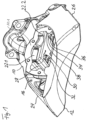
- the brake caliper shown has a caliper section 10 on the application side and a caliper section 12 on the rim side.
- the rim-side saddle section is (largely) closed, which contributes to the stable design.
- a brake disc projects into the first recess 14, so that part of the brake disc lies between the two caliper sections 10 and 12.
- the second recess 16 is used to mount/remove brake pads (also not shown in the drawing).
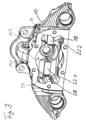
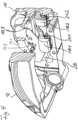
- a clamping shaft 18.1, 18.2 arranged inside the brake caliper 10, 12 is shown, which is located via bearings 20.1, 20.2 on support surfaces 22.1, 22.2 (cf. Figures 1 and 3 ) is supported, and when pivoting in the direction of rotation D, clamping parts mounted in front of it, such as a brake pad, press against the brake disc.
- the clamping shaft 18.1, 18.2 with a rotary lever 18.3 is part of a clamping device arranged in the brake caliper 10, 12, but not shown in detail, as used in commercial vehicle disc brakes. In this version, the rotary lever 18.3 is also preferably located inside the brake caliper 10, 12.
- the two saddle sections 10 and 12 are formed in one piece with each other. They are connected to one another via webs 24, 26, which, when installed, extend over the brake disc.
- Guide surfaces 28, 30, 32, 34, 36, 37, 38, 39 are provided for holding and / or guiding a pressure piece and / or the brake pad on the application side in the radial or circumferential direction of the brake disc.
- further guide surfaces can also be formed which serve additional purposes, namely, for example, holding and/or guiding a printing spindle device and/or a printing stamp device.
- the axial opening 10.2 also serves to later introduce the previously mentioned parts of the clamping device.
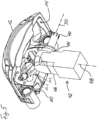
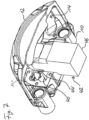
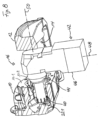
- a machining tool 40 in the form of an end mill with an L-shaped holder 42 is inserted from radially inside through the first recess 14 into the saddle interior.
- One leg 44 of the "L”, which carries the processing tool 40, is parallel to a main plane of the brake disc in the installed state. Insertion into the first recess is possible in this position because the leg 44 of the "L” is shorter than the length of the first recess. In a position rotated 90°, the leg 44 would not enter the first recess 14 fit because its length is greater than the width of the first recess 14.
- the guide surfaces 22.1 and 22.2 are flat.
- the support surfaces mentioned can also be designed in the manner of a channel with a circular arc-shaped contour.
- the processing tool 40 is moved out of the interior of the saddle again. The movements described above take place in the reverse order.
- the longitudinal axis of the leg 44 is designated by the reference number 50, cf. Figure 8 .
- the processing tool 40 with the L-shaped holder 42 is inserted into the first recess 14 in a position in which the longitudinal axis 50 of the leg 44 with the processing tool 40 is oblique with respect to the main plane 52 of the brake disc (not shown). is employed.
- the angle of attack ⁇ is approximately 55°, cf. Figure 9 (a) .
- the tool 40 is then moved translationally into the interior of the saddle. This is then done in accordance with Figure 9 (c) a pivoting of the holder 42 with the processing tool 40 with respect to the saddle about an axis perpendicular to the two longitudinal axes 48 and 50.
- the holder 42 can be pivoted with the processing tool 40 with respect to the saddle.
- the saddle can also be pivoted with respect to the aforementioned elements. Both can also be pivoted at the same time.
- Figure 9 (d) shows a state in which compared to the Figure 9 (c) has been pivoted even further.
- Figure 9 (f) shows the working position in which the support surfaces 22.1 and 22.2 are formed with the processing tool 40.
- the holder 42 with the processing tool 40 is moved out in the reverse order to the move in.
Landscapes
- Engineering & Computer Science (AREA)
- General Engineering & Computer Science (AREA)
- Mechanical Engineering (AREA)
- Braking Arrangements (AREA)
Description
- Die Erfindung betrifft ein Verfahren zum Herstellen einer Sattelscheibenbremse, insbesondere für Nutzfahrzeuge.
- Ein Verfahren der oben genannten Art ist bekannt, beispielsweise aus der
DE 195 15 063 C2 . Dabei wird ein Bearbeitungswerkzeug zum Ausbilden der Abstützfläche durch eine eigens dafür vorgesehene Arbeitsöffnung in das Innere des Sattels eingeführt. Vergleichbare Herstellungsverfahren sind bekannt aus derEP 1 881 472 A1 , aus derDE 10 2005 054 402 B4 sowie aus derDE 10 2007 001 960 A1 , die ein Verfahren gemäß dem Oberbergriff der Ansprüche 1 und 2 offenbart, und die sich auf dieselbe Bremse bezieht wie dieDE 10 2007 041 658 A1 . Das Ausbilden der Arbeitsöffnung zum Einführen des Bearbeitungswerkzeugs resultiert in einer Schwächung des Bremssattels. Darüber hinaus bedarf es zusätzlicher Maßnahmen, um die Arbeitsöffnung nach der Bearbeitung zu verschließen, wobei der Verschluß auch dicht sein muß. - Einen anderen Weg gehen die Lösungen nach der
EP 1 160 480 A2 und derUS 6,811,004 B1 . Hier wird die Abstützfläche an einem separaten Bauteil ausgebildet, das erst nach der abschließenden Bearbeitung in das Sattelinnere eingebracht und in einer großflächigen Öffnung am Sattelende verankert wird. Auch diese Lösung ist aufwendig und bereitet Abdichtprobleme. - Die
JP2004-353850 A1 - Schließlich zeigen die
WO 03/023244 A1 DE 698 24 731 T2 Lösungen, bei denen der Sattel geteilt ist, der zuspannseitige Sattelabschnitt mithin nicht einstückig mit dem felgenseitigen Sattelabschnitt ausgebildet ist. Dabei werden zum Ausbilden der Abstützfläche die beiden Sattelabschnitte voneinander getrennt, um die Zugänglichkeit zu gewährleisten. Bei dieser Lösung sind die Verbindungselemente zum Koppeln der beiden Sattelabschnitte miteinander im Betrieb erheblichen Belastungen ausgesetzt. - Demgegenüber bezieht sich die Erfindung auf eine Bremse mit einem einstückig ausgebildeten geschlossenen Sattel, dessen Inneres nur sehr schwer zugänglich ist.
- Der Erfindung liegt die Aufgabe zugrunde, das Herstellungsverfahren nach der
DE 195 15 063 C2 derart weiterzubilden, daß der Aufwand verringert ist, der Sattel nicht geschwächt ist und keine zusätzlichen Verbindungselemente erforderlich sind, die im Betrieb starken Belastungen ausgesetzt sind. - Erfindungsgemäß wird die gestellte Aufgabe durch das Herstellungsverfahren nach Anspruch 1 oder Anspruch 2 gelöst.
- Der Erfindung liegt dabei die Erkenntnis zugrunde, daß bei Verwendung der Ausnehmung, in die in eingebautem Zustand die Bremsscheibe hineinragt, um das Bearbeitungswerkzeug zum Ausbilden der Abstützfläche einzuführen, auch bei einem einstückig ausgebildeten Sattel eine zusätzliche Arbeitsöffnung nicht erforderlich ist und auch die Abstützfläche nicht außerhalb des Sattels ausgebildet werden muß.
- Nach der Erfindung kann das Bearbeitungswerkzeug auch durch die Montage-/ Demontageöffnung für den Bremsbelag in das Sattelinnere eingeführt werden, um die Abstützfläche auszubilden.
- Die Abstützfläche ist nach einer besonders bevorzugten Ausführungsform der Erfindung zumindest abschnittweise eben.
- Zusätzlich oder alternativ kann aber auch vorgesehen sein, daß die Abstützfläche zumindest-abschnittweise die Form einer Rinne hat.
- Weiter bevorzugt hat die Rinne eine bogenförmige, insbesondere eine kreisbogenförmige Kontur.
- Die Gestaltung der Abstützfläche hängt jeweils von den übrigen Gegebenheiten in der Bremse ab, insbesondere von der üblicherweise im Sattelinneren angeordneten Zuspanneinrichtung.
- Nach der Erfindung weist das Bearbeitungswerkzeug eine L-förmige Halterung auf und ist zum Verfahren in eine Arbeitsstellung translatorisch sowie rotatorisch um eine Achse in Richtung der Längserstreckung eines der Schenkel des "L" bezüglich des Sattels verstellbar.
- Wenn hier von Bewegungen bezüglich des Sattels die Rede ist, so können diese Bewegungen zum einen dadurch hervorgerufen werden, daß das Bearbeitungswerkzeug bewegt wird. Zusätzlich oder alternativ kann aber auch der Sattel bezüglich des Werkzeugs komplementäre Bewegungen ausführen. Selbstverständlich deckt die Erfindung auch Lösungen ab, bei denen sowohl das Bearbeitungswerkzeug als auch der Sattel bewegt bzw. verstellt werden. Das gilt auch für im folgenden beschriebene Bewegungen / Verstellungen.
- Erfindungsgemäß weiter bevorzugt ist vorgesehen, daß
in einem ersten Schritt der Schenkel des "L" mit dem Bearbeitungswerkzeug in die erste oder die zweite Ausnehmung gefahren wird, und zwar mit seiner Längsachse parallel zu der Hauptebene einer in eingebautem Zustand in die erste Ausnehmung hineinragenden Bremsscheibe,
in einem zweiten Schritt die Halterung um eine Achse in Richtung der Längserstrekkung des anderen Schenkels des "L" gedreht wird, so daß das Bearbeitungswerkzeug dem zuspannseitigen Sattelabschnitt zugewandt ist,
in einem dritten Schritt das Bearbeitungswerkzeug auf den zuspannseitigen Sattelabschnitt zu bewegt wird und
in einem vierten Schritt die Abstützfläche ausgebildet wird. - Mit anderen Worten wird das Bearbeitungswerkzeug angesichts der gegebenen Geometrie zunächst mit seitlicher Ausrichtung in die erste oder die zweite Ausnehmung und damit in das Sattelinnere eingebracht und erst dann in eine für die Bearbeitung der Abstützfläche geeignete Ausrichtung gedreht und zu der auszubildenden Abstützfläche hin gebracht. Dadurch wird der Schwierigkeit Rechnung getragen, daß die "Breite" der ersten und der zweiten Ausnehmung in aller Regel kleiner ist als die "Länge" des Schenkels des "L" mit dem Bearbeitungswerkzeug.
- Nach dieser Ausgestaltung wird das Problem, daß die Länge des Schenkels des "L" mit dem Bearbeitungswerkzeug größer als die Breite der ersten und der zweiten Ausnehmung ist, dadurch gelöst, daß das Bearbeitungwerkzeug "schräg" durch die erste oder zweite Ausnehmung in das Innere des Sattels eingeführt wird.
- Nach der Erfindung kann der Anstellwinkel 30° bis 80° betragen, bevorzugt 40° bis 70°, weiter bevorzugt 50° bis 60°.
- Die genaue Festlegung des Anstellwinkels ist dabei selbstverständlich von den jeweiligen geometrischen Gegebenheiten abhängig.
- Das erfindungsgemäße Verfahren deckt auch eine Version ab, bei der der zuspannseitige Sattelabschnitt mindestens eine Führungsfläche zum Halten und/oder Führen eines Bremsbelages, eines Druckstücks, mindestens einer Druckspindeleinrichtung und/oder mindestens einer Druckstempeleinrichtung in Radial- und/oder Umfangsrichtungen der Bremse aufweist, wobei vorgesehen ist, daß zum Ausbilden der Führungsfläche ein Bearbeitungswerkzeug durch die erste oder die zweite Ausnehm ung in denjenigen Bereich verbracht wird, in dem die Führungsfläche ausgebildet werden soll.
- Mit anderen Worten kann nach der Erfindung nicht nur vorgesehen sein, die Abstützfläche mit einem Bearbeitungswerkzeug auszubilden, das durch die erste oder die zweite Ausnehmung in das Sattelinnere eingeführt wird, sondern es gilt das gleiche auch für die Ausbildung einer Führungsfläche.
- Im folgenden ist die Erfindung anhand bevorzugter Ausführungsbeispiele unter Bezugnahme auf die beiliegende Zeichnung mit weiteren Einzelheiten näher erläutert. Dabei zeigen
- Figur 1
- eine perspektivische Ansicht eines bevorzugten Ausführungsbeispiels des erfindungsgemäßen Bremssattels, von der Felgenseite her gesehen,
- Figur 2
- die gleiche Ansicht wie
Figur 1 , jedoch von der Zuspannseite her gesehen, - Figur 3
- eine perspektivische Querschnittansicht auf den zuspannseitigen Abschnitt des Sattels,
- Figur 4
- eine perspektivische Längsschnittansicht des Sattels,
- Figur 5
- eine perspektivische Ansicht des Sattels von radial innen mit einem Bearbeitungswerkzeug,
- Figur 6
- die gleiche Ansicht wie
Figur 5 , jedoch mit dem Bearbeitungswerkzeug in einer fortgeschrittenen Position, - Figur 7
- die gleiche Ansicht wie
Figur 6 , jedoch mit dem Bearbeitungswerkzeug in einer noch weiter fortgeschrittenen Position, - Figur 8
- eine perspektivische Längsschnittansicht mit dem Bearbeitungswerkzeug in einer Arbeitsstellung,
- die Figuren 9(a) bis (f)
- schematische Schnittansichten zur Erläuterung eines alternativen Herstellungsverfahrens.
- Der in den
Figuren 1 bis 8 dargestellte Bremssattel weist einen zuspannseitigen Sattelabschnitt 10 und einen felgenseitigen Sattelabschnitt 12 auf. Der felgenseitige Sattelabschnitt ist (weitestgehend) geschlossen, was zur stabilen Ausbildung beiträgt. Zwischen den beiden Sattelabschnitten 10 und 12 liegt eine erste nach radial innen offene Ausnehmung 14, vgl. insbesondereFigur 5 . Ferner liegt zwischen den Sattelabschnitten 10 und 12 eine nach radial außen offene zweite Ausnehmung 16, vgl.Figur 1 . In eingebautem Zustand ragt eine (in der Zeichnung nicht gezeigte) Bremsscheibe in die erste Ausnehmung 14 hinein, so daß ein Teil der Bremsscheibe zwischen den beiden Sattelabschnitten 10 und 12 liegt. Die zweite Ausnehmung 16 dient zum Montieren / Demontieren von Bremsbelägen (ebenfalls in der Zeichnung nicht gezeigt). - In
Figur 4 ist eine im Inneren des Bremssattels 10, 12 angeordnete Zuspannwelle 18.1, 18.2 gezeigt, die sich über Lager 20.1, 20.2 an Abstützflächen 22.1, 22.2 (vgl.Figuren 1 und3 ) abstützt, und beim Verschwenken in Drehrichtung D davor gelagerte Zuspannteile, wie beispielsweise einen Bremsbelag, gegen die Bremsscheibe preßt. Die Zuspannwelle 18.1, 18.2 mit einem Drehhebel 18.3 ist Teil einer im Bremssattel 10, 12 angeordneten, aber nicht näher dargestellten Zuspanneinrichtung, wie sie bei Nutzfahrzeugscheibenbremsen verwendet wird. Auch der Drehhebel 18.3 liegt bei dieser Ausführung bevorzugt im Inneren des Bremssattels 10, 12. - Die beiden Sattelabschnitte 10 und 12 sind einstückig miteinander ausgebildet. Sie sind über Stege 24, 26 miteinander verbunden, die in eingebautem Zustand die Bremsscheibe übergreifen.
- Im Inneren des Sattels bzw. an dem zuspannseitigen Sattelabschnitt 10 sind gemäß
Figur 1 Führungsflächen 28, 30, 32, 34, 36, 37, 38, 39 zum Halten und/oder Führen eines Druckstücks und/oder des zuspannseitigen Bremsbelages in Radial- bzw. Umfangsrichtung der Bremsscheibe vorgesehen. Zusätzlich zu den gezeigten Führungsflächen können auch weitere Führungsflächen ausgebildet sein, die weiteren Zwecken dienen, nämlich beispielsweise dem Halten und/oder Führen einer Druckspindeleinrichtung und/oder einer Druckstempeleinrichtung. Bei der Ausführung/Lage und der Anzahl der Führungsflächen ist die Ausführung der Zuspanneinrichtung entscheidend. - Eine Flanschfläche 10.1 des zuspannseitigen Sattelschenkels 10, an der ein Verschlußrahmen angebracht werden kann, umläuft eine Axialöffnung 10.2, über die die Abstützflächen 22.1 und 22.2 zugänglich sind. Die Axialöffnung 10.2 dient auch dem späteren Einbringen der vorab erwähnten Teile der Zuspanneinrichtung.
- Im folgenden ist ein erstes Beispiel eines Verfahrens zum Ausbilden der Abstützflächen 22.1 und 22.2 beschrieben:
- Gemäß
Figur 5 wird ein Bearbeitungswerkzeug 40 in Form eines Stirnfräsers mit einer L-förmigen Halterung 42 von radial innen her durch die erste Ausnehmung 14 in das Sattelinnere eingeführt. Dabei steht ein Schenkel 44 des "L", der das Bearbeitungswerkzeug 40 trägt, parallel zu einer Hauptebene der Bremsscheibe in eingebautem Zustand. Das Einführen in die erste Ausnehmung ist in dieser Stellung möglich, weil der Schenkel 44 des "L" kürzer als die Länge der ersten Ausnehmung ist. In 90° dazu gedrehter Stellung würde der Schenkel 44 nicht in die erste Ausnehmung 14 passen, weil seine Länge größer als die Breite der ersten Ausnehmung 14 ist. - Nachdem also das Bearbeitungswerkzeug 40 in
Figur 5 nach oben und damit in den Innenraum des Sattels eingefahren worden ist und mithin die Stellung nachFigur 6 eingenommen hat, erfolgt eine Drehung um die Längsachse 48 des Schenkels 46, so daß der Schenkel 44 gemäßFigur 7 auf die Abstützflächen 22.1 und 22.2 zu gerichtet ist. Wie insbesondereFigur 8 zu entnehmen ist, kann in dieser Stellung die Ausbildung der Abstützflächen 22.1 und 22.2 unter Verwendung des als Bearbeitungswerkzeug 40 vorgesehenen Stirnfräsers erfolgen. Das Bearbeitungswerkzeug 40 läuft zur Bearbeitung die jeweils zu bearbeitende Fläche entlang. Es sei angemerkt, daß selbstverständlich alle Abstützflächen auch durchgängig oder auch als weitere Teilflächen ausgebildet sein können. - Bei dem gezeigten Ausführungsbeispiel sind die Führungsflächen 22.1 und 22.2 eben. Unter Verwendung beispielsweise eines Kugelkopffräsers als Bearbeitungswerkzeug können die genannten Abstützflächen auch nach Art einer Rinne mit kreisbogenförmiger Kontur ausgebildet werden.
- Nach Ausbildung der Abstützflächen 22.1 und 22.2 wird das Bearbeitungswerkzeug 40 wieder aus dem Inneren des Sattels herausgefahren. Dabei erfolgen die oben beschriebenen Bewegungen in umgekehrter Reihenfolge.
- Die Längsachse des Schenkels 44 ist mit der Bezugszahl 50 bezeichnet, vgl.
Figur 8 . - Im folgenden ist ein zweites Beispiel eines Verfahrens zum Ausbilden der Abstützflächen 22.1 und 22.2 unter Bezugnahme auf die
Figur 9 beschrieben. - Das Bearbeitungswerkzeug 40 mit dem L-förmigen Halter 42 wird anders als nach dem ersten Beispiel in einer Stellung in die erste Ausnehmung 14 eingeführt, in der die Längsachse 50 des Schenkels 44 mit dem Bearbeitungswerkzeug 40 schräg bezüglich der Hauptebene 52 der (nicht gezeigten) Bremsscheibe angestellt ist. In dem beschriebenen Ausführungsbeispiel beträgt der Anstellwinkel α ca. 55°, vgl.
Figur 9 (a) . - Gemäß
Figur 9 (b) wird das Werkzeug 40 danach translatorisch in den Innenraum des Sattels hineingefahren. Danach erfolgt gemäßFigur 9 (c) ein Verschwenken der Halterung 42 mit dem Bearbeitungswerkzeug 40 bezüglich des Sattels um eine auf den beiden Längsachsen 48 und 50 senkrecht stehende Achse. Dazu kann die Halterung 42 mit dem Bearbeitungswerkzeug 40 bezüglich des Sattels verschwenkt werden. Es kann aber auch der Sattel bezüglich der vorgenannten Elemente verschwenkt werden. Es können auch beide gleichzeitig verschwenkt werden. -
Figur 9 (d) zeigt einen Zustand, in dem gegenüber derFigur 9 (c) noch weiter verschwenkt worden ist. - Wie der
Figur 9 (e) zu entnehmen ist, wird daraufhin die Halterung 42 mit dem Bearbeitungswerkzeug 40 in der Zeichnung nach links, d.h. weiter in den Innenraum des Sattels hinein verschoben. -
Figur 9 (f) zeigt die Arbeitsstellung, in der mit dem Bearbeitungswerkzeug 40 die Abstützflächen 22.1 und 22.2 ausgebildet werden. - Das Herausfahren der Halterung 42 mit dem Bearbeitungswerkzeug 40 erfolgt in umgekehrter Reihenfolge wie das Hineinfahren.
- Die in der obigen Beschreibung, den Ansprüchen sowie der Zeichnung offenbarten Merkmale der Erfindung können sowohl einzeln als auch in beliebiger Kombination für die Verwirklichung der Erfindung in ihren verschiedenen Ausführungsformen wesentlich sein.
Claims (9)
- Verfahren zum Herstellen eines Sattels einer Sattelscheibenbremse, insbesondere für Nutzfahrzeuge, wobei der Sattel folgendes aufweist:einen zuspannseitigen Sattelabschnitt (10) mit mindestens einer Abstützfläche (22.1, 22.2) zum Aufnehmen von Klemmkräften beim Bremsen, einen einstückig mit dem zuspannseitigen Sattelabschnitt ausgeführten felgenseitigen Sattelabschnitt (12) und eine zwischen den beiden Sattelabschnitten liegende erste Ausnehmung (14), in die in eingebautem Zustand mindestens eine Bremsscheibe zumindest abschnittweise hineinragt, dadurch gekennzeichnet, dasszum Ausbilden der Abstützfläche ein Bearbeitungswerkzeug (40) durch die erste Ausnehmung in denjenigen Bereich verbracht wird, in dem die Abstützfläche ausgebildet werden soll, wobeidas Bearbeitungswerkzeug (40) eine L-förmige Halterung (42) aufweist und zum Verfahren in eine Arbeitsstellung translatorisch sowie rotatorisch um eine Achse (48) in Richtung der Längserstreckung eines der Schenkel des "L" und um eine senkrecht auf beiden Schenkeln (44, 46) des "L" stehende Achse bezüglich des Sattels verstellbar ist.
- Verfahren zum Herstellen eines Sattels einer Sattelscheibenbremse, insbesondere für Nutzfahrzeuge, wobei der Sattel folgendes aufweist:einen zuspannseitigen Sattelabschnitt (10) mit mindestens einer Abstützfläche (22.1, 22.2) zum Aufnehmen von Klemmkräften beim Bremsen,einen einstückig mit dem zuspannseitigen Sattelabschnitt ausgeführten felgenseitigen Sattelabschnitt (12) undeine zwischen den beiden Sattelabschnitten liegende zweite Ausnehmung (16) zum Montieren / Demontieren mindestens eines Bremsbelages,dadurch gekennzeichnet, dasszum Ausbilden der Abstützfläche ein Bearbeitungswerkzeug (40) durch die zweite Ausnehmung in denjenigen Bereich verbracht wird, in dem die Abstützfläche ausgebildet werden soll.
- Verfahren nach Anspruch 1 oder 2, dadurch gekennzeichnet, dass die Abstützfläche (22.1, 22.2) zumindest abschnittweise eben ist.
- Verfahren nach einem der vorangehenden Ansprüche, dadurch gekennzeichnet, dass die Abstützfläche zumindest abschnittweise die Form einer Rinne hat.
- Verfahren nach Anspruch 4, dadurch gekennzeichnet, dass die Rinne eine bogenförmige, insbesondere eine kreisbogenförmige Kontur hat.
- Verfahren nach einem der vorangehenden Ansprüche, dadurch gekennzeichnet, dass in einem ersten Schritt der Schenkel (44) des "L" mit dem Bearbeitungswerkzeug in die erste oder die zweite Ausnehmung (14, 16) gefahren wird, und zwar mit seiner Längsachse (50) parallel zu der Hauptebene einer in eingebautem Zustand in die erste Ausnehmung hineinragenden Bremsscheibe,in einem zweiten Schritt die Halterung um eine Achse (48) in Richtung der Längserstreckung des anderen Schenkels (44) des "L" gedreht wird, so dass das Bearbeitungswerkzeug (40) dem zuspannseitigen Sattelabschnitt (10) zugewandt ist,in einem dritten Schritt das Bearbeitungswerkzeug auf den zuspannseitigen Sattelabschnitt zu bewegt wird undin einem vierten Schritt die Abstützfläche (22.1, 22.2) ausgebildet wird.
- Verfahren nach einem der vorangehenden Ansprüche, dadurch gekennzeichnet, dass in einem ersten Schritt der Schenkel (44) des "L" mit dem Bearbeitungswerkzeug (40) in die erste oder die zweite Ausnehmung (14, 16) gefahren wird, und zwar mit seiner Längsachse (50) bezüglich der Hauptebene (52) einer in eingebautem Zustand in die erste Ausnehmung hineinragenden Bremsscheibe um einen vorbestimmten Winkel (α) angestellt,in einem zweiten Schritt das Bearbeitungswerkzeug (40) auf den zuspannseitigen Sattelabschnitt (10) zu bewegt wird,in einem dritten Schritt das Bearbeitungswerkzeug (40) um die auf beiden Schenkein (44, 46) des "L" senkrecht stehende Achse bezüglich des Sattels verschwenkt wird, so dass der Schenkel des "L" mit dem Bearbeitungswerkzeug mit seiner Längsachse (50) senkrecht zur Hauptebene (52) einer in eingebautem Zustand in die erste Ausnehmung hineinragenden Bremsscheibe steht undin einem vierten Schritt die Abstützfläche (22.1, 22.2) ausgebildet wird.
- Verfahren nach Anspruch 7, dadurch gekennzeichnet, dass der Anstellwinkel (a) 30° bis 80° beträgt, bevorzugt 40° bis 70°, weiter bevorzugt 50° bis 60°.
- Verfahren nach einem der vorangehenden Ansprüche, wobei der zuspannseitige Sattelabschnitt mindestens eine Führungsfläche (28, 30, 32, 34, 36, 37, 38, 39) zum Halten und/oder Führen eines Bremsbelages, eines Druckstücks, mindestens einer Druckspindeleinrichtung und/oder mindestens einer Druckstempeleinrichtung in Radial- und/oder Umfangsrichtungen der Bremsscheibe aufweist,
dadurch gekennzeichnet, dass
zum Ausbilden der Führungsfläche ein Bearbeitungswerkzeug durch die erste oder die zweite Ausnehmung (14, 16) in denjenigen Bereich verbracht wird, in dem die Führungsfläche ausgebildet werden soll.
Applications Claiming Priority (2)
| Application Number | Priority Date | Filing Date | Title |
|---|---|---|---|
| DE102008035753A DE102008035753A1 (de) | 2008-07-31 | 2008-07-31 | Verfahren zum Herstellen eines Bremssattels, Bearbeitungswerkzeug zum Ausführen des Verfahrens, mit dem Verfahren hergestellter Bremssattel sowie Scheibenbremse mit einem solchen Sattel |
| PCT/EP2009/005358 WO2010012414A1 (de) | 2008-07-31 | 2009-07-23 | Verfahren zum herstellen eines bremssattels, bearbeitungswerkzeug zum ausführen des verfahrens, mit dem verfahren hergestellter bremssattel sowie scheibenbremse mit einem solchen sattel |
Publications (3)
| Publication Number | Publication Date |
|---|---|
| EP2304261A1 EP2304261A1 (de) | 2011-04-06 |
| EP2304261B1 EP2304261B1 (de) | 2016-03-09 |
| EP2304261B2 true EP2304261B2 (de) | 2023-11-29 |
Family
ID=41016993
Family Applications (1)
| Application Number | Title | Priority Date | Filing Date |
|---|---|---|---|
| EP09777399.8A Active EP2304261B2 (de) | 2008-07-31 | 2009-07-23 | Verfahren zum herstellen eines bremssattels |
Country Status (6)
| Country | Link |
|---|---|
| US (1) | US20110127120A1 (de) |
| EP (1) | EP2304261B2 (de) |
| CN (1) | CN102119286A (de) |
| BR (1) | BRPI0911030A2 (de) |
| DE (1) | DE102008035753A1 (de) |
| WO (1) | WO2010012414A1 (de) |
Families Citing this family (15)
| Publication number | Priority date | Publication date | Assignee | Title |
|---|---|---|---|---|
| JP5492176B2 (ja) * | 2011-11-30 | 2014-05-14 | 曙ブレーキ工業株式会社 | キャリパボディ、キャリパボディのトルク受け部の溝加工方法 |
| DE102012004605B4 (de) | 2012-03-02 | 2023-03-30 | Knorr-Bremse Systeme für Nutzfahrzeuge GmbH | Verfahren und Werkzeug zur spanenden Bearbeitung von Lagerstellen in einem Bremssattel |
| DE102014115764A1 (de) * | 2014-10-30 | 2016-05-04 | Knorr-Bremse Systeme für Nutzfahrzeuge GmbH | Aus Gusseisen bestehender Bremssattel einer Scheibenbremse |
| DE102016115176A1 (de) | 2016-08-16 | 2018-02-22 | Bpw Bergische Achsen Kg | Verfahren zur Innenbearbeitung eines Bremssattels einer Scheibenbremse |
| DE102017102233A1 (de) | 2017-02-06 | 2018-08-09 | Bpw Bergische Achsen Kg | Verfahren zur Innenbearbeitung eines Bremssattels einer Scheibenbremse |
| IT201700079579A1 (it) * | 2017-07-14 | 2019-01-14 | Freni Brembo Spa | Assieme di pinza freno ed almeno una pastiglia |
| CN111587327A (zh) * | 2017-12-28 | 2020-08-25 | Zf主动安全美国股份公司 | 用于具有电动驻车制动器的盘式制动器组件的单向防旋转构件 |
| US10648522B2 (en) * | 2018-03-02 | 2020-05-12 | Arvinmeritor Technology, Llc | Brake caliper housing |
| EP3623656B1 (de) * | 2018-09-17 | 2021-01-27 | WABCO Europe BVBA | Bremssattel einer scheibenbremse für kraftfahrzeuge |
| WO2020253955A1 (de) * | 2019-06-19 | 2020-12-24 | Wabco Europe Bvba | Fahrzeugbremse, insbesondere nutzfahrzeug-druckluftscheibenbremse sowie druckstück für selbige |
| CN110985568A (zh) * | 2019-11-14 | 2020-04-10 | 浙江万安科技股份有限公司 | 钳体、钳体加工方法、具有该钳体的制动器装配方法 |
| CN115217864B (zh) * | 2021-04-20 | 2024-03-26 | 汉拿万都株式会社 | 卡钳制动器 |
| EP4160042A1 (de) * | 2021-09-30 | 2023-04-05 | Meritor Heavy Vehicle Braking Systems (UK) Limited | Werkzeugmaschinenkopf |
| DE102023103290B3 (de) | 2023-02-10 | 2024-07-18 | Hl Mando Corporation | Schwimmender Bremssattel mit plattenförmigem Bereich zum Anliegen an einem Bremsbelag sowie Werkzeug und Verfahren zur Bearbeitung desselben |
| US20250075756A1 (en) * | 2023-09-01 | 2025-03-06 | Arvinmeritor Technology, Llc | Single piston brake caliper housing and a method of manufacturing a single piston brake caliper housing |
Citations (4)
| Publication number | Priority date | Publication date | Assignee | Title |
|---|---|---|---|---|
| DE19515063C2 (de) † | 1995-04-27 | 2002-06-06 | Knorr Bremse Systeme | Scheibenbremse für Fahrzeuge, insbesondere Straßenfahrzeuge |
| JP2004353850A (ja) † | 2003-05-30 | 2004-12-16 | Tokico Ltd | ディスクブレーキキャリパの加工方法およびシリンダへの軸方向溝の加工方法 |
| DE102005006264B4 (de) † | 2004-11-30 | 2006-11-02 | Knorr-Bremse Systeme für Nutzfahrzeuge GmbH | Scheibenbremse, insbesondere für ein Nutzfahrzeug |
| WO2007077206A1 (en) † | 2006-01-05 | 2007-07-12 | Sunstar Engineering Pte. Ltd. | Improved method of manufacturing callipers for disc brakes |
Family Cites Families (28)
| Publication number | Priority date | Publication date | Assignee | Title |
|---|---|---|---|---|
| GB818077A (en) | 1956-04-10 | 1959-08-12 | Girling Ltd | Improvements relating to disc brakes for vehicles |
| US3540165A (en) * | 1968-08-05 | 1970-11-17 | Bendix Corp | Device for rotatably holding a braking member having opposed braking surfaces for machining said surfaces |
| US3967705A (en) | 1975-04-02 | 1976-07-06 | The Bendix Corporation | Application adjuster for disc brake |
| CA1030881A (en) | 1975-04-02 | 1978-05-09 | Donald D. Johannesen | Mechanically actuated disc brake |
| US4400859A (en) | 1980-12-23 | 1983-08-30 | Kearney & Trecker Corporation | Machining centers for machining tubular workpieces |
| JPS605406B2 (ja) * | 1981-09-03 | 1985-02-12 | 日産自動車株式会社 | 等速ジヨイントのレ−ス溝加工装置 |
| DE3330942A1 (de) * | 1982-09-17 | 1984-03-22 | Scharmann GmbH & Co, 4050 Mönchengladbach | Horizontal-, bohr- und fraesmaschine |
| US4638550A (en) * | 1982-09-17 | 1987-01-27 | Scharmann Gmbh & Co. | Horizontal drilling and milling machine |
| ES2004205A6 (es) * | 1986-02-01 | 1988-12-16 | Akebono Brake Ind | Metodo y aparato para la fabricacion a maquina de una mordaza de freno de disco |
| DE4101514C2 (de) | 1991-01-19 | 2002-03-21 | Continental Teves Ag & Co Ohg | Teilbelagscheibenbremse für die Radaufhängung eines Kraftfahrzeugs |
| US5632580A (en) * | 1995-03-31 | 1997-05-27 | The United States Of America As Represented By The Secretary Of The Navy | Milling machine extension |
| DE19636942C5 (de) | 1996-09-11 | 2010-07-29 | Wabco Radbremsen Gmbh | Gleitsattelscheibenbremse |
| GB9716363D0 (en) | 1997-08-02 | 1997-10-08 | Lucas Ind Plc | Improvements relating to disc brakes |
| SE522332C2 (sv) * | 2000-05-31 | 2004-02-03 | Haldex Brake Prod Ab | Förfarande för att montera en bromsmekanism i ett bromsok samt ett sådant bromsok |
| DE10139900A1 (de) | 2000-08-17 | 2004-08-12 | Knorr-Bremse Systeme für Nutzfahrzeuge GmbH | Scheibenbremse mit Schiebe- oder Schwenksattel |
| US6481542B2 (en) * | 2001-02-19 | 2002-11-19 | Meritor Heavy Vehicle Systems, Llc. | Brake adjuster |
| SE523555C2 (sv) | 2001-09-07 | 2004-04-27 | Haldex Brake Prod Ab | Modulformad skrivbroms för ett fordon |
| DE10152248B4 (de) * | 2001-10-23 | 2006-03-16 | Knorr-Bremse Systeme für Nutzfahrzeuge GmbH | Scheibenbremse mit elektromotorisch betätigtem Nachstellsystem |
| DE10219148C1 (de) | 2002-04-29 | 2003-09-18 | Wabco Perrot Bremsen Gmbh | Linearzuspannvorrichtung für eine Scheibenbremse |
| US6811044B2 (en) | 2002-09-26 | 2004-11-02 | Brian Walker | Shelf liner |
| DE102004002571B4 (de) * | 2003-04-28 | 2015-02-26 | Bpw Bergische Achsen Kg | Bremssattel für eine Scheibenbremse |
| US6811004B1 (en) | 2003-05-09 | 2004-11-02 | Arvinmeritor Technology, Llc | Vehicle brake assembly having a bearing block closure and method of assembly therefor |
| DE102004042574A1 (de) * | 2004-09-02 | 2006-03-30 | Knorr-Bremse Systeme für Nutzfahrzeuge GmbH | Scheibenbremse, insbesondere für Nutzfahrzeuge |
| US7326011B2 (en) | 2005-09-23 | 2008-02-05 | The Boeing Company | Contouring right angle head for complex machining |
| DE102005054402B4 (de) | 2005-11-15 | 2007-12-06 | Knorr-Bremse Systeme für Nutzfahrzeuge GmbH | Scheibenbremse, insbesondere für ein Nutzfahrzeug |
| DE102006033240B4 (de) | 2006-07-18 | 2016-03-24 | Lucas Varity S.R.O. | Befestigung des Firmenmarkenzeichens an dem Bremssattel einer Scheibenbremse |
| DE102007041658A1 (de) * | 2006-09-02 | 2008-03-13 | Bpw Bergische Achsen Kg | Fahrzeug-Scheibenbremse |
| DE102007001960A1 (de) * | 2007-01-13 | 2008-07-17 | Bpw Bergische Achsen Kg | Scheibenbremse |
-
2008
- 2008-07-31 DE DE102008035753A patent/DE102008035753A1/de not_active Ceased
-
2009
- 2009-07-23 CN CN2009801250124A patent/CN102119286A/zh active Pending
- 2009-07-23 WO PCT/EP2009/005358 patent/WO2010012414A1/de not_active Ceased
- 2009-07-23 US US13/056,115 patent/US20110127120A1/en not_active Abandoned
- 2009-07-23 EP EP09777399.8A patent/EP2304261B2/de active Active
- 2009-07-23 BR BRPI0911030A patent/BRPI0911030A2/pt not_active Application Discontinuation
Patent Citations (4)
| Publication number | Priority date | Publication date | Assignee | Title |
|---|---|---|---|---|
| DE19515063C2 (de) † | 1995-04-27 | 2002-06-06 | Knorr Bremse Systeme | Scheibenbremse für Fahrzeuge, insbesondere Straßenfahrzeuge |
| JP2004353850A (ja) † | 2003-05-30 | 2004-12-16 | Tokico Ltd | ディスクブレーキキャリパの加工方法およびシリンダへの軸方向溝の加工方法 |
| DE102005006264B4 (de) † | 2004-11-30 | 2006-11-02 | Knorr-Bremse Systeme für Nutzfahrzeuge GmbH | Scheibenbremse, insbesondere für ein Nutzfahrzeug |
| WO2007077206A1 (en) † | 2006-01-05 | 2007-07-12 | Sunstar Engineering Pte. Ltd. | Improved method of manufacturing callipers for disc brakes |
Also Published As
| Publication number | Publication date |
|---|---|
| CN102119286A (zh) | 2011-07-06 |
| BRPI0911030A2 (pt) | 2015-12-29 |
| EP2304261A1 (de) | 2011-04-06 |
| US20110127120A1 (en) | 2011-06-02 |
| WO2010012414A1 (de) | 2010-02-04 |
| EP2304261B1 (de) | 2016-03-09 |
| DE102008035753A1 (de) | 2010-02-04 |
Similar Documents
| Publication | Publication Date | Title |
|---|---|---|
| EP2304261B1 (de) | Verfahren zum herstellen eines bremssattels, bearbeitungswerkzeug zum ausführen des verfahrens, mit dem verfahren hergestellter bremssattel sowie scheibenbremse mit einem solchen sattel | |
| EP3020998B2 (de) | Scheibenbremse | |
| EP1989021A1 (de) | Verfahren und vorrichtung zur fertigbearbeitung von gebauten nocken- und exzenterwellen | |
| DE102004002571B4 (de) | Bremssattel für eine Scheibenbremse | |
| EP1171259B1 (de) | Verfahren und vorrichtung zum bruchtrennen eines werkstücks | |
| EP3027926B2 (de) | Scheibenbremse, insbesondere für nutzfahrzeuge, sowie bremsbelag einer solchen scheibenbremse | |
| WO2017036765A1 (de) | Scheibenbremse mit synchronisationseinheit | |
| DE3616695C2 (de) | Teilbelag-Scheibenbremse | |
| EP3109499B1 (de) | Scheibenbremse, insbesondere für nutzfahrzeuge | |
| EP1974150B1 (de) | Scheibenbremse | |
| EP3500769B2 (de) | Verfahren zur innenbearbeitung eines bremssattels einer scheibenbremse | |
| DE2635823A1 (de) | Scheibenbremse | |
| DE102012006700A1 (de) | Radlagerwerkzeug | |
| DE102023103290B3 (de) | Schwimmender Bremssattel mit plattenförmigem Bereich zum Anliegen an einem Bremsbelag sowie Werkzeug und Verfahren zur Bearbeitung desselben | |
| DE202011103889U1 (de) | Einrichtung an Portaldrehmaschinen zum Bearbeiten von Eisenbahnradsätzen mit Achslagergehäusen | |
| EP2519756B1 (de) | Bremssattel für ein fahrzeugbremssystem sowie verfahren und vorrichtung zum herstellen eines bremssattels | |
| DE102023120073A1 (de) | Aktorbaugruppe einer elektromechanischen Fahrzeugbremse und Verfahren zum Montieren eines Bremskolbens in einer Aktorbaugruppe | |
| DE2756856A1 (de) | Schwimmsattel-scheibenbremse | |
| DE102015000926B4 (de) | Verfahren zur Herstellung eines Bremssattels einer Scheibenbremse | |
| EP2813712B1 (de) | Kolbeneinheit eines Plungerzylinders | |
| DE102014220933B4 (de) | Werkzeug zur spanenden Bearbeitung von Werkstücken | |
| DE29709802U1 (de) | Vorrichtung zur Aufnahme und Halterung einer hohlzylindrischen Druckhülse | |
| DE102017102233A1 (de) | Verfahren zur Innenbearbeitung eines Bremssattels einer Scheibenbremse | |
| EP1525589B1 (de) | Verfahren und vorrichtung zum zerlegen eines steuerelementes eines siedewasserreaktors | |
| DE102004036614B3 (de) | Vorrichtung für eine Maschine zum Bearbeiten von Bremsscheiben |
Legal Events
| Date | Code | Title | Description |
|---|---|---|---|
| PUAI | Public reference made under article 153(3) epc to a published international application that has entered the european phase |
Free format text: ORIGINAL CODE: 0009012 |
|
| 17P | Request for examination filed |
Effective date: 20101206 |
|
| AK | Designated contracting states |
Kind code of ref document: A1 Designated state(s): AT BE BG CH CY CZ DE DK EE ES FI FR GB GR HR HU IE IS IT LI LT LU LV MC MK MT NL NO PL PT RO SE SI SK SM TR |
|
| AX | Request for extension of the european patent |
Extension state: AL BA RS |
|
| DAX | Request for extension of the european patent (deleted) | ||
| 17Q | First examination report despatched |
Effective date: 20130102 |
|
| GRAP | Despatch of communication of intention to grant a patent |
Free format text: ORIGINAL CODE: EPIDOSNIGR1 |
|
| INTG | Intention to grant announced |
Effective date: 20151008 |
|
| GRAS | Grant fee paid |
Free format text: ORIGINAL CODE: EPIDOSNIGR3 |
|
| GRAA | (expected) grant |
Free format text: ORIGINAL CODE: 0009210 |
|
| AK | Designated contracting states |
Kind code of ref document: B1 Designated state(s): AT BE BG CH CY CZ DE DK EE ES FI FR GB GR HR HU IE IS IT LI LT LU LV MC MK MT NL NO PL PT RO SE SI SK SM TR |
|
| REG | Reference to a national code |
Ref country code: GB Ref legal event code: FG4D Free format text: NOT ENGLISH |
|
| REG | Reference to a national code |
Ref country code: AT Ref legal event code: REF Ref document number: 779770 Country of ref document: AT Kind code of ref document: T Effective date: 20160315 Ref country code: CH Ref legal event code: EP |
|
| REG | Reference to a national code |
Ref country code: IE Ref legal event code: FG4D Free format text: LANGUAGE OF EP DOCUMENT: GERMAN |
|
| REG | Reference to a national code |
Ref country code: DE Ref legal event code: R096 Ref document number: 502009012218 Country of ref document: DE |
|
| REG | Reference to a national code |
Ref country code: SE Ref legal event code: TRGR |
|
| RAP2 | Party data changed (patent owner data changed or rights of a patent transferred) |
Owner name: WABCO EUROPE BVBA |
|
| REG | Reference to a national code |
Ref country code: LT Ref legal event code: MG4D |
|
| REG | Reference to a national code |
Ref country code: NL Ref legal event code: MP Effective date: 20160309 |
|
| REG | Reference to a national code |
Ref country code: FR Ref legal event code: PLFP Year of fee payment: 8 |
|
| PG25 | Lapsed in a contracting state [announced via postgrant information from national office to epo] |
Ref country code: HR Free format text: LAPSE BECAUSE OF FAILURE TO SUBMIT A TRANSLATION OF THE DESCRIPTION OR TO PAY THE FEE WITHIN THE PRESCRIBED TIME-LIMIT Effective date: 20160309 Ref country code: GR Free format text: LAPSE BECAUSE OF FAILURE TO SUBMIT A TRANSLATION OF THE DESCRIPTION OR TO PAY THE FEE WITHIN THE PRESCRIBED TIME-LIMIT Effective date: 20160610 Ref country code: FI Free format text: LAPSE BECAUSE OF FAILURE TO SUBMIT A TRANSLATION OF THE DESCRIPTION OR TO PAY THE FEE WITHIN THE PRESCRIBED TIME-LIMIT Effective date: 20160309 Ref country code: NO Free format text: LAPSE BECAUSE OF FAILURE TO SUBMIT A TRANSLATION OF THE DESCRIPTION OR TO PAY THE FEE WITHIN THE PRESCRIBED TIME-LIMIT Effective date: 20160609 Ref country code: ES Free format text: LAPSE BECAUSE OF FAILURE TO SUBMIT A TRANSLATION OF THE DESCRIPTION OR TO PAY THE FEE WITHIN THE PRESCRIBED TIME-LIMIT Effective date: 20160309 |
|
| PG25 | Lapsed in a contracting state [announced via postgrant information from national office to epo] |
Ref country code: PL Free format text: LAPSE BECAUSE OF FAILURE TO SUBMIT A TRANSLATION OF THE DESCRIPTION OR TO PAY THE FEE WITHIN THE PRESCRIBED TIME-LIMIT Effective date: 20160309 Ref country code: LT Free format text: LAPSE BECAUSE OF FAILURE TO SUBMIT A TRANSLATION OF THE DESCRIPTION OR TO PAY THE FEE WITHIN THE PRESCRIBED TIME-LIMIT Effective date: 20160309 Ref country code: NL Free format text: LAPSE BECAUSE OF FAILURE TO SUBMIT A TRANSLATION OF THE DESCRIPTION OR TO PAY THE FEE WITHIN THE PRESCRIBED TIME-LIMIT Effective date: 20160309 Ref country code: LV Free format text: LAPSE BECAUSE OF FAILURE TO SUBMIT A TRANSLATION OF THE DESCRIPTION OR TO PAY THE FEE WITHIN THE PRESCRIBED TIME-LIMIT Effective date: 20160309 |
|
| REG | Reference to a national code |
Ref country code: GB Ref legal event code: 732E Free format text: REGISTERED BETWEEN 20160901 AND 20160907 |
|
| PG25 | Lapsed in a contracting state [announced via postgrant information from national office to epo] |
Ref country code: EE Free format text: LAPSE BECAUSE OF FAILURE TO SUBMIT A TRANSLATION OF THE DESCRIPTION OR TO PAY THE FEE WITHIN THE PRESCRIBED TIME-LIMIT Effective date: 20160309 Ref country code: IS Free format text: LAPSE BECAUSE OF FAILURE TO SUBMIT A TRANSLATION OF THE DESCRIPTION OR TO PAY THE FEE WITHIN THE PRESCRIBED TIME-LIMIT Effective date: 20160709 |
|
| PG25 | Lapsed in a contracting state [announced via postgrant information from national office to epo] |
Ref country code: CZ Free format text: LAPSE BECAUSE OF FAILURE TO SUBMIT A TRANSLATION OF THE DESCRIPTION OR TO PAY THE FEE WITHIN THE PRESCRIBED TIME-LIMIT Effective date: 20160309 Ref country code: RO Free format text: LAPSE BECAUSE OF FAILURE TO SUBMIT A TRANSLATION OF THE DESCRIPTION OR TO PAY THE FEE WITHIN THE PRESCRIBED TIME-LIMIT Effective date: 20160309 Ref country code: SM Free format text: LAPSE BECAUSE OF FAILURE TO SUBMIT A TRANSLATION OF THE DESCRIPTION OR TO PAY THE FEE WITHIN THE PRESCRIBED TIME-LIMIT Effective date: 20160309 Ref country code: PT Free format text: LAPSE BECAUSE OF FAILURE TO SUBMIT A TRANSLATION OF THE DESCRIPTION OR TO PAY THE FEE WITHIN THE PRESCRIBED TIME-LIMIT Effective date: 20160711 Ref country code: SK Free format text: LAPSE BECAUSE OF FAILURE TO SUBMIT A TRANSLATION OF THE DESCRIPTION OR TO PAY THE FEE WITHIN THE PRESCRIBED TIME-LIMIT Effective date: 20160309 |
|
| REG | Reference to a national code |
Ref country code: DE Ref legal event code: R026 Ref document number: 502009012218 Country of ref document: DE |
|
| PLBI | Opposition filed |
Free format text: ORIGINAL CODE: 0009260 |
|
| PLBI | Opposition filed |
Free format text: ORIGINAL CODE: 0009260 |
|
| PG25 | Lapsed in a contracting state [announced via postgrant information from national office to epo] |
Ref country code: BE Free format text: LAPSE BECAUSE OF NON-PAYMENT OF DUE FEES Effective date: 20160731 Ref country code: IT Free format text: LAPSE BECAUSE OF FAILURE TO SUBMIT A TRANSLATION OF THE DESCRIPTION OR TO PAY THE FEE WITHIN THE PRESCRIBED TIME-LIMIT Effective date: 20160309 |
|
| 26 | Opposition filed |
Opponent name: BPW BERGISCHE ACHSEN KG Effective date: 20161207 |
|
| PLAX | Notice of opposition and request to file observation + time limit sent |
Free format text: ORIGINAL CODE: EPIDOSNOBS2 |
|
| 26 | Opposition filed |
Opponent name: KNORR-BREMSE SYSTEME FUER NUTZFAHRZEUGE GMBH Effective date: 20161208 |
|
| PG25 | Lapsed in a contracting state [announced via postgrant information from national office to epo] |
Ref country code: DK Free format text: LAPSE BECAUSE OF FAILURE TO SUBMIT A TRANSLATION OF THE DESCRIPTION OR TO PAY THE FEE WITHIN THE PRESCRIBED TIME-LIMIT Effective date: 20160309 |
|
| PG25 | Lapsed in a contracting state [announced via postgrant information from national office to epo] |
Ref country code: BG Free format text: LAPSE BECAUSE OF FAILURE TO SUBMIT A TRANSLATION OF THE DESCRIPTION OR TO PAY THE FEE WITHIN THE PRESCRIBED TIME-LIMIT Effective date: 20160609 |
|
| REG | Reference to a national code |
Ref country code: CH Ref legal event code: PL |
|
| PG25 | Lapsed in a contracting state [announced via postgrant information from national office to epo] |
Ref country code: MC Free format text: LAPSE BECAUSE OF FAILURE TO SUBMIT A TRANSLATION OF THE DESCRIPTION OR TO PAY THE FEE WITHIN THE PRESCRIBED TIME-LIMIT Effective date: 20160309 |
|
| PG25 | Lapsed in a contracting state [announced via postgrant information from national office to epo] |
Ref country code: CH Free format text: LAPSE BECAUSE OF NON-PAYMENT OF DUE FEES Effective date: 20160731 Ref country code: LI Free format text: LAPSE BECAUSE OF NON-PAYMENT OF DUE FEES Effective date: 20160731 |
|
| REG | Reference to a national code |
Ref country code: IE Ref legal event code: MM4A |
|
| PLBB | Reply of patent proprietor to notice(s) of opposition received |
Free format text: ORIGINAL CODE: EPIDOSNOBS3 |
|
| PG25 | Lapsed in a contracting state [announced via postgrant information from national office to epo] |
Ref country code: SI Free format text: LAPSE BECAUSE OF FAILURE TO SUBMIT A TRANSLATION OF THE DESCRIPTION OR TO PAY THE FEE WITHIN THE PRESCRIBED TIME-LIMIT Effective date: 20160309 |
|
| REG | Reference to a national code |
Ref country code: FR Ref legal event code: PLFP Year of fee payment: 9 |
|
| PG25 | Lapsed in a contracting state [announced via postgrant information from national office to epo] |
Ref country code: IE Free format text: LAPSE BECAUSE OF NON-PAYMENT OF DUE FEES Effective date: 20160723 |
|
| PG25 | Lapsed in a contracting state [announced via postgrant information from national office to epo] |
Ref country code: LU Free format text: LAPSE BECAUSE OF NON-PAYMENT OF DUE FEES Effective date: 20160723 |
|
| REG | Reference to a national code |
Ref country code: AT Ref legal event code: MM01 Ref document number: 779770 Country of ref document: AT Kind code of ref document: T Effective date: 20160723 |
|
| PG25 | Lapsed in a contracting state [announced via postgrant information from national office to epo] |
Ref country code: AT Free format text: LAPSE BECAUSE OF NON-PAYMENT OF DUE FEES Effective date: 20160723 |
|
| PG25 | Lapsed in a contracting state [announced via postgrant information from national office to epo] |
Ref country code: HU Free format text: LAPSE BECAUSE OF FAILURE TO SUBMIT A TRANSLATION OF THE DESCRIPTION OR TO PAY THE FEE WITHIN THE PRESCRIBED TIME-LIMIT; INVALID AB INITIO Effective date: 20090723 Ref country code: CY Free format text: LAPSE BECAUSE OF FAILURE TO SUBMIT A TRANSLATION OF THE DESCRIPTION OR TO PAY THE FEE WITHIN THE PRESCRIBED TIME-LIMIT Effective date: 20160309 |
|
| PG25 | Lapsed in a contracting state [announced via postgrant information from national office to epo] |
Ref country code: MT Free format text: LAPSE BECAUSE OF FAILURE TO SUBMIT A TRANSLATION OF THE DESCRIPTION OR TO PAY THE FEE WITHIN THE PRESCRIBED TIME-LIMIT Effective date: 20160309 Ref country code: TR Free format text: LAPSE BECAUSE OF FAILURE TO SUBMIT A TRANSLATION OF THE DESCRIPTION OR TO PAY THE FEE WITHIN THE PRESCRIBED TIME-LIMIT Effective date: 20160309 Ref country code: MK Free format text: LAPSE BECAUSE OF FAILURE TO SUBMIT A TRANSLATION OF THE DESCRIPTION OR TO PAY THE FEE WITHIN THE PRESCRIBED TIME-LIMIT Effective date: 20160309 |
|
| REG | Reference to a national code |
Ref country code: FR Ref legal event code: PLFP Year of fee payment: 10 |
|
| APBM | Appeal reference recorded |
Free format text: ORIGINAL CODE: EPIDOSNREFNO |
|
| APBP | Date of receipt of notice of appeal recorded |
Free format text: ORIGINAL CODE: EPIDOSNNOA2O |
|
| APAH | Appeal reference modified |
Free format text: ORIGINAL CODE: EPIDOSCREFNO |
|
| APBM | Appeal reference recorded |
Free format text: ORIGINAL CODE: EPIDOSNREFNO |
|
| APBP | Date of receipt of notice of appeal recorded |
Free format text: ORIGINAL CODE: EPIDOSNNOA2O |
|
| APBQ | Date of receipt of statement of grounds of appeal recorded |
Free format text: ORIGINAL CODE: EPIDOSNNOA3O |
|
| APBQ | Date of receipt of statement of grounds of appeal recorded |
Free format text: ORIGINAL CODE: EPIDOSNNOA3O |
|
| PGFP | Annual fee paid to national office [announced via postgrant information from national office to epo] |
Ref country code: SE Payment date: 20190725 Year of fee payment: 11 |
|
| REG | Reference to a national code |
Ref country code: SE Ref legal event code: EUG |
|
| RAP4 | Party data changed (patent owner data changed or rights of a patent transferred) |
Owner name: ZF CV SYSTEMS EUROPE BV |
|
| PG25 | Lapsed in a contracting state [announced via postgrant information from national office to epo] |
Ref country code: SE Free format text: LAPSE BECAUSE OF NON-PAYMENT OF DUE FEES Effective date: 20200724 |
|
| PLAB | Opposition data, opponent's data or that of the opponent's representative modified |
Free format text: ORIGINAL CODE: 0009299OPPO |
|
| R26 | Opposition filed (corrected) |
Opponent name: BPW BERGISCHE ACHSEN KG Effective date: 20161207 |
|
| APBU | Appeal procedure closed |
Free format text: ORIGINAL CODE: EPIDOSNNOA9O |
|
| REG | Reference to a national code |
Ref country code: FR Ref legal event code: PLFP Year of fee payment: 14 |
|
| PLAY | Examination report in opposition despatched + time limit |
Free format text: ORIGINAL CODE: EPIDOSNORE2 |
|
| PLBC | Reply to examination report in opposition received |
Free format text: ORIGINAL CODE: EPIDOSNORE3 |
|
| PLAB | Opposition data, opponent's data or that of the opponent's representative modified |
Free format text: ORIGINAL CODE: 0009299OPPO |
|
| R26 | Opposition filed (corrected) |
Opponent name: BPW BERGISCHE ACHSEN KG Effective date: 20161207 |
|
| PLAT | Information related to reply to examination report in opposition deleted |
Free format text: ORIGINAL CODE: EPIDOSDORE3 |
|
| REG | Reference to a national code |
Ref country code: DE Ref legal event code: R081 Ref document number: 502009012218 Country of ref document: DE Owner name: ZF CV SYSTEMS EUROPE BV, BE Free format text: FORMER OWNER: WABCO RADBREMSEN GMBH, 68229 MANNHEIM, DE |
|
| P01 | Opt-out of the competence of the unified patent court (upc) registered |
Effective date: 20230528 |
|
| PUAH | Patent maintained in amended form |
Free format text: ORIGINAL CODE: 0009272 |
|
| STAA | Information on the status of an ep patent application or granted ep patent |
Free format text: STATUS: PATENT MAINTAINED AS AMENDED |
|
| 27A | Patent maintained in amended form |
Effective date: 20231129 |
|
| AK | Designated contracting states |
Kind code of ref document: B2 Designated state(s): AT BE BG CH CY CZ DE DK EE ES FI FR GB GR HR HU IE IS IT LI LT LU LV MC MK MT NL NO PL PT RO SE SI SK SM TR |
|
| REG | Reference to a national code |
Ref country code: DE Ref legal event code: R102 Ref document number: 502009012218 Country of ref document: DE |
|
| PGFP | Annual fee paid to national office [announced via postgrant information from national office to epo] |
Ref country code: GB Payment date: 20250529 Year of fee payment: 17 |
|
| PGFP | Annual fee paid to national office [announced via postgrant information from national office to epo] |
Ref country code: FR Payment date: 20250610 Year of fee payment: 17 |
|
| PGFP | Annual fee paid to national office [announced via postgrant information from national office to epo] |
Ref country code: DE Payment date: 20250604 Year of fee payment: 17 |