EP2299677B1 - Bilderzeugungsvorrichtung und Steuerverfahren dafür - Google Patents
Bilderzeugungsvorrichtung und Steuerverfahren dafür Download PDFInfo
- Publication number
- EP2299677B1 EP2299677B1 EP10158174.2A EP10158174A EP2299677B1 EP 2299677 B1 EP2299677 B1 EP 2299677B1 EP 10158174 A EP10158174 A EP 10158174A EP 2299677 B1 EP2299677 B1 EP 2299677B1
- Authority
- EP
- European Patent Office
- Prior art keywords
- image forming
- forming apparatus
- volatile memory
- power saving
- saving mode
- Prior art date
- Legal status (The legal status is an assumption and is not a legal conclusion. Google has not performed a legal analysis and makes no representation as to the accuracy of the status listed.)
- Not-in-force
Links
Images


Classifications
-
- G—PHYSICS
- G06—COMPUTING OR CALCULATING; COUNTING
- G06F—ELECTRIC DIGITAL DATA PROCESSING
- G06F1/00—Details not covered by groups G06F3/00 - G06F13/00 and G06F21/00
- G06F1/26—Power supply means, e.g. regulation thereof
- G06F1/32—Means for saving power
- G06F1/3203—Power management, i.e. event-based initiation of a power-saving mode
- G06F1/3234—Power saving characterised by the action undertaken
-
- H—ELECTRICITY
- H04—ELECTRIC COMMUNICATION TECHNIQUE
- H04N—PICTORIAL COMMUNICATION, e.g. TELEVISION
- H04N1/00—Scanning, transmission or reproduction of documents or the like, e.g. facsimile transmission; Details thereof
- H04N1/00885—Power supply means, e.g. arrangements for the control of power supply to the apparatus or components thereof
-
- G—PHYSICS
- G06—COMPUTING OR CALCULATING; COUNTING
- G06F—ELECTRIC DIGITAL DATA PROCESSING
- G06F3/00—Input arrangements for transferring data to be processed into a form capable of being handled by the computer; Output arrangements for transferring data from processing unit to output unit, e.g. interface arrangements
- G06F3/12—Digital output to print unit, e.g. line printer, chain printer
- G06F3/1296—Printer job scheduling or printer resource handling
-
- H—ELECTRICITY
- H04—ELECTRIC COMMUNICATION TECHNIQUE
- H04N—PICTORIAL COMMUNICATION, e.g. TELEVISION
- H04N1/00—Scanning, transmission or reproduction of documents or the like, e.g. facsimile transmission; Details thereof
- H04N1/00885—Power supply means, e.g. arrangements for the control of power supply to the apparatus or components thereof
- H04N1/00888—Control thereof
- H04N1/00896—Control thereof using a low-power mode, e.g. standby
-
- H—ELECTRICITY
- H04—ELECTRIC COMMUNICATION TECHNIQUE
- H04N—PICTORIAL COMMUNICATION, e.g. TELEVISION
- H04N2201/00—Indexing scheme relating to scanning, transmission or reproduction of documents or the like, and to details thereof
- H04N2201/0077—Types of the still picture apparatus
- H04N2201/0094—Multifunctional device, i.e. a device capable of all of reading, reproducing, copying, facsimile transception, file transception
Definitions
- aspects relate to an image forming apparatus and a controlling method thereof, and more particularly, to an image forming apparatus which is capable of reducing power consumption in a standby state and a controlling method thereof.
- An image forming apparatus refers to an apparatus which generates, prints, receives, and transmits image data, and includes a printer, a scanner, a copier, a facsimile machine and a multifunction peripheral (MFP) incorporating the functions of the aforementioned devices into a single device.
- MFP multifunction peripheral
- the standby power refers to power which is always consumed regardless of the normal operation of the image forming apparatus.
- US 2009/207423 A1 and US 2009/125739 disclose information processing apparatuses having a power saving mode.
- aspects provide an image forming apparatus which determines whether it is in a standby state or not and enters standby modes of different power consumption levels in a stepwise manner according to a result of determination, and a controlling method thereof.
- an image forming apparatus including: an engine unit to execute an image forming job, a determination unit to determine whether the image forming apparatus is in a standby state or not, based on whether the standby state to wait for execution of the image forming job is maintained for a predetermined time or not, and a controller to control the image forming apparatus to operate in a first power saving mode if it is determined that the image forming apparatus is in the standby state, wherein, in the first power saving mode, information stored in a volatile memory is copied to an internal memory and operation frequencies of a CPU, the volatile memory, and a functional unit are lowered.
- the determination unit may repeatedly determine whether the image forming apparatus is in the standby state or not.
- the controller may control the image forming apparatus to operate in a second power saving mode in which the CPU is set to use the information copied to the internal memory and the volatile memory enters an idle mode.
- the controller may control the image forming apparatus to operate in a third power saving mode in which power supplied to the volatile memory and an operation module is interrupted and the operation frequency of the CPU is lowered.
- the image forming apparatus may further include a PLL unit to generate operation frequency and provide the operation frequency to the CPU, the volatile memory, and the functional unit.
- the internal memory may be a memory that stores information necessary for driving the functional unit in a normal state in which the image forming job is executed, and, in the first power saving mode, information stored in the volatile memory of the normal state may be copied to the internal memory.
- the determination unit may determine whether an external signal requesting the image forming apparatus to operate in a normal state to execute the image forming job is input or not, and, if it is determined that the external signal indicates the normal state, the controller may change the operation frequencies of the CPU and the volatile memory to normal operation frequencies in response to the external signal.
- the determination unit may determine whether an external signal requesting the image forming apparatus to operate in a normal state to execute the image forming job is input or not, and, if it is determined that the external signal indicates the normal state, the controller may change the operation frequencies of the CPU and the volatile memory to normal operation frequencies, and may set the volatile memory to be in an operation mode in response to the external signal.
- the determination unit may determine whether an external signal requesting the image forming apparatus to operate in a normal state to execute the image forming job is input or not, and, if it is determined that the external signal indicates the normal state, the controller may change the operation frequencies of the CPU and the volatile memory to normal operation frequencies, supply power to the volatile memory and the operation module, and copy information necessary for operating in the normal state from the non-volatile memory to the volatile memory.
- a controlling method of an image forming apparatus including: determining whether the image forming apparatus is in a standby state or not, based on whether the standby state to wait for execution of an image forming job is maintained for a predetermined time or not, and if it is determined that the image forming apparatus is in the standby state, entering a first power saving mode in which information stored in a volatile memory is copied to an internal memory and operation frequencies of a CPU, the volatile memory, and a functional unit are lowered.
- the determining operation it may be repeatedly determined whether the image forming apparatus is in the standby state or not.
- the entering may include entering a second power saving mode in which the CPU is set to use the information copied to the internal memory and the volatile memory enters an idle mode.
- the entering may include entering a third power saving mode in which power supplied to the volatile memory and an operation module is interrupted and the operation frequency of the CPU is lowered.
- the internal memory may be a memory that stores information necessary for driving the functional unit in a normal state in which the image forming job is executed, and, in the first power saving mode, information stored in the volatile memory may be copied to the internal memory.
- the controlling method may further include: determining whether an external signal requesting the image forming apparatus to operate in a normal state to execute the image forming job is input or not, and, if it is determined that the external signal indicates the normal state, changing the operation frequencies of the CPU and the volatile memory to normal operation frequencies in response to the external signal.
- the controlling method may further include: determining whether an external signal requesting the image forming apparatus to operate in a normal state to execute the image forming job is input or not, and, if it is determined that the external signal indicates the normal state, changing the operation frequencies of the CPU and the volatile memory to normal operation frequencies, and setting the volatile memory to be in an operation mode in response to the external signal.
- the controlling method may further include: determining whether an external signal requesting the image forming apparatus to operate in a normal state to execute the image forming job is input or not, and, if it is determined that the external signal indicates the normal state, changing the operation frequencies of the CPU and the volatile memory to normal operation frequencies, supplying power to the volatile memory and the operation module, and copying information from the non-volatile memory to the volatile memory.
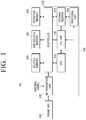
- FIG. 1 is a block diagram illustrating an image forming apparatus according to an exemplary embodiment.
- an image forming apparatus 100 includes an engine unit 110, a determination unit 120, a controller 130, a CPU 140, a phase-locked loop (PLL) unit 150, a functional unit 160, an internal memory 170, a volatile memory 180, a non-volatile memory 185, and an operation module 190.
- PLL phase-locked loop
- the determination unit 120, the controller 130, the CPU 140, the PLL unit 150, the internal memory 160, and the functional unit 170 constitute an application-specific integrated circuit (ASIC) unit 200 to perform their associated operations.
- the ASIC unit 200 may be realized as a single chip such as an ASIC chip.
- the engine unit 110 performs an image forming job such as printing, scanning, and copying.
- the determination unit 120 determines whether the image forming apparatus 100 is in a standby state to wait for execution of an image forming job or not.
- the standby state may include various power saving modes according to power consumption levels.
- the determination unit 120 may operate even in the standby state.
- the determination unit 120 may determine whether the image forming apparatus 100 is in a normal state (operation state) or not.
- the determination unit 120 may include a communication interface (not shown) and the external signal may be an interrupt signal which is input from a host device (not shown) or a USB memory.
- the determination unit 120 repeatedly determines whether the image forming apparatus is in the standby state or not in order to enter the various power saving modes in a stepwise manner. For example, the image forming apparatus 100 enters a first power saving mode, a second power saving mode, and a third power saving mode in a stepwise manner. In this case, the power consumption can be further reduced in the second power saving mode than in the first power saving mode and can be still further reduced in the third power saving mode than in the second power saving mode.
- the controller 130 controls the image forming apparatus 100 to operate in the first power saving mode in which information stored in the volatile memory 180 is copied to the internal memory 170 and operation frequencies of the CPU 140, the volatile memory 180 and the functional unit 160 are lowered.
- the controller 130 controls the image forming apparatus 100 to operate in the second power saving mode in which the CPU 140 uses the information copied to the internal memory 170 and the volatile memory 180 enters an idle mode.
- the controller 130 controls the image forming apparatus 100 to operate in the third power saving mode in which the power supplied to the volatile memory 180 and the operation module 190 is interrupted and the operation frequency of the CPU 140 is lowered.
- the controller 130 changes the operation frequencies of the CPU 140 and the volatile memory 180 to normal operation frequencies.
- the controller 130 changes the operation frequencies of the CPU 140 and the volatile memory 180 to normal operation frequencies, and changes the mode of the volatile memory 180 from the idle mode to an operation mode.
- the controller 130 changes the operation frequencies of the CPU 140 and the volatile memory 180 to normal operation frequencies, supplies power to the volatile memory 180 and the operation module 190, and copies information necessary for normal operation from the non-volatile memory 185 to the volatile memory 180.
- the CPU 140 controls overall operation of the components of the ASIC chip.
- the controller 130 controls the operation frequency of the CPU 140 to be lowered in the first power saving mode and the third power saving mode.
- the operation frequency in the third power saving mode is lower than in the first power saving mode.
- the PLL unit 150 generates various operation frequencies and provides them to the components of the ASIC unit 200, such as the CPU 140, the volatile memory 180, and the functional unit 160.
- the functional unit 160 a functional device, performs various functions, such as image processing to execute an image forming job in the operation state and motor driving speed controlling.
- a plurality of functional units 160 may be provided according to the operations to be performed.
- the internal memory 170 is disposed in the ASIC unit 200.
- the internal memory 170 may store information necessary for executing the function of the functional unit 160 if the image forming apparatus 100 is in the operation state to execute an image forming job. However, if the image forming apparatus is in the standby state such as the first power saving mode, the information which is stored in the volatile memory 180 in the operation state is copied to and stored in the internal memory 170.
- the internal memory 170 may be realized as a static random access memory (SRAM).
- the volatile memory 180 is disposed outside the ASIC unit 200 and the CPU 140 reads out information from the volatile memory 180 and performs overall controlling operation in the operation state.
- the volatile memory 180 enters a self-refresh mode, that is, an idle mode to perform refreshing by itself. Accordingly, the volatile memory 180 is not required to receive a refresh command to perform refreshing at predetermined intervals from the controller 130.
- the volatile memory 180 may be realized as a dynamic random access memory (DRAM).
- DRAM dynamic random access memory
- the non-volatile memory 185 is disposed outside the ASIC unit 200 and may be realized as a read-only memory (ROM).
- ROM read-only memory
- the non-volatile memory 185 In order to enter the operation state by supplying power to the volatile memory 180 and the operation module 190 which are turned off in the third power saving mode, the non-volatile memory 185 provides information which is necessary for entering the operation state to the volatile memory 180.
- the operation module 190 may be a printing module, a scanning module, and a copying module, and also may be a module to execute an image forming job. Since the operation module 190 is not required to operate in the standby state such as the third power saving mode, the controller 130 interrupts power supplied to the operation module 190.
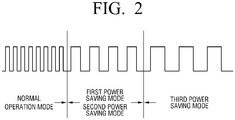
- FIG. 2 is a view illustrating the operation frequencies which are generated by the PLL unit and provided to each component.
- various operation frequencies generated by the PLL unit 150 may be applied to each component and each component operates according to the operation frequencies.
- more jobs can be performed than in the first power saving mode and the second power saving mode.
- the number of operations of reading and writing information with respect to a rising edge is higher than in the first power saving mode and the second power saving mode.
- more jobs are performed in the first and the second power saving modes than in the third power saving mode.
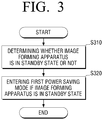
- FIG. 3 is a flowchart illustrating a controlling method of an image forming apparatus according to an exemplary embodiment.
- the controlling method of the image forming apparatus may be performed in the ASIC unit 200 such as an ASIC chip.
- the determination unit 120 determines whether the standby state to wait for execution of an image forming job is maintained for a predetermined time or not (S310). Operation S310 is repeatedly performed.
- the image forming apparatus 100 enters the first power saving mode in which information stored in the volatile memory 180 is copied to the internal memory 170 and the operation frequencies of the CPU 140, the volatile memory 180, and the functional unit 160 are lowered (S320).
- the operation mode in which the image forming job is executed may be converted into the first power saving mode.
- the controlling method of the image forming apparatus repeatedly determines whether the image forming apparatus 100 is in the standby state or not, and enters different power saving modes in a stepwise manner according to the result of determination, so that power consumption can be reduced in the standby state.
- FIG. 4 is a flowchart illustrating the controlling method of the image forming apparatus of FIG. 3 in more detail. For convenience of explanation, it is assumed that the image forming apparatus 100 is in an operation state (S410).
- the determination unit 120 determines whether a condition for entering the first power saving mode is satisfied or not (S420).
- the image forming apparatus 100 enters the first power saving mode (S430).
- the information stored in the volatile memory 180 is copied to the internal memory 170 and the operation frequencies of the CPU 140, the volatile memory 180, and the functional unit 160 are lowered under the control of the controller 130.
- the determination unit 120 determines whether a condition for entering the second power saving mode is satisfied or not (S440).
- the image forming apparatus 100 operates in the second power saving mode (S450).
- the CPU 140 which has read out information from the volatile memory 180 is set to use the information copied to the internal memory 170, and the volatile memory 180 enters the idle mode, under the control of the controller 130.
- the CPU 140 which has read out information from the volatile memory 180 uses the minimum information copied to the internal memory 170, power consumption can be further reduced. Also, if the volatile memory 180 enters the idle mode, it is not necessary to receive a refresh command to perform refreshing at predetermined intervals from the controller 130 and thus power consumption can be further reduced.
- the determination unit 130 determines whether a condition for entering the third power saving mode is satisfied or not (S460).
- the image forming apparatus 100 operates in the third power saving mode (S470).
- the third power saving mode the power supplied to the volatile memory 180 and the operation module 190 is interrupted the operation frequency of the CPU 140 is lowered, under the control of the controller 130.
- the operation frequency of the CPU 140 can be lowered to the minimum frequency that can allow the CPU 140 to operate.
- the minimum frequency that can allow the CPU 140 to operate is lower than the minimum frequency that can allow the volatile memory 180 to operate in the first power saving mode.
- the image forming apparatus 100 enters the first power saving mode, the second power saving mode, and the third power saving mode, which have different power consumption levels, in a stepwise manner, and optimizes the power consumption according to each mode, so that the power consumption can be reduced in the standby mode of the image forming apparatus 100.
- the predetermined time set in operations S420, S440, and S460 may be different from or equal to one another.
- the first power saving mode, the second power saving mode, and the third power saving mode are performed in sequence according to the controlling method of the image forming apparatus of FIG. 4 , this should not be considered as limiting. That is, if only the level of saved power can be adjusted in a stepwise manner, various embodiments can be applied.
- the image forming apparatus 100 may directly enter the third power saving mode from the first power saving mode or may enter the third power saving mode after performing the first power saving mode and the second power saving mode simultaneously.
- FIG. 5 is a flowchart illustrating a controlling method of an image forming apparatus according to another exemplary embodiment.
- the determination unit 120 repeatedly determines whether a standby state to wait for execution of an image forming job is maintained for a predetermined time or not (S510).
- the controller 130 controls the image forming apparatus 100 to enter the first power saving mode by adjusting a power-saving level in a stepwise manner according to the result of repetitive determination (S520). More specifically, in operation S520, the normal state is converted into the standby state of the first power saving mode in which the controller 130 controls a code stored in the volatile memory 180 in the normal state to be copied to the internal memory 170 and the operation frequency of each component to be lowered.
- FIG. 6 is a flowchart illustrating a controlling method of an image forming apparatus according to still another exemplary embodiment.
- the determination unit 120 repeatedly determines whether a standby state to wait for execution of an image forming job is maintained for a predetermined time or not (S610).
- the controller 130 controls the image forming apparatus to enter the second power saving mode by adjusting a power-saving level in a stepwise manner according to the result of repetitive determination (S620). More specifically, in operation S620, after the normal state is converted into the first power saving mode, the first power saving mode is converted into the second power saving mode in which the CPU 140 is set to use information copied to the internal memory 170 (program jump) and the volatile memory 180 enters the self-refresh mode.
- the operation frequencies of the CPU 140 and the volatile memory 180 are changed to normal operation frequencies, and the volatile memory 180 operates in the normal operation mode (S640).
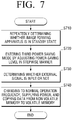
- FIG. 7 is a flowchart illustrating a controlling method of an image forming apparatus according to still another exemplary embodiment.
- the determination unit 120 repeatedly determines whether a standby state to wait for execution of an image forming job is maintained for a predetermined time or not (S710).
- the controller 130 controls the image forming apparatus to enter the third power saving mode by adjusting a power-saving level in a stepwise manner according to the result of repetitive determination (S720). More specifically, in operation S720, after the first power saving mode is converted into the second power saving mode, the second power saving mode is converted into the third power saving mode in which the power supplied to the volatile memory 180 and the operation module 190 is interrupted and the operation frequency of the CPU 140 is lowered.
- the operation frequencies of the CPU 140 and the volatile memory 180 are changed to normal operation frequencies, power is supplied to the volatile memory 180 and the operation module 190, and information is copied from the non-volatile memory 185 to the volatile memory 180 (S740).
- the information copied to the volatile memory 180 in operation S740 may be data or code which has been pre-stored in the non-volatile memory 185 to allow the image forming apparatus 100 to operate in the normal state.
- the embodiments include a computer readable recording medium which includes a program for executing the controlling method of the image forming apparatus described above.
- the computer readable recording medium includes all kinds of recording devices which store data readable by a computer system. Examples of the computer readable recording medium are a ROM, a RAM, a CD-ROM, a magnetic tape, a floppy disk, and an optical data storage device. Also, the computer readable recording medium may store or execute a code which is distributed over a computer system connected to a network and is readable by a computer in a distributed manner.
Landscapes
- Engineering & Computer Science (AREA)
- Theoretical Computer Science (AREA)
- Multimedia (AREA)
- Signal Processing (AREA)
- Physics & Mathematics (AREA)
- General Engineering & Computer Science (AREA)
- General Physics & Mathematics (AREA)
- Human Computer Interaction (AREA)
- Facsimiles In General (AREA)
- Control Or Security For Electrophotography (AREA)
- Power Sources (AREA)
- Accessory Devices And Overall Control Thereof (AREA)
Claims (15)
- Bildausbildungsvorrichtung (100), umfassend:eine Maschineneinheit (110), die dazu ausgelegt ist,einen Bildausbildungsauftrag auszuführen, umfassend Erzeugen, Drucken, Empfangen oder Senden von Bilddaten;eine Bestimmungseinheit (120) undein Steuergerät (130);dadurch gekennzeichnet, dass die Bestimmungseinheit (120) dazu ausgelegt ist, wiederholt zu bestimmen, ob sich die Bildausbildungsvorrichtung in einem Bereitschaftszustand befindet oder nicht, auf der Grundlage davon, ob sich der Bereitschaftszustand zum Warten auf eine Ausführung des Bildausbildungsauftrags für eine vorbestimmte Zeit aufrechterhalten wird oder nicht; unddas Steuergerät (130) dazu ausgelegt ist, die Bildausbildungsvorrichtung anzusteuern, in einem ersten Energiesparmodus zu laufen, falls bestimmt wird, dass sich die Bildausbildungsvorrichtung im Bereitschaftszustand befindet, wobei:Betriebsfrequenzen einer CPU (140), eines flüchtigen Speichers (180) und einer Funktionseinheit (160), die zur Durchführung einer Funktion für den Bildausbildungsauftrag ausgelegt ist, im ersten Energiesparmodus gesenkt werden, und im flüchtigen Speicher (180) gespeicherte Informationen zu einem internen Speicher (170) kopiert werden, der dazu ausgelegt ist, Informationen, die zum Antreiben der Funktionseinheit (160) in einem Normalzustand, in dem der Bildausbildungsauftrag ausgeführt wird, erforderlich sind, zu speichern.
- Bildausbildungsvorrichtung (100) nach Anspruch 1, wobei das Steuergerät (130) gemäß der wiederholten Bestimmung, falls bestimmt wird, dass der Bereitschaftszustand zum Warten auf eine Ausführung des Bildausbildungsauftrags für eine vorbestimmte Zeit, nachdem die Bildausbildungsvorrichtung im ersten Energiesparmodus läuft, aufrechterhalten wird, die Bildausbildungsvorrichtung ansteuert, in einem zweiten Energiesparmodus zu laufen, in dem die CPU (140) dazu eingerichtet ist, die in den internen Speicher (170) kopierten Informationen zu verwenden, und der flüchtige Speicher (180) in einen Ruhemodus tritt.
- Bildausbildungsvorrichtung (100) nach Anspruch 2, wobei das Steuergerät (130) gemäß der wiederholten Bestimmung, falls bestimmt wird, dass der Bereitschaftszustand zum Warten auf eine Ausführung des Bildausbildungsauftrags für eine vorbestimmte Zeit, nachdem die Bildausbildungsvorrichtung im zweiten Energiesparmodus läuft, aufrechterhalten wird, die Bildausbildungsvorrichtung ansteuert, in einem dritten Energiesparmodus zu laufen, in dem Energie, die dem flüchtigen Speicher (180) und einem Betriebsmodul zugeführt wird, unterbrochen wird und die Betriebsfrequenz der CPU (140) gesenkt wird.
- Bildausbildungsvorrichtung (100) nach einem vorhergehenden Anspruch, ferner umfassend eine PLL-Einheit (150) zum Erzeugen einer Betriebsfrequenz und Bereitstellen der Betriebsfrequenz für die CPU (140), den flüchtigen Speicher (180) und die Funktionseinheit (160).
- Bildausbildungsvorrichtung (100) nach einem vorhergehenden Anspruch, wobei, im ersten Energiesparmodus, im flüchtigen Speicher (180) gespeicherte Informationen des Normalzustands in den internen Speicher (170) kopiert werden.
- Bildausbildungsvorrichtung (100) nach Anspruch 1, wobei die Bestimmungseinheit (120) dazu ausgelegt ist, zu bestimmen, ob ein externes Signal, das die Bildausbildungsvorrichtung dazu auffordert, in dem Normalzustand zu laufen, um den Bildausbildungsauftrag auszuführen, eingegeben wird oder nicht,
wobei das Steuergerät (130), falls bestimmt wird, dass das externe Signal den Normalzustand angibt, als Reaktion auf das externe Signal die Betriebsfrequenzen der CPU (140) und des flüchtigen Speichers (180) zu normalen Betriebsfrequenzen ändert. - Bildausbildungsvorrichtung (100) nach Anspruch 2, wobei die Bestimmungseinheit (120) dazu ausgelegt ist, zu bestimmen, ob ein externes Signal, das die Bildausbildungsvorrichtung dazu auffordert, in dem Normalzustand zu laufen, um den Bildausbildungsauftrag auszuführen, eingegeben wird oder nicht,
wobei das Steuergerät (130), falls bestimmt wird, dass das externe Signal den Normalzustand angibt, als Reaktion auf das externe Signal die Betriebsfrequenzen der CPU (140) und des flüchtigen Speichers (180) zu normalen Betriebsfrequenzen ändert und den flüchtigen Speicher (180) so einstellt, dass er sich in einem Betriebsmodus befindet. - Bildausbildungsvorrichtung (100) nach Anspruch 3, wobei die Bestimmungseinheit (120) dazu ausgelegt ist, zu bestimmen, ob ein externes Signal, das die Bildausbildungsvorrichtung dazu auffordert, in dem Normalzustand zu laufen, um den Bildausbildungsauftrag auszuführen, eingegeben wird oder nicht,
wobei das Steuergerät (130), falls bestimmt wird, dass das externe Signal den Normalzustand angibt, die Betriebsfrequenzen der CPU (140) und des flüchtigen Speichers (180) zu normalen Betriebsfrequenzen ändert, den flüchtigen Speicher (180) und das Betriebsmodul mit Energie versorgt und Informationen, die zum Betrieb im Normalzustand erforderlich sind, vom nichtflüchtigen Speicher (185) in den flüchtigen Speicher (180) kopiert. - Steuerverfahren einer Bildausbildungsvorrichtung, wobei das Verfahren Folgendes umfasst:wiederholtes Bestimmen, ob sich die Bildausbildungsvorrichtung in einem Bereitschaftszustand befindet oder nicht, auf der Grundlage davon, ob sich der Bereitschaftszustand zum Warten auf eine Ausführung eines Bildausbildungsauftrags, der Erzeugen, Drucken, Empfangen oder Senden von Bilddaten umfasst, für eine vorbestimmte Zeit aufrechterhalten wird oder nicht (S310, S510); undfalls bestimmt wird, dass sich die Bildausbildungsvorrichtung im Bereitschaftszustand befindet, Treten in einen ersten Energiesparmodus, in dem Betriebsfrequenzen einer CPU, eines flüchtigen Speichers und einer Funktionseinheit, die zur Durchführung einer Funktion für den Bildausbildungsauftrag ausgelegt ist, gesenkt werden (S320, S520), und im flüchtigen Speicher gespeicherte Informationen zu einem internen Speicher kopiert werden, der dazu ausgelegt ist, Informationen, die zum Antreiben der Funktionseinheit in einem Normalzustand, in dem der Bildausbildungsauftrag ausgeführt wird, erforderlich sind, zu speichern.
- Steuerverfahren nach Anspruch 9, wobei, gemäß der wiederholten Bestimmung (S610), falls bestimmt wird, dass der Bereitschaftszustand zum Warten auf eine Ausführung des Bildausbildungsauftrags für eine vorbestimmte Zeit, nachdem die Bildausbildungsvorrichtung im ersten Energiesparmodus läuft, aufrechterhalten wird, das Eintreten Treten in einen zweiten Energiesparmodus umfasst, in dem die CPU dazu eingerichtet ist, die in den internen Speicher kopierten Informationen zu verwenden, und der flüchtige Speicher in einen Ruhemodus tritt (S620).
- Steuerverfahren nach Anspruch 10, wobei, gemäß der wiederholten Bestimmung (S710), falls bestimmt wird, dass der Bereitschaftszustand zum Warten auf eine Ausführung des Bildausbildungsauftrags für eine vorbestimmte Zeit, nachdem die Bildausbildungsvorrichtung im zweiten Energiesparmodus läuft, aufrechterhalten wird, das Eintreten Treten in einen dritten Energiesparmodus umfasst, in dem dem flüchtigen Speicher und einem Betriebsmodul zugeführte Energie unterbrochen wird und die Betriebsfrequenz der CPU gesenkt wird (S720).
- Steuerverfahren nach einem der Ansprüche 9 bis 11, wobei im ersten Energiesparmodus im flüchtigen Speicher gespeicherte Informationen des Normalzustands in den internen Speicher kopiert werden.
- Steuerverfahren nach Anspruch 9, ferner umfassend:Bestimmen, ob ein externes Signal, das die Bildausbildungsvorrichtung dazu auffordert, in dem Normalzustand zu laufen, um den Bildausbildungsauftrag auszuführen, eingegeben wird oder nicht (S530), undfalls bestimmt wird, dass das externe Signal den Normalzustand angibt, als Reaktion auf das externe Signal Ändern der Betriebsfrequenzen der CPU und des flüchtigen Speichers zu normalen Betriebsfrequenzen (S540).
- Steuerverfahren nach Anspruch 10, ferner umfassend:Bestimmen, ob ein externes Signal, das die Bildausbildungsvorrichtung dazu auffordert, in dem Normalzustand zu laufen, um den Bildausbildungsauftrag auszuführen, eingegeben wird oder nicht (S630), und falls bestimmt wird, dass das externe Signal den Normalzustand angibt, als Reaktion auf das externe Signal Ändern der Betriebsfrequenzen der CPU und des flüchtigen Speichers zu normalen Betriebsfrequenzen und Einstellen des flüchtigen Speichers derart, dass er sich in einem Betriebsmodus befindet (S640).
- Steuerverfahren nach Anspruch 11, ferner umfassend:Bestimmen, ob ein externes Signal, das die Bildausbildungsvorrichtung dazu auffordert, in dem Normalzustand zu laufen, um den Bildausbildungsauftrag auszuführen, eingegeben wird oder nicht (S730), undfalls bestimmt wird, dass das externe Signal den Normalzustand angibt, Ändern der Betriebsfrequenzen der CPU und des flüchtigen Speichers zu normalen Betriebsfrequenzen, Versorgen des flüchtigen Speichers und des Betriebsmoduls mit Energie und Kopieren von Informationen vom nichtflüchtigen Speicher in den flüchtigen Speicher (S740).
Applications Claiming Priority (1)
| Application Number | Priority Date | Filing Date | Title |
|---|---|---|---|
| KR20090084312 | 2009-09-08 |
Publications (3)
| Publication Number | Publication Date |
|---|---|
| EP2299677A2 EP2299677A2 (de) | 2011-03-23 |
| EP2299677A3 EP2299677A3 (de) | 2013-01-30 |
| EP2299677B1 true EP2299677B1 (de) | 2017-05-17 |
Family
ID=42199453
Family Applications (1)
| Application Number | Title | Priority Date | Filing Date |
|---|---|---|---|
| EP10158174.2A Not-in-force EP2299677B1 (de) | 2009-09-08 | 2010-03-29 | Bilderzeugungsvorrichtung und Steuerverfahren dafür |
Country Status (3)
| Country | Link |
|---|---|
| US (4) | US8339626B2 (de) |
| EP (1) | EP2299677B1 (de) |
| KR (1) | KR101184396B1 (de) |
Families Citing this family (24)
| Publication number | Priority date | Publication date | Assignee | Title |
|---|---|---|---|---|
| US8339626B2 (en) * | 2009-09-08 | 2012-12-25 | Samsung Electronics Co., Ltd. | Image forming apparatus and controlling method thereof |
| JP5586924B2 (ja) * | 2009-11-24 | 2014-09-10 | キヤノン株式会社 | 画像形成装置 |
| KR20110083008A (ko) * | 2010-01-13 | 2011-07-20 | 삼성전자주식회사 | 화상형성장치 및 화상형성장치의 전원관리방법 |
| JP2012006167A (ja) * | 2010-06-22 | 2012-01-12 | Konica Minolta Business Technologies Inc | 画像処理装置、画像処理装置の制御方法、および画像処理装置の制御プログラム |
| KR20120071114A (ko) * | 2010-12-22 | 2012-07-02 | 한국전자통신연구원 | 전원 컨트롤러, 외장 디바이스 및 그의 운용 방법 |
| JP5975662B2 (ja) * | 2012-02-06 | 2016-08-23 | キヤノン株式会社 | 画像形成装置及び画像形成装置の制御方法 |
| JP2013186589A (ja) * | 2012-03-06 | 2013-09-19 | Canon Inc | 電源制御装置、電源制御方法及びプログラム |
| TWI456487B (zh) * | 2012-04-26 | 2014-10-11 | Acer Inc | 行動裝置以及手勢判斷方法 |
| JP6102087B2 (ja) * | 2012-06-01 | 2017-03-29 | 株式会社リコー | 画像形成装置、方法およびプログラム |
| JP5700013B2 (ja) * | 2012-09-21 | 2015-04-15 | コニカミノルタ株式会社 | 画像形成システム、該システムにおける画像形成装置の省電力状態からの復帰方法並びに外部端末 |
| KR102117841B1 (ko) * | 2012-10-30 | 2020-06-02 | 삼성전자주식회사 | 전자장치 및 그 제어방법 |
| JP5705203B2 (ja) * | 2012-12-28 | 2015-04-22 | キヤノン株式会社 | 通信装置、通信端末、その制御方法、プログラム |
| KR101859022B1 (ko) | 2013-01-17 | 2018-06-28 | 에이치피프린팅코리아 주식회사 | 화상형성장치, 외부 장치와 연결 방법 및 컴퓨터 판독가능 기록매체 |
| JP6071647B2 (ja) | 2013-02-28 | 2017-02-01 | 株式会社東芝 | 情報処理装置、動作状態制御方法及びプログラム |
| JP2014167499A (ja) * | 2013-02-28 | 2014-09-11 | Kyocera Document Solutions Inc | 電子機器 |
| TW201435561A (zh) * | 2013-03-12 | 2014-09-16 | Hon Hai Prec Ind Co Ltd | 電子裝置 |
| TWI641943B (zh) * | 2013-03-15 | 2018-11-21 | 美商英特爾公司 | 控制電源供應單元於閒置狀態期間的功率消耗之技術 |
| JP5882256B2 (ja) * | 2013-05-30 | 2016-03-09 | 京セラドキュメントソリューションズ株式会社 | ジョブ送信プログラムおよび電子機器 |
| JP6249693B2 (ja) | 2013-09-09 | 2017-12-20 | キヤノン株式会社 | 画像処理装置、画像処理装置の制御方法、及びプログラム |
| KR102179506B1 (ko) | 2013-12-23 | 2020-11-17 | 삼성전자 주식회사 | 전자장치 및 그 제어방법 |
| KR102320399B1 (ko) | 2014-08-26 | 2021-11-03 | 삼성전자주식회사 | 전원 관리 칩, 그것을 포함하는 모바일 장치 및 그것의 클록 조절 방법 |
| DE102015112253A1 (de) | 2014-08-26 | 2016-03-03 | Samsung Electronics Co., Ltd. | Integrierte Leistungsverwaltungsschaltung, Leistungsverwaltungsverfahren, mobile Vorrichtung und Takteinstellverfahren |
| JP6180450B2 (ja) * | 2015-02-02 | 2017-08-16 | キヤノン株式会社 | 制御装置、制御装置の制御方法及びプログラム |
| KR102792543B1 (ko) * | 2023-11-10 | 2025-04-08 | 주식회사 리퓨터 | 대기전력 절감 컴퓨팅 장치 |
Family Cites Families (28)
| Publication number | Priority date | Publication date | Assignee | Title |
|---|---|---|---|---|
| US4881205A (en) * | 1987-04-21 | 1989-11-14 | Casio Computer Co., Ltd. | Compact electronic apparatus with a refresh unit for a dynamic type memory |
| US5396635A (en) * | 1990-06-01 | 1995-03-07 | Vadem Corporation | Power conservation apparatus having multiple power reduction levels dependent upon the activity of the computer system |
| JPH04236682A (ja) * | 1991-01-18 | 1992-08-25 | Mitsubishi Electric Corp | マイクロコンピュータシステム |
| US5721935A (en) * | 1995-12-20 | 1998-02-24 | Compaq Computer Corporation | Apparatus and method for entering low power mode in a computer system |
| JPH11161385A (ja) * | 1997-11-28 | 1999-06-18 | Toshiba Corp | コンピュータシステムおよびそのシステムステート制御方法 |
| JP3360665B2 (ja) * | 1999-03-12 | 2002-12-24 | セイコーエプソン株式会社 | 省電力モードを有する電子印刷装置および制御方法 |
| US6571333B1 (en) | 1999-11-05 | 2003-05-27 | Intel Corporation | Initializing a memory controller by executing software in second memory to wakeup a system |
| JP2002333933A (ja) | 2001-05-09 | 2002-11-22 | Casio Comput Co Ltd | 電源部内蔵型電子機器、プログラムおよび電源制御方法 |
| JP2002358231A (ja) * | 2001-05-31 | 2002-12-13 | Fujitsu Ltd | メモリ制御システム |
| JP2003333933A (ja) | 2002-05-17 | 2003-11-25 | Ofaa Sekkei Jimusho:Kk | 植栽器用土止め及び植栽器 |
| KR100505638B1 (ko) | 2002-08-28 | 2005-08-03 | 삼성전자주식회사 | 워킹 콘텍스트 저장 및 복구 장치 및 방법 |
| JP2004126162A (ja) * | 2002-10-01 | 2004-04-22 | Canon Inc | 画像形成装置 |
| JP4505740B2 (ja) * | 2005-05-16 | 2010-07-21 | ソニー株式会社 | 撮像装置及びその起動方法 |
| JP2007226632A (ja) | 2006-02-24 | 2007-09-06 | Denso Corp | マイクロコンピュータ |
| EP1836999A1 (de) * | 2006-03-23 | 2007-09-26 | Sharp Kabushiki Kaisha | Bilderzeugungsvorrichtung |
| KR100950491B1 (ko) | 2006-08-03 | 2010-03-31 | 삼성전자주식회사 | 네트워크 인터페이스카드, 이를 갖는 네트워크프린터 및 그 장치의 제어방법 |
| US7548481B1 (en) * | 2006-12-08 | 2009-06-16 | Nvidia Corp. | Method and apparatus for dynamic power adjustment in a memory subsystem |
| US8250382B2 (en) * | 2007-08-22 | 2012-08-21 | International Business Machines Corporation | Power control of servers using advanced configuration and power interface (ACPI) states |
| US7913103B2 (en) * | 2007-08-31 | 2011-03-22 | Globalfoundries Inc. | Method and apparatus for clock cycle stealing |
| KR101429674B1 (ko) | 2007-09-11 | 2014-08-13 | 삼성전자주식회사 | 시스템 온 칩에서 전력 소모를 감소시키기 위한 장치 및방법 |
| JP5008138B2 (ja) * | 2007-11-12 | 2012-08-22 | 株式会社リコー | 情報処理装置、情報処理方法、プログラム及び記録媒体 |
| US20090204835A1 (en) * | 2008-02-11 | 2009-08-13 | Nvidia Corporation | Use methods for power optimization using an integrated circuit having power domains and partitions |
| US20090204837A1 (en) * | 2008-02-11 | 2009-08-13 | Udaykumar Raval | Power control system and method |
| JP5207792B2 (ja) * | 2008-02-19 | 2013-06-12 | キヤノン株式会社 | 情報処理装置及び情報処理方法 |
| JP4866870B2 (ja) * | 2008-02-22 | 2012-02-01 | 株式会社沖データ | 画像処理装置 |
| US8339626B2 (en) * | 2009-09-08 | 2012-12-25 | Samsung Electronics Co., Ltd. | Image forming apparatus and controlling method thereof |
| US8799553B2 (en) * | 2010-04-13 | 2014-08-05 | Apple Inc. | Memory controller mapping on-the-fly |
| US8824222B2 (en) * | 2010-08-13 | 2014-09-02 | Rambus Inc. | Fast-wake memory |
-
2010
- 2010-03-18 US US12/659,731 patent/US8339626B2/en not_active Expired - Fee Related
- 2010-03-29 EP EP10158174.2A patent/EP2299677B1/de not_active Not-in-force
- 2010-06-11 KR KR1020100055575A patent/KR101184396B1/ko active Active
- 2010-09-08 US US12/877,757 patent/US8364994B2/en not_active Expired - Fee Related
-
2012
- 2012-11-27 US US13/685,926 patent/US8610917B2/en active Active
- 2012-12-27 US US13/728,278 patent/US9519329B2/en active Active
Non-Patent Citations (1)
| Title |
|---|
| None * |
Also Published As
| Publication number | Publication date |
|---|---|
| US9519329B2 (en) | 2016-12-13 |
| EP2299677A2 (de) | 2011-03-23 |
| US20130088745A1 (en) | 2013-04-11 |
| EP2299677A3 (de) | 2013-01-30 |
| KR101184396B1 (ko) | 2012-09-20 |
| US20110113267A1 (en) | 2011-05-12 |
| KR20110027544A (ko) | 2011-03-16 |
| US20110058206A1 (en) | 2011-03-10 |
| US8364994B2 (en) | 2013-01-29 |
| US8339626B2 (en) | 2012-12-25 |
| US20130138986A1 (en) | 2013-05-30 |
| US8610917B2 (en) | 2013-12-17 |
Similar Documents
| Publication | Publication Date | Title |
|---|---|---|
| EP2299677A2 (de) | Bilderzeugungsvorrichtung und Steuerverfahren dafür | |
| EP2437180B1 (de) | Bilderzeugungsvorrichtung, System-auf-Chip-Einheit und Treiberverfahren dafür | |
| EP2299681B1 (de) | Bilderzeugungsvorrichtung und Leistungssteuerverfahren dafür | |
| KR101203145B1 (ko) | 화상형성장치, SoC 유닛 및 그 구동 방법 | |
| US20070260358A1 (en) | Power supplying mode switching controller, image forming apparatus, and image reading apparatus | |
| US20110083027A1 (en) | Controller for image processing apparatus | |
| US20080198397A1 (en) | Image forming apparatus and control method | |
| US20180217656A1 (en) | Information processing apparatus control method therefor and storage medium | |
| US10642545B2 (en) | Information processing apparatus that controls shifting between power states in accordance with remaining storage capacity and control method thereof | |
| US9813576B2 (en) | Communication apparatus, control method, and program | |
| JP2011059937A (ja) | 電子機器 | |
| JP2018118443A (ja) | 記憶装置システム及びその制御方法、情報処理装置、電源制御システム及びその制御方法、並びにプログラム | |
| JP2005186425A (ja) | 画像処理装置の省電力制御方法、および画像処理装置 | |
| US20170315606A1 (en) | Apparatus and method for information processing | |
| CN111541825B (zh) | 电子装置及其控制方法 | |
| US20080068645A1 (en) | Device management method and device management system | |
| CN102752470A (zh) | 图像处理装置和图像处理方法 | |
| AU2013374549A1 (en) | Image forming apparatus, method of connecting with external device thereof, and computer-readable recording medium | |
| US20110102825A1 (en) | Image processing device having a plurality of control units | |
| US8902689B2 (en) | Controlling electric power supply to a memory in an image processing apparatus | |
| JP2018097496A (ja) | 情報処理装置およびプログラム | |
| JP2019165373A (ja) | 画像形成装置及びプログラム |
Legal Events
| Date | Code | Title | Description |
|---|---|---|---|
| PUAI | Public reference made under article 153(3) epc to a published international application that has entered the european phase |
Free format text: ORIGINAL CODE: 0009012 |
|
| AK | Designated contracting states |
Kind code of ref document: A2 Designated state(s): AT BE BG CH CY CZ DE DK EE ES FI FR GB GR HR HU IE IS IT LI LT LU LV MC MK MT NL NO PL PT RO SE SI SK SM TR |
|
| AX | Request for extension of the european patent |
Extension state: AL BA ME RS |
|
| RAP1 | Party data changed (applicant data changed or rights of an application transferred) |
Owner name: SAMSUNG ELECTRONICS CO., LTD. |
|
| PUAL | Search report despatched |
Free format text: ORIGINAL CODE: 0009013 |
|
| AK | Designated contracting states |
Kind code of ref document: A3 Designated state(s): AT BE BG CH CY CZ DE DK EE ES FI FR GB GR HR HU IE IS IT LI LT LU LV MC MK MT NL NO PL PT RO SE SI SK SM TR |
|
| AX | Request for extension of the european patent |
Extension state: AL BA ME RS |
|
| RIC1 | Information provided on ipc code assigned before grant |
Ipc: H04N 1/00 20060101AFI20121224BHEP Ipc: G06F 3/12 20060101ALI20121224BHEP Ipc: G06F 1/32 20060101ALI20121224BHEP |
|
| RIC1 | Information provided on ipc code assigned before grant |
Ipc: H04N 1/00 20060101AFI20130418BHEP Ipc: G06F 3/12 20060101ALI20130418BHEP Ipc: G06F 1/32 20060101ALI20130418BHEP |
|
| 17P | Request for examination filed |
Effective date: 20130729 |
|
| RBV | Designated contracting states (corrected) |
Designated state(s): AT BE BG CH CY CZ DE DK EE ES FI FR GB GR HR HU IE IS IT LI LT LU LV MC MK MT NL NO PL PT RO SE SI SK SM TR |
|
| 17Q | First examination report despatched |
Effective date: 20160919 |
|
| STAA | Information on the status of an ep patent application or granted ep patent |
Free format text: STATUS: EXAMINATION IS IN PROGRESS |
|
| GRAP | Despatch of communication of intention to grant a patent |
Free format text: ORIGINAL CODE: EPIDOSNIGR1 |
|
| STAA | Information on the status of an ep patent application or granted ep patent |
Free format text: STATUS: GRANT OF PATENT IS INTENDED |
|
| RAP1 | Party data changed (applicant data changed or rights of an application transferred) |
Owner name: S-PRINTING SOLUTION CO., LTD. |
|
| GRAS | Grant fee paid |
Free format text: ORIGINAL CODE: EPIDOSNIGR3 |
|
| INTG | Intention to grant announced |
Effective date: 20170313 |
|
| GRAA | (expected) grant |
Free format text: ORIGINAL CODE: 0009210 |
|
| STAA | Information on the status of an ep patent application or granted ep patent |
Free format text: STATUS: THE PATENT HAS BEEN GRANTED |
|
| AK | Designated contracting states |
Kind code of ref document: B1 Designated state(s): AT BE BG CH CY CZ DE DK EE ES FI FR GB GR HR HU IE IS IT LI LT LU LV MC MK MT NL NO PL PT RO SE SI SK SM TR |
|
| REG | Reference to a national code |
Ref country code: GB Ref legal event code: FG4D |
|
| REG | Reference to a national code |
Ref country code: CH Ref legal event code: EP |
|
| REG | Reference to a national code |
Ref country code: IE Ref legal event code: FG4D |
|
| REG | Reference to a national code |
Ref country code: AT Ref legal event code: REF Ref document number: 895406 Country of ref document: AT Kind code of ref document: T Effective date: 20170615 |
|
| REG | Reference to a national code |
Ref country code: DE Ref legal event code: R096 Ref document number: 602010042364 Country of ref document: DE |
|
| REG | Reference to a national code |
Ref country code: NL Ref legal event code: FP |
|
| REG | Reference to a national code |
Ref country code: LT Ref legal event code: MG4D |
|
| REG | Reference to a national code |
Ref country code: AT Ref legal event code: MK05 Ref document number: 895406 Country of ref document: AT Kind code of ref document: T Effective date: 20170517 |
|
| PG25 | Lapsed in a contracting state [announced via postgrant information from national office to epo] |
Ref country code: NO Free format text: LAPSE BECAUSE OF FAILURE TO SUBMIT A TRANSLATION OF THE DESCRIPTION OR TO PAY THE FEE WITHIN THE PRESCRIBED TIME-LIMIT Effective date: 20170817 Ref country code: AT Free format text: LAPSE BECAUSE OF FAILURE TO SUBMIT A TRANSLATION OF THE DESCRIPTION OR TO PAY THE FEE WITHIN THE PRESCRIBED TIME-LIMIT Effective date: 20170517 Ref country code: LT Free format text: LAPSE BECAUSE OF FAILURE TO SUBMIT A TRANSLATION OF THE DESCRIPTION OR TO PAY THE FEE WITHIN THE PRESCRIBED TIME-LIMIT Effective date: 20170517 Ref country code: GR Free format text: LAPSE BECAUSE OF FAILURE TO SUBMIT A TRANSLATION OF THE DESCRIPTION OR TO PAY THE FEE WITHIN THE PRESCRIBED TIME-LIMIT Effective date: 20170818 Ref country code: HR Free format text: LAPSE BECAUSE OF FAILURE TO SUBMIT A TRANSLATION OF THE DESCRIPTION OR TO PAY THE FEE WITHIN THE PRESCRIBED TIME-LIMIT Effective date: 20170517 Ref country code: ES Free format text: LAPSE BECAUSE OF FAILURE TO SUBMIT A TRANSLATION OF THE DESCRIPTION OR TO PAY THE FEE WITHIN THE PRESCRIBED TIME-LIMIT Effective date: 20170517 Ref country code: FI Free format text: LAPSE BECAUSE OF FAILURE TO SUBMIT A TRANSLATION OF THE DESCRIPTION OR TO PAY THE FEE WITHIN THE PRESCRIBED TIME-LIMIT Effective date: 20170517 |
|
| PG25 | Lapsed in a contracting state [announced via postgrant information from national office to epo] |
Ref country code: LV Free format text: LAPSE BECAUSE OF FAILURE TO SUBMIT A TRANSLATION OF THE DESCRIPTION OR TO PAY THE FEE WITHIN THE PRESCRIBED TIME-LIMIT Effective date: 20170517 Ref country code: SE Free format text: LAPSE BECAUSE OF FAILURE TO SUBMIT A TRANSLATION OF THE DESCRIPTION OR TO PAY THE FEE WITHIN THE PRESCRIBED TIME-LIMIT Effective date: 20170517 Ref country code: IS Free format text: LAPSE BECAUSE OF FAILURE TO SUBMIT A TRANSLATION OF THE DESCRIPTION OR TO PAY THE FEE WITHIN THE PRESCRIBED TIME-LIMIT Effective date: 20170917 Ref country code: BG Free format text: LAPSE BECAUSE OF FAILURE TO SUBMIT A TRANSLATION OF THE DESCRIPTION OR TO PAY THE FEE WITHIN THE PRESCRIBED TIME-LIMIT Effective date: 20170817 Ref country code: PL Free format text: LAPSE BECAUSE OF FAILURE TO SUBMIT A TRANSLATION OF THE DESCRIPTION OR TO PAY THE FEE WITHIN THE PRESCRIBED TIME-LIMIT Effective date: 20170517 |
|
| PG25 | Lapsed in a contracting state [announced via postgrant information from national office to epo] |
Ref country code: RO Free format text: LAPSE BECAUSE OF FAILURE TO SUBMIT A TRANSLATION OF THE DESCRIPTION OR TO PAY THE FEE WITHIN THE PRESCRIBED TIME-LIMIT Effective date: 20170517 Ref country code: DK Free format text: LAPSE BECAUSE OF FAILURE TO SUBMIT A TRANSLATION OF THE DESCRIPTION OR TO PAY THE FEE WITHIN THE PRESCRIBED TIME-LIMIT Effective date: 20170517 Ref country code: SK Free format text: LAPSE BECAUSE OF FAILURE TO SUBMIT A TRANSLATION OF THE DESCRIPTION OR TO PAY THE FEE WITHIN THE PRESCRIBED TIME-LIMIT Effective date: 20170517 Ref country code: EE Free format text: LAPSE BECAUSE OF FAILURE TO SUBMIT A TRANSLATION OF THE DESCRIPTION OR TO PAY THE FEE WITHIN THE PRESCRIBED TIME-LIMIT Effective date: 20170517 Ref country code: CZ Free format text: LAPSE BECAUSE OF FAILURE TO SUBMIT A TRANSLATION OF THE DESCRIPTION OR TO PAY THE FEE WITHIN THE PRESCRIBED TIME-LIMIT Effective date: 20170517 |
|
| REG | Reference to a national code |
Ref country code: FR Ref legal event code: PLFP Year of fee payment: 9 Ref country code: DE Ref legal event code: R097 Ref document number: 602010042364 Country of ref document: DE |
|
| PG25 | Lapsed in a contracting state [announced via postgrant information from national office to epo] |
Ref country code: IT Free format text: LAPSE BECAUSE OF FAILURE TO SUBMIT A TRANSLATION OF THE DESCRIPTION OR TO PAY THE FEE WITHIN THE PRESCRIBED TIME-LIMIT Effective date: 20170517 Ref country code: SM Free format text: LAPSE BECAUSE OF FAILURE TO SUBMIT A TRANSLATION OF THE DESCRIPTION OR TO PAY THE FEE WITHIN THE PRESCRIBED TIME-LIMIT Effective date: 20170517 |
|
| PLBE | No opposition filed within time limit |
Free format text: ORIGINAL CODE: 0009261 |
|
| STAA | Information on the status of an ep patent application or granted ep patent |
Free format text: STATUS: NO OPPOSITION FILED WITHIN TIME LIMIT |
|
| 26N | No opposition filed |
Effective date: 20180220 |
|
| PG25 | Lapsed in a contracting state [announced via postgrant information from national office to epo] |
Ref country code: SI Free format text: LAPSE BECAUSE OF FAILURE TO SUBMIT A TRANSLATION OF THE DESCRIPTION OR TO PAY THE FEE WITHIN THE PRESCRIBED TIME-LIMIT Effective date: 20170517 |
|
| REG | Reference to a national code |
Ref country code: NL Ref legal event code: HC Owner name: HP PRINTING KOREA CO., LTD.; KR Free format text: DETAILS ASSIGNMENT: CHANGE OF OWNER(S), CHANGE OF OWNER(S) NAME; FORMER OWNER NAME: S-PRINTING SOLUTION CO., LTD. Effective date: 20180816 |
|
| REG | Reference to a national code |
Ref country code: CH Ref legal event code: PL |
|
| PG25 | Lapsed in a contracting state [announced via postgrant information from national office to epo] |
Ref country code: MC Free format text: LAPSE BECAUSE OF FAILURE TO SUBMIT A TRANSLATION OF THE DESCRIPTION OR TO PAY THE FEE WITHIN THE PRESCRIBED TIME-LIMIT Effective date: 20170517 |
|
| REG | Reference to a national code |
Ref country code: BE Ref legal event code: MM Effective date: 20180331 |
|
| REG | Reference to a national code |
Ref country code: IE Ref legal event code: MM4A |
|
| PG25 | Lapsed in a contracting state [announced via postgrant information from national office to epo] |
Ref country code: LU Free format text: LAPSE BECAUSE OF NON-PAYMENT OF DUE FEES Effective date: 20180329 |
|
| PG25 | Lapsed in a contracting state [announced via postgrant information from national office to epo] |
Ref country code: IE Free format text: LAPSE BECAUSE OF NON-PAYMENT OF DUE FEES Effective date: 20180329 |
|
| PG25 | Lapsed in a contracting state [announced via postgrant information from national office to epo] |
Ref country code: CH Free format text: LAPSE BECAUSE OF NON-PAYMENT OF DUE FEES Effective date: 20180331 Ref country code: LI Free format text: LAPSE BECAUSE OF NON-PAYMENT OF DUE FEES Effective date: 20180331 Ref country code: BE Free format text: LAPSE BECAUSE OF NON-PAYMENT OF DUE FEES Effective date: 20180331 |
|
| REG | Reference to a national code |
Ref country code: DE Ref legal event code: R082 Ref document number: 602010042364 Country of ref document: DE Ref country code: DE Ref legal event code: R081 Ref document number: 602010042364 Country of ref document: DE Owner name: HP PRINTING KOREA CO., LTD., SUWON-SI, KR Free format text: FORMER OWNER: S-PRINTING SOLUTION CO., LTD., SUWON-SI, GYEONGGI-DO, KR Ref country code: DE Ref legal event code: R081 Ref document number: 602010042364 Country of ref document: DE Owner name: HEWLETT-PACKARD DEVELOPMENT COMPANY, L.P., SPR, US Free format text: FORMER OWNER: S-PRINTING SOLUTION CO., LTD., SUWON-SI, GYEONGGI-DO, KR Ref country code: DE Ref legal event code: R082 Ref document number: 602010042364 Country of ref document: DE Representative=s name: SCHOPPE, ZIMMERMANN, STOECKELER, ZINKLER, SCHE, DE |
|
| REG | Reference to a national code |
Ref country code: NL Ref legal event code: PD Owner name: HEWLETT-PACKARD DEVELOPMENT COMPANY, L.P.; US Free format text: DETAILS ASSIGNMENT: CHANGE OF OWNER(S), CHANGE OF LEGAL ENTITY; FORMER OWNER NAME: HP PRINTING KOREA CO., LTD. Effective date: 20191030 |
|
| REG | Reference to a national code |
Ref country code: DE Ref legal event code: R081 Ref document number: 602010042364 Country of ref document: DE Owner name: HEWLETT-PACKARD DEVELOPMENT COMPANY, L.P., SPR, US Free format text: FORMER OWNER: HP PRINTING KOREA CO., LTD., SUWON-SI, GYEONGGI-DO, KR |
|
| REG | Reference to a national code |
Ref country code: GB Ref legal event code: 732E Free format text: REGISTERED BETWEEN 20191212 AND 20191218 |
|
| PG25 | Lapsed in a contracting state [announced via postgrant information from national office to epo] |
Ref country code: MT Free format text: LAPSE BECAUSE OF NON-PAYMENT OF DUE FEES Effective date: 20180329 |
|
| PG25 | Lapsed in a contracting state [announced via postgrant information from national office to epo] |
Ref country code: TR Free format text: LAPSE BECAUSE OF FAILURE TO SUBMIT A TRANSLATION OF THE DESCRIPTION OR TO PAY THE FEE WITHIN THE PRESCRIBED TIME-LIMIT Effective date: 20170517 |
|
| PG25 | Lapsed in a contracting state [announced via postgrant information from national office to epo] |
Ref country code: HU Free format text: LAPSE BECAUSE OF FAILURE TO SUBMIT A TRANSLATION OF THE DESCRIPTION OR TO PAY THE FEE WITHIN THE PRESCRIBED TIME-LIMIT; INVALID AB INITIO Effective date: 20100329 Ref country code: PT Free format text: LAPSE BECAUSE OF FAILURE TO SUBMIT A TRANSLATION OF THE DESCRIPTION OR TO PAY THE FEE WITHIN THE PRESCRIBED TIME-LIMIT Effective date: 20170517 |
|
| PG25 | Lapsed in a contracting state [announced via postgrant information from national office to epo] |
Ref country code: MK Free format text: LAPSE BECAUSE OF NON-PAYMENT OF DUE FEES Effective date: 20170517 Ref country code: CY Free format text: LAPSE BECAUSE OF FAILURE TO SUBMIT A TRANSLATION OF THE DESCRIPTION OR TO PAY THE FEE WITHIN THE PRESCRIBED TIME-LIMIT Effective date: 20170517 |
|
| REG | Reference to a national code |
Ref country code: DE Ref legal event code: R082 Ref document number: 602010042364 Country of ref document: DE Representative=s name: SCHOPPE, ZIMMERMANN, STOECKELER, ZINKLER, SCHE, DE |
|
| PGFP | Annual fee paid to national office [announced via postgrant information from national office to epo] |
Ref country code: GB Payment date: 20220225 Year of fee payment: 13 |
|
| PGFP | Annual fee paid to national office [announced via postgrant information from national office to epo] |
Ref country code: NL Payment date: 20220217 Year of fee payment: 13 Ref country code: FR Payment date: 20220221 Year of fee payment: 13 |
|
| PGFP | Annual fee paid to national office [announced via postgrant information from national office to epo] |
Ref country code: DE Payment date: 20230221 Year of fee payment: 14 |
|
| REG | Reference to a national code |
Ref country code: NL Ref legal event code: MM Effective date: 20230401 |
|
| GBPC | Gb: european patent ceased through non-payment of renewal fee |
Effective date: 20230329 |
|
| PG25 | Lapsed in a contracting state [announced via postgrant information from national office to epo] |
Ref country code: NL Free format text: LAPSE BECAUSE OF NON-PAYMENT OF DUE FEES Effective date: 20230401 |
|
| PG25 | Lapsed in a contracting state [announced via postgrant information from national office to epo] |
Ref country code: GB Free format text: LAPSE BECAUSE OF NON-PAYMENT OF DUE FEES Effective date: 20230329 |
|
| PG25 | Lapsed in a contracting state [announced via postgrant information from national office to epo] |
Ref country code: GB Free format text: LAPSE BECAUSE OF NON-PAYMENT OF DUE FEES Effective date: 20230329 Ref country code: FR Free format text: LAPSE BECAUSE OF NON-PAYMENT OF DUE FEES Effective date: 20230331 |
|
| REG | Reference to a national code |
Ref country code: DE Ref legal event code: R119 Ref document number: 602010042364 Country of ref document: DE |
|
| PG25 | Lapsed in a contracting state [announced via postgrant information from national office to epo] |
Ref country code: DE Free format text: LAPSE BECAUSE OF NON-PAYMENT OF DUE FEES Effective date: 20241001 |
|
| PG25 | Lapsed in a contracting state [announced via postgrant information from national office to epo] |
Ref country code: DE Free format text: LAPSE BECAUSE OF NON-PAYMENT OF DUE FEES Effective date: 20241001 |