EP2298313A1 - Prochlorperazin enthaltende pharmazeutische zusammensetzung zur externen anwendung - Google Patents
Prochlorperazin enthaltende pharmazeutische zusammensetzung zur externen anwendung Download PDFInfo
- Publication number
- EP2298313A1 EP2298313A1 EP09746420A EP09746420A EP2298313A1 EP 2298313 A1 EP2298313 A1 EP 2298313A1 EP 09746420 A EP09746420 A EP 09746420A EP 09746420 A EP09746420 A EP 09746420A EP 2298313 A1 EP2298313 A1 EP 2298313A1
- Authority
- EP
- European Patent Office
- Prior art keywords
- pharmaceutical composition
- external application
- prochlorperazine
- composition
- menthol
- Prior art date
- Legal status (The legal status is an assumption and is not a legal conclusion. Google has not performed a legal analysis and makes no representation as to the accuracy of the status listed.)
- Withdrawn
Links
Images



Classifications
-
- A—HUMAN NECESSITIES
- A61—MEDICAL OR VETERINARY SCIENCE; HYGIENE
- A61K—PREPARATIONS FOR MEDICAL, DENTAL OR TOILETRY PURPOSES
- A61K9/00—Medicinal preparations characterised by special physical form
- A61K9/0012—Galenical forms characterised by the site of application
- A61K9/0014—Skin, i.e. galenical aspects of topical compositions
-
- A—HUMAN NECESSITIES
- A61—MEDICAL OR VETERINARY SCIENCE; HYGIENE
- A61K—PREPARATIONS FOR MEDICAL, DENTAL OR TOILETRY PURPOSES
- A61K31/00—Medicinal preparations containing organic active ingredients
- A61K31/33—Heterocyclic compounds
- A61K31/395—Heterocyclic compounds having nitrogen as a ring hetero atom, e.g. guanethidine or rifamycins
- A61K31/54—Heterocyclic compounds having nitrogen as a ring hetero atom, e.g. guanethidine or rifamycins having six-membered rings with at least one nitrogen and one sulfur as the ring hetero atoms, e.g. sulthiame
- A61K31/5415—Heterocyclic compounds having nitrogen as a ring hetero atom, e.g. guanethidine or rifamycins having six-membered rings with at least one nitrogen and one sulfur as the ring hetero atoms, e.g. sulthiame ortho- or peri-condensed with carbocyclic ring systems, e.g. phenothiazine, chlorpromazine, piroxicam
-
- A—HUMAN NECESSITIES
- A61—MEDICAL OR VETERINARY SCIENCE; HYGIENE
- A61K—PREPARATIONS FOR MEDICAL, DENTAL OR TOILETRY PURPOSES
- A61K47/00—Medicinal preparations characterised by the non-active ingredients used, e.g. carriers or inert additives; Targeting or modifying agents chemically bound to the active ingredient
- A61K47/06—Organic compounds, e.g. natural or synthetic hydrocarbons, polyolefins, mineral oil, petrolatum or ozokerite
- A61K47/08—Organic compounds, e.g. natural or synthetic hydrocarbons, polyolefins, mineral oil, petrolatum or ozokerite containing oxygen, e.g. ethers, acetals, ketones, quinones, aldehydes, peroxides
- A61K47/10—Alcohols; Phenols; Salts thereof, e.g. glycerol; Polyethylene glycols [PEG]; Poloxamers; PEG/POE alkyl ethers
-
- A—HUMAN NECESSITIES
- A61—MEDICAL OR VETERINARY SCIENCE; HYGIENE
- A61K—PREPARATIONS FOR MEDICAL, DENTAL OR TOILETRY PURPOSES
- A61K9/00—Medicinal preparations characterised by special physical form
- A61K9/70—Web, sheet or filament bases ; Films; Fibres of the matrix type containing drug
- A61K9/7023—Transdermal patches and similar drug-containing composite devices, e.g. cataplasms
- A61K9/703—Transdermal patches and similar drug-containing composite devices, e.g. cataplasms characterised by shape or structure; Details concerning release liner or backing; Refillable patches; User-activated patches
- A61K9/7038—Transdermal patches of the drug-in-adhesive type, i.e. comprising drug in the skin-adhesive layer
- A61K9/7046—Transdermal patches of the drug-in-adhesive type, i.e. comprising drug in the skin-adhesive layer the adhesive comprising macromolecular compounds
- A61K9/7053—Transdermal patches of the drug-in-adhesive type, i.e. comprising drug in the skin-adhesive layer the adhesive comprising macromolecular compounds obtained by reactions only involving carbon to carbon unsaturated bonds, e.g. polyvinyl, polyisobutylene, polystyrene
-
- A—HUMAN NECESSITIES
- A61—MEDICAL OR VETERINARY SCIENCE; HYGIENE
- A61K—PREPARATIONS FOR MEDICAL, DENTAL OR TOILETRY PURPOSES
- A61K9/00—Medicinal preparations characterised by special physical form
- A61K9/70—Web, sheet or filament bases ; Films; Fibres of the matrix type containing drug
- A61K9/7023—Transdermal patches and similar drug-containing composite devices, e.g. cataplasms
- A61K9/703—Transdermal patches and similar drug-containing composite devices, e.g. cataplasms characterised by shape or structure; Details concerning release liner or backing; Refillable patches; User-activated patches
- A61K9/7038—Transdermal patches of the drug-in-adhesive type, i.e. comprising drug in the skin-adhesive layer
- A61K9/7046—Transdermal patches of the drug-in-adhesive type, i.e. comprising drug in the skin-adhesive layer the adhesive comprising macromolecular compounds
- A61K9/7053—Transdermal patches of the drug-in-adhesive type, i.e. comprising drug in the skin-adhesive layer the adhesive comprising macromolecular compounds obtained by reactions only involving carbon to carbon unsaturated bonds, e.g. polyvinyl, polyisobutylene, polystyrene
- A61K9/7061—Polyacrylates
-
- A—HUMAN NECESSITIES
- A61—MEDICAL OR VETERINARY SCIENCE; HYGIENE
- A61K—PREPARATIONS FOR MEDICAL, DENTAL OR TOILETRY PURPOSES
- A61K9/00—Medicinal preparations characterised by special physical form
- A61K9/70—Web, sheet or filament bases ; Films; Fibres of the matrix type containing drug
- A61K9/7023—Transdermal patches and similar drug-containing composite devices, e.g. cataplasms
- A61K9/703—Transdermal patches and similar drug-containing composite devices, e.g. cataplasms characterised by shape or structure; Details concerning release liner or backing; Refillable patches; User-activated patches
- A61K9/7038—Transdermal patches of the drug-in-adhesive type, i.e. comprising drug in the skin-adhesive layer
- A61K9/7046—Transdermal patches of the drug-in-adhesive type, i.e. comprising drug in the skin-adhesive layer the adhesive comprising macromolecular compounds
- A61K9/7069—Transdermal patches of the drug-in-adhesive type, i.e. comprising drug in the skin-adhesive layer the adhesive comprising macromolecular compounds obtained otherwise than by reactions only involving carbon to carbon unsaturated bonds, e.g. polysiloxane, polyesters, polyurethane, polyethylene oxide
-
- A—HUMAN NECESSITIES
- A61—MEDICAL OR VETERINARY SCIENCE; HYGIENE
- A61K—PREPARATIONS FOR MEDICAL, DENTAL OR TOILETRY PURPOSES
- A61K9/00—Medicinal preparations characterised by special physical form
- A61K9/70—Web, sheet or filament bases ; Films; Fibres of the matrix type containing drug
- A61K9/7023—Transdermal patches and similar drug-containing composite devices, e.g. cataplasms
- A61K9/703—Transdermal patches and similar drug-containing composite devices, e.g. cataplasms characterised by shape or structure; Details concerning release liner or backing; Refillable patches; User-activated patches
- A61K9/7038—Transdermal patches of the drug-in-adhesive type, i.e. comprising drug in the skin-adhesive layer
- A61K9/7076—Transdermal patches of the drug-in-adhesive type, i.e. comprising drug in the skin-adhesive layer the adhesive comprising ingredients of undetermined constitution or reaction products thereof, e.g. rosin or other plant resins
-
- A—HUMAN NECESSITIES
- A61—MEDICAL OR VETERINARY SCIENCE; HYGIENE
- A61P—SPECIFIC THERAPEUTIC ACTIVITY OF CHEMICAL COMPOUNDS OR MEDICINAL PREPARATIONS
- A61P1/00—Drugs for disorders of the alimentary tract or the digestive system
- A61P1/08—Drugs for disorders of the alimentary tract or the digestive system for nausea, cinetosis or vertigo; Antiemetics
Definitions
- the present invention relates to a pharmaceutical composition for external application of a percutaneous absorption type containing prochlorperazine or a pharmaceutically acceptable salt thereof as an effective ingredient.
- Prochlorperazine [2-chloro-10-[3-(4-methyl-piperazin-1-yl)prdpyl]-10H-phenothiazine] is classified as an antipsychotic drug of a phenothiazine type and, in Japan, prochlorperazine maleate tablets and prochlorperazine mesylate injection have been put into the market in 1957 and 1959, respectively, where schizophrenia (for tablets only) and nausea/vomiting before and after the operation, etc. are the indications.
- Prochlorperazine has a dopamine D 2 receptor antagonistic action and suppresses the vomiting by acting on chemoreceptor trigger zone (CTZ) in the area postrema of medulla.
- CTZ chemoreceptor trigger zone
- chlorpromazine which is also a phenothiazine-type antipsychotic drug and has been widely used in clinical fields as the first choice for the treatment of nausea and vomiting before and after the operation, etc.
- a method where a pharmaceutical agent is administered by means of percutaneous absorption is able to solve various problems such as that the administration frequency is reduced by sustaining of effective concentrations in blood, that the adverse effect is avoided by lowering of the maximum blood level, that the pain upon injection and infusion is removed, that the application to treatment at home is possible, that the hepatic first-pass effect upon oral administration is avoided or that the compliance and the quality of life of patients (QOL) are improved as compared with the administration of injections and peroral agents.
- QOL quality of life of patients
- antiemetic drugs such as prochlorperazine
- they are inevitably administered to patients who need the treatment for nausea (unusual sense of unpleasant and vomiting feel taking in the throat to the upper abdomen which often happens prior to vomiting) and vomiting (a phenomenon that the content in the stomach is discharged from the mouth via esophagus and oral cavity as a result of sudden shrinking of diaphragm and abdominal muscle) and it is often that oral administration to the patients as such is difficult.
- an antiemetic agent of a percutaneous type which is able to be easily and conveniently administered even to the patients exhibiting the symptoms of nausea and vomiting.
- prochlorperazine the preparations which have now been sold as the products in Japan are tablets and injections only while there is no example of the preparation for external application and there has been almost no report for the percutaneously absorptive preparation of prochlorperazine.
- Patent Document 1 prochlorperazine is disclosed in its Example V-21 as one of antiemetic agents to be added to percutaneously absorptive preparations.
- This document discloses an invention for percutaneously absorptive preparations of aconitine (a kind of alkaloids) and, as one of the pharmaceuticals which are able to be made co-present in aconitine, antiemetic agents are exemplified.
- prochlorperazine is merely disclosed as one of the antiemetic agents and no specific composition is disclosed.
- Patent Document 1 International Publication WO 01/35883
- An object of the present invention is to provide a novel pharmaceutical composition for promoting the percutaneous permeation of prochlorperazine or a pharmaceutical acceptable salt thereof which is an effective ingredient so as to achieve an excellent pharmacological effect.
- the present inventors Under the current state where there has been almost no report for an externally applicable prochlorperazine preparation, the present inventors have carried out intensive studies for the percutaneous absorbability of prochlorperazine which is hardly absorbed through the skin and investigated for its preparation in order to achieve an excellent pharmacological effect as an externally applicable agent. As a result, they have found that, when menthol is compounded with prochlorperazine, the percutaneous absorbability of prochlorperazine is promoted. The present inventors also found the components by which the percutaneous absorbability of prochlorperazine is further improved when they are added in the manufacture of hydrogel and adhesive matrix which are particularly able to be applied to ointment and plaster, respectively.
- the pharmaceutical composition for external application according to the present invention contains prochlorperazine which has been widely used in clinical fields as the first choice for the treating agent for nausea/vomiting before and after the operation, etc. as an effective ingredient and the resulting composition is highly useful being excellent in its effect, being able to be safely used for a long period of time, having high convenience in practical use and being applicable to antiemetic agent, etc. of a percutaneously absorptive type.
- the present invention relates to a novel pharmaceutical composition for external application in which prochlorperazine or a pharmaceutically acceptable salt thereof is an effective ingredient and menthol is made to contain therein.
- the composition of the present invention in a form of hydrogel, it is preferred that the composition contains lower alcohol and/or pyrrolidone compound in addition to menthol.
- the composition in the case of the composition of the present invention in form of an adhesive matrix, it is preferred that the composition contains polyvinylpyrrolidone, glycerol fatty acid ester and/or fatty acid ester in addition to menthol.
- Prochlorperazine which is the effective ingredient of the pharmaceutical composition for external application according to the present invention includes its salt and there is no particular limitation for the salt so far as it is a pharmaceutically acceptable acid addition salt.
- examples thereof include an inorganic acid salt such as hydrochloride, sulfate, nitrate, phosphate, hydrofluoride or hydrobromide and an organic acid salt such as acetate, tartrate, lactate, citrate, fumarate, maleate, mesylate, succinate, methanesulfonate, benzenesulfonate, toluenesulfonate, naphthalenesufonate or camphorsulfonate.
- an inorganic acid salt such as hydrochloride, sulfate, nitrate, phosphate, hydrofluoride or hydrobromide
- an organic acid salt such as acetate, tartrate, lactate, citrate, fumarate, maleate, mesylate, succinate, methan
- Preferred examples include prochlorperazine maleate and mesylate which have been commercially available and widely used in the clinical fields. Hydrate and solvate of prochlorperazine are also covered in the prochlorperazine which is an effective ingredient of the present invention.
- Compounding amount of prochlorperazine or a pharmaceutically acceptable salt thereof contained in the pharmaceutical composition for external application according to the present invention as an effective ingredient is able to be appropriately selected depending upon the dosage form, etc. which will be mentioned later and, in the case of a hydrogel form, it may be made, for example, 0.1 to 5% by weight, preferably 0.2 to 3% by weight and, more preferably, 0.3 to 1% by weight to the total weight of the composition while, in the case of an adhesive matrix form, it may be made, for example, 0.5 to 30% by weight and, preferably, 1 to 20% by weight to the total weight of the composition.
- Menthol used in the pharmaceutical composition for external application according to the present invention includes 1-menthol and dl-menthol which are optical isomers thereof. Peppermint oil and peppermint water where menthol is a main component are also covered by menthol of the present invention.
- Compounding amount of menthol used is able to be appropriately selected depending upon the dosage form, etc. which will be mentioned later and, in the case of a hydrogel form, it may be made, for example, 0.75 to 10% by weight and, preferably, 1 to 5% by weight to the total weight of the composition while, in the case of an adhesive matrix form, it may be made, for example, 0.5 to 20% by weight and, preferably, 1 to 15% by weight to the total weight of the composition.
- Examples of the lower alcohol which is used in the pharmaceutical composition for external application according to the present invention include methanol, ethanol, propanol, isopropanol, butanol, isobutanol and 2-butanol.
- Compounding amount of the lower alcohol used is able to be appropriately selected depending upon the dosage form, etc. which will be mentioned later and, in the case of a hydrogel form, it may be made, for example, 5 to 40% by weight and, preferably, 10 to 30% by weight to the total weight of the composition.
- Examples of the pyrrolidone compound which is used in the pharmaceutical composition for external application according to the present invention include 2-pyrrolidone, N-methyl-2-pyrrolidone, 5-methyl-2-pyrrolidone, 1,5-dimethyl-2-pyrrolidone, 1-ethyl-2-pyrrolidone and 1-dodecyl-2-pyrrolidone2-pyrrolidone N-Methyl-2-pyrrolidone is particularly preferred.
- Compounding amount of the pyrrolidone compound used is able to be appropriately selected depending upon the dosage form, etc.
- Polyvinylpyrrolidone used in an adhesive matrix is a macromolecular compound where N-vinyl-2-pyrrolidone is polymerized and it may be made, for example, 1 to 30% by weight and, preferably, 2 to 20% by weight to the total weight of the composition.
- a silicone-type adhesive is suitable.
- the silicone-type adhesive that where polyorganosiloxane such as polydimethylsiloxane, polymethylphenylsiloxane or polydiphenylsiloxane is a main component may be exemplified and, in the commercially available silicone-type adhesive, a BIO-PSA (trade name) series manufactured by Dow Corning is able to be used.
- Compounding amount of the silicone-type adhesive used is able to be appropriately selected depending upon the dosage form, etc. which will be mentioned later and, in the case of an adhesive matrix form, it may be made, for example, 20 to 96% by weight and, preferably, 30 to 92% by weight to the total weight of the composition.
- glycerol fatty acid ester used in the pharmaceutical composition for external application a medium-chain (having 5 to 25 carbons) fatty acid glycerol ester may be exemplified. More specific examples include glycerol caprylate, glycerol caprate, glycerol laurate, glycerol palmitate, glycerol monooleate, glycerol stearate, glycerol dicaprylate, glycerol tricaprylate, glycerol di-tricaplyrate and sorbitan caprate.
- Preferred examples include glycerol monocaprylate, glycerol monocaprate and glycerol monolaurate and, among them, glycerol monooleate is particularly preferred.
- Each of those glycerol fatty acid esters may be used solely or two or more thereof may be mixed and used.
- Compounding amount of the glycerol fatty acid ester used is able to be appropriately selected depending upon the dosage form, etc. which will be mentioned later and, in the case of an adhesive matrix form, it may be made, for example, 1 to 30% by weight and, preferably, 2 to 20% by weight to the total weight of the composition.
- fatty acid ester used in the pharmaceutical composition for external application according to the present invention, fatty acid ester comprising fatty acid where carbon numbers are 6 to 22 and alcohol where carbon number(s) is/are 1 to 12 may be exemplified.
- the fatty acid having 6 to 22 carbons include a monocarboxylic acid such as caproic acid, enanthic acid, caprylic acid, capric acid, undecylenic acid, lauric acid, myristic acid, palmitic acid, margaric acid, stearic acid, oleic acid or linoleic acid; and a dicarboxylic acid such as adipic acid or sebacic acid.
- Examples of the alcohol having 1 to 12 carbon(s) include methanol, ethanol, propanol, isopropanol, butanol, tert-butanol, hexanol and octanol.
- examples of the fatty acid ester include diisopropyl adipate, diethyl sebacate, isopropyl myristate, isopropyl palmitate, isopropyl stearate, butyl stearate, octyldodecyl myristate, butyl myristate, hexyl laurate, octyl palmitate and ethyl oleate.
- Isopropyl myristate is particularly preferred.
- Each of those fatty acid esters may be used solely or two or more thereof may be mixed and used.
- Compounding amount of the fatty acid ester is able to be appropriately selected depending upon the dosage form, etc. which will be mentioned later and, in the case of an adhesive matrix, it may be made, for example, 1 to 30% by weight and, preferably, 2 to 20% by weight to the total weight of the composition.
- the composition is suitable for the production of ointment or plaster.
- ointment stands for an externally applying preparation to be applied to the skin which is usually prepared in a wholly uniform semisolid form with an appropriate consistency and includes the preparations called cream preparation, gel preparation, lotion preparation, etc.
- plaster stands for an externally applying preparation usually spread on cloth or plastic film or sealed therein and used by adhering to the skin and includes the preparations called tape preparation, patch preparation, etc.
- the preparation In making into the preparation, it is able to be manufactured by appropriately using additives and base materials suitable for each of the dosage forms and subjected to common methods disclosed, for example, in the General Rules for Manufacturing the Preparations mentioned in the Japanese Pharmacopoeia.
- other pharmaceutically active ingredient may be also used together with prochlorperazine to give a compounded preparation.
- Examples of the preferred dosage form of the composition for external application according to the present invention include the hydrogel where sticky feel is little and application to ointment is possible and the adhesive matrix which is able to be applied to a plaster of a matrix type having excellent adhesion and using feel to the skin.
- a thickener such as hydroxyethyl cellulose, hydroxypropyl cellulose, hydroxypropyl methyl cellulose or carboxyvinyl polymer is used followed by swelling with water to give a base and, in order to uniformly mix prochlorperazine which is a main ingredient and the above absorption promoter, etc.
- a suitable solvent such as isopropanol or ethanol is used whereupon an ointment is able to be prepared.
- a suitable solvent such as isopropanol or ethanol
- an ointment is able to be prepared.
- a silicone-type adhesive as an adhesive base and to use a common method where the compounding components such as an absorption promoter are uniformly dissolved in a solvent which is in the same type as the solvent contained in said adhesive and mixed with a adhesive to make homogeneous.
- Hydrogel of the formulation of the present invention as shown in Table 1 and that of the comparative control formulation as shown in Table 2 were prepared according to the following methods. Water was added to hydroxyethyl cellulose, hydroxypropyl cellulose and PCP (all of the PCP used in Examples was a maleate and, even in that case, it is expressed as PCP for the sake of convenience) and allowed to stand for one night whereupon the base was swollen.
- other components in the formulations shown in Tables 1 and 2 (isopropanol, ethanol, 1-menthol, d-limonene, Tween 80 and N-methyl-2-pyrrolidone) were mixed therewith upon necessity and gradually added to the base to prepare a homogeneous hydrogel. Amount of water was adjusted as the compounding amounts of PCT and other component increase or decrease so that the total amount was made 100% by weight.
- the skin excised from abdomen of male hairless mouse (seven weeks age) was cut out in full thickness and mounted on a Franz type diffusion cell (effective diffusing area: 2.0 cm 2 ; receiver cell volume: 16.0 mL).
- the hydrogel (1 mL) prepared in the above Example 1 was applied into a donor cell and the receiver cell was filled with a phosphate-buffered physiological saline (to which 4% BriJ98 (trade name) was added) of pH 7.4.
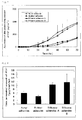
- Fig. 1 shows a graph of an accumulated permeated amount vs. time curve showing the accumulated permeated amount through the skin of PCP per unit area of the formulation 1 measured with elapse of in accordance with the above.
- skin permeation of the PCP through the skin was promoted with elapse of time.
- Fig. 2 shows the skin permeating amounts of PCP in the formulations 3, 4, 5, 6 and 1 where only adding amount of PCP was varied as 0.3% by weight, 0.5% by weight, 0.6% by weight, 0.75% by weight and 1% by weight, respectively, while other compounding components were the same as shown in Table 1. From the result, it is noted that the skin permeating amount increases depending upon the added amount of PCP.
- Fig. 3 shows the skin permeating amount of PCP in the formulation 1 and the comparative formulations 3 and 4 where the additives were 1-menthol, d-limonene and Tween 80, respectively while other compounding components were the same.
- the results show that, when 1-menthol was used as an additive, significantly high skin permeation was noted whereby it was confirmed to be favorable as an absorption promoter.
- d-limonene is a monocyclic monoterpene like 1-menthol and is a compound having the similar structure
- PCP rarely showed the skin permeation when d-limonene was added.
- Tween 80 is a surfactant having emulsifying and dispersing actions besides the permeating action due to lowering of surface tension of aqueous solution, PCP also rarely showed the skin permeation when Tween 80 was added.
- Fig. 4 shows the skin permeated amount of PCP in the comparative formulations 1, 2 and 7 and the formulation 1 where only added amount of 1-menthol was made 0% by weight, 0.5% by weight, 1% by weight and 2% by weight, respectively, while other compound components were made same.
- Fig. 5 shows the skin permeated amount of PCP in the formulations 8 and 1 where only added amount of N-methyl-2-pyrrolidone was made 0% by weight and 10% by weight, respectively. From those results, with regard to 1-menthol, significant skin permeability was noted when its added amount of 1% by weight or more.
- N-methyl-2-pyrrolidone significant skin permeability was noted when the added amount was 10% by weight or more and, although some skin permeability was available even when it was not added, some imbalance in the skin permeability was noted whereby it was noted that addition was more preferred.
- Fig. 6 shows the skin permeated amount of PCP in the formulations 1 and 2 where the lower alcohol was isopropanol and ethanol, respectively, while other compounding components were same. From the results, it was noted that there was almost no difference between the two in terms of the skin permeability and that various lower alcohols were able to be appropriately used.
- PCP-containing pressure-sensitive adhesive plasters where the adhesives were different were prepared by the following method using the adhesives shown in Table 3.
- PCP, 1-menthol, polyvinylpyrrolidone, glycerol monooleate and isopropyl myristate 20%, 20%, 15%, 20% and 10% by weight, respectively, to the weight of each adhesive were dissolved in a solvent (in an amount of 1.5-timers of the adhesive) contained in each adhesive, mixed for 1 minute and subjected to an ultrasonic treatment for 10 minutes to give uniform solutions.
- solvent in an amount of 1.5-timers of the adhesive
- Example 4 In vitro skin permeability test
- Fig. 7 shows a graph of accumulated permeation amount vs. time curve showing the accumulated permeation amount of PCP per unit area of each plaster measured with elapse of time.
- Fig. 8 shows a skin permeating amount (Flux: g/h/cm 2 ) of PCP determined from the above measured values for each of the adhesives. The same as in the result of the above Fig. 7 , an excellent skin permeation amount (high flux value) was achieved when a silicone adhesive was used as an adhesive base in a plaster prepared by using an adhesive matrix comprising the composition of the present invention.
- Hair on the back of male mice (seven weeks age) of ddY strain was shaved using a clipper for animals under anesthetizing with pentobarbital (50mg/kg) within such an area that was able to be equipped with a glass cell of an effective area of 2 cm 2 . After the shaving, feed and water were placed in a cage for one night.
- mice where the back was shaved were placed in tubs for observation by dividing into a group to which a hydrogel of the formulation 1 was applied and a control group and then spontaneous movement and standing-up behavior were observed for five minutes.
- spontaneous movement the case where the body of a mouse completely went over the line drawn on the tub was counted as one time and, as to the standing-up behavior, the case where the both forelimbs were completely separated from the floor was counted as one time.
- a glass cell was adhered, using an adhesive for living body (trade name: Aron Alpha), to the shaved back of the mice in each group under anesthetization with pentobarbital (50 mg/kg).
- the skin permeability of prochlorperazine is able to be improved in a more stable manner by addition of a lower alcohol such as isopropanol or ethanol or by addition of N-methyl-2-pyrrolidone.
- the adhesive matrix form of the pharmaceutical composition of the present invention it is also possible to improve the percutaneous permeability of prochlorperazine when a silicone adhesive is used as an adhesive base and polyvinylpyrrolidone, glycerol fatty acid ester and/or fatty acid ester are/is further added as additive (s) in addition to menthol.
- the adhesive matrix as such it is now possible to manufacture a plaster showing an excellent percutaneous absorption.
- the pharmaceutical composition of the present invention contains prochlorperazine which has been widely used in clinical fields as the first choice, etc. for the treating agent for nausea and vomiting before and after the operation, etc. and the preparation thereof for external application is very highly useful as an antiemetic agent, etc. being excellent in percutaneous absorption and able to be used for a long period.
Landscapes
- Health & Medical Sciences (AREA)
- Engineering & Computer Science (AREA)
- Bioinformatics & Cheminformatics (AREA)
- Dermatology (AREA)
- Life Sciences & Earth Sciences (AREA)
- Chemical & Material Sciences (AREA)
- Veterinary Medicine (AREA)
- Public Health (AREA)
- Medicinal Chemistry (AREA)
- General Health & Medical Sciences (AREA)
- Animal Behavior & Ethology (AREA)
- Pharmacology & Pharmacy (AREA)
- Epidemiology (AREA)
- General Chemical & Material Sciences (AREA)
- Chemical Kinetics & Catalysis (AREA)
- Botany (AREA)
- Oil, Petroleum & Natural Gas (AREA)
- Organic Chemistry (AREA)
- Nuclear Medicine, Radiotherapy & Molecular Imaging (AREA)
- Otolaryngology (AREA)
- Hospice & Palliative Care (AREA)
- Medicinal Preparation (AREA)
- Pharmaceuticals Containing Other Organic And Inorganic Compounds (AREA)
- Nitrogen- Or Sulfur-Containing Heterocyclic Ring Compounds With Rings Of Six Or More Members (AREA)
Applications Claiming Priority (2)
| Application Number | Priority Date | Filing Date | Title |
|---|---|---|---|
| JP2008128245 | 2008-05-15 | ||
| PCT/JP2009/053988 WO2009139213A1 (ja) | 2008-05-15 | 2009-03-03 | プロクロルペラジン含有外用医薬組成物 |
Publications (2)
| Publication Number | Publication Date |
|---|---|
| EP2298313A1 true EP2298313A1 (de) | 2011-03-23 |
| EP2298313A4 EP2298313A4 (de) | 2013-08-21 |
Family
ID=41318586
Family Applications (1)
| Application Number | Title | Priority Date | Filing Date |
|---|---|---|---|
| EP09746420.0A Withdrawn EP2298313A4 (de) | 2008-05-15 | 2009-03-03 | Prochlorperazin enthaltende pharmazeutische zusammensetzung zur externen anwendung |
Country Status (4)
| Country | Link |
|---|---|
| US (1) | US20110151001A1 (de) |
| EP (1) | EP2298313A4 (de) |
| JP (1) | JPWO2009139213A1 (de) |
| WO (1) | WO2009139213A1 (de) |
Family Cites Families (28)
| Publication number | Priority date | Publication date | Assignee | Title |
|---|---|---|---|---|
| US4931283A (en) * | 1983-12-22 | 1990-06-05 | American Home Products Corp. (Del) | Menthol enhancement of transdermal drug delivery |
| GR81250B (en) * | 1983-12-22 | 1985-11-19 | American Home Prod | Menthol enhancement of transdermal drug delivery |
| US4933184A (en) * | 1983-12-22 | 1990-06-12 | American Home Products Corp. (Del) | Menthol enhancement of transdermal drug delivery |
| JP2659961B2 (ja) * | 1986-08-18 | 1997-09-30 | 中外製薬株式会社 | 経皮吸収貼付剤 |
| JPH01265021A (ja) * | 1987-10-29 | 1989-10-23 | Hercon Lab Corp | 薬理学的活性物質を含有する組成物を動物組織に制御放出および供給するための物品 |
| JPH07106982B2 (ja) * | 1988-08-11 | 1995-11-15 | エスエス製薬株式会社 | 外用薬剤組成物 |
| JPH04217920A (ja) * | 1990-03-30 | 1992-08-07 | Morimoto Kazutoshi | 経皮吸収組成物 |
| DE69122464T2 (de) * | 1990-03-30 | 1997-02-20 | Yasunori Morimoto | Transdermal absorbierbares mittel mit morphin hydrochlorid |
| JPH0648962A (ja) * | 1991-10-24 | 1994-02-22 | Kazutoshi Morimoto | 経皮吸収製剤用組成物 |
| JPH07330591A (ja) * | 1994-06-06 | 1995-12-19 | Kanegafuchi Chem Ind Co Ltd | 経皮吸収製剤 |
| JPH0881373A (ja) * | 1994-09-09 | 1996-03-26 | Nichiban Co Ltd | 経皮貼付剤 |
| JPH08245377A (ja) * | 1995-03-15 | 1996-09-24 | Yamanouchi Pharmaceut Co Ltd | 経皮吸収用製剤 |
| JPH0959153A (ja) * | 1995-08-18 | 1997-03-04 | Teisan Seiyaku Kk | 硝酸イソソルビド含有貼付剤の製造方法 |
| JP3924017B2 (ja) * | 1995-12-25 | 2007-06-06 | 埼玉第一製薬株式会社 | 外用医薬組成物 |
| JPH09176001A (ja) * | 1995-12-26 | 1997-07-08 | Teijin Ltd | 医療用貼付材 |
| JPH1053527A (ja) * | 1996-08-09 | 1998-02-24 | Tanabe Seiyaku Co Ltd | カフェイン含有経皮吸収製剤 |
| WO1998014184A1 (fr) * | 1996-10-04 | 1998-04-09 | Saitama Daiichi Seiyaku Kabushiki Kaisha | Timbre percutane |
| DE19814084B4 (de) * | 1998-03-30 | 2005-12-22 | Lts Lohmann Therapie-Systeme Ag | D2-Agonist enthaltendes transdermales therapeutisches System zur Behandlung des Parkinson-Syndroms und Verfahren zu seiner Herstellung |
| JP3657435B2 (ja) * | 1998-07-23 | 2005-06-08 | 純一 須藤 | 経皮吸収用組成物 |
| US6896898B1 (en) * | 1999-11-19 | 2005-05-24 | Xel Herbaceuticals, Inc. | Transdermal delivery system for alkaloids of aconitum species |
| AU1780101A (en) | 1999-11-19 | 2001-05-30 | Xel Herbaceuticals | Transdermal delivery system for alkaloids of aconitum species |
| US20050042271A1 (en) * | 1999-11-19 | 2005-02-24 | Xel Herbaceuticals, Inc . | Transdermal delivery system for alkaloids of aconitum species |
| US20030124176A1 (en) * | 1999-12-16 | 2003-07-03 | Tsung-Min Hsu | Transdermal and topical administration of drugs using basic permeation enhancers |
| LT2351555T (lt) * | 2004-02-23 | 2016-12-27 | Euro-Celtique S.A. | Piktnaudžiavimui atspari priemonė, skirta transderminiam opoido įvedimui |
| JP2006036687A (ja) * | 2004-07-27 | 2006-02-09 | Nippon Zoki Pharmaceut Co Ltd | トラマドール含有外用医薬組成物 |
| JP2006298774A (ja) * | 2005-04-15 | 2006-11-02 | Lead Chemical Co Ltd | 経皮吸収型フリーラジカル抑制製剤 |
| JP4807974B2 (ja) * | 2005-06-30 | 2011-11-02 | 帝國製薬株式会社 | 経皮吸収促進組成物 |
| JP5064391B2 (ja) * | 2006-07-14 | 2012-10-31 | 久光製薬株式会社 | 貼付剤 |
-
2009
- 2009-03-03 WO PCT/JP2009/053988 patent/WO2009139213A1/ja not_active Ceased
- 2009-03-03 US US12/991,134 patent/US20110151001A1/en not_active Abandoned
- 2009-03-03 JP JP2009552024A patent/JPWO2009139213A1/ja active Pending
- 2009-03-03 EP EP09746420.0A patent/EP2298313A4/de not_active Withdrawn
Also Published As
| Publication number | Publication date |
|---|---|
| WO2009139213A1 (ja) | 2009-11-19 |
| EP2298313A4 (de) | 2013-08-21 |
| US20110151001A1 (en) | 2011-06-23 |
| JPWO2009139213A1 (ja) | 2011-09-15 |
Similar Documents
| Publication | Publication Date | Title |
|---|---|---|
| FI91361B (fi) | Menetelmä eperisonia sisältävän farmaseuttisen koostumuksen valmistamiseksi | |
| US8354121B2 (en) | Tape preparation | |
| EP2016939A1 (de) | Transdermal resorbierbare zubereitung mit einem mittel gegen demenz | |
| EP2730290B1 (de) | Hautpflaster mit einem arzneimittel mit einem serotoninrezeptor-antagonisten | |
| TWI905361B (zh) | 緩釋製劑組合物 | |
| IL182541A (en) | Pharmaceutical veterinary composition in the form of transmucosal gel, kit and method thereof | |
| EA030797B1 (ru) | Система трансдермальной доставки гормонов (варианты) и способы ее применения | |
| JP2019522025A (ja) | メマンチン経皮送達システム | |
| US20230139565A1 (en) | Oral delivery system comprising hydroxychloroquine and/or chloroquine | |
| CN115475152A (zh) | 氟比洛芬的外用制剂及其制备方法 | |
| CZ240297A3 (cs) | Transdermální přípravek | |
| TW201136615A (en) | Local anesthetic emulsion compositions and methods of making and using the same | |
| US20180177800A1 (en) | Composition for percutaneous absorption | |
| US20230123388A1 (en) | Transdermal and/or topical delivery system comprising hydroxychloroquine and/or chloroquine | |
| CN114452255A (zh) | 一种阿戈美拉汀微乳、微乳凝胶及其制备方法 | |
| US20110151001A1 (en) | Pharmaceutical composition for external application containing prochlorperazine | |
| EP1787648A1 (de) | Medizinische zusammensetzung für perkutane perospiron-verwaltung | |
| JP4119502B2 (ja) | 新規な経皮吸収促進剤を含有する外用剤組成物 | |
| EP4338740A1 (de) | Transdermales pflaster zur förderung oder beschleunigung der myelinisierung und/oder remyelinisierung | |
| KR102455157B1 (ko) | 로피니롤 경피흡수제 | |
| CN119950415A (zh) | 一种复方非泼罗尼吡喹酮凝胶及其制备方法和应用 | |
| JPWO2010050423A1 (ja) | オンダンセトロン含有外用医薬組成物 | |
| HK1137344B (en) | Tape preparation | |
| HK1193996B (en) | Adhesive skin patch containing serotonin receptor antagonist drug |
Legal Events
| Date | Code | Title | Description |
|---|---|---|---|
| PUAI | Public reference made under article 153(3) epc to a published international application that has entered the european phase |
Free format text: ORIGINAL CODE: 0009012 |
|
| 17P | Request for examination filed |
Effective date: 20101209 |
|
| AK | Designated contracting states |
Kind code of ref document: A1 Designated state(s): AT BE BG CH CY CZ DE DK EE ES FI FR GB GR HR HU IE IS IT LI LT LU LV MC MK MT NL NO PL PT RO SE SI SK TR |
|
| AX | Request for extension of the european patent |
Extension state: AL BA RS |
|
| DAX | Request for extension of the european patent (deleted) | ||
| RIC1 | Information provided on ipc code assigned before grant |
Ipc: A61K 47/22 20060101ALI20130708BHEP Ipc: A61K 9/06 20060101ALI20130708BHEP Ipc: A61P 1/08 20060101ALI20130708BHEP Ipc: C07D 279/28 20060101ALI20130708BHEP Ipc: A61K 9/70 20060101ALI20130708BHEP Ipc: A61K 31/5415 20060101AFI20130708BHEP Ipc: A61K 47/10 20060101ALI20130708BHEP |
|
| A4 | Supplementary search report drawn up and despatched |
Effective date: 20130718 |
|
| STAA | Information on the status of an ep patent application or granted ep patent |
Free format text: STATUS: THE APPLICATION IS DEEMED TO BE WITHDRAWN |
|
| 18D | Application deemed to be withdrawn |
Effective date: 20131001 |