EP2290735B1 - Elektrochemische Batteriezelle - Google Patents
Elektrochemische Batteriezelle Download PDFInfo
- Publication number
- EP2290735B1 EP2290735B1 EP10009875A EP10009875A EP2290735B1 EP 2290735 B1 EP2290735 B1 EP 2290735B1 EP 10009875 A EP10009875 A EP 10009875A EP 10009875 A EP10009875 A EP 10009875A EP 2290735 B1 EP2290735 B1 EP 2290735B1
- Authority
- EP
- European Patent Office
- Prior art keywords
- electrode
- cell
- electrolyte solution
- ions
- metal
- Prior art date
- Legal status (The legal status is an assumption and is not a legal conclusion. Google has not performed a legal analysis and makes no representation as to the accuracy of the status listed.)
- Expired - Lifetime
Links
- 238000000034 method Methods 0.000 claims description 33
- 238000004140 cleaning Methods 0.000 claims description 31
- 229910052751 metal Inorganic materials 0.000 claims description 31
- 239000002184 metal Substances 0.000 claims description 31
- 239000008151 electrolyte solution Substances 0.000 claims description 27
- 150000003839 salts Chemical class 0.000 claims description 24
- 238000003780 insertion Methods 0.000 claims description 20
- 230000037431 insertion Effects 0.000 claims description 20
- 150000002500 ions Chemical class 0.000 claims description 18
- WHXSMMKQMYFTQS-UHFFFAOYSA-N Lithium Chemical compound [Li] WHXSMMKQMYFTQS-UHFFFAOYSA-N 0.000 claims description 16
- 239000012459 cleaning agent Substances 0.000 claims description 16
- 229910052744 lithium Inorganic materials 0.000 claims description 16
- 229910052783 alkali metal Inorganic materials 0.000 claims description 14
- 238000006243 chemical reaction Methods 0.000 claims description 14
- 238000009830 intercalation Methods 0.000 claims description 10
- 230000002687 intercalation Effects 0.000 claims description 10
- 239000002841 Lewis acid Substances 0.000 claims description 9
- 150000001340 alkali metals Chemical class 0.000 claims description 9
- 150000007517 lewis acids Chemical class 0.000 claims description 9
- 238000004519 manufacturing process Methods 0.000 claims description 9
- 150000001875 compounds Chemical class 0.000 claims description 6
- 229910052784 alkaline earth metal Inorganic materials 0.000 claims description 4
- 150000001342 alkaline earth metals Chemical class 0.000 claims description 4
- 230000000737 periodic effect Effects 0.000 claims description 4
- -1 hydroxide ions Chemical class 0.000 claims description 3
- 238000005342 ion exchange Methods 0.000 claims description 3
- 229910001537 lithium tetrachloroaluminate Inorganic materials 0.000 claims description 3
- 229910044991 metal oxide Inorganic materials 0.000 claims description 3
- 150000004706 metal oxides Chemical class 0.000 claims description 3
- 238000005457 optimization Methods 0.000 claims description 3
- 229910052782 aluminium Inorganic materials 0.000 claims description 2
- 239000007795 chemical reaction product Substances 0.000 claims description 2
- 239000000243 solution Substances 0.000 claims description 2
- 238000012546 transfer Methods 0.000 claims description 2
- KLZUFWVZNOTSEM-UHFFFAOYSA-K Aluminium flouride Chemical compound F[Al](F)F KLZUFWVZNOTSEM-UHFFFAOYSA-K 0.000 claims 2
- KWGKDLIKAYFUFQ-UHFFFAOYSA-M lithium chloride Chemical compound [Li+].[Cl-] KWGKDLIKAYFUFQ-UHFFFAOYSA-M 0.000 claims 2
- OYPRJOBELJOOCE-UHFFFAOYSA-N Calcium Chemical compound [Ca] OYPRJOBELJOOCE-UHFFFAOYSA-N 0.000 claims 1
- CURLTUGMZLYLDI-UHFFFAOYSA-N Carbon dioxide Chemical compound O=C=O CURLTUGMZLYLDI-UHFFFAOYSA-N 0.000 claims 1
- QGJOPFRUJISHPQ-UHFFFAOYSA-N Carbon disulfide Chemical compound S=C=S QGJOPFRUJISHPQ-UHFFFAOYSA-N 0.000 claims 1
- KRHYYFGTRYWZRS-UHFFFAOYSA-M Fluoride anion Chemical compound [F-] KRHYYFGTRYWZRS-UHFFFAOYSA-M 0.000 claims 1
- 229910005267 GaCl3 Inorganic materials 0.000 claims 1
- DGAQECJNVWCQMB-PUAWFVPOSA-M Ilexoside XXIX Chemical compound C[C@@H]1CC[C@@]2(CC[C@@]3(C(=CC[C@H]4[C@]3(CC[C@@H]5[C@@]4(CC[C@@H](C5(C)C)OS(=O)(=O)[O-])C)C)[C@@H]2[C@]1(C)O)C)C(=O)O[C@H]6[C@@H]([C@H]([C@@H]([C@H](O6)CO)O)O)O.[Na+] DGAQECJNVWCQMB-PUAWFVPOSA-M 0.000 claims 1
- HCHKCACWOHOZIP-UHFFFAOYSA-N Zinc Chemical compound [Zn] HCHKCACWOHOZIP-UHFFFAOYSA-N 0.000 claims 1
- XAGFODPZIPBFFR-UHFFFAOYSA-N aluminium Chemical compound [Al] XAGFODPZIPBFFR-UHFFFAOYSA-N 0.000 claims 1
- WTEOIRVLGSZEPR-UHFFFAOYSA-N boron trifluoride Chemical compound FB(F)F WTEOIRVLGSZEPR-UHFFFAOYSA-N 0.000 claims 1
- 229910052791 calcium Inorganic materials 0.000 claims 1
- 239000011575 calcium Substances 0.000 claims 1
- UPWPDUACHOATKO-UHFFFAOYSA-K gallium trichloride Chemical compound Cl[Ga](Cl)Cl UPWPDUACHOATKO-UHFFFAOYSA-K 0.000 claims 1
- 150000002739 metals Chemical class 0.000 claims 1
- 229910052708 sodium Inorganic materials 0.000 claims 1
- 239000011734 sodium Substances 0.000 claims 1
- 229910052725 zinc Inorganic materials 0.000 claims 1
- 239000011701 zinc Substances 0.000 claims 1
- 239000003792 electrolyte Substances 0.000 description 20
- 239000012212 insulator Substances 0.000 description 19
- RAHZWNYVWXNFOC-UHFFFAOYSA-N Sulphur dioxide Chemical compound O=S=O RAHZWNYVWXNFOC-UHFFFAOYSA-N 0.000 description 17
- 239000000463 material Substances 0.000 description 10
- 238000011049 filling Methods 0.000 description 9
- 239000002904 solvent Substances 0.000 description 9
- XLYOFNOQVPJJNP-UHFFFAOYSA-N water Substances O XLYOFNOQVPJJNP-UHFFFAOYSA-N 0.000 description 8
- PXHVJJICTQNCMI-UHFFFAOYSA-N Nickel Chemical compound [Ni] PXHVJJICTQNCMI-UHFFFAOYSA-N 0.000 description 7
- 239000007772 electrode material Substances 0.000 description 7
- 238000002161 passivation Methods 0.000 description 7
- 230000008569 process Effects 0.000 description 7
- OKTJSMMVPCPJKN-UHFFFAOYSA-N Carbon Chemical compound [C] OKTJSMMVPCPJKN-UHFFFAOYSA-N 0.000 description 6
- 239000011149 active material Substances 0.000 description 6
- 230000015572 biosynthetic process Effects 0.000 description 6
- 238000010276 construction Methods 0.000 description 6
- 238000002484 cyclic voltammetry Methods 0.000 description 6
- 238000013461 design Methods 0.000 description 6
- 229910012851 LiCoO 2 Inorganic materials 0.000 description 5
- 230000008021 deposition Effects 0.000 description 4
- 239000003599 detergent Substances 0.000 description 4
- 229910002804 graphite Inorganic materials 0.000 description 4
- 239000010439 graphite Substances 0.000 description 4
- 239000007788 liquid Substances 0.000 description 4
- 229910001416 lithium ion Inorganic materials 0.000 description 4
- 238000011068 loading method Methods 0.000 description 4
- 239000011148 porous material Substances 0.000 description 4
- 238000003860 storage Methods 0.000 description 4
- 238000012360 testing method Methods 0.000 description 4
- 229910010238 LiAlCl 4 Inorganic materials 0.000 description 3
- 238000010521 absorption reaction Methods 0.000 description 3
- 230000008859 change Effects 0.000 description 3
- 238000007599 discharging Methods 0.000 description 3
- 238000005259 measurement Methods 0.000 description 3
- 229910021645 metal ion Inorganic materials 0.000 description 3
- 230000035699 permeability Effects 0.000 description 3
- 229910016569 AlF 3 Inorganic materials 0.000 description 2
- HBBGRARXTFLTSG-UHFFFAOYSA-N Lithium ion Chemical compound [Li+] HBBGRARXTFLTSG-UHFFFAOYSA-N 0.000 description 2
- 230000003213 activating effect Effects 0.000 description 2
- 230000004913 activation Effects 0.000 description 2
- 150000001450 anions Chemical class 0.000 description 2
- 229910052799 carbon Inorganic materials 0.000 description 2
- 238000000605 extraction Methods 0.000 description 2
- 239000012530 fluid Substances 0.000 description 2
- 150000004673 fluoride salts Chemical class 0.000 description 2
- 239000006260 foam Substances 0.000 description 2
- 150000004820 halides Chemical class 0.000 description 2
- XLYOFNOQVPJJNP-UHFFFAOYSA-M hydroxide Chemical compound [OH-] XLYOFNOQVPJJNP-UHFFFAOYSA-M 0.000 description 2
- 239000000203 mixture Substances 0.000 description 2
- 229910052759 nickel Inorganic materials 0.000 description 2
- 229920000642 polymer Polymers 0.000 description 2
- 238000000746 purification Methods 0.000 description 2
- 238000000926 separation method Methods 0.000 description 2
- VZGDMQKNWNREIO-UHFFFAOYSA-N tetrachloromethane Chemical compound ClC(Cl)(Cl)Cl VZGDMQKNWNREIO-UHFFFAOYSA-N 0.000 description 2
- NLXLAEXVIDQMFP-UHFFFAOYSA-N Ammonia chloride Chemical compound [NH4+].[Cl-] NLXLAEXVIDQMFP-UHFFFAOYSA-N 0.000 description 1
- 229910017008 AsF 6 Inorganic materials 0.000 description 1
- 229910032387 LiCoO2 Inorganic materials 0.000 description 1
- 238000009825 accumulation Methods 0.000 description 1
- 239000002253 acid Substances 0.000 description 1
- 239000000654 additive Substances 0.000 description 1
- 230000000996 additive effect Effects 0.000 description 1
- 229910001413 alkali metal ion Inorganic materials 0.000 description 1
- 239000000956 alloy Substances 0.000 description 1
- 229910045601 alloy Inorganic materials 0.000 description 1
- 229910000323 aluminium silicate Inorganic materials 0.000 description 1
- 239000000010 aprotic solvent Substances 0.000 description 1
- 239000012298 atmosphere Substances 0.000 description 1
- 150000001768 cations Chemical class 0.000 description 1
- XOYLJNJLGBYDTH-UHFFFAOYSA-M chlorogallium Chemical compound [Ga]Cl XOYLJNJLGBYDTH-UHFFFAOYSA-M 0.000 description 1
- 238000002425 crystallisation Methods 0.000 description 1
- 230000008025 crystallization Effects 0.000 description 1
- 238000010586 diagram Methods 0.000 description 1
- HNPSIPDUKPIQMN-UHFFFAOYSA-N dioxosilane;oxo(oxoalumanyloxy)alumane Chemical compound O=[Si]=O.O=[Al]O[Al]=O HNPSIPDUKPIQMN-UHFFFAOYSA-N 0.000 description 1
- 238000004090 dissolution Methods 0.000 description 1
- 230000000694 effects Effects 0.000 description 1
- 238000005429 filling process Methods 0.000 description 1
- 239000011888 foil Substances 0.000 description 1
- 230000001771 impaired effect Effects 0.000 description 1
- 238000010952 in-situ formation Methods 0.000 description 1
- 238000011065 in-situ storage Methods 0.000 description 1
- 238000010348 incorporation Methods 0.000 description 1
- DNHVXYDGZKWYNU-UHFFFAOYSA-N lead;hydrate Chemical compound O.[Pb] DNHVXYDGZKWYNU-UHFFFAOYSA-N 0.000 description 1
- 239000011244 liquid electrolyte Substances 0.000 description 1
- 229910000625 lithium cobalt oxide Inorganic materials 0.000 description 1
- BFZPBUKRYWOWDV-UHFFFAOYSA-N lithium;oxido(oxo)cobalt Chemical compound [Li+].[O-][Co]=O BFZPBUKRYWOWDV-UHFFFAOYSA-N 0.000 description 1
- 239000006262 metallic foam Substances 0.000 description 1
- 239000002808 molecular sieve Substances 0.000 description 1
- 230000003287 optical effect Effects 0.000 description 1
- 239000005486 organic electrolyte Substances 0.000 description 1
- 230000008092 positive effect Effects 0.000 description 1
- 230000009467 reduction Effects 0.000 description 1
- 230000000717 retained effect Effects 0.000 description 1
- 239000012047 saturated solution Substances 0.000 description 1
- HBMJWWWQQXIZIP-UHFFFAOYSA-N silicon carbide Chemical compound [Si+]#[C-] HBMJWWWQQXIZIP-UHFFFAOYSA-N 0.000 description 1
- 229910010271 silicon carbide Inorganic materials 0.000 description 1
- URGAHOPLAPQHLN-UHFFFAOYSA-N sodium aluminosilicate Chemical compound [Na+].[Al+3].[O-][Si]([O-])=O.[O-][Si]([O-])=O URGAHOPLAPQHLN-UHFFFAOYSA-N 0.000 description 1
- 239000007858 starting material Substances 0.000 description 1
- 239000000126 substance Substances 0.000 description 1
- 239000000758 substrate Substances 0.000 description 1
- 239000003115 supporting electrolyte Substances 0.000 description 1
- 238000009827 uniform distribution Methods 0.000 description 1
Images



Classifications
-
- H—ELECTRICITY
- H01—ELECTRIC ELEMENTS
- H01M—PROCESSES OR MEANS, e.g. BATTERIES, FOR THE DIRECT CONVERSION OF CHEMICAL ENERGY INTO ELECTRICAL ENERGY
- H01M10/00—Secondary cells; Manufacture thereof
- H01M10/05—Accumulators with non-aqueous electrolyte
- H01M10/056—Accumulators with non-aqueous electrolyte characterised by the materials used as electrolytes, e.g. mixed inorganic/organic electrolytes
- H01M10/0561—Accumulators with non-aqueous electrolyte characterised by the materials used as electrolytes, e.g. mixed inorganic/organic electrolytes the electrolyte being constituted of inorganic materials only
- H01M10/0563—Liquid materials, e.g. for Li-SOCl2 cells
-
- H—ELECTRICITY
- H01—ELECTRIC ELEMENTS
- H01M—PROCESSES OR MEANS, e.g. BATTERIES, FOR THE DIRECT CONVERSION OF CHEMICAL ENERGY INTO ELECTRICAL ENERGY
- H01M50/00—Constructional details or processes of manufacture of the non-active parts of electrochemical cells other than fuel cells, e.g. hybrid cells
- H01M50/60—Arrangements or processes for filling or topping-up with liquids; Arrangements or processes for draining liquids from casings
- H01M50/609—Arrangements or processes for filling with liquid, e.g. electrolytes
- H01M50/618—Pressure control
-
- H—ELECTRICITY
- H01—ELECTRIC ELEMENTS
- H01M—PROCESSES OR MEANS, e.g. BATTERIES, FOR THE DIRECT CONVERSION OF CHEMICAL ENERGY INTO ELECTRICAL ENERGY
- H01M10/00—Secondary cells; Manufacture thereof
- H01M10/05—Accumulators with non-aqueous electrolyte
- H01M10/052—Li-accumulators
- H01M10/0525—Rocking-chair batteries, i.e. batteries with lithium insertion or intercalation in both electrodes; Lithium-ion batteries
-
- H—ELECTRICITY
- H01—ELECTRIC ELEMENTS
- H01M—PROCESSES OR MEANS, e.g. BATTERIES, FOR THE DIRECT CONVERSION OF CHEMICAL ENERGY INTO ELECTRICAL ENERGY
- H01M10/00—Secondary cells; Manufacture thereof
- H01M10/05—Accumulators with non-aqueous electrolyte
- H01M10/058—Construction or manufacture
-
- H—ELECTRICITY
- H01—ELECTRIC ELEMENTS
- H01M—PROCESSES OR MEANS, e.g. BATTERIES, FOR THE DIRECT CONVERSION OF CHEMICAL ENERGY INTO ELECTRICAL ENERGY
- H01M10/00—Secondary cells; Manufacture thereof
- H01M10/05—Accumulators with non-aqueous electrolyte
- H01M10/058—Construction or manufacture
- H01M10/0585—Construction or manufacture of accumulators having only flat construction elements, i.e. flat positive electrodes, flat negative electrodes and flat separators
-
- H—ELECTRICITY
- H01—ELECTRIC ELEMENTS
- H01M—PROCESSES OR MEANS, e.g. BATTERIES, FOR THE DIRECT CONVERSION OF CHEMICAL ENERGY INTO ELECTRICAL ENERGY
- H01M4/00—Electrodes
- H01M4/02—Electrodes composed of, or comprising, active material
- H01M4/04—Processes of manufacture in general
- H01M4/0438—Processes of manufacture in general by electrochemical processing
- H01M4/044—Activating, forming or electrochemical attack of the supporting material
- H01M4/0445—Forming after manufacture of the electrode, e.g. first charge, cycling
- H01M4/0447—Forming after manufacture of the electrode, e.g. first charge, cycling of complete cells or cells stacks
-
- H—ELECTRICITY
- H01—ELECTRIC ELEMENTS
- H01M—PROCESSES OR MEANS, e.g. BATTERIES, FOR THE DIRECT CONVERSION OF CHEMICAL ENERGY INTO ELECTRICAL ENERGY
- H01M4/00—Electrodes
- H01M4/02—Electrodes composed of, or comprising, active material
- H01M4/13—Electrodes for accumulators with non-aqueous electrolyte, e.g. for lithium-accumulators; Processes of manufacture thereof
-
- H—ELECTRICITY
- H01—ELECTRIC ELEMENTS
- H01M—PROCESSES OR MEANS, e.g. BATTERIES, FOR THE DIRECT CONVERSION OF CHEMICAL ENERGY INTO ELECTRICAL ENERGY
- H01M4/00—Electrodes
- H01M4/02—Electrodes composed of, or comprising, active material
- H01M4/13—Electrodes for accumulators with non-aqueous electrolyte, e.g. for lithium-accumulators; Processes of manufacture thereof
- H01M4/139—Processes of manufacture
-
- H—ELECTRICITY
- H01—ELECTRIC ELEMENTS
- H01M—PROCESSES OR MEANS, e.g. BATTERIES, FOR THE DIRECT CONVERSION OF CHEMICAL ENERGY INTO ELECTRICAL ENERGY
- H01M4/00—Electrodes
- H01M4/02—Electrodes composed of, or comprising, active material
- H01M4/36—Selection of substances as active materials, active masses, active liquids
- H01M4/48—Selection of substances as active materials, active masses, active liquids of inorganic oxides or hydroxides
- H01M4/52—Selection of substances as active materials, active masses, active liquids of inorganic oxides or hydroxides of nickel, cobalt or iron
- H01M4/525—Selection of substances as active materials, active masses, active liquids of inorganic oxides or hydroxides of nickel, cobalt or iron of mixed oxides or hydroxides containing iron, cobalt or nickel for inserting or intercalating light metals, e.g. LiNiO2, LiCoO2 or LiCoOxFy
-
- H—ELECTRICITY
- H01—ELECTRIC ELEMENTS
- H01M—PROCESSES OR MEANS, e.g. BATTERIES, FOR THE DIRECT CONVERSION OF CHEMICAL ENERGY INTO ELECTRICAL ENERGY
- H01M4/00—Electrodes
- H01M4/02—Electrodes composed of, or comprising, active material
- H01M4/36—Selection of substances as active materials, active masses, active liquids
- H01M4/58—Selection of substances as active materials, active masses, active liquids of inorganic compounds other than oxides or hydroxides, e.g. sulfides, selenides, tellurides, halogenides or LiCoFy; of polyanionic structures, e.g. phosphates, silicates or borates
- H01M4/583—Carbonaceous material, e.g. graphite-intercalation compounds or CFx
- H01M4/587—Carbonaceous material, e.g. graphite-intercalation compounds or CFx for inserting or intercalating light metals
-
- H—ELECTRICITY
- H01—ELECTRIC ELEMENTS
- H01M—PROCESSES OR MEANS, e.g. BATTERIES, FOR THE DIRECT CONVERSION OF CHEMICAL ENERGY INTO ELECTRICAL ENERGY
- H01M50/00—Constructional details or processes of manufacture of the non-active parts of electrochemical cells other than fuel cells, e.g. hybrid cells
- H01M50/40—Separators; Membranes; Diaphragms; Spacing elements inside cells
- H01M50/489—Separators, membranes, diaphragms or spacing elements inside the cells, characterised by their physical properties, e.g. swelling degree, hydrophilicity or shut down properties
- H01M50/497—Ionic conductivity
-
- H—ELECTRICITY
- H01—ELECTRIC ELEMENTS
- H01M—PROCESSES OR MEANS, e.g. BATTERIES, FOR THE DIRECT CONVERSION OF CHEMICAL ENERGY INTO ELECTRICAL ENERGY
- H01M10/00—Secondary cells; Manufacture thereof
- H01M10/05—Accumulators with non-aqueous electrolyte
- H01M10/054—Accumulators with insertion or intercalation of metals other than lithium, e.g. with magnesium or aluminium
-
- H—ELECTRICITY
- H01—ELECTRIC ELEMENTS
- H01M—PROCESSES OR MEANS, e.g. BATTERIES, FOR THE DIRECT CONVERSION OF CHEMICAL ENERGY INTO ELECTRICAL ENERGY
- H01M4/00—Electrodes
- H01M4/02—Electrodes composed of, or comprising, active material
- H01M4/62—Selection of inactive substances as ingredients for active masses, e.g. binders, fillers
-
- H—ELECTRICITY
- H01—ELECTRIC ELEMENTS
- H01M—PROCESSES OR MEANS, e.g. BATTERIES, FOR THE DIRECT CONVERSION OF CHEMICAL ENERGY INTO ELECTRICAL ENERGY
- H01M50/00—Constructional details or processes of manufacture of the non-active parts of electrochemical cells other than fuel cells, e.g. hybrid cells
- H01M50/40—Separators; Membranes; Diaphragms; Spacing elements inside cells
- H01M50/409—Separators, membranes or diaphragms characterised by the material
- H01M50/431—Inorganic material
-
- Y—GENERAL TAGGING OF NEW TECHNOLOGICAL DEVELOPMENTS; GENERAL TAGGING OF CROSS-SECTIONAL TECHNOLOGIES SPANNING OVER SEVERAL SECTIONS OF THE IPC; TECHNICAL SUBJECTS COVERED BY FORMER USPC CROSS-REFERENCE ART COLLECTIONS [XRACs] AND DIGESTS
- Y02—TECHNOLOGIES OR APPLICATIONS FOR MITIGATION OR ADAPTATION AGAINST CLIMATE CHANGE
- Y02E—REDUCTION OF GREENHOUSE GAS [GHG] EMISSIONS, RELATED TO ENERGY GENERATION, TRANSMISSION OR DISTRIBUTION
- Y02E60/00—Enabling technologies; Technologies with a potential or indirect contribution to GHG emissions mitigation
- Y02E60/10—Energy storage using batteries
-
- Y—GENERAL TAGGING OF NEW TECHNOLOGICAL DEVELOPMENTS; GENERAL TAGGING OF CROSS-SECTIONAL TECHNOLOGIES SPANNING OVER SEVERAL SECTIONS OF THE IPC; TECHNICAL SUBJECTS COVERED BY FORMER USPC CROSS-REFERENCE ART COLLECTIONS [XRACs] AND DIGESTS
- Y02—TECHNOLOGIES OR APPLICATIONS FOR MITIGATION OR ADAPTATION AGAINST CLIMATE CHANGE
- Y02P—CLIMATE CHANGE MITIGATION TECHNOLOGIES IN THE PRODUCTION OR PROCESSING OF GOODS
- Y02P70/00—Climate change mitigation technologies in the production process for final industrial or consumer products
- Y02P70/50—Manufacturing or production processes characterised by the final manufactured product
-
- Y—GENERAL TAGGING OF NEW TECHNOLOGICAL DEVELOPMENTS; GENERAL TAGGING OF CROSS-SECTIONAL TECHNOLOGIES SPANNING OVER SEVERAL SECTIONS OF THE IPC; TECHNICAL SUBJECTS COVERED BY FORMER USPC CROSS-REFERENCE ART COLLECTIONS [XRACs] AND DIGESTS
- Y10—TECHNICAL SUBJECTS COVERED BY FORMER USPC
- Y10T—TECHNICAL SUBJECTS COVERED BY FORMER US CLASSIFICATION
- Y10T29/00—Metal working
- Y10T29/49—Method of mechanical manufacture
- Y10T29/49002—Electrical device making
- Y10T29/49108—Electric battery cell making
Definitions
- the invention relates to a method for producing an electrochemical battery cell with a negative electrode (cathode), an electrolyte containing a conducting salt and a positive electrode (anode).
- the invention is directed to alkali metal cells in which the active material is an alkali metal stored in and / or on the negative electrode upon charging of the cell.
- the active material may also be another metal, in particular an alkaline earth metal or a metal of the second group of the periodic table.
- the conductive salt of the electrolyte consists of cations of the metal that forms the active mass and suitable anions.
- the conductive salt used is preferably a tetrahaloaluminate of the alkali metal, for example LiAlCl 4 .
- alkali metal cells in particular lithium cells.
- Typical of such cells is a construction of several superimposed layers whose area dimensions is much larger than their thickness. They have approximately the same size dimensions and are sandwiched in the cell. Commonly used are prismatic cells with generally cuboidal housing and straight layers and cylindrical cells, in the interior of which the layers are wound like a roll.
- the active mass in particular after several charge and discharge cycles, is not deposited as a smooth layer with a flat surface, but as filamentary sections in sections.
- unbranched filaments are formed with substantially the same diameter (for a particular cell with a particular electrolyte) that grows into balls and is referred to as whiskers.
- the formation of the whiskers is attributed to the formation on the surface of the reactive active metal as a result of a self-discharge reaction, of a thin covering layer which is not completely uniform. Therefore, the electrodeposited active metal preferably grows through the cover layer at the thinner points, and then continues at the end of the thread.
- the negative electrode is usually designed as a so-called "insertion electrode".
- This term generally refers to electrodes that contain the active metal in its interior such that it is ready to be exchanged with the electrolyte during cell loading and unloading.
- the negative electrode is an insertion electrode based on graphite, in the interior of which metal ions of the conducting salt are taken up during charging of the cell.
- the cell should be operated in such a way that operating conditions are avoided in which active metal is deposited on the surface of the electrode. In practice, however, this can only be achieved with expensive electronic measures by which overcharging of the cell and charging with relatively high current levels (above a limit valid for the respective cell) are reliably avoided.
- the electronics must be extremely accurate (cut-off voltage, for example, 4.2 V ⁇ 0.01 V) and extremely reliable (at most one error per 100 million pieces). Such measures substantially increase costs. Nevertheless, certain risks remain.
- the highest possible safety standard should be achieved with as little effort as possible, with the advantageous properties of the respective cell type (in the case of lithium cells, in particular their unsurpassed high energy density) being fully retained or even still to be improved.
- the invention proposes a simple and effective method for producing an electrochemical battery cell with the features of claim 1.
- the cell For filling, the cell is evacuated and after flipping a valve, the electrolyte solution is sucked into the cell.
- the large pressure difference between the electrolyte solution and the interior of the cell is disadvantageous.
- the solvent (SO 2 ) is initially evaporated from the electrolyte solution. As a result, the risk of crystallization of the conductive salt and thus a blockage of the filling is additionally increased.
- a preferred embodiment relates to a production method for an electrochemical battery cell, in particular a cleaning step taking place within such a method, in which an electrode of the cell is optimized for its function by removing OH - ions bound to the electrode.
- a cleanser one with OH - contains reactive ions first cleaning component placed such with the electrode in contact with that on their bonded OH - are dissolved ions by reaction with the first cleaning component from the electrode surface, and components of the cleaning agent or Reaction products that could interfere with the function of the cell are removed from the electrode.
- the invention particularly relates to battery cells whose electrolyte is based on SO 2 .
- electrolyte As being "on SO 2 based" (SO 2 based) electrolyte are referred containing SO 2 not only as an additive in low concentration, but in which the mobility of the ions of the supporting electrolyte contained in the electrolyte and causing the charge transport, at least is partially ensured by the SO 2 . Further information can be found here WO 00/79631 and the documents cited therein.
- the passivation can be attributed to the fact that a reaction of the surface molecules of the electrode with water (eg from atmospheric moisture) leads to the formation of a cover layer which is a hydroxide of the active metal, in the case of an alkali metal A, ie a compound of the AOH type , contains. Even slight traces of water lead to the formation of a hydroxide cover layer. According to the knowledge of the inventors, the formation of a cover layer can hardly be avoided even when producing electrodes whose active material is based on a metal-oxide intercalation compound, in particular LiCoO 2 .
- the passivation of the electrode can be eliminated by reaction with the cleaning component, which reacts with OH - ions and is referred to herein as the first cleaning component.
- the first cleaning component is also referred to below as an activation component without limiting the generality.
- an insertion electrode is obtained, in particular an intercalation electrode whose surface is substantially free of OH - ions.
- the electrode is also substantially free of H + ions.
- "essentially free of OH - ions or H + ions” is to be understood as meaning that the passivation of the electrode associated with the presence of the ions or the resulting loss of capacity is not present to such an extent that the practical function the electrode is affected in a battery cell.
- the passivation leads to a continuous increase in the internal resistance of the cell during the charging and discharging cycles.
- the relevant properties of the electrode can be observed for example by means of cyclic voltammograms, as will be explained in more detail below.
- the freedom of the surface of the active material of hydroxide ions is achieved by the method described above by means of the first cleaning component.
- insertion electrodes of the type discussed here have a content of chemically bound water in the order of 10000 ppm (ie 1% by weight H 2 O relative to the electrochemically active electrode mass, in particular LiCoO 2 ).
- An inventive optimized electrode has a water content of at most 5000 ppm, preferably at most 1000 ppm, more preferably at most 100 ppm, and most preferably at most 10 ppm.
- a particularly suitable first cleaning component has proven to be a proton-free Lewis acid.
- This term refers to a substance that has acid properties in the sense of the definition given by GN Lewis (ie, is an electron acceptor) but does not contain an H + ion.
- Preferred examples of Lewis acids are AlF 3 , BF 3 , CO 2 , CS 2 and GaCl 3 . In general, the suitability of a Lewis acid for the purposes of the invention can be experimentally tested.
- a pre-selection of suitable Lewis acids can be made by virtue of their strength, which in turn can be estimated from the difference in electronegativity values of the acid-forming atoms (for example, Al and F in the case of AlF 3 ). The larger this difference, the stronger the Lewis acid.
- the cleaning agent is usually a liquid containing the first component in a suitable solvent.
- suitable solvents are aprotic liquids, for example carbon tetrachloride (CCl 4 ).
- the required freedom from water of the solvent can be achieved for example by means of a molecular sieve, in particular based on metal aluminosilicate with a large surface.
- the solvent used can also be a gas or supercritical fluid, in particular based on supercritical CO 2 .
- the cleaning component may also be present as a fluid (eg, via critical CO 2 ) or gas (eg, CS 2 ).
- the detergent need not contain any additional solvent.
- the concentration of the activating component in the cleaning agent should be as high as possible, with an upper limit resulting from the solubility of the activating component in the case of a solution. As a rule, a saturated solution is preferred. In principle, however, an activation effect is possible even at lower concentrations.
- the appropriate concentration must be determined experimentally in each case in connection with the duration of the cleaning treatment and, of course, also depends on the Lewis acid used.
- a second cleaning component which reacts with H + ions and is brought into contact with the insertion electrode in a cleaning agent in such a way that H + ions bound in it react by reaction with the second Cleaning component are dissolved from the interior of the electrode.
- H + ions protons
- the properties of insertion electrodes are also impaired by the fact that H + ions (protons) bind to the electrode material.
- the protons exchange with the alkali metal ions of the insertion electrode, thereby reducing their capacity for absorption of active metal (especially alkali metal) and thus the electrical capacity of the cell.
- the second cleaning component the protons are extracted from the insertion electrode. As a result, their absorption capacity and thus the electrical storage capacity of the cell is improved.
- a salt is suitable, which enters into an ion exchange reaction with the protons bound in the insertion electrode.
- Suitable examples are halides, in particular fluorides of an alkali metal, alkaline earth metal or a metal of the third main group of the periodic table.
- cleaning salt is used below for the second cleaning component.
- the cleaning salt can be introduced into the electrode and thus into the electrode during the production of the electrode mass. It is also possible to work with a procedure in which the first and / or the second cleaning component is not introduced directly into the detergent. Rather, of course, there is also the possibility that these components are formed in situ by means of suitable pre-reactions. Examples which may be mentioned are salts which can form a cleaning salt in that they split off halides, preferably fluorides, in particular salts of the anions PF 6 - , AsF 6 - , BF 4 - and AlF 4 - . Organic salts may also be suitable starting materials for the in situ formation of a cleaning salt.
- the removal of the OH is carried out - and H + ions in two stages in two separate steps, in each of which a separate (preferably also different) solvent is used.
- the insertion electrode in a first stage, can be contacted with a cleaning agent containing a proton-free Lewis acid in a readily volatile aprotic solvent, for example CCl 4 .
- This detergent is allowed to act until the OH - ions have passed from the electrode to the detergent. After that it will be removed.
- the electrode is contacted with a second cleaning agent containing the second cleaning component.
- the second cleaning agent can also be removed again.
- the resulting optimized electrode must of course be further processed in anhydrous atmosphere, so that their properties do not again through absorption of water and its components OH - and H + are deteriorated.
- the electrolyte provided for the respective cell can also be used as the solvent of a cleaning liquid.
- a suitable cleaning salt together with the electrolyte in the cell. Since the compounds formed by ion exchange with the protons contained in the insertion electrode, such as HF and HCl, are volatile, they escape by themselves, which can be accelerated by applying vacuum (evacuation). In such a case the cleaning liquid does not need to be removed from the cell, but remains as electrolyte in it, with remaining residues of the cleaning salt have further positive effects (in addition to the extraction of H + ions from the electrode).
- the treatment of the electrodes with the cleaning agents can basically be done both inside and outside the cell.
- the invention has proven particularly useful in cell designs in which the negative electrode is designed so that positive metal ions of the conducting salt are taken up in their interior during charging of the cell.
- the negative electrode is designed so that positive metal ions of the conducting salt are taken up in their interior during charging of the cell.
- the insertion electrode As insertion electrode in this general sense is also a construction with a flat, electronically conductive substrate and an associated Abscheide für, in the pores of the active material is recorded during loading to look at. Such a construction is from the WO 02/09213 to which reference is made so far.
- an electrically conductive electrode mass which is part of the negative electrode.
- an electrically conductive electrode mass are carbon-containing electrodes, in particular graphite electrodes, as are also used for lithium-ion cells.
- the storage of lithium during charging is not carried out by deposition in porous cavities, but by incorporation into the lattice structure of the electrically conductive electrode mass.
- graphite electrodes mentioned can as Examples of such electrode materials are lithium intercalation electrodes based on Li 4 Ti 5 O 12 or alloy electrodes.
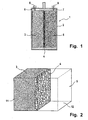
- FIG. 1 schematically shows an electrochemical battery cell 1 with a housing 2, in whose interior there is a sandwich of layers, namely a negative electrode 3, a porous insulating layer 4 and a positive Electrode 5.
- the electrodes 3, 5 are connected via electrical arresters 6, 7 to connection contacts 8, 9, via which the cell can be connected for charging with a charger or, when used with a current consumer.
- the construction of the cell is largely conventional and need not be explained.
- An important feature is that there is no separator between the electrodes 3, 5 but a porous insulator layer 4 which deposits the active metal interleaving deposited on the surface of the negative electrode facing the positive electrode 5 when the cell is charged. favors through the insulator layer 4 therethrough. This results in local contacts between the active metal and the surface of the positive electrode 5 facing the negative electrode 3 and, as a result, local short circuits take place.
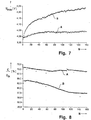
- FIG. 1 and more clearly FIG. 2 show that the electrodes 3,5 are preferably much thicker than the insulator layer 4.
- the insulator layer 4 preferably has a thickness of at most 100 ⁇ m, while the electrodes have a thickness of typically about 0.1 mm to 2 mm.
- the relatively large thickness of the electrodes 3 and 5 is due to the fact that in the illustrated preferred embodiment, both electrodes have an electrically conductive electrode mass 11 and 12, respectively, into which the ions of the active metal are taken during charging or discharging of the cell. Suitable materials have already been mentioned.
- the negative electrode 3 is a graphite electrode, wherein its (preferably porous) electrode mass 11 consists largely of carbon.
- the positive electrode is preferably an intercalation electrode whose electrode mass 12 is formed from lithium cobalt oxide and preferably also has a porous structure. When discharged, the lithium is stored inside the positive electrode. Walking while loading Lithium ions through the porous insulator layer 4 in the electrode material 11 of the negative electrode.
- deposition of the active metal takes place at the interface between the electrode mass 11 and the porous insulator layer 4.
- the active metal penetrates into the pores of the insulator layer 4 and grows through the porous insulator layer 4 finally up to the interface between the positive electrode 5 and the insulator layer 4, where the explained local short circuits take place.
- Positive electrode 19 LiCoO 2 in Ni foam
- the layers are stacked and pressed together by means of a frame, not shown.
- the entire assembly is immersed in an SO 2 -based electrolyte solution whose composition corresponds to the electrolyte solution of the planned cell.
- the experimental cell shown is charged by means of a charger 20, whereby (as previously described for the cell of the Figures 1 and 2 Lithium is discharged from the positive electrode 19 and deposited in the negative electrode.
- a voltage measuring device 21 It is usually 3.3 volts (voltage of a Li-Ni element).
- the measurement is terminated and the experimental cell disassembled.
- optical examination of the insulator layer on the side facing the auxiliary electrode 17 side), the type of lithium growth can be determined. The places where the lithium has grown through, as well as the possible accumulation of lithium, are clearly visible. Thus, it can be determined whether the lithium penetrates as desired the layer 16 to be examined only at localized points and is therefore suitable as a porous insulator layer for the invention.
- FIG. 4 shows results of the experimental testing of a separatorless measuring cell.
- the cell had a positive electrode of LiCoO 2 and a negative electrode with direct deposition of metallic lithium into a porous structure of silicon carbide, which was in direct contact with the electrode composition of the positive electrode.
- the electrolyte used was LiAlCl 4 ⁇ 1.5 SO 2 .
- FIGS. 5 and 6 show cyclic voltammograms, which were obtained on the one hand with an electrode not optimized according to the invention and on the other hand with an inventively optimized electrode. Plotted is the measured current I in mA against the voltage applied to the cell ⁇ in V against the Li / Li + -Halbzelle. In each case, four cycles are shown, including the first cycle Z 1 and the last cycle Z 40 .
- positive electrode shows FIG. 5 a significant change in the cyclic voltammogram, characterized in particular by the position of the anodic peak shifting to higher voltages. While still well below 4 V in the first cycle, it is close to 4.2 V at the fortieth cycle. This corresponds to an increase in the internal resistance of the cell which, according to the inventors, is due to the positive electrode passivation.
- FIG. 8 shows for a cell with optimized electrode (curve A) and a cell with non-optimized electrode (curve B), the dependence of the electrical discharge capacity (in% of the theoretical capacity of the number N of the charge and discharge cycles).
- This characteristic is also significantly improved by the invention: on the one hand, the initial capacity is about 7% higher, on the other hand, the capacity decrease associated with the repeated charging and discharging of the cell is much lower.
- Electrolyte solution instead. This reduces the amount of gas in the housing 2. The result is a negative pressure in the cell 1, is sucked through the other electrolyte from the container 32. The electrolyte penetrates into all pores of the existing inside the cell 1 layers. This is further promoted if at this time already a subset of the conductive salt in the cell (for example as a result of a purification step) is present.
Landscapes
- Chemical & Material Sciences (AREA)
- Chemical Kinetics & Catalysis (AREA)
- Electrochemistry (AREA)
- General Chemical & Material Sciences (AREA)
- Engineering & Computer Science (AREA)
- Manufacturing & Machinery (AREA)
- Inorganic Chemistry (AREA)
- Materials Engineering (AREA)
- Secondary Cells (AREA)
- Battery Electrode And Active Subsutance (AREA)
- Filling, Topping-Up Batteries (AREA)
- Cell Separators (AREA)
Applications Claiming Priority (2)
| Application Number | Priority Date | Filing Date | Title |
|---|---|---|---|
| DE10343862 | 2003-09-23 | ||
| EP04786822.9A EP1665447B1 (de) | 2003-09-23 | 2004-09-21 | Elektrochemische batteriezelle |
Related Parent Applications (2)
| Application Number | Title | Priority Date | Filing Date |
|---|---|---|---|
| EP04786822.9 Division | 2004-09-21 | ||
| EP04786822.9A Division-Into EP1665447B1 (de) | 2003-09-23 | 2004-09-21 | Elektrochemische batteriezelle |
Publications (2)
| Publication Number | Publication Date |
|---|---|
| EP2290735A1 EP2290735A1 (de) | 2011-03-02 |
| EP2290735B1 true EP2290735B1 (de) | 2012-11-07 |
Family
ID=34384223
Family Applications (4)
| Application Number | Title | Priority Date | Filing Date |
|---|---|---|---|
| EP10009875A Expired - Lifetime EP2290735B1 (de) | 2003-09-23 | 2004-09-21 | Elektrochemische Batteriezelle |
| EP10009874.8A Expired - Lifetime EP2290738B1 (de) | 2003-09-23 | 2004-09-21 | Elektrochemische batteriezelle |
| EP04786822.9A Expired - Lifetime EP1665447B1 (de) | 2003-09-23 | 2004-09-21 | Elektrochemische batteriezelle |
| EP10009876A Withdrawn EP2290736A1 (de) | 2003-09-23 | 2004-09-21 | Elektrochemische Batteriezelle |
Family Applications After (3)
| Application Number | Title | Priority Date | Filing Date |
|---|---|---|---|
| EP10009874.8A Expired - Lifetime EP2290738B1 (de) | 2003-09-23 | 2004-09-21 | Elektrochemische batteriezelle |
| EP04786822.9A Expired - Lifetime EP1665447B1 (de) | 2003-09-23 | 2004-09-21 | Elektrochemische batteriezelle |
| EP10009876A Withdrawn EP2290736A1 (de) | 2003-09-23 | 2004-09-21 | Elektrochemische Batteriezelle |
Country Status (12)
| Country | Link |
|---|---|
| US (3) | US20070065714A1 (pl) |
| EP (4) | EP2290735B1 (pl) |
| JP (2) | JP5244314B2 (pl) |
| KR (2) | KR101254613B1 (pl) |
| CN (4) | CN101807718A (pl) |
| CA (1) | CA2539409C (pl) |
| DE (1) | DE112004002289D2 (pl) |
| ES (3) | ES2625897T3 (pl) |
| HU (1) | HUE046297T2 (pl) |
| PL (1) | PL2290738T3 (pl) |
| RU (1) | RU2343601C2 (pl) |
| WO (1) | WO2005031908A2 (pl) |
Families Citing this family (54)
| Publication number | Priority date | Publication date | Assignee | Title |
|---|---|---|---|---|
| US8883354B2 (en) | 2006-02-15 | 2014-11-11 | Optodot Corporation | Separators for electrochemical cells |
| EP1923934A1 (de) * | 2006-11-14 | 2008-05-21 | Fortu Intellectual Property AG | Wiederaufladbare elektrochemische Batteriezelle |
| JP4384213B2 (ja) * | 2007-09-18 | 2009-12-16 | トヨタ自動車株式会社 | 二次電池の状態検出装置 |
| EP2071658A1 (de) * | 2007-12-14 | 2009-06-17 | Fortu Intellectual Property AG | Elektrolyt für eine elektrochemische Batteriezelle |
| US8426067B2 (en) * | 2008-10-27 | 2013-04-23 | Nissan Motor Co., Ltd. | Composite electrode for electricity storage device, method for producing the same and electricity storage device |
| WO2010138177A1 (en) | 2009-05-26 | 2010-12-02 | Steven Allen Carlson | Lithium batteries utilizing nanoporous separator layers |
| US8557444B2 (en) * | 2009-12-15 | 2013-10-15 | E I Du Pont De Nemours And Company | Multi-layer article comprising polyimide nanoweb |
| EP2355229A1 (de) | 2010-02-08 | 2011-08-10 | Fortu Intellectual Property AG | Hochstrombatteriesystem und Verfahren zur Steuerung eines Hochstrombatteriesystems |
| US9209458B2 (en) | 2010-02-10 | 2015-12-08 | Alevo Research Ag | Rechargeable electrochemical battery cell |
| EP2360772A1 (de) | 2010-02-12 | 2011-08-24 | Fortu Intellectual Property AG | Wiederaufladbare elektrochemische Zelle |
| CN106784556A (zh) | 2010-07-19 | 2017-05-31 | 奥普图多特公司 | 用于电化学电池的隔膜 |
| MX365048B (es) * | 2013-02-07 | 2019-05-16 | Innolith Assets Ag | Electrolito para una celda de bateria electroquimica y una celda de bateria que contiene el electrolito. |
| KR102236436B1 (ko) | 2013-04-29 | 2021-04-06 | 옵토도트 코포레이션 | 증가된 열 전도율을 갖는 나노기공성 복합체 분리기들 |
| US9559384B2 (en) * | 2013-05-15 | 2017-01-31 | Semiconductor Energy Laboratory Co., Ltd. | Secondary battery and method for restoring capacity of secondary battery |
| KR101542880B1 (ko) * | 2013-10-08 | 2015-08-07 | 전자부품연구원 | 나트륨-금속염화물계 이차 전지 및 그의 제조 방법 |
| KR101520606B1 (ko) * | 2013-10-08 | 2015-05-15 | 전자부품연구원 | 나트륨-이산화황계 이차 전지 및 이의 제조 방법 |
| DE102013112385A1 (de) | 2013-11-11 | 2015-05-13 | Günther Hambitzer | Wiederaufladbare elektrochemische Zelle |
| KR101610014B1 (ko) * | 2014-09-16 | 2016-04-11 | 전자부품연구원 | 이산화황 기반의 이온성 액체 전해질을 포함하는 전해액 및 그를 갖는 나트륨-이산화황 이차 전지 |
| KR20160032773A (ko) * | 2014-09-16 | 2016-03-25 | 전자부품연구원 | 이산화황 기반의 갈륨계 무기 전해질을 포함하는 전해액 및 그를 갖는 나트륨-이산화황 이차 전지 |
| KR101586194B1 (ko) | 2014-09-16 | 2016-01-20 | 전자부품연구원 | 금속염화물과 알칼리금속염화물을 함유하는 양극 및 그를 포함하는 알칼리금속이온 이차 전지 |
| JP2016177901A (ja) * | 2015-03-18 | 2016-10-06 | 株式会社東芝 | 二次電池用正極活物質、二次電池、及び、二次電池用正極活物質の製造方法 |
| US12040506B2 (en) | 2015-04-15 | 2024-07-16 | Lg Energy Solution, Ltd. | Nanoporous separators for batteries and related manufacturing methods |
| US10381623B2 (en) | 2015-07-09 | 2019-08-13 | Optodot Corporation | Nanoporous separators for batteries and related manufacturing methods |
| KR20170029702A (ko) | 2015-09-07 | 2017-03-16 | 전자부품연구원 | 탄소복합 양극 활물질 및 그를 이용한 나트륨-이산화황 이차전지 |
| KR20170029703A (ko) | 2015-09-07 | 2017-03-16 | 전자부품연구원 | 양극 활물질 및 그를 이용한 이산화황 기반의 이차전지 |
| KR20170030115A (ko) | 2015-09-08 | 2017-03-17 | 전자부품연구원 | 이산화황 기반의 복합 무기 전해질을 포함하는 전해액 및 그를 갖는 나트륨-이산화황 이차 전지 |
| KR101664812B1 (ko) | 2015-09-08 | 2016-10-13 | 전자부품연구원 | 선충전 이산화황 이차전지 및 그의 제조 방법 |
| KR20170030118A (ko) | 2015-09-08 | 2017-03-17 | 전자부품연구원 | 다공성 탄소 소재의 제조 방법 및 이를 적용한 나트륨-이산화황 이차 전지 |
| KR20170030136A (ko) | 2015-09-08 | 2017-03-17 | 전자부품연구원 | 다공성 탄소전극을 구비한 이산화황 기반 이차전지 및 그 다공성 탄소전극 제조 방법 |
| KR20170030117A (ko) | 2015-09-08 | 2017-03-17 | 전자부품연구원 | 나트륨-이산화황 이차 전지용 양극의 제조 방법 및 이를 적용한 나트륨-이산화황 이차 전지 |
| KR102143021B1 (ko) | 2015-09-10 | 2020-08-11 | 전자부품연구원 | 복합 알칼리이온 무기 액체 전해질을 포함한 리튬-이산화황 이차 전지 및 그 복합 알칼리이온 무기 액체 전해질 |
| CN107104222B (zh) * | 2016-02-19 | 2021-09-21 | 株式会社半导体能源研究所 | 蓄电装置、蓄电系统 |
| DE102016106947A1 (de) | 2016-04-14 | 2017-10-19 | Fortu New Battery Technology Gmbh | Elektrolyt für wiederaufladbare elektrochemische Batteriezellen |
| KR101901658B1 (ko) * | 2016-09-29 | 2018-10-01 | 전자부품연구원 | 요오드화물 첨가제를 함유하는 전해액 및 그를 포함하는 이산화황 기반 이차 전지 |
| CN108075186B (zh) * | 2016-11-09 | 2020-04-14 | 微宏动力系统(湖州)有限公司 | 一种无机电解液、其制备方法及其锂电池 |
| KR102465701B1 (ko) * | 2017-09-25 | 2022-11-10 | 한양대학교 산학협력단 | 무기 액체 전해질을 채용한 리튬이차전지용 분리막 |
| DE102018105271A1 (de) | 2018-03-07 | 2019-09-12 | High Performance Battery Technology Gmbh | Festionenleiter für wiederaufladbare elektrochemische Batteriezellen |
| KR102373313B1 (ko) | 2018-07-12 | 2022-03-10 | 주식회사 엘지에너지솔루션 | 무기 전해액을 포함하는 리튬 이차전지 |
| KR20200041213A (ko) | 2018-10-11 | 2020-04-21 | 전자부품연구원 | 구리산화물을 함유하는 양극 및 그를 포함하는 2종이온 저장 이차 전지 |
| CN109301254B (zh) * | 2018-11-12 | 2020-07-07 | 中南大学 | 一种锂硫电池正极材料、正极及其制备和应用 |
| HUE055324T2 (hu) | 2019-07-31 | 2021-11-29 | Innolith Tech Ag | SO2 alapú elektrolit újratölthetõ akkumulátorcellához és azt tartalmazó újratölthetõ akkumulátorcella |
| JP2021089830A (ja) * | 2019-12-03 | 2021-06-10 | 株式会社Gsユアサ | 蓄電素子および該蓄電素子の製造方法 |
| CN111551610A (zh) * | 2020-04-07 | 2020-08-18 | 上海电气集团股份有限公司 | 一种钒电解液浓度测试方法、微型钒电池及钒电解液浓度测试装置 |
| DE102020126296A1 (de) | 2020-10-07 | 2022-04-07 | Volkswagen Aktiengesellschaft | Verfahren zur Herstellung von Batteriezellen, Verwendung eines Reinigungsmittels und Batteriezelle |
| BR112023022296A2 (pt) | 2021-04-29 | 2023-12-26 | 24M Tech Inc | Células eletroquímicas com múltiplos separadores, e métodos de produção das mesmas |
| DE102021132747A1 (de) | 2021-12-10 | 2023-06-15 | Bayerische Motoren Werke Aktiengesellschaft | Batteriezelle sowie Batteriespeicher mit der Batteriezelle |
| DE102021132745A1 (de) | 2021-12-10 | 2023-06-15 | Bayerische Motoren Werke Aktiengesellschaft | Batteriespeicher mit einer Sicherheitsvorrichtung sowie Verfahren zum Auslösen der Sicherheitsvorrichtung |
| DE102021132740A1 (de) | 2021-12-10 | 2023-06-15 | Bayerische Motoren Werke Aktiengesellschaft | Batteriespeicher mit einer Filtervorrichtung |
| DE102021132739A1 (de) | 2021-12-10 | 2023-06-15 | Bayerische Motoren Werke Aktiengesellschaft | Batteriespeicher mit einer Sicherheitsvorrichtung und ein Verfahren zum Auslösen der Sicherheitsvorrichtung |
| DE102021132742A1 (de) | 2021-12-10 | 2023-06-15 | Bayerische Motoren Werke Aktiengesellschaft | Batteriespeicher mit einer Sicherheitsvorrichtung sowie Verfahren zum Auslösen der Sicherheitsvorrichtung |
| DE102021132746A1 (de) | 2021-12-10 | 2023-06-15 | Bayerische Motoren Werke Aktiengesellschaft | Batteriespeicher mit einer Sicherheitsvorrichtung sowie Verfahren zum Auslösen der Sicherheitsvorrichtung |
| TW202443944A (zh) | 2022-12-16 | 2024-11-01 | 美商24M科技公司 | 用於最小化及預防電化電池中形成枝晶的系統及方法 |
| CN116435591B (zh) * | 2023-04-24 | 2024-02-23 | 湖南添越能源科技有限公司 | 一种适用于超低温条件下工作的锂离子电池电极材料 |
| US12431545B1 (en) | 2024-03-26 | 2025-09-30 | 24M Technologies, Inc. | Systems and methods for minimizing and preventing dendrite formation in electrochemical cells |
Family Cites Families (25)
| Publication number | Priority date | Publication date | Assignee | Title |
|---|---|---|---|---|
| US4052537A (en) * | 1976-10-01 | 1977-10-04 | P. R. Mallory & Co. Inc. | Electrical device |
| US4407910A (en) * | 1979-04-23 | 1983-10-04 | Catanzarite Vincent Owen | Anode neutralization |
| US4283469A (en) * | 1980-03-31 | 1981-08-11 | Gte Products Corp. | Integrated electrode/separator structures |
| JPS59149654A (ja) * | 1983-02-15 | 1984-08-27 | Kao Corp | 二次電池 |
| US4567031A (en) | 1983-12-27 | 1986-01-28 | Combustion Engineering, Inc. | Process for preparing mixed metal oxides |
| USH496H (en) * | 1987-08-10 | 1988-07-05 | The United States Of America As Represented By The Secretary Of The Army | Electrolyte for use in an all inorganic rechargeable cell and lithium inorganic cell containing the improved electrolyte |
| US5006428A (en) * | 1989-11-28 | 1991-04-09 | Yardney Technical Products, Inc. | Getter electrode and improved electrochemical cell containing the same |
| US5264201A (en) * | 1990-07-23 | 1993-11-23 | Her Majesty The Queen In Right Of The Province Of British Columbia | Lithiated nickel dioxide and secondary cells prepared therefrom |
| US5595837A (en) * | 1995-04-12 | 1997-01-21 | Valence Technology, Inc. | Process for prelithiation of carbon based anodes for lithium batteries |
| US5601951A (en) * | 1995-09-19 | 1997-02-11 | Battery Engineering, Inc. | Rechargeable lithium ion cell |
| RU2157024C2 (ru) * | 1996-07-05 | 2000-09-27 | Украинский Государственный Химико-Технологический Университет | Способ изготовления инертного катода для литиевых химических источников тока |
| US5798563A (en) * | 1997-01-28 | 1998-08-25 | International Business Machines Corporation | Polytetrafluoroethylene thin film chip carrier |
| TW369735B (en) * | 1997-02-05 | 1999-09-11 | Sumitomo Chemical Co | Cathode for lithium secondary battery |
| US6159635A (en) * | 1998-09-29 | 2000-12-12 | Electrofuel Inc. | Composite electrode including current collector |
| WO2000044061A1 (de) * | 1999-01-23 | 2000-07-27 | Fortu Bat Batterien Gmbh | Nichtwässrige elektrochemische zelle |
| DE19911800C1 (de) * | 1999-03-17 | 2000-11-02 | Fraunhofer Ges Forschung | Verfahren und Vorrichtung zum Befüllen einer elektrochemischen Zelle mit einem aus in wenigstens einem bei Raumtemperatur gasförmigen Lösungsmittel solvatisierten Salzen bestehenden Elektrolyten |
| EP1201004B1 (de) * | 1999-06-18 | 2004-12-01 | Hambitzer, Günther, Dr. | Wiederaufladbare elektrochemische zelle |
| SE518564C2 (sv) * | 1999-12-20 | 2002-10-22 | Ericsson Telefon Ab L M | Polymer elektrolyt, battericell innefattande elektrolyten, förfarande för framställning av elektrolyten samt användning av elektrolyten och battericellen |
| DE10192980B4 (de) * | 2000-07-21 | 2012-09-13 | Günther Hambitzer | Elektrochemische Batteriezelle |
| DE10110716A1 (de) * | 2001-03-07 | 2002-09-12 | Fortu Bat Batterien Gmbh | Wiederaufladbare nichtwässrige Batteriezelle |
| US6780542B2 (en) * | 2001-09-13 | 2004-08-24 | Wilson Greatbatch Ltd. | Lithium oxyhalide cell with improved safety and voltage delay characteristics |
| CN1427497A (zh) * | 2001-12-21 | 2003-07-02 | 厦门宝龙工业股份有限公司 | 一种聚合物锂离子可充电纽扣电池及制备方法 |
| DE10201936A1 (de) * | 2002-01-19 | 2003-07-31 | Fortu Bat Batterien Gmbh | Wiederaufladbare elektrochemische Batteriezelle |
| EP1481429B1 (de) * | 2002-03-08 | 2006-05-31 | Epcos Ag | Verfahren und vorrichtung zum einfüllen flüchtiger flüssigkeiten in gehäuse elektrischer bauelemente und zum verschliessen der gehäuse |
| DE10240032A1 (de) * | 2002-08-27 | 2004-03-11 | Creavis Gesellschaft Für Technologie Und Innovation Mbh | Ionenleitender Batterieseparator für Lithiumbatterien, Verfahren zu deren Herstellung und die Verwendung derselben |
-
2004
- 2004-09-21 EP EP10009875A patent/EP2290735B1/de not_active Expired - Lifetime
- 2004-09-21 EP EP10009874.8A patent/EP2290738B1/de not_active Expired - Lifetime
- 2004-09-21 US US10/572,935 patent/US20070065714A1/en not_active Abandoned
- 2004-09-21 EP EP04786822.9A patent/EP1665447B1/de not_active Expired - Lifetime
- 2004-09-21 WO PCT/DE2004/002105 patent/WO2005031908A2/de not_active Ceased
- 2004-09-21 HU HUE10009874A patent/HUE046297T2/hu unknown
- 2004-09-21 DE DE112004002289T patent/DE112004002289D2/de not_active Withdrawn - After Issue
- 2004-09-21 CN CN200910253233A patent/CN101807718A/zh active Pending
- 2004-09-21 ES ES04786822.9T patent/ES2625897T3/es not_active Expired - Lifetime
- 2004-09-21 ES ES10009874T patent/ES2750338T3/es not_active Expired - Lifetime
- 2004-09-21 CA CA2539409A patent/CA2539409C/en not_active Expired - Lifetime
- 2004-09-21 CN CN200910253231A patent/CN101783414A/zh active Pending
- 2004-09-21 CN CN2004800275738A patent/CN1898833B/zh not_active Expired - Fee Related
- 2004-09-21 JP JP2006527267A patent/JP5244314B2/ja not_active Expired - Fee Related
- 2004-09-21 ES ES10009875T patent/ES2398345T3/es not_active Expired - Lifetime
- 2004-09-21 CN CN200910253225A patent/CN101783413A/zh active Pending
- 2004-09-21 KR KR1020127009992A patent/KR101254613B1/ko not_active Expired - Fee Related
- 2004-09-21 PL PL10009874T patent/PL2290738T3/pl unknown
- 2004-09-21 RU RU2006106416/09A patent/RU2343601C2/ru not_active IP Right Cessation
- 2004-09-21 EP EP10009876A patent/EP2290736A1/de not_active Withdrawn
-
2006
- 2006-03-23 KR KR1020067005799A patent/KR101210908B1/ko not_active Expired - Fee Related
-
2011
- 2011-08-03 US US13/197,369 patent/US8858655B2/en not_active Expired - Fee Related
-
2012
- 2012-03-15 JP JP2012058811A patent/JP2012146673A/ja active Pending
-
2014
- 2014-09-08 US US14/479,625 patent/US10637096B2/en not_active Expired - Lifetime
Also Published As
Similar Documents
| Publication | Publication Date | Title |
|---|---|---|
| EP1665447B1 (de) | Elektrochemische batteriezelle | |
| EP3794665B1 (de) | Wiederaufladbare batteriezelle | |
| EP3611788B1 (de) | Wiederaufladbare elektrochemische zelle | |
| EP3734724B1 (de) | Wiederaufladbare batteriezelle | |
| WO2008058685A1 (de) | Wiederaufladbare elektrochemische batteriezelle | |
| EP1201004A1 (de) | Wiederaufladbare elektrochemische zelle | |
| EP3771011A2 (de) | Auf so2-basierender elektrolyt für eine wiederaufladbare batteriezelle und wiederaufladbare batteriezellen damit | |
| DE102018100158A1 (de) | Verarbeitungsvorrichtung zur verwendung von organischem dampf zum abscheiden von wasser aus elektrodenmaterialien und zellkernen | |
| EP1149429B1 (de) | Nichtwässrige elektrochemische zelle | |
| EP4292158A1 (de) | Verfahren zum herstellen einer lithiumionenbatterie sowie lithiumionenbatterie | |
| DE102020111235A1 (de) | Lithiumionen-Batterie und Verfahren zur Herstellung einer Lithiumionen-Batterie | |
| EP3560009B1 (de) | Elektrode-separator-element mit einer keramischen separatorschicht | |
| DE102020118129A1 (de) | Lithiumionen-Batterie und Verfahren zur Herstellung einer solchen Lithiumionen-Batterie | |
| DE102020111237A1 (de) | Lithiumionen-Batterie und Verfahren zur Herstellung einer Lithiumionen-Batterie | |
| DE102024105914A1 (de) | Stromspeicherzelle mit an Porenvolumen angepassten Elektrolytvolumen bei hohen Ladezuständen | |
| EP3840091B1 (de) | Zelle mit metallischer lithiumanode und herstellungsverfahren | |
| WO2022156983A1 (de) | Verfahren zum herstellen eines elektrischen energiespeichers sowie elektrischer energiespeicher | |
| DE102024133301A1 (de) | Stromspeicherzelle mit einem Separator mit verringertem transversalen in-plane Elektrolyt-Porendurchflusswiderstand | |
| DE102024105916A1 (de) | Stromspeicherzelle mit zwischen Anode und Kathode angepasstem in-plane Elektrolyt-Porendurchflusswiderstand | |
| DE102022112792A1 (de) | Lithiumbatterie umfassend eine Lithiummetallanode mit einem porösen Stromableiter | |
| DE102023132398A1 (de) | Natriumionenbatterie mit Natriummetallanode und Verfahren zum Herstellen einer Natriumionenbatterie | |
| DE102024208665A1 (de) | Natrium-Ionen-Akkumulator und Verfahren zur Fertigung eines Natrium-Ionen-Akkumulators | |
| DE102021127939A1 (de) | Lithiumionen-Festkörperbatterie mit einer prälithiierten Anode sowie ein Verfahren zur Herstellung der prälithiierten Anode | |
| DE102023112153A1 (de) | Natriumionenbatterie, Verfahren zum Herstellen einer Natriumionenbatterie und Verwendung einer Natriumionenbatterie | |
| DE102020119844A1 (de) | Lithiumionen-Batterie und Verfahren zur Herstellung einer solchen Lithiumionen-Batterie |
Legal Events
| Date | Code | Title | Description |
|---|---|---|---|
| PUAI | Public reference made under article 153(3) epc to a published international application that has entered the european phase |
Free format text: ORIGINAL CODE: 0009012 |
|
| AC | Divisional application: reference to earlier application |
Ref document number: 1665447 Country of ref document: EP Kind code of ref document: P |
|
| AK | Designated contracting states |
Kind code of ref document: A1 Designated state(s): AT BE BG CH CY CZ DE DK EE ES FI FR GB GR HU IE IT LI LU MC NL PL PT RO SE SI SK TR |
|
| 17P | Request for examination filed |
Effective date: 20110617 |
|
| 17Q | First examination report despatched |
Effective date: 20110824 |
|
| REG | Reference to a national code |
Ref country code: DE Ref legal event code: R079 Ref document number: 502004013862 Country of ref document: DE Free format text: PREVIOUS MAIN CLASS: H01M0010056000 Ipc: H01M0010052500 |
|
| RIC1 | Information provided on ipc code assigned before grant |
Ipc: H01M 10/0563 20100101ALI20120402BHEP Ipc: H01M 10/0525 20100101AFI20120402BHEP Ipc: H01M 2/36 20060101ALI20120402BHEP Ipc: H01M 10/056 20100101ALI20120402BHEP |
|
| GRAP | Despatch of communication of intention to grant a patent |
Free format text: ORIGINAL CODE: EPIDOSNIGR1 |
|
| RAP1 | Party data changed (applicant data changed or rights of an application transferred) |
Owner name: FORTU INTELLECTUAL PROPERTY AG |
|
| GRAS | Grant fee paid |
Free format text: ORIGINAL CODE: EPIDOSNIGR3 |
|
| GRAA | (expected) grant |
Free format text: ORIGINAL CODE: 0009210 |
|
| AC | Divisional application: reference to earlier application |
Ref document number: 1665447 Country of ref document: EP Kind code of ref document: P |
|
| AK | Designated contracting states |
Kind code of ref document: B1 Designated state(s): AT BE BG CH CY CZ DE DK EE ES FI FR GB GR HU IE IT LI LU MC NL PL PT RO SE SI SK TR |
|
| REG | Reference to a national code |
Ref country code: GB Ref legal event code: FG4D Free format text: NOT ENGLISH |
|
| REG | Reference to a national code |
Ref country code: AT Ref legal event code: REF Ref document number: 583317 Country of ref document: AT Kind code of ref document: T Effective date: 20121115 Ref country code: CH Ref legal event code: EP |
|
| REG | Reference to a national code |
Ref country code: IE Ref legal event code: FG4D Free format text: LANGUAGE OF EP DOCUMENT: GERMAN |
|
| REG | Reference to a national code |
Ref country code: DE Ref legal event code: R096 Ref document number: 502004013862 Country of ref document: DE Effective date: 20130103 |
|
| REG | Reference to a national code |
Ref country code: CH Ref legal event code: NV Representative=s name: ISLER AND PEDRAZZINI AG, CH |
|
| REG | Reference to a national code |
Ref country code: NL Ref legal event code: T3 |
|
| REG | Reference to a national code |
Ref country code: ES Ref legal event code: FG2A Ref document number: 2398345 Country of ref document: ES Kind code of ref document: T3 Effective date: 20130315 |
|
| PG25 | Lapsed in a contracting state [announced via postgrant information from national office to epo] |
Ref country code: FI Free format text: LAPSE BECAUSE OF FAILURE TO SUBMIT A TRANSLATION OF THE DESCRIPTION OR TO PAY THE FEE WITHIN THE PRESCRIBED TIME-LIMIT Effective date: 20121107 Ref country code: SE Free format text: LAPSE BECAUSE OF FAILURE TO SUBMIT A TRANSLATION OF THE DESCRIPTION OR TO PAY THE FEE WITHIN THE PRESCRIBED TIME-LIMIT Effective date: 20121107 |
|
| PG25 | Lapsed in a contracting state [announced via postgrant information from national office to epo] |
Ref country code: SI Free format text: LAPSE BECAUSE OF FAILURE TO SUBMIT A TRANSLATION OF THE DESCRIPTION OR TO PAY THE FEE WITHIN THE PRESCRIBED TIME-LIMIT Effective date: 20121107 Ref country code: GR Free format text: LAPSE BECAUSE OF FAILURE TO SUBMIT A TRANSLATION OF THE DESCRIPTION OR TO PAY THE FEE WITHIN THE PRESCRIBED TIME-LIMIT Effective date: 20130208 Ref country code: PL Free format text: LAPSE BECAUSE OF FAILURE TO SUBMIT A TRANSLATION OF THE DESCRIPTION OR TO PAY THE FEE WITHIN THE PRESCRIBED TIME-LIMIT Effective date: 20121107 Ref country code: PT Free format text: LAPSE BECAUSE OF FAILURE TO SUBMIT A TRANSLATION OF THE DESCRIPTION OR TO PAY THE FEE WITHIN THE PRESCRIBED TIME-LIMIT Effective date: 20130307 |
|
| PG25 | Lapsed in a contracting state [announced via postgrant information from national office to epo] |
Ref country code: BG Free format text: LAPSE BECAUSE OF FAILURE TO SUBMIT A TRANSLATION OF THE DESCRIPTION OR TO PAY THE FEE WITHIN THE PRESCRIBED TIME-LIMIT Effective date: 20130207 Ref country code: CZ Free format text: LAPSE BECAUSE OF FAILURE TO SUBMIT A TRANSLATION OF THE DESCRIPTION OR TO PAY THE FEE WITHIN THE PRESCRIBED TIME-LIMIT Effective date: 20121107 Ref country code: DK Free format text: LAPSE BECAUSE OF FAILURE TO SUBMIT A TRANSLATION OF THE DESCRIPTION OR TO PAY THE FEE WITHIN THE PRESCRIBED TIME-LIMIT Effective date: 20121107 Ref country code: SK Free format text: LAPSE BECAUSE OF FAILURE TO SUBMIT A TRANSLATION OF THE DESCRIPTION OR TO PAY THE FEE WITHIN THE PRESCRIBED TIME-LIMIT Effective date: 20121107 Ref country code: EE Free format text: LAPSE BECAUSE OF FAILURE TO SUBMIT A TRANSLATION OF THE DESCRIPTION OR TO PAY THE FEE WITHIN THE PRESCRIBED TIME-LIMIT Effective date: 20121107 |
|
| PG25 | Lapsed in a contracting state [announced via postgrant information from national office to epo] |
Ref country code: RO Free format text: LAPSE BECAUSE OF FAILURE TO SUBMIT A TRANSLATION OF THE DESCRIPTION OR TO PAY THE FEE WITHIN THE PRESCRIBED TIME-LIMIT Effective date: 20121107 |
|
| PLBE | No opposition filed within time limit |
Free format text: ORIGINAL CODE: 0009261 |
|
| STAA | Information on the status of an ep patent application or granted ep patent |
Free format text: STATUS: NO OPPOSITION FILED WITHIN TIME LIMIT |
|
| 26N | No opposition filed |
Effective date: 20130808 |
|
| PG25 | Lapsed in a contracting state [announced via postgrant information from national office to epo] |
Ref country code: CY Free format text: LAPSE BECAUSE OF FAILURE TO SUBMIT A TRANSLATION OF THE DESCRIPTION OR TO PAY THE FEE WITHIN THE PRESCRIBED TIME-LIMIT Effective date: 20121107 |
|
| REG | Reference to a national code |
Ref country code: DE Ref legal event code: R097 Ref document number: 502004013862 Country of ref document: DE Effective date: 20130808 |
|
| BERE | Be: lapsed |
Owner name: FORTU INTELLECTUAL PROPERTY A.G. Effective date: 20130930 |
|
| REG | Reference to a national code |
Ref country code: DE Ref legal event code: R082 Ref document number: 502004013862 Country of ref document: DE Representative=s name: DURM & PARTNER PATENTANWAELTE, DE |
|
| PG25 | Lapsed in a contracting state [announced via postgrant information from national office to epo] |
Ref country code: MC Free format text: LAPSE BECAUSE OF FAILURE TO SUBMIT A TRANSLATION OF THE DESCRIPTION OR TO PAY THE FEE WITHIN THE PRESCRIBED TIME-LIMIT Effective date: 20121107 |
|
| REG | Reference to a national code |
Ref country code: DE Ref legal event code: R081 Ref document number: 502004013862 Country of ref document: DE Owner name: ALEVO INTERNATIONAL S.A., CH Free format text: FORMER OWNER: FORTU INTELLECTUAL PROPERTY AG, SARNEN, CH Effective date: 20140402 Ref country code: DE Ref legal event code: R082 Ref document number: 502004013862 Country of ref document: DE Representative=s name: DURM PATENTANWAELTE PARTG MBB, DE Effective date: 20140402 Ref country code: DE Ref legal event code: R082 Ref document number: 502004013862 Country of ref document: DE Representative=s name: DURM & PARTNER PATENTANWAELTE, DE Effective date: 20140402 Ref country code: DE Ref legal event code: R081 Ref document number: 502004013862 Country of ref document: DE Owner name: ALEVO RESEARCH AG, CH Free format text: FORMER OWNER: FORTU INTELLECTUAL PROPERTY AG, SARNEN, CH Effective date: 20140402 Ref country code: DE Ref legal event code: R082 Ref document number: 502004013862 Country of ref document: DE Representative=s name: LEMCKE, BROMMER & PARTNER, PATENTANWAELTE PART, DE Effective date: 20140402 Ref country code: DE Ref legal event code: R081 Ref document number: 502004013862 Country of ref document: DE Owner name: INNOLITH ASSETS AG, CH Free format text: FORMER OWNER: FORTU INTELLECTUAL PROPERTY AG, SARNEN, CH Effective date: 20140402 |
|
| REG | Reference to a national code |
Ref country code: CH Ref legal event code: PCOW Ref country code: CH Ref legal event code: PUE Owner name: ALEVO RESEARCH AG, CH Free format text: FORMER OWNER: FORTU INTELLECTUAL PROPERTY AG, CH |
|
| REG | Reference to a national code |
Ref country code: IE Ref legal event code: MM4A |
|
| REG | Reference to a national code |
Ref country code: GB Ref legal event code: 732E Free format text: REGISTERED BETWEEN 20140626 AND 20140702 |
|
| PG25 | Lapsed in a contracting state [announced via postgrant information from national office to epo] |
Ref country code: BE Free format text: LAPSE BECAUSE OF NON-PAYMENT OF DUE FEES Effective date: 20130930 Ref country code: IE Free format text: LAPSE BECAUSE OF NON-PAYMENT OF DUE FEES Effective date: 20130921 |
|
| REG | Reference to a national code |
Ref country code: NL Ref legal event code: SD Effective date: 20140813 Ref country code: ES Ref legal event code: PC2A Owner name: ALEVO RESEARCH AG Effective date: 20140813 |
|
| REG | Reference to a national code |
Ref country code: FR Ref legal event code: TP Owner name: ALEVO RESEARCH AG, CH Effective date: 20140908 |
|
| REG | Reference to a national code |
Ref country code: AT Ref legal event code: PC Ref document number: 583317 Country of ref document: AT Kind code of ref document: T Owner name: ALEVO RESEARCH AG, CH Effective date: 20141003 |
|
| PG25 | Lapsed in a contracting state [announced via postgrant information from national office to epo] |
Ref country code: TR Free format text: LAPSE BECAUSE OF FAILURE TO SUBMIT A TRANSLATION OF THE DESCRIPTION OR TO PAY THE FEE WITHIN THE PRESCRIBED TIME-LIMIT Effective date: 20121107 |
|
| PG25 | Lapsed in a contracting state [announced via postgrant information from national office to epo] |
Ref country code: LU Free format text: LAPSE BECAUSE OF NON-PAYMENT OF DUE FEES Effective date: 20130921 Ref country code: HU Free format text: LAPSE BECAUSE OF FAILURE TO SUBMIT A TRANSLATION OF THE DESCRIPTION OR TO PAY THE FEE WITHIN THE PRESCRIBED TIME-LIMIT; INVALID AB INITIO Effective date: 20040921 |
|
| REG | Reference to a national code |
Ref country code: DE Ref legal event code: R082 Ref document number: 502004013862 Country of ref document: DE Representative=s name: DURM & PARTNER PATENTANWAELTE, DE Ref country code: DE Ref legal event code: R081 Ref document number: 502004013862 Country of ref document: DE Owner name: ALEVO INTERNATIONAL S.A., CH Free format text: FORMER OWNER: ALEVO RESEARCH AG, ZUG, CH Ref country code: DE Ref legal event code: R082 Ref document number: 502004013862 Country of ref document: DE Representative=s name: DURM PATENTANWAELTE PARTG MBB, DE Ref country code: DE Ref legal event code: R082 Ref document number: 502004013862 Country of ref document: DE Representative=s name: LEMCKE, BROMMER & PARTNER, PATENTANWAELTE PART, DE Ref country code: DE Ref legal event code: R081 Ref document number: 502004013862 Country of ref document: DE Owner name: INNOLITH ASSETS AG, CH Free format text: FORMER OWNER: ALEVO RESEARCH AG, ZUG, CH |
|
| REG | Reference to a national code |
Ref country code: CH Ref legal event code: PUE Owner name: ALEVO INTERNATIONAL S.A., CH Free format text: FORMER OWNER: ALEVO RESEARCH AG, CH |
|
| REG | Reference to a national code |
Ref country code: GB Ref legal event code: 732E Free format text: REGISTERED BETWEEN 20160609 AND 20160615 |
|
| REG | Reference to a national code |
Ref country code: FR Ref legal event code: PLFP Year of fee payment: 13 |
|
| REG | Reference to a national code |
Ref country code: NL Ref legal event code: PD Owner name: ALEVO INTERNATIONAL S.A.; CH Free format text: DETAILS ASSIGNMENT: VERANDERING VAN EIGENAAR(S), OVERDRACHT; FORMER OWNER NAME: ALEVO RESEARCH AG Effective date: 20160921 |
|
| REG | Reference to a national code |
Ref country code: ES Ref legal event code: PC2A Owner name: ALEVO INTERNATIONAL S.A. Effective date: 20161024 Ref country code: FR Ref legal event code: TP Owner name: ALEVO INTERNATIONAL S.A., CH Effective date: 20160928 |
|
| REG | Reference to a national code |
Ref country code: AT Ref legal event code: PC Ref document number: 583317 Country of ref document: AT Kind code of ref document: T Owner name: ALEVO INTERNATIONAL S.A., CH Effective date: 20161130 |
|
| REG | Reference to a national code |
Ref country code: FR Ref legal event code: PLFP Year of fee payment: 14 |
|
| REG | Reference to a national code |
Ref country code: DE Ref legal event code: R082 Ref document number: 502004013862 Country of ref document: DE Representative=s name: LBP LEMCKE, BROMMER & PARTNER PATENTANWAELTE M, DE Ref country code: DE Ref legal event code: R082 Ref document number: 502004013862 Country of ref document: DE Representative=s name: LEMCKE, BROMMER & PARTNER, PATENTANWAELTE PART, DE |
|
| REG | Reference to a national code |
Ref country code: DE Ref legal event code: R082 Ref document number: 502004013862 Country of ref document: DE Representative=s name: LEMCKE, BROMMER & PARTNER, PATENTANWAELTE PART, DE Ref country code: DE Ref legal event code: R081 Ref document number: 502004013862 Country of ref document: DE Owner name: INNOLITH ASSETS AG, CH Free format text: FORMER OWNER: ALEVO INTERNATIONAL S.A., MARTIGNY, CH |
|
| REG | Reference to a national code |
Ref country code: FR Ref legal event code: PLFP Year of fee payment: 15 |
|
| REG | Reference to a national code |
Ref country code: CH Ref legal event code: PUE Owner name: INNOLITH ASSETS AG, CH Free format text: FORMER OWNER: BLUEHORN SA, CH Ref country code: CH Ref legal event code: PUE Owner name: BLUEHORN SA, CH Free format text: FORMER OWNER: ALEVO INTERNATIONAL S.A., CH Ref country code: AT Ref legal event code: PC Ref document number: 583317 Country of ref document: AT Kind code of ref document: T Owner name: INNOLITH ASSETS AG, CH Effective date: 20180924 |
|
| REG | Reference to a national code |
Ref country code: NL Ref legal event code: PD Owner name: BLUEHORN SA; CH Free format text: DETAILS ASSIGNMENT: CHANGE OF OWNER(S), ASSIGNMENT; FORMER OWNER NAME: BLUEHORN SA Effective date: 20190212 |
|
| REG | Reference to a national code |
Ref country code: ES Ref legal event code: PC2A Owner name: INNOLITH ASSETS AG Effective date: 20190717 |
|
| REG | Reference to a national code |
Ref country code: GB Ref legal event code: 732E Free format text: REGISTERED BETWEEN 20190718 AND 20190724 |
|
| P01 | Opt-out of the competence of the unified patent court (upc) registered |
Effective date: 20230516 |
|
| PGFP | Annual fee paid to national office [announced via postgrant information from national office to epo] |
Ref country code: NL Payment date: 20230921 Year of fee payment: 20 Ref country code: GB Payment date: 20230921 Year of fee payment: 20 Ref country code: AT Payment date: 20230921 Year of fee payment: 20 |
|
| PGFP | Annual fee paid to national office [announced via postgrant information from national office to epo] |
Ref country code: FR Payment date: 20230920 Year of fee payment: 20 Ref country code: DE Payment date: 20230804 Year of fee payment: 20 |
|
| PGFP | Annual fee paid to national office [announced via postgrant information from national office to epo] |
Ref country code: ES Payment date: 20231019 Year of fee payment: 20 |
|
| PGFP | Annual fee paid to national office [announced via postgrant information from national office to epo] |
Ref country code: IT Payment date: 20230922 Year of fee payment: 20 Ref country code: CH Payment date: 20231001 Year of fee payment: 20 |
|
| REG | Reference to a national code |
Ref country code: DE Ref legal event code: R071 Ref document number: 502004013862 Country of ref document: DE |
|
| REG | Reference to a national code |
Ref country code: NL Ref legal event code: MK Effective date: 20240920 |
|
| REG | Reference to a national code |
Ref country code: CH Ref legal event code: PL |
|
| PG25 | Lapsed in a contracting state [announced via postgrant information from national office to epo] |
Ref country code: GB Free format text: LAPSE BECAUSE OF EXPIRATION OF PROTECTION Effective date: 20240920 |
|
| REG | Reference to a national code |
Ref country code: GB Ref legal event code: PE20 Expiry date: 20240920 |
|
| PG25 | Lapsed in a contracting state [announced via postgrant information from national office to epo] |
Ref country code: GB Free format text: LAPSE BECAUSE OF EXPIRATION OF PROTECTION Effective date: 20240920 |
|
| REG | Reference to a national code |
Ref country code: ES Ref legal event code: FD2A Effective date: 20241104 |
|
| REG | Reference to a national code |
Ref country code: AT Ref legal event code: MK07 Ref document number: 583317 Country of ref document: AT Kind code of ref document: T Effective date: 20240921 |
|
| PG25 | Lapsed in a contracting state [announced via postgrant information from national office to epo] |
Ref country code: ES Free format text: LAPSE BECAUSE OF EXPIRATION OF PROTECTION Effective date: 20240922 |
|
| PG25 | Lapsed in a contracting state [announced via postgrant information from national office to epo] |
Ref country code: ES Free format text: LAPSE BECAUSE OF EXPIRATION OF PROTECTION Effective date: 20240922 |