EP2268706B1 - Polycarbonate mit umlagerungsstrukturen, cyclischen und linearen oligomeren sowie verbessertem fliessverhalten - Google Patents
Polycarbonate mit umlagerungsstrukturen, cyclischen und linearen oligomeren sowie verbessertem fliessverhalten Download PDFInfo
- Publication number
- EP2268706B1 EP2268706B1 EP09733376A EP09733376A EP2268706B1 EP 2268706 B1 EP2268706 B1 EP 2268706B1 EP 09733376 A EP09733376 A EP 09733376A EP 09733376 A EP09733376 A EP 09733376A EP 2268706 B1 EP2268706 B1 EP 2268706B1
- Authority
- EP
- European Patent Office
- Prior art keywords
- mol
- ppm
- acid
- polycarbonate
- formula
- Prior art date
- Legal status (The legal status is an assumption and is not a legal conclusion. Google has not performed a legal analysis and makes no representation as to the accuracy of the status listed.)
- Active
Links
- 0 C*(C(ONO*(C)C(Oc1ccccc1)=O)=O)Oc1ccccc1 Chemical compound C*(C(ONO*(C)C(Oc1ccccc1)=O)=O)Oc1ccccc1 0.000 description 4
Classifications
-
- C—CHEMISTRY; METALLURGY
- C08—ORGANIC MACROMOLECULAR COMPOUNDS; THEIR PREPARATION OR CHEMICAL WORKING-UP; COMPOSITIONS BASED THEREON
- C08G—MACROMOLECULAR COMPOUNDS OBTAINED OTHERWISE THAN BY REACTIONS ONLY INVOLVING UNSATURATED CARBON-TO-CARBON BONDS
- C08G64/00—Macromolecular compounds obtained by reactions forming a carbonic ester link in the main chain of the macromolecule
- C08G64/04—Aromatic polycarbonates
- C08G64/06—Aromatic polycarbonates not containing aliphatic unsaturation
-
- C—CHEMISTRY; METALLURGY
- C08—ORGANIC MACROMOLECULAR COMPOUNDS; THEIR PREPARATION OR CHEMICAL WORKING-UP; COMPOSITIONS BASED THEREON
- C08G—MACROMOLECULAR COMPOUNDS OBTAINED OTHERWISE THAN BY REACTIONS ONLY INVOLVING UNSATURATED CARBON-TO-CARBON BONDS
- C08G64/00—Macromolecular compounds obtained by reactions forming a carbonic ester link in the main chain of the macromolecule
- C08G64/20—General preparatory processes
- C08G64/30—General preparatory processes using carbonates
- C08G64/307—General preparatory processes using carbonates and phenols
Definitions
- This invention relates to compositions having improved rheological properties based on polycarbonate with rearrangement structures and cyclic and linear oligomers, and molded articles and extrudates of these polycarbonate compositions.
- EP-A 0 517 044 WO 2006/072344 and EP-A 1 609 818 and documents cited therein describe, for example, the phase interfaces and the melt process for the production of polycarbonate.
- the amount of the structural units (I) to (IV) in total is generally from 50 to 900 ppm, based on the underlying polycarbonate, furthermore comprising in total linear and cyclic oligomers in an amount of from 0.1 to 2% by weight.
- X represents a single bond, C 1 - to C 6 alkylene, C 2 - to C 5 alkylidene or C 5 - to C 6 - cycloalkylidene, which with C 1 - may be substituted to C 6 alkyl, preferably methyl or ethyl , stands.
- the structural units of the formulas (I) to (IV) are also referred to simply as rearrangement structures.
- the structural units are derived and result from the diphenols or diphenol mixtures used for the preparation of the polycarbonate.
- the phenyl rings of the rearrangement structures unsubstituted.
- the cyclic oligomers of the general formula (X) present in the polycarbonate compositions according to the invention are preferably present in amounts of 0.2 to 1.2, particularly preferably 0.2 to 1.1 and very particularly preferably 0.3 to 1 wt .-% ,
- linear oligomers of the general formula (V) to (VII) which are contained in the polycarbonate compositions according to the invention are preferably in amounts of from 0.2 to 1.2, particularly preferably from 0.3 to 1.1 and very particularly preferably from 0.4 to 0, 9 wt .-% included.
- the rearrangement structures defined above occur in different amounts and proportions to one another. Their amount can be determined by total saponification of the polycarbonate composition.
- the characteristic of the respective rearrangement structure low molecular weight degradation products of the formulas (Ia) to (IVa) are formed, the amount of which is determined by HPLC, wherein the phenyl rings may be substituted as indicated above in the description of the formulas (I) to (IV).
- the amount of the compound of the formula (Ia) released thereby is 50 to 800 ppm, preferably from 70 to 700 ppm, more preferably from 100 to 600 ppm and most preferably from 100 to 550 ppm.
- the amount of compound of formula (IIa) released thereby is 0 (below the detection limit of ⁇ 5 ppm) to 100 ppm, preferably from 0 to 90 ppm, more preferably from 0 to 80 ppm and most preferably from 0 to 70 ppm.
- the amount of compound of formula (IIIa) released thereby is 0 (below the detection limit of ⁇ 5 ppm) to 60 ppm, preferably from 0 to 50 ppm, more preferably from 5 to 40 ppm and most preferably from 5 to 30 ppm.
- the amount of compound of formula (IVa) released thereby is 0 (below the detection limit of ⁇ 5 ppm) to 300 ppm, preferably from 5 to 280 ppm, more preferably from 5 to 270 ppm and most preferably from 10 to 260 ppm.
- the amount of the structures of the formula (I) to (IV) is set equal to the amount of the released compounds of the formulas (Ia) to (IVa).
- compositions of the invention which contain the erfmdungslichen rearrangement structures and reduced content of oligomers (cyclic and linear), and preferably a narrower molecular weight distribution (minor nonuniformity U), are aromatic dihydroxy compounds, with carbonic acid diesters with the aid of certain catalysts and optionally other additives in the melt transesterified.
- polycarbonate compositions according to the invention having reduced cyclic carbonate contents and rearrangement structures and having a narrower molecular weight distribution (smaller nonuniformity U) are prepared by the melt transesterification process from aromatic dihydroxy compounds with carbonic acid diesters in the presence of ammonium or phosphonium salts as catalysts.
- suitable diphenols are those of the formula (1) HO-Z-OH (1) in which Z is a radical of the formula (1a) stands in the R 1 and R 2 are independently H, C 1 -C 8 alkyl, preferably H or C 1 - C 4 alkyl, more preferably hydrogen or methyl, and X represents a single bond, C 1 - to C 6 alkylene, C 2 - to C 5 alkylidene or C 5 - to C 6 - cycloalkylidene, which with C 1 - may be substituted to C 6 alkyl, preferably methyl or ethyl , stands.
- Z is a radical of the formula (1a) stands in the R 1 and R 2 are independently H, C 1 -C 8 alkyl, preferably H or C 1 - C 4 alkyl, more preferably hydrogen or methyl
- X represents a single bond, C 1 - to C 6 alkylene, C 2 - to C 5 alkylidene or C 5 - to C 6
- dihydroxyaryl compounds examples include dihydroxybenzenes, dihydroxydiphenyls, bis (hydroxyphenyl) alkanes, bis (hydroxyphenyl) -cycloalkanes, and their nuclear alkylated compounds.
- Dihydroxyaryl compounds are well known or can be prepared by well-known methods (eg WO 2006/072344 . EP-A 1609818 and literature cited therein).
- Preferred diphenols of the formula (1) are: 2,2-bis (4-hydroxyphenyl) propane (BPA), bis (4-hydroxyphenyl) -3,3,5-trimethylcyclohexane and 4,4'-dihydroxydiphenyl ,
- Both a dihydroxyaryl compound to form homopolycarbonates and various dihydroxyaryl compounds to form copolycarbonates can be used.
- the latter is particularly important when products are to be produced with special property combinations.
- the dihydroxyaryl compounds can also be used with residual contents of the monohydroxyaryl compounds from which they have been prepared or the low molecular weight oligocarbonates with residual contents of the monohydroxyaryl compounds which have been eliminated in the preparation of the oligomers.
- the residual contents of the monohydroxyaryl compounds can be up to 20%, preferably 10%, more preferably up to 5% and very particularly preferably up to 2% (see, for example, US Pat EP-A 1 240 232 ).
- the dihydroxyaryl compounds used, as well as all other raw materials, chemicals and auxiliaries added to the synthesis, may be contaminated with the impurities derived from their own synthesis, handling and storage, although it is desirable and desirable to work with as clean as possible raw materials, chemicals and adjuvants.
- Suitable diaryl carbonates for the reaction with the dihydroxyaryl compounds are those of the formula (2) wherein R, R 'and R "may be the same or different independently of one another and are hydrogen, optionally branched C 1 -C 34 alkyl, C 7 -C 34 alkylaryl or C 6 -C 34 aryl, R furthermore also -COO R '' is hydrogen, optionally branched C 1 -C 34 alkyl, C 7 -C 34 alkylaryl or C 6 -C 34 aryl.
- diaryl carbonates are, for example, in EP-A 1 609 818 described.
- Preferred diaryl compounds are diphenyl carbonate, 4-tert-butylphenyl phenyl carbonate, di (4-tert-butylphenyl) carbonate, biphenyl-4-yl phenyl carbonate, di (biphenyl-4-yl) carbonate, 4 - (1-methyl-1-phenylethyl) -phenyl-phenyl-carbonate and di- [4- (1-methyl-1-phenylethyl) -phenyl] -carbonate.
- diphenyl carbonate is particularly preferred.
- the diaryl carbonates can also be used with residual contents of the monohydroxyaryl compounds from which they were prepared.
- the residual contents of the monohydroxyaryl compounds may be up to 20%, preferably 10%, more preferably up to 5% and most preferably up to 2%.
- the diaryl carbonates are generally from 1.02 to 1.30 mol, preferably from 1.04 to 1.25 mol, more preferably from 1.06 to 1.22 mol, most preferably from 1.06 to 1.20 moles per mole of dihydroxyaryl used. It is also possible to use mixtures of the abovementioned diaryl carbonates.
- a monohydroxyaryl compound whose boiling point is above that of the monohydroxyaryl compound used to prepare the diaryl carbonate used must be chosen.
- the monohydroxyaryl compound can be added at any time in the course of the reaction. It is preferably added at the beginning of the reaction or else at any point in the course of the process.
- the proportion of free monohydroxyaryl compound may be 0.2-20 mol%, preferably 0.4-10 mol%, based on the dihydroxyaryl compound.
- the end groups can also be altered by the concomitant use of a diaryl carbonate whose base monohydroxyaryl compound has a higher boiling point than the base monohydroxyaryl compound of the main diaryl carbonate.
- the diaryl carbonate can be added at any time during the course of the reaction. It is preferably added at the beginning of the reaction or else at any point in the course of the process.
- the proportion of the diaryl carbonate with the higher-boiling base monohydroxyaryl compound in the total amount of diaryl carbonate used can be 1 to 40 mol%, preferably 1 to 20 mol% and particularly preferably 1 to 10 mol%.
- the catalysts used in the melt transesterification process according to the invention are ammonium or phosphonium salts, referred to below as onium salts. Preference is given to using phosphonium salts.
- Phosphonium salts in the context of the invention are those of the general formula (4) where R 7-10 are the same or different C 1 -C 10 -alkyls, C 6 -C 14 -aryls, C 7 -C 15 -arylalkyls or C 5 -C 6 -cycloalkyls, preferably methyl or C 6 -C 14 -aryls , particularly preferably be methyl or phenyl, and X - an anion such as hydroxide, sulfate, hydrogen sulfate, bicarbonate, carbonate or a halide, preferably chloride or an alkylate or arylate of the formula -OR, where R can be a C 6 -C 14 -aryl, C 7 -C 15 -aryl
- catalysts are tetraphenylphosphonium chloride, tetraphenylphosphonium hydroxide and tetraphenylphosphonium phenolate, particularly preferred is tetraphenylphosphonium phenolate.
- They are preferably used in amounts of from 10 -8 to 10 -3 mol, based on one mol of dihydroxyaryl compound, more preferably in amounts of from 10 -7 to 10 -4 mol.
- catalysts may be used as cocatalyst in addition to the onium salt of the above type to increase the rate of polycondensation.
- alkaline salts of alkali metals and alkaline earth metals such as hydroxides, alkoxides and aryl oxides of lithium, sodium and potassium, preferably hydroxides, alkoxides or aryl oxides of sodium.
- alkaline salts of alkali metals and alkaline earth metals such as hydroxides, alkoxides and aryl oxides of lithium, sodium and potassium, preferably hydroxides, alkoxides or aryl oxides of sodium.
- sodium hydroxide and sodium phenolate as well as the disodium salt of 2,2-bis- (4-hydroxyphenyl) -propane.
- the amounts of the alkaline salts of alkali metals and alkaline earth metals as cocatalyst may range from 1 to 500 ppb, preferably from 5 to 300 ppb, and most preferably from 5 to 200 ppb, each calculated as sodium and based on polycarbonate to be formed.
- alkaline salts of alkali metals and alkaline earth metals can already be used in the preparation of the oligocarbonates, that is to say at the beginning of the synthesis, or they can also be mixed in before the polycondensation in order to suppress unwanted side reactions.
- the addition of the catalysts is carried out in solution in order to avoid harmful excess concentrations during the metering.
- the solvents are systemic and process inherent compounds such as dihydroxyaryl compounds, diaryl carbonates or monohydroxyaryl compounds. Particular preference is given to monohydroxyaryl compounds because it is familiar to the person skilled in the art that the dihydroxyaryl compounds and diaryl carbonates readily change and decompose at already slightly elevated temperatures, in particular under the action of a catalyst.
- These include polycarbonate grades.
- the preferred compound is phenol. Phenol is also available therefore already mandatory because the preferably used catalyst tetraphenylphosphonium is isolated in the production as a mixed crystal with phenol.
- the weight average molecular weights of the polycarbonates are generally from 15,000 to 50,000, preferably from 17,000 to 40,000, more preferably from 17,000 to 34,000 g / mol, and are determined by GPC against a polycarbonate calibration.
- the polycarbonates generally have an extremely low content of cations and anions of less than 60 ppb each, preferably ⁇ 40 ppb and particularly preferably ⁇ 20 ppb (calculated as Na cation), where as cations are those of alkali metals and alkaline earth metals which for example, as an impurity derived from the raw materials used and the phosphonium and ammonium salts.
- cations are those of alkali metals and alkaline earth metals which for example, as an impurity derived from the raw materials used and the phosphonium and ammonium salts.
- Other ions such as Fe, Ni, Cr, Zn, Sn, Mo, Al ions and their homologues can be contained in the raw materials or originate from the materials of the plant used by removal or corrosion.
- the content of these ions is less than 2 ppm in total, preferably less than 1 ppm and more preferably less than 0.5 ppm.
- Anions are those of inorganic acids and of organic acids in equivalent amounts (eg, chloride, sulfate, carbonate, phosphate, phosphite, oxalate, etc.).
- the aim is thus the smallest amounts that can be achieved only by using pure raw materials.
- pure raw materials are e.g. only after cleaning procedures such as recrystallization, distillation, wash down u. ⁇ . Available.
- the process according to the invention for the production of polycarbonate by the transesterification process can be designed batchwise or else continuously. After the dihydroxyaryl compounds and diaryl carbonates, if appropriate with further compounds, are in the form of a melt, the reaction is started in the presence of the catalyst essential to the invention. The conversion or molecular weight is increased with increasing temperatures and falling pressures in suitable apparatus and devices by discharging the cleaving Monohydroxyarylharm until the desired final state is reached.
- the end groups are characterized in type and concentration by the method or plant used to produce the polycarbonate.
- temperatures, pressures and catalysts used to perform the melt transesterification reaction between the dihydroxyaryl compound and the diaryl carbonate optionally also other added reactants.
- Each condition is possible as long as the selected temperatures, pressures and catalysts allow a melt transesterification with correspondingly rapid removal of the cleaved Monohydroxyarylharm.
- the temperatures over the entire process are generally 180 to 330 ° C at pressures of 15 bar, absolute to 0.01 mbar, absolute.
- the continuous process for the preparation of polycarbonates is characterized in that one or more dihydroxyaryl compounds with the diaryl carbonate, optionally also other added reactants using the catalysts, after a precondensation without separating the Monohydroxyarylharm formed in then then several reaction evaporator With gradually increasing temperatures and gradually decreasing pressures, the molecular weight is built up to the desired level.
- the apparatus, apparatus and reactors suitable for the individual reaction-evaporator stages are, according to the process course, heat exchangers, expansion apparatuses, separators, columns, evaporators, stirred vessels and reactors or other commercially available apparatus which provide the necessary residence time at selected temperatures and pressures.
- the chosen devices must provide the necessary heat input and be designed to meet the ever-increasing melt viscosities.
- the catalyst preferably dissolved in phenol, admixed and the melt is heated to the reaction temperature.
- This is at the beginning of the technically significant process for the production of polycarbonate from 2,2-bis (4-hydroxyphenyl) propane and diphenyl carbonate 180 to 220 ° C, preferably 190 to 210 ° C, most preferably 190 ° C.
- the reaction equilibrium is adjusted without the hydroxyaryl compound formed being removed.
- the reaction can be run at atmospheric pressure, but for technical reasons even at overpressure.
- the preferred pressure in technical systems is 2 to 15 bar absolute.
- the melt mixture is in a first vacuum chamber, the pressure of 100 to 400 mbar, preferably adjusted to 150 to 300 mbar, relaxed and then directly heated in a suitable device at the same pressure back to the inlet temperature. In the relaxation process, the resulting hydroxyaryl compound is evaporated with remaining monomers.
- the reaction mixture is in a second vacuum chamber whose pressure is 50 to 200 mbar, preferably 80 to 150 mbar, relaxed and then directly in a suitable Device at the same pressure to a temperature of 190 to 250 ° C, preferably 210 to 240 ° C, more preferably 210 to 230 ° C, heated.
- the resulting Hydroxyarylharm is evaporated with remaining monomers.
- the reaction mixture in a third vacuum chamber whose pressure is 30 to 150 mbar, preferably 50 to 120 mbar, relaxed and directly afterwards in a suitable device at the same pressure to a temperature of 220 to 280 ° C, preferably 240 to 270 ° C, more preferably 240 to 260 ° C, heated.
- the resulting HydroxyarylENS is evaporated with remaining monomers.
- the reaction mixture is in a further vacuum chamber whose pressure at 5 to 100 mbar, preferably 15 to 100 mbar, particularly preferably 20 to 80 mbar , Relaxed and immediately thereafter in a suitable device at the same pressure to a temperature of 250 to 300 ° C, preferably 260 to 290 ° C, more preferably 260 to 280 ° C, heated.
- a suitable device at the same pressure to a temperature of 250 to 300 ° C, preferably 260 to 290 ° C, more preferably 260 to 280 ° C, heated.
- Viscosity of the oligomeric carbonate is between 1.04 and 1.20, preferably between 1.05 and 1.15, particularly preferably between 1.06 and 1.10.
- the oligocarbonate thus produced is after a residence time of 5 to 20 min in a sump template possibly pumped with the same pressure and same temperature as in the last flash / evaporator stage in a disk or basket reactor and at 250 to 310 ° C, preferably 250 to 290 ° C, more preferably 250 to 280 ° C, at pressures of 1 to 15 mbar, preferably 2 to 10 mbar, at residence times of 30 to 90 minutes, preferably 30 to 60 minutes, further condensed.
- the product reaches a rel. Viscosity of 1.12 to 1.28, preferably 1.13 to 1.26, more preferably 1.13 to 1.24.
- the melt leaving this reactor is brought to the desired final viscosity or the final molecular weight in a further disk or basket reactor.
- the temperatures are 270 to 330 ° C, preferably 280 to 320 ° C, more preferably 280 to 310 ° C, the pressure 0.01 to 3 mbar, preferably 0.2 to 2 mbar, with residence times of 60 to 180 minutes, preferably 75 to 150 min.
- the rel. Viscosities are adjusted to the level required for the intended application and are 1.18 to 1.40, preferably 1.18 to 1.36, more preferably 1.18 to 1.34.
- the function of the two basket reactors or disk reactors can also be summarized in a basket reactor or disk reactor.
- the vapors from all process stages are immediately derived, collected and processed. This work-up is usually carried out by distillation in order to achieve high purities of the recovered materials. This can be done, for example, according to German patent application no. 10 100 404 respectively.
- Recovery and isolation of the cleaved Monohydroxyarylharm in its purest form is of course from an economic and environmental point of view.
- the monohydroxyaryl compound can be used directly for producing a dihydroxyaryl compound or a diaryl carbonate.
- oligocarbonates even very low molecular weight, and the finished polycarbonates are usually promoted by gear pumps, screws of various designs or positive displacement pumps special design.
- Particularly suitable materials for the production of apparatus, reactors, pipelines, pumps and valves are stainless steels of the type Cr Ni (Mo) 18/10 such. B. 1.4571 or 1.4541 (Stahlêtl 2001, Verlag: Stahl Whyl Wegst GmbH, Th-Heuss-Strasse 36, D-71672 Marbach) and Ni-base alloys of the type C, such. B. 2.4605 or 2.4610 ( Stahl Whyl 2001, Publisher: Stahl Whyl Wegst GmbH, Th-Heuss-Strckee 36, D-71672 Marbach ).
- the stainless steels are used up to process temperatures of about 290 ° C and the Ni base alloys at process temperatures above about 290 ° C.
- the polycarbonate obtained for the modification of properties with other customary additives and additives can be provided after addition of the inhibitors of the invention.
- the addition of additives and additives serves the extension of the useful life (eg hydrolysis or degradation stabilizers), the improvement of color stability (eg thermal and UV stabilizers), the simplification of processing (eg demulsifier, flow aids), the improvement of performance characteristics (eg Antistatic agents), improving the flame retardant, influencing the visual impression (eg organic colorants, pigments) or the adaptation of the polymer properties to certain loads (impact modifiers, finely divided minerals, fiber, quartz, glass and carbon fibers).
- Such additives and additives are described in eg " Plastics Additives ", R. Gumbleter and H. Müller, Hanser Publishers 1983 , described.
- Tris (2,4-di-tert-butylphenyl) phosphite (Irgafos 168), tetrakis (2,4-di-tert-butylphenyl) [1,1-biphenyl] -4,4'-diylbisphosphonite, are preferred as thermal stabilizers.
- Trisoctyl phosphate, octadecyl 3- (3,5-di-tert-butyl-4-hydroxyphenyl) propionate (Irganox 1076), bis (2,4-dicumylphenyl) pentaerythritol diphosphite (Doverphos S-9228), bis (2,6-di-tert-butyl) tert-butyl-4-methylphenyl) pentaerythritol diphosphite (ADK STAB PEP-36) or triphenylphosphine. They are used alone or in a mixture (eg Irganox B900 or Doverphos S-92228 with Irganox B900 or Irganox 1076).
- Suitable light stabilizers are preferably benzotriazoles, triazines, benzophenones, cyanoacrylates, cinnamic acid esters or oxalanilides. They are used alone or in a mixture.
- additives and additives can be added individually or in any desired mixtures or several different mixtures of the polymer melt, namely directly in the isolation of the polymer or after melting of granules in a so-called compounding step.
- the additives and additives or mixtures thereof may be added as a solid, ie as a powder, or as a melt of the polymer melt.
- Another type of dosing is the use of masterbatches or mixtures of masterbatches of the additives or additive mixtures.
- Suitable additives are described, for example, in Additives for Plastics Handbook, John Murphy, Elsevier, Oxford 1999 or Plastics Additives Handbook Hans Zweifel, Hanser, Kunststoff 2001 ,
- inhibitors (quenchers) for deactivating catalyst residues of the polymer melt can be dissolved in pure form, in an inert solvent or added as a masterbatch.
- Suitable inhibitors are acid components such as Lewis or Brönsted acids or esters of strong acids.
- the pKa of the inhibitor should not be greater than 5, preferably less than 3.
- the acid component or its esters are added in order to deactivate the reaction mixture, that is to bring the reaction to a complete standstill in the ideal case.
- the acid component is added in concentrations of ⁇ 20 ppm, preferably ⁇ 10 ppm, more preferably ⁇ 5 ppm and most preferably ⁇ 2.5 ppm. After reaching the desired molecular weight, the detectable P amount is in the 1 ppm range.
- the molar inhibitor amounts to be used according to the invention are below the molar residual amounts of catalyst to be assumed from the P value.
- Suitable acid components are: ortho-phosphoric acid, phosphorous acid, pyrophosphoric acid, hypophosphoric acid, polyphosphoric acids, benzenephosphonic acid, sodium dihydrogenphosphate, boric acid, arylboronic acids, hydrochloric acid (hydrochloric acid), sulfuric acid, ascorbic acid, oxalic acid, benzoic acid, salicylic acid, formic acid, acetic acid, adipic acid, citric acid, Benzenesulfonic acid, toluenesulfonic acid, dodecylbenzenesulfonic acid and all other phenyl-substituted benzenesulfonic acids, nitric acid, terephthalic acid, isophthalic acid, stearic acid and other fatty acids, acid chlorides such as phenyl chloroformate, stearic acid chloride, acetoxy-BP-A, benzoyl chloride and esters, half esters and bridged esters of
- ortho-phosphoric acid pyrophosphoric acid, polyphosphoric acids, benzenephosphonic acid, benzoic acid, benzenesulphonic acid, toluenesulphonic acid, dodecylbenzenesulphonic acid and all other phenyl-substituted benzenesulphonic acids and esters, monoesters and bridged esters of the abovementioned acids such as, for example, toluenesulphonic acid esters, phosphoric esters, phosphorous acid esters, phosphonic acid esters and others Water affecting acid-generating components such as tri-iso-octyl phosphate, Ultranox® 640 and BDP in question.
- the metered addition of the acidic components can take place in solid, liquid or gaseous form.
- the acidic component is continuously mixed homogeneously in the product stream to be liberated from the monomers in the production process directly after reaching the desired final molecular weight, to begin immediately thereafter with the evaporation of the residual monomers.
- the additive is made to improve individual product properties behind the acid dosage and the residual monomer reduction and not combined with the step of residual monomer reduction, because often additives are used, which are volatile in the vacuum, which is essential for the reduction of the residual monomers, and then be adjusted poorly in the necessary concentrations in the polymer.
- the acidic components are added in liquid form. Since the amounts to be metered are very low, solutions of the acidic components are preferably used.
- Suitable solvents are those which do not interfere with the process, are chemically inert and evaporate rapidly.
- Suitable solvents are all organic solvents having a boiling point at normal pressure of 30 to 300 ° C, preferably from 30 to 250 ° C and more preferably from 30 to 200 ° C and water - this includes water of crystallization - in question.
- those compounds are selected which occur in the respective processes. Depending on the requirement profile of the product to be produced, any remaining residues do not reduce the quality.
- solvents include alkanes, cycloalkanes and aromatics, which may also be substituted.
- the substituents may be aliphatic, cycloaliphatic or aromatic radicals in various combinations as well as halogens or a hydroxyl group. Heteroatoms, such as oxygen, may also be bridge members between aliphatic, cycloaliphatic or aromatic radicals, where the radicals may be the same or different.
- Further solvents may also be ketones and esters of organic acids and cyclic carbonates.
- Examples are, in addition to water, n-pentane, n-hexane, n-heptane and their isomers, cyclohexane, toluene and xylene, methylene chloride, ethyl chloride, ethylene chloride, chlorobenzene, methanol, ethanol, propanol, butanol and their isomers, phenol, o-, m - And p-cresol, diethyl ether, dimethyl ketone, polyethylene glycols, polypropylene glycols, ethyl acetate, ethylene carbonate and propylene carbonate.
- suitable for the polycarbonate process are water, phenol, propylene carbonate, ethylene carbonate and toluene.
- Particularly suitable are water, phenol and propylene carbonate.
- the polycarbonates according to the invention can be subjected to residual degassing of monomers (eg diphenyl carbonate, phenol, BPA) and short oligomers and small rings after prior or simultaneous deactivation (quenching) of catalyst residues.
- monomers eg diphenyl carbonate, phenol, BPA
- short oligomers and small rings after prior or simultaneous deactivation (quenching) of catalyst residues.
- This can be with or without towing gas, e.g. Nitrogen, in the last reactor or a downstream degassing unit can be achieved.
- the present application also relates to extrudates and shaped articles, in particular those for use in the transparent region, which are obtainable from the compositions according to the invention.
- Areas of application may be: safety disks, shields of helmets, foils, blown bodies such as water bottles, translucent panels, such as solid panels or in particular hollow panels, for example for covering buildings such as stations, greenhouses and lighting systems, traffic light housing or traffic signs, foams with open or closed optionally printable Surface, threads and wires (sa DE-A 11 37 167 Translucent settings containing barium sulfate and or titanium dioxide and or zirconium oxide or organic polymeric acrylate rubbers ( EP-A 0 634 445 .
- EP-A 0 269 324 for the production of translucent and light-scattering moldings, precision injection molded parts, such as holders, eg lens holders;
- precision injection molded parts such as holders, eg lens holders;
- polycarbonates with glass fibers and an optionally additional content of 1-10% by weight of molybdenum disulfide (based on the entire molding composition) are used, optical device parts, in particular lenses for photo and film cameras ( DE-A 27 01 173 ),
- Light transmission carrier in particular optical fiber cable ( EP-A 0 089 801 ) and lighting strips, electrical conductors for electrical conductors and for connector housings and connectors and capacitors, mobile telephone housings, network interface devices, housings for hard dics and data storage systems, substrates for organic photoconductors, lamps, headlight lamps, scattered light lenses or inner lenses, medical applications such as oxygenators, dialyzers, Food applications such as bottles, dishes and chocolate molds, automotive applications such as glazing or ABS blends as bumpers, sporting goods such as s
- the content of phenolic OH was obtained by IR measurement.
- a difference measurement of a solution of 2 g of polymer in 50 ml of dichloromethane was measured against pure dichloromethane and the difference in extinction at 3582 cm -1 determined.
- the flow behavior (melt viscosity) of the polymer melts is determined at different temperatures in a capillary rheometer according to ISO 11443.
- the polycarbonate samples are previously dried for this purpose at 130 ° C overnight.
- the shear rates are given in s -1 .
- the sample is dissolved with methylene chloride. By adding acetone, the majority of the polymer is precipitated. The undissolved portions are filtered off, the filtrate is concentrated to dryness. The dry residue is dissolved with THF and the oligomers are determined by HPLC with UV detection.
- the polycarbonate sample is saponified with sodium methylate under reflux.
- the saponification solution is acidified and concentrated to dryness.
- the dry residue is dissolved with acetonitrile and the phenolic compounds (Ia to IVa) are determined by HPLC with UV detection.
- the polycarbonate composition PC1 was prepared in a melt process as follows.
- the melt is then passed through an expansion valve in a below 200 mbar separator.
- the effluent melt is reheated to 190 ° C. in a falling-film evaporator, which is also under 200 mbar, and collected in a receiver. After a residence time of 20 minutes, the melt is pumped into the next three, similarly constructed stages.
- the conditions in the 2nd / 3rd / 4th Level are 100/74/40 mbar; 220 ° C / 225 ° C / 273 ° C and 20/10/10 minutes.
- the resulting oligomer has a rel. Viscosity of 1.08. All vapors are passed through pressure controls in a column under vacuum and discharged as condensates.
- the oligomer is condensed in a subsequent disk reactor at 290 ° C and 0.7 mbar at a residence time of 120 minutes to a higher molecular weight product.
- the rel. Viscosity is 1.257.
- the vapors are condensed.
- the vapors are condensed in the vacuum system and behind it.
- polycarbonate compositions PC3, PC5 and PC7 are prepared analogously to PC1, adjusting the BPA to DPC ratio such that the higher vicosities are obtained eta rel.
- PC2, PC4, PC6 and PC8 are comparative examples in which the polycarbonate compositions were recovered by the interfacial method.
- Table 1 gives the data of the polycarbonate compositions prepared according to the above experiments, including the determined rearrangement structure and oligomer contents and the nonuniformity U: ⁇ b> Table 1: ⁇ / b> Type PC1 PC2 Comp. PC3 PC4 Comp. PC5 PC6 Comp. PC7 PC8 Comp.
- the inventive polycarbonates PC1, PC3, PC5 and PC7 have significantly lower levels of cycles than the corresponding comparative examples PC2, PC4, PC6 and PC8. Nevertheless, a better flow behavior of the polycarbonates according to the invention is found in each case.
- polycarbonates according to the invention despite the presence of more functional rearrangement structures (branches), have a significantly narrower MW distribution (smaller nonuniformity U).
Landscapes
- Chemical & Material Sciences (AREA)
- Health & Medical Sciences (AREA)
- Chemical Kinetics & Catalysis (AREA)
- Medicinal Chemistry (AREA)
- Polymers & Plastics (AREA)
- Organic Chemistry (AREA)
- Polyesters Or Polycarbonates (AREA)
- Compositions Of Macromolecular Compounds (AREA)
Description
- Gegenstand dieser Erfindung sind Zusammensetzungen mit verbesserten rheologischen Eigenschaften, basierend auf Polycarbonat mit Umlagerungsstrukturen und cyclischen und linearen Oligomeren sowie Formkörper und Extrudate aus diesen Polycarbonat-Zusammensetzungen.
- Allgemein ist das Verfahren zur Polycarbonatsynthese bekannt und in zahlreichen Publikationen beschrieben.
-
EP-A 0 517 044 ,WO 2006/072344 undEP-A 1 609 818 und dort zitierte Dokumente beschreiben beispielsweise das Phasengrenzflächen und das Schmelzeverfahren zur Herstellung von Polycarbonat. - Grundsätzlich ist die Herstellung von aromatischen Oligo- bzw. Polycarbonaten nach dem Schmelzumesterungsverfahren literaturbekannt und beispielsweise in der Encyclopedia of Polymer Science, Vol. 10 (1969), Chemistry and Physics of Polycarbonates, Polymer Reviews, H. Schnell, Vol. 9, John Wiley and Sons, Inc. (1964) sowie in der
DE-C 10 31 512 ,US-A 3,022,272 ,US-A 5,340,905 undUS-A 5,399,659 vorbeschrieben. - Es ist bekannt, dass niedermolekulare Bestandteile (Oligomere, Cyclen oder Additive) in Thermoplasten zu einer Verringerung der Schmelzviskosität führen und somit als inhärente Weichmacher wirken. So beschreibt
EP-A 0953605 die Verwendung von cyclischen aromatischen Carbonaten als Fließverbesserer und Mittel zur Verbesserung der Formübertragbarkeit von linearen aromatischen Polycarbonaten. - Überraschenderweise wurde nun gefunden, dass Polycarbonatzusammensetzungen, diese Nachteile nicht in gleichem Umfang aufweisen und gleichzeitig über niedrigere Schmelzviskositäten, d.h. besseres Fließverhalten und damit ein verbessertes Verarbeitungsverhalten im Spritzguss zeigen, wenn der Gehalt an Oligomeren - Summe aus linearen und cyclischen Oligomeren - reduziert ist und außerdem bestimmte Mengen an teilweise mehrfunktionellen Umlagerungsstrukturen, welche aus Carbonatstrukturen entstehen, vorliegen, sowie bevorzugt die Polycarbonate eine engere Molekulargewichtsverteilung, d. h. eine geringere Uneinheitlichkeit U = (Mw/Mn)-1 aufweisen. Dies ist umso überraschender, da höhere und nicht reduzierte Oligomerengehalte bekanntlich zur Fließverbesserung führen. Außerdem führen mehrfunktionelle Umlagerungsstukturen bekanntlich zu Verzweigungen und damit zu höheren Schmelzviskositäten und einer breiteren Molekulargewichtsverteilung, was gleichzeitig mit einem unerwünschten schlechteren Fließverhalten einher geht.
- Gegenstand der vorliegenden Erfindung sind daher
- Polycarbonate mit einer oder mehreren Strukturen der allgemeinen Formeln (I) bis (IV)
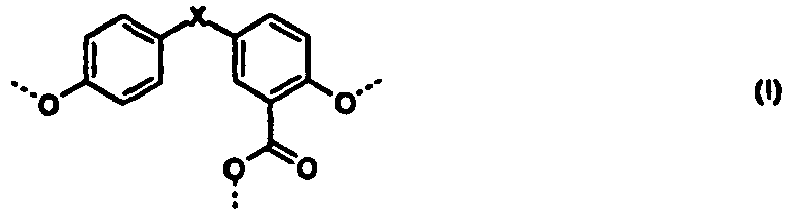
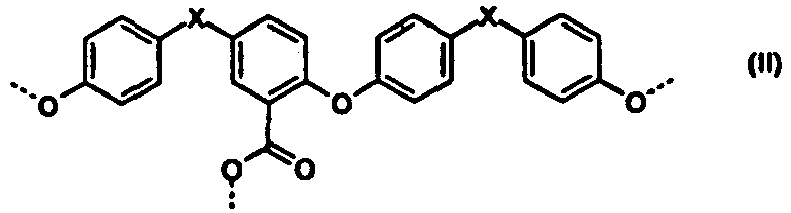

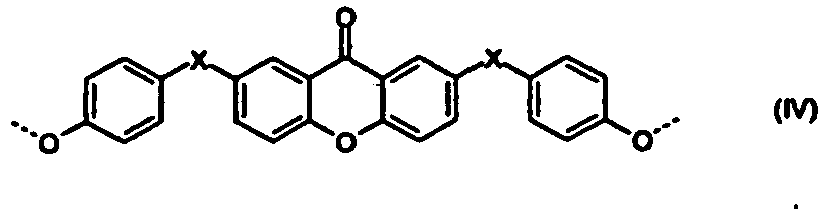
wobei die Menge der Struktureinheiten (I) bis (IV) in Summe im Allgemeinen 50 bis 900 ppm, bezogen auf das zugrunde liegende Polycarbonat, beträgt, weiterhin enthaltend in Summe lineare und cyclische Oligomere in einer Menge von 0,1 bis 2 Gew.-% bezogen auf die gesamte Zusammensetzung, wobei die
linearen Oligomere solche der Formeln (V) bis (IX) sind


und die cyclischen Oligomere solche der allgemeinen Formel (X) sind
n eine ganze Zahl von 2 bis 6 ist und
Z für einen Rest der Formel (1a)
R1 und R2 unabhängig voneinander für H, C1-C8-Alkyl, bevorzugt für H oder C1-C4-Alkyl, besonders bevorzugt für Wasserstoff oder Methyl stehen, und - X für eine Einfachbindung, C1- bis C6-Alkylen, C2- bis C5-Alkyliden oder C5- bis C6- Cycloalkyliden, welches mit C1- bis C6-Alkyl, vorzugsweise Methyl oder Ethyl substituiert sein kann, steht.
- Im Rahmen der vorliegenden Anmeldung werden die Struktureinheiten der Formeln (I) bis (IV) auch vereinfachend als Umlagerungsstrukturen bezeichnet. Die Struktureinheiten sind abgeleitet und resultieren aus den für die Herstellung des Polycarbonats eingesetzten Diphenolen bzw. Diphenolgemischen. So sind z.B. im Falle von Bisphenol A als Diphenol die Phenylringe der Umlagerungsstrukturen unsubstituiert.
- Die in den erfindungsgemäßen Polycarbonatzusammensetzungen enthaltenen cyclischen Oligomere der allgemeinen Formel (X) sind bevorzugt in Mengen von 0,2 bis 1,2, besonders bevorzugt 0,2 bis 1,1 und ganz besonders bevorzugt 0,3 bis 1 Gew.-% enthalten.
- Im Wesentlichen, d.h. zu mehr als 95 %, haben die enthaltenen Cyclen Ringgrößen mit n = 2 bis 6. Bevorzugt treten Ringgrößen mit n = 3 und/oder n = 4, besonders bevorzugt n = 3 auf.
- Die in den erfindungsgemäßen Polycarbonatzusammensetzungen enthaltenen linearen Oligomere der allgemeinen Formel (V) bis (VII) sind bevorzugt in Mengen von 0,2 bis 1,2, besonders bevorzugt 0,3 bis 1,1 und ganz besonders bevorzugt 0,4 bis 0,9 Gew.-% enthalten.
- Die vorstehend definierten Umlagerungsstrukturen treten in unterschiedlichen Mengen und Verhältnissen zueinander auf. Ihre Menge lässt sich durch Totalverseifung der Polycarbonatzusammensetzung bestimmen.
- Bei dem Abbau zu Analysezwecken werden die für die jeweilige Umlagerungsstruktur charakteristischen niedermolekularen Abbauprodukte der Formeln (Ia) bis (IVa) gebildet, deren Menge mittels HPLC bestimmt wird,


- Typischerweise beträgt die Menge der dabei freigesetzten Verbindung der Formel (Ia) 50 bis 800 ppm, bevorzugt von 70 bis 700 ppm besonders bevorzugt von 100 bis 600 ppm und ganz besonders bevorzugt von 100 bis 550 ppm.
- Typischerweise beträgt die Menge der dabei freigesetzten Verbindung der Formel (IIa) 0 (unterhalb der Nachweisgrenze von < 5 ppm) bis 100 ppm, bevorzugt von 0 bis 90 ppm besonders bevorzugt von 0 bis 80 ppm und ganz besonders bevorzugt von 0 bis 70 ppm.
- Typischerweise beträgt die Menge der dabei freigesetzten Verbindung der Formel (IIIa) 0 (unterhalb der Nachweisgrenze von < 5 ppm) bis 60 ppm, bevorzugt von 0 bis 50 ppm besonders bevorzugt von 5 bis 40 ppm und ganz besonders bevorzugt von 5 bis 30 ppm.
- Typischerweise beträgt die Menge der dabei freigesetzten Verbindung der Formel (IVa) 0 (unterhalb der Nachweisgrenze von < 5 ppm) bis 300 ppm, bevorzugt von 5 bis 280 ppm besonders bevorzugt von 5 bis 270 ppm und ganz besonders bevorzugt von 10 bis 260 ppm.
- Aus Gründen der Vereinfachung wird die Menge der Strukturen der Formel (I) bis (IV) mit der Menge der freigesetzten Verbindungen der Formeln (Ia) bis (IVa) gleichgesetzt.
- Bevorzugt weisen die Polycarbonate die folgende Uneinheitlichkeit auf, wobei die Uneinheitlichkeit für verschiedene Molekulargewichtsbereiche wie folgt ist:
- für niedrigviskoses erfindungsgemäßes PC mit einem mittleren Molekulargewicht (Gewichtsmittel) von 18.000 bis 22.000 g/mol beträgt U 1,08 bis 1,18, bevorzugt 1,10 bis 1,16,
- für mittelviskoses erfindungsgemäßes PC mit einem mittleren Molekulargewicht (Gewichtsmittel) von größer 22.000 bis 26.000 g/mol beträgt U 1,18 bis 1,60 , bevorzugt 1,20 bis 1,55, besonders bevorzugt 1,20 bis 1,50, ganz besonders bevorzugt 1,20 bis 1,45,
- für hochviskoses erfindungsgemäßes PC mit einem mittleren Molekulargewicht (Gewichtsmittel) von größer 26.000 bis 30.000 g/mol beträgt U 1,25 bis 1,65, bevorzugt 1,25 bis 1,60 , besonders bevorzugt 1,25 bis 1,50 und ganz besonders bevorzugt 1,30 bis 1,45,
- für höchstviskoses erfindungsgemäßes PC mit einem mittleren Molekulargewicht (Gewichtsmittel) von größer 30.000 g/mol, bevorzugt kleiner 50.000 g/mol beträgt U 1,50 bis 1,95, bevorzugt 1,55 bis 1,90 , besonders bevorzugt 1,55 bis 1,85, ganz besonders bevorzugt 1,55 bis 1,80.
- Zur Herstellung der erfindungsgemäßen Zusammensetzungen, die die erfmdungswesentlichen Umlagerungsstrukturen und reduzierten Gehalt an Oligomeren (cyclische und lineare) enthalten, sowie bevorzugt eine engere Molekulargewichtsverteilung (kleinere Uneinheitlichkeit U) aufweisen, werden aromatische Dihydroxyverbindungen, mit Kohlensäurediestern unter Zuhilfenahme von bestimmten Katalysatoren und gegebenenfalls weiteren Zusatzstoffen in der Schmelze umgeestert.
- Die erfindungsgemäßen Polycarbonatzusammensetzungen mit reduzierten cyclischen Carbonatgehalten und Umlagerungsstrukturen sowie eine engere Molekulargewichtsverteilung (kleinere Uneinheitlichkeit U) aufweisend werden nach dem Schmelzeumesterungsverfahren aus aromatischen Dihydroxyverbindungen, mit Kohlensäurediestern in Anwesenheit von Ammonium- oder Phosphoniumsalzen als Katalysatoren hergestellt.
- Für die Herstellung von Polycarbonaten sind geeignete Diphenole solche der Formel (1)
HO-Z-OH (1)
in welcher Z für einen Rest der Formel (1a)
R1 und R2 unabhängig voneinander für H, C1-C8-Alkyl, bevorzugt für H oder C1- C4-Alkyl, besonders bevorzugt für Wasserstoff oder Methyl stehen, und
X für eine Einfachbindung, C1- bis C6-Alkylen, C2- bis C5-Alkyliden oder C5- bis C6- Cycloalkyliden, welches mit C1- bis C6-Alkyl, vorzugsweise Methyl oder Ethyl substituiert sein kann, steht. - Bevorzugt steht X für eine Einfachbindung, Methylen, Isopropyliden, Cyclohexyliden oder 3,3,5-Trimethylcyclohexyliden, besonders bevorzugt für Isopropyliden oder 3,3,5-Trimethylcyclohexyliden.
- Beispiele für solche Dihydroxyarylverbindungen sind: Dihydroxybenzole, Dihydroxydiphenyle, Bis-(hydroxyphenyl)-alkane, Bis-(hydroxyphenyl)-cycloalkane, sowie deren kernalkylierte Verbindungen.
- Dihydroxyarylverbindungen sind allgemein bekannt oder lassen sich nach allgemein bekannten Verfahren herstellen (z.B.
WO 2006/072344 ,EP-A 1609818 und darin zitierte Literatur). - Bevorzugte Diphenole der Formel (1) sind: 2,2-Bis-(4-hydroxyphenyl)-propan (BPA), Bis-(4-hydroxyphenyl)-3,3,5-trimethyl-cyclohexan und 4,4'-Dihydroxydiphenyl.
- Es können sowohl eine Dihydroxyarylverbindung unter Bildung von Homopolycarbonaten als auch verschiedene Dihydroxyarylverbindungen unter Bildung von Copolycarbonaten verwendet werden. Letzteres ist insbesondere dann von Bedeutung, wenn Produkte mit besonderen Eigenschaftskombinationen hergestellt werden sollen.
- Anstelle der monomeren Dihydroxyarylverbindungen können auch niedermolekulare, überwiegend OH-endgruppengestoppte Oligocarbonate als Ausgangsverbindung eingesetzt werden.
- Die Dihydroxyarylverbindungen können auch mit Restgehalten der Monohydroxyarylverbindungen, aus denen sie hergestellt wurden bzw. die niedermolekularen Oligocarbonate mit Restgehalten der Monohydroxyarylverbindungen, die bei der Herstellung der Oligomeren abgespalten wurden, eingesetzt werden. Die Restgehalte der Monohydroxyarylverbindungen können bis zu 20 %, vorzugsweise 10 %, besonders bevorzugt bis 5 % und ganz besonders bevorzugt bis zu 2 % betragen (s. z.B.
EP-A 1 240 232 ). - Die verwendeten Dihydroxyarylverbindungen, wie auch alle anderen der Synthese zugesetzten Rohstoffe, Chemikalien und Hilfsstoffe können mit den aus ihrer eigenen Synthese, Handhabung und Lagerung stammenden Verunreinigungen kontaminiert sein, obwohl es wünschenswert und Ziel ist, mit möglichst sauberen Rohstoffen, Chemikalien und Hilfsstoffen zu arbeiten.
- Die für die Umsetzung mit den Dihydroxyarylverbindungen geeigneten Diarylcarbonate sind solche der Formel (2)

- Solche Diarylcarbonate sind beispielsweise in
EP-A 1 609 818 beschrieben. Bevorzugte Diarylverbindungen sind Diphenylcarbonat, 4-tert-Butylphenyl-phenyl-carbonat, Di-(4-tert-butylphenyl)-carbonat, Biphenyl-4-yl-phenyl-carbonat, Di-(biphenyl-4-yl)-carbonat, 4-(1-Methyl-1-phenylethyl)-phenyl-phenyl-carbonat und Di-[4-(1-methyl-1-phenylethyl)-phenyl]-carbonat. - Besonders bevorzugt ist Diphenylcarbonat.
- Die Diarylcarbonate können auch mit Restgehalten der Monohydroxyarylverbindungen, aus denen sie hergestellt wurden, eingesetzt werden. Die Restgehalte der Monohydroxyarylverbindungen können bis zu 20 %, vorzugsweise 10 %, besonders bevorzugt bis 5 % und ganz besonders bevorzugt bis zu 2 % betragen.
- Bezogen auf die Dihydroxyarylverbindung werden die Diarylcarbonate im Allgemeinen mit 1,02 bis 1,30 Mol, bevorzugt mit 1,04 bis 1,25 Mol, besonders bevorzugt mit 1,06 bis 1,22 Mol, ganz besonders bevorzugt mit 1,06 bis 1,20 Mol pro Mol Dihydroxyarylverbindung eingesetzt. Es können auch Mischungen der oben genannten Diarylcarbonate eingesetzt werden.
- Zur Steuerung bzw. Veränderung der Endgruppen kann zusätzlich eine Monohydroxyarylverbindung eingesetzt werden, die nicht zur Herstellung des verwendeten Diarylcarbonats benutzt wurde. Sie wird durch folgende allgemeine Formel (3) dargestellt:

- Dabei ist eine Monohydroxyarylverbindung zu wählen, deren Siedepunkt über dem der Monohydroxyarylverbindung liegt, die zur Herstellung des verwendeten Diarylcarbonates eingesetzt wurde. Die Monohydroxyarylverbindung kann zu jedem Zeitpunkt im Reaktionsverlauf zugegeben werden. Sie wird bevorzugt zu Beginn der Reaktion zugegeben oder aber auch an beliebiger Stelle im Verfahrensverlauf. Der Anteil an freier Monohydroxyarylverbindung kann 0,2 - 20 Mol %, bevorzugt 0,4 - 10 Mol %, bezogen auf die Dihydroxyarylverbindung, betragen.
- Die Endgruppen können auch durch Mitverwendung eines Diarylcarbonates, dessen Basis-Monohydroxyarylverbindung einen höheren Siedepunkt hat als die Basis- Monohydroxyarylverbindung des hauptsächlich eingesetzten Diarylcarbonates, verändert werden. Auch hier kann das Diarylcarbonat zu jedem Zeitpunkt im Reaktionsverlauf zugegeben werden. Es wird bevorzugt zu Beginn der Reaktion zugegeben oder aber auch an beliebiger Stelle im Verfahrensverlauf. Der Anteil des Diarylcarbonates mit der höher siedenden Basis-Monohydroxyarylverbindung an der gesamt eingesetzten Diarylcarbonatmenge kann 1 - 40 Mol %, bevorzugt 1 - 20 Mol % und besonders bevorzugt 1 - 10 Mol % betragen.
- Als Katalysatoren werden im erfindungswesentlichen Schmelzeumesterungsverfahren Ammonium- oder Phosphoniumsalze, im folgenden als Oniumsalze bezeichnet, eingesetzt. Bevorzugt werden Phosphoniumsalze eingesetzt. Phosphoniumsalze im Sinne der Erfindung sind solche der allgemeinen Formel (4)

- Besonders bevorzugte Katalysatoren sind Tetraphenylphosphoniumchlorid, Tetraphenylphosphoniumhydroxid und Tetraphenylphosphoniumphenolat, besonders bevorzugt ist Tetraphenylphosphoniumphenolat.
- Sie werden bevorzugt in Mengen von 10-8 bis 10-3 mol, bezogen auf ein mol Dihydroxyarylverbindung, besonders bevorzugt in Mengen von 10-7 bis 10-4 mol, eingesetzt.
- Weitere Katalysatoren können zusätzlich zu dem Oniumsalz der vorstehend genannten Art als Cokatalysator verwendet werden, um die Geschwindigkeit der Polykondensation zu erhöhen.
- Dazu gehören die alkalisch wirkenden Salze von Alkalimetallen und Erdalkalimetallen, wie Hydroxyde, Alkoxyde und Aryloxyde von Lithium, Natrium und Kalium, vorzugsweise Hydroxyde, Alkoxyde oder Aryloxyde von Natrium. Am meisten bevorzugt sind Natriumhydroxyd und Natriumphenolat, sowie auch das Dinatriumsalz des 2,2-Bis-(4-hydroxyphenyl)-propans.
- Die Mengen der alkalisch wirkenden Salze von Alkalimetallen und Erdalkalimetallen als Cokatalysator können im Bereich von 1 bis 500 ppb, vorzugsweise 5 bis 300 ppb und am meisten bevorzugt 5 bis 200 ppb liegen, jeweils berechnet als Natrium und bezogen auf zu bildendes Polycarbonat.
- Die alkalisch wirkenden Salze von Alkalimetallen und Erdalkalimetallen können schon bei der Herstellung der Oligocarbonate, das heißt zu Beginn der Synthese, eingesetzt oder aber auch erst vor der Polykondensation zugemischt werden, um unerwünschte Nebenreaktionen zu unterdrücken.
- Weiter besteht auch die Möglichkeit, ergänzende Mengen Oniumkatalysatoren des gleichen Typs oder eines anderen vor der Polykondensation zuzugeben.
- Die Zugabe der Katalysatoren erfolgt in Lösung, um bei der Dosierung schädliche Überkonzentrationen zu vermeiden. Die Lösungsmittel sind system- und verfahrensinhärente Verbindungen wie beispielsweise Dihydroxyarylverbindungen, Diarylcarbonate oder Monohydroxyarylverbindungen. Besonders bevorzugt sind Monohydroxyarylverbindungen, weil dem Fachmann geläufig ist, dass sich die Dihydroxyarylverbindungen und Diarylcarbonate bei schon leicht erhöhten Temperaturen, insbesondere unter Katalysatoreinwirkung, leicht verändern und zersetzen. Hierunter leiden die Polycarbonatqualitäten. Beim technisch bedeutsamen Umesterungsverfahren zur Herstellung von Polycarbonat ist die bevorzugte Verbindung Phenol. Phenol bietet sich auch deshalb schon zwingend an, weil der vorzugsweise benutzte Katalysator Tetraphenylphosphoniumphenolat bei der Herstellung als Mischkristall mit Phenol isoliert wird.
- Die mittleren Gewichtsmolekulargewichte der Polycarbonate betragen im Allgemeinen 15.000 bis 50.000, bevorzugt 17.000 bis 40.000, besonders bevorzugt 17.000 bis 34.000 g/mol, und werden durch GPC gegen eine Polycarbonat-Eichung bestimmt.
- Die Polycarbonate haben im Allgemeinen einen äußerst geringen Gehalt von Kationen und Anionen von jeweils weniger als 60 ppb, bevorzugt < 40 ppb und besonders bevorzugt < 20 ppb (als Na-Kation berechnet), wobei als Kationen solche von Alkali- und Erdalkalimetallen vorliegen, welche beispielsweise als Verunreinigung aus den verwendeten Rohstoffen und den Phosphonium-und Ammoniumsalzen stammen können. Weitere Ionen wie Fe-, Ni-, Cr-, Zn-, Sn, Mo-, Al-Ionen und ihre Homologen können in den Rohstoffen enthalten sein oder durch Abtrag oder Korrosion aus den Werkstoffen der benutzten Anlage stammen. Der Gehalt dieser Ionen ist in der Summe kleiner als 2 ppm, bevorzugt kleiner als 1 ppm und besonders bevorzugt kleiner 0,5 ppm.
- Als Anionen liegen solche von anorganischen Säuren und von organischen Säuren in äquivalenten Mengen vor (z. B. Chlorid, Sulfat, Carbonat, Phosphat, Phosphit, Oxalat, u.a.).
- Angestrebt werden also geringste Mengen, die nur durch Verwendung reinster Rohstoffe erreicht werden können. Derart reine Rohstoffe sind z.B. nur nach Reinigungsverfahren wie Umkristallisieren, Destillieren, Umfällen mit Wäschen u. ä. erhältlich.
- Das erfindungsgemäße Verfahren zur Herstellung von Polycarbonat nach dem Umesterungsverfahren kann diskontinuierlich oder auch kontinuierlich gestaltet werden. Nachdem die Dihydroxyarylverbindungen und Diarylcarbonate, ggf. mit weiteren Verbindungen, als Schmelze vorliegen, wird in Gegenwart des erfindungswesentlichen Katalysators die Umsetzung gestartet. Der Umsatz bzw. das Molekulargewicht wird bei steigenden Temperaturen und fallenden Drücken in geeigneten Apparaten und Vorrichtungen durch Abführen der sich abspaltenden Monohydroxyarylverbindung solange erhöht, bis der angestrebte Endzustand erreicht ist. Durch Wahl des Verhältnisses Dihydroxyarylverbindung zu Diarylcarbonat, der durch Wahl der Verfahrensweise bzw. Anlage zur Herstellung des Polycarbonats gegebenen Verlustrate des Diarylcarbonats über die Brüden und ggf. zugesetzter Verbindungen, wie beispielsweise einer höhersiedenden Monohydroxyarylverbindung, werden die Endgruppen in Art und Konzentration geprägt.
- Bezüglich der Art und Weise, in welcher Anlage und nach welcher Verfahrensweise der Prozess ausgeführt wird, gibt es keine Limitierung und Einschränkung.
- Weiter gibt es keine spezielle Limitierung und Einschränkung bezüglich der Temperaturen, der Drücke und verwendeter Katalysatoren, um die Schmelzeumesterungsreaktion zwischen der Dihydroxyarylverbindung und dem Diarylcarbonat, ggf. auch anderer zugesetzter Reaktanten durchzuführen. Jede Bedingung ist möglich, solange die gewählten Temperaturen, Drucke und Katalysatoren eine Schmelzeumesterung unter entsprechend schneller Entfernung der abgespaltenen Monohydroxyarylverbindung ermöglichen.
- Die Temperaturen über den gesamten Prozess betragen im Allgemeinen 180 bis 330°C bei Drücken von 15 bar, absolut bis 0,01 mbar, absolut.
- Meist wird eine kontinuierliche Verfahrensweise gewählt, weil das vorteilhaft für die Produktqualität ist.
- Vorzugsweise ist das kontinuierliche Verfahren zur Herstellung von Polycarbonaten dadurch gekennzeichnet, dass eine oder mehrere Dihydroxyarylverbindungen mit dem Diarylcarbonat, ggf. auch anderer zugesetzter Reaktanten unter Verwendung der Katalysatoren, nach einer Vorkondensation ohne Abtrennen der gebildeten Monohydroxyarylverbindung in sich dann daran anschließenden mehreren Reaktions-Verdampfer-Stufen bei schrittweise steigenden Temperaturen und schrittweise fallenden Drucken das Molekulargewicht bis zum gewünschten Niveau aufgebaut wird.
- Die für die einzelnen Reaktions-Verdampfer-Stufen geeigneten Vorrichtungen, Apparate und Reaktoren sind entsprechend dem Verfahrensverlauf Wärmetauscher, Entspannungsapparate, Abscheider, Kolonnen, Verdampfer, Rührbehälter und Reaktoren oder sonstige käufliche Apparate, welche die nötige Verweilzeit bei ausgewählten Temperaturen und Drucken bereitstellen. Die gewählten Vorrichtungen müssen den nötigen Wärmeeintrag ermöglichen und so konstruiert sein, dass sie den kontinuierlich wachsenden Schmelzviskositäten gerecht werden.
- Alle Vorrichtungen sind über Pumpen, Rohrleitungen und Ventilen miteinander verbunden. Die Rohrleitungen zwischen allen Einrichtungen sollten selbstverständlich so kurz wie möglich sein und die Krümmungen der Leitungen so gering wie möglich gehalten werden, um unnötig verlängerte Verweilzeiten zu vermeiden. Dabei sind die äußeren, das heißt technischen Rahmenbedingungen und Belange für Montagen chemischer Anlagen zu berücksichtigen.
- Zur Durchführung des Verfahrens nach einer bevorzugten kontinuierlichen Verfahrensweise können die Reaktionspartner entweder gemeinsam aufgeschmolzen oder aber die feste Dihydroxyarylverbindung in der Diarylcarbonatschmelze oder das feste Diarylcarbonat in der Schmelze der Dihydroxyarylverbindung gelöst werden oder beide Rohstoffe werden als Schmelze, bevorzugt direkt aus der Herstellung, zusammengeführt. Die Verweilzeiten der getrennten Schmelzen der Rohstoffe, insbesondere die der Schmelze der Dihydroxyarylverbindung, werden so kurz wie möglich eingestellt. Das Schmelzegemisch kann dagegen wegen des im Vergleich zu den einzelnen Rohstoffen erniedrigten Schmelzpunktes des Rohstoffgemisches bei entsprechend niedrigeren Temperaturen ohne Qualitätseinbußen länger verweilen.
- Danach wird der Katalysator, vorzugsweise in Phenol gelöst, zugemischt und die Schmelze auf die Reaktionstemperatur erhitzt. Diese beträgt zu Beginn des technisch bedeutsamen Prozesses zur Herstellung von Polycarbonat aus 2,2-Bis-(4-hydroxyphenyl)-propan und Diphenylcarbonat 180 bis 220°C, vorzugsweise 190 bis 210°C, ganz besonders bevorzugt 190°C. Bei Verweilzeiten von 15 bis 90 min, vorzugsweise 30 bis 60 min, wird das Reaktionsgleichgewicht eingestellt, ohne dass die gebildete Hydroxyarylverbindung entnommen wird. Die Reaktion kann bei Atmosphärendruck, aber aus technischen Gründen auch bei Überdruck gefahren werden. Der bevorzugte Druck in technischen Anlagen beträgt 2 bis 15 bar absolut.
- Das Schmelzegemisch wird in eine erste Vakuumkammer, deren Druck auf 100 bis 400 mbar, vorzugsweise auf 150 bis 300 mbar eingestellt wird, entspannt und direkt danach in einer geeigneten Vorrichtung bei gleichem Druck wieder auf die Eintrittstemperatur erhitzt. Bei dem Entspannungsvorgang wird die entstandene Hydroxyarylverbindung mit noch vorhandenen Monomeren verdampft. Nach einer Verweilzeit von 5 bis 30 min in einer Sumpfvorlage ggf. mit Umpumpung bei gleichem Druck und gleicher Temperatur wird das Reaktionsgemisch in eine zweite Vakuumkammer, deren Druck 50 bis 200 mbar, vorzugsweise 80 bis 150 mbar beträgt, entspannt und direkt danach in einer geeigneten Vorrichtung bei gleichem Druck auf eine Temperatur von 190 bis 250°C, bevorzugt 210 bis 240°C, besonders bevorzugt 210 bis 230°C, erwärmt. Auch hierbei wird die entstandene Hydroxyarylverbindung mit noch vorhandenen Monomeren verdampft. Nach einer Verweilzeit von 5 bis 30 min in einer Sumpfvorlage, ggf. mit Umpumpung, bei gleichem Druck und gleicher Temperatur wird das Reaktionsgemisch in eine dritte Vakuumkammer, deren Druck 30 bis 150 mbar, vorzugsweise 50 bis 120 mbar beträgt, entspannt und direkt danach in einer geeigneten Vorrichtung bei gleichem Druck auf eine Temperatur von 220 bis 280°C, bevorzugt 240 bis 270°C, besonders bevorzugt 240 bis 260°C, erwärmt. Auch hierbei wird die entstandene Hydroxyarylverbindung mit noch vorhandenen Monomeren verdampft. Nach einer Verweilzeit von 5 bis 20 min in einer Sumpfvorlage ggf. mit Umpumpung bei gleichem Druck und gleicher Temperatur wird das Reaktionsgemisch in eine weitere Vakuumkammer, deren Druck bei 5 bis 100 mbar, bevorzugt 15 bis 100 mbar, besonders bevorzugt 20 bis 80 mbar beträgt, entspannt und direkt danach in einer geeigneten Vorrichtung bei gleichem Druck auf eine Temperatur von 250 bis 300°C, vorzugsweise 260 bis 290°C, besonders bevorzugt 260 bis 280°C, erwärmt. Auch hierbei wird die entstandene Hydroxyarylverbindung mit noch vorhandenen Monomeren verdampft.
- Die Zahl dieser Stufen, hier beispielhaft 4, kann zwischen 2 und 6 variieren. Die Temperaturen und Drucke sind bei Änderung der Stufigkeit entsprechend anzupassen, um vergleichbare Resultate zu erhalten. Die in diesen Stufen erreichte rel. Viskosität des oligomeren Carbonats liegt zwischen 1,04 und 1,20, bevorzugt zwischen 1,05 und 1,15, besonders bevorzugt zwischen 1,06 bis 1,10.
- Das so erzeugte Oligocarbonat wird nach einer Verweilzeit von 5 bis 20 min in einer Sumpfvorlage ggf. mit Umpumpung bei gleichem Druck und gleicher Temperatur wie in der letzten Flash-/Verdampferstufe in einen Scheiben- oder Korbreaktor gefördert und bei 250 bis 310°C, bevorzugt 250 bis 290°C, besonders bevorzugt 250 bis 280°C, bei Drucken von 1 bis 15 mbar, vorzugsweise 2 bis 10 mbar, bei Verweilzeiten von 30 bis 90 min, vorzugsweise 30 bis 60 min, weiter aufkondensiert. Das Produkt erreicht eine rel. Viskosität von 1,12 bis 1,28, bevorzugt 1,13 bis 1,26, besonders bevorzugt 1,13 bis 1,24.
- Die diesen Reaktor verlassende Schmelze wird in einem weiteren Scheiben- oder Korbreaktor auf die gewünschte Endviskosität bzw. das Endmolekulargewicht gebracht. Die Temperaturen betragen 270 bis 330°C, bevorzugt 280 bis 320°C, besonders bevorzugt 280 bis 310°C, der Druck 0,01 bis 3 mbar, vorzugsweise 0,2 bis 2 mbar, bei Verweilzeiten von 60 bis 180 min, vorzugsweise 75 bis 150 min. Die rel. Viskositäten werden auf das für die vorgesehene Anwendung nötige Niveau eingestellt und betragen 1,18 bis 1,40, bevorzugt 1,18 bis 1,36, besonders bevorzugt 1,18 bis 1,34.
- Die Funktion der beiden Korbreaktoren bzw. Scheibenreaktoren kann auch in einem Korbreaktor bzw. Scheibenreaktor zusammengefasst werden.
- Die Brüden aus allen Verfahrensstufen werden unmittelbar abgeleitet, gesammelt und aufgearbeitet. Diese Aufarbeitung erfolgt in der Regel destillativ, um hohe Reinheiten der rückgewonnenen Stoffe zu erreichen. Dies kann beispielsweise gemäss Deutscher Patentanmeldung Nr.
10 100 404 erfolgen. Eine Rückgewinnung und Isolierung der abgespaltenen Monohydroxyarylverbindung in reinster Form ist aus ökonomischer und ökologischer Sicht selbstverständlich. Die Monohydroxyarylverbindung kann direkt zur Herstellung einer Dihydroxyarylverbindung oder eines Diarylcarbonats verwendet werden. - Die Scheiben- oder Korbreaktoren zeichnen sich dadurch aus, dass sie bei hohen Verweilzeiten eine sehr große, sich ständig erneuernde Oberfläche am Vakuum bereitstellen. Die Scheiben- oder Korbreaktoren sind entsprechend den Schmelzviskositäten der Produkte geometrisch ausgebildet. Geeignet sind beispielsweise Reaktoren, wie sie in der
DE 44 47 422 C2 undEP A 1 253 163 , oder Zweiwellenreaktoren, wie sie in derWO A 99/28 370 - Die Oligocarbonate, auch sehr niedermolekulare, und die fertigen Polycarbonate werden in der Regel mittels Zahnradpumpen, Schnecken unterschiedlichster Bauart oder Verdrängerpumpen spezieller Bauart gefördert.
- Besonders geeignete Werkstoffe zur Herstellung der Apparate, Reaktoren, Rohrleitungen, Pumpen und Armaturen sind nicht rostende Stähle vom Typ Cr Ni (Mo) 18/10 wie z. B. 1.4571 oder 1. 4541 (Stahlschlüssel 2001, Verlag: Stahlschlüssel Wegst GmbH, Th-Heuss-Straße 36, D-71672 Marbach) und Ni-Basislegierungen vom Typ C, wie z. B. 2.4605 oder 2.4610 (Stahlschlüssel 2001, Verlag: Stahlschlüssel Wegst GmbH, Th-Heuss-Straße 36, D-71672 Marbach). Die nicht rostenden Stähle werden bis zu Prozesstemperaturen von etwa 290°C und die Ni-Basislegierungen bei Prozesstemperaturen oberhalb von etwa 290°C benutzt.
- Weiterhin kann das erhaltene Polycarbonat zur Veränderung von Eigenschaften mit weiteren, üblichen Additiven und Zusatzstoffen (z.B. Hilfs- und Verstärkungsstoffe) nach Zugabe der erfindungsgemäßen Inhibitoren versehen werden. Der Zusatz von Additiven und Zuschlagsstoffen dient der Verlängerung der Nutzungsdauer (z.B. Hydrolyse- oder Abbaustabilisatoren), der Verbesserung der Farbstabilität (z.B. Thermo- und UV-Stabilisatoren), der Vereinfachung der Verarbeitung (z.B. Entformer, Fließhilfsmittel), der Verbesserung der Gebrauchseigenschaften (z.B. Antistatika), der Verbesserung des Flammschutzes, der Beeinflussung des optischen Eindrucks (z.B. organische Farbmittel, Pigmente) oder der Anpassung der Polymereigenschaften an bestimmte Belastungen (Schlagzähmodifikatoren, fein zerteilte Mineralien, Faserstoffe, Quarzmehl, Glas- und Kohlenstofffasern). Alles kann beliebig kombiniert werden, um die gewünschten Eigenschaften einzustellen und zu erreichen. Solche Zuschlagstoffe und Additive werden z.B. in "Plastics Additives", R. Gächter und H. Müller, Hanser Publishers 1983, beschrieben.
- Als Thermostabilisator eignen sich bevorzugt Tris-(2,4-di-tert-butylphenyl)phosphit (Irgafos 168), Tetrakis(2,4-di-tert.-butylphenyl)[1,1biphenyl]-4,4'-diylbisphosphonit, Trisoctylphosphat, Octadecyl-3-(3,5-di-tert butyl-4-hydroxyphenyl)propionat (Irganox 1076), Bis(2,4-dicumylphenyl)pentaerythritoldiphosphit (Doverphos S-9228), Bis(2,6-di-tert.butyl-4-methylphenyl)pentaerythritoldiphosphit (ADK STAB PEP-36) oder Triphenylphosphin. Sie werden allein oder im Gemisch (z. B. Irganox B900 oder Doverphos S-92228 mit Irganox B900 bzw. Irganox 1076) eingesetzt.
- Als Entformungsmitttel eignen sich bevorzugt Pentaerythrittetrastearat, Glycerinmonostearat., Stearylstearat oder Propoandiolstearat. Sie werden allein oder im Gemisch eingesetzt.
- Als Lichtschutzmittel eignen sich bevorzugt Benzotriazole, Triazine, Benzophenone, Cyanacrylate, Zimtsäureester oder Oxalanilide. Sie werden allein oder im Gemisch eingesetzt.
- Diese Additive und Zuschlagstoffe können einzeln oder in beliebigen Mischungen oder mehreren verschiedenen Mischungen der Polymerschmelze zugesetzt werden und zwar direkt bei der Isolierung des Polymeren oder aber nach Aufschmelzung von Granulat in einem sogenannten Compoundierungsschritt.
- Dabei können die Additive und Zuschlagstoffe beziehungsweise deren Mischungen als Feststoff, also als Pulver, oder als Schmelze der Polymerschmelze zugesetzt werden. Eine andere Art der Dosierung ist die Verwendung von Masterbatches oder Mischungen von Masterbatches der Additive oder Additivmischungen.
- Der Zusatz dieser Stoffe erfolgt vorzugsweise auf herkömmlichen Aggregaten zum fertigen Polycarbonat, kann jedoch, je nach den Erfordernissen, auch auf einer anderen Stufe im Herstellverfahren des Polycarbonats erfolgen.
- Geeignete Additive sind beispielsweise beschrieben in Additives for Plastics Handbook, John Murphy, Elsevier, Oxford 1999 oder Plastics Additives Handbook Hans Zweifel, Hanser, München 2001.
- Desweiteren können Inhibitoren (Quencher) zur Deaktivierung von Katalysatorresten der Polymerschmelze in Reinform, in einem inerten Lösemittel gelöst oder als Masterbatch zugegeben werden. Als Inhibitoren geeignet sind Säurekomponenten wie Lewis- oder Brönstedsäuren oder Ester starker Säuren. Der pKa-Wert des Inhibitors sollte nicht größer als 5, bevorzugt kleiner 3 sein. Die Säurekomponente wird bzw. deren Ester werden zugegeben, um die Reaktionsmischung zu deaktivieren, also die Reaktion im Idealfall vollständig zum Erliegen zu bringen. Die Säurekomponente wird in Konzentrationen von < 20 ppm, vorzugsweise < 10 ppm, besonders bevorzugt < 5 ppm und ganz besonders bevorzugt < 2,5 ppm zugesetzt. Nach Erreichen des gewünschten Molekulargewichts liegt die nachweisbare P-Menge im 1 ppm Bereich. Die erfindungsgemäß einzusetzenden molaren Inhibitor-Mengen liegen allerdings unter den aus dem P-Wert anzunehmenden molaren Restmengen an Katalysator.
- Beispiele für geeignete Säurekomponenten sind: ortho-Phosphorsäure, phosphorige Säure, Pyrophosphorsäure, Hypophosphorsäure, Polyphosphorsäuren, Benzolphosphonsäure, Natriumdihydrogenphosphat, Borsäure, Arylboronsäuren, Salzsäure (Chlorwasserstoff), Schwefelsäure, Ascorbinsäure, Oxalsäure, Benzoesäure, Salicylsäure, Ameisensäure, Essigsäure, Adipinsäure, Zitronensäure, Benzolsulfonsäure, Toluolsulfonsäure, Dodekylbenzolsulfonsäure und alle sonstigen Phenyl-substituierten Benzolsulfonsäuren, Salpetersäure, Terephthalsäure, Isophthalsäure, Stearinsäure und sonstige Fettsäuren, Säurechloride wie Chlorameisensäurephenylester, Stearinsäurechlorid, Acetoxy-BP-A, Benzoylchlorid sowie Ester, Halbester und verbrückte Ester der oben genannten Säuren wie beispielsweise Toluolsulfonsäureester, Phosphorsäureester, Phosphorigsäureester, Phosphonsäureester, Dimethylsulfat, Borsäureester, Arylboronsäureester und andere unter Wassereinfluss säuregenerierende Komponenten wie Tri-iso-octylphosphat, Ultranox® 640 und BDP (Bisphenoldiphosphat-Oligomer).
- Bevorzugt kommen dabei ortho-Phosphorsäure, phosphorige Säuren, Pyrophosphorsäure, Hypophosphonsäure, Polyphosphorsäuren, Benzolphosphonsäure, Natriumdihydrogenphosphat, Borsäure, Arylboronsäuren, Benzoesäure, Salicylsäure, Benzolsulfonsäure, Toluolsulfonsäure, Dodekylbenzolsulfonsäure und alle sonstigen Phenyl-substituierten Benzolsulfonsäuren, Säurechloride wie Chlorameisensäurephenylester, Stearinsäurechlorid, Acetoxy-BP-A, Benzoylchlorid sowie Ester, Halbester und verbrückte Ester der oben genannten Säuren wie beispielsweise Toluolsulfonsäureester, Phosphorsäureester, Phosphorigsäureester, Phosphonsäureester, Borsäureester, Arylboronsäureester und andere unter Wassereinfluss säuregenerierende Komponenten wie Tri-iso-octylphosphat, Ultranox® 640 und BDP in Frage.
- Bevorzugte geeignete Inhibitoren sind verbrückte Ester von organischen Schwefel-enthaltenden Säuren, ausgewählt aus mindestens einer Verbindung
- a) der Formel (5)

R1 unabhängig für Wasserstoff oder für C1-C20-Alkyl, vorzugsweise für C1-C8-Alkyl, besonders bevorzugt für unsubstituiertes C1-C6-Alkyl, ganz besonders bevorzugt für C1-C4-Alkyl, wobei Alkyl durch Halogen substituiert sein kann, insbesondere für Wasserstoff oder Methyl steht,
R2 und R3 unabhängig voneinander für Wasserstoff, oder für C1-C6-Alkyl, C4-C30-Alkylcarbonyl, vorzugsweise C1-C4-Alkyl, C6-C25-Alkylcarboxyl, besonders bevorzugt für C8-C20-Alkylcarboxyl, insbesondere für Wasserstoff, C17-Alkylcarboxyl oder C15-Alkylcarboxyl oder für den Rest
worin- R1
- die oben genannte Bedeutung hat,
- n
- für eine ganze Zahl von 0 bis 8, vorzugsweise 0 bis 6, insbesondere 0, 1 oder 2 steht.
- Besonders bevorzugt kommen ortho-Phosphorsäure, Pyrophosphorsäure, Polyphosphorsäuren, Benzolphosphonsäure, Benzoesäure, Benzolsulfonsäure, Toluolsulfonsäure, Dodecylbenzolsulfonsäure und alle sonstigen Phenyl-substituierten Benzolsulfonsäuren sowie Ester, Halbester und verbrückte Ester der oben genannten Säuren wie beispielsweise Toluolsulfonsäureester, Phosphorsäureester, Phosphorigsäureester, Phosphonsäureester und andere unter Wassereinfluss säuregenerierende Komponenten wie Tri-iso-octylphosphat, Ultranox® 640 und BDP in Frage.
- Ganz besonders bevorzugt kommen ortho-Phosphorsäure, Pyrophosphorsäure, Benzolsulfonsäure, Toluolsulfonsäure, Dodecylbenzolsulfonsäure und alle sonstigen Phenyl-substituierten Benzolsulfonsäuren sowie Ester, Halbester und verbrückte Ester der oben genannten Säuren wie beispielsweise Toluolsulfonsäureester und Phosphorsäureester in Frage.
- Ganz besonders bevorzugt ist folgender Inhibitor der Formel (6):

- Die Zudosierung der sauren Komponenten kann in fester, flüssiger oder gasförmiger Form erfolgen. In einer bevorzugten Verfahrensweise wird die saure Komponente kontinuierlich in den von den Monomeren zu befreienden Produktstrom im Herstellprozess direkt nach Erreichen des angestrebten Endmolekulargewichtes homogen zugemischt, um sofort danach mit der Verdampfung der Restmonomeren zu beginnen. In einer besonders bevorzugten Verfahrensweise wird die Additivierung zur Verbesserung einzelner Produkteigenschaften hinter der Säuredosierung und der Restmonomerreduzierung vorgenommen und nicht mit dem Schritt der Restmonomerreduzierung zusammengefasst, weil oft Additive benutzt werden, die im Vakuum, das für die Reduzierung der Restmonomeren unabdingbar ist, flüchtig sind und dann schlecht in den nötigen Konzentrationen im Polymer einzustellen sind.
- Bevorzugt werden die sauren Komponenten in flüssiger Form zugegeben. Da die zu dosierenden Mengen sehr gering sind, werden vorzugsweise Lösungen der sauren Komponenten verwendet.
- Geeignete Lösemittel sind solche, die den Prozess nicht stören, chemisch inert sind und schnell verdampfen.
- Als Lösemittel kommen alle organischen Lösemittel mit einem Siedepunkt bei Normaldruck von 30 bis 300°C, bevorzugt von 30 bis 250°C und besonders bevorzugt von 30 bis 200°C sowie auch Wasser - dazu zählt auch Kristallwasser - in Frage. Vorzugsweise werden solche Verbindungen gewählt, die in den jeweiligen Prozessen vorkommen. Eventuell verbleibende Reste mindern, je nach Anforderungsprofil des herzustellenden Produktes, nicht die Qualität.
- Lösemittel sind neben Wasser Alkane, Cycloalkane und Aromaten, die auch substituiert sein können. Die Substituenten können aliphatische, cycloaliphatische oder aromatische Reste in unterschiedlicher Kombination sowie Halogene oder eine Hydroxylgruppe sein. Heteroatome, wie beispielsweise Sauerstoff, können auch zwischen aliphatischen, cycloaliphatischen oder aromatischen Resten Brückenglieder sein, wobei die Reste gleich oder unterschiedlich sein können. Weitere Lösemittel können auch Ketone und Ester organischer Säuren sowie cyclische Carbonate sein.
- Beispiele sind neben Wasser n-Pentan, n- Hexan, n-Heptan und deren Isomere, Cyclohexan, Toluol und Xylol, Methylenchlorid, Ethylchlorid, Ethylenchlorid, Chlorbenzol, Methanol, Ethanol, Propanol, Butanol und deren Isomere, Phenol, o-, m- und p-Kresol, Diethylether, Dimethylketon, Polyethylenglycole, Polypropylenglycole, Essigsäureethylester, Ethylencarbonat und Propylencarbonat.
- Bevorzugt geeignet sind für den Polycarbonatprozess Wasser, Phenol, Propylencarbonat, Ethylencarbonat und Toluol.
- Besonders bevorzugt geeignet sind Wasser, Phenol und Propylencarbonat.
- Zur wirksamen Einmischung des Inhibitors sind statische Mischer oder andere zu einer homogenen Einmischung führende Mischer, wie beispielsweise Extruder, geeignet.
- Die erfindungsgemäßen Polycarbonate können nach vorheriger oder gleichzeitger Deaktivierung (quenchen) von Katalysatorresten einer Restentgasung von Monomeren (z. B. Diphenylcarbonat, Phenol, BPA) und kurzen Oligomeren sowie kleinen Ringen unterzogen werden. Diese kann mit oder ohne Schleppgas, z.B. Stickstoff, im letzten Reaktor oder einem nachgeschalteten Entgasungsaggregat erreicht werden.
- Gegenstand der vorliegenden Anmeldung sind auch Extrudate und Formkörper, insbesondere solchen zur Verwendung im transparenten Bereich, die aus den erfindungsgemäßen Zusammensetzungen erhältlich sind.
- Anwendungsbereiche können sein: Sicherheitsscheiben, Schilde von Helmen, Folien, Blaskörper wie unter anderem Wasserflaschen, Lichtdurchlässige Platten, wie Massivplatten oder insbesondere Hohlkammerplatten, beispielsweise zum Abdecken von Gebäuden wie Bahnhöfen, Gewächshäusern und Beleuchtungsanlagen, Ampelgehäuse oder Verkehrsschilder, Schaumstoffe mit offener oder geschlossener gegebenenfalls bedruckbarer Oberfläche, Fäden und Drähte (s.a.
DE-A 11 37 167 ), lichttechnische Anwendungen, gegebenenfalls unter Verwendung von Glasfasern für Anwendungen im transluzenten Bereich , transluzente Einstellungen mit einem Gehalt an Bariumsulfat und oder Titandioxid und oder Zirkoniumoxid bzw. organischen polymeren Acrylatkautschuken (EP-A 0 634 445 ,EP-A 0 269 324 ) zur Herstellung von lichtdurchlässigen und lichtstreuenden Formteilen, Präzisionsspritzgussteile, wie Halterungen, z.B. Linsenhalterungen; hier werden gegebenenfalls Polycarbonate mit Glasfasern und einem gegebenenfalls zusätzlichen Gehalt von 1-10 Gew. % Molybdändisulfid (bez. auf die gesamte Formmasse) verwendet, optische Geräteteile, insbesondere Linsen für Foto- und Filmkameras (DE-A 27 01 173 ), Lichtübertragungsträger, insbesondere Lichtleiterkabel (EP-A 0 089 801 ) und Beleuchtungsleisten, Elektroisolierstoffe für elektrische Leiter und für Steckergehäuse und Steckverbinder sowie Kondensatoren, Mobiltelefongehäuse, Network interface devices, Gehäuse für hard dics und Datenspeichersysteme, Trägermaterialien für organische Fotoleiter, Leuchten, Scheinwerferlampen, Streulichtscheiben oder innere Linsen, medizinische Anwendungen wie Oxygenatoren, Dialysatoren, Lebensmittelanwendungen, wie Flaschen, Geschirr und Schokoladenformen, Anwendungen im Automobilbereich, wie Verglasungen oder in Form von Blends mit ABS als Stoßfänger, Sportartikel wie Slalomstangen, Skischuhschnallen, Haushaltsartikel, wie Küchenspülen, Waschbecken, Briefkästen, Gehäuse, wie Elektroverteilerkästen, Gehäuse für elektrische Geräte wie Zahnbürsten, Föne, Kaffeemaschinen, Werkzeugmaschinen, wie Bohr-, Fräs-, Hobelmaschinen und Sägen, Waschmaschinen-Bullaugen, Schutzbrillen, Sonnenbrillen, Korrekturbrillen bzw. deren Linsen, Lampenabdeckungen, Verpackungsfolien, Chip-Boxen, Chipträger, Boxen für Si-Wafer und sonstige Anwendungen wie Maststalltüren oder Tierkäfige. - Die relative Lösungsviskosität ηrel auch als eta rel bezeichnet wurde in Dichlormethan bei einer Konzentration von 5 g/l bei 25°C mit einem Ubbelohdeviskosimeter bestimmt.
- Der Gehalt an phenolischem OH wurde durch IR-Messung erhalten. Zu diesem Zweck wurde eine Differenzmessung von einer Lösung aus 2 g Polymer in 50 ml Dichlormethan gegenüber reinem Dichlormethan vermessen und die Extinktionsdifferenz bei 3582 cm-1 bestimmt.
- Das Fließverhalten (Schmelzeviskosität) der Polymerschmelzen wird bei verschiedenen Temperaturen in einem Kapillarrheometer nach ISO 11443 ermittelt. Die Polycarbonatproben werden zu diesem Zweck vorher über Nacht bei 130°C getrocknet. In den Beispielen sind jeweils die Scherraten in s-1 angegeben.
- Die Probe wird mit Methylenchlorid gelöst. Durch Zugabe von Aceton wird der überwiegende Anteil des Polymeren ausgefällt. Die ungelösten Anteile werden abfiltriert, das Filtrat wird zur Trockne eingeengt. Der Trockenrückstand wird mit THF gelöst und die Oligomeren werden mit HPLC mit UV-Detektion bestimmt.
- Die Polycarbonatprobe wird mit Natriummethylat unter Rückfluss verseift. Die Verseifungslösung wird angesäuert und zur Trockne eingeengt. Der Trockenrückstand wird mit Acetonitril gelöst und die phenolischen Verbindungen (Ia bis IVa) werden mit HPLC mit UV-Detektion bestimmt.
- Die Polycarbonatzusammensetzung PC1 wurde in einem Schmelzeverfahren wie folgt hergestellt.
- Aus einer Vorlage werden 8.600 kg/h Schmelzegemisch, bestehend aus 4.425 kg Diphenylcarbonat/h (20.658 mol/h) und 4.175 kg Bisphenol A/h (18.287 mol/h), unter Zusetzen von 0,52 kg des Phenoladdukts von Tetraphenylphosphoniumphenolat mit 65,5 % Tetraphenylphosphoniumphenolat/h (0,786 mol/h; das sind 0,0043 Mol %) gelöst in 4,5 kg Phenol/h durch einen Wärmetauscher gepumpt, auf 190°C erwärmt und durch eine Verweilkolonne bei 12 bar und 190°C geführt. Die mittlere Verweilzeit beträgt 50 Minuten.
- Die Schmelze wird dann über ein Entspannungsventil in einen unter 200 mbar stehenden Abscheider geleitet. Die abfließende Schmelze wird in einem, ebenfalls unter 200 mbar stehenden, Fallfilmverdampfer wieder auf 190°C erwärmt und in einer Vorlage aufgefangen. Nach einer Verweilzeit von 20 Minuten wird die Schmelze in die nächsten drei, gleichartig aufgebauten Stufen gepumpt. Die Bedingungen in der 2./3./4. Stufe sind 100/74/40 mbar; 220°C / 225°C/ 273°C und 20 / 10 / 10 Minuten. Das entstandene Oligomere hat eine rel. Viskosität von 1,08. Alle Brüden werden über Druckregelungen in eine unter Vakuum stehende Kolonne geführt und als Kondensate abgeleitet.
- Danach wird das Oligomer in einem sich anschliessenden Scheibenreaktor bei 290°C und 0,7 mbar bei einer Verweilzeit von 120 Minuten zu einem höhermolekularen Produkt aufkondensiert. Die rel. Viskosität beträgt 1,257. Die Brüden werden kondensiert.
- Die Brüden werden in der Vakuumanlage und dahinter kondensiert.
- Die Polycarbonatzusammensetzungen PC3, PC5 und PC7 werden analog PC1 hergestellt, wobei das BPA zu DPC Verhältnis angepasst wird, so dass die höheren Vikositäten eta rel erhalten werden.
- PC2, PC4, PC6 und PC8 stellen Vergleichsbeispiele dar, in denen die Polycarbonatzusammensetzungen nach dem Phasengrenzflächenverfahren gewonnen wurden.
- In der folgenden Tabelle 1 sind die Daten der nach den vorstehenden Experimenten hergestellten Polycarbonatzusammensetzungen einschließlich der ermittelten Umlagerungsstruktur- und Oligomeranteile sowie die Uneinheitlichkeit U wiedergegeben:
Tabelle 1: Typ PC1 PC2 Vergl. PC3 PC4 Vergl. PC5 PC6 Vergl. PC7 PC8 Vergl. eta rel 1,257 1,255 1,282 1,285 1,295 1,293 1,317 1,323 Mn 10622 9386 11621 10141 12322 11489 12825 Mw 24219 23664 27156 26084 28752 31348 36983 U 1,28 1,52 1,34 1,57 1,33 1,73 1,88 Umlagerungsstrukturen Ia ppm 91 <5 363 <5 298 <5 375 <5 IIa ppm 13 <5 56 <5 35 <5 50 <5 IIIa ppm <5 <5 17 <5 12 <5 15 <5 IVa ppm 14 <5 255 <5 103 <5 170 <5 Oligomerenverteilung Type V - IX V n=1 bis 6 gesamt % 0,290 0,003 0,230 0,010 0,200 0,060 0,220 0,053 VI n=1 bis 6 gesamt % 0,042 0,008 0,034 0,009 0,034 0,009 0,042 0,008 vII n=1 bis 6 gesamt % 0,680 0,009 0,560 0,071 0,590 1,030 0,430 0,860 Cyclen X n=2 bis 6 gesamt % 0,610 1,140 0,570 1,180 0,620 1,270 0,630 1,440 VIII n=1 bis 4 gesamt % <0,001 0,84 <0,001 0,74 <0,001 0,042 <0,001 0,027 IX gesamt. % <0,001 0,038 <0,001 0,02 <0,001 0,001 <0,001 <0,001 Summe Oligomere % 1,63 2,03 1,39 2,04 1,44 2,41 1,32 2,39 Schmelzevisk. 280°C 50 Pas 744 742 883 925 1334 1542 100 Pas 413 468 718 737 837 898 1247 1456 200 Pas 402 467 670 711 766 839 1085 1310 500 Pas 356 417 554 593 617 676 813 951 1000 Pas 300 338 425 450 462 499 577 645 1500 Pas 256 283 345 362 370 396 490 500 5000 Pas 129 137 158 164 168 175 250 219 Schmelzevisk. 300°C 50 Pas 412 - - 653 752 100 Pas 359 401 436 470 617 731 200 Pas 204 244 348 397 427 459 566 672 500 Pas 198 232 309 356 370 403 467 531 1000 Pas 178 205 263 300 305 330 371 448 1500 Pas 163 183 227 258 259 277 312 365 5000 Pas 97 104 121 131 131 136 165 167 Schmelzevisk. 320°C 50 Pas - - 100 Pas 223 - - 304 415 200 Pas 128 132 190 221 238 262 295 395 500 Pas 126 130 178 213 223 246 263 357 1000 Pas 119 123 163 191 193 216 216 301 1500 Pas 112 115 148 173 167 192 194 266 5000 Pas 70 76 91 102 100 108 112 137 Schmelzevisk. 340°C 50 Pas - - 100 Pas - - 200 Pas 118 136 129 145 177 277 500 Pas 64 80 113 128 126 142 166 257 1000 Pas 64 79 106 122 117 133 148 224 1500 Pas 62 77 98 115 108 123 136 200 5000 Pas 52 58 68 78 74 82 80 112 Fließspirale cm 26,5 25 25,5 25 26 25 22 20 - Man erkennt aus Tabelle 1, dass die Oligomer- und mehrfunktionelle Umlagerungsstrukturenhaltigen PC1, PC3, PC5 und PC7 bei vergleichbaren Lösungsviskositäten selbst bei hohen Scherraten jeweils niedrigere Schmelzviskositäten, also besseres Fließverhalten und damit verbessertes Verarbeitungsverhalten im Spritzgussprozess zeigen, als die Vergleichsprodukte ohne diese Strukturen. Dieser Effekt wird ebenfalls bei der Messung mittels der Fließspirale beobachtet. Dies ist überraschend, da Umlagerungsstrukturen mit höherer Funktionalität normalerweise zu Verzweigung und damit zu höheren Schmelzviskositäten führen.
- Des weiteren ist die Uneinheitlichkeit dieser Produkte verglichen mit den Vergleichspolycarbonaten PC2, PC4, PC6 und PC8 trotz mehrfunktioneller Umlagerungsstrukturen (Verzweigungen) signifikant geringer, d. h. eine engere Molekulargewichtsverteilung ist gegeben.
- In allen Fällen weisen die erfindungsgemäßen Polycarbonate PC1, PC3, PC5 und PC7 deutlich geringere Anteile an Cyclen als die entsprechenden Vergleichsbeispiele PC2, PC4, PC6 und PC8 auf. Trotzdem wird jeweils ein besseres Fließverhalten der erfindungsgemäßen Polycarbonate gefunden.
- Überraschenderweise wurde gefunden, dass das Verfahren immer eine nahezu konstante und geringere Menge an Cyclen liefert, wo hingegen die Vergleichsbeispiele mit steigender Viskosität höhere Anteile an Cyclen aufweisen.
- Weiterhin weisen die erfindungsgemäßen Polycarbonate trotz Vorliegen mehrfunktioneller Umlagerungsstrukturen (Verzweigungen) eine signifikant engere MW-Verteilung (kleinere Uneinheitlichkeit U) auf.
Claims (8)
- Polycarbonat mit einer oder mehreren Strukturen der allgemeinen Formeln (I) bis (IV)


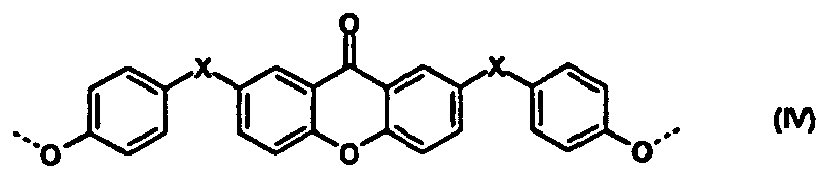
wobei die Menge der Struktureinheiten (I) bis (IV) in Summe 50 bis 900 ppm , bezogen auf das zugrunde liegende Polycarbonat, beträgt,
weiterhin enthaltend in Summe lineare und cyclische Oligomere in einer Menge von 0,1 bis 2 Gew.-% bezogen auf die gesamte Zusammensetzung, wobei die
linearen Oligomere solche der Formeln (V) bis (IX) sind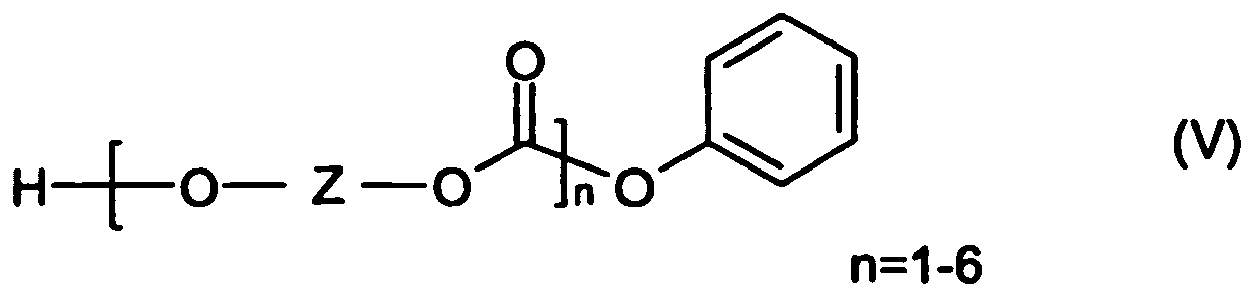


n eine ganze Zahl von 2 bis 6 ist und Z für einen Rest der Formel (1a)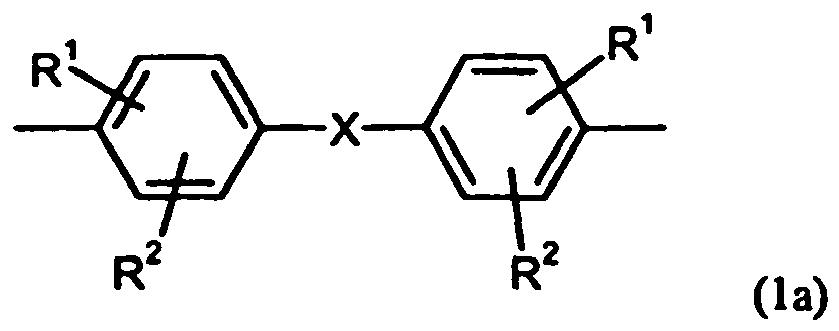
R1 und R2 unabhängig voneinander für H, C1-C8-Alkyl stehen, und
X für eine Einfachbindung, C1- bis C6-Alkylen, C2- bis C5-Alkyliden oder C5- bis C6- Cycloalkyliden, welches mit C1- bis C6-Alkyl substituiert sein kann. - Polycarbonat gemäß Anspruch 1, wobei die Menge der Verbindung der Formel (I) 50 bis 800 ppm, der Formel (II) 0 bis 100 ppm, der Formel (III) 0 bis 100 ppm und der Formel (IV) 0 bis 300 ppm beträgt.
- Polycarbonat germäß Anspruch 1, wobei das Polycarbonat die folgende Uneinheitlichkeit aufweist:für PC mit einem mittleren Molekulargewicht (Gewichtsmittel) von 18.000 bis 22.000 g/mol beträgt U 1,08 bis 1,18,für PC mit einem mittleren Molekulargewicht (Gewichtsmittel) von größer 22.000 bis 26.000 g/mol beträgt U 1,18 bis 1,60 ,für PC mit einem mittleren Molekulargewicht (Gewichtsmittel) von größer 26.000 bis 30.000 g/mol beträgt U 1,25 bis 1,65für PC mit einem mittleren Molekulargewicht (Gewichtsmittel) von größer 30.000 g/mol, bevorzugt kleiner 50.000 g/mol beträgt U 1,50 bis 1,95.
- Polycarbonat gemäß Anspruch 3, wobei die Uneinheitlichkeit wie folgt ist:für PC mit einem mittleren Molekulargewicht (Gewichtsmittel) von 18.000 bis 22.000 g/mol beträgt U 1,10 bis 1,16,für PC mit einem mittleren Molekulargewicht (Gewichtsmittel) von größer 22.000 bis 26.000 g/mol beträgt U 1,20 bis 1,50,für PC mit einem mittleren Molekulargewicht (Gewichtsmittel) von größer 26.000 bis 30.000 g/mol beträgt U 1,25 bis 1,50,für PC mit einem mittleren Molekulargewicht (Gewichtsmittel) von größer 30.000 g/mol, bevorzugt kleiner 50.000 g/mol beträgt U 1,55 bis 1,85.
- Polycarbonat gemäß Anspruch 1, wobei Z abgeleitet ist von 2,2-Bis-(4-hydroxyphenyl)-propan, Bis-(4-hydroxyphenyl)-3,3,5-trimethyl-cyclohexan und 4,4'-Dihydroxydiphenyl und X in Formeln (I) bis (IV) für eine Einfachbindung, Isopropyliden oder 3,3,5-Trimethylcyclohexyl steht.
- Verwendung von Polycarbonaten gemäß Anspruch 1 zur Herstellung von Extrudaten und Formkörpern
- Extrudate und Formkörper, erhältlich aus Polycarbonaten gemäß Anspruch 1.
- Verwendung von Polycarbonaten gemäß Anspruch 1 zur Herstellung von Blends.
Priority Applications (1)
| Application Number | Priority Date | Filing Date | Title |
|---|---|---|---|
| PL09733376T PL2268706T3 (pl) | 2008-04-18 | 2009-04-09 | Poliwęglany ze strukturami przegrupowania, oligomerami cyklicznymi i liniowymi oraz o poprawionych właściwościach przepływu |
Applications Claiming Priority (2)
| Application Number | Priority Date | Filing Date | Title |
|---|---|---|---|
| DE102008019503A DE102008019503A1 (de) | 2008-04-18 | 2008-04-18 | Polycarbonate mit Umlagerungsstrukturen, cyclischen und linearen Oligomeren sowie verbessertem Fließverhalten |
| PCT/EP2009/002662 WO2009127366A1 (de) | 2008-04-18 | 2009-04-09 | Polycarbonate mit umlagerungsstrukturen, cyclischen und linearen oligomeren sowie verbessertem fliessverhalten |
Publications (2)
| Publication Number | Publication Date |
|---|---|
| EP2268706A1 EP2268706A1 (de) | 2011-01-05 |
| EP2268706B1 true EP2268706B1 (de) | 2012-10-03 |
Family
ID=40765591
Family Applications (1)
| Application Number | Title | Priority Date | Filing Date |
|---|---|---|---|
| EP09733376A Active EP2268706B1 (de) | 2008-04-18 | 2009-04-09 | Polycarbonate mit umlagerungsstrukturen, cyclischen und linearen oligomeren sowie verbessertem fliessverhalten |
Country Status (11)
| Country | Link |
|---|---|
| US (1) | US8158745B2 (de) |
| EP (1) | EP2268706B1 (de) |
| JP (1) | JP5620367B2 (de) |
| KR (1) | KR101669684B1 (de) |
| CN (1) | CN102007161B (de) |
| DE (1) | DE102008019503A1 (de) |
| ES (1) | ES2394418T3 (de) |
| PL (1) | PL2268706T3 (de) |
| RU (1) | RU2496801C9 (de) |
| TW (1) | TWI481641B (de) |
| WO (1) | WO2009127366A1 (de) |
Families Citing this family (26)
| Publication number | Priority date | Publication date | Assignee | Title |
|---|---|---|---|---|
| RU2015123120A (ru) | 2012-11-17 | 2017-01-10 | Мицубиси Гэс Кемикал Компани, Инк. | Композиция ароматической поликарбонатной смолы |
| KR102159520B1 (ko) * | 2012-11-17 | 2020-09-24 | 미츠비시 가스 가가쿠 가부시키가이샤 | 고분자량화된 방향족 폴리카보네이트 수지의 제조 방법 |
| EP2921514B1 (de) * | 2012-11-17 | 2021-01-06 | Mitsubishi Gas Chemical Company, Inc. | Herstellungsverfahren für aromatisches polycarbonatharz mit erhöhtem molekulargewicht |
| JP6212854B2 (ja) * | 2012-11-17 | 2017-10-18 | 三菱瓦斯化学株式会社 | ポリカーボネート共重合体 |
| CN105637012B (zh) * | 2013-10-08 | 2019-03-08 | 科思创德国股份有限公司 | 聚硅氧烷-聚碳酸酯嵌段共缩合物 |
| EP3055341B1 (de) | 2013-10-08 | 2019-10-02 | Covestro Deutschland AG | Herstellung von siloxanhaltigen blockcopolycarbonaten mittels reaktiver extrusion |
| JP6621739B2 (ja) | 2013-10-08 | 2019-12-18 | コベストロ、ドイチュラント、アクチエンゲゼルシャフトCovestro Deutschland Ag | 弱酸の塩を用いてポリシロキサン−ポリカーボネートブロック共縮合物を調製する方法 |
| US9845378B2 (en) | 2013-10-08 | 2017-12-19 | Covestro Deutschland Ag | Process for preparing polysiloxane-polycarbonate block cocondensates |
| KR102270558B1 (ko) | 2014-01-30 | 2021-06-29 | 코베스트로 도이칠란트 아게 | 개선된 레올로지 특성을 갖는 폴리실록산-폴리카르보네이트 블록 공축합물 |
| EP2918388A1 (de) * | 2014-03-10 | 2015-09-16 | Sulzer Chemtech AG | Verfahren zur Wiederverwertung von expandierbaren Kunststoffmaterialien und sowie damit herstellbares expandierfähiges oder expandiertes Kunststoffmaterial |
| JP6314601B2 (ja) * | 2014-03-28 | 2018-04-25 | 三菱瓦斯化学株式会社 | 芳香族ポリカーボネート樹脂組成物 |
| JP6314600B2 (ja) * | 2014-03-28 | 2018-04-25 | 三菱瓦斯化学株式会社 | 芳香族ポリカーボネート樹脂組成物 |
| CN106536629A (zh) * | 2014-08-01 | 2017-03-22 | 科思创德国股份有限公司 | 具有支化结构和环状低聚物以及改进的流变性质的共聚碳酸酯组合物 |
| KR102383387B1 (ko) * | 2014-08-01 | 2022-04-07 | 코베스트로 도이칠란트 아게 | 개선된 광학적 성질을 갖는, 시클릭 올리고머 및 선형 올리고머를 갖는 코폴리카르보네이트 조성물 |
| KR20170039234A (ko) * | 2014-08-01 | 2017-04-10 | 코베스트로 도이칠란드 아게 | 개선된 레올로지 특성 및 분지 구조물 및 선형 올리고머를 갖는 코폴리카르보네이트 조성물 |
| WO2016016422A1 (de) * | 2014-08-01 | 2016-02-04 | Covestro Deutschland Ag | Copolycarbonat-zusammensetzungen mit cyclischen und linearen oligomeren und verbesserten rheologischen eigenschaften |
| WO2016116395A1 (de) * | 2015-01-20 | 2016-07-28 | Covestro Deutschland Ag | Flammgeschützte formmassen enthaltend siloxan-haltiges polycarbonat-blockcokondensat |
| JP6779885B2 (ja) * | 2015-01-20 | 2020-11-04 | コベストロ、ドイチュラント、アクチエンゲゼルシャフトCovestro Deutschland Ag | ガラス繊維およびシロキサン含有ポリカーボネートブロック共縮合物を含んでなる難燃性成形組成物 |
| KR20170134408A (ko) | 2015-04-07 | 2017-12-06 | 코베스트로 도이칠란트 아게 | 폴리실록산과 디히드록시디페닐시클로알칸-기반 (코)폴리카르보네이트의 블록 공축합물 |
| US20190085123A1 (en) * | 2016-03-30 | 2019-03-21 | Mitsubishi Gas Chemical Company, Inc. | Aromatic polycarbonate resin composition and aromatic polycarbonate resin manufacturing method |
| CN109196054B (zh) | 2016-06-03 | 2021-08-10 | 科思创德国股份有限公司 | 包含特定的共聚碳酸酯作为基质材料的多层复合材料 |
| CN109863203B (zh) | 2016-08-24 | 2022-03-15 | 科思创德国股份有限公司 | 包含滑石的聚碳酸酯组合物 |
| KR102454155B1 (ko) | 2016-12-19 | 2022-10-14 | 코베스트로 도이칠란트 아게 | 상용화제를 사용한 실록산-함유 블록 코폴리카르보네이트의 제조 |
| EP3581605A1 (de) | 2018-06-14 | 2019-12-18 | Covestro Deutschland AG | Schmelzeumesterungsverfahren zur gleichzeitigen herstellung mindestens zweier verschiedenartiger polycarbonate in einer produktionsanlage |
| ES2933516T3 (es) | 2019-04-02 | 2023-02-09 | Covestro Deutschland Ag | Co-policarbonatos en bloque que contienen siloxano con un tamaño de dominio pequeño |
| CN119213058A (zh) | 2022-05-17 | 2024-12-27 | 科思创德国股份有限公司 | 由特殊封端的硅氧烷嵌段制成的聚硅氧烷-聚碳酸酯-嵌段共缩合物 |
Citations (3)
| Publication number | Priority date | Publication date | Assignee | Title |
|---|---|---|---|---|
| EP0953605A2 (de) * | 1998-04-28 | 1999-11-03 | Teijin Limited | Polycarbonatabmischung mit verbessertem Fliessverhalten |
| WO2005054335A1 (de) * | 2003-12-06 | 2005-06-16 | Bayer Materialscience Ag | Verfahren zur herstellung von polycarbonaten mit geringem gehalt an flüchtigen verbindungen nach dem umesterungsverfahren |
| EP1612231A1 (de) * | 2004-07-01 | 2006-01-04 | Bayer MaterialScience AG | Inhibierung von katalytisch aktiven Verunreinigungen in Polycarbonat nach dem Schmelzeumesterungsverfahren |
Family Cites Families (32)
| Publication number | Priority date | Publication date | Assignee | Title |
|---|---|---|---|---|
| US3022272A (en) | 1962-02-20 | Process for the production of high | ||
| DE1031512B (de) | 1955-12-21 | 1958-06-04 | Bayer Ag | Verfahren zur Herstellung von hochmolekularen faser- und filmbildenden Polycarbonaten |
| NL256449A (de) | 1959-10-01 | 1900-01-01 | ||
| DE2701173C2 (de) | 1977-01-13 | 1983-02-10 | Bayer Ag, 5090 Leverkusen | Verwendung von Polycarbonaten zur Herstellung von Linsen für Photo- und Filmkameras |
| JPS58179224A (ja) | 1982-03-18 | 1983-10-20 | Konishiroku Photo Ind Co Ltd | 光学用樹脂組成物および光学用素子 |
| CA1337104C (en) | 1986-11-18 | 1995-09-26 | William James Work | Light-scattering thermoplastic polymers |
| DE4118232A1 (de) * | 1991-06-04 | 1992-12-10 | Bayer Ag | Kontinuierliche herstellung von polycarbonaten |
| DE4238123C2 (de) | 1992-11-12 | 2000-03-09 | Bayer Ag | Verfahren zur Herstellung von thermoplastischen Polycarbonaten |
| DE4312390A1 (de) | 1993-04-16 | 1994-10-20 | Bayer Ag | Zweistufen-Verfahren zur Herstellung von thermoplastischem Polycarbonat |
| GB9314604D0 (en) | 1993-07-14 | 1993-08-25 | Dow Deutschland Inc | Light diffuser composition |
| EP0719582B1 (de) * | 1994-12-30 | 1999-03-03 | Karl Fischer Industrieanlagen Gmbh | Reaktorvorrichtung für fliessfähige und höherviskose Medien |
| DE4447422C2 (de) | 1994-12-30 | 1996-10-31 | Fischer Karl Ind Gmbh | Reaktorvorrichtung für fließfähige Medien |
| JPH11158262A (ja) | 1997-11-28 | 1999-06-15 | Hitachi Ltd | ポリカーボネートの製造方法 |
| WO2000037531A1 (en) * | 1998-12-18 | 2000-06-29 | General Electric Company | Method for the preparation of bisphenol-a polycarbonate with reduced levels of fries |
| US6248859B1 (en) * | 1999-07-06 | 2001-06-19 | General Electric Company | Polycarbonates suitable for use in optical article |
| DE19954787A1 (de) * | 1999-11-15 | 2001-05-17 | Bayer Ag | Verfahren zur Herstellung von Polycarbonat |
| US6228973B1 (en) * | 2000-06-02 | 2001-05-08 | General Electric Company | Method for preparing high molecular weight polycarbonate |
| US8099122B1 (en) | 2000-06-05 | 2012-01-17 | Qualcomm Incorporated | Method and apparatus for improved forward link power control while in soft handoff |
| DE10100404A1 (de) | 2001-01-05 | 2002-07-11 | Bayer Ag | Verfahren zur Herstellung von Polycarbonat |
| DE10122496A1 (de) * | 2001-03-26 | 2002-10-10 | Bayer Ag | Polycarbonat mit geringem Scherentzähungsverhalten |
| DE10119851A1 (de) | 2001-04-24 | 2002-10-31 | Bayer Ag | Verfahren zur kontinuierlichen Herstellung von Polycarbonaten nach dem Schmelzumesterungsverfahren |
| US6548623B2 (en) * | 2001-07-24 | 2003-04-15 | General Electric Company | Method of polycarbonate preparation |
| US6608164B2 (en) | 2001-10-25 | 2003-08-19 | General Electric Company | Salts of heterocyclic diols as catalysts for melt polycarbonate |
| US6569986B1 (en) * | 2001-10-25 | 2003-05-27 | General Electric Company | Salts of organic polyacids as polymerization catalysts |
| US20030214070A1 (en) * | 2002-05-08 | 2003-11-20 | General Electric Company | Multiwall polycarbonate sheet and method for its production |
| US6639043B1 (en) * | 2002-06-27 | 2003-10-28 | General Electric Company | Azonaphthalene sulfonates as polymerization catalysts |
| US6833422B2 (en) * | 2002-08-16 | 2004-12-21 | General Electric Company | Method of preparing transparent silicone-containing copolycarbonates |
| DE10328665A1 (de) * | 2003-06-26 | 2005-01-13 | Bayer Materialscience Ag | Polycarbonatformmassen mit verbesserter Schmelzefließfähigkeit und Chemikalienbeständigkeit |
| DE102004022673A1 (de) * | 2004-05-07 | 2005-11-24 | Bayer Materialscience Ag | Copolycarbonate mit verbesserter Fließfähigkeit |
| ATE460458T1 (de) * | 2004-06-24 | 2010-03-15 | Bayer Materialscience Ag | Thermostabilisierte polycarbonat- zusammensetzungen |
| DE102004061713A1 (de) * | 2004-12-22 | 2006-07-20 | Bayer Materialscience Ag | Polycarbonate mit guter Benetzbarkeit |
| SG183052A1 (en) * | 2007-07-31 | 2012-08-30 | Mitsubishi Chem Corp | Polycarbonate resins and methods for preparing the same |
-
2008
- 2008-04-18 DE DE102008019503A patent/DE102008019503A1/de not_active Withdrawn
-
2009
- 2009-04-09 PL PL09733376T patent/PL2268706T3/pl unknown
- 2009-04-09 WO PCT/EP2009/002662 patent/WO2009127366A1/de not_active Ceased
- 2009-04-09 CN CN2009801136222A patent/CN102007161B/zh active Active
- 2009-04-09 RU RU2010146694/04A patent/RU2496801C9/ru not_active IP Right Cessation
- 2009-04-09 ES ES09733376T patent/ES2394418T3/es active Active
- 2009-04-09 EP EP09733376A patent/EP2268706B1/de active Active
- 2009-04-09 US US12/988,456 patent/US8158745B2/en active Active
- 2009-04-09 JP JP2011504358A patent/JP5620367B2/ja not_active Expired - Fee Related
- 2009-04-09 KR KR1020107023078A patent/KR101669684B1/ko not_active Expired - Fee Related
- 2009-04-17 TW TW098112728A patent/TWI481641B/zh not_active IP Right Cessation
Patent Citations (3)
| Publication number | Priority date | Publication date | Assignee | Title |
|---|---|---|---|---|
| EP0953605A2 (de) * | 1998-04-28 | 1999-11-03 | Teijin Limited | Polycarbonatabmischung mit verbessertem Fliessverhalten |
| WO2005054335A1 (de) * | 2003-12-06 | 2005-06-16 | Bayer Materialscience Ag | Verfahren zur herstellung von polycarbonaten mit geringem gehalt an flüchtigen verbindungen nach dem umesterungsverfahren |
| EP1612231A1 (de) * | 2004-07-01 | 2006-01-04 | Bayer MaterialScience AG | Inhibierung von katalytisch aktiven Verunreinigungen in Polycarbonat nach dem Schmelzeumesterungsverfahren |
Also Published As
| Publication number | Publication date |
|---|---|
| PL2268706T3 (pl) | 2013-02-28 |
| KR20100133436A (ko) | 2010-12-21 |
| EP2268706A1 (de) | 2011-01-05 |
| TWI481641B (zh) | 2015-04-21 |
| CN102007161A (zh) | 2011-04-06 |
| RU2496801C9 (ru) | 2014-07-10 |
| JP5620367B2 (ja) | 2014-11-05 |
| JP2011516700A (ja) | 2011-05-26 |
| ES2394418T3 (es) | 2013-01-31 |
| TW201004999A (en) | 2010-02-01 |
| US20110040066A1 (en) | 2011-02-17 |
| WO2009127366A1 (de) | 2009-10-22 |
| RU2496801C2 (ru) | 2013-10-27 |
| KR101669684B1 (ko) | 2016-10-27 |
| DE102008019503A1 (de) | 2009-10-22 |
| RU2010146694A (ru) | 2012-05-27 |
| US8158745B2 (en) | 2012-04-17 |
| CN102007161B (zh) | 2013-02-06 |
Similar Documents
| Publication | Publication Date | Title |
|---|---|---|
| EP2268706B1 (de) | Polycarbonate mit umlagerungsstrukturen, cyclischen und linearen oligomeren sowie verbessertem fliessverhalten | |
| EP1609818B1 (de) | Thermostabilisierte Polycarbonat-Zusammensetzungen | |
| EP2147038B1 (de) | Verfahren zur herstellung von polycarbonat nach dem schmelzeumesterungsverfahren | |
| EP2285865B1 (de) | Alkylphenol zur einstellung des molekulargewichtes und copolycarbonat mit verbesserten eigenschaften | |
| EP2483344B1 (de) | Polycarbonatzusammensetzungen mit verbesserter schmelzestabilität | |
| EP1692205B1 (de) | Verfahren zur herstellung von polycarbonaten mit geringem gehalt an flüchtigen verbindungen nach dem umesterungsverfahren | |
| DE102008008841A1 (de) | Verfahren zur Herstellung von Polycarbonaten | |
| EP2090605B1 (de) | Verfahren zur Herstellung von Polycarbonaten | |
| EP3227387B1 (de) | Copolycarbonat-zusammensetzungen mit verbessertem verarbeitungsverhalten enthaltend pe-wachse | |
| EP2250210B1 (de) | Polycarbonate mit cyclischen oligomeren und verbessertem fliessverhalten | |
| EP2483343B1 (de) | Polycarbonatzusammensetzungen mit verbesserten optischen eigenschaften | |
| EP1612231B1 (de) | Inhibierung von katalytisch aktiven Verunreinigungen in Polycarbonat nach dem Schmelzeumesterungsverfahren | |
| EP3581605A1 (de) | Schmelzeumesterungsverfahren zur gleichzeitigen herstellung mindestens zweier verschiedenartiger polycarbonate in einer produktionsanlage | |
| WO2013144102A1 (de) | Polycarbonatzusammensetzung mit verbesserten optischen eigenschaften | |
| EP3174935B1 (de) | Copolycarbonat-zusammensetzungen mit cyclischen und linearen oligomeren und verbesserten optischen eigenschaften | |
| DE102004030664A1 (de) | Benzol- und Toluolsulfonsäureester als Additive in Polycarbonat | |
| DE102004032125A1 (de) | Inhibierung von katalytisch aktiven Verunreinigungen in Polycarbonat nach dem Schmelzeumesterungsverfahren | |
| DE10248951A1 (de) | Herstellung von Polycarbonat mit Hilfe eines Filtrationskonzeptes | |
| DE10249270A1 (de) | Rücklöseverfahren | |
| EP3985047A1 (de) | Verfahren zur herstellung eines polycarbonats nach dem phasengrenzflächenverfahren unter lösungsmittelaustausch | |
| DE102004057349A1 (de) | Benzol- und Toluolsulfonsäureester als Additive in Polycarbonat | |
| DE10249269A1 (de) | Verfahren zur Herstellung von Polycarbonaten unter Rückführung von Polycar-bonatlösung aus Abwasser-und Abfallströmen in den Herstellungsprozess | |
| DE10248950A1 (de) | Herstellung von besonders wenig durch Sauerstoff geschädigtem Polycarbonat | |
| DE10248021A1 (de) | Verfahren zur Herstellung von Polycarbonat nach dem Phasengrenzflächenverfahren mit Verweiltank | |
| DE102004013526A1 (de) | Herstellung von besonders wenig durch Sauerstoff geschädigtem Polycarbonat |
Legal Events
| Date | Code | Title | Description |
|---|---|---|---|
| PUAI | Public reference made under article 153(3) epc to a published international application that has entered the european phase |
Free format text: ORIGINAL CODE: 0009012 |
|
| 17P | Request for examination filed |
Effective date: 20101118 |
|
| AK | Designated contracting states |
Kind code of ref document: A1 Designated state(s): AT BE BG CH CY CZ DE DK EE ES FI FR GB GR HR HU IE IS IT LI LT LU LV MC MK MT NL NO PL PT RO SE SI SK TR |
|
| AX | Request for extension of the european patent |
Extension state: AL BA RS |
|
| 17Q | First examination report despatched |
Effective date: 20110331 |
|
| DAX | Request for extension of the european patent (deleted) | ||
| REG | Reference to a national code |
Ref country code: DE Ref legal event code: R079 Ref document number: 502009004959 Country of ref document: DE Free format text: PREVIOUS MAIN CLASS: C08G0064000000 Ipc: C08G0064060000 |
|
| GRAP | Despatch of communication of intention to grant a patent |
Free format text: ORIGINAL CODE: EPIDOSNIGR1 |
|
| RIC1 | Information provided on ipc code assigned before grant |
Ipc: C08L 69/00 20060101ALI20120423BHEP Ipc: C08G 64/06 20060101AFI20120423BHEP Ipc: C08G 64/00 20060101ALI20120423BHEP Ipc: C08G 64/04 20060101ALI20120423BHEP Ipc: C08G 64/30 20060101ALI20120423BHEP |
|
| GRAS | Grant fee paid |
Free format text: ORIGINAL CODE: EPIDOSNIGR3 |
|
| GRAA | (expected) grant |
Free format text: ORIGINAL CODE: 0009210 |
|
| AK | Designated contracting states |
Kind code of ref document: B1 Designated state(s): AT BE BG CH CY CZ DE DK EE ES FI FR GB GR HR HU IE IS IT LI LT LU LV MC MK MT NL NO PL PT RO SE SI SK TR |
|
| REG | Reference to a national code |
Ref country code: GB Ref legal event code: FG4D Free format text: NOT ENGLISH |
|
| REG | Reference to a national code |
Ref country code: AT Ref legal event code: REF Ref document number: 577959 Country of ref document: AT Kind code of ref document: T Effective date: 20121015 Ref country code: CH Ref legal event code: EP |
|
| REG | Reference to a national code |
Ref country code: IE Ref legal event code: FG4D Free format text: LANGUAGE OF EP DOCUMENT: GERMAN |
|
| REG | Reference to a national code |
Ref country code: DE Ref legal event code: R096 Ref document number: 502009004959 Country of ref document: DE Effective date: 20121129 |
|
| REG | Reference to a national code |
Ref country code: ES Ref legal event code: FG2A Ref document number: 2394418 Country of ref document: ES Kind code of ref document: T3 Effective date: 20130131 |
|
| PG25 | Lapsed in a contracting state [announced via postgrant information from national office to epo] |
Ref country code: SI Free format text: LAPSE BECAUSE OF FAILURE TO SUBMIT A TRANSLATION OF THE DESCRIPTION OR TO PAY THE FEE WITHIN THE PRESCRIBED TIME-LIMIT Effective date: 20121003 |
|
| REG | Reference to a national code |
Ref country code: PL Ref legal event code: T3 |
|
| REG | Reference to a national code |
Ref country code: NL Ref legal event code: VDEP Effective date: 20121003 |
|
| REG | Reference to a national code |
Ref country code: LT Ref legal event code: MG4D |
|
| PG25 | Lapsed in a contracting state [announced via postgrant information from national office to epo] |
Ref country code: SE Free format text: LAPSE BECAUSE OF FAILURE TO SUBMIT A TRANSLATION OF THE DESCRIPTION OR TO PAY THE FEE WITHIN THE PRESCRIBED TIME-LIMIT Effective date: 20121003 Ref country code: FI Free format text: LAPSE BECAUSE OF FAILURE TO SUBMIT A TRANSLATION OF THE DESCRIPTION OR TO PAY THE FEE WITHIN THE PRESCRIBED TIME-LIMIT Effective date: 20121003 Ref country code: NO Free format text: LAPSE BECAUSE OF FAILURE TO SUBMIT A TRANSLATION OF THE DESCRIPTION OR TO PAY THE FEE WITHIN THE PRESCRIBED TIME-LIMIT Effective date: 20130103 Ref country code: HR Free format text: LAPSE BECAUSE OF FAILURE TO SUBMIT A TRANSLATION OF THE DESCRIPTION OR TO PAY THE FEE WITHIN THE PRESCRIBED TIME-LIMIT Effective date: 20121003 Ref country code: IS Free format text: LAPSE BECAUSE OF FAILURE TO SUBMIT A TRANSLATION OF THE DESCRIPTION OR TO PAY THE FEE WITHIN THE PRESCRIBED TIME-LIMIT Effective date: 20130203 Ref country code: LT Free format text: LAPSE BECAUSE OF FAILURE TO SUBMIT A TRANSLATION OF THE DESCRIPTION OR TO PAY THE FEE WITHIN THE PRESCRIBED TIME-LIMIT Effective date: 20121003 Ref country code: NL Free format text: LAPSE BECAUSE OF FAILURE TO SUBMIT A TRANSLATION OF THE DESCRIPTION OR TO PAY THE FEE WITHIN THE PRESCRIBED TIME-LIMIT Effective date: 20121003 |
|
| RAP2 | Party data changed (patent owner data changed or rights of a patent transferred) |
Owner name: BAYER INTELLECTUAL PROPERTY GMBH |
|
| PG25 | Lapsed in a contracting state [announced via postgrant information from national office to epo] |
Ref country code: GR Free format text: LAPSE BECAUSE OF FAILURE TO SUBMIT A TRANSLATION OF THE DESCRIPTION OR TO PAY THE FEE WITHIN THE PRESCRIBED TIME-LIMIT Effective date: 20130104 Ref country code: PT Free format text: LAPSE BECAUSE OF FAILURE TO SUBMIT A TRANSLATION OF THE DESCRIPTION OR TO PAY THE FEE WITHIN THE PRESCRIBED TIME-LIMIT Effective date: 20130204 Ref country code: LV Free format text: LAPSE BECAUSE OF FAILURE TO SUBMIT A TRANSLATION OF THE DESCRIPTION OR TO PAY THE FEE WITHIN THE PRESCRIBED TIME-LIMIT Effective date: 20121003 |
|
| PG25 | Lapsed in a contracting state [announced via postgrant information from national office to epo] |
Ref country code: DK Free format text: LAPSE BECAUSE OF FAILURE TO SUBMIT A TRANSLATION OF THE DESCRIPTION OR TO PAY THE FEE WITHIN THE PRESCRIBED TIME-LIMIT Effective date: 20121003 Ref country code: SK Free format text: LAPSE BECAUSE OF FAILURE TO SUBMIT A TRANSLATION OF THE DESCRIPTION OR TO PAY THE FEE WITHIN THE PRESCRIBED TIME-LIMIT Effective date: 20121003 Ref country code: BG Free format text: LAPSE BECAUSE OF FAILURE TO SUBMIT A TRANSLATION OF THE DESCRIPTION OR TO PAY THE FEE WITHIN THE PRESCRIBED TIME-LIMIT Effective date: 20130103 Ref country code: EE Free format text: LAPSE BECAUSE OF FAILURE TO SUBMIT A TRANSLATION OF THE DESCRIPTION OR TO PAY THE FEE WITHIN THE PRESCRIBED TIME-LIMIT Effective date: 20121003 Ref country code: CZ Free format text: LAPSE BECAUSE OF FAILURE TO SUBMIT A TRANSLATION OF THE DESCRIPTION OR TO PAY THE FEE WITHIN THE PRESCRIBED TIME-LIMIT Effective date: 20121003 |
|
| PLBE | No opposition filed within time limit |
Free format text: ORIGINAL CODE: 0009261 |
|
| STAA | Information on the status of an ep patent application or granted ep patent |
Free format text: STATUS: NO OPPOSITION FILED WITHIN TIME LIMIT |
|
| PG25 | Lapsed in a contracting state [announced via postgrant information from national office to epo] |
Ref country code: RO Free format text: LAPSE BECAUSE OF FAILURE TO SUBMIT A TRANSLATION OF THE DESCRIPTION OR TO PAY THE FEE WITHIN THE PRESCRIBED TIME-LIMIT Effective date: 20121003 |
|
| 26N | No opposition filed |
Effective date: 20130704 |
|
| BERE | Be: lapsed |
Owner name: BAYER MATERIALSCIENCE A.G. Effective date: 20130430 |
|
| REG | Reference to a national code |
Ref country code: DE Ref legal event code: R097 Ref document number: 502009004959 Country of ref document: DE Effective date: 20130704 |
|
| PG25 | Lapsed in a contracting state [announced via postgrant information from national office to epo] |
Ref country code: MC Free format text: LAPSE BECAUSE OF FAILURE TO SUBMIT A TRANSLATION OF THE DESCRIPTION OR TO PAY THE FEE WITHIN THE PRESCRIBED TIME-LIMIT Effective date: 20121003 Ref country code: CY Free format text: LAPSE BECAUSE OF FAILURE TO SUBMIT A TRANSLATION OF THE DESCRIPTION OR TO PAY THE FEE WITHIN THE PRESCRIBED TIME-LIMIT Effective date: 20121003 |
|
| REG | Reference to a national code |
Ref country code: CH Ref legal event code: PL |
|
| GBPC | Gb: european patent ceased through non-payment of renewal fee |
Effective date: 20130409 |
|
| REG | Reference to a national code |
Ref country code: IE Ref legal event code: MM4A |
|
| PG25 | Lapsed in a contracting state [announced via postgrant information from national office to epo] |
Ref country code: CH Free format text: LAPSE BECAUSE OF NON-PAYMENT OF DUE FEES Effective date: 20130430 Ref country code: LI Free format text: LAPSE BECAUSE OF NON-PAYMENT OF DUE FEES Effective date: 20130430 Ref country code: GB Free format text: LAPSE BECAUSE OF NON-PAYMENT OF DUE FEES Effective date: 20130409 Ref country code: BE Free format text: LAPSE BECAUSE OF NON-PAYMENT OF DUE FEES Effective date: 20130430 |
|
| PG25 | Lapsed in a contracting state [announced via postgrant information from national office to epo] |
Ref country code: IE Free format text: LAPSE BECAUSE OF NON-PAYMENT OF DUE FEES Effective date: 20130409 |
|
| REG | Reference to a national code |
Ref country code: DE Ref legal event code: R081 Ref document number: 502009004959 Country of ref document: DE Owner name: COVESTRO DEUTSCHLAND AG, DE Free format text: FORMER OWNER: BAYER MATERIALSCIENCE AG, 51373 LEVERKUSEN, DE Effective date: 20140526 Ref country code: DE Ref legal event code: R081 Ref document number: 502009004959 Country of ref document: DE Owner name: BAYER INTELLECTUAL PROPERTY GMBH, DE Free format text: FORMER OWNER: BAYER MATERIALSCIENCE AG, 51373 LEVERKUSEN, DE Effective date: 20140526 |
|
| PG25 | Lapsed in a contracting state [announced via postgrant information from national office to epo] |
Ref country code: MT Free format text: LAPSE BECAUSE OF FAILURE TO SUBMIT A TRANSLATION OF THE DESCRIPTION OR TO PAY THE FEE WITHIN THE PRESCRIBED TIME-LIMIT Effective date: 20121003 |
|
| REG | Reference to a national code |
Ref country code: AT Ref legal event code: MM01 Ref document number: 577959 Country of ref document: AT Kind code of ref document: T Effective date: 20140409 |
|
| PG25 | Lapsed in a contracting state [announced via postgrant information from national office to epo] |
Ref country code: LU Free format text: LAPSE BECAUSE OF NON-PAYMENT OF DUE FEES Effective date: 20130409 Ref country code: HU Free format text: LAPSE BECAUSE OF FAILURE TO SUBMIT A TRANSLATION OF THE DESCRIPTION OR TO PAY THE FEE WITHIN THE PRESCRIBED TIME-LIMIT; INVALID AB INITIO Effective date: 20090409 Ref country code: MK Free format text: LAPSE BECAUSE OF FAILURE TO SUBMIT A TRANSLATION OF THE DESCRIPTION OR TO PAY THE FEE WITHIN THE PRESCRIBED TIME-LIMIT Effective date: 20121003 |
|
| PG25 | Lapsed in a contracting state [announced via postgrant information from national office to epo] |
Ref country code: AT Free format text: LAPSE BECAUSE OF NON-PAYMENT OF DUE FEES Effective date: 20140409 |
|
| REG | Reference to a national code |
Ref country code: DE Ref legal event code: R081 Ref document number: 502009004959 Country of ref document: DE Owner name: COVESTRO DEUTSCHLAND AG, DE Free format text: FORMER OWNER: BAYER INTELLECTUAL PROPERTY GMBH, 40789 MONHEIM, DE |
|
| REG | Reference to a national code |
Ref country code: FR Ref legal event code: PLFP Year of fee payment: 8 |
|
| PGFP | Annual fee paid to national office [announced via postgrant information from national office to epo] |
Ref country code: TR Payment date: 20160317 Year of fee payment: 8 |
|
| PGFP | Annual fee paid to national office [announced via postgrant information from national office to epo] |
Ref country code: FR Payment date: 20160323 Year of fee payment: 8 |
|
| PGFP | Annual fee paid to national office [announced via postgrant information from national office to epo] |
Ref country code: IT Payment date: 20160418 Year of fee payment: 8 Ref country code: PL Payment date: 20160401 Year of fee payment: 8 |
|
| REG | Reference to a national code |
Ref country code: FR Ref legal event code: TP Owner name: COVESTRO DEUTSCHLAND AG, DE Effective date: 20161115 |
|
| REG | Reference to a national code |
Ref country code: FR Ref legal event code: ST Effective date: 20171229 |
|
| PG25 | Lapsed in a contracting state [announced via postgrant information from national office to epo] |
Ref country code: FR Free format text: LAPSE BECAUSE OF NON-PAYMENT OF DUE FEES Effective date: 20170502 |
|
| PG25 | Lapsed in a contracting state [announced via postgrant information from national office to epo] |
Ref country code: IT Free format text: LAPSE BECAUSE OF NON-PAYMENT OF DUE FEES Effective date: 20170409 |
|
| PG25 | Lapsed in a contracting state [announced via postgrant information from national office to epo] |
Ref country code: PL Free format text: LAPSE BECAUSE OF NON-PAYMENT OF DUE FEES Effective date: 20170409 |
|
| PG25 | Lapsed in a contracting state [announced via postgrant information from national office to epo] |
Ref country code: TR Free format text: LAPSE BECAUSE OF NON-PAYMENT OF DUE FEES Effective date: 20170409 |
|
| PGFP | Annual fee paid to national office [announced via postgrant information from national office to epo] |
Ref country code: ES Payment date: 20220505 Year of fee payment: 14 |
|
| REG | Reference to a national code |
Ref country code: ES Ref legal event code: FD2A Effective date: 20240528 |
|
| PG25 | Lapsed in a contracting state [announced via postgrant information from national office to epo] |
Ref country code: ES Free format text: LAPSE BECAUSE OF NON-PAYMENT OF DUE FEES Effective date: 20230410 |
|
| PG25 | Lapsed in a contracting state [announced via postgrant information from national office to epo] |
Ref country code: ES Free format text: LAPSE BECAUSE OF NON-PAYMENT OF DUE FEES Effective date: 20230410 |
|
| PGFP | Annual fee paid to national office [announced via postgrant information from national office to epo] |
Ref country code: DE Payment date: 20250319 Year of fee payment: 17 |