EP0089801A1 - Optical element and optical resin composition for the preparation thereof - Google Patents
Optical element and optical resin composition for the preparation thereof Download PDFInfo
- Publication number
- EP0089801A1 EP0089801A1 EP83301449A EP83301449A EP0089801A1 EP 0089801 A1 EP0089801 A1 EP 0089801A1 EP 83301449 A EP83301449 A EP 83301449A EP 83301449 A EP83301449 A EP 83301449A EP 0089801 A1 EP0089801 A1 EP 0089801A1
- Authority
- EP
- European Patent Office
- Prior art keywords
- group
- resin composition
- optical
- represent
- formula
- Prior art date
- Legal status (The legal status is an assumption and is not a legal conclusion. Google has not performed a legal analysis and makes no representation as to the accuracy of the status listed.)
- Withdrawn
Links
- 230000003287 optical effect Effects 0.000 title claims abstract description 53
- 239000011342 resin composition Substances 0.000 title claims abstract description 33
- 238000002360 preparation method Methods 0.000 title description 3
- 125000002947 alkylene group Chemical group 0.000 claims abstract description 21
- 125000002993 cycloalkylene group Chemical group 0.000 claims abstract description 18
- 239000000155 melt Substances 0.000 claims abstract description 16
- 229920000515 polycarbonate Polymers 0.000 claims abstract description 14
- 239000004417 polycarbonate Substances 0.000 claims abstract description 14
- 125000000217 alkyl group Chemical group 0.000 claims abstract description 9
- 230000009477 glass transition Effects 0.000 claims abstract description 6
- 125000000732 arylene group Chemical group 0.000 claims abstract description 5
- 125000000843 phenylene group Chemical group C1(=C(C=CC=C1)*)* 0.000 claims abstract description 5
- 229910052736 halogen Inorganic materials 0.000 claims description 5
- 150000002367 halogens Chemical class 0.000 claims description 5
- 229910052739 hydrogen Inorganic materials 0.000 claims description 3
- 239000001257 hydrogen Substances 0.000 claims description 3
- 150000002431 hydrogen Chemical class 0.000 claims 2
- 229920000642 polymer Polymers 0.000 description 28
- 238000000465 moulding Methods 0.000 description 27
- 229920005989 resin Polymers 0.000 description 25
- 239000011347 resin Substances 0.000 description 25
- 239000000047 product Substances 0.000 description 17
- 239000004033 plastic Substances 0.000 description 13
- 239000000178 monomer Substances 0.000 description 12
- 238000000034 method Methods 0.000 description 11
- 238000001746 injection moulding Methods 0.000 description 10
- YGYAWVDWMABLBF-UHFFFAOYSA-N Phosgene Chemical compound ClC(Cl)=O YGYAWVDWMABLBF-UHFFFAOYSA-N 0.000 description 7
- 238000006116 polymerization reaction Methods 0.000 description 7
- -1 alkyl phthalates Chemical class 0.000 description 5
- 238000000748 compression moulding Methods 0.000 description 5
- 239000000203 mixture Substances 0.000 description 5
- 125000001424 substituent group Chemical group 0.000 description 5
- 0 C**C(CCC(C)*1)C1ClC Chemical compound C**C(CCC(C)*1)C1ClC 0.000 description 4
- 150000002009 diols Chemical class 0.000 description 4
- 239000004014 plasticizer Substances 0.000 description 4
- OKKJLVBELUTLKV-UHFFFAOYSA-N Methanol Chemical compound OC OKKJLVBELUTLKV-UHFFFAOYSA-N 0.000 description 3
- ZMANZCXQSJIPKH-UHFFFAOYSA-N Triethylamine Chemical compound CCN(CC)CC ZMANZCXQSJIPKH-UHFFFAOYSA-N 0.000 description 3
- 239000006096 absorbing agent Substances 0.000 description 3
- 125000004432 carbon atom Chemical group C* 0.000 description 3
- 150000001875 compounds Chemical class 0.000 description 3
- 238000004132 cross linking Methods 0.000 description 3
- 229920005668 polycarbonate resin Polymers 0.000 description 3
- 239000004431 polycarbonate resin Substances 0.000 description 3
- 230000005855 radiation Effects 0.000 description 3
- WKBOTKDWSSQWDR-UHFFFAOYSA-N Bromine atom Chemical group [Br] WKBOTKDWSSQWDR-UHFFFAOYSA-N 0.000 description 2
- QFZFKXVGQIODJN-UHFFFAOYSA-N CC1C=CC(C)=CC1 Chemical compound CC1C=CC(C)=CC1 QFZFKXVGQIODJN-UHFFFAOYSA-N 0.000 description 2
- PXGOKWXKJXAPGV-UHFFFAOYSA-N Fluorine Chemical compound FF PXGOKWXKJXAPGV-UHFFFAOYSA-N 0.000 description 2
- NBIIXXVUZAFLBC-UHFFFAOYSA-N Phosphoric acid Chemical compound OP(O)(O)=O NBIIXXVUZAFLBC-UHFFFAOYSA-N 0.000 description 2
- PPBRXRYQALVLMV-UHFFFAOYSA-N Styrene Chemical compound C=CC1=CC=CC=C1 PPBRXRYQALVLMV-UHFFFAOYSA-N 0.000 description 2
- 125000001931 aliphatic group Chemical group 0.000 description 2
- 125000005907 alkyl ester group Chemical group 0.000 description 2
- 125000003118 aryl group Chemical group 0.000 description 2
- 239000011248 coating agent Substances 0.000 description 2
- 238000000576 coating method Methods 0.000 description 2
- 150000002148 esters Chemical class 0.000 description 2
- 229910052731 fluorine Inorganic materials 0.000 description 2
- 239000011737 fluorine Substances 0.000 description 2
- 239000000463 material Substances 0.000 description 2
- 238000005259 measurement Methods 0.000 description 2
- 238000002844 melting Methods 0.000 description 2
- 230000008018 melting Effects 0.000 description 2
- 239000012044 organic layer Substances 0.000 description 2
- HJIAMFHSAAEUKR-UHFFFAOYSA-N (2-hydroxyphenyl)-phenylmethanone Chemical class OC1=CC=CC=C1C(=O)C1=CC=CC=C1 HJIAMFHSAAEUKR-UHFFFAOYSA-N 0.000 description 1
- CMHULLZFVLTEFN-UHFFFAOYSA-N 1,1,2,2,2-pentafluoroethyl 2-methylprop-2-enoate Chemical compound CC(=C)C(=O)OC(F)(F)C(F)(F)F CMHULLZFVLTEFN-UHFFFAOYSA-N 0.000 description 1
- YEVQZPWSVWZAOB-UHFFFAOYSA-N 2-(bromomethyl)-1-iodo-4-(trifluoromethyl)benzene Chemical compound FC(F)(F)C1=CC=C(I)C(CBr)=C1 YEVQZPWSVWZAOB-UHFFFAOYSA-N 0.000 description 1
- SBYMUDUGTIKLCR-UHFFFAOYSA-N 2-chloroethenylbenzene Chemical compound ClC=CC1=CC=CC=C1 SBYMUDUGTIKLCR-UHFFFAOYSA-N 0.000 description 1
- 125000004203 4-hydroxyphenyl group Chemical group [H]OC1=C([H])C([H])=C(*)C([H])=C1[H] 0.000 description 1
- MBGYSHXGENGTBP-UHFFFAOYSA-N 6-(2-ethylhexoxy)-6-oxohexanoic acid Chemical compound CCCCC(CC)COC(=O)CCCCC(O)=O MBGYSHXGENGTBP-UHFFFAOYSA-N 0.000 description 1
- NLHHRLWOUZZQLW-UHFFFAOYSA-N Acrylonitrile Chemical compound C=CC#N NLHHRLWOUZZQLW-UHFFFAOYSA-N 0.000 description 1
- AAIXZDBTEWDLSG-SECBINFHSA-N CC(C)C1=CC[C@H](C)C=C1 Chemical compound CC(C)C1=CC[C@H](C)C=C1 AAIXZDBTEWDLSG-SECBINFHSA-N 0.000 description 1
- QVQAXRVMHCKGPK-UHFFFAOYSA-N CC(C1C2)C=CC2(C)C1[ClH]C Chemical compound CC(C1C2)C=CC2(C)C1[ClH]C QVQAXRVMHCKGPK-UHFFFAOYSA-N 0.000 description 1
- GTRMUMXARHWUHY-CRMZSWGPSA-N CCCC(C(C1C(CC2)CC2C1)C(C(C)C=C1C(C)C)=CCC=C1O)/C=C(/CC)\C(O)=C Chemical compound CCCC(C(C1C(CC2)CC2C1)C(C(C)C=C1C(C)C)=CCC=C1O)/C=C(/CC)\C(O)=C GTRMUMXARHWUHY-CRMZSWGPSA-N 0.000 description 1
- URLKBWYHVLBVBO-UHFFFAOYSA-N Cc1ccc(C)cc1 Chemical compound Cc1ccc(C)cc1 URLKBWYHVLBVBO-UHFFFAOYSA-N 0.000 description 1
- ZAMOUSCENKQFHK-UHFFFAOYSA-N Chlorine atom Chemical compound [Cl] ZAMOUSCENKQFHK-UHFFFAOYSA-N 0.000 description 1
- BJQHLKABXJIVAM-UHFFFAOYSA-N Diethylhexyl phthalate Natural products CCCCC(CC)COC(=O)C1=CC=CC=C1C(=O)OCC(CC)CCCC BJQHLKABXJIVAM-UHFFFAOYSA-N 0.000 description 1
- SKIIMZWCCAQBSK-UHFFFAOYSA-N OC12C=CC(CC3C=CC(O)=CC3)=CC1C2 Chemical compound OC12C=CC(CC3C=CC(O)=CC3)=CC1C2 SKIIMZWCCAQBSK-UHFFFAOYSA-N 0.000 description 1
- QIGBRXMKCJKVMJ-UHFFFAOYSA-N Oc(cc1)ccc1O Chemical compound Oc(cc1)ccc1O QIGBRXMKCJKVMJ-UHFFFAOYSA-N 0.000 description 1
- YSMRWXYRXBRSND-UHFFFAOYSA-N TOTP Chemical compound CC1=CC=CC=C1OP(=O)(OC=1C(=CC=CC=1)C)OC1=CC=CC=C1C YSMRWXYRXBRSND-UHFFFAOYSA-N 0.000 description 1
- BOTDANWDWHJENH-UHFFFAOYSA-N Tetraethyl orthosilicate Chemical compound CCO[Si](OCC)(OCC)OCC BOTDANWDWHJENH-UHFFFAOYSA-N 0.000 description 1
- 239000002253 acid Substances 0.000 description 1
- 150000007513 acids Chemical class 0.000 description 1
- 125000003545 alkoxy group Chemical group 0.000 description 1
- 229910000147 aluminium phosphate Inorganic materials 0.000 description 1
- 239000007864 aqueous solution Substances 0.000 description 1
- 125000004429 atom Chemical group 0.000 description 1
- GDTBXPJZTBHREO-UHFFFAOYSA-N bromine Substances BrBr GDTBXPJZTBHREO-UHFFFAOYSA-N 0.000 description 1
- 229910052794 bromium Inorganic materials 0.000 description 1
- 229910052799 carbon Inorganic materials 0.000 description 1
- 239000000969 carrier Substances 0.000 description 1
- 238000006243 chemical reaction Methods 0.000 description 1
- 229910052801 chlorine Inorganic materials 0.000 description 1
- 239000000460 chlorine Substances 0.000 description 1
- 239000007859 condensation product Substances 0.000 description 1
- 238000006482 condensation reaction Methods 0.000 description 1
- 238000001816 cooling Methods 0.000 description 1
- NLCKLZIHJQEMCU-UHFFFAOYSA-N cyano prop-2-enoate Chemical class C=CC(=O)OC#N NLCKLZIHJQEMCU-UHFFFAOYSA-N 0.000 description 1
- 125000000753 cycloalkyl group Chemical group 0.000 description 1
- 125000004976 cyclobutylene group Chemical group 0.000 description 1
- 125000000113 cyclohexyl group Chemical group [H]C1([H])C([H])([H])C([H])([H])C([H])(*)C([H])([H])C1([H])[H] 0.000 description 1
- 125000004956 cyclohexylene group Chemical group 0.000 description 1
- 238000000354 decomposition reaction Methods 0.000 description 1
- DOIRQSBPFJWKBE-UHFFFAOYSA-N dibutyl phthalate Chemical compound CCCCOC(=O)C1=CC=CC=C1C(=O)OCCCC DOIRQSBPFJWKBE-UHFFFAOYSA-N 0.000 description 1
- JQCXWCOOWVGKMT-UHFFFAOYSA-N diheptyl phthalate Chemical compound CCCCCCCOC(=O)C1=CC=CC=C1C(=O)OCCCCCCC JQCXWCOOWVGKMT-UHFFFAOYSA-N 0.000 description 1
- DROMNWUQASBTFM-UHFFFAOYSA-N dinonyl benzene-1,2-dicarboxylate Chemical compound CCCCCCCCCOC(=O)C1=CC=CC=C1C(=O)OCCCCCCCCC DROMNWUQASBTFM-UHFFFAOYSA-N 0.000 description 1
- VJHINFRRDQUWOJ-UHFFFAOYSA-N dioctyl sebacate Chemical compound CCCCC(CC)COC(=O)CCCCCCCCC(=O)OCC(CC)CCCC VJHINFRRDQUWOJ-UHFFFAOYSA-N 0.000 description 1
- ROORDVPLFPIABK-UHFFFAOYSA-N diphenyl carbonate Chemical compound C=1C=CC=CC=1OC(=O)OC1=CC=CC=C1 ROORDVPLFPIABK-UHFFFAOYSA-N 0.000 description 1
- 238000010894 electron beam technology Methods 0.000 description 1
- 238000007720 emulsion polymerization reaction Methods 0.000 description 1
- 238000010528 free radical solution polymerization reaction Methods 0.000 description 1
- 230000005251 gamma ray Effects 0.000 description 1
- 239000007789 gas Substances 0.000 description 1
- 239000011521 glass Substances 0.000 description 1
- 125000004435 hydrogen atom Chemical group [H]* 0.000 description 1
- 230000001678 irradiating effect Effects 0.000 description 1
- 125000001449 isopropyl group Chemical group [H]C([H])([H])C([H])(*)C([H])([H])[H] 0.000 description 1
- 150000002576 ketones Chemical class 0.000 description 1
- 238000004519 manufacturing process Methods 0.000 description 1
- 125000000956 methoxy group Chemical group [H]C([H])([H])O* 0.000 description 1
- 125000002496 methyl group Chemical group [H]C([H])([H])* 0.000 description 1
- 238000001053 micromoulding Methods 0.000 description 1
- DJDSLBVSSOQSLW-UHFFFAOYSA-N mono(2-ethylhexyl) phthalate Chemical compound CCCCC(CC)COC(=O)C1=CC=CC=C1C(O)=O DJDSLBVSSOQSLW-UHFFFAOYSA-N 0.000 description 1
- WIBFFTLQMKKBLZ-SEYXRHQNSA-N n-butyl oleate Chemical compound CCCCCCCC\C=C/CCCCCCCC(=O)OCCCC WIBFFTLQMKKBLZ-SEYXRHQNSA-N 0.000 description 1
- 125000001624 naphthyl group Chemical group 0.000 description 1
- 125000002347 octyl group Chemical group [H]C([*])([H])C([H])([H])C([H])([H])C([H])([H])C([H])([H])C([H])([H])C([H])([H])C([H])([H])[H] 0.000 description 1
- 239000013307 optical fiber Substances 0.000 description 1
- 150000004762 orthosilicates Chemical class 0.000 description 1
- 239000008188 pellet Substances 0.000 description 1
- GOXHZCGBEOAIIA-UHFFFAOYSA-N phenyl 6,6-dihydroxycyclohexa-2,4-diene-1-carboxylate Chemical class OC1(O)C=CC=CC1C(=O)OC1=CC=CC=C1 GOXHZCGBEOAIIA-UHFFFAOYSA-N 0.000 description 1
- 125000001997 phenyl group Chemical group [H]C1=C([H])C([H])=C(*)C([H])=C1[H] 0.000 description 1
- 229920000728 polyester Polymers 0.000 description 1
- 239000002952 polymeric resin Substances 0.000 description 1
- 239000002244 precipitate Substances 0.000 description 1
- 239000011541 reaction mixture Substances 0.000 description 1
- 239000000243 solution Substances 0.000 description 1
- 238000005507 spraying Methods 0.000 description 1
- 150000003440 styrenes Chemical class 0.000 description 1
- 229920003002 synthetic resin Polymers 0.000 description 1
- 125000000999 tert-butyl group Chemical group [H]C([H])([H])C(*)(C([H])([H])[H])C([H])([H])[H] 0.000 description 1
- BFKJFAAPBSQJPD-UHFFFAOYSA-N tetrafluoroethene Chemical group FC(F)=C(F)F BFKJFAAPBSQJPD-UHFFFAOYSA-N 0.000 description 1
- CZDYPVPMEAXLPK-UHFFFAOYSA-N tetramethylsilane Chemical compound C[Si](C)(C)C CZDYPVPMEAXLPK-UHFFFAOYSA-N 0.000 description 1
- 238000002834 transmittance Methods 0.000 description 1
- STCOOQWBFONSKY-UHFFFAOYSA-N tributyl phosphate Chemical compound CCCCOP(=O)(OCCCC)OCCCC STCOOQWBFONSKY-UHFFFAOYSA-N 0.000 description 1
- XZZNDPSIHUTMOC-UHFFFAOYSA-N triphenyl phosphate Chemical compound C=1C=CC=CC=1OP(OC=1C=CC=CC=1)(=O)OC1=CC=CC=C1 XZZNDPSIHUTMOC-UHFFFAOYSA-N 0.000 description 1
Images
Classifications
-
- C—CHEMISTRY; METALLURGY
- C08—ORGANIC MACROMOLECULAR COMPOUNDS; THEIR PREPARATION OR CHEMICAL WORKING-UP; COMPOSITIONS BASED THEREON
- C08L—COMPOSITIONS OF MACROMOLECULAR COMPOUNDS
- C08L69/00—Compositions of polycarbonates; Compositions of derivatives of polycarbonates
Definitions
- the present invention relates to an optical plastic element which is prepared by way of an injection molding, a compression molding or the like.
- the present invention also relates to an optical resin composition to be used for the preparation of said optical element.
- the optical resin composition includes a main monomer component comprising bis (4-hydroxyphenyl)alkylene or the derivative thereof.
- optical plastic elements are of late years in great demand on the ground of their good natures that they are lighter in weight than the glass elements, highly resistible to impact, they do not require surface glinding, are easily mass-produced, and-able to give lenses which have non- spherical surface or surfaces.
- the optical plastic elements have several disadvantages that they have low evenness in their surfaces, narrow selectivity in making refractive indices and high birefringence, which are derived from their manufacturing conditions and their inherent characteristics, so that they, in fact, have many limitations in their practical uses.
- the birefringence of the optical plastic element varies, in many cases, in accordance with their molding conditions as well as their inherent characteristics.
- the double refraction of the optical plastic element has been tried to be reduced by way of improving the molding conditions of the elements.
- those trials are less fruitful under the existing circumstances in that the fine optical elements are gradually coming into higher requirement and in that more strict reduction of the birefringence, which can not be fully met by any improvement of the molding conditions, must be accomplished. Therefore, the birefringence of the optical plastic element is now intended to be reduced by changing the plastic material to be used for the preparation of the optical plastic element.
- An object of the present invention is to provide an optical plastic material to be subjected to an injection molding, a compression molding or the like, which, after molded, can show an improved birefringence.
- Another object of the present invention is to provide an optical plastic element prepared as a molding product, which shows an improved birefringence.
- an optical resin composition which includes a main component being a polycarbonate, which has a melt flow rate of more than or equal to 5.0 g/10 min. as measured based on ISO R-1133 Standard under the conditions of 230 °C and 5 kgf., and which has a glass transition point of more than or equal to 100 °C.
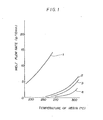
- Fig. 1 of the drawings shows relationships between the temperature and the 7 melt flow rate of the resins in which designated by 1 is a curve representing said relationship concerning one example of the optical resin composition : according to thepresent invention, and designated by 2, 3 and 4 are curves representing said relationships concerning polycarbonate resins which have melt flow rates of less than 5 g/10 min. as measured based on ISO R-1133 Standard under the conditions of 230 °C and 5 kgf.
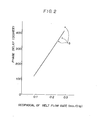
- Fig. 2 of the drawings shows relationships between the melt flow rate and the birefringence of the molding products molded at the temperature of 270 °C, in which designated by 5 are dots representing said relationships concerning known polycarbonate resins having the melt flow rates of less than 5 g/10 min. as.measured based on ISO R-1133 Standard under the .conditions of 230 °C and 5 kgf.
- the above- mentioned polycarbonate according to the present invention may be any polycarbonate which has the above defined melt flow rate and glass transition point.
- the polycarbonate according to the present invention preferably is a polymer including a major repeating unit represented by the following formula (I) or (II), more preferably is a polymer including a major repeating unit represented by the following formula (III).
- Ar 1 and Ar 2 each represents an arylene group or a cycloalkylene group
- R represents an alkylene group, a cycloalkylene group, -O-, -O-Ar 3 -O-, -S-, -SO-, -SO 2 -, -SO 2 -Ar 3 -SO 2 -
- R 1 Ar 4 -R 1 , -O-R 1 -O-, -CONH-R 1 -NHCO-or Ar 5 -R 1
- Ar 3 and Ar 4 each represents a phenylene group or a bisphenylene group
- R 1 represents an alkylene group
- R 2 represents a cycloalkylene group
- Ar 5 represents a cycloalkylene group.
- A represents an alkylene group, a cycloalkylene group, -R 1 -Ar 4 -R 1 -, -R 1 -Ar 5 -R 1 -, -R 1 -O-Ar 4 -O-R 1 -, or -R 1 -O-Ar 4 -X-Ar 4 -O-R 1
- X represents -SO 2 -, -CO-, an alkylene group or -R 1 -Ar 4 -R 1 -;
- R 1 , Ar4 and Ar 5 each has the same meaning as mentioned above.
- R 4 represents and R5 and R6 each represents a hydrogen, a halogen, an alkyl group or an aryl group.
- an arylene group preferably is a phenylene group or a naphtylene group; a cycloalkylene group preferably is a cycloalkylene group having from 4 to 7 ring members such as, for example, a cyclohexylene group, a cyclobutylene group; an alkylene group preferably is atstraight or branched alkylene group having from 1 to 18 carbon atoms; an alkyl group preferably is an alkylene group having from 1 to 6 carbon atoms, such as, for example, a methyl gorup, a iso-propyl group and a tert-butyl group; and a halogen preferably is a fluorine, a chlorine or a bromine atom.
- each group mentioned in connection with the above formulae (I), (II) and (III), may be either a group which has not a substituent group (or a substituent atom) or aigroup which has a substituent group or groups (or a substituent atom or atoms).
- substituent groups include any substituents which may be introduced into said group, and include as preferable examples a halogen such as a fluorine, a chroline and a bromine, an alkyl group such as alkyl groups having from 1 to 4 carbon atoms, an aryl group such as a phenyl group and a naphtyl group, a cycloalkyl group such as a cyclohexyl group and a norbonyl group, and a alkoxy group such as a methoxy group.
- a halogen such as a fluorine, a chroline and a bromine
- an alkyl group such as alkyl groups having from 1 to 4 carbon atoms
- an aryl group such as a phenyl group and a naphtyl group
- a cycloalkyl group such as a cyclohexyl group and a norbonyl group
- alkoxy group such as a methoxy group
- the polymer mentioned above as structurally including the major recurring unit represented by the formulae (I), (II) and (III) is defined as the polymer which includes 50 : % by weight or more of the recurring unit represented by the formula.
- the optical resin composition mentioned above as : including the main component being said polymer is defined as the optical resin composition which includes 95-100 % by weight of said polymer,
- TheCoptical resin composition according to the present invention is characterized, on the one hand, in that said composition includes the polymer made up mainly of the major monomer component consisted of at least one of bis(4-hydroxyphenyl)alkylene and the derivatives thereof which have sufficiently high values of the melt flow rate in themselves.
- the optical plastic element is usually a molding product prepared by-the steps comprising melting a resin and cooling the thus melted resin in the mold.
- the resin composition has high value of viscosity when melted, the molten resin composition is liable to be unevenly cooled, so that the molding product remains to have optical strain which results in some degree of the double refraction.
- the highly viscous molten resin is cooled while remaining orientation of the resin in the direction it flows, thus the molding product is liable to have double refraction.
- the resin may possibly be given low viscosity when melted at high temperature.- The high temperature, however, can not be given for fear of the decomposition of the resin.
- the present inventors have found that the double refraction of the resin molding product correlates quantitatively to the melt flow rate of the resin as illustrated in Fig. 2 of the drawings.
- the optical resin composition which includes a main component being a polymer prepared from a monomer composition containing 50 % by weight or more of at least one of bis(4-hydroxy-phenyl)alkylene or the derivative thereof, can be given much reduced double refraction as compared with the known polycarbonate type resin or resin composition which is used for the preparatiom of the optical elements, provided that said optical resin compositon has a melt flow rate of more than or equal to 5.0 g/10 min. as measured based on ISO R-1133 Standard under-the conditions of 230 °C and 5 kgf.
- the melt flow rate of the polymer according to the present invention which is prepared from the monomer composition containing 50 % by weight or more of at least one of bis(4-hydroxyphenyl)alkylene--and the derivatives thereof, can be reduced by making the molecular weight of the polymer smaller than the widely usable resin used in the molding of the optical elements.
- the glass transition point (Tg) of the optical resin composition must be kept more than or equal to 100 °C, because an overly reduced molecular weight of the polymer gives the molding product a worse heat resistivity.
- the polymer according to the present invention may contain relatively large amount of monomer components that should not harm the molding conditions and product, and that may be given by controlling residual monomers in the polymerization reaction of the optical resin composition, in order to increase the melt flow rate of the optical resin composition.
- the amount of the residual monomer components is preferably less th or equal to 2 % by weight, more preferably less than or equal to 0.5 % by weight of the optical resin composition according to the present invention.
- the optical resin composition according to the present invention may contain one or more plasticizers which can work as normally efficacious plasticizer.
- Usable plasticizers include, for example, alkyl phthalates such as 2-ethylhexyl phthalate, n-butyl phthalate, i-decanyl phthalate, tridecanyl phtahlate, heptyl phthalate and nonyl phthalate, alkyl esters of dibasic acids such as 2-ethylhexyl adipate and 2-ethylhexyl sebacate, alkyl esters of phosphoric acid such as tributyl phosphate, trioctyl phosphate, tricresyl phosphate and triphenyl phosphate, epoxidized esters of aliphatic acids such as epoxidized octyl oleate-and epoxidized butyl oleate, polyester type plasticizers
- the polymer according to the present invention is a condensation product prepared by way of a condensation reaction of a diol component and a phosgene carrier such as, for example, phosgene, diphenylcarbonate and diimidazolyl ketone.
- the polymer may include one diol component, or two or more diol components and may include one phosgene carrier, or - two or more phosgene carriers.
- the optical resin composition according to the present invention may include one or more known polycarbonates other than the polymer according to the present invention.
- the polymer according to the present invention may be exemplified by the following structural formulae.
- illustrative examples of the polymers consisting merely diol components according to the present invention include the following compounds.
- the polymer according to the present invention has a weight average molecular weight of from 5,000 to 500,000..
- the polymer according to the present invention can be prepared by any known polymerization method such as emulsion polymerization, solution polymerization, block polymerazation and radiation polymerization.
- the optical resin composition according to the present invention may contain an ultra-violet absorbing agent for the purpose of advancing durability against exposure of light.
- Usable ultra-violet absorbing agents are those which can efficaciously absorb ultra-violet radiation and should not harm the inherent characteristics of the resin, and preferably those which should not reduce the transmittance of the. visible light.
- the usable ultra-violet absorbing agents include phenyl o-hydroxysalicylate type compounds, o-hydroxybenzophenone type compounds, 2-(o-hydroxyphenyl)bnezotriazole type compounds and cyano acrylate type compounds.
- the optical element according to the present invention may be prepared by molding the optical resin composition by way of any molding method which comprise completely or halfway melting the resin and molding the thus melted resin, such as an injection molding in the first place, a compression molding and blended methods of the injection molding and the compression molding such as called Rolinx method and micro- molding method.
- the optical element according to the present invention may effectively applicable to the molding methods such as injection molding in which the molding products have relatively high values of the birefringence.
- the optical r esi n. composition may effectively applicable, in the second place next to the injection molding, to the Rolinx method or mocromolding method, and, in the third place to the compression molding.
- the resin compositions having high fluidity are worse in heat resistivity, such resin compositions if employed may contain a little amount of a monomer having cross linking ability for the purpose of improving the heat resistivity of the molding product.
- the resin composition including cross linking monomer may be molded while remaining high fluidity and may be subjected to cross-linking hardening after molded by irradiating gamma ray, an electron beam, X-rays, an ultra-violet radiation or the like.
- Heat stability of the molding product is, in some cases, effected by the humidification of the molding product.
- the molding product therefore, may be coated at its surfaces in order to prevent the humidification and consequently to advancing the dimention stability of the molding product.
- Usable methods of surface resin coating of the molding product are, for example, a method comprising applying a monomer or prepolymer of the resin to the surface of the molding product and polymerization hardening the-monomer or prepolymer by way of thermal polymerazation, radiation- induced polymerization, electron polymerization or the like, a method comprising spraying polymer solution, and plasma polymerization.
- Usable resin for the surface coating are, by way of example, polymers containing one or more monomer components selected from fluoroalkylene compounds such as tetrafluoroethylene, organosilane compounds such as tetramethylsilane, orthosilicate compounds such as tetraethyl orthosilicate, fluoroalkyl methacrylate compounds such as pentafluoroethyl methacrylate, conjugated nitrile compounds such as acrylonitrile, and styrene compounds such as styrene and chlorostyrene.
- fluoroalkylene compounds such as tetrafluoroethylene
- organosilane compounds such as tetramethylsilane
- orthosilicate compounds such as tetraethyl orthosilicate
- fluoroalkyl methacrylate compounds such as pentafluoroethyl methacrylate
- conjugated nitrile compounds such as acrylonitrile
- the polymer according to the present invention may effectively applicable to the molding of the optical element which has lower double refraction than the known polycarbonate type resins.
- the melt flow rate of the polymer according to the present invention is preferably more than or equal to 10 g/10 min., more preferably 20 a/10 min. as measured based on ISO R-1133 Standard under the conditions of 230 °C and 5 kgf.
- the optical element which is prepared by molding the optical resin composition according to the present invention is the element which has its function appearing while the light transmits through or reflect from it
- the optical element according to the present invention may be exemplified by lenses used.for still-camera, video camera, telescope, spectacles, contact lenses, a collector for solar lights or the like, prisms such as pentaprism, mirrors such as concave spherical mirror, polygon morror and the like, optical fibers, light-conductive elements used in light waveguide and discs such as audio disc, video disc and-the like.
- the polymer After being dried and molded to have a pellet-like shape, the polymer was subjected to the measurement of the-melt flow rate based on ISO R-1133 Standard under the conditions of 230 °C and 5 kgf. As a result of the measurement, the polymer appeared to have the melt flow rate of 9.2 g/10 min. In the mean time, the pellet of the polymer was subjected to the injection molding at the resin temperature of 260 °C to give a plastic lens which has a thickness of 3 mm in the central portion thereof and which has a phase delay of 180 degree and a refractive index of 1.61.
- the polymer was obtained in the same manner as in Example 1, by using the following resin composition and introducing thereto 50 parts by weight of phosgene. (resin composition)
- the thus obtained polymer resin was subjected to the injection molding at the resin temperature of 260 °C to give the molding product which has a phase delay of 150 degrees and which has the melt flow rate of 12.2 g/min. as measured basedn on ISO R-1133 Standard under the conditions of 230 °C and 5 kgf.
Landscapes
- Chemical & Material Sciences (AREA)
- Health & Medical Sciences (AREA)
- Chemical Kinetics & Catalysis (AREA)
- Medicinal Chemistry (AREA)
- Polymers & Plastics (AREA)
- Organic Chemistry (AREA)
- Polyesters Or Polycarbonates (AREA)
- Compositions Of Macromolecular Compounds (AREA)
- Eyeglasses (AREA)
Abstract
Problems of birefringence can be avoided in an optical element including an optical resin composition consisting essentially of certain polycarbonates having a melt flow rate of more than or equal to 5.0 g/10 min. as measured based on ISO R-1133 Standard at 230 DEG C and 5 kgf., and having a glass transition point of more than or equal to 100 DEG C. The polycarbonates preferably include major repeating units having the formula (I) or (II). …<??>Formula (I) …… &lparstr& O - Ar1 - R - Ar2 - O@ &rparstr& … …<??>Formula (II) …… &lparstr& O - A - R - O@ &rparstr& … wherein Ar1 and AR2 each represent an arylene group or a cycloalkylene group; R represents an alkylene group, a cycloalkylene group, -O-, -O-Ar3-O-, -S-, -SO-, -SO2-, -SO2-Ar3-SO2-, -R1-Ar4-R1-, -O-R1-O-, …<CHEM>… -CONH-R1-NHCO-, or -Ar5-R1-; Ar3 and Ar4 each represent a phenylene group or a bisphenylene group; R1 represents an alkylene group; R2 represents an alkyl group; Ar5 represents a cycloalkylene group, -R1-Ar4-R1-, -R1-Ar5-R1-, -R1-O-Ar4-O-R1-, or -R1-O-Ar4-X-Ar4-O-R1; and X represents -SO2-, -CO-, an alkylene group. or -R1-Ar4-R1-.
Description
- The present invention relates to an optical plastic element which is prepared by way of an injection molding, a compression molding or the like. The present invention also relates to an optical resin composition to be used for the preparation of said optical element. The optical resin composition includes a main monomer component comprising bis (4-hydroxyphenyl)alkylene or the derivative thereof.
- Optical plastic elements are of late years in great demand on the ground of their good natures that they are lighter in weight than the glass elements, highly resistible to impact, they do not require surface glinding, are easily mass-produced, and-able to give lenses which have non- spherical surface or surfaces. The optical plastic elements, however, have several disadvantages that they have low evenness in their surfaces, narrow selectivity in making refractive indices and high birefringence, which are derived from their manufacturing conditions and their inherent characteristics, so that they, in fact, have many limitations in their practical uses.
- Particularly, in the field of fine optics where the optical elements are used for reading and-writing of information by means of laser or the like, there is much necessity to improve the birefringence of the optical plastic elements.
- As is well known to the art, the birefringence of the optical plastic element varies, in many cases, in accordance with their molding conditions as well as their inherent characteristics. To this point of view, the double refraction of the optical plastic element has been tried to be reduced by way of improving the molding conditions of the elements. However, those trials are less fruitful under the existing circumstances in that the fine optical elements are gradually coming into higher requirement and in that more strict reduction of the birefringence, which can not be fully met by any improvement of the molding conditions, must be accomplished. Therefore, the birefringence of the optical plastic element is now intended to be reduced by changing the plastic material to be used for the preparation of the optical plastic element.
- An object of the present invention, therefore, is to provide an optical plastic material to be subjected to an injection molding, a compression molding or the like, which, after molded, can show an improved birefringence.
- Another object of the present invention is to provide an optical plastic element prepared as a molding product, which shows an improved birefringence.
- These objects, mentioned above, of the present invention are accomplished by an optical resin composition which includes a main component being a polycarbonate, which has a melt flow rate of more than or equal to 5.0 g/10 min. as measured based on ISO R-1133 Standard under the conditions of 230 °C and 5 kgf., and which has a glass transition point of more than or equal to 100 °C.
- Fig. 1 of the drawings shows relationships between the temperature and the7melt flow rate of the resins in which designated by 1 is a curve representing said relationship concerning one example of the optical resin composition : according to thepresent invention, and designated by 2, 3 and 4 are curves representing said relationships concerning polycarbonate resins which have melt flow rates of less than 5 g/10 min. as measured based on ISO R-1133 Standard under the conditions of 230 °C and 5 kgf.
- Fig. 2 of the drawings shows relationships between the melt flow rate and the birefringence of the molding products molded at the temperature of 270 °C, in which designated by 5 are dots representing said relationships concerning known polycarbonate resins having the melt flow rates of less than 5 g/10 min. as.measured based on ISO R-1133 Standard under the .conditions of 230 °C and 5 kgf.
- In accordance with the present invention, the above- mentioned polycarbonate according to the present invention may be any polycarbonate which has the above defined melt flow rate and glass transition point. Among such polycarbonates, the polycarbonate according to the present invention preferably is a polymer including a major repeating unit represented by the following formula (I) or (II), more preferably is a polymer including a major repeating unit represented by the following formula (III).
-


-

-


- In connection with the above formulae (I), (II) and (III), an arylene group preferably is a phenylene group or a naphtylene group; a cycloalkylene group preferably is a cycloalkylene group having from 4 to 7 ring members such as, for example, a cyclohexylene group, a cyclobutylene group; an alkylene group preferably is atstraight or branched alkylene group having from 1 to 18 carbon atoms; an alkyl group preferably is an alkylene group having from 1 to 6 carbon atoms, such as, for example, a methyl gorup, a iso-propyl group and a tert-butyl group; and a halogen preferably is a fluorine, a chlorine or a bromine atom.
- Moreover, each group mentioned in connection with the above formulae (I), (II) and (III), may be either a group which has not a substituent group (or a substituent atom) or aigroup which has a substituent group or groups (or a substituent atom or atoms). Illustrative examples of such substituent groups (or substituent atoms) include any substituents which may be introduced into said group, and include as preferable examples a halogen such as a fluorine, a chroline and a bromine, an alkyl group such as alkyl groups having from 1 to 4 carbon atoms, an aryl group such as a phenyl group and a naphtyl group, a cycloalkyl group such as a cyclohexyl group and a norbonyl group, and a alkoxy group such as a methoxy group.
- In accordance with the present invention, the polymer mentioned above as structurally including the major recurring unit represented by the formulae (I), (II) and (III) is defined as the polymer which includes 50:% by weight or more of the recurring unit represented by the formula. In the same manner, the optical resin composition mentioned above as : including the main component being said polymer is defined as the optical resin composition which includes 95-100 % by weight of said polymer,
- TheCoptical resin composition according to the present invention is characterized, on the one hand, in that said composition includes the polymer made up mainly of the major monomer component consisted of at least one of bis(4-hydroxyphenyl)alkylene and the derivatives thereof which have sufficiently high values of the melt flow rate in themselves.
- As is well known to the art, the optical plastic element is usually a molding product prepared by-the steps comprising melting a resin and cooling the thus melted resin in the mold. In case the resin composition has high value of viscosity when melted, the molten resin composition is liable to be unevenly cooled, so that the molding product remains to have optical strain which results in some degree of the double refraction. Particularly, in the case of using the injection molding in which the molten resin is injected into the mold, the highly viscous molten resin is cooled while remaining orientation of the resin in the direction it flows, thus the molding product is liable to have double refraction.
- Since the viscosity of the molten resin varies in conjunction with the temperature of the resin as shown in Fig. 1 of the drawings, the resin may possibly be given low viscosity when melted at high temperature.- The high temperature, however, can not be given for fear of the decomposition of the resin.
- The present inventors have found that the double refraction of the resin molding product correlates quantitatively to the melt flow rate of the resin as illustrated in Fig. 2 of the drawings. As a result of earnest studies, the present inventors have also found that the optical resin composition, which includes a main component being a polymer prepared from a monomer composition containing 50 % by weight or more of at least one of bis(4-hydroxy-phenyl)alkylene or the derivative thereof, can be given much reduced double refraction as compared with the known polycarbonate type resin or resin composition which is used for the preparatiom of the optical elements, provided that said optical resin compositon has a melt flow rate of more than or equal to 5.0 g/10 min. as measured based on ISO R-1133 Standard under-the conditions of 230 °C and 5 kgf.
- The melt flow rate of the polymer according to the present invention, which is prepared from the monomer composition containing 50 % by weight or more of at least one of bis(4-hydroxyphenyl)alkylene--and the derivatives thereof, can be reduced by making the molecular weight of the polymer smaller than the widely usable resin used in the molding of the optical elements. In this case, the glass transition point (Tg) of the optical resin composition must be kept more than or equal to 100 °C, because an overly reduced molecular weight of the polymer gives the molding product a worse heat resistivity.
- The polymer according to the present invention may contain relatively large amount of monomer components that should not harm the molding conditions and product, and that may be given by controlling residual monomers in the polymerization reaction of the optical resin composition, in order to increase the melt flow rate of the optical resin composition. The amount of the residual monomer components is preferably less th or equal to 2 % by weight, more preferably less than or equal to 0.5 % by weight of the optical resin composition according to the present invention.
- In order to increase the melt flow rate, the optical resin composition according to the present invention may contain one or more plasticizers which can work as normally efficacious plasticizer. Usable plasticizers include, for example, alkyl phthalates such as 2-ethylhexyl phthalate, n-butyl phthalate, i-decanyl phthalate, tridecanyl phtahlate, heptyl phthalate and nonyl phthalate, alkyl esters of dibasic acids such as 2-ethylhexyl adipate and 2-ethylhexyl sebacate, alkyl esters of phosphoric acid such as tributyl phosphate, trioctyl phosphate, tricresyl phosphate and triphenyl phosphate, epoxidized esters of aliphatic acids such as epoxidized octyl oleate-and epoxidized butyl oleate, polyester type plasticizers and chlorinated esters of aliphatic acids.
- The polymer according to the present invention is a condensation product prepared by way of a condensation reaction of a diol component and a phosgene carrier such as, for example, phosgene, diphenylcarbonate and diimidazolyl ketone. The polymer may include one diol component, or two or more diol components and may include one phosgene carrier, or - two or more phosgene carriers.
- The optical resin composition according to the present invention may include one or more known polycarbonates other than the polymer according to the present invention.
- The polymer according to the present invention may be exemplified by the following structural formulae.


- In addition, illustrative examples of the polymers consisting merely diol components according to the present invention include the following compounds.


- The polymer according to the present invention has a weight average molecular weight of from 5,000 to 500,000..
- The polymer according to the present invention can be prepared by any known polymerization method such as emulsion polymerization, solution polymerization, block polymerazation and radiation polymerization.
- The optical resin composition according to the present invention may contain an ultra-violet absorbing agent for the purpose of advancing durability against exposure of light. Usable ultra-violet absorbing agents are those which can efficaciously absorb ultra-violet radiation and should not harm the inherent characteristics of the resin, and preferably those which should not reduce the transmittance of the. visible light. The usable ultra-violet absorbing agents include phenyl o-hydroxysalicylate type compounds, o-hydroxybenzophenone type compounds, 2-(o-hydroxyphenyl)bnezotriazole type compounds and cyano acrylate type compounds.
- The optical element according to the present invention may be prepared by molding the optical resin composition by way of any molding method which comprise completely or halfway melting the resin and molding the thus melted resin, such as an injection molding in the first place, a compression molding and blended methods of the injection molding and the compression molding such as called Rolinx method and micro- molding method. The optical element according to the present invention may effectively applicable to the molding methods such as injection molding in which the molding products have relatively high values of the birefringence. The optical r esi n. composition may effectively applicable, in the second place next to the injection molding, to the Rolinx method or mocromolding method, and, in the third place to the compression molding.
- Since the resin compositions having high fluidity are worse in heat resistivity, such resin compositions if employed may contain a little amount of a monomer having cross linking ability for the purpose of improving the heat resistivity of the molding product. The resin composition including cross linking monomer may be molded while remaining high fluidity and may be subjected to cross-linking hardening after molded by irradiating gamma ray, an electron beam, X-rays, an ultra-violet radiation or the like.
- Heat stability of the molding product is, in some cases, effected by the humidification of the molding product. The molding product, therefore, may be coated at its surfaces in order to prevent the humidification and consequently to advancing the dimention stability of the molding product. Usable methods of surface resin coating of the molding product are, for example, a method comprising applying a monomer or prepolymer of the resin to the surface of the molding product and polymerization hardening the-monomer or prepolymer by way of thermal polymerazation, radiation- induced polymerization, electron polymerization or the like, a method comprising spraying polymer solution, and plasma polymerization. Usable resin for the surface coating are, by way of example, polymers containing one or more monomer components selected from fluoroalkylene compounds such as tetrafluoroethylene, organosilane compounds such as tetramethylsilane, orthosilicate compounds such as tetraethyl orthosilicate, fluoroalkyl methacrylate compounds such as pentafluoroethyl methacrylate, conjugated nitrile compounds such as acrylonitrile, and styrene compounds such as styrene and chlorostyrene.
- The polymer according to the present invention may effectively applicable to the molding of the optical element which has lower double refraction than the known polycarbonate type resins. The melt flow rate of the polymer according to the present invention is preferably more than or equal to 10 g/10 min., more preferably 20 a/10 min. as measured based on ISO R-1133 Standard under the conditions of 230 °C and 5 kgf.
- The optical element which is prepared by molding the optical resin composition according to the present invention, is the element which has its function appearing while the light transmits through or reflect from it, The optical element according to the present invention may be exemplified by lenses used.for still-camera, video camera, telescope, spectacles, contact lenses, a collector for solar lights or the like, prisms such as pentaprism, mirrors such as concave spherical mirror, polygon morror and the like, optical fibers, light-conductive elements used in light waveguide and discs such as audio disc, video disc and-the like.
- The present invention is more specifically described by the following Examples which should not limit the scope of the present invention.
- Into the reaction vessel equipped with a condenser, a gas inlet, a thermometer and stirrer, was put the following resin compositon and introduced thereinto 50 parts by weight of phosgene.

- After the introduction of phosgene, 2 parts by weight of 5 % aqueous solution of triethylamine was added to the reaction mixture. Thereafter the mixture was continuously stirred and subsequently the organic layer was separated therefrom. The thus separated organic layer was condensed to its amount of about 1000 ml and added to 4000 parts by weight of methanol which is stirred to obtain a precipitate of a polymer.
- After being dried and molded to have a pellet-like shape, the polymer was subjected to the measurement of the-melt flow rate based on ISO R-1133 Standard under the conditions of 230 °C and 5 kgf. As a result of the measurement, the polymer appeared to have the melt flow rate of 9.2 g/10 min. In the mean time, the pellet of the polymer was subjected to the injection molding at the resin temperature of 260 °C to give a plastic lens which has a thickness of 3 mm in the central portion thereof and which has a phase delay of 180 degree and a refractive index of 1.61.
- In the same manner, the commercially available polycarbonate resin which has low viscosity was subjected to the injection molding to give lens having a phase delay of 420 degrees.
- The polymer was obtained in the same manner as in Example 1, by using the following resin composition and introducing thereto 50 parts by weight of phosgene. (resin composition)

- The thus obtained polymer resin was subjected to the injection molding at the resin temperature of 260 °C to give the molding product which has a phase delay of 150 degrees and which has the melt flow rate of 12.2 g/min. as measured basedn on ISO R-1133 Standard under the conditions of 230 °C and 5 kgf.
Claims (6)
1. An optical element including an optical resin composition consisting essentially of a polycarbonate, characterized in that said optical resin composition has a melt flow rate of more than or equal to 5.0 g/10 min. as measured based on ISO R-1133 Standard at 230°C and 5 kgf., and a glass transition point of more than or equal to 100°C.
2. An optical element according to Claim 1, characterized in that said polycarbonate has a major repeating unit of the formula (I) or (II),


wherein Ar1 and Ar2 each represent an arylene group or a cycloalkylene group; R represents an alkylene group, a cycloalkylene group, -0-, -O-Ar3-O-, -S-, -SO-, -SO2-, -SO2-Ar3-SO2-, -R1-Ar4-R1-, -O-R1-O-,

-CONH-R1-NHCO-, or -Ar5-R1- ; Ar3 and Ar4 each represent a phenylene group or a bisphenylene group; R1 represents an alkylene group; R2 represents an alkyl group; Ar5 represents a cycloalkylene group; A represents an alkylene group, a cycloalkylene group, -R1-Ar4-R1-, -R1-Ar5-R1-, -R1-O-Ar4-O-Rl-, or -R1-O-Ar4-X-Ar4-O-R1-; and X represents -S02-, -CO-, an alkylene group, or -R1-Ar4-R1-.
3. An optical element according to Claim 2, characterized in that said major repeating unit has the formula (III)

wherein R4 represents

and R5 and R6 each represent hydrogen, halogen or alkyl.
4. An optical resin composition consisting essentially of a polycarbonate, characterized in that said optical resin composition has a melt flow rate of more than or equal to 5.0 g/10 min. as measured based on ISO R-1133 Standard at 230°C and 5 Kgf., and has a glass transition point of more than or equal to 100°C.
5. An optical resin composition according to Claim 4, characterized in that said polycarbonate has a major repeating unit of the formula (I) or (II).


wherein Ar1 and Ar2 each represent an arylene group or a cycloalkylene group; R represents an alkylene group, a cycloalkylene group, -0-, -O-Ar3-O-, -S-, -SO-, -SO2-, -SO2-Ar3-SO2-, -R1-Ar4-R1-, -O-R1-O-,

-CONH-R1-NHCO-, or -Ar5-R1-; Ar3 and Ar4 each represent a phenylene group or a bisphenylene group; R1 represents an alkylene group; R2 represents an alkyl group; Ar5 represents a cycloalkylene group; A represents an alkylene group, a cycloalkylene group, -R1-Ar4-R1-, -R1-Ar5-R1-, -R1-O-Ar4-O-R1, or -R1-O-Ar4-X-Ar4-O-R1-; and X represents -SO2-, -CO-, an alkylene group, or -R1-Ar4-R1-.
6. An optical resin composition according to Claim 5, characterized in that said major repeating unit has the formula (III)

wherein R4 represents

and R5 and R6 each represent a hydrogen, a halogen or an alkyl group.
Applications Claiming Priority (2)
| Application Number | Priority Date | Filing Date | Title |
|---|---|---|---|
| JP57043841A JPS58179224A (en) | 1982-03-18 | 1982-03-18 | Optical resin composition and optical element |
| JP43841/82 | 1982-03-18 |
Publications (1)
| Publication Number | Publication Date |
|---|---|
| EP0089801A1 true EP0089801A1 (en) | 1983-09-28 |
Family
ID=12674962
Family Applications (1)
| Application Number | Title | Priority Date | Filing Date |
|---|---|---|---|
| EP83301449A Withdrawn EP0089801A1 (en) | 1982-03-18 | 1983-03-16 | Optical element and optical resin composition for the preparation thereof |
Country Status (3)
| Country | Link |
|---|---|
| US (1) | US4495345A (en) |
| EP (1) | EP0089801A1 (en) |
| JP (1) | JPS58179224A (en) |
Cited By (27)
| Publication number | Priority date | Publication date | Assignee | Title |
|---|---|---|---|---|
| EP0175905A3 (en) * | 1984-08-24 | 1986-04-09 | Mitsubishi Chemical Industries Limited | Optical disc substrate made of a polycarbonate |
| EP0177713A1 (en) * | 1984-08-24 | 1986-04-16 | Mitsubishi Kasei Corporation | Polycarbonate and optical disc substrate |
| JPS6245623A (en) * | 1985-08-26 | 1987-02-27 | Mitsubishi Chem Ind Ltd | Polycarbonate |
| EP0199824A4 (en) * | 1984-11-02 | 1987-06-03 | Sumitomo Chemical Co | Resin material for an optical device. |
| EP0274092A3 (en) * | 1986-12-19 | 1988-11-02 | Daicel Chemical Industries Co., Ltd. | Polycarbonate copolymer and optical disk |
| DE3829890A1 (en) * | 1988-09-02 | 1990-03-15 | Bayer Ag | Polystyrene/polycarbonate mixtures |
| EP0359953A1 (en) * | 1988-08-12 | 1990-03-28 | Bayer Ag | Dihydroxydiphenylcycloalkanes, their preparation and their use for the preparation of high molecular polycarbonates |
| US5227458A (en) * | 1988-08-12 | 1993-07-13 | Bayer Aktiengesellschaft | Polycarbonate from dihydroxydiphenyl cycloalkane |
| US7169333B2 (en) | 2000-05-12 | 2007-01-30 | Bayer Aktiengesellschaft | Antistatic agent |
| DE102007015948A1 (en) | 2007-04-03 | 2008-10-09 | Bayer Materialscience Ag | Modified polycarbonates, polyester carbonates and polyesters with improved extensibility and flame retardancy |
| EP2090605A1 (en) | 2008-02-13 | 2009-08-19 | Bayer MaterialScience AG | Method for making polycarbonates |
| DE102008008841A1 (en) | 2008-02-13 | 2009-08-20 | Bayer Materialscience Ag | Preparing (co)polycarbonate or diaryl carbonate, useful in e.g. sunglasses, comprises converting di-, mono-phenol and phosgene to chloroformic acid aryl ester, oligo- or diaryl-carbonate, and reacting the product under alkaline solution |
| DE102008008842A1 (en) | 2008-02-13 | 2009-08-27 | Bayer Materialscience Ag | Alkylphenol for molecular weight adjustment and polycarbonate compositions having improved properties |
| DE102008011903A1 (en) | 2008-02-29 | 2009-09-03 | Bayer Materialscience Ag | Polycarbonates with cyclic oligomers and improved flow behavior |
| EP2098553A1 (en) | 2008-03-05 | 2009-09-09 | Bayer MaterialScience AG | Method of manufacturing polycarbonate using the phase boundary method |
| DE102008019503A1 (en) | 2008-04-18 | 2009-10-22 | Bayer Materialscience Ag | Polycarbonates with rearrangement structures, cyclic and linear oligomers and improved flow behavior |
| DE102008023800A1 (en) | 2008-05-15 | 2009-11-19 | Bayer Materialscience Ag | Alkyl phenol for molecular weight adjustment and copolycarbonate with improved properties |
| DE102008036406A1 (en) | 2008-08-05 | 2010-02-11 | Bayer Materialscience Ag | Modified polycarbonates with improved surface properties |
| DE102008059658A1 (en) | 2008-11-28 | 2010-06-02 | Bayer Materialscience Ag | Copolycarbonates with improved surface hardness |
| WO2010105769A1 (en) | 2009-03-18 | 2010-09-23 | Bayer Materialscience Ag | Copolycarbonates having improved properties |
| DE102009015040A1 (en) | 2009-03-26 | 2010-09-30 | Bayer Materialscience Ag | (Co) polycarbonates with improved optical properties |
| EP2333013A1 (en) | 2009-12-12 | 2011-06-15 | Bayer MaterialScience AG | Polycarbonate blends with high thermoforming resistance and improved surface characteristics |
| DE102009058462A1 (en) | 2009-12-16 | 2011-06-22 | Bayer MaterialScience AG, 51373 | Producing polycarbonate injection molded body comprises introducing injection molded bodies containing polycarbonate in reactor, inerting atmosphere of reactor, introducing fluorine-inert gas mixture and evacuating and flushing the reactor |
| US9771451B2 (en) | 2014-01-24 | 2017-09-26 | Covestro Deutschland Ag | Method for producing polycarbonate according to the phase interface method |
| WO2018033562A1 (en) | 2016-08-19 | 2018-02-22 | Covestro Deutschland Ag | Process for the synthesis of polyoxazolidinone compounds |
| EP3357949A1 (en) | 2017-02-02 | 2018-08-08 | Covestro Deutschland AG | Method for the production of polyoxazolidinone polymer compounds |
| EP3985047A1 (en) | 2020-10-13 | 2022-04-20 | Covestro Deutschland AG | Method for the preparation of a polycarbonate based on the interfacial process with solvent exchange |
Families Citing this family (14)
| Publication number | Priority date | Publication date | Assignee | Title |
|---|---|---|---|---|
| JPS6218501A (en) * | 1985-07-18 | 1987-01-27 | Teijin Chem Ltd | Optical formed article |
| US4757129A (en) * | 1985-12-27 | 1988-07-12 | Ppg Industries, Inc. | Compositions for producing polymers of high refractive index and low yellowness |
| US4746716A (en) * | 1985-12-27 | 1988-05-24 | Ppg Industries, Inc. | Compositions for producing polymers of high refractive index and low yellowness |
| DE3778430D1 (en) * | 1986-06-20 | 1992-05-27 | Idemitsu Kosan Co | Polycarbonate. |
| JP2538566B2 (en) * | 1986-09-10 | 1996-09-25 | 出光興産株式会社 | Novel polymer and method for producing the same |
| US4950731A (en) * | 1987-04-20 | 1990-08-21 | General Electric Company | Method for preparing spirobiindane polycarbonates |
| DE3926850A1 (en) * | 1989-08-15 | 1991-02-21 | Bayer Ag | POLYSILOXANE-POLYCARBONATE BLOCK COPOLYMERS BASED ON SPECIAL DIHYDROXYDPHENYLCYCLOALKANE |
| JPH04249201A (en) * | 1991-02-05 | 1992-09-04 | Teijin Chem Ltd | Lens |
| CA2171584A1 (en) * | 1995-04-11 | 1996-10-12 | James P. Mason | Compositions having low birefringence |
| EP0787756B1 (en) * | 1996-01-30 | 2000-04-26 | Teijin Limited | Polycarbonate copolymer containing oxaspiroundecane group and production process therefor |
| US6470131B1 (en) | 2000-11-03 | 2002-10-22 | Corning Incorporated | Highly-halogenated low optical loss polymer |
| US20040062604A1 (en) * | 2001-06-08 | 2004-04-01 | Forrer Douglas S. | Reflective pavement marker |
| KR101636128B1 (en) * | 2013-07-01 | 2016-07-04 | 주식회사 엘지화학 | Polycarbonate resin composition |
| EP4311839A1 (en) * | 2022-07-28 | 2024-01-31 | Covestro Deutschland AG | Mineral filled polycarbonate blend moulding material with low bpa content and method of its preparation |
Citations (4)
| Publication number | Priority date | Publication date | Assignee | Title |
|---|---|---|---|---|
| GB939447A (en) * | 1959-07-17 | 1963-10-16 | Kodak Ltd | Improvements in polycarbonates |
| DE2701173A1 (en) * | 1977-01-13 | 1978-07-20 | Bayer Ag | USE OF POLYCARBONATES FOR OPTICAL DEVICES |
| US4216305A (en) * | 1978-09-18 | 1980-08-05 | General Electric Company | Aromatic polyformal carbonates and method for making |
| EP0044911A2 (en) * | 1980-07-14 | 1982-02-03 | American Cyanamid Company | Infrared absorbing polycarbonate eye protective lens |
Family Cites Families (3)
| Publication number | Priority date | Publication date | Assignee | Title |
|---|---|---|---|---|
| DE1915221A1 (en) * | 1968-03-29 | 1970-10-29 | Eastman Kodak Co | Electrophotographic recording material |
| DE2830849A1 (en) * | 1978-07-13 | 1980-01-24 | Capsugel Ag | SEALING MACHINE FOR CAPSULES |
| JPS55142025A (en) * | 1979-04-24 | 1980-11-06 | Mitsubishi Chem Ind Ltd | Process of production of polycarbonate |
-
1982
- 1982-03-18 JP JP57043841A patent/JPS58179224A/en active Pending
-
1983
- 1983-03-11 US US06/474,464 patent/US4495345A/en not_active Expired - Lifetime
- 1983-03-16 EP EP83301449A patent/EP0089801A1/en not_active Withdrawn
Patent Citations (4)
| Publication number | Priority date | Publication date | Assignee | Title |
|---|---|---|---|---|
| GB939447A (en) * | 1959-07-17 | 1963-10-16 | Kodak Ltd | Improvements in polycarbonates |
| DE2701173A1 (en) * | 1977-01-13 | 1978-07-20 | Bayer Ag | USE OF POLYCARBONATES FOR OPTICAL DEVICES |
| US4216305A (en) * | 1978-09-18 | 1980-08-05 | General Electric Company | Aromatic polyformal carbonates and method for making |
| EP0044911A2 (en) * | 1980-07-14 | 1982-02-03 | American Cyanamid Company | Infrared absorbing polycarbonate eye protective lens |
Non-Patent Citations (1)
| Title |
|---|
| JOURNAL OF POLYMER SCIENCE, vol. 17, no. 8, August 1979, New York, H.W. GIBSON et al. "Synthesis and thermal characterization of some novel phenol carbonates", pages 2499-2509 * |
Cited By (47)
| Publication number | Priority date | Publication date | Assignee | Title |
|---|---|---|---|---|
| EP0177713A1 (en) * | 1984-08-24 | 1986-04-16 | Mitsubishi Kasei Corporation | Polycarbonate and optical disc substrate |
| US4680374A (en) * | 1984-08-24 | 1987-07-14 | Mitsubishi Chemical Industries Ltd. | Optical disc substrate made of a copolycarbonate |
| US4734488A (en) * | 1984-08-24 | 1988-03-29 | Mitsubishi Chemical Industries Ltd. | Polycarbonate and optical disc substrate |
| EP0175905A3 (en) * | 1984-08-24 | 1986-04-09 | Mitsubishi Chemical Industries Limited | Optical disc substrate made of a polycarbonate |
| US4785053A (en) * | 1984-11-02 | 1988-11-15 | Sumitomo Chemical Company, Limited | Optical resin material having improved birefringence |
| EP0199824A4 (en) * | 1984-11-02 | 1987-06-03 | Sumitomo Chemical Co | Resin material for an optical device. |
| JPS6245623A (en) * | 1985-08-26 | 1987-02-27 | Mitsubishi Chem Ind Ltd | Polycarbonate |
| EP0274092A3 (en) * | 1986-12-19 | 1988-11-02 | Daicel Chemical Industries Co., Ltd. | Polycarbonate copolymer and optical disk |
| EP0359953A1 (en) * | 1988-08-12 | 1990-03-28 | Bayer Ag | Dihydroxydiphenylcycloalkanes, their preparation and their use for the preparation of high molecular polycarbonates |
| US4982014A (en) * | 1988-08-12 | 1991-01-01 | Bayer Aktiengesellschaft | Dihydroxydiphenyl cycloalkanes, their production and their use for the production of high molecular weight polycarbonates |
| US5126428A (en) * | 1988-08-12 | 1992-06-30 | Bayer Aktiengesellschaft | Polycarbonate from dihydroxy diphenyl cycloalkane |
| US5227458A (en) * | 1988-08-12 | 1993-07-13 | Bayer Aktiengesellschaft | Polycarbonate from dihydroxydiphenyl cycloalkane |
| DE3829890A1 (en) * | 1988-09-02 | 1990-03-15 | Bayer Ag | Polystyrene/polycarbonate mixtures |
| US7169333B2 (en) | 2000-05-12 | 2007-01-30 | Bayer Aktiengesellschaft | Antistatic agent |
| DE102007015948A1 (en) | 2007-04-03 | 2008-10-09 | Bayer Materialscience Ag | Modified polycarbonates, polyester carbonates and polyesters with improved extensibility and flame retardancy |
| US7879967B2 (en) | 2007-04-03 | 2011-02-01 | Bayer Materialscience Ag | Modified polycarbonates, polyester carbonates and polyesters having improved elongation behavior and flame resistance |
| DE102008008841A1 (en) | 2008-02-13 | 2009-08-20 | Bayer Materialscience Ag | Preparing (co)polycarbonate or diaryl carbonate, useful in e.g. sunglasses, comprises converting di-, mono-phenol and phosgene to chloroformic acid aryl ester, oligo- or diaryl-carbonate, and reacting the product under alkaline solution |
| DE102008008842A1 (en) | 2008-02-13 | 2009-08-27 | Bayer Materialscience Ag | Alkylphenol for molecular weight adjustment and polycarbonate compositions having improved properties |
| EP2090605A1 (en) | 2008-02-13 | 2009-08-19 | Bayer MaterialScience AG | Method for making polycarbonates |
| US8202961B2 (en) | 2008-02-13 | 2012-06-19 | Bayer Materialscience Ag | Alkylphenol for adjusting the molecular weight, and polycarbonate compositions having improved properties |
| US7863403B2 (en) | 2008-02-13 | 2011-01-04 | Bayer Materialscience Ag | Process for the preparation of polycarbonates and diaryl carbonate |
| DE102008011903A1 (en) | 2008-02-29 | 2009-09-03 | Bayer Materialscience Ag | Polycarbonates with cyclic oligomers and improved flow behavior |
| US8110649B2 (en) | 2008-02-29 | 2012-02-07 | Bayer Materialscience Ag | Polycarbonates comprising cyclic oligomers and having an improved flow behavior |
| EP2098553A1 (en) | 2008-03-05 | 2009-09-09 | Bayer MaterialScience AG | Method of manufacturing polycarbonate using the phase boundary method |
| DE102008012613A1 (en) | 2008-03-05 | 2009-09-10 | Bayer Materialscience Ag | Process for the preparation of polycarbonate by the interfacial process |
| US7847051B2 (en) | 2008-03-05 | 2010-12-07 | Bayer Materialscience Ag | Phase boundary processes for preparing polycarbonates |
| DE102008019503A1 (en) | 2008-04-18 | 2009-10-22 | Bayer Materialscience Ag | Polycarbonates with rearrangement structures, cyclic and linear oligomers and improved flow behavior |
| US8158745B2 (en) | 2008-04-18 | 2012-04-17 | Bayer Materialscience Ag | Polycarbonates having rearrangement structures, cyclic and linear oligomers and also flow behavior |
| DE102008023800A1 (en) | 2008-05-15 | 2009-11-19 | Bayer Materialscience Ag | Alkyl phenol for molecular weight adjustment and copolycarbonate with improved properties |
| US7968671B2 (en) | 2008-05-15 | 2011-06-28 | Bayer Material Science Ag | Alkylphenol-terminated copolycarbonates, processes for preparing the same, molding compositions containing the same, and articles prepared therefrom |
| US8507635B2 (en) | 2008-08-05 | 2013-08-13 | Bayer Intellectual Property Gmbh | Modified polycarbonates having improved surface properties |
| DE102008036406A1 (en) | 2008-08-05 | 2010-02-11 | Bayer Materialscience Ag | Modified polycarbonates with improved surface properties |
| US8329852B2 (en) | 2008-11-28 | 2012-12-11 | Bayer Materialscience Ag | Copolycarbonates having improved surface hardness |
| DE102008059658A1 (en) | 2008-11-28 | 2010-06-02 | Bayer Materialscience Ag | Copolycarbonates with improved surface hardness |
| WO2010105769A1 (en) | 2009-03-18 | 2010-09-23 | Bayer Materialscience Ag | Copolycarbonates having improved properties |
| DE102009013643A1 (en) | 2009-03-18 | 2010-09-30 | Bayer Materialscience Ag | Copolycarbonates with improved properties |
| US9139730B2 (en) | 2009-03-26 | 2015-09-22 | Bayer Materialscience Ag | (Co)polycarbonates with improved optical properties |
| DE102009015040A1 (en) | 2009-03-26 | 2010-09-30 | Bayer Materialscience Ag | (Co) polycarbonates with improved optical properties |
| WO2010108626A1 (en) | 2009-03-26 | 2010-09-30 | Bayer Materialscience Ag | (co)polycarbonates with improved optical properties |
| DE102009058099A1 (en) | 2009-12-12 | 2011-06-16 | Bayer Materialscience Ag | Polycarbonate blends with high heat resistance and improved surface properties |
| EP2333013A1 (en) | 2009-12-12 | 2011-06-15 | Bayer MaterialScience AG | Polycarbonate blends with high thermoforming resistance and improved surface characteristics |
| DE102009058462A1 (en) | 2009-12-16 | 2011-06-22 | Bayer MaterialScience AG, 51373 | Producing polycarbonate injection molded body comprises introducing injection molded bodies containing polycarbonate in reactor, inerting atmosphere of reactor, introducing fluorine-inert gas mixture and evacuating and flushing the reactor |
| US9771451B2 (en) | 2014-01-24 | 2017-09-26 | Covestro Deutschland Ag | Method for producing polycarbonate according to the phase interface method |
| WO2018033562A1 (en) | 2016-08-19 | 2018-02-22 | Covestro Deutschland Ag | Process for the synthesis of polyoxazolidinone compounds |
| EP3357949A1 (en) | 2017-02-02 | 2018-08-08 | Covestro Deutschland AG | Method for the production of polyoxazolidinone polymer compounds |
| WO2018141743A1 (en) | 2017-02-02 | 2018-08-09 | Covestro Deutschland Ag | Method for the production of polyoxazolidinone polymer compounds |
| EP3985047A1 (en) | 2020-10-13 | 2022-04-20 | Covestro Deutschland AG | Method for the preparation of a polycarbonate based on the interfacial process with solvent exchange |
Also Published As
| Publication number | Publication date |
|---|---|
| US4495345A (en) | 1985-01-22 |
| JPS58179224A (en) | 1983-10-20 |
Similar Documents
| Publication | Publication Date | Title |
|---|---|---|
| US4495345A (en) | Optical element and optical polycarbonate resin composition for the preparation thereof | |
| JP3187142B2 (en) | High refractive index, low birefringence polycarbonate resin | |
| WO2021230085A1 (en) | Polycarbonate resin, and optical lens and optical film using same | |
| KR100498896B1 (en) | Epoxy acrylate resin composition for optical lens | |
| JPH09291205A (en) | Eyeglass lens | |
| JP2779288B2 (en) | Composition | |
| US5780159A (en) | Plastic optical components | |
| JP2000109669A (en) | Aromatic polycarbonate resin composition and optical molded article | |
| JP2558285B2 (en) | Optical materials | |
| EP0090558A1 (en) | Optical element and optical resin composition for the preparation thereof | |
| JPS60163007A (en) | Material for optical or glazing glass | |
| JPS58160305A (en) | Optical resin composition and optical element | |
| JP2000248058A (en) | Aromatic polycarbonate copolymer | |
| EP0302516B1 (en) | Optical article made of amorphous thermoplastic polyester resin | |
| JPS58162901A (en) | Plastic optical element | |
| EP0197508A1 (en) | Stabilized polycarbonates | |
| JPS58162617A (en) | Optical resin composition and optical element | |
| JPS58160306A (en) | Optical resin composition and optical element | |
| JPS58171421A (en) | Optical resin composition and optical element | |
| JPS62148559A (en) | Polycarbonate resin composition for use in disc | |
| JPH0796613B2 (en) | Substrate for optical disk | |
| JPS61206943A (en) | Production of optical disk substrate | |
| JPH0157124B2 (en) | ||
| JPH01102505A (en) | optical parts | |
| JP2002226570A (en) | Polycarbonate resin copolymer and plastic lens |
Legal Events
| Date | Code | Title | Description |
|---|---|---|---|
| PUAI | Public reference made under article 153(3) epc to a published international application that has entered the european phase |
Free format text: ORIGINAL CODE: 0009012 |
|
| AK | Designated contracting states |
Designated state(s): DE FR GB IT NL |
|
| 17P | Request for examination filed |
Effective date: 19840303 |
|
| STAA | Information on the status of an ep patent application or granted ep patent |
Free format text: STATUS: THE APPLICATION IS DEEMED TO BE WITHDRAWN |
|
| 18D | Application deemed to be withdrawn |
Effective date: 19861031 |
|
| RIN1 | Information on inventor provided before grant (corrected) |
Inventor name: MATSUNAGA, SATOSHI Inventor name: MURATA, HIDEKI Inventor name: KAWAKAMI, SOTA Inventor name: KIRIKI, TOSHIHIKO |