EP2254859B1 - Improved process to co-manufacture acrylonitrile and hydrogen cyanide - Google Patents
Improved process to co-manufacture acrylonitrile and hydrogen cyanide Download PDFInfo
- Publication number
- EP2254859B1 EP2254859B1 EP09717270A EP09717270A EP2254859B1 EP 2254859 B1 EP2254859 B1 EP 2254859B1 EP 09717270 A EP09717270 A EP 09717270A EP 09717270 A EP09717270 A EP 09717270A EP 2254859 B1 EP2254859 B1 EP 2254859B1
- Authority
- EP
- European Patent Office
- Prior art keywords
- column
- hcn
- stream
- hydrogen cyanide
- acrylonitrile
- Prior art date
- Legal status (The legal status is an assumption and is not a legal conclusion. Google has not performed a legal analysis and makes no representation as to the accuracy of the status listed.)
- Active
Links
- LELOWRISYMNNSU-UHFFFAOYSA-N hydrogen cyanide Chemical compound N#C LELOWRISYMNNSU-UHFFFAOYSA-N 0.000 title claims description 326
- NLHHRLWOUZZQLW-UHFFFAOYSA-N Acrylonitrile Chemical compound C=CC#N NLHHRLWOUZZQLW-UHFFFAOYSA-N 0.000 title claims description 117
- 238000000034 method Methods 0.000 title claims description 67
- 238000004519 manufacturing process Methods 0.000 title claims description 17
- 238000011084 recovery Methods 0.000 claims description 43
- 239000006096 absorbing agent Substances 0.000 claims description 29
- 239000002253 acid Substances 0.000 claims description 15
- AEMRFAOFKBGASW-UHFFFAOYSA-N Glycolic acid Chemical compound OCC(O)=O AEMRFAOFKBGASW-UHFFFAOYSA-N 0.000 claims description 14
- 238000004821 distillation Methods 0.000 claims description 12
- XLYOFNOQVPJJNP-UHFFFAOYSA-N water Substances O XLYOFNOQVPJJNP-UHFFFAOYSA-N 0.000 claims description 12
- 230000015572 biosynthetic process Effects 0.000 claims description 11
- 238000001035 drying Methods 0.000 claims description 10
- 239000010410 layer Substances 0.000 claims description 10
- 239000012044 organic layer Substances 0.000 claims description 9
- 238000003786 synthesis reaction Methods 0.000 claims description 8
- QTBSBXVTEAMEQO-UHFFFAOYSA-N Acetic acid Chemical compound CC(O)=O QTBSBXVTEAMEQO-UHFFFAOYSA-N 0.000 claims description 6
- KRKNYBCHXYNGOX-UHFFFAOYSA-N citric acid Chemical compound OC(=O)CC(O)(C(O)=O)CC(O)=O KRKNYBCHXYNGOX-UHFFFAOYSA-N 0.000 claims description 6
- VZCYOOQTPOCHFL-OWOJBTEDSA-N Fumaric acid Chemical compound OC(=O)\C=C\C(O)=O VZCYOOQTPOCHFL-OWOJBTEDSA-N 0.000 claims description 4
- NBIIXXVUZAFLBC-UHFFFAOYSA-N Phosphoric acid Chemical compound OP(O)(O)=O NBIIXXVUZAFLBC-UHFFFAOYSA-N 0.000 claims description 4
- JVTAAEKCZFNVCJ-UHFFFAOYSA-N lactic acid Chemical compound CC(O)C(O)=O JVTAAEKCZFNVCJ-UHFFFAOYSA-N 0.000 claims description 4
- BDAGIHXWWSANSR-UHFFFAOYSA-N methanoic acid Natural products OC=O BDAGIHXWWSANSR-UHFFFAOYSA-N 0.000 claims description 4
- VZCYOOQTPOCHFL-UHFFFAOYSA-N trans-butenedioic acid Natural products OC(=O)C=CC(O)=O VZCYOOQTPOCHFL-UHFFFAOYSA-N 0.000 claims description 4
- RBNPOMFGQQGHHO-UHFFFAOYSA-N -2,3-Dihydroxypropanoic acid Natural products OCC(O)C(O)=O RBNPOMFGQQGHHO-UHFFFAOYSA-N 0.000 claims description 2
- OSWFIVFLDKOXQC-UHFFFAOYSA-N 4-(3-methoxyphenyl)aniline Chemical compound COC1=CC=CC(C=2C=CC(N)=CC=2)=C1 OSWFIVFLDKOXQC-UHFFFAOYSA-N 0.000 claims description 2
- RBNPOMFGQQGHHO-UWTATZPHSA-N D-glyceric acid Chemical compound OC[C@@H](O)C(O)=O RBNPOMFGQQGHHO-UWTATZPHSA-N 0.000 claims description 2
- OFOBLEOULBTSOW-UHFFFAOYSA-N Propanedioic acid Natural products OC(=O)CC(O)=O OFOBLEOULBTSOW-UHFFFAOYSA-N 0.000 claims description 2
- KDYFGRWQOYBRFD-UHFFFAOYSA-N Succinic acid Natural products OC(=O)CCC(O)=O KDYFGRWQOYBRFD-UHFFFAOYSA-N 0.000 claims description 2
- 235000011054 acetic acid Nutrition 0.000 claims description 2
- 150000007513 acids Chemical class 0.000 claims description 2
- 229910000147 aluminium phosphate Inorganic materials 0.000 claims description 2
- KDYFGRWQOYBRFD-NUQCWPJISA-N butanedioic acid Chemical compound O[14C](=O)CC[14C](O)=O KDYFGRWQOYBRFD-NUQCWPJISA-N 0.000 claims description 2
- HNEGQIOMVPPMNR-IHWYPQMZSA-N citraconic acid Chemical compound OC(=O)C(/C)=C\C(O)=O HNEGQIOMVPPMNR-IHWYPQMZSA-N 0.000 claims description 2
- 229940018557 citraconic acid Drugs 0.000 claims description 2
- 150000002148 esters Chemical class 0.000 claims description 2
- 235000019253 formic acid Nutrition 0.000 claims description 2
- 239000001530 fumaric acid Substances 0.000 claims description 2
- 239000004310 lactic acid Substances 0.000 claims description 2
- 235000014655 lactic acid Nutrition 0.000 claims description 2
- VZCYOOQTPOCHFL-UPHRSURJSA-N maleic acid Chemical compound OC(=O)\C=C/C(O)=O VZCYOOQTPOCHFL-UPHRSURJSA-N 0.000 claims description 2
- 239000011976 maleic acid Substances 0.000 claims description 2
- LNOPIUAQISRISI-UHFFFAOYSA-N n'-hydroxy-2-propan-2-ylsulfonylethanimidamide Chemical compound CC(C)S(=O)(=O)CC(N)=NO LNOPIUAQISRISI-UHFFFAOYSA-N 0.000 claims description 2
- 235000011007 phosphoric acid Nutrition 0.000 claims description 2
- OKKJLVBELUTLKV-UHFFFAOYSA-N Methanol Chemical compound OC OKKJLVBELUTLKV-UHFFFAOYSA-N 0.000 description 60
- 239000000047 product Substances 0.000 description 49
- VNWKTOKETHGBQD-UHFFFAOYSA-N methane Chemical compound C VNWKTOKETHGBQD-UHFFFAOYSA-N 0.000 description 24
- 238000000746 purification Methods 0.000 description 23
- QGZKDVFQNNGYKY-UHFFFAOYSA-N Ammonia Chemical compound N QGZKDVFQNNGYKY-UHFFFAOYSA-N 0.000 description 20
- WEVYAHXRMPXWCK-UHFFFAOYSA-N Acetonitrile Chemical compound CC#N WEVYAHXRMPXWCK-UHFFFAOYSA-N 0.000 description 19
- 238000006116 polymerization reaction Methods 0.000 description 18
- 239000003054 catalyst Substances 0.000 description 11
- 238000006243 chemical reaction Methods 0.000 description 11
- 229910021529 ammonia Inorganic materials 0.000 description 10
- QVGXLLKOCUKJST-UHFFFAOYSA-N atomic oxygen Chemical compound [O] QVGXLLKOCUKJST-UHFFFAOYSA-N 0.000 description 10
- 239000007789 gas Substances 0.000 description 10
- 239000001301 oxygen Substances 0.000 description 10
- 229910052760 oxygen Inorganic materials 0.000 description 10
- 238000002347 injection Methods 0.000 description 8
- 239000007924 injection Substances 0.000 description 8
- 230000000052 comparative effect Effects 0.000 description 7
- 238000010791 quenching Methods 0.000 description 7
- QAOWNCQODCNURD-UHFFFAOYSA-N Sulfuric acid Chemical compound OS(O)(=O)=O QAOWNCQODCNURD-UHFFFAOYSA-N 0.000 description 6
- 230000003247 decreasing effect Effects 0.000 description 6
- 239000002351 wastewater Substances 0.000 description 6
- 239000006227 byproduct Substances 0.000 description 5
- QQONPFPTGQHPMA-UHFFFAOYSA-N propylene Natural products CC=C QQONPFPTGQHPMA-UHFFFAOYSA-N 0.000 description 5
- 125000004805 propylene group Chemical group [H]C([H])([H])C([H])([*:1])C([H])([H])[*:2] 0.000 description 5
- ATUOYWHBWRKTHZ-UHFFFAOYSA-N Propane Chemical compound CCC ATUOYWHBWRKTHZ-UHFFFAOYSA-N 0.000 description 4
- 239000001257 hydrogen Substances 0.000 description 4
- 229910052739 hydrogen Inorganic materials 0.000 description 4
- 238000004806 packaging method and process Methods 0.000 description 4
- BASFCYQUMIYNBI-UHFFFAOYSA-N platinum Chemical compound [Pt] BASFCYQUMIYNBI-UHFFFAOYSA-N 0.000 description 4
- 229920000642 polymer Polymers 0.000 description 4
- 238000011403 purification operation Methods 0.000 description 4
- 239000007858 starting material Substances 0.000 description 4
- 238000003860 storage Methods 0.000 description 4
- 238000001816 cooling Methods 0.000 description 3
- 230000009849 deactivation Effects 0.000 description 3
- 150000002431 hydrogen Chemical class 0.000 description 3
- 239000000543 intermediate Substances 0.000 description 3
- 239000000376 reactant Substances 0.000 description 3
- 239000007787 solid Substances 0.000 description 3
- 239000000126 substance Substances 0.000 description 3
- HGINCPLSRVDWNT-UHFFFAOYSA-N Acrolein Chemical compound C=CC=O HGINCPLSRVDWNT-UHFFFAOYSA-N 0.000 description 2
- IJGRMHOSHXDMSA-UHFFFAOYSA-N Atomic nitrogen Chemical compound N#N IJGRMHOSHXDMSA-UHFFFAOYSA-N 0.000 description 2
- OKTJSMMVPCPJKN-UHFFFAOYSA-N Carbon Chemical compound [C] OKTJSMMVPCPJKN-UHFFFAOYSA-N 0.000 description 2
- UGFAIRIUMAVXCW-UHFFFAOYSA-N Carbon monoxide Chemical class [O+]#[C-] UGFAIRIUMAVXCW-UHFFFAOYSA-N 0.000 description 2
- CDBYLPFSWZWCQE-UHFFFAOYSA-L Sodium Carbonate Chemical compound [Na+].[Na+].[O-]C([O-])=O CDBYLPFSWZWCQE-UHFFFAOYSA-L 0.000 description 2
- 150000001298 alcohols Chemical class 0.000 description 2
- BFNBIHQBYMNNAN-UHFFFAOYSA-N ammonium sulfate Chemical compound N.N.OS(O)(=O)=O BFNBIHQBYMNNAN-UHFFFAOYSA-N 0.000 description 2
- 229910052921 ammonium sulfate Inorganic materials 0.000 description 2
- 235000011130 ammonium sulphate Nutrition 0.000 description 2
- 239000007864 aqueous solution Substances 0.000 description 2
- 150000001875 compounds Chemical class 0.000 description 2
- 238000010276 construction Methods 0.000 description 2
- 239000000498 cooling water Substances 0.000 description 2
- 238000000354 decomposition reaction Methods 0.000 description 2
- 238000010586 diagram Methods 0.000 description 2
- 238000005516 engineering process Methods 0.000 description 2
- 150000002576 ketones Chemical class 0.000 description 2
- 239000000463 material Substances 0.000 description 2
- 229910052697 platinum Inorganic materials 0.000 description 2
- 239000001294 propane Substances 0.000 description 2
- 238000010992 reflux Methods 0.000 description 2
- 229920002972 Acrylic fiber Polymers 0.000 description 1
- 238000006189 Andrussov oxidation reaction Methods 0.000 description 1
- IBQHDRMOCNLKTJ-UHFFFAOYSA-N C#N.C=CC#N Chemical compound C#N.C=CC#N IBQHDRMOCNLKTJ-UHFFFAOYSA-N 0.000 description 1
- 229910000975 Carbon steel Inorganic materials 0.000 description 1
- RYGMFSIKBFXOCR-UHFFFAOYSA-N Copper Chemical compound [Cu] RYGMFSIKBFXOCR-UHFFFAOYSA-N 0.000 description 1
- UFHFLCQGNIYNRP-UHFFFAOYSA-N Hydrogen Chemical compound [H][H] UFHFLCQGNIYNRP-UHFFFAOYSA-N 0.000 description 1
- 229910000566 Platinum-iridium alloy Inorganic materials 0.000 description 1
- 239000004952 Polyamide Substances 0.000 description 1
- 229910000831 Steel Inorganic materials 0.000 description 1
- 150000001253 acrylic acids Chemical class 0.000 description 1
- 229910052799 carbon Inorganic materials 0.000 description 1
- 229910002091 carbon monoxide Inorganic materials 0.000 description 1
- 229910002090 carbon oxide Inorganic materials 0.000 description 1
- 239000010962 carbon steel Substances 0.000 description 1
- 239000000919 ceramic Substances 0.000 description 1
- KXZJHVJKXJLBKO-UHFFFAOYSA-N chembl1408157 Chemical compound N=1C2=CC=CC=C2C(C(=O)O)=CC=1C1=CC=C(O)C=C1 KXZJHVJKXJLBKO-UHFFFAOYSA-N 0.000 description 1
- 239000003153 chemical reaction reagent Substances 0.000 description 1
- 238000004140 cleaning Methods 0.000 description 1
- 239000002826 coolant Substances 0.000 description 1
- 229910052802 copper Inorganic materials 0.000 description 1
- 239000010949 copper Substances 0.000 description 1
- 238000011143 downstream manufacturing Methods 0.000 description 1
- 230000000694 effects Effects 0.000 description 1
- 230000008030 elimination Effects 0.000 description 1
- 238000003379 elimination reaction Methods 0.000 description 1
- 238000004880 explosion Methods 0.000 description 1
- 239000002360 explosive Substances 0.000 description 1
- 239000012467 final product Substances 0.000 description 1
- PCHJSUWPFVWCPO-UHFFFAOYSA-N gold Chemical compound [Au] PCHJSUWPFVWCPO-UHFFFAOYSA-N 0.000 description 1
- 229910052737 gold Inorganic materials 0.000 description 1
- 239000010931 gold Substances 0.000 description 1
- 239000012535 impurity Substances 0.000 description 1
- 229910052751 metal Inorganic materials 0.000 description 1
- 239000002184 metal Substances 0.000 description 1
- 238000005272 metallurgy Methods 0.000 description 1
- 239000000178 monomer Substances 0.000 description 1
- 239000003345 natural gas Substances 0.000 description 1
- 230000007935 neutral effect Effects 0.000 description 1
- 150000002825 nitriles Chemical class 0.000 description 1
- 229910052757 nitrogen Inorganic materials 0.000 description 1
- -1 non-absorbing gases Chemical compound 0.000 description 1
- 229920001778 nylon Polymers 0.000 description 1
- 239000012074 organic phase Substances 0.000 description 1
- 230000036284 oxygen consumption Effects 0.000 description 1
- PXXKQOPKNFECSZ-UHFFFAOYSA-N platinum rhodium Chemical compound [Rh].[Pt] PXXKQOPKNFECSZ-UHFFFAOYSA-N 0.000 description 1
- HWLDNSXPUQTBOD-UHFFFAOYSA-N platinum-iridium alloy Chemical class [Ir].[Pt] HWLDNSXPUQTBOD-UHFFFAOYSA-N 0.000 description 1
- 229920002647 polyamide Polymers 0.000 description 1
- NNFCIKHAZHQZJG-UHFFFAOYSA-N potassium cyanide Chemical compound [K+].N#[C-] NNFCIKHAZHQZJG-UHFFFAOYSA-N 0.000 description 1
- 238000010926 purge Methods 0.000 description 1
- 239000002994 raw material Substances 0.000 description 1
- 239000012048 reactive intermediate Substances 0.000 description 1
- 238000000926 separation method Methods 0.000 description 1
- 229910000029 sodium carbonate Inorganic materials 0.000 description 1
- 235000017550 sodium carbonate Nutrition 0.000 description 1
- 239000007921 spray Substances 0.000 description 1
- 239000010935 stainless steel Substances 0.000 description 1
- 229910001220 stainless steel Inorganic materials 0.000 description 1
- 239000010959 steel Substances 0.000 description 1
- 229920003051 synthetic elastomer Polymers 0.000 description 1
- 239000005061 synthetic rubber Substances 0.000 description 1
- 231100000331 toxic Toxicity 0.000 description 1
- 230000002588 toxic effect Effects 0.000 description 1
- 239000002699 waste material Substances 0.000 description 1
Images
Classifications
-
- C—CHEMISTRY; METALLURGY
- C07—ORGANIC CHEMISTRY
- C07C—ACYCLIC OR CARBOCYCLIC COMPOUNDS
- C07C253/00—Preparation of carboxylic acid nitriles
- C07C253/32—Separation; Purification; Stabilisation; Use of additives
- C07C253/34—Separation; Purification
-
- C—CHEMISTRY; METALLURGY
- C01—INORGANIC CHEMISTRY
- C01C—AMMONIA; CYANOGEN; COMPOUNDS THEREOF
- C01C3/00—Cyanogen; Compounds thereof
- C01C3/02—Preparation, separation or purification of hydrogen cyanide
-
- C—CHEMISTRY; METALLURGY
- C01—INORGANIC CHEMISTRY
- C01C—AMMONIA; CYANOGEN; COMPOUNDS THEREOF
- C01C3/00—Cyanogen; Compounds thereof
- C01C3/02—Preparation, separation or purification of hydrogen cyanide
- C01C3/0208—Preparation in gaseous phase
- C01C3/0212—Preparation in gaseous phase from hydrocarbons and ammonia in the presence of oxygen, e.g. the Andrussow-process
-
- C—CHEMISTRY; METALLURGY
- C07—ORGANIC CHEMISTRY
- C07C—ACYCLIC OR CARBOCYCLIC COMPOUNDS
- C07C253/00—Preparation of carboxylic acid nitriles
-
- C—CHEMISTRY; METALLURGY
- C07—ORGANIC CHEMISTRY
- C07C—ACYCLIC OR CARBOCYCLIC COMPOUNDS
- C07C255/00—Carboxylic acid nitriles
- C07C255/01—Carboxylic acid nitriles having cyano groups bound to acyclic carbon atoms
- C07C255/06—Carboxylic acid nitriles having cyano groups bound to acyclic carbon atoms of an acyclic and unsaturated carbon skeleton
- C07C255/07—Mononitriles
- C07C255/08—Acrylonitrile; Methacrylonitrile
-
- C—CHEMISTRY; METALLURGY
- C01—INORGANIC CHEMISTRY
- C01C—AMMONIA; CYANOGEN; COMPOUNDS THEREOF
- C01C1/00—Ammonia; Compounds thereof
- C01C1/24—Sulfates of ammonium
- C01C1/242—Preparation from ammonia and sulfuric acid or sulfur trioxide
-
- Y—GENERAL TAGGING OF NEW TECHNOLOGICAL DEVELOPMENTS; GENERAL TAGGING OF CROSS-SECTIONAL TECHNOLOGIES SPANNING OVER SEVERAL SECTIONS OF THE IPC; TECHNICAL SUBJECTS COVERED BY FORMER USPC CROSS-REFERENCE ART COLLECTIONS [XRACs] AND DIGESTS
- Y02—TECHNOLOGIES OR APPLICATIONS FOR MITIGATION OR ADAPTATION AGAINST CLIMATE CHANGE
- Y02P—CLIMATE CHANGE MITIGATION TECHNOLOGIES IN THE PRODUCTION OR PROCESSING OF GOODS
- Y02P20/00—Technologies relating to chemical industry
- Y02P20/50—Improvements relating to the production of bulk chemicals
- Y02P20/582—Recycling of unreacted starting or intermediate materials
Definitions
- This invention relates to a process for the co-manufacture of acrylonitrile and hydrogen cyanide with improved control and efficiency.
- Acrylonitrile is an important monomer for the synthesis of various polymers including acrylic fibers, synthetic rubbers, nylons, and is the starting material for acrylic acids and acrylaminde.
- Processes to prepare acrylonitrile are well known, and include the so-called “Sohio Process” in which propylene/propane react with ammonia and oxygen (air) over a catalyst at elevated temperatures ("ammoxidation”).
- Hydrogen cyanide (HCN) and acetonitrile (CH 3 CN) are produced as by-products.
- HCN is a valuable by-product due to it vast uses as a starting material or as an intermediate.
- HCN is used, for example, as a starting material for the synthesis of various polymers, including polyamides, and chemicals.
- HCN is the starting material for metal cyanides including sodium cyanide and potassium cyanide, two compounds important in metallurgy for recovery of gold and the hardening of steel.
- Methanol injection involves adding methanol gas to the acrylonitrile reactor or feed to the reactor to increase HCN production.
- a conventional Sohio process produces a ratio of acrylonitrile to HCN of about 9 to 1, whereas using methanol injection, this ratio can be decreased to 8 to 1.
- use of methanol injection can result in an increase of about 10 million pounds of HCN per year with coproduction of about 360 to 400 million pounds of acrylonitrile per year.
- Methanol injection has several disadvantages. Due to the burden placed on the system, overall yield of acrylonitrile can be reduced by as much as 5%. Methanol reduces propylene content of the reactor, resulting in less acrylonitrile being produced. High heat released at the catalyst surface as methanol reacts leads to catalyst deactivation resulting in more frequent catalyst replacement. Methanol can also react with ammoxidation intermediates to form reactive intermediates that can lead to polymer formation and fouling in downstream equipment.
- Methanol also reacts with oxygen in the system, consuming this reagent, and forming undesired by-products, such as carbon oxides.
- Methanol is typically produced by reaction of methane with steam under high temperatures and pressures over a copper catalyst yielding carbon monoxide and hydrogen, commonly referred to as "synthesis gas" or "syn-gas.”
- Syn-gas carbon monoxide and hydrogen
- the syn-gas then undergoes an additional high temperature reaction to yield methanol. It is desirable to avoid the inefficiencies of an intermediate step to convert methane to methanol while increasing production of HCN in an ACRN reaction system.
- HCN is a highly toxic and flammable gas. At high concentrations, risk increases for exothermic runaway reaction through polymerization and decomposition, which is a potentially explosive situation. Therefore, it is critical in any process which uses and/or produces HCN that safety must be of highest priority. Thus, when increasing concentration of HCN of a process, extreme caution is needed to ensure safe operation of the process.
- High concentrations of HCN in acrylonitrile systems are relatively unstable, and solid polymeric HCN can form in the heads column, reducing column pressure.
- the heads column is the distillation column in which HCN and ACRN are separated. The pressure drop raises the column temperature further favoring HCN polymerization.
- the present invention is a process for co-manufacture of acrylonitrile and hydrogen cyanide comprising (a) combining a stream comprising hydrogen cyanide and an acrylonitrile reactor product stream, in an absorber column with water to produce a combined product stream, having a ratio of acrylonitrile to hydrogen cyanide of about 9 to 1 or less; and (b) treating the combined product stream sequentially in a recovery column, a decanter having an aqueous layer and an organic layer, and a heads column, wherein pH is controlled by addition of an acid at pH of 7.0 or less in the absorber column and the recovery column, and at pH less than 4.5 in the decanter and heads column.
- an acrylonitrile process and a hydrogen cyanide process can be operated in parallel and the product streams from the individual processes are combined in a single recovery/purification operation.
- HCN polymerization is substantially prevented and the process is operated in a safe manner.
- the added HCN the process can be simply combined with ACRN product stream for recovery and purification, without need for a separate purification system
- a process for manufacture of acrylonitrile and hydrogen cyanide in parallel from separate reactor systems comprising (a) producing acrylonitrile and providing an acrylonitrile product stream; (b) producing hydrogen cyanide and providing a stream comprising hydrogen cyanide; (c) combining the stream comprising hydrogen cyanide and the acrylonitrile product stream in an absorber column with water, to produce a combined product stream, having a ratio of the acrylonitrile product stream to the stream comprising hydrogen cyanide of about 9 to 1 or less; (d) treating the combined product stream sequentially in a recovery column, a decanter having an aqueous layer and an organic layer, and a heads column, wherein pH is controlled by addition of an acid at pH of 7.0 or less in the absorber column and the recovery column, and at pH less than 4.5 in the decanter and heads column; and (e) separating a crude HCN stream from a crude acrylonitrile stream in the heads column, treating the crude HCN stream in a
- Acrylonitrile is produced in the present invention, for example, and preferably, by the Sohio process.
- propylene, propane or a combination thereof reacts with ammonia and oxygen over a catalyst at elevated temperatures.
- Hydrogen cyanide and acetonitrile are produced as by-products.
- Any source of oxygen can be used.
- the oxygen source is air.
- Useful catalysts are known and are generally based on bismuth-molybdates.
- the reaction is carried out a temperature of between about 260°C and 600°C, preferably 310°C to 510°C, more preferably 400°C to 510°C.
- the pressure is typically 5 to 30 psig (34 to 207 kPa).
- the contact time is generally in the range of 0.1 to 50 seconds.
- the acrylonitrile product stream (reactor effluent) is a gas stream comprising unreacted reactants, acrylonitrile, hydrogen cyanide, acetonitrile and water.
- the acrylonitrile product stream passes through a quencher into which water is fed to lower the temperature of this stream and to remove any unreacted ammonia.
- the unreacted ammonia can be recycled back into the process as a reactant.
- sulfuric acid may be added with the water to produce ammonium sulfate, which is removed as an aqueous stream.
- the stream comprising hydrogen cyanide can be obtained from any source of hydrogen cyanide.
- hydrogen cyanide stream is provided as hydrogen cyanide product stream from a hydrogen cyanide synthesis reactor.
- Hydrogen cyanide can be produced as a stand alone process, from the reaction of natural gas (methane), ammonia, and oxygen over platinum, platinum-rhodium, or a platinum-iridium alloy catalyst in gauze form at atmospheric pressures and at temperatures greater than 1000°C in the Andrussow Process.
- hydrogen cyanide can be produced from methane and ammonia passed through porous ceramic tubes lined or coated with platinum, at about 1300°C in the Degussa BMA Process. Detailed descriptions of these processes are provided, for example, in the Encyclopedia of Chemical Technology (Fourth Edition, Volume 7, pp 753 to 782) edited by Kirk-Othmer . It is understood that alternate methods of HCN production exist, and the present invention is not limited to those referred to hereinabove.
- a hydrogen cyanide product stream comprises hydrogen cyanide and may also comprise unreacted reactants, such as but not limited to methane, oxygen, nitrogen, and additional impurities, such as but not limited to hydrogen.
- an acrylonitrile product stream and a stream comprising hydrogen cyanide are combined to create a combined product stream.
- concentration of the each component in the combined product stream can be varied to produce a ratio of acrylonitrile to hydrogen cyanide ranging from 9 to 1, which is the typical ratio of acrylonitrile to hydrogen cyanide produced in a standard Sohio process, to 2 to 1 and may be between 2 to 1 and 5 to 1. Conveniently, this ratio can be adjusted by increasing or decreasing the rate of HCN being fed, such as increasing or decreasing rate of production from a HCN synthesis reactor.
- the combined product stream is introduced into a recovery and purification system.
- the acrylonitrile product stream and the stream comprising hydrogen cyanide are combined in an absorber column of a recovery/purification operation.
- the streams are combined with water in the absorber column to provide an aqueous stream comprising hydrogen cyanide acrylonitrile, having a ratio of acrylonitrile to hydrogen cyanide of about 9 to 1 or less;
- a typical process of this invention can yield 360 to 400 million pounds (163,000 to 181,000 metric tons) of acrylonitrile and 40 to 150 million pounds (18,000 to 68,000 metric tons) of hydrogen cyanide per year. While additional hydrogen cyanide is produced, surprisingly there is no substantial loss in yield of acrylonitrile. That is, HCN and acrylonitrile can form adducts, which would decrease yield of acrylonitrile and it is surprising that given high concentration of HCN, no yield loss occurs. In addition, unlike methanol injection, there is no affect on capacity of the acrylonitrile reactor.
- the process of this invention comprises passing the combined product stream into an absorber column, recovery column, a decanter and a heads column.
- column herein refers to a distillation column.
- the crude HCN is separated from the crude ACRN, and sent to an HCN distillation column for further purification and then sent for additional reaction and/or to storage.
- the crude ACRN is sent from the heads column to a drying column then to a product column for further purification and storage.
- a detailed description of a typical recovery and purification process is known to those skilled in the art and is disclosed in U.S. Patent 4,234,510 and Encyclopedia of Chemical Technology (Fourth Edition, Volume 7, pp 753 to 782) edited by Kirk-Othmer .
- Flammable gases such as methane and hydrogen
- Flammable gases such as methane and hydrogen
- Hydrogen, methane, and oxygen, as well as other non-absorbing gases are separated from the combined product stream and removed as off-gas from the top of the absorber column for incineration, or further separation.
- concentration of oxygen in the absorber column can become elevated and care should be taken to maintain an oxygen concentration below the explosion limit, for example, by adjusting the ratio of air to propylene being feed into the acrylonitrile reactor. Sensors and control systems are known and available commercially to make these adjustments.
- the concentration of HCN present in the adsorber column is increased, for example up to about 3% by weight, relative to a typical Sohio process where the concentration of HCN is 1% by weight at the same location.
- HCN concentration in the decanter can be as high as 20-30% by weight. Therefore, for safe operation, at the high HCN concentrations, conditions must be maintained to prevent HCN polymerization and/or decomposition.
- a control system to monitor pH and temperature along the recovery/purification system. Specifically, through a combination of temperature control and pH control, conditions are maintained to prevent HCN polymerization from occurring. More specifically, in circulating aqueous streams, as are present in the absorber column, recovery column, and decanter, these streams are maintained at a pH of pH 7 or less.
- the aqueous feed to the absorber column generally has a pH of 5.5 to 7.0.
- the absorber column is preferably maintained at pH of 5.0 to 6.5, which is then fed to the recovery column. pH is monitored in the absorber column and acid is added if needed to lower pH, as described below.
- the pH of the recovery column is near neutral pH, that is, pH of 6.8 to 7, for example, pH 6.8 to control acrolein in the system.
- a base such as soda ash is added to the recovery column to raise pH.
- Temperatures are also adjusted based on pH, as HCN polymerization is affect by a combination of pH and temperature.
- pH is controlled at pH less than 4.5, preferably at pH 3.8 to 4.2. Temperature is similarly controlled in combination with pH.
- the decanter preferably has a temperature of less than about 50°C and a pH of 3.8 to 4.2.
- the control system can be any standard control system such as a distributed control system or other feedback control system.
- Devices are installed in the recovery/purification system, particularly on the decanter as part of the control system, to monitor and control the temperature and pH.
- the devices may include thermocouples, pH meters, feedback controllers, and control devices to adjust temperature, e.g., by increasing or decreasing coolant to a column and to adjust pH, e.g., by adding, increasing or decreasing flow of an acid to one or more of the absorber column, recovery column, decanter, heads column and HCN column.
- HCN concentrations are relatively low and acid addition was performed only in the heads column and in HCN distillation column.
- the acid can be any acid capable of reducing the pH to below 4.5, preferably below 3.8.
- the acid is glycolic acid, acetic acid, phosphoric acid, succinic acid, lactic acid, formic acid, glyceric acid, citric acid, fumaric acid, citraconic acid, maleic acid, sulfamic acid, esters of these acids, and combinations of two or more thereof. More preferably, the acid is glycolic acid.
- temperature is controlled.
- the temperature of the decanter should be less than 50°C, preferably between 38°C and 42°C.
- Process cooling is normally controlled by cooling water circulation including in the decanter. It is understood that others methods of cooling is acceptable provided it is compatible with the materials of construction and does not interfere with the recovery and purification.
- the present invention has various advantages compared to currently practiced co-manufacture of acrylonitrile and hydrogen cyanide.
- the first advantage is the quantity of ACRN and HCN produced. ACRN reactor production is not decreased and the full potential of the plant is realized, while HCN production can be increased from 40 millions pounds (18,000 metric tons) of HCN in a typical non-methanol injection process, and from 50 million pounds (23,000 metric tons) per year in methanol injected process to ranges of 110 to 150 million pounds (50,000 to 68,000 metric tons) per year!
- the quantity of HCN can also be selectively produced based on market need and can be reduced or increased without affecting the ACRN catalyst or process conditions.
- An additional advantage is the elimination of the need to convert methane to methanol then to HCN improving the overall carbon balance of raw materials to final product.
- Another advantage of this invention is the ability to process large concentrations of HCN in the recovery and purification process while still preventing polymerization of HCN. Since risk of HCN polymerization increases with increasing HCN concentration it is surprising that the relatively high concentrations of HCN in the process of the present invention can be achieved with substantially no HCN polymerization, and maintaining safe operation.
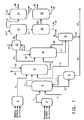
- FIG. 1 is a general diagram of a hydrogen cyanide (HCN) and acrylonitrile (ACRN) process of this invention.
- An ACRN product stream 4 is obtained by the ammoxidation of propylene, ammonia, and air in ACRN reactor 1.
- a HCN product stream 3 is obtained by reaction of methane, ammonia, and air in a HCN reactor 2, such as an Andrussow reactor.
- the ACRN product stream 4 is transferred to a quench column 5 where the hot ACRN product stream is cooled with water spray containing sulfuric acid fed through line 6 to neutralize the unreacted ammonia in the ACRN product stream to produce ammonium sulfate which is removed from quench column 5 through line 8 to waste water column 9.
- Recovered HCN/ACRN is cycled back to quench column 5 through line 7.
- a waste water purge stream 10 is take from waste water column 9.
- the cooled ACRN product stream 11 is then combined with the HCN product stream 3 in the absorber column 12, where the HCN and ACRN form a combined product stream as they are absorbed into an aqueous solution. Water is provided to the absorber column through line 13. Non-absorbed compounds are separated and removed as off-gas 15.
- the aqueous solution containing the combined product stream 14 is then transferred to a recovery column 16 for product purification.
- the combined product stream 21 is fed to decanter 22.
- Water from stripper column 18 is fed through line 13 to absorber column.
- a separate stream 17 is taken from the recovery column 16 and fed to stripper column 18 from which crude acetonitrile 19 is recovered and remaining aqueous stream 20 is fed back into recovery column 16. Crude acetonitrile 19 can be recovered or sent to incineration.
- the product stream 21 from recovery column 16 is transferred to decanter 22 where the stream separates, forming an organic layer and an aqueous layer.
- the aqueous layer is separated and returned as reflux flow 29 to recovery column 16.
- the organic layer is transferred through line 28 to heads column 30 where it is separated into crude ACRN 31 and crude HCN 32.
- the crude HCN 32 is sent to a HCN column 33, where the HCN is further purified and sent for storage (not shown) through line 40. Recovered ACRN 41 from HCN column 33 is returned to quench column 5 (line for return of recovered ACRN 41 from HCN column 33 to quench column 5 is not shown).
- Crude ACRN 31 is sent to a drying column 34, from which water is removed through line 37.
- Dried ACRN 35 is transferred to ACRN product column 36 for further purification before being sent through line 39 to storage (not shown) from which waste material is removed from ACRN product column 36 through line 38.
- Acetonitrile waste water stream 42 is combined with other waste water streams as combined waste water stream 43, which is collected and treated as needed.
- Acid to control pH between pH 3.8 and 4.4 is added through any of lines 23, 25, 26, or 27 to absorber column 12, recovery column 16, decanter 22, heads column 28, and HCN column 31.
- An appropriate control system (not shown) is used to monitor pH and temperature at each location where HCN concentration is sufficiently high, that is, greater than 1% by weight, that there is increased risk of HCN polymerization.
- the product stream (ACRN or combined stream) passed from the absorber column to a recovery column to a decanter, wherein an aqueous layer was separated from an organic layer, with the aqueous layer recycled to the recovery column and the organic layer fed to a heads column where crude HCN was separated from crude ACRN.
- Crude ACRN was removed from the bottom of the heads column and sent to a drying column and then further purification and packaging.
- Crude HCN was removed from the top of the heads column and sent to an HCN distillation column (HCN column) for further purification, reaction, if desired, and packaging.
- a nominal ACRN facility capable of producing 180 million pounds (82 million kg) per year of acrylonitrile and 20 million pounds (9 million kg) of hydrogen cyanide
- the facility produced about 50,000 pounds per hour, pph (23,000 kg per hour, kgph) of acrylonitrile and 6000 pph (3000 kgph) of HCN in a Sohio ammoxidation process.
- the effluent from the ACRN facility was an ACRN product stream having a temperature of about 450°C, which was fed to a quench column.
- a stream at a temperature of 46°C was fed to an absorber column, to a recovery column to a decanter, wherein an aqueous layer was separated from an organic layer, with the aqueous layer recycled to the recovery column and the organic layer fed to a heads column where crude HCN was separated from crude ACRN.
- Crude ACRN was removed from the bottom of the heads column and sent to a drying column and further purification and packaging.
- Crude HCN was removed from the top of the heads column and sent to an HCN distillation column for further purification, reaction, if desired, and packaging.
- the product ratio of ACN to HCN after purification was 9 to 1.
- a hydrogen cyanide reactor was operated producing an HCN product stream, which was combined with quenched stream from the ACRN process in the ACRN recovery/purification system used in the Comparative Example and as described above. ACRN was produced at the same rate as was produced in the Comparative Example. The amount of HCN produced from the ACRN reactor and hydrogen cyanide reactor was about 2.5 times the amount produced in Comparative Example.
- High concentration of HCN in the streams, especially in the recovery column and decanter provide greatest concern for safety, where there are high concentrations of HCN in organic phases, susceptible to polymerization.
- the pH was monitored and controlled at the absorber column, recovery column, decanter, heads column, and drying column by adding glycolic acid to the column or decanter, as needed to stabilize against polymerization.
- the ratio of acrylonitrile to HCN was 3 to 1 with no substantially no polymerization of HCN.
- Example 1 The process of Example 1 was repeated, but the amount of HCN produced was varied to provide ratios of ACRN to HCN of 2 to 1, 4 to 1 and 5 to 1 to show the ability to vary rate of co-manufacture of HCN and ACRN.
- the pH was monitored and controlled at the absorber column, recovery column, decanter, heads column, and drying column by adding glycolic acid to the column or decanter, as needed to stabilize against polymerization.
- the process of this invention can provide varying amounts of HCN relative to ACRN with minimal need for added investment in recovery and purification operations. Polymerization of HCN was substantially prevented.
Landscapes
- Chemical & Material Sciences (AREA)
- Organic Chemistry (AREA)
- Health & Medical Sciences (AREA)
- General Health & Medical Sciences (AREA)
- Toxicology (AREA)
- Inorganic Chemistry (AREA)
- Organic Low-Molecular-Weight Compounds And Preparation Thereof (AREA)
Applications Claiming Priority (2)
| Application Number | Priority Date | Filing Date | Title |
|---|---|---|---|
| US12/074,775 US8585870B2 (en) | 2008-03-05 | 2008-03-05 | Process to C-manufacture acrylonitrile and hydrogen cyanide |
| PCT/US2009/036111 WO2009111605A1 (en) | 2008-03-05 | 2009-03-05 | Improved process to co-manufacture acrylonitrile and hydrogen cyanide |
Publications (2)
| Publication Number | Publication Date |
|---|---|
| EP2254859A1 EP2254859A1 (en) | 2010-12-01 |
| EP2254859B1 true EP2254859B1 (en) | 2013-01-09 |
Family
ID=40863580
Family Applications (1)
| Application Number | Title | Priority Date | Filing Date |
|---|---|---|---|
| EP09717270A Active EP2254859B1 (en) | 2008-03-05 | 2009-03-05 | Improved process to co-manufacture acrylonitrile and hydrogen cyanide |
Country Status (7)
| Country | Link |
|---|---|
| US (1) | US8585870B2 (enExample) |
| EP (1) | EP2254859B1 (enExample) |
| JP (1) | JP2011513425A (enExample) |
| KR (1) | KR101586512B1 (enExample) |
| CN (1) | CN101959850B (enExample) |
| RU (1) | RU2494092C2 (enExample) |
| WO (1) | WO2009111605A1 (enExample) |
Families Citing this family (9)
| Publication number | Priority date | Publication date | Assignee | Title |
|---|---|---|---|---|
| JP2010222309A (ja) * | 2009-03-24 | 2010-10-07 | Asahi Kasei Chemicals Corp | アクリロニトリルの精製方法 |
| JP6097092B2 (ja) * | 2013-02-18 | 2017-03-15 | 旭化成株式会社 | 青酸重合物及びその製造方法 |
| CN104922923A (zh) * | 2014-03-21 | 2015-09-23 | 英尼奥斯欧洲股份公司 | 添加抑制剂的头馏分塔操作 |
| CN103984369A (zh) * | 2014-05-19 | 2014-08-13 | 英尼奥斯欧洲股份公司 | 丙烯腈产物的在线分析 |
| CN103991653B (zh) * | 2014-06-09 | 2018-03-20 | 英尼奥斯欧洲股份公司 | 粗制丙烯腈罐 |
| EP3322672B1 (en) | 2015-07-14 | 2020-05-27 | The Chemours Company FC, LLC | Method for removing nitriles from hydrogen cyanide |
| CN108025922B (zh) * | 2015-07-22 | 2021-06-15 | 英威达纺织(英国)有限公司 | 来自丙烯腈共同制备的高纯度hcn |
| KR102383958B1 (ko) * | 2017-12-28 | 2022-04-08 | 주식회사 엘지화학 | 미반응 단량체를 포함하는 혼합용액으로부터 미반응 단량체의 분리방법 |
| WO2021117434A1 (ja) * | 2019-12-09 | 2021-06-17 | 昭和電工株式会社 | 精製シアン化水素の製造方法 |
Family Cites Families (38)
| Publication number | Priority date | Publication date | Assignee | Title |
|---|---|---|---|---|
| US4510A (en) * | 1846-05-09 | Machinery for dressing staves | ||
| US3185636A (en) * | 1962-02-19 | 1965-05-25 | Standard Oil Co | Removal of saturated carbonyls from acrylonitrile |
| BE637244A (enExample) | 1962-09-15 | 1900-01-01 | ||
| US4377444A (en) * | 1970-04-16 | 1983-03-22 | The Standard Oil Co. | Recovery and purification of olefinic nitriles |
| US3911089A (en) | 1972-10-06 | 1975-10-07 | Sumitomo Chemical Co | Process for preparing hydrogen cyanide |
| US4234510A (en) | 1973-06-07 | 1980-11-18 | Standard Oil Company | Recovery of acrylonitrile or methacrylonitrile by condensation |
| JPS548655B2 (enExample) | 1974-08-01 | 1979-04-17 | ||
| US4238295A (en) * | 1978-12-04 | 1980-12-09 | Standard Oil Company | Energy efficient recovery of acrylonitrile |
| KR850001603B1 (ko) * | 1980-12-03 | 1985-10-24 | 아사히 가세이 고오교오 가부시기가이샤 | 불포화 니트릴의 제조법 |
| US4485079A (en) | 1981-12-18 | 1984-11-27 | The Standard Oil Company | Ammoxidation of methanol to produce hydrogen cyanide |
| CN1031662A (zh) | 1987-08-29 | 1989-03-15 | 中国石油化工总公司上海石油化工总厂 | 富产氢氰酸的丙烯腈催化剂 |
| JP2737914B2 (ja) | 1988-04-13 | 1998-04-08 | 三菱瓦斯化学株式会社 | 青酸反応器 |
| US5204079A (en) * | 1991-02-15 | 1993-04-20 | Standard Oil Company | HCN by catalytic ammoxidation of crude acetonitrile |
| US5288473A (en) | 1992-10-09 | 1994-02-22 | The Standard Oil Company | Process for elimination of waste material during manufacture of acrylonitrile |
| US6315972B1 (en) | 1994-02-01 | 2001-11-13 | E.I. Du Pont De Nemours And Company | Gas phase catalyzed reactions |
| WO1995021126A1 (en) | 1994-02-01 | 1995-08-10 | E.I. Du Pont De Nemours And Company | Preparation of hydrogen cyanide |
| US5629444A (en) * | 1996-06-06 | 1997-05-13 | The Standard Oil Company | Acrylonitrile recovery process |
| US5882618A (en) | 1997-04-28 | 1999-03-16 | Air Liquide America Corporation | Process for cyanic acid production |
| US5840648A (en) | 1997-09-02 | 1998-11-24 | The Standard Oil Company | Catalyst for the manufacture of acrylonitrile and hydrogen cyanide |
| US5869730A (en) * | 1998-05-13 | 1999-02-09 | The Standard Oil Company | Oxidant reduction by manipulation and/or treatment of aqueous acrylonitrile process streams |
| US6238574B1 (en) * | 1998-10-30 | 2001-05-29 | The Standard Oil Company | Oxidation and ammoxidation of acrylonitrile process waste water organics |
| US6204407B1 (en) | 1998-12-09 | 2001-03-20 | The Standard Oil Company | Ammoxidation of a mixture of alcohols to a mixture of nitriles to acetonitrile and HCN |
| US6296739B1 (en) * | 1999-01-08 | 2001-10-02 | The Standard Oil Company | Operation of heads column |
| IL146417A0 (en) * | 1999-05-13 | 2002-07-25 | Medical Res Council | Ox2 receptor homologs |
| US6413485B2 (en) | 1999-05-27 | 2002-07-02 | The Standard Oil Company | Ammoxidation of a mixture of ketones to acetonitrile and HCN |
| US6084121A (en) | 1999-09-09 | 2000-07-04 | E. I. Du Pont De Nemours And Company | Nitrile process |
| DE10034193A1 (de) | 2000-07-13 | 2002-03-28 | Roehm Gmbh | Verfahren zur Herstellung von Cyanwasserstoff |
| DE10034194A1 (de) | 2000-07-13 | 2003-09-11 | Roehm Gmbh | Verfahren zur Herstellung von Cyanwasserstoff |
| JP4573970B2 (ja) * | 2000-08-29 | 2010-11-04 | ダイヤニトリックス株式会社 | アクリロニトリルの製造方法 |
| US6355828B1 (en) | 2000-11-10 | 2002-03-12 | E. I. Du Pont De Nemours And Company | Nitrile process |
| JP2003002870A (ja) | 2001-06-21 | 2003-01-08 | Asahi Kasei Corp | 不飽和ニトリル製造時における青酸の併産方法 |
| JP2005501119A (ja) * | 2001-08-21 | 2005-01-13 | ザ・スタンダード・オイル・カンパニー | アクリロニトリル製造におけるヘッドカラムの改良された運転 |
| RU2263108C1 (ru) * | 2001-08-21 | 2005-10-27 | Дзе Стэндард Ойл Компани | Способ извлечения акрилонитрила, метакрилонитрила или цианида водорода |
| US7070743B2 (en) | 2002-03-14 | 2006-07-04 | Invista North America S.A R.L. | Induction-heated reactors for gas phase catalyzed reactions |
| WO2004026462A1 (en) * | 2002-09-18 | 2004-04-01 | University Of Wyoming | System and method for the manufacture of hydrogen cyanide and acrylonitrile with simultaneous recovery of hydrogen |
| US7196231B2 (en) * | 2003-06-27 | 2007-03-27 | Solutia, Inc. | Process for removal of acrolein from acrylonitrile product streams |
| US20050047988A1 (en) | 2003-09-03 | 2005-03-03 | Kim Tae Hoon | Method of making hydrocyanic acid using a mass spectrometer control system |
| CN101189205B (zh) | 2005-04-15 | 2012-09-26 | 南加利福尼亚大学 | 选择性氧化转化甲烷至甲醇、二甲醚和衍生产物 |
-
2008
- 2008-03-05 US US12/074,775 patent/US8585870B2/en active Active
-
2009
- 2009-03-05 WO PCT/US2009/036111 patent/WO2009111605A1/en not_active Ceased
- 2009-03-05 RU RU2010140591/04A patent/RU2494092C2/ru active
- 2009-03-05 CN CN200980107384.4A patent/CN101959850B/zh active Active
- 2009-03-05 KR KR1020107022123A patent/KR101586512B1/ko active Active
- 2009-03-05 EP EP09717270A patent/EP2254859B1/en active Active
- 2009-03-05 JP JP2010549868A patent/JP2011513425A/ja active Pending
Also Published As
| Publication number | Publication date |
|---|---|
| JP2011513425A (ja) | 2011-04-28 |
| KR101586512B1 (ko) | 2016-01-18 |
| RU2010140591A (ru) | 2012-04-10 |
| CN101959850B (zh) | 2014-10-22 |
| US8585870B2 (en) | 2013-11-19 |
| WO2009111605A1 (en) | 2009-09-11 |
| EP2254859A1 (en) | 2010-12-01 |
| RU2494092C2 (ru) | 2013-09-27 |
| KR20100125385A (ko) | 2010-11-30 |
| CN101959850A (zh) | 2011-01-26 |
| US20090223804A1 (en) | 2009-09-10 |
Similar Documents
| Publication | Publication Date | Title |
|---|---|---|
| EP2254859B1 (en) | Improved process to co-manufacture acrylonitrile and hydrogen cyanide | |
| US10647663B2 (en) | High purity HCN from acrylonitrile co-production | |
| WO2018074046A1 (ja) | アクリロニトリルの精製方法、製造方法、及び蒸留装置 | |
| EP1093389B1 (en) | Process for recovery of acrylonitirle | |
| EP2521710B1 (en) | A urea stripping process for the production of urea | |
| AU2016291719B2 (en) | Method for removing nitriles from hydrogen cyanide | |
| JP4418364B2 (ja) | ニトリル類の混合物へのカルボン酸のアンモ酸化 | |
| US6860971B2 (en) | Process for recovery of olefinically unsaturated nitriles | |
| JP6300387B1 (ja) | アクリロニトリルの精製方法、製造方法、及び蒸留装置 | |
| KR101320276B1 (ko) | 수성 암모늄 카바메이트 스트림의 농축 방법 | |
| EP1419140B1 (en) | Improved operation of heads column in acrylonitrile production | |
| US5703268A (en) | Acrylonitrile recovery process | |
| CN113727963A (zh) | 尿素合成方法 | |
| JP5344741B2 (ja) | アクリロニトリルの精製方法 | |
| JP7707921B2 (ja) | 精製シアン化水素の製造方法 | |
| EP0891967B1 (en) | Improved acrylonitrile recovery process | |
| ZA200300650B (en) | Amelioration of ammonia breakthrough in an alkane ammoxidation process. |
Legal Events
| Date | Code | Title | Description |
|---|---|---|---|
| PUAI | Public reference made under article 153(3) epc to a published international application that has entered the european phase |
Free format text: ORIGINAL CODE: 0009012 |
|
| 17P | Request for examination filed |
Effective date: 20100823 |
|
| AK | Designated contracting states |
Kind code of ref document: A1 Designated state(s): AT BE BG CH CY CZ DE DK EE ES FI FR GB GR HR HU IE IS IT LI LT LU LV MC MK MT NL NO PL PT RO SE SI SK TR |
|
| AX | Request for extension of the european patent |
Extension state: AL BA RS |
|
| RIN1 | Information on inventor provided before grant (corrected) |
Inventor name: BASHAM, BRENT, E. Inventor name: STIMEK, RICHARD, T. |
|
| DAX | Request for extension of the european patent (deleted) | ||
| GRAP | Despatch of communication of intention to grant a patent |
Free format text: ORIGINAL CODE: EPIDOSNIGR1 |
|
| GRAS | Grant fee paid |
Free format text: ORIGINAL CODE: EPIDOSNIGR3 |
|
| GRAA | (expected) grant |
Free format text: ORIGINAL CODE: 0009210 |
|
| AK | Designated contracting states |
Kind code of ref document: B1 Designated state(s): AT BE BG CH CY CZ DE DK EE ES FI FR GB GR HR HU IE IS IT LI LT LU LV MC MK MT NL NO PL PT RO SE SI SK TR |
|
| REG | Reference to a national code |
Ref country code: GB Ref legal event code: FG4D |
|
| REG | Reference to a national code |
Ref country code: CH Ref legal event code: EP Ref country code: AT Ref legal event code: REF Ref document number: 592664 Country of ref document: AT Kind code of ref document: T Effective date: 20130115 |
|
| REG | Reference to a national code |
Ref country code: IE Ref legal event code: FG4D |
|
| REG | Reference to a national code |
Ref country code: DE Ref legal event code: R096 Ref document number: 602009012659 Country of ref document: DE Effective date: 20130307 |
|
| PG25 | Lapsed in a contracting state [announced via postgrant information from national office to epo] |
Ref country code: SI Free format text: LAPSE BECAUSE OF FAILURE TO SUBMIT A TRANSLATION OF THE DESCRIPTION OR TO PAY THE FEE WITHIN THE PRESCRIBED TIME-LIMIT Effective date: 20130109 |
|
| REG | Reference to a national code |
Ref country code: NL Ref legal event code: VDEP Effective date: 20130109 |
|
| REG | Reference to a national code |
Ref country code: AT Ref legal event code: MK05 Ref document number: 592664 Country of ref document: AT Kind code of ref document: T Effective date: 20130109 |
|
| REG | Reference to a national code |
Ref country code: LT Ref legal event code: MG4D |
|
| PG25 | Lapsed in a contracting state [announced via postgrant information from national office to epo] |
Ref country code: AT Free format text: LAPSE BECAUSE OF FAILURE TO SUBMIT A TRANSLATION OF THE DESCRIPTION OR TO PAY THE FEE WITHIN THE PRESCRIBED TIME-LIMIT Effective date: 20130109 Ref country code: BG Free format text: LAPSE BECAUSE OF FAILURE TO SUBMIT A TRANSLATION OF THE DESCRIPTION OR TO PAY THE FEE WITHIN THE PRESCRIBED TIME-LIMIT Effective date: 20130409 Ref country code: NO Free format text: LAPSE BECAUSE OF FAILURE TO SUBMIT A TRANSLATION OF THE DESCRIPTION OR TO PAY THE FEE WITHIN THE PRESCRIBED TIME-LIMIT Effective date: 20130409 Ref country code: ES Free format text: LAPSE BECAUSE OF FAILURE TO SUBMIT A TRANSLATION OF THE DESCRIPTION OR TO PAY THE FEE WITHIN THE PRESCRIBED TIME-LIMIT Effective date: 20130420 Ref country code: LT Free format text: LAPSE BECAUSE OF FAILURE TO SUBMIT A TRANSLATION OF THE DESCRIPTION OR TO PAY THE FEE WITHIN THE PRESCRIBED TIME-LIMIT Effective date: 20130109 Ref country code: SE Free format text: LAPSE BECAUSE OF FAILURE TO SUBMIT A TRANSLATION OF THE DESCRIPTION OR TO PAY THE FEE WITHIN THE PRESCRIBED TIME-LIMIT Effective date: 20130109 Ref country code: IS Free format text: LAPSE BECAUSE OF FAILURE TO SUBMIT A TRANSLATION OF THE DESCRIPTION OR TO PAY THE FEE WITHIN THE PRESCRIBED TIME-LIMIT Effective date: 20130509 Ref country code: BE Free format text: LAPSE BECAUSE OF FAILURE TO SUBMIT A TRANSLATION OF THE DESCRIPTION OR TO PAY THE FEE WITHIN THE PRESCRIBED TIME-LIMIT Effective date: 20130109 |
|
| PG25 | Lapsed in a contracting state [announced via postgrant information from national office to epo] |
Ref country code: PT Free format text: LAPSE BECAUSE OF FAILURE TO SUBMIT A TRANSLATION OF THE DESCRIPTION OR TO PAY THE FEE WITHIN THE PRESCRIBED TIME-LIMIT Effective date: 20130509 Ref country code: GR Free format text: LAPSE BECAUSE OF FAILURE TO SUBMIT A TRANSLATION OF THE DESCRIPTION OR TO PAY THE FEE WITHIN THE PRESCRIBED TIME-LIMIT Effective date: 20130410 Ref country code: PL Free format text: LAPSE BECAUSE OF FAILURE TO SUBMIT A TRANSLATION OF THE DESCRIPTION OR TO PAY THE FEE WITHIN THE PRESCRIBED TIME-LIMIT Effective date: 20130109 Ref country code: FI Free format text: LAPSE BECAUSE OF FAILURE TO SUBMIT A TRANSLATION OF THE DESCRIPTION OR TO PAY THE FEE WITHIN THE PRESCRIBED TIME-LIMIT Effective date: 20130109 Ref country code: LV Free format text: LAPSE BECAUSE OF FAILURE TO SUBMIT A TRANSLATION OF THE DESCRIPTION OR TO PAY THE FEE WITHIN THE PRESCRIBED TIME-LIMIT Effective date: 20130109 Ref country code: NL Free format text: LAPSE BECAUSE OF FAILURE TO SUBMIT A TRANSLATION OF THE DESCRIPTION OR TO PAY THE FEE WITHIN THE PRESCRIBED TIME-LIMIT Effective date: 20130109 |
|
| PG25 | Lapsed in a contracting state [announced via postgrant information from national office to epo] |
Ref country code: HR Free format text: LAPSE BECAUSE OF FAILURE TO SUBMIT A TRANSLATION OF THE DESCRIPTION OR TO PAY THE FEE WITHIN THE PRESCRIBED TIME-LIMIT Effective date: 20130109 |
|
| PG25 | Lapsed in a contracting state [announced via postgrant information from national office to epo] |
Ref country code: CZ Free format text: LAPSE BECAUSE OF FAILURE TO SUBMIT A TRANSLATION OF THE DESCRIPTION OR TO PAY THE FEE WITHIN THE PRESCRIBED TIME-LIMIT Effective date: 20130109 Ref country code: SK Free format text: LAPSE BECAUSE OF FAILURE TO SUBMIT A TRANSLATION OF THE DESCRIPTION OR TO PAY THE FEE WITHIN THE PRESCRIBED TIME-LIMIT Effective date: 20130109 Ref country code: EE Free format text: LAPSE BECAUSE OF FAILURE TO SUBMIT A TRANSLATION OF THE DESCRIPTION OR TO PAY THE FEE WITHIN THE PRESCRIBED TIME-LIMIT Effective date: 20130109 Ref country code: RO Free format text: LAPSE BECAUSE OF FAILURE TO SUBMIT A TRANSLATION OF THE DESCRIPTION OR TO PAY THE FEE WITHIN THE PRESCRIBED TIME-LIMIT Effective date: 20130109 Ref country code: DK Free format text: LAPSE BECAUSE OF FAILURE TO SUBMIT A TRANSLATION OF THE DESCRIPTION OR TO PAY THE FEE WITHIN THE PRESCRIBED TIME-LIMIT Effective date: 20130109 Ref country code: MC Free format text: LAPSE BECAUSE OF NON-PAYMENT OF DUE FEES Effective date: 20130331 |
|
| REG | Reference to a national code |
Ref country code: CH Ref legal event code: PL |
|
| PLBE | No opposition filed within time limit |
Free format text: ORIGINAL CODE: 0009261 |
|
| STAA | Information on the status of an ep patent application or granted ep patent |
Free format text: STATUS: NO OPPOSITION FILED WITHIN TIME LIMIT |
|
| PG25 | Lapsed in a contracting state [announced via postgrant information from national office to epo] |
Ref country code: CY Free format text: LAPSE BECAUSE OF FAILURE TO SUBMIT A TRANSLATION OF THE DESCRIPTION OR TO PAY THE FEE WITHIN THE PRESCRIBED TIME-LIMIT Effective date: 20130109 |
|
| 26N | No opposition filed |
Effective date: 20131010 |
|
| PG25 | Lapsed in a contracting state [announced via postgrant information from national office to epo] |
Ref country code: IT Free format text: LAPSE BECAUSE OF FAILURE TO SUBMIT A TRANSLATION OF THE DESCRIPTION OR TO PAY THE FEE WITHIN THE PRESCRIBED TIME-LIMIT Effective date: 20130109 |
|
| REG | Reference to a national code |
Ref country code: IE Ref legal event code: MM4A |
|
| REG | Reference to a national code |
Ref country code: DE Ref legal event code: R097 Ref document number: 602009012659 Country of ref document: DE Effective date: 20131010 |
|
| PG25 | Lapsed in a contracting state [announced via postgrant information from national office to epo] |
Ref country code: IE Free format text: LAPSE BECAUSE OF NON-PAYMENT OF DUE FEES Effective date: 20130305 Ref country code: LI Free format text: LAPSE BECAUSE OF NON-PAYMENT OF DUE FEES Effective date: 20130331 Ref country code: CH Free format text: LAPSE BECAUSE OF NON-PAYMENT OF DUE FEES Effective date: 20130331 |
|
| PG25 | Lapsed in a contracting state [announced via postgrant information from national office to epo] |
Ref country code: MT Free format text: LAPSE BECAUSE OF FAILURE TO SUBMIT A TRANSLATION OF THE DESCRIPTION OR TO PAY THE FEE WITHIN THE PRESCRIBED TIME-LIMIT Effective date: 20130109 |
|
| PG25 | Lapsed in a contracting state [announced via postgrant information from national office to epo] |
Ref country code: TR Free format text: LAPSE BECAUSE OF FAILURE TO SUBMIT A TRANSLATION OF THE DESCRIPTION OR TO PAY THE FEE WITHIN THE PRESCRIBED TIME-LIMIT Effective date: 20130109 |
|
| PG25 | Lapsed in a contracting state [announced via postgrant information from national office to epo] |
Ref country code: HU Free format text: LAPSE BECAUSE OF FAILURE TO SUBMIT A TRANSLATION OF THE DESCRIPTION OR TO PAY THE FEE WITHIN THE PRESCRIBED TIME-LIMIT; INVALID AB INITIO Effective date: 20090305 Ref country code: LU Free format text: LAPSE BECAUSE OF NON-PAYMENT OF DUE FEES Effective date: 20130305 Ref country code: MK Free format text: LAPSE BECAUSE OF FAILURE TO SUBMIT A TRANSLATION OF THE DESCRIPTION OR TO PAY THE FEE WITHIN THE PRESCRIBED TIME-LIMIT Effective date: 20130109 |
|
| REG | Reference to a national code |
Ref country code: FR Ref legal event code: PLFP Year of fee payment: 8 |
|
| REG | Reference to a national code |
Ref country code: FR Ref legal event code: PLFP Year of fee payment: 9 |
|
| REG | Reference to a national code |
Ref country code: FR Ref legal event code: PLFP Year of fee payment: 10 |
|
| REG | Reference to a national code |
Ref country code: DE Ref legal event code: R081 Ref document number: 602009012659 Country of ref document: DE Owner name: COVORO MINING SOLUTIONS, LLC, WILMINGTON, US Free format text: FORMER OWNER: E.I. DU PONT DE NEMOURS AND CO., WILMINGTON, DEL., US Ref country code: DE Ref legal event code: R082 Ref document number: 602009012659 Country of ref document: DE Representative=s name: MARKS & CLERK (LUXEMBOURG) LLP, LU Ref country code: DE Ref legal event code: R081 Ref document number: 602009012659 Country of ref document: DE Owner name: THE CHEMOURS COMPANY FC, LLC, WILMINGTON, US Free format text: FORMER OWNER: E.I. DU PONT DE NEMOURS AND CO., WILMINGTON, DEL., US |
|
| REG | Reference to a national code |
Ref country code: GB Ref legal event code: 732E Free format text: REGISTERED BETWEEN 20211111 AND 20211117 |
|
| REG | Reference to a national code |
Ref country code: DE Ref legal event code: R081 Ref document number: 602009012659 Country of ref document: DE Owner name: COVORO MINING SOLUTIONS, LLC, WILMINGTON, US Free format text: FORMER OWNER: THE CHEMOURS COMPANY FC, LLC, WILMINGTON, DEL., US Ref country code: DE Ref legal event code: R082 Ref document number: 602009012659 Country of ref document: DE Representative=s name: HAFNER & KOHL PARTMBB, DE |
|
| REG | Reference to a national code |
Ref country code: GB Ref legal event code: 732E Free format text: REGISTERED BETWEEN 20230914 AND 20230920 |
|
| PGFP | Annual fee paid to national office [announced via postgrant information from national office to epo] |
Ref country code: DE Payment date: 20250313 Year of fee payment: 17 |
|
| PGFP | Annual fee paid to national office [announced via postgrant information from national office to epo] |
Ref country code: FR Payment date: 20250316 Year of fee payment: 17 |
|
| PGFP | Annual fee paid to national office [announced via postgrant information from national office to epo] |
Ref country code: GB Payment date: 20250128 Year of fee payment: 17 |