EP2229378B1 - Fluoreszierende, heterozyklisch annellierte perylene - Google Patents
Fluoreszierende, heterozyklisch annellierte perylene Download PDFInfo
- Publication number
- EP2229378B1 EP2229378B1 EP08858404A EP08858404A EP2229378B1 EP 2229378 B1 EP2229378 B1 EP 2229378B1 EP 08858404 A EP08858404 A EP 08858404A EP 08858404 A EP08858404 A EP 08858404A EP 2229378 B1 EP2229378 B1 EP 2229378B1
- Authority
- EP
- European Patent Office
- Prior art keywords
- oder
- bis
- fluorescence
- colorants
- chcl
- Prior art date
- Legal status (The legal status is an assumption and is not a legal conclusion. Google has not performed a legal analysis and makes no representation as to the accuracy of the status listed.)
- Not-in-force
Links
- 125000000623 heterocyclic group Chemical group 0.000 title claims abstract description 10
- 125000002080 perylenyl group Chemical group C1(=CC=C2C=CC=C3C4=CC=CC5=CC=CC(C1=C23)=C45)* 0.000 title description 44
- CSHWQDPOILHKBI-UHFFFAOYSA-N peryrene Natural products C1=CC(C2=CC=CC=3C2=C2C=CC=3)=C3C2=CC=CC3=C1 CSHWQDPOILHKBI-UHFFFAOYSA-N 0.000 title description 43
- 239000003086 colorant Substances 0.000 claims abstract description 133
- -1 aromatic nitriles Chemical class 0.000 claims abstract description 110
- 229910052739 hydrogen Inorganic materials 0.000 claims abstract description 76
- 238000006243 chemical reaction Methods 0.000 claims abstract description 20
- 230000007246 mechanism Effects 0.000 claims abstract description 6
- 239000001257 hydrogen Substances 0.000 claims abstract description 4
- 125000003118 aryl group Chemical group 0.000 claims description 47
- 238000000034 method Methods 0.000 claims description 23
- 150000001875 compounds Chemical class 0.000 claims description 22
- 230000008569 process Effects 0.000 claims description 15
- 239000000203 mixture Substances 0.000 claims description 14
- 125000004432 carbon atom Chemical group C* 0.000 claims description 13
- 239000000976 ink Substances 0.000 claims description 12
- 239000007787 solid Substances 0.000 claims description 12
- 125000001997 phenyl group Chemical group [H]C1=C([H])C([H])=C(*)C([H])=C1[H] 0.000 claims description 11
- 239000000463 material Substances 0.000 claims description 8
- 229910052794 bromium Inorganic materials 0.000 claims description 7
- 229910052801 chlorine Inorganic materials 0.000 claims description 7
- 229910052731 fluorine Inorganic materials 0.000 claims description 7
- 230000003287 optical effect Effects 0.000 claims description 7
- 239000004215 Carbon black (E152) Substances 0.000 claims description 6
- 229930195733 hydrocarbon Natural products 0.000 claims description 6
- 229910052740 iodine Inorganic materials 0.000 claims description 6
- 239000001301 oxygen Substances 0.000 claims description 6
- 229910052760 oxygen Inorganic materials 0.000 claims description 6
- 239000003973 paint Substances 0.000 claims description 6
- 239000000049 pigment Substances 0.000 claims description 6
- ODZPKZBBUMBTMG-UHFFFAOYSA-N sodium amide Chemical compound [NH2-].[Na+] ODZPKZBBUMBTMG-UHFFFAOYSA-N 0.000 claims description 6
- 239000007858 starting material Substances 0.000 claims description 6
- QVGXLLKOCUKJST-UHFFFAOYSA-N atomic oxygen Chemical compound [O] QVGXLLKOCUKJST-UHFFFAOYSA-N 0.000 claims description 5
- 238000004040 coloring Methods 0.000 claims description 5
- 239000004065 semiconductor Substances 0.000 claims description 5
- 125000001424 substituent group Chemical group 0.000 claims description 5
- 230000005670 electromagnetic radiation Effects 0.000 claims description 4
- 125000004435 hydrogen atom Chemical class [H]* 0.000 claims description 4
- 238000004519 manufacturing process Methods 0.000 claims description 4
- 238000007639 printing Methods 0.000 claims description 4
- 239000003814 drug Substances 0.000 claims description 3
- 238000005516 engineering process Methods 0.000 claims description 3
- 239000000010 aprotic solvent Substances 0.000 claims description 2
- 238000000504 luminescence detection Methods 0.000 claims description 2
- 239000005445 natural material Substances 0.000 claims description 2
- 239000011368 organic material Substances 0.000 claims description 2
- 229920000642 polymer Polymers 0.000 claims description 2
- 239000000700 radioactive tracer Substances 0.000 claims description 2
- 238000000518 rheometry Methods 0.000 claims description 2
- 230000001939 inductive effect Effects 0.000 claims 2
- 230000001678 irradiating effect Effects 0.000 claims 2
- 125000002924 primary amino group Chemical group [H]N([H])* 0.000 claims 2
- 125000000467 secondary amino group Chemical class [H]N([*:1])[*:2] 0.000 claims 2
- 150000003512 tertiary amines Chemical class 0.000 claims 2
- 125000001140 1,4-phenylene group Chemical group [H]C1=C([H])C([*:2])=C([H])C([H])=C1[*:1] 0.000 claims 1
- XDTMQSROBMDMFD-UHFFFAOYSA-N Cyclohexane Chemical compound C1CCCCC1 XDTMQSROBMDMFD-UHFFFAOYSA-N 0.000 claims 1
- 208000000655 Distemper Diseases 0.000 claims 1
- CIUQDSCDWFSTQR-UHFFFAOYSA-N [C]1=CC=CC=C1 Chemical compound [C]1=CC=CC=C1 CIUQDSCDWFSTQR-UHFFFAOYSA-N 0.000 claims 1
- 239000011248 coating agent Substances 0.000 claims 1
- 238000000576 coating method Methods 0.000 claims 1
- 239000000539 dimer Substances 0.000 claims 1
- 239000012442 inert solvent Substances 0.000 claims 1
- 239000000983 mordant dye Substances 0.000 claims 1
- 239000013638 trimer Substances 0.000 claims 1
- 229910052736 halogen Inorganic materials 0.000 abstract description 3
- 150000002367 halogens Chemical class 0.000 abstract description 3
- 125000001183 hydrocarbyl group Chemical class 0.000 abstract 1
- 150000002431 hydrogen Chemical class 0.000 abstract 1
- HEDRZPFGACZZDS-UHFFFAOYSA-N Chloroform Chemical compound ClC(Cl)Cl HEDRZPFGACZZDS-UHFFFAOYSA-N 0.000 description 138
- VYPSYNLAJGMNEJ-UHFFFAOYSA-N Silicium dioxide Chemical compound O=[Si]=O VYPSYNLAJGMNEJ-UHFFFAOYSA-N 0.000 description 58
- 239000000741 silica gel Substances 0.000 description 57
- 229910002027 silica gel Inorganic materials 0.000 description 57
- 229910052757 nitrogen Inorganic materials 0.000 description 51
- JFDZBHWFFUWGJE-UHFFFAOYSA-N benzonitrile Chemical compound N#CC1=CC=CC=C1 JFDZBHWFFUWGJE-UHFFFAOYSA-N 0.000 description 44
- YMWUJEATGCHHMB-UHFFFAOYSA-N Dichloromethane Chemical compound ClCCl YMWUJEATGCHHMB-UHFFFAOYSA-N 0.000 description 27
- 239000000126 substance Substances 0.000 description 25
- 238000004440 column chromatography Methods 0.000 description 24
- 229910052799 carbon Inorganic materials 0.000 description 22
- 239000000975 dye Substances 0.000 description 22
- 238000005160 1H NMR spectroscopy Methods 0.000 description 21
- BWHMMNNQKKPAPP-UHFFFAOYSA-L potassium carbonate Chemical compound [K+].[K+].[O-]C([O-])=O BWHMMNNQKKPAPP-UHFFFAOYSA-L 0.000 description 20
- 238000001644 13C nuclear magnetic resonance spectroscopy Methods 0.000 description 19
- AFABGHUZZDYHJO-UHFFFAOYSA-N 2-Methylpentane Chemical compound CCCC(C)C AFABGHUZZDYHJO-UHFFFAOYSA-N 0.000 description 18
- 238000006862 quantum yield reaction Methods 0.000 description 17
- 230000009102 absorption Effects 0.000 description 15
- VEXZGXHMUGYJMC-UHFFFAOYSA-N Hydrochloric acid Chemical compound Cl VEXZGXHMUGYJMC-UHFFFAOYSA-N 0.000 description 13
- 238000010521 absorption reaction Methods 0.000 description 13
- OKKJLVBELUTLKV-UHFFFAOYSA-N Methanol Chemical compound OC OKKJLVBELUTLKV-UHFFFAOYSA-N 0.000 description 12
- 125000004433 nitrogen atom Chemical group N* 0.000 description 12
- 239000000243 solution Substances 0.000 description 12
- 150000003254 radicals Chemical class 0.000 description 11
- KWYUFKZDYYNOTN-UHFFFAOYSA-M Potassium hydroxide Chemical compound [OH-].[K+] KWYUFKZDYYNOTN-UHFFFAOYSA-M 0.000 description 10
- 125000002496 methyl group Chemical group [H]C([H])([H])* 0.000 description 10
- AZKDTTQQTKDXLH-UHFFFAOYSA-N naphthalene-2-carbonitrile Chemical compound C1=CC=CC2=CC(C#N)=CC=C21 AZKDTTQQTKDXLH-UHFFFAOYSA-N 0.000 description 10
- 229910000027 potassium carbonate Inorganic materials 0.000 description 10
- CSNNHWWHGAXBCP-UHFFFAOYSA-L Magnesium sulfate Chemical compound [Mg+2].[O-][S+2]([O-])([O-])[O-] CSNNHWWHGAXBCP-UHFFFAOYSA-L 0.000 description 9
- ZMXDDKWLCZADIW-UHFFFAOYSA-N N,N-Dimethylformamide Chemical compound CN(C)C=O ZMXDDKWLCZADIW-UHFFFAOYSA-N 0.000 description 9
- YXFVVABEGXRONW-UHFFFAOYSA-N Toluene Chemical compound CC1=CC=CC=C1 YXFVVABEGXRONW-UHFFFAOYSA-N 0.000 description 9
- 125000000217 alkyl group Chemical group 0.000 description 9
- 239000004922 lacquer Substances 0.000 description 9
- 238000005481 NMR spectroscopy Methods 0.000 description 8
- NQRYJNQNLNOLGT-UHFFFAOYSA-N Piperidine Chemical compound C1CCNCC1 NQRYJNQNLNOLGT-UHFFFAOYSA-N 0.000 description 8
- HEDRZPFGACZZDS-MICDWDOJSA-N Trichloro(2H)methane Chemical compound [2H]C(Cl)(Cl)Cl HEDRZPFGACZZDS-MICDWDOJSA-N 0.000 description 8
- 238000002189 fluorescence spectrum Methods 0.000 description 8
- 238000000862 absorption spectrum Methods 0.000 description 7
- GUVUOGQBMYCBQP-UHFFFAOYSA-N dmpu Chemical compound CN1CCCN(C)C1=O GUVUOGQBMYCBQP-UHFFFAOYSA-N 0.000 description 7
- 0 *c1nc2c(-c(c(c3c(c4c5nc(*)[n]4*)C(N4*)=O)c5-c5c(*)cc6C(N(*)C7=O)=O)c(*)cc3C4=O)c5c6c7c2[n]1* Chemical compound *c1nc2c(-c(c(c3c(c4c5nc(*)[n]4*)C(N4*)=O)c5-c5c(*)cc6C(N(*)C7=O)=O)c(*)cc3C4=O)c5c6c7c2[n]1* 0.000 description 6
- HQSCPPCMBMFJJN-UHFFFAOYSA-N 4-bromobenzonitrile Chemical compound BrC1=CC=C(C#N)C=C1 HQSCPPCMBMFJJN-UHFFFAOYSA-N 0.000 description 6
- IAZDPXIOMUYVGZ-UHFFFAOYSA-N Dimethylsulphoxide Chemical compound CS(C)=O IAZDPXIOMUYVGZ-UHFFFAOYSA-N 0.000 description 6
- 229920000297 Rayon Polymers 0.000 description 6
- 125000001797 benzyl group Chemical group [H]C1=C([H])C([H])=C(C([H])=C1[H])C([H])([H])* 0.000 description 6
- 230000005855 radiation Effects 0.000 description 6
- RYHBNJHYFVUHQT-UHFFFAOYSA-N 1,4-Dioxane Chemical compound C1COCCO1 RYHBNJHYFVUHQT-UHFFFAOYSA-N 0.000 description 5
- XDJAAZYHCCRJOK-UHFFFAOYSA-N 4-methoxybenzonitrile Chemical compound COC1=CC=C(C#N)C=C1 XDJAAZYHCCRJOK-UHFFFAOYSA-N 0.000 description 5
- PASDCCFISLVPSO-UHFFFAOYSA-N benzoyl chloride Chemical compound ClC(=O)C1=CC=CC=C1 PASDCCFISLVPSO-UHFFFAOYSA-N 0.000 description 5
- 125000002915 carbonyl group Chemical group [*:2]C([*:1])=O 0.000 description 5
- 239000000460 chlorine Substances 0.000 description 5
- WFPZPJSADLPSON-UHFFFAOYSA-N dinitrogen tetraoxide Chemical compound [O-][N+](=O)[N+]([O-])=O WFPZPJSADLPSON-UHFFFAOYSA-N 0.000 description 5
- XLYOFNOQVPJJNP-UHFFFAOYSA-N water Substances O XLYOFNOQVPJJNP-UHFFFAOYSA-N 0.000 description 5
- BLXSFCHWMBESKV-UHFFFAOYSA-N 1-iodopentane Chemical compound CCCCCI BLXSFCHWMBESKV-UHFFFAOYSA-N 0.000 description 4
- 244000198134 Agave sisalana Species 0.000 description 4
- 235000011777 Corchorus aestuans Nutrition 0.000 description 4
- 235000010862 Corchorus capsularis Nutrition 0.000 description 4
- PXGOKWXKJXAPGV-UHFFFAOYSA-N Fluorine Chemical compound FF PXGOKWXKJXAPGV-UHFFFAOYSA-N 0.000 description 4
- AFVFQIVMOAPDHO-UHFFFAOYSA-N Methanesulfonic acid Chemical compound CS(O)(=O)=O AFVFQIVMOAPDHO-UHFFFAOYSA-N 0.000 description 4
- SECXISVLQFMRJM-UHFFFAOYSA-N N-Methylpyrrolidone Chemical compound CN1CCCC1=O SECXISVLQFMRJM-UHFFFAOYSA-N 0.000 description 4
- FZNCGRZWXLXZSZ-CIQUZCHMSA-N Voglibose Chemical compound OCC(CO)N[C@H]1C[C@](O)(CO)[C@@H](O)[C@H](O)[C@H]1O FZNCGRZWXLXZSZ-CIQUZCHMSA-N 0.000 description 4
- 239000006096 absorbing agent Substances 0.000 description 4
- 230000005284 excitation Effects 0.000 description 4
- 125000001449 isopropyl group Chemical group [H]C([H])([H])C([H])(*)C([H])([H])[H] 0.000 description 4
- 230000031700 light absorption Effects 0.000 description 4
- 229910052943 magnesium sulfate Inorganic materials 0.000 description 4
- 235000019341 magnesium sulphate Nutrition 0.000 description 4
- YJMNOKOLADGBKA-UHFFFAOYSA-N naphthalene-1-carbonitrile Chemical compound C1=CC=C2C(C#N)=CC=CC2=C1 YJMNOKOLADGBKA-UHFFFAOYSA-N 0.000 description 4
- 150000002825 nitriles Chemical class 0.000 description 4
- 239000000123 paper Substances 0.000 description 4
- 239000000047 product Substances 0.000 description 4
- 239000002964 rayon Substances 0.000 description 4
- 238000010992 reflux Methods 0.000 description 4
- 239000002904 solvent Substances 0.000 description 4
- 238000001228 spectrum Methods 0.000 description 4
- 125000003903 2-propenyl group Chemical group [H]C([*])([H])C([H])=C([H])[H] 0.000 description 3
- XTHFKEDIFFGKHM-UHFFFAOYSA-N Dimethoxyethane Chemical compound COCCOC XTHFKEDIFFGKHM-UHFFFAOYSA-N 0.000 description 3
- 239000000020 Nitrocellulose Substances 0.000 description 3
- 239000004146 Propane-1,2-diol Substances 0.000 description 3
- KEAYESYHFKHZAL-UHFFFAOYSA-N Sodium Chemical compound [Na] KEAYESYHFKHZAL-UHFFFAOYSA-N 0.000 description 3
- BHELZAPQIKSEDF-UHFFFAOYSA-N allyl bromide Chemical compound BrCC=C BHELZAPQIKSEDF-UHFFFAOYSA-N 0.000 description 3
- 230000005595 deprotonation Effects 0.000 description 3
- 238000010537 deprotonation reaction Methods 0.000 description 3
- SBZXBUIDTXKZTM-UHFFFAOYSA-N diglyme Chemical compound COCCOCCOC SBZXBUIDTXKZTM-UHFFFAOYSA-N 0.000 description 3
- VAYGXNSJCAHWJZ-UHFFFAOYSA-N dimethyl sulfate Chemical compound COS(=O)(=O)OC VAYGXNSJCAHWJZ-UHFFFAOYSA-N 0.000 description 3
- VLKZOEOYAKHREP-UHFFFAOYSA-N n-Hexane Chemical compound CCCCCC VLKZOEOYAKHREP-UHFFFAOYSA-N 0.000 description 3
- 229920001220 nitrocellulos Polymers 0.000 description 3
- 125000004430 oxygen atom Chemical group O* 0.000 description 3
- 125000003748 selenium group Chemical group *[Se]* 0.000 description 3
- 239000012312 sodium hydride Substances 0.000 description 3
- 229910000104 sodium hydride Inorganic materials 0.000 description 3
- 230000003595 spectral effect Effects 0.000 description 3
- 125000004434 sulfur atom Chemical group 0.000 description 3
- 238000003786 synthesis reaction Methods 0.000 description 3
- PORWMNRCUJJQNO-UHFFFAOYSA-N tellurium atom Chemical group [Te] PORWMNRCUJJQNO-UHFFFAOYSA-N 0.000 description 3
- 238000004809 thin layer chromatography Methods 0.000 description 3
- AVQQQNCBBIEMEU-UHFFFAOYSA-N 1,1,3,3-tetramethylurea Chemical compound CN(C)C(=O)N(C)C AVQQQNCBBIEMEU-UHFFFAOYSA-N 0.000 description 2
- CYSGHNMQYZDMIA-UHFFFAOYSA-N 1,3-Dimethyl-2-imidazolidinon Chemical compound CN1CCN(C)C1=O CYSGHNMQYZDMIA-UHFFFAOYSA-N 0.000 description 2
- LQAPSXCLHBZXFK-UHFFFAOYSA-N 1,6-dinitroperylene-3,4,9,10-tetracarboxylic acid Chemical compound [N+](=O)([O-])C1=CC(=C2C(=CC(=C3C4=CC=C(C=5C(=CC=C(C1=C23)C4=5)C(=O)O)C(=O)O)[N+](=O)[O-])C(=O)O)C(=O)O LQAPSXCLHBZXFK-UHFFFAOYSA-N 0.000 description 2
- QNMQFULKSBLEQB-UHFFFAOYSA-N 1,7-dinitroperylene-3,4,9,10-tetracarboxylic acid Chemical compound C=12C3=C([N+]([O-])=O)C=C(C(O)=O)C2=C(C(O)=O)C=CC=1C1=C([N+]([O-])=O)C=C(C(O)=O)C2=C1C3=CC=C2C(=O)O QNMQFULKSBLEQB-UHFFFAOYSA-N 0.000 description 2
- MNDIARAMWBIKFW-UHFFFAOYSA-N 1-bromohexane Chemical compound CCCCCCBr MNDIARAMWBIKFW-UHFFFAOYSA-N 0.000 description 2
- MCSXGCZMEPXKIW-UHFFFAOYSA-N 3-hydroxy-4-[(4-methyl-2-nitrophenyl)diazenyl]-N-(3-nitrophenyl)naphthalene-2-carboxamide Chemical compound Cc1ccc(N=Nc2c(O)c(cc3ccccc23)C(=O)Nc2cccc(c2)[N+]([O-])=O)c(c1)[N+]([O-])=O MCSXGCZMEPXKIW-UHFFFAOYSA-N 0.000 description 2
- ZCYVEMRRCGMTRW-UHFFFAOYSA-N 7553-56-2 Chemical compound [I] ZCYVEMRRCGMTRW-UHFFFAOYSA-N 0.000 description 2
- XKRFYHLGVUSROY-UHFFFAOYSA-N Argon Chemical compound [Ar] XKRFYHLGVUSROY-UHFFFAOYSA-N 0.000 description 2
- IJGRMHOSHXDMSA-UHFFFAOYSA-N Atomic nitrogen Chemical compound N#N IJGRMHOSHXDMSA-UHFFFAOYSA-N 0.000 description 2
- KXDAEFPNCMNJSK-UHFFFAOYSA-N Benzamide Chemical compound NC(=O)C1=CC=CC=C1 KXDAEFPNCMNJSK-UHFFFAOYSA-N 0.000 description 2
- 239000004135 Bone phosphate Substances 0.000 description 2
- WKBOTKDWSSQWDR-UHFFFAOYSA-N Bromine atom Chemical compound [Br] WKBOTKDWSSQWDR-UHFFFAOYSA-N 0.000 description 2
- 244000025254 Cannabis sativa Species 0.000 description 2
- 235000012766 Cannabis sativa ssp. sativa var. sativa Nutrition 0.000 description 2
- 235000012765 Cannabis sativa ssp. sativa var. spontanea Nutrition 0.000 description 2
- CURLTUGMZLYLDI-UHFFFAOYSA-N Carbon dioxide Chemical compound O=C=O CURLTUGMZLYLDI-UHFFFAOYSA-N 0.000 description 2
- ZAMOUSCENKQFHK-UHFFFAOYSA-N Chlorine atom Chemical compound [Cl] ZAMOUSCENKQFHK-UHFFFAOYSA-N 0.000 description 2
- RYGMFSIKBFXOCR-UHFFFAOYSA-N Copper Chemical compound [Cu] RYGMFSIKBFXOCR-UHFFFAOYSA-N 0.000 description 2
- 240000000491 Corchorus aestuans Species 0.000 description 2
- 240000004792 Corchorus capsularis Species 0.000 description 2
- 229920000742 Cotton Polymers 0.000 description 2
- LFQSCWFLJHTTHZ-UHFFFAOYSA-N Ethanol Chemical compound CCO LFQSCWFLJHTTHZ-UHFFFAOYSA-N 0.000 description 2
- 241000219146 Gossypium Species 0.000 description 2
- UFHFLCQGNIYNRP-UHFFFAOYSA-N Hydrogen Chemical compound [H][H] UFHFLCQGNIYNRP-UHFFFAOYSA-N 0.000 description 2
- XEEYBQQBJWHFJM-UHFFFAOYSA-N Iron Chemical compound [Fe] XEEYBQQBJWHFJM-UHFFFAOYSA-N 0.000 description 2
- 240000006240 Linum usitatissimum Species 0.000 description 2
- 235000004431 Linum usitatissimum Nutrition 0.000 description 2
- 229910002651 NO3 Inorganic materials 0.000 description 2
- NHNBFGGVMKEFGY-UHFFFAOYSA-N Nitrate Chemical compound [O-][N+]([O-])=O NHNBFGGVMKEFGY-UHFFFAOYSA-N 0.000 description 2
- 239000004133 Sodium thiosulphate Substances 0.000 description 2
- 229920002125 Sokalan® Polymers 0.000 description 2
- 150000001347 alkyl bromides Chemical class 0.000 description 2
- 150000001348 alkyl chlorides Chemical class 0.000 description 2
- 150000001351 alkyl iodides Chemical class 0.000 description 2
- 150000001450 anions Chemical class 0.000 description 2
- 230000015572 biosynthetic process Effects 0.000 description 2
- GDTBXPJZTBHREO-UHFFFAOYSA-N bromine Substances BrBr GDTBXPJZTBHREO-UHFFFAOYSA-N 0.000 description 2
- CODNYICXDISAEA-UHFFFAOYSA-N bromine monochloride Chemical compound BrCl CODNYICXDISAEA-UHFFFAOYSA-N 0.000 description 2
- 235000009120 camo Nutrition 0.000 description 2
- 230000008859 change Effects 0.000 description 2
- 235000005607 chanvre indien Nutrition 0.000 description 2
- 239000003153 chemical reaction reagent Substances 0.000 description 2
- 239000012084 conversion product Substances 0.000 description 2
- 239000010949 copper Substances 0.000 description 2
- 229910052802 copper Inorganic materials 0.000 description 2
- 125000004093 cyano group Chemical group *C#N 0.000 description 2
- 238000001514 detection method Methods 0.000 description 2
- 150000008050 dialkyl sulfates Chemical class 0.000 description 2
- 230000000694 effects Effects 0.000 description 2
- 239000012039 electrophile Substances 0.000 description 2
- 239000002657 fibrous material Substances 0.000 description 2
- 239000011737 fluorine Substances 0.000 description 2
- 230000005283 ground state Effects 0.000 description 2
- 238000003306 harvesting Methods 0.000 description 2
- 239000011487 hemp Substances 0.000 description 2
- 239000011630 iodine Substances 0.000 description 2
- PNDPGZBMCMUPRI-UHFFFAOYSA-N iodine Chemical compound II PNDPGZBMCMUPRI-UHFFFAOYSA-N 0.000 description 2
- RLJMLMKIBZAXJO-UHFFFAOYSA-N lead nitrate Chemical compound [O-][N+](=O)O[Pb]O[N+]([O-])=O RLJMLMKIBZAXJO-UHFFFAOYSA-N 0.000 description 2
- 229940098779 methanesulfonic acid Drugs 0.000 description 2
- VUQUOGPMUUJORT-UHFFFAOYSA-N methyl 4-methylbenzenesulfonate Chemical compound COS(=O)(=O)C1=CC=C(C)C=C1 VUQUOGPMUUJORT-UHFFFAOYSA-N 0.000 description 2
- 125000002950 monocyclic group Chemical group 0.000 description 2
- 229930014626 natural product Natural products 0.000 description 2
- 238000006396 nitration reaction Methods 0.000 description 2
- 239000012074 organic phase Substances 0.000 description 2
- 238000010422 painting Methods 0.000 description 2
- WSRHMJYUEZHUCM-UHFFFAOYSA-N perylene-1,2,3,4-tetracarboxylic acid Chemical compound C=12C3=CC=CC2=CC=CC=1C1=C(C(O)=O)C(C(O)=O)=C(C(O)=O)C2=C1C3=CC=C2C(=O)O WSRHMJYUEZHUCM-UHFFFAOYSA-N 0.000 description 2
- 238000005554 pickling Methods 0.000 description 2
- 229920003023 plastic Polymers 0.000 description 2
- 239000004033 plastic Substances 0.000 description 2
- 229920000435 poly(dimethylsiloxane) Polymers 0.000 description 2
- 229920003229 poly(methyl methacrylate) Polymers 0.000 description 2
- 229920002037 poly(vinyl butyral) polymer Polymers 0.000 description 2
- 229920002401 polyacrylamide Polymers 0.000 description 2
- 229920002857 polybutadiene Polymers 0.000 description 2
- 229920000728 polyester Polymers 0.000 description 2
- 229920000573 polyethylene Polymers 0.000 description 2
- 229920001195 polyisoprene Polymers 0.000 description 2
- 229920001155 polypropylene Polymers 0.000 description 2
- 229920002223 polystyrene Polymers 0.000 description 2
- 229920002689 polyvinyl acetate Polymers 0.000 description 2
- 229920000915 polyvinyl chloride Polymers 0.000 description 2
- 238000002360 preparation method Methods 0.000 description 2
- 230000005588 protonation Effects 0.000 description 2
- 238000004064 recycling Methods 0.000 description 2
- 238000011160 research Methods 0.000 description 2
- 239000001570 sorbitan monopalmitate Substances 0.000 description 2
- 238000001179 sorption measurement Methods 0.000 description 2
- 238000003756 stirring Methods 0.000 description 2
- 239000010902 straw Substances 0.000 description 2
- 239000000758 substrate Substances 0.000 description 2
- HXJUTPCZVOIRIF-UHFFFAOYSA-N sulfolane Chemical compound O=S1(=O)CCCC1 HXJUTPCZVOIRIF-UHFFFAOYSA-N 0.000 description 2
- 125000000999 tert-butyl group Chemical group [H]C([H])([H])C(*)(C([H])([H])[H])C([H])([H])[H] 0.000 description 2
- 239000002023 wood Substances 0.000 description 2
- JWZZKOKVBUJMES-UHFFFAOYSA-N (+-)-Isoprenaline Chemical compound CC(C)NCC(O)C1=CC=C(O)C(O)=C1 JWZZKOKVBUJMES-UHFFFAOYSA-N 0.000 description 1
- RVZFPJLGAUWXPU-UHFFFAOYSA-N 1,6-diaminoperylene-3,4,9,10-tetracarboxylic acid Chemical compound NC1=CC(=C2C(=CC(=C3C4=CC=C(C=5C(=CC=C(C1=C23)C4=5)C(=O)O)C(=O)O)N)C(=O)O)C(=O)O RVZFPJLGAUWXPU-UHFFFAOYSA-N 0.000 description 1
- FBDSPPGOQFZGFR-UHFFFAOYSA-N 1,7-diaminoperylene-3,4,9,10-tetracarboxylic acid Chemical compound C1=CC(C=2C(N)=CC(C(O)=O)=C3C=2C2=CC=C3C(O)=O)=C3C2=C(N)C=C(C(O)=O)C3=C1C(O)=O FBDSPPGOQFZGFR-UHFFFAOYSA-N 0.000 description 1
- QZNQSIHCDAGZIA-UHFFFAOYSA-N 1-(bromomethyl)-4-tert-butylbenzene Chemical compound CC(C)(C)C1=CC=C(CBr)C=C1 QZNQSIHCDAGZIA-UHFFFAOYSA-N 0.000 description 1
- UVRRJILIXQAAFK-UHFFFAOYSA-N 2-bromo-4-methylaniline Chemical compound CC1=CC=C(N)C(Br)=C1 UVRRJILIXQAAFK-UHFFFAOYSA-N 0.000 description 1
- AFMPMSCZPVNPEM-UHFFFAOYSA-N 2-bromobenzonitrile Chemical compound BrC1=CC=CC=C1C#N AFMPMSCZPVNPEM-UHFFFAOYSA-N 0.000 description 1
- 125000006276 2-bromophenyl group Chemical group [H]C1=C([H])C(Br)=C(*)C([H])=C1[H] 0.000 description 1
- 125000001622 2-naphthyl group Chemical group [H]C1=C([H])C([H])=C2C([H])=C(*)C([H])=C([H])C2=C1[H] 0.000 description 1
- 125000001494 2-propynyl group Chemical group [H]C#CC([H])([H])* 0.000 description 1
- STXAVEHFKAXGOX-UHFFFAOYSA-N 3-bromobenzonitrile Chemical compound BrC1=CC=CC(C#N)=C1 STXAVEHFKAXGOX-UHFFFAOYSA-N 0.000 description 1
- 125000006275 3-bromophenyl group Chemical group [H]C1=C([H])C(Br)=C([H])C(*)=C1[H] 0.000 description 1
- JYMNQRQQBJIMCV-UHFFFAOYSA-N 4-(dimethylamino)benzonitrile Chemical compound CN(C)C1=CC=C(C#N)C=C1 JYMNQRQQBJIMCV-UHFFFAOYSA-N 0.000 description 1
- 125000004800 4-bromophenyl group Chemical group [H]C1=C([H])C(*)=C([H])C([H])=C1Br 0.000 description 1
- 125000004172 4-methoxyphenyl group Chemical group [H]C1=C([H])C(OC([H])([H])[H])=C([H])C([H])=C1* 0.000 description 1
- 241001136792 Alle Species 0.000 description 1
- PKNZRRYYOQCVSC-UHFFFAOYSA-N CCCCCCC(CCCCCC)N(C(c1c(c2cc3c4-c(c5c(c(C(N(C(CCCCCC)CCCCCC)C6=O)=O)c7)c6c6)c7NC(c7ccccc7)=N3)c4c3-c5c6N=C(c4ccccc4)Nc3c1)=O)C2=O Chemical compound CCCCCCC(CCCCCC)N(C(c1c(c2cc3c4-c(c5c(c(C(N(C(CCCCCC)CCCCCC)C6=O)=O)c7)c6c6)c7NC(c7ccccc7)=N3)c4c3-c5c6N=C(c4ccccc4)Nc3c1)=O)C2=O PKNZRRYYOQCVSC-UHFFFAOYSA-N 0.000 description 1
- VEXZGXHMUGYJMC-UHFFFAOYSA-M Chloride anion Chemical compound [Cl-] VEXZGXHMUGYJMC-UHFFFAOYSA-M 0.000 description 1
- VYZAMTAEIAYCRO-UHFFFAOYSA-N Chromium Chemical compound [Cr] VYZAMTAEIAYCRO-UHFFFAOYSA-N 0.000 description 1
- 239000004134 Dicalcium diphosphate Substances 0.000 description 1
- MYMOFIZGZYHOMD-UHFFFAOYSA-N Dioxygen Chemical compound O=O MYMOFIZGZYHOMD-UHFFFAOYSA-N 0.000 description 1
- 206010022528 Interactions Diseases 0.000 description 1
- 238000005684 Liebig rearrangement reaction Methods 0.000 description 1
- 229920000877 Melamine resin Polymers 0.000 description 1
- 101150050192 PIGM gene Proteins 0.000 description 1
- 239000004952 Polyamide Substances 0.000 description 1
- 239000005062 Polybutadiene Substances 0.000 description 1
- 239000004698 Polyethylene Substances 0.000 description 1
- 239000004642 Polyimide Substances 0.000 description 1
- 239000004743 Polypropylene Substances 0.000 description 1
- 239000004793 Polystyrene Substances 0.000 description 1
- 229920001328 Polyvinylidene chloride Polymers 0.000 description 1
- 239000004111 Potassium silicate Substances 0.000 description 1
- 229920001800 Shellac Polymers 0.000 description 1
- PKCJVBBDONPCNC-UHFFFAOYSA-N Sindamine Natural products COc1cc2CCN(C)C(=O)c2cc1Oc3c(OC)c(OC)cc4CCN(C)C(Cc5ccc(O)c(Oc6ccc(C=O)cc6)c5)c34 PKCJVBBDONPCNC-UHFFFAOYSA-N 0.000 description 1
- 244000044283 Toxicodendron succedaneum Species 0.000 description 1
- 238000009825 accumulation Methods 0.000 description 1
- NIXOWILDQLNWCW-UHFFFAOYSA-N acrylic acid group Chemical group C(C=C)(=O)O NIXOWILDQLNWCW-UHFFFAOYSA-N 0.000 description 1
- 239000013543 active substance Substances 0.000 description 1
- 230000001154 acute effect Effects 0.000 description 1
- 239000000654 additive Substances 0.000 description 1
- 230000000996 additive effect Effects 0.000 description 1
- 230000002411 adverse Effects 0.000 description 1
- 125000002877 alkyl aryl group Chemical group 0.000 description 1
- 150000001350 alkyl halides Chemical class 0.000 description 1
- 239000002168 alkylating agent Substances 0.000 description 1
- 229940100198 alkylating agent Drugs 0.000 description 1
- 230000029936 alkylation Effects 0.000 description 1
- 238000005804 alkylation reaction Methods 0.000 description 1
- AZDRQVAHHNSJOQ-UHFFFAOYSA-N alumane Chemical compound [AlH3] AZDRQVAHHNSJOQ-UHFFFAOYSA-N 0.000 description 1
- 229910052782 aluminium Inorganic materials 0.000 description 1
- XAGFODPZIPBFFR-UHFFFAOYSA-N aluminium Chemical compound [Al] XAGFODPZIPBFFR-UHFFFAOYSA-N 0.000 description 1
- PNEYBMLMFCGWSK-UHFFFAOYSA-N aluminium oxide Inorganic materials [O-2].[O-2].[O-2].[Al+3].[Al+3] PNEYBMLMFCGWSK-UHFFFAOYSA-N 0.000 description 1
- 239000001144 aluminium sodium sulphate Substances 0.000 description 1
- 150000001412 amines Chemical class 0.000 description 1
- 150000001454 anthracenes Chemical group 0.000 description 1
- 238000013459 approach Methods 0.000 description 1
- 239000012736 aqueous medium Substances 0.000 description 1
- 229910052786 argon Inorganic materials 0.000 description 1
- 125000005228 aryl sulfonate group Chemical group 0.000 description 1
- 239000012298 atmosphere Substances 0.000 description 1
- 230000008901 benefit Effects 0.000 description 1
- AGEZXYOZHKGVCM-UHFFFAOYSA-N benzyl bromide Chemical compound BrCC1=CC=CC=C1 AGEZXYOZHKGVCM-UHFFFAOYSA-N 0.000 description 1
- 230000005540 biological transmission Effects 0.000 description 1
- 238000009835 boiling Methods 0.000 description 1
- XSSZLUZBROTYHX-UHFFFAOYSA-N bromomethylbenzene;perylene Chemical compound BrCC1=CC=CC=C1.C1=CC(C2=CC=CC=3C2=C2C=CC=3)=C3C2=CC=CC3=C1 XSSZLUZBROTYHX-UHFFFAOYSA-N 0.000 description 1
- KMGBZBJJOKUPIA-UHFFFAOYSA-N butyl iodide Chemical compound CCCCI KMGBZBJJOKUPIA-UHFFFAOYSA-N 0.000 description 1
- 239000001569 carbon dioxide Substances 0.000 description 1
- 229910002092 carbon dioxide Inorganic materials 0.000 description 1
- 150000001732 carboxylic acid derivatives Chemical class 0.000 description 1
- 239000003054 catalyst Substances 0.000 description 1
- 229920002301 cellulose acetate Polymers 0.000 description 1
- 229910052804 chromium Inorganic materials 0.000 description 1
- 239000011651 chromium Substances 0.000 description 1
- 238000009833 condensation Methods 0.000 description 1
- 230000005494 condensation Effects 0.000 description 1
- 239000002872 contrast media Substances 0.000 description 1
- 229920001577 copolymer Polymers 0.000 description 1
- 230000008878 coupling Effects 0.000 description 1
- 238000010168 coupling process Methods 0.000 description 1
- 238000005859 coupling reaction Methods 0.000 description 1
- 125000000113 cyclohexyl group Chemical group [H]C1([H])C([H])([H])C([H])([H])C([H])(*)C([H])([H])C1([H])[H] 0.000 description 1
- 238000013500 data storage Methods 0.000 description 1
- 230000003247 decreasing effect Effects 0.000 description 1
- 238000011161 development Methods 0.000 description 1
- 239000004205 dimethyl polysiloxane Substances 0.000 description 1
- 239000012153 distilled water Substances 0.000 description 1
- UZZWBUYVTBPQIV-UHFFFAOYSA-N dme dimethoxyethane Chemical compound COCCOC.COCCOC UZZWBUYVTBPQIV-UHFFFAOYSA-N 0.000 description 1
- 238000001035 drying Methods 0.000 description 1
- 238000004043 dyeing Methods 0.000 description 1
- 230000005611 electricity Effects 0.000 description 1
- 239000003792 electrolyte Substances 0.000 description 1
- 238000002330 electrospray ionisation mass spectrometry Methods 0.000 description 1
- 239000003480 eluent Substances 0.000 description 1
- 238000000407 epitaxy Methods 0.000 description 1
- 239000001761 ethyl methyl cellulose Substances 0.000 description 1
- 238000000695 excitation spectrum Methods 0.000 description 1
- 230000002349 favourable effect Effects 0.000 description 1
- 239000000835 fiber Substances 0.000 description 1
- 239000007850 fluorescent dye Substances 0.000 description 1
- 239000007789 gas Substances 0.000 description 1
- 239000003292 glue Substances 0.000 description 1
- 125000005843 halogen group Chemical group 0.000 description 1
- 239000012456 homogeneous solution Substances 0.000 description 1
- 230000002209 hydrophobic effect Effects 0.000 description 1
- 238000005286 illumination Methods 0.000 description 1
- 125000002883 imidazolyl group Chemical group 0.000 description 1
- 238000003018 immunoassay Methods 0.000 description 1
- 238000002329 infrared spectrum Methods 0.000 description 1
- 230000003993 interaction Effects 0.000 description 1
- INQOMBQAUSQDDS-UHFFFAOYSA-N iodomethane Chemical compound IC INQOMBQAUSQDDS-UHFFFAOYSA-N 0.000 description 1
- 150000002500 ions Chemical class 0.000 description 1
- 159000000014 iron salts Chemical class 0.000 description 1
- 238000012698 light-induced step-growth polymerization Methods 0.000 description 1
- 230000000670 limiting effect Effects 0.000 description 1
- 239000007788 liquid Substances 0.000 description 1
- 238000004020 luminiscence type Methods 0.000 description 1
- 239000000347 magnesium hydroxide Substances 0.000 description 1
- 239000003550 marker Substances 0.000 description 1
- 238000004949 mass spectrometry Methods 0.000 description 1
- 125000001434 methanylylidene group Chemical group [H]C#[*] 0.000 description 1
- 125000000956 methoxy group Chemical group [H]C([H])([H])O* 0.000 description 1
- 238000012544 monitoring process Methods 0.000 description 1
- 239000000178 monomer Substances 0.000 description 1
- SYSQUGFVNFXIIT-UHFFFAOYSA-N n-[4-(1,3-benzoxazol-2-yl)phenyl]-4-nitrobenzenesulfonamide Chemical class C1=CC([N+](=O)[O-])=CC=C1S(=O)(=O)NC1=CC=C(C=2OC3=CC=CC=C3N=2)C=C1 SYSQUGFVNFXIIT-UHFFFAOYSA-N 0.000 description 1
- 125000000449 nitro group Chemical group [O-][N+](*)=O 0.000 description 1
- GQPLMRYTRLFLPF-UHFFFAOYSA-N nitrous oxide Inorganic materials [O-][N+]#N GQPLMRYTRLFLPF-UHFFFAOYSA-N 0.000 description 1
- 239000012457 nonaqueous media Substances 0.000 description 1
- 229920003986 novolac Polymers 0.000 description 1
- 230000036961 partial effect Effects 0.000 description 1
- FVDOBFPYBSDRKH-UHFFFAOYSA-N perylene-3,4,9,10-tetracarboxylic acid Chemical compound C=12C3=CC=C(C(O)=O)C2=C(C(O)=O)C=CC=1C1=CC=C(C(O)=O)C2=C1C3=CC=C2C(=O)O FVDOBFPYBSDRKH-UHFFFAOYSA-N 0.000 description 1
- KJOLVZJFMDVPGB-UHFFFAOYSA-N perylenediimide Chemical class C=12C3=CC=C(C(NC4=O)=O)C2=C4C=CC=1C1=CC=C2C(=O)NC(=O)C4=CC=C3C1=C42 KJOLVZJFMDVPGB-UHFFFAOYSA-N 0.000 description 1
- 150000002979 perylenes Chemical class 0.000 description 1
- 229920000779 poly(divinylbenzene) Polymers 0.000 description 1
- 239000004584 polyacrylic acid Substances 0.000 description 1
- 229920002239 polyacrylonitrile Polymers 0.000 description 1
- 229920002647 polyamide Polymers 0.000 description 1
- 229920002480 polybenzimidazole Polymers 0.000 description 1
- 229920000515 polycarbonate Polymers 0.000 description 1
- 239000004417 polycarbonate Substances 0.000 description 1
- 229920000570 polyether Polymers 0.000 description 1
- 229920001721 polyimide Polymers 0.000 description 1
- 239000004926 polymethyl methacrylate Substances 0.000 description 1
- 229920001296 polysiloxane Polymers 0.000 description 1
- 229920002635 polyurethane Polymers 0.000 description 1
- 239000004814 polyurethane Substances 0.000 description 1
- 239000011118 polyvinyl acetate Substances 0.000 description 1
- 239000004800 polyvinyl chloride Substances 0.000 description 1
- 229920002102 polyvinyl toluene Polymers 0.000 description 1
- 239000005033 polyvinylidene chloride Substances 0.000 description 1
- 229920002717 polyvinylpyridine Polymers 0.000 description 1
- 239000004224 potassium gluconate Substances 0.000 description 1
- NTTOTNSKUYCDAV-UHFFFAOYSA-N potassium hydride Chemical compound [KH] NTTOTNSKUYCDAV-UHFFFAOYSA-N 0.000 description 1
- 229910000105 potassium hydride Inorganic materials 0.000 description 1
- YORCIIVHUBAYBQ-UHFFFAOYSA-N propargyl bromide Chemical compound BrCC#C YORCIIVHUBAYBQ-UHFFFAOYSA-N 0.000 description 1
- 230000001681 protective effect Effects 0.000 description 1
- 239000002994 raw material Substances 0.000 description 1
- 230000009103 reabsorption Effects 0.000 description 1
- 239000000376 reactant Substances 0.000 description 1
- 230000035484 reaction time Effects 0.000 description 1
- 229920005989 resin Polymers 0.000 description 1
- 239000011347 resin Substances 0.000 description 1
- 238000006798 ring closing metathesis reaction Methods 0.000 description 1
- 150000003839 salts Chemical class 0.000 description 1
- 229920006395 saturated elastomer Polymers 0.000 description 1
- 239000012047 saturated solution Substances 0.000 description 1
- 238000011896 sensitive detection Methods 0.000 description 1
- 230000035945 sensitivity Effects 0.000 description 1
- 238000000926 separation method Methods 0.000 description 1
- 239000004208 shellac Substances 0.000 description 1
- ZLGIYFNHBLSMPS-ATJNOEHPSA-N shellac Chemical compound OCCCCCC(O)C(O)CCCCCCCC(O)=O.C1C23[C@H](C(O)=O)CCC2[C@](C)(CO)[C@@H]1C(C(O)=O)=C[C@@H]3O ZLGIYFNHBLSMPS-ATJNOEHPSA-N 0.000 description 1
- 229940113147 shellac Drugs 0.000 description 1
- 235000013874 shellac Nutrition 0.000 description 1
- CDBYLPFSWZWCQE-UHFFFAOYSA-L sodium carbonate Substances [Na+].[Na+].[O-]C([O-])=O CDBYLPFSWZWCQE-UHFFFAOYSA-L 0.000 description 1
- 241000894007 species Species 0.000 description 1
- 238000003860 storage Methods 0.000 description 1
- 239000000725 suspension Substances 0.000 description 1
- 229920003002 synthetic resin Polymers 0.000 description 1
- 239000000057 synthetic resin Substances 0.000 description 1
- 238000012360 testing method Methods 0.000 description 1
- 238000004154 testing of material Methods 0.000 description 1
- 150000000000 tetracarboxylic acids Chemical class 0.000 description 1
- 239000004753 textile Substances 0.000 description 1
- 231100000331 toxic Toxicity 0.000 description 1
- 230000002588 toxic effect Effects 0.000 description 1
- WFKWXMTUELFFGS-UHFFFAOYSA-N tungsten Chemical compound [W] WFKWXMTUELFFGS-UHFFFAOYSA-N 0.000 description 1
- 229910052721 tungsten Inorganic materials 0.000 description 1
- 239000010937 tungsten Substances 0.000 description 1
- 238000002371 ultraviolet--visible spectrum Methods 0.000 description 1
- 239000002966 varnish Substances 0.000 description 1
- 125000000391 vinyl group Chemical group [H]C([*])=C([H])[H] 0.000 description 1
- 229920002554 vinyl polymer Polymers 0.000 description 1
- 230000000007 visual effect Effects 0.000 description 1
- 238000010792 warming Methods 0.000 description 1
- 230000003313 weakening effect Effects 0.000 description 1
Images


Classifications
-
- C—CHEMISTRY; METALLURGY
- C07—ORGANIC CHEMISTRY
- C07D—HETEROCYCLIC COMPOUNDS
- C07D401/00—Heterocyclic compounds containing two or more hetero rings, having nitrogen atoms as the only ring hetero atoms, at least one ring being a six-membered ring with only one nitrogen atom
- C07D401/14—Heterocyclic compounds containing two or more hetero rings, having nitrogen atoms as the only ring hetero atoms, at least one ring being a six-membered ring with only one nitrogen atom containing three or more hetero rings
Definitions
- the object of the invention was the development of a broadband absorbing fluorescent colorant which fluoresces in the long-wave visible range in order to use it for applications such as light-harvesting systems, for example in fluorescence solar collectors.
- the chromophore of perylenebisimides can be considered an inverse König's dye system; in the normal dye system according to equation (a) [ Prakt. Chem. 1926, 112, 1-36 ], two terminal donor groups are linked via ⁇ systems to a central acceptor. In inverse systems, according to equation (b) donor and acceptor groups are reversed. For the perylenebisimides, the carbonyl groups form these terminal acceptor groups, and the donor groups in the center are missing [ Helv. Chim. Acta. 2005, 88, 1309-1343 ]. Accordingly, donor groups in these positions cause a bathochromic shift in absorption resulting from the use of ⁇ -effect donor groups [ Dyes Pigm.
- the nitriles can be surprisingly by the carboxylic acid amides, such as. B. replace benzamide - the yields of (2) and (3) are not appreciably affected thereby.
- the strong base sodium amide can be replaced by solid potassium hydroxide; Sodium hydride gives significantly worse results.
- the access of atmospheric oxygen is required because under argon protective atmosphere, no reaction could be detected.
- the substances (2) and (3) each contain acide protons at one or two nitrogen atoms. One can therefore ask whether these positions can be implemented after deprotonation with electrophiles. Although such anions are also present spontaneously in the protonation equilibria, we expected more favorable results after deprotonation using strong bases.
- the UV / Vis spectroscopic properties of the new colorant classes are just as surprising as their simple synthesis.
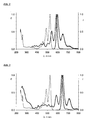
- the UV / Vis absorption of (2) is in Figure 2 shown - compared to (1a) observed a significant bathochromic color shift. Even more striking is the pronounced, red fluorescence of the substance, whose quantum efficiency is close to 100%. This is remarkable insofar as it is speculated in the literature that high fluorescence quantum yields are not possible in the long-wavelength visible spectral range because of coupling with CH vibrational overtones.
- the fluorescence of (2) surprisingly refutes this postulate.
- the substance is extremely lightfast and is also suitable for applications under the direct influence of sunlight.
- the new substance (2) has the advantage that not only has a bathochromic shift of the longest wavelength absorption occurred, but, in addition, in the visible and UV ranges, additional bands are attributable to the novel heterocyclic structure. These new bands cause light to be absorbed by the longest wavelength absorption down to the UV range, resulting in a broadband absorber.
- Such broadband absorbers are of particular interest for any type of solar applications, in particular for light collection systems, which can thus use a correspondingly large section of the solar radiation.
- the colorants (2) and (3) can be deprotonated - this leads to a surprisingly strong bathochromic shift of absorption and fluorescence - in addition, the fluorescence is surprisingly intense; please refer Figure 4 , These colorants can thus be used as NIR colorants: here, the usual applications as an invisible fluorescent marker or as a contrast agent in medicine to think, since in this area, the tissue absorbs little light.
- the deprotonated species fluoresces correspondingly long-wavelength shifted, as in the fluorescence of the anion.
- the ground state reached by the fluorescence is then also deprotonated and returns to its original state by protonation;
- the amazing thing about the cycle is that it also works in non-aqueous media efficient at the long wavelengths, while the first ESPT process found by Förster and Weller took place in the short-wave spectral range and in an aqueous medium in which the proton transmissions are very fast.
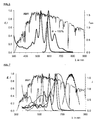
- the substances (2) and (3), in particular the latter, are extremely interesting for fluorescence solar collectors because there is a combination of broadband absorption in the visible, a strong fluorescence in the NIR range; An impression of this is provided by a comparison with the AM1 solar spectrum Figure 6 , If one uses a stack of superimposed plates, then the solar spectrum can be broken down into individual areas and used individually.
- the ESPT mechanism also provides a large Stokes shift that spectrally separates the absorption and fluorescence spectra, thereby suppressing reabsorption of fluorescence in the fluorescence solar collector. Since the colorants are also extremely lightfast, there is an ideal material for the fluorescent solar collector.
- the broad absorption of light is of interest, since in this case it is possible to optically excite broadband emitting light sources such as flash lamps, since the colorants can absorb a large part of the light due to their broadband absorption and convert it to the spectrally narrower range of fluorescence ,
- Colorants such as (2) or (3) can be used in photovoltaic directly in organic Solar cells are used or in electrolyte systems, such. B. the Grätzel cell Angew. Chem. 2007, 119, 8510-8514 ]. Finally, colorants of the chromophore (2) are of interest in cases where it is desired to dim, without weakening the infrared radiation; These colorants are therefore particularly suitable here, because they can completely absorb the visible light, but not weaken the infrared light. This is important for passive solar thermal systems.
- the long-wave and broadband absorption of the colorant of the chromophore (3) is of interest, for example, if you want a tint of slices, such as a tint for heat protection against light radiation.
- a tint of slices such as a tint for heat protection against light radiation.
- the absorbed light is not simply converted into heat, but emitted again as fluorescent light.
- the absorber is heated much weaker than if a conventional, non-fluorescent colorant would be used.
- the new colorants (2) and (3) can also be used as pigment or textile dyes in conventional technology. Here, their long-wave light absorption is interesting, can be achieved by the special color effects.
- the compounds of this invention can also be obtained by the condensation of an amide-substituted perylene diimide in the presence of a strong base (as before, for example sodium amide), optionally in the presence of a solvent.
- a strong base as before, for example sodium amide
- IR Spectra Perkin Elmer 1420 Ratio Recording Infrared Spectrometer, FT 1000; UV / Vis spectra: Varian Cary 5000 and Bruins Omega 20; Fluorescence spectra: Perkin Elmer FS 3000 (fully corrected); NMR spectroscopy: Varian Vnmrs 600 (600 MHz); Mass spectrometry: Finnigan MAT 95.
- Example 1 2,10-Bis (1-hexylheptyl) -6-phenyl [1,3] diazepino [4 ', 5', 6 ': 4,5] phenanthro- [2,1,10- def :: 7 , 8,9- d'e'f '] diisoquinoline-1,3,9,11 (2 H , 5 H , 9 H , 11 H ) -tetraone (2a) and 2,9-bis (1-hexylheptyl) -bis- [1,3] diazepino [4 ', 5', 6 ': 1,12; 4 ", 5", 6 ": 6,7] perylo [3,4- cd : 9,10- c' ] d '] dipyridin-1,3,9,11 (2 H, 5 H, 10 H, 13 H) -tetraon (3a) of N, N, N'-bis (1-hexylheptyl) -perylene-3,4
- Example 2 2,10-Bis (1-hexylheptyl) -6- (2-naphthyl) [1,3] diazepino [4 ', 5', 6 ': 4,5] -phenanthro [2,1,1 0 - def :: 7,8,9- d'e'f '] diisoquinoline-1,3,9,11 (2 H , 5 H , 9 H , 11 H ) -tetraone (2e).
- N, N'-bis (1-hexylheptyl) -perylene-3,4: 9,10-tetracarboxylic acid-3,4: 9,10-bisimide ((1a), 200 mg, 0.264 mmol), NaNH 2 (1 00 g, 5.12 mmol) and 2-naphthonitrile (8 g) were reacted and worked up as in Example 1.
- Example 3 2,10-Bis (1-hexylheptyl) -6- (4-bromophenyl) [1,3] diazepino [4 ', 5', 6 ': 4,5] -phenanthro [2,1,10- def :: 7,8,9- d'e'f '] diisoquinoline-1,3,9,11 (2 H , 5 H , 9 H , 11 H ) -tetraone (2c).
- Example 4 10-Bis [1- (1-methylethyl) -2-methylpropyl] -6-phenyl [1,3] diazepino [4 ', 5' -, 6 ': 4,5] phenanthro [2,1, 10- def :: 7,8,9- d'e'f '] diisoquinoline-1,3,9,11 (2 H , 5 H , 9 H , 11 H ) -tetraone (2b).
- N, N '-bis [1- (1-methylethyl) -2-methylpropyl] perylene-3,4: 9,10-tetracarboxylic acid-3,4: 9,10-bisimide ((1b), 1.30 g, 1.85 mmol), NaNH 2 (1.30 g, 33.3 mmol) and benzonitrile (250 g) were reacted and worked up as in Example 1.
- Example 5 2,10-Bis (1-hexylheptyl) -6- (4-methoxyphenyl) [1,3] diazepino [4 ', 5', 6 ': 4,5] -phenanthro [2,1,10- def :: 7,8,9- d'e'f '] diisoquinoline-1,3,9,11 (2 H , 5 H , 9 H , 11 H ) -tetraone (2d).
- N, N'-bis (1-hexylheptyl) -perylene-3,4: 9,10-tetracarboxylic acid-3,4: 9,10-bisimide ((1a), 500 mg, 0.660 mmol), NaNH 2 (500 mg , 12.8 mmol) and 4-methoxybenzonitrile (20 g) were reacted and worked up as in Example 1.
- Example 6 2,10-Bis (1-hexylheptyl) -5-methyl-6-phenyl [1,3] diazepino [4 ', 5', 6 ': 4,5] -phenanthro [2,1,10- def :: 7,8,9- d'e'f '] diisoquinoline-1,3,9,11 (2 H , 5 H , 9 H , 11 H ) -tetraone (4a).
- Example 7 2,10-Bis [1- (1-methylethyl) -2-methylpropyl] -5-methyl-6-phenyl [1,3] di-azepino [4 ', 5', 6 ': 4.5 ] phenanthro [2,1,10- def : 7,8,9- d'e'f '] diisoquinoline-1,3,9,11 (2 H , -5 H , 9 H , 11 H ) -tetraone ( 4b).
- Example 8 8,15-Bis (1-hexylheptyl) -phenanthra [2,1,10- def : 7,8,9- d'e'f '] -2,5-diphenyl-1,6,10 , 15-tetrahydro-imidizo [4,5-h: 4 ', 5'-h'] diisoquinoline-7,9,14,16-tetraone.
- N, N'-bis (1-hexylheptyl) perylene-3,4: 9,10-tetracarboxylic acid-3,4: 9,10-bisimide ((1a), 1.00g, 1:32 mmol) and NaNH 2 (1.00 g, 25.6 mmol) were suspended in benzonitrile (250 mL), heated to 165 ° C (blue color), cooled again after 3 h, shaken with a 1: 1 mixture of 2 N aqueous HCl and CHCl 3 (300 mL), over magnesium sulfate dried, with the rotary evaporator at 12 mbar and then evaporated to remove benzonitrile in a fine vacuum, taken up in CHCl 3 , filtered and purified by column chromatography on silica gel with chloroform as eluent.
- Example 9 2,10-Bis (1-hexylheptyl) -6- (2-bromophenyl) [1,3] diazepino [4 ', 5', 6 ': 4,5] -phenanthro [2,1,10- def :: 7,8,9- d'e'f '] diisoquinoline-1,3,9,11 (2 H , 5 H , 9 H , 11 H ) -tetraon.
- Example 10 2,10-Bis (1-hexylheptyl) -6- (3-bromophenyl) [1,3] diazepino [4 ', 5', 6 ': 4,5] -phenanthro [2,1,10- def :: 7,8,9- d'e'f '] diisoquinoline-1,3,9,11 (2 H , 5 H , 9 H , 11 H ) -tetraon.
- N, N'-bis (1-hexylheptyl) perylene-3,4: 9,10-tetracarboxylic acid-3,4: 9,10-bisimide (200 mg, 0.265 mmol) and NaNH 2 (200 mg, 5.13 mmol) were in m-bromobenzonitrile (10 g) and analogously to 2,10-bis (1-hexylheptyl) -6-phenyl [1,3] diazepino [4 ', 5', 6 ': - 4,5] phenanthro [2,1,10- def :: 7,8,9- ezf '] diisoquinoline-1,3,9,11 (2 H , 5 H , 9 H , 11 H ) -tetraone and worked up and purified by column chromatography (silica gel, chloroform / iso).
- Example 11 2,10-Bis (1-hexylheptyl) -6- (4-dimethylaminophenyl) [1,3] diazepino [4 ', 5', 6'-d ", e", f "] phenanthra [ 2,1,10- def: 7,8,9- d'e'f '.] -2,5,9,11-tetrahydro-diisoquinoline-1,3,9,11-tetraone N, N' -bis (1-hexylheptyl) perylene-3,4: 9,10-tetracarboxylic acid 3,4: 9,10-bisimide (200 mg, 0.26 mmol), NaNH 2 (200 mg, 5.13 mmol) were dissolved in 4-dimethylaminobenzonitrile (10 g) and analogously to 2,10-bis (1-hexylheptyl) -6-phenyl [1,3] diazepino [4 ', 5', 6 '
- Example 12 2,10-Bis- (1-hexylheptyl) -6- (2,4-bismethoxyphenyl) - [1,3] diazepino- [4 ', 5', 6'-d ";e”; f " ] phenanthra [2,1,10- def : 7,8,9- d'e'f '] -2,5,9,11-tetrahydro-diisoquinoline-1,3,9,11-tetrazone, N , N -Bis (1-hexylheptyl) perylene-3,4: 9,10-tetracarboxylic acid 3,4: 9,10-bisimide (200 mg, 0.265 mmol) and NaNH 2 (200 mg, 5.13 mmol) were prepared in 2, Dissolved 4-bismethoxybenzonitrile (10 g) at 100 ° C and analogously to 2,10-bis (1-hexylheptyl) -6-phenyl [1,3]
- Example 13 2,10-Bis- (1-hexylheptyl) -6- (3,4-bismethoxyphenyl) - [1,3] diazepino- [4 ', 5', 6'-d ", e”; f " ] phenanthra [2,1,10- def : 7,8,9- d'e'f '] -2,5,9,11-tetrahydro-diisoquinoline-1,3,9,11-tetrazone, N , N -Bis (1-hexylheptyl) perylene-3,4: 9,10-tetracarboxylic acid 3,4: 9,10-bisimide (0.240 g, 0.317 mmol) and NaNH 2 (0.200 g, 5.13 mmol) were prepared in 2, Dissolved 4-bismethoxybenzonitrile (10 g) at 100 ° C and analogously to 2,10-bis (1-hexylheptyl) -6-pheny
- Example 14 Dinitrogen tetraoxide in dichloromethane: Solid lead (II) nitrate (100 g, 302 mmol) is vigorously heated in a round bottom flask with the Bunsen burner and the resulting nitrous gases are passed into a receiver flask with dichloromethane (1000 mL) until the dichloromethane solution is saturated. This reagent is used for the alternative synthetic route according to the following examples.
- Example 15 1-nitro-N, N '-bis- (1-hexylheptyl) perylene-3,4: 9,10-bis (dicarboximide).
- N, N'-bis (1-hexylheptyl) perylene-3,4: 9,10-tetracarboxylic acid-3,4: 9,10-bisimide (1a, 3:00 g, 3.97 mmol) was placed in dichloromethane (200 mL), with methanesulfonic acid (2 mL, 30.8 mmol) added (catalyst in excess), with a saturated solution of dinitrogen tetroxide in dichloromethane (according to Example 14) added dropwise with stirring at room temperature until a control by thin layer chromatography (silica gel, chloroform) gives complete reaction (Color change of the solution to dark red); washed with distilled water (100 mL), dried over magnesium sulfate, evaporated with the rotary evaporator, dissolved in
- Example 16 1-amino-N, N '-bis- (1-hexylheptyl) perylene-3,4: 9,10-bis (dicarboximide).
- 1-nitro-N, N '-bis- (1-hexylheptyl) perylene-3,4: 9,10-bis (dicarboximide) according to Example 15 (2:41 g, 3.01, mmol) was dissolved in THF (100 mL) (dark red Solution), with Iron powder (350 mg, 6.27 mmol) and concentrated hydrochloric acid (11 mL), heated with stirring for 30 minutes under reflux (after 10 minutes a color change from dark red to dark blue), allowed to cool, with distill.
- IR (ATR): ⁇ 3350m, 3242m, 3047w, 2954s, 2926s, 2856s, 1694s, 1653s, 1616m, 1590s, 1573m, 1510m, 1463m, 1429s, 1397 m, 1373 m, 1339 s, 1311 m, 1269 m, 1252 m, 1178 m, 1122 W, 1084 m, 1062 W, 979 W, 846 W, 809 m, 750 W, 725 cm -1 W.
- Example 17 1-Benzamidyl- N, N '-bis (1-hexylheptyl) perylene-3,4: 9,10-tetracarbon Acidbisimid.
- 1-amino-N, N '-bis- (1-hexylheptyl) perylene-3,4: 9,10-bis (dicarboximide) of Example 16 (240 mg, 0.31mmol) was dissolved in dioxane (60 mL), Benzoyl chloride (1.00 g, 7.10 mmol) in dioxane (10 mL) was added dropwise, the mixture was stirred at 100 ° C.
- Example 18 2,10-Bis (1-hexylheptyl) -6-phenyl [1,3] diazepino [4 ', 5', 6'- d " , e” , f " ] phenanthra [2,1,10 - def: 7,8,9- d 'e' f '] -2,5,9,11-tetrahydro-diisoquinoline-1,3,9,11-tetraone Benzamidyl- 1-N, N,' -bis ( 1-hexylheptyl) perylene-3,4: 9,10-tetracarboxylic acid 3,4-anhydride-9,10-imide (100mg, 0.110mmol) and NaNH 2 (100mg, 2.56mmol) were dissolved in benzonitrile (250mL ), heated to 165 ° C (blue color), cooled again after 3 h, extracted with a 1: 1 mixture of HCl solution (2 N) and C
- Example 19 Exhaustive nitration of perylene-3,4,9,10-tetracarboxylic acid 3,4: 9,10-bit- (1-hexylheptylimide) -1,6-dinitroperylene-3,4,9,10-tetracarboxylic acid 3,4: 9,10-bis ((hexylheptylimide) and 1,7-dinitroperylene-3,4,9,10-tetracarboxylic acid 3,4: 9,10-bis (1-hexylheptylimide).
- N, N'-bis (1-hexylheptyl) perylene-3,4: 9,10-tetracarboxylic acid-3,4: 9,10-bisimide ((1a), 3.19 g, 4.23 mmol) was dissolved in little Dissolved dichloromethane, mixed with methanesulfonic acid (2 mL) and dinitrogen tetroxide solution, under irradiation with light (80 W tungsten filament incandescent lamp) stirred for 6 h at room temperature, by adding with distill. Water (100 ml) was stopped, extracted several times with chloroform (100 ml in each case), dried over magnesium sulfate, concentrated and chromatographed (silica gel, chloroform).
- IR (ATR): ⁇ 3047 w, 2978 m, 2927 s, 2857 m, 1705 s, 1664 s, 1599 s, 1542 s, 1427 w, 1407 m, 1335 s, 1251 m, 812 m, 743 cm -1 w.
- Example 20 1,6-isomer mixture Diaminoperylen-3,4,9,10-tetracarboxylic acid-3,4: 9,10-bis (1-hexylheptylimid) and 1,7-3,4,9,10-Diaminoperylen tetracarboxylic acid-3,4: 9,10-bis (1-hexylheptylimid).
- IR (ATR): ⁇ 3441 s br, 3360 s, 3250 m, 2954 m, 2926 s, 2857 m, 1691 s, 1646 s, 1588 s, 1552 w, 1530 w, 1515 w, 1455 m, 1422 m , 1393 m, 1339 s, 1272 m, 1246w, 1185w, 1107w, 984w, 873m, 806m, 778w, 755m, 723w, 574cm -1 w.
- UV / Vis (CHCl 3 ): ⁇ max ( E rel ) 384 nm (0.19), 402 (0.25), 432 (0.16), 506 sh (0.32), 581 sh (0.90), 611 (1.0).
- Example 21 1,6-bis-benzamidyl- N, N '-bis (1-hexylheptyl) perylene-3,4: 9,10-tetracarboxylic-carbonklarebisimid and 1,7-bis-benzamidyl- N, N' -bis (1-hexylheptyl) perylene-3,4: 9,10-tetracarbon Acidbisimid.
- IR (ATR): ⁇ -3222.2 m, 2952.2 m, 2922.0 s, 2854.0 m, 1699.4 s, 1654.9 s, 1592.0 s, 1502.4 w, 1478.9 w, 1455.4 w, 1409.3 w, 1322.4 s, 1267.3 m, 1243.3 m, 1180.4 w, 1108.0 w, 1026.1 w, 895.7 w, 862.1 m, 809.1 w, 749.4 m, 704.0 m, 585.4 w cm -1 .
- Example 22 1,6-bis-benzamidyl- N, N '-bis (1-hexylheptyl) perylene-3,4: 9,10-tetracarbonklarebisimid and 1,7-bis-benzamidyl- N, N' -bis (1 -hexylheptyl) perylene-3,4: 9,10-tetracarboxylic bisimide (100 mg, 0.10 mmol) as mixture of isomers and NaNH 2 (100 mg, 2.56 mmol) were suspended in benzonitrile (250 mL), heated to 165 ° C (blue coloration) , cooled after 3 h and shaken with a 1: 1 mixture of aqueous HCl (2 N) and CHCl 3 (300 mL).
- Example 23 2,10-Bis (1-hexylheptyl) - ( N -benzyl) -6-phenyl [1,3] diazepino [4 ', 5', 6 ': 4,5] -phenanthro [2,1, 10- def :: 7,8,9- d 'e' f '] diisoquinoline-1,3,9,11 (2H, 5H, 9H, 11H) -tetraon.
- Example 24 2,10-Bis (1-hexylheptyl) - ( N -4-tert -butylbenzyl) -6-phenyl [1,3] diazepino [4 ', 5', 6 ': 4,5] phenanthro [ 2,1,10- def :: 7,8,9- d'e'f ' ] diisoquinoline-1,3,9,11 ( 2H , 5H , 9H , -11H ) -tetraone.
- Example 25 Bichromophore of monoadduct and perylenebisimide.
- Example 26 2,10-Bis (1-hexylheptyl) - ( N -butyl) -6-phenyl [1,3] diazepino [4 ', 5', 6 ': 4,5] -phenanthro [2,1, 10- def :: 7,8,9-d'e'f] diisoquinoline-1,3,9,11 ( 2H, 5H, 9H, 11H ) -tetraone.
- Example 27 2,10-Bis (1-hexylheptyl) - ( N -pentyl) -6-phenyl [1,3] diazepino [4 ', 5', 6 ': 4,5] -phenanthro [2,1, 10- def :: 7,8,9- dsf ] diisoquinoline-1,3,9,11 ( 2H, 5H, 9H, 11H ) -tetraon.
- Example 28 2,10-Bis (1-hexylheptyl) - ( N -pentyl) -6-phenyl [1,3] diazepino [4 ', 5', 6 ': 4,5] -phenanthro [2,1, 10- def :: 7,8,9- dsf ] diisoquinoline-1,3,9,11 ( 2H, 5H, 9H, 11H ) -tetraone (variant to Ex. 27).
- IR (ATR): ⁇ 3061.2 w, 2954.1 m, 2922.7 s, 2854.7 s, 1686.7 s, 1644.5 s, 1591.1 m, 1529.6 w, 1484.3 w, 1454.7 w, 1424.7 w, 1408.1 w, 1378.5 w, 1331.0 s, 1251.8 m, 1222.8 w, 1179.2 w, 1101.9 w, 1025.9 w, 929.9 w, 874.0 w, 842.2 w, 808.4 w, 771.9 w 749.8 w cm -1 .
- Example 29 2,10-Bis (1-hexylheptyl) - ( N -hexyl) -6-phenyl [1,3] diazepino [4 ', 5', 6 ': 4,5] -phenanthro [2,1, 10- def :: 7,8,9- d'e'f ' ] diisoquinoline-1,3,9,11 ( 2H, 5H, 9H, 11H ) -tetraone.
- Example 30 2,10-Bis (1-hexylheptyl) - ( N -allyl) -6-phenyl [1,3] diazepino [4 ', 5', 6 ': 4,5] -phenanthro [2,1, 10- def :: 7,8,9- d'e'f ' ] diisoquinoline-1,3,9,11 ( 2H, 5H, 9H, 11H ) -tetraone.
- Example 31 2,10-Bis (1-hexylheptyl) - ( N -propargyl) -6-phenyl [1,3] diazepino [4 ', 5', 6 ': - 4,5] -phenanthro [2,1 , 10- def :: 7,8,9- d'e'f ' ] diisoquinoline-1,3,9,11 ( 2H, 5H, 9H, 11H ) -tetraone.
- Example 32 2,9-Bis (1-hexylheptyl) bis- [1,3] diazepino [4 ', 5', 6 ': 1,12; 4 ", 5", 6 “: 6,7] - perylo [3,4- cd : 9,10- c'd ] dipyridine-1,3,9,11 ( 2H, 5H, 10H, 13H ) -tetrazone, 2,9-bis (1-hexylheptyl) -bis [1,3] diazepino [4 ', 5', 6 ': 1,12; 4 ", 5", 6 “: 6,7] perylo [3,4- cd : 9,10- c'd' ] dipyridine-1,3,9,11 ( 2H, 5H, 10H, 13H ) -tetraone according to Example 22 (90 mg, 0.091 mmol), p-tert- butylbenzylbromide (800 mg, 3.52 mmol
Landscapes
- Chemical & Material Sciences (AREA)
- Organic Chemistry (AREA)
- Nitrogen Condensed Heterocyclic Rings (AREA)
- Plural Heterocyclic Compounds (AREA)
- Nitrogen And Oxygen Or Sulfur-Condensed Heterocyclic Ring Systems (AREA)
Description
- Durch die Verknappung von fossilen Energieträgern und deren Kohlendioxid-Emission, die über den Treibhauseffekt zu einer globalen Erwärmung führt, besteht in der Technik ein zunehmendes Interesse an alternativen Energiequellen, deren Nutzung sich nicht negativ auf die Umwelt auswirkt. Von diesen ist die Solarenergie besonders attraktiv, weil sie für menschliche Dimensionen unbegrenzt erscheint. Das Hauptproblem ist aber andererseits die geringe Energiedichte dieser Quelle, das für die technische Nutzung ausgesprochen gravierend ist. Das Problem kann grundsätzlich durch lichtkonzentrierende Systeme gelöst werden. Wenn man dabei auch die in den gemäßigten Breiten wichtige diffuse Solarstrahlung nutzen will, werden Systeme mit einer nichtlinearen Optik benötigt. Hier ist insbesondere der Fluoreszenz-Solarkollektor [Nachr. Chem. Tech. Lab. 1980, 28, 716-718] zu nennen, der aus einer planparallelen Platte aus hoch lichtbrechendem Material besteht, die mit einem Fluoreszenzfarbstoff eingefärbt ist. Für den kurzwellig sichtbaren Bereich stehen einige Farbmittel, wie z. B. die Perylenfarbmittel (1), zur Verfügung, die mit hohen Quantenausbeuten fluoreszieren. Demgegenüber stellt der langwellig sichtbare und NIR-Bereich das größte Problem dar.
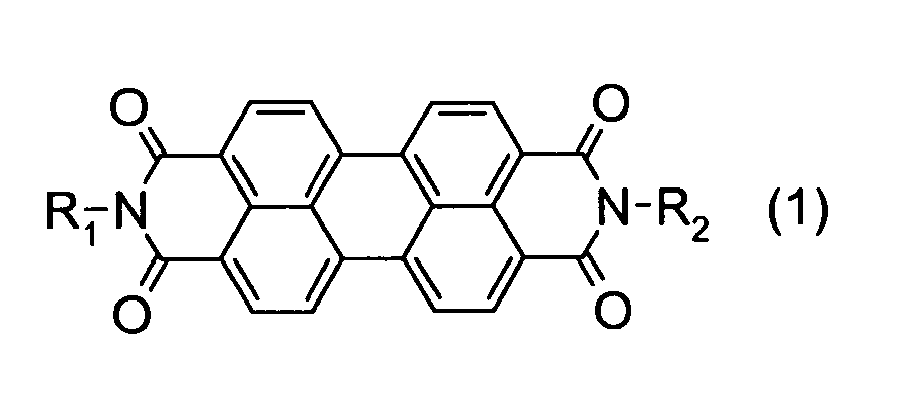
1 R1=R2 a CH(n-C6H13)2 b CH(iso-C3H7)2 - Die Aufgabe der Erfindung war die Entwicklung eines breitbandig absorbierenden Fluoreszenzfarbmittels, der im langwellig sichtbaren Bereich fluoresziert, um ihn für Anwendungen wie Lichtsammelsystemen, beispielsweise in Fluoreszenz-Solarkollektoren, einsetzen zu können.
- Die Lichtechtheit der Perylentetracarbonsäurebisimide (1) [Helv. Chim. Acta. 2005, 88, 1309-1343; Heterocycles 1995, 40, 477-500] und ihre hohen Fluoreszenzquantenausbeuten macht die Verbindungsklasse für Solaranwendungen, wie z. B. im Fluoreszenz-Solarkollektor, ausgesprochen interessant. Mit λmax von ca. 525 nm kann jedoch nur der kurzwellig sichtbare Bereich der Solarstrahlung durch (1) genutzt werden. Es gibt einen ganze Reihe von Ansätzen, die Lichtabsorption der Perylenbisimide in den längerwelligen Bereich zu verschieben. So hat z. B. der Austausch der Carbonylgruppen in (1) gegen Ketimino-Gruppen zu einer deutlichen bathochromen Verschiebung der Absorption geführt [J. Prakt. Chem. 1997, 339, 597-602; Liebigs Ann. Chem. 1995, 481- 486; Chem. Ber. 1983, 116, 3524-3528]. Nach Adachi [Pure Appl. Chem. 1996, 68, 1441- 1442] ist dabei allerdings der nach diesem Konzept erreichbare bathochrome Shift begrenzt.


- Als Alternative ist für eine langwellige Verschiebung der Perylenkern in den Positionen 1,6,7 und 12 mit Donor-Gruppen substituiert worden [Forschungsber. - Bundesminist. Forsch. Technol., Technol. Forsch. Entwickl. 1984, BMFT-FB-T 84-164; Chem. Abstr. 1985, 102, 150903; Vestn. Khar'kov. Politekh. Inst. 1969, 41, 21-26; Chem. Abstr. 1971, 75, 7375; Tetrahedron Lett. 1999, 40, 7047-7050; Eur. J. Org. Chem. 2000, 365-380] (diese Positionen werden in der Literatur häufig als ,Bay-Region' bezeichnet - dieser Ausdruck wird hier nicht verwendet, denn er erweckt den unzutreffenden Eindruck, dass hier eine sterisch besonders leicht zugängliche Struktur vorliegt; an diesen Positionen ist aber der sterische Druck besonders groß, weil eine Häufung von Wasserstoffatomen vorliegt, die bei der üblichen Strichschreibweise der Formeln nicht zum Ausdruck kommt).
- Der Chromophor der Perylenbisimide kann als inverses König'sches Farbstoff-System aufgefasst werden; im normalen Farbstoff-System nach Gleichung (a) [Prakt. Chem. 1926, 112, 1-36] sind zwei terminale Donor- Gruppen über π-Systeme mit einem zentralen Acceptor verknüpft. Bei inversen Systemen sind entsprechend Gleichung (b) Donor und Acceptorgruppen vertauscht. Bei den Perylenbisimiden bilden die Carbonylgruppen diese terminalen Acceptor-Gruppen, und die Donor-Gruppen im Zentrum fehlen [Helv. Chim. Acta. 2005, 88, 1309-1343]. Dementsprechend bewirken Donor-Gruppen in diesen Positionen eine bathochrome Verschiebung der Absorption, die bei dem Einsatz von α-Effekt-Donorgruppen [Dyes Pigm. 2003, 59, 109-116] bis in den NIR-Bereich hineinreicht. Bisher sind diesen Positionen nur fünf- und sechsgliedrige Ringe ankondensiert worden. Es ist zu fragen, in wieweit andere Ringgrößen zu Farbmitteln mit interessanten, langwellig absorbierenden Farbmitteln führen.

- Wir haben auf den Farbmittel (1a) [Chem. Ber. 1988, 121, 225-230] eine Mischung von Natriumamid und Benzonitril unter Luftsauerstoff bei einer Temperatur von 160°C einwirken lassen und dabei erstaunlicherweise direkt einen Ringschluss zu einem siebengliedrigen Ring unter Bildung von (2a) erzielt, bei dem ein Siebenring mit zwei Stickstoffatomen an (1a) ankondensiert ist; siehe
Abbildung 1 . Bei einen Überschuss der Reagenz-Mischung erfolgt die Reaktion auch doppelt unter Bildung der Substanzen (3a). Diese Reaktion ist nicht singulär auf das Substrat (1a) und Benzonitril beschränkt, sondern ist überraschend universell. So konnte die Reaktion auch am Beispiel des komplizierter aufgebauten Ausgangsmaterials (1 b) [Angew. Chem. 2006, 118, 4555-4561; Angew. Chem. Int. Ed. Engl. 2006, 45, 4444-4447] unter Bildung von (2b) und (3b) verifiziert werden. Diverse andere aromatische Nitrile konnten umgesetzt werden, wie z.B. 4-Brombenzonitril zu (2c) und (3c), 4-Methoxybenzonitil zu (2d) und (3d), und es ist sogar die Umsetzung von Nitrilen mehrkerniger Aromaten möglich, wie die Reaktion von 2-Naphthonitril zu (2e) und (3e) zeigt. Die Reaktion kann in Substanz oder in Lösung durchgeführt werden. Allerdings muss das Solvens hinreichend stabil unter den stark alkalischen Reaktionsbedingungen sein, wie z.B. 1,2-Dimethoxyethan. Die Nitrile lassen sich überraschenderweise durch die Carbonsäureamide, wie z. B. Benzamid ersetzen - die Ausbeuten an (2) und (3) werden dadurch nicht nennenswert beeinflusst. Die starke Base Natriumamid kann durch festes Kaliumhydroxid ersetzt werden; Natriumhydrid liefert deutlich schlechtere Ergebnisse. Für den Ablauf der Reaktion ist der Zutritt von Luftsauerstoff erforderlich, denn unter Argon-Schutzatmosphäre konnte keinerlei Umsetzung nachgewiesen werden.
- Die Substanzen (2) und (3) enthalten jeweils an einem bzw. zwei Stickstoffatomen acide Protonen. Man kann daher fragen, ob diese Positionen nach einer Deprotonierung mit Elektrophilen umgesetzt werden können. Zwar liegen solche Anionen auch spontan in den Protonierungsgleichgewichten vor, günstigere Ergebnisse haben wir aber nach einer Deprotonierung unter Verwendung starker Basen erwartet. Wir haben die Substanzen (2) und (3) jeweils mit Natriumhydrid als typische starke Base deprotoniert und dann mit Methyliodid als Elektrophil umgesetzt. Eine Reaktion erfolgte unter diesen Bedingungen erstaunlich glatt unter Bildung der Methylderivate.

- Die UV/Vis-spektroskopischen Eigenschaften der neuen Farbmittel-Klassen sind ebenso überraschend, wie deren einfache Synthese. Die UV/Vis-Absorption von (2) ist in
Abbildung 2 dargestellt - man beobachtet gegenüber (1a) eine erhebliche bathochrome Farbverschiebung. Erstaunlicher ist noch die ausgeprägte, rote Fluoreszenz der Substanz, deren Quantenausbeute nahe bei 100% liegt. Dies ist insofern bemerkenswert, da in der Literatur spekuliert wird, dass im langwellig sichtbaren Spektralbereich wegen einer Kopplung mit C-H-Schwingungsobertönen keine hohe Fluoreszenzquantenausbeuten möglich sind. Die Fluoreszenz von (2) widerlegt überraschend dieses Postulat. Die Substanz ist ausgesprochen lichtecht und eignet sich auch für Anwendungen unter direkter Einwirkung des Sonnenlichts. Die neue Substanz (2) hat gegenüber den oben erwähnten, donorsubstituierten Perylenderivaten den Vorteil, dass nicht nur eine bathochrome Verschiebung der längstwelligen Absorption erfolgt ist, sondern darüber hinaus im sichtbaren und UV-Bereich weitere Banden hinzukommen, welche der neuen heterocyclischen Struktur zuzuschreiben sind. Diese neuen Banden bewirken, dass von der längstwelligen Absorption bis in der UV-Bereich Licht absorbiert wird, so dass ein Breitband-Absorber vorliegt. Solche Breitbandabsorber sind für jede Art von Solaranwendungen von besonderem Interesse, insbesondere für Lichtsammelsysteme, die damit einen entsprechend großen Ausschnitt aus der Solarstrahlung nutzen können. - Beim neuen heterocyclischen Farbmittel (3) mit zwei siebengliedrigen Ringen tritt eine noch stärkere bathochrome Verschiebung der Absorption auf, so dass man bereits grüne Lösungen erhält; siehe
Abbildung 3 . Hier liegt ein extremer Breitbandabsorber vor, der kontinuierlich vom UV- bis in den NIR-Bereich Licht aufnehmen kann. Auch dieser Farbmittel fluoresziert mit einer nahe bei 100% liegenden Quantenausbeute. Da der überwiegende Teil der Fluoreszenz im langwellig sichtbaren Bereich auftritt mit einer bereits absinkenden Augenempfindlichkeit und große Teile des Spektrums im NIR liegen, erscheint die tiefrote Fluoreszenz nicht mehr so ausgeprägt, wie die von (2). - Mit starken Basen wie DBU lassen sich die Farbmittel (2) und (3) deprotonieren - dies führt zu einem überraschend starken bathochromen Shift der Absorption und der Fluoreszenz - zudem ist die Fluoreszenz erstaunlich intensiv; siehe
Abbildung 4 . Diese Farbmittel können dadurch als NIR-Farbmittel eingesetzt werden: Hier ist an die üblichen Anwendungen als unsichtbarer Fluoreszenzmarker oder als Kontrastmittel in der Medizin zu denken, da in diesem Bereich das Gewebe nur wenig Licht absorbiert. - Es wäre für diverse praktische Anwendungen der Farbmittel interessant, nur die Fluoreszenz von (2) oder (3) langwellig zu verschieben und die Lichtabsorption spektral zu belassen. Es ist zu fragen, ob dies durch eine schwache Base bewirkt werden kann. Wir haben deshalb den Farbmittel (2) mit der schwachen Base Piperidin gemischt und einen erstaunlich großen Stokes-Shift erzielt; siehe
Abb. 5 . Offensichtlich führt die optische Anregung des Farbmittels zu einer genügend großen Aciditätssteigerung der N-H-Gruppe, dass diese durch die schwache Base deprotoniert werden kann und so der erstaunlich großen Stokes-Shift auftritt. Für die Vergrößerung des Stokes-Shifts wird der ESPT-Mechanismus nachAbb. 5 verantwortlich gemacht, bei dem der Grundzustand des Farbmittels Licht absorbiert und dadurch optisch angeregt wird. Hierdurch erfolgt eine Deprotonierung des Stickstoffs unter Erhaltung der optischen Anregung. Die deprotonierte Spezies fluoresziert entsprechend langwellig verschoben, wie bei der Fluoreszenz des Anions. Der durch die Fluoreszenz erreichte Grundzustand ist dann ebenfalls deprotoniert und geht durch Protonierung wieder in den Ausgangszustand zurück; erstaunlich ist bei dem Kreisprozess, dass er auch in nichtwässrigen Medien derart effizient bei den langen Wellenlängen erfolgt, während der erste von Förster und Weller gefundene ESPT-Prozess im kurzwelligen Spektralbereich und in wässrigem Medium erfolgte, in dem die Protonenübertragungen sehr schnell sind. Das Resultat, ein Fluoreszenzfarbmittel mit extrem großem Stokes-Shift im langwelligen Spektralbereich, ist für viele Anwendungen ausgesprochen interessant, da kein Fluoreszenzlicht wieder reabsorbiert wird, wie dies bei den konventionellen Fluoreszenzfarbmitteln erfolgt. Dies ist insbesondere für Anwendungen als Laserfarbmittel oder als Farbmittel für Fluoreszenz-Solarkollektoren wichtig. - Noch extremer und überraschender wird die Situation beim Farbmittel (3), denn hier wird die Emission bis weit in den NIR-Bereich verschoben - in dieser Eigenschaft sind die erfindungsgemässen Farbmittel bekannten Materialien überlegen.
- Die Substanzen (2) und (3), insbesondere die letztere, sind für Fluoreszenz-Solarkollektoren ausgesprochen interessant, denn es liegt eine Kombination aus breitbandiger Absorption im Sichtbaren, einer starken Fluoreszenz im NIR-Bereich vor; ein Eindruck davon vermittelt ein Vergleich mit dem AM1 Sonnenspektrum nach
Abbildung 6 . Verwendet man einen Stapel übereinanderliegender Platten, dann kann das Solarspektrum in einzelnen Bereiche zerlegt und einzeln genutzt werden. Über den ESPT-Mechanismus lässt sich zudem ein großer Stokes-Shift erzielen, durch den Absorptions- und Fluoreszenzspektrum spektral getrennt werden, so dass eine Reabsorption des Fluoreszenzlichts im Fluoreszenz-Solarkollektor unterdrückt wird. Da die Farbmittel zudem ausgesprochen lichtecht sind, liegt ein ideales Material für den Fluoreszenz-Solarkollektor vor. Bei der Anwendung als Laserfarbmittel ist die breite Lichtabsorption von Interesse, da man in diesem Fall mit breitbandig emittiernden Lichtquellen wie Blitzlampen optisch anregen kann, da die Farbmittel durch ihre breitbandige Absorption einen großen Teil des Lichts aufnehmen können und auf den spektral schmaleren Bereich der Fluoreszenz umwandeln. - Farbmittel wie (2) oder (3) können in der Photovoltaik direkt in organischen Solarzellen eingesetzt werden oder auch in Elektrolyt-Systemen, wie z. B. der Grätzel-Zelle [Angew. Chem. 2007, 119, 8510-8514]. Schließlich sind Farbmittel des Chromophors (2) in den Fällen interessant, in denen man eine Abdunkelung wünscht, ohne die Infrarotstrahlung zu schwächen; diese Farbmittel sind deshalb hier besonders geeignet, weil sie das sichtbare Licht komplett absorbieren können, das Infrarotlicht aber nicht schwächen. Dies ist für passiv arbeitende Solarwärmesysteme von Bedeutung.
- Die langwellige und breitbandige Absorption der Farbmittel des Chromophors (3) ist dann von Interesse, wenn man beispielsweise eine Tönung von Scheiben wünscht, wie eine Tönung zum Wärmeschutz gegen Lichtstrahlung. Im Gegensatz zu einer Tönung mit einer allein lichtabsorbierenden Substanz wird das absorbierte Licht nicht einfach in Wärme umgewandelt wird, sondern wieder als Fluoreszenzlicht abgestrahlt. Hierdurch wird der Absorber erheblich schwächer aufgeheizt, als wenn ein üblicher, nicht fluoreszierender Farbmittel eingesetzt würde.
- Die neuen Farbmittel (2) und (3) lassen sich auch als Pigment- oder Textilfarbstoffe in konventioneller Technologie einsetzen. Hierbei ist ihre langwellige Lichtabsorption interessant, durch die besondere Farbeffekte erzielt werden können.
- Die Erfindung betrifft daher folgende Gegenstände:
- 1. Diazepinoperylenbisimide der allgemeinen Formel

- 2. Bisdiazepinoperylenbisimide der allgemeinen Formel

- 3. Verfahren, dadurch gekennzeichnet, dass als Ausgangsmaterialien für die Darstellung von (5) und/oder (6) Perylentetracarbonsäurebisimide, aromatische Nitrile und starke Basen verwendet werden. Beispiele für starke Basen sind Natriumamid, Kaliumhydroxid, Kaliumhydrid und 16 Natriumhydrid. Beispiele für aromatische Nitrile (Arylnitrile) sind Benzonitril, 1- oder 2- Naphthonitril, 4-Brombenzonitril und 4-Methoxybenzonitril.
- 4. Verfahren, dadurch gekennzeichnet, dass die Synthese der Verbindungen (5) oder (6) in Gegenwart von Sauerstoff erfolgt, bevorzugt Luftsauerstoff.
- 5. Verfahren, dadurch gekennzeichnet, dass die Reaktionspartner Perylentetracarbonsäurebisimid, Arylnitril und Base in Substanz erfolgt, bevorzugt bei erhöhter Temperatur, beispielsweise bei Temperaturen zwischen 100 und 200°C, bevorzugt bei 160°C; hierbei wird das Arylnitril äquimolekular oder im Überschuss eingesetzt, bevorzugt in einem zweifachen Überschuss - es können aber auch größere Überschüsse eingesetzt werden. Beispiele für sind Benzonitril , 1- oder 2-Naphthonitril, 4-Brombenzonitril und 4-Methoxybenzonitril.
- 6. Verfahren, dadurch gekennzeichnet, dass die Reaktionspartner unter Verwendung von Lösungsmitteln umgesetzt werden. Beispiele für Lösungsmittel sind Ethylenglycodimethylether (Glyme) oder Diethylenglycoldimethylether (Diglyme).
- 7. Verfahren, dadurch gekennzeichnet, dass die Farbmittel (5) mit R4=H und (6) mit R5 oder R6 = H oder R5 und R6 = H zu den Farbmitteln (5) mit R4=Alkyl und (6) mit R5 oder R6 = Alkyl oder R5 und R6 = Alkylreste alkyliert, bevorzugt methyliert werden. Beispiele für Alkylierungsmittel sind Alkylhalogenide mit den betreffenden Resten, wie z. B. Alkylchloride, Alkylbromide und Alkyliodide oder mono- und Dialkylsulfate wie Dimethylsulfat oder Alkyl/arylsulfonate wie Methyltosylat. Bevorzugte Medien für solche Alkylierungen sind dipolaraprotische Lösungsmittel wie DMSO, DMF, N-Methylpyrrolidon (NMP), Tetramethylharnstoff, DMPU, DMEU oder Sulfolan.
- 8. Verfahren, dadurch gekennzeichnet, dass die Farbmittel (5) mit R4=H oder (6) mit R4 oder R8 = H oder R4 und R8 = H unter Zusatz von schwachen Basen zur Erzeugung von großen Stokes-Shifts nach dem ESPT-Mechanismus eingesetzt werden. Beispiele für schwache Basen sind Amine wie Piperidin.
- 9. Verwendung der Substanzen (5) oder (6) als Farbmittel, bevorzugt als Pigmente.
- 10. Verwendung der Substanzen (5) oder (6) als Farbmittel, bevorzugt als Pigmente für Leimfarben und verwandte Farben wie Aquarell-Farben und Wasserfarben und Farben für Tintenstrahldrucker, Papierfarben, Druckfarben, Tinten und Tuschen und andere Farben für Mal- und Schreib-Zwecke und in Anstrichstoffen.
- 11. Verwendung der Substanzen (5) oder (6) als Farbmittel, bevorzugt als Pigmente in Lacken. Bevorzugte Lacke sind Kunstharz Lacke wie Acryl- oder VinylHarze, Polyesterlacke, Novolacke, Nitrocellulose-Lacke (Nitrolacke) oder auch Naturstoffe wie Zaponlack, Schellack oder Qi-Lack (Japanlack bzw. Chinalack oder ostasiatischer Lack).
- 12. Verwendung der Farbmittel (5) oder (6) in Datenspeichern, bevorzugt in optischen Speichern. Beispiele sind Systeme wie die CD- oder DVD-Disk.
- 13. Verwendung der Substanzen (5) oder (6) als Fluoreszenzfarbmittel.
- 14. Verwendung der Substanzen (5) oder (6) in OLEDS (organischen Leuchtdioden).
- 15. Verwendung der Substanzen (5) oder (6) in photovoltaischen Anlagen.
- 16. Anwendung der Farbmittel (5) oder (6) zur Masse-Färbung von Polymeren. Beispiele sind Materialien aus Polyvinylchlorid, Polyvinylidenchlorid, Polyacrylsäure, Polyacrylamid, Polyvinylbutyral, Polyvinylpyridin, Celluloseacetat, Nitrocellulose, Polycarbonaten, Polyamiden, Polyurethanen, Polyimiden, Polybenzimidazolen, Melaminharzen, Silikonen wie Polydimethylsiloxan, Polyestern, Polyethern, Polystyrol, Polydivinylbenzol, Polyvinyltoluol, Polyvinylbenzylchlorid, Polymethylmethacrylat, Polyethylen, Polypropylen, Polyvinylacetat, Polyacrylnitril, Polyacrolein, Polybutadien, Polychlorbutadien oder Polyisopren bzw. die Copolymeren der genannten Monomeren.
- 17. Anwendung der Farbmittel (5) oder (6) zur Färbung von Naturstoffen. Beispiele sind Papier, Holz, Stroh, oder natürliche Fasermaterialien wie Baumwolle, Jute, Sisal, Hanf, Flachs oder und deren Umwandlungsprodukte wie z. B. die Viskosefaser, Nitratseide oder Kupferrayon (Reyon).
- 18. Anwendung der Farbmittel (5) oder (6) als Beizenfarbmittel, z. B. zur Färbung von Naturstoffen. Beispiele sind Papier, Holz, Stroh, oder natürliche Fasermaterialien wie Baumwolle, Jute, Sisal, Hanf, Flachs oder deren Umwandlungsprodukte wie z.B. die Viskosefaser, Nitratseide oder Kupferrayon (Reyon). Bevorzugte Salze zum beizen sind Aluminium-, Chrom- und Eisensalze.
- 19. Anwendung der Farbmittel (5) oder (6) als Farbmittel, z. B. zur Färbung von Farben, Lacken und anderen Anstrichsstoffen, Papierfarben, Druckfarben, Tinten und andere Farben für Mal- und Schreib-Zwecke.
- 20. Anwendung der Farbmittel (5) oder (6) als Pigmente in der Elektrophotographie: z. B. für Trockenkopiersysteme (Xerox-Verfahren) und Laserdrucker ("Non-Impact-Printing").
- 21. Anwendung der Farbmittel (5) oder (6) für Sicherheitsmarkierungs-Zwecke, wobei die große chemische und photochemische Beständigkeit und ggf. auch die Fluoreszenz der Substanzen von Bedeutung ist. Bevorzugt ist dies für Schecks, Scheckkarten, Geldscheine, Coupons, Dokumente, Ausweispapiere und dergleichen, bei denen ein besonderer, unverkennbarer Farbeindruck erzielt werden soll.
- 22. Anwendung der Farbmittel (5) oder (6) als Zusatz zu anderen Farben, bei denen eine bestimmte Farbnuance erzielt werden soll, bevorzugt sind besonders leuchtende Farbtöne.
- 23. Anwendung der Farbmittel (5) oder (6) zum Markieren von Gegenständen zum maschinellen Erkennen dieser Gegenstände über die Fluoreszenz, bevorzugt ist die maschinelle Erkennung von Gegenständen zum Sortieren, z.B. auch für das Recycling von Kunststoffen.
- 24. Anwendung der Farbmittel (5) oder (6) als Fluoreszenzfarbmittel für maschinenlesbare Markierungen, bevorzugt sind alphanumerische Aufdrucke oder Barcodes.
- 25. Anwendung der Farbmittel (5) oder (6) zur Frequenzumsetzung von Licht, z. B. um aus kurzwelligem Licht längerwelliges, sichtbares Licht zu machen.
- 26. Anwendung der Farbmittel (5) oder (6) in Anzeigeelementen für vielerlei Anzeige-, Hinweis- und Markierungszwecke, z. B. passive Anzeigeelemente, Hinweis- und Verkehrszeichen, wie Ampeln.
- 27. Anwendung der Farbmittel (5) oder (6) in Tintenstrahldruckern in homogener Lösung als fluoreszierende Tinte.
- 28. Anwendung der Farbmittel (5) oder (6) als Ausgangsmaterial für supraleitende organische Materialien.
- 29. Anwendung der Farbmittel (5) oder (6) für Feststoff-Fluoreszenz-Markierungen.
- 30. Anwendung der Farbmittel (5) oder (6) für dekorative Zwecke.
- 31. Anwendung der Farbmittel (5) oder (6) für künstlerische Zwecke.
- 32. Anwendung der Farbmittel (5) oder (6) zu Tracer-Zwecken, z. B. in der Biochemie, Medizin, Technik und Naturwissenschaft. Hierbei können die Farbmittel kovalent mit Substraten verknüpft sein oder über Nebenvalenzen wie Wasserstoffbrückenbindungen oder hydrophobe Wechselwirkungen (Adsorption).
- 33. Anwendung der Farbmittel (5) oder (6) als Fluoreszenzfarbmittel in hochempfindlichen Nachweisverfahren.
- 34. Anwendung der Farbmittel (5) oder (6) als Fluoreszenzfarbmittel in Szintillatoren.
- 35. Anwendung der Farbmittel (5) oder (6) als Farbmittel oder Fluoreszenzfarbmittel in optischen Lichtsammelsystemen.
- 36. Anwendung der Farbmittel (5) oder (6) als Farbmittel oder Fluoreszenzfarbmittel in Fluoreszenz-Solarkollektoren.
- 37. Anwendung der Farbmittel (5) oder (6) als Farbmittel oder Fluoreszenzfarbmittel in Fluoreszenz-aktivierten Displays.
- 38. Anwendung der Farbmittel (5) oder (6) als Farbmittel oder Fluoreszenzfarbmittel in Kaltlichtquellen zur lichtinduzierten Polymerisation zur Darstellung von Kunststoffen.
- 39. Anwendung der Farbmittel (5) oder (6) als Farbmittel oder Fluoreszenzfarbmittel zur Materialprüfung, z. B. bei der Herstellung von Halbleiterschaltungen.
- 40. Anwendung der Farbmittel (5) oder (6) als Farbmittel oder Fluoreszenzfarbmittel zur Untersuchung von Mikrostrukturen von integrierten Halbleiterbauteilen.
- 41. Anwendung der Farbmittel (5) oder (6) als Farbmittel oder Fluoreszenzfarbmittel in Photoleitern.
- 42. Anwendung der Farbmittel (5) oder (6) als Farbmittel oder Fluoreszenzfarbmittel in fotografischen Verfahren.
- 43. Anwendung der Farbmittel (5) oder (6) als Farbmittel oder Fluoreszenzfarbmittel in Anzeige-, Beleuchtungs- oder Bildwandlersystemen, bei denen die Anregung durch Elektronen, Ionen oder UV-Strahlung erfolgt, z. B. in Fluoreszenzanzeigen, Braunschen Röhren oder in Leuchtstoffröhren.
- 44. Anwendung der Farbmittel (5) oder (6) als Farbmittel oder Fluoreszenzfarbmittel als Teil einer integrierten Halbleiterschaltung, die Farbmittel als solche oder in Verbindung mit anderen Halbleitern z. B. in Form einer Epitaxie.
- 45. Anwendung der Farbmittel (5) oder (6) als Farbmittel oder Fluoreszenzfarbmittel in Chemilumineszenzsystemen, z. B. in Chemilumineszenz-Leuchtstäben, in Lumineszenzimmunoassays oder anderen Lumineszenznachweisverfahren.
- 46. Anwendung der Farbmittel (5) oder (6) als Farbmittel oder Fluoreszenzfarbmittel als Signalfarben, bevorzugt zum optischen Hervorheben von Schriftzügen und Zeichnungen oder anderen graphischen Produkten, zum Kennzeichnen von Schildern und anderen Gegenständen, bei denen ein besonderer optischer Farbeindruck erreicht werden soll.
- 47. Anwendung der Farbmittel (5) oder (6) als Farbmittel oder Fluoreszenzfarbmittel in Farbstoff-Lasern, bevorzugt als Fluoreszenzfarbmittel zur Erzeugung von Laserstrahlen.
- 48. Anwendung der Farbmittel (5) oder (6) als Farbmittel in Farbstoff-Lasern als Q-Switch Schalter.
- 49. Anwendung der Farbmittel (5) oder (6) als aktive Substanzen für eine nichtlineare Optik, z. B. für die Frequenzverdopplung und die Frequenzverdreifachung von Laserlicht.
- 50. Anwendung der Farbmittel (5) oder (6) als Rheologieverbesserer.
- 51. Anwendung der Farbmittel (5) oder (6) zur Dichtigkeitsprüfung geschlossener Systeme.
- 52. Verfahren zur Anregung von Fluoreszenz im Bereich von 500 bis 1000 nm, dadurch gekennzeichnet, dass ein Farbmittel (5) oder (6) mit einer elektromagnetischen Strahlung der Wellenlänge von 250 bis 600 nm, bevorzugt mit sichtbares Licht der Wellenlänge von 400 bis 600 nm, bestrahlt wird. Die dadurch erzeugte Fluoreszenz kann beispielsweise zur Erzeugung von Strom oder Wärme, oder zur Vollziehung einer chemischen Reaktion verwendet werden.
- 53. Verfahren zur Detektion von Fluoreszenz im Bereich von 500 bis 1000 nm, dadurch gekennzeichnet, dass die Fluoreszenz durch Bestrahlung eines Farbmittels (5) oder (6) mit einer elektromagnetischen Strahlung der Wellenlänge von 250 bis 600 nm, bevorzugt sichtbares Licht der Wellenlänge von 400 bis 600 nm, angeregt wird. Die detektierte Fluoreszenz kann teilweise oder ganz aufgefangen werden und in analoge oder digitale Signale oder in Energie umgewandelt werden.
Die zuvor unter den Punkten 3. bis 53. offenbarten Verfahren und Verwendungen gelten auch für die hiernach in Punkten 54. bis 60. offenbarten weiteren isomeren Strukturen, welche auf gleiche Art und Weise zugänglich sind. - 54. Imidazoloperylenbisimide der allgemeinen Formel

- 55. Imidazoloperylenbisimide der allgemeinen Formel
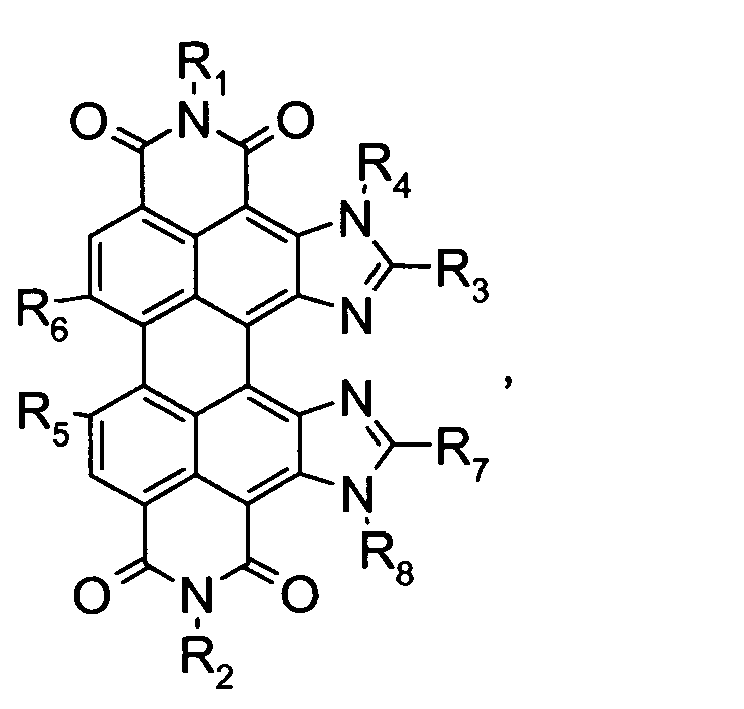
- 56. Imidazoloperylenbisimide der allgemeinen Formel

- 57. Imidazoloperylenbisimide der allgemeinen Formel

- 58. Imidazoloperylenbisimide der allgemeinen Formel

- 59. Imidazoloperylenbisimide der allgemeinen Formel

Formel
-
Abb. 1 zeigt das Syntheseschema der Diazepinoperylentetracarbonsäure-bisimide. -
Abb. 2 zeigt die UV/Vis Absorptions- (dicke Linie, links) und Fluoreszenzspektren (dicke Linie rechts) von (2a) in Chloroform im Vergleich zum Absorptionsspektrum von (1a) (dünne Linie). -
Abb. 3 zeigt die UV/Vis Absorptions- (dicke Linie, links) und Fluoreszenzspektren (dicke Linie rechts) von (3a) in Chloroform im Vergleich zum Absorptionsspektrum von (1a) (dünne Linie). -
Abb. 4 zeigt die UV/Vis Absorptions- (dicke Linie, links) und Fluoreszenzspektren (dicke Linie rechts) von (2a) in Chloroform unter Zusatz von DBU im Vergleich zum Absorptionsspektrum von (1a) (dünne Linie). -
Abb. 5 zeigt den ESPT-Mechanismus von 2a mit dem Absorptionsspektrum (dicke Linie links), dem Fluoreszentspektrum (dicke Linie rechts) und dem Fluoreszenzanregungsspektrum von (2a) bei 694 nm in Chloroform/Piperidin 3,1:1. -
Abb. 6 zeigt das Breitband-Absorptions- und Fluoreszenzspektrum des Farbmittels gemäss Beispiel 25 in Chloroform. -
Abb. 7 zeigt eine Übersicht über die UV/Vis-Absorptionsspektren in Chloroform. Die Maxima entsprechen von links nach rechts der Verbindung (1a), der Verbindung gemäss Beispiel 18, der Verbindung gemäss Beispiel 22, der Verbindung gemäss Beispiel 25, der deprotonierten Form der Verbindung gemäss Beispiel 18 und dem Fluoreszenzspektrum der deprotonierten Form der Verbindung gemäss Beispiel 18 im Vergleich zum AM1 Sonennspektrum (verrauschte obere Linie). - Im vorangegangenen Text wurden hauptsächlich nur die Strukturen (1) bis (6) diskutiert. Es ist jedoch zu erwähnen, dass die Strukturen der erfindungsgemässen Farbmittel nicht mit absoluter Sicherheit geklärt werden konnten. Strukturen (2) bis (6) widerspiegeln daher nur eine von mehreren möglichen Interpretationen der experimentellen analytischen Daten. Die heute zur Verfügung stehenden Methoden erlauben noch keine vollständig zufriedenstellende Zuordnung der Struktur. Gesichert sind jedoch deren Teilstrukturen, die wie folgt dargestellt werden können:

- In Formel (X) sind m gleich 0, 1 oder 2 und n gleich 1 oder 2. Die Substituenten sind selbstverständlich die gleichen, wie zuvor offenbart. Deren genaue Definition ist nochmals in Anspruch 1 offenbart.
- Aus den nachfolgenden Beispielen ergeben sich aber auch deutliche Hinweise auf folgende zusätzliche Strukturen, gegebenenfalls inklusive deren Isomere bezüglich der genauen Position von R4 und/oder R8 an den zwei N-Atomen der Imidazol-Ringe (beziehungsweise Tautomere, wenn R4 und/oder R8 gleich H sind):


- Die erfindungsgemässen Verbindungen können alternativ auch durch die Kondensation eines Amid-substitierten Perylendiimids in Gegenwart einer starken Base (wie zuvor, beispielsweise Natriumamid), gegebenenfalls in Gegenwart eines Lösungsmittels, erhalten werden.
- Die nachfolgenden Beispiele erläutern die Erfindung, ohne deren Umfang einzuschränken (wo nicht anders angegeben, handelt es sich bei "%" immer um Gewichts-%):
- IR-Spektren: Perkin Elmer 1420 Ratio Recording Infrared Spektrometer, FT 1000; UV/Vis-Spektren: Varian Cary 5000 und Bruins Omega 20; Fluoreszenzspektren: Perkin Elmer FS 3000 (totalkorrigiert); NMR-Spektroskopie: Varian Vnmrs 600 (600 MHz); Massenspektrometrie: Finnigan MAT 95.
- Beispiel 1: 2,10-Bis(1-hexylheptyl)-6-phenyl[1,3]diazepino[4',5',6':4,5]phenanthro-[2,1,10-def::7,8,9-d'e'f']diisochinolin-1,3,9,11(2H,5H,9H,11H)-tetraon (2a) und 2,9-Bis(1-hexylheptyl)-bis-[1,3]diazepino[4',5',6':1,12;4",5",6":6,7]perylo[3,4-cd:9,10-c'd']dipyridin-1,3,9,11(2H,5H,10H,13H)-tetraon (3a). N,N'-Bis(1-hexylheptyl)-perylen-3,4:9,10-tetracarbonsäure-3,4:9,10-bisimid ((1a), 1,00 g, 1,32 mMol) und NaNH2(1,00 g, 25,6 mMol) werden in Benzonitril (250 mL) suspendiert, 3 h auf 165°C erhitzt (Blaufärbung), abkühlen lassen und mit einem 1:1-Gemisch aus 2N-HCl und CHCl3 (300 mL) ausgeschüttelt. Die organische Phase wurde getrocknet (MgSO4), im Vakuum bis zur Trockene eingedampft (entfernen von überschüssigem Benzonitril), in CHCl3 aufgenommen, filtriert und säulenchromatographisch (Kieselgel, CHCl3) gereinigt. Es werden ein Einfach-Addukt und ein Doppeladdukt von Benzonitril erhalten. 1. Fraktion: 2,9-Bis(1-hexylheptyl)- bis-[1,3]diazepino[4',5',6':1,12;4",5",6":6,7]perylo[3,4-cd:9,10-c'd']dipyridin-1,3,9,11(2H,5H,10H,13H)-tetraon (3a). Ausb.: 40 mg (4%) schwarzer Farbmittel; Schmp. >300°C; Rf (Kieselgel, Chloroform) = 0,88; IR (ATR): ṽ = 3316,7 m, 2950,3 m, 2920,1 s, 2852,0 m, 1672,9 s, 1616,9 s, 1586,9 s, 1532,3 w, 1487,0 w, 1453,1 w, 1436,5 w, 1401,4 w, 1339,6 m, 1332,0 s, 1299,4 w, 1267,0 w, 1232,4 w, 1184,3 w, 1109,1 w, 1058,6 m, 1000,6 m, 955,5w, 895,7 w, 867,9 w, 815,0 w, 779,6 w, 758,2 m, 731,6 w, 687,6 w cm-1; 1H-NMR (600 MHz, CDCl3, 25°C), δ = 0,82-0,89 (m, 12 H, CH3), 1,26-1,47 (m, 32 H, CH2), 1,91-2,06 (dm, 4 H, β-CH2), 2,28-2,43 (m, 4 H, β-CH2), 5,22-5,36 (m, 2 H, CH-N), 7,65-7,67 (m, 3 H, CHaryl), 8,33-8,38 (m, 2 H, CHaryl), 8,72-8,85 (m, 6 H, Hpery), 10,95 (d, 1 H, 3 J= 8,0Hz), 11,55 ppm (s, 1 H, N-H); 13C-NMR (151 MHz, CDCl3, 25°C): δ = 14,1, 22,6, 27,0, 29,3, 31,8, 32,4, 54,6, 104,8, 121,2, 122,7, 123,5, 126,5, 126,6, 127,7, 128,1, 129,1, 129,4, 130,4, 130,6, 131,1, 132,2, 134,7, 134,9, 135,2, 135,2, 138,7, 39,0, 139,2, 143,9, 157,3, 163,9, 164,9, 165,7 ppm; UV/Vis (CHCl3): λmax (Erel) = 388,6 (0,07), 413,0 (0,12), 452,6 (0,14), 481,0 (0,15), 514,4 (0,14), 547,2 (0,11), 589,6 (0,42), 640,6 (1,00); Fluoreszenz (CHCl3): λmax (I rel) = 650,8 (1,00), 712,3 nm, (0,32), Fluoreszenzquantenausbeute (CHCl3, λexc= 472 nm, E 472nm= 0,149 cm-1, Referenz: S13 mit 1,00): 1,00; MS (DEI+/ 70 eV): m/z (%) = 990 (25) [M ++ 4H], 989 (63) [M ++ 3H], 988 (91) [M++ 4H], 806 (19), 805 (20), 624 (21), 623 (66), 622 (100), 55 (11); HMRS (C64H71N6O4): Ber, m/z: 987,554; Gef, m/z: 987,552, Δ = -2 mmu. 2. Fraktion: Ausb. 409 mg (36 %) 2,10-Bis(1-hexylheptyl)-6- phenyl[1,3]diazepino-[4',5',6':4,5]phenanthro[2,1,10-def::7,8,9-d'e'f']diisochinolin-1,3,9,11 (2H,5H,9H,-11H)-tetraon (2a) als metallisch glänzender, violetter Farbmittel, Schmp. >300°C, Rf (Kieselgel, Chloroform) = 0,85, IR (ATR): ṽ = 3411,7 m, 2954,8 m, 2923,5 s, 2855,2 m, 1689,1 s, 1656,0 s, 1640,3 s, 1623,0 s, 1591,7 s, 1534,8 w, 1486,6 w, 1455,4 w, 1432,6 w, 1396,1 w, 1375,6 w, 1342,4 s, 1332,0 s, 1305,6 m, 1257,4 m, 1219,9 w, 1179,1 w, 1090,9 m, 1054,9 m, 1016,0 m, 871,0 w, 807,6 m, 796,5 m, 748,1 m, 727,0 w, 684,0 w cm-1; 1H -NMR (600 MHz, CDCl3, 25°C): δ = 0,81-0,85 (m, 12H, CH3), 1,23-1,40 (m, 32H, CH2), 1,86-1,97 (m, 4H, β-CH2), 2,24-2,37 (m, 4H, β-CH2), 5,18- 5,30 (m, 2H, CH-N), 7,67-7,69 (m, 3H, CHaryl), 8,33-8,35 (m, 2H, CHaryl), 8,56-8,77 (m, 6H, Hpery), 10,74 (d, 1H, 3 J= 8,2Hz), 11,52 ppm (s, 1H, N-H), 13C-NMR (151 MHz, CDCl3, 25°C): δ= 14,1, 22,6, 27,0, 29,3, 31,8, 32,4, 54,6, 104,8, 121,2, 122,7, 123,5, 126,5, 126,6, 127,7, 128,1, 129,1, 129,4, 130,4, 130,6, 131,1, 132,2, 134,7, 134,9, 135,2, 135,2, 138,7, 39,0, 139,2, 143,9, 157,3, 163,9, 164,9, 165,7 ppm; UV/Vis (CHCl3): λmax (Erel) = 378,6 (9020), 396,9 (9210), 439,4 (13400), 463,6 (14700), 504,6 (15900), 541,9 (48100), 586,6 nm (92000); Fluoreszenz (CHCl3): λmax (I rel) = 599,3 (1,00), 651,5 (0,43); Fluoreszenzquantenausbeute (CHCl3, λexc= 541 nm, E541nm = 0,322 cm-1, Referenz: (1a) mit Φ = 1,00): 1,00; HMRS (C57H67N4O4): Ber, m/z: 871,516; Gef, m/z: 871,517; Δ = 1 mmu; C57H67N4O4 (871,2): ber. C 78,59 %, H 7,64, N 6,43 %; gef. C 78,49, H 7,78, N 6,55 %.
- Beispiel 2: 2,10-Bis(1-hexylheptyl)-6-(2-naphthyl)[1,3]diazepino[4',5',6':4,5]-phenanthro[2,1,1 0-def::7,8,9-d'e'f']diisochinolin-1,3,9,11 (2H,5H,9H,11H)-tetraon (2e). N,N'-Bis(1-hexylheptyl)-perylen-3,4:9,10-tetracarbonsäure-3,4:9,10-bisimid ((1a), 200 mg, 0,264 mMol), NaNH2(1,00 g, 5,12 mMol) und 2-Naphthonitril (8 g) wurden wie im Beispiel 1 umgesetzt und aufgearbeitet. Ausbeute: 54 mg (22 %) violetter Farbmittel, Schmp. >300°C; Rf (Kieselgel, Chloroform) = 0,90; IR (ATR): ṽ = 3409,1 m, 2953,2 m, 2922,7 s, 2853,1 m, 1690,6 s, 1655,7 s, 1640,2 s, 1624,2 s, 1607,6 w, 1591,4 s, 1527,4 w, 1507,9 w, 1458,7 w, 1432,3 w, 1411,5 w, 1379,2 w, 1343,4 s, 1343,4 m, 1248,2 m, 1220,4 w, 1179,01 10 w, 1120,0 wm, 974,1 m, 872,0 w, 852,3 m, 810,3 m, 749,3 m, 727,9 w, 632,3 w, 581,2 w cm-1; 1HNMR (300 MHz, CDCl3, 25°C): δ = 0,81-0,87 (m, 12H, CH3), 1,27-1,50 (m, 32H, CH2), 1,89-2,04 (m, 4H, β-CH2), 2,26-2,44 (m, 4H, β-CH2), 5,20-5,34 (m, 2H, CH-N), 7,52-7,64 (m, 2H, CHaryl), 7,81-8,00 (m, 3H, CHaryl), 8,32-8,37 (m, 2H,CHaryl), 8,46-8,72 (m, 6H, Hpery), 10,61 (d, 1H, 3 J=8,2Hz), 11,54 ppm (s, 1H, N-H); 13C-NMR (151 MHz, CDCl3, 25°C): δ = 14,1, 22,6, 27,0, 29,3, 31,8, 32,5, 54,6, 120,9, 122,2, 122,4, 123,0, 123,3, 124,0, 124,8, 125,2 126,4, 126,4, 127,2, 127,6, 128,0 128,3, 128,9, 129,0, 129,2, 130,1, 130,4, 130,8, 139,9, 132,9, 134,5, 134,6, 134,62, 139,1, 143,8, 157,1, 163,7,164,7, 164,8 ppm; UV/Vis (CHCl3): λmax (Erel) = 384,4 (0,14), 451,8 (0,20), 476,6 (0,23), 507,5 (0,19), 545,6 (0,54), 591,2 (1,00); Fluoreszenz (CHCl3): λmax (Irel) = 603,0 (1,00), 655,5 (0,46); Fluoreszenzquantenausbeute (CHCl3, λexc = 472 nm, E472 nm = 0,159 cm-1, Referenz: (1a) mit Φ = 1,00): 1,00; HMRS (C61H68N4O4): ber. m/z: 920,524, gef. m/z 920,522; Δ = -0,002.
- Beispiel 3: 2,10-Bis(1-hexylheptyl)-6-(4-bromphenyl)[1,3]diazepino[4',5',6':4,5]-phenanthro[2,1,10-def::7,8,9-d'e'f']diisochinolin-1,3,9,11(2H,5H,9H,11H)-tetraon (2c). N,N'-Bis(1-hexylheptyl)-perylen-3,4:9,10-tetracarbonsäure-3,4:9,10-bisimid ((1a), 100 mg, 0,264 mMol), NaNH2(1,00 g, 2,56 mmol) und 4-Brombenzonitril (10 g) wurden wie im Beispiel 1 umgesetzt und aufgearbeitet. Ausbeute 97 mg (77 %) violetter Farbmittel; Schmp. >300°C; Rf (Kieselgel, Chloroform) = 0,80, IR (ATR): ṽ = 3407,7 m, 2952,5 m, 2923,3 s, 2854,8 m, 1690,2 s, 1641,2 s, 1623,1 s, 1591,6 s, 1531,7 w, 1481,0 w, 1467,0 w, 1434,22,6 w, 1411,3 w, 1387,0 w, 1343,7 s, 1331,0 s, 1255,4 m, 1219,6 w, 1179,8 w, 1119,8 w, 1071,9 w, 1008,7 m, 871,3 w, 809,0 m, 772,0 w, 748,5 m, 724,1 w, 596,2 w cm-1; 1HNMR (600 MHz, CDCl3, 25°C): δ = 0,81-0,89 (m, 12H, CH3), 1,22-1,39 (m, 32H, CH2), 1,87-1,97 (m, 4H, β-CH2), 2,25-2,36 (m, 4H, β-CH2), 5,18-5,31 (m, 2H, CH-N), 7,81-7,83 (m, 2H, CHaryl), 8,23-8,25 (m, 2H, CHaryl), 8,65-8,84 (m, 6H, Hpery), 10,78 (d, 1H, 3 J=8,2Hz), 11,52 ppm (s, 1H, N-H); 13C-NMR (151 MHz, CDCl3, 25°C): δ = 14,1, 22,6, 27,0, 29,3, 31,8, 32,4, 54,6, 121,4, 122,8, 123,7, 126,7, 126,7, 127,0, 127,2, 129,1, 129,2, 132,8, 143,9 ppm; UV/Vis (CHCl3): λmax (ε) = 378,9 (9540), 399,0 (8870), 441,3 (14100), 465,0 (15400), 505,8 (15000), 542,9 (46600), 587,5 (89400); Fluoreszenz (CHCl3): λmax (Irel) = 599,8 (1,00), 653,5 (0,42) ; Fluoreszenzquantenausbeute (CHCl3, λexc = 495 nm, E495nm = 0,053 cm-1, Referenz: (1 a) mit Φ = 1,00): 1,00, HMRS (C57H65BrN4O4): ber. m/z 950,431, gef. m/z: 950,429, Δ = -2 mmu; C57H65BrN4O4 (950,1): ber. C 72,06, H 6,90, N 5,90; gef. C 71,79, H 6,73, N 5,88.
- Beispiel 4: 10-Bis[1-(1-methylethyl)-2-methylpropyl]-6- phenyl[1,3]diazepino[4',5'-,6':4,5]phenanthro[2,1,10-def::7,8,9-d'e'f']diisochinolin-1,3,9,11(2H,5H,9H,11H)-tetraon (2b). N,N'-Bis[1-(1-methylethyl)-2-methylpropyl]perylen-3,4:9,10-tetracarbonsäure-3,4:9,10-bisimid ((1b), 1,30 g, 1,85 mMol), NaNH2(1,30 g, 33,3 mMol) und Benzonitril (250 g) wurden wie im Beispiel 1 umgesetzt und aufgearbeitet. Ausbeute 670 mg (43%) metallisch glänzender, violetter Farbmittel; Schmp. >300°C; Rf (Kieselgel, Chloroform) = 0,25; IR (ATR): ṽ = 3407,6 m, 2962,1 m, 2923,5 m, 2872,3 m, 1698,7 m, 1683,5 m, 1659,4 m, 1639,5 s, 1628,5 s, 1608,2 m, 1591,9 s, 1566,2 w, 1532,8 w, 1487,6 w, 1457,0 w, 1433,1 w, 1411,6 w, 1382,6 w, 1332,0 s, 1306,2 m, 1252,1 m, 1212,4 w, 1167,3 w, 1123,5 w, 1100,3 w, 1052,2 w,924,4 w, 904,0 w, 872,0 w, 844,1 w, 811,9 m, 775,6 w, 751,3 m, 684,0 w, 585,4 w cm-1; 1HNMR (600 MHz, CDCl3, 25°C): δ = 0,97-1,01 (m, 12 H, CH3), 1,14-1,18 (m, 12 H, CH3), 2,72-2,83 (m, 4 H, β-CH), 4,77-4,88 (m, 2 H, CH-N), 7,67-7,69 (m, 3 H, CHaryl), 8,36-8,38 (m, 2 H, CHaryl), 8,62-8,84 (m, 6 H, Hpery), 10,79-10,83 (m, 1 H, CHpery), 11,57-11,59 ppm (m, 1 H, N-H) ; 13C-NMR (151 MHz, CDCl3, 25°C): δ = 20,7, 21,9, 22,0, 29,2, 29,4, 65,0, 65,1, 121,2, 121,3, 122,3, 122,4, 122,7, 122,8, 123,0, 123,1, 123,6, 125,1, 125,2, 125,3, 125,4, 126,6, 126,7, 127,7, 127,8, 128,2, 129,2, 129,4, 129,5, 130,6, 130,7, 131,3, 131,9, 132,2, 132,6, 134,8, 134,9,135,0, 135,3, 139,1, 139,4, 144,0, 157,4, 164,2, 164,4, 164,5, 165,4, 165,5, 166,3 ppm; UV/Vis (CHCl3): λmax(Erel) = 379,7 (0,10), 397,5 (0,10), 439,1 (0,15), 463,5 (0,17), 504,4 (0,19), 542,2 (0,52), 586,7 (1,00); Fluoreszenz (CHCl3): λmax (Irel) = 599,0 (1,00), 650,3 (0,43); Fluoreszenzquantenausbeute (CHCl3, λexc = 495 nm, E495 nm = 0,053 cm-1, Referenz: (1a) mit Φ = 1,00): 1,00; HMRS (C45H42N4O4): ber. m/z: 702,320, gef. m/z: 702,319, Δ = -0,001; C45H42N4O4 (702,8): ber. C 76,90, H 6,02, N 7,97; gef. C 76,55, H 5,91, N 7,94.
- Beispiel 5: 2,10-Bis(1-hexylheptyl)-6-(4-methoxyphenyl)[1,3]diazepino[4',5',6':4,5]-phenanthro[2,1,10-def::7,8,9-d'e'f']diisochinolin-1,3,9,11(2H,5H,9H,11H)-tetraon (2d). N,N'-Bis(1-hexylheptyl)-perylen-3,4:9,10-tetracarbonsäure-3,4:9,10-bisimid ((1a), 500 mg, 0,660 mMol), NaNH2(500 mg, 12,8 mMol) und 4-Methoxybenzonitril (20 g) wurden wie im Beispiel 1 umgesetzt und aufgearbeitet. Ausbeute 137 mg (23%) metallisch glänzender, violetter Farbmittel; Schmp. >300°C; Rf (Kieselgel, Chloroform) = 0,80; IR (ATR): ṽ = 3411,8 m, 2951,8 m, 2921,6 s, 2853,3 m, 1687,4 s, 1654,2 s, 1638,8 s, 1622,0 s, 1608,2 s, 1591,2 s, 1489,7 w, 1466,1 w, 1433,9 w, 1411,8 w, 1393,2 w, 1373,5 w, 1342,3 s, 1329,9 s, 1301,5 m, 1250,6 s, 1219,4 w, 1172,3 w, 1120,0 w, 1058,3 w, 1029,0 w, 840,2 w, 832,2 m, 809,0 m, 749,2 m, 726,8 w cm-1; 1HNMR (300 MHz, CDCl3, 25°C): δ = 0,81-0,85 (m, 12 H, CH3), 1,23-1,40 (m, 32 H, CH2), 1,86-1,97 (m, 4 H, β-CH2), 2,24-2,37 (m, 4 H, β-CH2), 3,99 (s, 3 H, CH3), 5,18-5,30 (m, 2 H, CH-N), 7,14 (d, 2 H, 3 J=8,8 Hz, CHaryl), 8,22 (d, 2 H, 3 J= 8,7 Hz, -CHaryl), 8,38-8,68 (m, 6 H, Hpery), 10,57 (d, 1 H, 3 J= 8,1 Hz), 11,30 ppm (s, 1H, N-H) ; UV/Vis (CHCl3): λmax(ε) = 380,0 (7610), 399,0 (7490), 465,1 (15700), 482,1 (19800), 511,8 (16300), 548,1 (41100), 592,7 (73500); Fluoreszenzquantenausbeute (CHCl3, λexc = 465 nm, E465nm = 0,00434 cm-1, Referenz: (1a) mit Φ = 1,00): 1,00); HMRS (C58H69N4O5): ber. m/z: 901,528; gef. m/z: 901,530, Δ = 2 mmu; C58H69N4O5 (901,2): ber. C 77,30, H 7,61, N 6,22; gef. C 77,34, H 7,78, N 6,09 %.
- Beispiel 6: 2,10-Bis(1-hexylheptyl)-5-methyl-6-phenyl[1,3]diazepino[4',5',6':4,5]-phenanthro[2,1,10-def::7,8,9-d'e'f']diisochinolin-1,3,9,11(2H,5H,9H,11H)-tetraon (4a). 2,10-Bis(1-hexylheptyl)-6-phenyl[1,3]diazepino[4',5',6':4,5]phenanthro[2,1,10-def::7,8,9-d'e'f']diisochinolin-1,3,9,11(2H,5H,9H,11H)-tetraon (2a) gemäss Beispiel 1 (100 mg, 0,115 mMol) wurde in THF (30 mL) gelöst und mit wässriger KOH (10%, 2,5 mL) versetzt, bis zur Blaufärbung gerührt, tropfenweise mit Dimethylsulfat (0,3 ml, Vorsicht: toxisch) versetzt, 3 Std. bei Raumtemperatur gerührt, mit Wasser versetzt (100 mL), abgesaugt, mit Methanol gewaschen und säulenchromatographisch gereinigt. Ausbeute 90 mg (88 %) violetter Farbmittel, Schmp. > 300°C, Rf (Kieselgel, Chloroform) = 0,80; IR (ATR): ṽ = 2952,8 m, 2922,3 s, 2854,5 m, 1688,8 s, 1645,9 s, 1588,8 s, 1528,5 w, 1486,3 w, 1462,8 w, 1424,1 w, 1404,1 w, 1332,2 s, 1253,5 m, 1219,9 w, 1179,2 w, 1099,5 w, 1023,2 m, 1016,0 w, 871,3 w, 808,0 m, 772,5 w, 746,0 m, 700,3 w, 600,0 w cm-1; 1HNMR (300 MHz, CDCl3, 25°C): δ = 0,81-0,84 (m, 12 H, CH3), 1,23-1,39 (m, 32 H, CH2), 1,87-1,93 (m, 4H, β-CH2), 2,26-2,33 (m, 4 H, β-CH2), 4,01 (s, 3 H, CH3) 5,19-5,24 (m, 2 H, CH-N), 7,67-7,72 (m, 3 H, CHaryl), 8,09-8,10 (m, 2 H, CHaryl), 8,56-8,72 (m, 6 H, Hpery), 10,74 ppm (d, 1 H, 3 J=8,2Hz) 13C-NMR (151 MHz, CDCl3, 25°C): δ = 14,0, 22,6, 27,0, 29,3, 31,8, 32,4, 39,0, 54,6, 121,1, 121,1, 122,4, 122,4, 123,4, 126,7, 127,7, 129,0, 129,0, 129,1, 130,4, 131,0, 131,4, 134,6, 144,2, 163,0, 163,9, 165,0 ppm; UV/Vis (CHCl3): λmax(Erel) = 377,5 (0,11), 394,5 (0,11), 437,6 (0,13), 502,9 (0,18), 540,2 (0,53), 584,8 (1,00); Fluoreszenz (CHCl3): λmax (Irel) = 599,0 (1,00), 650,0 (0,44); Fluoreszenzquantenausbeute (CHCl3, λexc = 490 nm, E490 nm = 0,0094 cm-1, Referenz: (1a) mit Φ = 1,00): 1,00; HMRS (C58H68N4O4): ber. m/z: 884,524; gef. m/z: 884,522; Δ = -0,002.
- Beispiel 7: 2,10-Bis[1-(1-methylethyl)-2-methylpropyl]-5-methyl-6- phenyl[1,3]di-azepino[4',5',6':4,5]phenanthro[2,1,10-def:7,8,9-d'e'f']diisochinolin- 1,3,9,11(2H,-5H,9H,11H)-tetraon (4b). 2,10-Bis[1-(1-methylethyl)-2-methylpropyl]-6- phenyl-[1,3]diazepino[4',5',6':4,5]phenanthro[2,1,10-def:7,8,9-d'e'f']diisochinolin- 1,3,9,11-(2H,5H,9H,11H)-tetraon (2b) gemäss Beispiel 4 (500 mg, 0,711 mMol) wurden analog zu Beispiel 6 umgesetzt und aufgearbeitet, Ausbeute 450 mg (88%) metallisch glänzender, violetter Farbmittel. Schmp. >300°C; Rf (Kieselgel, CHCl3) = 0,22; HMRS (C46H44N4O4): ber. m/z: 716,335; gef. m/z: 716,335, Δ = 0,000 mmu.
- Beispiel 8: 8,15-Bis-(1-hexylheptyl)-phenanthra[2,1,10-def:7,8,9-d'e'f']-2,5-diphenyl-1,6,10,15-tetrahydro-imidizo[4,5-h:4',5'-h']diisochinolin-7,9,14,16-tetraon. N,N'-Bis(1-hexylheptyl)perylen-3,4:9,10-tetracarbonsäure-3,4:9,10-bisimid ((1a), 1.00 g, 1.32 mmol) und NaNH2 (1.00 g, 25.6 mmol) wurden in Benzonitril (250 mL) suspendiert, auf 165°C erhitzt (Blaufärbung), nach 3 h wieder abgekühlt, mit einem 1:1-Gemisch aus 2 N wässriger HCl und CHCl3 (300 mL) ausgeschüttelt, über Magnesiumsulfat getrocknet, mit dem Rotationsverdampfer bei 12 mbar und dann zum Entfernen von Benzonitril in Feinvakuum eingedampft, in CHCl3 aufgenommen, filtriert und säulenchromatographisch über Kieselgel mit Chloroform als Eluent gereinigt. 1. grüne Fraktion: 2,9-Bis(1-hexylheptyl)-bis-[1,3]diazepino-[4',5',6':1,12;4",5",6":6,7]perylo[3,4-cd:9,10-c'd']dipyridin-1,3,9,11(2H,5H,10H,13H)-tetraon. Ausbeute 40 mg (4 %) schwarzer Farbstoff, Schmp.: >250°C. Rf (Kieselgel, Chloroform) = 0.88. 2. Fraktion: 2,10-Bis(1-hexylheptyl)-6-phenyl[1,3]-diazepino[4',5',6':4,5]phenanthro[2,1,10-def::7,8,9-d'e'f']diisochinolin-1,3,9,11-(2H,5H,9H,11H)-tetraon. Ausb. 409 mg (36 %) metallisch glänzender, violetter Farbstoff der Formel (8). Schmp. >250°C. Rf (Kieselgel, Chloroform) = 0.85. 3. Fraktion: 8,15-Bis-(1-hexylheptyl)-phenanthra[2,1,10-def:7,8,9-d'e'f']-2,5-diphenyl-1,6,10,15-tetrahydro-imidizo[4,5-h:4',5'-h']diisochinolin-7,9,14,16-tetraon. Ausb. 180 mg (18 %) grün-schwarzer Farbstoff, Schmp. >300°C. Rf (Kieselgel, Chloroform) = 0.23. IR (ATR): ṽ = 3387.6 m, 2952.9 m, 2920.8 s, 2853.6 m, 1685.1 m, 1639.5 s, 1593.9 s, 1582.7 s, 1545.9 w, 1486.1 w, 1456.3 w, 1429.2 w, 1402.4 w, 1381.5 w, 1349.0 m, 1325.2 m, 1304.9 m, 1290.2 m, 1242.9 s, 1173.7 m, 1127.5 w, 1026.1 w, 974.3 w, 879.7 w, 839.5 w, 810.7 m, 774.0 w, 753.0 w, 728.1 w, 701.4 w, 684.8, 624.9 w cm-1. 1H-NMR (600 MHz, CDCl3, 25°C): δ = 0.83 (t, 12 H, 3J = 7.0 Hz, CH3), 1.24-1.42 (m, 32 H, CH2), 1.93-2.02 (m, 4 H, β-CH2), 2.28-2.39 (m, 4 H, β-CH2), 5.26-5.33 (m, 2 H, CH-N), 7.49-7.54 (m, 4 H, CHaryl), 7.65-7.69 (m, 2 H, CHaryl),8.20-8.80 (m, 4 H, CHaryl), 8.69-8.80 (m, 4 H, Hperylen), 18.13 ppm (s, 1 H, N-H). 13C-NMR (150 MHz, CDCl3, 25°C): δ = 14.1, 22.6, 27.2, 29.3, 29.4, 31.8, 32.5, 54.6, 54.9, 121.8, 124.4, 127.3, 128.6, 129.3, 132.2, 139.3, 163.9, 164.9 ppm. UV/Vis (CHCl3): λmax (Erel) = 390.0 (0.15), 435.0 (0.23), 486.0 (0.11), 524.0 (0.12), 555.0 (0.17), 598.0 (0.52), 651.0 (1.00). Fluoreszenz (CHCl3): λmax (Irel) = 670.0 (1.00), 735.1 (0.33) nm. Fluoreszenzquantenausb. (CHCl3, λexc = 598 nm, E589 nm = 0.0249 cm-1, Referenz: (1a) mit 1.00): 0.80. MS (DEI+ / 70 eV): m/z (%) = 989.5 (9), 988.5 (37) [M+ + 2H], 987.5 (82) [M+ + H], 986.5 (100) [M+], 805.4 (13), 624.1 (31), 623.1 (65), 622.1 (32), 594.1 (23). C64H70N6O4 (987.3): Ber. C 77.86, H 7.15, N 8.51; Gef. C 77.83, H 7.08 N 8.47.
- Beispiel 9: 2,10-Bis(1-hexylheptyl)-6-(2-bromphenyl)[1,3]diazepino[4',5',6':4,5]-phenanthro[2,1,10-def::7,8,9-d'e'f']diisochinolin-1,3,9,11(2H,5H,9H,11H)-tetraon. N,N'-Bis(1-hexylheptyl)perylen-3,4:9,10-tetracarbonsäure-3,4:9,10-bisimid (150 mg, 0.199 mmol) und NaNH2 (150 mg, 3.85 mmol) werden in o-Bromobenzonitril (10 g) suspendiert und analog zu 2,10-Bis(1-hexylheptyl)-6-phenyl[1,3]diazepino[4',5',6':-4,5]phenanthro[2,1,10-def::7,8,9-d'e'f']diisochinolin-1,3,9,11(2H,5H,9H,11H)-tetraon umgesetzt und aufgearbeitet und säulenchromatographisch gereinigt (Kieselgel, Chloroform und iso-Hexan (3:1)). Ausb. 91 mg (48.4 %) violetter Farbstoff der Formel (8), Schmp. >250°C. Rf (Kieselgel, Chloroform) = 0.80. 1H-NMR (300 MHz, CDCl3, 25°C): δ = 0.80-0.93 (m, 12 H, CH3), 1.18-1.48 (m, 32 H, CH2), 1.83-2.02 (m, 4 H, β-CH2), 2.20-2.43 (m, 4 H, β-CH2), 5.15-5.35 (m, 2 H, CH-N), 7.52 (t, 1 H, 3 J=7.6 Hz, CHaryl), 7.69 (t, 1 H, 3 J=7.6 Hz, CHaryl), 7.87 (d, 1 H, 3 J=7.6 Hz, CHaryl), 8.60.8.88 (m, 6 H, CHperylen), 10.79 (d, 1 H, 3J =7.8 Hz, CHperylen), 12.41 ppm (s, 1 H, N-H). UV/Vis (CHCl3): λmax (ε) = 380.3 (9280), 397.1 (10070), 438.8 (13350), 461.2 (13030), 505.5 (16430), 542.9 (47470), 588.1 (86950). Fluoreszenz (CHCl3): λmax (Irel) = 601.5 (1.00), 654.1 (0.45). Fluoreszenzquantenausb. (CHCl3, λexc = 542 nm, E542 nm = 0.0097 cm-1, Referenz: (1a) mit 1.00): 1.00. HRMS (C57H65 79BrN4O4): Ber. m/z =948.4189; Gef. m/z = 948.4154, Δ = -0.0035. C57H65BrN4O4 (950.1): Ber. C 72.06, H 6.90, N 5.90; Gef. C 71.91, H 6.76, N 5.67.
- Beispiel 10: 2,10-Bis(1-hexylheptyl)-6-(3-bromphenyl)[1,3]diazepino[4',5',6':4,5]-phenanthro[2,1,10-def::7,8,9-d'e'f']diisochinolin-1,3,9,11(2H,5H,9H,11H)-tetraon. N,N'-Bis(1-hexylheptyl)perylen-3,4:9,10-tetracarbonsäure-3,4:9,10-bisimid (200 mg, 0.265 mmol) und NaNH2 (200 mg, 5.13 mmol) wurden in m-Bromobenzonitril (10 g) suspendiert und analog zu 2,10-Bis(1-hexylheptyl)-6-phenyl[1,3]diazepino[4',5',6':-4,5]phenanthro[2,1,10-def::7,8,9-d'e'f']diisochinolin-1,3,9,11(2H,5H,9H,11H)-tetraon umgesetzt und aufgearbeitet und säulenchromatographisch gereinigt (Kieselgel, Chloroform/iso-Hexan 3:1). Ausb 107 mg (42.4%) violetter Farbstoff der Formel (8), Schmp. >250°C. Rf (Kieselgel, Chloroform) = 0.80. 1H-NMR (400 MHz, CDCl3, 25°C): δ = 0.74-0.87 (m, 12 H, CH3), 1.13-1.45 (m, 32 H, CH2), 1.82-2.00 (m, 4 H, β-CH2), 2.20-2.37 (m, 4 H, β-CH2), 5.14-5.31 (m, 2 H, CH-N), 7.53 (t, 1 H, 3 J=7.9 Hz, CHaryl), 7.77 (ddd, 1 H, 3 J=8.0 Hz, 4 J=1.8 Hz, 4 J=0.8 Hz, CHaryl), 8.25 (d, 1 H, 3 J=7.6 Hz, CHaryl), 8.50-8.81 (m, 6H, CHperylen), 10.64 (d, 1 H, 3 J=8.2 Hz, CHperylen), 11.48 ppm (s, 1 H, N-H). 13C-NMR (150 MHz, CDCl3, 25°C): δ = 14.3, 22.8, 27.2, 29.5, 31.8, 32.0, 32.7, 54.9, 121.5, 123.0, 123.8, 123.8, 125.7, 125.8, 126.5, 126.8, 129.9, 129.3, 1230.4, 130.6, 131.0, 131.2, 132.6, 134.8, 135.2, 135.5, 139.0, 139.2, 143.7, 155.8, 164.0, 165.0 ppm. UV/Vis (CHCl3): λmax (Erel) = 378.6 (0.10), 399.1 (0.10), 437.2 (0.13), 461.4 (0.13), 504.6 (0.16), 542.7 (0.51), 587.4 (1.00). Fluoreszenz (CHCl3): λmax (Irel) = 595.8 (1.00), 648.8 (0.42). Fluoreszenzquantenausbeute (CHCl3, λexc = 542 nm, E542 nm = 0.0068 cm-1, Referenz: (1a) mit 1.00): 0.99. HRMS (C57H65 79BrN4O4): Ber. m/z = 948.4189; Gef. m/z = 948.4177, Δ = -0.0012.
- Beispiel 11: 2,10-Bis-(1-hexylheptyl)-6-(4-dimethylaminophenyl)[1,3]diazepino-[4',5',6'-d",e",f"]phenanthra[2,1,10-def:7,8,9-d'e'f']-2,5,9,11-tetrahydro-diisochinolin-1,3,9,11-tetraon. N,N'-Bis(1-hexylheptyl)perylen-3,4:9,10-tetracarbonsäure-3,4:9,10-bisimid (200 mg, 0.26 mmol), NaNH2 (200 mg, 5.13 mmol) wurden in 4-Dimethylaminobenzonitril (10 g) suspendiert und analog zu 2,10-Bis(1-hexylheptyl)-6-phenyl[1,3]diazepino[4',5',6':4,5]phenanthro[2,1,10-def::7,8,9-d'e'f']diisochinolin-1,3,9,11(2H,5H,9H,11H)-tetraon umgesetzt und aufgearbeitet und säulenchromatographisch (Kieselgel, CHCl3) gereinigt. Der Farbstoff der Formel (8) wird in Chloroform gelöst und mit Methanol gefällt. Ausb. 23 mg (12 %) metallisch glänzender, violetter Farbstoff, Schmp. >300°C. Rf (Kieselgel, Chloroform) = 0.70. IR (ATR): ṽ = 3416.2 m, 3096.0 w, 2952.8 s, 2921.7 s, 2853.8 s, 2364.3 w, 1691.1 m, 1639.8 s, 1626.6 s, 1607.3 s, 1590.8 s, 1493.2 m, 1470.3 m, 1434.2 m, 1413.5 m, 1365.8 m, 1343.8 s, 1306.2 m, 1255.9 s, 1219.9 m, 1196.3 m, 1121.0 m, 1103.5 m, 1058.3 m, 1038.2 w, 949.8 w, 871.3 w, 809.8 m, 751.4 w, 619.1 w, 581.6 w cm-1. 1H-NMR (600 MHz, CDCl3, 25°C): δ = 0.82-0.87 (m, 12 H, CH3), 1.25-1.46 (m, 32 H, CH2), 1.88-1.99 (m, 4 H, β-CH2), 2.25-2.35 (m, 4 H, β-CH2), 3.17 (s, 6 H, NCH3), 5.21-5.31 (m, 2 H, CH-N), 6.87 (d, 2 H, 3J =8.2Hz, CHaryl), 8.15 (d, 2 H, 3J =8.2Hz, CHaryl), 8.46-8.73 (m, 5 H, Hperylen), 10.65 (d, 1 H, 3 J=8.1Hz), 11.25 ppm (s, 1H, N-H). 13C-NMR (150 MHz, CDCl3, 25°C): δ = 14.1, 14.1, 22.6, 27.0, 29.3, 31.8, 31.8, 32.5, 40.4, 54.6, 112.1, 120.8, 122.1, 123.4, 126.1, 126.6, 129.2, 129.3, 130.0, 130.8, 134.7, 134.9, 135.0, 144.8, 152.6, 161.8, 164.0, 165.0 ppm. UV/Vis (CHCl3): λmax (Emax) = 396.0 (0.20), 513 (sh, 0.67), 544 (1.0), 594 (sh, 0.91), 616 nm (0.98). Fluoreszenz (CHCl3): λmax = 740.2 nm. Fluoreszenzquantenausbeute (CHCl3, λexc = 465 nm, E465 nm = 0.0476 cm-1, Referenz: (1a) mit Φ = 1.00): 0.72. HRMS (C59H71N5O4): Ber. m/z: = 913.550; Gef. m/z = 913.549, Δ = -0.0010.
- Beispiel 12: 2,10-Bis-(1-hexylheptyl)-6-(2,4-bismethoxyphenyl)-[1,3]diazepino-[4',5',6'-d";e";f"]phenanthra[2,1,10-def:7,8,9-d'e'f']-2,5,9,11-tetrahydro-diisochinolin-1,3,9,11-tetraon. N,N'-Bis(1-hexylheptyl)perylen-3,4:9,10-tetracarbonsäure-3,4:9,10-bisimid (200 mg, 0.265 mmol) und NaNH2 (200 mg, 5.13 mmol) wurden in 2,4-Bismethoxybenzonitril (10 g) bei 100°C gelöst und analog zu 2,10-Bis(1-hexylheptyl)-6-phenyl[1,3]diazepino[4',5',6':4,5]phenanthro[2,1,10-def::7,8,9-d'e'f']diisochinolin-1,3,9,11(2H,5H,9H,11H)-tetraon umgesetzt und aufgearbeitet und säulenchromatographisch gereinigt (Kieselgel, Chloroform) Ausb. 80 mg (32.4 %) metallisch glänzender, violetter Farbstoff der Formel (8). Schmp. >300°C. Rf (Kieselgel, Chloroform) = 0.38. UV/Vis (CHCl3): λmax (Erel) = 396.9 (0.14), 464.3 (0.29), 491.4 (0.37), 560.3 (0.62), 603.5 (1.00). Fluoreszenz (CHCl3): λmax (Irel) = 634.2 (1.00), 684.6 (0.66). Fluoreszenzquantenausb. (CHCl3, λexc = 560 nm, E560 nm = 0.01088 cm-1, Referenz: (1a) mit Φ = 1.00): 0.96. 1H-NMR (400 MHz, CDCl3, 25°C): δ = 0.77-0.87 (m, 12 H, CH3), 1.17-1.43 (m, 32 H, CH2), 1.81-1.98 (m, 4 H, β-CH2), 2.20-2.40 (m, 4 H, β-CH2), 3.96 (s, 3 H, OCH3), 4.15 (s, 3 H, OCH3), 5.15-5.30 (m, 2 H, CH-N), 6.61 (d, 2 H, 3J =1.8 Hz, CHaryl), 6.80 (d, 2 H, 3J =9.1 Hz, CHaryl), 8.50-8.79 (m, 6 H, Hperylen), 10.60-10.72 (br, 1 H), 12.13-12.24 ppm (br, 1 H, N-H). 13C-NMR (100 MHz, CDCl3, 25°C): δ = 14.3, 22.9, 27.3, 29.5, 32.0, 32.7, 54.8, 56.0, 56.5, 98.9, 106.8, 109.8, 121.2122.4, 123.6, 126.3, 126.9, 129.4, 130.2, 130.5, 133.2, 135.0, 135.4, 143.7, 159.9, 164.5, 165.4 ppm. HRMS (C59H70N4O6): Ber. m/z = 930.5295; Gef. m/z = 930.5289, Δ = -0.0006.
- Beispiel 13: 2,10-Bis-(1-hexylheptyl)-6-(3,4-bismethoxyphenyl)-[1,3]diazepino-[4',5',6'-d",e";f"]phenanthra[2,1,10-def:7,8,9-d'e'f']-2,5,9,11-tetrahydro-diisochinolin-1,3,9,11-tetraon. N,N'-Bis(1-hexylheptyl)perylen-3,4:9,10-tetracarbonsäure-3,4:9,10-bisimid (0.240 g, 0.317 mmol) und NaNH2 (0.200 g, 5.13 mmol) wurden in 2,4-Bismethoxybenzonitril (10 g) bei 100 °C gelöst und analog zu 2,10-Bis(1-hexylheptyl)-6-phenyl[1,3]diazepino[4',5',6':4,5]phenanthro[2,1,10-def::7,8,9-d'e'f']diisochinolin-1,3,9,11(2H,5H,9H,11H)-tetraon umgesetzt (4.5 h Reaktionszeit) und aufgearbeitet und säulenchromatographisch gereinigt (Kieselgel, Chloroform). Ausb.: 118 mg (39.9 %) metallisch glänzender, violetter Farbstoff der Formel (8), Schmp. >300°C. Rf (Kieselgel, Chloroform) = 0.38. 1H-NMR (600 MHz, CDCl3, 25°C): δ = 0.78-0.85 (m, 12 H, CH3), 1.17-1.44 (m, 32 H, CH2), 1.83-1.98 (m, 4 H, β-CH2), 2.21-2.34 (m, 4 H, β-CH2), 4.04 (s, 3 H, OCH3), 4.11 (s, 3 H, OCH3), 5.15-5.28 (m, 2 H, CH-N), 7.07 (d, 2 H, 3J =8.4 Hz, CHaryl), 7.78-7.87 (m, 2 H, CHaryl), 8.44-8.75 (m, 5 H, Hperyylen), 10.63-10.68 (br, 1 H), 11.35 ppm (s, 1 H, N-H). 13C-NMR (100 MHz, CDCl3, 25°C): δ = 14.3, 14.3, 22.8, 22.8, 27.2, 27.3, 27.4, 32.5, 32.7, 32.8, 54.8, 54.9, 56.5, 56.5, 103.4, 104.2, 111.6, 121.0, 121.3, 121.5, 122.7, 123.6, 126.6, 126.8, 129.4, 130.6, 144.3, 150.0, 153.0, 157.7, 164.1, 165.3, 166.0 ppm. UV/Vis (CHCl3): λmax (Erel) = 500.9 (0.29), 549.4 (0.58), 593.7 (1.00). Fluoreszenz (CHCl3): λmax (Irel) = 614.8 (1.00), 665.7 (0.61). Fluoreszenzquantenausbeute (CHCl3, λexc = 549 nm, E549 nm = 0.008146 cm-1, Referenz: (1a) mit Φ = 1.00): 1.00. HRMS (C59H70N4O6): Ber. m/z = 930.5295; Gef. m/z = 930.5284, Δ = -0.0011. C59H70N4O6 (931.2): Ber. C 76.10, H 7.58, N 6.02; Gef. C 75.66, H 7.38, N 5.90.
- Beispiel 14: Distickstofftetraoxidin Dichlormethan: Festes Blei(II)nitrat (100 g, 302 mmol) wird in einem Rundkolben mit dem Bunsenbrenner stark erhitzt und die entstehenden nitrosen Gase solange in einen Vorlagekolben mit Dichlormethan (1000 mL) geleitet, bis die Dichlormethan-Lösung gesättigt ist. Dieses Reagenz wird für den alternativen Syntheseweg gemäss den folgenden Beispielen verwendet.
- Beispiel 15: 1-Nitro-N,N'-bis-(1-hexylheptyl)perylen-3,4:9,10-bis(dicarboximid). N,N'-Bis(1-hexylheptyl)perylen-3,4:9,10-tetracarbonsäure-3,4:9,10-bisimid (1a, 3.00 g, 3.97 mmol) wurde in Dichlormethan (200 mL) vorgelegt, mit Methansulfonsäure (2 mL, 30.8 mmol) versetzt (Katalysator im Überschuss), mit soviel einer gesättigten Lösung von Distickstofftetroxid in Dichlormethan (gemäss Beispiel 14) unter Rühren bei Raumtemperatur tropfenweise versetzt bis eine Kontrolle mittels Dünnschichtchromatographie (Kieselgel, Chloroform) eine vollständige Umsetzung ergibt (Farbumschlag der Lösung nach Dunkelrot); mit destilliertem Wasser gewaschen (100 mL), über Magnesiumsulfat getrocknet, mit dem Rotationsverdampfer eingedampft, in wenig Chloroform gelöst und säulenchromatographisch gereinigt (Kieselgel, Dichlormethan). Ausbeute 2.41 g (76 %) dunkelroter, metallisch-glänzender Feststoff, Schmp. 120 °C. Rf (Kieselgel/CHCl3): 0.80. IR (ATR): ṽ = 3048 w, 2955 s, 2927 s, 2857 s, 1703 s, 1661 s, 1596 s, 1537 s, 1457 m, 1427 m, 1405 s, 1337 s, 1251 s, 1209 w, 1179 m, 1112 w, 973 w, 920 w, 855 w, 812 m, 746 cm-1 m. 1H-NMR (300 MHz, CDCl3, 25°C) δ = 0.83 (t, 6 H, 3 J= 7.0 Hz, CH3), 1.21-1.38 (m, 16 H, CH2), 1.85-1.91 (m, 2 H, β-CH2), 2.22-2.28 (m, 2 H, β-CH2), 5.10-5.20 (m, 2 H, α-CH2), 8.25 (d, 3J = 8.1 Hz, 1 H, Hperylen), 8.59 (d, 3J = 8.1 Hz, 1 H, Hperylen), 8.71-8.77 (m, 5 H, Hperylen). UV/Vis (CHCl3): λmax (Erel) = 490 (0.67), 523 nm (1.0).
- Beispiel 16: 1-Amino-N,N'-bis-(1-hexylheptyl)perylen-3,4:9,10-bis(dicarboximid). 1-Nitro-N,N'-bis-(1-hexylheptyl)perylen-3,4:9,10-bis(dicarboximid) gemäss Beispiel 15 (2.41 g, 3.01 mmol) wurde in THF (100 mL) gelöst (dunkelrote Lösung), mit Eisen-Pulver (350 mg, 6.27 mmol) und konzentrierter Salzsäure (11 mL) versetzt, unter Rühren 30 Minuten unter Rückfluss erhitzt (nach 10 Minuten ein Farbumschlag von Dunkelrot nach Dunkelblau), abkühlen lassen, mit destill. Wasser (500 mL) gefällt, abgesaugt, in wenig Chloroform gelöst, säulenchromatographisch gereinigt (Kieselgel, Chloroform) und eingedampft. Ausb. 2.08 g (72.1 %). sehr feiner, amorphen Feststoff, Schmp. 92-94°C. Rf (Kieselgel/CHCl3): 0.30. IR (ATR): ṽ =3350 m, 3242 m, 3047 w, 2954 s, 2926 s, 2856 s, 1694 s, 1653 s, 1616 m, 1590 s, 1573 m, 1510 m, 1463 m, 1429 s, 1397 m, 1373 m, 1339 s, 1311 m, 1269 m, 1252 m, 1178 m, 1122 w, 1084 m, 1062 w, 979 w, 846 w, 809 m, 750 w, 725 cm-1 w. 1H-NMR (300 MHz, CDCl3, 25°C): δ = 0.83 (t, 6 H, 3 J= 7.0 Hz, CH3), 1.21-1.38 (m, 16 H, CH2), 1.85-1.91 (m, 2 H, β-CH2), 2.22-2.28 (m, 2 H, β-CH2), 5.10-5.20 (m, 4 H, α-CH2, NH2), 8.17 (s, 1 H, HPerylen), 8.49-8.55 (m, 3 H, HPerylen), 8.64 (s, 2 H, HPerylen), 8.87 ppm (d, 3 J = 8.1 Hz, 1 H, HPerylen). UV/Vis (CHCl3): λmax (Erel) = 420 (0.32), nm 571 (1.00). Fluoreszenz (CHCl3): λmax = 684 nm.
- Beispiel 17: 1-Benzamidyl-N,N'-bis(1-hexylheptyl)perylen-3,4:9,10-tetracarbonsäurebisimid. 1-Amino-N,N'-bis-(1-hexylheptyl)perylen-3,4:9,10-bis(dicarboximid) gemäss Beispiel 16 (240 mg, 0.31 mmol) wurde in Dioxan-(60 mL) gelöst, tropfenweise mit Benzoylchlorid (1.00 g, 7.10 mmol) in Dioxan (10 mL) versetzt, 7 h bei 100 °C unter Rückfluß gerührt (nach 2 h wird noch einmal die gleiche Menge an Benzoylchlorid zugegeben (Überwachung des Reaktionsendes mittels DC), abfiltriert. Säulenchromatographisch gereinigt (Kieselgel, Chloroform, roter Vorlauf aus dem Ausgangsmaterial, pinkfarbene Hauptfraktion), mit dem Rotationsverdampfer eingedampft, in wenig Chloroform aufgenommen und mit Methanol gefällt, abgesaugt und im Trockenschrank bei 110 °C getrocknet. Ausb. 125 mg (46 %) pinker Farbstoff der Formel (7), Schmp. >300 °C. Rf (Kieselgel, CH2Cl2) = 0.53. IR (ATR): ṽ = 3212.5 w, 2952.1 m, 2921.4 s, 2853.3 m, 1697.0 s, 1654.9 s, 1591.4 m, 1527.1 w, 1503.1 w, 1482.2 w, 1466.4 m, 1455.4 m, 1407.9 m, 1362.2 w, 1326.9 s, 1267.5 m, 1246.2 m, 1175.6 m, 1106.9 w, 1025.0 w, 971.7 w, 940.7 w, 896.9 w, 845.5 w, 809.2 m, 745.5 w, 702.2 w, 686.8 w, 614.9 w cm-1. 1H-NMR (600 MHz, CDCl3, 25°C): δ = 0.82 (t, 3 J H,H = 7.0 Hz, 12 H, CH3), 1.16-1.35 (m, 33 H, CH2 und NH), 1.79-1.85 (m, 4 H, β-CH2), 2.15-2.25 (m, 4 H, β-CH2), 5.10-5.19 (m, 2 H, α-CH), 7.59 (t, 3 J = 7.7 Hz, 2 H, Phenyl), 8.04 (d, 3 J = 7.3 Hz, 1 H, Phenyl), 8.45 (s, 2H, Phenyl), 8.52 (d, 3 J = 7.9 Hz, 1 H, HPerylen), 8.60-8.64 (m, 2 H, Phenyl), 8.79 (s, 1 H, CHPerylen), 8.97-8.99 ppm (m, 2 H, CHPerylen). 13C-NMR (150 MHz, CDCl3, 25°C): δ = 14.0, 22.6, 26.9, 29.2, 31.7, 31.8, 32.3, 54.8, 54.9, 122.5, 123.7, 125.6, 127.0, 127.5, 128.0, 129.2, 132,9, 133.2, 134.3, 134.3, 135.2, 135.2, 165.8 ppm. UV/ViS (CHCl3): λmax (E rel) = 274 (0.51), 313 (0.29), 380 (0.12), 419 (0.12), 498 (0.71), 531 nm (1.00). Fluoreszenz (CHCl3): λmax = 599 nm. Fluoreszenzquantenausb. (CHCl3, λexc = 500 nm, E 500 nm = 0.01835 cm-1, Referenz: (1a) mit 1.00): 0.813. HRMS (C57H67N3O5): Ber. m/z = 873.508; Gef. m/z = 873.508., Δ = 0.0000. C57H67N3O5 (874.16): Ber. C 78.32, H 7.73, N 4.81; Gef. C 77.97, H 7.43, N 4.73.
- Beispiel 18: 2,10-Bis-(1-hexylheptyl)-6-phenyl[1,3]diazepino[4',5',6'-d",e",f"]phenanthra[2,1,10-def:7,8,9-d'e'f']-2,5,9,11-tetrahydro-diisochinolin-1,3,9,11-tetraon. 1-Benzamidyl-N,N'-bis(1-hexylheptyl)perylen-3,4:9,10-tetracarbonsäure-3,4-anhydrid-9,10-imid (100 mg, 0.110 mmol) und NaNH2 (100 mg, 2.56 mmol) wurden in Benzonitril (250 mL) suspendiert, auf 165°C erhitzt (Blaufärbung), nach 3 h wieder abgekühlt, mit einem 1:1-Gemisch aus HCI-Lösung (2 N) und CHCl3 (300 mL) ausgeschüttelt, vom CHCl3 befreit, im Vakuum destillativ vom Benzonitril befreit, in wenig CHCl3 aufgenommen, filtriert und säulenchromatographisch gereinigt (Kieselgel, CHCl3). Ausb. 60 mg (57 %) metallisch glänzender, violetter Farbstoff.
- Beispiel 19: Erschöpfende Nitrierung von Perylen-3,4,9,10-tetracarbonsäure-3,4:9,10-bits-(1-hexylheptylimid) - 1,6-Dinitroperylen-3,4,9,10-tetracarbonsäure-3,4:9,10-bis-(-hexylheptylimid) und 1,7-Dinitroperylen-3,4,9,10-tetracarbonsäure-3,4:9,10-bis-(1-hexylheptylimid). N,N'-Bis(1-hexylheptyl)perylen-3,4:9,10-tetracarbonsäure-3,4:9,10-bisimid ((1a), 3.19 g, 4.23 mmol) wurde in wenig Dichlormethan gelöst, mit Methansulfonsäure (2 mL) und Distickstofftetroxid-Lösung versetzt, unter Bestrahlung mit Licht (80 W Wolframfaden-Glühlampe) 6 h bei Raumtemperatur gerührt, durch Versetzen mit destill. Wasser (100 ml) gestoppt, mehrfach mit Chloroform (jeweils 100 ml) extrahiert, über Magnesiumsulfat getrocknet, eingeengt und chromatographiert (Kieselgel, Chloroform). Man erhält ein Gemisch aus 1,6-Dinitroperylen-3,4,9,10-tetracarbonsäure-3,4:9,10-bis-(1-hexylheptylimid) und 1,7-Dinitroperylen-3,4,9,10-tetracarbonsäure-3,4:9,10-bis-(1-hexylheptylimid) als tiefroten Feststoff. Eine Trennung dieser beiden Isomere gelang aufgrund identischer Rf-Werte nicht. Ausb. 2.72 g (76.1 %). Rf (Kieselgel/- CHCl3): 0.7. IR (ATR):ṽ = 3047 w, 2978 m, 2927 s, 2857 m, 1705 s, 1664 s, 1599 s, 1542 s, 1427 w, 1407 m, 1335 s, 1251 m, 812 m, 743 cm-1 w. 1H-NMR (300 MHz, CDCl3' 25°C): δ = 0.83 (t, 6 H, 3J= 7.0 Hz, CH3), 1.21-1.38 (m, 16 H, CH2), 1.85-1.91 (m, 2 H, β-CH2), 2.22-2.28 (m, 2 H, β-CH2), 5.10-5.20 (m, 2 H, α-CH2), 8.31 (d, 3 J = 8.0 Hz, 1 H, CHPerylen), 8.33 (d, 3 J = 8.0 Hz, 1 H, CHPerylen), 8.66 - 8.70 (m, 2 H, CHPerylen), 8.83 (s, 2 H, HPerylen). UV/Vis (CHCl3): λmax (E rel) = 450 (0.26), 491 (0.73), 520 nm (1.00).
- Beispiel 20 : Isomerengemisch 1,6-Diaminoperylen-3,4,9,10-tetracarbonsäure-3,4:9,10-bis-(1-hexylheptylimid) und 1,7-Diaminoperylen-3,4,9,10-tetracarbonsäure-3,4:9,10-bis-(1-hexylheptylimid). Das Isomerengemisch 1,6-Dinitroperylen-3,4,9,10-tetracarbonsäure-3,4:9,10-bis-(1-hexylheptylimid) und 1,7-Dinitroperylen-3,4,9,10-tetracarbonsäure-3,4:9,10-bis-(1-hexylheptylimid) aus der Nitrierung von N,N'-Bis(1-hexylheptyl)perylen-3,4:9,10-tetracarbonsäure-3,4:9,10-bisimid (1.00 g, 1.19 mmol) wurde in siedendem Ethanol (150 mL) unter Rückfluss gelöst, mit Eisenpulver (500 mg, 8.93 mmol) und Salzsäure (konz., 5.00 mL) versetzt, 30 min gerührt, durch Zugabe von destill. Wasser (500 mL) gestoppt, eine Stunde weiter bei Raumtemperatur gerührt, abfiltriert und chromatographiert (Kieselgel, Dichlormethan). Ausb. 814 mg (87.6 %), Schmp. 146 - 148 °C. Rf (Kieselgel/CHCl3):0.20. IR (ATR): ṽ = 3441 s br., 3360 s, 3250 m, 2954 m, 2926 s, 2857 m, 1691 s, 1646 s, 1588 s, 1552 w, 1530 w, 1515 w, 1455 m, 1422 m, 1393 m, 1339 s, 1272 m, 1246 w, 1185 w, 1107 w, 984 w, 873 m, 806 m, 778 w, 755 m, 723 w, 574 cm-1 w. UV/Vis (CHCl3): λmax (E rel) = 384 nm (0.19), 402 (0.25), 432 (0.16), 506 sh (0.32), 581 sh (0.90), 611 (1.0).
- Beispiel 21: 1,6-Bis-benzamidyl-N,N'-bis(1-hexylheptyl)perylen-3,4:9,10-tetra-carbonsäurebisimid und 1,7-Bis-benzamidyl-N,N'-bis(1-hexylheptyl)perylen-3,4:9,10-tetracarbonsäurebisimid. Eine Lösung aus dem Isomerengemisch 1,6-Diaminoperylen-3,4,9,10-tetracarbonsäure-3,4:9,10-bis-(1-hexylheptylimid) und 1,7-Diaminoperylen-3,4,9,10-tetracarbonsäure-3,4:9,10-bis-(1-hexylheptylimid) (1.00 g, 1.27 mmol) in 1,4-Dioxan (100 mL) wurde mit Benzoylchlorid (2.00 g, 14.2 mmol) in 1,4-Dioxan (10 mL) tropfenweise versetzt, insgesamt 7 h bei 100 °C unter Rückfluss gerührt (nach jeweils 2 h wurden Benzoylchlorid (2.00 g) zugegeben und das Ende der Reaktion wird mittels DC überwacht), eingeengt durch Abdestillieren vom Benzoylchlorid befreit, säulenchromatographisch (Kieselgel, Chloroform, pinkfarbenes Produkt nach einigen Vorfraktionen) gereinigt, mit dem Rotationsverdampfer eingedampft und im Feinvakuum bei 200°C von einer farblosen Flüssigkeit befreit. Ausb. 450 mg (35 %) metallisch glänzender Farbstoff, Schmp. >300°C. Rf (Kieselgel, Chloroform) = 0.05. IR (ATR): ṽ = -3222.2 m, 2952.2 m, 2922.0 s, 2854.0 m, 1699.4 s, 1654.9 s, 1592.0 s, 1502.4 w, 1478.9 w, 1455.4 w, 1409.3 w, 1322.4 s, 1267.3 m, 1243.3 m, 1180.4 w, 1108.0 w, 1026.1 w, 895.7 w, 862.1 m, 809.1 w, 749.4 m, 704.0 m, 585.4 w cm-1. 1H-NMR (600 MHz, CDCl3, 25°C): δ = 0.82-0.86 (m, 12 H, CH3), 1.11-1.26 (m, 32 H, CH2), 1.80-2.10 (m, 8 H, β-CH2), 4.90-5.02 (m, 2 H, CH-N), 7.48-7.66 (m, 5 H, CHaryl), 7.87-7.92 (m, 3 H, CHaryl), 8.18-8.22 (m, 2 H, CHaryl), 8.58-8.80 ppm (m, 6 H, Hpery). 13C-NMR (150 MHz, CDCl3, 25°C): δ = 14.1, 14.1, 14.1, 22.6, 22.6, 22.6, 27.0, 27.0, 29.3, 29.3, 29.4, 31.7, 31.7, 31.7, 32.1, 32.3, 54.8, 55.2, 124.8, 125.1, 126.1, 126.1, 127.4, 127.7, 127.9, 128.3, 128.3, 128.3, 128.3, 128.8, 128.8, 128.8, 128.8, 129.2, 129.4, 130.3, 131.0, 132.7, 133.7, 135.4, 162.4, 163.0, 164.1, 165.9 ppm. UV/Vis (CHCl3): λmax (E rel) = 387 (0.36), 544 nm (1.0). Fluoreszenz (CHCl3): λmax (I rel) = 615 nm. Fluoreszenzquantenausb. (CHCl3, λexc = 521 nm, E 521 nm = 0.03251 cm-1, Referenz: (1a) mit 1.00): 0.53. MS (EI): m/z (%) = 995.6 [M ++ 2 H] (6), 994.6 [M ++ H] (16), 993.6 [M +] (22), 874.2 (9).
- Beispiel 22: 1,6-Bis-benzamidyl-N,N'-bis(1-hexylheptyl)perylen-3,4:9,10-tetracarbonsäurebisimid und 1,7-Bis-benzamidyl-N,N'-bis(1-hexylheptyl)perylen-3,4:9,10-tetracarbonsäurebisimid (100 mg, 0.10 mmol) als Isomerengemisch und NaNH2 (100 mg, 2.56 mmol) wurden in Benzonitril (250 mL) suspendiert, auf 165°C erhitzt (Blaufärbung), nach 3 h abgekühlt und mit einem 1:1-Gemisch aus wäßriger HCl (2 N) und CHCl3 (300 mL) ausgeschüttelt. Die organische Phase wurde eingedampft, im Feinvakuum vom Benzonitril befreit, in wenig CHCl3 aufgenommen, filtriert und säulenchromatographisch (Kieselgel, CHCl3) gereinigt. Der eluierte Farbstoff wurde in wenig Dichlormethan aufgenommen und mit Methanol gefällt. Ausb. 37 mg (35 %) schwarzer Farbstoff der Formel (9) und / oder (10).
- Beispiel 23: 2,10-Bis(1-hexylheptyl)-(N-benzyl)-6-phenyl[1,3]diazepino[4',5',6':4,5]-phenanthro[2,1,10-def::7,8,9-d'e'f']diisochinolin-1,3,9,11(2H,5H,9H,11H)-tetraon. 2,10-Bis(1-hexylheptyl)-6-phenyl[1,3]diazepino[4',5',6':4,5]phenanthro[2,1,10- def:7,8,9-d'e'f']diisochinolin-1,3,9,11(2H,5H,9H,11H)-tetraon (85 mg, 0.098 mmol) wurde in DMF (5 mL) gelöst, auf 100°C erhitzt, mit wasserfreiem Kaliumcarbonat (100 mg, 0.724 mmol) versetzt (Blaufärbung der vorher pinken Lösung), tropfenweise mit Benzylbromid (400 mg, 2.34 mmol) versetzt (Violettfärbung), 3 h bei 100 °C gerührt, durch Zugabe von 2 N HCl-Lösung gestoppt, abgesaugt, 16 h bei 110 °C getrocknet und säulenchromatographisch gereinigt (Kieselgel, Chloroform/iso-Hexan 3:1). Ausb. 26 mg (27.7 %) dunkel-violetter Feststoff der Formel (7), Schmp. >250°C. R f (Kieselgel/Chloroform) = 0.81. IR (ATR): ṽ = 3061.3 vw, 2953.6 m, 2922.4 vs, 2854.4 s, 2359.2 w, 2341.1 w, 1685.5 vs, 1641.8 vs, 1590.8 s, 1573.8 m, 1529.9 w, 1483.8 w, 1455.2, w, 1424.0 m, 1406.6 vw, 1378.0 w, 1357.6 w, 1330.2 vs, 1251.6 m, 1222.4 w, 1180.7 w, 1108.5 w, 1075.2 w, 1027.9 w, 873.3 w, 845.7 w, 809.0 m, 774.1 w, 751.3 w, 720.6 w, 699.0 m, 673.7 w cm-1. 1H-NMR (150 MHz, CDCl3, 25 °C): δ = 0.83 (t, 3 J=6.9 Hz, 12 H, CH3), 1.18-1.40 (m, 32 H, CH2), 1.85-1.94 (m, 4 H, CH2), 2.15 (s, 2 H, CH2), 2.23-2.32 (m, 2 H, CH2), 5.06-5.24 (m, 2 H, CH-N), 6.19 (s, 1 H, N-CH2), 6.25 (s, 1 H, N-CH2), 6.54-6.64 (br, 2 H, CHaromat,benzyl), 6.95-7.04 (br, 2 H, CHaromat,benzyl), 7.67 (s, 3 H, CHPhenyl), 8.06 (s, 2 H, CHPhenyl), 8.58-8.82 (m, 5 H, CHperylen), 10.84 ppm (s, 1 H, CHperylen). 13C-NMR (150 MHz, CDCl3, 25 °C): δ = 14.3, 14.3, 22.8, 22.8, 27.2, 27.3, 29.5, 29.6, 32.1, 32.0, 32.7, 54.9, 54.9, 55.1, 75.8, 121.5, 122.8, 125.6, 126.1, 126.5, 127.0, 128.8, 129.3, 129.4, 129.9, 130.6, 131.5, 135.0, 145.0, 164.0, 165.1 ppm. UV/Vis (CHCl3): λmax (Erel ) = 395 (0.11), 435 (0.11), 500 (0.17), 537 (0.52), 582 (1.00). Fluoreszenz (CHCl3): λmax (Irel ) = 593 (1.00), 647 nm (0.44). Fluoreszenzquantenausb. (λ exc = 490 nm, E 490 nm = 0.13671/1 cm, CHCl3, Referenz (1a) mit Φ = 1.00): Φ = 1.00. MS (DEI+, 70 eV): m/z (%): 964.4 (6.3), 963.3 (24.9), 962.3 (69.8), 961.3 (100.0) [M +], 871.1 [M + -Benzyl], 780.7 (5.0), 779.7(11.4), 778.7 (11.3) [M +-C13H26], 598.2 (6.1), 597.2 (18.8), 596.2 (28.6), 595.2 (14.9) [M +- 2 C13H26].
- Beispiel 24: 2,10-Bis(1-hexylheptyl)-(N-4-tert-butylbenzyl)-6-phenyl[1,3]diazepino-[4',5',6':4,5]phenanthro[2,1,10-def::7,8,9-d'e'f']diisochinolin-1,3,9,11(2H,5H,9H,-11H)-tetraon. 2,10-Bis(1-hexylheptyl)-6-phenyl[1,3]diazepino[4',5',6':4,5]-phenanthro[2,1,10-def::7,8,9-d'e'f']diisochinolin-1,3,9,11(2H,5H,9H,11H)-tetraon (85 mg, 0.098 mmol) wurde in DMF (5 mL) mit Kaliumcarbonat (100 mg, 0.724 mmol) und 4-tert-Butylbenzylbromid (400 mg, 1.76 mmol) wie bei 2,10-Bis(1-hexylheptyl)-(N-benzyl)-6-phenyl[1,3]diazepino[4',5',6':4,5]-phenanthro[2,1,10- def.:7,8,9-d'e'f']diisochinolin-1,3,9,11(2H,5H,9H,11H)-tetraon umgesetzt und aufgearbeitet und säulenchromatographisch gereinigt (Kieselgel, Chloroform/iso-Hexan 2:1). Ausb. 64 mg (64.5 %) schwarz-violetter Feststoff der Formel (7), Schmp. > 250°C. R f (Kieselgel/Chloroform:iso-Hexan 2:1):0.40. IR (ATR): ṽ = 3058.1 vw, 2953.6 m, 2922.6 vs, 2854.5 s, 2360.5 w, 2340.9 w, 1687.1 vs, 1643.3 vs, 1591.3 s, 1573.9 m, 1529.7 w, 1483.8 w, 1463.0, w, 1424.0 m, 1407.4 vw, 1377.6 w, 1357.6 w, 1330.1 vs, 1251.9 m, 1223.0 w, 1179.4 w, 1107.2 w, 1025.1 w, 929.4 vw, 873.3 w, 844.9 w, 809.8 m, 774.1 w, 750.7 w, 719.5 w, 700.8 m, 673.0 w cm-1. 1H-NMR (600 MHz, CDCl3, 25°C): δ = 0.81 (t, 3 J=7.0 Hz, 12 H, CH3), 1.07 (s, 9 H, tert-Butyl-CH3), 1.16-1.40 (m, 32 H, CH2), 1.83-1.97 (m, 4 H, CH2), 2.12-2.31 (m, 4 H, CH2), 5.13-5.23 (m, 2 H, CH-N), 6.14 (s, 1 H, N-CH2), 6.19 (s, 1 H, N-CH2), 6.46-6-61 (br, 2 H, CHaromat,benzyl), 7.00 (d, 3J=8.3 Hz, 2 H, CHaromat,benzyl), 7.65 (s, 3H, CHPhenyl), 8.06 (s, 2H, CHPhenyl), 8.47-8.79 (m, 5H, CHperylen), 10.80 ppm (s, 1H, CHperylen). 13C-NMR (150 MHz, CDCl3, 25 °C): δ = 14.3, 14.3, 22.8, 22.9, 27.2, 27.5, 29.5, 31.3, 32.0, 32.1, 32.7, 34.6, 54.9, 76.6, 121.3, 122.7, 123.8, 125.5, 125.7, 126.1, 126.7, 126.9, 129.2, 129.5, 130.0, 130.7, 131.4, 134.8, 139.9, 145.0, 164.0, 165.1 ppm. UV/Vis (CHCl3): λmax (Erel ) = 395 (0.11), 436 (0.12), 501 (0.17), 538 (0.52), 582 (1.00). Fluoreszenz (CHCl3): λmax (Irel ) = 595 (1.00), 648 nm (0.45). Fluoreszenzquantenausb. (λ exc = 490 nm, E 490 nm = 0.013671/1 cm, CHCl3, Referenz (2a) mit Φ = 1.00): 1.00. MS (DEI+, 70 eV): m/z (%): 1020.6 (7.5), 1019.6 (28.7), 1018.6 (73.0), 1017.6 (100.0) [M +], 872.1 (9.0), 871.1 (15.4) [M + -Benzyl], 835.9 (8.6), 834.9 (9.0) [M +-C13H26], 653.4 (6.7), 652.4 (11.2) [M +- 2 C13H26], 651.4 (6.6). C68H80N4O4 (1017,39): Ber. C 80.28; H 7.93; N 5.51; Gef. C 79.90; H 7.38; N 5.39.
- Beispiel 25: Bichromophor aus Monoaddukt und Perylenbisimid. 2,10-Bis(1-hexylheptyl)-6-phenyl[1,3]diazepino[4',5',6':4,5]phenanthro[2,1,10-def::7,8,9-d'e'f]-diisochinolin-1,3,9,11(2H,5H,9H,11H)-tetraon (100 mg, 0.115 mmol) wurde in DMF (5 mL) mit Kaliumcarbonat (100 mg, 0.724 mmol) und Perylen-benzylbromid (400 mg, 0.529 mmol) wie bei 2,10-Bis(1-hexylheptyl)-(N-benzyl)-6-phenyl[1,3]-diazepino[4',5',6':4,5]-phenanthro[2,1,10-def::7,8,9-d'e'f]diisochinolin-1,3,9,11-(2H,5H,9H,11H)-tetraon umgesetzt und aufgearbeitet und säulenchromatographisch gereinigt (Kieselgel, Chloroform). Ausb. 96 mg (54.1 %) der Formel (7), Schmp. > 250°C. R f (Kieselgel/Chloroform): 0.40. UV/Vis (CHCl3): λmax (E rel) = 391 (0.11), 431 (0.14), 460 (0.25), 492 (0.56), 528 (1.00), 582 (0.73). Fluoreszenz (CHCl3): λmax (I rel = 594 (1.00), 645 (0.45), 709 nm (0.10). Fluoreszenzquantenausb. (CHCl3, λexc = 582 nm, E 582 nm = 0.02399 cm-1, Referenz: (1a) mit 1.00): 1.00. Fluoreszenzquantenausb. (CHCl3, λexc = 528 nm, E 528 nm = 0.03272 cm-1, Referenz: (1a) mit 1.00): 0.80. MS (FAB+): m/z(%): 1544.4 (0.1) [M +- H], 871.5 (0.2) [M +- C45H62N2O4], 675.4 (0.7) [M +- C57H66N2O4], 460.3, 391.4, 307.3.
- Beispiel 26: 2,10-Bis(1-hexylheptyl)-(N-butyl)-6-phenyl[1,3]diazepino[4',5',6':4,5]-phenanthro[2,1,10-def::7,8,9-d'e'f]diisochinolin-1,3,9,11(2H,5H,9H,11H)-tetraon. 2,10-Bis(1-hexylheptyl)-6-phenyl[1,3]diazepino[4',5',6':4,5]phenanthro[2,1,10-def::7,8,9-d'e'f']diisochinolin-1,3,9,11(2H,5H,9H,11H)-tetraon (100 mg, 0.115 mmol), 1-lodbutan (635 mg, 3.45 mmol) und Kaliumcarbonat (120 mg, 0.868 mmol) wurden in DMF (5 mL) wie bei 2,10-Bis(1-hexylheptyl)-(N-benzyl)-6-phenyl-[1,3]diazepino[4',5',6':4,5]-phenanthro[2,1,10-def::7,8,9-d'e'f]diisochinolin-1,3,9,11(2H,5H,9H,11H)-tetraon umgesetzt und aufgearbeitet und säulenchromatographisch gereinigt (Kieselgel, Chloroform). Ausb. 48 mg (45 %) dunkelrot bis schwarzer Feststoff der Formel (7), Schmp. > 250°C. R f (Kieselgel/Chloroform): 0.76. IR (ATR): ṽ = 3062.8 w, 2954.3 m, 2922.6 s, 2855.1 s, 1686.5 s, 1644.5 s, 1591.3 m, 1574.4 m, 1529.3 w, 1484.2 w, 1424.0 m, 1408.1 w, 1378.6 w, 1330.3 s, 1252.4 m, 1221.3 w, 1178.6 w, 1101.3 w, 1025.7 w, 874.5 w, 841.9 w, 808.0 m, 772.1 w, 750.0 w, 587.6 w cm-1. 1H-NMR (600 MHz, CDCl3, 25 °C): δ = 0.56 (t, 3 J = 12.0 Hz, 3 H, CH3), 0.80-0.82 (m, 12 H, CH3), 1.22-1.31 (m, 32 H, CH2), 1.84-1.91 (m, 4 H, β-CH), 2.29-2.24 (m, 4 H, β-CH), 4.97 (t, 3 J = 12.0 Hz, 2 H, N-CH2), 5.16-5.24 (m, 2 H, N-CH), 7.67-7.68 (m, 3 H, CHaryl), 7.99-8.01 (m, 2 H, CHaryl), 8.71-8.74 (m, 5 H, CHperylen), 10.82 ppm (d, 3 J=12.0 Hz, 1 H, CHperylen). UV/Vis (CHCl3): λmax (E rel) = 376.6 (0.79), 395.2 (0.09), 438.8 (0.11), 502.4 (0.16), 539.2 (0.52), 583.8 nm (1.00). Fluoreszenz (CHCl3): λmax (I rel) = 596.2 (1.00), 647.5 nm (0.45). Fluoreszenzquantenausb. (CHCl3, λexc = 539 nm, E 539 nm = 0.01647 cm-1, Referenz: (1a) mit Φ = 1.00): 1.00. HRMS (C68H80N4O4): Ber. m/z = 926.5710, Gef. m/z = 926.5721, Δ = 0.0011.
- Beispiel 27: 2,10-Bis(1-hexylheptyl)-(N-pentyl)-6-phenyl[1,3]diazepino[4',5',6':4,5]-phenanthro[2,1,10-def::7,8,9-d'e'f]diisochinolin-1,3,9,11(2H,5H, 9H,11H)-tetraon. 2,10-Bis(1-hexylheptyl)-6-phenyl[1,3]diazepino[4',5',6':4,5]phenanthro[2,1,10-def::7,8,9-d'e'f']diisochinolin-1,3,9,11(2H,5H,9H,11H)-tetraon (100 mg, 0.115 mmol), 1-lodpentan (683 mg, 3.45 mmol) und Kaliumcarbonat (120 mg, 0.868 mmol) wurden in DMF (5 mL) wie bei 2,10-Bis(1-hexylheptyl)-(N-benzyl)-6-phenyl[1,3]diazepino[4',5',6':4,5]-phenanthro[2,1,10-def::7,8,9-d'e'f']diisochinolin-1,3,9,11(2H,5H,9H,11H)-tetraon umgesetzt und aufgearbeitet, zur Entfernung von nicht regiertem 1-lodpentan säulenchromatographisch (Kieselgel, Chloroform) gereinigt, in Toluol gelöst und mit einem Überschuss an DBU versetzt und säulenchromatographisch (Aluminiumoxid basisch, Toluol, das deprotonierte Ausgangsmaterial wird fest adsorbiert) gereinigt. Ausb. 75 mg (69 %) dunkelrot bis schwarzer Feststoff der Formel (7).
- Beispiel 28: 2,10-Bis(1-hexylheptyl)-(N-pentyl)-6-phenyl[1,3]diazepino[4',5',6':4,5]-phenanthro[2,1,10-def::7,8,9-d'e'f]diisochinolin-1,3,9,11 (2H,5H,9H,11H)-tetraon (Variante zu Bsp. 27). 2,10-Bis(1-hexylheptyl)-6-phenyl[1,3]diazepino[4',5',6':4,5]-phenanthro[2,1,10-def::7,8,9-d'e'f']diisochinolin-1,3,9,11 (2H,5H, 9H,11H)-tetraon (100 mg, 0.115 mmol), 1-lodpentan (683 mg, 3.45 mmol) und Kaliumcarbonat (120 mg, 0.868 mmol) wurden in DMPU (5 mL) suspendiert, 6 h auf 100°C erhitzt, noch lauwarm mit wäßriger HCl (2 N, 50 mL, ausgefallener Farbstoff als rote Susupension) versetzte, abgesaugt, getrocknet, in Chloroform aufgenommen und zur Entfernung von nicht regiertem 1-lodpentan säulenchromatographisch (Kieselgel, Chloroform) gereinigt. Ausb. 90 mg (83 %), Schmp. > 250°C. Rf (Kieselgel/Chloroform): 0.59. IR (ATR): ṽ = 3061.2 w, 2954.1 m, 2922.7 s, 2854.7 s, 1686.7 s, 1644.5 s, 1591.1 m, 1529.6 w, 1484.3 w, 1454.7 w, 1424.7 w, 1408.1 w, 1378.5 w, 1331.0 s, 1251.8 m, 1222.8 w, 1179.2 w, 1101.9 w, 1025.9 w, 929.9 w, 874.0 w, 842.2 w, 808.4 w, 771.9 w 749.8 w cm-1. 1H-NMR (600 MHz, CDCl3, 25°C): δ = 0.57 (t, 3 J=7.3 Hz, 3 H, CH 3), 0.66-0.75 (br, 2 H, CH2), 0.78-0.83 (m, 12 H, CH 3), 0.88-0.96 (m, 2 H, CH 2), 1.15-1.43 (m, 32 H, CH 2), 1.82-1.95 (m, 4 H, β - CH), 2.21-2.40 (m, 4 H, β-CH), 4.93 (t, 3 J=6.8 Hz, 2 H, N-CH 2), 5.15-5.30 (m, 2 H, N-CH), 7.66-7.67 (m, 3 H, CH aryl), 7.98-7.99 (m, 2 H, CH aryl), 8.66-8.73 (m, 5 H, CH perylen), 10.77 ppm (d, 3 J = 6 Hz, 1 H, CH perylen). 13C-NMR (150 MHz, CDCl3, 25°C): δ = 13.9, 14.3, 22.2, 22.8, 22.9, 27.2, 27.4, 28.4, 28.7, 29.5, 29.6, 32.0, 32.0, 32.7, 49.4, 54.8, 121.5, 122.8, 123.9, 127.0, 127.3, 129.3, 130.2, 130.5, 131.3, 131.6, 135.1, 145.1, 163.9 164.1, 165.2 ppm. UV/ViS (CHCl3):λmax (E rel) = 377.2 (0.09), 396.0 (0.10), 440.2 (0.11), 502.8 (0.16), 539.8 (0.52), 584.2 nm (1.00). Fluoreszenz (CHCl3): λmax (Irel ) = 596.6 (1.00), 650.1 nm (0.45). Fluoreszenzquantenausb. (CHCl3, λexc = 540 nm, E 540 nm = 0.01462 cm-1, Referenz: (1a) mit 1.00): 1.00, HRMS (C62H78N4O4): Ber. m/z = 941.5900, Gef. m/z = 941.5924, Δ = 0.0024. C62H78N4O4 (961.3): Ber. C 79.11; H 5.95; N 8.14; Gef. C 78.99; H 5.91; N 8.51.
- Beispiel 29: 2,10-Bis(1-hexylheptyl)-(N-hexyl)-6-phenyl[1,3]diazepino[4',5',6':4,5]-phenanthro[2,1,10-def::7,8,9-d'e'f']diisochinolin-1,3,9,11(2H,5H,9H,11H)-tetraon. 2,10-Bis(1-hexylheptyl)-6-phenyl[1,3]diazepino[4',5',6':4,5]phenanthro[2,1,10-def::-7,8,9-d'e'f']diisochinolin-1,3,9,11(2H,5H,9H,11H)-tetraon (100 mg, 0.115 mmol), 1-Bromhexan (570 mg, 3.45 mmol) und Kaliumcarbonat (300 mg, 2.17 mmol) wurden in DMPU (5 mL) suspendiert, 3 h auf 100°C erhitzt, noch lauwarm mit wässriger HCl (2 N, 50 mL) versetzt, dreimal mit Chloroform (je 50 mL) extrahiert, über Magnesiumsulfat getrocknet, eingedampft, in wenig Chloroform aufgenommen und zur Entfernung von nicht regiertem 1-Bromhexan säulenchromatographisch (Kieselgel, Chloroform/ iso-Hexan 3:1) gereinigt. Ausb. 86 mg (78%) der Formel (7), Schmp. > 250°C. Rf (Kieselgel, Chloroform): 0.59. 1H-NMR (600 MHz, CDCl3, 25 °C): δ = 0.60 (t, 3 J=7.3 Hz, 3 H, CH 3), 0.67-0.75 (br, 2 H, CH2), 0.76-0.82 (m, 12 H, CH 3), 0.83-0.90 (m, 2 H, CH 2), 0.92-01.10 (m, 2 H, CH 2), 1.16-1.44 (m, 34 H, CH 2), 1.82-1.96 (m, 4 H, β -CH), 2.20-2.40 (m, 4 H, β-CH), 4.93 (t, 3 J=6.7 Hz, 2 H, N-CH 2), 5.15-5.31 (m, 2 H, N-CH), 7.61-7.70 (m, 3 H, CH aryl), 7.96-8.01 (m, 2 H, CH aryl), 8.60-8.82 (m, 5 H, CH perylen), 10.76 ppm (d, 3 J = 8.04 Hz, 1 H, CH perylen). 13C-NMR (150 MHz, CDCl3, 25°C): δ = 13.9, 14.3, 22.5, 22.8, 22.9, 25.9, 27.2, 27.4, 28.9, 29.5, 29.6, 31.2, 32.0, 32.1, 32.7, 49.4, 54.8, 121.4, 122.8, 123.8, 127.0, 127.3, 129.3, 130.2, 130.5, 131.3, 131.6, 145.1, 163.9 ppm. UV/Vis (CHCl3): λmax (E rel) = 377.1 (0.11), 394.7 (0.12), 500.9 (0.18), 539.0 (0.53), 583.7 nm (1.00). Fluoreszenz (CHCl3): λmax (I rel) = 596.8 (1.00), 650.1 nm (0.45). Fluoreszenzquantenausb. (CHCl3, λexc = 539 nm, E 539 nm = 0.01671 cm-1, Referenz: (1a) mit 1.00): 1.00.
- Beispiel 30: 2,10-Bis(1-hexylheptyl)-(N-allyl)-6-phenyl[1,3]diazepino[4',5',6':4,5]-phenanthro[2,1,10-def::7,8,9-d'e'f']diisochinolin-1,3,9,11 (2H,5H,9H,11H)-tetraon. 2,10-Bis(1-hexylheptyl)-6-phenyl[1,3]diazepino[4',5',6':4,5]phenanthro[2,1,10-def::-7,8,9-d'e'f']diisochinolin-1,3,9,11(2H,5H,9H,11H)-tetraon (100 mg, 0.115 mmol), Allylbromid (624 mg, 3.45 mmol) und Kaliumcarbonat (300 mg, 2.17 mmol) wurden in DMPU (5 mL) suspendiert, 24 h auf 65°C erhitzt, noch lauwarm mit wäßriger HCl (2 N, 50 mL) versetzt, abgesaugt, getrocknet, in wenig Chloroform aufgenommen und zur Entfernung von nicht regiertem Allylbromid säulenchromatographisch (Kieselgel, Chloroform/iso-Hexan 2:1) gereinigt. Ausb. 87 mg (83 %) der Formel (7), Schmp. > 250°C. Rf (Kieselgel, Chloroform): 0.52. 1H-NMR (600 MHz, CDCl3, 25°C): δ = 0.82 (t, 3 J=7.0 Hz, 12 H, CH3), 1.16-1.40 (m, 32 H, CH 2), 1.82-1.92 (m, 4 H, β -CH), 2.20-2.34 (m, 4 H, β-CH), 4.44-4.64 (br, 1 H, CH allyl), 4.81-4.88 ( br, 1 H, CH allyl), 5.15-5.22 (m, 2 H, N-CH 2), 5.42-5.60 (br, 3 H, N-CH + CH allyl), 7.64-7.68 (m, 3 H, CH aryl), 7.95-8.00 (m, 2 H, CH aryl), 8.60-8.79 (m, 5 H, CH perylen), 10.75 ppm (d, 3 J = 8.1 Hz, 1 H, CH perylen). 13C-NMR (150 MHz, CDCl3, 25°C): δ = 14.3, 22.8, 22.8, 27.2, 27.3, 29.5, 29.5, 32.0, 32.1, 32.7, 51.3, 54.9, 55.3, 121.5, 122.8, 123.9, 125.6, 127.0, 127.3, 129.3, 129.9, 130.4, 130.4, 131.5, 132.5, 135.0, 139.6, 144.8, 163.4, 164.1, 165.1 ppm. UV/Vis (CHCl3): λmax (ε) = 376.0 (8067), 395.4 (8978), 500.3 (14530), 536.9 (43870), 581.3 nm (82740). Fluoreszenz (CHCl3): λmax (I rel) = 594.6 (1.00), 644.2 nm (0.32). Fluoreszenzquantenausb. (CHCl3, λexc = 537.5 nm, E 537.5 nm = 0.01405 cm-1, Referenz: (1a) mit Φ = 1.00): 1.00. HRMS (C60H70N4O4): Ber. m/z = 910.5397, Gef. m/z = 910.5379, Δ=-0.0018. C60H70N4O4 (911.2): Ber. C 79.09, H 7.74, N 6.15; Gef. C 78.87, H 7.71, N 5.83.
- Beispiel 31: 2,10-Bis(1-hexylheptyl)-(N-propargyl)-6-phenyl[1,3]diazepino[4',5',6':-4,5]-phenanthro[2,1,10-def::7,8,9-d'e'f']diisochinolin-1,3,9,11(2H,5H, 9H,11H)-tetraon. 2,10-Bis(1-hexylheptyl)-6-phenyl[1,3]diazepino[4',5',6':4,5]phenanthro[2,1,10-def::7,8,9-d'e'f']diisochinolin-1,3,9,11(2H,5H,9H,11H)-tetraon (300 mg, 0.344 mmol), Propargylbromid (1.53 g, 10.3 mmol, 80 proz. in Toluol) und Kaliumcarbonat (900 mg, 6.517 mmol) wurden in DMPU (15 mL) suspendiert, 24 h auf 85°C erhitzt, eingedampft, mit wässriger HCl (2 N, 150 mL) versetzt, abgesaugt, getrocknet, in wenig Chloroform aufgenommen und zur Entfernung von nicht regiertem Allylbromid säulenchromatographisch (Kieselgel, Chloroform/iso-Hexan 3:1) gereinigt. Ausb. 212 mg (67.7%) der Formel (7), Schmp. > 250°C. Rf (Kieselgel, Chloroform): 0.45. 1H-NMR (600 MHz, CDCl3, 25°C): δ = 0.82 (t, 3 J=6.8 Hz, 12 H, CH 3), 1.15-1.44 (m, 32 H, CH 2), 1.82-1.95 (m, 4 H, β-CH), 1.99 (s, 1H, C≡CH), 2.21-2.36 (m, 4 H, β-CH), 5.14-5.30 (m, 2H, N-CH 2), 5.67 (s, 2H, CHpropargyl ), 7.65-7.75 (m, 3 H, CH aryl), 7.99-8.03 (m, 2 H, CH aryl), 8.53-8.78 (m, 5 H, CH perylen), 10.68 ppm (d, 3 J = 8.0 Hz, 1 H, CH perylen). 13C-NMR (150 MHz, CDCl3, 25 °C): δ = 14.3, 14.3, 22.7, 22.8, 22.9, 27.2, 27.4, 29.5, 29.6, 29.9, 32.0, 32.1, 32.7, 32.8, 39.7, 54.9, 55.4, 121.6, 122.5, 122.8, 123.1, 124.0, 125.6, 126.9, 127.3, 129.1, 129.3, 129.5, 130.5, 131.4, 131.8, 132.6, 134.9, 139.1, 144.7, 162.9, 164.0, 165.1 ppm. UV/Vis (CHCl3): λmax (E rel) = 375.2 (0.10), 395.3 (0.11), 434.6 (0.11), 498.4 (0.18), 534.8 (0.54), 579.0 nm (1.00). Fluoreszenz (CHCl3): λmax (I rel) = 591.6 (1.00), 643.0 nm (0.47). Fluoreszenzquantenausb. (CHCl3, λexc = 543 nm, E 537.5 nm = 0.008991 cm-1, Referenz: (1a) mit 1.00): 0.17. HRMS (C60H68N4O4): Ber. m/z 908.5241, Gef. m/z 908.5216, Δ = - 0.0025. C60H68N4O4 (909.2): Ber. C 79.26, H 7.54, N 6.16; Gef. C 79.13, H 7.62, N 6.14.
- Beispiel 32: 2,9-Bis(1-hexylheptyl)-bis-[1,3]diazepino[4',5',6':1,12;4",5", 6":6,7]-perylo[3,4-cd:9,10-c'd]dipyridin-1,3,9,11(2H,5H,10H,13H)-tetraon. 2,9-Bis(1-hexylheptyl)-bis-[1,3]diazepino[4',5',6':1,12;4",5",6":6,7]perylo[3,4-cd:9,10-c'd']dipyridin-1,3,9,11(2H,5H,10H,13H)-tetraon gemäss Beispiel 22 (90 mg, 0.091 mmol), p-tert-Butylbenzylbromid (800 mg, 3.52 mmol), Kaliumcarbonat (600 mg, 4.34 mmol) wurden in 10 mL DMPU suspendiert, 6 h auf 100°C erhitzt, noch warm mit wässriger HCl-Lösung (2 N, 50 mL) versetzt, dreimal mit Chloroform ausgeschüttelt, über Magnesiumsulfat getrocknet, eingedampft, und säulenchromatographisch (Kieselgel, Chloroform/iso-Hexan 3:1) gereinigt. Ausb. 72 mg (62%) schwarzer Feststoff der Formel (9) und (10), Schmp. >250°C. Rf (Kieselgel, Chloroform; iso-Hexan 3:1) = 0.62. 1H-NMR (600 MHz, CDCl3, 25 °C, cis-Produkt): δ = 0.82 (q, 3 J = 7.04 Hz, 12 H, CH3), 1.05 (s, 18 H, CH3,tert-Butyl), 1.17-1.40 (m, 32 H, CH2), 1.82-1.91 (m, 2 H, CH2), 1.97-2.12 (m, 4 H, CH2), 2.23-2.33 (m, 2 H, CH2), 5.10-5.26 (m, 2 H, CH-N), 6.12 (s, 6 H, cis-N-CH2), 6.44 (d, 3 J = 7.7 Hz, 2 H, cis-CHaromatisch), 6.90-6.96 (br, 2 H, CHaromat), 7.57-7.67 (br, 6 H, CHaromat), 7.94-8.07 (br, 4 H, CHaromat), 8.73-8.83 (br, 2 H, CHperylen), 10.84 ppm (d, 3 J = 7.64 Hz, 2 H, CHperylen). 1H-NMR (600 MHz, CDCl3, 25 °C, trans-Produkt): δ = 0.82 (q, 3 J = 7.04 Hz, 12 H, CH3), 1.05 (s, 18 H, CH3,tert-Butyl), 1.17-1.40 (m, 32 H, CH2), 1.82-1.91 (m, 2 H, CH2), 1.97-2.12 (m, 4 H, CH2), 2.23-2.33 (m, 2 H, CH2), 5.10-5.26 (m, 2 H, CH-N), 6.06 (s, 6 H, trans-N-CH2), 6.37 (d, 3 J = 7.7 Hz, 2 H, trans-CHaromatisch), 6.90-6.96 (br, 2 H, CHaromat), 7.57-7.67 (br, 6 H, CHaromat), 7.94-8.07 (br, 4 H, CHaromat), 8.73-8.83 (br, 2 H, CHperylen), 10.84 ppm (d, 3 J = 7.64 Hz, 2 H, CHperylen). 13C-NMR (150 MHz, CDCl3, 25°C): δ = 14.3, 14.3, 22.8, 23.0, 27.2, 27.8, 29.5, 29.7, 31.3, 31.3, 32.0, 32.1, 32.7, 33.0, 34.5, 51.7, 51.8,, 54.7, 55.8, 76.9, 108.4, 108.8, 121.9, 125.3, 125.6, 125.8, 126.1, 126.3, 127.5, 128.8, 129.3, 130.2, 130.3, 130.5, 131.2, 131.4, 131.9, 133.9, 134.0, 135.1, 139.7, 140.0, 143.7, 150.4, 150.6, 163.1, 163.7, 163.8, 164.1, 164.4 ppm. UV/ViS (CHCl3): λmax (E rel) = 383.6 (0.11), 404.2 (0.13), 465.4 (0.18), 488.8 (0.19), 535.0 (0.11), 577.4 (0.41), 629.8 (1.00). Fluoreszenz (CHCl3): λmax (I rel) = 642.3 (1.00), 701.9 nm (0.34). Fluoreszenzquantenausb.(CHCl3, λexc = 577 nm, E 577 nm = 0.014317 cm-1, Referenz: (1a) mit 1.00): 1.00. MS (DEI+, 70 eV): m/z (%) = 1281.3 (16.4), 1280.3 (48.7), 1279.3 (96.0), 1278.3 (100.0) [M +], 1134.3 (3.3), 1133.3 (8.4), 1132.3 (11.5) [M + -p-tert-Butylbenzyl], 1098.2 (2.7), 1097.2 (4.6), 1096.2 (4.2) [M + - C13H26]. C86H98N6O4 (1279.7): Ber. C 80.71, H 7.72, N 6.57; Gef. C 80.35, H 7.84 ,N 6.46.
Claims (15)
- Verbindung der Formel


R1 bis R8 unabhängig voneinander für H, F, Cl, Br, J oder {linear C1-C37Alkyl}(-R9)m stehen, m eine Zahl von 0 bis 12 ist,
R9, und bei mehreren R9 jedes R9 unabhängig von allen anderen R9, für H, F, Cl, Br, J, CN oder {linear C1-C18Alkyl}(-R10)n steht, n eine Zahl von 0 bis 6 ist,
R10, und bei mehreren R10 jedes R10 unabhängig von allen anderen R10, für H, F, Cl, Br, J, CN oder {linear C1-C18Alkyl} steht,
wobei in jedem {linear C1-C37Alkyl}, gegebenenfalls unabhängig von allen anderen {linear C1-C37Alkyl}, keine oder von 1 bis 10 -CH2- Einheiten durch R11 ersetzt sein können, und / oder in {linear C1-C18Alkyl}, und bei mehreren {linear C1-C18Alkyl} in jedem {linear C1-C18Alkyl} unabhängig von allen anderen {linear C1-C18Alkyl}, keine oder von 1 bis 6 -CH2- Einheiten durch R12 ersetzt sein können, und
R11 und R12 unabhängig voneinander, und bei mehreren R11 und R12 jedes R11 oder R12 unabhängig von allen anderen R11 und R12, für -CO-, -O-, -S-, -Se-, -Te-, cis- oder trans- -CH=CH-, cis- oder trans- -N=CH-, -C≡C-, 1,2-, 1,3- oder 1,4-Phenylen, 2,3-, 2,4-, 2,5-, 2,6-, 3,4- oder 3,5-Pyridindiyl, 2,3-, 2,4-, 2,5- oder 3,4-Thiophendiyl, 1,2-, 1,3-, 1,4-, 1,5-, 1,6-, 1,7-, 1,8-, 2,3-, 2,6- oder 2,7-Naphthylen, worin 0, 1 oder 2 =CH- durch =N- ersetzt sein können, oder 1,2-, 1,3-, 1,4-, 1,5-, 1,6-, 1,7-, 1,8-, 1,9-, 1,10-, 2,3-, 2,6-, 2,7-, 2,9-, 2,10- oder 9,10-disubstituierte Anthracylen, worin 0, 1 oder 2 =CH- durch =N- ersetzt sein können, stehen,
oder zwei beliebige Substituenten R9, R10, R11 und/oder R12 bilden ein- oder mehrfach paarweise zusammen eine Direktbindung, so dass Ringe entstehen, bevorzugt Cyclohexan- oder Benzolringe,
wobei fakultativ R4 durch eine Direktbindung mit R4 eines zweiten Moleküls, und / oder R8 durch eine Direktbindung mit R8 eines zweiten Moleküls gebunden sein können, so dass Dimere, Trimere, Tetramere oder höhere Oligomere entstehen. - Verbindung gemäss Anspruch 1, worin {linear C1-C37Alkyl}(-R9)m ein unsubstituiertes oder substituiertes Kohlenwasserstoffrest bedeutet, welcher von 1 bis 60, bevorzugt von 1 bis 37, besonders bevorzugt von 1 bis 18 Kohlenstoffatome enthält, wobei dieser Kohlenwasserstoffrest bei R3 und/oder R8 bevorzugt durch dreifache Substitution von -CH2- mit -CH=CH- und einer Direktbindung zwischen 2 Substituenten R9 ein Phenylradikal bildet.
- Verfahren zur Herstellung einer Verbindung gemäss Anspruch 1 oder 2, dadurch gekennzeichnet, dass ein Perylentetracarbonsäurebisimid mit einem aromatischen Nitril in Gegenwart einer starken Base, zweckmässig in Gegenwart von Sauerstoff, umgesetzt wird.
- Verfahren gemäss Anspruch 3, worin das Arylnitril, bezogen auf das Perylentetracarbonsäurebisimid, äquimolekular oder im Überschuss eingesetzt wird, und die Reaktionstemperatur von 80 bis 300°C, bevorzugt von 100 bis 200°C, insbesondere zirka 160°C beträgt.
- Verfahren zur Herstellung einer Verbindung gemäss Anspruch 1 oder 2, dadurch gekennzeichnet, dass ein Perylentetracarbonsäurebisimid der Formel (X'), worin als einzige Abweichung zur Formel (X) Q4, Q4 und Q6, oder Q4 und Q7 Arylamido-Gruppen bedeuten, worin Aryl aus Gruppen R3 oder R8 ausgewählt ist, in Gegenwart einer starken Base, zweckmässig mit Natriumamid, umgesetzt wird.
- Verfahren gemäss Anspruch 3, 4 oder 5, worin die Umsetzung in Gegenwart eines inerten Lösungsmittels stattfindet.
- Verfahren zur Herstellung einer Verbindung gemäss Anspruch 1 oder 2, dadurch gekennzeichnet, dass eine Verbindung gemäss Anspruch 1 oder 2, worin R4, R8 oder R4 und R8 gleich H sind, an mindestens einem R4 oder R8 alkyliert, bevorzugt methyliert werden, bevorzugt in einem dipolaren aprotischen Lösungsmittel.
- Zusammensetzung, enthaltend einer Verbindung gemäss Anspruch 1 oder 2 und eine schwache Base, bevorzugt ein primäres, sekundäres oder tertiäres Amin.
- Verfahren zur Erhöhung des Stokes-Shifts einer Verbindung gemäss Anspruch 1 oder 2, bevorzugt durch den ESPT-Mechanismus, dadurch gekennzeichnet, dass eine schwache Base, bevorzugt ein primäres, sekundäres oder tertiäres Amin, der Verbindung gemäss Anspruch 1 oder 2 zugesetzt wird.
- Verwendung einer Verbindung gemäss Anspruch 1 oder 2 als Farbmittel, bevorzugt als Pigment, besonders bevorzugt in Leim- und verwandten Farben, Papierfarben, Druckfarben, Tinten, Tuschen, Anstrichfarben oder Lacken, als Rheologieverbesserer, als Fluoreszenzfarbmittel, in optischen Aufzeichnungsmaterialien, in OLEDS (organischen Leuchtdioden), in photovoltaischen Zellen, zur Massenfärbung von Polymeren, zur Färbung von Naturstoffen, als Beizenfarbmittel, in elektrophotographischen Systemen, für Sicherheits- und Erkennungs-Markierungen, als Komponente von Farbmittelzusammensetzungen, in nichtlinearen optischen Elementen, in Lasern, zur Frequenzumwandlung von Licht, in Anzeigeelementen, als Ausgangsmaterial für supraleitende organische Materialien, für Feststoff-Fluoreszenz-Markierungen, für dekorative oder künstlerische Zwecke, oder als Tracer in der Biochemie, Medizin, Technik oder Naturwissenschaft.
- Verwendung gemäss Anspruch 10, worin die Verbindung gemäss Anspruch 1 oder 2 in einem Fluoreszenz-Solarkollektor, in einem Display, in einer Kaltlichtquelle, in einem Chemilumineszenz-Leuchtstab, in einer integrierten Halbleiterschaltung, in einem Lumineszenznachweisverfahren oder in einem Photoleiter verwendet wird.
- Verfahren zur Anregung von Fluoreszenz im Bereich von 500 bis 1000 nm, dadurch gekennzeichnet, dass eine Verbindung gemäss Anspruch 1 oder 2 mit einer elektromagnetischen Strahlung der Wellenlänge von 250 bis 600 nm, bevorzugt sichtbares Licht der Wellenlänge von 400 bis 600 nm, bestrahlt wird.
- Verfahren gemäss Anspruch 12, worin die Fluoreszenz zur Erzeugung von Strom oder Wärme, oder zur Vollziehung einer chemischen Reaktion verwendet wird.
- Verfahren zur Detektion von Fluoreszenz im Bereich von 500 bis 1000 nm, dadurch gekennzeichnet, dass die Fluoreszenz durch Bestrahlung einer Verbindung gemäss Anspruch 1 oder 2 mit einer elektromagnetischen Strahlung der Wellenlänge von 250 bis 600 nm, bevorzugt sichtbares Licht der Wellenlänge von 400 bis 600 nm, angeregt wird.
- Verfahren gemäss Anspruch 14, worin die detektierte Fluoreszenz aufgefangen wird und in ein analoges oder digitales Signal oder in Energie umgewandelt wird.
Applications Claiming Priority (3)
| Application Number | Priority Date | Filing Date | Title |
|---|---|---|---|
| DE102007059683A DE102007059683A1 (de) | 2007-12-12 | 2007-12-12 | Diazepinoperylene |
| DE102008061452A DE102008061452A1 (de) | 2007-12-12 | 2008-12-10 | Imidazoloperylenbisimide |
| PCT/EP2008/067416 WO2009074675A1 (de) | 2007-12-12 | 2008-12-12 | Fluoreszierende, heterozyklisch annellierte perylene |
Publications (2)
| Publication Number | Publication Date |
|---|---|
| EP2229378A1 EP2229378A1 (de) | 2010-09-22 |
| EP2229378B1 true EP2229378B1 (de) | 2011-08-10 |
Family
ID=40755249
Family Applications (1)
| Application Number | Title | Priority Date | Filing Date |
|---|---|---|---|
| EP08858404A Not-in-force EP2229378B1 (de) | 2007-12-12 | 2008-12-12 | Fluoreszierende, heterozyklisch annellierte perylene |
Country Status (9)
| Country | Link |
|---|---|
| US (1) | US20110079733A1 (de) |
| EP (1) | EP2229378B1 (de) |
| JP (1) | JP2011506403A (de) |
| KR (1) | KR20100097208A (de) |
| CN (1) | CN101952277A (de) |
| AT (1) | ATE519758T1 (de) |
| AU (1) | AU2008334556B2 (de) |
| DE (1) | DE102008061452A1 (de) |
| WO (1) | WO2009074675A1 (de) |
Families Citing this family (27)
| Publication number | Priority date | Publication date | Assignee | Title |
|---|---|---|---|---|
| DE102011100745A1 (de) | 2011-05-06 | 2012-11-08 | Heinz Langhals | Optisch teiltransparente Fluoreszenz-Solarkollektoren |
| DE102011122240A1 (de) | 2011-12-23 | 2013-06-27 | Giesecke & Devrient Gmbh | Sicherheitsmerkmal mit mehreren Komponenten |
| DE102012005897A1 (de) | 2012-03-14 | 2013-09-19 | Heinz Langhals | Fluoreszenzfarbstoffe mit Absorptionsüberhöhung und vergrößertem Stokes-Shift durch kontrollierte molekulare Dynamik in Bichromophoren |
| DE102012012772A1 (de) | 2012-06-22 | 2013-12-24 | Ludwig-Maximilians-Universität München | Markierung von Polymermaterialien mit Fluoreszenzfarbstoffen für deren eindeutige automatische Sortierung |
| DE102012014982A1 (de) | 2012-07-26 | 2014-02-13 | Ludwig-Maximilians-Universität München | Markierung von Polymermaterialien mit Nano-Fluoreszenzpartikeln für deren eindeutige automatische Sortierung |
| DE102012023247A1 (de) * | 2012-11-27 | 2014-06-26 | Ludwig-Maximilians-Universität München | Terrylen- und Quaterrylenfarbstoffe mit zu den Carbonylgruppen benachbarten Amino-Gruppen und ihre Verwendung in Grätzel-Solarzellen |
| US10347423B2 (en) | 2014-05-12 | 2019-07-09 | Capacitor Sciences Incorporated | Solid multilayer structure as semiproduct for meta-capacitor |
| US10340082B2 (en) | 2015-05-12 | 2019-07-02 | Capacitor Sciences Incorporated | Capacitor and method of production thereof |
| CN106575573B (zh) | 2014-05-12 | 2019-03-19 | 柯帕瑟特科学有限责任公司 | 能量储存器件及其制造方法 |
| WO2016073522A1 (en) | 2014-11-04 | 2016-05-12 | Capacitor Sciences Incorporated | Energy storage devices and methods of production thereof |
| RU2017128756A (ru) | 2015-02-26 | 2019-03-27 | Кэпэситор Сайенсиз Инкорпорейтед | Самовосстанавливающийся конденсатор и способы его получения |
| US9932358B2 (en) | 2015-05-21 | 2018-04-03 | Capacitor Science Incorporated | Energy storage molecular material, crystal dielectric layer and capacitor |
| US9941051B2 (en) | 2015-06-26 | 2018-04-10 | Capactor Sciences Incorporated | Coiled capacitor |
| US10600574B2 (en) | 2015-10-21 | 2020-03-24 | Capacitor Sciences Incorporated | Organic compound, crystal dielectric layer and capacitor |
| US10026553B2 (en) * | 2015-10-21 | 2018-07-17 | Capacitor Sciences Incorporated | Organic compound, crystal dielectric layer and capacitor |
| US20170233528A1 (en) * | 2016-02-12 | 2017-08-17 | Capacitor Sciences Incorporated | Sharp polymer and capacitor |
| US10305295B2 (en) | 2016-02-12 | 2019-05-28 | Capacitor Sciences Incorporated | Energy storage cell, capacitive energy storage module, and capacitive energy storage system |
| US9978517B2 (en) | 2016-04-04 | 2018-05-22 | Capacitor Sciences Incorporated | Electro-polarizable compound and capacitor |
| US10153087B2 (en) | 2016-04-04 | 2018-12-11 | Capacitor Sciences Incorporated | Electro-polarizable compound and capacitor |
| JP7114578B2 (ja) * | 2016-10-06 | 2022-08-08 | ビーエーエスエフ ソシエタス・ヨーロピア | 2-フェニルフェノキシ置換ペリレンビスイミド化合物およびそれらの使用 |
| US10395841B2 (en) | 2016-12-02 | 2019-08-27 | Capacitor Sciences Incorporated | Multilayered electrode and film energy storage device |
| EP3717485A4 (de) * | 2017-11-20 | 2021-07-07 | Capacitor Sciences Incorporated | Elektroplattierbare hein-verbindung und kondensator dafür |
| FR3111215B1 (fr) * | 2020-06-04 | 2022-08-12 | Linxens Holding | Module de capteur biométrique pour carte à puce et procédé de fabrication d’un tel module |
| CN112479989B (zh) * | 2020-11-16 | 2022-06-21 | 山东师范大学 | 同侧湾位双识别基团的苝系衍生物与制备方法及其应用 |
| CN113061349B (zh) * | 2021-03-24 | 2022-06-17 | 东莞理工学院 | 一种苝系颜料及其制备方法 |
| CN113717353B (zh) * | 2021-08-27 | 2023-07-25 | 徐州工程学院 | 一种双氮杂晕苯二酰亚胺n-型聚合物及其制备方法和用途 |
| CN120574241B (zh) * | 2025-08-05 | 2025-10-17 | 西安瑞联新材料股份有限公司 | 一种咪唑稠环化合物及其在有机电致发光器件中的应用 |
Family Cites Families (3)
| Publication number | Priority date | Publication date | Assignee | Title |
|---|---|---|---|---|
| DE19848555A1 (de) * | 1998-10-21 | 2000-04-27 | Heinz Langhals | Neue Fluoreszenzfarbstoffe durch Kern-Erweiterung von Perylen-3,4:9,10-tetracarbonsäurebisimiden |
| DE10307557A1 (de) * | 2003-02-21 | 2004-09-02 | Clariant Gmbh | Verfahren zur Herstellung von transparenten Pigmentzubereitungen auf Basis von Perylen-3,4,9,10-tetracarbonsäurediimid |
| DE102007059683A1 (de) | 2007-12-12 | 2009-06-18 | Langhals, Heinz, Prof. Dr. | Diazepinoperylene |
-
2008
- 2008-12-10 DE DE102008061452A patent/DE102008061452A1/de not_active Withdrawn
- 2008-12-12 JP JP2010537461A patent/JP2011506403A/ja not_active Withdrawn
- 2008-12-12 KR KR1020107015166A patent/KR20100097208A/ko not_active Withdrawn
- 2008-12-12 AU AU2008334556A patent/AU2008334556B2/en not_active Ceased
- 2008-12-12 CN CN2008801265619A patent/CN101952277A/zh active Pending
- 2008-12-12 WO PCT/EP2008/067416 patent/WO2009074675A1/de not_active Ceased
- 2008-12-12 US US12/745,900 patent/US20110079733A1/en not_active Abandoned
- 2008-12-12 AT AT08858404T patent/ATE519758T1/de active
- 2008-12-12 EP EP08858404A patent/EP2229378B1/de not_active Not-in-force
Also Published As
| Publication number | Publication date |
|---|---|
| DE102008061452A1 (de) | 2010-07-08 |
| AU2008334556A1 (en) | 2009-06-18 |
| KR20100097208A (ko) | 2010-09-02 |
| CN101952277A (zh) | 2011-01-19 |
| US20110079733A1 (en) | 2011-04-07 |
| JP2011506403A (ja) | 2011-03-03 |
| WO2009074675A1 (de) | 2009-06-18 |
| AU2008334556B2 (en) | 2013-04-18 |
| EP2229378A1 (de) | 2010-09-22 |
| ATE519758T1 (de) | 2011-08-15 |
Similar Documents
| Publication | Publication Date | Title |
|---|---|---|
| EP2229378A1 (de) | Fluoreszierende, heterozyklisch annellierte perylene | |
| EP1951842B1 (de) | Verwendung von rylenderivaten als photosensibilisatoren in solarzellen | |
| DE19848555A1 (de) | Neue Fluoreszenzfarbstoffe durch Kern-Erweiterung von Perylen-3,4:9,10-tetracarbonsäurebisimiden | |
| DE102008036495A1 (de) | Persistente Pery-Imid-Radikalanionen als NIR-Farbstoffe | |
| DE102016010081A1 (de) | Eine effiziente Synthese für Benzoperylen-Derivate. Verbesserung der Diels-Alder-Clar-Reaktion | |
| CN113980002A (zh) | 一种氮杂环咔唑类化合物及其应用 | |
| DE10026623A1 (de) | Perylenfarbstoffe mit persistenter Fluoreszenz durch sterische Aggregationshinderung | |
| DE102007059683A1 (de) | Diazepinoperylene | |
| EP2356118B1 (de) | Systeme zur lichtgetriebenen trennung von ladungen | |
| DE19900063A1 (de) | Naphthalin- und Perylenhydrazamimide - eine neue Klasse von Farbstoffen | |
| DE102009048848A1 (de) | Benzothiadiazoloperylene-amorphe funktionale Materialien | |
| DE102010023469A1 (de) | Orthogonale Benzoperylenbisimide und neue Benzoperylenhexacarbonsäuretrismide und Perylendicarbonsäurebismide | |
| DE102007004016A1 (de) | Bichromophore Perylenabkömmlinge für Solarenergiesysteme | |
| DE69826440T2 (de) | Kronenether derivatisierte perylene | |
| EP2925817A2 (de) | Aminosubstituierte peri-arylenfarbstoffe | |
| DE19709008A1 (de) | Perylenfarbstoff-Kronenether: Fluoreszenz-Komplexbildner für Metallionen | |
| DE102007063051A1 (de) | Fluoreszenzmarkierungen durch die "Click-Reaktion". Anwendung der 1,3-dipolaren Cycloaddition | |
| DE102007038422A1 (de) | Aceanthren- und Anthracencarbonsäureimide | |
| DE102005045375A1 (de) | Methoxyperylenbisimide und Perylenlactamimide-neue, rot fluoreszierende Farbstoffe | |
| DE102012005897A1 (de) | Fluoreszenzfarbstoffe mit Absorptionsüberhöhung und vergrößertem Stokes-Shift durch kontrollierte molekulare Dynamik in Bichromophoren | |
| DE102011116207A1 (de) | Perylenfarbstoffe mit zu den Carbonylgruppen benachbarten Amino-Gruppen | |
| DE102007007796A1 (de) | Die Fluoreszenzmarkierung von Aminogruppen mit Perylenfarbstoffen | |
| DE102016004396A1 (de) | Stark fluoreszierende und solvatochrome Naphthalincarboximide mit Phenyl- und Naphthyl-Substituenten | |
| DE102024000070A1 (de) | Verstärkung des Wirkungsgrads von Photovoltaik-Zellen durch optische Kopplung an OBISIM- Fluoreszenzfarbstoffe | |
| DE102015002462A1 (de) | Sexterrylentetracarbonsäurebisimide und ihre Verwendung |
Legal Events
| Date | Code | Title | Description |
|---|---|---|---|
| PUAI | Public reference made under article 153(3) epc to a published international application that has entered the european phase |
Free format text: ORIGINAL CODE: 0009012 |
|
| 17P | Request for examination filed |
Effective date: 20100712 |
|
| AK | Designated contracting states |
Kind code of ref document: A1 Designated state(s): AT BE BG CH CY CZ DE DK EE ES FI FR GB GR HR HU IE IS IT LI LT LU LV MC MT NL NO PL PT RO SE SI SK TR |
|
| AX | Request for extension of the european patent |
Extension state: AL BA MK RS |
|
| RIN1 | Information on inventor provided before grant (corrected) |
Inventor name: LANGHALS, HEINZ Inventor name: KINZEL, SIMON Inventor name: OBERMEIER, ANDREAS |
|
| GRAP | Despatch of communication of intention to grant a patent |
Free format text: ORIGINAL CODE: EPIDOSNIGR1 |
|
| DAX | Request for extension of the european patent (deleted) | ||
| GRAS | Grant fee paid |
Free format text: ORIGINAL CODE: EPIDOSNIGR3 |
|
| GRAA | (expected) grant |
Free format text: ORIGINAL CODE: 0009210 |
|
| AK | Designated contracting states |
Kind code of ref document: B1 Designated state(s): AT BE BG CH CY CZ DE DK EE ES FI FR GB GR HR HU IE IS IT LI LT LU LV MC MT NL NO PL PT RO SE SI SK TR |
|
| REG | Reference to a national code |
Ref country code: GB Ref legal event code: FG4D Free format text: NOT ENGLISH |
|
| REG | Reference to a national code |
Ref country code: CH Ref legal event code: EP |
|
| REG | Reference to a national code |
Ref country code: IE Ref legal event code: FG4D Free format text: LANGUAGE OF EP DOCUMENT: GERMAN |
|
| REG | Reference to a national code |
Ref country code: DE Ref legal event code: R096 Ref document number: 502008004484 Country of ref document: DE Effective date: 20111013 |
|
| REG | Reference to a national code |
Ref country code: NL Ref legal event code: VDEP Effective date: 20110810 |
|
| REG | Reference to a national code |
Ref country code: ES Ref legal event code: FG2A Ref document number: 2371519 Country of ref document: ES Kind code of ref document: T3 Effective date: 20120104 |
|
| LTIE | Lt: invalidation of european patent or patent extension |
Effective date: 20110810 |
|
| PG25 | Lapsed in a contracting state [announced via postgrant information from national office to epo] |
Ref country code: FI Free format text: LAPSE BECAUSE OF FAILURE TO SUBMIT A TRANSLATION OF THE DESCRIPTION OR TO PAY THE FEE WITHIN THE PRESCRIBED TIME-LIMIT Effective date: 20110810 Ref country code: IS Free format text: LAPSE BECAUSE OF FAILURE TO SUBMIT A TRANSLATION OF THE DESCRIPTION OR TO PAY THE FEE WITHIN THE PRESCRIBED TIME-LIMIT Effective date: 20111210 Ref country code: NO Free format text: LAPSE BECAUSE OF FAILURE TO SUBMIT A TRANSLATION OF THE DESCRIPTION OR TO PAY THE FEE WITHIN THE PRESCRIBED TIME-LIMIT Effective date: 20111110 Ref country code: SE Free format text: LAPSE BECAUSE OF FAILURE TO SUBMIT A TRANSLATION OF THE DESCRIPTION OR TO PAY THE FEE WITHIN THE PRESCRIBED TIME-LIMIT Effective date: 20110810 Ref country code: NL Free format text: LAPSE BECAUSE OF FAILURE TO SUBMIT A TRANSLATION OF THE DESCRIPTION OR TO PAY THE FEE WITHIN THE PRESCRIBED TIME-LIMIT Effective date: 20110810 Ref country code: LT Free format text: LAPSE BECAUSE OF FAILURE TO SUBMIT A TRANSLATION OF THE DESCRIPTION OR TO PAY THE FEE WITHIN THE PRESCRIBED TIME-LIMIT Effective date: 20110810 Ref country code: HR Free format text: LAPSE BECAUSE OF FAILURE TO SUBMIT A TRANSLATION OF THE DESCRIPTION OR TO PAY THE FEE WITHIN THE PRESCRIBED TIME-LIMIT Effective date: 20110810 Ref country code: PT Free format text: LAPSE BECAUSE OF FAILURE TO SUBMIT A TRANSLATION OF THE DESCRIPTION OR TO PAY THE FEE WITHIN THE PRESCRIBED TIME-LIMIT Effective date: 20111212 |
|
| PG25 | Lapsed in a contracting state [announced via postgrant information from national office to epo] |
Ref country code: PL Free format text: LAPSE BECAUSE OF FAILURE TO SUBMIT A TRANSLATION OF THE DESCRIPTION OR TO PAY THE FEE WITHIN THE PRESCRIBED TIME-LIMIT Effective date: 20110810 Ref country code: SI Free format text: LAPSE BECAUSE OF FAILURE TO SUBMIT A TRANSLATION OF THE DESCRIPTION OR TO PAY THE FEE WITHIN THE PRESCRIBED TIME-LIMIT Effective date: 20110810 Ref country code: LV Free format text: LAPSE BECAUSE OF FAILURE TO SUBMIT A TRANSLATION OF THE DESCRIPTION OR TO PAY THE FEE WITHIN THE PRESCRIBED TIME-LIMIT Effective date: 20110810 Ref country code: GR Free format text: LAPSE BECAUSE OF FAILURE TO SUBMIT A TRANSLATION OF THE DESCRIPTION OR TO PAY THE FEE WITHIN THE PRESCRIBED TIME-LIMIT Effective date: 20111111 Ref country code: CY Free format text: LAPSE BECAUSE OF FAILURE TO SUBMIT A TRANSLATION OF THE DESCRIPTION OR TO PAY THE FEE WITHIN THE PRESCRIBED TIME-LIMIT Effective date: 20110810 |
|
| REG | Reference to a national code |
Ref country code: IE Ref legal event code: FD4D |
|
| PG25 | Lapsed in a contracting state [announced via postgrant information from national office to epo] |
Ref country code: IE Free format text: LAPSE BECAUSE OF FAILURE TO SUBMIT A TRANSLATION OF THE DESCRIPTION OR TO PAY THE FEE WITHIN THE PRESCRIBED TIME-LIMIT Effective date: 20110810 Ref country code: SK Free format text: LAPSE BECAUSE OF FAILURE TO SUBMIT A TRANSLATION OF THE DESCRIPTION OR TO PAY THE FEE WITHIN THE PRESCRIBED TIME-LIMIT Effective date: 20110810 Ref country code: CZ Free format text: LAPSE BECAUSE OF FAILURE TO SUBMIT A TRANSLATION OF THE DESCRIPTION OR TO PAY THE FEE WITHIN THE PRESCRIBED TIME-LIMIT Effective date: 20110810 |
|
| PG25 | Lapsed in a contracting state [announced via postgrant information from national office to epo] |
Ref country code: RO Free format text: LAPSE BECAUSE OF FAILURE TO SUBMIT A TRANSLATION OF THE DESCRIPTION OR TO PAY THE FEE WITHIN THE PRESCRIBED TIME-LIMIT Effective date: 20110810 Ref country code: EE Free format text: LAPSE BECAUSE OF FAILURE TO SUBMIT A TRANSLATION OF THE DESCRIPTION OR TO PAY THE FEE WITHIN THE PRESCRIBED TIME-LIMIT Effective date: 20110810 |
|
| PLBE | No opposition filed within time limit |
Free format text: ORIGINAL CODE: 0009261 |
|
| STAA | Information on the status of an ep patent application or granted ep patent |
Free format text: STATUS: NO OPPOSITION FILED WITHIN TIME LIMIT |
|
| PG25 | Lapsed in a contracting state [announced via postgrant information from national office to epo] |
Ref country code: DK Free format text: LAPSE BECAUSE OF FAILURE TO SUBMIT A TRANSLATION OF THE DESCRIPTION OR TO PAY THE FEE WITHIN THE PRESCRIBED TIME-LIMIT Effective date: 20110810 |
|
| BERE | Be: lapsed |
Owner name: BASF SE Effective date: 20111231 |
|
| 26N | No opposition filed |
Effective date: 20120511 |
|
| PG25 | Lapsed in a contracting state [announced via postgrant information from national office to epo] |
Ref country code: MC Free format text: LAPSE BECAUSE OF NON-PAYMENT OF DUE FEES Effective date: 20111231 |
|
| REG | Reference to a national code |
Ref country code: DE Ref legal event code: R097 Ref document number: 502008004484 Country of ref document: DE Effective date: 20120511 |
|
| PG25 | Lapsed in a contracting state [announced via postgrant information from national office to epo] |
Ref country code: BE Free format text: LAPSE BECAUSE OF NON-PAYMENT OF DUE FEES Effective date: 20111231 |
|
| PG25 | Lapsed in a contracting state [announced via postgrant information from national office to epo] |
Ref country code: MT Free format text: LAPSE BECAUSE OF FAILURE TO SUBMIT A TRANSLATION OF THE DESCRIPTION OR TO PAY THE FEE WITHIN THE PRESCRIBED TIME-LIMIT Effective date: 20110810 |
|
| PGFP | Annual fee paid to national office [announced via postgrant information from national office to epo] |
Ref country code: IT Payment date: 20121218 Year of fee payment: 5 |
|
| PGFP | Annual fee paid to national office [announced via postgrant information from national office to epo] |
Ref country code: GB Payment date: 20130102 Year of fee payment: 5 Ref country code: ES Payment date: 20130125 Year of fee payment: 5 Ref country code: DE Payment date: 20130228 Year of fee payment: 5 Ref country code: CH Payment date: 20130103 Year of fee payment: 5 Ref country code: FR Payment date: 20130124 Year of fee payment: 5 |
|
| PG25 | Lapsed in a contracting state [announced via postgrant information from national office to epo] |
Ref country code: LU Free format text: LAPSE BECAUSE OF NON-PAYMENT OF DUE FEES Effective date: 20111212 |
|
| PG25 | Lapsed in a contracting state [announced via postgrant information from national office to epo] |
Ref country code: BG Free format text: LAPSE BECAUSE OF FAILURE TO SUBMIT A TRANSLATION OF THE DESCRIPTION OR TO PAY THE FEE WITHIN THE PRESCRIBED TIME-LIMIT Effective date: 20111110 |
|
| PG25 | Lapsed in a contracting state [announced via postgrant information from national office to epo] |
Ref country code: TR Free format text: LAPSE BECAUSE OF FAILURE TO SUBMIT A TRANSLATION OF THE DESCRIPTION OR TO PAY THE FEE WITHIN THE PRESCRIBED TIME-LIMIT Effective date: 20110810 |
|
| PG25 | Lapsed in a contracting state [announced via postgrant information from national office to epo] |
Ref country code: HU Free format text: LAPSE BECAUSE OF FAILURE TO SUBMIT A TRANSLATION OF THE DESCRIPTION OR TO PAY THE FEE WITHIN THE PRESCRIBED TIME-LIMIT Effective date: 20110810 |
|
| REG | Reference to a national code |
Ref country code: DE Ref legal event code: R119 Ref document number: 502008004484 Country of ref document: DE |
|
| REG | Reference to a national code |
Ref country code: CH Ref legal event code: PL |
|
| GBPC | Gb: european patent ceased through non-payment of renewal fee |
Effective date: 20131212 |
|
| REG | Reference to a national code |
Ref country code: DE Ref legal event code: R119 Ref document number: 502008004484 Country of ref document: DE Effective date: 20140701 |
|
| REG | Reference to a national code |
Ref country code: FR Ref legal event code: ST Effective date: 20140829 |
|
| PG25 | Lapsed in a contracting state [announced via postgrant information from national office to epo] |
Ref country code: CH Free format text: LAPSE BECAUSE OF NON-PAYMENT OF DUE FEES Effective date: 20131231 Ref country code: LI Free format text: LAPSE BECAUSE OF NON-PAYMENT OF DUE FEES Effective date: 20131231 Ref country code: DE Free format text: LAPSE BECAUSE OF NON-PAYMENT OF DUE FEES Effective date: 20140701 |
|
| PG25 | Lapsed in a contracting state [announced via postgrant information from national office to epo] |
Ref country code: FR Free format text: LAPSE BECAUSE OF NON-PAYMENT OF DUE FEES Effective date: 20131231 Ref country code: GB Free format text: LAPSE BECAUSE OF NON-PAYMENT OF DUE FEES Effective date: 20131212 |
|
| REG | Reference to a national code |
Ref country code: AT Ref legal event code: MM01 Ref document number: 519758 Country of ref document: AT Kind code of ref document: T Effective date: 20131212 |
|
| REG | Reference to a national code |
Ref country code: ES Ref legal event code: FD2A Effective date: 20150327 |
|
| PG25 | Lapsed in a contracting state [announced via postgrant information from national office to epo] |
Ref country code: ES Free format text: LAPSE BECAUSE OF NON-PAYMENT OF DUE FEES Effective date: 20131213 |
|
| PG25 | Lapsed in a contracting state [announced via postgrant information from national office to epo] |
Ref country code: AT Free format text: LAPSE BECAUSE OF NON-PAYMENT OF DUE FEES Effective date: 20131212 |
|
| PG25 | Lapsed in a contracting state [announced via postgrant information from national office to epo] |
Ref country code: IT Free format text: LAPSE BECAUSE OF NON-PAYMENT OF DUE FEES Effective date: 20131231 |
|
| PG25 | Lapsed in a contracting state [announced via postgrant information from national office to epo] |
Ref country code: IT Free format text: LAPSE BECAUSE OF NON-PAYMENT OF DUE FEES Effective date: 20131212 |