EP2227293B1 - Magnaretraktor-system - Google Patents
Magnaretraktor-system Download PDFInfo
- Publication number
- EP2227293B1 EP2227293B1 EP08853840.0A EP08853840A EP2227293B1 EP 2227293 B1 EP2227293 B1 EP 2227293B1 EP 08853840 A EP08853840 A EP 08853840A EP 2227293 B1 EP2227293 B1 EP 2227293B1
- Authority
- EP
- European Patent Office
- Prior art keywords
- intracorporeal
- placement
- magnet
- interface
- tissue
- Prior art date
- Legal status (The legal status is an assumption and is not a legal conclusion. Google has not performed a legal analysis and makes no representation as to the accuracy of the status listed.)
- Active
Links
Images






Classifications
-
- A—HUMAN NECESSITIES
- A61—MEDICAL OR VETERINARY SCIENCE; HYGIENE
- A61B—DIAGNOSIS; SURGERY; IDENTIFICATION
- A61B17/00—Surgical instruments, devices or methods
- A61B17/02—Surgical instruments, devices or methods for holding wounds open, e.g. retractors; Tractors
- A61B17/0218—Surgical instruments, devices or methods for holding wounds open, e.g. retractors; Tractors for minimally invasive surgery
-
- A—HUMAN NECESSITIES
- A61—MEDICAL OR VETERINARY SCIENCE; HYGIENE
- A61B—DIAGNOSIS; SURGERY; IDENTIFICATION
- A61B34/00—Computer-aided surgery; Manipulators or robots specially adapted for use in surgery
- A61B34/70—Manipulators specially adapted for use in surgery
-
- A—HUMAN NECESSITIES
- A61—MEDICAL OR VETERINARY SCIENCE; HYGIENE
- A61B—DIAGNOSIS; SURGERY; IDENTIFICATION
- A61B34/00—Computer-aided surgery; Manipulators or robots specially adapted for use in surgery
- A61B34/70—Manipulators specially adapted for use in surgery
- A61B34/73—Manipulators for magnetic surgery
-
- A—HUMAN NECESSITIES
- A61—MEDICAL OR VETERINARY SCIENCE; HYGIENE
- A61B—DIAGNOSIS; SURGERY; IDENTIFICATION
- A61B90/00—Instruments, implements or accessories specially adapted for surgery or diagnosis and not covered by any of the groups A61B1/00 - A61B50/00, e.g. for luxation treatment or for protecting wound edges
- A61B90/10—Instruments, implements or accessories specially adapted for surgery or diagnosis and not covered by any of the groups A61B1/00 - A61B50/00, e.g. for luxation treatment or for protecting wound edges for stereotaxic surgery, e.g. frame-based stereotaxis
- A61B90/14—Fixators for body parts, e.g. skull clamps; Constructional details of fixators, e.g. pins
-
- A—HUMAN NECESSITIES
- A61—MEDICAL OR VETERINARY SCIENCE; HYGIENE
- A61D—VETERINARY INSTRUMENTS, IMPLEMENTS, TOOLS, OR METHODS
- A61D1/00—Surgical instruments for veterinary use
- A61D1/16—Magnets for the stomach
-
- A—HUMAN NECESSITIES
- A61—MEDICAL OR VETERINARY SCIENCE; HYGIENE
- A61N—ELECTROTHERAPY; MAGNETOTHERAPY; RADIATION THERAPY; ULTRASOUND THERAPY
- A61N2/00—Magnetotherapy
- A61N2/002—Magnetotherapy in combination with another treatment
-
- A—HUMAN NECESSITIES
- A61—MEDICAL OR VETERINARY SCIENCE; HYGIENE
- A61N—ELECTROTHERAPY; MAGNETOTHERAPY; RADIATION THERAPY; ULTRASOUND THERAPY
- A61N2/00—Magnetotherapy
- A61N2/02—Magnetotherapy using magnetic fields produced by coils, including single turn loops or electromagnets
-
- A—HUMAN NECESSITIES
- A61—MEDICAL OR VETERINARY SCIENCE; HYGIENE
- A61B—DIAGNOSIS; SURGERY; IDENTIFICATION
- A61B17/00—Surgical instruments, devices or methods
- A61B17/02—Surgical instruments, devices or methods for holding wounds open, e.g. retractors; Tractors
- A61B17/0281—Abdominal wall lifters
-
- A—HUMAN NECESSITIES
- A61—MEDICAL OR VETERINARY SCIENCE; HYGIENE
- A61B—DIAGNOSIS; SURGERY; IDENTIFICATION
- A61B17/00—Surgical instruments, devices or methods
- A61B17/068—Surgical staplers, e.g. containing multiple staples or clamps
- A61B17/0682—Surgical staplers, e.g. containing multiple staples or clamps for applying U-shaped staples or clamps, e.g. without a forming anvil
-
- A—HUMAN NECESSITIES
- A61—MEDICAL OR VETERINARY SCIENCE; HYGIENE
- A61B—DIAGNOSIS; SURGERY; IDENTIFICATION
- A61B17/00—Surgical instruments, devices or methods
- A61B17/42—Gynaecological or obstetrical instruments or methods
- A61B17/4241—Instruments for manoeuvring or retracting the uterus, e.g. during laparoscopic surgery
-
- A—HUMAN NECESSITIES
- A61—MEDICAL OR VETERINARY SCIENCE; HYGIENE
- A61B—DIAGNOSIS; SURGERY; IDENTIFICATION
- A61B17/00—Surgical instruments, devices or methods
- A61B2017/00367—Details of actuation of instruments, e.g. relations between pushing buttons, or the like, and activation of the tool, working tip, or the like
- A61B2017/00398—Details of actuation of instruments, e.g. relations between pushing buttons, or the like, and activation of the tool, working tip, or the like using powered actuators, e.g. stepper motors, solenoids
-
- A—HUMAN NECESSITIES
- A61—MEDICAL OR VETERINARY SCIENCE; HYGIENE
- A61B—DIAGNOSIS; SURGERY; IDENTIFICATION
- A61B17/00—Surgical instruments, devices or methods
- A61B2017/0046—Surgical instruments, devices or methods with a releasable handle; with handle and operating part separable
- A61B2017/00464—Surgical instruments, devices or methods with a releasable handle; with handle and operating part separable for use with different instruments
-
- A—HUMAN NECESSITIES
- A61—MEDICAL OR VETERINARY SCIENCE; HYGIENE
- A61B—DIAGNOSIS; SURGERY; IDENTIFICATION
- A61B17/00—Surgical instruments, devices or methods
- A61B2017/00743—Type of operation; Specification of treatment sites
- A61B2017/00818—Treatment of the gastro-intestinal system
-
- A—HUMAN NECESSITIES
- A61—MEDICAL OR VETERINARY SCIENCE; HYGIENE
- A61B—DIAGNOSIS; SURGERY; IDENTIFICATION
- A61B17/00—Surgical instruments, devices or methods
- A61B2017/00831—Material properties
- A61B2017/00876—Material properties magnetic
-
- A—HUMAN NECESSITIES
- A61—MEDICAL OR VETERINARY SCIENCE; HYGIENE
- A61B—DIAGNOSIS; SURGERY; IDENTIFICATION
- A61B17/00—Surgical instruments, devices or methods
- A61B17/04—Surgical instruments, devices or methods for suturing wounds; Holders or packages for needles or suture materials
- A61B17/0401—Suture anchors, buttons or pledgets, i.e. means for attaching sutures to bone, cartilage or soft tissue; Instruments for applying or removing suture anchors
- A61B2017/0409—Instruments for applying suture anchors
-
- A—HUMAN NECESSITIES
- A61—MEDICAL OR VETERINARY SCIENCE; HYGIENE
- A61B—DIAGNOSIS; SURGERY; IDENTIFICATION
- A61B17/00—Surgical instruments, devices or methods
- A61B17/064—Surgical staples, i.e. penetrating the tissue
- A61B2017/0649—Coils or spirals
-
- A—HUMAN NECESSITIES
- A61—MEDICAL OR VETERINARY SCIENCE; HYGIENE
- A61B—DIAGNOSIS; SURGERY; IDENTIFICATION
- A61B17/00—Surgical instruments, devices or methods
- A61B17/28—Surgical forceps
- A61B17/29—Forceps for use in minimally invasive surgery
- A61B2017/2926—Details of heads or jaws
- A61B2017/2931—Details of heads or jaws with releasable head
-
- A—HUMAN NECESSITIES
- A61—MEDICAL OR VETERINARY SCIENCE; HYGIENE
- A61B—DIAGNOSIS; SURGERY; IDENTIFICATION
- A61B17/00—Surgical instruments, devices or methods
- A61B17/28—Surgical forceps
- A61B17/29—Forceps for use in minimally invasive surgery
- A61B2017/2926—Details of heads or jaws
- A61B2017/2932—Transmission of forces to jaw members
-
- A—HUMAN NECESSITIES
- A61—MEDICAL OR VETERINARY SCIENCE; HYGIENE
- A61B—DIAGNOSIS; SURGERY; IDENTIFICATION
- A61B34/00—Computer-aided surgery; Manipulators or robots specially adapted for use in surgery
- A61B34/70—Manipulators specially adapted for use in surgery
- A61B34/73—Manipulators for magnetic surgery
- A61B2034/731—Arrangement of the coils or magnets
- A61B2034/733—Arrangement of the coils or magnets arranged only on one side of the patient, e.g. under a table
-
- A—HUMAN NECESSITIES
- A61—MEDICAL OR VETERINARY SCIENCE; HYGIENE
- A61B—DIAGNOSIS; SURGERY; IDENTIFICATION
- A61B46/00—Surgical drapes
- A61B46/10—Surgical drapes specially adapted for instruments, e.g. microscopes
Definitions
- the present invention is directed generally to surgical apparatus and systems for use in subjects including humans and animals, and to apparatus and systems of manipulating objects within the body of a subject when performing laparoscopy.
- the number of surgical instruments which can be manipulated in the abdomen is limited by the number of abdominal ports incised. Accordingly, the number of organs and tissues the surgeon can manipulate simultaneously is limited by the number of instruments in place.
- a camera In a standard laparoscopy for endometriosis, for example, a camera is placed through the umbilical port, and two lower quadrant ports are made for use with instruments.
- the ovary In order to access, excise or fulgurate endometriosis deep in the pelvis or behind an ovary, the ovary must be retracted. An instrument is inserted into one port and used for the purpose of grasping and retracting the ovary. It is often difficult to control the ovary with the grasper, often resulting in unwanted and uncontrolled movement of the ovary. With the camera inserted through the umbilical port and the grasper inserted through a second port, there is only one port left available to the surgeon.
- a cork screw tool is often placed in the fundus of the uterus and used for upward traction in order to decrease bleeding.
- the traction on the uterus also makes it easier to access the lateral sides of the uterus and suture and ligate the uterine arteries and cardinal ligaments.
- the surgeon must try and place an extra port and use a grasper to retract the uterus - often a very difficult task. Additionally, the extra grasper often causes instrument clutter with the other instruments being used to carry out the dissection.
- surgeon is physically limited to controlling two instruments at a time, i.e., one instrument per hand. If it is elected to use an additional instrument to perform a function such as retraction of an ovary or manipulation of the uterus, the surgeon will encounter the problem of not being able to manipulate all of the instruments simultaneously.
- WO 00/51500 A1 discloses a method and apparatus for repositionable, self-anchoring occlusion, including vascular and ureter occlusion.
- US 2004/0176797 A1 discloses a magnetic attachment device for use in transcatheter delivery.
- US5,156,609 discloses an endoscopic or laparoscopic stapling device.
- US6,315,709 B1 discloses a device and method for treating vascular defects by filling the defect with magnetically controlled devices.
- US5,411,535 discloses a cardiac pacemaker and a device for placing electrodes.
- WO 2007/067231 A1 discloses pacing systems that employ wireless electrode systems.
- the present invention is a laparoscopic surgical apparatus and system using magnetic fields such as those produced by magnets and tools responsive to these magnetic fields to allow a surgeon to retract and control intra-abdominal organs and objects without the necessity of having to place additional items in the abdominal cavity, as defined in the independent claims.
- the system uses various fasteners such as screws, loops, clips, clamps etc., to attach to objects and organs within the body.
- These fasteners are capable of being influenced or manipulated in three-dimensional space, directly or indirectly, by a magnetic or electromagnetic field, to allow the surgeon to control intra-abdominal organs and objects without placing additional abdominal ports.
- the fasteners are then detached from the long tool used to place them into the abdomen.
- an apparatus containing a magnetic field source such as a magnet or electromagnet, is placed on the outside of the abdomen.
- the magnetic field produced by this apparatus is used to manipulate the fasteners attached to the objects or organs inside the abdomen, allowing the surgeon to retract or position the object around the abdomen without the use of an intra-abdominal instrument or placing additional ports.
- the present invention provides laparoscopic surgeons a system to allow the surgeon to retract and manipulate intra-abdominal organs and objects without placing extra ports. Furthermore, the present invention allows the surgeon to maintain increased control over his instruments due to increased space in the body cavity.
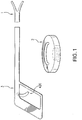
- the system of the invention performs its functions with three classes of magnaretractor apparatuses working together - the intracorporeal apparatus 1 , extracorporeal apparatus 2 , and placement apparatus 3 , as shown in Figure 1 .
- the intracorporeal apparatuses are the set of tools that are used to attach to an object or tissue inside a patient's body. They are designed to interact with the placement apparatus to place it in the correct position inside the body, an extracorporeal apparatus to manipulate it from outside the body, and the object or tissue the surgeon wishes to manipulate.
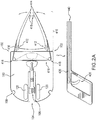
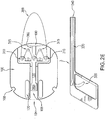
- FIG. 2 shows an intracorporeal apparatus.
- the preferred embodiment comprises a body 100 of some shape such as a narrow shaft at least in one cross section having a size no greater than a trocar. This is necessary as the intracorporeal apparatus in its preferred method of use will be passed through a trocar port into the patient's body.
- the apparatus is adapted to attach to an object or tissue.
- the apparatus is adapted to engage with a placement apparatus.
- the intracorporeal apparatuses are designed to both physically engage the placement apparatus, and respond to energy from an extracorporeal apparatus.
- a preferred embodiment accomplishes this by using magnets 120 disposed in one end 104 of the intracorporeal apparatus opposite the fastener end 414. To aid in engaging a placement apparatus, the magnet attracts an end of the placement apparatus containing a material attracted to the magnet. When the end of the placement apparatus is drawn near the end of the intracorporeal apparatus containing the magnet, the two apparatuses are attracted. If there is no impeding material located between the placement and intracorporeal apparatuses, the two apparatuses will contact and stick to each other, end to end.
- the magnetic end 104 of the intracorporeal apparatus is rounded to align axially with the placement apparatus. This alignment is imperative to allow the surgeon to retract both the placement and intracorporeal apparatuses through the trocar as well as to allow the interfaces of the placement apparatus to correctly engage the mating nodes of the intracorporeal apparatus.
- grooves or ridges 108 are placed on the end 104 of the intracorporeal apparatus to match the grooves or ridges 108 placed on the end of the placement apparatus. When the two apparatuses are pulled proximate to each other by their magnetic attraction, the grooves and ridges force the two apparatuses to align with the end of the placement apparatus slightly overlapping the end of the intracorporeal apparatus, and forming a tight connection.
- a portion of the body 100 of the intracorporeal apparatus is made of a material responsive to magnetic energy, and the magnet is instead disposed in the end of the placement apparatus.
- the magnet on the placement apparatus may be a permanent magnet or an electromagnet.
- the function performed by this reversed embodiment is identical to the function as described above.
- sterilization is a key consideration.
- sterilization of medical equipment is performed using an autoclave, which amongst other things, heats the equipment to a temperature higher than any germ can withstand to kill any germs present.
- some embodiments of the present invention utilize permanent magnets, which when heated near a certain temperature known as the Curie temperature, will permanently lose their magnetism. Therefore, special consideration in design and use must be made to ensure that the tools are both sterile and properly magnetized.
- the simplest procedure to ensure correct magnetization is to use a new device with a fresh magnet for each surgery.
- magnets may be employed having Curie temperatures well in excess of sterilization temperatures.
- Other embodiments of the invention are designed to accommodate reuse.
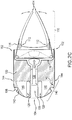
- the intracorporeal apparatus shown in FIG. 2C is designed to permit reusing the magnet, but allowing the choice of disposing the rest.
- the body 100 is at least partially covered by a sterile plastic shell.
- the body 100 has a resealable chamber 140 proximate the end 104 which engages the placement apparatus, wherein the permanent magnet 120 is placed.
- the chamber is formed by a cap 142 over a hollows 146 in the body wherein the cap screws or presses into the rim 144 of the hollows.
- the surgical team can remove the magnet 120 from the intracorporeal apparatus, and determine whether to sterilize the rest of the apparatus or discard it.
- the team may place an available magnet back into the resealable chamber 140 of the now sterile apparatus.
- the team may also choose to use an unused sterile intracorporeal apparatus, in which case they may place an available magnet into its resealable chamber 140 and reseal the chamber, preparing it for surgery. In either method, the magnet is removed after surgery, and thus never exposed to the destructive heat of an autoclave.
- the body 100 is made of a magnetically inert metal.
- the body of the intracorporeal apparatus has a resealable chamber 140 proximate the end 104 to house a permanent magnet.
- the resealable chamber 140 is formed by a metal 142 cap over a hollows 146 in the body wherein the cap screws or presses into the rim 144 of the hollows 146. After a surgery, the surgical team can remove the magnet 120 from the intracorporeal apparatus, and then sterilize this embodiment of the apparatus in an autoclave.
- the surgical team may use either an unused intracorporeal apparatus or an intracorporeal apparatus that has been autoclaved, perfecting preparation for surgery by placing an available magnet into the resealable chamber 140 and resealing the chamber.
- an available magnet into the resealable chamber 140 and resealing the chamber.
- This structure forms the platform for nearly limitless types of attachments and fasteners to be constructed for the surgeon's use.
- Such conceived attachments include screws, loops, clips, clamps, and the like.
- a screw may be useful for piercing and driving into a thick or muscular organ, such as a uterus, to gain appropriate traction to operate.
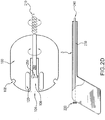
- the screw of the intracorporeal apparatus shown in FIG. 2D may have a port 106 on its end 104 to receive a type of energy and convert it into rotational energy. The surgeon using this embodiment may use the rotation of the screw 210 to drive the intracorporeal apparatus into the tissue which it is desired to manipulate.
- a matching placement apparatus 3 has an interface such as a rotatable knob 220 on the portion of the placement apparatus that remains outside the patient's body. Twisting the knob 220 manipulates a shaft 230 which connects to a node 240 at the end of the placement apparatus. This node engages a second mating node 250 on the screw intracorporeal apparatus.
- the second node 250 is in turn mechanically connected to the screw 210 by an axle 260, which is adapted to rotate independently from the body 100. Therefore, twisting the knob 220 on the placement apparatus rotates the screw 210 on the intracorporeal apparatus.
- the length of the screw 210 may be varied in order to obtain the optimal distance between the body part which it is desired to manipulate and the abdominal wall.
- Another embodiment includes a non-human powered drive in the placement apparatus to drive the shaft 230 and cause the screw 210 to rotate at a higher power than a human can exert without strain.
- FIGS. 2E and 2F Another intracorporeal apparatus, shown in FIGS. 2E and 2F is in the form of a loop.
- the loop embodiment may be used to attach to an object by placing the loop around the object, tightening the loop and capturing the object. The loop can later be loosened to release the object when finished.
- a matching placement apparatus 3 has an interface such as a lever, button, or trigger 320 on the portion of the body that remains outside the patient's body.
- This trigger 320 drives a shaft 330 which connects to a node 340 at the first end of the body.
- This node engages a second mating node 350 on the loop intracorporeal apparatus.
- This node 350 is in turn mechanically connected to one or both ends of the loop 300 such that as the node 350 moves towards the loop, the loop opens, and as the node moves away from the loop, the loop closes. Therefore, the loop opens and closes in response to the surgeon moving the trigger 320 on the placement apparatus outside the patient's body.
- An additional feature is a locking mechanism which maintains the tightened loop when the intracorporeal apparatus is not engaged with a placement apparatus.
- the mating node 350 on the intracorporeal apparatus is tensioned with a spring 360. This spring pushes the mating node away from the loop, thus holding the loop closed.
- the surgeon's pressure on the trigger 320 can easily overcome the spring, forcing the loop to open.
- the loop 300 is actuated by moving pulleys 310 and stationary pulleys 315.
- Moving pulleys 310 are mounted on a piston 130.
- the loop 300 is threaded between moving pulleys 310 and stationary pulleys 315 as shown in FIG. 2E .
- piston 130 and moving pulleys 310 advance toward the stationary pulleys 315.
- FIG. 2F this shortens the internal path loop 300 must take within body 100, allowing more of the loop to extend outside body 100.
- piston 130 and moving pulleys 310 return back to their extended position as shown in FIG. 2E .
- spring 360 causes piston 130 and mating pulleys 310 to return to this long-path state.
- An embodiment of the intracorporeal apparatus is a clip mechanism.
- the clip embodiment can be used to attach a surgical clip to an object proximate the end of the clip intracorporeal apparatus while retracting the object, and leaving the clip in place.
- a matching placement apparatus has an interface such as a lever, button, or trigger on the portion of the apparatus that remains outside the patient's body. This trigger drives a shaft which connects to a node at the end of the apparatus. This node engages a second mating node on the clip intracorporeal apparatus.
- the second node is in turn mechanically connected by a piston 130 such that as the node moves toward the clip, the clip is expelled from the clip intracorporeal apparatus and closes permanently on the object. Therefore, the clip is closed about an object in response to the surgeon moving the trigger on the placement apparatus outside the patient's body.
- a further embodiment of the intracorporeal apparatus is a clamp.
- the clamp embodiment can be used to form a simple attachment to an object whereby the surgeon opens the clamp and closes it around an object, to maintain its position. The clamp can later be opened to release the object.
- a placement apparatus 3 has an interface such as a lever, button, or trigger 420 on the portion of the apparatus that remains outside the patient's body.
- This trigger 420 manipulates a shaft 430 which connects to a node 440 at the end of the apparatus.
- This node 440 engages a second mating node 450 on the clamp intracorporeal apparatus.
- the second node 450 is in turn mechanically connected by a piston 130 to one or both sides of the clamp 410 such that as the node 450 moves towards the clamp, the clamp opens, and as the node moves away from the clamp, the clamp closes.
- the clamp opens and closes in response to the surgeon moving the trigger 420 on the placement apparatus outside the patient's body.
- An additional feature is the locking mechanism which holds the clamp tight when the intracorporeal apparatus is not engaged with a placement apparatus.
- the mating node 450 on the intracorporeal apparatus is spring tensioned by use of the clamp 410.
- the clamp is preferably constructed of a single rigid material that when at rest will close down its tines 414 to a point.
- the teeth 418 may be disposed near the end of one or both tines 414.
- the tines are connected to each other by a flexible filament 416 which is thread through the body 100 across pulleys 418.
- the piston 130 is in physical contact with the filament 416 inside the body 100.
- the spring function of the tines 414 keeps the filament 416 in a taut position. This taut filament 416 pushes against the piston 130 away from the clamp.
- the surgeon's pressure on trigger 420 can easily overcome the tension placed on the filaments by the tines 414. This pressure forces mating node 450 and piston 130 to move towards the clamp 410, stretching filament 416. As pressure is applied to the filament 416, the tines 414 are forced to open.
- the placement apparatuses are the tools that are used to physically position the intracorporeal apparatuses inside the patient's body and cause them to attach to objects.
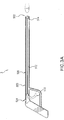
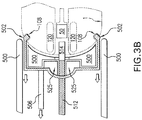
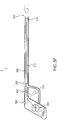
- the preferred embodiment shown in FIGS. 3A and 3B , comprises a body 500 having some shape with some length at least in one cross section having a size no greater than a trocar being of a length which would allow it to access distant areas within the body and allow the surgeon to comfortably operate the portion of the apparatus remaining outside the patient's body.
- the preferred embodiment further comprises a connector 502 disposed on the end of the body that is placed through the trocar into the patient's body.
- This connector is adapted to engage and disengage any of numerous intracorporeal apparatuses 1.
- the connector is controlled by an engagement interface near the end of the body that remains outside the body during surgery.
- This engagement interface can be a button, an electrical connection to an external device or, most preferably, an engagement lever 504 that slides in the direction along the body's length, and is mechanically attached by a shaft 506 to the connector 502 at the far end of the body 500.
- the engagement lever 504 When the engagement lever 504 is moved closer to the far end, the connector 502 moves with the engagement lever to capture and engage with an intracorporeal apparatus 1.
- the connector moves with the lever to disengage and release an intracorporeal apparatus.
- the preferred embodiment also comprises another interface near the end of the body that remains outside of the patient's body.
- This action interface transmits mechanical energy from the surgeon or another source outside the body to an intracorporeal apparatus if engaged to the placement apparatus.
- the preferred embodiment for the action interface is a lever in the form of a trigger 510 which is spring loaded.
- the trigger 510 is mechanically connected to a node 514 at the far end of the body 500 by a shaft 512.
- This node 514 engages with a mating node 50 on an intracorporeal apparatus 1, the intracorporeal apparatus then in turn converts the delivered energy for its uses.
- the action interface may also be alternatively an electrical connection to an external device.
- the placement apparatus In order to assist engaging with the preferred embodiment of the intracorporeal apparatus described above, the placement apparatus must have some magnetically responsive material to attract the permanent magnet in the intracorporeal apparatus.
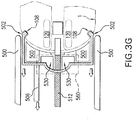
- the preferred embodiment thus has a mass of magnetically responsive material 525 disposed within the body 500 of the placement apparatus near the end that enters the patient's body. This magnetically responsive material 525 is mechanically connected to the connector 502 and moves toward the end when the engagement interface is moved towards the end. The magnetically responsive material 525 moves away from the end further up the body 500 when the engagement interface is moved away from the end.
- the magnetically responsive material is most proximate the end of the body, and thus more easily attracted to the magnet in the intracorporeal apparatus. Furthermore, when the engagement interface is positioned to disengage from the intracorporeal apparatus, the magnetically responsive material is pulled away and outside the attractive reach of the intracorporeal apparatus magnet, thus allowing the two apparatuses to separate.
- any magnetically responsive material may be utilized in accordance with the teaching of the invention.
- Presently preferred magnetically responsive material includes ferrous or iron-containing material, rare-earth containing materials, and the like. Exemplary magnetic materials are listed in Table 1.
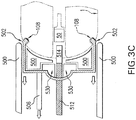
- the placement apparatus contains a magnet 530 or electromagnet 540 disposed near the end of the body that enters the patient's body.
- the magnet 530 attracts the magnetically responsive material in certain embodiments of the intracorporeal apparatuses, performing the same function in aiding the surgeon to engage the intracorporeal apparatus inside the patient's body.
- this magnet 530 may be disposed within the shaft of the body 500 and mechanically connected to the connector 502. In this way, the magnet 530 moves closer to the end of the body 500 when the engagement interface is slid towards the end. With the magnet closer to the end, the placement apparatus will more easily attract the intracorporeal apparatus. Similarly, the magnet moves into the interior of the body and further from the end as the engagement interface is slid away from the end. With the magnet further from the end, the intracorporeal apparatus will be less attracted to the placement apparatus, which will cause an easy separation.
- the system can take advantage of controlled temporary magnetism.
- the electromagnet 540 is turned on, and so attracts the magnetically responsive material 120 in a corresponding intracorporeal apparatus.
- the electromagnet 540 is turned off. With slight movement from the surgeon, the intracorporeal apparatus will no longer be attracted to the placement apparatus, and the two apparatuses may be separated.
- a detachable power supply connects to the placement apparatus near the end that remains outside the patient's body. This power supply being external to the placement apparatus allows the placement apparatus to be made smaller.
- the surgical team may detach the power supply and sterilize the placement apparatus in an autoclave as they normally would. When sterile, the team may then reattach the power supply for use in a subsequent procedure.
- a preferred embodiment also comprises a third interface near the end of the body that remains outside of the patient's body.
- the interface 550 when activated by the surgeon causes the connector 502 and any object engaged to it to rotate about the axis of the placement apparatus.
- the surgeon's interface 550 may articulate an intracorporeal apparatus 1 attached to the placement apparatus in a fashion similar to the manner in which surgeons currently rotate laparoscopic instruments within a patient's body.
- the placement apparatus containing their own permanent magnets, a similar situation arises as seen in the intracorporeal apparatuses above involving sterilization.
- Typical sterilization in an autoclave may strip the permanent magnets of their magnetism.
- the magnet 530 is placed in a resealable chamber 560 proximate the end of the body 500 that is passed into the patient's body.
- the resealable chamber is formed by a cap 562 over a hollow in the body wherein the cap presses into the rim of the hollows.
- the surgical team can remove the magnet 530 from the placement apparatus, and sterilize the remainder in an autoclave.
- the team may take an unused or an autoclaved placement apparatus, place an available magnet into its resealable chamber, and replace the cap on the chamber, thereby rendering the placement apparatus ready for utilization in a subsequent surgery.
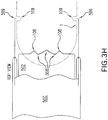
- FIG. 3H demonstrates a top view of the connector and its interaction with the intracorporeal apparatus.
- grooves or ridges 108 are placed on the end of the intracorporeal apparatus to match grooves or ridges 508 on the connector 502.
- the placement apparatus may be fitted with a moveable or flexible tab 509 mechanically connected to the engagement interface. This tab 509 is adapted to fit within a groove 109 on an intracorporeal apparatus in a mating fashion when the engagement interface is moved toward the end of the body. Thus, the tab thus locks the intracorporeal apparatus to the placement apparatus.
- a third major component of this system is the extracorporeal apparatus.
- This apparatus may be used to position an intracorporeal apparatus and any object attached to it within the patient's body.
- This apparatus comprises a body of some shape with an affixed handle and a magnet or other source of magnetic energy.
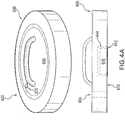
- the extracorporeal apparatus may be shaped like a disk with the magnet 610 contained in the middle of the body 600, away from the surface.
- the body forms a shell around the magnet, comprised of either a medically inert plastic or a magnetically inert metal or a combination of both materials. Both materials are suitable to prevent the magnet from coming in direct contact with the patient's body, but also serve the purpose of protecting the magnet.
- Many types of magnets used in the preferred embodiments are so fragile or brittle, that their own attraction to another magnet can cause the magnet to disintegrate upon contact.
- the body surrounding the magnet absorbs some of the energy in the event of an impact with a hard surface or a corresponding magnaretractor apparatus.
- the extracorporeal apparatus may be partially wrapped by a disposable or sterilizable cover 620.
- the use of permanent magnets presents a situation wherein the typical method of sterilization, i.e., use of an autoclave may destroy the magnetic properties of the magnet.
- the surgical team may remove this cover from the extracorporeal apparatus, and either discard or sterilize it for later use. In preparation for a subsequent surgery, the team then may simply place a new or sterilized cover on an available extracorporeal apparatus.
- the cover comprise a form-fitting boot to frictionally adhere to the body of the extracorporeal apparatus.
- an extracorporeal apparatus embodiment having a resealable magnet chamber is to use an extracorporeal apparatus embodiment having a resealable magnet chamber.
- the resealable chamber 640 resides in the central area of the apparatus body 600.
- the chamber is formed by a cap 642 over a hollows in the body wherein the cap screws or presses into the rim of the hollows.
- the surgical team can remove the magnet 610 from the extracorporeal apparatus 2, and determine whether to sterilize the apparatus or discard it. If the team chooses to sterilize its used extracorporeal apparatuses, after sterilization, the team may place an available magnet back into the resealable chamber 640 of the now sterile apparatus.
- the team may also choose to use an unused sterile extracorporeal apparatus, in which case they may place an available magnet into its resealable chamber in preparation for surgery. In either method, the magnet is never exposed to the destructive heat of an autoclave.
- the magnets of the extracorporeal apparatuses must be strong enough to exert sufficient pulling (or pushing) force to permit manipulation of the desired object within the body cavity from a distance of several centimeters. For example, in performing a hysterectomy on a fibroid uterus, the magnet pulling an attached intracorporeal apparatus must reach through as much as 5 centimeters or even more of the patient's body to cause the uterus to move.
- the present invention includes a set of extracorporeal apparatuses with magnets of varying sizes, shapes and materials, or an adjustable electromagnet.
- the first consideration for a surgical team in choosing which type of magnets to use concerns whether they will reuse the tools, and if so, how they will sterilize them.
- a surgical team choosing to discard used extracorporeal apparatuses is only limited in its choice by the expense of individual magnets, and therefore needs only consider the magnetic strength required for this particular patient or procedure.
- using an autoclave may destroy a magnet's magnetism. Therefore, the team has three options for reuse.
- the first option is to choose a magnet with a Curie temperature much higher than their autoclave can generate, such as Samarium-cobalt or Alnico magnets. With this option, the team may simply place the entire apparatus into the autoclave as they would any other equipment. For many purposes, this may be an adequate solution.
- both Samarium-cobalt and Alnico magnets are weaker than Neodymium magnets, and such strength may be necessary for patients with thick adipose tissue or in procedures that require manipulation of deeply situated or heavy objects.
- the second option is to choose an extracorporeal apparatus having a removable magnet in a resealable chamber.
- the team removes the magnet from the apparatus after use.
- the apparatus then may be placed in the autoclave as the team typically would to sterilize equipment. After sterilization, the team would then place the magnet back into the apparatus prior to conducting another surgery.
- the final option is to use permanently positioned magnets within the apparatus.
- the surgical team may place the entire extracorporeal apparatus into the autoclave, without regard to Curie temperatures until sterilization is achieved. Since the magnet embedded in the apparatus may have been demagnetized, before use, the team must place the apparatus into a remagnetizer to return the magnet to its full magnetic capabilities. The team may perform this on-site, or return the apparatus to an appropriate vendor who can perform a remagnetizing service to re-magnetize the magnets.
- a preferred embodiment of a remagnetizer includes a body which physically mates with the extracorporeal apparatus to hold it in one position during the re-magnetization process.
- the remagnetizer exposes the magnet within the magnaretractor apparatus to a high-intensity magnetic field, which causes the magnet to retain its original magnetic field.
- This option may similarly be used to sterilize and re-magnetize intracorporeal and placement apparatuses.
- Table 1 - Exemplary magnets and their characteristics Material Curie Temp. Characteristics Cobalt (Co) 1115 °C Very high Curie temp. Low strength Alnico 800 °C High Curie temp. Much weaker than SmCo and NIB magnets Much stronger than other non-rare earth magnets Iron (Fe) 770 °C High Curie temp. Low strength Samarium-cobalt (SmCo) 680 to 800 °C High Curie temp.
- the shape has an effect on how much the magnetic field "falls off" over distance.
- a magnet shaped like a long rod may be strong enough to cause an object weighing 1 kilogram from one centimeter away to accelerate towards the magnet.
- This same magnet can only cause the same acceleration on an object weighing 250 grams from two centimeters away or 40 grams from five centimeters away.
- the strength of the magnetic field is said to fall off with the square of the distance, giving this magnet a deep reach.
- a magnet having a different shape may also be able to cause an object weighing 1 kilogram from one centimeter away to accelerate towards it, however, at two centimeters, it may only have the capacity to cause the same acceleration on an object weighing 125 grams, and from five centimeters the magnet may only cause the same acceleration on an object weighing 8 grams.
- the strength of the magnetic field is said to fall off with the cube of the distance, i.e., a shallower reach.
- the surgeon will have the option of choosing an extracorporeal apparatus with a deeper or shallower reach.
- the surgeon may use special trocars with graduations to measure the thickness of the abdominal walls of the patient's body. With that measurement and the surgeon's knowledge of the approximate weight of the object to be moved, the surgeon may choose the appropriate extracorporeal apparatus having a magnet of the required strength amongst the plurality of available apparatuses.
- the extracorporeal apparatus may be fine tuned by disposing the magnet on an articulable joint.
- the magnet 610 may be moved closer or further away from the patient's body by manipulating the articulable joint 660. This way, the surgeon may exact greater or lesser force on an object held by an intracorporeal apparatus within the body. Additionally, the surgeon may use intracorporeal apparatuses containing its own magnets, which will interact with the magnet 610 in the extracorporeal apparatus 2.
- the surgeon may rotate the magnet of the extracorporeal apparatus 660, which would cause the magnet of the nearby intracorporeal apparatus to rotate in sympathy. The result is that the surgeon can manipulate the attitude of the object within the patient's body by articulating the magnet attached to the extracorporeal apparatus.
- FIG. 4C Another embodiment shown in FIG. 4C uses an electromagnet 615 as the source of magnetic energy.
- the strength of the electromagnet's 615 magnetic field is adjustable to allow the surgeon to choose the smallest field required to position a single intracorporeal apparatus, and not interfere with other apparatuses or other magnetically responsive objects.
- a detachable power supply cable 617 provides power to the electromagnet 615.
- surgeon may lubricate the surface 670 touching the patient's body to allow it to move more easily, and anchor the apparatus to the body, the surgical drape, the surgical table, or another fixed object, to prevent the apparatus from moving once in place.
- Anchoring the extracorporeal apparatus in a fixed position may also be accomplished by using an air pump.
- the preferred embodiments shown in FIGS. 4A , 4B and 4C dispose a port 650 on one side of the extracorporeal apparatus which may be connect to an air pump. This port allows the surgeon to position the extracorporeal apparatus 2 on the desired point on the exterior of the patient's body. Then using the air pump, the surgeon may pump air from beneath port 650, thereby decreasing the pressure between the extracorporeal apparatus 2 and the patient's body. The resulting pressure differential will gently lock the extracorporeal apparatus in position on the patient's body. When the surgeon wishes to remove the apparatus, a release valve on the air pump may be opened, allowing normal pressure to return to the region between the apparatus and the patient's body, thus unlocking the apparatus.
- the extracorporeal apparatus may also be anchored to the patient's body by use of a medical adhesive.
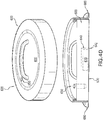
- a semi-permanent adhesive may be either placed directly on the bottom surface 670 of the extracorporeal apparatus 2, or alternatively, the adhesive may be placed around the edge of the extracorporeal apparatus as shown in FIG. 4D .
- the rim may be moveable to align with the lower surface 670 of the extracorporeal apparatus 2 when adhering to the patient's body, or retracted above the lower surface 670 of the extracorporeal apparatus when not adhering to the patient's body.
- the surgeon may start by placing the three ports: a camera in the umbilical port, and two operative ports in the lower quadrants. The surgeon then may engage a clamp intracorporeal apparatus to a placement apparatus. Using one of the operative ports, the surgeon may feed the combination through the trocar into the patient's body, and place the clamp on the ovary to be retracted. The surgeon then is able to place an extracorporeal apparatus on the exterior surface of the abdomen. The magnetic field attracts the clamp and the surgeon is able to guide the ovary towards the extracorporeal apparatus. The extracorporeal apparatus may be locked into position using an adhesive on the extracorporeal apparatus rim or an anchor.
- the surgeon is able to disengage the clamp intracorporeal apparatus from the placement apparatus and retract the placement apparatus back through the trocar and out of the patient's body.
- the ovary will now remain retracted against the interior surface of the anterior abdominal wall, well outside of the surgical field, and without the inclusion of a large intra-abdominal instrument. Accordingly, the surgeon will only need two intra-abdominal instruments, and may control all of the instruments in the operative field without assistance. This also beneficially results in less instrument clutter in the operative field.
- the placement apparatuses and systems of the present invention can also be very beneficial when performing a laparoscopic hysterectomy.
- a cork screw is often placed in the fundus of the uterus and used for upward traction in order to decrease bleeding.
- the traction on the uterus also makes it much easier to access the lateral sides of the uterus and suture and ligate the uterine arteries and cardinal ligaments.
- One of the difficulties in performing a laparoscopic hysterectomy is that there is no way to retract the uterus in a similar fashion. It is often difficult to surgically place an extra port and use a grasper to retract the uterus.
- the additional grasper often gets in the way of the other intra-abdominal instruments, which are being used to carry out the dissection. Also, the surgeon is physically unable to manipulate more than two instruments at a time. Lastly, a surgeon often experiences difficulty in trying to manipulate the uterus utilizing a grasper.
- the placement apparatuses and systems of the present invention allows the surgeon the ability to retract the uterus in the same fashion as if the surgeon were performing an open abdominal hysterectomy.
- the surgeon would engage a screw intracorporeal apparatus with a placement apparatus, and insert the combination through a trocar into the patient's body.
- the surgeon is then able to position the screw and twist it into the fundus of the uterus.
- An extracorporeal apparatus may then be placed on the external anterior abdominal wall.
- the surgeon must choose an extracorporeal apparatus with a magnet strong enough to attract the muscular and massive uterus.
- the screw intracorporeal apparatus and the attached uterus would then be attracted towards the magnetic field of the extracorporeal apparatus.
- the extracorporeal apparatus would essentially provide upwards traction on the uterus similar to an open abdominal case. Furthermore, the extracorporeal apparatus could be moved laterally as needed to move the uterus and allow for easy access to the lateral aspects of the uterus and cervix. With the screw intracorporeal apparatus attached to the uterus, the surgeon may disengage and retract the placement apparatus through the trocar and out of the patient's body, thus freeing space within the body for other intra-abdominal instruments.
- the placement apparatuses and systems of the present invention can also be used to increase performance when conducting a salpingectomy for a tubal ligation or an ectopic pregnancy.
- the current procedure is conducted with use of three ports: an umbilical port for a camera, and two within which to operate.
- the procedure requires a surgical assistant to grasp and hold the tube while the surgeon performs the resection.
- the placement apparatuses and systems of the present invention allows the surgeon to perform the procedure without any assistance, and utilizing only two ports: an umbilical port for the camera, and a superpubic operative port. Initially, the surgeon would begin by engaging a clamp intracorporeal apparatus to a placement apparatus, and passing the combination through a trocar into the patient's body.
- the surgeon can maneuver the clamp onto the area of the tube that is to be resected.
- An extracorporeal apparatus placed on the external abdominal wall could then be used to retract and grasp the tube.
- the surgeon may disengage the placement apparatus and retract it through the trocar and out of the patient's body, thereby freeing up space for a different intra-abdominal apparatus.
- a harmonic scalpel or other such device would be used to resect the desired portion of the tube. Accordingly, the need for an extra port and a surgical assistant is eliminated.
- Post-completion of the resection the surgeon may then reinsert the placement apparatus through the trocar into the patient's body, and manipulate the clamp intracorporeal apparatus still attached to the tube.
- the surgeon is able to then re-engage the placement apparatus with the intracorporeal apparatus, and release the clamp from the tube. Finally, the surgeon may remove the resected tube from the abdominal cavity, retract the combination of the placement apparatus and the clamp through the trocar and seal the ports used in the surgical procedure.
- the placement apparatuses and systems of the present invention may also be used to help the surgeon avoid many of the common complications of laparoscopic surgery.
- a common complication in laparoscopic surgery is ureteral damage. Ureteral damage, if not promptly treated, may result in damage to renal function and possibly loss of the kidney entirely.
- the placement apparatuses and systems of the present invention prevents damage to a ureter by the insertion of an intracorporeal apparatus such as a toothless clamp or a loop to move a ureter away from the surgical field.
- the placement apparatuses and systems of the present invention may also be used in general surgical procedures.
- laparoscopic bariatric surgery can be made more efficient using the placement apparatuses and systems of this invention.
- the surgeon must retract the liver.
- this retractor requires the use of an operative port.
- the present invention allows the surgeon the ability to retract the liver without the use of a trocar-occupying instrument. Accordingly, the surgery could be performed with a reduced number of ports and reduced intra-abdominal congestion.
- the placement apparatuses and systems of the present invention may also be used in laparoscopic procedures performed on animals. For example, laparoscopic surgery routinely performed on baboons may be carried out more efficiently by means of the placement apparatuses and systems of the present invention.
- laparoscopic surgery routinely performed on baboons may be carried out more efficiently by means of the placement apparatuses and systems of the present invention.
- diagnostic laparoscopic procedures it has been discovered that the uterus and ovaries of a baboon are more mobile than those of humans.
- the placement apparatuses and systems of the present invention enables the surgeon to retract the uterus or ovaries of a baboon without the use of grasping forceps. This is preferable, because the use of grasping forceps has been reported to result in slight round ligament bleeding in some laparoscopic procedures performed on baboons.
- Laparoscopic surgery is also performed on other animals, including mammals such as dogs, llamas, alpacas, mares, lions and cows.
- the placement apparatuses and systems of the present invention will enable surgeons to accomplish such operations in a more efficient manner, as in humans.
Landscapes
- Health & Medical Sciences (AREA)
- Life Sciences & Earth Sciences (AREA)
- Surgery (AREA)
- Engineering & Computer Science (AREA)
- Veterinary Medicine (AREA)
- Animal Behavior & Ethology (AREA)
- Public Health (AREA)
- General Health & Medical Sciences (AREA)
- Nuclear Medicine, Radiotherapy & Molecular Imaging (AREA)
- Biomedical Technology (AREA)
- Heart & Thoracic Surgery (AREA)
- Molecular Biology (AREA)
- Medical Informatics (AREA)
- Robotics (AREA)
- Radiology & Medical Imaging (AREA)
- Pathology (AREA)
- Oral & Maxillofacial Surgery (AREA)
- Neurosurgery (AREA)
- Wood Science & Technology (AREA)
- Zoology (AREA)
- Surgical Instruments (AREA)
- Transition And Organic Metals Composition Catalysts For Addition Polymerization (AREA)
Claims (15)
- Platzierungsvorrichtung (3) zur Verwendung in Laparoskopieverfahren, umfassend:einen Körper (500) mit einem ersten Ende, das einen Schaft (506) umfasst,einen Verbinder (502) in der Nähe des ersten Endes des Körpers (500), wobei der Verbinder dazu ausgeführt ist, eine intrakorporale Vorrichtung (1) gezielt in Eingriff zu nehmen und aus dieser auszurücken,eine erste Schnittstelle (504) in der Nähe des zweiten Endes des Körpers (500), die mit dem Verbinder (502) wirkverbunden ist, um den Verbinder (502) so zu steuern, dass er die introkorporale Vorrichtung (1) in Eingriff nimmt und aus ihr ausrückt, und eine zweite Schnittstelle (510) in der Nähe des zweiten Endes, die dazu ausgeführt ist, mechanische Energie von der Platzierungsvorrichtung (3) zu der intrakorporalen Vorrichtung (1) zu liefern,dadurch gekennzeichnet, dass die Platzierungsvorrichtung (3) ferner einen Magneten (525, 530, 540) in der Nähe des ersten Endes umfasst, um zum Eingriff mit der korporalen Vorrichtung (1) beizutragen, wobei der Magnet (525, 530, 540) in einer wiederversiegelbaren Kammer (560) an dem ersten Ende des Körpers (500) platziert ist.
- Platzierungsvorrichtung (3) nach Anspruch 1, wobei die zweite Schnittstelle einen Hebel und/oder eine Feder und/oder eine Taste und/oder einen Auslöser und/oder einen drehbaren Knopf umfasst.
- Platzierungsvorrichtung nach Anspruch 1, wobei der Magnet (525, 530, 540) ein Elektromagnet (540) ist und wobei die Platzierungsvorrichtung (3) optional ferner eine ablösbare Elektromagnet-Energiequelle in der Nähe des zweiten Endes der Platzierungsvorrichtung (3) umfasst, um den Elektromagneten (540) mit Energie zu versorgen.
- Platzierungsvorrichtung nach einem der vorhergehenden Ansprüche, wobei:der Magnet (525, 530, 540) an die erste Schnittstelle (504) gekoppelt ist undsich der Magnet (525, 530, 540) als Reaktion auf die erste Schnittstelle (504) in dem Schaft (506) bewegt.
- Platzierungsvorrichtung (3) nach Anspruch 1, wobei die Platzierungsvorrichtung (3) nach der Entfernung des Magneten (525, 530, 540) für die Sterilisierung durch die Verwendung von Hitze geeignet ist und wobei der Magnet (525, 530, 540) eine Curie-Temperatur unter der Sterilisierungstemperatur hat.
- Platzierungsvorrichtung (3) nach Anspruch 1, ferner umfassend: ein auf magnetische Energie (525) reagierendes Material und eine/n oder mehrere Stege oder Rillen in der Nähe des ersten Endes, die auf eine/n oder mehrere Stege oder Rillen an einem Ende der introkorporalen Vorrichtung (1) ausgerichtet sind.
- Platzierungsvorrichtung (3) nach Anspruch 1, wobei der Verbinder eine bewegliche Lasche umfasst, die auf die erste Schnittstelle (504) reagiert und dazu ausgeführt ist, zusammenpassend in eine Rille an einer intrakorporalen Vorrichtung (1) zu passen.
- Platzierungsvorrichtung (3) nach Anspruch 1, wobei mindestens eine der ersten und zweiten Schnittstelle (504, 510) eine elektrische Verbindung zu einer externen Vorrichtung umfasst.
- Chirurgisches System, umfassend:die Platzierungsvorrichtung (3) zur Verwendung in Laparoskopieverfahren nach Anspruch 1 undeine intrakorporale Vorrichtung (1), wobei die intrakorporale Vorrichtung (1) Folgendes umfasst:einen Körper (100),wobei ein erstes Ende (102) des Körpers (100) dazu ausgeführt ist, durch eine Schraube und/oder eine Schlaufe und/oder einen Clip und/oder eine Klemme und/oder eine Befestigungsvorrichtung an einem Gewebe in dem Körper eines Patienten angebracht zu werden, undwobei ein zweites Ende (104) des Körpers (100), das dem ersten Ende gegenüberliegt, eine Schnittstelle umfasst, die dazu ausgeführt ist, mit der Platzierungsvorrichtung (3) in Eingriff zu kommen und aus dieser ausgerückt zu werden, wobei die Schnittstelle dazu ausgeführt ist, magnetische und/oder mechanische Energie von der Platzierungsvorrichtung (3) zu erhalten.
- Chirurgisches System nach Anspruch 9, wobei die intrakorporale Vorrichtung (1) ferner eine/n oder mehrere Stege oder Rillen (108) in der Nähe des zweiten Endes (104) umfasst, die auf eine/n oder mehrere Stege oder Rillen an einem Ende der Platzierungsvorrichtung (3) ausgerichtet sind.
- Chirurgisches System nach Anspruch 9, wobei die intrakorporale Vorrichtung (1) entweder ferner Folgendes umfasst:eine Kunststoffschale, die mindestens einen Teil des Körpers (100) umgibt,eine wiederversiegelbare Kammer (140) in der Nähe des zweiten Endes (104),einen in der wiederversiegelbaren Kammer (140) platzierten Permanentmagneten (120), wobei der Permanentmagnet (120) aus der wiederversiegelbaren Kammer (140) entfernbar ist,
oder ferner Folgendes umfasst: eine wiederversiegelbare Kammer (140) in der Nähe des zweiten Endes (104),einen in der wiederversiegelbaren Kammer (140) platzierten Permanentmagneten (120),wobei der Körper (100) ein magnetisch inertes Metall umfasst. - Chirurgisches System nach Anspruch 9, wobei die intrakorporale Vorrichtung (1) ferner eine weitere Schnittstelle in der Nähe des zweiten Endes (104) des Körpers (100) für eine Wirkverbindung mit einem Verbinder der Platzierungsvorrichtung (3) umfasst, um den Verbinder und ein beliebiges Objekt, das entlang der Achse des Körpers (100) mit dem Verbinder verbunden ist, zu drehen.
- Chirurgisches System nach Anspruch 9, wobei:das erste Ende (102) des Körpers (100) der intrakorporalen Vorrichtung (1) dazu ausgeführt ist, durch eine Schraube (210) an das Gewebe angebracht zu werden, wodurch die Energie zum Drehen der Schraube (210) von der Schnittstelle geliefert wird, vorzugsweise um dadurch das Gewebe in Eingriff zu nehmen, wenn sich die Schraube (210) dreht, oderdas erste Ende (102) des Körpers (100) der intrakorporalen Vorrichtung (1) dazu ausgeführt ist, durch eine Schlaufe (300) an das Gewebe angebracht zu werden, wodurch die Energie zum Anziehen oder Lockern der Schlaufe (300) von der Schnittstelle geliefert wird, vorzugsweise um dadurch das Gewebe in Eingriff zu nehmen, wenn die Schlaufe (300) angezogen wird, oderdas erste Ende (102) des Körpers (100) der intrakorporalen Vorrichtung (1) dazu ausgeführt ist, durch einen Clip an das Gewebe angebracht zu werden, wodurch die Energie zum Öffnen oder Schließen des Clips von der Schnittstelle geliefert wird, vorzugsweise um dadurch das Gewebe zu ergreifen, wenn sich der Clip schließt, oderdas erste Ende (102) des Körpers (100) der intrakorporalen Vorrichtung (1) dazu ausgeführt ist, durch eine Klammer (410) an das Gewebe angebracht zu werden, wodurch die Energie zum Öffnen oder Schließen der Klammer (410) von der Schnittstelle geliefert wird, vorzugsweise um dadurch das Gewebe einzuklemmen, wenn sich die Klammer (410) schließt, oderdas erste Ende (102) des Körpers (100) der intrakorporalen Vorrichtung (1) dazu ausgeführt ist, durch eine Befestigungsvorrichtung an das Gewebe angebracht zu werden, wodurch die Energie zur Betätigung der Befestigungsvorrichtung von der Schnittstelle geliefert wird, vorzugsweise um dadurch das Gewebe in Eingriff zu nehmen, wenn die Befestigungsvorrichtung betätigt wird.
- Chirurgisches System nach Anspruch 9, ferner umfassend:
eine extrakorporale Vorrichtung (2), die mobil und dazu ausgeführt ist, in nächster Nähe des Körpers platziert zu werden, wobei die extrakorporale Vorrichtung (2) Folgendes aufweist:einen Körper (600), der einen mittleren Abschnitt und einen Umfangsrandabschnitt umfasst,einen an dem Körper (600) befestigten Griff,eine an den Körper (600) gekoppelte Quelle magnetischer Energie (610) undwobei der Körper dazu ausgeführt ist, magnetische Energie an die an einem Gewebe in dem Körper des Patienten angebrachte intrakorporale Vorrichtung (1) zu liefern, so dass das Patientengewebe zurückgezogen werden kann. - Chirurgisches System nach Anspruch 14, ferner umfassend:
einen Autoklav zum Sterilisieren eine intrakorporale Vorrichtung (1) und/oder eine extrakorporale Vorrichtung (2) und/oder eine Platzierungsvorrichtung (3) nach Platzierung der intrakorporalen Vorrichtung (1) im Körper eines Patienten und/oder eine sterilisierte Abdeckung, die die erste extrakorporale Vorrichtung (2) mindestens teilweise abdeckt, um eine Kontaminierung des Körpers eines Patienten zu verhindern.
Applications Claiming Priority (2)
| Application Number | Priority Date | Filing Date | Title |
|---|---|---|---|
| US99657507P | 2007-11-26 | 2007-11-26 | |
| PCT/US2008/084991 WO2009070743A1 (en) | 2007-11-26 | 2008-11-26 | Magnaretractor system and method |
Publications (3)
| Publication Number | Publication Date |
|---|---|
| EP2227293A1 EP2227293A1 (de) | 2010-09-15 |
| EP2227293A4 EP2227293A4 (de) | 2013-07-03 |
| EP2227293B1 true EP2227293B1 (de) | 2019-08-28 |
Family
ID=40679001
Family Applications (1)
| Application Number | Title | Priority Date | Filing Date |
|---|---|---|---|
| EP08853840.0A Active EP2227293B1 (de) | 2007-11-26 | 2008-11-26 | Magnaretraktor-system |
Country Status (6)
| Country | Link |
|---|---|
| US (7) | US8602981B2 (de) |
| EP (1) | EP2227293B1 (de) |
| JP (1) | JP2011504767A (de) |
| AU (1) | AU2008329676B2 (de) |
| CA (4) | CA2706860C (de) |
| WO (1) | WO2009070743A1 (de) |
Families Citing this family (29)
| Publication number | Priority date | Publication date | Assignee | Title |
|---|---|---|---|---|
| DE60024437T2 (de) * | 1999-03-17 | 2006-07-13 | Medtronic, Inc., Minneapolis | Werkzeug zum einstellen eines implantierbaren und einstellbaren durchflussregelventils |
| CA2706860C (en) | 2007-11-26 | 2017-08-01 | Eastern Virginia Medical School | Magnaretractor system and method |
| CL2009000279A1 (es) | 2009-02-06 | 2009-08-14 | Biotech Innovations Ltda | Sistema de guia y traccion remota para cirugia mini-invasiva, que comprende: al menos una endopinza quirurgica y desprendible con medios de enganches y una porcion de material ferro magnaetico, una guia de introduccion de forma cilindrica, un mecanismo de desprendimiento, y al menos un medio de traccion remota con iman. |
| US20130066304A1 (en) * | 2009-02-27 | 2013-03-14 | Modular Surgical, Inc. | Apparatus and methods for hybrid endoscopic and laparoscopic surgery |
| KR101070238B1 (ko) * | 2009-11-23 | 2011-10-06 | 주식회사 이턴 | 수술용 인스트루먼트 |
| US9421032B2 (en) * | 2010-06-16 | 2016-08-23 | Covidien Lp | Seal port with blood collector |
| BR112013011944B1 (pt) | 2010-11-16 | 2022-02-22 | TVA Medical, Inc | Sistema para formação de uma fistula |
| CA2887557C (en) | 2012-10-11 | 2022-05-17 | Tva Medical, Inc. | Devices and methods for fistula formation |
| US8764769B1 (en) | 2013-03-12 | 2014-07-01 | Levita Magnetics International Corp. | Grasper with magnetically-controlled positioning |
| WO2014159023A1 (en) | 2013-03-14 | 2014-10-02 | Levita Magnetics International Corp. | Magnetic control assemblies and systems therefor |
| US10821217B2 (en) | 2013-03-14 | 2020-11-03 | Tva Medical, Inc. | Fistula formation devices and methods therefor |
| EP3096673B1 (de) | 2014-01-21 | 2025-02-19 | Levita Magnetics International Corp. | Laparoskopische greifer und systeme dafür |
| WO2015138998A1 (en) | 2014-03-14 | 2015-09-17 | Tva Medical, Inc. | Fistula formation devices and methods therefor |
| US10646666B2 (en) | 2014-08-27 | 2020-05-12 | Tva Medical, Inc. | Cryolipolysis devices and methods therefor |
| CN107106220B (zh) * | 2014-10-28 | 2019-10-08 | 奥林巴斯株式会社 | 外科手术装置 |
| US10603040B1 (en) | 2015-02-09 | 2020-03-31 | Tva Medical, Inc. | Methods for treating hypertension and reducing blood pressure with formation of fistula |
| EP3967244B1 (de) | 2015-04-13 | 2025-12-31 | Levita Magnetics International Corp. | Retraktorvorrichtungen |
| EP4520287A3 (de) | 2015-04-13 | 2025-03-26 | Levita Magnetics International Corp. | Zange mit magnetisch gesteuerter positionierung |
| EP3399902B1 (de) | 2016-01-08 | 2024-06-12 | Levita Magnetics International Corp. | Chirurgisches system für einen bediener |
| WO2017124062A1 (en) | 2016-01-15 | 2017-07-20 | Tva Medical, Inc. | Devices and methods for forming a fistula |
| CA3011238C (en) | 2016-01-15 | 2024-01-02 | Tva Medical, Inc. | Devices and methods for advancing a wire |
| JP7219090B2 (ja) | 2016-01-15 | 2023-02-07 | ティーブイエー メディカル, インコーポレイテッド | 脈管を接着するためのシステムおよび方法 |
| US10874422B2 (en) | 2016-01-15 | 2020-12-29 | Tva Medical, Inc. | Systems and methods for increasing blood flow |
| WO2018057095A1 (en) | 2016-09-25 | 2018-03-29 | Tva Medical, Inc. | Vascular stent devices and methods |
| US11020137B2 (en) | 2017-03-20 | 2021-06-01 | Levita Magnetics International Corp. | Directable traction systems and methods |
| US10898192B2 (en) | 2017-06-15 | 2021-01-26 | Roberto Tapia Espriu | Adjustable pressure surgical clamp with releasable or integrated remote manipulator for laparoscopies |
| EP4642352A1 (de) * | 2022-12-27 | 2025-11-05 | Magnisity Ltd. | Entmagnetisierung von arbeitskanalwerkzeugen in einem elektromagnetisch verfolgten endoskop |
| WO2025089250A1 (ja) * | 2023-10-24 | 2025-05-01 | 国立大学法人滋賀医科大学 | 牽引具 |
| WO2025245589A1 (en) * | 2024-05-31 | 2025-12-04 | Michael Westen | A tampon |
Family Cites Families (332)
| Publication number | Priority date | Publication date | Assignee | Title |
|---|---|---|---|---|
| US2678228A (en) | 1951-06-08 | 1954-05-11 | Bausch & Lomb | Diagnostic instrument with magnetic connector |
| US2863444A (en) | 1956-08-21 | 1958-12-09 | Winsten Joseph | Liver retractor for cholecystectomies |
| US3146381A (en) | 1960-09-12 | 1964-08-25 | Vente D Aimants Allevard Ugine | Magnetic force control or switching system |
| SE336642B (de) | 1969-10-28 | 1971-07-12 | Astra Meditec Ab | |
| US3794091A (en) | 1971-10-07 | 1974-02-26 | Med General Inc | Sterile sheath for surgical illuminator |
| US3789285A (en) | 1972-03-27 | 1974-01-29 | Handotai Kenkyu Shinkokai | Position control system using magnetic force |
| US4364377A (en) | 1979-02-02 | 1982-12-21 | Walker Scientific, Inc. | Magnetic field hemostasis |
| US4380999A (en) | 1980-07-15 | 1983-04-26 | Healy Keelin E | Stepped surgical retractor |
| US4756312A (en) | 1984-03-22 | 1988-07-12 | Advanced Hearing Technology, Inc. | Magnetic attachment device for insertion and removal of hearing aid |
| US4706668A (en) * | 1985-09-16 | 1987-11-17 | B & B Tools | Aneurysm clip pliers |
| US4971067A (en) | 1988-05-05 | 1990-11-20 | Lee Bolduc | Biopsy instrument with a disposable cutting blade |
| US5154189A (en) * | 1988-06-03 | 1992-10-13 | Oberlander Michael A | Method for repairing a torn meniscus |
| CA2004658C (en) * | 1988-06-03 | 1995-10-10 | Michael A. Oberlander | Arthroscopic clip and insertion tool |
| US5484437A (en) * | 1988-06-13 | 1996-01-16 | Michelson; Gary K. | Apparatus and method of inserting spinal implants |
| DE8809501U1 (de) | 1988-07-26 | 1988-11-24 | Schad, Karl, 7201 Kolbingen | Chirurgisches Instrument |
| US4901405A (en) | 1988-08-25 | 1990-02-20 | Grover Alfred H | Self-aligning magnetic necklace clasp |
| US4968136A (en) * | 1988-09-02 | 1990-11-06 | Northrop Corporation | Ring laser gyro and magnetic mirror therefor |
| US5053045A (en) * | 1988-09-16 | 1991-10-01 | Schmidt Ferenc J | Surgical clip |
| US4915435A (en) | 1989-04-05 | 1990-04-10 | Levine Brian M | Mobile operating room with pre and post-operational areas |
| US5002557A (en) | 1989-04-06 | 1991-03-26 | Hasson Harrith M | Laparoscopic cannula |
| US5681260A (en) | 1989-09-22 | 1997-10-28 | Olympus Optical Co., Ltd. | Guiding apparatus for guiding an insertable body within an inspected object |
| US5665100A (en) | 1989-12-05 | 1997-09-09 | Yoon; Inbae | Multifunctional instrument with interchangeable operating units for performing endoscopic procedures |
| US5797939A (en) | 1989-12-05 | 1998-08-25 | Yoon; Inbae | Endoscopic scissors with longitudinal operating channel |
| US6099550A (en) | 1989-12-05 | 2000-08-08 | Yoon; Inbae | Surgical instrument having jaws and an operating channel and method for use thereof |
| US5156609A (en) | 1989-12-26 | 1992-10-20 | Nakao Naomi L | Endoscopic stapling device and method |
| US5454365A (en) | 1990-11-05 | 1995-10-03 | Bonutti; Peter M. | Mechanically expandable arthroscopic retractors |
| DE4024106C1 (de) | 1990-07-30 | 1992-04-23 | Ethicon Gmbh & Co Kg, 2000 Norderstedt, De | |
| MY107915A (en) | 1990-12-11 | 1996-06-29 | Claymax Corp | Clay liner for steep slopes |
| US5361752A (en) | 1991-05-29 | 1994-11-08 | Origin Medsystems, Inc. | Retraction apparatus and methods for endoscopic surgery |
| SE469432B (sv) | 1991-11-22 | 1993-07-05 | Nordiskafilt Ab | Vaevd beklaednad foer pappersmaskiner och liknande |
| US5282806A (en) | 1992-08-21 | 1994-02-01 | Habley Medical Technology Corporation | Endoscopic surgical instrument having a removable, rotatable, end effector assembly |
| JPH05245215A (ja) * | 1992-03-03 | 1993-09-24 | Terumo Corp | 心臓ペースメーカ |
| CA2090980C (en) * | 1992-03-06 | 2004-11-30 | David Stefanchik | Ligating clip applier |
| US5304183A (en) | 1992-03-23 | 1994-04-19 | Laparomed Corporation | Tethered clamp retractor |
| DE4212430C2 (de) | 1992-04-14 | 1998-01-22 | Franz Diemer | Vorrichtung zum Bergen von Körperorganen, insbesondere der Gallenblase |
| US5307805A (en) | 1992-07-10 | 1994-05-03 | Surgical Innovations I, L.P. | Surgical retractor assembly |
| CA2104345A1 (en) | 1992-09-02 | 1994-03-03 | David T. Green | Surgical clamp apparatus |
| US5300081A (en) * | 1992-10-09 | 1994-04-05 | United States Surgical Corporation | Surgical clip applier having clip advancement control |
| US5304185A (en) | 1992-11-04 | 1994-04-19 | Unisurge, Inc. | Needle holder |
| US5450842A (en) | 1993-02-19 | 1995-09-19 | United States Surgical Corporation | Endoscopic surgical retractor |
| US5417701A (en) | 1993-03-30 | 1995-05-23 | Holmed Corporation | Surgical instrument with magnetic needle holder |
| US5449361A (en) | 1993-04-21 | 1995-09-12 | Amei Technologies Inc. | Orthopedic cable tensioner |
| GB9309142D0 (en) | 1993-05-04 | 1993-06-16 | Gyrus Medical Ltd | Laparoscopic instrument |
| US5458603A (en) | 1993-05-12 | 1995-10-17 | Futch, Sr.; William A. | Elongated drive tool for prosthesis in body cavity |
| US5496333A (en) | 1993-10-20 | 1996-03-05 | Applied Medical Resources Corporation | Laparoscopic surgical clamp |
| US5397325A (en) * | 1993-11-09 | 1995-03-14 | Badiaco, Inc. | Laparoscopic suturing device |
| US5499986A (en) | 1994-01-07 | 1996-03-19 | Smith & Nephew Richards Inc. | Quick release handle apparatus for removing and inserting intramedullary nails |
| US5415160A (en) | 1994-03-15 | 1995-05-16 | Ethicon, Inc. | Surgical lift method and apparatus |
| US5529568A (en) | 1994-03-18 | 1996-06-25 | Surgery Futures Research, Inc. | Magnetic operating table |
| US5595562A (en) | 1994-11-10 | 1997-01-21 | Research Corporation Technologies, Inc. | Magnetic enteral gastrostomy |
| US6464710B1 (en) | 1995-03-06 | 2002-10-15 | Cook Urological Incorporated | Releasable, surgical clamp |
| US5538098A (en) | 1995-05-18 | 1996-07-23 | Trw Vehicle Safety Systems Inc. | Magnetically controlled retractor |
| US5733292A (en) | 1995-09-15 | 1998-03-31 | Midwest Orthopaedic Research Foundation | Arthroplasty trial prosthesis alignment devices and associated methods |
| DE19534618A1 (de) | 1995-09-18 | 1997-03-20 | Karl Schad | Chirurgisches Instrument |
| US5893873A (en) | 1995-10-23 | 1999-04-13 | Johns Hopkins University | Surgical instrument having a handle with a removable, rotatable tip |
| CN2244381Y (zh) | 1995-12-05 | 1997-01-08 | 罗菲尔(天津)医学工程有限公司 | 手术牵开器 |
| JPH09192137A (ja) | 1996-01-16 | 1997-07-29 | Takahiro Eguchi | 神経内視鏡に挿入可能で脱着可能な脳動脈瘤クリップ |
| US6126657A (en) | 1996-02-23 | 2000-10-03 | Somnus Medical Technologies, Inc. | Apparatus for treatment of air way obstructions |
| US6099537A (en) | 1996-02-26 | 2000-08-08 | Olympus Optical Co., Ltd. | Medical treatment instrument |
| JP3776529B2 (ja) | 1996-02-29 | 2006-05-17 | オリンパス株式会社 | クリップ装置 |
| GB2313645B (en) | 1996-03-08 | 2000-04-26 | Marconi Gec Ltd | Levitation device |
| US5728121A (en) | 1996-04-17 | 1998-03-17 | Teleflex Medical, Inc. | Surgical grasper devices |
| US5722126A (en) | 1996-05-22 | 1998-03-03 | Romag Fasteners Inc. | Magnetic snap fasteners |
| US5782748A (en) | 1996-07-10 | 1998-07-21 | Symbiosis Corporation | Endoscopic surgical instruments having detachable proximal and distal portions |
| US5797911A (en) | 1996-09-24 | 1998-08-25 | Sdgi Holdings, Inc. | Multi-axial bone screw assembly |
| JPH10118200A (ja) | 1996-10-25 | 1998-05-12 | Nippon Koden Corp | 生体用磁気刺激装置 |
| US5848969A (en) | 1996-10-28 | 1998-12-15 | Ep Technologies, Inc. | Systems and methods for visualizing interior tissue regions using expandable imaging structures |
| US6331181B1 (en) | 1998-12-08 | 2001-12-18 | Intuitive Surgical, Inc. | Surgical robotic tools, data architecture, and use |
| US6017358A (en) | 1997-05-01 | 2000-01-25 | Inbae Yoon | Surgical instrument with multiple rotatably mounted offset end effectors |
| US5879297A (en) | 1997-05-08 | 1999-03-09 | Lucent Medical Systems, Inc. | System and method to determine the location and orientation of an indwelling medical device |
| DE19722062C2 (de) | 1997-05-27 | 1999-07-08 | Storz Karl Gmbh & Co | Zerlegbares medizinisches Instrument mit selbstorientierender Kupplung |
| IT1292016B1 (it) | 1997-05-28 | 1999-01-25 | Valerio Cigaina | Dispositivo di impianto particolarmente per elettrostimolazione e/o elettroregistrazione di visceri endoaddominali |
| US6015414A (en) | 1997-08-29 | 2000-01-18 | Stereotaxis, Inc. | Method and apparatus for magnetically controlling motion direction of a mechanically pushed catheter |
| US5849015A (en) | 1997-09-11 | 1998-12-15 | Bristol-Myers Squibb Company | Orthopaedic stem inserter with quick release lever and ratchet |
| US6459924B1 (en) | 1997-11-12 | 2002-10-01 | Stereotaxis, Inc. | Articulated magnetic guidance systems and devices and methods for using same for magnetically-assisted surgery |
| US6212419B1 (en) | 1997-11-12 | 2001-04-03 | Walter M. Blume | Method and apparatus using shaped field of repositionable magnet to guide implant |
| US6311082B1 (en) | 1997-11-12 | 2001-10-30 | Stereotaxis, Inc. | Digital magnetic system for magnetic surgery |
| GB9803970D0 (en) | 1998-02-26 | 1998-04-22 | Univ Birmingham | Method of applying a corrosion-resistant coating |
| CA2331947A1 (en) | 1998-05-15 | 1999-11-25 | Robin Medical, Inc. | Method and apparatus for generating controlled torques on objects particularly objects inside a living body |
| US6315709B1 (en) | 1998-08-07 | 2001-11-13 | Stereotaxis, Inc. | Magnetic vascular defect treatment system |
| US6447726B1 (en) | 1998-08-10 | 2002-09-10 | Uab Research Foundation | High density protein crystal growth |
| US6458146B1 (en) * | 1998-10-22 | 2002-10-01 | East West Medical, Llp | Acupuncture treatment device and methods of use |
| US6241671B1 (en) | 1998-11-03 | 2001-06-05 | Stereotaxis, Inc. | Open field system for magnetic surgery |
| US6330467B1 (en) | 1999-02-04 | 2001-12-11 | Stereotaxis, Inc. | Efficient magnet system for magnetically-assisted surgery |
| US6173715B1 (en) | 1999-03-01 | 2001-01-16 | Lucent Medical Systems, Inc. | Magnetic anatomical marker and method of use |
| US6368338B1 (en) | 1999-03-05 | 2002-04-09 | Board Of Regents, The University Of Texas | Occlusion method and apparatus |
| DE19920869A1 (de) | 1999-05-06 | 2000-12-07 | Storz Karl Gmbh & Co Kg | Retraktor zur Verwendung in der endoskopischen Chirurgie sowie medizinisches Instrument zum Einführen eines Retraktors und Verfahren zur Verwendung eines Retraktors in der endoskopischen Chirurgie |
| US8241322B2 (en) | 2005-07-27 | 2012-08-14 | Tyco Healthcare Group Lp | Surgical device |
| US6398791B1 (en) | 1999-06-11 | 2002-06-04 | Scimed Life Systems Inc | Variable composite sheath with interrupted sections |
| US6824511B1 (en) | 1999-06-23 | 2004-11-30 | Canica Design Inc. | Surgical fixation and retraction system |
| US6523919B1 (en) | 1999-07-21 | 2003-02-25 | Switchboard | Filing cabinet having vertically extensible drawers |
| US6371973B1 (en) | 1999-08-04 | 2002-04-16 | Ron-Tech Medical Ltd. | Forceps useful for intrabody guiding and/or positioning of a medical instrument |
| JP3901421B2 (ja) * | 1999-08-19 | 2007-04-04 | 有限会社 パックス オプティカ ジャパン | 臓器吻合装置 |
| GB9919722D0 (en) * | 1999-08-20 | 1999-10-20 | Surgical Innovations Ltd | Laparoscopic forceps handle |
| US7019610B2 (en) | 2002-01-23 | 2006-03-28 | Stereotaxis, Inc. | Magnetic navigation system |
| US6702804B1 (en) | 1999-10-04 | 2004-03-09 | Stereotaxis, Inc. | Method for safely and efficiently navigating magnetic devices in the body |
| US7313429B2 (en) | 2002-01-23 | 2007-12-25 | Stereotaxis, Inc. | Rotating and pivoting magnet for magnetic navigation |
| US6428548B1 (en) | 1999-11-18 | 2002-08-06 | Russell F. Durgin | Apparatus and method for compressing body tissue |
| US6551304B1 (en) | 1999-12-01 | 2003-04-22 | Abbeymoor Medical, Inc. | Magnetic retrieval device and method of use |
| US6358196B1 (en) | 1999-12-29 | 2002-03-19 | Reiza Rayman | Magnetic retraction system for laparoscopic surgery and method of use thereof |
| US6401723B1 (en) | 2000-02-16 | 2002-06-11 | Stereotaxis, Inc. | Magnetic medical devices with changeable magnetic moments and method of navigating magnetic medical devices with changeable magnetic moments |
| US6488615B1 (en) | 2000-03-31 | 2002-12-03 | Ferx Incorporated | Permanent magnet keeper-shield assembly |
| US6689119B1 (en) | 2000-06-02 | 2004-02-10 | Scimed Life Systems, Inc. | Self-aligning medical device |
| WO2002007794A2 (en) | 2000-07-24 | 2002-01-31 | Stereotaxis, Inc. | Magnetically navigated pacing leads, and methods for delivering medical devices |
| DE10038576C1 (de) | 2000-08-03 | 2002-05-02 | Storz Karl Gmbh & Co Kg | Medizinisches Instrument mit abnehmbarem Werkzeug |
| US6656199B1 (en) | 2000-08-24 | 2003-12-02 | Scimed Life Systems, Inc. | Magnetic clamp assembly for an elongated flexible medical device |
| US6537196B1 (en) | 2000-10-24 | 2003-03-25 | Stereotaxis, Inc. | Magnet assembly with variable field directions and methods of magnetically navigating medical objects |
| US6677752B1 (en) | 2000-11-20 | 2004-01-13 | Stereotaxis, Inc. | Close-in shielding system for magnetic medical treatment instruments |
| US6716226B2 (en) | 2001-06-25 | 2004-04-06 | Inscope Development, Llc | Surgical clip |
| US7905900B2 (en) | 2003-01-30 | 2011-03-15 | Integrated Vascular Systems, Inc. | Clip applier and methods of use |
| JP2002224124A (ja) | 2001-02-06 | 2002-08-13 | Olympus Optical Co Ltd | 結紮装置 |
| US6723109B2 (en) | 2001-02-07 | 2004-04-20 | Karl Storz Endoscopy-America, Inc. | Deployable surgical clamp with delivery/retrieval device and actuator |
| WO2002082979A2 (en) | 2001-04-18 | 2002-10-24 | Bbms Ltd. | Navigating and maneuvering of an in vivo vechicle by extracorporeal devices |
| US6817974B2 (en) | 2001-06-29 | 2004-11-16 | Intuitive Surgical, Inc. | Surgical tool having positively positionable tendon-actuated multi-disk wrist joint |
| US6440133B1 (en) | 2001-07-03 | 2002-08-27 | Sdgi Holdings, Inc. | Rod reducer instruments and methods |
| US7094245B2 (en) | 2001-10-05 | 2006-08-22 | Scimed Life Systems, Inc. | Device and method for through the scope endoscopic hemostatic clipping |
| US6719765B2 (en) | 2001-12-03 | 2004-04-13 | Bonutti 2003 Trust-A | Magnetic suturing system and method |
| US20030114731A1 (en) | 2001-12-14 | 2003-06-19 | Cadeddu Jeffrey A. | Magnetic positioning system for trocarless laparoscopic instruments |
| US7072883B2 (en) | 2001-12-21 | 2006-07-04 | Ut-Battelle Llc | System for gathering and summarizing internet information |
| US20070185376A1 (en) | 2002-03-11 | 2007-08-09 | Wilson Roger F | System and method for positioning a laparoscopic device |
| AU2003218164A1 (en) * | 2002-03-15 | 2003-09-29 | Nmt Medical, Inc. | Coupling system useful in placement of implants |
| ES2377483T3 (es) | 2002-04-25 | 2012-03-28 | Tyco Healthcare Group Lp | Instrumentos quirúrgicos que incluyen sistemas microelectromecánicos (MEMS) |
| US6743220B2 (en) | 2002-05-01 | 2004-06-01 | Michael Sheffer | Grasper device for use in minimally invasive surgery |
| US7248914B2 (en) | 2002-06-28 | 2007-07-24 | Stereotaxis, Inc. | Method of navigating medical devices in the presence of radiopaque material |
| US7189198B2 (en) | 2002-07-03 | 2007-03-13 | Stereotaxis, Inc. | Magnetically guidable carriers and methods for the targeted magnetic delivery of substances in the body |
| US7769427B2 (en) | 2002-07-16 | 2010-08-03 | Magnetics, Inc. | Apparatus and method for catheter guidance control and imaging |
| US7630752B2 (en) | 2002-08-06 | 2009-12-08 | Stereotaxis, Inc. | Remote control of medical devices using a virtual device interface |
| US20040044295A1 (en) | 2002-08-19 | 2004-03-04 | Orthosoft Inc. | Graphical user interface for computer-assisted surgery |
| JP4147315B2 (ja) * | 2002-09-13 | 2008-09-10 | Hoya株式会社 | 磁気アンカー遠隔誘導システム |
| JP2006506039A (ja) | 2002-11-07 | 2006-02-16 | ステリオタクシス インコーポレイテツド | 複合磁石の製造方法 |
| US7390298B2 (en) | 2003-01-06 | 2008-06-24 | City Of Hope | Expandable surgical retractor for internal body spaces approached with minimally invasive incisions or through existing orifices |
| JP4091004B2 (ja) | 2003-02-04 | 2008-05-28 | オリンパス株式会社 | 医療装置誘導システム |
| JP2004254899A (ja) | 2003-02-26 | 2004-09-16 | Hitachi Ltd | 手術支援システム及び手術支援方法 |
| US7182775B2 (en) | 2003-02-27 | 2007-02-27 | Microline Pentax, Inc. | Super atraumatic grasper apparatus |
| US7618435B2 (en) * | 2003-03-04 | 2009-11-17 | Nmt Medical, Inc. | Magnetic attachment systems |
| US7774046B2 (en) | 2003-03-13 | 2010-08-10 | Stereotaxis, Inc. | Magnetic navigation system |
| US7645232B2 (en) | 2003-05-16 | 2010-01-12 | Zimmer Spine, Inc. | Access device for minimally invasive surgery |
| US7431567B1 (en) | 2003-05-30 | 2008-10-07 | Northern Power Systems Inc. | Wind turbine having a direct-drive drivetrain |
| JP4320214B2 (ja) | 2003-06-03 | 2009-08-26 | Hoya株式会社 | 内視鏡用把持装置及び磁気アンカー遠隔誘導システム |
| WO2005004734A1 (en) | 2003-06-13 | 2005-01-20 | Sherwood Services Ag | Vessel sealer and divider for use with small trocars and cannulas |
| US8001977B2 (en) | 2005-04-08 | 2011-08-23 | Nanobiomagnetics, Inc. | Device for moving magnetic nanoparticles through tissue |
| GB0315479D0 (en) * | 2003-07-02 | 2003-08-06 | Paz Adrian | Virtual ports devices |
| JP2005021576A (ja) | 2003-07-02 | 2005-01-27 | Pentax Corp | 内視鏡用磁気アンカー遠隔誘導システム、及び磁気アンカー遠隔誘導システムを用いた内視鏡による処置方法 |
| WO2005011790A1 (en) | 2003-07-31 | 2005-02-10 | Wilson-Cook Medical Inc. | System for introducing multiple medical devices |
| US7623904B2 (en) | 2003-08-06 | 2009-11-24 | Olympus Corporation | Medical apparatus, medical apparatus guide system, capsule type medical apparatus, and capsule type medical apparatus guide apparatus |
| DE10343494B4 (de) | 2003-09-19 | 2006-06-14 | Siemens Ag | Magnetisch navigierbare Einrichtung für den Einsatz auf dem Gebiet der medizinischen Endoskopie |
| US7708756B2 (en) | 2003-09-29 | 2010-05-04 | Ethicon Endo-Surgery, Inc. | Actuation mechanism for flexible endoscopic device |
| EP1670365B1 (de) | 2003-09-30 | 2018-12-05 | Boston Scientific Scimed, Inc. | Vorrichtung zum setzen eines hämostase-clips |
| US20050124875A1 (en) | 2003-10-01 | 2005-06-09 | Olympus Corporation | Vivo observation device |
| US20050220583A1 (en) | 2003-11-21 | 2005-10-06 | Lutz David W | Tiltable work platform |
| US7429259B2 (en) | 2003-12-02 | 2008-09-30 | Cadeddu Jeffrey A | Surgical anchor and system |
| US7431726B2 (en) | 2003-12-23 | 2008-10-07 | Mitralign, Inc. | Tissue fastening systems and methods utilizing magnetic guidance |
| US8074655B2 (en) | 2004-02-26 | 2011-12-13 | Linguaflex, Inc. | Methods and devices for treating sleep apnea and snoring |
| US20100237206A1 (en) | 2004-03-17 | 2010-09-23 | John Christopher Barker | Magnetic-based releasable, adjustable camera or other device mount apparatus |
| US7799050B2 (en) | 2004-05-05 | 2010-09-21 | Boston Scientific Scimed, Inc. | Devices and methods for magnetically manipulating intravascular devices |
| US20050250988A1 (en) | 2004-05-07 | 2005-11-10 | Usgi Medical Inc. | Removable apparatus for manipulating and securing tissue within a treatment space |
| US20050277975A1 (en) | 2004-06-09 | 2005-12-15 | Usgi Medical Corp. | Methods and apparatus for creating a working space within a body lumen or cavity |
| KR100615881B1 (ko) | 2004-06-21 | 2006-08-25 | 한국과학기술연구원 | 캡슐형 내시경 조종 시스템 |
| US20060015178A1 (en) | 2004-07-15 | 2006-01-19 | Shahram Moaddeb | Implants and methods for reshaping heart valves |
| US8043290B2 (en) | 2004-09-29 | 2011-10-25 | The Regents Of The University Of California, San Francisco | Apparatus and methods for magnetic alteration of deformities |
| US20060079897A1 (en) | 2004-09-29 | 2006-04-13 | Harrison Michael R | Apparatus and methods for magnetic alteration of anatomical features |
| AU2005295589B2 (en) | 2004-10-15 | 2009-12-03 | Baxano, Inc. | Devices and methods for tissue removal |
| US8226690B2 (en) | 2005-07-22 | 2012-07-24 | The Board Of Trustees Of The Leland Stanford Junior University | Systems and methods for stabilization of bone structures |
| US7686827B2 (en) | 2004-10-21 | 2010-03-30 | Covidien Ag | Magnetic closure mechanism for hemostat |
| US20060116714A1 (en) * | 2004-11-26 | 2006-06-01 | Ivan Sepetka | Coupling and release devices and methods for their assembly and use |
| EP1672262B1 (de) | 2004-12-16 | 2007-08-22 | arwa AG | Einhebel-Mischventil mit Bügelgriff |
| NO322695B1 (no) | 2004-12-29 | 2006-11-27 | Surgitech Norway As | Instrument, saerlig til bruk ved laparoskopisk kirurgisk inngrep |
| US8235055B2 (en) | 2005-01-11 | 2012-08-07 | Uti Limited Partnership | Magnetic levitation of intraluminal microelectronic capsule |
| DE102005006705A1 (de) | 2005-02-15 | 2006-08-24 | Robert Paspa | Instrument zum endoskopischen chirurgischen Nähen mit einer Nadel und daran angeschlossenem Faden |
| US7780054B2 (en) | 2005-02-18 | 2010-08-24 | Ethicon Endo-Surgery, Inc. | Surgical instrument with laterally moved shaft actuator coupled to pivoting articulation joint |
| US7766810B2 (en) * | 2005-03-10 | 2010-08-03 | Olympus Medical Systems Corp. | Probing method and holding method for luminal organ |
| US7491202B2 (en) | 2005-03-31 | 2009-02-17 | Covidien Ag | Electrosurgical forceps with slow closure sealing plates and method of sealing tissue |
| US20060247678A1 (en) | 2005-04-08 | 2006-11-02 | Weisenburgh William B Ii | Surgical instrument system |
| US20060241691A1 (en) | 2005-04-12 | 2006-10-26 | Wilk Patent, Llc | Medical treatment method and device utilizing magnetic elements |
| US20060247522A1 (en) | 2005-04-28 | 2006-11-02 | Boston Scientific Scimed, Inc. | Magnetic navigation systems with dynamic mechanically manipulatable catheters |
| US20060276738A1 (en) * | 2005-06-06 | 2006-12-07 | Becker Bruce B | Lacrimal drainage bypass device and method |
| US7300400B2 (en) | 2005-06-27 | 2007-11-27 | Automated Medical Products Corporation | Pediatric liver retractor |
| US8313497B2 (en) | 2005-07-01 | 2012-11-20 | Abbott Laboratories | Clip applier and methods of use |
| US7416335B2 (en) | 2005-07-15 | 2008-08-26 | Sterotaxis, Inc. | Magnetically shielded x-ray tube |
| US7824324B2 (en) | 2005-07-27 | 2010-11-02 | Neuronetics, Inc. | Magnetic core for medical procedures |
| US7495537B2 (en) | 2005-08-10 | 2009-02-24 | Stereotaxis, Inc. | Method and apparatus for dynamic magnetic field control using multiple magnets |
| WO2007033379A2 (en) | 2005-09-14 | 2007-03-22 | Neoguide Systems, Inc. | Methods and apparatus for performing transluminal and other procedures |
| US20070073102A1 (en) | 2005-09-27 | 2007-03-29 | Kiyotaka Matsuno | Endoscope apparatus |
| SG132553A1 (en) | 2005-11-28 | 2007-06-28 | Pang Ah San | A device for laparoscopic or thoracoscopic surgery |
| EP1957147B1 (de) * | 2005-12-09 | 2010-12-29 | Boston Scientific Scimed, Inc. | Herzstimulationssystem |
| EP1797823B1 (de) | 2005-12-13 | 2010-03-03 | University of Dundee | Medizinisches Instrument zum Manipulieren, insbesondere zum Zurückziehen des Gewebes oder des Organes. |
| US20070135802A1 (en) | 2005-12-14 | 2007-06-14 | Olympus Medical Systems Corp. | Method of lifting diseased part, tissue lifting system, and indwelling tool |
| US8136888B2 (en) | 2005-12-14 | 2012-03-20 | Olympus Medical Systems Corp. | Lifting method for lesion area, and anchoring device |
| EP2484272A3 (de) | 2005-12-28 | 2012-08-22 | Olympus Medical Systems Corp. | In den Körper einsetzbares Vorrichtungssystem und In-vivo-Beobachtungsverfahren |
| US20070156028A1 (en) | 2005-12-29 | 2007-07-05 | Van Lue Stephen J | Magnetic surgical/oral retractor |
| US7850591B2 (en) | 2006-02-06 | 2010-12-14 | Donald Spector | Magnetic therapeutic wand, apparatus and method |
| US7691731B2 (en) | 2006-03-15 | 2010-04-06 | University Of Central Florida Research Foundation, Inc. | Deposition of crystalline layers on polymer substrates using nanoparticles and laser nanoforming |
| DE102006029455B4 (de) | 2006-06-27 | 2009-06-25 | Erbe Elektromedizin Gmbh | Vorrichtung zur Behandlung von menschlichem oder tierischem Gewebe |
| US7691103B2 (en) | 2006-04-29 | 2010-04-06 | Board Of Regents, The University Of Texas System | Devices for use in transluminal and endoluminal surgery |
| US20070270629A1 (en) * | 2006-05-19 | 2007-11-22 | Charles Filipi J | System and techniques for magnetic manipulation of internal organs during minimally invasive surgery |
| EP2020925B1 (de) * | 2006-06-01 | 2013-07-10 | Cook Medical Technologies LLC | Lösemechanismus für eine klammervorrichtung |
| US8074657B2 (en) | 2006-06-01 | 2011-12-13 | Surgical Concept Designs, LLC. | Surgical drape system |
| US20070282311A1 (en) | 2006-06-01 | 2007-12-06 | Scott Christopher P | Multi-joint fixture system |
| CA2861159C (en) | 2006-06-22 | 2018-02-27 | Board Of Regents Of The University Of Nebraska | Magnetically coupleable robotic devices and related methods |
| US8197494B2 (en) | 2006-09-08 | 2012-06-12 | Corpak Medsystems, Inc. | Medical device position guidance system with wireless connectivity between a noninvasive device and an invasive device |
| US20080081883A1 (en) | 2006-09-28 | 2008-04-03 | Battelle Memorial Institute | Polyester Polyols Derived From 2,5-Furandicarboxylic Acid, and Method |
| US8220690B2 (en) | 2006-09-29 | 2012-07-17 | Ethicon Endo-Surgery, Inc. | Connected surgical staples and stapling instruments for deploying the same |
| US8246533B2 (en) | 2006-10-20 | 2012-08-21 | Ellipse Technologies, Inc. | Implant system with resonant-driven actuator |
| US20080108860A1 (en) | 2006-11-02 | 2008-05-08 | Bell Stephen G | Methods and Apparatus for Magnetic Manipulation or Retrieval |
| US20080134474A1 (en) | 2006-12-12 | 2008-06-12 | Yuriy Uryasov | Magnetic retaining device |
| US8057438B2 (en) | 2007-01-03 | 2011-11-15 | Tyco Healthcare Group Lp | Surgical system having a magnetic entry |
| US20080171907A1 (en) | 2007-01-12 | 2008-07-17 | Ethicon Endo-Surgery, Inc. | Magnetic Tissue Grasping |
| WO2008095003A2 (en) | 2007-01-31 | 2008-08-07 | Hadasit Medical Research Services And Development Ltd. | Magnetic levitation based devices, systems and techniques for probing and operating in confined space, including performing medical diagnosis and surgical procedures |
| EP1972284A3 (de) | 2007-02-07 | 2009-09-09 | CODMAN & SHURTLEFF, INC. | Aufrollerringaufnahme |
| US8377044B2 (en) | 2007-03-30 | 2013-02-19 | Ethicon Endo-Surgery, Inc. | Detachable end effectors |
| US9259233B2 (en) | 2007-04-06 | 2016-02-16 | Hologic, Inc. | Method and device for distending a gynecological cavity |
| WO2008131128A1 (en) | 2007-04-18 | 2008-10-30 | The Brigham And Women's Hospital, Inc. | Magnetic manipulation and retraction for surgical procedures |
| US8301226B2 (en) | 2007-04-24 | 2012-10-30 | Medtronic, Inc. | Method and apparatus for performing a navigated procedure |
| FR2916672A1 (fr) | 2007-05-31 | 2008-12-05 | Daniel Viel | Dispositif de moulage par injection d'un element tubulaire en matiere synthetique |
| JP2008307226A (ja) | 2007-06-14 | 2008-12-25 | Olympus Medical Systems Corp | 内視鏡システム |
| US7566038B2 (en) | 2007-07-11 | 2009-07-28 | Surgical Concept Designs, Llc | Rail clamp |
| EP3078344B1 (de) | 2007-07-12 | 2020-02-26 | Board of Regents of the University of Nebraska | Betätigung in robotischen vorrichtungen |
| US20100204727A1 (en) | 2007-08-07 | 2010-08-12 | Dominguez Guillermo Manuel | Magnetic Surgical Device to Manipulate Tissue in Laparoscopic Surgeries or via Natural Holes Performed with a Single Trocar |
| US20090043246A1 (en) | 2007-08-07 | 2009-02-12 | Dominguez Guillermo Manuel | Magnetic Surgical Device to Manipulate Tissue in Laparoscopic Surgeries Performed with a Single Trocar or Via Natural Orifices |
| US8827891B2 (en) | 2007-08-10 | 2014-09-09 | Yale University | Suspension/retraction device for surgical manipulation |
| CA2695615A1 (en) | 2007-08-15 | 2009-02-19 | Board Of Regents Of The University Of Nebraska | Medical inflation, attachment, and delivery devices and related methods |
| JP4381438B2 (ja) | 2007-09-05 | 2009-12-09 | 渡 渡邉 | 薬剤シート |
| JP2009072368A (ja) | 2007-09-20 | 2009-04-09 | Olympus Medical Systems Corp | 医療装置 |
| US8066715B2 (en) | 2007-10-03 | 2011-11-29 | Cook Medical Technologies Llc | Magnetic stent removal |
| US20110105848A1 (en) | 2007-10-07 | 2011-05-05 | Niv Sadovsky | Laparoscopic tissue retractor |
| US8758394B2 (en) | 2007-10-12 | 2014-06-24 | Med-El Elektromedizinische Geraete Gmbh | Implant magnet insertion and removal tools |
| CN201079412Y (zh) | 2007-10-18 | 2008-07-02 | 中国人民解放军第三军医大学第一附属医院 | 一种腹腔镜胃手术用肝脏牵开器 |
| US8057472B2 (en) | 2007-10-30 | 2011-11-15 | Ellipse Technologies, Inc. | Skeletal manipulation method |
| US20100268254A1 (en) | 2007-11-12 | 2010-10-21 | Joe Alan Golden | Clamp System and Method of Using the Same |
| US8252021B2 (en) | 2007-11-16 | 2012-08-28 | Microline Surgical, Inc. | Fenestrated super atraumatic grasper apparatus |
| CN201091596Y (zh) | 2007-11-23 | 2008-07-30 | 徐生源 | 拆卸式一次性手术钳 |
| US8517931B2 (en) | 2007-11-26 | 2013-08-27 | Ethicon Endo-Surgery, Inc. | Tissue retractors |
| CA2706860C (en) | 2007-11-26 | 2017-08-01 | Eastern Virginia Medical School | Magnaretractor system and method |
| US8128559B2 (en) | 2007-11-26 | 2012-03-06 | Ethicon Endo-Surgery, Inc. | Tissue retractors |
| US7841502B2 (en) | 2007-12-18 | 2010-11-30 | Abbott Laboratories | Modular clip applier |
| US8364277B2 (en) | 2008-01-10 | 2013-01-29 | Bioness Inc. | Methods and apparatus for implanting electronic implants within the body |
| WO2009092021A1 (en) | 2008-01-17 | 2009-07-23 | Nidus Medical, Llc | Epicardial access and treatment systems |
| US20090192344A1 (en) | 2008-01-24 | 2009-07-30 | Ethicon Endo-Surgery, Inc. | Surgical devices for manipulating tissue |
| ES2885755T3 (es) | 2008-04-16 | 2021-12-15 | Childrens Medical Center | Clip de tejido |
| US20090267717A1 (en) | 2008-04-24 | 2009-10-29 | Baskett Michael D | Magnetic Mat for Holding Surgical Instruments |
| US8579787B2 (en) | 2008-05-19 | 2013-11-12 | University Of Maryland College Park | Methods and systems for using therapeutic, diagnostic or prophylactic magnetic agents |
| US8188688B2 (en) | 2008-05-22 | 2012-05-29 | Vladimir Balakin | Magnetic field control method and apparatus used in conjunction with a charged particle cancer therapy system |
| EP2392251A3 (de) | 2008-06-19 | 2013-02-06 | Olympus Medical Systems Corporation | Magnetisches Führungssystem und magnetisches Führungsverfahren |
| US20100010306A1 (en) | 2008-07-08 | 2010-01-14 | Olympus Medical Systems Corp. | System for guiding capsule medical device |
| FR2934486B1 (fr) | 2008-07-29 | 2012-08-17 | Univ Joseph Fourier Grenoble I | Outil chirurgical modulaire |
| US8685046B2 (en) | 2008-08-05 | 2014-04-01 | Covidien Lp | Magnetic compression anastomosis device |
| US20100145147A1 (en) | 2008-09-02 | 2010-06-10 | Syncro Medical Innovations, Inc. | Magnetic device for guiding catheter and method of use therefor |
| US8529435B2 (en) | 2008-09-26 | 2013-09-10 | Ethicon Endo-Surgery, Inc. | Magnetic scope manipulator |
| US8316861B2 (en) | 2008-10-21 | 2012-11-27 | The Board Of Trustees Of The Leland Stanford Junior University | System and method for guiding a medical instrument with magnetic force control |
| US20100114126A1 (en) | 2008-11-02 | 2010-05-06 | Marc Neff | Magnetic positioning of surgical mesh |
| EP2355699A4 (de) | 2008-11-11 | 2012-08-01 | Univ Texas | Medizinische geräte, vorrichtungen, systeme und verfahren |
| US20100137845A1 (en) | 2008-12-03 | 2010-06-03 | Immersion Corporation | Tool Having Multiple Feedback Devices |
| US20100152539A1 (en) | 2008-12-17 | 2010-06-17 | Ethicon Endo-Surgery, Inc. | Positionable imaging medical devices |
| WO2010078315A1 (en) | 2008-12-30 | 2010-07-08 | Wilson-Cook Medical Inc. | Magnetic retraction device |
| US8944997B2 (en) | 2009-01-16 | 2015-02-03 | Board Of Regents, The University Of Texas System | Medical devices and methods |
| WO2010088481A1 (en) | 2009-01-30 | 2010-08-05 | The Trustees Of Columbia University In The City Of New York | Controllable magnetic source to fixture intracorporeal apparatus |
| US20100193566A1 (en) | 2009-02-05 | 2010-08-05 | Ethicon Endo-Surgery, Inc. | Surgical stapling instrument |
| CL2009000279A1 (es) | 2009-02-06 | 2009-08-14 | Biotech Innovations Ltda | Sistema de guia y traccion remota para cirugia mini-invasiva, que comprende: al menos una endopinza quirurgica y desprendible con medios de enganches y una porcion de material ferro magnaetico, una guia de introduccion de forma cilindrica, un mecanismo de desprendimiento, y al menos un medio de traccion remota con iman. |
| US8316862B2 (en) | 2009-02-25 | 2012-11-27 | University Of Maryland | Devices, systems and methods for magnetic-assisted therapeutic agent delivery |
| US8403916B2 (en) | 2009-02-26 | 2013-03-26 | Enteroptyx | Surgical instrument having a magnetically driven detachable tool assembly |
| US20130066304A1 (en) | 2009-02-27 | 2013-03-14 | Modular Surgical, Inc. | Apparatus and methods for hybrid endoscopic and laparoscopic surgery |
| US7988027B2 (en) | 2009-03-31 | 2011-08-02 | Tyco Healthcare Group Lp | Crimp and release of suture holding buttress material |
| AU2010247862B2 (en) | 2009-05-15 | 2013-02-07 | Cook Medical Technologies Llc | Delivery system for magnetic anastomosis device |
| KR101136304B1 (ko) | 2009-08-13 | 2012-04-19 | 국립암센터 | 수술용 견인기구 |
| US8133254B2 (en) | 2009-09-18 | 2012-03-13 | Tyco Healthcare Group Lp | In vivo attachable and detachable end effector assembly and laparoscopic surgical instrument and methods therefor |
| US20110087249A1 (en) | 2009-10-09 | 2011-04-14 | Tyco Healthcare Group Lp | Internal Tissue Anchors |
| US20110087224A1 (en) | 2009-10-09 | 2011-04-14 | Cadeddu Jeffrey A | Magnetic surgical sled with variable arm |
| US8623011B2 (en) | 2009-10-09 | 2014-01-07 | Ethicon Endo-Surgery, Inc. | Magnetic surgical sled with locking arm |
| US8235272B2 (en) | 2009-11-20 | 2012-08-07 | Tyco Healthcare Group Lp | Surgical stapling device with captive anvil |
| GB2476461A (en) | 2009-12-22 | 2011-06-29 | Neosurgical Ltd | Laparoscopic surgical device with jaws biased closed |
| US8870898B2 (en) | 2010-01-05 | 2014-10-28 | GI Windows, Inc. | Self-assembling magnetic anastomosis device having an exoskeleton |
| US20110184440A1 (en) | 2010-01-26 | 2011-07-28 | Saldinger Pierre F | Magnetically manipulable surgical mesh and apparatus for the manipulation thereof |
| WO2011091483A1 (en) | 2010-01-26 | 2011-08-04 | Dokter Philippe Ehlinger, Besloten Vennootschap Met Beperkte Aansprakelijheid | Surgical thread and surgical device for lifting and suspension of soft tissues. |
| DE102010010417A1 (de) | 2010-03-05 | 2011-09-08 | Siemens Aktiengesellschaft | Haltesystem |
| CN102573671B (zh) | 2010-03-11 | 2014-12-03 | 奥林巴斯医疗株式会社 | 腹腔内操作对应钳子及使用腹腔内操作对应钳子的手法 |
| CA2733465A1 (en) | 2010-03-18 | 2011-09-18 | Tyco Healthcare Group Lp | Magnetically secured surgical station with force modulation |
| US9173714B2 (en) | 2010-03-18 | 2015-11-03 | Covidien Lp | Magnetically secured surgical station with force modulation |
| EP2542296A4 (de) | 2010-03-31 | 2014-11-26 | St Jude Medical Atrial Fibrill | Intuitive benutzeroberflächensteuerung zur fernnavigation eines katheters sowie 3d-kartierungs- und visualisierungssysteme |
| JP5669433B2 (ja) | 2010-05-06 | 2015-02-12 | キヤノン株式会社 | 部品結合装置及び部品結合方法 |
| US20110284014A1 (en) | 2010-05-19 | 2011-11-24 | The Board Of Regents Of The University Of Texas System | Medical Devices That Include Removable Magnet Units and Related Methods |
| US9044256B2 (en) | 2010-05-19 | 2015-06-02 | Board Of Regents, The University Of Texas System | Medical devices, apparatuses, systems, and methods |
| US9627120B2 (en) | 2010-05-19 | 2017-04-18 | The Board Of Regents Of The University Of Texas System | Magnetic throttling and control: magnetic control |
| US8491626B2 (en) | 2010-06-02 | 2013-07-23 | Covidien Lp | Apparatus for performing an electrosurgical procedure |
| US8409247B2 (en) | 2010-06-02 | 2013-04-02 | Covidien Lp | Apparatus for performing an electrosurgical procedure |
| JP3185329U (ja) | 2010-07-05 | 2013-08-15 | バーチャル ポーツ リミテッド | 内部開創器 |
| US8625532B2 (en) | 2010-07-08 | 2014-01-07 | Microsoft Corporation | Soft handoffs in networks |
| GB201012336D0 (en) | 2010-07-23 | 2010-09-08 | Univ Leeds | Surgical device and procedure |
| US20120053402A1 (en) | 2010-09-01 | 2012-03-01 | Conlon Sean P | Minimally invasive surgery |
| US20120065627A1 (en) | 2010-09-10 | 2012-03-15 | Ghabrial Ragae M | Non-Clumping Unit For Use With A Magnetic Surgical System |
| US20120085358A1 (en) | 2010-10-06 | 2012-04-12 | Jeffery Cadeddu | Systems and Methods for Magnetically Charging and Discharging a Member Configured for Medical Use |
| US8628529B2 (en) | 2010-10-26 | 2014-01-14 | Ethicon Endo-Surgery, Inc. | Surgical instrument with magnetic clamping force |
| US20120116148A1 (en) | 2010-11-08 | 2012-05-10 | Weinberg Medical Physics Llc | Magnetic-assisted tumor confinement methodology and equipment |
| US9049987B2 (en) | 2011-03-17 | 2015-06-09 | Ethicon Endo-Surgery, Inc. | Hand held surgical device for manipulating an internal magnet assembly within a patient |
| KR20140146038A (ko) | 2011-06-28 | 2014-12-24 | 노바트랙트 서지컬, 인크. | 조직 견인기 조립체 |
| US9011468B2 (en) | 2011-09-13 | 2015-04-21 | Abbott Cardiovascular Systems Inc. | Independent gripper |
| US20130085341A1 (en) | 2011-09-30 | 2013-04-04 | Rudolph H. Nobis | Methods and devices for manipulating tissue in vivo |
| US20130090666A1 (en) | 2011-10-06 | 2013-04-11 | Ethicon Endo-Surgery, Inc. | Vacuum assisted tissue manipulation devices and surgical methods |
| DE102011054910B4 (de) | 2011-10-28 | 2013-10-10 | Ovesco Endoscopy Ag | Magnetischer Endeffektor und Einrichtung zur Führung und Positionierung desselben |
| EP2773436A4 (de) | 2011-10-31 | 2016-05-04 | Modular Robotics Inc | Kinematische modularer bausatz |
| US20130158348A1 (en) | 2011-12-14 | 2013-06-20 | Ethicon Endo-Surgery, Inc. | Introducer for an internal magnetic camera |
| US20130158659A1 (en) | 2011-12-20 | 2013-06-20 | Richard A. Bergs | Medical Devices, Apparatuses, Systems, and Methods With Configurations for Shaping Magnetic-Fields and Interactions |
| US20130158660A1 (en) | 2011-12-20 | 2013-06-20 | Richard A. Bergs | Medical Devices, Apparatuses, Systems, and Methods with Magnetic Shielding |
| US20130158523A1 (en) | 2011-12-20 | 2013-06-20 | Richard A. Bergs | Medical Devices, Apparatuses, Systems, and Methods for Magnetic Transmural and/or Transdermal Activation of Medical Tools |
| US9149172B2 (en) | 2011-12-29 | 2015-10-06 | Given Imaging Ltd. | System and apparatus for anchoring and operation of in-vivo medical devices |
| US20140187857A1 (en) | 2012-02-06 | 2014-07-03 | Vantage Surgical Systems Inc. | Apparatus and Methods for Enhanced Visualization and Control in Minimally Invasive Surgery |
| US20130245356A1 (en) | 2012-03-15 | 2013-09-19 | Board Of Regents Of The University Of Texas System | Hand held surgical device for manipulating an internal magnet assembly within a patient |
| US20130253256A1 (en) | 2012-03-20 | 2013-09-26 | David B. Griffith | Apparatuses, systems, and methods for use and transport of magnetic medical devices with transport fixtures or safety cages |
| US20130267788A1 (en) | 2012-04-04 | 2013-10-10 | Ankon Technologies Co. Ltd. | System and Method for Orientation and Movement of Remote Objects |
| US8891924B2 (en) | 2012-04-26 | 2014-11-18 | Bio-Medical Engineering (HK) Limited | Magnetic-anchored robotic system |
| US9427255B2 (en) | 2012-05-14 | 2016-08-30 | Ethicon Endo-Surgery, Inc. | Apparatus for introducing a steerable camera assembly into a patient |
| US8968356B2 (en) | 2012-08-06 | 2015-03-03 | Covidien Lp | Surgical device and handle assembly for use therewith |
| US9113854B2 (en) | 2012-10-22 | 2015-08-25 | Alan G Ellman | Tissue retractor |
| US20140135773A1 (en) | 2012-11-09 | 2014-05-15 | Orthosensor Inc | Prosthetic hip installation system |
| US10098527B2 (en) | 2013-02-27 | 2018-10-16 | Ethidcon Endo-Surgery, Inc. | System for performing a minimally invasive surgical procedure |
| US9554818B2 (en) | 2013-02-27 | 2017-01-31 | Mohammadreza Rohaninejad | Methods and systems for magnetically suspending tissue structures |
| US20140257370A1 (en) | 2013-03-05 | 2014-09-11 | Covidien Lp | Anvil Grasper |
| US8764769B1 (en) | 2013-03-12 | 2014-07-01 | Levita Magnetics International Corp. | Grasper with magnetically-controlled positioning |
| WO2014159023A1 (en) | 2013-03-14 | 2014-10-02 | Levita Magnetics International Corp. | Magnetic control assemblies and systems therefor |
| US9855064B2 (en) | 2013-03-14 | 2018-01-02 | Arthrex, Inc. | Drill guide assembly |
| US10821217B2 (en) | 2013-03-14 | 2020-11-03 | Tva Medical, Inc. | Fistula formation devices and methods therefor |
| US9271797B2 (en) | 2013-07-02 | 2016-03-01 | Gyrus Acmi, Inc. | Robotic surgery |
| EP2842511A1 (de) | 2013-08-27 | 2015-03-04 | Vantage Surgical Systems, Inc. | Verfahren für stereoskopische Visualisierung in minimalinvasiver Chirurgie |
| EP3096673B1 (de) | 2014-01-21 | 2025-02-19 | Levita Magnetics International Corp. | Laparoskopische greifer und systeme dafür |
| KR102446091B1 (ko) | 2014-03-17 | 2022-09-22 | 인튜어티브 서지컬 오퍼레이션즈 인코포레이티드 | 촬상 장치 및 입력 컨트롤 중심복귀 시스템 및 방법 |
| US10028761B2 (en) * | 2014-03-26 | 2018-07-24 | Ethicon Llc | Feedback algorithms for manual bailout systems for surgical instruments |
| CN203953720U (zh) | 2014-07-10 | 2014-11-26 | 张自雄 | 一种由磁力牵引活动建腔适于颈部内镜手术的装置 |
| US10799302B2 (en) | 2014-07-10 | 2020-10-13 | Transenterix Europe S.A.R.L. | Interface for laparoscopic surgeries—movement gestures |
| EP4520287A3 (de) | 2015-04-13 | 2025-03-26 | Levita Magnetics International Corp. | Zange mit magnetisch gesteuerter positionierung |
| EP3967244B1 (de) | 2015-04-13 | 2025-12-31 | Levita Magnetics International Corp. | Retraktorvorrichtungen |
| US11638615B2 (en) | 2015-08-30 | 2023-05-02 | Asensus Surgical Us, Inc. | Intelligent surgical tool control system for laparoscopic surgeries |
| EP3399902B1 (de) | 2016-01-08 | 2024-06-12 | Levita Magnetics International Corp. | Chirurgisches system für einen bediener |
| US11020137B2 (en) | 2017-03-20 | 2021-06-01 | Levita Magnetics International Corp. | Directable traction systems and methods |
-
2008
- 2008-11-26 CA CA2706860A patent/CA2706860C/en active Active
- 2008-11-26 CA CA3216287A patent/CA3216287C/en active Active
- 2008-11-26 WO PCT/US2008/084991 patent/WO2009070743A1/en not_active Ceased
- 2008-11-26 CA CA3122449A patent/CA3122449C/en active Active
- 2008-11-26 AU AU2008329676A patent/AU2008329676B2/en active Active
- 2008-11-26 JP JP2010535125A patent/JP2011504767A/ja active Pending
- 2008-11-26 CA CA2942567A patent/CA2942567C/en active Active
- 2008-11-26 EP EP08853840.0A patent/EP2227293B1/de active Active
-
2010
- 2010-05-26 US US12/787,998 patent/US8602981B2/en active Active
-
2013
- 2013-11-08 US US14/074,783 patent/US9386973B2/en active Active
-
2015
- 2015-10-21 US US14/918,974 patent/US9962148B2/en active Active
-
2018
- 2018-04-30 US US15/966,958 patent/US10335134B2/en active Active
-
2019
- 2019-05-22 US US16/419,363 patent/US11413025B2/en active Active
- 2019-08-01 US US16/528,878 patent/US11413026B2/en active Active
-
2022
- 2022-08-04 US US17/881,452 patent/US20230106676A1/en active Pending
Non-Patent Citations (1)
| Title |
|---|
| None * |
Also Published As
| Publication number | Publication date |
|---|---|
| WO2009070743A1 (en) | 2009-06-04 |
| US20180242964A1 (en) | 2018-08-30 |
| US20160038135A1 (en) | 2016-02-11 |
| US8602981B2 (en) | 2013-12-10 |
| EP2227293A1 (de) | 2010-09-15 |
| US20230106676A1 (en) | 2023-04-06 |
| CA2942567C (en) | 2021-08-17 |
| US20100298645A1 (en) | 2010-11-25 |
| AU2008329676A1 (en) | 2009-06-04 |
| US20190350575A1 (en) | 2019-11-21 |
| US10335134B2 (en) | 2019-07-02 |
| US9962148B2 (en) | 2018-05-08 |
| US20190269394A1 (en) | 2019-09-05 |
| CA3216287A1 (en) | 2009-06-04 |
| CA3122449C (en) | 2023-12-05 |
| US9386973B2 (en) | 2016-07-12 |
| AU2008329676B2 (en) | 2015-03-05 |
| CA2706860A1 (en) | 2009-06-04 |
| CA2942567A1 (en) | 2009-06-04 |
| CA2706860C (en) | 2017-08-01 |
| JP2011504767A (ja) | 2011-02-17 |
| US11413026B2 (en) | 2022-08-16 |
| US20140066695A1 (en) | 2014-03-06 |
| CA3216287C (en) | 2025-09-09 |
| EP2227293A4 (de) | 2013-07-03 |
| US11413025B2 (en) | 2022-08-16 |
| CA3122449A1 (en) | 2009-06-04 |
Similar Documents
| Publication | Publication Date | Title |
|---|---|---|
| US20230106676A1 (en) | Magnaretractor system and method | |
| US8460171B2 (en) | Endoscopic mesh delivery system with integral mesh stabilizer and vaginal probe | |
| US9055938B2 (en) | Surgical suturing latch | |
| US20090192344A1 (en) | Surgical devices for manipulating tissue | |
| WO2008001882A1 (en) | Medical holder and method of using the medical holder | |
| JPH07299073A (ja) | 縫合糸を確保する器具及び方法 | |
| CN102046093A (zh) | 用于穿过天然孔口递送端部操纵装置的腹腔镜式-内窥镜式混合外科手术技术 | |
| Koh et al. | Laparoscopic microsurgical tubal anastomosis | |
| AU2017254921B2 (en) | Magnaretractor system and method | |
| CN212346591U (zh) | 一种微创手术的辅助装置 | |
| JP2008259554A (ja) | 組織の挙上システム並びに留置具 |
Legal Events
| Date | Code | Title | Description |
|---|---|---|---|
| PUAI | Public reference made under article 153(3) epc to a published international application that has entered the european phase |
Free format text: ORIGINAL CODE: 0009012 |
|
| 17P | Request for examination filed |
Effective date: 20100625 |
|
| AK | Designated contracting states |
Kind code of ref document: A1 Designated state(s): AT BE BG CH CY CZ DE DK EE ES FI FR GB GR HR HU IE IS IT LI LT LU LV MC MT NL NO PL PT RO SE SI SK TR |
|
| AX | Request for extension of the european patent |
Extension state: AL BA MK RS |
|
| DAX | Request for extension of the european patent (deleted) | ||
| A4 | Supplementary search report drawn up and despatched |
Effective date: 20130531 |
|
| RIC1 | Information provided on ipc code assigned before grant |
Ipc: A61N 2/08 20060101AFI20130524BHEP Ipc: A61B 17/02 20060101ALI20130524BHEP |
|
| GRAP | Despatch of communication of intention to grant a patent |
Free format text: ORIGINAL CODE: EPIDOSNIGR1 |
|
| STAA | Information on the status of an ep patent application or granted ep patent |
Free format text: STATUS: GRANT OF PATENT IS INTENDED |
|
| RIC1 | Information provided on ipc code assigned before grant |
Ipc: A61B 17/02 20060101ALI20170821BHEP Ipc: A61N 2/08 20060101AFI20170821BHEP |
|
| INTG | Intention to grant announced |
Effective date: 20170922 |
|
| GRAJ | Information related to disapproval of communication of intention to grant by the applicant or resumption of examination proceedings by the epo deleted |
Free format text: ORIGINAL CODE: EPIDOSDIGR1 |
|
| STAA | Information on the status of an ep patent application or granted ep patent |
Free format text: STATUS: REQUEST FOR EXAMINATION WAS MADE |
|
| INTC | Intention to grant announced (deleted) | ||
| STAA | Information on the status of an ep patent application or granted ep patent |
Free format text: STATUS: EXAMINATION IS IN PROGRESS |
|
| 17Q | First examination report despatched |
Effective date: 20180315 |
|
| GRAP | Despatch of communication of intention to grant a patent |
Free format text: ORIGINAL CODE: EPIDOSNIGR1 |
|
| STAA | Information on the status of an ep patent application or granted ep patent |
Free format text: STATUS: GRANT OF PATENT IS INTENDED |
|
| RAP1 | Party data changed (applicant data changed or rights of an application transferred) |
Owner name: ATTRACTIVE SURGICAL, LLC |
|
| INTG | Intention to grant announced |
Effective date: 20190318 |
|
| GRAS | Grant fee paid |
Free format text: ORIGINAL CODE: EPIDOSNIGR3 |
|
| GRAA | (expected) grant |
Free format text: ORIGINAL CODE: 0009210 |
|
| STAA | Information on the status of an ep patent application or granted ep patent |
Free format text: STATUS: THE PATENT HAS BEEN GRANTED |
|
| AK | Designated contracting states |
Kind code of ref document: B1 Designated state(s): AT BE BG CH CY CZ DE DK EE ES FI FR GB GR HR HU IE IS IT LI LT LU LV MC MT NL NO PL PT RO SE SI SK TR |
|
| REG | Reference to a national code |
Ref country code: GB Ref legal event code: FG4D |
|
| REG | Reference to a national code |
Ref country code: CH Ref legal event code: EP |
|
| REG | Reference to a national code |
Ref country code: AT Ref legal event code: REF Ref document number: 1171625 Country of ref document: AT Kind code of ref document: T Effective date: 20190915 |
|
| REG | Reference to a national code |
Ref country code: IE Ref legal event code: FG4D |
|
| REG | Reference to a national code |
Ref country code: DE Ref legal event code: R096 Ref document number: 602008061048 Country of ref document: DE |
|
| REG | Reference to a national code |
Ref country code: NL Ref legal event code: MP Effective date: 20190828 |
|
| REG | Reference to a national code |
Ref country code: LT Ref legal event code: MG4D |
|
| PG25 | Lapsed in a contracting state [announced via postgrant information from national office to epo] |
Ref country code: NO Free format text: LAPSE BECAUSE OF FAILURE TO SUBMIT A TRANSLATION OF THE DESCRIPTION OR TO PAY THE FEE WITHIN THE PRESCRIBED TIME-LIMIT Effective date: 20191128 Ref country code: HR Free format text: LAPSE BECAUSE OF FAILURE TO SUBMIT A TRANSLATION OF THE DESCRIPTION OR TO PAY THE FEE WITHIN THE PRESCRIBED TIME-LIMIT Effective date: 20190828 Ref country code: SE Free format text: LAPSE BECAUSE OF FAILURE TO SUBMIT A TRANSLATION OF THE DESCRIPTION OR TO PAY THE FEE WITHIN THE PRESCRIBED TIME-LIMIT Effective date: 20190828 Ref country code: FI Free format text: LAPSE BECAUSE OF FAILURE TO SUBMIT A TRANSLATION OF THE DESCRIPTION OR TO PAY THE FEE WITHIN THE PRESCRIBED TIME-LIMIT Effective date: 20190828 Ref country code: PT Free format text: LAPSE BECAUSE OF FAILURE TO SUBMIT A TRANSLATION OF THE DESCRIPTION OR TO PAY THE FEE WITHIN THE PRESCRIBED TIME-LIMIT Effective date: 20191230 Ref country code: LT Free format text: LAPSE BECAUSE OF FAILURE TO SUBMIT A TRANSLATION OF THE DESCRIPTION OR TO PAY THE FEE WITHIN THE PRESCRIBED TIME-LIMIT Effective date: 20190828 Ref country code: NL Free format text: LAPSE BECAUSE OF FAILURE TO SUBMIT A TRANSLATION OF THE DESCRIPTION OR TO PAY THE FEE WITHIN THE PRESCRIBED TIME-LIMIT Effective date: 20190828 Ref country code: BG Free format text: LAPSE BECAUSE OF FAILURE TO SUBMIT A TRANSLATION OF THE DESCRIPTION OR TO PAY THE FEE WITHIN THE PRESCRIBED TIME-LIMIT Effective date: 20191128 |
|
| PG25 | Lapsed in a contracting state [announced via postgrant information from national office to epo] |
Ref country code: ES Free format text: LAPSE BECAUSE OF FAILURE TO SUBMIT A TRANSLATION OF THE DESCRIPTION OR TO PAY THE FEE WITHIN THE PRESCRIBED TIME-LIMIT Effective date: 20190828 Ref country code: LV Free format text: LAPSE BECAUSE OF FAILURE TO SUBMIT A TRANSLATION OF THE DESCRIPTION OR TO PAY THE FEE WITHIN THE PRESCRIBED TIME-LIMIT Effective date: 20190828 Ref country code: GR Free format text: LAPSE BECAUSE OF FAILURE TO SUBMIT A TRANSLATION OF THE DESCRIPTION OR TO PAY THE FEE WITHIN THE PRESCRIBED TIME-LIMIT Effective date: 20191129 Ref country code: IS Free format text: LAPSE BECAUSE OF FAILURE TO SUBMIT A TRANSLATION OF THE DESCRIPTION OR TO PAY THE FEE WITHIN THE PRESCRIBED TIME-LIMIT Effective date: 20191228 |
|
| REG | Reference to a national code |
Ref country code: AT Ref legal event code: MK05 Ref document number: 1171625 Country of ref document: AT Kind code of ref document: T Effective date: 20190828 |
|
| PG25 | Lapsed in a contracting state [announced via postgrant information from national office to epo] |
Ref country code: TR Free format text: LAPSE BECAUSE OF FAILURE TO SUBMIT A TRANSLATION OF THE DESCRIPTION OR TO PAY THE FEE WITHIN THE PRESCRIBED TIME-LIMIT Effective date: 20190828 |
|
| PG25 | Lapsed in a contracting state [announced via postgrant information from national office to epo] |
Ref country code: RO Free format text: LAPSE BECAUSE OF FAILURE TO SUBMIT A TRANSLATION OF THE DESCRIPTION OR TO PAY THE FEE WITHIN THE PRESCRIBED TIME-LIMIT Effective date: 20190828 Ref country code: PL Free format text: LAPSE BECAUSE OF FAILURE TO SUBMIT A TRANSLATION OF THE DESCRIPTION OR TO PAY THE FEE WITHIN THE PRESCRIBED TIME-LIMIT Effective date: 20190828 Ref country code: EE Free format text: LAPSE BECAUSE OF FAILURE TO SUBMIT A TRANSLATION OF THE DESCRIPTION OR TO PAY THE FEE WITHIN THE PRESCRIBED TIME-LIMIT Effective date: 20190828 Ref country code: AT Free format text: LAPSE BECAUSE OF FAILURE TO SUBMIT A TRANSLATION OF THE DESCRIPTION OR TO PAY THE FEE WITHIN THE PRESCRIBED TIME-LIMIT Effective date: 20190828 Ref country code: IT Free format text: LAPSE BECAUSE OF FAILURE TO SUBMIT A TRANSLATION OF THE DESCRIPTION OR TO PAY THE FEE WITHIN THE PRESCRIBED TIME-LIMIT Effective date: 20190828 Ref country code: DK Free format text: LAPSE BECAUSE OF FAILURE TO SUBMIT A TRANSLATION OF THE DESCRIPTION OR TO PAY THE FEE WITHIN THE PRESCRIBED TIME-LIMIT Effective date: 20190828 |
|
| PG25 | Lapsed in a contracting state [announced via postgrant information from national office to epo] |
Ref country code: IS Free format text: LAPSE BECAUSE OF FAILURE TO SUBMIT A TRANSLATION OF THE DESCRIPTION OR TO PAY THE FEE WITHIN THE PRESCRIBED TIME-LIMIT Effective date: 20200224 Ref country code: SK Free format text: LAPSE BECAUSE OF FAILURE TO SUBMIT A TRANSLATION OF THE DESCRIPTION OR TO PAY THE FEE WITHIN THE PRESCRIBED TIME-LIMIT Effective date: 20190828 Ref country code: CZ Free format text: LAPSE BECAUSE OF FAILURE TO SUBMIT A TRANSLATION OF THE DESCRIPTION OR TO PAY THE FEE WITHIN THE PRESCRIBED TIME-LIMIT Effective date: 20190828 |
|
| REG | Reference to a national code |
Ref country code: DE Ref legal event code: R097 Ref document number: 602008061048 Country of ref document: DE |
|
| REG | Reference to a national code |
Ref country code: CH Ref legal event code: PL |
|
| PLBE | No opposition filed within time limit |
Free format text: ORIGINAL CODE: 0009261 |
|
| STAA | Information on the status of an ep patent application or granted ep patent |
Free format text: STATUS: NO OPPOSITION FILED WITHIN TIME LIMIT |
|
| PG2D | Information on lapse in contracting state deleted |
Ref country code: IS |
|
| PG25 | Lapsed in a contracting state [announced via postgrant information from national office to epo] |
Ref country code: CH Free format text: LAPSE BECAUSE OF NON-PAYMENT OF DUE FEES Effective date: 20191130 Ref country code: MC Free format text: LAPSE BECAUSE OF FAILURE TO SUBMIT A TRANSLATION OF THE DESCRIPTION OR TO PAY THE FEE WITHIN THE PRESCRIBED TIME-LIMIT Effective date: 20190828 Ref country code: LI Free format text: LAPSE BECAUSE OF NON-PAYMENT OF DUE FEES Effective date: 20191130 Ref country code: LU Free format text: LAPSE BECAUSE OF NON-PAYMENT OF DUE FEES Effective date: 20191126 |
|
| 26N | No opposition filed |
Effective date: 20200603 |
|
| REG | Reference to a national code |
Ref country code: BE Ref legal event code: MM Effective date: 20191130 |
|
| PG25 | Lapsed in a contracting state [announced via postgrant information from national office to epo] |
Ref country code: SI Free format text: LAPSE BECAUSE OF FAILURE TO SUBMIT A TRANSLATION OF THE DESCRIPTION OR TO PAY THE FEE WITHIN THE PRESCRIBED TIME-LIMIT Effective date: 20190828 |
|
| PG25 | Lapsed in a contracting state [announced via postgrant information from national office to epo] |
Ref country code: IE Free format text: LAPSE BECAUSE OF NON-PAYMENT OF DUE FEES Effective date: 20191126 |
|
| PG25 | Lapsed in a contracting state [announced via postgrant information from national office to epo] |
Ref country code: BE Free format text: LAPSE BECAUSE OF NON-PAYMENT OF DUE FEES Effective date: 20191130 |
|
| PG25 | Lapsed in a contracting state [announced via postgrant information from national office to epo] |
Ref country code: CY Free format text: LAPSE BECAUSE OF FAILURE TO SUBMIT A TRANSLATION OF THE DESCRIPTION OR TO PAY THE FEE WITHIN THE PRESCRIBED TIME-LIMIT Effective date: 20190828 |
|
| PG25 | Lapsed in a contracting state [announced via postgrant information from national office to epo] |
Ref country code: HU Free format text: LAPSE BECAUSE OF FAILURE TO SUBMIT A TRANSLATION OF THE DESCRIPTION OR TO PAY THE FEE WITHIN THE PRESCRIBED TIME-LIMIT; INVALID AB INITIO Effective date: 20081126 Ref country code: MT Free format text: LAPSE BECAUSE OF FAILURE TO SUBMIT A TRANSLATION OF THE DESCRIPTION OR TO PAY THE FEE WITHIN THE PRESCRIBED TIME-LIMIT Effective date: 20190828 |
|
| PGFP | Annual fee paid to national office [announced via postgrant information from national office to epo] |
Ref country code: GB Payment date: 20250930 Year of fee payment: 18 |
|
| PGFP | Annual fee paid to national office [announced via postgrant information from national office to epo] |
Ref country code: FR Payment date: 20250930 Year of fee payment: 18 |
|
| PGFP | Annual fee paid to national office [announced via postgrant information from national office to epo] |
Ref country code: DE Payment date: 20250930 Year of fee payment: 18 |