EP2220140B1 - Schlagzähigkeitsverbesserer für epoxidharzzusammensetzungen - Google Patents
Schlagzähigkeitsverbesserer für epoxidharzzusammensetzungen Download PDFInfo
- Publication number
- EP2220140B1 EP2220140B1 EP08851312.2A EP08851312A EP2220140B1 EP 2220140 B1 EP2220140 B1 EP 2220140B1 EP 08851312 A EP08851312 A EP 08851312A EP 2220140 B1 EP2220140 B1 EP 2220140B1
- Authority
- EP
- European Patent Office
- Prior art keywords
- hydroxyphenyl
- bis
- formula
- polymer
- bisphenol
- Prior art date
- Legal status (The legal status is an assumption and is not a legal conclusion. Google has not performed a legal analysis and makes no representation as to the accuracy of the status listed.)
- Active
Links
- 0 CC(C(CC(CC1)*=C1C(C)(C)CC(C)(C)C)(C1)C2C1CCC2)C1=*(C)C1CC1CC1 Chemical compound CC(C(CC(CC1)*=C1C(C)(C)CC(C)(C)C)(C1)C2C1CCC2)C1=*(C)C1CC1CC1 0.000 description 2
Images

Classifications
-
- C—CHEMISTRY; METALLURGY
- C08—ORGANIC MACROMOLECULAR COMPOUNDS; THEIR PREPARATION OR CHEMICAL WORKING-UP; COMPOSITIONS BASED THEREON
- C08G—MACROMOLECULAR COMPOUNDS OBTAINED OTHERWISE THAN BY REACTIONS ONLY INVOLVING UNSATURATED CARBON-TO-CARBON BONDS
- C08G59/00—Polycondensates containing more than one epoxy group per molecule; Macromolecules obtained by polymerising compounds containing more than one epoxy group per molecule using curing agents or catalysts which react with the epoxy groups
- C08G59/18—Macromolecules obtained by polymerising compounds containing more than one epoxy group per molecule using curing agents or catalysts which react with the epoxy groups ; e.g. general methods of curing
- C08G59/40—Macromolecules obtained by polymerising compounds containing more than one epoxy group per molecule using curing agents or catalysts which react with the epoxy groups ; e.g. general methods of curing characterised by the curing agents used
- C08G59/42—Polycarboxylic acids; Anhydrides, halides or low molecular weight esters thereof
- C08G59/4246—Polycarboxylic acids; Anhydrides, halides or low molecular weight esters thereof polymers with carboxylic terminal groups
- C08G59/4253—Rubbers
Definitions
- the invention relates to the field of impact modifiers and the field of epoxy resin compositions.
- Toughening improvers are used to improve the strength of adhesives in the event of sudden impact.
- epoxy resin compositions generally have high mechanical strengths, but are very brittle, that is, in a sudden force, such as occurs in a collision of vehicles breaks the cured epoxy resin and thereby leads to destruction of the composite.
- Liquid rubbers have long been used for toughening. Examples of liquid rubbers were used based on acrylonitrile / butadiene copolymers, as performance, for example, under the name Hycar ® by the company Emerald Performance Materials, LLC, United States, commercially available. Also known is the use of adducts of acrylonitrile / butadiene copolymers with solid epoxy resins, as described, for example, in US Pat EP 0 308 664 B1 ,
- the present invention relates in a first aspect to a polymer of the formula (I).
- polymer in the present document comprises on the one hand a collective of chemically uniform, but differing in terms of degree of polymerization, molecular weight and chain length macromolecules, which was prepared by a polyreaction (polymerization, polyaddition, polycondensation).
- polyreaction polymerization, polyaddition, polycondensation
- the term also encompasses derivatives of such a collective of macromolecules from polyreactions, compounds which have been obtained by reactions, such as additions or substitutions, of functional groups on given macromolecules and which may be chemically uniform or chemically nonuniform.
- prepolymers that is, reactive oligomeric pre-adducts whose functional groups are involved in the construction of macromolecules.
- Substance names beginning with "poly”, such as, for example, polyol or polyamine, in the present document refer to substances which formally contain two or more of the functional groups occurring in their name per molecule.
- solid epoxy resin is well known to the person skilled in the epoxy art and is used in contrast to "liquid epoxy resin".
- the glass transition temperature T G of the solid epoxy resins is above room temperature of 25 ° C, ie they can be crushed at room temperature to pourable particles.
- diphenol refers to mononuclear, polynuclear and fused aromatics and heteroaromatics having two phenolic hydroxyl groups.
- the radical R 1 is a divalent radical of a carboxyl terminated butadiene / acrylonitrile copolymer CTBN after removal of the terminal carboxyl groups.
- the radicals R 2 and R 3 are each independently a divalent radical of an epoxy solid resin after removal of the glycidyl ether groups.
- radicals R 2 and R 3 independently of one another represent a bivalent radical of the formula (II) where p is a value of ⁇ 2, in particular from 2 to 12, preferably from 2 to 7.
- the radical X is independently of one another in each case a divalent radical of a diphenol after removal of the two hydroxyl groups.
- the radical R 5 is, independently of one another, each a hydrogen atom or a methyl group.
- the radical R 4 is phenol, cresol, p-tert-butylphenol, cardanol (3-pentadecenylphenol (from cashew nut shell oil)), nonylphenol, hydroquinone monomethyl ether, hydroxybenzyl alcohol, as well as a aromatic or aliphatic carboxylic acid such as benzoic acid or a fatty acid after removal of a hydroxyl group.
- R 4 may optionally also have one or more free hydroxyl groups.
- R 4 can also be used for a diphenol, for example phenols reacted with styrene or dicyclopentadiene, bisphenol A, bisphenol F, phenolphthalein. or 4-bis (4-hydroxyphenyl) valeric acid, or for example also for p-hydroxybenzoic acid, hydroxybenzyl alcohol or benzyl alcohol after removal of an OH group.
- the radical R 1 is in particular a divalent radical of the formula (IV).
- the dashed lines represent the bonds to the two carboxyl groups of the CTBN .
- A represents the structural element derived from acrylonitrile and b and c the structural elements derived from butadiene.
- the radical R 10 is a linear or branched alkylene radical having 1 to 6 C atoms, in particular 4 C atoms, which is optionally substituted by unsaturated groups.
- the index q stands for a value between 40 and 100, in particular between 50 and 90, preferably between 52 and 66, most preferably between 54 and 62.
- the indices s, t, and u in turn represent values which represent the ratio of the structural elements a, b and c describe each other.
- the index s stands for values from 0.05 to 0.3, in particular from 0.1 to 0.25, preferred from 0.1 to 0.2, most preferably from 0.1 to 0.18, the index t for values from 0.5 to 0.8, in particular from 0.6 to 0.7, the index u for values from 0.1 to 0.2, in particular from 0.13 to 0.15, with the proviso that the Sum of s, t and u is equal to 1.
- R 1 represents a radical such as is available terminated after formal removal of carboxyl groups from a Performance under the tradename Hycar ® CTBN from the company Emerald Performance Materials, LLC, USA, commercially sold carboxyl butadiene / acrylonitrile copolymer CTBN.
- Polymers of the formula (I) according to the invention typically have a solid state of aggregation at room temperature. As a result, the handling of such polymers compared to liquid at room temperature or viscous polymers considerably facilitates.
- the invention comprises a process for the preparation of a polymer of formula (I) as previously described.
- a carboxyl-terminated polymer of the formula (V) is reacted with an epoxy solid resin of the formula (VI) where the radicals R 1, R 5 and X and the index p have already been described above.
- the carboxyl-group-terminated polymer of the formula (V) is reacted with an epoxy solid resin and not with an epoxy liquid resin, ie that the radicals R 2 and R 3 in the polymer of the formula (I) independently of one another represent solid epoxy resins after removal of the two glycidyl groups.
- the use of epoxy liquid resin-modified butadiene / acrylonitrile copolymers CTBN leads only to a marginal reduction in undercoating corrosion on bonding to or from metallic surfaces.
- novel epoxide-solid-resin modified butadiene / acrylonitrile copolymers CTBN leads to a drastic reduction in undercourse corrosion .
- the polymer of formula (I) is prepared by reacting the carboxyl group-terminated polymer of formula (V) with a stoichiometric excess of the solid epoxy resin of formula (VI).
- the molar ratio of the epoxide groups of the solid epoxy resin to the carboxyl groups of the butadiene / acrylonitrile copolymer CTBN is ⁇ 2: 1, preferably between 3: 1 and 10: 1. This ensures that all carboxyl groups are reacted with epoxide groups. At the same time, prepolymers with molecular weights of more than 20,000 daltons are prevented from forming.
- the polymer of the formula (I) is preferably prepared in stages with n ⁇ 0, the solid epoxy resin of the formula (VI) being reacted before reaction with the carboxyl-terminated polymer of the formula (V) on one side with a compound of the formula (VII) is implemented.
- Such reactions of epoxides or glycidyl ethers with carboxylic acids and the reaction conditions for this are known in the art.
- the reaction proceeds under protective atmosphere at higher temperatures, typically above 100 ° C, preferably at about 140 ° C, and optionally using catalysts.
- catalysts are triphenylphosphine, tertiary amines, quaternary phosphonium salts or quaternary ammonium salts.
- the present invention comprises the use of a previously described polymer of formula (I) as an impact modifier in a polymer matrix.
- impact modifiers substances or compounds used in a polymer matrix to impart the ability of this polymer matrix to enhance the ability of that polymer matrix to absorb impact and impact energy without breaking or otherwise To be damaged.
- polymers of formula (I) are preferably used in crosslinking compositions, especially in systems in which these polymers can react.
- the question in which compositions these polymers are used depends in particular on the polymer matrix.
- epoxy-terminated polymers of the formula (I) are preferably used in epoxy resin compositions.
- solid epoxy resins EP are solid epoxy resins of the formula (VI) where the substituent R 5 and also the index p have already been described above.
- Preferred epoxy solid resins EP have a glass transition temperature T G of .gtoreq.25.degree. C., in particular of .gtoreq.35.degree. C., can typically be prepared from the reaction of compounds of the formula HO-X-OH with epichlorohydrin and / or 2-methyl- epichlorohydrin, where X has been previously described. It is clear to the person skilled in the art that X in the polymer of the formula (I) and epoxy solid resin EP can be selected independently of one another from the group described.
- Such solid epoxy resins EP are available commercially for example under the trade names Araldite ® GT 7071 or Araldite ® GT 7004 from Huntsman International, LLC, United States.
- Other suitable solid epoxy resins EP are, for example, commercially available from The Dow Chemical Company, USA, or from Hexion Specialty Chemicals Inc, USA.
- modified solid epoxy resins in particular fatty acid-modified solid epoxy resins can be used as they are commercially available for example under the trade names Araldite ® GT 6404 from Huntsman International, LLC, United States.
- the proportion of the epoxy solid resin EP is preferably 30 to 90 wt .-%, in particular 35 to 85 wt .-%, preferably 40 to 75 wt .-%, based on the total weight of the composition.
- composition comprises in particular at least one hardener H for epoxy resins.
- the hardener H in particular contains groups which are reactive towards epoxide groups and is present in blocked form or in crystalline form as a compound sparingly soluble in epoxides.
- the curing agent H is activated by elevated temperature.
- hardeners H are amines such as aliphatic, cycloaliphatic, aromatic or araliphatic, preferably primary or secondary, amines and polyamines; Adducts and polyalkoxylation products of polyamines; amine-terminated polyalkylene glycols; Polyphenols such as phenol or cresol novolaks, adducts of monophenols or polyphenols with polyamides; Polyamides, especially those derived from aliphatic polyamines and dimerized or trimerized fatty acids; polysulfides; Aniline formaldehyde; polyhydric phenols; polybasic carboxylic acids and their anhydrides.
- amines such as aliphatic, cycloaliphatic, aromatic or araliphatic, preferably primary or secondary, amines and polyamines
- Adducts and polyalkoxylation products of polyamines amine-terminated polyalkylene glycols
- Polyphenols such as phenol or cresol novolaks,
- Preferred hardeners H are selected from the group consisting of dicyandiamide, guanamine, guanidine, aminoguanidine and their derivatives. Also possible are accelerating effective curing agents, such as substituted ureas, for example 3- (3-chloro-4-methylphenyl) -1,1-dimethylurea (chlorotoluron), or phenyl-dimethylureas, especially 3- (p-chlorophenyl) -1,1 dimethylurea (monuron), 3-phenyl-1,1-dimethylurea (Fenuron) or 3- (3,4-dichlorophenyl) -1,1-dimethylurea (diuron). Furthermore, compounds of the class of imidazoles, imidazolines and amine complexes can be used.
- the hardener H is particularly preferably dicyandiamide.
- the hardener H is preferably used in a stoichiometric amount based on the epoxide groups in the composition.
- the molar ratio of the epoxide groups to the active hydrogen of the curing agent H is preferably 0.8 to 1.2, in particular 0.9 to 1.1, preferably 0.95 to 1.05.
- the proportion of hardener H is 0.05 to 30 wt .-%, in particular 0.1 to 15 wt .-%, preferably 0.2 to 5 wt .-%, based on the total weight of the composition.
- composition may additionally contain at least one liquid epoxy resin.
- liquid epoxy resins have the formula (VII)
- the radicals R 5 ' , R 11 and R 12 independently of one another are either H or CH 3 .
- the index r stands for a value from 0 to 1.
- Preferred liquid epoxy resins have a value r of ⁇ 0.2.
- 'A / F' refers here to a mixture of acetone with formaldehyde, which is used in its preparation as starting material.
- liquid resins are available, for example under the trade names Araldite ® GY 250, Araldite ® PY 304, Araldite ® GY 282 from Huntsman International, LLC, USA, or DER ® 331 or DER ® 330 from The Dow Chemical Company, USA, or under the trade names Epikote ® 828 or Epikote ® 862 from Hexion Specialty Chemicals Inc., United States, commercially available.
- the composition may additionally contain at least one epoxide group-containing phenolic resin.
- phenolic resins which are prepared from a polycondensation reaction of phenol or cresol with formaldehyde in a stoichiometric ratio of phenol to formaldehyde of ⁇ 1: 1, in particular from 1.2: 1 to 2: 1, using mostly acidic catalysts, and subsequent reaction of obtained polyphenol (also called novolac) with epichlorohydrin and / or 2-methyl-epichlorohydrin.
- Such epoxy-containing polyphenols or novolacs are commercially available, for example, under the trade names D.E.N TM 431 and D.E.N TM 438 from The Dow Chemical Company, USA.
- the proportion of the liquid epoxy resin or the phenolic resin is 0.1 to 20 wt .-%, preferably 0.1 to 15 wt .-%, in particular 0.1 to 5 wt .-%, based on the total weight of the composition.
- the composition may additionally contain chemical or physical blowing agents.
- Chemical blowing agents are organic or inorganic substances which form or split off gaseous substances under the influence of temperature, moisture, electromagnetic radiation or chemicals. Such substances are in particular azodicarbonamides, sulfohydrazides, bicarbonates or carbonates.
- physical blowing agents it is possible to use compounds which, for example when the temperature, pressure or volume changes, in particular when the temperature is raised, change into the gaseous state of matter and thus form a foam structure as a result of volume expansion.
- such physical blowing agents are liquids which evaporate at elevated temperature.
- gases or low-boiling liquids can be used, which are introduced in microencapsulated form in the composition. Both chemical and physical blowing agents are capable of producing foam structures in polymer compositions.
- Preferred blowing agents are chemical blowing agents which cause foaming of the composition under the influence of temperature.
- the heat required for the foaming can thereby by external heat sources such as storage in an oven, contacting with electrical heating elements, microwave radiation, induction heating and the like, or by internal heat sources, such as by an exothermic chemical reaction.
- Suitable blowing agents are, for example, commercially available under the trade name Expancel ® by Akzo Nobel, the Netherlands, under the trade name Celogen ® from Chemtura Corp., USA, or under the trade name LUVOPOR ® by Lehmann & Voss & Co. KG, Germany.
- the composition may further contain additional solid toughening agents.
- a "toughener” is here and hereinafter understood to mean an addition to an epoxy resin matrix which, even at low additions of from 0.1 to 15% by weight, in particular from 0.5 to 8% by weight, based on the total weight of the composition Increases the toughness and thus is able to absorb higher bending, tensile, impact or impact stress before the matrix penetrates or breaks.
- Such solid tougheners are, for example, organic ion-exchanged layer minerals, as known to the person skilled in the art under the terms Organoclay or Nanoclay; Block copolymers, in particular of the monomers styrene, butadiene, acrylonitrile and methyl methacrylate; amorphous silica; or core-shell polymers.
- the solid toughener is a core-shell polymer.
- Core-shell polymers consist of an elastic core polymer (core) and a rigid shell polymer (shell).
- Particularly suitable core-shell polymers consist of a core of elastic acrylate or butadiene polymer, which is enveloped by a rigid shell of a rigid thermoplastic polymer.
- Preferred core-shell polymers are those known as MBS polymers, which are commercially available under the trade name Clearstrength ® from Arkema, Inc., USA, Paraloid ® from Rohm and Haas Co., USA, or F-351 TM from Zeon Chemicals LP, U.S.A. are.
- core-shell polymer particles which are already present as a dried polymer latex.
- core-shell polymer particles which are already present as a dried polymer latex.
- examples include GENIOPERL ® M23A from Wacker Chemie AG, Germany, with Polysiloxankem and acrylate, radiation-crosslinked rubber particles of the NEP series manufactured by Eliokem, Inc., USA, or Nanopren ® from Lanxess AG, Germany, or Paraloid ® EXL from Rohm and Haas Co., USA.
- core-shell polymers are Germany, under the trade seeds Albidur® ® from Nanoresins AG.
- the proportion of the solid core-shell polymer is from 0.1 to 15% by weight, preferably from 0.1 to 8% by weight, in particular from 0.1 to 5% by weight, based on the total weight of the composition.
- the composition may additionally comprise at least one filler.
- This is preferably a filler which is selected from the group consisting of carbon black, mica, talc, kaolin, wollastonite, feldspar, syenite, chlorite, sheet silicates such as bentonites or montmorillonites, calcium carbonate (precipitated or ground), dolomite, quartz , Silicic acids (pyrogenic or precipitated), cristobalite, calcium oxide, aluminum hydroxide, magnesium oxide, ceramic hollow spheres, glass hollow spheres, organic hollow spheres, glass spheres, colored pigments, glass fibers, plastic fibers and carbon fibers.
- Filler means both the organically modified and the untreated commercially available and known in the art forms.
- the proportion of the filler is 3 to 50 wt .-%, preferably 5 to 40 wt .-%, in particular 8 to 35 wt .-%, based on the total weight of the composition.
- the composition may contain non-reactive thermoplastic polymers, such as homopolymers or copolymers of unsaturated monomers, in particular unsaturated monomers, which are selected from the group consisting of ethylene, propylene, butylene, isobutylene, isoprene, vinyl acetate or higher esters thereof, and (meth) acrylate, wherein ethylene vinyl acetate copolymers (EVA), atactic poly- ⁇ -olefins (APAO), polypropylenes (PP) and polyethylenes (PE) are particularly suitable.
- EVA ethylene vinyl acetate copolymers
- APAO atactic poly- ⁇ -olefins
- PP polypropylenes
- PE polyethylenes
- thermoplastic polymers are polyesters, polyamides, polystyrene, polymethylmethacrylate, thermoplastic polyurethanes or polyether esters such as, for example, under the trade name Hytrel ® from DuPont Fima, USA, are commercially available.
- composition may comprise further ingredients, especially catalysts, reactive diluents, heat and / or light stabilizers, thixotropic agents, plasticizers, solvents, dyes and pigments.
- compositions as described above are suitable, for example, as adhesives, sealants or as compositions for producing coatings, in particular as structural adhesives.
- novel compositions are suitable as foamable, thermosetting compositions which are used as structural foams in bulkhead parts for sealing and / or noise insulation or as reinforcing parts for reinforcement in cavities of structural components and reinforcing elements, in particular in vehicle construction.
- foamable, thermosetting compositions which are used as structural foams in bulkhead parts for sealing and / or noise insulation or as reinforcing parts for reinforcement in cavities of structural components and reinforcing elements, in particular in vehicle construction.
- compositions of the invention have proven to be particularly advantageous because they have a very good adhesion to metallic surfaces, and in their aging behavior, a general increase in resistance to corrosion, in particular against undercrossing corrosion.
- FIG. 1 shows a reinforcing member (Reinforcer), as it is used in a cavity of a structural member 4 before the foaming of In this embodiment foamable composition 1, which is located on a support member 3.
- Reinforcer a reinforcing member
- foamable composition 1 which is located on a support member 3.
- such reinforcing parts are used in assembling the body at locations which are later exposed to particularly high loads, and attached to the body, for example by means of a clip or the like.
- KTL cathodic dip coating
- FIG. 2 shows a reinforcing member as it is inserted in a cavity of a structural member 4.
- the foamable material 2 is already completely filled with foam in this case and completely fills the cavity between the carrier part 3 and the structural component 6.
- EW epoxide equivalent weight
- the polymers P1 to P6 were obtained with the solid epoxy resin Araldite ® GT 7004 ( “GT 7004") or Araldite ® GT 7071 ( “GT 7071”) mixed in the weight ratios shown in Table 2. Thereafter, the additional substances listed in Table 2 were added in the appropriate proportions by weight and mixed in an extruder.
- compositions without polymer corresponding to the formula (I) were prepared by adding the substances listed in Table 2 in the appropriate proportions by weight and mixing in an extruder.
- Table 2 Preparation of the Compositions ⁇ b> ⁇ i> Z ⁇ b> 1 ⁇ / i> ⁇ /b> to ⁇ b> ⁇ i> Z ⁇ b> 6 ⁇ / i> ⁇ /b> and the compositions ⁇ b> ⁇ i> Ref ⁇ b> 1 ⁇ / b> to ⁇ b> ⁇ i> Ref3 ⁇ / i> ⁇ /b>; Z1 Z2 Z3 Z4 Z5 Z6 Ref 1 Ref2 Ref 3 P1 14.2 P2 14.2 P3 14.2 P4 13.9 P5 14.2 P6 14.2 GT 7004 59.9 59.8 59.9 58.5 59.8 59.8 66.1 GT 7071 80.3 75.1 Epoxysilane 1) 0.7 0.7 0.7 0.7 0.7 0.7 EP-CTBN 2)
- ZSF The tensile shear strength
- ZSF H0 The first measurement of tensile shear strength
- ZSF H7 The second measurement (ZSF H7") was made after storage of the test specimen for 7 days at 70 ° C and 100% relative humidity (Cataplasma storage).
- the change in tensile shear strength after cataplasmic storage (“ZSF H7”) in relation to the tensile shear strength after cure (“ZSF H0”) is reported in%.
Landscapes
- Chemical & Material Sciences (AREA)
- Health & Medical Sciences (AREA)
- Chemical Kinetics & Catalysis (AREA)
- Medicinal Chemistry (AREA)
- Polymers & Plastics (AREA)
- Organic Chemistry (AREA)
- Epoxy Resins (AREA)
- Compositions Of Macromolecular Compounds (AREA)
Description
- Die Erfindung betrifft das Gebiet der Schlagzähigkeitsverbesserer und das Gebiet der Epoxidharzzusammensetzungen.
- Schlagzähigkeitsverbesserer werden dazu eingesetzt, um die Festigkeit von Klebstoffen bei schlagartiger Krafteinwirkung zu verbessern. Insbesondere Epoxidharzzusammensetzungen weisen generell zwar hohe mechanische Festigkeiten auf, sind jedoch sehr spröde, das heisst bei einer schlagartigen Krafteinwirkung, wie sie beispielsweise in einem Zusammenstoss von Fahrzeugen eintritt, bricht das gehärtete Epoxidharz und führt dadurch zu einer Zerstörung des Verbundes.
- Flüssigkautschuke werden schon seit längerem zur Zähigkeitsmodifizierung eingesetzt. Beispielsweise wurden Flüssigkautschuke auf Basis von Acrylnitril/Butadien-Copolymeren eingesetzt, wie sie beispielsweise unter dem Namen Hycar® von der Firma Emerald Performance Materials, LLC, USA, kommerziell erhältlich sind. Weiterhin bekannt ist der Einsatz von Addukten von Acrylnitril/Butadien-Copolymeren mit Epoxid-Festharzen wie sie beispielsweise beschrieben sind in
EP 0 308 664 B1 . - Derartige bekannte Epoxidharzzusammensetzungen haben sich insbesondere beim Einsatz an metallischen Oberflächen, wie dies beispielsweise im Fahrzeugbau der Fall ist, als nachteilig erwiesen, wo schlagzähmodifizierte Epoxidharzzusammensetzungen als Klebstoffe oder als Strukturschäume zur Verstärkung in Hohlräumen in strukturellen Bauteilen, als so genannten "Reinforcer", eingesetzt werden. Ein Hauptgrund dafür ist die ungenügende Alterungsbeständigkeit aufgrund auftretender Korrosion im Bereich zwischen der Substratoberfläche und dem Klebstoff bzw. dem Reinforcer. Diese so genannte Unterwanderungskorrosion schwächt die Klebeverbindung und führt zu einem adhäsiven Bruch des Haftverbunds.
- Aufgabe der vorliegenden Erfindung ist es daher, Schlagzähigkeitsverbesserer zur Verfügung zu stellen, welche gegenüber den aus dem Stand der Technik bekannten Schlagzähigkeitsverbesserer in Epoxidharzzusammensetzungen zu einer Verbesserung der Schlagzähigkeit und zu einer Verbesserung der Korrosionsbeständigkeit gegenüber Unterwanderungskorrosion und damit auch zu einer Verbesserung der Haftung, insbesondere auf metallischen Oberflächen, führen.
- Überraschenderweise wurde gefunden, dass diese Aufgabe durch Polymere gemäss Anspruch 1 gelöst werden kann. Der Einsatz derartiger Polymere in Epoxidharzzusammensetzungen führt insbesondere bei der Verklebung an oder von metallischen Oberflächen zu einer wesentlich geringeren Unterwanderungskorrosion und somit zu einem deutlich stärkeren und langlebigeren Haftverbund.
- Weitere Aspekte der Erfindung sind Gegenstand weiterer unabhängiger Ansprüche. Besonders bevorzugte Ausführungsformen der Erfindung sind Gegenstand der abhängigen Ansprüche.
- Anhand der Zeichnungen werden Ausführungsbeispiele der Erfindung näher erläutert. Gleiche Elemente sind in den verschiedenen Figuren mit den gleichen Bezugszeichen versehen. Selbstverständlich ist die Erfindung nicht auf gezeigte und beschriebene Ausführungsbeispiele beschränkt.
- Es zeigen:
- Figur 1
- eine schematische Darstellung eines Verstärkungsteils vor der Schäumung;
- Figur 2
- eine schematische Darstellung eines Verstärkungsteils nach der Schäumung.
- In den Figuren sind nur die für das unmittelbare Verständnis der Erfindung wesentlichen Elemente gezeigt.
- Die vorliegende Erfindung betrifft in einem ersten Aspekt ein Polymer der Formel (I).

- Der Begriff "Polymer" umfasst im vorliegenden Dokument einerseits ein Kollektiv von chemisch einheitlichen, sich aber in Bezug auf Polymerisationsgrad, Molmasse und Kettenlänge unterscheidenden Makromolekülen, das durch eine Polyreaktion (Polymerisation, Polyaddition, Polykondensation) hergestellt wurde. Der Begriff umfasst andererseits auch Derivate eines solchen Kollektivs von Makromolekülen aus Polyreaktionen, Verbindungen also, die durch Umsetzungen, wie beispielsweise Additionen oder Substitutionen, von funktionellen Gruppen an vorgegebenen Makromolekülen erhalten wurden und die chemisch einheitlich oder chemisch uneinheitlich sein können. Der Begriff umfasst weiterhin auch so genannte Prepolymere, das heisst reaktive oligomere Voraddukte, deren funktionelle Gruppen am Aufbau von Makromolekülen beteiligt sind.
- Mit "Poly" beginnende Substanznamen wie beispielsweise Polyol oder Polyamin bezeichnen im vorliegenden Dokument Substanzen, die formal zwei oder mehr der in ihrem Namen vorkommenden funktionellen Gruppen pro Molekül enthalten.
- Der Begriff "Epoxid-Festharz" ist dem Epoxid-Fachmann bestens bekannt und wird im Gegensatz zu "Epoxid-Flüssigharz" verwendet. Die Glasübergangstemperatur TG der Epoxid-Festharze liegt über der Raumtemperatur von 25 °C, d.h. sie lassen sich bei Raumtemperatur zu schüttfähigen Partikeln zerkleinern.
- Der Begriff "Diphenol" bezeichnet im vorliegenden Dokument einkernige, mehrkernige sowie kondensierte Aromaten und Heteroaromaten, welche zwei phenolische Hydroxylgruppen aufweisen.
- Im Polymer der Formel (I) steht der Rest R1 für einen zweiwertigen Rest eines Carboxylgruppen terminierten Butadien/Acrylnitril-Copolymers CTBN nach Entfernung der terminalen Carboxylgruppen.
- Die Reste R2 und R3 stehen unabhängig voneinander jeweils für einen zweiwertigen Rest eines Epoxid-Festharzes nach Entfernung der Glycidylethergruppen.
- Insbesondere stehen die Reste R2 und R3 unabhängig voneinander für einen zweiwertigen Rest der Formel (II)

- Der Rest X steht unabhängig voneinander jeweils für einen zweiwertigen Rest eines Diphenols nach Entfernung der beiden Hydroxylgruppen. Als Diphenol eignen sich insbesondere Diphenole, welche ausgewählt sind aus der Gruppe bestehend aus 1,4-Dihydroxybenzol, 1,3-Dihydroxybenzol, 1,2-Dihydroxybenzol, 1,3-Dihydroxytoluol, 3,5-Dihydroxy-benzoate, 2,2-Bis(4-hydroxyphenyl)propan (= Bisphenol A), Bis(4-hydroxy-phenyl)methan (= Bisphenol F), Bis(4-hydroxyphenyl)sulfon (= Bisphenol S), Naphtoresorcin, Dihydroxynaphthalin, Dihydroxyanthrachinon, Dihydroxy-biphenyl, 3,3-bis(p-hydroxyphenyl)phthalide, 5,5-Bis(4-hydroxyphenyl)hexahydro-4,7-methanoindan, Phenolpthalein, Fluorescein, 4,4'-[bis-(hydroxy-phenyl)-1,3-Phenylenbis-(1-Methyl-ethyliden)] (= Bisphenol M), 4,4'-[bis-(hydroxyphenyl)-1,4-Phenylenbis-(1-Methyl-ethyliden)] (= Bisphenol P), 2,2'-Diallyl-bisphenol-A, Diphenole und Dikresole hergestellt durch Umsetzung von Phenolen oder Kresolen mit Di-isopropylidenbenzol sowie alle Isomeren der vorgenannten Verbindungen.
- Der Rest R4 steht für eine Alkylarylgruppe oder für einen einkernigen, mehrkernigen oder kondensierten aromatischen Rest, welcher für den Fall, dass m = 0 ist, gegebenenfalls eine oder mehrere phenolische Hydroxylgruppen aufweist; oder für einen Rest der Formel (III)

- Der Rest R5 steht unabhängig voneinander jeweils für ein Wasserstoffatom oder für eine Methylgruppe.
m steht für einen Wert von 0 oder 1, insbesondere für 0, und n steht für einen Wert von 1 oder 2, insbesondere für 2, mit der Massgabe, dass (m + n) = 2 ist. - Polymere der Formel (I) wobei m = n = 1 oder m = 0 und n = 2 ist, haben gegenüber den Polymeren der Formel (I), bei welchen m = 2 und n = 0 ist, den Vorteil der höheren Lagerstabilität. Der Grund dafür ist, dass die Polymere mit m # 2 keine Kettenverlängerungen eingehen können. Dieser Vorteil zeichnet diese Polymere auch in ihrer Anwendung in Epoxidharzzusammensetzungen aus.
- Insbesondere steht der Rest R4 für Phenol, Kresol, p-tert.-Butylphenol, Cardanol (3-Pentadecenylphenol (aus Cashewnuss-Schalen-Öl)), Nonylphenol, Hydrochinon-monomethylether, Hydroxybenzylalkohol, sowie für eine aromatische oder aliphatische Carbonsäure wie Benzoesäure oder eine Fettsäure, nach Entfernung einer Hydroxylgruppe.
- Unter der Voraussetzung, dass im Polymer der Formel (I) m = 0 ist, das heisst, dass keine Epoxidgruppen vorhanden sind, kann der Rest R4 gegebenenfalls auch eine oder mehrere freie Hydroxylgruppen aufweisen. Insbesondere kann R4 in diesem Fall auch für ein Diphenol wie beispielsweise mit Styrol oder Dicyclopentadien umgesetzte Phenole, Bisphenol A, Bisphenol F, Phenolphthalein. oder 4-Bis(4-hydroxyphenyl)valeriansäure, oder beispielsweise auch für p-Hydroxybenzoesäure, Hydroxybenzylalkohol oder Benzylalkohol nach Entfernung einer OH-Gruppe.
- Im Polymer der Formel (I) steht der Rest R1 insbesondere für einen zweiwertigen Rest der Formel (IV).

- Die gestrichelten Linien stellen dabei die Bindungen zu den zwei Carboxylgruppen des CTBN dar. a stellt das Strukturelement dar, welches von Acrylnitril stammt und b und c die Strukturelemente, welche von Butadien stammen.
- Der Rest R10 steht für einen linearen oder verzweigten Alkylenrest mit 1 bis 6 C-Atomen, insbesondere mit 4 C-Atomen, welcher gegebenenfalls mit ungesättigten Gruppen substituiert ist.
- Weiterhin steht der Index q für einen Wert zwischen 40 und 100, insbesondere zwischen 50 und 90, bevorzugt zwischen 52 und 66, meist bevorzugt zwischen 54 und 62. Die Indices s, t, und u stellen ihrerseits Werte dar, die das Verhältnis der Strukturelemente a, b und c zueinander beschreiben. Der Index s steht für Werte von 0.05 bis 0.3, insbesondere von 0.1 bis 0.25, bevorzugt von 0.1 bis 0.2, meist bevorzugt von 0.1 bis 0.18, der Index t für Werte von 0.5 bis 0.8, insbesondere von 0.6 bis 0.7, der Index u für Werte von 0.1 bis 0.2, insbesondere von 0.13 bis 0.15, mit der Massgabe, dass die Summe von s, t und u gleich 1 ist.
- Dem Fachmann ist klar, dass die in Formel (IV) gezeigte Struktur als vereinfachte Darstellung zu verstehen ist. Somit können die Strukturelemente, welche mit a, b und c bezeichnet sind, jeweils zufällig, abwechselnd oder blockweise zueinander angeordnet sein.
- Insbesondere steht R1 für einen Rest, wie er nach der formellen Entfernung der Carboxylgruppen, aus einem unter dem Handelsnamen Hycar® CTBN von der Firma Emerald Performance Materials, LLC, USA, kommerziell vertriebenen Carboxylgruppen terminierten Butadien/Acrylonitril-Copolymer CTBN erhältlich ist.
- Erfindungsgemässe Polymere der Formel (I), wie sie vorhergehend beschreiben worden sind, weisen bei Raumtemperatur typischerweise einen festen Aggregatszustand auf. Dadurch erleichtert sich die Handhabung derartiger Polymere gegenüber bei Raumtemperatur flüssigen oder auch zähflüssigen Polymeren erheblich.
- In einem zweiten Aspekt umfasst die Erfindung ein Verfahren zur Herstellung eines Polymers der Formel (I), wie es vorhergehend beschreiben wurde. Dabei wird ein Carboxylgruppen terminiertes Polymer der Formel (V) mit einem Epoxid-Festharz der Formel (VI) umgesetzt


- Für die Erfindung ist es dabei wesentlich, dass das Carboxylgruppen terminierte Polymer der Formel (V) mit einem Epoxid-Festharz und nicht mit einem Epoxid-Flüssigharz umgesetzt wird, das heisst dass die Reste R2 und R3 im Polymer der Formel (I) entsprechend unabhängig voneinander Epoxid-Festharze nach Entfernung der zwei Glycidylgruppen darstellen. Der Einsatz von Epoxid-Flüssigharz modifizierten Butadien/Acrylonitril-Copolymeren CTBN führt nur zu einer marginalen Verminderung der Unterwanderungskorrosion bei Verklebungen an oder von metallischen Oberflächen. Dem gegenüber führt der Einsatz von erfindungsgemässen Epoxid-Festharz modifizierten Butadien/Acrylonitril-Copolymeren CTBN überraschenderweise zu einer drastischen Verminderung der Unterwanderungskorrosion.
- Das Polymer der Formel (I) wird durch Umsetzung des Carboxylgruppen terminierten Polymers der Formel (V) mit einem stöchiometrischen Überschuss des Epoxid-Festharzes der Formel (VI) hergestellt.
- Das molare Verhältnis der Epoxidgruppen des Epoxid-Festharzes zu den Carboxylgruppen des Butadien/Acrylonitril-Copolymeren CTBN ist dabei ≥ 2:1, bevorzugt zwischen 3:1 und 10:1. Dadurch ist sichergestellt, dass alle Carboxylgruppen mit Epoxidgruppen umgesetzt sind. Gleichzeitig wird auch verhindert, dass sich Prepolymere mit Molekulargewichten von über 20'000 Dalton bilden.
- Für die Herstellung von Polymeren der Formel (I), wobei n ≠ 0 ist, das heisst, dass die Epoxidgruppen des Polymers der Formel (I) zumindest teilweise mit Verbindungen der Formel (VII) umgesetzt werden, kann mit einem geringeren Überschuss an Epoxidgruppen gearbeitet werden.
HO-R4 (VII)
- Der Rest R4 ist bereits vorhergehend beschrieben worden.
- Die Herstellung eines Polymers der Formel (I), wobei n ≠ 0 ist, kann dabei stufenweise, beispielsweise über die Herstellung eines Polymers der Formel (I), wobei m = 2 und n = 0 ist, und anschliessender zumindest teilweiser Reaktion mit einer Verbindung der Formel (VII), oder in einem so genannten Eintopfverfahren erfolgen, wo das Carboxylgruppen terminierte Polymer der Formel (V), das Epoxid-Festharz der Formel (VI) und die Verbindung der Formel (VII) zusammen umgesetzt werden.
- Bevorzugt wird das Polymer der Formel (I), mit n ≠ 0, stufenweise hergestellt, wobei das Epoxid-Festharz der Formel (VI) vor der Reaktion mit dem Carboxylgruppen terminierten Polymer der Formel (V) einseitig mit einer Verbindung der Formel (VII) umgesetzt wird.
- Derartige Umsetzungen von Epoxiden bzw. Glycidylethern mit Carbonsäuren sowie die Reaktionsbedingungen hierfür sind dem Fachmann bekannt. Insbesondere verläuft die Umsetzung unter Schutzatmosphäre bei höheren Temperaturen, typischerweise über 100°C, bevorzugt bei etwa 140°C, und gegebenenfalls unter Verwendung von Katalysatoren. Beispiele für derartige Katalysatoren sind Triphenylphosphin, tertiäre Amine, quatemäre Phosphoniumsalze oder quaternäre Ammoniumsalze.
- In einem weiteren Aspekt umfasst die vorliegende Erfindung die Verwendung eines vorhergehend beschriebenen Polymers der Formel (I) als Schlagzähigkeitsverbesserer in einer Polymermatrix.
- Unter "Schlagzähigkeitsverbesserer" werden im vorliegenden Dokument Stoffe oder Verbindungen verstanden, welche in einer Polymermatrix eingesetzt werden, um dieser Polymermatrix die Fähigkeit zu verleihen bzw. die Fähigkeit dieser Polymermatrix zu verbessern, Stoss- und Schlagenergie zu absorbieren, ohne dabei zu brechen oder einen sonstigen Schaden zu nehmen.
- Diese Polymere der Formel (I) werden vorzugsweise in vernetzenden Zusammensetzungen verwendet, insbesondere in Systemen, in welche diese Polymere einreagieren können. Somit ist die Frage, in welchen Zusammensetzungen diese Polymere eingesetzt werden, insbesondere abhängig von der Polymermatrix. Demnach werden Epoxidgruppen terminierte Polymere der Formel (I) bevorzugt in Epoxidharzzusammensetzungen eingesetzt.
- In einem weiteren Aspekt geht die Erfindung aus von einer Zusammensetzung umfassend
- a) mindestens ein wie vorhergehend beschriebenes Polymer der Formel (I);
- b) mindestens ein Epoxid-Festharz EP; sowie
- c) mindestens einen Härter H für Epoxidharze.
- Als Epoxid-Festharze EP eignen sich insbesondere Epoxid-Festharze der Formel (VI) wobei der Substituent R5 sowie der Index p vorhergehend bereits beschrieben worden sind.
- Bevorzugte Epoxid-Festharze EP weisen eine Glasübergangstemperatur TG von ≥ 25 °C, insbesondere von ≥ 30 °C, auf, lassen sich typischerweise herstellen aus der Umsetzung von Verbindungen der Formel HO-X-OH mit Epichlorhydrin und/oder 2-Methyl-epichlorhydrin, wobei X bereits vorhergehend beschrieben worden ist. Dem Fachmann ist dabei klar, dass X im Polymer der Formel (I) und Epoxid-Festharz EP unabhängig voneinander aus der beschriebenen Gruppe ausgewählt sein können.
- Derartige Epoxid-Festharze EP sind beispielsweise kommerziell erhältlich unter den Handelsnamen Araldite® GT 7071 oder Araldite® GT 7004 von der Firma Huntsman International, LLC, USA. Weitere geeignete Epoxid-Festharze EP sind beispielsweise kommerziell erhältlich von The Dow Chemical Company, USA, oder von Hexion Specialty Chemicals Inc, USA.
- Weiterhin können modifizierte Epoxid-Festharze, insbesondere fettsäuremodifizierte Epoxid-Festharze verwendet werden, wie sie beispielsweise unter dem Handelsnamen Araldite® GT 6404 von der Firma Huntsman International, LLC, USA, kommerziell erhältlich sind.
- Der Anteil des Epoxid-Festharzes EP beträgt vorzugsweise 30 bis 90 Gew.-%, insbesondere 35 bis 85 Gew.-%, bevorzugt 40 bis 75 Gew.-%, bezogen auf das Gesamtgewicht der Zusammensetzung.
- Weiterhin umfasst die Zusammensetzung insbesondere mindestens einen Härter H für Epoxidharze.
- Der Härter H enthält insbesondere gegenüber Epoxidgruppen reaktive Gruppen und liegt in blockierter Form oder kristallin als in Epoxiden schwerlösliche Verbindung vor. Bevorzugt wird der Härter H durch erhöhte Temperatur aktiviert.
- Beispiele für geeignete Härter H sind Amine wie aliphatische, cycloaliphatische, aromatische oder araliphatische, bevorzugt primäre oder sekundäre, Amine und Polyamine; Addukte und Polyalkoxylierungsprodukte von Polyaminen; aminterminierte Polyalkylenglykole; Polyphenole wie Phenol- oder Kresolnovolake, Addukte von Monophenolen oder Polyphenolen mit Polyamiden; Polyamide, besonders solche, die sich ableiten von aliphatischen Polyaminen und dimerisierten oder trimerisierten Fettsäuren; Polysulfide; Anilinformaldehyde; mehrwertige Phenole; mehrwertige Carbonsäuren und ihre Anhydride.
- Bevorzugte Härter H sind ausgewählt ist aus der Gruppe bestehend aus Dicyandiamid, Guanamin, Guanidin, Aminoguanidin und deren Derivate. Weiterhin möglich sind beschleunigend wirksame Härter, wie substituierte Harnstoffe, beispielsweise 3-(3-Chlor-4-methylphenyl)-1,1-dimethylharnstoff (Chlortoluron), oder Phenyl-Dimethylharnstoffe, insbesondere 3-(p-Chlorphenyl)-1,1-dimethylharnstoff (Monuron), 3-Phenyl-1,1-dimethylharnstoff (Fenuron) oder 3-(3,4-Dichlorphenyl)-1,1-dimethylhamstoff (Diuron). Weiterhin können Verbindungen der Klasse der Imidazole, Imidazoline und Amin-Komplexe eingesetzt werden.
- Besonders bevorzugt ist der Härter H Dicyandiamid.
- Der Härter H wird vorzugsweise in einer stöchiometrischen Menge bezogen auf die Epoxidgruppen in der Zusammensetzung eingesetzt. Das molare Verhältnis der Epoxidgruppen zum aktiven Wasserstoff des Härters H beträgt vorzugsweise 0.8 bis 1.2, insbesondere 0.9 bis 1.1, bevorzugt 0.95 bis 1.05.
- Insbesondere beträgt der Anteil des Härters H 0.05 bis 30 Gew.-%, insbesondere 0.1 bis 15 Gew.-%, bevorzugt 0.2 bis 5 Gew.-%, bezogen auf das Gesamtgewicht der Zusammensetzung.
- Weiterhin kann die Zusammensetzung zusätzlich mindestens ein Epoxid-Flüssigharz enthalten. Bevorzugte Epoxid-Flüssigharze weisen die Formel (VII) auf

- Hierbei stehen die Reste R5', R11 und R12 unabhängig voneinander entweder für H oder CH3. Weiterhin steht der Index r für einen Wert von 0 bis 1. Bevorzugte Epoxid-Flüssigharze weisen einen Wert r von ≤ 0.2 auf.
- Es handelt sich somit vorzugsweise um Diglycidylether von Bisphenol A (BADGE), von Bisphenol F (BFDGE) sowie von Bisphenol A/F. Die Bezeichnung ,A/F' verweist hierbei auf eine Mischung von Aceton mit Formaldehyd, welche bei dessen Herstellung als Edukt verwendet wird. Solche Flüssigharze sind beispielsweise unter den Handelsnamen Araldite® GY 250, Araldite® PY 304, Araldite® GY 282 von der Firma Huntsman International, LLC, USA, oder D.E.R.® 331 oder D.E.R.® 330 von der Firma The Dow Chemical Company, USA, oder unter den Handelsnamen Epikote® 828 oder Epikote® 862 von der Firma Hexion Specialty Chemicals Inc., USA, kommerziell erhältlich.
- Weiterhin kann die Zusammensetzung zusätzlich mindestens ein Epoxidgruppen aufweisendes Phenolharz enthalten. Bevorzugt werden dabei Phenolharze, welche hergestellt sind aus einer Polykondensationsreaktion von Phenol oder Kresol mit Formaldehyd in einem stöchiometrischen Verhältnis von Phenol zu Formaldehyd von ≥ 1:1, insbesondere von 1.2:1 bis 2:1, unter Verwendung meist saurer Katalysatoren, und anschliessender Reaktion des erhaltenen Polyphenols (auch Novolak genannt) mit Epichlorohydrin und/oder 2-Methyl-epichlorhydrin.
- Derartige Epoxidgruppen aufweisende Polyphenole, bzw. Novolake sind beispielsweise unter den Handelsnamen D.E.N™ 431 und D.E.N™ 438 kommerziell erhältlich von The Dow Chemical Company, USA.
- Vorteilhaft beträgt der Anteil des Epoxid-Flüssigharzes oder des Phenolharzes 0.1 bis 20 Gew.-%, vorzugsweise 0.1 bis 15 Gew.-%, insbesondere 0.1 bis 5 Gew.-%, bezogen auf das Gesamtgewicht der Zusammensetzung.
- Die Zusammensetzung kann zusätzlich chemische oder physikalische Treibmittel enthalten. Als chemische Treibmittel werden organische oder anorganische Substanzen bezeichnet, welche unter Einfluss von Temperatur, Feuchtigkeit, elektromagnetischer Strahlung oder Chemikalien gasförmige Substanzen bilden oder abspalten. Derartige Substanzen sind insbesondere Azodicarbonamide, Sulfohydrazide, Hydrogencarbonate oder Carbonate. Als physikalische Treibmittel können Verbindungen eingesetzt werden, welche beispielsweise bei Änderung der Temperatur, des Drucks oder des Volumens, insbesondere bei Erhöhung der Temperatur, in den gasförmigen Aggregatzustand übergehen und so durch Volumenexpansion eine Schaumstruktur bilden. Insbesondere sind solche physikalischen Treibmittel Flüssigkeiten, welche bei erhöhter Temperatur verdampfen. Weiterhin können als physikalische Treibmittel Gase oder niedrigsiedende Flüssigkeiten eingesetzt werden, welche in mikroverkapselter Form in die Zusammensetzung eingebracht werden. Sowohl chemische als auch physikalische Treibmittel sind in der Lage Schaumstrukturen in Polymerzusammensetzungen zu erzeugen.
- Bevorzugte Treibmittel sind chemische Treibmittel, die unter Einfluss von Temperatur zu einer Schäumung der Zusammensetzung führen. Die für die Schäumung erforderliche Wärme kann dabei durch externe Wärmequellen wie beispielsweise Lagerung in einem Ofen, Kontaktieren mit elektrischen Wärmeelementen, Mikrowellenstrahlung, Induktionsheizung und dergleichen, oder durch interne Wärmequellen wie beispielsweise durch eine exotherme chemische Reaktion eingebracht werden.
- Geeignete Treibmittel sind beispielsweise kommerziell erhältlich unter dem Handelsnamen Expancel® von der Firma Akzo Nobel, Niederlande, unter dem Handelsnamen Celogen® von der Firma Chemtura Corp., USA, oder unter dem Handelsnamen Luvopor® von der Firma Lehmann & Voss & Co. KG, Deutschland.
- Die Zusammensetzung kann weiterhin zusätzliche feste Zähigkeitsverbesserer enthalten. Unter einem "Zähigkeitsverbesserer" wird hierbei und im Folgenden ein Zusatz zu einer Epoxidharzmatrix verstanden, der bereits bei geringen Zuschlägen von 0.1 bis 15 Gew.-%, insbesondere von 0.5 bis 8 Gew.-%, bezogen auf das Gesamtgewicht der Zusammensetzung, eine deutliche Zunahme der Zähigkeit bewirkt und somit in der Lage ist, höhere Biege-, Zug-, Schlag- oder Stossbeanspruchung aufzunehmen, bevor die Matrix einreisst oder bricht.
- Derartige feste Zähigkeitsverbesserer sind beispielsweise organische ionengetauschte Schichtminerale, wie sie dem Fachmann unter den Begriffen Organoclay oder Nanoclay bekannt sind; Blockcopolymere, insbesondere der Monomere Styrol, Butadien, Acrylnitril und Methylmethacrylat; amorphes Siliciumdioxid; oder Core-Shell Polymere. Insbesondere ist der feste Zähigkeitsverbesserer ein Core-Shell Polymer.
- Core-Shell-Polymere bestehen aus einem elastischen Kernpolymer (Core) und einem starren Schalen-Polymer (Shell). Besonders geeignete Core-Shell-Polymere bestehen aus einem Kern aus elastischem Acrylat- oder Butadien-Polymer, welcher von einer starren Schale eines starren thermoplastischen Polymers umhüllt ist.
- Bevorzugte Core-Shell-Polymere sind sogenannte MBS Polymere, welche kommerziell unter dem Handelsnamen Clearstrength® von Arkema, Inc., USA, Paraloid® von Rohm and Haas Co., USA, oder F-351™ von Zeon Chemicals L.P., USA, erhältlich sind.
- Besonders bevorzugt sind Core-Shell-Polymerpartikel, die bereits als getrockneter Polymerlatex vorliegen. Beispiele hierfür sind GENIOPERL® M23A von Wacker Chemie AG, Deutschland, mit Polysiloxankem und Acrylatschale, strahlungsvernetzte Kautschukpartikel der NEP Reihe, hergestellt von Eliokem, Inc., USA, oder Nanopren® von Lanxess AG, Deutschland, oder Paraloid® EXL von Rohm and Haas Co., USA.
- Weitere vergleichbare Beispiele für Core-Shell-Polymere werden unter dem Handelsamen Albidur® von Nanoresins AG, Deutschland, angeboten.
- Vorteilhaft beträgt der Anteil des festen Core-Shell Polymers 0.1 bis 15 Gew.-%, vorzugsweise 0.1 bis 8 Gew.-%, insbesondere 0.1 bis 5 Gew.-%, bezogen auf das Gesamtgewicht der Zusammensetzung.
- Weiterhin kann die Zusammensetzung zusätzlich mindestens einen Füllstoff umfassen. Bevorzugt handelt es sich hierbei um einen Füllstoff, welcher ausgewählt ist aus der Gruppe bestehend aus Russ, Glimmer, Talk, Kaolin, Wollastonit, Feldspat, Syenith, Chlorit, Schichtsilikate wie beispielsweise Bentonite oder Montmorillonite, Calciumcarbonat (gefällt oder gemahlen), Dolomit, Quarz, Kieselsäuren (pyrogen oder gefällt), Cristobalit, Calciumoxid, Aluminiumhydroxid, Magnesiumoxid, Keramikhohlkugeln, Glashohlkugeln, organische Hohlkugeln, Glaskugeln, Farbpigmente, Glasfasern, Kunststofffasern und Kohlefasern. Als Füllstoff sind sowohl die organisch modifizierten als auch die unbehandelten kommerziell erhältlichen und dem Fachmann bekannten Formen gemeint.
- Vorteilhaft beträgt der Anteil des Füllstoffs 3 bis 50 Gew.-%, vorzugsweise 5 bis 40 Gew.-%, insbesondere 8 bis 35 Gew.-%, bezogen auf das Gesamtgewicht der Zusammensetzung.
- Weiterhin kann die Zusammensetzung nicht-reaktive thermoplastische Polymere, wie beispielsweise Homo- oder Copolymere von ungesättigten Monomeren, insbesondere von ungesättigten Monomeren enthalten, welche ausgewählt sind aus der Gruppe bestehend aus Ethylen, Propylen, Butylen, Isobutylen, Isopren, Vinylacetat oder höhere Ester davon, und (Meth)acrylat, wobei Ethylenvinylacetat-Copolymere (EVA), ataktische Poly-α-Olefine (APAO), Polypropylene (PP) und Polyethylene (PE) besonders geeignet sind.
- Weitere geeignete nicht-reaktive thermoplastische Polymere sind Polyester, Polyamide, Polystyrol, Polymethylmethacrylat, thermoplastische Polyurethane oder Polyetherester wie sie beispielsweise unter dem Handelsnamen Hytrel® von der Fima DuPont, USA, kommerziell erhältlich sind.
- Die Zusammensetzung kann weitere Bestandteile, insbesondere Katalysatoren, Reaktivverdünner, Hitze- und/oder Lichtstabilisatoren, Thixotropiermittel, Weichmacher, Lösungsmittel, Farbstoffe und Pigmente umfassen.
- Zusammensetzungen, wie sie vorhergehend beschrieben sind, eignen sich beispielsweise als Klebstoffe, Dichtstoffe oder als Zusammensetzungen zur Herstellung von Beschichtungen, insbesondere als Strukturklebstoffe.
- Weiterhin eignen sich die erfindungsgemässen Zusammensetzungen als schäumbare, hitzehärtende Zusammensetzungen, welche als Strukturschäume in Schottteilen zur Dichtung und/oder Geräuschdämmung oder als Verstärkungsteile zur Verstärkung in Hohlräumen von strukturellen Bauteilen und Verstärkungselementen, insbesondere im Fahrzeugbau, eingesetzt werden. Dem Fachmann sind solche Systeme unter den Begriffen "Baffle" und "Reinforcer" bekannt.
- Insbesondere für den Einsatz als schäumbares, hitzehärtendes Material für Baffle- und Reinforcer-Anwendungen haben sich die erfindungsgemässe Zusammensetzungen als besonders vorteilhaft erwiesen, da sie eine sehr gute Haftung auf metallischen Oberflächen aufweisen, und in ihrem Alterungsverhalten eine generelle Steigerung der Resistenz gegenüber Korrosion, insbesondere gegenüber Unterwanderungskorrosion, aufweisen.
- In den
Figuren 1 und 2 ist ein Anwendungsbeispiel der vorliegenden Erfindung gemäss vorhergehender Beschreibung schematisch dargestellt. -
Figur 1 zeigt ein Verstärkungsteil (Reinforcer), wie es in einem Hohlraum eines strukturellen Bauteils 4 eingesetzt wird vor der Schäumung der in dieser Ausführungsform schäumbaren Zusammensetzung 1, welche sich auf einem Trägerteil 3 befindet. Im Fahrzeugbau werden derartige Verstärkungsteile beim Zusammenbau der Karosserie an Stellen, welche später besonders hohen Belastungen ausgesetzt sind, eingesetzt und beispielsweise mittels eines Clips oder dergleichen an der Karosserie befestigt. Bei der Aushärtung der kathodischen Tauchlackierung (KTL) in einem Ofen schäumt die schäumbare Zusammensetzung auf, verklebt mit dem Bauteil und härtet dann aus. -
Figur 2 zeigt ein Verstärkungsteil, wie es in einem Hohlraum eines strukturellen Bauteils 4 eingesetzt ist. Das schäumbare Material 2 ist in diesem Fall bereits vollständig ausgeschäumt und füllt den Hohlraum zwischen dem Trägerteil 3 und dem strukturellen Bauteil 6 vollständig aus. - Für die Herstellung der Polymere P1 bis P6 entsprechend der Formel (I) wurde Hycar® 1300X13 CTBN ("X13") bzw. Hycar® 1300X8 CTBN ("X8") mit Cardolite® NC 700 (= Cardanol; "NC 700"), Araldite® GT 7071 ("GT 7071") und gegebenenfalls mit dem Epoxid-Flüssigharz ("BFDGE"), dem Epoxidgruppen aufweisenden Polyphenol ("D.E.N 431") und/oder dem Bisphenol A in den in Tabelle 1 angegebenen Gewichtsanteilen während 10 Stunden bei 120 °C unter Zusatz eines Katalysators (PPh3) zur Reaktion gebracht. Die Reaktion wurde abgebrochen nachdem ein Epoxidequivalentgewicht (EEW) von 2000 g/eq erreicht war.
Tabelle 1 Herstellung der Polymere P1 bis P6 der Formel (I). P1 P2 P3 P4 P5 P6 X13 24.99 39.98 24.99 24.99 X8 24.99 24.99 GT 7071 59.97 59.97 59.97 39.98 39.98 72.18 D.E.N.431 19.99 BFDGE 19.99 PPh3 0.05 0.05 0.05 0.05 0.05 0.05 N 700 14.99 14.99 14.99 14.99 Bisphenol A 2.78 Summe 100 100 100 100 100 100 EEW [g/eq] 1920 1100 2270 770 830 980 - Die Polymere P1 bis P6 wurden mit dem Epoxid-Festharz Araldite® GT 7004 ("GT 7004") bzw. Araldite® GT 7071 ("GT 7071") in der in Tabelle 2 angegebenen Gewichtsverhältnissen gemischt. Danach wurden die zusätzlichen in Tabelle 2 aufgeführten Substanzen in den entsprechenden Gewichtsanteilen zugegeben und in einem Extruder gemischt.
- Als Referenzbeispiele Ref1 bis Ref3 wurden Zusammensetzungen ohne Polymer entsprechend der Formel (I) dadurch hergestellt, dass die in Tabelle 2 aufgeführten Substanzen in den entsprechenden Gewichtsanteilen zugegeben und in einem Extruder gemischt wurden.
Tabelle 2 Herstellung der Zusammensetzungen Z1 bis Z6 und der Zusammensetzungen Ref1 bis Ref3 ; Z1 Z2 Z3 Z4 Z5 Z6 Ref1 Ref2 Ref3 P1 14.2 P2 14.2 P3 14.2 P4 13.9 P5 14.2 P6 14.2 GT 7004 59.9 59.8 59.9 58.5 59.8 59.8 66.1 GT 7071 80.3 75.1 Epoxysilan1) 0.7 0.7 0.7 0.7 0.7 0.7 EP-CTBN2) 16.5 DICY3) 1.2 1.3 1.2 1.4 1.4 1.4 1.3 2 1.8 Füllstoffe 20.2 20.2 20.2 19.7 20.2 20.2 13.2 15.1 20.8 Treibmittel 0.4 0.4 0.4 0.4 0.4 0.4 0.3 0.4 0.4 SiO2 3.0 3.0 3.0 5.1 3.0 3.0 2.5 2 1.7 Katalysator 0.3 0.3 0.3 0.3 0.3 0.3 0.2 0.2 0.2 Summe 100 100 100 100 100 100 100 100 100 ZSF H0 [MPa] 5.0 3.5 2.9 4.8 8.4 8.1 10.5 6.6 5.9 ZSF H7 [MPa] 3.8 3.5 3.4 3.6 6.9 6.3 3.1 1.3 0 Änderung ZSF [%] -24 -2 +15 -24 -18 -22 -71 -80 -100 1) 3-Glycidoxypropyltrimethoxysilan;
2) EP-CTBN = Epoxid-Flüssigharz modifiziertes Hycar® 1300X13 CTBN;
3) Dicyandiamid - Die Zugscherfestigkeit ("ZSF") wurde in Anlehnung an ISO 4587/DIN EN 1465 auf einer Zugmaschine Zwick/Roell Z005 bestimmt, wobei jeweils zwei gleiche Substrate miteinander verklebt wurden (Klebefläche: 25x20 mm; Schichtdicke: 2 mm; Messgeschwindigkeit: 10 mm/min; Substrate: feuerverzinkter Stahl G1010 (HLE, HE450M), 100x25x1.8mm; Aushärtung: 30 Min. bei 180°C; Messtemperatur: 23°C (falls nicht anders genannt)).
- Die erste Messung der Zugscherfestigkeit ("ZSF H0") wurde nach der Aushärtung der Zusammensetzung durchgeführt. Eine zweite Messung ("ZSF H7") wurde nach der Lagerung des Prüfkörpers während 7 Tagen bei 70 °C und 100% relativer Luftfeuchtigkeit (Cataplasma-Lagerung) durchgeführt. Die Änderung der Zugscherfestigkeit nach Cataplasma-Lagerung ("ZSF H7") in Bezug zur Zugscherfestigkeit nach der Aushärtung ("ZSF H0") ist in % angegeben.
- Die Bruchbilder wurden visuell analysiert, wobei die visuell bestimmte Korrosion auf den Substraten tendenziell mit den Resultaten der Messung der Zugscherfestigkeiten übereinstimmte. Bei den nicht erfindungsgemässen Formulierungen Ref1 bis Ref3 wurde auf den Substraten eine erhebliche Unterwanderungskorrosion festgestellt, welche zum Teil zu spontanem adhäsivem Versagen der Klebeverbindung führte (ZSF H7 = 0). Die erfindungsgemässen Zusammensetzungen Z1 bis Z6 zeigten ein kohäsives Bruchbild ohne Anzeichen von Korrosion auf den Substraten.
- Die Resultate der Bestimmung der Zugscherfestigkeiten sind in Tabelle 2 dargestellt. Sie zeigen, dass der Abfall der Zugscherfestigkeit bei den erfindungsgemässen Beispielen nach der Cataplasma-Lagerung gegenüber dem bei den Referenzbeispielen Ref1 bis Ref3 ohne Polymer der Formel (I) deutlich geringer ist, oder dass sogar vereinzelt eine höhere Zugscherfestigkeit nach der Cataplasma-Lagerung gemessen wurde. Der geringere Haftungsabfall bei den erfindungsgemässen Beispielen ist auf die geringere Unterwanderungskorrosion zurückzuführen.
-
- 1
- schäumbare Zusammensetzung
- 2
- geschäumte Zusammensetzung
- 3
- Trägermaterial
- 4
- strukturelles Bauteil
Claims (17)
- Polymer der Formel (I)
 wobei R1 für einen zweiwertigen Rest eines Carboxylgruppen terminierten Butadien/Acrylnitril-Copolymers CTBN nach Entfernung der terminalen Carboxylgruppen steht;R2 und R3 unabhängig voneinander jeweils für einen zweiwertigen Rest eines Epoxid-Festharzes nach Entfernung der terminalen Glycidylethergruppen steht;R4 für eine Alkylarylgruppe oder für einen einkernigen, mehrkernigen oder kondensierten aromatischen Rest steht, welcher für den Fall, dass m = 0 ist, gegebenenfalls eine oder mehrere phenolische Hydroxylgruppen aufweist; oder für einen Rest der Formel (III) steht
 R9 für eine Alkylarylgruppe oder für einen einkernigen, mehrkernigen oder kondensierten aromatischen Rest steht, für den Fall, dass m = 0 ist, gegebenenfalls eine oder mehrere phenolische Hydroxylgruppen aufweist;R5 unabhängig voneinander jeweils für ein Wasserstoffatom oder für eine Methylgruppe steht; und m für einen Wert von 0 oder 1, insbesondere für 0, steht; und n für einen Wert von 1 oder 2, insbesondere für 2, steht, mit der Massgabe, dass (m + n) = 2 ist.
 - Polymer gemäss einem der vorhergehenden Ansprüche, dadurch gekennzeichnet, dass die Reste R2 und R3 unabhängig voneinander jeweils für einen zweiwertigen Rest der Formel (II) stehen
 wobei p für einen Wert von ≥ 2, insbesondere von 2 bis 12, bevorzugt von 2 bis 7, steht; undX unabhängig voneinander jeweils für einen zweiwertigen Rest eines Diphenols nach Entfernung der Hydroxylgruppen steht.
 - Polymer gemäss Anspruch 2, dadurch gekennzeichnet, dass das Diphenol ausgewählt ist aus der Gruppe bestehend aus 1,4-Dihydroxybenzol, 1,3-Dihydroxybenzol, 1,2-Dihydroxybenzol, 1,3-Dihydroxytoluol, 3,5-Dihydroxy-benzoate, 2,2-Bis(4-hydroxyphenyl)propan (= Bisphenol A), Bis(4-hydroxyphenyl)methan (= Bisphenol F), Bis(4-hydroxyphenyl)sulfon (= Bisphenol S), Naphtoresorcin, Dihydroxynaphthalin, Dihydroxyanthrachinon, Dihydroxybiphenyl, 3,3-bis(p-hydroxyphenyl)phthalide, 5,5-Bis(4-hydroxyphenyl)hexahydro-4,7-methanoindan, Phenolpthalein, Fluorescein, 4,4'-[bis-(hydroxyphenyl)-1,3-Phenylenbis-(1-Methyl-ethyliden)] (= Bisphenol M), 4,4'-[bis-(hydroxyphenyl)-1,4-Phenylenbis-(1-Methyl-ethyliden)] (= Bisphenol P), 2,2'-Diallyl-bisphenol-A, Diphenole und Dikresole hergestellt durch Umsetzung von Phenolen oder Kresolen mit Di-isopropylidenbenzol sowie alle Isomeren der vorgenannten Verbindungen.
- Polymer gemäss einem der vorhergehenden Ansprüche, dadurch gekennzeichnet, dass R1 die Formel (IV) aufweist
 wobei die gestrichelten Linien die Anbindungsstellen der zwei Carboxylgruppen darstellen;a das Strukturelement, welches von Acrylnitril stammt, und b und c die Strukturelemente, welche von Butadien stammen, darstellen;R10 für einen linearen oder verzweigten Alkylenrest mit 1 bis 6 C-Atomen, insbesondere mit 4 C-Atomen, welcher gegebenenfalls mit ungesättigten Gruppen substituiert ist, steht;q für einen Wert von 40 bis 100, insbesondere von 50 bis 90, steht;s für einen Wert von 0.05 bis 0.3 steht;t für einen Wert von 0.5 bis 0.8 steht;u für einen Wert 0.1 bis 0.2 steht;mit der Massgabe, dass (s + t + u) = 1 ist.
 - Polymer gemäss Anspruch 4, dadurch gekennzeichnet, dass
q für einen Wert von 52 bis 66, insbesondere von 54 bis 62, steht;
s für einen Wert von 0.1 bis 0.25 steht;
t für einen Wert von 0.6 bis 0.7 steht;
u für einen Wert 0.13 bis 0.15 steht;
mit der Massgabe, dass (s + t + u) = 1 ist. - Polymer gemäss einem der vorhergehenden Ansprüche, dadurch gekennzeichnet, dass der Rest R4 ausgewählt ist aus der Gruppe bestehend aus Phenol, Kresol, p-tert.-Butylphenol, 3-Pentadecenylphenol, Nonylphenol, Hydrochinon-monomethylether, Hydroxybenzylalkohol, eine aromatische oder aliphatische Carbonsäure wie Benzoesäure, einem Diphenol wie mit Styrol oder Dicyclopentadien umgesetzte Phenole, Bisphenol A, Bisphenol F, Phenolphthalein, 4-Bis(4-hydroxyphenyl)valeriansäure, p-Hydroxybenzoesäure, Hydroxybenzylalkohol und Benzylalkohol jeweils nach Entfernung einer OH-Gruppe.
- Verfahren zur Herstellung eines Polymers gemäss einem der Ansprüche 1 bis 6 durch eine Umsetzung eines Carboxylgruppen terminierten Polymers der Formel (V) mit einem Epoxid-Festharz der Formel (VI),


- Verfahren gemäss Anspruch 7 dadurch gekennzeichnet, dass die terminalen Epoxidgruppen des hergestellten Polymers zumindest teilweise durch die Umsetzung mit einer Verbindung der Formel (VII) umgesetzt werden
HO-R4 (VII)
wobei R4 für eine Alkylarylgruppe oder für einen einkernigen, mehrkernigen oder kondensierten aromatischen Rest steht, welcher für den Fall, dass m = 0 ist, gegebenenfalls eine oder mehrere phenolische Hydroxylgruppen aufweist; oder
für einen Rest der Formel (III) steht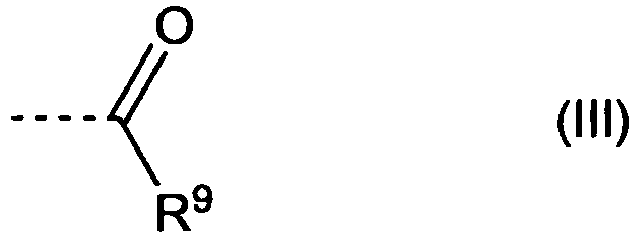 R9 für eine Alkylarylgruppe oder für einen einkernigen, mehrkernigen oder kondensierten aromatischen Rest steht, für den Fall, dass m = 0 ist, gegebenenfalls eine oder mehrere phenolische Hydroxylgruppen aufweist.
 - Verwendung eines Polymers der Formel (I) gemäss einem der Ansprüche 1 bis 6 als Schlagzähigkeitsverbesserer in einer Polymermatrix.
- Verwendung gemäss Anspruch 9, dadurch gekennzeichnet, dass die Polymermatrix eine Epoxidharzmatrix ist.
- Zusammensetzung umfassenda) mindestens ein Polymer gemäss einem der Ansprüche 1 bis 6;b) mindestens ein Epoxid-Festharz EP; undc) mindestens einen Härter H für Epoxidharze.
- Zusammensetzung gemäss Anspruch 11, dadurch gekennzeichnet, dass das feste Epoxidharz EP herstellbar ist durch die Umsetzung von Verbindungen der Formel HO-X-OH mit Epichlorhydrin und/oder 2-Methyl-epichlorhydrin, wobei X jeweils für einen zweiwertigen Rest eines Diphenols nach Entfernung der Hydroxylgruppen steht, welcher insbesondere ausgewählt ist aus der Gruppe bestehend aus 1,4-Dihydroxybenzol, 1,3-Dihydroxybenzol, 1,2-Dihydroxybenzol, 1,3-Dihydroxytoluol, 3,5-Dihydroxybenzoate, 2,2-Bis(4-hydroxyphenyl)propan (= Bisphenol A), Bis(4-hydroxyphenyl)methan (= Bisphenol F), Bis(4-hydroxyphenyl)sulfon (= Bisphenol S), Naphtoresorcin, Dihydroxynaphthalin, Dihydroxyanthrachinon, Dihydroxy-biphenyl, 3,3-bis(p-hydroxyphenyl)phthalide, 5,5-Bis(4-hydroxyphenyl)hexahydro-4,7-methano-indan, Phenolpthalein, Fluorescein, 4,4'-[bis-(hydroxyphenyl)-1,3-Phenylenbis-(1-Methyl-ethyliden)] (= Bisphenol M), 4,4'-[bis-(hydroxyphenyl)-1,4-Phenylen-bis-(1-Methyl-ethyliden)] (= Bisphenol P), 2,2'-Diallyl-bisphenol-A, Diphenole und Dikresole hergestellt durch Umsetzung von Phenolen oder Kresolen mit Di-isopropylidenbenzol sowie alle Isomeren der vorgenannten Verbindungen.
- Zusammensetzung gemäss einem der Ansprüche 11 oder 12, dadurch gekennzeichnet, dass der Härter H für Epoxidharze durch erhöhte Temperatur aktiviert wird.
- Zusammensetzung gemäss einem der Ansprüche 11 bis 13, dadurch gekennzeichnet, dass der Härter H für Epoxidharze Dicyandiamid enthält.
- Zusammensetzung gemäss einem der Ansprüche 11 bis 14, dadurch gekennzeichnet, dass die Zusammensetzung zusätzlich mindestens einen festen Zähigkeitsverbesserer, insbesondere ein Core-Shell-Polymer, umfasst.
- Zusammensetzung gemäss einem der Ansprüche 11 bis 15, dadurch gekennzeichnet, dass die Zusammensetzung zusätzlich weitere Bestandteile enthält, welche insbesondere ausgewählt sind aus der Gruppe bestehend aus Treibmittel, Füllstoff, nicht-reaktive thermoplastische Polymere, Katalysatoren, Reaktivverdünner, Hitze- und/oder Lichtstabilisatoren, Thixotropiermittel, Weichmacher, Lösungsmittel, Farbstoffe und Pigmente.
- Verwendung einer Zusammensetzung gemäss einem der Ansprüche 11 bis 16 als Strukturklebstoff und/oder als schäumbare, hitzehärtende Zusammensetzung für die Verstärkung in Hohlräumen von strukturellen Bauteilen und Verstärkungselementen.
Priority Applications (1)
| Application Number | Priority Date | Filing Date | Title |
|---|---|---|---|
| EP08851312.2A EP2220140B1 (de) | 2007-11-21 | 2008-11-21 | Schlagzähigkeitsverbesserer für epoxidharzzusammensetzungen |
Applications Claiming Priority (3)
| Application Number | Priority Date | Filing Date | Title |
|---|---|---|---|
| EP07121178A EP2062928A1 (de) | 2007-11-21 | 2007-11-21 | Schlagzähigkeitsverbesserer für Epoxidharzzusammensetzungen |
| PCT/EP2008/065949 WO2009065914A1 (de) | 2007-11-21 | 2008-11-21 | Schlagzähigkeitsverbesserer für epoxidharzzusammensetzungen |
| EP08851312.2A EP2220140B1 (de) | 2007-11-21 | 2008-11-21 | Schlagzähigkeitsverbesserer für epoxidharzzusammensetzungen |
Publications (2)
| Publication Number | Publication Date |
|---|---|
| EP2220140A1 EP2220140A1 (de) | 2010-08-25 |
| EP2220140B1 true EP2220140B1 (de) | 2016-07-06 |
Family
ID=39226653
Family Applications (2)
| Application Number | Title | Priority Date | Filing Date |
|---|---|---|---|
| EP07121178A Withdrawn EP2062928A1 (de) | 2007-11-21 | 2007-11-21 | Schlagzähigkeitsverbesserer für Epoxidharzzusammensetzungen |
| EP08851312.2A Active EP2220140B1 (de) | 2007-11-21 | 2008-11-21 | Schlagzähigkeitsverbesserer für epoxidharzzusammensetzungen |
Family Applications Before (1)
| Application Number | Title | Priority Date | Filing Date |
|---|---|---|---|
| EP07121178A Withdrawn EP2062928A1 (de) | 2007-11-21 | 2007-11-21 | Schlagzähigkeitsverbesserer für Epoxidharzzusammensetzungen |
Country Status (7)
| Country | Link |
|---|---|
| US (1) | US9796809B2 (de) |
| EP (2) | EP2062928A1 (de) |
| JP (2) | JP6143408B2 (de) |
| CN (1) | CN101868489B (de) |
| BR (1) | BRPI0820322A2 (de) |
| ES (1) | ES2588021T3 (de) |
| WO (1) | WO2009065914A1 (de) |
Families Citing this family (20)
| Publication number | Priority date | Publication date | Assignee | Title |
|---|---|---|---|---|
| EP2365046A1 (de) * | 2010-03-02 | 2011-09-14 | Sika Technology AG | Schlagzäher bei Raumtemperatur härtender zwei-komponentiger Strukturklebstoff |
| US20140150970A1 (en) | 2010-11-19 | 2014-06-05 | Ppg Industries Ohio, Inc. | Structural adhesive compositions |
| US20120128499A1 (en) | 2010-11-19 | 2012-05-24 | Desai Umesh C | Structural adhesive compositions |
| WO2013086348A2 (en) * | 2011-12-08 | 2013-06-13 | Zephyros, Inc. | Adhesive material |
| EP2994507A4 (de) * | 2013-05-10 | 2016-12-28 | Blue Cube Ip Llc | Epoxidharzzusammensetzungen |
| KR20150051106A (ko) * | 2013-10-30 | 2015-05-11 | 아크조노벨코팅스인터내셔널비.브이. | 분말 코팅 조성물 |
| EP2883781A1 (de) | 2013-12-13 | 2015-06-17 | Sika Technology AG | Leichtbau -Verstärkungselement und ein Verfahren zur Herstellung einer solchen Verstärkungselement |
| EP3009461A1 (de) | 2014-10-13 | 2016-04-20 | Sika Technology AG | Polyester-Präpolymere als Schlagzähigkeitsverbesserer in Epoxyformulierungen |
| EP3170877B1 (de) | 2015-11-19 | 2020-11-18 | 3M Innovative Properties Company | Strukturklebstoff mit verbessertem fehlermodus |
| TWI572631B (zh) * | 2015-11-25 | 2017-03-01 | 財團法人工業技術研究院 | 共聚物與環氧樹脂複合物 |
| EP3630883A4 (de) * | 2017-05-25 | 2020-12-09 | Henkel IP & Holding GmbH | Härtbare zusammensetzungen |
| EP3642098B1 (de) * | 2017-06-22 | 2022-11-16 | Sika Technology AG | Verstärkungselement, system eines verstärkten strukturelementes und verfahren zur verstärkung eines strukturelementes |
| US11591503B2 (en) | 2018-01-25 | 2023-02-28 | Sika Technology Ag | Shape memory material with improved mechanical properties |
| US10822517B2 (en) | 2018-11-28 | 2020-11-03 | Industrial Technology Research Institute | Resin composition and cured resin composition |
| EP3770227A1 (de) | 2019-07-23 | 2021-01-27 | Sika Technology Ag | Formgedächtnismaterial und verwendung davon zum verbinden von substraten |
| CN119404356A (zh) | 2022-06-24 | 2025-02-07 | 泽费罗斯股份有限公司 | 热逸散烟气管理 |
| EP4406995A1 (de) | 2023-01-24 | 2024-07-31 | Sika Technology AG | Einkomponentige expandierbare wärmehärtbare epoxidzusammensetzung mit reduzierter voc-emission |
| EP4617297A1 (de) | 2024-03-11 | 2025-09-17 | Sika Technology AG | Einkomponentige expandierbare wärmehärtende epoxidzusammensetzung mit konsistenten ausdehnungseigenschaften nach lagerung unter feuchten bedingungen |
| EP4707132A1 (de) | 2024-09-09 | 2026-03-11 | Sika Technology AG | Thermisch leitender träger für ablenkplatte oder verstärkungselement |
| WO2026082875A1 (en) | 2024-10-16 | 2026-04-23 | Sika Technology Ag | Specific polymeric material for a baffle and/or reinforcer element |
Family Cites Families (20)
| Publication number | Priority date | Publication date | Assignee | Title |
|---|---|---|---|---|
| JPS59196376A (ja) | 1983-04-22 | 1984-11-07 | Yokohama Rubber Co Ltd:The | 構造用接着剤 |
| US4740539A (en) * | 1986-04-21 | 1988-04-26 | Ashland Oil, Inc. | Flexible two-component epoxy structural adhesives |
| US4707518A (en) * | 1986-10-16 | 1987-11-17 | Shah Dilipkumar N | Rubber-modified epoxy adhesives |
| US4751129A (en) * | 1987-08-10 | 1988-06-14 | Century Adhesives Inc. | One-part hot-sprayable epoxy resin systems and methods |
| US5278257A (en) * | 1987-08-26 | 1994-01-11 | Ciba-Geigy Corporation | Phenol-terminated polyurethane or polyurea(urethane) with epoxy resin |
| EP0308664B1 (de) | 1987-08-26 | 1991-08-28 | Ciba-Geigy Ag | Modifizierte Epoxidharze |
| JPS6466282A (en) | 1987-09-08 | 1989-03-13 | Shinko Chem | Adhesive composition for bonding electronic part |
| ES2068911T3 (es) * | 1988-07-28 | 1995-05-01 | Ciba Geigy Ag | Combinaciones de flexibilizadores para resinas epoxi. |
| EP0381625B1 (de) * | 1989-02-02 | 1996-07-31 | Ciba-Geigy Ag | Zähe Epoxidharze |
| JPH02222444A (ja) | 1989-02-23 | 1990-09-05 | Yokohama Rubber Co Ltd:The | エポキシ樹脂組成物 |
| US5140068A (en) * | 1990-04-27 | 1992-08-18 | The B. F. Goodrich Company | Epoxy resin systems modified with low viscosity statistical monofunctional reactive polymers |
| JP3906547B2 (ja) | 1998-02-13 | 2007-04-18 | 松下電工株式会社 | 銅張り積層板、多層積層板 |
| US20040181013A1 (en) * | 1998-10-06 | 2004-09-16 | Henkel Teroson Gmbh | Impact resistant epoxide resin compositions |
| DE19845607A1 (de) * | 1998-10-06 | 2000-04-20 | Henkel Teroson Gmbh | Schlagfeste Epoxidharz-Zusammensetzungen |
| US6486256B1 (en) * | 1998-10-13 | 2002-11-26 | 3M Innovative Properties Company | Composition of epoxy resin, chain extender and polymeric toughener with separate base catalyst |
| DE19858921A1 (de) * | 1998-12-19 | 2000-06-21 | Henkel Teroson Gmbh | Schlagfeste Epoxidharz-Zusammensetzungen |
| FR2809741B1 (fr) * | 2000-05-31 | 2002-08-16 | Atofina | Materiaux thermodurs a tenue au choc amelioree |
| JP4357717B2 (ja) | 2000-08-10 | 2009-11-04 | 三井化学株式会社 | 接着性樹脂組成物 |
| JP2003128873A (ja) | 2001-10-22 | 2003-05-08 | Nippon Kayaku Co Ltd | エポキシ樹脂組成物及びそれを用いた接着シート |
| CN101050344A (zh) * | 2007-04-30 | 2007-10-10 | 湖南神力实业有限公司 | 一种纳米交联橡胶微粉改性环氧胶粘剂及制备方法 |
-
2007
- 2007-11-21 EP EP07121178A patent/EP2062928A1/de not_active Withdrawn
-
2008
- 2008-11-21 JP JP2010534481A patent/JP6143408B2/ja active Active
- 2008-11-21 WO PCT/EP2008/065949 patent/WO2009065914A1/de not_active Ceased
- 2008-11-21 ES ES08851312.2T patent/ES2588021T3/es active Active
- 2008-11-21 CN CN2008801172489A patent/CN101868489B/zh active Active
- 2008-11-21 BR BRPI0820322-9A patent/BRPI0820322A2/pt not_active IP Right Cessation
- 2008-11-21 EP EP08851312.2A patent/EP2220140B1/de active Active
- 2008-11-21 US US12/743,456 patent/US9796809B2/en active Active
-
2014
- 2014-06-23 JP JP2014127943A patent/JP2014177645A/ja active Pending
Also Published As
| Publication number | Publication date |
|---|---|
| JP2014177645A (ja) | 2014-09-25 |
| CN101868489A (zh) | 2010-10-20 |
| CN101868489B (zh) | 2013-06-19 |
| BRPI0820322A2 (pt) | 2015-05-26 |
| ES2588021T3 (es) | 2016-10-28 |
| US9796809B2 (en) | 2017-10-24 |
| WO2009065914A1 (de) | 2009-05-28 |
| JP6143408B2 (ja) | 2017-06-07 |
| US20100280167A1 (en) | 2010-11-04 |
| JP2011504198A (ja) | 2011-02-03 |
| EP2062928A1 (de) | 2009-05-27 |
| EP2220140A1 (de) | 2010-08-25 |
Similar Documents
| Publication | Publication Date | Title |
|---|---|---|
| EP2062928A1 (de) | Schlagzähigkeitsverbesserer für Epoxidharzzusammensetzungen | |
| EP2917260B1 (de) | Aminzusammensetzung für einen crashfesten 2k epoxyklebstoff | |
| EP3207074B1 (de) | Polyester-präpolymere als schlagzähigkeitsverbesserer in epoxyformulierungen | |
| EP2060592B1 (de) | Hitzehärtende Epoxidharzzusammensetzung enthaltend nichtaromatische Harnstoffe als Beschleuniger | |
| EP2085426B1 (de) | Auswaschbeständige hitzehärtende Epoxidharzklebstoffe | |
| KR102626996B1 (ko) | 에폭시 접착제를 위한 블로킹된 폴리우레탄 강인화제 | |
| EP3824039B1 (de) | Verfahren zur verstärkung von metallstrukturen mithilfe von gehärteten 2c-epoxidklebstoffen | |
| EP2145908B1 (de) | Haftvermittlerverbindungen für beölten Stahl | |
| WO2005007720A1 (de) | Hitzehärtende zusammensetzungen mit tieftemperatur-schlagzähigkeitsmodifikatoren | |
| EP2285862A1 (de) | Hitzehärtende epoxidharzzusammensetzung enthaltend einen beschleuniger mit heteroatomen | |
| WO2016102329A1 (de) | Epoxidharz-zusammensetzung | |
| EP2917254B1 (de) | Reaktive flüssigkautschuke aus blockierten isocyanat-terminierten präpolymeren mit glycolfänger | |
| WO2008113845A1 (de) | Epoxidgruppen terminierte polymer, deren zusammensetzungen und deren verwendung als schlagzähigkeitsmodifikatoren | |
| EP2313464A2 (de) | Auf amphiphilen block-copolymer basierende reaktionsprodukte und deren verwendung als schlagzähigkeitsmodifikator | |
| WO2021099440A1 (de) | Matrixharz für laminate mit hoher transparenz, geringer vergilbung und hohen glasübergangstemperaturen | |
| DE3624314A1 (de) | Verwendung von epoxidharz/haerter-mischungen zur herstellung von beschichtungen mit erhoehter zwischenschichthaftung | |
| EP2274359B1 (de) | Aktivator für epoxidharzzusammensetzungen | |
| EP2113525A1 (de) | Aktivator für Epoxidharzzusammensetzungen | |
| EP3712219B1 (de) | Brandschutzzusammensetzung und deren verwendung | |
| DE2429992B2 (de) | Verfahren zum herstellen von vergiessungen und abdichtungen | |
| EP3428045A1 (de) | Einkomponentiger hitzehärtender epoxidklebstoff hoher auswaschbeständigkeit | |
| WO2026013086A1 (de) | Mercapto-funktionelles addukt von isocyanatgruppen-haltigem polymer mit niedrigem monomergehalt | |
| CH699848A2 (de) | Aktivator für epoxidharzzusammensetzungen. |
Legal Events
| Date | Code | Title | Description |
|---|---|---|---|
| PUAI | Public reference made under article 153(3) epc to a published international application that has entered the european phase |
Free format text: ORIGINAL CODE: 0009012 |
|
| 17P | Request for examination filed |
Effective date: 20100621 |
|
| AK | Designated contracting states |
Kind code of ref document: A1 Designated state(s): AT BE BG CH CY CZ DE DK EE ES FI FR GB GR HR HU IE IS IT LI LT LU LV MC MT NL NO PL PT RO SE SI SK TR |
|
| AX | Request for extension of the european patent |
Extension state: AL BA MK RS |
|
| DAX | Request for extension of the european patent (deleted) | ||
| 17Q | First examination report despatched |
Effective date: 20120817 |
|
| GRAP | Despatch of communication of intention to grant a patent |
Free format text: ORIGINAL CODE: EPIDOSNIGR1 |
|
| INTG | Intention to grant announced |
Effective date: 20160321 |
|
| GRAS | Grant fee paid |
Free format text: ORIGINAL CODE: EPIDOSNIGR3 |
|
| GRAA | (expected) grant |
Free format text: ORIGINAL CODE: 0009210 |
|
| AK | Designated contracting states |
Kind code of ref document: B1 Designated state(s): AT BE BG CH CY CZ DE DK EE ES FI FR GB GR HR HU IE IS IT LI LT LU LV MC MT NL NO PL PT RO SE SI SK TR |
|
| REG | Reference to a national code |
Ref country code: GB Ref legal event code: FG4D Free format text: NOT ENGLISH |
|
| REG | Reference to a national code |
Ref country code: AT Ref legal event code: REF Ref document number: 810652 Country of ref document: AT Kind code of ref document: T Effective date: 20160715 Ref country code: CH Ref legal event code: EP |
|
| REG | Reference to a national code |
Ref country code: IE Ref legal event code: FG4D Free format text: LANGUAGE OF EP DOCUMENT: GERMAN |
|
| REG | Reference to a national code |
Ref country code: DE Ref legal event code: R096 Ref document number: 502008014368 Country of ref document: DE |
|
| REG | Reference to a national code |
Ref country code: ES Ref legal event code: FG2A Ref document number: 2588021 Country of ref document: ES Kind code of ref document: T3 Effective date: 20161028 |
|
| REG | Reference to a national code |
Ref country code: NL Ref legal event code: MP Effective date: 20160706 |
|
| REG | Reference to a national code |
Ref country code: LT Ref legal event code: MG4D |
|
| REG | Reference to a national code |
Ref country code: FR Ref legal event code: PLFP Year of fee payment: 9 |
|
| PG25 | Lapsed in a contracting state [announced via postgrant information from national office to epo] |
Ref country code: NL Free format text: LAPSE BECAUSE OF FAILURE TO SUBMIT A TRANSLATION OF THE DESCRIPTION OR TO PAY THE FEE WITHIN THE PRESCRIBED TIME-LIMIT Effective date: 20160706 Ref country code: LT Free format text: LAPSE BECAUSE OF FAILURE TO SUBMIT A TRANSLATION OF THE DESCRIPTION OR TO PAY THE FEE WITHIN THE PRESCRIBED TIME-LIMIT Effective date: 20160706 Ref country code: NO Free format text: LAPSE BECAUSE OF FAILURE TO SUBMIT A TRANSLATION OF THE DESCRIPTION OR TO PAY THE FEE WITHIN THE PRESCRIBED TIME-LIMIT Effective date: 20161006 Ref country code: HR Free format text: LAPSE BECAUSE OF FAILURE TO SUBMIT A TRANSLATION OF THE DESCRIPTION OR TO PAY THE FEE WITHIN THE PRESCRIBED TIME-LIMIT Effective date: 20160706 Ref country code: IS Free format text: LAPSE BECAUSE OF FAILURE TO SUBMIT A TRANSLATION OF THE DESCRIPTION OR TO PAY THE FEE WITHIN THE PRESCRIBED TIME-LIMIT Effective date: 20161106 Ref country code: IT Free format text: LAPSE BECAUSE OF FAILURE TO SUBMIT A TRANSLATION OF THE DESCRIPTION OR TO PAY THE FEE WITHIN THE PRESCRIBED TIME-LIMIT Effective date: 20160706 Ref country code: FI Free format text: LAPSE BECAUSE OF FAILURE TO SUBMIT A TRANSLATION OF THE DESCRIPTION OR TO PAY THE FEE WITHIN THE PRESCRIBED TIME-LIMIT Effective date: 20160706 |
|
| PG25 | Lapsed in a contracting state [announced via postgrant information from national office to epo] |
Ref country code: PL Free format text: LAPSE BECAUSE OF FAILURE TO SUBMIT A TRANSLATION OF THE DESCRIPTION OR TO PAY THE FEE WITHIN THE PRESCRIBED TIME-LIMIT Effective date: 20160706 Ref country code: LV Free format text: LAPSE BECAUSE OF FAILURE TO SUBMIT A TRANSLATION OF THE DESCRIPTION OR TO PAY THE FEE WITHIN THE PRESCRIBED TIME-LIMIT Effective date: 20160706 Ref country code: BE Free format text: LAPSE BECAUSE OF NON-PAYMENT OF DUE FEES Effective date: 20161130 Ref country code: GR Free format text: LAPSE BECAUSE OF FAILURE TO SUBMIT A TRANSLATION OF THE DESCRIPTION OR TO PAY THE FEE WITHIN THE PRESCRIBED TIME-LIMIT Effective date: 20161007 Ref country code: SE Free format text: LAPSE BECAUSE OF FAILURE TO SUBMIT A TRANSLATION OF THE DESCRIPTION OR TO PAY THE FEE WITHIN THE PRESCRIBED TIME-LIMIT Effective date: 20160706 Ref country code: PT Free format text: LAPSE BECAUSE OF FAILURE TO SUBMIT A TRANSLATION OF THE DESCRIPTION OR TO PAY THE FEE WITHIN THE PRESCRIBED TIME-LIMIT Effective date: 20161107 |
|
| REG | Reference to a national code |
Ref country code: DE Ref legal event code: R097 Ref document number: 502008014368 Country of ref document: DE |
|
| PG25 | Lapsed in a contracting state [announced via postgrant information from national office to epo] |
Ref country code: RO Free format text: LAPSE BECAUSE OF FAILURE TO SUBMIT A TRANSLATION OF THE DESCRIPTION OR TO PAY THE FEE WITHIN THE PRESCRIBED TIME-LIMIT Effective date: 20160706 Ref country code: EE Free format text: LAPSE BECAUSE OF FAILURE TO SUBMIT A TRANSLATION OF THE DESCRIPTION OR TO PAY THE FEE WITHIN THE PRESCRIBED TIME-LIMIT Effective date: 20160706 |
|
| PLBE | No opposition filed within time limit |
Free format text: ORIGINAL CODE: 0009261 |
|
| STAA | Information on the status of an ep patent application or granted ep patent |
Free format text: STATUS: NO OPPOSITION FILED WITHIN TIME LIMIT |
|
| PG25 | Lapsed in a contracting state [announced via postgrant information from national office to epo] |
Ref country code: SK Free format text: LAPSE BECAUSE OF FAILURE TO SUBMIT A TRANSLATION OF THE DESCRIPTION OR TO PAY THE FEE WITHIN THE PRESCRIBED TIME-LIMIT Effective date: 20160706 Ref country code: DK Free format text: LAPSE BECAUSE OF FAILURE TO SUBMIT A TRANSLATION OF THE DESCRIPTION OR TO PAY THE FEE WITHIN THE PRESCRIBED TIME-LIMIT Effective date: 20160706 Ref country code: BG Free format text: LAPSE BECAUSE OF FAILURE TO SUBMIT A TRANSLATION OF THE DESCRIPTION OR TO PAY THE FEE WITHIN THE PRESCRIBED TIME-LIMIT Effective date: 20161006 |
|
| 26N | No opposition filed |
Effective date: 20170407 |
|
| REG | Reference to a national code |
Ref country code: CH Ref legal event code: PL |
|
| PG25 | Lapsed in a contracting state [announced via postgrant information from national office to epo] |
Ref country code: LI Free format text: LAPSE BECAUSE OF NON-PAYMENT OF DUE FEES Effective date: 20161130 Ref country code: CH Free format text: LAPSE BECAUSE OF NON-PAYMENT OF DUE FEES Effective date: 20161130 |
|
| REG | Reference to a national code |
Ref country code: IE Ref legal event code: MM4A |
|
| PG25 | Lapsed in a contracting state [announced via postgrant information from national office to epo] |
Ref country code: SI Free format text: LAPSE BECAUSE OF FAILURE TO SUBMIT A TRANSLATION OF THE DESCRIPTION OR TO PAY THE FEE WITHIN THE PRESCRIBED TIME-LIMIT Effective date: 20160706 |
|
| PG25 | Lapsed in a contracting state [announced via postgrant information from national office to epo] |
Ref country code: LU Free format text: LAPSE BECAUSE OF NON-PAYMENT OF DUE FEES Effective date: 20161130 |
|
| REG | Reference to a national code |
Ref country code: FR Ref legal event code: PLFP Year of fee payment: 10 |
|
| PG25 | Lapsed in a contracting state [announced via postgrant information from national office to epo] |
Ref country code: IE Free format text: LAPSE BECAUSE OF NON-PAYMENT OF DUE FEES Effective date: 20161121 |
|
| REG | Reference to a national code |
Ref country code: AT Ref legal event code: MM01 Ref document number: 810652 Country of ref document: AT Kind code of ref document: T Effective date: 20161121 |
|
| PG25 | Lapsed in a contracting state [announced via postgrant information from national office to epo] |
Ref country code: AT Free format text: LAPSE BECAUSE OF NON-PAYMENT OF DUE FEES Effective date: 20161121 |
|
| REG | Reference to a national code |
Ref country code: BE Ref legal event code: MM Effective date: 20161130 |
|
| PG25 | Lapsed in a contracting state [announced via postgrant information from national office to epo] |
Ref country code: HU Free format text: LAPSE BECAUSE OF FAILURE TO SUBMIT A TRANSLATION OF THE DESCRIPTION OR TO PAY THE FEE WITHIN THE PRESCRIBED TIME-LIMIT; INVALID AB INITIO Effective date: 20081121 Ref country code: CY Free format text: LAPSE BECAUSE OF FAILURE TO SUBMIT A TRANSLATION OF THE DESCRIPTION OR TO PAY THE FEE WITHIN THE PRESCRIBED TIME-LIMIT Effective date: 20160706 |
|
| PG25 | Lapsed in a contracting state [announced via postgrant information from national office to epo] |
Ref country code: MC Free format text: LAPSE BECAUSE OF FAILURE TO SUBMIT A TRANSLATION OF THE DESCRIPTION OR TO PAY THE FEE WITHIN THE PRESCRIBED TIME-LIMIT Effective date: 20160706 Ref country code: TR Free format text: LAPSE BECAUSE OF FAILURE TO SUBMIT A TRANSLATION OF THE DESCRIPTION OR TO PAY THE FEE WITHIN THE PRESCRIBED TIME-LIMIT Effective date: 20160706 |
|
| PG25 | Lapsed in a contracting state [announced via postgrant information from national office to epo] |
Ref country code: MT Free format text: LAPSE BECAUSE OF FAILURE TO SUBMIT A TRANSLATION OF THE DESCRIPTION OR TO PAY THE FEE WITHIN THE PRESCRIBED TIME-LIMIT Effective date: 20160706 |
|
| REG | Reference to a national code |
Ref country code: FR Ref legal event code: PLFP Year of fee payment: 11 |
|
| PGFP | Annual fee paid to national office [announced via postgrant information from national office to epo] |
Ref country code: CZ Payment date: 20191120 Year of fee payment: 12 |
|
| PGFP | Annual fee paid to national office [announced via postgrant information from national office to epo] |
Ref country code: GB Payment date: 20191128 Year of fee payment: 12 |
|
| GBPC | Gb: european patent ceased through non-payment of renewal fee |
Effective date: 20201121 |
|
| PG25 | Lapsed in a contracting state [announced via postgrant information from national office to epo] |
Ref country code: CZ Free format text: LAPSE BECAUSE OF NON-PAYMENT OF DUE FEES Effective date: 20201121 |
|
| PG25 | Lapsed in a contracting state [announced via postgrant information from national office to epo] |
Ref country code: GB Free format text: LAPSE BECAUSE OF NON-PAYMENT OF DUE FEES Effective date: 20201121 |
|
| PGFP | Annual fee paid to national office [announced via postgrant information from national office to epo] |
Ref country code: ES Payment date: 20211201 Year of fee payment: 14 |
|
| REG | Reference to a national code |
Ref country code: ES Ref legal event code: FD2A Effective date: 20240102 |
|
| PG25 | Lapsed in a contracting state [announced via postgrant information from national office to epo] |
Ref country code: ES Free format text: LAPSE BECAUSE OF NON-PAYMENT OF DUE FEES Effective date: 20221122 |
|
| PG25 | Lapsed in a contracting state [announced via postgrant information from national office to epo] |
Ref country code: ES Free format text: LAPSE BECAUSE OF NON-PAYMENT OF DUE FEES Effective date: 20221122 |
|
| PGFP | Annual fee paid to national office [announced via postgrant information from national office to epo] |
Ref country code: DE Payment date: 20251022 Year of fee payment: 18 |
|
| PGFP | Annual fee paid to national office [announced via postgrant information from national office to epo] |
Ref country code: FR Payment date: 20251022 Year of fee payment: 18 |