EP2209478B1 - Kondensationsprodukte auf der basis von bicyclischen oder polycyclischen aromaten oder heteroaromaten - Google Patents
Kondensationsprodukte auf der basis von bicyclischen oder polycyclischen aromaten oder heteroaromaten Download PDFInfo
- Publication number
- EP2209478B1 EP2209478B1 EP08850648.0A EP08850648A EP2209478B1 EP 2209478 B1 EP2209478 B1 EP 2209478B1 EP 08850648 A EP08850648 A EP 08850648A EP 2209478 B1 EP2209478 B1 EP 2209478B1
- Authority
- EP
- European Patent Office
- Prior art keywords
- condensation product
- acid
- condensation products
- product according
- condensation
- Prior art date
- Legal status (The legal status is an assumption and is not a legal conclusion. Google has not performed a legal analysis and makes no representation as to the accuracy of the status listed.)
- Not-in-force
Links
- 239000007859 condensation product Substances 0.000 title claims description 176
- -1 polycyclic aromatic Chemical class 0.000 title claims description 40
- 125000002619 bicyclic group Chemical group 0.000 title description 4
- 150000002390 heteroarenes Chemical class 0.000 title description 2
- 239000003795 chemical substances by application Substances 0.000 claims description 64
- ISWSIDIOOBJBQZ-UHFFFAOYSA-N Phenol Chemical compound OC1=CC=CC=C1 ISWSIDIOOBJBQZ-UHFFFAOYSA-N 0.000 claims description 60
- XSQUKJJJFZCRTK-UHFFFAOYSA-N Urea Chemical compound NC(N)=O XSQUKJJJFZCRTK-UHFFFAOYSA-N 0.000 claims description 58
- 239000000243 solution Substances 0.000 claims description 47
- QAOWNCQODCNURD-UHFFFAOYSA-N sulfuric acid Substances OS(O)(=O)=O QAOWNCQODCNURD-UHFFFAOYSA-N 0.000 claims description 37
- 239000003814 drug Substances 0.000 claims description 33
- 239000000203 mixture Substances 0.000 claims description 33
- 238000006243 chemical reaction Methods 0.000 claims description 28
- LNETULKMXZVUST-UHFFFAOYSA-N 1-naphthoic acid Chemical compound C1=CC=C2C(C(=O)O)=CC=CC2=C1 LNETULKMXZVUST-UHFFFAOYSA-N 0.000 claims description 26
- 150000003839 salts Chemical class 0.000 claims description 26
- 241001465754 Metazoa Species 0.000 claims description 25
- 239000004202 carbamide Substances 0.000 claims description 21
- 238000011282 treatment Methods 0.000 claims description 21
- 238000002360 preparation method Methods 0.000 claims description 20
- 239000006071 cream Substances 0.000 claims description 18
- 238000000034 method Methods 0.000 claims description 17
- 239000008194 pharmaceutical composition Substances 0.000 claims description 15
- 150000003672 ureas Chemical class 0.000 claims description 15
- 239000000443 aerosol Substances 0.000 claims description 13
- 239000000645 desinfectant Substances 0.000 claims description 13
- JDSHMPZPIAZGSV-UHFFFAOYSA-N melamine Chemical compound NC1=NC(N)=NC(N)=N1 JDSHMPZPIAZGSV-UHFFFAOYSA-N 0.000 claims description 13
- 239000000843 powder Substances 0.000 claims description 12
- 239000003443 antiviral agent Substances 0.000 claims description 11
- 208000010668 atopic eczema Diseases 0.000 claims description 10
- WSFSSNUMVMOOMR-NJFSPNSNSA-N methanone Chemical compound O=[14CH2] WSFSSNUMVMOOMR-NJFSPNSNSA-N 0.000 claims description 10
- 230000008569 process Effects 0.000 claims description 10
- 229920000877 Melamine resin Polymers 0.000 claims description 9
- 239000002674 ointment Substances 0.000 claims description 9
- 241000701024 Human betaherpesvirus 5 Species 0.000 claims description 8
- 201000004681 Psoriasis Diseases 0.000 claims description 8
- 150000001299 aldehydes Chemical class 0.000 claims description 8
- 229940079593 drug Drugs 0.000 claims description 8
- 239000000499 gel Substances 0.000 claims description 8
- 239000006210 lotion Substances 0.000 claims description 8
- 238000011321 prophylaxis Methods 0.000 claims description 8
- IKHGUXGNUITLKF-UHFFFAOYSA-N Acetaldehyde Chemical compound CC=O IKHGUXGNUITLKF-UHFFFAOYSA-N 0.000 claims description 7
- 201000004624 Dermatitis Diseases 0.000 claims description 7
- NBBJYMSMWIIQGU-UHFFFAOYSA-N Propionic aldehyde Chemical compound CCC=O NBBJYMSMWIIQGU-UHFFFAOYSA-N 0.000 claims description 7
- 208000009889 Herpes Simplex Diseases 0.000 claims description 6
- 102000012479 Serine Proteases Human genes 0.000 claims description 6
- 108010022999 Serine Proteases Proteins 0.000 claims description 6
- 239000000839 emulsion Substances 0.000 claims description 6
- 238000001802 infusion Methods 0.000 claims description 6
- 238000004519 manufacturing process Methods 0.000 claims description 6
- 239000007922 nasal spray Substances 0.000 claims description 6
- 206010034674 peritonitis Diseases 0.000 claims description 6
- XQFRJNBWHJMXHO-RRKCRQDMSA-N IDUR Chemical compound C1[C@H](O)[C@@H](CO)O[C@H]1N1C(=O)NC(=O)C(I)=C1 XQFRJNBWHJMXHO-RRKCRQDMSA-N 0.000 claims description 5
- 230000000172 allergic effect Effects 0.000 claims description 5
- 239000007864 aqueous solution Substances 0.000 claims description 5
- 239000000470 constituent Substances 0.000 claims description 5
- 239000000725 suspension Substances 0.000 claims description 5
- 206010010744 Conjunctivitis allergic Diseases 0.000 claims description 4
- 241000282414 Homo sapiens Species 0.000 claims description 4
- 241000701806 Human papillomavirus Species 0.000 claims description 4
- 208000019693 Lung disease Diseases 0.000 claims description 4
- 206010034277 Pemphigoid Diseases 0.000 claims description 4
- 102000035195 Peptidases Human genes 0.000 claims description 4
- 108091005804 Peptidases Proteins 0.000 claims description 4
- 206010039085 Rhinitis allergic Diseases 0.000 claims description 4
- 208000004732 Systemic Vasculitis Diseases 0.000 claims description 4
- 208000002205 allergic conjunctivitis Diseases 0.000 claims description 4
- 201000010105 allergic rhinitis Diseases 0.000 claims description 4
- 208000006673 asthma Diseases 0.000 claims description 4
- 208000024998 atopic conjunctivitis Diseases 0.000 claims description 4
- 208000000594 bullous pemphigoid Diseases 0.000 claims description 4
- 230000002401 inhibitory effect Effects 0.000 claims description 4
- 229940097496 nasal spray Drugs 0.000 claims description 4
- 235000019833 protease Nutrition 0.000 claims description 4
- 230000010410 reperfusion Effects 0.000 claims description 4
- 206010059313 Anogenital warts Diseases 0.000 claims description 3
- 208000023275 Autoimmune disease Diseases 0.000 claims description 3
- 201000009030 Carcinoma Diseases 0.000 claims description 3
- 201000006082 Chickenpox Diseases 0.000 claims description 3
- 208000000907 Condylomata Acuminata Diseases 0.000 claims description 3
- 241000711573 Coronaviridae Species 0.000 claims description 3
- 108020004437 Endogenous Retroviruses Proteins 0.000 claims description 3
- 208000003251 Pruritus Diseases 0.000 claims description 3
- 206010040070 Septic Shock Diseases 0.000 claims description 3
- 208000006105 Uterine Cervical Neoplasms Diseases 0.000 claims description 3
- 206010046980 Varicella Diseases 0.000 claims description 3
- 239000013566 allergen Substances 0.000 claims description 3
- 230000002009 allergenic effect Effects 0.000 claims description 3
- 208000025009 anogenital human papillomavirus infection Diseases 0.000 claims description 3
- 201000004201 anogenital venereal wart Diseases 0.000 claims description 3
- 206010003246 arthritis Diseases 0.000 claims description 3
- ZTQSAGDEMFDKMZ-UHFFFAOYSA-N butyric aldehyde Natural products CCCC=O ZTQSAGDEMFDKMZ-UHFFFAOYSA-N 0.000 claims description 3
- 208000027866 inflammatory disease Diseases 0.000 claims description 3
- 239000007937 lozenge Substances 0.000 claims description 3
- 239000000047 product Substances 0.000 claims description 3
- 230000036303 septic shock Effects 0.000 claims description 3
- 239000007921 spray Substances 0.000 claims description 3
- 230000000087 stabilizing effect Effects 0.000 claims description 3
- 239000003826 tablet Substances 0.000 claims description 3
- 230000001225 therapeutic effect Effects 0.000 claims description 3
- 241001529453 unidentified herpesvirus Species 0.000 claims description 3
- 241000271566 Aves Species 0.000 claims description 2
- 241000283690 Bos taurus Species 0.000 claims description 2
- 241000710831 Flavivirus Species 0.000 claims description 2
- 206010061218 Inflammation Diseases 0.000 claims description 2
- 102000016387 Pancreatic elastase Human genes 0.000 claims description 2
- 108010067372 Pancreatic elastase Proteins 0.000 claims description 2
- 241000282887 Suidae Species 0.000 claims description 2
- 230000001476 alcoholic effect Effects 0.000 claims description 2
- 239000002775 capsule Substances 0.000 claims description 2
- 235000013305 food Nutrition 0.000 claims description 2
- 239000007903 gelatin capsule Substances 0.000 claims description 2
- 239000008187 granular material Substances 0.000 claims description 2
- 239000007943 implant Substances 0.000 claims description 2
- 230000004054 inflammatory process Effects 0.000 claims description 2
- 208000030603 inherited susceptibility to asthma Diseases 0.000 claims description 2
- 238000002347 injection Methods 0.000 claims description 2
- 239000007924 injection Substances 0.000 claims description 2
- 230000000302 ischemic effect Effects 0.000 claims description 2
- 239000003094 microcapsule Substances 0.000 claims description 2
- 239000002324 mouth wash Substances 0.000 claims description 2
- 230000002107 myocardial effect Effects 0.000 claims description 2
- 239000006187 pill Substances 0.000 claims description 2
- 239000002453 shampoo Substances 0.000 claims description 2
- 238000004659 sterilization and disinfection Methods 0.000 claims description 2
- 230000000475 sunscreen effect Effects 0.000 claims description 2
- 239000000516 sunscreening agent Substances 0.000 claims description 2
- 239000000829 suppository Substances 0.000 claims description 2
- 239000006188 syrup Substances 0.000 claims description 2
- 235000020357 syrup Nutrition 0.000 claims description 2
- 229940098465 tincture Drugs 0.000 claims description 2
- 239000000606 toothpaste Substances 0.000 claims description 2
- 206010012444 Dermatitis diaper Diseases 0.000 claims 1
- 208000003105 Diaper Rash Diseases 0.000 claims 1
- 201000009053 Neurodermatitis Diseases 0.000 claims 1
- 230000006931 brain damage Effects 0.000 claims 1
- 231100000874 brain damage Toxicity 0.000 claims 1
- 208000029028 brain injury Diseases 0.000 claims 1
- 239000002537 cosmetic Substances 0.000 claims 1
- 235000010603 pastilles Nutrition 0.000 claims 1
- WSFSSNUMVMOOMR-UHFFFAOYSA-N Formaldehyde Chemical compound O=C WSFSSNUMVMOOMR-UHFFFAOYSA-N 0.000 description 98
- 241000700605 Viruses Species 0.000 description 50
- HEMHJVSKTPXQMS-UHFFFAOYSA-M Sodium hydroxide Chemical compound [OH-].[Na+] HEMHJVSKTPXQMS-UHFFFAOYSA-M 0.000 description 36
- 230000000694 effects Effects 0.000 description 32
- 101000851058 Homo sapiens Neutrophil elastase Proteins 0.000 description 24
- 229960004279 formaldehyde Drugs 0.000 description 23
- XLYOFNOQVPJJNP-UHFFFAOYSA-N water Substances O XLYOFNOQVPJJNP-UHFFFAOYSA-N 0.000 description 23
- 235000013877 carbamide Nutrition 0.000 description 22
- 150000001875 compounds Chemical class 0.000 description 21
- 125000002887 hydroxy group Chemical group [H]O* 0.000 description 21
- 229920001864 tannin Polymers 0.000 description 21
- 235000018553 tannin Nutrition 0.000 description 21
- 239000001648 tannin Substances 0.000 description 21
- 150000001728 carbonyl compounds Chemical class 0.000 description 20
- 239000011541 reaction mixture Substances 0.000 description 20
- 102100033174 Neutrophil elastase Human genes 0.000 description 18
- FAPWRFPIFSIZLT-UHFFFAOYSA-M Sodium chloride Chemical compound [Na+].[Cl-] FAPWRFPIFSIZLT-UHFFFAOYSA-M 0.000 description 17
- 238000004255 ion exchange chromatography Methods 0.000 description 17
- 235000013311 vegetables Nutrition 0.000 description 17
- 230000000269 nucleophilic effect Effects 0.000 description 16
- 241000700588 Human alphaherpesvirus 1 Species 0.000 description 15
- 239000000126 substance Substances 0.000 description 15
- LNTHITQWFMADLM-UHFFFAOYSA-N gallic acid Chemical compound OC(=O)C1=CC(O)=C(O)C(O)=C1 LNTHITQWFMADLM-UHFFFAOYSA-N 0.000 description 14
- 210000004027 cell Anatomy 0.000 description 13
- 125000002496 methyl group Chemical group [H]C([H])([H])* 0.000 description 13
- 125000003118 aryl group Chemical group 0.000 description 12
- 230000000052 comparative effect Effects 0.000 description 12
- 238000010790 dilution Methods 0.000 description 12
- 239000012895 dilution Substances 0.000 description 12
- 125000001495 ethyl group Chemical group [H]C([H])([H])C([H])([H])* 0.000 description 12
- 238000011156 evaluation Methods 0.000 description 12
- 239000008098 formaldehyde solution Substances 0.000 description 12
- HHLFWLYXYJOTON-UHFFFAOYSA-N glyoxylic acid Chemical compound OC(=O)C=O HHLFWLYXYJOTON-UHFFFAOYSA-N 0.000 description 12
- 210000004379 membrane Anatomy 0.000 description 12
- 239000012528 membrane Substances 0.000 description 12
- 239000000376 reactant Substances 0.000 description 11
- 238000000108 ultra-filtration Methods 0.000 description 11
- KCXVZYZYPLLWCC-UHFFFAOYSA-N EDTA Chemical compound OC(=O)CN(CC(O)=O)CCN(CC(O)=O)CC(O)=O KCXVZYZYPLLWCC-UHFFFAOYSA-N 0.000 description 10
- 241000701074 Human alphaherpesvirus 2 Species 0.000 description 10
- UFWIBTONFRDIAS-UHFFFAOYSA-N Naphthalene Chemical compound C1=CC=CC2=CC=CC=C21 UFWIBTONFRDIAS-UHFFFAOYSA-N 0.000 description 10
- 230000000840 anti-viral effect Effects 0.000 description 10
- 125000003178 carboxy group Chemical group [H]OC(*)=O 0.000 description 10
- 239000008139 complexing agent Substances 0.000 description 10
- LEQAOMBKQFMDFZ-UHFFFAOYSA-N glyoxal Chemical compound O=CC=O LEQAOMBKQFMDFZ-UHFFFAOYSA-N 0.000 description 10
- 125000001072 heteroaryl group Chemical group 0.000 description 10
- 229920000642 polymer Polymers 0.000 description 10
- 238000004448 titration Methods 0.000 description 10
- 238000009833 condensation Methods 0.000 description 9
- 239000012038 nucleophile Substances 0.000 description 9
- 238000000926 separation method Methods 0.000 description 9
- 239000000758 substrate Substances 0.000 description 9
- 238000012360 testing method Methods 0.000 description 9
- WYURNTSHIVDZCO-UHFFFAOYSA-N Tetrahydrofuran Chemical compound C1CCOC1 WYURNTSHIVDZCO-UHFFFAOYSA-N 0.000 description 8
- 230000009471 action Effects 0.000 description 8
- 230000005494 condensation Effects 0.000 description 8
- 238000004128 high performance liquid chromatography Methods 0.000 description 8
- 239000001257 hydrogen Substances 0.000 description 8
- 229910052739 hydrogen Inorganic materials 0.000 description 8
- 125000000959 isobutyl group Chemical group [H]C([H])([H])C([H])(C([H])([H])[H])C([H])([H])* 0.000 description 8
- 125000001449 isopropyl group Chemical group [H]C([H])([H])C([H])(*)C([H])([H])[H] 0.000 description 8
- 125000004108 n-butyl group Chemical group [H]C([H])([H])C([H])([H])C([H])([H])C([H])([H])* 0.000 description 8
- 125000004123 n-propyl group Chemical group [H]C([H])([H])C([H])([H])C([H])([H])* 0.000 description 8
- 239000003921 oil Substances 0.000 description 8
- YGSDEFSMJLZEOE-UHFFFAOYSA-N salicylic acid Chemical compound OC(=O)C1=CC=CC=C1O YGSDEFSMJLZEOE-UHFFFAOYSA-N 0.000 description 8
- UFHFLCQGNIYNRP-UHFFFAOYSA-N Hydrogen Chemical compound [H][H] UFHFLCQGNIYNRP-UHFFFAOYSA-N 0.000 description 7
- 230000015572 biosynthetic process Effects 0.000 description 7
- 239000006285 cell suspension Substances 0.000 description 7
- 230000006378 damage Effects 0.000 description 7
- 238000001704 evaporation Methods 0.000 description 7
- 230000008020 evaporation Effects 0.000 description 7
- 238000005227 gel permeation chromatography Methods 0.000 description 7
- 238000011534 incubation Methods 0.000 description 7
- 125000002924 primary amino group Chemical group [H]N([H])* 0.000 description 7
- 239000001117 sulphuric acid Substances 0.000 description 7
- 125000003396 thiol group Chemical group [H]S* 0.000 description 7
- WFDIJRYMOXRFFG-UHFFFAOYSA-N Acetic anhydride Chemical compound CC(=O)OC(C)=O WFDIJRYMOXRFFG-UHFFFAOYSA-N 0.000 description 6
- 208000006545 Chronic Obstructive Pulmonary Disease Diseases 0.000 description 6
- PEDCQBHIVMGVHV-UHFFFAOYSA-N Glycerine Chemical compound OCC(O)CO PEDCQBHIVMGVHV-UHFFFAOYSA-N 0.000 description 6
- OKKJLVBELUTLKV-UHFFFAOYSA-N Methanol Chemical compound OC OKKJLVBELUTLKV-UHFFFAOYSA-N 0.000 description 6
- 229910052783 alkali metal Inorganic materials 0.000 description 6
- 238000010171 animal model Methods 0.000 description 6
- 230000001419 dependent effect Effects 0.000 description 6
- 229940015043 glyoxal Drugs 0.000 description 6
- 150000002431 hydrogen Chemical class 0.000 description 6
- 230000005764 inhibitory process Effects 0.000 description 6
- 239000007788 liquid Substances 0.000 description 6
- 239000002609 medium Substances 0.000 description 6
- 229910052757 nitrogen Inorganic materials 0.000 description 6
- 235000019198 oils Nutrition 0.000 description 6
- 125000002914 sec-butyl group Chemical group [H]C([H])([H])C([H])([H])C([H])(*)C([H])([H])[H] 0.000 description 6
- 125000000467 secondary amino group Chemical group [H]N([*:1])[*:2] 0.000 description 6
- 238000010186 staining Methods 0.000 description 6
- IIACRCGMVDHOTQ-UHFFFAOYSA-N sulfamic acid Chemical compound NS(O)(=O)=O IIACRCGMVDHOTQ-UHFFFAOYSA-N 0.000 description 6
- 239000003039 volatile agent Substances 0.000 description 6
- VPWNQTHUCYMVMZ-UHFFFAOYSA-N 4,4'-sulfonyldiphenol Chemical compound C1=CC(O)=CC=C1S(=O)(=O)C1=CC=C(O)C=C1 VPWNQTHUCYMVMZ-UHFFFAOYSA-N 0.000 description 5
- QGZKDVFQNNGYKY-UHFFFAOYSA-N Ammonia Chemical compound N QGZKDVFQNNGYKY-UHFFFAOYSA-N 0.000 description 5
- 241000725303 Human immunodeficiency virus Species 0.000 description 5
- 239000013543 active substance Substances 0.000 description 5
- 201000010099 disease Diseases 0.000 description 5
- 208000037265 diseases, disorders, signs and symptoms Diseases 0.000 description 5
- 229960001484 edetic acid Drugs 0.000 description 5
- 229940074391 gallic acid Drugs 0.000 description 5
- 235000004515 gallic acid Nutrition 0.000 description 5
- 235000013824 polyphenols Nutrition 0.000 description 5
- 210000003491 skin Anatomy 0.000 description 5
- 239000007787 solid Substances 0.000 description 5
- 238000003756 stirring Methods 0.000 description 5
- 238000003786 synthesis reaction Methods 0.000 description 5
- 125000004178 (C1-C4) alkyl group Chemical group 0.000 description 4
- DLFVBJFMPXGRIB-UHFFFAOYSA-N Acetamide Chemical compound CC(N)=O DLFVBJFMPXGRIB-UHFFFAOYSA-N 0.000 description 4
- CSCPPACGZOOCGX-UHFFFAOYSA-N Acetone Chemical compound CC(C)=O CSCPPACGZOOCGX-UHFFFAOYSA-N 0.000 description 4
- IJGRMHOSHXDMSA-UHFFFAOYSA-N Atomic nitrogen Chemical compound N#N IJGRMHOSHXDMSA-UHFFFAOYSA-N 0.000 description 4
- NTYJJOPFIAHURM-UHFFFAOYSA-N Histamine Chemical compound NCCC1=CN=CN1 NTYJJOPFIAHURM-UHFFFAOYSA-N 0.000 description 4
- 241000713772 Human immunodeficiency virus 1 Species 0.000 description 4
- 101150084935 PTER gene Proteins 0.000 description 4
- 239000002253 acid Substances 0.000 description 4
- 238000013459 approach Methods 0.000 description 4
- 239000002585 base Substances 0.000 description 4
- 235000005487 catechin Nutrition 0.000 description 4
- ADRVNXBAWSRFAJ-UHFFFAOYSA-N catechin Natural products OC1Cc2cc(O)cc(O)c2OC1c3ccc(O)c(O)c3 ADRVNXBAWSRFAJ-UHFFFAOYSA-N 0.000 description 4
- 239000012141 concentrate Substances 0.000 description 4
- 235000008504 concentrate Nutrition 0.000 description 4
- 239000002552 dosage form Substances 0.000 description 4
- 150000002148 esters Chemical class 0.000 description 4
- 239000000284 extract Substances 0.000 description 4
- 125000001972 isopentyl group Chemical group [H]C([H])([H])C([H])(C([H])([H])[H])C([H])([H])C([H])([H])* 0.000 description 4
- 229940056960 melamin Drugs 0.000 description 4
- 239000000178 monomer Substances 0.000 description 4
- FJKROLUGYXJWQN-UHFFFAOYSA-N papa-hydroxy-benzoic acid Natural products OC(=O)C1=CC=C(O)C=C1 FJKROLUGYXJWQN-UHFFFAOYSA-N 0.000 description 4
- 230000002829 reductive effect Effects 0.000 description 4
- 229960004889 salicylic acid Drugs 0.000 description 4
- YLQBMQCUIZJEEH-UHFFFAOYSA-N tetrahydrofuran Natural products C=1C=COC=1 YLQBMQCUIZJEEH-UHFFFAOYSA-N 0.000 description 4
- 230000000007 visual effect Effects 0.000 description 4
- 238000005406 washing Methods 0.000 description 4
- SQAINHDHICKHLX-UHFFFAOYSA-N 1-naphthaldehyde Chemical class C1=CC=C2C(C=O)=CC=CC2=C1 SQAINHDHICKHLX-UHFFFAOYSA-N 0.000 description 3
- WXTMDXOMEHJXQO-UHFFFAOYSA-N 2,5-dihydroxybenzoic acid Chemical compound OC(=O)C1=CC(O)=CC=C1O WXTMDXOMEHJXQO-UHFFFAOYSA-N 0.000 description 3
- QTWJRLJHJPIABL-UHFFFAOYSA-N 2-methylphenol;3-methylphenol;4-methylphenol Chemical compound CC1=CC=C(O)C=C1.CC1=CC=CC(O)=C1.CC1=CC=CC=C1O QTWJRLJHJPIABL-UHFFFAOYSA-N 0.000 description 3
- FEPBITJSIHRMRT-UHFFFAOYSA-N 4-hydroxybenzenesulfonic acid Chemical compound OC1=CC=C(S(O)(=O)=O)C=C1 FEPBITJSIHRMRT-UHFFFAOYSA-N 0.000 description 3
- QTBSBXVTEAMEQO-UHFFFAOYSA-N Acetic acid Chemical compound CC(O)=O QTBSBXVTEAMEQO-UHFFFAOYSA-N 0.000 description 3
- LSNNMFCWUKXFEE-UHFFFAOYSA-M Bisulfite Chemical compound OS([O-])=O LSNNMFCWUKXFEE-UHFFFAOYSA-M 0.000 description 3
- 241000694440 Colpidium aqueous Species 0.000 description 3
- 241000699800 Cricetinae Species 0.000 description 3
- YMWUJEATGCHHMB-UHFFFAOYSA-N Dichloromethane Chemical compound ClCCl YMWUJEATGCHHMB-UHFFFAOYSA-N 0.000 description 3
- KMTRUDSVKNLOMY-UHFFFAOYSA-N Ethylene carbonate Chemical compound O=C1OCCO1 KMTRUDSVKNLOMY-UHFFFAOYSA-N 0.000 description 3
- 206010072579 Granulomatosis with polyangiitis Diseases 0.000 description 3
- ZRALSGWEFCBTJO-UHFFFAOYSA-N Guanidine Chemical compound NC(N)=N ZRALSGWEFCBTJO-UHFFFAOYSA-N 0.000 description 3
- 102000001554 Hemoglobins Human genes 0.000 description 3
- 108010054147 Hemoglobins Proteins 0.000 description 3
- 208000032843 Hemorrhage Diseases 0.000 description 3
- 241000282412 Homo Species 0.000 description 3
- VEXZGXHMUGYJMC-UHFFFAOYSA-N Hydrochloric acid Chemical compound Cl VEXZGXHMUGYJMC-UHFFFAOYSA-N 0.000 description 3
- YQEZLKZALYSWHR-UHFFFAOYSA-N Ketamine Chemical compound C=1C=CC=C(Cl)C=1C1(NC)CCCCC1=O YQEZLKZALYSWHR-UHFFFAOYSA-N 0.000 description 3
- 241000699673 Mesocricetus auratus Species 0.000 description 3
- KWYUFKZDYYNOTN-UHFFFAOYSA-M Potassium hydroxide Chemical compound [OH-].[K+] KWYUFKZDYYNOTN-UHFFFAOYSA-M 0.000 description 3
- DNIAPMSPPWPWGF-UHFFFAOYSA-N Propylene glycol Chemical compound CC(O)CO DNIAPMSPPWPWGF-UHFFFAOYSA-N 0.000 description 3
- 206010070834 Sensitisation Diseases 0.000 description 3
- VYPSYNLAJGMNEJ-UHFFFAOYSA-N Silicium dioxide Chemical compound O=[Si]=O VYPSYNLAJGMNEJ-UHFFFAOYSA-N 0.000 description 3
- 241000700584 Simplexvirus Species 0.000 description 3
- PMZURENOXWZQFD-UHFFFAOYSA-L Sodium Sulfate Chemical compound [Na+].[Na+].[O-]S([O-])(=O)=O PMZURENOXWZQFD-UHFFFAOYSA-L 0.000 description 3
- 244000269722 Thea sinensis Species 0.000 description 3
- 206010047115 Vasculitis Diseases 0.000 description 3
- 125000003277 amino group Chemical group 0.000 description 3
- 150000001450 anions Chemical class 0.000 description 3
- 150000001491 aromatic compounds Chemical class 0.000 description 3
- 230000008901 benefit Effects 0.000 description 3
- OHJMTUPIZMNBFR-UHFFFAOYSA-N biuret Chemical compound NC(=O)NC(N)=O OHJMTUPIZMNBFR-UHFFFAOYSA-N 0.000 description 3
- 150000001765 catechin Chemical class 0.000 description 3
- 230000008859 change Effects 0.000 description 3
- 210000004351 coronary vessel Anatomy 0.000 description 3
- 229930003836 cresol Natural products 0.000 description 3
- 238000001514 detection method Methods 0.000 description 3
- 238000000502 dialysis Methods 0.000 description 3
- 238000009826 distribution Methods 0.000 description 3
- 235000012734 epicatechin Nutrition 0.000 description 3
- 239000003925 fat Substances 0.000 description 3
- 239000012530 fluid Substances 0.000 description 3
- 210000003714 granulocyte Anatomy 0.000 description 3
- 230000036541 health Effects 0.000 description 3
- 102000052502 human ELANE Human genes 0.000 description 3
- 239000004615 ingredient Substances 0.000 description 3
- 208000028867 ischemia Diseases 0.000 description 3
- 229960003299 ketamine Drugs 0.000 description 3
- 230000003902 lesion Effects 0.000 description 3
- LXCFILQKKLGQFO-UHFFFAOYSA-N methylparaben Chemical compound COC(=O)C1=CC=C(O)C=C1 LXCFILQKKLGQFO-UHFFFAOYSA-N 0.000 description 3
- 238000001471 micro-filtration Methods 0.000 description 3
- 230000003448 neutrophilic effect Effects 0.000 description 3
- 230000000422 nocturnal effect Effects 0.000 description 3
- 239000012466 permeate Substances 0.000 description 3
- DDBREPKUVSBGFI-UHFFFAOYSA-N phenobarbital Chemical compound C=1C=CC=CC=1C1(CC)C(=O)NC(=O)NC1=O DDBREPKUVSBGFI-UHFFFAOYSA-N 0.000 description 3
- 229960002695 phenobarbital Drugs 0.000 description 3
- 150000008442 polyphenolic compounds Chemical class 0.000 description 3
- 239000000651 prodrug Substances 0.000 description 3
- 229940002612 prodrug Drugs 0.000 description 3
- RUOJZAUFBMNUDX-UHFFFAOYSA-N propylene carbonate Chemical compound CC1COC(=O)O1 RUOJZAUFBMNUDX-UHFFFAOYSA-N 0.000 description 3
- 230000000630 rising effect Effects 0.000 description 3
- 230000008313 sensitization Effects 0.000 description 3
- 159000000000 sodium salts Chemical class 0.000 description 3
- 125000000999 tert-butyl group Chemical group [H]C([H])([H])C(*)(C([H])([H])[H])C([H])([H])[H] 0.000 description 3
- 239000011534 wash buffer Substances 0.000 description 3
- BPICBUSOMSTKRF-UHFFFAOYSA-N xylazine Chemical compound CC1=CC=CC(C)=C1NC1=NCCCS1 BPICBUSOMSTKRF-UHFFFAOYSA-N 0.000 description 3
- 229960001600 xylazine Drugs 0.000 description 3
- WHOZNOZYMBRCBL-OUKQBFOZSA-N (2E)-2-Tetradecenal Chemical compound CCCCCCCCCCC\C=C\C=O WHOZNOZYMBRCBL-OUKQBFOZSA-N 0.000 description 2
- QJYNZEYHSMRWBK-NIKIMHBISA-N 1,2,3,4,6-pentakis-O-galloyl-beta-D-glucose Chemical compound OC1=C(O)C(O)=CC(C(=O)OC[C@@H]2[C@H]([C@H](OC(=O)C=3C=C(O)C(O)=C(O)C=3)[C@@H](OC(=O)C=3C=C(O)C(O)=C(O)C=3)[C@H](OC(=O)C=3C=C(O)C(O)=C(O)C=3)O2)OC(=O)C=2C=C(O)C(O)=C(O)C=2)=C1 QJYNZEYHSMRWBK-NIKIMHBISA-N 0.000 description 2
- KEQGZUUPPQEDPF-UHFFFAOYSA-N 1,3-dichloro-5,5-dimethylimidazolidine-2,4-dione Chemical compound CC1(C)N(Cl)C(=O)N(Cl)C1=O KEQGZUUPPQEDPF-UHFFFAOYSA-N 0.000 description 2
- PRPINYUDVPFIRX-UHFFFAOYSA-N 1-naphthaleneacetic acid Chemical compound C1=CC=C2C(CC(=O)O)=CC=CC2=C1 PRPINYUDVPFIRX-UHFFFAOYSA-N 0.000 description 2
- LROZSPADHSXFJA-UHFFFAOYSA-N 2-(4-hydroxyphenyl)sulfonylphenol Chemical compound C1=CC(O)=CC=C1S(=O)(=O)C1=CC=CC=C1O LROZSPADHSXFJA-UHFFFAOYSA-N 0.000 description 2
- WXHLLJAMBQLULT-UHFFFAOYSA-N 2-[[6-[4-(2-hydroxyethyl)piperazin-1-yl]-2-methylpyrimidin-4-yl]amino]-n-(2-methyl-6-sulfanylphenyl)-1,3-thiazole-5-carboxamide;hydrate Chemical compound O.C=1C(N2CCN(CCO)CC2)=NC(C)=NC=1NC(S1)=NC=C1C(=O)NC1=C(C)C=CC=C1S WXHLLJAMBQLULT-UHFFFAOYSA-N 0.000 description 2
- 125000003542 3-methylbutan-2-yl group Chemical group [H]C([H])([H])C([H])(*)C([H])(C([H])([H])[H])C([H])([H])[H] 0.000 description 2
- 239000005725 8-Hydroxyquinoline Substances 0.000 description 2
- NLHHRLWOUZZQLW-UHFFFAOYSA-N Acrylonitrile Chemical compound C=CC#N NLHHRLWOUZZQLW-UHFFFAOYSA-N 0.000 description 2
- 229930024421 Adenine Natural products 0.000 description 2
- GFFGJBXGBJISGV-UHFFFAOYSA-N Adenine Chemical compound NC1=NC=NC2=C1N=CN2 GFFGJBXGBJISGV-UHFFFAOYSA-N 0.000 description 2
- VHUUQVKOLVNVRT-UHFFFAOYSA-N Ammonium hydroxide Chemical compound [NH4+].[OH-] VHUUQVKOLVNVRT-UHFFFAOYSA-N 0.000 description 2
- OKTJSMMVPCPJKN-UHFFFAOYSA-N Carbon Chemical compound [C] OKTJSMMVPCPJKN-UHFFFAOYSA-N 0.000 description 2
- DQFBYFPFKXHELB-UHFFFAOYSA-N Chalcone Natural products C=1C=CC=CC=1C(=O)C=CC1=CC=CC=C1 DQFBYFPFKXHELB-UHFFFAOYSA-N 0.000 description 2
- 102100026735 Coagulation factor VIII Human genes 0.000 description 2
- 240000007154 Coffea arabica Species 0.000 description 2
- 208000035473 Communicable disease Diseases 0.000 description 2
- 229920000742 Cotton Polymers 0.000 description 2
- 208000002064 Dental Plaque Diseases 0.000 description 2
- 206010012434 Dermatitis allergic Diseases 0.000 description 2
- 102000004190 Enzymes Human genes 0.000 description 2
- 108090000790 Enzymes Proteins 0.000 description 2
- ZHNUHDYFZUAESO-UHFFFAOYSA-N Formamide Chemical compound NC=O ZHNUHDYFZUAESO-UHFFFAOYSA-N 0.000 description 2
- DHMQDGOQFOQNFH-UHFFFAOYSA-N Glycine Chemical compound NCC(O)=O DHMQDGOQFOQNFH-UHFFFAOYSA-N 0.000 description 2
- 208000031886 HIV Infections Diseases 0.000 description 2
- 101000911390 Homo sapiens Coagulation factor VIII Proteins 0.000 description 2
- 241001213909 Human endogenous retroviruses Species 0.000 description 2
- WOBHKFSMXKNTIM-UHFFFAOYSA-N Hydroxyethyl methacrylate Chemical compound CC(=C)C(=O)OCCO WOBHKFSMXKNTIM-UHFFFAOYSA-N 0.000 description 2
- 206010020751 Hypersensitivity Diseases 0.000 description 2
- KFZMGEQAYNKOFK-UHFFFAOYSA-N Isopropanol Chemical compound CC(C)O KFZMGEQAYNKOFK-UHFFFAOYSA-N 0.000 description 2
- 241000124008 Mammalia Species 0.000 description 2
- KACHFMOHOPLTNX-UHFFFAOYSA-N Methyl EudesMate Chemical compound COC(=O)C1=CC(OC)=C(OC)C(OC)=C1 KACHFMOHOPLTNX-UHFFFAOYSA-N 0.000 description 2
- 108010058846 Ovalbumin Proteins 0.000 description 2
- 102000003992 Peroxidases Human genes 0.000 description 2
- NBIIXXVUZAFLBC-UHFFFAOYSA-N Phosphoric acid Chemical compound OP(O)(O)=O NBIIXXVUZAFLBC-UHFFFAOYSA-N 0.000 description 2
- 229920003171 Poly (ethylene oxide) Polymers 0.000 description 2
- 229920000388 Polyphosphate Polymers 0.000 description 2
- 241000241413 Propolis Species 0.000 description 2
- ZTHYODDOHIVTJV-UHFFFAOYSA-N Propyl gallate Chemical compound CCCOC(=O)C1=CC(O)=C(O)C(O)=C1 ZTHYODDOHIVTJV-UHFFFAOYSA-N 0.000 description 2
- 241000238711 Pyroglyphidae Species 0.000 description 2
- 241000700159 Rattus Species 0.000 description 2
- 206010063837 Reperfusion injury Diseases 0.000 description 2
- 241000725643 Respiratory syncytial virus Species 0.000 description 2
- 229920002125 Sokalan® Polymers 0.000 description 2
- 108010090804 Streptavidin Proteins 0.000 description 2
- DTQVDTLACAAQTR-UHFFFAOYSA-N Trifluoroacetic acid Chemical compound OC(=O)C(F)(F)F DTQVDTLACAAQTR-UHFFFAOYSA-N 0.000 description 2
- 241000710886 West Nile virus Species 0.000 description 2
- XLOMVQKBTHCTTD-UHFFFAOYSA-N Zinc monoxide Chemical compound [Zn]=O XLOMVQKBTHCTTD-UHFFFAOYSA-N 0.000 description 2
- YRKCREAYFQTBPV-UHFFFAOYSA-N acetylacetone Chemical compound CC(=O)CC(C)=O YRKCREAYFQTBPV-UHFFFAOYSA-N 0.000 description 2
- 230000002378 acidificating effect Effects 0.000 description 2
- 150000007513 acids Chemical class 0.000 description 2
- 125000001931 aliphatic group Chemical group 0.000 description 2
- 229910001514 alkali metal chloride Inorganic materials 0.000 description 2
- 150000008044 alkali metal hydroxides Chemical class 0.000 description 2
- 229910052936 alkali metal sulfate Inorganic materials 0.000 description 2
- 125000000217 alkyl group Chemical group 0.000 description 2
- 229960004784 allergens Drugs 0.000 description 2
- 230000007815 allergy Effects 0.000 description 2
- 150000001412 amines Chemical class 0.000 description 2
- 238000004458 analytical method Methods 0.000 description 2
- 238000003556 assay Methods 0.000 description 2
- 125000004429 atom Chemical group 0.000 description 2
- RWCCWEUUXYIKHB-UHFFFAOYSA-N benzophenone Chemical compound C=1C=CC=CC=1C(=O)C1=CC=CC=C1 RWCCWEUUXYIKHB-UHFFFAOYSA-N 0.000 description 2
- VCCBEIPGXKNHFW-UHFFFAOYSA-N biphenyl-4,4'-diol Chemical group C1=CC(O)=CC=C1C1=CC=C(O)C=C1 VCCBEIPGXKNHFW-UHFFFAOYSA-N 0.000 description 2
- IISBACLAFKSPIT-UHFFFAOYSA-N bisphenol A Chemical compound C=1C=C(O)C=CC=1C(C)(C)C1=CC=C(O)C=C1 IISBACLAFKSPIT-UHFFFAOYSA-N 0.000 description 2
- 230000000903 blocking effect Effects 0.000 description 2
- 210000004556 brain Anatomy 0.000 description 2
- 229940057801 calcium lactate pentahydrate Drugs 0.000 description 2
- JCFHGKRSYPTRSS-UHFFFAOYSA-N calcium;2-hydroxypropanoic acid;hydrate Chemical compound O.[Ca].CC(O)C(O)=O JCFHGKRSYPTRSS-UHFFFAOYSA-N 0.000 description 2
- 238000004364 calculation method Methods 0.000 description 2
- 229910052799 carbon Inorganic materials 0.000 description 2
- 150000004651 carbonic acid esters Chemical class 0.000 description 2
- 239000000969 carrier Substances 0.000 description 2
- 238000004113 cell culture Methods 0.000 description 2
- 201000010881 cervical cancer Diseases 0.000 description 2
- 150000001789 chalcones Chemical class 0.000 description 2
- 235000005513 chalcones Nutrition 0.000 description 2
- 239000007795 chemical reaction product Substances 0.000 description 2
- XTHPWXDJESJLNJ-UHFFFAOYSA-N chlorosulfonic acid Substances OS(Cl)(=O)=O XTHPWXDJESJLNJ-UHFFFAOYSA-N 0.000 description 2
- 239000000084 colloidal system Substances 0.000 description 2
- 238000004590 computer program Methods 0.000 description 2
- 125000004122 cyclic group Chemical group 0.000 description 2
- 230000007812 deficiency Effects 0.000 description 2
- QGBSISYHAICWAH-UHFFFAOYSA-N dicyandiamide Chemical compound NC(N)=NC#N QGBSISYHAICWAH-UHFFFAOYSA-N 0.000 description 2
- GLTPIQXHYZOBOI-UHFFFAOYSA-N didehydrogeraniin Natural products OC1=C(O)C(O)=CC(C(=O)OC2C3OC(=O)C=4C=C(O)C(O)=C5OC6(O)C(=O)C=C(C(C5=4)C6(O)O)C(=O)OC4C3OC(=O)C=3C=C(O)C(O)=C5OC6(O)C(=O)C=C(C(C5=3)C6(O)O)C(=O)OCC4O2)=C1 GLTPIQXHYZOBOI-UHFFFAOYSA-N 0.000 description 2
- 239000003480 eluent Substances 0.000 description 2
- 239000003995 emulsifying agent Substances 0.000 description 2
- 229940088598 enzyme Drugs 0.000 description 2
- VFPFQHQNJCMNBZ-UHFFFAOYSA-N ethyl gallate Chemical compound CCOC(=O)C1=CC(O)=C(O)C(O)=C1 VFPFQHQNJCMNBZ-UHFFFAOYSA-N 0.000 description 2
- 238000002474 experimental method Methods 0.000 description 2
- 239000003889 eye drop Substances 0.000 description 2
- 229940012356 eye drops Drugs 0.000 description 2
- 239000004744 fabric Substances 0.000 description 2
- 150000002206 flavan-3-ols Chemical class 0.000 description 2
- 229930003949 flavanone Natural products 0.000 description 2
- 150000002208 flavanones Chemical class 0.000 description 2
- 235000011981 flavanones Nutrition 0.000 description 2
- 229930003944 flavone Natural products 0.000 description 2
- 150000002213 flavones Chemical class 0.000 description 2
- 235000011949 flavones Nutrition 0.000 description 2
- 235000009569 green tea Nutrition 0.000 description 2
- 229960004198 guanidine Drugs 0.000 description 2
- BXWNKGSJHAJOGX-UHFFFAOYSA-N hexadecan-1-ol Chemical compound CCCCCCCCCCCCCCCCO BXWNKGSJHAJOGX-UHFFFAOYSA-N 0.000 description 2
- IPCSVZSSVZVIGE-UHFFFAOYSA-N hexadecanoic acid Chemical compound CCCCCCCCCCCCCCCC(O)=O IPCSVZSSVZVIGE-UHFFFAOYSA-N 0.000 description 2
- 229960001340 histamine Drugs 0.000 description 2
- 229940046533 house dust mites Drugs 0.000 description 2
- 206010022000 influenza Diseases 0.000 description 2
- 238000011835 investigation Methods 0.000 description 2
- 125000004491 isohexyl group Chemical group C(CCC(C)C)* 0.000 description 2
- 230000007803 itching Effects 0.000 description 2
- 239000000463 material Substances 0.000 description 2
- 201000001441 melanoma Diseases 0.000 description 2
- 239000002207 metabolite Substances 0.000 description 2
- FBSFWRHWHYMIOG-UHFFFAOYSA-N methyl 3,4,5-trihydroxybenzoate Chemical compound COC(=O)C1=CC(O)=C(O)C(O)=C1 FBSFWRHWHYMIOG-UHFFFAOYSA-N 0.000 description 2
- 150000007522 mineralic acids Chemical class 0.000 description 2
- 125000003136 n-heptyl group Chemical group [H]C([H])([H])C([H])([H])C([H])([H])C([H])([H])C([H])([H])C([H])([H])C([H])([H])* 0.000 description 2
- 125000001280 n-hexyl group Chemical group C(CCCCC)* 0.000 description 2
- 125000000740 n-pentyl group Chemical group [H]C([H])([H])C([H])([H])C([H])([H])C([H])([H])C([H])([H])* 0.000 description 2
- 238000001728 nano-filtration Methods 0.000 description 2
- PSZYNBSKGUBXEH-UHFFFAOYSA-N naphthalene-1-sulfonic acid Chemical compound C1=CC=C2C(S(=O)(=O)O)=CC=CC2=C1 PSZYNBSKGUBXEH-UHFFFAOYSA-N 0.000 description 2
- 125000001971 neopentyl group Chemical group [H]C([*])([H])C(C([H])([H])[H])(C([H])([H])[H])C([H])([H])[H] 0.000 description 2
- 150000007524 organic acids Chemical class 0.000 description 2
- 229940092253 ovalbumin Drugs 0.000 description 2
- 239000001301 oxygen Substances 0.000 description 2
- 229910052760 oxygen Inorganic materials 0.000 description 2
- 229960003540 oxyquinoline Drugs 0.000 description 2
- 239000002245 particle Substances 0.000 description 2
- 230000010412 perfusion Effects 0.000 description 2
- 108040007629 peroxidase activity proteins Proteins 0.000 description 2
- 229940044654 phenolsulfonic acid Drugs 0.000 description 2
- 239000004584 polyacrylic acid Substances 0.000 description 2
- 239000001205 polyphosphate Substances 0.000 description 2
- 235000011176 polyphosphates Nutrition 0.000 description 2
- 229940069949 propolis Drugs 0.000 description 2
- 230000001681 protective effect Effects 0.000 description 2
- 239000008213 purified water Substances 0.000 description 2
- MCJGNVYPOGVAJF-UHFFFAOYSA-N quinolin-8-ol Chemical compound C1=CN=C2C(O)=CC=CC2=C1 MCJGNVYPOGVAJF-UHFFFAOYSA-N 0.000 description 2
- 230000009467 reduction Effects 0.000 description 2
- 238000011160 research Methods 0.000 description 2
- 239000012465 retentate Substances 0.000 description 2
- 206010041232 sneezing Diseases 0.000 description 2
- 239000011734 sodium Substances 0.000 description 2
- 229910052938 sodium sulfate Inorganic materials 0.000 description 2
- 235000011152 sodium sulphate Nutrition 0.000 description 2
- 239000007858 starting material Substances 0.000 description 2
- KZNICNPSHKQLFF-UHFFFAOYSA-N succinimide Chemical compound O=C1CCC(=O)N1 KZNICNPSHKQLFF-UHFFFAOYSA-N 0.000 description 2
- 125000000542 sulfonic acid group Chemical group 0.000 description 2
- 208000024891 symptom Diseases 0.000 description 2
- 239000000454 talc Substances 0.000 description 2
- 229910052623 talc Inorganic materials 0.000 description 2
- 238000002560 therapeutic procedure Methods 0.000 description 2
- JOXIMZWYDAKGHI-UHFFFAOYSA-N toluene-4-sulfonic acid Chemical compound CC1=CC=C(S(O)(=O)=O)C=C1 JOXIMZWYDAKGHI-UHFFFAOYSA-N 0.000 description 2
- 230000029812 viral genome replication Effects 0.000 description 2
- PFTAWBLQPZVEMU-DZGCQCFKSA-N (+)-catechin Chemical compound C1([C@H]2OC3=CC(O)=CC(O)=C3C[C@@H]2O)=CC=C(O)C(O)=C1 PFTAWBLQPZVEMU-DZGCQCFKSA-N 0.000 description 1
- WMBWREPUVVBILR-WIYYLYMNSA-N (-)-Epigallocatechin-3-o-gallate Chemical compound O([C@@H]1CC2=C(O)C=C(C=C2O[C@@H]1C=1C=C(O)C(O)=C(O)C=1)O)C(=O)C1=CC(O)=C(O)C(O)=C1 WMBWREPUVVBILR-WIYYLYMNSA-N 0.000 description 1
- HFVMEOPYDLEHBR-UHFFFAOYSA-N (2-fluorophenyl)-phenylmethanol Chemical compound C=1C=CC=C(F)C=1C(O)C1=CC=CC=C1 HFVMEOPYDLEHBR-UHFFFAOYSA-N 0.000 description 1
- CSPHGSFZFWKVDL-UHFFFAOYSA-M (3-chloro-2-hydroxypropyl)-trimethylazanium;chloride Chemical compound [Cl-].C[N+](C)(C)CC(O)CCl CSPHGSFZFWKVDL-UHFFFAOYSA-M 0.000 description 1
- 125000000008 (C1-C10) alkyl group Chemical group 0.000 description 1
- BJEPYKJPYRNKOW-REOHCLBHSA-N (S)-malic acid Chemical compound OC(=O)[C@@H](O)CC(O)=O BJEPYKJPYRNKOW-REOHCLBHSA-N 0.000 description 1
- KJCVRFUGPWSIIH-UHFFFAOYSA-N 1-naphthol Chemical compound C1=CC=C2C(O)=CC=CC2=C1 KJCVRFUGPWSIIH-UHFFFAOYSA-N 0.000 description 1
- 239000005971 1-naphthylacetic acid Substances 0.000 description 1
- IIZPXYDJLKNOIY-JXPKJXOSSA-N 1-palmitoyl-2-arachidonoyl-sn-glycero-3-phosphocholine Chemical compound CCCCCCCCCCCCCCCC(=O)OC[C@H](COP([O-])(=O)OCC[N+](C)(C)C)OC(=O)CCC\C=C/C\C=C/C\C=C/C\C=C/CCCCC IIZPXYDJLKNOIY-JXPKJXOSSA-N 0.000 description 1
- HCYFGRCYSCXKNQ-UHFFFAOYSA-N 2-(1,3-dimethyl-2,6-dioxo-7-purinyl)acetic acid Chemical compound O=C1N(C)C(=O)N(C)C2=C1N(CC(O)=O)C=N2 HCYFGRCYSCXKNQ-UHFFFAOYSA-N 0.000 description 1
- HIXDQWDOVZUNNA-UHFFFAOYSA-N 2-(3,4-dimethoxyphenyl)-5-hydroxy-7-methoxychromen-4-one Chemical compound C=1C(OC)=CC(O)=C(C(C=2)=O)C=1OC=2C1=CC=C(OC)C(OC)=C1 HIXDQWDOVZUNNA-UHFFFAOYSA-N 0.000 description 1
- UPHOPMSGKZNELG-UHFFFAOYSA-N 2-hydroxynaphthalene-1-carboxylic acid Chemical compound C1=CC=C2C(C(=O)O)=C(O)C=CC2=C1 UPHOPMSGKZNELG-UHFFFAOYSA-N 0.000 description 1
- UOBYKYZJUGYBDK-UHFFFAOYSA-N 2-naphthoic acid Chemical compound C1=CC=CC2=CC(C(=O)O)=CC=C21 UOBYKYZJUGYBDK-UHFFFAOYSA-N 0.000 description 1
- VIBOGIYPPWLDTI-UHFFFAOYSA-N 2-naphthylacetic acid Chemical compound C1=CC=CC2=CC(CC(=O)O)=CC=C21 VIBOGIYPPWLDTI-UHFFFAOYSA-N 0.000 description 1
- LEACJMVNYZDSKR-UHFFFAOYSA-N 2-octyldodecan-1-ol Chemical compound CCCCCCCCCCC(CO)CCCCCCCC LEACJMVNYZDSKR-UHFFFAOYSA-N 0.000 description 1
- QCDWFXQBSFUVSP-UHFFFAOYSA-N 2-phenoxyethanol Chemical compound OCCOC1=CC=CC=C1 QCDWFXQBSFUVSP-UHFFFAOYSA-N 0.000 description 1
- IMOYOUMVYICGCA-UHFFFAOYSA-N 2-tert-butyl-4-hydroxyanisole Chemical compound COC1=CC=C(O)C=C1C(C)(C)C IMOYOUMVYICGCA-UHFFFAOYSA-N 0.000 description 1
- SJSOFNCYXJUNBT-UHFFFAOYSA-N 3,4,5-trimethoxybenzoic acid Chemical compound COC1=CC(C(O)=O)=CC(OC)=C1OC SJSOFNCYXJUNBT-UHFFFAOYSA-N 0.000 description 1
- BMYNFMYTOJXKLE-UHFFFAOYSA-N 3-azaniumyl-2-hydroxypropanoate Chemical compound NCC(O)C(O)=O BMYNFMYTOJXKLE-UHFFFAOYSA-N 0.000 description 1
- YBMTWYWCLVMFFD-UHFFFAOYSA-N 3-methylbutyl 3,4,5-trihydroxybenzoate Chemical compound CC(C)CCOC(=O)C1=CC(O)=C(O)C(O)=C1 YBMTWYWCLVMFFD-UHFFFAOYSA-N 0.000 description 1
- MRBKEAMVRSLQPH-UHFFFAOYSA-N 3-tert-butyl-4-hydroxyanisole Chemical compound COC1=CC=C(O)C(C(C)(C)C)=C1 MRBKEAMVRSLQPH-UHFFFAOYSA-N 0.000 description 1
- LKDMKWNDBAVNQZ-UHFFFAOYSA-N 4-[[1-[[1-[2-[[1-(4-nitroanilino)-1-oxo-3-phenylpropan-2-yl]carbamoyl]pyrrolidin-1-yl]-1-oxopropan-2-yl]amino]-1-oxopropan-2-yl]amino]-4-oxobutanoic acid Chemical compound OC(=O)CCC(=O)NC(C)C(=O)NC(C)C(=O)N1CCCC1C(=O)NC(C(=O)NC=1C=CC(=CC=1)[N+]([O-])=O)CC1=CC=CC=C1 LKDMKWNDBAVNQZ-UHFFFAOYSA-N 0.000 description 1
- DBCAQXHNJOFNGC-UHFFFAOYSA-N 4-bromo-1,1,1-trifluorobutane Chemical compound FC(F)(F)CCCBr DBCAQXHNJOFNGC-UHFFFAOYSA-N 0.000 description 1
- ZMGMDXCADSRNCX-UHFFFAOYSA-N 5,6-dihydroxy-1,3-diazepan-2-one Chemical class OC1CNC(=O)NCC1O ZMGMDXCADSRNCX-UHFFFAOYSA-N 0.000 description 1
- GZVHEAJQGPRDLQ-UHFFFAOYSA-N 6-phenyl-1,3,5-triazine-2,4-diamine Chemical compound NC1=NC(N)=NC(C=2C=CC=CC=2)=N1 GZVHEAJQGPRDLQ-UHFFFAOYSA-N 0.000 description 1
- 241000254032 Acrididae Species 0.000 description 1
- 229910018072 Al 2 O 3 Inorganic materials 0.000 description 1
- 235000011468 Albizia julibrissin Nutrition 0.000 description 1
- USFZMSVCRYTOJT-UHFFFAOYSA-N Ammonium acetate Chemical compound N.CC(O)=O USFZMSVCRYTOJT-UHFFFAOYSA-N 0.000 description 1
- 239000005695 Ammonium acetate Substances 0.000 description 1
- 241000894006 Bacteria Species 0.000 description 1
- 208000034309 Bacterial disease carrier Diseases 0.000 description 1
- KXDAEFPNCMNJSK-UHFFFAOYSA-N Benzamide Chemical compound NC(=O)C1=CC=CC=C1 KXDAEFPNCMNJSK-UHFFFAOYSA-N 0.000 description 1
- 201000006474 Brain Ischemia Diseases 0.000 description 1
- COVZYZSDYWQREU-UHFFFAOYSA-N Busulfan Chemical compound CS(=O)(=O)OCCCCOS(C)(=O)=O COVZYZSDYWQREU-UHFFFAOYSA-N 0.000 description 1
- VFRPPNXPLILJQH-YSCOSZNVSA-N Camelliatannin A Natural products O=C1O[C@@H]2[C@H]([C@H]3[C@H](O)COC(=O)c4c(c(O)c(O)c(O)c4)-c4c(O)c(O)c(O)cc4C(=O)O3)OC(=O)c3c(c(O)c(O)c(O)c3)-c3c(O)c(O)c(O)c([C@@H]2c2c(O)cc(O)c4c2O[C@@H]([C@@H](O)C4)c2cc(O)c(O)cc2)c13 VFRPPNXPLILJQH-YSCOSZNVSA-N 0.000 description 1
- QVQMITBCNKWSNM-OUXXFMEGSA-N Camelliatannin F Natural products O=C1O[C@@H]2[C@H]([C@H]3[C@H](O)COC(=O)c4c(c(O)c(O)c(O)c4)-c4c(O)c(O)c(O)cc4C(=O)O3)OC(=O)c3c(c(O)c(O)c(O)c3)C3=C(O)C(=O)[C@]4(Oc5c([C@@H]24)c2O[C@H]([C@@H](O)Cc2c(O)c5)c2cc(O)c(O)cc2)[C@@H]13 QVQMITBCNKWSNM-OUXXFMEGSA-N 0.000 description 1
- BVKZGUZCCUSVTD-UHFFFAOYSA-L Carbonate Chemical compound [O-]C([O-])=O BVKZGUZCCUSVTD-UHFFFAOYSA-L 0.000 description 1
- 208000024172 Cardiovascular disease Diseases 0.000 description 1
- 235000014036 Castanea Nutrition 0.000 description 1
- 241001070941 Castanea Species 0.000 description 1
- CHBITXAMNKHJCR-WWPZCJLISA-N Casuariin Natural products O=C1O[C@@H]2[C@@H]([C@@H]3[C@@H](O)COC(=O)c4c(c(O)c(O)c(O)c4)-c4c(O)c(O)c(O)cc4C(=O)O3)OC(=O)c3c(c(O)c(O)c(O)c3)-c3c(O)c(O)c(O)c([C@@H]2O)c13 CHBITXAMNKHJCR-WWPZCJLISA-N 0.000 description 1
- 102000004173 Cathepsin G Human genes 0.000 description 1
- 108090000617 Cathepsin G Proteins 0.000 description 1
- 206010008120 Cerebral ischaemia Diseases 0.000 description 1
- 206010008342 Cervix carcinoma Diseases 0.000 description 1
- 241001502567 Chikungunya virus Species 0.000 description 1
- VYZAMTAEIAYCRO-UHFFFAOYSA-N Chromium Chemical compound [Cr] VYZAMTAEIAYCRO-UHFFFAOYSA-N 0.000 description 1
- 229920002261 Corn starch Polymers 0.000 description 1
- FBPFZTCFMRRESA-FSIIMWSLSA-N D-Glucitol Natural products OC[C@H](O)[C@H](O)[C@@H](O)[C@H](O)CO FBPFZTCFMRRESA-FSIIMWSLSA-N 0.000 description 1
- 108020004414 DNA Proteins 0.000 description 1
- 102000053602 DNA Human genes 0.000 description 1
- 241000450599 DNA viruses Species 0.000 description 1
- UQGQRFAPHZGTMR-UHFFFAOYSA-N Dehydrogeraniin Natural products OC1OC2COC(=O)C3=CC(=O)C4(OC(=O)c5cc(O)c(O)c(O)c5)Oc6c(O)c(O)cc(C(=O)OC7C1OC(=O)c8cc(O)c(O)c9OC%10(O)C(=O)C=C(C(c89)C%10(O)O)C(=O)OC27)c6C3C4(O)O UQGQRFAPHZGTMR-UHFFFAOYSA-N 0.000 description 1
- 206010012438 Dermatitis atopic Diseases 0.000 description 1
- 241000238710 Dermatophagoides Species 0.000 description 1
- MYMOFIZGZYHOMD-UHFFFAOYSA-N Dioxygen Chemical compound O=O MYMOFIZGZYHOMD-UHFFFAOYSA-N 0.000 description 1
- RPWFJAMTCNSJKK-UHFFFAOYSA-N Dodecyl gallate Chemical compound CCCCCCCCCCCCOC(=O)C1=CC(O)=C(O)C(O)=C1 RPWFJAMTCNSJKK-UHFFFAOYSA-N 0.000 description 1
- 229940122858 Elastase inhibitor Drugs 0.000 description 1
- 241000196324 Embryophyta Species 0.000 description 1
- 108090000371 Esterases Proteins 0.000 description 1
- LFQSCWFLJHTTHZ-UHFFFAOYSA-N Ethanol Chemical compound CCO LFQSCWFLJHTTHZ-UHFFFAOYSA-N 0.000 description 1
- 239000004262 Ethyl gallate Substances 0.000 description 1
- IAYPIBMASNFSPL-UHFFFAOYSA-N Ethylene oxide Chemical group C1CO1 IAYPIBMASNFSPL-UHFFFAOYSA-N 0.000 description 1
- PZLXZXQDEBTISJ-UHFFFAOYSA-N Euphorbin E Natural products OC1C=C2C3C4C(=CC(=O)C(O)(OC3=C1O)C4(O)O)C(=O)OC5C6COC(=O)c7cc8Oc9c(O)c(O)c(O)cc9C(=O)OC%10C(OC%11COC(=O)C%12=CC(=O)C%13(O)Oc%14c(O)c(O)cc(C(=O)OC%11C%10OC(=O)c%15cc(O)c(O)c(O)c%15)c%14C%12C%13(O)O)OC(=O)C%16=CC(=O)C%17(O)Oc%18c(O)c(O)cc(C(=O)OC5C(OC2=O)C(OC(=O)c%19cc(O)c(O)c(O)c%19)O6)c%18c7c%20OC%17(O)C%16Oc8%20 PZLXZXQDEBTISJ-UHFFFAOYSA-N 0.000 description 1
- CITFYDYEWQIEPX-UHFFFAOYSA-N Flavanol Natural products O1C2=CC(OCC=C(C)C)=CC(O)=C2C(=O)C(O)C1C1=CC=C(O)C=C1 CITFYDYEWQIEPX-UHFFFAOYSA-N 0.000 description 1
- 241000233866 Fungi Species 0.000 description 1
- FZZLFHQMYWJTNZ-UHFFFAOYSA-N Furosinin Natural products O=C1OC(C2OC(=O)C3=CC(=O)C4(O)OC=5C(O)=C(O)C=C(C=5C3C4(O)O)C(=O)O3)C3C(O)OC2COC(=O)C2=CC(=O)C3(O)C(O)(O)C2C2=C1C=C(O)C(O)=C2O3 FZZLFHQMYWJTNZ-UHFFFAOYSA-N 0.000 description 1
- 230000005526 G1 to G0 transition Effects 0.000 description 1
- WMBWREPUVVBILR-UHFFFAOYSA-N GCG Natural products C=1C(O)=C(O)C(O)=CC=1C1OC2=CC(O)=CC(O)=C2CC1OC(=O)C1=CC(O)=C(O)C(O)=C1 WMBWREPUVVBILR-UHFFFAOYSA-N 0.000 description 1
- 241001295925 Gegenes Species 0.000 description 1
- XKVYZLLWKHGKMT-BEJOYRPXSA-N Gemin D Natural products O([C@@H]([C@@H](O)C=O)[C@@H]1[C@@H](O)COC(=O)c2c(c(O)c(O)c(O)c2)-c2c(O)c(O)c(O)cc2C(=O)O1)C(=O)c1cc(O)c(O)c(O)c1 XKVYZLLWKHGKMT-BEJOYRPXSA-N 0.000 description 1
- JQQBXPCJFAKSPG-SVYIMCMUSA-N Geraniin Chemical compound OC1=C(O)C(O)=CC(C(=O)O[C@H]2[C@@H]3OC(=O)C=4C=C(O)C(O)=C5O[C@@]6(O)C(=O)C=C([C@@H](C5=4)C6(O)O)C(=O)O[C@H]4[C@@H]3OC(=O)C3=CC(O)=C(O)C(O)=C3C3=C(O)C(O)=C(O)C=C3C(=O)OC[C@H]4O2)=C1 JQQBXPCJFAKSPG-SVYIMCMUSA-N 0.000 description 1
- 229920000061 Geraniin Polymers 0.000 description 1
- 239000004471 Glycine Substances 0.000 description 1
- 208000007514 Herpes zoster Diseases 0.000 description 1
- CMBYOWLFQAFZCP-UHFFFAOYSA-N Hexyl dodecanoate Chemical compound CCCCCCCCCCCC(=O)OCCCCCC CMBYOWLFQAFZCP-UHFFFAOYSA-N 0.000 description 1
- 241000192019 Human endogenous retrovirus K Species 0.000 description 1
- 241000257303 Hymenoptera Species 0.000 description 1
- DGAQECJNVWCQMB-PUAWFVPOSA-M Ilexoside XXIX Chemical compound C[C@@H]1CC[C@@]2(CC[C@@]3(C(=CC[C@H]4[C@]3(CC[C@@H]5[C@@]4(CC[C@@H](C5(C)C)OS(=O)(=O)[O-])C)C)[C@@H]2[C@]1(C)O)C)C(=O)O[C@H]6[C@@H]([C@H]([C@@H]([C@H](O6)CO)O)O)O.[Na+] DGAQECJNVWCQMB-PUAWFVPOSA-M 0.000 description 1
- AXISYYRBXTVTFY-UHFFFAOYSA-N Isopropyl tetradecanoate Chemical compound CCCCCCCCCCCCCC(=O)OC(C)C AXISYYRBXTVTFY-UHFFFAOYSA-N 0.000 description 1
- ZGUNAGUHMKGQNY-ZETCQYMHSA-N L-alpha-phenylglycine zwitterion Chemical compound OC(=O)[C@@H](N)C1=CC=CC=C1 ZGUNAGUHMKGQNY-ZETCQYMHSA-N 0.000 description 1
- 229920001732 Lignosulfonate Polymers 0.000 description 1
- 208000004852 Lung Injury Diseases 0.000 description 1
- FYYHWMGAXLPEAU-UHFFFAOYSA-N Magnesium Chemical compound [Mg] FYYHWMGAXLPEAU-UHFFFAOYSA-N 0.000 description 1
- 201000005505 Measles Diseases 0.000 description 1
- UEZVMMHDMIWARA-UHFFFAOYSA-N Metaphosphoric acid Chemical compound OP(=O)=O UEZVMMHDMIWARA-UHFFFAOYSA-N 0.000 description 1
- 240000005852 Mimosa quadrivalvis Species 0.000 description 1
- 208000007201 Myocardial reperfusion injury Diseases 0.000 description 1
- CHJJGSNFBQVOTG-UHFFFAOYSA-N N-methyl-guanidine Natural products CNC(N)=N CHJJGSNFBQVOTG-UHFFFAOYSA-N 0.000 description 1
- 229910004879 Na2S2O5 Inorganic materials 0.000 description 1
- GRYLNZFGIOXLOG-UHFFFAOYSA-N Nitric acid Chemical compound O[N+]([O-])=O GRYLNZFGIOXLOG-UHFFFAOYSA-N 0.000 description 1
- 0 OC1C=CC(*c2ccccc2)=CC=C1 Chemical compound OC1C=CC(*c2ccccc2)=CC=C1 0.000 description 1
- BJKKYEKHHYWTQZ-ZRPSBEJESA-N Oenothein A Natural products O([C@H]([C@@H](OC(=O)c1cc(O)c(O)c(O)c1)[C@@H]1[C@@H](O)COC(=O)c2c(c(O)c(O)c(O)c2)-c2c(O)c(O)c(O)cc2C(=O)O1)C=O)C(=O)c1c(Oc2c(O)c(O)c3-c4c(O)c(O)c5Oc6c(O)c(O)c(O)cc6C(=O)O[C@H](C=O)[C@H](OC(=O)c6cc(O)c(O)c(O)c6)[C@H]6[C@H](O)COC(=O)c7c(c(O)c(O)c(Oc8c(O)c(O)c(O)cc8C(=O)O[C@@H](C=O)[C@H](OC(=O)c8cc(O)c(O)c(O)c8)[C@H]([C@@H](O)COC(=O)c3c2)OC(=O)c4c5)c7)-c2c(O)c(O)c(O)cc2C(=O)O6)c(O)c(O)c(O)c1 BJKKYEKHHYWTQZ-ZRPSBEJESA-N 0.000 description 1
- 229910019142 PO4 Inorganic materials 0.000 description 1
- 239000002033 PVDF binder Substances 0.000 description 1
- 235000021314 Palmitic acid Nutrition 0.000 description 1
- 239000004793 Polystyrene Substances 0.000 description 1
- 206010037888 Rash pustular Diseases 0.000 description 1
- 241000700157 Rattus norvegicus Species 0.000 description 1
- 208000036071 Rhinorrhea Diseases 0.000 description 1
- 206010039101 Rhinorrhoea Diseases 0.000 description 1
- DWAQJAXMDSEUJJ-UHFFFAOYSA-M Sodium bisulfite Chemical compound [Na+].OS([O-])=O DWAQJAXMDSEUJJ-UHFFFAOYSA-M 0.000 description 1
- 235000021355 Stearic acid Nutrition 0.000 description 1
- FEWJPZIEWOKRBE-UHFFFAOYSA-N Tartaric Acid Chemical compound [H+].[H+].[O-]C(=O)C(O)C(O)C([O-])=O FEWJPZIEWOKRBE-UHFFFAOYSA-N 0.000 description 1
- 229910010413 TiO 2 Inorganic materials 0.000 description 1
- 206010069363 Traumatic lung injury Diseases 0.000 description 1
- 239000007983 Tris buffer Substances 0.000 description 1
- 238000012793 UV/ Vis spectrometry Methods 0.000 description 1
- 238000006887 Ullmann reaction Methods 0.000 description 1
- 229950003769 acefylline Drugs 0.000 description 1
- 229950001122 acitazanolast Drugs 0.000 description 1
- 239000004480 active ingredient Substances 0.000 description 1
- 239000000654 additive Substances 0.000 description 1
- 230000000996 additive effect Effects 0.000 description 1
- 229960000643 adenine Drugs 0.000 description 1
- BZAFROBDXRJYTQ-JVEQELPQSA-N agrimoniin Chemical compound C([C@H]1O[C@@H]2OC(=O)C=3C=C(C(=C(O)C=3)O)OC3=C(C(=O)O[C@@H]4[C@@H]5OC(=O)C6=CC(O)=C(O)C(O)=C6C6=C(O)C(O)=C(O)C=C6C(=O)O[C@H]5[C@@H]5OC(=O)C6=CC(O)=C(O)C(O)=C6C6=C(O)C(O)=C(O)C=C6C(=O)OC[C@H]5O4)C=C(C(=C3O)O)O)OC(=O)C3=CC(O)=C(O)C(O)=C3C3=C(O)C(O)=C(O)C=C3C(=O)O[C@H]1[C@H]1[C@H]2OC(=O)C2=CC(O)=C(O)C(O)=C2C2=C(O)C(O)=C(O)C=C2C(=O)O1 BZAFROBDXRJYTQ-JVEQELPQSA-N 0.000 description 1
- PPFLXOUHEPKYMK-UHFFFAOYSA-N agrimoniin Natural products Oc1cc2C(=O)OCC3OC(OC(=O)c4cc(O)c(O)c(Oc5cc(C(=O)OC6OC7COC(=O)c8cc(O)c(O)c(O)c8c9c(O)c(O)c(O)cc9C(=O)OC7C%10OC(=O)c%11cc(O)c(O)c(O)c%11c%12c(O)c(O)c(O)cc%12C(=O)OC6%10)c(O)c(O)c5O)c4)C%13OC(=O)c%14cc(O)c(O)c(O)c%14c%15c(O)c(O)c(O)cc%15C(=O)OC%13C3OC(=O)c%16cc(O)c(O)c(O)c%16c2c(O)c1O PPFLXOUHEPKYMK-UHFFFAOYSA-N 0.000 description 1
- 150000001447 alkali salts Chemical class 0.000 description 1
- 201000009961 allergic asthma Diseases 0.000 description 1
- 208000026935 allergic disease Diseases 0.000 description 1
- 229910000147 aluminium phosphate Inorganic materials 0.000 description 1
- 150000001408 amides Chemical class 0.000 description 1
- 150000007854 aminals Chemical group 0.000 description 1
- 229910021529 ammonia Inorganic materials 0.000 description 1
- 235000019257 ammonium acetate Nutrition 0.000 description 1
- 229940043376 ammonium acetate Drugs 0.000 description 1
- 150000003863 ammonium salts Chemical class 0.000 description 1
- 238000005349 anion exchange Methods 0.000 description 1
- 230000001093 anti-cancer Effects 0.000 description 1
- 230000000259 anti-tumor effect Effects 0.000 description 1
- 239000000427 antigen Substances 0.000 description 1
- 102000036639 antigens Human genes 0.000 description 1
- 108091007433 antigens Proteins 0.000 description 1
- 229940121357 antivirals Drugs 0.000 description 1
- 210000000709 aorta Anatomy 0.000 description 1
- 208000003464 asthenopia Diseases 0.000 description 1
- QVGXLLKOCUKJST-UHFFFAOYSA-N atomic oxygen Chemical compound [O] QVGXLLKOCUKJST-UHFFFAOYSA-N 0.000 description 1
- 201000008937 atopic dermatitis Diseases 0.000 description 1
- 230000004888 barrier function Effects 0.000 description 1
- 150000007514 bases Chemical class 0.000 description 1
- WPYMKLBDIGXBTP-UHFFFAOYSA-N benzoic acid group Chemical group C(C1=CC=CC=C1)(=O)O WPYMKLBDIGXBTP-UHFFFAOYSA-N 0.000 description 1
- 239000012965 benzophenone Substances 0.000 description 1
- 235000021028 berry Nutrition 0.000 description 1
- 239000011230 binding agent Substances 0.000 description 1
- 150000001621 bismuth Chemical class 0.000 description 1
- 210000004369 blood Anatomy 0.000 description 1
- 239000008280 blood Substances 0.000 description 1
- 210000005013 brain tissue Anatomy 0.000 description 1
- CZBZUDVBLSSABA-UHFFFAOYSA-N butylated hydroxyanisole Chemical compound COC1=CC=C(O)C(C(C)(C)C)=C1.COC1=CC=C(O)C=C1C(C)(C)C CZBZUDVBLSSABA-UHFFFAOYSA-N 0.000 description 1
- MKJXYGKVIBWPFZ-UHFFFAOYSA-L calcium lactate Chemical compound [Ca+2].CC(O)C([O-])=O.CC(O)C([O-])=O MKJXYGKVIBWPFZ-UHFFFAOYSA-L 0.000 description 1
- 239000001527 calcium lactate Substances 0.000 description 1
- 229960002401 calcium lactate Drugs 0.000 description 1
- 235000011086 calcium lactate Nutrition 0.000 description 1
- 159000000007 calcium salts Chemical class 0.000 description 1
- VFRPPNXPLILJQH-UHFFFAOYSA-N camelliatannin a Chemical compound OC1CC2=C(O)C=C(O)C(C3C4=C5C(=O)OC3C(OC(=O)C3=CC(O)=C(O)C(O)=C3C5=C(O)C(O)=C4O)C3C(COC(=O)C4=CC(O)=C(O)C(O)=C4C4=C(O)C(O)=C(O)C=C4C(=O)O3)O)=C2OC1C1=CC=C(O)C(O)=C1 VFRPPNXPLILJQH-UHFFFAOYSA-N 0.000 description 1
- QVQMITBCNKWSNM-UHFFFAOYSA-N camelliatannin f Chemical compound OC1CC2=C(O)C=C3OC4(C5C(=O)OC6C(OC(=O)C7=CC(O)=C(O)C(O)=C7C5=C(O)C4=O)C4C(COC(=O)C5=CC(O)=C(O)C(O)=C5C5=C(O)C(O)=C(O)C=C5C(=O)O4)O)C6C3=C2OC1C1=CC=C(O)C(O)=C1 QVQMITBCNKWSNM-UHFFFAOYSA-N 0.000 description 1
- 125000005392 carboxamide group Chemical group NC(=O)* 0.000 description 1
- 150000003857 carboxamides Chemical class 0.000 description 1
- 125000002843 carboxylic acid group Chemical group 0.000 description 1
- 210000001715 carotid artery Anatomy 0.000 description 1
- 239000000679 carrageenan Substances 0.000 description 1
- 235000010418 carrageenan Nutrition 0.000 description 1
- 229920001525 carrageenan Polymers 0.000 description 1
- 229940113118 carrageenan Drugs 0.000 description 1
- CHBITXAMNKHJCR-JNUHSSLSSA-N casuariin Chemical compound O1C(=O)C2=CC(O)=C(O)C(O)=C2C2=C(O)C(O)=C(O)C=C2C(=O)OC[C@@H](O)[C@@H]1[C@@H]1OC(=O)C2=CC(O)=C(O)C(O)=C2C2=C(O)C(O)=C(O)C3=C2C(=O)O[C@H]1[C@@H]3O CHBITXAMNKHJCR-JNUHSSLSSA-N 0.000 description 1
- 230000015556 catabolic process Effects 0.000 description 1
- 238000005341 cation exchange Methods 0.000 description 1
- 150000001768 cations Chemical class 0.000 description 1
- 230000003833 cell viability Effects 0.000 description 1
- 230000002490 cerebral effect Effects 0.000 description 1
- 206010008118 cerebral infarction Diseases 0.000 description 1
- 229960000541 cetyl alcohol Drugs 0.000 description 1
- BULLHNJGPPOUOX-UHFFFAOYSA-N chloroacetone Chemical compound CC(=O)CCl BULLHNJGPPOUOX-UHFFFAOYSA-N 0.000 description 1
- BFGKITSFLPAWGI-UHFFFAOYSA-N chromium(3+) Chemical class [Cr+3] BFGKITSFLPAWGI-UHFFFAOYSA-N 0.000 description 1
- 229950001002 cianidanol Drugs 0.000 description 1
- 230000009194 climbing Effects 0.000 description 1
- 238000005345 coagulation Methods 0.000 description 1
- 230000015271 coagulation Effects 0.000 description 1
- 239000011248 coating agent Substances 0.000 description 1
- 238000000576 coating method Methods 0.000 description 1
- 108010044493 collagen type XVII Proteins 0.000 description 1
- 239000013065 commercial product Substances 0.000 description 1
- 238000007796 conventional method Methods 0.000 description 1
- 239000008120 corn starch Substances 0.000 description 1
- 230000000120 cytopathologic effect Effects 0.000 description 1
- 230000001086 cytosolic effect Effects 0.000 description 1
- 238000006731 degradation reaction Methods 0.000 description 1
- GLTPIQXHYZOBOI-MSBKIYRASA-N dehydrogeraniin Chemical compound OC1=C(O)C(O)=CC(C(=O)O[C@H]2C3OC(=O)C=4C=C(O)C(O)=C5O[C@@]6(O)C(=O)C=C([C@@H](C5=4)C6(O)O)C(=O)O[C@H]4[C@@H]3OC(=O)C=3C=C(O)C(O)=C5O[C@@]6(O)C(=O)C=C([C@@H](C5=3)C6(O)O)C(=O)OC[C@H]4O2)=C1 GLTPIQXHYZOBOI-MSBKIYRASA-N 0.000 description 1
- 230000000249 desinfective effect Effects 0.000 description 1
- 125000005265 dialkylamine group Chemical group 0.000 description 1
- ZBCBWPMODOFKDW-UHFFFAOYSA-N diethanolamine Chemical compound OCCNCCO ZBCBWPMODOFKDW-UHFFFAOYSA-N 0.000 description 1
- HPNMFZURTQLUMO-UHFFFAOYSA-N diethylamine Chemical compound CCNCC HPNMFZURTQLUMO-UHFFFAOYSA-N 0.000 description 1
- IMHDGJOMLMDPJN-UHFFFAOYSA-N dihydroxybiphenyl Natural products OC1=CC=CC=C1C1=CC=CC=C1O IMHDGJOMLMDPJN-UHFFFAOYSA-N 0.000 description 1
- 238000007865 diluting Methods 0.000 description 1
- 239000004205 dimethyl polysiloxane Substances 0.000 description 1
- SWSQBOPZIKWTGO-UHFFFAOYSA-N dimethylaminoamidine Natural products CN(C)C(N)=N SWSQBOPZIKWTGO-UHFFFAOYSA-N 0.000 description 1
- 238000009537 direct laryngoscopy Methods 0.000 description 1
- 230000009266 disease activity Effects 0.000 description 1
- 239000002270 dispersing agent Substances 0.000 description 1
- 235000010386 dodecyl gallate Nutrition 0.000 description 1
- 231100000673 dose–response relationship Toxicity 0.000 description 1
- 239000006196 drop Substances 0.000 description 1
- 239000003937 drug carrier Substances 0.000 description 1
- 241001493065 dsRNA viruses Species 0.000 description 1
- 239000000428 dust Substances 0.000 description 1
- 239000003602 elastase inhibitor Substances 0.000 description 1
- 229920001968 ellagitannin Polymers 0.000 description 1
- 238000004945 emulsification Methods 0.000 description 1
- 230000002255 enzymatic effect Effects 0.000 description 1
- 210000002615 epidermis Anatomy 0.000 description 1
- 229940030275 epigallocatechin gallate Drugs 0.000 description 1
- 125000004185 ester group Chemical group 0.000 description 1
- CCGKOQOJPYTBIH-UHFFFAOYSA-N ethenone Chemical group C=C=O CCGKOQOJPYTBIH-UHFFFAOYSA-N 0.000 description 1
- BEFDCLMNVWHSGT-UHFFFAOYSA-N ethenylcyclopentane Chemical compound C=CC1CCCC1 BEFDCLMNVWHSGT-UHFFFAOYSA-N 0.000 description 1
- RTZKZFJDLAIYFH-UHFFFAOYSA-N ether Substances CCOCC RTZKZFJDLAIYFH-UHFFFAOYSA-N 0.000 description 1
- 235000019277 ethyl gallate Nutrition 0.000 description 1
- STVZJERGLQHEKB-UHFFFAOYSA-N ethylene glycol dimethacrylate Substances CC(=C)C(=O)OCCOC(=O)C(C)=C STVZJERGLQHEKB-UHFFFAOYSA-N 0.000 description 1
- 229940071106 ethylenediaminetetraacetate Drugs 0.000 description 1
- BZAFROBDXRJYTQ-UHFFFAOYSA-N euscaphinin Natural products OC1=C(O)C(O)=CC(C(=O)OC2C3OC(=O)C4=CC(O)=C(O)C(O)=C4C4=C(O)C(O)=C(O)C=C4C(=O)OC3C3OC(=O)C4=CC(O)=C(O)C(O)=C4C4=C(O)C(O)=C(O)C=C4C(=O)OCC3O2)=C1OC(C(=C(O)C=1)O)=CC=1C(=O)OC1OC2COC(=O)C3=CC(O)=C(O)C(O)=C3C3=C(O)C(O)=C(O)C=C3C(=O)OC2C2C1OC(=O)C1=CC(O)=C(O)C(O)=C1C1=C(O)C(O)=C(O)C=C1C(=O)O2 BZAFROBDXRJYTQ-UHFFFAOYSA-N 0.000 description 1
- 239000000945 filler Substances 0.000 description 1
- 238000001914 filtration Methods 0.000 description 1
- 235000021323 fish oil Nutrition 0.000 description 1
- 150000005835 flavan-3,4-diols Chemical class 0.000 description 1
- 229930182497 flavan-3-ol Natural products 0.000 description 1
- 235000011987 flavanols Nutrition 0.000 description 1
- 210000004744 fore-foot Anatomy 0.000 description 1
- 229910021485 fumed silica Inorganic materials 0.000 description 1
- 238000004817 gas chromatography Methods 0.000 description 1
- 238000001502 gel electrophoresis Methods 0.000 description 1
- XKVYZLLWKHGKMT-UHFFFAOYSA-N gemin d Chemical compound O1C(=O)C2=CC(O)=C(O)C(O)=C2C2=C(O)C(O)=C(O)C=C2C(=O)OCC(O)C1C(C(C=O)O)OC(=O)C1=CC(O)=C(O)C(O)=C1 XKVYZLLWKHGKMT-UHFFFAOYSA-N 0.000 description 1
- 229960005219 gentisic acid Drugs 0.000 description 1
- GJMUCSXZXBCQRZ-UHFFFAOYSA-N geraniin Natural products Oc1cc(cc(O)c1O)C(=O)OC2OC3COC(=O)c4cc(O)c(O)c(O)c4c5cc(C(=O)C67OC3C(O6)C2OC(=O)c8cc(O)c(O)c9OC%10(O)C(C(=CC(=O)C%10(O)O)C7=O)c89)c(O)c(O)c5O GJMUCSXZXBCQRZ-UHFFFAOYSA-N 0.000 description 1
- YSLFLCIPPPJEHH-UHFFFAOYSA-N glarein a Chemical compound OC1OC(C2OC(=O)C3=C4)COC(=O)C5=CC(O)=C(O)C(O)=C5C3=C(O)C(O)=C4OC3=C(O)C(O)=C(O)C=C3C(=O)OC(C(C3OC(=O)C4=CC(O)=C(O)C(O)=C4C4=C(O)C=5O)OC(=O)C=6C=C(O)C(O)=C(O)C=6)C(O)OC3COC(=O)C4=CC=5OC3=C(O)C(O)=C(O)C=C3C(=O)OC1C2OC(=O)C1=CC(O)=C(O)C(O)=C1 YSLFLCIPPPJEHH-UHFFFAOYSA-N 0.000 description 1
- 150000002314 glycerols Chemical class 0.000 description 1
- 239000001963 growth medium Substances 0.000 description 1
- 150000002391 heterocyclic compounds Chemical class 0.000 description 1
- 229940100463 hexyl laurate Drugs 0.000 description 1
- 150000004677 hydrates Chemical class 0.000 description 1
- 230000002209 hydrophobic effect Effects 0.000 description 1
- 150000003949 imides Chemical class 0.000 description 1
- 125000001841 imino group Chemical group [H]N=* 0.000 description 1
- NBZBKCUXIYYUSX-UHFFFAOYSA-N iminodiacetic acid Chemical compound OC(=O)CNCC(O)=O NBZBKCUXIYYUSX-UHFFFAOYSA-N 0.000 description 1
- 238000000338 in vitro Methods 0.000 description 1
- 238000001727 in vivo Methods 0.000 description 1
- 208000015181 infectious disease Diseases 0.000 description 1
- 230000002458 infectious effect Effects 0.000 description 1
- 230000000977 initiatory effect Effects 0.000 description 1
- 229910010272 inorganic material Inorganic materials 0.000 description 1
- 239000011147 inorganic material Substances 0.000 description 1
- 239000000543 intermediate Substances 0.000 description 1
- 239000007928 intraperitoneal injection Substances 0.000 description 1
- 238000001990 intravenous administration Methods 0.000 description 1
- 150000002500 ions Chemical class 0.000 description 1
- 239000002085 irritant Substances 0.000 description 1
- 231100000021 irritant Toxicity 0.000 description 1
- 238000002955 isolation Methods 0.000 description 1
- 150000002576 ketones Chemical class 0.000 description 1
- 230000002147 killing effect Effects 0.000 description 1
- 239000010985 leather Substances 0.000 description 1
- 239000000787 lecithin Substances 0.000 description 1
- 229940067606 lecithin Drugs 0.000 description 1
- 235000010445 lecithin Nutrition 0.000 description 1
- 229920005610 lignin Polymers 0.000 description 1
- 238000012417 linear regression Methods 0.000 description 1
- 238000011670 long-evans rat Methods 0.000 description 1
- 239000000314 lubricant Substances 0.000 description 1
- 210000004072 lung Anatomy 0.000 description 1
- 231100000516 lung damage Toxicity 0.000 description 1
- 231100000515 lung injury Toxicity 0.000 description 1
- 239000011777 magnesium Substances 0.000 description 1
- 229910052749 magnesium Inorganic materials 0.000 description 1
- 159000000003 magnesium salts Chemical class 0.000 description 1
- AFVFQIVMOAPDHO-UHFFFAOYSA-N methanesulfonic acid Substances CS(O)(=O)=O AFVFQIVMOAPDHO-UHFFFAOYSA-N 0.000 description 1
- DWZFNULJNZJRLM-UHFFFAOYSA-N methoxy-dimethyl-trimethylsilylsilane Chemical compound CO[Si](C)(C)[Si](C)(C)C DWZFNULJNZJRLM-UHFFFAOYSA-N 0.000 description 1
- BSEUVBISSZPVKT-VRCZBDOOSA-N methyl (1s,2s,3ae,5s,6e,9r,11r,12e)-4,9-diacetyloxy-1-benzoyloxy-2,5,8,8,12-pentamethyl-1,2,3,5,9,10,11,13a-octahydrocyclopenta[12]annulene-11-carboxylate Chemical compound O([C@H]1[C@@H](C)C/C2=C(OC(C)=O)/[C@@H](C)/C=C/C(C)(C)[C@H](OC(C)=O)C[C@H](C(=C/C21)/C)C(=O)OC)C(=O)C1=CC=CC=C1 BSEUVBISSZPVKT-VRCZBDOOSA-N 0.000 description 1
- IBKQQKPQRYUGBJ-UHFFFAOYSA-N methyl gallate Natural products CC(=O)C1=CC(O)=C(O)C(O)=C1 IBKQQKPQRYUGBJ-UHFFFAOYSA-N 0.000 description 1
- 235000010270 methyl p-hydroxybenzoate Nutrition 0.000 description 1
- 230000004048 modification Effects 0.000 description 1
- 238000012986 modification Methods 0.000 description 1
- 210000004400 mucous membrane Anatomy 0.000 description 1
- 210000004165 myocardium Anatomy 0.000 description 1
- LNOPIUAQISRISI-UHFFFAOYSA-N n'-hydroxy-2-propan-2-ylsulfonylethanimidamide Chemical compound CC(C)S(=O)(=O)CC(N)=NO LNOPIUAQISRISI-UHFFFAOYSA-N 0.000 description 1
- WQEPLUUGTLDZJY-UHFFFAOYSA-N n-Pentadecanoic acid Natural products CCCCCCCCCCCCCCC(O)=O WQEPLUUGTLDZJY-UHFFFAOYSA-N 0.000 description 1
- DWBLFPDQJHUECH-UHFFFAOYSA-N naphthalen-1-yl 2-chloroacetate Chemical compound C1=CC=C2C(OC(=O)CCl)=CC=CC2=C1 DWBLFPDQJHUECH-UHFFFAOYSA-N 0.000 description 1
- 229940075566 naphthalene Drugs 0.000 description 1
- LNIQEBQSPWOLPH-UHFFFAOYSA-N naphthalene-1-carboxylic acid Chemical compound OC(=O)c1cccc2ccccc12.OC(=O)c1cccc2ccccc12 LNIQEBQSPWOLPH-UHFFFAOYSA-N 0.000 description 1
- 238000011587 new zealand white rabbit Methods 0.000 description 1
- 229910017604 nitric acid Inorganic materials 0.000 description 1
- 125000004433 nitrogen atom Chemical group N* 0.000 description 1
- QJGQUHMNIGDVPM-UHFFFAOYSA-N nitrogen group Chemical group [N] QJGQUHMNIGDVPM-UHFFFAOYSA-N 0.000 description 1
- 238000007344 nucleophilic reaction Methods 0.000 description 1
- 235000019488 nut oil Nutrition 0.000 description 1
- 239000010466 nut oil Substances 0.000 description 1
- QIQXTHQIDYTFRH-UHFFFAOYSA-N octadecanoic acid Chemical compound CCCCCCCCCCCCCCCCCC(O)=O QIQXTHQIDYTFRH-UHFFFAOYSA-N 0.000 description 1
- OQCDKBAXFALNLD-UHFFFAOYSA-N octadecanoic acid Natural products CCCCCCCC(C)CCCCCCCCC(O)=O OQCDKBAXFALNLD-UHFFFAOYSA-N 0.000 description 1
- BRNPAEUKZMBRLQ-UHFFFAOYSA-N octadecyl 3,4,5-trihydroxybenzoate Chemical compound CCCCCCCCCCCCCCCCCCOC(=O)C1=CC(O)=C(O)C(O)=C1 BRNPAEUKZMBRLQ-UHFFFAOYSA-N 0.000 description 1
- BZHGJOKQDLMGGS-UHFFFAOYSA-N oenothein B Natural products OC1OC2COC(=O)c3cc(O)c(O)c(O)c3c4c(O)c(O)c5Oc6c(O)c(O)c(O)cc6C(=O)OC7C(O)OC8COC(=O)c9cc(Oc%10c(O)c(O)c(O)cc%10C(=O)OC1C(OC=O)C2OC(=O)c4c5)c(O)c(O)c9c%11c(O)c(O)c(O)cc%11C(=O)OC8C7OC(=O)c%12cc(O)c(O)c(O)c%12 BZHGJOKQDLMGGS-UHFFFAOYSA-N 0.000 description 1
- YHUCFFIAACFPCP-UHFFFAOYSA-N oenothein F Natural products OC1OC(C2OC(=O)C3=C4)COC(=O)C5=CC(O)=C(O)C(O)=C5C3=C(O)C(O)=C4OC3=C(O)C(O)=C(O)C=C3C(=O)OC(C(C3OC(=O)C4=C5)OC(=O)C=6C=C(O)C(O)=C(O)C=6)C(O)OC3COC(=O)C3=CC(O)=C(O)C(O)=C3C4=C(O)C(O)=C5OC3=C(O)C(O)=C(O)C=C3C(=O)OC1C2OC(=O)C1=CC(O)=C(O)C(O)=C1 YHUCFFIAACFPCP-UHFFFAOYSA-N 0.000 description 1
- BJKKYEKHHYWTQZ-BHGGTIJZSA-N oenothein a Chemical compound O([C@@H]([C@@H]1OC(=O)C2=CC(O)=C(O)C(O)=C2C2=C(O)C(O)=C(O)C=C2C(=O)OC[C@H]1O)[C@@H](OC(=O)C=1C(=C(O)C(O)=C(O)C=1)OC=1C(=C(O)C2=C(C(OC[C@@H](O)[C@@H]3[C@H](OC(=O)C=4C=C(O)C(O)=C(O)C=4)[C@H](C=O)OC(=O)C4=CC(O)=C(O)C(O)=C4OC4=C(O)C(O)=C5C6=C(O)C(O)=C(O)C=C6C(=O)O[C@H]([C@@H](COC(=O)C5=C4)O)[C@H](OC(=O)C=4C=C(O)C(O)=C(O)C=4)[C@H](C=O)OC(=O)C4=CC(O)=C(O)C(O)=C4OC4=C(O)C(O)=C2C(C(=O)O3)=C4)=O)C=1)O)C=O)C(=O)C1=CC(O)=C(O)C(O)=C1 BJKKYEKHHYWTQZ-BHGGTIJZSA-N 0.000 description 1
- 239000004006 olive oil Substances 0.000 description 1
- 235000008390 olive oil Nutrition 0.000 description 1
- 235000005985 organic acids Nutrition 0.000 description 1
- 239000011368 organic material Substances 0.000 description 1
- 239000003960 organic solvent Substances 0.000 description 1
- 230000008520 organization Effects 0.000 description 1
- 125000006353 oxyethylene group Chemical group 0.000 description 1
- 239000003973 paint Substances 0.000 description 1
- 239000012188 paraffin wax Substances 0.000 description 1
- 230000008506 pathogenesis Effects 0.000 description 1
- 125000001147 pentyl group Chemical group C(CCCC)* 0.000 description 1
- 210000004303 peritoneum Anatomy 0.000 description 1
- 239000000546 pharmaceutical excipient Substances 0.000 description 1
- 230000000144 pharmacologic effect Effects 0.000 description 1
- 229960005323 phenoxyethanol Drugs 0.000 description 1
- NBIIXXVUZAFLBC-UHFFFAOYSA-K phosphate Chemical compound [O-]P([O-])([O-])=O NBIIXXVUZAFLBC-UHFFFAOYSA-K 0.000 description 1
- 239000010452 phosphate Substances 0.000 description 1
- 238000005375 photometry Methods 0.000 description 1
- 229920000435 poly(dimethylsiloxane) Polymers 0.000 description 1
- 229920002492 poly(sulfone) Polymers 0.000 description 1
- 229920001921 poly-methyl-phenyl-siloxane Polymers 0.000 description 1
- 125000003367 polycyclic group Chemical group 0.000 description 1
- 229920002223 polystyrene Polymers 0.000 description 1
- 229920002981 polyvinylidene fluoride Polymers 0.000 description 1
- XAEFZNCEHLXOMS-UHFFFAOYSA-M potassium benzoate Chemical compound [K+].[O-]C(=O)C1=CC=CC=C1 XAEFZNCEHLXOMS-UHFFFAOYSA-M 0.000 description 1
- 159000000001 potassium salts Chemical class 0.000 description 1
- 239000003755 preservative agent Substances 0.000 description 1
- 230000002265 prevention Effects 0.000 description 1
- 150000003138 primary alcohols Chemical class 0.000 description 1
- 235000010388 propyl gallate Nutrition 0.000 description 1
- 235000010232 propyl p-hydroxybenzoate Nutrition 0.000 description 1
- QELSKZZBTMNZEB-UHFFFAOYSA-N propylparaben Chemical compound CCCOC(=O)C1=CC=C(O)C=C1 QELSKZZBTMNZEB-UHFFFAOYSA-N 0.000 description 1
- 229960003415 propylparaben Drugs 0.000 description 1
- 238000000746 purification Methods 0.000 description 1
- 208000029561 pustule Diseases 0.000 description 1
- 238000003908 quality control method Methods 0.000 description 1
- 230000035484 reaction time Effects 0.000 description 1
- 230000009257 reactivity Effects 0.000 description 1
- 230000010076 replication Effects 0.000 description 1
- 229920005989 resin Polymers 0.000 description 1
- 239000011347 resin Substances 0.000 description 1
- 230000029058 respiratory gaseous exchange Effects 0.000 description 1
- 206010039073 rheumatoid arthritis Diseases 0.000 description 1
- 229920002477 rna polymer Polymers 0.000 description 1
- 150000003333 secondary alcohols Chemical class 0.000 description 1
- 210000002966 serum Anatomy 0.000 description 1
- 239000000377 silicon dioxide Substances 0.000 description 1
- 235000012239 silicon dioxide Nutrition 0.000 description 1
- 229910052708 sodium Inorganic materials 0.000 description 1
- HRZFUMHJMZEROT-UHFFFAOYSA-L sodium disulfite Chemical compound [Na+].[Na+].[O-]S(=O)S([O-])(=O)=O HRZFUMHJMZEROT-UHFFFAOYSA-L 0.000 description 1
- 239000012453 solvate Substances 0.000 description 1
- 239000002904 solvent Substances 0.000 description 1
- 235000010199 sorbic acid Nutrition 0.000 description 1
- 239000004334 sorbic acid Substances 0.000 description 1
- 229940075582 sorbic acid Drugs 0.000 description 1
- 239000000600 sorbitol Substances 0.000 description 1
- 230000008925 spontaneous activity Effects 0.000 description 1
- 238000001694 spray drying Methods 0.000 description 1
- 238000005507 spraying Methods 0.000 description 1
- 239000003381 stabilizer Substances 0.000 description 1
- 239000008117 stearic acid Substances 0.000 description 1
- 239000011550 stock solution Substances 0.000 description 1
- 239000010902 straw Substances 0.000 description 1
- 125000001424 substituent group Chemical group 0.000 description 1
- 239000001384 succinic acid Substances 0.000 description 1
- 229960002317 succinimide Drugs 0.000 description 1
- 238000006277 sulfonation reaction Methods 0.000 description 1
- 229940032330 sulfuric acid Drugs 0.000 description 1
- 239000006228 supernatant Substances 0.000 description 1
- 231100000606 suspected carcinogen Toxicity 0.000 description 1
- 208000011580 syndromic disease Diseases 0.000 description 1
- 238000009121 systemic therapy Methods 0.000 description 1
- 239000011975 tartaric acid Substances 0.000 description 1
- 235000013616 tea Nutrition 0.000 description 1
- 238000010998 test method Methods 0.000 description 1
- 239000012085 test solution Substances 0.000 description 1
- OULAJFUGPPVRBK-UHFFFAOYSA-N tetratriacontan-1-ol Chemical compound CCCCCCCCCCCCCCCCCCCCCCCCCCCCCCCCCCO OULAJFUGPPVRBK-UHFFFAOYSA-N 0.000 description 1
- 231100001274 therapeutic index Toxicity 0.000 description 1
- 210000001519 tissue Anatomy 0.000 description 1
- 231100000331 toxic Toxicity 0.000 description 1
- 231100000816 toxic dose Toxicity 0.000 description 1
- 230000002588 toxic effect Effects 0.000 description 1
- 231100000419 toxicity Toxicity 0.000 description 1
- 230000001988 toxicity Effects 0.000 description 1
- QOHOAHBOUVTRTF-UHFFFAOYSA-N trapanin b Chemical compound C1=C2C(=O)OC3C(OC(=O)C=4C=C(O)C(O)=C(O)C=4)C(OC(=O)C=4C=C(O)C(O)=C(O)C=4)C(O)OC3COC(=O)C3=CC(O)=C(O)C(O)=C3C2=C(O)C(O)=C1OC1=C(O)C(O)=C(O)C=C1C(=O)OC(C(C1OC(=O)C2=C3)OC(=O)C=4C=C(O)C(O)=C(O)C=4)C(O)OC1COC(=O)C1=CC(O)=C(O)C(O)=C1C2=C(O)C(O)=C3OC1=C(O)C(O)=C(O)C=C1C(=O)OC(C(C1OC(=O)C2=C3)OC(=O)C=4C=C(O)C(O)=C(O)C=4)C(O)OC1COC(=O)C1=CC(O)=C(O)C(O)=C1C2=C(O)C(O)=C3OC1=C(O)C(O)=C(O)C=C1C(=O)OC1C(O)OC2COC(=O)C3=CC(O)=C(O)C(O)=C3C3=C(O)C(O)=C(O)C=C3C(=O)OC2C1OC(=O)C1=CC(O)=C(O)C(O)=C1 QOHOAHBOUVTRTF-UHFFFAOYSA-N 0.000 description 1
- 241001430294 unidentified retrovirus Species 0.000 description 1
- 235000021122 unsaturated fatty acids Nutrition 0.000 description 1
- 210000003501 vero cell Anatomy 0.000 description 1
- 230000003253 viricidal effect Effects 0.000 description 1
- 230000003612 virological effect Effects 0.000 description 1
- 229940088594 vitamin Drugs 0.000 description 1
- 239000011782 vitamin Substances 0.000 description 1
- 229930003231 vitamin Natural products 0.000 description 1
- 235000013343 vitamin Nutrition 0.000 description 1
- 150000003722 vitamin derivatives Chemical class 0.000 description 1
- 230000002618 waking effect Effects 0.000 description 1
- 239000002351 wastewater Substances 0.000 description 1
- 239000001993 wax Substances 0.000 description 1
- 239000000080 wetting agent Substances 0.000 description 1
- 239000002023 wood Substances 0.000 description 1
- 239000011787 zinc oxide Substances 0.000 description 1
- UHVMMEOXYDMDKI-JKYCWFKZSA-L zinc;1-(5-cyanopyridin-2-yl)-3-[(1s,2s)-2-(6-fluoro-2-hydroxy-3-propanoylphenyl)cyclopropyl]urea;diacetate Chemical compound [Zn+2].CC([O-])=O.CC([O-])=O.CCC(=O)C1=CC=C(F)C([C@H]2[C@H](C2)NC(=O)NC=2N=CC(=CC=2)C#N)=C1O UHVMMEOXYDMDKI-JKYCWFKZSA-L 0.000 description 1
Classifications
-
- A—HUMAN NECESSITIES
- A61—MEDICAL OR VETERINARY SCIENCE; HYGIENE
- A61K—PREPARATIONS FOR MEDICAL, DENTAL OR TOILETRY PURPOSES
- A61K31/00—Medicinal preparations containing organic active ingredients
- A61K31/74—Synthetic polymeric materials
- A61K31/765—Polymers containing oxygen
-
- A—HUMAN NECESSITIES
- A61—MEDICAL OR VETERINARY SCIENCE; HYGIENE
- A61K—PREPARATIONS FOR MEDICAL, DENTAL OR TOILETRY PURPOSES
- A61K31/00—Medicinal preparations containing organic active ingredients
- A61K31/74—Synthetic polymeric materials
- A61K31/795—Polymers containing sulfur
-
- A—HUMAN NECESSITIES
- A61—MEDICAL OR VETERINARY SCIENCE; HYGIENE
- A61P—SPECIFIC THERAPEUTIC ACTIVITY OF CHEMICAL COMPOUNDS OR MEDICINAL PREPARATIONS
- A61P11/00—Drugs for disorders of the respiratory system
-
- A—HUMAN NECESSITIES
- A61—MEDICAL OR VETERINARY SCIENCE; HYGIENE
- A61P—SPECIFIC THERAPEUTIC ACTIVITY OF CHEMICAL COMPOUNDS OR MEDICINAL PREPARATIONS
- A61P11/00—Drugs for disorders of the respiratory system
- A61P11/06—Antiasthmatics
-
- A—HUMAN NECESSITIES
- A61—MEDICAL OR VETERINARY SCIENCE; HYGIENE
- A61P—SPECIFIC THERAPEUTIC ACTIVITY OF CHEMICAL COMPOUNDS OR MEDICINAL PREPARATIONS
- A61P15/00—Drugs for genital or sexual disorders; Contraceptives
-
- A—HUMAN NECESSITIES
- A61—MEDICAL OR VETERINARY SCIENCE; HYGIENE
- A61P—SPECIFIC THERAPEUTIC ACTIVITY OF CHEMICAL COMPOUNDS OR MEDICINAL PREPARATIONS
- A61P17/00—Drugs for dermatological disorders
-
- A—HUMAN NECESSITIES
- A61—MEDICAL OR VETERINARY SCIENCE; HYGIENE
- A61P—SPECIFIC THERAPEUTIC ACTIVITY OF CHEMICAL COMPOUNDS OR MEDICINAL PREPARATIONS
- A61P17/00—Drugs for dermatological disorders
- A61P17/06—Antipsoriatics
-
- A—HUMAN NECESSITIES
- A61—MEDICAL OR VETERINARY SCIENCE; HYGIENE
- A61P—SPECIFIC THERAPEUTIC ACTIVITY OF CHEMICAL COMPOUNDS OR MEDICINAL PREPARATIONS
- A61P25/00—Drugs for disorders of the nervous system
-
- A—HUMAN NECESSITIES
- A61—MEDICAL OR VETERINARY SCIENCE; HYGIENE
- A61P—SPECIFIC THERAPEUTIC ACTIVITY OF CHEMICAL COMPOUNDS OR MEDICINAL PREPARATIONS
- A61P31/00—Antiinfectives, i.e. antibiotics, antiseptics, chemotherapeutics
-
- A—HUMAN NECESSITIES
- A61—MEDICAL OR VETERINARY SCIENCE; HYGIENE
- A61P—SPECIFIC THERAPEUTIC ACTIVITY OF CHEMICAL COMPOUNDS OR MEDICINAL PREPARATIONS
- A61P31/00—Antiinfectives, i.e. antibiotics, antiseptics, chemotherapeutics
- A61P31/12—Antivirals
-
- A—HUMAN NECESSITIES
- A61—MEDICAL OR VETERINARY SCIENCE; HYGIENE
- A61P—SPECIFIC THERAPEUTIC ACTIVITY OF CHEMICAL COMPOUNDS OR MEDICINAL PREPARATIONS
- A61P31/00—Antiinfectives, i.e. antibiotics, antiseptics, chemotherapeutics
- A61P31/12—Antivirals
- A61P31/14—Antivirals for RNA viruses
- A61P31/18—Antivirals for RNA viruses for HIV
-
- A—HUMAN NECESSITIES
- A61—MEDICAL OR VETERINARY SCIENCE; HYGIENE
- A61P—SPECIFIC THERAPEUTIC ACTIVITY OF CHEMICAL COMPOUNDS OR MEDICINAL PREPARATIONS
- A61P31/00—Antiinfectives, i.e. antibiotics, antiseptics, chemotherapeutics
- A61P31/12—Antivirals
- A61P31/20—Antivirals for DNA viruses
- A61P31/22—Antivirals for DNA viruses for herpes viruses
-
- A—HUMAN NECESSITIES
- A61—MEDICAL OR VETERINARY SCIENCE; HYGIENE
- A61P—SPECIFIC THERAPEUTIC ACTIVITY OF CHEMICAL COMPOUNDS OR MEDICINAL PREPARATIONS
- A61P35/00—Antineoplastic agents
-
- A—HUMAN NECESSITIES
- A61—MEDICAL OR VETERINARY SCIENCE; HYGIENE
- A61P—SPECIFIC THERAPEUTIC ACTIVITY OF CHEMICAL COMPOUNDS OR MEDICINAL PREPARATIONS
- A61P37/00—Drugs for immunological or allergic disorders
-
- A—HUMAN NECESSITIES
- A61—MEDICAL OR VETERINARY SCIENCE; HYGIENE
- A61P—SPECIFIC THERAPEUTIC ACTIVITY OF CHEMICAL COMPOUNDS OR MEDICINAL PREPARATIONS
- A61P37/00—Drugs for immunological or allergic disorders
- A61P37/08—Antiallergic agents
-
- C—CHEMISTRY; METALLURGY
- C08—ORGANIC MACROMOLECULAR COMPOUNDS; THEIR PREPARATION OR CHEMICAL WORKING-UP; COMPOSITIONS BASED THEREON
- C08G—MACROMOLECULAR COMPOUNDS OBTAINED OTHERWISE THAN BY REACTIONS ONLY INVOLVING UNSATURATED CARBON-TO-CARBON BONDS
- C08G12/00—Condensation polymers of aldehydes or ketones with only compounds containing hydrogen attached to nitrogen
- C08G12/02—Condensation polymers of aldehydes or ketones with only compounds containing hydrogen attached to nitrogen of aldehydes
- C08G12/04—Condensation polymers of aldehydes or ketones with only compounds containing hydrogen attached to nitrogen of aldehydes with acyclic or carbocyclic compounds
- C08G12/10—Condensation polymers of aldehydes or ketones with only compounds containing hydrogen attached to nitrogen of aldehydes with acyclic or carbocyclic compounds with acyclic compounds having the moiety X=C(—N<)2 in which X is O, S or —N
- C08G12/12—Ureas; Thioureas
-
- C—CHEMISTRY; METALLURGY
- C08—ORGANIC MACROMOLECULAR COMPOUNDS; THEIR PREPARATION OR CHEMICAL WORKING-UP; COMPOSITIONS BASED THEREON
- C08G—MACROMOLECULAR COMPOUNDS OBTAINED OTHERWISE THAN BY REACTIONS ONLY INVOLVING UNSATURATED CARBON-TO-CARBON BONDS
- C08G12/00—Condensation polymers of aldehydes or ketones with only compounds containing hydrogen attached to nitrogen
- C08G12/02—Condensation polymers of aldehydes or ketones with only compounds containing hydrogen attached to nitrogen of aldehydes
- C08G12/26—Condensation polymers of aldehydes or ketones with only compounds containing hydrogen attached to nitrogen of aldehydes with heterocyclic compounds
- C08G12/30—Condensation polymers of aldehydes or ketones with only compounds containing hydrogen attached to nitrogen of aldehydes with heterocyclic compounds with substituted triazines
- C08G12/32—Melamines
-
- C—CHEMISTRY; METALLURGY
- C08—ORGANIC MACROMOLECULAR COMPOUNDS; THEIR PREPARATION OR CHEMICAL WORKING-UP; COMPOSITIONS BASED THEREON
- C08G—MACROMOLECULAR COMPOUNDS OBTAINED OTHERWISE THAN BY REACTIONS ONLY INVOLVING UNSATURATED CARBON-TO-CARBON BONDS
- C08G14/00—Condensation polymers of aldehydes or ketones with two or more other monomers covered by at least two of the groups C08G8/00 - C08G12/00
- C08G14/02—Condensation polymers of aldehydes or ketones with two or more other monomers covered by at least two of the groups C08G8/00 - C08G12/00 of aldehydes
- C08G14/04—Condensation polymers of aldehydes or ketones with two or more other monomers covered by at least two of the groups C08G8/00 - C08G12/00 of aldehydes with phenols
- C08G14/06—Condensation polymers of aldehydes or ketones with two or more other monomers covered by at least two of the groups C08G8/00 - C08G12/00 of aldehydes with phenols and monomers containing hydrogen attached to nitrogen
-
- C—CHEMISTRY; METALLURGY
- C08—ORGANIC MACROMOLECULAR COMPOUNDS; THEIR PREPARATION OR CHEMICAL WORKING-UP; COMPOSITIONS BASED THEREON
- C08G—MACROMOLECULAR COMPOUNDS OBTAINED OTHERWISE THAN BY REACTIONS ONLY INVOLVING UNSATURATED CARBON-TO-CARBON BONDS
- C08G14/00—Condensation polymers of aldehydes or ketones with two or more other monomers covered by at least two of the groups C08G8/00 - C08G12/00
- C08G14/02—Condensation polymers of aldehydes or ketones with two or more other monomers covered by at least two of the groups C08G8/00 - C08G12/00 of aldehydes
- C08G14/04—Condensation polymers of aldehydes or ketones with two or more other monomers covered by at least two of the groups C08G8/00 - C08G12/00 of aldehydes with phenols
- C08G14/06—Condensation polymers of aldehydes or ketones with two or more other monomers covered by at least two of the groups C08G8/00 - C08G12/00 of aldehydes with phenols and monomers containing hydrogen attached to nitrogen
- C08G14/08—Ureas; Thioureas
-
- C—CHEMISTRY; METALLURGY
- C14—SKINS; HIDES; PELTS; LEATHER
- C14C—CHEMICAL TREATMENT OF HIDES, SKINS OR LEATHER, e.g. TANNING, IMPREGNATING, FINISHING; APPARATUS THEREFOR; COMPOSITIONS FOR TANNING
- C14C3/00—Tanning; Compositions for tanning
- C14C3/02—Chemical tanning
- C14C3/08—Chemical tanning by organic agents
- C14C3/18—Chemical tanning by organic agents using polycondensation products or precursors thereof
- C14C3/20—Chemical tanning by organic agents using polycondensation products or precursors thereof sulfonated
Definitions
- the invention relates to a condensation product (synthetic tanning agent), as defined below, which may optionally be present as a mixture with at least one further tanning agent, and to processes for producing such a condensation product, its use as a medicament and pharmaceutical compositions comprising such a condensation product.
- a condensation product synthetic tanning agent
- Another object of the present invention is the use of the condensation product as a disinfectant, for example in animal stables and a disinfectant containing such a condensation product.
- Another object of the present invention is the use of the condensation product as a tanning agent.
- both the tanning agents of plant origin (hereinafter referred to as vegetable or natural tanning agent) and the synthetic organic tanning agents (hereinafter referred to as synthetic tanning agent) are in the literature partially associated with antiviral activity. This applies in particular to vegetable or synthetic tanning agents, which are referred to as so-called polyphenols.
- propolis which is collected from bees from the buds, barks and resins of certain trees and contains vegetable tannins, among others, an antiviral activity, for example, against herpes simplex attributed.
- propolis which is a complex mixture containing polyphenol, may contain up to 200 different ingredients, in particular chalcones, flavanones, flavones and flavanols (S. Bogdanov, Swiss Center for Bee Research, article available on the Internet http://www.apis.admin.ch/de/bienen endeavor/docs/ oper/propolis_d.pdf).
- DE-A 33 41 122 externally applicable virucidal drugs, especially against herpes labilis and viral diseases of the skin.
- These medicines are synthetic tannins produced by condensation of, for example, urea with phenol / cresol, formaldehyde and a sulfonating agent.
- condensation products are described which are obtainable by reacting at least one aromatic, at least one sulfonating agent, at least one carbonyl compound and optionally at least one urea derivative. Following the synthesis, the condensation products are subjected to at least one molecular size-dependent separation process. The condensation product was separated into three fractions, a high molecular weight, a medium molecular weight and a low molecular weight fraction. It has been found that the high molecular weight fractions have improved efficacy in inhibiting the activity of the human leukocyte elastase enzyme compared to the corresponding mid molecular fractions of these condensation products.
- DE-A 2004 034613 does not disclose that bicyclic aromatics such as naphthalene must be necessarily substituted with a carboxy group.
- the low molecular weight fraction may be any tanning agent, for example a condensation product obtainable by reacting melamine and / or urea, glyoxal, glyoxylic acid or an alkali metal salt thereof and optionally other components such as an aromatic compound.
- a condensation product which, with regard to the educts, coincides with the high molecular weight fraction but has an M w value ⁇ 3000 g / mol.
- condensation products are disclosed, which are obtainable by reacting at least one aromatic or heteroaromatic, which are substituted with at least one carboxy group and at least one hydroxy group, at least one carbonyl compound, optionally at least one sulfonating agent, optionally at least one urea derivative and optionally at least one other aromatic or heteroaromatic ,
- aromatic or heteroaromatic used is restricted to bicyclic or polycyclic compounds containing at least one carboxy group.
- the respective condensation products are particularly suitable as an antiviral agent, for example for the treatment of inflammation of the skin, in particular for the treatment of herpes simplex.
- condensation products based on gentisic acid (dihydroxybenzoic acid) as well as formaldehyde and sulfuric acid are described. These condensation products are useful as drugs against rheumatoid arthritis and against certain infectious diseases. However, these condensation products contain no urea derivative as Eduktkomponente. Analogous, but somewhat broader condensation products for the treatment of infectious diseases are in BE-A 506 674 described. Gallic acid and hydroxy-naphthalenecarboxylic acid can also be used as the educt component. In the WO 91/07183 Condensation products described are suitable for the treatment of cardiovascular diseases.
- the educts used are aromatics such as salicylic acid, gallic acid or naphthalene, sulfuric acid and formaldehyde. Also in WO-91/07183 The condensation products described contain no urea derivative as Eduktkomponente.
- EP-A 0 301 406 relate to synthetic tanning agents, in particular low molecular weight tanning agents, for which no use as medicaments is described.
- EP-A 0 301 406 refers to condensation products obtainable by reacting melamine with glyoxal or glyoxylic acid.
- an aromatic compound is condensed in, selected from phenolsulfonic acid, sulfosalicylic acid, salicylic acid or 8-hydroxyquinoline.
- condensation products which are prepared by reaction of gallic acid or salicylic acid with cresol, sulfuric acid, urea and formaldehyde.
- WO 97/02216 describes the treatment of aqueous systems using a chemically modified tannin.
- a composition comprising a hydroxyl-containing tannin which has been chemically modified by the reaction of at least one of these hydroxyl groups with another component and then derivatized.
- Possible components for the modification are an esterifying agent (for example acetic anhydride), an etherifying agent (for example dichloromethane or quaternary organic amines such as N- (3-chloro-2-hydroxypropyl) trimethylammonium chloride to form the corresponding ester or ether with an aldehyde (for example formaldehyde) or an aldehyde and at least one compound selected from ammonia and organic amines containing at least one primary or secondary nitrogen atom WO 97/02216 are suitable for the coagulation and / or detackification of solid particles suspended in an aqueous system, such as, for example, suspended in the waste water from paint spraying color particles. Likewise, these tannins are used for the de-emulsification in oil-in-water emulsions application.
- an esterifying agent for example acetic anhydride
- an etherifying agent for example dichloromethane or quaternary organic amines such as N- (3-chloro-2
- an oral hygiene composition comprises a condensation polymer of formaldehyde with a naphthalene compound selected from the group consisting of 1-naphthoic acid, 2-naphthoic acid, 1-naphthylacetic acid, 2-naphthylacetic acid, which polymer has certain repeating structural units.
- An advantage of the present invention is the fact that the condensation products according to the invention have a markedly improved activity as an antiviral agent, for example against the herpes simplex virus and other viruses.
- the improved activity is achieved in particular by preparing a condensation product from component a1), where the carboxy group may also be partially or completely present in salt form, in particular naphthalenecarboxylic acid or salts of naphthalenecarboxylic acid. If component a1) is combined with at least one component a5) in the preparation of the condensation products according to the invention, the activity can continue increase.
- the improved efficacy of the condensation products of this invention is over both conventional phenol-based or naphthalene-based synthetic tanning agents and vegetable tannins, such as gallic acid-based, as found in green tea.
- condensation products according to the invention are also suitable for the inhibition of serine proteases, in particular for the inhibition of human leukocyte elastase (HLE).
- HLE human leukocyte elastase
- condensation products according to the invention are used in the form of mixtures with further tanning agents
- a further advantage of these mixtures according to the invention is the fact that in the case in which a formaldehyde-based condensation product according to the invention is used as a mixture with a further synthetic, formaldehyde-free tanning agent is, in particular using at least one condensation product (C) or (D), the proportion of formaldehyde-containing components in the mixture according to the invention can be reduced.
- the activity of these mixtures, depending on the content of condensation product according to the invention at least equal, but usually better than synthetic tanning agents according to the prior art.
- Component a1) is 1-naphthalenecarboxylic acid ( ⁇ -naphthalenecarboxylic acid), it being possible for the carboxy group to be present partially or completely in salt form, preferably as physiologically tolerable salts.
- Preferred physiologically acceptable salts of component a1) are alkali metal salts (especially the sodium salt or potassium salt), and alkaline earth salts (e.g., magnesium salt). Further preferred salts are bismuth salt.
- the carbonyl compound is an aldehyde such as formaldehyde, acetaldehyde or propionaldehyde and especially formaldehyde. If it is desired to use formaldehyde, it is preferable to use formaldehyde in aqueous solution.
- a suitable sulfonating agent is concentrated sulfuric acid, further oleum containing from 1 to 30% by weight of SO 3 , furthermore chlorosulfonic acid and sulfamic acid. Preference is given to concentrated sulfuric acid and oleum containing from 1 to 15% by weight of SO 3 .
- urea and all derivatives thereof are suitable as component a4), namely (unsubstituted) urea, melamine or the cyclic urea derivatives of the formulas I.1, I.2 or 1.3
- At least one component a3) and at least one component a5) are used as reactant (reactant) in the preparation of the condensation product.
- at least one component a1) to a5) is used in the preparation of the condensation product.
- a component a1) and a component a5) is used.
- the order of addition of the components a1) and a5) may be reversed or a1) and a5) are added at least once in the form of a mixture.
- the components a1), a2) and a4) and optionally a3) and a5) can be reacted in each case in one portion.
- At least one component a1) to a5) is reacted in at least two portions. These are preferably the components a1), a2) and / or a5), in particular the component a2). This means that you add the second portion - in maximum equimolar amounts to the first portion - after reaction of the other components in the reaction vessel and performs a so-called post-condensation.
- the ratio a1) to a6) is from 10 to 99% by weight to 1 to 90% by weight, in particular from 30 to 80% by weight, to 20 to 70% by weight. -%.
- temperatures in the range from 40 to 200.degree. C. preferably from 50 to 110.degree.
- the temperature of the reaction is adapted to a1) and a2).
- it reacts at atmospheric pressure but, if desired, can also be at higher pressures, for example 1.1 to 10 bar.
- reaction solutions which usually contain large amounts of acids, in particular sulfuric acid or, in the case of the use of chlorosulfonic acid, HCl. Furthermore, reaction solutions may contain large amounts of alkali metal sulfate and / or alkali metal chloride.
- a pH in the range from 3 to 10, preferably 3.5 to 9 with, for example, aqueous alkali metal hydroxide solution or aqueous ammonia.
- a water content in the range of 70 to 95% by weight, preferably 75 to 90% by weight can be adjusted.
- the present invention also encompasses the corresponding physiological or basic groups toxicologically acceptable salts of the condensation products according to the invention. If appropriate, the condensation products according to the invention can be converted into physiologically tolerable salts following their preparation.
- Physiologically acceptable salts are particularly suitable for medical applications due to their higher water solubility compared to the starting or basic compounds. These salts must have a physiologically acceptable anion or cation.
- Suitable physiologically acceptable acid addition salts of the compounds according to the invention are salts of inorganic acids, such as hydrochloric acid, hydrobromic acid, phosphoric acid, metaphosphoric acid, nitric acid, sulfonic acid and sulfuric acid, and also organic acids, e.g.
- Suitable pharmaceutically acceptable basic salts are ammonium salts, alkali metal salts (such as sodium and potassium salts) and alkaline earth salts (such as magnesium and calcium salts).
- Salts with a non-pharmaceutically acceptable anion are also within the scope of the invention as useful intermediates for the preparation or purification of pharmaceutically acceptable salts and / or for use in nontherapeutic, for example, in vitro applications.
- the corresponding salts of the condensation products of the invention can be obtained by conventional methods known to those skilled in the art, for example by reaction with an organic or inorganic acid or base in a solvent or dispersant, or by anion or cation exchange with other salts.
- the present invention further includes all solvates of the condensation products, for example, hydrates or adducts with alcohol, active metabolites, and derivatives containing a physiologically acceptable and removable group, for example, esters or amides.
- physiologically functional derivative refers to any physiologically acceptable derivative of a condensation product of the present invention, eg, an ester which, when administered to a mammal, such as man, is capable of (directly or indirectly) a condensation product of the invention or an active To form metabolites thereof.
- examples of these are acetyl-phenoxy derivatives, obtainable by reaction of acetic anhydride and one of the phenol groups present.
- the physiologically functional derivatives also include prodrugs of the condensation products according to the invention.
- prodrugs can be metabolized in vivo to a condensation product of the invention.
- These prodrugs may themselves be effective or not and are also an object of the present invention.
- the condensation products of the invention may also be in various polymorphic forms, e.g. as amorphous and crystalline polymorphic forms. All polymorphic forms of the condensation products of the invention are within the scope of the invention and are a further aspect of the invention.
- a molecular size-dependent separation process in the preparation of the condensation product according to the invention after reaction of the components a1), a2) and a4) and optionally a3) and a5), a molecular size-dependent separation process can be carried out, preferably an ultrafiltration to give individual fractions of the condensation product according to the invention, for example, a low molecular weight, a medium molecular weight and a high molecular weight fraction.
- the low molecular weight fraction preferably has an M w value of 300 to 3000 g / mol.
- Suitable molecular size-dependent separation processes are, for example, preparative gel permeation chromatography and membrane separation processes such as microfiltration, nanofiltration and, in particular, ultrafiltration. Combinations of microfiltration and ultrafiltration are also suitable.
- Microfiltration and ultrafiltration and membranes required for this purpose are known as such and described, for example, in US Pat Ullmann's Encyclopedia of Industrial Chemistry, 6th Edition, Vol. 21, Wiley-VCH Weinheim, pp. 243-321 , Nanofiltration and the associated membranes are also known and described as such R. Rautenbach, "Membrane Process", Springer Verlag Berlin Heidelberg 1997 ,
- Ultrafiltrations are known per se and are generally operated as cross-flow ultrafiltrations.
- membranes commercially available membranes are suitable, for example, of organic materials such as polysulfones or polyvinylidene fluoride or preferably of inorganic materials such as TiO 2 , ZrO 2 or Al 2 O 3 are produced.
- organic materials such as polysulfones or polyvinylidene fluoride
- inorganic materials such as TiO 2 , ZrO 2 or Al 2 O 3 are produced.
- Common forms are capillary, tube and flat membranes, the latter in the form of membrane pads or spiral wrapping modules.
- a transmembrane pressure differential i. E. a pressure difference between feed and permeate, in the range of 1 to 200 bar, preferably in the range of 1.2 to 100 bar.
- the temperature of the membrane separation process treated reaction solution is in the range of 20 to 70 ° C, preferably 25 to 35 ° C.
- the molecular weight cut-off is also referred to as the separation limit.
- the ultrafiltration is carried out by adjusting a certain mass ratio of permeate to retentate at the end of the ultrafiltration.
- the amount of retentate usually remains constant in the ultrafiltration by continuous replenishment of water, the permeate increases in the course of the filtration time.
- Typical values are in the range from 0.5: 1 to 10: 1, preferably 0.8: 1 to 5: 1, particularly preferably 1.0: 1 to 3: 1.
- the condensation products have a salt content of inorganic salts such as alkali metal sulfate and alkali metal chloride of 10 ppm to less than 5 wt .-%, preferably less than 2 wt .-%, more preferably less than 1 wt .-% and most preferably less than 0.5 wt .-%, based on the dry weight of condensation product.
- the salt content can be determined for example by ion chromatography (IC), such as in Rompps Lexikon Chemie, 10th Edition, Georg Thieme Verlag Stuttgart New York, Volume 2, keyword: Ion chromatography described ,
- the condensation products have a residual monomer content of from 10 ppm to less than 5% by weight, preferably less than 2% by weight, based on the dry weight of the condensation product.
- unreacted reactants a1), a2), a4) and optionally a5) which may be present in condensation products are referred to as residual monomers.
- the residual monomer content can be determined, for example, by gel permeation chromatography (GPC) or preferably by ion chromatography (IC) or high pressure liquid chromatography (HPLC).
- condensation products of the invention have a content of free carbonyl compound a2) including as hydrate present carbonyl compound a2) in the range of 1 ppm to less than 0.5 wt .-%, preferably 0.1 wt .-% or less, based on the dry weight of inventive condensation product.
- the amount of free carbonyl compound a2) refers to the carbonyl compound a2), which has been used in the reaction of a1), a2) and a4) and optionally a3) and a5).
- the content of free carbonyl compound a2) refers to the sum of all carbonyl compounds a2) which has been used in the reaction of a1), a2), a3) and a4) and optionally a5).
- the determination of the content of free carbonyl compound a2) can be carried out by methods known per se. If carbonyl compound a2) is solid or liquid at room temperature, the content of free carbonyl compound a2) can be determined, for example, by gas chromatography or HPLC. If carbonyl compound a2) is formaldehyde, it can be determined photometrically, for example.
- a particularly preferred method for the determination of free formaldehyde is the reaction with acetylacetone and ammonium acetate to Diacetyldihydrolutidin and photometric measurement of Diacetyldihydrolutidin at a wavelength of 412 nm.
- the condensation product described above is used as a mixture with at least one (further) tanning agent, in particular a synthetic or vegetable tanning agent.
- the M w value of the further tanning agent is ⁇ 3000 g / mol, preferably an M w value between 300 and 3000 g / mol.
- the further tanning agent may be either an inorganic tanning agent, a vegetable tanning agent or a synthetic tanning agent (for this purpose, see the definition given above in accordance with Rompps Chemie Lexikon, 9th edition (1995), Georg Thieme Verlag, Stuttgart, keyword: “Gerbstoffe", pages 1541-1542 ).
- other tanning agents used are vegetable or synthetic tanning agents, more preferably here are synthetic tanning agents.
- those tanning agents which contain no formaldehyde as starting material are preferred.
- the further tanning agent can be added in any concentration to the condensation product according to the invention.
- the condensation product according to the invention is present in such a mixture to at least 50 wt .-% based on the sum of the tannins.
- vegetable tanning agents are tannins such as catechins or gallic acid derivatives such as gallate.
- Vegetable tanning agents which are based on gallic acid derivatives (such as gallates) differ from the condensation products according to the invention in particular in that the latter have in their chemical structures (a multiplicity of) -CR 1 R 2 bridges (crosslinks) which are different from the carbonyl compound used a2) and are not present in vegetable tannins. If, for example, formaldehyde is used as component a2), the condensation products have -CH 2 bridges.
- Vegetable tanning agents (gallates) are typically oligomeric systems, while the condensation products according to the present invention are preferably polymers. In one embodiment, the condensation products have a molecular weight M w ⁇ 800 g / mol, preferably ⁇ 2500 g / mol, in particular from 10 000 to 50 000 g / mol.
- Preferred vegetable tanning agents are tannins from the group of catechins, epicatechins and epigallocatechins and their gallates.
- Tannin is understood to be, in principle, naturally occurring polyphenols, as used, for example, in US Pat T. Okuda Phytochemistry, Vol. 66 (2005), pages 2012-2031 or Römpp's Chemielexikon, 9th edition (1995), Georg Thieme Verlag, Stuttgart, keyword “tannins", pages 4452 to 4453 are listed.
- Preferred tannins are ellagitannins and dehydroellagitannins, in particular geraniin, dehydrogeraniin, furosinin, ascorbican, geraniynic acid, mallotusic acid, pentagalloylglucose, camelliatannin A, casuariin, euphorbin E, camelliatannin F, agrimoniin, trapanin B, oenothein A, oenothein B or gemin D, lignin and ligninsulfonates , Also preferred are catechins, epicatechins and epigallocatechins.
- a suitable catechin or derivatives thereof include in particular flavan-3-ols, flavan-3,4-diols (leucoanthocyanidins) and also flavanones, flavones, chalcones or dihydrocychalcones, epicatechins and epigallocatechins.
- Suitable vegetable gallic acid derivatives are, for example, in Sakagami et al., Anticancer Research 17 (1997), pages 377-380 listed.
- methyl tri-O-methyl gallate tri-O-methyl gallic acid
- methyl tri-O-acetyl gallate methyl gallate, ethyl gallate, n-propyl gallate, isoamyl gallate, lauryl gallate, stearyl gallate, epigallocatechin gallate and gallic acid.
- extracts of green tea can be used as vegetable tannins, as are extracts of chestnuts or mimosa.
- Synthetic tanning agents as such and processes for their preparation are known to the person skilled in the art.
- Suitable synthetic tanning agents preferably having an M w value ⁇ 3000 g / mol, are, for example, in EP-A 0 301 406 or DE-A 10 2005 050 193.1 disclosed.
- Methods for controlling the molecular weight in a certain range by controlling the synthesis parameters are known to the person skilled in the art.
- the mixtures according to the invention preferably comprise as synthetic tanning agent at least one of the condensation products (B) to (D) listed below.
- Components b1) to b4) correspond to components a2) to a5) of the condensation product according to the invention, component b1) corresponding to component a5). Furthermore, in contrast to component a5), besides phenol, dihydroxydiphenylsulfone, in particular 4,4'-dihydroxydiphenylsulfone, is a particularly preferred component b1).
- the condensation products (B) have an M w value ⁇ 3000 g / mol.
- Processes for the preparation of condensation products (B) with a low M w value are known to the person skilled in the art.
- condensation products can be specifically produced in particular by influencing parameters such as reaction time, temperature (rather low), the choice of monomers (influences the reactivity, in particular use of dihydroxydiphenylsulfones or pH (slightly acidic).)
- condensation products (B) can also be characterized be prepared that - as described for the condensation product according to the invention - following the synthesis a corresponding condensation product, a molecular size-dependent separation process, preferably an ultrafiltration, is carried out, wherein the condensation product (B) is isolated from all other constituents.
- Condensation products (B) with the desired M w value can be separated and isolated in particular by using a membrane with a suitable molecular weight cut-off range of 1000 D-2500 D.
- condensation products (C) as such and processes for their preparation are known in the art. For example, these are in EP-A 0 301 406 and are incorporated by reference into the present invention.
- Suitable components c3) are, for example, phenolsulfonic acid, sulfosalicylic acid, salicylic acid and 8-hydroxyquinoline or 4,4'-dihydroxydiphenylsulfone.
- component c4) are suitable carboxamides, sulfonic acid amides, imides, ureas, amino and imino acids and dialkylamines and dialkanolamines. Examples thereof are acetamide, benzoic acid amide, formamide, amidosulfonic acid, succinimide, glycine, iminodiacetic acid, phenylglycine, urea, dicyandiamide, diethanolamine or diethylamine. Acidic compounds can be condensed in the form of their alkali metal salts. Particularly preferred as component c4) acetamide and amidosulfonic acid.
- cyclic organic carbonates (component d1) are understood as meaning organic carbonic acid esters which have at least one cyclic group.
- Cyclic organic carbonates are preferably those organic carbonic acid esters in which the carbonic ester group is part of a cyclic system.
- Component d2) is understood as meaning those compounds which have two groups capable of nucleophilic reactions, for example sulfonic acid groups, hydroxyl groups, mercapto groups or primary or secondary amino groups.
- Sulfuric acid is not a compound d2) in the context of the present invention.
- nucleophilic hydroxyl groups are OH groups of primary and secondary alcohols and in particular phenolic OH groups.
- nucleophilic mercapto groups are SH groups, aliphatic or aromatic.
- nucleophilic amino groups are -NHR 3 groups, aliphatic or aromatic, wherein R 3 is selected from hydrogen, C 1 -C 4 -alkyl, as defined above, and CN, or the NH 2 -group of, for example, amidosulfonic acid.
- OH groups and NH groups which are constituents of aminal groups, semiaminal groups or hydrate groups of ketones or aldehydes are not nucleophilic hydroxyl groups or amino groups in the sense of the present invention.
- OH groups and NH groups which are constituents of carboxylic acid groups or carboxamide groups are also not nucleophilic Hydroxyl groups or amino groups in the context of the present invention.
- compound d2) are 4-hydroxyphenylsulfonic acid and amidosulfonic acid.
- Particularly preferred compounds d2) are selected from melamine, biuret, dicyanamide, amidosulfonic acid and 4,4'-dihydroxydiphenylsulfone.
- mixtures are used in which at least one condensation product according to the invention and / or at least one synthetic tanning agent having an M w value ⁇ 3000 g / mol are prepared using at least one compound which contains or comprises at least one hydroxyl group such a group is substituted.
- this is achieved by Component a5) contains at least one compound which is substituted by at least one hydroxyl group and / or the component b1) contains at least one compound which is substituted by at least one hydroxyl group and / or the component c3) is present and / or the component d2) contains at least one compound having at least one hydroxyl group as the nucleophilic group.
- mixtures are used in which the further tanning agent is formaldehyde-free, preferably a synthetic formaldehyde-free tanning agent.
- the further tanning agent is formaldehyde-free, preferably a synthetic formaldehyde-free tanning agent. This is preferably achieved by using a condensation product (C) or condensation product (D) in a mixture.
- the present invention furthermore relates to the use of the condensation products according to the invention, optionally in the context of one of the mixtures described above, as a medicament or medicament.
- the condensation products according to the invention are suitable in particular as antiviral agent, ie as medicaments against viruses, also called antivirals or virucidal agents.
- they are useful as antiviral agent against human papillomaviruses, especially type 16, 18, 6 and 11, endogenous retroviruses, especially HERV type (human endogenous retroviruses), herpes viruses, especially HSV-1, HCMV viruses (human cytomegalovirus) or HIV viruses.
- condensation products according to the invention are preferably suitable as antiviral agent against coronaviruses (eg SARS-associated coronavirus), flaviviruses (eg West Nile virus (WNV)), togaviruses (eg chikungunya virus) or paramoxy viruses (eg measles, Respiratory syncytial virus (RSV).
- coronaviruses eg SARS-associated coronavirus
- flaviviruses eg West Nile virus (WNV)
- togaviruses eg chikungunya virus
- paramoxy viruses eg measles, Respiratory syncytial virus (RSV).
- condensation products of the invention are preferably suitable for inhibiting serine proteases.
- Serine proteases include human leukocyte elastase (HLE, also referred to as human neutrophil elastase (HNE)), proteinase 3 and cathepsin G.
- HLE human leukocyte elastase
- HNE human neutrophil elastase
- proteinase 3 and cathepsin G.
- the serine proteases are HLE or proteinase 3, in particular HLE.
- the condensation products according to the invention are preferably suitable for the prophylaxis and / or treatment of genital warts, cervical cancer, allergic or non-allergic eczema, in particular atopic dermatitis (endogenous eczema), soreness, itching, inflammatory diseases, autoimmune diseases, in particular arthritis, Rheumatism, melanoma carcinomas, inflammation of the skin, herpes, especially herpes labilis and herpes simplex, chickenpox, shingles, influenza or aids (HIV).
- the condensation products according to the invention are suitable for the prophylaxis and / or treatment of lung diseases, myocardial perfusion, ischaemia damage of the brain, peritonitis, septic shock or systemic vasculitis.
- the lung diseases are preferably chronic obstructive pulmonary diseases (COPD).
- COPD chronic obstructive pulmonary diseases
- the condensation product according to the invention is preferably administered in the form of an aerosol.
- the systemic vasculitis is preferably Wegener's granulomatosis.
- condensation products according to the invention are suitable for the prophylaxis and / or treatment of bullous pemphigoid, psoriasis vulgaris, the allergenic potency of type 1 allergens, allergic rhinitis, allergic conjunctivitis, allergic asthma, bronchial or psoriasis.
- medicaments are medicaments for the local treatment of allergic or non-allergic eczema, soreness or itching.
- eczema endogenous eczema
- medicaments are medicaments for the treatment of inflammatory diseases of the skin in which, by enzymatic activity, e.g. the human leukocyte elastase to the formation of blisters, pustules and so-called spongiosis in the epidermis comes.
- the drugs are preferably applied externally
- medicaments are medicaments against viruses, preferably retroviruses, for example RNA viruses (ribonucleic acid viruses) and DNA viruses (deoxyribonucleic acid viruses), and in particular herpes viruses, for example viruses, herpes simplex (HS viruses), or even viruses that produce chickenpox and influenza.
- viruses preferably retroviruses, for example RNA viruses (ribonucleic acid viruses) and DNA viruses (deoxyribonucleic acid viruses), and in particular herpes viruses, for example viruses, herpes simplex (HS viruses), or even viruses that produce chickenpox and influenza.
- viruses preferably retroviruses
- RNA viruses ribonucleic acid viruses
- DNA viruses deoxyribonucleic acid viruses
- herpes viruses for example viruses, herpes simplex (HS viruses), or even viruses that produce chickenpox and influenza.
- the active compounds according to the invention can be used against hydrophilic as well as also effectively against lipophilic / hydrophobic viruses.
- medicaments are medicines for HIV viruses (Human Imuno Deficiency Virus).
- HIV virus Human Imuno Deficiency Virus
- the HIV virus is known to cause AIDS (Aquired Imuno Deficiency Syndrome).
- medicaments are medicaments for human papillomaviruses as well as endogenous retroviruses (HERV type).
- the human papillomaviruses are in particular types 16, 18, 6 and 11.
- the inventive Condensation products in particular for external medication of genital warts and cervix cancer.
- the condensation products according to the invention are suitable for the treatment of autoimmune diseases (arthritis) as well as preventively against melanoma carcinomas.
- treatment also includes the prophylaxis, therapy or cure of the aforementioned diseases.
- the condensation products of the invention can be administered to animals and humans, preferably mammals and humans, more preferably humans.
- the condensation products according to the invention can themselves be administered as medicaments, in mixtures with one another or mixtures with other medicaments or in the form of pharmaceutical compositions. Accordingly, the use of the condensation products according to the invention for the preparation of one or more medicaments for the prophylaxis and / or treatment of the aforementioned diseases or as antiviral agent, pharmaceutical compositions containing an effective amount of at least one condensation product according to the invention and the use of these pharmaceutical compositions for prophylaxis and / or Treatment of the aforementioned diseases also subject of the present invention.
- the pharmaceutical compositions of the invention comprise an effective amount of at least one condensation product of the invention and a physiologically acceptable carrier.
- the pharmaceutical compositions may be present in different dosage forms, in particular in the form of a pill, tablet, lozenge, granules, capsule, hard or soft gelatin capsule, aqueous solution, alcoholic solution, oily solution, syrup, emulsion, suspension, suppository, lozenge, solution for Injection or infusion, ointment, tincture, cream, lotion, powder, spray, transdermal therapeutic system, nasal spray, aerosol, aerosol mixture, microcapsule, implant, rod, patch or gel.
- the pharmaceutical composition according to the invention may also be part of health care products such as sunscreen creams, nasal sprays, mouthwashes, toothpastes, patches, (moist) wipes, washing lotions or shampoos.
- the condensation products of the invention with physiologically acceptable carriers which are known in the art as such, processed into the pharmaceutical compositions of the invention.
- the carrier must of course be compatible in the sense that it is compatible with the other ingredients of the composition and not harmful to health for the patient is (physiologically tolerable).
- the carrier may be a solid or a liquid, or both, and is preferably formulated with the compound as a single dose, for example, as a tablet which may contain from 0.05 to 95% by weight of the active ingredient (condensation product of the invention).
- Other pharmaceutically active substances may also be present.
- compositions according to the invention can be prepared by one of the known pharmaceutical methods, which consists essentially in that the ingredients are mixed with pharmacologically acceptable carriers and / or other excipients such as fillers, binders, lubricants, wetting agents, stabilizers and so on.
- ointments, creams, fatty creams, gels, lotions or powders according to the invention may each contain in the range from 0.1 to 5% by weight, preferably 0.2 to 3% by weight, condensation products of the invention, based on the respective Ointment, cream, fat cream, lotion or the respective gel or powder.
- powders or concentrates according to the invention may contain in the range from 1 to 75% by weight, preferably from 10 to 65% by weight, of condensation product according to the invention, based on the particular powder or concentrate.
- Creams according to the invention are usually oil-in-water emulsions, ointments according to the invention are usually water-in-oil emulsions.
- Ointments and creams according to the invention contain, in addition to preferably purified water, one or more oil components and preferably one or more surface-active substances, for example one or more emulsifiers or protective colloids.
- ointments and fatty creams according to the invention-like other dosage forms according to the invention of the condensation products according to the invention may also contain preservatives, for example sorbic acid.
- Suitable oil components are natural and synthetic waxes, natural and synthetic oils such as nut oil, fish oil, olive oil and polymers such as polyacrylic acid, polydimethylsiloxane and polymethylphenylsiloxane.
- ointments and creams according to the invention may also contain organic solvents, for example propylene glycol and glycerol.
- Preferred examples of surface-active substances are, for example, isopropyl tetradecanoate, cetyl alcohol, palmitic acid, stearic acid, polyoxyethylene 2-stearyl ether, ⁇ -n-dodecyl- ⁇ -hydroxypolyoxyethylene having on average 10 ethylene oxide units, 2-phenoxyethanol, polyoxyethylene 21-stearyl ether.
- Fatty creams according to the invention are usually water-in-oil emulsions and, in addition to preferably purified water, contain one or more oil components and preferably one or more surface-active substances, for example one or more emulsifiers or protective colloids.
- Suitable oil components are, in addition to the above-described oil components, natural and synthetic fats, such as, for example, mono- or polyethylenically unsaturated fatty acid glycerides.
- fat creams according to the invention may comprise one or more of the following substances: methyl 4-hydroxybenzoate, propyl 4-hydroxybenzoate, aqueous sorbitol solution, tris [n-dodecylpoly (oxoethylene) -4] phosphate, cetylstearyl alcohol, hexyl laurate, vitamin F; Glycerol esters, Dimeticon 350, calcium lactate pentahydrate.
- Gels according to the invention may contain, for example, polyacrylic acid, sodium hydroxide and butylhydroxyanisole, for example 4-methoxy-2-tert-butylphenol, 4-methoxy-3-tert-butylphenol and mixtures of the two abovementioned compounds.
- Lotions according to the invention may comprise, for example, at least one of the following substances: glycerol, zinc oxide, talc, lecithin, fumed silica, isopropanol, methyl (4-hydroxybenzoate), carrageenan, sodium salt and phosphoric esters of the general formula (V) in which R 4 , R 5 and R 6 may be the same or different and are selected from nC 10 -C 20 alkyl, in particular nC 16 -C 18 alkyl and H- (O-CH 2 -CH 2 ) m , wherein m is defined as above.
- Powders according to the invention may contain, for example: calcium lactate pentahydrate, talc, corn starch, 2-n-octyl-1-dodecanol, silicon dioxide.
- Powders according to the invention for the preparation of use solutions may contain, for example, calcium lactate 5 H 2 O and sodium sulfate (as support material).
- Concentrates according to the invention for the preparation of use solutions may contain, for example, sodium salt of dodecylpoly (oxyethylene) -2-hydrogen sulphate, sodium sulphate as support material.
- Another object of the present invention is the use of a condensation product according to the invention for disinfection, as a disinfectant or component of a disinfectant.
- the condensation products of the invention find use in the area of hospitals, especially hospital intensive care units, toilets, washrooms, households, food production or in stalls or cages of animals, in particular of birds, pigs and cattle.
- the condensation products according to the invention are distinguished by the fact that they have a surprisingly good broad-spectrum action against fungi, bacteria and viruses as well as lower toxicity compared to the customary agents or mixtures used as disinfectants according to the prior art. Furthermore, they are neither volatile nor mucous membrane irritant and they are easy to prepare both as a liquid or dispersible powder setting.
- the condensation products according to the invention are suitable for use in stables or cages of animals, preferably on straw.
- Another object of the present invention is thus also a disinfectant containing at least one inventive condensation product
- the disinfectants according to the invention are therefore not intended for administration as medicaments, but they are suitable for disinfecting, for example, the items listed above.
- the disinfectants according to the invention contain at least one condensation product according to the invention in the usual concentrations.
- Other components which are contained in the disinfectants according to the invention are known to the person skilled in the art. Such components may vary depending on the field of application, the same applies to the concentration of the condensation product according to the invention.
- condensation products of the invention are preferably suitable for tanning of leather and / or skins.
- Processes for tanning (tanning process) as such are known to the person skilled in the art, for example EP-A 0 301 406 ,
- aqueous sodium hydroxide solution 50 wt .-%), and 10 g of water is added.
- a temperature of 50 to 55 ° C 57.2 g of 1-naphthalenecarboxylic acid and 0.6 g of a complexing agent based Etyhlendiamin-tetraacetic acid are added.
- the reaction mixture is then stirred for 30 minutes at 55 ° C before 26.3 g of aqueous formaldehyde solution (30 wt .-%) are added within 15 to 20 minutes at 55 to 60 ° C.
- Aqueous sodium hydroxide (50 wt .-%) and 100 g of water are added to a pH of 7.2. After evaporation of the volatiles, the condensation product 2 is obtained.
- reaction mixture 6 It is then partially neutralized with 7.5 g of aqueous sodium hydroxide solution (50% by weight) and 3 g of water are added. At a temperature of 50 to 55 ° C 13.6 g of phenol and 0.3 g of a complexing agent based Etyhlendiamin - tetraacetic acid are added. The reaction mixture is then stirred for 30 minutes at 55 ° C, before 11.4 g of aqueous formaldehyde solution (30 wt .-%) are added within 15 to 20 minutes at 55 to 60 ° C. 32.2 g of aqueous sodium hydroxide solution (50 wt .-%) and 20 g of water are added. The final adjustment from pH to pH 7.0 - 7.4 is carried out by adding 8.2 g of sulfuric acid (50 wt .-%). After evaporation of the volatiles, 200 g of reaction mixture 6 are obtained as a colorless solid.
- the assay determines whether a condensation product has antiviral activity against various viruses and what amount of antiviral agent is needed to effect a 50% reduction in virus replication.
- the substance / virus mixture is added to monolayers of suitable cells. After a virus-dependent incubation period, the virus-related cytopathogenic change (CPE) is assessed. To determine the results, a staining by means of antibodies against the virus used is connected. A percentage estimate of the CPE is compared to the virus control, which is set as 100%. When staining a photometric evaluation is performed. Using linear regression using a computer program, the concentration at which a 50% reduction in virus replication of patient isolates is effected (“IC 50 ”) is calculated.
- CPE virus-related cytopathogenic change
- the ratio TC 50 / IC 50 shows the specific activity of a condensation product against a given virus.
- each approach a substance with known antiviral activity to the test virus is carried.
- Each approach involves a cell and virus control.
- HSV-1 Herpes simplex virus 1
- HSV-2 Herpes simplex virus 2
- HMV-2 Herpes simplex virus 2
- Herpes simplex virus 1 HSV-1 0.89 872 980
- Herpes simplex virus 2 HSV-2 0.77 872 1132 HCMV 0.33 872 2642
- Herpes simplex virus 1 ( ⁇ g / ml) TC 50 ( ⁇ g / ml) TI Herpes simplex virus 1 (HSV-1) 2500 500 0.2 Herpes simplex virus 2 (HSV-2) 1500 500 0.3
- Herpes simplex virus 1 (HSV-1) 1.34 885 660 Herpes simplex virus 2 (HSV-2) 0.87 885 1017 HCMV 0.42 885 2107
- Herpes simplex virus 1 HSV-1
- Herpes simplex virus 2 HSV-2
- Herpes simplex virus 2 HSV-2
- HSV-1 Herpes simplex virus 1
- HSV-1 10.4 99.2 9.5
- HMV 1.59 99.2 62.39
- HMV-1 Human immunodeficiency virus type 1
- Example 1 shows that the condensation products according to the invention for the HSV-1 virus have a reduced IC 50 value and a significantly higher TC 50 value and thus also a significantly improved TI indes than those from the prior art known condensation products.
- the condensation product according to the invention 3 shows for the HSV-1 virus a significantly higher TC 50 value than Comparative Example 6, in which no component a1) is contained as reactant (reactant) of the condensation product.
- the condensation products of the invention thus show improved pharmaceutical activity.
- HLE human leukocyte elastase
- HLE is incubated with the synthetic substrate N-methoxysuccinyl-Ala-Ala-Pro-Val-p-nitro-anilide (AAPV).
- AAPV N-methoxysuccinyl-Ala-Ala-Pro-Val-p-nitro-anilide
- the conversion of AAPV is determined photometrically at 405 nm.
- the condensation products from the examples are added in different concentrations.
- a dose-dependent inhibition of the HLE activity of the condensation products of Example 1 and Comparative Example 6 is shown.
- the half-maximum effective concentration (EC 50 ) for Example 1 is 0.3 ⁇ g / ml
- Comparative Example 6 the EC is 50 0.4 ⁇ g / ml.
- Example 1 in a chronic obstructive pulmonary disease (COPD) model, male Syrian golden hamsters (mean weight 125 g ⁇ 6 g) are divided into two groups (verum group and control group) of 10 hamsters each.
- the animals of both groups are anesthetized by intraperitoneally administered ketamine (95 mg / kg) and xylazine (17 mg / kg) and then intubated endotracheally.
- the verum group receives 250 ⁇ l of a solution (0.5 ⁇ g / ml) of Example 1 endotracheally introduced into the bronchial system, the control group is administered 250 ⁇ l of isotonic saline.
- a second instillation is carried out for both groups with 100 ⁇ l of human leukocyte elastase (HLE, 500 ⁇ g / ml in sterile 0.9% NaCl solution).
- HLE human leukocyte elastase
- the animals are killed (phenobarbital 70 mg / kg intraperitoneally).
- BAL bronchoalveolar lavage, BAL
- Example 1 the animals are treated in separate cages with continuous aerosol treatment of Example 1 (5 ⁇ g / ml) (verum group) or isotonic saline (control group) in the breathing air (humidity 60%) for 24 hours.
- the animals are killed (phenobarbital 70 mg / kg intraperitoneally) and a BAL (bronchoalveolar lavage) is performed.
- BAL bronchoalveolar lavage
- For the BAL 2.5 ml of 0.9% NaCl solution is repeatedly instilled (a total of 3 times) and then the hemoglobin concentration in the instillate is determined spectrophotometrically. The value thus obtained is used as a measure of lung injury (hemorrhage) by the serine protease (HNE).
- the reperfusion damage is achieved in male New Zealand white rabbits by ligature of a coronary artery, a reduced perfusion of the heart muscle tissue ( Bidouard JP et al., Eur J Pharmacol. 2003; 461: 49-52 ). Thoracotomy closes a lateral branch of the left coronary artery by ligation for 30 minutes and then reopens it to achieve reperfusion for 120 minutes. Before removing the heart, color ink is added to the ascending aorta. To investigate the effect of Example 1 on the reperfusion damage, the animals are divided into 3 groups of 3 animals each.
- One group receives intravenous treatment with Example 1 15 minutes prior to (Group 1) or 25 minutes after (Group 2) reopening of the coronary artery (5 ⁇ g / ml in isotonic saline, a third group (control group) is treated with isotonic saline alone ,
- the hearts After killing the animals, the hearts are removed, fixed with formalin and embedded in paraffin. Using appropriate cuts, the heart is examined for the distribution of the ink. Furthermore, neutrophilic granulocytes containing the enzyme HLE contained by means of alpha-naphthol-chloroacetate esterase staining in histological section.
- Example 1 The effect of Example 1 on cerebral ischemic damage is examined in an animal model.
- Adult Long-Evans rats are treated by occlusion of both carotid arteries with cerebral ischemia for one hour followed by reperfusion for 24 hours after reopening the vessels.
- the evaluation of the degree of damage is based on neuro-vegetative symptoms (spontaneous activity, coordinated walking, forefoot stretching and climbing).
- the damage to the brain tissue is also examined histologically.
- the animals are infused with either Example 1 (5 ⁇ g / ml) - (verum group) or isotonic saline (control group) 15 minutes before the initiation of ischemia and immediately before the following reperfusion.
- the bladder fluid is withdrawn and used for an ex vivo model ( Verraes et al., J Invest Dermatol. 2001; 117: 1091-6 ). Subsequently, recombinant radiolabeled BP180 antigen, the target antigen in this disease, is added to the bladder fluid and degradation is determined autoradiographically after gel electrophoresis. To inhibit elastase activity in the bladder fluid, either Example 1 (5 ⁇ g / ml) or the elastase inhibitor chloromethyl ketone is added. For comparison, an untreated control is used.
- Psoriasis is characterized by detection of neutrophilic granulocytes in the uppermost layers of the skin. High activity of HLE can be detected on the lesion skin ( Wiedow et al., J Invest Dermatol. , 1992; 99: 306-9 ).
- Example 1 is used in a concentration of 50 ⁇ g / mg in base cream DAC. Patients are included who had comparable lesions on both elbows. For evaluation the "local psoriasis severity index" (LPSI) is used ( Henneicke-von Zepelin et al., Br J Dermatol. 1993; 129: 713-7 ). Patients are instructed to apply the contents of the "right” and "left” labeled tubes 2x / day to the appropriate lesions. In the one tube contains the example 1-containing cream, in the other base cream DAC without additive. The allocation is random. The LPSI is determined once every 2 weeks.
- LPSI local psoriasis severity index
- Example 1 In an animal model for infectious peritonitis, the effect of Example 1 for use in peritoneal dialysis is examined ( Welten et al., Nephrol Dial Transplant. 2004; 19: 831-9 .).
- a catheter for peritoneal dialysis is placed on male Wistar rats and used to trigger peritonitis and for further peritoneal dialysis.
- Purulent peritonitis is produced by inoculating a suspension of S. aureus ATCC 25923 (1 x 10⁹ cfu in 0.5 ml). After 4 hours, a peritoneal lavage is carried out either with isotonic saline or with an isotonic saline solution with 5 ⁇ g / ml Example 1. After the death of the animals, but at the latest after 24 hours, the bacterial colonization and the inflammatory reaction in the peritoneum is histologically examined.
- An extract of the house dust mite Dermatophagoides pteronissinus (D. pter) is treated with Example 1 (final concentration 50 ⁇ g / ml). Subsequently, the D. pter / example 1 extract is tested in a Pric test in patients who have reacted positively to the conventional test liquid with D. pter.
- the untreated test solution, histamine solution 0.1%, with Example 1-treated histamine solution and isotonic saline again serves as control.
- Mattresses are a major source of immediate-type allergies caused by house dust mites (type 1 allergy). In affected patients, this manifests itself in nocturnal sneezing, eyestrain, and runny nose. For prophylaxis allergen-dense mattress covers are often used.
- Example 1-containing coating dense cotton fabric is provided with an Example 1-containing coating. 10 patients each with proven type 1 sensitization to D. Pter (pric test, detection of specific IgE, at least CAP class 3) are included in the study. You will be randomized to Example 1 coated or untreated mattress covers. The effect is achieved by means of a standardized Patient's diary. The frequency of nocturnal waking up, the number of sneezing attacks and the intensity of fluent tears and eye tears are recorded by means of visual analogue scales.
- Example 1 In an animal model in 10 week old brown Norwegian rats, the effect of Example 1 is tested ( Roumestan et al., Resp. Res. 8: 35-46, 2007 ). Repeated intraperitoneal injections of ovalbumin result in sensitization of the animals. The animals are then transferred to an air-conditioned cage and treated constantly with an aerosol of isotonic saline or Example 1 solution for 6 days. This is followed by an asthma triggering by an ovalbumin-containing aerosol. To measure the effectiveness, the change in airway resistance is determined by barometric plethysmography on the living animals after 24 h.
- condensation product infusions in systemic vasculitis on the example of Wegener's granulomatosis.
- neutrophilic granulocytes are activated and thus play an important role in the pathogenesis.
- the disease activity can be determined by determination of. Proteinase 3 anti-neutrophil cytoplasmic antibodies (PR3-ANCA) can be determined.
- Example 1 In an open-label study in patients with M. Wegener, the effect of an infusion of Example 1 once daily for one week in addition to individualized systemic therapy in 5 patients was investigated.
- the determination of PR3-ANCA in serum before and after one week after the last Example 1-containing infusion serves as a control parameter.
- Five patients who only use the individual therapy without further infusions serve as a comparison.
Landscapes
- Health & Medical Sciences (AREA)
- Chemical & Material Sciences (AREA)
- Medicinal Chemistry (AREA)
- Organic Chemistry (AREA)
- Chemical Kinetics & Catalysis (AREA)
- Life Sciences & Earth Sciences (AREA)
- Animal Behavior & Ethology (AREA)
- Pharmacology & Pharmacy (AREA)
- General Health & Medical Sciences (AREA)
- Public Health (AREA)
- Veterinary Medicine (AREA)
- General Chemical & Material Sciences (AREA)
- Nuclear Medicine, Radiotherapy & Molecular Imaging (AREA)
- Engineering & Computer Science (AREA)
- Polymers & Plastics (AREA)
- Bioinformatics & Cheminformatics (AREA)
- Virology (AREA)
- Epidemiology (AREA)
- Pulmonology (AREA)
- Communicable Diseases (AREA)
- Oncology (AREA)
- Molecular Biology (AREA)
- Immunology (AREA)
- Dermatology (AREA)
- Biotechnology (AREA)
- AIDS & HIV (AREA)
- Tropical Medicine & Parasitology (AREA)
- Neurosurgery (AREA)
- Neurology (AREA)
- Biomedical Technology (AREA)
- Endocrinology (AREA)
- Reproductive Health (AREA)
- Organic Low-Molecular-Weight Compounds And Preparation Thereof (AREA)
- Acyclic And Carbocyclic Compounds In Medicinal Compositions (AREA)
- Pharmaceuticals Containing Other Organic And Inorganic Compounds (AREA)
Description
- Die Erfindung betrifft ein Kondensationsprodukt (synthetischer Gerbstoff), wie nachfolgend definiert, der gegebenenfalls als Gemisch mit mindestens einem weiteren Gerbstoff vorliegen kann, sowie Verfahren zur Herstellung eines solchen Kondensationsproduktes, dessen Verwendung als Arzneimittel sowie pharmazeutische Zusammensetzungen enthaltend ein solches Kondensationsprodukt. Ein weiterer Gegenstand der vorliegenden Erfindung ist die Verwendung des Kondensationsproduktes als Desinfektionsmittel beispielsweise in Tierstallungen und ein Desinfektionsmittel enthaltend ein solches Kondensationsprodukt. Ein weiterer Gegenstand der vorliegenden Erfindung ist die Verwendung des Kondensationsproduktes als Gerbstoff.
- Gerbstoffe lassen sich prinzipiell in drei Hauptklassen einteilen (siehe Römpps Chemie Lexikon, 9. Auflage (1995), Georg Thieme Verlag Stuttgart, Stichwort "Gerbstoffe", Seiten 1541 bis 1542):
- 1. anorganische Gerbstoffe wie Chrom(III)-Salze oder Polyphosphate; 2. synthetische organische Gerbstoffe, die meist erhältlich sind durch Sulfonierung löslich gemachter Aldehyd-Kondensationsprodukte von aromatischen Grundkörpern, insbesondere von Phenol, Kresol, Naphthalin und Naphtol; sowie 3. Gerbstoffe von pflanzlichem Ursprung, wie sie in Blättern (Tee), Samen (Kaffee), Beeren, Gallen oder Hölzern vorkommen können. Im engeren Sinne versteht man unter Gerbstoffe von pflanzlichem Ursprung die sogenannten Gerbsäuren beziehungsweise Tannine.
- Sowohl die Gerbstoffe pflanzlichen Ursprungs (nachfolgend als pflanzlicher oder natürlicher Gerbstoff bezeichnet) als auch die synthetischen organischen Gerbstoffe (nachfolgend als synthetischer Gerbstoff bezeichnet) werden in der Literatur teilweise mit antiviraler Wirkung in Zusammenhang gebracht. Dies trifft insbesondere auf pflanzliche oder synthetische Gerbstoffe zu, die als sogenannte Polyphenole bezeichnet werden.
- Beispielsweise werden für pflanzliche Gerbstoffe wie Tannine in T. Okuda, Phytochemistry, Band 66 (2005), Seiten 2012 bis 2031 oder Fukuji et al., Antiviral Res. 11 (1989), Seiten 285 bis 298 eine antivirale Aktivität (insbesondere gegen Herpes simplex) sowie eine Antitumoraktivität dieser natürlichen Gerbstoffe beschrieben.
- Weiterhin wird auch Propolis, das von Bienen aus den Knospen, Rinden und Harzen bestimmter Bäume gesammelt wird und pflanzliche Gerbstoffe enthält, unter anderem eine antivirale Aktivität, beispielsweise gegen Herpes simplex, zugeschrieben. Propolis, das ein komplexes Gemisch ist und u.a. Polyphenol enthält, kann sich je nach Bienenvolk aus bis zu 200 verschiedenen Inhaltsstoffen zusammensetzen, insbesondere sind dies Chalkone, Flavanone, Flavone und Flavanole (S. Bogdanov, Schweizerisches Zentrum für Bienenforschung; Artikel erhältlich aus dem Internet; http://www.apis.admin.ch/de/bienenprodukte/docs/produkte/propolis_d.pdf).
- Auch im Fall von synthetischen Gerbstoffen sind pharmazeutische Anwendungen bereits bekannt. So betrifft
WO 95/14479 WO 95/14479 US-A 4,604,404 , worin die Verwendung von beispielsweise sulfonierten Naphthalin-Formaldehyd-Kondensationspolymeren zur Bekämpfung des Herpes simplex-Virus' beschrieben wird. Ähnliche Verbindungen bzw. deren Verwendung als Arzneimittel sind inUS-A 5,088,400 undUS-A 4,364,927 beschrieben. - Weiterhin beschreibt
DE-A 33 41 122 äußerlich anzuwendende virucide Arzneimittel, insbesondere gegen Herpes labilis sowie Viruserkrankungen der Haut. Bei diesen Arzneimitteln handelt es sich um synthetische Gerbstoffe, hergestellt durch Kondensation von beispielsweise Harnstoff mit Phenol/Kresol, Formaldehyd sowie einem Sulfonierungsmittel. - In
DE-A 10 2004 034613 werden Kondensationsprodukte beschrieben, die erhältlich sind durch Umsetzung von mindestens einem Aromaten, mindestens einem Sulfonierungsmittel, mindestens einer Carbonylverbindung und gegebenenfalls mindestens einem Harnstoffderivat. Im Anschluss an die Synthese werden die Kondensationsprodukte mindestens einem molekülgrößenabhängigen Trennverfahren unterzogen. Dabei wurde das Kondensationsprodukt in drei Fraktionen, eine hochmolekulare, eine mittelmolekulare sowie eine niedermolekulare Fraktion aufgetrennt. Es wurde festgestellt, dass die hochmolekularen Fraktionen eine verbesserte Wirksamkeit hinsichtlich der Inhibierung der Aktivität des Enzyms humane Leukozyten-Elastase aufweisen im Vergleich zu den entsprechenden mittelmolekularen Fraktionen dieser Kondensationsprodukte.DE-A 2004 034613 offenbart jedoch nicht, dass bicyclische Aromaten wie Naphthalin zwingend mit einer Carboxygruppe substituiert sein müssen. - In der internationalen Anmeldung
PCT/EP2007/051884 DE-A 10 2004 034613 sinngemäße Kondensationsprodukte offenbart, die hergestellt werden durch Umsetzung von mindestens einem Aromaten oder Heteroaromaten, mindestens einer Carbonylverbindung, gegebenenfalls mindestens einem Sulfonierungsmittel und gegebenenfalls mindestens einem Harnstoffderivat. Diese Kondensationsprodukte weisen eine Mw-Wert ≥ 9000 g/mol auf (hochmolekulare Fraktion) und liegen als Gemisch mit mindestens einem weiteren Gerbstoff mit einem Mw-Wert ≤ 3000 g/mol (niedermolekulare Fraktion) vor. Bei der niedermolekularen Fraktion kann es sich um einen beliebigen Gerbstoff handeln, beispielsweise um ein Kondensationsprodukt erhältlich durch Umsetzung von Melamin und/oder Harnstoff, Glyoxal, Glyoxylsäure oder einem Alkalisalz davon sowie gegebenenfalls weiterer Komponenten wie einer aromatischen Verbindung. Als niedermolekulare Fraktion kann in diesen Gemischen auch ein Kondensationsprodukt eingesetzt werden, dass hinsichtlich der Edukte mit der hochmolekularen Fraktion übereinstimmt, jedoch einen Mw-Wert ≤ 3000 g/mol aufweist. In einer weiteren internationalen AnmeldungWO 2007/131813 (PCT/EP 2007/051887 - In
CH-A 306 965 BE-A 506 674 WO 91/07183 WO-91/07183 - Die deutsche Anmeldung mit der Nummer
10 2005 050 193.1 ,GB-A 362 797 EP-A 0 301 406 betreffen synthetische Gerbstoffe, insbesondere niedermolekulare Gerbstoffe, für die keine Verwendung als Arzneimittel beschrieben ist.EP-A 0 301 406 betrifft Kondensationsprodukte, erhältlich durch Umsetzung von Melamin mit Glyoxal oder Glyoxylsäure. Gegebenenfalls wird eine aromatische Verbindung mit einkondensiert, ausgewählt aus Phenolsulfonsäure, Sulfosalicylsäure, Salicylsäure oder 8-Hydroxychinolin. InGB-A 362 797 - In
WO 97/02216 WO 97/02216 - Die
US 4,362,712 offenbart carboxylierte Naphthalin-Formaldehyd-KondensationsPolymere als Barriere für Zahnbelag (Plaque) in der Zahnmedizin. Die für die Verhinderung des Auftretens von Zahnbelag anwendbaren Zusammensetzungen umfassen Alkalimetallsalze von bestimmten carboxylierten Naphtalin-Formaldehyd-Polymeren in einem pharmazeutisch verträglichen Träger. Insbesondere umfasst eine Oralhygiene-Zusammensetzung ein Kondensationspolymer von Formaldehyd mit einer Naphtalinverbindung, die aus der Gruppe bestehend aus 1-Napthoesäure, 2-Napthoesäure, 1-Napthylessigsäure, 2-Napthylessigsäure, wobei das Polymer bestimmte sich wiederholende strukturelle Einheiten hat. - In keinem der vorgenannten Dokumente, die synthetische Gerbstoffe (Kondensationsprodukte) als solche auf der Basis von Aromaten oder deren Verwendung als Arzneimittel betreffen, wird jedoch beschrieben, dass die im jeweiligen Kondensationsprodukt eingesetzte Aromatenkomponente bicyclische oder polycyclische Aromaten oder Heteroaromaten sein können, die mit mindestens einer Carboxygruppe substituiert sein müssen beziehungsweise den Salzen davon.
- Der Erfindung lag somit die Aufgabe zugrunde, weitere Arzneimittel bereitzustellen, die als antivirales Agens geeignet sind, vorzugsweise sollen diese neuen Arzneimittel eine verbesserte Wirkung gegenüber Viren wie beispielsweise dem Herpes simplex-Virus aufweisen. Erfindungsgemäß wird diese Aufgabe gelöst durch ein Kondensationsprodukt erhältlich durch Umsetzung von
- a1) 1-Naphthalincarbonsäure oder einem Salz davon,
- a2) mindestens einem Aldehyd ausgewählt aus Formaldehyd, Acetaldehyd und Propionaldehyd,
- a3) konzentrierter Schwefelsäure,
- a4) mindestens einem Harnstoffderivat ausgewählt aus Harnstoff, Melamin,

- a5) gegebenenfalls Phenol,
- Ein Vorteil der vorliegenden Erfindung ist darin zu sehen, dass die erfindungsgemäßen Kondensationsprodukte eine deutlich verbesserte Wirksamkeit als antivirales Agens, beispielsweise gegenüber dem Herpes simplex-Virus sowie weiteren Viren, aufweisen. Die verbesserte Wirksamkeit wird insbesondere dadurch erzielt, dass ein Kondensationsprodukt hergestellt wird aus Komponente a1), wobei die Carboxygruppe auch teilweise oder vollständig in Salzform vorliegen kann, insbesondere Naphthalincarbonsäure oder Salzen der Naphthalincarbonsäure auf. Sofern bei der Herstellung der erfindungsgemäßen Kondensationsprodukte die Komponente a1) noch mit mindestens einer Komponente a5) kombiniert wird, kann die Wirksamkeit weiter erhöht werden. Die verbesserte Wirksamkeit der erfindungsgemäßen Kondensationsprodukte liegt sowohl gegenüber herkömmlichen synthetischen Gerbstoffen auf Phenolbasis oder Naphthalinbasis als auch gegenüber pflanzlichen Gerbstoffen beispielsweise auf Gallussäurebasis, wie sie in grünem Tee enthalten sind, vor.
- Ein weiterer Vorteil der vorliegenden Erfindung ist darin zu sehen, dass die erfindungsgemäßen Kondensationsprodukte auch zur Inhibierung von Serinproteasen, insbesondere zur Inhibierung der Humanen Leukozyten Elastase (HLE) geeignet sind.
- Sofern die erfindungsgemäßen Kondensationsprodukte in Form von Gemischen mit weiteren Gerbstoffen eingesetzt werden, so ist ein weiterer Vorteil dieser erfindungsgemäßen Gemische darin zu sehen, dass in dem Fall, in dem ein erfindungsgemäßes Kondensationsprodukt auf Formaldehyd-Basis als Gemisch mit einem weiteren synthetischen, formaldehydfreien Gerbstoff eingesetzt wird, insbesondere unter Verwendung von mindestens einem Kondensationsprodukt (C) oder (D), der Anteil an formaldehydhaltigen Komponenten in dem erfindungsgemäßen Gemisch verringert werden kann. Die Aktivität dieser Gemische ist in Abhängigkeit vom Gehalt an erfindungsgemäßem Kondensationsprodukt zumindest gleich, in der Regel jedoch besser als bei synthetischen Gerbstoffen gemäß dem Stand der Technik. Dies ist vor dem Hintergrund zu sehen, dass Formaldehyd, das ein weit verbreitetes Edukt bei der Herstellung von synthetischen Gerbstoffen ist, von der Weltgesundheitsbehörde (WHO) mittlerweile als kanzerogenverdächtig eingestuft wird. Demzufolge sollte Formaldehyd bei der Synthese möglichst vermieden werden, da bei den erhaltenen Kondensationsprodukten immer ein gewisser Formaldehyd-Restgehalt freigesetzt wird. Da aber beispielsweise auch ein Apfel in geringen Konzentrationen Formaldehyd enthält, sind dementsprechend geringe Formaldehyd-Konzentrationen in pharmazeutischen Zusammensetzungen tolerabel. Durch diese Ausführungsformen der erfindungsgemäßen Kondensationsprodukte wird jedoch der Formaldehydgehalt reduziert.
- Die Komponente a1) ist 1-Naphthalincarbonsäure (α-Naphthalincarbonsäure), wobei die Carboxygruppe teilweise oder vollständig in Salzform vorliegen kann, vorzugsweise als physiologisch verträgliche Salze.
- . Bevorzugte physiologisch verträgliche Salze von Komponente a1) sind Alkalimetallsalze (insbesondere das Natriumsalz oder das Kaliumsalz), und Erdalkalisalze (z.B. Magnesiumsalz). Weitere bevorzugte Salze sind Bismutsalz.
- Die Carbonylverbindung ist ein Aldehyd wie Formaldehyd, Acetaldehyd oder Propionaldehyd und insbesondere Formaldehyd. Wünscht man Formaldehyd einzusetzen, so ist es bevorzugt, Formaldehyd in wässriger Lösung einzusetzen.
- Ein geeignetes Sulfonierungsmittel ist konzentrierte Schwefelsäure, weiterhin Oleum mit einem Gehalt an SO3 von 1 bis 30 Gew.-%, weiterhin Chlorsulfonsäure und Amidosulfonsäure. Bevorzugt sind konzentrierte Schwefelsäure und Oleum mit einem Gehalt an SO3 von 1 bis 15 Gew.-%.
- Prinzipiell sind als Komponente a4) Harnstoff und alle Derivate davon geeignet, nämlich (unsubstituierter) Harnstoff, Melamin oder die cyclischen Harnstoffderivate der Formeln I.1, I.2 oder 1.3
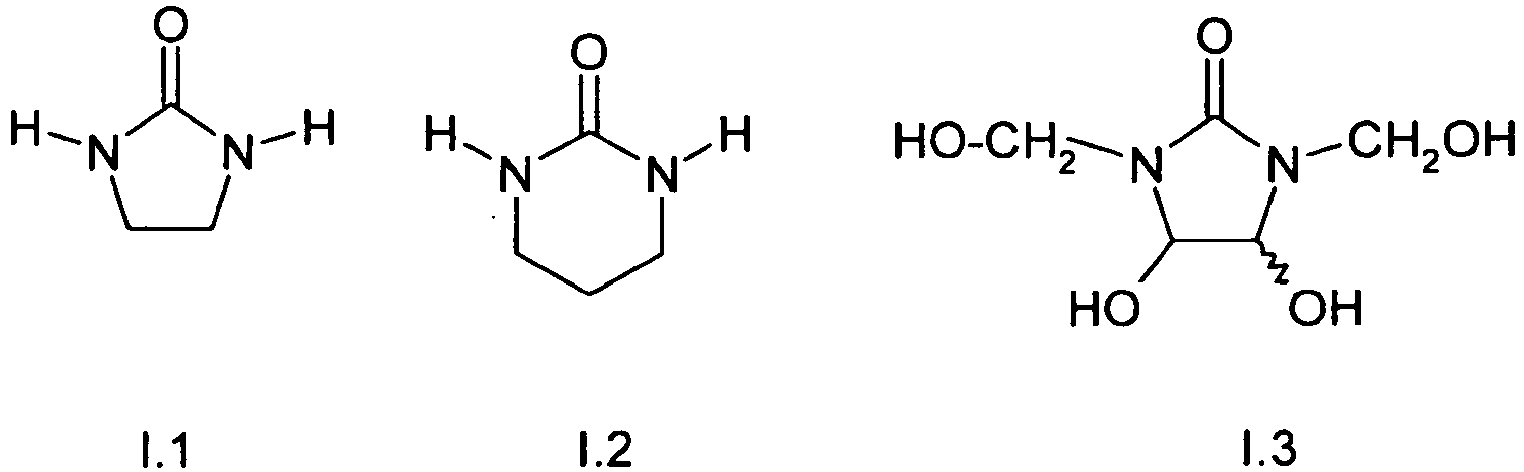
- In einer bevorzugten Ausführungsform der vorliegenden Erfindung wird bei der Herstellung des Kondensationsproduktes neben den Komponenten a1), a2) und a4) auch mindestens eine Komponente a3) und mindestens eine Komponente a5) als Edukt (Reaktand) eingesetzt. In einer mehr bevorzugten Ausführungsform wird bei der Herstellung des Kondensationsproduktes jeweils mindestens eine Komponente a1) bis a5) eingesetzt. Vorzugsweise wird eine Komponente a1) und eine Komponente a5) eingesetzt.
- Verfahren zur Herstellung eines erfindungsgemäßen Kondensationsproduktes sind dem Fachmann bekannt, beispielsweise werden sie in
EP-A 37 250 DE-A 1 113 457 . Ullmanns Encyclopedia of Industrial Chemistry, Band A15, (5.Auflage) Weinheim 1990, S.259 - 282 oderDE-A 848 823 beschrieben. - Man kann dabei die einzelnen Komponenten a1), a2), a3) und a4) sowie gegebenenfalls a5) in einer oder in mehreren Stufen umsetzen. Beispielsweise kann man zunächst
- a1) mindestens einen mit -COOH substituierten bicyclischen oder polycyclischen Aromaten oder Heteroaromaten
- a3) mit mindestens einem Sulfonierungsmittel umsetzen und danach im selben Gefäß ohne vorherige Isolierung mit
- a2) mindestens einer Carbonylverbindung,
- a4) mindestens einem Harnstoffderivat und
- a5) gegebenenfalls mindestens einen weiteren Aromaten oder Heteroaromaten umsetzen.
- Alternativ kann dabei die Reihenfolge der Zugabe der Komponenten a1) und a5) vertauscht sein oder a1) und a5) werden mindestens einmal in Form eines Gemisches zugegeben.
- Man kann in einer anderen Ausführungsform vorgehen, indem man
- a1) mindestens einen mit -COOH substituierten bicyclischen oder polycyclischen Aromaten oder Heteroaromaten
- a3) mit mindestens einem Sulfonierungsmittel umsetzt, das Produkt isoliert und dann mit dem Umsetzungsprodukt von
- a2) mindestens einer Carbonylverbindung,
- a4) mindestens einem Harnstoffderivat und
- a5) mindestens einem weiteren Aromaten oder Heteroaromaten umsetzt.
- Man kann in einer Ausführungsform der vorliegenden Erfindung die Komponenten a1), a2) und a4) und gegebenenfalls a3) und a5) in jeweils einer Portion zur Umsetzung bringen.
- In einer anderen Ausführungsform der vorliegenden Erfindung bringt man mindestens eine Komponente a1) bis a5) in mindestens zwei Portionen zur Umsetzung. Vorzugsweise sind dies die Komponenten a1), a2) und/oder a5), insbesondere die Komponente a2). Dies bedeutet, dass man die zweite Portion - in maximal äquimolaren- Mengen zur ersten Portion - nach Umsetzung der übrigen Komponenten in das Reaktionsgefäß zugibt und eine sogenannte Nachkondensation durchführt.
- In einer speziellen Ausführungsform der vorliegenden Erfindung bringt man mehrere Komponenten a1), a2), a3) und a4) und gegebenenfalls a5) in mehreren Portionen zur Umsetzung.
- In einer Ausführungsform der vorliegenden Erfindung kann man während der Umsetzung
- a6) einen oder mehrere weitere Komponenten zusetzen, beispielsweise NaHSO3, Na2S2O5, KHSO3, K2S2O5, wässrige Alkalimetallhydroxidlösung, insbesondere wässrige Natronlauge und wässrige Kaliläuge, und wässriges Ammoniak. Weiterhin sind auch Komplexbildner als Komponente a6) geeignet, beispielsweise Komplexbildner auf Basis Ethylendiamin-Tetraessigsäure. Ein Beispiel für einen solchen Komplexbildner ist das Handelsprodukt Trilon B (BASF AG, Ludwigshafen, Deutschland), das Ethylendiamintetraacetat (EDTA) enthält. Diese Komplexe sind stabil gegen Temperatur- (vorzugsweise bis mindestens 100 °C) und pH-Wert-Schwankungen. Die Komplexbildner fördern die Bildung von wasserlöslichen Komplexen mit Ionen. Die Komponente a6) dient insbesondere zur Einstellung des pH-Wertes sowie der Steuerung der Löslichkeit des Endprodukts
- Sofern die Komponente a6) in den erfindungsgemäßen Kondensationsprodukten enthalten ist, beträgt das Verhältnis a1) zu a6) 10 bis 99 Gew.-% zu 1 bis 90 Gew.-%, insbesondere 30 bis 80 Gew.-% zu 20 bis 70 Gew.-%.
- In einer Ausführungsform der vorliegenden Erfindung wählt man die Komponenten a1) bis a6) in folgendem Verhältnis:
- a1) im Bereich von insgesamt 10 bis 70 Gew.-% (Gewichtsprozent), bevorzugt insgesamt 20 bis 60 Gew.-%, besonders bevorzugt insgesamt 35 bis 50 Gew.%,
- a2) im Bereich von insgesamt 5 bis 40 Gew.-%, bevorzugt insgesamt 10 bis 30 Gew.-%, besonders bevorzugt insgesamt 15 bis 25 Gew.-%,
- a3) gegebenenfalls im Bereich von insgesamt 5 bis 50 Gew.-%, bevorzugt insgesamt 10 bis 40 Gew.-%, besonders bevorzugt insgesamt 20 bis 30 Gew.-%, wobei Sulfonierungsmittel stets als SO3 berechnet werden,
- a4) im Bereich von 0 bis insgesamt 30 Gew.-%, bevorzugt insgesamt 10 bis 25 und besonders bevorzugt 15 bis 25 Gew.-%,
- a5) gegebenenfalls im Bereich von insgesamt 10 bis 70 Gew.%, bevorzugt insgesamt 20 bis 60 Gew.-%, besonders bevorzugt insgesamt 35 bis 50 Gew.%,
- a6) im Bereich von 0 bis insgesamt 30 Gew.-%, bevorzugt bis insgesamt 25 Gew.% und besonders bevorzugt insgesamt bis 20 Gew.%,
- Man kann beispielsweise bei Temperaturen im Bereich von 40 bis 200°C, bevorzugt 50 bis 110°C umsetzen. Üblicherweise passt man dabei die Temperatur der Umsetzung an a1) und a2) an. Wünscht man beispielsweise aromatische Alkohole umzusetzen, so ist es bevorzugt, bei Temperaturen im Bereich von 50 bis 110°C umzusetzen. Natürlich ist es auch möglich, während der Umsetzung ein gewisses Temperaturprofil einzustellen. So ist es beispielsweise möglich, zunächst bei 90 bis 100°C die Reaktion zu starten und nach einiger Zeit, beispielsweise nach 2 bis 10 Stunden, auf 40 bis 75°C abzukühlen und die Umsetzung über einen Zeitraum von beispielsweise 1 bis 10 Stunden zu vervollständigen.
- Man setzt beispielsweise bei Atmosphärendruck um, kann aber, falls es gewünscht ist, auch bei höheren Drücken, beispielsweise 1,1 bis 10 bar.
- Durch die oben beschriebene Umsetzung erhält man Reaktionslösungen, die üblicherweise große Mengen an Säuren wie insbesondere Schwefelsäure oder - im Falle des Einsatzes von Chlorsulfonsäure - HCl enthalten. Weiterhin können Reaktionslösungen große Mengen an Alkalimetallsulfat und/oder Alkalimetallchlorid enthalten.
- Im Anschluss an die oben beschriebene Umsetzung kann man mit beispielsweise wässriger Alkalimetallhydroxidlösung oder wässrigem Ammoniak einen pH-Wert im Bereich von 3 bis 10, bevorzugt 3,5 bis 9 einstellen.
- Durch Zugabe von Wasser zu durch die oben beschriebene Umsetzung erhältliche Reaktionslösungen kann man durch Verdünnen mit Wasser einen Wassergehalt im Bereich von 70 bis 95 Gew.-%, bevorzugt 75 bis 90 Gew.-% einstellen.
- Aufgrund der in der Komponente a1) zwingend vorhandenen Carboxyl-Gruppe sowie in den einzelnen Komponenten eventuell vorhandenen weiteren sauren oder basischen Gruppen, umfasst die vorliegende Erfindung auch die entsprechend physiologisch oder toxikologisch verträgliche Salze der erfindungsgemäßen Kondensationsprodukte. Gegebenenfalls können die erfindungsgemäßen Kondensationsprodukte im Anschluss an deren Herstellung in physiologisch verträgliche Salze überführt werden.
- Physiologisch verträgliche Salze sind aufgrund ihrer höheren Wasserlöslichkeit gegenüber den Ausgangs- bzw. Basisverbindungen besonders geeignet für medizinische Anwendungen. Diese Salze müssen ein physiologisch verträgliches Anion oder Kation aufweisen. Geeignete physiologisch verträgliche Säureadditionssalze der erfindungsgemäßen Verbindungen sind Salze anorganischer Säuren, wie Salzsäure, Bromwasserstoff-, Phosphor-, Metaphosphor-, Salpeter-, Sulfon- und Schwefelsäure sowie organischer Säuren, wie z.B. Essigsäure, Theophyllinessigsäure, Methylen-bis-b-oxynaphthoe-, Benzolsulfon-, Benzoe-, Zitronen-, Ethansulfon-, Salicyl-, Fumar-, Glucon-, Glykol-, Isethion-, Milch-, Lactobion-, Malein-, Apfel-, Methansulfon-, Bernstein-, p-Toluolsulfon-, Wein- und Trifluoressigsäure. Geeignete pharmazeutisch verträgliche basische Salze sind Ammoniumsalze, Alkalimetallsalze (wie Natrium- und Kaliumsalze) und Erdalkalisalze (wie Magnesium- und Calciumsalze).
- Salze mit einem nicht pharmazeutisch verträglichen Anion gehören ebenfalls in den Rahmen der Erfindung als nützliche Zwischenprodukte für die Herstellung oder Reinigung pharmazeutisch verträglicher Salze und/oder für die Verwendung in nichttherapeutischen, zum Beispiel in-vitro-Anwendungen.
- Die entsprechenden Salze der erfindungsgemäßen Kondensationsprodukte können durch herkömmliche Methoden, die dem Fachmann bekannt sind, erhalten werden, beispielsweise durch Umsetzung mit einer organischen oder anorganischen Säure oder Base in einem Lösungsmittel oder Dispergiermittel, oder durch Anionen- oder Kationenaustausch mit anderen Salzen.
- Die vorliegende Erfindung schließt darüber hinaus alle Solvate der Kondensationsprodukte mit ein, beispielsweise Hydrate oder Addukte mit Alkohol, aktive Metaboliten sowie Derivate, die eine physiologisch annehmbare und abspaltbare Gruppe enthalten, beispielsweise Ester oder Amide.
- Der hier verwendete Begriff "physiologisch funktionelles Derivat" bezeichnet jedes physiologisch verträgliche Derivat eines erfindungsgemäßen Kondensationsproduktes, z.B. einen Ester, der bei Verabreichung an einen Säuger, wie z.B. den Menschen, in der Lage ist, (direkt oder indirekt) ein erfindungsgemäßes Kondensationsprodukt oder einen aktiven Metaboliten hiervon zu bilden. Beispiele hierfür sind Acetyl-Phenoxyderivate, erhältlich durch Umsetzung von Essigsäureanhydrid und einer der vorhandenen Phenolgruppen.
- Zu den physiologisch funktionellen Derivaten zählen auch Prodrugs der erfindungsgemäßen Kondensationsprodukte. Solche Prodrugs können in vivo zu einem erfindungsgemäßen Kondensationsprodukt metabolisiert werden. Diese Prodrugs können selbst wirksam sein oder nicht und sind ebenfalls Gegenstand der vorliegenden Erfindung.
- Die erfindungsgemäßen Kondensationsprodukte können auch in verschiedenen polymorphen Formen vorliegen, z.B. als amorphe und kristalline polymorphe Formen. Alle polymorphen Formen der erfindungsgemäßen Kondensationsprodukte gehören in den Rahmen der Erfindung und sind ein weiterer Aspekt der Erfindung.
- In einer weiteren Ausführungsform der vorliegenden Erfindung kann bei der Herstellung des erfindungsgemäßen Kondensationsproduktes nach Umsetzung der Komponenten a1), a2) und a4) sowie gegebenenfalls a3) und a5) ein molekülgrößenabhängiges Trennverfahren durchgeführt werden, vorzugsweise eine Ultrafiltration unter Erhalt einzelner Fraktionen des erfindungsgemäßen Kondensationsproduktes, beispielsweise einer niedermolekulare, einer mittelmolekulare sowie einer hochmolekulare Fraktion. Sinngemäßes gilt auch für die nachstehend beschriebenen Kondensationsprodukte (B). Die hochmolekulare Fraktion hat beispielsweise eine Mw-Wert ≥ 9000 g/mol (Mw = gewichtsmittleres Molekulargewicht), vorzugsweise einen Mw-Wert von 10.000 bis 100.000 g/mol. Die niedermolekulare Fraktion hat vorzugsweise einen Mw-Wert von 300 bis 3000 g/mol. Vorzugsweise beträgt in der hochmolekularen Fraktion das Verhältnis Mw/Mn < 10, insbesondere Mw/Mn < 5 (Mn = zahlenmittleres Molekulargewicht).
- An molekülgrößenabhängigen Trennverfahren sind beispielsweise geeignet: Präparative Gelpermeationschromatographie und Membrantrennverfahren wie beispielsweise die Mikrofiltration, die Nanofiltration und insbesondere die Ultrafiltration. Auch Kombinationen von Mikrofiltration und Ultrafiltration sind geeignet. Mikrofiltrationen und Ultrafiltrationen und dafür erforderliche Membranen sind als solche bekannt und beschrieben beispielsweise in Ullmann's Encyclopedia of Industrial Chemistry, 6. Auflage, Bd. 21, Wiley-VCH Weinheim, S. 243 - 321. Nanofiltrationen und die dazu gehörigen Membranen sind als solche ebenfalls bekannt und beschrieben in R. Rautenbach, "Membranverfahren", Springer Verlag Berlin Heidelberg 1997.
- Ultrafiltrationen sind als solche bekannt und werden im Allgemeinen als Querstromultrafiltrationen betrieben. Als Membranen sind handelsübliche Membranen geeignet, die beispielsweise aus organischen Materialien wie Polysulfonen oder Polyvinylidenfluorid oder bevorzugt aus anorganischen Materialien wie beispielsweise TiO2, ZrO2 oder Al2O3 hergestellt werden. Übliche Formen sind Kapillar-, Rohr- und Flachmembranen, letztere in Form von Membrankissen oder Spiralwickelmodulen.
- Beispielsweise wendet man bei Membrantrennverfahren und insbesondere bei Ultrafiltrationen eine transmembrane Druckdifferenz, d.h. eine Druckdifferenz zwischen Feed und Permeat, im Bereich von 1 bis 200 bar, bevorzugt im Bereich von 1,2 bis 100 bar an.
- In einer Ausführungsform liegt die Temperatur der nach Membrantrennverfahren behandelten Reaktionslösung im Bereich von 20 bis 70 °C, bevorzugt 25 bis 35 °C.
- In einer Ausführungsform der vorliegenden Erfindung setzt man mindestens eine Membran mit einem molecular weight cut-off im Bereich von 1000 Dalton, bevorzugt 2000 Dalton, besonders bevorzugt 5000 Dalton, ganz besonders bevorzugt 7500 Dalton und noch mehr bevorzugt von 15.000 Dalton. Der molecular weight cut-off wird auch als Trenngrenze bezeichnet.
- In einer Ausführungsform der vorliegenden Erfindung führt man die Ultrafiltration so durch, dass man ein bestimmtes Massenverhältnis von Permeat zu Retentat am Ende der Ultrafiltration einstellt. Die Retentatmenge bleibt üblicherweise bei der Ultrafiltration durch ständiges Nachdosieren von Wasser konstant, die Permeatmenge steigt im Laufe der Filtrationszeit an. Übliche Werte liegen im Bereich von 0,5:1 bis 10:1, bevorzugt 0,8:1 bis 5:1, besonders bevorzugt 1,0:1 bis 3:1.
- Man erhält üblicherweise visuell im Wesentlichen transparente wässrige Lösungen von Kondensationsprodukten.
- Es ist möglich, die Kondensationsprodukte aus den vorstehend beschriebenen Lösungen zu isolieren, beispielsweise durch Eindampfen des Wassers oder durch Sprühtrocknung.
- In einer Ausführungsform der vorliegenden Erfindung haben die Kondensationsprodukte einen Salzgehalt an anorganischen Salzen wie beispielsweise Alkalimetallsulfat und Alkalimetallchlorid von 10 ppm bis weniger als 5 Gew.-%, bevorzugt weniger als 2 Gew.-%, besonders bevorzugt weniger als 1 Gew.-% und ganz besonders bevorzugt weniger als 0,5 Gew.-%, bezogen auf das Trockengewicht von Kondensationsprodukt. Der Salzgehalt lässt sich beispielsweise durch Ionenchromatographie (IC) ermitteln, wie beispielsweise in Römpps Lexikon Chemie, 10. Auflage, Georg Thieme Verlag Stuttgart New York, Band 2, Stichwort: Ionenchromatographie beschrieben.
- In einer Ausführungsform der vorliegenden Erfindung haben die Kondensationsprodukte einen Restmonomergehalt von 10 ppm bis weniger als 5 Gew.-%, bevorzugt weniger als 2 Gew.-%, bezogen auf das Trockengewicht des Kondensationsprodukts. Als Restmonomer werden im Rahmen der vorliegenden Erfindung nicht abreagierte Reaktanden a1), a2), a4) und gegebenenfalls a5) bezeichnet, die sich in Kondensationsprodukten befinden können. Der Restmonomergehalt lässt sich beispielsweise durch Gelpermeationschromatographie (GPC) oder vorzugsweise durch lonenchromatographie (IC) oder Hochdruckflüssigkeitschromatographie (HPLC) bestimmen.
- In einer Ausführungsform der vorliegenden Erfindung haben erfindungsgemäße Kondensationsprodukte einen Gehalt von freier Carbonylverbindung a2) einschließlich als Hydrat vorliegender Carbonylverbindung a2) im Bereich von 1 ppm bis weniger als 0,5 Gew.-%, bevorzugt 0,1 Gew.-% oder weniger, bezogen auf das Trockengewicht von erfindungsgemäßem Kondensationsprodukt. In dieser Ausführungsform bezieht sich die Menge an freier Carbonylverbindung a2) natürlich auf die Carbonylverbindung a2), das man bei der Umsetzung von a1), a2) und a4) und gegebenenfalls a3) und a5) eingesetzt hat. Hat man mehrere Carbonylverbindungen a2) eingesetzt, so bezieht sich der Gehalt an freier Carbonylverbindung a2) auf die Summe aller Carbonylverbindungen a2), die man bei der Umsetzung von a1), a2), a3) und a4) und gegebenenfalls a5) eingesetzt hat. Die Bestimmung des Gehalts an freier Carbonylverbindung a2) kann man nach an sich bekannten Methoden durchführen. Ist Carbonylverbindung a2) bei Zimmertemperatur fest oder flüssig, so kann man den Gehalt an freier Carbonylverbindung a2) beispielsweise durch Gaschromatographie oder HPLC bestimmen. Handelt es sich bei Carbonylverbindung a2) um Formaldehyd, so lässt sich er sich beispielsweise photometrisch bestimmen. Eine besonders bevorzugte Methode zur Bestimmung von freiem Formaldehyd ist die Umsetzung mit Acetylaceton und Ammoniumacetat zu Diacetyldihydrolutidin und photometrische Messung von Diacetyldihydrolutidin bei einer Wellenlänge von 412 nm.
- In einer Ausführungsform der vorliegenden Erfindung wird das vorstehend beschriebene Kondensationsprodukt als Gemisch mit mindestens einem (weiteren) Gerbstoff eingesetzt, insbesondere einem synthetischen oder pflanzlichen Gerbstoff. In einer Ausführungsform beträgt der Mw-Wert des weiteren Gerbstoffes ≤ 3000 g/mol, bevorzugt ist ein Mw-Wert zwischen 300 und 3000 g/mol.
- Der weitere Gerbstoff kann sowohl ein anorganischer Gerbstoff, ein pflanzlicher Gerbstoff oder ein synthetischer Gerbstoff sein (siehe hierzu die vorstehend aufgeführte Definition gemäß Römpps Chemie Lexikon, 9. Auflage (1995), Georg Thieme Verlag, Stuttgart, Stichwort: "Gerbstoffe", Seiten 1541 bis 1542). Vorzugsweise werden als weitere Gerbstoffe pflanzliche oder synthetische Gerbstoffe verwendet, besonders bevorzugt sind hierbei synthetische Gerbstoffe. In einer Ausführungsform sind solche Gerbstoffe bevorzugt, die kein Formaldehyd als Edukt enthalten.
- Der weitere Gerbstoff kann in beliebiger Konzentration dem erfindungsgemäßen Kondensationsprodukt zugegeben werden. Vorzugsweise liegt das erfindungsgemäße Kondensationsprodukt in einem solchen Gemisch zu mindestens 50 Gew.-% bezogen auf die Summe der Gerbstoffe vor.
- Beispiele für pflanzliche Gerbstoffe sind Tannine wie Catechine oder Gallussäurederivate wie Gallate. Pflanzliche Gerbstoffe, die auf Gallussäurederivaten (wie Gallaten) beruhen, unterscheiden sich von den erfindungsgemäßen Kondensationsprodukten insbesondere darin, dass die Letztgenannten in ihren chemischen Strukturen (eine Vielzahl von) -CR1R2-Brücken (Vernetzungen) aufweisen, die von der eingesetzten Carbonylverbindung a2) stammen und die in pflanzlichen Gerbstoffen nicht vorhanden sind. Sofern beispielsweise Formaldehyd als Komponente a2) eingesetzt wird, weisen die Kondensationsprodukte -CH2-Brücken auf. Pflanzliche Gerbstoffe (Gallate) sind typischerweise oligomere Systeme, während es sich bei den Kondensationsprodukten gemäß der vorliegenden Erfindung vorzugsweise um Polymere handelt. In einer Ausführungsform haben die Kondensationsprodukte ein Molekulargewicht Mw ≥ 800 g/mol, vorzugsweise ≥ 2500 g/mol, insbesondere 10000 bis 50000 g/mol.
- Bevorzugte pflanzliche Gerbstoffe sind Tannine aus der Gruppe der Catechine, Epicatechine und Epigallocatechine und deren Gallate.
- Als Tannin versteht man prinzipiell natürlich vorkommende Polyphenole, wie sie beispielsweise in T. Okuda Phytochemistry, Band 66 (2005), Seiten 2012 bis 2031 oder Römpp's Chemielexikon, 9. Auflage (1995), Georg Thieme Verlag, Stuttgart, Stichwort "Tannine", Seiten 4452 bis 4453 aufgeführt sind. Bevorzugte Tannine sind Ellagitannine und Dehydroellagitannine, insbesondere Geraniin, Dehydrogeraniin, Furosinin, Ascorgeraniin, Geraniinsäure, Mallotusinsäure, Pentagalloylglukose, Camelliatannin A, Casuariin, Euphorbin E, Camelliatannin F, Agrimoniin, Trapanin B, Oenothein A, Oenothein B oder Gemin D , Lignin und Ligninsulfonate. Weiterhin bevorzugt sind Catechine, Epicatechine und Epigallocatechine.
- Beispiele für ein geeignetes Catechin oder Derivate davon umfassen insbesondere Flavan-3-ole, Flavan-3,4-diole (Leukoanthocyanidine) sowie Flavanone, Flavone, Chalkone oder Dihydrocychalkone, Epicatechine und Epigallocatechine.
- Beispiele für geeignete pflanzliche Gallussäurederivate sind beispielsweise in H. Sakagami et al, Anticancer Research 17 (1997), Seiten 377 bis 380 aufgeführt. Vorzugsweise sind dies Methyl-tri-O-methylgallat, tri-O-Methylgallussäure, Methyl-tri-O-acetylgallat, Methylgallat, Ethylgallat, n-Propylgallat, Isoamylgallat, Laurylgallat, Stearylgallat, Epigallocatechingallat sowie Gallussäure.
- Beispielsweise lassen sich auch Extrakte des grünen Tees als pflanzliche Gerbstoffe einsetzen, ebenso Extrakte von Kastanien oder Mimosa.
- Synthetische Gerbstoffe als solche sowie Verfahren zu deren Herstellung sind dem Fachmann bekannt. Geeignete synthetische Gerbstoffe, vorzugsweise mit einem Mw-Wert ≤ 3000 g/mol, sind beispielsweise in
EP-A 0 301 406 oderDE-A 10 2005 050 193.1 offenbart. Methoden, wie durch Steuerung der Syntheseparameter die Molmasse in einem bestimmten Bereich gesteuert werden kann, sind dem Fachmann bekannt. - Vorzugsweise enthalten die erfindungsgemäßen Gemische als synthetischen Gerbstoff mindestens eines der nachfolgend aufgeführten Kondensationsprodukte (B) bis (D).
- Kondensationsprodukt (B) ist erhältlich durch Umsetzung von
- b1) mindestens einem Aromaten oder Heteroaromaten,
- b2) mindestens einer Carbonylverbindung,
- b3) gegebenenfalls mindestens einem Sulfonierungsmittel und
- b4) gegebenenfalls mindestens einem Harnstoffderivat.
- Die Komponenten b1) bis b4) entsprechen inklusive der bevorzugten Definitionen den Komponenten a2) bis a5) des erfindungsgemäßen Kondensationsproduktes, wobei die Komponente b1) der Komponente a5) entspricht. Weiterhin ist im Gegensatz zu Komponente a5) außer Phenol auch Dihydroxydiphenylsulfon, insbesondere 4,4'-Dihydroxydiphenylsulfon, eine besonders bevorzugt Komponente b1).
- In einer Ausführungsform der vorliegenden Erfindung weisen die Kondensationsprodukte (B) einen Mw-Wert ≤ 3000 g/mol auf. Verfahren zur Herstellung von Kondensationsprodukten (B) mit einem niedrigen Mw-Wert (Mw-Wert ≤ 3000 g/mol) sind dem Fachmann bekannt. Solche Kondensationsprodukte lassen sich gezielt insbesondere durch Beeinflussung von Parametern wie Reaktionszeit, Temperatur (eher niedriger), die Wahl der Monomere (beeinflusst die Reaktivität, insbesondere Verwendung von Dihydroxydiphenylsulfonen oder pH-Wert (schwach sauer) herstellen. Alternativ können Kondensationsprodukte (B) auch dadurch hergestellt werden, dass - wie für das erfindungsgemäße Kondensationsprodukt beschrieben - im Anschluss an die Synthese eines entsprechenden Kondensationsproduktes ein molekülgrößenabhängiges Trennverfahren, vorzugsweise eine Ultrafiltration, durchgeführt wird, wobei das Kondensationsprodukt (B) von allen übrigen Bestandteilen isoliert wird. Kondensationsprodukte (B) mit dem gewünschten Mw-Wert können insbesondere durch Verwendung eines Membrans mit einem geeigneten Molecular weight cut-off-Bereich von 1000 D - 2500D abgetrennt und isoliert werden.
- Kondensationsprodukt (C) ist erhältlich durch Umsetzung von
- c1) Melamin und/oder Harnstoff,
- c2) Glyoxal, Glyoxylsäure oder einem Alkalisalz davon,
- c3) gegebenenfalls mindestens einer aromatische Verbindung mit mindestens einer phenolischen Hydroxylgruppe und
- c4) gegebenenfalls mindestens einer kondensierbaren Verbindung mit einer reaktiven stickstoffhaltigen Gruppe.
- Die Kondensationsprodukte (C) als solche sowie Verfahren zu deren Herstellung sind dem Fachmann bekannt. Beispielsweise werden diese in
EP-A 0 301 406 beschrieben und sind unter Bezugnahme in die vorliegende Erfindung mit aufgenommen. - Als Komponente c3) eignen sich beispielsweise Phenolsulfonsäure, Sulfosalicylsäure, Salicylsäure und 8-Hydroxychinolin oder 4,4'-Dihydroxydiphenylsulfon. Als Komponente c4) eignen sich Carbonsäureamide, Sulfonsäureamide, Imide, Harnstoffe, Amino-und Iminosäuren sowie Dialkylamine und Dialkanolamine. Beispiele dafür sind Acetamid, Benzoesäureamid, Formamid, Amidosulfonsäure, Succinimid, Glycin, Iminodiessigsäure, Phenylglycin, Harnstoff, Dicyandiamid, Diethanolamin oder Diethylamin. Saure Verbindungen können dabei in Form ihrer Alkalisalze einkondensiert werden. Besonders bevorzugt ist als Komponente c4) Acetamid und Amidosulfonsäure.
- Ein bevorzugtes Kondensationsprodukt (C) ist erhältlich durch Umsetzung von
- c1) Melamin und/oder Harnstoff,
- c2) Glyoxal und/oder Glyoxylsäure sowie
- c4) gegebenenfalls Amidosulfonsäure.
- Kondensationsprodukt (D) ist erhältlich durch Umsetzung von
- d1) mindestens einem cyclischen organischen Carbonat mit
- d2) mindestens einer Verbindung mit mindestens zwei nucleophilen Gruppen pro Molekül, gewählt aus Sulfonsäure-, Hydroxyl-, primären oder sekundären Amino-oder Mercaptogruppen.
- Kondensationsprodukte (D) als solche sowie Verfahren zu deren Herstellung sind dem Fachmann bekannt, sie sind beispielsweise in der deutschen Anmeldung mit der Nummer
DE-A 10 2005 050 193.1 offenbart und unter Bezugnahme in die vorliegende Erfindung mit aufgenommen. - Unter cyclischen organischen Carbonaten (Komponente d1) versteht man im Rahmen der vorliegenden Erfindung organische Kohlensäureester, die mindestens eine cyclische Gruppe aufweisen.
- Bevorzugt handelt es sich bei cyclischen organischen Carbonaten um solche organischen Kohlensäureester, bei denen die Kohlensäureestergruppe Bestandteil eines cyclischen Systems ist.
- In einer Ausführungsform der vorliegenden Erfindung wählt man cyclisches organisches Carbonat (d1) aus Verbindungen der allgemeinen Formel (II)

- R1
- gewählt aus C1-C4-Alkyl, verzweigt oder vorzugsweise linear, beispielsweise Methyl, Ethyl, n-Propyl, iso-Propyl, n-Butyl, iso-Butyl, sec-Butyl, tert.-Butyl, ganz bevorzugt Methyl und Ethyl, und ganz besonders bevorzugt Wasserstoff,
- R2
- gegebenenfalls verschieden oder vorzugsweise gleich und unabhängig voneinander gewählt aus Wasserstoff und C1-C4-Alkyl, verzweigt oder vorzugsweise linear, beispielsweise Methyl, Ethyl, n-Propyl, iso-Propyl, n-Butyl, iso-Butyl, sec-Butyl, tert.-Butyl, ganz bevorzugt Methyl und Ethyl, und ganz besonders bevorzugt jeweils gleich und Wasserstoff,
- Besonders bevorzugte cyclische organische Carbonate d1) sind Propylencarbonat oder Ethylencarbonat. Mischungen von Propylencarbonat (R' = Methyl, R2 = Wasserstoff, a = 1) und Ethylencarbonat (R' = R2 = Wasserstoff, a = 1), insbesondere bei Zimmertemperatur flüssige Mischungen von Propylencarbonat und Ethylencarbonat sind ebenfalls besonders bevorzugt.
- Unter Komponente d2) werden solche Verbindungen verstanden, die zwei zu nucleophilen Reaktionen befähigte Gruppen wie beispielsweise Sulfonsäuregruppen, Hydroxylgruppen, Mercaptogruppen oder primäre oder sekundäre Aminogruppen aufweisen.
- Beispiele für geeignete Verbindungen d2) können aufweisen:
- mindestens zwei nucleophile Hydroxylgruppen pro Molekül,
- mindestens zwei nucleophile Mercaptogruppen pro Molekül,
- mindestens zwei nucleophile primäre oder sekundäre Aminogruppen pro Molekül, beispielsweise zwei oder drei nucleophile primäre oder sekundäre Aminogruppen pro Molekül,
- mindestens eine nucleophile Hydroxylgruppe oder Mercaptogruppe und mindestens eine nucleophile primäre oder sekundäre Aminogruppe pro Molekül oder
- mindestens eine nucleophile Hydroxylgruppe und mindestens eine nucleophile Mercaptogruppe pro Molekül,
- mindestens eine nucleophile Hydroxylgruppe oder primäre oder sekundäre Aminogruppe und eine Sulfonsäuregruppe pro Molekül.
- Schwefelsäure ist keine Verbindung d2) im Sinne der vorliegenden Erfindung.
- Beispiele für nucleophile Hydroxylgruppen sind OH-Gruppen von primären und sekundären Alkoholen und insbesondere phenolische OH-Gruppen.
Beispiele für nucleophile Mercaptogruppen sind SH-Gruppen, äliphatisch oder aromatisch. - Beispiele für nucleophile Aminogruppen sind -NHR3-Gruppen, aliphatisch oder aromatisch, wobei R3 gewählt wird aus Wasserstoff, C1-C4-Alkyl, wie vorstehend definiert, und CN, oder die NH2-Gruppe von beispielsweise Amidosulfonsäure.
- OH-Gruppen und NH-Gruppen, die Bestandteile von Aminalgruppen, Halbaminalgruppen oder Hydratgruppen von Ketonen oder Aldehyden sind, sind keine nucleophilen Hydroxylgruppen beziehungsweise Aminogruppen im Sinne der vorliegenden Erfindung. Auch OH-Gruppen und NH-Gruppen, die Bestandteile von Carbonsäuregruppen oder Carbonsäureamidgruppen sind, sind keine nucleophilen Hydroxylgruppen beziehungsweise Aminogruppen im Sinne der vorliegenden Erfindung.
- Bevorzugte Beispiele für Verbindungen d2) sind
- i) Harnstoffe, unsubstituiert oder ein- oder zweifach N,N'-substituiert mit C1-C4-Alkyl, Biuret, insbesondere unsubstituierter Harnstoff,
- ii) heterocyclische Verbindungen mit mindestens zwei NH2-Gruppen pro Molekül, beispielsweise Adenin und insbesondere Melamin,
- iii) Benzoguanamin, Dicyandiamid, Guanidin,
- iv) Verbindungen der allgemeinen Formel (III)

- Weitere bevorzugte Beispiele für Verbindung d2) sind 4-Hydroxyphenylsulfonsäure und Amidosulfonsäure.
- Besonders bevorzugte Verbindungen d2) sind ausgewählt aus Melamin, Biuret, Dicyanamid, Amidosulfonsäure und 4,4'Dihydroxydiphenylsulfon.
- In einer Ausführungsform der vorliegenden Erfindung werden Gemische eingesetzt, in denen mindestens ein erfindungsgemäßes Kondensationsprodukt und/oder mindestens ein synthetischer Gerbstoff mit einem Mw-Wert ≤ 3000 g/mol hergestellt werden unter Verwendung von mindestens einer Verbindung, die mindestens eine Hydroxylgruppe enthält beziehungsweise mit einer solchen Gruppe substituiert ist. Vorzugsweise wird dies erzielt, indem
die Komponente a5) mindestens eine Verbindung enthält, die mit mindestens einer Hydroxylgruppe substituiert ist und/oder
die Komponente b1) mindestens eine Verbindung enthält, die mit mindestens einer Hydroxylgruppe substituiert ist und/oder
die Komponente c3) vorhanden ist und/oder
die Komponente d2) mindestens eine Verbindung enthält mit mindestens einer Hydroxylgruppe als nucleophiler Gruppe. - In einer weiteren bevorzugten Ausführungsform der vorliegenden Erfindung werden Gemische eingesetzt, bei denen der weitere Gerbstoff formaldehydfrei ist, vorzugsweise ein synthetischer formaldehydfreier Gerbstoff. Vorzugsweise wird dies erzielt, indem ein Kondensationsprodukt (C) oder Kondensationsprodukt (D) im Gemisch eingesetzt wird.
- Gegenstand der vorliegenden Erfindung ist weiterhin die Verwendung der erfindungsgemäßen Kondensationsprodukte, gegebenenfalls im Rahmen eines der vorstehend beschriebenen Gemische, als Arzneimittel beziehungsweise Medikament.
- Die erfindungsgemäßen Kondensationsprodukte eignen sich insbesondere als antivirales Agens, also als Arzneimittel gegen Viren, auch als Virustatika oder virucide Mittel bezeichnet. Vorzugsweise eignen sie sich als antivirales Agens gegenüber humanen Papillomviren, speziell Typ 16, 18, 6 und 11, endogenen Retroviren, insbesondere HERV-Typ (Humane endogene Retroviren), Herpes-Viren, insbesondere HSV-1, HCMV-Viren (Humanes Zytomegalievirus) oder HIV-Viren.
- Weiterhin eignen sich die erfindungsgemäßen Kondensationsprodukte vorzugsweise als antivirales Agens gegenüber Coronaviren (z.B. SARS (Severe Acute Respiratory Syndrome)-assoziiertes Coronavirus), Flaviviren (z.B. West-Nil-Virus (WNV)), Togaviren (z.B. Chikungunyavirus) oder Paramoxyviren (z.B. Masern, Respiratorisches Syncytialvirus (RSV).
- Weiterhin eignen sich die erfindungsgemäßen Kondensationsprodukte vorzugsweise zur Inhibierung von Serin Proteasen. Serin Proteasen umfassen die Humane Leukozyten Elastase (HLE; auch als Humane Neutrophile Elastase (HNE) bezeichnet), Proteinase 3 und Cathepsin G. Vorzugsweise handelt es sich bei den Serin Proteasen um HLE oder die Proteinase 3, insbesondere um HLE.
- Vorzugsweise eignen sich die erfindungsgemäßen Kondensationsprodukte (zur Herstellung von einem Medikament) zur Prophylaxe und/oder Behandlung von Genitalwarzen, Gebärmutterhalskrebs, allergischen oder nicht-allergischen Ekzemen, insbesondere Neurodermitis (endogenes Ekzem), Wundsein, Juckreiz, entzündlichen Erkrankungen, Autoimmunerkrankungen, insbesondere Arthritis, Rheuma, von melanomen Karzinomen, Entzündungen der Haut, Herpes, insbesondere Herpes labilis und Herpes simplex, Windpocken, Gürtelrose, Influenza oder Aids (HIV).
- Weiterhin eignen sich die erfindungsgemäßen Kondensationsprodukte zur Prophylaxe und/oder Behandlung von Lungenerkrankungen, Myokard-Perfusion, Ischämieschäden des Hirns, Peritonitis, septischem Schock oder systemischen Vaskulitiden. Bei den Lungenerkrankungen handelt es sich vorzugsweise um chronisch obstruktive Lungenerkrankungen (COPD). Vorzugsweise wird bei den Lungenerkrankungen das erfindungsgemäße Kondensationsprodukt in Form eines Aerosols verabreicht. Bei den systemischen Vaskulitiden handelt handelt es sich vorzugsweise um die Wegener'sche Granulomatose.
- Weiterhin eignen sich die erfindungsgemäßen Kondensationsprodukte zur Prophylaxe und/oder Behandlung von bullösem Pemphigoid, Psoriasis vulgaris, der allergenen Potenz von Typ 1-Allergenen, allergischer Rhinitis, allergischer Konjunktivitis, allergischem Asthma, Bronchiale oder Schuppenflechte.
- In einer Ausführungsform der vorliegenden Erfindung handelt es sich bei Arzneimitteln um Arzneimittel zur lokalen Behandlung von allergischen oder nicht-allergischen Ekzemen, Wundsein oder Juckreiz. Vorzugsweise wird in dieser Ausführungsform Neurodermitis (endogenes Ekzem) behandelt.
- In einer speziellen Ausführungsform der vorliegenden Erfindung handelt es sich bei Arzneimitteln um Arzneimittel zur Behandlung von entzündlichen Erkrankungen der Haut, bei denen es durch enzymatische Aktivität z.B. der humanen Leukozyten-Elastase zur Bildung von Bläschen, Pusteln und zur so genannten Spongiose in der Oberhaut kommt. Die Arzneimittel werden bevorzugt äußerlich appliziert
- In einer bevorzugten Ausführungsform der vorliegenden Erfindung handelt es sich bei Arzneimitteln um Arzneimittel gegen Viren, vorzugsweise Retroviren, beispielsweise RNS-Viren (Ribonucleinsäure-Viren) und DNS-Viren (Desoxyribonucleinsäure-Viren) und insbesondere Herpes-Viren, beispielsweise Viren, die Herpes simplex (HS-Viren) erzeugen, oder auch um Viren, die Windpocken und Influenza erzeugen. Ferner ist anzumerken, dass die erfindungsgemäßen Wirkstoffe sowohl gegen hydrophile als auch ebenso wirksam gegen lipophile/hydrophobe Viren eingesetzt werden können.
- In einer weiteren Ausführungsform der vorliegenden Erfindung handelt es sich bei Arzneimitteln um Arzneimittel gegen HIV-Viren (Human Imuno Deficiency Virus). Der HIV-Virus ist dafür bekannt, dass er Aids (Aquired Imuno Deficiency Syndrom) verursacht.
- In einer weiteren bevorzugten Ausführungsform der vorliegenden Erfindung handelt es sich bei Arzneimitteln um Arzneimittel gegen Humane Papillomviren sowie von endogenen Retroviren (HERV-Typ). Bei den Human-Papillomviren handelt es sich insbesondere um den Typ 16, 18, 6 und 11. In dieser Hinsicht eignen sich die erfindungsgemäßen Kondensationsprodukte insbesondere zur äußerlichen Medikation von Genitalwarzen und Gebärmutterhalskrebs. Im Zusammenhang mit der Behandlung von HERV-Viren (insbesondere HERV-K) eignen sich die erfindungsgemäßen Kondensationsprodukt zur Behandlung von Autoimmunkrankheiten (Arthritis) sowie präventiv gegen melanome Karzinome.
- In den vorstehenden Ausführungen umfasst der Begriff Behandlung auch die Prophylaxe, Therapie oder Heilung der vorgenannten Krankheiten.
- Die erfindungsgemäßen Kondensationsprodukte können Tieren und Menschen, bevorzugt Säugetieren und Menschen, besonders bevorzugt Menschen, verabreicht werden. Die erfindungsgemäßen Kondensationsprodukte können dabei selbst als Arzneimittel, in Mischungen miteinander oder Mischungen mit anderen Arzneimitteln oder in Form von pharmazeutischen Zusammensetzungen verabreicht werden. Folglich sind die Verwendung von den erfindungsgemäßen Kondensationsprodukten zur Herstellung eines oder mehrerer Medikamente zur Prophylaxe und/oder Behandlung der vorgenannten Krankheiten oder als antivirales Agens, pharmazeutische Zusammensetzungen enthaltend eine wirksame Menge von mindestens einem erfindungsgemäßen Kondensationsprodukt sowie der Verwendung dieser pharmazeutischen Zusammensetzungen zur Prophylaxe und/oder Behandlung der vorgenannten Krankheiten ebenfalls Gegenstand der vorliegenden Erfindung.
- Die erfindungsgemäßen pharmazeutischen Zusammensetzungen umfassen eine wirksame Menge von mindestens einem erfindungsgemäßen Kondensationsprodukt sowie einen physiologisch verträglichen Träger. Die pharmazeutischen Zusammensetzungen können dabei in unterschiedlichen Darreichungsformen vorliegen, insbesondere in Form einer Pille, Tablette, Lutschtablette, Granulat, Kapsel, harte oder weiche Gelatinekapsel, wässrigen Lösung, alkoholischen Lösung, ölartigen Lösung, Sirup, Emulsion, Suspension, Zäpfchen, Pastille, Lösung zur Injektion oder Infusion, Salbe, Tinktur, Creme, Lotion, Puder, Spray, eines transdermalen therapeutischen Systems, Nasenspray, Aerosol, Aerosol-Mischung, Mikrokapsel, Implantat, Stab, Pflaster oder Gel. Ebenso kann die erfindungsgemäße pharmazeutische Zusammensetzung auch Bestandteil von Health-Care Produkten wie Sonnenschutzcremes, Nasensprays, Mundwässern, Zahnpasten, Pflastern, (Feucht)-Tüchern, Waschlotionen oder Shampoos sein.
- Je nach verwendeter Darreichungsform werden die erfindungsgemäßen Kondensationsprodukte mit physiologisch verträglichen Trägern, die dem Fachmann als solche bekannt sind, zu den erfindungsgemäßen pharmazeutischen Zusammensetzungen verarbeitet. Der Träger muss natürlich verträglich sein in dem Sinn, dass er mit den anderen Bestandteilen der Zusammensetzung kompatibel ist und nicht gesundheitsschädlich für den Patienten ist (physiologisch verträglich). Der Träger kann ein Feststoff oder eine Flüssigkeit oder beides sein und wird vorzugsweise mit der Verbindung als Einzeldosis formuliert, beispielsweise als Tablette, die von 0,05 bis 95 Gew.-% des Wirkstoffs (erfindungsgemäßes Kondensationsprodukt) enthalten kann. Weitere pharmazeutisch aktive Substanzen können ebenfalls vorhanden sein. Die erfindungsgemäßen pharmazeutischen Zusammensetzungen können nach einer der bekannten pharmazeutischen Methoden hergestellt werden, die im Wesentlichen darin besteht, dass die Bestandteile mit pharmakologisch verträglichen Trägern und/oder weiteren Hilfsstoffen wie Füllstoffe, Bindemittel, Gleitmittel, Netzmittel, Stabilisatoren und so weiter gemischt werden.
- Bevorzugte pharmazeutische Zusammensetzungen im Rahmen der vorliegenden Erfindung sind nachfolgend aufgeführt.
- In einer Ausführungsform der vorliegenden Erfindung können erfindungsgemäße Salben, Cremes, Fettcremes, Gele, Lotionen beziehungsweise Puder jeweils im Bereich von 0,1 bis 5 Gew.%, bevorzugt 0,2 bis 3 Gew.-% erfindungsgemäße Kondensationsprodukte enthalten, bezogen auf die jeweilige Salbe, Creme, Fettcreme, Lotion beziehungsweise das jeweilige Gel oder Puder.
- In einer Ausführungsform der vorliegenden Erfindung können erfindungsgemäße Pulver beziehungsweise-Konzentrate im Bereich von 1 bis 75 Gew.%, bevorzugt 10 bis 65 Gew.-% erfindungsgemäßes Kondensationsprodukt enthalten, bezogen auf das jeweilige Pulver beziehungsweise Konzentrat.
- Erfindungsgemäße Cremes sind üblicherweise Öl-in-Wasser-Emulsionen, erfindungsgemäße Salben sind üblicherweise Wasser-in-Öl-Emulsionen. Erfindungsgemäße Salben und Cremes enthalten neben vorzugsweise gereinigtem Wasser eine oder mehrere Ölkomponenten und vorzugsweise eine oder mehrere oberflächenaktive Substanzen, beispielsweise einen oder mehrere Emulgatoren oder Schutzkolloide. Weiterhin können erfindungsgemäße Salben und Fettcremes - wie andere erfindungsgemäße Darreichungsformen der erfindungsgemäßen Kondensationsprodukte auch - Konservierungsmittel enthalten wie beispielsweise Sorbinsäure.
- Geeignete Ölkomponenten sind natürliche und synthetische Wachse, natürliche und synthetische Öle wie beispielsweise Nussöl, Fischöl, Olivenöl und Polymere wie beispielsweise Polyacrylsäure, Polydimethylsiloxan und Polymethylphenylsiloxan.
- Geeignete oberflächenaktive Substanzen sind beispielsweise Verbindungen der allgemeinen Formel (IV)
CH3-(CH2)n-X-R3 (IV)
wobei die Variablen wie folgt definiert sind: - n ist eine ganze Zahl im Bereich von 0 bis 20, bevorzugt eine gerade Zahl im Bereich von 2 bis 16 bedeutet und
- X steht für zweibindige Gruppen, die mindestens ein von Kohlenstoff und Wasserstoff verschiedenes Atom, bevorzugt Stickstoff und besonders bevorzugt Sauerstoff tragen, insbesondere -O- und -COO-,
- R3 wird gewählt aus
- Wasserstoff,
- C1-C10-Alkylgruppen wie beispielsweise Methyl, Ethyl, n-Propyl, iso-Propyl, n-Butyl, iso-Butyl, sec.-Butyl, tert.-Butyl, n-Pentyl, iso-Pentyl, sec.-Pentyl, neo-Pentyl, 1,2-Dimethylpropyl, iso-Amyl, n-Hexyl, iso-Hexyl, sec.-Hexyl, n-Heptyl, n-Octyl, 2-Ethylhexyl, n-Nonyl, n-Decyl; besonders bevorzugt C1-C4-Alkyl wie Methyl, Ethyl, n-Propyl, iso-Propyl, n-Butyl, iso-Butyl, sec.-Butyl und tert.-Butyl,
- -(CH2-CH2-O)m-H, wobei m eine ganze Zahl im Bereich von 1 bis 100, bevorzugt bis 25 ist,
- CH3-(CH2)n-X-(O-CH2-CH2)m-, wobei X und n jeweils verschieden oder vorzugsweise gleich sein können.
- Weiterhin können erfindungsgemäße Salben und Cremes - wie andere erfindungsgemäße Darreichungsformen der erfindungsgemäßen Kondensationsprodukte auch - organische Lösungsmittel enthalten wie beispielsweise Propylenglykol und Glycerin.
- Bevorzugte Beispiele für oberflächenaktive Substanzen sind beispielsweise Isopropyltetradecanoat, Cetylalkohol, Palmitinsäure, Stearinsäure, Polyoxyethylen-2-stearylether, α-n-Dodecyl-ω-hydroxypolyoxyethylen mit im Mittel 10 Ethylenoxideinheiten, 2-Phenoxyethanol, Polyoxyethylen-21-stearylether.
- Erfindungsgemäße Fettcremes sind üblicherweise Wasser-in-Öl-Emulsionen und enthalten neben vorzugsweise gereinigtem Wasser ein oder mehrere Ölkomponenten und vorzugsweise eine oder mehrere oberflächenaktive Substanzen, beispielsweise einen oder mehrere Emulgatoren oder Schutzkolloide.
- Geeignete Ölkomponenten sind neben den vorstehend beschriebenen Ölkomponenten natürliche und synthetische Fette wie beispielsweise ein- oder mehrfach ethylenisch ungesättigte Fettsäureglyceride.
- Weiterhin können erfindungsgemäße Fettcremes eine oder mehrere der folgenden Substanzen enthalten: Methyl-4-hydroxybenzoat, Propyl-4-hydroxybenzoat, wässrige Sorbit-Lösung, Tris[n-dodecylpoly(oxoethylen)-4]phosphat, Cetylstearylalkohol, Hexyllaurat, Vitamin-F-Glycerolester, Dimeticon 350, Calciumlactat-Pentahydrat.
- Erfindungsgemäße Gele können beispielsweise Polyacrylsäure, Natriumhydroxid und Butylhydroxyanisol, beispielsweise 4-Methoxy-2-tert.-butylphenol, 4-Methoxy-3-tert.-butylphenol und Mischungen der beiden vorgenannten Verbindungen enthalten.
- Erfindungsgemäße Lotionen können beispielsweise mindestens einen der im Folgenden genannten Stoffe enthalten: Glycerin, Zinkoxid, Talkum, Lecithin, hochdisperses Siliciumdioxid, Isopropanol, Methyl(4-hydroxybenzoat), Carageenan, Natriumsalz und Phosphorsäureester der allgemeinen Formel (V)

- Erfindungsgemäße Puder können beispielsweise enthalten: Calciumlactat-Pentahydrat, Talkum, Maisstärke, 2-n-Octyl-1-dodecanol, Siliciumdioxid.
- Erfindungsgemäße Pulver zur Herstellung von Gebrauchslösungen können beispielsweise Calciumlactat 5 H2O und Natriumsulfat (als Trägermaterial) enthalten.
- Erfindungsgemäße Konzentrate zur Herstellung von Gebrauchslösungen können beispielsweise enthalten: Natriumsalz des Dodecylpoly(oxyethylen)-2-hydrogensulfats, Natriumsulfat als Trägermaterial.
- Anstatt erfindungsgemäße Salben, Cremes, Fettcremes, Gele, Lotionen, Puder; Pulver oder Konzentrate auf ihre Wirksamkeit zu untersuchen, kann man erfindungsgemäße Kondensationsprodukte, gegebenenfalls als Stammlösung, auf ihre Wirksamkeit untersuchen. Geeignete Untersuchungsmethoden sind Untersuchungen auf Hemmung von ausgesuchten Enzymen, beispielsweise humane Leukozyten-Elastase oder der Protease Plasmin. Weiterhin kann man untersuchen, in welchem Maße die Replikation betreffender Viren gehemmt wird. Solche Untersuchungsmethoden werden im nachfolgend Text (Pharmakalogische Untersuchungen) noch genauer beschrieben.
- Ein weiterer Gegenstand der vorliegenden Erfindung ist die Verwendung eines erfindungsgemäßen Kondensationsproduktes zur Desinfektion, als Desinfektionsmittel oder Bestandteil eines Desinfektionsmittels. Insbesondere finden die erfindungsgemäßen Kondensationsprodukte Verwendung im Bereich von Krankenhäusern, insbesondere Krankenhaus-Intensivstationen, Toiletten, Waschräumen, Haushalten, der Lebensmittelproduktion oder in Stallungen oder Käfigen von Tieren, insbesondere von Vögeln, Schweinen und Rindern.
- Die erfindungsgemäßen Kondensationsprodukte zeichnen sich bei ihrer Verwendung als Desinfektionsmittel dadurch aus, dass sie eine überraschend gute Breitbandwirkung gegenüber Pilzen, Bakterien und Viren haben sowie eine geringere Toxizität gegenüber den üblichen Mitteln beziehungsweise Mischungen, die als Desinfektionsmittel gemäß des Standes der Technik verwendet werden, aufweisen. Weiterhin sind sie weder flüchtig noch schleimhautreizend und sie sind sowohl als flüssige oder auch streufähige Pulvereinstellung leicht herstellbar. Insbesondere eignen sich die erfindungsgemäßen Kondensationsprodukte zur Anwendung in Stallungen oder Käfigen von Tieren, vorzugsweise auf Stroh.
- Ein weiterer Gegenstand der vorliegenden Erfindung ist somit auch ein Desinfektionsmittel enthaltend mindestens ein erfindungsgemäßes Kondensationsprodukt
- Die erfindungsgemäßen Desinfektionsmittel sind somit nicht zur Verabreichung als Arzneimittel gedacht, sondern sie sind zur Desinfektion von beispielsweise den vorstehend aufgeführten Gegenständen geeignet. In den erfindungsgemäßen Desinfektionsmitteln ist mindestens ein erfindungsgemäßes Kondensationsprodukt in den üblichen Konzentrationen enthalten. Weitere Komponenten, die in den erfindungsgemäßen Desinfektionsmitteln enthalten sind, sind dem Fachmann bekannt. Solche Komponenten können je nach Anwendungsgebiet variieren, gleiches gilt für die Konzentration an dem erfindungsgemäßen Kondensationsprodukt.
- Ein weiterer Gegenstand der vorliegenden Erfindung ist die Verwendung der erfindungsgemäßen Kondensationsprodukte als Gerbstoff bzw. als Gerbereihilfsmittel. Vorzugsweise eignen sich die erfindungsgemäßen Kondensationsprodukte zum Gerben von Ledern und/oder Häuten. Verfahren zum Gerben (Gerbverfahren) als solche sind dem Fachmann bekannt, sie beispielsweise
EP-A 0 301 406 . - Die Erfindung soll an den nachfolgenden Beispielen verdeutlicht werden.
- ppm beziehen sich stets auf Gewichtsanteile, sofern nicht anders angegeben.
Die Molekulargewichtsbestimmungen werden mit Gelpermeationschromatographie (GPC) durchgeführt: - Stationäre Phase: mit Ethylenglykoldimethacrylat vernetztes Poly-(2-hydroxymeth-acrylat)-Gel, kommerziell erhältlich als HEMA BIO von Fa. PSS, Mainz, Deutschland. Laufmittel: Gemisch aus 30 Gew.% Tetrahydrofuran (THF), 10 Gew.% Acrylnitril, 60 Gew.-% 1-molare NaNO3-Lösung
- Interner Standard: 0,001 Gew.-% Benzophenon, bezogen auf Laufmittel
- Fluss: 1,5 ml/min
- Konzentration: 1 Gew.-% im Laufmittel mit internem Standard
- Detektion: UV/Vis-spektrometrisch bei 254 nm
- Kalibrierung mit Polystyrol-Eichteils der Fa. PSS.
- Mn: zahlenmittleres Molekulargewicht in [g/mol]
- Mw: gewichtsmitteleres Molekulargewicht in [g/mol]
- Reaktanden (Edukte):
- a) Phenol,
- b) konzentrierte Schwefelsäure,
- c) Harnstoff
- d) Formaldehyd
- e) 1-Naphtalincarbonsäure
- 47,1 g Phenol werden in einer Rührapparatur vorgelegt und während 25 Minuten mit 57,1 g konzentrierter Schwefelsäure (96 Gew.-%) versetzt. Dabei wird darauf geachtet, dass die Temperatur 105°C nicht übersteigt. Anschließend wird das Reaktionsgemisch 2 Stunden bei 100 bis 105°C gerührt. Das Reaktionsgemisch wird dann mit 7,9 g Wasser verdünnt. Es werden 64,6 g wässrige Harnstofflösung (50 Gew.-%) zudosiert, wobei die Temperatur auf 95°C steigt; anschließend wird auf 75°C gekühlt. Über einen Zeitraum von 90 Minuten werden 94,6 g wässrige Formaldehydlösung (30 Gew.-%) zugefügt, wobei darauf geachtet wird, dass die Temperatur nicht über 75°C steigt. Anschließend wird mit 17,3 g wässriger Natronlauge (50 Gew.-%) teilneutralisiert, und 6,9 g Wasser wird zugefügt. Bei einer Temperatur von 50 bis 55°C werden 57,2 g 1-Naphtalincarbonsäure und 0,6 g eines Komplexbildners auf Basis Etyhlendiamin - Tetraessigsäure zugegeben. Das Reaktionsgemisch wird dann 30 Minuten bei 55°C nachgerührt, bevor 26,3 g wässriger Formaldehydlösung (30 Gew.-%) innerhalb von 15 bis 20 Minuten bei 55 bis 60°C zudosiert werden. 74,4 g wässriger Natronlauge (50 Gew.-%) und 46,2 g Wasser werden zugegeben. Nach Verdampfung der flüchtigen Anteile erhält man 152,5 g Kondensationsprodukt 1 als Feststoff mit weißer Farbe.
- Die Analyse des Reaktionsgemisches 1 durch HPLC ergibt folgende Werte:
- Phenol: < 0,1 Gew.%;
- 4-Phenolsulfonsäure: 9,2 Gew.-%;
- freier Formaldehyd: < 20 ppm;
- Mn 2390 g/mol, Mw 35630 g/mol, bestimmt durch GPC.
- Reaktanden:
- a) Phenol,
- b) konzentrierte Schwefelsäure,
- c) Harnstoff,
- d) Formaldehyd,
- e) 1-Naphtalincarbonsäure
- 47,1 g Phenol werden in einer Rührapparatur vorgelegt und während 25 Minuten mit 57,1 g konzentrierter Schwefelsäure (96 Gew.-%) versetzt. Dabei wird darauf geachtet, dass die Temperatur 105°C nicht übersteigt. Anschließend wird das Reaktionsgemisch 2 Stunden bei 100 bis 105°C gerührt. Das Reaktionsgemisch wird dann mit 8 g Wasser verdünnt. Es werden 64,6 g wässrige Harnstofflösung (50 Gew.-%) zudosiert, wobei die Temperatur auf 95°C steigt; anschließend wird auf 75°C gekühlt. Über einen Zeitraum von 90 Minuten werden 141,9 g wässrige Formaldehydlösung (30 Gew.-%) zugefügt, wobei darauf geachtet wird, dass die Temperatur nicht über 75°C steigt. Anschließend wird mit 17,3 g wässriger Natronlauge (50 Gew.-%) teilneutralisiert, und 10 g Wasser wird zugefügt. Bei einer Temperatur von 50 bis 55°C werden 57,2 g 1-Naphtalincarbonsäure und 0,6 g eines Komplexbildners auf Basis Etyhlendiamin-Tetraessigsäure zugegeben. Das Reaktionsgemisch wird dann 30 Minuten bei 55°C nachgerührt, bevor 26,3 g wässriger Formaldehydlösung (30 Gew.-%) innerhalb von 15 bis 20 Minuten bei 55 bis 60°C zudosiert werden. Wässrige Natronlauge (50 Gew.-%) und 100 g Wasser werden bis zum einem pH-Wert von 7,2 zugegeben. Nach Verdampfung der flüchtigen Anteile erhält man das Kondensationsprodukt 2.
- Reaktanden:
- a) 1-Naphtalincarbonsäure,
- b) Harnstoff,
- c) Formaldehyd,
- 47,7 g 1-Naphtalincarbonsäure werden in einer Rührapparatur in 250 g Wasser und 22,5 g wässrige Natronlauge (50 Gew.-%) gelöst. Es wird darauf geachtet, dass der pH-Wert dieser wässrigen Lösung nicht über 9 steigt. Es werden 64,6 g wässrige Harnstofflösung (50 Gew.-%) bei 70°C zudosiert, wobei die Temperatur auf 95°C steigt; anschließend wird auf 75°C gekühlt. Über einen Zeitraum von 90 Minuten werden 94,6 g wässrige Formaldehydlösung (30 Gew.-%) zugefügt, wobei darauf geachtet wird, dass die Temperatur nicht über 75°C steigt. Bei einer Temperatur von 50 bis 55°C werden 57,2 g 1-Naphtalincarbonsäure und 0,6 g eines Komplexbildners auf Basis Etyhlendiamin - Tetraessigsäure zugegeben. Das Reaktionsgemisch wird dann 30 Minuten bei 55°C nachgerührt, bevor 26,3 g wässriger Formaldehydlösung (30 Gew.-%) innerhalb von 15 bis 20 Minuten bei 8°C zudosiert werden. 26,5 g wässriger Natronlauge (50 Gew.-%) werden zugegeben. Nach Verdampfung der flüchtigen Anteile erhält man 158,2 g Kondensationsprodukt 3 als Pulver mit weißer Farbe.
- Reaktanden:
- a) Phenol,
- b) konzentrierte Schwefelsäure,
- c) Harnstoff,
- d) Formaldehyd,
- d) Naphtalinsulfonsäure
- 47,1 g Phenol werden in einer Rührapparatur vorgelegt und während 25 Minuten mit 57,1 g konzentrierter Schwefelsäure (96 Gew.-%) versetzt. Dabei wird darauf geachtet, dass die Temperatur 105°C nicht übersteigt. Anschließend wird das Reaktionsgemisch 2 Stunden bei 100 bis 105°C gerührt. Das Reaktionsgemisch wird dann mit 7,9 g Wasser verdünnt. Es werden 64,6 g wässrige Harnstofflösung (50 Gew.-%) zudosiert, wobei die Temperatur auf 95°C steigt; anschließend wird auf 75°C gekühlt. Über einen Zeitraum von 90 Minuten werden 94,6 g wässrige Formaldehydlösung (30 Gew.-%) zugefügt, wobei darauf geachtet wird, dass die Temperatur nicht über 75°C steigt. Bei einer Temperatur von 50 bis 55°C werden 69,3 g Naphtalinsulfonsäure und 0,6 g eines Komplexbildners auf Basis Etyhlendiamin - Tetraessigsäure zugegeben. Das Reaktionsgemisch wird dann 30 Minuten bei 55°C nachgerührt, bevor 26,3 g wässriger Formaldehydlösung (30 Gew.-%) innerhalb von 15 bis 20 Minuten bei 55 bis 60°C zudosiert werden. Wässrige Natronlauge (50 Gew.-%) werden bis zum einem pH-Wert von 7,2 zugegeben. Nach Verdampfung der flüchtigen Anteile erhält man das Kondensationsprodukt 4.
- Reaktanden:
- a) Phenol,
- b) konzentrierte Schwefelsäure,
- c) Formaldehyd,
- d) 1-Naphtalincarbonsäure
- 47,1 g Phenol werden in einer Rührapparatur vorgelegt und während 25 Minuten mit 57,1 g konzentrierter Schwefelsäure (96 Gew.-%) versetzt. Dabei wird darauf geachtet, dass die Temperatur 105°C nicht übersteigt. Anschließend wird das Reaktionsgemisch 2 Stunden bei 100 bis 105°C gerührt. Das Reaktionsgemisch wird dann mit 7,9 g Wasser verdünnt. Über einen Zeitraum von 90 Minuten werden bei 75°C 94,6 g wässrige Formaldehydlösung (30 Gew.-%) zugefügt, wobei darauf geachtet wird, dass die Temperatur nicht über 75°C steigt. Bei einer Temperatur von 50 bis 55°C werden 57,2 g 1-Naphtalincarbonsäure und 0,6 g eines Komplexbildners auf Basis Etyhlendiamin - Tetraessigsäure zugegeben. Das Reaktionsgemisch wird dann 30 Minuten bei 55°C nachgerührt, bevor 26,3 g wässriger Formaldehydlösung (30 Gew.-%) innerhalb von 15 bis 20 Minuten bei 55 bis 60°C zudosiert werden. Wässrige Natronlauge (50 Gew.-%) werden bis zum einem pH-Wert von 7,2 zugegeben. Nach Verdampfung der flüchtigen Anteile erhält man das Kondensationsprodukt 5.
- Reaktanden:
- a) Phenol,
- b) konzentrierte Schwefelsäure,
- c) Harnstoff
- d) Formaldehyd
- 20,4 g Phenol werden in einer Rührapparatur vorgelegt und während 25 Minuten mit 24,7 g konzentrierter Schwefelsäure (96 Gew.-%) versetzt. Dabei wird darauf geachtet, dass die Temperatur 105°C nicht übersteigt. Anschließend wird das Reaktionsgemisch 2 Stunden bei 100 bis 105°C gerührt. Das Reaktionsgemisch wird dann mit 3,4 g Wasser verdünnt. Es werden 28,1 g wässrige Harnstofflösung (50 Gew.-%) zudosiert, wobei die Temperatur auf 95°C steigt; anschließend wird auf 75°C gekühlt. Über einen Zeitraum von 90 Minuten werden 41,0 g wässrige Formaldehydlösung (30 Gew.-%) zugefügt, wobei darauf geachtet wird, dass die Temperatur nicht über 75°C steigt. Anschließend wird mit 7,5 g wässriger Natronlauge (50 Gew.-%) teilneutralisiert, und 3 g Wasser wird zugefügt.
Bei einer Temperatur von 50 bis 55°C werden 13,6 g Phenol und 0,3 g eines Komplexbildners auf Basis Etyhlendiamin - Tetraessigsäure zugegeben. Das Reaktionsgemisch wird dann 30 Minuten bei 55°C nachgerührt, bevor 11,4 g wässriger Formaldehydlösung (30 Gew.-%) innerhalb von 15 bis 20 Minuten bei 55 bis 60°C zudosiert werden. 32,2 g wässriger Natronlauge (50 Gew.-%) und 20 g Wasser werden zugegeben. Die Endeinstellung vom pH-Wert bis pH 7,0 - 7,4 erfolgt durch Zugabe von 8,2 g Schwefelsäure (50 Gew.-%). Nach Verdampfung der flüchtigen Anteile erhält man 200 g Reaktionsgemisch 6 als farblosen Feststoff. - Die Analyse des Kondensationsproduktes 6 ergibt folgende Werte:
- Phenol durch HPLC: < 0,1 Gew.-%;
- 4-Phenolsulfonsäure durch HPLC: 7,8 Gew.-%;
- freier Formaldehyd: < 20 ppm;
- In der Untersuchung wird bestimmt, ob ein Kondensationsprodukt antivirale Aktivität gegen verschiedene Viren aufweist und welche Menge antiviraler Substanz benötigt wird, um eine 50% Reduktion der Virusreplikation zu bewirken.
- Die Virusgebrauchsverdünnung wird an Hand einer Endpunkttitration des angezüchteten Virusisolates ermittelt. Bei dieser Titration wird die Virusmenge ermittelt, bei der 50% der Ansätze aus der Virusverdünnung infiziert bzw. nicht infiziert sind (= infektiöse Dosis 50% = TCID50/ml).
- Aus der zu testenden Substanz wird eine um Faktor zwei ansteigende Verdünnungsreihe hergestellt. Danach wird eine definierte Menge Virus zugegeben.
- Das Stoff/Virus-Gemisch wird auf Monolayer aus geeigneten Zellen gegeben. Nach einer vom Virus abhängigen Inkubationszeit erfolgt eine Beurteilung der virusbedingten zytopathogenen Veränderung (CPE). Zur Ermittlung der Ergebnisse wird eine Färbung mittels Antikörper gegen das eingesetzte Virus angeschlossen. Dabei erfolgt eine prozentuale Abschätzung des CPE im Vergleich zur Viruskontrolle, die als 100% gesetzt wird. Bei der Färbung wird eine photometrische Auswertung durchgeführt. Mittels linearer Regression unter Verwendung eines Computerprogramms wird die Konzentration, bei der eine 50%ige Reduktion der Virusreplikation von Patientenisolaten bewirkt wird ("IC50"), errechnet.
- Das Verhältnis TC50 / IC50 (therapeutisches Index "TI" genannt) zeigt die spezifische Aktivität eines Kondensationsproduktes gegen ein gegebenes Virus.
-
- aus einer Vero-Zellkulturflasche (75cm2, ca. 9x10⁶ Zellen) mit konfluentem Zellrasen können ca. 100ml Zellsuspension hergestellt werden.
- pro Mikrotiterplatte werden 5ml Zellsuspension benötigt
-
- die Zellkultur wird trypsiniert, homogenisiert und in Wachstumsmedium überführt
-
- 50µl Zellsuspension pro Loch ansetzen
- Platten dann bis zur weiteren Benutzung im Brutschrank aufbewahren
-
- Herstellung einer 1:10 Verdünnungsreihe
- jeweils 50µl Verdünnung pro Loch im 8-fach Ansatz in eine mit Zellsuspension vorbereitete Platte pipettieren
- je nach Virus die Platte im Brutschrank für einige Tage inkubieren
- nach der Inkubationszeit Platten mikroskopisch nach CPE beurteilen
-
- Pro zu untersuchendes Virus muss eine 96-Loch Platte mit entsprechenden Zellen vorbereitet werden
- Beschriftung der Platten.
- ➢ 1. Reihe ZK (Zellkontrolle)
- ➢ 2. Reihe VK (Viruskontrolle)
- ➢ 3. - 10. Reihe Stoffkonzentrationen
- ➢ am Rand Virus und Datum
- mit der zu testenden Substanz eine 1:2 Verdünnungsreihe herstellen
- In Reihe 1 der Platte 100µl Medium zu den Zellen geben (keine Stoff- und Virusverdünnung)
- In Reihe 2 50µl Medium pipettieren (keine Stoffverdünnung)
- Substanzverdünnung Reihe 3-12 im 8-fach Ansatz auf die Platte verteilen
- Das Einpipettieren in die Platten zügig durchführen, da sonst die Zellen austrocknen
- eine ausreichende Menge Virussuspension für i.d.R. MOI 0,01 herstellen
- 50µl Virussuspension ab Reihe 2 pipettieren
- Platte bei 37°C im CO2-Bruschrank für 2 Tage inkubieren
-
- Nach Ende der Inkubationszeit die Platte mikroskopisch auf CPE auswerten. Dabei entspricht die Viruskontrolle 100%. Für alle Substanzverdünnungen wird, durch Vergleich mit der Viruskontrolle, der Umfang der Zellzerstörung als Prozentzahl angegeben. Nach der visuellen Auswertung kann eine Färbung angeschlossen werden
- unter der Sterilwerkbank Überstand aus Mikrotiterplatten absaugen
- Fixation der Zellen mit Aceton/Methanol
- Flüssigkeit absaugen
- Verdünnung der virusspezifischen Antikörper mit Blocking Solution. Pro Kavität werden 50µl eingesetzt. Die optimale Konzentration für den Antikörper wird für jede neue Charge mittels Titration ermittelt. Inkubation 1h bei 37°C
- 3x Waschen mit Waschpuffer
- biotinylierte Anti-IgG-Antikörper werden in Waschpuffer verdünnt und je 50µl in jede Kavität einpipettiert. Die optimale Konzentration für den Antikörper wird für jede neue Charge mittels Titration ermittelt.
- Inkubation 1h 37°C
- 3x Waschen
- das Streptavidin/Peroxidase Konjugat wird im Waschpuffer verdünnt und 50µl pro Kavität eingesetzt. Die optimale Konzentration des Konjugates wird für jede neue Charge mittels Titration ermittelt.
- Inkubation für 30Min bei 37°C
- 3x Waschen
- in jede Kavität werden 50µl Substrat-Lösung einpipettiert
- bei Gebrauch eines löslichen Substrates auf einer separaten Platte 2 Reihen mit 50µl Substrat pipettieren (=Substratleerwert)
- Inkubation 10Min bei RT
- Zum Abstoppen bei löslichem Substrat 100ml 1 N Schwefelsäure zugeben
- Auswertung photometrisch bei einer Wellenlänge von 450nm und einer Referenzwellenlänge von 630nm
- die Auswertung sollte innerhalb einer Stunde nach Ende des Tests erfolgen
-
- die Zellkontrolle muss einen konfluenten, morphologisch unauffälligen Zellrasen zeigen
- die Viruskontrolle wird als 100% CPE gesetzt
- bei der Berechnung des IC50-Wertes darf "r" nicht kleiner als 0,90 sein
-
- bei der visuellen Auswertung wird die Ausprägung des CPE bzw. der Färbung im Vergleich mit der Viruskontrolle abgelesen und als %-Wert protokolliert
- Dabei muss die ZK einen konfluenten Zellrasen aufweisen
- grundsätzlich alle Vertiefungen begutachten
-
- bei der photometrischen Auswertung wird aus allen 8-fach Bestimmungen jeweils ein Mittelwert errechnet
- der Mittelwert der Substratleerwerte wird von allen errechneten Mittelwerten subtrahiert
- der OD-Wert der VK entspricht 100%
- mittels Dreisatzrechnung werden die %-Werte der eingesetzten Stoffverdünnungen berechnet
-
- aus den 8 Einzelwerten der Kontrollen bzw. der Substanzbestimmungen den jeweiligen Mittelwert ermitteln
- den Substratleerwert von allen Werten subtrahieren
- bei der antiviralen Bestimmung entspricht der Wert der VK 100%
- für die einzelnen Werte der Substanzbestimmungen den %-Wert in Bezug auf die jeweilige Kontrolle berechnen
- ermittelte %-Werte in das Computerprogramm Calcusyn for Windows (Fa. Biosoft) einsetzen und den IC50-Wert berechnen.
- In jedem Ansatz wird eine Substanz mit bekannter antiviraler Aktivität gegenüber dem Prüfvirus mitgeführt. In jedem Ansatz wird eine Zell- und Viruskontrolle mitgeführt.
-
Virus IC50 (µg/ml) TC50 (µg/ml) TI Herpes simplex Virus 1 (HSV-1) 1,7 1670 982 Herpes simplex Virus 2 (HSV-2) 0,9 1670 1856 HCMV 0,3 1670 5567 Humanes Immundefizienzvirus Typ 1 (HIV-1) 0,7 305 436 -
Virus IC50 (µg/ml) TC50 (µg/ml) TI Herpes simplex Virus 1 (HSV-1) 0,89 872 980 Herpes simplex Virus 2 (HSV-2) 0,77 872 1132 HCMV 0,33 872 2642 -
Virus IC50 (µg/ml) TC50 (µg/ml) TI Herpes simplex Virus 1 (HSV-1) 2500 500 0,2 Herpes simplex Virus 2 (HSV-2) 1500 500 0,3 -
Virus IC50 (µg/ml) TC50 (µg/ml) TI Herpes simplex Virus 1 (HSV-1) 1,34 885 660 Herpes simplex Virus 2 (HSV-2) 0,87 885 1017 HCMV 0,42 885 2107 -
Virus IC50 (µg/ml) TC50 (µg/ml) TI Herpes simplex Virus 1 (HSV-1) 2,85 632 220 Herpes simplex Virus 2 (HSV-2) 2,40 632 263 HCMV 1,88 632 336 -
Virus IC50 (µg/ml) TC50 (µg/ml) TI Herpes simplex Virus 1 (HSV-1) 10,4 99,2 9,5 HCMV 1,59 99,2 62,39 Humanes Immundefizienzvirus Typ 1 (HIV-1) 10,8 405 37,7 - Der Vergleich von Beispiel 1 und Vergleichsbeispiel 6 zeigt, dass die erfindungsgemäßen Kondensationsprodukte für den HSV-1Virus einen verringerten IC50-Wert und einen deutlich höheren TC50-Wert und somit auch einen deutlich verbesserten TI-Indes aufweisen als die aus dem Stand der Technik bekannten Kondensationsprodukte. Das erfindungsgemäße Kondensationsprodukt 3 zeigt für den HSV-1-Virus einen deutlich höheren TC50-Wert als Vergleichsbeispiel 6, in dem keine Komponente a1) als Edukt (Reaktand) des Kondensationsproduktes enthalten ist. Die erfindungsgemäßen Kondensationsprodukte zeigen somit eine verbesserte pharmazeutische Wirksamkeit.
- Zum Nachweis einer Veränderung der Enzym-Aktivität wird HLE zusammen mit dem synthetischen Substrat N-Methoxysuccinyl-Ala-Ala-Pro-Val-pNitro-Anilid (AAPV) inkubiert. Der Umsatz von AAPV wird dabei photometrisch bei 405 nm bestimmt. Zu dem Ansatz werden die Kondensationsprodukte aus den Beispielen in unterschiedlichen Konzentrationen gegeben. Es zeigt sich eine Dosis-abhängige Hemmung der HLE-Aktivität der Kondensationsprodukte von Beispiel 1 und Vergleichsbeispiel 6. Dabei beträgt die halb-maximale effektive Konzentration (EC50) für Beispiel 1 0,3 µg/ml, für Vergleichsbeispiel 6. beträgt die EC50 0,4 µg/ml.
- Zur Untersuchung der Wirkung Beispiel 1 in einem Modell zur chronisch obstruktiven Lungenerkrankung (COPD) werden männliche syrische Goldhamster (mittleres Gewicht 125g ± 6 g) in zwei Gruppen (Verumgruppe und Kontrollgruppe) zu je 10 Hamstern aufgeteilt. Die Tiere beider Gruppen werden mittels intraperitoneal verabreichtem Ketamin (95 mg/kg) und Xylazin (17 mg/kg) anästhesiert und anschließend endotracheal intubiert. Die Verumgruppe erhält 250 µl einer Lösung (0,5 µg/ml) von Beispiel 1 endotracheal in das Bronchialsystem eingebracht, der Kontrollgruppe wird 250 µl isotonische Kochsalzlösung verabreicht. Nach 30 Minuten erfolgt für beide Gruppen eine zweite Instillation mit 100 µl humaner Leukozyten Elastase (HLE, 500 µg/ml in steriler 0.9% NaCl-Lösung). Nach 4 Stunden (6 Tiere pro Gruppe) bzw. nach 24 Stunden (4 Tiere pro Gruppe) nach der letzten Instillation werden die Tiere getötet (Phenobarbital 70 mg/kg intraperitoneal). Für die 4 Stunden nach der Instillation getöteten Tiere wird eine BAL (broncho-alveoläre Lavage, BAL) durchgeführt. Für die BAL wird 2,5 ml 0,9% NaCl-Lösung wiederholt (insgesamt 3mal) verwendet und anschließend die Hämoglobinkonzentration im Instillat spektrophotometrisch bestimmt. Dieser Wert wird als Maß für die Schädigung der Lunge durch Blutaustritt (Hämorrhagie) durch HLE verwendet.
- Männliche syrische Goldhamster (mittleres Gewicht 105g ± 8 g) werden in zwei Gruppen (Verumgruppe und Kontrollgruppe) zu je 6 Hamstern aufgeteilt. Die Tiere beider Gruppen werden zunächst intraperitoneal anästhesiert (Ketamin 95 mg/kg, and Xylazin 17 mg/kg) und anschließend mittels direkter Laryngoskopie endotracheal intubiert. Beide Gruppen erhalten 100 µl HLE (500 µg/ml in steriler 0.9% NaCl-Lösung) instilliert. Anschließend werden die Tiere in getrennten Käfigen mit einer kontinuierlichen Behandlung mit einem Aerosol von Beispiel 1 (5 µg/ml) (Verumgruppe) oder isotoner Kochsalzlösung (Kontrollgruppe) in der Atemluft (Luftfeuchtigkeit 60%) für 24 Stunden behandelt. Nach dieser Behandlung werden die Tiere getötet (Phenobarbital 70 mg/kg intraperitoneal) und eine BAL (bronchoalveoläre Lavage) durchgeführt. Für die BAL wird 2,5 ml 0,9% NaCl-Lösung wiederholt (insgesamt 3mal) instilliert und anschließend die Hämoglobinkonzentration im Instillat spektrophotometrisch bestimmt. Der so erhaltene Wert wird als Maß für die Schädigung der Lunge (Hämorrhagie) durch die Serinprotease (HNE) benutzt.
- Männliche syrische Goldhamster (mittleres Gewicht 115g ± 10 g) werden für diese Versuche verwendet. Die Tiere werden zunächst intraperitoneal anästhesiert (Ketamin 95 mg/kg, Xylazin 17 mg/kg) und anschließend endotracheal intubiert. Alle Tiere erhalten 100 µl humaner Leukozyten-Elastase (500 µg/ml in steriler 0.9% NaCl-Lösung) endotracheal instilliert. Anschließend werden jeweils 4 Tiere in getrennten Käfige (je 2 Hamster pro Käfig) untergebracht und einer dauernden Behandlung mit einem Aerosol von Beispiel 1 (Konzentration der Kondensationsprodukte von Beispiel 1 ist 5 µg/ml) oder Wasser-Aerosol in der Atemluft (Luftfeuchtigkeit 60%) für 4 Stunden unterzogen. Nach dieser Behandlung werden alle Tiere getötet (Phenobarbital 70 mg/kg intraperitoneal) und eine BAL (bronchoalveoläre Lavage) durchgeführt. Für die BAL wird 2,5 ml 0,9% NaCl-Lösung wiederholt (insgesamt 3mal) instilliert und anschließend die Hämoglobinkonzentration im Instillat spektrophotometrisch bestimmt. Dieser Wert wird als Maß für die Schädigung der Lunge (Hämorrhagie) durch die HLE gewertet.
- Der Reperfusionsschaden wird bei männlichen, weißen Neuseeland-Kaninchen durch Ligatur einer Koronararterie eine Minderdurchblutung des Herzmuskelgewebes erreicht (Bidouard JP et al., Eur J Pharmacol. 2003;461:49-52). Dabei wird durch Thorakotomie ein Seitenast der linken Koronararterie mittels Ligatur für 30 Minuten verschlossen und anschließend wieder eröffnet um eine Reperfusion über 120 Minuten zu erreichen. Vor Entnahme des Herzens wird Farbtusche in die Aorta ascendenz gegeben. Zur Untersuchung der Wirkung von Beispiel 1 auf den Reperfusionsschaden werden die Tiere in 3 Gruppen zu je 3 Tieren eingeteilt. Je eine Gruppe erhält 15 Minuten vor (Gruppe 1) oder 25 Minuten nach (Gruppe 2) der Wiedereröffnung der Koronararterie eine intravenöse Behandlung mit Beispiel 1 (5 µg/ml in isotoner Kochsalzlösung, eine dritte Gruppe (Kontrollgruppe) wird mit isotoner Kochsalzlösung alleine behandelt.
- Nach Tötung der Tiere werden die Herzen entnommen, mit Formalin fixiert und in Paraffin eingebettet. Anhand entsprechender Schnitte wird das Herz auf die Verteilung der Tusche untersucht. Ferner werden neutrophile Granulozyten, die das Enzym HLE enthalten, mittels alpha-Naphthol-Chloracetat-Esterase-Färbung im histologischen Schnitt dargestellt.
- Die Wirkung von Beispiel 1 auf den cerebralen Ischämieschaden wird in einem Tiermodell untersucht. Erwachsenen Long-Evans Ratten werden durch Verschluss beider A. carotis für eine Stunde eine cerebrale Ischämie zugefügt, der nach Wiedereröffnung der Gefäße eine Reperfusion über 24 Stunden folgt. Die Evaluierung des Schädigungsgrades erfolgt anhand neuro-vegetativer Symptome (Spontanaktivität, koordiniertes Gehen, Vorfußstrecken und Klettern). Die Schädigung des Hirngewebes wird ebenfalls histologisch untersucht. In zwei Versuchsgruppen zu je 3 Ratten werden den Tieren 15 Minuten vor Einleitung der Ischämie und unmittelbar vor der folgenden Reperfusion entweder Beispiel 1 (5 µg/ml)- (Verumgruppe) oder isotone Kochsalzlösung-(Kontrollgruppe) infundiert.
- Bei Patienten mit bullösem Pemphigoid wird die Blasenflüssigkeit entnommen und für ein ex vivo Modell verwendet (Verraes et al., J Invest Dermatol. 2001;117:1091-6). Anschließend wird rekombinantes, radioaktiv markiertes BP180-Antigen, das Zielantigen bei dieser Erkrankung, der Blasenflüssigkeit zugesetzt und der Abbau autoradiographisch nach Gelelektrophorese bestimmt. Zur Hemmung der Elastase-Aktivität in der Blasenflüssigkeit wird entweder Beispiel 1 (5 µg/ml) oder der Elastase-Inhibitor Chloromethylketon zugesetzt. Zum Vergleich dient eine unbehandelte Kontrolle.
- Die Psoriasis ist durch Nachweis von neutrophilen Granulozyten in die obersten Hautschichten charakterisiert. Hohe Aktivität von HLE lässt sich auf der läsionären Haut nachweisen (Wiedow et al., J Invest Dermatol. 1992;99:306-9).
- Zur Bestimmung der Wirkung von Beispiel 1 bei Psoriasis vulgaris wird ein Halbseitenversuch durchgeführt. Hierzu wird Beispiel 1 in einer Konzentration von 50µg/mg in Basiscreme DAC verwendet. Es werden Patienten eingeschlossen, die vergleichbare Läsionen an beiden Ellenbogen aufwiesen. Zur Evaluierung wird der "local psoriasis severity index" (LPSI) verwendet (Henneicke-von Zepelin et al., Br J Dermatol. 1993;129:713-7). Die Patienten werden angewiesen, den Inhalt der mit "rechts" und "links" markierten Tuben 2x/Tag auf die entsprechenden Läsionen aufzutragen. In der einen Tube befindet sich die Beispiel 1-haltige Creme, in der anderen Basiscreme DAC ohne Zusatz. Die Zuteilung erfolgt zufällig. Der LPSI wird einmal alle 2 Wochen bestimmt.
- In einem Tiermodell zur infektiösen Peritonitis wird die Wirkung von Beispiel 1 zur Anwendung bei einer Peritonealdialyse untersucht (Welten et al., Nephrol Dial Transplant. 2004;19:831-9.). Hierfür wird männlichen Wistar-Ratten ein Katheder zur Peritonealdialyse gelegt und zur Auslösung einer Peritonitis sowie zur weiteren Peritonealdialyse verwendet. Eine eitrige Peritonitis wird durch Einspülung einer Suspension von S. aureus ATCC 25923 (1 x 10⁹ c.f.u in 0.5 ml) erzeugt. Nach 4 Stunden wird eine peritoneale Lavage entweder mit isotoner Kochsalzlösung oder mit einer isotonen Kochsalzlösung mit 5 µg/ml Beispiel 1 durchgeführt. Nach dem Tod der Tiere spätestens aber nach 24 Stunden wird die bakterielle Besiedlung sowie die entzündliche Reaktion im Peritoneum histologisch untersucht.
- Ein Extrakt der Hausstaubmilbe Dermatophagoides pteronissinus (D. pter) wird mit Beispiel 1 (Endkonzentration 50 µg/ml) behandelt. Anschließend wird der D. pter/Beispiel 1-Extrakt in einem Pric-Test bei Patienten untersucht, die auf die konventionelle Testflüssigkeit mit D. pter positiv reagiert haben. Zur Kontrolle dient erneut die unbehandelte Testlösung, Histamin-Lösung 0.1%, mit Beispiel 1-behandelte Histamin-Lösung sowie isotone Kochsalzlösung.
- Matratzen stellen eine wesentliche Quelle der von Hausstaubmilben verursachten Allergien vom Soforttyp (Typ-1-Allergie) dar. Bei den betroffenen Patienten äußert sich dies in nächtlichen Niesanfällen, Augentränen und Fließschnupfen. Zur Prophylaxe werden häufig Allergen-dichte Matratzenbezüge verwendet.
- In einem Versuch wird dichtes Baumwollgewebe mit einer Beispiel 1-haltigen Beschichtung versehen. Jeweils 10 Patienten mit nachgewiesener Typ-1-Sensibilisierung gegenüber D. Pter (pric-Test; Nachweis von spezifischem IgE, mindestens CAP-Klasse 3) werden in die Untersuchung einbezogen. Sie erhalten randomisiert mit Beispiel 1-beschichtete oder unbehandelte Matratzenbezüge. Der Effekt wird mittels eines standardisierten Patiententagebuches festgehalten. Dabei werden Häufigkeit nächtlichen Aufwachens, Zahl der Niesanfälle und mittels visueller Analogskalen Intensität von Fließschnupfen und Augentränen erfasst.
- In einem Versuch wird bei Patienten mit nachgewiesener allergischer Rhinitis gegen Gräserpollen entweder ein Nasenspray verwendet, das 50 µg/ml Beispiel 1 enthält, oder isotonische Kochsalzlösung. Jeweils 5 Patienten pro Gruppe werden angewiesen, das Spray 6x/Tag zu verwenden.
- In einem Versuch werden bei Patienten mit nachgewiesener allergischer Konjunktivitis entweder Augentropfen verwendet, dass 5 µg/ml Beispiel 1 enthält, oder isotonische Kochsalzlösung. Jeweils 5 Patienten pro Gruppe werden angewiesen, die Tropfen 6x/Tag zu verwenden.
- In einem Tiermodell bei 10-Wochen alten braunen Norwegischen Ratten wird die Wirkung von Beispiel 1 überprüft (Roumestan et al., Resp Res 8:35-46, 2007). Durch wiederholte intraperitoneale Injektionen von Ovalbumin wird eine Sensibilisierung der Tiere erreicht. Die Tiere werden dann in einen klimatisierten Käfig überführt und konstant mit einem Aerosol aus isotoner Kochsalzlösung oder Beispiel 1-Lösung für 6 Tage behandelt. Daran anschließend erfolgt eine Asthma-Auslösung durch ein Ovalbuminhaltiges Aerosol. Für die Messung der Wirksamkeit wird die Veränderung des Atemwegswiderstandes durch barometrische Plethysmographie an den lebenden Tieren nach 24 h bestimmt.
- Bei der Wegenerschen Granulomatose kommt es zu einer Aktivierung von neutrophilen Granulozyten die damit eine wichtige Bedeutung für die Pathogenese haben. Die Krankheitsaktivtät kann durch Bestimmung von. Proteinase 3-anti-neutrophilen cytoplasmatischen Antikörpern (PR3-ANCA) bestimmt werden.
- In einer offenen Studie wird bei Patienten mit M. Wegener die Wirkung einer Infusion mit Beispiel 1 einmal täglich über eine Woche zusätzlich zur individuellen systemischen Therapie bei 5 Patienten untersucht. Die Bestimmung des PR3-ANCA im Serum vor und nach einer Woche nach der letzten Beispiel 1-haltigen Infusion dient als Kontrollparameter. Fünf Patienten, bei denen ausschließlich die individuelle Therapie ohne weitere Infusionen angewendet wird, dienen als Vergleich.
Claims (14)
- Kondensationsprodukt erhältlich durch Umsetzung vona1) 1-Naphthalincarbonsäure oder einem Salz davon,a2) mindestens einem Aldehyd ausgewählt aus Formaldehyd, Acetaldehyd und Propionaldehyda3) konzentrierter Schwefelsäurea4) mindestens einem Harnstoffderivat ausgewählt aus Harnstoff, Melamin,
 a5) gegebenenfalls Phenoloder ein physiologisch verträgliches Salz davon.
 - Kondensationsprodukt gemäß Anspruch 1, dadurch gekennzeichnet, dass die Komponente a5) vorhanden ist.
- Kondensationsprodukt gemäß Anspruch 1 oder 2, dadurch gekennzeichnet, dass das Kondensationsprodukt als Gemisch mit mindestens einem Gerbstoff, insbesondere einem synthetischen oder pflanzlichen Gerbstoff vorliegt.
- Kondensationsprodukt gemäß einem der Ansprüche 1 bis 3 zur Verwendung als Arzneimittel.
- Verwendung eines Kondensationsproduktes nach einem der Ansprüche 1 bis 3 zur Herstellung von einem Medikament zur Prophylaxe und/oder Behandlung von Genitalwarzen, Gebärmutterhalskrebs, allergischen oder nicht-allergischen Ekzemen, insbesondere Neurodermitis (endogenes Ekzem), Wundsein, Juckreiz, bullösem Pemphigoid, Psoriasis vulgaris; der allergenen Potenz von Typ 1-Allergenen, allergischer Rhinitis, allergischer Konjunktivitis, allergischem Asthma Bronchiale, Schuppenflechte, entzündlichen Erkrankungen, Autoimmunerkrankungen, insbesondere Arthritis, Rheuma, melanomen Karzinomen, Entzündungen der Haut, Herpes, insbesondere Herpes labilis oder Herpes simplex, Windpocken, Aids, Lungenerkrankungen, Myokard-Reperfusion, Ischämieschaden des Hirns, Peritonitis, septischem Schock oder systemischen Vaskulitiden.
- Verwendung eines Kondensationsproduktes nach einem der Ansprüche 1 bis 3 zur Herstellung von einem Medikament, das ein antivirales Agens ist, vorzugsweise gegenüber humanen Papillomviren, speziell Typ 16, 18, 6 und 11, endogenen Retroviren, insbesondere HERV-Typ, Herpes-Viren, HCMV-Viren, HIV-Viren, Corona-Viren, Flaviviren, Togaviren oder Paramoxyviren.
- Verwendung eines Kondensationsproduktes nach einem der Ansprüche 1 bis 3 zur Inhibierung von Serin Proteasen, insbesondere der Humanen Leukozyten Elastase (HLE) oder der Proteinase 3.
- Pharmazeutische Zusammensetzung umfassend eine wirksame Menge von mindestens einem Kondensationsprodukt gemäß einem der Ansprüche 1 bis 3 und einem physiologisch verträglichen Träger.
- Pharmazeutische Zusammensetzung gemäß Anspruch 8, wobei die pharmazeutische Zusammensetzung in Form einer Pille, Tablette, Lutschtablette, Granulat, Kapsel, harte oder weiche Gelatinekapsel, wässrigen Lösung, alkoholischen Lösung, ölartigen Lösung, Sirup, Emulsion, Suspension, Zäpfchen, Pastille, Lösung zur Injektion oder Infusion, Salbe, Tinktur, Creme, Lotion, Puder, Spray, eines transdermalen therapeutischen Systems, Nasenspray, Aerosol, Aerosol-Mischung, Mikrokapsel, Implantat, Stab, Pflaster oder Gel vorliegt oder dass die pharmazeutische Zusammensetzung Bestandteil von Health Care-Produkten wie Sonnenschutzcremes, Nasensprays, Mundwässer, Zahnpasten, Pflastern, (Feucht)-Tüchern, Waschlotionen oder Shampoos ist.
- Verwendung eines Kondensationsproduktes gemäß einem der Ansprüche 1 bis 3 zur Desinfektion, als Desinfektionsmittel oder Bestandteil eines Desinfektionsmittels.
- Verwendung gemäß Anspruch 10 im Bereich von Krankenhäusern, insbesondere Krankenhaus-Intensivstationen, Toiletten, Waschräumen, Haushalten, der Lebensmittelproduktion oder in Stallungen oder Käfigen von Tieren, insbesondere von Vögeln, Schweinen oder Rindern.
- Desinfektionsmittel enthaltend mindestens ein Kondensationsprodukt gemäß einem der Ansprüche 1 bis 3.
- Verfahren zur Herstellung eines Kondensationsproduktes gemäß einem der Ansprüche 1 bis 3, dadurch gekennzeichnet, dass die einzelnen Komponenten a1), a2), a3) und a4) sowie gegebenenfalls a5) in einer oder in mehreren Stufen miteinander umgesetzt werden.
- Verwendung eines Kondensationsproduktes gemäß einem der Ansprüche 1 bis 3 als Gerbstoff.
Priority Applications (1)
| Application Number | Priority Date | Filing Date | Title |
|---|---|---|---|
| EP08850648.0A EP2209478B1 (de) | 2007-11-14 | 2008-11-11 | Kondensationsprodukte auf der basis von bicyclischen oder polycyclischen aromaten oder heteroaromaten |
Applications Claiming Priority (3)
| Application Number | Priority Date | Filing Date | Title |
|---|---|---|---|
| EP07120669 | 2007-11-14 | ||
| EP08850648.0A EP2209478B1 (de) | 2007-11-14 | 2008-11-11 | Kondensationsprodukte auf der basis von bicyclischen oder polycyclischen aromaten oder heteroaromaten |
| PCT/EP2008/065319 WO2009062932A1 (de) | 2007-11-14 | 2008-11-11 | Kondensationsprodukte auf der basis von bicyclischen oder polycyclischen aromaten oder heteroaromaten |
Publications (2)
| Publication Number | Publication Date |
|---|---|
| EP2209478A1 EP2209478A1 (de) | 2010-07-28 |
| EP2209478B1 true EP2209478B1 (de) | 2013-05-22 |
Family
ID=40329218
Family Applications (1)
| Application Number | Title | Priority Date | Filing Date |
|---|---|---|---|
| EP08850648.0A Not-in-force EP2209478B1 (de) | 2007-11-14 | 2008-11-11 | Kondensationsprodukte auf der basis von bicyclischen oder polycyclischen aromaten oder heteroaromaten |
Country Status (6)
| Country | Link |
|---|---|
| US (1) | US8945610B2 (de) |
| EP (1) | EP2209478B1 (de) |
| CN (1) | CN101918008B (de) |
| ES (1) | ES2412681T3 (de) |
| PT (1) | PT2209478E (de) |
| WO (1) | WO2009062932A1 (de) |
Families Citing this family (1)
| Publication number | Priority date | Publication date | Assignee | Title |
|---|---|---|---|---|
| CN115418414B (zh) * | 2022-09-01 | 2025-10-03 | 兴业皮革科技股份有限公司 | 一种基于无铬鞣的缩醛胺复鞣剂及高鲜艳度皮革的制备方法 |
Family Cites Families (24)
| Publication number | Priority date | Publication date | Assignee | Title |
|---|---|---|---|---|
| CH139645A (de) * | 1927-12-12 | 1930-04-30 | Von Diesbach Heinrich Dr Prof | Verfahren zur Herstellung eines neuen Zwischenproduktes der Teerfarbenindustrie. |
| GB362797A (en) | 1930-03-10 | 1931-12-10 | Geigy Ag J R | Improvements relating to tanning substances |
| DE848823C (de) | 1943-12-07 | 1952-09-08 | Bayer Ag | Verfahren zur Herstellung von Kondensationsprodukten |
| BE506674A (de) | 1951-10-25 | 1951-11-14 | ||
| BE514739A (de) | 1951-11-29 | |||
| DE1113457B (de) | 1959-05-27 | 1961-09-07 | Basf Ag | Verfahren zur Herstellung lichtechter Kondensationsprodukte durch Umsetzung sulfonierter Phenole mit Harnstoff und Formaldehyd |
| US3262970A (en) * | 1962-07-25 | 1966-07-26 | Standard Oil Co | Condensation of naphthoic acid and formaldehyde |
| SU487917A1 (ru) * | 1974-07-16 | 1975-10-15 | Отделение Стеклопластиков Всесоюзного Электротехнического Института Им. В.И.Ленина | Полимерна композици |
| EP0037250A3 (de) | 1980-04-02 | 1981-10-14 | BP Chemicals Limited | Synthetische Gerbstoffe und Verfahren zur Herstellung derselben |
| US4362712A (en) | 1980-07-25 | 1982-12-07 | Johnson & Johnson Products, Inc. | Carboxylated naphthalene formaldehyde condensation polymers as dental plaque barriers |
| US4364927A (en) | 1980-07-25 | 1982-12-21 | Johnson & Johnson Products, Inc. | Sulfonated naphthalene formaldehyde condensation polymers as dental plaque barriers |
| DE3341122A1 (de) | 1983-11-12 | 1985-05-23 | Rolf Dipl.-Chem.Dr. 7801 Umkirch Schober | Aeusserlich anzuwendendes virucides arzneimittel |
| US4604404A (en) | 1985-04-03 | 1986-08-05 | A. H. Robins Company, Inc. | Antiviral sulfonated naphthalene formaldehyde condensation polymers |
| DE3724868A1 (de) | 1987-07-28 | 1989-02-09 | Basf Ag | Gerbereihilfsmittel, dessen verwendung und verfahren zum gerben von leder |
| ATE181506T1 (de) | 1989-11-22 | 1999-07-15 | Rhone Poulenc Rorer Int | Pharmazeutische präparate enthaltend polymere mit alkyl- oder heteroalkylhauptketten |
| US5088400A (en) | 1991-01-25 | 1992-02-18 | John T. Hepburn, Limited | Adjusting press platen clearance |
| US5614559A (en) | 1993-11-23 | 1997-03-25 | Procept Inc. | Compound for inhibiting HIV infectivity |
| US5830315A (en) | 1995-07-06 | 1998-11-03 | Betzdearborn Inc. | Treatment of Aqueous systems using a chemically modified tannin |
| US6114476A (en) | 1998-08-10 | 2000-09-05 | Occidental Chemical Corporation | Inhibiting scale in vinyl monomer polymerization |
| JP2003160626A (ja) * | 2001-11-27 | 2003-06-03 | Showa Highpolymer Co Ltd | 光硬化性樹脂 |
| BR0318684A (pt) * | 2003-12-25 | 2006-12-12 | Council Scient Ind Res | processo transformado para a fabricação de couros |
| DE102004034613A1 (de) | 2004-07-16 | 2006-02-09 | Basf Ag | Durch molekülgrößenabhängige Trennverfahren behandelte Kondensationsprodukte als Arzneimittel und ihre Verwendung |
| DE102005050193A1 (de) | 2005-10-18 | 2007-04-19 | Basf Ag | Verfahren zur Herstellung von Leder und dafür geeignete Produkte |
| WO2007131813A1 (de) | 2006-05-17 | 2007-11-22 | Basf Se | Kondensationsprodukte, verfahren zu deren herstellung und deren verwendung in arzneimitteln, als desinfektionsmittel oder als gerbstoff |
-
2008
- 2008-11-11 PT PT88506480T patent/PT2209478E/pt unknown
- 2008-11-11 WO PCT/EP2008/065319 patent/WO2009062932A1/de not_active Ceased
- 2008-11-11 CN CN200880124612.4A patent/CN101918008B/zh not_active Expired - Fee Related
- 2008-11-11 EP EP08850648.0A patent/EP2209478B1/de not_active Not-in-force
- 2008-11-11 US US12/742,939 patent/US8945610B2/en not_active Expired - Fee Related
- 2008-11-11 ES ES08850648T patent/ES2412681T3/es active Active
Also Published As
| Publication number | Publication date |
|---|---|
| US20100316695A1 (en) | 2010-12-16 |
| CN101918008B (zh) | 2014-07-30 |
| ES2412681T3 (es) | 2013-07-12 |
| EP2209478A1 (de) | 2010-07-28 |
| WO2009062932A1 (de) | 2009-05-22 |
| US8945610B2 (en) | 2015-02-03 |
| CN101918008A (zh) | 2010-12-15 |
| PT2209478E (pt) | 2013-07-08 |
Similar Documents
| Publication | Publication Date | Title |
|---|---|---|
| EP3556350B1 (de) | Pharmazeutische zubereitung enthaltend ein antiviral wirksames dihydrochinazolinderivat mit s-konfiguration in position 4 | |
| DE60113496T2 (de) | Verwendung von Glycyrrhizin zur Behandlung von Mastitis. | |
| WO2005037257A2 (de) | Neue alanyl-aminopeptidasen-inhibitoren zur funktionellen beeinflussung unterschiedlicher zellen und zur behandlung immunologischer, entzündlicher, neuronaler und anderer erkrankungen | |
| EP2023942A1 (de) | Gemische von gerbstoffen, ihre herstellung und verwendung in arzneimitteln oder als desinfektionsmittel | |
| DE60108647T2 (de) | Zusamensetzungen mit schädlicher vasculärer wirkung | |
| EP2021010B1 (de) | Kondensationsprodukte, verfahren zu deren herstellung und deren verwendung in arzneimitteln, als desinfektionsmittel | |
| DE102009003942A1 (de) | Verwendung von Deuteriumoxid zur Behandlung Virus-basierter Erkrankungen des Auges | |
| DE69111974T2 (de) | Verwendung von Lithium zur Behandlung oder Prophylaxe von Molluscum contagiusum. | |
| DE69814612T2 (de) | Stoffe zur hemmung der bildung des pterygiums und seines postoperative wiederauftretens | |
| EP3013343B1 (de) | Antiviral wirksame pharmazeutische zusammensetzung | |
| EP2209478A1 (de) | Kondensationsprodukte auf der basis von bicyclischen oder polycyclischen aromaten oder heteroaromaten | |
| WO1988000828A1 (en) | Antiviral agent | |
| EP1095007B1 (de) | Wasserlöslische zinkpyruvate bzw. deren hydrate, verfahren zu ihrer herstellung und deren verwendung | |
| EP1429795A1 (de) | Verfahren zur herstellung von extrakten aus pelargonium sidoides und/oder pelargonium reniforme und deren verwendung | |
| DE68928488T2 (de) | Zusammensetzungen und verabreichungsverfahren für heilmittel | |
| DE60223828T2 (de) | Spermizide | |
| DE2143437A1 (de) | Arzneimittel zur Bekämpfung von Virusinfektionen und dessen Verwendung als Zusatz zu Futtermitteln | |
| DE1543153C (de) | ||
| DE3883392T2 (de) | Verwendung eines Lysozymdimeren und/oder Ribonucleasedimeren zur Herstellung eines antiviralen oder antibakteriellen Arzneimittels. | |
| DE19902773A1 (de) | Anticholestatische Wirksamkeit von Luteolin | |
| CH316965A (de) | Verfahren zur Herstellung neuer, biologisch wirksamer Polykondensationsprodukte aus Gentisinsäure | |
| EP0029990A1 (de) | Diphenylmethanderivat, Verfahren zu seiner Herstellung und es enthaltende Arzneimittel | |
| CH569016A5 (en) | Substd 5-nitrofuryl derivs of aminopyrazolepyrimidines - from substd nitrofurylpyrazole and amine, - broad spectrum antimicrobials |
Legal Events
| Date | Code | Title | Description |
|---|---|---|---|
| PUAI | Public reference made under article 153(3) epc to a published international application that has entered the european phase |
Free format text: ORIGINAL CODE: 0009012 |
|
| 17P | Request for examination filed |
Effective date: 20100614 |
|
| AK | Designated contracting states |
Kind code of ref document: A1 Designated state(s): AT BE BG CH CY CZ DE DK EE ES FI FR GB GR HR HU IE IS IT LI LT LU LV MC MT NL NO PL PT RO SE SI SK TR |
|
| AX | Request for extension of the european patent |
Extension state: AL BA MK RS |
|
| 17Q | First examination report despatched |
Effective date: 20101220 |
|
| DAX | Request for extension of the european patent (deleted) | ||
| GRAP | Despatch of communication of intention to grant a patent |
Free format text: ORIGINAL CODE: EPIDOSNIGR1 |
|
| RIC1 | Information provided on ipc code assigned before grant |
Ipc: C08G 14/06 20060101ALI20121107BHEP Ipc: C14C 3/20 20060101ALI20121107BHEP Ipc: C08G 14/08 20060101ALI20121107BHEP Ipc: C08G 14/02 20060101ALI20121107BHEP Ipc: C08G 12/12 20060101ALI20121107BHEP Ipc: A61K 31/765 20060101AFI20121107BHEP Ipc: A61K 31/795 20060101ALI20121107BHEP Ipc: C08G 12/32 20060101ALI20121107BHEP Ipc: C14C 3/18 20060101ALI20121107BHEP |
|
| GRAS | Grant fee paid |
Free format text: ORIGINAL CODE: EPIDOSNIGR3 |
|
| GRAA | (expected) grant |
Free format text: ORIGINAL CODE: 0009210 |
|
| AK | Designated contracting states |
Kind code of ref document: B1 Designated state(s): AT BE BG CH CY CZ DE DK EE ES FI FR GB GR HR HU IE IS IT LI LT LU LV MC MT NL NO PL PT RO SE SI SK TR |
|
| REG | Reference to a national code |
Ref country code: GB Ref legal event code: FG4D Free format text: NOT ENGLISH |
|
| REG | Reference to a national code |
Ref country code: CH Ref legal event code: EP |
|
| REG | Reference to a national code |
Ref country code: AT Ref legal event code: REF Ref document number: 612823 Country of ref document: AT Kind code of ref document: T Effective date: 20130615 |
|
| REG | Reference to a national code |
Ref country code: IE Ref legal event code: FG4D Free format text: LANGUAGE OF EP DOCUMENT: GERMAN |
|
| REG | Reference to a national code |
Ref country code: PT Ref legal event code: SC4A Free format text: AVAILABILITY OF NATIONAL TRANSLATION Effective date: 20130626 |
|
| REG | Reference to a national code |
Ref country code: ES Ref legal event code: FG2A Ref document number: 2412681 Country of ref document: ES Kind code of ref document: T3 Effective date: 20130712 |
|
| REG | Reference to a national code |
Ref country code: DE Ref legal event code: R096 Ref document number: 502008009991 Country of ref document: DE Effective date: 20130718 |
|
| REG | Reference to a national code |
Ref country code: NL Ref legal event code: T3 |
|
| REG | Reference to a national code |
Ref country code: LT Ref legal event code: MG4D |
|
| PG25 | Lapsed in a contracting state [announced via postgrant information from national office to epo] |
Ref country code: SE Free format text: LAPSE BECAUSE OF FAILURE TO SUBMIT A TRANSLATION OF THE DESCRIPTION OR TO PAY THE FEE WITHIN THE PRESCRIBED TIME-LIMIT Effective date: 20130522 Ref country code: NO Free format text: LAPSE BECAUSE OF FAILURE TO SUBMIT A TRANSLATION OF THE DESCRIPTION OR TO PAY THE FEE WITHIN THE PRESCRIBED TIME-LIMIT Effective date: 20130822 Ref country code: GR Free format text: LAPSE BECAUSE OF FAILURE TO SUBMIT A TRANSLATION OF THE DESCRIPTION OR TO PAY THE FEE WITHIN THE PRESCRIBED TIME-LIMIT Effective date: 20130823 Ref country code: SI Free format text: LAPSE BECAUSE OF FAILURE TO SUBMIT A TRANSLATION OF THE DESCRIPTION OR TO PAY THE FEE WITHIN THE PRESCRIBED TIME-LIMIT Effective date: 20130522 Ref country code: FI Free format text: LAPSE BECAUSE OF FAILURE TO SUBMIT A TRANSLATION OF THE DESCRIPTION OR TO PAY THE FEE WITHIN THE PRESCRIBED TIME-LIMIT Effective date: 20130522 Ref country code: IS Free format text: LAPSE BECAUSE OF FAILURE TO SUBMIT A TRANSLATION OF THE DESCRIPTION OR TO PAY THE FEE WITHIN THE PRESCRIBED TIME-LIMIT Effective date: 20130922 Ref country code: LT Free format text: LAPSE BECAUSE OF FAILURE TO SUBMIT A TRANSLATION OF THE DESCRIPTION OR TO PAY THE FEE WITHIN THE PRESCRIBED TIME-LIMIT Effective date: 20130522 |
|
| PG25 | Lapsed in a contracting state [announced via postgrant information from national office to epo] |
Ref country code: HR Free format text: LAPSE BECAUSE OF FAILURE TO SUBMIT A TRANSLATION OF THE DESCRIPTION OR TO PAY THE FEE WITHIN THE PRESCRIBED TIME-LIMIT Effective date: 20130522 Ref country code: PL Free format text: LAPSE BECAUSE OF FAILURE TO SUBMIT A TRANSLATION OF THE DESCRIPTION OR TO PAY THE FEE WITHIN THE PRESCRIBED TIME-LIMIT Effective date: 20130522 Ref country code: BG Free format text: LAPSE BECAUSE OF FAILURE TO SUBMIT A TRANSLATION OF THE DESCRIPTION OR TO PAY THE FEE WITHIN THE PRESCRIBED TIME-LIMIT Effective date: 20130822 |
|
| PG25 | Lapsed in a contracting state [announced via postgrant information from national office to epo] |
Ref country code: LV Free format text: LAPSE BECAUSE OF FAILURE TO SUBMIT A TRANSLATION OF THE DESCRIPTION OR TO PAY THE FEE WITHIN THE PRESCRIBED TIME-LIMIT Effective date: 20130522 |
|
| PG25 | Lapsed in a contracting state [announced via postgrant information from national office to epo] |
Ref country code: SK Free format text: LAPSE BECAUSE OF FAILURE TO SUBMIT A TRANSLATION OF THE DESCRIPTION OR TO PAY THE FEE WITHIN THE PRESCRIBED TIME-LIMIT Effective date: 20130522 Ref country code: CZ Free format text: LAPSE BECAUSE OF FAILURE TO SUBMIT A TRANSLATION OF THE DESCRIPTION OR TO PAY THE FEE WITHIN THE PRESCRIBED TIME-LIMIT Effective date: 20130522 Ref country code: DK Free format text: LAPSE BECAUSE OF FAILURE TO SUBMIT A TRANSLATION OF THE DESCRIPTION OR TO PAY THE FEE WITHIN THE PRESCRIBED TIME-LIMIT Effective date: 20130522 Ref country code: EE Free format text: LAPSE BECAUSE OF FAILURE TO SUBMIT A TRANSLATION OF THE DESCRIPTION OR TO PAY THE FEE WITHIN THE PRESCRIBED TIME-LIMIT Effective date: 20130522 |
|
| PG25 | Lapsed in a contracting state [announced via postgrant information from national office to epo] |
Ref country code: RO Free format text: LAPSE BECAUSE OF FAILURE TO SUBMIT A TRANSLATION OF THE DESCRIPTION OR TO PAY THE FEE WITHIN THE PRESCRIBED TIME-LIMIT Effective date: 20130522 |
|
| PLBE | No opposition filed within time limit |
Free format text: ORIGINAL CODE: 0009261 |
|
| STAA | Information on the status of an ep patent application or granted ep patent |
Free format text: STATUS: NO OPPOSITION FILED WITHIN TIME LIMIT |
|
| 26N | No opposition filed |
Effective date: 20140225 |
|
| BERE | Be: lapsed |
Owner name: BASF SE Effective date: 20131130 |
|
| REG | Reference to a national code |
Ref country code: DE Ref legal event code: R097 Ref document number: 502008009991 Country of ref document: DE Effective date: 20140225 |
|
| REG | Reference to a national code |
Ref country code: CH Ref legal event code: PL |
|
| PG25 | Lapsed in a contracting state [announced via postgrant information from national office to epo] |
Ref country code: MC Free format text: LAPSE BECAUSE OF FAILURE TO SUBMIT A TRANSLATION OF THE DESCRIPTION OR TO PAY THE FEE WITHIN THE PRESCRIBED TIME-LIMIT Effective date: 20130522 Ref country code: CH Free format text: LAPSE BECAUSE OF NON-PAYMENT OF DUE FEES Effective date: 20131130 Ref country code: LI Free format text: LAPSE BECAUSE OF NON-PAYMENT OF DUE FEES Effective date: 20131130 |
|
| REG | Reference to a national code |
Ref country code: FR Ref legal event code: ST Effective date: 20140731 |
|
| REG | Reference to a national code |
Ref country code: IE Ref legal event code: MM4A |
|
| PG25 | Lapsed in a contracting state [announced via postgrant information from national office to epo] |
Ref country code: BE Free format text: LAPSE BECAUSE OF NON-PAYMENT OF DUE FEES Effective date: 20131130 |
|
| PG25 | Lapsed in a contracting state [announced via postgrant information from national office to epo] |
Ref country code: IE Free format text: LAPSE BECAUSE OF NON-PAYMENT OF DUE FEES Effective date: 20131111 |
|
| PG25 | Lapsed in a contracting state [announced via postgrant information from national office to epo] |
Ref country code: FR Free format text: LAPSE BECAUSE OF NON-PAYMENT OF DUE FEES Effective date: 20131202 |
|
| REG | Reference to a national code |
Ref country code: AT Ref legal event code: MM01 Ref document number: 612823 Country of ref document: AT Kind code of ref document: T Effective date: 20131111 |
|
| PG25 | Lapsed in a contracting state [announced via postgrant information from national office to epo] |
Ref country code: AT Free format text: LAPSE BECAUSE OF NON-PAYMENT OF DUE FEES Effective date: 20131111 |
|
| PG25 | Lapsed in a contracting state [announced via postgrant information from national office to epo] |
Ref country code: CY Free format text: LAPSE BECAUSE OF FAILURE TO SUBMIT A TRANSLATION OF THE DESCRIPTION OR TO PAY THE FEE WITHIN THE PRESCRIBED TIME-LIMIT Effective date: 20130522 |
|
| PG25 | Lapsed in a contracting state [announced via postgrant information from national office to epo] |
Ref country code: LU Free format text: LAPSE BECAUSE OF NON-PAYMENT OF DUE FEES Effective date: 20131111 Ref country code: HU Free format text: LAPSE BECAUSE OF FAILURE TO SUBMIT A TRANSLATION OF THE DESCRIPTION OR TO PAY THE FEE WITHIN THE PRESCRIBED TIME-LIMIT; INVALID AB INITIO Effective date: 20081111 |
|
| PG25 | Lapsed in a contracting state [announced via postgrant information from national office to epo] |
Ref country code: MT Free format text: LAPSE BECAUSE OF FAILURE TO SUBMIT A TRANSLATION OF THE DESCRIPTION OR TO PAY THE FEE WITHIN THE PRESCRIBED TIME-LIMIT Effective date: 20130522 |
|
| PGFP | Annual fee paid to national office [announced via postgrant information from national office to epo] |
Ref country code: GB Payment date: 20151130 Year of fee payment: 8 Ref country code: IT Payment date: 20151124 Year of fee payment: 8 Ref country code: TR Payment date: 20151102 Year of fee payment: 8 |
|
| PGFP | Annual fee paid to national office [announced via postgrant information from national office to epo] |
Ref country code: NL Payment date: 20151125 Year of fee payment: 8 Ref country code: ES Payment date: 20151221 Year of fee payment: 8 Ref country code: PT Payment date: 20151029 Year of fee payment: 8 |
|
| PGFP | Annual fee paid to national office [announced via postgrant information from national office to epo] |
Ref country code: DE Payment date: 20160129 Year of fee payment: 8 |
|
| REG | Reference to a national code |
Ref country code: DE Ref legal event code: R119 Ref document number: 502008009991 Country of ref document: DE |
|
| REG | Reference to a national code |
Ref country code: NL Ref legal event code: MM Effective date: 20161201 |
|
| GBPC | Gb: european patent ceased through non-payment of renewal fee |
Effective date: 20161111 |
|
| PG25 | Lapsed in a contracting state [announced via postgrant information from national office to epo] |
Ref country code: PT Free format text: LAPSE BECAUSE OF NON-PAYMENT OF DUE FEES Effective date: 20170511 |
|
| PG25 | Lapsed in a contracting state [announced via postgrant information from national office to epo] |
Ref country code: NL Free format text: LAPSE BECAUSE OF NON-PAYMENT OF DUE FEES Effective date: 20161201 |
|
| PG25 | Lapsed in a contracting state [announced via postgrant information from national office to epo] |
Ref country code: IT Free format text: LAPSE BECAUSE OF NON-PAYMENT OF DUE FEES Effective date: 20161111 |
|
| PG25 | Lapsed in a contracting state [announced via postgrant information from national office to epo] |
Ref country code: DE Free format text: LAPSE BECAUSE OF NON-PAYMENT OF DUE FEES Effective date: 20170601 Ref country code: GB Free format text: LAPSE BECAUSE OF NON-PAYMENT OF DUE FEES Effective date: 20161111 |
|
| PG25 | Lapsed in a contracting state [announced via postgrant information from national office to epo] |
Ref country code: ES Free format text: LAPSE BECAUSE OF NON-PAYMENT OF DUE FEES Effective date: 20161112 |
|
| REG | Reference to a national code |
Ref country code: ES Ref legal event code: FD2A Effective date: 20181121 |
|
| PG25 | Lapsed in a contracting state [announced via postgrant information from national office to epo] |
Ref country code: TR Free format text: LAPSE BECAUSE OF NON-PAYMENT OF DUE FEES Effective date: 20161111 |